This invention relates to release modifier
compositions suitable for use in silicone release coating
emulsions and in solventless silicone release coating
compositions.
Silicone release coatings have been known for a
long time. They are useful in many applications where a
relatively non-adhesive surface is required. The coatings
are applied onto substrates and subsequently cured by, for
example, thermally initiated or radiation initiated methods
depending on the cure chemistry of the system. Silicone
release coatings are used, for example, in relation to
single sided liners such as in the coating of backing papers
for pressure sensitive adhesive labels adapted to
temporarily retain the labels without affecting the adhesive
properties of the labels themselves and in relation to
double sided liners such as interleaving papers for double
sided and transfer tapes, which are utilized to ensure the
desired unwind characteristics and protection of a double
sided self-adhesive tape or adhesive film.
Thermally cured silicone release coating
compositions generally contain an alkenylated
polyorganosiloxane, a crosslinking agent designed to
crosslink the alkenylated polyorganosiloxanes typically by
addition polymerization during the cure process, a catalyst
to catalyze crosslinking, typically addition reactions,
during the cure process, and optionally an inhibitor
designed to prevent the commencement of curing below a
prerequisite cure temperature.
Compositions containing the above components are
generally called premium release coatings compositions. In
order to control the level of release force from a coating
it has become common practice for a silicone release coating
composition to contain an additive, generally known as a
release modifier composition. The release modifier
composition usually replaces a proportion of the alkenylated
polyorganosiloxane in the premium release coating
composition. Release modifier compositions are also known
as controlled release additives (CRA's) or high release
additives (HRA's).
Silicone release coating compositions have been
prepared in the form of solutions in organic solvents, oil-in-water
emulsions and in solventless systems. Of these,
the emulsion and solventless systems are particularly
preferred in the industry.
A wide variety of release modifier compositions
have been proposed for use in each type of silicone release
coating discussed above. Such compositions often include
siloxane resins which consist essentially of R3SiO1/2 units
(M units) and SiO4/2 units (Q units) wherein R is
independently selected from alkyl groups and alkenyl groups.
In the case of MQ resins used in release modifier
compositions, a proportion of the M groups are
trialkylsiloxy groups, usually trimethylsiloxy groups and
the remainder of the M groups are alkenyldialkylsiloxy
groups. Henceforth in the present application, MQ resins of
this type will be referred to as alkenyl MQ resins. The
alkenyl MQ resins found in release modifier compositions are
often vinyl MQ resins such as those described in U.S.
Patents 4,123,664 and 3,527,659.
European Publication 0108208 discloses the use of
an MQ resin dispersed in an unsaturated non-volatile organic
diluent for example dibutylmaleate, decylvinylether,
dodecylvinylether, camphene, isopropenylbenzene or a C16-18 α-olefin
in a solventless release coating composition. Of the
diluents discussed the α-olefins were the most preferred.
U.S. Patent 5,741,439 claims a silicone release
coating emulsion composition comprising an alkenylated
silicone resin, an alkenyl polyorganosiloxane, a silicone
resin with SiH groups and water. An organic diluent such as
dibutylmaleate, decylvinylether, dodecylvinylether,
camphene, meta-bis-isopropenylbenzene or a C16-18 α-olefin may
also be included in the composition. Again the olefins were
the preferred diluents, the most preferred of which was 1-octadecene.
U.S. Patent 4,526,953 provides an addition curable
silicone based release coating composition containing "an
effective amount of a C4 to C30 α-olefin". These olefins are
straight chain hydrocarbons with a terminal double bond.
However, it is to be noted that the examples provided all
relate to C16-18 linear α-olefins.
As can be seen from above, a number of silicone
release compositions proposed as emulsion or solventless
coatings incorporate linear olefins. In each case, the
linear olefins form part of a release modifier composition.
While the use of linear olefins in release modifier
compositions has proved to be successful, a number of
problems still exist.
Two particular problems are, first, that during
curing the olefins presently used tend to partially or
completely volatilize at the elevated temperatures
encountered and therefore a cloud of "smoke" can often be
seen during processing of the modified silicone release
coating composition. This volatilization leads to a
variation in the composition of the resultant cured coating.
Furthermore, the "smoke" is considered to be an undesirable
release of volatile organic compounds into the atmosphere.
Second, linear olefins such as C14-18 α-olefins freeze at
moderate temperatures and therefore release modifier
compositions incorporating these olefins tend to freeze or
at least become very viscous at low temperatures which
render the release modifier compositions unsatisfactory in
colder climates.
This invention relates to a release modifier
composition comprising an alkenyl functional
polyorganosiloxane and a branched olefin.
This invention further relates to the use of the
release modifier composition in silicone release coating
emulsions and solventless silicone release coating
compositions.
It is one object of the present invention to
provide improved release modifier compositions.
It is an additional object of the invention to
provide release coating compositions comprising the improved
release modifier compositions.
The inventors have found that improved release
modifier compositions can be provided by use of a particular
family of branched olefins.
The inventors have now found that release modifier
compositions comprising a particular family of branched
olefins overcome these problems whilst maintaining excellent
release modification properties.
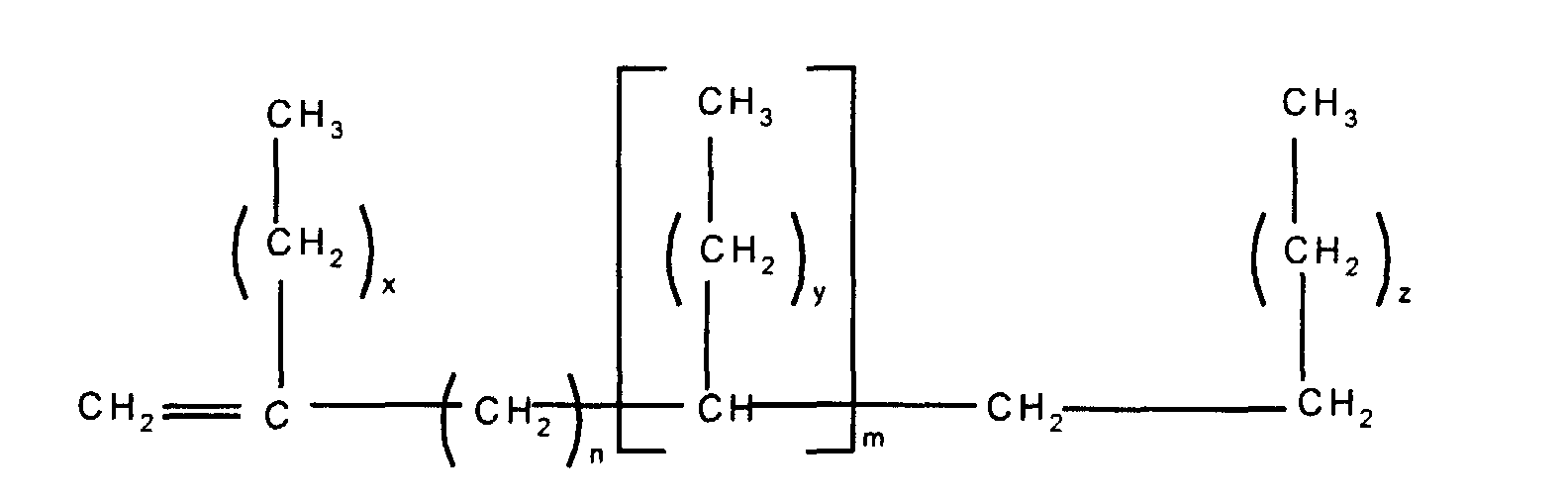
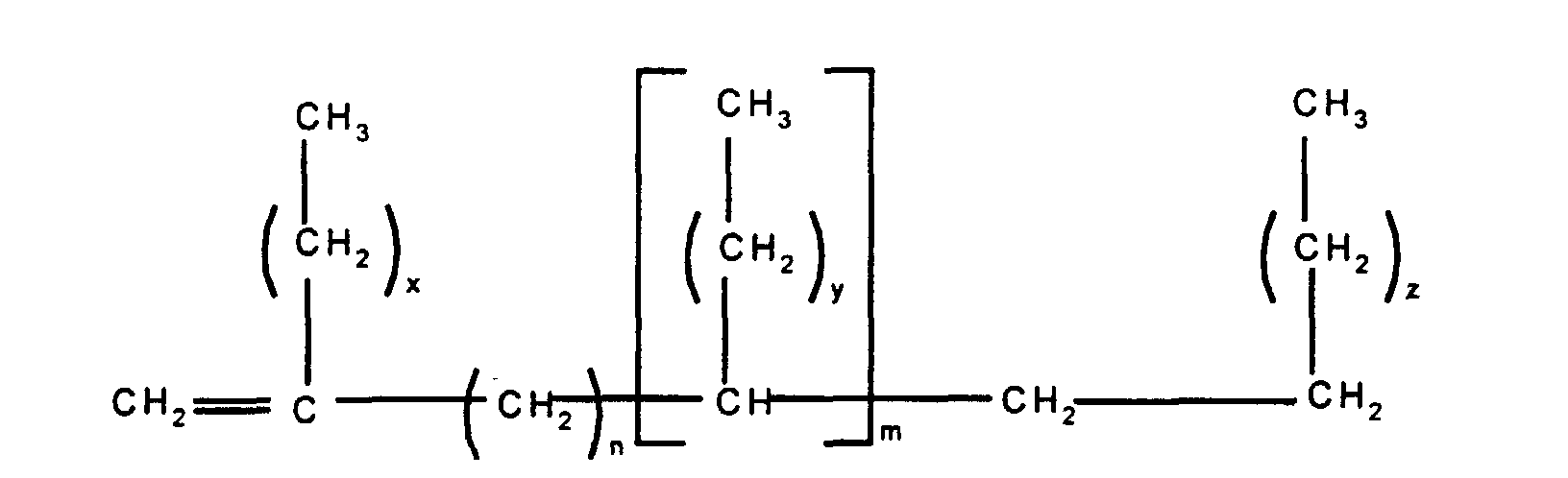
In a first embodiment, this invention relates to a
release modifier composition comprising (i) at least one
alkenyl functional siloxane and (ii) at least one branched
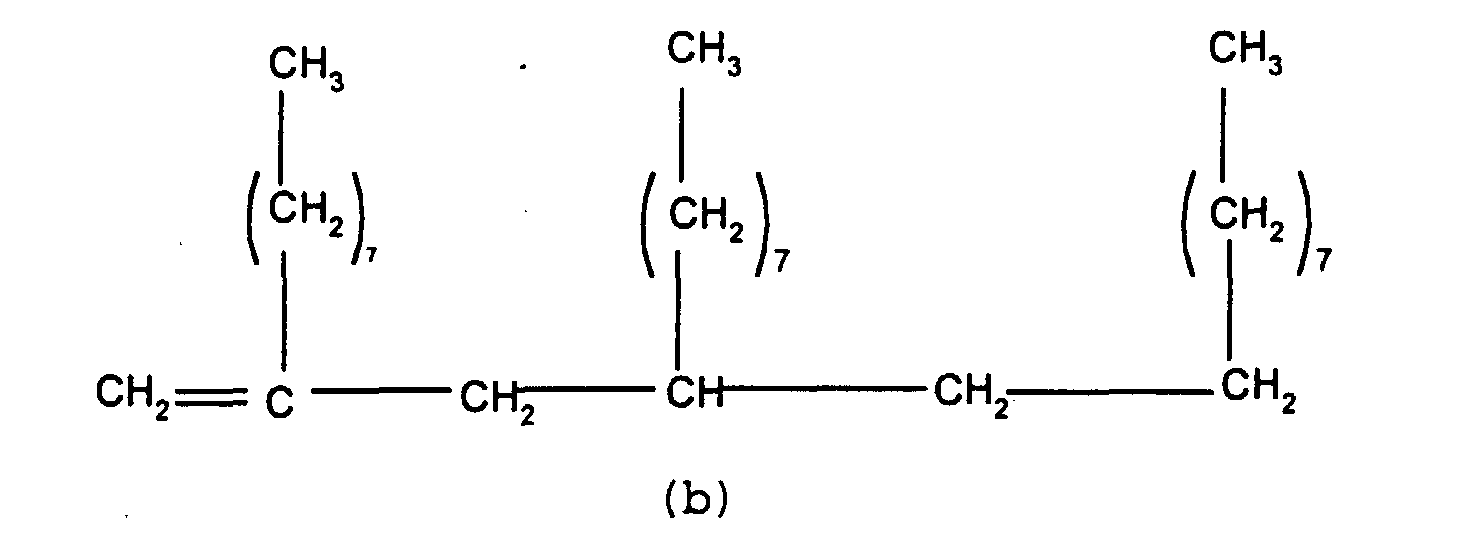
olefin having the formula
wherein n and m independently have a value of from 0 to 20,
the subscripts x, z and y independently have a value of from
1 to 12, with the proviso that the total number of carbon
atoms in each olefin is at least 20.
The alkenyl functional siloxane (i) is preferably
an alkenyl functional polyorganosiloxane having the formula
MD1 aD2 bTcM(c+1) wherein M is R3SiO1/2, D1 is (CH3)2SiO2/2, D2 is
R2SiO2/2 and T is RSiO3/2 wherein the R is independently
selected from the group consisting of alkyl groups, aryl
groups and alkenyl groups. The alkyl groups are exemplified
by methyl, ethyl, propyl, butyl, hexyl, octyl and decyl, the
aryl groups are exemplified by phenyl and the alkenyl groups
are exemplified by vinyl, allyl, 3-butenyl, 4-pentenyl, 5-hexenyl,
cyclohexenyl, 6-heptenyl, 7-octenyl, 8-nonenyl, 9-decenyl,
10-undecenyl, 4,7-octadienyl, 5,8-nonadienyl, 5,9-decadienyl,
6, 11-dodecadienyl and 4,8-nonadienyl.
However, at least one R group per polyorganosiloxane
must be an alkenyl group, a is an integer, b and c
are the same or different and may be 0 or integers. The
value of a + b + c, is preferably from 20 to 750.
The most preferred alkenyl groups are vinyl or
hexenyl. Preferably, b and/or c are 0. Most preferably
both b and c are 0. The value of a + b + c, is most
preferably from 20 to 150. Alkenyl functional
polyorganosiloxane polymers with a higher value of
a + b + c have typically been found to be too viscous to coat
at an appropriate coat weight with respect to solventless
systems and for the preparation of oil-in-water emulsions
with respect to emulsion systems. While polymers with a
value of a + b + c of up to 750 may be used it is preferred
to use polymers with a value of a + b + c of 150 or less as
these provide coatings with better cure characteristics
because of the increased number of alkenyl groups available
for cross-linking purposes compared to polymers with higher
values of a + b +c. The lower value of a + b + c is
determined due to the fact that short chain materials are
expensive to buy and make, are insufficiently viscous to
coat with respect to solventless systems and steric factors
prevent achievement of the desired extent of the
crosslinking reaction.
Thus, component (i) is selected from the group
consisting of trimethylsiloxy-terminated
polydimethylsiloxane-polymethylvinylsiloxane copolymers,
vinyldimethylsiloxy-terminated polydimethylsiloxane-polymethylvinylsiloxane
copolymers, trimethylsiloxy-terminated
polydimethylsiloxane-polymethylhexenylsiloxane
copolymers, hexenyldimethylsiloxy-terminated
polydimethylsiloxane-polymethylhexenylsiloxane copolymers,
vinyldimethylsiloxy-terminated polydimethylsiloxane polymers
and hexenyldimethylsiloxy-terminated polydimethylsiloxane
polymers. The viscosity of Component (i) is from 40 to
100,000 millipascal-seconds (mPa·s) at 25°C., preferably it
is from 40 to 50,000 mPa·s at 25°C. and it is especially
preferred to be from 400 to 10,000 mPa·s at 25°C. (1 mPa·s =
1 centipoise (cP)). It is highly preferred that component
(i) is selected from vinyldimethylsiloxy-terminated
polydimethylsiloxane polymers or hexenyldimethylsiloxy-terminated
polydimethylsiloxane polymers.
The alkenyl functional siloxane (i) may
alternatively be an alkenyl functional siloxane resin
essentially consisting of at least one R1 3SiO1/2 (M) unit and
at least one SiO4/2 (Q) unit wherein R1 is independently
selected from the group consisting of alkyl groups, aryl,
groups and alkenyl groups with the proviso that at least one
R1 is an alkenyl group. The alkyl groups, aryl groups and
alkenyl groups are as defined above. The preferred alkyl
group is methyl, the preferred aryl group is phenyl and the
preferred alkenyl group is vinyl.
The siloxane resins have a molar ratio of M units
to Q units of from 0.6/1 to 4/1. It is preferred that the
siloxane resins of the invention have a molar ratio of M to
Q units of 0.6/1 to 1.9/1, more preferably from 1.2/1 to
1.6/1, and most preferably 1.4/1.
The alkenyl functional siloxane resins of (i) are
exemplified by siloxane resins essentially consisting of
ViMe2SiO1/2 (M) and SiO4/2 (Q) units or essentially consisting
of Me3SiO1/2 (M), ViMe2SiO1/2 (M) and SiO4/2 (Q) units, wherein
Me denotes, and is hereafter, methyl, Vi denotes, and is
hereafter, vinyl and the molar ratio of M to Q units is from
0.6/1 to 1.9/1. Component (i) may also comprise a
combination of an alkenyl functional polyorganosiloxane as
defined above and an alkenyl functional siloxane resin as
defined above.
Component (ii) is the branched olefin having the
above formula. In that formula, it is preferred that x, y
and z independently have a value of from 5 to 8 and, most
preferably, each x, y and z has a value of 7. When n and/or
m are greater than 1 they may be either in the form of a
block as shown in the above formula or may be randomly
distributed along the olefin chain. It is preferred for the
m and n groups to alternate in the format shown in
accordance with the above formula.
Preferably, n and/or m independently have a value
of from 0 to 8 and most preferably n and m have the same
value, i.e. n = m = 0 or n = m = a value of from 1 to 20.
It is particularly preferred for n and/or m = 0 or 1 and
most preferable for n = m =0 or n = m = 1.
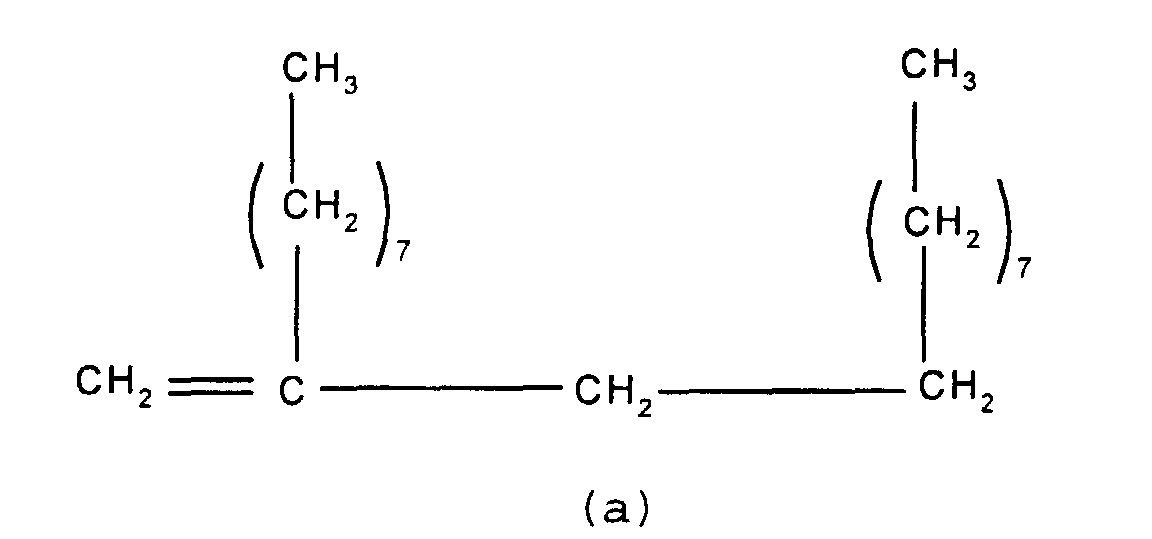
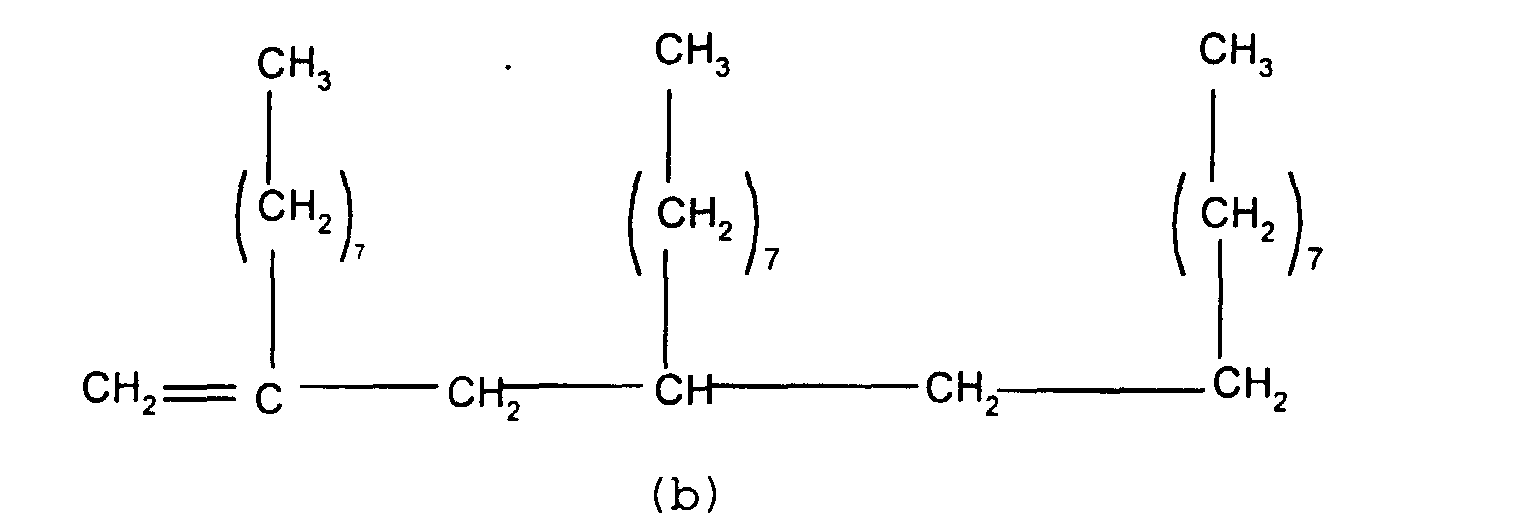
While it is possible to use a single olefin of the
above general formula as component (ii), it has been found
that it is particularly advantageous to use a mixture of
these olefins in a release modifier composition. One olefin
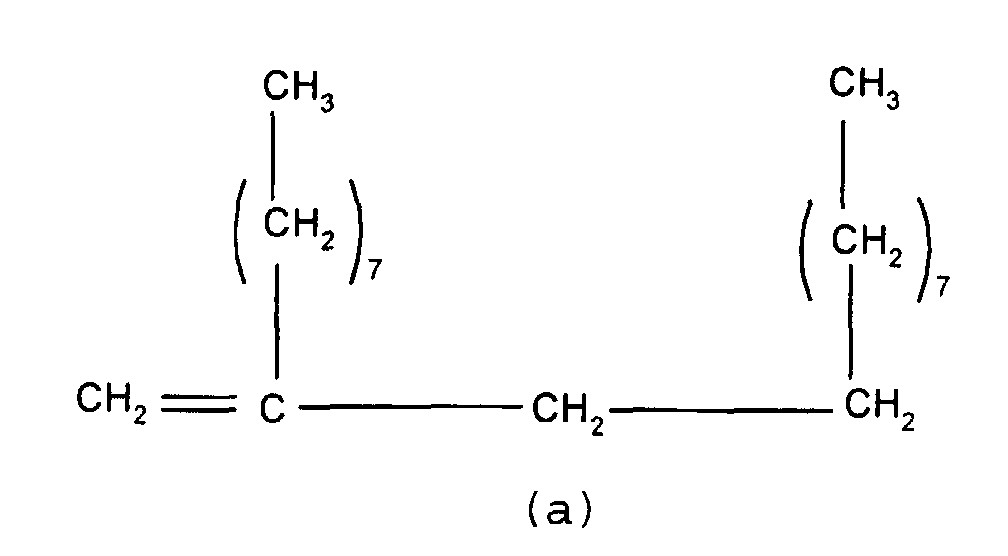
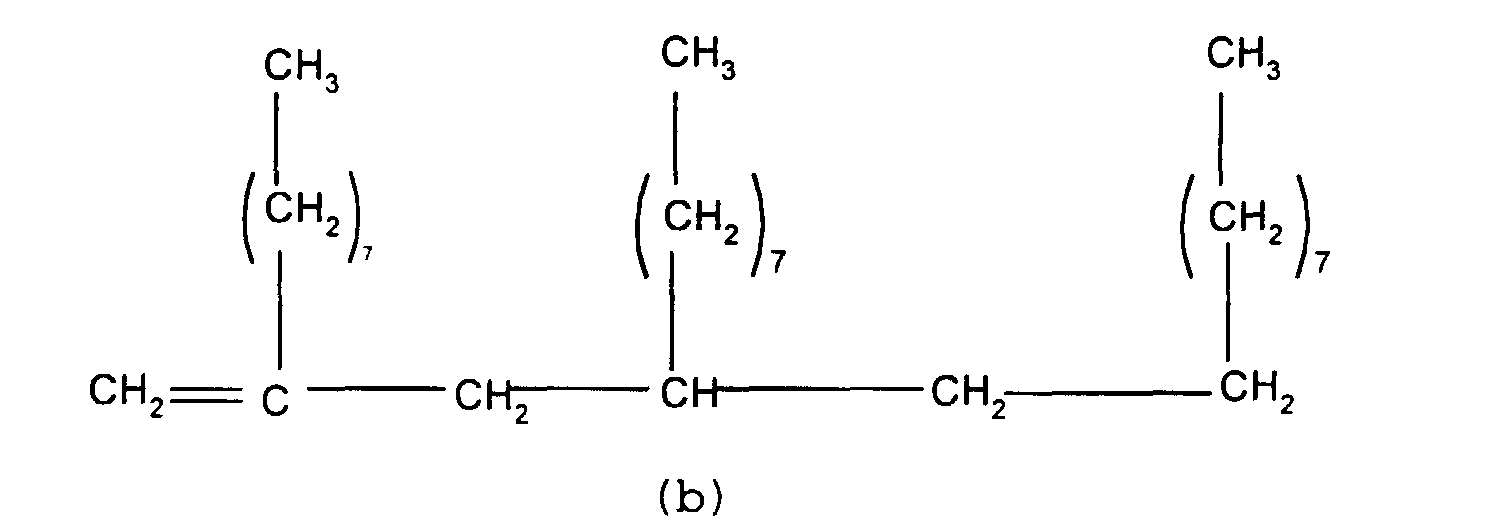
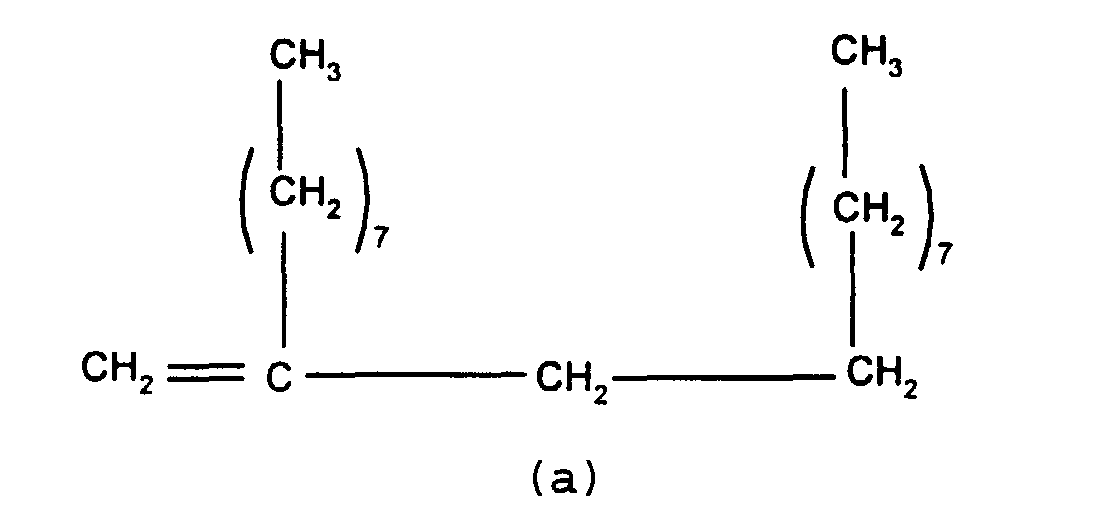
mixture of particular importance comprises (a) a branched
olefin where x and z =7 and n and m=0 and (b) a second
olefin where x, y and z = 7 and n and m = 1. Such compounds
have the formulae shown below
and
While any mixture of these olefins is suitable for
the release modifier composition of the invention, it has
been found that the best results are obtained when the
mixture of (a):(b) is in a weight ratio of from 7:3 to 6:4.
The release modifier composition may further
comprise a siloxane resin essentially consisting of at least
one R2 3SiO1/2 (M) unit and at least one SiO4/2 (Q) unit wherein
R2 is an alkyl group. These siloxane resins have a molar
ratio of M units to Q units of from 0.6/1 to 4/1. It is
preferred that our siloxane resins have a molar ratio of M
to Q units of 0.6/1 to 1.9/1, more preferably from 1.2/1 to
1.6/1, and most preferably 1.4/1. The alkyl group is as
above and is preferably methyl. This siloxane resin is
preferably a siloxane resin essentially consisting of
Me3SiO1/2 (M) and SiO4/2 (Q) units and the molar ratio of M to
Q units is from 0.6/1 to 1.9/1.
In a most preferred embodiment, the release
modifier composition comprises a vinyldimethylsiloxy-terminated
polydimethylsiloxane polymer or
hexenyldimethylsiloxy-terminated polydimethylsiloxane
polymer, one or more of the branched olefins also described
above and a siloxane resin essentially consisting of
Me3SiO1/2 (M), ViMe2SiO1/2 (M) and SiO4/2 (Q) units and/or a
siloxane resin essentially consisting of Me3SiO1/2 (M) and
SiO4/2 (Q) units.
The release modifier composition of the present
invention may be utilized in the form of a solventless
release modifier composition such as a composition having a
first part comprising a vinyldimethylsiloxy-terminated
polydimethylsiloxane polymer and one or more of the branched
olefins described above in a weight ratio of from 9:1 to
3:1; and a second part comprising a siloxane resin
essentially consisting of Me3SiO1/2 (M), ViMe2SiO1/2 (M) and
SiO4/2 (Q) units and/or a siloxane resin essentially
consisting of Me3SiO1/2 (M) and SiO4/2 (Q) units in a weight
ratio of from 20:1 to 1:1. Most preferred is the
combination where the weight ratio of the components in the
first part is 9:1 and the weight ratio of the components of
the second part is 3:1. Furthermore, it is preferred that
the weight ratio of the contents of the first part to the
second part is from 3:2 to 2:3.
A further alternative solventless release modifier
composition in accordance with this invention is provided
having a first part comprising a vinyldimethylsiloxy-terminated
polydimethylsiloxane polymer and one or more of
the branched olefins described above and having as a second
part a siloxane resin essentially consisting of Me3SiO1/2
(M), ViMe2SiO1/2 (M) and SiO4/2 (Q) units.
A still further solventless release modifier
composition in accordance with the present invention
comprises a hexenyldimethylsiloxy-terminated
polydimethylsiloxane polymer, one or more of the above
branched olefins and a siloxane resin essentially consisting
of Me3SiO1/2 (M), ViMe2SiO1/2 (M) and SiO4/2 (Q) units.
Release modifier compositions are typically sold
in the form of controlled release additives which comprise
the release modifier composition as described above and
optionally an inhibitor, a platinum group-metal containing
catalyst and at least one organohydrogensiloxane which are
described infra.
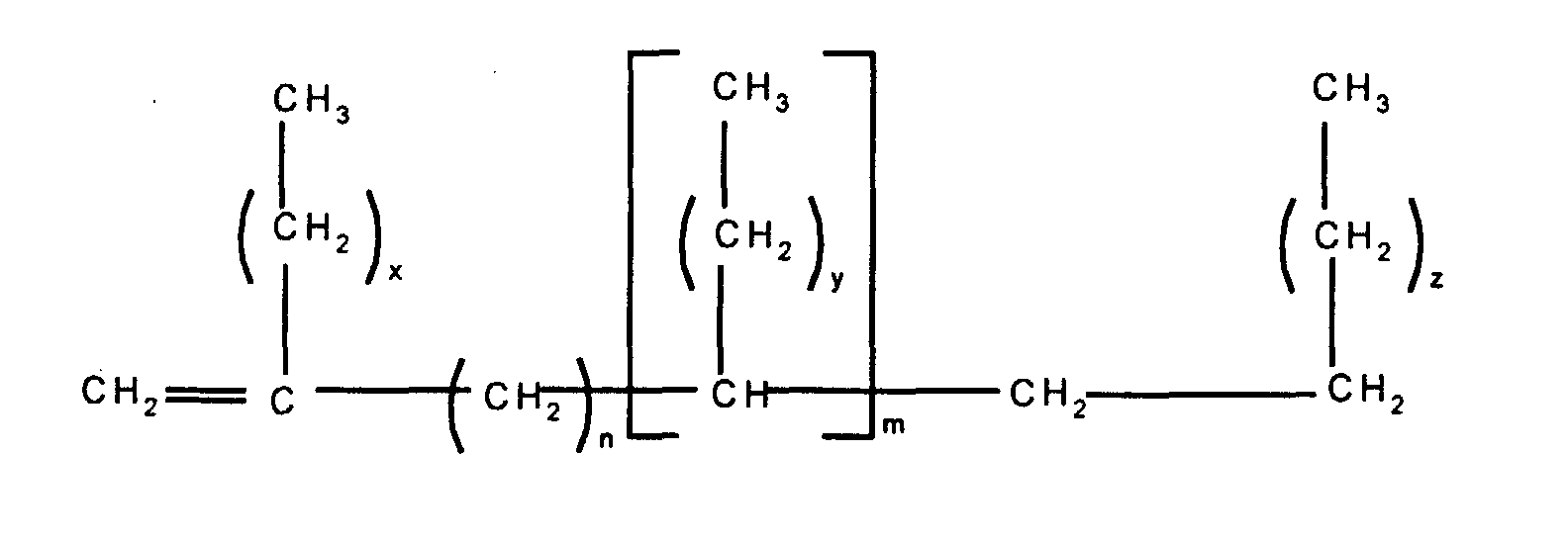
In a second embodiment, this invention relates to
a silicone release coating composition comprising (i) at
least one alkenyl functional polyorganosiloxane having at
least two silicon-bonded alkenyl groups per molecule, (iii)
at least one organohydrogensiloxane having at least two
silicon-bonded hydrogen groups per molecule, (iv) a platinum
group metal-containing catalyst, and (v) a release modifier
composition comprising (a) an alkenyl functional siloxane
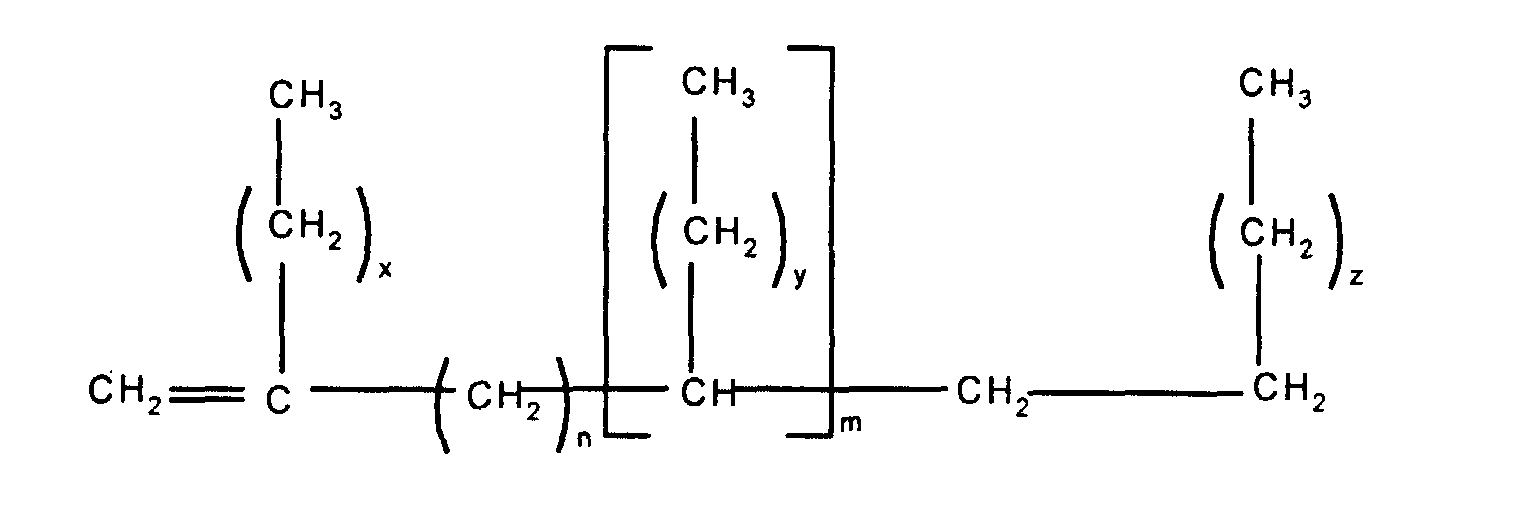
and (b) at least one branched olefin having the formula
wherein n and m independently have a value of from 0 to 20,
the subscripts x, z and y independently have a value of from
1 to 12 with the proviso that the total number of carbon
atoms in each olefin is at least 20.
The alkenyl functional polyorganosiloxane polymer
of (i) is as described above including preferred embodiments
thereof. Preferably the alkenyl functional organopolysiloxane
polymer of (i) is selected from the group
consisting of trimethylsiloxy-terminated polydimethylsiloxane-polymethylvinylsiloxane
copolymers,
vinyldimethylsiloxy-terminated polydimethylsiloxane-polymethylvinylsiloxane
copolymers, trimethylsiloxy-terminated
polydimethylsiloxane-polymethylhexenylsiloxane
copolymers, hexenyldimethylsiloxy-terminated
polydimethylsiloxane-polymethylhexenylsiloxane copolymers,
vinyldimethylsiloxy-terminated polydimethylsiloxane polymers
and hexenyldimethylsiloxy-terminated polydimethylsiloxane
polymers. Component (i) can also be a combination of two or
more of the above described alkenyl functional
polyorganosiloxane polymers. The viscosity of Component (i)
is from 40 to 100,000 mPa·s at 25°C., preferably it is from
40 to 50,000 mPa·s at 25°C., and it is especially preferred
from 400 to 10,000 mPa·s at 25°C.
Component (iii) is at least one organohydrogen-siloxane
having at least two silicon-bonded hydrogen atoms
per molecule. Component (iii) is preferably an
organohydrogen-siloxane compound which is free of aliphatic
unsaturation and contains two or more silicon atoms linked
by divalent radicals, an average of from one to two silicon-bonded
monovalent radicals per silicon atom and an average
of at least two silicon-bonded hydrogen atoms per compound.
Preferably, the organohydrogensiloxane (iii) contains an
average of at least three silicon-bonded hydrogen atoms such
as, for example, 3, 5, 10, 20, 40, 70, 100 or more. The
organohydrogensiloxane compounds suitable as Component (iii)
can linear, branched, resinous or cyclic, however,
preferably they are linear.
Component (iii) is exemplified by
dimethylhydrogensiloxy-terminated polydimethylsiloxanes,
dimethylhydrogensiloxy-terminated polymethylhydrogensiloxanes,
dimethylhydrogensiloxy-terminated
polydimethylsiloxane-polymethylhydrogensiloxane copolymers,
trimethylsiloxy-terminated polydimethylsiloxane-polymethylhydrogensiloxane
copolymers, trimethylsiloxy-terminated
polymethylhydrogensiloxanes, PrSi(OSiMe2H)3,
cyclic methylhydrogensiloxanes, siloxane resins consisting
essentially of Me2HSiO1/2 units and SiO2 units. Component
(iii) can also be a combination of two or more of the above
described organohydrogensiloxanes.
The viscosity at 25°C. of Component (iii) is
generally from 1 to 2000 mPa·s, and is preferably from 5 to
45 mPa·s.
The amount of Components (i) and (iii) that is
used in the compositions of this invention is not narrowly
limited. The amounts, expressed in terms of the ratio of
the number of silicon-bonded hydrogen atoms of Component
(iii) to the number of silicon-bonded alkenyl groups of
Component (i), is sufficient to provide a ratio of at least
1/4 to 100/1, preferably from 1/2 to 20/1, and most
preferably from 1/1 to 3/1.
Component (iv) is any platinum group metal-containing
catalyst which facilitates the reaction of
silicon-bonded hydrogen atoms of component (iii) with
silicon-bonded alkenyl radicals of component (i). By
platinum group, we mean ruthenium, rhodium, palladium,
osmium, iridium and platinum.
The platinum group metal-containing catalyst is
preferably a platinum containing catalyst since they are the
most widely used and available and because they provide a
more favorable effect for the compositions of this invention
in terms of improved reaction rates. Platinum-containing
catalysts herein include a compound or complex of a platinum
metal.
One type of preferred platinum-containing catalyst
in the compositions of this invention is the composition
that is obtained when chloroplatinic acid is reacted with an
aliphatically unsaturated organosilicon compound such as
divinyltetramethyldisiloxane, as disclosed by U.S. Patent
3,419,593, because of its easy dispersibility in
organosilicon systems.
Preferably, this catalyst is selected from the
group consisting of chloroplatinic acid, alcohol modified
chloroplatinic acids, olefin complexes of chloroplatinic
acid, complexes of chloroplatinic acid and
divinyltetramethyldisiloxane, fine platinum particles
adsorbed on carbon carriers, platinum black, platinum
acetylacetonate, platinous halides exemplified by PtCl2,
PtCl4, Pt(CN)2, complexes of platinous halides with
unsaturated compounds exemplified by ethylene, propylene and
organovinylsiloxanes, styrene hexamethyldiplatinum and
RhCl3(Bu2S)3.
The amount of platinum group metal-containing catalyst
component that is used is not narrowly limited as long as
there is a sufficient amount to accelerate a room
temperature reaction between an organohydrogensiloxane and
an alkenyl organopolysiloxane and not so much as to make its
action uncontrollable by the use of an inhibitor. The exact
necessary amount of this catalyst component will depend on
the particular catalyst utilized and is not easily
predictable. However, for platinum-containing catalysts the
amount can be as low as one part by weight of platinum for
every one million parts by weight of components (i) + (iii).
However, preferably the catalyst is added at an amount of 10
to 500 parts per one million parts of components (i) +
(iii), and it is highly preferred that the amount is at 50
to 250 parts by weight of platinum for every one million
parts by weight of (i) + (iii).
Component (v), the release modifier is as
described above including preferred embodiments thereof.
Preferably, the alkenyl functional siloxane of (v) (a) is
selected from the group consisting of vinyldimethylsiloxy-terminated
polydimethylsiloxane polymers or
hexenyldimethylsiloxy-terminated polydimethylsiloxane
polymers. The viscosity of Component (v) (a) is typically
from 40 to 100,000 mPa·s at 25°C., preferably from 40 to
50,000 mPa·s at 25°C. and it is especially preferred from
400 to 10,000 mPa·s at 25°C.
Component (v) (b), the branched olefin, is as
described above including preferred embodiments thereof.
Preferably x, y and z independently have a value of from 5
to 8 and most preferably each x, y and z has a value of 7.
Preferably n and/or m independently have a value
of from 0 to 8 and most preferably n and m have the same
value, i.e. n = m = 0 or n = m = a value of from 1 to 20.
It is particularly preferred for n and/or m = 0 or 1 and
most preferable for n = m =0 or n = m = 1.
It is especially preferred that component (v) (b)
is a mixture comprising (1) a branched olefin where x and z
= 7 and n and m = 0 and (2) a branched olefin where x, y and
z = 7 and n and m = 1. Preferably the mixture of
(v) (b) (i) : (v) (b) (2) is in a weight ratio of from 7:3 to 6:4.
Typically, from 10 to 50 wt% of the alkenyl
functional polyorganosiloxane in the silicone release
coating emulsion composition is replaced by component (iv),
the release modifier composition, although significantly
more of the alkenyl functional polyorganosiloxane, such as
80 or even 100 wt%, can be replaced by the release modifier
composition as and when required.
When the silicone release coating of this
invention is in emulsion form, the composition further
comprises at least one surfactant and water. The surfactant
preferably is selected from the group consisting of anionic
surfactants, cationic surfactants and nonionic surfactants.
The surfactant component can also be a combination of two or
more of the above described surfactants. It is preferred
that the surfactant component is a nonionic surfactant.
Preferably, the surfactant is polyvinylalcohol having a
degree of hydrolysis of at least 92%, and most preferably
from 92-98%. Polyvinylalcohol is made by hydrolyzing
polyvinylacetate to various degrees. The degree of
hydrolysis of a polyvinylalcohol is a number which
represents the percentage of pendant acetate groups,
originally present in the polyvinylacetate, that have been
converted to pendant hydroxyl groups.
The silicone release coating emulsion compositions
of this invention generally can comprise any amount of the
aforementioned components such as from 1 to 75, preferably 1
to 50, and most preferably 10 to 40 parts by weight for
every 50 parts by weight of water. Typically, from 1 to 5
percent by weight based on the total weight of these
components of a surfactant is also used. Water forms the
remainder of our emulsion, and is preferably clear water,
and most preferably distilled and/or deionized water.
The emulsions of this invention further comprise
optional ingredients exemplified by biocides exemplified by
TEKTAMER™ 38 A.D. (available from Calgon Corporation) and by
viscosity increasing additives exemplified by carboxymethyl
cellulose, hydroxyethyl cellulose and sodium alginates.
The silicone release coating emulsion compositions
of this invention are conveniently prepared by adding at
least one surfactant and water to the preceding components.
The order of mixing the components is not critical; however,
it is preferred to mix components (i), (iii), (v), at least
one surfactant, water, and any optional ingredients together
and then to add component (iv) to this mixture just before
the release coating emulsion is used. Generally, these
emulsions are prepared by reacting a mixture comprising the
above components, surfactants and water, and any optional
ingredients. "Reacting" for the purposes of this invention
denotes simply mixing said components and any optional
components at room temperature (25°C.) or heating a mixture
of said components and any optional components at
temperatures above room temperature. It is preferred to
simply mix the components. The crude emulsion may then be
mixed using any of the known homogenizer machines to form an
emulsion having the desired particle size and distribution.
The silicone release coating compositions and the
silicone release coating emulsion compositions of this
invention further comprise an inhibitor. The inhibitor is
utilized to prevent the cure of the coating from occurring
below a predetermined temperature. While an inhibitor is
not essential to the functioning of the coating itself it is
to be understood that without the presence of an inhibitor
the catalyst may initiate/catalyze the cure of the silicone
release coating composition at ambient temperature.
The inhibitor is any material that is known to be,
or can be, used to inhibit the catalytic activity of
platinum group metal-containing catalysts. By the term
"inhibitor", we mean a material that retards the room
temperature curing of a curable mixture of an alkenyl
functional polyorganosiloxane, an organohydrogensiloxane and
a platinum catalyst, when incorporated therein in small
amounts, such as less than 10 parts by weight of the
composition, without preventing the elevated temperature
curing of the mixture. Examples of suitable inhibitors
include ethylenically or aromatically unsaturated amides,
acetylenic compounds including acetylenic alcohols and
silylated acetylenic alcohols, ethylenically unsaturated
isocyanates, olefinic siloxanes, unsaturated hydrocarbon
diesters, conjugated ene-ynes, olefinic cyclosiloxanes,
hydroperoxides, nitriles and diaziridines.
Preferred inhibitors are exemplified by acetylenic
alcohols exemplified by 1-ethynyl-1-cyclohexanol, 2-methyl-3-butyn-2-ol,
2-phenyl-3-butyn-2-ol, 2-ethynyl-isopropanol,
2-ethynyl-butane-2-ol and 3,5-dimethyl-l-hexyn-3-ol,
silylated acetylenic alcohols exemplified by trimethyl(3,5-dimethyl-1-hexyn-3-oxy)silane,
dimethyl-bis-(3-methyl-1-butyn-oxy)silane,
methylvinylbis(3-methyl-1-butyn-3-oxy)silane
and ((1,1-dimethyl-2-propynyl)oxy)trimethylsilane,
unsaturated carboxylic esters exemplified by diallyl
maleate, dimethyl maleate, diethyl fumarate, diallyl
fumarate and bis(2-methoxy-1-methylethyl) maleate,
conjugated ene-ynes exemplified by 2-isobutyl-1-butene-3-yne,
3,5-dimethyl-3-hexene-1-yne, 3-methyl-3-pentene-1-yne,
3-methyl-3-hexene-1-yne, 1-ethynylcyclohexene, 3-ethyl-3-butene-1-yne
and 3-phenyl-3-butene-1-yne,
vinylcyclosiloxanes such as 1,3,5,7-tetramethyl-1,3,5,7-tetravinylcyclotetrasiloxane,
a mixture comprising a
conjugated ene-yne and a vinylcyclosiloxane, a mixture
comprising a vinylcyclosiloxane and an acetylenic alcohol,
and a mixture comprising an unsaturated carboxylic ester and
an alcohol exemplified by benzyl alcohol and 1-octanol.
The amount of inhibitor used in the silicone
release coating compositions of this invention is not
critical and is any amount that will retard the reaction
between Components (i) and (iii) initiated by the presence
of catalyst (iv) while not preventing this reaction at
elevated temperatures. No specific amount of inhibitor is
suggested to obtain a specified pot life at room temperature
since the desired amount of any particular inhibitor will
depend on the type of platinum group metal-containing
catalyst (iv) which is used, the nature and amounts of
ingredients (i), (iii) and (v) and the presence or absence
of optional ingredients. The affinity of a particular
inhibitor for platinum also has to be considered when
selecting a molar ratio of inhibitor to platinum and is
conveniently determined by routine experimentation.
However, it is preferred that from 0.1 to 10 parts by weight
of inhibitor be used and it is highly preferred that from
0.5 to 5 parts by weight of inhibitor be employed per 100
parts by weight of Component (i).
The silicone release coating compositions of this
invention are readily prepared by reacting a mixture of
these ingredients, and any optional ingredients, in any
order using any suitable mixing means such as a spatula, a
drum roller, a mechanical stirrer, a three-roll mill, a
sigma blade mixer, a bread dough mixer and a two-roll mill.
"Reacting" for the purposes of this invention denotes simply
mixing all components, and any optional components at room
temperature (25°C.) or heating a mixture of these
components, and any optional components, at temperatures
above room temperature. It is preferred to simply mix the
components. The order of mixing the components is not
critical; however, it is preferred to mix components (i),
(iii), (iv), (v), and any optional ingredients together, and
then to add component (iv) to said mixture just before the
release coating composition is used.
In a third embodiment, this invention relates to a
method of making an article of manufacture comprising (I)
applying a silicone release coating composition to a surface
of a substrate wherein the silicone release coating
composition comprises: (i) at least one alkenyl functional
polyorganosiloxane having at least two silicon-bonded
alkenyl groups per molecule, (iii) at least one
organohydrogensiloxane having at least two silicon-bonded
hydrogen groups per molecule, (iv) a platinum group metal-containing
catalyst, and (v) a release modifier composition
comprising (a) an alkenyl functional siloxane and (b) at
least one branched olefin having the formula
wherein n and m independently have a value of from 0 to 20,
the subscripts x, z and y independently have a value of from
1 to 12, with the proviso that the total number of carbon
atoms in each olefin is at least 20.
The silicone release coating composition further
comprises surfactants and water when it is desired to have
the release coating in the form of an emulsion. The
silicone release coating composition and the silicone
release coating emulsion may further comprise an inhibitor
and any of the optional ingredients recited above.
Components (i), (iii), (iv) and (v), and the optional
ingredients, are as described above, including amounts and
preferred embodiments thereof.
The method of this invention further comprises
(II) exposing the product of (I) to heat in an amount
sufficient to cure the silicone release coating composition.
The method of this embodiment of our invention also further
comprises (III) applying an adhesive to the product of (I)
or the product of (II).
Preferably, the substrate is a flexible sheet
material such as paper, polyolefin film, polyolefin-coated
paper or foil. Other suitable solid substrates can be
coated by the method of this invention and include other
cellulosic materials, such as wood, cardboard and cotton;
metallic materials, such as aluminum, copper, steel and
silver; siliceous materials such as glass and stone; and
synthetic polymer materials, such as polyolefins,
polyamides, polyesters and polyacrylates. As to the form of
the solid substrate, it can be substantially sheet-like,
such as a peelable release liner for pressure sensitive
adhesive, a fabric, a foil or even substantially three-dimensional
in form.
The application herein of the silicone release
coating composition to the substrate is accomplished by any
suitable manner known in the art, such as by spreading,
brushing, extruding, spraying, gravure, kiss-roll and air-knife.
By heat, we mean infrared radiation, hot-air or
microwave radiation.
After the curable silicone release coating
composition has been coated onto a substrate, it is next
heated to cure the liquid coating and to adhere it to the
substrate.
In a preferred embodiment of this invention, a
flexible sheet material, such as paper, metal foil or
tapestock, is first coated with a thin coating of the liquid
curable silicone release coating composition, preferably in
a continuous manner and the coated material is next heated
rapidly to cure the coating and to provide a sheetlike
material bearing on at least one surface thereof an
adhesive-releasing coating. The adhesive-releasing coating
is subsequently brought into contact with a pressure
sensitive adhesive to form an article having a peelable,
i.e. releasable, adhesive/coating interface.
Examples of such an article include, adhesive
labels having a peelable backing, adhesive tape in roll form
and adhesive packaged in a strippable container. The
pressure sensitive adhesive can be non-silicone-based, such
as the well-known acrylic or rubber types or silicone-based,
such as the peroxide-or platinum-curable polydiorganosiloxane-based
adhesives.
The method of this invention is also applicable to
adhesive materials, other than pressure sensitive adhesives.
Examples of said adhesive materials include foods, asphalt
and gum polymers.
As a comparison to the silicone based release
compositions of the present invention, we have also prepared
a number of samples outside the scope of the invention. For
instance, it was noted that prior art release modifier
compositions often comprise a linear C16-18 α-olefin together
with an alkenyl (usually vinyl) terminated MQ resin. We
have found that a minor improvement to the properties of our
release modifier composition occurs with the introduction of
a trimethylsiloxy endcapped polysiloxane resin as compared
to the prior art composition mentioned above. However, this
improvement is relatively small compared with replacing the
C16-18 α-olefins with branched olefins as claimed and
described herein.
We have also determined that, while the
preparation of a copolymer of the crosslinking agent and one
or more of the branched olefins may be used to crosslink the
alkenylated polysiloxane polymer(s), such a release modifier
does not provide sufficient advantageous release
modification; and therefore, it is believed that the
branched olefins as claimed herein for our release modifier
composition must be present in a form which is not a
copolymer.
The following examples illustrate the present
invention by comparing the properties of release modifiers
compositions of the present invention with known release
modifier compositions.
Release modifier compositions were then prepared
by mixing 68 weight percent (wt%) of a siloxane resin
consisting essentially of Me
3SiO
1/2 (M), ViMe
2SiO
1/2 (M) and
SiO
4/2 (Q) units, the molar ratio of M to Q units is from
0.7/1 and the siloxane resin contains 1.75 to 2.3 wt% vinyl,
4.8 wt% of a vinyldimethylsiloxy-terminated
polydimethylsiloxane having a viscosity of 9000 mPa·s at
25°C. and 27.2 wt% of olefin. The xylene was then removed
by stripping under vacuum. Several tests were carried out
utilizing these release modifier compositions whereby the
olefin was either a branched olefin mixture containing
and
and the mixture of (a):(b) was in a weight ratio of from 7:3
to 6:4 or 1-octadecene (a C18 (-olefin). All other
constituents of the release modifier compositions were
identical. In all subsequent examples the release modifier
composition prepared above containing the branched olefin
mixture will be referred to as release modifier composition
X and the comparative release modifier composition
incorporating an identical wt% of 1-octadecene will referred
to as release modifier composition Y.
The variation of viscosity with temperature of
each of the release modifier compositions X and Y was
determined by first measuring the viscosity at a standard
temperature, 23°C. and 50% Relative Humidity, using a
Brookfield™ viscometer. The temperature was then gradually
reduced and viscosity values were taken at 10oC and 0oC.
The results appear in Table 1.
| TEMP | | Release Modifier |
| OC | Y | X |
| 0 | SOLID | 15686 |
| 10 | SOLID | 7843 |
| 20 | 588 | 3137 |
All viscosity measurements in Table 1 are in mPa·s.
It is noted that release modifier composition X,
which contained the branched olefin mixture, was still in a
liquid form at a temperature of 0°C. whereas composition Y,
containing 1-octadecene, was found to be a solid at 10°C.
Example 2
Release modifier compositions X and Y were
compared with respect to their smoking properties by placing
the samples of each release modifier composition in an oven
which was maintained at a constant temperature of 200°C.
This temperature is significantly in excess of normal curing
temperatures used with conventional silicone release coating
compositions which are usually from 120 to 150°C. It was
found that smoke was visible less than 90 seconds after
introducing the sample of release modifier composition Y
into the oven, but it took over 240 seconds before any
smoking was visible from the sample of release modifier
composition X. This fact demonstrates that there is a
significant reduction in smoking when our branched olefin
mixture is used in a release modifier composition instead of
1-octadecene.
Example 3
Samples of release modifier compositions X and Y
were prepared as before with the addition of small amounts
of an inhibitor and a catalyst. The resultant release
modifier compositions X1 and Y1, contained 97.08 weight % of
release modifier compositions X and Y, respectively, with
0.97 wt% of bis(2-methoxy-1-methylethyl) maleate and 1.95
wt% a platinum catalyst containing a complex of
chloroplatinic acid and divinyltetramethyldisiloxane diluted
in vinyldimethylsiloxy-terminated polydimethylsiloxane and
having a viscosity of 450 mPa·s to provide 1.5 wt% platinum
metal. This catalyst composition was prepared according to
Example 1 of U.S. Patent 3,419,593 (hereinafter referred to
as "platinum catalyst").
Release modifier compositions X1 and Y1 were then
mixed into identical silicone release compositions to form
solventless release coating compositions. In addition to
the release modifiercompositions, the solventless release
coating compositions contained a vinyldimethylsiloxy-terminated
polydimethylsiloxane having a viscosity of 9000
mPa·s (millipascal-seconds) at 25°C., and a sufficient
amount of trimethylsiloxy-terminated methylhydrogenpolysiloxane
and trimethylsiloxy-terminated polydimethylsiloxane-polymethylhydrogensiloxane
copolymer to provide a
ratio of the total number of silicon-bonded hydrogen atoms
to the total number of silicon-bonded alkenyl groups of
1.15:1 in the solventless release coating composition.
A number of solventless release coating
compositions were prepared wherein the relevant release
modifier composition replaced a proportion of the
vinyldimethylsiloxy-terminated polydimethylsiloxane polymer,
indicated in the following table, in which the wt% of
release modifier present is varied.
The solventless release coating compositions were
applied on to a clay coated paper (Cham Tenero CT-688) using
a Euclid® laboratory coater to give a coating of 1g/m2.
Papers coated with the solventless release coating
composition were subsequently placed in an oven at 120°C.
for 20 seconds to cure said coating composition. The coated
papers were then aged for 7 days at 23°C. and 50% relative
humidity. Laminates were then prepared by applying adhesive
coated high gloss white facestock (from Avery Dennison
Corporation) onto the cured coatings. The laminates were
aged at an elevated temperature overnight to ensure intimate
wetting of adhesive on the silicone coating.
High speed release performance (g/50mm) was then
determined by delamination of the tapes using an
Instrumentors™ Inc. ZPE-1000 High Rate Peel Tester at a
variety of speeds. A further comparison was made wherein
the coating was the premium release coating. The results of
the tests are in Table 2.
The delamination of the adhesive coated high gloss
white facestock from coatings containing release modifier X1
gave significantly higher values than the comparative
samples.
| % | MODIFIER | DELAMINATION SPEED (m/min) |
| Release Modifier | | 0.3 | 10.0 | 20.0 | 100.0 | 200.0 |
| | | performance (g/50mm) |
| 0 | None present | 6 | 20 | 28 | 62 | 73 |
| 40 | Y1 | 16 | 40 | 53 | 165 | 229 |
| 40 | X1 | 58 | 107 | 156 | 327 | 355 |
The higher results provided by X1 are improvements
over the comparative prior art example using Y1, as these
higher values mean that the compositions of this invention
may be used to produce a wider range of end products and
because a reduced amount of our new release modifier will be
required in a typical release coating composition to achieve
any given level of desired release performance.
Example 4
Low speed release performance delamination tests
were also performed using the same coating compositions as
abpve using two alternative test tapes. The tapes were
TESA® 4651 which uses a rubber adhesive and TESA® 7475 which
uses an acrylic adhesive. In these tests, delamination was
undertaken using a Lloyd® Instruments L500 Tensometer at a
delamination speed of 0.3m/min. In each of the two sets of
tests, the coating compositions containing release modifier
composition X1 gave significantly higher results than
comparative coating compositions.
For these cases, two different criteria were used
to test the performance after different periods of time.
Immediate/20 hours means that the relevant coating was
laminated immediately after curing and then delamination was
undertaken after conditioning the laminate for 20 hours at
23°C. and 50% relative humidity. Similarly 7 Days/20 hours
means that lamination was undertaken 7 days after curing and
then delamination was carried out after conditioning the
laminate for 20 hours at 23°C. and 50% relative humidity.
In both cases, the coating compositions containing release
modifier composition X1 provided higher results. The
results are shown in Table 3.
| | | 0% RM | 40% RM Y1 | 40% RM X1 |
| Tape | Aging | Release (g/25mm) |
| 4651 | Immediate/20 hours | 6.5 | 14.3 | 20.1 |
| | 7 Days/20 hours | 4.7 | 13.4 | 29.2 |
| 7475 | Immediate/20 hours | 9.3 | 51.0 | 196.7 |
| | 7 days/20 hours | 5.6 | 10.2 | 20.3 |
In this example, the branched olefin mixture was
used as the sole component of the release modifier in a
composition containing vinyldimethylsiloxy- terminated
polydimethylsiloxane polymer, a trimethylsiloxy-terminated
polydimethylsiloxane-polymethylhydrogensiloxane copolymer,
platinum catalyst and bis(2-methoxy-1-methylethyl) maleate.
In this example, the only compositional variations were the
replacement of polymer by the olefin mixture. Table 4
presents the amount of the branched olefin mixture used to
replace the equivalent amount of polymer per 100g of the
polymer.
In this instance, the two TESA tapes used for
lamination purposes were the 7475 acrylic based tape and
7476 rubber based tape. The release coating compositions
were coated onto 87g super calendered Kraft paper (Nicolet™)
and the pull speed utilized was 10.16 meters per minute (400
inches per minute). The coatings were laminated with the
tapes immediately after curing and the laminates were then
aged at 23°C. and 50% Relative Humidity for seven days
before delamination. The results are given in Table 4.
| Amount of branched olefin mixture (g per 100g of polymer) | 7475 Tape | 7476 Tape |
| | (g per inch) |
| 0.0 | 37.5 | 16.3 |
| 0.7 | 46.6 | 35.1 |
| 2.5 | 70.1 | 41.5 |
| 6.0 | 154.4 | 47.2 |
During the curing process, the organohydrogen-siloxane
crosslinking agent reacts with the alkenyl group of
the branched olefin. The following tests were performed
with a view to determine whether a crosslinking agent
comprising a copolymer of the standard crosslinking agent
and the branched olefin mixture would provide similar
results to those release coating compositions which comprise
the two components individually in a composition.
Three of the copolymer crosslinking agents were
prepared using a trimethylsiloxy-terminated
polydimethylsiloxane-polymethylhydrogensiloxane copolymer,
platinum catalyst and a branched olefin mixture. The
samples were prepared using the following amounts in parts:
| Copolymer | A' | B' | C' |
| crosslinking agent | 55.7 | 68.4 | 89.6 |
| branched olefin mixture | 44.1 | 31.6 | 14.6 |
| Pt catalyst | 0.21 | 0.2 | 0.20 |
The co-polymers A', B' and C' were then incorporated in to
release coating compositions A'', B'' and C'' as shown
below.
A'' was 100g of 100 degree of polymerization (DP)
vinyldimethylsiloxy-terminated polydimethylsiloxane polymer,
7.6g of copolymer A', 1g of bis(2-methoxy-1-methylethyl)
maleate and 2 g of platinum catalyst.
Compositions B'' and C'' were the same as A" apart
from the fact that they contained 5.4g of copolymer B' and
4.2g of copolymer C', respectively.
The release coating compositions A'', B'' and C''
were compared with a composition which solely contained a
trimethylsiloxy-terminated polydimethylsiloxane
polymethylhydrogensiloxane copolymer crosslinking agent D.
The solventless release coating compositions were
applied on to a clay coated paper (Cham Tenero CT-688) using
a Euclid® laboratory coater to give a coating of 1g/m
2.
Papers coated with the solventless release coating
compositions were subsequently placed in an oven at 120°C.
for 20 seconds to cure said compositions. The following
results were obtained with respect to immediate lamination
and after 7 days of aging, the laminate at 23°C. and 50%
relative humidity. The tapes used in the lamination were
again TESA 7475 and TESA 7476. The results are reported in
Table 5.
| Release Composition | 7475 TAPE | 7476 TAPE |
| D | 37.5 | 16.3 |
| A'' | 41.3 | 37.7 |
| B'' | 40.6 | 46.4 |
| C'' | 38.1 | 45.5 |
It is evident from the above results that a
copolymer of the branched olefin mixture and
trimethylsiloxy-terminated polydimethylsiloxane-polymethylhydrogensiloxane
copolymer do not provide useful
release coating compositions.
Example 7
Oil-in-water based silicone release coating
emulsions were prepared for a comparative study of the
effects of the branched olefin mixture with 1-octadecene in
release modifier compositions. The results obtained are
also compared with an example wherein no release modifier
composition was present.
The release modifier emulsions containing the
branched olefin mixture are subsequently referred to as X111.
The release modifier emulsions containing the 1-octadecene
are subsequently referred to as Y111.
Release modifier emulsions X111 and Y111 were
prepared by mixing 35.6 wt% of release modifier composition
X and Y respectively, 20 wt% of a 9.5 wt% polyvinylalcohol
solution in water, with the polyvinylalcohol having a degree
of hydrolysis of 96%, 39.9 wt% water and 4.4 wt% being made
up of trimethylsiloxy-terminated polydimethylsiloxane-polymethylhydrogensiloxane
copolymer having a viscosity of
85 mm2/s. The crude emulsion was homogenized using a high
pressure (HP) sonolator to provide an oil-in-water emulsion.
Then, 0.1 wt% of 3,5-dimethyl-1-hexyn-3-ol was added to the
emulsion.
A base emulsion was prepared by mixing 34.6 wt% of
a dimethylvinylsiloxy-terminated polydimethylsiloxane having
a viscosity of 450 mPa·s, 3.5 wt% of a dimethylvinylsiloxy-terminated
polydimethylsiloxane having a viscosity of 25
mm2/s and 1.9 wt% of a trimethylsiloxy-terminated
polydimethylsiloxane-polymethylhydrogensiloxane copolymer
having a viscosity of 85 mm2/s to form an oil phase. The
oil phase was blended with 20 wt% of a 9.5 wt% polyvinylalcohol
solution in water with the polyvinylalcohol having a
degree of hydrolysis of 92% and 39.9 wt% of water to form a
crude emulsion. The crude emulsion was homogenized using an
HP sonolator to provide an oil-in-water emulsion. Then, 0.1
wt% of 3,5-dimethyl-1-hexyn-3-ol was added to the emulsion.
A catalyst emulsion was prepared by mixing 36.8
wt% of a dimethylvinylsiloxy-terminated polydimethylsiloxane
having a viscosity of 450 mPa·s, 3.2 wt% of platinum
catalyst, 20 wt% of a 9.5 wt% polyvinylalcohol solution in
water with the polyvinylalcohol having a degree of
hydrolysis of 92%, 39.95 wt% water and 0.05 wt% acetic acid
to form a crude emulsion. The crude emulsion was
homogenized using an HP sonolator to provide an oil-in-water
emulsion.
The 3 emulsions described above were blended with
water in the proportions shown below to form silicone
release coating emulsions at 10% active solids as test
samples. The addition level of the release modifier
emulsion is expressed as a percentage of the total emulsion,
i.e., (release modifier emulsion/base emulsion + catalyst
emulsion + release modifier emulsion) x 100. It is to be
noted, however, that in each case the release modifier
emulsion replaced only base emulsion. The compositions were
prepared with no release modifier or 40% or 80% of the base
emulsion was replaced by the relevant release modifier
composition. The following test samples were prepared - all
values given in wt%:
| | 0% RM | 40% RM | 80% RM |
| base emulsion | 22.5 | 12.5 | 2.5 |
| Release modifier emulsion | 0 | 10 | 20 |
| platinum catalyst emulsion | 2.5 | 2.5 | 2.5 |
| water | 75.0 | 75.0 | 75.0 |
The emulsion release coating compositions were
applied on to glassine paper (Denaeyer Delta PCB) using a
Meyer rod to give a coating of 1g/m2. The coated papers
were then placed in an oven at 150°C. for 30 seconds to dry
and to cure the emulsion based release coating composition
to a no smear, no migration and no-rub off condition.
Laminates were next prepared and aged in the same manner as
previously discussed. Delamination tests were conducted
after a variety of different aging periods for low speed
release performance at a speed of 0.3m/min. Table 6 gives
the results of the experiment whereby the coatings
containing the release modifier composition X111 provide
significantly higher results.
In relation to the formulations given, it is
understood that our release modifier emulsion conveniently
replaces base emulsion in the release coating composition.
Hence, 0% means that no release modifier composition was
present and therefore the base emulsion part of the mixture
was at a value of 100%.
Table 6 reports the results of tests where the
tapes were laminated to the coated substrates immediately
after curing, the laminates were then aged for 20 hours at
23°C. and 50% relative humidity and subsequently were
delaminated.
| | Immediate lamination + 20 hours aging |
| Release Modifier present | Release Forces |
| | tape 7475 | tape 4651 |
| | [N] | [N] |
| 0 | 0.06 | 0.08 |
| 40% Y111 | 0.19 | 0.26 |
| 80% Y111 | 1.06 | 0.99 |
| 40% X111 | 0.44 | 0.29 |
| 80% X111 | 2.98 | 3.20 |
The above procedure was repeated apart from the
fact that the laminates were stored at 23°C. and 50%
relative humidity for 1 week prior to delamination. The
results are given in Table 7.
| | immediate lamination + 7 days aging |
| RM Present | Release Forces |
| | tape 7475 | tape 4651 |
| | [N] | [N] |
| 0 | 0.10 | 0.09 |
| 40% Y111 | 0.28 | 0.35 |
| 80% Y111 | 1.43 | 1.35 |
| 40% X111 | 0.97 | 0.43 |
| 80% X111 | 4.99 | 3.83 |
The above was again repeated except for the fact
that the coated papers were aged at 23°C. and 50% relative
humidity for a week before lamination of the test tapes and
the laminates were subsequently stored at 23°C. and 50%
relative humidity for 20 hours prior to delamination. The
results are shown in Table 8.
| | lamination after 1 week + 20 hrs aging |
| RM Present | release Forces |
| | tape 7475 | tape 4651 |
| | [N] | [N] |
| 0 | 0.05 | 0.08 |
| 40% Y111 | 0.14 | 0.20 |
| 80% Y111 | 0.85 | 1.10 |
| 40% X111 | 0.15 | 0.22 |
| 80% X111 | 2.16 | 2.69 |
The above was again repeated except for the fact
that the coated papers were aged at 23°C. and 50% relative
humidity for a week before lamination with the test tapes
and then the laminates were subsequently stored at 23°C. and
50% relative humidity for a further week before
delamination. The results are listed in Table 9.
| | lamination after 1 week + 1 week aging |
| RM present | release Forces |
| | tape 7475 | tape 4651 |
| | [N] | [N] |
| 0 | 0.08 | 0.10 |
| 40% Y111 | 0.16 | 0.25 |
| 80% Y111 | 1.11 | 1.22 |
| 40% X111 | 0.24 | 0.31 |
| 80% X111 | 2.64 | 2.83 |
In every example provided above, the X111 coatings
all gave better results compared to those coatings
containing the Y111 release modifier compositions.
Example 8
The following experiment was undertaken to
determine what effect the MQ resin has in a release coating
composition. In this example, the release modifier
contained a 1:1 ratio of siloxane resin to
vinyldimethylsiloxy-terminated polydimethylsiloxane polymer.
Also, no olefins were present in this release modifier
composition. The release modifier composition was
incorporated into a release coating composition containing
0.12 wt% of bis(2-methoxy-1-methylethyl) maleate, 2 wt%
platinum catalyst, a methylhydrogensiloxane crosslinking
agent in an amount such that the ratio of silicon-bonded
hydrogen atoms to silicon-bonded alkenyl groups in the
release coating composition was 1.1:1 and a vinyldimethylsiloxy-terminated
polydimethylsiloxane polymer.
The experiments were conducted whereby 0%, 30% and
60% of the release coating composition polymer was replaced
by the release modifier compositions.
The siloxane resin content of the release modifier
was varied by utilizing a siloxane resin A essentially
consisting of Me
3SiO
1/2 (M), ViMe
2SiO
1/2 (M) and SiO
4/2 (Q)
units and with 25% and 50 % of this resin replaced by a
siloxane resin B essentially consisting of Me
3SiO
1/2 (M) and
SiO
4/2 (Q) units. Table 10 reports the % of siloxane resin B
in the release modifier composition. Once the release
coating compositions had been prepared, the process
undertaken to obtain the results in Table 10 was exactly the
same as described in Example 3.
| % wt RM | % Siloxane Resin B in MODIFIER | DELAMINATION SPEED (m/min) |
| | | 0.3 | 10.0 | 20.0 | 100.0 | 200.0 |
| | | performance (g/50mm) |
| 30 | 0 | 1.2 | 27.3 | 42.4 | 82.1 | 118.7 |
| 30 | 25 | 6.9 | 36.3 | 55.3 | 90.5 | 111.5 |
| 30 | 50 | 2.4 | 49 | 75.4 | 114.7 | 156.1 |
| 60 | 0 | 19.6 | 56.4 | 84.7 | 187.4 | 225.4 |
| 60 | 25 | 41.4 | 86.5 | 155.5 | 238.4 | 261.6 |
| 60 | 50 | 40.6 | 121.9 | 214.4 | 339.5 | 348.5 |
It was found that by incorporating siloxane resins
which only contain Me3SiO1/2 units and SiO4/2 (Q) units into
the release modifier produced had improved results over
release modifiers containing Me3SiO1/2 (M), ViMe2SiO1/2 (M) and
SiO4/2 units incorporated as the sole siloxane resin.
 and wherein the mixture of (a):(b) is a weight ratio of from 7:3 to 6:4.