EP0977484B1 - Nicht-kugliges und nicht-plättchenförmiges pyrithion-salz - Google Patents
Nicht-kugliges und nicht-plättchenförmiges pyrithion-salz Download PDFInfo
- Publication number
- EP0977484B1 EP0977484B1 EP98919781A EP98919781A EP0977484B1 EP 0977484 B1 EP0977484 B1 EP 0977484B1 EP 98919781 A EP98919781 A EP 98919781A EP 98919781 A EP98919781 A EP 98919781A EP 0977484 B1 EP0977484 B1 EP 0977484B1
- Authority
- EP
- European Patent Office
- Prior art keywords
- pyrithione
- salts
- particles
- salt
- spherical
- Prior art date
- Legal status (The legal status is an assumption and is not a legal conclusion. Google has not performed a legal analysis and makes no representation as to the accuracy of the status listed.)
- Expired - Lifetime
Links
Images
Classifications
-
- A—HUMAN NECESSITIES
- A01—AGRICULTURE; FORESTRY; ANIMAL HUSBANDRY; HUNTING; TRAPPING; FISHING
- A01N—PRESERVATION OF BODIES OF HUMANS OR ANIMALS OR PLANTS OR PARTS THEREOF; BIOCIDES, e.g. AS DISINFECTANTS, AS PESTICIDES OR AS HERBICIDES; PEST REPELLANTS OR ATTRACTANTS; PLANT GROWTH REGULATORS
- A01N43/00—Biocides, pest repellants or attractants, or plant growth regulators containing heterocyclic compounds
- A01N43/34—Biocides, pest repellants or attractants, or plant growth regulators containing heterocyclic compounds having rings with one nitrogen atom as the only ring hetero atom
- A01N43/40—Biocides, pest repellants or attractants, or plant growth regulators containing heterocyclic compounds having rings with one nitrogen atom as the only ring hetero atom six-membered rings
-
- A—HUMAN NECESSITIES
- A61—MEDICAL OR VETERINARY SCIENCE; HYGIENE
- A61K—PREPARATIONS FOR MEDICAL, DENTAL OR TOILETRY PURPOSES
- A61K31/00—Medicinal preparations containing organic active ingredients
- A61K31/33—Heterocyclic compounds
- A61K31/395—Heterocyclic compounds having nitrogen as a ring hetero atom, e.g. guanethidine or rifamycins
- A61K31/435—Heterocyclic compounds having nitrogen as a ring hetero atom, e.g. guanethidine or rifamycins having six-membered rings with one nitrogen as the only ring hetero atom
- A61K31/44—Non condensed pyridines; Hydrogenated derivatives thereof
-
- A—HUMAN NECESSITIES
- A61—MEDICAL OR VETERINARY SCIENCE; HYGIENE
- A61K—PREPARATIONS FOR MEDICAL, DENTAL OR TOILETRY PURPOSES
- A61K8/00—Cosmetics or similar toiletry preparations
- A61K8/02—Cosmetics or similar toiletry preparations characterised by special physical form
-
- A—HUMAN NECESSITIES
- A61—MEDICAL OR VETERINARY SCIENCE; HYGIENE
- A61K—PREPARATIONS FOR MEDICAL, DENTAL OR TOILETRY PURPOSES
- A61K8/00—Cosmetics or similar toiletry preparations
- A61K8/18—Cosmetics or similar toiletry preparations characterised by the composition
- A61K8/30—Cosmetics or similar toiletry preparations characterised by the composition containing organic compounds
- A61K8/49—Cosmetics or similar toiletry preparations characterised by the composition containing organic compounds containing heterocyclic compounds
- A61K8/4906—Cosmetics or similar toiletry preparations characterised by the composition containing organic compounds containing heterocyclic compounds with one nitrogen as the only hetero atom
- A61K8/4933—Cosmetics or similar toiletry preparations characterised by the composition containing organic compounds containing heterocyclic compounds with one nitrogen as the only hetero atom having sulfur as an exocyclic substituent, e.g. pyridinethione
-
- A—HUMAN NECESSITIES
- A61—MEDICAL OR VETERINARY SCIENCE; HYGIENE
- A61Q—SPECIFIC USE OF COSMETICS OR SIMILAR TOILETRY PREPARATIONS
- A61Q19/00—Preparations for care of the skin
-
- A—HUMAN NECESSITIES
- A61—MEDICAL OR VETERINARY SCIENCE; HYGIENE
- A61Q—SPECIFIC USE OF COSMETICS OR SIMILAR TOILETRY PREPARATIONS
- A61Q5/00—Preparations for care of the hair
- A61Q5/006—Antidandruff preparations
-
- A—HUMAN NECESSITIES
- A61—MEDICAL OR VETERINARY SCIENCE; HYGIENE
- A61Q—SPECIFIC USE OF COSMETICS OR SIMILAR TOILETRY PREPARATIONS
- A61Q5/00—Preparations for care of the hair
- A61Q5/02—Preparations for cleaning the hair
-
- C—CHEMISTRY; METALLURGY
- C07—ORGANIC CHEMISTRY
- C07D—HETEROCYCLIC COMPOUNDS
- C07D213/00—Heterocyclic compounds containing six-membered rings, not condensed with other rings, with one nitrogen atom as the only ring hetero atom and three or more double bonds between ring members or between ring members and non-ring members
- C07D213/02—Heterocyclic compounds containing six-membered rings, not condensed with other rings, with one nitrogen atom as the only ring hetero atom and three or more double bonds between ring members or between ring members and non-ring members having three double bonds between ring members or between ring members and non-ring members
- C07D213/89—Heterocyclic compounds containing six-membered rings, not condensed with other rings, with one nitrogen atom as the only ring hetero atom and three or more double bonds between ring members or between ring members and non-ring members having three double bonds between ring members or between ring members and non-ring members with hetero atoms directly attached to the ring nitrogen atom
-
- A—HUMAN NECESSITIES
- A61—MEDICAL OR VETERINARY SCIENCE; HYGIENE
- A61K—PREPARATIONS FOR MEDICAL, DENTAL OR TOILETRY PURPOSES
- A61K2800/00—Properties of cosmetic compositions or active ingredients thereof or formulation aids used therein and process related aspects
- A61K2800/40—Chemical, physico-chemical or functional or structural properties of particular ingredients
- A61K2800/41—Particular ingredients further characterized by their size
- A61K2800/412—Microsized, i.e. having sizes between 0.1 and 100 microns
Definitions
- the present invention relates generally to method for preparing particles of pyrithione salts, and more specifically to methods of preparing particles of pyrithione salts having non-spherical or non-platelet forms, particularly needle or rod forms.
- the present invention also relates to products made with the non-spherical or non-platelet particles of pyrithione salts.
- Polyvalent metal salts of pyrithione are known to be effective biocidal agents, and are widely used as fungicides and bactericides in paints and personal care products such as anti-dandruff shampoos.
- the polyvalent metal salts of pyrithione are only sparingly soluble in water and include magnesium pyrithione, barium pyrithione, bismuth pyrithione, .strontium pyrithione, copper pyrithione, zinc pyrithione, cadmium pyrithione, and zirconium pyrithione.
- the most widely used divalent pyrithione salts are zinc pyrithione and copper pyrithione.
- Zinc and copper pyrithione are useful as antimicrobial agents active against gram-positive and negative bacteria, fungi, and yeasts.
- Zinc pyrithione is used as an antidandruff component in shampoos, while technical suspensions of zinc pyrithione and/or copper pyrithione are used as preservatives in paints and polymers.
- Synthesis of polyvalent pyrithione salts are described in U.S. Patent No. 2,809,971 to Berstein et al. Other patents disclosing similar compounds and processes for making them include U.S. Patent Nos. 2,786,847; 3,589,999; 3,590,035; 3,773,770.
- insoluble polyvalent salts of pyrithione result in platelet-shaped large particles having an average size greater than 2 micrometers ( ⁇ m). These particles are either used directly, or converted into smaller spherical particles.
- Such small spherical particles of pyrithione salts are usually generated by a separate mechanical manipulation step (e.g., grinding or crushing) on larger particles or crystals that are made by conventional processes.
- European Patent No. 70046 describes preparation of zinc pyrithione using organic solvents. This process results in production of large crystals of zinc pyrithione.
- a separate, optional grinding step is used to grind the large crystals and produce zinc pyrithione particles of smaller size.
- insoluble polyvalent pyrithione particles are often desirable because they offer certain physical properties that are not inherent in platelet or spherical forms.
- Elongated particles of pyrithione salts such as rods, needles, ellipsoids, offer advantages such as a large and/or flat surface area for use in shampoos, soaps and paints.
- elongated particles are more easily isolable by conventional filtration methods than the platelet particles of the prior art.
- U.S. Patent No. 5,540,860 to Hosseini et al. discloses a general method for producing several forms of copper pyrithione particles, such as rods, spheres, needles, platelets, and combinations thereof at processing temperatures of about 70°C or greater by using a variety of surfactants including POLYTERGENT 2A-1L, POLYTERGENT SLF-18, and TRITON X-100 surfactants.
- a general method of producing non-platelet or non-spherical forms of pyrithione salts is not disclosed. The present inventors have found that such a general method requires the use of lower temperatures and/or dispersants such as salts of polymerized alkyl naphthalene sulfonic acids. Neither of these parameters are disclosed in the '860 patent to Hosseini.
- the invention relates to a method for producing non-spherical and non-platelet particles of pyrithione salts, comprising reacting pyrithione or a water-soluble salt of pyrithione and a water-soluble polyvalent metal salt in a carrier and in the presence of a dispersant at a temperature from 20°C to 60°C to produce non-spherical and non-platelet particles of pyrithione salts.
- the invention relates to non-spherical and non-platelet particles of pyrithione salts made by reacting pyrithione or a water-soluble salt of pyrithione and a water-soluble polyvalent metal salt in a carrier and in the presence of a dispersant comprising from 0.05 to 10% by weight, based on the total weight of the reaction mixture, at a temperature from 20°C to 60°C to produce non-spherical and non-platelet particles of pyrithione salts, the non-spherical and non-platelet particles of pyrithione salt having a configuration selected from rods, needles, cylinders, cones, ellipsoids, prisms, parallelepipeds, pyramids, tetrahedrons, hexahedrons (cube), octahedrons, dodecahedrons, icosahedrons, and combinations thereof.
- the present invention relates to a composition
- a composition comprising non-spherical and/or non-platelet particles of pyrithione salt having a particle size of from 0.1 to 1 microns in width and from 2 to 50 microns in length.
- the particles are elongated and have an aspect ratio of from 2 to 500.
- these particles have a shape or configuration selected from the group consisting of rods, needles, cylinders, cones, ellipsoids, prisms, parallelepipeds, pyramids, tetrahedrons, hexahedrons (cube), octahedrons, dodecahedrons, icosahedrons, and combinations thereof.
- these particles can be employed in admixture with other pyrithione salts selected from the group consisting of spheres, platelets, and combinations thereof.
- the present invention relates to a shampoo or skin-care composition
- a shampoo or skin-care composition comprising a base fluid and non-spherical and/or non-platelet particles of pyrithione salt having a particle size of from 0.1 to 1 microns in width and from 2 to 50 microns in length.
- the base fluid is suitably a surfactant, a dispersant, or a combination thereof.
- the invention relates to a method for producing elongated particles of zinc pyrithione comprising reacting pyrithione or a water-soluble salt of pyrithione and a water-soluble zinc salt selected from the group consisting essentially of zinc sulfate, zinc chloride, zinc acetate, and combinations thereof, in a carrier and in the presence of a dispersant comprising from 0.05 and 10% by weight, based on the total weight of the reaction mixture and selected from the group consisting essentially of salts of polymerized alkyl naphthalene sulfonic acid at a temperature from 20°C to 60°C to produce elongated particles of zinc pyrithione.
- the invention relates to products made from the particles made from the method of the invention.
- pyrithione salt particles in forms other than platelet or spherical form, such as rods, needles, cylinders, cones, ellipsoids, prisms, parallelepipeds, pyramids, and cubes.
- the present inventors have solved this problem utilizing selected dispersants or a combination of dispersant and surfactants, and a range of low processing temperatures which promote the formation of non-platelet forms of pyrithione salt particles.
- pyrithione salt particles having an elongated form, such rods, needles may be produced in accordance with the method of the present invention.
- the elongated pyrithione salt particles made by the method of the invention have excellent surface deposition properties due to the large surface area of the elongated particles. This large surface area results in improved biocidal efficacy in shampoos, soaps and paints.
- the elongated particles made according to the method of the invention are more easily isolable by conventional filtration methods than the platelet or spherical particles of the prior art.
- water-soluble salts of pyrithione or “water-soluble pyrithione salts” include those salts of pyrithione in which the hydrogen atom of the thiol group is substituted with a monovalent cation.
- water-soluble polyvalent metal salt refers to those water-soluble salts in which the cation has a charge of +2 or greater.
- non-platelet refers to any form other than platelet form.
- elongated is defined herein as any form having an aspect ratio greater than about 1.0, for example, rods, needles, or ellipsoids. As defined herein, the term “aspect ratio” means the ratio of length to width (L:W).
- particles of pyrithione salts or “pyrithione salt particles” as used herein refer to those salts of pyrithione that form precipitates and are essentially insoluble or sparingly soluble in the surrounding medium.
- induce refers to any cause that results in morphological change of the non-spherical and non-platelet particles of the invention, for example, changes in temperature, pH, or pressure.
- morphological transformation is used herein to refer to the process of changing from one crystalline form to another crystalline form, for example, from elongated particles to small platelets.
- the term “more stable form” refers to a thermodynamically more stable form than non-spherical and non-platelet particles.
- metal refers to a crystalline state that may be altered by application of external environmental factors.
- dispenser as used herein refers to a compound that promotes separation of solid particles, and that does not promote foaming.
- pyrithione or a water-soluble salt of pyrithione is reacted with a water-soluble salt of a selected polyvalent metal in the presence of a dispersant to form elongated pyrithione salt particles as a precipitate.
- Pyrithione in its acid form, or a water-soluble salt of pyrithione may be used in the reaction.
- Useful water soluble salts of pyrithione preferably include an ammonium ion or an alkali metal ion such as sodium.
- exemplary water soluble salts of pyrithione include sodium pyrithione, potassium pyrithione, lithium pyrithione, ammonium pyrithione, and combinations of these.
- the most preferred water-soluble salt of pyrithione useful in the present invention is the sodium salt (i.e., sodium pyrithione).
- the amount of pyrithione or water-soluble salt of pyrithione can vary over a wide range and establishing a useful amount is within the capabilities of the ordinary skilled practitioner based on the stoichiometry of the reaction and the required amount of particles that must be generated.
- a preferred amount of pyrithione or water-soluble pyrithione salt is from 3% to 52% by weight of the total weight of the reaction mixture.
- Exemplary water-soluble polyvalent metal salts useful in accordance with the method of the invention include example zinc salts, tin salts, cadmium salts, copper salts, zirconium salts, magnesium salts, and aluminum salts. Combinations of these salts may also be employed. Useful counterions for these metals include nitrates, acetates, sulfates, halides or combinations thereof. Preferred water-soluble polyvalent metal salts include zinc chloride (ZnCl 2 ), copper chloride (CuCl 2 ), zinc acetate (Zn (O 2 CCH 3 ) 2 ) and zinc sulfate (ZnSO 4 ).
- the amount of water-soluble polyvalent metal salt can vary depending on the amount of water soluble salt of pyrithione.
- the molar ratio of pyrithione or water-soluble salt of pyrithione to the water-soluble polyvalent metal salt is generally in the range from 1:2 to 1:8.
- a slight stoichiometric excess e.g., 5% of water-soluble polyvalent metal salt by weight over pyrithione or water-soluble salt of pyrithione
- a slight stoichiometric excess e.g., 5% of water-soluble polyvalent metal salt by weight over pyrithione or water-soluble salt of pyrithione
- Useful media or carriers for the reaction include aqueous media such as water, or water in combination with one or more organic solvent(s).
- Useful organic solvents include alcohols, such as methanol, ethanol, amines such as diethanolamine, ether, and esters.
- Additional salts such as potassium chloride, sodium chloride, and magnesium chloride, may also be added to the reaction medium to control particle length and shape. Addition of these salts result in elongated particles having a flatter appearance.
- the additional salts are included in the reaction mixture in an amount of from 0.1% by weight to 10% by weight, more preferably from 1% by weight to 8% by weight, and most preferably from 3% by weight to 6% by weight, all based on the total weight of the reaction mixture.
- a particularly useful amount of additional sodium chloride added to the reaction mixture to control particle size and shape is 5% by weight based on the total weight of the reaction mixture.
- Pearlizing agents such as TiO 2 -coated mica, may also be included to promote particle growth.
- these optional ingredients comprise from 0.1 to 20% by weight, more preferably from 1 to 15% by weight, and most preferably from 1 to 6% by weight, all based on the total weight of the reaction mixture.
- a dispersant is included in the reaction mixture to promote formation of elongated particles of pyrithione salt.
- the dispersant is a salt of polymerized alkyl naphthalene sulfonic acids, such as "DARVAN 1" (sodium naphthalene sulfonic acid formaldehyde, a product of R.T. Vanderbilt Co. Inc.), “DEMOL N” (sodium salt of naphthalene sulfonic acid, a product of Kao Chemicals), "DAXAD 11” (sodium salt of polymerized alkyl naphthalene sulfonic acids, a product of W.R.
- DARVAN 1 sodium naphthalene sulfonic acid formaldehyde, a product of R.T. Vanderbilt Co. Inc.
- DEMOL N sodium salt of naphthalene sulfonic acid, a product of Kao Chemicals
- the dispersants employed in the method of the present invention may suitably be combined with a surfactant.
- Useful surfactants may be selected from the classes of surfactants known as nonionics, anionics, cationics, and amphoterics (the latter being also commonly referred to as "zwitterionics").
- the surfactants are suitably employed singly, or in combinations of two, three, or even four or more surfactants selected from the above-mentioned four classes.
- Useful nonionic surfactants include linear alcohol alkoxylates, such as the linear alcohol ethoxylates, ethyoxylated/propoxylated block copolymers, ethyoxylated/propoxylated fatty alcohols, and polyoxyethylene cetyl ethers .
- Useful linear alcohol alkoxylates are commercially available, for example, under the registered trademark POLY-TERGENT SL-42, a product of Olin Corporation.
- the alcohol alkoxylate is suitably end-capped with a lower alkyl group, and such a product is commercially available as POLY-TERGENT SLF-18, a propylene oxide-capped linear alcohol alkoxylate that is also a product of Olin Corporation, and these end-capped linear alcohol alkoxylates are notably low foaming during use.
- surfactants within the group commercially available as POLY-TERGENT SLF-18B series surfactants which are surfactants characterized by enhanced biodegradability (also products of Olin Corporation), being alkene oxide-capped linear alcohol alkoxylates, containing ethylene oxide moieties in the backbone, and suitably also containing at least one propylene oxide moiety in the backbone, as disclosed, for example, in U.S. Patents 4,925,587 and 4,898,621.
- NEODOL 91-6 a registered trademark surfactant product of Shell Chemical. This surfactant is a detergent range mixture of C 9 -C 11 linear primary alcohol ethoxylates having an average of six moles of ethylene oxide per mole of alcohol.
- Other useful nonionic surfactants include those containing a linear C 9 -C 11 carbon chain and five or six ethylene oxide or propylene oxide groups per molecule.
- Useful anionic surfactants include alkyl diphenylether disulfonates, alkyl phenyl ethoxylated phosphate esters, carboxylated linear alcohol alkoxylates, linear alkyl benzene sulfonic acid, diisobutyl sulfosuccinate, and alkyl sulfonates.
- Useful anionics also include the alkylated diphenyl oxide sulfonates, and their methods of preparation are well-known, as illustrated by the disclosures of U.S. Patents 3,264,242; 3,634,272; and 3,945,437.
- alkylated diphenyl oxide sulfonates generally do not produce species which are monoalkylated, monosulfonated, dialkylated or disulfonated.
- the commercially available species typically are predominately (greater than 90 percent) disulfonated and are a mixture of mono- and di- alkylated with the percentage of dialkylation being 15 to 25 percent, and the percentage of monoalkylation being about 75 to 85 percent. Most typically, the commercially available species are about 80 percent monoalkylated and 20 percent dialkylated.
- DOWFAX 8390 DOWFAX 8390A surfactants
- DOWFAX 8390A surfactants
- the alkyl group is predominantly a hexadecyl C 16 group.
- These products are suitably employed in a solution fully or partially neutralized with ammonium hydroxide if desired.
- An advantageous anionic surfactant is also provided by reacting the above-described alkylated diphenyl oxide sulfonates with a piperazine compound to produce a molar ratio of sulfonate compound to piperazine compound of between 10:1 and 1:10, preferably between 2:1 and 1:2.
- a piperazine compound any piperazine compound can be used for such reaction, preferred compounds include those selected from the group consisting of 1,2-aminoethyl piperazine, 1,4-piperazinediethane sulfonic acid, anhydrous piperazine, hydrated piperazine, and combinations thereof.
- polycarboxylated alcohol alkoxylates preferably those selected from acids or organic or inorganic salts of the following: polycarboxylated linear alcohol alkoxylates, polycarboxylated branched alcohol alkoxylates, polycarboxylated cyclic alcohol alkoxylates, and combinations thereof. These polycarboxylated alcohol alkoxylates typically contain at least two succinic acid radicals per molecule.
- Preferred polycarboxylated alcohol alkoxylates are those having a backbone containing both poly(propylene oxide) and poly(ethylene oxide) blocks, and such preferred polycarboxylated alcohol alkoxylates are readily commercially available, for example, as POLY-TERGENT CS-1, a trademarked surfactant of Olin Corporation. If desired, at least a portion of the acid groups on the polycarboxylated alcohol alkoxylate are neutralized with a base to provide the corresponding salt.
- Suitable bases include alkali metal hydroxides, alkaline earth metal hydroxides, and metal-free hydroxides, including potassium hydroxide, ammonium hydroxide, calcium hydroxide, magnesium hydroxide, ammonia, mono-, di- and tri-ethanol amines, and combinations thereof.
- Sodium hydroxide is preferred, and although potassium hydroxide can be employed, it is not preferred.
- the organic or inorganic base is preferably employed in at least an equimolar amount relative to the number of moles of polycarboxylated alcohol alkoxylated used.
- the polycarboxylated alcohol may also contain a polycarboxylic acid, for example, polyacrylic acid, along with the starting alcohol alkoxylate and esters of the alkoxylate of the polycarboxylic acid.
- cationic and the amphoteric surfactants are acceptable for use in the process of the present invention, they may also be used in combination with at least one surfactant from one of the other classes.
- Illustrative cationics include alkyl triammonium halide, non-linear alkyl dimethyl halide and alkyl dimethyl benzyl ammonium halide-containing surfactants.
- Illustrative amphoteric surfactants include polyglycol ether derivatives, ethoxylate oxazoline derivatives, lauramidopropyl betaine, and lecithin.
- Suitable blends can be employed in the process of the present invention based on various combinations of the above-described surfactants.
- Such a blend can be any combination of two or more surfactants, between or within the above-described four broad classes of surfactants.
- Combinations can include blends of: anionic with anionic, anionic with nonionic, anionic with cationic, anionic with amphoteric, cationic with cationic, cationic with amphoteric, nonionic with nonionic, nonionic with amphoteric, and amphoteric with amphoteric.
- ternary and quaternary blends of surfactants by selecting three or four surfactants, respectively, from within or among the above-described classes.
- any single or combination of two, three or four surfactants from the following illustrative list are suitably employed: (a) nonionics, including alkoxylated linear alcohols (such as POLY-TERGENT SLF-18 surfactant, a product of Olin Corporation), linear alcohol ethoxylates (such as NEODOL 91-8 surfactant, a product of the Shell Corporation), ethoxylated linear alkyl benzene (such as TRITON X-100 surfactant, a product of Union Carbide Corporation), and EO/PO block copolymers (such as POLY-TERGENT E-17A surfactant, a product of Olin Corporation); (b) anionics, including alkyl diphenyl ether disulfonates (such as POLY-TERGENT 2A1 surfactant, a product of Olin Corporation), alkyl phenyl ethoxylated phosphate esters (such as Wayfos M-60 surfactant, a product of
- the dispersant or disperant/surfactant combination is preferably employed in a total amount of between 0.05 and 10%, more preferably between 0.1 and 5%, most preferably between 0.5 and 1.5% by weight, based on the total weight of the reaction mixture.
- the temperature of the reaction may be any temperature which permits precipitation of elongated particles of pyrithione salt. Preferable temperatures for the reaction are in the range of from between 20°C and 60°C, and more preferably between 30°C and 55°C.
- the reaction may be gently agitated to promote formation of elongated particles. Stirring at high rpm of greater than 150 rpm tends to produce metastable particles that can be induced to undergo a morphological transformation to more stable small particles having sizes 1 ⁇ m or less by perturbing the environment of the particles. Generally, gently stirring the reaction at 150 rpm or less, and preferably about 100 rpm, most preferably from 50 to 100 rpm, is sufficient to promote formation of elongated particles that are physically stable against thermal degradation up to 60°C.
- pyrithione or a selected water-soluble salt of pyrithione and a selected water-soluble polyvalent metal salt are reacted in the presence of a surfactant or combination of surfactants in any suitable reaction vessel at a temperature below 70°C, and preferably between 20°C and 60°C.
- the particles formed by the method of the invention can take any nonspherical or non-platelet form, such as rods, needles, cylinders, cones, ellipsoids, prisms, parallelepipeds, pyramids, and the like.
- the particles formed by the present invention may also take the form of tetrahedrons, hexahedrons (cube), octahedrons, dodecahedrons, and icosahedrons.
- sodium pyrithione is reacted with zinc chloride or zinc sulfate in the presence of salt (e.g., sodium chloride) and a selected dispersant or combination of dispersant and surfactant at 35°C to form zinc pyrithione having rod and/or needles shapes, along with aqueous sodium chloride or aqueous sodium sulfate as by-products.
- salt e.g., sodium chloride
- dispersant or combination of dispersant and surfactant at 35°C to form zinc pyrithione having rod and/or needles shapes, along with aqueous sodium chloride or aqueous sodium sulfate as by-products.
- the method of the invention may also be utilized in a "continuous" process in which the zinc pyrithione particles are collected, and the mother liquor containing aqueous sodium chloride or sodium sulfate is recycled back to the reaction vessel to provide a source of additional salt.
- An optional filter e.g., carbon or charcoal filter
- An optional filter may be employed to remove impurities such as colored organic compounds from the mother liquor.
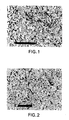
- Particles of zinc pyrithione so formed have a "needle” and/or “rod” appearance as shown in Figs. 1 and 2.
- the rods or needles of zinc pyrithione salt produced in accordance with the present invention are between 0.1 and 1 ⁇ m in width and between 2 and 50 ⁇ m in length. Accordingly, the aspect ratio of the elongated particles is greater than 1, and more preferably from 2 to 500.
- the non-spherical and/or non-platelet pyrithione salt particles produced by the method of the invention at a mixing speed of greater than 150 rpm have been observed to undergo a morphological transformation to small particles when the particles are subjected to certain external environmental factors. While not wishing to be bound by any particular theory, the applicants postulate that the non-spherical and/or non-platelet particles produced by the method of the invention at rpm greater than 150 rpm are in a metastable state and can be induced to undergo a morphological transformation to more stable small particles having sizes 1 ⁇ m or less by perturbing the environment of the particles. Accordingly, it is the applicants' intention to cover all those more stable crystalline forms that result from morphological transformation of the metastable particles in accordance with the present invention.
- the particles produced according to the method of the invention are useful in a variety of items such as personal care products (such as soaps and shampoos), paints, coatings, fertilizers, and foodstuffs.
- personal care products such as soaps and shampoos
- paints, coatings, fertilizers, and foodstuffs such as soaps and shampoos
- zinc pyrithione particles made according to the method of the invention are a useful antidandruff additive to antidandruff shampoos.
- the mixture of particles and by-products may be added to commercial products directly without further purification.
- the by-products e.g., aqueous sodium chloride or aqueous sodium sulfate
- the by-products are useful in shampoo or soap formulations as thickeners.
- An additional benefit derived from the needle/rod shape is the ease of separation of these particles from the reaction medium.
- dispersant sodium salt of polymerized alkyl naphthalene sulfonic acid sold under the tradename DARVAN 1 available from R.T. Vanderbilt & Company
- the temperature is raised to 35°C and maintained throughout the reaction sequence.
- the agitation speed is set at about 100 rpm 437 g of a 10% aqueous zinc sulfate monohydrate solution was pumped into the reactor over 50 to 60 minutes using a peristaltic pump.
- the product slurry is isolated by filtration with a Buchner funnel and washed with water.
- the isolated reaction product was about 19.6% zinc pyrithione by weight. Under microscopic examination, the isolated product was found to consist of particles of zinc pyrithione having rod and/or needle shape.
- a solution of 355 g of 16.9% by weight sodium pyrithione, 845 ml water, and 2.4 g of DARVAN 1 (as described in Example I) was placed in a 2000 ml jacketed reaction vessel and warmed to 39°C.
- a solution of 198.5 g of 20% by weight zinc sulfate monohydrate and 595.4 ml water was added over about 68 minutes at a stirring speed of 400 rpm.
- the mixture was stirred for 20 minutes and the product is isolated by filtration and washed. The isolated precipitate is assayed and found to contain about 33.6% by weight zinc pyrithione.
- the zinc pyrithione particles were resuspended in an aqueous solution of water and DARVAN 1 (sodium naphthalene sulfonic acid formaldehyde) to form solution containing 25% by weight zinc pyrithione and 0.1% by weight DARVAN 1.
- Photomicrographs showed that the particles had an elongated form and appeared as rods or needles (See Figs. 1 and 2).
- the width of the rods and needles varied from 0.1 to 1 ⁇ m, and the length of the rods and needles varied from 2 to 10 ⁇ m.
- small platelets having a diameter of 0.1 to 1 micron were also present.
- An antidandruff shampoo composition is made using needle and rod forms of zinc pyrithione made as described in Examples 1 and 2 in combination with the following ingredients: Component A: Water 41.0% Magnesium aluminum silicate 1.0% Hydroxypropyl methylcellulose 0.8% Component B: Zinc Pyrithione (needles/rods, 25% aqueous dispersion) 4.0% Component C: Cocamide DEA 1.0% Component D: Triethanolamine lauryl sulfate, 40% 40.0% Triethanolamine, 99% 3.2% FD&C Blue No. 1 (0.2%) 1.5% FD&C Yellow No. 5 (0.1%) 0.5% Fragrance q.s.
- the antidandruff shampoo composition is made as follows:
- Component A is prepared by heating water to 70°C and dissolving the other two components with stirring (about 1500 rpm). The temperature of the mixture is lowered to 50°C, and component B is added, and stirring continued for 5 minutes. Stirring speed is reduce stirring to -300 rpm. Component C is melted in a separate container, and added to the A/B mixture. The heat is removed and component D is added while the mixture cooled.
- Another antidandruff shampoo composition is made using needle and rod forms of zinc pyrithione made as described in Examples 1 and 2 in combination with the following ingredients: Component A: Deionized water 76.0% Ammonium lauryl sulfate 15.0% Cocamide DEA 2.0% Component B: Di(hydrogenated) tallow phthalic acid amide 5.0% Zinc Pyrithione (needles/rods, 25% aqueous dispersion) 4.0% Component C: Preservative q.s. Component D: Citric Acid, 50% aq. Solution, OR Sodium hydroxide, 50% aqueous solution q.s. Component E: Ammonium chloride q.s.
- the antidandruff shampoo composition is made as follows:
- components A and B are each mixed well.
- Component A is heated to 60°C and component B is added.
- the mixture is stirred for 30 minutes.
- the mixture is then cooled to 50°C, and component C is added.
- the pH of the resulting mixture is adjusted to 5.0-6.2 with component D, and the viscosity is adjusted with component E.
- An antidandruff shampoo and conditioner composition is made using needle and rod forms of zinc pyrithione made as described in Examples 1 and 2 in combination with the following ingredients:
- Component A Deionized Water 77.0% Ammonium lauryl sulfate 20.0% Cocamide DEA 2.0%
- Component B Di(hydrogenated) tallow phthalic acid amide 4.0% Zinc Pyrithione (needles/rods, 25% aqueous dispersion) 4.0% Dimethicone, 12,000 cps 0.5%
- Component C Preservative q.s.
- Component D Citric acid, 50% aqueous solution, OR Sodium hydroxide, 50% aqueous solution q.s.
- Component E Ammonium chloride q.s.
- the antidandruff shampoo and conditioner composition is made as follows:
- components A and B were each mixed well.
- Component A is heated to 60°C and component B is added.
- the mixture is stirred for 30 minutes.
- the mixture is then cooled to 50°C, and component C is added.
- the pH of the resulting mixture is adjusted to 5.0-6.2 with component D, and the viscosity is adjusted with component E.
- EXAMPLE 6 (Proposed Example) Another antidandruff shampoo Another antidandruff shampoo and conditioner composition is made using needle and rod forms of zinc pyrithione made as described in Examples 1 and 2 in combination with the following ingredients: Component A: Deionized water 21.75% Guar hydroxypropyl trimonium chloride 0.30% Magnesium Aluminum Silicate 0.70% Zinc Pyrithione (needles/rods, 25% aqueous dispersion) 4.0% Component B: Sodium laureth sulfate 30.0% Ammonium xylene sulfonate, 40% aq.
- Component A Deionized water 21.75% Guar hydroxypropyl trimonium chloride 0.30% Magnesium Aluminum Silicate 0.70% Zinc Pyrithione (needles/rods, 25% aqueous dispersion) 4.0%
- Component B Sodium laureth sulfate 30.0% Ammonium xylene sulfonate, 40% aq.
- Component C Tricetylammonium chloride 0.50% Cetyl alcohol NF 0.40% Stearyl alcohol 0.40% Gycol distearate 2.00%
- Component D Cocamide MEA 1.70% Ammonium lauryl sulfate 36.00%
- Component E Preservative 0.05% Fragrance and dye q.s.
- Component F Citric acid, 25% aqueous solution q.s.
- the antidandruff shampoo and conditioner composition is made as follows:
- Component A is prepared by heating water to 50°C and dispersing the guar hydroxypropyl trimonium chloride and the magnesium aluminum silicate with rapid agitation. The zinc pyrithione dispersion is added to this combination with stirring. The pH of component A is adjusted to 4.5-5.0 with component F. Both components of B were slowly added to component A, mixing well. The pH of the mixture is adjusted to 5.7-6.3 with component F. In a separate container, component C is heated to 70-75°C. The A/B mixture is heated to 60°C and blend with component C, mixing well. Both components of D were added to the hot mixture, and stirred well. The pH of the mixture is adjusted to 5.7-6.3 with component F. The mixture is cooled to 40-45°C, and component E is added with stirring. If desired, the viscosity of the product can be increased by adding 0.05-1% sodium chloride.
- An "extra body” antidandruff shampoo and conditioner composition is made using needle and rod forms of zinc pyrithione made as described in Examples 1 and 2 in combination with the following ingredients: Component A: Deionized Water 62.6% Zinc Pyrithione (needles/rods, 25% aqueous dispersion) 4.0% Component B: Methyl Paraben 0.30% Propyl Paraben 0.10% Propylene Glycol 0.50% Sodium Chloride 0.50% Component C: Triethanolamine lauryl sulfate 20.0% Cocamide MEA 4.0% Ethylene glycol distearate 7.0% Component D: Cocodimonium hydrolyzed animal protein. 1.00% Component E: FD&C Blue No. 1 q.s. Component F: Citric Acid, 50% aqueous solution q.s.
- the antidandruff shampoo and conditioner composition is made as follows:
- Component A is heated to 60°C.
- the ingredients of component B were added with good stirring until dissolved.
- the ingredients of component C were added to the mixture sequentially, and heated with mixing at 60°C.
- the mixture is cooled with stirring to 40°C, and components D and E were added with stirring.
- the pH of the final composition is adjusted to 4.7 with component F.
Landscapes
- Health & Medical Sciences (AREA)
- Life Sciences & Earth Sciences (AREA)
- General Health & Medical Sciences (AREA)
- Veterinary Medicine (AREA)
- Animal Behavior & Ethology (AREA)
- Public Health (AREA)
- Chemical & Material Sciences (AREA)
- Organic Chemistry (AREA)
- Epidemiology (AREA)
- Birds (AREA)
- Environmental Sciences (AREA)
- Pest Control & Pesticides (AREA)
- Engineering & Computer Science (AREA)
- Dentistry (AREA)
- Wood Science & Technology (AREA)
- Zoology (AREA)
- Dermatology (AREA)
- Plant Pathology (AREA)
- Agronomy & Crop Science (AREA)
- Medicinal Chemistry (AREA)
- Pharmacology & Pharmacy (AREA)
- Cosmetics (AREA)
- Agricultural Chemicals And Associated Chemicals (AREA)
- Pyridine Compounds (AREA)
- Pharmaceuticals Containing Other Organic And Inorganic Compounds (AREA)
Claims (29)
- Verfahren zur Herstellung nicht-kugeliger und/oder nicht-plättchenförmiger Partikel aus einem Pyrithion-Salz, die aus Stäbchen, Nadeln, Zylindern, Kegeln, Ellipsoiden, Prismen, Parallelepipeden, Pyramiden, Tetraedern, Hexaedern, Oktaedem, Dodekaedern, Ikosaedern und Kombinationen davon ausgewählt sind, wobei das Verfahren das Reagieren von Pyrithion oder einem wasserlöslichen Salz aus Pyrithion und einem wasserlöslichen mehrwertigen Metallsalz, das ein zweiwertiges Salz ist, das aus Zinksalzen, Zinnsalzen, Kadmiumsalzen, Wismutsalzen, Zirkoniumsalzen, Magnesiumsalzen, Aluminiumsalzen und Kombinationen davon ausgewählt ist, in einem Träger und in Anwesenheit eines Dispergens in einer Menge von 0,1 bis 10 Gewichtsprozent auf der Basis des Gesamtgewichts des Reaktionsgemischs, wobei das Dispergens aus Natriumsalzen polymerisierter Alkyl-Naphthalinsulfonsäuren und Kaliumsalzen polymerisierter Alkyl-Naphthalinsulfonsäuren und Kombinationen davon ausgewählt ist, optional in Anwesenheit eines grenzflächenaktiven Stoffs, bei einer Temperatur von 20°C bis 60°C umfasst, um nicht-kugelige und nicht-plättchenförmige Partikel eines Pyrithion-Salzes herzustellen.
- Verfahren nach Anspruch 1, worin das wasserlösliche Salz aus Pyrithion aus Natrium-Pyrithion, Kalium-Pyrithion, Lithium-Pyrithion, Ammonium-Pyrithion und Kombinationen davon ausgewählt ist.
- Verfahren nach Anspruch 1, worin das zweiwertige Salz aus Zinksulfat, Zinkchlorid, Zinkacetat, Wismutacetat und Kombinationen davon ausgewählt ist.
- Verfahren nach Anspruch 1, wobei ein Molverhältnis des Pyrithions oder wasserlöslichen Salzes aus Pyrithion zu dem wasserlöslichen mehrwertigen Metallsalz in dem Bereich von 1:2 bis 1:8 verwendet wird.
- Verfahren nach Anspruch 1, worin das Dispergens aus Natriumsalzen polymerisierter Alkyl-Naphthalinsulfonsäuren und Kombinationen davon ausgewählt ist.
- Verfahren nach Anspruch 1, worin das Dispergens zwischen 0,05 und 10 Gewichtsprozent auf der Basis des Gesamtgewichts des Reaktionsgemischs umfasst.
- Verfahren nach Anspruch 6, worin das Dispergens mit einem grenzflächenaktiven Stoff kombiniert wird.
- Verfahren nach Anspruch 7, worin das Dispergens zwischen 0,5 und 1,5 Gewichtsprozent auf der Basis des Gesamtgewichts des Reaktionsgemischs umfasst.
- Verfahren nach Anspruch 1, weiter umfassend den Schritt des Isolierens der Partikel des Pyrithion-Salzes.
- Verfahren nach Anspruch 1, worin die nicht-kugeligen und/oder nicht-plättchenförmigen Partikel des Pyrithion-Salzes länglich sind und ein Längenverhältnis von 2 bis 500 aufweisen.
- Verfahren nach Anspruch 10, worin die nicht-kugeligen und/oder nicht-plättchenförmigen Partikel des Pyrithion-Salzes eine Breite von 0,1 bis 1 µm und eine Länge von 2 bis 50 µm aufweisen.
- Verfahren nach Anspruch 1, weiter umfassend den Schritt des Induzierens der nicht-kugeligen und/oder nicht-plättchenförmigen Partikel aus Pyrithion zum Erfahren einer morphologischen Transformation in eine stabilere Form, die Partikel mit Größen von 1 µm oder weniger aufweist.
- Die durch das Verfahren nach Anspruch 12 erzeugten Partikel mit einer Größe von 1 Mikrometer oder weniger.
- Verfahren nach Anspruch 1, worin die nicht-kugeligen und/oder nicht-plättchenförmigen Partikel aus Pyrithion-Salzen längliche Partikel aus Zink-Pyrithion sind, das wasserlösliche mehrwertige Salz ein Zinksalz ist, das aus Zinksulfat, Zinkchlorid, Zinkacetat und Kombinationen davon ausgewählt ist, und die Reaktion in einem wässrigen Medium und in der Anwesenheit eines Dispergens ausgeführt wird, das von 0,05 und 10 Gewichtsprozent auf der Basis des Gesamtgewichts des Reaktionsgemischs umfasst und aus Natrium- und Kaliumsalzen einer polymerisierten Alkyl-Naphthalinsulfonsäure und Kombinationen davon ausgewählt ist, um längliche Partikel aus Zink-Pyrithion mit einem Längenverhältnis von 2 bis 500 herzustellen.
- Verfahren nach Anspruch 14, worin das wasserlösliche Salz aus Pyrithion aus der Gruppe ausgewählt ist, die aus Natrium-Pyrithion, Kalium-Pyrithion, Lithium-Pyrithion. Ammonium-Pyrithion und Kombinationen davon besteht.
- Verfahren nach Anspruch 15, weiter umfassend den Schritt des Isolierens der länglichen Partikel aus Zink-Pyrithion.
- Verfahren nach Anspruch 14, worin die länglichen Partikel des Pyrithion-Salzes eine Breite von etwa 0,1 bis etwa 1 µm und eine Länge von 2 bis 50 µm aufweisen.
- Verfahren nach Anspruch 14, weiter umfassend den Schritt des Induzierens der länglichen Partikel aus Pyrithion zum Erfahren einer morphologischen Transformation In eine stabilere Form, die Partikel mit Größen von 1 µm oder weniger umfasst.
- Nicht-kugelige und/oder nicht-plättchenförmige mittels eines Verfahrens nach einem der Ansprüche 1 bis 12 erhaltbare Partikel eines Pyrithion-Salzes, das ein zweiwertiges Salz ist, das aus Zinksalzen, Zinnsalzen, Kadmiumsalzen, Wismutsalzen, Zirkoniumsalzen, Magnesiumsalzen, Aluminiumsalzen und Kombinationen davon ausgewählt ist.
- Zusammensetzung mit den nicht-kugeligen und/oder nicht-plättchenförmigen Partikeln des Pyrithion-Salzes nach Anspruch 19, worin die Partikel eine Partikelgröße von 0,1 bis 1 Mikrometer in der Breite und von 2 bis 50 Mikrometer in der Länge aufweisen, wobei die Zusammensetzungen mittels des Verfahrens nach Anspruch 1 hergestellt sind.
- Zusammensetzung nach Anspruch 20, worin die Partikel des Pyrithion-Salzes länglich sind und ein Längenverhältnis von 2 bis 500 aufweisen.
- Zusammensetzung nach Anspruch 20, die zusätzlich Partikel eines Pyrithion-Salzes aufweist, die aus der Gruppe ausgewählt sind, die aus Kugeln, Plättchen und Kombinationen davon besteht.
- Zusammensetzung, die nicht-kugelige und/oder nicht-plättchenförmige Partikel aus Pyrithion-Salzen aufweist, nach Anspruch 22, worin die nicht-kugeligen und/oder nicht-plättchenförmigen Partikel oder Pyrithion metastabil sind und mittels einer morphologischen Transformation in eine stabilere Form weiter verändert werden, wobei die stabilere Form Plättchen mit Größen von 1µm oder weniger aufweist.
- Shampoo oder Hautpflegezusammensetzung mit einem Basisfluid und einer Zusammensetzung nach einem der Ansprüche 20 bis 22.
- Zusammensetzung nach Anspruch 24, worin das Basisfluid aus der Gruppe ausgewählt ist, die aus grenzflächenaktiven Stoffen, Dispergentien und Kombinationen davon besteht.
- Antischuppenshampoo-Zusammensetzung mit einer Zusammensetzung, die nicht-kugelige und/oder nicht-plättchenförmige Partikel aus Pyrithion-Salzen aufweist, nach einem der Ansprüche 20 bis 22.
- Stabile nicht-Kugelige und/oder nicht-plättchenförmige Partikel aus einem Pyrithion-Salz, das ein zweiwertiges Salz ist, das aus Zinksalzen, Zinnsalzen, Kadmiumsalzen, Wismutsalzen, Zirkoniumsalzen, Magnesiumsalzen, Aluminiumsalzen und Kombinationen davon ausgewählt ist, und die eine Form aufweisen, die aus Stäbchen, Nadeln, Zylindern, Kegeln, Ellipsoiden, Prismen, Paralielepipeden, Pyramiden, Tetraedern, Hexaedern, Oktaedern, Dodekaedem, Ikosaedern und Kombinationen davon ausgewählt ist, und die gegenüber einer thermischen Verschlechterung bis zu einer Temperatur von 60°C physikalisch stabil sind, wobei die Partikel durch Reagieren eines Reaktionsgemischs hergestellt sind, das Pyrithion oder ein wasserlösliches Salz aus Pyrithion und ein wasserlösliches mehrwertiges Metallsalz in einem Träger und in der Anwesenheit eines Dispergens aufweist, das von 0,1 bis 10 Gewichtsprozent auf der Basis des Gesamtgewichts des Reaktionsgemischs umfasst, wobei das Dispergens aus Natriumsalzen polymerisierter Alkyl-Naphthalinsulfonsäuren, Kaliumsalzen polymerisierter Alkyl-Naphthalinsulfonsäuren und Kombinationen davon ausgewählt ist, während das Reaktionsgemisch bei einer Mischgeschwindigkeit von weniger als 150 Umdrehungen pro Minute gerührt wird.
- Zusammensetzung mit Partikeln aus einem Pyrithion-Salz, die mittels des Verfahrens nach Anspruch 1 hergestellt sind, wobei die Partikel eine Partikelgröße von 1 Mikrometer oder weniger aufweisen.
- Zusammensetzung nach Anspruch 28, worin die Partikelgröße zwischen 0,1 und 1 Mikrometer beträgt.
Applications Claiming Priority (5)
| Application Number | Priority Date | Filing Date | Title |
|---|---|---|---|
| US4433997P | 1997-04-28 | 1997-04-28 | |
| US44339P | 1997-04-28 | ||
| US09/025,665 US6017562A (en) | 1997-04-28 | 1998-02-18 | Non-spherical and non-platelet crystalline forms of pyrithione salts |
| US25665 | 1998-02-18 | ||
| PCT/US1998/007689 WO1998048629A1 (en) | 1997-04-28 | 1998-04-13 | Non-spherical and non-platelet pyrithione salts |
Publications (3)
| Publication Number | Publication Date |
|---|---|
| EP0977484A1 EP0977484A1 (de) | 2000-02-09 |
| EP0977484A4 EP0977484A4 (de) | 2002-06-12 |
| EP0977484B1 true EP0977484B1 (de) | 2005-12-28 |
Family
ID=26700012
Family Applications (1)
| Application Number | Title | Priority Date | Filing Date |
|---|---|---|---|
| EP98919781A Expired - Lifetime EP0977484B1 (de) | 1997-04-28 | 1998-04-13 | Nicht-kugliges und nicht-plättchenförmiges pyrithion-salz |
Country Status (12)
| Country | Link |
|---|---|
| US (1) | US6017562A (de) |
| EP (1) | EP0977484B1 (de) |
| JP (1) | JP4263249B2 (de) |
| KR (1) | KR100517432B1 (de) |
| CN (2) | CN1112099C (de) |
| AU (1) | AU7249398A (de) |
| BR (1) | BR9808993A (de) |
| CA (1) | CA2291056A1 (de) |
| DE (1) | DE69832971T2 (de) |
| ID (1) | ID24655A (de) |
| MY (1) | MY118407A (de) |
| WO (1) | WO1998048629A1 (de) |
Families Citing this family (55)
| Publication number | Priority date | Publication date | Assignee | Title |
|---|---|---|---|---|
| US6242007B1 (en) * | 1997-04-28 | 2001-06-05 | Arch Chemicals, Inc. | Non-spherical and non-platelet forms of pyrithione salts and methods of making same |
| GB9813640D0 (en) * | 1998-06-24 | 1998-08-26 | Unilever Plc | Antimicrobial hair treatment composition |
| US6682724B2 (en) * | 1999-02-23 | 2004-01-27 | Arch Chemcials, Inc. | Sonic method of enhancing chemical reactions to provide uniform, non-agglomerated particles |
| US6432432B1 (en) | 1999-03-05 | 2002-08-13 | Arch Chemicals, Inc. | Chemical method of making a suspension, emulsion or dispersion of pyrithione particles |
| US7026308B1 (en) * | 1999-06-25 | 2006-04-11 | The Procter & Gamble Company | Topical anti-microbial compositions |
| US7455851B1 (en) * | 1999-06-25 | 2008-11-25 | Arch Chemicals, Inc. | Pyrithione biocides enhanced by silver, copper, or zinc ions |
| CN100341408C (zh) * | 1999-06-25 | 2007-10-10 | 阿奇化工公司 | 用银、铜或锌离子增效的羟基吡啶硫酮抗微生物剂 |
| DE10005707B4 (de) * | 2000-02-09 | 2004-10-14 | Pci Augsburg Gmbh | Pulverförmige Zusammensetzung auf der Basis von wasserlöslichen Polymeren |
| US7674785B2 (en) * | 2000-06-22 | 2010-03-09 | The Procter & Gamble Company | Topical anti-microbial compositions |
| GB0015723D0 (en) * | 2000-06-27 | 2000-08-16 | Unilever Plc | Compositions containing a metal pyrithione |
| US20060014674A1 (en) * | 2000-12-18 | 2006-01-19 | Dennis Keith | Methods for preparing purified lipopeptides |
| KR20090122469A (ko) * | 2000-12-18 | 2009-11-30 | 큐비스트 파마슈티컬즈 인코포레이티드 | 정제된 리포펩티드의 제조 방법 |
| WO2003007900A2 (en) * | 2001-07-18 | 2003-01-30 | Unilever Plc | Skin treatment |
| US6627665B2 (en) * | 2001-09-28 | 2003-09-30 | Arch Chemicals, Inc. | Non-dusting copper pyrithione dispersion |
| US20040058855A1 (en) * | 2002-04-22 | 2004-03-25 | Schwartz James R. | Use of materials having zinc ionophoric behavior |
| JP3851312B2 (ja) * | 2002-04-22 | 2006-11-29 | ザ プロクター アンド ギャンブル カンパニー | 水性界面活性剤組成物中に亜鉛含有物質を含むパーソナルケア組成物 |
| US8361450B2 (en) | 2002-06-04 | 2013-01-29 | The Procter & Gamble Company | Shampoo containing a gel network and a non-guar galactomannan polymer derivative |
| US9381382B2 (en) * | 2002-06-04 | 2016-07-05 | The Procter & Gamble Company | Composition comprising a particulate zinc material, a pyrithione or a polyvalent metal salt of a pyrithione and a gel network |
| US8349301B2 (en) | 2002-06-04 | 2013-01-08 | The Procter & Gamble Company | Shampoo containing a gel network |
| US8367048B2 (en) * | 2002-06-04 | 2013-02-05 | The Procter & Gamble Company | Shampoo containing a gel network |
| US8361448B2 (en) * | 2002-06-04 | 2013-01-29 | The Procter & Gamble Company | Shampoo containing a gel network |
| US9381148B2 (en) | 2003-03-18 | 2016-07-05 | The Procter & Gamble Company | Composition comprising particulate zinc material with a high relative zinc lability |
| US8470305B2 (en) | 2002-06-04 | 2013-06-25 | The Procter & Gamble Company | Shampoo containing a gel network |
| US8491877B2 (en) * | 2003-03-18 | 2013-07-23 | The Procter & Gamble Company | Composition comprising zinc-containing layered material with a high relative zinc lability |
| US8349302B2 (en) | 2002-06-04 | 2013-01-08 | The Procter & Gamble Company | Shampoo containing a gel network and a non-guar galactomannan polymer derivative |
| US20050202984A1 (en) * | 2003-03-18 | 2005-09-15 | Schwartz James R. | Composition comprising zinc-containing layered material with a high relative zinc lability |
| US6821326B2 (en) * | 2002-12-20 | 2004-11-23 | Arch Chemicals, Inc. | Small particle copper pyrithione |
| US7481873B2 (en) * | 2002-12-20 | 2009-01-27 | Arch Chemicals, Inc. | Small particle copper pyrithione |
| US20040191331A1 (en) * | 2003-03-18 | 2004-09-30 | The Procter & Gamble Company | Composition comprising particulate zinc materials having a defined crystallite size |
| US20040213751A1 (en) * | 2003-03-18 | 2004-10-28 | Schwartz James Robert | Augmentation of pyrithione activity or a polyvalent metal salt of pyrithione activity by zinc-containing layered material |
| US20080097070A1 (en) * | 2006-10-19 | 2008-04-24 | L'oreal | Aqueous polyamine-containing systems for water-insoluble materials |
| US20080096782A1 (en) * | 2006-10-19 | 2008-04-24 | L'oreal | Aqueous systems containing phospholipid, surfactant and phosphate ester for water-insoluble materials |
| EP2275466A1 (de) * | 2009-07-16 | 2011-01-19 | Bayer MaterialScience AG | Polyharnstoff-basierter Gewebekleber |
| WO2011103147A2 (en) * | 2010-02-16 | 2011-08-25 | The Procter & Gamble Company | Method for providing maximum malodor and irritation control |
| US8541493B2 (en) * | 2010-02-19 | 2013-09-24 | Arch Chemicals, Inc. | Synthesis of zinc acrylate copolymer from acid functional copolymer, zinc pyrithione, and copper compound |
| US9119796B2 (en) | 2011-02-28 | 2015-09-01 | The Gillette Company | Razor comprising a molded shaving aid composition comprising a pyrithione source |
| WO2013025744A2 (en) | 2011-08-15 | 2013-02-21 | The Procter & Gamble Company | Personal care methods |
| WO2013025886A1 (en) * | 2011-08-16 | 2013-02-21 | The Gillette Company | Shave preparations comprising an anti-irritation agent |
| WO2013025960A1 (en) | 2011-08-17 | 2013-02-21 | Arch Chemicals, Inc. | Synthesis of copper pyrithione from zinc pyrithione and copper compound |
| BR112014007727B1 (pt) | 2011-10-07 | 2019-04-30 | The Procter & Gamble Company | Composição de xampu e seu processo para preparação |
| EP2847315B1 (de) | 2012-05-11 | 2018-03-21 | The Procter and Gamble Company | Körperreinigungszusammensetzungen mit zinkpyrithion |
| WO2014139133A1 (en) | 2013-03-14 | 2014-09-18 | The Procter & Gamble Company | Bar soap compositions containing zinc pyrithione and a zinc-pyridine oxide complex |
| WO2014169464A1 (en) | 2013-04-18 | 2014-10-23 | The Procter & Gamble Company | Personal care compositions containing zinc pyrithione and zinc-phosphonate complex |
| US10226404B2 (en) | 2014-02-06 | 2019-03-12 | The Procter And Gamble Company | Method for preparing antidandruff hair care compositions comprising a step of injecting antidandruff agents, perfumes and/or silicones |
| US20150216777A1 (en) * | 2014-02-06 | 2015-08-06 | The Procter & Gamble Company | Method For Preparing Hair Care Compositions Comprising a Step of Controlling Temperature to Add Antidandruff Agents |
| US10201481B2 (en) | 2014-03-07 | 2019-02-12 | The Procter & Gamble Company | Personal care compositions and methods of making same |
| US9901584B2 (en) | 2015-05-06 | 2018-02-27 | The Procter & Gamble Company | Methods of cosmetically treating skin conditions with a cosmetic personal cleansing composition |
| US10945935B2 (en) | 2016-06-27 | 2021-03-16 | The Procter And Gamble Company | Shampoo composition containing a gel network |
| WO2018071353A1 (en) | 2016-10-10 | 2018-04-19 | The Procter & Gamble Company | Personal care compositions substantially free of sulfated surfactants and containing a gel network |
| CN117562814A (zh) | 2018-06-05 | 2024-02-20 | 宝洁公司 | 透明清洁组合物 |
| WO2020123484A1 (en) | 2018-12-14 | 2020-06-18 | The Procter & Gamble Company | Shampoo composition comprising sheet-like microcapsules |
| US11896689B2 (en) | 2019-06-28 | 2024-02-13 | The Procter & Gamble Company | Method of making a clear personal care comprising microcapsules |
| MX2022008714A (es) | 2020-02-14 | 2022-08-08 | Procter & Gamble | Botella adaptada para almacenar una composicion liquida con un dise?o estetico suspendido en esta. |
| US12053130B2 (en) | 2021-02-12 | 2024-08-06 | The Procter & Gamble Company | Container containing a shampoo composition with an aesthetic design formed by bubbles |
| US11633072B2 (en) | 2021-02-12 | 2023-04-25 | The Procter & Gamble Company | Multi-phase shampoo composition with an aesthetic design |
Family Cites Families (17)
| Publication number | Priority date | Publication date | Assignee | Title |
|---|---|---|---|---|
| US2809971A (en) * | 1955-11-22 | 1957-10-15 | Olin Mathieson | Heavy-metal derivatives of 1-hydroxy-2-pyridinethiones and method of preparing same |
| US2786847A (en) * | 1956-07-23 | 1957-03-26 | Reilly Tar & Chem Corp | 2-mercapto, alkanol pyridine-nu-oxides |
| US3590035A (en) * | 1967-12-21 | 1971-06-29 | Procter & Gamble | Process for preparing pyridine n-oxide carbanion salts |
| US3773770A (en) * | 1968-09-30 | 1973-11-20 | Procter & Gamble | Process for preparing pyridine n-oxide carbanion salts and derivatives thereof |
| US3589999A (en) * | 1968-10-25 | 1971-06-29 | Ionics | Deionization process |
| DE3127863A1 (de) * | 1981-07-15 | 1983-02-03 | Rütgerswerke AG, 6000 Frankfurt | Verfahren zur herstellung des zinksalzes von 2-merkaptopyridin-n-oxid in einer leicht filtrierbaren aber gut suspendierbaren form |
| US4396766A (en) * | 1982-04-28 | 1983-08-02 | Olin Corporation | Process for producing sodium and zinc pyrithione |
| EP0133914B1 (de) * | 1983-07-06 | 1988-06-15 | Kao Corporation | Fein gepulverte polyvalente Metallsalze von 2-Mercaptopyridin-N-oxid, Verfahren zur Herstellung derselben und diese enthaltende antibakterielle Zusammensetzungen |
| DE3584595D1 (de) * | 1984-08-29 | 1991-12-12 | Kao Corp | Antimikrobische suspensionen und antimikrobische haarbehandlungsmittel. |
| US4940578A (en) * | 1987-06-18 | 1990-07-10 | Kao Corporation | Hair preparation |
| US5696083A (en) * | 1992-11-10 | 1997-12-09 | Olin Corporation | Personal care composition containing pyrithione and polymyxin |
| US5424435A (en) * | 1993-10-18 | 1995-06-13 | Olin Corporation | 1-hydroxy-6-substituted-2-pyridones |
| US5540860A (en) * | 1994-02-28 | 1996-07-30 | Olin Corporation | Process for preparing copper pyrithione |
| US5614538A (en) * | 1994-12-05 | 1997-03-25 | Olin Corporation | Synergistic antimicrobial composition containing pyrithione and alcohol |
| US5562995A (en) * | 1995-02-03 | 1996-10-08 | Olin Corporation | Discoloration prevention in pyrithione-containing coating compositions |
| US5707929A (en) * | 1995-05-08 | 1998-01-13 | Troy Chemical Corporation | Biocidal compositions comprising mixtures of haloproynyl compounds and sulfur containing triazines |
| JPH11509220A (ja) * | 1995-07-14 | 1999-08-17 | ユニリーバー・ナームローゼ・ベンノートシヤープ | 抗菌性ヘアトリートメント組成物 |
-
1998
- 1998-02-18 US US09/025,665 patent/US6017562A/en not_active Expired - Lifetime
- 1998-04-13 CA CA002291056A patent/CA2291056A1/en not_active Abandoned
- 1998-04-13 KR KR10-1999-7009975A patent/KR100517432B1/ko not_active Expired - Lifetime
- 1998-04-13 WO PCT/US1998/007689 patent/WO1998048629A1/en not_active Ceased
- 1998-04-13 EP EP98919781A patent/EP0977484B1/de not_active Expired - Lifetime
- 1998-04-13 BR BR9808993-5A patent/BR9808993A/pt not_active Application Discontinuation
- 1998-04-13 JP JP54704998A patent/JP4263249B2/ja not_active Expired - Lifetime
- 1998-04-13 AU AU72493/98A patent/AU7249398A/en not_active Abandoned
- 1998-04-13 DE DE69832971T patent/DE69832971T2/de not_active Expired - Lifetime
- 1998-04-13 CN CN98804623A patent/CN1112099C/zh not_active Expired - Lifetime
- 1998-04-13 CN CNB031106692A patent/CN1245939C/zh not_active Expired - Lifetime
- 1998-04-13 ID IDW991288A patent/ID24655A/id unknown
- 1998-04-27 MY MYPI98001881A patent/MY118407A/en unknown
Also Published As
| Publication number | Publication date |
|---|---|
| HK1025718A1 (en) | 2000-11-24 |
| DE69832971T2 (de) | 2006-08-24 |
| DE69832971D1 (de) | 2006-02-02 |
| CA2291056A1 (en) | 1998-11-05 |
| ID24655A (id) | 2000-07-27 |
| CN1245939C (zh) | 2006-03-22 |
| EP0977484A4 (de) | 2002-06-12 |
| KR20010020356A (ko) | 2001-03-15 |
| US6017562A (en) | 2000-01-25 |
| CN1112099C (zh) | 2003-06-25 |
| CN1448123A (zh) | 2003-10-15 |
| JP4263249B2 (ja) | 2009-05-13 |
| MY118407A (en) | 2004-10-30 |
| AU7249398A (en) | 1998-11-24 |
| JP2002501500A (ja) | 2002-01-15 |
| WO1998048629A1 (en) | 1998-11-05 |
| BR9808993A (pt) | 2000-08-08 |
| CN1259017A (zh) | 2000-07-05 |
| KR100517432B1 (ko) | 2005-09-29 |
| EP0977484A1 (de) | 2000-02-09 |
Similar Documents
| Publication | Publication Date | Title |
|---|---|---|
| US6017562A (en) | Non-spherical and non-platelet crystalline forms of pyrithione salts | |
| US6017936A (en) | Method for producing particles of pyrithione salts and particles so produced | |
| US6242007B1 (en) | Non-spherical and non-platelet forms of pyrithione salts and methods of making same | |
| US8709460B2 (en) | Chemical method of making a suspension, emulsion or dispersion of pyrithione particles | |
| US5650095A (en) | Process for preparing copper pyrithione | |
| US6682724B2 (en) | Sonic method of enhancing chemical reactions to provide uniform, non-agglomerated particles | |
| US6465015B1 (en) | Sonic method of enhancing chemical reactions to provide uniform, non-agglomerated particles | |
| HK1025718B (en) | Non-spherical and non-platelet pyrithione salts | |
| TW523508B (en) | Non-spherical and non-platelet pyrithione salts |
Legal Events
| Date | Code | Title | Description |
|---|---|---|---|
| PUAI | Public reference made under article 153(3) epc to a published international application that has entered the european phase |
Free format text: ORIGINAL CODE: 0009012 |
|
| 17P | Request for examination filed |
Effective date: 19991125 |
|
| AK | Designated contracting states |
Kind code of ref document: A1 Designated state(s): DE FR GB IE IT |
|
| A4 | Supplementary search report drawn up and despatched |
Effective date: 20020429 |
|
| AK | Designated contracting states |
Kind code of ref document: A4 Designated state(s): DE FR GB IE IT |
|
| RIC1 | Information provided on ipc code assigned before grant |
Free format text: 7A 01N 55/02 A, 7A 61K 7/06 B, 7A 61K 7/07 B, 7A 61K 7/075 B, 7B 01J 13/00 B, 7C 07F 1/08 B, 7C 07D 213/89 B |
|
| 17Q | First examination report despatched |
Effective date: 20030328 |
|
| GRAP | Despatch of communication of intention to grant a patent |
Free format text: ORIGINAL CODE: EPIDOSNIGR1 |
|
| GRAS | Grant fee paid |
Free format text: ORIGINAL CODE: EPIDOSNIGR3 |
|
| GRAA | (expected) grant |
Free format text: ORIGINAL CODE: 0009210 |
|
| AK | Designated contracting states |
Kind code of ref document: B1 Designated state(s): DE FR GB IE IT |
|
| REG | Reference to a national code |
Ref country code: GB Ref legal event code: FG4D |
|
| REG | Reference to a national code |
Ref country code: IE Ref legal event code: FG4D |
|
| REF | Corresponds to: |
Ref document number: 69832971 Country of ref document: DE Date of ref document: 20060202 Kind code of ref document: P |
|
| REG | Reference to a national code |
Ref country code: HK Ref legal event code: GR Ref document number: 1025718 Country of ref document: HK |
|
| ET | Fr: translation filed | ||
| PLBE | No opposition filed within time limit |
Free format text: ORIGINAL CODE: 0009261 |
|
| STAA | Information on the status of an ep patent application or granted ep patent |
Free format text: STATUS: NO OPPOSITION FILED WITHIN TIME LIMIT |
|
| 26N | No opposition filed |
Effective date: 20060929 |
|
| PGFP | Annual fee paid to national office [announced via postgrant information from national office to epo] |
Ref country code: IE Payment date: 20140417 Year of fee payment: 17 |
|
| REG | Reference to a national code |
Ref country code: FR Ref legal event code: PLFP Year of fee payment: 18 |
|
| REG | Reference to a national code |
Ref country code: IE Ref legal event code: MM4A |
|
| REG | Reference to a national code |
Ref country code: FR Ref legal event code: PLFP Year of fee payment: 19 |
|
| PG25 | Lapsed in a contracting state [announced via postgrant information from national office to epo] |
Ref country code: IE Free format text: LAPSE BECAUSE OF NON-PAYMENT OF DUE FEES Effective date: 20150413 |
|
| REG | Reference to a national code |
Ref country code: FR Ref legal event code: PLFP Year of fee payment: 20 |
|
| PGFP | Annual fee paid to national office [announced via postgrant information from national office to epo] |
Ref country code: IT Payment date: 20170324 Year of fee payment: 20 |
|
| PGFP | Annual fee paid to national office [announced via postgrant information from national office to epo] |
Ref country code: FR Payment date: 20170405 Year of fee payment: 20 Ref country code: GB Payment date: 20170412 Year of fee payment: 20 Ref country code: DE Payment date: 20170328 Year of fee payment: 20 |
|
| REG | Reference to a national code |
Ref country code: DE Ref legal event code: R071 Ref document number: 69832971 Country of ref document: DE |
|
| REG | Reference to a national code |
Ref country code: GB Ref legal event code: PE20 Expiry date: 20180412 |
|
| PG25 | Lapsed in a contracting state [announced via postgrant information from national office to epo] |
Ref country code: GB Free format text: LAPSE BECAUSE OF EXPIRATION OF PROTECTION Effective date: 20180412 |