EP0975561B1 - Verfahren zur herstellung einer chemischen bibliothek - Google Patents
Verfahren zur herstellung einer chemischen bibliothek Download PDFInfo
- Publication number
- EP0975561B1 EP0975561B1 EP98917337A EP98917337A EP0975561B1 EP 0975561 B1 EP0975561 B1 EP 0975561B1 EP 98917337 A EP98917337 A EP 98917337A EP 98917337 A EP98917337 A EP 98917337A EP 0975561 B1 EP0975561 B1 EP 0975561B1
- Authority
- EP
- European Patent Office
- Prior art keywords
- bead
- beads
- library
- polymeric
- synthesis
- Prior art date
- Legal status (The legal status is an assumption and is not a legal conclusion. Google has not performed a legal analysis and makes no representation as to the accuracy of the status listed.)
- Expired - Lifetime
Links
- 238000000034 method Methods 0.000 title claims abstract description 37
- 239000000126 substance Substances 0.000 title claims abstract description 32
- 238000002360 preparation method Methods 0.000 title claims abstract description 5
- 238000003786 synthesis reaction Methods 0.000 claims abstract description 30
- 230000015572 biosynthetic process Effects 0.000 claims abstract description 29
- 150000001875 compounds Chemical class 0.000 claims abstract description 25
- 239000002245 particle Substances 0.000 claims abstract description 14
- 239000011324 bead Substances 0.000 claims description 132
- 239000011859 microparticle Substances 0.000 claims description 29
- 238000010191 image analysis Methods 0.000 claims description 7
- 239000000463 material Substances 0.000 claims description 7
- 230000000694 effects Effects 0.000 claims description 6
- 238000012216 screening Methods 0.000 claims description 5
- 230000001419 dependent effect Effects 0.000 claims description 2
- 229910010293 ceramic material Inorganic materials 0.000 claims 1
- 239000011521 glass Substances 0.000 claims 1
- 230000000063 preceeding effect Effects 0.000 claims 1
- 238000003556 assay Methods 0.000 description 7
- 238000004519 manufacturing process Methods 0.000 description 7
- 238000003384 imaging method Methods 0.000 description 6
- 239000011325 microbead Substances 0.000 description 6
- 239000000178 monomer Substances 0.000 description 6
- 239000003446 ligand Substances 0.000 description 5
- 239000011159 matrix material Substances 0.000 description 5
- 108090000765 processed proteins & peptides Proteins 0.000 description 4
- 238000013459 approach Methods 0.000 description 3
- 238000001000 micrograph Methods 0.000 description 3
- 229920000642 polymer Polymers 0.000 description 3
- 239000002904 solvent Substances 0.000 description 3
- 239000000725 suspension Substances 0.000 description 3
- 238000012360 testing method Methods 0.000 description 3
- MYRTYDVEIRVNKP-UHFFFAOYSA-N 1,2-Divinylbenzene Chemical compound C=CC1=CC=CC=C1C=C MYRTYDVEIRVNKP-UHFFFAOYSA-N 0.000 description 2
- 241000252095 Congridae Species 0.000 description 2
- 108091034117 Oligonucleotide Proteins 0.000 description 2
- XUIMIQQOPSSXEZ-UHFFFAOYSA-N Silicon Chemical compound [Si] XUIMIQQOPSSXEZ-UHFFFAOYSA-N 0.000 description 2
- 150000001413 amino acids Chemical class 0.000 description 2
- 230000015556 catabolic process Effects 0.000 description 2
- 238000003776 cleavage reaction Methods 0.000 description 2
- 238000006731 degradation reaction Methods 0.000 description 2
- 238000009826 distribution Methods 0.000 description 2
- 238000010348 incorporation Methods 0.000 description 2
- 239000000203 mixture Substances 0.000 description 2
- 102000004196 processed proteins & peptides Human genes 0.000 description 2
- 230000007017 scission Effects 0.000 description 2
- 239000000243 solution Substances 0.000 description 2
- 230000008961 swelling Effects 0.000 description 2
- 241000972773 Aulopiformes Species 0.000 description 1
- 108010067902 Peptide Library Proteins 0.000 description 1
- JLCPHMBAVCMARE-UHFFFAOYSA-N [3-[[3-[[3-[[3-[[3-[[3-[[3-[[3-[[3-[[3-[[3-[[5-(2-amino-6-oxo-1H-purin-9-yl)-3-[[3-[[3-[[3-[[3-[[3-[[5-(2-amino-6-oxo-1H-purin-9-yl)-3-[[5-(2-amino-6-oxo-1H-purin-9-yl)-3-hydroxyoxolan-2-yl]methoxy-hydroxyphosphoryl]oxyoxolan-2-yl]methoxy-hydroxyphosphoryl]oxy-5-(5-methyl-2,4-dioxopyrimidin-1-yl)oxolan-2-yl]methoxy-hydroxyphosphoryl]oxy-5-(6-aminopurin-9-yl)oxolan-2-yl]methoxy-hydroxyphosphoryl]oxy-5-(6-aminopurin-9-yl)oxolan-2-yl]methoxy-hydroxyphosphoryl]oxy-5-(6-aminopurin-9-yl)oxolan-2-yl]methoxy-hydroxyphosphoryl]oxy-5-(6-aminopurin-9-yl)oxolan-2-yl]methoxy-hydroxyphosphoryl]oxyoxolan-2-yl]methoxy-hydroxyphosphoryl]oxy-5-(5-methyl-2,4-dioxopyrimidin-1-yl)oxolan-2-yl]methoxy-hydroxyphosphoryl]oxy-5-(4-amino-2-oxopyrimidin-1-yl)oxolan-2-yl]methoxy-hydroxyphosphoryl]oxy-5-(5-methyl-2,4-dioxopyrimidin-1-yl)oxolan-2-yl]methoxy-hydroxyphosphoryl]oxy-5-(5-methyl-2,4-dioxopyrimidin-1-yl)oxolan-2-yl]methoxy-hydroxyphosphoryl]oxy-5-(6-aminopurin-9-yl)oxolan-2-yl]methoxy-hydroxyphosphoryl]oxy-5-(6-aminopurin-9-yl)oxolan-2-yl]methoxy-hydroxyphosphoryl]oxy-5-(4-amino-2-oxopyrimidin-1-yl)oxolan-2-yl]methoxy-hydroxyphosphoryl]oxy-5-(4-amino-2-oxopyrimidin-1-yl)oxolan-2-yl]methoxy-hydroxyphosphoryl]oxy-5-(4-amino-2-oxopyrimidin-1-yl)oxolan-2-yl]methoxy-hydroxyphosphoryl]oxy-5-(6-aminopurin-9-yl)oxolan-2-yl]methoxy-hydroxyphosphoryl]oxy-5-(4-amino-2-oxopyrimidin-1-yl)oxolan-2-yl]methyl [5-(6-aminopurin-9-yl)-2-(hydroxymethyl)oxolan-3-yl] hydrogen phosphate Polymers Cc1cn(C2CC(OP(O)(=O)OCC3OC(CC3OP(O)(=O)OCC3OC(CC3O)n3cnc4c3nc(N)[nH]c4=O)n3cnc4c3nc(N)[nH]c4=O)C(COP(O)(=O)OC3CC(OC3COP(O)(=O)OC3CC(OC3COP(O)(=O)OC3CC(OC3COP(O)(=O)OC3CC(OC3COP(O)(=O)OC3CC(OC3COP(O)(=O)OC3CC(OC3COP(O)(=O)OC3CC(OC3COP(O)(=O)OC3CC(OC3COP(O)(=O)OC3CC(OC3COP(O)(=O)OC3CC(OC3COP(O)(=O)OC3CC(OC3COP(O)(=O)OC3CC(OC3COP(O)(=O)OC3CC(OC3COP(O)(=O)OC3CC(OC3COP(O)(=O)OC3CC(OC3COP(O)(=O)OC3CC(OC3COP(O)(=O)OC3CC(OC3CO)n3cnc4c(N)ncnc34)n3ccc(N)nc3=O)n3cnc4c(N)ncnc34)n3ccc(N)nc3=O)n3ccc(N)nc3=O)n3ccc(N)nc3=O)n3cnc4c(N)ncnc34)n3cnc4c(N)ncnc34)n3cc(C)c(=O)[nH]c3=O)n3cc(C)c(=O)[nH]c3=O)n3ccc(N)nc3=O)n3cc(C)c(=O)[nH]c3=O)n3cnc4c3nc(N)[nH]c4=O)n3cnc4c(N)ncnc34)n3cnc4c(N)ncnc34)n3cnc4c(N)ncnc34)n3cnc4c(N)ncnc34)O2)c(=O)[nH]c1=O JLCPHMBAVCMARE-UHFFFAOYSA-N 0.000 description 1
- 239000003905 agrochemical Substances 0.000 description 1
- 239000012491 analyte Substances 0.000 description 1
- 238000004458 analytical method Methods 0.000 description 1
- 239000007900 aqueous suspension Substances 0.000 description 1
- 150000001491 aromatic compounds Chemical class 0.000 description 1
- 238000010256 biochemical assay Methods 0.000 description 1
- 238000012512 characterization method Methods 0.000 description 1
- 238000001311 chemical methods and process Methods 0.000 description 1
- 239000013626 chemical specie Substances 0.000 description 1
- 239000002131 composite material Substances 0.000 description 1
- 238000007796 conventional method Methods 0.000 description 1
- 238000013500 data storage Methods 0.000 description 1
- 238000013461 design Methods 0.000 description 1
- 238000003795 desorption Methods 0.000 description 1
- 238000012912 drug discovery process Methods 0.000 description 1
- 238000004817 gas chromatography Methods 0.000 description 1
- 238000005286 illumination Methods 0.000 description 1
- 238000000099 in vitro assay Methods 0.000 description 1
- 238000011065 in-situ storage Methods 0.000 description 1
- 239000006249 magnetic particle Substances 0.000 description 1
- 238000005259 measurement Methods 0.000 description 1
- 238000002156 mixing Methods 0.000 description 1
- 230000003287 optical effect Effects 0.000 description 1
- 229920001184 polypeptide Polymers 0.000 description 1
- 238000011160 research Methods 0.000 description 1
- 230000000717 retained effect Effects 0.000 description 1
- 235000019515 salmon Nutrition 0.000 description 1
- 229910052710 silicon Inorganic materials 0.000 description 1
- 239000010703 silicon Substances 0.000 description 1
- 150000003384 small molecules Chemical class 0.000 description 1
- 239000011550 stock solution Substances 0.000 description 1
- 238000001308 synthesis method Methods 0.000 description 1
- 238000005011 time of flight secondary ion mass spectroscopy Methods 0.000 description 1
- 238000002042 time-of-flight secondary ion mass spectrometry Methods 0.000 description 1
Images


Classifications
-
- B—PERFORMING OPERATIONS; TRANSPORTING
- B01—PHYSICAL OR CHEMICAL PROCESSES OR APPARATUS IN GENERAL
- B01J—CHEMICAL OR PHYSICAL PROCESSES, e.g. CATALYSIS OR COLLOID CHEMISTRY; THEIR RELEVANT APPARATUS
- B01J19/00—Chemical, physical or physico-chemical processes in general; Their relevant apparatus
- B01J19/0046—Sequential or parallel reactions, e.g. for the synthesis of polypeptides or polynucleotides; Apparatus and devices for combinatorial chemistry or for making molecular arrays
-
- B—PERFORMING OPERATIONS; TRANSPORTING
- B01—PHYSICAL OR CHEMICAL PROCESSES OR APPARATUS IN GENERAL
- B01J—CHEMICAL OR PHYSICAL PROCESSES, e.g. CATALYSIS OR COLLOID CHEMISTRY; THEIR RELEVANT APPARATUS
- B01J2219/00—Chemical, physical or physico-chemical processes in general; Their relevant apparatus
- B01J2219/00274—Sequential or parallel reactions; Apparatus and devices for combinatorial chemistry or for making arrays; Chemical library technology
- B01J2219/00277—Apparatus
- B01J2219/00279—Features relating to reactor vessels
- B01J2219/00306—Reactor vessels in a multiple arrangement
- B01J2219/00313—Reactor vessels in a multiple arrangement the reactor vessels being formed by arrays of wells in blocks
- B01J2219/00315—Microtiter plates
- B01J2219/00317—Microwell devices, i.e. having large numbers of wells
-
- B—PERFORMING OPERATIONS; TRANSPORTING
- B01—PHYSICAL OR CHEMICAL PROCESSES OR APPARATUS IN GENERAL
- B01J—CHEMICAL OR PHYSICAL PROCESSES, e.g. CATALYSIS OR COLLOID CHEMISTRY; THEIR RELEVANT APPARATUS
- B01J2219/00—Chemical, physical or physico-chemical processes in general; Their relevant apparatus
- B01J2219/00274—Sequential or parallel reactions; Apparatus and devices for combinatorial chemistry or for making arrays; Chemical library technology
- B01J2219/00277—Apparatus
- B01J2219/00497—Features relating to the solid phase supports
- B01J2219/005—Beads
-
- B—PERFORMING OPERATIONS; TRANSPORTING
- B01—PHYSICAL OR CHEMICAL PROCESSES OR APPARATUS IN GENERAL
- B01J—CHEMICAL OR PHYSICAL PROCESSES, e.g. CATALYSIS OR COLLOID CHEMISTRY; THEIR RELEVANT APPARATUS
- B01J2219/00—Chemical, physical or physico-chemical processes in general; Their relevant apparatus
- B01J2219/00274—Sequential or parallel reactions; Apparatus and devices for combinatorial chemistry or for making arrays; Chemical library technology
- B01J2219/00277—Apparatus
- B01J2219/00497—Features relating to the solid phase supports
- B01J2219/00502—Particles of irregular geometry
-
- B—PERFORMING OPERATIONS; TRANSPORTING
- B01—PHYSICAL OR CHEMICAL PROCESSES OR APPARATUS IN GENERAL
- B01J—CHEMICAL OR PHYSICAL PROCESSES, e.g. CATALYSIS OR COLLOID CHEMISTRY; THEIR RELEVANT APPARATUS
- B01J2219/00—Chemical, physical or physico-chemical processes in general; Their relevant apparatus
- B01J2219/00274—Sequential or parallel reactions; Apparatus and devices for combinatorial chemistry or for making arrays; Chemical library technology
- B01J2219/00277—Apparatus
- B01J2219/0054—Means for coding or tagging the apparatus or the reagents
- B01J2219/00554—Physical means
-
- B—PERFORMING OPERATIONS; TRANSPORTING
- B01—PHYSICAL OR CHEMICAL PROCESSES OR APPARATUS IN GENERAL
- B01J—CHEMICAL OR PHYSICAL PROCESSES, e.g. CATALYSIS OR COLLOID CHEMISTRY; THEIR RELEVANT APPARATUS
- B01J2219/00—Chemical, physical or physico-chemical processes in general; Their relevant apparatus
- B01J2219/00274—Sequential or parallel reactions; Apparatus and devices for combinatorial chemistry or for making arrays; Chemical library technology
- B01J2219/00583—Features relative to the processes being carried out
- B01J2219/00592—Split-and-pool, mix-and-divide processes
-
- B—PERFORMING OPERATIONS; TRANSPORTING
- B01—PHYSICAL OR CHEMICAL PROCESSES OR APPARATUS IN GENERAL
- B01J—CHEMICAL OR PHYSICAL PROCESSES, e.g. CATALYSIS OR COLLOID CHEMISTRY; THEIR RELEVANT APPARATUS
- B01J2219/00—Chemical, physical or physico-chemical processes in general; Their relevant apparatus
- B01J2219/00274—Sequential or parallel reactions; Apparatus and devices for combinatorial chemistry or for making arrays; Chemical library technology
- B01J2219/00583—Features relative to the processes being carried out
- B01J2219/00596—Solid-phase processes
-
- C—CHEMISTRY; METALLURGY
- C40—COMBINATORIAL TECHNOLOGY
- C40B—COMBINATORIAL CHEMISTRY; LIBRARIES, e.g. CHEMICAL LIBRARIES
- C40B60/00—Apparatus specially adapted for use in combinatorial chemistry or with libraries
- C40B60/14—Apparatus specially adapted for use in combinatorial chemistry or with libraries for creating libraries
-
- C—CHEMISTRY; METALLURGY
- C40—COMBINATORIAL TECHNOLOGY
- C40B—COMBINATORIAL CHEMISTRY; LIBRARIES, e.g. CHEMICAL LIBRARIES
- C40B70/00—Tags or labels specially adapted for combinatorial chemistry or libraries, e.g. fluorescent tags or bar codes
Definitions
- Chemical libraries are a powerful way of providing compounds for the identification of active compounds in pharmaceutical, agrochemical and related industries.
- Chemical libraries may be assembled by a number of methods, including the 'combine/mix/divide', or split synthesis process described by Furka et al (Abstr. 14th Int. Congr. Biochem., Prague, Czechoslovakia, 1988, 5, 47 ; Int. J. Pept. Prot. Res, 1991, 37, 487-493 ) for creating libraries on polymer beads, in which each bead contains one discrete chemical species.
- the individual components of the library may be tested either still attached to the polymer bead on which they were synthesised ( Lam et al, Nature, 1991, 354, 82-84 ) or after cleavage from the bead ( Salmon et al, Proc. Nat. Acad. Sci.
- WO 96/24061 discloses a peptide library linked on a particle containing a microchip.
- a method for the preparation of a chemical library comprises synthesising the library on a plurality of polymeric beads comprising optically distinguishable random features in the form of microparticles incorporated into the bead, recording such features during library synthesis, so as to provide the chemical library on the plurality of polymeric beads and wherein the identity of library compound(s) associated with a polymeric bead is established by reference to the bead's random features.
- random features we mean disordered, physical features of the polymeric bead which arise during manufacture. It will be appreciated that the manufacturing process is adapted to apply random features to the polymeric beads.
- An optical characterisation system is used to categorise individual beads, beads are subsequently tracked according to the same characteristics.
- each bead will be distinct so that there is no ambiguity when identifying beads at the end of the procedure. It will be appreciated that when the beads are made distinctive by random procedures, there will be a finite chance of two or more identical structures arising by chance. This is acceptable provided that this ambiguity is not inconveniently frequent, this is what is refered to by "distinct".
- a chemical library provided on a plurality of polymeric beads comprising optically distinguishable random features in the form of microparticles incorporated into the bead, and wherein the identity of library compound(s) associated with a polymeric bead is established by reference to the bead's random features as recorded during library synthesis.
- the chemical library is conveniently prepared by the split synthesis method ( Furka et al (Abstr. 14th Int. Congr. Biochem., Prague, Czechoslovakia, 1988, 5, 47 ; Int. J. Pept. Prot. Res, 1991, 37, 487-493 ) and related procedures where different building blocks are added to a nascent compound at different synthesis stages. It is common in split synthesis procedures, not to mix the beads at the end of the synthesis. In this way information concerning the last building blocks to be added is retained. The method of the invention optionally incorporates this feature to aid identification of the beads of interest.
- the invention includes methods where the distribution of beads is random or directed (for example using robotic apparatus), conveniently random.
- a chemical library synthesis system for use with polymeric beads comprising optically distinguishable random features in the form of microparticles incorporated into the bead, which system comprises chemical library synthesis apparatus coupled to image analysis apparatus such that during chemical library synthesis the image analysis apparatus can capture image(s) of chemical library polymeric beads comprising optically distinguishable random features in the form of microparticles incorporated into the bead and subsequently identify the beads by reference to their random features.
- the coded polymeric beads of the invention are conveniently manipulated using robotic apparatus as disclosed in our co-pending UK patent application no. 9707743.2, filed 17th April 1997 , the contents of which are incorporated herein by reference.
- Advantages of the use of manipulative robotic devices such as "pick-and-place" machines in combinatorial chemistry include: the ability to form an essentially complete library consisting of a single composite polymeric bead per chemistry either by selection from a larger stochastically formed set or by manipulation of beads at all stages; the ability to select a sub-library of controlled diversity for an initial screen which is designed to highlight the 'volumes of chemical space' in which compounds of interest are to be found, in particular the ability to decide not to select individual beads or sub-libraries of beads - followed by a subsequent selection of further sub-libraries surrounding the regions of interest, without further chemical synthesis processes being required. In this way, the technique significantly enhances the throughput of the overall drug discovery process.
- the chemical library may be used in screening methods to identify compounds which modulate the activity of a biological of interest.
- a compound will be cleaved from its associated coded bead before testing; alternatively, compounds are tested whilst still attached to their beads. In both cases, there needs to be an association between the measured activity and the bead that gave rise to that activity.
- its bead code is retrieved, preferably in substantially the same way as was used to track the bead in the course of the synthesis. This code is then compared to the record of the movement of the beads made during the synthesis procedure, and the structure of the compound of interest is inferred. Using appropriate image analysis and computer algorithms, the location of the bead of interest at the various synthesis stages is determined.
- Library compounds may be tested in a variety of assay systems. These include biochemical and in vitro assays. In general bead codes are read once the assay is complete and only beads associated with active compounds are identified and decoded. Alternatively library compounds are plated out and decoded before the assay takes place. Active compounds are then identified by reference to their position on the plate(s), for example by reference to plate number and well/locus number.
- Convenient assay approaches include the following.
- the library may be stored in stock solutions (ie. compound is removed from the polymeric bead) for example in wells in microtitre plates. These solutions may be used for many different assays.
- activity is detected in an assay, the location of the active compound is determined and the corresponding polymeric bead is retrieved and decoded.
- the polymeric beads are distributed in a two-dimensional assay system, for example a high density array such as on a gel or in microwells. Compounds are removed from the beads. Any active compounds give rise to zones of activity.
- Corresponding beads may be decoded, either in situ or by retrieval and transferral to a code reading station.
- image analysis apparatus is subsequently coupled to chemical library screening apparatus to provide an automated or semi-automated chemical library analysis system wherein synthesis particles comprising random features are identified during or after screening by reference to their images as captured by image analysis apparatus during library synthesis.
- Polymeric beads for use in the invention are beads that exhibit features that allow them to be distinguished optically. Such features will typically result from the manufacturing procedures which, optionally, could be varied in such a way as to enhance the non-uniformity of the beads.
- the polymeric beads have features that are introduced during the preparation of the beads.
- optical distinguishable features we mean microparticles, the number and position of which makes each bead distinguishable from the others. By distinguishable we mean that the chances of two or more beads not being distinguishable one from the other is low and does not detract from the usefulness of the method.
- the beads are preferably spherical beads of polystrene or other polymeric material suitable for library synthesis.
- a convenient size is 100-300 micron but other sizes are possible depending on the number of compounds to be synthesised, scale, economics and other factors.
- the beads are derivatised for library synthesis using conventional techniques.
- the optically distinguishable features are microparticles.
- the microparticles may be of any inert, opaque material that may be conveniently imaged.
- the material may be coloured, opaque or of markedly different refractive index to the material comprising the bulk of the bead.
- the microparticles may be for example in the range 0.5 to 40 micron in diameter. A convenient range would be 3 to 20 microns.
- the microparticles are incorporated into the bead for example by mixing them into the monomer solution, allowing the monomer to polymerise to beads under conventional conditions.
- the number of microparticles is adjusted to give the desired number of particles per bead. This may be determined emperically but is expected to be in the range 5 to 200 particles per bead. The optimum number will depend on the microparticle size, the bead size, the resolution of the imaging system, the number of beads in the library and other factors. The optimum number may be determined by routine methods.
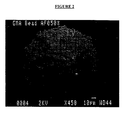
- the microparticle may be a preformed polymeric bead made by micro suspension polymerisation ideally having a diameter in the range 5-15 ⁇ m.
- Such micro beads may be incorporated into the primary bead matrix by suspending them in the aqueous polymerisation medium and then performing a standard suspension polymerisation with the additional monomer(s). A proportion of the micro beads will become encapsulated within the primary bead structure.
- the micro beads are chemically anchored into position within the primary bead matrix.
- microencapsulated micro structures are conveniently distinguished by the use of coloured (dyed or pigmented) or fluorescent components.
- microparticles are conveniently constrained for image capture. This may be achieved for example by passing the particles through a conduit, such as a capillary, this immobilises the particles in two dimensions.
- the conduit is conveniently translucent and/or has a viewing window. Also, pulsed/stroboscopic lighting may be used to give the impression that a particle is stationary.
- Imaging is effected using any convenient means. This is for example achievable using commercially available telescope or long range microscope devices.
- the Questar QM-100 instrument (Box C, New Hope, Pennsylvania 18938, USA) is able to resolve features of 1.1 ⁇ m with a field of view from 375 ⁇ m to 8mm at a working range of 150mm. It offers a large aperture (c.87mm) which reduces the demands on the overall level of illumination required.
- the pattern of microparticles will be random and appear for example like a constellation of stars. Like a constellation, the pattern appears very different depending on the viewing angle. Though it is possible (by bead design, for example by introducing an asicular magnetic particle into the bead it may be aligned to a magnetic field) to orientate the bead during imaging, it is more convenient to take an image at an arbitrary angle. Clearly, if the bead of interest identified after testing is also imaged at a random orientation, it will be difficult in many cases to identify the bead. Hence it is desirable to image the bead of interest from at least two, and up to six different angles, preferably three different angles, for example at or close to 90 degrees apart.
- the number of images to be taken may depend, in some cases to a large extent on the transparency of the bead. It will be appreciated that in this embodiment the orientation of the bead is not constant in all imaging steps. This means that a signature may be derived which does not depend on the orientation of the bead. This signature is a distance matrix. A consequence of multiple imaging is a reduction in the number of unique codes. This may be overcome by providing more microparticles to the synthesis beads or by reducing the size of each measured volume element or "voxel".
- a particular advantage of the use of a spherical co-ordinate scheme is that the angular ordinates are not dependent on the bead diameter and thus any bead swelling during exposure to solvents is unlikely to interfere with the overall recognition process.
- the inter-microparticle distances are conveniently quantised as one of 256 different values. This being convenient for data storage.
- 45 bytes of memory may be used to capture the data for each bead. For a 20,000 bead library this is a total of about 1 megabyte of memory. This is not a large data volume by current standards.
- extra bytes of memory are allocated to each bead to record its movement. Further convenient aspects of the data handling process will be apparent to the artisan of ordinary skill.
- the polymeric beads are of diameter 100-300 ⁇ m and contain between 5 and 200 (preferably between 5 and 25) dispersed microparticles for recognition purposes.
- the information content may be increased by the use of beads that differ in size, shape, colour or other recognisable parameter.
- the number of microparticles per bead may be varied. Conveniently this will be achieved by random incorporation of the microparticles during the manufacture of the bead. Alternatively, non-random incorporation may be used to broaden the distribution of number of microparticles per bead.
- the microparticles may be incorporated as surface features of the bead, rather than dispersed within the core of the bead.
- beads may swell differently in different solvents. Hence it is desirable either to use the same solvent for the different imaging stages, or to make allowances for inter-particle spacings with the image analysis software.
Landscapes
- Chemical & Material Sciences (AREA)
- Organic Chemistry (AREA)
- Chemical Kinetics & Catalysis (AREA)
- Organic Low-Molecular-Weight Compounds And Preparation Thereof (AREA)
- Transition And Organic Metals Composition Catalysts For Addition Polymerization (AREA)
- Glass Compositions (AREA)
- Iron Core Of Rotating Electric Machines (AREA)
- Physical Or Chemical Processes And Apparatus (AREA)
- Compositions Of Macromolecular Compounds (AREA)
- Investigating Or Analysing Biological Materials (AREA)
Claims (9)
- Verfahren zur Herstellung einer chemischen Bibliothek, wobei das Verfahren das Synthetisieren der Bibliothek auf mehreren Polymerkügelchen, die optisch unterscheidbare willkürliche Merkmale in Form von Mikropartikeln umfassen, welche in das Kügelchen eingearbeitet sind, das Aufzeichnen derartiger Merkmale während der Bibliothekssynthese zur Bereitstellung einer chemischen Bibliothek auf mehreren Polymerkügelchen umfasst, wobei die Identität einer Bibliotheksverbindung bzw. Bibliotheksverbindungen, die mit einem Polymerkügelchen verbunden ist, durch Verweis auf die willkürlichen Merkmale dieses Kügelchens nachgewiesen wird.
- Verfahren nach Anspruch 1, wobei die Polymerkügelchen Glasmaterial und gepfropftes oder gebundenes Polymermaterial umfassen.
- Verfahren nach Anspruch 1, wobei die Polymerkügelchen Keramikmaterial und gepfropftes oder gebundenes Polymermaterial umfassen.
- Chemische Bibliothek auf mehreren Polymerkügelchen, die optisch unterscheidbare willkürliche Merkmale in Form von Mikropartikeln umfassen, welche in das Kügelchen eingearbeitet sind, hergestellt gemäß dem Verfahren nach einem der vorhergehenden Ansprüche.
- System zur Synthese einer chemischen Bibliothek, das eine Vorrichtung zur Synthese einer chemischen Bibliothek umfasst, die derart mit einer Bildanalysevorrichtung verbunden ist, dass die Bildanalysevorrichtung während der Synthese einer chemischen Bibliothek ein Bild bzw. Bilder der Polymerkügelchen der chemischen Bibliothek, die optisch unterscheidbare willkürliche Merkmale in Form von Mikropartikeln umfassen, welche in das Kügelchen eingearbeitet sind, erfasst und die Kügelchen anschließend durch Verweis auf die willkürlichen Merkmale identifiziert.
- Synthesesystem nach Anspruch 5, wobei die Synthesepartikel für die Bilderfassung eingespannt sind.
- Synthesesystem nach Anspruch 5 oder Anspruch 6, wobei die einzelnen Bilder der Polymerkügelchen von der Ausrichtung der Kügelchen unabhängig sind.
- Verwendung einer chemischen Bibliothek nach Anspruch 4 in Screening-Verfahren zur Identifizierung von Verbindungen, die die Aktivität eines fraglichen Biologikums modulieren.
- Verwendung einer automatischen Bestückungsvorrichtung zur Handhabung von Polymerkügelchen, die optisch unterscheidbare willkürliche Merkmale in Form von Mikropartikeln umfassen, welche in das Kügelchen eingearbeitet sind.
Applications Claiming Priority (3)
| Application Number | Priority Date | Filing Date | Title |
|---|---|---|---|
| GB9707741 | 1997-04-17 | ||
| GBGB9707741.6A GB9707741D0 (en) | 1997-04-17 | 1997-04-17 | Process |
| PCT/GB1998/001063 WO1998047838A1 (en) | 1997-04-17 | 1998-04-14 | Process for the preparation of a chemical library |
Publications (2)
| Publication Number | Publication Date |
|---|---|
| EP0975561A1 EP0975561A1 (de) | 2000-02-02 |
| EP0975561B1 true EP0975561B1 (de) | 2009-08-26 |
Family
ID=10810906
Family Applications (1)
| Application Number | Title | Priority Date | Filing Date |
|---|---|---|---|
| EP98917337A Expired - Lifetime EP0975561B1 (de) | 1997-04-17 | 1998-04-14 | Verfahren zur herstellung einer chemischen bibliothek |
Country Status (7)
| Country | Link |
|---|---|
| EP (1) | EP0975561B1 (de) |
| JP (1) | JP2001526645A (de) |
| AT (1) | ATE440809T1 (de) |
| AU (1) | AU7058298A (de) |
| DE (1) | DE69841096D1 (de) |
| GB (1) | GB9707741D0 (de) |
| WO (1) | WO1998047838A1 (de) |
Families Citing this family (4)
| Publication number | Priority date | Publication date | Assignee | Title |
|---|---|---|---|---|
| AUPP737298A0 (en) * | 1998-11-30 | 1998-12-24 | University Of Queensland, The | Combinatorial libraries |
| US8791053B2 (en) * | 2002-09-27 | 2014-07-29 | Mpm-Holding Aps | Spatially encoded polymer matrix |
| EP1654326A1 (de) * | 2003-08-01 | 2006-05-10 | VersaMatrix A/S | Trianguliniumfluoreszenzfarbstoffe und sie enthaltende polymere |
| WO2005061094A1 (en) * | 2003-12-22 | 2005-07-07 | Versamatrix A/S | Identification of encoded beads |
Family Cites Families (4)
| Publication number | Priority date | Publication date | Assignee | Title |
|---|---|---|---|---|
| US6087186A (en) | 1993-07-16 | 2000-07-11 | Irori | Methods and apparatus for synthesizing labeled combinatorial chemistry libraries |
| GB2289150B (en) * | 1994-04-25 | 1998-07-15 | Univ Hertfordshire | Coded items for labelling objects |
| GB2291708B (en) | 1994-07-22 | 1997-03-05 | Zeneca Ltd | Process for screening a library of compounds released from a solid phase |
| GB9521943D0 (en) * | 1995-10-26 | 1996-01-03 | Univ Hertfordshire | Coded particles for process sequence tracking in combinatorial compound library preparation |
-
1997
- 1997-04-17 GB GBGB9707741.6A patent/GB9707741D0/en active Pending
-
1998
- 1998-04-14 EP EP98917337A patent/EP0975561B1/de not_active Expired - Lifetime
- 1998-04-14 DE DE69841096T patent/DE69841096D1/de not_active Expired - Lifetime
- 1998-04-14 JP JP54526598A patent/JP2001526645A/ja active Pending
- 1998-04-14 WO PCT/GB1998/001063 patent/WO1998047838A1/en not_active Ceased
- 1998-04-14 AT AT98917337T patent/ATE440809T1/de not_active IP Right Cessation
- 1998-04-14 AU AU70582/98A patent/AU7058298A/en not_active Abandoned
Also Published As
| Publication number | Publication date |
|---|---|
| WO1998047838A1 (en) | 1998-10-29 |
| DE69841096D1 (de) | 2009-10-08 |
| EP0975561A1 (de) | 2000-02-02 |
| ATE440809T1 (de) | 2009-09-15 |
| AU7058298A (en) | 1998-11-13 |
| JP2001526645A (ja) | 2001-12-18 |
| GB9707741D0 (en) | 1997-06-04 |
Similar Documents
| Publication | Publication Date | Title |
|---|---|---|
| US6799120B2 (en) | Nonredundant split/pool synthesis of combinatorial libraries | |
| JP4954415B2 (ja) | 試料のビーズをベースとした同時プロセシングのための基材としての個々のアレイのアレイおよびその製造法 | |
| US6908737B2 (en) | Systems and methods of conducting multiplexed experiments | |
| EP0853497B1 (de) | Matricen mit speichern und verwendungen davon | |
| CA2291853C (en) | Color-encoding and in-situ interrogation of matrix-coupled chemical compounds | |
| US6306975B1 (en) | Radiation-grafted solid supports for chemical synthesis | |
| US20030134330A1 (en) | Chemical-library composition and method | |
| JP2011221036A (ja) | ハイブリダイゼーションチャンバーと微小球を利用した複合アレイ | |
| US20030027221A1 (en) | High-throughput screening assays by encapsulation | |
| US20030036096A1 (en) | Chemical-library composition and method | |
| JP2004226415A (ja) | 微小球を利用する複合アレイ | |
| EP1448789A2 (de) | Einrichtung und verfahren zur gezielten synthese chemischer bibliotheken | |
| JP2004012460A (ja) | マイクロアレイ較正手段 | |
| EP0975561B1 (de) | Verfahren zur herstellung einer chemischen bibliothek | |
| JP2002501489A (ja) | コード付きケミカルライブラリーの調製方法 | |
| CN111315757B (zh) | 质谱法可区分的合成化合物、库及其方法 | |
| WO2000061281A1 (en) | Encoding scheme for solid phase chemical libraries | |
| WO2002042736A2 (en) | Chemical-library composition and method | |
| US20020177169A1 (en) | Method for the preparation of a coded chemical library |
Legal Events
| Date | Code | Title | Description |
|---|---|---|---|
| PUAI | Public reference made under article 153(3) epc to a published international application that has entered the european phase |
Free format text: ORIGINAL CODE: 0009012 |
|
| 17P | Request for examination filed |
Effective date: 19991117 |
|
| AK | Designated contracting states |
Kind code of ref document: A1 Designated state(s): AT BE CH CY DE DK ES FI FR GB GR IE IT LI LU MC NL PT SE |
|
| RAP1 | Party data changed (applicant data changed or rights of an application transferred) |
Owner name: ASTRAZENECA UK LIMITED |
|
| RAP1 | Party data changed (applicant data changed or rights of an application transferred) |
Owner name: ASTRAZENECA AB |
|
| RAP1 | Party data changed (applicant data changed or rights of an application transferred) |
Owner name: CENTRAL RESEARCH LABORATORIES LIMITED |
|
| RAP1 | Party data changed (applicant data changed or rights of an application transferred) |
Owner name: VERSAMATRIX A/S |
|
| RAP1 | Party data changed (applicant data changed or rights of an application transferred) |
Owner name: VERSAMATRIX A/S |
|
| RAP1 | Party data changed (applicant data changed or rights of an application transferred) |
Owner name: NOVO NORDISK A/S |
|
| 17Q | First examination report despatched |
Effective date: 20070913 |
|
| GRAP | Despatch of communication of intention to grant a patent |
Free format text: ORIGINAL CODE: EPIDOSNIGR1 |
|
| GRAS | Grant fee paid |
Free format text: ORIGINAL CODE: EPIDOSNIGR3 |
|
| GRAA | (expected) grant |
Free format text: ORIGINAL CODE: 0009210 |
|
| AK | Designated contracting states |
Kind code of ref document: B1 Designated state(s): AT BE CH CY DE DK ES FI FR GB GR IE IT LI LU MC NL PT SE |
|
| REG | Reference to a national code |
Ref country code: GB Ref legal event code: FG4D |
|
| REG | Reference to a national code |
Ref country code: CH Ref legal event code: EP |
|
| REG | Reference to a national code |
Ref country code: IE Ref legal event code: FG4D |
|
| REF | Corresponds to: |
Ref document number: 69841096 Country of ref document: DE Date of ref document: 20091008 Kind code of ref document: P |
|
| PG25 | Lapsed in a contracting state [announced via postgrant information from national office to epo] |
Ref country code: SE Free format text: LAPSE BECAUSE OF FAILURE TO SUBMIT A TRANSLATION OF THE DESCRIPTION OR TO PAY THE FEE WITHIN THE PRESCRIBED TIME-LIMIT Effective date: 20090826 Ref country code: FI Free format text: LAPSE BECAUSE OF FAILURE TO SUBMIT A TRANSLATION OF THE DESCRIPTION OR TO PAY THE FEE WITHIN THE PRESCRIBED TIME-LIMIT Effective date: 20090826 Ref country code: AT Free format text: LAPSE BECAUSE OF FAILURE TO SUBMIT A TRANSLATION OF THE DESCRIPTION OR TO PAY THE FEE WITHIN THE PRESCRIBED TIME-LIMIT Effective date: 20090826 |
|
| NLV1 | Nl: lapsed or annulled due to failure to fulfill the requirements of art. 29p and 29m of the patents act | ||
| PG25 | Lapsed in a contracting state [announced via postgrant information from national office to epo] |
Ref country code: NL Free format text: LAPSE BECAUSE OF FAILURE TO SUBMIT A TRANSLATION OF THE DESCRIPTION OR TO PAY THE FEE WITHIN THE PRESCRIBED TIME-LIMIT Effective date: 20090826 |
|
| PG25 | Lapsed in a contracting state [announced via postgrant information from national office to epo] |
Ref country code: CY Free format text: LAPSE BECAUSE OF FAILURE TO SUBMIT A TRANSLATION OF THE DESCRIPTION OR TO PAY THE FEE WITHIN THE PRESCRIBED TIME-LIMIT Effective date: 20090826 Ref country code: PT Free format text: LAPSE BECAUSE OF FAILURE TO SUBMIT A TRANSLATION OF THE DESCRIPTION OR TO PAY THE FEE WITHIN THE PRESCRIBED TIME-LIMIT Effective date: 20091228 |
|
| PG25 | Lapsed in a contracting state [announced via postgrant information from national office to epo] |
Ref country code: ES Free format text: LAPSE BECAUSE OF FAILURE TO SUBMIT A TRANSLATION OF THE DESCRIPTION OR TO PAY THE FEE WITHIN THE PRESCRIBED TIME-LIMIT Effective date: 20091207 Ref country code: DK Free format text: LAPSE BECAUSE OF FAILURE TO SUBMIT A TRANSLATION OF THE DESCRIPTION OR TO PAY THE FEE WITHIN THE PRESCRIBED TIME-LIMIT Effective date: 20090826 |
|
| PG25 | Lapsed in a contracting state [announced via postgrant information from national office to epo] |
Ref country code: BE Free format text: LAPSE BECAUSE OF FAILURE TO SUBMIT A TRANSLATION OF THE DESCRIPTION OR TO PAY THE FEE WITHIN THE PRESCRIBED TIME-LIMIT Effective date: 20090826 |
|
| PLBE | No opposition filed within time limit |
Free format text: ORIGINAL CODE: 0009261 |
|
| STAA | Information on the status of an ep patent application or granted ep patent |
Free format text: STATUS: NO OPPOSITION FILED WITHIN TIME LIMIT |
|
| 26N | No opposition filed |
Effective date: 20100527 |
|
| PG25 | Lapsed in a contracting state [announced via postgrant information from national office to epo] |
Ref country code: GR Free format text: LAPSE BECAUSE OF FAILURE TO SUBMIT A TRANSLATION OF THE DESCRIPTION OR TO PAY THE FEE WITHIN THE PRESCRIBED TIME-LIMIT Effective date: 20091127 |
|
| PG25 | Lapsed in a contracting state [announced via postgrant information from national office to epo] |
Ref country code: MC Free format text: LAPSE BECAUSE OF NON-PAYMENT OF DUE FEES Effective date: 20100430 |
|
| REG | Reference to a national code |
Ref country code: CH Ref legal event code: PL |
|
| PG25 | Lapsed in a contracting state [announced via postgrant information from national office to epo] |
Ref country code: IE Free format text: LAPSE BECAUSE OF NON-PAYMENT OF DUE FEES Effective date: 20100414 |
|
| PG25 | Lapsed in a contracting state [announced via postgrant information from national office to epo] |
Ref country code: LI Free format text: LAPSE BECAUSE OF NON-PAYMENT OF DUE FEES Effective date: 20100430 Ref country code: CH Free format text: LAPSE BECAUSE OF NON-PAYMENT OF DUE FEES Effective date: 20100430 |
|
| PG25 | Lapsed in a contracting state [announced via postgrant information from national office to epo] |
Ref country code: IT Free format text: LAPSE BECAUSE OF FAILURE TO SUBMIT A TRANSLATION OF THE DESCRIPTION OR TO PAY THE FEE WITHIN THE PRESCRIBED TIME-LIMIT Effective date: 20090826 |
|
| PG25 | Lapsed in a contracting state [announced via postgrant information from national office to epo] |
Ref country code: LU Free format text: LAPSE BECAUSE OF NON-PAYMENT OF DUE FEES Effective date: 20100414 |
|
| PGFP | Annual fee paid to national office [announced via postgrant information from national office to epo] |
Ref country code: GB Payment date: 20130410 Year of fee payment: 16 Ref country code: DE Payment date: 20130508 Year of fee payment: 16 |
|
| PGFP | Annual fee paid to national office [announced via postgrant information from national office to epo] |
Ref country code: FR Payment date: 20130625 Year of fee payment: 16 |
|
| REG | Reference to a national code |
Ref country code: DE Ref legal event code: R119 Ref document number: 69841096 Country of ref document: DE |
|
| GBPC | Gb: european patent ceased through non-payment of renewal fee |
Effective date: 20140414 |
|
| REG | Reference to a national code |
Ref country code: FR Ref legal event code: ST Effective date: 20141231 |
|
| PG25 | Lapsed in a contracting state [announced via postgrant information from national office to epo] |
Ref country code: DE Free format text: LAPSE BECAUSE OF NON-PAYMENT OF DUE FEES Effective date: 20141101 Ref country code: GB Free format text: LAPSE BECAUSE OF NON-PAYMENT OF DUE FEES Effective date: 20140414 |
|
| REG | Reference to a national code |
Ref country code: DE Ref legal event code: R119 Ref document number: 69841096 Country of ref document: DE Effective date: 20141101 |
|
| PG25 | Lapsed in a contracting state [announced via postgrant information from national office to epo] |
Ref country code: FR Free format text: LAPSE BECAUSE OF NON-PAYMENT OF DUE FEES Effective date: 20140430 |