EP0972368B1 - Method and apparatus for communicating a block of digital information between a sending and a receiving station - Google Patents
Method and apparatus for communicating a block of digital information between a sending and a receiving station Download PDFInfo
- Publication number
- EP0972368B1 EP0972368B1 EP98912842A EP98912842A EP0972368B1 EP 0972368 B1 EP0972368 B1 EP 0972368B1 EP 98912842 A EP98912842 A EP 98912842A EP 98912842 A EP98912842 A EP 98912842A EP 0972368 B1 EP0972368 B1 EP 0972368B1
- Authority
- EP
- European Patent Office
- Prior art keywords
- block
- digital information
- digital
- encoded
- communication system
- Prior art date
- Legal status (The legal status is an assumption and is not a legal conclusion. Google has not performed a legal analysis and makes no representation as to the accuracy of the status listed.)
- Expired - Lifetime
Links
- 238000000034 method Methods 0.000 title claims description 45
- 230000005540 biological transmission Effects 0.000 claims description 132
- 238000004891 communication Methods 0.000 claims description 67
- 238000011084 recovery Methods 0.000 claims description 21
- 239000000470 constituent Substances 0.000 claims description 11
- 230000009897 systematic effect Effects 0.000 claims description 5
- 230000000977 initiatory effect Effects 0.000 claims 4
- 230000001413 cellular effect Effects 0.000 claims 1
- 238000010586 diagram Methods 0.000 description 7
- 230000010267 cellular communication Effects 0.000 description 3
- 230000002411 adverse Effects 0.000 description 1
- 230000015572 biosynthetic process Effects 0.000 description 1
- 230000007423 decrease Effects 0.000 description 1
- 230000001419 dependent effect Effects 0.000 description 1
- 238000001514 detection method Methods 0.000 description 1
- 238000010295 mobile communication Methods 0.000 description 1
Images



Classifications
-
- H—ELECTRICITY
- H04—ELECTRIC COMMUNICATION TECHNIQUE
- H04L—TRANSMISSION OF DIGITAL INFORMATION, e.g. TELEGRAPHIC COMMUNICATION
- H04L1/00—Arrangements for detecting or preventing errors in the information received
- H04L1/12—Arrangements for detecting or preventing errors in the information received by using return channel
- H04L1/16—Arrangements for detecting or preventing errors in the information received by using return channel in which the return channel carries supervisory signals, e.g. repetition request signals
- H04L1/18—Automatic repetition systems, e.g. Van Duuren systems
-
- H—ELECTRICITY
- H04—ELECTRIC COMMUNICATION TECHNIQUE
- H04L—TRANSMISSION OF DIGITAL INFORMATION, e.g. TELEGRAPHIC COMMUNICATION
- H04L1/00—Arrangements for detecting or preventing errors in the information received
- H04L1/004—Arrangements for detecting or preventing errors in the information received by using forward error control
- H04L1/0056—Systems characterized by the type of code used
- H04L1/0064—Concatenated codes
- H04L1/0066—Parallel concatenated codes
-
- H—ELECTRICITY
- H04—ELECTRIC COMMUNICATION TECHNIQUE
- H04L—TRANSMISSION OF DIGITAL INFORMATION, e.g. TELEGRAPHIC COMMUNICATION
- H04L1/00—Arrangements for detecting or preventing errors in the information received
- H04L1/004—Arrangements for detecting or preventing errors in the information received by using forward error control
- H04L1/0056—Systems characterized by the type of code used
- H04L1/0067—Rate matching
- H04L1/0068—Rate matching by puncturing
-
- H—ELECTRICITY
- H04—ELECTRIC COMMUNICATION TECHNIQUE
- H04L—TRANSMISSION OF DIGITAL INFORMATION, e.g. TELEGRAPHIC COMMUNICATION
- H04L1/00—Arrangements for detecting or preventing errors in the information received
- H04L1/12—Arrangements for detecting or preventing errors in the information received by using return channel
- H04L1/16—Arrangements for detecting or preventing errors in the information received by using return channel in which the return channel carries supervisory signals, e.g. repetition request signals
- H04L1/18—Automatic repetition systems, e.g. Van Duuren systems
- H04L1/1812—Hybrid protocols; Hybrid automatic repeat request [HARQ]
- H04L1/1819—Hybrid protocols; Hybrid automatic repeat request [HARQ] with retransmission of additional or different redundancy
Definitions
- the present invention relates generally to the communication of a block of digital information in encoded form between a sending station and a receiving station in a digital communication system. More particularly, the present invention relates to a method according to the preamble of claim 1 and to an apparatus according to the preamble of claim 29.
- XP000273890 there is described a type-II hybrid-ARQ protocol using punctured reed-Solomon codes.
- An (n, k) RS code is decomposed into a pair of (n/2, k) punctured RS codes.
- the original code and the two derivative codes are used individually in type-I hybrid-ARQ protocols.
- These three type-I protocols combine to form a single type-II protocol.
- the performance of the related system is analyzed, with particular attention being paid to the definition of an effective channel model for packets that are known to have caused the generation of retransmission requests.
- a communication system is formed, at a minimum, by a transmitter and a receiver interconnected by a communication channel.
- the transmitter forms at least a portion of a sending station
- the receiver forms at least a portion of a receiving station.
- Communication signals transmitted by the sending station are transmitted upon the communication channel to be received by the receiving station.
- Information contained in the communication signals transmitted by the sending station is recovered once received at the receiving station.
- information to be communicated to the receiving station is digitized. The digitized information is then used to form the communication signal.
- the communication signals are transmitted in bursts.
- Blocks of digital information are communicated by a sending station to a receiving station during transmission of the bursts upon the communication channel.
- the communication signal is distorted during its transmission upon the communication channel. Because of such distortion, when the communication signal is received at the receiving station, the received signal differs somewhat from the communication signal transmitted from the sending station. If the communication channel is of poor quality, and the amount of distortion is significant, the informational content of the communication signal cannot be properly recovered at the receiving station.
- multi-path and Rayleigh distortion is sometimes introduced upon the communication signal as it is transmitted on the communication channel from the sending station to the receiving station.
- the receiving station determines whether a burst of the block of information received at the receiving station is of an acceptable quality level. Indications of the determinations, forming feedback information, are returned to the sending station by way of a feedback channel.
- the indication may also be communicated back to the sending station implicitly. That is to say, lack of transmission of feedback information from the receiving to the sending station may be indicative of successful recovery of the informational content of the block of digital information.
- the feedback information may be provided to the sending station in a manner other than by way of a direct feedback channel extending directly to the sending station.
- the indication may alternately be communicated back to the sending station indirectly. For example, the sending station might measure the channel conditions and decide that the probability of the receiving station successfully decoding the block of digital information to be so low that retransmission of the block of digital information would be justifiable.
- the receiving station simply detects whether the received signal burst is of an acceptable quality level. If the signal quality level of the received signal burst is not good enough to permit recovery of the informational content thereof, the receiving station merely requests the sending station to retransmit the block of digital information in a subsequent burst.
- Such a scheme is sometimes referred to as an ARQ (automatic request) scheme.
- Retransmission of the block of digital information can be repeated in successive bursts until the block of digital information is received at the receiving station with at least a minimum quality level.
- the receiving station makes the determination of the quality of the received block of digital information responsive, for example, to detection of an error detecting code, knowledge of the communication channel upon which the block of information is transmitted, or some other suitable scheme.
- the block of digital information can also be transmitted using an error protecting code, such as type I hybrid ARQ (Automatic Repeat Request) scheme, a general channel decoding technique
- an error protecting code such as type I hybrid ARQ (Automatic Repeat Request) scheme, a general channel decoding technique
- the receiving station receives the block of digital information
- the received block is decoded by a decoder to extract the informational content from the received signal.
- a determination is made if the informational content of the block of digital information can be recovered with at least an acceptable quality level. Because of the error protection, the block of digital information is better able to be recovered even if transmitted upon a communication channel of lowered quality.
- Decoder circuitry at the receiving station capable of utilizing soft information is referred to as a soft input decoder.
- blocks of digital information determined by the receiving station to be corrupt are not merely discarded. Instead, the corrupt blocks are combined with subsequently-transmitted blocks of digital information.
- Information contained in previously-transmitted blocks is accumulated and forms accumulated knowledge.
- Such accumulated knowledge can be used to facilitate recovery of subsequently-transmitted blocks. Thereby, "accumulated knowledge" results, the number of times in which the blocks of digital information must otherwise be retransmitted decreases.
- the advantages of utilization of accumulated knowledge permitted by the combining of successive retransmissions of the blocks of digital information occur with increased amounts of information contained in the blocks of digital information.
- Decoder circuitry at the receiving station capable of utilizing soft information is referred to as a soft input decoder.
- a sequence formed of other symbols created from the same block of digital information is instead transmitted. For instance, if the first sequence is formed of an original set of parity symbols (possibly including uncoded information symbols of the block of digital information) and retransmission is requested, additional numbers of parity symbols are transmitted by the sending station in the retransmitted sequence. The receiving station accumulates the received symbols of the various transmissions and the symbols accumulated during the various transmissions are utilized together during a decoding process.
- a conventional block or convolutional low rate coding process can be performed to form an encoded signal. Then, the encoded signal is "punctured.” That is, selected symbols of the coded block are marked so as not to be transmitted. Only the "unpunctured" symbols, i.e., symbols which have not been marked, are transmitted. While the coded signal is weakened by transmitting only some of the encoded symbols, a higher effective coding rate is possible for a given encoder structure. If the informational content of the block of digital information can not be recovered with a desired level of quality from the symbols first received at the receiving station, additional coded portions of the signal are requested by the receiving station to be transmitted thereto.
- Some of the previously-punctured, and not-yet sent, symbols are thereafter transmitted by the sending to the receiving station.
- the receiving station utilizes both the previously-transmitted symbols and the newly-transmitted symbols. If additional retransmissions are required, yet additional symbols are subsequently transmitted to the receiving station.
- Such a scheme is referred to as a successive redundancy transmission scheme.
- a successive redundancy transmission scheme designed to be able to cope with adverse channel conditions, however, requires a complex decoding process to be performed to recover the informational content of the block of digital information. And, if the block of digital information is coded using a convolutional coding scheme, the decoding required at a receiving station to decode the information is complex irrespective of the amount of puncturing of the code.
- a manner by which to adaptively select the complexity of the coding of a block of digital information to be transmitted between a sending and a receiving station would therefore be advantageous.
- channel conditions are of good quality, only limited portions of a coded signal would have to be transmitted to a receiving station to permit recovery of the informational content thereof.
- additional portions of the coded signal could be transmitted, better to ensure that the informational content of the block of digital information can be recovered at the receiving station.
- the present invention accordingly, advantageously provides a method according to claim 1 and an associated apparatus according to claim 29.
- the number of the transmission sets which are transmitted by the sending station is dependent upon the quality of the channel conditions extending between the sending and receiving stations.
- channel conditions are of good quality, fewer transmission sets are required to be transmitted to permit the receiving station to recover the informational content of the block of digital information.
- the channel conditions are of poor quality, increased numbers of transmission sets are transmitted to ensure better that the receiving station is able to recover the informational content of the block of digital information.
- the sending station includes a parallel-concatenated coder for forming a plurality of encoded versions of a block of digital information.
- a transmitter is selectively coupled to be provided with transmission sets formed of at least selected portions of at least selected ones of the encoded versions of the block of digital information.
- the transmitters are operable to transmit the transmission sets to a receiving station.
- a selector controls formation of the transmission sets and when the transmission sets are provided to the transmitter. The selection by the selector is made responsive to indications as to whether the receiving station is able to recover adequately the block of digital information from the digital information from the one or more transmission sets, previously-transmitted to the receiving station. When channel conditions are of poor quality, the selector selects additional transmission sets to be transmitted by the transmitter to the receiving station.
- the present invention is embodied in a cellular communication system which utilizes digital communications, such as a GSM (Global System For Mobile Communications) communication system.
- GSM Global System For Mobile Communications
- operation of an embodiment of the present invention facilitates communication, both of downlink and uplink transmissions, between the base station and mobile terminals.
- channel conditions are of good quality, the amount of coded data communicated between the base station and mobile terminal is minimized, thereby to maximize throughput rates.
- channel conditions are of poor quality, increased amounts of coded data is communicated between the base station and the mobile terminal, thereby to facilitate recovery of the informational content of the transmissions.
- a method and an associated apparatus selectively iteratively increases redundancy of a block of digital information communicated by a sending station to at least one receiving station in a digital communication system.
- a block of digital information is parallel-concatenated coded to form a plurality of encoded versions of the block of digital information.
- At least a first selected portion of at least one selected encoded version of the plurality of encoded versions of the block of the digital information is transmitted from the sending station to the at least one receiving station.
- Iterative transmission of at least a second selected portion of at least one selected encoded version of the plurality of encoded versions of the block of the digital information from the sending station to the receiving station is initiated if recovery of the block of digital information at the receiving station is not possible with at least a selected level of accuracy.
- the second selected portion has at least one part which is dissimilar with the first selected portion of the at least one selected encoded version.
- FIG. 1 illustrates a communication system, shown generally at 10, in which an embodiment of the present invention is operable. While the following description shall be described with respect to an exemplary embodiment in which the communication system 10 forms a cellular communication system, it should be understood that such description is by way of example only.
- the communication system 10 is similarly representative of other types of communication systems, both non-wireline and wireline in nature. Embodiments of the present invention are similarly operable in such other types of communication systems. And, operation of the various embodiments of the present invention can similarly be described with respect to such other types of communication systems.
- the communication systems 10 includes a sending station 12 and a receiving station 14 coupled by way of a communication channel 16. Exemplary operation of the communication system 10 shall be described with respect to transmission of a downlink transmission transmitted by the sending station 12 forming a radio base station to the receiving station 14 forming a mobile terminal. Operation can analogously be described with respect to transmission of an uplink signal by a sending station forming a mobile terminal to a receiving station forming a radio base station.
- the communication system forms a digital communication system in which blocks of digital information are transmitted in bursts between the sending station 12 and the receiving station 14.
- the sending station 12 receives, or generates, an information signal, here shown to be formed by an information source 22.
- An information signal formed by the information source 22 is encoded by a source encoder 24.
- the source encoder in one embodiment, digitizes and formats the information signal applied thereto.
- a formatted, source-encoded signal generated by the encoder 24 is applied to a channel encoder 26.
- the channel encoder 26 channel-encodes the signal applied thereto in manners which shall be described in greater detail below with respect to FIGS. 3 and 4 .
- the channel encoder forms a parallel-concatenated encoder which forms a plurality of encoded versions of blocks of digital information provided thereto by the source encoder 24. Selected portions of selected encoded versions formed by the channel encoder 26 form transmission sets which are selectively applied to a modulator 28. Selection of which portions of which encoded versions formed by the channel encoder 26 form the transmission sets and are provided to the modulator 28 is made by a selector 30.
- the selector 30 is formed of, for example, a processing device. The selector 30 is operable responsive to indications of feedback information reported back to the sending station 12 by the receiving station 14. Such feedback information is here received by receiver circuitry 32 of the sending station 12.
- the modulator 28 modulates the transmission sets provided thereto by the channel encoder to permit transmission of the transmission set upon the communication channel 16.
- the channel 16 is here shown to include multiple numbers of paths forming a multi-path communication channel. Distortion is introduced upon the signal transmitted upon the multi-path channel by the sending station 12. Such distortion causes the signal received by the receiving station 14 to differ from that which is transmitted by the sending station 12.
- the receiving station 14 includes a demodulator 36 for demodulating the downlink signal received at the receiving station 14.
- the demodulator 26 generates demodulated signals which are applied to a channel decoder 38 which decodes the demodulated signal applied thereto in a manner generally reverse to that used by the channel encoder 26 of the sending station 12. Additional details of operation of the decoder 38 shall be described with respect to the description of FIGS. 5 and 6 below.
- the channel decoder generates a channel-decoded signal which is provided to a source decoder 42 and to a determiner 44.
- the source decoder 42 is operable to source decode a signal applied thereto and to provide a decoded signal to an information sink 46.
- the determiner 44 is operable to determine whether the channel decoder 38 has been able to decode the signal applied to the channel decoder 38 with at least a selected level of accuracy. If a determination is made by the determiner 44 that the channel decoder has been unable to adequately decode the signal applied thereto, a request is generated by transmitter circuitry 48 of the receiving station 14 for transmission back to the sending station. The request requests the sending station to transmit another transmission set. Such an indication is received by the receiver circuitry 32 of the sending station 12. The selector 30 of the sending station 12 is provided with indications of the request and causes the channel encoder 26 to provide another transmission set to the modulator 28.
- Successively-redundant, iterative transmission of additional transmission sets can be performed by the sending station 12 to the receiving station 14, if necessary, to ensure better that the receiving station 14 is able to recover the informational content of the block of digital information.
- the newly-selected transmission set, selected by the selector differs from at least one, but not necessarily all, of previously-transmitted transmission sets associated with the corresponding information block.
- the same transmission set can be retransmitted but not until at least another, dissimilar transmission set has before been transmitted.
- Two transmission sets are said to differ when they are formed by taking a different set of code bits from possibly different, encoded versions of the parallel-concatenated code. Viz., the actually-transmitted symbol values transmitted with two different transmission sets may happen to be equal, but the positions and, possibly, the constituent codes from which they are formed differ for at least one number of the sets.
- a second transmission set must differ from the first transmission set.
- the third transmission set must differ from the first transmission set or the second transmission set, but not necessarily from both previously-transmitted, transmission sets. And, trivially, since the second set must differ from the first set, and the third set cannot equal both the first and second sets simultaneously, the third set complies with the constraint automatically. And, thus, no other constraints are needed for the third transmission set. Subsequently-transmitted transmission sets can similarly be analyzed. Therefore, the constraint on transmission set selection is merely that the secondly-transmitted transmission set must differ from the firstly-transmitted set. These sets are referred to as second and first transmission sets, respectively.
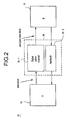
- FIG. 2 again illustrates the communication system 10 and illustrates the feedback arrangement by which the receiving station 14 reports back to the sending station 12 requests to transmit an additional transmission set formed of an additional portion of selected encoded versions of a block of digital information.
- the sending station 12 is operable to transmit upon a forward channel portion 16-1 a transmission set formed of at least a selected portion of at least a selected encoded version of the block of digital information.
- the receiving station 14 receives the transmission set formed of the at least the portion of the at least one encoded version of the block of digital information, once transmitted upon the forward channel portion 16-1.
- the receiving station 14 reports back by way of a reverse channel, here the feedback channel 16-2, when the informational content of the signal transmitted to the receiving station 14 cannot be recovered with the selected level of accuracy. Iterative transmission of additional portions of selected encoded versions of the block of digital information can be effectuated, if necessary, better to ensure that the receiving station 14 is able to recover the informational content of the data transmitted thereto.
- the forward channel 16-1 is of a good quality level and the receiving station 14 is able to recover the informational content of the signal transmitted thereto, repeated, iterative transmissions of portions of encoded versions of the block of digital information need not be transmitted to the receiving station. Thereby, throughput rates of information transfer between the sending and receiving stations 12 and 14 are improved.
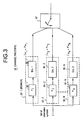
- FIG. 3 illustrates the channel encoder 26 which forms a portion of the sending station 12, shown in FIG. 1 .
- the channel encoder 26 forms a parallel-concatenated encoder for forming, in parallel, the plurality of encoded versions of a block of information symbols.
- the block of digital information is formed of a length of K information symbols I.
- Each K-length block of I-symbols is applied to N branches, here branches 62-1, 62-2, ..., and 62-N, of the channel encoder 26.
- Each branch permutes the block of information symbols provided thereto by a separate permutation.
- Each branch 62-1 through 62-N includes a permuter 64-1, 64-2, ..., 64-N to perform such permutations.
- the permuters permute the block of information symbols to form N separate permutations of the block of symbols provided to the encoder 26.
- a permutation performed by one of the branches may, for example, form a trivial identity permutation.
- the permuted blocks of symbols formed by the permuters 64-1 through 64-N are provided on each respective branch, to a separate encoder, here encoders 66-1, 66-2, ..., and 66-N.
- the encoders encode the permuted blocks of symbols provided thereto.
- each of the encoders adds parity symbols to the permuted block provided thereto.
- the encoders of each of the branches form constituent, systematic encoder elements.
- the parity bits added by the encoders of the different branches may substantially correspond with one another in one embodiment, or may differ with one another in other embodiments.
- a functional switch element 67 selectively passes selected portions of the encoded versions formed at the different branches.
- FIG. 4 illustrates again the channel encoder 26 shown in FIG. 3 .
- the branches 62-1, 62-2, ..., and 62-N of an exemplary implementation of the channel encoder 26 are shown.
- a separate permuter 64-1 (shown in FIG. 3 ) is not separately illustrated as a trivial identity permutation is provided to the encoder 66-1.
- Permuters 64-2 and 64-N are, however; separately illustrated in the branches 62-2 and 62-N, respectively.
- Each of the encoders 66-1 through 66-N includes delay elements 68 and summation elements 72 for forming encoded signals in manners as described previously with respect to FIG. 3 . And, the encoded signals formed by the encoder 66-1 through 66-N are selectively coupled, by way of the switch element 67, to the modulator 28 (shown in FIG. 1 ). The switch element 67 is again shown to be controlled by the selections made by the selector 30 (shown in FIG. 1 ).
- any selected portion of any selected one or more encoded versions of the block of symbols formed by any of the branches 62-I through 62-N form a transmission set which is provided to the modulator.
- an entire encoded version formed by a single branch forms the transmission set which is provided to the modulator.
- selected portions of an encoded version form a transmission set which is provided to the modulator, and in other embodiments, the transmission set is formed of selected portions taken from different encoded versions generated by different ones of the branches of the encoder 26. Control over the selection is made by the selector 30 (again, shown in FIG. 1 ).
- a transmission set formed of a first encoded version generated by the first branch 62-1 is first transmitted to the receiving station 14. If the receiving station 14 is unable to recover the informational content of the block from the transmission set transmitted thereto upon the communication channel 16, a request is made for the sending station 12 to transmit additional information.
- the selector 30 causes a second transmission set formed of an encoded version of the block of symbols to be transmitted to the receiving station. Such a procedure can be repeated iteratively, if necessary, if the receiving station 14 is unable to recover the informational content of the block of symbols.
- FIG. 5 illustrates exemplary decoder operation of the channel decoder 38 of the receiving station 14 when the at least portions of the selected encoded versions of the block of symbols are received at the receiving station.
- operation of the channel decoder 38 shall be described with respect to the embodiment, described above, in which entire encoded versions formed by separate branches 62-1 through 62-N of the channel encoder are transmitted by the sending station 12 to the receiving station 14.
- analogous operation of the channel decoder may instead be described.
- decoding of the first encoded version is performed, as represented by the decoder one step 82.
- a determination is made, as indicated by the determiner 44 as to whether recovery of the informational content of the block of symbols can be made responsive to the first step of decoding 82. If recovery of the informational content of the block of symbols can be adequately performed, additional information pertaining to that block of symbols need not be transmitted by the sending station 12.
- a request is made for the sending station to transmit another transmission set.
- a transmission set formed of a second encoded version of the block of symbols is thereafter transmitted to the receiving station 14, and the transmission set is decoded by a second decoding step, here second decoding step 86.
- the first and second decoding steps 82 and 86 are repeated a Y number of times, as indicated by the block 88.
- the determiner 44 again determines whether recovery of the informational content of the block of symbols can be effectuated with a selected level of accuracy. If so, transmission of additional information pertaining to that block of symbols need not be transmitted by the sending station.
- a request is made for the sending station 12 to transmit another transmission set formed of another encoded version of the block of symbols.
- the third encoded version is decoded, as indicated by the third decoding step 92.
- the three decoding steps 82, 86 and 92 may be repeated a Z number of times, as indicated by the block 94. Thereafter, the determiner 44 again makes a determination as to whether the informational content of the block of symbols can be recovered adequately. If so, transmission of additional information is not necessitated. Otherwise, transmission of additional encoded versions, and successive decoding steps of which decoding step 96 is illustrative, are subsequently performed.
- channel conditions are of good quality and recovery of the informational content of the block of symbols can be effectuated by the decoding of only one or a few transmission sets, processing required to recover the informational content of the block is reduced. And, when channel conditions are of generally poor quality, additional transmission sets are transmitted by the sending station to the receiving station, better to ensure that the informational content of the block of symbols can be recovered.
- FIG. 6 illustrates the channel decoder 38 of an embodiment of the present invention.
- a block of received symbols I r is provided to a first decoder branch 106-1.
- the channel decoder 38 includes a plurality of N decoder branches of which decoder branches 106-2 and 106-N are shown in the figure. Each of the decoder branches is coupled to receive the received block of systematic symbols.
- operation of the channel decoder shall be described with respect to the embodiment in which entire encoded versions of the block of symbols are transmitted between the sending and receiving stations. In other embodiments, analogous operation of the channel decoder 38 can analogously be described.
- the block of received systematic symbols is provided to the first decoder branch 106-1.
- the received block is applied to a first permuter 108-1.
- the permuter 108-1 performs a process generally identical to that of the permuter 64-1, shown in FIG. 3 .
- the block of permuted received systematic symbols is provided to a first-branch decoder 112-1.
- the first-branch decoder 112-1 further receives indications of the parity bits forming at least part of the first encode- version of the block of symbols formed by the channel encoder 26, here indicated by way of line 114-1.
- the decoder 112-1 additionally receives a-priori information which, initially, might have associated therewith a zero confidence level.
- the first-branch decoder is operable to decode the received block of symbols corresponding to the first encoded version of the block of symbols transmitted thereto.
- a determination is made, here indicated by the success query block 116, as to whether the decoding of the first encoded version has permitted recovery of the informational content of the block of symbols with at least a selected level of accuracy. If so, additional transmissions of additional encoded versions of the block of symbols need not be transmitted. If recovery of the informational content of the block of symbols cannot be successfully effectuated, a request is made, as indicated earlier, for the sending station 12 to transmit another encoded version of the block of symbols.
- the second decoder branch 106-2 also includes a permuter, here 108-2 and a second branch decoder 112-2. Such elements are operable in manner analogous to their counterparts of the first decoder branch 106-1.
- the second branch decoder 112-2 is also coupled to receive indications of the parity bits forming at least part of the coded version, here by way of line 114-2 and to receive a-priori information generated by the first branch decoder 112-1.
- the decoders 112-1 and 112-2 alternately decodes the first and second received encoded versions of the block of symbols, respectively, a selected number of times. Once decoding operations have been completed at the second branch decoder 112-2, a determination is made, as indicated by the block 116 as to whether such decoding permits recovery of the informational content of the block of symbols. If the informational content can be recovered with at least a selected level of accuracy, additional transmissions by the sending station to the receiving station of that block of symbols is not necessitated.
- the channel decoder 38 includes N decoder branches permitting up to N number of encoded versions to be decoded.
- An Nth decoder branch 106-N is further illustrated in the figure.
- the Nth decoder branch also includes an Nth permuter 108-N and Nth decoder 112-N.
- the decoder 112-N is further coupled to receive indications of the parity bits forming at least part of the Nth encoded version provided by the channel encoder 26.
- the decoder 112-N is also coupled to receive a-priori information generated responsive to the preceding decoding steps.
- a determination is also made as to the success of the recovery of the informational content of the block of symbols transmitted by way of the determiner 116, such as by performing the decoding process a selected number of times.
- the parallel-concatenated coder forming the channel encoder 26 can be considered to construct a number of transmission sets.
- Each transmission set consists of any selected number of information symbols and symbols from any number of parity sets P ⁇ i . While not necessarily so, in one embodiment, the intersection between any two transmission sets forms an empty set.
- the dimension of a transmission set is defined to be the number of parity sets (or equivalently, the number of constituent codes) which have contributed to the particular transmission sets. In analogous fashion, the dimension of the union between any number of transmission sets is the number of parity sets (constituent codes) which have contributed to the union of the transmission sets.
- a first transmission set is transmitted by the sending station 12 to the receiving station 14. Once the transmission set is received at the receiving station and provided to the decoder 38, decoding of the transmission set is performed.
- the first transmission set is decoded by the first decoding branch 106-1.
- the N number of decoder branches corresponds to the number of dimensions of the first transmission set.
- a-priori information L 0 u ⁇ 1 e can be used, if available, to facilitate decoding at the first branch decoder 106-1.
- Iteration of the decoding of the first transmission set is performed a selected number of times, here over the iteration variable k, until some stopping criterion is met. Then, the success of the decoding is assessed, indicated in the Figure by block 116.
- An embedded error detecting code for example, in the information set can be utilized to determine the success of the decoding. Or, estimation of the expected number of decoded bit errors using presently-available, inherent, soft information can be made to perform such an assessment.
- the success of the decoding of the first transmission set is not assessed at that point. Instead, decoding of any outer error correcting codes is performed prior to making the assessment.
- the receiving station 14 reports feedback information back to the sending station 12 that the decoding of the first transmission set was unsuccessful.
- the sending station 12 then transmits another, the next, transmission set to the receiving station 12.
- the channel decoder 38 decodes such additional transmission set using any number of symbols from the union of the two available, received transmission sets wherein N is equal to the dimension of the total set of symbols used.
- the order of decoding the constituent codes, or even the basic decoder structure, may differ between any two decodings.
- the sending station 12 initiates a second, or later, transmission without any explicit feedback information returned to the sending station by the receiving station. Instead, the sending station 12 bases a decision to initiate the additional transmission on an independent criterium, e.g., bandwidth availability of the channel 16 or a timer. If the bandwidth availability is the criterium, the sending station 12 automatically transmits a new transmission set corresponding to the block of information symbols if there is a channel 16 available and no other transmission set (of higher priority) awaits transmission.
- an independent criterium e.g., bandwidth availability of the channel 16 or a timer. If the bandwidth availability is the criterium, the sending station 12 automatically transmits a new transmission set corresponding to the block of information symbols if there is a channel 16 available and no other transmission set (of higher priority) awaits transmission.
- the sending station 12 automatically transmits the new transmission set if no acknowledgment has been received, e.g., caused due to loss of feedback information, within a set time period after sending a previous transmission set corresponding to the block of information symbols.
- the iterative transmission and decoding process continues until the block of information symbols has been satisfactorily received or discontinued due to the receiving station's inability to reach an acceptable result within, e.g., a set time period or a retransmission count limit.
- each transmission set consists only of information and parity bits taken from one particular constituent code, a different code for each transmission set.
- the dimension for each of the transmission sets is a dimension of one.
- the received union of transmission sets has a dimension increasing by one for each transmission.
- each transmission set consists of symbols from all, e.g., N, constituent codes.
- the dimension of the transmission set thereby equals N.
- the channel decoder 38 will always need N constituent decoding branches, yielding a higher, fixed, in the sense of number of constituent decoders, decoder complexity.
- possibly fewer transmissions and/or fewer iterations of decoding in the decoding structure might be necessitated as the resulting, higher dimension code presumably has better error correcting capabilities than a lower dimension code.
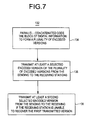
- FIG. 7 illustrates a method, shown generally at 132, of an embodiment of the present invention.
- the method selectively iteratively increases the redundancy of a block of digital information communicated by a sending station to at least one receiving station in a digital communication system.
- the block of digital information is parallel-concatenated encoded to form a plurality of encoded versions of the block of digital information.
- at least a selected portion of at least a first selected encoded version of the plurality of encoded versions of the block of digital information is transmitted from the sending station to the receiving station.
- transmission of at least a selected portion of at least one additional version of the plurality of encoded versions is initiated if recovery of the block of digital information at the receiving station is unrecoverable with at least a selected level of accuracy.
- channel conditions of a channel extending between the sending and receiving stations are of good quality
- information throughput between the sending and receiving stations can be maximized.
- successive redundant transmission of the additional portions of the selected, encoded versions better ensures that the informational content of the digital information can be accurately recreated.
- Feedback signals returned from the receiving to the sending station prompt the sending station to implement the successive, redundant transmission of the additional portions of the selected encoded versions to the receiving station.
Landscapes
- Engineering & Computer Science (AREA)
- Computer Networks & Wireless Communication (AREA)
- Signal Processing (AREA)
- Detection And Prevention Of Errors In Transmission (AREA)
- Error Detection And Correction (AREA)
- Communication Control (AREA)
- Time-Division Multiplex Systems (AREA)
Applications Claiming Priority (3)
| Application Number | Priority Date | Filing Date | Title |
|---|---|---|---|
| US824469 | 1997-03-26 | ||
| US08/824,469 US6189123B1 (en) | 1997-03-26 | 1997-03-26 | Method and apparatus for communicating a block of digital information between a sending and a receiving station |
| PCT/SE1998/000402 WO1998043383A1 (en) | 1997-03-26 | 1998-03-06 | Method and apparatus for communicating a block of digital information between a sending and a receiving station |
Publications (2)
| Publication Number | Publication Date |
|---|---|
| EP0972368A1 EP0972368A1 (en) | 2000-01-19 |
| EP0972368B1 true EP0972368B1 (en) | 2009-05-13 |
Family
ID=25241481
Family Applications (1)
| Application Number | Title | Priority Date | Filing Date |
|---|---|---|---|
| EP98912842A Expired - Lifetime EP0972368B1 (en) | 1997-03-26 | 1998-03-06 | Method and apparatus for communicating a block of digital information between a sending and a receiving station |
Country Status (11)
| Country | Link |
|---|---|
| US (1) | US6189123B1 (enExample) |
| EP (1) | EP0972368B1 (enExample) |
| JP (1) | JP3699730B2 (enExample) |
| KR (1) | KR100671676B1 (enExample) |
| CN (1) | CN1242585C (enExample) |
| AU (1) | AU738214B2 (enExample) |
| CA (1) | CA2283885C (enExample) |
| DE (1) | DE69840828D1 (enExample) |
| ES (1) | ES2326396T3 (enExample) |
| TW (1) | TW391145B (enExample) |
| WO (1) | WO1998043383A1 (enExample) |
Families Citing this family (76)
| Publication number | Priority date | Publication date | Assignee | Title |
|---|---|---|---|---|
| DE19736676C1 (de) * | 1997-08-22 | 1998-12-10 | Siemens Ag | Verfahren zur Paketübertragung mit einem ARQ-Protokoll auf Übertragungskanälen in einem digitalen Übertragungssystem |
| US6353907B1 (en) * | 1997-10-29 | 2002-03-05 | At&T Corp. | Incremental redundancy radio link protocol |
| US6101168A (en) * | 1997-11-13 | 2000-08-08 | Qualcomm Inc. | Method and apparatus for time efficient retransmission using symbol accumulation |
| KR100604363B1 (ko) * | 1998-03-19 | 2006-07-25 | 코닌클리케 필립스 일렉트로닉스 엔.브이. | 디지탈 정보신호를 인코딩된 형태 및 인코딩되지 않은형태로 교대로 송신하는 송신장치 |
| KR100429506B1 (ko) * | 1998-04-18 | 2004-11-20 | 삼성전자주식회사 | 통신시스템의 채널부호/복호장치 및 방법 |
| FR2778040B1 (fr) * | 1998-04-28 | 2000-05-26 | Alsthom Cge Alcatel | Procede et dispositif de codage correcteur d'erreur pour des transmissions de donnees numeriques a debit eleve, et procede et dispositif de decodage correspondant |
| US6581177B1 (en) * | 1998-05-01 | 2003-06-17 | Texas Instruments Incorporated | Multi-access, collision-based communications |
| US6647069B1 (en) * | 1998-05-01 | 2003-11-11 | Texas Instruments Incorporated | Method and apparatus for capacity increase and enhanced communications performance in CATV networks |
| US6912315B1 (en) * | 1998-05-28 | 2005-06-28 | Verance Corporation | Pre-processed information embedding system |
| US7644282B2 (en) | 1998-05-28 | 2010-01-05 | Verance Corporation | Pre-processed information embedding system |
| DE19833967C2 (de) * | 1998-07-28 | 2001-02-08 | Siemens Ag | Empfangsdiversitätsverfahren und Funk-Kommunikationssystem mit Diversitätsempfang |
| DE19946721A1 (de) | 1999-09-29 | 2001-05-03 | Siemens Ag | Verfahren und Vorrichtung zur Kanalkodierung in einem Nachrichtenübertragungssystem |
| US6628723B1 (en) * | 1999-10-15 | 2003-09-30 | Cisco Technology | Coding rate reduction for turbo codes |
| US6654927B1 (en) * | 2000-01-10 | 2003-11-25 | Lg Electronics Inc. | Iterative error-correction for turbo code decoding |
| JP4884631B2 (ja) * | 2000-01-20 | 2012-02-29 | ノーテル・ネットワークス・リミテッド | 可変速度パケット・データ・アプリケーションでのソフト組合せを備えたハイブリッドarq方式 |
| US6737957B1 (en) | 2000-02-16 | 2004-05-18 | Verance Corporation | Remote control signaling using audio watermarks |
| US7224702B2 (en) * | 2000-08-30 | 2007-05-29 | The Chinese University Of Hong Kong | System and method for error-control for multicast video distribution |
| JP3558026B2 (ja) | 2000-09-27 | 2004-08-25 | 日本電気株式会社 | 自己直交符号復号回路及び自己直交符号復号方法 |
| KR100525384B1 (ko) * | 2000-10-31 | 2005-11-02 | 엘지전자 주식회사 | 무선 통신 시스템에서의 패킷 재전송 제어 방법 |
| JP3699910B2 (ja) * | 2000-10-31 | 2005-09-28 | 株式会社東芝 | データ伝送装置、データ伝送方法及びプログラム |
| DE10065919A1 (de) * | 2000-11-07 | 2002-05-29 | Bosch Gmbh Robert | Verfahren zur codierten Modulation |
| US20030039226A1 (en) * | 2001-08-24 | 2003-02-27 | Kwak Joseph A. | Physical layer automatic repeat request (ARQ) |
| US6990624B2 (en) * | 2001-10-12 | 2006-01-24 | Agere Systems Inc. | High speed syndrome-based FEC encoder and decoder and system using same |
| US7231575B2 (en) * | 2002-04-01 | 2007-06-12 | Intel Corporation | Apparatus for iterative hard-decision forward error correction decoding |
| US7246294B2 (en) * | 2002-04-01 | 2007-07-17 | Intel Corporation | Method for iterative hard-decision forward error correction decoding |
| CA2499967A1 (en) | 2002-10-15 | 2004-04-29 | Verance Corporation | Media monitoring, management and information system |
| US20050224596A1 (en) * | 2003-07-08 | 2005-10-13 | Panopoulos Peter J | Machine that is an automatic pesticide, insecticide, repellant, poison, air freshener, disinfectant or other type of spray delivery system |
| US7155655B2 (en) * | 2003-07-22 | 2006-12-26 | Telefonaktiebolaget Lm Ericsson (Publ) | Adaptive hybrid ARQ algorithms |
| US7359446B2 (en) * | 2003-08-13 | 2008-04-15 | Lucent Technologies Inc. | Methods and devices for decoding signals containing noise and distortion |
| US7103825B2 (en) * | 2003-08-19 | 2006-09-05 | Mitsubishi Electric Research Laboratories, Inc. | Decoding error-correcting codes based on finite geometries |
| US7415658B2 (en) * | 2003-09-10 | 2008-08-19 | Intel Corporation | Forward error correction mapping and de-mapping techniques |
| US7181657B2 (en) * | 2003-09-25 | 2007-02-20 | Oki Electric Industry Co., Ltd. | Data transmission apparatus adaptive to data quality on radio-transmission and a method of data transmission therefor |
| US20060239501A1 (en) | 2005-04-26 | 2006-10-26 | Verance Corporation | Security enhancements of digital watermarks for multi-media content |
| US7395495B2 (en) * | 2004-01-12 | 2008-07-01 | Intel Corporation | Method and apparatus for decoding forward error correction codes |
| KR100989314B1 (ko) * | 2004-04-09 | 2010-10-25 | 삼성전자주식회사 | 디스플레이장치 |
| US7454225B2 (en) * | 2004-12-28 | 2008-11-18 | Lucent Technologies Inc. | Method and apparatus for reducing transmitted energy in power-controlled systems based on early decoding |
| US9459960B2 (en) | 2005-06-03 | 2016-10-04 | Rambus Inc. | Controller device for use with electrically erasable programmable memory chip with error detection and retry modes of operation |
| US7831882B2 (en) | 2005-06-03 | 2010-11-09 | Rambus Inc. | Memory system with error detection and retry modes of operation |
| US8020004B2 (en) | 2005-07-01 | 2011-09-13 | Verance Corporation | Forensic marking using a common customization function |
| US8781967B2 (en) | 2005-07-07 | 2014-07-15 | Verance Corporation | Watermarking in an encrypted domain |
| US11620185B2 (en) * | 2005-09-30 | 2023-04-04 | Pure Storage, Inc. | Integrity processing in a dispersed storage network |
| US7562285B2 (en) | 2006-01-11 | 2009-07-14 | Rambus Inc. | Unidirectional error code transfer for a bidirectional data link |
| US20070271495A1 (en) * | 2006-05-18 | 2007-11-22 | Ian Shaeffer | System to detect and identify errors in control information, read data and/or write data |
| US8352805B2 (en) | 2006-05-18 | 2013-01-08 | Rambus Inc. | Memory error detection |
| US8904265B2 (en) * | 2007-05-02 | 2014-12-02 | Broadcom Corporation | Optimal period rate matching for turbo coding |
| CN101237310B (zh) * | 2007-11-19 | 2010-10-20 | 北京邮电大学 | 一种增强型自适应数据重传的方法 |
| US8477830B2 (en) | 2008-03-18 | 2013-07-02 | On-Ramp Wireless, Inc. | Light monitoring system using a random phase multiple access system |
| US8958460B2 (en) * | 2008-03-18 | 2015-02-17 | On-Ramp Wireless, Inc. | Forward error correction media access control system |
| US8271861B2 (en) | 2008-05-09 | 2012-09-18 | Marvell International Ltd. | Symbol vector-level combining receiver for incremental redundancy HARQ with MIMO |
| JP5056947B2 (ja) * | 2008-06-04 | 2012-10-24 | 富士通株式会社 | 情報処理装置、データ送信装置およびデータ送信装置のデータ転送方法 |
| US8259938B2 (en) | 2008-06-24 | 2012-09-04 | Verance Corporation | Efficient and secure forensic marking in compressed |
| US8363699B2 (en) | 2009-03-20 | 2013-01-29 | On-Ramp Wireless, Inc. | Random timing offset determination |
| US8838978B2 (en) | 2010-09-16 | 2014-09-16 | Verance Corporation | Content access management using extracted watermark information |
| US10061650B2 (en) | 2011-06-06 | 2018-08-28 | International Business Machines Corporation | Priority based rebuilding |
| US10042709B2 (en) | 2011-06-06 | 2018-08-07 | International Business Machines Corporation | Rebuild prioritization during a plurality of concurrent data object write operations |
| US8762479B2 (en) * | 2011-06-06 | 2014-06-24 | Cleversafe, Inc. | Distributing multi-media content to a plurality of potential accessing devices |
| US10949301B2 (en) * | 2011-06-06 | 2021-03-16 | Pure Storage, Inc. | Pre-positioning pre-stored content in a content distribution system |
| US8839368B2 (en) * | 2011-11-01 | 2014-09-16 | Cleversafe, Inc. | Acquiring a trusted set of encoded data slices |
| US8615104B2 (en) | 2011-11-03 | 2013-12-24 | Verance Corporation | Watermark extraction based on tentative watermarks |
| US8533481B2 (en) | 2011-11-03 | 2013-09-10 | Verance Corporation | Extraction of embedded watermarks from a host content based on extrapolation techniques |
| US8923548B2 (en) | 2011-11-03 | 2014-12-30 | Verance Corporation | Extraction of embedded watermarks from a host content using a plurality of tentative watermarks |
| US8682026B2 (en) | 2011-11-03 | 2014-03-25 | Verance Corporation | Efficient extraction of embedded watermarks in the presence of host content distortions |
| US8745403B2 (en) | 2011-11-23 | 2014-06-03 | Verance Corporation | Enhanced content management based on watermark extraction records |
| US9323902B2 (en) | 2011-12-13 | 2016-04-26 | Verance Corporation | Conditional access using embedded watermarks |
| US9547753B2 (en) | 2011-12-13 | 2017-01-17 | Verance Corporation | Coordinated watermarking |
| US9571606B2 (en) | 2012-08-31 | 2017-02-14 | Verance Corporation | Social media viewing system |
| US8869222B2 (en) | 2012-09-13 | 2014-10-21 | Verance Corporation | Second screen content |
| US20140075469A1 (en) | 2012-09-13 | 2014-03-13 | Verance Corporation | Content distribution including advertisements |
| US8726304B2 (en) | 2012-09-13 | 2014-05-13 | Verance Corporation | Time varying evaluation of multimedia content |
| US9262793B2 (en) | 2013-03-14 | 2016-02-16 | Verance Corporation | Transactional video marking system |
| US9251549B2 (en) | 2013-07-23 | 2016-02-02 | Verance Corporation | Watermark extractor enhancements based on payload ranking |
| US9208334B2 (en) | 2013-10-25 | 2015-12-08 | Verance Corporation | Content management using multiple abstraction layers |
| WO2015138798A1 (en) | 2014-03-13 | 2015-09-17 | Verance Corporation | Interactive content acquisition using embedded codes |
| JP6703108B2 (ja) * | 2016-02-05 | 2020-06-03 | オッポ広東移動通信有限公司Guangdong Oppo Mobile Telecommunications Corp., Ltd. | 通信方法、端末デバイス及びネットワークデバイス |
| EP3776207B1 (en) | 2018-03-26 | 2023-08-09 | Rambus Inc. | Command/address channel error detection |
| CN109104262B (zh) * | 2018-07-03 | 2021-12-10 | 深圳市智慧海洋科技有限公司 | 一种水声无线可靠通信方法 |
Family Cites Families (12)
| Publication number | Priority date | Publication date | Assignee | Title |
|---|---|---|---|---|
| NL8403147A (nl) * | 1984-10-16 | 1986-05-16 | Philips Nv | Dataverwerkingssysteem dat is opgebouwd uit drie dataverwerkingsmodules. |
| JPH0618358B2 (ja) * | 1985-04-09 | 1994-03-09 | 沖電気工業株式会社 | 誤り制御符号化方式 |
| US5068724A (en) * | 1990-06-15 | 1991-11-26 | General Instrument Corporation | Adaptive motion compensation for digital television |
| US5172228A (en) * | 1991-11-19 | 1992-12-15 | Utah State University Foundation | Image compression method and apparatus employing distortion adaptive tree search vector quantization |
| US5844922A (en) * | 1993-02-22 | 1998-12-01 | Qualcomm Incorporated | High rate trellis coding and decoding method and apparatus |
| JPH08223624A (ja) * | 1995-02-15 | 1996-08-30 | Nec Corp | 無線選択呼出受信機及び無線データ伝送方式 |
| US5649051A (en) * | 1995-06-01 | 1997-07-15 | Rothweiler; Joseph Harvey | Constant data rate speech encoder for limited bandwidth path |
| DE69527633T2 (de) * | 1995-10-23 | 2003-04-03 | Nokia Corp., Espoo | Verfahren zur Paketdatenübertragung mit hybridem FEC/ARQ-Type-II-Verfahren |
| US5815515A (en) * | 1996-03-28 | 1998-09-29 | Lsi Logic Corporation | Edge metric calculation method and apparatus using permutations |
| US5734962A (en) * | 1996-07-17 | 1998-03-31 | General Electric Company | Satellite communications system utilizing parallel concatenated coding |
| US5996104A (en) * | 1996-09-13 | 1999-11-30 | Herzberg; Hanan | System for coding system |
| US5809043A (en) * | 1996-10-08 | 1998-09-15 | Ericsson Inc. | Method and apparatus for decoding block codes |
-
1997
- 1997-03-26 US US08/824,469 patent/US6189123B1/en not_active Expired - Lifetime
-
1998
- 1998-03-06 AU AU67531/98A patent/AU738214B2/en not_active Expired
- 1998-03-06 WO PCT/SE1998/000402 patent/WO1998043383A1/en not_active Ceased
- 1998-03-06 EP EP98912842A patent/EP0972368B1/en not_active Expired - Lifetime
- 1998-03-06 DE DE69840828T patent/DE69840828D1/de not_active Expired - Lifetime
- 1998-03-06 CA CA002283885A patent/CA2283885C/en not_active Expired - Lifetime
- 1998-03-06 KR KR1019997008654A patent/KR100671676B1/ko not_active Expired - Lifetime
- 1998-03-06 JP JP54555198A patent/JP3699730B2/ja not_active Expired - Lifetime
- 1998-03-06 CN CNB988055236A patent/CN1242585C/zh not_active Expired - Lifetime
- 1998-03-06 ES ES98912842T patent/ES2326396T3/es not_active Expired - Lifetime
- 1998-03-18 TW TW087104026A patent/TW391145B/zh not_active IP Right Cessation
Also Published As
| Publication number | Publication date |
|---|---|
| AU6753198A (en) | 1998-10-20 |
| CN1242585C (zh) | 2006-02-15 |
| CN1258401A (zh) | 2000-06-28 |
| JP3699730B2 (ja) | 2005-09-28 |
| US6189123B1 (en) | 2001-02-13 |
| DE69840828D1 (de) | 2009-06-25 |
| WO1998043383A1 (en) | 1998-10-01 |
| JP2002508894A (ja) | 2002-03-19 |
| TW391145B (en) | 2000-05-21 |
| EP0972368A1 (en) | 2000-01-19 |
| ES2326396T3 (es) | 2009-10-08 |
| KR100671676B1 (ko) | 2007-01-18 |
| CA2283885A1 (en) | 1998-10-01 |
| KR20010005590A (ko) | 2001-01-15 |
| CA2283885C (en) | 2008-02-05 |
| AU738214B2 (en) | 2001-09-13 |
Similar Documents
| Publication | Publication Date | Title |
|---|---|---|
| EP0972368B1 (en) | Method and apparatus for communicating a block of digital information between a sending and a receiving station | |
| US7865813B2 (en) | Rate matching for a wireless communications systems | |
| US7941724B2 (en) | Embedded retransmission scheme with cross-packet coding | |
| EP0798889B1 (en) | Error control method and error control device for digital communication | |
| EP1994669B1 (en) | Method and apparatus for transmitting and receiving a data block in a wireless communication system | |
| US8266488B2 (en) | Encoding and decoding systems with header and data transmission success indication | |
| US7778978B2 (en) | Decoder for a system with H-ARQ with cross-packet coding | |
| US6996762B2 (en) | Methods and apparatus of signal demodulation combining with different modulations and coding for wireless communications | |
| US20100260292A1 (en) | Blind modulation detection | |
| US12015489B2 (en) | Communication transmitter for retransmitting medium access control (MAC) protocol data unit (MPDU) | |
| US8555135B2 (en) | Incremental redundancy with resegmentation | |
| Cygan et al. | A concatenated two-stage adaptive (CTSA) error control scheme for data transmission in time-varying channels | |
| WO2005048519A1 (en) | Communication method, system and device | |
| MXPA99008514A (en) | Method and apparatus for communicating a block of digital information between a sending and a receiving station | |
| Miyagi et al. | Selective repeat type‐II hybrid fec/arq systems using concatenated codes | |
| KR102797988B1 (ko) | 다중 경로를 이용하여 신호를 전송하는 협력 통신 장치 및 방법 | |
| EP2061176B1 (en) | Incremental redundancy with resegmentation | |
| Sim et al. | Adaptive hybrid ARQ scheme using concatenated FEC for ATM over wireless links |
Legal Events
| Date | Code | Title | Description |
|---|---|---|---|
| PUAI | Public reference made under article 153(3) epc to a published international application that has entered the european phase |
Free format text: ORIGINAL CODE: 0009012 |
|
| 17P | Request for examination filed |
Effective date: 19990922 |
|
| AK | Designated contracting states |
Kind code of ref document: A1 Designated state(s): DE ES GB IT |
|
| RAP1 | Party data changed (applicant data changed or rights of an application transferred) |
Owner name: TELEFONAKTIEBOLAGET LM ERICSSON (PUBL) |
|
| 17Q | First examination report despatched |
Effective date: 20071214 |
|
| GRAP | Despatch of communication of intention to grant a patent |
Free format text: ORIGINAL CODE: EPIDOSNIGR1 |
|
| GRAS | Grant fee paid |
Free format text: ORIGINAL CODE: EPIDOSNIGR3 |
|
| GRAA | (expected) grant |
Free format text: ORIGINAL CODE: 0009210 |
|
| AK | Designated contracting states |
Kind code of ref document: B1 Designated state(s): DE ES GB IT |
|
| REG | Reference to a national code |
Ref country code: GB Ref legal event code: FG4D |
|
| REF | Corresponds to: |
Ref document number: 69840828 Country of ref document: DE Date of ref document: 20090625 Kind code of ref document: P |
|
| REG | Reference to a national code |
Ref country code: ES Ref legal event code: FG2A Ref document number: 2326396 Country of ref document: ES Kind code of ref document: T3 |
|
| PLBI | Opposition filed |
Free format text: ORIGINAL CODE: 0009260 |
|
| PLAX | Notice of opposition and request to file observation + time limit sent |
Free format text: ORIGINAL CODE: EPIDOSNOBS2 |
|
| 26 | Opposition filed |
Opponent name: HUAWEI TECHNOLOGIES CO., LTD. Effective date: 20100211 |
|
| PLAF | Information modified related to communication of a notice of opposition and request to file observations + time limit |
Free format text: ORIGINAL CODE: EPIDOSCOBS2 |
|
| PLBB | Reply of patent proprietor to notice(s) of opposition received |
Free format text: ORIGINAL CODE: EPIDOSNOBS3 |
|
| PLAB | Opposition data, opponent's data or that of the opponent's representative modified |
Free format text: ORIGINAL CODE: 0009299OPPO |
|
| R26 | Opposition filed (corrected) |
Opponent name: HUAWEI TECHNOLOGIES CO., LTD. Effective date: 20100211 |
|
| PLBP | Opposition withdrawn |
Free format text: ORIGINAL CODE: 0009264 |
|
| PLBD | Termination of opposition procedure: decision despatched |
Free format text: ORIGINAL CODE: EPIDOSNOPC1 |
|
| PLBM | Termination of opposition procedure: date of legal effect published |
Free format text: ORIGINAL CODE: 0009276 |
|
| STAA | Information on the status of an ep patent application or granted ep patent |
Free format text: STATUS: OPPOSITION PROCEDURE CLOSED |
|
| 27C | Opposition proceedings terminated |
Effective date: 20111028 |
|
| PGFP | Annual fee paid to national office [announced via postgrant information from national office to epo] |
Ref country code: GB Payment date: 20170327 Year of fee payment: 20 |
|
| PGFP | Annual fee paid to national office [announced via postgrant information from national office to epo] |
Ref country code: IT Payment date: 20170324 Year of fee payment: 20 |
|
| PGFP | Annual fee paid to national office [announced via postgrant information from national office to epo] |
Ref country code: DE Payment date: 20170329 Year of fee payment: 20 |
|
| PGFP | Annual fee paid to national office [announced via postgrant information from national office to epo] |
Ref country code: ES Payment date: 20170328 Year of fee payment: 20 |
|
| REG | Reference to a national code |
Ref country code: DE Ref legal event code: R071 Ref document number: 69840828 Country of ref document: DE |
|
| REG | Reference to a national code |
Ref country code: GB Ref legal event code: PE20 Expiry date: 20180305 |
|
| PG25 | Lapsed in a contracting state [announced via postgrant information from national office to epo] |
Ref country code: GB Free format text: LAPSE BECAUSE OF EXPIRATION OF PROTECTION Effective date: 20180305 |
|
| REG | Reference to a national code |
Ref country code: ES Ref legal event code: FD2A Effective date: 20220127 |
|
| PG25 | Lapsed in a contracting state [announced via postgrant information from national office to epo] |
Ref country code: ES Free format text: LAPSE BECAUSE OF EXPIRATION OF PROTECTION Effective date: 20180307 |