EP0970997B1 - Flame retardant polycarbonate/abs composition - Google Patents
Flame retardant polycarbonate/abs composition Download PDFInfo
- Publication number
- EP0970997B1 EP0970997B1 EP99202262A EP99202262A EP0970997B1 EP 0970997 B1 EP0970997 B1 EP 0970997B1 EP 99202262 A EP99202262 A EP 99202262A EP 99202262 A EP99202262 A EP 99202262A EP 0970997 B1 EP0970997 B1 EP 0970997B1
- Authority
- EP
- European Patent Office
- Prior art keywords
- weight
- parts
- mixture
- flame retardant
- component
- Prior art date
- Legal status (The legal status is an assumption and is not a legal conclusion. Google has not performed a legal analysis and makes no representation as to the accuracy of the status listed.)
- Expired - Lifetime
Links
- 239000000203 mixture Substances 0.000 title claims description 98
- 239000003063 flame retardant Substances 0.000 title claims description 57
- RNFJDJUURJAICM-UHFFFAOYSA-N 2,2,4,4,6,6-hexaphenoxy-1,3,5-triaza-2$l^{5},4$l^{5},6$l^{5}-triphosphacyclohexa-1,3,5-triene Chemical compound N=1P(OC=2C=CC=CC=2)(OC=2C=CC=CC=2)=NP(OC=2C=CC=CC=2)(OC=2C=CC=CC=2)=NP=1(OC=1C=CC=CC=1)OC1=CC=CC=C1 RNFJDJUURJAICM-UHFFFAOYSA-N 0.000 title claims description 41
- 239000004417 polycarbonate Substances 0.000 title claims description 40
- 229920000515 polycarbonate Polymers 0.000 title claims description 39
- -1 C1-C8 alkyl methacrylate Chemical class 0.000 claims description 46
- PPBRXRYQALVLMV-UHFFFAOYSA-N Styrene Chemical group C=CC1=CC=CC=C1 PPBRXRYQALVLMV-UHFFFAOYSA-N 0.000 claims description 44
- IISBACLAFKSPIT-UHFFFAOYSA-N bisphenol A Chemical compound C=1C=C(O)C=CC=1C(C)(C)C1=CC=C(O)C=C1 IISBACLAFKSPIT-UHFFFAOYSA-N 0.000 claims description 42
- 229920000388 Polyphosphate Polymers 0.000 claims description 34
- 239000001205 polyphosphate Substances 0.000 claims description 34
- 235000011176 polyphosphates Nutrition 0.000 claims description 34
- 229920000578 graft copolymer Polymers 0.000 claims description 23
- 229920000098 polyolefin Polymers 0.000 claims description 20
- 238000009757 thermoplastic moulding Methods 0.000 claims description 20
- 229940106691 bisphenol a Drugs 0.000 claims description 18
- NLHHRLWOUZZQLW-UHFFFAOYSA-N Acrylonitrile Chemical compound C=CC#N NLHHRLWOUZZQLW-UHFFFAOYSA-N 0.000 claims description 17
- 239000011342 resin composition Substances 0.000 claims description 17
- 229920005989 resin Polymers 0.000 claims description 15
- 239000011347 resin Substances 0.000 claims description 15
- 125000004209 (C1-C8) alkyl group Chemical class 0.000 claims description 14
- 125000003118 aryl group Chemical group 0.000 claims description 14
- 229920001577 copolymer Polymers 0.000 claims description 14
- 150000003839 salts Chemical class 0.000 claims description 14
- 150000004712 monophosphates Chemical class 0.000 claims description 13
- 229920000642 polymer Polymers 0.000 claims description 13
- 229920006163 vinyl copolymer Polymers 0.000 claims description 13
- 229920002857 polybutadiene Polymers 0.000 claims description 12
- 229920001971 elastomer Polymers 0.000 claims description 11
- 150000003014 phosphoric acid esters Chemical class 0.000 claims description 11
- 239000005060 rubber Substances 0.000 claims description 11
- 229920005992 thermoplastic resin Polymers 0.000 claims description 11
- 229910019142 PO4 Inorganic materials 0.000 claims description 10
- 125000000217 alkyl group Chemical group 0.000 claims description 10
- XYLMUPLGERFSHI-UHFFFAOYSA-N alpha-Methylstyrene Chemical group CC(=C)C1=CC=CC=C1 XYLMUPLGERFSHI-UHFFFAOYSA-N 0.000 claims description 9
- 229910052736 halogen Inorganic materials 0.000 claims description 9
- NBIIXXVUZAFLBC-UHFFFAOYSA-K phosphate Chemical compound [O-]P([O-])([O-])=O NBIIXXVUZAFLBC-UHFFFAOYSA-K 0.000 claims description 9
- 239000010452 phosphate Substances 0.000 claims description 9
- 150000003440 styrenes Chemical class 0.000 claims description 9
- 125000000999 tert-butyl group Chemical group [H]C([H])([H])C(*)(C([H])([H])[H])C([H])([H])[H] 0.000 claims description 9
- XZZNDPSIHUTMOC-UHFFFAOYSA-N triphenyl phosphate Chemical compound C=1C=CC=CC=1OP(OC=1C=CC=CC=1)(=O)OC1=CC=CC=C1 XZZNDPSIHUTMOC-UHFFFAOYSA-N 0.000 claims description 9
- 150000002367 halogens Chemical class 0.000 claims description 8
- FPYJFEHAWHCUMM-UHFFFAOYSA-N maleic anhydride Chemical compound O=C1OC(=O)C=C1 FPYJFEHAWHCUMM-UHFFFAOYSA-N 0.000 claims description 8
- 229910052698 phosphorus Inorganic materials 0.000 claims description 7
- 125000006736 (C6-C20) aryl group Chemical group 0.000 claims description 6
- GYCMBHHDWRMZGG-UHFFFAOYSA-N Methylacrylonitrile Chemical compound CC(=C)C#N GYCMBHHDWRMZGG-UHFFFAOYSA-N 0.000 claims description 6
- 125000001449 isopropyl group Chemical group [H]C([H])([H])C([H])(*)C([H])([H])[H] 0.000 claims description 5
- 229920001169 thermoplastic Polymers 0.000 claims description 5
- 239000004416 thermosoftening plastic Substances 0.000 claims description 5
- PVFQHGDIOXNKIC-UHFFFAOYSA-N 4-[2-[3-[2-(4-hydroxyphenyl)propan-2-yl]phenyl]propan-2-yl]phenol Chemical compound C=1C=CC(C(C)(C)C=2C=CC(O)=CC=2)=CC=1C(C)(C)C1=CC=C(O)C=C1 PVFQHGDIOXNKIC-UHFFFAOYSA-N 0.000 claims description 4
- 125000002496 methyl group Chemical group [H]C([H])([H])* 0.000 claims description 4
- 239000002245 particle Substances 0.000 claims description 4
- BFKJFAAPBSQJPD-UHFFFAOYSA-N tetrafluoroethene Chemical group FC(F)=C(F)F BFKJFAAPBSQJPD-UHFFFAOYSA-N 0.000 claims description 4
- 125000004178 (C1-C4) alkyl group Chemical group 0.000 claims description 3
- 229920002943 EPDM rubber Polymers 0.000 claims description 3
- 239000000654 additive Substances 0.000 claims description 3
- MTAZNLWOLGHBHU-UHFFFAOYSA-N butadiene-styrene rubber Chemical compound C=CC=C.C=CC1=CC=CC=C1 MTAZNLWOLGHBHU-UHFFFAOYSA-N 0.000 claims description 3
- UOCJDOLVGGIYIQ-PBFPGSCMSA-N cefatrizine Chemical group S([C@@H]1[C@@H](C(N1C=1C(O)=O)=O)NC(=O)[C@H](N)C=2C=CC(O)=CC=2)CC=1CSC=1C=NNN=1 UOCJDOLVGGIYIQ-PBFPGSCMSA-N 0.000 claims description 3
- HQQADJVZYDDRJT-UHFFFAOYSA-N ethene;prop-1-ene Chemical group C=C.CC=C HQQADJVZYDDRJT-UHFFFAOYSA-N 0.000 claims description 3
- 239000000945 filler Substances 0.000 claims description 3
- 230000009477 glass transition Effects 0.000 claims description 3
- 125000000959 isobutyl group Chemical group [H]C([H])([H])C([H])(C([H])([H])[H])C([H])([H])* 0.000 claims description 3
- 125000001972 isopentyl group Chemical group [H]C([H])([H])C([H])(C([H])([H])[H])C([H])([H])C([H])([H])* 0.000 claims description 3
- 229920003049 isoprene rubber Polymers 0.000 claims description 3
- 125000001997 phenyl group Chemical group [H]C1=C([H])C([H])=C(*)C([H])=C1[H] 0.000 claims description 3
- 239000003963 antioxidant agent Substances 0.000 claims description 2
- 239000002216 antistatic agent Substances 0.000 claims description 2
- 239000000975 dye Substances 0.000 claims description 2
- 239000000314 lubricant Substances 0.000 claims description 2
- 239000006082 mold release agent Substances 0.000 claims description 2
- 239000002667 nucleating agent Substances 0.000 claims description 2
- CMPQUABWPXYYSH-UHFFFAOYSA-N phenyl phosphate Chemical compound OP(O)(=O)OC1=CC=CC=C1 CMPQUABWPXYYSH-UHFFFAOYSA-N 0.000 claims description 2
- 239000000049 pigment Substances 0.000 claims description 2
- 230000000379 polymerizing effect Effects 0.000 claims description 2
- XAEFZNCEHLXOMS-UHFFFAOYSA-M potassium benzoate Chemical compound [K+].[O-]C(=O)C1=CC=CC=C1 XAEFZNCEHLXOMS-UHFFFAOYSA-M 0.000 claims description 2
- 230000000979 retarding effect Effects 0.000 claims description 2
- 150000003871 sulfonates Chemical class 0.000 claims description 2
- 239000003017 thermal stabilizer Substances 0.000 claims description 2
- 229920000049 Carbon (fiber) Polymers 0.000 claims 1
- 239000004917 carbon fiber Substances 0.000 claims 1
- ASMQGLCHMVWBQR-UHFFFAOYSA-M diphenyl phosphate Chemical compound C=1C=CC=CC=1OP(=O)([O-])OC1=CC=CC=C1 ASMQGLCHMVWBQR-UHFFFAOYSA-M 0.000 claims 1
- 239000003365 glass fiber Substances 0.000 claims 1
- 239000011256 inorganic filler Substances 0.000 claims 1
- 229910003475 inorganic filler Inorganic materials 0.000 claims 1
- 239000004611 light stabiliser Substances 0.000 claims 1
- 239000004014 plasticizer Substances 0.000 claims 1
- 238000000465 moulding Methods 0.000 description 18
- 150000001875 compounds Chemical class 0.000 description 14
- 238000001746 injection moulding Methods 0.000 description 10
- QIGBRXMKCJKVMJ-UHFFFAOYSA-N Hydroquinone Chemical compound OC1=CC=C(O)C=C1 QIGBRXMKCJKVMJ-UHFFFAOYSA-N 0.000 description 8
- VVQNEPGJFQJSBK-UHFFFAOYSA-N Methyl methacrylate Chemical compound COC(=O)C(C)=C VVQNEPGJFQJSBK-UHFFFAOYSA-N 0.000 description 8
- 229920000122 acrylonitrile butadiene styrene Polymers 0.000 description 8
- 238000000034 method Methods 0.000 description 8
- 235000021317 phosphate Nutrition 0.000 description 8
- GHMLBKRAJCXXBS-UHFFFAOYSA-N resorcinol Chemical compound OC1=CC=CC(O)=C1 GHMLBKRAJCXXBS-UHFFFAOYSA-N 0.000 description 8
- 230000000740 bleeding effect Effects 0.000 description 7
- 229920005668 polycarbonate resin Polymers 0.000 description 7
- 239000000839 emulsion Substances 0.000 description 6
- 239000004431 polycarbonate resin Substances 0.000 description 6
- 238000012662 bulk polymerization Methods 0.000 description 5
- 239000000243 solution Substances 0.000 description 5
- 238000002485 combustion reaction Methods 0.000 description 4
- 230000000052 comparative effect Effects 0.000 description 4
- 238000005336 cracking Methods 0.000 description 4
- 238000007720 emulsion polymerization reaction Methods 0.000 description 4
- 238000010528 free radical solution polymerization reaction Methods 0.000 description 4
- 238000002347 injection Methods 0.000 description 4
- 239000007924 injection Substances 0.000 description 4
- 238000004519 manufacturing process Methods 0.000 description 4
- XHXFXVLFKHQFAL-UHFFFAOYSA-N phosphoryl trichloride Chemical compound ClP(Cl)(Cl)=O XHXFXVLFKHQFAL-UHFFFAOYSA-N 0.000 description 4
- 239000000843 powder Substances 0.000 description 4
- 238000010557 suspension polymerization reaction Methods 0.000 description 4
- ISWSIDIOOBJBQZ-UHFFFAOYSA-N Phenol Chemical compound OC1=CC=CC=C1 ISWSIDIOOBJBQZ-UHFFFAOYSA-N 0.000 description 3
- 150000002148 esters Chemical class 0.000 description 3
- 238000013508 migration Methods 0.000 description 3
- 230000005012 migration Effects 0.000 description 3
- 239000000178 monomer Substances 0.000 description 3
- 239000011574 phosphorus Substances 0.000 description 3
- 238000002360 preparation method Methods 0.000 description 3
- 238000012545 processing Methods 0.000 description 3
- 125000001424 substituent group Chemical group 0.000 description 3
- 239000000725 suspension Substances 0.000 description 3
- QTWJRLJHJPIABL-UHFFFAOYSA-N 2-methylphenol;3-methylphenol;4-methylphenol Chemical compound CC1=CC=C(O)C=C1.CC1=CC=CC(O)=C1.CC1=CC=CC=C1O QTWJRLJHJPIABL-UHFFFAOYSA-N 0.000 description 2
- PYSRRFNXTXNWCD-UHFFFAOYSA-N 3-(2-phenylethenyl)furan-2,5-dione Chemical compound O=C1OC(=O)C(C=CC=2C=CC=CC=2)=C1 PYSRRFNXTXNWCD-UHFFFAOYSA-N 0.000 description 2
- SDDLEVPIDBLVHC-UHFFFAOYSA-N Bisphenol Z Chemical compound C1=CC(O)=CC=C1C1(C=2C=CC(O)=CC=2)CCCCC1 SDDLEVPIDBLVHC-UHFFFAOYSA-N 0.000 description 2
- KAKZBPTYRLMSJV-UHFFFAOYSA-N Butadiene Chemical compound C=CC=C KAKZBPTYRLMSJV-UHFFFAOYSA-N 0.000 description 2
- AFCARXCZXQIEQB-UHFFFAOYSA-N N-[3-oxo-3-(2,4,6,7-tetrahydrotriazolo[4,5-c]pyridin-5-yl)propyl]-2-[[3-(trifluoromethoxy)phenyl]methylamino]pyrimidine-5-carboxamide Chemical compound O=C(CCNC(=O)C=1C=NC(=NC=1)NCC1=CC(=CC=C1)OC(F)(F)F)N1CC2=C(CC1)NN=N2 AFCARXCZXQIEQB-UHFFFAOYSA-N 0.000 description 2
- 229920000147 Styrene maleic anhydride Polymers 0.000 description 2
- QAOWNCQODCNURD-UHFFFAOYSA-N Sulfuric acid Chemical compound OS(O)(=O)=O QAOWNCQODCNURD-UHFFFAOYSA-N 0.000 description 2
- NIXOWILDQLNWCW-UHFFFAOYSA-N acrylic acid group Chemical group C(C=C)(=O)O NIXOWILDQLNWCW-UHFFFAOYSA-N 0.000 description 2
- 150000001298 alcohols Chemical class 0.000 description 2
- 238000000149 argon plasma sintering Methods 0.000 description 2
- 125000004432 carbon atom Chemical group C* 0.000 description 2
- 238000007796 conventional method Methods 0.000 description 2
- 229930003836 cresol Natural products 0.000 description 2
- 239000008367 deionised water Substances 0.000 description 2
- 229910021641 deionized water Inorganic materials 0.000 description 2
- KZTYYGOKRVBIMI-UHFFFAOYSA-N diphenyl sulfone Chemical compound C=1C=CC=CC=1S(=O)(=O)C1=CC=CC=C1 KZTYYGOKRVBIMI-UHFFFAOYSA-N 0.000 description 2
- SUPCQIBBMFXVTL-UHFFFAOYSA-N ethyl 2-methylprop-2-enoate Chemical compound CCOC(=O)C(C)=C SUPCQIBBMFXVTL-UHFFFAOYSA-N 0.000 description 2
- 229920002313 fluoropolymer Polymers 0.000 description 2
- 238000010559 graft polymerization reaction Methods 0.000 description 2
- 239000004816 latex Substances 0.000 description 2
- 229920000126 latex Polymers 0.000 description 2
- 125000005397 methacrylic acid ester group Chemical group 0.000 description 2
- 125000005395 methacrylic acid group Chemical class 0.000 description 2
- 238000002156 mixing Methods 0.000 description 2
- 238000006116 polymerization reaction Methods 0.000 description 2
- NHARPDSAXCBDDR-UHFFFAOYSA-N propyl 2-methylprop-2-enoate Chemical compound CCCOC(=O)C(C)=C NHARPDSAXCBDDR-UHFFFAOYSA-N 0.000 description 2
- 238000010526 radical polymerization reaction Methods 0.000 description 2
- 238000005979 thermal decomposition reaction Methods 0.000 description 2
- XLYOFNOQVPJJNP-UHFFFAOYSA-N water Chemical compound O XLYOFNOQVPJJNP-UHFFFAOYSA-N 0.000 description 2
- UETPRJJVZPVPQI-UHFFFAOYSA-N (2-propan-2-ylphenyl) dihydrogen phosphate Chemical class CC(C)C1=CC=CC=C1OP(O)(O)=O UETPRJJVZPVPQI-UHFFFAOYSA-N 0.000 description 1
- PXZZRISEDBDRLY-UHFFFAOYSA-N (2-tert-butylphenyl) dihydrogen phosphate Chemical class CC(C)(C)C1=CC=CC=C1OP(O)(O)=O PXZZRISEDBDRLY-UHFFFAOYSA-N 0.000 description 1
- 125000006833 (C1-C5) alkylene group Chemical group 0.000 description 1
- 150000005208 1,4-dihydroxybenzenes Chemical class 0.000 description 1
- OEVVKKAVYQFQNV-UHFFFAOYSA-N 1-ethenyl-2,4-dimethylbenzene Chemical compound CC1=CC=C(C=C)C(C)=C1 OEVVKKAVYQFQNV-UHFFFAOYSA-N 0.000 description 1
- OZAIFHULBGXAKX-UHFFFAOYSA-N 2-(2-cyanopropan-2-yldiazenyl)-2-methylpropanenitrile Chemical compound N#CC(C)(C)N=NC(C)(C)C#N OZAIFHULBGXAKX-UHFFFAOYSA-N 0.000 description 1
- XKZQKPRCPNGNFR-UHFFFAOYSA-N 2-(3-hydroxyphenyl)phenol Chemical class OC1=CC=CC(C=2C(=CC=CC=2)O)=C1 XKZQKPRCPNGNFR-UHFFFAOYSA-N 0.000 description 1
- XBQRPFBBTWXIFI-UHFFFAOYSA-N 2-chloro-4-[2-(3-chloro-4-hydroxyphenyl)propan-2-yl]phenol Chemical compound C=1C=C(O)C(Cl)=CC=1C(C)(C)C1=CC=C(O)C(Cl)=C1 XBQRPFBBTWXIFI-UHFFFAOYSA-N 0.000 description 1
- VEORPZCZECFIRK-UHFFFAOYSA-N 3,3',5,5'-tetrabromobisphenol A Chemical compound C=1C(Br)=C(O)C(Br)=CC=1C(C)(C)C1=CC(Br)=C(O)C(Br)=C1 VEORPZCZECFIRK-UHFFFAOYSA-N 0.000 description 1
- FRIBMENBGGCKPD-UHFFFAOYSA-N 3-(2,3-dimethoxyphenyl)prop-2-enal Chemical compound COC1=CC=CC(C=CC=O)=C1OC FRIBMENBGGCKPD-UHFFFAOYSA-N 0.000 description 1
- JLBJTVDPSNHSKJ-UHFFFAOYSA-N 4-Methylstyrene Chemical compound CC1=CC=C(C=C)C=C1 JLBJTVDPSNHSKJ-UHFFFAOYSA-N 0.000 description 1
- NIRYBKWMEWFDPM-UHFFFAOYSA-N 4-[3-(4-hydroxyphenyl)-3-methylbutyl]phenol Chemical compound C=1C=C(O)C=CC=1C(C)(C)CCC1=CC=C(O)C=C1 NIRYBKWMEWFDPM-UHFFFAOYSA-N 0.000 description 1
- NIXOWILDQLNWCW-UHFFFAOYSA-M Acrylate Chemical compound [O-]C(=O)C=C NIXOWILDQLNWCW-UHFFFAOYSA-M 0.000 description 1
- LSNNMFCWUKXFEE-UHFFFAOYSA-M Bisulfite Chemical compound OS([O-])=O LSNNMFCWUKXFEE-UHFFFAOYSA-M 0.000 description 1
- BVKZGUZCCUSVTD-UHFFFAOYSA-L Carbonate Chemical compound [O-]C([O-])=O BVKZGUZCCUSVTD-UHFFFAOYSA-L 0.000 description 1
- VGGSQFUCUMXWEO-UHFFFAOYSA-N Ethene Chemical compound C=C VGGSQFUCUMXWEO-UHFFFAOYSA-N 0.000 description 1
- 239000005977 Ethylene Substances 0.000 description 1
- DGAQECJNVWCQMB-PUAWFVPOSA-M Ilexoside XXIX Chemical compound C[C@@H]1CC[C@@]2(CC[C@@]3(C(=CC[C@H]4[C@]3(CC[C@@H]5[C@@]4(CC[C@@H](C5(C)C)OS(=O)(=O)[O-])C)C)[C@@H]2[C@]1(C)O)C)C(=O)O[C@H]6[C@@H]([C@H]([C@@H]([C@H](O6)CO)O)O)O.[Na+] DGAQECJNVWCQMB-PUAWFVPOSA-M 0.000 description 1
- LSDPWZHWYPCBBB-UHFFFAOYSA-N Methanethiol Chemical compound SC LSDPWZHWYPCBBB-UHFFFAOYSA-N 0.000 description 1
- 239000002033 PVDF binder Substances 0.000 description 1
- YGYAWVDWMABLBF-UHFFFAOYSA-N Phosgene Chemical compound ClC(Cl)=O YGYAWVDWMABLBF-UHFFFAOYSA-N 0.000 description 1
- 229920001283 Polyalkylene terephthalate Polymers 0.000 description 1
- 239000004952 Polyamide Substances 0.000 description 1
- 239000005062 Polybutadiene Substances 0.000 description 1
- ZLMJMSJWJFRBEC-UHFFFAOYSA-N Potassium Chemical compound [K] ZLMJMSJWJFRBEC-UHFFFAOYSA-N 0.000 description 1
- 229920006362 Teflon® Polymers 0.000 description 1
- KYPYTERUKNKOLP-UHFFFAOYSA-N Tetrachlorobisphenol A Chemical compound C=1C(Cl)=C(O)C(Cl)=CC=1C(C)(C)C1=CC(Cl)=C(O)C(Cl)=C1 KYPYTERUKNKOLP-UHFFFAOYSA-N 0.000 description 1
- LAUIXFSZFKWUCT-UHFFFAOYSA-N [4-[2-(4-phosphonooxyphenyl)propan-2-yl]phenyl] dihydrogen phosphate Chemical compound C=1C=C(OP(O)(O)=O)C=CC=1C(C)(C)C1=CC=C(OP(O)(O)=O)C=C1 LAUIXFSZFKWUCT-UHFFFAOYSA-N 0.000 description 1
- RUFZJUYWZZUTJE-UHFFFAOYSA-J [F-].[F-].[F-].[F-].F.F.[Na+].[Al+3] Chemical compound [F-].[F-].[F-].[F-].F.F.[Na+].[Al+3] RUFZJUYWZZUTJE-UHFFFAOYSA-J 0.000 description 1
- 150000001335 aliphatic alkanes Chemical class 0.000 description 1
- 125000001118 alkylidene group Chemical group 0.000 description 1
- ROOXNKNUYICQNP-UHFFFAOYSA-N ammonium persulfate Chemical compound [NH4+].[NH4+].[O-]S(=O)(=O)OOS([O-])(=O)=O ROOXNKNUYICQNP-UHFFFAOYSA-N 0.000 description 1
- 229910052787 antimony Inorganic materials 0.000 description 1
- WATWJIUSRGPENY-UHFFFAOYSA-N antimony atom Chemical compound [Sb] WATWJIUSRGPENY-UHFFFAOYSA-N 0.000 description 1
- 230000003078 antioxidant effect Effects 0.000 description 1
- 239000012736 aqueous medium Substances 0.000 description 1
- 229920006164 aromatic vinyl copolymer Polymers 0.000 description 1
- 230000006399 behavior Effects 0.000 description 1
- 235000010290 biphenyl Nutrition 0.000 description 1
- 239000004305 biphenyl Substances 0.000 description 1
- 125000006267 biphenyl group Chemical group 0.000 description 1
- VCCBEIPGXKNHFW-UHFFFAOYSA-N biphenyl-4,4'-diol Chemical group C1=CC(O)=CC=C1C1=CC=C(O)C=C1 VCCBEIPGXKNHFW-UHFFFAOYSA-N 0.000 description 1
- 239000001506 calcium phosphate Substances 0.000 description 1
- 150000001732 carboxylic acid derivatives Chemical class 0.000 description 1
- 239000003054 catalyst Substances 0.000 description 1
- 239000012986 chain transfer agent Substances 0.000 description 1
- 238000006243 chemical reaction Methods 0.000 description 1
- 239000003795 chemical substances by application Substances 0.000 description 1
- 239000000470 constituent Substances 0.000 description 1
- 230000007797 corrosion Effects 0.000 description 1
- 238000005260 corrosion Methods 0.000 description 1
- 230000007423 decrease Effects 0.000 description 1
- 230000003247 decreasing effect Effects 0.000 description 1
- 230000007812 deficiency Effects 0.000 description 1
- 150000005690 diesters Chemical class 0.000 description 1
- 239000006185 dispersion Substances 0.000 description 1
- 238000001035 drying Methods 0.000 description 1
- 238000001704 evaporation Methods 0.000 description 1
- 230000008020 evaporation Effects 0.000 description 1
- 230000003619 fibrillary effect Effects 0.000 description 1
- 239000007789 gas Substances 0.000 description 1
- HCDGVLDPFQMKDK-UHFFFAOYSA-N hexafluoropropylene Chemical group FC(F)=C(F)C(F)(F)F HCDGVLDPFQMKDK-UHFFFAOYSA-N 0.000 description 1
- 239000012433 hydrogen halide Substances 0.000 description 1
- 229910000039 hydrogen halide Inorganic materials 0.000 description 1
- 238000010348 incorporation Methods 0.000 description 1
- 239000000463 material Substances 0.000 description 1
- 238000005259 measurement Methods 0.000 description 1
- 239000000155 melt Substances 0.000 description 1
- 239000011259 mixed solution Substances 0.000 description 1
- 150000002903 organophosphorus compounds Chemical class 0.000 description 1
- 239000008188 pellet Substances 0.000 description 1
- ZUOUZKKEUPVFJK-UHFFFAOYSA-N phenylbenzene Natural products C1=CC=CC=C1C1=CC=CC=C1 ZUOUZKKEUPVFJK-UHFFFAOYSA-N 0.000 description 1
- 150000003013 phosphoric acid derivatives Chemical class 0.000 description 1
- 229920002647 polyamide Polymers 0.000 description 1
- 229920002959 polymer blend Polymers 0.000 description 1
- 229920001955 polyphenylene ether Polymers 0.000 description 1
- 229920001343 polytetrafluoroethylene Polymers 0.000 description 1
- 239000004810 polytetrafluoroethylene Substances 0.000 description 1
- 229920002981 polyvinylidene fluoride Polymers 0.000 description 1
- 239000011591 potassium Substances 0.000 description 1
- 229910052700 potassium Inorganic materials 0.000 description 1
- 229940096992 potassium oleate Drugs 0.000 description 1
- MLICVSDCCDDWMD-KVVVOXFISA-M potassium;(z)-octadec-9-enoate Chemical compound [K+].CCCCCCCC\C=C/CCCCCCCC([O-])=O MLICVSDCCDDWMD-KVVVOXFISA-M 0.000 description 1
- 239000002243 precursor Substances 0.000 description 1
- HJWLCRVIBGQPNF-UHFFFAOYSA-N prop-2-enylbenzene Chemical compound C=CCC1=CC=CC=C1 HJWLCRVIBGQPNF-UHFFFAOYSA-N 0.000 description 1
- 150000003254 radicals Chemical class 0.000 description 1
- 229920005604 random copolymer Polymers 0.000 description 1
- 239000011541 reaction mixture Substances 0.000 description 1
- 239000012779 reinforcing material Substances 0.000 description 1
- 238000011160 research Methods 0.000 description 1
- 239000000779 smoke Substances 0.000 description 1
- 230000000391 smoking effect Effects 0.000 description 1
- 239000011734 sodium Substances 0.000 description 1
- 229910052708 sodium Inorganic materials 0.000 description 1
- KMFXMUYBJLJRGA-UHFFFAOYSA-M sodium;2,3,4-trichlorobenzenesulfonate Chemical compound [Na+].[O-]S(=O)(=O)C1=CC=C(Cl)C(Cl)=C1Cl KMFXMUYBJLJRGA-UHFFFAOYSA-M 0.000 description 1
- 239000003381 stabilizer Substances 0.000 description 1
- BDHFUVZGWQCTTF-UHFFFAOYSA-M sulfonate Chemical compound [O-]S(=O)=O BDHFUVZGWQCTTF-UHFFFAOYSA-M 0.000 description 1
- 238000012360 testing method Methods 0.000 description 1
- 239000012815 thermoplastic material Substances 0.000 description 1
- 239000002341 toxic gas Substances 0.000 description 1
- QORWJWZARLRLPR-UHFFFAOYSA-H tricalcium bis(phosphate) Chemical compound [Ca+2].[Ca+2].[Ca+2].[O-]P([O-])([O-])=O.[O-]P([O-])([O-])=O QORWJWZARLRLPR-UHFFFAOYSA-H 0.000 description 1
- 229940078499 tricalcium phosphate Drugs 0.000 description 1
- 229910000391 tricalcium phosphate Inorganic materials 0.000 description 1
- 235000019731 tricalcium phosphate Nutrition 0.000 description 1
- SPUXJWDKFVXXBI-UHFFFAOYSA-N tris(2-tert-butylphenyl) phosphate Chemical compound CC(C)(C)C1=CC=CC=C1OP(=O)(OC=1C(=CC=CC=1)C(C)(C)C)OC1=CC=CC=C1C(C)(C)C SPUXJWDKFVXXBI-UHFFFAOYSA-N 0.000 description 1
- 238000005199 ultracentrifugation Methods 0.000 description 1
- 229920002554 vinyl polymer Polymers 0.000 description 1
- 238000005406 washing Methods 0.000 description 1
Classifications
-
- C—CHEMISTRY; METALLURGY
- C08—ORGANIC MACROMOLECULAR COMPOUNDS; THEIR PREPARATION OR CHEMICAL WORKING-UP; COMPOSITIONS BASED THEREON
- C08L—COMPOSITIONS OF MACROMOLECULAR COMPOUNDS
- C08L69/00—Compositions of polycarbonates; Compositions of derivatives of polycarbonates
-
- C—CHEMISTRY; METALLURGY
- C08—ORGANIC MACROMOLECULAR COMPOUNDS; THEIR PREPARATION OR CHEMICAL WORKING-UP; COMPOSITIONS BASED THEREON
- C08K—Use of inorganic or non-macromolecular organic substances as compounding ingredients
- C08K5/00—Use of organic ingredients
- C08K5/49—Phosphorus-containing compounds
- C08K5/51—Phosphorus bound to oxygen
- C08K5/52—Phosphorus bound to oxygen only
- C08K5/521—Esters of phosphoric acids, e.g. of H3PO4
- C08K5/523—Esters of phosphoric acids, e.g. of H3PO4 with hydroxyaryl compounds
-
- C—CHEMISTRY; METALLURGY
- C08—ORGANIC MACROMOLECULAR COMPOUNDS; THEIR PREPARATION OR CHEMICAL WORKING-UP; COMPOSITIONS BASED THEREON
- C08L—COMPOSITIONS OF MACROMOLECULAR COMPOUNDS
- C08L25/00—Compositions of, homopolymers or copolymers of compounds having one or more unsaturated aliphatic radicals, each having only one carbon-to-carbon double bond, and at least one being terminated by an aromatic carbocyclic ring; Compositions of derivatives of such polymers
- C08L25/02—Homopolymers or copolymers of hydrocarbons
- C08L25/04—Homopolymers or copolymers of styrene
- C08L25/08—Copolymers of styrene
- C08L25/12—Copolymers of styrene with unsaturated nitriles
-
- C—CHEMISTRY; METALLURGY
- C08—ORGANIC MACROMOLECULAR COMPOUNDS; THEIR PREPARATION OR CHEMICAL WORKING-UP; COMPOSITIONS BASED THEREON
- C08L—COMPOSITIONS OF MACROMOLECULAR COMPOUNDS
- C08L27/00—Compositions of homopolymers or copolymers of compounds having one or more unsaturated aliphatic radicals, each having only one carbon-to-carbon double bond, and at least one being terminated by a halogen; Compositions of derivatives of such polymers
- C08L27/02—Compositions of homopolymers or copolymers of compounds having one or more unsaturated aliphatic radicals, each having only one carbon-to-carbon double bond, and at least one being terminated by a halogen; Compositions of derivatives of such polymers not modified by chemical after-treatment
- C08L27/12—Compositions of homopolymers or copolymers of compounds having one or more unsaturated aliphatic radicals, each having only one carbon-to-carbon double bond, and at least one being terminated by a halogen; Compositions of derivatives of such polymers not modified by chemical after-treatment containing fluorine atoms
-
- C—CHEMISTRY; METALLURGY
- C08—ORGANIC MACROMOLECULAR COMPOUNDS; THEIR PREPARATION OR CHEMICAL WORKING-UP; COMPOSITIONS BASED THEREON
- C08L—COMPOSITIONS OF MACROMOLECULAR COMPOUNDS
- C08L51/00—Compositions of graft polymers in which the grafted component is obtained by reactions only involving carbon-to-carbon unsaturated bonds; Compositions of derivatives of such polymers
- C08L51/04—Compositions of graft polymers in which the grafted component is obtained by reactions only involving carbon-to-carbon unsaturated bonds; Compositions of derivatives of such polymers grafted on to rubbers
Definitions
- the present invention relates to flame retardant polycarbonate-based thermoplastic resin composition with improved flame retardancy, thermal stability and stress cracking resistance that is useful for the electric and electronic products housings. Moreover, the resin composition of the present invention has no smoking and no bleeding out during injection molding. More particularly, the present invention relates to a polycarbonate-based thermoplastic resin composition which comprises a polycarbonate, a rubber-reformed graft copolymer, a vinyl copolymer, a mixture of specific polyphosphate compounds and monophosphate compounds wherein the amount of polyphosphate compounds is less than 50 wt. % and equal to or more than 10 wt. % of the total amount of the flame retardants, and further flame retardants such as a fluorinated polyolefin and/or a salt having flame-proofing properties for aromatic polycarbonates.
- Polycarbonate molding compositions are broadly used for the parts of electrical products and automotive components as having excellent transparency, high impact strength, and flame retardant properties. However, having poor processability during molding process, polycarbonate resins are usually used by blending with other kinds of resins. For example, molding compositions comprising a polycarbonate resin and a styrene-containing resin have good processability as well as high notched impact strength.
- polycarbonate molding compositions used for parts of home appliances and computers should have particularly high flame resistance to prevent fires.
- halogen and/or antimony containing compounds have been used to render flame retardant property to thermoplastic molding compositions.
- a halogen containing compound is used as a flame retardant.
- the halogen containing compound results in the corrosion of the mold itself by the hydrogen halide gases released during a molding process and is fatally harmful due to the toxic gases generated during combustion.
- U.S. Pat. No. 4,692,488 discloses a thermoplastic molding composition comprising a halogen-free aromatic polycarbonate, a halogen-free copolymer of styrene and acrylonitrile, a halogen-free phosphorus compound, a tetrafluoroethylene polymer, and small amounts of ABS graft polymer.
- the use of a phosphorus compound and perfluoroalkane polymer to render flame retardancy to a polycarbonate/ABS resin composition as disclosed in U.S. Pat. No. 4,692,488, prevents the dripping of flaming particles during combustion. While these molding compositions indeed have adequate flame retardant behavior and mechanical properties, surface crack problem due to the migration of flame retardant during a molding process, called "bleeding out", might occur.
- U.S. Pat. No. 5,030,675 describes flame retardant, thermoplastic molding composition prepared from an aromatic polycarbonate, ABS polymer, polyalkylene terephthalate together with monophosphates and fluorinated polyolefins as flame retardants.
- Good stress cracking resistance is accompanied by deficiencies in notched impact strength, together with unsatisfactory thermal stability when exposed to elevated temperatures during processing.
- Polyphosphates are also known as flame retardants.
- Japanese Pat. Laid Open 59-202,240 describes the production of such a product from phosphorus oxychloride, diphenols such as hydroquinone or bisphenol A and monophenols such as phenol or cresol.
- diphenols such as hydroquinone or bisphenol A
- monophenols such as phenol or cresol.
- These polyphosphates may be used as flame retardants in polyamide or polycarbonate.
- this publication limits the amount of the monophosphate within 40 wt. % of the total phosphate esters.
- U.S. Pat. No. 5,204,394 describes a polymer mixture comprising an aromatic polycarbonate, a copolymer and/or graft copolymer containing styrene, together with polyphosphates as flame retardants.
- U.S. Pat. No. 5,061,745 describes a polycarbonate molding compounds consisting of an aromatic polycarbonate, ABS graft copolymer, monophosphates as flame retardants and, optionally, a copolymer.
- the representative examples of the phosphorus compound are triarylphosphates and polyphosphates.
- the stress cracking resistance mainly depends on the volatility of the flame retardant, i.e. molecular weight of the flame retardant, and compatibility between polycarbonate resin and the flame retardant.
- a bleeding out phenomenon occurs during molding processes because the triarylphosphates form the laminae on the surface due to the volatility.
- U.S. Pat. No. 5,672,645 describes flame retardant polycarbonate/ABS molding composition containing an aromatic polycarbonate, a vinyl copolymer, a graft copolymer, a combination of a monophosphate compound and an polyphosphate compound as flame retardants, and a fluorinated polyolefin.
- resorcinol or hydroquinone derivatives was used as a polyphosphate compound flame retardant, but it is known that the compatibility of resorcinol or hydroquinone type polyphosphate with polycarbonate resin is not so good. So the impact strength of these composition can be lowered and surface crack due to the migration of flame retardant to the surface of molded parts still occurs. And also color stripes on the surface of molded parts occur by the thermal decomposition of these resorcinol or hydroquinone derived polyphosphate.
- EP 0 767 204 A2 discloses flame retardant polycarbonate/ABS molding composition in which a mixture of a bisphenol-A type polyphosphate and a monophosphate ester is blended with polyphenylene ether resin or polycarbonate resin.
- the molding composition in this patent does not smoke and bleed out during injection molding and the mixture of phosphate esters wherein the amount of polyphosphate is more than 50 wt% of the total flame retardant is easy to handle.
- the resin composition disclosed in this patent has relatively poor performance in flame retardancy, impact strength and thermal stability during injection molding.
- EP 0 767 215 A1 discloses that when an aromatic vinyl copolymer and an aromatic vinyl graft copolymer are added as a compatibility agent to a resin composition comprising aromatic polycarbonate, rubber-modified styrene polymer and a mixture of an aromatic phosphate and a flame retardant auxiliary, the impact strength is excellent when the average N value is within the range of 0 to 0.9 (see Table 5 and page 25 lines 51/52). Said document does not teach that a particular amount of polyphosphate needs to be used to establish both and improved flame retardancy and an improved thermal stability.
- ignition resistant polycarbonate blends comprising a carbonate polymer, a rubber-modified styrene-acrylonitrile-type polymer, an organophosphorus compound, a fluorinated-polymer, and a halogenated diphenol oligocarbonate.
- thermoplastic resin composition with balanced properties of excellent thermal stability during processing, improved flame retardancy, high impact strength, and high heat resistance.
- novel flame retardant thermoplastic resin composition comprises a polycarbonate, a rubber-reformed graft copolymer, vinyl copolymer, a mixture of bisphenol A derived specific type polyphosphate compounds and a monophosphate ester compounds, and a fluorinated polyolefin.
- the present invention has been completed based on the above findings.
- An object of the invention is to provide a flameproof thermoplastic resin composition which has a well-balanced properties such as improved flame retardancy, good impact strength, high heat resistance, and excellent thermal stability during processing which comprise a polycarbonate, a rubber-reformed graft copolymer, vinyl copolymer, a mixture of bisphenol A derived specific type polyphosphate compounds and a monophosphate ester compounds wherein the amount of polyphosphate compounds is less than 50 wt.% and more than or equal to 10 wt. % of the total flame retardants, and fluorinated polyolefin.
- thermoplastic, aromatic polycarbonates to be used in the invention are generally prepared by reacting diphenols being represented by the following formula (III) with phosgene, a halogen formate or a carbonic diester, wherein A is a single bond, C1-C5 alkylene, C2-C6 alkylidene, C5-C6 cycloalkylidene,-S- or -SO2-.
- diphenols of the formula (III) include hydroquinone, resorcinol, 4,4'-dihydroxydiphenyl, 2,2-bis-(4-hydroxyphenyl) propane, 2,4-bis-(4-hydroxyphenyl)-2-methyl-butane, 1,1-bis-(4-hydroxyphenyl)-cyclohexane, 2,2-bis-(3-chloro-4-hydroxyphenyl) propane, 2,2-bis -(3,5-dibromo-4-hydroxyphenyl)propane.
- 2,2-bis-(4-hydroxyphenyl)propane 2,2-bis-(3,5-dichloro-4-hydroxyphenyl)propane and 1,1-bis-(4-hydroxyphenyl)-cyclohexane are preferred.
- aromatic polycarbonates are prepared from bisphenol-A, and 2,2-bis-(4-hydroxyphenyl)propane.
- suitable polycarbonates (A) to be incorporated into the present invention is ones having an average molecular weights (Mw, weight average, as measured for example by ultracentrifugation or light scattering measurement) of 10,000 to 200,000, preferably of 15,000 to 80,000.
- Mw average molecular weights
- Suitable polycarbonates (A) incorporated into the composition of the invention may be branched in a known manner, in particular preferably by incorporation 0.05 to 2 mol.%, based to total quantity of diphenols used, of tri- or higher functional compounds, for example, those with three or more phenolic groups. Both and copolycarbonates are illustrated as suitable polycarbonates for the present invention.
- Component A may also be a blend of the thermoplastic polycarbonates specified above.
- the polycarbonates (A) may be partially or entirely replaced with aromatic polyester-carbonates which are obtained by performing the polymerization reaction in the presence of an ester precursor, for example, a difunctional carboxylic acid.
- the graft copolymers to be used in the present invention are those prepared from the following monomer units
- graft polymers (B) include polybutadienes, butadiene/styrene copolymers and acryl rubbers grafted with styrene and/or acrylonitrile and/or (meth)acrylic acid alkyl esters. Of these, ABS polymers are particularly preferred for the polymers (B).
- the preferred average particle size of the rubber(B.2) is 0.05 to 4 ⁇ m in order to improve the impact strength and surface of the moldings.
- the graft copolymers of components (B) may be prepared according to the conventional methods in the art of preparation of the graft copolymers, in particular, emulsion, suspension, solution or bulk polymerization. Preferred method for preparing the graft copolymer (B) is emulsion or bulk polymerization.
- Component (C) vinyl copolymers to be used in the present invention are those prepared from
- C1-C8 alkyl acrylates or C1-C8 alkyl methacrylates are the esters of acrylic or methacrylic acids respectively with monohydric alcohols with 1 to 8 carbon atoms. Specific examples include methyl methacrylate, ethyl methacrylate and propyl methacrylate. For methacrylic acid ester, methyl methacrylate is particularly preferred.
- the copolymers of component (C) may be often produced as secondary products in the graft polymerization during production of component (B), particularly when a large quantity of monomers is grafted onto a small quantity of rubber.
- the quantity of copolymer (C) to be used in accordance with the present invention does not include these secondary graft polymerization product.
- the component (C) copolymers are resinous thermoplastic material, and they do not contain rubber.
- Preferred copolymers (C) are those prepared from methyl methacrylate with methyl (meth)acrylate, which may be produced by free-radical polymerization, in particular by emulsion, suspension, solution or bulk polymerization.
- Preferred copolymers (C) are also those prepared from styrene with acrylonitrile and optionally methyl methacrylate, from ⁇ -methylstyrene with acrylonitrile and optionally methyl methacrylate or from styrene and ⁇ -methylstyrene with acrylonitrile and optionally methyl methacrylate.
- the component (C) styrene/acrylonitrile copolymers are materials known per se and may be prepared, for examples, by free-radical polymerization, in particular by emulsion, suspension, solution or bulk polymerization.
- the preferable component (C) copolymers is illustrated as those having molecular weights Mw (weight average, determined by light scattering or settling) of between 15,000 and 200,000.
- Preferred copolymers (C) to be incorporated into the composition of the invention are also random copolymers of styrene and maleic anhydride, which may be produced from the corresponding monomers by continuous bulk or solution polymerization with incomplete conversion.
- the proportions of the two components in the suitable random styrene-maleic anhydride copolymers may be varied within a wide range.
- the preferred maleic anhydride content is between 5 and 25 wt. %.
- the molecular weights (number average, Mn) of the suitable component (C) random styrene-maleic anhydride copolymers may vary over a wide range. A range of 60,000 to 200,000 is preferred. An intrinsic viscosity of 0.3 to 0.9 is preferred for these products.
- the vinyl copolymers (C) may also contain ring-substituted styrenes such as p-methylstyrene, vinyltoluene, 2,4-dimethylstyrene, and other substituted styrenes such as ⁇ -methylstyrene.
- the vinyl copolymers mentioned in the above can be used alone or in admixture with other two or more vinyl copolymers.
- the thermoplastic resin compositions according to the invention contain a mixture of (D-1) and (D-2) as a flame retardant.
- the weight ratios of (D-1) and (D-2) may be varied within a wide range, according to the purpose of the properties to be required.
- the mixture consists of more than or equal to 10 wt. % and less than 50 wt. % of (D-1) and more than or equal to 50 wt. % and less than or equal to 90 wt. % of (D-2), preferably 10 to 47 wt. % of (D-1) and 90 to 53 wt. % of (D-2), and more preferably, 15 to 45 wt. % of (D-1) and 85 to 55 wt. % of (D-2).
- bisphenol-A derived polyphosphates are synthesized by reacting phosphorus oxychloride with bisphenol-A and monophenols such as phenol or cresol. Due to the nature of the production process of the polyphosphates, monophosphates(D-2) are always included in the reaction mixture. To obtain the mixture of phosphate esters(D) having desired composition, commercially available monophosphates such as triphenylphosphate(TPP) can be added.
- TPP triphenylphosphate
- the preferable composition of (D) is such a composition that the average value of the number of phosphorus atom per phosphate molecule is 1.03 - 2.0, more preferably, 1.03 - 1.6.
- thermoplastic resin compositions according to the present invention contain, as a flame retardant, a mixture of polyphosphate ester compound (D-1) and a monophosphate ester compound (D-2).
- Component (D-1) is a mixture of polyphosphates wherein each component is represented by the general formula (I) wherein R 1 , R 2 , R 4 , and R 5 mutually independently are C6-C20 aryl or alkyl substituted C6-C20 aryl, R3 is a residue derived from bisphenol A, and M is an integer equal to or greater than 1.
- (D-1) is a mixture of polyphosphates represented by formula ( I ) wherein M is 1, 2, 3, 4, or 5.
- Component (D-2) is a monophosphate represented by the general formula (II) or a mixture of monophosphates wherein each component is represented by the general formula (II) wherein R is alkyl group such as t-butyl, isopropyl, isobutyl, isoamyl, t-amyl and N is 0 or an integer from 1 to 3.
- the preferred substituent R is t-butyl and isopropyl.
- the most preferred substituent R is t-butyl.
- a mixture of mixed t-butylphenyl phosphate esters and the mixed isopropylphenyl phosphate esters are also preferred.
- thermoplastic resin compositions according to the present invention include further flame retardants to improve the flame-retarding properties.
- a fluorinated polyolefins and/or a salt having flame-retarding properties for aromatic polycarbonates are used as further flame retardants.
- fluorinated polyolefins examples include polytetrafluoroethylene, polyvinylidene fluoride, tetrafluoroethylene/hexafluoropropylene and ethylene/tetrafluoroethylene copolymers.
- the fluorinated polyolefins may be used alone or in admixture with other two or more fluorinated polyolefins.
- the fluorinated polyolefin decreases the melt flow of the flameproof thermoplastic resin during combustion by forming a fibrillary network in the resin and increases shrinkage of the resin, thereby preventing dripping of the melted resin during combustion.
- fluorinated polymers may be produced using known processes, for example, by polymerization oftetrafluoroethylene in an aqueous medium with a free radical forming catalyst, for example sodium, potassium or ammonium peroxydisulphate at pressures of 7 to 71 kgf/cm2 and at temperatures of 0°C to 200°C, preferably at temperatures of 20°C to 100°C.
- a free radical forming catalyst for example sodium, potassium or ammonium peroxydisulphate
- the fluorinated polyolefins may be used in powder form or in emulsion form. Fluorinated polyolefins of emulsion form show a good dispersion, but make the preparation process complicated. Therefore, it is desirable to use powder formed fluorinated polyolefins that can be dispersed evenly in the total resins to form fibrillar network.
- the fluorinated polyolefins suitable for the present invention is tetrafluoroethylene polymers with average particle sizes of 0.05 to 1000 ⁇ m and densities of 2.0 g/cm3 to 2.3 g/cm3.
- Salts having flame retarding properties are generally known and are used commercially in polycarbonate based resins. All salts which are suitable for polycarbonate based resins can be used in the resin composition of the present invention. Specific examples are salts of sulfonates for example, sodium trichlorobenzene sulfonate, salts of sulfone sulfonates, for example, potassium salt of diphenylsulfone sulfonate, salts of alkane sulfonic acid and sodium aluminum hexafluoride.
- An amount of the fluorinated polyolefins to be blended in the composition is 0.05 to 5.0 part by weight, based on 100 parts by weight of the basic resin (A)+(B)+(C) and an amount of the salts to be blended is 0.01 - 1 parts by weight of the base resin (A)+(B)+(C).
- thermoplastic molding composition according to the invention may further contain the conventional additives such as lubricants and mold release agents, nucleating agents, antistatic agents, stabilizers, fillers and reinforcing materials, together with dyes and pigments.
- the amount of fillers or reinforced molding compounds to be incorporated may contain up to 60 parts, preferably 10 to 40 parts by weight based on 100 parts by weight of the basic resin (A)+(B)+(C).
- thermoplastic resin compositions can be prepared according to the conventional techniques of preparation of resin compositions, for example, by mixing together the constituents including the various additives and melt-extruding within the extruders in pellet form.
- the molding composition according to the present invention may be used to produce moldings of any kind.
- the molding composition are particularly suitable for the production of electric and electronic products housings (for example, computer casing parts), which are required to exhibit particularly high notched impact strength and stress cracking resistance.
- Bisphenol A based polycarbonate with an average molecular weight(Mw) of 20,000 was used.
- SAN copolymer was prepared by suspension polymerization, and subsequently by washing, dehydrating and drying the resultant product. SAN copolymer in powder form was obtained.
- Bisphenol-A type polyphosphate(Da) used was a mixture of phosphates wherein each components were represented by the identifyral formula (I), wherein the substituents designated as R 1 , R 2 , R 4 , and R 5 are phenyl groups, and M was 0, 1, 2, 3, or 4.
- Bleeding out was measured by observing the injection molded container produced on an 40 oz injection molding machine at the temperature of 250°C with a dimension of 200 mm ⁇ 200 mm ⁇ 100 mm ⁇ 3 mm, length, width, height, and thickness respectively.
- Thermal stability was measured by the occurrence of black streak on the surface of molded parts of dimensions 200 mm ⁇ 50 mm ⁇ 2 mm after injection molding.
- the injection molding temperature was varied from 280 °C to 320 °C and the injection pressure and speed were also varied.
- various conditions including relatively severe conditions of high temperature and high injection speed were tested.
- the examples 1 and 2 with a mixture of a bisphenol A derived polyphosphate and monophosphate esters wherein the amount of bisphenol A derived polyphosphate is less than 50 wt. % and more than or equal to 10 wt. % of the total amount of the flame retardant have higher impact strength, better flame retardancy, and distinctly higher thermal stability than the comparative examples 1 and 2 with flame retardants having more than 50 wt. % of the bisphenol A derived polyphosphates in the total flame retardants.
- all the examples and the comparative examples do not show bleeding out during injection molding.
- Example 1-2 Comparative example 1-2 1 2 1 2 (A) Polycarbonate 80 67 67 50 (B) Graft Copolymer 10 13 13 20 (C) SAN 10 20 20 30 (Da) Bisphenol-A diphosphate 5.8 4 11 6.2 (Db) TPP 3.1 10 3 5.8 (Dc) A mixture of t-butyl substituted monophosphate 3.1 - - - Weight % of (D-1) and (D-2) in total phosphate esters (D-1) 47 28 76 50 (D-2) 53 72 24 50 (E) Fluorinated Polyolefin 0.4 0.2 0.2 - UL94 (1/16") V-0 V-0 V-1 V-2 Izod Impact Strength (1/8", kg cm/cm) 42 39 35 31 Heat Resistance (VST, °C) 94 84 85 74 Bleeding out 0 0 0 0 Thermal stability 0 0 ⁇ ⁇
Landscapes
- Chemical & Material Sciences (AREA)
- Health & Medical Sciences (AREA)
- Chemical Kinetics & Catalysis (AREA)
- Medicinal Chemistry (AREA)
- Polymers & Plastics (AREA)
- Organic Chemistry (AREA)
- Compositions Of Macromolecular Compounds (AREA)
Description
- The present invention relates to flame retardant polycarbonate-based thermoplastic resin composition with improved flame retardancy, thermal stability and stress cracking resistance that is useful for the electric and electronic products housings. Moreover, the resin composition of the present invention has no smoking and no bleeding out during injection molding. More particularly, the present invention relates to a polycarbonate-based thermoplastic resin composition which comprises a polycarbonate, a rubber-reformed graft copolymer, a vinyl copolymer, a mixture of specific polyphosphate compounds and monophosphate compounds wherein the amount of polyphosphate compounds is less than 50 wt. % and equal to or more than 10 wt. % of the total amount of the flame retardants, and further flame retardants such as a fluorinated polyolefin and/or a salt having flame-proofing properties for aromatic polycarbonates.
- Polycarbonate molding compositions are broadly used for the parts of electrical products and automotive components as having excellent transparency, high impact strength, and flame retardant properties. However, having poor processability during molding process, polycarbonate resins are usually used by blending with other kinds of resins. For example, molding compositions comprising a polycarbonate resin and a styrene-containing resin have good processability as well as high notched impact strength.
- Furthermore, polycarbonate molding compositions used for parts of home appliances and computers should have particularly high flame resistance to prevent fires. For this purpose, halogen and/or antimony containing compounds have been used to render flame retardant property to thermoplastic molding compositions. In U.S. Pat. No. 4,983,658 and 4,883,835, a halogen containing compound is used as a flame retardant. The halogen containing compound, however, results in the corrosion of the mold itself by the hydrogen halide gases released during a molding process and is fatally harmful due to the toxic gases generated during combustion.
- U.S. Pat. No. 4,692,488 discloses a thermoplastic molding composition comprising a halogen-free aromatic polycarbonate, a halogen-free copolymer of styrene and acrylonitrile, a halogen-free phosphorus compound, a tetrafluoroethylene polymer, and small amounts of ABS graft polymer. The use of a phosphorus compound and perfluoroalkane polymer to render flame retardancy to a polycarbonate/ABS resin composition, as disclosed in U.S. Pat. No. 4,692,488, prevents the dripping of flaming particles during combustion. While these molding compositions indeed have adequate flame retardant behavior and mechanical properties, surface crack problem due to the migration of flame retardant during a molding process, called "bleeding out", might occur.
- U.S. Pat. No. 5,030,675 describes flame retardant, thermoplastic molding composition prepared from an aromatic polycarbonate, ABS polymer, polyalkylene terephthalate together with monophosphates and fluorinated polyolefins as flame retardants. Good stress cracking resistance is accompanied by deficiencies in notched impact strength, together with unsatisfactory thermal stability when exposed to elevated temperatures during processing.
- Polyphosphates are also known as flame retardants. Japanese Pat. Laid Open 59-202,240 describes the production of such a product from phosphorus oxychloride, diphenols such as hydroquinone or bisphenol A and monophenols such as phenol or cresol. These polyphosphates may be used as flame retardants in polyamide or polycarbonate. However, this publication limits the amount of the monophosphate within 40 wt. % of the total phosphate esters.
- U.S. Pat. No. 5,204,394 describes a polymer mixture comprising an aromatic polycarbonate, a copolymer and/or graft copolymer containing styrene, together with polyphosphates as flame retardants. U.S. Pat. No. 5,061,745 describes a polycarbonate molding compounds consisting of an aromatic polycarbonate, ABS graft copolymer, monophosphates as flame retardants and, optionally, a copolymer. In the aforementioned patents, the representative examples of the phosphorus compound are triarylphosphates and polyphosphates. In the case of flame retardant molding composition using a base resin comprising a polycarbonate, a styrene-containing graft copolymer, vinyl copolymer, the stress cracking resistance mainly depends on the volatility of the flame retardant, i.e. molecular weight of the flame retardant, and compatibility between polycarbonate resin and the flame retardant. In the process of using triarylphosphates, a bleeding out phenomenon occurs during molding processes because the triarylphosphates form the laminae on the surface due to the volatility. On the other hand, in processes using polyphosphates, the occurrence of bleeding out caused by the evaporation of flame retardant might be decreased but the surface crack due to the migration of flame retardant to the surface of molded parts still occurs when the polyphosphate flame retardant does not have good compatibility with polycarbonate resin. Also thermal stability of compound is lowered by the thermal decomposition of polyphosphate, which leads the injection molded articles to have black streaks on the surface.
- U.S. Pat. No. 5,672,645 describes flame retardant polycarbonate/ABS molding composition containing an aromatic polycarbonate, a vinyl copolymer, a graft copolymer, a combination of a monophosphate compound and an polyphosphate compound as flame retardants, and a fluorinated polyolefin. In this patent, resorcinol or hydroquinone derivatives was used as a polyphosphate compound flame retardant, but it is known that the compatibility of resorcinol or hydroquinone type polyphosphate with polycarbonate resin is not so good. So the impact strength of these composition can be lowered and surface crack due to the migration of flame retardant to the surface of molded parts still occurs. And also color stripes on the surface of molded parts occur by the thermal decomposition of these resorcinol or hydroquinone derived polyphosphate.
- EP 0 767 204 A2 discloses flame retardant polycarbonate/ABS molding composition in which a mixture of a bisphenol-A type polyphosphate and a monophosphate ester is blended with polyphenylene ether resin or polycarbonate resin. The molding composition in this patent does not smoke and bleed out during injection molding and the mixture of phosphate esters wherein the amount of polyphosphate is more than 50 wt% of the total flame retardant is easy to handle. But the resin composition disclosed in this patent has relatively poor performance in flame retardancy, impact strength and thermal stability during injection molding.
- EP 0 767 215 A1 discloses that when an aromatic vinyl copolymer and an aromatic vinyl graft copolymer are added as a compatibility agent to a resin composition comprising aromatic polycarbonate, rubber-modified styrene polymer and a mixture of an aromatic phosphate and a flame retardant auxiliary, the impact strength is excellent when the average N value is within the range of 0 to 0.9 (see Table 5 and page 25 lines 51/52). Said document does not teach that a particular amount of polyphosphate needs to be used to establish both and improved flame retardancy and an improved thermal stability.
- It is further observed that in WO 91/01350 ignition resistant polycarbonate blends are disclosed comprising a carbonate polymer, a rubber-modified styrene-acrylonitrile-type polymer, an organophosphorus compound, a fluorinated-polymer, and a halogenated diphenol oligocarbonate.
- In view of the foregoing circumstances, the present inventors have proceeded with extensive research, resulting in the finding of a new thermoplastic resin composition with balanced properties of excellent thermal stability during processing, improved flame retardancy, high impact strength, and high heat resistance. The novel flame retardant thermoplastic resin composition comprises a polycarbonate, a rubber-reformed graft copolymer, vinyl copolymer, a mixture of bisphenol A derived specific type polyphosphate compounds and a monophosphate ester compounds, and a fluorinated polyolefin. The present invention has been completed based on the above findings.
- An object of the invention is to provide a flameproof thermoplastic resin composition which has a well-balanced properties such as improved flame retardancy, good impact strength, high heat resistance, and excellent thermal stability during processing which comprise a polycarbonate, a rubber-reformed graft copolymer, vinyl copolymer, a mixture of bisphenol A derived specific type polyphosphate compounds and a monophosphate ester compounds wherein the amount of polyphosphate compounds is less than 50 wt.% and more than or equal to 10 wt. % of the total flame retardants, and fluorinated polyolefin.
- The present invention provides flame retardant thermoplastic molding composition comprises
- (A) 40 to 99 parts by weight of a halogen free, thermoplastic polycarbonate;
- (B) 1 to 50 parts by weight of a graft polymer prepared by graft polymerizing
- (B-1) 5 to 95 parts by weight of a mixture of
- (B-1.1) 50 to 95 parts by weight of styrene, α -methylstyrene, halogen or methyl ring-substituted styrene, C1-C8 alkyl methacrylate, C1-C8 alkyl acrylate, or a mixture thereof and
- (B-1.2) 5 to 50 parts by weight of acrylonitrile, methacrylonitrile, C1-C8 alkyl methacrylates, C1-C8 alkyl acrylate, maleic anhydride, C1-C4 alkyl or phenyl N-substituted maleimides or a mixture thereof, and
- (B-2) 5 to 95 parts by weight of a polymer with a glass transition temperature of below -10 °C and selected from a group consisting of butadiene rubbers, acryl rubbers, ethylene/propylene rubbers, styrene/butadiene rubbers, acrylonitrile/butadiene rubbers, isoprene rubbers, EPDM rubbers, polyorganosiloxane derivatives, and mixture thereof.
- (C) 0 to 50 parts by weight of a vinyl copolymer or mixture thereof prepared from
- (C-1) 50 to 95 parts by weight of styrene, α -methylstyrene, ring-substituted styrenes, C1-C8 alkyl methacrylates, C1-C8 alkyl acrylates or a mixture thereof and
- (C-2) 50 to 5 parts by weight of acrylonitrile, methacrylonitrile, C1-C8 alkyl methacrylates, C1-C8 alkyl acrylates, maleic anhydride, N-substituted maleimides and a mixture thereof,
- (D) 0.5 to 20 parts by weight, based on 100 parts by weight of (A)+(B)+(C), of a mixture
of phosphate esters comprising
- (D-1) more than or equal to 10 % by weight and less than 50 % by weight of a mixture
of polyphosphates wherein each component is represented by the general formula (I)
wherein,

R1, R2, R4, and R5 independently of one another are C6-C20 aryl or alkyl substituted C6-C20 aryl, R3 is a residue derived from bisphenol A, and M is an integer equal to or greater than 1, and - (D-2) more than or equal to 50 % by weight and less than or equal to 90% by weight of
a monophosphate represented by the general formula (II) or a mixture of monophosphates
wherein each component is represented by the general formula (II)
wherein

R is alkyl group such as t-butyl, isopropyl, isobutyl, isoamyl, t-amyl and N is 0 or an integer from 1 to 3, and - (E) further flame retardants.
-
- Suitable component (A) thermoplastic, aromatic polycarbonates to be used in the invention are generally prepared by reacting diphenols being represented by the following formula (III) with phosgene, a halogen formate or a carbonic diester,wherein

A is a single bond, C1-C5 alkylene, C2-C6 alkylidene, C5-C6 cycloalkylidene,-S- or -SO2-. Specific examples of diphenols of the formula (III) include hydroquinone, resorcinol, 4,4'-dihydroxydiphenyl, 2,2-bis-(4-hydroxyphenyl) propane, 2,4-bis-(4-hydroxyphenyl)-2-methyl-butane, 1,1-bis-(4-hydroxyphenyl)-cyclohexane, 2,2-bis-(3-chloro-4-hydroxyphenyl) propane, 2,2-bis -(3,5-dibromo-4-hydroxyphenyl)propane. Among these, 2,2-bis-(4-hydroxyphenyl)propane, 2,2-bis-(3,5-dichloro-4-hydroxyphenyl)propane and 1,1-bis-(4-hydroxyphenyl)-cyclohexane are preferred. The most preferred and widely used aromatic polycarbonates are prepared from bisphenol-A, and 2,2-bis-(4-hydroxyphenyl)propane. - As the suitable polycarbonates (A) to be incorporated into the present invention, it is ones having an average molecular weights (Mw, weight average, as measured for example by ultracentrifugation or light scattering measurement) of 10,000 to 200,000, preferably of 15,000 to 80,000.
- Suitable polycarbonates (A) incorporated into the composition of the invention may be branched in a known manner, in particular preferably by incorporation 0.05 to 2 mol.%, based to total quantity of diphenols used, of tri- or higher functional compounds, for example, those with three or more phenolic groups. Both and copolycarbonates are illustrated as suitable polycarbonates for the present invention. Component A may also be a blend of the thermoplastic polycarbonates specified above.
- The polycarbonates (A) may be partially or entirely replaced with aromatic polyester-carbonates which are obtained by performing the polymerization reaction in the presence of an ester precursor, for example, a difunctional carboxylic acid.
- The graft copolymers to be used in the present invention are those prepared from the following monomer units
- (B-1) 5 to 95 parts by weight, based on (B), of a mixture of
- (B-1.1) 50 to 95 parts by weight of styrene, α -methylstyrene, halogen or methyl ring-substituted styrene, C1-C8 alkyl methacrylate, C1-C8 alkyl acrylate, or a mixture thereof, and
- (B-1.2) to 50 parts by weight of acrylonitrile, methacrylonitrile, C1-C8 alkyl methacrylates, C1-C8 alkyl acrylate, maleic anhydride, C1-C4 alkyl or phenyl N-substituted maleimides or a mixture thereof onto
- (B-2) 5 to 95 parts by weight of a polymer with a glass transition temperature of below -10 °C and selected from a group consisting of butadiene rubbers, acryl rubbers, ethylene/propylene rubbers, styrene/butadiene rubbers, acrylonitrile/butadiene rubbers, isoprene rubbers, EPDM rubbers, polyorganosiloxane derivatives, and a mixture thereof. C1-C8 alkyl acrylates or C1-C8 alkyl methacrylates are the esters of acrylic or methacrylic acids respectively with monohydric alcohols with 1 to 8 C atoms. Specific examples include methyl methacrylate, ethyl methacrylate and propyl methacrylate. Among methyl methacrylate, methacrylic acid ester is particularly preferred.
-
- Preferred examples of the graft polymers (B) include polybutadienes, butadiene/styrene copolymers and acryl rubbers grafted with styrene and/or acrylonitrile and/or (meth)acrylic acid alkyl esters. Of these, ABS polymers are particularly preferred for the polymers (B).
- The preferred average particle size of the rubber(B.2) is 0.05 to 4 µm in order to improve the impact strength and surface of the moldings.
- The graft copolymers of components (B) may be prepared according to the conventional methods in the art of preparation of the graft copolymers, in particular, emulsion, suspension, solution or bulk polymerization. Preferred method for preparing the graft copolymer (B) is emulsion or bulk polymerization.
- Component (C) vinyl copolymers to be used in the present invention are those prepared from
- (C-1) 50 to 95 parts by weight of styrene, α -methylstyrene, ring-substituted styrenes, C1-C8 alkyl methacrylates, C1-C8 alkyl acrylates or a mixture thereof, and
- (C-2) 50 to 5 parts by weight of acrylonitrile, methacrylonitrile, C1-C8 alkyl methacrylates, C1-C8 alkyl acrylates, maleic anhydride, N-substituted maleimides or a mixture thereof.
-
- C1-C8 alkyl acrylates or C1-C8 alkyl methacrylates are the esters of acrylic or methacrylic acids respectively with monohydric alcohols with 1 to 8 carbon atoms. Specific examples include methyl methacrylate, ethyl methacrylate and propyl methacrylate. For methacrylic acid ester, methyl methacrylate is particularly preferred. The copolymers of component (C) may be often produced as secondary products in the graft polymerization during production of component (B), particularly when a large quantity of monomers is grafted onto a small quantity of rubber. The quantity of copolymer (C) to be used in accordance with the present invention does not include these secondary graft polymerization product.
- The component (C) copolymers are resinous thermoplastic material, and they do not contain rubber.
- Preferred copolymers (C) are those prepared from methyl methacrylate with methyl (meth)acrylate, which may be produced by free-radical polymerization, in particular by emulsion, suspension, solution or bulk polymerization.
Preferred copolymers (C) are also those prepared from styrene with acrylonitrile and optionally methyl methacrylate, from α -methylstyrene with acrylonitrile and optionally methyl methacrylate or from styrene and α -methylstyrene with acrylonitrile and optionally methyl methacrylate. - The component (C) styrene/acrylonitrile copolymers are materials known per se and may be prepared, for examples, by free-radical polymerization, in particular by emulsion, suspension, solution or bulk polymerization. The preferable component (C) copolymers is illustrated as those having molecular weights Mw (weight average, determined by light scattering or settling) of between 15,000 and 200,000.
- Preferred copolymers (C) to be incorporated into the composition of the invention are also random copolymers of styrene and maleic anhydride, which may be produced from the corresponding monomers by continuous bulk or solution polymerization with incomplete conversion.
- The proportions of the two components in the suitable random styrene-maleic anhydride copolymers may be varied within a wide range. The preferred maleic anhydride content is between 5 and 25 wt. %. The molecular weights (number average, Mn) of the suitable component (C) random styrene-maleic anhydride copolymers may vary over a wide range. A range of 60,000 to 200,000 is preferred. An intrinsic viscosity of 0.3 to 0.9 is preferred for these products.
- Instead of styrene, the vinyl copolymers (C) may also contain ring-substituted styrenes such as p-methylstyrene, vinyltoluene, 2,4-dimethylstyrene, and other substituted styrenes such as α -methylstyrene.
- The vinyl copolymers mentioned in the above can be used alone or in admixture with other two or more vinyl copolymers.
- The thermoplastic resin compositions according to the invention contain a mixture of (D-1) and (D-2) as a flame retardant. The weight ratios of (D-1) and (D-2) may be varied within a wide range, according to the purpose of the properties to be required. The mixture consists of more than or equal to 10 wt. % and less than 50 wt. % of (D-1) and more than or equal to 50 wt. % and less than or equal to 90 wt. % of (D-2), preferably 10 to 47 wt. % of (D-1) and 90 to 53 wt. % of (D-2), and more preferably, 15 to 45 wt. % of (D-1) and 85 to 55 wt. % of (D-2).
- As generally known to this field, bisphenol-A derived polyphosphates are synthesized by reacting phosphorus oxychloride with bisphenol-A and monophenols such as phenol or cresol. Due to the nature of the production process of the polyphosphates, monophosphates(D-2) are always included in the reaction mixture. To obtain the mixture of phosphate esters(D) having desired composition, commercially available monophosphates such as triphenylphosphate(TPP) can be added.
- The preferable composition of (D) is such a composition that the average value of the number of phosphorus atom per phosphate molecule is 1.03 - 2.0, more preferably, 1.03 - 1.6.
- The thermoplastic resin compositions according to the present invention contain, as a flame retardant, a mixture of polyphosphate ester compound (D-1) and a monophosphate ester compound (D-2).
- Component (D-1) is a mixture of polyphosphates wherein each component is represented by the general formula (I)wherein

R1, R2, R4, and R5 mutually independently are C6-C20 aryl or alkyl substituted C6-C20 aryl, R3 is a residue derived from bisphenol A, and M is an integer equal to or greater than 1. Preferably, (D-1) is a mixture of polyphosphates represented by formula ( I ) wherein M is 1, 2, 3, 4, or 5. - Component (D-2) is a monophosphate represented by the general formula (II) or a mixture of monophosphates wherein each component is represented by the general formula (II)wherein

R is alkyl group such as t-butyl, isopropyl, isobutyl, isoamyl, t-amyl and N is 0 or an integer from 1 to 3. Preferably, the component (D-2) is a mixture of alkyl substituted monophosphate esters comprising 0 to 20 parts by weight of tri(alkylphenyl)phosphate(N=3), 0 to 50 parts by weight of di(alkylphenyl)monophenylphosphate(N=2), 0 to 60 parts by weight of diphenylmono(alkylphenyl)phosphate(N=1), and 10 to 100 parts by weight of triphenylphosphate(N=0). - The preferred substituent R is t-butyl and isopropyl. The most preferred substituent R is t-butyl. And a mixture of mixed t-butylphenyl phosphate esters and the mixed isopropylphenyl phosphate esters are also preferred.
- The thermoplastic resin compositions according to the present invention include further flame retardants to improve the flame-retarding properties. In particular, a fluorinated polyolefins and/or a salt having flame-retarding properties for aromatic polycarbonates are used as further flame retardants.
- Examples of fluorinated polyolefins include polytetrafluoroethylene, polyvinylidene fluoride, tetrafluoroethylene/hexafluoropropylene and ethylene/tetrafluoroethylene copolymers. The fluorinated polyolefins may be used alone or in admixture with other two or more fluorinated polyolefins.
- The fluorinated polyolefin decreases the melt flow of the flameproof thermoplastic resin during combustion by forming a fibrillary network in the resin and increases shrinkage of the resin, thereby preventing dripping of the melted resin during combustion.
- These fluorinated polymers may be produced using known processes, for example, by polymerization oftetrafluoroethylene in an aqueous medium with a free radical forming catalyst, for example sodium, potassium or ammonium peroxydisulphate at pressures of 7 to 71 kgf/cm2 and at temperatures of 0°C to 200°C, preferably at temperatures of 20°C to 100°C.
- The fluorinated polyolefins may be used in powder form or in emulsion form. Fluorinated polyolefins of emulsion form show a good dispersion, but make the preparation process complicated. Therefore, it is desirable to use powder formed fluorinated polyolefins that can be dispersed evenly in the total resins to form fibrillar network.
- The fluorinated polyolefins suitable for the present invention is tetrafluoroethylene polymers with average particle sizes of 0.05 to 1000 µm and densities of 2.0 g/cm3 to 2.3 g/cm3.
- Salts having flame retarding properties are generally known and are used commercially in polycarbonate based resins. All salts which are suitable for polycarbonate based resins can be used in the resin composition of the present invention. Specific examples are salts of sulfonates for example, sodium trichlorobenzene sulfonate, salts of sulfone sulfonates, for example, potassium salt of diphenylsulfone sulfonate, salts of alkane sulfonic acid and sodium aluminum hexafluoride.
- An amount of the fluorinated polyolefins to be blended in the composition is 0.05 to 5.0 part by weight, based on 100 parts by weight of the basic resin (A)+(B)+(C) and an amount of the salts to be blended is 0.01 - 1 parts by weight of the base resin (A)+(B)+(C).
- In addition to the above-mentioned components, the thermoplastic molding composition according to the invention may further contain the conventional additives such as lubricants and mold release agents, nucleating agents, antistatic agents, stabilizers, fillers and reinforcing materials, together with dyes and pigments. The amount of fillers or reinforced molding compounds to be incorporated may contain up to 60 parts, preferably 10 to 40 parts by weight based on 100 parts by weight of the basic resin (A)+(B)+(C).
- The thermoplastic resin compositions can be prepared according to the conventional techniques of preparation of resin compositions, for example, by mixing together the constituents including the various additives and melt-extruding within the extruders in pellet form.
- The molding composition according to the present invention may be used to produce moldings of any kind. The molding composition are particularly suitable for the production of electric and electronic products housings (for example, computer casing parts), which are required to exhibit particularly high notched impact strength and stress cracking resistance.
- Bisphenol A based polycarbonate with an average molecular weight(Mw) of 20,000 was used.
- 45 parts by weight of polybutadiene latex, 36 parts by weight of styrene, 14 parts by weight of acrylonitrile, and 150 parts by weight of deionized water were mixed, and 1.0 parts by weight of potassium oleate, 0.4 parts by weight of cumene hydroperoxide, and 0.3 parts by weight of mercaptan-based chain transfer agent were added to the mixed solution. The resulting solution was kept at 75 °C for 5 hours to prepare a ABS graft copolymer latex. To the resulting graft copolymer, 1% sulfuric acid solution was added to prepare graft copolymer in powder form.
- To a mixture of 70 parts by weight of styrene, 30 parts by weight of acrylonitrile and 120 parts by weight of deionized water, 0.2 parts by weight of azobisisobutylonitrile and 0.5 parts by weight of tricalcium phosphate were added. SAN copolymer was prepared by suspension polymerization, and subsequently by washing, dehydrating and drying the resultant product. SAN copolymer in powder form was obtained.
- Bisphenol-A type polyphosphate(Da) used was a mixture of phosphates wherein each components were represented by the gerneral formula (I), wherein the substituents designated as R1, R2, R4, and R5 are phenyl groups, and M was 0, 1, 2, 3, or 4. The amount of triphenylphosphate(phosphate with M=0 in general formula (I)) was 3 wt. % of the phosphate mixture and the average value of the number of phosphorus atom per phosphate molecule was 2.1.
- A mixture of t-butyl substituted monophosphate esters containing 0.5% by weight of triphenylphosphate, 33.2% by weight of diphenyl(t-butylphenyl)phosphate, 49.5% by weight of phenyldi(t-butylphenyl)phosphate and 12.5% by weight of tri(t-butylphenyl)phosphate was used.
- Teflon(trademark) 7AJ of Dupont, Inc. of U.S.A. was used.
- All the components were mixed with an antioxidant and thermal stabilizer, and extruded in a twin-screw extruder(L/D=35, Φ =45). The resulting extrudates were pelletized and the test specimens for mechanical properties were produced using an 10 oz injection molding machine at the temperature of 250 °C.
- Bleeding out was measured by observing the injection molded container produced on an 40 oz injection molding machine at the temperature of 250°C with a dimension of 200 mm × 200 mm × 100 mm × 3 mm, length, width, height, and thickness respectively.
- Thermal stability was measured by the occurrence of black streak on the surface of molded parts of dimensions 200 mm × 50 mm × 2 mm after injection molding. The injection molding temperature was varied from 280 °C to 320 °C and the injection pressure and speed were also varied. For the consideration of various types of injection molding conditions used in the practical commercial injection molding process, various conditions including relatively severe conditions of high temperature and high injection speed were tested.
- It may be seen from the Table that the examples 1 and 2 with a mixture of a bisphenol A derived polyphosphate and monophosphate esters wherein the amount of bisphenol A derived polyphosphate is less than 50 wt. % and more than or equal to 10 wt. % of the total amount of the flame retardant have higher impact strength, better flame retardancy, and distinctly higher thermal stability than the comparative examples 1 and 2 with flame retardants having more than 50 wt. % of the bisphenol A derived polyphosphates in the total flame retardants. Moreover, all the examples and the comparative examples do not show bleeding out during injection molding.
Example 1-2 Comparative example 1-2 1 2 1 2 (A) Polycarbonate 80 67 67 50 (B) Graft Copolymer 10 13 13 20 (C) SAN 10 20 20 30 (Da) Bisphenol-A diphosphate 5.8 4 11 6.2 (Db) TPP 3.1 10 3 5.8 (Dc) A mixture of t-butyl substituted monophosphate 3.1 - - - Weight % of (D-1) and (D-2) in total phosphate esters (D-1) 47 28 76 50 (D-2) 53 72 24 50 (E) Fluorinated Polyolefin 0.4 0.2 0.2 - UL94 (1/16") V-0 V-0 V-1 V-2 Izod Impact Strength (1/8", kg cm/cm) 42 39 35 31 Heat Resistance (VST, °C) 94 84 85 74 Bleeding out 0 0 0 0 Thermal stability 0 0 × Δ
Claims (16)
- Flame retardant, thermoplastic molding composition which comprises(A) 40 to 99 parts by weight of a halogen free, thermoplastic polycarbonate;(B) 1 to 50 parts by weight of a graft polymer prepared by graft polymerizing(B-1) 5 to 95 parts by weight of a mixture of(B-1.1) 50 to 95 parts by weight of styrene, α -methylstyrene, halogen or methyl ring-substituted styrene, C1-C8 alkyl methacrylate, C1-C8 alkyl acrylate, or a mixture thereof and(B-1.2) 5 to 50 parts by weight of acrylonitrile, methacrylonitrile, C1-C8 alkyl methacrylates, C1-C8 alkyl acrylate, maleic anhydride, C1-C4 alkyl or phenyl N-substituted maleimides or a mixture thereof onto(B-2) 5 to 95 parts by weight of a polymer with a glass transition temperature of below -10 °C and selected from a group consisting of butadiene rubbers, acryl rubbers, ethylene/propylene rubbers, styrene/butadiene rubbers, acrylonitrile/butadiene rubbers, isoprene rubbers, EPDM rubbers, polyorganosiloxane derivatives, and mixture thereof;(C) 0 to 50 parts by weight of a vinyl copolymer or mixture thereof prepared from(C-1) 50 to 95 parts by weight of styrene, α -methylstyrene, ring-substituted styrenes, C1-C8 alkyl methacrylates, C1-C8 alkyl acrylates or a mixture thereof and(C-2) 50 to 5 parts by weight of acrylonitrile, methacrylonitrile, C1-C8 alkyl methacrylates, C1-C8 alkyl acrylates, maleic anhydride, N-substituted maleimides and a mixture thereof;(D) 0.5 to 20 parts by weight, based on 100 parts by weight of (A)+(B)+(C), of a mixture of phosphate esters comprisingwherein(D-1) more than or equal to 10 % by weight and less than 50 % by weight of a mixture of polyphosphates wherein each component is represented by the general formula (I)wherein

R1, R2, R4 and R5 independently of one another are C6-C20 aryl or alkyl substituted C6-C20 aryl, R3 is a residue derived from bisphenol A, and M is an integer equal to or greater than 1, and(D-2) more than or equal to 50 % by weight and less than or equal to 90% by weight of a monophosphate represented by the general formula (II) or a mixture of monophosphates wherein each component is represented by the general formula (II)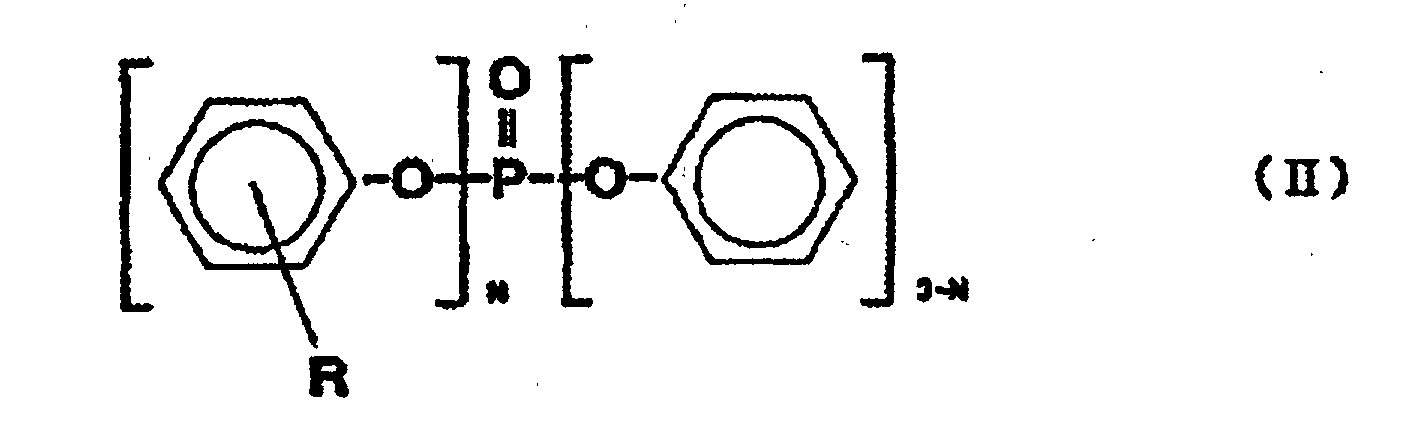
R is alkyl group such as t-butyl, isopropyl, isobutyl, isoamyl, t-amyl and N is 0 or an integer from 1 to 3; and(E) further flame retardants comprising 0.05 to 5.0 part by weight, based on 100 parts by weight of the basic resin (A)+(B)+(C), of a fluorinated polyolefin and/or 0.01 - 1 parts by weight of the base resin (A)+(B)+(C) of a salt having flame retarding properties for aromatic polycarbonates. - Flame retardant thermoplastic molding composition according to claim 1, wherein weight ratio of (D-1) to (D-2) is between 10:90 and 47:53.
- Flame retardant thermoplastic molding composition according to claim 1, wherein weight ratio of (D-1) to (D-2) is between 15:85 and 45:55.
- Flame retardant thermoplastic molding composition according to claim 1, wherein said component (D-1) is a mixture of polyphosphates wherein each component, represented by the formula (I), has M value of 1, 2, 3, 4, or 5.
- Flame retardant thermoplastic molding composition according to claim 1, wherein the R1, R2, R4, and R5 of component (D-1) are all phenyl.
- Flame retardant thermoplastic molding composition according to claim 1, wherein said component (D-1) is bisphenol-A diphenylphosphate.
- Flame retardant thermoplastic molding composition according to claim 1, wherein said component (D-2) is a mixture of alkyl substituted monophosphate esters comprising 0 to 20 parts by weight of tri(alkylphenyl)phosphate(N=3), 0 to 50 parts by weight of di(alkylphenyl)monophenylphosphate(N=2), 0 to 60 parts by weight of diphenylmono(alkylphenyl)phosphate(N=1), and 10 to 100 parts by weight of triphenylphosphate(N=0).
- Flame retardant thermoplastic molding composition according to claim 1, wherein the alkyl group R of said component (D-2) is t-butyl.
- Flame retardant thermoplastic molding composition according to claim 1, wherein the alkyl group R of said component (D-2) is isopropyl.
- Flame retardant thermoplastic molding composition according to claim 1, wherein the composition of said component (D) is such a composition that the average value of the number of phosphorus atom per phosphate molecule is 1.03 - 2.0.
- Flame retardant thermoplastic molding composition according to claim 1, wherein the composition of said component (D) is such a composition that the average value of the number of phosphorus atom per phosphate molecule is 1.03 - 1.6.
- Flame retardant thermoplastic molding composition according to claim 1, wherein said fluorinated polyolefin in component (E) is a fluorinated polyolefin with average particle sizes of 0.05 to 1000 µm and densities of 2.0 g/cm3 to 2.3 g/cm3
- Flame retardant thermoplastic molding composition according to claim 1, wherein said salt in component (E) is a salt selected from the group consisting of salts of sulfonates, salts of sulfone sulfonates, and salts of alkane sulfonic acids.
- Flame retardant thermoplastic molding composition according to claim 1, wherein said resin composition further includes at least one additives selected from the group consisting of inorganic fillers, glass fibers, carbon fibers, thermal stabilizers, antioxidants, light stabilizers, plasticizers, dyes, pigments, lubricants and mold release agents, fillers, nucleating agents and antistatic agents.
- Flame retardant thermoplastic molding composition having improved flame retardancy and thermal stability, consisting essentially of(A) 40 to 99 parts by weight of aromatic polycarbonate;(B) 2 to 40 parts by weight of a graft polymer of styrene and acrylonitrile on particulate, crosslinked polybutadiene rubber,(C) 1 to 40 parts by weight of styrene/acrylonitrile copolymer;(D) 2 to 20 parts by weight, based on 100 parts by weight of (A)+(B)+(C), of a mixture of(D-1) more than or equal to 10 % by weight and less than 50 % by weight of a mixture of polyphosphates wherein each component is represented by the general formula (I)wherein

R1, R2, R4, and R5 are all phenyl, R3 is a residue derived from bisphenol A, and M is an integer equal to 1, 2, 3, 4 or 5, and(D-2) more than or equal to 50 wt. % and less than or equal to 90 wt. %, based on (D), of triphenylphosphate; and(E) 0.05 to 5 parts by weight of tetrafluoroethylene polymer and/or 0.01 to 1 parts by weight of potassium salt of sulfone sulfonate. - Articles formed from the thermoplastic resin composition as claimed in claim 1.
Applications Claiming Priority (2)
| Application Number | Priority Date | Filing Date | Title |
|---|---|---|---|
| US11387298A | 1998-07-10 | 1998-07-10 | |
| US113872 | 1998-07-10 |
Publications (3)
| Publication Number | Publication Date |
|---|---|
| EP0970997A2 EP0970997A2 (en) | 2000-01-12 |
| EP0970997A3 EP0970997A3 (en) | 2000-10-18 |
| EP0970997B1 true EP0970997B1 (en) | 2003-11-12 |
Family
ID=22352018
Family Applications (1)
| Application Number | Title | Priority Date | Filing Date |
|---|---|---|---|
| EP99202262A Expired - Lifetime EP0970997B1 (en) | 1998-07-10 | 1999-07-09 | Flame retardant polycarbonate/abs composition |
Country Status (6)
| Country | Link |
|---|---|
| EP (1) | EP0970997B1 (en) |
| JP (1) | JP4274636B2 (en) |
| KR (1) | KR20010009104A (en) |
| DE (1) | DE69912687T2 (en) |
| ES (1) | ES2210966T3 (en) |
| GB (1) | GB2339431B (en) |
Families Citing this family (32)
| Publication number | Priority date | Publication date | Assignee | Title |
|---|---|---|---|---|
| US6417319B1 (en) * | 1998-12-16 | 2002-07-09 | Asahi Kasei Kabushiki Kaisha | Flame-retardant polycarbonate resin composition with excellent melt flowability |
| JP2004510025A (en) | 2000-09-26 | 2004-04-02 | バイエル アクチェンゲゼルシャフト | Copolycarbonate composition, its use and molded parts containing it |
| KR100372569B1 (en) * | 2000-10-31 | 2003-02-19 | 제일모직주식회사 | Flame Retardant Thermoplastic Resin Composition |
| KR100706840B1 (en) * | 2001-06-18 | 2007-04-11 | 주식회사 삼양사 | Polycarbonate resin composition with improved flow and impact resistance |
| KR100462531B1 (en) * | 2002-07-08 | 2004-12-17 | 제일모직주식회사 | Flame Retardant Thermoplastic Resin Composition |
| KR100463960B1 (en) | 2002-07-11 | 2004-12-30 | 제일모직주식회사 | Flame Retardant Thermoplastic Resin Composition |
| GB0229810D0 (en) | 2002-12-20 | 2003-01-29 | Vantico Ag | Flame retardant polymer compositions |
| KR100650910B1 (en) | 2004-10-13 | 2006-11-27 | 제일모직주식회사 | Flame Retardant Thermoplastic Composition |
| WO2007078083A1 (en) | 2005-12-30 | 2007-07-12 | Cheil Industries Inc. | Flame retardant polycarbonate thermoplastic resin composition having good extrusion moldability and impact resistance |
| US20070191519A1 (en) | 2006-02-14 | 2007-08-16 | General Electric Company | Halogen-free polycarbonate compositions and articles formed therefrom |
| KR100877291B1 (en) | 2007-11-19 | 2009-01-07 | 제일모직주식회사 | Non-halogen flame retardant polycarbonate resin composition |
| KR101004040B1 (en) | 2007-12-18 | 2010-12-31 | 제일모직주식회사 | Flame retardant scratch resistant thermoplastic resin composition with improved compatibility |
| KR100885819B1 (en) | 2007-12-18 | 2009-02-26 | 제일모직주식회사 | Branched acrylic copolymer with excellent refractive index and manufacturing method thereof |
| KR100902352B1 (en) | 2008-03-13 | 2009-06-12 | 제일모직주식회사 | Thermoplastic resin composition with improved compatibility |
| KR100886348B1 (en) | 2008-04-14 | 2009-03-03 | 제일모직주식회사 | Flame retardant scratch resistant thermoplastic resin composition with improved compatibility |
| US8039535B2 (en) | 2008-07-03 | 2011-10-18 | Cheil Industries Inc. | Flame retardant and impact modifier, method for preparing the same, and thermoplastic resin composition including the same |
| KR101150816B1 (en) * | 2008-07-03 | 2012-06-13 | 제일모직주식회사 | Flame retardant and impact modifier, method for preparing thereof, and thermoplastic resin composition containing the same |
| KR100966050B1 (en) * | 2008-11-06 | 2010-06-28 | 제일모직주식회사 | Thermoplastic resin composition with excellent compatibility |
| KR100974015B1 (en) | 2008-12-12 | 2010-08-05 | 제일모직주식회사 | Non-halogen flame retardant polycarbonate resin composition and plastic molded article |
| KR101188349B1 (en) | 2008-12-17 | 2012-10-05 | 제일모직주식회사 | Polycarbonate resin composition with improved transparency and scratch-resistance |
| CN101928450B (en) * | 2010-05-11 | 2012-11-07 | 上海陈立实业有限公司 | Automobile skylight decorating part material |
| KR101378865B1 (en) * | 2010-12-13 | 2014-03-28 | 주식회사 삼양사 | Polycarbonate resin composition having both good uninflammability and good impact resistance and molded article thereof |
| KR101381044B1 (en) * | 2012-02-03 | 2014-04-17 | 주식회사 엘지화학 | Non―halogen flame retardant and high rigidity polycarbonate resin composition |
| CN102807746B (en) * | 2012-08-17 | 2014-05-28 | 东莞市信诺橡塑工业有限公司 | High-hardness and high-fluidity PC/PMMA/AS alloy and preparation method thereof |
| KR101688684B1 (en) * | 2013-09-30 | 2016-12-21 | 롯데첨단소재(주) | Transparent Thermoplastic Resin Composition with Excellent Chemical Resistance |
| EP2881408B1 (en) | 2013-12-04 | 2017-09-20 | Lotte Advanced Materials Co., Ltd. | Styrene-based copolymer and thermoplastic resin composition including the same |
| US9902850B2 (en) | 2014-06-26 | 2018-02-27 | Lotte Advanced Materials Co., Ltd. | Thermoplastic resin composition |
| US9850333B2 (en) | 2014-06-27 | 2017-12-26 | Lotte Advanced Materials Co., Ltd. | Copolymers and thermoplastic resin composition including the same |
| US9856371B2 (en) | 2014-06-27 | 2018-01-02 | Lotte Advanced Materials Co., Ltd. | Thermoplastic resin composition and low-gloss molded article made therefrom |
| US9790362B2 (en) | 2014-06-27 | 2017-10-17 | Lotte Advanced Materials Co., Ltd. | Thermoplastic resin composition and molded article made using the same |
| KR101822697B1 (en) | 2014-11-18 | 2018-01-30 | 롯데첨단소재(주) | Thermoplastic resin composition with excellent appearance and molded article using thereof |
| US20210070684A1 (en) * | 2017-01-23 | 2021-03-11 | Katholieke Universiteit Leuven | Production of highly pure meta,meta-coupled bis(4-alkylphenol) derivatives and uses thereof |
Family Cites Families (14)
| Publication number | Priority date | Publication date | Assignee | Title |
|---|---|---|---|---|
| CA2045148A1 (en) * | 1989-07-24 | 1991-01-25 | Samuel A. Ogoe | Ignition resistant polycarbonate blends |
| JP3312665B2 (en) * | 1993-04-09 | 2002-08-12 | 宇部サイコン株式会社 | Flame retardant resin composition |
| DE4328656A1 (en) * | 1993-08-26 | 1995-03-02 | Bayer Ag | Flame retardant, stress crack resistant polycarbonate ABS molding compounds |
| TW377367B (en) * | 1994-06-21 | 1999-12-21 | Asahi Kasei Corp | Aromatic polycarbonate-styrene polymer resin composition |
| JP3565593B2 (en) * | 1994-06-27 | 2004-09-15 | 旭化成ケミカルズ株式会社 | High rigidity flame retardant resin composition |
| KR0139249B1 (en) * | 1994-09-05 | 1998-05-01 | 유현식 | Thermoplastic resin composition having flame retardancy |
| JPH08319406A (en) * | 1995-05-26 | 1996-12-03 | Kanegafuchi Chem Ind Co Ltd | Flame-retardant resin composition |
| JPH0995610A (en) * | 1995-09-30 | 1997-04-08 | Nippon G Ii Plast Kk | Fire resisting resin composition |
| US5864004A (en) * | 1997-03-27 | 1999-01-26 | Samyang Corporation | Flame retardant polymer resin composition having improved heat distortion temperature and mechanical properties |
| KR100234854B1 (en) * | 1997-03-27 | 1999-12-15 | 김윤 | Flame retardant polymer resin composition with improved thermal deformation temperature and mechanical properties |
| GB2329639B (en) * | 1997-09-25 | 2002-02-20 | Samyang Corp | Flame retardant resin composition |
| KR100360710B1 (en) * | 1997-10-23 | 2003-04-07 | 제일모직주식회사 | Polycarbonate-based thermoplastic resin composition having flame retardancy |
| KR100360714B1 (en) * | 1997-10-23 | 2003-04-03 | 제일모직주식회사 | Flame retardant thermoplastic resin composition based on polycarbonate |
| KR100327501B1 (en) * | 1998-07-14 | 2002-10-11 | 제일모직주식회사 | Flame retardant thermoplastic resin conposition |
-
1999
- 1999-07-07 KR KR1019990027281A patent/KR20010009104A/en not_active Ceased
- 1999-07-08 GB GB9915901A patent/GB2339431B/en not_active Expired - Lifetime
- 1999-07-09 EP EP99202262A patent/EP0970997B1/en not_active Expired - Lifetime
- 1999-07-09 ES ES99202262T patent/ES2210966T3/en not_active Expired - Lifetime
- 1999-07-09 DE DE69912687T patent/DE69912687T2/en not_active Expired - Lifetime
- 1999-07-09 JP JP19574599A patent/JP4274636B2/en not_active Expired - Fee Related
Also Published As
| Publication number | Publication date |
|---|---|
| ES2210966T3 (en) | 2004-07-01 |
| DE69912687T2 (en) | 2004-09-23 |
| DE69912687D1 (en) | 2003-12-18 |
| EP0970997A3 (en) | 2000-10-18 |
| EP0970997A2 (en) | 2000-01-12 |
| GB2339431A (en) | 2000-01-26 |
| GB2339431B (en) | 2002-03-13 |
| JP4274636B2 (en) | 2009-06-10 |
| KR20010009104A (en) | 2001-02-05 |
| GB9915901D0 (en) | 1999-09-08 |
| JP2000063655A (en) | 2000-02-29 |
Similar Documents
| Publication | Publication Date | Title |
|---|---|---|
| US6630524B1 (en) | Flame retardant thermoplastic resin composition | |
| EP0970997A2 (en) | Flame retardant polycarbonate/abs composition | |
| EP1069156B1 (en) | Flame retardant thermoplastic resin composition | |
| EP1534781B1 (en) | Flame retardant thermoplastic resin composition | |
| EP1201714B1 (en) | Flame retardant thermoplastic resin composition | |
| US7569629B2 (en) | Flame retardant polycarbonate resin composition | |
| EP1534782B1 (en) | Flame retardant thermoplastic resin composition | |
| JP2005501953A (en) | Flame retardant thermoplastic resin composition | |
| CN101061179B (en) | Flame retardant thermoplastic resin composition | |
| US6593404B1 (en) | Thermoplastic resin composition | |
| KR100431020B1 (en) | Flame Retardant Thermoplastic Polycarbonate Resin Composition | |
| GB2330583A (en) | Flame-retardant thermoplastic resin compositions | |
| KR101012078B1 (en) | Non-halogen flame retardant polycarbonate resin composition | |
| KR100439331B1 (en) | Flame-Retardant Thermoplastic Resin Composition | |
| KR100344895B1 (en) | Thermoplastic Polycarbonate Resin Composition having Flame-retarding properties | |
| KR100451837B1 (en) | Flame Retardant Thermoplastic Resin Composition |
Legal Events
| Date | Code | Title | Description |
|---|---|---|---|
| PUAI | Public reference made under article 153(3) epc to a published international application that has entered the european phase |
Free format text: ORIGINAL CODE: 0009012 |
|
| AK | Designated contracting states |
Kind code of ref document: A2 Designated state(s): DE ES FR NL |
|
| AX | Request for extension of the european patent |
Free format text: AL;LT;LV;MK;RO;SI |
|
| PUAL | Search report despatched |
Free format text: ORIGINAL CODE: 0009013 |
|
| AK | Designated contracting states |
Kind code of ref document: A3 Designated state(s): AT BE CH CY DE DK ES FI FR GB GR IE IT LI LU MC NL PT SE |
|
| AX | Request for extension of the european patent |
Free format text: AL;LT;LV;MK;RO;SI |
|
| 17P | Request for examination filed |
Effective date: 20010409 |
|
| AKX | Designation fees paid |
Free format text: DE ES FR GB NL |
|
| RBV | Designated contracting states (corrected) |
Designated state(s): DE ES FR NL |
|
| 17Q | First examination report despatched |
Effective date: 20020805 |
|
| GRAH | Despatch of communication of intention to grant a patent |
Free format text: ORIGINAL CODE: EPIDOS IGRA |
|
| GRAS | Grant fee paid |
Free format text: ORIGINAL CODE: EPIDOSNIGR3 |
|
| GRAA | (expected) grant |
Free format text: ORIGINAL CODE: 0009210 |
|
| AK | Designated contracting states |
Kind code of ref document: B1 Designated state(s): DE ES FR NL |
|
| REF | Corresponds to: |
Ref document number: 69912687 Country of ref document: DE Date of ref document: 20031218 Kind code of ref document: P |
|
| REG | Reference to a national code |
Ref country code: ES Ref legal event code: FG2A Ref document number: 2210966 Country of ref document: ES Kind code of ref document: T3 |
|
| ET | Fr: translation filed | ||
| PLBI | Opposition filed |
Free format text: ORIGINAL CODE: 0009260 |
|
| PLAX | Notice of opposition and request to file observation + time limit sent |
Free format text: ORIGINAL CODE: EPIDOSNOBS2 |
|
| 26 | Opposition filed |
Opponent name: BAYER MATERIALSCIENCE AG Effective date: 20040811 |
|
| NLR1 | Nl: opposition has been filed with the epo |
Opponent name: BAYER MATERIALSCIENCE AG |
|
| PLAX | Notice of opposition and request to file observation + time limit sent |
Free format text: ORIGINAL CODE: EPIDOSNOBS2 |
|
| PLBB | Reply of patent proprietor to notice(s) of opposition received |
Free format text: ORIGINAL CODE: EPIDOSNOBS3 |
|
| PLCK | Communication despatched that opposition was rejected |
Free format text: ORIGINAL CODE: EPIDOSNREJ1 |
|
| PLBN | Opposition rejected |
Free format text: ORIGINAL CODE: 0009273 |
|
| STAA | Information on the status of an ep patent application or granted ep patent |
Free format text: STATUS: OPPOSITION REJECTED |
|
| 27O | Opposition rejected |
Effective date: 20070419 |
|
| NLR2 | Nl: decision of opposition |
Effective date: 20070419 |
|
| PGFP | Annual fee paid to national office [announced via postgrant information from national office to epo] |
Ref country code: ES Payment date: 20140611 Year of fee payment: 16 |
|
| REG | Reference to a national code |
Ref country code: FR Ref legal event code: PLFP Year of fee payment: 18 |
|
| REG | Reference to a national code |
Ref country code: ES Ref legal event code: FD2A Effective date: 20170206 |
|
| PG25 | Lapsed in a contracting state [announced via postgrant information from national office to epo] |
Ref country code: ES Free format text: LAPSE BECAUSE OF NON-PAYMENT OF DUE FEES Effective date: 20150710 |
|
| REG | Reference to a national code |
Ref country code: NL Ref legal event code: PD Owner name: LOTTE ADVANCED MATERIALS CO., LTD.; KR Free format text: DETAILS ASSIGNMENT: CHANGE OF OWNER(S), MERGE; FORMER OWNER NAME: SAMSUNG SDI CO., LTD. Effective date: 20170221 |
|
| REG | Reference to a national code |
Ref country code: DE Ref legal event code: R082 Ref document number: 69912687 Country of ref document: DE Representative=s name: DOMPATENT VON KREISLER SELTING WERNER - PARTNE, DE Ref country code: DE Ref legal event code: R081 Ref document number: 69912687 Country of ref document: DE Owner name: LOTTE ADVANCED MATERIALS CO., LTD., YEOSU-SI, KR Free format text: FORMER OWNER: CHEIL INDUSTRIES INC., UIWANG, KYOUNGKI, KR |
|
| REG | Reference to a national code |
Ref country code: DE Ref legal event code: R082 Ref document number: 69912687 Country of ref document: DE Representative=s name: DOMPATENT VON KREISLER SELTING WERNER - PARTNE, DE Ref country code: DE Ref legal event code: R081 Ref document number: 69912687 Country of ref document: DE Owner name: LOTTE ADVANCED MATERIALS CO., LTD., YEOSU-SI, KR Free format text: FORMER OWNER: SAMSUNG SDI CO., LTD., YONGIN-SI, KYONGGI-DO, KR |
|
| REG | Reference to a national code |
Ref country code: FR Ref legal event code: PLFP Year of fee payment: 19 |
|
| REG | Reference to a national code |
Ref country code: FR Ref legal event code: TP Owner name: LOTTE ADVANCED MATERIALS CO., LTD., KR Effective date: 20170831 |
|
| REG | Reference to a national code |
Ref country code: FR Ref legal event code: PLFP Year of fee payment: 20 |
|
| PGFP | Annual fee paid to national office [announced via postgrant information from national office to epo] |
Ref country code: FR Payment date: 20180612 Year of fee payment: 20 |
|
| PGFP | Annual fee paid to national office [announced via postgrant information from national office to epo] |
Ref country code: DE Payment date: 20180626 Year of fee payment: 20 Ref country code: NL Payment date: 20180712 Year of fee payment: 20 |
|
| REG | Reference to a national code |
Ref country code: DE Ref legal event code: R071 Ref document number: 69912687 Country of ref document: DE |
|
| REG | Reference to a national code |
Ref country code: NL Ref legal event code: MK Effective date: 20190708 |