EP0970720A2 - Behandlung von Schmerzen und vom Nervensystem - Google Patents
Behandlung von Schmerzen und vom Nervensystem Download PDFInfo
- Publication number
- EP0970720A2 EP0970720A2 EP99202191A EP99202191A EP0970720A2 EP 0970720 A2 EP0970720 A2 EP 0970720A2 EP 99202191 A EP99202191 A EP 99202191A EP 99202191 A EP99202191 A EP 99202191A EP 0970720 A2 EP0970720 A2 EP 0970720A2
- Authority
- EP
- European Patent Office
- Prior art keywords
- adjacent
- terminus
- nerve
- circuit
- extremity
- Prior art date
- Legal status (The legal status is an assumption and is not a legal conclusion. Google has not performed a legal analysis and makes no representation as to the accuracy of the status listed.)
- Withdrawn
Links
- 210000000653 nervous system Anatomy 0.000 title claims abstract description 9
- 208000002193 Pain Diseases 0.000 title abstract description 28
- 238000011282 treatment Methods 0.000 title description 14
- 210000005036 nerve Anatomy 0.000 claims abstract description 65
- 238000000034 method Methods 0.000 claims abstract description 22
- 230000037361 pathway Effects 0.000 claims description 9
- 230000035559 beat frequency Effects 0.000 claims description 8
- 210000002820 sympathetic nervous system Anatomy 0.000 abstract description 14
- 208000024891 symptom Diseases 0.000 abstract description 12
- 238000002560 therapeutic procedure Methods 0.000 abstract description 11
- 230000000392 somatic effect Effects 0.000 abstract description 5
- 230000005611 electricity Effects 0.000 abstract description 4
- 230000000694 effects Effects 0.000 abstract description 2
- 230000006872 improvement Effects 0.000 abstract description 2
- 230000009467 reduction Effects 0.000 abstract description 2
- 230000002567 autonomic effect Effects 0.000 abstract 1
- 210000001640 nerve ending Anatomy 0.000 abstract 1
- 210000002683 foot Anatomy 0.000 description 14
- 210000003792 cranial nerve Anatomy 0.000 description 9
- 210000001590 sural nerve Anatomy 0.000 description 8
- 210000000609 ganglia Anatomy 0.000 description 6
- 210000003414 extremity Anatomy 0.000 description 5
- 210000003811 finger Anatomy 0.000 description 5
- SFLSHLFXELFNJZ-QMMMGPOBSA-N (-)-norepinephrine Chemical compound NC[C@H](O)C1=CC=C(O)C(O)=C1 SFLSHLFXELFNJZ-QMMMGPOBSA-N 0.000 description 4
- 210000003423 ankle Anatomy 0.000 description 4
- 229960002748 norepinephrine Drugs 0.000 description 4
- SFLSHLFXELFNJZ-UHFFFAOYSA-N norepinephrine Natural products NCC(O)C1=CC=C(O)C(O)=C1 SFLSHLFXELFNJZ-UHFFFAOYSA-N 0.000 description 4
- 238000000554 physical therapy Methods 0.000 description 4
- 230000002889 sympathetic effect Effects 0.000 description 4
- 210000000331 sympathetic ganglia Anatomy 0.000 description 4
- 210000003813 thumb Anatomy 0.000 description 4
- 210000002972 tibial nerve Anatomy 0.000 description 4
- 208000013586 Complex regional pain syndrome type 1 Diseases 0.000 description 3
- 206010030113 Oedema Diseases 0.000 description 3
- 239000011159 matrix material Substances 0.000 description 3
- 210000000278 spinal cord Anatomy 0.000 description 3
- 230000000638 stimulation Effects 0.000 description 3
- 206010019233 Headaches Diseases 0.000 description 2
- 201000001947 Reflex Sympathetic Dystrophy Diseases 0.000 description 2
- 210000003403 autonomic nervous system Anatomy 0.000 description 2
- 210000003169 central nervous system Anatomy 0.000 description 2
- 238000003745 diagnosis Methods 0.000 description 2
- 239000003814 drug Substances 0.000 description 2
- 210000000454 fifth toe Anatomy 0.000 description 2
- 210000004744 fore-foot Anatomy 0.000 description 2
- 210000000455 fourth toe Anatomy 0.000 description 2
- 230000002496 gastric effect Effects 0.000 description 2
- 231100000869 headache Toxicity 0.000 description 2
- 238000004519 manufacturing process Methods 0.000 description 2
- 210000004126 nerve fiber Anatomy 0.000 description 2
- 210000002569 neuron Anatomy 0.000 description 2
- 210000000056 organ Anatomy 0.000 description 2
- 210000000578 peripheral nerve Anatomy 0.000 description 2
- 210000004233 talus Anatomy 0.000 description 2
- UCTWMZQNUQWSLP-VIFPVBQESA-N (R)-adrenaline Chemical compound CNC[C@H](O)C1=CC=C(O)C(O)=C1 UCTWMZQNUQWSLP-VIFPVBQESA-N 0.000 description 1
- 229930182837 (R)-adrenaline Natural products 0.000 description 1
- BSYNRYMUTXBXSQ-UHFFFAOYSA-N Aspirin Chemical compound CC(=O)OC1=CC=CC=C1C(O)=O BSYNRYMUTXBXSQ-UHFFFAOYSA-N 0.000 description 1
- 206010006797 Burns first degree Diseases 0.000 description 1
- 206010006802 Burns second degree Diseases 0.000 description 1
- 206010008874 Chronic Fatigue Syndrome Diseases 0.000 description 1
- 208000011231 Crohn disease Diseases 0.000 description 1
- 206010013935 Dysmenorrhoea Diseases 0.000 description 1
- 102000009025 Endorphins Human genes 0.000 description 1
- 108010049140 Endorphins Proteins 0.000 description 1
- 241000282412 Homo Species 0.000 description 1
- 208000035154 Hyperesthesia Diseases 0.000 description 1
- 206010020751 Hypersensitivity Diseases 0.000 description 1
- 206010020772 Hypertension Diseases 0.000 description 1
- HEFNNWSXXWATRW-UHFFFAOYSA-N Ibuprofen Chemical compound CC(C)CC1=CC=C(C(C)C(O)=O)C=C1 HEFNNWSXXWATRW-UHFFFAOYSA-N 0.000 description 1
- 206010024264 Lethargy Diseases 0.000 description 1
- 241001465754 Metazoa Species 0.000 description 1
- 208000012322 Raynaud phenomenon Diseases 0.000 description 1
- 208000013738 Sleep Initiation and Maintenance disease Diseases 0.000 description 1
- 229960001138 acetylsalicylic acid Drugs 0.000 description 1
- 230000009471 action Effects 0.000 description 1
- 230000001464 adherent effect Effects 0.000 description 1
- 229940013181 advil Drugs 0.000 description 1
- NDAUXUAQIAJITI-UHFFFAOYSA-N albuterol Chemical compound CC(C)(C)NCC(O)C1=CC=C(O)C(CO)=C1 NDAUXUAQIAJITI-UHFFFAOYSA-N 0.000 description 1
- 230000000172 allergic effect Effects 0.000 description 1
- 230000007815 allergy Effects 0.000 description 1
- 230000008321 arterial blood flow Effects 0.000 description 1
- 210000002565 arteriole Anatomy 0.000 description 1
- 210000001367 artery Anatomy 0.000 description 1
- 208000006673 asthma Diseases 0.000 description 1
- 208000010668 atopic eczema Diseases 0.000 description 1
- 210000004204 blood vessel Anatomy 0.000 description 1
- 210000004556 brain Anatomy 0.000 description 1
- 239000002775 capsule Substances 0.000 description 1
- 230000004087 circulation Effects 0.000 description 1
- 230000002354 daily effect Effects 0.000 description 1
- XYYVYLMBEZUESM-UHFFFAOYSA-N dihydrocodeine Natural products C1C(N(CCC234)C)C2C=CC(=O)C3OC2=C4C1=CC=C2OC XYYVYLMBEZUESM-UHFFFAOYSA-N 0.000 description 1
- 238000009826 distribution Methods 0.000 description 1
- 229940079593 drug Drugs 0.000 description 1
- 229960005139 epinephrine Drugs 0.000 description 1
- 230000003203 everyday effect Effects 0.000 description 1
- 208000028327 extreme fatigue Diseases 0.000 description 1
- 239000000835 fiber Substances 0.000 description 1
- 230000037406 food intake Effects 0.000 description 1
- LLPOLZWFYMWNKH-CMKMFDCUSA-N hydrocodone Chemical compound C([C@H]1[C@H](N(CC[C@@]112)C)C3)CC(=O)[C@@H]1OC1=C2C3=CC=C1OC LLPOLZWFYMWNKH-CMKMFDCUSA-N 0.000 description 1
- 229960000240 hydrocodone Drugs 0.000 description 1
- OROGSEYTTFOCAN-UHFFFAOYSA-N hydrocodone Natural products C1C(N(CCC234)C)C2C=CC(O)C3OC2=C4C1=CC=C2OC OROGSEYTTFOCAN-UHFFFAOYSA-N 0.000 description 1
- 208000030603 inherited susceptibility to asthma Diseases 0.000 description 1
- 206010022437 insomnia Diseases 0.000 description 1
- 230000002045 lasting effect Effects 0.000 description 1
- 230000005389 magnetism Effects 0.000 description 1
- 230000007246 mechanism Effects 0.000 description 1
- 210000001872 metatarsal bone Anatomy 0.000 description 1
- 208000029766 myalgic encephalomeyelitis/chronic fatigue syndrome Diseases 0.000 description 1
- 238000012261 overproduction Methods 0.000 description 1
- 230000001734 parasympathetic effect Effects 0.000 description 1
- 210000001428 peripheral nervous system Anatomy 0.000 description 1
- 230000000306 recurrent effect Effects 0.000 description 1
- 229960002052 salbutamol Drugs 0.000 description 1
- 208000018316 severe headache Diseases 0.000 description 1
- 201000009890 sinusitis Diseases 0.000 description 1
- 210000001032 spinal nerve Anatomy 0.000 description 1
- 210000000225 synapse Anatomy 0.000 description 1
- 238000012360 testing method Methods 0.000 description 1
- 210000000115 thoracic cavity Anatomy 0.000 description 1
- LLPOLZWFYMWNKH-UHFFFAOYSA-N trans-dihydrocodeinone Natural products C1C(N(CCC234)C)C2CCC(=O)C3OC2=C4C1=CC=C2OC LLPOLZWFYMWNKH-UHFFFAOYSA-N 0.000 description 1
- 230000001228 trophic effect Effects 0.000 description 1
- 230000003442 weekly effect Effects 0.000 description 1
Images

Classifications
-
- A—HUMAN NECESSITIES
- A61—MEDICAL OR VETERINARY SCIENCE; HYGIENE
- A61N—ELECTROTHERAPY; MAGNETOTHERAPY; RADIATION THERAPY; ULTRASOUND THERAPY
- A61N1/00—Electrotherapy; Circuits therefor
- A61N1/18—Applying electric currents by contact electrodes
- A61N1/32—Applying electric currents by contact electrodes alternating or intermittent currents
- A61N1/36—Applying electric currents by contact electrodes alternating or intermittent currents for stimulation
- A61N1/36014—External stimulators, e.g. with patch electrodes
- A61N1/36021—External stimulators, e.g. with patch electrodes for treatment of pain
-
- A—HUMAN NECESSITIES
- A61—MEDICAL OR VETERINARY SCIENCE; HYGIENE
- A61N—ELECTROTHERAPY; MAGNETOTHERAPY; RADIATION THERAPY; ULTRASOUND THERAPY
- A61N1/00—Electrotherapy; Circuits therefor
- A61N1/18—Applying electric currents by contact electrodes
- A61N1/32—Applying electric currents by contact electrodes alternating or intermittent currents
- A61N1/323—Interference currents, i.e. treatment by several currents summed in the body
Definitions
- This invention comprises a method of treating the human body and more particularly to treating the sympathetic nervous system and the somatic nervous system.
- the human nervous system is normally thought of as including a central nervous system consisting of the brain and spinal column, a peripheral nervous system consisting of twelve pair of cranial nerves and thirty one pairs of spinal nerves and an autonomic nervous system which helps regulate various organs and systems throughout the body.
- the autonomic nervous system has two main segments, the sympathetic or thoracolumbar system and the parasympathetic or craniosacral system.
- the nerves of the sympathetic nervous system arise in the thoracic and lumbar portions of the spinal cord. They run from the spinal cord to ganglia that lie along both sides of the spinal column.
- the neurons from the spinal cord form a synapse with the neurons that continue to the various organs.
- this invention acts primarily on the sympathetic or thoracolumbar nervous system and secondarily on the somatic nervous system and the central nervous system.
- RSDS Reflex Sympathetic Dystrophy Syndrome
- energy is delivered through a circuit in the patient's body.
- the circuit includes nerves that extend from the extremities to the spinal column. Delivering energy, such as electricity with an electrical interferential device, through the circuit causes the electricity to pass through the nerve ganglia adjacent the spinal column which includes those mechanisms which control operation of the sympathetic nervous systems. While not being bound by any particular theory of operation, it appears that operation in accordance with this invention releases endorphins stored in some manner along the nerve path or adjacent the spinal column because there is a marked decrease in pain.
- this invention promotes correction of the underlying imbalance in the sympathetic nervous system which lies at the cause of the ailment suffered by the patient.
- Norepinephrine is a longer lasting version of epinephrine and both assist in transmitting nerve impulses and in constricting blood vessels.
- Overproduction of norepinephrine causes constriction of superficial small to medium arteries and arterioles which results in hypertension, trophic skin changes and demyelinization of nerves and hyperesthesia. Reducing the production and/or distribution of norepinephrine results in increased superficial arterial blood flow.
- electrical interferential equipment is used to deliver electrical energy along one nerve leading from one terminus on the hand or foot of the patient to the other terminus adjacent the nerve root adjacent the spinal column and along a second nerve leading from its terminus adjacent its nerve root adjacent the spinal column to its terminus on another hand or foot.
- the electrical energy alters and normalizes the sympathetic nervous system, which is controlled by the sympathetic ganglia which communicate with the spinal column through the same nerve roots as the electrical energy passes. This action has caused a reduction in pain perceived by the patient, as well as subjective and objective improvement in a number of observed conditions.
- this invention comprises a method of treating a human for ailments related to the sympathetic nervous system comprising establishing a circuit in the human body including a first circuit path comprising a first nerve having a first terminus adjacent an extremity of the human and a second terminus adjacent a first spinal vertebra, a second nerve having a first terminus adjacent an extremity of the human and a second terminus adjacent a second spinal vertebra and a pathway between the second termini, and delivering electromagnetic energy through the circuit and through the pathway.
- Another object of this invention is to provide an improved method for treating patients by delivering electromagnetic energy through nerves leading from the spinal column to the extremities.
- an electric circuit is established in the patient's body.
- the circuit includes at least two, often four and ideally eight segments.
- Each segment includes the nerve fibers having one terminus on an extremity, i.e. on the foot or hand of the patient, and one terminus adjacent a sympathetic nerve ganglia near a nerve ganglia adjacent a particular vertebra on the spinal column.
- Some type of electrical connection is made between the nerve ganglia adjacent the spinal column. It is clear that the circuit includes the nerve fibers which extend from the more distal aspect of a first peripheral nerve to its root adjacent the spinal column. It is believed the circuit continues through the root of the first nerve into the spinal column, through the spinal column and exits from the spinal column through the root of a second nerve. The circuit continues through the fibers of the second peripheral nerve to a more distal aspect of that nerve.
- the energy delivered through the circuit may be selected from a variety of electromagnetic types. Although interferential electrical energy has so far been shown to be the most desirable, H-wave stimulation with a physical therapy device such as made by Electronic Waveform Lab, Huntington Beach, California, galvanic stimulation with a physical therapy device such as a Model SW made by Rehabilicare Corporation, St. Paul, Minnesota, SMP stimulation with a physical therapy device which creates constantly changing TENS frequency such as made by Rehabilicare Corporation, St. Paul, Minnesota, or matrix electrostimulation with a physical therapy device such as made by Rehabilicare Corporation, St. Paul, Minnesota, have shown desirable effects.
- a physical therapy device such as made by Electronic Waveform Lab, Huntington Beach, California
- galvanic stimulation with a physical therapy device such as a Model SW made by Rehabilicare Corporation, St. Paul, Minnesota
- SMP stimulation with a physical therapy device which creates constantly changing TENS frequency such as made by Rehabilicare Corporation, St. Paul, Minnesota
- matrix electrostimulation with a physical therapy device
- a patient 10 is illustrated as being treated in accordance with this invention by a conventional electrical interferential therapy device 12 such as available commercially from Rehabilicare Corporation of St. Paul, Minnesota.
- the device 12 includes a control panel 14 with output jacks 16, 18 capable of accepting a jack 20 of an insulated wire pair 22 leading to electrode pairs 24, 24' and 26, 26'.
- the dial 28 of the device 12 controls the amplitude delivered to the electrodes and is set to deliver maximum amplitude consistent with patient comfort.
- the electrode switch 30 is set to either two or four depending on whether one or two pair of electrodes are being used.
- the setting of the frequency switch 32 is subject to some adjustment.
- the frequency switch 32 controls the "beat" frequency.
- the frequency of the alternating current delivered by the device of Rehabilicare is nominally 4000 Hz and the frequency switch 32 acts to vary the frequency, at a setting of ten, to 4010 Hz.
- the settings of the frequency switch 32 is normally below ten, and preferably below five and is optimally at four.
- the electrodes 24, 26 are attached to the patient's skin in a conventional manner, i.e. they are self adherent.
- the location of the electrodes 24, 26 on the patient establish the electrical circuit in the patient's body.
- one electrode 24 is placed adjacent the end or terminus of the right medial plantar nerve L5 and its matching electrode or mate 24' is placed adjacent the end or terminus of the left sural nerve S1, inferior to the left ankle bone (lateral malleolus) thereby establishing or creating a first circuit 34 in the patient's body.
- the reference characters L5, S1 and the like are standard medical terminology for the nerve. Those skilled in the art will recognize L5 as being the nerve which extends away from the fifth lumbar vertebra and S1 as being the nerve which extends away from the first sacral vertebra.
- the terminus of the right medial plantar nerve L5 is located on the bottom of the right foot, approximately on the ball of the foot.
- the terminus of the left sural nerve S1 is located below the left ankle bone (lateral malleolus).
- Another electrode 26 is placed adjacent the terminus of the right sural nerve S1 and its matching electrode or mate 26' is placed adjacent the terminus of the left medial plantar nerve L5 thereby establishing a second circuit 36 in the patient's body.
- Turning the device 12 on delivers electrical energy through the circuits 34, 36.
- the medial plantar nerves L5 and the sural nerves S1 terminate adjacent the spinal column near adjacent spinal vertebra, in the area of the connection to the lumbar sympathetic ganglia.
- a second electrical interferential therapy device 12' is used simultaneously with the first device 12 and another set of circuits is simultaneously established as suggested in Figure 2.
- the electrical interferential therapy device 12' is either a separate unit from the device 12 or they may be incorporated together in a single housing.
- an electrode 38 is attached to the patient's skin adjacent the terminus of the right lateral plantar nerve L5 and its matching electrode or mate 38' is placed adjacent the terminus of the left saphenous nerve L4, at the ankle, thereby establishing a circuit 40.
- the terminus of the right lateral plantar nerve L5 is on the bottom of the right foot below the little toe and the fourth toe on the pad of the foot near the fifth metatarsal head.
- the terminus of the left saphenous nerve L4 is on the top inside (medial-anterior aspect) of the left ankle.
- An electrode 42 is attached to the patient's skin adjacent the terminus of the right saphenous nerve L4 and its matching electrode or mate 42' is placed adjacent the terminus of the left lateral plantar nerve L5 thereby establishing a circuit 44.
- the terminus of the right saphenous nerve L4 is on the top inside of the right foot, forward of the right ankle.
- the terminus of the left lateral plantar nerve is on the bottom of the left foot below the little toe and the fourth toe on the pad of the foot. Turning the device 12 on delivers electrical energy through the circuits 40, 44.
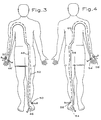
- FIG. 3 Another technique is shown in Figure 3.
- An electrode 46 is placed adjacent the end or terminus of the nerve L5 of the left forefoot plantar aspect. Its matching electrode or mate 46' is placed adjacent the end or terminus of the right cranial nerve C8 where the fifth finger joins the right hand thereby establishing or creating a first circuit 48 in the patient's body.
- Another electrode 50 is placed adjacent the terminus of the left sural nerve S1 on the lateral aspect of the left ankle and its matching electrode or mate 50' is placed adjacent the terminus of the right cranial nerve C6 where the thumb joins the hand thereby establishing a second circuit 52 in the patient's body. Turning the device 12 on delivers electrical energy through the circuits 48, 52.
- a second electrical interferential therapy device 12' may be used simultaneously with the first device 12 and another set of circuits may simultaneously established as suggested in Figure 4 so the circuits of Figures 3 and 4 are normally used together.
- An electrode 54 is attached to the patient's skin adjacent the terminus of the nerve L5 on the right forefoot planar aspect and its matching electrode or mate 54' is placed adjacent the terminus of the cranial nerve C8 on the left palmer surface where the fifth finger joins the hand thereby establishing a circuit 56 in the patient's body.
- An electrode 58 is attached to the patient's skin adjacent the terminus of the right sural nerve S1 and its matching electrode or mate 58' is placed on the left palmer surface adjacent the terminus of the left cranial nerve C6 thereby establishing a circuit 60. Turning the device 12' on delivers electrical energy through the circuits 56, 60.
- Figures 1 and 2 are preferably run simultaneously with similar or identical settings on the devices 12, 12'.
- the nerves L5 and the sural nerves S1 terminate adjacent the spinal column near adjacent spinal vertebra, in the area of the connection to the lumbar sympathetic ganglia while the nerves C6, C8 terminate adjacent the spinal column near spinal vertebrae that are far above the termini of the nerves L5, S1.
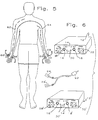
- FIG. 5 another set of circuits 62, 64 is established.
- An electrode 66 is adhesively placed at the terminus of the cranial nerve C8 on the left palmer surface where the fifth finger joins the hand and its matching electrode 66' is placed at the terminus of the cranial nerve C6 on the right palmer surface where the thumb joins the hand thereby establishing the circuit 62.
- An electrode 68 is attached adjacent the terminus of the cranial nerve C6 on the left palmar surface where the thumb joins the hand and its matching electrode or mate 68' is placed adjacent the terminus of the cranial nerve C8 on the right palmer surface where the fifth finger joins the hand thereby establishing the circuit 64.
- Experience has shown a decrease in pain in patient's complaining of pain and a decrease in symptoms consistent with an imbalanced sympathetic nervous system.
- a six year old Caucasian female presented gastrointestinal symptoms such as severe pain following ingestion of any type food.
- the patient had numerous testings and treatments, without success. She was tentative diagnosed with Crohn's disease.
- Following twenty minutes of interferential electrical therapy treatment with a Rehabilicare Corporation device with a maximum comfortable amplitude setting and a beat frequency setting of four, with eight electrodes as shown in a combination of Figures 1 and 2, the patient was pain free and was able to eat spicy Mexican food, the same evening, without complaint.
- the patient was treated with interferential electrical therapy, matrix electrostimulation and H-wave with the electrodes as shown in a combination of Figures 1 and 2, for several months but never again had gastrointestinal problems.
- a twenty eight year old Caucasian female presented with severe menstrual cramps, lower body pain and headache.
- Past medical history includes Raynaud's phenomenon, recurrent headaches, sinus infection and allergies.
- the patient was treated with electrical interferential treatment with a Rehabilicare Corporation device, with a maximum comfortable amplitude setting, a beat frequency setting of four and an eight electrode pattern in accordance with a combination of Figures 1 and 2.
- the patient reported a total resolution of all symptoms.
- a 54 year old female presented with the diagnosis of Chronic Fatigue Syndrome. The patient was experiencing extreme fatigue, sleeplessness and lethargy.
- the patent was treated, twice weekly, with two interferential machines of the Rehabilicare Corporation using a maximum comfortable amplitude selling, a beat frequency selling of four and an eight electrode pattern in accordance with a combination of Figures 1 and 2. After the first week of treatment, the patient had a markedly increased energy level.
- a 43 year old Caucasian female presented with the diagnosis of Reflex Sympathetic Dystrophy Syndrome of fifteen months duration, in spite of numerous treatments including lumbar sympathetic blocks and oral medicines.
- the right foot was severely inflamed and discolored.
- the left foot was moderately inflamed and discolored.
- the patient had not worn shoes, other than bedroom slippers, for many months.
- the patient was treated daily, with two interferential machines of the Rehabilicare Corporation, using a maximum comfortable amplitude setting, a beat frequency setting of four, and an eight electrode pattern in accordance with a combination of Figures 1 and 2. Following the first treatment, the patent was able to begin wearing a tennis shoe, on the left foot. Following three treatments, the patient was able to begin wearing a tennis shoe on the right foot.
- the patient Prior to the treatments, the patient was taking six to eight Hydrocodone capsules every day for pain. After beginning therapy, the patient no longer required any medicine for pain, even aspirin or ADVIL. Pining edema was present, on the first visit, which required more than one minute to disappear. By the second visit, the pitting edema was resolving and by the third visit, the pitting edema was no longer apparent.
- a twenty eight year old Caucasian female presented with extreme pain, in the right hand, due to first and second degree burns on the distal portion of the thumb, second, third and fourth fingers of the right hand, of forty five minutes duration. When seen, the patient was applying ice to help alleviate the pain. After twenty minutes of matrix treatment with a Rehabilicare Corporation device, with an electrode pattern as shown in Figure 5, the pain was totally eliminated.
Landscapes
- Health & Medical Sciences (AREA)
- Life Sciences & Earth Sciences (AREA)
- Animal Behavior & Ethology (AREA)
- Nuclear Medicine, Radiotherapy & Molecular Imaging (AREA)
- Radiology & Medical Imaging (AREA)
- Biomedical Technology (AREA)
- Engineering & Computer Science (AREA)
- General Health & Medical Sciences (AREA)
- Public Health (AREA)
- Veterinary Medicine (AREA)
- Pain & Pain Management (AREA)
- Biophysics (AREA)
- Heart & Thoracic Surgery (AREA)
- Electrotherapy Devices (AREA)
Applications Claiming Priority (2)
| Application Number | Priority Date | Filing Date | Title |
|---|---|---|---|
| US111222 | 1987-10-22 | ||
| US09/111,222 US5995873A (en) | 1998-07-07 | 1998-07-07 | Treatment of pain and of the nervous system |
Publications (2)
| Publication Number | Publication Date |
|---|---|
| EP0970720A2 true EP0970720A2 (de) | 2000-01-12 |
| EP0970720A3 EP0970720A3 (de) | 2000-08-16 |
Family
ID=22337255
Family Applications (1)
| Application Number | Title | Priority Date | Filing Date |
|---|---|---|---|
| EP99202191A Withdrawn EP0970720A3 (de) | 1998-07-07 | 1999-07-05 | Behandlung von Schmerzen und vom Nervensystem |
Country Status (4)
| Country | Link |
|---|---|
| US (1) | US5995873A (de) |
| EP (1) | EP0970720A3 (de) |
| AU (1) | AU745299B2 (de) |
| CA (1) | CA2276963A1 (de) |
Cited By (1)
| Publication number | Priority date | Publication date | Assignee | Title |
|---|---|---|---|---|
| EP3950048A1 (de) * | 2013-11-27 | 2022-02-09 | EBT Medical, Inc. | System zur behandlung der inkontinenzdysfunktion eines patienten |
Families Citing this family (35)
| Publication number | Priority date | Publication date | Assignee | Title |
|---|---|---|---|---|
| US6438423B1 (en) * | 2000-01-20 | 2002-08-20 | Electrocore Technique, Llc | Method of treating complex regional pain syndromes by electrical stimulation of the sympathetic nerve chain |
| US6393328B1 (en) | 2000-05-08 | 2002-05-21 | International Rehabilitative Sciences, Inc. | Multi-functional portable electro-medical device |
| US7747332B2 (en) | 2000-05-08 | 2010-06-29 | International Rehabilitative Sciences, Inc. | Electrical stimulation combined with a biologic to increase osteogenesis |
| US6560487B1 (en) | 2000-05-08 | 2003-05-06 | International Rehabilitative Sciences, Inc. | Electro-medical device for use with biologics |
| US6675048B2 (en) | 2000-05-08 | 2004-01-06 | International Rehabilitative Sciences, Inc. | Electro-medical device for use with biologics |
| US6453204B1 (en) * | 2000-08-11 | 2002-09-17 | Donald A. Rhodes | Magnetic electrode for delivering energy to the body |
| US6826429B2 (en) | 2001-01-19 | 2004-11-30 | Dynatronics Corporation | Interferential current treatment apparatus |
| US20040226556A1 (en) | 2003-05-13 | 2004-11-18 | Deem Mark E. | Apparatus for treating asthma using neurotoxin |
| WO2005062829A2 (en) * | 2003-12-19 | 2005-07-14 | Advanced Bionics Corporation | Skull-mounted electrical stimulation system and method for treating patients |
| US7374569B2 (en) * | 2004-09-02 | 2008-05-20 | Dynatronics, Corporation | Dynamically distributing power of a light beam for use in light therapy |
| KR101025442B1 (ko) * | 2005-06-03 | 2011-03-28 | 바이오레이즈 테크놀로지, 인크. | 조직 치료 장치 및 방법 |
| US9037247B2 (en) | 2005-11-10 | 2015-05-19 | ElectroCore, LLC | Non-invasive treatment of bronchial constriction |
| US8041428B2 (en) | 2006-02-10 | 2011-10-18 | Electrocore Llc | Electrical stimulation treatment of hypotension |
| EP1948301B8 (de) | 2005-11-10 | 2014-03-12 | ElectroCore LLC | Elektrische stimulationsbehandlung bei bronchialkonstriktion |
| US8812112B2 (en) | 2005-11-10 | 2014-08-19 | ElectroCore, LLC | Electrical treatment of bronchial constriction |
| US20070156183A1 (en) * | 2006-01-05 | 2007-07-05 | Rhodes Donald A | Treatment of various ailments |
| US7711430B2 (en) | 2006-02-10 | 2010-05-04 | Electrocore Llc | Methods and apparatus for treating anaphylaxis using electrical modulation |
| EP1984065B1 (de) | 2006-02-10 | 2012-08-22 | Electrocore, Inc. | Behandlung von hypotension durch elektrische stimulation |
| US20070208396A1 (en) * | 2006-03-03 | 2007-09-06 | Gary Whatcott | Systems and methods for providing a dynamic light pad |
| US20070208289A1 (en) * | 2006-03-03 | 2007-09-06 | Jay Walther | Systems and methods for providing light therapy traction |
| US20070219598A1 (en) * | 2006-03-14 | 2007-09-20 | Rhodes Donald A | Diagnostic method and apparatus |
| US10786669B2 (en) | 2006-10-02 | 2020-09-29 | Emkinetics, Inc. | Method and apparatus for transdermal stimulation over the palmar and plantar surfaces |
| US11224742B2 (en) | 2006-10-02 | 2022-01-18 | Emkinetics, Inc. | Methods and devices for performing electrical stimulation to treat various conditions |
| US8483831B1 (en) | 2008-02-15 | 2013-07-09 | Holaira, Inc. | System and method for bronchial dilation |
| EP2662027B1 (de) | 2008-05-09 | 2017-09-27 | Holaira, Inc. | Systeme, Baugruppen und Verfahren zur Behandlung eines Bronchialbaumes |
| CN104042322B (zh) | 2009-10-27 | 2017-06-06 | 赫莱拉公司 | 具有可冷却的能量发射组件的递送装置 |
| US8911439B2 (en) | 2009-11-11 | 2014-12-16 | Holaira, Inc. | Non-invasive and minimally invasive denervation methods and systems for performing the same |
| EP2842510B1 (de) | 2009-11-11 | 2022-08-24 | Nuvaira, Inc. | Vorrichtung zur Gewebebehandlung und Stenosekontrolleti |
| US8545444B2 (en) | 2011-02-16 | 2013-10-01 | Walter T. Perkins | System and method for pain-free injections |
| US9061145B2 (en) | 2012-09-17 | 2015-06-23 | Donald A. Rhodes | Technique for determining optimum treatment parameters |
| US9398933B2 (en) | 2012-12-27 | 2016-07-26 | Holaira, Inc. | Methods for improving drug efficacy including a combination of drug administration and nerve modulation |
| EP3565631B1 (de) | 2017-01-05 | 2024-04-24 | Noctrix Health, Inc. | Behandlung von restless-leg-syndrom oder überaktiven nerven |
| WO2021067751A1 (en) | 2019-10-03 | 2021-04-08 | Noctrix Health, Inc. | Peripheral nerve stimulation for restless legs syndrome |
| EP4041376A1 (de) | 2019-10-03 | 2022-08-17 | Noctrix Health, Inc. | Periphere nervenstimulation für restless-leg-syndrom |
| US11517753B2 (en) | 2020-02-20 | 2022-12-06 | Donald A. Rhodes | Interferential treatment with modified beat frequency |
Citations (5)
| Publication number | Priority date | Publication date | Assignee | Title |
|---|---|---|---|---|
| US4292980A (en) | 1978-10-31 | 1981-10-06 | Hakuju Institute For Health Science Co., Ltd. | Electrode assembly for use in electric field therapy apparatus |
| US5067495A (en) | 1989-09-27 | 1991-11-26 | Brehm Richard L | Electro wave therapy |
| US5447530A (en) | 1994-03-28 | 1995-09-05 | Guibert; Raul | Periodic pulsed heat technique for inducing analgesic effects |
| US5458625A (en) | 1994-05-04 | 1995-10-17 | Kendall; Donald E. | Transcutaneous nerve stimulation device and method for using same |
| US5643329A (en) | 1995-10-20 | 1997-07-01 | Solomonow; Moshe | System for maintaining a desired spinal curvature of a user suffering from improper alignment of the vertebrae of the spine |
Family Cites Families (5)
| Publication number | Priority date | Publication date | Assignee | Title |
|---|---|---|---|---|
| EP0196393B1 (de) * | 1985-04-01 | 1989-06-14 | Oscobal Ag | Elektrostimulationsgerät, insbesondere zur Skoliosebehandlung |
| US5069211A (en) * | 1989-08-25 | 1991-12-03 | Staodyn, Inc. | Microprocessor controlled electronic stimulating device having biphasic pulse output |
| US5417719A (en) * | 1993-08-25 | 1995-05-23 | Medtronic, Inc. | Method of using a spinal cord stimulation lead |
| JPH08332234A (ja) * | 1995-06-07 | 1996-12-17 | Masahiro Iimori | 低周波治療器 |
| US5817138A (en) * | 1996-11-27 | 1998-10-06 | Suzuki; James Y. | Multi-channel, interferential wave, micro current device and methods for treatment using micro current |
-
1998
- 1998-07-07 US US09/111,222 patent/US5995873A/en not_active Expired - Lifetime
-
1999
- 1999-07-05 EP EP99202191A patent/EP0970720A3/de not_active Withdrawn
- 1999-07-06 AU AU38011/99A patent/AU745299B2/en not_active Expired
- 1999-07-06 CA CA002276963A patent/CA2276963A1/en not_active Abandoned
Patent Citations (6)
| Publication number | Priority date | Publication date | Assignee | Title |
|---|---|---|---|---|
| US4292980A (en) | 1978-10-31 | 1981-10-06 | Hakuju Institute For Health Science Co., Ltd. | Electrode assembly for use in electric field therapy apparatus |
| US5067495A (en) | 1989-09-27 | 1991-11-26 | Brehm Richard L | Electro wave therapy |
| US5447530A (en) | 1994-03-28 | 1995-09-05 | Guibert; Raul | Periodic pulsed heat technique for inducing analgesic effects |
| US5580350A (en) | 1994-03-28 | 1996-12-03 | Guibert; Raul | Periodic pulsed heat technique for inducing analgesic effects |
| US5458625A (en) | 1994-05-04 | 1995-10-17 | Kendall; Donald E. | Transcutaneous nerve stimulation device and method for using same |
| US5643329A (en) | 1995-10-20 | 1997-07-01 | Solomonow; Moshe | System for maintaining a desired spinal curvature of a user suffering from improper alignment of the vertebrae of the spine |
Cited By (1)
| Publication number | Priority date | Publication date | Assignee | Title |
|---|---|---|---|---|
| EP3950048A1 (de) * | 2013-11-27 | 2022-02-09 | EBT Medical, Inc. | System zur behandlung der inkontinenzdysfunktion eines patienten |
Also Published As
| Publication number | Publication date |
|---|---|
| AU3801199A (en) | 2000-06-08 |
| AU745299B2 (en) | 2002-03-21 |
| US5995873A (en) | 1999-11-30 |
| EP0970720A3 (de) | 2000-08-16 |
| CA2276963A1 (en) | 2000-01-07 |
Similar Documents
| Publication | Publication Date | Title |
|---|---|---|
| US5995873A (en) | Treatment of pain and of the nervous system | |
| US20110015689A1 (en) | Treatment of various ailments | |
| JP7133543B2 (ja) | 末梢神経刺激による心機能不全の治療のためのシステムおよび方法 | |
| US10213593B2 (en) | Method and apparatus for noninvasive inhibition of deep vein thrombosis | |
| Martin et al. | Functional electrical stimulation in spinal cord injury: from theory to practice | |
| RU2396995C2 (ru) | Способ лечения больных с остеохондрозом поясничного отдела позвоночника с корешковым синдромом | |
| KR101612985B1 (ko) | 부작용이 감소되면서 통증을 억제하기 위한 선택적 고주파수 척수 조정, 및 관련된 시스템 및 방법 | |
| US20140135858A1 (en) | Charge-enhanced neural electric stimulation system | |
| CN103561811A (zh) | 靶向治疗运动障碍的装置、系统和方法 | |
| Fonoff et al. | Pain relief and functional recovery in patients with complex regional pain syndrome after motor cortex stimulation | |
| US20150246229A1 (en) | Treatment of various ailments | |
| US20240065937A1 (en) | System and method of mechanical stimulation for pain relief | |
| US20200206504A1 (en) | Method and apparatus for controlling multi-site neurostimulation | |
| Triggs et al. | Dysaesthesiae induced by physiological and electrical activation of posterior column afferents after stroke. | |
| RU2038102C1 (ru) | Способ лечения вибрационной болезни | |
| MXPA99006312A (es) | Tratamiento de dolor y del sistema nervioso | |
| RU2854778C1 (ru) | Способ проведения физиотерапии с помощью комбинированного аппарата для магнитно- и электротерапии и аппарат для его осуществления | |
| RU2403072C2 (ru) | Метод вольдемара рагеля - способ электротерапии человека | |
| Lairamore et al. | Lower Extremity Functional Electrical Stimulation During Inpatient Rehabilitation: A Pilot Study Investigating Gait and Muscle Activity in Persons With Stroke or Brain Injury | |
| US20230310852A1 (en) | Treatment of ischemia | |
| Golovakha et al. | Effectivness of genicular nerves radiofrequency neuroablation for pain syndrome managment in patients with knee arthritis | |
| Shelyakin et al. | The use of micropolarization in the treatment of spinal cord lesions | |
| Sorgnard et al. | Utilization of Electronic Cell Signaling to Effect Recovery from Peroneal Neuropathy in Patients with Complete Foot Drop | |
| EP3305362A2 (de) | Verfahren und vorrichtung zur nichtinvasiven hemmung von tiefer venenthrombose | |
| Landi et al. | Motor evoked potentials upon magnetic stimulation in post-traumatic myelic dysfunction |
Legal Events
| Date | Code | Title | Description |
|---|---|---|---|
| PUAI | Public reference made under article 153(3) epc to a published international application that has entered the european phase |
Free format text: ORIGINAL CODE: 0009012 |
|
| AK | Designated contracting states |
Kind code of ref document: A2 Designated state(s): AT BE CH CY DE DK ES FI FR GB GR IE IT LI LU MC NL PT SE |
|
| AX | Request for extension of the european patent |
Free format text: AL;LT;LV;MK;RO;SI |
|
| PUAL | Search report despatched |
Free format text: ORIGINAL CODE: 0009013 |
|
| AK | Designated contracting states |
Kind code of ref document: A3 Designated state(s): AT BE CH CY DE DK ES FI FR GB GR IE IT LI LU MC NL PT SE |
|
| AX | Request for extension of the european patent |
Free format text: AL;LT;LV;MK;RO;SI |
|
| 17P | Request for examination filed |
Effective date: 20010216 |
|
| AKX | Designation fees paid |
Free format text: AT BE CH CY DE DK ES FI FR GB GR IE IT LI LU MC NL PT SE |
|
| AXX | Extension fees paid |
Free format text: AL PAYMENT 20010216;LT PAYMENT 20010216;LV PAYMENT 20010216;MK PAYMENT 20010216;RO PAYMENT 20010216;SI PAYMENT 20010216 |
|
| STAA | Information on the status of an ep patent application or granted ep patent |
Free format text: STATUS: THE APPLICATION HAS BEEN WITHDRAWN |
|
| 18W | Application withdrawn |
Withdrawal date: 20010516 |