EP0969964B1 - A thermal control device - Google Patents
A thermal control device Download PDFInfo
- Publication number
- EP0969964B1 EP0969964B1 EP97940808A EP97940808A EP0969964B1 EP 0969964 B1 EP0969964 B1 EP 0969964B1 EP 97940808 A EP97940808 A EP 97940808A EP 97940808 A EP97940808 A EP 97940808A EP 0969964 B1 EP0969964 B1 EP 0969964B1
- Authority
- EP
- European Patent Office
- Prior art keywords
- heat
- endothermic
- temperature control
- control surface
- article
- Prior art date
- Legal status (The legal status is an assumption and is not a legal conclusion. Google has not performed a legal analysis and makes no representation as to the accuracy of the status listed.)
- Expired - Lifetime
Links
Classifications
-
- H—ELECTRICITY
- H10—SEMICONDUCTOR DEVICES; ELECTRIC SOLID-STATE DEVICES NOT OTHERWISE PROVIDED FOR
- H10W—GENERIC PACKAGES, INTERCONNECTIONS, CONNECTORS OR OTHER CONSTRUCTIONAL DETAILS OF DEVICES COVERED BY CLASS H10
- H10W40/00—Arrangements for thermal protection or thermal control
- H10W40/70—Fillings or auxiliary members in containers or in encapsulations for thermal protection or control
- H10W40/73—Fillings or auxiliary members in containers or in encapsulations for thermal protection or control for cooling by change of state
- H10W40/735—Fillings or auxiliary members in containers or in encapsulations for thermal protection or control for cooling by change of state by melting or evaporation of solids
-
- C—CHEMISTRY; METALLURGY
- C01—INORGANIC CHEMISTRY
- C01D—COMPOUNDS OF ALKALI METALS, i.e. LITHIUM, SODIUM, POTASSIUM, RUBIDIUM, CAESIUM, OR FRANCIUM
- C01D1/00—Oxides or hydroxides of sodium, potassium or alkali metals in general
- C01D1/04—Hydroxides
-
- C—CHEMISTRY; METALLURGY
- C01—INORGANIC CHEMISTRY
- C01D—COMPOUNDS OF ALKALI METALS, i.e. LITHIUM, SODIUM, POTASSIUM, RUBIDIUM, CAESIUM, OR FRANCIUM
- C01D15/00—Lithium compounds
- C01D15/02—Oxides; Hydroxides
-
- C—CHEMISTRY; METALLURGY
- C01—INORGANIC CHEMISTRY
- C01D—COMPOUNDS OF ALKALI METALS, i.e. LITHIUM, SODIUM, POTASSIUM, RUBIDIUM, CAESIUM, OR FRANCIUM
- C01D15/00—Lithium compounds
- C01D15/08—Carbonates; Bicarbonates
-
- C—CHEMISTRY; METALLURGY
- C01—INORGANIC CHEMISTRY
- C01D—COMPOUNDS OF ALKALI METALS, i.e. LITHIUM, SODIUM, POTASSIUM, RUBIDIUM, CAESIUM, OR FRANCIUM
- C01D7/00—Carbonates of sodium, potassium or alkali metals in general
-
- C—CHEMISTRY; METALLURGY
- C09—DYES; PAINTS; POLISHES; NATURAL RESINS; ADHESIVES; COMPOSITIONS NOT OTHERWISE PROVIDED FOR; APPLICATIONS OF MATERIALS NOT OTHERWISE PROVIDED FOR
- C09K—MATERIALS FOR MISCELLANEOUS APPLICATIONS, NOT PROVIDED FOR ELSEWHERE
- C09K5/00—Heat-transfer, heat-exchange or heat-storage materials, e.g. refrigerants; Materials for the production of heat or cold by chemical reactions other than by combustion
- C09K5/16—Materials undergoing chemical reactions when used
- C09K5/18—Non-reversible chemical reactions
-
- F—MECHANICAL ENGINEERING; LIGHTING; HEATING; WEAPONS; BLASTING
- F24—HEATING; RANGES; VENTILATING
- F24V—COLLECTION, PRODUCTION OR USE OF HEAT NOT OTHERWISE PROVIDED FOR
- F24V30/00—Apparatus or devices using heat produced by exothermal chemical reactions other than combustion
-
- F—MECHANICAL ENGINEERING; LIGHTING; HEATING; WEAPONS; BLASTING
- F28—HEAT EXCHANGE IN GENERAL
- F28D—HEAT-EXCHANGE APPARATUS, NOT PROVIDED FOR IN ANOTHER SUBCLASS, IN WHICH THE HEAT-EXCHANGE MEDIA DO NOT COME INTO DIRECT CONTACT
- F28D20/00—Heat storage plants or apparatus in general; Regenerative heat-exchange apparatus not covered by groups F28D17/00 or F28D19/00
- F28D20/02—Heat storage plants or apparatus in general; Regenerative heat-exchange apparatus not covered by groups F28D17/00 or F28D19/00 using latent heat
-
- Y—GENERAL TAGGING OF NEW TECHNOLOGICAL DEVELOPMENTS; GENERAL TAGGING OF CROSS-SECTIONAL TECHNOLOGIES SPANNING OVER SEVERAL SECTIONS OF THE IPC; TECHNICAL SUBJECTS COVERED BY FORMER USPC CROSS-REFERENCE ART COLLECTIONS [XRACs] AND DIGESTS
- Y02—TECHNOLOGIES OR APPLICATIONS FOR MITIGATION OR ADAPTATION AGAINST CLIMATE CHANGE
- Y02E—REDUCTION OF GREENHOUSE GAS [GHG] EMISSIONS, RELATED TO ENERGY GENERATION, TRANSMISSION OR DISTRIBUTION
- Y02E60/00—Enabling technologies; Technologies with a potential or indirect contribution to GHG emissions mitigation
- Y02E60/14—Thermal energy storage
Definitions
- the present invention relates to devices comprising endothermic materials and, more particularly, it relates to the provision of certain acids and their salts, certain bases and their salts, and certain organic compounds as endothermic reaction agents for use in such endothermic materials for the control of temperature and heat in cooling systems for electronic components, structures, surfaces and the like, which are sensitive to changes in temperature.
- phase change material compositions Generally, endothermic devices employ phase change material compositions (PCM's).
- PCM materials are largely solid or fluidic in nature, for example, being liquids, quasi-liquids, or solids such as a waxes or other meltable compositions.
- the conventional PCM's have proven to suffer from many technical problems as well as problems in their use and application. These problems include relatively low latent heat of fusion, the inability to control the shape and form of such fluid PCM materials as well as the evenness of heating and cooling.
- U.S. Patent No. 4,446,916 Applicant has disclosed what he calls a composite fabric endothermic material (CFEM), providing devices especially suitable as heat sinks for aerospace and military use.
- CFEM composite fabric endothermic material
- the patented CFEM provides an improved heat sink that absorbs heat at the melting temperatures of a compound embedded within a fibrous mesh or matrix.
- the CFEM preferably comprises a phase change material which is held by capillary action and chemical adhesions to the fibers of the matrix. As a result a greatly increased surface area for heat transfer is obtained.
- the endothermic agents i.e. heat absorbing agents suggested in Applicant's U.S. Patent No. 5,709,914, have accomplished some protection from high temperatures through the physical phenomenon of the absorption of the latent heat of fusion, wherein the appropriate crystaline substance absorbs a quantity of heat to melt without a temperature rise to its surroundings.
- the phenomenon of the absorption of the latent heat of fusion is reversible and will provide protection when heat generation occurs more than once in the application.
- US patent No. 4,585,843 discloses a polymerisation process which uses a particulate heat sink material which undergoes an endothermic phase charge to absorb thermal energy.
- Latent heat of fusion agents tend to burn at relatively high temperatures raising the overall heat content of the system.
- PCM's Latent heat of fusion agents
- the reversibility of the phenomena virtually guarantees that these agents will also transfer heat into the environment once the environment is at a lower temperature than the respective temperatures of the agents. Consequently, not only do these agents operate as heat absorbing agents, but they can also act as heat transfer agents to cause the very damage to the electronic components that these agents were initially intended to prevent.
- German specification DE-OS-2233107 relates to endothermic agent for cooling hot gases used to inflate inflatable structures.
- the endothermic agents are particulate and housed in porous whils for passage of gases therethrough.
- the object of the present invention to overcome the disadvantages of PCM's and, in particular, to provide for nonreversible heat absorbing applications.
- the present invention utilizes nonrecyclable, nonreversible endothermic chemical reactions, which make use of the latent heat of decomposition and dehydration reactions to provide new, improved and, particularly, efficacious endothermic cooling systems.
- the compounds developed in the present invention provide endothermic chemical reactions, which are extremely stable in diverse environments, have long shelf life and high latent heats of reaction.
- the compounds used by the present invention include: boric acid and some borate salts, salts of acetic acid and formic acid, hydroxides of lithium, calcium, aluminum and sodium, carbonate salts of magnesium, lithium and silicon, paraldehyde and paraformaldehyde as well as trioxane, and hydrated salts.
- the endothermic agents of interest include those which thermally decompose into any of the following:
- the compounds of the present invention may be employed in composite fabric carriers or matrices of the type discussed in Applicant's aforementioned application or in the prior noted patent.
- flight data recorders were provided in a container forming a heat sink structure. Waferlike cakes formed of boric acid were located in metal enclosures fitted within the heat sink structure. The boric acid wafers were formed by compression into rectangular wafers and cakes which fit neatly into the metal enclosures of the heat sink structure. The heat sink structure was then connected with the circuit board of a memory control system. In this way, the natural rise in temperature of a conventional (prior art) heat sink military flight recorder may be compared to the same flight recorder's thermal performance with a boric acid endothermic heat sink formed in accordance with the present invention.
- Aluminum hydroxide (Al(OH) 3 ) devices work best as a high temperature endothermic temperature control agent. When Al(OH) 3 decomposes, it leaves behind a strong thermal insulation layer of Al 2 O which further abates temperature rise through decomposition product to the heat sink device.
- Other applications of the present invention presented for example and not as limitation include: temperature control coatings, wraps and liners as well as thermal protection for metal and plastic structures; cooling for electronics, oven sensors, missile skins, exhaust pipes, thermal protection in race cars, fire walls and related equipment.
- hydroxides or carbonates may be stored almost indefinitely provided they are not exposed to temperatures at or above the temperature of reaction. When exposed to reduced pressure and some heat, hydrates tend to lose H 2 O, making them less likely to be fully effective as cooling agents in some aircraft applications, unless properly hermetically sealed, with allowance to permit venting of water vapor at the temperature of reaction.
- the compounds are commercially available and inexpensive. They may be easily incorporated in and integrated with CFEMs, metal mesh matrices, silicon or carbon fiber or microencapsulated and macroencapsulated in porous silica or porous carbon bodies.
- the agents may be shaped in the form of enclosures, chips or cakes which can be incorporated in shaped bodies and thus, can be formed in shape and dimension as required. In some applications the agents may be formed into gels and pastes.
- the special compounds of the present invention provide unforeseen, critical benefits in that massive quantities of heat are readily absorbed, in a unidirectional reaction. And that once so absorbed, do not reverse and, therefore, cannot act as a heat generator. Thus, protection for sensitive devices is absolute.
Landscapes
- Chemical & Material Sciences (AREA)
- Engineering & Computer Science (AREA)
- Organic Chemistry (AREA)
- Materials Engineering (AREA)
- Inorganic Chemistry (AREA)
- Thermal Sciences (AREA)
- Physics & Mathematics (AREA)
- Mechanical Engineering (AREA)
- General Engineering & Computer Science (AREA)
- Chemical Kinetics & Catalysis (AREA)
- Combustion & Propulsion (AREA)
- General Chemical & Material Sciences (AREA)
- Sorption Type Refrigeration Machines (AREA)
- Cooling Or The Like Of Electrical Apparatus (AREA)
- General Preparation And Processing Of Foods (AREA)
- Mounting, Exchange, And Manufacturing Of Dies (AREA)
- Heating, Cooling, Or Curing Plastics Or The Like In General (AREA)
- Control Of Temperature (AREA)
- Devices That Are Associated With Refrigeration Equipment (AREA)
- Thermotherapy And Cooling Therapy Devices (AREA)
- Cooling Or The Like Of Semiconductors Or Solid State Devices (AREA)
- Compositions Of Macromolecular Compounds (AREA)
- Refuse Collection And Transfer (AREA)
- Vending Machines For Individual Products (AREA)
Abstract
Description
- The present invention relates to devices comprising endothermic materials and, more particularly, it relates to the provision of certain acids and their salts, certain bases and their salts, and certain organic compounds as endothermic reaction agents for use in such endothermic materials for the control of temperature and heat in cooling systems for electronic components, structures, surfaces and the like, which are sensitive to changes in temperature.
- Often, active cooling of such electronic components, particularly delicate TR modules, Impatt diodes, data recorders and the like, is not feasible and even when it is feasible, it requires continuous high energy cooling which taxes other attached engineering systems such as those typical to missiles, aircraft and related combat systems.
- Generally, endothermic devices employ phase change material compositions (PCM's). The conventional PCM materials are largely solid or fluidic in nature, for example, being liquids, quasi-liquids, or solids such as a waxes or other meltable compositions. Over time, the conventional PCM's have proven to suffer from many technical problems as well as problems in their use and application. These problems include relatively low latent heat of fusion, the inability to control the shape and form of such fluid PCM materials as well as the evenness of heating and cooling. Other problems are the need to provide a containment housing and the stress placed on the housing, resulting in frequent rupture and spillage of the PCM; the hazard to life and property due to PCM's high heat content and flammability; and lastly, the uneven heating or cooling hysteresis. For these critical reasons and others, PCM's as thermal storage and temperature control mediums have a long history of failure and nonuse in commercial and military applications.
- In Applicant's patent, U.S. Patent No. 4,446,916, Applicant has disclosed what he calls a composite fabric endothermic material (CFEM), providing devices especially suitable as heat sinks for aerospace and military use. The patented CFEM provides an improved heat sink that absorbs heat at the melting temperatures of a compound embedded within a fibrous mesh or matrix. The CFEM preferably comprises a phase change material which is held by capillary action and chemical adhesions to the fibers of the matrix. As a result a greatly increased surface area for heat transfer is obtained.
- The normal PCM's can spill hot fluids onto a human's skin, resulting in serious third degree burns due to the sticky contact nature of many hot wax and plastic phase change material and the high heat and sticky adherence to skin. Ruptured non-CFEM or liquified wax PCM disks can spill their content and cause flash fires, which spread as the PCM pours out during heating in ovens. Wax-filled disks are prone to fires, which can spread and flow out of stoves; however, CFEM fabric absorbs and contains liquid PCM, making it difficult to ignite.
- While the patented CFEM is suitable for use in food and in military applications, the scope of its suitability for other commercial and civilian applications is limited and is particularly not suitable for high temperature application, flight recorders and oven sensors.
- In Applicant's U.S. Patent No. 5,709,914, Applicant addresses the need for an improved CFEM for use in many commercial and civilian applications, particularly for food, home and commercial packaging operations. In this application, improved CFEMs capable of being employed in a variety of commercial applications such as in the food industry where a need has arisen for heat retaining or heat insulating containers, packages and thermal storage devices.
- The endothermic agents, i.e. heat absorbing agents suggested in Applicant's U.S. Patent No. 5,709,914, have accomplished some protection from high temperatures through the physical phenomenon of the absorption of the latent heat of fusion, wherein the appropriate crystaline substance absorbs a quantity of heat to melt without a temperature rise to its surroundings. The phenomenon of the absorption of the latent heat of fusion is reversible and will provide protection when heat generation occurs more than once in the application.
- US patent No. 4,585,843 discloses a polymerisation process which uses a particulate heat sink material which undergoes an endothermic phase charge to absorb thermal energy.
- However, there are many problems inherent in the use of such heat absorbing agents as described above. By virtue of the fact that the phenomena of the earlier application need to be reversible so that heat absorption occurs more than once, they operate in relatively low temperature ranges. In other words they are capable of absorbing not more than 837 J/g (200 cal/gm). Thus, they can remove heat for only a short period of time and only at temperatures not exceeding 163°C (326°F). Consequently, they are not effective for applications requiring cooling at very high temperatures and for long periods of time as would be needed, for example, in airplane crashes, missile electronics, spacecraft devices, power supplies, data recorders employed as aircraft components, and combat devices and in commercial uses as oven sensors, fire walls and automobile exhaust systems.
- Latent heat of fusion agents (PCM's) tend to burn at relatively high temperatures raising the overall heat content of the system. In addition, the reversibility of the phenomena virtually guarantees that these agents will also transfer heat into the environment once the environment is at a lower temperature than the respective temperatures of the agents. Consequently, not only do these agents operate as heat absorbing agents, but they can also act as heat transfer agents to cause the very damage to the electronic components that these agents were initially intended to prevent.
- German specification DE-OS-2233107 relates to endothermic agent for cooling hot gases used to inflate inflatable structures. The endothermic agents are particulate and housed in porous certaines for passage of gases therethrough.
- It is, therefore, the object of the present invention to overcome the disadvantages of PCM's and, in particular, to provide for nonreversible heat absorbing applications.
- It is a further object of the present invention to provide improved coolant media capable of being employed in a variety of applications such as in airplane crashes, missile electronics, spacecraft devices, power supplies, data recorders employed as aircraft components, and combat devices, as well as in commercial uses such as oven sensors and the like.
- It is a particular object of the present invention to provide heat absorbing agents capable of absorbing heat at temperatures above 150°C (300°F).
- It is another object of the present invention to provide endothermic mechanisms utilizing the chemical reaction of latent heat of formation or decomposition.
- Aspects of the present invention are defined in the appendent independent claims.
- The present invention utilizes nonrecyclable, nonreversible endothermic chemical reactions, which make use of the latent heat of decomposition and dehydration reactions to provide new, improved and, particularly, efficacious endothermic cooling systems.
- What makes these nonrecyclable, nonreversible endothermic chemical reactions particularly appropriate is that they have temperatures of reaction suitable in the temperature range used in the design of flight data recorders, electronics and related devices, i.e. the heat sink structure must be capable of maintaining an interior temperature of between 100°C and 300°C while operating.in an external temperature range of 600 to 1100°C and act only as a heat sink and not as a heat generator.
- The compounds developed in the present invention provide endothermic chemical reactions, which are extremely stable in diverse environments, have long shelf life and high latent heats of reaction. The compounds used by the present invention include: boric acid and some borate salts, salts of acetic acid and formic acid, hydroxides of lithium, calcium, aluminum and sodium, carbonate salts of magnesium, lithium and silicon, paraldehyde and paraformaldehyde as well as trioxane, and hydrated salts.
- Specifically, the endothermic agents of interest include those which thermally decompose into any of the following:
- 1. Hydrated salts which endothermically decompose into water and salt.
- 2. Paraldehyde, trioxane and paraformaldehyde which endothermically decompose into formaldehyde.
- 3. Low molecular weight acids which endothermically decompose into water and oxides.
- 4. Carbonate salts which decompose into carbon dioxide and an oxide.
-
-
- I. The following illustrates the endothermic
reaction and heat absorption of the aforementioned
hydroxides when subject to a temperature of reaction below
1100°C.
Lithium hydroxide (LiOH):
LiOH melts at 450°C
Sodium Hydroxide (NaOH):
Aluminum Hydroxide (Al(OH)3):
It will be seen from the foregoing that the specified hydroxides decompose at their specified temperatures of reaction to form metal oxides while absorbing large quantities of latent heat of reaction. In some reactions a higher amount of latent heat is absorbed by the melting of the starting hydroxides and the melting of the produced oxides. - II. The following illustrates the endothermic
reaction and heat absorption of the aforementioned salts
when subject to a temperature reaction below 1100°C.
Calcium Carbonate (CaCO3):
Silicon Carbonate (SiCO3):
Magnesium Carbonate (MgCO3):
NOTE: The starting endothermic material is composed of Magnesium Carbonate (MgCO3), Mg(OH)2, and H2O, i.e.: n MgCO3 : n Mg (OH) : n H2O)
n MgCO3 :
n MgO + CO2 and n H2O at 300°C absorbing 1193 J/g - III. This reaction will provide endothermic cooling
of electronic devices and other surfaces and structures by
the thermal decomposition of sodium bicarbonate absorbing
in excess of 1465 J/g (350 cal/gm) between 120°C and 310°C.
ΔH° ∼ 1520 J/g (363cal/g) - IV. This reaction will provide endothermic cooling
of electronic devices and other surfaces and structures by
the thermal decomposition of sodium carbonate absorbing in
excess of 1340 J/g (320 cal/gm).
MW = 84.0ΔH° = [1.27x10⁵ J/mol (30,450 cal/mol)]/(84 g/mol) = 1518 J/g (363 cal/g)
- V. In particular, it has been found that boric acid
absorbs large amounts of heat when decomposing, because
boric acid decomposes in stages over a range of temperature
to produce boron oxide and water while absorbing
nearly 1674 J/g (400 cal/gm). Borate salts act similarly for
effective heat absorption results.
The following illustrates the reactions of Boric acid while absorbing the appropriate latent heats of reaction:
This reaction will provide endothermic cooling of electronic devices and other surfaces and structures by the thermal decomposition of boric acid absorbing in excess of 1674 J/g (400 cal/gm) between 120°C and 350°C.
MW = 62ΔH° = 2.24x10⁵J (53.6 Kcal)/2 mol H3BO3
ΔH = [2.24x10⁵ (53.600 Kcal)/2 mol] (2(62) g/2 mol ≥ 1808 J/g (432cal/g) - VI. The following illustrates the endothermic
reaction and heat absorption of hydrated salts when
subject to a temperature reaction below 1100°C.
The following hydrate salts provide effective endothermic cooling from 60 - 200°C:ΔHr = 1.78x10⁵ J/mole (42.4 Kcal/mole)
MW = 96.39
[1.78x10⁵ J/mole (42.4 Kcal/mole)]/96.39ΔHr is negative. MW = 246.37
[4.13x10⁵ J/mole (98.6 Kcal/mole)]/246.37 = 1675 J/g (400.2 cal/gm)ΔHr is 5.22x10⁵ J/mole (124.58 Kcal/mole)
MW = 354.12
[5.22x10⁵ J/mole (124.58 Kcal/mole)]/354.12 = 1473 J/g (351.8 cal/gm)ΔHr = 2.32x10⁵ J/mole (55.46 Kcal/mole)
MW = 155.96
2.32x10⁵ J/mole [(55.46 Kcal/mole)]/155.96 = 1490 J/g (355.6 cal/gm)ΔHr = 1.08x10⁶ J/mole (257.12 Kcal/mole).
MW = 666.14
[1.08x10⁶ J/mole (257.12 Kcal/mole)]/666.14 = 1616 J/g (385.98 cal/gm)ΔHr = 2.71x10⁵ J/mole (64.7 Kcal/mole)
MW = 137.98
[2.71x10⁵ J/mole (64.7 Kcal/mole)]/137.98 = 1963 J/g (468.9 cal/gm)ΔHr = 4.33x10⁵ J/mole (103.49 Kcal/mole)
MW = 375.01
[4.33x10⁵ J/mol](103.49 Kcal/mole)/375.01 = 1155 J/g (275.98 cal/gm
This reaction will provide endothermic cooling of electronic devices and other surfaces and structures by the thermal decomposition of lithium chloride trihydrate absorbing in excess of 1842 J/g (440 cal/gm) between 90°C and 150°C.
MW = 96.4ΔH° = 1.78x10⁵ J/mole (42.4 Kcal/mol)
ΔH° = 1842 J/g (440 cal/g)
This reaction will provide endothermic cooling of electronic devices and other surfaces and structures by the thermal decomposition of lithium nitrate trihydrate absorbing in excess of 1340 J/g (320 cal/gm) between 50°C and 120°C.
MW = 123ΔH° = 167x105 J/mole (39.9 Kcal/mol)
ΔH° = 1357 J/g (324 cal/g)
This reaction will provide endothermic cooling of electronic devices and other surfaces and structures by the thermal decomposition of sodium carbonate decahydrate absorbing in excess of 1340 J/g (320 cal/gm) between 20°C and 80°C.
MM = 266ΔH° = 5.34x10⁵ J/mol(127.6 Kcal/mol)
ΔH° = 2010 J/g(480 cal/g)
This reaction will provide Endothermic cooling of electronic devices and other surfaces and structures by the thermal decomposition of Sodium Borate Decahydrate yielding in excess of 1465 J/g (350 cal/gm) between 200°C and 375°C.
MW = 382ΔH°= 5.92x10⁵ J/mole (141.3 Kcal/mol)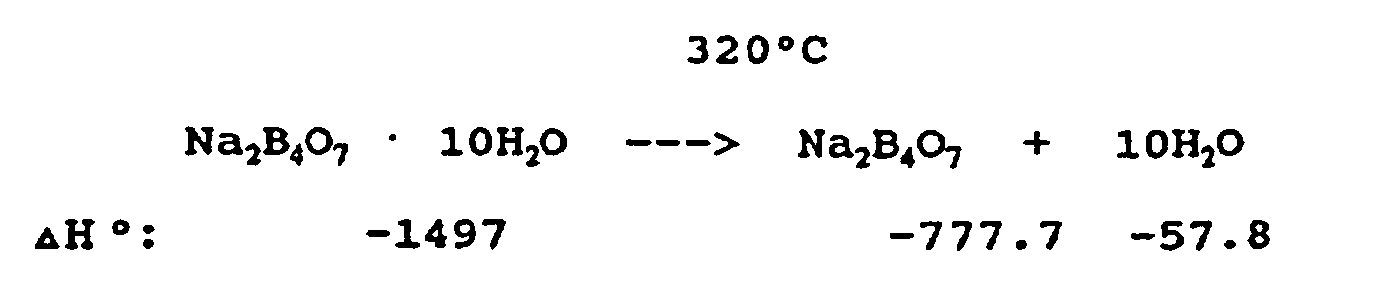
ΔH°= 1550 J/g (370 cal/g)
This reaction will provide endothermic cooling of electronic devices and other surfaces and structures by the thermal decomposition of epsom salt hydrated absorbing in excess of 1465 J/g (350 cal/gm)between 120°C and 250°C.
MW = 246.5ΔH° = 3.86x10⁵ J/g (92.3 Kcal/mol)
ΔH° = 1566 J/g (374 cal/g)
The following reactions will provide endothermic cooling of electronic devices and other surfaces and structures by the thermal decomposition of beryllium sulfate hydrate absorbing in excess of 1256 J/g (300 cal/gm) between 90°C and 450°C.
MW = 177.1 ΔH° = 1400 J/g (334 cal/g) (total)
This reaction will provide endothermic cooling of electronic devices and other surfaces and structures by the thermal decomposition of hydrated sodium phosphate absorbing in excess of 1256 J/g (300 cal/gm) between 80°C and 150°C.
MW = 377ΔH° = [6.5x10⁵ J/mol (156.4 Kcal/mol)]/(377 g/mol) = 1725 J/g (412 cal/g)
This reaction will provide endothermic cooling of electronic devices and other surfaces and structures by the thermal decomposition of calcium chloride hexahydrate absorbing in excess of 1256 J/g (300 cal/gm) between 220°C and 350°C.
MW = 219ΔH° = 3.6x10⁵ J/mole (86.4 Kcal/mol)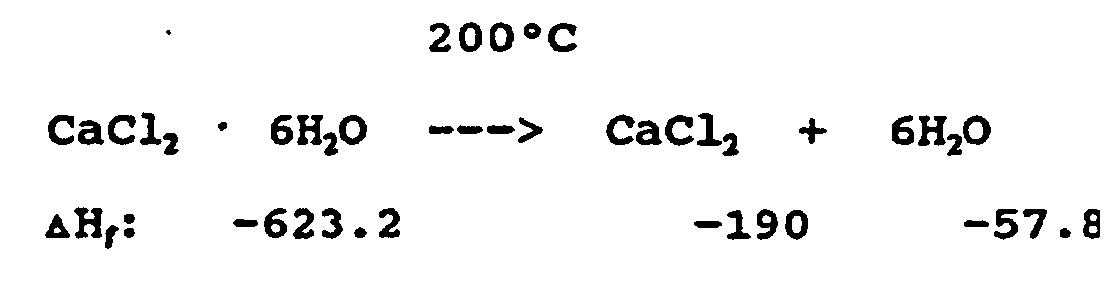
ΔH° = 1654 J/g (395 cal/g)
This reaction wil provide Endothermic cooling of electronic devices and other surfaces and structures by the thermal decomposition of zinc sulfate heptahydrate absorbing in excess of 1256 J/g (300 cal/gm) between 220°C and 350°C.
MW = 288ΔH° = 4.05x10⁵ J/mole (96.7 Kcal/mol)
ΔH° = 1406 J/g (336 cal/g) -
- Other reactions include the decomposition of paraldehyde and paraformaldehyde which, likewise, result in relatively large scale endothermies. Several of the reaction products of the combination of the aforementioned material such as the lithium acetate and formates may also be used.
- It has also been found that the salts of acetic acid and formic acid result in large scale endothermic reactions and absorptions of large quantities of heat.
- The compounds of the present invention may be employed in composite fabric carriers or matrices of the type discussed in Applicant's aforementioned application or in the prior noted patent. In testing these compounds, flight data recorders were provided in a container forming a heat sink structure. Waferlike cakes formed of boric acid were located in metal enclosures fitted within the heat sink structure. The boric acid wafers were formed by compression into rectangular wafers and cakes which fit neatly into the metal enclosures of the heat sink structure. The heat sink structure was then connected with the circuit board of a memory control system. In this way, the natural rise in temperature of a conventional (prior art) heat sink military flight recorder may be compared to the same flight recorder's thermal performance with a boric acid endothermic heat sink formed in accordance with the present invention.
- The use of a hydrated salt (MgSO4· 7H2O) results in a strong cooling effect when applied to the flight recorder.
- Aluminum hydroxide (Al(OH)3) devices work best as a high temperature endothermic temperature control agent. When Al(OH)3 decomposes, it leaves behind a strong thermal insulation layer of Al2O which further abates temperature rise through decomposition product to the heat sink device. Other applications of the present invention presented for example and not as limitation include: temperature control coatings, wraps and liners as well as thermal protection for metal and plastic structures; cooling for electronics, oven sensors, missile skins, exhaust pipes, thermal protection in race cars, fire walls and related equipment.
- Unlike salt hydrates discussed above, hydroxides or carbonates may be stored almost indefinitely provided they are not exposed to temperatures at or above the temperature of reaction. When exposed to reduced pressure and some heat, hydrates tend to lose H2O, making them less likely to be fully effective as cooling agents in some aircraft applications, unless properly hermetically sealed, with allowance to permit venting of water vapor at the temperature of reaction.
- The compounds are commercially available and inexpensive. They may be easily incorporated in and integrated with CFEMs, metal mesh matrices, silicon or carbon fiber or microencapsulated and macroencapsulated in porous silica or porous carbon bodies. The agents may be shaped in the form of enclosures, chips or cakes which can be incorporated in shaped bodies and thus, can be formed in shape and dimension as required. In some applications the agents may be formed into gels and pastes.
- The special compounds of the present invention provide unforeseen, critical benefits in that massive quantities of heat are readily absorbed, in a unidirectional reaction. And that once so absorbed, do not reverse and, therefore, cannot act as a heat generator. Thus, protection for sensitive devices is absolute.
- Above all, all of these compounds produce environmentally harmless vapor products during decomposition and even at elevated temperatures.
- Various embodiment disclosed herein, and others within the scope of the appended claims will be apparent to those skilled in this art. Therefore, it is to be understood that the present disclosure is by way of illustrating and not limiting of the present invention.
Claims (8)
- An article of manufacture for controlling temperature of a surface of a heat generating device, or a surface of an object exposed to heat from a heat generator, when applied to said surface, comprising a heat sink having a temperature control surface and comprising an endothermic agent configured to absorb thermal energy through the temperature control surface by an endothermic chemical reaction utilizing latent heat of decomposition or dehydration, said endothermic agent being selected from the group of hydroxides consisting of aluminum hydroxide, calcium hydroxide, sodium hydroxide, potassium hydroxide and lithium hydroxide and their mixture.
- An article of manufacture for controlling temperature of a surface of a heat generating device, or a surface of an object exposed to heat from a heat generator, when applied to said surface, comprising a heat sink having a temperature control surface and comprising an endothermic agent configured to absorb thermal energy through the temperature control surface by an endothermic chemical reaction utilizing latent heat of decomposition or dehydration, said endothermic agent comprising a low molecular weight acid which endothermically decomposes into water and oxides.
- An article of manufacture according to claim 2, in which the low molecular weight acid is boric acid.
- An article of manufacture for controlling temperature of a surface of a heat generating device, or a surface of an object exposed to heat from a heat generator, when applied to said surface, comprising a heat sink having a temperature control surface and comprising an endothermic agent configured to absorb thermal energy through the temperature control surface by an endothermic chemical reaction utilizing latent heat of decomposition or dehydration, said endothermic agent being selected from the group of organic compounds consisting of paraldehyde, paraformaldehyde and trioxane and their mixture.
- An article of manufacture for controlling temperature of a surface of a heat generating device, or a surface of an object exposed to heat from a heat generator, when applied to said surface, comprising a heat sink having a temperature control surface and comprising an endothermic agent configured to absorb thermal energy through the temperature control surface by an endothermic chemical reaction utilizing latent heat of decomposition or dehydration, said endothermic agent being selected from the group of salts consisting of lithium formate, lithium acetate, lithium carbonate, calcium carbonate, silicon carbonate, magnesium carbonate, sodium bicarbonate, salts of acetic acid, salts of formic acid, salts of boric acid and their mixtures.
- An article of manufacture for controlling temperature of a surface of a heat generating device, or a surface of an object exposed to heat from a heat generator, when applied to said surface, comprising a heat sink having a temperature control surface and comprising an endothermic agent configured to absorb thermal energy through the temperature control surface by an endothermic chemical reaction utilizing latent heat of decomposition or dehydration, said endothermic agent being selected from the group of hydrate salts consisting of lithium chloride trihydrate, lithium nitrate trihydrate, sodium carbonate decahydrate, sodium borate decahydrate, hydrated epsom salts, magnesium nitrate hexahydrate, beryllium sulfate tetrahydrate, sodium phosphate, dodecahydrate, calcium chloride hexahydrate, and zinc sulfate heptahydrate, magnesium chloride hexahydrate, sodium sulfate decahyrdate, aluminum oxide trihydrate, aluminum sulfate decaoctahydrate, aluminum fluoride trihydrate, aluminum nitrate nonahydrate and their mixtures.
- The article of manufacture according to any one of claims 1 to 6, wherein the heat sink comprises a retaining matrix, packaging, enclosure or structure to form the temperature control surface.
- A method of controlling temperature of a surface of a heat generating device, or a surface of an object when exposed to heat from a heat generator, comprising:positioning an article of manufacture according to any one of claims 1 to 7 with the temperature control surface of its heat sink in thermal contact with the surface of the heat generating device or the surface of the object; andabsorbing thermal energy in the heat sink through the temperature control surface by endothermic decomposition or dehydration of the endothermic agent.
Priority Applications (1)
| Application Number | Priority Date | Filing Date | Title |
|---|---|---|---|
| DE69730997T DE69730997T9 (en) | 1997-09-04 | 1997-09-04 | Heat storage and transfer device |
Applications Claiming Priority (1)
| Application Number | Priority Date | Filing Date | Title |
|---|---|---|---|
| PCT/US1997/015577 WO1999011455A1 (en) | 1997-09-04 | 1997-09-04 | A thermal storage and transfer device |
Publications (4)
| Publication Number | Publication Date |
|---|---|
| EP0969964A1 EP0969964A1 (en) | 2000-01-12 |
| EP0969964A4 EP0969964A4 (en) | 2002-08-14 |
| EP0969964B1 true EP0969964B1 (en) | 2004-09-29 |
| EP0969964B2 EP0969964B2 (en) | 2011-01-19 |
Family
ID=22261559
Family Applications (1)
| Application Number | Title | Priority Date | Filing Date |
|---|---|---|---|
| EP97940808A Expired - Lifetime EP0969964B2 (en) | 1997-09-04 | 1997-09-04 | A thermal control device |
Country Status (10)
| Country | Link |
|---|---|
| EP (1) | EP0969964B2 (en) |
| AT (1) | ATE277755T1 (en) |
| AU (1) | AU763447B2 (en) |
| BR (1) | BR9714822A (en) |
| CA (1) | CA2302751C (en) |
| CZ (1) | CZ299714B6 (en) |
| DE (1) | DE69730997T9 (en) |
| DK (1) | DK0969964T4 (en) |
| ES (1) | ES2225984T5 (en) |
| WO (1) | WO1999011455A1 (en) |
Cited By (1)
| Publication number | Priority date | Publication date | Assignee | Title |
|---|---|---|---|---|
| RU2634927C1 (en) * | 2016-05-20 | 2017-11-08 | федеральное государственное бюджетное образовательное учреждение высшего образования "Дагестанский государственный технический университет" | Device for distributing heat from ree elements, working in mode of intermittent heat release |
Families Citing this family (17)
| Publication number | Priority date | Publication date | Assignee | Title |
|---|---|---|---|---|
| US6224784B1 (en) * | 1995-09-07 | 2001-05-01 | Claude Q. C. Hayes | Heat absorbing temperature control devices and method |
| US6241909B1 (en) * | 1995-09-07 | 2001-06-05 | Claude Q. C. Hayes | Heat absorbing temperature control devices and method |
| DE60045825D1 (en) * | 1999-07-14 | 2011-05-19 | Claude Q C Hayes | THERMO CONTROL COMPOSITIONS |
| US7045077B2 (en) | 2004-06-18 | 2006-05-16 | Biolab, Inc. | Calcium hypochlorite compositions |
| CN101643222B (en) * | 2008-08-07 | 2012-03-21 | 友发化工股份有限公司 | Method for purifying potassium hydroxide aqueous solution rich in silicon impurities |
| ES2362518B1 (en) * | 2009-06-16 | 2012-02-02 | Abengoa Solar New Technologies S.A. | COMPOSITE MATERIAL FOR HIGH TEMPERATURE THERMAL ENERGY STORAGE. |
| US8951487B2 (en) | 2010-10-25 | 2015-02-10 | ADA-ES, Inc. | Hot-side method and system |
| US8496894B2 (en) | 2010-02-04 | 2013-07-30 | ADA-ES, Inc. | Method and system for controlling mercury emissions from coal-fired thermal processes |
| US8845986B2 (en) | 2011-05-13 | 2014-09-30 | ADA-ES, Inc. | Process to reduce emissions of nitrogen oxides and mercury from coal-fired boilers |
| US8883099B2 (en) | 2012-04-11 | 2014-11-11 | ADA-ES, Inc. | Control of wet scrubber oxidation inhibitor and byproduct recovery |
| DE102012210238B4 (en) * | 2012-06-18 | 2017-01-12 | Fraunhofer-Gesellschaft zur Förderung der angewandten Forschung e.V. | Latent heat storage materials based on aluminum sulfate hydrates and their use |
| US9957454B2 (en) * | 2012-08-10 | 2018-05-01 | ADA-ES, Inc. | Method and additive for controlling nitrogen oxide emissions |
| US9889451B2 (en) | 2013-08-16 | 2018-02-13 | ADA-ES, Inc. | Method to reduce mercury, acid gas, and particulate emissions |
| JP6513829B2 (en) * | 2015-04-20 | 2019-05-15 | エスエヌエステック リミテッド ライアビリティ カンパニー | Closure system for containers |
| JP7248989B2 (en) * | 2018-02-16 | 2023-03-30 | タテホ化学工業株式会社 | Chemical heat storage material and its manufacturing method |
| FR3139381B1 (en) * | 2022-09-05 | 2024-08-09 | Univ Bordeaux | THERMAL ENERGY STORAGE DEVICE BASED ON LITHIUM HYDROXIDE |
| GB202318488D0 (en) | 2023-12-04 | 2024-01-17 | Univ Edinburgh | Heat-absorbing materials |
Family Cites Families (10)
| Publication number | Priority date | Publication date | Assignee | Title |
|---|---|---|---|---|
| US1879128A (en) † | 1929-10-16 | 1932-09-27 | Ernest W Desper | Cigarette |
| US3871684A (en) * | 1971-08-02 | 1975-03-18 | Dow Chemical Co | Gas generator |
| US4001126A (en) † | 1972-05-17 | 1977-01-04 | Universal Propulsion Co. | Heat protective material and method of making the material |
| DE2233107C3 (en) * | 1972-07-06 | 1979-12-13 | Thiokol Chemical Corp., Bristol, Pa. (V.St.A.) | Use of copper-II-oxalate or aluminum chloride hexahydrate to cool hot gases |
| US3973397A (en) † | 1973-08-14 | 1976-08-10 | Imperial Metal Industries (Kynoch) Limited | Rocket motor with ablative insulating casing liner |
| DE3006733C2 (en) * | 1980-02-22 | 1986-07-10 | Georg Prof.Dr. 8000 München Alefeld | Process for harnessing thermal energy |
| US4446916A (en) * | 1981-08-13 | 1984-05-08 | Hayes Claude Q C | Heat-absorbing heat sink |
| GB8310662D0 (en) * | 1983-04-20 | 1983-05-25 | Allied Colloids Ltd | Exothermic reactions |
| US4600634A (en) † | 1983-07-21 | 1986-07-15 | Minnesota Mining And Manufacturing Company | Flexible fibrous endothermic sheet material for fire protection |
| GB2302994B (en) † | 1995-07-01 | 1999-06-09 | British Aerospace | Thermal and shock resistant data recorder assembly |
-
1997
- 1997-09-04 WO PCT/US1997/015577 patent/WO1999011455A1/en not_active Ceased
- 1997-09-04 DK DK97940808.5T patent/DK0969964T4/en active
- 1997-09-04 ES ES97940808T patent/ES2225984T5/en not_active Expired - Lifetime
- 1997-09-04 CA CA002302751A patent/CA2302751C/en not_active Expired - Lifetime
- 1997-09-04 AU AU42502/97A patent/AU763447B2/en not_active Expired
- 1997-09-04 CZ CZ0321099A patent/CZ299714B6/en not_active IP Right Cessation
- 1997-09-04 BR BR9714822-9A patent/BR9714822A/en not_active IP Right Cessation
- 1997-09-04 AT AT97940808T patent/ATE277755T1/en active
- 1997-09-04 DE DE69730997T patent/DE69730997T9/en active Active
- 1997-09-04 EP EP97940808A patent/EP0969964B2/en not_active Expired - Lifetime
Cited By (1)
| Publication number | Priority date | Publication date | Assignee | Title |
|---|---|---|---|---|
| RU2634927C1 (en) * | 2016-05-20 | 2017-11-08 | федеральное государственное бюджетное образовательное учреждение высшего образования "Дагестанский государственный технический университет" | Device for distributing heat from ree elements, working in mode of intermittent heat release |
Also Published As
| Publication number | Publication date |
|---|---|
| CZ321099A3 (en) | 2000-03-15 |
| CA2302751A1 (en) | 1999-03-11 |
| DE69730997D1 (en) | 2004-11-04 |
| AU763447B2 (en) | 2003-07-24 |
| EP0969964B2 (en) | 2011-01-19 |
| DE69730997T2 (en) | 2005-11-17 |
| DK0969964T4 (en) | 2011-05-09 |
| CZ299714B6 (en) | 2008-10-29 |
| EP0969964A1 (en) | 2000-01-12 |
| ATE277755T1 (en) | 2004-10-15 |
| ES2225984T3 (en) | 2005-03-16 |
| WO1999011455A1 (en) | 1999-03-11 |
| DK0969964T3 (en) | 2005-01-10 |
| BR9714822A (en) | 2000-08-22 |
| CA2302751C (en) | 2004-10-12 |
| DE69730997T3 (en) | 2011-07-21 |
| AU4250297A (en) | 1999-03-22 |
| EP0969964A4 (en) | 2002-08-14 |
| ES2225984T5 (en) | 2011-06-02 |
| DE69730997T9 (en) | 2012-08-30 |
Similar Documents
| Publication | Publication Date | Title |
|---|---|---|
| EP0969964B2 (en) | A thermal control device | |
| US6780345B2 (en) | Heat absorbing temperature control devices and method | |
| US6793844B2 (en) | Heat absorbing temperature control devices and method | |
| WO1999023860A1 (en) | Method for dissipating heat away from a heat sensitive device using bicarbonate compositions | |
| US6224784B1 (en) | Heat absorbing temperature control devices and method | |
| CA2707364C (en) | Endotherm systems and methods utilizing carbohydrate in non-oxidizing environment | |
| JPS61197668A (en) | Thermal energy storage material | |
| JPH0453913B2 (en) |
Legal Events
| Date | Code | Title | Description |
|---|---|---|---|
| PUAI | Public reference made under article 153(3) epc to a published international application that has entered the european phase |
Free format text: ORIGINAL CODE: 0009012 |
|
| 17P | Request for examination filed |
Effective date: 19990903 |
|
| AK | Designated contracting states |
Kind code of ref document: A1 Designated state(s): AT BE CH DE DK ES FI FR GB GR IE IT LI LU MC NL PT SE |
|
| A4 | Supplementary search report drawn up and despatched |
Effective date: 20020701 |
|
| AK | Designated contracting states |
Kind code of ref document: A4 Designated state(s): AT BE CH DE DK ES FI FR GB GR IE IT LI LU MC NL PT SE |
|
| 17Q | First examination report despatched |
Effective date: 20030617 |
|
| GRAP | Despatch of communication of intention to grant a patent |
Free format text: ORIGINAL CODE: EPIDOSNIGR1 |
|
| GRAS | Grant fee paid |
Free format text: ORIGINAL CODE: EPIDOSNIGR3 |
|
| GRAA | (expected) grant |
Free format text: ORIGINAL CODE: 0009210 |
|
| RTI1 | Title (correction) |
Free format text: A THERMAL CONTROL DEVICE |
|
| AK | Designated contracting states |
Kind code of ref document: B1 Designated state(s): AT BE CH DE DK ES FI FR GB GR IE IT LI LU MC NL PT SE |
|
| REG | Reference to a national code |
Ref country code: GB Ref legal event code: FG4D |
|
| REG | Reference to a national code |
Ref country code: CH Ref legal event code: EP |
|
| REG | Reference to a national code |
Ref country code: IE Ref legal event code: FG4D |
|
| REF | Corresponds to: |
Ref document number: 69730997 Country of ref document: DE Date of ref document: 20041104 Kind code of ref document: P |
|
| REG | Reference to a national code |
Ref country code: SE Ref legal event code: TRGR |
|
| REG | Reference to a national code |
Ref country code: CH Ref legal event code: NV Representative=s name: KELLER & PARTNER PATENTANWAELTE AG |
|
| PG25 | Lapsed in a contracting state [announced via postgrant information from national office to epo] |
Ref country code: GR Free format text: LAPSE BECAUSE OF FAILURE TO SUBMIT A TRANSLATION OF THE DESCRIPTION OR TO PAY THE FEE WITHIN THE PRESCRIBED TIME-LIMIT Effective date: 20041229 |
|
| REG | Reference to a national code |
Ref country code: ES Ref legal event code: FG2A Ref document number: 2225984 Country of ref document: ES Kind code of ref document: T3 |
|
| PLAQ | Examination of admissibility of opposition: information related to despatch of communication + time limit deleted |
Free format text: ORIGINAL CODE: EPIDOSDOPE2 |
|
| PLBQ | Unpublished change to opponent data |
Free format text: ORIGINAL CODE: EPIDOS OPPO |
|
| PLBI | Opposition filed |
Free format text: ORIGINAL CODE: 0009260 |
|
| PLAX | Notice of opposition and request to file observation + time limit sent |
Free format text: ORIGINAL CODE: EPIDOSNOBS2 |
|
| 26 | Opposition filed |
Opponent name: PENNY & GILES AEROSPACE LIMITED Effective date: 20050627 |
|
| ET | Fr: translation filed | ||
| PG25 | Lapsed in a contracting state [announced via postgrant information from national office to epo] |
Ref country code: MC Free format text: LAPSE BECAUSE OF NON-PAYMENT OF DUE FEES Effective date: 20050930 Ref country code: LU Free format text: LAPSE BECAUSE OF NON-PAYMENT OF DUE FEES Effective date: 20050930 |
|
| NLR1 | Nl: opposition has been filed with the epo |
Opponent name: PENNY & GILES AEROSPACE LIMITED |
|
| PLAF | Information modified related to communication of a notice of opposition and request to file observations + time limit |
Free format text: ORIGINAL CODE: EPIDOSCOBS2 |
|
| PLAF | Information modified related to communication of a notice of opposition and request to file observations + time limit |
Free format text: ORIGINAL CODE: EPIDOSCOBS2 |
|
| PLBB | Reply of patent proprietor to notice(s) of opposition received |
Free format text: ORIGINAL CODE: EPIDOSNOBS3 |
|
| PLBP | Opposition withdrawn |
Free format text: ORIGINAL CODE: 0009264 |
|
| PG25 | Lapsed in a contracting state [announced via postgrant information from national office to epo] |
Ref country code: PT Free format text: LAPSE BECAUSE OF NON-PAYMENT OF DUE FEES Effective date: 20050228 |
|
| APBP | Date of receipt of notice of appeal recorded |
Free format text: ORIGINAL CODE: EPIDOSNNOA2O |
|
| APAH | Appeal reference modified |
Free format text: ORIGINAL CODE: EPIDOSCREFNO |
|
| APBQ | Date of receipt of statement of grounds of appeal recorded |
Free format text: ORIGINAL CODE: EPIDOSNNOA3O |
|
| APBU | Appeal procedure closed |
Free format text: ORIGINAL CODE: EPIDOSNNOA9O |
|
| PUAH | Patent maintained in amended form |
Free format text: ORIGINAL CODE: 0009272 |
|
| STAA | Information on the status of an ep patent application or granted ep patent |
Free format text: STATUS: PATENT MAINTAINED AS AMENDED |
|
| 27A | Patent maintained in amended form |
Effective date: 20110119 |
|
| AK | Designated contracting states |
Kind code of ref document: B2 Designated state(s): AT BE CH DE DK ES FI FR GB GR IE IT LI LU MC NL PT SE |
|
| REG | Reference to a national code |
Ref country code: CH Ref legal event code: AEN Free format text: AUFRECHTERHALTUNG DES PATENTES IN GEAENDERTER FORM |
|
| REG | Reference to a national code |
Ref country code: SE Ref legal event code: RPEO |
|
| REG | Reference to a national code |
Ref country code: NL Ref legal event code: T3 |
|
| REG | Reference to a national code |
Ref country code: DK Ref legal event code: T4 |
|
| REG | Reference to a national code |
Ref country code: ES Ref legal event code: DC2A Ref document number: 2225984 Country of ref document: ES Kind code of ref document: T5 Effective date: 20110602 |
|
| REG | Reference to a national code |
Ref country code: CH Ref legal event code: PCAR Free format text: NEW ADDRESS: EIGERSTRASSE 2 POSTFACH, 3000 BERN 14 (CH) |
|
| REG | Reference to a national code |
Ref country code: FR Ref legal event code: PLFP Year of fee payment: 19 |
|
| REG | Reference to a national code |
Ref country code: FR Ref legal event code: PLFP Year of fee payment: 20 |
|
| PGFP | Annual fee paid to national office [announced via postgrant information from national office to epo] |
Ref country code: GB Payment date: 20160901 Year of fee payment: 20 Ref country code: IT Payment date: 20160825 Year of fee payment: 20 Ref country code: CH Payment date: 20160825 Year of fee payment: 20 Ref country code: NL Payment date: 20160913 Year of fee payment: 20 Ref country code: FI Payment date: 20160919 Year of fee payment: 20 Ref country code: DE Payment date: 20160913 Year of fee payment: 20 Ref country code: DK Payment date: 20160923 Year of fee payment: 20 Ref country code: IE Payment date: 20160824 Year of fee payment: 20 |
|
| PGFP | Annual fee paid to national office [announced via postgrant information from national office to epo] |
Ref country code: FR Payment date: 20160829 Year of fee payment: 20 Ref country code: AT Payment date: 20160928 Year of fee payment: 20 Ref country code: SE Payment date: 20160824 Year of fee payment: 20 |
|
| PGFP | Annual fee paid to national office [announced via postgrant information from national office to epo] |
Ref country code: BE Payment date: 20160825 Year of fee payment: 20 Ref country code: ES Payment date: 20160913 Year of fee payment: 20 |
|
| REG | Reference to a national code |
Ref country code: DE Ref legal event code: R071 Ref document number: 69730997 Country of ref document: DE |
|
| REG | Reference to a national code |
Ref country code: NL Ref legal event code: MK Effective date: 20170903 |
|
| REG | Reference to a national code |
Ref country code: DK Ref legal event code: EUP Effective date: 20170904 |
|
| REG | Reference to a national code |
Ref country code: CH Ref legal event code: PL |
|
| REG | Reference to a national code |
Ref country code: GB Ref legal event code: PE20 Expiry date: 20170903 |
|
| REG | Reference to a national code |
Ref country code: AT Ref legal event code: MK07 Ref document number: 277755 Country of ref document: AT Kind code of ref document: T Effective date: 20170904 |
|
| REG | Reference to a national code |
Ref country code: SE Ref legal event code: EUG |
|
| REG | Reference to a national code |
Ref country code: IE Ref legal event code: MK9A |
|
| PG25 | Lapsed in a contracting state [announced via postgrant information from national office to epo] |
Ref country code: GB Free format text: LAPSE BECAUSE OF EXPIRATION OF PROTECTION Effective date: 20170903 |
|
| REG | Reference to a national code |
Ref country code: BE Ref legal event code: MK Effective date: 20170904 |
|
| PG25 | Lapsed in a contracting state [announced via postgrant information from national office to epo] |
Ref country code: IE Free format text: LAPSE BECAUSE OF EXPIRATION OF PROTECTION Effective date: 20170904 |
|
| REG | Reference to a national code |
Ref country code: ES Ref legal event code: FD2A Effective date: 20180508 |
|
| PG25 | Lapsed in a contracting state [announced via postgrant information from national office to epo] |
Ref country code: ES Free format text: LAPSE BECAUSE OF EXPIRATION OF PROTECTION Effective date: 20170905 |