EP0969249A2 - Brenner mit breiter Flamme - Google Patents
Brenner mit breiter Flamme Download PDFInfo
- Publication number
- EP0969249A2 EP0969249A2 EP99112420A EP99112420A EP0969249A2 EP 0969249 A2 EP0969249 A2 EP 0969249A2 EP 99112420 A EP99112420 A EP 99112420A EP 99112420 A EP99112420 A EP 99112420A EP 0969249 A2 EP0969249 A2 EP 0969249A2
- Authority
- EP
- European Patent Office
- Prior art keywords
- orifices
- nozzle
- fuel
- oxidant
- refractory
- Prior art date
- Legal status (The legal status is an assumption and is not a legal conclusion. Google has not performed a legal analysis and makes no representation as to the accuracy of the status listed.)
- Withdrawn
Links
Images
Classifications
-
- C—CHEMISTRY; METALLURGY
- C03—GLASS; MINERAL OR SLAG WOOL
- C03B—MANUFACTURE, SHAPING, OR SUPPLEMENTARY PROCESSES
- C03B5/00—Melting in furnaces; Furnaces so far as specially adapted for glass manufacture
- C03B5/16—Special features of the melting process; Auxiliary means specially adapted for glass-melting furnaces
- C03B5/235—Heating the glass
- C03B5/2353—Heating the glass by combustion with pure oxygen or oxygen-enriched air, e.g. using oxy-fuel burners or oxygen lances
-
- F—MECHANICAL ENGINEERING; LIGHTING; HEATING; WEAPONS; BLASTING
- F23—COMBUSTION APPARATUS; COMBUSTION PROCESSES
- F23D—BURNERS
- F23D14/00—Burners for combustion of a gas, e.g. of a gas stored under pressure as a liquid
- F23D14/46—Details
- F23D14/84—Flame spreading or otherwise shaping
-
- C—CHEMISTRY; METALLURGY
- C03—GLASS; MINERAL OR SLAG WOOL
- C03B—MANUFACTURE, SHAPING, OR SUPPLEMENTARY PROCESSES
- C03B5/00—Melting in furnaces; Furnaces so far as specially adapted for glass manufacture
- C03B5/16—Special features of the melting process; Auxiliary means specially adapted for glass-melting furnaces
- C03B5/235—Heating the glass
-
- F—MECHANICAL ENGINEERING; LIGHTING; HEATING; WEAPONS; BLASTING
- F23—COMBUSTION APPARATUS; COMBUSTION PROCESSES
- F23D—BURNERS
- F23D14/00—Burners for combustion of a gas, e.g. of a gas stored under pressure as a liquid
- F23D14/20—Non-premix gas burners, i.e. in which gaseous fuel is mixed with combustion air on arrival at the combustion zone
- F23D14/22—Non-premix gas burners, i.e. in which gaseous fuel is mixed with combustion air on arrival at the combustion zone with separate air and gas feed ducts, e.g. with ducts running parallel or crossing each other
-
- F—MECHANICAL ENGINEERING; LIGHTING; HEATING; WEAPONS; BLASTING
- F23—COMBUSTION APPARATUS; COMBUSTION PROCESSES
- F23D—BURNERS
- F23D14/00—Burners for combustion of a gas, e.g. of a gas stored under pressure as a liquid
- F23D14/32—Burners for combustion of a gas, e.g. of a gas stored under pressure as a liquid using a mixture of gaseous fuel and pure oxygen or oxygen-enriched air
-
- F—MECHANICAL ENGINEERING; LIGHTING; HEATING; WEAPONS; BLASTING
- F23—COMBUSTION APPARATUS; COMBUSTION PROCESSES
- F23D—BURNERS
- F23D14/00—Burners for combustion of a gas, e.g. of a gas stored under pressure as a liquid
- F23D14/46—Details
- F23D14/48—Nozzles
- F23D14/56—Nozzles for spreading the flame over an area, e.g. for desurfacing of solid material, for surface hardening or for heating workpieces
-
- Y—GENERAL TAGGING OF NEW TECHNOLOGICAL DEVELOPMENTS; GENERAL TAGGING OF CROSS-SECTIONAL TECHNOLOGIES SPANNING OVER SEVERAL SECTIONS OF THE IPC; TECHNICAL SUBJECTS COVERED BY FORMER USPC CROSS-REFERENCE ART COLLECTIONS [XRACs] AND DIGESTS
- Y02—TECHNOLOGIES OR APPLICATIONS FOR MITIGATION OR ADAPTATION AGAINST CLIMATE CHANGE
- Y02P—CLIMATE CHANGE MITIGATION TECHNOLOGIES IN THE PRODUCTION OR PROCESSING OF GOODS
- Y02P40/00—Technologies relating to the processing of minerals
- Y02P40/50—Glass production, e.g. reusing waste heat during processing or shaping
Definitions
- This invention relates to a method and system for combusting materials, and more particularly for carrying out combustion with a wide flame.
- One way of accomplishing this is to use a wide flame burner. This type of burner produces a flame in which the dimension through the horizontal axis is much greater than through the vertical axis at any cross-section along the axis of the flame.
- EP 754,912 A2 discloses the injection of converging fuel and oxygen streams at low velocities to produce a long wide flame from a burner.
- U.S. Patent No. 5,299,929 discloses a burner where multiple fuel orifices in a fan shaped pattern are used to distribute the fuel in a wide fan-shaped flame. This fuel is sandwiched between two closely spaced oxygen passages above and below with baffles that force the oxygen to follow a fan shaped path as it exits the burner.
- U.S. Patent No. 5,302,112 discloses a burner where a stream of low velocity fuel and oxygen are purposely collided together along a vertical axis. When adjusted correctly, this produces a horizontal flat flame initiating at the point of collision in the furnace.
- U.S. Patent No. 5,611,682 discloses the use of an elongated opening to produce a wide or fan shaped flame for the burner described.
- This invention is directed to a method for carrying out combustion with a wide flame comprising the steps of (a) providing a combustion zone containing an atmosphere of furnace gases at a temperature exceeding about 1000°F; (b) injecting a wide oxidant layer through a first refractory nozzle having a plurality of first orifices at a velocity of less than about 180 ft/sec to produce an oxidant layer in the combustion zone; (c) injecting a wide fuel layer through a second refractory nozzle having a plurality of second orifices, the fuel being injected at a velocity of less than about 210 ft/sec to produce a fuel layer in a plane parallel to the oxidant layer in the combustion zone; (d) turbulently mixing at least a portion of the oxidant from the oxidant layer with at least a portion of the fuel from the fuel layer to produce an oxidant-fuel mixture in a mixture layer within the combustion zone; and (e) combusting fuel and oxidant within the mixture layer in the combustion
- this invention is also directed to a nozzle assembly for separate injection of a wide oxidant layer and a wide fuel layer into a combustion zone comprising (a) a first refractory nozzle having a minimum wall thickness of from about 0.25 to about 0.33 of the minimum nozzle dimension, the nozzle comprising a plurality of first orifices, the first orifices defining a first plane; (b) a second refractory nozzle having a minimum wall thickness of from about 0.25 to about 0.33 of the minimum nozzle dimension, the nozzle comprising a plurality of second orifices, the second orifices defining a second plane that is parallel to the first plane; (c) a first conduit means in fluid communication with each of the first orifices for passing oxidant from an oxidant source to the first orifices; and (d) a second conduit means in fluid communication with each of the second orifices for passing fuel from a fuel source to the second orifices; wherein each of the first refractory
- this invention is directed to a burner for producing a wide combustion flame comprising (a) a first refractory nozzle having a minimum wall thickness of from about 0.25 to about 0.33 of the minimum nozzle dimension and comprising a plurality of first orifices; (b) a second refractory nozzle having a minimum wall thickness of from about 0.25 to about 0.33 of the minimum nozzle dimension and comprising a plurality of second orifices, the number of first orifices being the same as the number of second orifices; (c) a refractory material placed between each of the first and second refractory nozzle; (d) the first and second nozzle removably mounted on a refractory burner block such that each of the first orifices is vertically aligned with a corresponding second orifices; (e) a first conduit means in fluid communication with each of the first orifices for passing oxidant from an oxidant source to the first orifices; and (f)
- the first refractory nozzle may be located above or below the second refractory nozzle.
- the number of orifices in the first nozzle is preferably the same as the number of orifices in the second nozzle.
- the oxidant is a fluid having an oxygen concentration of at least 30 percent by volume. Preferably, pure oxygen is used as an oxidant.
- the fuel preferably comprises a gaseous fuel, including natural gas, and other combustible gases known in the art such as hydrogen, propane and liquified petroleum gas.
- Either the oxidant and/or the fuel may be externally preheated prior to injecting into the combustion zone.
- the first and second refractory nozzle of the assembly have a minimum wall thickness of less than 1.5" and each of the orifices diverges with an adjacent orifice in the nozzle at an angle between 0 and 45 degrees.
- Each of the nozzles is a replaceable unit and may be parallel to one another.
- Each refractory nozzle may be recessed by the same distance with respect to the burner block.
- a refractory material is placed between the first and second refractory nozzle to prevent any unexpected mixing of the oxidant and fuel in the burner block.
- combustion zone means a volume in which fuel and oxidant mix and react to release heat.
- pure oxygen means a gas having an oxygen concentration of at least 99.5 percent.
- gaseous fuel means a fuel composed of one or more gaseous components, some of which are combustible, liquid fuel droplets dispersed in a gaseous medium; solid fuel particles dispersed in a gaseous medium.
- the term "wide" in the context of wide flame means the flame exhibits an aspect ratio greater than 2 (i.e. the width of the flame's major axis is two or more times longer than the height of the flames minor axis) at any cross-section along the axis of the flame.
- refractory in the context of "refractory block” means any of a series of materials which can withstand temperatures greater than 2200°F (1204°C) and which usually comprise of oxides, nitrides or carbides of other metallic elements. Examples are silica, fused silica, bonded alumina-zirconia-silica, alumina, mullite, silicon carbide, silicon nitride and boron nitride.
- the preferred refractory material is an alumina-zirconia-silica refractory containing about 66% alumina, 21% zirconia and 12% silica.
- multiple conical fuel and oxidant jets are issued from two separate nozzles in a fan shaped pattern. This allows fairly precise control over the distribution of fuel throughout the flame and its overall shape (i.e. width).
- the nozzle is located close to the inside (hot) surface of the furnace wall so that the angle of the fuel and oxidant jets can be manipulated to any desired angle without being restricted by the confines of a narrow burner block.
- the burner nozzles are preferably made from a refractory material. This eliminates the need for water cooling and allows no metal parts to be placed near the hot surface of the furnace wall.
- the nozzle must be fairly rugged to handle the potential for thermal and mechanical shock and hence has a fairly thick cross-section.
- the two reactant streams are injected separately through two similar nozzles and mix within the furnace once they are some distance from the nozzles.
- the NOx generated by this burner is about half that generated by any burner where all the oxidant and fuel are in direct contact within or immediately infront of a burner block.
- the vertical spacing between the nozzles will influence flame length and NOx levels and can be chosen ahead of time by design.
- the burner is also amenable to use with preheated feedstocks such as preheated oxygen and preheated natural gas.
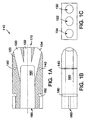
- Figs. 1a, 1b and 1c are sketches of the refractory nozzle. This is the heart of the invention in its simplicity and functionality.
- the nozzle 110 consists of a refractory brick 120 with three orifices 130, 132 and 134 drilled or cast in the front face 170 to allow gas to pass into the furnace. These three orifices pass into a central larger passage 190 which brings the gas from the inlet end (back face) 160 of the burner to the outlet end (front face) 170 of the burner.
- the cross-sectional area of this passage is greater than 85% of the area of the exit orifices in the face of the nozzle to insure a uniform distribution of gas to all the orifices.
- Tapered plenum 190 is the conduit which distributes the fuel or oxidant to orifices 130, 132 and 134. Stress slits 140 and 142 are provided in refractory brick 120 to aid in relieving the tensile stress produced as a result of the varying temperature in the nozzle.
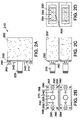
- Figs. 2a, 2b, 2c and 2d show the total burner configuration which consists of two separate burner blocks for the two nozzles comprising one burner. For simplicity, only one will be described as both blocks are similar in design. The separated blocks facilitate adjusting the vertical spacing of the nozzles. In an alternative embodiment, it should be noted that one unified block comprising the two nozzles, each having a plurality of orifices, is also contemplated.
- the burner block 202 has a plate 250 mounted to the back of it to fasten the nozzles to and provide a sealing surface between the nozzle plate 270 and the burner block plate 250. This prevents cold air from leaking into the furnace around the nozzle and hot furnace gases from leaking out.
- bolt means 280, 282, 284 and 286 are used to secure the burner block plate 250 to the burner block 202.
- the nozzle plate 270 has two small alignment holes 266 and 268 in the top edge through which two pins on the burner block plate 250 pass, so that the nozzle plate 270 can be accurately aligned with the burner block plate 250. This positions the nozzle 205 in burner 210 in the center of the opening in the burner block.
- the two small hand knobs 240 and 242 on either side of the inlet pipe 225 fasten the nozzle plate 270 to the refractory nozzle 205.
- the nozzle plate 270 is fastened to burner block plate 250 via two larger hand knobs 260 and 262 and two swivel clamps 290 and 292. This allows the nozzle 205 to be inserted and removed without having to remove any fastening devices from the burner block plate 250. This makes maintaining and servicing the burner fairly easy and straight forward.
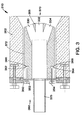
- a top cut-away view of the burner 310 is shown in Fig. 3.
- the nozzle 305 is centered in the opening of the burner block 302 and is shown recessed from the front end 370 of the burner block.
- the nozzle shown is an alternative embodiment of the nozzle shown in Fig. 1 in that the front face of the nozzle has two mitered cuts which are perpendicular to the drilled orifices 334 and 330, rather than a rounded end.
- the openings at the front of the burner block 302 are tapered to avoid the angled jets of the nozzle from impinging on the edges of the block.
- the orifices 330, 332 and 334 in nozzle 305 can be drilled at any diameter and angle from the nozzle axis to vary the wide flame characteristics emanating from the burner.
- the nozzle 305 is secured to the nozzle mounting plate 350 via two T-bolts 362, 364, which are inserted into slots 366, 368 on the rear end 360 of the nozzle 305.
- Two hand knobs 352, 354 are used to fasten these two parts together.
- a gasket (not shown) is placed between the nozzle 305 and the nozzle mounting plate 350 to prevent gas from leaking at this joint.
- a gap 372 is provided between the nozzle and burner block so that in the event of a gas leak, the gas would be directed harmlessly to the front of the burner block 370.
- Inlet piping from a fuel or oxidant supply can be connected to the inlet connection 325 as in any standard plumbing fashion.
- the burner can remain in the furnace through any down period with no additional cooling requirements.
- metallic burners must be removed or air cooled when the gas and oxidant flows to them are shutoff to avoid damaging/overheating the metal burner parts.
- the higher surface temperatures of the burner components will prevent condensation of volatiles from the combustion atmosphere, which is a major problem in glass making furnaces causing plugging of orifices and frequent maintenance.
- refractory burner parts are compatible with preheated fuel and/or oxidant supplies in that no overheating of already thermally stressed metallic parts will occur.
- the tip of the burner can be closer to the inside of the furnace thereby increasing the flexibility of the burner by allowing a variety of different nozzle drilling patterns to be employed. Each different pattern could result in a different flame shape and heat delivery profile for the burner. This is not practical with metallic burners because they usually require a deep, narrow burner block to protect the burner from the radiant heat of the furnace so there is little flexibility available for gas flow direction. Refractory burner components do have a disadvantage in that they are susceptible to thermal shock, poor tensile strength, and difficulty to machine.
- an oval shaped hole is provided in the nozzle's rectangular cross-section.
- the poor tensile strength of the refractory material is addressed by designing the nozzle such that all parts of the nozzle experiencing tensile stresses are in the colder regions of the burner and by limiting the internal pressure of the gas (by using low velocities) so as not to exacerbate the stress condition in the nozzle.
- stress slits 140 and 142 are provided on the sides of the refractory brick toward the front face. These slits aid to relieve the stress as a result of the varying temperature in the nozzle.
- the machining issue is overcome by utilizing fairly simple shapes which can be directly cast to their final shape, or partially cast to an intermediate shape and then, using simple drilling techniques, customized for its particular function.
- refractory has a low thermal conductivity
- the fuel and oxidant are injected separately through two nozzles so there is little to no reaction at the surface of the nozzle to create overheating. All the combustion occurs in the furnace thereby allowing the refractory nozzle to remain at reasonable temperatures.
- nozzle failure i.e. cracks, breakage, etc.
- the fuel or oxidant will flow out of the nozzle and be contained by the burner block to produce a poorly defined flame without damaging or overheating the burner block or nozzles.
- the nozzle is recessed in the burner block by about one inch and the burner block is recessed in the furnace wall by about one inch. This prevents any rundown on the inside wall of the furnace from filling the gap between the nozzle and the burner block and gluing the two pieces together.
- a 0.25" gap is provided between the block and the nozzle. This is large enough to prevent bridging of any condensables between the two surfaces. The low velocities employed with this burner minimize furnace gases from being recirculated near the nozzle and contributing to corrosion or condensation.
- Flames for use in glass furnaces need the following attributes to be acceptable to the user: high luminosity, low momentum, high aspect ratio (width of flame versus height of flame), no lofting (upward bending of flame due to buoyancy), stability, no smoke generation, low NOx and carbon monoxide emissions.
- lower velocity burner systems are employed. Lower velocity jets behave differently than higher velocity jets because buoyancy becomes a larger component of the force balance on the free jet system, and the larger diameter holes prevalent in low velocity systems delay jet mixing. The use of multiple jets also allows more flexibility in flame shaping from a single burner.
- the horizontal placement of the jets provides one parameter which can be manipulated to create different jet and hence flame effects in the furnace.
- the turbulent nature of a gas jet injected into a medium creates entrainment of surrounding fluid into the jets and results in the expansion of the jet and a dissipation of its velocity.
- a jet will entrain gases from all sides as it expands and if sufficient gas is not available, it will recirculate its own gases from a point further downstream back to the root of the jet to supply the entrainment requirement.
- Fuel jets spaced closely will form a fuel-rich layer whose size will be defined by the initial jet angles.
- oxidant jets will produce an oxidant-rich layer.
- the fuel and oxidant layers are injected into the same enclosure, the fuel and oxidant layers, due to turbulence and jet entrainment will mix with each other and begin reacting, forming a wide flame region defined by the initial jet angles of the two reactants.
- a wide flame can be created as opposed to multiple small flames at each fuel/oxygen jet pair.
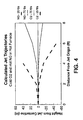
- Fig. 4 shows the jet buoyancy effects of the gas stream.
- the natural gas fuel has a rising buoyancy effect, while the oxidant has a sinking effect. This important characteristic is used to optimize the calculated jet trajectories for combustion in the combustion zone.
- buoyancy can impact the rate at which turbulent mixing occurs.
- Oxidant jets are typically cold and denser than the fuel jets, so when injected into a furnace they usually fall down towards the bottom of the furnace.
- most gaseous fuels are less dense than the oxidant (i.e., pure oxygen) and once they start burning become hotter than the surroundings so they tend to rise in the furnace environment.
- the oxidant layer is placed below the fuel layer, the streams diverge, and the rate of mixing between the streams is reduced.
- the oxidant is place above the fuel, the two streams converge due to buoyancy and the mixing is enhanced. Placing the oxidant stream over the fuel stream controls lofting because the cooler oxidant prevents the warmer fuel from rising as it progresses along the flame length. This vertical positioning of oxidant and fuel can be used to alter flame lengths and NOx emissions from the burner.
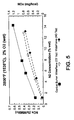
- Fig. 5 shows the NOx level produced by the wide flame burner of this invention. Due to separate injection of fuel and oxidant, delayed mixing and greater flame surface areas, the NOx emission from the wide flame burner is about 50% lower than that of a conventional concentric tube oxy-fuel burner. The figure also shows the impact of switching the vertical position of the fuel and oxidant. With the oxidant on top, mixing is enhanced due to the buoyancy effect and the flame is shorter and higher temperature which produces slightly higher NOx levels. With the oxidant on the bottom, mixing is delayed and the longer flame runs a little cooler and produces slightly less NOx.
- a preselected velocity is used to create a different combustion process.
- a turndown test revealed that the burner could be operated between 70 and 210 ft/sec for the natural gas stream and 50 and 180 ft/sec for the oxygen stream while still maintaining a productive flame.
- the flame At the low end of the velocity range, the flame is luminous and exhibits some lofting behavior.
- the luminosity is lower and the flame appears less stable than at lower velocities.
Landscapes
- Engineering & Computer Science (AREA)
- Chemical & Material Sciences (AREA)
- Combustion & Propulsion (AREA)
- Mechanical Engineering (AREA)
- General Engineering & Computer Science (AREA)
- Materials Engineering (AREA)
- Organic Chemistry (AREA)
- Gas Burners (AREA)
- Pre-Mixing And Non-Premixing Gas Burner (AREA)
- Combustion Of Fluid Fuel (AREA)
Applications Claiming Priority (2)
| Application Number | Priority Date | Filing Date | Title |
|---|---|---|---|
| US106771 | 1998-06-30 | ||
| US09/106,771 US6132204A (en) | 1998-06-30 | 1998-06-30 | Wide flame burner |
Publications (2)
| Publication Number | Publication Date |
|---|---|
| EP0969249A2 true EP0969249A2 (de) | 2000-01-05 |
| EP0969249A3 EP0969249A3 (de) | 2000-02-23 |
Family
ID=22313154
Family Applications (1)
| Application Number | Title | Priority Date | Filing Date |
|---|---|---|---|
| EP99112420A Withdrawn EP0969249A3 (de) | 1998-06-30 | 1999-06-29 | Brenner mit breiter Flamme |
Country Status (8)
| Country | Link |
|---|---|
| US (1) | US6132204A (de) |
| EP (1) | EP0969249A3 (de) |
| JP (1) | JP2000039106A (de) |
| KR (1) | KR100418314B1 (de) |
| CN (1) | CN1143078C (de) |
| BR (1) | BR9902474A (de) |
| CA (1) | CA2276857C (de) |
| ID (1) | ID23615A (de) |
Cited By (1)
| Publication number | Priority date | Publication date | Assignee | Title |
|---|---|---|---|---|
| DE102017204584A1 (de) * | 2017-03-20 | 2018-09-20 | Technische Universität Bergakademie Freiberg | Brennerkopf zur Anordnung im Kopf eines Vergasers zur Primäroxidation gasförmiger Vergasungsstoffe in Vergasern nach dem Prinzip der autothermen Reformierung (ATR) oder der nichtkatalytischen Partialoxidation (POX) |
Families Citing this family (18)
| Publication number | Priority date | Publication date | Assignee | Title |
|---|---|---|---|---|
| EP1255613A1 (de) * | 2000-02-03 | 2002-11-13 | Corning Incorporated | Feuerfeste brennerdüse mit entspannungsschlitzen |
| US7021562B2 (en) * | 2002-11-15 | 2006-04-04 | Parker-Hannifin Corp. | Macrolaminate direct injection nozzle |
| KR100875238B1 (ko) * | 2008-07-14 | 2008-12-19 | 황부성 | 수소산소 혼합가스 연소버너 |
| US8408197B2 (en) | 2008-10-13 | 2013-04-02 | Corning Incorporated | Submergible combustion burner |
| US20100104990A1 (en) * | 2008-10-23 | 2010-04-29 | Sarmiento-Darkin Wladimir Y | Wide flame burner |
| US9587823B2 (en) | 2009-03-25 | 2017-03-07 | Wallace Horn | Laminar flow jets |
| US8087928B2 (en) * | 2009-03-25 | 2012-01-03 | Horn Wallace E | Laminar flow jets |
| EP2299056A1 (de) * | 2009-09-02 | 2011-03-23 | Siemens Aktiengesellschaft | Kühlung eines Gasturbinenbauteils ausgebildet als Rotorscheibe oder Turbinenschaufel |
| US9032760B2 (en) * | 2012-07-03 | 2015-05-19 | Johns Manville | Process of using a submerged combustion melter to produce hollow glass fiber or solid glass fiber having entrained bubbles, and burners and systems to make such fibers |
| FR2968746B1 (fr) * | 2010-12-08 | 2014-11-21 | Saint Gobain | Combustion a jets divergents de combustible |
| US9677760B2 (en) * | 2011-01-28 | 2017-06-13 | Osaka Gas Co., Ltd. | Furnace heating combustion apparatus |
| US9416960B2 (en) | 2012-04-30 | 2016-08-16 | Bevolo Gas & Electric Lights, Inc. | Lighting apparatus |
| CN103727539A (zh) * | 2012-10-11 | 2014-04-16 | 丹阳市江南工业炉有限公司 | 加热炉的平焰喷嘴 |
| WO2016106035A1 (en) | 2014-12-23 | 2016-06-30 | Praxair Technology, Inc. | Upwardly angled burners in glass furnaces |
| CN106116109A (zh) * | 2016-06-22 | 2016-11-16 | 巨石集团有限公司 | 一种玻璃池窑及玻璃熔制的方法 |
| US10859260B2 (en) | 2017-10-13 | 2020-12-08 | Praxair Technology, Inc. | Reduced fouling in staged combustion |
| US20230049414A1 (en) * | 2020-02-12 | 2023-02-16 | Selas Heat Technology Company Llc | Oxy flat flame burner and block assembly |
| KR102363610B1 (ko) * | 2021-09-30 | 2022-02-16 | 국방과학연구소 | 비행체 내부 보호 장치 |
Citations (4)
| Publication number | Priority date | Publication date | Assignee | Title |
|---|---|---|---|---|
| US5299929A (en) | 1993-02-26 | 1994-04-05 | The Boc Group, Inc. | Fuel burner apparatus and method employing divergent flow nozzle |
| US5302112A (en) | 1993-04-09 | 1994-04-12 | Xothermic, Inc. | Burner apparatus and method of operation thereof |
| EP0754912A2 (de) | 1995-07-17 | 1997-01-22 | L'air Liquide, Societe Anonyme Pour L'etude Et L'exploitation Des Procedes Georges Claude | Verbrennungsverfahren und Vorrichtung dafür mit getrennter Einspritzung von Brennstoff und Oxydationsmittel |
| US5611682A (en) | 1995-09-05 | 1997-03-18 | Air Products And Chemicals, Inc. | Low-NOx staged combustion device for controlled radiative heating in high temperature furnaces |
Family Cites Families (4)
| Publication number | Priority date | Publication date | Assignee | Title |
|---|---|---|---|---|
| US2149980A (en) * | 1937-11-04 | 1939-03-07 | Jr Henry Wilbur Paret | Method and apparatus for controlling furnace combustion |
| US4878829A (en) * | 1988-05-05 | 1989-11-07 | Union Carbide Corporation | Fuel jet burner and combustion method |
| US4907961A (en) * | 1988-05-05 | 1990-03-13 | Union Carbide Corporation | Oxygen jet burner and combustion method |
| US5076779A (en) * | 1991-04-12 | 1991-12-31 | Union Carbide Industrial Gases Technology Corporation | Segregated zoning combustion |
-
1998
- 1998-06-30 US US09/106,771 patent/US6132204A/en not_active Expired - Fee Related
-
1999
- 1999-06-24 ID IDP990612D patent/ID23615A/id unknown
- 1999-06-29 BR BR9902474-8A patent/BR9902474A/pt not_active IP Right Cessation
- 1999-06-29 CN CNB99110028XA patent/CN1143078C/zh not_active Expired - Fee Related
- 1999-06-29 JP JP11183395A patent/JP2000039106A/ja active Pending
- 1999-06-29 CA CA002276857A patent/CA2276857C/en not_active Expired - Fee Related
- 1999-06-29 KR KR10-1999-0025235A patent/KR100418314B1/ko not_active Expired - Fee Related
- 1999-06-29 EP EP99112420A patent/EP0969249A3/de not_active Withdrawn
Patent Citations (4)
| Publication number | Priority date | Publication date | Assignee | Title |
|---|---|---|---|---|
| US5299929A (en) | 1993-02-26 | 1994-04-05 | The Boc Group, Inc. | Fuel burner apparatus and method employing divergent flow nozzle |
| US5302112A (en) | 1993-04-09 | 1994-04-12 | Xothermic, Inc. | Burner apparatus and method of operation thereof |
| EP0754912A2 (de) | 1995-07-17 | 1997-01-22 | L'air Liquide, Societe Anonyme Pour L'etude Et L'exploitation Des Procedes Georges Claude | Verbrennungsverfahren und Vorrichtung dafür mit getrennter Einspritzung von Brennstoff und Oxydationsmittel |
| US5611682A (en) | 1995-09-05 | 1997-03-18 | Air Products And Chemicals, Inc. | Low-NOx staged combustion device for controlled radiative heating in high temperature furnaces |
Cited By (1)
| Publication number | Priority date | Publication date | Assignee | Title |
|---|---|---|---|---|
| DE102017204584A1 (de) * | 2017-03-20 | 2018-09-20 | Technische Universität Bergakademie Freiberg | Brennerkopf zur Anordnung im Kopf eines Vergasers zur Primäroxidation gasförmiger Vergasungsstoffe in Vergasern nach dem Prinzip der autothermen Reformierung (ATR) oder der nichtkatalytischen Partialoxidation (POX) |
Also Published As
| Publication number | Publication date |
|---|---|
| BR9902474A (pt) | 2000-01-04 |
| CA2276857C (en) | 2005-03-01 |
| CN1241697A (zh) | 2000-01-19 |
| CA2276857A1 (en) | 1999-12-30 |
| EP0969249A3 (de) | 2000-02-23 |
| KR20000006555A (ko) | 2000-01-25 |
| CN1143078C (zh) | 2004-03-24 |
| US6132204A (en) | 2000-10-17 |
| ID23615A (id) | 2000-05-04 |
| KR100418314B1 (ko) | 2004-02-11 |
| JP2000039106A (ja) | 2000-02-08 |
Similar Documents
| Publication | Publication Date | Title |
|---|---|---|
| US6132204A (en) | Wide flame burner | |
| EP2017233B1 (de) | Brenner und Verfahren zur Kraftstoffverbrennung | |
| US5299929A (en) | Fuel burner apparatus and method employing divergent flow nozzle | |
| US6659762B2 (en) | Oxygen-fuel burner with adjustable flame characteristics | |
| US5545031A (en) | Method and apparatus for injecting fuel and oxidant into a combustion burner | |
| US5490775A (en) | Forward injection oxy-fuel burner | |
| CN100467947C (zh) | 高热量传导低氧化氮的燃烧系统 | |
| US5458483A (en) | Oxygen-fuel burner with integral staged oxygen supply | |
| US5725367A (en) | Method and apparatus for dispersing fuel and oxidant from a burner | |
| US20100104990A1 (en) | Wide flame burner | |
| CN110073145B (zh) | 具有火焰稳定性的流体燃烧器 | |
| JP5847464B2 (ja) | 管状火炎バーナ及びガラス加工方法 | |
| USRE39425E1 (en) | Oxygen-fuel burner with integral staged oxygen supply | |
| US8021145B2 (en) | Gas burners | |
| AU2008200617B2 (en) | Burner and method for combusting fuels |
Legal Events
| Date | Code | Title | Description |
|---|---|---|---|
| PUAI | Public reference made under article 153(3) epc to a published international application that has entered the european phase |
Free format text: ORIGINAL CODE: 0009012 |
|
| AK | Designated contracting states |
Kind code of ref document: A2 Designated state(s): DE ES FR GB IT |
|
| AX | Request for extension of the european patent |
Free format text: AL;LT;LV;MK;RO;SI |
|
| PUAL | Search report despatched |
Free format text: ORIGINAL CODE: 0009013 |
|
| RIN1 | Information on inventor provided before grant (corrected) |
Inventor name: FRANCIS, ARTHUR WELLINGTON, JR. Inventor name: SNYDER, WILLIAM JOSEPH |
|
| AK | Designated contracting states |
Kind code of ref document: A3 Designated state(s): AT BE CH CY DE DK ES FI FR GB GR IE IT LI LU MC NL PT SE |
|
| AX | Request for extension of the european patent |
Free format text: AL;LT;LV;MK;RO;SI |
|
| 17P | Request for examination filed |
Effective date: 20000302 |
|
| AKX | Designation fees paid |
Free format text: DE ES FR GB IT |
|
| 17Q | First examination report despatched |
Effective date: 20010321 |
|
| STAA | Information on the status of an ep patent application or granted ep patent |
Free format text: STATUS: THE APPLICATION IS DEEMED TO BE WITHDRAWN |
|
| 18D | Application deemed to be withdrawn |
Effective date: 20030225 |