EP0962890B1 - Procédé de suivi dynamique de l'évolution de milieux déformables, et de prédiction de leur évolution - Google Patents
Procédé de suivi dynamique de l'évolution de milieux déformables, et de prédiction de leur évolution Download PDFInfo
- Publication number
- EP0962890B1 EP0962890B1 EP99401309A EP99401309A EP0962890B1 EP 0962890 B1 EP0962890 B1 EP 0962890B1 EP 99401309 A EP99401309 A EP 99401309A EP 99401309 A EP99401309 A EP 99401309A EP 0962890 B1 EP0962890 B1 EP 0962890B1
- Authority
- EP
- European Patent Office
- Prior art keywords
- skeletons
- image
- process according
- images
- vectors
- Prior art date
- Legal status (The legal status is an assumption and is not a legal conclusion. Google has not performed a legal analysis and makes no representation as to the accuracy of the status listed.)
- Expired - Lifetime
Links
Images
Classifications
-
- G—PHYSICS
- G06—COMPUTING OR CALCULATING; COUNTING
- G06T—IMAGE DATA PROCESSING OR GENERATION, IN GENERAL
- G06T7/00—Image analysis
- G06T7/20—Analysis of motion
- G06T7/246—Analysis of motion using feature-based methods, e.g. the tracking of corners or segments
- G06T7/251—Analysis of motion using feature-based methods, e.g. the tracking of corners or segments involving models
-
- G—PHYSICS
- G06—COMPUTING OR CALCULATING; COUNTING
- G06V—IMAGE OR VIDEO RECOGNITION OR UNDERSTANDING
- G06V20/00—Scenes; Scene-specific elements
- G06V20/10—Terrestrial scenes
- G06V20/13—Satellite images
Definitions
- the present invention relates to a monitoring method dynamics of the evolution of deformable environments, and prediction of their evolution.
- the present invention relates to a dynamic tracking method the evolution of deformable environments which allows this monitoring to be carried out and to establish relatively reliable forecasts of the evolution of their deformation, without requiring prohibitive calculation time.
- the method of the invention ensuring the dynamic monitoring of media deformable consists, starting from at least two images temporally spaced, obtained by at least one sensor, to establish for each image the skeleton of each separate set of this medium, and to proceed with a matching the skeletons of the images in question.
- an image preprocessing is carried out before the skeletons are established, this pretreatment may include filtering steps (frequency and / or morphological), thresholding and elimination of image components of no interest for the problem posed.
- the skeletons can advantageously be simplified by vectorization (thinning and / or search for points where the curves representative of the skeletons have a curvature greater than a value determined then linearization) and / or elimination of artifacts or barbs not significant.
- a displacement vector mapping for at least one area of interest processed images is provided.
- a other possibility of predicted image reconstruction is to calculate, from vectors of skeleton displacement, the displacement of each of the image pixels, and reconstruct from the new locations predict the pixels of the predicted image.
- attributes to at least part of the pixels of several images temporally spaced, we determine the characteristics of the zones corresponding, and thus enrich the information on the evolution of the zones and / or their nature.
- attributes are in particular: the evolution of the surface or of the volume of the deformable media, their density, the local variation of the density inside these media.
- deformable medium here is meant a set of particles and / or groups of particles and / or sets of objects and / or organisms, which may be gaseous and / or liquid and / or solid, these elements evolving inhomogeneously in time, with gradients deformation may vary over time and / or from one set to another.
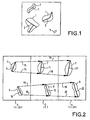
- FIG. 1 The contours of some formations are shown in Figure 1 1, as recorded using a weather radar and displayed on a screen, for example a control post screen air traffic.
- the image thus viewed has been pre-processed, in a manner known in itself, to remove any soil clutter (if any, due to the relief, the swell, at fixed obstacles).
- This first step can be used to compress the image data. It then suffices to establish the skeletons of different sets of the image, as outlined above, and to only keep as information related to these skeletons. Of course, such compression results in some data loss.
- FIG. 2 three such successive images have been represented, referenced 4, 5 and 6, and relating to cloudy phenomena respectively recorded by a weather radar at times t- ⁇ t, t, t + ⁇ t (t is the instant at which we place our to analyze the current situation).
- the time lapse ⁇ t is equal to a few minutes, for example 5 minutes, but it is understood that, depending on the phenomena observed and according to the fields of application of the process, this period of time may be different, depending on the rate of evolution of the phenomena concerned and the required resolution.
- image 5 relating to time t, the contours of two cloud formations 7, 8. It can be seen that in image 4, obtained a few minutes before time t, i.e. at time t- ⁇ t, the formations 7 and 8 also appear, but are closer to each other than at time t, and have dimensions slightly smaller than those of same formations at time t.
- each of the vectors 13 to 16 of a length equal to itself, respectively we extend each of the vectors 13 to 16 of a length equal to itself, respectively, and we thus obtain the vectors 17 to 20.
- the vectors 13 and 14 are slightly diverging to the right, as are vectors 15, 16, this which makes the skeletons 11, 12 slightly longer than the skeletons 9.10 respectively.
- image 6 is only a forecast calculated at time (t), and it can be corrected, if necessary, using measurements made at the instant (t + ⁇ t), to allow calculation of forecast for the moment (t + 2 ⁇ t).
- Image 6 of FIG. 2 has been obtained, for the example described above, by linear extrapolation, but it is understood that others types of non-linear extrapolations are possible, especially when we see that the forecast images are very different from the images measured, because of a skeleton size evolution gradient and deformations), and it is also understood that if strong gradients of evolution appear, the time intervals ⁇ t can be reduced, and that if the gradients vary, the extrapolation can be adaptive.
- cloud formations may disappear (or else the amplitude of their radar echo may become negligible). Their representations on the images also disappear, which can allow, if necessary, to correct forecasts for areas neighbors. Conversely, cloud formations may appear, and as soon that the amplitude of their radar echo exceeds a determined value experimentally, we can trace the corresponding skeleton and modify it depending on the evolution of these cloud masses.
- the images to be processed to obtain the skeletons can undergo various suitable pretreatments, known per se.
- pre-treatments we can cite: thresholding and filtering (frequency and / or morphological), in order to eliminate parasites such as those due to noise basically, the elimination of the components without interest for the problem posed (in particular, elimination of the static components of the images).
- the skeletons obtained can be simplified by vectorization (thinning, search for points of strong curvature of the skeleton, linearization), and we can eliminate the insignificant barbs or different artifacts.
- the shape information (cloud shape in the example described above) is compressed (the data needed to code the skeletons are much less than with the known methods), which makes it possible to treat more quickly the images.
- the displacements and deformations of the clouds are easier to analyze and extrapolate for more reliable forecasts.
- the representation in the form of a polygonal skeleton approximation (in the skeleton trunk) is more stationary than the representation as a polygonal approximation of the contours.
Landscapes
- Engineering & Computer Science (AREA)
- Physics & Mathematics (AREA)
- General Physics & Mathematics (AREA)
- Multimedia (AREA)
- Theoretical Computer Science (AREA)
- Computer Vision & Pattern Recognition (AREA)
- Astronomy & Astrophysics (AREA)
- Remote Sensing (AREA)
- Image Processing (AREA)
Description
- la figure 1 est un schéma simplifié d'un écran de visualisation de radar météorologique, sur lequel ont été représentés les squelettes de plusieurs formations nuageuses, établis conformément à l'invention, et
- la figure 2 représente des vues schématiques montrant des mises en correspondance entre des squelettes d'images radar décalées dans le temps, conformément à l'invention, et ce, pour différents cas d'évolution des formations nuageuses.
- l'observation spatiale : suivi des phénomènes naturels et/ou dus à l'homme, tels que les inondations, la couverture neigeuse, la désertification des sols arables ou leur mise en culture, les pollutions fluviales ou maritimes (par hydrocarbures, ...), ...
- l'océanographie : suivi de l'évolution du gradient de température des océans (fronts, tourbillons, courants sous-marins, ...) sur des images spatiales infrarouges ou en proche ultraviolet (à cause du phyto-plancton). Les informations recueillies sont intéressantes pour la météorologie marine, ainsi que pour la modélisation de la propagation des ondes sonar (communications et détection des sous-marins...),
- le domaine médical : pour le traitement des images médicales (I.R.M., tomographie ..), pour le suivi des pathologies : étude de la dynamique du coeur, suivi de l'activité cérébrale, suivi de l'évolution des tumeurs...
- la mécanique des fluides : suivi des volutes (par coloration) des écoulements instationnaires tels que ceux se produisant le long d'une paroi, ou l'injection de carburant dans une chambre de combustion, ...
Claims (10)
- Procédé de suivi dynamique de l'évolution de milieux déformables, caractérisé en ce qu'il consiste, à partir d'au moins deux images temporellement espacées, obtenues par au moins un capteur, à établir pour chaque image (4, 5, 6) le squelette (9, 10, 11, 12, 21, 22) de chaque ensemble distinct de ce milieu (7, 8), et à procéder à une mise en correspondance des squelettes (13 à 16, 17 à 20) des images en question.
- Procédé selon la revendication 1, caractérisé en ce que pour effectuer la mise en correspondance, on vectorise les squelettes des images traitées, on examine les vecteurs, pris deux à deux, de ces squelettes et on cherche à apparier à chaque fois deux vecteurs possédant sensiblement les mêmes caractéristiques géométriques.
- Procédé selon l'une des revendications 1 ou 2, caractérisé en ce que l'on établit une cartographie de vecteurs de déplacement de pixels pour au moins une zone d'intérêt des images traitées.
- Procédé selon la revendication 2, caractérisé en ce que pour reconstruire une image prédite, on reconstruit ses squelettes à l'aide des vecteurs de déplacement appliqués aux squelettes correspondants d'une image existante, et qu'à partir des squelettes reconstruits, on reconstruit les ensembles correspondants.
- Procédé selon la revendication 4, caractérisé en ce que l'on applique les vecteurs de déplacement à chaque pixel d'une image pour calculer une image prédite.
- Procédé selon l'une des revendications précédentes, caractérisé en ce que l'on applique des attributs à au moins une partie des pixels de plusieurs images temporellement espacées, que l'on détermine les caractéristiques des zones correspondantes, et qu'à partir de ces caractéristiques on affine les prédictions d'évolution de ces zones.
- Procédé selon l'une des revendications précédentes, caractérisé en ce qu'on effectue un prétraitement d'image avant l'établissement des squelettes.
- Procédé selon la revendication 7, caractérisé en ce que le prétraitement comporte au moins l'un des processus suivants: filtrage fréquentiel, filtrage morphologique, seuillage, élimination de composantes d'image sans intérêt pour le problème posé.
- Procédé selon l'une des revendications précédentes, caractérisé en ce que l'on simplifie les squelettes par vectorisation et/ou élimination des artefacts ou barbules non significatives.
- Procédé selon la revendication 1, pour la compression de données d'au moins une image, caractérisé en ce que l'on établit les squelettes des différents ensembles de l'image, et que l'on ne garde que les informations relatives à ces squelettes.
Applications Claiming Priority (2)
| Application Number | Priority Date | Filing Date | Title |
|---|---|---|---|
| FR9807095A FR2779548B1 (fr) | 1998-06-05 | 1998-06-05 | Procede de suivi dynamique de l'evolution de milieux deformables, et de prediction de leur evolution |
| FR9807095 | 1998-06-05 |
Publications (2)
| Publication Number | Publication Date |
|---|---|
| EP0962890A1 EP0962890A1 (fr) | 1999-12-08 |
| EP0962890B1 true EP0962890B1 (fr) | 2004-08-18 |
Family
ID=9527061
Family Applications (1)
| Application Number | Title | Priority Date | Filing Date |
|---|---|---|---|
| EP99401309A Expired - Lifetime EP0962890B1 (fr) | 1998-06-05 | 1999-06-01 | Procédé de suivi dynamique de l'évolution de milieux déformables, et de prédiction de leur évolution |
Country Status (4)
| Country | Link |
|---|---|
| US (1) | US6438253B1 (fr) |
| EP (1) | EP0962890B1 (fr) |
| DE (1) | DE69919449T2 (fr) |
| FR (1) | FR2779548B1 (fr) |
Families Citing this family (12)
| Publication number | Priority date | Publication date | Assignee | Title |
|---|---|---|---|---|
| ATE499665T1 (de) * | 2003-12-11 | 2011-03-15 | Koninkl Philips Electronics Nv | Elastische bildregistration |
| FR2891153B1 (fr) * | 2005-09-28 | 2008-08-22 | Centre Nat Rech Scient | Dispositif de traitement thermique de tissus biologiques en mouvement |
| FR2897952B1 (fr) | 2006-02-28 | 2008-05-30 | Thales Sa | Procede de generation et systeme meteorologique a prediction progressive de situations meteorologiques autour d'un porteur. |
| US20080260220A1 (en) * | 2006-12-22 | 2008-10-23 | Art Advanced Research Technologies Inc. | Registration of optical images of small animals |
| FR2947938B1 (fr) | 2009-07-10 | 2014-11-21 | Thales Sa | Procede de prediction d'une evolution d'un phenomene meteorologique a partir de donnees provenant d'un radar meteorologique |
| CN102662172A (zh) * | 2012-03-29 | 2012-09-12 | 天津大学 | 一种基于多普勒雷达反射率图像的风暴云团的外推方法 |
| US10281571B2 (en) * | 2014-08-21 | 2019-05-07 | Raytheon Company | Phased array antenna using stacked beams in elevation and azimuth |
| CN105225252B (zh) * | 2015-09-21 | 2018-03-30 | 华北电力大学(保定) | 云团运动预测方法 |
| DE102015013627A1 (de) * | 2015-10-20 | 2017-04-20 | Fresenius Medical Care Deutschland Gmbh | Blutbehandlungsgerät und Verfahren zur Erstellung einer Verschreibung |
| EP3185206B1 (fr) * | 2015-12-22 | 2018-09-26 | Thomson Licensing | Procédés et systèmes pour le traitement d'images numériques |
| US11561326B1 (en) * | 2018-06-14 | 2023-01-24 | ACME Atronomatic, LLC | System and method for generating accurate hyperlocal nowcasts |
| CN109325403B (zh) * | 2018-08-07 | 2020-12-11 | 广州粤建三和软件股份有限公司 | 一种基于图像识别的水域污染识别治理方法和系统 |
Family Cites Families (10)
| Publication number | Priority date | Publication date | Assignee | Title |
|---|---|---|---|---|
| US5224179A (en) * | 1988-12-20 | 1993-06-29 | At&T Bell Laboratories | Image skeletonization method |
| FR2656700B1 (fr) * | 1989-12-28 | 1992-08-07 | Aerospatiale | Procede de restitution du mouvement d'un mobile par observation d'un symbole forme sur ce dernier et dispositifs pour la mise en óoeuvre du procede. |
| US5148500A (en) * | 1991-01-24 | 1992-09-15 | Aoi Systems, Inc. | Morphological processing system |
| US5734756A (en) * | 1995-02-01 | 1998-03-31 | Scanvec Co. Ltd. | Methods and apparatus for reproducing a gray scale raster represented elongate graphic image including vectorizing a skeleton of the image by determining a midpoint between two detected endpoints of the image |
| FR2735594B1 (fr) | 1995-06-13 | 1997-07-25 | Thomson Csf | Procede et dispositif de determination du spectre de frequence d'un signal |
| JP3745802B2 (ja) * | 1995-10-13 | 2006-02-15 | 株式会社日立製作所 | 画像生成/表示装置 |
| US5757953A (en) * | 1996-02-29 | 1998-05-26 | Eastman Kodak Company | Automated method and system for region decomposition in digital radiographic images |
| US6175655B1 (en) * | 1996-09-19 | 2001-01-16 | Integrated Medical Systems, Inc. | Medical imaging system for displaying, manipulating and analyzing three-dimensional images |
| DE69724906T2 (de) * | 1996-10-16 | 2004-07-22 | Koninklijke Philips Electronics N.V. | Numerisches Bildverarbeitungsverfahren zur automatischen Extraktion bandförmiger Objekte |
| US6058219A (en) * | 1997-10-10 | 2000-05-02 | Autodesk, Inc. | Method of skeletonizing a binary image using compressed run length data |
-
1998
- 1998-06-05 FR FR9807095A patent/FR2779548B1/fr not_active Expired - Fee Related
-
1999
- 1999-06-01 DE DE69919449T patent/DE69919449T2/de not_active Expired - Lifetime
- 1999-06-01 EP EP99401309A patent/EP0962890B1/fr not_active Expired - Lifetime
- 1999-06-07 US US09/326,638 patent/US6438253B1/en not_active Expired - Fee Related
Also Published As
| Publication number | Publication date |
|---|---|
| DE69919449T2 (de) | 2005-09-15 |
| DE69919449D1 (de) | 2004-09-23 |
| US6438253B1 (en) | 2002-08-20 |
| FR2779548B1 (fr) | 2000-11-10 |
| FR2779548A1 (fr) | 1999-12-10 |
| EP0962890A1 (fr) | 1999-12-08 |
Similar Documents
| Publication | Publication Date | Title |
|---|---|---|
| FR2909185A1 (fr) | Methode d'interpretation stratigraphique d'images sismiques | |
| EP0962890A1 (fr) | Procédé de suivi dynamique de l'évolution de milieux déformables, et de prédiction de leur évolution | |
| FR2947938A1 (fr) | Procede de prediction d'une evolution d'un phenomene meteorologique a partir de donnees provenant d'un radar meteorologique | |
| FR2841344A1 (fr) | Procede, dispositif et produit-programme de lissage d'une propriete de subsurface | |
| FR3052275A1 (fr) | Procede et systeme de determination de cellules traversees par un axe de mesure ou de visualisation | |
| Mitchell | Processing and analysis of Simrad multibeam sonar data | |
| Douxchamps et al. | Stereoscopic and velocimetric reconstructions of the free surface topography of antidune flows | |
| Laroche et al. | Fast non-stationary deconvolution of ultrasonic beamformed images for nondestructive testing | |
| EP3640743A1 (fr) | Procédé d'observation d'un échantillon | |
| Yan et al. | High-fidelity 3D sonar point cloud data reconstruction of underwater bridge caisson foundation for scour inspection | |
| Xiong et al. | Anti-aliasing filters for deriving high-accuracy DEMs from TLS data: A case study from Freeport, Texas | |
| Liu et al. | A multiscale residual U-net architecture for super-resolution ultrasonic phased array imaging from full matrix capture data | |
| McIntyre et al. | Coastal bathymetry from hyperspectral remote sensing data: Comparisons with high resolution multibeam bathymetry | |
| Rezvov et al. | Improving data-driven estimation of significant wave height through preliminary training on synthetic X-band radar sea clutter imagery | |
| FR2923312A1 (fr) | Procede de traitement d'images sismiques du sous-sol | |
| EP3862980A1 (fr) | Procédé de construction d'une représentation tridimensionnelle virtuelle d'une carapace de digue | |
| Vetter et al. | Estimating changes of riverine landscapes and riverbeds by using airborne LiDAR data and river cross-sections | |
| EP1360524B1 (fr) | Procede de determination du courant marin et dispositif associe | |
| FR2725792A1 (fr) | Procede pour evaluer des effets non-euclidiens affectant une image obtenue avec un radar spatial, et satellite pour sa mise en oeuvre | |
| Duan et al. | Video Motion Magnification and Subpixel Edge Detection‐Based Full‐Field Dynamic Displacement Measurement | |
| CN115964958A (zh) | 通量观测足迹与遥感像元空间尺度的匹配方法 | |
| Richter et al. | UAV-based LiDAR Bathymetry at an Alpine Mountain Lake | |
| Mukto et al. | A particle-image based wave profile measurement technique | |
| FR2800491A1 (fr) | Procede de traitement d'images en presence de bruit structure et de bruit non-structure | |
| Senet et al. | Image sequence analysis of water surface waves in a hydraulic wind wave tank |
Legal Events
| Date | Code | Title | Description |
|---|---|---|---|
| PUAI | Public reference made under article 153(3) epc to a published international application that has entered the european phase |
Free format text: ORIGINAL CODE: 0009012 |
|
| AK | Designated contracting states |
Kind code of ref document: A1 Designated state(s): DE FR GB IT |
|
| AX | Request for extension of the european patent |
Free format text: AL;LT;LV;MK;RO;SI |
|
| 17P | Request for examination filed |
Effective date: 20000221 |
|
| AKX | Designation fees paid |
Free format text: DE FR GB IT |
|
| RAP1 | Party data changed (applicant data changed or rights of an application transferred) |
Owner name: THALES |
|
| 17Q | First examination report despatched |
Effective date: 20030205 |
|
| GRAP | Despatch of communication of intention to grant a patent |
Free format text: ORIGINAL CODE: EPIDOSNIGR1 |
|
| RIN1 | Information on inventor provided before grant (corrected) |
Inventor name: MONNIER, BERNARD Inventor name: LEGOUPIL, SAMUEL Inventor name: BARBARESCO, FREDERIC |
|
| GRAS | Grant fee paid |
Free format text: ORIGINAL CODE: EPIDOSNIGR3 |
|
| GRAA | (expected) grant |
Free format text: ORIGINAL CODE: 0009210 |
|
| AK | Designated contracting states |
Kind code of ref document: B1 Designated state(s): DE FR GB IT |
|
| REG | Reference to a national code |
Ref country code: GB Ref legal event code: FG4D Free format text: NOT ENGLISH |
|
| REF | Corresponds to: |
Ref document number: 69919449 Country of ref document: DE Date of ref document: 20040923 Kind code of ref document: P |
|
| GBT | Gb: translation of ep patent filed (gb section 77(6)(a)/1977) |
Effective date: 20041020 |
|
| PLBE | No opposition filed within time limit |
Free format text: ORIGINAL CODE: 0009261 |
|
| STAA | Information on the status of an ep patent application or granted ep patent |
Free format text: STATUS: NO OPPOSITION FILED WITHIN TIME LIMIT |
|
| 26N | No opposition filed |
Effective date: 20050519 |
|
| PGFP | Annual fee paid to national office [announced via postgrant information from national office to epo] |
Ref country code: DE Payment date: 20120530 Year of fee payment: 14 |
|
| PGFP | Annual fee paid to national office [announced via postgrant information from national office to epo] |
Ref country code: GB Payment date: 20120530 Year of fee payment: 14 |
|
| PGFP | Annual fee paid to national office [announced via postgrant information from national office to epo] |
Ref country code: IT Payment date: 20120615 Year of fee payment: 14 |
|
| PGFP | Annual fee paid to national office [announced via postgrant information from national office to epo] |
Ref country code: FR Payment date: 20130624 Year of fee payment: 15 |
|
| GBPC | Gb: european patent ceased through non-payment of renewal fee |
Effective date: 20130601 |
|
| REG | Reference to a national code |
Ref country code: DE Ref legal event code: R119 Ref document number: 69919449 Country of ref document: DE Effective date: 20140101 |
|
| PG25 | Lapsed in a contracting state [announced via postgrant information from national office to epo] |
Ref country code: DE Free format text: LAPSE BECAUSE OF NON-PAYMENT OF DUE FEES Effective date: 20140101 Ref country code: GB Free format text: LAPSE BECAUSE OF NON-PAYMENT OF DUE FEES Effective date: 20130601 |
|
| PG25 | Lapsed in a contracting state [announced via postgrant information from national office to epo] |
Ref country code: IT Free format text: LAPSE BECAUSE OF NON-PAYMENT OF DUE FEES Effective date: 20130601 |
|
| REG | Reference to a national code |
Ref country code: FR Ref legal event code: ST Effective date: 20150227 |
|
| PG25 | Lapsed in a contracting state [announced via postgrant information from national office to epo] |
Ref country code: FR Free format text: LAPSE BECAUSE OF NON-PAYMENT OF DUE FEES Effective date: 20140630 |