EP0959360B1 - Rasterization control method - Google Patents
Rasterization control method Download PDFInfo
- Publication number
- EP0959360B1 EP0959360B1 EP99300916A EP99300916A EP0959360B1 EP 0959360 B1 EP0959360 B1 EP 0959360B1 EP 99300916 A EP99300916 A EP 99300916A EP 99300916 A EP99300916 A EP 99300916A EP 0959360 B1 EP0959360 B1 EP 0959360B1
- Authority
- EP
- European Patent Office
- Prior art keywords
- rasterization
- data
- address pairs
- controlling
- activity according
- Prior art date
- Legal status (The legal status is an assumption and is not a legal conclusion. Google has not performed a legal analysis and makes no representation as to the accuracy of the status listed.)
- Expired - Lifetime
Links
- 238000000034 method Methods 0.000 title claims description 18
- 230000000694 effects Effects 0.000 claims description 11
- 230000015654 memory Effects 0.000 claims description 8
- 230000006399 behavior Effects 0.000 description 6
- 230000002688 persistence Effects 0.000 description 6
- 239000000872 buffer Substances 0.000 description 2
- 238000013481 data capture Methods 0.000 description 2
- 230000007423 decrease Effects 0.000 description 2
- 238000010586 diagram Methods 0.000 description 2
- 238000012986 modification Methods 0.000 description 2
- 230000004048 modification Effects 0.000 description 2
- 230000003252 repetitive effect Effects 0.000 description 2
- 238000012360 testing method Methods 0.000 description 2
- 238000013459 approach Methods 0.000 description 1
- 238000005282 brightening Methods 0.000 description 1
- 239000002131 composite material Substances 0.000 description 1
- 230000003247 decreasing effect Effects 0.000 description 1
- 230000001934 delay Effects 0.000 description 1
- 238000013461 design Methods 0.000 description 1
- 230000006870 function Effects 0.000 description 1
- 239000011159 matrix material Substances 0.000 description 1
- 238000012545 processing Methods 0.000 description 1
- 238000009738 saturating Methods 0.000 description 1
- 238000001228 spectrum Methods 0.000 description 1
- 230000003068 static effect Effects 0.000 description 1
Images
Classifications
-
- G—PHYSICS
- G01—MEASURING; TESTING
- G01R—MEASURING ELECTRIC VARIABLES; MEASURING MAGNETIC VARIABLES
- G01R13/00—Arrangements for displaying electric variables or waveforms
- G01R13/20—Cathode-ray oscilloscopes
- G01R13/22—Circuits therefor
-
- G—PHYSICS
- G01—MEASURING; TESTING
- G01R—MEASURING ELECTRIC VARIABLES; MEASURING MAGNETIC VARIABLES
- G01R13/00—Arrangements for displaying electric variables or waveforms
- G01R13/20—Cathode-ray oscilloscopes
- G01R13/22—Circuits therefor
- G01R13/34—Circuits for representing a single waveform by sampling, e.g. for very high frequencies
-
- G—PHYSICS
- G09—EDUCATION; CRYPTOGRAPHY; DISPLAY; ADVERTISING; SEALS
- G09G—ARRANGEMENTS OR CIRCUITS FOR CONTROL OF INDICATING DEVICES USING STATIC MEANS TO PRESENT VARIABLE INFORMATION
- G09G1/00—Control arrangements or circuits, of interest only in connection with cathode-ray tube indicators; General aspects or details, e.g. selection emphasis on particular characters, dashed line or dotted line generation; Preprocessing of data
- G09G1/06—Control arrangements or circuits, of interest only in connection with cathode-ray tube indicators; General aspects or details, e.g. selection emphasis on particular characters, dashed line or dotted line generation; Preprocessing of data using single beam tubes, e.g. three-dimensional or perspective representation, rotation or translation of display pattern, hidden lines, shadows
- G09G1/14—Control arrangements or circuits, of interest only in connection with cathode-ray tube indicators; General aspects or details, e.g. selection emphasis on particular characters, dashed line or dotted line generation; Preprocessing of data using single beam tubes, e.g. three-dimensional or perspective representation, rotation or translation of display pattern, hidden lines, shadows the beam tracing a pattern independent of the information to be displayed, this latter determining the parts of the pattern rendered respectively visible and invisible
Definitions
- This invention relates to the rasterization of acquired data-address pairs so as to prepare the data they contain for the raster scan display of a digital oscilloscope, and more particularly to how such oscilloscopes operate in the presence of a low or non-existent trigger rate and the resulting shortage of waveforms for rasterization.
- Modern digital oscilloscopes typically acquire and digitize input data representative of the behavior over time of an electrical signal.
- the resulting data-address pairs are typically "rasterized" to convert them into a two-dimensional bit-map for display by a raster scan display.
- Raster scan displays like those in computer monitors, utilize a two-dimensional matrix of pixels arranged in rows and columns.
- Grey-scale raster scan displays can also provide "variable persistence", a way for the user to control how quickly or slowly the intensity of each illuminated pixel is decreased over time if no new intensity information is directed to that pixel.
- the intensity values stored for the individual pixels at the locations associated with these waveforms are made brighter by some increment value. All illuminated pixels are also decremented on each display cycle. Pixels that are part of the waveform display of a repetitive waveform eventually attain a maximum intensity value and are displayed brightly, while pixels that are part of an intermittent feature of the waveform appear dimmer, depending on how infrequently that intermittent part of the waveform occurs and therefor how often they receive an additional increment of intensity value.
- Infinite persistence refers to the oscilloscope display's behavior when illuminated pixel's intensity is not decremented at all.
- intensity data is only added to pixel values, never subtracted. In this mode, all of the pixels affected by repetitive waveforms eventually reach their maximum intensity values and stay there until the display settings are modified.
- a trigger signal indicates to the oscilloscope that some external event has met preestablished criteria defining when another data acquisition would be appropriate. In its simplest form, a trigger can be generated every time that the signal under test crosses a particular voltage level going in a particular direction.
- the "raw" trigger signal, a.k.a. main event trigger (MET) becomes active every time external events meet the preestablished criteria.
- MET main event trigger
- the oscilloscope may not be ready to make another acquisition yet. Raw triggers are ignored until the oscilloscope itself is again in a state of readiness to do another acquisition.
- a signal indicative of this readiness is typically ANDed with the MET to produce a MAT, or main accepted trigger.
- This is the trigger signal that controls data acquisition, since it means that both the external event and the rest of the oscilloscope are now at a suitable time for referencing the acquisition of another data record.
- the oscilloscope When the MAT occurs, the oscilloscope performs a sequence of activities to capture, or retain, data that is representative of the behavior of the signal under test.
- the trigger event may initiate data capture, or terminate it, or provide a reference point somewhere in the middle of the acquired data record.
- Use of a circular data acquisition memory makes the time relationship between the trigger event and the time of the actual data capture highly adjustable.
- the data acquisition interval and the waveform rasterization period may vary widely with respect to each other, it is generally desirable to try to keep them happening in parallel with each other to maximize throughput. Under some circumstances, however, the rate of the MET, or external trigger, is highly variable. This can cause a variation in signal intensity that is irritating or frustrating to the user.
- the waveform display will tend to go to maximum intensity in every illuminated pixel, thereby "saturating" the display.
- the user may become quite frustrated by the need to constantly adjust the brightness control in an effort to produce a display with satisfactory intensity.
- What is desired is some way to continue to provide a useful display in the presence of a fluctuating trigger rate.
- this problem has been discussed in the context of multi-bit raster scan displays with persistence, an ideal solution should also work for single bit rasterizations too.
- one or more recently acquired waveform data sets are maintained in memory after they are initially rasterized.
- the trigger and waveform acquisition rates become so low that rasterizer time is being wasted, one or more of the most recent previously acquired waveforms are automatically re-rasterized and displayed again to maintain the display until another newly acquired waveform becomes available.
- the rasterizer's readiness to re-rasterize a previously rasterized waveform data set can be qualified with a pre-determined or programmable time delay, thereby providing more flexibility for external circuitry and controllers to optimize utilization of the rasterizer's behavior.
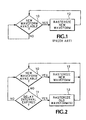
- FIG. 1 is a logic diagram illustrating how rasterization was controlled according to the prior art.
- FIG. 2 is a logic diagram illustrating how rasterization is controlled according to the present invention.
- rasterizer behavior simply waited for new waveforms to become available 10 , and only continued rasterizing 12 after new waveform data became available.
- decision block 10 if a new waveform or the trigger associated with a new waveform is not available after a previous rasterization, decision block 10 produces a "no". This "no" starts the delay interval referred to in decision block 11. So long as the delay interval lasts, the "no" output of decision block 11 keeps sending the logical inquiry back to decision block 10, which is waiting for the arrival of the information that a new trigger signal has been received and a new waveform will soon be available. If no such information is received within the predetermined delay interval 11 , decision block 11 produces a "yes" outcome and the rasterizer then performs a re-rasterization 13 of a previously rasterized waveform data set.
- the delay interval of block 11 is provided by a counter/timer.
- the counter/timer is reset, or initialized to zero, continuously whenever the rasterizer referred to in blocks 12 and 13 is running, or when a trigger associated with the next waveform has been received, i.e., "yes" from decision block 10 .
- the reset or initialization signal is withdrawn and the counter/timer is allowed to count for the time of the delay interval, unless it is interrupted and reset by the availability of another trigger signal and the availability of a new waveform that such a trigger signal implies.
- the "wait time” value can be set to zero, effectively eliminating decision block 11 from the method of the invention. With decision block 11 gone, or its wait time set to zero, rasterization of an old waveform begins immediately upon completion of the previous rasterization if no trigger signal indicates that new waveform data is available.
- the ability to set the wait time is a general purpose control input that allows this re-rasterization technique to be optimized for a variety of operational environments. Since waveform data acquisition time can have various relationships with the time taken by the rasterization process, it may be desirable to lengthen, or shorten, or make equal to zero, the wait time before undertaking a re-rasterization. If new waveforms are being acquired very quickly compared with the time it is taking to rasterize them, the wait time should be set to be long enough to ensure that the rasterizer waits for the arrival of the next new waveform rather than starting with any re-rasterizations.
- the slow display of this design only provided a single bit of intensity data per pixel and therefore had no analog-like gray scaling capability. Nonetheless, the two single bit per pixel raster memories were used in a way that gave the operator some indication of the presence of intermittent signals. This was accomplished by using a randomizing process to qualify the compositing of the most recent waveform into the previously accumulated waveforms. With this approach, waveforms that were sufficiently intermittent only showed up as dotted lines, while waveforms that occurred most of the time would generally appear as completely filled in. Because of the single bit per pixel limitation of this implementation, extremely rare and not-so rare waveforms would tend to be misidentified, respectively, as not discernable or as always present.
- rasterization schemes that include some form of randomization in their output are ideally suited for re-rasterization according to this invention. Rasterization processes that do not include any randomizing function at all will produce static displays when a single waveform is repeatedly re-rasterized. This might be a case where the re-rasterization of more that one waveform would lead to a more natural and active looking display.
Landscapes
- Physics & Mathematics (AREA)
- General Physics & Mathematics (AREA)
- Controls And Circuits For Display Device (AREA)
- Image Generation (AREA)
Description
- This invention relates to the rasterization of acquired data-address pairs so as to prepare the data they contain for the raster scan display of a digital oscilloscope, and more particularly to how such oscilloscopes operate in the presence of a low or non-existent trigger rate and the resulting shortage of waveforms for rasterization.
- Modern digital oscilloscopes typically acquire and digitize input data representative of the behavior over time of an electrical signal. The resulting data-address pairs are typically "rasterized" to convert them into a two-dimensional bit-map for display by a raster scan display. Raster scan displays, like those in computer monitors, utilize a two-dimensional matrix of pixels arranged in rows and columns.
- Although such displays can have only a single bit of intensity information associated with each pixel location, and are therefore limited to turning the pixel's intensity "on" or "off", more expensive raster scan displays use more memory depth in association with each pixel and thereby achieve a grey-scale spectrum of intensity choices for each pixel in the display.
- Grey-scale raster scan displays can also provide "variable persistence", a way for the user to control how quickly or slowly the intensity of each illuminated pixel is decreased over time if no new intensity information is directed to that pixel. As new waveforms are acquired and displayed, the intensity values stored for the individual pixels at the locations associated with these waveforms are made brighter by some increment value. All illuminated pixels are also decremented on each display cycle. Pixels that are part of the waveform display of a repetitive waveform eventually attain a maximum intensity value and are displayed brightly, while pixels that are part of an intermittent feature of the waveform appear dimmer, depending on how infrequently that intermittent part of the waveform occurs and therefor how often they receive an additional increment of intensity value.
- Infinite persistence refers to the oscilloscope display's behavior when illuminated pixel's intensity is not decremented at all. When a user selects this display mode, intensity data is only added to pixel values, never subtracted. In this mode, all of the pixels affected by repetitive waveforms eventually reach their maximum intensity values and stay there until the display settings are modified.
- The rate at which an oscilloscope can acquire new waveforms, and therefore a limitation on how often it can rasterize new data for its display, depends on something called "the trigger rate". A trigger signal indicates to the oscilloscope that some external event has met preestablished criteria defining when another data acquisition would be appropriate. In its simplest form, a trigger can be generated every time that the signal under test crosses a particular voltage level going in a particular direction. The "raw" trigger signal, a.k.a. main event trigger (MET), becomes active every time external events meet the preestablished criteria. However, for a variety of reasons, the oscilloscope may not be ready to make another acquisition yet. Raw triggers are ignored until the oscilloscope itself is again in a state of readiness to do another acquisition. A signal indicative of this readiness is typically ANDed with the MET to produce a MAT, or main accepted trigger. This is the trigger signal that controls data acquisition, since it means that both the external event and the rest of the oscilloscope are now at a suitable time for referencing the acquisition of another data record.
- When the MAT occurs, the oscilloscope performs a sequence of activities to capture, or retain, data that is representative of the behavior of the signal under test. As implied above, the trigger event may initiate data capture, or terminate it, or provide a reference point somewhere in the middle of the acquired data record. Use of a circular data acquisition memory makes the time relationship between the trigger event and the time of the actual data capture highly adjustable.
- Once the data associated with a particular trigger event has been acquired, however, it is still generally necessary for the instrument to perform some additional operations before it can initiate rasterization of that data. For example, in an instrument having a fast-in, slow-out (FISO) front end, data must be moved out of that front end and into a slower speed acquisition memory before the data is ready for rasterization. The time associate with this particular activity also delays the instrument's readiness to perform another acquisition of data.
- While the data acquisition interval and the waveform rasterization period may vary widely with respect to each other, it is generally desirable to try to keep them happening in parallel with each other to maximize throughput. Under some circumstances, however, the rate of the MET, or external trigger, is highly variable. This can cause a variation in signal intensity that is irritating or frustrating to the user.
- When digital oscilloscopes of the prior art are using their persistence mode (I.e., are not in the infinite persistence mode), they have traditionally responded to the absence of triggers by continuing to decrease the displayed waveform's intensity level until it reaches zero and the waveform fades away. If the trigger rate decreases, but some triggers continue to occur, fewer waveforms update the display and the perceived intensity fades to a level that may be difficult use. To deal with this situation, most digital oscilloscopes have a "brightness" control that allows the user to modify the value by which the intensity values of individual pixels are decremented, thereby increasing the persistence of each waveform and brightening the display. But, this too can be irritating or frustrating to the user if the trigger rate continues to vary.
- If the trigger rate should increase again, after the brightness control has been adjusted to compensate for the reduced trigger rate, the waveform display will tend to go to maximum intensity in every illuminated pixel, thereby "saturating" the display. Thus, in the presence of a variable trigger rate, the user may become quite frustrated by the need to constantly adjust the brightness control in an effort to produce a display with satisfactory intensity. What is desired is some way to continue to provide a useful display in the presence of a fluctuating trigger rate. And, while this problem has been discussed in the context of multi-bit raster scan displays with persistence, an ideal solution should also work for single bit rasterizations too.
- The above problem is solved by the features of claim 1.
- In accordance with the invention, one or more recently acquired waveform data sets are maintained in memory after they are initially rasterized. When the trigger and waveform acquisition rates become so low that rasterizer time is being wasted, one or more of the most recent previously acquired waveforms are automatically re-rasterized and displayed again to maintain the display until another newly acquired waveform becomes available. The rasterizer's readiness to re-rasterize a previously rasterized waveform data set can be qualified with a pre-determined or programmable time delay, thereby providing more flexibility for external circuitry and controllers to optimize utilization of the rasterizer's behavior.
- FIG. 1 is a logic diagram illustrating how rasterization was controlled according to the prior art.
- FIG. 2 is a logic diagram illustrating how rasterization is controlled according to the present invention.
- Referring first to FIG. 1, rasterizer behavior according to the prior art simply waited for new waveforms to become available 10, and only continued rasterizing 12 after new waveform data became available.
- Referring now to FIG. 2, according to the present invention, if a new waveform or the trigger associated with a new waveform is not available after a previous rasterization,
decision block 10 produces a "no". This "no" starts the delay interval referred to indecision block 11. So long as the delay interval lasts, the "no" output ofdecision block 11 keeps sending the logical inquiry back todecision block 10, which is waiting for the arrival of the information that a new trigger signal has been received and a new waveform will soon be available. If no such information is received within thepredetermined delay interval 11,decision block 11 produces a "yes" outcome and the rasterizer then performs are-rasterization 13 of a previously rasterized waveform data set. Under some circumstances it might be necessary to re-rasterize the previously rasterized data sequence more than once beforedecision block 10 is satisfied by the availability of new waveform data. And, in an alternative implementation, more than one previously rasterized data sequence may be re-rasterized by the operation ofblock 13. - In one embodiment, implemented in hardware, the delay interval of
block 11 is provided by a counter/timer. The counter/timer is reset, or initialized to zero, continuously whenever the rasterizer referred to inblocks decision block 10. In the absence of a current rasterization, and if no new trigger has been received, the reset or initialization signal is withdrawn and the counter/timer is allowed to count for the time of the delay interval, unless it is interrupted and reset by the availability of another trigger signal and the availability of a new waveform that such a trigger signal implies. - It should be noted that the "wait time" value can be set to zero, effectively eliminating
decision block 11 from the method of the invention. Withdecision block 11 gone, or its wait time set to zero, rasterization of an old waveform begins immediately upon completion of the previous rasterization if no trigger signal indicates that new waveform data is available. - The ability to set the wait time is a general purpose control input that allows this re-rasterization technique to be optimized for a variety of operational environments. Since waveform data acquisition time can have various relationships with the time taken by the rasterization process, it may be desirable to lengthen, or shorten, or make equal to zero, the wait time before undertaking a re-rasterization. If new waveforms are being acquired very quickly compared with the time it is taking to rasterize them, the wait time should be set to be long enough to ensure that the rasterizer waits for the arrival of the next new waveform rather than starting with any re-rasterizations. However, if rasterization is occurring much more quickly than new waveforms are being acquired, a short or non-existent wait time will allow the rasterizer to do repeated cycles of re-rasterization while waiting for the availability of the next new waveform. Software in the instrument can obtain information about the internal trigger rate, trigger processing time, and the time being needed for rasterization, and from that information derive a desirable setting for the delay interval. How that time is used is beyond the scope of the present invention, but providing a capability for such a delay interval to be programmed and used is not.
- It might also be desired under some circumstance to modify the behavior dictated by
block 13 so that more than one old waveform sequence of data-address pairs is rasterized before returning todecision block 10 to determine if new waveform data is available. - It should also be noted that this technique works especially well with rasterizers that have some random element in the way they perform rasterization. For example, U.S. patent 5,412,579 to Meadows, et al. for "Slow Display Method for Digital Oscilloscope With Fast Acquisition System", describes an oscilloscope system in which acquisitions are composited into alternating (also known as "ping-ponging") display buffers, so that while the contents of one display buffer is being used to display data to the user, the other one is being used to gather and composite more data.
- The slow display of this design only provided a single bit of intensity data per pixel and therefore had no analog-like gray scaling capability. Nonetheless, the two single bit per pixel raster memories were used in a way that gave the operator some indication of the presence of intermittent signals. This was accomplished by using a randomizing process to qualify the compositing of the most recent waveform into the previously accumulated waveforms. With this approach, waveforms that were sufficiently intermittent only showed up as dotted lines, while waveforms that occurred most of the time would generally appear as completely filled in. Because of the single bit per pixel limitation of this implementation, extremely rare and not-so rare waveforms would tend to be misidentified, respectively, as not discernable or as always present.
- Copending application by Sullivan et al., US serial no. 09/026815, for "Sparse Vector Rasterization" shows the use of another form of randomization used by a rasterizer. It distributes pixel modification along a vector by using a combination of a random offset from zero and a calculated constant increment between successive locations, with the latter being indexed to the randomly determined offset.
- In any event, as has been stated, rasterization schemes that include some form of randomization in their output are ideally suited for re-rasterization according to this invention. Rasterization processes that do not include any randomizing function at all will produce static displays when a single waveform is repeatedly re-rasterized. This might be a case where the re-rasterization of more that one waveform would lead to a more natural and active looking display.
- While a preferred embodiment of the present invention has been shown and described, it will be apparent to those skilled in the art that many changes and modifications may be made without departing from the invention in its broader aspects. The claims that follow define the scope of the invention.
Claims (9)
- A method of controlling rasterization activity to produce waveform displays in an electronic data acquisition instrument, the method comprising the steps of:(a) repeatedly acquiring new sequences of data representative of electronic signal waveforms and storing the data sequences in a memory as sequences of data-address pairs;(b) rasterizing a sequence of data-address pairs from the memory to produce a raster scan display image for storage in a raster memory;(c) determining whether or not a new sequence of data-address pairs is available, i.e. ready for rasterization;(d) if a new sequence of data-address pairs is ready for rasterization according to the determination of step (c), performing step (b) on the new sequence of data-address pairs; and(e) if a new sequence of data-address pairs is not ready for rasterization according to the determination of step (c), performing step (b) again on a previously rasterized sequence of data-address pairs.
- A method of controlling rasterization activity according to claim 1 wherein step (c), the determining step, comprises the steps of:(c.1) waiting for a delay interval to see if a new sequence of data-address pairs becomes ready for rasterization;(c.2) ceasing to wait and proceeding to step (d) if a new sequence of data-address pairs is or becomes ready for rasterization; and(c.3) at the end of the delay interval, proceeding to step (e).
- A method of controlling rasterization activity according to claim 2 wherein the delay interval is preset and constant.
- A method of controlling rasterization activity according to claim 2 wherein the delay interval is variable.
- A method of controlling rasterization activity according to claim 2 wherein the delay interval is variable and under control of other elements of the electronic data acquisition instrument during operation.
- A method of controlling rasterization activity according to claim 1 wherein step (e) includes performing step (b) more than once.
- A method of controlling rasterization activity according to claim 1 wherein step (e) includes performing step (b) on two or more previously rasterized sequences of data-address pairs.
- A method of controlling rasterization activity according to claim 2 wherein step (e) includes performing step (b) more than once.
- A method of controlling rasterization activity according to claim 2 wherein step (e) includes performing step (b) on two or more previously rasterized sequences of data-address pairs.
Applications Claiming Priority (2)
| Application Number | Priority Date | Filing Date | Title |
|---|---|---|---|
| US09/026,186 US5995117A (en) | 1998-02-19 | 1998-02-19 | Rasterization control method |
| US26186 | 1998-02-19 |
Publications (3)
| Publication Number | Publication Date |
|---|---|
| EP0959360A2 EP0959360A2 (en) | 1999-11-24 |
| EP0959360A3 EP0959360A3 (en) | 2000-02-23 |
| EP0959360B1 true EP0959360B1 (en) | 2003-08-20 |
Family
ID=21830369
Family Applications (1)
| Application Number | Title | Priority Date | Filing Date |
|---|---|---|---|
| EP99300916A Expired - Lifetime EP0959360B1 (en) | 1998-02-19 | 1999-02-09 | Rasterization control method |
Country Status (7)
| Country | Link |
|---|---|
| US (1) | US5995117A (en) |
| EP (1) | EP0959360B1 (en) |
| JP (1) | JP3263783B2 (en) |
| KR (1) | KR100552409B1 (en) |
| CN (1) | CN1145032C (en) |
| DE (1) | DE69910489T2 (en) |
| TW (1) | TW417018B (en) |
Families Citing this family (9)
| Publication number | Priority date | Publication date | Assignee | Title |
|---|---|---|---|---|
| US6104374A (en) * | 1998-02-19 | 2000-08-15 | Tektronix, Inc. | Sparse vector rasterization |
| US6195080B1 (en) * | 1998-04-03 | 2001-02-27 | Tektronix, Inc. | High probability capture of slow trigger rate acquisitions in a digital oscilloscope with variable intensity rasterization |
| US6188384B1 (en) * | 1998-06-05 | 2001-02-13 | Tektronix, Inc. | Reacting to unusual waveforms |
| US6473701B1 (en) * | 1999-11-22 | 2002-10-29 | Tektronix, Inc. | Alternate triggering in digital oscilloscopes |
| US8102396B2 (en) * | 2006-07-17 | 2012-01-24 | Tektronix, Inc. | Apparatus and method for improved measurement speed in test and measurement instruments |
| US8046183B2 (en) * | 2008-03-04 | 2011-10-25 | Tektronix, Inc. | Pre-trigger and post-trigger acquisition for no dead time acquisition system |
| US8330758B2 (en) * | 2008-05-08 | 2012-12-11 | Teledyne Lecroy, Inc. | Statistically-based display processing |
| CN102109540B (en) * | 2009-12-25 | 2015-05-20 | 北京普源精电科技有限公司 | Digital oscilloscope capable of displaying waveforms of equivalent sampling in raster display and setting method of equivalent sampling points thereof |
| CN112578490A (en) * | 2019-09-30 | 2021-03-30 | 南开大学 | Low-refractive-index large-angle deflection sparse grating for 3D printing |
Family Cites Families (9)
| Publication number | Priority date | Publication date | Assignee | Title |
|---|---|---|---|---|
| US4816813A (en) * | 1986-09-19 | 1989-03-28 | Nicolet Instrument Corporation | Raster scan emulation of conventional analog CRT displays |
| US5602564A (en) * | 1991-11-14 | 1997-02-11 | Hitachi, Ltd. | Graphic data processing system |
| US5412579A (en) * | 1993-04-05 | 1995-05-02 | Tektronix, Inc. | Slow display method for digital oscilloscope with fast acquisition system |
| KR950012931A (en) * | 1993-10-27 | 1995-05-17 | 김광호 | Laser diode and manufacturing method thereof |
| TW276317B (en) * | 1993-12-17 | 1996-05-21 | Hitachi Seisakusyo Kk | |
| US5530454A (en) * | 1994-04-13 | 1996-06-25 | Tektronix, Inc. | Digital oscilloscope architecture for signal monitoring with enhanced duty cycle |
| JP3139671B2 (en) * | 1995-04-04 | 2001-03-05 | 横河電機株式会社 | Waveform observation device |
| JP3753263B2 (en) * | 1995-08-23 | 2006-03-08 | ヒューレット・パッカード・カンパニー | How to process images |
| US5838973A (en) * | 1996-05-03 | 1998-11-17 | Andersen Consulting Llp | System and method for interactively transforming a system or process into a visual representation |
-
1998
- 1998-02-19 US US09/026,186 patent/US5995117A/en not_active Expired - Lifetime
-
1999
- 1999-02-09 DE DE69910489T patent/DE69910489T2/en not_active Expired - Lifetime
- 1999-02-09 EP EP99300916A patent/EP0959360B1/en not_active Expired - Lifetime
- 1999-02-10 JP JP03324699A patent/JP3263783B2/en not_active Expired - Fee Related
- 1999-02-12 TW TW088102349A patent/TW417018B/en not_active IP Right Cessation
- 1999-02-15 CN CNB991023439A patent/CN1145032C/en not_active Expired - Fee Related
- 1999-02-19 KR KR1019990005523A patent/KR100552409B1/en not_active Expired - Fee Related
Also Published As
| Publication number | Publication date |
|---|---|
| DE69910489T2 (en) | 2004-06-24 |
| JPH11281676A (en) | 1999-10-15 |
| US5995117A (en) | 1999-11-30 |
| CN1236104A (en) | 1999-11-24 |
| EP0959360A2 (en) | 1999-11-24 |
| KR100552409B1 (en) | 2006-02-16 |
| JP3263783B2 (en) | 2002-03-11 |
| KR19990072768A (en) | 1999-09-27 |
| TW417018B (en) | 2001-01-01 |
| DE69910489D1 (en) | 2003-09-25 |
| CN1145032C (en) | 2004-04-07 |
| EP0959360A3 (en) | 2000-02-23 |
Similar Documents
| Publication | Publication Date | Title |
|---|---|---|
| EP1074845B1 (en) | Digital oscilloscope architecture for signal monitoring with enhanced duty cycle | |
| US6104374A (en) | Sparse vector rasterization | |
| EP0959360B1 (en) | Rasterization control method | |
| EP0489594B1 (en) | Computer graphics system | |
| JP2627691B2 (en) | Display device | |
| KR100720013B1 (en) | A method for providing persistence decay to contents of a raster memory in a raster display digital oscilloscope | |
| US5438655A (en) | Methods and apparatus for updating and antialiasing waveforms | |
| JPH0623794B2 (en) | Waveform display device | |
| US5412579A (en) | Slow display method for digital oscilloscope with fast acquisition system | |
| EP0497494A1 (en) | Image scaling apparatus for a multimedia system | |
| KR19980024576A (en) | System and method for high-speed clocking digital displays in multiple simultaneous display systems | |
| EP0393824A2 (en) | Test signal generator position cursors | |
| US6384825B2 (en) | Method of controlling a sparse vector rasterizer | |
| US5185874A (en) | Address generator for high speed data averager | |
| JP2727036B2 (en) | Trigger generation method using buffer memory | |
| EP0123082A1 (en) | Logic timing diagram display apparatus | |
| US6201527B1 (en) | Technique for displaying enveloped waveform | |
| US5754439A (en) | Method for reducing display locking in digital oscilloscopes or logic analyzers using inter-acquisition dithering techniques | |
| EP0919818B1 (en) | Method and apparatus for displaying waveforms | |
| JPH06317611A (en) | Video line selection display device | |
| JPH06242146A (en) | Digital oscilloscope | |
| JPH04288594A (en) | Display memory controller |
Legal Events
| Date | Code | Title | Description |
|---|---|---|---|
| PUAI | Public reference made under article 153(3) epc to a published international application that has entered the european phase |
Free format text: ORIGINAL CODE: 0009012 |
|
| AK | Designated contracting states |
Kind code of ref document: A2 Designated state(s): DE FR GB |
|
| AX | Request for extension of the european patent |
Free format text: AL;LT;LV;MK;RO;SI |
|
| PUAL | Search report despatched |
Free format text: ORIGINAL CODE: 0009013 |
|
| AK | Designated contracting states |
Kind code of ref document: A3 Designated state(s): AT BE CH CY DE DK ES FI FR GB GR IE IT LI LU MC NL PT SE |
|
| AX | Request for extension of the european patent |
Free format text: AL;LT;LV;MK;RO;SI |
|
| RIC1 | Information provided on ipc code assigned before grant |
Free format text: 7G 01R 13/02 A |
|
| 17P | Request for examination filed |
Effective date: 20000706 |
|
| AKX | Designation fees paid |
Free format text: DE FR GB |
|
| GRAH | Despatch of communication of intention to grant a patent |
Free format text: ORIGINAL CODE: EPIDOS IGRA |
|
| GRAS | Grant fee paid |
Free format text: ORIGINAL CODE: EPIDOSNIGR3 |
|
| GRAA | (expected) grant |
Free format text: ORIGINAL CODE: 0009210 |
|
| AK | Designated contracting states |
Designated state(s): DE FR GB |
|
| REG | Reference to a national code |
Ref country code: GB Ref legal event code: FG4D |
|
| REF | Corresponds to: |
Ref document number: 69910489 Country of ref document: DE Date of ref document: 20030925 Kind code of ref document: P |
|
| ET | Fr: translation filed | ||
| PLBE | No opposition filed within time limit |
Free format text: ORIGINAL CODE: 0009261 |
|
| STAA | Information on the status of an ep patent application or granted ep patent |
Free format text: STATUS: NO OPPOSITION FILED WITHIN TIME LIMIT |
|
| 26N | No opposition filed |
Effective date: 20040524 |
|
| REG | Reference to a national code |
Ref country code: FR Ref legal event code: PLFP Year of fee payment: 17 |
|
| PGFP | Annual fee paid to national office [announced via postgrant information from national office to epo] |
Ref country code: DE Payment date: 20150226 Year of fee payment: 17 |
|
| PGFP | Annual fee paid to national office [announced via postgrant information from national office to epo] |
Ref country code: FR Payment date: 20150217 Year of fee payment: 17 Ref country code: GB Payment date: 20150226 Year of fee payment: 17 |
|
| REG | Reference to a national code |
Ref country code: DE Ref legal event code: R119 Ref document number: 69910489 Country of ref document: DE |
|
| GBPC | Gb: european patent ceased through non-payment of renewal fee |
Effective date: 20160209 |
|
| REG | Reference to a national code |
Ref country code: FR Ref legal event code: ST Effective date: 20161028 |
|
| PG25 | Lapsed in a contracting state [announced via postgrant information from national office to epo] |
Ref country code: FR Free format text: LAPSE BECAUSE OF NON-PAYMENT OF DUE FEES Effective date: 20160229 Ref country code: DE Free format text: LAPSE BECAUSE OF NON-PAYMENT OF DUE FEES Effective date: 20160901 Ref country code: GB Free format text: LAPSE BECAUSE OF NON-PAYMENT OF DUE FEES Effective date: 20160209 |