EP0959080A1 - Initiators for radical polymerisation - Google Patents
Initiators for radical polymerisation Download PDFInfo
- Publication number
- EP0959080A1 EP0959080A1 EP99107085A EP99107085A EP0959080A1 EP 0959080 A1 EP0959080 A1 EP 0959080A1 EP 99107085 A EP99107085 A EP 99107085A EP 99107085 A EP99107085 A EP 99107085A EP 0959080 A1 EP0959080 A1 EP 0959080A1
- Authority
- EP
- European Patent Office
- Prior art keywords
- initiators
- diels
- dissolved
- added
- alder
- Prior art date
- Legal status (The legal status is an assumption and is not a legal conclusion. Google has not performed a legal analysis and makes no representation as to the accuracy of the status listed.)
- Withdrawn
Links
- 0 *OC(N=NC(O*)=O)=O Chemical compound *OC(N=NC(O*)=O)=O 0.000 description 1
Classifications
-
- C—CHEMISTRY; METALLURGY
- C08—ORGANIC MACROMOLECULAR COMPOUNDS; THEIR PREPARATION OR CHEMICAL WORKING-UP; COMPOSITIONS BASED THEREON
- C08F—MACROMOLECULAR COMPOUNDS OBTAINED BY REACTIONS ONLY INVOLVING CARBON-TO-CARBON UNSATURATED BONDS
- C08F4/00—Polymerisation catalysts
- C08F4/04—Azo-compounds
-
- C—CHEMISTRY; METALLURGY
- C07—ORGANIC CHEMISTRY
- C07D—HETEROCYCLIC COMPOUNDS
- C07D231/00—Heterocyclic compounds containing 1,2-diazole or hydrogenated 1,2-diazole rings
- C07D231/54—Heterocyclic compounds containing 1,2-diazole or hydrogenated 1,2-diazole rings condensed with carbocyclic rings or ring systems
-
- C—CHEMISTRY; METALLURGY
- C07—ORGANIC CHEMISTRY
- C07D—HETEROCYCLIC COMPOUNDS
- C07D271/00—Heterocyclic compounds containing five-membered rings having two nitrogen atoms and one oxygen atom as the only ring hetero atoms
- C07D271/12—Heterocyclic compounds containing five-membered rings having two nitrogen atoms and one oxygen atom as the only ring hetero atoms condensed with carbocyclic rings or ring systems
-
- C—CHEMISTRY; METALLURGY
- C07—ORGANIC CHEMISTRY
- C07D—HETEROCYCLIC COMPOUNDS
- C07D487/00—Heterocyclic compounds containing nitrogen atoms as the only ring hetero atoms in the condensed system, not provided for by groups C07D451/00 - C07D477/00
- C07D487/02—Heterocyclic compounds containing nitrogen atoms as the only ring hetero atoms in the condensed system, not provided for by groups C07D451/00 - C07D477/00 in which the condensed system contains two hetero rings
- C07D487/08—Bridged systems
-
- C—CHEMISTRY; METALLURGY
- C07—ORGANIC CHEMISTRY
- C07F—ACYCLIC, CARBOCYCLIC OR HETEROCYCLIC COMPOUNDS CONTAINING ELEMENTS OTHER THAN CARBON, HYDROGEN, HALOGEN, OXYGEN, NITROGEN, SULFUR, SELENIUM OR TELLURIUM
- C07F7/00—Compounds containing elements of Groups 4 or 14 of the Periodic Table
- C07F7/02—Silicon compounds
- C07F7/08—Compounds having one or more C—Si linkages
- C07F7/0803—Compounds with Si-C or Si-Si linkages
- C07F7/081—Compounds with Si-C or Si-Si linkages comprising at least one atom selected from the elements N, O, halogen, S, Se or Te
- C07F7/0812—Compounds with Si-C or Si-Si linkages comprising at least one atom selected from the elements N, O, halogen, S, Se or Te comprising a heterocyclic ring
- C07F7/0814—Compounds with Si-C or Si-Si linkages comprising at least one atom selected from the elements N, O, halogen, S, Se or Te comprising a heterocyclic ring said ring is substituted at a C ring atom by Si
Definitions
- Initiators for radical polymerization are Compounds that break down into radicals and so the radical Initiate polymerization.
- the rate of decay is in general temperature dependent and can be determined by the Arrhenius equation to be discribed.
- the breakdown into radicals begins therefore already at lower temperatures and is through Accelerated temperature increase.
- initiators are desired that only at high temperatures be effective. Powder coatings must be applied after application the substrate surface generally to flowability be heated to get a smooth and even layer of paint. A simultaneous hardening (radical crosslinking) due to the decomposition of the initiators into radicals leads to bumps or defects in the paint surface. The hardening should rather, use only after melting the polymer powder a smooth layer of lacquer was formed.
- the object of the present invention was corresponding initiators to provide.
- a Diels-Alder reaction is a 1,4-cycloaddition a C, C double bond (instead one here Azo group) to a conjugated double bond (diene).
- the initiators according to the invention can be obtained accordingly by 1,4-cycloaddition of the azo group of an azo compound (Dienophile) to a diene.
- the azo compound is a compound which is already an initiator for radical polymerization and breaks down into free radicals above certain temperatures (azo initiator). Furthermore, the azo compound should be able to undergo a Diels-Alder reaction. Suitable azo compounds are, for example, those of the formula wherein R 1 and R 2 are independently organic radicals.
- the radicals R 1 and R 2 are preferably organic radicals which contain up to 30, in particular up to 20, C atoms and optionally also heteroatoms such as N, O, S.
- R 1 and R 2 are particularly preferably, independently of one another, a C 1 -C 20 alkyl group, a C 5 -C 20 aryl group or cycloalkyl group, a C 6 to C 20 alkaryl or aralkyl group. In particular, it is a C 1 -C 8 alkyl group.
- the alkyl groups can be linear or branched.
- Another azo compound capable of the Diels-Alder reaction is an imide of the formula
- R 1 has the meaning given above.
- dienes which with the azo compounds form the Diels-Alder adduct form, come e.g. Butadiene, cyclopentadiene, cyclohexadiene, or their derivatives in which one or more of the hydrogen atoms substituted by organic radicals are considered.
- the Azo compounds with the diene e.g. at temperatures from 0 ° C to 100 ° C in a solvent.
- the original azo compound is also in the initiator according to the invention the connection that breaks down into radicals and stuff has an initiating effect. Only this azo compound has to go through first a reversal of the Diels-Alder reaction (retro-Diels-Alder reaction) are released from the Diels-Alder adduct.
- the temperature for the Retro-Diels-Alder reaction depends on the choice of the azo compound with the Diene components. Generally the temperatures are above 100 ° C, especially between 150 and 250 ° C. This Temperatures are generally above the decay temperature of azo compounds.
- the azo compound is at Temperature increase only after the Retro-Diels-Alder reaction has taken place released so that the decomposition temperature of the invention Initiators in radicals over the original Azo compounds is increased.
- Retro-Diels-Alder reaction also follows the Arrhenius law, i.e. it shows a certain temperature dependence. Another Improvement of this invention can be achieved if this Temperature dependence is further reduced.
- the decay is autocatalytic and does not follow the Arrhenius law.
- the compound of the formula IIIb decomposes autocatalytically into the Diels-Alder adduct of the formula IIIa when the temperature rises, with the elimination of CO 2 and phenol, and then further into a Retro-Diels-Alder reactor into the azo compound effective as an initiator.
- Diels Alder adducts which are subject to a corresponding autocatalytic decay are those which have at least one group of the formulas are substituted.
- a and A 'in the above formulas independently of one another organic radicals with 1 to 30 C atoms, preferably 2 to 20 C atoms.
- it is a residue with an aromatic ring system. It is particularly preferably a phenyl group which can optionally carry further substituents, for example C 1 -C 8 alkyl groups. A phenyl group is very particularly preferred.
- Preferred substituents are groups of the formula IIa or IId, especially phenyl carbonate or phenyl sulfonate.
- the Diels Alder adduct preferably contains one or two, especially preferably a substituent of the formula IIa to IIe.
- the phenyl group of the phenyl carbonate or phenyl sulfonate can contain further substituents, in particular, for example, C 1 -C 8 alkyl groups.
- the autocatalytic decomposition temperature can be varied.
- the above groups of the formulas IIa) to IIe), in particular the phenyl carbonate or phenyl sulfonate group, can be bound to the Diels-Alder adduct, for example by a customary addition reaction, to the double bonds obtained in the Diels-Alder reaction. Esterifications of the acids, acid anhydrides or acid chlorides derived from IIa to IIe with hydroxyl group-containing Diels-Alder adducts are also particularly suitable.
- the attachment of the phenyl carbonate or phenyl sulfonate group or their derivatives is particularly easy by reacting with Diels-Alder adducts containing hydroxyl groups.
- the initiators according to the invention are suitable as initiators for radical polymerization. It can be the Polymerization of low molecular weight monomers, e.g. Acrylates, Trade vinyl aromatics, vinyl esters, vinyl ethers etc. In consideration cross-linking of oligomers and polymers also occurs radical polymerization of radically polymerizable, ethylenically unsaturated groups which are present in the polymer or Oligomer are included. For example, polymers or oligomers Contain epoxy groups, which with acrylic acid or hydroxyalkyl acrylates be implemented, and so the desired salary is set on double bonds. Of special interest are the initiators for polymer powder according to the invention, which can be crosslinked or hardened by radical polymerization.
- the content of the initiators according to the invention is general 0.05 to 10 parts by weight, in particular 0.1 to 5 parts by weight, based on 100 parts by weight of the total radical polymerizable monomers and / or radical crosslinkable oligomers or polymers.
- the solvent is distilled off and the intermediate product is purified by chromatography. 1.6 g of a white solid are obtained. 3.27 g of chromium trioxide are dissolved in 80 ml of methylene chloride and 5.2 g of pyridine are added with ice cooling. The above-mentioned white solid, dissolved in 10 ml of methylene chloride, is added dropwise to this solution at 0.degree. The mixture is stirred at room temperature for 1 hour and decanted. The solution is washed, dried and concentrated. The crude product is purified by chromatography and by recrystallization. Yield: 165 mg VIII (white crystals).
- Cyclopentadiene is added dropwise to 3.22 g of ice-cold diisopropylazodicarboxylate until the reaction solution has decolorized. The volatile constituents are distilled off and the residue is purified by chromatography. XVII is obtained as a colorless oil.
- Benzyl methacrylate was degassed in a glass tube under vacuum, sealed and heated in an oil bath at 150 ° C for 1 hour. After that, the viscosity had risen only slightly.
- n-butyl acrylate and 0.42% by weight XVII, based on n-butyl acrylate, were degassed in a glass tube under vacuum, sealed and in heated to 145 ° C for 1 hour in an oil bath. After that was the High viscosity approach.
Landscapes
- Chemical & Material Sciences (AREA)
- Organic Chemistry (AREA)
- Engineering & Computer Science (AREA)
- Materials Engineering (AREA)
- Health & Medical Sciences (AREA)
- Chemical Kinetics & Catalysis (AREA)
- Medicinal Chemistry (AREA)
- Polymers & Plastics (AREA)
- Organic Low-Molecular-Weight Compounds And Preparation Thereof (AREA)
- Polymerization Catalysts (AREA)
Abstract
Description
Die Erfindung betrifft Initiatoren für die radikalische Polymerisation, enthaltend als Strukturmerkmal das Diels-Alder-Addukt einer Azogruppe (-N=N-) an eine konjugierte Doppelbindung (Dien).The invention relates to initiators for radical polymerization, containing the Diels-Alder adduct as a structural feature an azo group (-N = N-) to a conjugated double bond (diene).
Initiatoren für die radikalische Polymerisation sind Verbindungen, die in Radikale zerfallen und so die radikalische Polymerisation initiieren. Die Zerfallsgeschwindigkeit ist im allgemeinen temperaturabhängig und kann durch die Arrhenius-Gleichung beschrieben werden. Der Zerfall in Radikale beginnt demnach schon bei tieferen Temperaturen und wird durch Temperaturerhöhung beschleunigt.Initiators for radical polymerization are Compounds that break down into radicals and so the radical Initiate polymerization. The rate of decay is in general temperature dependent and can be determined by the Arrhenius equation to be discribed. The breakdown into radicals begins therefore already at lower temperatures and is through Accelerated temperature increase.
Für manche Anwendungsgebiete, z.B. für die Härtung von Pulverlacken sind Initiatoren gewünscht, die erst bei hohen Temperaturen wirksam werden. Pulverlacke müssen nach dem Auftragen auf die Substratoberfläche im allgemeinen bis zur Fließfähigkeit erhitzt werden, um eine glatte und ebene Lackschicht zu bekommen. Eine gleichzeitig einsetzende Härtung (radikalisch Vernetzung) durch Zerfall der Initiatoren in Radikale führt dabei zu Unebenheiten bzw. Defekten in der Lackoberfläche. Die Härtung soll vielmehr erst einsetzen nachdem durch Aufschmelzen des Polymerpulvers eine glatte Lackschicht gebildet wurde.For some areas of application, e.g. for curing powder coatings initiators are desired that only at high temperatures be effective. Powder coatings must be applied after application the substrate surface generally to flowability be heated to get a smooth and even layer of paint. A simultaneous hardening (radical crosslinking) due to the decomposition of the initiators into radicals leads to bumps or defects in the paint surface. The hardening should rather, use only after melting the polymer powder a smooth layer of lacquer was formed.
Dazu werden Initiatoren benötigt, die erst bei hohen Temperaturen in Radikale zerfallen. Die Temperaturabhängigkeit der Zerfallsgeschwindigkeit soll dabei möglichst gering sein, das heißt kein Zerfall unterhalb einer bestimmten Temperatur möglichst vollständiger Zerfall oberhalb dieser Temperatur (nicht-Arrhenius-Verhalten).This requires initiators that only work at high temperatures disintegrate into radicals. The temperature dependence of the The rate of decay should be as low as possible means no decay below a certain temperature complete decay as possible above this temperature (non-Arrhenius behavior).
Aufgabe der vorliegenden Erfindung war, entsprechende Initiatoren zur Verfügung zu stellen.The object of the present invention was corresponding initiators to provide.
Demgemäß wurden die eingangs definierten Initiatoren gefunden.Accordingly, the initiators defined at the outset were found.
Die erfindungsgemäßen Initiatoren enthalten als Strukturmerkmal das Diels-Alder-Addukt einer Azogruppe, das heißt einer -N=N- Gruppe, an ein Dien. The initiators according to the invention contain as a structural feature the Diels-Alder adduct of an azo group, that is to say an -N = N group, to a servant.
Bei einer Diels-Alder-Reaktion handelt es sich um eine 1,4-Cycloaddition einer C,C-Doppelbindung (stattdessen hier eine Azogruppe) an eine konjugierte Doppelbindung (Dien).A Diels-Alder reaction is a 1,4-cycloaddition a C, C double bond (instead one here Azo group) to a conjugated double bond (diene).
Entsprechend können die erfindungsgemäßen Initiatoren erhalten werden durch 1,4-Cycloaddition der Azogruppe einer Azoverbindung (Dienophil) an ein Dien.The initiators according to the invention can be obtained accordingly by 1,4-cycloaddition of the azo group of an azo compound (Dienophile) to a diene.
Bei der Azoverbindung handelt es sich um eine Verbindung, welche
bereits ein Initiator für die radikalische Polymerisation ist und
oberhalb bestimmter Temperaturen in Radikale zerfällt (Azoinitiator).
Weiterhin sollte die Azoverbindung eine Diels-Alder
Reaktion eingehen können. Geeignete Azoverbindungen sind z.B.
solche der Formel

Bevorzugt handelt es sich bei den Resten R1 und R2 um organische Reste, welche bis zu 30, insbesondere bis zu 20 C-Atome und gegebenenfalls noch Heteroatome wie N, O, S enthalten.The radicals R 1 and R 2 are preferably organic radicals which contain up to 30, in particular up to 20, C atoms and optionally also heteroatoms such as N, O, S.
Besonders bevorzugt handelt es sich bei R1 und R2 unabhängig voneinander um eine C1-C20-Alkylgruppe, eine C5-C20-Arylgruppe oder Cycloalkylgruppe, eine C6- bis C20-Alkaryl- oder Aralkylgruppe. Insbesondere handelt es sich um eine C1-C8 Alkylgruppe. Die Alkylgruppen können linear oder verzweigt sein.R 1 and R 2 are particularly preferably, independently of one another, a C 1 -C 20 alkyl group, a C 5 -C 20 aryl group or cycloalkyl group, a C 6 to C 20 alkaryl or aralkyl group. In particular, it is a C 1 -C 8 alkyl group. The alkyl groups can be linear or branched.
Eine weitere zur Diels-Alder-Reaktion befähigte Azoverbindung ist
ein Imid der Formel
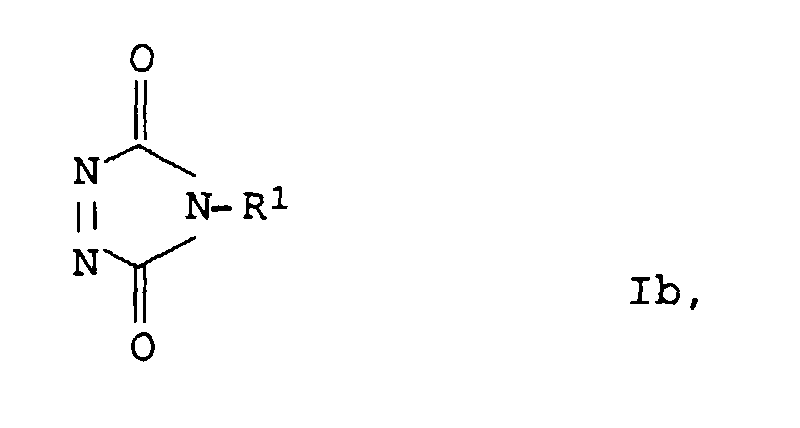
R1 hat die oben angegebene Bedeutung. R 1 has the meaning given above.
Die initiierende Wirkung der Azodicarbonsäureester ist in der Literatur beschrieben (T. Schmelzer und J.Springer; Eur.Polym.J.23(3), pp. 243-248 (1987)).The initiating effect of the azodicarboxylic acid ester is in the Literature described (T. Schmelzer and J.Springer; Eur.Polym.J.23 (3), pp. 243-248 (1987)).
Als Diene, welche mit den Azoverbindungen das Diels-Alder-Addukt bilden, kommen z.B. Butadien, Cyclopentadien, Cyclohexadien, oder deren Derivate, in denen ein oder mehrere der Wasserstoffatome durch organische Reste substituiert sind in Betracht.As dienes, which with the azo compounds form the Diels-Alder adduct form, come e.g. Butadiene, cyclopentadiene, cyclohexadiene, or their derivatives in which one or more of the hydrogen atoms substituted by organic radicals are considered.
Wesentlich ist lediglich, daß eine konjugierte Doppelbindung vorhanden ist, welche zu einer Diels-Alder-Reaktion befähigt ist.It is only essential that a conjugated double bond is present, which is capable of a Diels-Alder reaction.
Die Durchführung der Diels-Alder-Reaktion ist bekannt.The implementation of the Diels-Alder reaction is known.
Zur Herstellung der erfindungsgemäßen Initiatoren können die Azoverbindungen mit dem Dien z.B. bei Temperaturen von 0°C bis 100°C in einem Lösemittel umgesetzt werden.To produce the initiators according to the invention, the Azo compounds with the diene e.g. at temperatures from 0 ° C to 100 ° C in a solvent.
Bei der Umsetzung der Azoverbindungen der Formel I z.B. mit
Cyclopentadien wird folgendes Diels-Alder-Addukt erhalten:

Auch beim erfindungsgemäßen Initiator ist die ursprüngliche Azoverbindung die Verbindung, die in Radikale zerfällt und so initiierend wirkt. Nur muß diese Azoverbindung zunächst durch eine Umkehr der Diels-Alder-Reaktion (Retro-Diels-Alder-Reaktion) aus den Diels-Alder-Addukt freigesetzt werden.The original azo compound is also in the initiator according to the invention the connection that breaks down into radicals and stuff has an initiating effect. Only this azo compound has to go through first a reversal of the Diels-Alder reaction (retro-Diels-Alder reaction) are released from the Diels-Alder adduct.
Die Temperatur, welche für die Retro-Diels-Alder-Reaktion benötigt wird, hängt von der Wahl der Azoverbindung mit der Dienkomponenten ab. Im allgemeinen liegen die Temperaturen oberhalb 100°C,insbesondere zwischen 150 und 250°C. Diese Temperaturen liegen im allgemeinen oberhalb der Zerfallstemperatur der Azoverbindungen. Die Azoverbindung wird bei Temperaturerhöhung erst nach erfolgter Retro-Diels-Alder-Reaktion freigesetzt,so daß die Zerfallstemperatur der erfindungsgemäßen Initiatoren in Radikale gegenüber den ursprünglichen Azoverbindungen erhöht ist.The temperature for the Retro-Diels-Alder reaction depends on the choice of the azo compound with the Diene components. Generally the temperatures are above 100 ° C, especially between 150 and 250 ° C. This Temperatures are generally above the decay temperature of azo compounds. The azo compound is at Temperature increase only after the Retro-Diels-Alder reaction has taken place released so that the decomposition temperature of the invention Initiators in radicals over the original Azo compounds is increased.
Auch die Retro-Diels-Alder-Reaktion folgt dem Arrhenius-Gesetz, d.h. sie zeigt eine gewisse Temperaturabhängigkeit. Eine weitere Verbesserung dieser Erfindung kann erreicht werden, wenn diese Temperaturabhängigkeit noch weiter vermindert wird.The Retro-Diels-Alder reaction also follows the Arrhenius law, i.e. it shows a certain temperature dependence. Another Improvement of this invention can be achieved if this Temperature dependence is further reduced.
Aus der Literatur Fréchet, J.M.J; Eichler, E, HO, H; Willson C.G.
Polymer 1996, 24, 995-1000 ist bekannt, daß Phenyl-tert.-Butylcarbonat
unter thermischer Belastung schlagartig in iso-Buten
zerfällt:
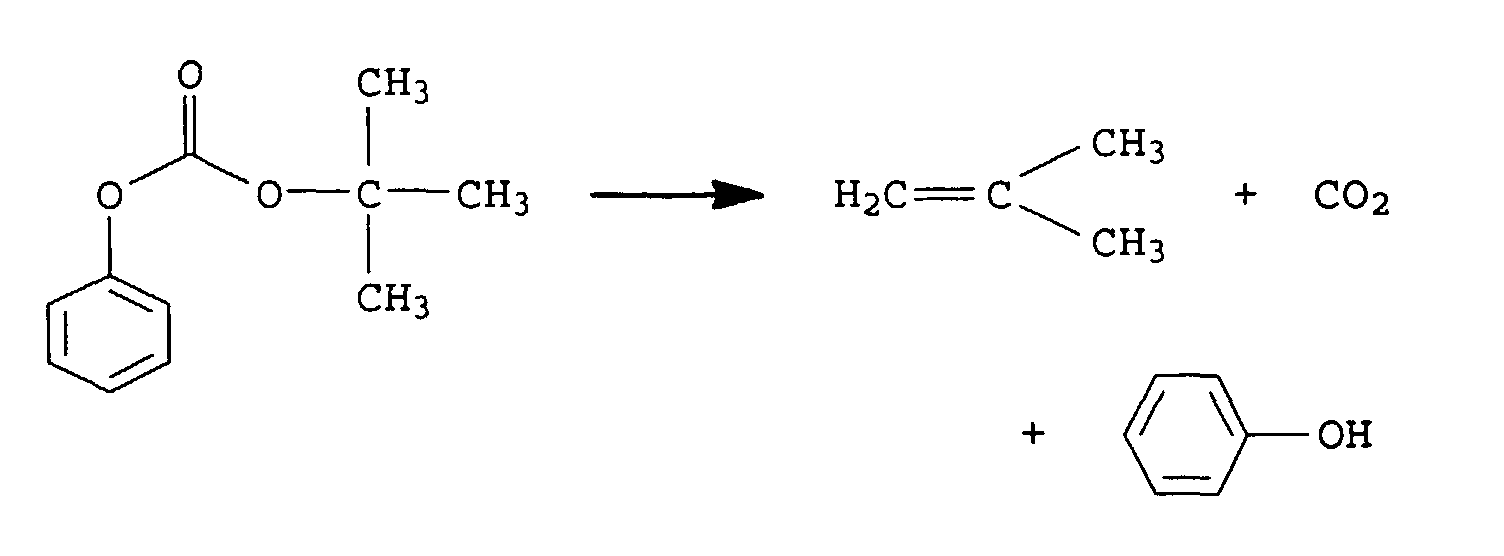
Der Zerfall ist autokatalytisch und folgt nicht dem Arrhenius-Gesetz.The decay is autocatalytic and does not follow the Arrhenius law.
Z.B. ergibt sich bei entsprechender Addition von Substituenten an
das Diels-Alder-Addukt der Formel IIIa die Verbindung
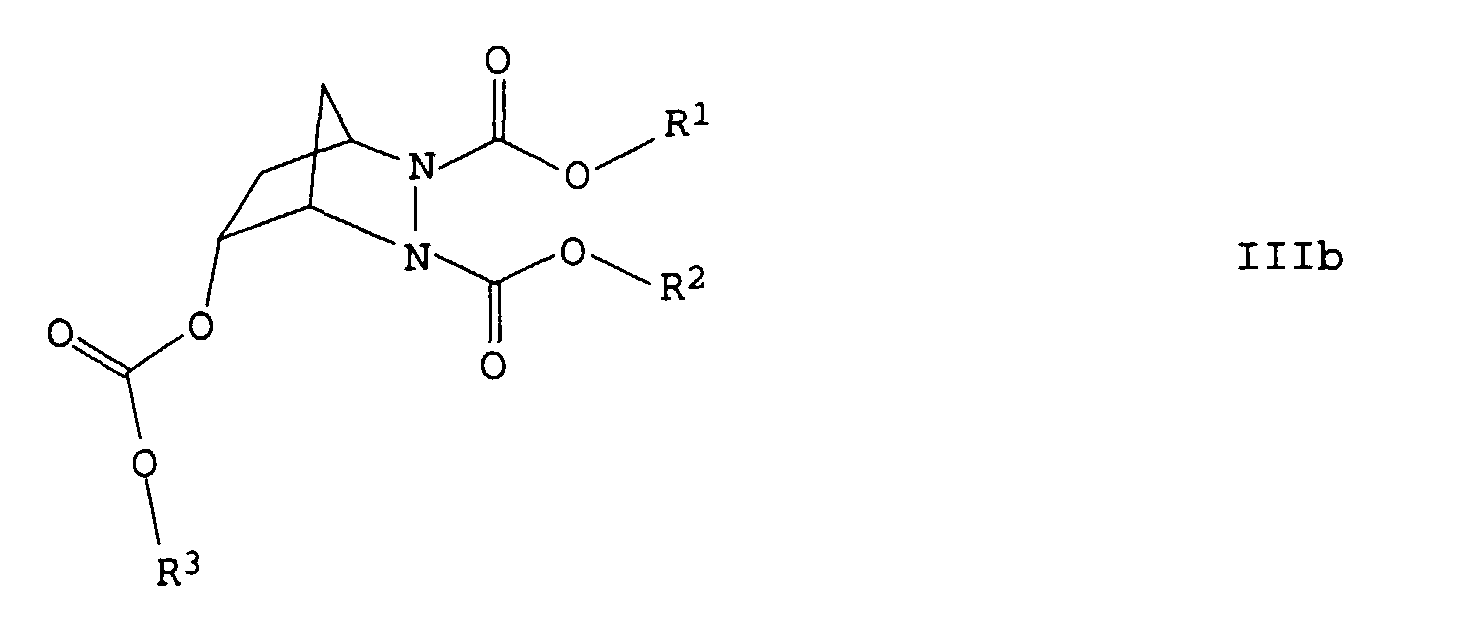
Die Verbindung der Formel IIIb zerfällt bei Temperaturerhöhung unter Abspaltung von CO2 und Phenol autokatalytisch in das Diels-Alder-Addukt der Formel IIIa und dies dann weiter in einen Retro-Diels-Alder-Reaktor in die als Initiator wirksame Azoverbindung. The compound of the formula IIIb decomposes autocatalytically into the Diels-Alder adduct of the formula IIIa when the temperature rises, with the elimination of CO 2 and phenol, and then further into a Retro-Diels-Alder reactor into the azo compound effective as an initiator.
Auf diese Weise wird erreicht, daß eine Temperaturabhängigkeit des Zerfalls des Diels-Alder Addukts unterbunden wird und der im Diels Alder Addukt enthaltende Initiator in vollem Umfang erst oberhalb der Temperatur des autokatalytischen Zerfalls wirksam wird.In this way it is achieved that a temperature dependence the disintegration of the Diels-Alder adduct is prevented and that in Initiator containing Diels Alder adduct in full effective above the temperature of the autocatalytic decay becomes.
Diels Alder Addukte, die einen entsprechenden autokatalytischen
Zerfall unterliegen sind solche, die durch mindestens eine Gruppe
der Formeln
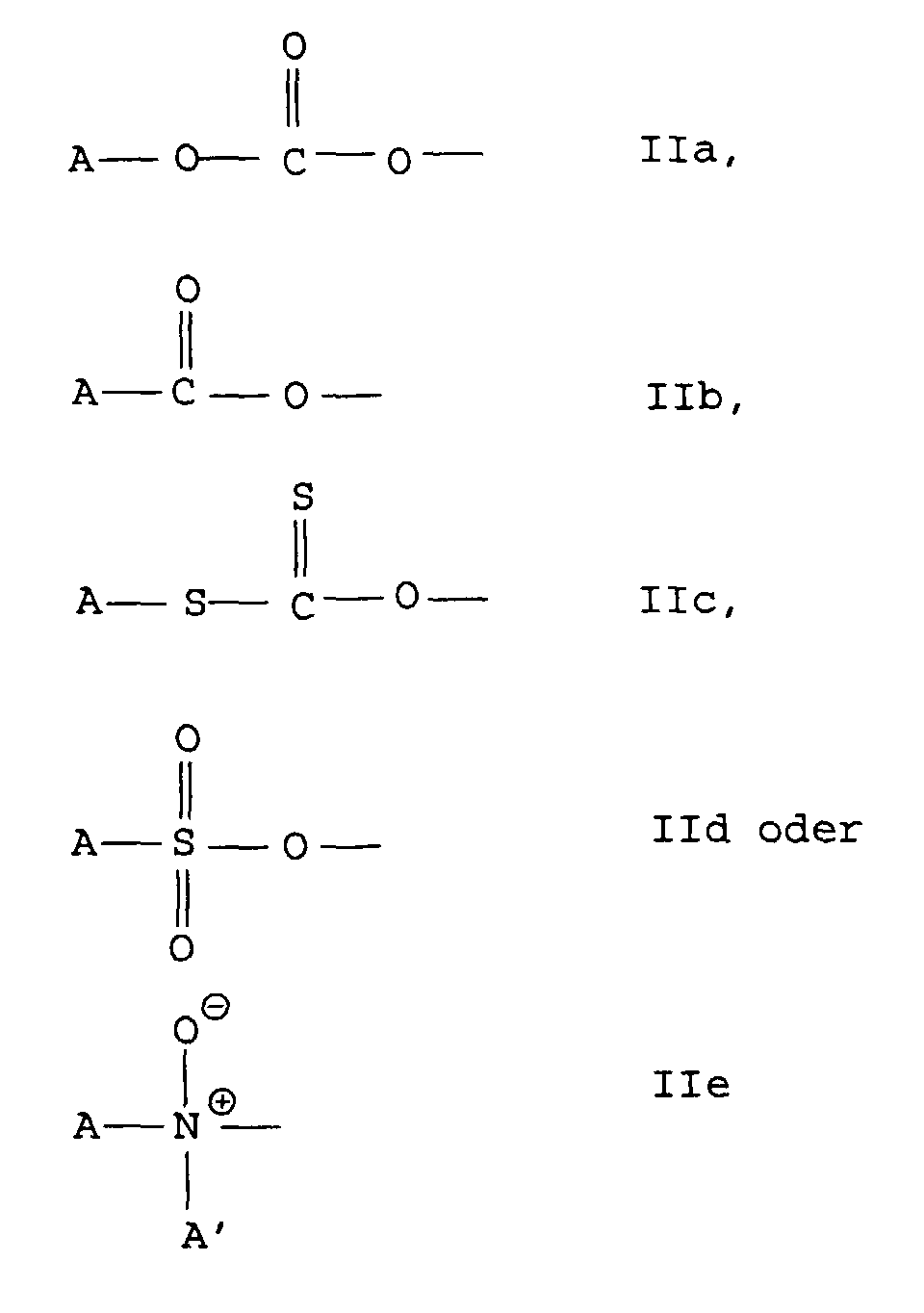
A und A' stehen in obigen Formeln unabhängig voneinander für organische Reste mit 1 bis 30 C-Atomen, vorzugsweise 2 bis 20 C-Atomen.A and A 'in the above formulas independently of one another organic radicals with 1 to 30 C atoms, preferably 2 to 20 C atoms.
Insbesondere handelt es sich um einen Rest mit einem aromatischen Ringsystem. Besonders bevorzugt handelt es sich um eine Phenylgruppe, welche gegebenenfalls noch weitere Substituenten, z.B. C1-C8 Alkylgruppen tragen kann. Ganz besonders bevorzugt ist eine Phenylgruppe. In particular, it is a residue with an aromatic ring system. It is particularly preferably a phenyl group which can optionally carry further substituents, for example C 1 -C 8 alkyl groups. A phenyl group is very particularly preferred.
Bevorzugte Substituenten sind Gruppen der Formel IIa oder IId, insbesondere Phenylcarbonat oder Phenylsulfonat.Preferred substituents are groups of the formula IIa or IId, especially phenyl carbonate or phenyl sulfonate.
Das Diels Alder Addukt enthält vorzugsweise ein oder zwei, besonders bevorzugt einen Substituenten der Formel IIa bis IIe.The Diels Alder adduct preferably contains one or two, especially preferably a substituent of the formula IIa to IIe.
Die Phenylgruppe des Phenylcarbonats bzw. Phenylsulfonats kann weitere Substituenten enthalten, insbesondere z.B. C1-C8 Alkylgruppen. Die autokatalytische Zerfallstemperatur kann dadurch variiert werden.The phenyl group of the phenyl carbonate or phenyl sulfonate can contain further substituents, in particular, for example, C 1 -C 8 alkyl groups. The autocatalytic decomposition temperature can be varied.
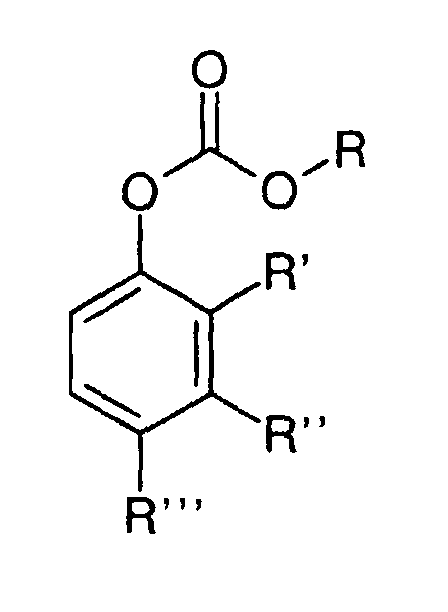
Die obigen Gruppen der Formeln IIa) bis IIe), insbesondere die
Phenylcarbonat bzw. Phenylsulfonatgruppe können an das Diels-Alder
Addukt z.B. durch übliche Additionsreaktion an die bei der
Diels-Alder-Reaktion erhaltenen Doppelbindungen gebunden werden.
Geeignet sind insbesondere auch Veresterungen der von IIa bis IIe
abgeleiteten Säuren, Säureanhydriden oder Säurechloriden mit
Hydroxygruppen enthaltenden Diels-Alder Addukten. Besonders einfach
gelingt die Anbindung der Phenylcarbonat- oder Phenylsulfonatgruppe
bzw. deren Derivate durch Umsetzung von
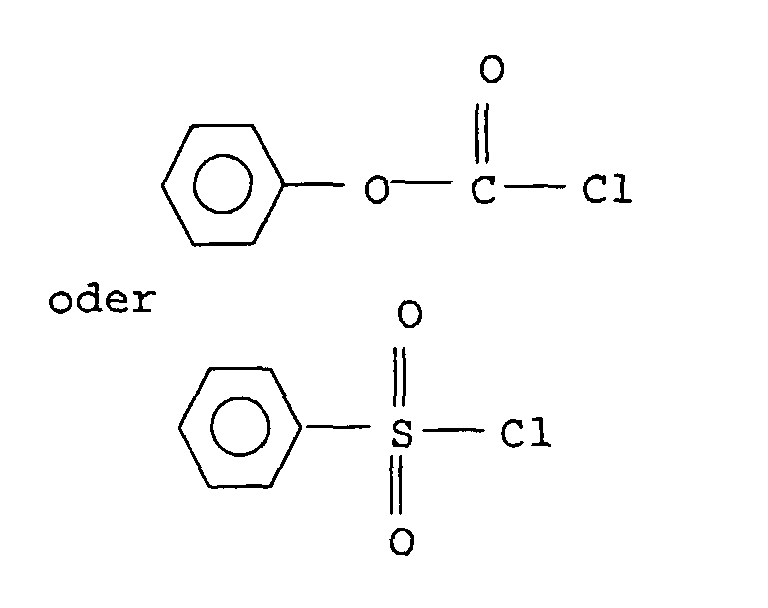
Die erfindungsgemäßen Initiatoren eignen sich als Initiatoren für die radikalischen Polymerisation. Es kann sich dabei um die Polymerisation von niedermolekularen Monomeren, z.B. Acrylaten, Vinylaromaten, Vinylestern, Vinylethern etc. handeln. In Betracht kommt auch die Vernetzung von Oligomeren und Polymeren durch radikalische Polymerisation von radikalisch polymerisierbaren, ethylenisch ungesättigten Gruppen, welche in dem Polymer bzw. Oligomer enthalten sind. Zum Beispiel können Polymere oder Oligomere Epoxidgruppen enthalten, welche mit Acrylsäure oder Hydroxyalkylacrylaten umgesetzt werden, und so der gewünschte Gehalt an Doppelbindungen eingestellt wird. Von besonderem Interesse sind die erfindungsgemäßen Initiatoren für Polymerpulver, welche durch radikalische Polymerisation vernetzt bzw. gehärtet werden.The initiators according to the invention are suitable as initiators for radical polymerization. It can be the Polymerization of low molecular weight monomers, e.g. Acrylates, Trade vinyl aromatics, vinyl esters, vinyl ethers etc. In consideration cross-linking of oligomers and polymers also occurs radical polymerization of radically polymerizable, ethylenically unsaturated groups which are present in the polymer or Oligomer are included. For example, polymers or oligomers Contain epoxy groups, which with acrylic acid or hydroxyalkyl acrylates be implemented, and so the desired salary is set on double bonds. Of special interest are the initiators for polymer powder according to the invention, which can be crosslinked or hardened by radical polymerization.
Der Gehalt der erfindungsgemäßen Initiatoren beträgt im allgemeinen 0,05 bis 10 Gew.-Teile, insbesondere 0,1 bis 5 Gew.-Teile, bezogen auf 100 Gew.-Teile der insgesamt vorhandenen radikalisch polymerisierbaren Monomeren und/oder radikalisch vernetzbaren Oligomere oder Polymere.The content of the initiators according to the invention is general 0.05 to 10 parts by weight, in particular 0.1 to 5 parts by weight, based on 100 parts by weight of the total radical polymerizable monomers and / or radical crosslinkable oligomers or polymers.
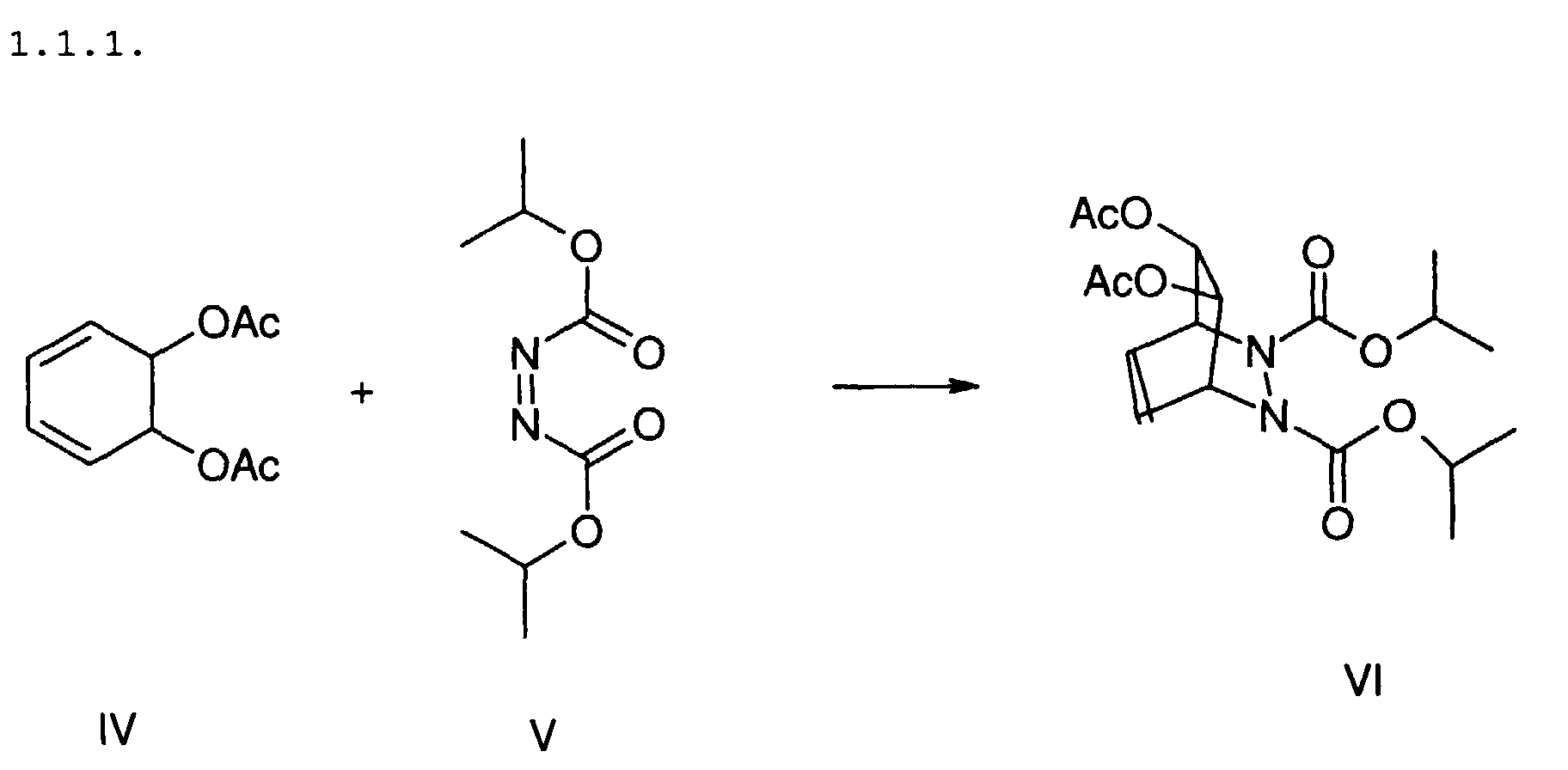
7,7 g IV und 7,9 g V werden in 400 ml Cyclohexan gelöst und 20
Stunden bei 50 °C mit UV-Licht bestrahlt. Nach der Reaktion wird
das Lösungsmittel abdestilliert und das Rohprodukt
chromatographisch gereinigt. Ausbeute: 6,2 g VI.
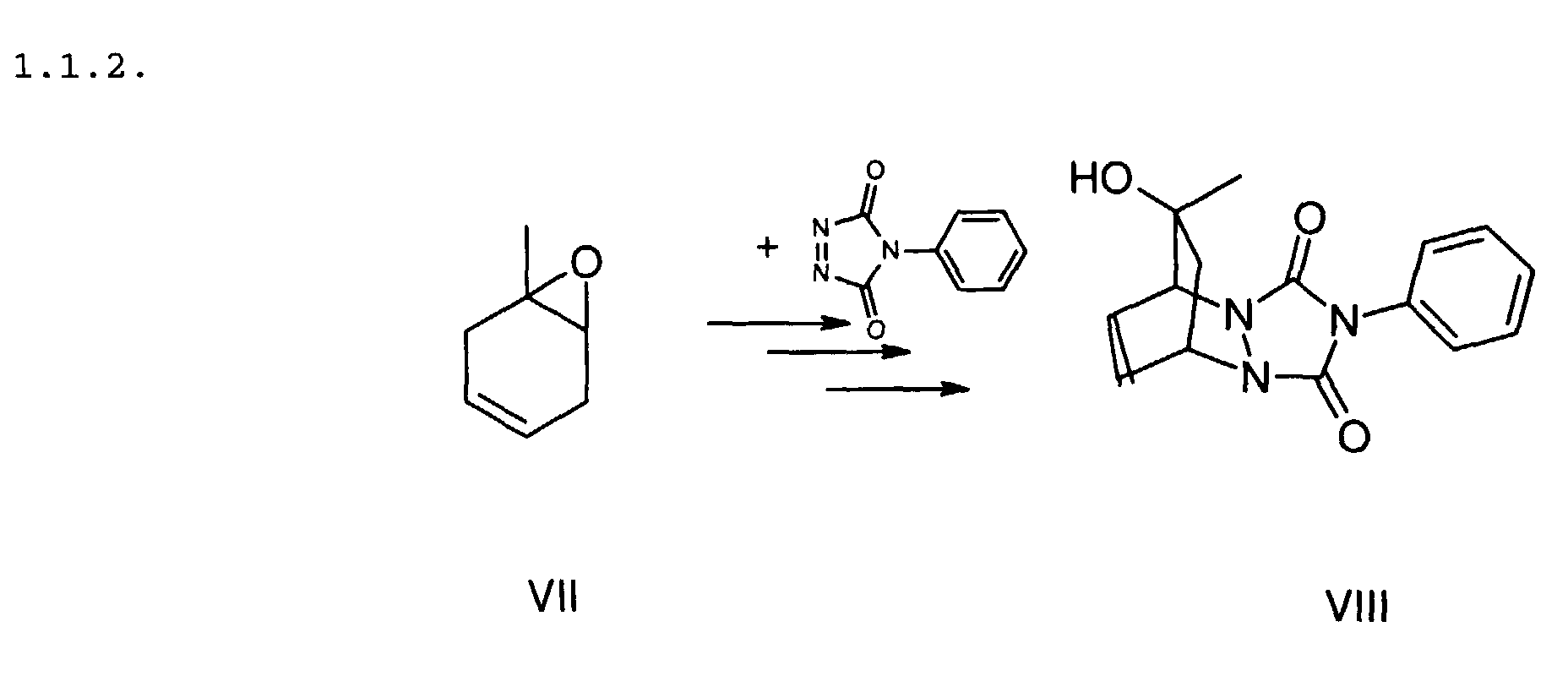
2,2 g VII werden in Diethylether gelöst und bei 0 °C zu einer 1,4 molaren Lösung von Methyllithium in Diethylether getropft, eine Stunde bei Raumtemperatur gerührt und 10 ml einer 5%igen Natriumhydroxid-Lösung zugegeben. Die organische Phase wird mit gesättigter Kochsalziösung gewaschen und 4-Phenylurazol zugesetzt.2.2 g VII are dissolved in diethyl ether and at 0 ° C to a 1.4 molar solution of methyl lithium dropped into diethyl ether, a Stirred for one hour at room temperature and 10 ml of a 5% sodium hydroxide solution admitted. The organic phase is with saturated saline and 4-phenylurazole added.
Das Lösungsmittel wird abdestilliert und das Zwischenprodukt
chromatographisch gereinigt. Man erhält 1,6 g eines weißen Feststoffes.
3,27 g Chromtrioxid werden in 80 ml Methylenchlorid gelöst und
5,2 g Pyridin unter Eiskühlung zugesetzt. Zu dieser Lösung wird
der oben erwähnte weiße Feststoff, gelöst in 10 ml Methylenchlorid,
bei 0 °C zugetropft. Der Ansatz wird 1 Stunde bei Raumtemperatur
gerührt, und dekantiert. Die Lösung wird gewaschen,
getrocknet und eingeengt. Das Rohprodukt wird chromatographisch
und durch Umkristallisation gereinigt. Ausbeute: 165 mg VIII
(weiße Kristalle).
3.27 g of chromium trioxide are dissolved in 80 ml of methylene chloride and 5.2 g of pyridine are added with ice cooling. The above-mentioned white solid, dissolved in 10 ml of methylene chloride, is added dropwise to this solution at 0.degree. The mixture is stirred at room temperature for 1 hour and decanted. The solution is washed, dried and concentrated. The crude product is purified by chromatography and by recrystallization. Yield: 165 mg VIII (white crystals).
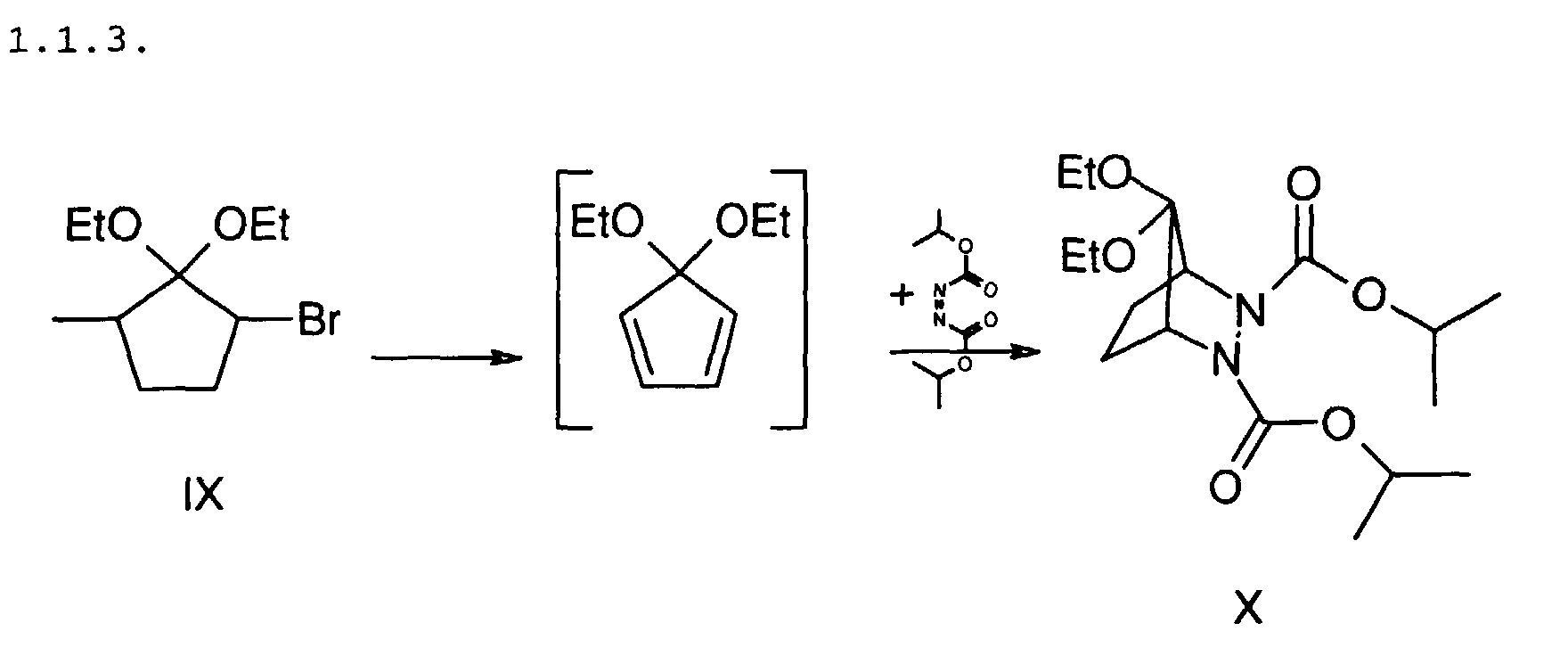
8,9 g IX werden in 25 ml Dimethylsulfoxid gelöst und bei 17 °C zu
einer Lösung von 12,84 g Kalium-t-butylat in 75 ml Dimethylsulfoxid
getropft. 100 ml kaltes Pentan werden zugegeben und die
Mischung in 100 ml Eis gegossen. Die organische Phase wird
abgetrennt, bei 0 °C gehalten und innerhalb einer Stunde zu einer
Lösung von 23,24 g Diisopropylazodicarboxylat in 30 ml Diethylether
getropft. Die Lösung wird anschließend 2,5 h zum Sieden
erhitzt.
Die flüchtigen Bestandteile werden abdestilliert und das
erhaltene gelbe Öl in n-Hexan gelöst und im Kühlschrank
aufbewahrt. Über Nacht fallen 1,18 g X (weiße Kristalle) aus.

The volatile constituents are distilled off and the yellow oil obtained is dissolved in n-hexane and stored in the refrigerator. 1.18 g of X (white crystals) precipitate out overnight.
200 mg XI und 200 mg Diisopropylazodicarboxylat werden in Benzol
gelöst und die Lösung 24 h zum Sieden erhitzt. Das Lösungsmittel
wird abdestilliert und das Rohprodukt chromatographisch
gereinigt. Ausbeute: 220 mg XII (farbloses Öl).
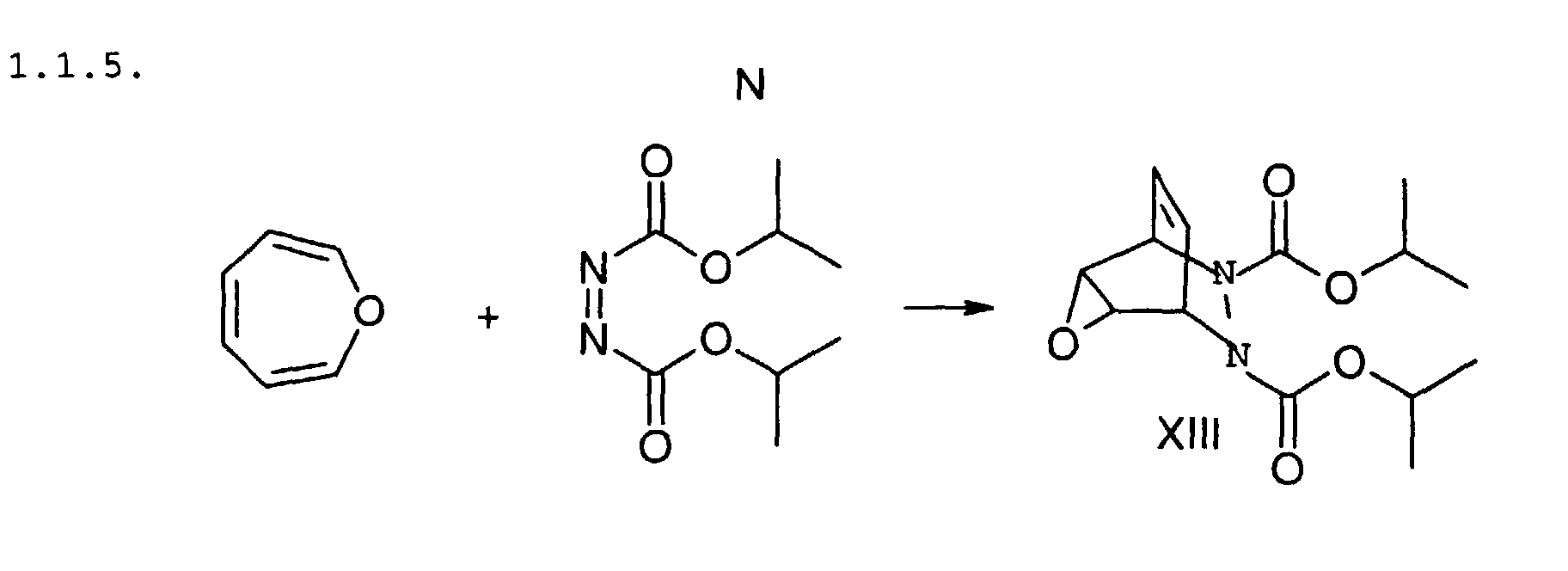
577 mg Oxepin werden in 10 ml Chloroform gelöst und 1210 mg
Diisopropylazodicarboxylat, gelöst in 4 ml Chloroform, innerhalb
von 30 min zugegeben. Der Ansatz wird 21 h bei Raumtemperatur
gerührt. Die flüchtigen Bestandteile werden abdestilliert und der
Rückstand umkristallisiert. Ausbeute: 1466 mg XIII (weiße
Kristalle).

560 mg XIV werden in 6 ml Chloroform gelöst und 1070 mg Diisopropyldiazocarboxylat,
gelöst in 2 ml Chloroform, zugegeben. Der
Ansatz wird 24 h bei Raumtemperatur gerührt. Die flüchtigen Bestandteile
werden abdestilliert und der Rückstand chromatographisch
gereinigt. Ausbeute: 710 mg XV (farbloses Öl)
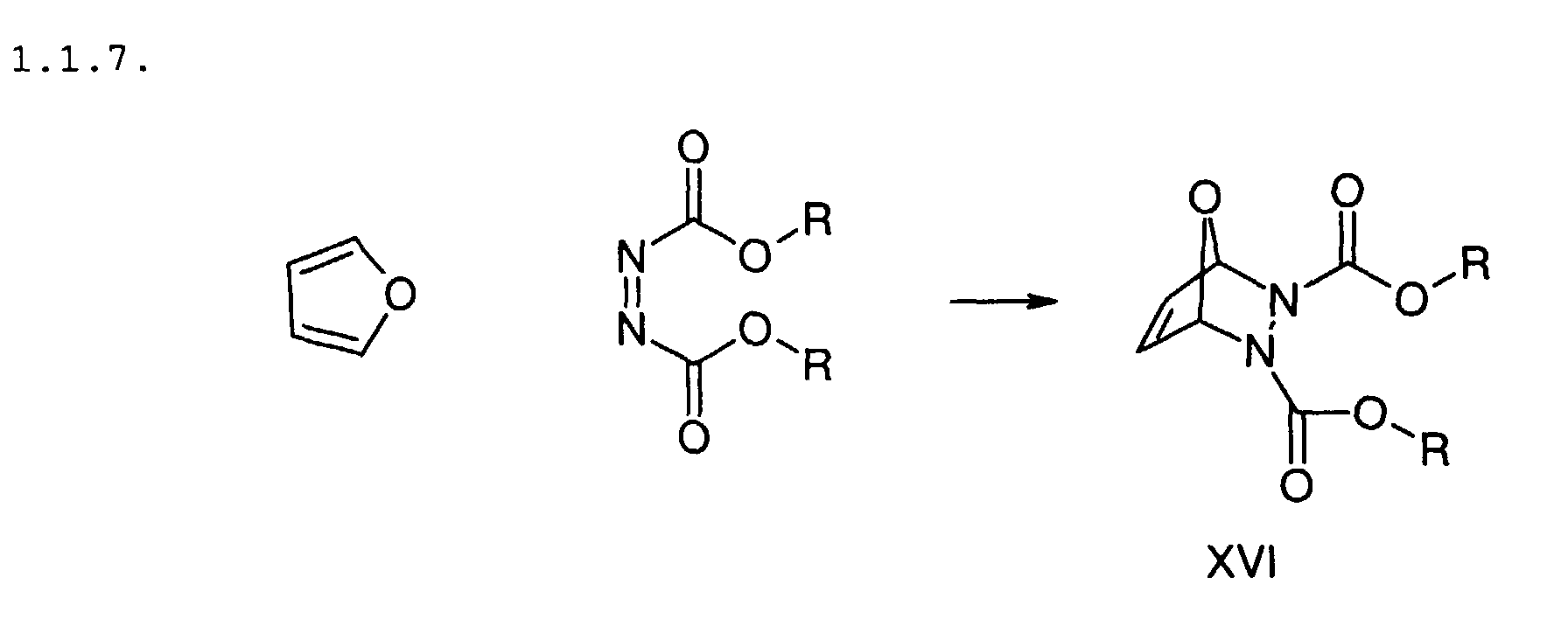
13,7 mmol des entsprechenden Dialkylazodicarboxylates werden in
10 ml Furan gelöst und 20 h bei Raumtemperatur gerührt. Nach
Abdestillieren der flüchtigen Bestandteile bleibt das Produkt XVI
(Öl) zurück.
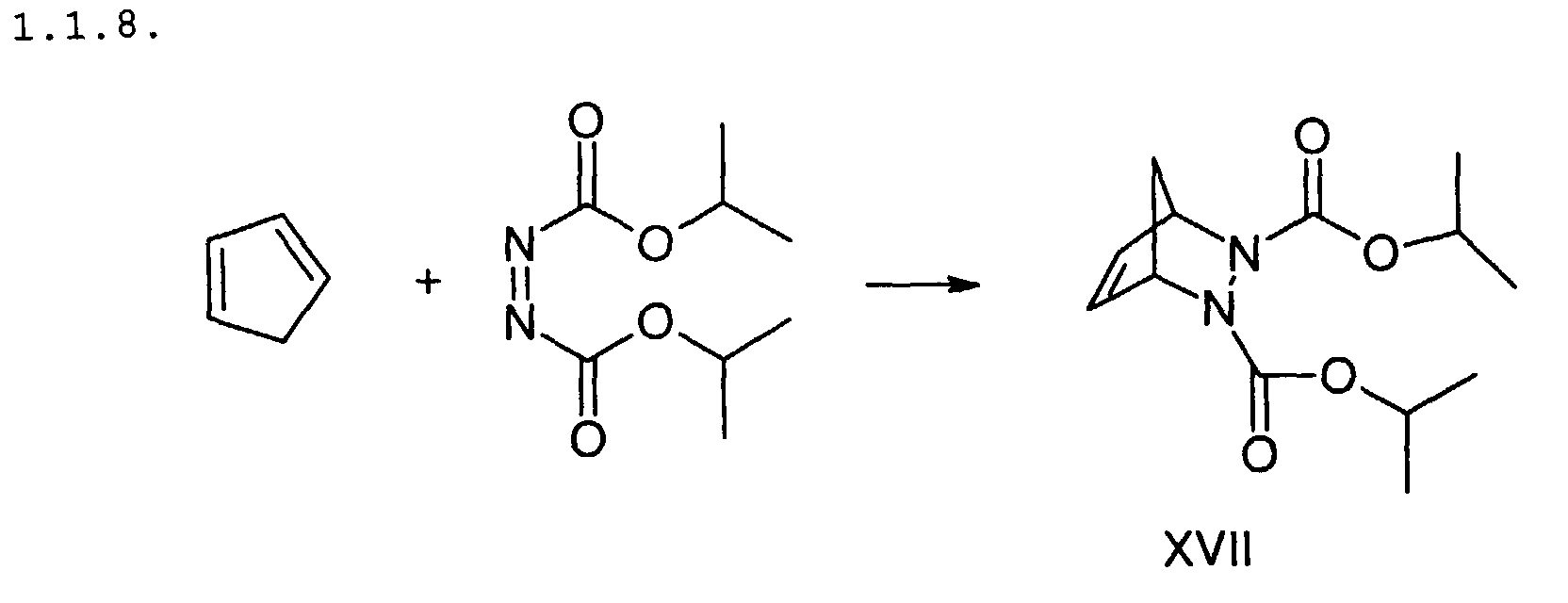
Zu 3,22 g eiskaltem Diisopropylazodicarboxylat wird Cyclopentadien
getropft bis sich die Reaktionsiösung entfärbt hat. Die
flüchtigen Bestandteile werden abdestilliert und der Rückstand
chromatographisch gereinigt. Man erhält XVII als farbloses Öl.
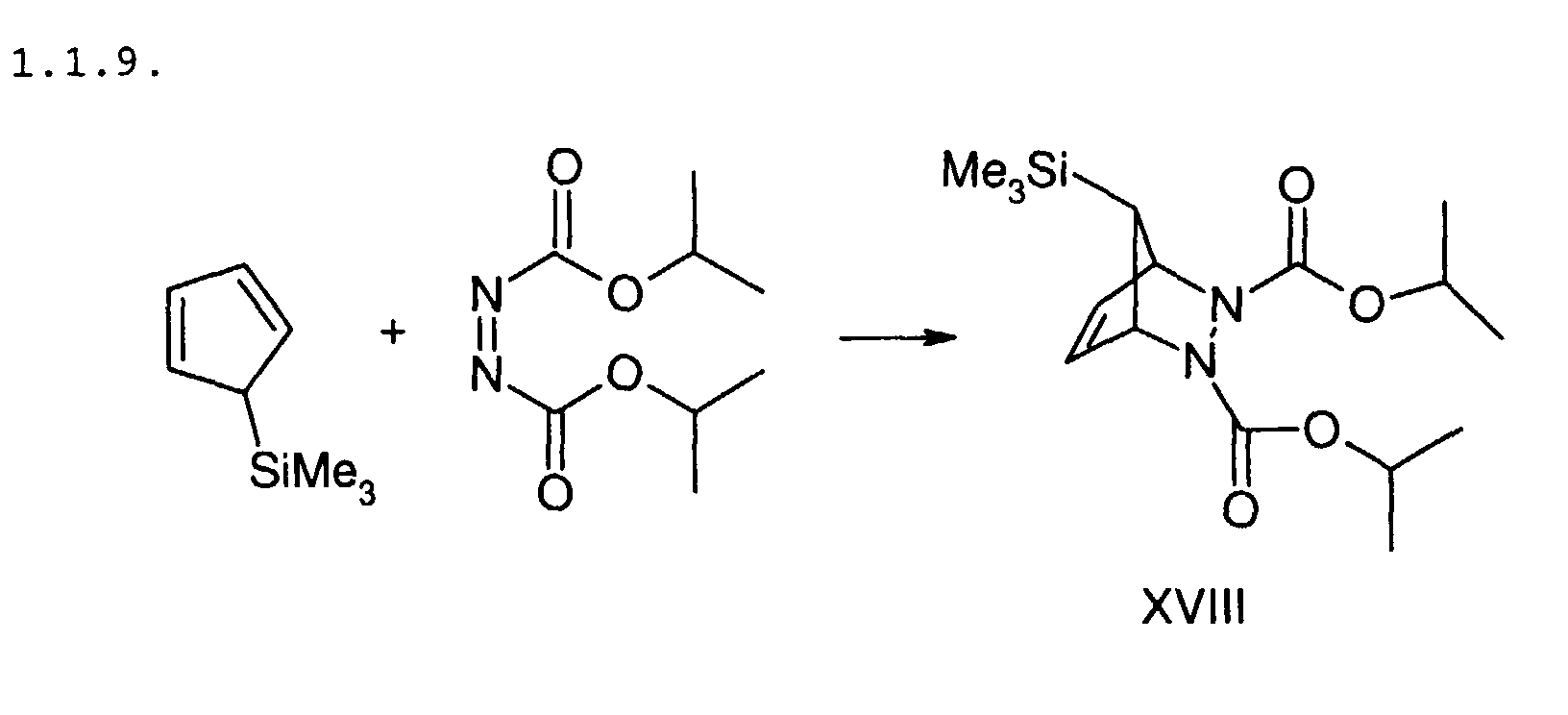
7,8 ml Trimethylsilylcyclopentadien und 6,71 g Diisopropylazodicarboxylat werden in Tetrahydrofuran gelöst und 18 h bei Rauintemperatur gerührt. Die flüchtigen Bestandteile werden abdestilliert und der Rückstand chromatographisch gereinigt. Ausbeute: 3,51 g XVIII (farbloses Öl). 7.8 ml of trimethylsilylcyclopentadiene and 6.71 g of diisopropylazodicarboxylate are dissolved in tetrahydrofuran and 18 h at room temperature touched. The volatile constituents are distilled off and the residue was purified by chromatography. Yield: 3.51 g XVIII (colorless oil).
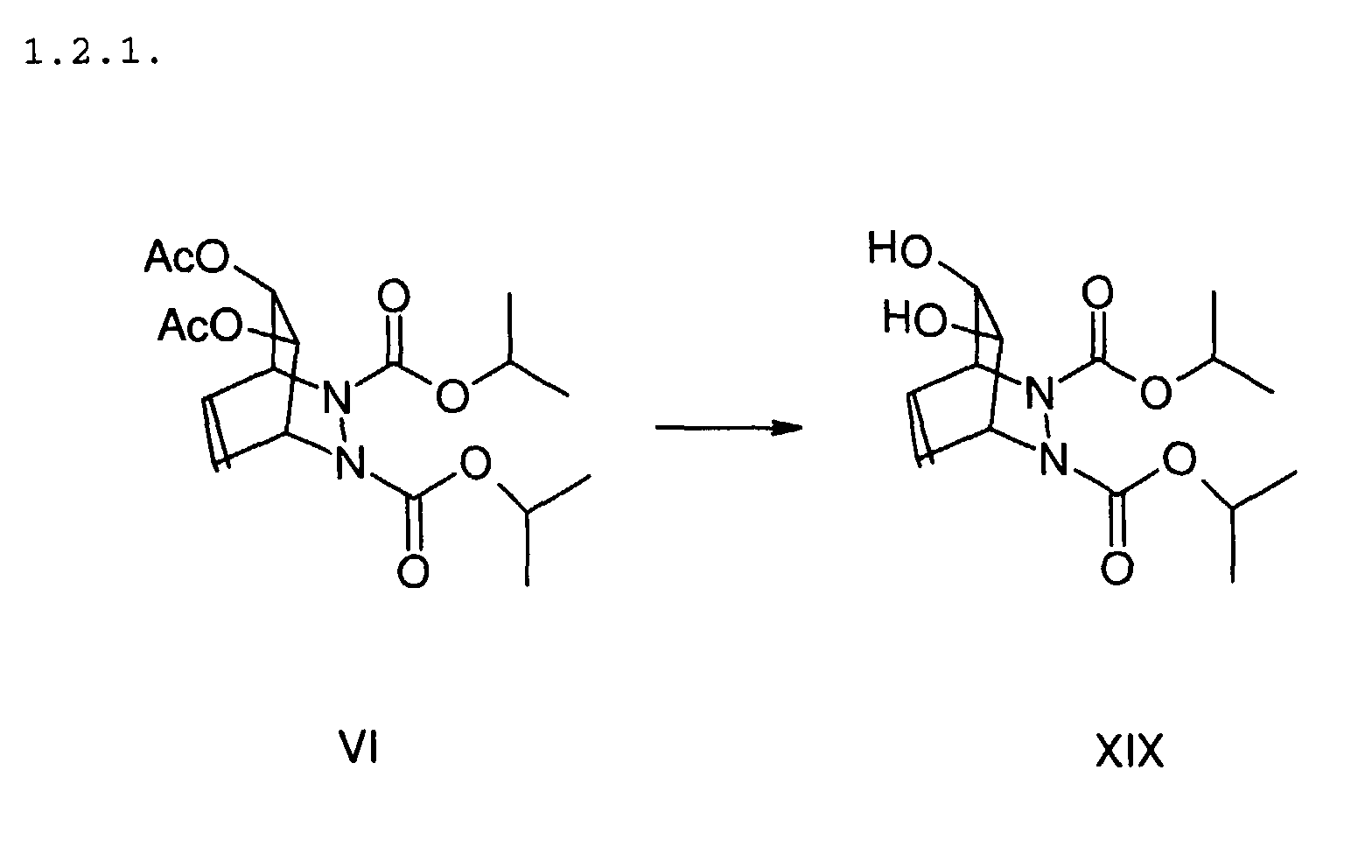
220 mg VI werden in 10 ml Diethylether gelöst und 51 mg Methanol
sowie 35 mg Lithiumborhydrid zugegeben. Der Ansatz wird 2,5 h zum
Sieden erhitzt, neutralisiert und extrahiert. Die organische
Phase wird eingeengt und das erhaltene Öl chromatographisch
gereinigt. Ausbeute: 36 mg XIX (farbloses Öl).

220 mg XII werden in 10 ml Methanol gelöst und eine Spatelspitze
Amberlyst® 15 zugesetzt. Der Ansatz wird 24 h auf 70 °C erwärmt.
Man erhält XX.

4,07 g XVII werden in 12 ml Tetrahydrofuran gelöst, auf 0 °C
gekühlt, und 9,4 ml einer 1M Boran-Lösung zugegeben. Die Lösung
wird 1 h unter Kühlung und 2 h bei Raumtemperatur gerührt. 2,8 ml
3M Natronlauge und 2 ml 30% Wasserstoffperoxyd werden zugesetzt
und die Lösung 30 min bei 0 °C und 1 h bei Raumtemperatur gerührt.
Die Lösung wird in Essigsäureethylester aufgenommen und mit
gesättigter Kochsalzlösung gewaschen. Die organische Phase wird
eingeengt und das Rohprodukt chromatographisch gereinigt.
Ausbeute: 2,87 g XXI (farbloses Öl, kristallisiert nach einigen
Tagen bei Raumtemperatur).

2,173 g XXI werden in 20 ml Methylenchlorid gelöst und 4,436 g
Pyridiniumdichromat, 8 g Molekularsieb sowie 0,8 ml Essigsäure
zugegeben. Der Ansatz wird 24 h gerührt und das Filtrat
eingeengt. Der Rückstand wird in Diethylether aufgenommen,
gewaschen und eingeengt. Das Rohprodukt wird chromatographisch
gereinigt. Ausbeute: 0,869 g XXII (farbloses Öl, kristallisiert
nach einigen Tagen bei Raumtemperatur).

0,106 g XXII werden in 9 ml Tetrahydrofuran gelöst und 0,3 ml
einer 3 M Methylmagnesiumchlorid - Lösung zugesetzt. Der Ansatz
wird 2 h gerührt, mit Eis versetzt und die flüchtigen
Bestandteile abdestilliert. Der Rückstand wird chromatographisch
gereinigt. Ausbeute: 0,02 g XXIII (farbloses Öl).

0,116 g XXII werden in 10 ml Tetrahydrofuran gelöst, auf -78 °C gekühlt und 0,465 ml einer 1M Phenylmagnesiumbromid - Lösung zugesetzt. Die Lösung wird 2 h bei -78 °C gerührt. Nach der Zugabe von Eis und Essigsäureethylester wird die organische Phase gewaschen und eingeengt. Das Rohprodukt wird chromatographisch gereinigt. Ausbeute: 0,082 g XXIV (gelbliches Öl). 0.116 g XXII are dissolved in 10 ml of tetrahydrofuran at -78 ° C cooled and 0.465 ml of a 1M phenylmagnesium bromide solution added. The solution is stirred at -78 ° C for 2 h. After the encore of ice and ethyl acetate becomes the organic phase washed and concentrated. The crude product is chromatographed cleaned. Yield: 0.082 g XXIV (yellowish oil).
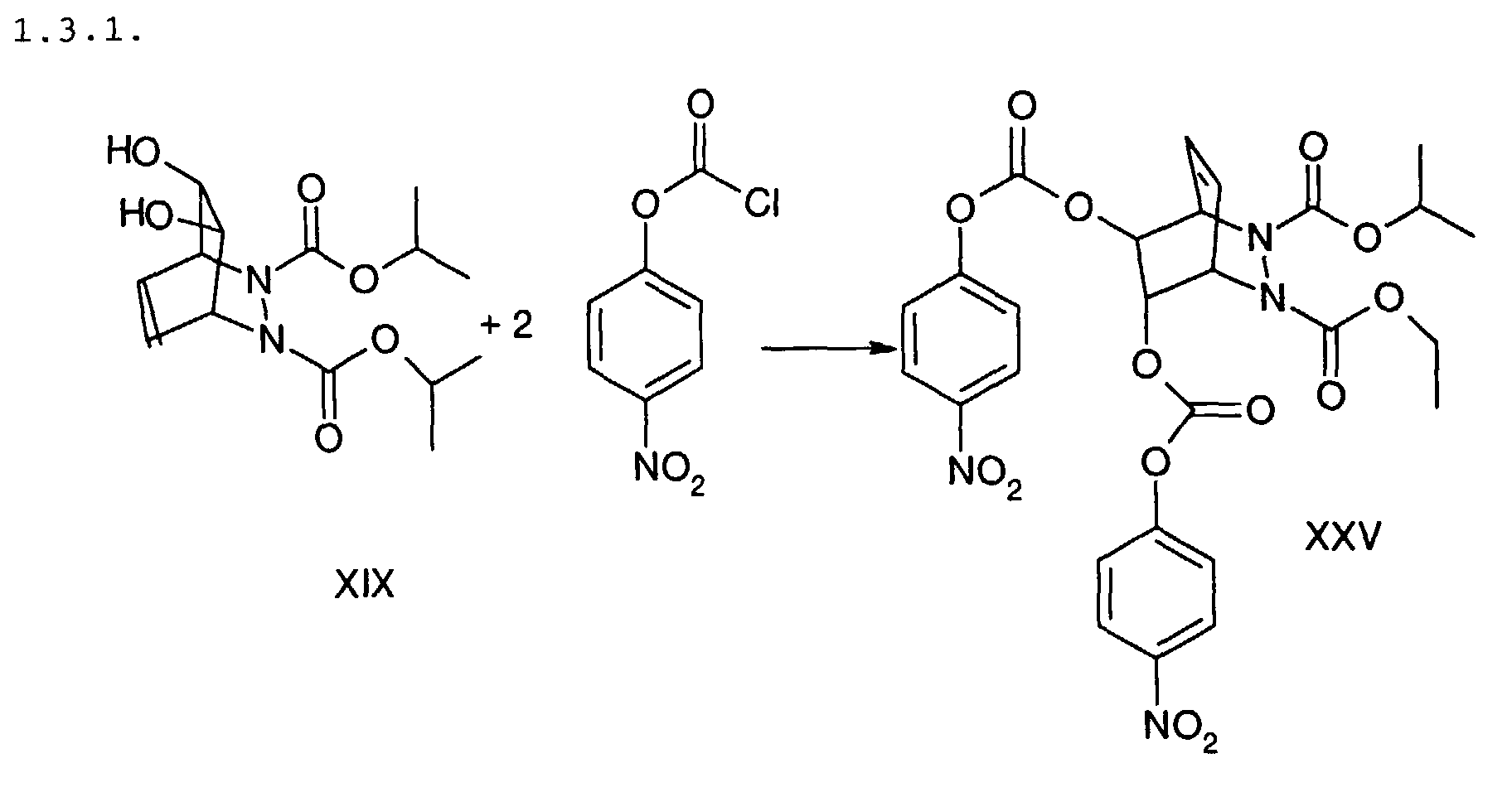
36 mg XIX werden in 2 ml Tetrahydrofuran gelöst und 0,03 ml
Pyridin zugesetzt. 46,4 mg p-Nitrophenylchlorformiat werden bei
0 °C zugegeben und die Lösung bei Raumtemperatur 17 h gerührt.
Nach Zugabe von je 1 ml Wasser und Diethylether wird die
organische Phase abgetrennt, gewaschen und eingeengt. Das
Rohprodukt wird chromatographisch gereinigt. Man erhält XXV.

700 mg XIX werden in 10 ml Pyridin gelöst und 425,4 mg p-Toluolsulfonsäurechlorid
bei 0°C zugegeben. Die Lösung wird 2 d im Kühlschrank
aufbewahrt, dann in 40 ml salzsaures Eis gegossen. Die
organische Phase wird eingeengt und das Produkt im Hochvakuum getrocknet.
Ausbeute: 720 mg XXVI (weißer Feststoff).
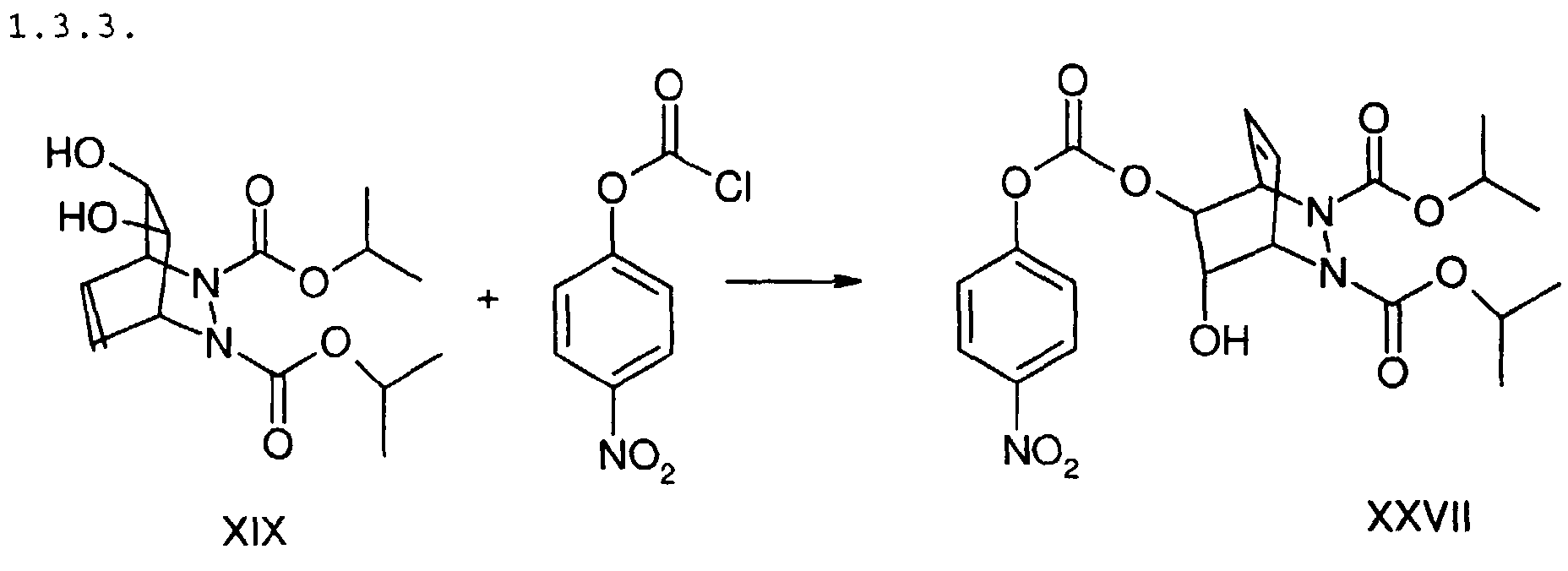
100 mg XIX werden in 20 ml Tetrahydrofuran gelöst und 0,042 ml
Pyridin zugegeben. 63,5 mg p-Nitrophenylchlorformiat, gelöst in 6
ml Tetrahydrofuran, werden bei 0 °C innerhalb von 50 min
zugetropft. Die Lösung wird 4,5 d im Kühlschrank aufbewahrt, dann
je 3 ml Wasser und Diethylether zugegeben. Die organische Phase
wird gewaschen und eingeengt. Das Rohprodukt wird chromatographisch
gereinigt. Ausbeute: 70 mg XXVII.
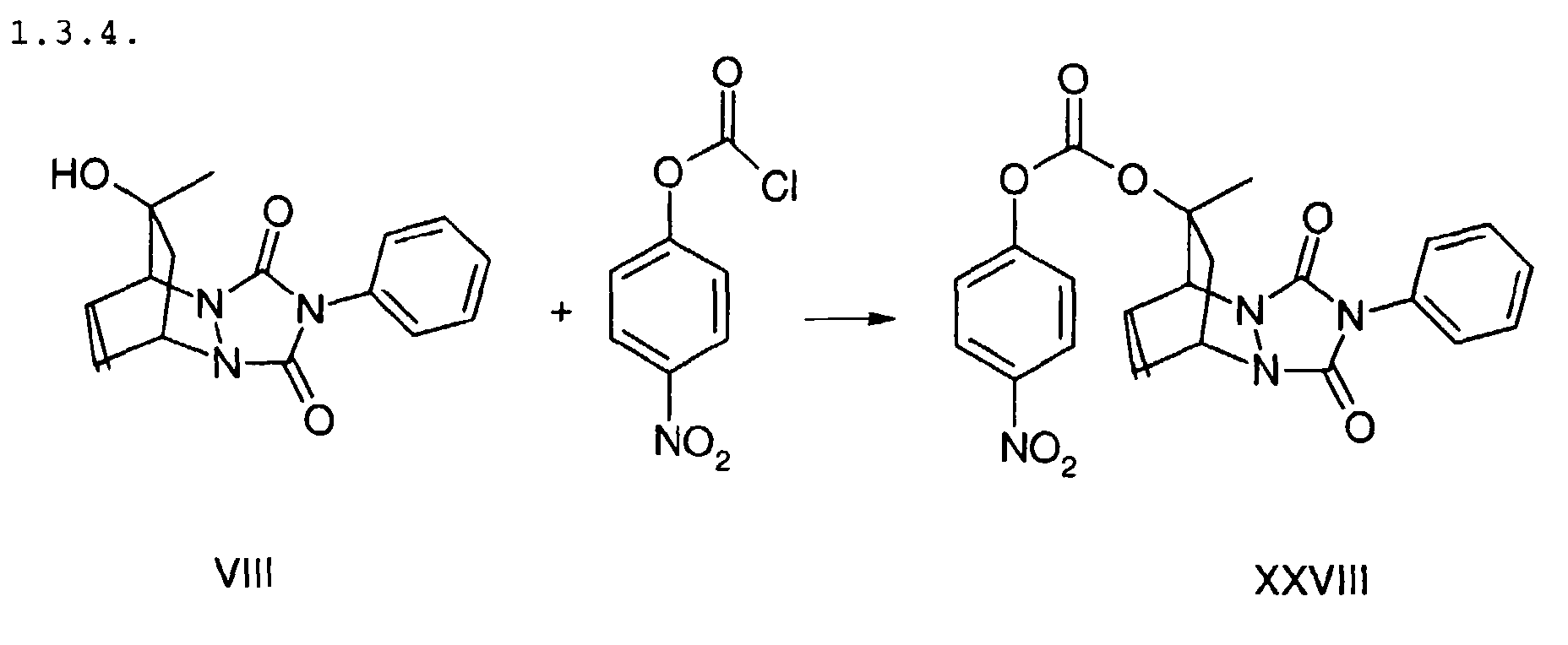
165 mg VIII werden in 7 ml Tetrahydrofuran gelöst und 0,1 ml
Pyridin zugegeben. 121 mg p-Nitrophenylchlorformiat, gelöst in 3
ml Tetrahydrofuran, werden bei 0 °C zugesetzt und die Lösung bei
0°C 1,5 h, bei Raumtemperatur 17 h gerührt. Nach Zugabe von 10 ml
Diethylether und 5 ml Wasser wird die organische Phase gewaschen
und eingeengt. Das Rohprodukt wird durch Umkristallisation
gereinigt. Ausbeute: 105 mg XXVIII (weißer Feststoff).

XXI wird im angegebenen Lösungsmittel gelöst und mit einem
leichten Überschuß des entsprechenden Reaktanden versetzt. Man
läßt bei Raumtemperatur rühren, destilliert die flüchtigen
Bestandteile ab und reinigt das Rohprodukt chromatographisch.
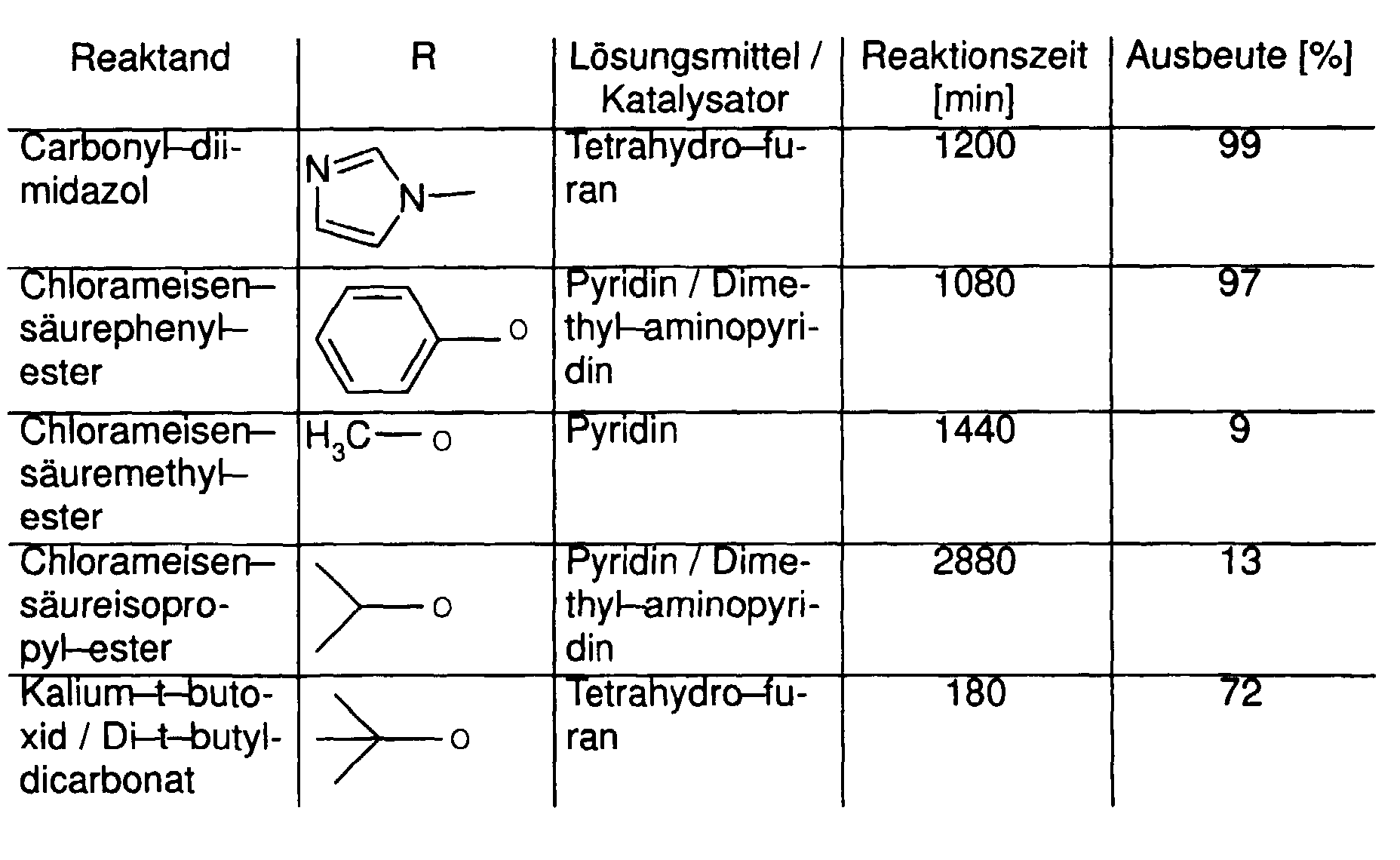
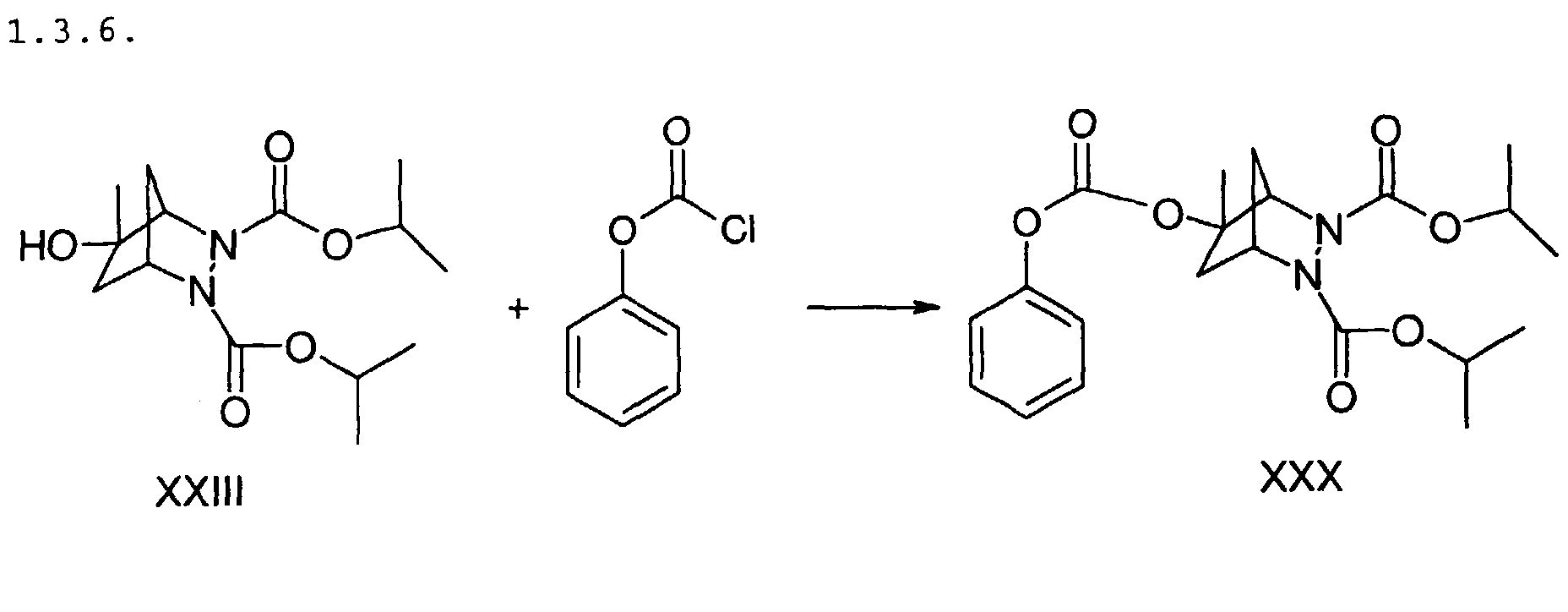
14,5 mg XXIII werden in 2,5 ml Methylenchlorid gelöst und nacheinander 13,1 mg Dimethylaminopyridin und 0,035 ml Chlorameisensäurephenylester zugesetzt. Der Ansatz wird 42 h bei Raumtemperatur gerührt. Die flüchtigen Bestandteile werden abdestilliert und das Rohprodukt chromatographisch gereinigt. Ausbeute: 15 mg XXX (farbloses Öl).14.5 mg XXIII are dissolved in 2.5 ml methylene chloride and successively 13.1 mg dimethylaminopyridine and 0.035 ml Phenyl chloroformate added. The batch becomes 42 h at Room temperature stirred. The volatile components are distilled off and the crude product purified by chromatography. Yield: 15 mg XXX (colorless oil).
Benzylmethacrylat wurde in einem Glasrohr unter Vakuum entgast, versiegelt und in einem Ölbad 1 Stunde lang auf 150 °C erhitzt. Danach war die Viskosität nur leicht angestiegen.Benzyl methacrylate was degassed in a glass tube under vacuum, sealed and heated in an oil bath at 150 ° C for 1 hour. After that, the viscosity had risen only slightly.
Benzylmethacrylat und 5 Gew.-% XVII, bezogen auf Benzylmethacrylat, wurden in einem Glasrohr unter Vakuum entgast, versiegelt und in einem Ölbad 1 Stunde lang auf 150 °C erhitzt. Danach war der Ansatz nicht mehr fließfähig.Benzyl methacrylate and 5% by weight XVII, based on benzyl methacrylate, were degassed in a glass tube under vacuum, sealed and heated in an oil bath at 150 ° C for 1 hour. After that the approach was no longer fluid.
n-Butylacrylat und 0,42 Gew.-% XVII, bezogen auf n-Butylacrylat, wurden in einem Glasrohr unter Vakuum entgast, versiegelt und in einem Ölbad 1 Stunde lang auf 145 °C erhitzt. Danach war der Ansatz hochviskos. n-butyl acrylate and 0.42% by weight XVII, based on n-butyl acrylate, were degassed in a glass tube under vacuum, sealed and in heated to 145 ° C for 1 hour in an oil bath. After that was the High viscosity approach.
Claims (5)


Applications Claiming Priority (2)
| Application Number | Priority Date | Filing Date | Title |
|---|---|---|---|
| US80239 | 1987-07-27 | ||
| US09/080,239 US6177379B1 (en) | 1998-05-18 | 1998-05-18 | Initiators for radical polymerization |
Publications (1)
| Publication Number | Publication Date |
|---|---|
| EP0959080A1 true EP0959080A1 (en) | 1999-11-24 |
Family
ID=22156114
Family Applications (1)
| Application Number | Title | Priority Date | Filing Date |
|---|---|---|---|
| EP99107085A Withdrawn EP0959080A1 (en) | 1998-05-18 | 1999-04-12 | Initiators for radical polymerisation |
Country Status (3)
| Country | Link |
|---|---|
| US (3) | US6177379B1 (en) |
| EP (1) | EP0959080A1 (en) |
| JP (1) | JPH11349616A (en) |
Families Citing this family (3)
| Publication number | Priority date | Publication date | Assignee | Title |
|---|---|---|---|---|
| US8765217B2 (en) | 2008-11-04 | 2014-07-01 | Entrotech, Inc. | Method for continuous production of (meth)acrylate syrup and adhesives therefrom |
| US20100113692A1 (en) * | 2008-11-04 | 2010-05-06 | Mcguire Jr James E | Apparatus for Continuous Production of Partially Polymerized Compositions |
| US8329079B2 (en) * | 2009-04-20 | 2012-12-11 | Entrochem, Inc. | Method and apparatus for continuous production of partially polymerized compositions and polymers therefrom |
Citations (2)
| Publication number | Priority date | Publication date | Assignee | Title |
|---|---|---|---|---|
| DE4207558A1 (en) * | 1992-03-10 | 1993-09-16 | Herberts Gmbh | Furan-terminated telechel(s) for copolymerisation, crosslinking, etc. - by polymerising ethylenically-unsatd. monomers in presence of corresp. furan-terminated azo initiators |
| WO1997031901A1 (en) * | 1996-02-29 | 1997-09-04 | Mikael Bols | Hydroxyhexahydropyridazines |
Family Cites Families (6)
| Publication number | Priority date | Publication date | Assignee | Title |
|---|---|---|---|---|
| DE1301086B (en) * | 1964-08-04 | 1969-08-14 | Huels Chemische Werke Ag | Process for the copolymerization of ethylene with other alpha-olefins or of ethylene and / or other alpha-olefins with diolefins |
| US3773727A (en) * | 1972-03-31 | 1973-11-20 | Borg Warner | Process for preparing maleic anhydrideconjugated diene copolymers |
| US4481356A (en) * | 1980-07-31 | 1984-11-06 | The Upjohn Company | Diene adducts with triazoline diones |
| EP0077211B1 (en) * | 1981-10-12 | 1989-04-05 | Wako Pure Chemical Industries, Ltd. | Process for producing aqueous suspension containing organic azo compound as polymerization initiator |
| US4504640A (en) * | 1982-05-19 | 1985-03-12 | Nitto Boseki Co., Ltd. | Process for producing monoallylamine polymer |
| JPH0215082A (en) * | 1988-07-04 | 1990-01-18 | Nippon Tokushu Noyaku Seizo Kk | Novel heterocyclic compound and herbicide |
-
1998
- 1998-05-18 US US09/080,239 patent/US6177379B1/en not_active Expired - Fee Related
-
1999
- 1999-04-12 EP EP99107085A patent/EP0959080A1/en not_active Withdrawn
- 1999-05-14 JP JP11134362A patent/JPH11349616A/en not_active Withdrawn
- 1999-12-27 US US09/472,200 patent/US6172170B1/en not_active Expired - Fee Related
-
2000
- 2000-10-03 US US09/677,889 patent/US6288185B1/en not_active Expired - Fee Related
Patent Citations (2)
| Publication number | Priority date | Publication date | Assignee | Title |
|---|---|---|---|---|
| DE4207558A1 (en) * | 1992-03-10 | 1993-09-16 | Herberts Gmbh | Furan-terminated telechel(s) for copolymerisation, crosslinking, etc. - by polymerising ethylenically-unsatd. monomers in presence of corresp. furan-terminated azo initiators |
| WO1997031901A1 (en) * | 1996-02-29 | 1997-09-04 | Mikael Bols | Hydroxyhexahydropyridazines |
Also Published As
| Publication number | Publication date |
|---|---|
| US6288185B1 (en) | 2001-09-11 |
| US6177379B1 (en) | 2001-01-23 |
| JPH11349616A (en) | 1999-12-21 |
| US6172170B1 (en) | 2001-01-09 |
Similar Documents
| Publication | Publication Date | Title |
|---|---|---|
| DE3024368C2 (en) | Coating composition based on an aqueous medium | |
| CH420117A (en) | Process for the preparation of farnesyl acetic acid esters | |
| DE2734618A1 (en) | UNSATURATED HYDANTOIN COMPOUNDS AND HARDABLE POLYMERS CONTAINING UNSATURATED HYDANTOIN COMPOUNDS | |
| EP0959080A1 (en) | Initiators for radical polymerisation | |
| DE2950490C2 (en) | Sodium fluoroacrylate, process for its production and process for the production of phenyl fluoroacrylate | |
| AT390252B (en) | METHOD FOR PRODUCING 6-DEOXYANTHRACYCLINONES | |
| DE2734172A1 (en) | PROCESS FOR THE PRODUCTION OF VITAMIN A FROM SULPHONES | |
| DE2328544A1 (en) | 4,4'-BIS (ALCOXYCARBONYL) BENZOINE ETHER, AND PROCESS FOR THEIR PRODUCTION | |
| DE3390557C2 (en) | Process for the preparation of beta- (4-hydroxy-3,5-di-tert-butylphenyl) -propionic acid alkyl esters | |
| DE19603331A1 (en) | Process for the production of polyisoolefins using new initiator systems of the metallocene type | |
| CH631961A5 (en) | METHOD FOR THE PRODUCTION OF BETA DIHALOGENETHYLCYCLOPROPANDERIVATS, WHICH ARE EITHER PRACTICALLY COMPLETE OR EXTENSIVE IN THE TRANS FORM. | |
| DE2822786A1 (en) | METHOD FOR PRODUCING LIGHT, CLEAR PETROLEUM RESINS | |
| DE1212532B (en) | Process for the preparation of acyclic and / or cyclic carboxamides | |
| DE2364121A1 (en) | PROCESS FOR THE PREPARATION OF HYDROXYALKYLPHENYL DERIVATIVES | |
| DE2021088A1 (en) | Hydroxyalkyl alkanoates and hydroxyalkyl benzoates | |
| EP0892823B1 (en) | Polymers or 2,7-dioxa-bicyclo 3,2,1]octane derivatives | |
| EP0075234B1 (en) | Acyloxyalkadienecarboxylic-acid esters and process for their preparation | |
| DE1257134B (en) | Process for the preparation of 2-methylene-propanediol-1,3 and its substitution products | |
| DE2650162A1 (en) | High mol. lactone prepn. from alkenyl succinic acid - by reaction with protonating agent or electron pair acceptor, for use as dispersant for motor fuels | |
| EP1894949A1 (en) | Process for the preparation of cold-cured biopolymers | |
| DE884365C (en) | Process for the production of vitamin A esters or free vitamin A. | |
| CH617424A5 (en) | ||
| DE1141791B (en) | Process for the production of light-stabilized mixed and graft copolymers | |
| DE1643874C3 (en) | Diels-Alder adducts of hexachlorocyclopentadiene with vinyl, allyl or methallyl esters of maleic acid, fumaric acid or itaconic acid and processes for their preparation | |
| DE1618437C3 (en) | Process for the production of (Androst-17 beta-yl) -alpha-pyrone |
Legal Events
| Date | Code | Title | Description |
|---|---|---|---|
| PUAI | Public reference made under article 153(3) epc to a published international application that has entered the european phase |
Free format text: ORIGINAL CODE: 0009012 |
|
| 17P | Request for examination filed |
Effective date: 19990922 |
|
| AK | Designated contracting states |
Kind code of ref document: A1 Designated state(s): BE DE FR GB IT SE |
|
| AX | Request for extension of the european patent |
Free format text: AL;LT;LV;MK;RO;SI |
|
| AKX | Designation fees paid |
Free format text: BE DE FR GB IT SE |
|
| 17Q | First examination report despatched |
Effective date: 20030307 |
|
| STAA | Information on the status of an ep patent application or granted ep patent |
Free format text: STATUS: THE APPLICATION HAS BEEN WITHDRAWN |
|
| 18W | Application withdrawn |
Effective date: 20030417 |