EP0957100B1 - Diamine derivatives and pharmaceutical containing the same - Google Patents
Diamine derivatives and pharmaceutical containing the same Download PDFInfo
- Publication number
- EP0957100B1 EP0957100B1 EP98929866A EP98929866A EP0957100B1 EP 0957100 B1 EP0957100 B1 EP 0957100B1 EP 98929866 A EP98929866 A EP 98929866A EP 98929866 A EP98929866 A EP 98929866A EP 0957100 B1 EP0957100 B1 EP 0957100B1
- Authority
- EP
- European Patent Office
- Prior art keywords
- quinolylmethyl
- dihydro
- piperazinyl
- compound
- mmol
- Prior art date
- Legal status (The legal status is an assumption and is not a legal conclusion. Google has not performed a legal analysis and makes no representation as to the accuracy of the status listed.)
- Expired - Lifetime
Links
- 0 CC(CCC(NP(C(*1)=O)=C=C)=C1C1C(C)(*)C11)C1(C)O* Chemical compound CC(CCC(NP(C(*1)=O)=C=C)=C1C1C(C)(*)C11)C1(C)O* 0.000 description 1
Classifications
-
- C—CHEMISTRY; METALLURGY
- C07—ORGANIC CHEMISTRY
- C07D—HETEROCYCLIC COMPOUNDS
- C07D215/00—Heterocyclic compounds containing quinoline or hydrogenated quinoline ring systems
- C07D215/02—Heterocyclic compounds containing quinoline or hydrogenated quinoline ring systems having no bond between the ring nitrogen atom and a non-ring member or having only hydrogen atoms or carbon atoms directly attached to the ring nitrogen atom
- C07D215/16—Heterocyclic compounds containing quinoline or hydrogenated quinoline ring systems having no bond between the ring nitrogen atom and a non-ring member or having only hydrogen atoms or carbon atoms directly attached to the ring nitrogen atom with hetero atoms or with carbon atoms having three bonds to hetero atoms with at the most one bond to halogen, e.g. ester or nitrile radicals, directly attached to ring carbon atoms
- C07D215/20—Oxygen atoms
- C07D215/22—Oxygen atoms attached in position 2 or 4
- C07D215/227—Oxygen atoms attached in position 2 or 4 only one oxygen atom which is attached in position 2
-
- A—HUMAN NECESSITIES
- A61—MEDICAL OR VETERINARY SCIENCE; HYGIENE
- A61P—SPECIFIC THERAPEUTIC ACTIVITY OF CHEMICAL COMPOUNDS OR MEDICINAL PREPARATIONS
- A61P11/00—Drugs for disorders of the respiratory system
- A61P11/02—Nasal agents, e.g. decongestants
-
- A—HUMAN NECESSITIES
- A61—MEDICAL OR VETERINARY SCIENCE; HYGIENE
- A61P—SPECIFIC THERAPEUTIC ACTIVITY OF CHEMICAL COMPOUNDS OR MEDICINAL PREPARATIONS
- A61P11/00—Drugs for disorders of the respiratory system
- A61P11/06—Antiasthmatics
-
- A—HUMAN NECESSITIES
- A61—MEDICAL OR VETERINARY SCIENCE; HYGIENE
- A61P—SPECIFIC THERAPEUTIC ACTIVITY OF CHEMICAL COMPOUNDS OR MEDICINAL PREPARATIONS
- A61P17/00—Drugs for dermatological disorders
-
- A—HUMAN NECESSITIES
- A61—MEDICAL OR VETERINARY SCIENCE; HYGIENE
- A61P—SPECIFIC THERAPEUTIC ACTIVITY OF CHEMICAL COMPOUNDS OR MEDICINAL PREPARATIONS
- A61P17/00—Drugs for dermatological disorders
- A61P17/06—Antipsoriatics
-
- A—HUMAN NECESSITIES
- A61—MEDICAL OR VETERINARY SCIENCE; HYGIENE
- A61P—SPECIFIC THERAPEUTIC ACTIVITY OF CHEMICAL COMPOUNDS OR MEDICINAL PREPARATIONS
- A61P27/00—Drugs for disorders of the senses
- A61P27/02—Ophthalmic agents
-
- A—HUMAN NECESSITIES
- A61—MEDICAL OR VETERINARY SCIENCE; HYGIENE
- A61P—SPECIFIC THERAPEUTIC ACTIVITY OF CHEMICAL COMPOUNDS OR MEDICINAL PREPARATIONS
- A61P37/00—Drugs for immunological or allergic disorders
- A61P37/08—Antiallergic agents
-
- C—CHEMISTRY; METALLURGY
- C07—ORGANIC CHEMISTRY
- C07D—HETEROCYCLIC COMPOUNDS
- C07D401/00—Heterocyclic compounds containing two or more hetero rings, having nitrogen atoms as the only ring hetero atoms, at least one ring being a six-membered ring with only one nitrogen atom
- C07D401/02—Heterocyclic compounds containing two or more hetero rings, having nitrogen atoms as the only ring hetero atoms, at least one ring being a six-membered ring with only one nitrogen atom containing two hetero rings
- C07D401/12—Heterocyclic compounds containing two or more hetero rings, having nitrogen atoms as the only ring hetero atoms, at least one ring being a six-membered ring with only one nitrogen atom containing two hetero rings linked by a chain containing hetero atoms as chain links
-
- C—CHEMISTRY; METALLURGY
- C07—ORGANIC CHEMISTRY
- C07D—HETEROCYCLIC COMPOUNDS
- C07D403/00—Heterocyclic compounds containing two or more hetero rings, having nitrogen atoms as the only ring hetero atoms, not provided for by group C07D401/00
- C07D403/02—Heterocyclic compounds containing two or more hetero rings, having nitrogen atoms as the only ring hetero atoms, not provided for by group C07D401/00 containing two hetero rings
- C07D403/12—Heterocyclic compounds containing two or more hetero rings, having nitrogen atoms as the only ring hetero atoms, not provided for by group C07D401/00 containing two hetero rings linked by a chain containing hetero atoms as chain links
-
- C—CHEMISTRY; METALLURGY
- C07—ORGANIC CHEMISTRY
- C07D—HETEROCYCLIC COMPOUNDS
- C07D417/00—Heterocyclic compounds containing two or more hetero rings, at least one ring having nitrogen and sulfur atoms as the only ring hetero atoms, not provided for by group C07D415/00
- C07D417/02—Heterocyclic compounds containing two or more hetero rings, at least one ring having nitrogen and sulfur atoms as the only ring hetero atoms, not provided for by group C07D415/00 containing two hetero rings
- C07D417/12—Heterocyclic compounds containing two or more hetero rings, at least one ring having nitrogen and sulfur atoms as the only ring hetero atoms, not provided for by group C07D415/00 containing two hetero rings linked by a chain containing hetero atoms as chain links
Definitions
- This invention relates to novel diamine derivatives having antihistaminic action and antileukotrienic action and also to medicines containing the same.
- An asthma treating agent containing a benzimidazole derivative is known from JP 0 959 158.
- JP 07 149 646 discloses isoquinolinesulfoneamide derivatives for the treatment of allergic diseases.
- Histamine exhibits bronchial smooth muscle constricting action and capillaropenetration accelerating action as a result of its binding to the H 1 receptor in cell membranes, and is considered to be an important mediator in allergic diseases. Described specifically, histamine is believed to cause aggravation of asthmatic symptoms by its bronchoconstricting action and also to increase transudation of blood components into intercellular spacings due to accelerated capillaropenetration and hence to take part in the formation of edema seen in allergic rhinitis and conjunctivitis. For the treatment of these allergic diseases, antihistaminic agents are therefore used.
- Conventional antihistaminic agents however bind to the H 1 receptor in the brain, so that side effects on the central nerve system, such as drowsiness, are concerned.
- bronchial asthma is regarded as eosinophilic chronic inflammation of the airway, and a late asthmatic response that the symptom of airway constriction which is typical to asthma is developed due to infiltration of inflammatory cells on the bronchial mucosa, oversecretion of mucus and the like is at issue.
- Antihistaminic agents are not effective for such late asthmatic responses, leading to the existence of an outstanding desire for the development of pharmaceuticals of a new type for their treatment.
- Leukotrienes are associated with causes for most inflammatory diseases, especially asthma, psoriasis, rheumatism and inflammatory colitis, and are considered to play an important role in inflammatory processes through cytopathy.
- Leukotrienes are principal mediators of allergy and inflammation, and therefore many substances which inhibit the action and/or syntheses of leukotrienes are being discovered for the treatment of these diseases (S.T. Holgate et al.: J. Allergy Clin. Immunol., 98 , 1-13, 1996).
- Leukotrienes are arachidonate metabolites synthesized by 5-lipoxygenase (5-LO), and consist of two groups. One of the groups is LTB 4 and has strong chemotaxis towards leukocytes. The other group is collectively called cysteine leukotrienes (CysLT) and includes LTC 4 , LTD 4 and LTE 4 . As biologically active substances, they have been called “slow-reacting substances of anaphylaxis (SRS-A)" for many years. CysLT binds to their receptors in human tissues to exert its action.
- SRS-A anaphylaxis
- a selective LTD 4 receptor inhibitor has been found to inhibit contracting actions of both LTC 4 and LTD 4 in human lung tissues, so that LTC 4 is suggested to bind to the same site of a receptor as LTD 4 (Buckner C.K. et al: Ann. NY Acad. Sci., 524 , 181-6, 1988; Aharony D. et al.: New Trends in Lipid Mediators Research, Basel: Karger 67-71, 1989).
- LTE 4 is also considered to act via the same receptor as LTD 4 , but is called a partially active substance for its lower potency.
- an immediate asthmatic response such as bronchial constriction and edematous formation, in which histamine or the like takes principal part
- a late asthmatic response such as airway constriction due to cell infiltration, mucus secretion or mucosal hypertrophy, in which a leukotriene or the like takes part are considered to be important for the development of morbid conditions.
- a compound having antagonism against both a histamine H 1 receptor and an LTD 4 receptor and less tendency of brain penetration is therefore considered to prevent or cure a variety of allergic diseases, especially a series of symptoms of asthma or rhinitis, which ranges from an immediate response to a late response, and to become an effective pharmaceutical of reduced side effects.
- LTD 4 antagonists which have been developed so far contain at least one acidic group, so that these LTD 4 antagonists are hydrophilic compounds having high polarity. They are thus unavoidably insufficient in absorption upon inhalative administration or oral administration. This is believed to have led to the increased doses of these pharmaceuticals and hence, to the development of side effects.
- an object of the present invention is to provide a compound making combined use of both antileukotrienic action and antihistaminic action, having low tendency of brain penetration and containing no acidic group in its molecule; and also a medicine comprising this compound as an effective ingredient.
- the present invention also provides a medicine comprising as an effective ingredient a diamine derivative represented by the formula (1) or a salt thereof.
- the present invention also provides a medicinal composition
- a medicinal composition comprising a diamine derivative represented by the formula (1) or a salt thereof and a pharmaceutically acceptable carrier.
- the present invention also provides use of a diamine derivative represented by the formula (1) or a salt thereof as a medicine.
- the present invention also provides a method for treating an allergic disease, which comprises administering an effective amount of a diamine derivative represented by the formula (1) or a salt thereof.
- examples of the halogen atom represented by R 1 include fluorine, chlorine, bromine and iodine atoms.
- examples of the aralkyloxy group include phenylalkyloxy groups, preferably phenyl-C 1 -C 6 alkyloxy groups, notably a benzyloxy group.
- R 1 a hydrogen atom or a hydroxyl group is preferred.
- Illustrative of the lower alkyl groups represented by R 2 , R 4 , R 5 and R 6 are linear or branched alkyl groups having 1-6 carbon atoms, for example, methyl, ethyl, n-propyl, isopropyl, n-butyl, isobutyl, t-butyl, n-pentyl and n-hexyl, with methyl being particularly preferred.
- Illustrative of the alkoxyalkyl group represented by R 4 are C 1-6 alkyl groups substituted by C 1-6 alkoxy groups, for example, methoxymethyl, methoxyethyl, methoxypropyl, methoxybutyl, ethoxymethyl, ethoxyethyl, ethoxypropyl, ethoxybutyl, propoxymethyl, propoxyethyl, propoxypropyl and propoxybutyl, with ethoxyethyl being particularly preferred.
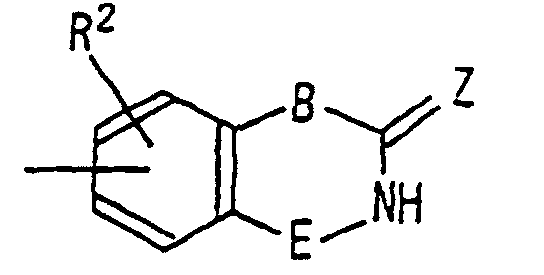
- examples of in the formula (1) include the following groups: wherein R 1 , R 2 , R 3 , R 4 , R 5 , R 6 , R 7 , Z, l, k and q have the same meanings as defined above.
- the salt of the diamine derivative (1) of the present invention is a pharmacologically acceptable salt.
- Illustrative are mineral acid addition salts such as the hydrochloride, hydrobromide, hydroiodide, sulfate and phosphate; and organic acid addition salts such as the benzoate, methanesulfonate, ethanesulfonate, benzenesulfonate, p-toluenesulfonate, oxalate, maleate, fumarate, tartrate and citrate.
- the compound of the present invention may also exist in the form of solvates, which are typified by the hydrate, or a keto-enol tautomer. Such solvates and isomer are also included in the present invention.
- the compound (1) of the present invention can be prepared, for example, in accordance with the following reaction process.
- A, B, E, R 1 , R 2 , W, Y, Z, l, m and n have the same meanings as defined above, and
- X represents a chlorine atom, bromine atom or iodine atom.
- a compound (1) of the present invention in which Y is -CH 2 - can be prepared by reacting a diamine compound (2) with a haloalkylated phenol compound (3) as shown by the process A or by reacting a haloalkylated diamine compound (4) with a phenol compound (5) as shown by the process B.
- a compound (1) of the present invention in which Y is -CO- can be prepared by reacting a haloacylated diamine compound (4) with a phenol compound (5) as shown by the process B.
- the above reactions can each be practiced by conducting heating for 1 to 24 hours (preferably at 100 to 200°C) under an inert gas stream in a solventless manner or in an aprotic solvent such as acetone, 2-butanone, dimethylformamide (DMF), dimethylsulfoxide (DMSO) or hexamethylphosphoroamide (HMPA).
- an inorganic base such as potassium carbonate and an inorganic salt such as potassium iodide may be added.
- a compound (1) of the present invention in which R 1 is a hydroxyl group can be obtained by subjecting a compound (1) of the present invention, in which R 1 is an aralkyloxy group, to a catalytic hydrogenating reaction in the presence of a catalyst such as palladium on charcoal or in a manner known per se in the art.
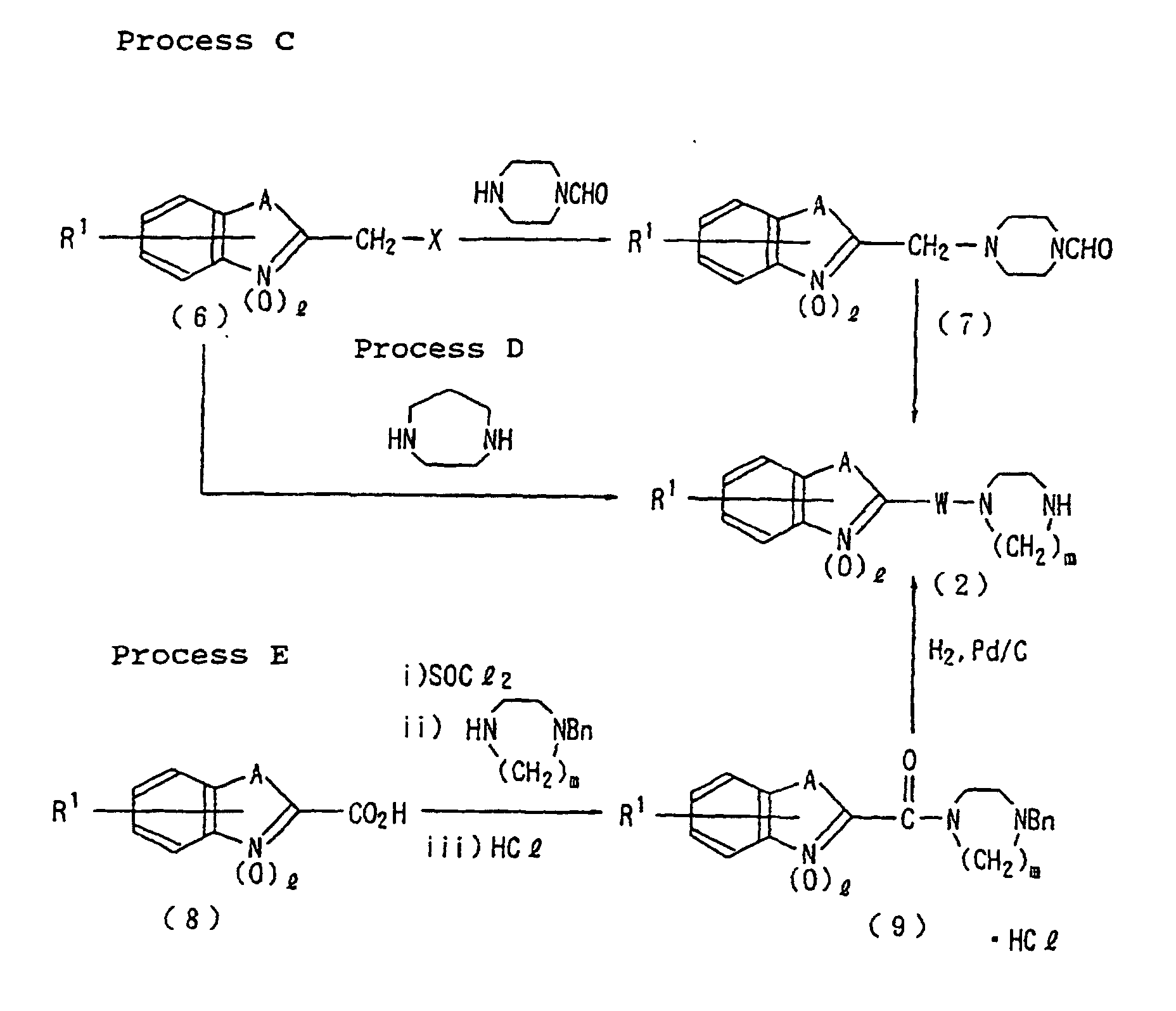
- the diamine compound (2) for use in the process A can be prepared by a known process, for example, the process disclosed in Pesson, Marcel et al.: Eur. J. Med. Chem.-Chim. Ther., 10 (6), 567-572, 1975; Imura, Ryuichi et al.: J. Heterocycl. Chem., 24 , 31-37, 1987; Meyer, Walter E. et al.: J. Med. Chem., 32 (3), 593-597, 1989; or the like, or in accordance with the reaction scheme shown below.
- A, R 1 , W, l and m have the same meanings as defined above
- Bn represents a benzyl group
- X represents a chlorine atom, bromine atom or iodine atom.
- a compound (2) in which W is -CH 2 - and m is 2 can be obtained, as shown by the process C, by reacting a halomethyl derivative (6) and N-formylpiperazine in the presence of a base such as pyridine or triethylamine in a polar solvent such as methanol or ethanol at 0°C to reflux temperature (preferably room temperature) for 1 to 7 days to obtain a compound (7) and then reacting and deformylating the compound (7) in a polar solvent such as methanol or ethanol in the presence of an acid, such as concentrated sulfuric acid, added therein at 0°C to reflux temperature (preferably reflux temperature) for 1 to 4 days.
- a base such as pyridine or triethylamine
- a polar solvent such as methanol or ethanol
- an acid such as concentrated sulfuric acid
- a compound (2) in which W is -CH 2 - and m is 3 can be obtained, as shown by the process D, by reacting a halomethyl derivative (6) and homopiperazine in the presence of a base such as triethylamine in a polar solvent such as methanol or ethanol at 0°C to reflux temperature (preferably room temperature) for 1 to 7 days.
- a base such as triethylamine
- a polar solvent such as methanol or ethanol
- a compound (2) in which W is -CO- can be obtained, as shown by the process E, by chlorinating a carboxylic acid (8) with thionyl chloride or the like, reacting the chlorinated product with N-benzylpiperazine or N-benzylhomopiperazine to obtain a compound (9), reducingly debenzylating the compound (9), for example, with a palladium-charcoal catalyst or the like under a hydrogen gas stream, and then converting the resulting hydrochloride of the compound (2) into a free base.
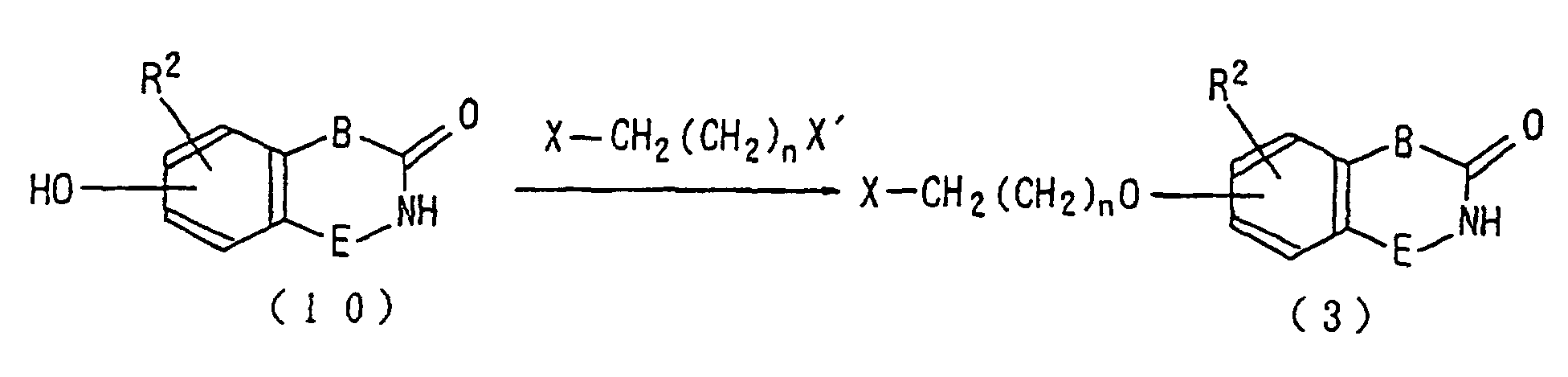
- the haloalkylated phenol compound (3) useful in the process A can be obtained, as shown below, by reacting the phenol compound (10) and a dihalogenide of a linear alkane in an aprotic solvent such as acetone, 2-butanone, DMF, DMSO or HMPA at 0°C to reflux temperature (preferably reflux temperature) for 1 to 24 hours.
- an aprotic solvent such as acetone, 2-butanone, DMF, DMSO or HMPA
- B, E, R 2 and n have the same meanings as defined above, and X and X' may be the same or different and individually represent a chlorine atom, bromine atom or iodine atom.
- each compound (4a) in which Y is -CH 2 - can be obtained, as shown below, by reacting a compound (2) and a dihalogenide of a linear alkane in an aprotic solvent such as acetone, 2-butanone, DMF, DMSO or HMPA at 0°C to reflux temperature (preferably reflux temperature) for 1 to 24 hours.
- an aprotic solvent such as acetone, 2-butanone, DMF, DMSO or HMPA
- A, R 1 , W, l, m and n have the same meanings as defined above, and X and X' may be the same or different and individually represent a chlorine atom, bromine atom or iodine atom.
- each compound (4b) in which Y is -CO- can be obtained by haloacylating a compound (2) by a method known per se in the art as shown below.
- A, R 1 , W, l, m and n have the same meanings as defined above, and X and X' may be the same or different and individually represent a chlorine atom, bromine atom or iodine atom.
- the compound (1) of the present invention can be obtained by treating the reaction mixture by a method known per se in the art subsequent to the reaction by the process A or B. If necessary, it can be purified using a conventional purification method such as recrystallization or column chromatography. By a method known per se in the art, it can be converted into a desired salt as needed.
- the invention compound (1) or salt thereof available as described above has excellent antileukotrienic action and antihistaminic action in combination, has lower tendency of penetration to the center than terfenadine, and is useful as a medicine for asthma, allergic rhinitis, allergic dermatitis, allergic conjunctivitis, urticaria and psoriasis.
- the medicine according to the present invention comprises the above-described compound (1) or a salt or solvate thereof as an effective ingredient. It is however preferred to use it as a medicinal composition which comprises the effective ingredient and a pharmaceutically acceptable carrier.
- Its administration forms as such medicinal compositions include, for example, oral administration forms such as tablets, capsules, granules, powders and syrups; and parenteral administration forms such as intravenous injections, intramuscular injections, suppositories, inhalative agents, percutaneous absorption agents, eye drops and nasal drops.
- the effective ingredient can be used either singly or by suitably combining the same with one or more pharmaceutically acceptable carriers such as excipients, binders, extenders, disintegrants, surfactants, lubricants, dispersants, buffers, preservatives, corrigents, perfumes, coating materials, diluents and the like.
- pharmaceutically acceptable carriers such as excipients, binders, extenders, disintegrants, surfactants, lubricants, dispersants, buffers, preservatives, corrigents, perfumes, coating materials, diluents and the like.
- the dosage of the medicine according to the present invention varies depending on the age, body weight, conditions, administration form, administration frequency and the like. In general, however, it is preferred to orally or parenterally administer to an adult the compound (1) or its salt or solvate in an amount of about 1 to 1,000 mg per day at once or in several portions.
- the extract was washed with water and then dried over anhydrous magnesium sulfate.
- the extract was washed with water and then dried over anhydrous magnesium sulfate.
- Oxalic acid dihydrate (0.176 g, 1.4 mmol) was added to the oil (0.630 g, 1.4 mmol) and crystallization was then conducted from methanol, whereby 0.438 g of the title compound was obtained as pale yellow powder (yield: 58.1%).
- a 4N hydrogen chloride-ethyl acetate solution (0.45 ml) and a palladium-on-charcoal catalyst (90 mg) were added to a solution of 7- ⁇ 3-[4-(8-benzyloxy-2-quinolylmethyl)-1-piperazinyl]propoxy ⁇ -3,4-dihydro-2H-1,4-benzothiazin-3-one (450 mg, 0.81 mmol) in acetic acid (6 ml), followed by stirring for 2 hours at a bath temperature of 80°C under a hydrogen gas stream.
- the catalyst was filtered off from the reaction mixture and was then washed with methanol. The filtrate and the washing were mixed, followed by concentration under reduced pressure.
- the residue was purified by thin-layer silica gel chromatography while using chloroform/methanol(saturated with ammonia) (15/1) as an eluent, hereby 40 mg of the free base of the title compound were obtained in a pale yellow amorphous form.
- the catalyst was washed further with a saturated aqueous solution of sodium hydrogencarbonate and chloroform.
- the chloroform layer was dried over anhydrous sodium sulfate and then concentrated, whereby 108 mg of the free base of the title compound were obtained in the form of a pale yellow amorphous (39.3% in total).
- the extract was dried over anhydrous sodium sulfate and then concentrated under reduced pressure.
- the residue was subjected to chromatography on a silica gel column while using chloroform-methanol (10:1) as an eluent, whereby impurities which existed at the starting point were removed. Fractions containing the target compound were collected and then concentrated under reduced pressure.
- the concentrate was crystallized from chloroformdiethyl ether, whereby the 203 mg of the title compound were obtained as yellow powder (67.7%).
- An isolated guinea pig ileum was cut into about 2 cm lengths. Each ileum piece was suspended in a 20-ml container filled with the Tyrode's buffer. An isotonic contractive response by histamine or LTD 4 was recorded on a recorder. The Tyrode's buffer was controlled at 30°C, through which a mixed gas (95%O 2 -5%CO 2 ) was bubbled.
- Antihistaminic action was determined by adding 10 -3 -10 -4 M histamine to an organ bath and measuring its dose-response. After the ileum piece was washed several times with the buffer, a test compound of a predetermined specific concentration was added. Subsequent to incubation for 30 minutes, the dose-response of histamine was measured again, and is presented in terms of pA 2 or pD' 2 at 10 -5 M test compound in Table 11.
- Antileukotrienic action was determined by investigating effects of addition of 10 -5 M test compound on a contractive response caused by 10 -8 M LTD 4 , and is presented in terms of an inhibition rate at 10 -5 M test compound in Table 11.
- Anti-LTD 4 action (%) (10 -5 M) 1 8.22pA2 16 9 8.11pA2 40 26 8.01pD's 27 29 8.79pA2 48 32 8.64pA2 20 36 9.12pA2 46 39 9.08pA2 30 42 9.33pA2 13 44 8.67pA2 47 61 8.47pA2 19 69 9.42pA2 25 78 8.37pA2 27 79 8.48pA2 19 80 9.15pA2 11 81 8.04pA2 19 83 9.37pA2 26 85 8.55pA2 21 88 8.67pA2 12 89 8.55pA2 21 90 10.06pA2 16 92 8.22pA2 42 102 8.69pA2 10 Terfen
- Example H1 receptor (%) LTD4 receptor (%) 1 1.73x10 -7 3.24x10 -6 9 1.35x10 -8 4.96x10 -5 26 3.63x10 -8 3.34x10 -6 36 3.49x10 -12 1.99x10 -6 41 4.32x10 -9 3.83x10 -6 45 3.39x10 -9 1.98x10 -6 50 4.57x10 -7 8.60x10 -6 54 2.49x10 -10 8.81x10 -4 60 5.45x10 -9 8.73x10 -6 61 4.69x10 -9 1.61x10 -6 75 5.58x10 -8 7.34x10 -6 77 7.45x10 -8 1.10x10 -4 78 1.82x10 -8 7.43x10 -6 79 7.59x10 -8 8.61x10 -6 80 4.31x10 -9 1.84x10 -5 85 1.83x10 -8 3.57x10 -5 90 5.01x10 -9 9.41x10 -6 92 5.57x10 -8 4.23x10 -6 93 7.10
- a brain penetration test was conducted based on the method proposed by Zang, M.Q. (J. Med. Chem., 38 , 2472-2477, 1995). Described specifically, to a mouse of 20 g to 23 g, a test compound of a given concentration was peritoneally administered. Upon elapsed time of one hour after the administration, the mouse was sacrificed. The brain tissue was taken out, and was then homogenated with a 30 mM Na,K phosphate buffer (pH 7.5) to give 40 ml/g wet weight. The homogenate was divided into three test tubes (900 ⁇ l), followed by the addition of 100 ⁇ l of [ 3 H]mepyramin solution (final concentration: 0.5 nM).
- BP index IC 50 (mg/kg)/H 1 binding inhibition dissociation constant (nM)
- the diamine derivatives (1) or salts thereof according to the present invention have antileukotrienic action and antihistaminic action in combination and are low in brain penetration, are hence useful as medicines such as asthma preventives and curatives.
Landscapes
- Chemical & Material Sciences (AREA)
- Organic Chemistry (AREA)
- Health & Medical Sciences (AREA)
- Life Sciences & Earth Sciences (AREA)
- General Health & Medical Sciences (AREA)
- Bioinformatics & Cheminformatics (AREA)
- Chemical Kinetics & Catalysis (AREA)
- General Chemical & Material Sciences (AREA)
- Medicinal Chemistry (AREA)
- Nuclear Medicine, Radiotherapy & Molecular Imaging (AREA)
- Engineering & Computer Science (AREA)
- Pharmacology & Pharmacy (AREA)
- Veterinary Medicine (AREA)
- Animal Behavior & Ethology (AREA)
- Public Health (AREA)
- Pulmonology (AREA)
- Dermatology (AREA)
- Immunology (AREA)
- Ophthalmology & Optometry (AREA)
- Otolaryngology (AREA)
- Pharmaceuticals Containing Other Organic And Inorganic Compounds (AREA)
- Organic Low-Molecular-Weight Compounds And Preparation Thereof (AREA)
- Acyclic And Carbocyclic Compounds In Medicinal Compositions (AREA)
- Quinoline Compounds (AREA)
- Plural Heterocyclic Compounds (AREA)
- Medicinal Preparation (AREA)
Abstract
Description

R1 represents a hydrogen atom, a hydroxyl group, an aralkyloxy group or a halogen atom;
R2 represents a hydrogen atom or a lower alkyl group;
A represents -C(R3)=CH-, R3 being a hydrogen atom or a hydroxyl group, -CH=N-, -N(R4)-,R4 being a lower alkyl group or an alkoxyalkyl group, -O-, or -S-;
B represents a single bond, -C(R5)(R6)-(CH2)k-, R5 and R6 being the same or different and individually representing a hydrogen atom or a lower alkyl group, and k being a value of from 0 to 2, -S(O)qCH(R7), q being a value of from 0 to 2, and R7 being a hydrogen atom or a hydroxyl group, or -CH=CH-;
E represents a single bond or -(CH2)3-;
W and Y may be the same or different and individually represent -CH2- or -CO-;
Z represents an oxygen atom or a sulfur atom; and
ℓ is a value of 0 or 1, m is a value of 2 or 3, and n is a value of from 1 to 4; with the proviso that E is -(CH2)3- when B is a single bond and E is a single bond when B is a group other than a single bond.






- 1H-NMR(CDCl3)δ(ppm):
- 8.16(1H,d,J=8.3Hz), 8.09(1H,d,J=8.3Hz), 8.06(1H,s), 7.88-7.45(4H,m), 3.88(2H,s), 3.66-3.50(2H,m), 3.48-3.32(2H,m), 2.64-2.45(4H,m).
- IR(film)cm-1:
- 2817, 1665, 1443, 1140, 1018, 1005, 838, 827, 786, 758.
- 1H-NMR(CDCl3)δ(ppm):
- 8.13(1H,d,J=8.8Hz), 8.08(1H,d,J=9.3Hz), 7.86-7.56(3H,m), 7.51(1H,t,J=6.8Hz), 3.82(2H,s), 3.00-2.84(4H,m), 2.65-2.44(4H,m).
- IR(film)cm-1:
- 3287, 2939, 2814, 1600, 1504, 1425, 1142, 1131, 1119, 835, 785, 754.
- 1H-NMR(CDCl3)δ(ppm):
- 8.15(1H,d,J=8.8Hz), 8.06(1H,d,J=8.3Hz), 7.79(2H,d,J=7.8Hz), 7.68(2H,d,J=8.8Hz), 7.52(1H,t,J=6.8Hz), 4.03(2H,s), 3.30-3.06(4H,m), 3.00-2.70(4H,m), 2.06-1.90(2H,m).
- IR(film)cm-1:
- 3100-2300, 1618, 1600, 1504, 1461, 1426, 1356, 1310, 1142, 1114, 1085, 1054, 834, 753.
- m.p.:
- 65-67°C
- 1H-NMR(CDCl3)δ(ppm):
- 8.13(2H,d,J=8.8Hz), 8.06(2H,d,J=8.8Hz), 7.84-7.62(6H,m), 7.50(2H,td,J=8.3,1.5Hz), 4.00(4H,s), 2.92-2.73(8H,m), 2.00-1.78(2H,m).
- IR(film)cm-1:
- 3059, 2935, 2815, 1618, 1600, 1563, 1504, 1458, 1425, 1355, 1335, 1112, 833, 785, 757.
| Prep. Ex. | Compound Name | Color, state of matter |
| 4 | 1-(2-Quinazolinylmethyl)piperazine | Amber oil |
| 5 | 1-(N-Methylbenzoimidazol-2-yl-methyl)piperazine | Amber oil |
| 6 | 1-(N-Methylbenzoimidazol-2-yl-methyl)homopiperazine | Amber oil |
| 7 | 1-(N-Ethoxyethylbenzoimidazol-2-yl-methyl)piperazine | Amber oil |
| 8 | 1-(N-Ethoxyethylbenzoimidazol-2-yl-methyl)homopiperazine | Amber oil |
| 9 | 1-(1-Oxo-2-quinolylmethyl)piperazine | Amber oil |
| 10 | 1-(8-Benzyloxy-2-quinolylmethyl)piperazine | Colorless oil |
| 11 | 1-(4-Benzyloxy-2-quinolylmethyl)piperazine | Amber oil |
- m.p.:
- 150-152°C
- 1H-NMR(CDCl3)δ(ppm):
- 8.80(1H,br.s), 6.87(1H,d,J=2.4Hz), 6.82(1H,d,J=8.8Hz), 6.73(1H,dd,J=8.3,2.4Hz), 4.08(2H,t,J=5.8Hz), 3.74(2H,t,J=5.8Hz), 3.42(2H,s), 2.32-2.14(2H,m).
- IR(KBr)cm-1:
- 3262, 1671, 1635, 1502, 1468, 1387, 1243, 1233, 1033.
| Prep. EX. | Compound Name | Melting point(°C) |
| 13 | 6-(3-Chloropropoxy)-2,3,4,5-tetrahydro-1H-1-benzoazepin-2-one | 110-112 |
| 14 | 7-(3-Chloropropoxy)-2,3,4,5-tetrahydro-1H-1-benzoazepin-2-one | 121-123 |
| 15 | 7-(3-Chloropropoxy)-2,3,4,5-tetrahydro-1H-2-benzoazepin-1-one | 132-133 |
| 16 | 7-(2-Chloroethoxy)-3,4-dihydro-2H-1,4-benzothiazin-3-one | 179-181 |
| 17 | 7-(4-Chlorobutoxy)-3,4-dihydro-2H-1,4-benzothiazin-3-one | 137-139 |
| 18 | 7-(5-Chloropentyloxy)-3,4-dihydro-2H-1,4-benzothiazin-3-one | 121-123 |
| 19 | 5-(3-Chloropropoxy)-8-methyl-1,2-dihydroquinolin-2-one | 162-165 |
| 20 | 6-(3-Chloropropoxy)-1,2-dihydroquinolin-2-one | 196-198 |
| 21 | 7-(2-Chloroethoxy)-1,2-dihydroquinolin-2-one | 182-184 |
| 22 | 7-(3-Chloroethoxy)-1,2-dihydroquinolin-2-one | 124-126 |
| 23 | 5-(2-Chloroethoxy)-8-methyl-1,2,3,4-tetrahydroquinolin-2-one | 161-162 |
| 24 | 5-(3-Chloropropoxy)-8-methyl-1,2,3,4-tetrahydroquinolin-2-one | 146-147 |
| 25 | 5-(4-Chlorobutoxy)-8-methyl-1,2,3,4-tetrahydroquinolin-2-one | 120-121 |
| 26 | 5-(5-Chloropentyloxy)-8-methyl-1,2,3,4-tetrahydroquinolin-2-one | 115-116 |
| 27 | 6-(2-Chloroethoxy)-1,2,3,4-tetrahydroquinolin-2-one | 150-152 |
| 28 | 6-(3-Chloropropoxy)-1,2,3,4-tetrahydroquinolin-2-one | 133-135 |
| 29 | 6-(4-Chlorobutoxy)-1,2,3,4-tetrahydroquinolin-2-one | 146-147 |
| 30 | 6-(5-Chloropentyloxy)-1,2,3,4-tetrahydroquinolin-2-one | 102-104 |
| 31 | 7-(2-Chloroethoxy)-1,2,3,4-tetrahydroquinolin-2-one | 137-138 |
| 32 | 7-(3-Chloropropoxy)-1,2,3,4-tetrahydroquinolin-2-one | 126-127 |
| 33 | 7-(4-Chlorobutoxy)-1,2,3,4-tetrahydroquinolin-2-one | 104-105 |
| 34 | 7-(5-Chloropentyloxy)-1,2,3,4-tetrahydroquinolin-2-one | 130-131 |
| Prep. Ex. | Compound Name | Melting point(°C) |
| 35 | 7-(3-Chloropropoxy)-4,4-tetrahydroquinolin-2-one | 147-148 |
| 36 | 8-(3-Chloropropoxy)-1,2,3,4-tetrahydroquinolin-2-one | 151-153 |
| 37 | 8-(4-Chloropropoxy)-1,2,3,4-tetrahydroquinolin-2-one | 129-131 |
| 38 | 4-(3-Chloropropoxy)-2,3-dihydro-1H-indol-2-one | 142-144 |
| 39 | 4-(2-Chloroethoxy)-3,3,7-trimethyl-2,3-dihydro-1H-indol-2-one | 153-154 |
| 40 | 4-(3-Chloropropoxy)-3,3,7-trimethyl-2,3-dihydro-1H-indol-2-one | 185-187 |
| 41 | 4-(4-Chlorobutoxy)-3,3,7-trimethyl-2,3-dihydro-1H-indol-2-one | 161-162 |
| 42 | 4-(5-Chloropentyloxy)-3,3,7-trimethyl-2,3-dihydro-1H-indol-2-one | 142-143 |
| 43 | 4-(3-Chloropropoxy)-3,3-dimethyl-2,3-dihydro-1H-indol-2-one | 149-151 |
| 44 | 5-(2-Chloroethoxy)-3,3-dimethyl-2,3-dihydro-1H-indol-2-one | 153-155 |
| 45 | 5-(3-Chloropropoxy)-3,3-dimethyl-2,3-dihydro-1H-indol-2-one | 102 |
| 46 | 5-(4-Chlorobutoxy)-3,3-dimethyl-2,3-dihydro-1H-indol-2-one | 94 |
| 47 | 5-(5-Chloropentyloxy)-3,3-dimethyl-2,3-dihydro-1H-indol-2-one | 94-95 |
| 48 | 6-(2-Chloroethoxy)-3,3-dimethyl-2,3-dihydro-1H-indol-2-one | 139-140 |
| 49 | 6-(3-Chloropropoxy)-3,3-dimethyl-2,3-dihydro-1H-indol-2-one | 130-131 |
| 50 | 6-(4-Chlorobutoxy)-3,3-dimethyl-2,3-dihydro-1H-indol-2-one | 126 |
| 51 | 6-(5-Chloropentyloxy)-3,3-dimethyl-2,3-dihydro-1H-indol-2-one | 156-157 |
| 52 | 7-(3-Chloropropoxy)-3,3-dimethyl-2,3-dihydro-1H-indol-2-one | 170-171 |
| 53 | 7-(4-Chlorobutoxy)-3,3-dimethyl-2,3-dihydro-1H-indol-2-one | 158-159 |
| 54 | 7-(5-Chloropentyloxy)-3,3-dimethyl-2,3-dihydro-1H-indol-2-one | 110-111 |
| 55 | 7-(3-Chloropropoxy)-3,4-dihydro-2H-1,4-benzothiazin-3-one-1-oxide | 180-182 (dec.) |
| 56 | 7-(3-Chloropropoxy)-3,4-dihydro-2H-1,4-benzothiazin-3-one-1,1-dioxide | 172-174 |
- 1H-NMR(CDCl3)δ(ppm):
- 8.12(1H,d,J=8.8Hz), 8.08(1H,d,J=9.8Hz), 7.80(1H,d,J=8.3Hz), 7.70(1H,td,J=5.9,1.5Hz), 7.63(1H,d,J=8.3Hz), 7.51(1H,t,J=6.8Hz), 3.85(2H,s), 3.59(2H,t,J=6.3Hz), 2.72-2.40(10H,m), 2.10-1.80(2H,m).
- IR(film)cm-1:
- 2940, 2812, 1600, 1504, 1458, 1425, 1299, 1160, 1132, 1013, 838, 757.
- 1H-NMR(CDCl3)δ(ppm):
- 8.12(1H,d,J=8.3Hz), 8.06(1H,d,J=8.8Hz), 7.80(1H,d,J=7.8Hz), 7.75-7.59(1H,m), 7.70(1H,t,J=8.3Hz), 7.50(1H,td,J=8.3,1.0Hz), 3.97(2H,s), 3.61(2H,t,J=6.3Hz), 2.85-2.55(10H,m), 2.00-1.72(4H,m).
- IR(film)cm-1:
- 2938, 2815, 1600, 1504, 1425, 1356, 1115, 832.
- 1H-NMR(CDCl3)δ(ppm):
- 8.15(1H,d,J=8.5Hz), 8.08(1H,d,J=8.3Hz), 7.81(1H,d,J=8.3Hz), 7.70(1H,td,J=6.8Hz,1.5Hz), 7.61(1H,d,J=8.6Hz), 7.53(1H,t,J=8.0Hz), 4.06(2H,s), 3.88(2H,s), 3.68(2H,t,J=5.1Hz), 3.56(2H,t,J=5.1Hz), 2.60(4H,qw,J=4.8Hz).
- IR(film)cm-1:
- 2941, 2809, 1712, 1663, 1618, 1600, 1504, 1461, 1426, 1366, 1329, 1302, 1279, 1252, 1223, 1142, 1002, 835, 786, 757.
- m.p.:
- 235-237°C (dec.)
- 1H-NMR(DMSO-d6)δ(ppm):
- 11.68(1H,br.s), 8.55(1H,d,J=8.3Hz), 8.06(1H,d,J=9.8Hz), 7.92-7.55(6H,m), 7.52-7.37(3H,m), 4.65(1H,d,J=12Hz), 4.37(2H,s), 4.18(1H,d,J=12Hz), 3.85-3.00(6H,m).
- IR(KBr)cm-1:
- 2800-2200, 1644, 1474, 1416, 1290, 1100, 1040, 953, 838, 778, 770, 759, 704.
- m.p.:
- 236-237°C (dec.)
- 1H-NMR(DMSO-d6)δ(ppm):
- 9.48(1H,br.s), 8.55(1H,d,J=8.8Hz), 8.07(2H,d,J=8.3Hz), 7.91-7.64(3H,m), 4.02-3.70(4H,br), 3.30-3.02(4H,br).
- IR(KBr)cm-1:
- 2938, 2744, 2716, 2711, 2475, 1647, 1593, 1472, 1436, 1421, 1289, 843, 789, 767.
- 1H-NMR(CDCl3)δ(ppm):
- 8.27(1H,d,J=8.3Hz), 8.11(1H,d,J=8.3Hz), 7.91-7.57(4H,m), 3.87(2H,t,J=5.4Hz), 3.66(2H,t,J=5.4Hz), 3.04(2H,t,J=5.4Hz).
- IR(KBr)cm-1:
- 3301, 2947, 2917, 1629, 1597, 1561, 1479, 1441, 1424, 1288, 1173, 1140, 1118, 1024, 845, 819, 776, 764, 621.
- m.p.:
- 187-189°C (dec.)
- 1H-NMR(CDCl3)δ(ppm):
- 8.57(1H,br.s), 8.12(1H,d,J=8.5Hz), 8.07(1H,d,J=8.8Hz), 7.80(1H,d,J=8.3Hz), 7.69(1H,dt,J=8.6,1.5Hz), 7.63(1H,d,J=8.3Hz), 7.51(1H,dt,J=8.1,1.2Hz), 6.80(1H,d,J=8.4Hz), 6.80(1H,d,J=2.4Hz), 6.71(1H,dd,J=8.4,2.4Hz), 4.08(2H,t,J=5.9Hz), 3.86(2H,s), 2.82(2H,t,J=5.9Hz), 2.65(8H,br.s), 1.37(6H,s).
- IR(KBr)cm-1:
- 3424, 3171, 3088, 3045, 2965, 2927, 2870, 2810, 1709, 1603, 1566, 1500, 1482, 1456, 1427, 1393, 1331, 1311, 1278, 1206, 1158, 1135, 1091, 1076, 1050, 1014, 973, 958, 870, 854, 840, 824, 761, 737, 653, 579, 482, 459.
- m.p.:
- 163-165°C (dec.)
- 1H-NMR(CDCl3)δ(ppm):
- 10.30(1H,s), 7.61(1H,m), 7.58(1H,m), 7.27(1H,m), 7.21(1H,m), 6.91(1H,d,J=8.5Hz), 6.50(1H,d,J=8.5Hz), 6.14(4H,s), 4.52(1H,br.t,J=5.1Hz), 4.08-3.96(4H,m), 3.72(2H,br.t,J=5.1Hz), 3.39(2H,q,J=7.1Hz), 3.50-2.80(8H,br), 3.22(2H,br), 2.14(3H,s), 1.31(6H,s), 1.04(3H,t,J=7.1Hz).
- IR(KBr)cm-1:
- 2977, 2869, 1705, 1614, 1582, 1509, 1485, 1465, 1385, 1361, 1091, 866.
- m.p.:
- 131-133°C
- 1H-NMR(CDCl3)δ(ppm):
- 8.10(2H,t,J=8.8Hz), 7.85-7.44(1H,m),7.32(1H,br.s), 6.92-6.66(3H,m), 4.00(2H,t,J=6.3Hz), 3.86(2H,s), 2.75(2H,t,J=7.3Hz), 2.68-2.40(10H,m), 2.40-2.07(4H,m), 2.05-1.88(2H,m).
- IR(KBr)cm-1:
- 1672, 1499, 1424, 1385, 1255, 1238, 1170, 1163, 1155, 1057, 835, 807, 749.
- m.p.:
- 161-162°C
- 1H-NMR(CDCl3)δ(ppm):
- 8.11(2H,t,J=8.8Hz), 7.78(1H,td,J=9.8,1.5Hz), 7.75-7.58(4H,m), 7.51(1H,td,J=6.9,1.0Hz), 6.84(1H,dd,J=8.3,2.4Hz), 6.71(1H,d,J=2.4Hz), 6.52-6.34(1H,br), 4.05(2H,t,J=6.4Hz), 3.86(2H,s), 3.12(2H,t,J=6.4Hz), 2.83(2H,t,J=6.8Hz), 2.72-2.40(10H,m), 2.09-1.88(4H,m).
- IR(KBr)cm-1:
- 2940, 2805, 1652, 1601, 1246.
- 1H-NMR(CDCl3)δ(ppm):
- 8.89(1H,br.s), 8.13(1H,d,J=8.6Hz), 8.07(1H,d,J=8.6Hz), 7.81(1H,d,J=8.1Hz), 7.70(1H,ddd,J=8.6,7.1,1.5Hz), 7.63(1H,d,J=8.6Hz), 7.52(1H,ddd,J=8.1,6.8,1.2Hz), 7.25(1H,d,J=2.7Hz), 7.06(1H,dd,J=8.8,2.7Hz), 6.97(1H,d,J=8.8Hz), 4.12(1H,d,J=5.4Hz), 4.04(2H,t,J=6.4Hz), 3.87(2H,s), 3.66(1H,d,J=5.4Hz), 2.70-2.42(10H,cm), 2.00(2H,br).
- IR(KBr)cm-1:
- 2940, 2816, 1686, 1500, 1228, 1039.
| Ex. | Compound Name | Melting point(°C) |
| 6 | 7-{3-[4-(2-Quinazolinylmethyl)-1-piperazinyl]propoxy}-3,4-dihydro-2H-1,4-benzothiazin-3-one | 155-157 |
| 7 | 3,3,7-Trimethyl-4-{4-[4-(2-quinolylmethyl)-1-piperazinyl]butoxy}-2,3-dihydro-1H-indol-2-one | 148-149 |
| 8 | 7-{5-[4-(2-Quinolylmethyl)-1-piperazinyl]pentyloxy}-3,4-dihydro-2H-1,4-benzothiazin-3-one | 150-151 |
| 9 | 3,3,7-Trimethyl-4-{5-[4-(2-quinolylmethyl)-1-piperazinyl]pentyloxy}-2,3-dihydro-1H-indol-2-one | 141-146 |
| 10 | 7-{4-[4-(2-Quinolylmethyl)-1-piperazinyl]butoxy}-3,4-dihydro-2H-1,4-benzothiazin-3-one | 152-153 |
| 11 | 4-{3-[4-(2-Quinolylmethyl)-1-piperazinyl]propoxy}-2,3-dihydro-1H-indol-2-one | 159-160 |
| 12 | 8-Methyl-5-{2-[4-(2-quinolylmethyl)-1-piperazinyl]ethoxy}-1,2,3,4-tetrahydroquinolin-2-one | 149-150 |
| 13 | 8-Methyl-5-{4-[4-(2-quinolylmethyl)-1-piperazinyl]butoxy}-1,2,3,4-tetrahydroquinolin-2-one | 115-117 |
| 14 | 8-Methyl-5-{5-[4-(2-quinolylmethyl)-1-piperazinyl]pentyloxy}-1,2,3,4-tetrahydroquinolin-2-one | 147-148 |
| 15 | 6-{3-[4-(2-Quinolylmethyl)-1-piperazinyl]propoxy}-2,3,4,5-tetrahydro-1H-1-benzoazepin-2-one | 130-131 |
| 16 | 3,3-Dimethyl-5-{3-[4-(2-quinolylmethyl)-1-piperazinyl]propoxy}-2,3-dihydro-1H-indol-2-one | 137-138 |
| 17 | 3,3-Dimethyl-5-{4-[4-(2-quinolylmethyl)-1-piperazinyl]butoxy}-2,3-dihydro-1H-indol-2-one | 119-120 |
| 18 | 3,3-Dimethyl-5-{5-[4-(2-quinolylmethyl)-1-piperazinyl]pentyloxy}-2,3-dihydro-1H-indol-2-one | 109-110 |
| 19 | 6-{2-[4-(2-Quinolylmethyl)-1-piperazinyl]ethoxy}-1,2,3,4-tetrahydroquinolin-2-one | 154-156 |
| 20 | 6-{3-[4-(2-Quinolylmethyl)-1-piperazinyl]propoxy}-1,2,3,4-tetrahydroquinolin-2-one | 176-178 |
| 21 | 6-{4-[4-(2-Quinolylmethyl)-1-piperazinyl]butoxy}-1,2,3,4-tetrahydroquinolin-2-one | 150-152 |
| Ex. | Compound Name | Melting point(°C) |
| 22 | 6-{5-[4-(2-Quinolylmethyl)-1-piperazinyl]pentyloxy}-1,2,3,4-tetrahydroquinolin-2-one | 140-142 |
| 23 | 4,4-Dimethyl-7-{3-[4-(2-quinolylmethyl)-1-piperazinyl]propoxy}-1,2,3,4-tetrahydroquinolin-2-one | 190-192 (dec.) |
| 24 | 3,3,7-Trimethyl-4-{3-[4-(2-quinazolinylmethyl)-1-piperazinyl]propoxy}-2,3-dihydro-1H-indol-2-one | 162-164 |
| 25 | 8-Methyl-5-{3-[4-(2-quinazolinylmethyl)-1-piperazinyl]propoxy}-1,2,3,4-tetrahydroquinolin-2-one | 145-147 |
| 26 | 3,3,7-Trimethyl-4-{3-[4-(N-methylbenzoimidazol-2-ylmethyl)-1-piperazinyl]propoxy}-2,3-dihydro-1H-indol-2-one | 150-153 (dec.) |
| 27 | 7-{3-[4-(N-Methylbenzoimidazol-2-ylmethyl)-1-piperazinyl]propoxy}-3,4-dihydro-2H-1,4-benzothiazin-3-one | 176-179 (dec.) |
| 28 | 7-{3-[4-(N-Ethoxyethylbenzoimidazol2-ylmethyl)-1-piperazinyl]propoxy}-3,4-dihydro-2H-1,4-benzothiazin-3-one | 178-181 (dec.) |
| 29 | 3,3-Dimethyl-7-{3-[4-(2-quinolylmethyl)-1-piperazinyl]propoxy}-2,3-dihydro-1H-indol-2-one | 111-112 |
| 30 | 3,3-Dimethyl-7-{4-[4-(2-quinolylmethyl)-1-piperazinyl]butoxy}-2,3-dihydro-1H-indol-2-one | 133-134 |
| 31 | 6-{3-[4-(2-Quinolylmethyl)-1-piperazinyl]propoxy}-1,2-dihydroquinolin-2-one | 169-171 |
| 32 | 7-{2-[4-(2-Quinolylmethyl)-1-piperazinyl]ethoxy}-1,2,3,4-tetrahydroquinolin-2-one | 148-150 |
| 33 | 7-{3-[4-(2-Quinolylmethyl)-1-piperazinyl]propoxy}-1,2,3,4-tetrahydroquinolin-2-one | 199-200 (dec.) |
| 34 | 7-{4-[4-(2-Quinolylmethyl)-1-piperazinyl]butoxy}-1,2,3,4-tetrahydroquinolin-2-one | 145-147 |
| 35 | 7-{5-[4-(2-Quinolylmethyl)-1-piperazinyl]pentyloxy)-1,2,3,4-tetrahydroquinolin-2-one | 116-117 |
| 36 | 7-{3-[4-(2-Quinolylmethyl)-1-piperazinyl]propoxy}-1,2-dihydroquinolin-2-one | 155-157 |
| Ex. | Compound Name | Melting point(°C) |
| 37 | 3,3,7-Trimethyl-4-{5-[4-(2-quinolylmethyl)-1-piperazinyl]pentyloxy}-2,3-dihydro-1H-indol-2-one | 121-122 |
| 38 | 3,3-Dimethyl-6-{3-[4-(2-quinolylmethyl)-1-piperazinyl]propoxy}-2,3-dihydro-1H-indol-2-one | 143-144 |
| 39 | 7-{2-[4-(2-Quinolylmethyl)-1-piperazinyl]ethoxy}-1,2-dihydroquinolin-2-one | 188-190 (dec.) |
| 40 | 3,3-Dimethyl-6-{2-[4-(2-quinolylmethyl)-1-piperazinyl]ethoxy}-2,3-dihydro-1H-indol-2-one | 161-162 |
| 41 | 3,3-Dimethyl-4-{3-[4-(2-quinolylmethyl)-1-piperazinyl]propoxy}-2,3-dihydro-1H-indol-2-one | 162-163 |
| 42 | 3,3-Dimethyl-6-{5-[4-(2-quinolylmethyl)-1-piperazinyl]pentyloxy}-2,3-dihydro-1H-indol-2-one | 144-145 |
| 43 | 3,3-Dimethyl-6-{4-[4-(2-quinolylmethyl)-1-piperazinyl]butoxy}-2,3-dihydro-1H-indol-2-one | 138-140 |
| 44 | 8-{4-[4-(2-Quinolylmethyl)-1-piperazinyl]butoxy}-1,2,3,4-tetrahydroquinolin-2-one | 174-177 (dec.) |
| 45 | 8-{3-[4-(2-Quinolylmethyl)-1-piperazinyl]propoxy}-1,2,3,4-tetrahydroquinolin-2-one | 172 (dec.) |
| 46 | 7-{3-[4-(2-Quinolylmethyl)-1-piperazinyl]propoxy}-3,4-dihydro-2H-1,4-benzothiazin-3-one-1,1-dioxide | 204-206 (dec.) |
| 47 | 7-{3-[4-(4-Benzyloxy-2-quinolylmethyl)-1-piperazinyl]propoxy}-3,4-dihydro-2H-1,4-benzothiazin-3-one | 151-154 |
| 48 | 7-(3-[4-(8-Benzyloxy-2-quinolylmethyl)-1-piperazinyl]propoxy}-3,4-dihydro-2H-1,4-benzothiazin-3-one-1,1-dioxide | Amorphous |
| 49 | 7-{3-[4-(1-Oxo-2-quinolylmethyl)-1-piperazinyl]propoxy}-3,4-dihydro-2H-1,4-benzothiazin-3-one-1,1-dioxide | 175-177 (dec.) |
- m.p.:
- 145-147°C (dec.)
- 1H-NMR(DMSO-d6)δ(ppm):
- 8.40(1H,d,J=8.6Hz), 8.01-7.98(2H,m), 7.78(1H,dt,J=8.3,1.5Hz), 7.68-7.59(2H,m), 6.99(1H,br.s), 6.78-6.77(2H,m), 6.13(4H,s), 4.25(2H,s), 4.21(2H,t,J=5.1Hz), 3.45-3.16(8H,br.s), 3.03(2H,t,J=5.1Hz), 2.06-2.00(2H,m), 1.23(6H,s).
- IR(KBr)cm-1:
- 1717, 1695, 1674, 1577, 1483, 1386, 1363, 1280, 1202, 1088, 1006, 930, 877, 865, 833, 814, 710, 571.
- m.p.:
- 123-125°C
- 1H-NMR(CDCl3)δ(ppm):
- 9.04(1H,s), 7.72(1H,m), 7.37-7.20(3H,m), 6.84(1H,d,J=2.7Hz), 6.80(1H,d,J=8.8Hz), 6.70(1H,dt,J=8.8,2.7Hz), 3.95(2H,t,J=6.4Hz), 3.92(2H,s), 3.89(3H,s), 3.40(2H,s), 2.80-2.58(10H,m), 1.95-1.74(4H,m).
- IR(KBr)cm-1:
- 2940, 1668, 1607, 1498, 1475, 1237, 1120, 1069, 832, 737.
| Ex. | Compound Name | Melting point(°C) |
| 52 | 7-{5-[4-(2-Quinolylmethyl)-1-homopiperazinyl]pentyloxy}-3,4-dihydro-2H-1,4-benzothiazin-3-one | 97-99 |
| 53 | 3,3,7-Trimethyl-4-{5-[4-(2-quinolylmethyl)-1-homopiperazinyl]pentyloxy}-2,3-dihydro-1H-indol-2-one | 90-91 |
| 54 | 3,3,7-Trimethyl-4-{2-[4-(2-quinolylmethyl)-1-homopiperazinyl]ethoxy}-2,3-dihydro-1H-indol-2-one | 153-155 (dec.)a) |
| 55 | 3,3,7-Trimethyl-4-{4-[4-(2-quinolylethyl)-1-homopiperazinyl]butoxy}-2,3-dihydro-1H-indol-2-one | 122-124 (dec.)a) |
| 56 | 7-{2-[4-(2-Quinolylmethyl)-1-homopiperazinyl]ethoxy}-3,4-dihydro-2H-1,4-benzothiazin-3-one | 126-128 |
| 57 | 7-{4-[4-(2-Quinolylmethyl)-1-homopiperazinyl]ethoxy}-3,4-dihydro-2H-1,4-benzothiazin-3-one | 86-88 |
| 58 | 8-Methyl-5-{5-[4-(2-quinolylmethyl)-1-homopiperazinyl]pentyloxy}-1,2,3,4-tetrahydroquinolin-2-one | 143-145 (dec.)a) |
| 59 | 8-Methyl-5-{4-[4-(2-quinolylmethyl)-1-homopiperazinyl]butoxy}-1,2,3,4-tetrahydroquinolin-2-one | 146-148 (dec.)a) |
| 60 | 8-Methyl-5-{3-[4-(2-quinolylmethyl)-1-homopiperazinyl]propoxy}-1,2,3,4-tetrahydroquinolin-2-one | 154-156a) |
| 61 | 8-Methyl-5-{2-[4-(2-quinolylmethyl)-1-homopiperazinyl]ethoxy}-1,2,3,4-tetrahydroquinolin-2-one | 156-157 (dec.)a) |
| 62 | 3,3-Dimethyl-5-{3-[4-(2-quinolylmethyl)-1-homopiperazinyl]propoxy}-2,3-dihydro-1H-indol-2-one | 139-140a) |
| 63 | 6-{2-[4-(2-Quinolylmethyl)-1-homopiperazinyl]ethoxy}-1,2,3,4-tetrahydroquinolin-2-one | 139-141 (dec.)a) |
| 64 | 6-{3-[4-(2-Quinolylmethyl)-1-homopiperazinyl]propoxy}-1,2,3,4-tetrahydroquinolin-2-one | 158-161 (dec.) |
| 65 | 6-{4-[4-(2-Quinolylmethyl)-1-homopiperazinyl]butoxy}-1,2,3,4-tetrahydroquinolin-2-one | 159-161 (dec.)a) |
| 66 | 6-{5-[4-(2-Quinolylmethyl)-1-homopiperazinyl]pentyloxy}-1,2,3,4-tetrahydroquinolin-2-one | 143-145 (dec.)a) |
| Ex. | Compound Name | Melting point(°C) |
| 67 | 6-{3-[4-(2-Quinolylmethyl)-1-homopiperazinyl]propoxy}-2,3,4,5-tetrahydro-1H-1-benzoazepin-2-one | 129-131 (dec.)a) |
| 68 | 4,4-Dimethyl-7-{3-[4-(2-quinolylmethyl)-1-homopiperazinyl]propoxy}-1,2,3,4-tetrahydroquinolin-2-one | 157-159 (dec.)a) |
| 69 | 3,3-Dimethyl-7-{3-[4-(2-quinolylmethyl)-1-homopiperazinyl]propoxy}-2,3-dihydro-1H-indol-2-one | 133-134 (dec.)a) |
| 70 | 6-{3-[4-(2-Quinolylmethyl)-1-homopiperazinyl]propoxy}-1,2-dihydroquinolin-2-one | 161-163 (dec.)a) |
| 71 | 7-{3-[4-(2-Quinolylmethyl)-1-homopiperazinyl]propoxy}-1,2,3,4-tetrahydroquinolin-2-one | 158-160 (dec.)a) |
| 72 | 7-{4-[4-{2-Quinolylmethyl)-1-homopiperazinyl]butoxy}-1,2,3,4-tetrahydroquinolin-2-one | 153-155 (dec.) |
| 73 | 7-{5-[4-(2-Quinolylmethyl)-1-homopiperazinyl]pentyloxy}-1,2,3,4-tetrahydroquinolin-2-one | 143-145 (dec.)a) |
| 74 | 7-{3-[4-(2-Quinolylmethyl)-1-homopiperazinyl]propoxy}-1,2-dihydroquinolin-2-one | 151-153 (dec.)a) |
| 75 | 6-{2-[4-(N-Methylbenzoimidazol-2-ylmethyl)-1-homopiperazinyl]ethoxy}-1,2,3,4-tetrahydroquinolin-2-one | 146-147 (dec.)a) |
| 76 | 8-Methyl-5-{2-[4-(N-methylbenzoimidazol-2-ylmethyl)-1-homopiperazinyl]ethoxy}-1,2,3,4-tetrahydroquinolin-2-one | 163-165 (dec.)a) |
| 77 | 6-{2-[4-(N-Methylbenzoimidazol-2-ylmethyl)-1-homopiperazinyl]ethoxy}-1,2-dihydroquinolin-2-one | 166-169a) |
| 78 | 3,3-Dimethyl-6-{3-[4-(2-quinolylmethyl)-1-homopiperazinyl]propoxy}-2,3-dihydro-1H-indol-2-one | 132-135 (dec.)a) |
| 79 | 7-{2-[4-(2-Quinolylmethyl)-1-homopiperazinyl]ethoxy}-1,2-dihydroquinolin-2-one | 151-153 (dec.)a) |
| 80 | 7-{2-[4-(N-Methylbenzoimidazol-2-ylmethyl)-1-homopiperazinyl]ethoxy}-1,2-dihydroquinolin-2-one | 119-121 (dec.) |
| 81 | 7-{2-[4-(2-Quinolylmethyl)-1-homopiperazinyl]ethoxy}-1,2,3,4-tetrahydroquinolin-2-one | 155-157 (dec.)a) |

- m.p.:
- 159-161°C.
- 1H-NMR(CDCl3)δ(ppm):
- 8.52(1H,s), 8.10(2H,t,J=8.8Hz), 7.80(1H,d,J=8.3Hz), 7.70(1H,td,J=7.8,1.5Hz), 7.63(1H,d,J=8.3Hz), 7.51(1H,t,J=6.8Hz), 6.86(1H,d,J=2.4Hz), 6.78(1H,d,J=8.8Hz), 6.71(1H,dd,J=8.8,2.4Hz), 3.97(2H,t,J=6.3Hz), 3.86(2H,s), 3.41(2H,s), 2.72-2.34(10H,m), 1.91(2H,q,J=6.8Hz).
- IR(KBr)cm-1:
- 2944, 1816, 1683, 1493, 1211, 1070.
- m.p.:
- 150-152°C (dec.)
- 1H-NMR(CDCl3)δ(ppm):
- 8.13(1H,d,J=8.8Hz), 8.10(2H,d,J=8.8Hz), 7.85-7.44(4H,m), 7.37(1H,br.s), 6.95(1H,d,J=8.3Hz), 6.50(1H,d,J=8.3Hz), 4.00(2H,t,J=6.3Hz), 3.86(2H,s), 2.95(2H,t,J=7.8Hz), 2.70-2.40(12H,m), 2.16(3H,s), 2.06-1.82(2H,m).
- IR(KBr)cm-1:
- 3222, 2939, 2816, 1679, 1615, 1598, 1504, 1466, 1376, 1328, 1274, 1207, 1093, 838, 792, 752.
| Ex. | Compound Name | Melting point(°C) |
| 92 | 3,3,7-Trimethyl-4-{3-[4-(2-quinolylmethyl)-1-piperazinyl]propoxy}-2,3-dihydro-1H-indol-2-one | 232-234 (dec.) |
| 93 | 3,3,7-Trimethyl-4-{2-[4-(2-quinolylmethyl)-1-piperazinyl]ethoxy}-2,3-dihydro-1H-indol-2-one | 133-135 |
| 94 | 7-{2-[4-(2-Quinolylmethyl)-1-piperazinyl]ethoxy}-3,4-dihydro-2H-1,4-benzothiazin-3-one | 171-173 (dec.) |
| 95 | 8-Methyl-5-{3-[4-(2-quinolylmethyl)-1-piperazinyl]propoxy}-1,2-dihydroquinolin-2-one | 170-172 |
| 96 | 7-{3-[4-(2-Quinolylmethyl)-1-homopiperazinyl]propoxy}-3,4-dihydro-2H-1,4-benzothiazin-3-one | 130-132 |
| 97 | 3,3,7-Trimethyl-4-{3-[4-(2-quinolylmethyl)-1-homopiperazinyl]propoxy}-2,3-dihydro-1H-indol-2-one | 110-112 |
- m.p.:
- 184-186°C (dec.)
- 1H-NMR(CDCl3)δ(ppm):
- 8.44-8.33(1H,m), 8.12-7.54(6H,m), 6.97-6.75(2H,m), 4.83(2H,s), 4.49(2H,s), 3.97-3.80(4H,br), 3.40(2H,s), 3.33-3.17(4H,br).
- IR(KBr)cm-1:
- 1655, 1496, 1405, 1216, 720.
- m.p.:
- 184-186°C (dec.)
- m.p.:
- 166-168°C (dec.)
- m.p.:
- 176-178°C (dec.)
- 1H-NMR(DMSO-d6)δ(ppm):
- 10.33(1H,s), 8.54(1H,d,J=8.3Hz), 8.10-8.02(2H,m), 7.90-7.67(3H,m), 6.92(1H,d,J=9.3Hz), 6.52(1H,d,J=9.3Hz), 6.09(2H,s), 4.04(2H,t,J=5.9Hz), 3.95-2.95(10H,br), 2.14(3H,s), 2.19-2.00(2H,br), 1.32(6H,s).
- IR(KBr)cm-1:
- 1705, 1635, 1614, 1578, 1507, 1475, 1381, 1355, 1280, 1258, 1136, 1091, 982, 868, 766.
- m.p.:
- 173-175°C (dec.)
- m.p.:
- 182-184°C (dec.)
- m.p.:
- 263-265°C (dec.)
- 1H-NMR(DMSO-d6)δ(ppm):
- 10.41(1H,s), 8.46(1H,d,J=8.5Hz), 7.61(1H,d,J=8.5Hz), 7.54-7.44(2H,m), 7.16(1H,dd,J=7.3,1.2Hz), 6.93(1H,d,J=2.7Hz), 6.90(1H,d,J=8.8Hz), 6.80(1H,dd,J=8.8,2.7Hz), 4.80(1H,br.s), 4.05(2H,t,J=6.3Hz), 3.73(2H,s), 3.42(2H,s), 2.52-2.49(10H,m), 2.23-2.14(2H,br).
- IR(KBr)cm-1:
- 1680, 1608, 1499, 1475, 1323, 1237.
- m.p.:
- 205-208°C (dec.)
- 1H-NMR(CDCℓ3-CD3OD)δ(ppm):
- 8.29(1H,d,J=8.3Hz), 7.64(1H,dd,J=7.8,7.1Hz), 7.49(1H,d,J=7.8Hz), 7.37(1H,m), 6.86-6.82(2H,m), 6.72(1H,m), 6.28(1H,s), 3.99(2H,t,J=6.1Hz), 3.57(2H,s), 3.38(2H,s), 2.75-2.49(10H,m), 1.98(2H,br).
- IR(KBr)cm-1:
- 1672, 1632, 1606, 1496, 1473, 1233, 761.
- m.p.:
- 184-188
- 1H-NMR(DMSO-d6)δ(ppm):
- 8.00-7.92(2H,m), 7.73(1H,ddd,J=7.3,6.8,1.5Hz), 7.64-7.54(2H,m), 6.96(1H,br.s), 6.92(1H,d,J=8.8Hz), 6.87(1H,d,J=2.4Hz), 6.78(1H,dd,J=8.8,2.4Hz), 5.19(1H,s), 3.95(2H,t,J=6.2Hz), 3.75(1H,s), 2.55-2.30(10H,cm,overlapped with solvent), 1.82(2H,t,J=6.8Hz).
- IR(KBr)cm-1:
- 2955, 2814, 1672, 1498, 1229, 1046.
| Example | Antihistaminic action (%) (10-5M) | Anti-LTD4 action (%) (10-5M) |
| 1 | 8.22pA2 | 16 |
| 9 | 8.11pA2 | 40 |
| 26 | 8.01pD's | 27 |
| 29 | 8.79pA2 | 48 |
| 32 | 8.64pA2 | 20 |
| 36 | 9.12pA2 | 46 |
| 39 | 9.08pA2 | 30 |
| 42 | 9.33pA2 | 13 |
| 44 | 8.67pA2 | 47 |
| 61 | 8.47pA2 | 19 |
| 69 | 9.42pA2 | 25 |
| 78 | 8.37pA2 | 27 |
| 79 | 8.48pA2 | 19 |
| 80 | 9.15pA2 | 11 |
| 81 | 8.04pA2 | 19 |
| 83 | 9.37pA2 | 26 |
| 85 | 8.55pA2 | 21 |
| 88 | 8.67pA2 | 12 |
| 89 | 8.55pA2 | 21 |
| 90 | 10.06pA2 | 16 |
| 92 | 8.22pA2 | 42 |
| 102 | 8.69pA2 | 10 |
| Terfenadine | 8.24pA2 | - |
| Example | H1 receptor (%) | LTD4 receptor (%) |
| 1 | 1.73x10⁻⁷ | 3.24x10⁻⁶ |
| 9 | 1.35x10⁻⁸ | 4.96x10⁻⁵ |
| 26 | 3.63x10⁻⁸ | 3.34x10⁻⁶ |
| 36 | 3.49x10⁻¹² | 1.99x10⁻⁶ |
| 41 | 4.32x10⁻⁹ | 3.83x10⁻⁶ |
| 45 | 3.39x10⁻⁹ | 1.98x10⁻⁶ |
| 50 | 4.57x10⁻⁷ | 8.60x10⁻⁶ |
| 54 | 2.49x10⁻¹⁰ | 8.81x10⁻⁴ |
| 60 | 5.45x10⁻⁹ | 8.73x10⁻⁶ |
| 61 | 4.69x10⁻⁹ | 1.61x10⁻⁶ |
| 75 | 5.58x10⁻⁸ | 7.34x10⁻⁶ |
| 77 | 7.45x10⁻⁸ | 1.10x10⁻⁴ |
| 78 | 1.82x10⁻⁸ | 7.43x10⁻⁶ |
| 79 | 7.59x10⁻⁸ | 8.61x10⁻⁶ |
| 80 | 4.31x10⁻⁹ | 1.84x10⁻⁵ |
| 85 | 1.83x10⁻⁸ | 3.57x10⁻⁵ |
| 90 | 5.01x10⁻⁹ | 9.41x10⁻⁶ |
| 92 | 5.57x10⁻⁸ | 4.23x10⁻⁶ |
| 93 | 7.10x10⁻⁸ | 5.90x10⁻⁶ |
| 97 | 1.87x10⁻⁷ | 1.59x10⁻⁵ |
| Telfenadine | 1.52x10⁻⁷ | - |
| Compound | IC50 (mg/Kg,ex vivo) | BP index |
| Ex. 90 | 8.5 | 1.7 |
| Ex. 91 | 10 | 35.7 |
| Ex. 92 | 16.5 | 0.29 |
| Telfenadine | 26 | 0.17 |
Claims (6)
- A diamine derivative represented by the following formula (1) or a salt thereof:wherein

R1 represents a hydrogen atom, a hydroxyl group, an aralkyloxy group or a halogen atom;
R2 represents a hydrogen atom or a linear or branched alkyl group having 1-6 carbon atoms;
A represents -C(R3)=CH-, R3 being a hydrogen atom or a hydroxyl group, -CH=N-, -N(R4)-, R4 being a linear or branched alkyl group having 1-6 carbon atoms or an alkoxyalkyl group, -O-, or -S-;
B represents a single bond, -C(R5)(R6)-(CH2)k-, R5 and R6 being the same or different and individually representing a hydrogen atom or a linear or branched alkyl group having 1-6 carbon atoms, and k being a value of from 0 to 2, -S(O)qCH(R7), q being a value of from 0 to 2, and R7 being a hydrogen atom or a hydroxyl group, or -CH=CH-;
E represents a single bond or -(CH2)3-;
W and Y may be the same or different and individually represent -CH2- or -CO-;
Z represents an oxygen atom or a sulfur atom; and
ℓ is a value of 0 or 1, m is a value of 2 or 3, and n is a value of from 1 to 4; with the proviso that E is -(CH2)3- when B is a single bond and E is a single bond when B is a group other than a single bond. - A medicine comprising as an effective ingredient the diamine derivative or salt thereof according to claim 1.
- The medicine according to claim 2, which is a preventive or curative for an allergic disease.
- A medicinal composition comprising the diamine derivative or salt thereof according to claim 1 and a pharmaceutically acceptable carrier.
- Use of the diamine derivative or salt thereof according to claim 1 for the manufacture of a medicine.
- The use according to claim 5, wherein said medicine is a preventive or curative for an allergic disease.
Priority Applications (1)
| Application Number | Priority Date | Filing Date | Title |
|---|---|---|---|
| DK98929866T DK0957100T3 (en) | 1997-07-07 | 1998-07-07 | Diamond derivatives and pharmaceutical preparations containing the same |
Applications Claiming Priority (3)
| Application Number | Priority Date | Filing Date | Title |
|---|---|---|---|
| JP18119697 | 1997-07-07 | ||
| JP18119697 | 1997-07-07 | ||
| PCT/JP1998/003054 WO1999002520A1 (en) | 1997-07-07 | 1998-07-07 | Diamine derivatives and pharmaceutical containing the same |
Publications (3)
| Publication Number | Publication Date |
|---|---|
| EP0957100A1 EP0957100A1 (en) | 1999-11-17 |
| EP0957100A4 EP0957100A4 (en) | 2004-04-14 |
| EP0957100B1 true EP0957100B1 (en) | 2004-10-27 |
Family
ID=16096534
Family Applications (1)
| Application Number | Title | Priority Date | Filing Date |
|---|---|---|---|
| EP98929866A Expired - Lifetime EP0957100B1 (en) | 1997-07-07 | 1998-07-07 | Diamine derivatives and pharmaceutical containing the same |
Country Status (10)
| Country | Link |
|---|---|
| US (1) | US6127360A (en) |
| EP (1) | EP0957100B1 (en) |
| JP (1) | JP3588126B2 (en) |
| KR (1) | KR100538152B1 (en) |
| AT (1) | ATE280759T1 (en) |
| DE (1) | DE69827233T2 (en) |
| DK (1) | DK0957100T3 (en) |
| ES (1) | ES2231992T3 (en) |
| PT (1) | PT957100E (en) |
| WO (1) | WO1999002520A1 (en) |
Families Citing this family (10)
| Publication number | Priority date | Publication date | Assignee | Title |
|---|---|---|---|---|
| ES2176877T3 (en) * | 1997-09-26 | 2002-12-01 | Kowa Co | DERIVATIVES OF TETRAZOL AS ANTAGONISTS OF LTD4 AND H1. |
| DE10035928A1 (en) * | 2000-07-21 | 2002-03-07 | Asta Medica Ag | New heteroaryl derivatives and their use as medicines |
| DE10102053A1 (en) * | 2001-01-17 | 2002-07-18 | Merck Patent Gmbh | Piperazinylcarbonyl-quinoline and piperazinylcarbonyl-isoquinoline derivatives useful for treatment of e.g. schizophrenia, psychoses, depression, Parkinson's disease and Alzheimer's disease |
| ATE440825T1 (en) * | 2003-06-06 | 2009-09-15 | Vertex Pharma | PYRIMIDINE DERIVATIVES FOR USE AS MODULATORS OF ATP-BINDING CASSETTE TRANSPORTERS |
| TW200613278A (en) * | 2004-09-03 | 2006-05-01 | Kowa Co | 7-substituted-carbostyril derivative and preparation method thereof |
| WO2006025479A1 (en) * | 2004-09-03 | 2006-03-09 | Kowa Co., Ltd. | Method for producing n-(1-methylbenzoimidazole-2-yl)methyl-n'-2- [(carbostyryl-7-yl)oxy]ethylhomopiperazine |
| TW201139432A (en) * | 2010-03-18 | 2011-11-16 | Kowa Co | Monomaleate of benzothiazine compound |
| WO2011115150A1 (en) * | 2010-03-18 | 2011-09-22 | 興和株式会社 | Method for producing benzothiazine compound |
| US9302992B2 (en) | 2013-04-02 | 2016-04-05 | Annji Pharmaceutical Co., Ltd. | Multifunctional quinoline derivatives as anti-neurodegenerative agents |
| BR112015024472A2 (en) * | 2013-04-02 | 2017-07-18 | Annji Pharm Co Ltd | multifunctional quinoline derivatives as anti-neurodegenerative agents |
Family Cites Families (4)
| Publication number | Priority date | Publication date | Assignee | Title |
|---|---|---|---|---|
| JPH07149646A (en) * | 1993-11-29 | 1995-06-13 | Asahi Chem Ind Co Ltd | Chemical mediator isolation suppressor |
| JP3834089B2 (en) * | 1995-06-14 | 2006-10-18 | 株式会社日清製粉グループ本社 | Asthma treatment containing a benzimidazole derivative |
| JPH09227561A (en) * | 1996-02-21 | 1997-09-02 | Tanabe Seiyaku Co Ltd | Xanthine derivative |
| ES2176877T3 (en) * | 1997-09-26 | 2002-12-01 | Kowa Co | DERIVATIVES OF TETRAZOL AS ANTAGONISTS OF LTD4 AND H1. |
-
1998
- 1998-07-07 EP EP98929866A patent/EP0957100B1/en not_active Expired - Lifetime
- 1998-07-07 ES ES98929866T patent/ES2231992T3/en not_active Expired - Lifetime
- 1998-07-07 WO PCT/JP1998/003054 patent/WO1999002520A1/en not_active Ceased
- 1998-07-07 US US09/147,777 patent/US6127360A/en not_active Expired - Fee Related
- 1998-07-07 DE DE69827233T patent/DE69827233T2/en not_active Expired - Lifetime
- 1998-07-07 JP JP50545599A patent/JP3588126B2/en not_active Expired - Fee Related
- 1998-07-07 DK DK98929866T patent/DK0957100T3/en active
- 1998-07-07 PT PT98929866T patent/PT957100E/en unknown
- 1998-07-07 AT AT98929866T patent/ATE280759T1/en active
- 1998-07-07 KR KR10-1999-7001804A patent/KR100538152B1/en not_active Expired - Fee Related
Also Published As
| Publication number | Publication date |
|---|---|
| US6127360A (en) | 2000-10-03 |
| ATE280759T1 (en) | 2004-11-15 |
| PT957100E (en) | 2005-02-28 |
| EP0957100A4 (en) | 2004-04-14 |
| WO1999002520A1 (en) | 1999-01-21 |
| JP3588126B2 (en) | 2004-11-10 |
| EP0957100A1 (en) | 1999-11-17 |
| KR20000068436A (en) | 2000-11-25 |
| DK0957100T3 (en) | 2005-01-31 |
| DE69827233D1 (en) | 2004-12-02 |
| KR100538152B1 (en) | 2005-12-21 |
| DE69827233T2 (en) | 2005-03-24 |
| ES2231992T3 (en) | 2005-05-16 |
Similar Documents
| Publication | Publication Date | Title |
|---|---|---|
| US5756518A (en) | Phenylene derivatives | |
| US4734416A (en) | Pharmaceutically useful carbostyril derivatives | |
| FI94634B (en) | Analogous Process for Preparation of Antiprotozoic 5,6-Dihydro-2- (Substituted Phenyl) -1,2,4-Triazine-3,5 (2H, 4H) -Dione Derivatives | |
| US5300513A (en) | Carbostyril derivatives and pharmaceutical composition containing the same | |
| JPH02191256A (en) | Carbostyryl derivative and remedy for schizophrenia containing the same | |
| EP0495484A1 (en) | Novel benzo [5,6] cyclohepta [1,2-b] pyridine derivatives and antiallergic agents comprising same | |
| US9180122B2 (en) | 5- or 6-substituted 3-hydroxy-2 (1 H)-pyridinones as D-amino acid oxidase (DAAO) inhibitors in therapy of diseases such as schizophrenia, cognitive disorder and pain | |
| US7750019B2 (en) | Pyrimidine compound having benzyl(pyridylmethyl)amine structure and medicament comprising the same | |
| JP2014001227A (en) | Quinolone compound and pharmaceutical composition | |
| US6127360A (en) | Diamine derivatives and pharmaceutical containing the same | |
| JP5769504B2 (en) | Medicine | |
| JPWO1999002520A1 (en) | Diamine derivatives and medicines containing the same | |
| EP0905133B1 (en) | Tetrazole derivatives as LTD4 and H1 antagonists | |
| DE69732551T2 (en) | Flavon Derivatives and their containing medicinal products | |
| CN101870696A (en) | N-aryl piperazine derivative having double activity of dopamine D2 and 5-HT2a | |
| JPH04297466A (en) | Tetrazole derivative and medicine | |
| CN103319408B (en) | For the compound of prevention and therapy cardiovascular disorder | |
| KR100535324B1 (en) | Piperidine derivatives | |
| JP4057671B2 (en) | Phenylene derivatives | |
| JP2002504125A (en) | Dopamine D (2) 2-aminoalkylaminoquinoline as ligand | |
| KR850001796B1 (en) | Method for preparing carbostyryl derivative | |
| JP4246822B2 (en) | Tetrazole derivative | |
| JPH07165720A (en) | Carbostyril derivative and therapeutic agent for schizophrenia containing the same derivative | |
| JP2591345B2 (en) | Tetrazole derivatives and pharmaceuticals | |
| JPH0351687B2 (en) |
Legal Events
| Date | Code | Title | Description |
|---|---|---|---|
| PUAI | Public reference made under article 153(3) epc to a published international application that has entered the european phase |
Free format text: ORIGINAL CODE: 0009012 |
|
| 17P | Request for examination filed |
Effective date: 19990305 |
|
| AK | Designated contracting states |
Kind code of ref document: A1 Designated state(s): AT BE CH CY DE DK ES FI FR GB GR IE IT LI LU MC NL PT SE |
|
| A4 | Supplementary search report drawn up and despatched |
Effective date: 20040301 |
|
| RIC1 | Information provided on ipc code assigned before grant |
Ipc: 7C 07D 417/12 B Ipc: 7C 07D 403/12 B Ipc: 7C 07D 401/12 B Ipc: 7A 61K 31/33 B Ipc: 7C 07D 215/22 A |
|
| 17Q | First examination report despatched |
Effective date: 20040505 |
|
| GRAP | Despatch of communication of intention to grant a patent |
Free format text: ORIGINAL CODE: EPIDOSNIGR1 |
|
| GRAS | Grant fee paid |
Free format text: ORIGINAL CODE: EPIDOSNIGR3 |
|
| GRAA | (expected) grant |
Free format text: ORIGINAL CODE: 0009210 |
|
| AK | Designated contracting states |
Kind code of ref document: B1 Designated state(s): AT BE CH CY DE DK ES FI FR GB GR IE IT LI LU MC NL PT SE |
|
| REG | Reference to a national code |
Ref country code: GB Ref legal event code: FG4D |
|
| REG | Reference to a national code |
Ref country code: CH Ref legal event code: EP |
|
| REG | Reference to a national code |
Ref country code: SE Ref legal event code: TRGR |
|
| REG | Reference to a national code |
Ref country code: CH Ref legal event code: NV Representative=s name: BOVARD AG PATENTANWAELTE |
|
| REG | Reference to a national code |
Ref country code: IE Ref legal event code: FG4D |
|
| REF | Corresponds to: |
Ref document number: 69827233 Country of ref document: DE Date of ref document: 20041202 Kind code of ref document: P |
|
| REG | Reference to a national code |
Ref country code: DK Ref legal event code: T3 |
|
| REG | Reference to a national code |
Ref country code: GR Ref legal event code: EP Ref document number: 20050400035 Country of ref document: GR |
|
| REG | Reference to a national code |
Ref country code: PT Ref legal event code: SC4A Free format text: AVAILABILITY OF NATIONAL TRANSLATION Effective date: 20041221 |
|
| REG | Reference to a national code |
Ref country code: ES Ref legal event code: FG2A Ref document number: 2231992 Country of ref document: ES Kind code of ref document: T3 |
|
| ET | Fr: translation filed | ||
| PLBE | No opposition filed within time limit |
Free format text: ORIGINAL CODE: 0009261 |
|
| STAA | Information on the status of an ep patent application or granted ep patent |
Free format text: STATUS: NO OPPOSITION FILED WITHIN TIME LIMIT |
|
| 26N | No opposition filed |
Effective date: 20050728 |
|
| PG25 | Lapsed in a contracting state [announced via postgrant information from national office to epo] |
Ref country code: CY Free format text: LAPSE BECAUSE OF NON-PAYMENT OF DUE FEES Effective date: 20080707 |
|
| PGFP | Annual fee paid to national office [announced via postgrant information from national office to epo] |
Ref country code: CY Payment date: 20100712 Year of fee payment: 13 |
|
| REG | Reference to a national code |
Ref country code: CH Ref legal event code: PFA Owner name: KOWA CO., LTD. Free format text: KOWA CO., LTD.#6-29, NISHIKI 3-CHOME#NAKA-KU, NAGOYA-SHI, AICHI 460-0003 (JP) -TRANSFER TO- KOWA CO., LTD.#6-29, NISHIKI 3-CHOME#NAKA-KU, NAGOYA-SHI, AICHI 460-0003 (JP) |
|
| PGFP | Annual fee paid to national office [announced via postgrant information from national office to epo] |
Ref country code: PT Payment date: 20110624 Year of fee payment: 14 |
|
| PGFP | Annual fee paid to national office [announced via postgrant information from national office to epo] |
Ref country code: LU Payment date: 20110722 Year of fee payment: 14 |
|
| PGFP | Annual fee paid to national office [announced via postgrant information from national office to epo] |
Ref country code: MC Payment date: 20110721 Year of fee payment: 14 Ref country code: DK Payment date: 20110725 Year of fee payment: 14 Ref country code: IE Payment date: 20110719 Year of fee payment: 14 Ref country code: CH Payment date: 20110725 Year of fee payment: 14 Ref country code: FR Payment date: 20110729 Year of fee payment: 14 |
|
| PGFP | Annual fee paid to national office [announced via postgrant information from national office to epo] |
Ref country code: AT Payment date: 20110720 Year of fee payment: 14 Ref country code: SE Payment date: 20110721 Year of fee payment: 14 Ref country code: GB Payment date: 20110721 Year of fee payment: 14 Ref country code: GR Payment date: 20110721 Year of fee payment: 14 Ref country code: DE Payment date: 20110725 Year of fee payment: 14 Ref country code: ES Payment date: 20110728 Year of fee payment: 14 Ref country code: FI Payment date: 20110720 Year of fee payment: 14 |
|
| PGFP | Annual fee paid to national office [announced via postgrant information from national office to epo] |
Ref country code: NL Payment date: 20110725 Year of fee payment: 14 Ref country code: IT Payment date: 20110727 Year of fee payment: 14 Ref country code: BE Payment date: 20110725 Year of fee payment: 14 |
|
| REG | Reference to a national code |
Ref country code: PT Ref legal event code: MM4A Free format text: LAPSE DUE TO NON-PAYMENT OF FEES Effective date: 20130107 |
|
| BERE | Be: lapsed |
Owner name: *KOWA CO. LTD Effective date: 20120731 |
|
| REG | Reference to a national code |
Ref country code: NL Ref legal event code: V1 Effective date: 20130201 |
|
| PG25 | Lapsed in a contracting state [announced via postgrant information from national office to epo] |
Ref country code: MC Free format text: LAPSE BECAUSE OF NON-PAYMENT OF DUE FEES Effective date: 20120731 |
|
| REG | Reference to a national code |
Ref country code: CH Ref legal event code: PL |
|
| REG | Reference to a national code |
Ref country code: GR Ref legal event code: ML Ref document number: 20050400035 Country of ref document: GR Effective date: 20130104 |
|
| REG | Reference to a national code |
Ref country code: SE Ref legal event code: EUG |
|
| REG | Reference to a national code |
Ref country code: AT Ref legal event code: MM01 Ref document number: 280759 Country of ref document: AT Kind code of ref document: T Effective date: 20120707 |
|
| GBPC | Gb: european patent ceased through non-payment of renewal fee |
Effective date: 20120707 |
|
| REG | Reference to a national code |
Ref country code: DK Ref legal event code: EBP |
|
| REG | Reference to a national code |
Ref country code: FR Ref legal event code: ST Effective date: 20130329 |
|
| PG25 | Lapsed in a contracting state [announced via postgrant information from national office to epo] |
Ref country code: FR Free format text: LAPSE BECAUSE OF NON-PAYMENT OF DUE FEES Effective date: 20120731 Ref country code: DE Free format text: LAPSE BECAUSE OF NON-PAYMENT OF DUE FEES Effective date: 20130201 Ref country code: FI Free format text: LAPSE BECAUSE OF NON-PAYMENT OF DUE FEES Effective date: 20120707 Ref country code: SE Free format text: LAPSE BECAUSE OF NON-PAYMENT OF DUE FEES Effective date: 20120708 Ref country code: NL Free format text: LAPSE BECAUSE OF NON-PAYMENT OF DUE FEES Effective date: 20130201 Ref country code: LI Free format text: LAPSE BECAUSE OF NON-PAYMENT OF DUE FEES Effective date: 20120731 Ref country code: CH Free format text: LAPSE BECAUSE OF NON-PAYMENT OF DUE FEES Effective date: 20120731 Ref country code: GB Free format text: LAPSE BECAUSE OF NON-PAYMENT OF DUE FEES Effective date: 20120707 |
|
| REG | Reference to a national code |
Ref country code: IE Ref legal event code: MM4A |
|
| PG25 | Lapsed in a contracting state [announced via postgrant information from national office to epo] |
Ref country code: CY Free format text: LAPSE BECAUSE OF NON-PAYMENT OF DUE FEES Effective date: 20120707 Ref country code: GR Free format text: LAPSE BECAUSE OF NON-PAYMENT OF DUE FEES Effective date: 20130204 Ref country code: IT Free format text: LAPSE BECAUSE OF NON-PAYMENT OF DUE FEES Effective date: 20120707 Ref country code: PT Free format text: LAPSE BECAUSE OF NON-PAYMENT OF DUE FEES Effective date: 20130107 Ref country code: BE Free format text: LAPSE BECAUSE OF NON-PAYMENT OF DUE FEES Effective date: 20120731 |
|
| PG25 | Lapsed in a contracting state [announced via postgrant information from national office to epo] |
Ref country code: AT Free format text: LAPSE BECAUSE OF NON-PAYMENT OF DUE FEES Effective date: 20120707 |
|
| PG25 | Lapsed in a contracting state [announced via postgrant information from national office to epo] |
Ref country code: IE Free format text: LAPSE BECAUSE OF NON-PAYMENT OF DUE FEES Effective date: 20120707 Ref country code: DK Free format text: LAPSE BECAUSE OF NON-PAYMENT OF DUE FEES Effective date: 20120731 |
|
| REG | Reference to a national code |
Ref country code: DE Ref legal event code: R119 Ref document number: 69827233 Country of ref document: DE Effective date: 20130201 |
|
| REG | Reference to a national code |
Ref country code: ES Ref legal event code: FD2A Effective date: 20131018 |
|
| PG25 | Lapsed in a contracting state [announced via postgrant information from national office to epo] |
Ref country code: ES Free format text: LAPSE BECAUSE OF NON-PAYMENT OF DUE FEES Effective date: 20120708 |
|
| PG25 | Lapsed in a contracting state [announced via postgrant information from national office to epo] |
Ref country code: LU Free format text: LAPSE BECAUSE OF NON-PAYMENT OF DUE FEES Effective date: 20120707 |