EP0956552B1 - Method and apparatus for combined information from speech signals for adaptive interaction in teaching and testing - Google Patents
Method and apparatus for combined information from speech signals for adaptive interaction in teaching and testing Download PDFInfo
- Publication number
- EP0956552B1 EP0956552B1 EP96942132A EP96942132A EP0956552B1 EP 0956552 B1 EP0956552 B1 EP 0956552B1 EP 96942132 A EP96942132 A EP 96942132A EP 96942132 A EP96942132 A EP 96942132A EP 0956552 B1 EP0956552 B1 EP 0956552B1
- Authority
- EP
- European Patent Office
- Prior art keywords
- user
- prompt
- linguistic
- values
- computer system
- Prior art date
- Legal status (The legal status is an assumption and is not a legal conclusion. Google has not performed a legal analysis and makes no representation as to the accuracy of the status listed.)
- Expired - Lifetime
Links
Images


Classifications
-
- G—PHYSICS
- G09—EDUCATION; CRYPTOGRAPHY; DISPLAY; ADVERTISING; SEALS
- G09B—EDUCATIONAL OR DEMONSTRATION APPLIANCES; APPLIANCES FOR TEACHING, OR COMMUNICATING WITH, THE BLIND, DEAF OR MUTE; MODELS; PLANETARIA; GLOBES; MAPS; DIAGRAMS
- G09B7/00—Electrically-operated teaching apparatus or devices working with questions and answers
- G09B7/02—Electrically-operated teaching apparatus or devices working with questions and answers of the type wherein the student is expected to construct an answer to the question which is presented or wherein the machine gives an answer to the question presented by a student
- G09B7/04—Electrically-operated teaching apparatus or devices working with questions and answers of the type wherein the student is expected to construct an answer to the question which is presented or wherein the machine gives an answer to the question presented by a student characterised by modifying the teaching programme in response to a wrong answer, e.g. repeating the question or supplying a further explanation
-
- G—PHYSICS
- G09—EDUCATION; CRYPTOGRAPHY; DISPLAY; ADVERTISING; SEALS
- G09B—EDUCATIONAL OR DEMONSTRATION APPLIANCES; APPLIANCES FOR TEACHING, OR COMMUNICATING WITH, THE BLIND, DEAF OR MUTE; MODELS; PLANETARIA; GLOBES; MAPS; DIAGRAMS
- G09B19/00—Teaching not covered by other main groups of this subclass
- G09B19/04—Speaking
-
- G—PHYSICS
- G10—MUSICAL INSTRUMENTS; ACOUSTICS
- G10L—SPEECH ANALYSIS TECHNIQUES OR SPEECH SYNTHESIS; SPEECH RECOGNITION; SPEECH OR VOICE PROCESSING TECHNIQUES; SPEECH OR AUDIO CODING OR DECODING
- G10L15/00—Speech recognition
- G10L15/22—Procedures used during a speech recognition process, e.g. man-machine dialogue
Definitions
- the area of the present invention relates generally to interactive language proficiency testing systems using speech recognition and, more particularly, to such systems which track the linguistic, indexical and paralinguistic characteristics of spoken inputs.
- CALL Computer assisted language learning
- Prior laboratory demonstration systems have been designed to offer instruction in reading in the user's native language.
- Two systems have emulated selected aspects of the interaction of a reading instructor while the human user reads a displayed text aloud.
- One system based its spoken displays on the running average of poor pronunciations by the reader (See, e.g., WO 94/20952 by Rticianv, Bernstein, and Chen), and the other system developed models of common false starts, and based its spoken displays on the recognition of the occurrence of these linguistic elements. (See J. Mostow et al., "A Prototype Reading Coach that Listens," Proc. 12th Nat. Conf. Artificial Intelligence, AAAI-94 , pp. 785-792, 1984).
- computer systems that interact with human users via spoken language are improved by the combined use of linguistic and extra-linguistic information manifest in the speech of the human user.
- the present invention extracts linguistic content, speaker state, speaker identity, vocal reaction time, rate of speech, fluency, pronunciation skill, native language, and other linguistic, indexical, or paralinguistic information from an incoming speech signal.
- the user produces a speech signal in the context of a computer-produced display that is conventionally interpreted by the user as a request for information, or a request to read or repeat a word, phrase, sentence, or larger linguistic unit, or a request to complete, fill in, or identify missing elements in graphic or verbal aggregates (e.g., pictures or paragraphs), or an example to imitate, or any similar graphical or verbal presentation that conventionally serves as a prompt to speak.
- the display is presented though a device either integral or peripheral to a computer system, such as a local or remote video display terminal or telephone.
- the extracted linguistic and extra-linguistic information is combined in order to differentially select subsequent computer output for the purpose of amusement, instruction, or evaluation of that person by means of computer-human interaction.
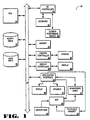
- Figure 1 illustrates a computer system 10 implementing the apparatus and methods of the present invention.
- computer system 10 represents one preferred embodiment of the platform for the present invention.
- computer system 10 comprises a host CPU 12, memory 14, hard disk drive 16, and floppy disk drive 18, all of which are coupled together via system bus 19.
- system bus 19 Upon review of this specification, it will be appreciated that some or all of these components can be eliminated from various embodiments of the present invention. It will further be appreciated that operating system software and other software needed for the operation of computer system 10 will be loaded into main memory 14 from either hard disk drive 16 or floppy disk drive 18 upon power up. It will be appreciated that some of the code to be executed by CPU 12 on power up is stored in a ROM or other non-volatile storage device.
- Computer system 10 is further equipped with a conventional keyboard 20 and a cursor positioning device 22.
- cursor positioning device 22 includes a trackball and two switches' which are actuated by two contoured buttons.
- Keyboard 22 and cursor positioning device 13 comprise part of the user interface of computer system 10 and allow a user to communicate with the other elements of computer system 10.
- any keyboard 20 and cursor positioning device 22 could be used with computer system 10, in one embodiment, these items are distinct units which are coupled to the system bus 19 via input/output controller 24. Other embodiments may eliminate the input/output controller and may further integrate keyboard 20 and cursor positioning device 22 into a single unit.
- Computer system 10 further includes a display unit 26 which is coupled to the system bus 19 through display controller 28.
- Display 26 may comprise any one of a number of familiar display devices any may be a liquid crystal display unit or video display terminal. It will be appreciated by those skilled in the art, however, that in other embodiments, display 26 can be any one of a number of other display devices.
- Display controller 28 which typically includes video memory (not shown), receives command and data information via system bus 19 and then provides the necessary signals to display 26, thereby accomplishing the display of text, graphical and other information to the user.
- menus and other input/output displays which comprise part of the user interface of the computer system 10 are displayed on display 26 and an associated cursor can be moved on the screen using cursor positioning device 22 in the familiar fashion.
- printer controller 30 is coupled to system bus 19, thereby allowing for the transfer of command and data information.
- Printer 32 is coupled to printer controller 30 in the familiar fashion. It will be appreciated that some embodiments of computer system 10 will not utilize printer controller 30 and printer 32.
- Application interface unit 34 is coupled to system bus 19 and acts as an interface between telephone handset 36, display 38 and speaker 40 and the system bus 19.
- Application interface unit 34 is further coupled to semaphore logic 42 which, in turn, is coupled to automatic speech recognizer (ASR) 44.
- ASR automatic speech recognizer
- Microphone 46 and telephone handset 36 are coupled to ASR 44.
- voice signals are converted to electrical signals by either microphone 46 or telephone handset 36.
- the electrical signals are then digitized and analyzed by ASR 44 in accordance with the methods of the present invention as described in detail below.
- the output signals of ASR 44 are passed to semaphore logic 42 which extracts values associated with the signals. These values are presented to application interface unit 34 for further processing as described below. Results of the processing are presented via display 38 and/or speaker 40 and telephone handset 36. It will be appreciated that in some embodiments display 38 and display 26 may comprise the same unit. In other embodiments, display 38 may be a dedicated unit.
- application interface unit 34 has been depicted as a separate unit, upon review of this specification it will be apparent to those skilled in the art that the functions of application unit 34 may be implemented via host CPU 12.
- Computer systems that support spoken language interaction are based on speech recognition systems integrated with an application interface logic and other components such as data bases and peripherals.
- Computer system 10 shown in Figure 1 is such a system.
- Three principal components of computer system 10: the automatic speech recognizer 44, the semaphore logic 42, and the application interface controller 34 are shown in further detail in Figure 2.
- These components are directly or indirectly connected to three transducers: a video display terminal (VDT) 38, a loudspeaker 40, and a microphone 46.
- VDT 38 may comprise an alternative type of display device such as a liquid crystal display.
- the components and transducers are connected by logical data streams, 50-58.
- the embodiment shown in Figure 2 resembles a system in which a user interacts at a console with a VDT, microphone and a loudspeaker. However, the microphone and speaker in Figure 2 could both be replaced by a telephone handset 36.
- a language proficiency testing system that operates over the telephone is one embodiment of the invention shown in Figure 2.
- the human user may be remote from the computer system 10.
- the computer system 10 displays speech signals over the outbound data stream 58, which is a telephone line.
- the user responds by speaking into the microphone 46 or the telephone handset 36.
- the user's speech signal is transmitted over the phone line 50, and processed by the speech recognizer 44, with reference to the current state of the application interface, as received in data stream 55 from the application interface controller 34.
- the speech recognizer 44 produces a data stream 52 that contains an augmented representation of the linguistic content of the user's speech signal, including a representation of the speech signal aligned with segment, syllable, word, phrase, and clause units.
- the semaphore logic 42 is implemented as a sequentially separate processing component in the embodiment shown in Figure 2, although its function may also be performed in whole or in part in the speech recognizer 44.
- the semaphore logic 42 extracts a series of nominal and numerical values that are associated with each unit level.
- This embedded semaphore structure is data stream 54 that is stored in application interface controller 34 and combined in various forms to drive the branching decisions and determine the state of the application interface controller 34.
- the state of the application interface controller 34 then generates two data streams: 56 that updates ASR 44 and semaphore logic 42 with its current state as relevant to the processing done in ASR 44 and semaphore logic 42, and 58 that is the audio signal that plays out through the loudspeaker 40 or the user's telephone handset 36.
- FIG. 3 is a block diagram of one embodiment of a speech recognizer 44.
- Speech recognizer 44 is consistent with an Hidden Markov Model (HMM) - based system for this embodiment, although the invention is applicable to systems that use other speech recognition techniques.
- the component comprises a feature extractor 60 that is implemented by digital signal processing techniques well known in the art and a decoder 62 that searches the language model 64 as appropriate to the current state of the application interface controller 34.
- HMM Hidden Markov Model
- FIG 4 is a schematic block diagram of the semaphore logic 42, which operates on the data stream 52 and produces the data stream 53.
- Semaphore logic 42 implements a set of estimation routines 70-76 that logically operate in parallel, with partial inter-process communication. These processes include, in the embodiment for telephone language proficiency testing, measures of speaking rate and of fluency, estimates of speaker gender and native language, and measures of segmental and prosodic accuracy for the spoken response. Each of these processes is implemented using programming techniques well known in the art.
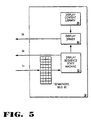
- FIG. 5 is a block diagram of the application interface controller 34 which comprises a semaphore silo 80, which stores a 10-utterance FIFO of semaphores, a display sequence state machine 82, a display driver 84, and a display content library 86 containing the audio files specified for display by the display sequence state machine 82.
- Display sequence state machine 82 changes state depending on the content of the semaphore silo 80.
- the current state of display sequence state machine 82 generates data stream 56 and controls the display driver 84, which copies or adapts content from display content library 86 and produces data stream 58.
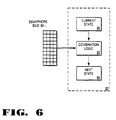
- Figure 6 represents a decision logic element in the state network implemented in the display sequence state machine 82.
- the combination logic 90 in this embodiment is a deterministic, state-dependent function of the last semaphore value.
- Combination logic 90 allows display sequence state machine 82 to transition from current state 92 to next state 94 based on the input from semaphoric silo 80.
- Other possibilities within the scope of the invention include probabilistic functions of the last semaphore values, and probabilistic or deterministic functions on the values of the last n (n ⁇ 11) semaphores.
- a remote user initiates contact with computer system 10 via a standard telephone handset 36. It will be appreciated that this can be accomplished by dialing up a telephone number associated with computer system 10 whereupon the user's call will be automatically answered.
- the user initiates the operation of a desired speech testing or other routine in the typical fashion, for example, by responding to audio prompts using the touch-tone keypad of the telephone.
- computer system 10 loads the desired application program from hard drive 16 into main memory 14 and begins to execute the instructions associated therewith. This further causes computer system 10 to configure its circuitry accordingly so as to implement the operation of the selected application program.
- computer system 10 begins testing the user's speech abilities by generating a series of displays. These displays may be purely audio, i.e., in the case of a solely telephone contact by the user, or audio-visual, where the user is positioned at a remote terminal or has accessed computer system 10 via a modem. It will be appreciated that one method of accessing computer system 10 may be via a gateway to the network of computer systems commonly referred to as the Internet.
- the displays initiated by computer system 10 may take the form of a request to read or repeat a word, phrase, or sentence (or larger linguistic unit); a request to complete, fill in, or identify missing elements in a graphic or verbal aggregate (i.e., a picture or a paragraph); example to imitate; or any similar graphical or verbal presentation that conveniently serves as a prompt for the user to speak.
- the user provides a speech signal which is transmitted via the telephone handset 36 (or other device) to ASR 44.
- the user's speech signal is processed by ASR 44 to produce data stream 52.
- This information (data stream 52) is passed on to semaphore logic 42 where the above-described processes operate to extract linguistic and extra-linguistic information. For example, in one embodiment, the response latency and speaking rate of the user is identified. Other embodiments might extract gender and native language information.
- This extracted information is then utilized by application interface 34 to select the subsequent output of computer system 10.
- this might include displaying advanced graphical or verbal aggregates to those users whose speech characteristics demonstrate a high level of fluency.
- targets other than language proficiency. For example, geographical familiarity or competency in arithmetic could be examined.
- the present invention could be used as a means by which users interact with an amusement game running on computer system 10.
Landscapes
- Engineering & Computer Science (AREA)
- Business, Economics & Management (AREA)
- Theoretical Computer Science (AREA)
- Physics & Mathematics (AREA)
- Educational Administration (AREA)
- Educational Technology (AREA)
- General Physics & Mathematics (AREA)
- General Health & Medical Sciences (AREA)
- Health & Medical Sciences (AREA)
- Entrepreneurship & Innovation (AREA)
- Audiology, Speech & Language Pathology (AREA)
- Electrically Operated Instructional Devices (AREA)
- User Interface Of Digital Computer (AREA)
- Measurement Of The Respiration, Hearing Ability, Form, And Blood Characteristics Of Living Organisms (AREA)
Abstract
Description
vocal reaction time, rate of speech, fluency, pronunciation skill, native language, and other linguistic, indexical, or paralinguistic information from an incoming speech signal. The user produces a speech signal in the context of a computer-produced display that is conventionally interpreted by the user as a request for information, or a request to read or repeat a word, phrase, sentence, or larger linguistic unit, or a request to complete, fill in, or identify missing elements in graphic or verbal aggregates (e.g., pictures or paragraphs), or an example to imitate, or any similar graphical or verbal presentation that conventionally serves as a prompt to speak. The display is presented though a device either integral or peripheral to a computer system, such as a local or remote video display terminal or telephone. The extracted linguistic and extra-linguistic information is combined in order to differentially select subsequent computer output for the purpose of amusement, instruction, or evaluation of that person by means of computer-human interaction.
Claims (17)
- An improvement for an interactive computer-based system (10) comprising means for extracting linguistic or indexical values in a spoken response elicited from a user in response to prompts presented by the system, means for extracting (44) paralinguistic values in the user's spoken response and means for automatically selecting a next prompt (34) to be presented to the user according to combined values of linguistic units, including words, phrases or sentences contained in the response, characterised by:the means for automatically selecting the next prompt (34) being configured to select the next prompt according to latency of the spoken response relative to the prompt.
- The system of claim 1 wherein the means for extracting (44) indexical or paralinguistic values comprises means for extracting (42) semaphore values including speaker identity, fundamental frequency values, speech signal amplitudes, pronunciation quality, fluency, speech rate, speaker native language, speaker age or speaker gender from the user's spoken responses.
- The system of claim 1 wherein the means for extracting (44) indexical or paralinguistic values comprises means for extracting (42) semaphore values including user's native language derived from the user's spoken responses in a target language.
- The system of claim 2 wherein the means for automatically selecting the next prompt (34) comprises means for combining (80, 82) (a) one or more of the extracted semaphore values from the user's spoken responses with (b) a measure of the latency of the user's response and with (c) the linguistic units of a previous response to select the next prompt.
- The system of claim 2 wherein the means for automatically selecting (34) the next prompt comprises means for estimating (42) a user state by combining two or more of the extracted semaphore values to select the next prompt.
- The system of claim 2 wherein the means for automatically selecting (34) the next prompt further comprises means-for estimating (42) a user skill or trait by combining two or more of the extracted semaphore values to select the next prompt.
- The system of claim 6 wherein the user skill or trait comprises at least one of: language proficiency, subject matter knowledge, user age or user gender.
- The system of claim 1 further comprising means for selecting (38, 40) the linguistic, paralinguistic or indexical characteristics of the prompt, at least in part, by the linguistic, paralinguistic or indexical content of a spoken response from the user.
- The system of claim 8 wherein the linguistic, paralinguistic or indexical characteristics of the prompt presented included linguistic units, latency relative to the user's response, speech rate, fundamental frequency values, speech signal amplitudes, pronunciation quality, fluency, speaker identity, speaker age or speaker gender.
- The system of claim 8 wherein the prompt comprises a request for information.
- The system of claim 8 wherein the prompt comprises a request to read a linguistic unit.
- The system of claim 8 wherein the prompt comprises a request to repeat a linguistic unit.
- The system of claim 8 wherein the prompt comprises a request to complete, fill in or identify a verbal aggregate.
- The system of claim 1 wherein the spoken responses from the user are received at the interactive computer system (10) via telephone or other telecommunication or data information network (36).
- The system of claim 1 wherein the prompts are graphical prompts.
- The system of claim 1 wherein the prompts are audio prompts.
- The system of claim 1 wherein the prompts combine verbal and graphical elements.
Applications Claiming Priority (3)
| Application Number | Priority Date | Filing Date | Title |
|---|---|---|---|
| US791495P | 1995-12-04 | 1995-12-04 | |
| US7914P | 1995-12-04 | ||
| PCT/US1996/019264 WO1997021201A1 (en) | 1995-12-04 | 1996-11-25 | Method and apparatus for combined information from speech signals for adaptive interaction in teaching and testing |
Publications (2)
| Publication Number | Publication Date |
|---|---|
| EP0956552A1 EP0956552A1 (en) | 1999-11-17 |
| EP0956552B1 true EP0956552B1 (en) | 2002-07-17 |
Family
ID=21728782
Family Applications (1)
| Application Number | Title | Priority Date | Filing Date |
|---|---|---|---|
| EP96942132A Expired - Lifetime EP0956552B1 (en) | 1995-12-04 | 1996-11-25 | Method and apparatus for combined information from speech signals for adaptive interaction in teaching and testing |
Country Status (11)
| Country | Link |
|---|---|
| US (1) | US5870709A (en) |
| EP (1) | EP0956552B1 (en) |
| JP (2) | JP2000501847A (en) |
| AT (1) | ATE220817T1 (en) |
| AU (1) | AU1128597A (en) |
| CA (1) | CA2239691C (en) |
| DE (1) | DE69622439T2 (en) |
| DK (1) | DK0956552T3 (en) |
| ES (1) | ES2180819T3 (en) |
| PT (1) | PT956552E (en) |
| WO (1) | WO1997021201A1 (en) |
Families Citing this family (118)
| Publication number | Priority date | Publication date | Assignee | Title |
|---|---|---|---|---|
| JPH10260692A (en) * | 1997-03-18 | 1998-09-29 | Toshiba Corp | Speech recognition / synthesis encoding / decoding method and speech encoding / decoding system |
| US6603835B2 (en) * | 1997-09-08 | 2003-08-05 | Ultratec, Inc. | System for text assisted telephony |
| US6493426B2 (en) * | 1997-09-08 | 2002-12-10 | Ultratec, Inc. | Relay for personal interpreter |
| US6594346B2 (en) * | 1997-09-08 | 2003-07-15 | Ultratec, Inc. | Relay for personal interpreter |
| DE19752907C2 (en) * | 1997-11-28 | 2002-10-31 | Egon Stephan | Method for conducting a dialogue between a single or multiple users and a computer |
| US5927988A (en) * | 1997-12-17 | 1999-07-27 | Jenkins; William M. | Method and apparatus for training of sensory and perceptual systems in LLI subjects |
| US6192341B1 (en) * | 1998-04-06 | 2001-02-20 | International Business Machines Corporation | Data processing system and method for customizing data processing system output for sense-impaired users |
| US7203649B1 (en) * | 1998-04-15 | 2007-04-10 | Unisys Corporation | Aphasia therapy system |
| WO2000042589A2 (en) * | 1998-09-04 | 2000-07-20 | N.V. De Wilde Cbt | Apparatus and method for personalized language exercise generation |
| WO2000022597A1 (en) * | 1998-10-15 | 2000-04-20 | Planetlingo Inc. | Method for computer-aided foreign language instruction |
| GB2348035B (en) * | 1999-03-19 | 2003-05-28 | Ibm | Speech recognition system |
| US6224383B1 (en) | 1999-03-25 | 2001-05-01 | Planetlingo, Inc. | Method and system for computer assisted natural language instruction with distracters |
| WO2000057386A1 (en) * | 1999-03-25 | 2000-09-28 | Planetlingo, Inc. | Method and system for computer assisted natural language instruction with adjustable speech recognizer |
| US6397185B1 (en) * | 1999-03-29 | 2002-05-28 | Betteraccent, Llc | Language independent suprasegmental pronunciation tutoring system and methods |
| US7062441B1 (en) | 1999-05-13 | 2006-06-13 | Ordinate Corporation | Automated language assessment using speech recognition modeling |
| US6299452B1 (en) * | 1999-07-09 | 2001-10-09 | Cognitive Concepts, Inc. | Diagnostic system and method for phonological awareness, phonological processing, and reading skill testing |
| US6665644B1 (en) * | 1999-08-10 | 2003-12-16 | International Business Machines Corporation | Conversational data mining |
| DE19941227A1 (en) * | 1999-08-30 | 2001-03-08 | Philips Corp Intellectual Pty | Method and arrangement for speech recognition |
| US6963837B1 (en) * | 1999-10-06 | 2005-11-08 | Multimodal Technologies, Inc. | Attribute-based word modeling |
| US6513009B1 (en) * | 1999-12-14 | 2003-01-28 | International Business Machines Corporation | Scalable low resource dialog manager |
| KR20000049483A (en) * | 2000-03-28 | 2000-08-05 | 이헌 | Foreign language learning system using a method of voice signal. comparison |
| KR20000049500A (en) * | 2000-03-31 | 2000-08-05 | 백종관 | Method of Practicing Foreign Language Using Voice Recognition and Text-to-Speech and System Thereof |
| JP3887525B2 (en) * | 2000-07-11 | 2007-02-28 | 株式会社日本統計事務センター | Online testing system |
| US6424935B1 (en) * | 2000-07-31 | 2002-07-23 | Micron Technology, Inc. | Two-way speech recognition and dialect system |
| JP2004516497A (en) * | 2000-10-20 | 2004-06-03 | ジヨンソン,キヤロル,エム | Automatic language acquisition system and method |
| US20020115044A1 (en) * | 2001-01-10 | 2002-08-22 | Zeev Shpiro | System and method for computer-assisted language instruction |
| WO2002071390A1 (en) * | 2001-03-01 | 2002-09-12 | Ordinate Corporation | A system for measuring intelligibility of spoken language |
| US20020169604A1 (en) * | 2001-03-09 | 2002-11-14 | Damiba Bertrand A. | System, method and computer program product for genre-based grammars and acoustic models in a speech recognition framework |
| US6876728B2 (en) | 2001-07-02 | 2005-04-05 | Nortel Networks Limited | Instant messaging using a wireless interface |
| US20030039948A1 (en) * | 2001-08-09 | 2003-02-27 | Donahue Steven J. | Voice enabled tutorial system and method |
| US7881441B2 (en) * | 2005-06-29 | 2011-02-01 | Ultratec, Inc. | Device independent text captioned telephone service |
| US8416925B2 (en) | 2005-06-29 | 2013-04-09 | Ultratec, Inc. | Device independent text captioned telephone service |
| US8644475B1 (en) | 2001-10-16 | 2014-02-04 | Rockstar Consortium Us Lp | Telephony usage derived presence information |
| EP1456837B1 (en) * | 2001-12-21 | 2006-03-22 | Telefonaktiebolaget LM Ericsson (publ) | Method and device for voice recognition |
| US20030135624A1 (en) * | 2001-12-27 | 2003-07-17 | Mckinnon Steve J. | Dynamic presence management |
| US6953343B2 (en) * | 2002-02-06 | 2005-10-11 | Ordinate Corporation | Automatic reading system and methods |
| TW520488B (en) * | 2002-03-12 | 2003-02-11 | Inventec Corp | Computer-assisted foreign language audiolingual teaching system for contextual read-after assessment and method thereof |
| EP1363271A1 (en) | 2002-05-08 | 2003-11-19 | Sap Ag | Method and system for processing and storing of dialogue speech data |
| BR0304830A (en) * | 2002-05-14 | 2004-08-17 | Koninkl Philips Electronics Nv | Device and method of communication between a user and an electrical appliance |
| USH2187H1 (en) | 2002-06-28 | 2007-04-03 | Unisys Corporation | System and method for gender identification in a speech application environment |
| US7299188B2 (en) * | 2002-07-03 | 2007-11-20 | Lucent Technologies Inc. | Method and apparatus for providing an interactive language tutor |
| US7181392B2 (en) * | 2002-07-16 | 2007-02-20 | International Business Machines Corporation | Determining speech recognition accuracy |
| US7249011B2 (en) * | 2002-08-12 | 2007-07-24 | Avaya Technology Corp. | Methods and apparatus for automatic training using natural language techniques for analysis of queries presented to a trainee and responses from the trainee |
| KR20040017896A (en) * | 2002-08-22 | 2004-03-02 | 박이희 | Recording media for learning a foreign language using a computer and method using the same |
| US7305336B2 (en) * | 2002-08-30 | 2007-12-04 | Fuji Xerox Co., Ltd. | System and method for summarization combining natural language generation with structural analysis |
| US20040049391A1 (en) * | 2002-09-09 | 2004-03-11 | Fuji Xerox Co., Ltd. | Systems and methods for dynamic reading fluency proficiency assessment |
| US8392609B2 (en) | 2002-09-17 | 2013-03-05 | Apple Inc. | Proximity detection for media proxies |
| US7455522B2 (en) * | 2002-10-04 | 2008-11-25 | Fuji Xerox Co., Ltd. | Systems and methods for dynamic reading fluency instruction and improvement |
| US7752045B2 (en) * | 2002-10-07 | 2010-07-06 | Carnegie Mellon University | Systems and methods for comparing speech elements |
| US7324944B2 (en) * | 2002-12-12 | 2008-01-29 | Brigham Young University, Technology Transfer Office | Systems and methods for dynamically analyzing temporality in speech |
| US7363213B2 (en) * | 2003-02-11 | 2008-04-22 | Fuji Xerox Co., Ltd. | System and method for dynamically determining the function of a lexical item based on discourse hierarchy structure |
| US7369985B2 (en) * | 2003-02-11 | 2008-05-06 | Fuji Xerox Co., Ltd. | System and method for dynamically determining the attitude of an author of a natural language document |
| US7424420B2 (en) * | 2003-02-11 | 2008-09-09 | Fuji Xerox Co., Ltd. | System and method for dynamically determining the function of a lexical item based on context |
| US7260519B2 (en) * | 2003-03-13 | 2007-08-21 | Fuji Xerox Co., Ltd. | Systems and methods for dynamically determining the attitude of a natural language speaker |
| US9118574B1 (en) | 2003-11-26 | 2015-08-25 | RPX Clearinghouse, LLC | Presence reporting using wireless messaging |
| US8515024B2 (en) | 2010-01-13 | 2013-08-20 | Ultratec, Inc. | Captioned telephone service |
| GB2448635B (en) * | 2004-02-18 | 2009-02-11 | Ultratec Inc | Captioned telephone service |
| US20060008781A1 (en) * | 2004-07-06 | 2006-01-12 | Ordinate Corporation | System and method for measuring reading skills |
| US7624013B2 (en) * | 2004-09-10 | 2009-11-24 | Scientific Learning Corporation | Word competition models in voice recognition |
| US20060069562A1 (en) * | 2004-09-10 | 2006-03-30 | Adams Marilyn J | Word categories |
| US9520068B2 (en) * | 2004-09-10 | 2016-12-13 | Jtt Holdings, Inc. | Sentence level analysis in a reading tutor |
| US7433819B2 (en) * | 2004-09-10 | 2008-10-07 | Scientific Learning Corporation | Assessing fluency based on elapsed time |
| US8109765B2 (en) * | 2004-09-10 | 2012-02-07 | Scientific Learning Corporation | Intelligent tutoring feedback |
| US20060058999A1 (en) * | 2004-09-10 | 2006-03-16 | Simon Barker | Voice model adaptation |
| US7243068B2 (en) * | 2004-09-10 | 2007-07-10 | Soliloquy Learning, Inc. | Microphone setup and testing in voice recognition software |
| US20060057545A1 (en) * | 2004-09-14 | 2006-03-16 | Sensory, Incorporated | Pronunciation training method and apparatus |
| US20060136215A1 (en) * | 2004-12-21 | 2006-06-22 | Jong Jin Kim | Method of speaking rate conversion in text-to-speech system |
| US11258900B2 (en) | 2005-06-29 | 2022-02-22 | Ultratec, Inc. | Device independent text captioned telephone service |
| US20070055523A1 (en) * | 2005-08-25 | 2007-03-08 | Yang George L | Pronunciation training system |
| US20070055514A1 (en) * | 2005-09-08 | 2007-03-08 | Beattie Valerie L | Intelligent tutoring feedback |
| JP2006053578A (en) * | 2005-09-12 | 2006-02-23 | Nippon Tokei Jimu Center:Kk | How to conduct the test |
| US7697827B2 (en) | 2005-10-17 | 2010-04-13 | Konicek Jeffrey C | User-friendlier interfaces for a camera |
| US20070166685A1 (en) * | 2005-12-22 | 2007-07-19 | David Gilbert | Automated skills assessment |
| US20070179788A1 (en) * | 2006-01-27 | 2007-08-02 | Benco David S | Network support for interactive language lessons |
| JP4911756B2 (en) * | 2006-06-12 | 2012-04-04 | 株式会社日本統計事務センター | Online testing system |
| JP2008022493A (en) * | 2006-07-14 | 2008-01-31 | Fujitsu Ltd | Reception support system and its program |
| JP2008026463A (en) * | 2006-07-19 | 2008-02-07 | Denso Corp | Spoken dialogue device |
| WO2008024377A2 (en) * | 2006-08-21 | 2008-02-28 | Power-Glide Language Courses, Inc. | Group foreign language teaching system and method |
| US20080140412A1 (en) * | 2006-12-07 | 2008-06-12 | Jonathan Travis Millman | Interactive tutoring |
| US20080140652A1 (en) * | 2006-12-07 | 2008-06-12 | Jonathan Travis Millman | Authoring tool |
| US20080140411A1 (en) * | 2006-12-07 | 2008-06-12 | Jonathan Travis Millman | Reading |
| US20080140413A1 (en) * | 2006-12-07 | 2008-06-12 | Jonathan Travis Millman | Synchronization of audio to reading |
| US20080140397A1 (en) * | 2006-12-07 | 2008-06-12 | Jonathan Travis Millman | Sequencing for location determination |
| US20080160487A1 (en) * | 2006-12-29 | 2008-07-03 | Fairfield Language Technologies | Modularized computer-aided language learning method and system |
| GB2451907B (en) * | 2007-08-17 | 2010-11-03 | Fluency Voice Technology Ltd | Device for modifying and improving the behaviour of speech recognition systems |
| US8271281B2 (en) * | 2007-12-28 | 2012-09-18 | Nuance Communications, Inc. | Method for assessing pronunciation abilities |
| US20090209341A1 (en) * | 2008-02-14 | 2009-08-20 | Aruze Gaming America, Inc. | Gaming Apparatus Capable of Conversation with Player and Control Method Thereof |
| US20100075289A1 (en) * | 2008-09-19 | 2010-03-25 | International Business Machines Corporation | Method and system for automated content customization and delivery |
| US8494857B2 (en) | 2009-01-06 | 2013-07-23 | Regents Of The University Of Minnesota | Automatic measurement of speech fluency |
| US10088976B2 (en) | 2009-01-15 | 2018-10-02 | Em Acquisition Corp., Inc. | Systems and methods for multiple voice document narration |
| WO2010084881A1 (en) * | 2009-01-20 | 2010-07-29 | 旭化成株式会社 | Voice conversation device, conversation control method, and conversation control program |
| US20110166862A1 (en) * | 2010-01-04 | 2011-07-07 | Eyal Eshed | System and method for variable automated response to remote verbal input at a mobile device |
| US8392186B2 (en) | 2010-05-18 | 2013-03-05 | K-Nfb Reading Technology, Inc. | Audio synchronization for document narration with user-selected playback |
| US20140038160A1 (en) * | 2011-04-07 | 2014-02-06 | Mordechai Shani | Providing computer aided speech and language therapy |
| JP2012128440A (en) * | 2012-02-06 | 2012-07-05 | Denso Corp | Voice interactive device |
| US9576593B2 (en) | 2012-03-15 | 2017-02-21 | Regents Of The University Of Minnesota | Automated verbal fluency assessment |
| US9635067B2 (en) | 2012-04-23 | 2017-04-25 | Verint Americas Inc. | Tracing and asynchronous communication network and routing method |
| US20130282844A1 (en) | 2012-04-23 | 2013-10-24 | Contact Solutions LLC | Apparatus and methods for multi-mode asynchronous communication |
| EP3103038B1 (en) | 2014-02-06 | 2019-03-27 | Contact Solutions, LLC | Systems, apparatuses and methods for communication flow modification |
| US10748523B2 (en) | 2014-02-28 | 2020-08-18 | Ultratec, Inc. | Semiautomated relay method and apparatus |
| US20180034961A1 (en) | 2014-02-28 | 2018-02-01 | Ultratec, Inc. | Semiautomated Relay Method and Apparatus |
| US20180270350A1 (en) | 2014-02-28 | 2018-09-20 | Ultratec, Inc. | Semiautomated relay method and apparatus |
| US12482458B2 (en) | 2014-02-28 | 2025-11-25 | Ultratec, Inc. | Semiautomated relay method and apparatus |
| US10389876B2 (en) | 2014-02-28 | 2019-08-20 | Ultratec, Inc. | Semiautomated relay method and apparatus |
| US10878721B2 (en) | 2014-02-28 | 2020-12-29 | Ultratec, Inc. | Semiautomated relay method and apparatus |
| US9166881B1 (en) | 2014-12-31 | 2015-10-20 | Contact Solutions LLC | Methods and apparatus for adaptive bandwidth-based communication management |
| CN104464399A (en) * | 2015-01-03 | 2015-03-25 | 杨茹芹 | Novel display board for English teaching |
| US9947322B2 (en) * | 2015-02-26 | 2018-04-17 | Arizona Board Of Regents Acting For And On Behalf Of Northern Arizona University | Systems and methods for automated evaluation of human speech |
| WO2017024248A1 (en) | 2015-08-06 | 2017-02-09 | Contact Solutions LLC | Tracing and asynchronous communication network and routing method |
| US10063647B2 (en) | 2015-12-31 | 2018-08-28 | Verint Americas Inc. | Systems, apparatuses, and methods for intelligent network communication and engagement |
| US9799324B2 (en) | 2016-01-28 | 2017-10-24 | Google Inc. | Adaptive text-to-speech outputs |
| US10796715B1 (en) * | 2016-09-01 | 2020-10-06 | Arizona Board Of Regents On Behalf Of Arizona State University | Speech analysis algorithmic system and method for objective evaluation and/or disease detection |
| US10431112B2 (en) | 2016-10-03 | 2019-10-01 | Arthur Ward | Computerized systems and methods for categorizing student responses and using them to update a student model during linguistic education |
| US10049664B1 (en) * | 2016-10-27 | 2018-08-14 | Intuit Inc. | Determining application experience based on paralinguistic information |
| US20180197438A1 (en) | 2017-01-10 | 2018-07-12 | International Business Machines Corporation | System for enhancing speech performance via pattern detection and learning |
| US10593351B2 (en) * | 2017-05-03 | 2020-03-17 | Ajit Arun Zadgaonkar | System and method for estimating hormone level and physiological conditions by analysing speech samples |
| US11539900B2 (en) | 2020-02-21 | 2022-12-27 | Ultratec, Inc. | Caption modification and augmentation systems and methods for use by hearing assisted user |
| US12482369B2 (en) | 2023-02-09 | 2025-11-25 | Renaissance Learning, Inc. | Multi-lingual toggle system with transferable skills, course mapping and translanguaging capabilities across global and regional educational jurisdictions |
Family Cites Families (13)
| Publication number | Priority date | Publication date | Assignee | Title |
|---|---|---|---|---|
| GB8817705D0 (en) * | 1988-07-25 | 1988-09-01 | British Telecomm | Optical communications system |
| US5065345A (en) * | 1988-11-04 | 1991-11-12 | Dyned International, Inc. | Interactive audiovisual control mechanism |
| US5036539A (en) * | 1989-07-06 | 1991-07-30 | Itt Corporation | Real-time speech processing development system |
| US5133560A (en) * | 1990-08-31 | 1992-07-28 | Small Maynard E | Spelling game method |
| US5268990A (en) * | 1991-01-31 | 1993-12-07 | Sri International | Method for recognizing speech using linguistically-motivated hidden Markov models |
| US5302132A (en) * | 1992-04-01 | 1994-04-12 | Corder Paul R | Instructional system and method for improving communication skills |
| JP2524472B2 (en) * | 1992-09-21 | 1996-08-14 | インターナショナル・ビジネス・マシーンズ・コーポレイション | How to train a telephone line based speech recognition system |
| US5393236A (en) * | 1992-09-25 | 1995-02-28 | Northeastern University | Interactive speech pronunciation apparatus and method |
| GB9223066D0 (en) * | 1992-11-04 | 1992-12-16 | Secr Defence | Children's speech training aid |
| US5487671A (en) * | 1993-01-21 | 1996-01-30 | Dsp Solutions (International) | Computerized system for teaching speech |
| DE69425564D1 (en) * | 1993-03-12 | 2000-09-21 | Stanford Res Inst Int | METHOD AND DEVICE FOR VOICE TEACHING BY MEANS OF INTERACTIVE VOICE CONTROL |
| US5458494A (en) * | 1993-08-23 | 1995-10-17 | Edutech Research Labs, Ltd. | Remotely operable teaching system and method therefor |
| US5540589A (en) * | 1994-04-11 | 1996-07-30 | Mitsubishi Electric Information Technology Center | Audio interactive tutor |
-
1996
- 1996-11-25 WO PCT/US1996/019264 patent/WO1997021201A1/en not_active Ceased
- 1996-11-25 ES ES96942132T patent/ES2180819T3/en not_active Expired - Lifetime
- 1996-11-25 AU AU11285/97A patent/AU1128597A/en not_active Abandoned
- 1996-11-25 PT PT96942132T patent/PT956552E/en unknown
- 1996-11-25 DE DE69622439T patent/DE69622439T2/en not_active Expired - Lifetime
- 1996-11-25 EP EP96942132A patent/EP0956552B1/en not_active Expired - Lifetime
- 1996-11-25 DK DK96942132T patent/DK0956552T3/en active
- 1996-11-25 AT AT96942132T patent/ATE220817T1/en not_active IP Right Cessation
- 1996-11-25 CA CA002239691A patent/CA2239691C/en not_active Expired - Lifetime
- 1996-11-25 JP JP09521379A patent/JP2000501847A/en not_active Withdrawn
- 1996-11-25 US US08/753,580 patent/US5870709A/en not_active Expired - Lifetime
-
2005
- 2005-06-08 JP JP2005168611A patent/JP2005321817A/en active Pending
Also Published As
| Publication number | Publication date |
|---|---|
| WO1997021201A1 (en) | 1997-06-12 |
| ATE220817T1 (en) | 2002-08-15 |
| AU1128597A (en) | 1997-06-27 |
| ES2180819T3 (en) | 2003-02-16 |
| CA2239691A1 (en) | 1997-06-12 |
| DE69622439D1 (en) | 2002-08-22 |
| JP2000501847A (en) | 2000-02-15 |
| HK1023638A1 (en) | 2000-09-15 |
| US5870709A (en) | 1999-02-09 |
| DE69622439T2 (en) | 2002-11-14 |
| JP2005321817A (en) | 2005-11-17 |
| CA2239691C (en) | 2006-06-06 |
| EP0956552A1 (en) | 1999-11-17 |
| DK0956552T3 (en) | 2002-11-04 |
| PT956552E (en) | 2002-10-31 |
Similar Documents
| Publication | Publication Date | Title |
|---|---|---|
| US5870709A (en) | Method and apparatus for combining information from speech signals for adaptive interaction in teaching and testing | |
| US6157913A (en) | Method and apparatus for estimating fitness to perform tasks based on linguistic and other aspects of spoken responses in constrained interactions | |
| US6324507B1 (en) | Speech recognition enrollment for non-readers and displayless devices | |
| US5393236A (en) | Interactive speech pronunciation apparatus and method | |
| US5487671A (en) | Computerized system for teaching speech | |
| Cucchiarini et al. | Automatic evaluation of Dutch pronunciation by using speech recognition technology | |
| CN108431883B (en) | Language learning systems and language learning programs | |
| US20030154080A1 (en) | Method and apparatus for modification of audio input to a data processing system | |
| KR101037247B1 (en) | Methods and Apparatus for Foreign Language Conversation Practice and Learner Simulation Methods and Devices for Rapid Development and Verification | |
| US20080027731A1 (en) | Comprehensive Spoken Language Learning System | |
| Inoue et al. | A Study of Objective Measurement of Comprehensibility through Native Speakers' Shadowing of Learners' Utterances. | |
| CN109697975B (en) | A kind of voice evaluation method and device | |
| JP2003228279A (en) | Language learning device using speech recognition, language learning method, and storage medium therefor | |
| Kabashima et al. | Dnn-based scoring of language learners’ proficiency using learners’ shadowings and native listeners’ responsive shadowings | |
| JPH06348297A (en) | Pronunciation practice device | |
| HK1023638B (en) | Method and apparatus for combined information from speech signals for adaptive interaction in teaching and testing | |
| Wik | Designing a virtual language tutor | |
| JP2001051587A (en) | Foreign language learning device, foreign language learning method, and computer readable recording medium recording foreign language learning program | |
| JP2007148170A (en) | Foreign language learning support system | |
| Aju et al. | A review of accent-based automatic speech recognition models for e-learning environment | |
| Sanders et al. | Speech synthesis for computer assisted instruction: The MISS system and its applications | |
| JP2020129023A (en) | Language learning device and language learning program | |
| JPH10326074A (en) | Control method of language training device | |
| Hofmann et al. | Vocabulary training program using TTS and speech recognition technologies | |
| JP2021135312A (en) | Information processing device, information processing method, information processing system, and information processing program |
Legal Events
| Date | Code | Title | Description |
|---|---|---|---|
| PUAI | Public reference made under article 153(3) epc to a published international application that has entered the european phase |
Free format text: ORIGINAL CODE: 0009012 |
|
| 17P | Request for examination filed |
Effective date: 19980820 |
|
| AK | Designated contracting states |
Kind code of ref document: A1 Designated state(s): AT BE CH DE DK ES FI FR GB GR IE IT LI LU MC NL PT SE |
|
| 17Q | First examination report despatched |
Effective date: 20000814 |
|
| GRAG | Despatch of communication of intention to grant |
Free format text: ORIGINAL CODE: EPIDOS AGRA |
|
| GRAG | Despatch of communication of intention to grant |
Free format text: ORIGINAL CODE: EPIDOS AGRA |
|
| GRAH | Despatch of communication of intention to grant a patent |
Free format text: ORIGINAL CODE: EPIDOS IGRA |
|
| GRAH | Despatch of communication of intention to grant a patent |
Free format text: ORIGINAL CODE: EPIDOS IGRA |
|
| GRAA | (expected) grant |
Free format text: ORIGINAL CODE: 0009210 |
|
| AK | Designated contracting states |
Kind code of ref document: B1 Designated state(s): AT BE CH DE DK ES FI FR GB GR IE IT LI LU MC NL PT SE |
|
| REF | Corresponds to: |
Ref document number: 220817 Country of ref document: AT Date of ref document: 20020815 Kind code of ref document: T |
|
| REG | Reference to a national code |
Ref country code: GB Ref legal event code: FG4D |
|
| RIC1 | Information provided on ipc code assigned before grant |
Free format text: 7G 09B 19/04 A, 7G 09B 7/04 B, 7G 10L 15/00 B |
|
| REG | Reference to a national code |
Ref country code: CH Ref legal event code: EP |
|
| REG | Reference to a national code |
Ref country code: CH Ref legal event code: NV Representative=s name: AMMANN PATENTANWAELTE AG BERN |
|
| REG | Reference to a national code |
Ref country code: IE Ref legal event code: FG4D |
|
| REF | Corresponds to: |
Ref document number: 69622439 Country of ref document: DE Date of ref document: 20020822 |
|
| REG | Reference to a national code |
Ref country code: PT Ref legal event code: SC4A Free format text: AVAILABILITY OF NATIONAL TRANSLATION Effective date: 20020805 |
|
| REG | Reference to a national code |
Ref country code: GR Ref legal event code: EP Ref document number: 20020402691 Country of ref document: GR |
|
| ET | Fr: translation filed | ||
| REG | Reference to a national code |
Ref country code: ES Ref legal event code: FG2A Ref document number: 2180819 Country of ref document: ES Kind code of ref document: T3 |
|
| PLBE | No opposition filed within time limit |
Free format text: ORIGINAL CODE: 0009261 |
|
| STAA | Information on the status of an ep patent application or granted ep patent |
Free format text: STATUS: NO OPPOSITION FILED WITHIN TIME LIMIT |
|
| 26N | No opposition filed |
Effective date: 20030422 |
|
| PGFP | Annual fee paid to national office [announced via postgrant information from national office to epo] |
Ref country code: AT Payment date: 20031103 Year of fee payment: 8 |
|
| PGFP | Annual fee paid to national office [announced via postgrant information from national office to epo] |
Ref country code: PT Payment date: 20031110 Year of fee payment: 8 Ref country code: MC Payment date: 20031110 Year of fee payment: 8 |
|
| PGFP | Annual fee paid to national office [announced via postgrant information from national office to epo] |
Ref country code: SE Payment date: 20031121 Year of fee payment: 8 Ref country code: DK Payment date: 20031121 Year of fee payment: 8 Ref country code: CH Payment date: 20031121 Year of fee payment: 8 |
|
| PGFP | Annual fee paid to national office [announced via postgrant information from national office to epo] |
Ref country code: FI Payment date: 20031124 Year of fee payment: 8 |
|
| PGFP | Annual fee paid to national office [announced via postgrant information from national office to epo] |
Ref country code: GR Payment date: 20031127 Year of fee payment: 8 |
|
| PGFP | Annual fee paid to national office [announced via postgrant information from national office to epo] |
Ref country code: LU Payment date: 20031128 Year of fee payment: 8 |
|
| PG25 | Lapsed in a contracting state [announced via postgrant information from national office to epo] |
Ref country code: LU Free format text: LAPSE BECAUSE OF NON-PAYMENT OF DUE FEES Effective date: 20041125 Ref country code: FI Free format text: LAPSE BECAUSE OF NON-PAYMENT OF DUE FEES Effective date: 20041125 Ref country code: AT Free format text: LAPSE BECAUSE OF NON-PAYMENT OF DUE FEES Effective date: 20041125 |
|
| PG25 | Lapsed in a contracting state [announced via postgrant information from national office to epo] |
Ref country code: SE Free format text: LAPSE BECAUSE OF NON-PAYMENT OF DUE FEES Effective date: 20041126 |
|
| PG25 | Lapsed in a contracting state [announced via postgrant information from national office to epo] |
Ref country code: MC Free format text: LAPSE BECAUSE OF NON-PAYMENT OF DUE FEES Effective date: 20041130 Ref country code: LI Free format text: LAPSE BECAUSE OF NON-PAYMENT OF DUE FEES Effective date: 20041130 Ref country code: DK Free format text: LAPSE BECAUSE OF NON-PAYMENT OF DUE FEES Effective date: 20041130 Ref country code: CH Free format text: LAPSE BECAUSE OF NON-PAYMENT OF DUE FEES Effective date: 20041130 |
|
| PG25 | Lapsed in a contracting state [announced via postgrant information from national office to epo] |
Ref country code: PT Free format text: LAPSE BECAUSE OF NON-PAYMENT OF DUE FEES Effective date: 20050525 |
|
| PG25 | Lapsed in a contracting state [announced via postgrant information from national office to epo] |
Ref country code: GR Free format text: LAPSE BECAUSE OF NON-PAYMENT OF DUE FEES Effective date: 20050602 |
|
| REG | Reference to a national code |
Ref country code: DK Ref legal event code: EBP |
|
| EUG | Se: european patent has lapsed | ||
| REG | Reference to a national code |
Ref country code: CH Ref legal event code: PL |
|
| REG | Reference to a national code |
Ref country code: PT Ref legal event code: MM4A Effective date: 20050525 |
|
| REG | Reference to a national code |
Ref country code: FR Ref legal event code: PLFP Year of fee payment: 20 |
|
| PGFP | Annual fee paid to national office [announced via postgrant information from national office to epo] |
Ref country code: DE Payment date: 20151118 Year of fee payment: 20 Ref country code: IE Payment date: 20151109 Year of fee payment: 20 Ref country code: IT Payment date: 20151124 Year of fee payment: 20 Ref country code: GB Payment date: 20151125 Year of fee payment: 20 |
|
| PGFP | Annual fee paid to national office [announced via postgrant information from national office to epo] |
Ref country code: FR Payment date: 20151008 Year of fee payment: 20 Ref country code: ES Payment date: 20151014 Year of fee payment: 20 Ref country code: NL Payment date: 20151110 Year of fee payment: 20 Ref country code: BE Payment date: 20151111 Year of fee payment: 20 |
|
| REG | Reference to a national code |
Ref country code: DE Ref legal event code: R071 Ref document number: 69622439 Country of ref document: DE |
|
| REG | Reference to a national code |
Ref country code: NL Ref legal event code: MK Effective date: 20161124 |
|
| REG | Reference to a national code |
Ref country code: GB Ref legal event code: PE20 Expiry date: 20161124 |
|
| REG | Reference to a national code |
Ref country code: IE Ref legal event code: MK9A |
|
| PG25 | Lapsed in a contracting state [announced via postgrant information from national office to epo] |
Ref country code: IE Free format text: LAPSE BECAUSE OF EXPIRATION OF PROTECTION Effective date: 20161125 Ref country code: GB Free format text: LAPSE BECAUSE OF EXPIRATION OF PROTECTION Effective date: 20161124 |
|
| REG | Reference to a national code |
Ref country code: ES Ref legal event code: FD2A Effective date: 20170303 |
|
| PG25 | Lapsed in a contracting state [announced via postgrant information from national office to epo] |
Ref country code: ES Free format text: LAPSE BECAUSE OF EXPIRATION OF PROTECTION Effective date: 20161126 |