EP0954544B1 - Process for producing polymeric films for use as fuel cells - Google Patents
Process for producing polymeric films for use as fuel cells Download PDFInfo
- Publication number
- EP0954544B1 EP0954544B1 EP97911615A EP97911615A EP0954544B1 EP 0954544 B1 EP0954544 B1 EP 0954544B1 EP 97911615 A EP97911615 A EP 97911615A EP 97911615 A EP97911615 A EP 97911615A EP 0954544 B1 EP0954544 B1 EP 0954544B1
- Authority
- EP
- European Patent Office
- Prior art keywords
- solvent
- acid
- membrane
- solution
- polymer
- Prior art date
- Legal status (The legal status is an assumption and is not a legal conclusion. Google has not performed a legal analysis and makes no representation as to the accuracy of the status listed.)
- Expired - Lifetime
Links
- 238000000034 method Methods 0.000 title claims abstract description 47
- 239000000446 fuel Substances 0.000 title description 18
- 239000002904 solvent Substances 0.000 claims abstract description 98
- 239000002253 acid Substances 0.000 claims abstract description 87
- 239000012528 membrane Substances 0.000 claims abstract description 52
- 229920000642 polymer Polymers 0.000 claims abstract description 39
- 230000015271 coagulation Effects 0.000 claims abstract description 37
- 238000005345 coagulation Methods 0.000 claims abstract description 37
- 239000000203 mixture Substances 0.000 claims abstract description 18
- 229920002480 polybenzimidazole Polymers 0.000 claims abstract description 11
- 239000004693 Polybenzimidazole Substances 0.000 claims abstract description 10
- 239000007788 liquid Substances 0.000 claims abstract description 9
- 239000011148 porous material Substances 0.000 claims abstract description 9
- 238000001035 drying Methods 0.000 claims abstract description 8
- 239000013557 residual solvent Substances 0.000 claims abstract description 7
- 230000001112 coagulating effect Effects 0.000 claims abstract description 6
- 238000004519 manufacturing process Methods 0.000 claims abstract description 6
- OKKJLVBELUTLKV-UHFFFAOYSA-N Methanol Chemical compound OC OKKJLVBELUTLKV-UHFFFAOYSA-N 0.000 claims description 72
- XLYOFNOQVPJJNP-UHFFFAOYSA-N water Substances O XLYOFNOQVPJJNP-UHFFFAOYSA-N 0.000 claims description 23
- MHABMANUFPZXEB-UHFFFAOYSA-N O-demethyl-aloesaponarin I Natural products O=C1C2=CC=CC(O)=C2C(=O)C2=C1C=C(O)C(C(O)=O)=C2C MHABMANUFPZXEB-UHFFFAOYSA-N 0.000 claims description 19
- IAZDPXIOMUYVGZ-UHFFFAOYSA-N Dimethylsulphoxide Chemical compound CS(C)=O IAZDPXIOMUYVGZ-UHFFFAOYSA-N 0.000 claims description 12
- AFVFQIVMOAPDHO-UHFFFAOYSA-N Methanesulfonic acid Chemical compound CS(O)(=O)=O AFVFQIVMOAPDHO-UHFFFAOYSA-N 0.000 claims description 12
- NBIIXXVUZAFLBC-UHFFFAOYSA-N Phosphoric acid Chemical compound OP(O)(O)=O NBIIXXVUZAFLBC-UHFFFAOYSA-N 0.000 claims description 12
- QAOWNCQODCNURD-UHFFFAOYSA-N Sulfuric acid Chemical compound OS(O)(=O)=O QAOWNCQODCNURD-UHFFFAOYSA-N 0.000 claims description 12
- 239000003792 electrolyte Substances 0.000 claims description 9
- SECXISVLQFMRJM-UHFFFAOYSA-N N-Methylpyrrolidone Chemical compound CN1CCCC1=O SECXISVLQFMRJM-UHFFFAOYSA-N 0.000 claims description 8
- DTQVDTLACAAQTR-UHFFFAOYSA-N Trifluoroacetic acid Chemical compound OC(=O)C(F)(F)F DTQVDTLACAAQTR-UHFFFAOYSA-N 0.000 claims description 8
- CSCPPACGZOOCGX-UHFFFAOYSA-N Acetone Chemical compound CC(C)=O CSCPPACGZOOCGX-UHFFFAOYSA-N 0.000 claims description 6
- ZMXDDKWLCZADIW-UHFFFAOYSA-N N,N-Dimethylformamide Chemical compound CN(C)C=O ZMXDDKWLCZADIW-UHFFFAOYSA-N 0.000 claims description 6
- 229910000147 aluminium phosphate Inorganic materials 0.000 claims description 6
- -1 poly(pyrimidine) Polymers 0.000 claims description 6
- AHVYPIQETPWLSZ-UHFFFAOYSA-N N-methyl-pyrrolidine Natural products CN1CC=CC1 AHVYPIQETPWLSZ-UHFFFAOYSA-N 0.000 claims description 5
- 229940098779 methanesulfonic acid Drugs 0.000 claims description 5
- GSNUFIFRDBKVIE-UHFFFAOYSA-N DMF Natural products CC1=CC=C(C)O1 GSNUFIFRDBKVIE-UHFFFAOYSA-N 0.000 claims description 4
- 150000001298 alcohols Chemical class 0.000 claims description 3
- 229920002577 polybenzoxazole Polymers 0.000 claims description 3
- ITMCEJHCFYSIIV-UHFFFAOYSA-N triflic acid Chemical compound OS(=O)(=O)C(F)(F)F ITMCEJHCFYSIIV-UHFFFAOYSA-N 0.000 claims description 3
- JUJWROOIHBZHMG-UHFFFAOYSA-N Pyridine Chemical compound C1=CC=NC=C1 JUJWROOIHBZHMG-UHFFFAOYSA-N 0.000 claims 2
- 239000011877 solvent mixture Substances 0.000 abstract description 3
- 150000007513 acids Chemical class 0.000 description 7
- 238000002791 soaking Methods 0.000 description 7
- 239000007787 solid Substances 0.000 description 7
- 229920013683 Celanese Polymers 0.000 description 4
- 238000005266 casting Methods 0.000 description 4
- 239000005357 flat glass Substances 0.000 description 4
- 238000005213 imbibition Methods 0.000 description 4
- 230000014759 maintenance of location Effects 0.000 description 4
- 238000002156 mixing Methods 0.000 description 4
- UFHFLCQGNIYNRP-UHFFFAOYSA-N Hydrogen Chemical compound [H][H] UFHFLCQGNIYNRP-UHFFFAOYSA-N 0.000 description 3
- 238000009835 boiling Methods 0.000 description 3
- 238000007710 freezing Methods 0.000 description 3
- 230000008014 freezing Effects 0.000 description 3
- 239000001257 hydrogen Substances 0.000 description 3
- 229910052739 hydrogen Inorganic materials 0.000 description 3
- 239000011159 matrix material Substances 0.000 description 3
- 239000002245 particle Substances 0.000 description 3
- 239000005518 polymer electrolyte Substances 0.000 description 3
- OAKJQQAXSVQMHS-UHFFFAOYSA-N Hydrazine Chemical compound NN OAKJQQAXSVQMHS-UHFFFAOYSA-N 0.000 description 2
- MHAJPDPJQMAIIY-UHFFFAOYSA-N Hydrogen peroxide Chemical compound OO MHAJPDPJQMAIIY-UHFFFAOYSA-N 0.000 description 2
- QVGXLLKOCUKJST-UHFFFAOYSA-N atomic oxygen Chemical compound [O] QVGXLLKOCUKJST-UHFFFAOYSA-N 0.000 description 2
- 238000006243 chemical reaction Methods 0.000 description 2
- 125000000524 functional group Chemical group 0.000 description 2
- VNWKTOKETHGBQD-UHFFFAOYSA-N methane Chemical compound C VNWKTOKETHGBQD-UHFFFAOYSA-N 0.000 description 2
- 239000007800 oxidant agent Substances 0.000 description 2
- 230000001590 oxidative effect Effects 0.000 description 2
- 239000001301 oxygen Substances 0.000 description 2
- 229910052760 oxygen Inorganic materials 0.000 description 2
- 102100025250 C-X-C motif chemokine 14 Human genes 0.000 description 1
- MYMOFIZGZYHOMD-UHFFFAOYSA-N Dioxygen Chemical compound O=O MYMOFIZGZYHOMD-UHFFFAOYSA-N 0.000 description 1
- 101000858068 Homo sapiens C-X-C motif chemokine 14 Proteins 0.000 description 1
- 230000002378 acidificating effect Effects 0.000 description 1
- 239000011260 aqueous acid Substances 0.000 description 1
- 150000001875 compounds Chemical class 0.000 description 1
- 238000000748 compression moulding Methods 0.000 description 1
- 238000010276 construction Methods 0.000 description 1
- 238000000354 decomposition reaction Methods 0.000 description 1
- 239000007789 gas Substances 0.000 description 1
- 125000005647 linker group Chemical group 0.000 description 1
- 238000011068 loading method Methods 0.000 description 1
- 239000000463 material Substances 0.000 description 1
- 239000002201 polymeric electrolyte material Substances 0.000 description 1
- 238000003860 storage Methods 0.000 description 1
Classifications
-
- H—ELECTRICITY
- H01—ELECTRIC ELEMENTS
- H01M—PROCESSES OR MEANS, e.g. BATTERIES, FOR THE DIRECT CONVERSION OF CHEMICAL ENERGY INTO ELECTRICAL ENERGY
- H01M8/00—Fuel cells; Manufacture thereof
- H01M8/10—Fuel cells with solid electrolytes
- H01M8/1016—Fuel cells with solid electrolytes characterised by the electrolyte material
- H01M8/1018—Polymeric electrolyte materials
- H01M8/1069—Polymeric electrolyte materials characterised by the manufacturing processes
- H01M8/1081—Polymeric electrolyte materials characterised by the manufacturing processes starting from solutions, dispersions or slurries exclusively of polymers
-
- C—CHEMISTRY; METALLURGY
- C08—ORGANIC MACROMOLECULAR COMPOUNDS; THEIR PREPARATION OR CHEMICAL WORKING-UP; COMPOSITIONS BASED THEREON
- C08J—WORKING-UP; GENERAL PROCESSES OF COMPOUNDING; AFTER-TREATMENT NOT COVERED BY SUBCLASSES C08B, C08C, C08F, C08G or C08H
- C08J5/00—Manufacture of articles or shaped materials containing macromolecular substances
- C08J5/20—Manufacture of shaped structures of ion-exchange resins
- C08J5/22—Films, membranes or diaphragms
-
- C—CHEMISTRY; METALLURGY
- C08—ORGANIC MACROMOLECULAR COMPOUNDS; THEIR PREPARATION OR CHEMICAL WORKING-UP; COMPOSITIONS BASED THEREON
- C08J—WORKING-UP; GENERAL PROCESSES OF COMPOUNDING; AFTER-TREATMENT NOT COVERED BY SUBCLASSES C08B, C08C, C08F, C08G or C08H
- C08J5/00—Manufacture of articles or shaped materials containing macromolecular substances
- C08J5/20—Manufacture of shaped structures of ion-exchange resins
- C08J5/22—Films, membranes or diaphragms
- C08J5/2206—Films, membranes or diaphragms based on organic and/or inorganic macromolecular compounds
- C08J5/2218—Synthetic macromolecular compounds
-
- H—ELECTRICITY
- H01—ELECTRIC ELEMENTS
- H01M—PROCESSES OR MEANS, e.g. BATTERIES, FOR THE DIRECT CONVERSION OF CHEMICAL ENERGY INTO ELECTRICAL ENERGY
- H01M8/00—Fuel cells; Manufacture thereof
- H01M8/02—Details
- H01M8/0289—Means for holding the electrolyte
-
- H—ELECTRICITY
- H01—ELECTRIC ELEMENTS
- H01M—PROCESSES OR MEANS, e.g. BATTERIES, FOR THE DIRECT CONVERSION OF CHEMICAL ENERGY INTO ELECTRICAL ENERGY
- H01M8/00—Fuel cells; Manufacture thereof
- H01M8/10—Fuel cells with solid electrolytes
- H01M8/1016—Fuel cells with solid electrolytes characterised by the electrolyte material
- H01M8/1018—Polymeric electrolyte materials
- H01M8/102—Polymeric electrolyte materials characterised by the chemical structure of the main chain of the ion-conducting polymer
- H01M8/1027—Polymeric electrolyte materials characterised by the chemical structure of the main chain of the ion-conducting polymer having carbon, oxygen and other atoms, e.g. sulfonated polyethersulfones [S-PES]
-
- H—ELECTRICITY
- H01—ELECTRIC ELEMENTS
- H01M—PROCESSES OR MEANS, e.g. BATTERIES, FOR THE DIRECT CONVERSION OF CHEMICAL ENERGY INTO ELECTRICAL ENERGY
- H01M8/00—Fuel cells; Manufacture thereof
- H01M8/10—Fuel cells with solid electrolytes
- H01M8/1016—Fuel cells with solid electrolytes characterised by the electrolyte material
- H01M8/1018—Polymeric electrolyte materials
- H01M8/102—Polymeric electrolyte materials characterised by the chemical structure of the main chain of the ion-conducting polymer
- H01M8/103—Polymeric electrolyte materials characterised by the chemical structure of the main chain of the ion-conducting polymer having nitrogen, e.g. sulfonated polybenzimidazoles [S-PBI], polybenzimidazoles with phosphoric acid, sulfonated polyamides [S-PA] or sulfonated polyphosphazenes [S-PPh]
-
- H—ELECTRICITY
- H01—ELECTRIC ELEMENTS
- H01M—PROCESSES OR MEANS, e.g. BATTERIES, FOR THE DIRECT CONVERSION OF CHEMICAL ENERGY INTO ELECTRICAL ENERGY
- H01M8/00—Fuel cells; Manufacture thereof
- H01M8/10—Fuel cells with solid electrolytes
- H01M8/1016—Fuel cells with solid electrolytes characterised by the electrolyte material
- H01M8/1018—Polymeric electrolyte materials
- H01M8/102—Polymeric electrolyte materials characterised by the chemical structure of the main chain of the ion-conducting polymer
- H01M8/1032—Polymeric electrolyte materials characterised by the chemical structure of the main chain of the ion-conducting polymer having sulfur, e.g. sulfonated-polyethersulfones [S-PES]
-
- H—ELECTRICITY
- H01—ELECTRIC ELEMENTS
- H01M—PROCESSES OR MEANS, e.g. BATTERIES, FOR THE DIRECT CONVERSION OF CHEMICAL ENERGY INTO ELECTRICAL ENERGY
- H01M8/00—Fuel cells; Manufacture thereof
- H01M8/10—Fuel cells with solid electrolytes
- H01M8/1016—Fuel cells with solid electrolytes characterised by the electrolyte material
- H01M8/1018—Polymeric electrolyte materials
- H01M8/1041—Polymer electrolyte composites, mixtures or blends
- H01M8/1046—Mixtures of at least one polymer and at least one additive
- H01M8/1048—Ion-conducting additives, e.g. ion-conducting particles, heteropolyacids, metal phosphate or polybenzimidazole with phosphoric acid
-
- Y—GENERAL TAGGING OF NEW TECHNOLOGICAL DEVELOPMENTS; GENERAL TAGGING OF CROSS-SECTIONAL TECHNOLOGIES SPANNING OVER SEVERAL SECTIONS OF THE IPC; TECHNICAL SUBJECTS COVERED BY FORMER USPC CROSS-REFERENCE ART COLLECTIONS [XRACs] AND DIGESTS
- Y02—TECHNOLOGIES OR APPLICATIONS FOR MITIGATION OR ADAPTATION AGAINST CLIMATE CHANGE
- Y02E—REDUCTION OF GREENHOUSE GAS [GHG] EMISSIONS, RELATED TO ENERGY GENERATION, TRANSMISSION OR DISTRIBUTION
- Y02E60/00—Enabling technologies; Technologies with a potential or indirect contribution to GHG emissions mitigation
- Y02E60/10—Energy storage using batteries
-
- Y—GENERAL TAGGING OF NEW TECHNOLOGICAL DEVELOPMENTS; GENERAL TAGGING OF CROSS-SECTIONAL TECHNOLOGIES SPANNING OVER SEVERAL SECTIONS OF THE IPC; TECHNICAL SUBJECTS COVERED BY FORMER USPC CROSS-REFERENCE ART COLLECTIONS [XRACs] AND DIGESTS
- Y02—TECHNOLOGIES OR APPLICATIONS FOR MITIGATION OR ADAPTATION AGAINST CLIMATE CHANGE
- Y02E—REDUCTION OF GREENHOUSE GAS [GHG] EMISSIONS, RELATED TO ENERGY GENERATION, TRANSMISSION OR DISTRIBUTION
- Y02E60/00—Enabling technologies; Technologies with a potential or indirect contribution to GHG emissions mitigation
- Y02E60/30—Hydrogen technology
- Y02E60/50—Fuel cells
-
- Y—GENERAL TAGGING OF NEW TECHNOLOGICAL DEVELOPMENTS; GENERAL TAGGING OF CROSS-SECTIONAL TECHNOLOGIES SPANNING OVER SEVERAL SECTIONS OF THE IPC; TECHNICAL SUBJECTS COVERED BY FORMER USPC CROSS-REFERENCE ART COLLECTIONS [XRACs] AND DIGESTS
- Y02—TECHNOLOGIES OR APPLICATIONS FOR MITIGATION OR ADAPTATION AGAINST CLIMATE CHANGE
- Y02P—CLIMATE CHANGE MITIGATION TECHNOLOGIES IN THE PRODUCTION OR PROCESSING OF GOODS
- Y02P70/00—Climate change mitigation technologies in the production process for final industrial or consumer products
- Y02P70/50—Manufacturing or production processes characterised by the final manufactured product
Definitions
- This invention relates to the manufacture of films for use as polymer electrolytes in fuel cell applications.
- Fuel cells can be configured in numerous ways with a variety of electrolytes, fuels and operating temperatures.
- fuels such as hydrogen or methanol can be provided directly to the fuel cell electrode.
- fuels such as methane or methanol, can be converted to a hydrogen rich gas mixture external to the cell itself and subsequently provided to the fuel cell.
- Air is the source of oxygen in most fuel cells, although in some applications, the oxygen is obtained by hydrogen peroxide decomposition or from a cryogenic storage system.
- the present invention provides an improved method of preparing polymeric films and membranes, particularly those made of a PBI, for use as electrolytes in fuel cells.
- the method comprises forming a porous structure by coagulating a PBI dope solution in a coagulation bath containing a non-solvent alone or a mixture of a non-solvent and a solvent, both miscible in each other.
- the resulting membrane is then submerged into a water bath to remove any residual solvent, and then placed into an acid and water solution.
- the pores are then filled with the acid/water mixture.
- the membrane is dried to remove residual water which collapse the porous structure entrapping the acid.
- the method comprises coagulating the polymer/solvent mixture directly in an acid/solvent/water mixture to produce the membrane directly and imbibe the acid/water solution.
- the membrane is then dried to remove residual water and solvent and collapse the pores to produce a dense film.
- the amount of acid in the resulting film can be controlled by adjusting the membrane porosity, which is determined by the solvent content in the coagulation medium, and controlling the acid concentration in the coagulation bath. Since PBIs are basic polymers, these compounds have an affinity for acids and retain them under extreme conditions. This method is advantageous due to the speed of imbibition and the resulting morphology of the film produced.
- the present invention provides improved porous polymeric films prepared by the novel methods described herein.
- Such films are characterized by higher acid loadings and improved electrochemical and/or mechanical properties.
- the films may be characterized by better retention of the acid than the films of the prior art.
- polymeric films preferably those made from a polybenzimidazole (PBI) are prepared in a controlled fashion with single or multiple component liquids.
- PBI polybenzimidazole
- one of these liquids, the coagulation bath comprises a non-solvent.
- one of these liquids, the coagulation bath comprises a miscible mixture of a non-solvent and a solvent.
- one of these liquids, the coagulation bath comprises a miscible mixture of a non-solvent, a solvent and an acid.
- a porous structure is formed by coagulating polymer dope solutions in a coagulation bath containing either a non-solvent alone, or a miscible mixture of a solvent and a non-solvent.
- the addition of a solvent to the mixture slows down the coagulation reaction and can change the morphology of the resulting membrane.
- the resulting membrane is then submerged into a bath containing the non-solvent to remove any residual solvent, and then placed into a solution containing an acid and a non-solvent, such as an acid/water solution or an acid/methanol solution, among other non-solvents, to fill the membrane pores with the acid solution.
- the membrane is oven dried to remove residual non-solvent which collapses the porous structure, entrapping the acid.
- An advantage of this method is that the acid imbibition occurs over a short timespan, i.e., about 30 seconds to about 1 hour, in contrast to prior art methods which take between 10 to 72 hours. This advantage is reflected in both reduced cost and better performance of the electrolyte.
- polymer dope solution means a solution containing about 2 to about 30% of a selected polymer dissolved in a suitable solvent.
- suitable solvents in which the polymers are dissolved include, without limitation, DMAC, NMP, DMF, DMSO, strong acids such as sulfuric acid, methanesulfonic acid, and trifluoroacetic acid.
- the selected polymers employed to form the dopes include polymers containing basic groups that can form complexes with stable acids, or polymers containing acidic groups which can be used to form films suitable for use as a solid polymer electrolyte membrane in fuel cells. These polymers may contain a variety of functional groups. Examples of such polymers include, but are not limited to, polybenzimidazoles (PBI), poly(pyridines), poly(pyrimidines), polyimidazoles, polybenzthiazoles, polybenzoxazoles, polyoxadiazoles, polyquinoxalines, polythiadiazoles, and poly(tetrazapyrenes). The presently preferred, and exemplified polymers are PBIs.
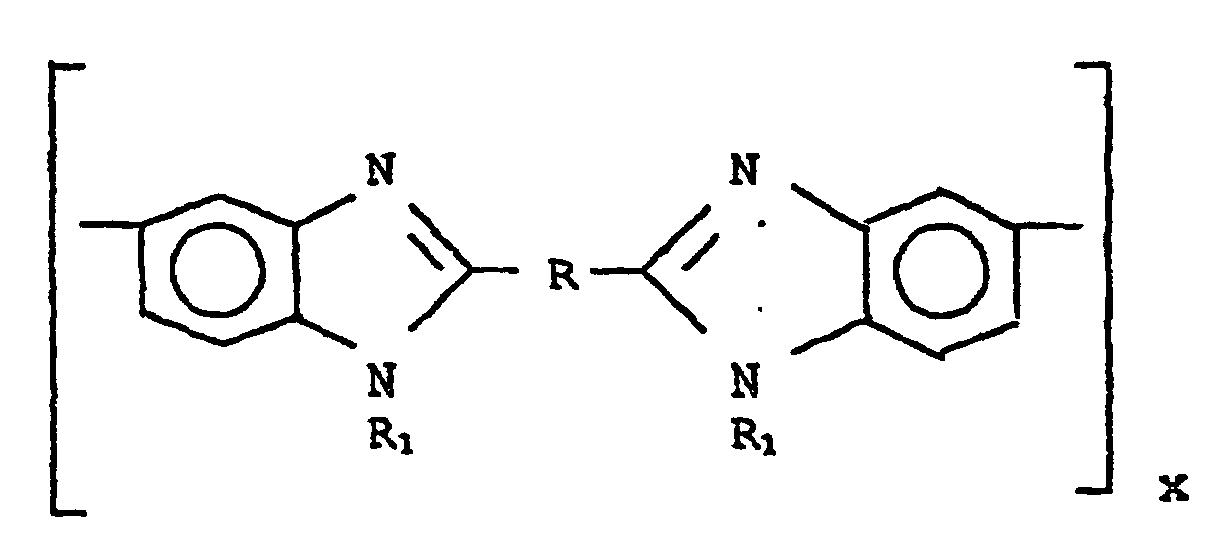
- the polybenzimidazole polymer has the known structure, wherein R and R 1 are selected from among a variety of linking or functional groups [See, e.g., US Patent Nos. 4,814,399 and 5,525,436; and International Patent Application No. WO96/13872]:
- polymer dope solution is coagulated in a coagulation bath comprising a non-solvent alone.
- non-solvents include water, methanol, acetone, other alcohols and other water miscible non-solvents.
- the amount of non-solvent(s) in the bath is about 100% by weight of the composition.
- the bath temperature is generally room temperature but can be anywhere between the freezing point and boiling point of the non-solvent.
- the polymeric dope is coagulated in the non-solvent bath until it coagulates into a porous membrane, characterized by a porous structure.
- the coagulation time i.e., the amount of time taken for the polymer dope to coagulate, is generally between about 5 seconds to 1 hour.
- polymer dope solution is coagulated in a coagulation bath comprising a mixture of a solvent and a non-solvent.
- suitable solvents include, without limitation, DMAC, NMP, DMF, DMSO, strong acids such as sulfuric acid, methanesulfonic acid, trifluoroacetic acid and triflic acid. From among the solvents and non-solvents identified above, the following combinations are preferred: DMAC/methanol, MMP/methanol, DMAC/water. However, any combination of solvents and non-solvents which are miscible in each other will work in the method of this invention.
- the amount of solvent and non-solvent in the bath is between about 0% and about 90% by weight of the solvent, and between about 100% and about 10% by weight of the non-solvent.
- the bath temperature is generally room temperature, but can be anywhere between the freezing point and boiling point of the non-solvent/solvent mixture.
- the polymeric dope is precipitated in the coagulation bath for about 5 seconds to about 1 hour until it coagulates into a porous membrane, characterized by a porous structure.
- the amount of solvent or non-solvent in the coagulation bath controls the kinetics of the reaction, and thereby controls the morphology of the resulting film.
- the resulting membrane is submerged into a non-solvent bath, such as a water or methanol, or a bath formed of a mixture of non-solvents to remove any residual solvent for about 0.5 to about 60 minutes, usually less than about 5 minutes.
- a non-solvent bath such as a water or methanol, or a bath formed of a mixture of non-solvents to remove any residual solvent for about 0.5 to about 60 minutes, usually less than about 5 minutes.
- the bath temperature is generally room temperature but can be anywhere between the freezing point and boiling point of the non-solvent.
- the membrane is then soaked in an acid solution consisting of acid and a non-solvent, for example a solution of acid and water, or acid and methanol, among others.
- the acid solution generally contains about 5 to about 100 weight percent, preferably about 50 weight percent, of an acid, such as phosphoric, sulfuric, methanesulfonic acids, among others.
- the acid solution is at room temperature, with elevated temperatures increasing the rate of imbibition.
- This soaking step generally takes about 1 minute to about 2 hours. The preferred time depends on temperature and acid concentration. For example, at room temperature and 50 weight% acid, the soaking step takes less than about 5 minutes, in which time the pores in the coagulated membrane become filled with the acid solution.
- the membrane is then dried at room temperature to about 200°C, preferably between about 80°C to about 180°C, to remove residual solvent and non-solvent, such as DMAC, water, and/or methanol. This drying step collapses the porous structure, thereby entrapping the acid and forming a dense film.
- the resulting membrane or film is capable of imbibing up to about 80% of the acid in the acid solution.
- the polymer dope is precipitated directly in a coagulation bath consisting of a mixture of a non-solvent and an acid, or a non-solvent, a solvent and an acid, the components of the bath being miscible in each other.
- a coagulation bath consisting of a mixture of a non-solvent and an acid, or a non-solvent, a solvent and an acid, the components of the bath being miscible in each other.
- the individual components of the coagulation bath are selected from the lists of solvents, non-solvents and acids described above.
- the coagulation bath containing an acid and a non-solvent generally comprises about 5 to about 75% by weight of a suitable strong acid, selected from among those acids discussed above, in admixture with between about 95 to about 25% by weight non-solvent.
- the coagulation bath containing an acid, a solvent and a non-solvent generally comprises between about 5 to about 75% by weight of a suitable strong acid, between about 95 to about 10% by weight non-solvent, and between 0 to about 85% by weight solvent. These mixtures are usually at room temperature, but can be up to 80°C.
- the polymer from the coagulation bath is placed in this mixture for between about 1 and about 60 minutes. In this bath the pores of the coagulated membrane become filled with the acid solution.
- the membrane is then dried at room temperature to about 200°C, preferably between about 80°C to about 180°C for about 5 minutes to about 24 hours depending on drying conditions.
- the drying removes residual solvent and non-solvent, such as DMAC, water, and/or methanol, and collapses the pores to entrain the acid and produce a dense film.
- the amount of acid in the resulting film can be controlled by adjusting the membrane porosity, temperature, soak time, and acid concentration as well as the specific materials employed. By controlling the acid concentration in the acid bath and the residence time, one controls the amount of acid in the resulting film. Since PBI is a basic polymer, it has an affinity for acids and will retain then under extreme conditions.
- dense films or asymmetric membranes may be prepared in a controlled fashion, more rapidly than the prior art.
- These methods lead to better functional and mechanical properties of the film. Among such functional properties is a more tenacious acid retention, better electrochemical properties, and possibly other enhanced properties desirable for fuel cell use.
- the polymeric membranes resulting from the practice of these methods will generally contain from about 40% to about 80% acid by weight of the membrane itself. For a polymer to function adequately as an electrolyte in a fuel cell, about 50% or more acid is required.
- Example 1 PBI Cast Films with Non-Solvent Coagulation Bath
- the polymeric dope solution (Sample 23-1) is prepared by mixing 10g PBI (10% solids) [poly 2,2'-(metaphenylene)-5, 5'-bibenzimidazole, Hoechst Celanese Corporation] and 90g DMAC [DuPont]. This dope solution is then placed in a 100% by weight water coagulation bath for coagulation of the polymer dope into a membrane. After 3 minutes in the bath, the membrane was removed and rinsed in a water bath for 1 minute at 23°C.
- the membrane is then soaked in an aqueous acid solution containing 85% phosphoric acid. This soaking occurs at a temperature of 23°C for about 2 minutes.
- the membrane is then oven dried at a temperature of 120°C for 12 hours to remove residual water and solvent, e.g., DMAC.
- the resulting dense film contains about 52% acid by weight.
- Example 2 PBI Cast Films with Non-Solvent Coagulation Bath
- PBI plate glass cast films (20 mil thickness wet cast) using an adjustable casting knife are prepared as follows.
- the polymeric dope solution (Sample 23-1) is prepared by mixing 10g PBI (10% solids) [poly 2,2'-(metaphenylene)-5,5'-bibenzimidazole, Hoechst Celanese Corporation] and 90g DMAC [DuPont]. This solution is then placed in a coagulation bath containing 100% by weight methanol. After 6 minutes in the bath, the membrane was removed and rinsed in a methanol bath for 3 minutes at 23°C.
- the membrane is then soaked in a methanol/acid solution containing 50% phosphoric acid. This soaking occurs at a temperature of 23°C for 5 minutes.
- the membrane is then oven dried at a temperature of 120°C for 12 hours to remove residual methanol and DMAC.
- the resulting dense film contains about 58% acid by weight. The resulting membrane has improved acid retention and better mechanical properties.
- Example 3 PBI Cast Films with a Non-Solvent/Solvent Coagulation Bath
- PBI plate glass cast films (20 mil thickness wet cast) using an adjustable casting knife are prepared as follows.
- the polymeric dope solution (Sample 23-1) is prepared by mixing 10g PBI (10% solids) [poly 2,2'-(metaphenylene)-5,5'-bibenzimidazole, Hoechst Celanese Corporation] and 90g DMAC [DuPont]. This solution is then placed in a coagulation bath containing both a non-solvent and a solvent, i.e., 50/50 wt% methanol/DMAC. After 4 minutes in the bath, the membrane was removed and rinsed in a methanol bath for 5 minutes at 23°C.
- the membrane is then soaked in a methanol/acid solution containing 60% phosphoric acid. This soaking occurs at a temperature of 23°C for 10 minutes.
- the membrane is then oven dried at a temperature of 140°C for 14 hours to remove residual methanol and DMAC.
- the resulting dense film contains about 61% acid by weight.
- the resulting membrane also has improved acid retention and better mechanical properties.
- Example 4 PBI Cast Films with Single Step Coagulation/Acid Bath
- PBI plate glass cast films (20 mil thickness wet cast) using an adjustable casting knife are prepared as follows.
- the polymeric dope solution (Sample 23-1) is prepared by mixing 10g PBI (10% solids) [poly 2,2'-(metaphenylene)-5,5'-bibenzimidazole, Hoechst Celanese Corporation] and 90g DMAc [DuPont].
- this dope solution is then placed in a single nonsolvent/solvent/acid bath for both coagulation and acid imbibition. This bath contains 30/20/50 wt% methanol/DMAC/phosphoric acid bath. After 8 minutes in the bath, the membrane was removed. The membrane is then oven dried at a temperature of 60°C for 2 hours, 100°C for 2 hours, and 150°C for 10 hours to remove residual methanol and BMAC.
- the resulting dense film contains about 70% acid by weight.
Landscapes
- Chemical & Material Sciences (AREA)
- Manufacturing & Machinery (AREA)
- Engineering & Computer Science (AREA)
- Chemical Kinetics & Catalysis (AREA)
- Life Sciences & Earth Sciences (AREA)
- General Chemical & Material Sciences (AREA)
- Electrochemistry (AREA)
- Sustainable Energy (AREA)
- Sustainable Development (AREA)
- Crystallography & Structural Chemistry (AREA)
- Medicinal Chemistry (AREA)
- Health & Medical Sciences (AREA)
- Materials Engineering (AREA)
- Organic Chemistry (AREA)
- Polymers & Plastics (AREA)
- Dispersion Chemistry (AREA)
- Inorganic Chemistry (AREA)
- Composite Materials (AREA)
- Manufacture Of Porous Articles, And Recovery And Treatment Of Waste Products (AREA)
- Treatments Of Macromolecular Shaped Articles (AREA)
- Manufacture Of Macromolecular Shaped Articles (AREA)
- Fuel Cell (AREA)
- Separation Using Semi-Permeable Membranes (AREA)
- Processing And Handling Of Plastics And Other Materials For Molding In General (AREA)
- Compositions Of Macromolecular Compounds (AREA)
- Moulding By Coating Moulds (AREA)
Abstract
Description
Claims (24)
- A method for producing a polymeric film suitable for use as an electrolyte comprising the steps of:a. forming a porous membrane by coagulating a polymer dope solution, said solution comprising a polymer dissolved in a solvent, in a liquid coagulation bath comprising a non-solvent;b. submerging the resulting membrane into a non-solvent bath to remove any residual solvent;c. placing said membrane into an acid solution in a non-solvent, whereby the pores become filled with the acid solution;d. drying the membrane to remove residual non-solvent, which collapses the porous structure entrapping the acid and forming a dense film.
- The method according to claim 1 wherein said polymer dope solution comprises a solution containing 2 to 30% of a selected polymer dissolved in 98 to 70% of a suitable solvent.
- The method according to claim 2 wherein said selected polymer is selected from the group consisting of a polybenzimidazole (PBI), a poly(pyridine), a poly(pyrimidine), a polyimidazole, a polybenzthiazole, a polybenzoxazole, a polyoxadiazole, a polyquinoxaline, a polythiadiazole, and a poly(tetrazapyrene).
- The method according to claim 2 wherein said polymer is a PBI.
- The method according to claim 1 wherein said non-solvent is selected from the group consisting of water, methanol, acetone, alcohols and water miscible non-solvents.
- The method according to claim 1 wherein said coagulation bath further comprises a solvent.
- The method according to claim 6 wherein said solvent is selected from the group consisting of DMAC, NMP, DMF, DMSO, sulfuric acid, methanesulfonic acid, trifluoroacetic acid and triflic acid.
- The method according to claim 1 wherein said coagulation bath comprises a miscible mixture of a non-solvent and a solvent.
- The method according to claim 8 wherein said mixture is selected from the groups consisting of DMAC and methanol, NMP and methanol, and DMAC and water.
- The method according to claim 1 wherein said acid solution comprises between 5 to 100 weight percent of an acid and 95% to 0% non-solvent.
- The method according to claim 10 wherein said acid solution comprises about 50% acid and 50% non-solvent.
- The method according to claim 10 wherein said acid is selected from the group consisting of phosphoric, sulfuric, and methanesulfonic acids.
- A dense porous polymeric film produced by the method of any of claims 1-12.
- A method for producing polymeric films suitable for use as an electrolyte comprising the steps of:a. adding a polymeric dope solution, said solution comprising a polymer dissolved in a solvent, in a liquid coagulation bath comprising a non-solvent and an acid, wherein the dope solution coagulates into a membrane which imbibes acid; andb. drying the membrane to remove residual non-solvent, which collapses the porous structure entrapping the acid and producing a dense film.
- The method according to claim 14 wherein said polymer dope solution comprises a solution containing 2 to 30% of a selected polymer dissolved in 98 to 70% of a suitable solvent.
- The method according to claim 15 wherein said selected polymer is selected from the group consisting of a polybenzimidazole (PBI), a poly(pyridine), a poly(pyrimidine), a polyimidazole, a polybenzthiazole, a polybenzoxazole, a polyoxadiazole, a polyquinoxaline, a polythiadiazole, and a poly(tetrazapyrene).
- The method according to claim 15 wherein said polymer is a FBI.
- The method according to claim 14 wherein said non-solvent is selected from the group consisting of water, methanol, acetone, alcohols and water miscible non-solvents.
- The method according to claim 14 wherein said coagulation bath further comprises a solvent.
- The method according to claim 19 wherein said solvent is selected from the group consisting of DMAC, NMP, DMF, DMSO, sulfuric acid, methanesulfonic acid, trifluoroacetic acid and triflic acid.
- The method according to claims 14 wherein said acid is selected from the group consisting of phosphoric acid, sulfuric acid, and methanesulfonic acid.
- The method according to claim 14 wherein the liquid coagulation bath contains between 5% to 75% by weight acid and between 95% to 25% non-solvent.
- The method according to claim 19 wherein the liquid coagulation bath contains between 5% to 75% by weight acid, between 95% to 10% non-solvent, and between 0 to 85% solvent.
- A dense porous polymeric film produced by the method of any of claims 14-23.
Applications Claiming Priority (3)
| Application Number | Priority Date | Filing Date | Title |
|---|---|---|---|
| US2716996P | 1996-10-01 | 1996-10-01 | |
| US27169P | 1996-10-01 | ||
| PCT/US1997/017790 WO1998014505A1 (en) | 1996-10-01 | 1997-09-29 | Process for producing polymeric films for use as fuel cells |
Publications (2)
| Publication Number | Publication Date |
|---|---|
| EP0954544A1 EP0954544A1 (en) | 1999-11-10 |
| EP0954544B1 true EP0954544B1 (en) | 2002-03-27 |
Family
ID=21836091
Family Applications (1)
| Application Number | Title | Priority Date | Filing Date |
|---|---|---|---|
| EP97911615A Expired - Lifetime EP0954544B1 (en) | 1996-10-01 | 1997-09-29 | Process for producing polymeric films for use as fuel cells |
Country Status (12)
| Country | Link |
|---|---|
| US (1) | US6187231B1 (en) |
| EP (1) | EP0954544B1 (en) |
| JP (1) | JP4201350B2 (en) |
| KR (1) | KR100525581B1 (en) |
| AT (1) | ATE215107T1 (en) |
| AU (1) | AU4893997A (en) |
| BR (1) | BR9712247A (en) |
| CA (1) | CA2266101A1 (en) |
| DE (1) | DE69711441T2 (en) |
| ES (1) | ES2175369T3 (en) |
| TW (1) | TW402616B (en) |
| WO (1) | WO1998014505A1 (en) |
Cited By (16)
| Publication number | Priority date | Publication date | Assignee | Title |
|---|---|---|---|---|
| DE102006062251A1 (en) * | 2006-12-22 | 2008-06-26 | Volkswagen Ag | Membrane electrode unit for high temperature gas cell, comprises polymer membrane impregnated with electrolytes, and cathodic- and anodic gas diffusion electrodes placed at cathode- and anode lateral membrane surfaces respectively |
| DE102007002515A1 (en) | 2007-01-17 | 2008-08-14 | Volkswagen Ag | Polymer electrolyte membrane useful for high temperature-fuel cell for traction systems or the additional power supply of motor vehicles, comprises an organic polymer material impregnated with an electrolyte, and a laminated structure |
| DE102007018280A1 (en) | 2007-04-18 | 2008-10-23 | Volkswagen Ag | Polymer electrolyte membrane manufacturing method for fuel cell, involves impregnating polymer membrane with liquid or solved electrolytes, where polymer membrane is supported between carrier foils that lie at both sides of polymer membrane |
| DE102007020947A1 (en) | 2007-05-04 | 2008-11-13 | Volkswagen Ag | Gas diffusion electrode for fuel cell, particularly for high temperature fuel cells based on electrolyte impregnated membranes, has gas diffusion layer and porous catalyst layer arranged on gas diffusion layer |
| DE102007025207A1 (en) | 2007-05-30 | 2008-12-04 | Volkswagen Ag | Gas diffusion electrode for high temperature gas cells based on electrolyte-impregnated membrane, comprises gas diffusion layer, and porous catalyst layer arranged on diffusion layer and having conductive substrate and catalytic material |
| DE102007031280A1 (en) | 2007-07-05 | 2009-01-08 | Volkswagen Ag | Gas diffusion electrode with membrane-electrode-unit for high temperature fuel cells based on membrane for traction system, has gas diffusion layer and catalyst layer is impregnated with another electrolyte and has hydrophobic material |
| DE102007044246A1 (en) | 2007-09-11 | 2009-03-12 | Volkswagen Ag | Membrane electrode unit with hydrogenatable material for a fuel cell |
| DE102007061061A1 (en) | 2007-12-14 | 2009-06-18 | Volkswagen Ag | Fuel cell stack for traction system of motor vehicle, has hydrogen supply line for supplying hydrogen to anodes and dummy cell, and hydrogen discharge line for removing residual hydrogen from anode and dummy cell |
| DE102008009437A1 (en) | 2008-02-14 | 2009-09-03 | Volkswagen Ag | Membrane-electrode unit for high temperature-proton exchange membrane-fuel cell, has polymer electrolyte membrane with polymer membrane impregnated with electrolyte |
| DE102008019874A1 (en) | 2008-04-17 | 2009-10-22 | Volkswagen Ag | Method for determining content or partial pressure of gas component in gas mixture of fuel cell, involves detecting sound velocity of gas mixture, where content or partial pressure is determined in dependence of sound velocity |
| DE102008041225A1 (en) | 2008-08-13 | 2010-02-18 | Volkswagen Ag | Fuel cell for supplying electricity to e.g. drive motor of motor vehicle, has discharging systems arranged in fuel cell stack that is upstream in hydrogen flow direction and connected with supply systems of downstream fuel cell stack |
| DE102009001137A1 (en) | 2008-10-29 | 2010-05-06 | Volkswagen Ag | Polymer electrolyte membrane for fuel cells and process for their preparation |
| DE102009001141A1 (en) | 2008-10-29 | 2010-05-06 | Volkswagen Ag | Producing polymer electrolyte membrane, by producing polymer solution of polyazol in solvent mixture, transferring polymer solution in flat structure, and dropping polymer solution that is transferred in flat structure with liquid water |
| DE102009028308A1 (en) | 2009-08-06 | 2011-02-10 | Volkswagen Ag | Membrane electrode unit, useful in fuel cell, comprises a polymer electrolyte membrane made of a polymer, two electrodes sandwiching polymer electrolyte membrane, an electrolyte wetting polymer electrolyte membrane and silicate derivative |
| WO2011020872A1 (en) | 2009-08-20 | 2011-02-24 | Volkswagen Ag | Long-term stable polymer electrolyte membrane for ht fuel cells and method for the production thereof |
| WO2011069593A1 (en) | 2009-12-10 | 2011-06-16 | Volkswagen Aktiengesellschaft | Method for producing a catalytic material for electrodes of a fuel cell |
Families Citing this family (40)
| Publication number | Priority date | Publication date | Assignee | Title |
|---|---|---|---|---|
| US6042968A (en) * | 1997-07-16 | 2000-03-28 | Aventis Research & Technologies Gmbh & Co. Kg | Process for producing polybenzimidazole fabrics for use in fuel |
| US5945233A (en) * | 1997-07-16 | 1999-08-31 | Avents Research & Technologies Gmbh & Co. Kg | Process for producing polybenzimidazole pastes and gels for use in fuel cells |
| US6248469B1 (en) | 1997-08-29 | 2001-06-19 | Foster-Miller, Inc. | Composite solid polymer electrolyte membranes |
| US6500571B2 (en) | 1998-08-19 | 2002-12-31 | Powerzyme, Inc. | Enzymatic fuel cell |
| JP2000195528A (en) * | 1998-12-25 | 2000-07-14 | Aventis Res & Technol Gmbh & Co Kg | Method for producing polymer electrolyte membrane and fuel cell |
| KR20020019789A (en) * | 2000-09-07 | 2002-03-13 | 안효준 | A polyelectrolyte with the improved mechanical hardness and the preparation thereof |
| DE10109829A1 (en) * | 2001-03-01 | 2002-09-05 | Celanese Ventures Gmbh | Polymer membrane, process for its production and its use |
| US7318972B2 (en) * | 2001-09-07 | 2008-01-15 | Itm Power Ltd. | Hydrophilic polymers and their use in electrochemical cells |
| US7537852B2 (en) | 2002-02-15 | 2009-05-26 | Toyo Boseki Kabushiki Kaisha | Composite ion exchange membrane and electrolyte membrane electrode assembly |
| US20040042789A1 (en) * | 2002-08-30 | 2004-03-04 | Celanese Ventures Gmbh | Method and apparatus for transferring thin films from a source position to a target position |
| DE10242708A1 (en) | 2002-09-13 | 2004-05-19 | Celanese Ventures Gmbh | Proton-conducting membranes and their use |
| AU2003295249A1 (en) * | 2002-12-09 | 2004-06-30 | Suprapolix B.V. | Siloxane polymers with quadruple hydrogen bonding units |
| DE10258580A1 (en) | 2002-12-16 | 2004-06-24 | Celanese Ventures Gmbh | High molecular weight polyazoles, e.g. useful for making shaped products, fibers, films, coatings and electrode membranes, produced by polymerizing a selected particle size fraction |
| JP4068988B2 (en) * | 2003-02-20 | 2008-03-26 | Jsr株式会社 | Method for producing electrolytic membrane-electrode substrate composite |
| EP1680831A2 (en) * | 2003-10-10 | 2006-07-19 | Ballard Power Systems Inc. | Water insoluble additive for improving conductivity of an ion exchange membrane |
| EP2267062B1 (en) | 2003-11-04 | 2017-10-25 | SupraPolix B.V. | Supramolecular polymers containing quadruple hydrogen bonding units in the polymer backbone |
| KR100590967B1 (en) * | 2003-12-30 | 2006-06-19 | 현대자동차주식회사 | High Temperature Conductive Polymer Nanocomposite Membrane, Manufacturing Method Thereof and Membrane-electrode Assembly Using the Same, and Polymer Electrolyte Fuel Cell Comprising The Same |
| US6979749B2 (en) * | 2004-03-29 | 2005-12-27 | Council Of Scientific And Industrial Research | Catalytic process for the production of 3,3′, 4,4′-tetraminobiphenyl |
| JP4506259B2 (en) | 2004-04-23 | 2010-07-21 | トヨタ自動車株式会社 | Fuel cell electrolyte layer, fuel cell, and method for producing fuel cell electrolyte layer |
| JP4664626B2 (en) * | 2004-07-05 | 2011-04-06 | ポリマテック株式会社 | Ion conductive polymer electrolyte membrane and method for producing the same |
| US8268952B2 (en) | 2004-07-12 | 2012-09-18 | Suprapolix B.V. | Supramolecular ionomers |
| KR100738788B1 (en) * | 2004-12-07 | 2007-07-12 | 주식회사 엘지화학 | Polybenzimidazole-benzamide copolymer and preparation method thereof, electrolyte membrane prepared therefrom and preparation method thereof |
| ES2376888T3 (en) | 2005-05-04 | 2012-03-20 | Suprapolix B.V. | Biologically active, bio-absorbable or biomedical modular supramolecular materials |
| US7977392B2 (en) * | 2005-12-22 | 2011-07-12 | Daimler Ag | Water insoluble additive for improving conductivity of an ion exchange membrane |
| KR100791780B1 (en) | 2005-12-31 | 2008-01-03 | 성균관대학교산학협력단 | Acid / base / inorganic polyelectrolyte composite membrane for fuel cell and its manufacturing method |
| WO2007090072A2 (en) * | 2006-01-30 | 2007-08-09 | H2 Pump Llc | Apparatus and methods for electrochemical hydrogen manipulation |
| EP2087027B1 (en) | 2006-11-20 | 2011-10-05 | SupraPolix B.V. | Supramolecular polymers from low-melting, easily processable building blocks |
| US8628789B2 (en) | 2007-03-23 | 2014-01-14 | Suprapolix, B.V. | Strong reversible hydrogels |
| US8362195B2 (en) * | 2007-10-26 | 2013-01-29 | Lalgudi Ramanathan S | Ionically conductive polymer for use in electrochemical devices |
| DE102008008483B4 (en) * | 2008-02-08 | 2021-08-05 | Volkswagen Ag | Solid polymer electrolyte material, solid polymer electrolyte sheet and methods for their production and electrochemical battery device using such a sheet |
| US8754213B2 (en) | 2008-07-04 | 2014-06-17 | Suprapolix B.V. | High flow supramolecular compounds |
| TWI340773B (en) * | 2008-07-07 | 2011-04-21 | Univ Taipei Medical | Method of fabricating nano-fibers by electrospinning |
| WO2011084785A2 (en) * | 2009-12-21 | 2011-07-14 | E. I. Du Pont De Nemours And Company | Integrated processes for the preparation of polybenzimidazole precursors |
| CN102263290B (en) * | 2010-05-31 | 2014-04-02 | 比亚迪股份有限公司 | Polymer battery and preparation method thereof |
| DE102010039900A1 (en) | 2010-08-27 | 2012-03-01 | Wacker Chemie Ag | Porous polymer films based on nitrogen-containing aromatic polymers |
| EP2450394B1 (en) | 2010-11-05 | 2017-06-07 | SupraPolix B.V. | A process for the preparation of a supramolecular polymer |
| JP5291174B2 (en) * | 2011-12-01 | 2013-09-18 | バスフ・ヒュエル・セル・ゲーエムベーハー | POLYMER ELECTROLYTE MEMBRANE MANUFACTURING METHOD AND FUEL CELL |
| FR3049605B1 (en) * | 2016-04-05 | 2018-03-23 | Arkema France | PROCESS FOR OBTAINING FINE FILMS AND FILMOGENIC ARTICLES |
| KR102280859B1 (en) | 2019-09-03 | 2021-07-23 | 한국과학기술연구원 | High temperature-type unitized regenerative fuel cell using water vapor and method of operating the same |
| CN112652797B (en) * | 2019-10-11 | 2022-03-08 | 中国科学院大连化学物理研究所 | Porous ion-conducting membrane with gradient distribution of pore size and its preparation and application |
Family Cites Families (7)
| Publication number | Priority date | Publication date | Assignee | Title |
|---|---|---|---|---|
| US4020142A (en) * | 1975-08-21 | 1977-04-26 | Celanese Corporation | Chemical modification of polybenzimidazole semipermeable |
| US4693824A (en) | 1985-09-23 | 1987-09-15 | Celanese Corporation | Process for the production of polybenzimidazole ultrafiltration membranes |
| US4664761A (en) | 1985-12-27 | 1987-05-12 | Uop Inc. | Electrochemical method and apparatus using proton-conducting polymers |
| US4927909A (en) * | 1987-09-18 | 1990-05-22 | Hoechst Celanese Corp. | Fabrication of high performance polybenzimidazole films |
| US5091087A (en) | 1990-06-25 | 1992-02-25 | Hoechst Celanese Corp. | Fabrication of microporous PBI membranes with narrow pore size distribution |
| US5525436A (en) * | 1994-11-01 | 1996-06-11 | Case Western Reserve University | Proton conducting polymers used as membranes |
| US5599639A (en) | 1995-08-31 | 1997-02-04 | Hoechst Celanese Corporation | Acid-modified polybenzimidazole fuel cell elements |
-
1997
- 1997-09-29 JP JP51686998A patent/JP4201350B2/en not_active Expired - Fee Related
- 1997-09-29 ES ES97911615T patent/ES2175369T3/en not_active Expired - Lifetime
- 1997-09-29 EP EP97911615A patent/EP0954544B1/en not_active Expired - Lifetime
- 1997-09-29 AT AT97911615T patent/ATE215107T1/en not_active IP Right Cessation
- 1997-09-29 US US09/269,082 patent/US6187231B1/en not_active Expired - Fee Related
- 1997-09-29 BR BR9712247A patent/BR9712247A/en not_active IP Right Cessation
- 1997-09-29 WO PCT/US1997/017790 patent/WO1998014505A1/en not_active Ceased
- 1997-09-29 KR KR10-1999-7002790A patent/KR100525581B1/en not_active Expired - Fee Related
- 1997-09-29 CA CA002266101A patent/CA2266101A1/en not_active Abandoned
- 1997-09-29 DE DE69711441T patent/DE69711441T2/en not_active Expired - Lifetime
- 1997-09-29 AU AU48939/97A patent/AU4893997A/en not_active Abandoned
- 1997-10-01 TW TW086114314A patent/TW402616B/en not_active IP Right Cessation
Cited By (19)
| Publication number | Priority date | Publication date | Assignee | Title |
|---|---|---|---|---|
| DE102006062251A1 (en) * | 2006-12-22 | 2008-06-26 | Volkswagen Ag | Membrane electrode unit for high temperature gas cell, comprises polymer membrane impregnated with electrolytes, and cathodic- and anodic gas diffusion electrodes placed at cathode- and anode lateral membrane surfaces respectively |
| DE102007002515A1 (en) | 2007-01-17 | 2008-08-14 | Volkswagen Ag | Polymer electrolyte membrane useful for high temperature-fuel cell for traction systems or the additional power supply of motor vehicles, comprises an organic polymer material impregnated with an electrolyte, and a laminated structure |
| DE102007018280A1 (en) | 2007-04-18 | 2008-10-23 | Volkswagen Ag | Polymer electrolyte membrane manufacturing method for fuel cell, involves impregnating polymer membrane with liquid or solved electrolytes, where polymer membrane is supported between carrier foils that lie at both sides of polymer membrane |
| DE102007020947A1 (en) | 2007-05-04 | 2008-11-13 | Volkswagen Ag | Gas diffusion electrode for fuel cell, particularly for high temperature fuel cells based on electrolyte impregnated membranes, has gas diffusion layer and porous catalyst layer arranged on gas diffusion layer |
| DE102007025207A1 (en) | 2007-05-30 | 2008-12-04 | Volkswagen Ag | Gas diffusion electrode for high temperature gas cells based on electrolyte-impregnated membrane, comprises gas diffusion layer, and porous catalyst layer arranged on diffusion layer and having conductive substrate and catalytic material |
| DE102007031280A1 (en) | 2007-07-05 | 2009-01-08 | Volkswagen Ag | Gas diffusion electrode with membrane-electrode-unit for high temperature fuel cells based on membrane for traction system, has gas diffusion layer and catalyst layer is impregnated with another electrolyte and has hydrophobic material |
| DE102007044246A1 (en) | 2007-09-11 | 2009-03-12 | Volkswagen Ag | Membrane electrode unit with hydrogenatable material for a fuel cell |
| DE102007061061A1 (en) | 2007-12-14 | 2009-06-18 | Volkswagen Ag | Fuel cell stack for traction system of motor vehicle, has hydrogen supply line for supplying hydrogen to anodes and dummy cell, and hydrogen discharge line for removing residual hydrogen from anode and dummy cell |
| DE102008009437A1 (en) | 2008-02-14 | 2009-09-03 | Volkswagen Ag | Membrane-electrode unit for high temperature-proton exchange membrane-fuel cell, has polymer electrolyte membrane with polymer membrane impregnated with electrolyte |
| DE102008019874A1 (en) | 2008-04-17 | 2009-10-22 | Volkswagen Ag | Method for determining content or partial pressure of gas component in gas mixture of fuel cell, involves detecting sound velocity of gas mixture, where content or partial pressure is determined in dependence of sound velocity |
| DE102008019874B4 (en) * | 2008-04-17 | 2021-02-18 | Audi Ag | Method for determining a content or partial pressure of a gas component of a fuel cell |
| DE102008041225A1 (en) | 2008-08-13 | 2010-02-18 | Volkswagen Ag | Fuel cell for supplying electricity to e.g. drive motor of motor vehicle, has discharging systems arranged in fuel cell stack that is upstream in hydrogen flow direction and connected with supply systems of downstream fuel cell stack |
| DE102009001137A1 (en) | 2008-10-29 | 2010-05-06 | Volkswagen Ag | Polymer electrolyte membrane for fuel cells and process for their preparation |
| DE102009001141A1 (en) | 2008-10-29 | 2010-05-06 | Volkswagen Ag | Producing polymer electrolyte membrane, by producing polymer solution of polyazol in solvent mixture, transferring polymer solution in flat structure, and dropping polymer solution that is transferred in flat structure with liquid water |
| DE102009028308A1 (en) | 2009-08-06 | 2011-02-10 | Volkswagen Ag | Membrane electrode unit, useful in fuel cell, comprises a polymer electrolyte membrane made of a polymer, two electrodes sandwiching polymer electrolyte membrane, an electrolyte wetting polymer electrolyte membrane and silicate derivative |
| WO2011020872A1 (en) | 2009-08-20 | 2011-02-24 | Volkswagen Ag | Long-term stable polymer electrolyte membrane for ht fuel cells and method for the production thereof |
| DE102009028758A1 (en) | 2009-08-20 | 2011-02-24 | Volkswagen Ag | Long-term stable polymer electrolyte membrane for HT fuel cells and process for their preparation |
| WO2011069593A1 (en) | 2009-12-10 | 2011-06-16 | Volkswagen Aktiengesellschaft | Method for producing a catalytic material for electrodes of a fuel cell |
| DE102009057797A1 (en) | 2009-12-10 | 2011-06-16 | Volkswagen Ag | Method for producing a catalytic material for electrodes of a fuel cell |
Also Published As
| Publication number | Publication date |
|---|---|
| KR20000048799A (en) | 2000-07-25 |
| CA2266101A1 (en) | 1998-04-09 |
| ATE215107T1 (en) | 2002-04-15 |
| US6187231B1 (en) | 2001-02-13 |
| EP0954544A1 (en) | 1999-11-10 |
| KR100525581B1 (en) | 2005-11-03 |
| WO1998014505A1 (en) | 1998-04-09 |
| BR9712247A (en) | 1999-08-24 |
| JP4201350B2 (en) | 2008-12-24 |
| AU4893997A (en) | 1998-04-24 |
| ES2175369T3 (en) | 2002-11-16 |
| DE69711441T2 (en) | 2002-11-07 |
| TW402616B (en) | 2000-08-21 |
| DE69711441D1 (en) | 2002-05-02 |
| JP2001517254A (en) | 2001-10-02 |
Similar Documents
| Publication | Publication Date | Title |
|---|---|---|
| US6187231B1 (en) | Process for producing polymeric films for use as fuel cells | |
| US6248469B1 (en) | Composite solid polymer electrolyte membranes | |
| US7550216B2 (en) | Composite solid polymer electrolyte membranes | |
| US5945233A (en) | Process for producing polybenzimidazole pastes and gels for use in fuel cells | |
| Jheng et al. | A novel asymmetric polybenzimidazole membrane for high temperature proton exchange membrane fuel cells | |
| US9136034B2 (en) | Polymer electrolyte membrane for a fuel cell, and method for preparing same | |
| US6042968A (en) | Process for producing polybenzimidazole fabrics for use in fuel | |
| EP1515346A1 (en) | Polyelectrolyte membrane and production method therefor | |
| JP2001514431A (en) | Composite solid polymer electrolyte membrane | |
| CN109273647B (en) | Porous single-ion conductive polymer electrolyte separator, preparation method and application thereof | |
| EP1512190A2 (en) | Grafted polymer electrolyte membrane, method for the production thereof, and application thereof in fuel cells | |
| US20040054125A1 (en) | Sulfonated aryl sulfonate matrices and method of production | |
| KR102543046B1 (en) | Method for preparing hydroxide conductive PBI membrane | |
| EP0844681A2 (en) | Porous membrane with low steam permeability | |
| KR20110054607A (en) | Reinforced composite electrolyte membrane and preparation method thereof | |
| US20040058216A1 (en) | Organic ionic conductive membrane for fuel cell and method for making same | |
| CN117820719A (en) | Ion exchange membrane, preparation method thereof and flow battery | |
| EP1676333A1 (en) | Proton-conducting polymer membrane comprising at least one porous carrier material, and use thereof in fuel cells | |
| JP2004224954A (en) | Ion exchange membrane and method for producing the same | |
| KR100705760B1 (en) | Membrane for Lithium Secondary Battery, Manufacturing Method and Lithium Secondary Battery Using the Same | |
| CN121983608A (en) | A composite porous base membrane and its preparation method | |
| CN119753753A (en) | Composite diaphragm and preparation method and application thereof | |
| Munakata et al. | Preparation of Composite Membrane with Three-Dimensionally Ordered Polyimide Matrix and Proton Conductive Gel Polymer | |
| JP2003147118A (en) | Method for producing porous polyimide membrane | |
| EP1116292A2 (en) | Composite solid polymer electrolyte membranes |
Legal Events
| Date | Code | Title | Description |
|---|---|---|---|
| PUAI | Public reference made under article 153(3) epc to a published international application that has entered the european phase |
Free format text: ORIGINAL CODE: 0009012 |
|
| 17P | Request for examination filed |
Effective date: 19990503 |
|
| AK | Designated contracting states |
Kind code of ref document: A1 Designated state(s): AT BE CH DE DK ES FI FR GB IE IT LI LU NL PT SE |
|
| 17Q | First examination report despatched |
Effective date: 20000330 |
|
| GRAG | Despatch of communication of intention to grant |
Free format text: ORIGINAL CODE: EPIDOS AGRA |
|
| RAP1 | Party data changed (applicant data changed or rights of an application transferred) |
Owner name: CELANESE VENTURES GMBH |
|
| GRAG | Despatch of communication of intention to grant |
Free format text: ORIGINAL CODE: EPIDOS AGRA |
|
| GRAH | Despatch of communication of intention to grant a patent |
Free format text: ORIGINAL CODE: EPIDOS IGRA |
|
| REG | Reference to a national code |
Ref country code: GB Ref legal event code: IF02 |
|
| GRAH | Despatch of communication of intention to grant a patent |
Free format text: ORIGINAL CODE: EPIDOS IGRA |
|
| GRAA | (expected) grant |
Free format text: ORIGINAL CODE: 0009210 |
|
| AK | Designated contracting states |
Kind code of ref document: B1 Designated state(s): AT BE CH DE DK ES FI FR GB IE IT LI LU NL PT SE |
|
| PG25 | Lapsed in a contracting state [announced via postgrant information from national office to epo] |
Ref country code: FI Free format text: LAPSE BECAUSE OF FAILURE TO SUBMIT A TRANSLATION OF THE DESCRIPTION OR TO PAY THE FEE WITHIN THE PRESCRIBED TIME-LIMIT Effective date: 20020327 |
|
| REF | Corresponds to: |
Ref document number: 215107 Country of ref document: AT Date of ref document: 20020415 Kind code of ref document: T |
|
| REG | Reference to a national code |
Ref country code: CH Ref legal event code: EP |
|
| REF | Corresponds to: |
Ref document number: 69711441 Country of ref document: DE Date of ref document: 20020502 |
|
| REG | Reference to a national code |
Ref country code: IE Ref legal event code: FG4D |
|
| PG25 | Lapsed in a contracting state [announced via postgrant information from national office to epo] |
Ref country code: SE Free format text: LAPSE BECAUSE OF FAILURE TO SUBMIT A TRANSLATION OF THE DESCRIPTION OR TO PAY THE FEE WITHIN THE PRESCRIBED TIME-LIMIT Effective date: 20020627 Ref country code: PT Free format text: LAPSE BECAUSE OF FAILURE TO SUBMIT A TRANSLATION OF THE DESCRIPTION OR TO PAY THE FEE WITHIN THE PRESCRIBED TIME-LIMIT Effective date: 20020627 Ref country code: DK Free format text: LAPSE BECAUSE OF FAILURE TO SUBMIT A TRANSLATION OF THE DESCRIPTION OR TO PAY THE FEE WITHIN THE PRESCRIBED TIME-LIMIT Effective date: 20020627 |
|
| ET | Fr: translation filed | ||
| ET | Fr: translation filed | ||
| PG25 | Lapsed in a contracting state [announced via postgrant information from national office to epo] |
Ref country code: LU Free format text: LAPSE BECAUSE OF NON-PAYMENT OF DUE FEES Effective date: 20020929 |
|
| REG | Reference to a national code |
Ref country code: ES Ref legal event code: FG2A Ref document number: 2175369 Country of ref document: ES Kind code of ref document: T3 |
|
| PLBE | No opposition filed within time limit |
Free format text: ORIGINAL CODE: 0009261 |
|
| STAA | Information on the status of an ep patent application or granted ep patent |
Free format text: STATUS: NO OPPOSITION FILED WITHIN TIME LIMIT |
|
| 26N | No opposition filed |
Effective date: 20021230 |
|
| PGFP | Annual fee paid to national office [announced via postgrant information from national office to epo] |
Ref country code: CH Payment date: 20040909 Year of fee payment: 8 |
|
| PGFP | Annual fee paid to national office [announced via postgrant information from national office to epo] |
Ref country code: IE Payment date: 20040915 Year of fee payment: 8 |
|
| PGFP | Annual fee paid to national office [announced via postgrant information from national office to epo] |
Ref country code: ES Payment date: 20040920 Year of fee payment: 8 |
|
| REG | Reference to a national code |
Ref country code: CH Ref legal event code: PUE Owner name: PEMEAS GMBH Free format text: CELANESE VENTURES GMBH##65926 FRANKFURT (DE) -TRANSFER TO- PEMEAS GMBH#INDUSTRIEPARK HOECHST#65926 FRANKFURT AM MAIN (DE) |
|
| PGFP | Annual fee paid to national office [announced via postgrant information from national office to epo] |
Ref country code: NL Payment date: 20050914 Year of fee payment: 9 |
|
| PGFP | Annual fee paid to national office [announced via postgrant information from national office to epo] |
Ref country code: AT Payment date: 20050919 Year of fee payment: 9 |
|
| REG | Reference to a national code |
Ref country code: GB Ref legal event code: 732E |
|
| PG25 | Lapsed in a contracting state [announced via postgrant information from national office to epo] |
Ref country code: IE Free format text: LAPSE BECAUSE OF NON-PAYMENT OF DUE FEES Effective date: 20050929 |
|
| PG25 | Lapsed in a contracting state [announced via postgrant information from national office to epo] |
Ref country code: LI Free format text: LAPSE BECAUSE OF NON-PAYMENT OF DUE FEES Effective date: 20050930 Ref country code: ES Free format text: LAPSE BECAUSE OF NON-PAYMENT OF DUE FEES Effective date: 20050930 Ref country code: CH Free format text: LAPSE BECAUSE OF NON-PAYMENT OF DUE FEES Effective date: 20050930 |
|
| NLS | Nl: assignments of ep-patents |
Owner name: PEMEAS GMBH Effective date: 20050815 |
|
| REG | Reference to a national code |
Ref country code: FR Ref legal event code: TP |
|
| REG | Reference to a national code |
Ref country code: CH Ref legal event code: PL |
|
| REG | Reference to a national code |
Ref country code: IE Ref legal event code: MM4A |
|
| PG25 | Lapsed in a contracting state [announced via postgrant information from national office to epo] |
Ref country code: AT Free format text: LAPSE BECAUSE OF NON-PAYMENT OF DUE FEES Effective date: 20060929 |
|
| REG | Reference to a national code |
Ref country code: ES Ref legal event code: FD2A Effective date: 20050930 |
|
| PG25 | Lapsed in a contracting state [announced via postgrant information from national office to epo] |
Ref country code: NL Free format text: LAPSE BECAUSE OF NON-PAYMENT OF DUE FEES Effective date: 20070401 |
|
| NLV4 | Nl: lapsed or anulled due to non-payment of the annual fee |
Effective date: 20070401 |
|
| PGFP | Annual fee paid to national office [announced via postgrant information from national office to epo] |
Ref country code: BE Payment date: 20080922 Year of fee payment: 12 |
|
| BERE | Be: lapsed |
Owner name: *PEMEAS G.M.B.H. Effective date: 20090930 |
|
| PG25 | Lapsed in a contracting state [announced via postgrant information from national office to epo] |
Ref country code: BE Free format text: LAPSE BECAUSE OF NON-PAYMENT OF DUE FEES Effective date: 20090930 |
|
| PGFP | Annual fee paid to national office [announced via postgrant information from national office to epo] |
Ref country code: GB Payment date: 20100930 Year of fee payment: 14 |
|
| PGFP | Annual fee paid to national office [announced via postgrant information from national office to epo] |
Ref country code: FR Payment date: 20101014 Year of fee payment: 14 |
|
| PGFP | Annual fee paid to national office [announced via postgrant information from national office to epo] |
Ref country code: DE Payment date: 20101129 Year of fee payment: 14 |
|
| PGFP | Annual fee paid to national office [announced via postgrant information from national office to epo] |
Ref country code: IT Payment date: 20100930 Year of fee payment: 14 |
|
| GBPC | Gb: european patent ceased through non-payment of renewal fee |
Effective date: 20110929 |
|
| PG25 | Lapsed in a contracting state [announced via postgrant information from national office to epo] |
Ref country code: IT Free format text: LAPSE BECAUSE OF NON-PAYMENT OF DUE FEES Effective date: 20110929 |
|
| REG | Reference to a national code |
Ref country code: FR Ref legal event code: ST Effective date: 20120531 |
|
| REG | Reference to a national code |
Ref country code: DE Ref legal event code: R119 Ref document number: 69711441 Country of ref document: DE Effective date: 20120403 |
|
| PG25 | Lapsed in a contracting state [announced via postgrant information from national office to epo] |
Ref country code: DE Free format text: LAPSE BECAUSE OF NON-PAYMENT OF DUE FEES Effective date: 20120403 |
|
| PG25 | Lapsed in a contracting state [announced via postgrant information from national office to epo] |
Ref country code: FR Free format text: LAPSE BECAUSE OF NON-PAYMENT OF DUE FEES Effective date: 20110930 Ref country code: GB Free format text: LAPSE BECAUSE OF NON-PAYMENT OF DUE FEES Effective date: 20110929 |