EP0952925B1 - Lithographic plate precursor - Google Patents
Lithographic plate precursor Download PDFInfo
- Publication number
- EP0952925B1 EP0952925B1 EP98900618A EP98900618A EP0952925B1 EP 0952925 B1 EP0952925 B1 EP 0952925B1 EP 98900618 A EP98900618 A EP 98900618A EP 98900618 A EP98900618 A EP 98900618A EP 0952925 B1 EP0952925 B1 EP 0952925B1
- Authority
- EP
- European Patent Office
- Prior art keywords
- plate
- group
- heat
- coating
- pigment
- Prior art date
- Legal status (The legal status is an assumption and is not a legal conclusion. Google has not performed a legal analysis and makes no representation as to the accuracy of the status listed.)
- Expired - Lifetime
Links
- 239000002243 precursor Substances 0.000 title claims description 5
- 238000000034 method Methods 0.000 claims description 26
- 239000011248 coating agent Substances 0.000 claims description 20
- 238000000576 coating method Methods 0.000 claims description 20
- 238000003384 imaging method Methods 0.000 claims description 14
- 125000000664 diazo group Chemical group [N-]=[N+]=[*] 0.000 claims description 12
- XLYOFNOQVPJJNP-UHFFFAOYSA-N water Substances O XLYOFNOQVPJJNP-UHFFFAOYSA-N 0.000 claims description 11
- 239000000049 pigment Substances 0.000 claims description 6
- 229910052782 aluminium Inorganic materials 0.000 claims description 5
- 230000005660 hydrophilic surface Effects 0.000 claims description 5
- 238000012545 processing Methods 0.000 claims description 5
- 150000001875 compounds Chemical class 0.000 claims description 4
- 150000001450 anions Chemical group 0.000 claims description 3
- 229910052751 metal Inorganic materials 0.000 claims description 3
- 239000002184 metal Substances 0.000 claims description 3
- VEXZGXHMUGYJMC-UHFFFAOYSA-M Chloride anion Chemical group [Cl-] VEXZGXHMUGYJMC-UHFFFAOYSA-M 0.000 claims description 2
- 229910002651 NO3 Inorganic materials 0.000 claims description 2
- NHNBFGGVMKEFGY-UHFFFAOYSA-N Nitrate Chemical group [O-][N+]([O-])=O NHNBFGGVMKEFGY-UHFFFAOYSA-N 0.000 claims description 2
- 125000003545 alkoxy group Chemical group 0.000 claims description 2
- 125000000217 alkyl group Chemical group 0.000 claims description 2
- 150000001412 amines Chemical class 0.000 claims description 2
- 239000006229 carbon black Substances 0.000 claims description 2
- 239000003795 chemical substances by application Substances 0.000 claims description 2
- VDQQXEISLMTGAB-UHFFFAOYSA-N chloramine T Chemical compound [Na+].CC1=CC=C(S(=O)(=O)[N-]Cl)C=C1 VDQQXEISLMTGAB-UHFFFAOYSA-N 0.000 claims description 2
- 229910052736 halogen Inorganic materials 0.000 claims description 2
- 150000002367 halogens Chemical class 0.000 claims description 2
- 229910052739 hydrogen Inorganic materials 0.000 claims description 2
- 239000001257 hydrogen Substances 0.000 claims description 2
- 125000004435 hydrogen atom Chemical group [H]* 0.000 claims description 2
- HOBCFUWDNJPFHB-UHFFFAOYSA-N indolizine Chemical compound C1=CC=CN2C=CC=C21 HOBCFUWDNJPFHB-UHFFFAOYSA-N 0.000 claims description 2
- DZVCFNFOPIZQKX-LTHRDKTGSA-M merocyanine Chemical compound [Na+].O=C1N(CCCC)C(=O)N(CCCC)C(=O)C1=C\C=C\C=C/1N(CCCS([O-])(=O)=O)C2=CC=CC=C2O\1 DZVCFNFOPIZQKX-LTHRDKTGSA-M 0.000 claims description 2
- 125000004573 morpholin-4-yl group Chemical group N1(CCOCC1)* 0.000 claims description 2
- 239000012860 organic pigment Substances 0.000 claims description 2
- 125000005007 perfluorooctyl group Chemical group FC(C(C(C(C(C(C(C(F)(F)F)(F)F)(F)F)(F)F)(F)F)(F)F)(F)F)(F)* 0.000 claims description 2
- 229920006267 polyester film Polymers 0.000 claims description 2
- 229920000642 polymer Polymers 0.000 claims description 2
- WVIICGIFSIBFOG-UHFFFAOYSA-N pyrylium Chemical compound C1=CC=[O+]C=C1 WVIICGIFSIBFOG-UHFFFAOYSA-N 0.000 claims description 2
- 238000006467 substitution reaction Methods 0.000 claims description 2
- QAOWNCQODCNURD-UHFFFAOYSA-L sulfate group Chemical group S(=O)(=O)([O-])[O-] QAOWNCQODCNURD-UHFFFAOYSA-L 0.000 claims description 2
- 229910021653 sulphate ion Inorganic materials 0.000 claims description 2
- 229910052725 zinc Inorganic materials 0.000 claims description 2
- 239000000243 solution Substances 0.000 description 7
- XEEYBQQBJWHFJM-UHFFFAOYSA-N Iron Chemical compound [Fe] XEEYBQQBJWHFJM-UHFFFAOYSA-N 0.000 description 6
- 239000000758 substrate Substances 0.000 description 6
- 239000004411 aluminium Substances 0.000 description 3
- XAGFODPZIPBFFR-UHFFFAOYSA-N aluminium Chemical compound [Al] XAGFODPZIPBFFR-UHFFFAOYSA-N 0.000 description 3
- 238000011161 development Methods 0.000 description 3
- 230000018109 developmental process Effects 0.000 description 3
- 150000008049 diazo compounds Chemical class 0.000 description 3
- 230000004069 differentiation Effects 0.000 description 3
- 229910052742 iron Inorganic materials 0.000 description 3
- 230000005855 radiation Effects 0.000 description 3
- 238000005476 soldering Methods 0.000 description 3
- OKTJSMMVPCPJKN-UHFFFAOYSA-N Carbon Chemical compound [C] OKTJSMMVPCPJKN-UHFFFAOYSA-N 0.000 description 2
- 239000011230 binding agent Substances 0.000 description 2
- 230000007613 environmental effect Effects 0.000 description 2
- 239000003960 organic solvent Substances 0.000 description 2
- 229920000728 polyester Polymers 0.000 description 2
- 238000009987 spinning Methods 0.000 description 2
- 239000000126 substance Substances 0.000 description 2
- 238000005406 washing Methods 0.000 description 2
- ARXJGSRGQADJSQ-UHFFFAOYSA-N 1-methoxypropan-2-ol Chemical compound COCC(C)O ARXJGSRGQADJSQ-UHFFFAOYSA-N 0.000 description 1
- 229920002307 Dextran Polymers 0.000 description 1
- 229920001218 Pullulan Polymers 0.000 description 1
- 239000004373 Pullulan Substances 0.000 description 1
- 239000011358 absorbing material Substances 0.000 description 1
- 239000007864 aqueous solution Substances 0.000 description 1
- 229910052799 carbon Inorganic materials 0.000 description 1
- 239000008199 coating composition Substances 0.000 description 1
- 238000012733 comparative method Methods 0.000 description 1
- 238000001035 drying Methods 0.000 description 1
- 238000005516 engineering process Methods 0.000 description 1
- 239000011888 foil Substances 0.000 description 1
- 125000000524 functional group Chemical group 0.000 description 1
- 150000004676 glycans Chemical class 0.000 description 1
- 239000010439 graphite Substances 0.000 description 1
- 229910002804 graphite Inorganic materials 0.000 description 1
- 229910052816 inorganic phosphate Inorganic materials 0.000 description 1
- 238000001459 lithography Methods 0.000 description 1
- 238000004519 manufacturing process Methods 0.000 description 1
- 239000000463 material Substances 0.000 description 1
- 239000000203 mixture Substances 0.000 description 1
- 238000012986 modification Methods 0.000 description 1
- 230000004048 modification Effects 0.000 description 1
- IEQIEDJGQAUEQZ-UHFFFAOYSA-N phthalocyanine Chemical compound N1C(N=C2C3=CC=CC=C3C(N=C3C4=CC=CC=C4C(=N4)N3)=N2)=C(C=CC=C2)C2=C1N=C1C2=CC=CC=C2C4=N1 IEQIEDJGQAUEQZ-UHFFFAOYSA-N 0.000 description 1
- 229920001282 polysaccharide Polymers 0.000 description 1
- 239000005017 polysaccharide Substances 0.000 description 1
- 238000002360 preparation method Methods 0.000 description 1
- 235000019423 pullulan Nutrition 0.000 description 1
- 239000011347 resin Substances 0.000 description 1
- 229920005989 resin Polymers 0.000 description 1
- 125000001424 substituent group Chemical group 0.000 description 1
Classifications
-
- G—PHYSICS
- G03—PHOTOGRAPHY; CINEMATOGRAPHY; ANALOGOUS TECHNIQUES USING WAVES OTHER THAN OPTICAL WAVES; ELECTROGRAPHY; HOLOGRAPHY
- G03F—PHOTOMECHANICAL PRODUCTION OF TEXTURED OR PATTERNED SURFACES, e.g. FOR PRINTING, FOR PROCESSING OF SEMICONDUCTOR DEVICES; MATERIALS THEREFOR; ORIGINALS THEREFOR; APPARATUS SPECIALLY ADAPTED THEREFOR
- G03F7/00—Photomechanical, e.g. photolithographic, production of textured or patterned surfaces, e.g. printing surfaces; Materials therefor, e.g. comprising photoresists; Apparatus specially adapted therefor
- G03F7/004—Photosensitive materials
- G03F7/016—Diazonium salts or compounds
-
- B—PERFORMING OPERATIONS; TRANSPORTING
- B41—PRINTING; LINING MACHINES; TYPEWRITERS; STAMPS
- B41C—PROCESSES FOR THE MANUFACTURE OR REPRODUCTION OF PRINTING SURFACES
- B41C1/00—Forme preparation
- B41C1/10—Forme preparation for lithographic printing; Master sheets for transferring a lithographic image to the forme
- B41C1/1008—Forme preparation for lithographic printing; Master sheets for transferring a lithographic image to the forme by removal or destruction of lithographic material on the lithographic support, e.g. by laser or spark ablation; by the use of materials rendered soluble or insoluble by heat exposure, e.g. by heat produced from a light to heat transforming system; by on-the-press exposure or on-the-press development, e.g. by the fountain of photolithographic materials
-
- B—PERFORMING OPERATIONS; TRANSPORTING
- B41—PRINTING; LINING MACHINES; TYPEWRITERS; STAMPS
- B41C—PROCESSES FOR THE MANUFACTURE OR REPRODUCTION OF PRINTING SURFACES
- B41C2210/00—Preparation or type or constituents of the imaging layers, in relation to lithographic printing forme preparation
- B41C2210/04—Negative working, i.e. the non-exposed (non-imaged) areas are removed
-
- B—PERFORMING OPERATIONS; TRANSPORTING
- B41—PRINTING; LINING MACHINES; TYPEWRITERS; STAMPS
- B41C—PROCESSES FOR THE MANUFACTURE OR REPRODUCTION OF PRINTING SURFACES
- B41C2210/00—Preparation or type or constituents of the imaging layers, in relation to lithographic printing forme preparation
- B41C2210/08—Developable by water or the fountain solution
-
- B—PERFORMING OPERATIONS; TRANSPORTING
- B41—PRINTING; LINING MACHINES; TYPEWRITERS; STAMPS
- B41C—PROCESSES FOR THE MANUFACTURE OR REPRODUCTION OF PRINTING SURFACES
- B41C2210/00—Preparation or type or constituents of the imaging layers, in relation to lithographic printing forme preparation
- B41C2210/22—Preparation or type or constituents of the imaging layers, in relation to lithographic printing forme preparation characterised by organic non-macromolecular additives, e.g. dyes, UV-absorbers, plasticisers
-
- B—PERFORMING OPERATIONS; TRANSPORTING
- B41—PRINTING; LINING MACHINES; TYPEWRITERS; STAMPS
- B41C—PROCESSES FOR THE MANUFACTURE OR REPRODUCTION OF PRINTING SURFACES
- B41C2210/00—Preparation or type or constituents of the imaging layers, in relation to lithographic printing forme preparation
- B41C2210/24—Preparation or type or constituents of the imaging layers, in relation to lithographic printing forme preparation characterised by a macromolecular compound or binder obtained by reactions involving carbon-to-carbon unsaturated bonds, e.g. acrylics, vinyl polymers
-
- Y—GENERAL TAGGING OF NEW TECHNOLOGICAL DEVELOPMENTS; GENERAL TAGGING OF CROSS-SECTIONAL TECHNOLOGIES SPANNING OVER SEVERAL SECTIONS OF THE IPC; TECHNICAL SUBJECTS COVERED BY FORMER USPC CROSS-REFERENCE ART COLLECTIONS [XRACs] AND DIGESTS
- Y10—TECHNICAL SUBJECTS COVERED BY FORMER USPC
- Y10S—TECHNICAL SUBJECTS COVERED BY FORMER USPC CROSS-REFERENCE ART COLLECTIONS [XRACs] AND DIGESTS
- Y10S430/00—Radiation imagery chemistry: process, composition, or product thereof
- Y10S430/145—Infrared
Definitions
- This invention relates to a method of producing a lithographic plate precursor which is imageable by direct heat and processable with water.
- imaging devices which allow for the preparation of direct digitally written printing forms.
- digital imaging information is used to image the plate directly by laser radiation without the need to utilise an imaging master such as a photographic transparency.
- the fastest growing trend is to utilise lasers which emit infra-red radiation.
- imaging systems are, however, costly due to the lasers required and this is a contributing factor to the slow rate of uptake of this new imaging technology within the print industry.
- imaging devices are now available commercially which can image media using direct heat via means of a heated stylus or nib controlled by an image stored in a computer. Such devices are much cheaper than the equivalent laser imagers and are reducing the entry cost for direct plate imaging systems.
- the differentiation is revealed during the development step.
- a developing solution which may be highly alkaline, e.g. pH of 13, and based on an organic solvent.
- aqueous developing solutions comprising volatile organic solvents or which are strongly alkaline in nature are used, their use and disposal presents an environmental problem.
- a method of preparing a lithographic printing plate using a precursor which comprises on a lithographic support having a hydrophilic surface a layer of a heat sensitive coating (1) imaging the coating by direct heat and then (2) processing the plate, wherein the plate is processible with pure water to remove the unexposed areas of the coating, to reveal the hydrophilic surface of the plate and to leave an ink receptive image
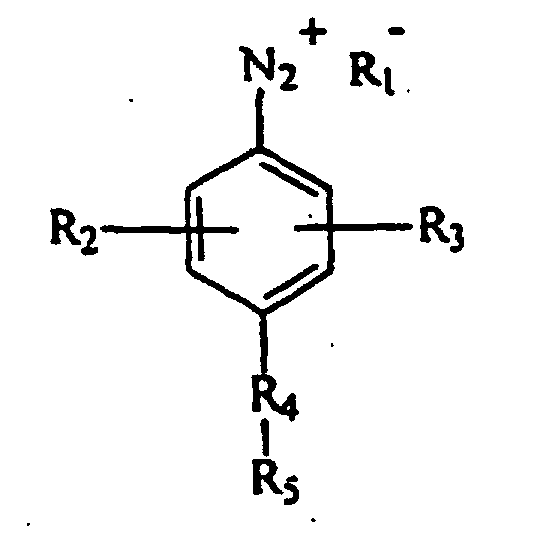
- the heat sensitive coating comprises a diazo salt of the following formula: wherein R 1 is an anion, R 2 and R 3 represents optional substitution, R 4 is -N-or -S- and R 5 is a group which after exposure of the plate renders the residue of the diazo salt oleophilic and fount insoluble.
- R 1 is sulphate, nitrate or chloride or it may be a more complex anion for example perfluorooctyl.
- R 2 and R 3 if present are preferably selected from an alkoxy, halogen, alkyl or amine. The presence of a substituent group in R 2 or R 3 helps to stabilise the diazo compound.
- R 4 When R 4 is -N-, the group R 4 -R 5 may be represented by where R 7 and R 6 may be part of a polymer chain or may be part of a morpholino functional group.
- R 6 is hydrogen and R 7 is a group where R 8 is the residue of a condensing agent and n is 1 to 100.
- the group R 7 converts the diazo compound to a diazo resin and this helps to prevent the exposed diazo from washing off during processing.
- diazo salts useful in the present invention are as follow:
- the printing plate precursor is imagewise heated using a direct heat source which is imagewise controlled by an image stored in a computer.
- the heat sensitive coating comprises a compound capable of absorbing heat and transferring this into the bulk of the coating.
- the heat absorbing material may be carbon such as carbon black or graphite. It may be a commercially available pigment such as Heliogen Green as supplied by BASF or Nigrosine Base NGI as supplied by NH Laboratories Inc. Usefully it may be an organic pigment or dye such as phthalocyanine pigment or it may be a dye or pigment of the squarylium, merocyanine, indolizine, pyrylium or metal dithioline classes.
- ⁇ ⁇ ⁇ ⁇ ⁇ ⁇ ⁇ ⁇ ⁇ ⁇ ⁇ ⁇ ⁇ ⁇ ⁇ ⁇ ⁇ ⁇ ⁇ ⁇ ⁇ ⁇ ⁇ ⁇ ⁇ ⁇ ⁇ ⁇ ⁇ ⁇ ⁇ ⁇ ⁇ ⁇ ⁇ ⁇ ⁇ ⁇ ⁇ ⁇ ⁇ ⁇ ⁇ ⁇ ⁇ ⁇ ⁇ ⁇ ⁇ ⁇ ⁇ ⁇ ⁇ ⁇ ⁇ ⁇ ⁇ ⁇ ⁇ ⁇ ⁇ ⁇ ⁇ ⁇ ⁇ ⁇ ⁇ ⁇ ⁇ ⁇ ⁇ ⁇ ⁇ ⁇ ⁇ ⁇ ⁇ ⁇ ⁇ ⁇ ⁇ ⁇ ⁇ ⁇ ⁇ ⁇ ⁇ ⁇ ⁇ ⁇ ⁇ ⁇ ⁇ ⁇ ⁇ ⁇ ⁇ ⁇ ⁇ ⁇ ⁇ ⁇ ⁇ ⁇ ⁇ ⁇ ⁇ ⁇ ⁇ ⁇ ⁇ ⁇ ⁇ ⁇ ⁇ ⁇ ⁇ ⁇ ⁇ ⁇ ⁇ ⁇ ⁇ ⁇ ⁇ ⁇
- the support is a flexible support which is attached to a printing press after the direct imaging and water development of the image.
- hydrophilic layer In a modification to the method of the present invention there is present between the hydrophilic surface of the support and the dried diazo coating solution a hydrophilic layer. This helps the water to remove the unexposed diazo coating more cleanly after the imagewise exposure.
- hydrophilic layers are layers composed of hydrophilic polysaccharides, for example dextran or pullulan.
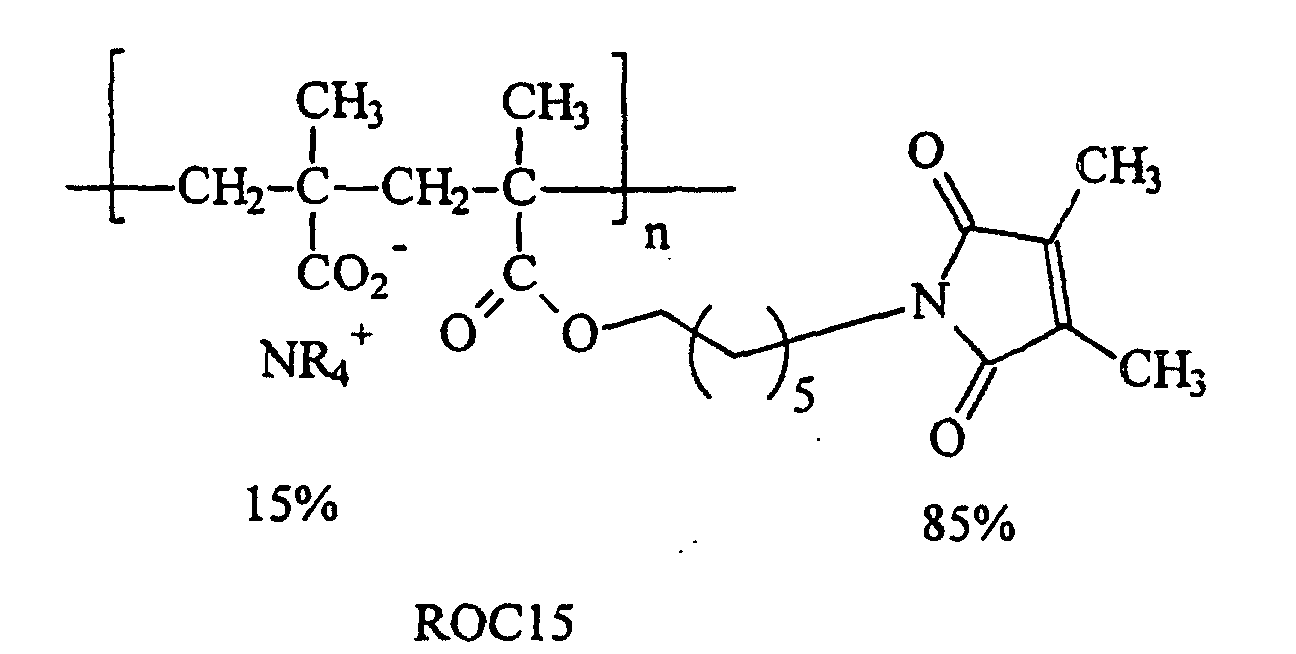
- Binder - Ronacoat OC15 having the structure: as supplied by Rohner Ltd of Pratteln, Switzerland.
- Diazo - TG-3 having the structure: as supplied by PJS Chemicals of New York State, USA.
- IR dye - IR-1 as supplied by Eastman Chemical Company, Rochester, New York, USA, having the structure:
- the coating formulation for the examples was prepared as a solution in 1-methoxy propan-2-ol/water 96 : 4 (v:v).
- the substrates used were:
- the coating solutions were coated onto the substrate by means of a wire wound bar.
- the solution concentrations were selected to provide the specified dry film compositions with a coating weight of 1.3 gm -2 after thorough drying at 80°C in an oven for 2 minutes.
- the coated aluminium substrate was cut into a circle of 105 mm diameter and placed on a disc that could be rotated at a constant speed of 2500 revolutions per minute.
- a translating table Adjacent to the spinning disc, a translating table held the source of the laser beam so that the laser beam impinged normal to the coated substrate, while the translating table moved the laser beam radially in a linear fashion with respect to the spinning disc.
- the exposed image was in the form of a spiral whereby the image in the centre of the spiral represented slow laser scanning speed and long exposure time and the outer edge of the spiral represented fast scanning speed and short exposure time.
- the laser used was a single mode 830 nm wavelength 200 mW laser diode which was focused to a 10 ⁇ m spot.
- the laser power supply was a stabilised constant current source.
- Samples of the coated aluminium substrate were subjected to heat delivered from a Weller Soldering Iron EC 2100M at 316°C.
- the desired image was created by manually moving the soldering iron over the coating to imagewise solubilise the coating by direct heat and produce the image differentiation.
- the speed of movement of the soldering iron over the plate surface was 1 cm s -1 and the heat was applied to the coated face of the plate.
- Exposure Method 3 Direct Heat imagewise controlled by a computer
- Samples of the coated polyester substrate were subjected to heat delivered from a thermal paper exposing head controlled by a computer attached to a Perkin-Elmer 881 IR spectrophotometer.
- Exposure Method Result 1 The imaging density required to give a useful image was 450 mJ cm -2 2 Coating totally removed in areas NOT subjected to heat, leaving a water insoluble imaged area. 3 Coating totally removed in areas NOT subjected to heat, leaving a water insoluble imaged area.
Landscapes
- Physics & Mathematics (AREA)
- Optics & Photonics (AREA)
- Thermal Sciences (AREA)
- Engineering & Computer Science (AREA)
- Manufacturing & Machinery (AREA)
- General Physics & Mathematics (AREA)
- Printing Plates And Materials Therefor (AREA)
- Manufacture Or Reproduction Of Printing Formes (AREA)
- Photosensitive Polymer And Photoresist Processing (AREA)
Description




| Component | Parts by Weight |
| Binder | 71 |
| Diazo | 25 |
| IR Dye | 4 |
| Exposure Method | Result |
| 1 | The imaging density required to give a useful image was 450 mJ cm-2 |
| 2 | Coating totally removed in areas NOT subjected to heat, leaving a water insoluble imaged area. |
| 3 | Coating totally removed in areas NOT subjected to heat, leaving a water insoluble imaged area. |
Claims (13)
- A method of preparing a lithographic printing plate using a precursor which comprises on a lithographic support having a hydrophilic surface a layer of a heat sensitive coating, (1) imaging the coating by direct heat and then (2) processing the plate, wherein the plate is processible with pure water to remove the unexposed areas of the coating, to reveal the hydrophilic surface of the plate and to leave an ink receptive image and wherein the heat sensitive coating comprises a diazo salt of the following formula:wherein R1 is an anion, R2 and R3 represents optional substitution, R4 is -N-or - S- and R5 is a group which after exposure of tile plate renders the residue of the diazo salt oleophilic and fount insoluble.

- A method according to claim 1 wherein R1 is sulphate, nitrate or chloride or perfluorooctyl.
- A method according to claim 1 wherein R2 and R3 when present are selected from alkoxy, halogen, alkyl or amine.
- A method according to claim 1 wherein when R4 is -N-, the group R4-R5 is represented by the formula:-where R7 and R6 may be part of a polymer chain or may be part of a morpholino functional group.

- A method according to claim 1 wherein when R4 is -N-, the group R4-R5 is represented by the formula:-where R6 is a hydrogen and R7 is a group
 where R8 is the residue of a condensing agent and n is 1 to 100.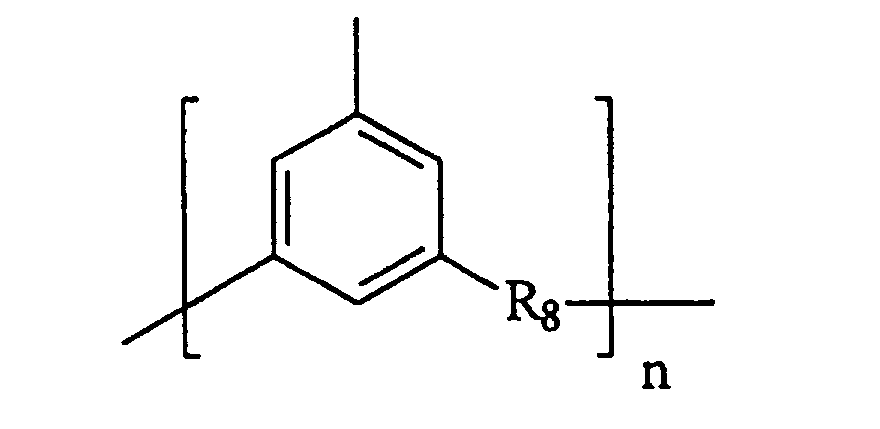
- A method according to claim 1 wherein the direct heat source is controlled by an image stored in a computer.
- A method according to claim 1 wherein the heat sensitive coating further comprises a compound capable of absorbing heat.
- A method according to claim 7 wherein the compound capable of absorbing heat is pigment.
- A method according to claim 8 wherein the pigment is selected from carbon black, Heliogen Green, Nigrosine Base NGI.
- A method according to claim 8 wherein the pigment is an organic pigment.
- A method according to claim 7 wherein the compound capable of absorbing heat is selected from a dye of the squarylium, merocyanine, indolizine, pyrylium or metal dithioline classes.
- A method according to claim 1 wherein the support is Al or Zn, polyester film supports or a paper base.
- A method according to claim 12 wherein the surface of the support is treated or coated to render it hydrophilic.
Applications Claiming Priority (3)
| Application Number | Priority Date | Filing Date | Title |
|---|---|---|---|
| GBGB9700882.5A GB9700882D0 (en) | 1997-01-17 | 1997-01-17 | Lithographic plate precursor |
| PCT/GB1998/000134 WO1998031545A1 (en) | 1997-01-17 | 1998-01-15 | Lithographic plate precursor |
| GB9700882 | 1998-01-15 |
Publications (2)
| Publication Number | Publication Date |
|---|---|
| EP0952925A1 EP0952925A1 (en) | 1999-11-03 |
| EP0952925B1 true EP0952925B1 (en) | 2002-06-12 |
Family
ID=10806109
Family Applications (1)
| Application Number | Title | Priority Date | Filing Date |
|---|---|---|---|
| EP98900618A Expired - Lifetime EP0952925B1 (en) | 1997-01-17 | 1998-01-15 | Lithographic plate precursor |
Country Status (6)
| Country | Link |
|---|---|
| US (1) | US6265136B1 (en) |
| EP (1) | EP0952925B1 (en) |
| JP (1) | JP2001508189A (en) |
| DE (1) | DE69805958T2 (en) |
| GB (1) | GB9700882D0 (en) |
| WO (1) | WO1998031545A1 (en) |
Families Citing this family (6)
| Publication number | Priority date | Publication date | Assignee | Title |
|---|---|---|---|---|
| GB9700883D0 (en) | 1997-01-17 | 1997-03-05 | Horsell Graphic Ind Ltd | Lithographic plate precursor |
| GB9713411D0 (en) * | 1997-06-26 | 1997-08-27 | Horsell Graphic Ind Ltd | Waterless lithographic printing |
| GB9714526D0 (en) * | 1997-07-11 | 1997-09-17 | Horsell Graphic Ind Ltd | Pattern Formation |
| US6458511B1 (en) | 2000-06-07 | 2002-10-01 | Kodak Polychrome Graphics Llc | Thermally imageable positive-working lithographic printing plate precursor and method for imaging |
| US6596460B2 (en) | 2000-12-29 | 2003-07-22 | Kodak Polychrome Graphics Llc | Polyvinyl acetals having azido groups and use thereof in radiation-sensitive compositions |
| US6723495B2 (en) | 2002-01-24 | 2004-04-20 | Kodak Polychrome Graphics Llc | Water-developable negative-working ultraviolet and infrared imageable element |
Family Cites Families (26)
| Publication number | Priority date | Publication date | Assignee | Title |
|---|---|---|---|---|
| US3664737A (en) * | 1971-03-23 | 1972-05-23 | Ibm | Printing plate recording by direct exposure |
| US3997349A (en) * | 1974-06-17 | 1976-12-14 | Minnesota Mining And Manufacturing Company | Light-sensitive development-free driographic printing plate |
| FR2300354A1 (en) * | 1975-02-04 | 1976-09-03 | Kodak Pathe | Presensitised lithographic printing plates - with layer of photosensitive P-aminobenzene diazonium salt with long chain alkyl or alkoxy gp. on the amino atom |
| DE2547221A1 (en) * | 1975-10-22 | 1977-05-05 | Johannes Ruediger | Printing pressure plate exposure and burning in system - uses laser or electron beam heat radiation source for designs and words before or after picture composition for rapid working |
| DE2725308A1 (en) * | 1976-06-10 | 1977-12-22 | Hoechst Co American | Laser imaging system producing aluminium offset plates - uses visible coherent light on emulsion contg. negative diazo prods. |
| US4486529A (en) | 1976-06-10 | 1984-12-04 | American Hoechst Corporation | Dialo printing plate made from laser |
| GB1586573A (en) * | 1976-06-10 | 1981-03-18 | Hoechst Co American | Recording process using a diazonium compound |
| GB1600871A (en) | 1977-11-01 | 1981-10-21 | Vickers Ltd | Radiation sensitive materials |
| US4248959A (en) * | 1978-12-07 | 1981-02-03 | American Hoechst Corporation | Preparation of diazo printing plates using laser exposure |
| US4533620A (en) | 1982-03-18 | 1985-08-06 | American Hoechst Corporation | Light sensitive co-condensates |
| EP0164128B1 (en) * | 1984-06-08 | 1990-12-27 | Howard A. Fromson | Process for making lithographic printing plates, and printing plates made by the process |
| DE3541723A1 (en) | 1985-11-26 | 1987-05-27 | Hoechst Ag | LIGHT SENSITIVE POLYCONDENSATION PRODUCT CONTAINING DIAZONIUM GROUPS, METHOD FOR THE PRODUCTION THEREOF AND LIGHT SENSITIVE RECORDING MATERIAL THAT CONTAINS THIS POLYCONDENSATION PRODUCT |
| US4914000A (en) | 1988-02-03 | 1990-04-03 | Hoechst Celanese Corporation | Three dimensional reproduction material diazonium condensates and use in light sensitive |
| US5122442A (en) | 1989-07-28 | 1992-06-16 | Hoechst Celanese Corporation | Method for forming an image from a high speed screen printing composition on a screen mesh |
| GB9308859D0 (en) | 1993-04-29 | 1993-06-16 | Johnson Ronald F | Water-developable coloured photosensitive composition |
| US5340699A (en) * | 1993-05-19 | 1994-08-23 | Eastman Kodak Company | Radiation-sensitive composition containing a resole resin and a novolac resin and use thereof in lithographic printing plates |
| EP0632328B1 (en) * | 1993-07-02 | 1997-10-29 | Agfa-Gevaert N.V. | Improvement of the storage stability of a diazo-based imaging element for making a printing plate |
| EP0672954B1 (en) * | 1994-03-14 | 1999-09-15 | Kodak Polychrome Graphics LLC | Radiation-sensitive composition containing a resole resin, a novolac resin, an infrared absorber and a triazine and use thereof in lithographic printing plates |
| US5466557A (en) * | 1994-08-29 | 1995-11-14 | Eastman Kodak Company | Radiation-sensitive composition containing a resole resin, a novolac resin, a latent bronsted acid, an infrared absorber and terephthalaldehyde and use thereof in lithographic printing plates |
| US5491046A (en) * | 1995-02-10 | 1996-02-13 | Eastman Kodak Company | Method of imaging a lithographic printing plate |
| DE69504951T2 (en) * | 1995-02-15 | 1999-04-15 | Agfa-Gevaert N.V., Mortsel | Diazo recording element with improved resistance to mechanical damage |
| US6001536A (en) * | 1995-10-24 | 1999-12-14 | Agfa-Gevaert, N.V. | Method for making a lithographic printing plate involving development by plain water |
| US6140005A (en) * | 1996-04-23 | 2000-10-31 | Agfa-Gevaert, N.V. | Imaging element and a method for producing a lithographic plate therewith |
| US5922502A (en) * | 1996-04-23 | 1999-07-13 | Agfa-Gevaert, N.V. | Imaging element for making a lithographic printing plate wherein that imaging element comprises a thermosensitive mask |
| US5879861A (en) * | 1996-04-23 | 1999-03-09 | Agfa-Gevaert, N.V. | Method for making a lithographic printing plate wherein an imaging element is used that comprises a thermosensitive mask |
| US6071369A (en) * | 1996-10-29 | 2000-06-06 | Agfa-Gevaert, N.V. | Method for making an lithographic printing plate with improved ink-uptake |
-
1997
- 1997-01-17 GB GBGB9700882.5A patent/GB9700882D0/en active Pending
-
1998
- 1998-01-15 DE DE69805958T patent/DE69805958T2/en not_active Expired - Fee Related
- 1998-01-15 JP JP52297698A patent/JP2001508189A/en active Pending
- 1998-01-15 WO PCT/GB1998/000134 patent/WO1998031545A1/en not_active Ceased
- 1998-01-15 EP EP98900618A patent/EP0952925B1/en not_active Expired - Lifetime
-
1999
- 1999-07-08 US US09/348,212 patent/US6265136B1/en not_active Expired - Fee Related
Also Published As
| Publication number | Publication date |
|---|---|
| JP2001508189A (en) | 2001-06-19 |
| DE69805958T2 (en) | 2003-02-20 |
| WO1998031545A1 (en) | 1998-07-23 |
| DE69805958D1 (en) | 2002-07-18 |
| EP0952925A1 (en) | 1999-11-03 |
| GB9700882D0 (en) | 1997-03-05 |
| US6265136B1 (en) | 2001-07-24 |
Similar Documents
| Publication | Publication Date | Title |
|---|---|---|
| RU2153986C2 (en) | Thermosensitive composition and method of using thermosensitive composition for manufacture of lithographic printing form | |
| JP2894550B2 (en) | Thermosensitive imaging elements and methods of making printing plates therewith | |
| JP2894549B2 (en) | Thermosensitive imaging element and method of making a printing plate therewith | |
| EP0780239B1 (en) | Negative-working image recording material | |
| US6083662A (en) | Methods of imaging and printing with a positive-working infrared radiation sensitive printing plate | |
| JP2002500973A (en) | Lithographic printing plate used for laser imaging equipment | |
| JP2002023350A (en) | Negative type lithographic printing plate precursor | |
| US6245477B1 (en) | Imagable compositions and printing forms | |
| JPH10254143A (en) | Manufacture of positive-action planographic printing plate | |
| US6265136B1 (en) | Lithographic plate precursor | |
| US6723495B2 (en) | Water-developable negative-working ultraviolet and infrared imageable element | |
| US6960423B2 (en) | Preparation of gravure and intaglio printing elements using direct thermally imageable media | |
| US6291134B1 (en) | Lithographic plate precursor | |
| US7134395B2 (en) | Acid inkjet imaging of lithographic printing plates | |
| US6242159B1 (en) | Method of preparing a water-less lithographic printing form | |
| EP0996544B1 (en) | Pattern formation | |
| JP3522450B2 (en) | Plate making method of lithographic printing plate | |
| EP0882583A1 (en) | A heat sensitive imaging element and a method for producing lithographic plates therewith | |
| EP1065049A1 (en) | Heat-sensitive imaging element with cover layer for providing a lithographic printing plate | |
| JP2001039047A (en) | Processless thermal printing plate having cover layer containing compound having cationic group | |
| EP0966355A1 (en) | Method of imaging lithographic printing plates with high intensity laser | |
| JP2001272787A (en) | Image forming material | |
| JPH10128944A (en) | Production of planographic printing plate enhanced in ink absorbability | |
| AU2004224966A1 (en) | A printing plate |
Legal Events
| Date | Code | Title | Description |
|---|---|---|---|
| PUAI | Public reference made under article 153(3) epc to a published international application that has entered the european phase |
Free format text: ORIGINAL CODE: 0009012 |
|
| 17P | Request for examination filed |
Effective date: 19990703 |
|
| AK | Designated contracting states |
Kind code of ref document: A1 Designated state(s): DE FR GB |
|
| GRAG | Despatch of communication of intention to grant |
Free format text: ORIGINAL CODE: EPIDOS AGRA |
|
| 17Q | First examination report despatched |
Effective date: 20010420 |
|
| GRAG | Despatch of communication of intention to grant |
Free format text: ORIGINAL CODE: EPIDOS AGRA |
|
| GRAG | Despatch of communication of intention to grant |
Free format text: ORIGINAL CODE: EPIDOS AGRA |
|
| GRAH | Despatch of communication of intention to grant a patent |
Free format text: ORIGINAL CODE: EPIDOS IGRA |
|
| GRAH | Despatch of communication of intention to grant a patent |
Free format text: ORIGINAL CODE: EPIDOS IGRA |
|
| GRAA | (expected) grant |
Free format text: ORIGINAL CODE: 0009210 |
|
| AK | Designated contracting states |
Kind code of ref document: B1 Designated state(s): DE FR GB |
|
| REG | Reference to a national code |
Ref country code: GB Ref legal event code: FG4D |
|
| REF | Corresponds to: |
Ref document number: 69805958 Country of ref document: DE Date of ref document: 20020718 |
|
| ET | Fr: translation filed | ||
| PGFP | Annual fee paid to national office [announced via postgrant information from national office to epo] |
Ref country code: FR Payment date: 20030110 Year of fee payment: 6 |
|
| PGFP | Annual fee paid to national office [announced via postgrant information from national office to epo] |
Ref country code: GB Payment date: 20030115 Year of fee payment: 6 |
|
| PGFP | Annual fee paid to national office [announced via postgrant information from national office to epo] |
Ref country code: DE Payment date: 20030123 Year of fee payment: 6 |
|
| PLBE | No opposition filed within time limit |
Free format text: ORIGINAL CODE: 0009261 |
|
| STAA | Information on the status of an ep patent application or granted ep patent |
Free format text: STATUS: NO OPPOSITION FILED WITHIN TIME LIMIT |
|
| 26N | No opposition filed |
Effective date: 20030313 |
|
| PG25 | Lapsed in a contracting state [announced via postgrant information from national office to epo] |
Ref country code: GB Free format text: LAPSE BECAUSE OF NON-PAYMENT OF DUE FEES Effective date: 20040115 |
|
| PG25 | Lapsed in a contracting state [announced via postgrant information from national office to epo] |
Ref country code: DE Free format text: LAPSE BECAUSE OF NON-PAYMENT OF DUE FEES Effective date: 20040803 |
|
| GBPC | Gb: european patent ceased through non-payment of renewal fee |
Effective date: 20040115 |
|
| PG25 | Lapsed in a contracting state [announced via postgrant information from national office to epo] |
Ref country code: FR Free format text: LAPSE BECAUSE OF NON-PAYMENT OF DUE FEES Effective date: 20040930 |
|
| REG | Reference to a national code |
Ref country code: FR Ref legal event code: ST |