EP0951166A2 - Automatic wireless alerting on an automatic call distribution center - Google Patents
Automatic wireless alerting on an automatic call distribution center Download PDFInfo
- Publication number
- EP0951166A2 EP0951166A2 EP99301551A EP99301551A EP0951166A2 EP 0951166 A2 EP0951166 A2 EP 0951166A2 EP 99301551 A EP99301551 A EP 99301551A EP 99301551 A EP99301551 A EP 99301551A EP 0951166 A2 EP0951166 A2 EP 0951166A2
- Authority
- EP
- European Patent Office
- Prior art keywords
- wireless
- switching system
- split
- acd
- wireless terminals
- Prior art date
- Legal status (The legal status is an assumption and is not a legal conclusion. Google has not performed a legal analysis and makes no representation as to the accuracy of the status listed.)
- Granted
Links
Images

Classifications
-
- H—ELECTRICITY
- H04—ELECTRIC COMMUNICATION TECHNIQUE
- H04M—TELEPHONIC COMMUNICATION
- H04M3/00—Automatic or semi-automatic exchanges
- H04M3/42—Systems providing special services or facilities to subscribers
- H04M3/50—Centralised arrangements for answering calls; Centralised arrangements for recording messages for absent or busy subscribers ; Centralised arrangements for recording messages
- H04M3/51—Centralised call answering arrangements requiring operator intervention, e.g. call or contact centers for telemarketing
-
- H—ELECTRICITY
- H04—ELECTRIC COMMUNICATION TECHNIQUE
- H04M—TELEPHONIC COMMUNICATION
- H04M2207/00—Type of exchange or network, i.e. telephonic medium, in which the telephonic communication takes place
- H04M2207/18—Type of exchange or network, i.e. telephonic medium, in which the telephonic communication takes place wireless networks
-
- H—ELECTRICITY
- H04—ELECTRIC COMMUNICATION TECHNIQUE
- H04M—TELEPHONIC COMMUNICATION
- H04M3/00—Automatic or semi-automatic exchanges
- H04M3/42—Systems providing special services or facilities to subscribers
- H04M3/50—Centralised arrangements for answering calls; Centralised arrangements for recording messages for absent or busy subscribers ; Centralised arrangements for recording messages
- H04M3/51—Centralised call answering arrangements requiring operator intervention, e.g. call or contact centers for telemarketing
- H04M3/5175—Call or contact centers supervision arrangements
-
- H—ELECTRICITY
- H04—ELECTRIC COMMUNICATION TECHNIQUE
- H04M—TELEPHONIC COMMUNICATION
- H04M3/00—Automatic or semi-automatic exchanges
- H04M3/42—Systems providing special services or facilities to subscribers
- H04M3/50—Centralised arrangements for answering calls; Centralised arrangements for recording messages for absent or busy subscribers ; Centralised arrangements for recording messages
- H04M3/51—Centralised call answering arrangements requiring operator intervention, e.g. call or contact centers for telemarketing
- H04M3/523—Centralised call answering arrangements requiring operator intervention, e.g. call or contact centers for telemarketing with call distribution or queueing
Definitions
- This invention relates to telecommunication switching, and, in particular, to automatic call distribution (ACD) systems.
- ACD automatic call distribution
- ACD systems also referred to as telemarketing centers or call centers, are systems that enable a pool of agents to serve incoming and/or outgoing calls. With the calls being distributed and connected to whichever of the agents happens to be available at the time. When no agents are free and available to handle additional calls, additional incoming calls are typically placed in a holding queue to await agents becoming available. It is common practice to divide the pool of agents into a plurality of groups, commonly referred to as splits, and to assign different types of calls to different splits. For example, different splits may be designated to handle calls pertaining to different client companies, or calls pertaining to different products or services of the same client company. Each split has its own incoming-call queue. In addition, to the agents associated with a split, each split has an assigned supervisor whose responsibility is to assure that the split functions against given criteria.
- Each call center, or each split within each call center typically has its own incoming-call queue.
- it can happen that one call center or split is heavily loaded with calls and has a full queue of calls waiting for an available agent, while another call center or split may be only lightly overloaded, and yet another call center or split may not be overloaded at all and actually may have idle agents.
- some call centers have implemented a capability whereby, if a call center for handling a particular call is heavily loaded and its queue is overflowing with waiting calls, the call center evaluates the call load of other call centers to determine if one of the other splits or call centers is less busy and consequently may be able to handle overflow calls and do so more promptly.
- the overflow call is then queued to the first such backup call center that is found instead of being queued within the call center that received it.
- Such arrangements are known by different names, one being "look ahead interflow".
- the control of how calls are processed in a ACD system is done for example in the Lucent Technologies ACD systems by program instructions (also referred to as scripts) that are stored in vectors with each split having its own vector. The instructions within a vector allow the customer the ability to customize the operation of their ACD system without resorting to contacting the manufacturer.
- the ability to do look ahead interflow does allow one call center to automatically transfer incoming calls to another call center, it does not provide a mechanism for alerting a supervisor of a split or off duty agents of a split to an undesired condition on the split.
- a supervisor does have access to a supervisor's terminal that allows the ACD system to supply the supervisor information conceming the operation of the split. However, this forces the supervisor to remain at their terminal to receive such information. It is highly desirable for the supervisors to be able to roam about the call center and even take short breaks.
- a technical advance is achieved by an apparatus and a method that allow the alerting of supervisors and off duty agents to conditions on a split of an ACD system via wireless terminals.
- the conditions under which the wireless alerting will be performed are programmed by the owner of the ACD system rather than the manufacturer.
- the ACD center is connected to a wireless switching system via a primary rate ISDN interface (PRI) link.
- PRI primary rate ISDN interface
- the ACD system considers the wireless switching system as another ACD system and utilizes the look ahead interflow operation to communicate information to the wireless switching system conceming the condition of a split. This is done by the ACD placing informational telecommunication calls to pseudo telecommunication numbers via the PRI link to the wireless switching system.
- the wireless switching system is responsive to each of these pseudo numbers to interpret the pseudo number as to the wireless terminal that should be contacted and an alphanumeric message that is to be displayed on that wireless terminal.
- the alphanumeric message defines the condition of the split to the supervisor or off duty agents of the split.
- the wireless switching system may be a wireless telephone system or a paging system.
- the wireless terminals may be wireless telephones or pagers.
- ACD system 102 is interconnected to the public telephone system 101 via links 117.
- ACD system 102 receives calls from public telephone system 101 via links 117 and directs these calls to splits 107-108.
- Each split comprises a plurality of agent terminals 1 12-1 15.
- split 108 comprises agent terminals 114-115.
- An agent sitting at each split is responsive to a particular dialed telephone number received over links 117 from public telephone system 101.
- Wireless switching system 103 provides wireless telephone service via wireless sets 109-111.
- Wireless sets 109-111 are interconnected to wireless switching system 103 via base stations 104-106.
- Wireless set 109 can place a call to another wireless set via wireless switching system 103 or to a telephone connected to public telephone system 101 via base station 104, wireless switching system 103, and ACD system 102.
- Wireless set 109 is assigned to the supervisor of split 108.
- Wireless set 109 has a telephone number that is utilized by other telephone devices to place voice calls to wireless set 109.
- wireless switching system 103 recognizes a set of informational telephone numbers for wireless set 109 with each of these telephone numbers defining a condition on split 108.
- Wireless switching system 103 is responsive to these informational telephone numbers to send a data message for display on the display portion of wireless set 109.
- Other wireless sets could be assigned to other splits.
- agents of split 108 could be given wireless terminals when off duty and messages be transmitted to these wireless terminals as a group.
- wireless set 111 could be assigned to split 107.
- ACD system 102 is administered to direct calls to these informational telephone numbers to PRI link 118.
- the informational telephone numbers are transmitted in ISDN set up messages on the D channel of PRI link 118.
- the informational telephone numbers do not impact the telephone numbers utilized by public telephone system 101 or for voice calls made within ACD system 102 since the informational telephone numbers are distinct from those numbers.
- wireless switching system 103 could be a paging system and the wireless terminals could be pagers.
- ACD system 102 is advantageously the Lucent Technologies Definity ACD private branch exchange (PBX).
- ACD system 102 serves a plurality of call-handling applications; for example, sales-call-handling, service-call handling, accounting-inquiry-call handling, etc.
- ACD system 102 conventionally has a different telephone number, referred to herein as an arriving vector directory number (VDN).
- VDN arriving vector directory number
- a customer call that has newly arrived at ACD system 102 is to be directed by the VDN of split 108.
- the VDN directs the call to be handled by a script which is prepared by the owner of ACD system 102 and not the manufacturer.
- ACD system 102 determines that the longest waiting call in the queue for split 108 has exceeded sixty seconds. ACD system 102 then executes a look ahead interflow operation to wireless switching system 103 via PRI link 118. ACD system 102 transmits a telephone number associated with the look ahead interflow call of 8 289 1081.
- Wireless switching system 103 is responsive to the first four digits to recognize that this is an informational telephone number and to the next three digits, "108" to recognize that a data message is to be transmitted to the wireless set of the supervisor of split 108.
- the last digit, "1" defines the out of criterion condition that makes it necessary to alert the supervisor of split 108.
- Wireless set 109 is assigned to the supervisor of split 108.
- Wireless switching system 103 transmits a data message for display on wireless set 109 that specifies that the split presently has a waiting time that is longer than sixty seconds and has just received another telephone call.
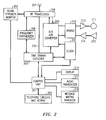
- wireless set 109 When wireless switching system 103 is a wireless telephone switching system, wireless set 109 is advantageously illustrated in greater detail in FIG. 2. The other wireless sets are similar in design.
- Wireless set 109 implements a wireless protocol that allows wireless set 109 to maintain a wireless signal link with wireless switching system 103 via base stations included in wireless switching system 103.
- One air interface that can be used is the Japanese PHS protocol as set forth in "User-Network Interface and Inter-Network Interface Standards for PHS", the Telecommunication Technology Committee, 1995, and “Personal Handy Phone System RCR Standard", Version 1, RCR STD-28, December 20, 1993.
- the message set of the PHS protocol is similar to the ISDN message set. Overall control of the wireless set is provided by control unit 201.
- Units 202, 203, 206, 207, 208, and 209 provide the RF communication capabilities for the wireless set.
- Elements 204, 210, and 211-214 provide the audio information received and transmitted to the user; whereas, elements 216-217 and 205 provide the basic user interface.
- Wireless Switching system 103 uses the message set to update display 216 with the messages described with respect to FIG. 4.
- wireless set 109 is a pager which are well known in the art.
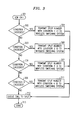
- FIG. 3 illustrates, in flow chart form, the steps performed by ACD system 102 in receiving an incoming call from public telephone network 101 for a split.
- Decision block 302 determines if the first condition has been exceeded. As way of an example, the first condition is the longest waiting call in the queue for the split exceeding sixty seconds. If the answer is yes, control is transferred to block 304 which transmits to wireless switching system 103 the digits "8289" followed by the digits representing the split number and the digit "1" representing the condition. After execution of block 304, control is transferred to block 312 which adds the call onto the queue of the split before transferring control to block 313 which ends the sequence of the script.
- look ahead interflow could be done to another ACD system before execution of block 312.
- decision block 303 determines if a second condition has been exceeded.
- this second condition may be that the number of available agents has diminished below a predefined value. If the answer in decision block 303 is yes, block 308 transmits the same information as was done in block 304 with the exception that the last digit will be a 2 before transferring control to block 312.
- decision block 306 determines if condition 3 has been exceeded.
- condition 3 may be the number of agents who are presently staffing the queue. If the answer is yes in decision block 306, block 307 transmits the same information as block 304 with the exception that the last digit will be a 3 before transferring control to block 312.
- decision block 309 determines if a fourth condition has been exceeded.
- the fourth condition may be the time of day exceeding some predefined time. If the answer in decision block 309 is yes, control is transferred to block 311 which transmits the same information as block 304 with the exception being that the last digit is a 4 before transferring control to block 312.
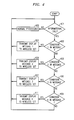
- FIG. 4 illustrates, in flow chart form, the steps performed by wireless switching system 103 in implementing the invention.
- Decision block 401 determines if an informational call as defined by the first four digits of the received telephone number being "8289" has been received. If the answer is no, control is transferred to block 405 that proceeds to handle a call in a normal manner or any other messages from ACD system 102 in a normal manner before transferring control back to decision block 401. If the answer in decision block 401 is yes, block 402 determines if condition 1 ID (as defined by the last digit) is in the set up message received to start the call.
- condition 1 ID as defined by the last digit
- block 404 determines the wireless set or wireless sets associated with the split as defined in the received telephone number and transmits the predefined message 1 to the display of the determined wireless set or wireless sets before transferring control back to decision block 401.
- Blocks 403 and 408, blocks 406 and 407, and blocks 409 and 411 function in a manner similar to blocks 402 and 404.
- Blocks 403-411 differ from the operation of blocks 402 and 404 only in the predefined data message that is sent to the wireless set or wireless sets by wireless switching system 103.
Landscapes
- Business, Economics & Management (AREA)
- Marketing (AREA)
- Engineering & Computer Science (AREA)
- Signal Processing (AREA)
- Mobile Radio Communication Systems (AREA)
- Telephonic Communication Services (AREA)
Abstract
Description
Claims (5)
- A method of displaying information on a plurality of wireless terminals (109) defining conditions on an automatic call distribution system (102) with the plurality of wireless terminals interconnected to the automatic call distribution system via a wireless switching system (103), comprising the steps of:CHARACTERIZED IN THATdetecting (302, 303, 306, 309) a condition on the automatic call distribution system by the automatic call distribution system;transmitting (304, 308, 307, 311) an informational telecommunication call identifying one of the plurality of wireless terminals and defining the condition to the wireless switching system by the automatic call distribution system;determining (401, 402, 403, 406, 409) the one of the plurality of wireless terminals from the plurality of wireless terminals connected to the wireless switching system and a message in response to the informational telecommunication call by the wireless switching system;transmitting (404, 408, 407, 411) the determined message to the determined one of the plurality of wireless terminals; anddisplaying (201, 216) the transmitted message by the determined one of the plurality of wireless terminals.
- The method of claim 1 wherein a telephone number of the telecommunication call defines the condition and the determined one of the plurality of wireless terminals.
- The method of claim 2 wherein the step of determining further comprises determining a set of the plurality of wireless terminals from the telephone number; andthe step of transmitting further comprises transmitting the determined message to the determined set of the plurality of wireless terminals.
- The method of claim 3 wherein the wireless switching system is a wireless telecommunication switching system and the plurality of wireless terminals are wireless telephones.
- The method of claim 3 wherein the wireless switching system is a paging system and the plurality of wireless terminals are pagers.
Applications Claiming Priority (2)
| Application Number | Priority Date | Filing Date | Title |
|---|---|---|---|
| US09/042,459 US6088442A (en) | 1998-03-16 | 1998-03-16 | Automatic wireless alerting on an automatic call distribution center |
| US42459 | 1998-03-16 |
Publications (3)
| Publication Number | Publication Date |
|---|---|
| EP0951166A2 true EP0951166A2 (en) | 1999-10-20 |
| EP0951166A3 EP0951166A3 (en) | 2000-01-19 |
| EP0951166B1 EP0951166B1 (en) | 2002-06-05 |
Family
ID=21922048
Family Applications (1)
| Application Number | Title | Priority Date | Filing Date |
|---|---|---|---|
| EP99301551A Expired - Lifetime EP0951166B1 (en) | 1998-03-16 | 1999-03-02 | Automatic wireless alerting on an automatic call distribution center |
Country Status (5)
| Country | Link |
|---|---|
| US (1) | US6088442A (en) |
| EP (1) | EP0951166B1 (en) |
| JP (1) | JPH11331388A (en) |
| CA (1) | CA2261547C (en) |
| DE (1) | DE69901651T2 (en) |
Cited By (2)
| Publication number | Priority date | Publication date | Assignee | Title |
|---|---|---|---|---|
| DE19951380A1 (en) * | 1999-10-26 | 2001-05-03 | Deutsche Telekom Ag | System for operator-free hotline routing includes an ACD server/call generator and a database containing customer master and machine data. |
| EP1211619A2 (en) * | 2000-11-29 | 2002-06-05 | Siemens Aktiengesellschaft | Method and system for the mobile supervision of a contact center |
Families Citing this family (13)
| Publication number | Priority date | Publication date | Assignee | Title |
|---|---|---|---|---|
| US6594470B1 (en) * | 1999-10-28 | 2003-07-15 | Nortel Networks Limited | System and method for remote management of call center operations |
| US6956941B1 (en) * | 2000-04-12 | 2005-10-18 | Austin Logistics Incorporated | Method and system for scheduling inbound inquiries |
| US7103173B2 (en) | 2001-07-09 | 2006-09-05 | Austin Logistics Incorporated | System and method for preemptive goals based routing of contact records |
| US7502460B2 (en) | 2006-11-20 | 2009-03-10 | Austin Logistics Incorporated | Method and system for distributing outbound telephone calls |
| US7142662B2 (en) | 2000-07-11 | 2006-11-28 | Austin Logistics Incorporated | Method and system for distributing outbound telephone calls |
| US20020025819A1 (en) * | 2000-08-24 | 2002-02-28 | Zoran Cetusic | Wireless communication techniques |
| US20020083024A1 (en) * | 2000-11-17 | 2002-06-27 | Myers Bradley A. | Case management system and method |
| US20020120487A1 (en) * | 2001-02-23 | 2002-08-29 | Fridrich Donald J. | Referral systems for providing customers with information |
| US7054434B2 (en) | 2001-07-09 | 2006-05-30 | Austin Logistics Incorporated | System and method for common account based routing of contact records |
| US7715546B2 (en) | 2001-07-09 | 2010-05-11 | Austin Logistics Incorporated | System and method for updating contact records |
| US20040249848A1 (en) * | 2003-06-06 | 2004-12-09 | Carlbom Ingrid Birgitta | Method and apparatus for intelligent and automatic alert management using multimedia database system |
| US7864945B2 (en) * | 2004-11-30 | 2011-01-04 | Aspect Software, Inc. | Method for detecting availability of non-traditional agent |
| US7729277B2 (en) * | 2007-02-28 | 2010-06-01 | Cisco Technology, Inc. | Use of intelligent directed broadcast in contact center solutions |
Family Cites Families (9)
| Publication number | Priority date | Publication date | Assignee | Title |
|---|---|---|---|---|
| US4582959B1 (en) * | 1984-06-05 | 2000-02-01 | At & T Information Systems Inc | Message waiting alerting method |
| US4788715A (en) * | 1986-10-16 | 1988-11-29 | American Telephone And Telegraph Company At&T Bell Laboratories | Announcing waiting times in queuing systems |
| US4942598A (en) * | 1988-03-04 | 1990-07-17 | Motorola, Inc. | Telephone answering machine in paging systems with automatic number identification based message operations |
| US5400327A (en) * | 1993-09-30 | 1995-03-21 | Rockwell International Corporation | Automatic call distributor with wireless connection with remote unit and method |
| US5384841A (en) * | 1993-10-27 | 1995-01-24 | Rockwell International Corporation | Automatic call distribution network with call overload system and method |
| US5841854A (en) * | 1994-02-16 | 1998-11-24 | Priority Call Management, Inc. | Wireless telephone integration system and method for call centers and workgroups |
| US5666399A (en) * | 1995-03-31 | 1997-09-09 | Lucent Technologies Inc. | Software architecture for providing communication features to different types of wireless telephones via different communication switching systems |
| US5555297A (en) * | 1995-05-18 | 1996-09-10 | Rockwell International Corporation | Automatic call distributor reporting system and method therefor |
| US5684872A (en) * | 1995-07-21 | 1997-11-04 | Lucent Technologies Inc. | Prediction of a caller's motivation as a basis for selecting treatment of an incoming call |
-
1998
- 1998-03-16 US US09/042,459 patent/US6088442A/en not_active Expired - Lifetime
-
1999
- 1999-02-09 CA CA002261547A patent/CA2261547C/en not_active Expired - Fee Related
- 1999-03-02 EP EP99301551A patent/EP0951166B1/en not_active Expired - Lifetime
- 1999-03-02 DE DE69901651T patent/DE69901651T2/en not_active Expired - Lifetime
- 1999-03-16 JP JP11069433A patent/JPH11331388A/en active Pending
Cited By (3)
| Publication number | Priority date | Publication date | Assignee | Title |
|---|---|---|---|---|
| DE19951380A1 (en) * | 1999-10-26 | 2001-05-03 | Deutsche Telekom Ag | System for operator-free hotline routing includes an ACD server/call generator and a database containing customer master and machine data. |
| DE19951380B4 (en) * | 1999-10-26 | 2013-06-13 | Deutsche Telekom Ag | System for operatorless hotline routing |
| EP1211619A2 (en) * | 2000-11-29 | 2002-06-05 | Siemens Aktiengesellschaft | Method and system for the mobile supervision of a contact center |
Also Published As
| Publication number | Publication date |
|---|---|
| EP0951166B1 (en) | 2002-06-05 |
| CA2261547A1 (en) | 1999-09-16 |
| CA2261547C (en) | 2002-08-13 |
| US6088442A (en) | 2000-07-11 |
| JPH11331388A (en) | 1999-11-30 |
| EP0951166A3 (en) | 2000-01-19 |
| DE69901651D1 (en) | 2002-07-11 |
| DE69901651T2 (en) | 2004-03-18 |
Similar Documents
| Publication | Publication Date | Title |
|---|---|---|
| EP0951166B1 (en) | Automatic wireless alerting on an automatic call distribution center | |
| US5479482A (en) | Cellular terminal for providing public emergency call location information | |
| US5706329A (en) | Personal mobile communication system having meet-me bridge reconnect feature | |
| FI103552B (en) | Method and arrangement for optionally coupling a stationary subscriber device to a neighboring mobile subscriber device using a telephone exchange function | |
| CA2129942A1 (en) | Telecommunication Network With Integrated Network-Wide Automatic Call Distribution | |
| US5937035A (en) | Interswitch telephone status monitoring | |
| EP0613278B1 (en) | Calling terminal controlled call coverage | |
| US5315647A (en) | Private branch exchange adapted for telemarketing | |
| EP0908042B1 (en) | Handling of time zones in a telecommunication system | |
| CN1025272C (en) | Communication Systems | |
| US6882862B1 (en) | Method for interfacing a private branch exchange with a wireless communications network and also with the public switched telephone network | |
| US20030185372A1 (en) | Method for putting through at least one call having a predeterminable priority | |
| EP0912033B1 (en) | Call transfer in an automatic call distributor | |
| EP0376525B1 (en) | Automated call handling apparatus | |
| KR100459552B1 (en) | Apparatus and method for monitoring the status of calls serviced at private exchanges | |
| KR100285328B1 (en) | Transfer method in mobile communication system | |
| WO1998039904A1 (en) | 'return to prior agent' feature in multi-destination call delivery services | |
| JPH06152753A (en) | Incoming call control system for busy line utilizing outgoing id | |
| JPH0418838A (en) | telephone equipment | |
| JPH04368045A (en) | Incoming call display control system | |
| KR100247434B1 (en) | Method for position busy service in attendant console device | |
| EP0786891A2 (en) | Method and autoconnect system for connecting outdialed calls to agents | |
| CA2473538C (en) | Telecommunication network that provides caller-entered information to multiple call destinations | |
| KR100306751B1 (en) | Incoming method for ring group of switching system | |
| EP1578166B1 (en) | A method in a mobile phone exchange |
Legal Events
| Date | Code | Title | Description |
|---|---|---|---|
| PUAI | Public reference made under article 153(3) epc to a published international application that has entered the european phase |
Free format text: ORIGINAL CODE: 0009012 |
|
| 17P | Request for examination filed |
Effective date: 19990317 |
|
| AK | Designated contracting states |
Kind code of ref document: A2 Designated state(s): DE FI FR SE |
|
| AX | Request for extension of the european patent |
Free format text: AL;LT;LV;MK;RO;SI |
|
| PUAL | Search report despatched |
Free format text: ORIGINAL CODE: 0009013 |
|
| AK | Designated contracting states |
Kind code of ref document: A3 Designated state(s): AT BE CH CY DE DK ES FI FR GB GR IE IT LI LU MC NL PT SE |
|
| AX | Request for extension of the european patent |
Free format text: AL;LT;LV;MK;RO;SI |
|
| AKX | Designation fees paid |
Free format text: DE FI FR SE |
|
| GRAG | Despatch of communication of intention to grant |
Free format text: ORIGINAL CODE: EPIDOS AGRA |
|
| 17Q | First examination report despatched |
Effective date: 20010621 |
|
| GRAG | Despatch of communication of intention to grant |
Free format text: ORIGINAL CODE: EPIDOS AGRA |
|
| GRAH | Despatch of communication of intention to grant a patent |
Free format text: ORIGINAL CODE: EPIDOS IGRA |
|
| GRAH | Despatch of communication of intention to grant a patent |
Free format text: ORIGINAL CODE: EPIDOS IGRA |
|
| GRAA | (expected) grant |
Free format text: ORIGINAL CODE: 0009210 |
|
| AK | Designated contracting states |
Kind code of ref document: B1 Designated state(s): DE FI FR SE |
|
| REF | Corresponds to: |
Ref document number: 69901651 Country of ref document: DE Date of ref document: 20020711 |
|
| ET | Fr: translation filed | ||
| PLBE | No opposition filed within time limit |
Free format text: ORIGINAL CODE: 0009261 |
|
| STAA | Information on the status of an ep patent application or granted ep patent |
Free format text: STATUS: NO OPPOSITION FILED WITHIN TIME LIMIT |
|
| 26N | No opposition filed |
Effective date: 20030306 |
|
| PGFP | Annual fee paid to national office [announced via postgrant information from national office to epo] |
Ref country code: FI Payment date: 20090316 Year of fee payment: 11 |
|
| PGFP | Annual fee paid to national office [announced via postgrant information from national office to epo] |
Ref country code: SE Payment date: 20090306 Year of fee payment: 11 |
|
| PGFP | Annual fee paid to national office [announced via postgrant information from national office to epo] |
Ref country code: FR Payment date: 20090316 Year of fee payment: 11 |
|
| EUG | Se: european patent has lapsed | ||
| PG25 | Lapsed in a contracting state [announced via postgrant information from national office to epo] |
Ref country code: FI Free format text: LAPSE BECAUSE OF NON-PAYMENT OF DUE FEES Effective date: 20100302 |
|
| REG | Reference to a national code |
Ref country code: FR Ref legal event code: ST Effective date: 20101130 |
|
| PG25 | Lapsed in a contracting state [announced via postgrant information from national office to epo] |
Ref country code: FR Free format text: LAPSE BECAUSE OF NON-PAYMENT OF DUE FEES Effective date: 20100331 |
|
| PG25 | Lapsed in a contracting state [announced via postgrant information from national office to epo] |
Ref country code: SE Free format text: LAPSE BECAUSE OF NON-PAYMENT OF DUE FEES Effective date: 20100303 |
|
| PGFP | Annual fee paid to national office [announced via postgrant information from national office to epo] |
Ref country code: DE Payment date: 20170322 Year of fee payment: 19 |
|
| REG | Reference to a national code |
Ref country code: DE Ref legal event code: R119 Ref document number: 69901651 Country of ref document: DE |
|
| PG25 | Lapsed in a contracting state [announced via postgrant information from national office to epo] |
Ref country code: DE Free format text: LAPSE BECAUSE OF FAILURE TO SUBMIT A TRANSLATION OF THE DESCRIPTION OR TO PAY THE FEE WITHIN THE PRESCRIBED TIME-LIMIT Effective date: 20181002 |