EP0950107B1 - Novel nucleic acid molecules from maize and their use for the production of modified starch - Google Patents
Novel nucleic acid molecules from maize and their use for the production of modified starch Download PDFInfo
- Publication number
- EP0950107B1 EP0950107B1 EP97954424A EP97954424A EP0950107B1 EP 0950107 B1 EP0950107 B1 EP 0950107B1 EP 97954424 A EP97954424 A EP 97954424A EP 97954424 A EP97954424 A EP 97954424A EP 0950107 B1 EP0950107 B1 EP 0950107B1
- Authority
- EP
- European Patent Office
- Prior art keywords
- starch
- nucleic acid
- plants
- dna
- cells
- Prior art date
- Legal status (The legal status is an assumption and is not a legal conclusion. Google has not performed a legal analysis and makes no representation as to the accuracy of the status listed.)
- Expired - Lifetime
Links
- 150000007523 nucleic acids Chemical class 0.000 title claims abstract description 80
- 102000039446 nucleic acids Human genes 0.000 title claims abstract description 78
- 108020004707 nucleic acids Proteins 0.000 title claims abstract description 78
- 240000008042 Zea mays Species 0.000 title claims abstract description 41
- 238000004519 manufacturing process Methods 0.000 title claims abstract description 39
- 235000002017 Zea mays subsp mays Nutrition 0.000 title claims abstract description 35
- 235000016383 Zea mays subsp huehuetenangensis Nutrition 0.000 title claims abstract description 32
- 235000009973 maize Nutrition 0.000 title claims abstract description 32
- 229920000881 Modified starch Polymers 0.000 title claims abstract description 25
- 235000019426 modified starch Nutrition 0.000 title claims abstract description 25
- 239000004368 Modified starch Substances 0.000 title claims abstract description 22
- 241000196324 Embryophyta Species 0.000 claims abstract description 281
- 229920002472 Starch Polymers 0.000 claims abstract description 242
- 235000019698 starch Nutrition 0.000 claims abstract description 239
- 239000008107 starch Substances 0.000 claims abstract description 227
- 108090000623 proteins and genes Proteins 0.000 claims abstract description 93
- 238000000034 method Methods 0.000 claims abstract description 82
- 102000004169 proteins and genes Human genes 0.000 claims abstract description 71
- 230000009261 transgenic effect Effects 0.000 claims abstract description 48
- 239000008187 granular material Substances 0.000 claims abstract description 19
- 230000002194 synthesizing effect Effects 0.000 claims abstract description 8
- 210000004027 cell Anatomy 0.000 claims description 186
- 108020004414 DNA Proteins 0.000 claims description 96
- 108091032973 (ribonucleotides)n+m Proteins 0.000 claims description 45
- 239000013598 vector Substances 0.000 claims description 42
- 102000053602 DNA Human genes 0.000 claims description 29
- 238000013518 transcription Methods 0.000 claims description 25
- 230000035897 transcription Effects 0.000 claims description 25
- 230000002829 reductive effect Effects 0.000 claims description 23
- 108090000994 Catalytic RNA Proteins 0.000 claims description 22
- 102000053642 Catalytic RNA Human genes 0.000 claims description 22
- 108091092562 ribozyme Proteins 0.000 claims description 22
- 108091028043 Nucleic acid sequence Proteins 0.000 claims description 21
- 230000000694 effects Effects 0.000 claims description 21
- 102000004190 Enzymes Human genes 0.000 claims description 19
- 108090000790 Enzymes Proteins 0.000 claims description 19
- 230000000692 anti-sense effect Effects 0.000 claims description 19
- 239000002773 nucleotide Substances 0.000 claims description 18
- 125000003729 nucleotide group Chemical group 0.000 claims description 18
- 229910019142 PO4 Inorganic materials 0.000 claims description 17
- 239000010452 phosphate Substances 0.000 claims description 17
- NBIIXXVUZAFLBC-UHFFFAOYSA-K phosphate Chemical compound [O-]P([O-])([O-])=O NBIIXXVUZAFLBC-UHFFFAOYSA-K 0.000 claims description 17
- 230000008569 process Effects 0.000 claims description 17
- 230000000295 complement effect Effects 0.000 claims description 13
- 230000001105 regulatory effect Effects 0.000 claims description 11
- 230000009467 reduction Effects 0.000 claims description 10
- 108090000344 1,4-alpha-Glucan Branching Enzyme Proteins 0.000 claims description 9
- 108020005544 Antisense RNA Proteins 0.000 claims description 9
- 239000003184 complementary RNA Substances 0.000 claims description 9
- 239000000463 material Substances 0.000 claims description 8
- 102000003925 1,4-alpha-Glucan Branching Enzyme Human genes 0.000 claims description 7
- 239000001963 growth medium Substances 0.000 claims description 7
- 108010039811 Starch synthase Proteins 0.000 claims description 6
- 230000032361 posttranscriptional gene silencing Effects 0.000 claims description 6
- 108091026890 Coding region Proteins 0.000 claims description 5
- 210000003527 eukaryotic cell Anatomy 0.000 claims description 4
- 230000002068 genetic effect Effects 0.000 claims description 4
- 210000001236 prokaryotic cell Anatomy 0.000 claims description 4
- 125000003275 alpha amino acid group Chemical group 0.000 claims 1
- 108020004511 Recombinant DNA Proteins 0.000 abstract description 8
- 239000013612 plasmid Substances 0.000 description 128
- 244000061456 Solanum tuberosum Species 0.000 description 73
- 239000002299 complementary DNA Substances 0.000 description 71
- 235000018102 proteins Nutrition 0.000 description 62
- 239000012634 fragment Substances 0.000 description 54
- 210000001938 protoplast Anatomy 0.000 description 43
- 239000000243 solution Substances 0.000 description 43
- 230000009466 transformation Effects 0.000 description 34
- 235000002595 Solanum tuberosum Nutrition 0.000 description 30
- WQZGKKKJIJFFOK-GASJEMHNSA-N Glucose Natural products OC[C@H]1OC(O)[C@H](O)[C@@H](O)[C@@H]1O WQZGKKKJIJFFOK-GASJEMHNSA-N 0.000 description 27
- 239000008103 glucose Substances 0.000 description 27
- 238000003780 insertion Methods 0.000 description 27
- 230000037431 insertion Effects 0.000 description 27
- 239000002609 medium Substances 0.000 description 21
- XLYOFNOQVPJJNP-UHFFFAOYSA-N water Substances O XLYOFNOQVPJJNP-UHFFFAOYSA-N 0.000 description 21
- 241000588724 Escherichia coli Species 0.000 description 20
- 230000015572 biosynthetic process Effects 0.000 description 20
- 239000000872 buffer Substances 0.000 description 19
- 238000004458 analytical method Methods 0.000 description 18
- 229920000856 Amylose Polymers 0.000 description 16
- 229940088598 enzyme Drugs 0.000 description 16
- 238000010561 standard procedure Methods 0.000 description 16
- 238000000636 Northern blotting Methods 0.000 description 15
- RAXXELZNTBOGNW-UHFFFAOYSA-N imidazole Natural products C1=CNC=N1 RAXXELZNTBOGNW-UHFFFAOYSA-N 0.000 description 15
- 239000000047 product Substances 0.000 description 15
- TWRXJAOTZQYOKJ-UHFFFAOYSA-L Magnesium chloride Chemical compound [Mg+2].[Cl-].[Cl-] TWRXJAOTZQYOKJ-UHFFFAOYSA-L 0.000 description 14
- 101100324954 Neurospora crassa (strain ATCC 24698 / 74-OR23-1A / CBS 708.71 / DSM 1257 / FGSC 987) oli gene Proteins 0.000 description 14
- LFQSCWFLJHTTHZ-UHFFFAOYSA-N Ethanol Chemical compound CCO LFQSCWFLJHTTHZ-UHFFFAOYSA-N 0.000 description 13
- 229920002527 Glycogen Polymers 0.000 description 13
- 229930006000 Sucrose Natural products 0.000 description 13
- CZMRCDWAGMRECN-UGDNZRGBSA-N Sucrose Chemical compound O[C@H]1[C@H](O)[C@@H](CO)O[C@@]1(CO)O[C@@H]1[C@H](O)[C@@H](O)[C@H](O)[C@@H](CO)O1 CZMRCDWAGMRECN-UGDNZRGBSA-N 0.000 description 13
- 150000001413 amino acids Chemical group 0.000 description 13
- 230000001580 bacterial effect Effects 0.000 description 13
- 239000000126 substance Substances 0.000 description 13
- 239000005720 sucrose Substances 0.000 description 13
- 229940096919 glycogen Drugs 0.000 description 12
- 238000002955 isolation Methods 0.000 description 12
- 239000000523 sample Substances 0.000 description 12
- NBSCHQHZLSJFNQ-GASJEMHNSA-N D-Glucose 6-phosphate Chemical compound OC1O[C@H](COP(O)(O)=O)[C@@H](O)[C@H](O)[C@H]1O NBSCHQHZLSJFNQ-GASJEMHNSA-N 0.000 description 11
- VFRROHXSMXFLSN-UHFFFAOYSA-N Glc6P Natural products OP(=O)(O)OCC(O)C(O)C(O)C(O)C=O VFRROHXSMXFLSN-UHFFFAOYSA-N 0.000 description 11
- 239000000654 additive Substances 0.000 description 11
- 239000000725 suspension Substances 0.000 description 11
- FAPWRFPIFSIZLT-UHFFFAOYSA-M Sodium chloride Chemical compound [Na+].[Cl-] FAPWRFPIFSIZLT-UHFFFAOYSA-M 0.000 description 10
- QTBSBXVTEAMEQO-UHFFFAOYSA-N Acetic acid Chemical compound CC(O)=O QTBSBXVTEAMEQO-UHFFFAOYSA-N 0.000 description 9
- 229920000945 Amylopectin Polymers 0.000 description 9
- KCXVZYZYPLLWCC-UHFFFAOYSA-N EDTA Chemical compound OC(=O)CN(CC(O)=O)CCN(CC(O)=O)CC(O)=O KCXVZYZYPLLWCC-UHFFFAOYSA-N 0.000 description 9
- 101000702488 Rattus norvegicus High affinity cationic amino acid transporter 1 Proteins 0.000 description 9
- HEMHJVSKTPXQMS-UHFFFAOYSA-M Sodium hydroxide Chemical compound [OH-].[Na+] HEMHJVSKTPXQMS-UHFFFAOYSA-M 0.000 description 9
- 230000000996 additive effect Effects 0.000 description 9
- 238000005119 centrifugation Methods 0.000 description 9
- 238000009396 hybridization Methods 0.000 description 9
- 238000003786 synthesis reaction Methods 0.000 description 9
- 229920001817 Agar Polymers 0.000 description 8
- 229930091371 Fructose Natural products 0.000 description 8
- 239000005715 Fructose Substances 0.000 description 8
- RFSUNEUAIZKAJO-ARQDHWQXSA-N Fructose Chemical compound OC[C@H]1O[C@](O)(CO)[C@@H](O)[C@@H]1O RFSUNEUAIZKAJO-ARQDHWQXSA-N 0.000 description 8
- 239000008272 agar Substances 0.000 description 8
- 235000001014 amino acid Nutrition 0.000 description 8
- 229940024606 amino acid Drugs 0.000 description 8
- 238000006243 chemical reaction Methods 0.000 description 8
- 239000012528 membrane Substances 0.000 description 8
- 238000012986 modification Methods 0.000 description 8
- 230000004048 modification Effects 0.000 description 8
- 239000000123 paper Substances 0.000 description 8
- 238000012545 processing Methods 0.000 description 8
- 102100031126 6-phosphogluconolactonase Human genes 0.000 description 7
- 108010029731 6-phosphogluconolactonase Proteins 0.000 description 7
- 241000589155 Agrobacterium tumefaciens Species 0.000 description 7
- 108010018962 Glucosephosphate Dehydrogenase Proteins 0.000 description 7
- 239000004677 Nylon Substances 0.000 description 7
- 238000012300 Sequence Analysis Methods 0.000 description 7
- 229910001629 magnesium chloride Inorganic materials 0.000 description 7
- 229920001778 nylon Polymers 0.000 description 7
- 229920001223 polyethylene glycol Polymers 0.000 description 7
- 235000012015 potatoes Nutrition 0.000 description 7
- 210000001519 tissue Anatomy 0.000 description 7
- 241000589158 Agrobacterium Species 0.000 description 6
- 241000701489 Cauliflower mosaic virus Species 0.000 description 6
- 240000004713 Pisum sativum Species 0.000 description 6
- 235000010582 Pisum sativum Nutrition 0.000 description 6
- 238000005903 acid hydrolysis reaction Methods 0.000 description 6
- -1 e.g. Substances 0.000 description 6
- 238000000605 extraction Methods 0.000 description 6
- 125000002791 glucosyl group Chemical group C1([C@H](O)[C@@H](O)[C@H](O)[C@H](O1)CO)* 0.000 description 6
- 230000010354 integration Effects 0.000 description 6
- 239000003550 marker Substances 0.000 description 6
- 238000005259 measurement Methods 0.000 description 6
- 239000000203 mixture Substances 0.000 description 6
- 239000011541 reaction mixture Substances 0.000 description 6
- 239000006228 supernatant Substances 0.000 description 6
- 238000005406 washing Methods 0.000 description 6
- 241000894006 Bacteria Species 0.000 description 5
- 239000002253 acid Substances 0.000 description 5
- 238000007792 addition Methods 0.000 description 5
- WQZGKKKJIJFFOK-VFUOTHLCSA-N beta-D-glucose Chemical compound OC[C@H]1O[C@@H](O)[C@H](O)[C@@H](O)[C@@H]1O WQZGKKKJIJFFOK-VFUOTHLCSA-N 0.000 description 5
- 239000011230 binding agent Substances 0.000 description 5
- 238000003776 cleavage reaction Methods 0.000 description 5
- 239000003245 coal Substances 0.000 description 5
- 238000011534 incubation Methods 0.000 description 5
- 210000002706 plastid Anatomy 0.000 description 5
- 230000008488 polyadenylation Effects 0.000 description 5
- 229920000642 polymer Polymers 0.000 description 5
- 239000002244 precipitate Substances 0.000 description 5
- 108091008146 restriction endonucleases Proteins 0.000 description 5
- 230000007017 scission Effects 0.000 description 5
- 239000011780 sodium chloride Substances 0.000 description 5
- 238000012546 transfer Methods 0.000 description 5
- IJGRMHOSHXDMSA-UHFFFAOYSA-N Atomic nitrogen Chemical compound N#N IJGRMHOSHXDMSA-UHFFFAOYSA-N 0.000 description 4
- DHMQDGOQFOQNFH-UHFFFAOYSA-N Glycine Chemical compound NCC(O)=O DHMQDGOQFOQNFH-UHFFFAOYSA-N 0.000 description 4
- CSNNHWWHGAXBCP-UHFFFAOYSA-L Magnesium sulfate Chemical compound [Mg+2].[O-][S+2]([O-])([O-])[O-] CSNNHWWHGAXBCP-UHFFFAOYSA-L 0.000 description 4
- 108700026244 Open Reading Frames Proteins 0.000 description 4
- 240000004808 Saccharomyces cerevisiae Species 0.000 description 4
- 235000007244 Zea mays Nutrition 0.000 description 4
- 239000002671 adjuvant Substances 0.000 description 4
- 239000011543 agarose gel Substances 0.000 description 4
- 235000013339 cereals Nutrition 0.000 description 4
- 238000007385 chemical modification Methods 0.000 description 4
- 230000008034 disappearance Effects 0.000 description 4
- 235000021186 dishes Nutrition 0.000 description 4
- 239000012153 distilled water Substances 0.000 description 4
- 210000002615 epidermis Anatomy 0.000 description 4
- 239000000499 gel Substances 0.000 description 4
- 238000012239 gene modification Methods 0.000 description 4
- 230000005017 genetic modification Effects 0.000 description 4
- 235000013617 genetically modified food Nutrition 0.000 description 4
- 239000003292 glue Substances 0.000 description 4
- 108010004047 granule-bound starch synthase I Proteins 0.000 description 4
- 230000007062 hydrolysis Effects 0.000 description 4
- 238000006460 hydrolysis reaction Methods 0.000 description 4
- 239000007788 liquid Substances 0.000 description 4
- 230000001404 mediated effect Effects 0.000 description 4
- 108020004999 messenger RNA Proteins 0.000 description 4
- 239000006870 ms-medium Substances 0.000 description 4
- 230000036961 partial effect Effects 0.000 description 4
- YBYRMVIVWMBXKQ-UHFFFAOYSA-N phenylmethanesulfonyl fluoride Chemical compound FS(=O)(=O)CC1=CC=CC=C1 YBYRMVIVWMBXKQ-UHFFFAOYSA-N 0.000 description 4
- FGIUAXJPYTZDNR-UHFFFAOYSA-N potassium nitrate Chemical compound [K+].[O-][N+]([O-])=O FGIUAXJPYTZDNR-UHFFFAOYSA-N 0.000 description 4
- 239000000843 powder Substances 0.000 description 4
- 238000002360 preparation method Methods 0.000 description 4
- 230000001172 regenerating effect Effects 0.000 description 4
- 230000008929 regeneration Effects 0.000 description 4
- 238000011069 regeneration method Methods 0.000 description 4
- 238000004513 sizing Methods 0.000 description 4
- 239000012064 sodium phosphate buffer Substances 0.000 description 4
- 239000007787 solid Substances 0.000 description 4
- 238000003860 storage Methods 0.000 description 4
- 235000000346 sugar Nutrition 0.000 description 4
- 150000008163 sugars Chemical class 0.000 description 4
- 229920001059 synthetic polymer Polymers 0.000 description 4
- 239000004753 textile Substances 0.000 description 4
- UXVMQQNJUSDDNG-UHFFFAOYSA-L Calcium chloride Chemical compound [Cl-].[Cl-].[Ca+2] UXVMQQNJUSDDNG-UHFFFAOYSA-L 0.000 description 3
- WSFSSNUMVMOOMR-UHFFFAOYSA-N Formaldehyde Chemical compound O=C WSFSSNUMVMOOMR-UHFFFAOYSA-N 0.000 description 3
- 108700023224 Glucose-1-phosphate adenylyltransferases Proteins 0.000 description 3
- 244000068988 Glycine max Species 0.000 description 3
- 235000010469 Glycine max Nutrition 0.000 description 3
- 206010020649 Hyperkeratosis Diseases 0.000 description 3
- 239000007993 MOPS buffer Substances 0.000 description 3
- 240000003183 Manihot esculenta Species 0.000 description 3
- 235000016735 Manihot esculenta subsp esculenta Nutrition 0.000 description 3
- 235000010804 Maranta arundinacea Nutrition 0.000 description 3
- 108091034117 Oligonucleotide Proteins 0.000 description 3
- 239000004698 Polyethylene Substances 0.000 description 3
- 244000062793 Sorghum vulgare Species 0.000 description 3
- 235000012419 Thalia geniculata Nutrition 0.000 description 3
- 241000700605 Viruses Species 0.000 description 3
- XJLXINKUBYWONI-DQQFMEOOSA-N [[(2r,3r,4r,5r)-5-(6-aminopurin-9-yl)-3-hydroxy-4-phosphonooxyoxolan-2-yl]methoxy-hydroxyphosphoryl] [(2s,3r,4s,5s)-5-(3-carbamoylpyridin-1-ium-1-yl)-3,4-dihydroxyoxolan-2-yl]methyl phosphate Chemical compound NC(=O)C1=CC=C[N+]([C@@H]2[C@H]([C@@H](O)[C@H](COP([O-])(=O)OP(O)(=O)OC[C@@H]3[C@H]([C@@H](OP(O)(O)=O)[C@@H](O3)N3C4=NC=NC(N)=C4N=C3)O)O2)O)=C1 XJLXINKUBYWONI-DQQFMEOOSA-N 0.000 description 3
- 238000010521 absorption reaction Methods 0.000 description 3
- 150000007513 acids Chemical class 0.000 description 3
- 239000004480 active ingredient Substances 0.000 description 3
- 239000000853 adhesive Substances 0.000 description 3
- 230000001070 adhesive effect Effects 0.000 description 3
- 239000001110 calcium chloride Substances 0.000 description 3
- 229910001628 calcium chloride Inorganic materials 0.000 description 3
- 230000003197 catalytic effect Effects 0.000 description 3
- 230000008859 change Effects 0.000 description 3
- 239000003795 chemical substances by application Substances 0.000 description 3
- 238000010367 cloning Methods 0.000 description 3
- 239000011248 coating agent Substances 0.000 description 3
- 238000000576 coating method Methods 0.000 description 3
- 238000010276 construction Methods 0.000 description 3
- 235000019621 digestibility Nutrition 0.000 description 3
- 239000012154 double-distilled water Substances 0.000 description 3
- 239000000975 dye Substances 0.000 description 3
- 229920001971 elastomer Polymers 0.000 description 3
- 238000004520 electroporation Methods 0.000 description 3
- 239000012149 elution buffer Substances 0.000 description 3
- 238000005516 engineering process Methods 0.000 description 3
- RTZKZFJDLAIYFH-UHFFFAOYSA-N ether Substances CCOCC RTZKZFJDLAIYFH-UHFFFAOYSA-N 0.000 description 3
- 150000002170 ethers Chemical class 0.000 description 3
- 239000000945 filler Substances 0.000 description 3
- 238000001502 gel electrophoresis Methods 0.000 description 3
- 229920000578 graft copolymer Polymers 0.000 description 3
- 238000003306 harvesting Methods 0.000 description 3
- 230000001900 immune effect Effects 0.000 description 3
- 238000001727 in vivo Methods 0.000 description 3
- 230000000977 initiatory effect Effects 0.000 description 3
- 229930027917 kanamycin Natural products 0.000 description 3
- 229960000318 kanamycin Drugs 0.000 description 3
- SBUJHOSQTJFQJX-NOAMYHISSA-N kanamycin Chemical compound O[C@@H]1[C@@H](O)[C@H](O)[C@@H](CN)O[C@@H]1O[C@H]1[C@H](O)[C@@H](O[C@@H]2[C@@H]([C@@H](N)[C@H](O)[C@@H](CO)O2)O)[C@H](N)C[C@@H]1N SBUJHOSQTJFQJX-NOAMYHISSA-N 0.000 description 3
- 229930182823 kanamycin A Natural products 0.000 description 3
- 238000010369 molecular cloning Methods 0.000 description 3
- 239000006072 paste Substances 0.000 description 3
- 230000035699 permeability Effects 0.000 description 3
- 229920000573 polyethylene Polymers 0.000 description 3
- 229920001592 potato starch Polymers 0.000 description 3
- 238000011160 research Methods 0.000 description 3
- 239000005060 rubber Substances 0.000 description 3
- 238000012216 screening Methods 0.000 description 3
- 239000002689 soil Substances 0.000 description 3
- 230000008961 swelling Effects 0.000 description 3
- 238000012360 testing method Methods 0.000 description 3
- 244000045561 useful plants Species 0.000 description 3
- 238000001262 western blot Methods 0.000 description 3
- 239000005631 2,4-Dichlorophenoxyacetic acid Substances 0.000 description 2
- JKMHFZQWWAIEOD-UHFFFAOYSA-N 2-[4-(2-hydroxyethyl)piperazin-1-yl]ethanesulfonic acid Chemical compound OCC[NH+]1CCN(CCS([O-])(=O)=O)CC1 JKMHFZQWWAIEOD-UHFFFAOYSA-N 0.000 description 2
- VLEIUWBSEKKKFX-UHFFFAOYSA-N 2-amino-2-(hydroxymethyl)propane-1,3-diol;2-[2-[bis(carboxymethyl)amino]ethyl-(carboxymethyl)amino]acetic acid Chemical compound OCC(N)(CO)CO.OC(=O)CN(CC(O)=O)CCN(CC(O)=O)CC(O)=O VLEIUWBSEKKKFX-UHFFFAOYSA-N 0.000 description 2
- QKNYBSVHEMOAJP-UHFFFAOYSA-N 2-amino-2-(hydroxymethyl)propane-1,3-diol;hydron;chloride Chemical compound Cl.OCC(N)(CO)CO QKNYBSVHEMOAJP-UHFFFAOYSA-N 0.000 description 2
- FWMNVWWHGCHHJJ-SKKKGAJSSA-N 4-amino-1-[(2r)-6-amino-2-[[(2r)-2-[[(2r)-2-[[(2r)-2-amino-3-phenylpropanoyl]amino]-3-phenylpropanoyl]amino]-4-methylpentanoyl]amino]hexanoyl]piperidine-4-carboxylic acid Chemical compound C([C@H](C(=O)N[C@H](CC(C)C)C(=O)N[C@H](CCCCN)C(=O)N1CCC(N)(CC1)C(O)=O)NC(=O)[C@H](N)CC=1C=CC=CC=1)C1=CC=CC=C1 FWMNVWWHGCHHJJ-SKKKGAJSSA-N 0.000 description 2
- 241000589156 Agrobacterium rhizogenes Species 0.000 description 2
- 235000007319 Avena orientalis Nutrition 0.000 description 2
- 244000075850 Avena orientalis Species 0.000 description 2
- 240000002791 Brassica napus Species 0.000 description 2
- 235000006008 Brassica napus var napus Nutrition 0.000 description 2
- 244000025254 Cannabis sativa Species 0.000 description 2
- 235000012766 Cannabis sativa ssp. sativa var. sativa Nutrition 0.000 description 2
- 235000012765 Cannabis sativa ssp. sativa var. spontanea Nutrition 0.000 description 2
- 108010059892 Cellulase Proteins 0.000 description 2
- IAJILQKETJEXLJ-UHFFFAOYSA-N Galacturonsaeure Natural products O=CC(O)C(O)C(O)C(O)C(O)=O IAJILQKETJEXLJ-UHFFFAOYSA-N 0.000 description 2
- 239000004471 Glycine Substances 0.000 description 2
- 235000003222 Helianthus annuus Nutrition 0.000 description 2
- 244000020551 Helianthus annuus Species 0.000 description 2
- 102000005548 Hexokinase Human genes 0.000 description 2
- 108700040460 Hexokinases Proteins 0.000 description 2
- 240000005979 Hordeum vulgare Species 0.000 description 2
- 235000007340 Hordeum vulgare Nutrition 0.000 description 2
- GRRNUXAQVGOGFE-UHFFFAOYSA-N Hygromycin-B Natural products OC1C(NC)CC(N)C(O)C1OC1C2OC3(C(C(O)C(O)C(C(N)CO)O3)O)OC2C(O)C(CO)O1 GRRNUXAQVGOGFE-UHFFFAOYSA-N 0.000 description 2
- 206010021033 Hypomenorrhoea Diseases 0.000 description 2
- 239000007836 KH2PO4 Substances 0.000 description 2
- 241000192130 Leuconostoc mesenteroides Species 0.000 description 2
- 235000004431 Linum usitatissimum Nutrition 0.000 description 2
- 240000006240 Linum usitatissimum Species 0.000 description 2
- 235000007688 Lycopersicon esculentum Nutrition 0.000 description 2
- BAWFJGJZGIEFAR-NNYOXOHSSA-O NAD(+) Chemical compound NC(=O)C1=CC=C[N+]([C@H]2[C@@H]([C@H](O)[C@@H](COP(O)(=O)OP(O)(=O)OC[C@@H]3[C@H]([C@@H](O)[C@@H](O3)N3C4=NC=NC(N)=C4N=C3)O)O2)O)=C1 BAWFJGJZGIEFAR-NNYOXOHSSA-O 0.000 description 2
- 239000000020 Nitrocellulose Substances 0.000 description 2
- OMBMFTUITNFNAW-UHFFFAOYSA-N OCC(CO)(CO)N(P)CC(O)=O Chemical compound OCC(CO)(CO)N(P)CC(O)=O OMBMFTUITNFNAW-UHFFFAOYSA-N 0.000 description 2
- 241000283973 Oryctolagus cuniculus Species 0.000 description 2
- 240000007594 Oryza sativa Species 0.000 description 2
- 235000007164 Oryza sativa Nutrition 0.000 description 2
- 108010029182 Pectin lyase Proteins 0.000 description 2
- 108020004487 Satellite DNA Proteins 0.000 description 2
- 235000007238 Secale cereale Nutrition 0.000 description 2
- 244000082988 Secale cereale Species 0.000 description 2
- VMHLLURERBWHNL-UHFFFAOYSA-M Sodium acetate Chemical compound [Na+].CC([O-])=O VMHLLURERBWHNL-UHFFFAOYSA-M 0.000 description 2
- 240000003768 Solanum lycopersicum Species 0.000 description 2
- 244000145580 Thalia geniculata Species 0.000 description 2
- 235000021307 Triticum Nutrition 0.000 description 2
- 244000098338 Triticum aestivum Species 0.000 description 2
- XSQUKJJJFZCRTK-UHFFFAOYSA-N Urea Chemical compound NC(N)=O XSQUKJJJFZCRTK-UHFFFAOYSA-N 0.000 description 2
- 235000010726 Vigna sinensis Nutrition 0.000 description 2
- 244000042314 Vigna unguiculata Species 0.000 description 2
- 235000005824 Zea mays ssp. parviglumis Nutrition 0.000 description 2
- FJWGYAHXMCUOOM-QHOUIDNNSA-N [(2s,3r,4s,5r,6r)-2-[(2r,3r,4s,5r,6s)-4,5-dinitrooxy-2-(nitrooxymethyl)-6-[(2r,3r,4s,5r,6s)-4,5,6-trinitrooxy-2-(nitrooxymethyl)oxan-3-yl]oxyoxan-3-yl]oxy-3,5-dinitrooxy-6-(nitrooxymethyl)oxan-4-yl] nitrate Chemical compound O([C@@H]1O[C@@H]([C@H]([C@H](O[N+]([O-])=O)[C@H]1O[N+]([O-])=O)O[C@H]1[C@@H]([C@@H](O[N+]([O-])=O)[C@H](O[N+]([O-])=O)[C@@H](CO[N+]([O-])=O)O1)O[N+]([O-])=O)CO[N+](=O)[O-])[C@@H]1[C@@H](CO[N+]([O-])=O)O[C@@H](O[N+]([O-])=O)[C@H](O[N+]([O-])=O)[C@H]1O[N+]([O-])=O FJWGYAHXMCUOOM-QHOUIDNNSA-N 0.000 description 2
- BFNBIHQBYMNNAN-UHFFFAOYSA-N ammonium sulfate Chemical compound N.N.OS(O)(=O)=O BFNBIHQBYMNNAN-UHFFFAOYSA-N 0.000 description 2
- 229910052921 ammonium sulfate Inorganic materials 0.000 description 2
- 239000003242 anti bacterial agent Substances 0.000 description 2
- 230000008901 benefit Effects 0.000 description 2
- 238000009395 breeding Methods 0.000 description 2
- 235000009120 camo Nutrition 0.000 description 2
- 239000011111 cardboard Substances 0.000 description 2
- 238000005266 casting Methods 0.000 description 2
- 230000015556 catabolic process Effects 0.000 description 2
- AZZMGZXNTDTSME-JUZDKLSSSA-M cefotaxime sodium Chemical compound [Na+].N([C@@H]1C(N2C(=C(COC(C)=O)CS[C@@H]21)C([O-])=O)=O)C(=O)\C(=N/OC)C1=CSC(N)=N1 AZZMGZXNTDTSME-JUZDKLSSSA-M 0.000 description 2
- 229940106157 cellulase Drugs 0.000 description 2
- 235000005607 chanvre indien Nutrition 0.000 description 2
- 229960005091 chloramphenicol Drugs 0.000 description 2
- WIIZWVCIJKGZOK-RKDXNWHRSA-N chloramphenicol Chemical compound ClC(Cl)C(=O)N[C@H](CO)[C@H](O)C1=CC=C([N+]([O-])=O)C=C1 WIIZWVCIJKGZOK-RKDXNWHRSA-N 0.000 description 2
- 229940088530 claforan Drugs 0.000 description 2
- 230000009918 complex formation Effects 0.000 description 2
- 238000011109 contamination Methods 0.000 description 2
- 235000005822 corn Nutrition 0.000 description 2
- 239000002537 cosmetic Substances 0.000 description 2
- 230000003247 decreasing effect Effects 0.000 description 2
- 238000006731 degradation reaction Methods 0.000 description 2
- 238000000502 dialysis Methods 0.000 description 2
- 230000004069 differentiation Effects 0.000 description 2
- 238000010790 dilution Methods 0.000 description 2
- 239000012895 dilution Substances 0.000 description 2
- BNIILDVGGAEEIG-UHFFFAOYSA-L disodium hydrogen phosphate Chemical compound [Na+].[Na+].OP([O-])([O-])=O BNIILDVGGAEEIG-UHFFFAOYSA-L 0.000 description 2
- 229910000397 disodium phosphate Inorganic materials 0.000 description 2
- 239000006185 dispersion Substances 0.000 description 2
- 239000003814 drug Substances 0.000 description 2
- 238000001035 drying Methods 0.000 description 2
- 238000010828 elution Methods 0.000 description 2
- 210000002257 embryonic structure Anatomy 0.000 description 2
- 230000032050 esterification Effects 0.000 description 2
- 238000005886 esterification reaction Methods 0.000 description 2
- 239000000706 filtrate Substances 0.000 description 2
- 230000008014 freezing Effects 0.000 description 2
- 238000007710 freezing Methods 0.000 description 2
- 239000012737 fresh medium Substances 0.000 description 2
- 238000010353 genetic engineering Methods 0.000 description 2
- 238000010438 heat treatment Methods 0.000 description 2
- XLYOFNOQVPJJNP-ZSJDYOACSA-N heavy water Substances [2H]O[2H] XLYOFNOQVPJJNP-ZSJDYOACSA-N 0.000 description 2
- 239000011487 hemp Substances 0.000 description 2
- 229940094991 herring sperm dna Drugs 0.000 description 2
- GRRNUXAQVGOGFE-NZSRVPFOSA-N hygromycin B Chemical compound O[C@@H]1[C@@H](NC)C[C@@H](N)[C@H](O)[C@H]1O[C@H]1[C@H]2O[C@@]3([C@@H]([C@@H](O)[C@@H](O)[C@@H](C(N)CO)O3)O)O[C@H]2[C@@H](O)[C@@H](CO)O1 GRRNUXAQVGOGFE-NZSRVPFOSA-N 0.000 description 2
- 229940097277 hygromycin b Drugs 0.000 description 2
- 230000006872 improvement Effects 0.000 description 2
- 238000000338 in vitro Methods 0.000 description 2
- 230000006698 induction Effects 0.000 description 2
- 238000002347 injection Methods 0.000 description 2
- 239000007924 injection Substances 0.000 description 2
- 229910052943 magnesium sulfate Inorganic materials 0.000 description 2
- 230000014759 maintenance of location Effects 0.000 description 2
- 235000019713 millet Nutrition 0.000 description 2
- 238000002156 mixing Methods 0.000 description 2
- 229910000402 monopotassium phosphate Inorganic materials 0.000 description 2
- 230000035772 mutation Effects 0.000 description 2
- 229930027945 nicotinamide-adenine dinucleotide Natural products 0.000 description 2
- BOPGDPNILDQYTO-NNYOXOHSSA-N nicotinamide-adenine dinucleotide Chemical compound C1=CCC(C(=O)N)=CN1[C@H]1[C@H](O)[C@H](O)[C@@H](COP(O)(=O)OP(O)(=O)OC[C@@H]2[C@H]([C@@H](O)[C@@H](O2)N2C3=NC=NC(N)=C3N=C2)O)O1 BOPGDPNILDQYTO-NNYOXOHSSA-N 0.000 description 2
- 229920001220 nitrocellulos Polymers 0.000 description 2
- 229940079938 nitrocellulose Drugs 0.000 description 2
- 229910052757 nitrogen Inorganic materials 0.000 description 2
- 210000000056 organ Anatomy 0.000 description 2
- 239000002245 particle Substances 0.000 description 2
- 230000026731 phosphorylation Effects 0.000 description 2
- 238000006366 phosphorylation reaction Methods 0.000 description 2
- 239000011505 plaster Substances 0.000 description 2
- 239000004033 plastic Substances 0.000 description 2
- 229920003023 plastic Polymers 0.000 description 2
- 238000003752 polymerase chain reaction Methods 0.000 description 2
- GNSKLFRGEWLPPA-UHFFFAOYSA-M potassium dihydrogen phosphate Chemical compound [K+].OP(O)([O-])=O GNSKLFRGEWLPPA-UHFFFAOYSA-M 0.000 description 2
- 230000001681 protective effect Effects 0.000 description 2
- 230000002285 radioactive effect Effects 0.000 description 2
- 239000002994 raw material Substances 0.000 description 2
- 239000011535 reaction buffer Substances 0.000 description 2
- 230000009257 reactivity Effects 0.000 description 2
- 235000009566 rice Nutrition 0.000 description 2
- 101150040247 rl gene Proteins 0.000 description 2
- YGSDEFSMJLZEOE-UHFFFAOYSA-N salicylic acid Chemical compound OC(=O)C1=CC=CC=C1O YGSDEFSMJLZEOE-UHFFFAOYSA-N 0.000 description 2
- 239000004576 sand Substances 0.000 description 2
- 239000001632 sodium acetate Substances 0.000 description 2
- 235000017281 sodium acetate Nutrition 0.000 description 2
- 238000001179 sorption measurement Methods 0.000 description 2
- 238000005507 spraying Methods 0.000 description 2
- 238000003756 stirring Methods 0.000 description 2
- 238000004114 suspension culture Methods 0.000 description 2
- 238000010257 thawing Methods 0.000 description 2
- 230000008719 thickening Effects 0.000 description 2
- 230000001131 transforming effect Effects 0.000 description 2
- 238000009941 weaving Methods 0.000 description 2
- 238000009736 wetting Methods 0.000 description 2
- DGVVWUTYPXICAM-UHFFFAOYSA-N β‐Mercaptoethanol Chemical compound OCCS DGVVWUTYPXICAM-UHFFFAOYSA-N 0.000 description 2
- PJVXUVWGSCCGHT-ZPYZYFCMSA-N (2r,3s,4r,5r)-2,3,4,5,6-pentahydroxyhexanal;(3s,4r,5r)-1,3,4,5,6-pentahydroxyhexan-2-one Chemical compound OC[C@@H](O)[C@@H](O)[C@H](O)[C@@H](O)C=O.OC[C@@H](O)[C@@H](O)[C@H](O)C(=O)CO PJVXUVWGSCCGHT-ZPYZYFCMSA-N 0.000 description 1
- OWEGMIWEEQEYGQ-UHFFFAOYSA-N 100676-05-9 Natural products OC1C(O)C(O)C(CO)OC1OCC1C(O)C(O)C(O)C(OC2C(OC(O)C(O)C2O)CO)O1 OWEGMIWEEQEYGQ-UHFFFAOYSA-N 0.000 description 1
- HXKWSTRRCHTUEC-UHFFFAOYSA-N 2,4-Dichlorophenoxyaceticacid Chemical compound OC(=O)C(Cl)OC1=CC=C(Cl)C=C1 HXKWSTRRCHTUEC-UHFFFAOYSA-N 0.000 description 1
- LMSDCGXQALIMLM-UHFFFAOYSA-N 2-[2-[bis(carboxymethyl)amino]ethyl-(carboxymethyl)amino]acetic acid;iron Chemical compound [Fe].OC(=O)CN(CC(O)=O)CCN(CC(O)=O)CC(O)=O LMSDCGXQALIMLM-UHFFFAOYSA-N 0.000 description 1
- ZCYVEMRRCGMTRW-UHFFFAOYSA-N 7553-56-2 Chemical compound [I] ZCYVEMRRCGMTRW-UHFFFAOYSA-N 0.000 description 1
- QTBSBXVTEAMEQO-UHFFFAOYSA-M Acetate Chemical compound CC([O-])=O QTBSBXVTEAMEQO-UHFFFAOYSA-M 0.000 description 1
- 229920000936 Agarose Polymers 0.000 description 1
- DCXYFEDJOCDNAF-UHFFFAOYSA-N Asparagine Natural products OC(=O)C(N)CC(N)=O DCXYFEDJOCDNAF-UHFFFAOYSA-N 0.000 description 1
- 108010006654 Bleomycin Proteins 0.000 description 1
- 239000004484 Briquette Substances 0.000 description 1
- KRKNYBCHXYNGOX-UHFFFAOYSA-K Citrate Chemical compound [O-]C(=O)CC(O)(CC([O-])=O)C([O-])=O KRKNYBCHXYNGOX-UHFFFAOYSA-K 0.000 description 1
- 108020004635 Complementary DNA Proteins 0.000 description 1
- 229920002261 Corn starch Polymers 0.000 description 1
- AEMOLEFTQBMNLQ-YMDCURPLSA-N D-galactopyranuronic acid Chemical compound OC1O[C@H](C(O)=O)[C@H](O)[C@H](O)[C@H]1O AEMOLEFTQBMNLQ-YMDCURPLSA-N 0.000 description 1
- AEMOLEFTQBMNLQ-AQKNRBDQSA-N D-glucopyranuronic acid Chemical compound OC1O[C@H](C(O)=O)[C@@H](O)[C@H](O)[C@H]1O AEMOLEFTQBMNLQ-AQKNRBDQSA-N 0.000 description 1
- 108010066133 D-octopine dehydrogenase Proteins 0.000 description 1
- HMFHBZSHGGEWLO-SOOFDHNKSA-N D-ribofuranose Chemical compound OC[C@H]1OC(O)[C@H](O)[C@@H]1O HMFHBZSHGGEWLO-SOOFDHNKSA-N 0.000 description 1
- 108020003215 DNA Probes Proteins 0.000 description 1
- 239000003298 DNA probe Substances 0.000 description 1
- YQYJSBFKSSDGFO-UHFFFAOYSA-N Epihygromycin Natural products OC1C(O)C(C(=O)C)OC1OC(C(=C1)O)=CC=C1C=C(C)C(=O)NC1C(O)C(O)C2OCOC2C1O YQYJSBFKSSDGFO-UHFFFAOYSA-N 0.000 description 1
- 241000617590 Escherichia coli K1 Species 0.000 description 1
- 241000617670 Escherichia coli K2 Species 0.000 description 1
- 241000701959 Escherichia virus Lambda Species 0.000 description 1
- 239000004606 Fillers/Extenders Substances 0.000 description 1
- 235000002918 Fraxinus excelsior Nutrition 0.000 description 1
- 108700028146 Genetic Enhancer Elements Proteins 0.000 description 1
- 108700039691 Genetic Promoter Regions Proteins 0.000 description 1
- 229920001503 Glucan Polymers 0.000 description 1
- 108010073178 Glucan 1,4-alpha-Glucosidase Proteins 0.000 description 1
- 108091027874 Group I catalytic intron Proteins 0.000 description 1
- 239000007995 HEPES buffer Substances 0.000 description 1
- 101150062179 II gene Proteins 0.000 description 1
- ONIBWKKTOPOVIA-BYPYZUCNSA-N L-Proline Chemical compound OC(=O)[C@@H]1CCCN1 ONIBWKKTOPOVIA-BYPYZUCNSA-N 0.000 description 1
- DCXYFEDJOCDNAF-REOHCLBHSA-N L-asparagine Chemical compound OC(=O)[C@@H](N)CC(N)=O DCXYFEDJOCDNAF-REOHCLBHSA-N 0.000 description 1
- 235000019759 Maize starch Nutrition 0.000 description 1
- GUBGYTABKSRVRQ-PICCSMPSSA-N Maltose Natural products O[C@@H]1[C@@H](O)[C@H](O)[C@@H](CO)O[C@@H]1O[C@@H]1[C@@H](CO)OC(O)[C@H](O)[C@H]1O GUBGYTABKSRVRQ-PICCSMPSSA-N 0.000 description 1
- 244000151018 Maranta arundinacea Species 0.000 description 1
- 239000004594 Masterbatch (MB) Substances 0.000 description 1
- NWBJYWHLCVSVIJ-UHFFFAOYSA-N N-benzyladenine Chemical compound N=1C=NC=2NC=NC=2C=1NCC1=CC=CC=C1 NWBJYWHLCVSVIJ-UHFFFAOYSA-N 0.000 description 1
- 229910002651 NO3 Inorganic materials 0.000 description 1
- 101150005851 NOS gene Proteins 0.000 description 1
- DFPAKSUCGFBDDF-UHFFFAOYSA-N Nicotinamide Chemical compound NC(=O)C1=CC=CN=C1 DFPAKSUCGFBDDF-UHFFFAOYSA-N 0.000 description 1
- NHNBFGGVMKEFGY-UHFFFAOYSA-N Nitrate Chemical compound [O-][N+]([O-])=O NHNBFGGVMKEFGY-UHFFFAOYSA-N 0.000 description 1
- 239000008118 PEG 6000 Substances 0.000 description 1
- 241001364096 Pachycephalidae Species 0.000 description 1
- 101710091688 Patatin Proteins 0.000 description 1
- 229920002584 Polyethylene Glycol 6000 Polymers 0.000 description 1
- 229920005830 Polyurethane Foam Polymers 0.000 description 1
- 238000012356 Product development Methods 0.000 description 1
- ONIBWKKTOPOVIA-UHFFFAOYSA-N Proline Natural products OC(=O)C1CCCN1 ONIBWKKTOPOVIA-UHFFFAOYSA-N 0.000 description 1
- 229920001131 Pulp (paper) Polymers 0.000 description 1
- PYMYPHUHKUWMLA-LMVFSUKVSA-N Ribose Natural products OC[C@@H](O)[C@@H](O)[C@@H](O)C=O PYMYPHUHKUWMLA-LMVFSUKVSA-N 0.000 description 1
- 108010003581 Ribulose-bisphosphate carboxylase Proteins 0.000 description 1
- 101001116809 Solanum tuberosum Patatin group M-1 Proteins 0.000 description 1
- 235000011684 Sorghum saccharatum Nutrition 0.000 description 1
- 238000002105 Southern blotting Methods 0.000 description 1
- 241000251131 Sphyrna Species 0.000 description 1
- QAOWNCQODCNURD-UHFFFAOYSA-L Sulfate Chemical compound [O-]S([O-])(=O)=O QAOWNCQODCNURD-UHFFFAOYSA-L 0.000 description 1
- 239000004826 Synthetic adhesive Substances 0.000 description 1
- 239000006180 TBST buffer Substances 0.000 description 1
- 239000007983 Tris buffer Substances 0.000 description 1
- 241000482268 Zea mays subsp. mays Species 0.000 description 1
- 230000005856 abnormality Effects 0.000 description 1
- 239000006096 absorbing agent Substances 0.000 description 1
- 238000009825 accumulation Methods 0.000 description 1
- 238000010306 acid treatment Methods 0.000 description 1
- 230000006978 adaptation Effects 0.000 description 1
- 238000004026 adhesive bonding Methods 0.000 description 1
- 230000032683 aging Effects 0.000 description 1
- 150000005215 alkyl ethers Chemical class 0.000 description 1
- HMFHBZSHGGEWLO-UHFFFAOYSA-N alpha-D-Furanose-Ribose Natural products OCC1OC(O)C(O)C1O HMFHBZSHGGEWLO-UHFFFAOYSA-N 0.000 description 1
- 230000004075 alteration Effects 0.000 description 1
- XAGFODPZIPBFFR-UHFFFAOYSA-N aluminium Chemical compound [Al] XAGFODPZIPBFFR-UHFFFAOYSA-N 0.000 description 1
- 229910052782 aluminium Inorganic materials 0.000 description 1
- 235000011130 ammonium sulphate Nutrition 0.000 description 1
- 229960000723 ampicillin Drugs 0.000 description 1
- AVKUERGKIZMTKX-NJBDSQKTSA-N ampicillin Chemical compound C1([C@@H](N)C(=O)N[C@H]2[C@H]3SC([C@@H](N3C2=O)C(O)=O)(C)C)=CC=CC=C1 AVKUERGKIZMTKX-NJBDSQKTSA-N 0.000 description 1
- 230000003321 amplification Effects 0.000 description 1
- 238000012197 amplification kit Methods 0.000 description 1
- 229940088710 antibiotic agent Drugs 0.000 description 1
- 238000013459 approach Methods 0.000 description 1
- 239000002956 ash Substances 0.000 description 1
- 229960001230 asparagine Drugs 0.000 description 1
- 235000009582 asparagine Nutrition 0.000 description 1
- 239000003525 auxine Substances 0.000 description 1
- 235000021168 barbecue Nutrition 0.000 description 1
- 239000000440 bentonite Substances 0.000 description 1
- 229910000278 bentonite Inorganic materials 0.000 description 1
- SVPXDRXYRYOSEX-UHFFFAOYSA-N bentoquatam Chemical group O.O=[Si]=O.O=[Al]O[Al]=O SVPXDRXYRYOSEX-UHFFFAOYSA-N 0.000 description 1
- 108010051210 beta-Fructofuranosidase Proteins 0.000 description 1
- 102000005936 beta-Galactosidase Human genes 0.000 description 1
- 108010005774 beta-Galactosidase Proteins 0.000 description 1
- 230000003115 biocidal effect Effects 0.000 description 1
- 230000008827 biological function Effects 0.000 description 1
- 238000004061 bleaching Methods 0.000 description 1
- 229960001561 bleomycin Drugs 0.000 description 1
- OYVAGSVQBOHSSS-UAPAGMARSA-O bleomycin A2 Chemical compound N([C@H](C(=O)N[C@H](C)[C@@H](O)[C@H](C)C(=O)N[C@@H]([C@H](O)C)C(=O)NCCC=1SC=C(N=1)C=1SC=C(N=1)C(=O)NCCC[S+](C)C)[C@@H](O[C@H]1[C@H]([C@@H](O)[C@H](O)[C@H](CO)O1)O[C@@H]1[C@H]([C@@H](OC(N)=O)[C@H](O)[C@@H](CO)O1)O)C=1N=CNC=1)C(=O)C1=NC([C@H](CC(N)=O)NC[C@H](N)C(N)=O)=NC(N)=C1C OYVAGSVQBOHSSS-UAPAGMARSA-O 0.000 description 1
- 239000012888 bovine serum Substances 0.000 description 1
- 230000001488 breeding effect Effects 0.000 description 1
- 239000007853 buffer solution Substances 0.000 description 1
- 239000004566 building material Substances 0.000 description 1
- 229940041514 candida albicans extract Drugs 0.000 description 1
- 239000002775 capsule Substances 0.000 description 1
- 239000004202 carbamide Substances 0.000 description 1
- 108010079058 casein hydrolysate Proteins 0.000 description 1
- 108020001778 catalytic domains Proteins 0.000 description 1
- 238000006555 catalytic reaction Methods 0.000 description 1
- 238000012512 characterization method Methods 0.000 description 1
- 238000001311 chemical methods and process Methods 0.000 description 1
- 239000007795 chemical reaction product Substances 0.000 description 1
- 239000003153 chemical reaction reagent Substances 0.000 description 1
- 235000010675 chips/crisps Nutrition 0.000 description 1
- 208000037516 chromosome inversion disease Diseases 0.000 description 1
- 239000004927 clay Substances 0.000 description 1
- 239000003250 coal slurry Substances 0.000 description 1
- 239000002131 composite material Substances 0.000 description 1
- 239000004567 concrete Substances 0.000 description 1
- 230000021615 conjugation Effects 0.000 description 1
- 238000007796 conventional method Methods 0.000 description 1
- 238000001816 cooling Methods 0.000 description 1
- 238000005336 cracking Methods 0.000 description 1
- 238000004132 cross linking Methods 0.000 description 1
- 238000002425 crystallisation Methods 0.000 description 1
- 230000008025 crystallization Effects 0.000 description 1
- 238000005520 cutting process Methods 0.000 description 1
- 230000018044 dehydration Effects 0.000 description 1
- 238000006297 dehydration reaction Methods 0.000 description 1
- 238000012217 deletion Methods 0.000 description 1
- 230000037430 deletion Effects 0.000 description 1
- 230000001419 dependent effect Effects 0.000 description 1
- 230000008021 deposition Effects 0.000 description 1
- 238000001514 detection method Methods 0.000 description 1
- 238000009792 diffusion process Methods 0.000 description 1
- ZPWVASYFFYYZEW-UHFFFAOYSA-L dipotassium hydrogen phosphate Chemical compound [K+].[K+].OP([O-])([O-])=O ZPWVASYFFYYZEW-UHFFFAOYSA-L 0.000 description 1
- 229910000396 dipotassium phosphate Inorganic materials 0.000 description 1
- 239000007884 disintegrant Substances 0.000 description 1
- 235000019800 disodium phosphate Nutrition 0.000 description 1
- 238000009826 distribution Methods 0.000 description 1
- 229940079593 drug Drugs 0.000 description 1
- 239000000428 dust Substances 0.000 description 1
- 238000010410 dusting Methods 0.000 description 1
- 235000013399 edible fruits Nutrition 0.000 description 1
- 239000000839 emulsion Substances 0.000 description 1
- 230000002255 enzymatic effect Effects 0.000 description 1
- 238000006911 enzymatic reaction Methods 0.000 description 1
- ZOOODBUHSVUZEM-UHFFFAOYSA-N ethoxymethanedithioic acid Chemical compound CCOC(S)=S ZOOODBUHSVUZEM-UHFFFAOYSA-N 0.000 description 1
- 230000001747 exhibiting effect Effects 0.000 description 1
- 238000002474 experimental method Methods 0.000 description 1
- 238000000855 fermentation Methods 0.000 description 1
- 230000004151 fermentation Effects 0.000 description 1
- 239000003337 fertilizer Substances 0.000 description 1
- 239000000835 fiber Substances 0.000 description 1
- 238000011049 filling Methods 0.000 description 1
- 239000010419 fine particle Substances 0.000 description 1
- 239000012530 fluid Substances 0.000 description 1
- 235000012020 french fries Nutrition 0.000 description 1
- 230000004927 fusion Effects 0.000 description 1
- 229930182830 galactose Natural products 0.000 description 1
- JLJLRLWOEMWYQK-GDUNQVSHSA-N giberellic acid Chemical compound C([C@@]1(O)C(=C)C[C@@]2(C1)C1C(O)=O)CC2[C@@]2(OC3=O)C1[C@]3(C)[C@@H](O)CC2 JLJLRLWOEMWYQK-GDUNQVSHSA-N 0.000 description 1
- 229930002203 giberellic acid Natural products 0.000 description 1
- 239000003365 glass fiber Substances 0.000 description 1
- 229940098404 glucose 4000 mg Drugs 0.000 description 1
- 229940097043 glucuronic acid Drugs 0.000 description 1
- ZDXPYRJPNDTMRX-UHFFFAOYSA-N glutamine Natural products OC(=O)C(N)CCC(N)=O ZDXPYRJPNDTMRX-UHFFFAOYSA-N 0.000 description 1
- 150000004676 glycans Chemical class 0.000 description 1
- 238000009499 grossing Methods 0.000 description 1
- 239000010440 gypsum Substances 0.000 description 1
- 229910052602 gypsum Inorganic materials 0.000 description 1
- 239000011507 gypsum plaster Substances 0.000 description 1
- 150000004820 halides Chemical class 0.000 description 1
- 150000002402 hexoses Chemical class 0.000 description 1
- 235000019534 high fructose corn syrup Nutrition 0.000 description 1
- 230000006801 homologous recombination Effects 0.000 description 1
- 238000002744 homologous recombination Methods 0.000 description 1
- 125000002887 hydroxy group Chemical group [H]O* 0.000 description 1
- 238000007689 inspection Methods 0.000 description 1
- 239000001573 invertase Substances 0.000 description 1
- 235000011073 invertase Nutrition 0.000 description 1
- 239000011630 iodine Substances 0.000 description 1
- 229910052740 iodine Inorganic materials 0.000 description 1
- 150000002500 ions Chemical class 0.000 description 1
- BPHPUYQFMNQIOC-NXRLNHOXSA-N isopropyl beta-D-thiogalactopyranoside Chemical compound CC(C)S[C@@H]1O[C@H](CO)[C@H](O)[C@H](O)[C@H]1O BPHPUYQFMNQIOC-NXRLNHOXSA-N 0.000 description 1
- 238000002372 labelling Methods 0.000 description 1
- 239000002649 leather substitute Substances 0.000 description 1
- 150000002632 lipids Chemical class 0.000 description 1
- 230000007774 longterm Effects 0.000 description 1
- 238000012423 maintenance Methods 0.000 description 1
- 238000013507 mapping Methods 0.000 description 1
- 230000007246 mechanism Effects 0.000 description 1
- 230000004060 metabolic process Effects 0.000 description 1
- 244000005700 microbiome Species 0.000 description 1
- 239000002557 mineral fiber Substances 0.000 description 1
- 239000000178 monomer Substances 0.000 description 1
- 239000004570 mortar (masonry) Substances 0.000 description 1
- 210000005036 nerve Anatomy 0.000 description 1
- 230000007935 neutral effect Effects 0.000 description 1
- 108010058731 nopaline synthase Proteins 0.000 description 1
- 238000003199 nucleic acid amplification method Methods 0.000 description 1
- 230000031787 nutrient reservoir activity Effects 0.000 description 1
- 230000003287 optical effect Effects 0.000 description 1
- 238000005457 optimization Methods 0.000 description 1
- 150000007524 organic acids Chemical class 0.000 description 1
- 235000005985 organic acids Nutrition 0.000 description 1
- 230000003204 osmotic effect Effects 0.000 description 1
- 230000003647 oxidation Effects 0.000 description 1
- 238000007254 oxidation reaction Methods 0.000 description 1
- 238000004806 packaging method and process Methods 0.000 description 1
- FJKROLUGYXJWQN-UHFFFAOYSA-N papa-hydroxy-benzoic acid Natural products OC(=O)C1=CC=C(O)C=C1 FJKROLUGYXJWQN-UHFFFAOYSA-N 0.000 description 1
- 239000011087 paperboard Substances 0.000 description 1
- 101150113864 pat gene Proteins 0.000 description 1
- 239000008188 pellet Substances 0.000 description 1
- 125000002467 phosphate group Chemical group [H]OP(=O)(O[H])O[*] 0.000 description 1
- 230000000865 phosphorylative effect Effects 0.000 description 1
- 230000000704 physical effect Effects 0.000 description 1
- 230000035790 physiological processes and functions Effects 0.000 description 1
- 239000000049 pigment Substances 0.000 description 1
- 239000013600 plasmid vector Substances 0.000 description 1
- 231100000614 poison Toxicity 0.000 description 1
- 229920002959 polymer blend Polymers 0.000 description 1
- 238000006116 polymerization reaction Methods 0.000 description 1
- 229920001282 polysaccharide Polymers 0.000 description 1
- 239000005017 polysaccharide Substances 0.000 description 1
- 229920006264 polyurethane film Polymers 0.000 description 1
- 239000011496 polyurethane foam Substances 0.000 description 1
- 238000004382 potting Methods 0.000 description 1
- 230000002028 premature Effects 0.000 description 1
- 238000002203 pretreatment Methods 0.000 description 1
- 230000002265 prevention Effects 0.000 description 1
- 230000037452 priming Effects 0.000 description 1
- 239000012460 protein solution Substances 0.000 description 1
- 238000010298 pulverizing process Methods 0.000 description 1
- 238000000746 purification Methods 0.000 description 1
- LXNHXLLTXMVWPM-UHFFFAOYSA-N pyridoxine Chemical compound CC1=NC=C(CO)C(CO)=C1O LXNHXLLTXMVWPM-UHFFFAOYSA-N 0.000 description 1
- 235000019171 pyridoxine hydrochloride Nutrition 0.000 description 1
- 239000011764 pyridoxine hydrochloride Substances 0.000 description 1
- 238000005215 recombination Methods 0.000 description 1
- 230000006798 recombination Effects 0.000 description 1
- 230000010076 replication Effects 0.000 description 1
- 238000003757 reverse transcription PCR Methods 0.000 description 1
- 230000002441 reversible effect Effects 0.000 description 1
- 229940100486 rice starch Drugs 0.000 description 1
- 229960004889 salicylic acid Drugs 0.000 description 1
- 150000003839 salts Chemical class 0.000 description 1
- 238000004062 sedimentation Methods 0.000 description 1
- 239000006152 selective media Substances 0.000 description 1
- 238000009958 sewing Methods 0.000 description 1
- 239000001509 sodium citrate Substances 0.000 description 1
- NLJMYIDDQXHKNR-UHFFFAOYSA-K sodium citrate Chemical compound O.O.[Na+].[Na+].[Na+].[O-]C(=O)CC(O)(CC([O-])=O)C([O-])=O NLJMYIDDQXHKNR-UHFFFAOYSA-K 0.000 description 1
- 239000001488 sodium phosphate Substances 0.000 description 1
- 241000894007 species Species 0.000 description 1
- 239000007921 spray Substances 0.000 description 1
- 230000006641 stabilisation Effects 0.000 description 1
- 238000011105 stabilization Methods 0.000 description 1
- 229910001220 stainless steel Inorganic materials 0.000 description 1
- 239000010935 stainless steel Substances 0.000 description 1
- 238000005728 strengthening Methods 0.000 description 1
- 238000006467 substitution reaction Methods 0.000 description 1
- 229910021653 sulphate ion Inorganic materials 0.000 description 1
- 238000004381 surface treatment Methods 0.000 description 1
- 230000009747 swallowing Effects 0.000 description 1
- 238000001308 synthesis method Methods 0.000 description 1
- 229920003002 synthetic resin Polymers 0.000 description 1
- 239000000057 synthetic resin Substances 0.000 description 1
- 239000000454 talc Substances 0.000 description 1
- 229910052623 talc Inorganic materials 0.000 description 1
- 235000012222 talc Nutrition 0.000 description 1
- 239000012815 thermoplastic material Substances 0.000 description 1
- 229960003495 thiamine Drugs 0.000 description 1
- DPJRMOMPQZCRJU-UHFFFAOYSA-M thiamine hydrochloride Chemical compound Cl.[Cl-].CC1=C(CCO)SC=[N+]1CC1=CN=C(C)N=C1N DPJRMOMPQZCRJU-UHFFFAOYSA-M 0.000 description 1
- 239000002562 thickening agent Substances 0.000 description 1
- 239000000606 toothpaste Substances 0.000 description 1
- 229940034610 toothpaste Drugs 0.000 description 1
- 239000003440 toxic substance Substances 0.000 description 1
- 239000011573 trace mineral Substances 0.000 description 1
- 235000013619 trace mineral Nutrition 0.000 description 1
- UZKQTCBAMSWPJD-UQCOIBPSSA-N trans-Zeatin Natural products OCC(/C)=C\CNC1=NC=NC2=C1N=CN2 UZKQTCBAMSWPJD-UQCOIBPSSA-N 0.000 description 1
- UZKQTCBAMSWPJD-FARCUNLSSA-N trans-zeatin Chemical compound OCC(/C)=C/CNC1=NC=NC2=C1N=CN2 UZKQTCBAMSWPJD-FARCUNLSSA-N 0.000 description 1
- 238000000844 transformation Methods 0.000 description 1
- 238000013519 translation Methods 0.000 description 1
- LENZDBCJOHFCAS-UHFFFAOYSA-N tris Chemical compound OCC(N)(CO)CO LENZDBCJOHFCAS-UHFFFAOYSA-N 0.000 description 1
- 239000012137 tryptone Substances 0.000 description 1
- 238000005199 ultracentrifugation Methods 0.000 description 1
- 241001515965 unidentified phage Species 0.000 description 1
- 239000010455 vermiculite Substances 0.000 description 1
- 229910052902 vermiculite Inorganic materials 0.000 description 1
- 235000019354 vermiculite Nutrition 0.000 description 1
- 239000011782 vitamin Substances 0.000 description 1
- 235000013343 vitamin Nutrition 0.000 description 1
- 229940088594 vitamin Drugs 0.000 description 1
- 229930003231 vitamin Natural products 0.000 description 1
- 229940011671 vitamin b6 Drugs 0.000 description 1
- 238000004073 vulcanization Methods 0.000 description 1
- 239000011534 wash buffer Substances 0.000 description 1
- 238000001238 wet grinding Methods 0.000 description 1
- 229940100445 wheat starch Drugs 0.000 description 1
- 239000012991 xanthate Substances 0.000 description 1
- 239000012138 yeast extract Substances 0.000 description 1
Images


Classifications
-
- C—CHEMISTRY; METALLURGY
- C12—BIOCHEMISTRY; BEER; SPIRITS; WINE; VINEGAR; MICROBIOLOGY; ENZYMOLOGY; MUTATION OR GENETIC ENGINEERING
- C12N—MICROORGANISMS OR ENZYMES; COMPOSITIONS THEREOF; PROPAGATING, PRESERVING, OR MAINTAINING MICROORGANISMS; MUTATION OR GENETIC ENGINEERING; CULTURE MEDIA
- C12N15/00—Mutation or genetic engineering; DNA or RNA concerning genetic engineering, vectors, e.g. plasmids, or their isolation, preparation or purification; Use of hosts therefor
- C12N15/09—Recombinant DNA-technology
- C12N15/63—Introduction of foreign genetic material using vectors; Vectors; Use of hosts therefor; Regulation of expression
- C12N15/79—Vectors or expression systems specially adapted for eukaryotic hosts
- C12N15/82—Vectors or expression systems specially adapted for eukaryotic hosts for plant cells, e.g. plant artificial chromosomes (PACs)
- C12N15/8241—Phenotypically and genetically modified plants via recombinant DNA technology
- C12N15/8242—Phenotypically and genetically modified plants via recombinant DNA technology with non-agronomic quality (output) traits, e.g. for industrial processing; Value added, non-agronomic traits
- C12N15/8243—Phenotypically and genetically modified plants via recombinant DNA technology with non-agronomic quality (output) traits, e.g. for industrial processing; Value added, non-agronomic traits involving biosynthetic or metabolic pathways, i.e. metabolic engineering, e.g. nicotine, caffeine
- C12N15/8245—Phenotypically and genetically modified plants via recombinant DNA technology with non-agronomic quality (output) traits, e.g. for industrial processing; Value added, non-agronomic traits involving biosynthetic or metabolic pathways, i.e. metabolic engineering, e.g. nicotine, caffeine involving modified carbohydrate or sugar alcohol metabolism, e.g. starch biosynthesis
-
- C—CHEMISTRY; METALLURGY
- C07—ORGANIC CHEMISTRY
- C07K—PEPTIDES
- C07K14/00—Peptides having more than 20 amino acids; Gastrins; Somatostatins; Melanotropins; Derivatives thereof
- C07K14/415—Peptides having more than 20 amino acids; Gastrins; Somatostatins; Melanotropins; Derivatives thereof from plants
Definitions
- the present invention relates to nucleic acid molecules encoding a starch granule-bound protein from maize as well as to methods and recombinant DNA molecules for the production of transgenic plant cells and plants synthesizing modified starch.
- the invention also relates to the transgenic plant cells and plants resulting from these methods and to A process for the production of a modified starch comprising the step of extracting from said plant and/or from a starch storing part of such a plant the starch.
- the polysaccharide starch which constitutes one of the most important storage substances in plants, is not only used in the area of foodstuffs but also plays a significant role as a regenerative material in the manufacturing of industrial products. In order to enable the use of this raw material in as many areas as possible, it is necessary to obtain a large variety of substances as well as to adapt these substances to the varying demands of the processing industry.
- starch consists of a chemically homogeneous basic component, namely glucose, it does not constitute a homogeneous raw material. It is rather a complex mixture of various types of molecules which differ from each other in their degree of polymerization and in the degree of branching of the glucose chains.
- amylose-starch a basically non-branched polymer made up of ⁇ -1,4-glycosidically branched glucose molecules, and amylopectin-starch which in turn is a mixture of more or less heavily branched glucose chains.
- the branching results from the occurrence of ⁇ -1,6-glycosidic interlinkings.
- the molecular structure of starch which is mainly determined by its degree of branching, the amylose/amylopectin ration, the average chain-length and the occurrence of phosphate groups is significant for important functional properties of starch or, respectively, its watery solutions.
- Important functional properties are for example solubility of the starch, tendency to retrogradation, capability of film formation, viscosity, pastification properties, i.e. binding and gluing properties, as well as cold resistance.
- the starch granule size may also be significant for the various uses.
- the production of starch with a high amylose content is particularly significant.
- modified starch contained in plant cells may, under certain conditions, favorably alter the behavior of the plant cell. For example, it would be possible to decrease the starch degradation during the storage of the starch-containing organs such as seeds and tubers prior to their further processing by, for example, starch extraction.
- modified starches which would render plant cells and plant organs containing this starch.more suitable for further processing, such as for the production of popcorn or corn flakes from maize or of French fries, crisps or potato powder from potatoes.
- modified starches There is a particular interest in improving the starches in such a way, that they show a reduced "cold sweetening", i.e. a decreased release of reduced sugars (especially glucose) during long-term storage at low temperatures.
- Starch which can be isolated from plants is often adapted to certain industrial purposes by means of chemical modifications which are usually time-consuming and expensive. Therefore it is desirable to find possibilities to produce plants synthesizing a starch the properties of which already meet the demands of the processing industry.
- mutants were produced from maize synthesizing starch with an altered viscosity (US patent specification 5,331,108) and a maize variety (waxy maize) was established by means of breeding the starch of which consists of almost 100% amylopectin (Akasuka and Nelson, J. Biol. Chem. 241 (1966), 2280-2285). Furthermore, mutants of maize and pea have been described which synthesize starches with a high amylose content (70% in maize or up to 50% in pea).
- plants synthesizing starch with altered properties may be produced by means of recombinant DNA techniques.
- the recombinant modification of potato plants aiming at altering the starch synthesized in these plants has been described (e.g. WO 92/11376; WO 92/14827).
- DNA sequences are required the gene products of which influence starch synthesis, starch modification or starch degradation.
- the problem underlying the present invention is to provide nucleic acid molecules and methods which allow for the alteration of plants in such a way, that they synthesize a starch which differs from starch naturally synthesized in plants with respect to its physical and/or chemical properties and is therefore more suitable for general and/or particular uses.
- the present invention relates to nucleic acid molecules encoding a protein comprising the amino acid sequence indicated in Seq ID No. 6 or in Seq ID No. 8.
- proteins are present in the plastids of plant cells, bound to starch granules as well as in free, i.e. soluble form.
- the present invention further relates to nucleic acid molecules comprising a sequence with the nucleotide sequence indicated in Seq ID No. 5 or in Seq ID No. 7, particularly the coding region indicated in Seq ID No. 5 or in Seq ID No. 7.
- nucleic acid molecules encoding a protein from maize, which in the plastids of the cells is partly granule-bound, and hybridizing to the above-mentioned nucleic acid molecules of the invention or their complementary strand are also the subject matter of the present invention.
- hybridization signifies hybridization under conventional hybridizing conditions, preferably under stringent conditions as described for example in Sambrook et al., Molecular Cloning, A Laboratory Manual, 2 nd Edition (1989) Cold Spring Harbor Laboratory Press, Cold Spring Harbor, NY).
- nucleic acid molecules may be used which exactly or basically contain the nucleotide sequence indicated under Seq ID No. 5 or under Seq ID No. 7 or parts thereof.
- the DNA fragments used as hybridization probe may also be synthetic DNA fragments which were produced by means of the conventional DNA synthesizing methods and the sequence of which is basically identical with that of a nucleic acid molecule of the invention. After identifying and isolating genes hybridizing to the nucleic acid sequences according to the invention, the sequence has to be determined and the properties of the proteins encoded by this sequence have to be analyzed.
- hybridizing nucleic acid molecules also encompass fragments, derivatives and allelic variants of the above-mentioned nucleic acid molecules, which encode the above-mentioned protein.
- fragments are described as parts of the nucleic acid molecules which are long enough in order to encode the above-described protein.
- derivative means that the sequences of these molecules differ from the sequences of the above-mentioned nucleic acid molecules at one or more positions and exhibit a high degree of homology to the sequences of these molecules.
- Homology means a sequence identity of at least 80% and still more preferably a sequence identity of more than 90% and particularly preferred of more than 95%.
- nucleic acid molecules which are homologous to the above-described nucleic acid molecules and represent derivatives of these molecules, are generally variations of these nucleic acid molecules, that constitute modifications which exert the same biological function. These variations may be naturally occurring variations or mutations, whereby these mutations may have occurred naturally or they may have been introduced deliberately. Moreover the variations may be synthetically produced sequences.
- allelic variants may be naturally occurring as well as synthetically produced variants or variants produced by recombinant DNA.techniques.
- the proteins encoded by the various variants of the nucleic acid molecules according to the invention exhibit certain common characteristics. Enzyme activity, molecular weight, immunologic reactivity, conformation etc. may belong to these characteristics as well as physical properties such as the mobility in gel electrophoresis, chromatographic characteristics, sedimentation coefficients, solubility, spectroscopic properties, stability, pH-optimum, temperature-optimum etc.
- the present invention relates to nucleic acid molecules the sequences of which, compared to the sequences of the above-mentioned molecules, are degenerated due to the genetic code and which encode a protein which is present in the plastids of plant cells partly in granule-bound and partly in free form, i.e. in a soluble form.
- nucleic acid molecules of the invention can, for example, be isolated from natural sources, produced by methods of genetic engineering, e.g. by PCR, or produced by means of synthesis methods known to the skilled person.
- the nucleic acid molecules of the invention may be DNA molecules, such as cDNA or genomic DNA, as well as RNA molecules.
- the invention relates to vectors, especially plasmids, cosmids, viruses, bacteriophages and other vectors common in genetic engineering, which contain the above-mentioned nucleic acid molecules of the invention.
- nucleic acid molecules contained in the vectors. are linked to regulatory elements that ensure the transcription and synthesis of a translatable RNA in prokaryotic and eukaryotic cells.
- the invention relates to host cells, in particular prokaryotic or eukaryotic cells, which have been transformed and/or recombinantly manipulated by an above-mentioned nucleic acid molecule of the invention or by a vector of the invention, as well as cells which are derived from such cells and which contain a nucleic acid molecule of the invention or a vector of the invention.
- This is preferably a bacterial cell or a plant cell.
- the protein encoded by the nucleic acid molecules of the invention influences the starch synthesis or modification and that changes in the amount of the protein in plant cells lead to changes in the starch metabolism of the plant, especially to the synthesis of starch with modified physical and chemical properties.
- the nucleic acid molecules of the invention it is possible to produce plants by means of recombinant DNA techniques synthesizing a modified starch which differs from the starch synthesized in wildtype plants with respect to its structure and its physical and chemical properties.
- the nucleic acid molecules of the invention are linked to regulatory elements, which ensure the transcription and translation in plant cells, and they are introduced into the plant cells.
- the present invention also relates to transgenic plant cells containing a nucleic acid molecule of the invention wherein the same is linked to regulatory elements which ensure the transcription in plant cells.
- the regulatory elements are preferably heterologous with respect to the nucleic acid molecule.
- Such plant cells of the invention differ from naturally occurring plants among other things in that at least one copy of the nucleic acid molecule of the invention is integrated in their genome, possibly in addition to the naturally occurring copies. Furthermore, this/these additional copy/copies is/are integrated at a location in the genome at which they do not occur naturally. This may be proved, for example, by means of a Southern Blot analysis.
- transgenic plant cells can preferably be distinguished from corresponding naturally occurring plant cells by at least one of the following features: If the nucleic acid molecule according to the invention, which was introduced into the plant cells, is heterologous to the plant cells, the transgenic cells can be distinguished from non transformed cells due to the presence of transcripts from the introduced molecule according to the invention. Such transcripts can be detected, e.g., by Northern Blot analysis. Preferably the transgenic cells furthermore contain the protein encoded by the nucleic acid molecule according to the invention. The presence of the protein can be detected, e.g., by immunological methods such as Western Blot analysis.
- the transgenic cells can be distinguished from non-transformed cells, for example, due to the additional expression of the nucleic acid molecule according to the invention.
- the transgenic cells contain preferably more transcripts of the nucleic acid molecules according to the invention. This can be detected, e.g., by Northern Blot analysis. "More" preferably means at least 10% more, more preferably at least 20% more, and even more preferably at least 50% more.
- the transgenic cells contain preferably more protein according to the invention in comparison to non-transformed cells. This can be detected, e.g., by Western Blot analysis.
- the cells contain at least 10% more protein according to the invention, more preferably at least 20% and even more preferably at least 50% more.
- the transgenic plant cells can be regenerated to whole plants.
- the plants obtainable by regenerating the transgenic plant cells of the invention are also the subject-matter of the present invention.
- a further subject-matter of the invention are plants which contain the above-described transgenic plant cells.
- the transgenic plants may in principle be plants of any desired species, i.e. they may be monocotyledonous as well as dicotyledonous plants.
- These are preferably useful plants, in particular starch-synthesizing or starch-storing plants such as cereals (rye, barley, oats, wheat, millet, sago etc.), rice, maize, peas, wrinkled peas, cassava, potato, tomato, oil seed rape, soy bean, hemp, flax, sunflower, cow-pea and arrowroot.
- the present invention also relates to a process for the production of a modified starch comprising the step of extracting from the above-described plants according to the invention and/or from starch storing parts of such plants the starch.
- a process furthermore comprises the steps of cultivating plants according to the invention and harvesting the cultivated plants and/or starch storing parts of these plants before the extraction of the starch.
- the present invention also relates to A process for the production of a modified starch comprising the step of extracting from the plant of the invention and/or from a starch storing part of such a plant the starch. Due to the expression or the additional expression of a nucleic acid molecule of the invention, the transgenic plant cells and plants of the invention synthesize a starch which is modified when compared to starch from wildtype-plants, i.e. non-transformed plants. In particular, such a starch has preferably a higher phosphate content than starch synthesized by corresponding non-transformed cells or plants.
- a higher phosphate content preferably means that the starch contains at least 10% more phosphate, more preferably at least 30%, even more preferably at least 50% and particularly preferred at least 100% more phosphate than starch from corresponding non-transformed cells or plants.
- Starches with a high content of phosphate are, for example, of particular interest for the paper industry, e.g., for the preparation of the surface of paper.
- the paper industry uses chemically modified starch, for example, hydroxyethylated or phosphorylated starch, for the surface sizing or coating. The production of highly phosphorylated starch in plants would thus avoid the necessity to chemically modify starch in order to adapt it to the requirements of the paper industry.
- a further subject-matter of the present invention is a method for the production of a protein which is present in plant cells in granule-bound form as well as in soluble from, in which host cells of the invention are cultivated under conditions that allow for the expression of the protein and in which the protein is then isolated from the cultivated cells and/or the culture medium.
- the invention relates to proteins encoded by the nucleic acid molecules of the invention as well as to proteins obtainable by the above-described method.
- proteins are preferably proteins from maize encoded by nuclear genes and which are localized in the plastids. In the plastids these enzymes are present in granule-bound as well as in free form.
- a further subject-matter of the invention are antibodies which specifically recognize a protein of the invention. These may be monoclonal as well as polyclonal antibodies. Methods for the production of such antibodies are known to the skilled person.
- DNA molecules encoding an antisense RNA which is complementary to transcripts of a DNA molecule of the invention are also the subject-matter of the present invention, as well as these antisense molecules.
- complementary does not signify that the encoded RNA has to be 100% complementary.
- a low degree of complementarity is sufficient, as long as it is high enough in order to inhibit the expression of a protein of the invention upon expression in plant cells.
- the transcribed RNA is preferably at least 90% and most preferably at least 95% complementary to the transcript of the nucleic acid molecule of the invention.
- DNA molecules In order to cause an antisense-effect during the transcription in plant cells such DNA molecules have a length of at least 15 bp, preferably a length of more than 100 bp and most preferably a length of more than 500 bp, however, usually less than 5000 bp, preferably shorter than 2500 bp.
- the invention further relates to DNA molecules which, during expression in plant cells, lead to the synthesis of an RNA which in the plant cells due to a cosupression-effect reduces the expression of the nucleic acid molecules of the invention encoding the described protein.
- the invention also relates to RNA molecules encoded thereby. The principle of the cosupression as well as the production of corresponding DNA sequences is precisely described, for example, in WO 90/12084.
- Such DNA molecules preferably encode a RNA having a high degree of homology to transcripts of the nucleic acid molecules of the invention. It is, however, not absolutely necessary that the coding RNA is translatable into a protein.
- the present invention relates to DNA molecules encoding an RNA molecule with ribozyme activity which specifically cleaves transcripts of a DNA molecule of the invention as well as these encoded RNA molecules.
- Ribozymes are catalytically active RNA molecules capable of cleaving RNA molecules and specific target sequences. By means of recombinant DNA techniques it is possible to alter the specificity of ribozymes.
- the second group consists of ribozymes which as a characteristic structural feature exhibit the so-called "hammerhead” motif.
- the specific recognition of the target RNA molecule may be modified by altering the sequences flanking this motif. By base pairing with sequences in the target molecule these sequences determine the position at which the catalytic reaction and therefore the cleavage of the target molecule takes place. Since the sequence requirements for an efficient cleavage are low, it is in principle possible to develop specific ribozymes for practically each desired RNA molecule.
- a DNA sequence encoding a catalytic domain of a ribozyme is bilaterally linked with DNA sequences which are homologous to sequences of the target enzyme.
- Sequences encoding the catalytic domain may for example be the catalytic domains of the satellite DNA of the SCMo virus (Davies et al., Virology 177 (1990), 216-224) or that of the satellite DNA of the TobR virus (Steinecke et al., EMBO J. 11 (1992), 1525-1530; Haseloff and Gerlach, Nature 334 (1988), 585-591).
- the DNA sequences flanking the catalytic domain are preferably derived from the above-described DNA molecules of the invention.
- the present invention relates to vectors containing the above-described DNA molecules, in particular those in which the described DNA molecules are linked with regulatory elements ensuring the transcription in plant cells.
- the present invention relates to host cells containing the described DNA molecules or vectors.
- the host cell may be a prokaryotic cell, such as a bacterial cell, or a eukaryotic cell.
- the eucaryotic host cells are preferably plant cells.
- the invention relates to transgenic plant cells containing an above-described DNA molecule encoding an antisense-RNA, a ribozyme or an RNA which leads to a cosuppression effect, whereby the DNA molecule is linked to DNA elements ensuring the transcription in plant cells.
- These transgenic plant cells may be regenerated to whole plants according to well-known techniques.
- the invention also relates to plants which may be obtained through regeneration from the described transgenic plant cells, as well as to plants containing the described transgenic plant cells.
- the transgenic plants themselves may be plants of any desired plant species, preferably useful plants, particularly starch-storing ones, as indicated above, and most preferably maize plant cells.
- the invention relates to the antisense RNA molecules encoded by the described DNA molecules, as well as to RNA molecules with ribozyme activity and RNA molecules which lead to a cosupression effect which are obtainable, for example, by means of transcription.
- a further subject-matter of the invention is a method for the production of transgenic plant cells, which in comparison to non-transformed cells synthesize a modified starch.
- this method the amount of proteins encoded by the DNA molecules of the invention, which are present in the cells in endogenic form, is reduced in the plant cells.
- this reduction is effected by means of an antisense effect.
- the DNA molecules of the invention or parts thereof are linked in antisense orientation with a promoter ensuring the transcription in plant cells and possibly with a termination signal ensuring the termination of the transcription as well as the polyadenylation of the transcript.
- the synthesized antisense RNA should exhibit a minimum length of 15 nucleotides, preferably of at least 100 nucleotides and most preferably of at least 500 nucleotides.
- the DNA sequence encoding the antisense RNA should be homologous with respect to the plant species to be transformed. However, DNA sequences exhibiting a high degree of homology to DNA sequences which are present in the cells in endogenic form may also be used, preferably with an homology of more than 90% and most preferably with an homology of more than 95%.
- the reduction of the amount of proteins encoded by the DNA molecules of the invention is effected by a ribozyme effect.
- the basic effect of ribozymes as well as the construction of DNA molecules encoding such RNA molecules have already been described above.
- the above described DNA molecules encoding a ribozyme are linked with DNA elements which ensure the transcription in plant cells, particularly with a promoter and a termination signal.
- the ribozymes synthesized in the plant cells lead to the cleavage of transcripts of DNA molecules of the invention which are present in the plant cells in endogenic form.
- the plant cells obtainable by the method of the invention are a further subject matter. These plant cells are characterized in that their amount of proteins encoded by the DNA molecules of the invention is reduced and that in comparison to wildtype cells they synthesize a modified starch.
- the transgenic cells show a reduction in the amount of transcripts encoding a protein according to the present invention of at least 30%, more preferably of at least 50%, even more preferably of at least 70% and most preferably of at least 90% in comparison to corresponding non-transformed cells.
- the amount of transcripts can be determined, for example, by Northern Blot analysis.
- the cells preferably show a corresponding reduction of the amount of the protein according to the invention. This can be determined, for example, by immunological methods such as Western Blot analysis.
- not only the synthesis of a protein of the invention is reduced in the transformed plant cells, but moreover also the synthesis of at least one further enzyme involved in starch synthesis and/or modification.
- starch granule-bound starch synthases or branching enzymes are preferred.
- the invention relates to plants obtainable by regeneration of the described plant cells as well as to plants containing the described cells of the invention.
- the present invention also relates to a process for the production of a modified starch comprising the step of extracting from the above-described plants according to the invention and/or from starch storing parts of such plants the starch.
- a process furthermore comprises the steps of cultivating plants according to the invention; and harvesting the cultivated plants and/or starch storing parts of these plants before the extraction of the starch.
- the present invention also relates to the starch obtainable from the described transgenic plant cells and plants or obtainable by the above described process. Due to the expression of the described DNA molecules encoding antisense RNA, a ribozyme or a cosupression RNA in the transgenic plant cells the amount of proteins encoded by the DNA molecules of the invention which are present in the cells in endogenic form, is reduced. Surprisingly, this reduction leads to a drastic change of the physical and chemical properties of the starch synthesized in the plant cells. When compared to starch from non-transformed cells or plants the modified starch preferably exhibits altered pastification properties, i.e. an altered viscosity of the watery solutions of the starch and/or an altered, in particular a reduced phosphate content.
- altered pastification properties i.e. an altered viscosity of the watery solutions of the starch and/or an altered, in particular a reduced phosphate content.
- the expression of the nucleic acid molecules of the invention may in principle take place in any kind of plant species.
- Monocotyledonous and dicotyledonous plants are preferred, in particular useful plants and preferably starch-storing plants such as cereals (rye, barley, oats, wheat, millet, sago etc.), rice, maize, peas, wrinkled peas, cassava, potato, tomato, oilseed rape, soy bean, hemp, flax, sunflower, cow-pea and arrowroot.
- regulatory DNA elements ensuring the transcription in plant cells are DNA regions which allow for the initiation or the termination of transcription in plant cells. DNA regions ensuring the initiation of transcription are in particular promoters.
- any promoter functioning in plant cells may be used.
- the promoter may be homologous or heterologous with respect to the used plant species. Use may, for example, be made of the 35S promoter of the cauliflower mosaic virus (Odell et al., Nature 313 (1985), 810-812) which ensures a constitutive expression in all plant tissues and also of the promoter construct described in WO/9401571.
- promoters which lead to an expression of subsequent sequences only at a point of time determined by exogenous factors (such as in WO/9307279) or in a particular tissue of the plant (see e.g. Stockhaus et al., EMBO J. 8 (1989), 2245-2251). Promoters which are active in the starch-storing parts of the plant to be transformed are preferably used. In the case of maize these parts are the maize seeds, in the case of potatoes the tubers. In order to transform potatoes the tuber-specific B33-promoter (Rocha-Sosa et al., EMBO J. 8 (1989), 23-29) may be used particularly, but not exclusively.
- DNA regions initiating transcription may also contain DNA sequences ensuring a further increase of transcription, such as the so-called enhancer-elements.
- regulatory DNA elements may also comprise termination signals which serve to correctly end the transcription and to add a poly-A-tail to the transcript which is believed to stabilize the transcripts. Such elements are described in the literature and can be exchanged as desired. Examples for such termination sequences are the 3'-nontranslatable regions comprising the polyadenylation signal of the nopaline synthase gene (NOS gene) or the octopine synthase gene (Gielen et al., EMBO J.
- the introduction of the DNA molecules of the invention into plant cells is preferably carried out using plasmids. Plasmids ensuring a stable integration of the DNA into the plant genome are preferred. In order to prepare the introduction of foreign genes in higher plants a large number of cloning vectors are at disposal, containing a replication signal for E.coli and a marker gene for the selection of transformed bacterial cells. Examples for such vectors are pBR322, pUC series, M13mp series, pACYC184 etc. The desired sequence may be integrated into the vector at a suitable restriction site. The obtained plasmid is used for the transformation of E.coli cells. Transformed E.coli cells are cultivated .in a suitable medium and subsequently harvested and lysed.
- the plasmid is recovered by means of standard methods.
- As an analyzing method for the characterization of the obtained plasmid DNA use is generally made of restriction analysis and sequence analysis. After each manipulation the plasmid DNA may be cleaved and the obtained DNA fragments may be linked to other DNA sequences.
- a wide range of techniques are at disposal. These techniques comprise the transformation of plant cells with T-DNA by using Agrobacterium tumefaciens or Agrobacterium rhizogenes as transformation medium, the fusion of protoplasts, the injection and the electroporation of DNA, the introduction of DNA by means of the biolistic method as well as further possibilities.
- plasmids In the case of injection and electroporation of DNA into plant cells, there are no special demands made to the plasmids used. Simple plasmids such as pUC derivatives may be used. However, in case that whole plants are to be regenerated from cells transformed in such a way, a selectable marker gene should be present. Depending on the method of introducting desired genes into the plant cell, further DNA sequences may be necessary. If the Ti- or Ri-plasmid is used e.g. for the transformation of the plant cell, at least the right border, more frequently, however, the right and left border of the Ti- and Ri-plasmid T-DNA has to be connected to the foreign gene to be introduced as a flanking region.
- the DNA which is to be introduced must be cloned into special plasmids, namely either into an intermediate vector or into a binary vector. Due to sequences homologous to the sequences within the T-DNA, the intermediate vectors may be integrated into the Ti- or Ri-plasmid of the Agrobacterium due to homologous recombination. This also contains the vir-region necessary for the transfer of the T-DNA. Intermediate vectors cannot replicate in Agrobacteria. By means of a helper plasmid the intermediate vector may be transferred to Agrobacterium tumefaciens (conjugation): Binary vectors may replicate in E.coli as well as in Agrobacteria.
- the plasmids used for the transformation of the Agrobacteria further comprise a selectable marker gene, such as the NPT II gene which allows for selecting transformed bacteria.
- the Agrobacterium acting as host cell should contain a plasmid carrying a vir-region. The vir-region is necessary for the transfer of the T-DNA into the plant cell. Additional T-DNA may be present. The Agrobacterium transformed in such a way is used for the transformation of plant cells.
- T-DNA for the transformation of plant cells was investigated intensely and described sufficiently in EP 120 516; Hoekema, In: The Binary Plant Vector System Offsetdrukkerij Kanters B.V., Alblasserdam (1985), Chapter V; Fraley et al., Crit. Rev. Plant. Sci., 4, 1-46 and An et al. EMBO J. 4 (1985), 277-287.
- Some binary vectors may already be obtained commercially, such as pBIN19 (Clontech Laboratories, Inc., USA).
- plant explants may suitably be co-cultivated with Agrobacterium tumefaciens or Agrobacterium rhizogenes.
- infected plant material e.g. pieces of leaves, stem segments, roots, but also protoplasts or suspension-cultivated plant cells
- whole plants may then be regenerated in a suitable medium which may contain antibiotics or biozides for the selection of transformed cells.
- the plants obtained in such a way may then be examined as to whether the introduced DNA is present or not.
- Other possibilities in order to introduce foreign DNA by using the biolistic method or by transforming protoplasts are known to the skilled person (cf. e.g. Willmitzer, L., 1993 Transgenic plants. In: Biotechnology, A Multi-Volume Comprehensive Treatise (H.J. Rehm, G. Reed, A. Pühler, P. Stadler, editors), Vol. 2, 627-659, VCH Weinheim-New York-Basel-Cambridge).
- the transformed plant cells usually contains a selectable marker which confers resistance against biozides or against an antibiotic such as kanamycin, G 418, bleomycin, hygromycin or phosphinotricine etc. to the transformed plant cells.
- the individually selected marker should therefore allow for a selection of transformed cells against cells lacking the introduced DNA.
- the transformed cells grow in the usual way within the plant (see also McCormick et al., Plant Cell Reports 5 (1986), 81-84).
- the resulting plants can be cultivated in the usual way and cross-bred with plants having the same transformed genetic heritage or another genetic heritage.
- the resulting hybrid individuals have the corresponding phenotypic properties. Two or more generations should be grown in order to ensure whether the phenotypic feature is kept stably and whether it is transferred. Furthermore, seeds should be harvested in order to ensure that the corresponding phenotype or other properties will remain.
- starch obtained from the plant cells or from the plants of the invention or obtainable by the processes of the invention is not only suitable for the specific purposes already mentioned herein, but also for various industrial uses.
- starch can be subdivided into two major fields.
- One field comprises the hydrolysis products of starch and the so-called native starches.
- the hydrolysis products essentially comprise glucose and glucans components obtained by enzymatic or chemical processes. They can be used for further processes, such as fermentation and chemical modifications. In this context, it might be of importance that the hydrolysis process can be carried out simply and inexpensively. Currently, it is carried out substantially enzymatically using amyloglucosidase.
- Starch is a classic additive for various foodstuffs, in which it essentially serves the purpose of binding aqueous additives and/or causes an increased viscosity or an increased gel formation.
- Important characteristic properties are flowing and sorption behavior, swelling and pastification temperature, viscosity and thickening performance, solubility of the starch, transparency and paste structure, heat, shear and acid resistance, tendency to retrogradation, capability of film formation, resistance to freezing/thawing, digestibility as well as the capability of complex formation with e.g. inorganic or organic ions.
- the other major field of application is the use of starch as an adjuvant in various production processes or as an additive in technical products.
- the major fields of application for the use of starch as an adjuvant are, first of all, the paper and cardboard industry.
- the starch is mainly used for retention (holding back solids), for sizing filler and fine particles, as solidifying substance and for dehydration.
- the advantageous properties of starch with regard to stiffness, hardness, sound, grip, gloss, smoothness, tear strength as well as the surfaces are utilized.
- a differentiation can be made between four fields of application, namely surface, coating, mass and spraying.
- the requirements on starch with regard to surface treatment are essentially a high degree of brightness, corresponding viscosity, high viscosity stability, good film formation as well as low formation of dust.
- a corresponding viscosity, a high capability to bind as well as a high pigment affinity play an important role.
- As an additive to the mass rapid, uniform, loss-free dispersion, high mechanical stability and complete retention in the paper pulp are of importance.
- corresponding content of solids, high viscosity as well as high capability to bind are also significant.
- a major field of application is, for instance, in the adhesive industry, where the fields of application are subdivided into four areas: the use as pure starch glue, the use in starch glues prepared with special chemicals, the use of starch as an additive to synthetic resins and polymer dispersions as well as the use of starches as extenders for synthetic adhesives.
- 90% of all starch-based adhesives are used in the production of corrugated board, paper sacks and bags, composite materials for paper and aluminum, boxes and wetting glue for envelopes, stamps, etc.
- Another possible use as adjuvant and additive is in the production of textiles and textile care products.
- a differentiation can be made between the following four fields of application: the use of starch as a sizing agent, i.e.
- starch may be used as an additive in building materials.
- One example is the production of gypsum plaster boards, in which the starch mixed in the thin plaster pastifies with the water, diffuses at the surface of the gypsum board and thus binds the cardboard to the board.
- Other fields of application are admixing it to plaster and mineral fibers.
- starch may be used for the deceleration of the sizing process.
- the starch is advantageous for the production of means for ground stabilization used for the temporary protection of ground particles against water in artificial earth shifting.
- starch in plant protectives for the modification of the specific properties of these preparations.
- starches are used for improving the wetting of plant protectives and fertilizers, for the dosed release of the active ingredients, for the conversion of liquid, volatile and/or odorous active ingredients into microcristalline, stable, deformable substances, for mixing incompatible compositions and for the prolongation of the duration of the effect due to a reduced disintegration.
- Starch may also be used in the fields of drugs, medicine and in the cosmetics industry.
- the starch may be used as a binder for tablets or for the dilution of the binder in capsules. Furthermore, starch is suitable as disintegrant for tablets since, upon swallowing, it absorbs fluid and after a short time it swells so much that the active ingredient is released. For qualitative reasons, medicinal flowance and dusting powders are further fields of application.
- the starch may for example be used as a carrier of powder additives, such as scents and salicylic acid. A relatively extensive field of application for the starch is toothpaste. The use of starch as an additive in coal and briquettes is also thinkable.
- starch By adding starch, coal can be quantitatively agglomerated and/or briquetted in high quality, thus preventing premature disintegration of the briquettes.
- Barbecue coal contains between 4 and 6% added starch, calorated coal between 0.1 and 0.5%.
- the starch is suitable as a binding agent since adding it to coal and briquette can considerably reduce the emission of toxic substances.
- the starch may be used as a flocculant in the processing of ore and coal slurry.
- Another field of application is the use as an additive to process materials in casting. For various casting processes cores produced from sands mixed with binding agents are needed.
- the most commonly used binding agent is bentonite mixed with modified starches, mostly swelling starches.
- starch The purpose of adding starch is increased flow resistance as well as improved binding strength.
- swelling starches may fulfill more prerequisites for the production process, such as dispersability in cold water, rehydratisability, good mixability in sand and high capability of binding water.
- starch In the rubber industry starch may be used for improving the technical and optical quality. Reasons for this are improved surface gloss, grip and appearance.
- the starch is dispersed on the sticky rubberized surfaces of rubber substances before the cold vulcanization. It may also be used for improving the printability of rubber.
- Another field of application for the modified starch is the production of leather substitutes.
- starch as a pure filler cannot compete with other substances such as talcum. This situation is different when the specific starch properties become effective and the property profile of the end products is thus clearly changed.
- One example is the use of starch products in the processing of thermoplastic materials, such as polyethylene. Thereby, starch and the synthetic polymer are combined in a ratio of 1 : 1 by means of coexpression to form a 'master batch', from which various products are produced by means of common techniques using granulated polyethylene.
- the integration of starch in polyethylene films may cause an increased substance permeability in hollow bodies, improved water vapor permeability, improved antistatic behavior, improved anti-block behavior as well as improved printability with aqueous dyes.
- starch in polyurethane foams. Due to the adaptation of starch derivatives as well as due to the optimization of processing techniques, it is possible to specifically control the reaction between synthetic polymers and the starch's hydroxy groups.
- the results are polyurethane films having the following property profiles due to the use of starch: a reduced coefficient of thermal expansion, decreased shrinking behavior, improved pressure/tension behavior, increased water vapor permeability without a change in water acceptance, reduced flammability and cracking density, no drop off of combustible parts, no halides and reduced aging. Disadvantages that presently still exist are reduced pressure and impact strength. Product development of film is not the only option.
- solid plastics products such as pots, plates and bowls can be produced by means of a starch content of more than 50%.
- the starch/polymer mixtures offer the advantage that they are much easier biodegradable.
- starch graft polymers have gained utmost importance. These are products having a backbone of starch and a side lattice of a synthetic monomer grafted on according to the principle of radical chain mechanism.
- the starch graft polymers available nowadays are characterized by an improved binding and retaining capability of up to 1000 g water per g starch at a high viscosity.
- These super absorbers are used mainly in the hygiene field, e.g. in products such as diapers and sheets, as well as in the agricultural sector, e.g. in seed pellets.
- modified starch obtained from the plant cells of the invention may be subjected to further chemical modification, which will result in further improvement of the quality for certain of the above-described fields of application.
- chemical modifications are principally known to the person skilled in the art. These are particularly modifications by means of
- the invention also relates to propagation material of the plants of the invention, such as seeds, fruits, cuttings, tubers or root stocks, wherein this propagation material contains plant cells of the invention.
- the plasmids produced and/or used within the framework of the present invention have been deposited at the internationally acknowledged deposit "Deutsche Sammlung von Mikroorganismen (DSM)" in Braunschweig, Federal Republic of Germany, according to the requirements of the Budapest treaty for international acknowledgment of microorganism deposits for patenting (deposit number; deposition date): plasmid pBinAR Hyg (DSM 9505) (10/20/94) plasmid p33-anti-BE (DSM 6146) (08/20/90) plasmid pRL2 (DSM 10225) (09/04/95)
- Fig. 1 shows the plasmid p35S-anti-RL.
- Fig. 2 shows the plasmid pB33-anti-RL
- Fig. 3 shows a Brabender curve of a watery starch solution, recorded with a Viskograph-E-type Brabender viscograph, which was isolated from non-transformed potato plants of the variety Désirée (see also Example 8). Thereby signifying: Drehm. torque [BE] Brabender unit Temp. temperature A start of pastification B maximum degree of viscosity C start of the 96°C-period D start of cooling-off period E end of cooling-off period F end of the end-50°C period
- the blue line indicates the viscosity; the red line stands for temperature.
- Fig. 4 shows a Brabender curve of a watery starch solution, recorded with a Viskograph-E-type Brabender viscograph, which was isolated from potato plants transformed with the plasmid p35S-anti-RL (see also Example 8).
- Fig. 5 shows a Brabender curve of a watery solution of starch from potatoes transformed with the plasmid pB33-anti-RL (see also Example 8), recorded with a Viskograph-E-type Brabender viscograph.
- Figure 3 shows a Brabender curve of a watery starch solution, recorded with a Viskograph-E-type Brabender viscograph, which was isolated from potato plants transformed with the plasmid p35S-anti-RL (see also Example 8).
- Fig. 5 shows a Brabender curve of a watery solution of starch from potatoes transformed with the plasmid pB33-anti-RL (see also Example 8), recorded with a Viskograph-E-type Brabender visc
- Fig. 6 shows curves of watery solutions of starch isolated from potato plants (see also Example 12), which were recorded with a Rapid Visco Analyser.
- the red line stands for the temperature; the blue lines 1, 2, 3 and 4 show the viscosities of the following starch solutions:
- Fig. 7 shows curves of watery solutions of starch isolated from potato plants (see also Example 13), which were recorded with a Rapid Visco Analyser.
- the red line stands for the temperature; the blue lines 1, 2, 3 and 4 show the viscosities of the following starch solutions:
- Fig. 8 shows the pRL2 plasmid which comprises a full-length cDNA from potato encoding an R1 enzyme.
- Protoplast isolation medium (100 ml)
- Protoplast washing solution 1 like protoplast isolating solution, but without cellulase, pectolyase and BSA
- PEG 6000 is added to the buffer described in b) immediately prior to the use of the solution (40 % w/v PEG).
- the solution is filtered with a 0,45 ⁇ m sterile filter.
- the DNA transfer was carried out by means of direct transformation according to the method of Höfgen & Willmitzer (Nucleic Acids Res. 16 (1988), 9877).
- the plasmid DNA of transformed Agrobacteria was isolated according to the method of Birnboim & Doly (Nucleic Acids Res. 7 (1979), 1513-1523) and electrophoretically analyzed after suitable restriction cleavage.
- the leaves were subsequently put on MS medium with 1,6% glucose, 5 mg/l naphtyle acetic acid, 0,2 mg/l benzylaminopurine, 250 mg/l claforan, 50 mg/l kanamycin or 1 mg/l hygromycin B, and 0,80% Bacto Agar for callus induction.
- the suspension is sifted through a stainless steel or nylon sieve with a mesh size of 200 or 45 ⁇ m.
- the combination of a 100 ⁇ m and a 60 ⁇ m sieve allows for separating the cell aggregates just as well.
- the protoplast-containing filtrate is examined microscopically. It usually contains 98 - 99% protoplasts. The rest are undigested single cells. Protoplast preparations with such a degree of purity are used for transformation experiments without additional gradient centrifugation.
- the protoplasts are sedimented by means of centrifugation (100 UpM in the swing-out rotor (100 x g, 3 minutes)).
- the supernatant is abandoned and the protoplasts are resuspended in washing solution 1.
- the centrifugation is repeated and the protoplasts are subsequently resuspended in the transformation buffer.
- the protoplasts resuspended in the transformation buffer are filled in 10 ml portions into 50 ml polyallomer tubes at a titer of 0.5 - 1 x 10 6 protoplasts/ml.
- the DNA used for transformation is dissolved in Tris-EDTA (TE) buffer solution. 20 ⁇ g plasmid DNA is added to each ml protoplast suspension. A plasmid which provides for resistance to phosphinotricine is used as vector (cf. e.g. EP 0 513 849).
- TE Tris-EDTA
- a plasmid which provides for resistance to phosphinotricine is used as vector (cf. e.g. EP 0 513 849).
- the titer is adjusted to 6 - 8 x 10 5 protoplasts and the protoplasts are cultivated in 3 ml portions in Petri dishes ( ⁇ 60 mm, height 15 mm).
- the Petri dishes are sealed with parafilm and stored in darkness at 25 ⁇ 2° C.
- the protoplasts are cultivated without adding fresh medium. As soon as the cells regenerated from the protoplasts have developed into cell aggregates with more than 20 to 50 cells, 1 ml of fresh protoplast culture medium, containing sucrose as an osmotic (90 g/l), is added.
- the cell aggregates developed from the protoplasts may be plated on Agar media with 100 mg/l. L-phosphinothricine. N6-medium with the vitamins of the protoplast culture medium, 90 g/l sucrose and 1.0 mg/l 2.4D is as suitable as an analogous medium such as a medium with the macro- and micro-nutritive salts of the MS medium (Murashige and Skoog (1962), see above).
- the calli developed from stably transformed protoplasts may grow further on the selective medium. After 3 to 5 weeks, preferably 4 weeks the transgenic calli may be transferred to fresh selection medium which also contains 100 mg/l L-phosphinothricine which, however, does no longer contain auxine.
- the embryogenical transformed maize tissue is cultivated on hormone-free N6-medium (Chu C.C. et al., Sci. Sin. 16 (1975), 659) in the presence of 5x10 -4 M L-phosphinothricine.
- On this medium maize embryos, which express the phosphinothricine-acetyl-transferase gene (PAT gene) in a sufficiently strong manner, develop into plants.
- PAT gene phosphinothricine-acetyl-transferase gene
- Non-transformed embryos or such with only a very weak PAT activity die down. As soon as the leaves of the in-vitro plants have reached a length of 4 to 6 mm, they may be transferred into soil.
- the plants After washing off the Agar residues at the roots the plants are planted into a mixture of clay, sand, vermiculite and potting soil with the ratio 3:1:1:1 and adapted to the soil culture at 90 - 100% of relative atmospheric humidity during the first 3 days after planting.
- the growing is carried out in a climate chamber with a 14 hour light period of approximately 25000 lux at the height of the plant at a day/night temperature of 23 ⁇ 1/17 ⁇ 1° C.
- the adapted plants are cultivated at an 65 ⁇ 5% atmospheric humidity.
- the radioactive marking of DNA fragments was carried out by means of a DNA-Random Primer Labeling Kits by Boehringer (Germany) according to the manufacturer's instructions.
- Potato plants were kept in the greenhouse under the following conditions: light period 16 hours at 25000 lux and 22°C dark period 8 hours at 15°C atmospheric humidity 60%
- Starch was isolated from potato plants according to standard methods and the amylose/amylopectin ratio was determined according to the method described by Hovenkamp-Hermelink et al. (Potato Research 31 (1988) 241-246).
- the quantitative determination of soluble glucose, fructose and sucrose is carried out in a reaction mixture with the following composition: 100.0 mM imidazole/HCl, pH 6.9 1.5 mM MgCl 2 0.5 mM NADP + 1.3 mM ATP 10-50 ⁇ l sample 1.0 U glucose-6-phosphate dehydrogenase from yeast
- the reaction mixture is incubated at room temperature for 5 minutes.
- the subsequent determination of sugars is carried out by means of standard photometric methods by measuring the absorption at 340 nm after successive adding of
- the isolation of starch granule-bound proteins from potato starch is carried out by means of electroelution in an elution appliance which was constructed analogous to the "Model 442 Electro Eluter" (BIORAD Laboratories Inc., USA) but had a considerably greater volume (approx. 200 ml). 25 g dried starch were dissolved in elution buffer (final volume 80 ml). The starch was derived from potatoes which produce an almost amylose-free starch due to the antisense-expression of a DNA sequence encoding the starch granule-bound starch synthases I (GBSS I) from potato. The suspension was heated to 70-80°C in a water bath.
- the proteins isolated according to Example 1 were used for the production of polyclonal antibodies from rabbit, which specifically recognize starch granule-bound proteins.
- a cDNA expression library was subsequently screened for sequences encoding starch granule-bound proteins, using standard methods.
- the expression library was produced as follows: Poly (A + )-mRNA was isolated from potato tubers of the "Berolina” variety. Starting from the poly (A + )-mRNA, cDNA was produced according to the Gubler and Hoffmann method (Gene 25 (1983), 263-269), using an Xho I-Oligo d(t)18 primer.
- This cDNA was cut with Xho I after EcoR I-linker addition and ligated in an oriented manner in a lambda ZAP II vector (Stratagene) cut with EcoR I and Xho I.
- Approximately 500,000 plaques of a cDNA library constructed in such a way were screened for sequences which were recognized by polyclonal antibodies directed against starch granule-bound proteins. In order to analyze the phage plaques these were transferred to nitrocellulose filters which had previously been incubated in a 10 mM IPTG solution for 30 to 60 minutes and had subsequently been dried on filter paper. The transfer took place at 37°C for 3 hours.
- the filters are incubated at room temperature for 30 minutes in block reagent and washed for 5-10 minutes in TBST buffer.
- the filters were shaken with the polyclonal antibodies directed against starch granule-bound proteins in a suitable dilution for one hour at room temperature or for 16 hours at 4°C.
- the identification of plaques expressing a protein which was recognized by the polyclonal antibodies was carried out by means of the "Blotting detection kit for rabbit antibodies RPN 23" (Amersham UK) according to the manufacturer's instructions. Phage clones of the cDNA library expressing a protein which was recognized by the polyclonal antibodies were further purified by using standard methods. By means of the in-vivo excision method, E.
- coli clones were obtained from positive phage clones containing a double-stranded pBluescript plasmid with the corresponding cDNA insertion. After checking the size and the restriction pattern of the insertions a suitable clone, pRL1, was further analyzed.
- the plasmid pRL1 was isolated and a part of the sequence of its cDNA insertion was determined by standard procedures using the didesoxynucleotide method (Sanger et al., Proc. Natl. Acad. Sci. USA 74 (1977), 5463-5467).
- the insertion has a length of about 2450 bp.
- a part of the nucleotide sequence as well as the amino acid sequence derived therefrom is indicated under Seq ID No. 3 and under Seq ID No. 4.
- a sequence analysis and a sequence comparison with known DNA sequences showed that the sequence indicated under Seq ID No. 3 is new and exhibits no significant homology to DNA sequences known so far.
- the sequence analysis showed that the cDNA insertion is only a partial cDNA in which a part of the coding region at the 5'-end is missing.
- a further cDNA library was produced.
- the suspension was filtered through a nylon sieve with a mesh size of 220 ⁇ m (Nybolt, Zurich, Switzerland) and washed in cold distilled water several times.
- the suspension itself was filtered through a 220 ⁇ m nylon sieve and intensely washed with cold distilled water.
- the residues (epidermis fragments) were crushed in a smaller "Waring blender" (with a volume of 250 ml) four times in distilled water and ice on a lower level for 15 seconds each.
- the suspension was filtered through a 220 ⁇ m nylon sieve and washed intensely with cold distilled water.
- the epidermis fragments (residues) were microscopically examined for contamination by mesophyl cells.
- the disruption of the guard cells of the epidermis fragments was carried out by means of pulverizing in liquid nitrogen in a cooled mortar for approximately two hours. In order to examine the disruption of the guard cells, probes were regularly taken and microscopically examined. After two hours, or if a sufficiently high amount of guard cells had been disrupted, the obtained powder was filled into a reaction tube (with a volume of 50 ml) and resuspended in one volume GTC buffer (Chirgwin et al., Biochem. 18 (1979), 5294-5299). The suspension was centrifuged and the supernatant was filtered through Miracloth (Calbiochem, La Jolla, California).
- the filtrate was subjected to ultracentrifugation for 16 hours, as described in Glisin et al. (Biochemistry 13 (1974), 2633-2637) and Mornex et al. (J. Clin. Inves. 77 (1986), 1952-1961).
- the RNA precipitate was dissolved in 250 ⁇ l GTC buffer.
- the RNA was precipitated by adding 0.05 volumes of 1 M acetic acid and 0.7 volumes of ethanol.
- the RNA was precipitated by centrifugation and the precipitate was washed with 3 M sodium acetate (pH 4.8) and 70% ethanol.
- the RNA was briefly dried and dissolved in DEPC treated water. Poly A + -RNA was isolated from the isolated RNA according to standard methods.
- cDNA was produced according to the Gubler and Hoffmann method (Gene 25 (1983), 263-269) by means of a Xho I-oligo d(t) 18 primer.
- This cDNA was cut with Xho I after EcoR I-linker addition and ligated in an oriented manner in a lambda ZAP II vector (Stratagene GmbH, Heidelberg, Germany) cut with EcoR I and Xho I.
- the packaging in phage heads was carried out using the Gigapack II Gold kit (Stratagene GmbH, Heidelberg, Germany) according to the manufacturer's instructions.
- phage clones hybridizing with the cDNA insertion of the pRL1 plasmid were isolated and purified according to standard methods.
- E.coli clones were obtained from positive phage clones containing a double-stranded pBluescript plasmid with the corresponding cDNA insertion.
- suitable clones were subjected to restriction mapping and sequence analysis.
- the plasmid pRL2 (DSM 10225) was isolated which contains a complete cDNA which encodes a starch granule-bound protein from potato.
- the nucleotide sequence of the cDNA insertion of the pRL2 plasmid was determined as described in Example 3.
- the insertion has a length of 4856 bp.
- the nucleotide sequence as well as the amino acid sequence derived therefrom is indicated in Seq ID No. 1 and/or Seq ID No. 2.
- the corresponding gene will be called RL-gene.
- the protein encoded by the coding region will be called R1 enzyme.
- pBinAR was constructed as follows: A fragment with a length of 529 bp comprising the nucleotides 6909-7437 of the 35S promoter of the cauliflower-mosaic virus (Franck et al., Cell 21 (1980), 285-294) was isolated from the plasmid pDH51 (Pietrzak et al., Nucl. Acids Res. 14, 5857-5868) as an EcoR I/Kpn I fragment and ligated between the EcoR I and the Kpn I sites of the pBin19 polylinker. This led to the plasmid pBin19-A.
- fragment B contains a part of the protein encoding cDNA insertion from plasmid pRL1. This was isolated as an Asp718 fragment of pRL1 as described above and fused to the 35S promoter in antisense orientation.
- Fragment C (192 bp) contains the polyadenylation signal of gene 3 of the T-DNA of the Ti-plasmid pTiACH5 (Gielen et al., EMBO J. 3 (1984), 835-846).
- the plasmid p35S-anti-RL has a size of approximately 12.8 kb.
- the plasmid was transferred into potato plants by means of Agrobacteria-mediated transformation, as described above. From the transformed cells whole plants were regenerated.
- the transformed plants were cultivated under greenhouse conditions. By analyzing total RNA in a Northern Blot analysis concerning the disappearance of the transcripts complementary to the cDNA, the success of the genetic modification of the plants was assessed. For this purpose, total RNA was isolated from leaves of transformed plants according to standard methods and subsequently separated electrophoretically on an agarose gel. Then it was transferred onto a nylon membrane and hybridized with a radioactively labelled probe having the sequence indicated under Seq ID No. 1 or a part thereof. In about 5-10% of the transformed plants the band indicating the specific transcript under Seq ID No. 1 was missing in the Northern Blot Analysis. The plants were used for analyzing the starch quality.
- a DNA fragment with an approximate length of 1800 bp, which comprises a part of the open reading frame of the cDNA insertion was isolated from the plasmid pRL1 and was ligated into the vector B33-Hyg which was cut with Asp718.
- This vector was constructed as follows: The 35S promoter was removed from the pBinAR Hyg vector (DSM 9505) by means of the restriction endonucleases EcoR I and Asp718.
- a fragment with a length of about 1526 bp comprising the B33 promoter was isolated from the plasmid p33-anti-BE (DSM 6146) by means of EcoR I and Asp718 and inserted into the pBinAR Hyg vector (DSM 9505) cut with EcoR I and Asp718.
- DSM 6146 plasmid p33-anti-BE
- DSM 9505 pBinAR Hyg vector
- fragment B contains a part of the protein encoding region of the cDNA insertion from the pRL1 plasmid. This was isolated as an Asp718 fragment from pRL1 as described above and fused to the 35S promoter in antisense orientation.
- Fragment C (192 bp) contains the polyadenylation signal of gene 3 of the T-DNA of the Ti-plasmid pTiACH5 (Gielen et al., EMBO J. 3 (1984), 835-846).
- the plasmid pB33-anti-RL has a size of approximately 12.8 kb. The plasmid was transferred into potato plants by means of Agrobacteria-mediated transformation, as described above.
- Example 6 and Example 7 were examined with regard to the properties of the synthesized starch. Analyses were carried out with various lines of the potato plants which had been transformed with the plasmid p35S-anti-RL or the plasmid pB33-anti-RL and which in Northern Blot analysis had not exhibited the band indicating transcripts hybridizing to the DNA sequences of the invention.
- starch was isolated from tubers of plants which had been transformed with the plasmid p35S-anti-RL or the plasmid pB33-anti-RL using standard methods. 30 g of starch were each taken up in 450 ml H 2 O and used for analysis in an E viscograph (Brabender OHG Duisburg (Germany)). The appliance was used according to the manufacturer's instructions. In order to determine the viscosity of the watery solution of the starch, the starch suspension was first heated from 50°C to 96°C at a speed of 3°C per minute. The temperature was subsequently kept at 96°C for 30 min.
- the characteristic values for wildtype-plants are as follows: Table 1 Value Time Torque Temperature [min : sec] [BE] [°C] A 6 : 30 60.5 ⁇ 17.7 69.9 ⁇ 0.57 B 11 : 30 1838.0 ⁇ 161.2 86.0 ⁇ 2.1 C 15 : 15 1412.0 ⁇ 18.4 96.0 D 45 : 15 526.0 ⁇ 17.0 96.0 E 60 : 30 812.0 ⁇ 8.5 50.0 F 70 : 45 853.0 ⁇ 5.7 50.0 The values represent the average values obtained from two different measurements.
- the phosphate content of the starch was determined by measuring the amount of phosphate bound to the C-6-position of the glucose residues. For this purpose, starch was first degraded by acid hydrolysis and the glucose-6-phosphate content was subsequently determined by means of an enzyme test, as described in the following.
- glucose-6-phosphate in the reaction mixture was determined by conversion with the enzyme glucose-6-phosphate-dehydrogenase.
- 1 U glucose-6-phosphate-dehydrogenase from Leuconostoc mesenteroides (Boehringer Mannheim) was added to the reaction mixture and the amount of produced NADH was determined by measuring the absorption at 340 nm.
- the glucose-6-phosphate content of 1 mg starch is indicated in the following table for non-transformed potato plants of the variety Désirée as well as for two lines (P1 (35S-anti-RL); P2(35S-anti-RL)) of transgenic potato plants which had been transformed with the plasmid p35S-anti-RL.
- the values show that the phosphate content of the modified starch from transgenic potato plants is at least 50% lower when compared to starch from wildtype plants.
- Tubers of plants from various transgenic lines which had been transformed with the antisense-construct p35S-anti-RL as well as tubers of wildtype plants were stored at 4°C or, respectively, at 20°C in darkness, for two months. Subsequently, the amounts of glucose, fructose and sucrose were determined.
- modified starch isolated from transgenic potato plants resembles starch from maize-wildtype plants. However, in comparison it has the advantage that its taste is neutral and that it is therefore more suitable for various uses in the foodstuffs area.
- the cells of the E.coli strain DH5 ⁇ are first transformed with the pACAC plasmid.
- This plasmid contains a DNA fragment encoding the ADP-glucose-pyrophosphorylase (AGPase) from E.coli, under the control of the lac Z promoter.
- the fragment had been isolated from the vector pEcA-15 as a DraI/HaeII fragment with a size of about 1.7 kb (see B. Müller-Röber (1992), dissertation, FU Berlin) and after filling in its sticky ends it had been cloned into a pACAC184 vector linearized with HindIII.
- E.coli-K1-cells The cells transformed in such a way will in the following be named E.coli-K1-cells.
- E.coli-K1-cells In order to determine the enzyme activity of the protein encoded by the cDNA of plasmid pRL2, E.coli-K1-cells were transformed with the pRL2 plasmid.
- the transformed E.coli cells which contain the pACAC plasmid as well as the pRL2 plasmid will in the following be named E.coli-K2-cells.
- the transfer of the plasmid DNA into the bacterial cells was carried out according to the Hanahan method (J. Mol. Biol. 166 (1983), 557-580).
- the transformed E.coli cells were plated onto agar culture dishes with the following composition:
- Escherichia coli cells of the DH5 ⁇ strain which had been transformed with the plasmid pRL2 + pACAC (E.coli-K2-cells) and also - for control - solely with the pACAC plasmid (E.coli-K1-cells), were raised on agar plates.
- the formed glycogen of the various cultures was examined with respect to the degree of phosphorylization (at the C-6 position of the glucose molecule), as described in the following.
- the bacteria colony which had grown after transformation was floated from each 6 agar plates ( ⁇ 135 mm) with 5 ml YT medium for each plate. The bacterial suspension was centrifuged at 4500 xg for 5 minutes. The bacterial precipitate was resuspended in 10 ml YT medium. Disruption of the bacteria was carried out by adding 2 volumes of disruption medium (0.2 N NaOH; 1% SDS) and by incubation at room temperature for 5 minutes. By adding 3 volumes of EtOH abs., incubating at 4°C for 30 minutes and subsequent centrifuging at 8000 gx for 15 minutes, the glycogen was sedimented. Then the precipitate was washed with 100 ml of 70% EtOH and again sedimented by means of a centrifugation step (10 minutes at 8000 xg). The washing procedure was repeated four times.
- disruption medium 0.2 N NaOH; 1% SDS
- the isolated and sedimented glycogen was first degraded into single glucose molecules by means of acidic hydrolysis (dissolving of the precipitate in 2 ml 0.7 N HCl; incubation for 4 hours at 100°C).
- the glucose content of the solution was determined by means of coupled enzymatic reaction of a starch test with a photometer (Kontron) at a wave length of 340 nm according to the manufacturer's (Boehringer Mannheim) instructions.
- the reaction buffer contains: 100 mM MOPS, pH 7.5 10 mM MgCl 2 2 mM EDTA 0.25 mM NADP 1 mM ATP 1 U/ml glucose-6-phosphate- dehydrogenase 2 U/ml hexokinase
- the reaction buffer contains: 100 mM MOPS, pH 7.5 10 mM MgCl 2 2 mM EDTA 0.25 mM NADP 2 U/ml glucose-6-phosphate- dehydrogenase
- the measurement was carried out at 25°C with 100 to 150 ⁇ l glucose solution.
- the plasmid p35S-anti-RL was constructed as described in Example 6.
- the plasmid p35SH-anti-BE was constructed as described in the application WO95/07355, Example 3. Both plasmids were sequentially transferred into potato plants by means of the Agrobacterium mediated transformation as described above.
- the plasmid p35SH-anti-BE was first transformed in potato plants. Whole plants were regenerated and selected for a reduced expression of the branching enzyme gene. Subsequently, the plasmid p35S-anti-RL was transformed into the transgenic plants already showing a reduced expression of the branching enzyme. From the transformed cells transgenic plants were again regenerated and the transformed plants were cultivated under greenhouse conditions.
- RNA Blot analysis By analyzing total RNA in an RNA Blot analysis with respect to the disappearance of the transcripts complementary to the branching enzyme cDNA or the RL cDNA, the success of the genetic modification of the plants with respect to a highly reduced expression of the branching enzyme gene as well as with respect to a highly reduced expression of the RL gene was assessed.
- total RNA was isolated from leaves of transformed plants according to the described methods and subsequently separated by means of gel electrophoresis, transferred onto a membrane, hybridized with a radioactively labelled probe showing the sequence indicated under Seq ID No. 1 or a part thereof and then hybridized with a radioactively labelled probe showing the sequence of the branching enzyme cDNA (cf. WO92/14827 Example 1) or a part thereof.
- the plasmid pB33-anti-RL was constructed as described in Example 7.
- the plasmid pB33-anti-GBSSI was constructed as follows: The DraI/DraI fragment of the promoter region of the patatin class I gene B33 from Solanum tuberosum comprising the nucleotides -1512 to +14 (Rocha-Sosa et al., EMBO J 8 (1989), 23-29) was ligated into the SmaI site of the pUC19 plasmid.
- the promoter fragment was ligated into the polylinker region of the pBin19 plasmid (Bevan, Nucleic Acids Research 12 (1984), 8711-8721) as an EcoRI/HindIII fragment. Subsequently, the 3' EcoRI fragment 1181 to 2511 of the GBSSI gene of Solanum tuberosum (Hegersberg, thesis (1988), University of Cologne) was ligated into the EcoRI site of the resulting plasmid.
- Both plasmids were transferred sequentially into potato plants by means of Agrobacterium mediated transformation as described in Example 10. From the transformed cells plants were regenerated and the transformed plants were cultivated under greenhouse conditions. By analyzing the complete RNA in a RNA Blot analysis with regard to the disappearance of the transcripts complementary to the two cDNAs, the success of the genetic modification of the plants was assessed. For this purpose, total RNA was isolated from tubers of transformed plants according to standard methods and subsequently separated on agarose gel by means of gel electrophoresis, transferred onto a membrane and hybridized with a radioactively labelled probe showing the sequence indicated under Seq ID No. 1 or a part thereof.
- the potato plants transformed according to Example 10 were examined with respect to the properties of the synthesized starch.
- the analyses were carried out with various lines of the potato plants which had been transformed with the plasmids p35S-anti-RL and p35SH-anti-BE and which did no longer - or only in extremely reduced form - show the bands indicating transcripts hybridizing to the DNA sequences of the invention or to the sequences of the branching cDNA in RNA Blot analysis.
- starch was isolated from tubers of plants which had been transformed with the plasmid p35S-anti-RL and the plasmid p35SH-anti-BE. 2 g of starch were each dissolved in 25 ml H 2 O and used for analysis with a Rapid Visco Analyser (Newport Scientific Pty Ltd, Investment Support Group, Warriewood NSW 2102, Australia). The equipment was used according to the instructions of the manufacturer. In order to determine the viscosity of the watery solution of the starch, the starch suspension was first heated from 50°C to 95°C with a speed of 12°C per minute. The temperature was then kept at 95°C for 2.5 minutes.
- FIG. 6 shows a typical RVA graph for starch isolated from the wildtype-plants of potato of the variety Désirée.
- Lines 2 and 3 show a typical RVA graph for starch isolated from the tubers of plants which had been transformed with the plasmid p35SH-anti-BE and with the plasmid p35S-anti-RL, respectively.
- Line 4 shows a typical RVA graph for starch isolated from tubers of plants which had been transformed with plasmid p35SH-anti-BE in combination with plasmid p35S-anti-RL. Line 4 is characterized in that there is no temperature-dependent increase of viscosity.
- the potato plants transformed according to Example 11 were examined with respect to the properties of the synthesized starch.
- the analyses were carried out with various lines of the potato plants which had been transformed with the plasmids pB33-anti-RL and pB33-anti-GBSSI and which did no longer - or only in extremely reduced form - show the bands indicating transcripts hybridizing to the DNA sequences of the invention or to the sequences of the GBSSI cDNA in RNA Blot analysis.
- Lines 2 and 3 show typical RVA graphs for starches isolated from potato plants which had been transformed with the plasmid pB33-anti-GBSSI and with the plasmid p35S-anti-RL, respectively.
- Line 4 shows a typical RVA graph for starch isolated from potato plants which had been transformed with the plasmid pB33-anti-GBSSI in combination with the plasmid pB33-anti-RL.
- This graph is characterized in that the maximum viscosity and the increase of viscosity at 50°C are missing.
- this starch is characterized in that the glue obtained after RVA treatment exhibits almost no retrogradation after incubating at room temperature for several days.
- Starch which was isolated from the tubers of transformed potato plants was examined with respect to the ratio of amylose to amylopectin.
- the plant line R3-5 (shown in line 4 of Fig. 7) exhibited an amylose content of less than 4%.
- the amylose content in wildtype starch of the Désirée variety rates between 19 and 22%.
- the phosphate content of the starch was determined by measuring the amount of phosphate bound to the C-6-position of the glucose residues. For this purpose, starch was first degraded by acid hydrolysis and the glucose-6-phosphate content was subsequently determined by means of an enzyme test, as described in the following.
- glucose-6-phosphate in the preparation is determined by conversion with the enzyme glucose-6-phosphate-dehydrogenase.
- 1 U glucose-6-phosphate-dehydrogenase from Leuconostoc mesenteroides (Boehringer Mannheim) was added to the reaction mixture and the amount of produced NADH was determined by measuring the absorption at 340 nm.
- the glucose-6-phosphate content of 1 mg starch is indicated in the following table for non-transformed potato plants of the variety Désirée as well as for the R3-5 and the R3-6 line of transgenic potato plants which had been transformed with the plasmid pB33-anti-RL in combination with the plasmid pB33-anti-GBSSI.
- the value of the starch from the so-called waxy potato (US2-10) which had been transformed with the plasmid pB33-anti-GBSSI is also indicated.
- Table 7 Plants nmol glucose-6-phosphate/mg starch % Wildtype 9.80 ⁇ 0.68 100 R3-5 1.32 ⁇ 0.10 13 R3-6 1.37 ⁇ 0.15 14 US2-10 10.82 ⁇ 0.42 110
- Bacteria of the XL1-Blue strain were infected with lambda phages, the phage heads of which contained a cDNA library of endosperm tissue from Zea mays (Stratagene, Heidelberg).
- the infected E.coli cells were plated on a medium in Petri dishes with a density of about 25000 plaques per approx. 75 cm 2 .
- nitro cellulose filters were laid on the lysed bacteria and were removed after one minute. The filter was first incubated in 0.5 M NaOH, 1.5 M NaCl for two minutes, then in 0.5 M Tris HCl pH 7.0 for two minutes and subsequently washed in 2x SSC for two minutes.
- the filters were incubated in buffer A for 3 hours before a radioactively labelled DNA probe (random priming) was added.
- a fragment of the pRL2 plasmid DNA insertion (see Examples 4 and 5) with a size of approximately 2.7 was used as a probe. This fragment was cut with the restriction enzymes XhoI and HindIII and represented the 3' end of the cDNA insertion in pRL2 (see Figure 8).
- the filters were washed for 1 x 10 minutes in 2x SSC/1 % SDS at room temperature and then 2 x 20 minutes in 1 x SSC/0.5 % SDS at 35°C and subsequently autoradiographed.
- Phage clones comprising a cDNA insertion were singled out in three screening cycles. Thereby, when screening about 1,500,000 phage plaques approximately 6 plaques were identified. These positive phage clones were used for the in vivo excision of a pBluescript plasmid according to standard methods. The DNA sequences of the corresponding insertions were determined according to the method of Sanger et al. (Proc. Natl. Acad. Sci. USA 74 (1977), 5463-5467). Thus, a number of clones could be identified containing insertions encoding an R1 enzyme from maize. The cDNA insertion of a suitable clone, R1M, was completely determined. The nucleic acid sequence is indicated in Seq ID No.
- Seq ID No. 6 The amino acid sequence derived therefrom is indicated in Seq ID No. 6.
- a suitable cDNA insertion of the R1M clone was isolated from the pBluescript derivative by NotI and XhoI by means of standard methods (Sambrook et al., Molecular Cloning: A Laboratory Manual, 2 nd edition, Cold Spring Harbour Laboratory Press, (1989), NY, USA). The sticky ends were filled in and the fragment was inserted into the pUBIbar vector at the HpaI site.
- This plasmid may be used for transforming plant cells, particularly maize, according to the methods described above. Since the sequence depicted in Seq ID No. 5 represents only a partial cDNA sequence, further techniques were applied to isolate sequences representing the 5' end of the cDNA.
- RNA was isolated from leaf tissue of maize according to standard methods. The isolated RNA was used for a polymerase chain reaction using the Titan TM One Tube RT-PCR system (Boehringer Mannheim, Germany) according to the instructions of the manufacturer. In this reaction the RNA is transcribed in a first step into cDNA which is then used as a template for the PCR. As primers the following oligonuleotides were used:
- the obtained sequence represents most of the 5' end of the cDNA.
- the derived amino acid sequence is depicted in Seq ID No. 8.
Landscapes
- Health & Medical Sciences (AREA)
- Life Sciences & Earth Sciences (AREA)
- Genetics & Genomics (AREA)
- Chemical & Material Sciences (AREA)
- Molecular Biology (AREA)
- Engineering & Computer Science (AREA)
- Organic Chemistry (AREA)
- Biotechnology (AREA)
- General Health & Medical Sciences (AREA)
- Biomedical Technology (AREA)
- Biophysics (AREA)
- General Engineering & Computer Science (AREA)
- Biochemistry (AREA)
- Bioinformatics & Cheminformatics (AREA)
- Nutrition Science (AREA)
- Wood Science & Technology (AREA)
- Zoology (AREA)
- Microbiology (AREA)
- Proteomics, Peptides & Aminoacids (AREA)
- Physics & Mathematics (AREA)
- Cell Biology (AREA)
- Botany (AREA)
- Gastroenterology & Hepatology (AREA)
- Medicinal Chemistry (AREA)
- Plant Pathology (AREA)
- Breeding Of Plants And Reproduction By Means Of Culturing (AREA)
- Micro-Organisms Or Cultivation Processes Thereof (AREA)
- Polysaccharides And Polysaccharide Derivatives (AREA)
- Preparation Of Compounds By Using Micro-Organisms (AREA)
- Peptides Or Proteins (AREA)
- Pharmaceuticals Containing Other Organic And Inorganic Compounds (AREA)
Abstract
Description
- The present invention relates to nucleic acid molecules encoding a starch granule-bound protein from maize as well as to methods and recombinant DNA molecules for the production of transgenic plant cells and plants synthesizing modified starch. The invention also relates to the transgenic plant cells and plants resulting from these methods and to A process for the production of a modified starch comprising the step of extracting from said plant and/or from a starch storing part of such a plant the starch.
- The polysaccharide starch, which constitutes one of the most important storage substances in plants, is not only used in the area of foodstuffs but also plays a significant role as a regenerative material in the manufacturing of industrial products. In order to enable the use of this raw material in as many areas as possible, it is necessary to obtain a large variety of substances as well as to adapt these substances to the varying demands of the processing industry.
Although starch consists of a chemically homogeneous basic component, namely glucose, it does not constitute a homogeneous raw material. It is rather a complex mixture of various types of molecules which differ from each other in their degree of polymerization and in the degree of branching of the glucose chains. One differentiates particularly between amylose-starch, a basically non-branched polymer made up of α-1,4-glycosidically branched glucose molecules, and amylopectin-starch which in turn is a mixture of more or less heavily branched glucose chains. The branching results from the occurrence of α-1,6-glycosidic interlinkings.
The molecular structure of starch which is mainly determined by its degree of branching, the amylose/amylopectin ration, the average chain-length and the occurrence of phosphate groups is significant for important functional properties of starch or, respectively, its watery solutions. Important functional properties are for example solubility of the starch, tendency to retrogradation, capability of film formation, viscosity, pastification properties, i.e. binding and gluing properties, as well as cold resistance. The starch granule size may also be significant for the various uses. The production of starch with a high amylose content is particularly significant. Furthermore, modified starch contained in plant cells may, under certain conditions, favorably alter the behavior of the plant cell. For example, it would be possible to decrease the starch degradation during the storage of the starch-containing organs such as seeds and tubers prior to their further processing by, for example, starch extraction. Moreover, there is some interest in producing modified starches which would render plant cells and plant organs containing this starch.more suitable for further processing, such as for the production of popcorn or corn flakes from maize or of French fries, crisps or potato powder from potatoes. There is a particular interest in improving the starches in such a way, that they show a reduced "cold sweetening", i.e. a decreased release of reduced sugars (especially glucose) during long-term storage at low temperatures.
Starch which can be isolated from plants is often adapted to certain industrial purposes by means of chemical modifications which are usually time-consuming and expensive. Therefore it is desirable to find possibilities to produce plants synthesizing a starch the properties of which already meet the demands of the processing industry.
Conventional methods for producing such plants are classical breeding methods and the production of mutants. Thus, for example, a mutant was produced from maize synthesizing starch with an altered viscosity (US patent specification 5,331,108) and a maize variety (waxy maize) was established by means of breeding the starch of which consists of almost 100% amylopectin (Akasuka and Nelson, J. Biol. Chem. 241 (1966), 2280-2285). Furthermore, mutants of maize and pea have been described which synthesize starches with a high amylose content (70% in maize or up to 50% in pea). These mutants have so far not been characterized on the molecular level and therefore do not allow for the production of corresponding mutants in other starch-storing plants.
Alternatively, plants synthesizing starch with altered properties may be produced by means of recombinant DNA techniques. In various cases, for example, the recombinant modification of potato plants aiming at altering the starch synthesized in these plants has been described (e.g.
WO 92/11376; WO 92/14827). However, in order to make use of recombinant DNA.techniques, DNA sequences are required the gene products of which influence starch synthesis, starch modification or starch degradation. - Therefore, the problem underlying the present invention is to provide nucleic acid molecules and methods which allow for the alteration of plants in such a way, that they synthesize a starch which differs from starch naturally synthesized in plants with respect to its physical and/or chemical properties and is therefore more suitable for general and/or particular uses.
- This problem is solved by the provision of the embodiments described in the claims.
- Therefore, the present invention relates to nucleic acid molecules encoding a protein comprising the amino acid sequence indicated in Seq ID No. 6 or in Seq ID No. 8. Such proteins are present in the plastids of plant cells, bound to starch granules as well as in free, i.e. soluble form.
- The present invention further relates to nucleic acid molecules comprising a sequence with the nucleotide sequence indicated in Seq ID No. 5 or in Seq ID No. 7, particularly the coding region indicated in Seq ID No. 5 or in Seq ID No. 7.
- Nucleic acid molecules encoding a protein from maize, which in the plastids of the cells is partly granule-bound, and hybridizing to the above-mentioned nucleic acid molecules of the invention or their complementary strand are also the subject matter of the present invention. In this context the term "hybridization" signifies hybridization under conventional hybridizing conditions, preferably under stringent conditions as described for example in Sambrook et al., Molecular Cloning, A Laboratory Manual, 2nd Edition (1989) Cold Spring Harbor Laboratory Press, Cold Spring Harbor, NY). More preferably hybridization occurs under the following conditions:
Hybridization buffer: 2 x SSC; 10 x Denhard's solution (Fikoll 400 + PEG + BSA; ratio 1:1:1); 0.1% SDS; 5 mM EDTA; 50 mM Na2HPO4; 250 µg/ml herring sperm DNA; 50µg/ml tRNA: or 0.25 M sodiumphosphate buffer pH 7.2 1 mM EDTA 7% SDS Hybridization temperature T = 65 + 68°C0.2 x SSC; 0.1% SDS Washing buffer: Washing temperature T = 40 to 68°C.
The identification and isolation of such nucleic acid molecules may take place by using the molecules according to the invention or parts of these molecules or, as the case may be, the reverse complementary strands of these molecules, e.g. by hybridization according to standard methods (see e.g. Sambrook et al., 1989, Molecular Cloning, A Laboratory Manual, 2nd Edition, Cold Spring Harbor Laboratory Press, Cold Spring Harbor, NY).
As a probe for hybridization e.g. nucleic acid molecules may be used which exactly or basically contain the nucleotide sequence indicated under Seq ID No. 5 or under Seq ID No. 7 or parts thereof. The DNA fragments used as hybridization probe may also be synthetic DNA fragments which were produced by means of the conventional DNA synthesizing methods and the sequence of which is basically identical with that of a nucleic acid molecule of the invention. After identifying and isolating genes hybridizing to the nucleic acid sequences according to the invention, the sequence has to be determined and the properties of the proteins encoded by this sequence have to be analyzed. - Such hybridizing nucleic acid molecules also encompass fragments, derivatives and allelic variants of the above-mentioned nucleic acid molecules, which encode the above-mentioned protein. In this context fragments are described as parts of the nucleic acid molecules which are long enough in order to encode the above-described protein. The term derivative means that the sequences of these molecules differ from the sequences of the above-mentioned nucleic acid molecules at one or more positions and exhibit a high degree of homology to the sequences of these molecules. Homology means a sequence identity of at least 80% and still more preferably a sequence identity of more than 90% and particularly preferred of more than 95%. The deviations occurring when comparing with the above-described nucleic acid molecules might have been caused by addition, deletion, substitution, insertion or recombination.
Moreover, homology means that functional and/or structural equivalence exists between the respective nucleic acid molecules or the proteins they encode. The nucleic acid molecules, which are homologous to the above-described nucleic acid molecules and represent derivatives of these molecules, are generally variations of these nucleic acid molecules, that constitute modifications which exert the same biological function. These variations may be naturally occurring variations or mutations, whereby these mutations may have occurred naturally or they may have been introduced deliberately. Moreover the variations may be synthetically produced sequences.
The allelic variants may be naturally occurring as well as synthetically produced variants or variants produced by recombinant DNA.techniques.
The proteins encoded by the various variants of the nucleic acid molecules according to the invention exhibit certain common characteristics. Enzyme activity, molecular weight, immunologic reactivity, conformation etc. may belong to these characteristics as well as physical properties such as the mobility in gel electrophoresis, chromatographic characteristics, sedimentation coefficients, solubility, spectroscopic properties, stability, pH-optimum, temperature-optimum etc. - Furthermore, the present invention relates to nucleic acid molecules the sequences of which, compared to the sequences of the above-mentioned molecules, are degenerated due to the genetic code and which encode a protein which is present in the plastids of plant cells partly in granule-bound and partly in free form, i.e. in a soluble form.
- The nucleic acid molecules of the invention can, for example, be isolated from natural sources, produced by methods of genetic engineering, e.g. by PCR, or produced by means of synthesis methods known to the skilled person.
- The nucleic acid molecules of the invention may be DNA molecules, such as cDNA or genomic DNA, as well as RNA molecules.
- Furthermore, the invention relates to vectors, especially plasmids, cosmids, viruses, bacteriophages and other vectors common in genetic engineering, which contain the above-mentioned nucleic acid molecules of the invention.
- In a preferred embodiment the nucleic acid molecules contained in the vectors.are linked to regulatory elements that ensure the transcription and synthesis of a translatable RNA in prokaryotic and eukaryotic cells.
- In a further embodiment the invention relates to host cells, in particular prokaryotic or eukaryotic cells, which have been transformed and/or recombinantly manipulated by an above-mentioned nucleic acid molecule of the invention or by a vector of the invention, as well as cells which are derived from such cells and which contain a nucleic acid molecule of the invention or a vector of the invention. This is preferably a bacterial cell or a plant cell.
- It was now found that the protein encoded by the nucleic acid molecules of the invention influences the starch synthesis or modification and that changes in the amount of the protein in plant cells lead to changes in the starch metabolism of the plant, especially to the synthesis of starch with modified physical and chemical properties.
By providing the nucleic acid molecules of the invention it is possible to produce plants by means of recombinant DNA techniques synthesizing a modified starch which differs from the starch synthesized in wildtype plants with respect to its structure and its physical and chemical properties. For this purpose, the nucleic acid molecules of the invention are linked to regulatory elements, which ensure the transcription and translation in plant cells, and they are introduced into the plant cells.
Therefore, the present invention also relates to transgenic plant cells containing a nucleic acid molecule of the invention wherein the same is linked to regulatory elements which ensure the transcription in plant cells. The regulatory elements are preferably heterologous with respect to the nucleic acid molecule.
Such plant cells of the invention differ from naturally occurring plants among other things in that at least one copy of the nucleic acid molecule of the invention is integrated in their genome, possibly in addition to the naturally occurring copies. Furthermore, this/these additional copy/copies is/are integrated at a location in the genome at which they do not occur naturally. This may be proved, for example, by means of a Southern Blot analysis. Furthermore, such transgenic plant cells can preferably be distinguished from corresponding naturally occurring plant cells by at least one of the following features: If the nucleic acid molecule according to the invention, which was introduced into the plant cells, is heterologous to the plant cells, the transgenic cells can be distinguished from non transformed cells due to the presence of transcripts from the introduced molecule according to the invention. Such transcripts can be detected, e.g., by Northern Blot analysis. Preferably the transgenic cells furthermore contain the protein encoded by the nucleic acid molecule according to the invention. The presence of the protein can be detected, e.g., by immunological methods such as Western Blot analysis.
If the nucleic acid molecule according to the invention which was introduced into the cells is homologous with respect to the cells, the transgenic cells can be distinguished from non-transformed cells, for example, due to the additional expression of the nucleic acid molecule according to the invention. In particular, the transgenic cells contain preferably more transcripts of the nucleic acid molecules according to the invention. This can be detected, e.g., by Northern Blot analysis. "More" preferably means at least 10% more, more preferably at least 20% more, and even more preferably at least 50% more. Accordingly, the transgenic cells contain preferably more protein according to the invention in comparison to non-transformed cells. This can be detected, e.g., by Western Blot analysis. Preferably, the cells contain at least 10% more protein according to the invention, more preferably at least 20% and even more preferably at least 50% more.
By means of methods known to the skilled person the transgenic plant cells can be regenerated to whole plants. The plants obtainable by regenerating the transgenic plant cells of the invention are also the subject-matter of the present invention. - A further subject-matter of the invention are plants which contain the above-described transgenic plant cells. The transgenic plants may in principle be plants of any desired species, i.e. they may be monocotyledonous as well as dicotyledonous plants. These are preferably useful plants, in particular starch-synthesizing or starch-storing plants such as cereals (rye, barley, oats, wheat, millet, sago etc.), rice, maize, peas, wrinkled peas, cassava, potato, tomato, oil seed rape, soy bean, hemp, flax, sunflower, cow-pea and arrowroot.
- The present invention also relates to a process for the production of a modified starch comprising the step of extracting from the above-described plants according to the invention and/or from starch storing parts of such plants the starch. Preferably, such a process furthermore comprises the steps of cultivating plants according to the invention and harvesting the cultivated plants and/or starch storing parts of these plants before the extraction of the starch.
- Methods for extracting starch from plants or from starch storing parts of plants are well known to the person skilled in the art. Methods to extract starch from maize seeds are described, for example, in Eckhoff et al. (Cereal Chem. 73 (1996), 54-57). Extraction of maize starch on an industrial scale is normally achieved by "wet-milling". Furthermore, methods for the extraction of starch from various starch storing plants are described, for example, in Starch: Chemistry and Technology (eds.: Whistler, BeMiller and Paschall (1994) 2nd Edition, Academic Press Inc. London LTD; ISBN 0-12-746270-8; see e.g. Chapter XII, page 417-468: Corn and Sorghum Starches: Production; by Watson, S.A.; Chapter XIII, page 469-479: Tapioca, Arrowroot and Sago Starches: Production; by Corbishley and Miller; Chapter XIV, page 479-490: Potato Starch: Production and Uses; by Mitch; Chapter XV, page 491-506: Wheat starch: Production, Modification and Uses; by Knight and Olson; and Chapter XVI, page 507-528: Rice starch : Production and Uses; by Rohwer and Klem). Means usually used in methods for the extraction of starches from plant materials are separators, decanters, hydroclones and different kinds of machines for drying the starch, e.g., spray drier or jet drier.
- The present invention also relates to A process for the production of a modified starch comprising the step of extracting from the plant of the invention and/or from a starch storing part of such a plant the starch. Due to the expression or the additional expression of a nucleic acid molecule of the invention, the transgenic plant cells and plants of the invention synthesize a starch which is modified when compared to starch from wildtype-plants, i.e. non-transformed plants. In particular, such a starch has preferably a higher phosphate content than starch synthesized by corresponding non-transformed cells or plants. A higher phosphate content preferably means that the starch contains at least 10% more phosphate, more preferably at least 30%, even more preferably at least 50% and particularly preferred at least 100% more phosphate than starch from corresponding non-transformed cells or plants. Starches with a high content of phosphate are, for example, of particular interest for the paper industry, e.g., for the preparation of the surface of paper. Normally, the paper industry uses chemically modified starch, for example, hydroxyethylated or phosphorylated starch, for the surface sizing or coating. The production of highly phosphorylated starch in plants would thus avoid the necessity to chemically modify starch in order to adapt it to the requirements of the paper industry.
- A further subject-matter of the present invention is a method for the production of a protein which is present in plant cells in granule-bound form as well as in soluble from, in which host cells of the invention are cultivated under conditions that allow for the expression of the protein and in which the protein is then isolated from the cultivated cells and/or the culture medium.
- Furthermore, the invention relates to proteins encoded by the nucleic acid molecules of the invention as well as to proteins obtainable by the above-described method. These are preferably proteins from maize encoded by nuclear genes and which are localized in the plastids. In the plastids these enzymes are present in granule-bound as well as in free form.
- A further subject-matter of the invention are antibodies which specifically recognize a protein of the invention. These may be monoclonal as well as polyclonal antibodies. Methods for the production of such antibodies are known to the skilled person.
- Furthermore, it was found that it is possible to influence the properties of the starch synthesized in plant cells by reducing the amount of proteins encoded by the nucleic acid molecules according to the invention in the cells. This reduction may be effected, for example, by means of antisense expression of the nucleic acid molecules of the invention, expression of suitable ribozymes or cosuppression.
- Therefore, DNA molecules encoding an antisense RNA which is complementary to transcripts of a DNA molecule of the invention are also the subject-matter of the present invention, as well as these antisense molecules. Thereby, complementary does not signify that the encoded RNA has to be 100% complementary. A low degree of complementarity is sufficient, as long as it is high enough in order to inhibit the expression of a protein of the invention upon expression in plant cells. The transcribed RNA is preferably at least 90% and most preferably at least 95% complementary to the transcript of the nucleic acid molecule of the invention. In order to cause an antisense-effect during the transcription in plant cells such DNA molecules have a length of at least 15 bp, preferably a length of more than 100 bp and most preferably a length of more than 500 bp, however, usually less than 5000 bp, preferably shorter than 2500 bp.
- The invention further relates to DNA molecules which, during expression in plant cells, lead to the synthesis of an RNA which in the plant cells due to a cosupression-effect reduces the expression of the nucleic acid molecules of the invention encoding the described protein. The invention also relates to RNA molecules encoded thereby. The principle of the cosupression as well as the production of corresponding DNA sequences is precisely described, for example, in WO 90/12084. Such DNA molecules preferably encode a RNA having a high degree of homology to transcripts of the nucleic acid molecules of the invention. It is, however, not absolutely necessary that the coding RNA is translatable into a protein.
- In a further embodiment the present invention relates to DNA molecules encoding an RNA molecule with ribozyme activity which specifically cleaves transcripts of a DNA molecule of the invention as well as these encoded RNA molecules.
Ribozymes are catalytically active RNA molecules capable of cleaving RNA molecules and specific target sequences. By means of recombinant DNA techniques it is possible to alter the specificity of ribozymes. There are various classes of ribozymes. For practical applications aiming at the specific cleavage of the transcript of a certain gene, use is preferably made of representatives of two different groups of ribozymes. The first group is made up of ribozymes which belong to the group I intron ribozyme type. The second group consists of ribozymes which as a characteristic structural feature exhibit the so-called "hammerhead" motif. The specific recognition of the target RNA molecule may be modified by altering the sequences flanking this motif. By base pairing with sequences in the target molecule these sequences determine the position at which the catalytic reaction and therefore the cleavage of the target molecule takes place. Since the sequence requirements for an efficient cleavage are low, it is in principle possible to develop specific ribozymes for practically each desired RNA molecule.
In order to produce DNA molecules encoding a ribozyme which specifically cleaves transcripts of a DNA molecule of the invention, for example a DNA sequence encoding a catalytic domain of a ribozyme is bilaterally linked with DNA sequences which are homologous to sequences of the target enzyme. Sequences encoding the catalytic domain may for example be the catalytic domains of the satellite DNA of the SCMo virus (Davies et al., Virology 177 (1990), 216-224) or that of the satellite DNA of the TobR virus (Steinecke et al., EMBO J. 11 (1992), 1525-1530; Haseloff and Gerlach, Nature 334 (1988), 585-591). The DNA sequences flanking the catalytic domain are preferably derived from the above-described DNA molecules of the invention. - In a further embodiment the present invention relates to vectors containing the above-described DNA molecules, in particular those in which the described DNA molecules are linked with regulatory elements ensuring the transcription in plant cells.
Furthermore, the present invention relates to host cells containing the described DNA molecules or vectors. The host cell may be a prokaryotic cell, such as a bacterial cell, or a eukaryotic cell. The eucaryotic host cells are preferably plant cells. - Furthermore, the invention relates to transgenic plant cells containing an above-described DNA molecule encoding an antisense-RNA, a ribozyme or an RNA which leads to a cosuppression effect, whereby the DNA molecule is linked to DNA elements ensuring the transcription in plant cells. These transgenic plant cells may be regenerated to whole plants according to well-known techniques. Thus, the invention also relates to plants which may be obtained through regeneration from the described transgenic plant cells, as well as to plants containing the described transgenic plant cells. The transgenic plants themselves may be plants of any desired plant species, preferably useful plants, particularly starch-storing ones, as indicated above, and most preferably maize plant cells.
- Furthermore, the invention relates to the antisense RNA molecules encoded by the described DNA molecules, as well as to RNA molecules with ribozyme activity and RNA molecules which lead to a cosupression effect which are obtainable, for example, by means of transcription.
- A further subject-matter of the invention is a method for the production of transgenic plant cells, which in comparison to non-transformed cells synthesize a modified starch. In this method the amount of proteins encoded by the DNA molecules of the invention, which are present in the cells in endogenic form, is reduced in the plant cells.
- In a preferred embodiment this reduction is effected by means of an antisense effect. For this purpose the DNA molecules of the invention or parts thereof are linked in antisense orientation with a promoter ensuring the transcription in plant cells and possibly with a termination signal ensuring the termination of the transcription as well as the polyadenylation of the transcript. In order to ensure an efficient antisense effect in the plant cells the synthesized antisense RNA should exhibit a minimum length of 15 nucleotides, preferably of at least 100 nucleotides and most preferably of at least 500 nucleotides. Furthermore, the DNA sequence encoding the antisense RNA should be homologous with respect to the plant species to be transformed. However, DNA sequences exhibiting a high degree of homology to DNA sequences which are present in the cells in endogenic form may also be used, preferably with an homology of more than 90% and most preferably with an homology of more than 95%.
- In a further embodiment the reduction of the amount of proteins encoded by the DNA molecules of the invention is effected by a ribozyme effect. The basic effect of ribozymes as well as the construction of DNA molecules encoding such RNA molecules have already been described above. In order to express an RNA with ribozyme activity in transgenic cells the above described DNA molecules encoding a ribozyme are linked with DNA elements which ensure the transcription in plant cells, particularly with a promoter and a termination signal. The ribozymes synthesized in the plant cells lead to the cleavage of transcripts of DNA molecules of the invention which are present in the plant cells in endogenic form.
- A further possibility in order to reduce the amount of proteins encoded by the nucleic acid molecules of the invention is cosupression. Therefore, the plant cells obtainable by the method of the invention are a further subject matter. These plant cells are characterized in that their amount of proteins encoded by the DNA molecules of the invention is reduced and that in comparison to wildtype cells they synthesize a modified starch.
- Preferably, the transgenic cells show a reduction in the amount of transcripts encoding a protein according to the present invention of at least 30%, more preferably of at least 50%, even more preferably of at least 70% and most preferably of at least 90% in comparison to corresponding non-transformed cells. The amount of transcripts can be determined, for example, by Northern Blot analysis. Furthermore, the cells preferably show a corresponding reduction of the amount of the protein according to the invention. This can be determined, for example, by immunological methods such as Western Blot analysis.
- In a particularly preferred embodiment of the present invention not only the synthesis of a protein of the invention is reduced in the transformed plant cells, but moreover also the synthesis of at least one further enzyme involved in starch synthesis and/or modification. In this context, for example, starch granule-bound starch synthases or branching enzymes are preferred.
- Furthermore, the invention relates to plants obtainable by regeneration of the described plant cells as well as to plants containing the described cells of the invention.
- The present invention also relates to a process for the production of a modified starch comprising the step of extracting from the above-described plants according to the invention and/or from starch storing parts of such plants the starch. Preferably, such a process furthermore comprises the steps of cultivating plants according to the invention; and harvesting the cultivated plants and/or starch storing parts of these plants before the extraction of the starch.
- The present invention also relates to the starch obtainable from the described transgenic plant cells and plants or obtainable by the above described process. Due to the expression of the described DNA molecules encoding antisense RNA, a ribozyme or a cosupression RNA in the transgenic plant cells the amount of proteins encoded by the DNA molecules of the invention which are present in the cells in endogenic form, is reduced. Surprisingly, this reduction leads to a drastic change of the physical and chemical properties of the starch synthesized in the plant cells. When compared to starch from non-transformed cells or plants the modified starch preferably exhibits altered pastification properties, i.e. an altered viscosity of the watery solutions of the starch and/or an altered, in particular a reduced phosphate content.
- The expression of the nucleic acid molecules of the invention may in principle take place in any kind of plant species. Monocotyledonous and dicotyledonous plants are preferred, in particular useful plants and preferably starch-storing plants such as cereals (rye, barley, oats, wheat, millet, sago etc.), rice, maize, peas, wrinkled peas, cassava, potato, tomato, oilseed rape, soy bean, hemp, flax, sunflower, cow-pea and arrowroot.
- Within the framework of the present invention the term "regulatory DNA elements ensuring the transcription in plant cells" are DNA regions which allow for the initiation or the termination of transcription in plant cells. DNA regions ensuring the initiation of transcription are in particular promoters.
For the expression of the various above-described DNA molecules of the invention in plants any promoter functioning in plant cells may be used. The promoter may be homologous or heterologous with respect to the used plant species. Use may, for example, be made of the 35S promoter of the cauliflower mosaic virus (Odell et al., Nature 313 (1985), 810-812) which ensures a constitutive expression in all plant tissues and also of the promoter construct described in WO/9401571. However, use may also be made of promoters which lead to an expression of subsequent sequences only at a point of time determined by exogenous factors (such as in WO/9307279) or in a particular tissue of the plant (see e.g. Stockhaus et al., EMBO J. 8 (1989), 2245-2251). Promoters which are active in the starch-storing parts of the plant to be transformed are preferably used. In the case of maize these parts are the maize seeds, in the case of potatoes the tubers. In order to transform potatoes the tuber-specific B33-promoter (Rocha-Sosa et al., EMBO J. 8 (1989), 23-29) may be used particularly, but not exclusively. Apart from promoters, DNA regions initiating transcription may also contain DNA sequences ensuring a further increase of transcription, such as the so-called enhancer-elements.
Furthermore, the term "regulatory DNA elements" may also comprise termination signals which serve to correctly end the transcription and to add a poly-A-tail to the transcript which is believed to stabilize the transcripts. Such elements are described in the literature and can be exchanged as desired. Examples for such termination sequences are the 3'-nontranslatable regions comprising the polyadenylation signal of the nopaline synthase gene (NOS gene) or the octopine synthase gene (Gielen et al., EMBO J. 8 (1989), 23-29) from agrobacteria, or the 3'-nontranslatable regions of the genes of the storage proteins from soy bean as well as the genes of the small subunit of ribulose-1,5-biphosphate-carboxylase (ssRUBISCO). - The introduction of the DNA molecules of the invention into plant cells is preferably carried out using plasmids. Plasmids ensuring a stable integration of the DNA into the plant genome are preferred.
In order to prepare the introduction of foreign genes in higher plants a large number of cloning vectors are at disposal, containing a replication signal for E.coli and a marker gene for the selection of transformed bacterial cells. Examples for such vectors are pBR322, pUC series, M13mp series, pACYC184 etc. The desired sequence may be integrated into the vector at a suitable restriction site. The obtained plasmid is used for the transformation of E.coli cells. Transformed E.coli cells are cultivated .in a suitable medium and subsequently harvested and lysed. The plasmid is recovered by means of standard methods. As an analyzing method for the characterization of the obtained plasmid DNA use is generally made of restriction analysis and sequence analysis. After each manipulation the plasmid DNA may be cleaved and the obtained DNA fragments may be linked to other DNA sequences.
In order to introduce DNA into plant host cells a wide range of techniques are at disposal. These techniques comprise the transformation of plant cells with T-DNA by using Agrobacterium tumefaciens or Agrobacterium rhizogenes as transformation medium, the fusion of protoplasts, the injection and the electroporation of DNA, the introduction of DNA by means of the biolistic method as well as further possibilities.
In the case of injection and electroporation of DNA into plant cells, there are no special demands made to the plasmids used. Simple plasmids such as pUC derivatives may be used. However, in case that whole plants are to be regenerated from cells transformed in such a way, a selectable marker gene should be present.
Depending on the method of introducting desired genes into the plant cell, further DNA sequences may be necessary. If the Ti- or Ri-plasmid is used e.g. for the transformation of the plant cell, at least the right border, more frequently, however, the right and left border of the Ti- and Ri-plasmid T-DNA has to be connected to the foreign gene to be introduced as a flanking region.
If Agrobacteria are used for transformation, the DNA which is to be introduced must be cloned into special plasmids, namely either into an intermediate vector or into a binary vector. Due to sequences homologous to the sequences within the T-DNA, the intermediate vectors may be integrated into the Ti- or Ri-plasmid of the Agrobacterium due to homologous recombination. This also contains the vir-region necessary for the transfer of the T-DNA. Intermediate vectors cannot replicate in Agrobacteria. By means of a helper plasmid the intermediate vector may be transferred to Agrobacterium tumefaciens (conjugation): Binary vectors may replicate in E.coli as well as in Agrobacteria. They contain a selectable marker gene as well as a linker or polylinker which is framed by the right and the left T-DNA border region. They may be transformed directly into the Agrobacteria (Holsters et al. Mol. Gen. Genet. 163 (1978), 181-187). The plasmids used for the transformation of the Agrobacteria further comprise a selectable marker gene, such as the NPT II gene which allows for selecting transformed bacteria. The Agrobacterium acting as host cell should contain a plasmid carrying a vir-region. The vir-region is necessary for the transfer of the T-DNA into the plant cell. Additional T-DNA may be present. The Agrobacterium transformed in such a way is used for the transformation of plant cells.
The use of T-DNA for the transformation of plant cells was investigated intensely and described sufficiently in EP 120 516; Hoekema, In: The Binary Plant Vector System Offsetdrukkerij Kanters B.V., Alblasserdam (1985), Chapter V; Fraley et al., Crit. Rev. Plant. Sci., 4, 1-46 and An et al. EMBO J. 4 (1985), 277-287. Some binary vectors may already be obtained commercially, such as pBIN19 (Clontech Laboratories, Inc., USA).
For transferring the DNA into the plant cells, plant explants may suitably be co-cultivated with Agrobacterium tumefaciens or Agrobacterium rhizogenes. From the infected plant material (e.g. pieces of leaves, stem segments, roots, but also protoplasts or suspension-cultivated plant cells) whole plants may then be regenerated in a suitable medium which may contain antibiotics or biozides for the selection of transformed cells. The plants obtained in such a way may then be examined as to whether the introduced DNA is present or not. Other possibilities in order to introduce foreign DNA by using the biolistic method or by transforming protoplasts are known to the skilled person (cf. e.g. Willmitzer, L., 1993 Transgenic plants. In: Biotechnology, A Multi-Volume Comprehensive Treatise (H.J. Rehm, G. Reed, A. Pühler, P. Stadler, editors), Vol. 2, 627-659, VCH Weinheim-New York-Basel-Cambridge). - Whereas the transformation of dicotyledonous plants by Ti-plasmid-vector systems by means of Agrobacterium tumefaciens is a well-established method, more recent studies indicate that the transformation with vectors based on Agrobacterium can also be used in the case of monocotyledonous plants (Chan et al., Plant Mol. Biol. 22 (1993), 491-506; Hiei et al., Plant J. 6 (1994), 271-282).
Alternative systems for the transformation of monocotyledonous plants are the transformation by means of the biolistic approach, protoplast transformation, electroporation of partially permeablized cells, the introduction of DNA by means of glass fibers.
There are various references in the relevant literature dealing specifically with the transformation of maize (cf. e.g. WO95/06128, EP 0 513 849; EP 0 465 875). In EP 292 435 a method is described by means of which fertile plants may be obtained starting from mucousless, friable granulous maize callus. In this context it was furthermore observed by Shillito et al. (Bio/Technology 7 (1989), 581) that for regenerating fertile plants it is necessary to start from callus-suspension cultures from which a culture of dividing protoplasts can be produced which is capable to regenerate to plants. After an in vitro cultivation period of 7 to 8 months Shillito et al. obtain plants with viable descendants which, however, exhibited abnormalities in morphology and reproductivity.
Prioli and Sondahl (Bio/Technology 7 (1989), 589) have described how to regenerate and to obtain fertile plants from maize protoplasts of the Cateto maize inbreed Cat 100-1. The authors assume that the regeneration of protoplast to fertile plants depends on a number of various factors such as the genotype, the physiological state of the donor-cell and the cultivation conditions. Once the introduced DNA has been integrated in the genome of the plant cell, it usually continues to be stable there and also remains within the descendants of the originally transformed cell. It usually contains a selectable marker which confers resistance against biozides or against an antibiotic such as kanamycin, G 418, bleomycin, hygromycin or phosphinotricine etc. to the transformed plant cells. The individually selected marker should therefore allow for a selection of transformed cells against cells lacking the introduced DNA.
The transformed cells grow in the usual way within the plant (see also McCormick et al., Plant Cell Reports 5 (1986), 81-84). The resulting plants can be cultivated in the usual way and cross-bred with plants having the same transformed genetic heritage or another genetic heritage. The resulting hybrid individuals have the corresponding phenotypic properties.
Two or more generations should be grown in order to ensure whether the phenotypic feature is kept stably and whether it is transferred. Furthermore, seeds should be harvested in order to ensure that the corresponding phenotype or other properties will remain. - Due to its properties the starch obtained from the plant cells or from the plants of the invention or obtainable by the processes of the invention is not only suitable for the specific purposes already mentioned herein, but also for various industrial uses.
Basically, starch can be subdivided into two major fields. One field comprises the hydrolysis products of starch and the so-called native starches. The hydrolysis products essentially comprise glucose and glucans components obtained by enzymatic or chemical processes. They can be used for further processes, such as fermentation and chemical modifications. In this context, it might be of importance that the hydrolysis process can be carried out simply and inexpensively. Currently, it is carried out substantially enzymatically using amyloglucosidase. It is thinkable that costs might be reduced by using lower amounts of enzymes for hydrolysis due to changes in the starch structure, e.g. increasing the surface of the grain, improved digestibility due to less branching or a steric structure, which limits the accessibility for the used enzymes. - The use of the so-called native starch which is used because of its polymer structure can be subdivided into two further areas:
- Starch is a classic additive for various foodstuffs, in which it essentially serves the purpose of binding aqueous additives and/or causes an increased viscosity or an increased gel formation. Important characteristic properties are flowing and sorption behavior, swelling and pastification temperature, viscosity and thickening performance, solubility of the starch, transparency and paste structure, heat, shear and acid resistance, tendency to retrogradation, capability of film formation, resistance to freezing/thawing, digestibility as well as the capability of complex formation with e.g. inorganic or organic ions.
- The other major field of application is the use of starch as an adjuvant in various production processes or as an additive in technical products. The major fields of application for the use of starch as an adjuvant are, first of all, the paper and cardboard industry. In this field, the starch is mainly used for retention (holding back solids), for sizing filler and fine particles, as solidifying substance and for dehydration. In addition, the advantageous properties of starch with regard to stiffness, hardness, sound, grip, gloss, smoothness, tear strength as well as the surfaces are utilized.
Within the paper production process, a differentiation can be made between four fields of application, namely surface, coating, mass and spraying.
The requirements on starch with regard to surface treatment are essentially a high degree of brightness, corresponding viscosity, high viscosity stability, good film formation as well as low formation of dust. When used in coating the solid content, a corresponding viscosity, a high capability to bind as well as a high pigment affinity play an important role. As an additive to the mass rapid, uniform, loss-free dispersion, high mechanical stability and complete retention in the paper pulp are of importance. When using the starch in spraying, corresponding content of solids, high viscosity as well as high capability to bind are also significant.
A major field of application is, for instance, in the adhesive industry, where the fields of application are subdivided into four areas: the use as pure starch glue, the use in starch glues prepared with special chemicals, the use of starch as an additive to synthetic resins and polymer dispersions as well as the use of starches as extenders for synthetic adhesives. 90% of all starch-based adhesives are used in the production of corrugated board, paper sacks and bags, composite materials for paper and aluminum, boxes and wetting glue for envelopes, stamps, etc.
Another possible use as adjuvant and additive is in the production of textiles and textile care products. Within the textile industry, a differentiation can be made between the following four fields of application: the use of starch as a sizing agent, i.e. as an adjuvant for smoothing and strengthening the burring behavior for the protection against tensile forces active in weaving as well as for the increase of wear resistance during weaving, as an agent for textile improvement mainly after quality-deteriorating pretreatments, such as bleaching, dying, etc., as thickener in the production of dye pastes for the prevention of dye diffusion and as an additive for warping agents for sewing yarns. - Furthermore, starch may be used as an additive in building materials. One example is the production of gypsum plaster boards, in which the starch mixed in the thin plaster pastifies with the water, diffuses at the surface of the gypsum board and thus binds the cardboard to the board. Other fields of application are admixing it to plaster and mineral fibers. In ready-mixed concrete, starch may be used for the deceleration of the sizing process.
Furthermore, the starch is advantageous for the production of means for ground stabilization used for the temporary protection of ground particles against water in artificial earth shifting. According to state-of-the-art knowledge, combination products consisting of starch and polymer emulsions can be considered to have the same erosion- and encrustation-reducing effect as the products used so far; however, they are considerably less expensive.
Another field of application is the use of starch in plant protectives for the modification of the specific properties of these preparations. For instance, starches are used for improving the wetting of plant protectives and fertilizers, for the dosed release of the active ingredients, for the conversion of liquid, volatile and/or odorous active ingredients into microcristalline, stable, deformable substances, for mixing incompatible compositions and for the prolongation of the duration of the effect due to a reduced disintegration.
Starch may also be used in the fields of drugs, medicine and in the cosmetics industry. In the pharmaceutical industry, the starch may be used as a binder for tablets or for the dilution of the binder in capsules. Furthermore, starch is suitable as disintegrant for tablets since, upon swallowing, it absorbs fluid and after a short time it swells so much that the active ingredient is released. For qualitative reasons, medicinal flowance and dusting powders are further fields of application. In the field of cosmetics, the starch may for example be used as a carrier of powder additives, such as scents and salicylic acid. A relatively extensive field of application for the starch is toothpaste.
The use of starch as an additive in coal and briquettes is also thinkable. By adding starch, coal can be quantitatively agglomerated and/or briquetted in high quality, thus preventing premature disintegration of the briquettes. Barbecue coal contains between 4 and 6% added starch, calorated coal between 0.1 and 0.5%. Furthermore, the starch is suitable as a binding agent since adding it to coal and briquette can considerably reduce the emission of toxic substances.
Furthermore, the starch may be used as a flocculant in the processing of ore and coal slurry.
Another field of application is the use as an additive to process materials in casting. For various casting processes cores produced from sands mixed with binding agents are needed. Nowadays, the most commonly used binding agent is bentonite mixed with modified starches, mostly swelling starches.
The purpose of adding starch is increased flow resistance as well as improved binding strength. Moreover, swelling starches may fulfill more prerequisites for the production process, such as dispersability in cold water, rehydratisability, good mixability in sand and high capability of binding water.
In the rubber industry starch may be used for improving the technical and optical quality. Reasons for this are improved surface gloss, grip and appearance. For this purpose, the starch is dispersed on the sticky rubberized surfaces of rubber substances before the cold vulcanization. It may also be used for improving the printability of rubber.
Another field of application for the modified starch is the production of leather substitutes.
In the plastics market the following fields of application are emerging: the integration of products derived from starch into the processing process (starch is only a filler, there is no direct bond between synthetic polymer and starch) or, alternatively, the integration of products derived from starch into the production of polymers (starch and polymer form a stable bond). - The use of the starch as a pure filler cannot compete with other substances such as talcum. This situation is different when the specific starch properties become effective and the property profile of the end products is thus clearly changed. One example is the use of starch products in the processing of thermoplastic materials, such as polyethylene. Thereby, starch and the synthetic polymer are combined in a ratio of 1 : 1 by means of coexpression to form a 'master batch', from which various products are produced by means of common techniques using granulated polyethylene. The integration of starch in polyethylene films may cause an increased substance permeability in hollow bodies, improved water vapor permeability, improved antistatic behavior, improved anti-block behavior as well as improved printability with aqueous dyes. Another possibility is the use of the starch in polyurethane foams. Due to the adaptation of starch derivatives as well as due to the optimization of processing techniques, it is possible to specifically control the reaction between synthetic polymers and the starch's hydroxy groups. The results are polyurethane films having the following property profiles due to the use of starch: a reduced coefficient of thermal expansion, decreased shrinking behavior, improved pressure/tension behavior, increased water vapor permeability without a change in water acceptance, reduced flammability and cracking density, no drop off of combustible parts, no halides and reduced aging. Disadvantages that presently still exist are reduced pressure and impact strength.
Product development of film is not the only option. Also solid plastics products, such as pots, plates and bowls can be produced by means of a starch content of more than 50%. Furthermore, the starch/polymer mixtures offer the advantage that they are much easier biodegradable.
Furthermore, due to their extreme capability to bind water, starch graft polymers have gained utmost importance. These are products having a backbone of starch and a side lattice of a synthetic monomer grafted on according to the principle of radical chain mechanism. The starch graft polymers available nowadays are characterized by an improved binding and retaining capability of up to 1000 g water per g starch at a high viscosity. These super absorbers are used mainly in the hygiene field, e.g. in products such as diapers and sheets, as well as in the agricultural sector, e.g. in seed pellets. - What is decisive for the use of the new starch modified by recombinant DNA techniques are, on the one hand, structure, water content, protein content, lipid content, fiber content, ashes/phosphate content, amylose/amylopectin ratio, distribution of the relative molar mass, degree of branching, granule size and shape as well as crystallization, and on the other hand, the properties resulting in the following features: flow and sorption behavior, pastification temperature, viscosity, thickening performance, solubility, paste structure, transparency, heat, shear and acid resistance, tendency to retrogradation, capability of gel formation, resistance to freezing/thawing, capability of complex formation, iodine binding, film formation, adhesive strength, enzyme stability, digestibility and reactivity. The most remarkable feature is viscosity.
Moreover, the modified starch obtained from the plant cells of the invention may be subjected to further chemical modification, which will result in further improvement of the quality for certain of the above-described fields of application. These chemical modifications are principally known to the person skilled in the art. These are particularly modifications by means of - acid treatment
- oxidation and
- esterification (formation of phosphate, nitrate, sulphate, xanthate, acetate and citrate starches. Further organic acids may also be used for esterification.)
- formation of starch ethers (starch alkyl ether, O-allyl ether, hydroxylalkyl ether, O-carboxylmethyl ether, N-containing starch ethers, S-containing starch ethers)
- formation of branched starches
- formation of starch graft polymers.
- The invention also relates to propagation material of the plants of the invention, such as seeds, fruits, cuttings, tubers or root stocks, wherein this propagation material contains plant cells of the invention.
- The plasmids produced and/or used within the framework of the present invention have been deposited at the internationally acknowledged deposit "Deutsche Sammlung von Mikroorganismen (DSM)" in Braunschweig, Federal Republic of Germany, according to the requirements of the Budapest treaty for international acknowledgment of microorganism deposits for patenting (deposit number; deposition date):
plasmid pBinAR Hyg (DSM 9505) (10/20/94) plasmid p33-anti-BE (DSM 6146) (08/20/90) plasmid pRL2 (DSM 10225) (09/04/95) - Fig. 1 shows the plasmid p35S-anti-RL.
-
- A = fragment A: CaMV 35S promoter, nt 6909-7437 (Franck et al., Cell 21 (1980), 285-294)
- B = fragment B: Asp718 fragment from pRL1 with a length of approximately 1949 bp
Orientation relative to the promoter: anti-sense
The arrow indicates the direction of the open reading frame. - C = fragment C: nt 11748-11939 of the T-DNA of Ti-plasmid pTiACH5 T-DNA (Gielen et al., EMBO J. 3 (1984), 835-846)
- Fig. 2 shows the plasmid pB33-anti-RL
-
- A = fragment A: B33 promoter of the patatin gene 833 from Solanum tuberosum (Rocha-Sosa et al., EMBO J. 8 (1989), 23-29)
- B = fragment B: Asp718 fragment from pRL1 with a length of approximately 1949 bp
Orientation relative to the promoter: anti-sense
The' arrow indicates the direction of the open reading frame. - C = fragment C: nt 11748-11939 of the T-DNA of Ti-plasmid pTiACH5 T-DNA (Gielen et al., EMBO J. 3 (1984), 835-846)
- Fig. 3 shows a Brabender curve of a watery starch solution, recorded with a Viskograph-E-type Brabender viscograph, which was isolated from non-transformed potato plants of the variety Désirée (see also Example 8).
Thereby signifying: Drehm. torque [BE] Brabender unit Temp. temperature A start of pastification B maximum degree of viscosity C start of the 96°C-period D start of cooling-off period E end of cooling-off period F end of the end-50°C period - The blue line indicates the viscosity; the red line stands for temperature.
- Fig. 4 shows a Brabender curve of a watery starch solution, recorded with a Viskograph-E-type Brabender viscograph, which was isolated from potato plants transformed with the plasmid p35S-anti-RL (see also Example 8). For the meaning of the abbreviations see Figure 3.
Fig. 5 shows a Brabender curve of a watery solution of starch from potatoes transformed with the plasmid pB33-anti-RL (see also Example 8), recorded with a Viskograph-E-type Brabender viscograph. For the meaning of the abbreviations see Figure 3. - Fig. 6 shows curves of watery solutions of starch isolated from potato plants (see also Example 12), which were recorded with a Rapid Visco Analyser. The red line stands for the temperature; the
blue lines - Line 1: starch isolated from wildtype plants,
- Line 2: starch isolated from plants in which only the branching enzyme was inhibited (cf. Example 1 of patent application WO92/14827),
- Line 3: starch isolated from plants in which merely the concentration of the proteins of the invention had been reduced (cf. Example 6).
- Line 4: starch isolated from plants which had been transformed with the plasmid p35S-anti-RL in combination with the p35SH-anti-BE plasmid (cf. Example 12).
- Fig. 7 shows curves of watery solutions of starch isolated from potato plants (see also Example 13), which were recorded with a Rapid Visco Analyser. The red line stands for the temperature; the
blue lines - Line 1: starch isolated from wildtype plants,
- Line 2: starch isolated from plants which had solely been transformed with the plasmid pB33-anti-GBSSI (so-called waxy-potato),
- Line 3: starch isolated from plants which had been solely transformed with the plasmid p35S-anti-RL (cf. Example 6).
- Line 4: starch isolated from plants which had been transformed with the plasmid pB33-anti-RL in combination with the plasmid pB33-anti-GBSSI (cf. Example 13).
- Fig. 8 shows the pRL2 plasmid which comprises a full-length cDNA from potato encoding an R1 enzyme.
- The Examples illustrate the invention.
-
Elution buffer: 25 mM Tris pH 8,3 250 mM glycine Dialysis buffer: 50 mM Tris-HCl pH 7,0 50 mM NaCl 2 mM EDTA 14,7 mM β-mercaptoethanol 0,5 mM PMSF Protein buffer: 50 mM sodium phosphate buffer pH 7,210 mM EDTA 0,5 mM PMSF 14,7 mM β-mercaptoethanol Lugol solution: 12 g KI 6 g I2 ad 1,8 l with ddH2O 20 x SSC: 175.3 g NaCl 88.2 g sodium citrate ad 1000 ml with ddH2O ph 7,0 with 10 N NaOH 10 x MEN: 200 mM MOPS 50 mM sodium acetate 10 mM EDTA pH 7,0 NSEB buffer: 0,25 M sodium phosphate buffer pH 7,27 % SDS 1 mM EDTA 1% BSA (w/v) YT 8 g Bacto-Yeast extract 5 g Bacto-Tryptone 5 g NaCl ad 1000 ml with ddH2O -
Cellulase Onozuka R S (Meiji Seika, Japan) 800 mg Pectolyase Y 23 40 mg KNO3 200 mg KH2PO4 136 mg K2HPO4 47 mg CaCl2 2H2O 147 mg MgSO4 7H2O 250 mg Bovine serum albumine (BSA) 20 mg Glucose 4000 mg Fructose 4000 mg Sucrose 1000 mg pH 5,8 Osmolarity 660 mosm. - Protoplast washing solution 1: like protoplast isolating solution, but without cellulase, pectolyase and BSA
-
a)Glucose 0,5 M MES 0,1 % MgCl2 6H2O 25 mM pH 5,8 adjust to 600 mosm.
b)PEG 6000-solution Glucose 0,5 M MgCl2 6H2O 100 mM Hepes 20 mM pH 6,5 -
PEG 6000 is added to the buffer described in b) immediately prior to the use of the solution (40 % w/v PEG). The solution is filtered with a 0,45 µm sterile filter. -
CaCl2 125 mM NaCl 150 mM KCl 5 mM Glucose 50 mM KNO3 3000 (NH4)2SO4 500 MgSO4 7H2O 350 KH2PO4 400 CaCl2 2H2O 300 m- inosite 100 Thiamine HCl 1,0 Nicotine acid amide 0,5 Pyridoxine HCl 0,5 Glycine 2,0 Glucuronic acid 750 Galacturonic acid 750 Galactose 500 Maltose 500 Glucose 36.000 Fructose 36.000 Sucrose 30.000 Asparagine 500 Glutamine 100 Proline 300 Caseinhydrolysate 500 2,4 dichlorophenoxy acetic acid (2,4-D) 0,5 pH 5,8 Osmolarity 600 mosm. Buffer A 2x SSC 10x Denhardts solution 0,1 % SDS 5 mM EDTA 50 mM disodium phosphate 250 µg/ml herring sperm DNA - In the example the following standard methods were used:
- For cloning in E.coli the vector pBluescriptSK was used.
- For plant transformation the gene constructs were cloned into the binary vector pBinAR (Höfgen and Willmitzer, Plant Sci. 66 (1990), 221-230) and B33-Hyg.
- For the Bluescript vector and for the pBinAR and B33-Hyg constructs use was made of the E.coli strain DH5α (Bethesda Research Laboratories, Gaithersburgh, USA).
- The transformation of plasmid in potato plants was carried out by means of the Agrobacterium tumefaciens strain C58Cl pGV2260 (Deblaere et al., Nucl. Acids Res. 13 (1985), 4777:4788).
- The DNA transfer was carried out by means of direct transformation according to the method of Höfgen & Willmitzer (Nucleic Acids Res. 16 (1988), 9877). The plasmid DNA of transformed Agrobacteria was isolated according to the method of Birnboim & Doly (Nucleic Acids Res. 7 (1979), 1513-1523) and electrophoretically analyzed after suitable restriction cleavage.
- Ten small leaves of a sterile potato culture (Solanum tuberosum L. cv. Désirée) injured by a scalpel were treated with 10 ml MS medium (Murashige & Skoog, Physiol. Plant. 15 (1962), 473-497) with 2% sucrose. The medium contained 50 µl of a Agrobacterium tumefaciens overnight-culture grown under selection. After slightly shaking it for 3-5 minutes, another incubation took place in darkness for two days. The leaves were subsequently put on MS medium with 1,6% glucose, 5 mg/l naphtyle acetic acid, 0,2 mg/l benzylaminopurine, 250 mg/l claforan, 50 mg/l kanamycin or 1 mg/l hygromycin B, and 0,80% Bacto Agar for callus induction. After a one-week incubation at 25°C and 3000 lux the leaves were put on MS-medium with 1,6% glucose, 1,4 mg/l zeatine ribose, 20 mg/l naphtyle acetic acid, 20 mg/l giberellic acid, 250 mg/l claforan, 50 mg/l kanamycin or 3 mg/l hygromycin B and 0,80% Bacto Agar for shoot induction.
- 2-4 days, preferably 3 days after the last change of medium in a protoplast suspension culture the liquid medium is pumped off and the remaining cells are washed in 50 ml
protoplast washing solution 1 and sucked dry once more. 10 ml protoplast isolation medium are added to 2 g of harvested cell mass. The resuspended cells and cell aggregates are incubated at 27 ± 2°C for 4 to 6 hours in the darkness, while shaking it slightly (at 30 to 40 rpm). - As soon as the release of at least 1 million protoplasts/ml has taken place (microscopic inspection), the suspension is sifted through a stainless steel or nylon sieve with a mesh size of 200 or 45 µm. The combination of a 100 µm and a 60 µm sieve allows for separating the cell aggregates just as well. The protoplast-containing filtrate is examined microscopically. It usually contains 98 - 99% protoplasts. The rest are undigested single cells. Protoplast preparations with such a degree of purity are used for transformation experiments without additional gradient centrifugation. The protoplasts are sedimented by means of centrifugation (100 UpM in the swing-out rotor (100 x g, 3 minutes)). The supernatant is abandoned and the protoplasts are resuspended in
washing solution 1. The centrifugation is repeated and the protoplasts are subsequently resuspended in the transformation buffer. - The protoplasts resuspended in the transformation buffer are filled in 10 ml portions into 50 ml polyallomer tubes at a titer of 0.5 - 1
x 106 protoplasts/ml. The DNA used for transformation is dissolved in Tris-EDTA (TE) buffer solution. 20 µg plasmid DNA is added to each ml protoplast suspension. A plasmid which provides for resistance to phosphinotricine is used as vector (cf. e.g. EP 0 513 849). After the addition of DNA the protoplast suspension is carefully shaken in order to homogenously distribute the DNA in the solution. Immediately afterwards 5 ml PEG solution is added in drops.
By carefully shaking the tubes the PEG solution is distributed homogenously. Afterwards further 5 ml of PEG solution are added and the homogenous mixing is repeated. The protoplasts remain in the PEG solution for 20 minutes at ± 2° C. Afterwards the protoplasts are sedimented by centrifuging for 3 minutes (100g; 1000 Upm). The supernatant is abandoned. The protoplasts are washed in 20 ml W5 solution by careful shaking and are again subjected to centrifugation. Then they are resuspended in 20 ml protoplast culture medium, centrifuged anew and again resuspended in culture medium. The titer is adjusted to 6 - 8x 10⁵ protoplasts and the protoplasts are cultivated in 3 ml portions in Petri dishes (∅ 60 mm, height 15 mm). The Petri dishes are sealed with parafilm and stored in darkness at 25 ± 2° C. - During the first 2 - 3 weeks after the protoplast isolation and transformation the protoplasts are cultivated without adding fresh medium. As soon as the cells regenerated from the protoplasts have developed into cell aggregates with more than 20 to 50 cells, 1 ml of fresh protoplast culture medium, containing sucrose as an osmotic (90 g/l), is added.
- 3 - 10 days after adding fresh medium the cell aggregates developed from the protoplasts may be plated on Agar media with 100 mg/l. L-phosphinothricine. N6-medium with the vitamins of the protoplast culture medium, 90 g/l sucrose and 1.0 mg/l 2.4D is as suitable as an analogous medium such as a medium with the macro- and micro-nutritive salts of the MS medium (Murashige and Skoog (1962), see above).
The calli developed from stably transformed protoplasts may grow further on the selective medium. After 3 to 5 weeks, preferably 4 weeks the transgenic calli may be transferred to fresh selection medium which also contains 100 mg/l L-phosphinothricine which, however, does no longer contain auxine. Within 3 to 5 weeks approximately 50% of the transgenic maize calli which had integrated the L-phosphinothricine-acetyl-transferase gene into their genome, start to differentiate into plants on this medium in the presence of L-phosphinothricine. - The embryogenical transformed maize tissue is cultivated on hormone-free N6-medium (Chu C.C. et al., Sci. Sin. 16 (1975), 659) in the presence of 5x10⁻⁴ M L-phosphinothricine. On this medium maize embryos, which express the phosphinothricine-acetyl-transferase gene (PAT gene) in a sufficiently strong manner, develop into plants. Non-transformed embryos or such with only a very weak PAT activity die down. As soon as the leaves of the in-vitro plants have reached a length of 4 to 6 mm, they may be transferred into soil. After washing off the Agar residues at the roots the plants are planted into a mixture of clay, sand, vermiculite and potting soil with the ratio 3:1:1:1 and adapted to the soil culture at 90 - 100% of relative atmospheric humidity during the first 3 days after planting. The growing is carried out in a climate chamber with a 14 hour light period of approximately 25000 lux at the height of the plant at a day/night temperature of 23 ± 1/17 ± 1° C. The adapted plants are cultivated at an 65 ± 5% atmospheric humidity.
- The radioactive marking of DNA fragments was carried out by means of a DNA-Random Primer Labeling Kits by Boehringer (Germany) according to the manufacturer's instructions.
- RNA was isolated from leave tissue according to standard protocols. 50 µg of the RNA was separated on an agarose gel. (1.5% agarose, 1 x MEN buffer, 16.6% formaldehyde). After the gel run the gel was briefly washed in water. The RNA was transferred to a Hybond N type nylon membrane (Amersham, UK) with 20 x SSC by means of capillary blot. The membrane was subsequently baked in vacuum for two hours at 80°C.
The membrane was prehybridized in NSEB buffer for two hours at 68°C and subsequently hybridized overnight in NSEB buffer in the presence of the radioactively marked probe at 68°C. - Potato plants were kept in the greenhouse under the following conditions:
light period 16 hours at 25000 lux and 22°C dark period 8 hours at 15°C atmospheric humidity 60% - Starch was isolated from potato plants according to standard methods and the amylose/amylopectin ratio was determined according to the method described by Hovenkamp-Hermelink et al. (Potato Research 31 (1988) 241-246).
- In order to determine the glucose, fructose and/or sucrose content, small pieces of potato tubers (with a diameter of approx. 10 mm) are frozen in liquid nitrogen and subsequently extracted for 30 min at 80°C in 0.5 ml 10mM HEPES, pH 7.5; 80% (vol./vol.) ethanol. The supernatant containing the soluble components is withdrawn and the volume is determined. The supernatant is used for determining the amount of soluble sugars. The quantitative determination of soluble glucose, fructose and sucrose is carried out in a reaction mixture with the following composition:
100.0 mM imidazole/HCl, pH 6.9 1.5 mM MgCl2 0.5 mM NADP+ 1.3 mM ATP 10-50 µl sample 1.0 U glucose-6-phosphate dehydrogenase from yeast - The reaction mixture is incubated at room temperature for 5 minutes. The subsequent determination of sugars is carried out by means of standard photometric methods by measuring the absorption at 340 nm after successive adding of
- 1.0 unit of hexokinase from yeast
(for determining glucose) - 1.0 unit of phosphoglucoisomerase from yeast
(for determining fructose)
and - 1.0 unit of invertase from yeast
(for determining sucrose). - The isolation of starch granule-bound proteins from potato starch is carried out by means of electroelution in an elution appliance which was constructed analogous to the "Model 442 Electro Eluter" (BIORAD Laboratories Inc., USA) but had a considerably greater volume (approx. 200 ml). 25 g dried starch were dissolved in elution buffer (final volume 80 ml). The starch was derived from potatoes which produce an almost amylose-free starch due to the antisense-expression of a DNA sequence encoding the starch granule-bound starch synthases I (GBSS I) from potato. The suspension was heated to 70-80°C in a water bath. Subsequently 72.07 g urea was added (end concentration 8 M) and the volume was filled up to 180 ml with elution buffer. The starch dissolved during permanent stirring and acquired a paste-like consistency. The proteins were electroeluted from the solution overnight by means of the elution appliance (100 V; 50-60 mA). The eluted proteins were carefully removed from the appliance. Suspended particles were removed in a brief centrifugation. The supernatant was dialyzed at 4°
C 2 to 3 times for one hour against dialysis buffer. Subsequently, the volume of the protein solution was determined. The proteins were precipitated by adding ammonium sulfate (final concentration 90 %), which was done during permanent stirring at 0°C. The precipitated proteins were pelleted by centrifugation and resuspended in protein buffer. - The proteins isolated according to Example 1 were used for the production of polyclonal antibodies from rabbit, which specifically recognize starch granule-bound proteins.
By means of such antibodies a cDNA expression library was subsequently screened for sequences encoding starch granule-bound proteins, using standard methods.
The expression library was produced as follows:
Poly (A+)-mRNA was isolated from potato tubers of the "Berolina" variety. Starting from the poly (A+)-mRNA, cDNA was produced according to the Gubler and Hoffmann method (Gene 25 (1983), 263-269), using an Xho I-Oligo d(t)18 primer. This cDNA was cut with Xho I after EcoR I-linker addition and ligated in an oriented manner in a lambda ZAP II vector (Stratagene) cut with EcoR I and Xho I. Approximately 500,000 plaques of a cDNA library constructed in such a way were screened for sequences which were recognized by polyclonal antibodies directed against starch granule-bound proteins.
In order to analyze the phage plaques these were transferred to nitrocellulose filters which had previously been incubated in a 10 mM IPTG solution for 30 to 60 minutes and had subsequently been dried on filter paper. The transfer took place at 37°C for 3 hours. Subsequently, the filters are incubated at room temperature for 30 minutes in block reagent and washed for 5-10 minutes in TBST buffer. The filters were shaken with the polyclonal antibodies directed against starch granule-bound proteins in a suitable dilution for one hour at room temperature or for 16 hours at 4°C. The identification of plaques expressing a protein which was recognized by the polyclonal antibodies was carried out by means of the "Blotting detection kit for rabbit antibodies RPN 23" (Amersham UK) according to the manufacturer's instructions.
Phage clones of the cDNA library expressing a protein which was recognized by the polyclonal antibodies were further purified by using standard methods.
By means of the in-vivo excision method, E. coli clones were obtained from positive phage clones containing a double-stranded pBluescript plasmid with the corresponding cDNA insertion. After checking the size and the restriction pattern of the insertions a suitable clone, pRL1, was further analyzed. - From an E.coli clone obtained according to Example 2 the plasmid pRL1 was isolated and a part of the sequence of its cDNA insertion was determined by standard procedures using the didesoxynucleotide method (Sanger et al., Proc. Natl. Acad.
Sci. USA 74 (1977), 5463-5467). The insertion has a length of about 2450 bp. A part of the nucleotide sequence as well as the amino acid sequence derived therefrom is indicated under Seq ID No. 3 and under Seq ID No. 4.
A sequence analysis and a sequence comparison with known DNA sequences showed that the sequence indicated under Seq ID No. 3 is new and exhibits no significant homology to DNA sequences known so far. Moreover, the sequence analysis showed that the cDNA insertion is only a partial cDNA in which a part of the coding region at the 5'-end is missing. - In order to isolate a complete cDNA corresponding to the partial cDNA insertion of the plasmid pRL1, a further cDNA library was produced. This was a guard-cell-specific cDNA library from Solanum tuberosum which was constructed as follows:
At first epidermis fragments from leaves of "Desirée" variety potato plants were produced essentially according to the Hedrich et al. method (Plant Physiol. 89 (1989), 148), by harvesting approximately 60 leaves of six-weeks-old potato plants kept in the greenhouse. The center nerve was removed from the leaves. The leaves were subsequently crushed in a big "Waring blender" (with a volume of 1 liter) four times in cooled, distilled H2O on the highest level for 15 seconds each. The suspension was filtered through a nylon sieve with a mesh size of 220 µm (Nybolt, Zurich, Switzerland) and washed in cold distilled water several times. The suspension itself was filtered through a 220 µm nylon sieve and intensely washed with cold distilled water. The residues (epidermis fragments) were crushed in a smaller "Waring blender" (with a volume of 250 ml) four times in distilled water and ice on a lower level for 15 seconds each. The suspension was filtered through a 220 µm nylon sieve and washed intensely with cold distilled water. The epidermis fragments (residues) were microscopically examined for contamination by mesophyl cells. If contamination occurred the crushing step was repeated in a small "Waring blender".
The disruption of the guard cells of the epidermis fragments was carried out by means of pulverizing in liquid nitrogen in a cooled mortar for approximately two hours. In order to examine the disruption of the guard cells, probes were regularly taken and microscopically examined. After two hours, or if a sufficiently high amount of guard cells had been disrupted, the obtained powder was filled into a reaction tube (with a volume of 50 ml) and resuspended in one volume GTC buffer (Chirgwin et al., Biochem. 18 (1979), 5294-5299). The suspension was centrifuged and the supernatant was filtered through Miracloth (Calbiochem, La Jolla, California). The filtrate was subjected to ultracentrifugation for 16 hours, as described in Glisin et al. (Biochemistry 13 (1974), 2633-2637) and Mornex et al. (J. Clin. Inves. 77 (1986), 1952-1961). After the centrifugation the RNA precipitate was dissolved in 250 µl GTC buffer. The RNA was precipitated by adding 0.05 volumes of 1 M acetic acid and 0.7 volumes of ethanol. The RNA was precipitated by centrifugation and the precipitate was washed with 3 M sodium acetate (pH 4.8) and 70% ethanol. The RNA was briefly dried and dissolved in DEPC treated water.
Poly A+-RNA was isolated from the isolated RNA according to standard methods. Starting from the poly(A+)-mRNA, cDNA was produced according to the Gubler and Hoffmann method (Gene 25 (1983), 263-269) by means of a Xho I-oligo d(t)18 primer. This cDNA was cut with Xho I after EcoR I-linker addition and ligated in an oriented manner in a lambda ZAP II vector (Stratagene GmbH, Heidelberg, Germany) cut with EcoR I and Xho I. The packaging in phage heads was carried out using the Gigapack II Gold kit (Stratagene GmbH, Heidelberg, Germany) according to the manufacturer's instructions.
From such a cDNA library phage clones hybridizing with the cDNA insertion of the pRL1 plasmid were isolated and purified according to standard methods. By means of the in vivo excision method E.coli clones were obtained from positive phage clones containing a double-stranded pBluescript plasmid with the corresponding cDNA insertion. After checking the size and the restriction pattern of the insertions, suitable clones were subjected to restriction mapping and sequence analysis. From a suitable clone the plasmid pRL2 (DSM 10225) was isolated which contains a complete cDNA which encodes a starch granule-bound protein from potato. - The nucleotide sequence of the cDNA insertion of the pRL2 plasmid was determined as described in Example 3. The insertion has a length of 4856 bp. The nucleotide sequence as well as the amino acid sequence derived therefrom is indicated in Seq ID No. 1 and/or Seq ID No. 2. In the following, the corresponding gene will be called RL-gene. The protein encoded by the coding region will be called R1 enzyme.
- By means of the restriction endonuclease Asp718 a DNA fragment with an approximate length of 1800 bp was isolated from the pRL1 plasmid. This corresponds to the DNA sequence indicated under Seq ID No. 3 and contains a part of the open reading frame. The fragment was ligated into the binary vector pBinAR cut with Asp718 (Höfgen and Willmitzer, Plant Sci. 66 (1990), 221-230). This is a derivative of the binary vector pBin19 (Bevan, Nucl. Acids Res. 12 (1984), 8711-8721). pBinAR was constructed as follows:
A fragment with a length of 529 bp comprising the nucleotides 6909-7437 of the 35S promoter of the cauliflower-mosaic virus (Franck et al., Cell 21 (1980), 285-294) was isolated from the plasmid pDH51 (Pietrzak et al., Nucl. Acids Res. 14, 5857-5868) as an EcoR I/Kpn I fragment and ligated between the EcoR I and the Kpn I sites of the pBin19 polylinker. This led to the plasmid pBin19-A.
By means of the restriction endonucleases Pvu II and Hind III a fragment with a length of 192 bp was isolated from the plasmid pAGV40 (Herrera-Estrella et al., Nature 303, 209-213) comprising the polyadenylation signal of gene 3 of the T-DNA of the Ti-plasmid pTiACH5 (Gielen et al., EMBO J. 3, 835-846) (nucleotides 11749-11939). After the addition of Sph I-linkers to the Pvu I site the fragment was ligated between the Sph I and Hind III sites of pBin19-A. This led to plasmid pBinAR.
By means of restriction and sequence analysis recombinant vectors were identified in which the DNA fragment is inserted in the vector in such a way that a part of the coding region of the cDNA insertion from pRL1 is linked with the 35S promoter in antisense orientation. The resulting plasmid p35S-anti-RL is shown in Figure 1.
By inserting the cDNA fragment an expression cassette is produced which consists of the fragments A, B and C:
Fragment A (529 bp) contains the 35S promoter of the cauliflower-mosaic virus (CaMV). The fragment comprises the nucleotides 6909 to 7437 of the CaMV (Franck et al., Cell 21 (1980), 285-294).
Apart from flanking regions, fragment B contains a part of the protein encoding cDNA insertion from plasmid pRL1. This was isolated as an Asp718 fragment of pRL1 as described above and fused to the 35S promoter in antisense orientation.
Fragment C (192 bp) contains the polyadenylation signal of gene 3 of the T-DNA of the Ti-plasmid pTiACH5 (Gielen et al., EMBO J. 3 (1984), 835-846).
The plasmid p35S-anti-RL has a size of approximately 12.8 kb.
The plasmid was transferred into potato plants by means of Agrobacteria-mediated transformation, as described above. From the transformed cells whole plants were regenerated. The transformed plants were cultivated under greenhouse conditions. By analyzing total RNA in a Northern Blot analysis concerning the disappearance of the transcripts complementary to the cDNA, the success of the genetic modification of the plants was assessed. For this purpose, total RNA was isolated from leaves of transformed plants according to standard methods and subsequently separated electrophoretically on an agarose gel. Then it was transferred onto a nylon membrane and hybridized with a radioactively labelled probe having the sequence indicated under Seq ID No. 1 or a part thereof. In about 5-10% of the transformed plants the band indicating the specific transcript under Seq ID No. 1 was missing in the Northern Blot Analysis. The plants were used for analyzing the starch quality. - By means of the restriction endonuclease Asp718, a DNA fragment with an approximate length of 1800 bp, which comprises a part of the open reading frame of the cDNA insertion was isolated from the plasmid pRL1 and was ligated into the vector B33-Hyg which was cut with Asp718. This vector was constructed as follows:
The 35S promoter was removed from the pBinAR Hyg vector (DSM 9505) by means of the restriction endonucleases EcoR I and Asp718. A fragment with a length of about 1526 bp comprising the B33 promoter was isolated from the plasmid p33-anti-BE (DSM 6146) by means of EcoR I and Asp718 and inserted into the pBinAR Hyg vector (DSM 9505) cut with EcoR I and Asp718.
By inserting the cDNA fragment into the Asp718 site of the B33-Hyg plasmid, an expression cassette is produced which consists of the fragments A, B and C as follows (Figure 4):
Fragment A contains the B33 promoter from Solanum tuberosum (EP 3775 092; Rocha-Sosa et al., EMBO J. 8 (1989), 23-29).
Apart from flanking regions, fragment B contains a part of the protein encoding region of the cDNA insertion from the pRL1 plasmid. This was isolated as an Asp718 fragment from pRL1 as described above and fused to the 35S promoter in antisense orientation.
Fragment C (192 bp) contains the polyadenylation signal of gene 3 of the T-DNA of the Ti-plasmid pTiACH5 (Gielen et al., EMBO J. 3 (1984), 835-846).
The plasmid pB33-anti-RL has a size of approximately 12.8 kb.
The plasmid was transferred into potato plants by means of Agrobacteria-mediated transformation, as described above. From the transformed cells whole plants were regenerated. The transformed plants were cultivated under greenhouse conditions. By analyzing total RNA in a Northern Blot analysis concerning the disappearance of the transcripts complementary to the cDNA the success of the genetic modification of the plants was assessed. For this purpose, total RNA was isolated from leaves of transformed plants according to standard methods and subsequently separated electrophoretically on an agarose gel. Then it was transferred onto a nylon membrane and hybridized with a radioactively labelled probe showing the sequence indicated under Seq ID No. 1 or a part thereof. In about 5-10% of the transformed plants the band indicating the transcript hybridizing with the cDNA of the invention was missing in the Northern Blot Analysis. From these plants starch was isolated from tubers and analyzed as described in Example 8. - The potato plants transformed according to Example 6 and Example 7 were examined with regard to the properties of the synthesized starch. Analyses were carried out with various lines of the potato plants which had been transformed with the plasmid p35S-anti-RL or the plasmid pB33-anti-RL and which in Northern Blot analysis had not exhibited the band indicating transcripts hybridizing to the DNA sequences of the invention.
- In order to determine the viscosity of the watery solutions of the starch synthesized in transformed potato plants, starch was isolated from tubers of plants which had been transformed with the plasmid p35S-anti-RL or the plasmid pB33-anti-RL using standard methods. 30 g of starch were each taken up in 450 ml H2O and used for analysis in an E viscograph (Brabender OHG Duisburg (Germany)). The appliance was used according to the manufacturer's instructions. In order to determine the viscosity of the watery solution of the starch, the starch suspension was first heated from 50°C to 96°C at a speed of 3°C per minute. The temperature was subsequently kept at 96°C for 30 min. The solution was then cooled from 96°C to 50°C at a speed of 3°C per minute. During the whole process the viscosity was determined. Representative results of such measurements are set forth in the form of graphs in Figures 3, 4 and 5, in which the viscosity is shown depending on time. Figure 3 shows a typical Brabender graph for starch isolated from wildtype-plants of the potatoe variety Désirée. Figures 4 and 5 show a typical Brabender graph for starch isolated from potato plants which had been transformed with the plasmid p35S-anti-RL or pB33-anti-RL. From these graphs characteristic values may be deduced.
- The characteristic values for wildtype-plants are as follows:
Table 1 Value Time Torque Temperature [min : sec] [BE] [°C] A 6 : 30 60.5 ± 17.7 69.9 ± 0.57 B 11 : 30 1838.0 ± 161.2 86.0 ± 2.1 C 15 : 15 1412.0 ± 18.4 96.0 D 45 : 15 526.0 ± 17.0 96.0 E 60 : 30 812.0 ± 8.5 50.0 F 70 : 45 853.0 ± 5.7 50.0 - In Table 1 and the following Tables 2 and 3 the abbreviations signify the following:
A: start of pastification B: maximum viscosity C: start of 96°C-period D: start of cooling-off time E: end of cooling-off time F: end of the end-50°C period Table 2 Value Time Torque Temperature [min : sec] [BE] [°C] A 6: 00 50.0 69.0 B 14 : 00 820.0 93.0 C 15 : 15 815.0 96.0 D 45 : 15 680.0 96.0 E 60 : 30 1150.0 50.0 F 70 : 45 1200.0 50.0 Table 3 Value Time Torque Temperature [min : sec] [BE] [°C] A 7:0 31.0 71.0 B 12:45 671.0 88.3 C 15:15 662.0 96.0 D 45:15 607.0 96.0 E 60:30 1063.0 50.0 F 70:45 1021.0 50.0 - During cooling, on the other hand, the viscosity of the starch isolated from transformed plants increases more than in the case of wildtype-plants.
- The phosphate content of the starch was determined by measuring the amount of phosphate bound to the C-6-position of the glucose residues. For this purpose, starch was first degraded by acid hydrolysis and the glucose-6-phosphate content was subsequently determined by means of an enzyme test, as described in the following.
- 100 mg starch were incubated in 500 µl 0.7 N HCl for 4 hours at 100°C. After
acid hydrolysis 10 µl of the reaction were added to 600 µl imidazole buffer (100 mM imidazole, 5 mM MgCl2, pH 6.9, 0.4 mM NAD+). The amount of glucose-6-phosphate in the reaction mixture was determined by conversion with the enzyme glucose-6-phosphate-dehydrogenase. For this purpose, 1 U glucose-6-phosphate-dehydrogenase (from Leuconostoc mesenteroides (Boehringer Mannheim)) was added to the reaction mixture and the amount of produced NADH was determined by measuring the absorption at 340 nm. - The glucose-6-phosphate content of 1 mg starch is indicated in the following table for non-transformed potato plants of the variety Désirée as well as for two lines (P1 (35S-anti-RL); P2(35S-anti-RL)) of transgenic potato plants which had been transformed with the plasmid p35S-anti-RL.
Table 4 Plants nmol glucose-6-phosphate/mg starch % Wildtype 12.89 ± 1.34 100 P1 (35S-anti-RL) 2.25 ± 0.41 17.4 P2 (35S-anti-RL) 1.25 ± 0 9.7 Table 5 Plants nmol glucose-6-phosphate/mg starch % Wildtype 9.80 ± 0.68 100 7 4.50 ± 0.73 45.9 37 2.64 ± 0.99 26.9 45 1.14 ± 0.44 11.6 31 1.25 ± 0.49 12.8 - The values show that the phosphate content of the modified starch from transgenic potato plants is at least 50% lower when compared to starch from wildtype plants.
- Tubers of plants from various transgenic lines which had been transformed with the antisense-construct p35S-anti-RL as well as tubers of wildtype plants were stored at 4°C or, respectively, at 20°C in darkness, for two months. Subsequently, the amounts of glucose, fructose and sucrose were determined. For two transgenic lines the representative values obtained were the following:
Table 6 Glucose Fructose Sucrose 20° C 4°C 20° C 4°C 20° C 4°C Wildtype 0.84 55.4 0.62 52.8 8.5 13.1 cv Désirée Transgenic 1.12 6.7 0.75 7.8 7.5 10.1 line 15 Transgenic 1.00 6.4 0.75 7.5 6.9 6.9 line 11 - From the values of Table 6 it becomes obvious that the accumulation of reducing sugars in the tubers is considerably lower in transgenic plants stored at 4°C than in wildtype plants.
- Altogether the modified starch isolated from transgenic potato plants resembles starch from maize-wildtype plants. However, in comparison it has the advantage that its taste is neutral and that it is therefore more suitable for various uses in the foodstuffs area.
- In order to express the cDNA insertion of the plasmid pRL2 the cells of the E.coli strain DH5α are first transformed with the pACAC plasmid. This plasmid contains a DNA fragment encoding the ADP-glucose-pyrophosphorylase (AGPase) from E.coli, under the control of the lac Z promoter. The fragment had been isolated from the vector pEcA-15 as a DraI/HaeII fragment with a size of about 1.7 kb (see B. Müller-Röber (1992), dissertation, FU Berlin) and after filling in its sticky ends it had been cloned into a pACAC184 vector linearized with HindIII. The expression of AGPase is to cause an increase of the glycogen synthesis in transformed E.coli cells. The cells transformed in such a way will in the following be named E.coli-K1-cells.
In order to determine the enzyme activity of the protein encoded by the cDNA of plasmid pRL2, E.coli-K1-cells were transformed with the pRL2 plasmid. The transformed E.coli cells which contain the pACAC plasmid as well as the pRL2 plasmid will in the following be named E.coli-K2-cells.
The transfer of the plasmid DNA into the bacterial cells was carried out according to the Hanahan method (J. Mol. Biol. 166 (1983), 557-580). The transformed E.coli cells were plated onto agar culture dishes with the following composition: -
1,5 % Bacto agar 50 mM sodium phosphate buffer, pH 7.2 1 % glucose 10 µg/ml chloramphenicol in the case of E.coli-K1-cells 10 µg/ml chloramphenicol and 10 µg/ml ampicillin in the case of E.coli-K2-cells. - Escherichia coli cells of the DH5α strain which had been transformed with the plasmid pRL2 + pACAC (E.coli-K2-cells) and also - for control - solely with the pACAC plasmid (E.coli-K1-cells), were raised on agar plates. The formed glycogen of the various cultures was examined with respect to the degree of phosphorylization (at the C-6 position of the glucose molecule), as described in the following.
- In order to isolate bacterial glycogen, the bacteria colony which had grown after transformation was floated from each 6 agar plates (∅ 135 mm) with 5 ml YT medium for each plate. The bacterial suspension was centrifuged at 4500 xg for 5 minutes. The bacterial precipitate was resuspended in 10 ml YT medium. Disruption of the bacteria was carried out by adding 2 volumes of disruption medium (0.2 N NaOH; 1% SDS) and by incubation at room temperature for 5 minutes. By adding 3 volumes of EtOH abs., incubating at 4°C for 30 minutes and subsequent centrifuging at 8000 gx for 15 minutes, the glycogen was sedimented. Then the precipitate was washed with 100 ml of 70% EtOH and again sedimented by means of a centrifugation step (10 minutes at 8000 xg). The washing procedure was repeated four times.
- The isolated and sedimented glycogen was first degraded into single glucose molecules by means of acidic hydrolysis (dissolving of the precipitate in 2 ml 0.7 N HCl; incubation for 4 hours at 100°C). The glucose content of the solution was determined by means of coupled enzymatic reaction of a starch test with a photometer (Kontron) at a wave length of 340 nm according to the manufacturer's (Boehringer Mannheim) instructions. The reaction buffer contains:
100 mM MOPS, pH 7.5 10 mM MgCl 22 mM EDTA 0.25 mM NADP 1 mM ATP 1 U/ml glucose-6-phosphate- dehydrogenase 2 U/ml hexokinase - Die measurement was carried out at 25°C with 10 µl glucose solution.
- In order to determine the content of glucose molecules phosphorylated at the C-6 position, equal amounts of glucose of the various bacterial cultures were used. By adding the same volumes of 0.7 N KOH to the glycogens degraded into its glucose molecules by acidic hydrolysis (as above), the solution was neutralized.
- The reaction buffer contains:
100 mM MOPS, pH 7.5 10 mM MgCl 22 mM EDTA 0.25 mM NADP 2 U/ml glucose-6-phosphate- dehydrogenase - The measurement was carried out at 25°C with 100 to 150 µl glucose solution.
- The results of the determination of the phosphate content of the glycogen synthesized in the bacterial cells show that the glycogen of the E.coli cells, which had been transformed with the pACAC + pRL2 plasmids, exhibits a 290 ± 25% increased phosphorylation at the C-6 position of the glucose when comparing with the control reaction (E. coli cells transformed with the pACYC) (see the following table).
E.coli cells glucose-6-phosphase: glucose in glycogen E.coli-K1 1 : (4600 ± 1150) E.coli-K2 1 : (1570 ± 390) - The plasmid p35S-anti-RL was constructed as described in Example 6. The plasmid p35SH-anti-BE was constructed as described in the application WO95/07355, Example 3. Both plasmids were sequentially transferred into potato plants by means of the Agrobacterium mediated transformation as described above. For this purpose, the plasmid p35SH-anti-BE was first transformed in potato plants. Whole plants were regenerated and selected for a reduced expression of the branching enzyme gene. Subsequently, the plasmid p35S-anti-RL was transformed into the transgenic plants already showing a reduced expression of the branching enzyme. From the transformed cells transgenic plants were again regenerated and the transformed plants were cultivated under greenhouse conditions. By analyzing total RNA in an RNA Blot analysis with respect to the disappearance of the transcripts complementary to the branching enzyme cDNA or the RL cDNA, the success of the genetic modification of the plants with respect to a highly reduced expression of the branching enzyme gene as well as with respect to a highly reduced expression of the RL gene was assessed. For this purpose, total RNA was isolated from leaves of transformed plants according to the described methods and subsequently separated by means of gel electrophoresis, transferred onto a membrane, hybridized with a radioactively labelled probe showing the sequence indicated under Seq ID No. 1 or a part thereof and then hybridized with a radioactively labelled probe showing the sequence of the branching enzyme cDNA (cf. WO92/14827 Example 1) or a part thereof. In about 5-10% of the transformed plants the band indicating the specific transcript of the sequence indicated under Seq ID No. 1 as well as the band indicating the specific transcript of the branching enzyme cDNA (cf. WO92/14827) was missing in the RNA Blot Analysis. These plants, which were designated R4 plants were used for analyzing the quality of the starch contained in tubers.
- The plasmid pB33-anti-RL was constructed as described in Example 7. The plasmid pB33-anti-GBSSI was constructed as follows:
The DraI/DraI fragment of the promoter region of the patatin class I gene B33 from Solanum tuberosum comprising the nucleotides -1512 to +14 (Rocha-Sosa et al., EMBO J 8 (1989), 23-29) was ligated into the SmaI site of the pUC19 plasmid. From the resulting plasmid the promoter fragment was ligated into the polylinker region of the pBin19 plasmid (Bevan, Nucleic Acids Research 12 (1984), 8711-8721) as an EcoRI/HindIII fragment. Subsequently, the 3' EcoRI fragment 1181 to 2511 of the GBSSI gene of Solanum tuberosum (Hegersberg, dissertation (1988), University of Cologne) was ligated into the EcoRI site of the resulting plasmid. - Both plasmids were transferred sequentially into potato plants by means of Agrobacterium mediated transformation as described in Example 10. From the transformed cells plants were regenerated and the transformed plants were cultivated under greenhouse conditions. By analyzing the complete RNA in a RNA Blot analysis with regard to the disappearance of the transcripts complementary to the two cDNAs, the success of the genetic modification of the plants was assessed. For this purpose, total RNA was isolated from tubers of transformed plants according to standard methods and subsequently separated on agarose gel by means of gel electrophoresis, transferred onto a membrane and hybridized with a radioactively labelled probe showing the sequence indicated under Seq ID No. 1 or a part thereof. Afterwards, the same membrane was hybridized with a radioactively labelled probe having the sequence of the GBSSI gene or a part of this sequence (Hegersberg, dissertation (1988) University of Cologne). In about 5-10% of the transformed plants the band indicating the transcripts hybridizing to the cDNA of the invention or the GBSSI cDNA were missing in the RNA Blot Analysis. From the tubers of these plants, which were designated R3 plants, starch was isolated and analyzed.
- The potato plants transformed according to Example 10 were examined with respect to the properties of the synthesized starch. The analyses were carried out with various lines of the potato plants which had been transformed with the plasmids p35S-anti-RL and p35SH-anti-BE and which did no longer - or only in extremely reduced form - show the bands indicating transcripts hybridizing to the DNA sequences of the invention or to the sequences of the branching cDNA in RNA Blot analysis.
- In order to determine the viscosity of the watery solutions of the starch synthesized in transformed potato plants, starch was isolated from tubers of plants which had been transformed with the plasmid p35S-anti-RL and the plasmid p35SH-anti-BE. 2 g of starch were each dissolved in 25 ml H2O and used for analysis with a Rapid Visco Analyser (Newport Scientific Pty Ltd, Investment Support Group, Warriewood NSW 2102, Australia). The equipment was used according to the instructions of the manufacturer. In order to determine the viscosity of the watery solution of the starch, the starch suspension was first heated from 50°C to 95°C with a speed of 12°C per minute. The temperature was then kept at 95°C for 2.5 minutes. Afterwards, the solution was cooled from 95°C to 50°C with a speed of 12°C per minute. During the whole process the viscosity was measured. Representative results of such measurements are set forth in the form of graphs in which the viscosity is shown depending on time. Figure 6 shows a typical RVA graph for starch isolated from the wildtype-plants of potato of the variety Désirée.
Lines 2 and 3 show a typical RVA graph for starch isolated from the tubers of plants which had been transformed with the plasmid p35SH-anti-BE and with the plasmid p35S-anti-RL, respectively.Line 4 shows a typical RVA graph for starch isolated from tubers of plants which had been transformed with plasmid p35SH-anti-BE in combination with plasmid p35S-anti-RL.Line 4 is characterized in that there is no temperature-dependent increase of viscosity. - Starch which was isolated from the tubers of transformed potato plants was examined with respect to the ratio of amylose to amylopectin. The plant line R4-1 (shown in
line 4 of Fig. 6) exhibited an amylose content of more than 70%. For the plant line R4-3 an amylose value of 27% was measured, whereas the amylose content in wildtype starch of the Désirée variety rates between 19 and 22%. - The potato plants transformed according to Example 11 were examined with respect to the properties of the synthesized starch. The analyses were carried out with various lines of the potato plants which had been transformed with the plasmids pB33-anti-RL and pB33-anti-GBSSI and which did no longer - or only in extremely reduced form - show the bands indicating transcripts hybridizing to the DNA sequences of the invention or to the sequences of the GBSSI cDNA in RNA Blot analysis.
- In order to determine the viscosity of the watery solution of the starch synthesized in transformed potato plants, starch was isolated from tubers of plants which had been transformed with the plasmid pB33-anti-RL in combination with the plasmid pB33-anti-GBSSI. The viscosity was determined by means of a Rapid Visco Analyser according to the method described in Example 12, part a. The results are indicated in Figure 7. In
line 1, Figure 7 shows a typical RVA graph for starch isolated from the wildtype-plants of the Désirée potato variety.Lines 2 and 3 show typical RVA graphs for starches isolated from potato plants which had been transformed with the plasmid pB33-anti-GBSSI and with the plasmid p35S-anti-RL, respectively.Line 4 shows a typical RVA graph for starch isolated from potato plants which had been transformed with the plasmid pB33-anti-GBSSI in combination with the plasmid pB33-anti-RL. This graph is characterized in that the maximum viscosity and the increase of viscosity at 50°C are missing. Furthermore, this starch is characterized in that the glue obtained after RVA treatment exhibits almost no retrogradation after incubating at room temperature for several days. - Starch which was isolated from the tubers of transformed potato plants was examined with respect to the ratio of amylose to amylopectin. The plant line R3-5 (shown in
line 4 of Fig. 7) exhibited an amylose content of less than 4%. For the plant line R3-6 an amylose content of less than 3% was measured. The amylose content in wildtype starch of the Désirée variety rates between 19 and 22%. - The phosphate content of the starch was determined by measuring the amount of phosphate bound to the C-6-position of the glucose residues. For this purpose, starch was first degraded by acid hydrolysis and the glucose-6-phosphate content was subsequently determined by means of an enzyme test, as described in the following.
- 100 mg starch were incubated in 500 µl 0.7 N HCl for 4 hours at 100°C. After
acid hydrolysis 10 µl of the reaction mixture were added to 600 µl imidazole buffer (100 mM imidazole, 5 mM MgCl2, pH 6.9, 0.4 mM NAD+). The amount of glucose-6-phosphate in the preparation is determined by conversion with the enzyme glucose-6-phosphate-dehydrogenase. For this purpose, 1 U glucose-6-phosphate-dehydrogenase (from Leuconostoc mesenteroides (Boehringer Mannheim)) was added to the reaction mixture and the amount of produced NADH was determined by measuring the absorption at 340 nm. - The glucose-6-phosphate content of 1 mg starch is indicated in the following table for non-transformed potato plants of the variety Désirée as well as for the R3-5 and the R3-6 line of transgenic potato plants which had been transformed with the plasmid pB33-anti-RL in combination with the plasmid pB33-anti-GBSSI. As a comparison, the value of the starch from the so-called waxy potato (US2-10) which had been transformed with the plasmid pB33-anti-GBSSI, is also indicated.
Table 7 Plants nmol glucose-6-phosphate/mg starch % Wildtype 9.80 ± 0.68 100 R3-5 1.32 ± 0.10 13 R3-6 1.37 ± 0.15 14 US2-10 10.82 ± 0.42 110 - Bacteria of the XL1-Blue strain were infected with lambda phages, the phage heads of which contained a cDNA library of endosperm tissue from Zea mays (Stratagene, Heidelberg). The infected E.coli cells were plated on a medium in Petri dishes with a density of about 25000 plaques per approx. 75 cm2. After about 9 hours of incubation nitro cellulose filters were laid on the lysed bacteria and were removed after one minute. The filter was first incubated in 0.5 M NaOH, 1.5 M NaCl for two minutes, then in 0.5 M Tris HCl pH 7.0 for two minutes and subsequently washed in 2x SSC for two minutes. After drying and fixing by UV crosslinking the filters were incubated in buffer A for 3 hours before a radioactively labelled DNA probe (random priming) was added. A fragment of the pRL2 plasmid DNA insertion (see Examples 4 and 5) with a size of approximately 2.7 was used as a probe. This fragment was cut with the restriction enzymes XhoI and HindIII and represented the 3' end of the cDNA insertion in pRL2 (see Figure 8).
After hybridizing for 12 hours at 48°C the filters were washed for 1 x 10 minutes in 2x SSC/1 % SDS at room temperature and then 2 x 20 minutes in 1 x SSC/0.5 % SDS at 35°C and subsequently autoradiographed.
Phage clones comprising a cDNA insertion were singled out in three screening cycles. Thereby, when screening about 1,500,000 phage plaques approximately 6 plaques were identified.
These positive phage clones were used for the in vivo excision of a pBluescript plasmid according to standard methods. The DNA sequences of the corresponding insertions were determined according to the method of Sanger et al. (Proc. Natl. Acad. Sci. USA 74 (1977), 5463-5467). Thus, a number of clones could be identified containing insertions encoding an R1 enzyme from maize. The cDNA insertion of a suitable clone, R1M, was completely determined. The nucleic acid sequence is indicated in Seq ID No. 5. The amino acid sequence derived therefrom is indicated in Seq ID No. 6.
A suitable cDNA insertion of the R1M clone was isolated from the pBluescript derivative by NotI and XhoI by means of standard methods (Sambrook et al., Molecular Cloning: A Laboratory Manual, 2nd edition, Cold Spring Harbour Laboratory Press, (1989), NY, USA). The sticky ends were filled in and the fragment was inserted into the pUBIbar vector at the HpaI site. This plasmid may be used for transforming plant cells, particularly maize, according to the methods described above. Since the sequence depicted in Seq ID No. 5 represents only a partial cDNA sequence, further techniques were applied to isolate sequences representing the 5' end of the cDNA. For this purpose polyA+ RNA was isolated from leaf tissue of maize according to standard methods. The isolated RNA was used for a polymerase chain reaction using the Titan™ One Tube RT-PCR system (Boehringer Mannheim, Germany) according to the instructions of the manufacturer. In this reaction the RNA is transcribed in a first step into cDNA which is then used as a template for the PCR. As primers the following oligonuleotides were used: - Primer 1 (Seq ID No. 9):
5' GCAAAGTTTT CAAGGACAAG ACTGATGAAG 3' - Primer 2 (Seq ID No. 10):
5' CCAGATGGCA CGACAGTGTA CAAGAACA 3'
and - Primer 6 (Seq ID No. 11):
5' AATGACTGCA AAGGIGGIAT GATGGA 3' - The combination of
primers primer combination
Comparison with the full-length cDNA of potato revealed that the obtained sequence is probably not yet complete and that about 420 bp of the 5' end are missing. This missing sequence can be completed by methods well known to the person skilled in the art. It is, for example, possible to isolate the 5'end of the cDNA using the 5'-RACE method (rapid amplification of cDNA ends). With this method an unknown 5'-end of a cDNA can be amplified by PCR. This method is normally used to produce cDNA which, in comparison to a known cDNA, is extended at the 5'-end. In order to apply the 5'-RACE method one can use, e.g., the Marathon-cDNA amplification kit (Clontech).
Other possibilities to isolate the complete cDNA are further PCRs using, for example, a lambda ZAP cDNA library of maize (Stratagene), immuno screening of expression libraries or the use of standard hybridization methods. -
- (1) GENERAL INFORMATION:
- (i) APPLICANT:
- (A) NAME: PlantTec Biotechnologie GmbH Forschung&Entwicklung
- (B) STREET ADDRESS: Hermannswerder 14
- (C) CITY: Potsdam
- (E) COUNTRY: DE
- (F) POSTAL CODE: 14473
- (ii) TITLE OF INVENTION: Novel nucleic acid molecules from maize and their use for the production of modified starch
- (iii) NUMBER OF SEQUENCES: 11
- (iv) COMPUTER-READABLE VERSION:
- (A) DATA CARRIER: Floppy disk
- (B) COMPUTER: IBM PC compatible
- (C) OPERATING SYSTEM: PC-DOS/MS-DOS
- (D) SOFTWARE: PatentIn Release #1.0, Version #1.30 (EPA)
- (i) APPLICANT:
- (2) INFORMATION FOR SEQ ID NO: 1:
- (i) SEQUENCE CHARACTERISTICS:
- (A) LENGTH: 4856 base pairs
- (B) TYPE: nucleotide
- (C) STRANDEDNESS: single
- (D) TOPOLOGY: linear
- (ii) MOLECULE TYPE: cDNA to mRNA
- (vi) ORIGINAL SOURCE:
- (A) ORGANISM: Solanum tuberosum
- (B) STRAIN: C.V. Berolina
- (ix) FEATURE:
- (A) NAME/KEY: CDS
- (B) LOCATION:105..4497
- (xi) SEQUENCE DESCRIPTION: SEQ ID NO: 1:


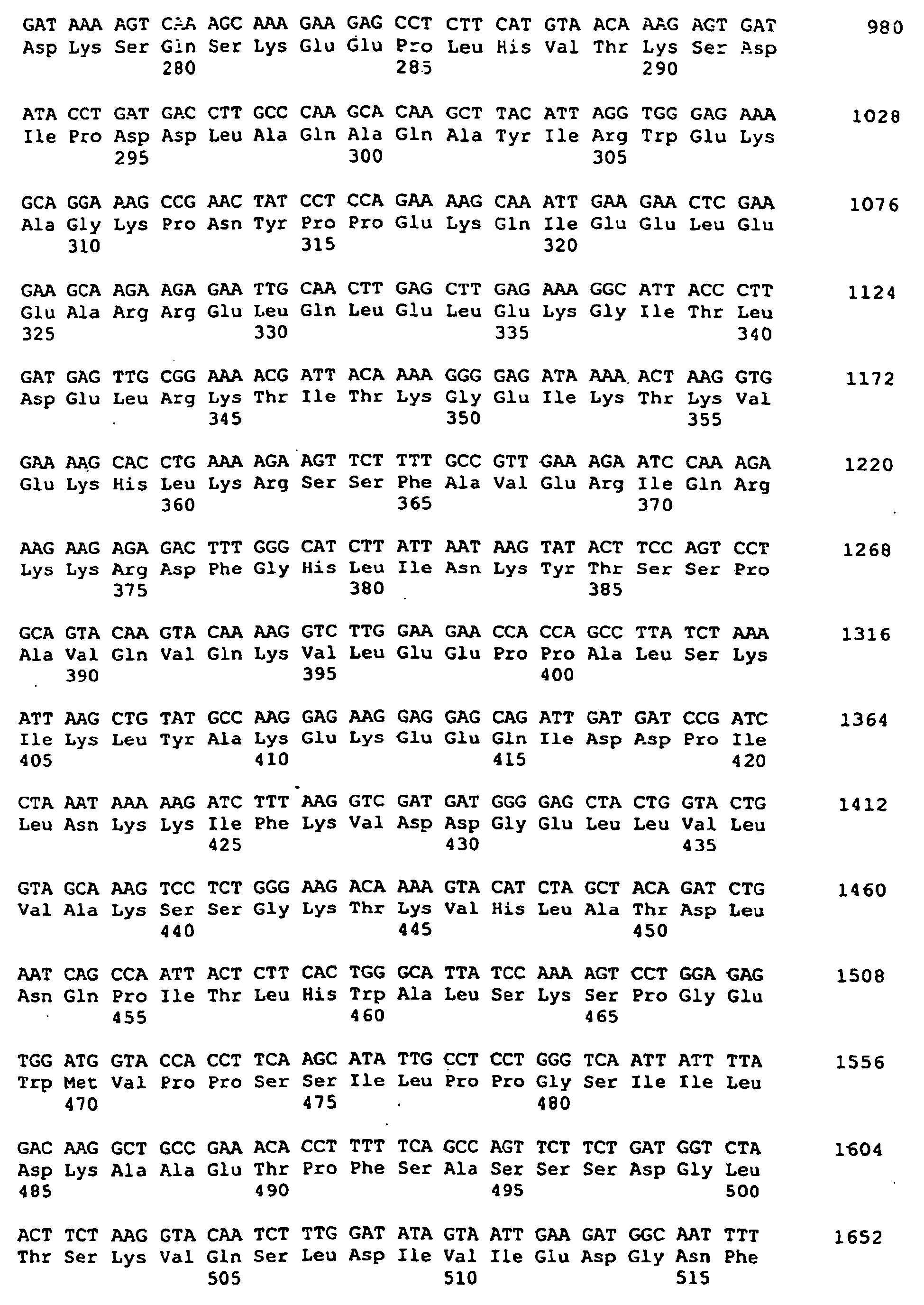


- (i) SEQUENCE CHARACTERISTICS:
- (2) INFORMATION FOR SEQ ID NO: 2:
- (i) SEQUENCE CHARACTERISTICS:
- (A) LENGTH: 1464 amino acids
- (B) TYPE: amino acid
- (D) TOPOLOGY: linear
- (ii) MOLECULE TYPE: protein
- (xi) SEQUENCE DESCRIPTION: SEQ ID NO: 2:
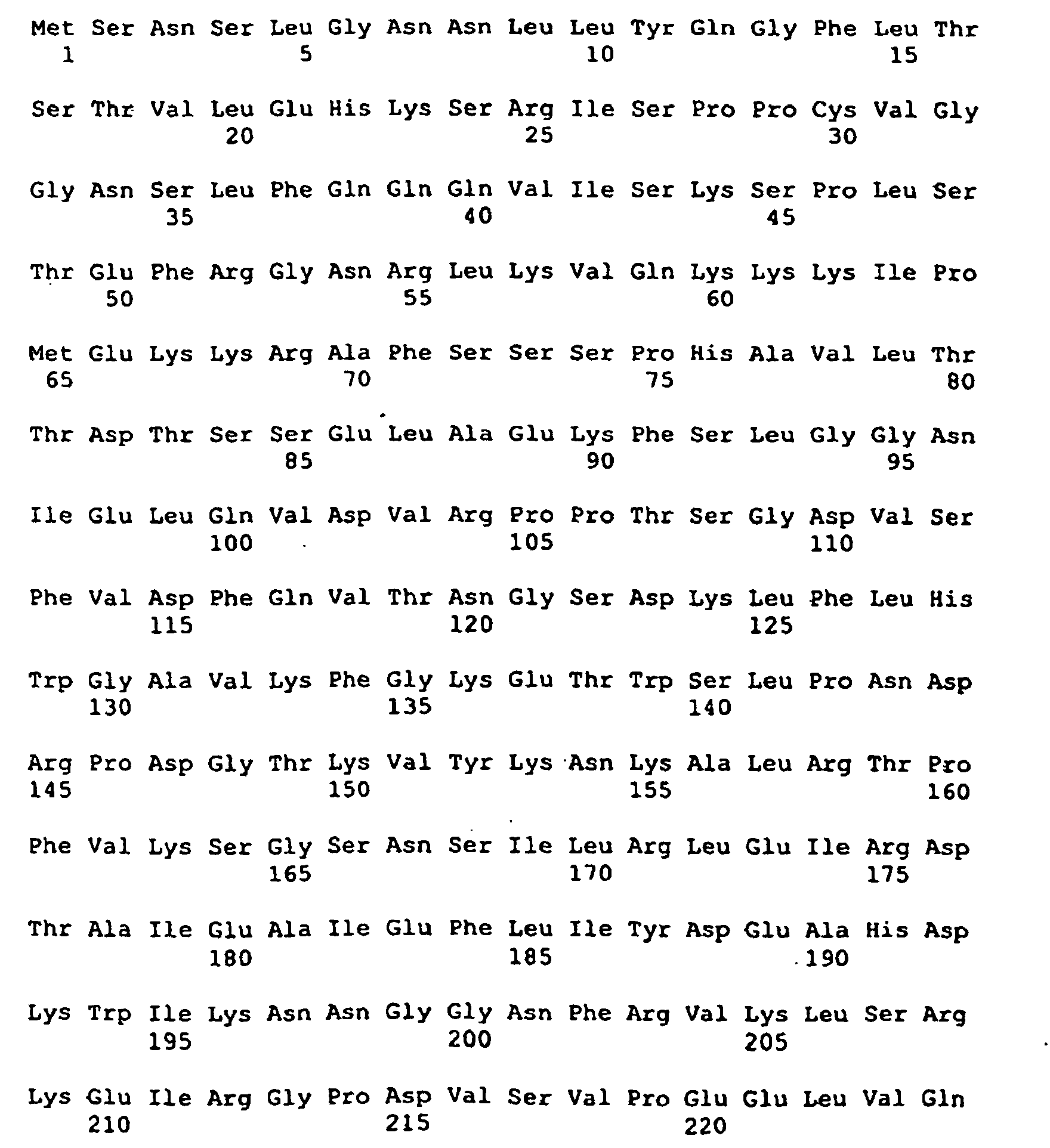

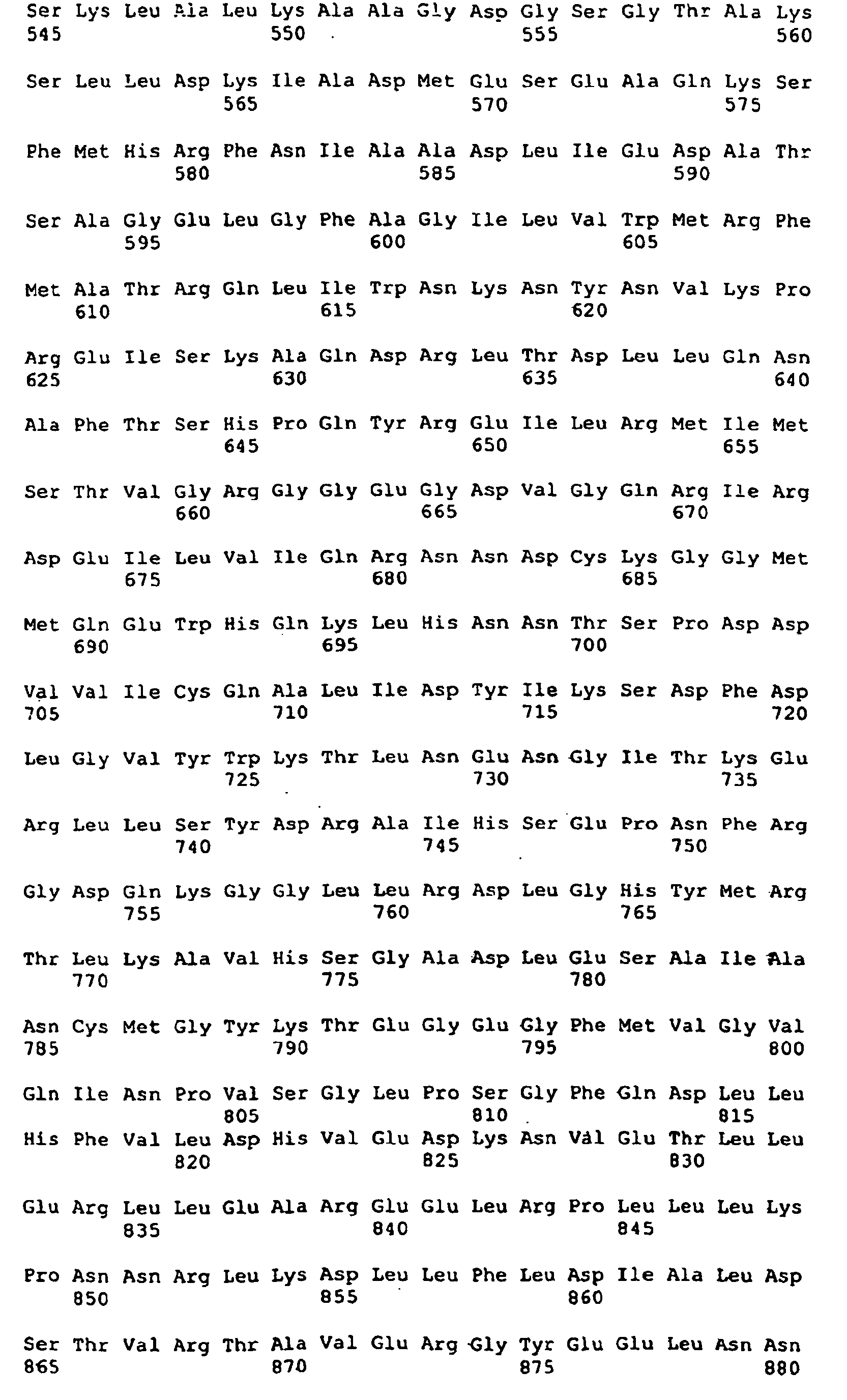
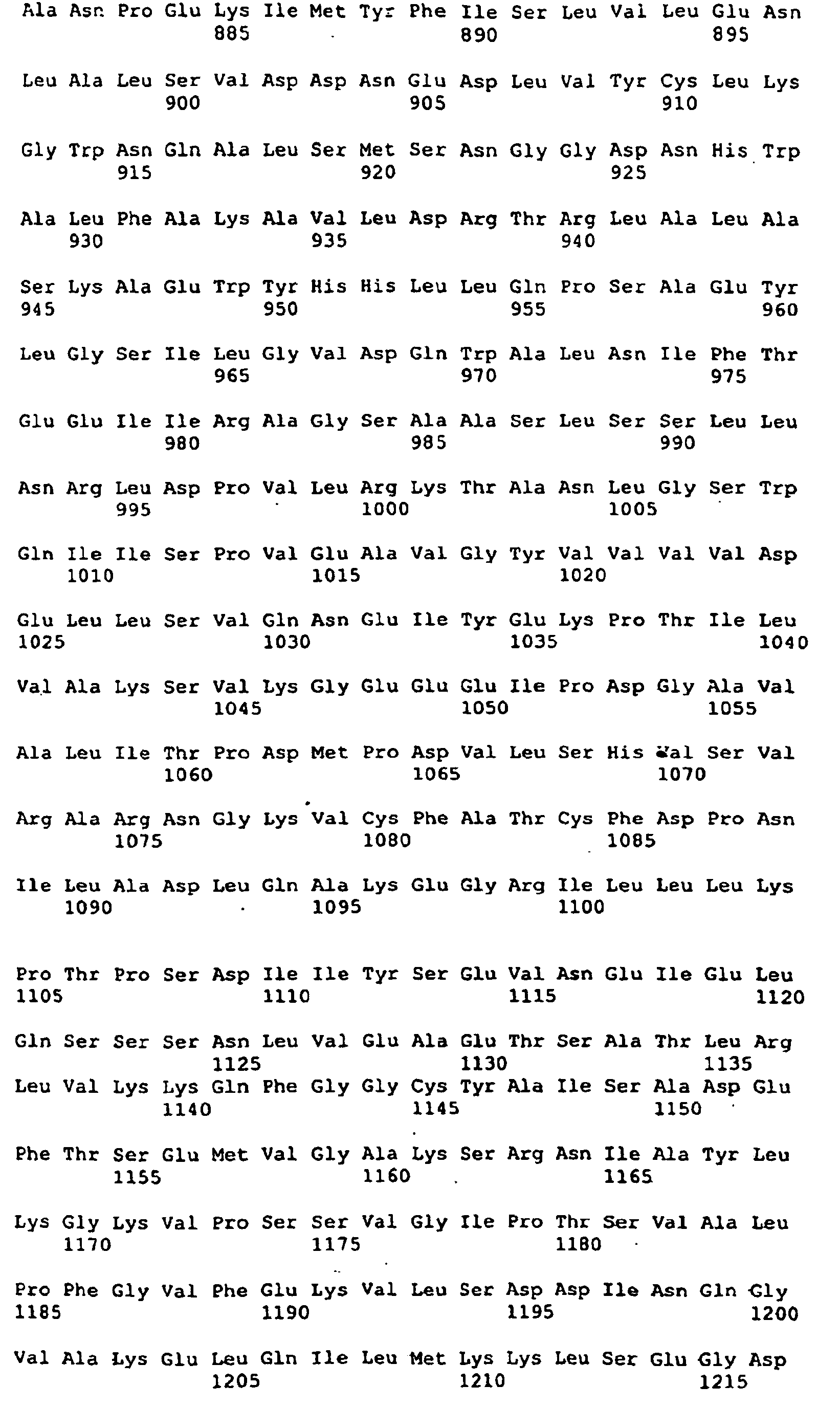

- (i) SEQUENCE CHARACTERISTICS:
- (2) INFORMATION FOR SEQ ID NO: 3:
- (i) SEQUENCE CHARACTERISTICS:
- (A) LENGTH: 1918 base pairs
- (B) TYPE: nucleotide
- (C) STRANDEDNESS: single
- (D) TOPOLOGY: linear
- (ii) MOLECULE TYPE: cDNA to mRNA
- (vi) ORIGINAL SOURCE:
- (A) ORGANISM: Solanum tuberosum
- (B) STRAIN: C.V. Desiree
- (ix) FEATURE:
- (A) NAME/KEY: CDS
- (B) LOCATION:1..1555
- (xi) SEQUENCE DESCRIPTION: SEQ ID NO: 3:


- (i) SEQUENCE CHARACTERISTICS:
- (2) INFORMATION FOR SEQ ID NO: 4:
- (i) SEQUENCE CHARACTERISTICS:
- (A) LENGTH: 518 amino acids
- (B) TYPE: amino acid
- (D) TOPOLOGY: linear
- (ii) MOLECULE TYPE: protein
- (xi) SEQUENCE DESCRIPTION: SEQ ID NO: 4:


- (i) SEQUENCE CHARACTERISTICS:
- (2) INFORMATION FOR SEQ ID NO: 5:
- (i) SEQUENCE CHARACTERISTICS:
- (A) LENGTH: 2307 base pairs
- (B) TYPE: nucleotide
- (C) STRANDEDNESS: single
- (D) TOPOLOGY: linear
- (ii) MOLECULE TYPE: cDNA to mRNA
- (iii) HYPOTHETICAL: NO
- (iv) ANTISENSE: NO
- (vi) ORIGINAL SOURCE:
- (A) ORGANISM: Zea mays
- (ix) FEATURE:
- (A) NAME/KEY: CDS
- (B) LOCATION:33..1943
- (xi) SEQUENZBESCHREIBUNG: SEQ ID NO: 5:


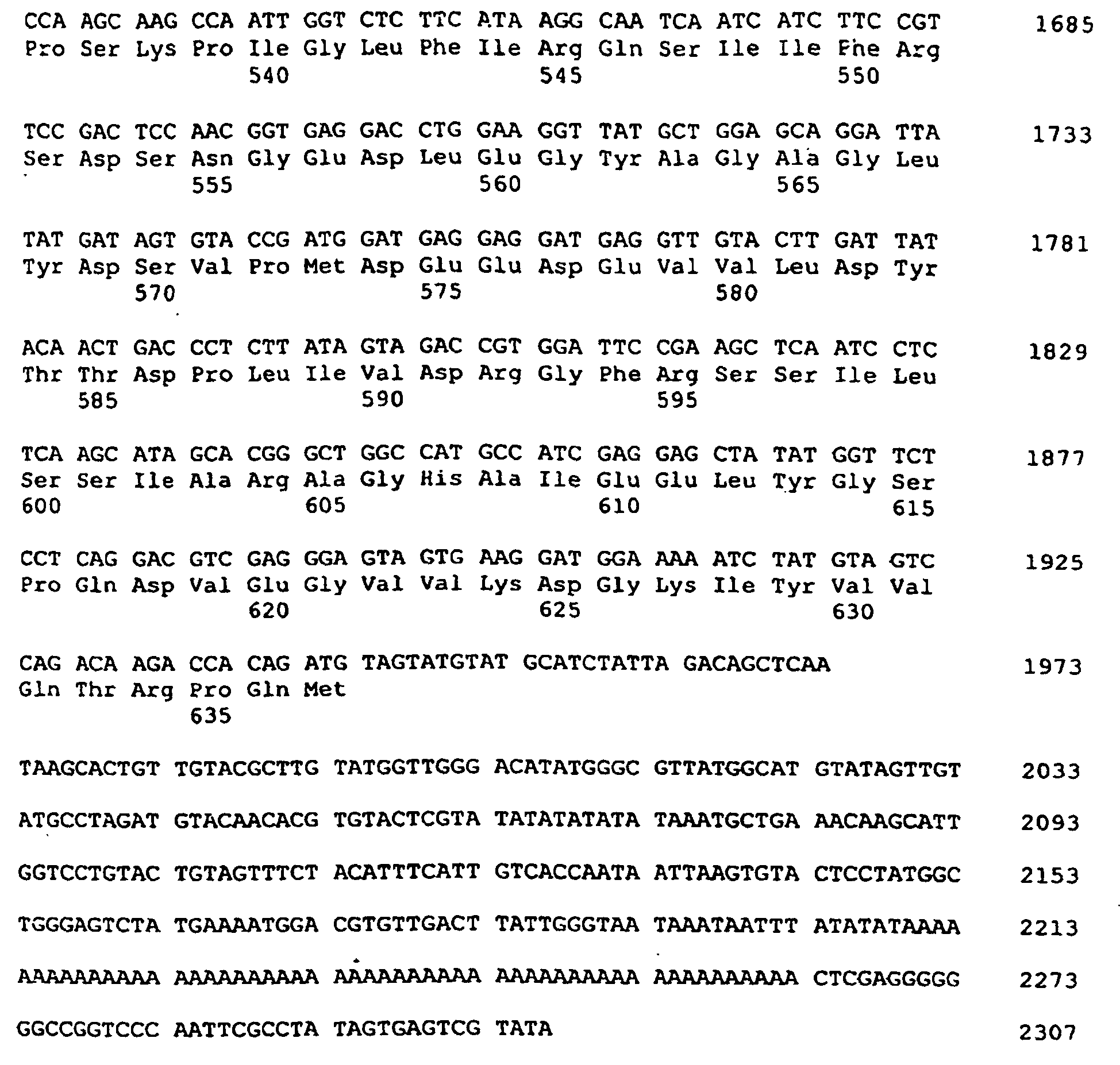
- (i) SEQUENCE CHARACTERISTICS:
- (2) ANGABEN ZU SEQ ID NO: 6:
- (i) SEQUENCE CHARACTERISTICS:
- (A) LENGTH: 637 amino acids
- (B) TYPE: amino acid
- (D) TOPOLOGY: linear
- (ii) MOLECULE TYPE: protein
- (xi) SEQUENCE DESCRIPTION: SEQ ID NO: 6:


- (i) SEQUENCE CHARACTERISTICS:
- (2) INFORMATION FOR SEQ ID NO: 7:
- (i) SEQUENCE CHARACTERISTICS:
- (A) LENGTH: 4329 base pairs
- (B) TYPE: nucleic acid
- (C) STRANDEDNESS: single
- (D) TOPOLOGY: linear
- (ii) MOLECULE TYPE: cDNA to mRNA
- (iii) HYPOTHETICAL: NO
- (iv) ANTI-SENSE: NO
- (vi) ORIGINAL SOURCE:
- (A) ORGANISM: Zea mays
- (ix) FEATURE:
- (A) NAME/KEY: CDS
- (B) LOCATION:2..4009
- (xi) SEQUENCE DESCRIPTION: SEQ ID NO: 7:
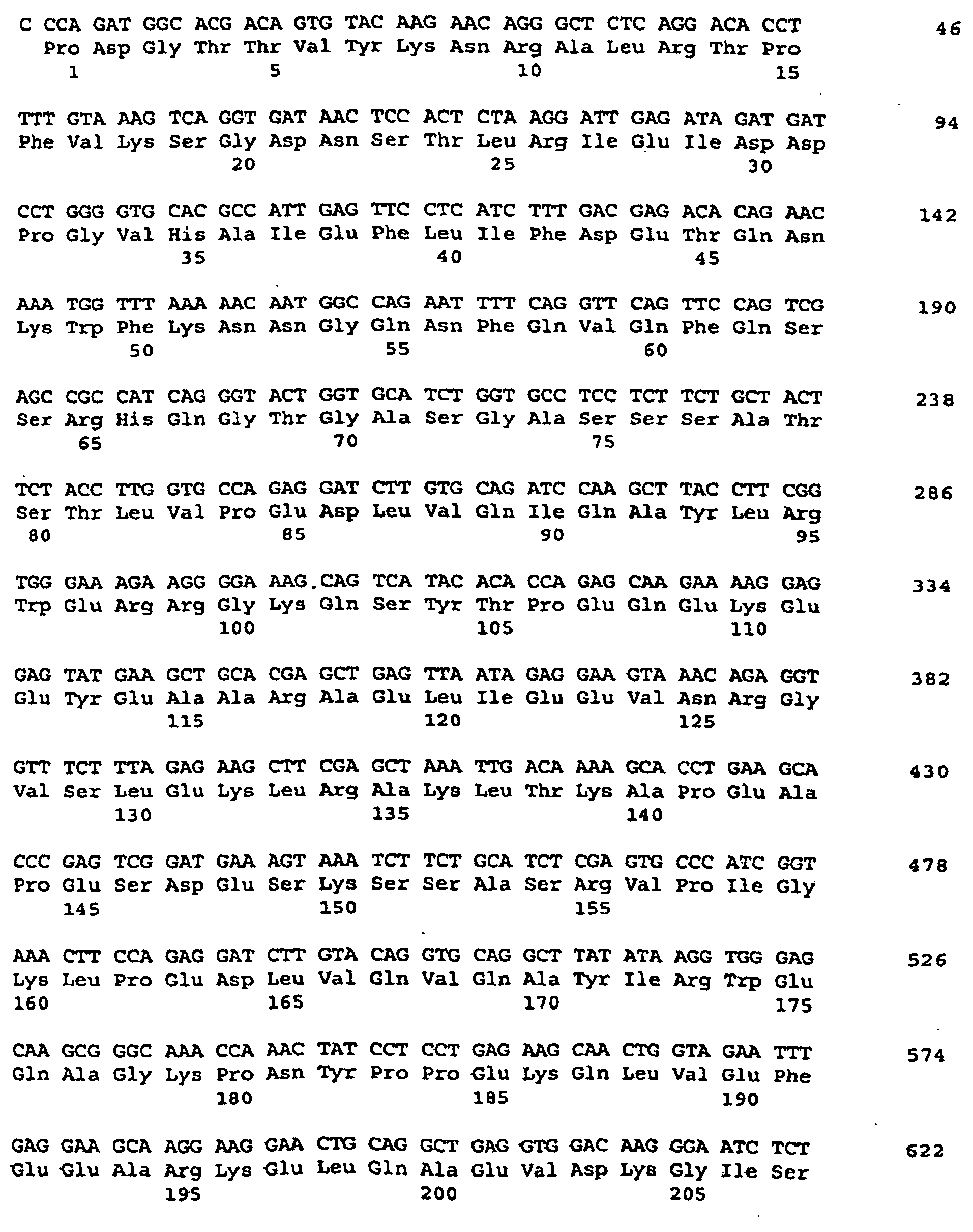


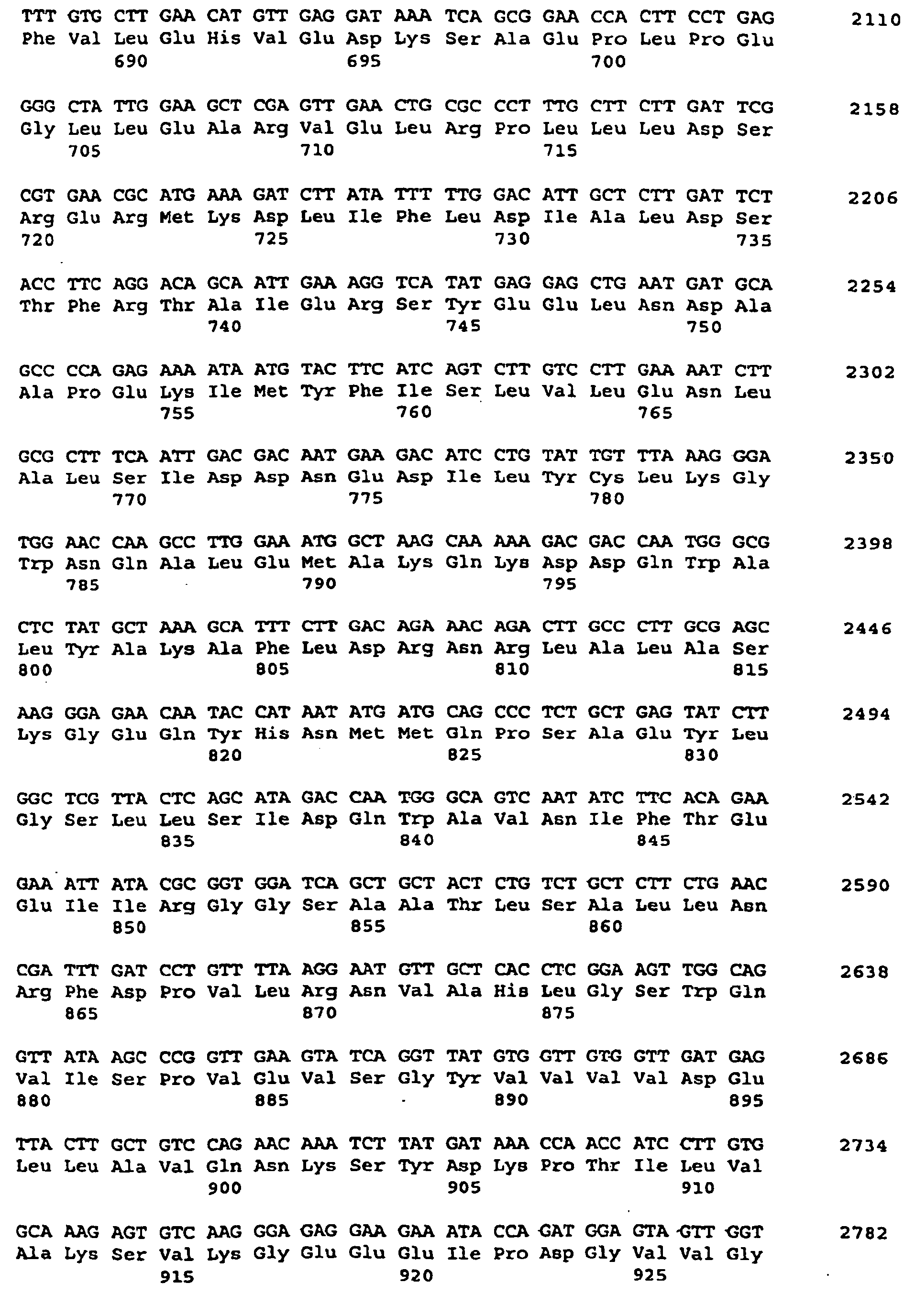


- (i) SEQUENCE CHARACTERISTICS:
- (2) INFORMATION FOR SEQ ID NO: 8:
- (i) SEQUENCE CHARACTERISTICS:
- (A) LENGTH: 1336 amino acids
- (B) TYPE: amino acid
- (D) TOPOLOGY: linear
- (ii) MOLECULE TYPE: protein
- (xi) SEQUENCE DESCRIPTION: SEQ ID NO: 8:


- (i) SEQUENCE CHARACTERISTICS:
- (2) INFORMATION FOR SEQ ID NO: 9:
- (i) SEQUENCE CHARACTERISTICS:
- (A) LENGTH: 30 base pairs
- (B) TYPE: nucleic acid
- (C) STRANDEDNESS: single
- (D) TOPOLOGY: linear
- (ii) MOLECULE TYPE: other nucleic acid
- (A) DESCRIPTION: /desc = "oligonucleotide"
- (iii) HYPOTHETICAL: YES
- (iv) ANTI-SENSE: NO
- (xi) SEQUENCE DESCRIPTION: SEQ ID NO: 9:
GCAAAGTTTT CAAGGACAAG ACTGATGAAG 30
- (i) SEQUENCE CHARACTERISTICS:
- (2) INFORMATION FOR SEQ ID NO: 10:
- (i) SEQUENCE CHARACTERISTICS:
- (A) LENGTH: 28 base pairs
- (B) TYPE: nucleic acid
- (C) STRANDEDNESS: single
- (D) TOPOLOGY: linear
- (ii) MOLECULE TYPE: other nucleic acid
- (A) DESCRIPTION: /desc = "oligonucleotide"
- (iii) HYPOTHETICAL: YES
- (iv) ANTI-SENSE: NO
- (xi) SEQUENCE DESCRIPTION: SEQ ID NO: 10:
CCAGATGGCA CGACAGTGTA CAAGAACA 28
- (i) SEQUENCE CHARACTERISTICS:
- (2) INFORMATION FOR SEQ ID NO: 11:
- (i) SEQUENCE CHARACTERISTICS:
- (A) LENGTH: 26 base pairs
- (B) TYPE: nucleic acid
- (C) STRANDEDNESS: single
- (D) TOPOLOGY: linear
- (ii) MOLECULE TYPE: other nucleic acid
- (A) DESCRIPTION: /desc = "oligonucleotide"
- (iii) HYPOTHETICAL: YES
- (iv) ANTI-SENSE: NO
- (ix) FEATURE:
- (A) NAME/KEY: modified_base
- (B) LOCATION:15
- (D) OTHER INFORMATION:/mod_base= i
- (ix) FEATURE:
- (A) NAME/KEY: modified_base
- (B) LOCATION:18
- (D) OTHER INFORMATION:/mod_base= i
- (xi) SEQUENCE DESCRIPTION: SEQ ID NO: 11:
AATGACTGCA AAGGGGGGAT GATGGA 26
- (i) SEQUENCE CHARACTERISTICS:
Claims (32)
- A nucleic acid molecule encoding a protein from maize which is present in plant cells in starch granule-bound form as well as in soluble form, said nucleic acid molecule leading to a reduction of the phosphate content of starch synthesized in plant cells when expressed as a cosuppression RNA in plant cells and being selected from the group consisting of:(a) nucleic acid molecules encoding a protein comprising the amino acid sequence indicated as in SEQ ID NO: 6 or in SEQ ID NO: 8;(b) nucleic acid molecules comprising the coding region of the nucleotide sequences indicated under SEQ ID NO: 5 or under SEQ ID NO: 7;(c) nucleic acid molecules the sequence of which shows a sequence identity of at least 80% to the sequence of a nucleic acid molecule indicated under (a) or (b); and(d) nucleic acid molecules the sequence of which differs from the sequence of a nucleic acid molecule of (c) due to the degeneracy of the genetic code;as well as the respective complementary strand of such a nucleic acid molecule.
- The nucleic acid molecule of claim 1(c), wherein the sequence identity is at least 90%.
- The nucleic acid molecule of claim 1(c), wherein the sequence identity is at least 95%.
- A vector containing a nucleic acid molecule of any one of claims 1 to 3.
- The vector of claim 4, wherein the nucleic acid molecule is linked to regulatory elements ensuring transcription in eukaryotic and prokaryotic cells.
- A host cell comprising a nucleic acid molecule of any one of claims 1 to 3 which is linked to heterologous regulatory elements which ensure transcription in plant cells or comprising the vector of claim 4 or 5.
- The host cell of claim 6, being a transgenic plant cell.
- A plant containing the plant cell of claim 7.
- A process for the production of a modified starch comprising the step of extracting from plants of claim 8 and/or from starch storing parts of such plants the starch.
- A method for the production of a protein encoded by a nucleic acid molecule of any one of claims 1 to 3 in which a host cell of claim 6 is cultivated and expresses said protein and in which said protein is isolated from the cells and/or the culture medium.
- A protein encoded by a nucleic acid molecule of any one of claims 1 to 3 or obtainable by the method of claim 10.
- An antibody specifically recognizing the protein of claim 11.
- A DNA molecule encoding an antisense-RNA, which causes an antisense-effect during the transcription in plant cells and which is complementary to the transcripts of a DNA molecule according to any one of claims 1 to 3.
- The DNA molecule of claim 13, wherein the encoded antisense-RNA has a minimal length selected from the group consisting of 15 nucleotides, 100 nucleotides and 500 nucleotides.
- A DNA molecule encoding an RNA with ribozyme activity which specifically cleaves transcripts of a DNA molecule of any one of claims 1 to 3.
- A DNA molecule encoding an RNA which is homologous to a transcript of a DNA molecule of any one of claims 1 to 3 and which upon expression in a plant cell leads to a reduction of expression of a nucleic acid molecule of claim 1 due to a cosuppression effect.
- A vector containing a DNA molecule of any one of claims 13 to 16.
- The vector of claim 17, wherein the DNA molecule is combined with regulatory DNA elements ensuring transcription in plant cells.
- A host cell containing a DNA molecule of any one of claims 13 to 16 or a vector of claim 17 or 18.
- A transgenic plant cell containing a DNA molecule of any one of claims 13 to 16 in combination with regulatory DNA elements ensuring transcription in plant cells.
- The transgenic plant cell of claim 20, in which the activity of at least one further enzyme selected from the group consisting of a branching enzyme and a starch granule-bound starch synthase of the isotype I (GBSS I) is reduced when compared to non-transformed plants.
- A transgenic plant containing a plant cell of claim 20 or 21.
- An RNA molecule obtainable by transcription of a DNA molecule of any one of claims 13 to 16.
- A method for the production of transgenic plant cells synthesizing a modified starch characterized in that the amount of proteins of claim 11, which are synthesized in the cells in endogenous form, is reduced in the cells and wherein the reduction is caused(i) by an antisense effect due to the expression of a DNA molecule of claim 13 or 14; or(ii) by a ribozyme effect due to the expression of a DNA molecule of claim 15; or(iii) by a cosuppression effect due to the expression of a DNA molecule of claim 16said method comprising the step of introducing into plant cells a DNA molecule of claim 13, 14, 15 or 16, wherein said DNA molecule is linked to DNA elements ensuring transcription in plant cells.
- The method of claim 24, wherein the enzyme activity of at least one further enzyme selected from the group consisting of a branching enzyme and a starch granule-bound starch synthase of the isotype I (GBSSI) is reduced.
- A transgenic plant cell comprising:(a) a DNA molecule encoding an antisense-RNA, which causes an antisense-effect during the transcription in plant cells and which is complementary to the transcripts of a DNA molecule according to any one of claims 1 to 3;(b) a DNA molecule encoding an RNA with ribozyme activity which specifically cleaves transcripts of a DNA molecule of any one of claims 1 to 3; or(c) a DNA molecule encoding an RNA which is homologous to a transcript of a DNA molecule of any one of claims 1 to 3 and which upon expression in a plant cell leads to a reduction of expression of a nucleic acid molecule of claim 1 due to a cosuppression effect,wherein said DNA molecule is linked to DNA elements ensuring transcription in plant cells.
- A transgenic plant containing plant cells of claim 26.
- A process for the production of a modified starch comprising the step of extracting from the plant of claim 22 or 27 and/or from a starch storing part of such a plant the starch.
- Propagation material of plants of claim 8 containing plant cells of claim 7.
- The propagation material of plants of claim 22 or 27, containing plant cells of any one of claims 20 or 21 or of claim 26.
- The transgenic plant of claim 22 or 27 which is a maize plant.
- Seeds of a maize plant of claim 31 containing plant cells according to claim 20 or according to claim 26.
Applications Claiming Priority (3)
| Application Number | Priority Date | Filing Date | Title |
|---|---|---|---|
| DE19653176A DE19653176A1 (en) | 1996-12-19 | 1996-12-19 | New maize nucleic acid molecules and their use to produce a modified starch |
| DE19653176 | 1996-12-19 | ||
| PCT/EP1997/007123 WO1998027212A1 (en) | 1996-12-19 | 1997-12-18 | Novel nucleic acid molecules from maize and their use for the production of modified starch |
Publications (2)
| Publication Number | Publication Date |
|---|---|
| EP0950107A1 EP0950107A1 (en) | 1999-10-20 |
| EP0950107B1 true EP0950107B1 (en) | 2007-03-21 |
Family
ID=7815459
Family Applications (1)
| Application Number | Title | Priority Date | Filing Date |
|---|---|---|---|
| EP97954424A Expired - Lifetime EP0950107B1 (en) | 1996-12-19 | 1997-12-18 | Novel nucleic acid molecules from maize and their use for the production of modified starch |
Country Status (10)
| Country | Link |
|---|---|
| US (1) | US7186898B1 (en) |
| EP (1) | EP0950107B1 (en) |
| JP (1) | JP4098365B2 (en) |
| AT (1) | ATE357522T1 (en) |
| AU (1) | AU740492C (en) |
| CA (1) | CA2272844C (en) |
| DE (2) | DE19653176A1 (en) |
| ES (1) | ES2280086T3 (en) |
| PT (1) | PT950107E (en) |
| WO (1) | WO1998027212A1 (en) |
Families Citing this family (203)
| Publication number | Priority date | Publication date | Assignee | Title |
|---|---|---|---|---|
| PT1435205E (en) | 1995-09-19 | 2010-02-04 | Bayer Bioscience Gmbh | Process for the production of a modified starch |
| US6620987B1 (en) | 1998-04-09 | 2003-09-16 | E. I. Dupont De Nemours & Company | Nucleic acid encoding a starch R1 phosphorylation protein homolog from maize |
| WO1999053072A1 (en) * | 1998-04-09 | 1999-10-21 | E.I. Du Pont De Nemours And Company | Starch r1 phosphorylation protein homologs |
| CN100408687C (en) * | 1998-11-09 | 2008-08-06 | 拜尔生物科学有限公司 | Nucleic acid molecules from rice and their use for producing modified starch |
| DE19926771A1 (en) * | 1999-06-11 | 2000-12-14 | Aventis Cropscience Gmbh | Nucleic acid molecules from wheat, transgenic plant cells and plants and their use for the production of modified starch |
| DE19937348A1 (en) | 1999-08-11 | 2001-02-22 | Aventis Cropscience Gmbh | Nucleic acid molecules from plants encoding enzymes involved in starch synthesis |
| DE19937643A1 (en) * | 1999-08-12 | 2001-02-22 | Aventis Cropscience Gmbh | Transgenic cells and plants with altered activity of the GBSSI and BE proteins |
| JP4565231B2 (en) | 2000-08-22 | 2010-10-20 | 独立行政法人農業生物資源研究所 | Method for highly accumulating foreign gene products in plant seeds |
| US6734340B2 (en) | 2000-10-23 | 2004-05-11 | Bayer Cropscience Gmbh | Monocotyledon plant cells and plants which synthesise modified starch |
| ATE394497T1 (en) | 2001-06-12 | 2008-05-15 | Bayer Cropscience Ag | TRANSGENIC PLANTS THAT PRODUCE STARCH WITH HIGH AMYLOSE CONTENT |
| NZ514547A (en) * | 2001-09-28 | 2004-10-29 | Duncan Stanley | Plastid alph-amylase protein and nucleic acids encoding same and methods for altering the starch content of a plant |
| DE10208132A1 (en) * | 2002-02-26 | 2003-09-11 | Planttec Biotechnologie Gmbh | Process for the production of maize plants with an increased leaf starch content and their use for the production of maize silage |
| DE10208133A1 (en) * | 2002-02-26 | 2003-09-11 | Planttec Biotechnologie Gmbh | Transgenic fodder plants with increased leaf starch content |
| CA2526480A1 (en) * | 2003-05-22 | 2005-01-13 | Syngenta Participations Ag | Modified starch, uses, methods for production thereof |
| CL2007003743A1 (en) * | 2006-12-22 | 2008-07-11 | Bayer Cropscience Ag | COMPOSITION THAT INCLUDES FENAMIDONA AND AN INSECTICIDE COMPOUND; AND METHOD TO CONTROL FITOPATOGENOS CULTURES AND INSECTS FACING OR PREVENTIVELY. |
| CL2007003744A1 (en) | 2006-12-22 | 2008-07-11 | Bayer Cropscience Ag | COMPOSITION THAT INCLUDES A 2-PYRIDILMETILBENZAMIDE DERIVATIVE AND AN INSECTICIDE COMPOUND; AND METHOD TO CONTROL FITOPATOGENOS CULTURES AND INSECTS FACING OR PREVENTIVELY. |
| EP1969934A1 (en) | 2007-03-12 | 2008-09-17 | Bayer CropScience AG | 4-cycloalkyl or 4-aryl substituted phenoxy phenylamidines and their use as fungicides |
| EP1969930A1 (en) | 2007-03-12 | 2008-09-17 | Bayer CropScience AG | Phenoxy phenylamidines and their use as fungicides |
| BRPI0808846A2 (en) | 2007-03-12 | 2019-09-24 | Bayer Cropscience Ag | 3-substituted phenoxyphenylamidines and their use as fungicides |
| BRPI0808798A2 (en) | 2007-03-12 | 2014-10-07 | Bayer Cropscience Ag | 3,5-DISSUBSTITUTED PHENOXYPHENYLAMIDINS AND THEIR USE AS FUNGICIDES |
| EP1969931A1 (en) * | 2007-03-12 | 2008-09-17 | Bayer CropScience Aktiengesellschaft | Fluoroalkyl phenylamidines and their use as fungicides |
| EP1969929A1 (en) | 2007-03-12 | 2008-09-17 | Bayer CropScience AG | Substituted phenylamidines and their use as fungicides |
| WO2008110279A1 (en) | 2007-03-12 | 2008-09-18 | Bayer Cropscience Ag | Dihalophenoxyphenylamidines and use thereof as fungicides |
| US8168567B2 (en) * | 2007-04-19 | 2012-05-01 | Bayer Cropscience Ag | Thiadiazolyl oxyphenyl amidines and the use thereof as a fungicide |
| DE102007045922A1 (en) | 2007-09-26 | 2009-04-02 | Bayer Cropscience Ag | Drug combinations with insecticidal and acaricidal properties |
| DE102007045919B4 (en) | 2007-09-26 | 2018-07-05 | Bayer Intellectual Property Gmbh | Drug combinations with insecticidal and acaricidal properties |
| DE102007045956A1 (en) | 2007-09-26 | 2009-04-09 | Bayer Cropscience Ag | Combination of active ingredients with insecticidal and acaricidal properties |
| DE102007045920B4 (en) | 2007-09-26 | 2018-07-05 | Bayer Intellectual Property Gmbh | Synergistic drug combinations |
| DE102007045953B4 (en) | 2007-09-26 | 2018-07-05 | Bayer Intellectual Property Gmbh | Drug combinations with insecticidal and acaricidal properties |
| EP2090168A1 (en) | 2008-02-12 | 2009-08-19 | Bayer CropScience AG | Method for improving plant growth |
| MX2010005937A (en) * | 2007-11-27 | 2010-06-15 | Commw Scient Ind Res Org | Plants with modified starch metabolism. |
| EP2072506A1 (en) | 2007-12-21 | 2009-06-24 | Bayer CropScience AG | Thiazolyloxyphenylamidine or thiadiazolyloxyphenylamidine und its use as fungicide |
| EP2168434A1 (en) | 2008-08-02 | 2010-03-31 | Bayer CropScience AG | Use of azols to increase resistance of plants of parts of plants to abiotic stress |
| US20110190365A1 (en) | 2008-08-14 | 2011-08-04 | Bayer Crop Science Ag | Insecticidal 4-phenyl-1H-pyrazoles |
| DE102008041695A1 (en) | 2008-08-29 | 2010-03-04 | Bayer Cropscience Ag | Methods for improving plant growth |
| EP2201838A1 (en) | 2008-12-05 | 2010-06-30 | Bayer CropScience AG | Active ingredient-beneficial organism combinations with insecticide and acaricide properties |
| EP2198709A1 (en) | 2008-12-19 | 2010-06-23 | Bayer CropScience AG | Method for treating resistant animal pests |
| EP2204094A1 (en) | 2008-12-29 | 2010-07-07 | Bayer CropScience AG | Method for improved utilization of the production potential of transgenic plants Introduction |
| EP2223602A1 (en) | 2009-02-23 | 2010-09-01 | Bayer CropScience AG | Method for improved utilisation of the production potential of genetically modified plants |
| AU2009335333B2 (en) | 2008-12-29 | 2015-04-09 | Bayer Intellectual Property Gmbh | Method for improved use of the production potential of genetically modified plants |
| EP2039771A2 (en) | 2009-01-06 | 2009-03-25 | Bayer CropScience AG | Method for improved utilization of the production potential of transgenic plants |
| EP2039770A2 (en) | 2009-01-06 | 2009-03-25 | Bayer CropScience AG | Method for improved utilization of the production potential of transgenic plants |
| EP2039772A2 (en) | 2009-01-06 | 2009-03-25 | Bayer CropScience AG | Method for improved utilization of the production potential of transgenic plants introduction |
| BRPI1006916A8 (en) | 2009-01-19 | 2016-05-03 | Bayer Cropscience Ag | CYCLIC DIONES AND THEIR USE AS INSECTICIDES, ACARICIDES AND/OR FUNGICIDES |
| EP2227951A1 (en) | 2009-01-23 | 2010-09-15 | Bayer CropScience AG | Application of enaminocarbonyl compounds for combating viruses transmitted by insects |
| EP2391608B8 (en) | 2009-01-28 | 2013-04-10 | Bayer Intellectual Property GmbH | Fungicide n-cycloalkyl-n-bicyclicmethylene-carboxamide derivatives |
| AR075126A1 (en) | 2009-01-29 | 2011-03-09 | Bayer Cropscience Ag | METHOD FOR THE BEST USE OF THE TRANSGENIC PLANTS PRODUCTION POTENTIAL |
| EP2218717A1 (en) | 2009-02-17 | 2010-08-18 | Bayer CropScience AG | Fungicidal N-((HET)Arylethyl)thiocarboxamide derivatives |
| EP2398770B1 (en) | 2009-02-17 | 2016-12-28 | Bayer Intellectual Property GmbH | Fungicidal n-(phenylcycloalkyl)carboxamide, n-(benzylcycloalkyl)carboxamide and thiocarboxamide derivatives |
| TW201031331A (en) | 2009-02-19 | 2010-09-01 | Bayer Cropscience Ag | Pesticide composition comprising a tetrazolyloxime derivative and a fungicide or an insecticide active substance |
| DE102009001469A1 (en) | 2009-03-11 | 2009-09-24 | Bayer Cropscience Ag | Improving utilization of productive potential of transgenic plant by controlling e.g. animal pest, and/or by improving plant health, comprises treating the transgenic plant with active agent composition comprising prothioconazole |
| DE102009001681A1 (en) | 2009-03-20 | 2010-09-23 | Bayer Cropscience Ag | Improving utilization of production potential of a transgenic plant by controlling animal pests, phytopathogenic fungi, microorganisms and/or improving plant health, comprises treating plant with a drug composition comprising iprovalicarb |
| DE102009001732A1 (en) | 2009-03-23 | 2010-09-30 | Bayer Cropscience Ag | Improving the production potential of transgenic plant, by combating e.g. animal pests and/or microorganism, and/or increasing plant health, comprises treating the plants with active agent composition comprising trifloxystrobin |
| DE102009001728A1 (en) | 2009-03-23 | 2010-09-30 | Bayer Cropscience Ag | Improving the production potential of transgenic plant, by combating e.g. animal pests and/or microorganism, and/or increasing plant health, comprises treating the plants with active agent composition comprising fluoxastrobin |
| DE102009001730A1 (en) | 2009-03-23 | 2010-09-30 | Bayer Cropscience Ag | Improving utilization of production potential of a transgenic plant by controlling animal pests, phytopathogenic fungi and/or microorganisms and/or the plant health, comprises treating plant with a drug composition comprising spiroxamine |
| UA104887C2 (en) | 2009-03-25 | 2014-03-25 | Баєр Кропсаєнс Аг | Synergic combinations of active ingredients |
| US8846568B2 (en) | 2009-03-25 | 2014-09-30 | Bayer Cropscience Ag | Active compound combinations having insecticidal and acaricidal properties |
| EP2232995A1 (en) | 2009-03-25 | 2010-09-29 | Bayer CropScience AG | Method for improved utilisation of the production potential of transgenic plants |
| MX2011009916A (en) | 2009-03-25 | 2011-10-06 | Bayer Cropscience Ag | Active ingredient combinations having insecticidal and acaricidal properties. |
| MX2011009372A (en) | 2009-03-25 | 2011-09-27 | Bayer Cropscience Ag | Active ingredient combinations having insecticidal and acaricidal properties. |
| US8828906B2 (en) | 2009-03-25 | 2014-09-09 | Bayer Cropscience Ag | Active compound combinations having insecticidal and acaricidal properties |
| EP2239331A1 (en) | 2009-04-07 | 2010-10-13 | Bayer CropScience AG | Method for improved utilization of the production potential of transgenic plants |
| WO2010127797A2 (en) | 2009-05-06 | 2010-11-11 | Bayer Cropscience Ag | Cyclopentanedione compounds and their use as insecticides, acaricides and/or fungicides |
| AR076839A1 (en) | 2009-05-15 | 2011-07-13 | Bayer Cropscience Ag | FUNGICIDE DERIVATIVES OF PIRAZOL CARBOXAMIDAS |
| EP2251331A1 (en) | 2009-05-15 | 2010-11-17 | Bayer CropScience AG | Fungicide pyrazole carboxamides derivatives |
| EP2255626A1 (en) | 2009-05-27 | 2010-12-01 | Bayer CropScience AG | Use of succinate dehydrogenase inhibitors to increase resistance of plants or parts of plants to abiotic stress |
| PL2437595T3 (en) | 2009-06-02 | 2019-05-31 | Bayer Cropscience Ag | Use of fluopyram for controlling sclerotinia ssp |
| CN104430378A (en) | 2009-07-16 | 2015-03-25 | 拜尔农作物科学股份公司 | Synergistic active substance combinations containing phenyl triazoles |
| WO2011015524A2 (en) | 2009-08-03 | 2011-02-10 | Bayer Cropscience Ag | Fungicide heterocycles derivatives |
| EP2292094A1 (en) | 2009-09-02 | 2011-03-09 | Bayer CropScience AG | Active compound combinations |
| US20130071884A1 (en) | 2009-11-06 | 2013-03-21 | Agrivida, Inc. | Plants expressing cell wall degrading enzymes and expression vectors |
| EP2343280A1 (en) | 2009-12-10 | 2011-07-13 | Bayer CropScience AG | Fungicide quinoline derivatives |
| TW201138624A (en) | 2009-12-28 | 2011-11-16 | Bayer Cropscience Ag | Fungicide hydroximoyl-tetrazole derivatives |
| CN102725282B (en) | 2009-12-28 | 2015-12-16 | 拜尔农科股份公司 | Fungicide hydroximoyl-tetrazole derivatives |
| US9000012B2 (en) | 2009-12-28 | 2015-04-07 | Bayer Cropscience Ag | Fungicide hydroximoyl-heterocycles derivatives |
| EA022553B1 (en) | 2010-01-22 | 2016-01-29 | Байер Интеллектуэль Проперти Гмбх | Use of biologically active ingredient combination, kit and composition comprising biologically active ingredient combination for controlling animal pests and method for improving utilization of production potential of transgenic plant |
| JP2013521255A (en) | 2010-03-04 | 2013-06-10 | バイエル・インテレクチュアル・プロパティ・ゲゼルシャフト・ミット・ベシュレンクテル・ハフツング | Fluoroalkyl-substituted 2-amidobenzimidazoles and their use to enhance stress tolerance in plants |
| WO2011124554A2 (en) | 2010-04-06 | 2011-10-13 | Bayer Cropscience Ag | Use of 4-phenylbutyric acid and/or the salts thereof for enhancing the stress tolerance of plants |
| CA2795838A1 (en) | 2010-04-09 | 2011-10-13 | Bayer Intellectual Property Gmbh | Use of derivatives of the(1-cyanocyclopropyl)phenylphosphinic acid, the esters thereof and/or the salts thereof for enhancing the tolerance of plants to abiotic stress |
| WO2011134913A1 (en) | 2010-04-28 | 2011-11-03 | Bayer Cropscience Ag | Fungicide hydroximoyl-heterocycles derivatives |
| JP2013525400A (en) | 2010-04-28 | 2013-06-20 | バイエル・クロップサイエンス・アーゲー | Fungicide hydroxymoyl-heterocyclic derivative |
| WO2011134911A2 (en) | 2010-04-28 | 2011-11-03 | Bayer Cropscience Ag | Fungicide hydroximoyl-tetrazole derivatives |
| UA110703C2 (en) | 2010-06-03 | 2016-02-10 | Байєр Кропсайнс Аг | Fungicidal n-[(trisubstitutedsilyl)methyl]carboxamide |
| ES2533026T3 (en) | 2010-06-03 | 2015-04-07 | Bayer Intellectual Property Gmbh | N - [(het) arylalkyl)] pyrazole (thio) carboxamides and their hetero substituted analogs |
| WO2011151370A1 (en) | 2010-06-03 | 2011-12-08 | Bayer Cropscience Ag | N-[(het)arylalkyl)] pyrazole (thio)carboxamides and their heterosubstituted analogues |
| WO2011154158A1 (en) | 2010-06-09 | 2011-12-15 | Bayer Bioscience N.V. | Methods and means to modify a plant genome at a nucleotide sequence commonly used in plant genome engineering |
| CN103119169B (en) | 2010-06-09 | 2018-11-20 | 拜尔作物科学公司 | Methods and tools for modifying plant genomes in nucleotide sequences commonly used in plant genome engineering |
| US9598700B2 (en) * | 2010-06-25 | 2017-03-21 | Agrivida, Inc. | Methods and compositions for processing biomass with elevated levels of starch |
| CA2803868A1 (en) | 2010-06-25 | 2011-12-29 | Agrivida, Inc. | Plants with altered levels of vegetative starch |
| US10443068B2 (en) | 2010-06-25 | 2019-10-15 | Agrivida, Inc. | Plants with engineered endogenous genes |
| AR082286A1 (en) | 2010-07-20 | 2012-11-28 | Bayer Cropscience Ag | BENZOCICLOALQUENOS AS ANTIFUNGIC AGENTS |
| RU2013114710A (en) | 2010-09-03 | 2014-10-10 | Байер Интеллектуэль Проперти Гмбх | Substituted Condensed Pyrimidinones and Dihydropyrimidinones |
| CN103298341B (en) | 2010-09-22 | 2016-06-08 | 拜耳知识产权有限责任公司 | Use of active ingredients for controlling nematodes in nematode-resistant crops |
| EP2460406A1 (en) | 2010-12-01 | 2012-06-06 | Bayer CropScience AG | Use of fluopyram for controlling nematodes in nematode resistant crops |
| BR112013008446B1 (en) | 2010-10-07 | 2018-06-12 | Bayer Cropscience Ag | '' COMPOSITION AND METHOD FOR CONTROLING PHYTOPATHOGENIC FUNGALS OR DAMAGING INSECTS OF PLANTS, CROPS OR SEEDS '' |
| US9084424B2 (en) | 2010-10-21 | 2015-07-21 | Bayer Intellectual Property Gmbh | N-benzyl heterocyclic carboxamides |
| BR112013009590B8 (en) | 2010-10-21 | 2019-03-19 | Bayer Ip Gmbh | compound, fungicidal composition and method |
| CA2815117A1 (en) | 2010-11-02 | 2012-05-10 | Bayer Intellectual Property Gmbh | N-hetarylmethyl pyrazolylcarboxamides |
| BR112013012081A2 (en) | 2010-11-15 | 2016-07-19 | Bayer Ip Gmbh | 5-halopyrazole (thio) carboxamides |
| EP2640706B1 (en) | 2010-11-15 | 2017-03-01 | Bayer Intellectual Property GmbH | N-aryl pyrazole(thio)carboxamides |
| MX2013005407A (en) | 2010-11-15 | 2013-07-03 | Bayer Ip Gmbh | 5-halogenopyrazolecarboxamides. |
| AP3519A (en) | 2010-12-01 | 2016-01-11 | Bayer Ip Gmbh | Use of fluopyram for controlling nematodes in crops and for increasing yield |
| EP2460407A1 (en) | 2010-12-01 | 2012-06-06 | Bayer CropScience AG | Agent combinations comprising pyridylethyl benzamides and other agents |
| EP2474542A1 (en) | 2010-12-29 | 2012-07-11 | Bayer CropScience AG | Fungicide hydroximoyl-tetrazole derivatives |
| EP2658853A1 (en) | 2010-12-29 | 2013-11-06 | Bayer Intellectual Property GmbH | Fungicide hydroximoyl-tetrazole derivatives |
| EP2471363A1 (en) | 2010-12-30 | 2012-07-04 | Bayer CropScience AG | Use of aryl-, heteroaryl- and benzylsulfonamide carboxylic acids, -carboxylic acid esters, -carboxylic acid amides and -carbonitriles and/or its salts for increasing stress tolerance in plants |
| EP2494867A1 (en) | 2011-03-01 | 2012-09-05 | Bayer CropScience AG | Halogen-substituted compounds in combination with fungicides |
| CN106244622B (en) | 2011-03-07 | 2020-06-12 | 谷万达公司 | Expression cassette and expression vector for expressing multiple proteins in engineering plant, method for preparing engineering plant and method for producing soluble sugar |
| WO2012120105A1 (en) | 2011-03-10 | 2012-09-13 | Bayer Cropscience Ag | Use of lipochito-oligosaccharide compounds for safeguarding seed safety of treated seeds |
| BR112013023502A2 (en) | 2011-03-14 | 2016-08-02 | Bayer Ip Gmbh | compound (i), fungicidal composition, method for the control of crop phytopathogenic fungi, use of the compounds of formula (i) and process for producing the compositions |
| JP2014512358A (en) | 2011-04-08 | 2014-05-22 | バイエル・インテレクチユアル・プロパテイー・ゲー・エム・ベー・ハー | Fungicide hydroxymoyl-tetrazole derivative |
| EP2511255A1 (en) | 2011-04-15 | 2012-10-17 | Bayer CropScience AG | Substituted prop-2-in-1-ol and prop-2-en-1-ol derivatives |
| AR085568A1 (en) | 2011-04-15 | 2013-10-09 | Bayer Cropscience Ag | 5- (BICYCLE [4.1.0] HEPT-3-EN-2-IL) -PENTA-2,4-DIENOS AND 5- (BICYCLE [4.1.0] HEPT-3-EN-2-IL) -PENT- 2-IN-4-INOS REPLACED AS ACTIVE PRINCIPLES AGAINST ABIOTIC STRESS OF PLANTS |
| AR090010A1 (en) | 2011-04-15 | 2014-10-15 | Bayer Cropscience Ag | 5- (CICLOHEX-2-EN-1-IL) -PENTA-2,4-DIENOS AND 5- (CICLOHEX-2-EN-1-IL) -PENT-2-EN-4-INOS REPLACED AS ACTIVE PRINCIPLES AGAINST THE ABIOTIC STRESS OF PLANTS, USES AND TREATMENT METHODS |
| AR085585A1 (en) | 2011-04-15 | 2013-10-09 | Bayer Cropscience Ag | VINIL- AND ALQUINILCICLOHEXANOLES SUBSTITUTED AS ACTIVE PRINCIPLES AGAINST STRIPS ABIOTIQUE OF PLANTS |
| EA029682B1 (en) | 2011-04-22 | 2018-04-30 | Байер Интеллекчуал Проперти Гмбх | Active compound combinations comprising a (thio)carboxamide derivative and a fungicidal compound |
| ES2657825T3 (en) | 2011-06-06 | 2018-03-07 | Bayer Cropscience Nv | Methods and means to modify the genome of a plant in a preselected site |
| US9173395B2 (en) | 2011-07-04 | 2015-11-03 | Bayer Intellectual Property Gmbh | Use of substituted isoquinolinones, isoquinolindiones, isoquinolintriones and dihydroisoquinolinones or in each case salts thereof as active agents against abiotic stress in plants |
| US9265252B2 (en) | 2011-08-10 | 2016-02-23 | Bayer Intellectual Property Gmbh | Active compound combinations comprising specific tetramic acid derivatives |
| AU2012299691B2 (en) | 2011-08-22 | 2015-01-29 | BASF Agricultural Solutions Seed US LLC | Methods and means to modify a plant genome |
| US20140206726A1 (en) | 2011-08-22 | 2014-07-24 | Juergen Benting | Fungicide hydroximoyl-tetrazole derivatives |
| EP2561759A1 (en) | 2011-08-26 | 2013-02-27 | Bayer Cropscience AG | Fluoroalkyl-substituted 2-amidobenzimidazoles and their effect on plant growth |
| EP2753177A1 (en) | 2011-09-09 | 2014-07-16 | Bayer Intellectual Property GmbH | Acyl-homoserine lactone derivatives for improving plant yield |
| JP6002225B2 (en) | 2011-09-12 | 2016-10-05 | バイエル・インテレクチュアル・プロパティ・ゲゼルシャフト・ミット・ベシュレンクテル・ハフツングBayer Intellectual Property GmbH | Bactericidal 4-substituted-3- {phenyl [(heterocyclylmethoxy) imino] methyl} -1,2,4-oxadiazol-5 (4H) -one derivatives |
| MX362112B (en) | 2011-09-16 | 2019-01-07 | Bayer Ip Gmbh | Use of phenylpyrazolin-3-carboxylates for improving plant yield. |
| EP2755484A1 (en) | 2011-09-16 | 2014-07-23 | Bayer Intellectual Property GmbH | Use of 5-phenyl- or 5-benzyl-2 isoxazoline-3 carboxylates for improving plant yield |
| CN103929956B (en) | 2011-09-16 | 2017-02-22 | 拜耳知识产权有限责任公司 | Use of acylsulfonamides for improving plant yield |
| US9226505B2 (en) | 2011-09-23 | 2016-01-05 | Bayer Intellectual Property Gmbh | 4-substituted 1-phenylpyrazole-3-carboxylic acid derivatives as agents against abiotic plant stress |
| WO2013050410A1 (en) | 2011-10-04 | 2013-04-11 | Bayer Intellectual Property Gmbh | RNAi FOR THE CONTROL OF FUNGI AND OOMYCETES BY INHIBITING SACCHAROPINE DEHYDROGENASE GENE |
| WO2013050324A1 (en) | 2011-10-06 | 2013-04-11 | Bayer Intellectual Property Gmbh | Combination, containing 4-phenylbutyric acid (4-pba) or a salt thereof (component (a)) and one or more selected additional agronomically active compounds (component(s) (b)), that reduces abiotic plant stress |
| CN103958531B (en) | 2011-11-21 | 2016-12-28 | 拜耳知识产权有限责任公司 | Antifungal N [(trisubstituted silicyl) methyl] carboxamide derivative |
| CA2857438A1 (en) | 2011-11-30 | 2013-06-06 | Bayer Intellectual Property Gmbh | Fungicidal n-bicycloalkyl and n-tricycloalkyl (thio)carboxamide derivatives |
| IN2014CN04325A (en) | 2011-12-19 | 2015-09-04 | Bayer Cropscience Ag | |
| JP5976837B2 (en) | 2011-12-29 | 2016-08-24 | バイエル・インテレクチュアル・プロパティ・ゲゼルシャフト・ミット・ベシュレンクテル・ハフツングBayer Intellectual Property GmbH | Bactericidal 3-[(1,3-thiazol-4-ylmethoxyimino) (phenyl) methyl] -2-substituted-1,2,4-oxadiazol-5 (2H) -one derivatives |
| US9556158B2 (en) | 2011-12-29 | 2017-01-31 | Bayer Intellectual Property Gmbh | Fungicidal 3-[(pyridin-2-ylmethoxyimino)(phenyl)methyl]-2-substituted-1,2,4-oxadiazol-5(2H)-one derivatives |
| HUE036328T2 (en) | 2012-02-22 | 2018-06-28 | Bayer Cropscience Ag | Use of fluopyram for controlling wood diseases in grape |
| CA2865300C (en) | 2012-02-27 | 2021-02-16 | Bayer Intellectual Property Gmbh | Active compound combinations containing a thiazoylisoxazoline and a fungicide |
| WO2013139949A1 (en) | 2012-03-23 | 2013-09-26 | Bayer Intellectual Property Gmbh | Compositions comprising a strigolactame compound for enhanced plant growth and yield |
| EP2836489B1 (en) | 2012-04-12 | 2016-06-29 | Bayer Cropscience AG | N-acyl-2-(cyclo) alkylpyrrolidines and piperidines useful as fungicides |
| JP2015516396A (en) | 2012-04-20 | 2015-06-11 | バイエル・クロップサイエンス・アーゲーBayer Cropscience Ag | N-cycloalkyl-N-[(trisubstituted silylphenyl) methylene]-(thio) carboxamide derivatives |
| JP6109295B2 (en) | 2012-04-20 | 2017-04-05 | バイエル・クロップサイエンス・アクチェンゲゼルシャフト | N-cycloalkyl-N-[(heterocyclylphenyl) methylene]-(thio) carboxamide derivatives |
| CA2871008C (en) | 2012-04-23 | 2022-11-22 | Bayer Cropscience Nv | Targeted genome engineering in plants |
| EP2662362A1 (en) | 2012-05-09 | 2013-11-13 | Bayer CropScience AG | Pyrazole indanyl carboxamides |
| EP2662370A1 (en) | 2012-05-09 | 2013-11-13 | Bayer CropScience AG | 5-Halogenopyrazole benzofuranyl carboxamides |
| EP2662364A1 (en) | 2012-05-09 | 2013-11-13 | Bayer CropScience AG | Pyrazole tetrahydronaphthyl carboxamides |
| EP2662361A1 (en) | 2012-05-09 | 2013-11-13 | Bayer CropScience AG | Pyrazol indanyl carboxamides |
| EP2662360A1 (en) | 2012-05-09 | 2013-11-13 | Bayer CropScience AG | 5-Halogenopyrazole indanyl carboxamides |
| CN104364236B (en) | 2012-05-09 | 2018-01-16 | 拜尔农作物科学股份公司 | 5 halo-pyrazole dihydro indenyl formamides |
| JP6262208B2 (en) | 2012-05-09 | 2018-01-17 | バイエル・クロップサイエンス・アクチェンゲゼルシャフト | Pyrazole indanyl carboxamides |
| EP2662363A1 (en) | 2012-05-09 | 2013-11-13 | Bayer CropScience AG | 5-Halogenopyrazole biphenylcarboxamides |
| AR091104A1 (en) | 2012-05-22 | 2015-01-14 | Bayer Cropscience Ag | COMBINATIONS OF ACTIVE COMPOUNDS THAT INCLUDE A LIPO-CHYTOOLIGOSACARIDE DERIVATIVE AND A NEMATICIDE, INSECTICIDE OR FUNGICIDE COMPOUND |
| AU2013289301A1 (en) | 2012-07-11 | 2015-01-22 | Bayer Cropscience Ag | Use of fungicidal combinations for increasing the tolerance of a plant towards abiotic stress |
| CN104780764A (en) | 2012-09-05 | 2015-07-15 | 拜尔农作物科学股份公司 | Use of substituted 2-amidobenzimidazoles, 2-amidobenzoxazoles and 2-amidobenzothiazoles or salts thereof as active substances against abiotic plant stress |
| EP2908642B1 (en) | 2012-10-19 | 2022-02-23 | Bayer Cropscience AG | Method for enhancing tolerance to abiotic stress in plants by using carboxamide or thiocarboxamide derivatives |
| WO2014060518A1 (en) | 2012-10-19 | 2014-04-24 | Bayer Cropscience Ag | Method of plant growth promotion using carboxamide derivatives |
| UA114648C2 (en) | 2012-10-19 | 2017-07-10 | Байєр Кропсайнс Аг | Method for treating plants against fungi resistant to fungicides using carboxamide or thiocarboxamide derivatives |
| EA026839B1 (en) | 2012-10-19 | 2017-05-31 | Байер Кропсайенс Аг | Active compound combinations comprising carboxamide compounds |
| WO2014079957A1 (en) | 2012-11-23 | 2014-05-30 | Bayer Cropscience Ag | Selective inhibition of ethylene signal transduction |
| EP2735231A1 (en) | 2012-11-23 | 2014-05-28 | Bayer CropScience AG | Active compound combinations |
| CN104837351A (en) | 2012-11-30 | 2015-08-12 | 拜耳作物科学股份公司 | Binary fungicidal or pesticidal mixture |
| UA117819C2 (en) | 2012-11-30 | 2018-10-10 | Байєр Кропсайєнс Акцієнгезелльшафт | Binary pesticidal and fungicidal mixtures |
| WO2014082950A1 (en) | 2012-11-30 | 2014-06-05 | Bayer Cropscience Ag | Ternary fungicidal mixtures |
| WO2014083088A2 (en) | 2012-11-30 | 2014-06-05 | Bayer Cropscience Ag | Binary fungicidal mixtures |
| CA2892712A1 (en) | 2012-11-30 | 2014-06-05 | Bayer Cropscience Ag | Ternary fungicidal and pesticidal mixtures |
| WO2014086751A1 (en) | 2012-12-05 | 2014-06-12 | Bayer Cropscience Ag | Use of substituted 1-(aryl ethynyl)-, 1-(heteroaryl ethynyl)-, 1-(heterocyclyl ethynyl)- and 1-(cyloalkenyl ethynyl)-cyclohexanols as active agents against abiotic plant stress |
| EP2740356A1 (en) | 2012-12-05 | 2014-06-11 | Bayer CropScience AG | Substituted (2Z)-5(1-Hydroxycyclohexyl)pent-2-en-4-inic acid derivatives |
| EP2740720A1 (en) | 2012-12-05 | 2014-06-11 | Bayer CropScience AG | Substituted bicyclic and tricyclic pent-2-en-4-inic acid derivatives and their use for enhancing the stress tolerance in plants |
| AR093909A1 (en) | 2012-12-12 | 2015-06-24 | Bayer Cropscience Ag | USE OF ACTIVE INGREDIENTS TO CONTROL NEMATODES IN CULTURES RESISTANT TO NEMATODES |
| AR093996A1 (en) | 2012-12-18 | 2015-07-01 | Bayer Cropscience Ag | BACTERICIDAL COMBINATIONS AND BINARY FUNGICIDES |
| EP2935218A1 (en) | 2012-12-19 | 2015-10-28 | Bayer CropScience AG | Difluoromethyl-nicotinic- tetrahydronaphtyl carboxamides |
| WO2014135608A1 (en) | 2013-03-07 | 2014-09-12 | Bayer Cropscience Ag | Fungicidal 3-{phenyl[(heterocyclylmethoxy)imino]methyl}-heterocycle derivatives |
| AU2014247151A1 (en) | 2013-04-02 | 2015-10-08 | Bayer Cropscience Nv | Targeted genome engineering in eukaryotes |
| JP2016522800A (en) | 2013-04-12 | 2016-08-04 | バイエル・クロップサイエンス・アクチェンゲゼルシャフト | New triazoline thione derivatives |
| CN105308032B (en) | 2013-04-12 | 2017-05-24 | 拜耳作物科学股份公司 | Novel triazole derivatives |
| WO2014170345A2 (en) | 2013-04-19 | 2014-10-23 | Bayer Cropscience Ag | Method for improved utilization of the production potential of transgenic plants |
| US9554573B2 (en) | 2013-04-19 | 2017-01-31 | Bayer Cropscience Aktiengesellschaft | Binary insecticidal or pesticidal mixture |
| WO2014177514A1 (en) | 2013-04-30 | 2014-11-06 | Bayer Cropscience Ag | Nematicidal n-substituted phenethylcarboxamides |
| TW201507722A (en) | 2013-04-30 | 2015-03-01 | Bayer Cropscience Ag | N-(2-halogen-2-phenethyl)carboxamides as nematicides and endoparasiticides |
| US9770022B2 (en) | 2013-06-26 | 2017-09-26 | Bayer Cropscience Ag | N-cycloalkyl-N-[(bicyclylphenyl)methylene]-(thio)carboxamide derivatives |
| CA2917559A1 (en) | 2013-07-09 | 2015-01-15 | Bayer Cropscience Aktiengesellschaft | Use of selected pyridone carboxamides or salts thereof as active substances against abiotic plant stress |
| EP3077377B1 (en) | 2013-12-05 | 2020-01-22 | Bayer CropScience Aktiengesellschaft | N-cycloalkyl-n-{[2-(1-substitutedcycloalkyl)phenyl]methylene}-(thio)carboxamide derivatives |
| RU2685723C1 (en) | 2013-12-05 | 2019-04-23 | Байер Кропсайенс Акциенгезелльшафт | N-cycloalkyl-n-{[2-(1-substituted cycloalkyl)phenyl]methylene}-(thio)carboxamide derivatives |
| AR101214A1 (en) | 2014-07-22 | 2016-11-30 | Bayer Cropscience Ag | CIANO-CICLOALQUILPENTA-2,4-DIENOS, CIANO-CICLOALQUILPENT-2-EN-4-INAS, CIANO-HETEROCICLILPENTA-2,4-DIENOS AND CYANO-HETEROCICLILPENT-2-EN-4-INAS REPLACED AS ACTIVE PRINCIPLES PLANTS ABIOTIC |
| AR103024A1 (en) | 2014-12-18 | 2017-04-12 | Bayer Cropscience Ag | SELECTED PYRIDONCARBOXAMIDS OR ITS SALTS AS ACTIVE SUBSTANCES AGAINST ABIOTIC PLANTS STRESS |
| US10214510B2 (en) | 2015-04-13 | 2019-02-26 | Bayer Cropscience Aktiengesellschaft | N-cycloalkyl-N-(biheterocyclylethylene)-(thio)carboxamide derivatives |
| EP3436575A1 (en) | 2015-06-18 | 2019-02-06 | The Broad Institute Inc. | Novel crispr enzymes and systems |
| US20190159451A1 (en) | 2016-07-29 | 2019-05-30 | Bayer Cropscience Aktiengesellschaft | Active compound combinations and methods to protect the propagation material of plants |
| WO2018054829A1 (en) | 2016-09-22 | 2018-03-29 | Bayer Cropscience Aktiengesellschaft | Novel triazole derivatives and their use as fungicides |
| EP3515907A1 (en) | 2016-09-22 | 2019-07-31 | Bayer CropScience Aktiengesellschaft | Novel triazole derivatives |
| US20190225974A1 (en) | 2016-09-23 | 2019-07-25 | BASF Agricultural Solutions Seed US LLC | Targeted genome optimization in plants |
| WO2018064208A1 (en) | 2016-09-28 | 2018-04-05 | The Broad Institute, Inc. | Systematic screening and mapping of regulatory elements in non-coding genomic regions, methods, compositions, and applications thereof |
| EP3531833A2 (en) | 2016-10-26 | 2019-09-04 | Bayer CropScience Aktiengesellschaft | Use of pyraziflumid for controlling sclerotinia spp in seed treatment applications |
| CA3046145A1 (en) | 2016-12-08 | 2018-06-14 | Bayer Cropscience Aktiengesellschaft | Use of insecticides for controlling wireworms |
| WO2018108627A1 (en) | 2016-12-12 | 2018-06-21 | Bayer Cropscience Aktiengesellschaft | Use of substituted indolinylmethyl sulfonamides, or the salts thereof for increasing the stress tolerance of plants |
| EP3332645A1 (en) | 2016-12-12 | 2018-06-13 | Bayer Cropscience AG | Use of substituted pyrimidine diones or their salts as agents to combat abiotic plant stress |
| WO2018204777A2 (en) | 2017-05-05 | 2018-11-08 | The Broad Institute, Inc. | Methods for identification and modification of lncrna associated with target genotypes and phenotypes |
| US12297436B2 (en) | 2017-05-18 | 2025-05-13 | The Broad Institute, Inc. | Systems, methods, and compositions for targeted nucleic acid editing |
| WO2019025153A1 (en) | 2017-07-31 | 2019-02-07 | Bayer Cropscience Aktiengesellschaft | USE OF SUBSTITUTED N-SULFONYL-N'-ARYLDIAMINOALKANES AND N-SULFONYL-N'-HETEROARYL DIAMINOALKANES OR THEIR SALTS TO INCREASE STRESSTOLERANCE IN PLANTS |
| AU2018338318B2 (en) | 2017-09-21 | 2022-12-22 | Massachusetts Institute Of Technology | Systems, methods, and compositions for targeted nucleic acid editing |
| WO2019126709A1 (en) | 2017-12-22 | 2019-06-27 | The Broad Institute, Inc. | Cas12b systems, methods, and compositions for targeted dna base editing |
| US10968257B2 (en) | 2018-04-03 | 2021-04-06 | The Broad Institute, Inc. | Target recognition motifs and uses thereof |
| JP2021525774A (en) | 2018-06-04 | 2021-09-27 | バイエル アクチェンゲゼルシャフトBayer Aktiengesellschaft | Herbicidal active bicyclic benzoylpyrazole |
| AU2019406778A1 (en) | 2018-12-17 | 2021-07-22 | Massachusetts Institute Of Technology | Crispr-associated transposase systems and methods of use thereof |
Family Cites Families (9)
| Publication number | Priority date | Publication date | Assignee | Title |
|---|---|---|---|---|
| US5231020A (en) | 1989-03-30 | 1993-07-27 | Dna Plant Technology Corporation | Genetic engineering of novel plant phenotypes |
| US5034323A (en) | 1989-03-30 | 1991-07-23 | Dna Plant Technology Corporation | Genetic engineering of novel plant phenotypes |
| SE9004095L (en) | 1990-12-21 | 1992-06-01 | Amylogene Hb | GENETIC MODIFICATION OF POTATOIS BEFORE EDUCATION OF AMYLOST TYPE |
| EP0664835B1 (en) * | 1992-10-14 | 2004-05-19 | Syngenta Limited | Novel plants and processes for obtaining them |
| WO1995007355A1 (en) * | 1993-09-09 | 1995-03-16 | Institut Für Genbiologische Forschung Berlin Gmbh | Combination of dna sequences which enable the formation of modified starch in plant cells and plants, processes for the production of these plants and the modified starch obtainable therefrom |
| CA2186399C (en) | 1994-03-25 | 2001-09-04 | David Cooke | Method for producing altered starch from potato plants |
| US5824790A (en) * | 1994-06-21 | 1998-10-20 | Zeneca Limited | Modification of starch synthesis in plants |
| DE4441408A1 (en) * | 1994-11-10 | 1996-05-15 | Inst Genbiologische Forschung | DNA sequences from Solanum tuberosum encoding enzymes involved in starch synthesis, plasmids, bacteria, plant cells and transgenic plants containing these sequences |
| PT1435205E (en) * | 1995-09-19 | 2010-02-04 | Bayer Bioscience Gmbh | Process for the production of a modified starch |
-
1996
- 1996-12-19 DE DE19653176A patent/DE19653176A1/en not_active Withdrawn
-
1997
- 1997-12-18 JP JP52733498A patent/JP4098365B2/en not_active Expired - Lifetime
- 1997-12-18 EP EP97954424A patent/EP0950107B1/en not_active Expired - Lifetime
- 1997-12-18 ES ES97954424T patent/ES2280086T3/en not_active Expired - Lifetime
- 1997-12-18 CA CA2272844A patent/CA2272844C/en not_active Expired - Lifetime
- 1997-12-18 AT AT97954424T patent/ATE357522T1/en active
- 1997-12-18 PT PT97954424T patent/PT950107E/en unknown
- 1997-12-18 AU AU58577/98A patent/AU740492C/en not_active Expired
- 1997-12-18 DE DE69737507T patent/DE69737507T2/en not_active Expired - Lifetime
- 1997-12-18 WO PCT/EP1997/007123 patent/WO1998027212A1/en not_active Ceased
-
1999
- 1999-06-16 US US09/334,103 patent/US7186898B1/en not_active Expired - Fee Related
Also Published As
| Publication number | Publication date |
|---|---|
| ES2280086T3 (en) | 2007-09-01 |
| DE69737507D1 (en) | 2007-05-03 |
| DE19653176A1 (en) | 1998-06-25 |
| JP2001522223A (en) | 2001-11-13 |
| US7186898B1 (en) | 2007-03-06 |
| AU740492C (en) | 2003-03-20 |
| JP4098365B2 (en) | 2008-06-11 |
| CA2272844A1 (en) | 1998-06-25 |
| ATE357522T1 (en) | 2007-04-15 |
| AU5857798A (en) | 1998-07-15 |
| AU740492B2 (en) | 2001-11-08 |
| CA2272844C (en) | 2011-03-22 |
| PT950107E (en) | 2007-05-31 |
| EP0950107A1 (en) | 1999-10-20 |
| WO1998027212A1 (en) | 1998-06-25 |
| DE69737507T2 (en) | 2007-11-29 |
Similar Documents
| Publication | Publication Date | Title |
|---|---|---|
| US7186898B1 (en) | Nucleic acid molecules from maize and their use for the production of modified starch | |
| US7897760B2 (en) | Plants which synthesize a modified starch, process for the production thereof and modified starch | |
| JP4148964B2 (en) | DNA molecules encoding enzymes involved in starch synthesis, and vectors, bacteria, transgenic plant cells and transgenic plants containing the DNA molecules | |
| US6716612B2 (en) | DNA molecules coding for debranching enzymes derived from plants | |
| AU770735B2 (en) | Nucleic acid module coding for alpha glucosidase, plants that synthesize modified starch, methods for the production and use of said plants, and modified starch | |
| US20020088023A1 (en) | Nucleic acid molecules encoding soluble starch synthases from maize |
Legal Events
| Date | Code | Title | Description |
|---|---|---|---|
| PUAI | Public reference made under article 153(3) epc to a published international application that has entered the european phase |
Free format text: ORIGINAL CODE: 0009012 |
|
| 17P | Request for examination filed |
Effective date: 19990719 |
|
| AK | Designated contracting states |
Kind code of ref document: A1 Designated state(s): AT BE CH DE DK ES FR GB GR IT LI NL PT SE |
|
| 17Q | First examination report despatched |
Effective date: 20031112 |
|
| RAP1 | Party data changed (applicant data changed or rights of an application transferred) |
Owner name: PLANTTEC BIOTECHNOLOGIE GMBH |
|
| RAP1 | Party data changed (applicant data changed or rights of an application transferred) |
Owner name: BAYER BIOSCIENCE GMBH |
|
| 17Q | First examination report despatched |
Effective date: 20031112 |
|
| GRAP | Despatch of communication of intention to grant a patent |
Free format text: ORIGINAL CODE: EPIDOSNIGR1 |
|
| GRAS | Grant fee paid |
Free format text: ORIGINAL CODE: EPIDOSNIGR3 |
|
| GRAA | (expected) grant |
Free format text: ORIGINAL CODE: 0009210 |
|
| AK | Designated contracting states |
Kind code of ref document: B1 Designated state(s): AT BE CH DE DK ES FR GB GR IT LI NL PT SE |
|
| REG | Reference to a national code |
Ref country code: GB Ref legal event code: FG4D |
|
| REG | Reference to a national code |
Ref country code: CH Ref legal event code: EP |
|
| REF | Corresponds to: |
Ref document number: 69737507 Country of ref document: DE Date of ref document: 20070503 Kind code of ref document: P |
|
| REG | Reference to a national code |
Ref country code: PT Ref legal event code: SC4A Free format text: AVAILABILITY OF NATIONAL TRANSLATION Effective date: 20070522 |
|
| PG25 | Lapsed in a contracting state [announced via postgrant information from national office to epo] |
Ref country code: SE Free format text: LAPSE BECAUSE OF FAILURE TO SUBMIT A TRANSLATION OF THE DESCRIPTION OR TO PAY THE FEE WITHIN THE PRESCRIBED TIME-LIMIT Effective date: 20070621 |
|
| REG | Reference to a national code |
Ref country code: GR Ref legal event code: EP Ref document number: 20070401689 Country of ref document: GR |
|
| REG | Reference to a national code |
Ref country code: CH Ref legal event code: NV Representative=s name: PATENTANWAELTE SCHAAD, BALASS, MENZL & PARTNER AG |
|
| ET | Fr: translation filed | ||
| REG | Reference to a national code |
Ref country code: ES Ref legal event code: FG2A Ref document number: 2280086 Country of ref document: ES Kind code of ref document: T3 |
|
| PLBE | No opposition filed within time limit |
Free format text: ORIGINAL CODE: 0009261 |
|
| STAA | Information on the status of an ep patent application or granted ep patent |
Free format text: STATUS: NO OPPOSITION FILED WITHIN TIME LIMIT |
|
| PG25 | Lapsed in a contracting state [announced via postgrant information from national office to epo] |
Ref country code: DK Free format text: LAPSE BECAUSE OF FAILURE TO SUBMIT A TRANSLATION OF THE DESCRIPTION OR TO PAY THE FEE WITHIN THE PRESCRIBED TIME-LIMIT Effective date: 20070321 |
|
| 26N | No opposition filed |
Effective date: 20071227 |
|
| REG | Reference to a national code |
Ref country code: DE Ref legal event code: R082 Ref document number: 69737507 Country of ref document: DE Representative=s name: VOSSIUS & PARTNER, DE |
|
| REG | Reference to a national code |
Ref country code: DE Ref legal event code: R082 Ref document number: 69737507 Country of ref document: DE Representative=s name: VOSSIUS & PARTNER PATENTANWAELTE RECHTSANWAELT, DE Effective date: 20131122 Ref country code: DE Ref legal event code: R082 Ref document number: 69737507 Country of ref document: DE Representative=s name: VOSSIUS & PARTNER, DE Effective date: 20131122 Ref country code: DE Ref legal event code: R081 Ref document number: 69737507 Country of ref document: DE Owner name: BAYER CROPSCIENCE AKTIENGESELLSCHAFT, DE Free format text: FORMER OWNER: BAYER BIOSCIENCE GMBH, 14473 POTSDAM, DE Effective date: 20131122 |
|
| REG | Reference to a national code |
Ref country code: PT Ref legal event code: PC4A Owner name: BAYER CROPSCIENCE AKTIENGESELLSCHAFT, DE Effective date: 20140219 |
|
| REG | Reference to a national code |
Ref country code: NL Ref legal event code: SD Effective date: 20140305 |
|
| REG | Reference to a national code |
Ref country code: ES Ref legal event code: PC2A Owner name: BAYER CROPSCIENCE AG Effective date: 20140313 |
|
| REG | Reference to a national code |
Ref country code: FR Ref legal event code: TP Owner name: BAYER CROPSCIENCE AKTIENGESELLSCHAFT, DE Effective date: 20140224 Ref country code: FR Ref legal event code: CA Effective date: 20140224 |
|
| REG | Reference to a national code |
Ref country code: CH Ref legal event code: PCOW Free format text: NEW ADDRESS: ALLFRED-NOBEL-STRASSE 50, 40789 MONHEIM (DE) |
|
| REG | Reference to a national code |
Ref country code: CH Ref legal event code: PFUS Owner name: BAYER CROPSCIENCE AG, DE Free format text: FORMER OWNER: BAYER BIOSCIENCE GMBH, DE |
|
| REG | Reference to a national code |
Ref country code: AT Ref legal event code: PC Ref document number: 357522 Country of ref document: AT Kind code of ref document: T Owner name: BAYER CROPSCIENCE AG, DE Effective date: 20140613 |
|
| REG | Reference to a national code |
Ref country code: GB Ref legal event code: 732E Free format text: REGISTERED BETWEEN 20140710 AND 20140716 |
|
| REG | Reference to a national code |
Ref country code: FR Ref legal event code: PLFP Year of fee payment: 19 |
|
| REG | Reference to a national code |
Ref country code: FR Ref legal event code: PLFP Year of fee payment: 20 |
|
| PGFP | Annual fee paid to national office [announced via postgrant information from national office to epo] |
Ref country code: NL Payment date: 20161128 Year of fee payment: 20 Ref country code: CH Payment date: 20161213 Year of fee payment: 20 Ref country code: GB Payment date: 20161214 Year of fee payment: 20 Ref country code: DE Payment date: 20161213 Year of fee payment: 20 Ref country code: FR Payment date: 20161128 Year of fee payment: 20 |
|
| PGFP | Annual fee paid to national office [announced via postgrant information from national office to epo] |
Ref country code: IT Payment date: 20161221 Year of fee payment: 20 Ref country code: ES Payment date: 20161129 Year of fee payment: 20 Ref country code: GR Payment date: 20161130 Year of fee payment: 20 Ref country code: BE Payment date: 20161124 Year of fee payment: 20 Ref country code: PT Payment date: 20161216 Year of fee payment: 20 Ref country code: AT Payment date: 20161125 Year of fee payment: 20 |
|
| REG | Reference to a national code |
Ref country code: DE Ref legal event code: R071 Ref document number: 69737507 Country of ref document: DE |
|
| REG | Reference to a national code |
Ref country code: NL Ref legal event code: MK Effective date: 20171217 |
|
| REG | Reference to a national code |
Ref country code: CH Ref legal event code: PL |
|
| REG | Reference to a national code |
Ref country code: GB Ref legal event code: PE20 Expiry date: 20171217 |
|
| REG | Reference to a national code |
Ref country code: AT Ref legal event code: MK07 Ref document number: 357522 Country of ref document: AT Kind code of ref document: T Effective date: 20171218 |
|
| REG | Reference to a national code |
Ref country code: BE Ref legal event code: MK Effective date: 20171218 |
|
| PG25 | Lapsed in a contracting state [announced via postgrant information from national office to epo] |
Ref country code: GB Free format text: LAPSE BECAUSE OF EXPIRATION OF PROTECTION Effective date: 20171217 Ref country code: PT Free format text: LAPSE BECAUSE OF EXPIRATION OF PROTECTION Effective date: 20171227 |
|
| REG | Reference to a national code |
Ref country code: ES Ref legal event code: FD2A Effective date: 20180326 |
|
| PG25 | Lapsed in a contracting state [announced via postgrant information from national office to epo] |
Ref country code: ES Free format text: LAPSE BECAUSE OF EXPIRATION OF PROTECTION Effective date: 20171219 |