EP0947449B1 - Verfahren zum Betrieb einer Anlage zum Zusammenstellen auftragsspezifischer Warengruppen sowie Anlage zur Durchführung des Verfahrens - Google Patents
Verfahren zum Betrieb einer Anlage zum Zusammenstellen auftragsspezifischer Warengruppen sowie Anlage zur Durchführung des Verfahrens Download PDFInfo
- Publication number
- EP0947449B1 EP0947449B1 EP99104841A EP99104841A EP0947449B1 EP 0947449 B1 EP0947449 B1 EP 0947449B1 EP 99104841 A EP99104841 A EP 99104841A EP 99104841 A EP99104841 A EP 99104841A EP 0947449 B1 EP0947449 B1 EP 0947449B1
- Authority
- EP
- European Patent Office
- Prior art keywords
- goods
- order
- containers
- transfer points
- orders
- Prior art date
- Legal status (The legal status is an assumption and is not a legal conclusion. Google has not performed a legal analysis and makes no representation as to the accuracy of the status listed.)
- Expired - Lifetime
Links
Images




Classifications
-
- B—PERFORMING OPERATIONS; TRANSPORTING
- B65—CONVEYING; PACKING; STORING; HANDLING THIN OR FILAMENTARY MATERIAL
- B65G—TRANSPORT OR STORAGE DEVICES, e.g. CONVEYORS FOR LOADING OR TIPPING, SHOP CONVEYOR SYSTEMS OR PNEUMATIC TUBE CONVEYORS
- B65G1/00—Storing articles, individually or in orderly arrangement, in warehouses or magazines
- B65G1/02—Storage devices
- B65G1/04—Storage devices mechanical
- B65G1/137—Storage devices mechanical with arrangements or automatic control means for selecting which articles are to be removed
- B65G1/1373—Storage devices mechanical with arrangements or automatic control means for selecting which articles are to be removed for fulfilling orders in warehouses
- B65G1/1376—Storage devices mechanical with arrangements or automatic control means for selecting which articles are to be removed for fulfilling orders in warehouses the orders being assembled on a commissioning conveyor
Definitions
- the invention relates to a method for operating an assembly system order-specific product groups, especially a picking system.
- Attachments are usually such that the respective goods receipts, in or to which the goods of an order are to be placed, along a conveyor line can be transported past at various transfer points. At these transfer points the goods of an order picked in the warehouse are made available, so that they can be handed over to the receiving department.
- the order is a "single order", that is, only a single item is ordered, this is at a specific transfer point, at which it was transported out of the warehouse, handed over, after which the order insofar as "processed".
- a multi-part order all parts of the goods can be provided at a single transfer point, or else spread over several corresponding transfer points, whereby this ultimately depends on where the individual parts of the goods are in the warehouse and which transfer point is the next in this regard.
- the disadvantage is that known methods, however, that a goods receipt, to which all parts (one or more) forming the order have been handed over, all subsequent transfer points must pass. This inventory occupies a place on the transport route without this being necessary, since there is no more handover of goods. For example, need several Single orders are processed, and there are the respective articles For example, at the first transfer point, every goods pickup is after Pass this transfer point completely occupied and go through without any further Treatment the subsequent transfer points, at which consequently not can be worked.
- a method is known from EP 0 494 014 in which individual goods are picked up an order is assigned and the goods receipts are transported past the transfer points where goods are handed over.
- the invention is therefore based on the problem of specifying a method which enables an increase in the performance of the system and better utilization and allows an increase in economy.
- the method according to the invention therefore depends on the rigid mode of operation, after which all goods receipts, whether they have already been completed or not, must be transported past all transfer points. Much more
- the method according to the invention advantageously provides that goods are picked up when it is completed, removed immediately after its completion and is transferred to a discharge conveyor line. This means, a gap is created in the transport route in which the invention Another goods pick-up is brought in, at the subsequent transfer points with the respective goods. That is, a finished goods receipt is subtracted and a new one is introduced. This way the performance and throughput of the system are remarkable increase, since only such goods receipts are conveyed along the transport route that are actually to be processed.
- gaps can of course also arise from the fact that, for example processed a goods receipt at the first transfer point and is then immediately transported to the third transfer point. On the first In the meantime, the transfer point will be another goods pick-up with articles busy. In the gap that arises between these two goods receptacles a new goods intake can also be introduced. It is obvious inventive method of high flexibility, so that the actual Requirements, especially economic, is taken into account. Of course, the entire operation, both the promotion and provision the corresponding goods receipts as well as the order picking operation the item in the appropriate warehouse and its provision and handover from a corresponding control device in the form of a data processing system or the same controlled.
- the transfer points themselves will be expediently formed in the form of corresponding conveyor belts at the appropriate point on the conveyor belt or the meet the same formed transport route so that the articles are handed over there can be.
- both single orders and several articles Orders can be processed, it has proven to be useful if according to the invention the size and / or type of the respective initially transported and the incoming goods receipts depending on the respective order or the respective product group can be selected, this of course via the higher-level control device.
- the goods receiving reservoir should advantageously be substantially uniform be occupied with the goods receptions that differ in their type / size.
- the invention also relates to an assembly system
- Order-specific product groups that are used to carry out the process is suitable, in particular a picking system can.
- This has a section for transporting goods receptacles over several transfer points where the order-specific goods can be made available and are transferable to the goods receptacles, the goods an order is made available and handed over to one or more transfer points can be.
- the system is characterized in that that a goods receipt completed at a transfer point by means of a Removal means can be removed to a removal transport point, and that into the gap created within the transport route or into one of the simultaneous treatment of multiple goods intakes resulting gap an incoming product, a new goods intake can be introduced is assigned, the goods at one or more subsequent transfer points are available and transferable, whereby naturally corresponding Means for in and out are provided.
- each entry point can act as a buffer store be formed, appropriately in the form of a long conveyor line.
- goods reception can be a goods reception reservoir be provided in which the goods receptacles that can be treated along the transport route are available and from which they can be deducted if necessary.
- the goods receiving reservoir can expediently be used as a conveyor circuit be designed with a corresponding conveyor belt or the same.
- the entry points e.g. in the form of the conveyor line, are with the conveyor circuit connected so that the recordings are delivered to the insertion points can.
- the goods receiving reservoir If necessary, the funding cycle facilities for preparing the goods receipts in the form of carton erectors, tray denesting devices or the be assigned to the same.
- the discharge conveyor line according to the invention as an inclined roller conveyor be trained, which makes it possible to move the ejected goods to move a certain part of the transport route sideways.
- the control device for selecting the size and / or type of each initially transportable and infiltrable goods intakes Dependence of the respective order or the respective product group his.
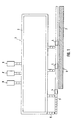
- Fig. 1 shows in a schematic diagram an inventive system for assembling corresponding product groups.
- This consists of a goods receiving reservoir 1 in the form of a funding cycle 2, on which, as in the following Figures shown corresponding goods receipts are moved.
- a transport route 3 which runs along several transfer points 4 runs.
- the corresponding goods receipts are initially abandoned.
- the respective goods receipts pass the corresponding transfer points 4 where the individual goods or articles forming the order to the goods receivers be handed over.
- the transport route 3 is a parallel discharge conveyor route 6 assigned in the form of an inclined roller conveyor 7. On this Inclined roller conveyors are from the transport route 3 after passing one corresponding transfer point 4, at which the respective product group completes was removed, removed goods pick-up.
- Fig.1 1 shows finally, the devices 8 assigned to the conveyor circuit 2 for preparation the corresponding goods receipts. This can be a case erector, Acting in the tray stabilizer or the like.
- FIG. 2 An operating case of the system according to the invention is shown in FIG. 2, but here only the feeding of the conveyor circuit 1 is shown.
- Each of these facilities 8 prepares a corresponding goods receiving 9, 10, 11. It can be are boxes, tubs or the like. These are broken down into corresponding gaps introduced into the conveyor circuit 1 and circulate, unless they have previously either at the drop point 5 or one of the feed points 12 from the conveyor circuit 1 be deducted.
- the entry points 12 are used as a buffer Conveyed route formed, which are connected to the conveyor circuit.
- there are suitable means for Moving / changing the goods receptacles to the subsequent conveyor section provided that are not described in detail.
- the control device sorts the order volume accordingly in order to form an order sequence that enables optimized throughput with a high degree of utilization.
- the above orders 1-8 are sorted as follows: processing file order number Transfer points were receiving zugeord. were receiving Order 1 I, III W a Mission 7 I 2 b Mission 3 II, III 1 c Mission 4 I, II 2 d Mission 5 III W e Mission 8 I, II 1 f Order 2 III 1 G Mission 6 II, III 2 H
- the individual goods receipts are first for the respective orders in the corresponding, corresponding buffer locations forming entry points 12 or upstream of the transfer point I.
- Transport route stored This is conveniently done dynamic, that is, as soon as a space becomes available, the next one is immediately required Goods receipt introduced.
- the goods receiving a is conveyed to the transfer point I and filled there.
- transfer point III where the rest Goods that make up order 1 are provided, that is, there will be the order completes.
- the goods reception b moves to the transfer point I and is there filled.
- the goods pick-up a is conveyed to transfer point III, there is a gap between these two goods receptacles from the transfer point II.
- the goods receptacle c is introduced into this (see FIG. 4, middle figure), which is assigned to order 3, which at the transfer points II and
- a collision with goods receipt b is excluded, there, cf. Fig. 4 bottom illustration, the goods receiving b to the transfer point l is completed and removed.
- the goods receipt assigned to order 4 d enters transfer point I.
- the goods receipt c is parallel to the transfer point III, where it is completed, promoted.
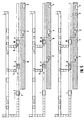
- FIG. 7 shows three different case examples for single-loop operation, a distinction is made here between goods receptacles that either Single orders or multi-article orders are assigned.
- Each is considered the transport route with the transfer points, with five transfer points here I-V are provided.
- this becomes assumed that the goods reception k completed at the transfer point I. and is removed.
- the transfer points II-V it is now possible to to inject a goods order l, m, n, o assigned to a single order of the respective transfer point completed and rejected immediately afterwards become. There is no gap formation at any time Throughput can be increased.
- a is shown in the transfer point I.
- Goods receipt p introduced which is assigned to several articles and the first at the transfer point ll is completed and removed.
- the gap that arises from transfer point III will also be a multiple article receiving goods receipt q introduced, in the example shown goes through several subsequent transfer points and only to a later one Time is removed.
- transfer point I there is also one in the lower illustration in the transfer point I.
- several items associated with goods receipt r introduced which also in Transfer point ll is completed.
- a goods receipt assigned to a single order becomes a gap s introduced, which is removed immediately afterwards.
- the transfer point IV is assigned to a product group comprising several articles Goods intake t introduced, which several until discharge Passing through.
- control is preferably carried out by means of a superordinate one Control device.
- This communicates expediently by means of a control device controlling the goods commission on the warehouse side. If there are difficulties on the picking side, this will be the corresponding control device reported, for example, in the absence of The article cancels the previously created "processing sequence" of the orders and the outsourced non-editable orders. Then the remaining A new processing sequence is generated for orders in the original order volume. Any incorrectly put together resulting from the lack of articles Goods receipts are marked accordingly and into local error processing brought. If the error is corrected, this will also be the parent Control device notified that the order sequence immediately again accordingly sorted.
Landscapes
- Engineering & Computer Science (AREA)
- Mechanical Engineering (AREA)
- Warehouses Or Storage Devices (AREA)
- General Factory Administration (AREA)
Description
- Fig. 1
- eine Prinzipsskizze zur Darstellung einer erfindungsgemässen Anlage,
- Fig. 2
- eine Prinzipsskizze zur Darstellung einer Betriebssituation,
- Fig. 3-6
- Prinzipsskizzen für die kontinuierliche schrittweise Abarbeitung mehrerer Aufträge, ausgehend von der Situation gemäß Figur 2, und
- Fig. 7
- eine Prinzipsskizze mehrerer Einschleusvarianten.
| Beispielauftragsdatei | ||
| Auftragnummer | Übergabestellen | Warenaufnahme |
| Auftrag 1 | I, III | W |
| Auftrag 2 | III | 1 |
| Auftrag 3 | II, III | 1 |
| Auftrag 4 | I, II | 2 |
| Auftrag 5 | III | W |
| Auftrag 6 | II, III | 2 |
| Auftrag 7 | I | 2 |
| Auftrag 8 | I, II | 1 |
1,2,W = Behälterart, (Kartongröße 1,2oder Wanne)
| Abarbeitungsdatei | |||
| Auftragnummer | Übergabestellen | Warenaufnahme | zugeord. Warenaufnahme |
| Auftrag 1 | I, III | W | a |
| Auftrag 7 | I | 2 | b |
| Auftrag 3 | II, III | 1 | c |
| Auftrag 4 | I, II | 2 | d |
| Auftrag 5 | III | W | e |
| Auftrag 8 | I, II | 1 | f |
| Auftrag 2 | III | 1 | g |
| Auftrag 6 | II, III | 2 | h |
Claims (14)
- Verfahren zum Betrieb einer Anlage zum Zusammenstellen auftragsspezifischer Warengruppen, insbesondere einer Kommissionieranlage, mit folgenden Merkmalen:a) den einzelnen Aufträgen sind Warenaufnahmen zugeordnet,b) die Warenaufnahmen werden längs einer Transportstrecke an mehreren Übergabestellen vorbeitransportiert, an denen die auftragsspezifischen Waren bereitgestellt und an die Warenaufnahmen übergeben werden, wobei die Waren eines Auftrags an einer oder mehreren Übergabestellen übergeben werden können,c) unmittelbar nach Komplettierung einer Warengruppe an einer Übergabestelle wird die jeweilige Warenaufnahme zur weiteren Bearbeitung ausgeschleust,d) in die innerhalb der Transportstrecke entlang der Übergabestellen entstandene Lücke oder in eine aus der gleichzeitigen Behandlung mehrerer Warenaufnahmen resultierenden Lücke wird eine neue Warenaufnahme eingeschleust, der ein Auftrag zugeordnet ist, dessen Waren an einer oder mehreren nachfolgenden Übergabestellen bereitgestellt und übergeben werden.
- Verfahren nach Anspruch 1, dadurch gekennzeichnet, daß mittels einer Steuerungseinrichtung die innerhalb einer vorgegebenen Zeit abzuarbeitenden Aufträge und/oder eine vorgegebene Anzahl von abzuarbeitenden Aufträgen zur Ermöglichung einer zeit- und/oder durchsatzoptimierten Bearbeitung sortiert werden, und der Bereitstellungsbetrieb der Warenaufnahmen und der Waren an den Übergabestellen entsprechend gesteuert wird.
- Verfahren nach Anspruch 1 oder 2, dadurch gekennzeichnet, daß die Größe und/oder Art der jeweiligen anfänglich transportierten und eingeschleusten Warenaufnahme in Abhängigkeit des jeweiligen Auftrags bzw. der jeweiligen Warengruppe gewählt werden.
- Verfahren nach einem der vorangehenden Ansprüche, dadurch gekennzeichnet, daß sämtliche Warenaufnahmen in einem gemeinsamen Warenaufnahmenreservoir bereitgehalten und von dort im Bedarfsfall abgezogen werden.
- Verfahren nach einem der vorangehenden Ansprüche, dadurch gekennzeichnet, daß die in entsprechende Lücken einzuschleusenden Warenaufnahmen vor dem Einschleusen in einem Pufferspeicher gespeichert werden.
- Anlage zum Zusammenstellen auftragsspezifischer Warengruppen zur Durchführung des Verfahrens nach den Ansprüchen 1 bis 5, insbesondere Kommissionieranlage, mit einer Transportstrecke zum Transportieren von Warenaufnahmen entlang mehrere Übergabestellen, an denen die auftragsspezifischen Waren bereitstellbar und an die Warenaufnahmen übergebbar sind, wobei die Waren eines Auftrags an einer oder mehreren Übergabestellen bereitgestellt und übergeben werden können, dadurch gekennzeichnet, daß eine an einer Übergabestelle (4, l, ll, lll, lV, V) komplettierte Warenaufnahme (9, 10, 11, a - h, k - t) mittels eines Ausschleusmittels an eine Ausschleustransportstrecke (6) ausschleusbar ist, und daß in die innerhalb der Transportstrecke (3) entstandene Lücke oder in eine aus der gleichzeitigen Behandlung mehrerer Warenaufnahmen resultierende Lücke mittels eines Einschleusmittels eine neue Warenaufnahme eingeschleusbar ist, der ein Auftrag zugeordnet ist, dessen Waren an einer oder mehreren nachfolgenden Übergabestellen bereitstellbar und übergebbar sind.
- Anlage nach Anspruch 6, dadurch gekennzeichnet, daß eine Steuerungseinrichtung vorgesehen ist, mittels welcher die innerhalb einer vorgegebenen Zeit abzuarbeitenden Aufträge und/oder eine vorgegebene Anzahl von abzuarbeitenden Aufträgen zur Ermöglichung einer zeit- und/oder durchsatzoptimierten Bearbeitung sortierbar sind, wobei der Bereitstellungsbetrieb der Warenaufnahmen und der Waren an den Übergabestellen entsprechend steuerbar sind.
- Anlage nach Anspruch 6 oder 7, dadurch gekennzeichnet, daß zumindest einem Teil der Übergabestellen (4, l, II, III, IV, V) eine Einschleusstelle (12) für die Warenaufnahmen zugeordnet ist.
- Anlage nach Anspruch 8, dadurch gekennzeichnet, daß jede Einschleusstelle (12) als Pufferspeicher ausgebildet ist.
- Anlage nach einem der Ansprüche 6 bis 9, dadurch gekennzeichnet, daß ein Warenaufnahmereservoir (1) vorgesehen ist, in dem die entlang der Transportstrecke (3) behandelbaren Warenaufnahmen (9, 10, 11) bereitgehalten sind und aus dem sie im Bedarfsfall abziehbar sind.
- Anlage nach Anspruch 10, dadurch gekennzeichnet, daß das Warenaufnahmereservoir (1) als Förderkreislauf (2) ausgebildet ist.
- Anlage nach Anspruch 10 oder 11, dadurch gekennzeichnet, daß dem Warenaufnahmereservoir (1), gegebenenfalls dem Förderkreislauf (2) Einrichtungen (8) zum Vorbereiten der Warenaufnahmen (9, 10, 11) in Form von Kartonaufrichteinrichtungen, Wannenentstapeleinrichtungen o.dgl. zugeordnet sind.
- Anlage nach einem der Ansprüche 6 bis 12, dadurch gekennzeichnet, daß die Ausschleustransportstrecke (6) als Schrägrollenförderer (7) ausgebildet ist.
- Anlage nach einem der Ansprüche 6 bis 13, dadurch gekennzeichnet, daß die Steuerungseinrichtung zum Auswählen der Größe und/oder Art der jeweiligen anfänglich transportierbaren und eingeschleusbaren Warenaufnahmen in Abhängigkeit des jeweiligen Auftrags bzw. der jeweiligen Warengruppe ausgebildet ist.
Applications Claiming Priority (2)
| Application Number | Priority Date | Filing Date | Title |
|---|---|---|---|
| DE19814558A DE19814558C2 (de) | 1998-04-01 | 1998-04-01 | Verfahren zum Betrieb einer Anlage zum Zusammenstellen auftragsspezifischer Warengruppen sowie Anlage zur Durchführung des Verfahrens |
| DE19814558 | 1998-04-01 |
Publications (2)
| Publication Number | Publication Date |
|---|---|
| EP0947449A1 EP0947449A1 (de) | 1999-10-06 |
| EP0947449B1 true EP0947449B1 (de) | 2003-05-28 |
Family
ID=7863214
Family Applications (1)
| Application Number | Title | Priority Date | Filing Date |
|---|---|---|---|
| EP99104841A Expired - Lifetime EP0947449B1 (de) | 1998-04-01 | 1999-03-11 | Verfahren zum Betrieb einer Anlage zum Zusammenstellen auftragsspezifischer Warengruppen sowie Anlage zur Durchführung des Verfahrens |
Country Status (3)
| Country | Link |
|---|---|
| EP (1) | EP0947449B1 (de) |
| AT (1) | ATE241541T1 (de) |
| DE (2) | DE19814558C2 (de) |
Family Cites Families (2)
| Publication number | Priority date | Publication date | Assignee | Title |
|---|---|---|---|---|
| FR2671201B1 (fr) * | 1990-12-28 | 1994-09-09 | Logarithme Sa | Preparation de listes d'objets a charger dans des contenants. |
| DE19610594A1 (de) * | 1996-03-18 | 1997-09-25 | Ferdinand Christ | Verfahren und Vorrichtung zum automatischen Bereitstellen von stückgutartigen Waren in, auf oder an einzelne Transporteinrichtungen |
-
1998
- 1998-04-01 DE DE19814558A patent/DE19814558C2/de not_active Expired - Fee Related
-
1999
- 1999-03-11 DE DE59905702T patent/DE59905702D1/de not_active Expired - Lifetime
- 1999-03-11 EP EP99104841A patent/EP0947449B1/de not_active Expired - Lifetime
- 1999-03-11 AT AT99104841T patent/ATE241541T1/de active
Also Published As
| Publication number | Publication date |
|---|---|
| ATE241541T1 (de) | 2003-06-15 |
| DE59905702D1 (de) | 2003-07-03 |
| EP0947449A1 (de) | 1999-10-06 |
| DE19814558C2 (de) | 2003-08-14 |
| DE19814558A1 (de) | 1999-10-07 |
Similar Documents
| Publication | Publication Date | Title |
|---|---|---|
| AT518818B1 (de) | Verfahren zum Kommissionieren von Artikeln und Kommissionierstation | |
| DE60009110T2 (de) | Doppelt breiter Querbandförderer | |
| AT512338B1 (de) | Kommissionierstation und verfahren zum kommissionieren von artikeln | |
| EP0241824B1 (de) | Warenumschlagsanlage und Verfahren zu deren Betrieb | |
| EP2173644B1 (de) | System und verfahren zum handling von retourwaren in eine kommissionieranlage | |
| EP2581329B1 (de) | Verfahren zum Kommissionieren von Aufträgen und Hängebahnanlage | |
| DE10136354A1 (de) | Verfahren und Anlage zum Kommissionieren mit einem Behälterregal und zugeordnetem Regalbediengerät | |
| CH713191A1 (de) | Lagersystem mit einer Mehrzahl von Lagerplätzen zur Aufnahme von Lagergut und Verfahren zum Betreiben eines solchen Lagersystems. | |
| DE102010015414A1 (de) | Kommissionieranlage und Verfahren zum Kommissionieren von Packstücken | |
| EP1686080A2 (de) | Kommissionerplatz und Verfahren zum Kommissionieren | |
| DE102014102092A1 (de) | Verfahren und Station zum Kommissionieren von Artikeln nach dem Ware-Zum-Mann Prinzip | |
| EP3265406A1 (de) | Verfahren zum einlagern von stückgütern in ein lagerregal und lagersystem | |
| EP1760012A1 (de) | Verfahren und Vorrichtung zur Bereitstellung einer vorbestimmbaren Sequenz von Transportbehältern | |
| CH713551A1 (de) | Verfahren zum Kommissionieren von Waren und Kommissionierungsanlage zur Durchführung des Verfahrens. | |
| EP0839113A1 (de) | Kommissioniersystem | |
| EP1846309A1 (de) | Vorrichtung und verfahren zum sortieren von ungeordneten behätern in einem kommissioniersystem | |
| DE102017112305A1 (de) | Verfahren und vorrichtung zur kommissionierung von waren mit begrenzter haltbarkeit | |
| EP4547579B1 (de) | Mehrstufiges verfahren zum automatischen sequenzieren von waren sowie kommissioniersystem dazu | |
| AT524109A1 (de) | Vorrichtung und ein Verfahren zur Kommissionierung von Artikeln | |
| WO2022266686A1 (de) | Verteilersystem und verfahren zum fördern von waren in einem lager- und kommissioniersystem | |
| DE10332359A1 (de) | Verfahren und Vorrichtung zur Frühgepäckspeicherung | |
| DE102021110132A1 (de) | Verfahren zum Betreiben eines Förderers für hintereinander folgende Güter und entsprechendes Fördersystem | |
| DE3902712C2 (de) | Verfahren und Vorrichtung zum Zusammenstellen von Gruppen aus Bekleidungsstücken | |
| EP3178986B1 (de) | Verfahren und vorrichtung zum sortieren von wäschestücken | |
| DE19814558C2 (de) | Verfahren zum Betrieb einer Anlage zum Zusammenstellen auftragsspezifischer Warengruppen sowie Anlage zur Durchführung des Verfahrens |
Legal Events
| Date | Code | Title | Description |
|---|---|---|---|
| PUAI | Public reference made under article 153(3) epc to a published international application that has entered the european phase |
Free format text: ORIGINAL CODE: 0009012 |
|
| AK | Designated contracting states |
Kind code of ref document: A1 Designated state(s): AT BE DE FR GB IT NL |
|
| AX | Request for extension of the european patent |
Free format text: AL;LT;LV;MK;RO;SI |
|
| 17P | Request for examination filed |
Effective date: 19991020 |
|
| 17Q | First examination report despatched |
Effective date: 20000323 |
|
| AKX | Designation fees paid |
Free format text: AT BE DE FR GB IT NL |
|
| RAP1 | Party data changed (applicant data changed or rights of an application transferred) |
Owner name: QUELLE AKTIENGESELLSCHAFT |
|
| GRAG | Despatch of communication of intention to grant |
Free format text: ORIGINAL CODE: EPIDOS AGRA |
|
| GRAG | Despatch of communication of intention to grant |
Free format text: ORIGINAL CODE: EPIDOS AGRA |
|
| GRAH | Despatch of communication of intention to grant a patent |
Free format text: ORIGINAL CODE: EPIDOS IGRA |
|
| GRAH | Despatch of communication of intention to grant a patent |
Free format text: ORIGINAL CODE: EPIDOS IGRA |
|
| GRAA | (expected) grant |
Free format text: ORIGINAL CODE: 0009210 |
|
| AK | Designated contracting states |
Designated state(s): AT BE DE FR GB IT NL |
|
| PG25 | Lapsed in a contracting state [announced via postgrant information from national office to epo] |
Ref country code: NL Free format text: LAPSE BECAUSE OF FAILURE TO SUBMIT A TRANSLATION OF THE DESCRIPTION OR TO PAY THE FEE WITHIN THE PRESCRIBED TIME-LIMIT Effective date: 20030528 Ref country code: IT Free format text: LAPSE BECAUSE OF FAILURE TO SUBMIT A TRANSLATION OF THE DESCRIPTION OR TO PAY THE FEE WITHIN THE PRE;WARNING: LAPSES OF ITALIAN PATENTS WITH EFFECTIVE DATE BEFORE 2007 MAY HAVE OCCURRED AT ANY TIME BEFORE 2007. THE CORRECT EFFECTIVE DATE MAY BE DIFFERENT FROM THE ONE RECORDED.SCRIBED TIME-LIMIT Effective date: 20030528 Ref country code: GB Free format text: LAPSE BECAUSE OF FAILURE TO SUBMIT A TRANSLATION OF THE DESCRIPTION OR TO PAY THE FEE WITHIN THE PRESCRIBED TIME-LIMIT Effective date: 20030528 |
|
| REG | Reference to a national code |
Ref country code: GB Ref legal event code: FG4D Free format text: NOT ENGLISH |
|
| REF | Corresponds to: |
Ref document number: 59905702 Country of ref document: DE Date of ref document: 20030703 Kind code of ref document: P |
|
| NLV1 | Nl: lapsed or annulled due to failure to fulfill the requirements of art. 29p and 29m of the patents act | ||
| GBV | Gb: ep patent (uk) treated as always having been void in accordance with gb section 77(7)/1977 [no translation filed] |
Effective date: 20030528 |
|
| ET | Fr: translation filed | ||
| PG25 | Lapsed in a contracting state [announced via postgrant information from national office to epo] |
Ref country code: BE Free format text: LAPSE BECAUSE OF NON-PAYMENT OF DUE FEES Effective date: 20040331 |
|
| PLBE | No opposition filed within time limit |
Free format text: ORIGINAL CODE: 0009261 |
|
| STAA | Information on the status of an ep patent application or granted ep patent |
Free format text: STATUS: NO OPPOSITION FILED WITHIN TIME LIMIT |
|
| 26N | No opposition filed |
Effective date: 20040302 |
|
| BERE | Be: lapsed |
Owner name: *QUELLE A.G. Effective date: 20040331 |
|
| REG | Reference to a national code |
Ref country code: FR Ref legal event code: TP Ref country code: FR Ref legal event code: CJ |
|
| REG | Reference to a national code |
Ref country code: FR Ref legal event code: TP |
|
| REG | Reference to a national code |
Ref country code: FR Ref legal event code: TP |
|
| REG | Reference to a national code |
Ref country code: FR Ref legal event code: PLFP Year of fee payment: 18 |
|
| PGFP | Annual fee paid to national office [announced via postgrant information from national office to epo] |
Ref country code: DE Payment date: 20160321 Year of fee payment: 18 |
|
| PGFP | Annual fee paid to national office [announced via postgrant information from national office to epo] |
Ref country code: FR Payment date: 20160322 Year of fee payment: 18 Ref country code: AT Payment date: 20160318 Year of fee payment: 18 |
|
| REG | Reference to a national code |
Ref country code: DE Ref legal event code: R119 Ref document number: 59905702 Country of ref document: DE |
|
| REG | Reference to a national code |
Ref country code: AT Ref legal event code: MM01 Ref document number: 241541 Country of ref document: AT Kind code of ref document: T Effective date: 20170311 |
|
| REG | Reference to a national code |
Ref country code: FR Ref legal event code: ST Effective date: 20171130 |
|
| PG25 | Lapsed in a contracting state [announced via postgrant information from national office to epo] |
Ref country code: AT Free format text: LAPSE BECAUSE OF NON-PAYMENT OF DUE FEES Effective date: 20170311 Ref country code: FR Free format text: LAPSE BECAUSE OF NON-PAYMENT OF DUE FEES Effective date: 20170331 Ref country code: DE Free format text: LAPSE BECAUSE OF NON-PAYMENT OF DUE FEES Effective date: 20171003 |