EP0946031A2 - Anzeigesteuerung für ein Mobilfunkgerät und Verfahren zur Steuerung der Anzeige für dasselbe - Google Patents
Anzeigesteuerung für ein Mobilfunkgerät und Verfahren zur Steuerung der Anzeige für dasselbe Download PDFInfo
- Publication number
- EP0946031A2 EP0946031A2 EP99105086A EP99105086A EP0946031A2 EP 0946031 A2 EP0946031 A2 EP 0946031A2 EP 99105086 A EP99105086 A EP 99105086A EP 99105086 A EP99105086 A EP 99105086A EP 0946031 A2 EP0946031 A2 EP 0946031A2
- Authority
- EP
- European Patent Office
- Prior art keywords
- information
- display
- phone number
- call
- telephone
- Prior art date
- Legal status (The legal status is an assumption and is not a legal conclusion. Google has not performed a legal analysis and makes no representation as to the accuracy of the status listed.)
- Withdrawn
Links
- 238000000034 method Methods 0.000 title claims description 9
- 238000004891 communication Methods 0.000 title description 7
- 238000010295 mobile communication Methods 0.000 claims description 4
- 230000006870 function Effects 0.000 description 7
- 230000005540 biological transmission Effects 0.000 description 5
- 230000000763 evoking effect Effects 0.000 description 4
- 238000006243 chemical reaction Methods 0.000 description 3
- 235000016496 Panda oleosa Nutrition 0.000 description 2
- 240000000220 Panda oleosa Species 0.000 description 2
- 238000010586 diagram Methods 0.000 description 2
- 230000001413 cellular effect Effects 0.000 description 1
- 230000000694 effects Effects 0.000 description 1
- 238000007519 figuring Methods 0.000 description 1
- 230000004044 response Effects 0.000 description 1
- 238000012795 verification Methods 0.000 description 1
Images




Classifications
-
- H—ELECTRICITY
- H04—ELECTRIC COMMUNICATION TECHNIQUE
- H04M—TELEPHONIC COMMUNICATION
- H04M1/00—Substation equipment, e.g. for use by subscribers
- H04M1/57—Arrangements for indicating or recording the number of the calling subscriber at the called subscriber's set
- H04M1/575—Means for retrieving and displaying personal data about calling party
-
- H—ELECTRICITY
- H04—ELECTRIC COMMUNICATION TECHNIQUE
- H04M—TELEPHONIC COMMUNICATION
- H04M1/00—Substation equipment, e.g. for use by subscribers
- H04M1/26—Devices for calling a subscriber
- H04M1/27—Devices whereby a plurality of signals may be stored simultaneously
- H04M1/274—Devices whereby a plurality of signals may be stored simultaneously with provision for storing more than one subscriber number at a time, e.g. using toothed disc
- H04M1/2745—Devices whereby a plurality of signals may be stored simultaneously with provision for storing more than one subscriber number at a time, e.g. using toothed disc using static electronic memories, e.g. chips
- H04M1/27467—Methods of retrieving data
- H04M1/27475—Methods of retrieving data using interactive graphical means or pictorial representations
-
- H—ELECTRICITY
- H04—ELECTRIC COMMUNICATION TECHNIQUE
- H04M—TELEPHONIC COMMUNICATION
- H04M1/00—Substation equipment, e.g. for use by subscribers
- H04M1/26—Devices for calling a subscriber
- H04M1/27—Devices whereby a plurality of signals may be stored simultaneously
- H04M1/274—Devices whereby a plurality of signals may be stored simultaneously with provision for storing more than one subscriber number at a time, e.g. using toothed disc
- H04M1/2745—Devices whereby a plurality of signals may be stored simultaneously with provision for storing more than one subscriber number at a time, e.g. using toothed disc using static electronic memories, e.g. chips
- H04M1/27453—Directories allowing storage of additional subscriber data, e.g. metadata
-
- H—ELECTRICITY
- H04—ELECTRIC COMMUNICATION TECHNIQUE
- H04M—TELEPHONIC COMMUNICATION
- H04M1/00—Substation equipment, e.g. for use by subscribers
- H04M1/72—Mobile telephones; Cordless telephones, i.e. devices for establishing wireless links to base stations without route selection
- H04M1/724—User interfaces specially adapted for cordless or mobile telephones
Definitions
- the invention relates to a display controller and a method of controlling display, and more particularly to a display controller for controlling display of registered information, and a method of doing the same.
- Conventional mobile radio-communication devices such as a mobile telephone are provided with an abbreviated phone number dialing function and a telephone directory function. Normally, in these functions, one phone number is assigned to one subscriber's name.
- a display screen is scrolled to thereby search a subscriber's name in registered data, and then, a call is made.
- a call is made.
- Mr. A and his home phone number are first registered, then a name of Mr. B and his office phone number are registered, then a name of Mr. C and his mobile telephone number are registered, and a few days after, a name of Mr. A and his mobile telephone number are registered.
- the registered phone numbers are displayed along with the respective owners' or subscribers' names in succession in their registered order. That is, the Mr. A's home phone number, Mr. B's office phone number, Mr. C's mobile phone number, and Mr. A's mobile phone number are displayed in this order along with the respective names.
- Mr. A's two phone numbers namely, home and mobile phone numbers, are displayed separately from each other. As a result, it would not be so easy to distinguish those two phone numbers, and accordingly, it would take some time to select a desired phone number.
- the maximum number of times of scrolling a display screen, required to evoke each of abbreviated phone numbers in their registered order is equal to the number of the registered abbreviated phone numbers.
- Japanese Unexamined Patent Publication No. 5-3507 has suggested a telephone in which if a part of registered phone number, name, and other information is input into the telephone, a destination telephone subscriber associated with the thus input information is displayed on a display screen.
- Japanese Unexamined Patent Publication No. 5-204795 has suggested an e-mail system in which a symbol such as a photograph or a portrait of a user is displayed together with an address of an e-mail, a list of addressers, and so on.
- Japanese Unexamined Patent Publication No. 7-131512 has suggested a communication terminal having an electronic telephone directory function When a destination telephone subscriber is to be retrieved, a capital letter of the destination is input into the communication terminal.
- Japanese Unexamined Patent Publication No. 9-83630 has suggested a telephone in which portraits of telephone subscribers are displayed each in the form of an icon. If an icon associated with a destination telephone subscriber is appointed, a call to the destination telephone subscriber is made.
- Japanese Unexamined Patent Publication No. 8-181763 has suggested a communication terminal including a real-time identifier for identifying a current time at which a call is made, and a memory for storing a plurality of phone numbers of various persons. If an instruction is given to the communication terminal to make a call to a certain person, one of phone numbers of the certain person is automatically selected in dependence on a current time at which the call is made, and then a call is made to the thus selected phone number.
- Japanese Unexamined Patent Publication No. 9-275441 has suggested a cellular phone including a memory storing therein a plurality of sets of data, each having a name of a person, a phone number of the person, and a mark symbolizing a group to which the person belongs.
- a destination phone number is to be retrieved, all the marks are displayed on a display screen.
- names belonging to the group associated with the selected mark are all displayed.
- a display controller comprising (a) a memory for storing therein a plurality of information sets, each including a first information for identifying a name of a call-receiver, a phone number of the subscriber, and a second information indicative of an attribute of the phone number, (b) an input device for making input of the first information of a desired call-receiver to be retrieved from the plurality of information sets stored in the memory, (c) a controller for extracting an information set including the thus input first information, from the memory, and (d) a display for displaying information thereon, characterized by that the controller causes the display to display the second information, along with the first information, stored in the memory in an information set including the first information.
- a mobile communication terminal including such a display controller as defined above.
- a method of controlling an operation of a display comprising the steps of (a) storing at least two information steps each including a first information for identifying a name of a call-receiver, a phone number of the call-receiver, and a second information indicative of an attribute of the phone number, (b) making input of a certain first information for retrieving an information set including the certain first information, (c) extracting the information set including the certain first information, and (d) displaying the second information associated with the certain first information, along with the certain first information.
- the display controller in accordance with the present invention is adapted to receive an input of a telephone subscriber's name to be retrieved or ID information associated with the name, when a registered information including a pair of a name and a phone number is retrieved. If there is found a registered information coincident with the input name or ID information, a plurality of phone numbers is displayed for a common subscriber's name or ID information.
- the present invention enables a user to readily recognize a desired destination phone number, ensuring enhanced operability and convenience in the use of a mobile telephone, for instance.
- Fig. 1 is a block diagram of a mobile telephone to which a display controller in accordance with the preferred embodiment of the present invention is applied.
- the illustrated mobile telephone is comprised of an antenna 1a, a radio transmission/reception circuit 1, a control circuit 2, ROM 3, a control panel 4, a handset 5, a display 6, RAM 7, and a speaker 8.
- the antenna 1, ROM 3, the control panel 4, the handset 5, the display 6, RAM 7, and the speaker 8 are all electrically connected to the control circuit 2, and are controlled in operation by the control circuit 2.
- the control circuit 2 includes a register 9 therein.
- the control circuit 2 compares an identification (ID) number included in the calling signal with an ID number characteristic of the mobile telephone, stored in ROM 3. When they are coincident with each other, the control circuit 2 causes the speaker 8 to make a sound for alarming arrival of a calling. If a user of the mobile telephone actuates an off-hook button on the control panel 4 in response to the alarming sound, the control circuit 2 transmits a reception acknowledge signal from the radio transmission/reception circuit 1, and allows the user to have a talk with a caller through the handset 5.
- ID identification
- the control circuit 2 transmits a calling signal through the radio transmission/reception circuit 1.
- the dialed destination phone number is indicated on the display 6 for verification.
- a plurality of abbreviated phone numbers are registered in RAM 7.
- call reception history may be stored in RAM 7, and a directory function may be provided in the mobile phone.
- destination subscribers' names and phone numbers previously stored in RAM 7 are displayed one after another. A call is made to a selected one of the phone numbers.
- the control panel 4 is provided thereon at least ten keys, an off-hook button, and function keys for designating an abbreviated phone number and scrolling a display screen.
- the mobile telephone may be designed to have further components in addition to those illustrated in Fig. 1. However, components having nothing to do with the present invention are not illustrated.
- the present invention is applied to a mobile telephone as illustrated in Fig. 1, but the present invention can be applied also to various mobile communication systems such as a pager, an automobile telephone, a cordless telephone, a second-generation cordless telephone PHS (personal handyphone system), and so on.
- the present invention is applicable to stationary communication system, a mobile information terminal, personal computer, and so on, other than the mobile communication systems.
- Fig. 2 is a flow chart of an operation to be carried out for registration of an abbreviated phone number in the preferred embodiment of the present invention.
- an abbreviated phone number register mode is set through the use of keys on the control panel 4 in step S101. Then, a call-receiver's name, preferably his or her full name, is entered in a hiragana (the cursive kana characters), a katakana (the square form of kana) or alphabet, in step S102. Hiragana and katakana are selected using predetermined keys on the control panel 4, and are entered using the ten keys.
- a predetermined key on the control panel 4 is used to effect the kana-kanji conversion in step S104.
- a phone number is then entered in step S105.
- step S103 when no kana-kanji conversion is required (NO in step S103), for instance, when a call-receiver's name is entered in alphabet, a phone number is entered without carrying out kana-kanji conversion in step S105.
- katakana, hiragana or kanji, or alphabet may not always be a telephone subscriber's name itself, but may be an information by which a call-receiver can be distinguished, for example, a nickname or a symbol.
- an icon characterizing the phone number namely, indicating the attribute of the phone number
- ROM 3 stores therein icons characteristic of a home telephone, an office telephone, a mobile telephone, a telephone of a school, a facsimile telephone, and so on, for example.
- a plurality of icons is indicated on the display 6, and one of them is selected in association with the entered phone number.
- a registered abbreviated phone number is selected for the icon in step S107 by operating keys on the control panel 4.
- the abbreviated phone number registration is over.
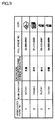
- Fig. 3 illustrates a storage pattern having been registered in RAM 7 in the above-mentioned manner.
- RAM 7 stores therein the same number of information sets as the number of abbreviated phone numbers, each information set including an abbreviated phone number, an ID information, a call-receiver's name, a phone number, and an icon.
- the above-mentioned information on telephone subscribers may be stored in their registered order or in the order of registered abbreviated phone numbers assigned to the respective phone numbers. In any way, a plurality of phone numbers of the same subscriber will not be registered in succession, unless a plurality of phone numbers or abbreviated phone numbers of the same person is designated in succession.
- Fig. 4 is a flow chart of an operation to be carried out to display registered information including a registered abbreviated phone number and others.
- a mode for retrieving an abbreviated phone number is selected by carrying out a predetermined key operation through the use of the control panel 4, in step S 201.
- a destination subscriber name to be retrieved is entered in hiragana, katakana or alphabet through key operation on the control panel 4 in step S202.
- a retrieval start command is entered through the control panel 4, the retrieval operation starts in step S203.
- This retrieval operation is conducted based on the entered hiragana, katakana, or alphabet, that is, based on the destination subscriber ID information. It is judged whether an ID information corresponding to the entered ID information is stored in RAM 7.
- hiragana corresponding to entered katakana is retrieved, for instance, it is judged as to whether they are coincident with each other by the standard having been established in advance.
- step S204 it is judged as to whether the registered hiragana , katakana or alphabet and entered katakana, hiragana, or alphabet are completely coincident with each other, or have a predetermined relation therebetween. This judgment may be effected in the order of registered abbreviated phone numbers, or in the registered order of the phone numbers.
- step S204 When there is not found any coincidence between the entered and registered data in step S204, the statement of the fact is indicated on the display 6 in step S205.
- step S206 data which was judged in step S204 to be coincident with the registered one is extracted at step S206.
- a set of information corresponding to the registered one stored in RAM 7 is temporarily stored in the register 9 installed in the control circuit 2.
- step S207 After all registered abbreviated phone number information have been checked for retrieval (YES in step S207), all information judged to be coincident with the entered information are displayed, as illustrated in Fig. 5, in step S208. The control circuit 2 then terminates the retrieval procedure.
- Fig. 5 is an example of indication of the registered information on the display 6.
- the retrieved ID information "Satoh” is indicated at an upper portion of the display 6, and icons figuring a home telephone and a mobile telephone, registered in association with the ID information, are displayed below the ID information "Satoh”.
- the home telephone icon is enclosed in a dash-line box.
- the dash-line box can be moved to any one of displayed icons by operating a scroll key on the control panel 4.
- the display controller may be adapted to display a phone number for the enclosed icon and make a call to the thus displayed phone number.
- the control circuit 2 transmits a signal indicative of the phone number associated with the icon as a dialing data, to the radio transmission/reception circuit 1, which modulates the signal, and transmits the thus modulated signal to a base station.
- ID information is illustrated in Fig. 5, but a name "Satoh” in Chinese character, for example, may be displayed instead of the ID information.
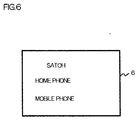
- Fig. 6 illustrates another example of indication on the display 6.
- Fig. 6 The indication in Fig. 6 is different from that in Fig. 5 in that home and mobile phone numbers are displayed in letters in place of their respective icons. These letters can be displayed by carrying out the step S106a in place of the step S106 in Fig. 2. In the step S106a, not icons but letters are designated for an entered phone number. The designated letters are registered in such a manner as illustrated in Fig. 3, in place of icons.
Landscapes
- Engineering & Computer Science (AREA)
- Signal Processing (AREA)
- Mobile Radio Communication Systems (AREA)
- Telephone Function (AREA)
Applications Claiming Priority (2)
| Application Number | Priority Date | Filing Date | Title |
|---|---|---|---|
| JP07742998A JP3299177B2 (ja) | 1998-03-25 | 1998-03-25 | 表示制御装置 |
| JP7742998 | 1998-03-25 |
Publications (2)
| Publication Number | Publication Date |
|---|---|
| EP0946031A2 true EP0946031A2 (de) | 1999-09-29 |
| EP0946031A3 EP0946031A3 (de) | 2003-09-10 |
Family
ID=13633761
Family Applications (1)
| Application Number | Title | Priority Date | Filing Date |
|---|---|---|---|
| EP99105086A Withdrawn EP0946031A3 (de) | 1998-03-25 | 1999-03-24 | Anzeigesteuerung für ein Mobilfunkgerät und Verfahren zur Steuerung der Anzeige für dasselbe |
Country Status (4)
| Country | Link |
|---|---|
| EP (1) | EP0946031A3 (de) |
| JP (1) | JP3299177B2 (de) |
| CN (1) | CN1238630A (de) |
| AU (1) | AU2137899A (de) |
Families Citing this family (1)
| Publication number | Priority date | Publication date | Assignee | Title |
|---|---|---|---|---|
| JP4526729B2 (ja) * | 2001-04-24 | 2010-08-18 | 京セラ株式会社 | 携帯端末 |
Family Cites Families (2)
| Publication number | Priority date | Publication date | Assignee | Title |
|---|---|---|---|---|
| DE4336791C1 (de) * | 1993-10-28 | 1994-11-10 | Grundig Emv | Verfahren zur Auswahl einer Rufnummer aus einem Rufnummernspeicher |
| US5848356A (en) * | 1995-10-02 | 1998-12-08 | Motorola, Inc. | Method for implementing icons in a radio communication device |
-
1998
- 1998-03-25 JP JP07742998A patent/JP3299177B2/ja not_active Expired - Fee Related
-
1999
- 1999-03-24 EP EP99105086A patent/EP0946031A3/de not_active Withdrawn
- 1999-03-24 AU AU21378/99A patent/AU2137899A/en not_active Abandoned
- 1999-03-25 CN CN99105482A patent/CN1238630A/zh active Pending
Also Published As
| Publication number | Publication date |
|---|---|
| JPH11275207A (ja) | 1999-10-08 |
| EP0946031A3 (de) | 2003-09-10 |
| JP3299177B2 (ja) | 2002-07-08 |
| AU2137899A (en) | 1999-10-07 |
| CN1238630A (zh) | 1999-12-15 |
Similar Documents
| Publication | Publication Date | Title |
|---|---|---|
| US9436363B2 (en) | Device, system, and method for informing users of functions and characters associated with telephone keys | |
| US6185295B1 (en) | Phone number database for a phone | |
| JP4494533B2 (ja) | 通信端末装置及びダイヤルシャトルを用いたオプション選択方法 | |
| KR101474568B1 (ko) | 이동통신 단말기에서 국제 전화 오토 다이얼링 제공 방법 및 장치 | |
| US6259934B1 (en) | Radio communication device programmed for automatic entry of directory data | |
| EP0936792A1 (de) | Vorrichtung und Suchverfahren in einem Telefonverzeichnis eines tragbaren zellularen Funktelefons | |
| US20060135197A1 (en) | Apparatus and method for originating call using latest communication records in mobile communication terminal | |
| JP2002092013A (ja) | 情報検索装置、情報検索システムおよびサーバ | |
| JPH11313170A (ja) | 情報通信端末 | |
| KR20060067262A (ko) | 이동 통신 단말의 사용자데이터 관리 장치 및 방법 | |
| EP0946031A2 (de) | Anzeigesteuerung für ein Mobilfunkgerät und Verfahren zur Steuerung der Anzeige für dasselbe | |
| JP3123988B2 (ja) | 携帯電話機 | |
| JP3492508B2 (ja) | 登録データの表示制御装置 | |
| JP3865009B2 (ja) | 通信端末 | |
| JPH11298588A (ja) | 移動電話方式 | |
| JP3612475B2 (ja) | 表示制御装置 | |
| US7515942B2 (en) | Method and device for telephone number search in a mobile terminal | |
| KR100563702B1 (ko) | 이동통신 단말기의 폰북 처리방법 | |
| JPH11127233A (ja) | 電子電話帳 | |
| JP3338353B2 (ja) | 電話機 | |
| KR0174618B1 (ko) | 무선 호출기의 개선된 수신정보 확인회로 및 방법 | |
| KR100995026B1 (ko) | 이동통신 단말기 통화자의 다수개 전화번호 검색방법 | |
| JP3255438B2 (ja) | 電話装置 | |
| KR20040041862A (ko) | 우선순위에 따른 휴대폰 전화번호부 검색 방법 | |
| JP2000032113A (ja) | 電話端末における番号表示機能 |
Legal Events
| Date | Code | Title | Description |
|---|---|---|---|
| PUAI | Public reference made under article 153(3) epc to a published international application that has entered the european phase |
Free format text: ORIGINAL CODE: 0009012 |
|
| AK | Designated contracting states |
Kind code of ref document: A2 Designated state(s): AT BE CH CY DE DK ES FI FR GB GR IE IT LI LU MC NL PT SE |
|
| AX | Request for extension of the european patent |
Free format text: AL;LT;LV;MK;RO;SI |
|
| PUAL | Search report despatched |
Free format text: ORIGINAL CODE: 0009013 |
|
| AK | Designated contracting states |
Kind code of ref document: A3 Designated state(s): AT BE CH CY DE DK ES FI FR GB GR IE IT LI LU MC NL PT SE |
|
| AX | Request for extension of the european patent |
Extension state: AL LT LV MK RO SI |
|
| 17P | Request for examination filed |
Effective date: 20030731 |
|
| 17Q | First examination report despatched |
Effective date: 20031023 |
|
| AKX | Designation fees paid |
Designated state(s): DE FR GB IT |
|
| STAA | Information on the status of an ep patent application or granted ep patent |
Free format text: STATUS: THE APPLICATION IS DEEMED TO BE WITHDRAWN |
|
| 18D | Application deemed to be withdrawn |
Effective date: 20050415 |