EP0941986A2 - A process for producing dialkanolamines - Google Patents
A process for producing dialkanolamines Download PDFInfo
- Publication number
- EP0941986A2 EP0941986A2 EP99301920A EP99301920A EP0941986A2 EP 0941986 A2 EP0941986 A2 EP 0941986A2 EP 99301920 A EP99301920 A EP 99301920A EP 99301920 A EP99301920 A EP 99301920A EP 0941986 A2 EP0941986 A2 EP 0941986A2
- Authority
- EP
- European Patent Office
- Prior art keywords
- catalyst
- alkylene oxide
- reaction
- ammonia
- monoalkanolamine
- Prior art date
- Legal status (The legal status is an assumption and is not a legal conclusion. Google has not performed a legal analysis and makes no representation as to the accuracy of the status listed.)
- Granted
Links
- 238000000034 method Methods 0.000 title claims abstract description 25
- 230000008569 process Effects 0.000 title claims abstract description 15
- QGZKDVFQNNGYKY-UHFFFAOYSA-N Ammonia Chemical compound N QGZKDVFQNNGYKY-UHFFFAOYSA-N 0.000 claims abstract description 89
- 239000003054 catalyst Substances 0.000 claims abstract description 69
- 238000006243 chemical reaction Methods 0.000 claims abstract description 63
- 125000002947 alkylene group Chemical group 0.000 claims abstract description 41
- 229910021529 ammonia Inorganic materials 0.000 claims abstract description 41
- 125000001495 ethyl group Chemical group [H]C([H])([H])C([H])([H])* 0.000 claims abstract description 6
- 125000004435 hydrogen atom Chemical group [H]* 0.000 claims abstract description 6
- 239000007791 liquid phase Substances 0.000 claims abstract description 6
- 125000002496 methyl group Chemical group [H]C([H])([H])* 0.000 claims abstract description 6
- 239000011148 porous material Substances 0.000 claims description 16
- 239000007858 starting material Substances 0.000 claims description 11
- 239000012229 microporous material Substances 0.000 claims description 7
- 229910052761 rare earth metal Inorganic materials 0.000 claims description 6
- 239000011164 primary particle Substances 0.000 claims description 3
- HZAXFHJVJLSVMW-UHFFFAOYSA-N 2-Aminoethan-1-ol Chemical compound NCCO HZAXFHJVJLSVMW-UHFFFAOYSA-N 0.000 description 22
- ZBCBWPMODOFKDW-UHFFFAOYSA-N diethanolamine Chemical compound OCCNCCO ZBCBWPMODOFKDW-UHFFFAOYSA-N 0.000 description 22
- IAYPIBMASNFSPL-UHFFFAOYSA-N Ethylene oxide Chemical compound C1CO1 IAYPIBMASNFSPL-UHFFFAOYSA-N 0.000 description 21
- GSEJCLTVZPLZKY-UHFFFAOYSA-N Triethanolamine Chemical compound OCCN(CCO)CCO GSEJCLTVZPLZKY-UHFFFAOYSA-N 0.000 description 17
- 238000004519 manufacturing process Methods 0.000 description 17
- 239000000047 product Substances 0.000 description 14
- 239000013078 crystal Substances 0.000 description 13
- 230000000694 effects Effects 0.000 description 11
- 150000002169 ethanolamines Chemical class 0.000 description 11
- 230000015572 biosynthetic process Effects 0.000 description 10
- 238000004064 recycling Methods 0.000 description 9
- 238000009826 distribution Methods 0.000 description 8
- 229910000069 nitrogen hydride Inorganic materials 0.000 description 8
- 230000000052 comparative effect Effects 0.000 description 7
- HNPSIPDUKPIQMN-UHFFFAOYSA-N dioxosilane;oxo(oxoalumanyloxy)alumane Chemical compound O=[Si]=O.O=[Al]O[Al]=O HNPSIPDUKPIQMN-UHFFFAOYSA-N 0.000 description 7
- 238000007493 shaping process Methods 0.000 description 7
- 239000003456 ion exchange resin Substances 0.000 description 6
- 229920003303 ion-exchange polymer Polymers 0.000 description 6
- 239000000243 solution Substances 0.000 description 6
- XLYOFNOQVPJJNP-UHFFFAOYSA-N water Substances O XLYOFNOQVPJJNP-UHFFFAOYSA-N 0.000 description 6
- 229910021536 Zeolite Inorganic materials 0.000 description 5
- 239000003921 oil Substances 0.000 description 5
- 238000003756 stirring Methods 0.000 description 5
- 239000010457 zeolite Substances 0.000 description 5
- 238000005576 amination reaction Methods 0.000 description 4
- 150000001768 cations Chemical class 0.000 description 4
- 239000012295 chemical reaction liquid Substances 0.000 description 4
- 239000003795 chemical substances by application Substances 0.000 description 4
- 239000007789 gas Substances 0.000 description 4
- 238000005342 ion exchange Methods 0.000 description 4
- XEEYBQQBJWHFJM-UHFFFAOYSA-N iron Substances [Fe] XEEYBQQBJWHFJM-UHFFFAOYSA-N 0.000 description 4
- 239000000463 material Substances 0.000 description 4
- 229910052751 metal Inorganic materials 0.000 description 4
- 239000002184 metal Substances 0.000 description 4
- 150000002894 organic compounds Chemical class 0.000 description 4
- 230000002829 reductive effect Effects 0.000 description 4
- 239000007787 solid Substances 0.000 description 4
- MUBZPKHOEPUJKR-UHFFFAOYSA-N Oxalic acid Chemical compound OC(=O)C(O)=O MUBZPKHOEPUJKR-UHFFFAOYSA-N 0.000 description 3
- VYPSYNLAJGMNEJ-UHFFFAOYSA-N Silicium dioxide Chemical compound O=[Si]=O VYPSYNLAJGMNEJ-UHFFFAOYSA-N 0.000 description 3
- 239000001913 cellulose Substances 0.000 description 3
- 229920002678 cellulose Polymers 0.000 description 3
- 230000007423 decrease Effects 0.000 description 3
- GUJOJGAPFQRJSV-UHFFFAOYSA-N dialuminum;dioxosilane;oxygen(2-);hydrate Chemical compound O.[O-2].[O-2].[O-2].[Al+3].[Al+3].O=[Si]=O.O=[Si]=O.O=[Si]=O.O=[Si]=O GUJOJGAPFQRJSV-UHFFFAOYSA-N 0.000 description 3
- 229910052901 montmorillonite Inorganic materials 0.000 description 3
- 239000000843 powder Substances 0.000 description 3
- 238000011084 recovery Methods 0.000 description 3
- NWUYHJFMYQTDRP-UHFFFAOYSA-N 1,2-bis(ethenyl)benzene;1-ethenyl-2-ethylbenzene;styrene Chemical compound C=CC1=CC=CC=C1.CCC1=CC=CC=C1C=C.C=CC1=CC=CC=C1C=C NWUYHJFMYQTDRP-UHFFFAOYSA-N 0.000 description 2
- VEXZGXHMUGYJMC-UHFFFAOYSA-N Hydrochloric acid Chemical compound Cl VEXZGXHMUGYJMC-UHFFFAOYSA-N 0.000 description 2
- NBIIXXVUZAFLBC-UHFFFAOYSA-N Phosphoric acid Chemical compound OP(O)(O)=O NBIIXXVUZAFLBC-UHFFFAOYSA-N 0.000 description 2
- MCMNRKCIXSYSNV-UHFFFAOYSA-N Zirconium dioxide Chemical compound O=[Zr]=O MCMNRKCIXSYSNV-UHFFFAOYSA-N 0.000 description 2
- 229910001413 alkali metal ion Inorganic materials 0.000 description 2
- PNEYBMLMFCGWSK-UHFFFAOYSA-N aluminium oxide Inorganic materials [O-2].[O-2].[O-2].[Al+3].[Al+3] PNEYBMLMFCGWSK-UHFFFAOYSA-N 0.000 description 2
- 229910000323 aluminium silicate Inorganic materials 0.000 description 2
- 150000001412 amines Chemical class 0.000 description 2
- 150000003863 ammonium salts Chemical class 0.000 description 2
- 239000011230 binding agent Substances 0.000 description 2
- 239000002734 clay mineral Substances 0.000 description 2
- 230000009849 deactivation Effects 0.000 description 2
- 230000006866 deterioration Effects 0.000 description 2
- 238000009792 diffusion process Methods 0.000 description 2
- -1 e.g. Substances 0.000 description 2
- 238000001914 filtration Methods 0.000 description 2
- 238000010438 heat treatment Methods 0.000 description 2
- 150000002371 helium Chemical class 0.000 description 2
- 239000001307 helium Substances 0.000 description 2
- 229910052734 helium Inorganic materials 0.000 description 2
- SWQJXJOGLNCZEY-UHFFFAOYSA-N helium atom Chemical compound [He] SWQJXJOGLNCZEY-UHFFFAOYSA-N 0.000 description 2
- 238000001027 hydrothermal synthesis Methods 0.000 description 2
- 238000009776 industrial production Methods 0.000 description 2
- 230000002401 inhibitory effect Effects 0.000 description 2
- 229910052742 iron Inorganic materials 0.000 description 2
- FYDKNKUEBJQCCN-UHFFFAOYSA-N lanthanum(3+);trinitrate Chemical compound [La+3].[O-][N+]([O-])=O.[O-][N+]([O-])=O.[O-][N+]([O-])=O FYDKNKUEBJQCCN-UHFFFAOYSA-N 0.000 description 2
- 239000007788 liquid Substances 0.000 description 2
- 239000000203 mixture Substances 0.000 description 2
- 239000002808 molecular sieve Substances 0.000 description 2
- 239000002245 particle Substances 0.000 description 2
- 238000002360 preparation method Methods 0.000 description 2
- 238000005245 sintering Methods 0.000 description 2
- URGAHOPLAPQHLN-UHFFFAOYSA-N sodium aluminosilicate Chemical group [Na+].[Al+3].[O-][Si]([O-])=O.[O-][Si]([O-])=O URGAHOPLAPQHLN-UHFFFAOYSA-N 0.000 description 2
- PAWQVTBBRAZDMG-UHFFFAOYSA-N 2-(3-bromo-2-fluorophenyl)acetic acid Chemical compound OC(=O)CC1=CC=CC(Br)=C1F PAWQVTBBRAZDMG-UHFFFAOYSA-N 0.000 description 1
- VXEGSRKPIUDPQT-UHFFFAOYSA-N 4-[4-(4-methoxyphenyl)piperazin-1-yl]aniline Chemical compound C1=CC(OC)=CC=C1N1CCN(C=2C=CC(N)=CC=2)CC1 VXEGSRKPIUDPQT-UHFFFAOYSA-N 0.000 description 1
- 239000005995 Aluminium silicate Substances 0.000 description 1
- QGZKDVFQNNGYKY-UHFFFAOYSA-O Ammonium Chemical compound [NH4+] QGZKDVFQNNGYKY-UHFFFAOYSA-O 0.000 description 1
- USFZMSVCRYTOJT-UHFFFAOYSA-N Ammonium acetate Chemical compound N.CC(O)=O USFZMSVCRYTOJT-UHFFFAOYSA-N 0.000 description 1
- 239000005695 Ammonium acetate Substances 0.000 description 1
- VHUUQVKOLVNVRT-UHFFFAOYSA-N Ammonium hydroxide Chemical compound [NH4+].[OH-] VHUUQVKOLVNVRT-UHFFFAOYSA-N 0.000 description 1
- 101150096839 Fcmr gene Proteins 0.000 description 1
- BPQQTUXANYXVAA-UHFFFAOYSA-N Orthosilicate Chemical compound [O-][Si]([O-])([O-])[O-] BPQQTUXANYXVAA-UHFFFAOYSA-N 0.000 description 1
- OAICVXFJPJFONN-UHFFFAOYSA-N Phosphorus Chemical compound [P] OAICVXFJPJFONN-UHFFFAOYSA-N 0.000 description 1
- WUGQZFFCHPXWKQ-UHFFFAOYSA-N Propanolamine Chemical compound NCCCO WUGQZFFCHPXWKQ-UHFFFAOYSA-N 0.000 description 1
- GOOHAUXETOMSMM-UHFFFAOYSA-N Propylene oxide Chemical compound CC1CO1 GOOHAUXETOMSMM-UHFFFAOYSA-N 0.000 description 1
- XSQUKJJJFZCRTK-UHFFFAOYSA-N Urea Chemical compound NC(N)=O XSQUKJJJFZCRTK-UHFFFAOYSA-N 0.000 description 1
- 239000002253 acid Substances 0.000 description 1
- 239000003377 acid catalyst Substances 0.000 description 1
- 238000010306 acid treatment Methods 0.000 description 1
- 229910052783 alkali metal Inorganic materials 0.000 description 1
- 150000001340 alkali metals Chemical class 0.000 description 1
- 229910052782 aluminium Inorganic materials 0.000 description 1
- XAGFODPZIPBFFR-UHFFFAOYSA-N aluminium Chemical group [Al] XAGFODPZIPBFFR-UHFFFAOYSA-N 0.000 description 1
- 229910000147 aluminium phosphate Inorganic materials 0.000 description 1
- 235000012211 aluminium silicate Nutrition 0.000 description 1
- 229940043376 ammonium acetate Drugs 0.000 description 1
- 235000019257 ammonium acetate Nutrition 0.000 description 1
- 238000004458 analytical method Methods 0.000 description 1
- 239000007864 aqueous solution Substances 0.000 description 1
- QVGXLLKOCUKJST-UHFFFAOYSA-N atomic oxygen Chemical compound [O] QVGXLLKOCUKJST-UHFFFAOYSA-N 0.000 description 1
- 229910052796 boron Inorganic materials 0.000 description 1
- 239000006227 byproduct Substances 0.000 description 1
- 238000001354 calcination Methods 0.000 description 1
- 239000004202 carbamide Substances 0.000 description 1
- 229910052799 carbon Inorganic materials 0.000 description 1
- 125000004432 carbon atom Chemical group C* 0.000 description 1
- 239000000969 carrier Substances 0.000 description 1
- 230000003197 catalytic effect Effects 0.000 description 1
- 230000008859 change Effects 0.000 description 1
- 239000007795 chemical reaction product Substances 0.000 description 1
- 229910052804 chromium Inorganic materials 0.000 description 1
- 239000004927 clay Substances 0.000 description 1
- ZPUCINDJVBIVPJ-LJISPDSOSA-N cocaine Chemical compound O([C@H]1C[C@@H]2CC[C@@H](N2C)[C@H]1C(=O)OC)C(=O)C1=CC=CC=C1 ZPUCINDJVBIVPJ-LJISPDSOSA-N 0.000 description 1
- 238000007796 conventional method Methods 0.000 description 1
- 230000003247 decreasing effect Effects 0.000 description 1
- 230000007547 defect Effects 0.000 description 1
- 238000007872 degassing Methods 0.000 description 1
- 238000011161 development Methods 0.000 description 1
- 239000006185 dispersion Substances 0.000 description 1
- 230000001747 exhibiting effect Effects 0.000 description 1
- 239000000835 fiber Substances 0.000 description 1
- 229910052733 gallium Inorganic materials 0.000 description 1
- 238000004817 gas chromatography Methods 0.000 description 1
- 238000000227 grinding Methods 0.000 description 1
- 230000003100 immobilizing effect Effects 0.000 description 1
- 230000006872 improvement Effects 0.000 description 1
- 230000010354 integration Effects 0.000 description 1
- 239000013067 intermediate product Substances 0.000 description 1
- 238000011835 investigation Methods 0.000 description 1
- 150000002500 ions Chemical class 0.000 description 1
- NLYAJNPCOHFWQQ-UHFFFAOYSA-N kaolin Chemical compound O.O.O=[Al]O[Si](=O)O[Si](=O)O[Al]=O NLYAJNPCOHFWQQ-UHFFFAOYSA-N 0.000 description 1
- 229910052746 lanthanum Inorganic materials 0.000 description 1
- FZLIPJUXYLNCLC-UHFFFAOYSA-N lanthanum atom Chemical compound [La] FZLIPJUXYLNCLC-UHFFFAOYSA-N 0.000 description 1
- 150000002605 large molecules Chemical class 0.000 description 1
- 229920002521 macromolecule Polymers 0.000 description 1
- 150000002739 metals Chemical class 0.000 description 1
- 150000007522 mineralic acids Chemical class 0.000 description 1
- 229910052759 nickel Inorganic materials 0.000 description 1
- 150000007524 organic acids Chemical class 0.000 description 1
- 235000005985 organic acids Nutrition 0.000 description 1
- 235000006408 oxalic acid Nutrition 0.000 description 1
- 239000001301 oxygen Substances 0.000 description 1
- 229910052760 oxygen Inorganic materials 0.000 description 1
- 229910052698 phosphorus Inorganic materials 0.000 description 1
- 239000011574 phosphorus Substances 0.000 description 1
- 229920000642 polymer Polymers 0.000 description 1
- 230000002035 prolonged effect Effects 0.000 description 1
- 238000010298 pulverizing process Methods 0.000 description 1
- 239000000376 reactant Substances 0.000 description 1
- 239000011541 reaction mixture Substances 0.000 description 1
- 230000003134 recirculating effect Effects 0.000 description 1
- 230000009467 reduction Effects 0.000 description 1
- 238000009877 rendering Methods 0.000 description 1
- 238000011160 research Methods 0.000 description 1
- 239000011347 resin Substances 0.000 description 1
- 229920005989 resin Polymers 0.000 description 1
- 238000000926 separation method Methods 0.000 description 1
- 239000000741 silica gel Substances 0.000 description 1
- 229910002027 silica gel Inorganic materials 0.000 description 1
- RMAQACBXLXPBSY-UHFFFAOYSA-N silicic acid Chemical compound O[Si](O)(O)O RMAQACBXLXPBSY-UHFFFAOYSA-N 0.000 description 1
- 239000000377 silicon dioxide Substances 0.000 description 1
- 239000005049 silicon tetrachloride Substances 0.000 description 1
- 159000000000 sodium salts Chemical class 0.000 description 1
- 229910001220 stainless steel Inorganic materials 0.000 description 1
- 239000010935 stainless steel Substances 0.000 description 1
- 238000010025 steaming Methods 0.000 description 1
- 239000000126 substance Substances 0.000 description 1
- 125000000542 sulfonic acid group Chemical group 0.000 description 1
- 238000003786 synthesis reaction Methods 0.000 description 1
- 230000002194 synthesizing effect Effects 0.000 description 1
- LFQCEHFDDXELDD-UHFFFAOYSA-N tetramethyl orthosilicate Chemical compound CO[Si](OC)(OC)OC LFQCEHFDDXELDD-UHFFFAOYSA-N 0.000 description 1
- 229910052719 titanium Inorganic materials 0.000 description 1
- 239000012808 vapor phase Substances 0.000 description 1
- 238000009834 vaporization Methods 0.000 description 1
- 230000008016 vaporization Effects 0.000 description 1
Images


Classifications
-
- C—CHEMISTRY; METALLURGY
- C07—ORGANIC CHEMISTRY
- C07C—ACYCLIC OR CARBOCYCLIC COMPOUNDS
- C07C213/00—Preparation of compounds containing amino and hydroxy, amino and etherified hydroxy or amino and esterified hydroxy groups bound to the same carbon skeleton
- C07C213/04—Preparation of compounds containing amino and hydroxy, amino and etherified hydroxy or amino and esterified hydroxy groups bound to the same carbon skeleton by reaction of ammonia or amines with olefin oxides or halohydrins
Definitions
- This invention relates to a process for selectively producing dialkanolamines, through amination of alkylene oxides with ammonia.
- the reaction is conducted using a large excess of ammonia, such as at the molar ratio of ammonia to ethylene oxide of 3-5, but still the selectivity for triethanolamine ranges 10-20 percent by weight or even higher, and that for diethanolamine is not more than 40 percent by weight.
- alkylene oxide hardly react with ammonia in a water-free system and hence presence of a catalyst is essential for this type of reaction.
- a catalyst for example, those of a homogeneous system such as of organic acids, inorganic acids or ammonium salts have been proposed (cf. Swedish Patent No. 158167). Those homogeneous system catalysts, however, have the problem that their separation from the reaction system is difficult, and their performance is insufficient.
- the highest allowable temperature of use of ordinary commercial ion-exchange resins is in the order of around 120°C, i.e., considerably low [(see ION KOKAN - RIRON TO O Y O ENO TEBIKI (ion-exchange - handbook of theory and application -)], co-translated by Rokuro Kuroda and Masami Shibukawa, 1981, Maruzen Kabushiki Kaisha, p.34).
- the reaction heat causes the temperature rise in the catalyst bed beyond the allowable maximum level, and a prolonged use of the catalyst under such temperature condition invites its deterioration. For this reason, it is difficult to lower the ammonia/ethylene oxide molar ratio to about 20-25 or less.
- Japan KOKAI Hei 2(1990)-225446 disclosed acid-activated clay catalysts, some of which gave monoethanolamine yield as high as 60 percent by weight or even higher. Their selectivity for monoalkanolamines, however, is insufficient and hence the reactions using those catalysts are conducted at ammonia/ethylene oxide molar ratio of 20-30 or still higher, which necessitates high equipment costs for recovery and recirculating use of ammonia and gives rise to many practical difficulties.
- Japan KOKAI Hei 7(1995)-173114 proposes as high activity catalysts capable of producing monoalkanolamine with high selectivity, rare earth elements supported on heat-resistant carriers.
- the object of these catalysts lies in monoalkanolamine production with high selectivity and their performance for producing dialkanolamine while inhibiting side-production of trialkanolamine is still unsatisfactory.
- dialkanolamine yield can be increased by recycling a part of the formed and separated monoalkanolamine into the reaction system. In actual practice, however, problems still remain such as high utility costs for the recycling.
- East German Patent 298,636 has disclosed a method of selectively synthesizing dialkanolamine through a vapor-phase reaction using a sodium salt of crystal line alminosilicate as the catalyst. Whereas, diethanolamine selectivity in said method was at the most only 23 percent by weight and in that occasion as much as 22 percent by weight of triethanolamine was formed. Thus, the method cannot be regarded suitable for industrial production of diethanolamine.
- the object of the invention is to provide a method for producing dialkanolamine with high selectivity and at high efficiency while inhibiting formation of undesirable side products such as trialkanolamine, in the occasion of preparing dialkanolamine by amination of alkylene oxide with ammonia.
- the production method according to the present invention is characterized by,
- Mole number of said ammonia is preferably in the range of not less than 2 ⁇ / ⁇ 0.3 and not more than 1/(1.5 ⁇ 0.5 ), per mole of the alkylene oxide.
- Preferred catalyst has an ⁇ between 0.10 to 1, in particular, between 0.10 and 0.5; and a ⁇ not more than 0.7, in particular, not more than 0.5, inter alia, not more than 0.25.
- the catalyst preferably is a microporous material having an effective pore size ranging from 0.45 nm to 0.8 nm.
- the catalyst preferably is a metallosilicate which has been ion-exchanged with a rare earth element.
- the catalyst preferably has the outer surfaces of its primary particles which have been given an deactivating treatment.
- the reaction of ammonia with an alkylene oxide is a sequential reaction, and for selectively producing dialkanolamine, which is an intermediate product, use of a catalyst excelling in selectivity is required. Namely, in said reaction, for example, the following three reactions sequentially take place: NH 3 + AO (alkylene oxide) ⁇ MAA (monoalkanolamine) MAA + AO ⁇ DAA (dialkanolamine) DAA + AO ⁇ TAA (trialkanolamine)
- dialkanolamine can be selectively produced with high efficiency, by carrying out the reaction under the conditions such that (i) said ⁇ is at least 0.10; preferably in the range of 0.10 to 1; in particular, in the range of 0.10 to 0.5; inter alia , in the range of 0.10 to 0.30: and (ii) said ⁇ is not more than 0.7; preferably not more than 0.5; in particular, not more than 0.4; inter alia , not more than 0.25.
- the selectivity for dialkanolamine can be still improved by suitably controlling the molar ratio between the starting materials within an appropriate range. That is, we have discovered that use of the starting reactants of the composition wherein the starting mole number of the ammonia is in the range of between 2 ⁇ / ⁇ 0.3 and 1/(1.5 ⁇ 0.5 ) per mole of alkylene oxide is preferred for the selective production of dialkanolamine.
- Fig. 1 among the appended drawings is a graph showing distribution of ethanolamines in the product formed in the reaction of starting ammonia with ethylene oxide with the molar ratio between the starting materials varied.
- the molar ratio (mole number of ammonia to ethylene oxide) is taken on the horizontal axis and the formation ratios among (mono-, di- and tri-) ethanolamines (percent by weight), on the vertical axis.
- Fig. 2 is a graph showing distribution of ethanolamines formed in the reaction of ammonia with ethylene oxide at a starting molar ratio of 8, in the products formed with the amount of recycled monoethanolamine varied.
- the weight ratio of the recycled monoethanolamine to the formed ethanolamine is taken on the horizontal axis and the formation ratio of (mono-, di-, and tri-) ethanolamines (weight %), on the vertical axis.
- the molar ratio When the molar ratio is less than the lower limit of 0.856 in this model, diethanolamine (DEA) decreases and triethanolamine (TEA) notably increases. Whereas, when it exceeds the upper limit of 8.0, triethanolamine (TEA) yield is low, but that of diethanolamine (DEA) also is low. Hence, the molar ratio preferably lies within the said range, when selective formation of diethanolamine (DEA) is intended.
- the catalysts according to the invention are those which are suitably used for the reaction to produce dialkanolamine at liquid phase, from alkylene oxide and ammonia. So long as they exhibit such reaction characteristics that aforesaid ⁇ is at least 0.10, preferably in the range of 0.10 to 1, in particular, between 0.10 and 0.5, inter alia , between 0.10 and 0.30; and ⁇ is not more than 0.7, preferably not more than 0.5, in particular, not more than 0.4, inter alia , not more than 0.25, they are subject to no further limitation. While preparation method of the catalyst is not critical, it is recommendable to optimize, for example, acidity, basicity, pore structure and crystal structure, etc. of the catalyst in the course of preparation.
- microporous materials refer to crystal substances having molecular order of pores of uniform diameter, which include metallosilicate type and aluminophosphate type.
- metallosilicate type material aluminosilicate whose metal component is aluminum is well known by the name of zeolite.
- metals to form other metallosilicates Fe, Ga, B, Co, Ni, Cr, Sc, Ge and Ti, etc. are known.
- aluminophosphate type aluminophosphate (ALPO), metalloaluminophosphate (MAPO) and silicoaluminophosphate (SAPO) are known.
- APO aluminophosphate
- MAPO metalloaluminophosphate
- SAPO silicoaluminophosphate
- microporous crystal The reaction between alkylene oxide with ammonia or amine takes place mainly within the pores, and therefore effective micropore diameter of above-described microporous crystal is within a range of 0.45-0.8 nm, preferably, 0.5-0.7 nm, for the crystal to exhibit selectivity.
- microporous crystal examples include ZSM-5, ZSM-11, ALPO-31, SAPO-40 and BETA.
- micropore diameter is preferred because it does not hinder diffusion of the starting materials into the pores to decrease the activity and, conversely, prevents formation of trialkanolamines in the pores so that the selectivity for dialkanolamines does not drop.
- X-type or Y-type zeolite having large cavities inside allow formation of large molecules in the cavities and hence seldom exhibit the shape selectivity expected of the pore diameters at the entrances and exits of the pores.
- deactivation treatment comprise high-temperature steaming, silicon tetrachloride treatment and alkoxysilane treatment.
- alkali metal ions are present at the ion-exchange sites. In that condition, the material has little acidity and exhibits low activity. It is therefore preferred to exchange the alkali metal ions with proton, ammonium ion, polyvalent cation (rare earth elements are particularly preferred) and the like to raise the activity level.
- metallosilicate can normally be prepared by dispersing a silica source, metal source and structural directing agent in water and heating the dispersion in an autoclave, i.e., by a so-called hydrothermal synthesis method.
- ALPO, MAPO and SAPO can similarly be prepared by hydrothermal synthesis, except that phosphoric acid is used.
- ZSM-5 and BETA are commercially available, which may be used in their marketed form.
- Those hydrothermally synthesized microporous materials normally contain alkali metals as pair cations and, therefore, they can be converted to proton-type by once ion-exchanging with NH 3 ions and then sintering at high temperatures. It is also possible to ion-exchange with polyvalent cations. In particular, when exchanged with a rare earth element, the material frequently exhibits improvement in both the catalytic activity and selectivity, and therefore is preferred.
- Metallosilicate consists of extremely fine crystals and exhibits very poor shaping property by itself. Therefore, in many cases an promoter or binder has to be used for its shaping.
- various oxide sols such as silica sol, alumina sol, zirconia sol and the like or clay minerals are used. From the standpoint of improving the shapability, clay minerals such as smectite-type and kaolin are preferred.
- smectite-type clays which themselves are active in the ammonia-alkylene oxide reaction, in particular, montmorillonite, are preferred.
- montmorillonite which has been ion-exchanged with polyvalent metal cations, in particular, a rare earth element, is preferred.
- a shaping promoter When such a shaping promoter is used, shaping progresses smoothly, and because that shaping promoter itself possesses activity selectivity, it does not impair the inherent performance of the catalyst of the present invention. It is also preferred to increase the pore volume, to prevent deterioration of the activity and selectivity of the catalyst which has been shaped to be given a significant volume under the influence of diffusion inside said catalyst. This can be accomplished by adding a pore-forming agent during the shaping and removing it through the calcinating operation to increase the pore volume.
- pore-forming agent various ammonium salts such as ammonium nitrate or ammonium acetate, organic compounds such as oxalic acid, urea, and the like and water-insoluble organic compounds such as polymers and fibers may be named. From the standpoint of pore-forming efficiency and ease of shaping, water-insoluble organic compounds can be conveniently used. As the water-insoluble organic compounds, those having a significant level of hygroscopicity, being in fine powder form and removable by burning by a high temperature treatment in the order of several hundred degrees Celsius are useful. In particular, crystalline cellulose is preferred because of ease of handling. As crystalline cellulose, powder formed by grinding filter paper or pulverizing pulp are used. When an organic pore-forming agent such as crystalline cellulose is used, a simple heating treatment cannot decompose and remove it, and hence it is burnt and removed in an oxygen-containing gas. Air is conveniently used for this purpose.
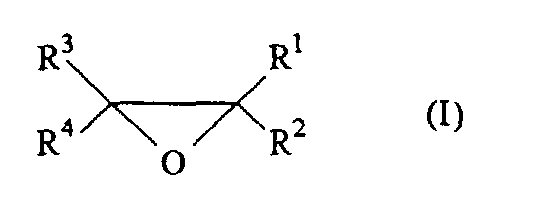
- alkylene oxides are those expressed by the earlier given general formula (I), examples of which including those containing 2 to 4 carbon atoms such as ethylene oxide, propylene oxide, and the like.
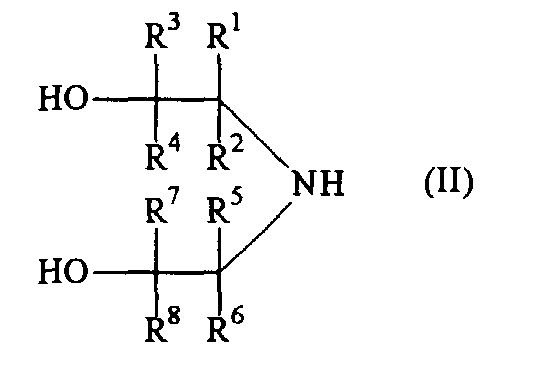
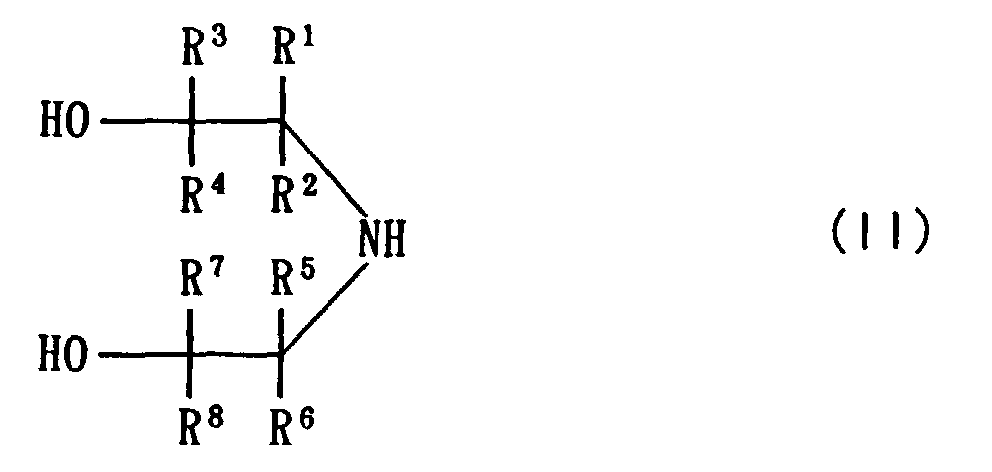
- alkanolamines of said general formula (II) are obtained.
- monoethanolamine, diethanolamine, triethanolamine, propanolamine and the like may be named.
- the reaction must be carried out at liquid phase, and hence it is generally necessary to maintain the reaction pressure at a level higher than the vapor pressure of the reaction liquid at the highest temperature inside the reactor.
- the alkylene oxide concentration is excessively high to render removal of the reaction heat difficult, it is also possible to vaporize a part of the ammonia and remove the reaction heat with its latent heat of vaporization. In that case, it is preferred to maintain the reaction pressure at a level lower than the vapor pressure of the reaction liquid at the highest temperature inside the reaction system.
- alkanolamines can be carried out at temperatures in the range of 40-300°C.
- the preferred range is 80-200°C.
- Suitable operation pressure ranges 1-20 MPa.
- liquid's hourly space velocity is subject to no critical limitation, while normally that of at least 1 hr -1 is used.
- dialkanolamine When the process of this invention is adopted, it is possible to produce dialkanolamine at a high efficiency, without recycling the formed monoalkanolamine. Whereas, it is also possible to increase the dialkanolamine yield by recycling a part of the formed monoalkanolamine into the reactor, when alkylene oxide concentration at the entrance into the reactor is subject to restrictions, eg., in case the process is practiced by an adiabatic single stage reaction, or when a large quantity monoalkanolamine production is unnecessary.
- the amount to be recycled varies depending on the desired production amount of monoalkanolamine and the ammonia/alkylene oxide molar ratio in the starting material. Taking an example in diethanolamine production, preferably the quantity of monoethanolamine to be recycled, to the total ethanolamine quantity produced, is not more than 0.3R ⁇ 0.5 by weight, when R represents the mole number of ammonia per mole of ethylene oxide at the entrance into the reactor. When the recycled amount is more than the said limit, utility costs for the recycling notably increases or unnecessarily large size reactor is needed, which is undesirable.
- the terms LHSV, ethylene oxide conversion and diethanolamine selectivity are used with the following definitions. Furthermore, the formed reaction mixture contains nearly no product other than ethanolamines, and hence the ethylene oxide conversion (mole %) is approximately the same to the total yield (mole %) of (mono, di and tri) ethanolamines based on the starting ethylene oxide.
- LHSV [volume of liquid starting material (cm 3 /hr) passing through reactor per hour] [volume (cm 3 ) of catalyst in the reactor]
- Ethylene oxide conversion [mole number of ethylene oxide consumed for the reaction] [mole number of ethylene oxide supplied to the reactor] x 100 (mole %)
- Diethanolamine selectivity [weight of diethanolamine in product] [weight of total ethanolamines in the product] x 100
- catalyst A Ten (10) grams of the catalyst A was added to 100 cm 3 of 1 mole/dm 3 aqueous lanthanum nitrate solution under stirring. Stirring was continued for a day at room temperature, followed by filtration. The residual solid was washed with 500 cm 3 of pure water. The resulting cake was dried for a day at 100°C, and pulverized to particle sizes of 0.1-0.2 mm to be used as the catalyst. This is referred to as catalyst B.
- Example 1 was repeated except that the catalyst A was replaced with the catalysts B and C which were obtained in Referential Examples 2 and 3, respectively.
- the reaction conditions and the results of the analysis were as indicated in Table 1.
- the product distribution at the exit of the reactor in this Example was: monoethanolamine 51.7 wt%, diethanolamine 44.4 wt% and triethanolamine 3.9 wt%.
- the monoethanolamine at the reactor exit was not recovered as a product as it was, but a part of which was recycled.
- the product distribution after the recycled portion was compensated was: monoethanolamine 13.0 wt%, diethanolamine 80.0 wt% and triethanolamine 7.0%. The recycling thus enabled very high diethanolamine yield.
- the amount of the recycled monoethanolamine to the formed ethanolamines was 80% by weight.
- catalyst X To 100 g of this catalyst powder, an equal amount of pure water was added once again, kneaded with a kneader and dried for a day at 100°C. Then the dried catalyst was given a high temperature treatment at 500 °C, for 5 hours while gassing with air. The resultant solid was pulverized to a particle size 0.1-0.2 mm, to serve as the catalyst which carried 14 wt% of lanthanum. This catalyst is referred to as catalyst X.
- Example 1 was repeated except that catalyst A was replaced with this catalyst X.
- the reaction conditions and the results were as indicated in Table 2.
- This catalyst X exhibited a high ⁇ value and was found to be suitable for monoethanolamine production, but was apt to form triethanolamine because of its high ⁇ value.
- Example 1 was repeated except that the catalyst A was replaced with DOWX-50W (50-100 mesh).
- the reaction conditions and the results were as indicated in Table 2. It can be understood from the data in Table 2 that this catalyst exhibited poor selectivity both for monoethanolamine and diethanolamine, because its ⁇ -value was not unordinarily large but its ⁇ -value was high.
- Example 1 was repeated except that the catalyst A was replaced with stabilized Y-form zeolite (abbreviated name: USY; Toso Kabushiki Kaisha, HSZ-350 HUA; pore size ⁇ 0.8 nm, having large inside cavities).
- the reaction conditions and the results were as indicated in Table 2. It can be understood from the given data that this catalyst tended strongly to produce triethanolamine because of its high ⁇ -value.
- Example 1 was repeated except that the catalyst A was replaced with Molecular Sieve 3A. Because the pore size of Molecular Sieve 3A was extremely small as about 0.3 nm, it exhibited very low reaction activity and even under such conditions as the oil bath temperature of 150°C, LHSV of 2-9 hr -1 and NH 3 /EO molar ratio of 14.3, still the conversion did not exceed 71%.
- catalyst Y Into a solution formed by dissolving 51 g of phosphorus wolframate-29-hydrate in 100 cm 3 of water, 10 g of 50-100 mesh silica gel was thrown, and was evaporated to dryness on a hot water bath under stirring. Thus recovered solid was dried at 120°C for 10 hours, followed by 2 hours' sintering at 300°C.
- This catalyst is referred to as catalyst Y.
- Example 1 was repeated except that the catalyst A was replaced with catalyst Y.
- the reaction conditions and the results were as indicated in Table 2. It can be understood that the monoethanolamine selectivity of this catalyst was poor even under a large excess of NH 3 , because of its low ⁇ -value; and also because of its large ⁇ -value, it strongly tended to form triethanolamine. Comparative Example No. Catalyst ⁇ ⁇ molar ratio NH 3 /EO LHSV hr -1 Oil bath temp.
- dialkanolamine production through amination of alkylene oxide with ammonia side-formation of trialkanolamine can be inhibited and dialkanolamine can be produced at high selectivity and high efficiency. Because of the high selectivity for dialkanolamine formation, the molar ratio of ammonia to alkylene oxide can be reduced compared with those in conventional methods.
- the invention achieves equivalent production ratios of alkanolamines without recycling the formed monoalkanolamine into the reaction system, the recovery cost of unreacted ammonia can be reduced and, at the same time, the total amount of the starting supply decreases. This enables reduction in sizes of the apparatuses in the reaction system as well as the recovery system, leading to reduced plant and equipment costs. The merits of the present invention are thus very substantial.
Landscapes
- Chemical & Material Sciences (AREA)
- Organic Chemistry (AREA)
- Chemical Kinetics & Catalysis (AREA)
- Organic Low-Molecular-Weight Compounds And Preparation Thereof (AREA)
- Low-Molecular Organic Synthesis Reactions Using Catalysts (AREA)
- Catalysts (AREA)
Abstract
which process comprises reacting an alkylene oxide of formula (I):
with ammonia in the liquid phase, in the presence of a catalyst and is carried out under conditions such that:
Description
through a reaction of an alkylene oxide represented by the general formula (I) below:

with ammonia at liquid phase, in the presence of a catalyst, carrying out said reaction under the conditions such that

| Example No. | Catalyst | α | β | molar ratio NH3/EO | LHSV hr-1 | Oil bath temp. °C | Product Distribution (wt.%) | ||
| 1 | A | 0.167 | 0.35 | 5.9 | 10.5 | 110 | 54.4 | 39.7 | 5.8 |
| 2 | B | 0.125 | 0.22 | 7.9 | 11.5 | 100 | 55.2 | 41.1 | 3.7 |
| 4.0 | 8.1 | 95 | 37.7 | 53.1 | 9.2 | ||||
| 3 | C | 0.155 | 0.21 | 4.1 | 7.0 | 95 | 43.3 | 50.0 | 6.7 |
| 7.8 | 10.5 | 100 | 59.8 | 37.5 | 2.7 |
| Comparative Example No. | Catalyst | α | β | molar ratio NH3/EO | LHSV hr-1 | Oil bath temp. °C | Product Distribution (wt.%) | ||
| 1 | X | 0.323 | 1.06 | 10.2 | 10.3 | 95 | 79.5 | 17.8 | 2.6 |
| 2 | 4.1 | 7.0 | 90 | 59.5 | 29.5 | 11.0 | |||
| 3 | DOW X50W | 0.18 | 0.98 | 11.0 | 10.8 | 95 | 70.1 | 24.6 | 5.3 |
| 4 | 4.0 | 6.1 | 85 | 45.6 | 34.7 | 19.7 | |||
| 5 | USY | 0.125 | 1.44 | 15.1 | 10.9 | 130 | 69.0 | 21.9 | 9.1 |
| 6 | 8.1 | 8.9 | 120 | 54.6 | 26.0 | 19.5 | |||
| 8 | Y | 0.0901 | 1.47 | 15.0 | 10.1 | 111 | 62.0 | 26.1 | 11.9 |
Claims (8)
- A process for producing a dialkanolamine of formula (II):wherein R1, R2, R3, R4, R5, R6, R7 and R8 each independently represent a hydrogen atom, a methyl group or an ethyl group;
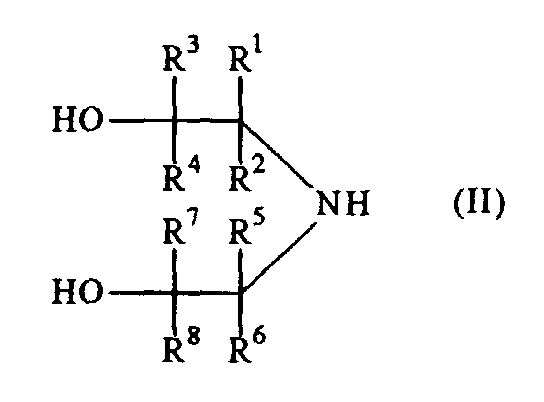
which process comprises reacting an alkylene oxide of formula (I):wherein R1, R2, R3 and R4 each independently represent a hydrogen atom, a methyl group or an ethyl group
with ammonia in the liquid phase, in the presence of a catalyst and is carried out under conditions such that:(i) the rate constant α of the reaction between ammonia and the alkylene oxide is at least 0.10, when the rate constant between an monoalkanolamine intermediate and said alkylene oxide is 1; and(ii) the rate constant β of the reaction between said dialkanolamine and said alkylene oxide is not more than 0.7, when the rate constant between said monoalkanolamine and said alkylene oxide is 1. - A process according to claim 1 , wherein the mole number of the ammonia is from 2β/α0.3 to 1/(1.5αβ0.5), per mole of said alkylene oxide.
- A process according to claim 1 or 2, wherein the catalyst is a microporous material having an effective pore size of from 0.45 nm to 0.8 nm.
- A process according to any one of the preceding claims, wherein the catalyst is a metallosilicate which has been ion-exchanged with a rare earth element.
- A process according to any one of the preceding claims, wherein the outer surfaces of the primary particles of the catalyst have been deactivated.
- A process according to any one of the preceding claims wherein α is from 0.10 to 0.30, and β is not more than 0.25.
- A process according to any one of the preceding claims wherein at least part of said monoalkanolamine is recycled into the starting material system.
- A process according to claim 7, wherein the ratio of the amount of the monoalkanolamine which is recycled to the amount of the total amount of alkanolamine formed is not more than 0.3Rβ0.5:1
wherein R is the mole number of ammonia per mole of said alkylene oxide.
Applications Claiming Priority (2)
| Application Number | Priority Date | Filing Date | Title |
|---|---|---|---|
| JP6313198 | 1998-03-13 | ||
| JP6313198 | 1998-03-13 |
Publications (3)
| Publication Number | Publication Date |
|---|---|
| EP0941986A2 true EP0941986A2 (en) | 1999-09-15 |
| EP0941986A3 EP0941986A3 (en) | 2000-01-12 |
| EP0941986B1 EP0941986B1 (en) | 2003-10-22 |
Family
ID=13220420
Family Applications (1)
| Application Number | Title | Priority Date | Filing Date |
|---|---|---|---|
| EP99301920A Expired - Lifetime EP0941986B1 (en) | 1998-03-13 | 1999-03-12 | A process for producing dialkanolamines |
Country Status (5)
| Country | Link |
|---|---|
| US (1) | US6169207B1 (en) |
| EP (1) | EP0941986B1 (en) |
| JP (1) | JP3154984B2 (en) |
| DE (1) | DE69912174T2 (en) |
| MY (1) | MY116319A (en) |
Cited By (6)
| Publication number | Priority date | Publication date | Assignee | Title |
|---|---|---|---|---|
| WO2001094290A1 (en) | 2000-06-09 | 2001-12-13 | Basf Aktiengesellschaft | Method for producing alkanolamines |
| EP1219592A1 (en) * | 2000-12-19 | 2002-07-03 | Nippon Shokubai Co., Ltd. | Method for production of alkanolamine and apparatus therefor |
| US6559342B1 (en) | 1999-11-26 | 2003-05-06 | Nippon Shokubai Co., Ltd. | Method of producing alkanolamines and apparatus for producing same |
| US6566556B2 (en) * | 2000-12-19 | 2003-05-20 | Nippon Shokubai Co., Ltd. | Method for production of alkanolamine and apparatus therefor |
| CN105085283B (en) * | 2014-05-14 | 2017-07-14 | 中国石油化工股份有限公司 | The method for producing triethanolamine |
| WO2019229156A1 (en) * | 2018-05-30 | 2019-12-05 | Basf Se | Zeolite catalyzed process for the amination of alkylene oxides |
Families Citing this family (15)
| Publication number | Priority date | Publication date | Assignee | Title |
|---|---|---|---|---|
| RU2176636C2 (en) * | 1999-11-19 | 2001-12-10 | Кемеровское открытое акционерное общество "Химпром" | Method of preparing triethanol amine |
| TWI303242B (en) * | 2003-02-03 | 2008-11-21 | Nippon Catalytic Chem Ind | Process for producing high purity trialkanolamine |
| DE102004029544A1 (en) * | 2004-06-18 | 2006-01-05 | Basf Ag | Shaped body containing a microporous material and at least one silicon-containing binder, process for its preparation and its use as catalyst, in particular in a process for the preparation of triethylenediamine (TEDA) |
| US7329720B2 (en) * | 2005-11-29 | 2008-02-12 | General Electric Company | Methods for increasing the mean particle size of 2-hydrocarbyl-3,3-bis(hydroxyaryl)phthalimidines |
| US7579498B2 (en) | 2005-11-29 | 2009-08-25 | E. I. Du Pont De Nemours And Company | Process for preparing fluorinated alkyl carboxylate esters |
| JP5774991B2 (en) | 2008-10-06 | 2015-09-09 | ユニオン カーバイド ケミカルズ アンド プラスティックス テクノロジー エルエルシー | Selective process for the production of diethylenetriamine (DETA) or other desirable ethyleneamines by continuous transamination of ethylenediamine (EDA) and other ethyleneamines over heterogeneous catalyst systems |
| CN102239134B (en) * | 2008-10-06 | 2014-04-16 | 陶氏环球技术有限责任公司 | Process for producing ethanolamines and ethyleneamines from ethylene oxide and ammonia and related processes |
| US8293676B2 (en) | 2008-10-06 | 2012-10-23 | Union Carbide Chemicals & Plastics Technology Llc | Low metal loaded, alumina supported, catalyst compositions and amination process |
| CN102224129B (en) * | 2008-10-06 | 2015-02-11 | 联合碳化化学品及塑料技术公司 | Method of manufacturing ethyleneamines |
| CN102227414B (en) | 2008-10-06 | 2016-05-18 | 联合碳化化学品及塑料技术公司 | Prepare the method for cyclic n nitroso compound-aminofunctional triamine |
| JP5480276B2 (en) | 2008-10-06 | 2014-04-23 | ユニオン カーバイド ケミカルズ アンド プラスティックス テクノロジー エルエルシー | Low metal (nickel and rhenium) catalyst composition comprising acidic mixed metal oxide as support |
| JP5806116B2 (en) * | 2008-10-06 | 2015-11-10 | ユニオン カーバイド ケミカルズ アンド プラスティックス テクノロジー エルエルシー | Transalkoxylation of nucleophilic compounds |
| CN105745251B (en) | 2013-12-02 | 2019-04-23 | 陶氏环球技术有限责任公司 | Preparation of high molecular weight, branched, acyclic polyalkylene amines and mixtures thereof |
| CN110590572B (en) * | 2018-06-12 | 2021-11-30 | 中国石油化工股份有限公司 | Method for producing monoethanolamine and diethanolamine |
| WO2020028262A1 (en) * | 2018-08-02 | 2020-02-06 | Archer Daniels Midland Company | Processes and cataylsts for producing diethanolamine from glycolaldehyde |
Family Cites Families (8)
| Publication number | Priority date | Publication date | Assignee | Title |
|---|---|---|---|---|
| DE298636C (en) | ||||
| US3697598A (en) | 1968-08-20 | 1972-10-10 | Mo Och Ab | Continuous process for preparing monoalkanolamines from ammonia and alkylene oxides |
| JPS4947728A (en) | 1972-09-14 | 1974-05-09 | ||
| US4438281A (en) * | 1983-01-24 | 1984-03-20 | Texaco Inc. | Selective production of monoalkanolamines from alkylene oxides and ammonia over acidic inorganic catalysts |
| US4939301A (en) | 1988-12-23 | 1990-07-03 | Texaco Chemical Company | Production of ethanolamine by amination of ethylene oxide over acid activated clays |
| JP2771465B2 (en) | 1993-11-02 | 1998-07-02 | 株式会社日本触媒 | Process for producing alkanolamine and catalyst used therein |
| DE69409463T2 (en) * | 1993-11-02 | 1998-07-30 | Nippon Catalytic Chem Ind | Process for the preparation of alkanolamine, catalyst for this process and process for the preparation of the catalyst |
| US5633408A (en) * | 1994-06-28 | 1997-05-27 | Mitsui Toatsu Chemicals, Inc. | Process for preparing alkanolamines |
-
1999
- 1999-03-11 JP JP06500199A patent/JP3154984B2/en not_active Expired - Fee Related
- 1999-03-12 MY MYPI99000912A patent/MY116319A/en unknown
- 1999-03-12 EP EP99301920A patent/EP0941986B1/en not_active Expired - Lifetime
- 1999-03-12 DE DE69912174T patent/DE69912174T2/en not_active Expired - Lifetime
- 1999-03-12 US US09/266,785 patent/US6169207B1/en not_active Expired - Lifetime
Cited By (8)
| Publication number | Priority date | Publication date | Assignee | Title |
|---|---|---|---|---|
| US6559342B1 (en) | 1999-11-26 | 2003-05-06 | Nippon Shokubai Co., Ltd. | Method of producing alkanolamines and apparatus for producing same |
| WO2001094290A1 (en) | 2000-06-09 | 2001-12-13 | Basf Aktiengesellschaft | Method for producing alkanolamines |
| US7119231B2 (en) | 2000-06-09 | 2006-10-10 | Basf Aktiengesellschaft | Method for producing alkanolamines |
| EP1219592A1 (en) * | 2000-12-19 | 2002-07-03 | Nippon Shokubai Co., Ltd. | Method for production of alkanolamine and apparatus therefor |
| US6566556B2 (en) * | 2000-12-19 | 2003-05-20 | Nippon Shokubai Co., Ltd. | Method for production of alkanolamine and apparatus therefor |
| MY119894A (en) * | 2000-12-19 | 2005-07-29 | Nippon Catalytic Chem Ind | Method for production of alkanolamine and apparatus therefor |
| CN105085283B (en) * | 2014-05-14 | 2017-07-14 | 中国石油化工股份有限公司 | The method for producing triethanolamine |
| WO2019229156A1 (en) * | 2018-05-30 | 2019-12-05 | Basf Se | Zeolite catalyzed process for the amination of alkylene oxides |
Also Published As
| Publication number | Publication date |
|---|---|
| EP0941986B1 (en) | 2003-10-22 |
| US6169207B1 (en) | 2001-01-02 |
| DE69912174T2 (en) | 2004-07-29 |
| JP3154984B2 (en) | 2001-04-09 |
| EP0941986A3 (en) | 2000-01-12 |
| MY116319A (en) | 2003-12-31 |
| DE69912174D1 (en) | 2003-11-27 |
| JPH11322681A (en) | 1999-11-24 |
Similar Documents
| Publication | Publication Date | Title |
|---|---|---|
| EP0941986B1 (en) | A process for producing dialkanolamines | |
| EP0652207B1 (en) | Process for preparation of alkanolamine, catalyst used in the process and process for preparation of the catalyst | |
| US6559342B1 (en) | Method of producing alkanolamines and apparatus for producing same | |
| JP3805152B2 (en) | Method for producing alkanolamine and apparatus for producing the same | |
| JP2014193852A (en) | Method for separating alkylethyleneamine or alkylethylenediamine | |
| JPH02225446A (en) | Preparation of alkanolamines by amination of alkylene oxides on acid-activated clay | |
| CN112537778A (en) | Preparation method and application of mordenite with high silica-alumina ratio | |
| JP4294347B2 (en) | Mono-lower alkyl monoalkanolamine production catalyst, mono-lower alkyl monoalkanolamine production method, and mono-lower alkyl monoalkanolamine production apparatus | |
| JP3442348B2 (en) | Binderless crystalline aluminosilicate molded body, method for producing the same and use thereof | |
| EP0324267B1 (en) | Process for the production of alkylamines | |
| US6566556B2 (en) | Method for production of alkanolamine and apparatus therefor | |
| JP2793485B2 (en) | Process for producing alkanolamine, catalyst used therefor, and process for preparing catalyst | |
| JPH0733718A (en) | Production of alkanolamine by amination of alkylene oxide | |
| JPH0113701B2 (en) | ||
| JP2002249470A (en) | Method and apparatus for producing alkanolamine | |
| EP1219592A1 (en) | Method for production of alkanolamine and apparatus therefor | |
| JPS638358A (en) | Improved Zeolite Thorough and ZK-5 Catalyst for Conversion of Methanol and Ammonia to Dimethylamine | |
| JP3830329B2 (en) | Method for regenerating catalyst for alkanolamine production | |
| JP2896787B2 (en) | Method for maintaining activity of zeolite catalyst | |
| JP2771465B2 (en) | Process for producing alkanolamine and catalyst used therein | |
| EP1516868A1 (en) | Process for the preparation of dimethylamine | |
| JP2001321673A (en) | Molded microporous material catalyst for dialkanolamine production | |
| JPH0859566A (en) | Method for producing methylamines | |
| JP2002028492A (en) | Method for producing dialkanolamine, catalyst for producing dialkanolamine and method for producing the same | |
| JP2004285005A (en) | Method for producing amine compound |
Legal Events
| Date | Code | Title | Description |
|---|---|---|---|
| PUAI | Public reference made under article 153(3) epc to a published international application that has entered the european phase |
Free format text: ORIGINAL CODE: 0009012 |
|
| AK | Designated contracting states |
Kind code of ref document: A2 Designated state(s): DE FR GB SE |
|
| AX | Request for extension of the european patent |
Free format text: AL;LT;LV;MK;RO;SI |
|
| PUAL | Search report despatched |
Free format text: ORIGINAL CODE: 0009013 |
|
| AK | Designated contracting states |
Kind code of ref document: A3 Designated state(s): AT BE CH CY DE DK ES FI FR GB GR IE IT LI LU MC NL PT SE |
|
| AX | Request for extension of the european patent |
Free format text: AL;LT;LV;MK;RO;SI |
|
| 17P | Request for examination filed |
Effective date: 20000619 |
|
| AKX | Designation fees paid |
Free format text: DE FR GB SE |
|
| 17Q | First examination report despatched |
Effective date: 20010820 |
|
| GRAH | Despatch of communication of intention to grant a patent |
Free format text: ORIGINAL CODE: EPIDOS IGRA |
|
| GRAS | Grant fee paid |
Free format text: ORIGINAL CODE: EPIDOSNIGR3 |
|
| GRAA | (expected) grant |
Free format text: ORIGINAL CODE: 0009210 |
|
| AK | Designated contracting states |
Kind code of ref document: B1 Designated state(s): DE FR GB SE |
|
| REG | Reference to a national code |
Ref country code: GB Ref legal event code: FG4D |
|
| REF | Corresponds to: |
Ref document number: 69912174 Country of ref document: DE Date of ref document: 20031127 Kind code of ref document: P |
|
| REG | Reference to a national code |
Ref country code: SE Ref legal event code: TRGR |
|
| ET | Fr: translation filed | ||
| PLBE | No opposition filed within time limit |
Free format text: ORIGINAL CODE: 0009261 |
|
| STAA | Information on the status of an ep patent application or granted ep patent |
Free format text: STATUS: NO OPPOSITION FILED WITHIN TIME LIMIT |
|
| 26N | No opposition filed |
Effective date: 20040723 |
|
| PGFP | Annual fee paid to national office [announced via postgrant information from national office to epo] |
Ref country code: SE Payment date: 20130312 Year of fee payment: 15 Ref country code: GB Payment date: 20130306 Year of fee payment: 15 Ref country code: FR Payment date: 20130325 Year of fee payment: 15 |
|
| REG | Reference to a national code |
Ref country code: SE Ref legal event code: EUG |
|
| GBPC | Gb: european patent ceased through non-payment of renewal fee |
Effective date: 20140312 |
|
| PG25 | Lapsed in a contracting state [announced via postgrant information from national office to epo] |
Ref country code: SE Free format text: LAPSE BECAUSE OF NON-PAYMENT OF DUE FEES Effective date: 20140313 |
|
| REG | Reference to a national code |
Ref country code: FR Ref legal event code: ST Effective date: 20141128 |
|
| PG25 | Lapsed in a contracting state [announced via postgrant information from national office to epo] |
Ref country code: GB Free format text: LAPSE BECAUSE OF NON-PAYMENT OF DUE FEES Effective date: 20140312 Ref country code: FR Free format text: LAPSE BECAUSE OF NON-PAYMENT OF DUE FEES Effective date: 20140331 |
|
| PGFP | Annual fee paid to national office [announced via postgrant information from national office to epo] |
Ref country code: DE Payment date: 20150305 Year of fee payment: 17 |
|
| REG | Reference to a national code |
Ref country code: DE Ref legal event code: R119 Ref document number: 69912174 Country of ref document: DE |
|
| PG25 | Lapsed in a contracting state [announced via postgrant information from national office to epo] |
Ref country code: DE Free format text: LAPSE BECAUSE OF NON-PAYMENT OF DUE FEES Effective date: 20161001 |