Technical Field
The present invention relates to a high aromatic oil
preferably used for various rubber products, such as
tires, rubber vibration insulators and fenders, printing
inks and writing inks, and a rubber composition and an
oil extended synthetic rubber using this high aromatic
oil, specifically to such an improved high aromatic oil
that the product performances thereof are compatible with
an environment, and a rubber composition and an oil
extended synthetic rubber using said high aromatic oil.
Background Art
In general, paraffinic and naphthenic oils and high
aromatic oils have so far been used as a softening agent
for a rubber composition and as an extender oil for a
synthetic rubber, and they have been used properly
depending on the uses thereof. In particular, high
aromatic oils have preferably been used as a softening
agent for a rubber composition and as an extender oil for
a synthetic rubber because of the following reasons (1)
to (4):
It has been advised, however, in PROPOSITION-65
enforcement in 1988 and a series of EU instructions
started in 1989 that the high aromatic oils have a
possibility to be a carcinogen because of polycyclic
aromatic compounds [hereinafter, called a DMSO extract or
PCA (polynuclear aromatics)] contained as components in
the high aromatic oils, and therefore a high aromatic oil
having no problem from the viewpoint of safety and
hygiene as well as the characteristics (1) to (4)
described above has been desired.
Following the series of regulations described above,
in particular, the EU instructions, several proposals
have so far been made from the viewpoint of a rubber
composition. At present, however, any high aromatic oils
which satisfy the three required characteristics
described above and concurrently are adequate from the
safety and hygiene point of view have not yet been
proposed, much less rubber compositions or oil extended
synthetic rubbers using said high aromatic oil.
A synthetic rubber obtained by using, as an aromatic
monomer, a high aromatic lubricant which has a viscosity
of 32 to 50 cst and which contains an aromatic component
of 30 to less than 55 % by weight and a saturated
hydrocarbon component of 40 to 65 % by weight, both of
which are measured by Clay-Gel method (ASTM D 2007), and
a polycyclic aromatic compound (PCA) of less than 3 %
measured according to IP (The Institute of Petroleum) 346
method (PCA standard test), in particular, a rubber
composition obtained by using the above lubricant for SBR
in a proportion of 10 to 25 % by weight based on the
whole weight of the rubber composition has been proposed
in, for example, Japanese Patent Application Disclosure
No. Hei 6-505524 [British Patent (GB) 2252978, US Patent
(US) 5504135 and European Patent (EP) 575400].
The viscosity of the high aromatic oil, however,
does not have a relation to the characteristic of
providing either the high loss performance or the
affinity with rubber among the characteristics required
to the performances of the high aromatic oils described
above and is not univocally related as well to the
softening characteristic. In addition, there is the
problem that the high aromatic oil can not stand the use
as an alternative for conventional high aromatic oils,
because the aromatic component falling within the above
range, measured by the Clay-Gel method, does not provide
the sufficiently high loss performance and the saturated
hydrocarbon component falling within the above range does
not provide as well the sufficient affinity with rubber.
Further, a method for solving a inferior high loss
performance of a high aromatic oil containing less
polycyclic aromatic compound (PCA) by making use of an
cumaron-indene resin is proposed in West Germany Patent
(DE) 3938620 [European Patent (EP) 429761, US Patent (US)
5091007 and East Germany Patent (DD) 299193]. This
method, however, has problems that the profitability is
very bad and that the affinity with rubber is low since
the amount of an aromatic component contained in the oil
used is as small as 0 to 30 % by weight, and therefore
the practicability is poor.
Thus, conventional methods are in a state that
performances, profitability and safety and hygiene can
not stand together, and therefore the development of a
novel high aromatic oil satisfying all of performances,
profitability and safety and hygiene has strongly been
desired.
Disclosure of the Invention
Outline of the invention:
An object of the present invention is to provide an
improved high aromatic oil used for various rubber
products such as tires, rubber vibration insulators and
fenders, printing inks and writing inks, which gives a
rubber composition containing the high aromatic oil the
conventional levels of performances required to a rubber
composition and contains polycyclic aromatic compounds
(PCA) of less than 3 % measured by the IP 346 method
based on the EU instructions, and which provides a rubber
composition at low cost, and to provide a rubber
composition and an oil extended synthetic rubber each
using the high aromatic oil.
Taking such circumstances into consideration, the
present inventor has intensively investigated what high
aromatic oil containing polycyclic aromatic compounds
(PCA) of less than 3 % measured by the IP 346 method, has
the same performances as those of a conventional high
aromatic oil and is obtainable within the industrially
reasonable range. Finally, he has found that only a high
aromatic oil having a glass transition point and an
aromatic component measured by the Clay-Gel method both
falling within the restricted ranges can allow the
intended performances, the profitability and the safety
and hygiene to stand together, and thus have come to
complete the present invention.
That is, the present invention resides in the
following (1) to (6):
Brief Description of the Drawings
Fig. 1 is a flow chart showing a production process
of a refining method (procedure) for a high aromatic oil
of the present invention.
Fig. 2 is a characteristic diagram showing a
relation of a glass transition point (Tg) with a low
temperature characteristic of a high aromatic oil.
Fig. 3 is a characteristic diagram showing a
relation of a glass transition point (Tg) with a loss
characteristic of a high aromatic oil.
Fig. 4 is a characteristic diagram showing a
relation of an aromatic component with a low temperature
characteristic of a high aromatic oil.
Fig. 5 is a characteristic diagram showing a
relation of an aromatic component with a loss
characteristic of a high aromatic oil.
Fig. 6 is a characteristic diagram showing a
relation of an aniline point with a rupture
characteristic of a high aromatic oil.
Fig. 7 is a characteristic diagram showing a
relation of a saturated component with a rupture
characteristic of a high aromatic oil.
Best Mode for Carrying Out the Invention
Best mode of the high aromatic oil;
The improved high aromatic oil of the present
invention is characterized by that the glass transition
point is -45 to -20°C and the aromatic component measured
by the Clay-Gel method accounts for 55 to 90 % by weight
and that the polycyclic aromatic compound measured by the
IP 346 method accounts for less than 3 % by weight based
on the whole components of hydrocarbons contained in the
oil.
In the present invention, the DMSO extract measured
by the IP 346 method has to account for less than 3 % by
weight, preferably 0.5 to 3.0 % by weight based on the
whole weight of a sample used for the test.
The DMSO extract of 3.0 % by weight or more is
contrary to the EU instructions because of a risk for a
carcinogen and therefore is not preferred.
Further, the glass transition point of the high
aromatic oil measureed by DSC has to be -45 to -20°C,
preferably -42 to -25°C and more preferably -40 to -28°C.
The glass transition point of less than -45°C does
not provide with a characteristic to give a sufficiently
high loss performance to the rubber composition and
concurrently changes the elasticity of the rubber
composition to a large extent. Accordingly, it is not
preferred. Further, the glass transition point exceeding
-20°C can not maintain the excellent low temperature
characteristic of a rubber composition and therefore is
not preferred.
Further, the aromatic component of the high aromatic
oil of the present invention measured by the Clay-Gel
method has to account for 55 to 90 % by weight,
preferably 60 to 85 % by weight and more preferably 65 to
80 % by weight.
The aromatic component accounting for less than 55 %
by weight does not provide a high aromatic oil with a
characteristic to give a sufficiently high loss
performance to the rubber composition and concurrently
does not give a sufficiently good rupture characteristic
to the rubber composition. Meanwhile, the aromatic
component exceeding 90 % by weight makes it markedly
difficult to maintain the polycyclic aromatic compounds
(PCA) measured by the IP 346 method at less than 3 %, and
as a result, the profitability at a refining step for the
high aromatic oil is notably decreased. Accordingly,
both are not preferred.
In the case of the improved high aromatic oil of the
present invention, the aniline point is preferably 97 or
less, further preferably 90 or less. It falls more
preferably within the range of 10 to 85, particularly
preferably 15 to 75.
The aniline point exceeding 97 deteriorates the
affinity of the high aromatic oil with a rubber component
contained in the rubber composition and results in being
liable to cause oil bleed. Accordingly, it is not
preferred. Meanwhile, the aniline point of less than 15
makes it difficult to maintain the polycyclic aromatic
compounds (PCA) measured by the IP 346 method at less
than 3 %, and as a result, the profitability at a
refining step for the high aromatic oil is decreased.
Further, the saturated hydrocarbon component
measured by the Clay-Gel method accounts for 40 % by
weight or less, preferably 35 % by weight or less and
more preferably 25 % by weight or less.
The saturated hydrocarbon component exceeding 40 %
by weight deteriorates the affinity of the high aromatic
oil with the rubber component contained in the rubber
composition and results in being liable to cause oil
bleed. Accordingly, it is not preferred.
In addition to the characteristics described above,
the high aromatic oil of the present invention further
preferably has the following characteristic so as to be
suitably used as a softening agent or an extender oil for
rubber.
That is, the high aromatic oil of the present
invention has preferably a kinetic viscosity of 70 cst or
less at 100 degree centigrade.
The kinetic viscosity exceeding 70 cst degrades the
workability when the high aromatic oil is used for a
rubber composition as a softening agent and for a
synthetic rubber, and concurrently does not provide a
sufficiently high softening performance as a softening
agent for a rubber composition. The kinetic viscosity
falls more preferably within the range of 10 to 32 cst
from the viewpoint of a softening performance.
For the high aromatic oil of the present invention,
the following various specific refining methods (1) to
(6) which have so far been proposed can be used as a
production process for embodying the properties and
compositions described above:
A method in which a tumor cancer-generating topped
light hydrocarbon oil having a boiling point falling
within the range of 250 to 780°F is blended with a non-tumor
cancer-generating vacuum distilled hydrocarbon oil,
disclosed in Japanese Patent Application Laid-open No.
Hei 6-41558 is proposed as a method of obtaining a non-carcinogenic
light lubricant for industries. It is,
however, substantially a light lubricant, and though the
above method is close to the refining method in the
present invention, it can not be applied for a high
aromatic lubricant as it is.
The high aromatic oil of the present invention can
be produced not only by the methods described in the
respective known literatures but also by methods
generally used for refining lubricants, that is, by
subjecting a fraction obtained by distilling naphthenic
and/or paraffinic crude oils at the atmospheric pressure
and at a reduced pressure to one of refining methods,
such as solvent extraction treatment, hydrogenation
treatment, dewaxing treatment and deasphalting treatment
or two or more kinds thereof suitably in combination, or
it can be produced as well by blending two or more oils
obtained by such methods.
The solvent extraction treatment described above
means an operation for separating a crude oil into a
raffinate having less aromatic content and an extract
having more aromatic content by using a solvent. Used as
the solvent are, for example, furfural, phenol, cresol,
sulfolane, N-methylpyrrolidone, dimethylsulfoxide,
formylmorpholine and glycolic solvents.
A separative power in the solvent extraction
treatment is varied depending on the solvent used, the
crude oil/solvent ratio and the reaction temperature
applied. Accordingly, PCA can selectively be separated
by suitably changing these conditions.
The hydrogenation treatment described above is an
oil refining process intended for decomposing sulfur,
nitrogen, oxygen and metal compounds contained in the
fraction in order to remove them and for reforming or
cracking hydrocarbons. Examples of the catalyst used for
the hydrogenation treatment include catalysts obtained by
using a metal such as Ni, W, Pt and Pd or a metal oxide
of Mo, Co, Ni or W as a metal component, and alumina,
silica, silica-alumina or zeolite as a carrier. Further,
the hydrogenation treatment is classified broadly into a
hydrogenation finishing treatment carried out under
relatively mild reaction conditions and hydrocracking
treatment carried out under severe conditions. Further,
it is possible to selectively crack only PCA by changing
the conditions of the hydrocracking treatment.
Further, the dewaxing treatment described above is
intended for removing a wax component contained in the
fraction, and an MEK dewaxing method and a propane
dewaxing method are known.
The deasphalting treatment described above is a
process for removing an asphalt component and a resinous
component particularly contained in a vacuum distillation
residual oil, and low molecular weight hydrocarbons
having 1 to 5 carbon atoms are used as a solvent.
Propane alone and a mixture of propane and butane are
used as an optimum solvent.
The high aromatic oil of the present invention can
be produced by suitably combining the methods described
in the respective known literatures described above with
the respective refining methods described above, and it
is a matter of course that the treating conditions have
to be settled so as to satisfy the respective properties
described above.
The solvent extraction treatment and hydrocracking
treatment described above can easily control the contents
of the aromatic components and PCA contained in the
fraction, and therefore they are preferably used for
producing the high aromatic oil of the present invention.
As described above, the high aromatic oil of the
present invention can be produced by using the respective
methods described above alone or in combination of a
plurality thereof, and the following processes (refining
methods) 1 to 13 are preferably used in order to satisfy
the performances, the profitability and safety and
hygienic requirement together.
Fig. 1 shows the following processes (refining
methods) 1 to 13 and the production processes of A to E,
and 1 to 13 and A to E in the drawing show the respective
processes (refining methods).
NT described in the following processes in Fig. 1
and in the tables means a product obtained by subjecting
a raffinate having a low aromatic content obtained by
subjecting a vacuum distillation distillate to solvent
extraction treatment to hydrogenation finishing treatment
and/or solvent dewaxing treatment, and includes a
paraffinic oil and a naphthenic oil.
Process 1:
NT is added to an extract having a high aromatic
content obtained by subjecting a vacuum distillation
distillate to solvent extraction treatment, and the
extract is then subjected, if necessary, to hydrocracking
treatment under the condition that only PCA is
selectively cracked.
Process 2:
NT is added to an extract having a high aromatic
content obtained by subjecting a vacuum distillation
distillate to solvent extraction treatment, and the
extract is then subjected, if necessary, to hydrogenation
finishing treatment under the condition that only PCA is
selectively cracked.
Process 3:
NT is added to an extract having a high aromatic
content obtained by subjecting a vacuum distillation
residual oil to deasphalting treatment and further to
solvent extraction treatment, and the extract is then
subjected, if necessary, to hydrogenation finishing
treatment under the condition that only PCA is
selectively cracked.
Process 4:
NT is added to an extract having a high aromatic
content obtained by subjecting a vacuum distillation
residual oil to deasphalting treatment and further to
solvent extraction treatment, and the extract is then
subjected, if necessary, to hydrocracking treatment under
the condition that only PCA is selectively cracked.
Process 5:
A vacuum distillation distillate is subjected to
solvent extraction treatment to obtain an extract having
a high aromatic content. The extract thus obtained is
then subjected to hydrocracking treatment under the
condition that PCA is selectively cracked.
Process 6:
A vacuum distillation distillate is subjected to
solvent extraction treatment to obtain an extract having
a high aromatic content. The extract thus obtained is
further subjected to solvent extraction treatment under
the condition that PCA is selectively cracked to obtain a
raffinate having a high aromatic content and a low PCA
content. The raffinate thus obtained is subjected to
hydrogenation finishing treatment, if necessary.
Process 7:
A vacuum distillation distillate is subjected to
hydrogenation dewaxing treatment. Subsequently, the oil
thus obtained is subjected to solvent extraction
treatment under the condition that PCA is selectively
separated to obtain a raffinate having a low PCA content.
Process 8:
A vacuum distillation distillate is subjected to
solvent extraction treatment under the condition that PCA
is selectively separated to obtain a raffinate having a
low PCA content. The raffinate thus obtained is
subjected to solvent dewaxing treatment and further to
hydrogenation finishing treatment.
Process 9:
An extract having a high aromatic content obtained
by subjecting a vacuum distillation residual oil to
deasphalting treatment and further to solvent extraction
treatment is subjected to hydrogenation finishing
treatment, if necessary.
Process 10:
A vacuum distillation residual oil is subjected to
deasphalting treatment and further to solvent extraction
treatment to obtain an extract having a high aromatic
content. The extract thus obtained is further subjected
to solvent extraction treatment under the condition that
PCA is selectively separated to obtain a raffinate having
a high aromatic content and a low PCA content. The
raffinate thus obtained is subjected to hydrogenation
finishing treatment, if necessary.
Process 11:
A vacuum distillation residual oil is subjected to
deasphalting treatment and further to hydrogenation
dewaxing treatment. Subsequently, the oil thus obtained
is subjected to solvent extraction treatment under the
condition that PCA is selectively separated to obtain a
raffinate having a low PCA content.
Process 12:
A vacuum distillation residual oil is subjected to
deasphalting treatment and further to solvent extraction
treatment under the condition that PCA is selectively
separated to obtain a raffinate having a low PCA content.
The raffinate thus obtained is subjected to solvent
dewaxing treatment and further, if necessary, to
hydrogenation finishing treatment.
Process 13:
A vacuum distillation residual oil is subjected to
deasphalting treatment and further to solvent extraction
treatment to obtain an extract having a high aromatic
content. The extract thus obtained is then subjected to
hydrocracking treatment under the condition that PCA is
selectively cracked.
Process A:
A vacuum distillation distillate is subjected, if
necessary, to dewaxing treatment and then to solvent
extraction treatment to obtain an extract having a high
aromatic content.
Process B:
A paraffinic or naphthenic fraction subjected to
hydrogenation finishing and/or dewaxing treatment is
added to an extract having a high aromatic content
obtained by subjecting a vacuum distillation distillate
to solvent extraction treatment.
Process C:
A vacuum distillation residual oil is subjected to
deasphalting treatment and further to solvent extraction
treatment to obtain an extract having a high aromatic
content. The extract thus obtained is then subjected to
hydrocracking treatment under the condition that PCA is
selectively cracked. Further, the cracked product is
treated with DMSO, and then subjected to solvent
extraction operation repeatedly three times while varying
the amount of furfural and the temperature condition.
Process D:
A vacuum distillation residual oil subjected to
deasphalting treatment is subjected to solvent extraction
and solvent dewaxing treatment.
Process E:
A vacuum distillation residual oil subjected to
deasphalting treatment is subjected to solvent extraction
and solvent dewaxing treatment.
Next, the rubber composition and the oil extended
synthetic rubber of the present invention are
characterized by using the high aromatic oil having the
characteristics and properties described above, and the
blend amounts and use amounts thereof are as follows.
There can be used as the synthetic rubber, for
example, styrene-butadiene copolymers (SBR),
polybutadiene (BR), polyisoprene (IR), polychloroprene
(CR), ethylene-propylene-diene ternary copolymers (EPDM),
acrylonitrile-butadiene rubber (NBR) and butyl rubber
(IIR).
If the proportion of the high aromatic oil having
the characteristics described above is less than 5 % by
weight based on the whole weight of the synthetic rubber,
the tackiness of the rubber is deteriorated, and it
becomes difficult to prepare a bale therefrom.
Meanwhile, if the proportion exceeds 50 % by weight,
adhesion between rubbers or between rubber and a press
becomes heavy, and it becomes difficult as well to
prepare a bale. Accordingly, both are not preferred.
A method of using the high aromatic oil for the
rubber composition may be either in the form of an oil as
it is or in the form of the high aromatic oil-extended
synthetic rubber. Further, the following compounds as
well as the high aromatic oil described above are blended
into the rubber composition of the present invention.
The rubber composition of the present invention is
obtained in the form of a mixture comprising components
(a) to (c) described above, the improved high aromatic
oil and optional components (d) to (g) described above.
Further, the rubber composition of the present invention
is used usually in the form of various rubber products by
heating.
EXAMPLES
The present invention shall be explained below in
further detail with reference to examples and comparative
examples but the present invention shall by no means be
restricted by these examples.
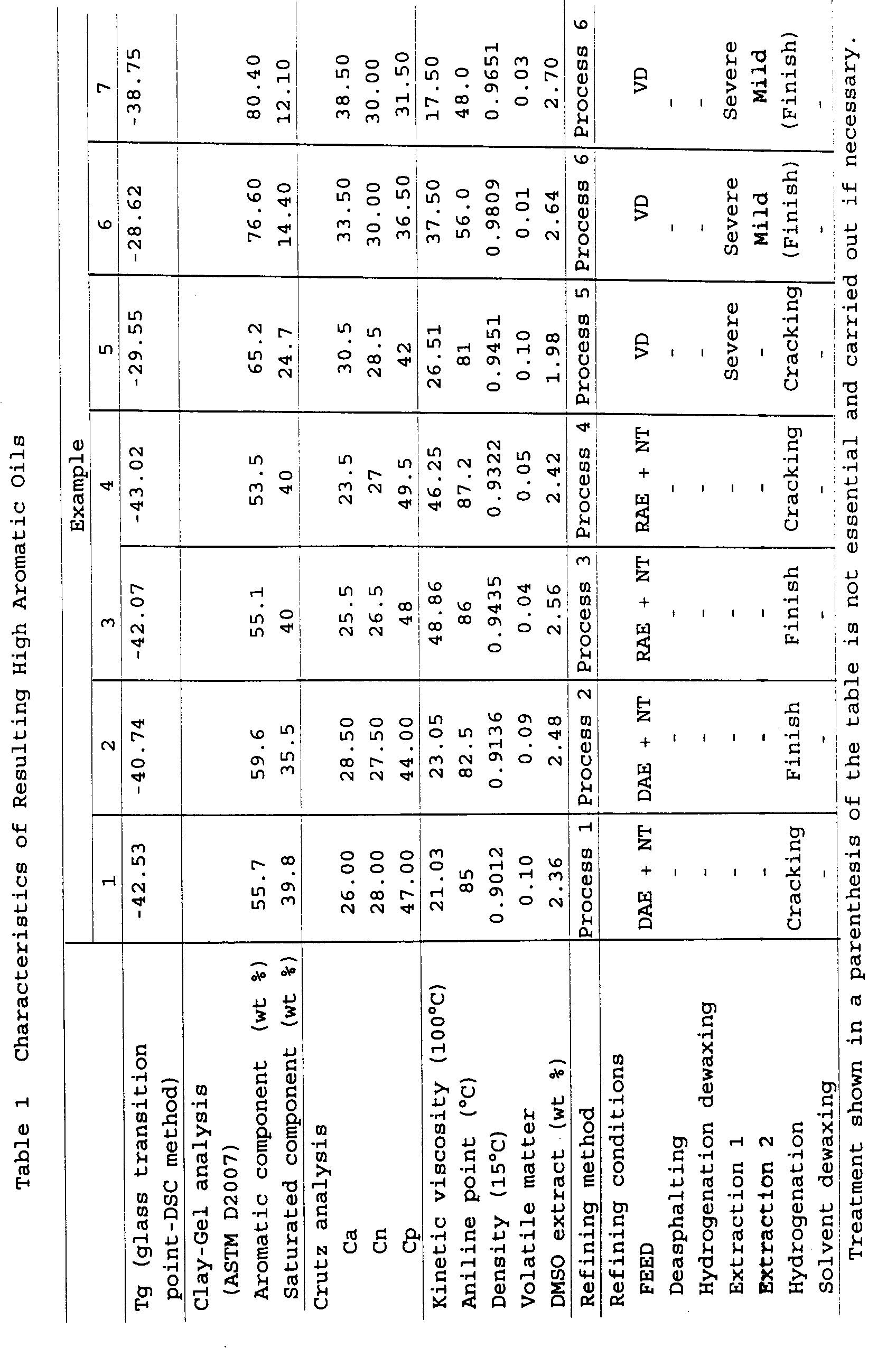
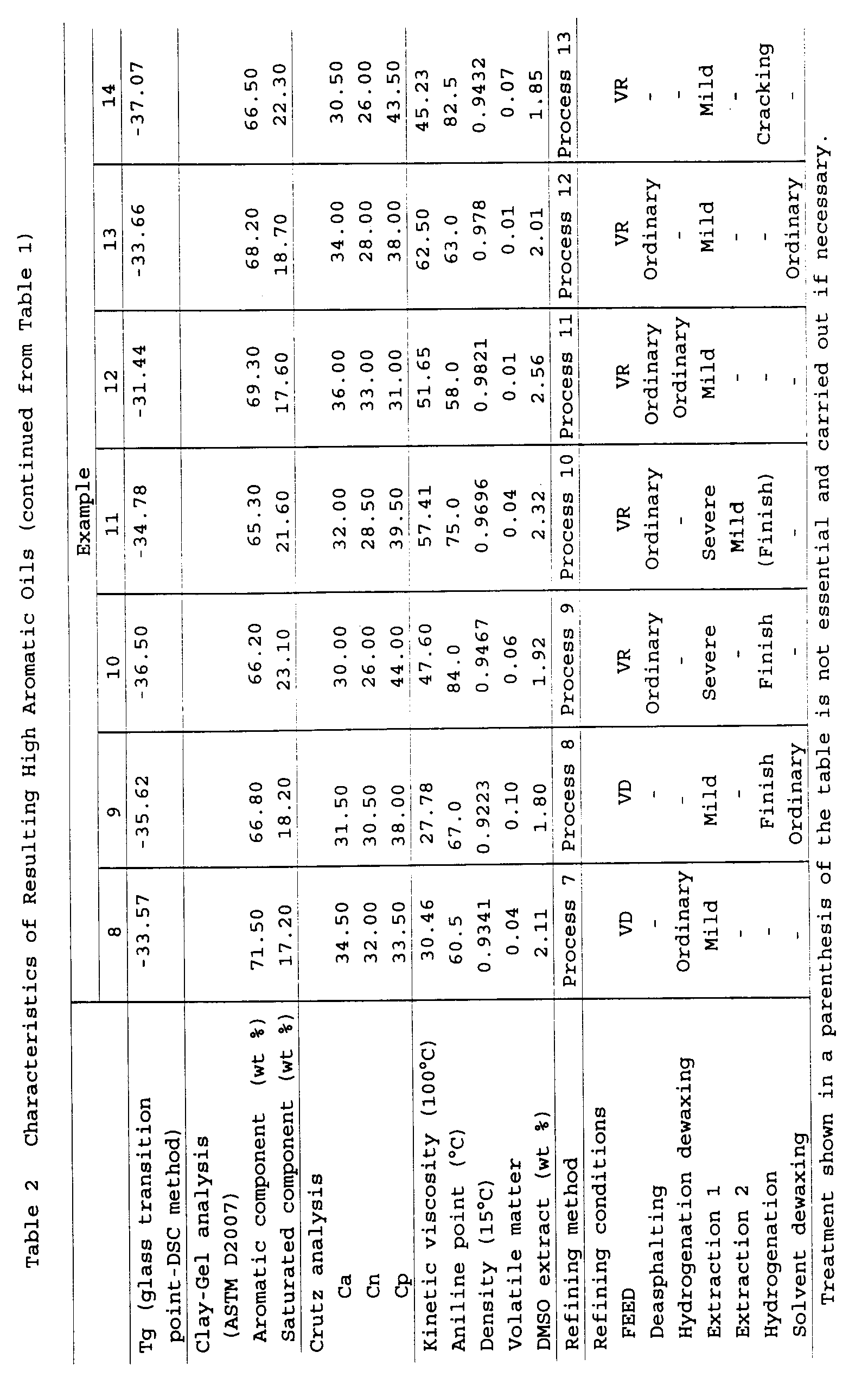
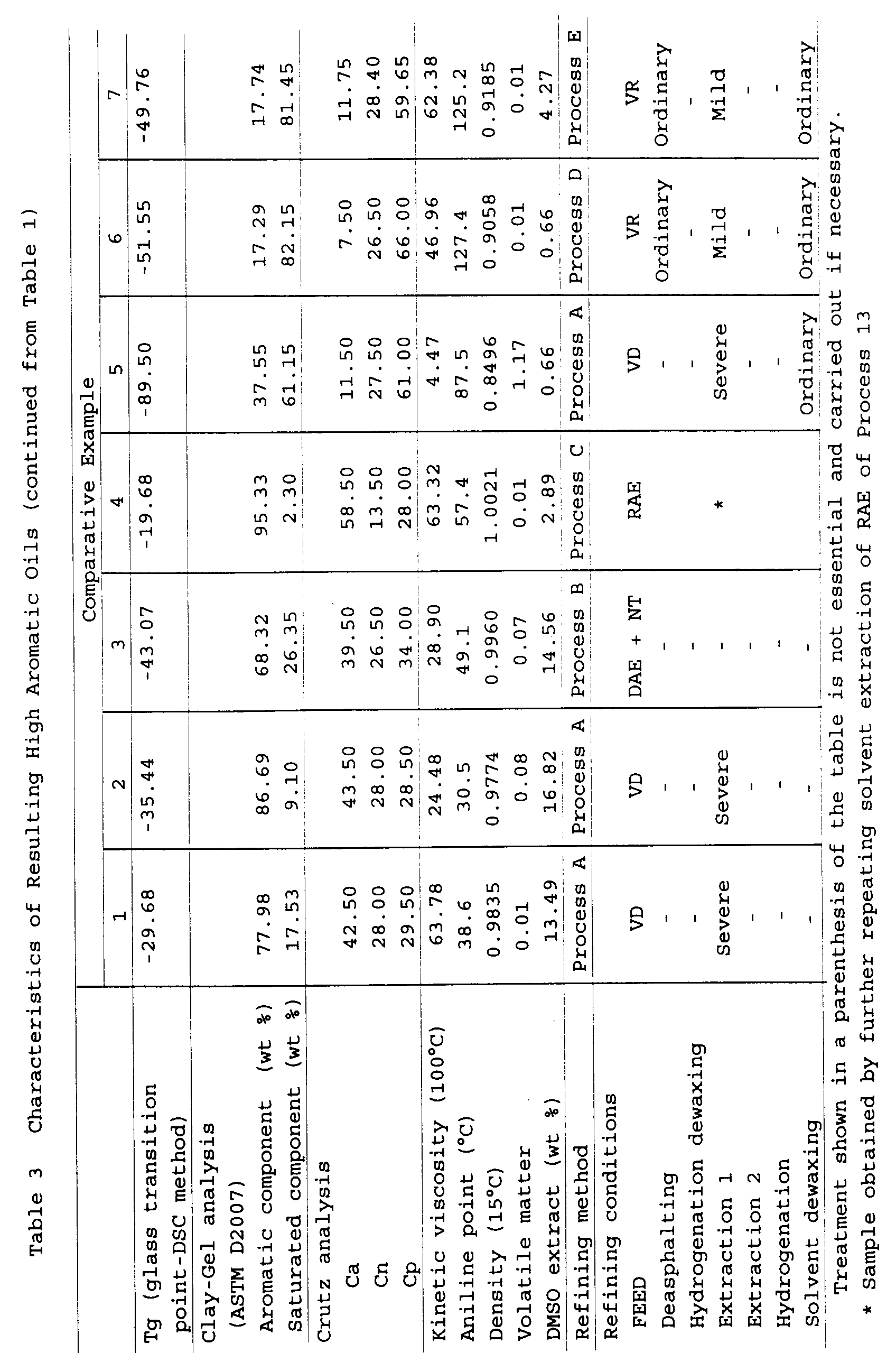
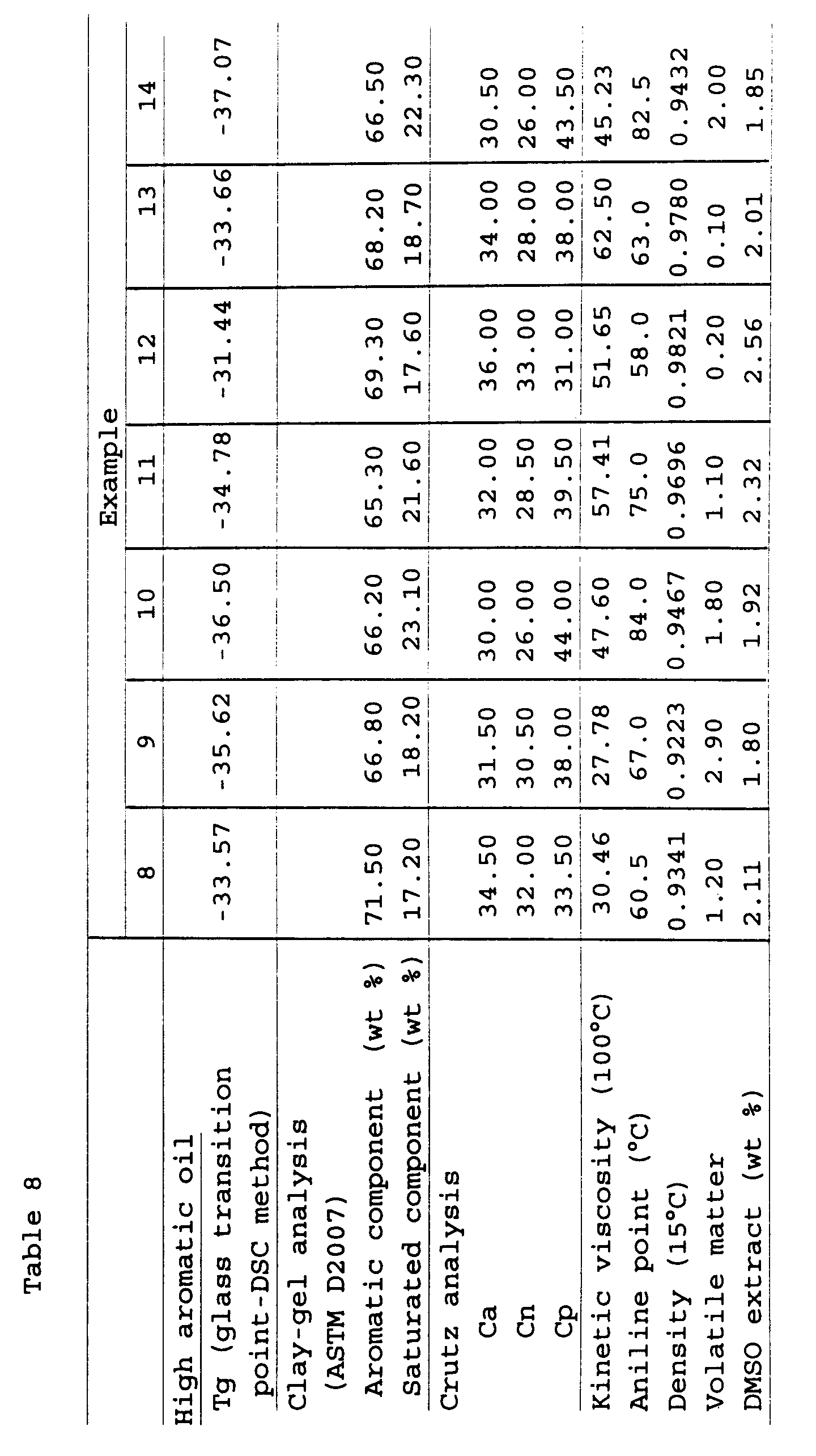
(1) Production and evaluation of the high aromatic oils
(Examples 1 to 14 and Comparative Examples 1 to 7)
The high aromatic oils were prepared under the
refining conditions of the respective refining methods
(processes 1 to 13 and A to E described above) shown in
the following tables 1 to 3. The characteristics (a
glass transition point Tg, an aromatic component, a
saturated component, Ca (aromatic carbon), Cn (naphthene
ring carbon), Cp (paraffin chain carbon), a kinetic
viscosity, an aniline point, a density, a volatile matter
and a DMSO extract amount) of the high aromatic oil thus
prepared are shown in the following tables 1 to 3.
As for the hydrogenation conditions shown in the
following tables 1 to 3, cracking means hydrocracking
treatment for selectively cracking PCA, and the
conditions thereof are a reaction temperature of 300 to
420°C, a pressure of 7.8 to 20 Mpa, a liquid space
velocity of 0.5 to 2.5 kl-oil/m3-catalyst and a hydrogen
circulation amount of 350 to 710 Nm3/kl-oil.
The conditions of the hydrogenation finishing
treatment are a reaction temperature of 280 to 360°C, a
pressure of 5.4 to 12 Mpa, a liquid space velocity of 0.5
to 2.5 kl-oil/m3-catalyst and a hydrogen circulation
amount of 50 to 350 Nm3/kl-oil.
As for the conditions of the solvent extraction
treatment shown in the following tables 1 to 3,
the term "mild" means a solvent extraction condition
for obtaining a raffinate having a high aromatic content
and a low PCA content, wherein a solvent used is
furfural; a solvent ratio (ratio of the solvent used to a
feed oil) is 1.0 to 3.0; and extraction temperatures are
80 to 110°C at the column top and 40 to 70°C at the
bottom.
The term "severe" means a solvent extraction
condition for obtaining an extract having a high aromatic
content, wherein a solvent used is furfural; a solvent
ratio is 3.0 to 6.0; and extraction temperatures are 100
to 130°C at the column top and 60 to 90°C at the bottom.
As for FEED shown in the following tables 1 to 3, VD
means a vacuum distillation distillate. VR means a
vacuum distillation residual oil. DAE means a solvent
extract of VD. RAE means a solvent extract of VR
subjected to deasphalting treatment.
The glass transition point Tg, the aromatic
component, the saturated component, Ca, Cn and Cp
measured by Kurtz analysis, the kinetic viscosity, the
aniline point, the density, the volatile matter and the
DMSO extract amount of the high aromatic oil were
measured and evaluated by the following methods,
respectively.
The glass transition point Tg was measured by a DSC
method.
The aromatic component and the saturated component
were measured by a Clay-Gel method (ASTM D2007).
Ca (aromatic carbon), Cn (naphthene ring carbon) and
Cp (paraffin chain carbon) were measured according to
ASTM D2140 (Kurtz analysis).
The kinetic viscosity was measured by JIS H 2283
[revised on March 1, 1993 (ISO 2909, 3104, 3105)].
The aniline point was measured by JIS K 2256
[revised on November 1, 1985 (ISO 2977)].
The density was measured by JIS K 2249 [revised on
March 1, 1987 (ISO 91/1, 649/1, 3675, 3838)].
The volatile matter was measured by JIS K 2207
[revised on August 1, 1990 (ASTM D6)].
The DMSO extract amount was measured by an IP 346
method.
The results obtained by evaluating the drying
workabilities, the bale-preparing difficulties and the
handling workabilities of the oil-extended synthetic
rubbers using the high aromatic oils of the present
invention and the like as an extender oil are shown in
the following tables 4 and 5.
The oil extended synthetic rubbers were prepared
according to the following polymerization processes 1 and
2 and to the recipe shown in the following tables 4 and
5. Further, the drying workability, the bale-preparing
difficulty and the handling workability were evaluated by
the following methods.
Polymerization process 1:
A pressure reactor of 5 liters was charged with 1200
g of dried cyclohexane, 80 g of styrene and 120 g of
butadiene, and the temperature of the content was
adjusted to 50°C. Further, 60 mmol of tetrahydrofuran
was charged as a randomizer, and then 1.6 mmol of a 1.6 N
n-hexane solution of n-BuLi was added as an initiator.
Subsequently, the polymerization was carried out at 50°C
for 2 hours.
After finishing the polymerization, a solution
obtained by dissolving 0.5 g of BHT in 5 ml of
isopropanol was added to the polymerization system to
stop the polymerization. After stopping the
polymerization, the high aromatic oil shown in Table 1
was added, and then the content was dried by a
conventional method to obtain an oil extended synthetic
rubber.
Polymerization process 2:
The pressure reactor of 5 liters was charged with
1200 g of dried cyclohexane, 80 g of styrene and 120 g of
butadiene, and the temperature of the content was
adjusted to 50°C. Further, 50 mmol of tetrahydrofuran
was charged as a randomizer, and then 1.2 mmol of a 1.6 N
n-hexane solution of n-BuLi was added as an initiator.
Subsequently, the polymerization was carried out at 50°C
for 2 hours.
After finishing the polymerization, 1 mmol of 1 N
(SiCl4/c-Hexane) was added to the polymerization system to
carry out a coupling reaction at 50°C for 30 minutes.
After finishing the reaction, a solution obtained by
dissolving 0.5 g of BHT in 5 ml of isopropanol was added
to the polymerization system to stop the polymerization.
After stopping the polymerization, the high aromatic oil
shown in Table 1 was added, and then the content was
dried by a conventional method to obtain an oil extended
synthetic rubber.
Evaluation of drying workability:
For the evaluation of the drying workability, a
sample (1 cm x 1 cm x 1 cm, the same shall apply
hereinafter) which was dried in an oven at 100°C for one
hour was used, and the temperature of the sample was
elevated by means of TGA (thermal analyzer) to measur an
evaporation loss. The evaporation loss of 1 % or less is
regarded as good.
Evaluation of bale-preparing difficulty:
The bale-preparing difficulty was evaluated by
whether or not a bale was formed when a sample was put in
an iron-made vessel of 10 cm × 10 cm × 10 cm to carry out
molding at 1 Mpa for one hour by means of a vertical
press.
Evaluation of handling workability:
The handling workability was evaluated by preparing
five of the same samples to evaluate the workability
thereof.
| Test Results of Oil Extended Synthetic Rubber |
| | Comparative Example A | Example A | Example B | Comparative Example C |
| Polymerization method | Process 1 | Process 1 | Process 1 | Process 1 |
| Mw | 240000 | 240000 | 240000 | 240000 |
| Styrene % | 40.1 | 40.1 | 40.1 | 40.1 |
| Butadiene % | 37.0 | 37 | 37 | 37 |
| High aromatic oil used | None | Example 2 | Example 2 | Example 2 |
| Use amount (PHR) | None | 27.3 | 37.5 | 54.5 |
| Drying workability | Good | Good | Good | Difficult |
| Bale preparing difficulty | Good | Good | Good | Adhered |
| Handling workability | Good | Good | Good | Extra bad |
| Test Results of Oil Extended Synthetic Rubber (continued from Table 4) |
| | Comparative Example B | Example | Comparative Example |
| | | C | D | E | D | E |
| Polymerization method | Process 2 | Process 2 | Process 2 | Process 2 | Process 2 | Process 2 |
| Mw | 1450000 | 1450000 | 1450000 | 1450000 | 1450000 | 1450000 |
| Styrene % | 40.2 | 40.2 | 40.2 | 40.2 | 40.2 | 40.2 |
| Butadiene % | 36.0 | 36 | 36 | 36 | 36 | 36 |
| High aromatic oil used | None | Example 2 | Example 2 | Example 2 | Example 2 | Example 2 |
| Use amount (PHR) | None | 27.3 | 37.5 | 27.3 | 2.0 | 54.5 |
| Drying workability | Very bad | Good | Good | Good | Difficult | Difficult |
| Bale preparing difficulty | No | Good | Good | Good | No | Adhered |
| Handling workability | Extra bad | Good | Good | Good | Extra bad | Extra bad |
As apparent from the results shown in Tables 4 and
5, it has become clear that the oil extended synthetic
rubbers which are excellent in a drying workability, a
bale preparing difficulty and a handling workability as
compared with those in Comparative Examples A to E
falling outside the scope of the present invention are
obtained in Examples A to E falling within the scope of
the present invention.
(3) Application to rubber composition:
Rubber compositions were prepared in accordance with
the compounding recipe shown in the following table 6 and
tables 7 to 9, and the test pieces were prepared by the
following method to evaluate a rupture characteristic, a
modulus of elasticity at a low temperature, a softening
performance, a loss characteristic (tan δ), an modulus of
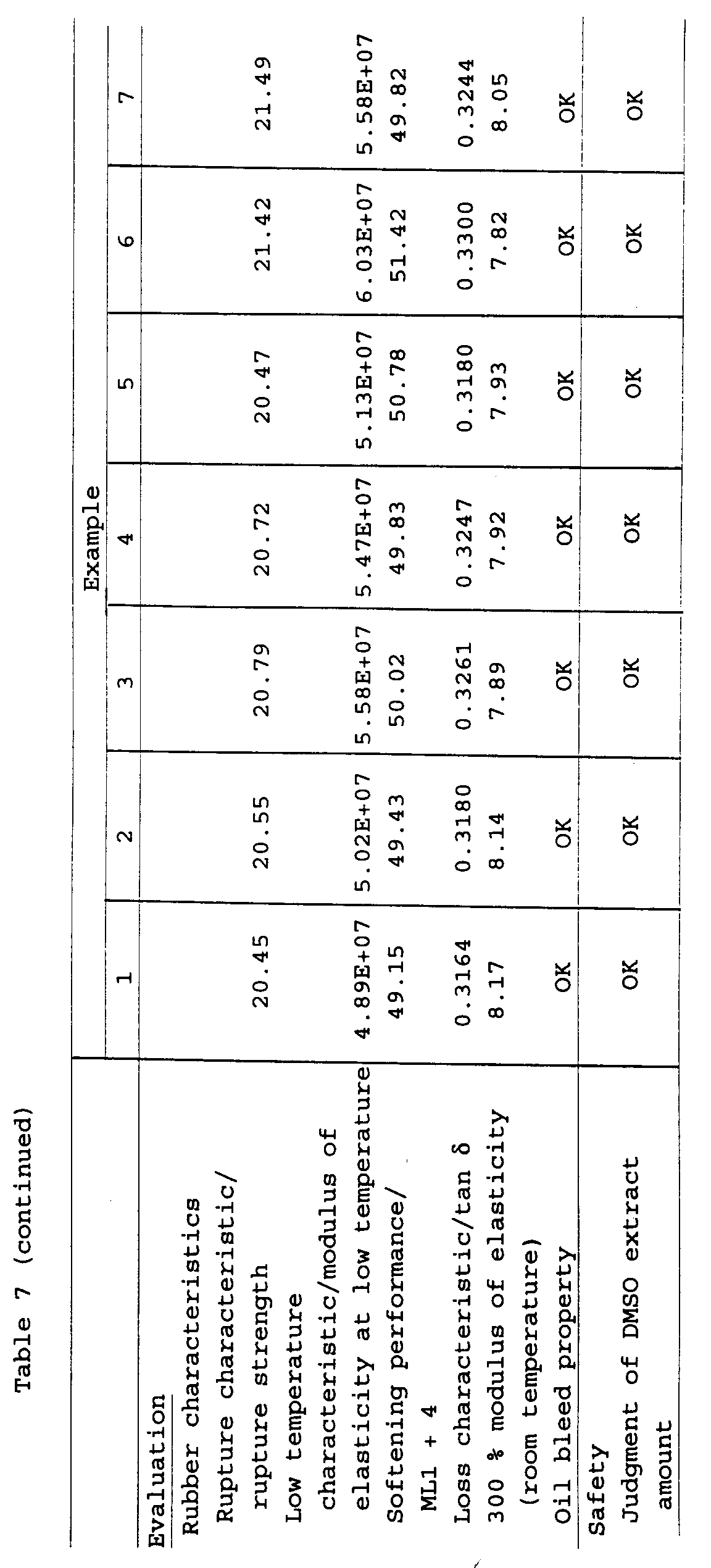
elasticity at 300 % elongation (room temperature) and an
oil bleed property in terms of the rubber characteristics
and judge a DMSO extract amount (PCA) in terms of the
safety. The results are shown in the following table 6
and tables 7 to 9.
[1] Preparing method of test pieces:
Raw materials for a master batch having the
compounding recipe shown in the following table 6 were
mixed by means of a kneader and then formed into a sheet
by means of a roll having a surface temperature of 70°C.
Subsequently, this master batch and raw materials for a
final were blended by means of the kneader and then
formed into a sheet by means of a roll having a surface
temperature of 70°C. Then, this was filled into a
suitable die and vulcanized under the conditions of a
temperature of 160°C, a pressure of 3.0 Mpa and a heating
period of 15 minutes. Then, it was taken out of the die
to prepare a prescribed test piece.
[2] Test method of rubber composition:
(a) Test method of measuring rupture characteristic:
A test piece of No. JIS-3 was prepared from a
vulcanized rubber sheet (150 mm × 150 mm × 2 mm) prepared
in accordance with the compounding recipe 1 shown in the
following table 6 according to JIS K6301.
This test piece was used to measur a tensile
strength (rupture strength) at the time of breaking by
means of a tensile tester (Strograph AR-1 manufactured by
Toyo Seiki Co., Ltd.).
(b) Test method of measuring modulus of elasticity at a
low temperature
A vulcanized rubber sheet (150 mm × 150 mm × 2 mm)
prepared in accordance with the compounding recipe 1
shown in the following table 6 was used to measur a
dynamic modulus of elasticity at -20°C by means of a
visco-elasticity tester (Rheolograph Solid, model L-1R
manufactured by Toyo Seiki Co., Ltd.). The term "E + 07"
means "× 107".
(c) Test method of measuring softening performance
A sample of non-vulcanized rubber prepared in
accordance with the compounding recipe 1 shown in the
following table 6 was measured for ML1 + 4 by means of a
Mooney viscosity measuring device.
(d) Test method of measuring loss characteristic (tan
δ):
Measur at a bias of 1 %, 52 Hz and 25°C by means of
a spectrometer.
(e) Test method of measuring a modulus of elasticity at
300 % elongation:
Measured according to JIS K 6301.
(f) Test method of measuring oil bleed property:
A vulcanized rubber sheet (150 mm × 150 mm × 2 mm)
prepared in accordance with the compounding recipe
formation 2 shown in the following table 6 was left for
standing for 48 hours at room temperature to evaluate the
presence of oil bleed with visual observation. The
absence of oil bleed was evaluated as "OK", and the
presence of oil bleed was evaluated as "NG".
(g) Judgment of DMSO extract amount:
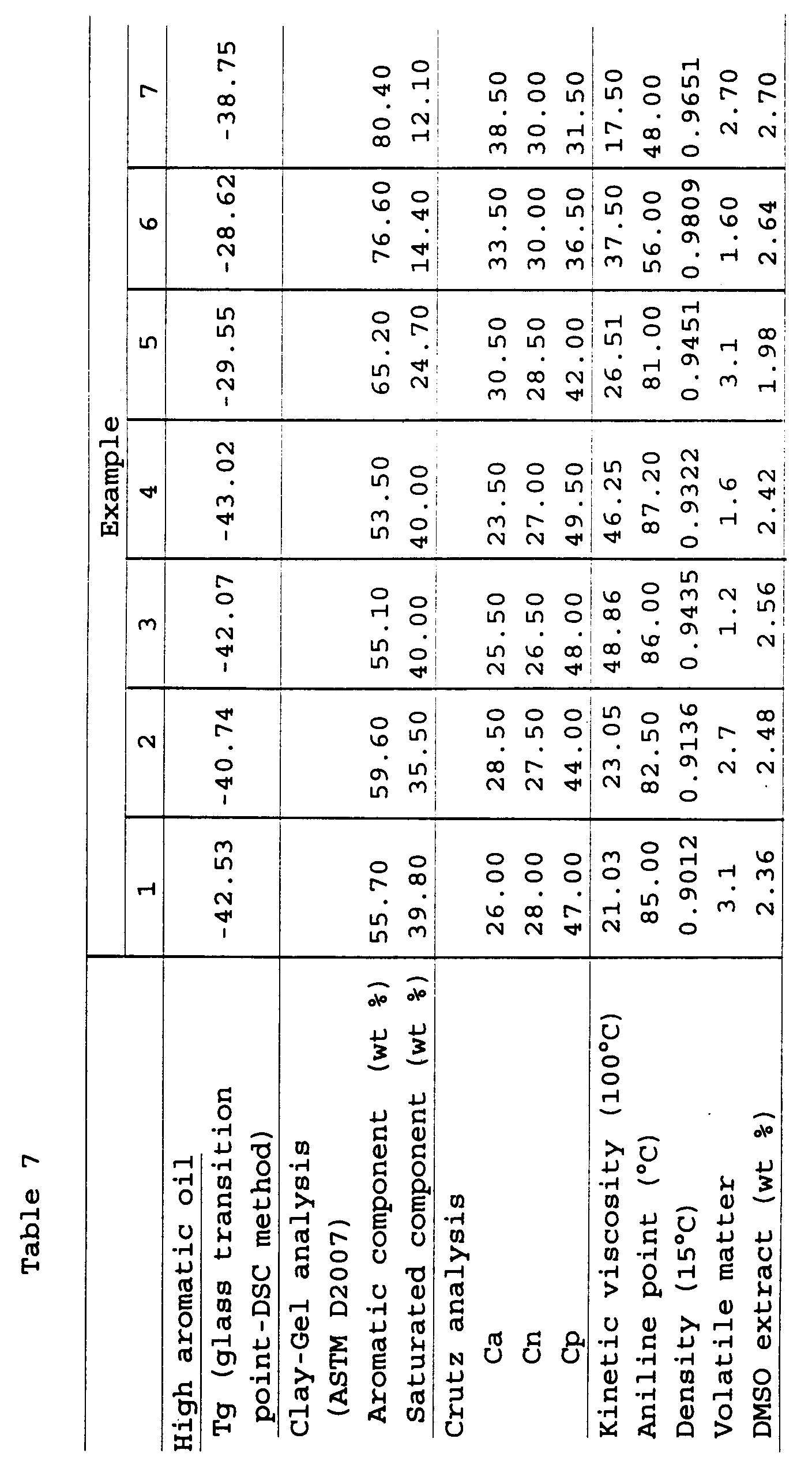
Consideration of Tables 7 to 9 and Fig. 2 to Fig. 7:
Tables 7 to 9 described above are to show a
comparison of conventional high aromatic oils with the
high aromatic oils of the present invention. As apparent
from the results shown in Tables 7 to 9, it has become
clear that since the high aromatic oils prepared in
Examples 1 to 14 falling within the scope of the present
invention have a DMSO extract amount of 3 % or less, they
have an excellent safety and are endowed with the
performances which are equal to those of the conventional
high aromatic lubricants (aroma oils) prepared in
Comparative Examples 1 to 3 and that the excellent rubber
properties thereof as a softening agent for a rubber
composition are compatible with the safety.
In particular, prepared in Comparative Example 6 is
a high aromatic oil containing PCA of less than 3 % by
weight falling within the range described in Japanese
Patent Application Disclosure No. Hei 6-505524 [British
Patent (GB) 2252978, US Patent (US) 5504135 and European
Patent (EP) 575400], wherein the kinetic viscosity is 32
to 50; the aromatic component accounts for 30 to 55 % by
weight; and the saturated component accounts for 40 % by
weight or more. As described above, it has become clear
that the rubber characteristics related to the loss
performance and the rupture characteristic are
deteriorated.
Further, in Comparative Example 6 in which the
highly aromatic oil containing the saturated component
exceeding 40 % by weight and, as described above, falling
within the range described in Japanese Patent Application
Disclosure No. Hei 6-505524 is used, it has become clear
that the saturated component exceeding 40 % by weight
deteriorates the rupture characteristic and bring about
oil bleed.
Fig. 2 and Fig. 3 are to show a comparison of high
aromatic oils having glass transition points of -45°C or
lower and of -20°C or higher with the high aromatic oils
of the present invention. As apparent from the results
shown in Fig. 2 and Fig. 3, it has become clear that the
Tg of -20°C or higher raises the modulus of elasticity to
notably deteriorate the low temperature characteristic
and the Tg of -45°C or lower does not provide the
sufficiently high loss performance but changes the
modulus of elasticity largely from those of conventional
products and deteriorates the oil bleed property.
Further, as apparent from the results shown in Fig.
4 and Fig. 5, it has become clear that the aromatic
component exceeding 90 % by weight makes it impossible to
maintain the low temperature characteristic, and the
aromatic component of less than 55 % by weight
deteriorates the loss performance. Further, it has
become clear from Fig. 6 that the aniline point of 97 or
more deteriorates the rupture characteristic.
Fig. 7 is to show a comparison of a high aromatic
oil having a saturated component of 40 % by weight or
more with the high aromatic oil of the present invention.
As apparent from the results shown in Fig. 7, it has
become clear that the saturated component exceeding 40 %
by weight deteriorates the rupture characteristic and
brings about oil bleed.
Considering the above results altogether, it has
become clear that only the high aromatic oils having a
glass transition point and an aromatic component each
falling within the scope of the present invention,
prepared in Examples 1 to 14, can have the rubber
performances to be compatible with the excellent safety.
Industrial Applicability
As described above, the high aromatic oil of the
present invention has excellent safety and the equal
performances as compared with conventional high aromatic
softening agents for rubber, and an oil extended
synthetic rubber using the above high aromatic oil as an
extender oil and a rubber composition using the same as a
softening agent can have the performances to be
compatible with the excellent safety. Further, if the
refining method recommended in the present invention is
employed, the profitability can be satisfied as well.
Further, the high aromatic oil of the present
invention can safely be used for all conventional uses of
high aromatic oils such as oils for printing inks and
writing inks as well as softening agents for rubber and
extender oils for synthetic rubber.