EP0938387B1 - Procede de traitement des machefers pour l'obtention de grave-mousse - Google Patents
Procede de traitement des machefers pour l'obtention de grave-mousse Download PDFInfo
- Publication number
- EP0938387B1 EP0938387B1 EP97947067A EP97947067A EP0938387B1 EP 0938387 B1 EP0938387 B1 EP 0938387B1 EP 97947067 A EP97947067 A EP 97947067A EP 97947067 A EP97947067 A EP 97947067A EP 0938387 B1 EP0938387 B1 EP 0938387B1
- Authority
- EP
- European Patent Office
- Prior art keywords
- clinker
- bitumen
- mix
- process according
- foam
- Prior art date
- Legal status (The legal status is an assumption and is not a legal conclusion. Google has not performed a legal analysis and makes no representation as to the accuracy of the status listed.)
- Expired - Lifetime
Links
Images
Classifications
-
- E—FIXED CONSTRUCTIONS
- E01—CONSTRUCTION OF ROADS, RAILWAYS, OR BRIDGES
- E01C—CONSTRUCTION OF, OR SURFACES FOR, ROADS, SPORTS GROUNDS, OR THE LIKE; MACHINES OR AUXILIARY TOOLS FOR CONSTRUCTION OR REPAIR
- E01C3/00—Foundations for pavings
- E01C3/003—Foundations for pavings characterised by material or composition used, e.g. waste or recycled material
-
- B—PERFORMING OPERATIONS; TRANSPORTING
- B09—DISPOSAL OF SOLID WASTE; RECLAMATION OF CONTAMINATED SOIL
- B09B—DISPOSAL OF SOLID WASTE NOT OTHERWISE PROVIDED FOR
- B09B3/00—Destroying solid waste or transforming solid waste into something useful or harmless
- B09B3/20—Agglomeration, binding or encapsulation of solid waste
- B09B3/21—Agglomeration, binding or encapsulation of solid waste using organic binders or matrix
-
- E—FIXED CONSTRUCTIONS
- E01—CONSTRUCTION OF ROADS, RAILWAYS, OR BRIDGES
- E01C—CONSTRUCTION OF, OR SURFACES FOR, ROADS, SPORTS GROUNDS, OR THE LIKE; MACHINES OR AUXILIARY TOOLS FOR CONSTRUCTION OR REPAIR
- E01C7/00—Coherent pavings made in situ
- E01C7/08—Coherent pavings made in situ made of road-metal and binders
- E01C7/18—Coherent pavings made in situ made of road-metal and binders of road-metal and bituminous binders
-
- E—FIXED CONSTRUCTIONS
- E01—CONSTRUCTION OF ROADS, RAILWAYS, OR BRIDGES
- E01C—CONSTRUCTION OF, OR SURFACES FOR, ROADS, SPORTS GROUNDS, OR THE LIKE; MACHINES OR AUXILIARY TOOLS FOR CONSTRUCTION OR REPAIR
- E01C7/00—Coherent pavings made in situ
- E01C7/08—Coherent pavings made in situ made of road-metal and binders
- E01C7/18—Coherent pavings made in situ made of road-metal and binders of road-metal and bituminous binders
- E01C7/182—Aggregate or filler materials, except those according to E01C7/26
Definitions
- the subject of the invention is a treatment method clinkers, for their inerting and / or their valuation. It also targets the grave-mousse including clinker and its use for creation of road base layers.
- x / y means a bitumen, the hardness class defined by a standardized test needle penetration according to standard NF T66-004.
- the parameters measured to classify the clink in these different categories are the following: the soluble fraction, mercury, lead, cadmium, arsenic, chromium VI, sulfates, carbon total organic, and loss on ignition.
- Clinkers with a high leachable fraction are evacuated to a classified landfill.
- Low leachable clinkers can be used in road engineering.
- Clinkers can be used in backfill, in form layer and in base layer of pavement and parking.
- embankment and form layer are specified in the technical guide of "Realization of embankments and form layers", SETRA and LCPC published in September 1992, which classifies this material in category F6; in contrast, layering has not been codified.
- bottom ash in works development was first limited to the realization of embankments, then road works, using clinker in undercoats, have emerged. It's in trying uses in base layers that them first problems due to the particular nature of the product appeared.
- US Patent 3,907,582 describes a method for treating clinker, intended to ensure its inerting for its use in road engineering. It involves mixing the clink with bitumen and possibly lime, to make different layers of pavement.
- Patent FR 2 553 125 finally describes the preparation of road mixes using bitumen foam.
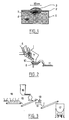
- Figure 1 shows a schematic section of a clinker-based structure treated with hydraulic binder, underlying swelling.
- This figure shows the local swelling and surface of a road structure whose layer seat 1 is formed by a mixture of clinker treated with hydraulic binder.
- This seat layer is covered a layer of bitumen 2, just below which finds a metal aluminum particle 4.
- the latter comes with a crown of hydrating gels 5 occupying the volume of the swelling.
- this is achieved by means of a process for treating bottom ash, with a view to its inerting and / or improving its properties mechanical, in which intimately mixed, in particular by kneading, clinker with bitumen foam, to form a grave-mousse.
- FIG. 2 represents a household waste incineration furnace leading to clinker production.
- Household garbage 6 is introduced into the incineration oven 7.
- the clinker 8 at the base of the oven 7 in an extractor 9 where it is brought into contact with water 10.
- the clinker undergoes wet extraction. It comes in the form of a blackish material 11 comprising elements of large size, such as scrap metal.
- Figure 3 shows a block diagram of a central of manufacture of grave-foam.
- Bitumen foam is obtained in a mixer 12 by injecting very small quantities of water and foaming agent in bitumen through a mixing chamber.
- a ramp 13 is arranged above of the mixer.
- a loading station 17 is set up at the end of process, to allow the transport of the grave-foam by trucks.
- the mixing is carried out in incorporating bitumen foam, the temperature of which is between 140 and 190 ° C, in bottom ash 8 of which the temperature is close to the ambient temperature.
- This technique consists in incorporating bitumen hot in the form of foam in aggregates not heated.
- Bitumen foam is obtained, for example, by injection of very small amounts of water and agents foaming in bitumen through a chamber mixture.
- the additive water vaporizes instantly on contact with hot bitumen, and generates foam which is revealed after passing through a diffuser to obtain a spray full conical.
- Laboratory studies on training of foam have shown a significant rate of expansion, close to 10, but also a short service life use it to distribute it in the most homogeneous possible in the material.
- a ramp can be arranged above of the mixer. It has a number of jets important which allows to better distribute the foam in the material.
- bitumen, water and additives are introduced, for example, using pumps metering and controlled by flowmeters, one of them being of the mass type for metering bitumen.
- the engine and valve controls of the platform are grouped, in general, on a desk mobile installed in the central control cabin serious manufacturing.
- a stickiness dope can be sprayed on the gravel.
- the grave-mousse is transported by tarpaulin trucks to keep its water content. It is spread with the grader or finisher and compacted using a conventional workshop, including a vibrating compactor and a tire compactor. As with all bituminous materials, general, a bonding layer before implementation some serious foam.
- the grave-foam has a very long lead time, twenty-four to forty-eight hours or more. However, it can be put under traffic immediately.
- the mixing is carried out by putting uses bitumen foam in a relative proportion by weight of bitumen, between 2 and 9%, and preferably between 3 and 6%.
- the constituents of the grave foam can be of three orders.
- the aggregates consist of clinker alone or mixed with natural aggregates.
- the binder used is generally a pure or modified bitumen, possibly fluxed from coal oil or petroleum, from grade 10/20 to 180/220, if possible of Venezuelan origin for its foaming ability and its good adhesion to aggregates.
- Hydrated lime is added, for example to mixture to hydrophobize aggregates.
- the presence a sticky dope may be necessary.
- Foaming and stabilizing agents can also be used, for obtaining foam and control of its quality.
- natural aggregates are added chosen from the group comprising natural sand, crushed natural rocks, and demolition concrete crushed; these natural aggregates being added to the mixture in a relative proportion by weight of between 0 and 90%, and preferably between 30 and 60%.
- Any natural sand can be used in the to the extent that it meets the cleanliness criteria laid down by standard NF P18-597 and applicable to seat materials roadways.
- the selected compositions have a layer particle size close to that of a grave reconstituted_ humidified (GRH), i.e. a solid curve with good short-term behavior characteristics (good Immediate Index).
- GH grave reconstituted_ humidified
- the granularity can be of type 0/10, 0/14 or 0/20 depending on the thickness of processing planned.
- an additive is added to the mixture powder advantageously chosen from quicklime, slaked lime, fine limestones and their mixtures, in a lower relative proportion by weight about 10%, and preferably between 0.5 and 3%, and possibly water so as to respect an appropriate water content.
- additional additives selected from the group comprising sticky dopes, and foaming agents, these can be added up to a relative proportion in weight of about 5 ⁇ , and preferably less than about 2 ⁇ .
- the clinker 8 is passed through an eddy current separator, in order to remove aluminum, and this prior to the implementation of the clink in the mixture.
- the clinker 8 set work has undergone, in addition, a defraillage treatment, in particular by magnetic sorting and / or treatment of screening in a mesh screen of size less than about 50 mm, and more preferably close to 30 mm.
- the clinker 8 preferably after elimination treatment metals, for about three months, before putting it used in the mixture.
- the serious foam likely to be obtained according to the process according to the invention can be used for the production of a seat layer, in particular, for the realization of a foundation layer or a base layer of new pavements, in particular, to low and medium traffic, or for strengthening pavements to rehabilitate.
- PCG test predicts compactibility of a material and its density on site (NFG P98-252).
- the minimum content is 1% lime.
- Two mixed formulas (- clinker mix and natural aggregates) have been tested.
- Test boards were produced in June 1995 on the access road to a asphalt mixing plant the Applicant.
- This road is traffic heavy vehicles transporting aggregates and mixes.
- the base layer has a thickness of 16 and 12 centimeters. Total thickness is constant and equal at 22 centimeters.
- test boards were followed up detailed and balance sheet after sixteen months of service including two summer periods, these being however conducive to the development of swelling when a risk potential of this type exists.
- Bitumen foam clinker treatment a beneficial effect on the risk of migration of elements pollutants to the natural environment.
- the X 31-210 leach test is a standard procedure that quantifies this risk. This test consists, after having made the material stay in pure water, to measure the quantities of pollutants that have migrated into the water. The results of this test carried out on untreated clinker and treated clinker are given in table V below: ANALYZES Clink alone Bitumen treated clinker Mitigation Soluble fraction 2.29% 1.24% 0.55 Content in mg / kg: TOC 482 272.3 0.56 Hexavalent chrome 0.27 0.15 0.55 sulfates 2077 1205 0.58 Mercury 0.03 0.03 Lead 0.03 0.03 (*) Cadmium 0.06 0.03 (*) Arsenic 0.03 0.03 (*)
- bitumen foam treatment allows significantly reduce migration of pollutants. Regulatory, this treatment allows a recovery of bottom ash from category “M” intermediate by passing them into category “V”. In the threshold values for these two categories are, one exception, in a ratio less than or equal to 2.
- this change of class by a treatment with hydraulic binders is also possible but it doesn't have a as systematic as the plug phenomenon does not develop with all clinkers.
- a dimensional stability test showed significant differences between treatment at bitumen foam emulsion and treatment when the bottom ash has not been dealuminated. Indeed, the graph below indicates swelling twenty-eight days from around 1% - which is still admissible - for the bitumen foam treatment, and more than 2% for the emulsion technique.
- Clinker treated with bitumen foam is a material that can be used as a foundation layer and as a base layer of new pavements essentially according to the rules defined in Table IX below: Layer Traffic less than or equal to T3 T2 T1 Bearing (minimum) bilayer coating 6 cm BB 2 cm BB Connection (minimum) - - 6 cm BB Based Clink alone Clink alone (*) Clinker + natural aggregates Foundation Clink alone (*) Clink alone (*) Clink alone (*) Clink alone (*) Clink alone (*) Clink alone (*)
- Pavement reinforcement is the second area use of the product.
- the rules to respect are also those defined for new pavements.
- the process according to the invention allows the use of clinkers more highly concentrated in elements undesirable ("M" class bottom ash) and further reduces the environmental impact of class V clinkers
- bitumen foam is best suitable for bottom ash, for two main reasons. First, there is no drop in mechanical resistance with clinker compared to natural aggregates, unlike what happens with others techniques. Then the clinker not separated from its aluminum is much less sensitive to the phenomena of swelling.
Landscapes
- Engineering & Computer Science (AREA)
- Architecture (AREA)
- Civil Engineering (AREA)
- Structural Engineering (AREA)
- Environmental & Geological Engineering (AREA)
- Road Paving Structures (AREA)
- Pit Excavations, Shoring, Fill Or Stabilisation Of Slopes (AREA)
- Curing Cements, Concrete, And Artificial Stone (AREA)
Description
- séparation des métaux ferreux,
- séparation des métaux non ferreux,
- criblage (obtention d'une granulométrie 0/20 mm),
- séparation des imbrûlés légers par tri aéraulique,
- maturation durant une période minimale de trois mois pendant laquelle le mâchefer se stabilise chimiquement (oxydation, carbonatation),
- traitement éventuel au liant hydraulique.
- catégorie V : mâchefer à faible fraction lixiviable
(teneurs inférieures au seuil 1), - catégorie M : mâchefer intermédiaire
(teneurs inférieures au seuil 2), - catégorie S : mâchefer à forte fraction lixiviable
(teneurs au moins supérieures au seuil 2).
| TENEUR | UNITE | SEUIL 1 | SEUIL 2 |
| Fraction soluble | % | 5 | 10 |
| Hg | mg/kg | 0,2 | 0,4 |
| Pb | mg/kg | 10 | 50 |
| Cd | mg/kg | 1 | 2 |
| As | mg/kg | 2 | 4 |
| Cr VI | mg/kg | 1,5 | 3 |
| SO4 2- | mg/kg | 10000 | 15000 |
| COT | mg/kg | 1500 | 2000 |
| Perte au feu | % | 5 | 5 |
- une citerne de bitume routière,
- une plate-forme de fabrication de la mousse, et
- une rampe de pulvérisation installée sur le malaxeur.
- maintenir les conditions hygrométriques de la grave-mousse le temps du mûrissement,
- protéger la surface au moment de la mise en circulation (le soir et le week-end).
- l'association avec des granulats de roches dures permet de satisfaire aux exigences demandées pour certaines utilisations,
- l'association avec une grave pauvre en fines et donc inutilisable en l'état, permet sa valorisation sans compromettre les performances du mélange, bien au contraire.
- les imbrûlés papiers et plastiques sont éliminés par soufflage,
- les métaux non ferreux et tout particulièrement l'aluminium sont retirés par passage dans un séparateur à courants de Foucault.
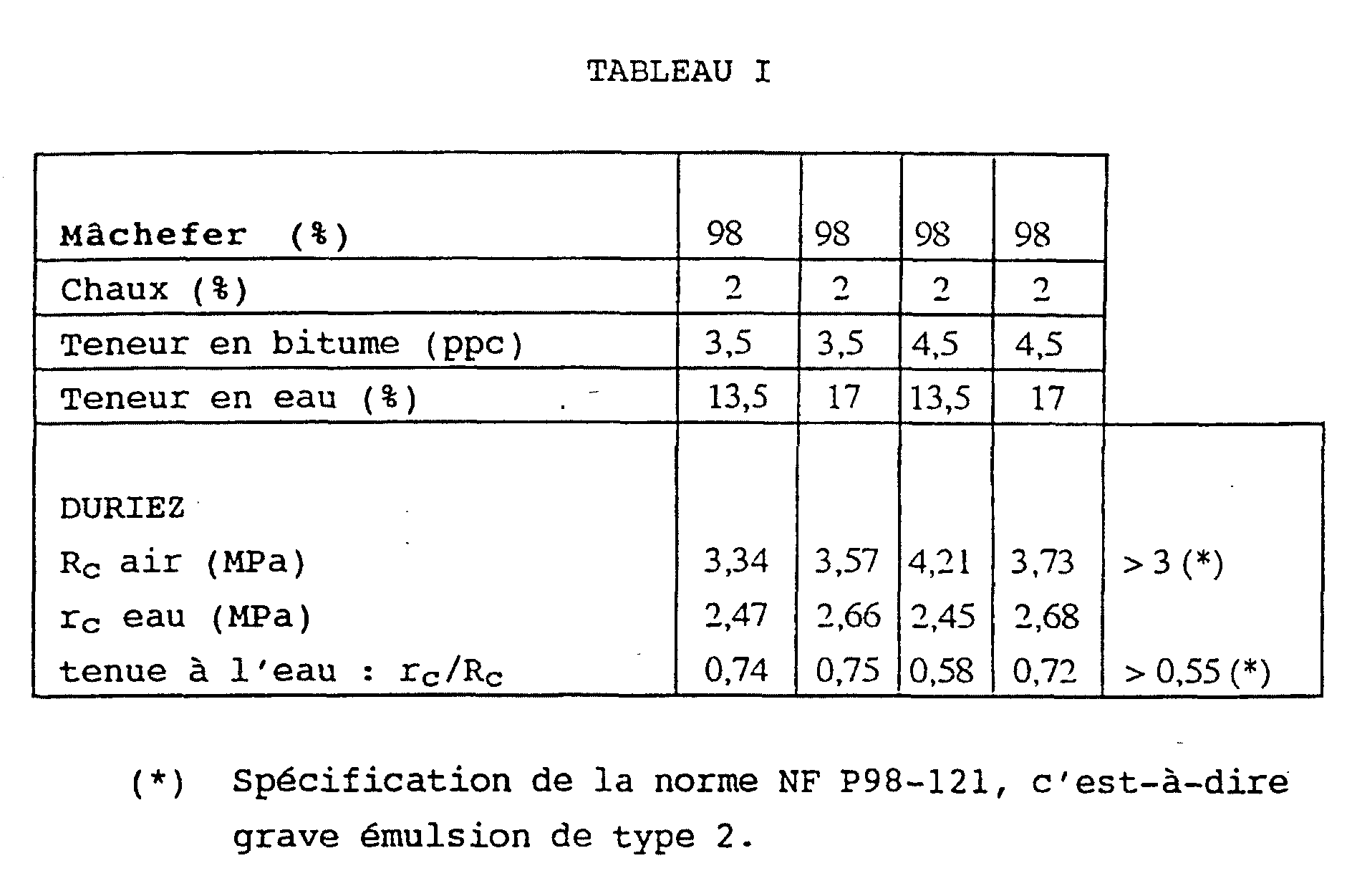
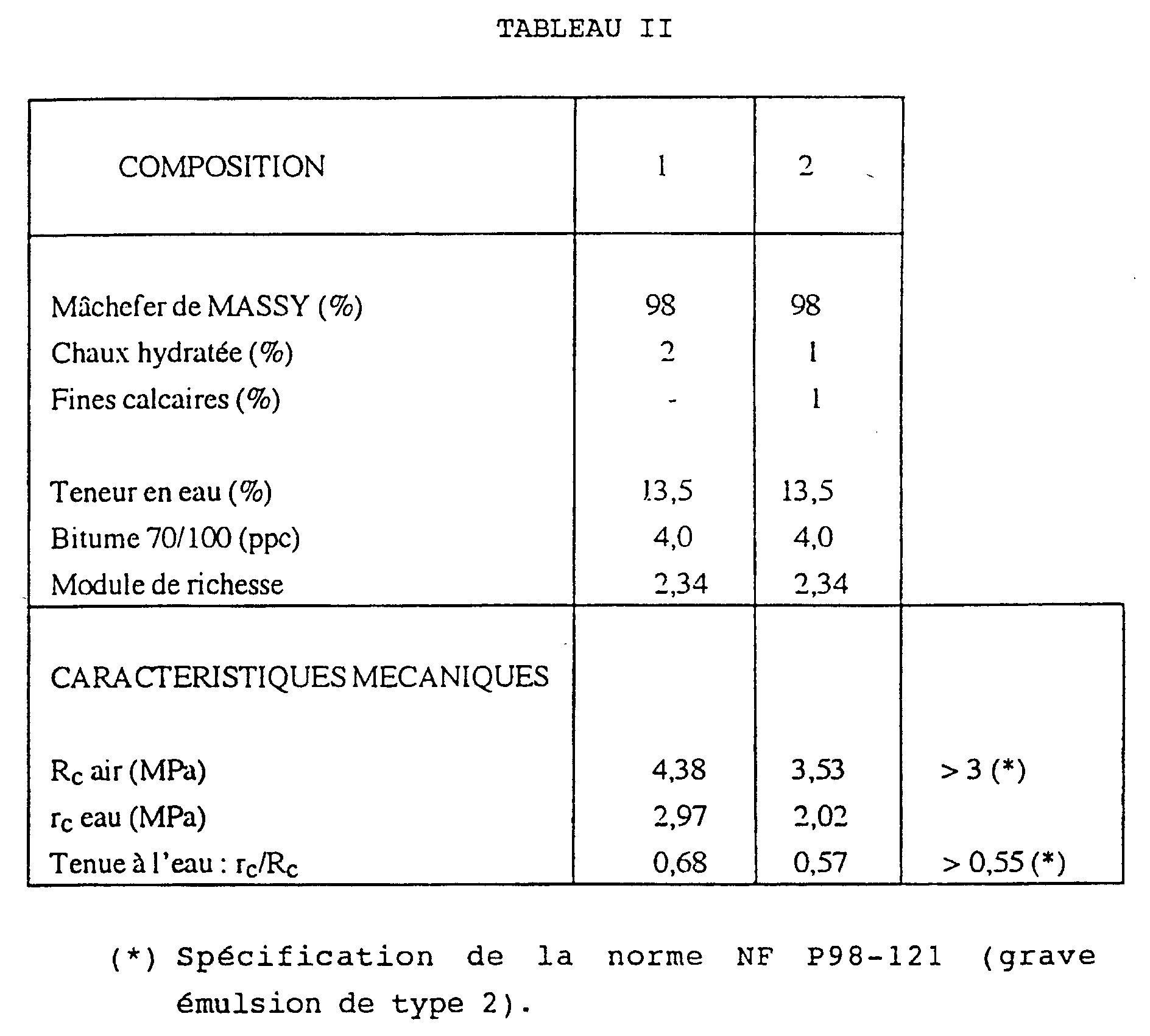
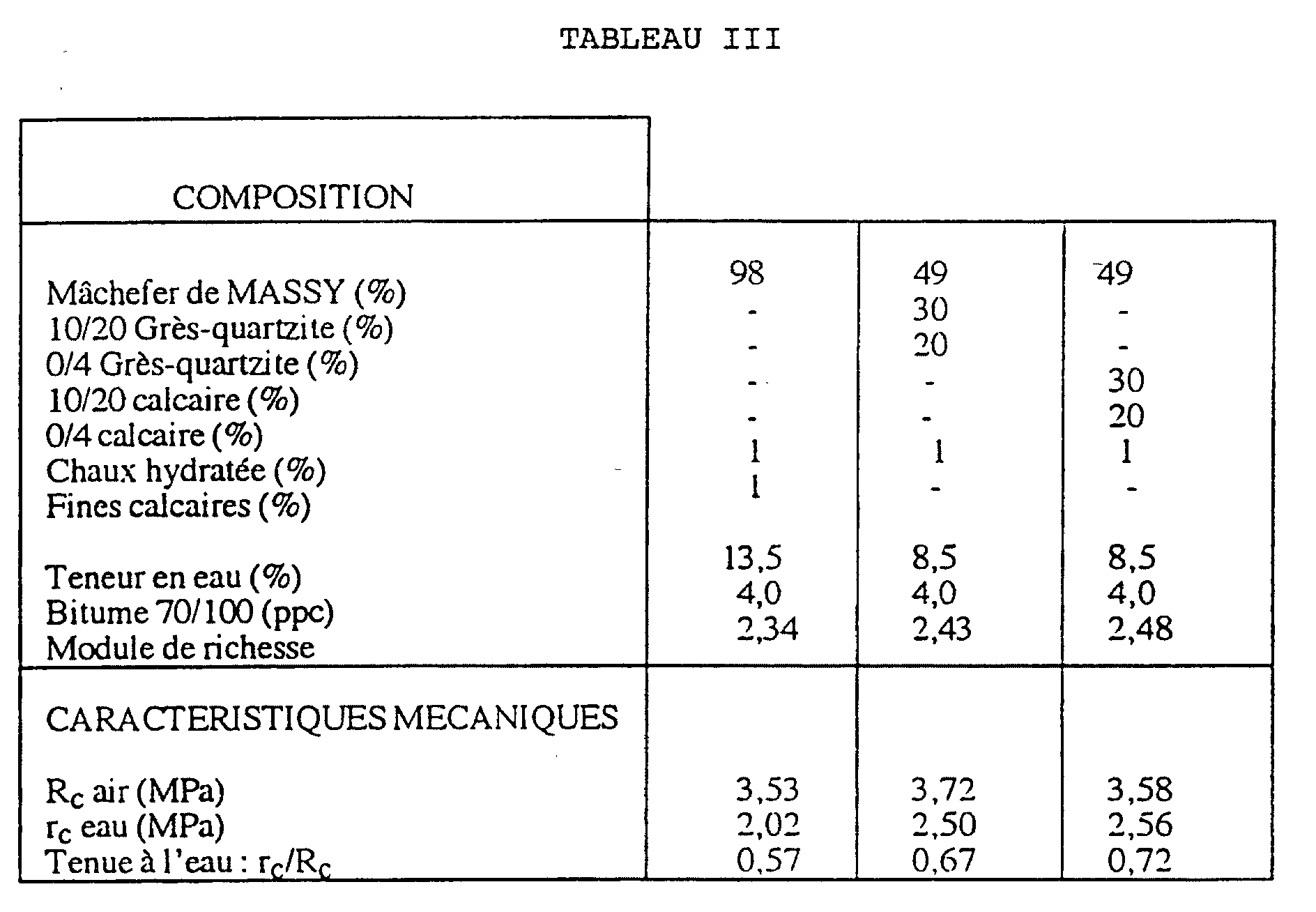
- l'essai Duriez (NF P98-251-4), et
- l'essai à la presse à cisaillement giratoire (PCG) (NF P98-252). La grave-mousse est élaborée dans un malaxeur de laboratoire dans lequel la mousse de bitume, fabriquée à partir d'un banc de mousse spécialement conçu pour cette technique, est incorporée aux granulats.Les performances minimales visées sont :
- pourcentage de vides Duriez : inférieur ou égal à quatorze pourcents,
- résistance à la compression sans immersion Rc supérieure ou égale à 3,5 MPa,
- rapport rc/Rc supérieur ou égal à 0,55, rc étant la résistance à la compression après conservation dans l'eau ;
- pourcentage de vides à l'essai PCG : à 10 girations, inférieur ou égal à 23 % ; à 200 girations, inférieur ou égal à 15 %.
- Réalisation de cinq planches de 25 mètres de long sur 6 mètres de large en 16 centimètres d'épaisseur en couche de base,
- Décaissement d'une demi-chaussée (3 mètres) sur une profondeur de 4 centimètres,
- Réalisation d'une couche de liaison en enrobé en 4 centimètres sur la demi-chaussée dérasée,
- Réalisation d'une couche de roulement en 6 centimètres en pleine largeur.
- sur le support avant la mise en oeuvre des matériaux,
- sur le revêtement de la chaussée juste après sa réalisation, et
- sur le revêtement après une année de service.
| Période | Avant travaux | Après travaux | Après 1 an de service |
| Déflexion moyenne (1/100 mm) | 218 | 99 | 76 |
| Atténuation | 1 | 0,45 | 0,35 |
| ANALYSES | Mâchefer seul | Mâchefer traité à la mousse de bitume | Atténuation |
| Fraction soluble | 2,29 % | 1,24 % | 0,55 |
| Teneur en mg/kg : | |||
| COT | 482 | 272,3 | 0,56 |
| Chrome hexavalent | 0,27 | 0,15 | 0,55 |
| Sulfates | 2077 | 1205 | 0,58 |
| Mercure | 0,03 | 0,03 | |
| Plomb | 0,03 | 0,03 | (*) |
| Cadmium | 0,06 | 0,03 | (*) |
| Arsenic | 0,03 | 0,03 | (*) |
- l'enrobage à chaud (grave-bitume),
- l'enrobage à froid à l'aide d'une émulsion de bitume (grave-émulsion).
| formules à base de mâchefer | |||
| Formule | Grave-bitume | Grave-émulsion | Grave-mousse |
| Mâcheferde Massy (%) | 100 | 100 | 98 |
| Chaux hydratée (%) | -- | -- | 1 |
| Fines calcaires (%) | -- | -- | 1 |
| Bitume résiduel (ppc) | 4,20 | 4,02 | 3,31 |
| Module de richesse | 2,52 | 2,42 | 1,80 |
| formules à base de granulats naturels | |||
| Formule | Grave-bitume | Grave-émulsion | Grave-mousse |
| 10/14 Grès-quartzite (%) | 20 | 26 | 26 |
| 4/10 Grès-quartzite (%) | 30 | 35 | 25 |
| 0/4 Grès-quartzite (%) | 49 | 49 | 48 |
| Fines calcaires (%) | 1 | -- | -- |
| Chaux hydratée (%) | -- | -- | 1 |
| Bitume résiduel (ppc) | 4,20 | 3,50 | 3,57 |
| Module de richesse | 2,52 | 2,12 | 2,13 |
| MATERIAUX | MACHEFER | GRANULATS NATURELS | ||||
| TYPE | Grave-bitume | Grave-émulsion | Grave mousse | Grave-bitume | Grave-émulsion | Grave mousse |
| Bitume résiduel (ppc) | 4,20 | 4,02 | 3,31 | 4,20 | 3,50 | 3,57 |
| Module de richesse | 2,52 | 2,42 | 1,80 | 2,52 | 2,12 | 2,13 |
| Résistances à la compression (MPa) | ||||||
| - Rc air | 2,6 | 3,6 | 4,05 | 5,7 | 5,1 | 4,1 |
| - rc eau | 0,4 | 2,3 | 2,26 | 4,0 | 3,2 | 2,63 |
| Tenue à l'eau (rc/Rc) | 0,15 | 0,64 | 0,56 | 0,70 | 0,63 | 0,64 |
| Trafic Couche | inférieur ou égal à T3 | T2 | T1 |
| Roulement (minimum) | enduit bicouche | 6 cm BB | 2 cm BB |
| Liaison (minimum) | -- | -- | 6 cm BB |
| Base | Mâchefer seul | Mâchefer seul (*) | Mâchefer+ granulats naturels |
| Fondation | Mâchefer seul (*) | Mâchefer seul (*) | Mâchefer seul (*) |
Claims (9)
- Procédé de traitement de mâchefer (8), en vue de son inertage et/ou de l'amélioration de ses propriétés mécaniques par mélange intime, notamment par malaxage (12), de mâchefer (8), de bitume et d'un additif pulvérulent choisi parmi la chaux vive et la chaux éteinte, caractérisé en ce que le bitume est ajouté sous forme de mousse de bitume afin de former une grave-mousse, et en ce qu'on fait passer le mâchefer (8) dans un séparateur à courants de Foucault, afin d'enlever l'aluminium, et ceci préalablement à la mise en oeuvre du mâchefer dans le mélange.
- Procédé selon la revendication 1, caractérisé par le fait que le bitume utilisé pour la fabrication de la mousse de bitume est un bitume pur ou modifié, éventuellement fluxé à partir d'une huille de houille ou de pétrole, de grade allant de 10/20 jusqu'à 180/220.
- Procédé selon l'une des revendications 1 et 2, caractérisé par le fait qu'on réalise le mélange en incorporant de la mousse de bitume, dont la température est comprise entre 140 et 190°C, dans du mâchefer (8) dont la température est voisine de la température ambiante;
- Procédé selon l'une quelconque des revendications précédentes, caractérisé par le fait qu'on réalise le mélange en mettant en oeuvre la mousse de bitume dans une proportion relative en poids de bitume, comprise entre 2 et 9%, et de préférence comprise entre 3 et 6% du mélange mâchefer / mousse de bitume.
- Procédé selon l'une quelconque des revendications précédentes, caractérisé en ce que la chaux est ajoutée dans une proportion relative en poids inférieure à environ 10 %, et de préférence comprise entre 0,5 et 3% du mélange mâchefer/mousse de bitume.
- Procédé selon l'une quelconque des revendications précédentes, caractérisé par le fait qu'on ajoute, en outre, des granulats naturels choisis dans le groupe comprenant le sable naturel, les roches naturelles concassées, et le béton de démolition concassé ; ces granulats naturels étant ajoutés au mélange dans une proportion relative en poids comprise entre 0 et 90 %, et de préférence comprise entre 30 et 60 %.
- Procédé selon l'une quelconque des revendications précédentes, caractérisé par le fait qu'on ajoute au mélange des additifs supplémentaires choisis dans le groupe comprenant les dopes d'adhésivité, et les agents moussants, ceux-ci pouvant être ajoutés jusqu'à une proportion relative en poids d'environ 5‰, et de préférence inférieure à environ 2‰.
- Procédé selon l'une quelconque des revendications précédentes, caractérisé par le fait que le mâchefer (8) mis en oeuvre a subi, en outre, un traitement de déferraillage, notamment par tri magnétique et/ou un traitement de criblage dans un tamis de maille de taille inférieure à environ 50 mm et de préférence voisine de 30 mm.
- Procédé selon l'une quelconque des revendications précédentes, caractérisé par le fait qu'on stocke le mâchefer (8), de préférence après traitement d'élimination des métaux, pendant environ trois mois, avant de le mettre en oeuvre dans le mélange.
Applications Claiming Priority (3)
| Application Number | Priority Date | Filing Date | Title |
|---|---|---|---|
| FR9613958 | 1996-11-15 | ||
| FR9613958A FR2755884B1 (fr) | 1996-11-15 | 1996-11-15 | Procede de traitement des machefers pour l'obtention de grave-mousse |
| PCT/FR1997/002055 WO1998022233A1 (fr) | 1996-11-15 | 1997-11-14 | Procede de traitement des machefers pour l'obtention de grave-mousse |
Publications (2)
| Publication Number | Publication Date |
|---|---|
| EP0938387A1 EP0938387A1 (fr) | 1999-09-01 |
| EP0938387B1 true EP0938387B1 (fr) | 2002-06-19 |
Family
ID=9497660
Family Applications (1)
| Application Number | Title | Priority Date | Filing Date |
|---|---|---|---|
| EP97947067A Expired - Lifetime EP0938387B1 (fr) | 1996-11-15 | 1997-11-14 | Procede de traitement des machefers pour l'obtention de grave-mousse |
Country Status (6)
| Country | Link |
|---|---|
| EP (1) | EP0938387B1 (fr) |
| CA (1) | CA2272141A1 (fr) |
| CZ (1) | CZ299422B6 (fr) |
| ES (1) | ES2176796T3 (fr) |
| FR (1) | FR2755884B1 (fr) |
| WO (1) | WO1998022233A1 (fr) |
Families Citing this family (3)
| Publication number | Priority date | Publication date | Assignee | Title |
|---|---|---|---|---|
| FR2832428B1 (fr) * | 2001-11-20 | 2004-10-15 | Eurovia | Procede de traitement du machefer pour lutter contre le gonflement |
| ES2326722B1 (es) * | 2008-04-01 | 2010-07-16 | Refineria Diaz, S.A | Procedimiento de reciclado y valoracion de escorias de aluminio. |
| BE1018866A3 (fr) * | 2009-08-21 | 2011-10-04 | Recoval Belgium | Procede de traitement d'une matiere carbonatable. |
Family Cites Families (6)
| Publication number | Priority date | Publication date | Assignee | Title |
|---|---|---|---|---|
| CS156221B1 (fr) * | 1971-01-20 | 1974-07-24 | ||
| US3907582A (en) * | 1972-06-15 | 1975-09-23 | C Edward Walter | Asphalt road composition and process of making same |
| FR2553125B1 (fr) * | 1983-10-06 | 1986-08-22 | Mobil Oil France | Procede pour la preparation d'enrobes a l'aide de bitume-mousse |
| FR2685928B1 (fr) * | 1992-01-02 | 1998-11-20 | Technologie Routiere | Produit a base de residus d'incineration d'ordures menageres, application aux corps de chaussees et obtention. |
| LU88471A1 (fr) * | 1994-03-30 | 1995-10-02 | Coos Felix S A R L | Procédé de traitement de scories de fours d'incinération de déchets ménagers et d'immondices |
| DE4425281A1 (de) * | 1994-07-16 | 1996-01-18 | Hermann Riede Strasen Und Tief | Verfahren und Anlage zur Herstellung von Asphalt |
-
1996
- 1996-11-15 FR FR9613958A patent/FR2755884B1/fr not_active Expired - Lifetime
-
1997
- 1997-11-14 CA CA002272141A patent/CA2272141A1/fr not_active Abandoned
- 1997-11-14 WO PCT/FR1997/002055 patent/WO1998022233A1/fr not_active Ceased
- 1997-11-14 EP EP97947067A patent/EP0938387B1/fr not_active Expired - Lifetime
- 1997-11-14 CZ CZ0169799A patent/CZ299422B6/cs not_active IP Right Cessation
- 1997-11-14 ES ES97947067T patent/ES2176796T3/es not_active Expired - Lifetime
Also Published As
| Publication number | Publication date |
|---|---|
| CA2272141A1 (fr) | 1998-05-28 |
| CZ299422B6 (cs) | 2008-07-23 |
| ES2176796T3 (es) | 2002-12-01 |
| FR2755884A1 (fr) | 1998-05-22 |
| CZ169799A3 (cs) | 1999-11-17 |
| FR2755884B1 (fr) | 1999-03-19 |
| WO1998022233A1 (fr) | 1998-05-28 |
| EP0938387A1 (fr) | 1999-09-01 |
Similar Documents
| Publication | Publication Date | Title |
|---|---|---|
| Vaitkus et al. | An algorithm for the use of MSWI bottom ash as a building material in road pavement structural layers | |
| Wu et al. | Characteristics of pervious concrete using incineration bottom ash in place of sandstone graded material | |
| Eldin et al. | Use of scrap tires in road construction | |
| Jiménez et al. | Use of mixed recycled aggregates with a low embodied energy from non-selected CDW in unpaved rural roads | |
| Agrela et al. | Environmental assessment, mechanical behavior and new leaching impact proposal of mixed recycled aggregates to be used in road construction | |
| US6190447B1 (en) | Process for removing of domestic waste incinerator residue | |
| Thompson, RJ* & Visser | Selection, performance and economic valuation of dust palliatives on surface mine haul roads | |
| EP3016914A1 (fr) | Procédé et installation de traitement de boues, notamment de boues portuaires | |
| Morgan et al. | Oil sludge solidification using cement kiln dust | |
| Eklund | Incorporation of contaminated soils into bituminous concrete | |
| RU2455414C1 (ru) | Способ изготовления строительного материала и способ строительства оснований автодорог и наземных сооружений на его основе | |
| Holley | Blacktop: How asphalt paving came to the urban United States | |
| EP0938387A1 (fr) | Procede de traitement des machefers pour l'obtention de grave-mousse | |
| EP0550303B1 (fr) | Produit à base de résidus d'incinération d'ordures ménagères, application aux corps de chaussées et obtention | |
| Plyuta | Determination of the percentage of lime in the strengthening of clay soils using pH | |
| Abdulwahab et al. | Palm kernel shell as partial replacement for fine aggregate in asphalt | |
| Dhriyan et al. | Application of waste plastic in modifying bitumen properties | |
| Hartlén et al. | Utilization of Incinerator Bottom Ash-Legal, Environmental and Engineering Aspects | |
| WO2020217019A1 (fr) | Composition pour revêtement de voiries à faible trafic permettant de limiter, voire d'empêcher, la pousse de végétaux | |
| US20060127185A1 (en) | Alternative cover material for landfills | |
| Murphy | Quantifying spatial and temporal deposition of atmospheric pollutants in runoff from different pavement types | |
| US20130108364A1 (en) | Method and material for paving a surface | |
| SAIDU | Performance Evaluation of Full Depth Reclaimed Surface-dressed Pavement Treated with Cement and Calcium Carbide Residue as Road Base | |
| Zhang | Assessment and life-cycle analysis of recycled materials for sustainable highway | |
| Brennan et al. | Materials used in road pavements |
Legal Events
| Date | Code | Title | Description |
|---|---|---|---|
| PUAI | Public reference made under article 153(3) epc to a published international application that has entered the european phase |
Free format text: ORIGINAL CODE: 0009012 |
|
| 17P | Request for examination filed |
Effective date: 19990531 |
|
| AK | Designated contracting states |
Kind code of ref document: A1 Designated state(s): ES FR GB |
|
| 17Q | First examination report despatched |
Effective date: 20000413 |
|
| GRAG | Despatch of communication of intention to grant |
Free format text: ORIGINAL CODE: EPIDOS AGRA |
|
| GRAG | Despatch of communication of intention to grant |
Free format text: ORIGINAL CODE: EPIDOS AGRA |
|
| GRAH | Despatch of communication of intention to grant a patent |
Free format text: ORIGINAL CODE: EPIDOS IGRA |
|
| GRAH | Despatch of communication of intention to grant a patent |
Free format text: ORIGINAL CODE: EPIDOS IGRA |
|
| GRAA | (expected) grant |
Free format text: ORIGINAL CODE: 0009210 |
|
| RAP1 | Party data changed (applicant data changed or rights of an application transferred) |
Owner name: EUROVIA |
|
| AK | Designated contracting states |
Kind code of ref document: B1 Designated state(s): ES FR GB |
|
| REG | Reference to a national code |
Ref country code: GB Ref legal event code: FG4D Free format text: NOT ENGLISH |
|
| GBT | Gb: translation of ep patent filed (gb section 77(6)(a)/1977) |
Effective date: 20020827 |
|
| REG | Reference to a national code |
Ref country code: ES Ref legal event code: FG2A Ref document number: 2176796 Country of ref document: ES Kind code of ref document: T3 |
|
| PLBE | No opposition filed within time limit |
Free format text: ORIGINAL CODE: 0009261 |
|
| STAA | Information on the status of an ep patent application or granted ep patent |
Free format text: STATUS: NO OPPOSITION FILED WITHIN TIME LIMIT |
|
| 26N | No opposition filed |
Effective date: 20030320 |
|
| PGFP | Annual fee paid to national office [announced via postgrant information from national office to epo] |
Ref country code: ES Payment date: 20121123 Year of fee payment: 16 Ref country code: GB Payment date: 20121127 Year of fee payment: 16 |
|
| GBPC | Gb: european patent ceased through non-payment of renewal fee |
Effective date: 20131114 |
|
| PG25 | Lapsed in a contracting state [announced via postgrant information from national office to epo] |
Ref country code: GB Free format text: LAPSE BECAUSE OF NON-PAYMENT OF DUE FEES Effective date: 20131114 |
|
| REG | Reference to a national code |
Ref country code: ES Ref legal event code: FD2A Effective date: 20150327 |
|
| PG25 | Lapsed in a contracting state [announced via postgrant information from national office to epo] |
Ref country code: ES Free format text: LAPSE BECAUSE OF NON-PAYMENT OF DUE FEES Effective date: 20131115 |
|
| REG | Reference to a national code |
Ref country code: FR Ref legal event code: PLFP Year of fee payment: 19 |
|
| REG | Reference to a national code |
Ref country code: FR Ref legal event code: PLFP Year of fee payment: 20 |
|
| PGFP | Annual fee paid to national office [announced via postgrant information from national office to epo] |
Ref country code: FR Payment date: 20161109 Year of fee payment: 20 |