EP0937588A2 - Radialluftreifen mit Litzen aus unverdrillten Stahlfäden in einer Gürtellage - Google Patents
Radialluftreifen mit Litzen aus unverdrillten Stahlfäden in einer Gürtellage Download PDFInfo
- Publication number
- EP0937588A2 EP0937588A2 EP99102590A EP99102590A EP0937588A2 EP 0937588 A2 EP0937588 A2 EP 0937588A2 EP 99102590 A EP99102590 A EP 99102590A EP 99102590 A EP99102590 A EP 99102590A EP 0937588 A2 EP0937588 A2 EP 0937588A2
- Authority
- EP
- European Patent Office
- Prior art keywords
- filament
- pneumatic tire
- tire
- strand
- filaments
- Prior art date
- Legal status (The legal status is an assumption and is not a legal conclusion. Google has not performed a legal analysis and makes no representation as to the accuracy of the status listed.)
- Withdrawn
Links
- 229910000831 Steel Inorganic materials 0.000 title claims abstract description 40
- 239000010959 steel Substances 0.000 title claims abstract description 40
- 230000003014 reinforcing effect Effects 0.000 claims description 7
- 229920000049 Carbon (fiber) Polymers 0.000 claims description 2
- 239000004677 Nylon Substances 0.000 claims description 2
- 229920000297 Rayon Polymers 0.000 claims description 2
- 239000004760 aramid Substances 0.000 claims description 2
- 229920003235 aromatic polyamide Polymers 0.000 claims description 2
- 239000004917 carbon fiber Substances 0.000 claims description 2
- 239000003365 glass fiber Substances 0.000 claims description 2
- VNWKTOKETHGBQD-UHFFFAOYSA-N methane Chemical compound C VNWKTOKETHGBQD-UHFFFAOYSA-N 0.000 claims description 2
- 229920001778 nylon Polymers 0.000 claims description 2
- 229920000728 polyester Polymers 0.000 claims description 2
- 239000002964 rayon Substances 0.000 claims description 2
- 239000011324 bead Substances 0.000 description 12
- 238000010276 construction Methods 0.000 description 5
- 230000002787 reinforcement Effects 0.000 description 4
- 239000000463 material Substances 0.000 description 3
- XEEYBQQBJWHFJM-UHFFFAOYSA-N Iron Chemical compound [Fe] XEEYBQQBJWHFJM-UHFFFAOYSA-N 0.000 description 2
- 239000000853 adhesive Substances 0.000 description 2
- 230000001070 adhesive effect Effects 0.000 description 2
- 230000004888 barrier function Effects 0.000 description 2
- 238000005452 bending Methods 0.000 description 2
- 238000004073 vulcanization Methods 0.000 description 2
- 241000254043 Melolonthinae Species 0.000 description 1
- 239000000956 alloy Substances 0.000 description 1
- 229910045601 alloy Inorganic materials 0.000 description 1
- 229910052804 chromium Inorganic materials 0.000 description 1
- 229910052802 copper Inorganic materials 0.000 description 1
- 239000000835 fiber Substances 0.000 description 1
- 239000012530 fluid Substances 0.000 description 1
- 229910052742 iron Inorganic materials 0.000 description 1
- 229910052748 manganese Inorganic materials 0.000 description 1
- 238000000034 method Methods 0.000 description 1
- 229910052750 molybdenum Inorganic materials 0.000 description 1
- 229910052759 nickel Inorganic materials 0.000 description 1
- 229910052758 niobium Inorganic materials 0.000 description 1
- 210000000006 pectoral fin Anatomy 0.000 description 1
- 229910052710 silicon Inorganic materials 0.000 description 1
- 239000000126 substance Substances 0.000 description 1
- 238000010998 test method Methods 0.000 description 1
- 229910052720 vanadium Inorganic materials 0.000 description 1
Images


Classifications
-
- D—TEXTILES; PAPER
- D07—ROPES; CABLES OTHER THAN ELECTRIC
- D07B—ROPES OR CABLES IN GENERAL
- D07B1/00—Constructional features of ropes or cables
- D07B1/06—Ropes or cables built-up from metal wires, e.g. of section wires around a hemp core
- D07B1/0606—Reinforcing cords for rubber or plastic articles
- D07B1/062—Reinforcing cords for rubber or plastic articles the reinforcing cords being characterised by the strand configuration
-
- B—PERFORMING OPERATIONS; TRANSPORTING
- B60—VEHICLES IN GENERAL
- B60C—VEHICLE TYRES; TYRE INFLATION; TYRE CHANGING; CONNECTING VALVES TO INFLATABLE ELASTIC BODIES IN GENERAL; DEVICES OR ARRANGEMENTS RELATED TO TYRES
- B60C9/00—Reinforcements or ply arrangement of pneumatic tyres
- B60C9/0007—Reinforcements made of metallic elements, e.g. cords, yarns, filaments or fibres made from metal
-
- B—PERFORMING OPERATIONS; TRANSPORTING
- B60—VEHICLES IN GENERAL
- B60C—VEHICLE TYRES; TYRE INFLATION; TYRE CHANGING; CONNECTING VALVES TO INFLATABLE ELASTIC BODIES IN GENERAL; DEVICES OR ARRANGEMENTS RELATED TO TYRES
- B60C9/00—Reinforcements or ply arrangement of pneumatic tyres
- B60C9/0064—Reinforcements comprising monofilaments
-
- B—PERFORMING OPERATIONS; TRANSPORTING
- B60—VEHICLES IN GENERAL
- B60C—VEHICLE TYRES; TYRE INFLATION; TYRE CHANGING; CONNECTING VALVES TO INFLATABLE ELASTIC BODIES IN GENERAL; DEVICES OR ARRANGEMENTS RELATED TO TYRES
- B60C9/00—Reinforcements or ply arrangement of pneumatic tyres
- B60C9/18—Structure or arrangement of belts or breakers, crown-reinforcing or cushioning layers
- B60C9/20—Structure or arrangement of belts or breakers, crown-reinforcing or cushioning layers built-up from rubberised plies each having all cords arranged substantially parallel
- B60C9/2003—Structure or arrangement of belts or breakers, crown-reinforcing or cushioning layers built-up from rubberised plies each having all cords arranged substantially parallel characterised by the materials of the belt cords
- B60C9/2006—Structure or arrangement of belts or breakers, crown-reinforcing or cushioning layers built-up from rubberised plies each having all cords arranged substantially parallel characterised by the materials of the belt cords consisting of steel cord plies only
-
- B—PERFORMING OPERATIONS; TRANSPORTING
- B60—VEHICLES IN GENERAL
- B60C—VEHICLE TYRES; TYRE INFLATION; TYRE CHANGING; CONNECTING VALVES TO INFLATABLE ELASTIC BODIES IN GENERAL; DEVICES OR ARRANGEMENTS RELATED TO TYRES
- B60C9/00—Reinforcements or ply arrangement of pneumatic tyres
- B60C9/18—Structure or arrangement of belts or breakers, crown-reinforcing or cushioning layers
- B60C9/20—Structure or arrangement of belts or breakers, crown-reinforcing or cushioning layers built-up from rubberised plies each having all cords arranged substantially parallel
- B60C9/2003—Structure or arrangement of belts or breakers, crown-reinforcing or cushioning layers built-up from rubberised plies each having all cords arranged substantially parallel characterised by the materials of the belt cords
- B60C9/2009—Structure or arrangement of belts or breakers, crown-reinforcing or cushioning layers built-up from rubberised plies each having all cords arranged substantially parallel characterised by the materials of the belt cords comprising plies of different materials
-
- D—TEXTILES; PAPER
- D07—ROPES; CABLES OTHER THAN ELECTRIC
- D07B—ROPES OR CABLES IN GENERAL
- D07B2201/00—Ropes or cables
- D07B2201/20—Rope or cable components
- D07B2201/2015—Strands
- D07B2201/2022—Strands coreless
-
- D—TEXTILES; PAPER
- D07—ROPES; CABLES OTHER THAN ELECTRIC
- D07B—ROPES OR CABLES IN GENERAL
- D07B2201/00—Ropes or cables
- D07B2201/20—Rope or cable components
- D07B2201/2015—Strands
- D07B2201/2033—Parallel wires
Definitions
- the present invention relates to a radial tire containing strands of untwisted steel filaments in a belt ply layer of the tire.
- US-A- 4 371 025 discloses a radial tire having an annular reinforcing structure comprising at least two layers of steel monofilaments arranged on a carcass having a radius of curvature, on the meridian plane in the crown point, equal to or greater than 400 mm.
- the monofilaments preferably have a specific tensile strength of at least 2000 N/mm 2 , a modulus of elasticity of 205,000 N/mm 2 , an elongation of 1.4 percent for a stress equal to 100 percent of the tensile strength.
- US-A- 4 840 214 describes a tire belt reinforcing strip having a significantly higher bending stiffness in the plane of the strip than in the longitudinal plane perpendicular thereto.
- the strip is in the form of a bundle of steel wires having flattened sides and the adjacent wires are bound to each other by means of a wrapping wire or adhesive.
- US-A- 5 234 044 describes a tire having a belt portion having a rubber portion and a plurality of reinforcing strips.
- Each strip is in the form of a bundle of four to seven single steel wires positioned side by side and each wire has a round cross-section.
- the adjacent wires are bound to each other with an adhesive other than the rubber in the rubber portion of the belt.
- the present invention relates to a pneumatic radial tire having a belt ply which comprises a layer of steel strands of untwisted steel filaments wherein the average distance in the cross-sectional direction of each strand is less than 0.97 x (D x n) where n is the number of filaments and D is the diameter of the filament in millimeters.
- pneumatic radial tire comprising:
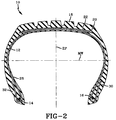
- the present invention relates to a pneumatic tire 10.
- the tire When mounted on the wheel of a motor vehicle, the tire through its tread provides traction and contains the fluid that sustains the vehicle load. More specifically, the present invention relates to a radial-ply tire.
- Radial-ply tire means a belted or circumferentially-restricted pneumatic tire in which the carcass ply reinforcement which extend from bead to bead are laid at angles between 75° and 105° with respect to the equatorial plane of the tire.
- the present invention relates to a pneumatic tire 10.
- the pneumatic tire 10 has a carcass ply 12 incorporating a plurality of rubber-coated parallel cords 13. Whereas only one carcass ply 12 is shown, more than one carcass ply may be used as shown in Figure 6 and later described. In fact, 6 or 8 plies may be used.
- the cords 13 for use in the carcass ply 12 may comprise from one (monofilament) to multiple filaments.
- the number of total filaments in the cord may range from 1 to 27.
- the individual diameter of each filament generally ranges from .15 to .30 mm for each filament. Preferably, the diameter of each filament ranges from .15 mm to .22 mm.
- cord constructions include 1 ⁇ , 2 ⁇ , 3 ⁇ , 4 ⁇ , 5 ⁇ , 6 ⁇ , 7 ⁇ , 8 ⁇ , 11 ⁇ , 12 ⁇ , 1 + 2, 1 + 4, 1 + 5, 1 + 6, 1 + 7, 1 + 8, 2 + 1, 3 + 1, 5 + 1, 6 + 1, 11 + 1, 12 + 1, 2 + 7, 2 + 7 + 1, 3 + 9, 1 + 5 + 1 and 1 + 6 + 1 or 3 + 9 + 1.
- the most preferred cord constructions including filament diameters are 3 ⁇ .18, 1 + 5 ⁇ .18, 1 + 6 ⁇ .18, 2 + 7 ⁇ .18, 2 + 7 ⁇ .18 ⁇ 1 ⁇ .15, 3 + 9 ⁇ .18 + 1 ⁇ .15, 3 + 9 ⁇ .18, 3 ⁇ .20 + 9 ⁇ .18 and 3 ⁇ .20 + 9 ⁇ .18 + 1 ⁇ .15.
- the above cord designations are understandable to those skilled in the art.
- designations such as 2 ⁇ , 3 ⁇ and 4 ⁇ mean a bunch of twisted filaments; ie, two filaments, three filaments, four filaments and the like.
- Designations such as 1 + 2 and 1 + 4 indicate, for example, a single filament wrapped by two or four filaments.
- the above cord constructions may be composed of nonmetallic material or steel.
- nonmetallic materials include rayon, polyester, glass fiber aramid, carbon fiber and nylon.
- the cord construction for the carcass is steel.
- the carcass ply 12 has a layer of the above-described cords 13 arranged so as to have from 5 to 70 ends per inch ( ⁇ 2 to 28 ends per cm) when measured in a tire circumferential direction at a location having a tire maximum width (MW).
- the layer of cords are arranged so as to have 7 to 20 ends per inch ( ⁇ 2.7 to 8 ends per cm) at MW.
- the above calculations for ends per inch are based upon the range of diameters for the cord, strength of the cord and the practical strength requirement for the carcass ply. For example, the high number of ends per inch would include the use of a lower diameter cord for a given strength versus a lower number of ends per inch for a higher diameter wire for the same strength. In the alternative, if one elects to use a cord of a given diameter, one may have to use more or less ends per inch depending on the strength of the cord.
- the steel cord 13 of the carcass ply 12 intersect the equatorial plane (EP) of the tire at an angle in the range of from 75° to 105°.
- the steel cords intersect at an angle of from 82° to 98°.
- the preferred range is from 89° to 91°.
- the pneumatic tire 10 has a pair of axially spaced-apart annular beads 14, 16.
- the carcass ply 12 extends between the beads 14, 16.
- the pneumatic tire 10 has a conventional tread 18 disposed on the crown of the carcass 12.
- the pneumatic tire 10 has a belt structure comprising at least two belts 20, 22.
- a critical aspect of the present invention is a belt structure comprising at least two plies 20, 22 at least one of which is reinforced with parallel steel strands 24, 26.
- one or both belt plies may be reinforced with the steel strands.
- it may be the top belt 22 or the bottom belt 20.
- both belts are reinforced with the steel strands.
- the belt ply having a layer of parallel steel strands 24, 26 of untwisted filaments is arranged so as to have from 8 to 40 ends per inch.
- EPI or ends per inch is measured in a direction perpendicular to the parallel strands.
- the layer of steel strands 24, 26 is arranged so as to have 12 to 28 ends per inch.
- the layer of steel strands 24, 26 is arranged so as to have 18 to 24 ends per inch.
- the rivet between the strands in the belt layer may range from 0.15 to 2.5 mm. Preferably, the rivet ranges from 0.3 to 1.2 mm.
- the above calculations for ends per inch and rivet are based upon the range of diameters for the strand, diameter of the filament, strength of the strand, strength of the filament and the practical strength requirement for the belt ply. For example, the high number of ends per inch would include the use of a lower diameter strand for a given strength versus a lower number of ends per inch for a lower diameter strand for the same strength. In the alternative, if one elects to use a strand of a given diameter, one may have to use more or less ends per inch depending on the tensile strength of the filaments.
- each filament in the strand may vary from 0.10 to 0.5 mm.
- the diameter of each strand will be from 0.20 to 0.40 mm.
- the number of filaments in each strand will range from 3 to 12 filaments. Preferably, the number of filaments in each strand range from 3 to 7.
- the strands used in the present invention have untwisted filaments, such filaments within a strand may have minor movement relative to other filaments in the strand prior to final vulcanization of the tire. Namely, such movement may occur during the vulcanization of the green tire. All of the filaments are, however, substantially parallel to each other. Therefore, the cross-sectional profile (as measured in a circumferential direction) of the strand may have minor variances along the belt ply.
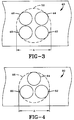
- the diameter of the smallest circle enveloping the cross-sectional area of each strand is less than 0.97 x (D x n).
- Figure 3 is a fragmentary cross-sectional view of a steel strand 40 having four untwisted round filaments 42,44,46,48.
- the diameter A of the smallest circle 50 enveloping the cross-sectional area of the strand 40 as shown by dotted line 50 is less than .97 x (diameter of each filament x 4).
- the diameter A of the smallest circle 50 enveloping the cross-sectional area of the strand 50 must be less than 0.776 mm.
- Figure 4 is a fragmentary cross-sectional view of a steel strand 60 having three untwisted round filaments 62,64,66.
- the diameter A of the smallest circle 68 enveloping the cross-sectional area of the strand 60 is less than 0.97 x (diameter of each filament x 3) .
- the diameter A of the smallest circle 68 enveloping the cross-sectional area of the strand 60 must be less than 0.873 mm.
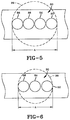
- Figure 5 is fragmentary cross-sectional view of a steel strand 80 having four untwisted round filaments 82,84,86,88 and which the diameter A of the smallest circle 89 enveloping the cross-sectional area of such strand 80 is more than 0.97 x (D x n). For example, it must exceed 1.00 x (D x n) because the strand 80 is flat with the parallel filaments 82,84,86,88 extending side by side in one plane when the bundle is in a free straight position. Stated another way, because each filament is aligned side by side, the diameter of the smallest circle 89 enveloping the cross-sectional area of the strand will be at a minimum the sum of the diameter of all the filaments in the strand. Any belt ply layer having the strand 80 of Figure 5 would have a significantly higher bending stiffness in the plane of the belt than in the longitudinal plane perpendicular thereto.
- Figure 6 is a fragmentary cross-sectional view of another strand 90 that does not meet the criteria of the present invention.
- Figure 6 shows a steel strand 90 having three untwisted round filaments 92,94,96.
- the diameter of the smallest circle 98 enveloping the cross-section area of the strand 90 is more than 0.97 x (D x n).
- the diameter A of the smallest circle 98 enveloping the cross-sectional area of the strand 90 of Figure 6 will be 1.00 x (D x n) or 0.90 mm, plus any distance associated between the individual filaments.
- the pneumatic tire 10 of the present invention is characterized by the use of strands of untwisted filaments, each having high tensile strength values.
- Each filament for use in the strands have a tensile strength of at least (3000 MPa -(2000 x D)) x 95 percent where D is the filament diameter in millimeters.
- the tensile strength of each filament is at least (4080 MPa -(2000 x D)) x 95 percent.
- tensile strengths greater than (4400 MPa - 12000 x D)) x 95 percent can be used.
- tensile strength of an individual filament is generally measured according to ASTM E8M-90a.
- the total elongation for the wire must be at least 2 percent over a gauge length of 25 centimeters.
- Total elongation is measured according to ASTM E8M-90a.
- the total elongation ranges from 2 percent to 4 percent.
- a particularly preferred total elongation ranges from 2.3 to 3.0.
- the torsion values for the steel filaments for use in the strand should be at least 20 turns with a gauge length of 200 times the diameter of the wire. Generally, the torsion value ranges from 20 to 100 turns. Preferably, the torsion values range from 30 to 80 turns with a range of from 35 to 55 being particularly preferred.
- the torsion values are determined according to ASTM Test Method E 558-83 with test lengths of 200 times the diameter of the wire.
- Representative of the type of steel filaments that may be used in the strands include the filaments disclosed in SA- 91/2134 having a tensile strength of 3,650 megapascals and a diameter of 0.20 millimeters.
- a substantially air impervious layer 28 is disposed inwardly of the carcass ply 12 and contiguous to an inflation chamber defined by the volume bounded by the tire 10 and rim assembly (not shown) .
- a barrier layer (not shown) is disposed between the air impervious layer 28 and the carcass ply 12. The barrier ply functions to separate the air impervious layer from the elastomeric layer in which the steel strands of untwisted filaments of the carcass ply 12 are embedded.
- Elastomeric sidewalls 30, 32 are disposed axially outwardly of the carcass structure.
- one embodiment of the present invention is a pneumatic tire 100 having a belt structure 102 containing four belt ply layers 104,106,108,110.
- the steel strands may be located in all or any one of the four belt ply layers 104,106,108,110.
- the lower three belts 104,106 and 108 contain steel strands.
- more than four belts may be used; for example, 6,8,10 belts ply layers may be used.
- the tire 100 of Figure 7 has two carcass plies 112,114.
- each carcass ply 112,114 may be reinforced with nonmetallic materials and/or steel.
- the pneumatic tire 100 has a pair of axially spaced-apart annular beads 116,118.
- the pneumatic tire has a conventional tread 120 disposed on the crown of the tire.
- the tire 100 of Figure 7, if of the tubeless variety, may have a substantially air impervious layer 122 that is disposed inwardly of the carcass ply 112 and contiguous to an inflation chamber defined by the volume bounded by the tire 100 and rim assembly (not shown). Elastomeric sidewalls 124,126 are disposed axially outwardly of the carcass structure.
- the use of steel strands of untwisted filaments in the carcass as disclosed herein may be applied to general passenger radial tires as well as racing tires, agricultural tires, motor cycles, small or medium size truck tires and leisure vehicle tires.
- the pneumatic tires of the present invention are directed to passenger tires and medium to light truck tires.
- the pneumatic tires of the present invention may be designed for various load ranges.
- the load ranges may be A, B, C, D or E.
- the load range is E.
- the pneumatic tires of the present invention may also be designated by various prefix letters depending on the designed service conditions requiring different loads and inflations.
- the tires may be designated by AT, LT, P and ST.
- the pneumatic tire is LT.
Landscapes
- Engineering & Computer Science (AREA)
- Mechanical Engineering (AREA)
- Tires In General (AREA)
- Ropes Or Cables (AREA)
Applications Claiming Priority (2)
| Application Number | Priority Date | Filing Date | Title |
|---|---|---|---|
| US2687798A | 1998-02-19 | 1998-02-19 | |
| US26877 | 1998-02-19 |
Publications (2)
| Publication Number | Publication Date |
|---|---|
| EP0937588A2 true EP0937588A2 (de) | 1999-08-25 |
| EP0937588A3 EP0937588A3 (de) | 2001-03-28 |
Family
ID=21834309
Family Applications (1)
| Application Number | Title | Priority Date | Filing Date |
|---|---|---|---|
| EP99102590A Withdrawn EP0937588A3 (de) | 1998-02-19 | 1999-02-11 | Radialluftreifen mit Litzen aus unverdrillten Stahlfäden in einer Gürtellage |
Country Status (4)
| Country | Link |
|---|---|
| EP (1) | EP0937588A3 (de) |
| JP (1) | JPH11291710A (de) |
| BR (1) | BR9900564A (de) |
| CA (1) | CA2261397A1 (de) |
Cited By (4)
| Publication number | Priority date | Publication date | Assignee | Title |
|---|---|---|---|---|
| EP1193084A3 (de) * | 2000-09-27 | 2003-03-12 | Bridgestone Corporation | Notlaufreifen |
| EP1167082A3 (de) * | 2000-05-12 | 2003-04-09 | Bridgestone Corporation | Radialer Reifen |
| CN102899768A (zh) * | 2011-07-25 | 2013-01-30 | 韩国轮胎株式会社 | 芳纶-尼龙66的复合帘线以及将其作为加强帘线使用的充气轮胎 |
| US9073389B2 (en) | 2011-10-21 | 2015-07-07 | Bridgestone Americas Tire Operations, Llc | All steel fabric radial construction for agricultural tires |
Families Citing this family (2)
| Publication number | Priority date | Publication date | Assignee | Title |
|---|---|---|---|---|
| JP2011105095A (ja) * | 2009-11-16 | 2011-06-02 | Bridgestone Corp | 空気入りタイヤ |
| JP5683977B2 (ja) * | 2011-01-25 | 2015-03-11 | 株式会社ブリヂストン | 農業用タイヤ |
Family Cites Families (3)
| Publication number | Priority date | Publication date | Assignee | Title |
|---|---|---|---|---|
| US3682221A (en) * | 1969-03-14 | 1972-08-08 | Alfred Marzocchi | Tire construction with improved reinforcement |
| EP0342644B1 (de) * | 1988-05-20 | 1996-08-21 | TOYO TIRE & RUBBER CO., LTD . | Luftreifen |
| USH1333H (en) * | 1990-03-21 | 1994-07-05 | Helfer Farrel B | High strength reinforcement |
-
1999
- 1999-02-09 BR BR9900564A patent/BR9900564A/pt not_active Application Discontinuation
- 1999-02-10 CA CA 2261397 patent/CA2261397A1/en not_active Abandoned
- 1999-02-11 EP EP99102590A patent/EP0937588A3/de not_active Withdrawn
- 1999-02-18 JP JP11040075A patent/JPH11291710A/ja active Pending
Cited By (6)
| Publication number | Priority date | Publication date | Assignee | Title |
|---|---|---|---|---|
| EP1167082A3 (de) * | 2000-05-12 | 2003-04-09 | Bridgestone Corporation | Radialer Reifen |
| US7438104B2 (en) | 2000-05-12 | 2008-10-21 | Bridgestone Corporation | Radial tire |
| EP1193084A3 (de) * | 2000-09-27 | 2003-03-12 | Bridgestone Corporation | Notlaufreifen |
| CN102899768A (zh) * | 2011-07-25 | 2013-01-30 | 韩国轮胎株式会社 | 芳纶-尼龙66的复合帘线以及将其作为加强帘线使用的充气轮胎 |
| CN102899768B (zh) * | 2011-07-25 | 2015-08-05 | 韩国轮胎株式会社 | 芳纶-尼龙66的复合帘线以及将其作为加强帘线使用的充气轮胎 |
| US9073389B2 (en) | 2011-10-21 | 2015-07-07 | Bridgestone Americas Tire Operations, Llc | All steel fabric radial construction for agricultural tires |
Also Published As
| Publication number | Publication date |
|---|---|
| CA2261397A1 (en) | 1999-08-19 |
| JPH11291710A (ja) | 1999-10-26 |
| EP0937588A3 (de) | 2001-03-28 |
| BR9900564A (pt) | 2001-03-13 |
Similar Documents
| Publication | Publication Date | Title |
|---|---|---|
| EP0795426B1 (de) | Radiale Reifen mit mindestens zwei mit Stahleinzeldrähten verstärkten Gürtellagen | |
| EP0846063B1 (de) | Reifen mit einer einzelnen karkasse aus metallischen korden,hochendende schichteumschlag und geschlossene wulstkonstruktion | |
| EP0984867B1 (de) | Ein unausdehnbarer hochtemperaturfester notlaufreifen | |
| EP0849098B1 (de) | Reifen mit hochfester Verstärkung | |
| EP0855964B1 (de) | Ein dünnes, mit klein-durchmesser-stahlkorden verstärktes reifengewebe und verfahren zum überlappungsspleissen von gewebe | |
| US20020011296A1 (en) | Pneumatic tire | |
| EP0542567B1 (de) | Luftreifen | |
| JP7692262B2 (ja) | タイヤのベルト構造 | |
| EP0987128A2 (de) | Reifen mit Verstärkung von hoher festigkeit in der Karkasse | |
| EP3339058B1 (de) | Luftreifen | |
| KR100582331B1 (ko) | 타이어 | |
| EP0937588A2 (de) | Radialluftreifen mit Litzen aus unverdrillten Stahlfäden in einer Gürtellage | |
| EP0644070A1 (de) | Reifen mit Stahldrähten in der Karkasse | |
| EP1120293B1 (de) | Luftreifen | |
| JP2595355Y2 (ja) | 空気入りタイヤ | |
| EP0937587A2 (de) | Radialluftreifen mit Litzen aus unverdrillten Stahlfäden in der Karkassenlage | |
| JP2022031257A (ja) | タイヤのシアバンド構造 | |
| MXPA99001546A (en) | Radial wheels containing non-retridated steel filament hebras in a layer of ba sheet |
Legal Events
| Date | Code | Title | Description |
|---|---|---|---|
| PUAI | Public reference made under article 153(3) epc to a published international application that has entered the european phase |
Free format text: ORIGINAL CODE: 0009012 |
|
| AK | Designated contracting states |
Kind code of ref document: A2 Designated state(s): AT BE CH CY DE DK ES FI FR GB GR IE IT LI LU MC NL PT SE |
|
| AX | Request for extension of the european patent |
Free format text: AL;LT;LV;MK;RO;SI |
|
| 18W | Application withdrawn |
Withdrawal date: 20000825 |
|
| PUAL | Search report despatched |
Free format text: ORIGINAL CODE: 0009013 |
|
| D18W | Application withdrawn (deleted) | ||
| AK | Designated contracting states |
Kind code of ref document: A3 Designated state(s): AT BE CH CY DE DK ES FI FR GB GR IE IT LI LU MC NL PT SE |
|
| AX | Request for extension of the european patent |
Free format text: AL;LT;LV;MK;RO;SI |
|
| AKX | Designation fees paid | ||
| REG | Reference to a national code |
Ref country code: DE Ref legal event code: 8566 |
|
| STAA | Information on the status of an ep patent application or granted ep patent |
Free format text: STATUS: THE APPLICATION IS DEEMED TO BE WITHDRAWN |
|
| 18D | Application deemed to be withdrawn |
Effective date: 20010930 |