EP0936452A2 - Verfahren und Anordnung zum Kalibrieren einer Vielkanal-interferometrisch-optisch- Fiberfühleranordnung in einem Signalbearbeitungssytem - Google Patents
Verfahren und Anordnung zum Kalibrieren einer Vielkanal-interferometrisch-optisch- Fiberfühleranordnung in einem Signalbearbeitungssytem Download PDFInfo
- Publication number
- EP0936452A2 EP0936452A2 EP99300974A EP99300974A EP0936452A2 EP 0936452 A2 EP0936452 A2 EP 0936452A2 EP 99300974 A EP99300974 A EP 99300974A EP 99300974 A EP99300974 A EP 99300974A EP 0936452 A2 EP0936452 A2 EP 0936452A2
- Authority
- EP
- European Patent Office
- Prior art keywords
- phase
- laser module
- average
- phase modulation
- component
- Prior art date
- Legal status (The legal status is an assumption and is not a legal conclusion. Google has not performed a legal analysis and makes no representation as to the accuracy of the status listed.)
- Granted
Links
- 238000000034 method Methods 0.000 title claims abstract description 32
- 238000012545 processing Methods 0.000 title claims abstract description 22
- 239000000835 fiber Substances 0.000 title description 21
- 230000003287 optical effect Effects 0.000 claims description 8
- 230000001419 dependent effect Effects 0.000 claims description 4
- 238000004836 empirical method Methods 0.000 claims 1
- 230000010363 phase shift Effects 0.000 description 11
- 238000003491 array Methods 0.000 description 10
- 238000010586 diagram Methods 0.000 description 7
- 230000008859 change Effects 0.000 description 4
- 239000013307 optical fiber Substances 0.000 description 4
- 230000010287 polarization Effects 0.000 description 4
- 230000008569 process Effects 0.000 description 4
- 239000000872 buffer Substances 0.000 description 3
- 239000013078 crystal Substances 0.000 description 3
- 230000008901 benefit Effects 0.000 description 2
- 238000004364 calculation method Methods 0.000 description 2
- 238000005562 fading Methods 0.000 description 2
- 238000001914 filtration Methods 0.000 description 2
- 238000012986 modification Methods 0.000 description 2
- 230000004048 modification Effects 0.000 description 2
- COCLLEMEIJQBAG-UHFFFAOYSA-N 8-methylnonyl 2-methylprop-2-enoate Chemical compound CC(C)CCCCCCCOC(=O)C(C)=C COCLLEMEIJQBAG-UHFFFAOYSA-N 0.000 description 1
- 101000798707 Homo sapiens Transmembrane protease serine 13 Proteins 0.000 description 1
- 230000018199 S phase Effects 0.000 description 1
- 102100032467 Transmembrane protease serine 13 Human genes 0.000 description 1
- 230000006978 adaptation Effects 0.000 description 1
- 239000000969 carrier Substances 0.000 description 1
- 239000003086 colorant Substances 0.000 description 1
- 239000002131 composite material Substances 0.000 description 1
- 230000003750 conditioning effect Effects 0.000 description 1
- 238000001514 detection method Methods 0.000 description 1
- 238000011161 development Methods 0.000 description 1
- 230000018109 developmental process Effects 0.000 description 1
- 229920005994 diacetyl cellulose Polymers 0.000 description 1
- 238000005553 drilling Methods 0.000 description 1
- 238000005516 engineering process Methods 0.000 description 1
- 230000006870 function Effects 0.000 description 1
- 230000010354 integration Effects 0.000 description 1
- GQYHUHYESMUTHG-UHFFFAOYSA-N lithium niobate Chemical compound [Li+].[O-][Nb](=O)=O GQYHUHYESMUTHG-UHFFFAOYSA-N 0.000 description 1
- 230000003278 mimic effect Effects 0.000 description 1
- 239000000203 mixture Substances 0.000 description 1
- 230000005405 multipole Effects 0.000 description 1
- 230000004044 response Effects 0.000 description 1
- 238000010187 selection method Methods 0.000 description 1
- 238000012360 testing method Methods 0.000 description 1
- 239000013598 vector Substances 0.000 description 1
- 238000012795 verification Methods 0.000 description 1
- 230000000007 visual effect Effects 0.000 description 1
- 239000013585 weight reducing agent Substances 0.000 description 1
Images





Classifications
-
- G—PHYSICS
- G01—MEASURING; TESTING
- G01D—MEASURING NOT SPECIALLY ADAPTED FOR A SPECIFIC VARIABLE; ARRANGEMENTS FOR MEASURING TWO OR MORE VARIABLES NOT COVERED IN A SINGLE OTHER SUBCLASS; TARIFF METERING APPARATUS; MEASURING OR TESTING NOT OTHERWISE PROVIDED FOR
- G01D5/00—Mechanical means for transferring the output of a sensing member; Means for converting the output of a sensing member to another variable where the form or nature of the sensing member does not constrain the means for converting; Transducers not specially adapted for a specific variable
- G01D5/26—Mechanical means for transferring the output of a sensing member; Means for converting the output of a sensing member to another variable where the form or nature of the sensing member does not constrain the means for converting; Transducers not specially adapted for a specific variable characterised by optical transfer means, i.e. using infrared, visible, or ultraviolet light
- G01D5/32—Mechanical means for transferring the output of a sensing member; Means for converting the output of a sensing member to another variable where the form or nature of the sensing member does not constrain the means for converting; Transducers not specially adapted for a specific variable characterised by optical transfer means, i.e. using infrared, visible, or ultraviolet light with attenuation or whole or partial obturation of beams of light
- G01D5/34—Mechanical means for transferring the output of a sensing member; Means for converting the output of a sensing member to another variable where the form or nature of the sensing member does not constrain the means for converting; Transducers not specially adapted for a specific variable characterised by optical transfer means, i.e. using infrared, visible, or ultraviolet light with attenuation or whole or partial obturation of beams of light the beams of light being detected by photocells
- G01D5/353—Mechanical means for transferring the output of a sensing member; Means for converting the output of a sensing member to another variable where the form or nature of the sensing member does not constrain the means for converting; Transducers not specially adapted for a specific variable characterised by optical transfer means, i.e. using infrared, visible, or ultraviolet light with attenuation or whole or partial obturation of beams of light the beams of light being detected by photocells influencing the transmission properties of an optical fibre
- G01D5/35303—Mechanical means for transferring the output of a sensing member; Means for converting the output of a sensing member to another variable where the form or nature of the sensing member does not constrain the means for converting; Transducers not specially adapted for a specific variable characterised by optical transfer means, i.e. using infrared, visible, or ultraviolet light with attenuation or whole or partial obturation of beams of light the beams of light being detected by photocells influencing the transmission properties of an optical fibre using a reference fibre, e.g. interferometric devices
-
- G—PHYSICS
- G01—MEASURING; TESTING
- G01H—MEASUREMENT OF MECHANICAL VIBRATIONS OR ULTRASONIC, SONIC OR INFRASONIC WAVES
- G01H9/00—Measuring mechanical vibrations or ultrasonic, sonic or infrasonic waves by using radiation-sensitive means, e.g. optical means
- G01H9/004—Measuring mechanical vibrations or ultrasonic, sonic or infrasonic waves by using radiation-sensitive means, e.g. optical means using fibre optic sensors
-
- G—PHYSICS
- G01—MEASURING; TESTING
- G01N—INVESTIGATING OR ANALYSING MATERIALS BY DETERMINING THEIR CHEMICAL OR PHYSICAL PROPERTIES
- G01N21/00—Investigating or analysing materials by the use of optical means, i.e. using sub-millimetre waves, infrared, visible or ultraviolet light
- G01N21/17—Systems in which incident light is modified in accordance with the properties of the material investigated
- G01N21/41—Refractivity; Phase-affecting properties, e.g. optical path length
- G01N21/45—Refractivity; Phase-affecting properties, e.g. optical path length using interferometric methods; using Schlieren methods
-
- G—PHYSICS
- G01—MEASURING; TESTING
- G01N—INVESTIGATING OR ANALYSING MATERIALS BY DETERMINING THEIR CHEMICAL OR PHYSICAL PROPERTIES
- G01N21/00—Investigating or analysing materials by the use of optical means, i.e. using sub-millimetre waves, infrared, visible or ultraviolet light
- G01N21/17—Systems in which incident light is modified in accordance with the properties of the material investigated
- G01N21/41—Refractivity; Phase-affecting properties, e.g. optical path length
- G01N21/45—Refractivity; Phase-affecting properties, e.g. optical path length using interferometric methods; using Schlieren methods
- G01N2021/458—Refractivity; Phase-affecting properties, e.g. optical path length using interferometric methods; using Schlieren methods using interferential sensor, e.g. sensor fibre, possibly on optical waveguide
Definitions
- the present invention relates generally to the field of signal processing, and more specifically to a method and apparatus for calibration of a multi-channel fiber optic interferometric sensor system in a signal processing system.
- Acoustic listening systems for underwater applications are well known in the art. They are typically equipped with arrays of acoustic sensors which provide sensitive underwater listening capabilities and may provide relative position information. Each sensor reacts to an incoming pressure wave by modulating an input signal and the outputs of all the sensors are processed to determine the sound and position information.
- These sensor arrays are generally either attached to the submarine hull or are towed behind the submarine. Ideally, the sensors would be attached to the submarine hull, but prior art acoustic sensors were too heavy for many submarine applications. Recent advances in acoustic sensor array technology, however, have produced arrays which are light enough to be mounted on a submarine hull and which still provide very sensitive signal response. This weight reduction has also allowed the number of sensors to be increased.
- Vast arrays of sensors may be placed on the ocean bottom in the vicinity of known oil reserves.
- a surface ship initiates an acoustic pressure wave with a large air burst.
- the acoustic pressure wave and its reflection off the ocean floor are detected by the sensor arrays.
- the data from the sensors is then processed and analyzed to determine optimum drilling locations or to monitor the status of known reservoirs.
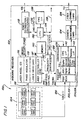
- the above-mentioned related patent applications describe techniques for interrogation of fiber optic interferometric sensors in multi-channel applications and for fine tuning of a receiver card 122 by calibration of digital down converters of the signal processing system 100 of Figure 1.
- the signal processing system 100 is comprised of a source end with lasers, sensors and control electronics, and a receive end.
- the sensors are located in-between the source end and receive end as part of the outboard telemetry.
- the sensors are fiber optic sensors which get the information from the environment sensed by the fiber optic interferometers.
- the optical fiber interferometer has a reference fiber and a signal fiber. A relative optical phase shift between these two fibers is the information returned by the telemetry and extracted by the receive end.
- FIG. 1 is a high-level block diagram of the signal processing system 100.
- An inboard receiver module 102 containing the requisite electronic control and processing circuitry is located inside the submarine.
- a lightweight array of fiber optic interferometric sensors 104 is located on the outside hull of the submarine. Each sensor in the array reacts to an incoming acoustic pressure wave by phase modulating a light signal 118 sent from a laser module 116 of the inboard receiver module 102. Modulated signals from different sensors, each operating at a different carrier frequency, are passively multiplexed onto a single fiber optic cable return signal 120 and sent back to the receiver 102. The channel signals are then demultiplexed and demodulated by the receiver 102.
- the inboard receiver 102 is connected to the submarine's power system (not shown) via a power connection 106.
- the inboard receiver 102 has a power distribution and conditioning block 112 to provide the necessary power requirements for the receiver components.
- Each input light signal 118 is generated by the corresponding laser module 116.
- Each laser module includes a laser 117, a phase modulator 119, a laser driver card 97 and a laser controller card 98.
- the laser 117 used in the preferred embodiment is a Model 125 200 mW Nd:YAG laser, available from Lightwave Electronics of Palo Alto, California.
- the phase modulator 119 is preferably a lithium niobate phase modulator.
- each laser 117 powers 56 sensors (channels), typically 28 channels on each side of the submarine.
- the laser 117 crystal is heated with the temperature level provided from a frequency synthesizer 142 ( Figure 1).
- the frequency synthesizer 142 controls the temperature of each laser 117 crystal separately, as is well known in the art, to produce laser outputs with eight different "colors" i.e., different wavelength nominally at 1319 nanometers, which are provided to the corresponding phase modulator 119a - 119h.
- each sensor array 104 On their way back to the receive end of the inboard receiver 102, all first channel outputs from each sensor array 104 are multiplexed together via a signal multiplexer 121. This is repeated for all the other 55 channels. Therefore, 56 fiber optic cable return signals 120 return from the sensor array 104, with each fiber carrying eight multiplexed signals. The multiplexed signal is then processed by a receiver card 122 ( Figure 1). Depending upon the number of sensors used, several receiver cards 122 may be needed.
- the frequency synthesizer 142 contains the master system clock and controls the operation of the laser module 116 by defining laser parameters, such as laser color, power, and temperature, provided to the laser module 116 on an amp/freq control line 146.
- the timing information is provided to the receiver card 122 via a signal timing line 144.
- a CPU 130 and an associated memory 140 provide system level control and status information to the component of receiver 102 via data lines 132, 138, 141.
- the CPU 130 has a VME interface 139, attached to a VME bus 138, which exists between the CPU 130 and the receiver card 122.
- the CPU 130 is connected to the frequency synthesizer 142 via a data line 141.
- the receiver card 122 demultiplexes and demodulates the retum signal 120 and outputs a signal to a beamformer card 124 which provides additional signal processing.
- a fiber channel card 126 provides the signal information to an external fiber bus 110.
- Each receiver card 122 processes the signals from 7 fiber return signals 120, wherein each fiber has eight laser channels, or a total of 56 channels from eight different sensor arrays 104.
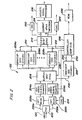
- FIG 3 is a detailed block diagram of the receiver card 122 shown in Figure 1.
- the return signal ⁇ ( ⁇ (t)) 120, containing 8 channels, output by the acoustic sensor array 104 is input into a polarization diversity detector (PDD) 200.
- PDD polarization diversity detector
- An example of a PDD which has three outputs is described in U.S Patent No. 5,448,058, entitled "OPTICAL SIGNAL DETECTION APPARATUS AND METHOD FOR PREVENTING POLARIZATION SIGNAL FADING IN OPTICAL FIBER INTERFEROMETRIC SENSOR SYSTEMS.”
- a bi-cell or a two-output PDD is used.
- the PDD 200 and some other elements of the receiver card 122 prevent polarization signal fading in the return signal 120.
- the PDD 200 converts the photonic energy of the optical fiber return signal 120 into two separate electrical currents 200a, 200b via two photodiodes.
- each opto-receiver 202a, 202b a transimpedance amplifier converts the input current to a voltage, and a variable gain amplifier sets the voltage level in order to maximize the signal-to-noise level and to ensure that the voltage level is below the saturation level of ADCs 204a, 204b.
- the ADC used in the preferred embodiment has the part number 9042, and is manufactured by Analog Devices, Inc.
- the number of ADCs used is directly dependent upon the number of outputs from the PDD 200. Typically, there are two outputs, but three are possible.
- the digitized output contains a complex signal comprised of all channels on the return optical fiber return signal 120, which are the frequency division multiplexed phase generated carriers with the information-carrying sidebands.
- Each ADC 204a, 204b output is buffered and passed through to a multi-throw, multi-pole bus switch 206 which taps into each ADC 204a, 204b signal path.
- One output of the bus switch 206 goes to a digital down converter (DDC) 228, via signal path 238, which is employed as part of a calibration channel, as described below.
- the outputs of the bus switch 206 go to the signal channel DDCs 208a, 208b, 208n.
- the purpose of the bus switch 206 is to allow each of the DDCs 208 to be able to connect to any ADC output. This is required by the PDD 200 selection algorithm, discussed below with reference to Figure 7.
- Each DDC 208a, 208b, 208n acts as a digital demultiplexer by performing mix down and filtering of the digital information, separating one channel out of the composite signal.
- the DDC chip employed in the presently preferred embodiment is the GC4014 chip manufactured by Graychip, Inc. This particular device has 2-channel capability. In other embodiments, each chip may only have 1/2 or 1-channel capability. The number of DDCs needed depends upon the number of channels used in a given application. For example, if the return signal 120 has 8 multiplexed channels, then 4 2-channel DDC chips are needed. In the present embodiment, 28 2-channel DDCs (56 channels) are used per receiver card 122, but only one calibration DDC 228 and receiver card controller 226 are required, as described below. Thus, seven channel groups are needed to process all 56 multiplexed signals, with 8 channels per multiplexed array output signal.
- Each DDC 208a, 208b, 208n outputs both in-phase (I) and quadrature phase (Q) data words that represent the rectangular components of the phase signal from the bus switch 206.
- I and Q components from the DDCs 208a, 208b, 208n are time division multiplexed (TDM) onto separate I and Q buses.
- TDM time division multiplexed
- the I and Q components which define the same phase angle do not have the same frequency in the present invention. They are harmonics of the same frequency and one of these components is usually on the fundamental frequency and the other is on the first harmonic frequency.
- the output signal paths 210, 212 (which may be serial, unidirectional data paths or bi-directional data paths) output the I and Q 8-bit data words to a buffer 214 which buffers the words and also converts the 8 bit words into 16 bit words.
- the I and Q words from all of the DDCs 208 in a time sequence are then demodulated.
- the I and Q words are converted from Cartesian to polar form by the coordinate transformer 216 to obtain the magnitude and the phase angle in polar coordinates.
- the coordinate transformer 216 of the preferred embodiment is a TMC2330A chip manufactured by Raytheon Corp., but may be any similar device.
- the output of the coordinate transformer 216 is the instantaneous phase angle, whose change is directly related to the change in acoustic pressure of the acoustic signal from the environment, and whose rate of change is directly related to the frequency of the acoustic signal from the environment for a given fiber optic sensor.
- the channel-by-channel instantaneous phase angles are further processed in an acoustic signal processor 218, with integration and filtering algorithms, which is also attached to the VME bus 138.
- the output of the acoustic signal processor 218 may then be provided to a visual display, an oscilloscope, or to some other signal processing blocks, as desired.
- Two DACs 222, 224 provide I and Q signals which can be used for testing or viewing the output signal.
- the calibration procedure described in the above-mentioned patent application U.S. Serial No. 09/021,557 uses the receiver card 122 fine tuning loop for calibration of the receiver card 122 components.
- the output 238 of the bus switch 206 is used to feed the calibration channel DDC 228. If there is more than one PDD 200, there will be more than one bus switch 206 feeding the calibration channel DDC 228, in a TDM manner.
- the calibration channel DDC 228 is set to mimic each signal channel in tum.
- the calibration channel provides a way to check PDD output selection, phase shift adjustment and I/Q balance on a per signal channel basis in a non-obtrusive way.
- the data is processed by the DDC 228 into I and Q words similar to the output of the signal channel DDCs 208a, 208b, 208n.
- the I and Q words are then processed by the receiver card controller 226 (a digital signal processor with its own RAM and ROM 232 memory) to extract the information necessary to determine channel performance.
- the receiver card controller 226 of the preferred embodiment is a ADSP 2181 manufactured by Analog Devices, Inc.
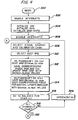
- the operation of the receiver card controller 226 is described with reference to the flowchart of Figure 4.
- the following steps are performed by software which is either stored in the system controller's ROM 232 or is downloaded by the system CPU 130 to the signal processor 226 DSP RAM upon system initialization.
- All interrupts are disabled at step 302.
- the receiver card controller 226 digital signal processing unit (DSP) is initialized at step 304, along with any associated RAM memory and the DDCs 208.
- the interrupts are then enabled at step 306.
- a signal channel and a calibration channel are selected at step 308.
- the best PDD signal is selected at step 310 by making the ADC selection for each signal channel. This PDD selection step is further described below with reference to Figure 7.
- a phase shift algorithm for the in-phase I component is performed at step 312, which is shown in detail in Figure 5.
- a phase shift algorithm for the Q component is performed at step 314, as shown in Figure 6.
- An I/Q balance algorithm is executed at step 316, which is shown in detail in Figure 8. Steps 308 - 316 are repeated for each channel, until all the channels have been calibrated. In one embodiment, calibration is performed only at system start-up. In the preferred embodiment, however, the calibration procedure continues for each DDC for as long as the system is operating. This results in a dynamic calibration system which unobtrusively calibrates the system while signal processing functions are unaffected.
- step 310) The procedure for selecting the best PDD signal (step 310) is illustrated by the flowchart of Figure 7.
- the first ADC 204a is selected, and I and Q data samples are obtained at step 604.
- a maximum I peak-to-peak value is calculated at step 606, when Q value is near zero.
- These 32 maximum I peak-to-peak values are averaged to determine the average maximum I peak-to-peak value. Similar process may be performed to determine the average maximum Q peak-to-peak value, when needed.
- the average maximum I peak-to-peak value determined at step 606 is then stored at step 608. Then the second ADC 204b is selected at step 610. I and Q data samples are then obtained for the second ADC 204b at step 612. Again, an average maximum I peak-to-peak value is calculated at step 614, and this value is stored at step 616. The two stored average maximum I peak-to-peak values are then compared at step 618. The ADC 204 which produces the larger I peak-to-peak value is then selected (steps 620, 622). Since selecting different ADCs 204 will affect the I and Q signal levels symmetrically, only one signal (I or Q) needs to be examined in this procedure. The PDD 200 selection step is performed for each channel separately. Thus, different channels within DDC 208 may actually be using different ADC 204 inputs, which is why each DDC 208 needs to be connected to both ADCs 204.
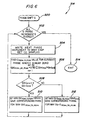
- phase shift algorithms for the I component (step 312) and the Q component (step 314) are shown in Figures 5 and 6, respectively.
- the purpose of these algorithms is to compensate for the misalignment of the return signal 120 from the laser modules 116, and the internal receiver card 122 local oscillator signal in the DDC 208.
- the misalignment occurs due to the fact that the laser modules 116 and the receiver card 122 are all run by the same master clock from the frequency synthesizer 142.
- the adjustment is performed in the DDC 208.
- the algorithm determines the phase offset values that result in a maximum phase signal (I data) and quadrature phase signal (Q data) for each channel.
- phase shift algorithm is performed on the I and Q data.
- the outputs of the phase shift algorithms are an I-phase offset and a Q-phase offset, which are the offsets that result in maximum-amplitude I and Q signals.
- a selected phase increment is stored in the calibration DDC 228, and the I and Q data values are obtained.
- an average maximum peak-to-peak value for I component is calculated. In the present embodiment 32 samples are used, but, depending upon the application, either more or less samples may be used. If the I value calculated at step 406 is greater to or equal to a previously obtained average maximum peak-to-peak value, then a MAX I(n) peak-to-peak variable is set equal to the current I value, and the corresponding phase value is also saved at step 410. Otherwise, at step 412, the MAX I(n) variable is set equal to the previously obtained average maximum peak-to-peak value of I, and the corresponding phase value is saved.
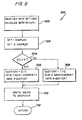
- FIG 8 is a flowchart illustrating the I/Q balance algorithm (step 316 of Figure 1). This procedure is necessary in order to normalize the maximum I and Q vectors and thus to minimize the errors in phase angle calculations.
- the current I and Q gain settings for the current signal channel are read and the I and Q data samples are obtained for the current channel.
- the I and Q values are compared. If I is greater than Q, then a new I gain is calculated at step 706. The new I gain value is made equal to the current I gain value multiplied by the quotient [Q/I]. If, however, I is not greater than Q, then a new Q gain value is calculated at step 708. The new Q gain value is made equal to the current Q gain value multiplied by the quotient [I/Q]. The determined gain values are then re-written to the DDC 208 of the current signal channel.
- control signal bus and the data bus for the DDCs 208 are separate.
- the control signal path between the DDCs 208 and the receiver card controller 226 is a separate bi-directional parallel bus.
- the data signals are output onto a separate serial bus.
- the background calibration operations are processed in parallel to the high speed signal data process flow.
- both high speed signal processing and background calibration processing can occur at the same time.
- both signal and control information share the same parallel bus, and, due to throughput limitations on the bus, the calibration routines are run only during startup or when there is a break in normal system operations.
- the described calibration technique only performs the fine tuning of the receiver card 122 components because its benefits are dependent on the parameters provided to the laser modules 116 during the initialization time.
- an improved calibration method usable with an inboard receiver with digital demodulation circuit and fiber optic interferometric sensor arrays.
- an algorithm for coarse calibration of laser systems which can be performed during the system initialization time.
- This and other objects of the present invention may be met by a coarse calibration technique for laser modules of a data acquisition module in a signal processing system.
- This coarse calibration technique is based on phase modulation of each laser module output signal, controlled by a CPU.
- phase modulation coefficient is calculated for each laser and used as the amplitude of a cosine wave signal for the laser module carrier frequency for phase modulation of the laser output signal.
- the phase modulation coefficient is determined from a global average I/Q ratio, calculated for all channels of the selected laser module, as an average of all I/Q ratios of in-phase and quadrature phase angle components of the signals returned from the sensors.
- the phase modulation coefficient for the selected laser module is determined empirically or by dividing the previously determined phase modulation coefficient by the previously determined global average I/Q ratio.
- the coarse calibration algorithm of the present invention is performed on the laser modules 116 of the inboard receiver 102 system with digital demodulation circuit and fiber optic interferometric sensor arrays 104, as shown in Figure 1, Figure 2 and Figure 3.
- the coarse calibration of the laser modules 116 is controlled by the CPU 130 and is performed only at the system initialization time, in cooperation with the fine tuning calibration method.
- some software code of the coarse calibration algorithm of the present invention is downloaded from the flash memory 140 of the CPU 130 to other cards of the inboard receiver 102, such as the receiver card 122 and the frequency synthesizer 142.
- the Frequency Synthesizer 142 includes a processor with the Laser Module Supervisor which sets the laser modules 116 to proper operating optical frequencies and laser module carrier frequencies.
- the CPU 130 has the rest of the software code with the coarse calibration algorithm.
- the CPU 130 is interfaced with a system control panel which is operated by a human operator. One of the commands entered by the operator is the inboard receiver commence initialization command. The operator receives the system status report from the CPU 130.
- the download of the calibration code to the frequency synthesizer 142 is accomplished via an RS-232 serial line 141.
- the CPU 130 VME backplane interface 139 is attached via a VME bus 138 to the receiver card VME interface 143, using an IDMA port on the receiver card controller ADSP-2181 card.
- the VME bus 138 is used for download from the CPU 130 to the receiver card 122 over the VME backplane interface 139.
- the initialization of the laser modules 116 is accomplished when the Turn on Laser command is sent from the CPU 130 to the frequency synthesizer 142.
- the set of laser coefficients is read from the laser module 116 EEPROM and sent to the frequency synthesizer 142.
- the laser coefficients contain data about the allowed and preferred frequency and temperature range for each laser 117.
- Each laser 117 powers 56 sensor channels of the array panel 104.
- the laser 117 crystal is heated to the designated temperature level, provided by a signal from the frequency synthesizer 142, in order to produce a laser optical output sine wave signal with the required "color'.
- the carrier frequency w 0 also has to be provided by the frequency synthesizer 142 to the corresponding phase modulator 119a - 119h, in the form of a modulating cosine wave signal 99, to modulate the phase of the laser optical output signal 118.
- FIG 9 is a block diagram illustrating a preferred configuration for the coarse calibration of a single laser module 116, according to the present invention.
- the frequency synthesizer 142 controls the operation of each laser 117 by providing, on the amp/freq control line 146 of Figure 1, the input cosine wave control signal 99 with the laser frequency w 0 (cos w 0 t) to the corresponding phase modulator 119, to modulate the phase of the laser optical output signal 118'.
- the frequency synthesizer 142 provides each laser controller card 98, and thus the corresponding phase modulator 119, with the appropriate phase modulation amplitude value "C", to control the phase of each laser optical output signal 118 in the coarse calibration loop of the inboard receiver 102.
- the I and Q components of the phase angle ⁇ (t) and their ratio I/Q are determined and optimized for each sensor channel at the appropriate receiver card 122 and receiver card controller 226, as described in the prior art. They are used both in the fine tuning algorithm of the prior art, performed on the receiver card 122, and in the coarse tuning algorithm of the present invention performed in the whole inboard receiver 102.
- FIG 10 is a flowchart illustrating the steps of the coarse calibration algorithm of the present invention, performed under control of the CPU 130 at the system initialization time.
- the next uncalibrated laser is selected.
- the steps of the coarse calibration algorithm are repeated iteratively for each laser, as long as is needed to obtain the I/Q ratio for each channel as close as possible to 1.0, at which time it is proclaimed at step 912 that all lasers controlled by that CPU are calibrated.
- the optimum values of the phase modulation coefficients for all laser modules controlled by that CPU are stored in the CPU 130 for the next initialization time.
- FIG 11 is a flowchart illustrating the steps of the phase modulation coefficient determination module of the coarse calibration algorithm, performed for the selected laser according to the present invention.
- a command is sent to the appropriate receiver card(s) 122 receiver card controller 226 to collect the I/Q ratio value for each channel assigned to the selected laser, calculated from the average maximum I peak-to-peak and average maximum Q peak-to-peak values, and obtained according to the algorithm of Figure 3.
- the I/Q ratio is calculated for each channel as a ratio of an average maximum I value (i.e., when Q is near 0) divided by the average maximum Q value (i.e., when I is near 0), where the average I and Q values are taken from a predetermined number of samples for that channel. Therefore, the I/Q values calculated during the fine tuning calibration at the system initialization time, at the appropriate receiver card 122, are sent to the CPU 130 via its VME backplane interface 139.
- the collected values of I/Q ratio for all channels controlled by the selected laser are added, in order to determine a global average I/Q ratio for all the channels controlled by the selected laser.
- the sensor values which are out of tolerance are discarded.
- the new optimum value of the phase modulation coefficient for the selected laser may be determined empirically or by calculation. In the preferred embodiment of the present invention this value may be obtained by an appropriate mathematical algorithm performed in the CPU 130.
- the new value of the phase modulation coefficient for example, may be calculated by dividing the old value of the phase modulation coefficient by the old value of the global average I/Q ratio.
- the CPU 130 determines the optimum value of the phase modulation coefficient for each laser module 116.
- This coefficient is actually the optimum value of the phase modulation amplitude C of the cosine wave signal 99 supplied to the phase modulator 119 by the frequency synthesizer 142, as shown in Figure 8. It is possible that each sensor in the array panel 104 receives a slightly different signal from the assigned laser 117, so it is impossible to provide a perfect value for the phase modulation amplitude C which would be ideal for all sensors, but only a value optimal for most sensors. Therefore, each receiver card 122 channel has to be fine tuned, as described in the above mentioned prior art patent applications.
- each CPU 130 has a memory map from which it is determined which receiver cards 122, controlled by that CPU, are associated with the selected laser module 116.
- Each CPU 130 preferably controls eight lasers. Ideally, each CPU 130 assists all 56 channels of the laser module 116 when they are all received on the same receiver card 122. However, for practical reasons, in the implementation of the present invention each receiver card 122 assists only 28 channels of each laser module 116. Therefore, each array panel 104 sensor channels are divided between two CPUs and the memory map in this embodiment defines which CPU coarse calibration module would be used to perform the calibration of the whole array panel 104, based on data from the 28 channels assigned to that CPU. It is conceivable, however, that in another embodiment each CPU would calculate its own global average I/Q ratio and that the value closer to 1.0, or the average of the two values, would be chosen to determine the phase modulation amplitude C for that laser.
Landscapes
- Physics & Mathematics (AREA)
- General Physics & Mathematics (AREA)
- Health & Medical Sciences (AREA)
- Life Sciences & Earth Sciences (AREA)
- Chemical & Material Sciences (AREA)
- Analytical Chemistry (AREA)
- Biochemistry (AREA)
- General Health & Medical Sciences (AREA)
- Immunology (AREA)
- Pathology (AREA)
- Optical Communication System (AREA)
- Lasers (AREA)
- Arrangements For Transmission Of Measured Signals (AREA)
- Testing Of Optical Devices Or Fibers (AREA)
- Measurement Of Velocity Or Position Using Acoustic Or Ultrasonic Waves (AREA)
Applications Claiming Priority (4)
| Application Number | Priority Date | Filing Date | Title |
|---|---|---|---|
| US7427398P | 1998-02-10 | 1998-02-10 | |
| US74273P | 1998-02-10 | ||
| US09/074,781 US6008900A (en) | 1998-02-10 | 1998-05-08 | Method and apparatus for calibration of a multi-channel fiber optic interferometric sensor system in a signal processing system |
| US74781 | 1998-05-08 |
Publications (3)
| Publication Number | Publication Date |
|---|---|
| EP0936452A2 true EP0936452A2 (de) | 1999-08-18 |
| EP0936452A3 EP0936452A3 (de) | 2000-07-12 |
| EP0936452B1 EP0936452B1 (de) | 2004-12-08 |
Family
ID=26755456
Family Applications (1)
| Application Number | Title | Priority Date | Filing Date |
|---|---|---|---|
| EP99300974A Expired - Lifetime EP0936452B1 (de) | 1998-02-10 | 1999-02-10 | Verfahren und Anordnung zum Kalibrieren einer Vielkanal-interferometrisch-optischen- Fiberfühleranordnung in einem Signalbearbeitungssytem |
Country Status (8)
| Country | Link |
|---|---|
| US (1) | US6008900A (de) |
| EP (1) | EP0936452B1 (de) |
| KR (1) | KR19990072555A (de) |
| AU (1) | AU740040B2 (de) |
| CA (1) | CA2259527A1 (de) |
| DE (1) | DE69922426T2 (de) |
| IL (1) | IL128451A (de) |
| NO (1) | NO322356B1 (de) |
Cited By (2)
| Publication number | Priority date | Publication date | Assignee | Title |
|---|---|---|---|---|
| WO2005010465A3 (en) * | 2003-07-09 | 2005-05-26 | Suzanne J Heeg | Filtered calculation of sensor array induced phase angle independent from demodulation phase offset of phase generated carrier |
| CN110031811A (zh) * | 2019-05-13 | 2019-07-19 | 成都天奥技术发展有限公司 | 多通道宽频带信号相参特性快速校准系统 |
Families Citing this family (12)
| Publication number | Priority date | Publication date | Assignee | Title |
|---|---|---|---|---|
| EP1040296A4 (de) * | 1997-12-17 | 2003-08-20 | James C O'meara | Laser-beleuchtungssystem. |
| US6600586B1 (en) * | 1999-05-10 | 2003-07-29 | Northrop Grumman Corporation | Normalization method for acquiring interferometer phase shift from frequency division multiplexed fiber optic sensor arrays |
| JP3903105B2 (ja) * | 2000-05-23 | 2007-04-11 | 富士フイルム株式会社 | 動的変化検出方法、動的変化検出装置及び超音波診断装置 |
| AU2002318180A1 (en) * | 2001-07-09 | 2003-01-29 | Oyster Optics, Inc. | Fiber optic telecommunications card with security detection |
| US7346313B2 (en) | 2002-03-04 | 2008-03-18 | Cafarella John H | Calibration of I-Q balance in transceivers |
| JP5228744B2 (ja) * | 2008-09-25 | 2013-07-03 | 富士通株式会社 | 音声信号処理装置及び音声信号処理方法 |
| FR3049132B1 (fr) * | 2016-03-18 | 2018-03-23 | Continental Automotive France | Procede pour limiter le bruit radio, notamment dans la bande fm, par interpolation polynomiale |
| CN110849465B (zh) * | 2019-11-27 | 2021-05-28 | 中国航空工业集团公司北京长城计量测试技术研究所 | 一种任意波形光频调制及溯源装置 |
| CN110849466B (zh) * | 2019-11-27 | 2021-08-06 | 中国航空工业集团公司北京长城计量测试技术研究所 | 一种任意波形的光频调制装置及方法 |
| CN111412974B (zh) * | 2020-05-07 | 2021-11-09 | 中国船舶重工集团公司第七一五研究所 | 一种同振式矢量传感器校准系统和方法 |
| CN113093157B (zh) * | 2021-04-02 | 2023-10-03 | 中国电子科技集团公司第三十八研究所 | 基于微波光子稳相传输链路的分布式接收阵列通道误差标定方法、系统 |
| CN113285755A (zh) * | 2021-05-24 | 2021-08-20 | 西安格威石油仪器有限公司 | 测井仪器总线系统 |
Family Cites Families (3)
| Publication number | Priority date | Publication date | Assignee | Title |
|---|---|---|---|---|
| US4789240A (en) * | 1985-05-28 | 1988-12-06 | Litton Systems, Inc. | Wavelength switched passive interferometric sensor system |
| US5283625A (en) * | 1991-08-19 | 1994-02-01 | Litton Systems, Inc. | Interferometer phase modulation controller apparatus using ratios of two pairs of harmonic signals |
| GB9605144D0 (en) * | 1996-03-11 | 1996-05-08 | Sensor Dynamics Ltd | Apparatus for sensing one or more parameters |
-
1998
- 1998-05-08 US US09/074,781 patent/US6008900A/en not_active Expired - Lifetime
-
1999
- 1999-02-09 NO NO19990611A patent/NO322356B1/no unknown
- 1999-02-09 IL IL12845199A patent/IL128451A/en not_active IP Right Cessation
- 1999-02-09 CA CA002259527A patent/CA2259527A1/en not_active Abandoned
- 1999-02-09 AU AU16367/99A patent/AU740040B2/en not_active Ceased
- 1999-02-10 KR KR1019990004627A patent/KR19990072555A/ko not_active Ceased
- 1999-02-10 DE DE69922426T patent/DE69922426T2/de not_active Expired - Fee Related
- 1999-02-10 EP EP99300974A patent/EP0936452B1/de not_active Expired - Lifetime
Cited By (3)
| Publication number | Priority date | Publication date | Assignee | Title |
|---|---|---|---|---|
| WO2005010465A3 (en) * | 2003-07-09 | 2005-05-26 | Suzanne J Heeg | Filtered calculation of sensor array induced phase angle independent from demodulation phase offset of phase generated carrier |
| US7038785B2 (en) | 2003-07-09 | 2006-05-02 | Northrop Grumman Corporation | Filtered calculation of sensor array induced phase angle independent from demodulation phase offset of phase generated carrier |
| CN110031811A (zh) * | 2019-05-13 | 2019-07-19 | 成都天奥技术发展有限公司 | 多通道宽频带信号相参特性快速校准系统 |
Also Published As
| Publication number | Publication date |
|---|---|
| US6008900A (en) | 1999-12-28 |
| EP0936452A3 (de) | 2000-07-12 |
| NO990611L (no) | 1999-08-11 |
| JP4401464B2 (ja) | 2010-01-20 |
| EP0936452B1 (de) | 2004-12-08 |
| IL128451A (en) | 2001-10-31 |
| DE69922426D1 (de) | 2005-01-13 |
| NO322356B1 (no) | 2006-09-18 |
| IL128451A0 (en) | 2000-01-31 |
| DE69922426T2 (de) | 2005-12-08 |
| CA2259527A1 (en) | 1999-08-10 |
| JPH11328568A (ja) | 1999-11-30 |
| AU740040B2 (en) | 2001-10-25 |
| NO990611D0 (no) | 1999-02-09 |
| AU1636799A (en) | 1999-08-26 |
| KR19990072555A (ko) | 1999-09-27 |
Similar Documents
| Publication | Publication Date | Title |
|---|---|---|
| EP0936453B1 (de) | Verfahren und Anordnung zur Abfrage von faseroptischen interferometrischen Fühlern in Vielkanalanwendungen | |
| EP0936452B1 (de) | Verfahren und Anordnung zum Kalibrieren einer Vielkanal-interferometrisch-optischen- Fiberfühleranordnung in einem Signalbearbeitungssytem | |
| EP0936764B1 (de) | Verfahren und Einrichtung zur Kalibrierung von digitalen Frequenzumsetzern in einem Signalverarbeitungssystem | |
| US6515276B2 (en) | Heterodyne optical spectrum analyzer with provisions for intensity noise subtraction | |
| KR100491451B1 (ko) | 위상 생성 반송파 복조 및 직교 에러 정정을 하는 다중채널 간섭계 | |
| EP1307983B1 (de) | Mehrkanaliger optischer empfänger zur verarbeitung von drei-zell-detektorausgängne mit polarisationsdiversität | |
| EP1009108A2 (de) | Verfahren und Gerät zum an Bord Testen eines Kommunikationssatellit | |
| JP4401464B6 (ja) | 信号処理システムにおける多重チャネル光ファイバ干渉センサシステムを校正する装置及び方法 | |
| RU2010456C1 (ru) | Способ измерения уровня звукового давления гидроакустического источника в естественном водоеме и излучатель опорных сигналов для его осуществления | |
| US20040068384A1 (en) | Polarization diversity detector mask selection algorithm |
Legal Events
| Date | Code | Title | Description |
|---|---|---|---|
| PUAI | Public reference made under article 153(3) epc to a published international application that has entered the european phase |
Free format text: ORIGINAL CODE: 0009012 |
|
| AK | Designated contracting states |
Kind code of ref document: A2 Designated state(s): DE FR GB IT NL |
|
| AX | Request for extension of the european patent |
Free format text: AL;LT;LV;MK;RO;SI |
|
| PUAL | Search report despatched |
Free format text: ORIGINAL CODE: 0009013 |
|
| AK | Designated contracting states |
Kind code of ref document: A3 Designated state(s): AT BE CH CY DE DK ES FI FR GB GR IE IT LI LU MC NL PT SE |
|
| AX | Request for extension of the european patent |
Free format text: AL;LT;LV;MK;RO;SI |
|
| RIC1 | Information provided on ipc code assigned before grant |
Free format text: 7G 01H 9/00 A, 7G 01D 5/353 B, 7H 04B 10/155 B |
|
| 17P | Request for examination filed |
Effective date: 20001227 |
|
| AKX | Designation fees paid |
Free format text: DE FR GB IT NL |
|
| 17Q | First examination report despatched |
Effective date: 20030715 |
|
| GRAP | Despatch of communication of intention to grant a patent |
Free format text: ORIGINAL CODE: EPIDOSNIGR1 |
|
| GRAS | Grant fee paid |
Free format text: ORIGINAL CODE: EPIDOSNIGR3 |
|
| GRAA | (expected) grant |
Free format text: ORIGINAL CODE: 0009210 |
|
| AK | Designated contracting states |
Kind code of ref document: B1 Designated state(s): DE FR GB IT NL |
|
| REG | Reference to a national code |
Ref country code: GB Ref legal event code: FG4D |
|
| REF | Corresponds to: |
Ref document number: 69922426 Country of ref document: DE Date of ref document: 20050113 Kind code of ref document: P |
|
| ET | Fr: translation filed | ||
| PLBE | No opposition filed within time limit |
Free format text: ORIGINAL CODE: 0009261 |
|
| STAA | Information on the status of an ep patent application or granted ep patent |
Free format text: STATUS: NO OPPOSITION FILED WITHIN TIME LIMIT |
|
| 26N | No opposition filed |
Effective date: 20050909 |
|
| PGFP | Annual fee paid to national office [announced via postgrant information from national office to epo] |
Ref country code: NL Payment date: 20070222 Year of fee payment: 9 |
|
| PGFP | Annual fee paid to national office [announced via postgrant information from national office to epo] |
Ref country code: DE Payment date: 20070330 Year of fee payment: 9 |
|
| PGFP | Annual fee paid to national office [announced via postgrant information from national office to epo] |
Ref country code: IT Payment date: 20070518 Year of fee payment: 9 |
|
| NLV4 | Nl: lapsed or anulled due to non-payment of the annual fee |
Effective date: 20080901 |
|
| PG25 | Lapsed in a contracting state [announced via postgrant information from national office to epo] |
Ref country code: NL Free format text: LAPSE BECAUSE OF NON-PAYMENT OF DUE FEES Effective date: 20080901 |
|
| PG25 | Lapsed in a contracting state [announced via postgrant information from national office to epo] |
Ref country code: DE Free format text: LAPSE BECAUSE OF NON-PAYMENT OF DUE FEES Effective date: 20080902 |
|
| PG25 | Lapsed in a contracting state [announced via postgrant information from national office to epo] |
Ref country code: IT Free format text: LAPSE BECAUSE OF NON-PAYMENT OF DUE FEES Effective date: 20080210 |
|
| REG | Reference to a national code |
Ref country code: FR Ref legal event code: PLFP Year of fee payment: 18 |
|
| REG | Reference to a national code |
Ref country code: FR Ref legal event code: PLFP Year of fee payment: 19 |
|
| REG | Reference to a national code |
Ref country code: FR Ref legal event code: PLFP Year of fee payment: 20 |
|
| PGFP | Annual fee paid to national office [announced via postgrant information from national office to epo] |
Ref country code: GB Payment date: 20180216 Year of fee payment: 20 |
|
| PGFP | Annual fee paid to national office [announced via postgrant information from national office to epo] |
Ref country code: FR Payment date: 20180222 Year of fee payment: 20 |
|
| REG | Reference to a national code |
Ref country code: GB Ref legal event code: PE20 Expiry date: 20190209 |
|
| PG25 | Lapsed in a contracting state [announced via postgrant information from national office to epo] |
Ref country code: GB Free format text: LAPSE BECAUSE OF EXPIRATION OF PROTECTION Effective date: 20190209 |