EP0933720A2 - Eingabevorrichtung für körperbehinderte Personen - Google Patents
Eingabevorrichtung für körperbehinderte Personen Download PDFInfo
- Publication number
- EP0933720A2 EP0933720A2 EP98124052A EP98124052A EP0933720A2 EP 0933720 A2 EP0933720 A2 EP 0933720A2 EP 98124052 A EP98124052 A EP 98124052A EP 98124052 A EP98124052 A EP 98124052A EP 0933720 A2 EP0933720 A2 EP 0933720A2
- Authority
- EP
- European Patent Office
- Prior art keywords
- line
- sight
- input
- user
- detecting
- Prior art date
- Legal status (The legal status is an assumption and is not a legal conclusion. Google has not performed a legal analysis and makes no representation as to the accuracy of the status listed.)
- Withdrawn
Links
Images



Classifications
-
- G—PHYSICS
- G06—COMPUTING OR CALCULATING; COUNTING
- G06F—ELECTRIC DIGITAL DATA PROCESSING
- G06F3/00—Input arrangements for transferring data to be processed into a form capable of being handled by the computer; Output arrangements for transferring data from processing unit to output unit, e.g. interface arrangements
- G06F3/01—Input arrangements or combined input and output arrangements for interaction between user and computer
- G06F3/011—Arrangements for interaction with the human body, e.g. for user immersion in virtual reality
- G06F3/013—Eye tracking input arrangements
Definitions
- This invention relates to an input apparatus suited for use in communicating with others through computers by seriously handicapped people such as those suffering from ALS (amyotrophic lateral sclerosis) or other intractable diseases and having difficulties in communicating due to acroparalysis.
- the invention relates also to an input apparatus for the physically handicapped, which detects looking directions by acquiring eyeball images by means of an image pickup optical system, and controls a pointing device such as a mouse cursor based on detected information.
- a physically handicapped person can input character information in one of three modes, i.e. a direct selection mode, a scan selection mode and an encoding mode.
- the keyboard is a typical input apparatus therefor.
- characters are selected by generating, through switch operation, codes allocated to the respective characters.
- This mode stands intermediate between the direct selection mode and scan selection mode.
- the above three modes have both advantages and disadvantages.
- the direct selection mode has the highest input efficiency, and there are demands for development of input apparatus for the direct selection mode suited to the physically handicapped.
- Input apparatus using a light pen, ultrasonic wave, CCD camera or laser pointer have been developed heretofore as input apparatus for the direct selection mode for allowing the physically handicapped, who can use part of the body, to input characters only by moving the head.
- the conventional input apparatus using detection of a line of sight detects a line of sight by emitting low-level infrared light toward the eyeballs and acquiring eyeball images with an infrared camera disposed directly under the center of a CRT display or the like. Input characters are determined from results of the detection.
- the conventional input apparatus using detection of a line of sight noted above, the user's angle of view is small since there is at least a certain distance between the user and the display. Consequently, the line of sight is movable only within a small range, which lowers precision in detecting the line of sight, hence a low degree of precision in determining input.
- This conventional apparatus requires detection of a neck movement, which requires detection of three-dimensional positions and image recognition. Thus, the apparatus has a disadvantage of being relatively large and complicated.
- this type of input apparatus is often used by a seriously handicapped, bedridden person. Difficulties are encountered in arranging the display and infrared camera, and a heavy burden is imposed on the handicapped person.
- Typical methods of analyzing eyeball images acquired with the above conventional input apparatus using detection of a line of sight include a cornea reflex method, a sclera reflex method and a pupil detection method.
- the cornea reflex method utilizes movement, caused by rolling of the eyeballs, of virtual images formed by light reflected from corneal surfaces, and measures eyeball movements based on a relationship between cornea reflection images and the positions of pupil centers.
- the sclera reflex method measures eyeball movements by emitting light to the boundary between the pupil and the white of the eye and observing variations in the intensity of light reflected therefrom.
- the pupil detection method simply measures eyeball movements from the center of the pupil.
- an index is shown in a known position on the display (CRT or LCD) beforehand, and positions of the pupil centers on eyeball images are detected when the user looks at the index.
- a correlation is determined beforehand between an actual position of a line of sight and positions of the pupil centers on eyeball images acquired. The position of the line of sight is detected by using a correlation coefficient.
- a pointing device may be controlled according to output of a result of detection of the line of sight position derived from the above analyzing methods.
- the personal computer may be operated based on the line of sight. Even a person suffering from acroparalysis and unable to operate a mouse or a keyboard at will may operate a personal computer freely only if that person can operate an enter switch.
- the correlation between the positions of the pupil centers and the position of a line of sight deviates, due to a displacement of the body, for example, from what is measured first. Then, the correlation must be measured all over again. Even if an icon for remeasurement is provided on a display screen, for example, it is difficult to move the pointing device at will since the correlation has already deviated. It is difficult for a seriously handicapped person to carry out a remeasurement (calibration) without help.
- This invention has been made having regard to the state of the art noted above, and its object is to provide an input apparatus for the physically handicapped, which has a relatively simple construction, yet realizes a high degree of precision in determining input, and imposes a less burden on the physically handicapped than the conventional apparatus of this type.
- Another object of this invention is to provide an input apparatus for the physically handicapped, which enables even a seriously handicapped person, without help, to remeasure a correlation between positions of the pupil centers and a position of a line of sight and to operate equipment for discontinuing input to a personal computer.
- an input apparatus for the physically handicapped for detecting a position of a user's line of sight, and executing an input operation according to an observed point
- the apparatus comprising a head mount display for displaying at least an input instructing image in response to a command from a computer, a line of sight detecting image pickup optical system mounted in the head mount display, a line of sight detecting device for detecting the position of the line of sight of the user wearing the head concerned mount display, an input enter device for detecting a predetermined motion of the user and outputting an enter signal, and a computing device operable, based on a result of detection by the line of sight detecting device, for computing a point on the input instructing image observed by the user wearing the head mount display, and executing the input operation, by regarding the point observed as an input position, upon receipt of the enter signal from the input enter device.
- an input instructing image such as of a keyboard, icons and the like is displayed on the head mount display, thereby enlarging an amount of movement of the user's line of sight when an observed point moves on the image.
- This improves the line of sight detecting precision, and hence input instructing precision.
- the line of sight is detected by using the line of sight detecting image pickup optical system mounted in the head mount display. This feature eliminates the necessity to detect movement of the neck, thereby simplifying the apparatus. There is no need to take an arrangement of the display and the line of sight detecting image pickup optical system into consideration. A physically handicapped, bedridden person will be relieved of the burden of having to turn toward these components.
- the image displayed on the head mount display is very close to the user's eyes, which provides a large angle of view for the entire image. Since a large amount of movement of the user's line of sight occurs when the observed point moves on the image, the line of sight detecting precision is improved drastically even with the image pickup optical system equivalent to a conventional optical system.
- an input instructing image is displayed on the head mount display, and the user's line of sight is detected by using the image pickup optical system mounted in the head mount display, to compute an observed point and determine an input instructing position.
- an input instructing point may be derived from a movement of the line of sight on the image providing a larger angle of view than an ordinary computer display such as a CRT display.
- the input instructing precision is improved drastically. There is little chance of input errors due to the apparatus.
- the input enter device is operable to measure, by using the result of detection by the line of sight detecting device, a duration of observation by the user of a location in a fixed range, and to determine an input to be entered when the duration exceeds a predetermined period of time.
- a duration of observation by the user of a location in a fixed range on the input instructing image is measured, to determine an input to be entered when the duration exceeds a predetermined period of time.
- the personal computer may be operated only by an input based on eye movement. A physically handicapped person is further relieved from the burden.
- the input enter device is operable to detect blinking of the user from eyeball image signals received from the line of sight detecting image pickup optical system, and to determine an input to be entered when the blinking continually occurs a plurality of times in a predetermined brief period of time.
- a circuit device may be provided to detect the user's blinking from eyeball image signals received from the line of sight detecting image pickup optical system, and a software device may be employed to determine an input to be entered when the blinking continually occurs a plurality of times in a predetermined brief period of time. Then, the personal computer may be operated only by an input based on eye movement. A physically handicapped person is further relieved from the burden.
- an input apparatus for the physically handicapped for detecting a position of a user's line of sight, and operating a pointing device of equipment based on detected information
- the apparatus comprising an image pickup optical system for detecting the user's line of sight, a line of sight detecting device for detecting the position of the user's line of sight by using the image pickup optical system, an eye open/close detecting device for detecting closing of the user's eyes based on a result of detection by the line of sight detecting device, and a control device for controlling the equipment by adding a result of detection by the eye open/close detecting device to control information.
- Infrared light is emitted to the eyeballs, and the image pickup optical system is used to acquire eyeball images for detecting a line of sight position.
- the pupils tend to absorb the infrared light while the other parts tend to reflect the infrared light.
- the signals received by the image pickup optical system are separable to pupil signal portions with low strength and the other signal portions with high strength.
- the signal portions of low strength corresponding to the pupils diminish since the pupils are covered by the eyelids. It may therefore be determined from the signal portions of low strength that the eyes are closed.
- Opening and closing of the eyes are determined based on detection results obtained from the eyeball image signals,
- the equipment may be controlled such that, when the eyes have been closed for at least a predetermined period of time T1, for example, a remeasurement is made of a correlation between the line of sight position and pupil center positions.
- T2 predetermined period of time
- the control of the equipment made by using the result of detection that the eyes are closed is not limited to a specific mode. Besides the above-noted equipment control for remeasurement of the correlation between the line of sight position and pupil center positions and termination of the eyeball image input, an input entering operation may be carried out when information on a display position of a pointing device is inputted, for example.
- a device is provided to detect that the user has closed his or her eyes, and the equipment is controlled by adding results of detection to control information.
- the equipment is controlled by adding results of detection to control information.
- Fig. 1 is a block diagram showing a construction in this embodiment.
- a head mount display 1 is a known device having LCDs (liquid crystal displays) 11, display optics 12 and half mirrors 13 for presenting the wearer with images, these components being provided in pairs for the right and left eyes.
- the LCDs 11 receive image signals from a personal computer 2 to show a display screen of personal computer 2 in enlargement in front of the wearer's eyes.
- the image of personal computer 2 serves as an input instructing image of a keyboard, icons and the like in time of making input.
- the head mount display 1 further includes a line of sight detecting image pickup optical system 3 having infrared light sources 31, half mirrors 32 and CCD cameras 33.
- the CCD cameras 33 pick up images of the eyeballs watching the display screen on the head mount display 1.
- the CCD cameras 33 of image pickup optical system 3 transmit eyeball image signals to a line of sight detection circuitry 4.
- the line of sight detection circuitry 4 includes a binary circuit 41, a reflection point sampling circuit 42, a pupil sampling circuit 43 and a line of sight detecting and computing circuit 44.
- the eyeball image signals from CCD cameras 33 are first taken into the binary circuit 41 where the signals are binary-coded by using a predetermined threshold.
- the reflection point sampling circuit 42 and pupil sampling circuit 43 sample positions of reflection images on the cornea of infrared light from the infrared light sources 31 and center positions in pupil images, respectively.
- the line of sight detecting and computing circuit 44 computes positions of lines of sight of the wearer.
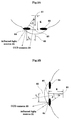
- Figs. 2A and 2B are a schematic plan view and a schematic side view of an eyeball.
- numeral 61 denotes the center of curvature of the cornea
- numeral 62 denotes the position of the pupil center
- numeral 63 denotes the iris
- numeral 64 denotes a cornea reflection image
- numeral 65 denotes a line of sight.
- CCD camera 33 forms with the infrared light source 31 an angle ⁇ in the horizontal direction and an angle ⁇ in the vertical direction.
- a horizontal distance I H between the position of the pupil center 62 and a center position in the cornea reflection image 64 is expressed by equation (1) below, and a vertical distance I V therebetween is expressed by equation (2):
- I H K ⁇ tan ⁇ ⁇ cos ( ⁇ - ⁇ )
- I V K ⁇ tan ⁇ ⁇ cos ( ⁇ - ⁇ )
- Equation (2) is a distance from the center of curvature of the cornea 61 to the position of the pupil center 62 as shown in Figs. 2A and 2B.
- IV K ⁇ sin ⁇
- the line of sight detecting and computing circuit 44 computes the position of the user's line of sight by the above method and transmits this information to the personal computer 2.
- the personal computer 2 moves the cursor on the image of head mount display 1 based on this line of sight position information.
- the personal computer 2 has an enter button 5 connected thereto.
- the enter button 5 is operable to transmit an input enter signal to the personal computer 2.
- the personal computer 2 takes in, as input information, a cursor position at a point of time when the input enter signal is supplied.
- a physically handicapped person wearing the head mount display 1 looks at a desired character, mark or the like on the input instructing image of a keyboard, icons and the like displayed thereon. Then, the handicapped person operates the enter button 5 to input that character or the like to the personal computer 2.
- a physically handicapped person can easily operate the personal computer 2 by means of the head mount display 1 and enter button 5.
- the handicapped person can communicate with able-bodied and other people on a network through application software designed to run on the personal computer 2 for use by the physically handicapped.
- the keyboard, icons and the like displayed on the head mount display 1 are operated by movement of the line of sight as above.
- an audio generating application for example, a physically handicapped person may be able to communicate vocally with an able-bodied person.
- Input may be made to the personal computer 2 only by looking at the input instructing image displayed on the head mount display 1 attached to the head, and operating the enter button 5. There is no need to turn toward a CRT or other type of display, which has been necessary with a conventional input apparatus of this type. Thus, no burden is imposed on the user. At the same time, since an instructing position is based on a line of sight detected when the user looks at the image on the head mount display 1 providing a large angle of view, a high degree of precision is achieved in determining inputs, and input errors are very unlikely to be made at the apparatus side.
- the enter button 5 is provided as a device for generating an input enter signal.
- This invention is not limited thereto.
- An input enter signal may be generated by software. Such examples are illustrated in Figs. 3 and 4.
- Fig. 3 shows an example where an input enter signal is generated when the wearer looks at a location within a given range (e.g. the same character or the like) on the input instructing image.
- the input apparatus has, in addition to the construction shown in Fig. 1, a line of sight continuance determination circuit 45 included in the line of sight detection circuitry 4.
- the line of sight continuance determination circuit 45 computes an amount of movement of the line of sight per unit time based on the line of sight position information received from the line of sight detecting and computing circuit 44, determines that an input should be entered when the amount of movement does not exceed a predetermined value, and transmits an input enter signal to the personal computer 2.
- the personal computer 2 takes in, as input information, a cursor position at a point of time when the input enter signal is supplied from the line of sight continuance determination circuit 45.
- Fig. 4 shows an example where an input enter signal is generated when the wearer blinks a plurality of times.
- the input apparatus has, in addition to the construction shown in Fig. 1, a blink detection circuit 46 included in the line of sight detection circuitry 4.
- the blink detection circuit 46 detects blinks from the eyeball image signals supplied by the CCD cameras 33, and generates an input enter signal. Specifically, this construction utilizes a phenomenon that, when the eyelids are closed, nothing appears in the binary images obtained from the eyeball image signals supplied by the CCD cameras 33.
- the blink detection circuit 46 detects the frequency of this no-input state, determines that an input should be entered when a plurality of (e.g. two) blinks occur continually within a very brief period of time, and transmits an input enter signal to the personal computer 2.
- the personal computer 2 takes in, as input information, a cursor position at a point of time when the input enter signal is supplied from the blink detection circuit 46.
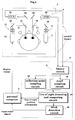
- Fig. 5 is a block diagram showing a construction in this embodiment.
- An image pickup optical system 101 includes infrared light sources 111 for emitting infrared light to the eyeballs, and CCD cameras 112 for picking up images of the eyeballs. Thus, the image pickup optical system 101 picks up the images of the eyeballs watching a screen on a display 104 such as an LCD.
- the CCD cameras 112 of image pickup optical system 101 transmit eyeball image signals to a line of sight detection system 102.
- the line of sight detection system 102 includes a line of sight detector 121, a controller 122 and an eye open/close detector 123.
- the line of sight detector 121 processes the eyeball image signals from CCD cameras 112 based the cornea reflex method, sclera reflex method or pupil detection method discussed in the Description of the Related Art hereof. Through this process, the line of sight detector 121 detects positions of the pupil centers in eyeball images when the user looks at an index appearing on the display 104, and determines a correlation between the pupil centers in the eyeball images and an actual position of a line of sight to detect the position of the line of sight.
- a personal computer 103 takes in, successively in predetermined sampling cycles, line of sight position information obtained by the line of sight detector 121.
- the eye open/close detector 123 detects blinking of the eyes looking at the index on the display 104.
- the eyeball image signals from CCD cameras 112 of image pickup optical system 101 are separable to pupil signal portions with low strength and the other signal portions with high strength.
- the signal portions of low strength corresponding to the pupils diminish since the pupils are covered by the eyelids.
- an appropriate threshold is set to the signal portions of low strength corresponding to the pupils of the eyeball image signals from CCD cameras 112. It is determined that the eyes are closed when the signal portions corresponding to the pupils fall below the threshold. Results of detection by the eye open/close detector 123 are transmitted to the controller 122.
- the controller 122 Based on the detection results of eye open/close detector 123, the controller 122 carries out an operation, described hereinafter, for a calibration (remeasurement of the correlation between the line of sight position and pupil center positions) and for discontinuing a line of sight detection.
- the personal computer 103 displays a pointing device on the screen of display 104, and moves the pointing device in accordance with the line of sight position information received from the line of sight detector 121 of line of sight detection system 102. Further, the personal computer 103 switches the display 104 to a calibration screen in response to a request signal from the controller 122 of line of sight detection system 102.
- the personal computer 103 has an enter switch 105 connected thereto.
- the enter switch 105 is operable to transmit an input enter signal to the personal computer 103.
- the personal computer 103 takes in, as input information, a pointing device display position at a point of time when the input enter signal is supplied.
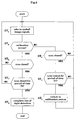
- Fig. 6 is a flow chart showing details of the operation.
- the eyeball image signals are successively taken in from CCD cameras 112 of image pickup optical system 101 (step ST1).
- the controller 122 communicates with the personal computer 103 to determine whether the calibration screen is displayed on the display 104 (step ST2).
- the controller 122 checks, based on the results of detection by the eye open/close detector 123 of line of sight detection system 102, whether the user's eyes are closed (step ST3).
- the controller 122 continues to take in the eyeball image signals, and performs the line of sight detection and input controls.
- the controller 122 determines whether the eyes have been closed for at least a predetermined period of time T1 (step ST4). When the eyes have been closed for at least the predetermined period of time T1, the controller 122 transmits a command signal to the personal computer 103 to switch the display 104 to the calibration screen (step ST5). At this point, the controller 122 continues to take in the eyeball image signals from CCD cameras 112.
- the controller 122 checks again whether the user's eyes are closed (step ST6). When the eyes are not closed, the controller 122 continues to take in the eyeball image signals, and carries out a calibration. When the eyes are not closed after the calibration is completed, the controller 122 takes in the eyeball image signals, and performs the line of sight detection and input controls.
- the controller 122 determines whether the eyes have been closed for at least a predetermined period of time T2 (T2>T1) (step ST7). At a point of time the period of time T2 elapses with the eyes closed, the controller 122 stops taking in the eyeball image information and terminates the line of sight detection (step ST8).
- a pointing device may be displayed on the head mount display, and the above image pickup optical system 101 may be provided for the head mount display to carry out a line of sight detection and input controls.
- input may be made to the personal computer 103 only by looking at the pointing device displayed on the head mount display attached to the head, and operating the enter switch 105.
- CRT or other type of display There is no need to turn toward a CRT or other type of display, which has been necessary with a conventional input apparatus of this type.
- a physically handicapped, bedridden person who has difficulty in watching a display may be able to operate a personal computer in a free and easy posture. This leads to an advantage of lightening the burden on the user.
- the enter switch 105 is provided as a device for generating an input enter signal.
- an input enter signal may be generated by using results of detection by the eye open/close detector 123 of line of sight detection system 102. As in the first above embodiment, for example, whether the user has blinked is detected based on results of detection by the eye open/close detector 123, and an input may be entered when the user continually blinks twice within a predetermined period of time.
- the functions to perform a calibration and discontinue a line of sight input are performed by the line of sight detection system 102.
- This embodiment may be modified to have these functions carried out by the personal computer 103.
Landscapes
- Engineering & Computer Science (AREA)
- General Engineering & Computer Science (AREA)
- Theoretical Computer Science (AREA)
- Human Computer Interaction (AREA)
- Physics & Mathematics (AREA)
- General Physics & Mathematics (AREA)
- Position Input By Displaying (AREA)
- User Interface Of Digital Computer (AREA)
Applications Claiming Priority (4)
| Application Number | Priority Date | Filing Date | Title |
|---|---|---|---|
| JP10016491A JPH11212715A (ja) | 1998-01-29 | 1998-01-29 | 視線入力装置 |
| JP1649198 | 1998-01-29 | ||
| JP8988098 | 1998-04-02 | ||
| JP8988098A JPH1173273A (ja) | 1997-06-27 | 1998-04-02 | 肢体不自由者用入力装置 |
Publications (2)
| Publication Number | Publication Date |
|---|---|
| EP0933720A2 true EP0933720A2 (de) | 1999-08-04 |
| EP0933720A3 EP0933720A3 (de) | 1999-11-10 |
Family
ID=26352838
Family Applications (1)
| Application Number | Title | Priority Date | Filing Date |
|---|---|---|---|
| EP98124052A Withdrawn EP0933720A3 (de) | 1998-01-29 | 1998-12-17 | Eingabevorrichtung für körperbehinderte Personen |
Country Status (1)
| Country | Link |
|---|---|
| EP (1) | EP0933720A3 (de) |
Cited By (6)
| Publication number | Priority date | Publication date | Assignee | Title |
|---|---|---|---|---|
| WO2002088824A3 (de) * | 2001-05-02 | 2003-04-10 | Bosch Gmbh Robert | Vorrichtung zur steuerung von geräten mittels blickrichtung |
| RU2410744C1 (ru) * | 2009-05-19 | 2011-01-27 | Борис Иванович Волков | Устройство ввода |
| US9239460B2 (en) | 2013-05-10 | 2016-01-19 | Microsoft Technology Licensing, Llc | Calibration of eye location |
| JP2016146632A (ja) * | 2016-02-12 | 2016-08-12 | セイコーエプソン株式会社 | 頭部装着型表示装置および頭部装着型表示装置の制御方法 |
| WO2017012519A1 (zh) * | 2015-07-20 | 2017-01-26 | 谢培树 | 头操作的数字眼镜 |
| CN110308794A (zh) * | 2019-07-04 | 2019-10-08 | 郑州大学 | 具有两种显示模式的虚拟现实头盔及显示模式的控制方法 |
Family Cites Families (1)
| Publication number | Priority date | Publication date | Assignee | Title |
|---|---|---|---|---|
| JPH0749744A (ja) * | 1993-08-04 | 1995-02-21 | Pioneer Electron Corp | 頭部搭載型表示入力装置 |
-
1998
- 1998-12-17 EP EP98124052A patent/EP0933720A3/de not_active Withdrawn
Cited By (6)
| Publication number | Priority date | Publication date | Assignee | Title |
|---|---|---|---|---|
| WO2002088824A3 (de) * | 2001-05-02 | 2003-04-10 | Bosch Gmbh Robert | Vorrichtung zur steuerung von geräten mittels blickrichtung |
| RU2410744C1 (ru) * | 2009-05-19 | 2011-01-27 | Борис Иванович Волков | Устройство ввода |
| US9239460B2 (en) | 2013-05-10 | 2016-01-19 | Microsoft Technology Licensing, Llc | Calibration of eye location |
| WO2017012519A1 (zh) * | 2015-07-20 | 2017-01-26 | 谢培树 | 头操作的数字眼镜 |
| JP2016146632A (ja) * | 2016-02-12 | 2016-08-12 | セイコーエプソン株式会社 | 頭部装着型表示装置および頭部装着型表示装置の制御方法 |
| CN110308794A (zh) * | 2019-07-04 | 2019-10-08 | 郑州大学 | 具有两种显示模式的虚拟现实头盔及显示模式的控制方法 |
Also Published As
| Publication number | Publication date |
|---|---|
| EP0933720A3 (de) | 1999-11-10 |
Similar Documents
| Publication | Publication Date | Title |
|---|---|---|
| Lin et al. | Powered wheelchair controlled by eye-tracking system. | |
| Betke et al. | The camera mouse: visual tracking of body features to provide computer access for people with severe disabilities | |
| US6659611B2 (en) | System and method for eye gaze tracking using corneal image mapping | |
| Zhu et al. | Novel eye gaze tracking techniques under natural head movement | |
| US20190235624A1 (en) | Systems and methods for predictive visual rendering | |
| JP3673834B2 (ja) | 眼球運動を用いた視線入力コミュニケーション方法 | |
| US20020039111A1 (en) | Automated visual tracking for computer access | |
| JPH0651901A (ja) | 視線認識によるコミュニケーション装置 | |
| CN108170279A (zh) | 头显设备的眼动和头动交互方法 | |
| JPH09251342A (ja) | 注視箇所推定装置とその方法及びそれを使用した情報表示装置とその方法 | |
| Lee et al. | A robust eye gaze tracking method based on a virtual eyeball model | |
| IL266360A (en) | Accessory for providing input to the computer without hand contact | |
| JPH09179062A (ja) | コンピュータシステム | |
| EP0933720A2 (de) | Eingabevorrichtung für körperbehinderte Personen | |
| JPH09167049A (ja) | コンソール用視線入力装置 | |
| JP2006293786A (ja) | 視線入力装置を備えた市場調査用機器 | |
| KR100520050B1 (ko) | 응시방향 기반의 머리착용형 컴퓨터 인터페이스 장치 및방법 | |
| CN119148392A (zh) | 显示设备和近眼显示装置 | |
| JPH1173273A (ja) | 肢体不自由者用入力装置 | |
| CN205750115U (zh) | 可穿戴计算装置和具有它的可穿戴设备 | |
| JPH11282617A (ja) | 視線入力装置 | |
| Piratla et al. | A neural network based real-time gaze tracker | |
| JPH11184621A (ja) | 視線入力装置 | |
| JPH11212715A (ja) | 視線入力装置 | |
| JP2000047823A (ja) | 情報処理装置 |
Legal Events
| Date | Code | Title | Description |
|---|---|---|---|
| PUAI | Public reference made under article 153(3) epc to a published international application that has entered the european phase |
Free format text: ORIGINAL CODE: 0009012 |
|
| AK | Designated contracting states |
Kind code of ref document: A2 Designated state(s): DE FR GB |
|
| AX | Request for extension of the european patent |
Free format text: AL;LT;LV;MK;RO;SI |
|
| PUAL | Search report despatched |
Free format text: ORIGINAL CODE: 0009013 |
|
| AK | Designated contracting states |
Kind code of ref document: A3 Designated state(s): AT BE CH CY DE DK ES FI FR GB GR IE IT LI LU MC NL PT SE |
|
| AX | Request for extension of the european patent |
Free format text: AL;LT;LV;MK;RO;SI |
|
| 17P | Request for examination filed |
Effective date: 20000121 |
|
| AKX | Designation fees paid |
Free format text: DE FR GB |
|
| 17Q | First examination report despatched |
Effective date: 20010425 |
|
| STAA | Information on the status of an ep patent application or granted ep patent |
Free format text: STATUS: THE APPLICATION IS DEEMED TO BE WITHDRAWN |
|
| 18D | Application deemed to be withdrawn |
Effective date: 20010906 |