EP0930375B1 - Method of manufacturing a ferritic stainless steel plate of high deep drawability and ridging resistance - Google Patents
Method of manufacturing a ferritic stainless steel plate of high deep drawability and ridging resistance Download PDFInfo
- Publication number
- EP0930375B1 EP0930375B1 EP98935353A EP98935353A EP0930375B1 EP 0930375 B1 EP0930375 B1 EP 0930375B1 EP 98935353 A EP98935353 A EP 98935353A EP 98935353 A EP98935353 A EP 98935353A EP 0930375 B1 EP0930375 B1 EP 0930375B1
- Authority
- EP
- European Patent Office
- Prior art keywords
- weight
- stainless steel
- ridging
- temperature
- ferritic stainless
- Prior art date
- Legal status (The legal status is an assumption and is not a legal conclusion. Google has not performed a legal analysis and makes no representation as to the accuracy of the status listed.)
- Expired - Lifetime
Links
Images



Classifications
-
- C—CHEMISTRY; METALLURGY
- C22—METALLURGY; FERROUS OR NON-FERROUS ALLOYS; TREATMENT OF ALLOYS OR NON-FERROUS METALS
- C22C—ALLOYS
- C22C38/00—Ferrous alloys, e.g. steel alloys
- C22C38/18—Ferrous alloys, e.g. steel alloys containing chromium
-
- C—CHEMISTRY; METALLURGY
- C21—METALLURGY OF IRON
- C21D—MODIFYING THE PHYSICAL STRUCTURE OF FERROUS METALS; GENERAL DEVICES FOR HEAT TREATMENT OF FERROUS OR NON-FERROUS METALS OR ALLOYS; MAKING METAL MALLEABLE, e.g. BY DECARBURISATION OR TEMPERING
- C21D8/00—Modifying the physical properties of ferrous metals or ferrous alloys by deformation combined with, or followed by, heat treatment
- C21D8/02—Modifying the physical properties of ferrous metals or ferrous alloys by deformation combined with, or followed by, heat treatment during manufacturing of plates or strips
- C21D8/04—Modifying the physical properties of ferrous metals or ferrous alloys by deformation combined with, or followed by, heat treatment during manufacturing of plates or strips to produce plates or strips for drawing, e.g. for deep-drawing
-
- C—CHEMISTRY; METALLURGY
- C22—METALLURGY; FERROUS OR NON-FERROUS ALLOYS; TREATMENT OF ALLOYS OR NON-FERROUS METALS
- C22C—ALLOYS
- C22C38/00—Ferrous alloys, e.g. steel alloys
- C22C38/18—Ferrous alloys, e.g. steel alloys containing chromium
- C22C38/24—Ferrous alloys, e.g. steel alloys containing chromium with vanadium
-
- C—CHEMISTRY; METALLURGY
- C22—METALLURGY; FERROUS OR NON-FERROUS ALLOYS; TREATMENT OF ALLOYS OR NON-FERROUS METALS
- C22C—ALLOYS
- C22C38/00—Ferrous alloys, e.g. steel alloys
- C22C38/18—Ferrous alloys, e.g. steel alloys containing chromium
- C22C38/26—Ferrous alloys, e.g. steel alloys containing chromium with niobium or tantalum
-
- C—CHEMISTRY; METALLURGY
- C22—METALLURGY; FERROUS OR NON-FERROUS ALLOYS; TREATMENT OF ALLOYS OR NON-FERROUS METALS
- C22C—ALLOYS
- C22C38/00—Ferrous alloys, e.g. steel alloys
- C22C38/18—Ferrous alloys, e.g. steel alloys containing chromium
- C22C38/28—Ferrous alloys, e.g. steel alloys containing chromium with titanium or zirconium
-
- C—CHEMISTRY; METALLURGY
- C21—METALLURGY OF IRON
- C21D—MODIFYING THE PHYSICAL STRUCTURE OF FERROUS METALS; GENERAL DEVICES FOR HEAT TREATMENT OF FERROUS OR NON-FERROUS METALS OR ALLOYS; MAKING METAL MALLEABLE, e.g. BY DECARBURISATION OR TEMPERING
- C21D8/00—Modifying the physical properties of ferrous metals or ferrous alloys by deformation combined with, or followed by, heat treatment
- C21D8/02—Modifying the physical properties of ferrous metals or ferrous alloys by deformation combined with, or followed by, heat treatment during manufacturing of plates or strips
- C21D8/04—Modifying the physical properties of ferrous metals or ferrous alloys by deformation combined with, or followed by, heat treatment during manufacturing of plates or strips to produce plates or strips for drawing, e.g. for deep-drawing
- C21D8/0421—Modifying the physical properties of ferrous metals or ferrous alloys by deformation combined with, or followed by, heat treatment during manufacturing of plates or strips to produce plates or strips for drawing, e.g. for deep-drawing characterised by the working steps
- C21D8/0426—Hot rolling
Definitions
- the present invention relates to a method of producing a ferritic stainless steel plate particularly excellent in the deep drawability and the anti-ridging property in ferritic stainless steel plates.
- Ferritic stainless steel has been widely utilized in various industrial fields such as house wares, parts of motorcars, etc., as a material excellent in the corrosion resistance and the heat resistance.
- the ferritic stainless steel is inexpensive as compared with an austenitic stainless steel containing a large amount of Ni but in general, is inferior in the workability and, for example, when press working is applied to a ferritic stainless steel, a surface defect called ridging is liable to cause, thereby the ferritic stainless steel is unsuitable for the use of being applied with a strong work such as a deep drawing work, etc.
- a ferritic stainless steel has the problems that the anisotropy ( ⁇ r) of a plastic strain ratio is large and a nonuniform deformation is liable to cause at deep drawing work.
- the stainless steel of the above-described (a) contains from 0.03 to 0.08 wt.% C, not more than 0.01 wt.% N, not more than 0.008 wt.% S, not more than 0.03 wt.% P, not more than 0.4 wt.% Si, not more than 0.5 wt.% Mn, not more than 0.3 wt.% Ni, from 15 to 20 wt.% Cr, and from 2 x N to 0.2 wt.% Al.
- the stainless steel of the above-described (b) contains not more than 0.1 wt.% C, not more than 1.0 wt.% Si, not more than 0.75 wt.% Mn, from 10 to 30 wt.% Cr, not more than 0.5 wt.% Ni, not more than 0.025 wt.% N, and from 2 to 30 ppm of B or further containing one or more kinds from 0.005 to 0.4 wt.% Al, from 0.005 to 0.6 wt.% Ti, from 0.005 to 0.4 wt.% Nb, from 0.005 to 0.4 wt.% V, from 0.005 to 0.4 wt.% Zr, from 0.02 to 0.5 wt.% Cu, not more than 0.05 wt.% Ca, and not more than 0.05 wt.% Ce.
- the content of Cr is from 3 to 60 wt.%, the contents of C, S, and O are reduced, and the content of N is from 0.03 to 0.5 wt.%.
- the stainless steel of the above-described (d) contains not more than 0.01 wt.% C, not more than 1.0 wt.% Si, not more than 1.0 wt.% Mn, not more than 0.01 wt.% S, from 9 to 50 wt.% Cr, not more than 0.07 wt.% Al, not more than 0.02 wt.% N, not more than 0.01 wt.% O, and C and N in the conditions satisfying N(wt.%)/C(wt.%) ⁇ 2 and 0.006 ⁇ [C(wt.%) + N(wt.%)] ⁇ 0.025, and further Ti in the conditions satisfying ⁇ Ti(wt.%) - 2 x S(wt.%) - 3 x O(wt.%) ⁇ /[C(wt.%) + N(wt.%)] ⁇ 4 and [Ti(wt.%)] x [N(wt.%) ⁇ 30 x 10 -4 .
- a ferritic stainless steel containing not more than 0.03 wt.% C, not more than 1.0 wt.% Si, not more than 1.0 wt.% Mn, not more than 0.05 wt. % P, not more than 0.015 wt.% S, not more than 0.1 wt.% Al, not more than 0.02 wt. % N, from 5 to 60 wt.
- % Cr from 4 x (C + N) to 0.5 wt.% Ti, from 0.003 to 0.02 wt.% Nb, and from 0.0002 to 0.005 wt.% B or further containing at least one kind of from 0.0005 to 0.01 wt. % Ca and from 0.1 to 5.0 wt. % Mo is disclosed in (e) Patent Publication (unexamined) No. 8-20843.
- ⁇ r becomes about 0.15 or lower and the anisotropy is improved but the anti-ridging property is insufficient.
- JP-A-8260106 discloses a steel for sleep drawability with a composition overlapping with the composition used in the present invention.
- both the techniques are the techniques of sufficiently satisfying the workability and further, in the portions subjected to a severe deep drawing work, the problem of the generation of ridging is not sufficiently improved.
- an object of the present invention is to provide a method of manufacturing a ferritic stainless steel plate having both the improved deep drawability and the improved anti-ridging property at a deep drawing work .
- object of the present invention is to provide a method of manufacturing a ferritic stainless steel plate having the deep drawability satisfying the characteristics of the r value of not less than 1.8 and ⁇ r of not more than 0.15 and having the excellent anti-ridging property.
- the present invention is as follows.
- Fig. 4 shows the adjusted relation of the limiting drawing height and V/Nb. From the results shown in Fig. 4, it can be seen that in the range of V/Nb of from 2 to 5, the limiting drawing height is greatly increased and the anti-ridging property is improved.
- Fig. 5 is a graph showing the adjusted relations of the r value, the ⁇ r, and V/Nb of these samples and from the results of Fig. 5, it can be seen that in the range of the value of V/Nb of 2 or higher, the r value is increased, the value of ⁇ r becomes smaller, and the formability is improved.
- the content of C is low and because when the content of C exceeds 0.015% by weight, the above characteristics are deteriorated, the upper limit is defined to be 0.015% by weight.
- the content of C is too low, there is no problem on the characteristics but when the content is less than 0.001% by weight, the smelting cost becomes large and thus the lower limit is defined to be 0.001% by weight which can be industrially produced.
- Si is an element which acts as a deoxidizer and increases the strength and because when the content of Si exceeds 1.0% by weight, lowering of the ductility cause, the upper limit is defined to be 1.0% weight. In addition, from the points of the balance of the strength, and the ductility, the range of from 0.05 to 0.5% by weight is preferred.
- Mn is also an element which acts as a deoxidizer and also increases the strength but because the content exceeds 1.0% by weight, the ductility and the corrosion resistance are lowered, the upper limit is defined to be 1.0% by weight. In addition, from the points of the strength, the ductility, and the corrosion resistance, the range of from 0.05 to 0.5% by weight is preferred.
- P Not more than 0.05% by weight P is an element of deteriorating the ductility and because when the content of P exceeds 0.05% by weight, the influence becomes particularly remarkable, the upper limit thereof is defined to be 0.05% by weight.
- S is a harmful element which forms a sulfide to deteriorate the corrosion resistance. Because the content of S exceeds 0.010% by weight, the bad influence becomes remarkable, the upper limit is defined to be 0.010% by weight.
- Cr 10 to 30% by weight
- Cr is a useful element which improves the corrosion resistance and the heat resistance of the alloy, when the content of Cr is 10% by weight or higher, the effect becomes large but because when the content exceeds 30% by weight, the ductility is lowered, the content is defined to be the range of from 10 to 30% by weight.
- Al acts as a deoxidizer but because when the content exceeds 0.08% by weight, the deoxidized product becomes coarse to cause the deterioration of the corrosion resistance and the occurrence of the surface defect, the upper limit is defined to be 0.08% by weight. The lower limit is not established because if the deoxidation is sufficiently carried out, no bad influence occurs.
- N 0.005 to 0.015% by weight From the points of the elongation, formability, etc., it is preferred that the content of N is low but because when the content of N is not more than 0.015% by weight, there is no considerable problem, the upper limit is defined to be 0.015% by weight. On the other hand, when the content of N is lowered extremely, the anti-ridging property is deteriorated. Because the defect becomes particularly remarkable, the content of N is less than 0.005% by weight, the lower limit is defined to be 0.005% by weight.
- O not more than 0.0080% by weight O exists in the form of an oxide in the steel and acts to accelerate the formation of the surface defect and deteriorate the corrosion resistance. When the content exceeds 0.008% by weight, the bad influences become particularly severe and thus the upper limit is limited to 0.008% by weight.
- Ti/N ⁇ 12 Ti is the primary element in the present invention as is clear from the above-described result, because by the addition of Ti satisfying Ti/N ⁇ 12, the anti-ridging property is improved, the lower limit of Ti is limited to Ti ⁇ 12 x N. On the other hand, the addition of a large amount of Ti is accompanied by the occurrence of the surface defect (stringer-form defect) which is considered to be caused by the aggregation and large-sizing of TiN and because the defect becomes severe when the content exceeds 0.25% by weight, the upper limit is defined to be 0.25% by weight.
- Nb + V 0.05 to 0.10% by weight
- V/Nb 2 to 5
- Nb and V are primary elements of the present invention and because as is clear from the above-described experimental result, when the content of (Nb + V) exceeds 0.05% by weight, the r value is improved and the ⁇ r becomes small, whereby the formability is remarkably improved, the lower limit of (Nb + V) is defined to be 0.05% by weight.
- the upper limit is defined to be 0.10% by weight.
- about V/Nb from the point of the anti-ridging property, the range thereof is from 2 to 5, wherein the characteristics are improved.
- Mo not more than 2.0% by weight
- Cu not more than 1.0% by weight
- Ni not more than 1.0% by weight
- Mo, Cu, and Ni are effective elements for improving the corrosion resistance of the stainless steel and when the addition amounts of them are increased, the corrosion resistance is improved.
- the addition of a large amount of Mo is accompanied by lowering of the toughness and the ductility and because when the content of Mo exceeds 2.0% by weight, the influence becomes severe, the upper limit thereof is defined to be 2.0% by weight.
- the addition of a large amount of Cu is accompanied by the hot brittleness and because when the content thereof exceeds 1.0% by weight, the influence thereof becomes severe, the upper limit thereof defined to be 1.0% by weight.
- the addition of a large amount of Ni is accompanied by the formation of an austenite phase at a high temperature region and facilitates the occurrence of lowering of the ductility. Also, because the content thereof exceeds 1.0% by weight, the influence becomes particularly severe, the upper limit is defined to be 1.0% by weight. In addition, when these elements are added singly or as a combination thereof, the similar effect is obtained and thus there is no regulation on the combination of them.
- B from 0.0005 to 0.0030% by weight
- Ca from 0.0007 to 0.0030% by weight
- Mg from, 0.0005 to 0.0030% by weight
- B, Ca, and Mg are effective elements for preventing clogging an immersion nozzle by the precipitation and attaching of a Ti-based inclusion which is liable to generate at the continuos casting of a Ti-containing steel.
- Fig. 6 shows the relation between the clogging of the immersion nozzle block and the addition amounts of B, Ca, and Mg when 160 tons of a slab of about 200 mm in thickness of the steel containing 0.007 wt.% C, 0.2 wt.% Si, 0.3 wt.% Mn, 0.03 wt.% P, 0.0049 wt.% S, 0.013 wt.% Al, 19 wt.% Cr, 0.19 wt.% Ti, 0.008 wt.% N, 0.02 wt.% Nb, and 0.047 wt.% V and prepared by VOD process is casted by continuous casting method.
- Slab heating temperature is 1170°C or lower, finishing a rough rolling temperature is 950°C or higher:
- the sufficient formability and anti-ridging property are obtained by adjusting the components only, there is unnecessary for making a specific consideration on the production conditions.
- the following condition in hot rolling must be employed.
- Fig. 7 shows the result of the ridging index adjusted by the slab heating temperature (SRT) and the finishing a rough rolling temperature (RDT) , rp/D is 0.15 and h/D is 0. 75 in the experimental method used for Experiment 3. From Fig. 7, it can be seen that in the case of carrying out under the conditions of SRT ⁇ 1170°C and RDT ⁇ 950°C, no ridging occurs even after the particularly severe drawing work.
- the lower limit temperature of the slab heating temperature causes no problem if finishing a rough rolling termination temperature of 950°C or higher is insured, it is unnecessary to particularly determine the lower limit temperature.
- Each of the steels having the compositions shown in Table 1 was subjected to a VOD method and then a continuous casting step to for a continuously cast slab of 200 mm in thickness and by a hot rolling mill constituted by a rough rolling mill composed of 3 stands and a continuous-type finish-rolling mill composed of 7 stands, the slab was rolled to a hot-rolled steel strip of 4 mm in thickness at a slab heating temperature (SRT) of from 1150 to 1180°C, finishing a rough rolling temperature (RDT) of from 950 to 1090°C, and a finish rolling termination temperature (FDT) of from 800 to 950°C.
- SRT slab heating temperature
- RDT rough rolling temperature
- FDT finish rolling termination temperature
- the hot-rolled steel strip was continuously annealed at a temperature of from 880 to 1000°C, and after pickling, by cold rolling, a steel strip of 0.8 mm in thickness was obtained.
- the cold-rolled steel strip was subjected to continuous finish annealing at a temperature of from 880 to 1000°C, and after pickling, a skin pass was applied to the steel to provide a stainless steel plate of a 2B finish (the surface finish regulated by JIS G 4307).
- a sample was obtained from each of the cold rolled and annealed plates obtained by the above-described method and was subjected to the various tests shown below.
- a tensile test piece of JIS No. 5 was sample and extent of the ridging after applying a 25% tensile strain was evaluated.
- the evaluation method was carried out by showing as an index the result obtained by visually comparing with a standard sample. The smaller numeral value means that extent of the ridging is less.
- the surface gloss was measured according to JIS Z-8741 at a light source incident angle of 20°.
- the evaluation was carried out by the glossiness (GS) and the larger value means that the gloss is better.
- the evaluation of the corrosion resistance was carried out by measuring a pitting potential in an aqueous NaCl solution according to JIS G-0577.
- the larger pitting potential means that the corrosion resistance is better.
- the ferritic stainless steel plate excellent in the formability and the anti-ridging property in severe working can be provided.
- the ferritic stainless steel plate having the more excellent corrosion resistance and the good toughness and ductility can be provided. (Claims 3 and 5)
- ferritic stainless steel stainless steel plate by optimizing the hot rolling condition, the ferritic stainless steel stainless steel plate more excellent in the anti-ridging property can be produced.
Landscapes
- Chemical & Material Sciences (AREA)
- Engineering & Computer Science (AREA)
- Materials Engineering (AREA)
- Mechanical Engineering (AREA)
- Metallurgy (AREA)
- Organic Chemistry (AREA)
- Physics & Mathematics (AREA)
- Thermal Sciences (AREA)
- Crystallography & Structural Chemistry (AREA)
- Heat Treatment Of Sheet Steel (AREA)
Description
- The present invention relates to a method of producing a ferritic stainless steel plate particularly excellent in the deep drawability and the anti-ridging property in ferritic stainless steel plates.
- Ferritic stainless steel has been widely utilized in various industrial fields such as house wares, parts of motorcars, etc., as a material excellent in the corrosion resistance and the heat resistance.
- The ferritic stainless steel is inexpensive as compared with an austenitic stainless steel containing a large amount of Ni but in general, is inferior in the workability and, for example, when press working is applied to a ferritic stainless steel, a surface defect called ridging is liable to cause, thereby the ferritic stainless steel is unsuitable for the use of being applied with a strong work such as a deep drawing work, etc.
- Also, a ferritic stainless steel has the problems that the anisotropy (Δr) of a plastic strain ratio is large and a nonuniform deformation is liable to cause at deep drawing work.
- Now, for solving the above-described problems, many attempts have hitherto been made. First, various improvements of an anti-ridging property are proposed in (a) Patent Publication (unexamined) No. 52-24913, (b) Patent Publication (unexamined) No. 56-123356, (c) Patent Publication (unexamined) No. 7-18385, (d) Patent Publication (unexamined) No. 9-53155, etc.
- The stainless steel of the above-described (a) contains from 0.03 to 0.08 wt.% C, not more than 0.01 wt.% N, not more than 0.008 wt.% S, not more than 0.03 wt.% P, not more than 0.4 wt.% Si, not more than 0.5 wt.% Mn, not more than 0.3 wt.% Ni, from 15 to 20 wt.% Cr, and from 2 x N to 0.2 wt.% Al.
- The stainless steel of the above-described (b) contains not more than 0.1 wt.% C, not more than 1.0 wt.% Si, not more than 0.75 wt.% Mn, from 10 to 30 wt.% Cr, not more than 0.5 wt.% Ni, not more than 0.025 wt.% N, and from 2 to 30 ppm of B or further containing one or more kinds from 0.005 to 0.4 wt.% Al, from 0.005 to 0.6 wt.% Ti, from 0.005 to 0.4 wt.% Nb, from 0.005 to 0.4 wt.% V, from 0.005 to 0.4 wt.% Zr, from 0.02 to 0.5 wt.% Cu, not more than 0.05 wt.% Ca, and not more than 0.05 wt.% Ce.
- In the stainless steel of the above-described (c), the content of Cr is from 3 to 60 wt.%, the contents of C, S, and O are reduced, and the content of N is from 0.03 to 0.5 wt.%.
- The stainless steel of the above-described (d) contains not more than 0.01 wt.% C, not more than 1.0 wt.% Si, not more than 1.0 wt.% Mn, not more than 0.01 wt.% S, from 9 to 50 wt.% Cr, not more than 0.07 wt.% Al, not more than 0.02 wt.% N, not more than 0.01 wt.% O, and C and N in the conditions satisfying N(wt.%)/C(wt.%) ≥ 2 and 0.006 ≤ [C(wt.%) + N(wt.%)] ≤ 0.025, and further Ti in the conditions satisfying {Ti(wt.%) - 2 x S(wt.%) - 3 x O(wt.%)}/[C(wt.%) + N(wt.%)] ≥ 4 and [Ti(wt.%)] x [N(wt.%) ≤ 30 x 10-4.
- However, in these techniques, when a severe deep drawing work is carried out, ridging occurs and thus they cannot say sufficient techniques. Also, there is a problem that the occurrence of a nonuniform deformation at a drawing work is not improved.
- On the other hand, as a technique of improving the anisotropy of the plastic strain ratio, a ferritic stainless steel containing not more than 0.03 wt.% C, not more than 1.0 wt.% Si, not more than 1.0 wt.% Mn, not more than 0.05 wt. % P, not more than 0.015 wt.% S, not more than 0.1 wt.% Al, not more than 0.02 wt. % N, from 5 to 60 wt. % Cr, from 4 x (C + N) to 0.5 wt.% Ti, from 0.003 to 0.02 wt.% Nb, and from 0.0002 to 0.005 wt.% B or further containing at least one kind of from 0.0005 to 0.01 wt. % Ca and from 0.1 to 5.0 wt. % Mo is disclosed in (e) Patent Publication (unexamined) No. 8-20843.
- By the technique, certainly, Δr becomes about 0.15 or lower and the anisotropy is improved but the anti-ridging property is insufficient.
- Also, techniques of improving the deep drawability are disclosed in (f) Patent Publication (unexamined) No. 8-260106 and (g) Patent Publication 8-26436.
- In the above-described (f), by adding a slight amount of Nb, Δr is reduced and further by adding V, the yield ratio is lowered and in the above-described (g), by making appropriate the addition amounts of Ti, Nb, and B, the drawability and the surface characteristics are improved.
- JP-A-8260106 discloses a steel for sleep drawability with a composition overlapping with the composition used in the present invention.
- However, it is hard to say that both the techniques are the techniques of sufficiently satisfying the workability and further, in the portions subjected to a severe deep drawing work, the problem of the generation of ridging is not sufficiently improved.
- As described above, in the ferritic stainless steels by the conventional techniques, the deep drawability and the anti-ridging property have not yet been improved to a sufficient level and particularly, when a severe deep drawing work is applied, there is a problem that ridging occurs.
- In view of the circumstances of the conventional techniques, an object of the present invention is to provide a method of manufacturing a ferritic stainless steel plate having both the improved deep drawability and the improved anti-ridging property at a deep drawing work .
- Also, other object of the present invention is to provide a method of manufacturing a ferritic stainless steel plate having the deep drawability satisfying the characteristics of the r value of not less than 1.8 and Δr of not more than 0.15 and having the excellent anti-ridging property.
- As the result of various investigations of producing a ferritic stainless steel plate capable of being applied with a severe deep drawing work and also scarcely causing ridging even in the case, the present inventors have discovered that by properly combining the component composition and the hot rolling condition, the above-described objects can be achieved and have accomplished the present invention. That is, the present invention is as follows.
- The invention is defined in
claim 1 with the dependent claims covering preferred embodiments. -
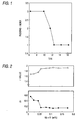
- Fig.1 is a graph showing the influence of Ti/N on the ridging index,
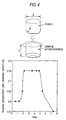
- Fig. 2 is a graph showing the influence of (Nb + V) on the r value and Ar,
- Fig. 3 is a graph showing the influence of (Nb + V) on the glossiness,
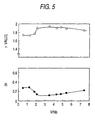
- Fig. 4 is a graph showing the influence of V/Nb on the ridging generating limit drawing height,
- Fig. 5 is a graph showing the influence of V/Nb on the r value and Ar,
- Fig. 6 is a graph showing the relation of the clogging of the immersion nozzle block and the addition amounts of B, Ca, and Mg, and
- Fig. 7 is a graph showing the relation of the generation of ridging and the hot rolling condition.
-
- Then, the experiment which became of the ground of the present invention is described.
- Steels each containing from 0.004 to 0.008 wt.% C, from 0.12 to 0.27 wt.% Si, from 0.27 to 0.35 wt.% Mn, from 0.021 to 0.037 wt.% P, from 0.001 to 0.006 wt.% S, from 16.4 to 16.8 wt.% Cr, from 0.002 to 0.057 wt.% Al, from 0.006 to 0.010 wt.% N, from 0.0027 to 0.0056 wt.% O, and from 0.06 to 0.07 wt.% (Nb + V) with V/Nb = 2.4 to 2.8, together with a changed amount of Ti were experimentally melted and by applying hot rolling, annealing, cold rolling, and then finish-annealing, each steel plate of 0.7 mm in thickness was produced.
- From the rolling direction of each steel plate obtained, a tensile test piece of JIS No. 5 was sampled and the anti-ridging property of each sample was evaluated from the ridging generated extent at applying a tensile strain of 25%. The smaller evaluation value means that ridging is less. The results are shown in Fig. 1.
- From the results shown in Fig. 1, it can be seen that when Ti/N becomes 12 or higher, the ridging index becomes 1 and ridging scarcely occurs.
- In the component systems used in
Experiment 1, however, with Ti/N of from 12.6 to 13.9, steels were melted by variously changing the contents of (Nb + V), and by applying hot rolling, annealing, cold rolling, and finish-annealing, each steel plate of 0.7 mm in thickness was produced. - From the rolling direction (L direction) of each steel plate obtained, the direction of 45° (D direction) to the rolling direction, and the direction of 90° (C direction) to the rolling direction, test pieces were sampled and the r value and the Δr were obtained by the following equations.
- The results obtained are readjusted with the amount of (Nb + V) and show in Fig. 2. From the results shown in Fig. 2, it can be seen that when the amount of (Nb + V) becomes 0.05% by weight or higher, the r value, which is the index of deep drawability, is increased to about 1.9, at the same time, the Δr, which is an index of the anisotropy, is reduced to about 0.15, and the formability is remarkably improved.
- On the other hand, the above-described steel plates were subjected to a de-scaling treatment by an electrolysis in an neutral salt solution and dipping in mixed acids and the glossiness of the surface of each steel plate was measured according to the method of JIS Z-8741. The results are readjusted with the amount of(Nb + V) and shown in Fig. 3. From the results shown in Fig. 3, it can be seen that when the amount of (Nb + V) exceeds 0.1% by weight, the glossiness (GS) after de-scaling is greatly lowered. That is, from the point of the glossiness, the upper limit of the amount of (Nb + V) is limited to 0.1% by weight.
- In the composition system used in Example 2 with, however, (Nb + V) of from 0.056 to 0.079 wt.% , steels were melted by variously changing Nb/V, applying hot rolling, annealing, cold rolling, finish-annealing, pickling, and 0.5% skin pass to carry out drawing at a ratio rp/D of the punch shoulder rp to the punch diameter D of 0.15 with various heights, the limiting drawing height of generating ridging at the worked portion was obtained.
- Fig. 4 shows the adjusted relation of the limiting drawing height and V/Nb. From the results shown in Fig. 4, it can be seen that in the range of V/Nb of from 2 to 5, the limiting drawing height is greatly increased and the anti-ridging property is improved.
- Fig. 5 is a graph showing the adjusted relations of the r value, the Δr, and V/Nb of these samples and from the results of Fig. 5, it can be seen that in the range of the value of V/Nb of 2 or higher, the r value is increased, the value of Δr becomes smaller, and the formability is improved.
- From the each experimental result, it can be seen that for the improvement of the deep drawability and the anti-ridging property in the case of applying a severe deep drawing work, the conditions of Ti/N ≥ 12, (Nb + V) ≥ 0.05% by weight, and 2 ≤ V/Nb ≤ 5 are necessary and indispensable and further from the point of the glossiness after de-scaling, (Nb + V) ≤ 0.10% by weight is necessary and indispensable.
- Then, the limitation reasons of the present invention are explained below.
- C: 0.001 to 0.015% by weight
From the points of the formability and the toughness, it is preferred that the content of C is low and because when the content of C exceeds 0.015% by weight, the above characteristics are deteriorated, the upper limit is defined to be 0.015% by weight. On the other hand, when the content of C is too low, there is no problem on the characteristics but when the content is less than 0.001% by weight, the smelting cost becomes large and thus the lower limit is defined to be 0.001% by weight which can be industrially produced. - Si: Not more than 1.0% by weight
Si is an element which acts as a deoxidizer and increases the strength and because when the content of Si exceeds 1.0% by weight, lowering of the ductility cause, the upper limit is defined to be 1.0% weight. In addition, from the points of the balance of the strength, and the ductility, the range of from 0.05 to 0.5% by weight is preferred. - Mn: Not more than 1.0% by weight
Mn is also an element which acts as a deoxidizer and also increases the strength but because the content exceeds 1.0% by weight, the ductility and the corrosion resistance are lowered, the upper limit is defined to be 1.0% by weight. In addition, from the points of the strength, the ductility, and the corrosion resistance, the range of from 0.05 to 0.5% by weight is preferred. - P: Not more than 0.05% by weight
P is an element of deteriorating the ductility and because when the content of P exceeds 0.05% by weight, the influence becomes particularly remarkable, the upper limit thereof is defined to be 0.05% by weight. - S: Not more than 0.010% by weight
S is a harmful element which forms a sulfide to deteriorate the corrosion resistance. Because the content of S exceeds 0.010% by weight, the bad influence becomes remarkable, the upper limit is defined to be 0.010% by weight. - Cr: 10 to 30% by weight
Cr is a useful element which improves the corrosion resistance and the heat resistance of the alloy, when the content of Cr is 10% by weight or higher, the effect becomes large but because when the content exceeds 30% by weight, the ductility is lowered, the content is defined to be the range of from 10 to 30% by weight. - Al: Not more than 0.08% by weight
Al acts as a deoxidizer but because when the content exceeds 0.08% by weight, the deoxidized product becomes coarse to cause the deterioration of the corrosion resistance and the occurrence of the surface defect, the upper limit is defined to be 0.08% by weight. The lower limit is not established because if the deoxidation is sufficiently carried out, no bad influence occurs. - N: 0.005 to 0.015% by weight
From the points of the elongation, formability, etc., it is preferred that the content of N is low but because when the content of N is not more than 0.015% by weight, there is no considerable problem, the upper limit is defined to be 0.015% by weight. On the other hand, when the content of N is lowered extremely, the anti-ridging property is deteriorated. Because the defect becomes particularly remarkable, the content of N is less than 0.005% by weight, the lower limit is defined to be 0.005% by weight. - O: Not more than 0.0080% by weight
O exists in the form of an oxide in the steel and acts to accelerate the formation of the surface defect and deteriorate the corrosion resistance. When the content exceeds 0.008% by weight, the bad influences become particularly severe and thus the upper limit is limited to 0.008% by weight. - Ti: Not more than 0.25% by weight and Ti/N ≥ 12
Ti is the primary element in the present invention as is clear from the above-described result, because by the addition of Ti satisfying Ti/N ≥ 12, the anti-ridging property is improved, the lower limit of Ti is limited to Ti ≥ 12 x N. On the other hand, the addition of a large amount of Ti is accompanied by the occurrence of the surface defect (stringer-form defect) which is considered to be caused by the aggregation and large-sizing of TiN and because the defect becomes severe when the content exceeds 0.25% by weight, the upper limit is defined to be 0.25% by weight. - (Nb + V): 0.05 to 0.10% by weight, V/Nb = 2 to 5
Nb and V are primary elements of the present invention and because as is clear from the above-described experimental result, when the content of (Nb + V) exceeds 0.05% by weight, the r value is improved and the Δr becomes small, whereby the formability is remarkably improved, the lower limit of (Nb + V) is defined to be 0.05% by weight. On the other hand, because when the content exceeds 0.10% by weight, the surface gloss after de-scaling greatly lowered to cause a problem for a practical use, the upper limit is defined to be 0.10% by weight. On the other hand, about V/Nb, from the point of the anti-ridging property, the range thereof is from 2 to 5, wherein the characteristics are improved. - Mo: not more than 2.0% by weight, Cu: not more than 1.0% by weight, Ni: not more than 1.0% by weight
Mo, Cu, and Ni are effective elements for improving the corrosion resistance of the stainless steel and when the addition amounts of them are increased, the corrosion resistance is improved. However, the addition of a large amount of Mo is accompanied by lowering of the toughness and the ductility and because when the content of Mo exceeds 2.0% by weight, the influence becomes severe, the upper limit thereof is defined to be 2.0% by weight. Also, the addition of a large amount of Cu is accompanied by the hot brittleness and because when the content thereof exceeds 1.0% by weight, the influence thereof becomes severe, the upper limit thereof defined to be 1.0% by weight. Furthermore, the addition of a large amount of Ni is accompanied by the formation of an austenite phase at a high temperature region and facilitates the occurrence of lowering of the ductility. Also, because the content thereof exceeds 1.0% by weight, the influence becomes particularly severe, the upper limit is defined to be 1.0% by weight. In addition, when these elements are added singly or as a combination thereof, the similar effect is obtained and thus there is no regulation on the combination of them. - B: from 0.0005 to 0.0030% by weight, Ca: from 0.0007 to 0.0030% by weight, Mg: from, 0.0005 to 0.0030% by weight
B, Ca, and Mg are effective elements for preventing clogging an immersion nozzle by the precipitation and attaching of a Ti-based inclusion which is liable to generate at the continuos casting of a Ti-containing steel. - Fig. 6 shows the relation between the clogging of the immersion nozzle block and the addition amounts of B, Ca, and Mg when 160 tons of a slab of about 200 mm in thickness of the steel containing 0.007 wt.% C, 0.2 wt.% Si, 0.3 wt.% Mn, 0.03 wt.% P, 0.0049 wt.% S, 0.013 wt.% Al, 19 wt.% Cr, 0.19 wt.% Ti, 0.008 wt.% N, 0.02 wt.% Nb, and 0.047 wt.% V and prepared by VOD process is casted by continuous casting method.
- From Fig. 6, it can be seen that by adding B in an amount of 0.0005% by weight or more, Ca in an amount of 0.0007% by weight or more, and Mg in an amount of 0.0005% by weight or more, the clogging ratio of the immersion nozzle is greatly lowered. Thus, the lower limits of the addition amounts of B, Mg, and Ca are defined to be 0.0005% by weight, 0.0005% by weight, and 0.0007% by weight respectively. Also, when the addition of these elements are solely or as a combination of them, the same effect is confirmed and thus there is no regulation on the combination of them. However, because the addition of the excessive amount of each of them is accompanied by the deterioration of the corrosion resistance, the upper limit of each of the elements is defined to be 0.0030% by weight.
- Slab heating temperature is 1170°C or lower, finishing a rough rolling temperature is 950°C or higher:
- Because in the steel plate produced according to the present invention, the sufficient formability and anti-ridging property are obtained by adjusting the components only, there is unnecessary for making a specific consideration on the production conditions. However, in the case of requiring a further improvement of the anti-ridging property, the following condition in hot rolling must be employed.
- That is, in hot rolling, by defining the slab heating temperature to 1170°C or lower and finishing a hot rough rolling temperature to 950°C or higher, the more improvement of the anti-ridging property is obtained. Fig. 7 shows the result of the ridging index adjusted by the slab heating temperature (SRT) and the finishing a rough rolling temperature (RDT) , rp/D is 0.15 and h/D is 0. 75 in the experimental method used for
Experiment 3. From Fig. 7, it can be seen that in the case of carrying out under the conditions of SRT ≤ 1170°C and RDT ≥ 950°C, no ridging occurs even after the particularly severe drawing work. - In addition, because the lower limit temperature of the slab heating temperature causes no problem if finishing a rough rolling termination temperature of 950°C or higher is insured, it is unnecessary to particularly determine the lower limit temperature.
- The present invention and the effects thereof are described below based on the following example.
- Each of the steels having the compositions shown in Table 1 was subjected to a VOD method and then a continuous casting step to for a continuously cast slab of 200 mm in thickness and by a hot rolling mill constituted by a rough rolling mill composed of 3 stands and a continuous-type finish-rolling mill composed of 7 stands, the slab was rolled to a hot-rolled steel strip of 4 mm in thickness at a slab heating temperature (SRT) of from 1150 to 1180°C, finishing a rough rolling temperature (RDT) of from 950 to 1090°C, and a finish rolling termination temperature (FDT) of from 800 to 950°C. The hot-rolled steel strip was continuously annealed at a temperature of from 880 to 1000°C, and after pickling, by cold rolling, a steel strip of 0.8 mm in thickness was obtained. After degreasing, the cold-rolled steel strip was subjected to continuous finish annealing at a temperature of from 880 to 1000°C, and after pickling, a skin pass was applied to the steel to provide a stainless steel plate of a 2B finish (the surface finish regulated by JIS G 4307). A sample was obtained from each of the cold rolled and annealed plates obtained by the above-described method and was subjected to the various tests shown below.
- From the L, D, and C directions of each of the steel plates, tensile test pieces (JIS No. 13 B) were sampled, 15% tensile strain was applied thereto, the plastic strain ratio of each direction was measured, and from the equations described above, the r value and the Δr were calculated.
- From the L direction of each steel plate, a tensile test piece of JIS No. 5 was sample and extent of the ridging after applying a 25% tensile strain was evaluated. The evaluation method was carried out by showing as an index the result obtained by visually comparing with a standard sample. The smaller numeral value means that extent of the ridging is less.
- The surface gloss was measured according to JIS Z-8741 at a light source incident angle of 20°. The evaluation was carried out by the glossiness (GS) and the larger value means that the gloss is better.
- The evaluation of the corrosion resistance was carried out by measuring a pitting potential in an aqueous NaCl solution according to JIS G-0577. The larger pitting potential means that the corrosion resistance is better.
- The measurement results of these tests are shown in Table 2. From the results shown in the table, it can be seen that in the steel plates that Ti/N is not less than 12, Nb + V is from 0.05 to 0.1 wt.%, and V/Nb is from 2 to 5 corresponding to the present invention, the r value is large, the Δr is small, and further the anti-ridging property is remarkably improved. Also, it is clear that the steel plates of the present invention are excellent in the surface glossiness. Furthermore, it can seen that in the steel plates added with Ni, Mo, and Cu to improve the corrosion resistance, the corrosion resistance is improved.
- As described above, according to the present invention, by optimizing the addition amounts of the addition elements in the ferritic stainless steel, particularly Ti, N, Nb, and V, the ferritic stainless steel plate excellent in the formability and the anti-ridging property in severe working can be provided. (
Claims 1 and 2) - Furthermore, by optimizing the addition amounts of Mo, Ni, and Cu, the ferritic stainless steel plate having the more excellent corrosion resistance and the good toughness and ductility can be provided. (
Claims 3 and 5) - Moreover, by the addition of slight amounts of B, Ca, and Mg. Clogging of an immersion nozzle by the precipitation and attaching of Ti-based inclusions, which is liable to occur at continuous casting of a Ti-containing steel, can be prevented. (
Claims 4 and 5) - Also, at the production of the above-described ferritic stainless steel plate, by optimizing the hot rolling condition, the ferritic stainless steel stainless steel plate more excellent in the anti-ridging property can be produced.


Claims (8)
- Method of producing a ferritic stainless steel having an excellent deep drawability and anti-ridging property, the steel containing from 0.001 to 0.015 wt% C, not more than 1.0 wt% Si, not more than 1.0 wt% Mn, not more than 0.05 wt% P, not more than 0.010 wt% S, from 10 to 30 wt% Cr, not more than 0.08 wt% Al, from 0.005 to 0.015 wt% N, not more than 0.0080 wt% O, not more than 0.25 wt% Ti with Ti/N ≥ 12, and from 0.05 to 0.10 wt% (Nb + V) with V/Nb being from 2 to 5,
optionally one or more kinds selected from not more than 2.0 wt% Mo, not more than 1.0 wt% Ni, and not more than 1.0 wt% Cu and/or one or more kinds selected from 0.0005 to 0.0030 wt% B, from 0.0007 to 0.0030 wt% Ca, and from 0.0005 to 0.0030 wt% Mg,
the balance being Fe and unavoidable impudties, wherein the method comprises the steps of:heating a steel slab comprising the components of said steel to a temperature range of 1170°C or lower,finishing rough hot rolling of the slab at a temperature range of 950°C or higher,and successively carrying out hot finish rolling. - Method according to claim 1, wherein the content of Si is from 0.05 to 0.5 wt%.
- Method according to claim 1 or 2, wherein the content of Mn is from 0.05 to 0.5 wt%.
- Method according to at least one of claims 1-3 wherein the steel slab heating temperature is from 1150 to 1170°C.
- Method according to at least one of claims 1-4 wherein the finish rough rolling temperature is from 950 to 1090°C.
- Method according to at least one of claims 1-5 wherein a hot finish rolling temperature is from 800 to 950°C.
- Method according to at least one of claims 1-6 wherein the hot rolled steel strip is continuously annealed at a temperature of from 880 to 1000°C, then pickled and then cold rolled.
- Method according to at least one of claims 1-7 wherein the steel strip is continuously finish annealed at a temperature of from 880 to 1000°C.
Applications Claiming Priority (3)
| Application Number | Priority Date | Filing Date | Title |
|---|---|---|---|
| JP21053497 | 1997-08-05 | ||
| JP21053497 | 1997-08-05 | ||
| PCT/JP1998/003469 WO1999007909A1 (en) | 1997-08-05 | 1998-08-04 | Ferritic stainless steel plate of high deep drawability and ridging resistance and method of manufacturing the same |
Publications (3)
| Publication Number | Publication Date |
|---|---|
| EP0930375A1 EP0930375A1 (en) | 1999-07-21 |
| EP0930375A4 EP0930375A4 (en) | 2002-09-11 |
| EP0930375B1 true EP0930375B1 (en) | 2004-06-09 |
Family
ID=16590960
Family Applications (1)
| Application Number | Title | Priority Date | Filing Date |
|---|---|---|---|
| EP98935353A Expired - Lifetime EP0930375B1 (en) | 1997-08-05 | 1998-08-04 | Method of manufacturing a ferritic stainless steel plate of high deep drawability and ridging resistance |
Country Status (9)
| Country | Link |
|---|---|
| US (1) | US6113710A (en) |
| EP (1) | EP0930375B1 (en) |
| JP (1) | JP3589036B2 (en) |
| KR (1) | KR100380833B1 (en) |
| CN (1) | CN1088764C (en) |
| DE (1) | DE69824384T2 (en) |
| ES (1) | ES2222598T3 (en) |
| TW (1) | TW452599B (en) |
| WO (1) | WO1999007909A1 (en) |
Families Citing this family (29)
| Publication number | Priority date | Publication date | Assignee | Title |
|---|---|---|---|---|
| US6413332B1 (en) * | 1999-09-09 | 2002-07-02 | Kawasaki Steel Corporation | Method of producing ferritic Cr-containing steel sheet having excellent ductility, formability, and anti-ridging properties |
| TW480288B (en) | 1999-12-03 | 2002-03-21 | Kawasaki Steel Co | Ferritic stainless steel plate and method |
| KR100415666B1 (en) * | 1999-12-20 | 2004-01-31 | 주식회사 포스코 | A ferritic stainless steel having improved formability, ridging resistance and a method for manufacturing it |
| FR2811683B1 (en) | 2000-07-12 | 2002-08-30 | Ugine Savoie Imphy | FERRITIC STAINLESS STEEL FOR USE IN FERROMAGNETIC PARTS |
| JP3769479B2 (en) * | 2000-08-07 | 2006-04-26 | 新日鐵住金ステンレス株式会社 | Ferritic stainless steel sheet for fuel tanks with excellent press formability |
| EP1207214B1 (en) | 2000-11-15 | 2012-07-04 | JFE Steel Corporation | Soft Cr-containing steel |
| US6786981B2 (en) | 2000-12-22 | 2004-09-07 | Jfe Steel Corporation | Ferritic stainless steel sheet for fuel tank and fuel pipe |
| JP4023106B2 (en) * | 2001-05-09 | 2007-12-19 | 住友金属工業株式会社 | Ferritic heat resistant steel with low softening of heat affected zone |
| JP3504655B2 (en) | 2001-12-06 | 2004-03-08 | 新日本製鐵株式会社 | Ferritic stainless steel sheet excellent in press formability and workability and manufacturing method thereof |
| US20060130938A1 (en) * | 2002-10-04 | 2006-06-22 | Firth Ag | Ferritic steel alloy |
| KR100958026B1 (en) * | 2002-11-15 | 2010-05-17 | 주식회사 포스코 | Manufacturing method of ferritic stainless steel with excellent ridging resistance |
| WO2007020826A1 (en) * | 2005-08-17 | 2007-02-22 | Jfe Steel Corporation | Ferritic stainless-steel sheet with excellent corrosion resistance and process for producing the same |
| KR100706529B1 (en) | 2005-12-26 | 2007-04-12 | 주식회사 포스코 | Manufacturing method of ferritic stainless steel with improved leasing characteristics |
| CN101008043B (en) * | 2006-01-27 | 2010-05-12 | 宝山钢铁股份有限公司 | Production method of ferritic stainless steel |
| CN100434200C (en) * | 2006-12-31 | 2008-11-19 | 山西太钢不锈钢股份有限公司 | Method for Preventing Peeling of Oxide Film on the Surface of Nickel-Chromium Roller |
| KR20150119496A (en) * | 2010-09-16 | 2015-10-23 | 닛폰 스틸 앤드 스미킨 스테인레스 스틸 코포레이션 | Heat-resistant ferrite-type stainless steel plate having excellent oxidation resistance |
| MX345579B (en) * | 2010-11-29 | 2017-02-07 | Nippon Steel & Sumitomo Metal Corp | High-strength bake-hardening cold-rolled steel sheet and method for manufacturing same. |
| KR101573511B1 (en) * | 2011-03-29 | 2015-12-01 | 닛폰 스틸 앤드 스미킨 스테인레스 스틸 코포레이션 | Ferrite stainless steel exhibiting excellent corrosion resistance and strength in weld zones, and tig-welded structure |
| JP5376099B1 (en) * | 2012-03-13 | 2013-12-25 | Jfeスチール株式会社 | Ferritic stainless steel |
| CN102618790B (en) * | 2012-03-26 | 2014-11-05 | 宝山钢铁股份有限公司 | High-strength low-Cr ferrite stainless steel and manufacturing method thereof |
| FI124995B (en) * | 2012-11-20 | 2015-04-15 | Outokumpu Oy | Ferritic stainless steel |
| KR101809812B1 (en) | 2013-07-29 | 2017-12-15 | 제이에프이 스틸 가부시키가이샤 | Ferritic stainless steel having excellent corrosion resistance of weld zone |
| JP5862846B2 (en) * | 2014-01-08 | 2016-02-16 | Jfeスチール株式会社 | Ferritic stainless steel and manufacturing method thereof |
| JP6302690B2 (en) * | 2014-02-04 | 2018-03-28 | 新日鐵住金ステンレス株式会社 | Ferritic stainless steel with excellent corrosion resistance after polishing |
| US10837075B2 (en) | 2014-02-05 | 2020-11-17 | Jfe Steel Corporation | Hot rolled and annealed ferritic stainless steel sheet, method of producing same, and cold rolled and annealed ferritic stainless steel sheet |
| KR101940427B1 (en) * | 2014-08-14 | 2019-01-18 | 제이에프이 스틸 가부시키가이샤 | Ferritic stainless steel sheet |
| CN107002199B (en) * | 2014-12-11 | 2021-07-16 | 杰富意钢铁株式会社 | Stainless steel and its manufacturing method |
| CN108315648B (en) * | 2018-02-13 | 2020-04-14 | 济南大学 | Ferritic stainless steel for rear-stage muffler of automobile exhaust system carrying SCR treatment device and preparation method thereof |
| KR20240073121A (en) * | 2021-11-17 | 2024-05-24 | 닛테츠 스테인레스 가부시키가이샤 | Ferritic stainless steel sheet |
Family Cites Families (11)
| Publication number | Priority date | Publication date | Assignee | Title |
|---|---|---|---|---|
| JPS5247513A (en) * | 1975-10-14 | 1977-04-15 | Nippon Steel Corp | Method of hot rolling of ferritic stainless steel |
| EP0050356B2 (en) * | 1980-10-21 | 1990-03-07 | Nippon Steel Corporation | Method for producing ferritic stainless steel sheets or strips containing aluminum |
| JP2960194B2 (en) * | 1990-04-23 | 1999-10-06 | 川崎製鉄株式会社 | Manufacturing method of ferritic stainless steel with excellent workability |
| JP3067892B2 (en) * | 1992-06-19 | 2000-07-24 | 新日本製鐵株式会社 | Manufacturing method of ferritic stainless steel sheet with excellent surface properties and deep drawability |
| JPH0617143A (en) * | 1992-07-02 | 1994-01-25 | Nippon Steel Corp | Method for producing ferritic stainless steel sheet with excellent surface properties and deep drawability |
| JP3241114B2 (en) * | 1992-07-14 | 2001-12-25 | 日新製鋼株式会社 | Method for producing ferritic stainless steel sheet excellent in ridging property and workability |
| JPH06184632A (en) * | 1992-10-21 | 1994-07-05 | Nippon Steel Corp | Production of ferritic stainless steel thin sheet |
| JP3411644B2 (en) * | 1993-10-29 | 2003-06-03 | Jfeスチール株式会社 | Manufacturing method of ferritic stainless steel sheet with excellent ridging resistance |
| JP3142427B2 (en) * | 1993-11-02 | 2001-03-07 | 川崎製鉄株式会社 | Ferritic stainless steel sheet excellent in secondary work brittleness resistance and method for producing the same |
| JP3420373B2 (en) * | 1995-03-20 | 2003-06-23 | Jfeスチール株式会社 | Chrome steel sheet with excellent formability |
| US5868875A (en) * | 1997-12-19 | 1999-02-09 | Armco Inc | Non-ridging ferritic chromium alloyed steel and method of making |
-
1998
- 1998-07-31 TW TW087112654A patent/TW452599B/en not_active IP Right Cessation
- 1998-07-31 JP JP21735898A patent/JP3589036B2/en not_active Expired - Lifetime
- 1998-08-04 CN CN98801478A patent/CN1088764C/en not_active Expired - Fee Related
- 1998-08-04 ES ES98935353T patent/ES2222598T3/en not_active Expired - Lifetime
- 1998-08-04 EP EP98935353A patent/EP0930375B1/en not_active Expired - Lifetime
- 1998-08-04 WO PCT/JP1998/003469 patent/WO1999007909A1/en not_active Ceased
- 1998-08-04 US US09/269,295 patent/US6113710A/en not_active Expired - Fee Related
- 1998-08-04 DE DE69824384T patent/DE69824384T2/en not_active Expired - Fee Related
- 1998-08-04 KR KR10-1999-7002897A patent/KR100380833B1/en not_active Expired - Fee Related
Also Published As
| Publication number | Publication date |
|---|---|
| DE69824384T2 (en) | 2004-10-14 |
| EP0930375A1 (en) | 1999-07-21 |
| WO1999007909A1 (en) | 1999-02-18 |
| DE69824384D1 (en) | 2004-07-15 |
| KR20000068699A (en) | 2000-11-25 |
| EP0930375A4 (en) | 2002-09-11 |
| JPH11106875A (en) | 1999-04-20 |
| KR100380833B1 (en) | 2003-04-18 |
| ES2222598T3 (en) | 2005-02-01 |
| CN1241221A (en) | 2000-01-12 |
| TW452599B (en) | 2001-09-01 |
| US6113710A (en) | 2000-09-05 |
| CN1088764C (en) | 2002-08-07 |
| JP3589036B2 (en) | 2004-11-17 |
Similar Documents
| Publication | Publication Date | Title |
|---|---|---|
| US6113710A (en) | Ferritic stainless steel plate excellent in deep drawability and anti-ridging property and production method thereof | |
| EP1308532B1 (en) | Ferritic stainless steel sheet having excellent deep-drawability and brittle resistance to secondary processing and method for making the same | |
| US6918971B2 (en) | Titanium sheet, plate, bar or wire having high ductility and low material anisotropy and method of producing the same | |
| US6786981B2 (en) | Ferritic stainless steel sheet for fuel tank and fuel pipe | |
| CN100537813C (en) | Steel composition for the production of cold rolled multiphase steel products | |
| EP2811047A1 (en) | Hot-dip galvanized steel sheet and production method therefor | |
| KR20110018363A (en) | Ultra high strength steel products and manufacturing method thereof | |
| KR102826744B1 (en) | Steel plates, members and their manufacturing methods | |
| KR102823033B1 (en) | Steel plates, members and their manufacturing methods | |
| EP4097263B1 (en) | Ultra low carbon interstitial free steel | |
| JP4852857B2 (en) | Ferritic / austenitic stainless steel sheet with excellent stretch formability and crevice corrosion resistance | |
| JP3357226B2 (en) | Fe-Cr alloy with excellent ridging resistance and surface properties | |
| JPH05140652A (en) | Manufacture of low yield ratio cold rolled high tensile strength steel sheet excellent in corrosion resistance | |
| US20240229184A1 (en) | Coiling temperature influenced cold rolled strip or steel | |
| CA1142069A (en) | Process for producing two-phase high tension cold rolled steel sheet having improved workability | |
| JPH07188862A (en) | Ferrite-based stainless steel sheet excellent in corrosion resistance, antiglare property and workability, and method for producing the same | |
| JP3266328B2 (en) | High-tensile cold-rolled steel sheet excellent in chemical conversion property and formability and method for producing the same | |
| JP3567280B2 (en) | Extremely soft austenitic stainless steel | |
| JP3288456B2 (en) | Manufacturing method of cold drawn steel sheet for deep drawing with excellent corrosion resistance | |
| JP7758973B2 (en) | Austenitic stainless steel and method for producing austenitic stainless steel | |
| JP3144572B2 (en) | Manufacturing method of low yield ratio high tensile strength hot rolled steel sheet with excellent corrosion resistance | |
| JP3923485B2 (en) | Manufacturing method of ferritic single-phase stainless steel with excellent deep drawability | |
| JPH10130737A (en) | Production of cold rolled steel sheet and hot dip galvanized steel sheet having high ductility | |
| JPH0670266B2 (en) | Ferritic stainless steel with excellent vertical crack resistance during secondary processing | |
| JPH05287447A (en) | Cold-rolled steel sheet for processing having excellent corrosion resistance and method for producing the same |
Legal Events
| Date | Code | Title | Description |
|---|---|---|---|
| PUAI | Public reference made under article 153(3) epc to a published international application that has entered the european phase |
Free format text: ORIGINAL CODE: 0009012 |
|
| 17P | Request for examination filed |
Effective date: 19990427 |
|
| AK | Designated contracting states |
Kind code of ref document: A1 Designated state(s): DE ES FR GB IT |
|
| A4 | Supplementary search report drawn up and despatched |
Effective date: 20020725 |
|
| AK | Designated contracting states |
Kind code of ref document: A4 Designated state(s): DE ES FR GB IT |
|
| 17Q | First examination report despatched |
Effective date: 20021104 |
|
| GRAP | Despatch of communication of intention to grant a patent |
Free format text: ORIGINAL CODE: EPIDOSNIGR1 |
|
| RAP1 | Party data changed (applicant data changed or rights of an application transferred) |
Owner name: JFE STEEL CORPORATION |
|
| RTI1 | Title (correction) |
Free format text: METHOD OF MANUFACTURING A FERRITIC STAINLESS STEEL PLATE OF HIGH DEEP DRAWABILITY AND RIDGING RESISTANCE |
|
| GRAS | Grant fee paid |
Free format text: ORIGINAL CODE: EPIDOSNIGR3 |
|
| GRAA | (expected) grant |
Free format text: ORIGINAL CODE: 0009210 |
|
| AK | Designated contracting states |
Kind code of ref document: B1 Designated state(s): DE ES FR GB IT |
|
| PG25 | Lapsed in a contracting state [announced via postgrant information from national office to epo] |
Ref country code: IT Free format text: LAPSE BECAUSE OF FAILURE TO SUBMIT A TRANSLATION OF THE DESCRIPTION OR TO PAY THE FEE WITHIN THE PRESCRIBED TIME-LIMIT;WARNING: LAPSES OF ITALIAN PATENTS WITH EFFECTIVE DATE BEFORE 2007 MAY HAVE OCCURRED AT ANY TIME BEFORE 2007. THE CORRECT EFFECTIVE DATE MAY BE DIFFERENT FROM THE ONE RECORDED. Effective date: 20040609 |
|
| REG | Reference to a national code |
Ref country code: GB Ref legal event code: FG4D |
|
| REF | Corresponds to: |
Ref document number: 69824384 Country of ref document: DE Date of ref document: 20040715 Kind code of ref document: P |
|
| PG25 | Lapsed in a contracting state [announced via postgrant information from national office to epo] |
Ref country code: GB Free format text: LAPSE BECAUSE OF NON-PAYMENT OF DUE FEES Effective date: 20040909 |
|
| REG | Reference to a national code |
Ref country code: ES Ref legal event code: FG2A Ref document number: 2222598 Country of ref document: ES Kind code of ref document: T3 |
|
| ET | Fr: translation filed | ||
| PLBE | No opposition filed within time limit |
Free format text: ORIGINAL CODE: 0009261 |
|
| STAA | Information on the status of an ep patent application or granted ep patent |
Free format text: STATUS: NO OPPOSITION FILED WITHIN TIME LIMIT |
|
| GBPC | Gb: european patent ceased through non-payment of renewal fee |
Effective date: 20040909 |
|
| 26N | No opposition filed |
Effective date: 20050310 |
|
| PGFP | Annual fee paid to national office [announced via postgrant information from national office to epo] |
Ref country code: ES Payment date: 20080826 Year of fee payment: 11 Ref country code: DE Payment date: 20080814 Year of fee payment: 11 |
|
| PGFP | Annual fee paid to national office [announced via postgrant information from national office to epo] |
Ref country code: FR Payment date: 20080818 Year of fee payment: 11 |
|
| REG | Reference to a national code |
Ref country code: FR Ref legal event code: ST Effective date: 20100430 |
|
| PG25 | Lapsed in a contracting state [announced via postgrant information from national office to epo] |
Ref country code: FR Free format text: LAPSE BECAUSE OF NON-PAYMENT OF DUE FEES Effective date: 20090831 Ref country code: DE Free format text: LAPSE BECAUSE OF NON-PAYMENT OF DUE FEES Effective date: 20100302 |
|
| REG | Reference to a national code |
Ref country code: ES Ref legal event code: FD2A Effective date: 20090805 |
|
| PG25 | Lapsed in a contracting state [announced via postgrant information from national office to epo] |
Ref country code: ES Free format text: LAPSE BECAUSE OF NON-PAYMENT OF DUE FEES Effective date: 20090805 |