EP0929960B1 - Verfahren zur unterdrückung der interferenz in einem ofdm-funkempfänger - Google Patents
Verfahren zur unterdrückung der interferenz in einem ofdm-funkempfänger Download PDFInfo
- Publication number
- EP0929960B1 EP0929960B1 EP98929451A EP98929451A EP0929960B1 EP 0929960 B1 EP0929960 B1 EP 0929960B1 EP 98929451 A EP98929451 A EP 98929451A EP 98929451 A EP98929451 A EP 98929451A EP 0929960 B1 EP0929960 B1 EP 0929960B1
- Authority
- EP
- European Patent Office
- Prior art keywords
- signals
- amplitude
- signal
- average
- radio receiver
- Prior art date
- Legal status (The legal status is an assumption and is not a legal conclusion. Google has not performed a legal analysis and makes no representation as to the accuracy of the status listed.)
- Expired - Lifetime
Links
- 238000000034 method Methods 0.000 title claims abstract description 47
- 230000010363 phase shift Effects 0.000 claims description 4
- 230000005540 biological transmission Effects 0.000 description 8
- 238000004364 calculation method Methods 0.000 description 6
- 239000000969 carrier Substances 0.000 description 4
- 238000001228 spectrum Methods 0.000 description 3
- 230000000694 effects Effects 0.000 description 2
- 230000002452 interceptive effect Effects 0.000 description 2
- 230000004048 modification Effects 0.000 description 2
- 238000012545 processing Methods 0.000 description 2
- 101150012579 ADSL gene Proteins 0.000 description 1
- 102100020775 Adenylosuccinate lyase Human genes 0.000 description 1
- 108700040193 Adenylosuccinate lyases Proteins 0.000 description 1
- 230000003044 adaptive effect Effects 0.000 description 1
- 238000004891 communication Methods 0.000 description 1
- 238000012937 correction Methods 0.000 description 1
- 230000001419 dependent effect Effects 0.000 description 1
- 238000010586 diagram Methods 0.000 description 1
- 239000000463 material Substances 0.000 description 1
- 238000012986 modification Methods 0.000 description 1
- 238000011160 research Methods 0.000 description 1
Images

Classifications
-
- H—ELECTRICITY
- H04—ELECTRIC COMMUNICATION TECHNIQUE
- H04L—TRANSMISSION OF DIGITAL INFORMATION, e.g. TELEGRAPHIC COMMUNICATION
- H04L27/00—Modulated-carrier systems
- H04L27/26—Systems using multi-frequency codes
- H04L27/2601—Multicarrier modulation systems
- H04L27/2647—Arrangements specific to the receiver only
Definitions
- OFDM is used as a modulation method for new digital broadcasting DAB (Digital Audio Broadcasting). Research is being conducted to use the method in DVB (Digital TV Broadcasting). In fixed data transmission networks, the method is used for implementing high-capacity modems, in association with modems known as ADSL modems (Asymmetric Digital Subscriber Loop). Transmission rates as high as 2-6 Mbit/s are then achieved by using a conventional twisted-pair cable of a telephone subscription.
- DAB Digital Audio Broadcasting
- ADSL modems Asymmetric Digital Subscriber Loop
- the described manner of obtaining reliability information is not satisfactory, since high interference may entirely mask the desired signal, and the amplitude measured at the receiver may then be very high, whereby, correspondingly, a very high value is obtained as the reliability value even though the desired signal is entirely buried in the interfering signal. Decoding convolutional coding of said received signal then leads to errors.
- the method and system of the invention provide many advantages. Reliability of soft decoding is considerably improved. When interference occurs on a channel, the bit error ratio of the information transferred on the channel can be considerably improved by using the method of the invention. Information, such as packet data, requiring a demanding bit error ratio can then be transferred.
- the present invention is suitable for use in all OFDM radio receivers in which interference may occur within the frequency range of the received subcarriers.
- the reliability part 110 is arranged to generate the reliability information as the signal-to-interference ratio.
- the signal-to-interference ratio is defined by dividing the amplitude of the received signal by the interference amplitude.
- the symbols must therefore be generated by a modulation method not affecting their amplitude in transmission.
- Such a method is for example the QPSK method (Quadrature Phase Shift Keying) employing four different carrier phases preferably differing ⁇ /2 radians from one another. Each phase shift is referred to as a symbol.
- the symbol represents two bits, in other words, the real part and the imaginary part of the symbol each basically represents one bit.
- the interference amplitude is defined by calculating the deviation of the amplitudes of a set of selected signals from the average amplitude level of the set of signals.
- Figure 2A shows how the interference amplitude is calculated for signal X of a subcarrier 202.
- Signal P preceding signal X and signal N following signal X are included in the set of signals. Calculation thus includes three signals, X, P and N. In the time domain, more or fewer signals can also be included.
- signals L and P received on adjacent subcarriers 200, 204 are also included in the set of signals.
- Signals LP, RP preceding the adjacent subcarrier 200, 204 signals in the time domain, and signals LN, RN, following them, are also included.
- the amplitudes of the real and the imaginary parts of the signal are the same.
- the average level and the deviation can then be separately calculated for the real and the imaginary parts of the signal.
- the mean values are calculated from the average level and from the deviation so obtained, the mean values then being set as the average levels and deviations of the real and the imaginary parts.
- the set of signals can also be so assembled that weighting coefficients are set to the signal amplitudes, for example in such a way that signals that are, in the time and frequency domains, farther from signal X have a smaller weighting coefficient value than those closer to signal X.
- the weighting coefficients can also be adaptive, i.e. they can automatically adapt to new conditions.
- the amplitude of the single signal X, the average amplitude determined on the basis of the same samples as the set of signals, the average amplitude determined on the basis of the samples selected in the time domain, or the average amplitude determined on the basis of the samples selected in the frequency domain can be used as the amplitude of the received signal.
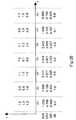
- Figure 2B now shows the processing of the signals on subcarriers 200-212.
- numerical values illustrate the amplitude of the received signal.
- the amplitude is presented as a scaled numerical value, and, in transmission, the amplitude is always one.
- a variation of, for example, about 30% from this level is considered as a normal variation caused by channel conditions.
- Figure 2B illustrates reception in a normal situation on the carriers 200, 202, 204, 208, 210, 212. Interference appears on the carrier 206.
- the mean value of the set of signals is 1.033, and the standard deviation is 0.186.
- the signals of the subcarriers 200, 202 and 204 are included in the following set of signals, the signals of the subcarriers 202, 204, 206 are included in the subsequent set of signals, etc. Only the signals of two subcarriers 210, 212 are, again, included in the rightmost set of signals, as no subcarrier exists to the right of the subcarrier 212.
- the average level can also be expressed as some other statistical quantity, the median, for example.
- the deviation can be expressed as some other statistical quantity, the variance, for example.
- At the periphery of the frequency range for example two carriers from the right or from the left side can be included in the set of signals in such cases where the leftmost or the rightmost carrier does not exist, whereby the number of signals in the set of signals is the same for all carriers. However, this is not the case in the example.
- the amplitude of a single signal is used as the amplitude of the received signal, i.e. in the example in Figure 2B, always the middle signal of the middle subcarrier of each set of signals.
- the signal-to-interference ratio SIR of the subcarrier 200 is thus calculated by dividing the amplitude 1.3 of the middle signal by the standard deviation 0.186, giving the result 6.989.
- Figure 2B presents the corresponding numerical value of the signal-to-interference ratio in decibels dB, whereby the SIR 6.989 corresponds to 8.4 dB, for example.
- the normal SIR is about 10 dB. It can be inferred that interference does not exist on the subcarriers 200, 202, 210, 212. The effect of interference on the subcarrier 204 appears in the calculation result, but interference is high particularly on the subcarrier 206. The subcarriers 208 and 204 are at the periphery of interference. Without the procedure of the invention, it could be assumed that interference does not exist on the subcarrier 206. As appears from the figure, in soft decoding, besides taking into account the signal-to-interference ratio, it is also essential to take into account how much the amplitude of the received signal deviates from the normal level. Naturally, the amplitude varies particularly under conditions where a transmitting radio transmitter moves. However, these facts can be inferred from timing factors, etc., and cannot therefore disturb the operation of the invention.
Landscapes
- Engineering & Computer Science (AREA)
- Computer Networks & Wireless Communication (AREA)
- Signal Processing (AREA)
- Noise Elimination (AREA)
- Input Circuits Of Receivers And Coupling Of Receivers And Audio Equipment (AREA)
- Cable Transmission Systems, Equalization Of Radio And Reduction Of Echo (AREA)
- Current-Collector Devices For Electrically Propelled Vehicles (AREA)
- Measurement And Recording Of Electrical Phenomena And Electrical Characteristics Of The Living Body (AREA)
- Magnetic Resonance Imaging Apparatus (AREA)
Claims (26)
- Störungsbeseitigungsverfahren zur Verwendung in einem OFDM-Funkempfänger (Orthogonal Frequency Division Multiplexing), der kodierte, auf Subträgern übertragene Signale empfängt, aufweisend Bilden von Zuverlässigkeitsinformation aus den empfangenen Signalen und Benutzen der Zuverlässigkeitsinformation in der Weichdekodierung der kodierten Signale, dadurch gekennzeichnet, dass das Signal-Stör-Verhältnis des Subträgers als Zuverlässigkeitsinformation benutzt wird, welches Signal-Stör-Verhältnis derart bestimmt wird, dass die Amplitude des empfangenen Signals durch die Störungsamplitude dividiert wird, die dadurch bestimmt wird, dass die Abweichung der Amplituden einer Menge von ausgewählten Signalen von der durchschnittlichen Amplitudenhöhe der Signalmenge gerechnet wird.
- Verfahren nach Anspruch 1, dadurch gekennzeichnet, dass die durchschnittliche Amplitudenhöhe der Signalmenge der Mittelwert, die Mediane oder eine andere statistische Größe ist, die die durchschnittliche Höhe der Amplituden der Signalmenge angibt.
- Verfahren nach Anspruch 1, dadurch gekennzeichnet, dass die Abweichung von der durchschnittlichen Amplitudenhöhe der Signalmenge die Standardabweichung, die Varianz oder eine andere statistische, Abweichung angebende Größe der Signalmenge ist.
- Verfahren nach Anspruch 1, dadurch gekennzeichnet, dass die Amplituden der Signalmenge aus aufeinander folgenden Symbolen im Zeitbereich und/oder aus nebeneinander liegenden Subträgern im Frequenzbereich ausgewählt werden.
- Verfahren nach Anspruch 1, dadurch gekennzeichnet, dass die Anzahl von in die Signalmenge ausgewählten Signalen wesentlich kleiner als die Anzahl von Subträgern ist.
- Verfahren nach Anspruch 5, dadurch gekennzeichnet, dass die Anzahl von in die Signalmenge ausgewählten Signalen kleiner als ein Fünftel der Anzahl von Subträgern ist.
- Verfahren nach Anspruch 1, dadurch gekennzeichnet, dass die Amplitude bei dem angewandten Modulationsverfahren nicht von Modulation beeinflusst wird.
- Verfahren nach Anspruch 7, dadurch gekennzeichnet, dass das angewandte Modulationsverfahren QPSK (Quadrature Phase Shift Keying) ist.
- Verfahren nach Anspruch 1, dadurch gekennzeichnet, dass die durchschnittliche Höhe und die Abweichung gesondert für die Real- und Imaginärteile des Signals gerechnet werden und die Mittelwerte aufgrund der somit erhaltenen durchschnittlichen Höhe und der Abweichung gerechnet werden, welche Mittelwerte dann als durchschnittliche Höhen und Abweichungen der Real- und Imaginärteile gesetzt werden.
- Verfahren nach Anspruch 1, dadurch gekennzeichnet, dass die Amplitude eines einzelnen Signals als Amplitude des empfangenen Signals benutzt wird.
- Verfahren nach Anspruch 1, dadurch gekennzeichnet, dass die aufgrund derselben Signale wie die Signalmenge bestimmte durchschnittliche Amplitude als Amplitude des empfangenen Signals benutzt wird.
- Verfahren nach Anspruch 1, dadurch gekennzeichnet, dass die aufgrund der im Zeitbereich ausgewählten Signale bestimmte durchschnittliche Amplitude als Amplitude des empfangenen Signals benutzt wird.
- Verfahren nach Anspruch 1, dadurch gekennzeichnet, dass die aufgrund der im Frequenzbereich ausgewählten Signale bestimmte durchschnittliche Amplitude als Amplitude des empfangenen Signals benutzt wird.
- OFDM-Funkempfänger (Orthogonal Frequency Division Multiplexing) aufweisend
eine Antenne (100);
Radiofrequenzteile (102) zum Empfangen von kodierten, auf Subträgern über die Antenne (100) übertragenen Signalen;
einen Demultiplexer (104) zum Demultiplexen des empfangenen Signals in orthogonale Subträger;
einen Demodulator (106) zum Demodulieren jedes Subträgersignals in Symbole;
einen Zuverlässigkeitsteil (110) zum Bilden von Zuverlässigkeitsinformation aus den empfangenen Signalen;
Mittel (108) zum Deinterleaven der Symbole zwischen verschiedenen Subträgem;
einen Dekodierungsteil (112) zur Weichdekodierung der Kodierung der Symbole anhand der Zuverlässigkeitsinformation;
dadurch gekennzeichnet, dass der Zuverlässigkeitsteil (110) angepasst ist,
die Zuverlässigkeitsinformation als Signal-Stör-Verhältnis zu bilden;
das Signal-Stör-Verhältnis zu bestimmen, indem die Amplitude des empfangenen Signals durch die Störamplitude dividiert wird;
die Störamplitude zu bestimmen, indem die Abweichung der Amplituden einer Menge von ausgewählten Signalen von der durchschnittlichen Amplitudenhöhe der Signalmenge gerechnet wird. - Funkempfänger nach Anspruch 14, dadurch gekennzeichnet, dass der Zuverlässigkeitsteil (110) angepasst ist, die durchschnittliche Amplitudenhöhe der Signalmenge zu bestimmen, indem der Mittelwert oder eine andere statistische Größe gerechnet wird, die die durchschnittliche Höhe der Amplituden der Signalmenge angibt.
- Funkempfänger nach Anspruch 14, dadurch gekennzeichnet, dass der Zuverlässigkeitsteil (110) angepasst ist, die Abweichung von der durchschnittlichen Amplitudenhöhe der Signalmenge zu bestimmen, indem die Standardabweichung, die Varianz oder eine andere statistische, Abweichung angebende Größe der Signalmenge gerechnet wird.
- Funkempfänger nach Anspruch 14, dadurch gekennzeichnet, dass der Zuverlässigkeitsteil (110) angepasst ist, die Amplituden der Signalmenge aus aufeinander folgenden Symbolen im Zeitbereich und/oder aus nebeneinander liegenden Subträgern im Frequenzbereich auszuwählen.
- Funkempfänger nach Anspruch 14, dadurch gekennzeichnet, dass die Anzahl von in die Signalmenge ausgewählten Signalen wesentlich kleiner als die Anzahl von Subträgem ist.
- Funkempfänger nach Anspruch 18, dadurch gekennzeichnet, dass die Anzahl von in die Signalmenge ausgewählten Signalen kleiner als ein Fünftel der Anzahl von Subträgern ist.
- Funkempfänger nach Anspruch 14, dadurch gekennzeichnet, dass die Amplitude bei dem angewandten Modulationsverfahren nicht von Modulation beeinflusst wird.
- Funkempfänger nach Anspruch 20, dadurch gekennzeichnet, dass das angewandte Modulationsverfahren QPSK (Quadrature Phase Shift Keying) ist.
- Funkempfänger nach Anspruch 14, dadurch gekennzeichnet, dass der Zuverlässigkeitsteil (110) angeordnet ist,
die durchschnittliche Höhe und die Abweichung gesondert für die Real- und Imaginärteile des Signals zu rechnen,
die Mittelwerte aufgrund der somit erhaltenen durchschnittlichen Höhe und der Abweichung zu rechnen, und die gerechneten Mittelwerte als durchschnittliche Höhen und Abweichungen der Real- und Imaginärteile zu setzen. - Funkempfänger nach Anspruch 14, dadurch gekennzeichnet, dass der Zuverlässigkeitsteil (110) angeordnet ist, die Amplitude eines einzelnen Signals als Amplitude des empfangenen Signals zu benutzen.
- Funkempfänger nach Anspruch 14, dadurch gekennzeichnet, dass der Zuverlässigkeitsteil (110) angeordnet ist, die aufgrund derselben Signale wie die Signalmenge bestimmte durchschnittliche Amplitude als Amplitude des empfangenen Signals zu benutzen.
- Funkempfänger nach Anspruch 14, dadurch gekennzeichnet, dass der Zuverlässigkeitsteil (110) angeordnet ist, die aufgrund der im Zeitbereich ausgewählten Signale bestimmte durchschnittliche Amplitude als Amplitude des empfangenen Signals zu benutzen.
- Funkempfänger nach Anspruch 14, dadurch gekennzeichnet, dass der Zuverlässigkeitsteil (110) angeordnet ist, die aufgrund der im Frequenzbereich ausgewählten Signale bestimmte durchschnittliche Amplitude als Amplitude des empfangenen Signals zu benutzen.
Applications Claiming Priority (3)
| Application Number | Priority Date | Filing Date | Title |
|---|---|---|---|
| FI972758 | 1997-06-26 | ||
| FI972758A FI103235B1 (fi) | 1997-06-26 | 1997-06-26 | Häiriönpoistomenetelmä OFDM-radiovastaanottimessa |
| PCT/FI1998/000544 WO1999003227A2 (en) | 1997-06-26 | 1998-06-22 | Method for eliminating interference in an ofdm radio receiver |
Publications (2)
| Publication Number | Publication Date |
|---|---|
| EP0929960A2 EP0929960A2 (de) | 1999-07-21 |
| EP0929960B1 true EP0929960B1 (de) | 2004-08-18 |
Family
ID=8549139
Family Applications (1)
| Application Number | Title | Priority Date | Filing Date |
|---|---|---|---|
| EP98929451A Expired - Lifetime EP0929960B1 (de) | 1997-06-26 | 1998-06-22 | Verfahren zur unterdrückung der interferenz in einem ofdm-funkempfänger |
Country Status (10)
| Country | Link |
|---|---|
| US (1) | US6603734B1 (de) |
| EP (1) | EP0929960B1 (de) |
| JP (1) | JP2001506468A (de) |
| CN (1) | CN1231095A (de) |
| AT (1) | ATE274269T1 (de) |
| AU (1) | AU743094B2 (de) |
| DE (1) | DE69825717D1 (de) |
| FI (1) | FI103235B1 (de) |
| NO (1) | NO990894L (de) |
| WO (1) | WO1999003227A2 (de) |
Families Citing this family (15)
| Publication number | Priority date | Publication date | Assignee | Title |
|---|---|---|---|---|
| EP1236326A1 (de) * | 1999-11-27 | 2002-09-04 | Deutsche Telekom AG | Verfahren zur gleichkanalstörungsunterdrückung in einem mehrträgerkommunikationssystem |
| JP4337228B2 (ja) * | 2000-04-13 | 2009-09-30 | ソニー株式会社 | Ofdm受信装置及び方法 |
| DE60029488T2 (de) * | 2000-12-28 | 2007-01-04 | Conexant Systems, Inc., Newport Beach | Mehrträgerdemodulator |
| US7099267B2 (en) * | 2001-08-23 | 2006-08-29 | Dsp Group Inc. | Enhanced frequency domain equalization in OFDM communication |
| AU2002251301A1 (en) * | 2002-04-19 | 2003-11-03 | Conexant Systems, Inc. | System and method for detecting narrowband interference in a wideband ofdm sign al based on normalized subcarrier amplitudes |
| US7227835B2 (en) * | 2002-06-27 | 2007-06-05 | Thomson Licensing | Method and apparatus for adjacent channel interference reduction in an orthogonal frequency division multiplexing (OFDM) receiver |
| KR101055004B1 (ko) | 2003-07-31 | 2011-08-05 | 파나소닉 주식회사 | 무선 송신 장치 및 변조 방식의 선택 방법 |
| RU2408986C2 (ru) | 2003-08-20 | 2011-01-10 | Панасоник Корпорэйшн | Устройство беспроводной связи и способ выделения поднесущих |
| KR100674918B1 (ko) * | 2004-11-05 | 2007-01-26 | 삼성전자주식회사 | Mcm 신호 수신 시스템에서의 임펄스 잡음 제거 회로 |
| GB0517046D0 (en) * | 2005-08-19 | 2005-09-28 | Univ Plymouth Entpr | Method and apparatus for configuring a communication channel |
| US7564912B2 (en) * | 2006-02-15 | 2009-07-21 | Mediatek Inc. | Method and apparatus for channel state information generation in a DVB-T receiver |
| US7889800B2 (en) * | 2007-05-31 | 2011-02-15 | Telefonaktiebolaget Lm Ericsson (Publ) | Memory-saving method for generating soft bit values from an OFDM signal |
| US8750803B2 (en) * | 2009-06-17 | 2014-06-10 | Nokia Corporation | Interference cancellation for predictive signals |
| CN102137051B (zh) * | 2011-03-10 | 2013-03-20 | 上海交通大学 | 用于无线传感器网络的干扰检测方法及其检测装置 |
| US9166709B2 (en) * | 2011-12-14 | 2015-10-20 | The Boeing Company | Ambient signal identification |
Family Cites Families (15)
| Publication number | Priority date | Publication date | Assignee | Title |
|---|---|---|---|---|
| US3488445A (en) | 1966-11-14 | 1970-01-06 | Bell Telephone Labor Inc | Orthogonal frequency multiplex data transmission system |
| GB2182529A (en) * | 1985-10-30 | 1987-05-13 | Philips Electronic Associated | Digital communication of analogue signals |
| DE69322322T2 (de) * | 1992-07-08 | 1999-06-17 | Koninklijke Philips Electronics N.V., Eindhoven | Verkettete Kodierung für OFDM-Übertragung |
| US5502713A (en) * | 1993-12-07 | 1996-03-26 | Telefonaktiebolaget Lm Ericsson | Soft error concealment in a TDMA radio system |
| JP3130752B2 (ja) | 1995-02-24 | 2001-01-31 | 株式会社東芝 | Ofdm伝送受信方式及び送受信装置 |
| JP3145003B2 (ja) | 1995-03-23 | 2001-03-12 | 株式会社東芝 | 直交周波数分割多重伝送方式とその送信装置および受信装置 |
| DE19520353A1 (de) | 1995-06-07 | 1996-12-12 | Thomson Brandt Gmbh | Verfahren und Schaltungsanordnung zur Verbesserung des Empfangsverhaltens bei der Übertragung von digitalen Signalen |
| DE69535033T2 (de) | 1995-07-11 | 2007-03-08 | Alcatel | Zuweisung von Kapazität bei OFDM |
| US5790516A (en) * | 1995-07-14 | 1998-08-04 | Telefonaktiebolaget Lm Ericsson | Pulse shaping for data transmission in an orthogonal frequency division multiplexed system |
| JPH09270765A (ja) | 1996-01-31 | 1997-10-14 | Victor Co Of Japan Ltd | Ofdm変復調装置及びofdm変調方法 |
| JPH1051418A (ja) | 1996-08-06 | 1998-02-20 | Mitsubishi Electric Corp | ディジタル受信装置 |
| FI102577B1 (fi) | 1996-09-05 | 1998-12-31 | Nokia Telecommunications Oy | Lähetys- ja vastaanottomenetelmä ja radiojärjestelmä |
| EP0869645A3 (de) * | 1997-03-31 | 2001-05-16 | Victor Company Of Japan, Ltd. | Phasen- und Amplitudenkorrektur in einem Mehrträgerempfänger |
| US6005894A (en) * | 1997-04-04 | 1999-12-21 | Kumar; Derek D. | AM-compatible digital broadcasting method and system |
| US6317456B1 (en) * | 2000-01-10 | 2001-11-13 | The Lucent Technologies Inc. | Methods of estimating signal-to-noise ratios |
-
1997
- 1997-06-26 FI FI972758A patent/FI103235B1/fi active
-
1998
- 1998-06-22 CN CN98800897.1A patent/CN1231095A/zh active Pending
- 1998-06-22 DE DE69825717T patent/DE69825717D1/de not_active Expired - Lifetime
- 1998-06-22 AU AU79202/98A patent/AU743094B2/en not_active Ceased
- 1998-06-22 US US09/242,530 patent/US6603734B1/en not_active Expired - Lifetime
- 1998-06-22 WO PCT/FI1998/000544 patent/WO1999003227A2/en not_active Ceased
- 1998-06-22 EP EP98929451A patent/EP0929960B1/de not_active Expired - Lifetime
- 1998-06-22 JP JP50509199A patent/JP2001506468A/ja active Pending
- 1998-06-22 AT AT98929451T patent/ATE274269T1/de not_active IP Right Cessation
-
1999
- 1999-02-25 NO NO990894A patent/NO990894L/no not_active Application Discontinuation
Also Published As
| Publication number | Publication date |
|---|---|
| FI103235B (fi) | 1999-05-14 |
| US6603734B1 (en) | 2003-08-05 |
| EP0929960A2 (de) | 1999-07-21 |
| WO1999003227A2 (en) | 1999-01-21 |
| ATE274269T1 (de) | 2004-09-15 |
| CN1231095A (zh) | 1999-10-06 |
| AU7920298A (en) | 1999-02-08 |
| DE69825717D1 (de) | 2004-09-23 |
| AU743094B2 (en) | 2002-01-17 |
| WO1999003227A3 (en) | 1999-04-01 |
| JP2001506468A (ja) | 2001-05-15 |
| FI972758A7 (fi) | 1998-12-27 |
| NO990894D0 (no) | 1999-02-25 |
| FI972758A0 (fi) | 1997-06-26 |
| FI103235B1 (fi) | 1999-05-14 |
| NO990894L (no) | 1999-02-25 |
Similar Documents
| Publication | Publication Date | Title |
|---|---|---|
| US7016425B1 (en) | Quasi-differential modulation/demodulation method for multi-amplitude digital modulated signals and OFDM system | |
| KR100691091B1 (ko) | 디지털 오디오 방송 시스템 및 방법 | |
| EP0929960B1 (de) | Verfahren zur unterdrückung der interferenz in einem ofdm-funkempfänger | |
| KR100777314B1 (ko) | 다중 반송파 시스템들을 위한 신호 성상도 | |
| JP2954570B1 (ja) | 周波数選択性妨害訂正装置 | |
| Said et al. | Linear two dimensional pilot assisted channel estimation for OFDM systems | |
| US7142608B2 (en) | Method for the transmission of digital data by means of radio signals with orthogonal frequency division multiplexing (OFDM) | |
| Rohling et al. | Comparison of PSK and DPSK Modulation in a Coded OFDM System | |
| US7292640B2 (en) | System and method for an adaptive receiver for the reception of signals subject to multipath interference | |
| de Bot et al. | An example of a multi-resolution digital terrestrial TV modem | |
| Paiement | Evaluation of single carrier and multi-carrier modulation techniques for digital ATV terrestrial broadcasting | |
| EP1528741B1 (de) | Verfahren und Vorrichtung für OFDM Diversity-Empfang | |
| WO1995002289A1 (en) | Multiresolution ofdm | |
| US8223852B2 (en) | Multicarrier modulation | |
| JP2005191662A (ja) | Ofdm信号の復調方法 | |
| Wang et al. | 64-QAM OFDM with TCM coding and waveform shaping in a time-selective Rician fading channel | |
| Thibault et al. | Advanced demodulation technique for COFDM in fast fading channels | |
| Saito et al. | Experimental and Simulation Results on an OFDM modem for TV broadcasters | |
| Esli et al. | Coded OFDM with transmitter diversity for digital television terrestrial broadcasting | |
| JP2004297216A (ja) | 復調装置 | |
| Qatawneh | Performance of orthogonal frequency division multiplex utilising differential quadrature amplitude modulation in AWGN and Rician fading channels. | |
| Di Zenobio | A double half-bandwidth OFDM system for digital video broadcasting | |
| Gomes et al. | Low-complexity block coded multi-carrier modulation for line-of-sight microwave systems | |
| Ha et al. | Detection of Hierarchically-Modulated Data for Advanced T-DMB Receivers | |
| KR20030056505A (ko) | Dvb-t방식에서의 ofdm 변조기기 |
Legal Events
| Date | Code | Title | Description |
|---|---|---|---|
| PUAI | Public reference made under article 153(3) epc to a published international application that has entered the european phase |
Free format text: ORIGINAL CODE: 0009012 |
|
| 17P | Request for examination filed |
Effective date: 19990305 |
|
| AK | Designated contracting states |
Kind code of ref document: A2 Designated state(s): AT BE CH CY DE DK ES FI FR GB GR IE IT LI LU MC NL PT SE |
|
| RAP1 | Party data changed (applicant data changed or rights of an application transferred) |
Owner name: NOKIA NETWORKS OY |
|
| RAP1 | Party data changed (applicant data changed or rights of an application transferred) |
Owner name: NOKIA CORPORATION |
|
| GRAP | Despatch of communication of intention to grant a patent |
Free format text: ORIGINAL CODE: EPIDOSNIGR1 |
|
| RIC1 | Information provided on ipc code assigned before grant |
Ipc: 7H 04L 27/26 A |
|
| GRAS | Grant fee paid |
Free format text: ORIGINAL CODE: EPIDOSNIGR3 |
|
| GRAA | (expected) grant |
Free format text: ORIGINAL CODE: 0009210 |
|
| AK | Designated contracting states |
Kind code of ref document: B1 Designated state(s): AT BE CH CY DE DK ES FI FR GB GR IE IT LI LU MC NL PT SE |
|
| PG25 | Lapsed in a contracting state [announced via postgrant information from national office to epo] |
Ref country code: NL Free format text: LAPSE BECAUSE OF FAILURE TO SUBMIT A TRANSLATION OF THE DESCRIPTION OR TO PAY THE FEE WITHIN THE PRESCRIBED TIME-LIMIT Effective date: 20040818 Ref country code: LI Free format text: LAPSE BECAUSE OF FAILURE TO SUBMIT A TRANSLATION OF THE DESCRIPTION OR TO PAY THE FEE WITHIN THE PRESCRIBED TIME-LIMIT Effective date: 20040818 Ref country code: IT Free format text: LAPSE BECAUSE OF FAILURE TO SUBMIT A TRANSLATION OF THE DESCRIPTION OR TO PAY THE FEE WITHIN THE PRESCRIBED TIME-LIMIT;WARNING: LAPSES OF ITALIAN PATENTS WITH EFFECTIVE DATE BEFORE 2007 MAY HAVE OCCURRED AT ANY TIME BEFORE 2007. THE CORRECT EFFECTIVE DATE MAY BE DIFFERENT FROM THE ONE RECORDED. Effective date: 20040818 Ref country code: FR Free format text: LAPSE BECAUSE OF FAILURE TO SUBMIT A TRANSLATION OF THE DESCRIPTION OR TO PAY THE FEE WITHIN THE PRESCRIBED TIME-LIMIT Effective date: 20040818 Ref country code: FI Free format text: LAPSE BECAUSE OF FAILURE TO SUBMIT A TRANSLATION OF THE DESCRIPTION OR TO PAY THE FEE WITHIN THE PRESCRIBED TIME-LIMIT Effective date: 20040818 Ref country code: CH Free format text: LAPSE BECAUSE OF FAILURE TO SUBMIT A TRANSLATION OF THE DESCRIPTION OR TO PAY THE FEE WITHIN THE PRESCRIBED TIME-LIMIT Effective date: 20040818 Ref country code: BE Free format text: LAPSE BECAUSE OF FAILURE TO SUBMIT A TRANSLATION OF THE DESCRIPTION OR TO PAY THE FEE WITHIN THE PRESCRIBED TIME-LIMIT Effective date: 20040818 Ref country code: AT Free format text: LAPSE BECAUSE OF FAILURE TO SUBMIT A TRANSLATION OF THE DESCRIPTION OR TO PAY THE FEE WITHIN THE PRESCRIBED TIME-LIMIT Effective date: 20040818 |
|
| REG | Reference to a national code |
Ref country code: GB Ref legal event code: FG4D |
|
| REG | Reference to a national code |
Ref country code: CH Ref legal event code: EP |
|
| REG | Reference to a national code |
Ref country code: IE Ref legal event code: FG4D |
|
| REF | Corresponds to: |
Ref document number: 69825717 Country of ref document: DE Date of ref document: 20040923 Kind code of ref document: P |
|
| PG25 | Lapsed in a contracting state [announced via postgrant information from national office to epo] |
Ref country code: SE Free format text: LAPSE BECAUSE OF FAILURE TO SUBMIT A TRANSLATION OF THE DESCRIPTION OR TO PAY THE FEE WITHIN THE PRESCRIBED TIME-LIMIT Effective date: 20041118 Ref country code: GR Free format text: LAPSE BECAUSE OF FAILURE TO SUBMIT A TRANSLATION OF THE DESCRIPTION OR TO PAY THE FEE WITHIN THE PRESCRIBED TIME-LIMIT Effective date: 20041118 Ref country code: DK Free format text: LAPSE BECAUSE OF FAILURE TO SUBMIT A TRANSLATION OF THE DESCRIPTION OR TO PAY THE FEE WITHIN THE PRESCRIBED TIME-LIMIT Effective date: 20041118 |
|
| PG25 | Lapsed in a contracting state [announced via postgrant information from national office to epo] |
Ref country code: DE Free format text: LAPSE BECAUSE OF FAILURE TO SUBMIT A TRANSLATION OF THE DESCRIPTION OR TO PAY THE FEE WITHIN THE PRESCRIBED TIME-LIMIT Effective date: 20041119 |
|
| PG25 | Lapsed in a contracting state [announced via postgrant information from national office to epo] |
Ref country code: ES Free format text: LAPSE BECAUSE OF FAILURE TO SUBMIT A TRANSLATION OF THE DESCRIPTION OR TO PAY THE FEE WITHIN THE PRESCRIBED TIME-LIMIT Effective date: 20041129 |
|
| NLV1 | Nl: lapsed or annulled due to failure to fulfill the requirements of art. 29p and 29m of the patents act | ||
| REG | Reference to a national code |
Ref country code: CH Ref legal event code: PL |
|
| PG25 | Lapsed in a contracting state [announced via postgrant information from national office to epo] |
Ref country code: LU Free format text: LAPSE BECAUSE OF NON-PAYMENT OF DUE FEES Effective date: 20050622 Ref country code: IE Free format text: LAPSE BECAUSE OF NON-PAYMENT OF DUE FEES Effective date: 20050622 Ref country code: CY Free format text: LAPSE BECAUSE OF FAILURE TO SUBMIT A TRANSLATION OF THE DESCRIPTION OR TO PAY THE FEE WITHIN THE PRESCRIBED TIME-LIMIT Effective date: 20050622 |
|
| PLBE | No opposition filed within time limit |
Free format text: ORIGINAL CODE: 0009261 |
|
| STAA | Information on the status of an ep patent application or granted ep patent |
Free format text: STATUS: NO OPPOSITION FILED WITHIN TIME LIMIT |
|
| PG25 | Lapsed in a contracting state [announced via postgrant information from national office to epo] |
Ref country code: MC Free format text: LAPSE BECAUSE OF NON-PAYMENT OF DUE FEES Effective date: 20050630 |
|
| 26N | No opposition filed |
Effective date: 20050519 |
|
| EN | Fr: translation not filed | ||
| REG | Reference to a national code |
Ref country code: IE Ref legal event code: MM4A |
|
| PG25 | Lapsed in a contracting state [announced via postgrant information from national office to epo] |
Ref country code: PT Free format text: LAPSE BECAUSE OF NON-PAYMENT OF DUE FEES Effective date: 20050118 |
|
| PGFP | Annual fee paid to national office [announced via postgrant information from national office to epo] |
Ref country code: GB Payment date: 20100616 Year of fee payment: 13 |
|
| GBPC | Gb: european patent ceased through non-payment of renewal fee |
Effective date: 20110622 |
|
| PG25 | Lapsed in a contracting state [announced via postgrant information from national office to epo] |
Ref country code: GB Free format text: LAPSE BECAUSE OF NON-PAYMENT OF DUE FEES Effective date: 20110622 |