EP0924902A2 - Commande de largeur de bande passante dans un réseau - Google Patents
Commande de largeur de bande passante dans un réseau Download PDFInfo
- Publication number
- EP0924902A2 EP0924902A2 EP98402875A EP98402875A EP0924902A2 EP 0924902 A2 EP0924902 A2 EP 0924902A2 EP 98402875 A EP98402875 A EP 98402875A EP 98402875 A EP98402875 A EP 98402875A EP 0924902 A2 EP0924902 A2 EP 0924902A2
- Authority
- EP
- European Patent Office
- Prior art keywords
- bandwidth
- window size
- time
- transmission unit
- control mechanism
- Prior art date
- Legal status (The legal status is an assumption and is not a legal conclusion. Google has not performed a legal analysis and makes no representation as to the accuracy of the status listed.)
- Granted
Links
- 230000007246 mechanism Effects 0.000 claims abstract description 40
- 230000005540 biological transmission Effects 0.000 claims description 45
- 238000000034 method Methods 0.000 claims description 24
- 238000004891 communication Methods 0.000 claims description 14
- 238000012545 processing Methods 0.000 claims description 2
- 238000013459 approach Methods 0.000 abstract description 9
- 230000003044 adaptive effect Effects 0.000 abstract description 7
- 239000012634 fragment Substances 0.000 description 15
- 238000004364 calculation method Methods 0.000 description 10
- 230000006870 function Effects 0.000 description 8
- 238000010586 diagram Methods 0.000 description 3
- 230000004044 response Effects 0.000 description 3
- 238000012546 transfer Methods 0.000 description 3
- 230000008901 benefit Effects 0.000 description 2
- 230000001419 dependent effect Effects 0.000 description 2
- 230000003287 optical effect Effects 0.000 description 2
- 239000007787 solid Substances 0.000 description 2
- 238000007792 addition Methods 0.000 description 1
- 230000008859 change Effects 0.000 description 1
- 230000001934 delay Effects 0.000 description 1
- 238000001514 detection method Methods 0.000 description 1
- 238000005516 engineering process Methods 0.000 description 1
- 238000013467 fragmentation Methods 0.000 description 1
- 238000006062 fragmentation reaction Methods 0.000 description 1
- 230000006872 improvement Effects 0.000 description 1
- 238000005259 measurement Methods 0.000 description 1
- 238000012986 modification Methods 0.000 description 1
- 230000004048 modification Effects 0.000 description 1
- 230000008569 process Effects 0.000 description 1
- 238000006467 substitution reaction Methods 0.000 description 1
- VLCQZHSMCYCDJL-UHFFFAOYSA-N tribenuron methyl Chemical compound COC(=O)C1=CC=CC=C1S(=O)(=O)NC(=O)N(C)C1=NC(C)=NC(OC)=N1 VLCQZHSMCYCDJL-UHFFFAOYSA-N 0.000 description 1
Images


Classifications
-
- H—ELECTRICITY
- H04—ELECTRIC COMMUNICATION TECHNIQUE
- H04L—TRANSMISSION OF DIGITAL INFORMATION, e.g. TELEGRAPHIC COMMUNICATION
- H04L47/00—Traffic control in data switching networks
- H04L47/10—Flow control; Congestion control
- H04L47/27—Evaluation or update of window size, e.g. using information derived from acknowledged [ACK] packets
-
- H—ELECTRICITY
- H04—ELECTRIC COMMUNICATION TECHNIQUE
- H04L—TRANSMISSION OF DIGITAL INFORMATION, e.g. TELEGRAPHIC COMMUNICATION
- H04L47/00—Traffic control in data switching networks
- H04L47/10—Flow control; Congestion control
-
- H—ELECTRICITY
- H04—ELECTRIC COMMUNICATION TECHNIQUE
- H04L—TRANSMISSION OF DIGITAL INFORMATION, e.g. TELEGRAPHIC COMMUNICATION
- H04L47/00—Traffic control in data switching networks
- H04L47/10—Flow control; Congestion control
- H04L47/19—Flow control; Congestion control at layers above the network layer
- H04L47/193—Flow control; Congestion control at layers above the network layer at the transport layer, e.g. TCP related
-
- H—ELECTRICITY
- H04—ELECTRIC COMMUNICATION TECHNIQUE
- H04L—TRANSMISSION OF DIGITAL INFORMATION, e.g. TELEGRAPHIC COMMUNICATION
- H04L47/00—Traffic control in data switching networks
- H04L47/10—Flow control; Congestion control
- H04L47/28—Flow control; Congestion control in relation to timing considerations
- H04L47/283—Flow control; Congestion control in relation to timing considerations in response to processing delays, e.g. caused by jitter or round trip time [RTT]
-
- H—ELECTRICITY
- H04—ELECTRIC COMMUNICATION TECHNIQUE
- H04L—TRANSMISSION OF DIGITAL INFORMATION, e.g. TELEGRAPHIC COMMUNICATION
- H04L69/00—Network arrangements, protocols or services independent of the application payload and not provided for in the other groups of this subclass
- H04L69/16—Implementation or adaptation of Internet protocol [IP], of transmission control protocol [TCP] or of user datagram protocol [UDP]
- H04L69/163—In-band adaptation of TCP data exchange; In-band control procedures
-
- H—ELECTRICITY
- H04—ELECTRIC COMMUNICATION TECHNIQUE
- H04L—TRANSMISSION OF DIGITAL INFORMATION, e.g. TELEGRAPHIC COMMUNICATION
- H04L69/00—Network arrangements, protocols or services independent of the application payload and not provided for in the other groups of this subclass
- H04L69/16—Implementation or adaptation of Internet protocol [IP], of transmission control protocol [TCP] or of user datagram protocol [UDP]
- H04L69/166—IP fragmentation; TCP segmentation
-
- H—ELECTRICITY
- H04—ELECTRIC COMMUNICATION TECHNIQUE
- H04L—TRANSMISSION OF DIGITAL INFORMATION, e.g. TELEGRAPHIC COMMUNICATION
- H04L69/00—Network arrangements, protocols or services independent of the application payload and not provided for in the other groups of this subclass
- H04L69/16—Implementation or adaptation of Internet protocol [IP], of transmission control protocol [TCP] or of user datagram protocol [UDP]
Definitions
- This invention relates to bandwidth control over a telecommunications network.
- the invention relates to bandwidth control for controlling communication flow on a connection to a network station, for example for controlling TCP/IP traffic on an Internet connection.
- the Internet provides three sets of services.
- a connectionless delivery system provides a foundation on which everything rests.
- a reliable transport service provides a high level platform.
- application services are provided which rely on the reliable transport service.
- a fundamental Internet service consists of an unreliable, best-effort, connectionless, packet delivery system.
- the service is described as being "unreliable” because delivery is not guaranteed.
- a packet may be lost, duplicated, or delivered out of order, but the Internet will not detect such conditions, nor will it inform the sender or receiver.
- the service is described as being “connectionless” because each packet is treated independently from all others.
- a sequence of packets sent from one machine to another may travel over different paths, or some may be lost while others are delivered.
- the service may be described as "best-effort" because the Internet aims to deliver packets.
- IP The protocol that defines the unreliable, connectionless, delivery mechanism is called the "Internet Protocol", and is usually referred to by its initials IP.
- IP defines the formal specification of data formats, including a basic unit of data transfer and the exact format of all data passing across the Internet. IP also includes rules which specify how packets should be processed and how errors should be handled. In particular, IP embodies the idea of unreliable delivery and packet routing.
- TCP Transmission Control Protocol
- IP Internet protocol
- the reliable stream delivery service provided by the TCP can be contrasted with the unreliable datagram protocol (UDP) which is also provided over the Internet.
- UDP unreliable datagram protocol
- the UDP provides an unreliable delivery service because delivery is not guaranteed. For example, packets may be lost or destroyed when transmission errors interfere with data, when network hardware fails, or when networks become too heavily loaded to accommodate the load presented.
- the TCP on the other hand has a complex structure providing delivery by means of a stream of bits, divided into eight-bit bytes.
- the TCP specifies the format of the data and acknowledgements that two computers are to exchange to achieve reliable transfer, as well as the procedure to ensure that data arrives correctly.
- TCP transmissions operate in accordance with a technique known as positive acknowledgement with retransmission.
- the technique requires a recipient to communicate with the source, sending back an acknowledgement message every time it receives data.
- the sender keeps a record of each packet that it sends and waits for an acknowledgement before sending the next packet.
- the sender also starts a timer when it sends its packet and retransmits a packet if the timer expires before the acknowledgement arrives.
- RTT Round-Trip-Time
- a bandwidth control mechanism has been proposed which is based on the measurement of the RTT experienced on a given connection and the advertised TCP window size of the receiver which is to be found in the WINDOW field of a TCP header.
- the RTT can be defined as the time between sending a byte with a particular sequence number and receiving an acknowledgment that covers that sequence number.
- This expression presents a direct way of modifying the bandwidth usage of a particular flow. In other words, if we know the RTT of the flow, we can act on the Window Size value to get the desired bandwidth.
- the computation described above has limitations. Firstly, there is the problem of determining the value of the RTT with sufficient precision. The computation of the RTT is not an easy task as it requires arrival of packets in both directions between two stations to be taken into account. Also, the RTT is not the same for every packet (e.g., a TCP acknowledgment may acknowledge the reception of various packets). Moreover, an average (non-instantaneous) calculation must be adopted. Further information on the so-called bandwidth delay product can be found in, for example, TCP/IP Illustrated, Volume 1: The Protocols W. Richard Stevens Addison-Wesley, October 1995.
- TCP is provided over the Internet, it is in fact an independent general purpose protocol which can also be used with other delivery systems. TCP makes very few assumptions regarding the underlying network, and it can also be used over a single network like Ethernet, as well as over a complex Internet, or Intranet. Indeed, although particular implementations of the invention are described in the context of the TCP/IP traffic over the Internet, the invention is not limited thereto.
- the present invention seeks to provide a solution to bandwidth control without the disadvantages of the approach described above.
- a computer implemented method of controlling network bandwidth by dynamically determining a current window size for a destination buffer as a bandwidth control parameter for a communication flow comprises:
- a method according to the invention provides a solution to the problem of achieving a desired bandwidth for a particular connection, without the problems associated with RTT calculations as described in the introduction.
- An embodiment of the invention enables a "desired bandwidth" limit to be assigned to a specific connection, for example a TCP connection, and for the adaptive determination of a window size for a communication flow without needing to perform absolute RTT calculations.
- a relative, or differential, approach providing successive recalculation of a current window size value based on a prior widow size value.
- a bandwidth control mechanism for a telecommunications network station.
- the bandwidth control mechanism is configured to be operable to define a current window size for a destination buffer as a bandwidth control parameter for a communication flow.
- the bandwidth control mechanism is configured to be responsive to a window size determined for the destination buffer at a prior time, a desired bandwidth value and a bandwidth used between the prior time and a current time for determining the current window size.
- An embodiment of a bandwidth control mechanism according to the invention takes account of the realisation that bandwidth control can be achieved without the calculation of an absolute RTT value, but rather on the basis of a relative, or differential calculation of current window size based on a prior calculation of window size.
- the relative computational approach of an embodiment of the invention enables more accurate control of bandwidth for a connection than would be possible with an absolute computation of an RTT value.
- absolute RTT calculation can only be achieved with low precision.
- the bandwidth error margin is also high.
- the error margin in bandwidth computation can be reduced dramatically by the use of the adaptive (delta) approach (i.e. a relative or differential approach) rather than an approach based on absolute calculation of RTT values.
- the "error margin" is not accumulative.
- direct RTT computation requires two-way control (packet sending plus acknowledgment reception), which is time consuming and makes high memory demands, the computations in an embodiment of the invention may be based on a one way control (e.g., the detection of TCP acknowledgments).
- a bandwidth control mechanism for controlling network bandwidth by dynamically determining a current window size for a destination buffer as a bandwidth control parameter for a communication flow, the mechanism comprising means for determining a current window size as a function of a first window size at a first time, a desired bandwidth value and a bandwidth used between the first time and a second time.
- the bandwidth control mechanism can be provided as a software bandwidth control mechanism on a carrier medium (e.g. a computer readable storage medium such as an optical or magnetic disk or tape, solid state storage, etc., or telecommunications medium such as a telephone line, a wireless connection, etc., or indeed any other suitable carrier medium).
- a carrier medium e.g. a computer readable storage medium such as an optical or magnetic disk or tape, solid state storage, etc., or telecommunications medium such as a telephone line, a wireless connection, etc., or indeed any other suitable carrier medium.
- the bandwidth control mechanism can also be implemented as a quality of service unit for a telecommunications network or network station.
- the invention also provides a telecommunications network station comprising a bandwidth controller.
- FIG. 1 of the accompanying drawings is a schematic representation of an instance of a computer network where a number of stations 10 communicate via a network 12.
- the network could be a local area network (LAN) or wide area network (WAN), and intra- or Inter-network.
- Each of the stations 10 could be formed by a single computer or by a network of computers, for example a LAN or WAN.
- LAN local area network
- WAN wide area network
- Inter-network intra- or Inter-network.
- Each of the stations 10 could be formed by a single computer or by a network of computers, for example a LAN or WAN.
- the interconnection structure could be at one logical level, or could employ at least in part a hierarchical structure.
- the individual stations 10 can make variable demands on the system, both relative to each other and over time. In a typical situation, a relatively smaller number of the stations 10 will form server stations and a relatively larger number of the stations 10 will form client stations. Some may act as both client and server stations in different
- FIG. 2 of the accompanying drawings is a schematic representation of a possible configuration for a computer system which could form one of the stations 10. These stations can be implemented using any appropriate technology. However, as illustrated in Figure 2, the station 10 is implemented by a server computer 20 comprising a system unit 22, optionally with a display 38, keyboard 40 and other input devices 42. It should be noted that the station 10 need not include a keyboard, display, etc.
- Figure 2A of the accompanying drawings is a schematic block representation of aspects of the contents of the system unit 22. As illustrated in Figure 2A, the system unit includes a processor 28, memory 30, disk drives 24 and 26, and a communications adaptor 32 for connection to one or more telecommunications lines 34 for connection to the telecommunications network 12.
- Figures 2/2A are a general schematic representation of one possible configuration for a server computer for forming a router or sender or destination station, and that many alternative configurations could be provided.
- Figure 3 illustrates another example of a possible implementation of one of the stations 10.
- the station 10 forms a quality of service (QoS) controller 37 for a local area network 38, to which a plurality of computers 39 are connected.
- QoS quality of service
- the quality of service controller 37 controls local area network access to and/or from the external network 12 and can also control other access and service functions within the local area network.
- IP datagram the basic unit of data transfer over the Internet
- a datagram comprises header and data areas, and source and destination addresses. There is no fixed size for a datagram. Bearing this in mind, and also the physical constraints of the underlying hardware services on which the Internet is based, it is necessary to divide the datagram into portions called “fragments”.
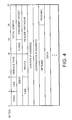
- Figure 4 illustrates the format of an Internet datagram. The same format is used for a fragment of a datagram.
- the 4 bit version field (VERS) specifies the IP protocol version and is used to ensure that all of the nodes along the path of the datagram agree on the format.
- the LEN field gives the datagram header length measured in 32 bit words.
- the TOTAL LENGTH field gives the length of the IP datagram measured in octets including the length of the header and data.
- the SERVICE TYPE field contains handling details for the datagram.
- the field IDENT contains a unique identifier that identifies the datagram.
- a first bit specifies whether the datagram may be fragmented, and a second bit indicates whether this is the last fragment in the datagram.
- the FRAGMENT OFFSET field specifies the offset of this fragment in the original datagram, measured in units of 8 octets, starting at offset zero.
- the combination of the FLAGS and FRAGMENT OFFSET fields are used to indicate that the headers relate to fragments, and to indicate the position of the fragment within the original datagram.
- the FRAGMENT OFFSET field identifies the position within the datagram, and the second of the FLAGS bits mentioned above (which is sometimes called the MORE FRAGMENTS flag) is used to indicate whether there are any more fragments in the datagram, or conversely that the fragment concerned is the last fragment of the datagram.
- the field PROTO is a form of type field.
- the HEADER CHECK SUM figure ensures integrity of header values.
- SOURCE IP ADDRESS and DESTINATION IP ADDRESS contain 32 bit Internet addresses of the datagram's sender and intended recipient.
- the OPTIONS field and the PADDING field are optional in the datagram.
- the field labelled DATA represents the beginning of the data field.
- Figure 5 represents the format of a segment used to communicate between two nodes under the TCP. Each segment is divided into two parts, a header followed by data.
- the header comprises SOURCE PORT and DESTINATION PORT fields containing the TCP PORT numbers that identify the application programs at the end of the connection.
- the SEQUENCE NO. identifies the position in the sender's byte stream of the data in the segment.
- the ACKNOWLEDGEMENT NO. field identifies the position of the highest byte that the source has received.
- the SEQUENCE NO. refers to the stream flowing in the same direction as the segment, while the ACKNOWLEDGEMENT NO. refers to the stream flowing in the opposite direction.
- the OFF field contains an integer that specifies the offset of the data portion of the segment.
- the OPTIONS field varies in length.
- the field RES is reserved for future use. Segments can be used to carry an acknowledgement or data or requests to establish or close a connection.
- the CODE field is used to determine the purpose and content of the segment.
- the WINDOW field specifies the buffer size that the destination is willing to accept every time it sends a segment.
- the CHECK SUM field includes a TCP header check sum.
- the URGENT POINTER field is used for identifying urgent data.
- the OPTIONS field is used to communicate information with the destination.
- the OPTIONS field can be used to specify a maximum segment size.
- the DATA indication represents the start of the data field of the segment.
- acknowledgements necessarily refer to a position in the stream, and not to packets or segments. Each acknowledgement specifies one greater than the highest byte position that has been received. Accordingly, acknowledgements specify the number of the next byte that the receiver expects to receive.
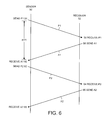
- Figure 6 is a schematic representation of the transmission and reception of packets and acknowledgements.
- the left hand side of Figure 6 represents events at a sender side 50, the right hand side represents events at a receiver side 52 and the middle portion represents network messages passing between the sender and the receiver.
- the sender 50 (eg, a client station 10) sends a packet P1 to a receiver 52 (eg, a server station 10) via the network and starts a timer for message P1.
- a receiver 52 eg, a server station 10) via the network and starts a timer for message P1.
- the receiver 52 receives, 56, the packet P1; the receiver then sends, 58, an acknowledgement A1.
- the sender can cancel the timer and send 62, the next packet P2 to the receiver 52 setting a timer for the message P2.
- the receiver 52 receives, 64, the packet P2, it sends 66, a second acknowledgment A2, to the sender 50. Once again the sender can cancel the timer. The process then continues with the transmission of further packets on receipt of the second acknowledgement A2.
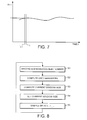
- Figure 7 illustrates a variation in Round-Trip-Time over time. As the value of the RTT changes only very gradually over time t, the RTT values at two close timings t(i-1) and t(i) are substantially the same.
- Figure 8 is a schematic flow diagram of the operation of the bandwidth control mechanism for real time computation in an adaptive manner of the window size for a desired bandwidth for every flow for which bandwidth is to be controlled.
- step S1 at each sample time t(i) a record is made of the mostly recently received transmission unit identifier (e.g., an acknowledgement number). This record is kept at least until the subsequent sample time (t+1).
- the mostly recently received transmission unit identifier e.g., an acknowledgement number
- step S2 the Used Bandwidth since t(i-1) is computed from the difference between both the transmission unit identifier for the current time t(i) and a record of that identifier for the previous sample time t(i-1).
- the transmission unit identifiers are, for example, acknowledgement numbers allocated in sequence for successive acknowledgements
- the difference t(i) minus t(i-1) directly gives a number of a result representative of a number of bytes that have been acknowledged between both times.
- the difference actually gives the number of bytes directly, as under this protocol the difference between two successive acknowledgement numbers is the number of bytes transmitted therebetween.
- AUBt(i-1) (ANt(i) - ANt(i-1)) / (t(i) - t(i-1)), where:
- the "Desired Used Bandwidth at t(i)" (DUBt(i)) and “Window Size at t(i-1)" (WSt(i-1)), are known values.
- the Desired Used Bandwidth at t(i) is the bandwidth for the flow concerned which it is desired to achieve and Window Size at t(i-1) is known from the previous pass through step S3.
- step S4 the Window Size at t(i) value can be set in the WINDOW SIZE field of an outgoing message or messages (see for example Figure 4).
- the Window Size value is then used in a conventional manner to indicate the amount of information which the recipient is able to receive at its input buffer at the current time. This value will change with time depending on dynamic factors associated with the connection which will determine the actually bandwidth until a subsequent time at which the window size is recalculated as described above.
- step S5 control passes back to step S1.
- the method as represented in Figure 8 enables control of network bandwidth for a connection by dynamically determining a current window size for a destination buffer as a bandwidth control parameter for a communication flow.
- the method includes steps of determining a first window size for the destination buffer at a first time on a first pass of the method steps S1-S5. Then on a second pass of steps S1-S5 at a second time, the method includes determining a current window size at the second time as a function of the first window size, a desired bandwidth value and a bandwidth used between the first time and the second time.
- the steps illustrated in Figure 8 are repeated at successive timings to provide adaptive bandwidth control.
- the used bandwidth is determined from a first transmission unit in a first direction at the first time and a second transmission unit in the same direction at the second time, where the transmission unit can be a network message packet, or a network acknowledgement packet.
- the used bandwidth is determined from a difference between transmission unit numbers at the first and second times.
- the transmission unit number is a TCP packet sequence number.
- the first and second times can be determined in response to a clock, or alternatively, in response to the detecting the reception of respective network messages in a given direction over a connection, or to respective acknowledgements, or indeed to any other stimulus as appropriate.
- the method can be implemented by software operating on a computer or in a quality of service unit at or as a station 10.
- the software con be stored as a sequence of instructions in a memory of the computer (e.g. a memory of a station as shown in Figure 2) or on a transportable data carrier for use with such a computer. It could also be implemented, at least in part, by appropriate hardware logic, for example in the form of one or more Application Specific Integrated Circuits (ASICs).
- ASICs Application Specific Integrated Circuits
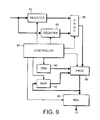
- Figure 9 is a schematic representation of the functional components of an example of a bandwidth control mechanism according to an embodiment of the invention.
- This mechanism can also be implemented by software for controlling the operation of programmable computer hardware, or at least in part by special purpose hardware.
- a controller 80 of the bandwidth controller causes a first transmission unit number (e.g. an acknowledgement number - see Figure 5) to be extracted from a transmission unit (e.g. a TCP segment) and stored in a first register 82 along with record of the time of first the transmission unit (if required) and/or the recording of the first transmission unit number.
- a transmission unit number e.g. an acknowledgement number - see Figure 5
- the controller 80 also causes second transmission unit number (e.g. an acknowledgement number - see Figure 5) to be extracted from a subsequent transmission unit (e.g. a TCP segment) and stored in a second register 84 along with record of the time of the second transmission unit (if required) and/or the recording of the second transmission unit number.
- second transmission unit number e.g. an acknowledgement number - see Figure 5
- the controller 80 then causes a processor 86 to determine a used bandwidth value by computing the amount of data transmitted between the first and second times (e.g., for successive TCP segments, the number of bytes transmitted by subtracting the first acknowledgement number from the second acknowledgement number). If the computation is performed at regular intervals, it is not necessary to record the times of the transmission units or the recording of the transmission unit numbers. However, if the computation is not performed at regular intervals, the times could be used to determine a bandwidth used per unit time.
- the controller then causes a processor 88 to determine a current window size in accordance with equation (4) above on the basis of the used bandwidth value output from the processor 86, the desired bandwidth value from a desired bandwidth register (DBR) 90 and a prior window size value from a window size register (WSR) 92 determined at the timing of the first time.
- the resulting current window size value can be output from the processor 88 to message generation logic (MGL) 94.
- the computed current window size then replaces the value in the window size register 92.
- the message generation logic 94 can be conventional and uses the computed current window size value for the WINDOW field of a TCP segment.
- the desired bandwidth value in the register 90 can predetermined for a particular connection, or can be computed dynamically by any appropriate technique for controlling the distribution of bandwidth between different connections.
- the initial window size can be chosen substantially at random. As the method is an adaptive one, the window size will rapidly approach the optimum after a low number of iterations.
- the controller causes the registers 82 and 84 to be operated in a tandem manner, so that the registers alternatively contain the current and previously recorded values.
- processors 86 and 88 are shown in Figure 9 for ease of explanation, these can be implemented as a single processor or processing logic.
- the bandwidth control mechanism can form part of a server and can be responsive to receipt of messages at the server to extract acknowledgement numbers from received messages. The server can then control the bandwidth available over one or more connections.
- bandwidth control can be effected in the same manner for a plurality of different connections, for example between a server and a plurality of clients.
- Algorithms can be employed to determine the distribution of desired bandwidth between the different connections in accordance with any suitable parameters such as bandwidth priorities, bandwidth paid for, and so on.
- the bandwidth control mechanism can be provided as a software bandwidth control mechanism on a carrier medium (e.g. a computer readable storage medium such as an optical or magnetic disk or tape, solid state storage, etc., or telecommunications medium such as a telephone line, a wireless connection, etc., or indeed any other suitable carrier medium).
- a carrier medium e.g. a computer readable storage medium such as an optical or magnetic disk or tape, solid state storage, etc., or telecommunications medium such as a telephone line, a wireless connection, etc., or indeed any other suitable carrier medium.
Landscapes
- Engineering & Computer Science (AREA)
- Computer Networks & Wireless Communication (AREA)
- Signal Processing (AREA)
- Computer Security & Cryptography (AREA)
- Data Exchanges In Wide-Area Networks (AREA)
- Communication Control (AREA)
Applications Claiming Priority (2)
| Application Number | Priority Date | Filing Date | Title |
|---|---|---|---|
| US08/995,707 US6249530B1 (en) | 1997-12-22 | 1997-12-22 | Network bandwidth control |
| US995707 | 1997-12-22 |
Publications (4)
| Publication Number | Publication Date |
|---|---|
| EP0924902A2 true EP0924902A2 (fr) | 1999-06-23 |
| EP0924902A3 EP0924902A3 (fr) | 2003-04-02 |
| EP0924902B1 EP0924902B1 (fr) | 2006-03-22 |
| EP0924902B9 EP0924902B9 (fr) | 2006-06-28 |
Family
ID=25542121
Family Applications (1)
| Application Number | Title | Priority Date | Filing Date |
|---|---|---|---|
| EP98402875A Expired - Lifetime EP0924902B9 (fr) | 1997-12-22 | 1998-11-19 | Commande de largeur de bande passante dans un réseau |
Country Status (5)
| Country | Link |
|---|---|
| US (1) | US6249530B1 (fr) |
| EP (1) | EP0924902B9 (fr) |
| JP (1) | JPH11275150A (fr) |
| CA (1) | CA2256229A1 (fr) |
| DE (1) | DE69833928T2 (fr) |
Cited By (5)
| Publication number | Priority date | Publication date | Assignee | Title |
|---|---|---|---|---|
| WO2000035163A1 (fr) * | 1998-12-08 | 2000-06-15 | Nokia Mobile Phones Ltd. | Procede pour optimiser la transmission de donnees |
| WO2001015394A1 (fr) * | 1999-08-26 | 2001-03-01 | Spinway, Inc. | Systeme et procede de transfert de donnees adaptatifs a la largeur de bande |
| US6772217B1 (en) | 2000-08-23 | 2004-08-03 | International Business Machines Corporation | Internet backbone bandwidth enhancement by initiating an additional data stream when individual bandwidth are approximately equal to the backbone limit |
| US7047309B2 (en) | 2000-08-23 | 2006-05-16 | International Business Machines Corporation | Load balancing and dynamic control of multiple data streams in a network |
| EP2738984A4 (fr) * | 2011-07-26 | 2015-03-11 | Hitachi Ltd | Dispositif de communication |
Families Citing this family (42)
| Publication number | Priority date | Publication date | Assignee | Title |
|---|---|---|---|---|
| US6473793B1 (en) * | 1994-06-08 | 2002-10-29 | Hughes Electronics Corporation | Method and apparatus for selectively allocating and enforcing bandwidth usage requirements on network users |
| JPH11243419A (ja) * | 1998-02-26 | 1999-09-07 | Fujitsu Ltd | Tcpレイヤのレート制御方式 |
| US6621829B1 (en) * | 1998-05-20 | 2003-09-16 | Nortel Networks Limited | Method and apparatus for the prioritization of control plane traffic in a router |
| US6505253B1 (en) * | 1998-06-30 | 2003-01-07 | Sun Microsystems | Multiple ACK windows providing congestion control in reliable multicast protocol |
| US6728263B2 (en) * | 1998-08-18 | 2004-04-27 | Microsoft Corporation | Dynamic sizing of data packets |
| US6483805B1 (en) * | 1998-12-28 | 2002-11-19 | Nortel Networks Limited | Internet differentiated services service for transaction applications |
| US6731600B1 (en) * | 1999-02-08 | 2004-05-04 | Realnetworks, Inc. | System and method for determining network conditions |
| US6438105B1 (en) * | 1999-02-08 | 2002-08-20 | 3Com Corporation | Reliable internet facsimile protocol |
| SG87029A1 (en) * | 1999-05-08 | 2002-03-19 | Kent Ridge Digital Labs | Dynamically delayed acknowledgement transmission system |
| EP1059828A1 (fr) * | 1999-06-11 | 2000-12-13 | BRITISH TELECOMMUNICATIONS public limited company | Allocation de bande passante en fonction du temps dans un réseau de communication |
| JP3391316B2 (ja) * | 1999-10-22 | 2003-03-31 | 日本電気株式会社 | ネットワークシステム |
| US6505034B1 (en) * | 1999-12-20 | 2003-01-07 | Nokia Ip Inc. | Adaptive ARQ feedback bandwidth allocation |
| US7106742B1 (en) * | 2000-01-13 | 2006-09-12 | Mercury Computer Systems, Inc. | Method and system for link fabric error detection and message flow control |
| US6674717B1 (en) * | 2000-03-30 | 2004-01-06 | Network Physics, Inc. | Method for reducing packet loss and increasing internet flow by feedback control |
| US6947445B1 (en) * | 2000-06-09 | 2005-09-20 | Hughes Electronics Corporation | Available bandwidth control mechanism |
| US8009667B1 (en) * | 2001-01-16 | 2011-08-30 | Wi—LAN, Inc. | Packing source data packets into transporting packets with fragmentation |
| US7072297B2 (en) * | 2001-04-30 | 2006-07-04 | Networks Physics, Inc. | Method for dynamical identification of network congestion characteristics |
| US7551560B1 (en) | 2001-04-30 | 2009-06-23 | Opnet Technologies, Inc. | Method of reducing packet loss by resonance identification in communication networks |
| JP2002368832A (ja) * | 2001-06-08 | 2002-12-20 | Nec Eng Ltd | プロトコル変換装置 |
| US7697447B2 (en) * | 2001-08-10 | 2010-04-13 | Motorola Inc. | Control of jitter buffer size and depth |
| US7539756B2 (en) * | 2002-01-31 | 2009-05-26 | Darby & Mohaine, L.L.C. | Method and system of data packet transmission timing for controlling bandwidth |
| US7113497B2 (en) * | 2002-05-08 | 2006-09-26 | Lenovo (Singapore) Pte. Ltd. | Bandwidth management in a wireless network |
| US7171482B2 (en) * | 2002-07-12 | 2007-01-30 | Ianywhere Solutions, Inc. | System and method for managing bandwidth utilization |
| EP1383281A1 (fr) * | 2002-07-19 | 2004-01-21 | TELEFONAKTIEBOLAGET LM ERICSSON (publ) | Méthode pour le calcul de la taille d'une fenêtre de transmission |
| US20040017773A1 (en) * | 2002-07-23 | 2004-01-29 | Eyeball Networks Inc. | Method and system for controlling the rate of transmission for data packets over a computer network |
| US7069326B1 (en) * | 2002-09-27 | 2006-06-27 | Danger, Inc. | System and method for efficiently managing data transports |
| US7428243B2 (en) | 2002-10-18 | 2008-09-23 | Darby & Mohaine, Llc | Method and system for varying data packet size for controlling bandwidth |
| US7421502B2 (en) * | 2002-12-06 | 2008-09-02 | International Business Machines Corporation | Method and system for storage-aware flow resource management |
| US20060165029A1 (en) * | 2002-12-19 | 2006-07-27 | Koninklijke Philips Electronics N.V. | Protecting real-time data in wireless networks |
| US7688733B1 (en) | 2003-08-04 | 2010-03-30 | Sprint Communications Company L.P. | System and method for bandwidth selection in a communication network |
| KR100604597B1 (ko) * | 2004-02-20 | 2006-07-24 | 주식회사 팬택앤큐리텔 | 이동 통신 단말기 |
| US7664067B2 (en) * | 2005-12-15 | 2010-02-16 | Microsoft Corporation | Preserving socket connections over a wireless network |
| US8170802B2 (en) * | 2006-03-21 | 2012-05-01 | Westerngeco L.L.C. | Communication between sensor units and a recorder |
| US9274238B2 (en) * | 2008-11-08 | 2016-03-01 | Westerngeco L.L.C. | Reliable broadcast delivery of communications in land-based seismic surveying |
| US9350616B1 (en) * | 2010-05-11 | 2016-05-24 | Trend Micro Inc. | Bandwidth prediction using a past available bandwidth value and a slope calculated from past available bandwidth values |
| US9660924B2 (en) | 2012-04-16 | 2017-05-23 | Hewlett Packard Enterprise Development Lp | Determining a maximal size of packets |
| GB2493639B (en) * | 2012-08-22 | 2014-02-12 | Broadcom Corp | Method and apparatus for transmitting data units |
| US9131251B2 (en) * | 2012-09-20 | 2015-09-08 | Google Technology Holdings LLC | Use of a receive-window size advertised by a client to a content server to change a video stream bitrate streamed by the content server |
| US9544344B2 (en) * | 2012-11-20 | 2017-01-10 | Google Technology Holdings LLC | Method and apparatus for streaming media content to client devices |
| US10122645B2 (en) | 2012-12-07 | 2018-11-06 | Cisco Technology, Inc. | Output queue latency behavior for input queue based device |
| US9628406B2 (en) * | 2013-03-13 | 2017-04-18 | Cisco Technology, Inc. | Intra switch transport protocol |
| US9860185B2 (en) | 2013-03-14 | 2018-01-02 | Cisco Technology, Inc. | Intra switch transport protocol |
Family Cites Families (14)
| Publication number | Priority date | Publication date | Assignee | Title |
|---|---|---|---|---|
| US5163046A (en) * | 1989-11-30 | 1992-11-10 | At&T Bell Laboratories | Dynamic window sizing in a data network |
| US5063562A (en) * | 1990-05-23 | 1991-11-05 | International Business Machines Corporation | Flow control for high speed networks |
| US5309437A (en) | 1990-06-29 | 1994-05-03 | Digital Equipment Corporation | Bridge-like internet protocol router |
| CA2065578C (fr) | 1991-04-22 | 1999-02-23 | David W. Carr | Methode de compression de donnees utilisant des paquets |
| US5307413A (en) | 1991-07-19 | 1994-04-26 | Process Software Corporation | Method and apparatus for adding data compression and other services in a computer network |
| US5307347A (en) | 1992-04-10 | 1994-04-26 | International Business Machines Corporation | Method and apparatus for sharing a telecommunications channel among multiple users |
| JP2826416B2 (ja) | 1992-06-05 | 1998-11-18 | 日本電気株式会社 | ローカルエリアネットワーク間の接続ルータ |
| US5442637A (en) * | 1992-10-15 | 1995-08-15 | At&T Corp. | Reducing the complexities of the transmission control protocol for a high-speed networking environment |
| AU706160B2 (en) * | 1994-06-08 | 1999-06-10 | Hughes Electronics Corporation | Apparatus and method for hybrid network access |
| US5535199A (en) | 1994-09-06 | 1996-07-09 | Sun Microsystems, Inc. | TCP/IP header compression X.25 networks |
| US5592627A (en) * | 1994-10-11 | 1997-01-07 | Emprise Technologies, L.P. | Pipelined, sliding-window, flow control for end-to-end communication sessions |
| US5764625A (en) * | 1995-11-13 | 1998-06-09 | International Business Machines Corp. | Optimal flow control window size design in high-speed networks |
| US5974028A (en) * | 1997-02-24 | 1999-10-26 | At&T Corp. | System and method for improving transport protocol performance in communication networks having lossy links |
| US6023453A (en) * | 1997-09-11 | 2000-02-08 | Nokia Telecommunications, Oy | System and method employing last occurrence and sliding window technique for determining minimum and maximum values |
-
1997
- 1997-12-22 US US08/995,707 patent/US6249530B1/en not_active Expired - Lifetime
-
1998
- 1998-11-19 DE DE69833928T patent/DE69833928T2/de not_active Expired - Fee Related
- 1998-11-19 EP EP98402875A patent/EP0924902B9/fr not_active Expired - Lifetime
- 1998-12-16 CA CA002256229A patent/CA2256229A1/fr not_active Abandoned
- 1998-12-22 JP JP36540598A patent/JPH11275150A/ja active Pending
Cited By (5)
| Publication number | Priority date | Publication date | Assignee | Title |
|---|---|---|---|---|
| WO2000035163A1 (fr) * | 1998-12-08 | 2000-06-15 | Nokia Mobile Phones Ltd. | Procede pour optimiser la transmission de donnees |
| WO2001015394A1 (fr) * | 1999-08-26 | 2001-03-01 | Spinway, Inc. | Systeme et procede de transfert de donnees adaptatifs a la largeur de bande |
| US6772217B1 (en) | 2000-08-23 | 2004-08-03 | International Business Machines Corporation | Internet backbone bandwidth enhancement by initiating an additional data stream when individual bandwidth are approximately equal to the backbone limit |
| US7047309B2 (en) | 2000-08-23 | 2006-05-16 | International Business Machines Corporation | Load balancing and dynamic control of multiple data streams in a network |
| EP2738984A4 (fr) * | 2011-07-26 | 2015-03-11 | Hitachi Ltd | Dispositif de communication |
Also Published As
| Publication number | Publication date |
|---|---|
| US6249530B1 (en) | 2001-06-19 |
| CA2256229A1 (fr) | 1999-06-22 |
| EP0924902B1 (fr) | 2006-03-22 |
| EP0924902A3 (fr) | 2003-04-02 |
| JPH11275150A (ja) | 1999-10-08 |
| DE69833928T2 (de) | 2006-12-07 |
| DE69833928D1 (de) | 2006-05-11 |
| EP0924902B9 (fr) | 2006-06-28 |
Similar Documents
| Publication | Publication Date | Title |
|---|---|---|
| US6249530B1 (en) | Network bandwidth control | |
| US6473425B1 (en) | Mechanism for dispatching packets via a telecommunications network | |
| US6215769B1 (en) | Enhanced acknowledgment pacing device and method for TCP connections | |
| US7103674B2 (en) | Apparatus and method of reducing dataflow distruption when detecting path maximum transmission unit (PMTU) | |
| US7474619B2 (en) | Method and apparatus for providing fragmentation at a transport level along a transmission path | |
| US6925060B2 (en) | Method and unit for controlling the flow of a TCP connection on a flow controlled network | |
| Velten et al. | Reliable data protocol | |
| US7065086B2 (en) | Method and system for efficient layer 3-layer 7 routing of internet protocol (“IP”) fragments | |
| EP1690391B1 (fr) | Optimisation transparente pour l'etablissement d'une session initiale de protocole de controle de transmission | |
| US20040192312A1 (en) | Communication system for voice and data with wireless TCP server | |
| US20070223529A1 (en) | Methods and apparatus for estimating bandwidth of a data network | |
| FI106417B (fi) | Menetelmä tiedonsiirron optimoimiseksi | |
| US6026093A (en) | Mechanism for dispatching data units via a telecommunications network | |
| US20030108044A1 (en) | Stateless TCP/IP protocol | |
| US7359326B1 (en) | Method for splitting data and acknowledgements in a TCP session | |
| EP0955749A1 (fr) | Commande d'encombrement par un récepteur et avis d'encombrement du routeur | |
| US8578040B2 (en) | Method, system and article for client application control of network transmission loss tolerance | |
| EP1052812A2 (fr) | Procédé d'equilibrage de charge de trafic Internet sur un réseau hybride asymetrique terrestre et satellite | |
| US20070291782A1 (en) | Acknowledgement filtering | |
| Rüngeler et al. | Congestion and flow control in the context of the message-oriented protocol SCTP | |
| Raitahila | Congestion Control Algorithms for the Constrained Application Protocol (CoAP) | |
| CA2246134C (fr) | Protocole de reseau ameliore | |
| Velten et al. | RFC0908: Reliable Data Protocol | |
| Sisalem et al. | A TCP Simulator with PTOLEMY | |
| Gulwani | TRANSPORT PROTOCOLS |
Legal Events
| Date | Code | Title | Description |
|---|---|---|---|
| PUAI | Public reference made under article 153(3) epc to a published international application that has entered the european phase |
Free format text: ORIGINAL CODE: 0009012 |
|
| AK | Designated contracting states |
Kind code of ref document: A2 Designated state(s): AT BE CH CY DE DK ES FI FR GB GR IE IT LI LU MC NL PT SE |
|
| AX | Request for extension of the european patent |
Free format text: AL;LT;LV;MK;RO;SI |
|
| RIN1 | Information on inventor provided before grant (corrected) |
Inventor name: MARTIN, JEAN CHRISTOPHE Inventor name: BLANCO, MARCOS ARES |
|
| PUAL | Search report despatched |
Free format text: ORIGINAL CODE: 0009013 |
|
| AK | Designated contracting states |
Kind code of ref document: A3 Designated state(s): AT BE CH CY DE DK ES FI FR GB GR IE IT LI LU MC NL PT SE |
|
| AX | Request for extension of the european patent |
Extension state: AL LT LV MK RO SI |
|
| RAP1 | Party data changed (applicant data changed or rights of an application transferred) |
Owner name: SUN MICROSYSTEMS, INC. |
|
| 17P | Request for examination filed |
Effective date: 20030702 |
|
| 17Q | First examination report despatched |
Effective date: 20030903 |
|
| AKX | Designation fees paid |
Designated state(s): DE FR GB |
|
| GRAP | Despatch of communication of intention to grant a patent |
Free format text: ORIGINAL CODE: EPIDOSNIGR1 |
|
| GRAS | Grant fee paid |
Free format text: ORIGINAL CODE: EPIDOSNIGR3 |
|
| GRAA | (expected) grant |
Free format text: ORIGINAL CODE: 0009210 |
|
| AK | Designated contracting states |
Kind code of ref document: B1 Designated state(s): DE FR GB |
|
| REG | Reference to a national code |
Ref country code: GB Ref legal event code: FG4D |
|
| REF | Corresponds to: |
Ref document number: 69833928 Country of ref document: DE Date of ref document: 20060511 Kind code of ref document: P |
|
| PGFP | Annual fee paid to national office [announced via postgrant information from national office to epo] |
Ref country code: DE Payment date: 20061116 Year of fee payment: 9 |
|
| PLBE | No opposition filed within time limit |
Free format text: ORIGINAL CODE: 0009261 |
|
| STAA | Information on the status of an ep patent application or granted ep patent |
Free format text: STATUS: NO OPPOSITION FILED WITHIN TIME LIMIT |
|
| 26N | No opposition filed |
Effective date: 20061227 |
|
| EN | Fr: translation not filed | ||
| GBPC | Gb: european patent ceased through non-payment of renewal fee |
Effective date: 20061119 |
|
| PG25 | Lapsed in a contracting state [announced via postgrant information from national office to epo] |
Ref country code: GB Free format text: LAPSE BECAUSE OF NON-PAYMENT OF DUE FEES Effective date: 20061119 |
|
| PG25 | Lapsed in a contracting state [announced via postgrant information from national office to epo] |
Ref country code: FR Free format text: LAPSE BECAUSE OF FAILURE TO SUBMIT A TRANSLATION OF THE DESCRIPTION OR TO PAY THE FEE WITHIN THE PRESCRIBED TIME-LIMIT Effective date: 20070309 |
|
| PG25 | Lapsed in a contracting state [announced via postgrant information from national office to epo] |
Ref country code: DE Free format text: LAPSE BECAUSE OF NON-PAYMENT OF DUE FEES Effective date: 20080603 |
|
| PG25 | Lapsed in a contracting state [announced via postgrant information from national office to epo] |
Ref country code: FR Free format text: LAPSE BECAUSE OF FAILURE TO SUBMIT A TRANSLATION OF THE DESCRIPTION OR TO PAY THE FEE WITHIN THE PRESCRIBED TIME-LIMIT Effective date: 20060322 |