EP0924645B1 - Methode und Nachverarbeitungsvorrichtung zur Reduktion von Blockartefakten mittels Projektionen - Google Patents
Methode und Nachverarbeitungsvorrichtung zur Reduktion von Blockartefakten mittels Projektionen Download PDFInfo
- Publication number
- EP0924645B1 EP0924645B1 EP19980113597 EP98113597A EP0924645B1 EP 0924645 B1 EP0924645 B1 EP 0924645B1 EP 19980113597 EP19980113597 EP 19980113597 EP 98113597 A EP98113597 A EP 98113597A EP 0924645 B1 EP0924645 B1 EP 0924645B1
- Authority
- EP
- European Patent Office
- Prior art keywords
- image
- projection
- respect
- algorithm
- windows
- Prior art date
- Legal status (The legal status is an assumption and is not a legal conclusion. Google has not performed a legal analysis and makes no representation as to the accuracy of the status listed.)
- Expired - Lifetime
Links
Images


Classifications
-
- G—PHYSICS
- G06—COMPUTING OR CALCULATING; COUNTING
- G06T—IMAGE DATA PROCESSING OR GENERATION, IN GENERAL
- G06T5/00—Image enhancement or restoration
- G06T5/20—Image enhancement or restoration using local operators
Definitions
- the present invention relates to a blocking artifact reduction method and a postprocessor therefor, and more particularly, to a blocking artifact reduction method for improving the quality of a restored image using a projection onto the overcomplete basis (POCB) algorithm.
- POCB overcomplete basis
- image data is compressed in units of a block.
- One of the main drawbacks of these block-based coding schemes is blocking artifacts.
- Compression of the image data is essential for transmitting a huge amount of image information through a transmission channel having a restricted bandwidth.
- the compression of the image data is performed by discarding some of the information from an image signal.
- a compression process i.e., a process of discarding some image information (high frequency information)
- image information high frequency information
- discontinuities appear at block boundaries. Accordingly, blocks which do not exist in an original image signal are visually sensed. This phenomenon is called blocking artifacts, and causes deterioration of the quality of a received image.
- the blocking artifacts appear since the loss of transform coefficients is not correctly compensated for in a process of independently quantizing each block during decoding. In particular, the phenomenon is more obvious in image compression encoders which require a high compression rate.
- a lowpass filtering method, a duplex converting method, a projection onto convex sets (POCS) method, and an optimal estimation of the transform coefficients method are provided in order to visually improve picture quality by reducing the blocking artifacts.
- the lowpass filtering relies on the fact that high frequency components are generated in a frequency domain since the discontinuities at the block boundary locally have a waveform similar in shape to a staircase.
- the blocking artifacts are reduced by lowpass filtering the high frequency components, thus reducing them.
- the discontinuities at the block boundary are reduced by allowing some duplex between blocks during encoding and decoding.
- the POCS method a more natural image is obtained by repeatedly projecting a decoded image onto a convex set using previous knowledge of the rough characteristics of an original image and a range of coefficients.
- the decoded transform coefficients are slightly corrected so that the discontinuities are minimal at the boundary between adjacent blocks in each block. This is possible since the blocking artifacts appear due to the excessive quantization error of the transform coefficients.
- the blocking artifacts are not completely removed, since the blocking artifacts are not only shown in the discontinuities at the block boundary but also in image information such as an edge in a two dimensional plane, as shown in FIG. 3. Namely, the discontinuities in the image information such as edges and textures are not property restored.
- a method for reducing blocking artifacts when restoring a block-based coded image comprising the steps of (a) receiving a decoded image with respect to a block-based coded image and (b) generating a postprocessed image by approximating the decoded image to an original image using a non-orthogonal basis through a projections onto the overcomplete basis (POCB) algorithm.
- POCB overcomplete basis
- a postprocessor for decoding and postprocessing a conversion block-based encoded image, comprising an area segmenter for segmenting an input decoded image into blocks of a predetermined size and a POCB processor for performing the POCB algorithm on each of segmented blocks.
- the postprocessor according to the present invention further comprises a bilinear averager for bilinearly averaging the image on which the POCB algorithm is performed and generating the postprocessed image signal of the transform block.
- the blocking artifacts are reduced by expressing an image in which the blocking artifacts are reduced by the linear combination of continuous functions having a directional property, in order to restore a surface continuity including the continuity of edges and textures as well as the continuity of a block boundary.
- the linear coefficients satisfying the following equation 1 must be obtained.
- f , f and , b l and ⁇ respectively represent an image in which the blocking artifacts appear, an image in which the blocking artifacts are reduced (a postprocessed image), an arbitrary function having a directional property, and a constant denoting a threshold value. Therefore, to reduce the blocking artifacts is to search the linear coefficient p l so that satisfies the above equation 1.
- the POCB method is used in order to search for the desired linear coefficient p l .
- the continuous functions (a non-orthogonal basis) used for the POCB method have a directional property and span an image signal space so that projection coefficients (linear coefficients) exist
- the following cosine function is provided as a continuous function b l satisfying such a condition.
- m ( i , j ) and l ( u , v ) are one-to-one correspondence functions for converting a two dimensional index to a one dimensional one
- N i.e. a block size to which the POCB is applied
- N 16 ⁇ 16, four times that of 8 ⁇ 8 DCT blocks. Therefore, the pixel position (i,j) and the range of frequency (u,v) of the block to which the POCB is applied is as follows. [EQUATION 3] 0 ⁇ i , j ⁇ N -1, 0 ⁇ u ⁇ N -1, -( N -1) ⁇ v ⁇ N -1
- Step 1 calculate the initial projection coefficient of the image f in which the blocking artifacts are not reduced, and initialize the estimate f and k of an estimate image.
- Step 2 Perform the POCB algorithm.
- f k +1 f k + p l k .b l k .
- f and k , f and k +1 , p k / l , and b l . are respectively a previous estimate, a renewed estimate, a projection coefficient having a previous maximum energy, and the non-orthogonal basic vector of the projection coefficient having the previous maximum energy.
- the projection coefficient p k +1 / l renewed in the above equation 7 can be easily obtained using known values without complete operations, since the calculated previous projection coefficient p k / l , the previous projection coefficient p k / l . having the maximum energy obtained by the equation 3, and the cross-correlations ⁇ b l , b l .> between the non-orthogonal basis vector of the projection coefficients and the non-orthogonal basis vector of the projection coefficient having the maximum energy, are shown.
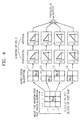
- the blocking artifacts in the block are reduced, but new blocking artifacts appear at the boundary of the 16 ⁇ 16 block. Therefore, the 16 ⁇ 16 block is overlappingly segmented into small blocks and then each block is processed by the POCB algorithm.
- the POCB algorithm is performed with respect to B(i,j) by setting different weights at the boundary and other portions in a first window 11 located at the right side of the 16 ⁇ 16 block.
- horizontal and vertical weights are shown with respect to the block B(i, j).
- a quadrangular pyramid shaped weight exists, using the center of the window of the 16 ⁇ 16 blocksize as the top.
- the window moves eight pixels to the right, thus constructing a new second window 12.
- a weight is set with respect to the second window 12 and the POCB algorithm is performed.
- the first window 11 moves eight pixels down, thus constructing a third window 13.
- a weight is set with respect to the third window 13 and the POCB algorithm is performed.
- the third window 13 moves eight pixels to the right, thus constructing a fourth window 14.
- a weight is set with respect to the fourth window 14 and the POCB is performed.
- a final output value is obtained by adding together pixel values obtained by performing four POCB algorithms with respect to the block B(i,j).
- This calculation method is called bilinear averaging.
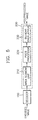
- a postprocessor for reducing the blocking artifacts using the POCB method according to the present invention will be described with reference to FIG. 5.
- a segmenter 210 of a postprocessor 200 overlappingly segments a decoded image applied from a decoder 100 into small blocks.
- a blocksize N ⁇ N (N is 16) can be used in order to observe the blocking artifacts between adjacent blocks. This blocksize is equal to 2 ⁇ 2DCT blocks.
- a POCB processor 220 generates a projection coefficient by processing the segmented 16 ⁇ 16 blocks on the basis of the above-mentioned first through third steps of POCB algorithm.
- a bilinear averager 230 is comprised of a plurality of delays, an adder, and an averager.
- the delays are for temporarily storing the respective results obtained by performing the POCB algorithm on the respective windows.
- the adder is for adding the outputs of the delays.
- the averager is for averaging the output of the adder and generating the postprocessed image signal of the DCT block.
- first through fourth windows having the block size of 16 ⁇ 16, including the block of the decoded image (the 8 ⁇ 8DCT block), different weighting values are set at a boundary and other portions as shown in FIG. 4.
- the method for reducing the blocking artifacts using the POCB algorithm according to the present invention can be applied to a codec in which block-based coding schemes such as the JPEG standard and vector quantizers are used.
- the present invention it is possible to effectively reduce the blocking artifacts in areas such as edges and textures other than a flat image, and to improve the picture quality of the received or restored image in the still image or moving image codec using block-based encoding.
Landscapes
- Physics & Mathematics (AREA)
- General Physics & Mathematics (AREA)
- Engineering & Computer Science (AREA)
- Theoretical Computer Science (AREA)
- Compression Or Coding Systems Of Tv Signals (AREA)
- Compression Of Band Width Or Redundancy In Fax (AREA)
- Compression, Expansion, Code Conversion, And Decoders (AREA)
- Image Processing (AREA)
- Apparatus For Radiation Diagnosis (AREA)
Claims (15)
- Verfahren zur Wiederherstellung eines Transformationsblock-basierend codierten Bildes mit den Schritten:dadurch gekennzeichnet, daß(a) Segmentieren eines decodierenden Bildes in Bezug auf das Transformationsblock-basierend codierte Bild in Blöcke einer vorbestimmten Größe;(b) Erzeugen von Projektionskoeffizienten durch Durchführen eines Blockartefakt-Reduktionsalgorithmus an jedem von den segmentierten Blöcken, wobei der Algorithmus eine Projektion auf eine übervollständige Basis anwendet; und(c) Erzeugen eines nachverarbeiteten Bildes,
das nachverarbeitete Bild durch bilineare Mittelung der Projektionskoeffizienten unter Nutzung einer Vielzahl von Fenstern (11, 12, 13, 14) erzeugt wird. - Verfahren nach Anspruch 1, wobei der Schritt der Segmentierung ferner das Empfangen des decodierten Bildes umfaßt.
- Verfahren nach Anspruch 1 oder 2, wobei der Schritt der Erzeugung des nachverarbeiteten Bildes ferner die Annäherung des decodierten Bildes an ein Originalbild unter Anwendung einer nicht-orthogonalen Basis durch den Algorithmus umfaßt.
- Verfahren nach Anspruch 3, wobei eine Cosinusfunktion mit einer Richtungseigenschaft und einer Vollständigkeitseigenschaft als die nicht-orthogonale Basis verwendet wird.
- Verfahren nach Anspruch 1, wobei das nachverarbeitete Bild durch eine Linearkombination stetiger Funktionen mit einer Richtungseigenschaft ausgedrückt wird.
- Verfahren nach einem der Ansprüche 1 bis 5, wobei der Schritt (b) die Schritte umfaßt:(b1) Berechnen anfänglicher Projektionskoeffizienten durch Kreuzkorrelation zwischen dem decodierten Bild und der nicht-orthogonalen Basis und Initialisierung eines Schätzwertes des nachverarbeiteten Bildes;(b2) Erhalten der Projektionskoeffizienten mit der maximalen Energie aus den anfänglichen Projektionskoeffizienten;(b3) Erneuern der Schätzung unter Verwendung des vorherigen Projektionskoeffizienten mit der maximalen Energie, des nicht-orthogonalen Basisvektors des vorherigen Projektionskoeffizienten, und eines vorherigen Schätzwertes;(b4) Erneuern der Projektionskoeffizienten in Bezug auf ein Restsignal unter Verwendung berechneter vorheriger Projektionskoeffizienten, eines vorherigen Projektionskoeffizienten mit der maximalen Energie, und einer Kreuzkorrelation zwischen den nicht-orthogonalen Basisvektoren vorheriger Projektionskoeffizienten und dem nicht-orthogonalen Basisvektor des vorherigen Projektionskoeffizienten mit der maximalen Energie; und(b5) wiederholtes Ausführen der Schritte (b2) bis (b4) bis die Differenz zwischen dem decodierten Bild und dem nachverarbeiteten Bild kleiner als ein Schwellenwert ist.
- Verfahren nach Anspruch 6, wobei eine Cosinusfunktion mit einer Richtungseigenschaft und einer Vollständigkeitseigenschaft als die nicht-orthogonale Basis verwendet wird.
- Verfahren nach einem der Ansprüche 1 bis 7, wobei Projektionskoeffizienten in Bezug auf eine Vielzahl von Fenstern (11, 12, 13, 14) durch Einstellen unterschiedlicher Gewichtungswerte an einer Grenze und an anderen Abschnitten in Bezug auf eine Vielzahl von Fenstern mit derselben Größe wie die das decodierte Bild des Transformationsblockes enthaltenden segmentierten Blöcke erzeugt werden, und der Algorithmus in dem Schritt (b) durchgeführt wird.
- Verfahren nach Anspruch 8, wobei der Schritt (c) die Schritte umfaßt:(c1) Aufaddieren der Projektionskoeffizienten in Bezug auf die Vielzahl der Fenster (11, 12, 13, 14) und Anlegen einer Summe; und(c2) Mitteln der Summe und Erzeugen eines nachverarbeiteten Bildes in Bezug auf das decodierte Bild des Transformationsblockes.
- Nachverarbeitungsvorrichtung zum Decodieren und Nachverarbeiten eines Transformationsblock-basierend codierten Bildes, umfassend:eine Bereichs-Segmentierungseinrichtung (210) zum Segmentieren eines decodierten Eingangsbildes in Blöcke einer vorbestimmten Größe;eine Prozessor (220) zum Erzeugen von Projektionskoeffizienten durch Durchführen eines Blockartefakt-Reduktionsalgorithmus an jedem der segmentierten Blökke, wobei der Algorithmus eine Projektion auf einer übervollständigen Basis anwendet; undeine bilineare Mittelungseinrichtung (230) zum Nachverarbeiten durch bilineares Mitteln der Projektionskoeffizienten unter Anwendung einer Vielzahl von Fenstern (11, 12, 13, 14).
- Nachverarbeitungsvorrichtung nach Anspruch 10, wobei die bilineare Mittelungseinrichtung ferner für eine bilineare Mittelung des Bildes, an welchem der Algorithmus durchgeführt wird, und zum Erzeugen des nachverarbeiteten Bildsignals des Transformationsblockes angepaßt ist.
- Nachverarbeitungsvorrichtung nach Anspruch 11, wobei der der Prozessor den Algorithmus durch Einstellen unterschiedlicher Gewichtungswerte an einer Grenze und an anderen Abschnitten in Bezug auf eine Vielzahl von Fenstern mit derselben Größe wie die das decodierte Bild des Transformationsblockes enthaltenden segmentierten Blöcke erzeugt werden, um Projektionskoeffizienten in Bezug auf eine Vielzahl von Fenstern zu erzeugen.
- Nachverarbeitungsvorrichtung nach Anspruch 12, wobei die bilineare Überlappungseinrichtung umfaßt:einen Addierer zum Addieren von Projektionskoeffizienten in Bezug auf die Vielzahl von Fenstern und zum Erzeugen einer Summe; undeine Mittelungseinrichtung zum Mitteln der Summe und Erzeugen des nachverarbeiteten Bildsignals des Transformationsblockes.
- Nachverarbeitungseinrichtung nach Anspruch 13, wobei die bilineare Mittelungseinrichtung ferner eine Vielzahl von Verzögerungseinrichtungen zum kurzzeitigen Speichern der Projektionskoeffizienten in Bezug auf die Vielzahl von Fenstern (11, 12, 13, 14) aufweist.
- Nachverarbeitungsvorrichtung nach einem der Ansprüche 10 bis 14, die für das Verfahren nach einem der Ansprüche 1 bis 9 angepaßt ist.
Applications Claiming Priority (2)
| Application Number | Priority Date | Filing Date | Title |
|---|---|---|---|
| KR9772028 | 1997-12-22 | ||
| KR19970072028A KR100263886B1 (en) | 1997-12-22 | 1997-12-22 | Blocking artifacts reducing method using projections on to the overcomplete basis and postprocessor therefor |
Publications (3)
| Publication Number | Publication Date |
|---|---|
| EP0924645A2 EP0924645A2 (de) | 1999-06-23 |
| EP0924645A3 EP0924645A3 (de) | 2000-08-23 |
| EP0924645B1 true EP0924645B1 (de) | 2004-04-07 |
Family
ID=19528186
Family Applications (1)
| Application Number | Title | Priority Date | Filing Date |
|---|---|---|---|
| EP19980113597 Expired - Lifetime EP0924645B1 (de) | 1997-12-22 | 1998-07-21 | Methode und Nachverarbeitungsvorrichtung zur Reduktion von Blockartefakten mittels Projektionen |
Country Status (4)
| Country | Link |
|---|---|
| EP (1) | EP0924645B1 (de) |
| JP (1) | JP3335925B2 (de) |
| KR (1) | KR100263886B1 (de) |
| DE (1) | DE69822987T2 (de) |
-
1997
- 1997-12-22 KR KR19970072028A patent/KR100263886B1/ko not_active Expired - Fee Related
-
1998
- 1998-07-21 EP EP19980113597 patent/EP0924645B1/de not_active Expired - Lifetime
- 1998-07-21 DE DE1998622987 patent/DE69822987T2/de not_active Expired - Fee Related
- 1998-08-18 JP JP23167698A patent/JP3335925B2/ja not_active Expired - Fee Related
Non-Patent Citations (1)
| Title |
|---|
| Joon-Ho Chang et al. "A projections onto the overcomplete basis approach for block loss recovery", Proceedings of IEEE Int. Conf. on Image Processing, 26-29 Oct. 1997, vol. 2, pp. 93-96, INSPEC: 5894171 * |
Also Published As
| Publication number | Publication date |
|---|---|
| KR100263886B1 (en) | 2000-08-16 |
| DE69822987D1 (de) | 2004-05-13 |
| EP0924645A3 (de) | 2000-08-23 |
| JP3335925B2 (ja) | 2002-10-21 |
| JPH11205794A (ja) | 1999-07-30 |
| EP0924645A2 (de) | 1999-06-23 |
| DE69822987T2 (de) | 2004-09-02 |
Similar Documents
| Publication | Publication Date | Title |
|---|---|---|
| Sun et al. | Concealment of damaged block transform coded images using projections onto convex sets | |
| US6360024B1 (en) | Method and apparatus for removing noise in still and moving pictures | |
| Rane et al. | Structure and texture filling-in of missing image blocks in wireless transmission and compression applications | |
| US6226050B1 (en) | Signal adaptive filtering method for reducing ringing noise and signal adaptive filter | |
| US6983079B2 (en) | Reducing blocking and ringing artifacts in low-bit-rate coding | |
| EP0705035B1 (de) | Kodierung von Daten, die wie eine multidimensionale Matrix dargestellt sind | |
| EP0635985B1 (de) | Verbesserter Dekompressionstandard für ADCT-komprimierte Bilddokumente | |
| EP1639829B1 (de) | Schätzverfahren für optische strömungen | |
| Zhu et al. | Second-order derivative-based smoothness measure for error concealment in DCT-based codecs | |
| Park et al. | Theory of projection onto the narrow quantization constraint set and its application | |
| JPH08242453A (ja) | 動きベクトル推定装置 | |
| JPH07231450A (ja) | 動画画像信号系列中のアーティファクトを削減するためのフィルタ装置及び方法 | |
| CN108141592B (zh) | 用于编码和解码数字图像或视频流的方法和装置 | |
| KR0174454B1 (ko) | 특징점 기반 움직임 보상에서의 에지 검출, 세선화 방법 및 장치 | |
| Kim et al. | Fine directional interpolation for spatial error concealment | |
| Apostolopoulos et al. | Postprocessing for very low bit-rate video compression | |
| WO2002007438A1 (en) | Generalized lapped biorthogonal transform embedded inverse discrete cosine transform and low bit rate video sequence coding artifact removal | |
| Desai et al. | Edge and mean based image compression | |
| EP0886972B1 (de) | Verbesserte nachbearbeitung zum entfernen von blockeffekten in einem dekodierten bildsignal | |
| US6020925A (en) | Method and apparatus for encoding a video signal using pixel-by-pixel motion prediction | |
| EP0924645B1 (de) | Methode und Nachverarbeitungsvorrichtung zur Reduktion von Blockartefakten mittels Projektionen | |
| JPH10229559A (ja) | ブロック化による影響を軽減する方法およびフィルタ | |
| Hsia et al. | Efficient postprocessor for blocky effect removal based on transform characteristics | |
| US6876771B2 (en) | Efficiently adaptive double pyramidal coding | |
| KR0159566B1 (ko) | 프랙탈 부호화기법을 이용한 동영상 부호화장치 |
Legal Events
| Date | Code | Title | Description |
|---|---|---|---|
| PUAI | Public reference made under article 153(3) epc to a published international application that has entered the european phase |
Free format text: ORIGINAL CODE: 0009012 |
|
| 17P | Request for examination filed |
Effective date: 19980721 |
|
| AK | Designated contracting states |
Kind code of ref document: A2 Designated state(s): DE FR GB NL |
|
| AX | Request for extension of the european patent |
Free format text: AL;LT;LV;MK;RO;SI |
|
| PUAL | Search report despatched |
Free format text: ORIGINAL CODE: 0009013 |
|
| AK | Designated contracting states |
Kind code of ref document: A3 Designated state(s): AT BE CH CY DE DK ES FI FR GB GR IE IT LI LU MC NL PT SE |
|
| AX | Request for extension of the european patent |
Free format text: AL;LT;LV;MK;RO;SI |
|
| AKX | Designation fees paid |
Free format text: DE FR GB NL |
|
| 17Q | First examination report despatched |
Effective date: 20030120 |
|
| GRAP | Despatch of communication of intention to grant a patent |
Free format text: ORIGINAL CODE: EPIDOSNIGR1 |
|
| GRAS | Grant fee paid |
Free format text: ORIGINAL CODE: EPIDOSNIGR3 |
|
| GRAA | (expected) grant |
Free format text: ORIGINAL CODE: 0009210 |
|
| AK | Designated contracting states |
Kind code of ref document: B1 Designated state(s): DE FR GB NL |
|
| REG | Reference to a national code |
Ref country code: GB Ref legal event code: FG4D |
|
| REF | Corresponds to: |
Ref document number: 69822987 Country of ref document: DE Date of ref document: 20040513 Kind code of ref document: P |
|
| ET | Fr: translation filed | ||
| PLBE | No opposition filed within time limit |
Free format text: ORIGINAL CODE: 0009261 |
|
| STAA | Information on the status of an ep patent application or granted ep patent |
Free format text: STATUS: NO OPPOSITION FILED WITHIN TIME LIMIT |
|
| 26N | No opposition filed |
Effective date: 20050110 |
|
| PGFP | Annual fee paid to national office [announced via postgrant information from national office to epo] |
Ref country code: DE Payment date: 20080724 Year of fee payment: 11 |
|
| PGFP | Annual fee paid to national office [announced via postgrant information from national office to epo] |
Ref country code: NL Payment date: 20080703 Year of fee payment: 11 Ref country code: FR Payment date: 20080718 Year of fee payment: 11 |
|
| PGFP | Annual fee paid to national office [announced via postgrant information from national office to epo] |
Ref country code: GB Payment date: 20080723 Year of fee payment: 11 |
|
| GBPC | Gb: european patent ceased through non-payment of renewal fee |
Effective date: 20090721 |
|
| NLV4 | Nl: lapsed or anulled due to non-payment of the annual fee |
Effective date: 20100201 |
|
| REG | Reference to a national code |
Ref country code: FR Ref legal event code: ST Effective date: 20100331 |
|
| PG25 | Lapsed in a contracting state [announced via postgrant information from national office to epo] |
Ref country code: FR Free format text: LAPSE BECAUSE OF NON-PAYMENT OF DUE FEES Effective date: 20090731 |
|
| PG25 | Lapsed in a contracting state [announced via postgrant information from national office to epo] |
Ref country code: GB Free format text: LAPSE BECAUSE OF NON-PAYMENT OF DUE FEES Effective date: 20090721 |
|
| PG25 | Lapsed in a contracting state [announced via postgrant information from national office to epo] |
Ref country code: DE Free format text: LAPSE BECAUSE OF NON-PAYMENT OF DUE FEES Effective date: 20100202 |
|
| PG25 | Lapsed in a contracting state [announced via postgrant information from national office to epo] |
Ref country code: NL Free format text: LAPSE BECAUSE OF NON-PAYMENT OF DUE FEES Effective date: 20100201 |