The present application is based on Japanese
Patent Applications Nos. 9-349273 and 10-310175 filed
December 18, 1997 and October 30, 1998, respectively, the
content of which is incorporated hereinto by reference.
BACKGROUND OF THE INVENTION
Field of the Invention
The present invention relates to a liquid agent
for a contact lens, which exhibits an excellent disinfecting
effect and assures a sufficiently high degree of safety to
the eyes of the user, and which liquid agent can be suitably
used as a cleaning and storing or preserving liquid for the
contact lens.
Discussion of the Related Art
The contact lenses worn on the eyes of the user is
likely to be soiled with deposits such as proteins and
lipids which are included in the tear. The contact lenses
need to be cleaned to remove such deposits therefrom.
Further, during a long period of use of the contact lenses,
microorganisms such as bacteria tend to adhere to and
proliferate on the surfaces of the contact lenses while the
contact lenses are stored after they have been removed from
the eyes. Such microorganisms may cause infectious diseases,
giving adverse influences on the eyes of the user. In view
of the above, the contact lenses need to be cleaned before
they are worn on the eyes. In particular, it is
indispensable to disinfect soft contact lenses since the
microorganisms are likely to proliferate on the surfaces of
the soft contact lenses more often than those of the hard
contact lenses, increasing a risk of causing the infectious
diseases.
For disinfecting the contact lenses, there have
been practiced a thermal disinfecting method using a
suitable boiling device for boiling the contact lenses, and
a chemical disinfecting method using a suitable chemical
disinfectant. The thermal disinfecting method requires a
relatively long period of time to disinfect the contact
lenses, using the boiling device. Accordingly, in recent
years, the chemical disinfecting method has been attracting
a greater attention than the thermal disinfecting method.
In the chemical disinfecting method, the contact
lenses are immersed in a liquid agent which exhibits a
chemical disinfecting effect, so that the contact lenses can
be sufficiently disinfected. Such a liquid agent is required
to exhibit not only a high disinfecting effect, but also low
toxicity to the eyes since the contact lenses are immersed
in the liquid agent for a long time for disinfection.
As the chemical disinfectant used in the chemical
disinfecting method, chlorhexidine, quaternary ammonium salt
and thimerosal are disclosed in JP-A-52-109953,
JP-A-62-153217 and JP-A-63-59960. In order to obtain a
sufficiently high disinfecting effect, these chemical
disinfectants are included generally at a relatively high
concentration in the liquid agent. In this case, the
chemical disinfectants are likely to be uptaked in or
adsorbed on the contact lenses, especially the soft contact
lenses. It is reported that the eyes of the lens wearer
suffer from troubles due to direct contact thereof with the
contact lenses on which the disinfectants are adsorbed after
the disinfecting treatment ("Journal of Japan Contact Lens
Society" 34:267-276, 277-282, 1992, 35:219-225, 1993,
36:57-61, 1994, 37:35-39, 154-157, 1995).
To avoid the above problem, the contact lens may
be disinfected by using a contact lens liquid agent in which
the chemical disinfectant (germicide) is included at a
relatively low concentration for assuring safety of the
eyes. In this case, however, the disinfecting effect to be
exhibited by the liquid agent is inevitably lowered, whereby
the liquid agent cannot provide a satisfactory disinfecting
or sterilizing effect, causing contamination of the contact
lenses by the microorganisms.
In order to solve the problem of adsorption of the
disinfectants on the contact lenses, it is proposed to use a
high molecular weight quaternary ammonium which exhibits a
high disinfecting effect. By using the quaternary ammonium
having a high molecular weight, the entry of the germicide
into the contact lens is prevented. Examples of such a
method are disclosed in JP-B-2-54804 which teaches the use
of Polyquaternium-1, and U.S. Patents Nos. 4361548 and
4443429, which teach the use of Polyquaternium-6. None of
the germicides disclosed in these patents, however, exhibit
a satisfactory disinfecting effect when used in the
formulations and compositions taught in those patents.
Therefore, it has been desired to provide a contact lens
liquid agent capable of exhibiting a sufficiently high
disinfecting effect and a high degree of safety to the eyes.
SUMMARY OF THE INVENTION
It is therefore an object of the present invention
to provide a liquid agent for a contact lens, which is
capable of providing sufficiently high disinfecting efficacy
while having a low degree of toxicity to the eyes, and which
can be safely used in disinfecting the contact lens.
The inventors have made an extensive study on
various known cation polymers which are considered to have
an antimicrobial activity or a disinfecting effect, in an
attempt to utilize those cation polymers in a contact lens
liquid agent as a disinfecting or sterilizing component. The
study has revealed that some kinds of the cation polymers
which are used as the materials of hair-care and skin-care
cosmetics and which are called "Polyquaternium" under the
CTFA (The Cosmetic Toiletry and Fragrance Association,
Washington D.C.), have a low degree of toxicity to the eyes
and a high degree of safety suitable as the disinfecting
component to be used in the contact lens liquid agent.
Further, the inventors have found that a combined use of a
suitable cation polymer with a nonionic tonicity agent
and/or an amino acid in the contact lens liquid agent
effectively intensifies or enhances the antimicrobial
activity or the disinfecting action of the cation polymer.
The above object of the present invention may be
attained according to the principle of the invention, which
provides a liquid agent for a contact lens, containing at
least one disinfecting component selected from the group
consisting of Polyquaternium-6, Polyquaternium-7,
Polyquaternium-16 and Polyquaternium-22, and a nonionic
tonicity agent and/or an amino acid.
The contact lens liquid agent according to the
present invention contains suitably selected Polyquaternium
as a component effective for disinfecting or sterilizing the
contact lens, so that it exhibits an excellent disinfecting
action and a high degree of safety owing to the considerably
low toxicity of the Polyquaternium. Further, the combined
use of the Polyquaternium and the nonionic tonicity agent
and/or the amino acid provides a synergistically enhanced
disinfecting effect, whereby the present contact lens liquid
agent can exhibit an excellent disinfecting effect even when
the concentration of the Polyquaternium included therein is
relatively low.
Preferably, the disinfecting component is
contained in the liquid agent at a concentration of
0.00000001-1.0 w/v%, and the nonionic tonicity agent and/or
the amino acid is/are contained at a concentration of
0.01-20 w/v%.
In the present invention, at least one of
glycerin, propylene glycol and mannitol is preferably used
as the nonionic tonicity agent while a low molecular weight
amino acid having a molecular weight of 75-250 is preferably
used as the amino acid. This arrangement is effective to
synergistically enhance the disinfecting activity of the
suitably selected Polyquaternium.
The present contact lens liquid agent may further
contain a buffer. Owing to the use of the buffer together
with the suitable Polyquaternium (as the disinfecting
component) and the nonionic tonicity agent and/or the amino
acid, the disinfecting and sterilizing effect to be
exhibited by the Polyquaternium is significantly enhanced.
As the buffer, a borate buffer, a phosphate buffer, a
citrate buffer or a tris(hydroxymethyl)aminomethane buffer
is preferably used.
DETAILED DESCRIPTION OF THE PREFERRED EMBODIMENT
The disinfecting component of the present contact
lens liquid agent is selected from substances called
"Polyquaternium" under the CTFA indicated above. In other
words, at least one of Polyquaternium-6, Polyquaternium-7,
Polyquaternium-16 and Polyquaternium-22 is used as the
disinfecting component. Owing to the combined use of the
suitably selected Polyquaternium and a nonionic tonicity
agent and/or an amino acid, the present contact lens liquid
agent exhibits a synergistically enhanced disinfecting
effect.
The above-described Polyquaternium is explained in
detail on pages 462-463 of "C.T.F.A International Cosmetic
Ingredient Dictionary". For instance, the Polyquaternium-6
is a homopolymer of dimethyl diallyl ammonium chloride. The
Polyquaternium-7 is a polymeric quaternary ammonium salt
formed of acrylamide and dimethyl diallyl ammonium chloride.
The Polyquaternium-16 is a polymeric quaternary ammonium
salt formed of methylvinylimidazolium chloride and
vinylpyrrolidone. The Polyquaternium-22 is a copolymer of
dimethyl diallyl ammonium chloride and acrylic acid.
Among various kinds of the Polyquaternium
indicated above, the Polyquaternium-6 which is the
homopolymer of dimethyl diallyl ammonium chloride, and the
Polyquaternium-7 which is a copolymer of dimethyl diallyl
ammonium chloride are preferably used in the present contact
lens liquid agent since they exhibit a high disinfecting
effect and assure a high degree of safety. As the
Polyquaternium-6, "Merquat-100" which is available from
CALGON CORPORATION, U.S.A., and which is used as a material
of hair-care and skin-care products is preferably used.
The Polyquaternium suitably selected as the
disinfecting component is used in combination with the
nonionic tonicity agent and/or the amino acid, so that the
antimicrobial action of the Polyquaternium is effectively
enhanced, so that the contact lens liquid agent of the
present invention can exhibit a sufficiently high
disinfecting effect even if the concentration of the
disinfecting component is considerably low, e.g., as low as
0.00000001 w/v%, as compared with that of the conventional
contact lens liquid agents. In the present invention, the
disinfecting component is included in the contact lens
liquid agent at a concentration of generally at least
0.00000001 w/v%, preferably at least 0.0000001 w/v%, more
preferably at least 0.000001 w/v%. The upper limit of the
disinfecting component included in the present contact lens
liquid agent is generally 1.0 w/v%, preferably 0.1 w/v%,
more preferably 0.01 w/v%.
The nonionic tonicity agent used in combination
with the suitable Polyquaternium as the disinfecting
component is selected from among various known nonionic
tonicity agents such as glycerin, propylene glycol,
mannitol, polyethylene glycol (having an average molecular
weight of 100-400), glucose, diethylene glycol, sorbitol,
xylitol and cyclodextrin. In addition, any other known
nonionic tonicity agents may be used, provided that they
assure sufficiently high safety suitable for the present
contact lens liquid agent. Any one of, or any combination
of, those nonionic tonicity agents may be employed. In
particular, at least one of glycerin, propylene glycol and
mannitol is preferably used as the nonionic tonicity agent
to be included in the present contact lens liquid agent. The
nonionic tonicity agent is also effective to adjust the
osmotic pressure of the contact lens liquid agent. The
osmotic pressure of the present contact lens liquid agent is
adjusted to within a range of 200-400 mOsm, which
substantially corresponds to a physiological osmotic
pressure, to thereby prevent the eye irritation which would
be otherwise caused when the contact lenses which have been
treated by the liquid agent are worn on the eyes.
The amino acid used in combination with the
suitable Polyquaternium as the disinfecting component is
selected from among various known compositions, each of
which has a carboxyl group and an amino group in each
molecule thereof. As the amino acid, it is preferable to use
a low molecular weight amino acid having a molecular weight
of 75-250 such as alanine, α-aminoadipic acid,
α-aminobutyric acid, α-aminoisobutyric acid, arginine,
asparagine, aspartic acid, isoleucine, creatine, glutamine,
glutamic acid, glycine, histidine, cystine, tyrosine,
tryptophan, valine, methionine, lysine, leucine, ornithine,
phenylalanine, proline, phosphoserine, sarcosine, threonine,
cysteine, serine, and salts thereof. Particularly preferably
used are sodium L-glutamate, glycine, DL-alanine, DL-serine,
L-histidine and L-glutamine. In particular, the sodium
L-glutamate or glycine is preferably used as the low
molecular weight amino acid. The amino acid also functions
as a buffer, and it does not give an adverse influence on
the size of the contact lens which is immersed in the liquid
agent, so that the amino acid can be preferably used in the
present contact lens liquid agent.
The nonionic tonicity agent and/or the amino acid
used in combination with the suitable Polyquaternium is/are
included in the present contact lens liquid agent generally
at a concentration of 0.01-20 w/v%, preferably at a
concentration of 0.05-10 w/v%. If the amount of the nonionic
tonicity agent and/or the amino acid is too small, the
osmotic pressure of the contact lens liquid agent is
undesirably low. On the other hand, an excessive amount of
the nonionic tonicity agent and/or the amino acid increases
the osmotic pressure of the liquid agent to an undesirably
high level.
The pH of the present contact lens liquid agent is
adjusted to be held within a substantially neutral range,
namely, in a range of 5-9, preferably in a range of 6-8, to
permit the disinfecting component to exhibit a sufficiently
high disinfecting and sterilizing effect while preventing
the eye irritation when the contact lenses treated by the
liquid agent are worn on the eyes. The pH value outside the
above range of 5-9 may cause an eye irritation and other
troubles.
For effectively keeping the pH of the present
contact lens liquid agent in the above range of 5-9 which
assures the safety of the eyes, at least one buffer is added
to the liquid agent. The buffer is added to the present
contact lens liquid agent in order to permit the
disinfecting component to exhibit a satisfactory
disinfecting and sterilizing effect while avoiding the eye
irritation when the contact lenses which have been treated
by the contact lens liquid agent are worn on the eyes.
The buffer to be added to the present contact lens
liquid agent may be suitably selected from among any known
buffers such as a borate buffer, a phosphate buffer, a
tris(hydroxymethyl)aminomethane buffer, and a citrate
buffer. The buffer is included in the contact lens liquid
agent in an amount of 0.05 w/v% or more, preferably 0.1 w/v%
or more, since the buffering action of the buffer tends to
be insufficient if the amount of the buffer is excessively
small. On the other hand, an excessive amount of the buffer
may cause an eye irritation when the contact lenses treated
by the contact lens liquid agent are worn on the eyes. In
view of this, the buffer is added to the liquid agent in an
amount of not larger than 1.2w/v%, preferably not larger
than 0.8 w/v%.
The present contact lens liquid agent may further
contain a surface active agent for improving a cleaning
effect to remove deposits such as lipids adhering to the
contact lenses, and for increasing the viscosity of the
liquid agent. Any kinds of the surface active agent such as
cationic, anionic, amphoteric and nonionic may be employed
at concentrations which do not adversely influence the
effect of the present invention, as long as the selected
surface active agent is safe to the living body without
adversely influencing the material of the contact lenses.
The present contact lens liquid agent may further
contain other known additives such as a chelating agent, a
thickener and a protein removing agent, provided that they
are safe to the living body and do not give an adverse
influence on the material of the contact lenses. The
additives may be employed in combination, as needed, in
amounts that do not inhibit the effect of the present
invention.
The present contact lens liquid agent which
contains the suitably selected Polyquaternium (as the
disinfecting component), the nonionic tonicity agent and/or
the amino acid is/are easily prepared in a way as usually
used for preparing an aqueous solution, without requiring
any special procedure. Namely, the present contact lens
liquid agent is obtained by dissolving each component in a
predetermined amount of purified sterile water. The obtained
contact lens liquid agent is transparent or clear, and is
subjected to sterile filtration as needed.
The contact lens is treated with the thus obtained
liquid agent in the following manner. The contact lens which
has been removed from the eye is accommodated in a container
filled with the present contact lens liquid agent. The
contact lens is immersed for disinfection in the contact
lens liquid agent for a time period of from 10 minutes to 24
hours, preferably from 30 minutes to 8 hours, more
preferably from 1 hour to 6 hours. It is to be understood
that the contact lens may be otherwise treated using the
present contact lens liquid agent.
According to the procedure described above, the
contact lens can be easily and effectively disinfected
without using the conventionally required boiling device.
Since the suitably selected Polyquaternium as the
disinfecting component assures a high degree of safety to
the eyes, the contact lens can be disinfected with safety
without causing any troubles with the eyes even when the
contact lens is immersed in the present contact lens liquid
agent for a relatively long period of time.
The contact lens liquid agent according to the
present invention can be applied to any known kinds of
contact lenses such as low-water-content and
high-water-content soft contact lenses, and hard contact
lenses, irrespective of the materials of those contact
lenses.
To further clarify the concept of the present
invention, some examples of the invention will be described.
It is to be understood that the invention is not limited to
the details of the illustrated examples, but may be embodied
with various changes, modifications and improvements, which
may occur to those skilled in the art without departing from
the scope of the invention defined in the attached claims.
The percentage in the following examples are on a
weight/volume (w/v) basis unless otherwise specified.
--Test for checking the disinfecting efficacy--
As the test bacteria or fungi, S. m. (Serratia
marcescens ATCC 13880) or C. a. (Candida albicans ATCC 10231)
was used. The S. m. was cultured by using a soybean-casein
medium at 30°C for 24 hours while the C. a. was cultured by
using a Glucose-Peptone medium at 30°C for 24 hours. Each of
the thus cultured S. m. and C. a. was suspended with saline,
to thereby provide a bacteria or fungi suspension of 108
cfu/ml.
To evaluate the disinfecting effect of the present
contact lens liquid agent, 10 ml of the liquid agent was
poured into a disinfected test tube. 0.05 ml of the bacteria
or fungi suspension prepared as described above was
introduced into the test tube, and the test tube was stored
in a thermostat kept at 23°C for a suitable period of time.
Thereafter, a predetermined amount of the mixture was taken
out of the test tube, and diluted with sterilized saline.
For 1 ml of the diluted solution, a viable cell count was
measured by a mixing dilution method. In the mixing dilution
method, the mixture including the bacteria (S.m.) was
cultured by using the soybean-casein medium at 30°C for 3
days while the mixture including the fungi (C.a.) was
cultured by using the Glucose-Peptone medium at 30°C for 5
days. On the basis of the measured viable cell count, there
was calculated a viable cell count of the mixture of the
contact lens liquid agent and the bacteria or fungi
suspension a predetermined time after mixing of the liquid
agent and the bacteria or fungi suspension. Then, an amount
of reduction of the bacteria or fungi was calculated in
logarithm according to the following equation.
Reduction amount [in logarithm] =
LOG (the viable cell count per 1 ml of each bacteria or
fungi suspension immediately after the preparation) -
LOG (the viable cell count per 1 ml of each bacteria
or fungi suspension after the treatment by the contact
lens liquid agent)
<Example 1>
To examine the disinfecting efficacy of the
present contact lens liquid agent, the following experiment
was conducted. Initially, various specimens (Nos. 1-10) of
the contact lens liquid agent were prepared so as to have
respective compositions as indicated in the following Tables
1 and 2, by dissolving respective components in purified
sterile water. As the disinfecting component, "Merquat 550"
available from CALGON CORPORATION, U.S.A., "Luviquat FC 370"
available from BASF, Germany, "SWANOL AM-101" available from
Nikko Chemicals, Co., Ltd, Japan, "Merquat 280" and "Merquat
100" both available from CALGON CORPORATION, U.S.A. were
used. Described in detail, the Merquat 550 is
Polyquaternium-7 which is a copolymer of acrylamide and
dimethyl diallyl ammonium chloride. The Lubiquat FC 370 is
Polyquaternium-16 which is a copolymer of
methylvinylimidazolium chloride and vinylpyrrolidone. The
SWANOL AM-101 is 2-alkyl-N-carboxymethyl-N-hydroxyethyl
imidazoliumbetaine. The Merquat 280 is Polyquaternium-22
which is a copolymer of dimethyl diallyl ammonium chloride
and acrylic acid. The Merquat 100 is Polyquaternium-6 which
is a homopolymer of dimethyl diallyl ammonium chloride.
Each of the thus prepared specimens of the contact
lens liquid agent was examined of its disinfecting efficacy
against the
C.a. Namely, the fungi reduction amount four
hours after mixing with the fungi suspension was obtained in
accordance with the above-described disinfecting efficacy
test. The results are also indicated in the Tables 1 and 2.
As is apparent from the results of the above
Tables 1 and 2, the specimens Nos. 1, 3, 7 and 9 of the
contact lens liquid agent according to the present invention
wherein the glycerin was added as the nonionic tonicity
agent exhibited a significantly higher disinfecting effect
than the specimens Nos. 2, 4, 8 and 10 of the contact lens
liquid agent which did not include the glycerin. The
disinfecting effect of the liquid agent specimens No. 5 and
6 which used the betaine substance as the disinfecting
component was not improved even if the glycerin was added as
the nonionic tonicity agent. It was thus confirmed that the
betaine substance as the disinfecting component did not
synergistically enhance the disinfecting effect even with
the combined use with the nonionic tonicity agent (i.e.,
glycerin).
<Example 2>
To examine the influence of a buffer on the
present contact lens liquid agent, three kinds of the liquid
agent specimens Nos. 11-13 in the form of an aqueous
solution were prepared, so as to have the respective
compositions as indicated below.
| specimen No. 11 (pH = 7.2): |
| Merquat 100 | 0.001 % |
| boric acid | 0.5 % |
| borax | 0.11 % |
| glycerin | 2.0 % |
| specimen No. 12 (pH = 7.3) |
| Merquat 100 | 0.001 % |
| sodium dihydrogenphosphate (dihydrate) | 0.08 % |
| disodium hydrogenphosphate (dodecahydrate) | 0.52 % |
| glycerin | 2.0 % |
| specimen No. 13 (pH = 7.3) |
| Merquat 100 | 0.001 % |
| tris(hydroxymethyl)aminomethane | 0.3 % |
| glycerin | 2.0 % |
| HCl | suitable amount |
These three specimens Nos. 11-13 of the contact
lens liquid agent were examined of their disinfecting
effects against the
S.m. and
C.a., respectively. Namely, the
bacteria and fungi reduction amounts two hours after mixing
with the bacteria and the fungi suspensions were obtained.
The results are indicated in the following Table 3.
| Specimen Nos. | 11 | 12 | 13 |
| reduction amount of S.m. (Log cfu/ml) | 4.1 | > 4.9 | > 4.9 |
| reduction amount of C.a. (Log cfu/ml) | > 4.9 | 2.6 | 3.5 |
It will be understood from the above results that
all of the borate buffer (included in the liquid agent
specimen No. 11), the phosphate buffer (included in the
liquid specimen No. 12) and the tris buffer (included in the
liquid specimen No. 13) synergistically enhanced the
disinfecting effect exhibited by the disinfecting component
(i.e., Merquat 100).
<Example 3>
Specimens Nos. 14-19 of the contact lens liquid
agent were obtained each as an aqueous solution, by using
Polyquaternium-6 (Merquat 100) as the disinfecting
component, and various kinds of the nonionic tonicity agents
as indicated in the following Table 4. Each liquid agent
specimen was examined of its disinfecting effects against
the S.m. and
C.a., respectively, in accordance with the
above-described disinfecting efficacy test. Namely, the
bacteria and fungi reduction amounts two hours after mixing
with the bacteria and the fungi suspensions were obtained.
The results are also shown in the Table 4.
As is apparent from the results of the above Table
4, the specimens Nos. 14-17 of the contact lens liquid agent
according to the present invention, which included various
nonionic tonicity agents, exhibited a sufficiently high
disinfecting effect. Namely, the addition of the nonionic
tonicity agents enhanced the disinfecting effect to be
exhibited by the Polyquaternium-6 (Merquat 100).
<Example 4>
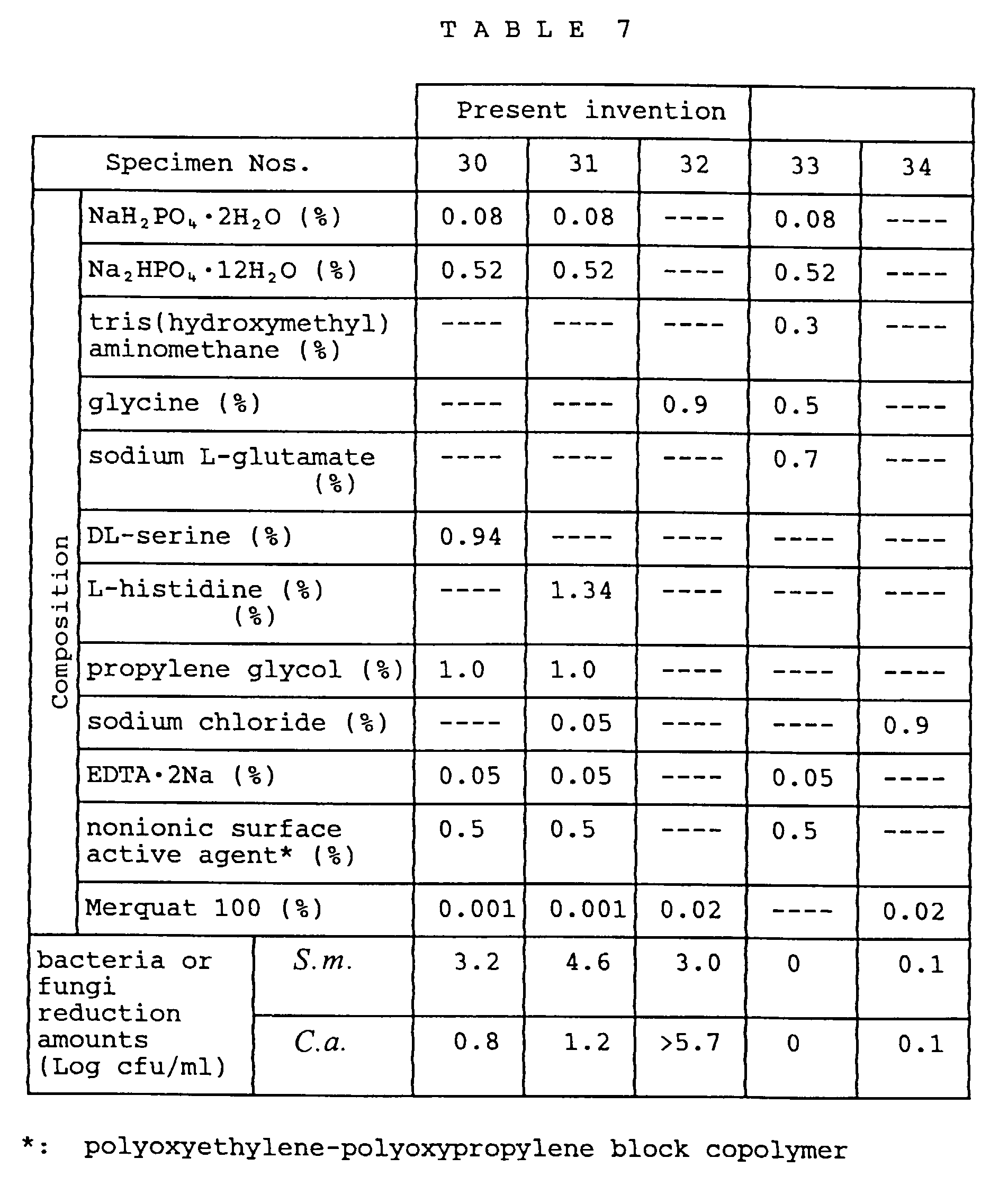
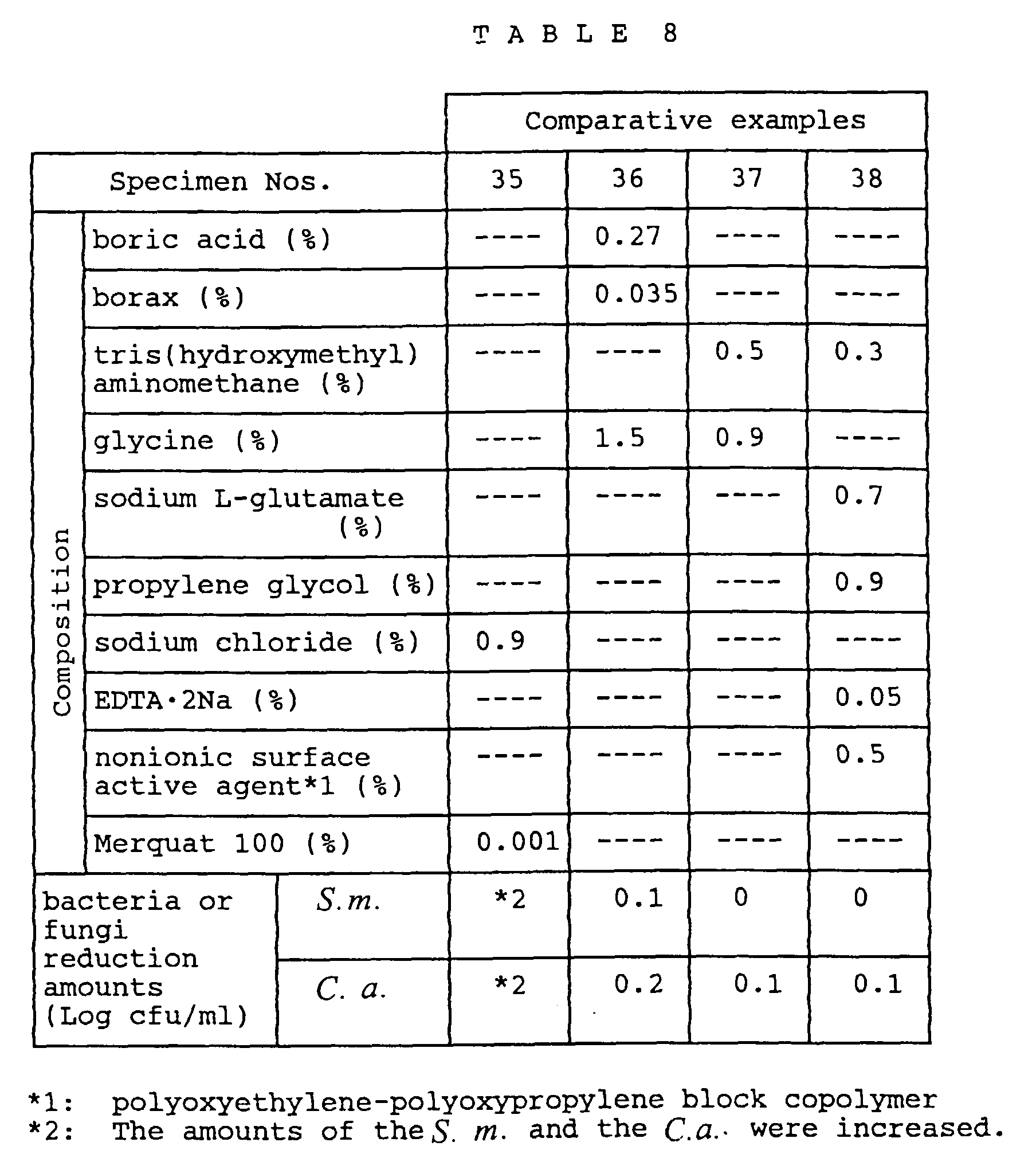
Specimens Nos. 20-32 of the contact lens liquid
agent according to the present invention, and specimens Nos.
33-38 of the contact lens liquid agent as comparative
examples, were obtained each as an aqueous solution, by
using the Polyquaternium-6 (Merquat 100) as the disinfecting
component, various amino acids and various buffers, in
various combinations as indicated in the following Tables
5-8. For each of the specimens, the bacteria
(S.m.) and the
fungi (
C.a.) reduction amounts four hours after mixing with
the bacteria and the fungi suspensions were obtained in
accordance with the disinfecting efficacy test described
above. The results are also indicated in the Tables 5-8.
It will be understood from the above results that
the specimens Nos. 20-32 of the present contact lens liquid
agent wherein the amino acid and/or the propylene glycol (as
the nonionic tonicity agent) was/were included exhibited a
sufficiently high disinfecting effect. That is, the
disinfecting effect of the Polyquaternium-6 (Merquat 100)
was enhanced by the combined use with the amino acid and/or
the nonionic tonicity agent. In contrast, the specimens Nos.
33 and 36-38 which did not contain the Polyquaternium-6
(Merquat 100) had no disinfecting effect.
<Example 5>
The disinfecting effect was compared between the
present contact lens liquid agent and commercially available
soft contact lens treating liquids, A, B and C. The specimen
of the present contact lens liquid agent used in this
Example 5 was an aqueous solution having a pH value of 7.2
and obtained by dissolving, in purified water, 0.001% of the
Polyquaternium-6 (Merquat 100), 0.5% of boric acid, 0.11% of
borate and 1.7% of glycerin.
As the test bacteria and fungi,P. a. (Pseudomonas
aeruginosa ATCC 9027), St. a. (Staphylococcus aureus ATCC
6538P), S.m. (Serratia marcescens ATCC 13880), C. a. (Candida
albicans ATCC 10231) and F.s. (Fusarium solani ATCC 36031)
were used. The P. a. and the St. a. were cultured by using a
soybean-casein medium at 35°C for 24 hours. The S.m. was
cultured by using the soybean-casein medium at 30°C for 24
hours. Each of the thus cultured bacteria was suspended with
saline, to thereby provide a bacteria suspension of 108
cfu/ml. The C.a. was cultured by using a Glucose-Peptone
medium at 30°C for 24 hours, and suspended with saline, to
thereby provide a fungi suspension of 108 cfu/ml. The F. s.
was cultured by using the Glucose-Peptone medium at 23°C for
10 days. After the cultured F. s. was harvested from the
surface of the medium by using saline containing 0.05% of
Polysorbate 80, it was filtered through sterilized
polypropylene wool so as to remove hyphal fragments
therefrom, thereby providing a spore suspension of 108
cfu/ml.
The commercially available soft contact lens
treating liquids A-C were examined of their disinfecting
effects against the above-described five kinds of the
bacteria and the fungi, respectively. Namely, the bacteria
and the fungi reduction amounts were respectively obtained
four hours after mixing with the bacteria and the fungi
suspensions, and the spore suspension, in accordance with
the above-described disinfecting efficacy test. Similarly,
the specimen of the present contact lens liquid agent
prepared as described above was examined of its disinfecting
effects against the five kinds of the bacteria and the
fungi, respectively. Namely, the bacteria and the fungi
reduction amounts one hour, two hours and four hours after
mixing with the suspensions were respectively obtained. The
results are indicated in the following Tables 9 and 10.
It will be apparent from the results of the Tables
9 and 10 that the present contact lens liquid agent
exhibited a higher disinfecting effect especially against
the fungi (C. a. and F. s.), and the bacteria, S. m., than the
commercially available products A-C. Further, it was
confirmed that the present contact lens liquid agent
exhibited a satisfactory disinfecting effect within one
hour.
<Example 6>
There was prepared a specimen of the present
contact lens liquid agent which included the
Polyquaternium-6 (Merquat 100) and the amino acid. The
obtained specimen was examined of its disinfecting effects
against the P. a., St. a., and F. s., respectively, in a manner
similar to that of the above Example 5. Namely, the
reduction amounts of the bacteria and the fungi in the
liquid agent specimen were obtained four hours after mixing
with the test bacteria suspensions and the spore suspension,
respectively.
The specimen of the contact lens liquid agent used
in this Example 6 was obtained by dissolving, in purified
water, 0.08% of NaH2PO4·2H2O, 0.52% of Na2HPO4·12H2O, 0.3%
of tris(hydroxymethyl)aminomethane, 0.5% of glycine, 0.7% of
sodium L-glutamate, 0.05% of EDTA·2Na, 0.5% of nonionic
surface active agent (polyoxyethylene-polyoxypropylene block
copolymer), and 0.001% of Merquat 100.
The results are shown in the following Table 11.
As is apparent from the results, the specimen of the contact
lens liquid agent according to the present invention
exhibited excellent disinfecting effects against all of the
test bacteria and the test fungi.
| P. a. reduction amount (Log cfu/ml) | St. a. reduction amount (Log cfu/ml) | F. s. reduction amount (Log cfu/ml) |
| >5.6 | >5.6 | >5.7 |
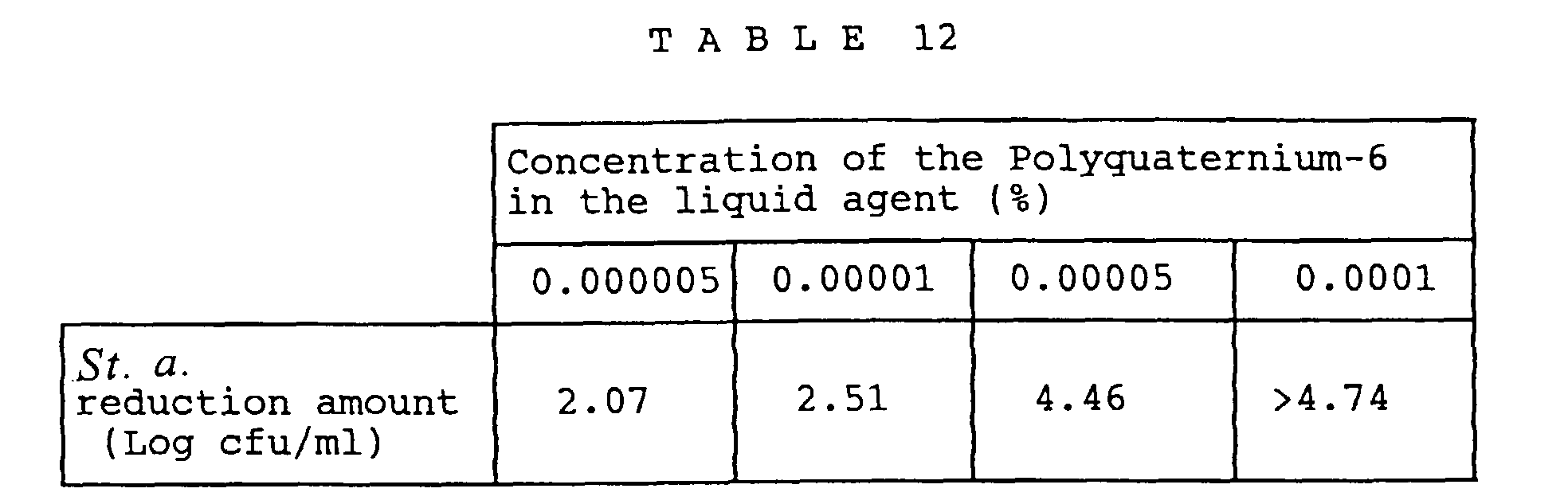
The disinfecting effect of the contact lens liquid
agent was examined when the concentration of the
Polyquaternium-6 as the disinfecting component was
relatively low. Namely, the contact lens liquid agents
having different concentration values of the
Polyquaternium-6 were examined of their disinfecting
effects, by using the St. a. suspension. Namely, the
reduction amount of the St. a. in each liquid agent was
calculated two hours after mixing with the St. a. suspension.
The contact lens liquid agents used in this
Example 7 included 0.5% of boric acid, 0.11% of borax, 1.7%
of glycerin, and the Polyquaternium-6 (Merquat 100) at
different concentration values, i.e., 0.000005%, 0.00001%,
0.00005% and 0.0001%. Each liquid agent was prepared as an
aqueous solution, and had a pH value of 7.2.
The results are indicated in the following Table
12. It will be apparent from the results that the contact
lens liquid agent exhibited a significantly high
disinfecting effect even when the concentration of the
Polyquaternium-6 was as low as 0.000005 %.
The following tests [1] and [2] were conduced by
using contact lenses to evaluate, in terms of safety, the
Polyquaternium-6 as a representative example of various
kinds of the Polyquaternium used as the disinfecting
component in the present contact lens liquid agent.
[1] An experiment according to an agar over lay method to
observe whether or not the Polyquaternium-6 was adsorbed on
the contact lens:
Commercially available soft contact lenses
("MENICON SOFT MA" and "MENICON SOFT S" both available from
Menicon Co., Ltd., Japan) were prepared. Each contact lens
was immersed in 2.0 ml of an aqueous solution containing
0.4% of the Polyquaternium-6 (according to the present
invention), and in 2.0 ml of an aqueous solution containing
0.1% of benzalkonium chloride (as a comparative example), at
room temperature for 18 hours. Thereafter, the contact
lenses were taken out of the respective aqueous solutions,
and placed on fibroblasts L-929 of a mouse, so as to observe
whether the cells (fibroblasts) held in contact with the
soft contact lenses which had been immersed in the above
aqueous solutions were adversely influenced or not by the
Polyquaternium-6 and the benzalkonium chloride. This
experiment to examine the cell toxicity was conducted
according to the agar over lay method using a Neutral Red
explained below. In this experiment, the cells were
evaluated as toxic when a lysis of the cells was observed or
when discoloring of the Neutral Red was observed, due to the
influence of the toxic substance adsorbed on the soft
contact lens. On the other hand, the cells were evaluated as
nontoxic when discoloring of the Neutral Red was not
observed. The Neutral Red is a kind of a coloring matter to
be added to cultured cells. The live cells are dyed with the
Neutral Red being introduced thereinto, whereas the dead
cells are not dyed with the Neutral Red being discharged
therefrom.
According to the above experiment by the agar over
lay method to examine the cell toxicity, the cells held in
contact with the contact lens which had been immersed in the
Polyquaternium-6 solution according to the present invention
were evaluated nontoxic. This means that the concentration
of the Polyquaternium-6 as high as 0.4% assured safety,
without the toxic substance being adsorbed on the contact
lens. In contrast, the cells held in contact with the
contact lens which had been immersed in the benzalkonium
chloride solution were evaluated toxic, giving a safety
problem in practical use.
(2) Test for measuring the inhibitory rate of proliferation
of cells:
For checking the safety of the present contact
lens liquid agent, the following test was conducted to
measure the inhibitory rate of proliferation of the cells,
by using the fibroblasts L-929 of a mouse.
Initially, the fibroblasts L-929 were diluted into
a cell solution of 1 × 10⁵ cells/ml. 100 microlitters of
this cell solution was poured into each of 96 wells of a
tissue culture plate, each of the wells having a flat bottom
surface. The tissue culture plate was stored in a
CO2-incubator kept at 37°C for 4 hours for culturing the
cell solution accommodated in the wells. After it was
confirmed that the cells adhered to the bottom surface of
each well, 10 microlitters of the following test solutions
were added to the wells, and the mixtures were cultured at
37°C. After 3 days, the medium in each well was removed, and
washed. According to the protein-quantitative analysis
method (Lowry method), an amount of the live cells was
measured as an amount of protein. The cell proliferation
inhibitory rate was calculated as a ratio of the amount of
the protein in each well to which the corresponding test
solution was added, with respect to an amount of protein
(live cells) in the well to which the test solutions were
not added. The following four aqueous solutions Nos. 1-4
were used as the test solutions.
- No. 1:
- phosphate buffer + Polyquaternium-6 (0.001%) +
glycerin (1.7%)
- No. 2:
- phosphate buffer + Polyquaternium-6 (0.001%) +
propylene glycol (1.42%)
- No. 3:
- Polyquaternium-6 (0.001%) + propylene glycol
(1.42%)
- No. 4:
- phosphate buffer (as a control)
The results of the above cell proliferation
inhibitory test reveled that the inhibitory rates were 0% in
all of the above test solutions. Thus, it was confirmed that
the present contact lens liquid agent had a high degree of
safety without inhibiting the proliferation of the cells.