EP0921228A2 - Method for the production of precleaned pulp - Google Patents
Method for the production of precleaned pulp Download PDFInfo
- Publication number
- EP0921228A2 EP0921228A2 EP98660126A EP98660126A EP0921228A2 EP 0921228 A2 EP0921228 A2 EP 0921228A2 EP 98660126 A EP98660126 A EP 98660126A EP 98660126 A EP98660126 A EP 98660126A EP 0921228 A2 EP0921228 A2 EP 0921228A2
- Authority
- EP
- European Patent Office
- Prior art keywords
- pulp
- cooking
- stage
- digester
- liquor
- Prior art date
- Legal status (The legal status is an assumption and is not a legal conclusion. Google has not performed a legal analysis and makes no representation as to the accuracy of the status listed.)
- Granted
Links
Images


Classifications
-
- D—TEXTILES; PAPER
- D21—PAPER-MAKING; PRODUCTION OF CELLULOSE
- D21C—PRODUCTION OF CELLULOSE BY REMOVING NON-CELLULOSE SUBSTANCES FROM CELLULOSE-CONTAINING MATERIALS; REGENERATION OF PULPING LIQUORS; APPARATUS THEREFOR
- D21C3/00—Pulping cellulose-containing materials
- D21C3/02—Pulping cellulose-containing materials with inorganic bases or alkaline reacting compounds, e.g. sulfate processes
-
- D—TEXTILES; PAPER
- D21—PAPER-MAKING; PRODUCTION OF CELLULOSE
- D21C—PRODUCTION OF CELLULOSE BY REMOVING NON-CELLULOSE SUBSTANCES FROM CELLULOSE-CONTAINING MATERIALS; REGENERATION OF PULPING LIQUORS; APPARATUS THEREFOR
- D21C1/00—Pretreatment of the finely-divided materials before digesting
- D21C1/04—Pretreatment of the finely-divided materials before digesting with acid reacting compounds
Definitions
- the present invention relates to a process for the production of purified pulp from lignocellulose-containing material. More particularly, the present invention relates to the production of pulp which has been purified in terms of removing harmful non-process compounds by an acidic pre-cleaning stage prior to delignification by alkaline cooking. Still more particularly, the present invention relates to a process for the production of a pulp to be bleached for papermaking pulp.
- alkaline cooking refers to pulp manufacturing processes well known in the art as kraft cooking, soda cooking and soda anthraquinone cooking.
- lignin-containing cellulosic materials in nature contain a wide variety of organic and inorganic compounds beside the main process compounds, lignin and cellulose.
- these non-process compounds enter the pulping process and will be subjected to the same chemical and physical treatment as the desired compounds. This is especially true in the case of alkaline delignification processes, such as kraft and soda cooking, which do not remove for example metal ions from the processed material.
- alkaline delignification processes such as kraft and soda cooking, which do not remove for example metal ions from the processed material.
- these non-process compounds have been led to the combustion and recovery line of the pulp mill with the spent liquor, or they have been ousted together with pulp mill effluents. Only some compounds have been separated and sold as by-products, such as sugars, tall oil and turpentine.
- Metals entering the process include all those occurring naturally in raw materials; monovalent metals sodium and potassium, earth-alkali divalent metals calcium, magnesium and barium, and heavy metals such as iron, copper and manganese. Under alkaline conditions metal ions are retained in the pulp and cause a lot of harm in terms of making the bleaching by oxygen chemicals, especially by hydrogen peroxide, less effective resulting in deteriorated pulp strength and excess chemical consumption. In addition divalent metals, especially calcium, tend to form precipitated deposits in process machinery, thus compromising operational efficiency. Currently, the metal problem is coped with by washing the metals to effluents after an acidic bleaching stage, or chelating metals in separate so called Q stages before peroxide bleaching stages.
- the side-groups in polysaccharides represent another group of non-process compounds. These side groups are not desired in the pulp product and their presence in the delignifying and bleaching processes is negative. It has been known for a long time that the acetyl groups of hemicelluloses are easily cleaved, but they consume alkali. could they be removed prior to alkaline cooking, a lot of alkali could be saved for delignification. Another example is the formation of so-called hexenuronic acid groups from hemicellulose side-groups in alkaline cooking (Vuorinen et al., Selective hydrolysis of hexenuronic acid groups and its application in ECF and TCF bleaching of kraft pulps.
- prehydrolysis kraft cooking an acidic hydrolysis is carried out before delignification by kraft cooking (Rydholm, S.E., "Pulping Processes", Interscience, New York 1968, pp. 649 to 672; US pat 5,589,033, Tikka).
- the objective of these processes is to remove as much hemicelluloses as possible from the cellulose macromolecule, which task the alkaline kraft cooking process can not accomplish. This is done in order to prepare pulp for products based on chemically modified cellulose such as viscose and cellulose acetate and other derivatives, which can not be manufactured in the presence of hemicelluloses.
- the prehydrolysis accomplishes a major cleaning effect, the resulting pulp has very low yield and is not suitable for papermaking purposes due to damaged fiber strength and the absence of hemicelluloses needed for fiber to fiber bonding in the paper web.
- One object of the present invention is to provide an improved alkaline delignification process for the preparation of pulp to be bleached for paper making, to be carried out within the framework of a modern closed-cycle pulp mill to meet present requirements for pulp purity after the cooking stage.
- these and other objectives have now been accomplished by means of a process for the production of pulp from lignin-containing cellulosic material, said process comprising an acidic precleaning stage for the removal of metals and side groups of polysaccharides, changing the process conditions of the cleaned lignocellulosic material from cleaning to alkaline delignification, and delignifying the precleaned lignocellulosic material with alkaline cooking liquor, yielding pulp suitable for bleaching to paper pulp.
- the conditions for the precleaning are accomplished by steaming the lignocellulosic material in order to reach a desired temperature, preferably 100-140 °C, during a time sufficient for reaching an end-pH of about 2.5 - 5, preferably 3-4.
- the conditions for the precleaning are accomplished by re-using steam on the lignocellulosic material in order to reach a desired temperature, preferably 100-140 °C, during a time sufficient for reaching an end-pH of about 2.5 - 5, preferably 3-4.
- the conditions for the precleaning are accomplished by using water or, for example, clean condensate and reacting at a temperature between 40 - 150 °C during a time sufficient for reaching an end-pH of 2.5 - 5, preferably 3-4.
- the conditions for the precleaning are accomplished by using re-used precleaning liquid reacting at a temperature between 40 - 150 °C for a time sufficient for reaching an end-pH of about 2.5 - 5, preferably 3-4.
- the conditions for the precleaning are accomplished by using re-used precleaning liquid and adding an acidic chemical, then reacting at a temperature between 40 - 150 °C for a time sufficient for reaching an end-pH of about 2.5 - 5, preferably 3-4.
- the conditions for the precleaning are accomplished by using an acidic process liquid such as acidic bleaching filtrate or acidic condensate or wood room effluent, then reacting at temperature between 40 - 150 °C a time sufficient for reaching an end-pH of about 2.5 - 5, preferably 3-4.
- an acidic process liquid such as acidic bleaching filtrate or acidic condensate or wood room effluent
- the transition from precleaning to alkaline delignification is carried out by introducing an alkaline process liquid and removing the portion of the resulting transition liquor that has a pH lower than 10.
- alkaline process liquid means any available alkaline liquor, e.g white liquor, green liquor, spent alkaline cooking liquor or alkaline bleach plant filtrate.
- the transition from the precleaning to alkaline delignification is carried out by introducing a washing liquid and subsequently removing the washing liquid by introducing the alkaline process liquid.
- washing liquid means any available aqueous medium, e.g water, condensate, or bleach plant filtrate.
- the lignocellulosic material is pre-cleaned prior to delignification in a more or less closed-cycle pulping process.
- metals and polysaccharide side groups attached to the fiber structures are transferred into the liquid medium surrounding the lignocellulosic material. Having been removed, these non-process compounds can be excluded from the process.
- Acidic or neutralized liquor from the transition stage before delignification can be conducted to the plant's recovery facilities, where organic compounds will be combusted and metals will be removed as dregs and muds separated as white and green liquors are filtered before returned to the pulping process.
- the invention is applicable to alkaline pulping processes as defined above, including processes operating batchwise or continuously.
- Batch processes include conventional as well as those employing the displacement method well known to those skilled in the art.
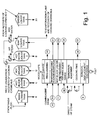
- FIG. 1 are schematic representations of tanks and liquor transfer sequences, illustrating embodiments of a process in accordance with the present invention.
- Suitable pre-cleaning agents include, for example, water in the form of steam or liquid, aqueous solutions of acids; these include organic acids, such as acetic acid, or mineral acids, such as sulfuric acid, sulfur dioxide and acid bisulfite cooking liquor; various aqueous solutions including evaporation condensates, bleach plant filtrates or wood handling effluents.
- aqueous solutions of acids include organic acids, such as acetic acid, or mineral acids, such as sulfuric acid, sulfur dioxide and acid bisulfite cooking liquor; various aqueous solutions including evaporation condensates, bleach plant filtrates or wood handling effluents.
- steam is introduced to the chip-filled digester to accomplish the desired final pH between about 2.5 to 5, preferably from 3 to 4.
- a suitable precleaning temperature is from about 100 °C to 150 °C for both softwoods and hardwoods.
- the non-process elements described above dissolve into the condensing cleaning medium and are thus removed from the wood matrix.
- the acidic precleaning stage dissolves disadvantageous side-groups of the polysaccharides.
- gases such as air and turpentine, are removed from the lignocellulosic material and vented from the digester at point A1, whereby turpentine is easily recovered.
- part of the cleaning agent can be removed from the digester as free liquid at point A1, before the transition stage.
- fresh hot white liquor B1 from tank 3 or uncausticized cooking liquor (green liquor) or a derivative X1 thereof from tank 5 is added to the digester to displace the cleaning medium surrounding the chips.
- the displaced cleaning medium leaves the digester at point D1 (transferred to tank 2).
- a suitable temperature of the displacing transition liquor is from about 70 °C to 150 °C, preferably from about 80 °C to 140 °C.
- the primary purpose of this transition stage is to remove the cleaning medium with the material dissolved therein, and to neutralize the cleaning medium remaining trapped within the chips.
- the contents of the digester are prepared for later alkaline delignification.
- Neutralisation is achieved by selecting an appropriate neutralising alkali charge which results in slightly alkaline conditions.
- the pH after completion of the neutralizing transition stage is preferable over 10. This levels out fluctuation in terms of improper alkali charge and pulp quality due to fluctuating alkali charge.
- dissolved non-process compounds such as Mn, Fe, Cu and Ca, which were dissolved in the acidic cleaning stage, are removed from the digester, thus lowering the content of disadvantageous non-process compounds in the final cooked pulp. This facilitates oxidative delignification and bleaching stages utilizing oxygen, peroxide, peracetic acid and ozone.
- the alkaline delignification is started by pumping hot black liquor C1 from tank 1 to the digester.
- the black liquor begins to displace the transition liquor from the digester at D2.
- the displaced transition liquor flows to the hot displaced liquor tank 2.
- the hot black liquor flow from tank 1 causes the entire contents of the digester to be submerged in the hot black liquor and the temperature of the digester to come close to the temperature of the hot black liquor which in turn is close to the cooking temperature.
- the cooking sequence is continued by pumping hot white liquor B2 from tank 3 into the digester.
- the liquor D3 displaced by the hot liquors is conducted to tank 2.
- the digester temperature is close to cooking temperature, typically in the range of 150-180 °C.
- the final temperature adjustment is carried out by using direct or indirect steam heating and digester recirculation.
- the spent liquor is ready to be displaced with wash filtrate E.
- the first portion C2 of the displaced hot black liquor corresponds to the total of the volumes of C1 required in the filling stages.
- the hot black liquor tank 2 provides cooled evaporation liquor to tank 4, transferring its heat to white liquor and water by means of heat exchange.
- the displaced cleaning medium is sent to evaporation through tank 2 and 4.
- the use of steam as a cleaning agent will, however, not essentially increase the load on the evaporation function within the plant. Thus, this embodiment of the process will be easily applicable for older pulp mills with overloaded evaporation plants.
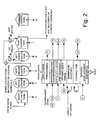
- the cleaning stage is accomplished as described above.
- an aqueous medium such as water, evaporation condensates or alkaline bleach plant filtrates, is added at point X2 from tank 6 to the digester to wash the chips and remove the cleaning medium from the reactor, point A2.
- the primary purpose of this transition stage is to remove the cleaning medium with the material dissolved therein, and to neutralize the cleaning medium remaining trapped within the chips.
- the contents of the digester are prepared for later alkaline delignification by washing out the acidic cleaning medium with aqueous solutions. This levels out fluctuation in terms of improper alkali charge and pulp quality due to flucuating alkali charge.
- Liquors A1 and A2 can be reused and be stored in tank 6.
- the transition liquor tank 6 is provided for storage of aquous media, such as water, evaporation condensates, bleach plant filtrates or wood room effluents, supplied, point G, from other pulp mill processes.
- aquous media such as water, evaporation condensates, bleach plant filtrates or wood room effluents, supplied, point G, from other pulp mill processes.
- the cooking process is completed as described in connection with Figure 1.
- the cleaning stage is accomplished by adding aqueous medium A and/or steam from tank 7 to achieve the end-pH after precleaning from 2.5 to 5.
- Suitable precleaning agents include water, aqueous solutions of acids, including organic acids such as acetic acid, and mineral acids such as sulfuric acid, sulfur dioxide and acid bisulfite cooking liquor, aqueous solutions such as evaporation condensates, bleach plant filtrates, wood handling effluents and reused cleaning agent.
- the precleaning agent A is added to the digester from the cleaning agent tank 7, soaking the chips.
- the temperature in the cleaning stage is adjusted by circulating the liquor in the digester. The temperature adjustment can be carried out by using direct or indirect steam heating in the digester recirculation.
- a suitable precleaning temperature is from about 40 °C to 150 °C.
- a suitable precleaning time is from about 10 to 200 minutes, preferably from about 20 to 120 minutes.
- part of the precleaning medium is recovered from the digester at point A1 to tank 7.
- fresh hot white liquor B1 from tank 3 or uncausticized cooking liquor (green liquor) or a derivative X1 thereof is added from tank 5 to the digester.
- the cleaning medium surrounding the chips is displaced and leaves the digester at point A2, to be recovered to tank 7 for reuse
- the cleaning medium is removed from the reactor and the reactor contents are neutralized.
- the first part of displaced liquor which is clearly acidic, A2 is led to tank 7 whereafter the remainder of the liquor is recovered to tank 2.
- Neutralisation is achieved by selecting an appropriate neutralising alkali charge which results in slightly alkaline conditions.
- the cleaning agent tank 7 is provided for storage of aqueous media, such as water, evaporation condensates, bleach plant filtrates or wood room effluents, supplied at point F. Suitable amounts of the acidic liquor containing dissolved organic solid is sent (point H) to either external or internal effluent treatment.
- aqueous media such as water, evaporation condensates, bleach plant filtrates or wood room effluents
- the cleaning stage is accomplished by adding aqueous medium A and/or steam from tank 7 to achieve the end-pH after precleaning from 2.5 to 5.
- Suitable precleaning agents include water, aqueous solutions of acids, these including organic acids such as acetic acid, or mineral acids such as sulfuric acid, sulfur dioxide and acid bisulfite cooking liquor, various aqueous solutions such as evaporation condensates, bleach plant filtrates, wood handling effluents and reused cleaning agent.
- the precleaning agent A is added to the digester from the cleaning agent tank 7, soaking the chips.
- the temperature in the cleaning stage is adjusted by circulating the liquor in the digester, and the temperature adjustment can be carried out by using direct or indirect steam heating in the digester recirculation.
- a suitable precleaning temperature is from about 40 °C to 150 °C.
- a suitable precleaning time is from about 10 to 200 minutes, preferably from about 20 to 120 minutes.
- part of the precleaning medium is recovered from the digester at point A1 to tank 7.
- the transition stage is carried out by adding, at point X2, an aqueous medium such as water, evaporation condensates, or bleach plant filtrates, from tank 6 to the digester to displace, at point A2, the cleaning medium surrounding the chips.
- the transition stage is to wash out and remove the acidic cleaning medium from the reactor and to prepare for later delignification to be carried out by alkaline cooking.
- liquors A1 and A2 can be reused and be stored in tank 6.
- the transition liquor tank 6 is provided for storage of aquous media, such as water, evaporation condensates, bleach plant filtrates or wood room effluents, supplied, point G, from other pulp mill processes.
- the cleaning agent tank 7 is provided for storage of aquous media, such as water, evaporation condensates, bleach plant filtrates or wood room effluents, supplied at point F from other pulp mill processes.
- the acidic liquor F containing dissolved organic solid is sent to either external or internal effluent treatment.
- the cooking process is completed as described in connection with Figure 1.
- the cleaning stage is carried out in a separate process unit outside the digester prior to introduction of the precleaned chips to the digester.
- EA Effective alkali NaOH + 1 ⁇ 2 Na 2 S, expressed as NaOH equivalents I BL Impregnation black liquor OI BL Over flown I BL DI BL Displaced (out) I BL H BL Hot black liquor RH BL Displaced (out) H BL WL White liquor HWL Hot white liquor NWL Neutralization white liquor DNWL Displaced (out) NWL O Oxygen delignification step P Peroxide bleaching step
- a hot black liquor pre-treatment stage followed by introducing hot black liquor (H BL, 155°C, 24 g EA(NaOH)/l) to the bottom of the digester displacing the spent impregnation black liquor out from the top of the digester (DI BL).
- hot white liquor 103 g EA (NaOH)/l ; Sulfidity 40%
- a 20 minutes heating-up with circulation raised the temperature from 155°C to the cooking temperature of 170°C.
- the digester was cooled by introducing washing liquor (80°C, 50 liters) into the digester bottom displacing the spent black liquors out of the digester top. After the delignification, the pulp was disintegrated, washed with deionized water, screened and analyzed. The cooking conditions were adjusted to achieve kappa number 20 and residual EA at the end of the cooking stage 20 g (NaOH)/l. Mill black liquors (I BL and H BL) were used. Table E1.1. below lists the liquor inputs and outputs (volumes in litres) and the conditions in corresponding cooking stages.
- the unbleached pulp was analyzed in terms of screened yield, kappa number, viscosity, brightness, content of non-process compounds and pulp strength by beating and testing.
- White liquor charge at a constant load of alkali (EA 4.4 g (NaOH)/l) to evaporation was calculated.
- unbleached pulp was bleached with the bleaching sequence O-P.
- Oxygen stage chemical consumption, kappa number and viscosity were determined.
- Bleaching chemicals demand for a given pulp brightness and bleached yield were determined.
- Bleaching process conditions are given in table E1.2.
- Cooking characteristics and bleaching results are given in Table E1.3. Liquor inputs and outputs and corresponding cooking stage conditions in Example 1. Volumes in litres.
- Washing was repeated three times by repeatingly filling and draining the digester with fresh deionized water. After the washing, neutralization white liquor was pumped into the digester and the circulation was started. After the neutralization time had passed the circulation was stopped and hot black liquor (H BL), as disclosed in Example 1, was pumped into the digester bottom. The pumping first filled the digester up and then continued as displacement, ousting liquor from the top of the digester (DNWL). The hot black liquor pumping was stopped after the desired volume was pumped in. The digester circulation was started again, and the desired temperature was reached. After the hot black liquor treatment time had passed the circulation was stopped and a defined amount spent hot black liquor was drained out of the digester (RH BL).
- H BL hot black liquor
- the cooking conditions were adjusted to target kappa number 20 and residual EA at the end of the cooking stage 20 g (NaOH)/l.
- Table E2.1 lists the liquor inputs and outputs (volumes in litres) and the conditions in corresponding cooking stages. Improved cooking results with respect to reference example 1 are given in Table E2.2 .
- E2.1. Liquor inputs and outputs and corresponding cooking stage conditions in Example 2. Volumes in litres. Liquor in Liquor out Process stage Cleaning - Pre-cleaning stage, 80° C, agent 19 30 min - 17 Drainage 17 17 Washing repeated three times NWL - Charge EA 10.
- Example 4 Production of pre-cleaned softwood kraft pulp by using a batch process. The experiment was carried out as disclosed in Example 3, but with following exception. Pre-cleaning temperature was 140°C. HWL Charge was EA 8.2 % NaOH. Improved results with respect to reference example 1 are given in Table E4.1 . E4.1. Cooking characteristics and bleaching results of Example 4. Pre-cleaning Acetic acid (% on wood) 2 End-pH 3.
- Example 5 Production of pre-cleaned softwood kraft pulp by using a batch process. The experiment was carried out as disclosed in Example 2, but with following exception.
- the cleaning agent used in this example was circulated three times in previous cooks.
- the cleaning agent was drained from a previous cook and used in this example with an addition of deionized water (0.5 liquor-to-wood ratio) and acetic acid.
- the HWL Charge was EA 9.3 % NaOH.
- Improved cooking characteristics and bleaching results with respect to reference example 1 are given in Table E5.1 .
- E5.1 Cooking characteristics and bleaching results of Example 5.
- Temperature (°C) 80 Cooking White liquor charge (% EA (NaOH)) 21.
- a hot black liquor pre-treatment stage followed by introducing hot black liquor (H BL, 145°C, 13 g EA(NaOH)/l) to the bottom of the digester displacing the spent impregnation black liquor out from the top of the digester (DI BL).
- hot white liquor 103 g EA(NaOH)/l; Sulfidity 40%
- a 10 minutes heating-up with circulation raised the temperature from 145 °C to the cooking temperature of 160 °C.
- the digester was cooled by introducing washing liquor (80 °C, 50 liters) into the digester bottom displacing the spent black liquors out of the digester top. After the delignification, the pulp was disintegrated, washed with deionized water, screened and analyzed. The cooking conditions were adjusted to achieve kappa number 17 and residual EA at the end of the cooking stage 14 g (NaOH)/l. Mill black liquors (I BL and H BL) were used.
- the Table E6.1 lists the liquor inputs and outputs (volumes in litres) and the conditions in corresponding cooking stages.
- Washing was repeated three times by repeatingly filling and draining the digester with fresh deionized water. After the washing, neutralization white liquor was pumped into the digester and the circulation was started. After the neutralization time had passed the circulation was stopped and hot black liquor (H BL), as disclosed in Example 6, was pumped into the digester bottom. The pumping first filled the digester up and then continued as displacement, ousting liquor from the top of the digester (DNWL). The hot black liquor pumping was stopped after the desired volume was pumped in. The digester circulation was started again, and the desired temperature was reached. After the hot black liquor treatment time had passed the circulation was stopped and a certain amount spent hot black liquor was drained out of the digester (RH BL).
- H BL hot black liquor
- Table E7.1 lists the liquor inputs and outputs (volumes in litres) and the conditions in corresponding cooking stages. Improved cooking characteristics with respect to reference example 6 are given in Table E7.2 .
- hot white liquor charge (HWL, 69 m3, 125 g EA(NaOH)/l, sulfidity 35 %) was introduced to the bottom of the digester displacing the corresponding volume of spent hot black liquor out of the digester top.
- a heating-up with circulation raised the temperature to the cooking temperature of 169°C.
- a white liquor charge (HWL, 20 m3, 125 g EA (NaOH)/l, sulfidity 35 %) at H-factor 400 was introduced to the digester displacing the corresponding amount of spent black liquor.
- the digester was cooled by introducing washing liquor (DPL, 9 g NaOH/l) into the digester bottom displacing the spent black liquors out of the digester top to two pressurized hot black liquor tanks. After the displacement, the digester was discharged, pulp was sampled, washed, screened and analyzed. The digestion and pulp sampling was carried out three times using constant mill conditions. The unbleached pulp was analyzed in terms of kappa number, content of non-process compounds, laboratory bleaching, pulp strength by beating and testing analysis. The content of calcium in the evaporation black liquor was analyzed by filtering the evaporation black liquor through a 0.2 mm filter.
- washing liquor DPL, 9 g NaOH/l
- the filter separates among others calcium crystals and the calcium analysis of the filtered sample indicates the amount of soluble calcium complexes which can break down and form calcium scaling in down-stream processes if reaching critical scaling conditions as e.g. temperature and dry solid near heat exchanger surfaces.
- Laboratory bleaching process conditions are given in table E9.1 .
- Cooking characteristics and bleaching results are given in table E9.2.
- Cooking characteristics and bleaching results Cooking Alkali consumption (% EA (NaOH)) 17.5 H-factor 1180 Kappa Number 22.8 Cooking residual (g EA (NaOH)/l) 17 Tear index at tensile index 70 Nm/g (mNm 2 /g) 16.1 Ca in pulp (mg/kg) 997 Mn in pulp (mg/kg) 73 Evaporation black liquor Ca content through filter 0.2 mm (ppm of dry solid) 270 Bleaching (O-D(EOP)DnD) Active chlorine consumption (kg/OD tons ) 37.4 I SO Brightness ( %) 90.3 Tear index at tensile index 70 Nm/g (mNm 2 /g) 18.0
- neutralization white liquor (NWL, 65 m3, 127 g EA (NaOH)/l, sulfidity 34 %) was introduced to the bottom of the digester.
- hot spent black liquor was introduced (H BL, 15 g EA(NaOH)/l) to the bottom of the digester displacing the steam condensate and the neutralization white liquor out from the top of the digester and the contents of the digester was neutralized after the acid steaming stage.
- hot white liquor charge (HWL, 25 m3, 127 g EA(NaOH)/l, sulfidity 34 %) was introduced to the bottom of the digester displacing the corresponding volume of spent hot black liquor out of the digester top.
- a heating-up with circulation and direct heating raised the temperature to the cooking temperature of 168°C.
- the digester was cooled by introducing washing liquor (DPL, 9 g NaOH/l) into the digester bottom displacing the spent black liquors out of the digester top to two separate hot black liquor accumulators. After the displacement, the digester was discharged, pulp was sampled, washed, screened and analyzed. The digestion was carried out four times using constant mill conditions.
- the evaporation black liquor was made up according to the principle shown in figure 1. The unbleached pulp was analyzed in terms of kappa number, content of non-process elements, laboratory bleaching, and pulp strength by beating and testing. The content of soluble calcium in the evaporation black liquor was analyzed by filtering through a 0.2 mm filter, as disclosed in example 9.
- Example 1 demonstrates the results from a displacement kraft batch cook of softwood, thus showing the state-of-the-art cooking process. As can be seen, the pulp contains considerable amounts of non-process compounds, thus increasing the manufacturing costs and making mill closure more complicated.
- Examples 2, 3, 4 and 5 demonstrate the results when the process is carried out on softwood according to the present invention.
- the amount of non-process compounds in the unbleached pulp was significantly lowered when a precleaning stages was carried out under acidic conditions prior to alkaline delignification.
- the unbleached and bleached yield is essentially at the same level as shown in the reference example 1.
- the precleaning stage according to the present invention produce pulp of well-acceptable yield.
- the invention overthrows the prejudice that an acidic pretreatment dissolves hemicelluloses and thus lowers yield, according to the teaching of, for example, Finnish patent 81844.
- pulps produced according to the invention contains considerable less hexuronic acid groups.
- Example 5 further demonstrates the results when the process is carried out according to the present invention recirculating and re-using the cleaning agent. This procedure will eventually lower the acid charge in pre-cleaning, making the process economically feasible and reducing use of highly corrosive, strong acids. If a higher pre-cleaning temperature is used, more acidity is liberated from the wood and the need for acid additions further declines. Thus, the invention overthrows the prejudice that an acidic pretreatment requires H 2 SO 4 or equivalent strong acids, according to the teaching of, for example, Finnish patent 81844.
- Example 6 demonstrates the results from a displacement kraft batch cook of hardwood, representing a state-of-the-art cooking process. As can be seen, the pulp contains considerable amounts of non-process compounds.
- Example 7 and 8 demonstrate the results when the process is carried out on hardwood according to the present invention.
- the amount of non-process compounds in the unbleached pulp was significantly lowered when a precleaning stage was carried out under acidic conditions prior to alkaline delignification.
- pulp yield was not essentially affected.
- Example 9 demonstrates the results from an industrial displacement kraft batch cook of softwood, representing state-of-art cooking process. As can be seen, the pulp contains considerable amounts of non-process compounds. In addition, the produced evaporation black liquor contains a high amount of calcium which passes a 0.2 mm filter. The evaporation black liquor analysis indicates the amount of calcium which can create calcium scaling if critical conditions as e.g. temperature are exceeded in down-stream processes e.g. near heat exchange surfaces.
- Example 10 demonstrates the results when the process is carried out on an industrial displacement kraft batch digester using softwood and according to the present invention.
- the amount of non-process compounds in the unbleached pulp was significantly lowered when a precleaning stage was carried out by steaming to achieve liberation of wood acidity and acidic conditions inside the chips prior to alkaline kraft cooking.
- a precleaning stage was carried out by steaming to achieve liberation of wood acidity and acidic conditions inside the chips prior to alkaline kraft cooking.
- higher temperature is used in steaming, more acidity is liberated which makes it possible to remove metals and side groups of polysaccharides.
- Improved strength of pulp was observed when producing according to the present invention.
- Another element of advantage was a lower content of detrimental calcium which passes through a 0.2 mm filter in the produced evaporation black liquor when producing according to the invention.
Landscapes
- Chemical & Material Sciences (AREA)
- Inorganic Chemistry (AREA)
- Paper (AREA)
- Inorganic Insulating Materials (AREA)
- Vessels, Lead-In Wires, Accessory Apparatuses For Cathode-Ray Tubes (AREA)
Abstract
Description
In accordance with one embodiment of the process of the present invention shown in figure 1, steam is introduced to the chip-filled digester to accomplish the desired final pH between about 2.5 to 5, preferably from 3 to 4. A suitable precleaning temperature is from about 100 °C to 150 °C for both softwoods and hardwoods. In the precleaning stage, the non-process elements described above dissolve into the condensing cleaning medium and are thus removed from the wood matrix. In addition, the acidic precleaning stage dissolves disadvantageous side-groups of the polysaccharides. Simultaneously, gases, such as air and turpentine, are removed from the lignocellulosic material and vented from the digester at point A1, whereby turpentine is easily recovered. If desired, part of the cleaning agent can be removed from the digester as free liquid at point A1, before the transition stage.
During the transition stage, dissolved non-process compounds, such as Mn, Fe, Cu and Ca, which were dissolved in the acidic cleaning stage, are removed from the digester, thus lowering the content of disadvantageous non-process compounds in the final cooked pulp. This facilitates oxidative delignification and bleaching stages utilizing oxygen, peroxide, peracetic acid and ozone. In addition, side-groups of polysaccharides, such as acetyl groups, are removed from the digester be-fore the alkaline cooking phase where the presence of these compounds would require extra alkali. Thus, the pulp is further purified from disadvantageous polysaccharide side groups, which leads to lower bleaching chemical consumption and higher pulp quality.
The cooking process is completed as described in connection with Figure 1.
In accordance with a third embodiment of the process of the present invention shown in figure 3, the cleaning stage is accomplished by adding aqueous medium A and/or steam from
The
Suitable amounts of the acidic liquor containing dissolved organic solid is sent (point H) to either external or internal effluent treatment.
The cooking process is completed as described in connection with Figure 1.
The cooking process is completed as described in connection with Figure 1.
| EA | Effective alkali = NaOH + ½ Na2S, expressed as NaOH equivalents |
| I BL | Impregnation black liquor |
| OI BL | Over flown I BL |
| DI BL | Displaced (out) I BL |
| H BL | Hot black liquor |
| RH BL | Displaced (out) H BL |
| WL | White liquor |
| HWL | Hot white liquor |
| NWL | Neutralization white liquor |
| DNWL | Displaced (out) NWL |
| O | Oxygen delignification step |
| P | Peroxide bleaching step |
| Liquor inputs and outputs and corresponding cooking stage conditions in Example 1. Volumes in litres. | ||
| Liquor in | Liquor out | Process stage |
| I BL 21 | | Black liquor impregnation 80 °C, 30 min |
| H BL 13.5 | DI BL 13.5 | Hot black liquor pre-treatment 155 °C, 20 min |
| HWL | ||
| Charge EA 16.5% NaOH | ||
| + 3. 6 H BL | RH BL 10 | Hot white liquor fill |
| Bleaching process conditions in examples 1-8 where applicable. | ||
| Stage | O | P |
| Time (min) | 45 | 240 |
| Temperature (°C) | 95 | 90 |
| Consistency (%) | 10 | 8 |
| Pressure (bar) | 6 (O2) | atm |
| NaOH ( %) | 1.9 | varied |
| MgSO4 ( %) | 0.5 | - |
| H2O2 ( %) | - | varied |
| End-pH | 11.5 | 10. 8 - 11.3 |
| E1.3. Cooking characteristics and bleaching results of Example 1. | |
| Cooking | |
| White liquor charge (% EA (NaOH) ) | 21. 6 |
| H-factor | 1000 |
| Kappa Number | 19 |
| Cooking residual (g EA (NaOH)/I) | 19 |
| Yield ( %) | 45.1 |
| SCAN viscosity (ml/g) | 1041 |
| ISO Brightness (%) | 33. 5 |
| Tear index at tensile index 70 Nm/g (mNm2/g) | 19.3 |
| Hexenuronic acids (µmol/g) | 24 |
| Ca in pulp (mg/kg) | 866 |
| Mg in pulp (mg/kg) | 87 |
| Mn in pulp (mg/kg) | 23 |
| Oxygen Delignification | |
| Kappa Number | 11.1 |
| SCAN viscosity (ml/g) | 898 |
| NaOH consumption/ΔKappa Number (kg/OD tons) | 1.6 |
| ΔViscosity/ΔKappa Number (ml/g) | 18 |
| Bleaching (P) | |
| Peroxide consumption (kg/OD tons ) | 54 |
| ISO Brightness ( %) | 69 |
| Bleached Yield (%) | 43.1 |
| E2.1. Liquor inputs and outputs and corresponding cooking stage conditions in Example 2. Volumes in litres. | ||
| Liquor in | Liquor out | Process stage |
| Cleaning | - | Pre-cleaning stage, 80° C, |
| agent 19 | 30 min | |
| - | 17 | Drainage |
| 17 | 17 | Washing repeated three |
| times | ||
| NWL | - | |
| Charge | ||
| EA 10. 4 ; 10.4 ; 14.4 | ||
| % NaOH | Neutralization, 15 min, 135°C | |
| H BL 31 | DNWL 21 | Hot black liquor pre-treatment, 20 min, 145°C |
| HWL | ||
| Charge EA | ||
| 8.7 % NaOH | RH BL 9 | Cooking step |
| E2.2. Cooking characteristics of Example 2. | |||
| Pre-Cleaning | |||
| Sulfuric acid ( % on wood) | 0.1 | ||
| Acetic acid (% on wood) | 0. 084 | 2. 0 | 21 |
| End-pH | 4.7 | 3.7 | 2.6 |
| Temperature (°C) | 80 | 80 | 80 |
| Cooking | |||
| White liquor charge (% EA (NaOH)) | 21.2 | 21.1 | 21.6 |
| H-factor | 1000 | 1000 | 1000 |
| Kappa Number | 21.1 | 20.0 | 18.5 |
| Cooking residual (g EA (NaOH)/1) | 19 | 20 | 20 |
| Yield (%) | 45.2 | 45.7 | 45. 3 |
| SCAN viscosity (ml/g) | 1018 | 1035 | 1011 |
| I SO Brightness (%) | 31.9 | 33.5 | 34.1 |
| Ca in pulp (mg/kg) | 840 | 615 | 392 |
| Mg in pulp (mg/kg) | 72 | 36 | 32 |
| Mn in pulp (mg/kg) | 20 | 16 | 11 |
The experiment was carried out as disclosed in Example 2, but with following exception. No washing stage followed the precleaning stage. Neutralization white liquor (EA 10.4% NaOH) was pumped into the digester after the cleaning agent drainage. Improved results with respect to reference example 1 are given in Table E3.1.
| E3.1. Cooking characteristics and bleaching results of Example 3. | |
| Pre-cleaning | |
| Acetic acid (% on wood) | 2 |
| End- | 3. 6 |
| Temperature (°C) | 80 |
| Cooking | |
| White liquor charge (% EA (NaOH)) | 21.2 |
| Alkali consumption (% EA (NaOH)) | 17.2 |
| H-factor | 1000 |
| Kappa Number | 20.5 |
| Cooking residual (g EA (NaOH)/l) | 19 |
| Yield (%) | 45.5 |
| SCAN viscosity (ml/g) | 1061 |
| I SO Brightness ( %) | 33.4 |
| Tear index at tensile index 70 Nm/g (mNm2/g) | 19.8 |
| Hexenuronic Acids (µmol/g) | 16 |
| Ca in pulp (mg/kg) | 472 |
| Mg in pulp (mg/kg) | 53 |
| Mn in pulp (mg/kg) | 16 |
| Oxygen Delignification | |
| Kappa Number | 11.9 |
| SCAN viscosity (ml/g) | 949 |
| NaOH consumption/ΔKappa Number (kg/OD tons) | 1.5 |
| ΔViscosity/ΔKappa Number (ml/g) | 13 |
| Bleaching (P) | |
| Peroxide consumption (kg/OD tons) | 32 |
| I SO Brightness (%) | 69 |
| Bleached Yield (%) | 43. 6 |
The experiment was carried out as disclosed in Example 3, but with following exception. Pre-cleaning temperature was 140°C. HWL Charge was EA 8.2 % NaOH. Improved results with respect to reference example 1 are given in Table E4.1.
| E4.1. Cooking characteristics and bleaching results of Example 4. | |
| Pre-cleaning | |
| Acetic acid (% on wood) | 2 |
| End- | 3. 6 |
| Temperature (°C) | 140 |
| Cooking | |
| White liquor charge (% EA (NaOH) ) | 21.2 |
| H-factor | 1000 |
| Kappa Number | 19.1 |
| Cooking residual (g EA (NaOH)/I) | 19 |
| Yield (%) | 43.5 |
| SCAN viscosity (ml/g) | 1039 |
| ISO Brightness (%) | 33.5 |
| Tear index at tensile index 70 | |
| Nm/g (mNm2/g) | 22.5 |
| Hexenuronic Acids (µmol/g) | 13 |
| Ca in pulp (mg/kg) | 542 |
| Mg in pulp (mg/kg) | 38 |
| Mn in pulp (mg/kg) | 14 |
| Oxygen Delignification | |
| Kappa Number | 10.5 |
| SCAN viscosity (ml/g) | 953 |
| NaOH consumption/ΔKappa Number | |
| (kg/OD tons) | 1.45 |
| ΔViscosity/ΔKappa Number (ml/g) | 10 |
| Bleaching (P) | |
| Peroxide consumption (kg/OD tons) | 19 |
| I SO Brightness (%) | 69 |
| Bleached Yield (%) | 42.4 |
The experiment was carried out as disclosed in Example 2, but with following exception. The cleaning agent used in this example was circulated three times in previous cooks. The cleaning agent was drained from a previous cook and used in this example with an addition of deionized water (0.5 liquor-to-wood ratio) and acetic acid. The HWL Charge was EA 9.3 % NaOH. Improved cooking characteristics and bleaching results with respect to reference example 1 are given in Table E5.1.
| E5.1. Cooking characteristics and bleaching results of Example 5. | |
| Pre-cleaning | |
| Acetic acid (% on wood) | 0. 8 |
| End-pH | 3.5 |
| Temperature (°C) | 80 |
| Cooking | |
| White liquor charge (% EA (NaOH)) | 21. 6 |
| H-factor | 1000 |
| Kappa Number | 19.8 |
| Cooking residual (g EA (NaOH)/l) | 19 |
| Yield (%) | 45.3 |
| SCAN viscosity (ml/g) | 1014 |
| I SO Brightness (%) | 33. 6 |
| Ca in pulp (mg/kg) | 420 |
| Mg in pulp (mg/kg) | 38 |
| Mn in pulp (mg/kg) | 12 |
| Oxygen Delignification | |
| Kappa Number | 11.2 |
| SCAN viscosity (ml/g) | 915 |
| NaOH consumption/AKappa Number (kg/OD tons ) | 1.45 |
| ΔViscosity/ΔKappa Number (ml/g) | 12 |
| Bleaching (P) | |
| Peroxide consumption (kg/OD tons ) | 33 |
| I SO Brightness ( %) | 69 |
| Bleached Yield ( %) | 43.3 |
4.5 kg hardwood, Birch (Betula pubescens), chips (oven dry basis) were metered into a chip basket positioned in a 25-liter jacketed displacement batch digester with forced circulation. The cover of the digester was closed.
Impregnation black liquor (I BL, 80-90°C, 14 g EA(NaOH)/l) was pumped during 15 minutes with some overflow (OI BL) followed by impregnation at 80°C under 5 bar pressure for 15 minutes. After impregnation, a hot black liquor pre-treatment stage followed by introducing hot black liquor (H BL, 145°C, 13 g EA(NaOH)/l) to the bottom of the digester displacing the spent impregnation black liquor out from the top of the digester (DI BL). After the 20 min hot black liquor stage, hot white liquor (103 g EA(NaOH)/l; Sulfidity 40%) charge was introduced to the bottom of the digester displacing the corresponding volume of spent hot black liquor out of the digester top (RH BL). A 10 minutes heating-up with circulation raised the temperature from 145 °C to the cooking temperature of 160 °C. After the desired cooking time fulfilled the target H-factor, the digester was cooled by introducing washing liquor (80 °C, 50 liters) into the digester bottom displacing the spent black liquors out of the digester top. After the delignification, the pulp was disintegrated, washed with deionized water, screened and analyzed. The cooking conditions were adjusted to achieve kappa number 17 and residual EA at the end of the cooking stage 14 g (NaOH)/l. Mill black liquors (I BL and H BL) were used. The Table E6.1. below lists the liquor inputs and outputs (volumes in litres) and the conditions in corresponding cooking stages. The unbleached pulp was analyzed in terms of screened yield, kappa number, viscosity, brightness, content of non-process compounds. White liquor charge at a constant load of alkali to evaporation was calculated. Cooking results are given in Table E6.2.
| Liquor inputs and outputs and corresponding cooking stage conditions in Example 6. Volumes in litres. | ||
| Liquor in | Liquor out | Process stage |
| I BL 20 | | Black liquor impregnation 80°C, 30 min |
| H BL 12 | DI BL 12 | Hot black liquor pre-treatment 145 ° C, 20 min |
| HWL | ||
| Charge | ||
| EA 15 % NaOH | ||
| + 3 H BL | RH BL 9.5 | Hot white liquor fill |
| E6.2. Results of Example 6. | |
| Cooking | |
| White liquor charge (% EA (NaOH) ) | 19.6 |
| H-factor | 355 |
| Kappa Number | 17 |
| Cooking residual (g EA (NaOH)/l) | 14 |
| Yield (%) | 51.4 |
| SCAN viscosity (ml/g) | 1291 |
| I SO Brightness (%) | 37 |
| Ca in pulp (mg/kg) | 554 |
| Mg in pulp (mg/kg) | 89 |
| Mn in pulp (mg/kg) | 25 |
5.0 kg hardwood chips, as disclosed in Example 6, (oven dry basis) were metered into a chip basket positioned in a 35-liter forced circulation digester. The cover of the digester was closed and the cleaning agent (deionized water + acid) at room temperature was pumped into the digester. The amount of acid was varied to give the desired end-pH as given in Table E7.2. The digester circulation was started and heating-up (about 2 °C/min) was carried out by introducing indirect pressure steam into the digester circulation. After the pre-cleaning time had passed, the cleaning agent was drained out of the digester and washing stages with hot deionized water followed. Washing was repeated three times by repeatingly filling and draining the digester with fresh deionized water. After the washing, neutralization white liquor was pumped into the digester and the circulation was started. After the neutralization time had passed the circulation was stopped and hot black liquor (H BL), as disclosed in Example 6, was pumped into the digester bottom. The pumping first filled the digester up and then continued as displacement, ousting liquor from the top of the digester (DNWL). The hot black liquor pumping was stopped after the desired volume was pumped in. The digester circulation was started again, and the desired temperature was reached. After the hot black liquor treatment time had passed the circulation was stopped and a certain amount spent hot black liquor was drained out of the digester (RH BL). Then cooking white liquor charge was pumped into the digester bottom. After the white liquor charge the digester circulation was started and the digester heated to the desired cooking temperature, 160°C. After the desired cooking time had passed, the cooking liquor was rapidly cooled and the spent liquor discharged. The pulp was washed in the digester with hot deionized water and then discharged from the cooking basket. The pulp was disintegrated, washed with deionized water, screened and analyzed. The accept fraction was analyzed in terms of screened yield, kappa number, viscosity, brightness and content of non-process compounds. Normalised white liquor charge at a constant charge of alkali to evaporation was calculated. The cooking conditions were adjusted to target kappa number 17 and residual EA at the end of the cooking stage 14 g (NaOH)/l. Table E7.1 lists the liquor inputs and outputs (volumes in litres) and the conditions in corresponding cooking stages. Improved cooking characteristics with respect to reference example 6 are given in Table E7.2.
| E7.1. Liquor inputs and outputs and corresponding cooking stage conditions in Example 7. Volumes in litres. | ||
| Liquor in | Liquor out | Process stage |
| Cleaning agent 22 | - | Cleaning stage, 80°C, 30 min |
| - | 19 | Drainage |
| 19 | 19 | Washing repeated three times |
| NWL | - | |
| Charge | ||
| EA 12.3 | ||
| % NaOH | Neutralization, 15 min, 135°C | |
| H BL 30 | DNWL 21 | Hot black liquor pre-treatment, 20 min, 140°C |
| HWL | ||
| Charge EA | ||
| 8.3 % NaOH | RH BL 9 | Cooking step |
| E7.2. Cooking results of Example 7. | |
| Pre-cleaning | |
| Acetic acid (% on wood) | 0.7 |
| End-pH | 4.0 |
| Temperature (°C) | 80 |
| Cooking | |
| White liquor charge (% EA (NaOH) ) | 19.7 |
| H-factor | 360 |
| Kappa Number | 18 |
| Cooking residual (g EA (NaOH)/l) | 13 |
| Yield (%) | 52.2 |
| SCAN viscosity (ml/g) | 1358 |
| I SO Brightness ( %) | 35 |
| Ca in pulp (mg/kg) | 392 |
| Mg in pulp (mg/kg) | 41 |
| Mn in pulp (mg/kg) | 11 |
The experiment was carried out as disclosed in Example 7, but with following exception. Pre-cleaning temperature was 140°C. No washing stage with water followed the pre-cleaning stage. The HWL charge was EA 8.7 % NaOH. Improved cooking characteristics in respect to reference example 6 are given in Table E8.1.
| E8.1. Results of example 8. | |
| Pre-cleaning | |
| Acetic acid ( % on wood) | 1.5 |
| End-pH | 3.7 |
| Temperature (°C) | 140 |
| Cooking | |
| White liquor charge (% EA (NaOH) ) | 20. 6 |
| H-factor | 340 |
| Kappa Number | 17 |
| Cooking residual (g EA (NaOH)/l) | 14 |
| Yield (%) | 50.4 |
| SCAN viscosity (ml/g) | 1390 |
| I SO Brightness (%) | 38 |
| Ca in pulp (mg/kg) | 434 |
| Mg in pulp (mg/kg) | 40 |
| Mn in pulp (mg/kg) | 13 |
An industrial batch digester having a capacity of 400 m3 was filled with 66 OD tons of softwood chips (Pinus sylvestris and Picea abies) using chip steam packing, air evacuation and impregnation black liquor (I BL, 80-90°C, 20 g EA(NaOH)/l) was pumped. After impregnation, a hot black liquor pre-treatment stage followed by introducing hot black liquor (H BL, 15 g EA(NaOH)/l) to the bottom of the digester displacing the spent impregnation black liquor out from the top of the digester. After the hot black liquor stage, hot white liquor charge (HWL, 69 m3, 125 g EA(NaOH)/l, sulfidity 35 %) was introduced to the bottom of the digester displacing the corresponding volume of spent hot black liquor out of the digester top. A heating-up with circulation raised the temperature to the cooking temperature of 169°C. A white liquor charge (HWL, 20 m3, 125 g EA (NaOH)/l, sulfidity 35 %) at H-factor 400 was introduced to the digester displacing the corresponding amount of spent black liquor. After the desired cooking time fulfilled the target H-factor, the digester was cooled by introducing washing liquor (DPL, 9 g NaOH/l) into the digester bottom displacing the spent black liquors out of the digester top to two pressurized hot black liquor tanks. After the displacement, the digester was discharged, pulp was sampled, washed, screened and analyzed. The digestion and pulp sampling was carried out three times using constant mill conditions. The unbleached pulp was analyzed in terms of kappa number, content of non-process compounds, laboratory bleaching, pulp strength by beating and testing analysis. The content of calcium in the evaporation black liquor was analyzed by filtering the evaporation black liquor through a 0.2 mm filter. The filter separates among others calcium crystals and the calcium analysis of the filtered sample indicates the amount of soluble calcium complexes which can break down and form calcium scaling in down-stream processes if reaching critical scaling conditions as e.g. temperature and dry solid near heat exchanger surfaces. Laboratory bleaching process conditions are given in table E9.1. Cooking characteristics and bleaching results are given in table E9.2.
| Bleaching process conditions in examples 9 and 10. | ||||||
| Stage | O | D | EOP | D | n | D |
| Time (min) | 60 | 60 | 120 | 180 | 5 | 180 |
| Temperature (°C) | 105 | 55 | 80 | varied | varied | varied |
| Consistency (%) | 12 | 10 | 12 | 12 | 8 | 12 |
| Pressure (bar) | 6 (O2) | 2 (O2) | ||||
| NaOH (%) | 1.5 | 1.5 | 0.5 | |||
| MgSO4 (%) | 0.25 | 0.2 | ||||
| H2O2 (%) | - | 0.3 | ||||
| Active Chlorine (%) | 1.9-2.0 | 0.4-2.4 | 0.2-1.2 | |||
| End-pH | 10.2 | 2.2 | 12 | 2.5-3 | 3.8-4.4 |
| E9.2. Cooking characteristics and bleaching results | |
| Cooking | |
| Alkali consumption (% EA (NaOH)) | 17.5 |
| H-factor | 1180 |
| Kappa Number | 22.8 |
| Cooking residual (g EA (NaOH)/l) | 17 |
| Tear index at tensile index 70 Nm/g (mNm2/g) | 16.1 |
| Ca in pulp (mg/kg) | 997 |
| Mn in pulp (mg/kg) | 73 |
| Evaporation black liquor | |
| Ca content through filter 0.2 mm (ppm of dry solid) | 270 |
| Bleaching (O-D(EOP)DnD) | |
| Active chlorine consumption (kg/OD tons ) | 37.4 |
| I SO Brightness ( %) | 90.3 |
| Tear index at tensile index 70 Nm/g (mNm2/g) | 18.0 |
An industrial batch digester having a capacity of 400 m3 was filled with 67 OD tons of softwood chips (Pinus sylvestris and Picea abies) using chip steam packing and air evacuation, as disclosed in Example 9. A few minutes into the chip fill, medium pressure (MP) steam was charged to the bottom of the digester and undesired gases was evacuated from the digester. After chip filling, the top valve (cover) was closed and the temperature was increased to 140°C with medium pressure steam to accomplish the desired pH range 2.5-5. The temperature in the digester was held for 15 minutes. Degassing was carried out through condensors to the turpentine recovery. After the desired time fulfilled, neutralization white liquor (NWL, 65 m3, 127 g EA (NaOH)/l, sulfidity 34 %) was introduced to the bottom of the digester. After the neutralization white liquor pad was added, hot spent black liquor was introduced (H BL, 15 g EA(NaOH)/l) to the bottom of the digester displacing the steam condensate and the neutralization white liquor out from the top of the digester and the contents of the digester was neutralized after the acid steaming stage. After the hot black liquor stage, hot white liquor charge (HWL, 25 m3, 127 g EA(NaOH)/l, sulfidity 34 %) was introduced to the bottom of the digester displacing the corresponding volume of spent hot black liquor out of the digester top. A heating-up with circulation and direct heating raised the temperature to the cooking temperature of 168°C. A white liquor charge (HWL, 27 m3, 127 g EA (NaOH)/l, sulfidity 34 %) at H-factor 400 was introduced to the digester displacing the corresponding amount of spent black liquor. After the desired cooking time fulfilled the target H-factor, the digester was cooled by introducing washing liquor (DPL, 9 g NaOH/l) into the digester bottom displacing the spent black liquors out of the digester top to two separate hot black liquor accumulators. After the displacement, the digester was discharged, pulp was sampled, washed, screened and analyzed. The digestion was carried out four times using constant mill conditions. The evaporation black liquor was made up according to the principle shown in figure 1. The unbleached pulp was analyzed in terms of kappa number, content of non-process elements, laboratory bleaching, and pulp strength by beating and testing. The content of soluble calcium in the evaporation black liquor was analyzed by filtering through a 0.2 mm filter, as disclosed in example 9. Improved results with respect to reference example 9 are given in table E10.1.
| E10.3. Cooking characteristics and bleaching results | |
| Cooking | |
| Alkali consumption (% EA (NaOH)) | 17.8 |
| H-factor | 1180 |
| Kappa Number | 20.3 |
| Cooking residual (g EA (NaOH)/l) | 19 |
| Tear index at tensile index 70 Nm/g (mNm2/g) | 17.5 |
| Ca in pulp (mg/kg) | 983 |
| Mn in pulp (mg/kg) | 54 |
| Evaporation black liquor | |
| Ca content through filter 0.2 mm (ppm of dry solid) 100 | |
| Bleaching (O-D(EOP)DnD) | |
| Active chlorine consumption (kg/OD tons) | 37.1 |
| I SO Brightness (%) | 90.1 |
| Tear index at tensile index 70 Nm/g (mNm2/g) | 19.8 |
Claims (14)
- A method for the preparation of paper pulp from lignocellulosic material, characterized by that prior to alkaline delignification, a precleaning stage is carried out in acidic conditions essentially without dissolution of polysaccharides, the final pH of said precleaning stage being in the range 2.5 - 5.
- A method according to claim 1, characterized by the precleaning stage being part of a batch cooking process.
- A method according to claim 2, characterized by the process being a displacement batch process.
- A method according to claim 1, characterized by the precleaning stage being part of a continuous cooking process.
- A method according to any of claims 1-4, characterized by that the precleaning stage includes treating the lignocellulosic material with water or steam or a combination of these.
- A method according to claim 5, characterized by that an amount of at least one acid is included in the water or steam.
- A method according to any of claims 1-6, characterized by the precleaning stage being part of a kraft process.
- A method according to claim 7, characterized by the final pH of the first alkaline stage following the precleaning stage being higher than 10.
- A method according to any of claims 1-6, characterized by the precleaning stage being part of a soda process.
- A method according to any of claims 1-9, characterized by that the lignocellulosic material is subjected to at least one washing stage following the precleaning stage.
- A method according to claim 10, characterized by that the washing stage is carried out using water or evaporation condensate.
- A method according to claim 10, characterized by that the washing stage is carried out using an amount of alkaline cooking liquor sufficient for neutralizing the lignocellulosic material after the precleaning stage, and that the resulting neutralized liquor is removed from the process.
- A method according to any of claims 1-12, characterized by the precleaning stage being carried out in the same process unit as the delignification stages.
- A method according to any of claims 1-12, characterized by the precleaning stage being carried out in a process unit separated from the delignification unit.
Applications Claiming Priority (2)
| Application Number | Priority Date | Filing Date | Title |
|---|---|---|---|
| FI974455 | 1997-12-08 | ||
| FI974455A FI122654B (en) | 1997-12-08 | 1997-12-08 | Process for making paper cellulose pulp |
Publications (3)
| Publication Number | Publication Date |
|---|---|
| EP0921228A2 true EP0921228A2 (en) | 1999-06-09 |
| EP0921228A3 EP0921228A3 (en) | 2000-02-23 |
| EP0921228B1 EP0921228B1 (en) | 2005-01-26 |
Family
ID=8550079
Family Applications (1)
| Application Number | Title | Priority Date | Filing Date |
|---|---|---|---|
| EP98660126A Expired - Lifetime EP0921228B1 (en) | 1997-12-08 | 1998-11-18 | Method for the production of precleaned pulp |
Country Status (6)
| Country | Link |
|---|---|
| US (1) | US6533896B1 (en) |
| EP (1) | EP0921228B1 (en) |
| JP (1) | JPH11241285A (en) |
| AT (1) | ATE287986T1 (en) |
| BR (1) | BR9805237A (en) |
| FI (1) | FI122654B (en) |
Cited By (6)
| Publication number | Priority date | Publication date | Assignee | Title |
|---|---|---|---|---|
| WO2003046276A1 (en) | 2001-11-30 | 2003-06-05 | Stfi, Skogsindustrins Tekniska Forskningsinstitut Ab | Removal of inorganic elements from wood chips |
| WO2004092478A1 (en) * | 2003-04-17 | 2004-10-28 | Kvaerner Pulping Ab | Impregnation of chips with an acid liquid prior to a sulphate pulping process |
| EP2534254A4 (en) * | 2010-02-08 | 2014-01-22 | Iogen Energy Corp | Method for scale removal during a lignocellulosic conversion process |
| EP2707539A4 (en) * | 2011-05-13 | 2014-11-19 | Valmet Aktiebolag | COMPACT PROCESS FOR OBTAINING PRE-HYDROLYZED PULP |
| WO2019059835A1 (en) * | 2017-09-19 | 2019-03-28 | Domsjö Fabriker Ab | Removal of inorganic elements from wood chips |
| EP3947809A4 (en) * | 2019-04-01 | 2023-01-04 | Valmet Ab | METHOD OF EXTRACTING HEMICELLULOSE FROM LIGNOCELLULOSIC MATERIAL |
Families Citing this family (20)
| Publication number | Priority date | Publication date | Assignee | Title |
|---|---|---|---|---|
| SE0104247L (en) * | 2001-12-14 | 2002-10-22 | Kvaerner Pulping Tech | Pre-treatment of chips with fresh white liquor before treatment with black liquor |
| AU2003291874A1 (en) * | 2003-06-03 | 2005-01-21 | David Tarasenko | Method for producing pulp and lignin |
| US20050115690A1 (en) * | 2003-11-25 | 2005-06-02 | Casella Waste Systems, Inc. | Methods for producing recycled pulp from waste paper |
| US8317975B2 (en) | 2004-04-20 | 2012-11-27 | The Research Foundation Of The State University Of New York | Product and processes from an integrated forest biorefinery |
| RU2388441C2 (en) * | 2005-05-24 | 2010-05-10 | Интернэшнл Пэйпа Кампани | Improved craft cellulose fibres |
| US7520958B2 (en) * | 2005-05-24 | 2009-04-21 | International Paper Company | Modified kraft fibers |
| BRPI0520735B1 (en) * | 2005-12-07 | 2017-05-09 | Antonio Rodriguez Rivera Jose | "Method for processing lignocellulosic material and its apparatus". |
| US20070167618A1 (en) * | 2006-01-13 | 2007-07-19 | Celanese Acetate, Llc | Manufacture of cellulose esters: recycle of caustic and/or acid from pre-treatment of pulp |
| FI123036B (en) | 2006-02-10 | 2012-10-15 | Metso Paper Inc | Process for collection of hydrolysis products |
| FI20065105A0 (en) * | 2006-02-10 | 2006-02-10 | Metso Paper Inc | Process for collection of hydrolysis products |
| AT503610B1 (en) * | 2006-05-10 | 2012-03-15 | Chemiefaser Lenzing Ag | METHOD FOR PRODUCING A PULP |
| US8734610B2 (en) * | 2007-05-23 | 2014-05-27 | Andritz Inc. | Two vessel reactor system and method for hydrolysis and digestion of wood chips with chemical enhanced wash method |
| CA2754521C (en) * | 2009-03-09 | 2015-11-10 | Kiram Ab | A shaped cellulose manufacturing process combined with a pulp mill recovery system |
| ES2525263T3 (en) * | 2010-05-04 | 2014-12-19 | Bahia Specialty Cellulose Sa | Procedure and treatment system for paper pulp using cold caustic extraction with reuse of alkaline filtrate |
| KR20110123184A (en) | 2010-05-06 | 2011-11-14 | 바히아 스페셜티 셀룰로스 에스에이 | Method and system for producing high alpha dissolving pulp |
| FI20105799A0 (en) * | 2010-07-13 | 2010-07-13 | Olli Joutsimo | Improved chemical pulp manufacturing process |
| US9371612B2 (en) * | 2011-02-22 | 2016-06-21 | Andritz Inc. | Method and apparatus to produce pulp using pre-hydrolysis and Kraft cooking |
| SE539706C2 (en) * | 2014-11-07 | 2017-11-07 | Valmet Oy | Method for recovering hydrolysate |
| SE538454C2 (en) * | 2014-11-27 | 2016-07-12 | Valmet Oy | Method for displacement in batch digesters |
| EP3680020A3 (en) * | 2015-06-30 | 2020-10-07 | Anellotech, Inc. | Improved catalytic fast pyrolysis process with impurity removal |
Family Cites Families (13)
| Publication number | Priority date | Publication date | Assignee | Title |
|---|---|---|---|---|
| US3923591A (en) * | 1972-03-21 | 1975-12-02 | Process Evaluation Devel | Prehydrolysis and digestion of fibrous lignocellulosic material |
| US4087318A (en) | 1974-03-14 | 1978-05-02 | Mo Och Domsjo Aktiebolag | Oxygen-alkali delignification of lignocellulosic material in the presence of a manganese compound |
| SE380298B (en) * | 1974-03-14 | 1975-11-03 | Mo | PROCEDURE FOR DELIGNIFICATION BY ACID-ALKALI TREATMENT OF LIGNOCELLUOSA-CONTAINING MATERIAL |
| GB1505529A (en) * | 1974-06-14 | 1978-03-30 | Mo Och Domsjoe Ab | Method for the oxygen-gas delignification of lignocellulosic material and apparatus for carrying out the method |
| US4198266A (en) | 1977-10-12 | 1980-04-15 | Airco, Inc. | Oxygen delignification of wood pulp |
| US4436586A (en) | 1982-01-22 | 1984-03-13 | Kamyr, Inc. | Method of producing kraft pulp using an acid prehydrolysis and pre-extraction |
| US4826568A (en) | 1985-08-05 | 1989-05-02 | Interox (Societe Anonyme) | Process for delignification of cellulosic substances by pretreating with a complexing agent followed by peroxide prior to kraft digestion |
| US4826567A (en) | 1985-08-05 | 1989-05-02 | Interox (Societe Anonyme) | Process for the delignification of cellulosic substances by pretreating with a complexing agent followed by hydrogen peroxide |
| IN167959B (en) * | 1985-08-05 | 1991-01-12 | Interox | |
| SE502667C2 (en) | 1993-07-12 | 1995-12-04 | Kvaerner Pulping Tech | Treatment of fiber material with complexing agents before cooking |
| US5424417A (en) * | 1993-09-24 | 1995-06-13 | Midwest Research Institute | Prehydrolysis of lignocellulose |
| FI103898B (en) * | 1994-01-24 | 1999-10-15 | Sunds Defibrator Pori Oy | Process for the preparation of prehydrolysed chemical pulp and / or cellulose pulp |
| FI102301B (en) * | 1994-10-13 | 1998-11-13 | Andritz Oy | Process for treating cellulose pulp |
-
1997
- 1997-12-08 FI FI974455A patent/FI122654B/en not_active IP Right Cessation
-
1998
- 1998-11-18 AT AT98660126T patent/ATE287986T1/en active
- 1998-11-18 EP EP98660126A patent/EP0921228B1/en not_active Expired - Lifetime
- 1998-12-08 JP JP10366128A patent/JPH11241285A/en active Pending
- 1998-12-08 BR BR9805237-3A patent/BR9805237A/en not_active Application Discontinuation
-
2000
- 2000-06-08 US US09/589,706 patent/US6533896B1/en not_active Expired - Lifetime
Cited By (8)
| Publication number | Priority date | Publication date | Assignee | Title |
|---|---|---|---|---|
| WO2003046276A1 (en) | 2001-11-30 | 2003-06-05 | Stfi, Skogsindustrins Tekniska Forskningsinstitut Ab | Removal of inorganic elements from wood chips |
| US7303649B2 (en) | 2001-11-30 | 2007-12-04 | Stfi Skogsindustrins Tekniska Forskningsinstitut Ab | Removal of inorganic elements from wood chips |
| WO2004092478A1 (en) * | 2003-04-17 | 2004-10-28 | Kvaerner Pulping Ab | Impregnation of chips with an acid liquid prior to a sulphate pulping process |
| EP2534254A4 (en) * | 2010-02-08 | 2014-01-22 | Iogen Energy Corp | Method for scale removal during a lignocellulosic conversion process |
| US8882925B2 (en) | 2010-02-08 | 2014-11-11 | Iogen Energy Corporation | Method for scale removal during a lignocellulosic conversion process |
| EP2707539A4 (en) * | 2011-05-13 | 2014-11-19 | Valmet Aktiebolag | COMPACT PROCESS FOR OBTAINING PRE-HYDROLYZED PULP |
| WO2019059835A1 (en) * | 2017-09-19 | 2019-03-28 | Domsjö Fabriker Ab | Removal of inorganic elements from wood chips |
| EP3947809A4 (en) * | 2019-04-01 | 2023-01-04 | Valmet Ab | METHOD OF EXTRACTING HEMICELLULOSE FROM LIGNOCELLULOSIC MATERIAL |
Also Published As
| Publication number | Publication date |
|---|---|
| ATE287986T1 (en) | 2005-02-15 |
| BR9805237A (en) | 1999-11-09 |
| JPH11241285A (en) | 1999-09-07 |
| US6533896B1 (en) | 2003-03-18 |
| EP0921228A3 (en) | 2000-02-23 |
| FI974455L (en) | 1999-06-09 |
| FI122654B (en) | 2012-05-15 |
| EP0921228B1 (en) | 2005-01-26 |
| FI974455A0 (en) | 1997-12-08 |
Similar Documents
| Publication | Publication Date | Title |
|---|---|---|
| EP0921228B1 (en) | Method for the production of precleaned pulp | |
| AU688447B2 (en) | Production of prehydrolyzed pulp | |
| EP2567023B1 (en) | Method and system for high alpha dissolving pulp production | |
| US8475627B2 (en) | Process of treating a lignocellulosic material | |
| US20150013925A1 (en) | Method and system for high alpha dissolving pulp production | |
| US6413367B1 (en) | Treatment of cellulosic material with a chelating agent prior to alkaline delignification | |
| JP2003500568A (en) | How to avoid mechanical damage to pulp | |
| US3294623A (en) | Continuous digestion and purification with recirculation of liquor | |
| AU721440B2 (en) | Batch process for preparing improved kraft pulp | |
| AU2010202496B2 (en) | Method and system for high alpha dissolving pulp production | |
| CA3093032A1 (en) | Method of producing dissolving pulp | |
| EP0635080B1 (en) | Method of producing pulp | |
| US8262856B2 (en) | Processes and systems for the bleaching of lignocellulosic pulps following cooking with soda and anthraquinone | |
| US20060175029A1 (en) | Batch process for preparing pulp | |
| CA2707330C (en) | Method and system for high alpha dissolving pulp production | |
| US20040089430A1 (en) | Method for alkaline cooking of fiber material |
Legal Events
| Date | Code | Title | Description |
|---|---|---|---|
| PUAI | Public reference made under article 153(3) epc to a published international application that has entered the european phase |
Free format text: ORIGINAL CODE: 0009012 |
|
| AK | Designated contracting states |
Kind code of ref document: A2 Designated state(s): AT ES GB SE |
|
| AX | Request for extension of the european patent |
Free format text: AL;LT;LV;MK;RO;SI |
|
| PUAL | Search report despatched |
Free format text: ORIGINAL CODE: 0009013 |
|
| AK | Designated contracting states |
Kind code of ref document: A3 Designated state(s): AT BE CH CY DE DK ES FI FR GB GR IE IT LI LU MC NL PT SE |
|
| AX | Request for extension of the european patent |
Free format text: AL;LT;LV;MK;RO;SI |
|
| 17P | Request for examination filed |
Effective date: 20000807 |
|
| AKX | Designation fees paid |
Free format text: AT ES GB SE |
|
| 17Q | First examination report despatched |
Effective date: 20001102 |
|
| REG | Reference to a national code |
Ref country code: DE Ref legal event code: 8566 |
|
| GRAP | Despatch of communication of intention to grant a patent |
Free format text: ORIGINAL CODE: EPIDOSNIGR1 |
|
| RAP1 | Party data changed (applicant data changed or rights of an application transferred) |
Owner name: METSO PAPER PORI OY |
|
| GRAS | Grant fee paid |
Free format text: ORIGINAL CODE: EPIDOSNIGR3 |
|
| GRAA | (expected) grant |
Free format text: ORIGINAL CODE: 0009210 |
|
| AK | Designated contracting states |
Kind code of ref document: B1 Designated state(s): AT ES GB SE |
|
| REG | Reference to a national code |
Ref country code: GB Ref legal event code: FG4D |
|
| PLAQ | Examination of admissibility of opposition: information related to despatch of communication + time limit deleted |
Free format text: ORIGINAL CODE: EPIDOSDOPE2 |
|
| PLBQ | Unpublished change to opponent data |
Free format text: ORIGINAL CODE: EPIDOS OPPO |
|
| PLBI | Opposition filed |
Free format text: ORIGINAL CODE: 0009260 |
|
| PLAQ | Examination of admissibility of opposition: information related to despatch of communication + time limit deleted |
Free format text: ORIGINAL CODE: EPIDOSDOPE2 |
|
| PLAR | Examination of admissibility of opposition: information related to receipt of reply deleted |
Free format text: ORIGINAL CODE: EPIDOSDOPE4 |
|
| PLBQ | Unpublished change to opponent data |
Free format text: ORIGINAL CODE: EPIDOS OPPO |
|
| PLAB | Opposition data, opponent's data or that of the opponent's representative modified |
Free format text: ORIGINAL CODE: 0009299OPPO |
|
| 26 | Opposition filed |
Opponent name: KVAERNER PULPING AB Effective date: 20050307 |
|
| R26 | Opposition filed (corrected) |
Opponent name: KVAERNER PULPING AB Effective date: 20050307 |
|
| PG25 | Lapsed in a contracting state [announced via postgrant information from national office to epo] |
Ref country code: ES Free format text: LAPSE BECAUSE OF FAILURE TO SUBMIT A TRANSLATION OF THE DESCRIPTION OR TO PAY THE FEE WITHIN THE PRESCRIBED TIME-LIMIT Effective date: 20050507 |
|
| REG | Reference to a national code |
Ref country code: SE Ref legal event code: TRGR |
|
| PG25 | Lapsed in a contracting state [announced via postgrant information from national office to epo] |
Ref country code: GB Free format text: LAPSE BECAUSE OF NON-PAYMENT OF DUE FEES Effective date: 20051118 |
|
| PLAX | Notice of opposition and request to file observation + time limit sent |
Free format text: ORIGINAL CODE: EPIDOSNOBS2 |
|
| PLAF | Information modified related to communication of a notice of opposition and request to file observations + time limit |
Free format text: ORIGINAL CODE: EPIDOSCOBS2 |
|
| PLBB | Reply of patent proprietor to notice(s) of opposition received |
Free format text: ORIGINAL CODE: EPIDOSNOBS3 |
|
| GBPC | Gb: european patent ceased through non-payment of renewal fee |
Effective date: 20051118 |
|
| PLBP | Opposition withdrawn |
Free format text: ORIGINAL CODE: 0009264 |
|
| PLBD | Termination of opposition procedure: decision despatched |
Free format text: ORIGINAL CODE: EPIDOSNOPC1 |
|
| PLBM | Termination of opposition procedure: date of legal effect published |
Free format text: ORIGINAL CODE: 0009276 |
|
| STAA | Information on the status of an ep patent application or granted ep patent |
Free format text: STATUS: OPPOSITION PROCEDURE CLOSED |
|
| 27C | Opposition proceedings terminated |
Effective date: 20070630 |
|
| PGFP | Annual fee paid to national office [announced via postgrant information from national office to epo] |
Ref country code: AT Payment date: 20161102 Year of fee payment: 19 Ref country code: SE Payment date: 20161125 Year of fee payment: 19 |
|
| REG | Reference to a national code |
Ref country code: SE Ref legal event code: EUG |
|
| REG | Reference to a national code |
Ref country code: AT Ref legal event code: MM01 Ref document number: 287986 Country of ref document: AT Kind code of ref document: T Effective date: 20171118 |
|
| PG25 | Lapsed in a contracting state [announced via postgrant information from national office to epo] |
Ref country code: AT Free format text: LAPSE BECAUSE OF NON-PAYMENT OF DUE FEES Effective date: 20171118 Ref country code: SE Free format text: LAPSE BECAUSE OF NON-PAYMENT OF DUE FEES Effective date: 20171119 |