EP0919578A1 - Polymers suitable for paper making additives and process of manufacturing them - Google Patents
Polymers suitable for paper making additives and process of manufacturing them Download PDFInfo
- Publication number
- EP0919578A1 EP0919578A1 EP98309660A EP98309660A EP0919578A1 EP 0919578 A1 EP0919578 A1 EP 0919578A1 EP 98309660 A EP98309660 A EP 98309660A EP 98309660 A EP98309660 A EP 98309660A EP 0919578 A1 EP0919578 A1 EP 0919578A1
- Authority
- EP
- European Patent Office
- Prior art keywords
- polymer
- acrylamide
- solution
- polymerization
- reaction vessel
- Prior art date
- Legal status (The legal status is an assumption and is not a legal conclusion. Google has not performed a legal analysis and makes no representation as to the accuracy of the status listed.)
- Granted
Links
- 229920000642 polymer Polymers 0.000 title claims abstract description 482
- 238000000034 method Methods 0.000 title claims description 23
- 230000008569 process Effects 0.000 title claims description 7
- 238000004519 manufacturing process Methods 0.000 title claims description 6
- 239000000654 additive Substances 0.000 title abstract description 9
- 239000000178 monomer Substances 0.000 claims abstract description 203
- 229920002554 vinyl polymer Polymers 0.000 claims abstract description 107
- 125000000391 vinyl group Chemical group [H]C([*])=C([H])[H] 0.000 claims abstract description 99
- 238000000576 coating method Methods 0.000 claims abstract description 46
- 239000013054 paper strength agent Substances 0.000 claims abstract description 37
- 150000003839 salts Chemical class 0.000 claims abstract description 29
- 229920006317 cationic polymer Polymers 0.000 claims abstract description 25
- 230000015556 catabolic process Effects 0.000 claims abstract description 20
- 238000006731 degradation reaction Methods 0.000 claims abstract description 20
- 230000000379 polymerizing effect Effects 0.000 claims abstract description 16
- 125000000217 alkyl group Chemical group 0.000 claims abstract description 9
- 125000004432 carbon atom Chemical group C* 0.000 claims abstract description 8
- 125000004435 hydrogen atom Chemical group [H]* 0.000 claims abstract description 7
- 238000006243 chemical reaction Methods 0.000 claims description 192
- HRPVXLWXLXDGHG-UHFFFAOYSA-N Acrylamide Chemical compound NC(=O)C=C HRPVXLWXLXDGHG-UHFFFAOYSA-N 0.000 claims description 159
- 239000000203 mixture Substances 0.000 claims description 45
- 239000011248 coating agent Substances 0.000 claims description 43
- 125000000129 anionic group Chemical group 0.000 claims description 27
- 238000004132 cross linking Methods 0.000 claims description 27
- 239000002253 acid Substances 0.000 claims description 11
- 125000003368 amide group Chemical group 0.000 claims description 9
- 239000000463 material Substances 0.000 claims description 3
- 239000000243 solution Substances 0.000 description 196
- 238000006116 polymerization reaction Methods 0.000 description 171
- XLYOFNOQVPJJNP-UHFFFAOYSA-N water Substances O XLYOFNOQVPJJNP-UHFFFAOYSA-N 0.000 description 158
- 239000007864 aqueous solution Substances 0.000 description 148
- SZHIIIPPJJXYRY-UHFFFAOYSA-M sodium;2-methylprop-2-ene-1-sulfonate Chemical compound [Na+].CC(=C)CS([O-])(=O)=O SZHIIIPPJJXYRY-UHFFFAOYSA-M 0.000 description 97
- VFXXTYGQYWRHJP-UHFFFAOYSA-N 4,4'-azobis(4-cyanopentanoic acid) Chemical compound OC(=O)CCC(C)(C#N)N=NC(C)(CCC(O)=O)C#N VFXXTYGQYWRHJP-UHFFFAOYSA-N 0.000 description 84
- 239000008213 purified water Substances 0.000 description 84
- IJGRMHOSHXDMSA-UHFFFAOYSA-N Atomic nitrogen Chemical compound N#N IJGRMHOSHXDMSA-UHFFFAOYSA-N 0.000 description 82
- 238000000569 multi-angle light scattering Methods 0.000 description 71
- 230000000052 comparative effect Effects 0.000 description 69
- 239000000123 paper Substances 0.000 description 65
- ZIUHHBKFKCYYJD-UHFFFAOYSA-N n,n'-methylenebisacrylamide Chemical compound C=CC(=O)NCNC(=O)C=C ZIUHHBKFKCYYJD-UHFFFAOYSA-N 0.000 description 60
- 229910001873 dinitrogen Inorganic materials 0.000 description 58
- 238000001816 cooling Methods 0.000 description 54
- VEXZGXHMUGYJMC-UHFFFAOYSA-N Hydrochloric acid Chemical compound Cl VEXZGXHMUGYJMC-UHFFFAOYSA-N 0.000 description 48
- 229920002401 polyacrylamide Polymers 0.000 description 41
- HEMHJVSKTPXQMS-UHFFFAOYSA-M Sodium hydroxide Chemical compound [OH-].[Na+] HEMHJVSKTPXQMS-UHFFFAOYSA-M 0.000 description 39
- LVHBHZANLOWSRM-UHFFFAOYSA-N itaconic acid Chemical class OC(=O)CC(=C)C(O)=O LVHBHZANLOWSRM-UHFFFAOYSA-N 0.000 description 39
- JAHNSTQSQJOJLO-UHFFFAOYSA-N 2-(3-fluorophenyl)-1h-imidazole Chemical compound FC1=CC=CC(C=2NC=CN=2)=C1 JAHNSTQSQJOJLO-UHFFFAOYSA-N 0.000 description 38
- 238000002360 preparation method Methods 0.000 description 38
- NIXOWILDQLNWCW-UHFFFAOYSA-M Acrylate Chemical compound [O-]C(=O)C=C NIXOWILDQLNWCW-UHFFFAOYSA-M 0.000 description 30
- SMZOUWXMTYCWNB-UHFFFAOYSA-N 2-(2-methoxy-5-methylphenyl)ethanamine Chemical compound COC1=CC=C(C)C=C1CCN SMZOUWXMTYCWNB-UHFFFAOYSA-N 0.000 description 22
- NIXOWILDQLNWCW-UHFFFAOYSA-N 2-Propenoic acid Natural products OC(=O)C=C NIXOWILDQLNWCW-UHFFFAOYSA-N 0.000 description 22
- -1 alkali metal salts Chemical class 0.000 description 19
- USHAGKDGDHPEEY-UHFFFAOYSA-L potassium persulfate Chemical compound [K+].[K+].[O-]S(=O)(=O)OOS([O-])(=O)=O USHAGKDGDHPEEY-UHFFFAOYSA-L 0.000 description 19
- 229920006318 anionic polymer Polymers 0.000 description 17
- 150000001875 compounds Chemical class 0.000 description 17
- JKNCOURZONDCGV-UHFFFAOYSA-N 2-(dimethylamino)ethyl 2-methylprop-2-enoate Chemical compound CN(C)CCOC(=O)C(C)=C JKNCOURZONDCGV-UHFFFAOYSA-N 0.000 description 16
- 229910052757 nitrogen Inorganic materials 0.000 description 15
- 239000003795 chemical substances by application Substances 0.000 description 14
- 239000013055 pulp slurry Substances 0.000 description 14
- LYCAIKOWRPUZTN-UHFFFAOYSA-N Ethylene glycol Chemical compound OCCO LYCAIKOWRPUZTN-UHFFFAOYSA-N 0.000 description 12
- QTBSBXVTEAMEQO-UHFFFAOYSA-N Acetic acid Chemical compound CC(O)=O QTBSBXVTEAMEQO-UHFFFAOYSA-N 0.000 description 11
- DIZPMCHEQGEION-UHFFFAOYSA-H aluminium sulfate (anhydrous) Chemical compound [Al+3].[Al+3].[O-]S([O-])(=O)=O.[O-]S([O-])(=O)=O.[O-]S([O-])(=O)=O DIZPMCHEQGEION-UHFFFAOYSA-H 0.000 description 11
- 125000002091 cationic group Chemical group 0.000 description 11
- 150000002500 ions Chemical group 0.000 description 11
- ZGCZDEVLEULNLJ-UHFFFAOYSA-M benzyl-dimethyl-(2-prop-2-enoyloxyethyl)azanium;chloride Chemical compound [Cl-].C=CC(=O)OCC[N+](C)(C)CC1=CC=CC=C1 ZGCZDEVLEULNLJ-UHFFFAOYSA-M 0.000 description 10
- 230000002209 hydrophobic effect Effects 0.000 description 10
- 230000000704 physical effect Effects 0.000 description 10
- KWYUFKZDYYNOTN-UHFFFAOYSA-M Potassium hydroxide Chemical compound [OH-].[K+] KWYUFKZDYYNOTN-UHFFFAOYSA-M 0.000 description 9
- MTHSVFCYNBDYFN-UHFFFAOYSA-N diethylene glycol Chemical compound OCCOCCO MTHSVFCYNBDYFN-UHFFFAOYSA-N 0.000 description 9
- 230000000694 effects Effects 0.000 description 8
- 239000003999 initiator Substances 0.000 description 8
- 238000003756 stirring Methods 0.000 description 8
- FYBFGAFWCBMEDG-UHFFFAOYSA-N 1-[3,5-di(prop-2-enoyl)-1,3,5-triazinan-1-yl]prop-2-en-1-one Chemical compound C=CC(=O)N1CN(C(=O)C=C)CN(C(=O)C=C)C1 FYBFGAFWCBMEDG-UHFFFAOYSA-N 0.000 description 7
- 229910052799 carbon Inorganic materials 0.000 description 7
- 239000003638 chemical reducing agent Substances 0.000 description 7
- 239000000047 product Substances 0.000 description 7
- 239000002002 slurry Substances 0.000 description 7
- 239000002904 solvent Substances 0.000 description 7
- 239000002699 waste material Substances 0.000 description 7
- MYRTYDVEIRVNKP-UHFFFAOYSA-N 1,2-Divinylbenzene Chemical compound C=CC1=CC=CC=C1C=C MYRTYDVEIRVNKP-UHFFFAOYSA-N 0.000 description 6
- OKKJLVBELUTLKV-UHFFFAOYSA-N Methanol Chemical compound OC OKKJLVBELUTLKV-UHFFFAOYSA-N 0.000 description 6
- ZMXDDKWLCZADIW-UHFFFAOYSA-N N,N-Dimethylformamide Chemical compound CN(C)C=O ZMXDDKWLCZADIW-UHFFFAOYSA-N 0.000 description 6
- NBIIXXVUZAFLBC-UHFFFAOYSA-N Phosphoric acid Chemical compound OP(O)(O)=O NBIIXXVUZAFLBC-UHFFFAOYSA-N 0.000 description 6
- QAOWNCQODCNURD-UHFFFAOYSA-N Sulfuric acid Chemical compound OS(O)(=O)=O QAOWNCQODCNURD-UHFFFAOYSA-N 0.000 description 6
- 150000003926 acrylamides Chemical class 0.000 description 6
- 230000000996 additive effect Effects 0.000 description 6
- BDAGIHXWWSANSR-UHFFFAOYSA-N methanoic acid Natural products OC=O BDAGIHXWWSANSR-UHFFFAOYSA-N 0.000 description 6
- FZGFBJMPSHGTRQ-UHFFFAOYSA-M trimethyl(2-prop-2-enoyloxyethyl)azanium;chloride Chemical compound [Cl-].C[N+](C)(C)CCOC(=O)C=C FZGFBJMPSHGTRQ-UHFFFAOYSA-M 0.000 description 6
- NLHHRLWOUZZQLW-UHFFFAOYSA-N Acrylonitrile Chemical compound C=CC#N NLHHRLWOUZZQLW-UHFFFAOYSA-N 0.000 description 5
- KGRVJHAUYBGFFP-UHFFFAOYSA-N 2,2'-Methylenebis(4-methyl-6-tert-butylphenol) Chemical compound CC(C)(C)C1=CC(C)=CC(CC=2C(=C(C=C(C)C=2)C(C)(C)C)O)=C1O KGRVJHAUYBGFFP-UHFFFAOYSA-N 0.000 description 4
- LCPVQAHEFVXVKT-UHFFFAOYSA-N 2-(2,4-difluorophenoxy)pyridin-3-amine Chemical compound NC1=CC=CN=C1OC1=CC=C(F)C=C1F LCPVQAHEFVXVKT-UHFFFAOYSA-N 0.000 description 4
- QGZKDVFQNNGYKY-UHFFFAOYSA-N Ammonia Chemical compound N QGZKDVFQNNGYKY-UHFFFAOYSA-N 0.000 description 4
- KAKZBPTYRLMSJV-UHFFFAOYSA-N Butadiene Chemical compound C=CC=C KAKZBPTYRLMSJV-UHFFFAOYSA-N 0.000 description 4
- VZCYOOQTPOCHFL-OWOJBTEDSA-N Fumaric acid Chemical compound OC(=O)\C=C\C(O)=O VZCYOOQTPOCHFL-OWOJBTEDSA-N 0.000 description 4
- MHAJPDPJQMAIIY-UHFFFAOYSA-N Hydrogen peroxide Chemical compound OO MHAJPDPJQMAIIY-UHFFFAOYSA-N 0.000 description 4
- QIGBRXMKCJKVMJ-UHFFFAOYSA-N Hydroquinone Chemical compound OC1=CC=C(O)C=C1 QIGBRXMKCJKVMJ-UHFFFAOYSA-N 0.000 description 4
- DGAQECJNVWCQMB-PUAWFVPOSA-M Ilexoside XXIX Chemical compound C[C@@H]1CC[C@@]2(CC[C@@]3(C(=CC[C@H]4[C@]3(CC[C@@H]5[C@@]4(CC[C@@H](C5(C)C)OS(=O)(=O)[O-])C)C)[C@@H]2[C@]1(C)O)C)C(=O)O[C@H]6[C@@H]([C@H]([C@@H]([C@H](O6)CO)O)O)O.[Na+] DGAQECJNVWCQMB-PUAWFVPOSA-M 0.000 description 4
- XEEYBQQBJWHFJM-UHFFFAOYSA-N Iron Chemical compound [Fe] XEEYBQQBJWHFJM-UHFFFAOYSA-N 0.000 description 4
- RRHGJUQNOFWUDK-UHFFFAOYSA-N Isoprene Chemical compound CC(=C)C=C RRHGJUQNOFWUDK-UHFFFAOYSA-N 0.000 description 4
- PPBRXRYQALVLMV-UHFFFAOYSA-N Styrene Chemical compound C=CC1=CC=CC=C1 PPBRXRYQALVLMV-UHFFFAOYSA-N 0.000 description 4
- 150000001252 acrylic acid derivatives Chemical class 0.000 description 4
- 150000001412 amines Chemical class 0.000 description 4
- 239000007857 degradation product Substances 0.000 description 4
- 229940093476 ethylene glycol Drugs 0.000 description 4
- 238000011156 evaluation Methods 0.000 description 4
- 108700039708 galantide Proteins 0.000 description 4
- PYGSKMBEVAICCR-UHFFFAOYSA-N hexa-1,5-diene Chemical group C=CCCC=C PYGSKMBEVAICCR-UHFFFAOYSA-N 0.000 description 4
- 238000010791 quenching Methods 0.000 description 4
- 239000012966 redox initiator Substances 0.000 description 4
- 230000009467 reduction Effects 0.000 description 4
- 238000010992 reflux Methods 0.000 description 4
- 239000011734 sodium Substances 0.000 description 4
- 229910052708 sodium Inorganic materials 0.000 description 4
- VWDWKYIASSYTQR-UHFFFAOYSA-N sodium nitrate Chemical compound [Na+].[O-][N+]([O-])=O VWDWKYIASSYTQR-UHFFFAOYSA-N 0.000 description 4
- CHQMHPLRPQMAMX-UHFFFAOYSA-L sodium persulfate Substances [Na+].[Na+].[O-]S(=O)(=O)OOS([O-])(=O)=O CHQMHPLRPQMAMX-UHFFFAOYSA-L 0.000 description 4
- 239000007787 solid Substances 0.000 description 4
- VZCYOOQTPOCHFL-UHFFFAOYSA-N trans-butenedioic acid Natural products OC(=O)C=CC(O)=O VZCYOOQTPOCHFL-UHFFFAOYSA-N 0.000 description 4
- KOMNUTZXSVSERR-UHFFFAOYSA-N 1,3,5-tris(prop-2-enyl)-1,3,5-triazinane-2,4,6-trione Chemical compound C=CCN1C(=O)N(CC=C)C(=O)N(CC=C)C1=O KOMNUTZXSVSERR-UHFFFAOYSA-N 0.000 description 3
- SYENVBKSVVOOPS-UHFFFAOYSA-N 2,2-bis(hydroxymethyl)butyl prop-2-enoate Chemical compound CCC(CO)(CO)COC(=O)C=C SYENVBKSVVOOPS-UHFFFAOYSA-N 0.000 description 3
- DPBJAVGHACCNRL-UHFFFAOYSA-N 2-(dimethylamino)ethyl prop-2-enoate Chemical compound CN(C)CCOC(=O)C=C DPBJAVGHACCNRL-UHFFFAOYSA-N 0.000 description 3
- OSWFIVFLDKOXQC-UHFFFAOYSA-N 4-(3-methoxyphenyl)aniline Chemical compound COC1=CC=CC(C=2C=CC(N)=CC=2)=C1 OSWFIVFLDKOXQC-UHFFFAOYSA-N 0.000 description 3
- KWSLGOVYXMQPPX-UHFFFAOYSA-N 5-[3-(trifluoromethyl)phenyl]-2h-tetrazole Chemical compound FC(F)(F)C1=CC=CC(C2=NNN=N2)=C1 KWSLGOVYXMQPPX-UHFFFAOYSA-N 0.000 description 3
- VGGSQFUCUMXWEO-UHFFFAOYSA-N Ethene Chemical compound C=C VGGSQFUCUMXWEO-UHFFFAOYSA-N 0.000 description 3
- 239000005977 Ethylene Substances 0.000 description 3
- WMFOQBRAJBCJND-UHFFFAOYSA-M Lithium hydroxide Chemical compound [Li+].[OH-] WMFOQBRAJBCJND-UHFFFAOYSA-M 0.000 description 3
- DWAQJAXMDSEUJJ-UHFFFAOYSA-M Sodium bisulfite Chemical compound [Na+].OS([O-])=O DWAQJAXMDSEUJJ-UHFFFAOYSA-M 0.000 description 3
- ZMANZCXQSJIPKH-UHFFFAOYSA-N Triethylamine Chemical compound CCN(CC)CC ZMANZCXQSJIPKH-UHFFFAOYSA-N 0.000 description 3
- HVVWZTWDBSEWIH-UHFFFAOYSA-N [2-(hydroxymethyl)-3-prop-2-enoyloxy-2-(prop-2-enoyloxymethyl)propyl] prop-2-enoate Chemical compound C=CC(=O)OCC(CO)(COC(=O)C=C)COC(=O)C=C HVVWZTWDBSEWIH-UHFFFAOYSA-N 0.000 description 3
- 229910052783 alkali metal Inorganic materials 0.000 description 3
- 229910000147 aluminium phosphate Inorganic materials 0.000 description 3
- ROOXNKNUYICQNP-UHFFFAOYSA-N ammonium peroxydisulfate Substances [NH4+].[NH4+].[O-]S(=O)(=O)OOS([O-])(=O)=O ROOXNKNUYICQNP-UHFFFAOYSA-N 0.000 description 3
- VAZSKTXWXKYQJF-UHFFFAOYSA-N ammonium persulfate Chemical compound [NH4+].[NH4+].[O-]S(=O)OOS([O-])=O VAZSKTXWXKYQJF-UHFFFAOYSA-N 0.000 description 3
- 229910001870 ammonium persulfate Inorganic materials 0.000 description 3
- 238000010009 beating Methods 0.000 description 3
- KRKNYBCHXYNGOX-UHFFFAOYSA-N citric acid Chemical compound OC(=O)CC(O)(C(O)=O)CC(O)=O KRKNYBCHXYNGOX-UHFFFAOYSA-N 0.000 description 3
- 125000001495 ethyl group Chemical group [H]C([H])([H])C([H])([H])* 0.000 description 3
- 235000019253 formic acid Nutrition 0.000 description 3
- 125000004836 hexamethylene group Chemical group [H]C([H])([*:2])C([H])([H])C([H])([H])C([H])([H])C([H])([H])C([H])([H])[*:1] 0.000 description 3
- 239000002655 kraft paper Substances 0.000 description 3
- 125000002496 methyl group Chemical group [H]C([H])([H])* 0.000 description 3
- 150000007522 mineralic acids Chemical class 0.000 description 3
- 230000004048 modification Effects 0.000 description 3
- 238000012986 modification Methods 0.000 description 3
- DFENKTCEEGOWLB-UHFFFAOYSA-N n,n-bis(methylamino)-2-methylidenepentanamide Chemical compound CCCC(=C)C(=O)N(NC)NC DFENKTCEEGOWLB-UHFFFAOYSA-N 0.000 description 3
- 150000007524 organic acids Chemical class 0.000 description 3
- 235000005985 organic acids Nutrition 0.000 description 3
- 239000003960 organic solvent Substances 0.000 description 3
- 239000010893 paper waste Substances 0.000 description 3
- 230000000171 quenching effect Effects 0.000 description 3
- 239000011347 resin Substances 0.000 description 3
- 229920005989 resin Polymers 0.000 description 3
- 229940079827 sodium hydrogen sulfite Drugs 0.000 description 3
- 235000010267 sodium hydrogen sulphite Nutrition 0.000 description 3
- 229910001379 sodium hypophosphite Inorganic materials 0.000 description 3
- ZIBGPFATKBEMQZ-UHFFFAOYSA-N triethylene glycol Chemical compound OCCOCCOCCO ZIBGPFATKBEMQZ-UHFFFAOYSA-N 0.000 description 3
- RRHXZLALVWBDKH-UHFFFAOYSA-M trimethyl-[2-(2-methylprop-2-enoyloxy)ethyl]azanium;chloride Chemical compound [Cl-].CC(=C)C(=O)OCC[N+](C)(C)C RRHXZLALVWBDKH-UHFFFAOYSA-M 0.000 description 3
- GNWBLLYJQXKPIP-ZOGIJGBBSA-N (1s,3as,3bs,5ar,9ar,9bs,11as)-n,n-diethyl-6,9a,11a-trimethyl-7-oxo-2,3,3a,3b,4,5,5a,8,9,9b,10,11-dodecahydro-1h-indeno[5,4-f]quinoline-1-carboxamide Chemical compound CN([C@@H]1CC2)C(=O)CC[C@]1(C)[C@@H]1[C@@H]2[C@@H]2CC[C@H](C(=O)N(CC)CC)[C@@]2(C)CC1 GNWBLLYJQXKPIP-ZOGIJGBBSA-N 0.000 description 2
- KFYRJJBUHYILSO-YFKPBYRVSA-N (2s)-2-amino-3-dimethylarsanylsulfanyl-3-methylbutanoic acid Chemical compound C[As](C)SC(C)(C)[C@@H](N)C(O)=O KFYRJJBUHYILSO-YFKPBYRVSA-N 0.000 description 2
- 239000001124 (E)-prop-1-ene-1,2,3-tricarboxylic acid Substances 0.000 description 2
- VXNZUUAINFGPBY-UHFFFAOYSA-N 1-Butene Chemical compound CCC=C VXNZUUAINFGPBY-UHFFFAOYSA-N 0.000 description 2
- XLPJNCYCZORXHG-UHFFFAOYSA-N 1-morpholin-4-ylprop-2-en-1-one Chemical compound C=CC(=O)N1CCOCC1 XLPJNCYCZORXHG-UHFFFAOYSA-N 0.000 description 2
- RESPXSHDJQUNTN-UHFFFAOYSA-N 1-piperidin-1-ylprop-2-en-1-one Chemical compound C=CC(=O)N1CCCCC1 RESPXSHDJQUNTN-UHFFFAOYSA-N 0.000 description 2
- WLPAQAXAZQUXBG-UHFFFAOYSA-N 1-pyrrolidin-1-ylprop-2-en-1-one Chemical compound C=CC(=O)N1CCCC1 WLPAQAXAZQUXBG-UHFFFAOYSA-N 0.000 description 2
- OEPOKWHJYJXUGD-UHFFFAOYSA-N 2-(3-phenylmethoxyphenyl)-1,3-thiazole-4-carbaldehyde Chemical compound O=CC1=CSC(C=2C=C(OCC=3C=CC=CC=3)C=CC=2)=N1 OEPOKWHJYJXUGD-UHFFFAOYSA-N 0.000 description 2
- XHZPRMZZQOIPDS-UHFFFAOYSA-N 2-Methyl-2-[(1-oxo-2-propenyl)amino]-1-propanesulfonic acid Chemical compound OS(=O)(=O)CC(C)(C)NC(=O)C=C XHZPRMZZQOIPDS-UHFFFAOYSA-N 0.000 description 2
- AGBXYHCHUYARJY-UHFFFAOYSA-N 2-phenylethenesulfonic acid Chemical compound OS(=O)(=O)C=CC1=CC=CC=C1 AGBXYHCHUYARJY-UHFFFAOYSA-N 0.000 description 2
- 239000004342 Benzoyl peroxide Substances 0.000 description 2
- OMPJBNCRMGITSC-UHFFFAOYSA-N Benzoylperoxide Chemical compound C=1C=CC=CC=1C(=O)OOC(=O)C1=CC=CC=C1 OMPJBNCRMGITSC-UHFFFAOYSA-N 0.000 description 2
- GAWIXWVDTYZWAW-UHFFFAOYSA-N C[CH]O Chemical group C[CH]O GAWIXWVDTYZWAW-UHFFFAOYSA-N 0.000 description 2
- RYGMFSIKBFXOCR-UHFFFAOYSA-N Copper Chemical compound [Cu] RYGMFSIKBFXOCR-UHFFFAOYSA-N 0.000 description 2
- SJIXRGNQPBQWMK-UHFFFAOYSA-N DEAEMA Natural products CCN(CC)CCOC(=O)C(C)=C SJIXRGNQPBQWMK-UHFFFAOYSA-N 0.000 description 2
- BRLQWZUYTZBJKN-UHFFFAOYSA-N Epichlorohydrin Chemical compound ClCC1CO1 BRLQWZUYTZBJKN-UHFFFAOYSA-N 0.000 description 2
- 208000007976 Ketosis Diseases 0.000 description 2
- CERQOIWHTDAKMF-UHFFFAOYSA-N Methacrylic acid Chemical compound CC(=C)C(O)=O CERQOIWHTDAKMF-UHFFFAOYSA-N 0.000 description 2
- GYCMBHHDWRMZGG-UHFFFAOYSA-N Methylacrylonitrile Chemical compound CC(=C)C#N GYCMBHHDWRMZGG-UHFFFAOYSA-N 0.000 description 2
- KWYHDKDOAIKMQN-UHFFFAOYSA-N N,N,N',N'-tetramethylethylenediamine Chemical compound CN(C)CCN(C)C KWYHDKDOAIKMQN-UHFFFAOYSA-N 0.000 description 2
- WHNWPMSKXPGLAX-UHFFFAOYSA-N N-Vinyl-2-pyrrolidone Chemical compound C=CN1CCCC1=O WHNWPMSKXPGLAX-UHFFFAOYSA-N 0.000 description 2
- OFOBLEOULBTSOW-UHFFFAOYSA-N Propanedioic acid Natural products OC(=O)CC(O)=O OFOBLEOULBTSOW-UHFFFAOYSA-N 0.000 description 2
- 239000005708 Sodium hypochlorite Substances 0.000 description 2
- XTXRWKRVRITETP-UHFFFAOYSA-N Vinyl acetate Chemical compound CC(=O)OC=C XTXRWKRVRITETP-UHFFFAOYSA-N 0.000 description 2
- BZHJMEDXRYGGRV-UHFFFAOYSA-N Vinyl chloride Chemical compound ClC=C BZHJMEDXRYGGRV-UHFFFAOYSA-N 0.000 description 2
- 150000007513 acids Chemical class 0.000 description 2
- 229940091181 aconitic acid Drugs 0.000 description 2
- 150000001298 alcohols Chemical class 0.000 description 2
- 150000001323 aldoses Chemical class 0.000 description 2
- 150000008044 alkali metal hydroxides Chemical class 0.000 description 2
- 150000001340 alkali metals Chemical class 0.000 description 2
- 229910052784 alkaline earth metal Inorganic materials 0.000 description 2
- 150000001336 alkenes Chemical class 0.000 description 2
- XYLMUPLGERFSHI-UHFFFAOYSA-N alpha-Methylstyrene Chemical compound CC(=C)C1=CC=CC=C1 XYLMUPLGERFSHI-UHFFFAOYSA-N 0.000 description 2
- 229910021529 ammonia Inorganic materials 0.000 description 2
- 229940010514 ammonium ferrous sulfate Drugs 0.000 description 2
- 239000002585 base Substances 0.000 description 2
- 235000019400 benzoyl peroxide Nutrition 0.000 description 2
- KCXMKQUNVWSEMD-UHFFFAOYSA-N benzyl chloride Chemical compound ClCC1=CC=CC=C1 KCXMKQUNVWSEMD-UHFFFAOYSA-N 0.000 description 2
- 229940073608 benzyl chloride Drugs 0.000 description 2
- JOBLZIHDLSDASY-UHFFFAOYSA-N but-3-ene-1,2,3-tricarboxylic acid;pent-4-ene-1,2,4-tricarboxylic acid Chemical compound OC(=O)CC(C(O)=O)C(=C)C(O)=O.OC(=O)CC(C(O)=O)CC(=C)C(O)=O JOBLZIHDLSDASY-UHFFFAOYSA-N 0.000 description 2
- IAQRGUVFOMOMEM-UHFFFAOYSA-N butene Natural products CC=CC IAQRGUVFOMOMEM-UHFFFAOYSA-N 0.000 description 2
- 125000000484 butyl group Chemical group [H]C([*])([H])C([H])([H])C([H])([H])C([H])([H])[H] 0.000 description 2
- 150000001735 carboxylic acids Chemical class 0.000 description 2
- 150000001768 cations Chemical class 0.000 description 2
- NEHMKBQYUWJMIP-NJFSPNSNSA-N chloro(114C)methane Chemical compound [14CH3]Cl NEHMKBQYUWJMIP-NJFSPNSNSA-N 0.000 description 2
- GTZCVFVGUGFEME-IWQZZHSRSA-N cis-aconitic acid Chemical compound OC(=O)C\C(C(O)=O)=C\C(O)=O GTZCVFVGUGFEME-IWQZZHSRSA-N 0.000 description 2
- HNEGQIOMVPPMNR-IHWYPQMZSA-N citraconic acid Chemical compound OC(=O)C(/C)=C\C(O)=O HNEGQIOMVPPMNR-IHWYPQMZSA-N 0.000 description 2
- 229940018557 citraconic acid Drugs 0.000 description 2
- 229910017052 cobalt Inorganic materials 0.000 description 2
- 239000010941 cobalt Substances 0.000 description 2
- GUTLYIVDDKVIGB-UHFFFAOYSA-N cobalt atom Chemical compound [Co] GUTLYIVDDKVIGB-UHFFFAOYSA-N 0.000 description 2
- 229910052802 copper Inorganic materials 0.000 description 2
- 239000010949 copper Substances 0.000 description 2
- 239000003431 cross linking reagent Substances 0.000 description 2
- LDHQCZJRKDOVOX-NSCUHMNNSA-N crotonic acid Chemical compound C\C=C\C(O)=O LDHQCZJRKDOVOX-NSCUHMNNSA-N 0.000 description 2
- LSXWFXONGKSEMY-UHFFFAOYSA-N di-tert-butyl peroxide Chemical compound CC(C)(C)OOC(C)(C)C LSXWFXONGKSEMY-UHFFFAOYSA-N 0.000 description 2
- 125000000118 dimethyl group Chemical group [H]C([H])([H])* 0.000 description 2
- VAYGXNSJCAHWJZ-UHFFFAOYSA-N dimethyl sulfate Chemical compound COS(=O)(=O)OC VAYGXNSJCAHWJZ-UHFFFAOYSA-N 0.000 description 2
- YIOJGTBNHQAVBO-UHFFFAOYSA-N dimethyl-bis(prop-2-enyl)azanium Chemical compound C=CC[N+](C)(C)CC=C YIOJGTBNHQAVBO-UHFFFAOYSA-N 0.000 description 2
- GQOKIYDTHHZSCJ-UHFFFAOYSA-M dimethyl-bis(prop-2-enyl)azanium;chloride Chemical compound [Cl-].C=CC[N+](C)(C)CC=C GQOKIYDTHHZSCJ-UHFFFAOYSA-M 0.000 description 2
- GRWZHXKQBITJKP-UHFFFAOYSA-N dithionous acid Chemical class OS(=O)S(O)=O GRWZHXKQBITJKP-UHFFFAOYSA-N 0.000 description 2
- 125000003438 dodecyl group Chemical group [H]C([H])([H])C([H])([H])C([H])([H])C([H])([H])C([H])([H])C([H])([H])C([H])([H])C([H])([H])C([H])([H])C([H])([H])C([H])([H])C([H])([H])* 0.000 description 2
- 239000003480 eluent Substances 0.000 description 2
- 238000005516 engineering process Methods 0.000 description 2
- IMBKASBLAKCLEM-UHFFFAOYSA-L ferrous ammonium sulfate (anhydrous) Chemical compound [NH4+].[NH4+].[Fe+2].[O-]S([O-])(=O)=O.[O-]S([O-])(=O)=O IMBKASBLAKCLEM-UHFFFAOYSA-L 0.000 description 2
- 239000001530 fumaric acid Substances 0.000 description 2
- 125000003055 glycidyl group Chemical group C(C1CO1)* 0.000 description 2
- QWPPOHNGKGFGJK-UHFFFAOYSA-N hypochlorous acid Chemical compound ClO QWPPOHNGKGFGJK-UHFFFAOYSA-N 0.000 description 2
- GEOVEUCEIQCBKH-UHFFFAOYSA-N hypoiodous acid Chemical compound IO GEOVEUCEIQCBKH-UHFFFAOYSA-N 0.000 description 2
- 239000011261 inert gas Substances 0.000 description 2
- 230000000977 initiatory effect Effects 0.000 description 2
- 229910052742 iron Inorganic materials 0.000 description 2
- 150000002584 ketoses Chemical class 0.000 description 2
- 230000014759 maintenance of location Effects 0.000 description 2
- VZCYOOQTPOCHFL-UPHRSURJSA-N maleic acid Chemical compound OC(=O)\C=C/C(O)=O VZCYOOQTPOCHFL-UPHRSURJSA-N 0.000 description 2
- 239000011976 maleic acid Substances 0.000 description 2
- 238000005259 measurement Methods 0.000 description 2
- 229910052751 metal Inorganic materials 0.000 description 2
- 239000002184 metal Substances 0.000 description 2
- 150000002739 metals Chemical class 0.000 description 2
- 229940088644 n,n-dimethylacrylamide Drugs 0.000 description 2
- YLGYACDQVQQZSW-UHFFFAOYSA-N n,n-dimethylprop-2-enamide Chemical compound CN(C)C(=O)C=C YLGYACDQVQQZSW-UHFFFAOYSA-N 0.000 description 2
- OMNKZBIFPJNNIO-UHFFFAOYSA-N n-(2-methyl-4-oxopentan-2-yl)prop-2-enamide Chemical compound CC(=O)CC(C)(C)NC(=O)C=C OMNKZBIFPJNNIO-UHFFFAOYSA-N 0.000 description 2
- CDJQLDOSFSALHP-UHFFFAOYSA-N n-[5-(oxiran-2-ylmethoxy)pentyl]prop-2-enamide Chemical compound C=CC(=O)NCCCCCOCC1CO1 CDJQLDOSFSALHP-UHFFFAOYSA-N 0.000 description 2
- MMMCIGSNLXGQIZ-UHFFFAOYSA-N n-[6-(oxiran-2-ylmethoxy)hexyl]prop-2-enamide Chemical compound C=CC(=O)NCCCCCCOCC1CO1 MMMCIGSNLXGQIZ-UHFFFAOYSA-N 0.000 description 2
- HOZLHJIPBBRFGM-UHFFFAOYSA-N n-dodecyl-2-methylprop-2-enamide Chemical compound CCCCCCCCCCCCNC(=O)C(C)=C HOZLHJIPBBRFGM-UHFFFAOYSA-N 0.000 description 2
- XQPVIMDDIXCFFS-UHFFFAOYSA-N n-dodecylprop-2-enamide Chemical compound CCCCCCCCCCCCNC(=O)C=C XQPVIMDDIXCFFS-UHFFFAOYSA-N 0.000 description 2
- RQAKESSLMFZVMC-UHFFFAOYSA-N n-ethenylacetamide Chemical compound CC(=O)NC=C RQAKESSLMFZVMC-UHFFFAOYSA-N 0.000 description 2
- ZQXSMRAEXCEDJD-UHFFFAOYSA-N n-ethenylformamide Chemical compound C=CNC=O ZQXSMRAEXCEDJD-UHFFFAOYSA-N 0.000 description 2
- WDFKEEALECCKTJ-UHFFFAOYSA-N n-propylprop-2-enamide Chemical compound CCCNC(=O)C=C WDFKEEALECCKTJ-UHFFFAOYSA-N 0.000 description 2
- 239000003002 pH adjusting agent Substances 0.000 description 2
- 238000010979 pH adjustment Methods 0.000 description 2
- 150000002978 peroxides Chemical class 0.000 description 2
- JRKICGRDRMAZLK-UHFFFAOYSA-L persulfate group Chemical group S(=O)(=O)([O-])OOS(=O)(=O)[O-] JRKICGRDRMAZLK-UHFFFAOYSA-L 0.000 description 2
- 239000008363 phosphate buffer Substances 0.000 description 2
- 239000000843 powder Substances 0.000 description 2
- 230000001737 promoting effect Effects 0.000 description 2
- 238000010526 radical polymerization reaction Methods 0.000 description 2
- 230000035484 reaction time Effects 0.000 description 2
- 238000004513 sizing Methods 0.000 description 2
- SUKJFIGYRHOWBL-UHFFFAOYSA-N sodium hypochlorite Chemical compound [Na+].Cl[O-] SUKJFIGYRHOWBL-UHFFFAOYSA-N 0.000 description 2
- 239000004317 sodium nitrate Substances 0.000 description 2
- 235000010344 sodium nitrate Nutrition 0.000 description 2
- GEHJYWRUCIMESM-UHFFFAOYSA-L sodium sulfite Chemical compound [Na+].[Na+].[O-]S([O-])=O GEHJYWRUCIMESM-UHFFFAOYSA-L 0.000 description 2
- 238000005728 strengthening Methods 0.000 description 2
- 235000000346 sugar Nutrition 0.000 description 2
- 150000008163 sugars Chemical class 0.000 description 2
- LSNNMFCWUKXFEE-UHFFFAOYSA-L sulfite Chemical class [O-]S([O-])=O LSNNMFCWUKXFEE-UHFFFAOYSA-L 0.000 description 2
- 150000003460 sulfonic acids Chemical class 0.000 description 2
- GTZCVFVGUGFEME-UHFFFAOYSA-N trans-aconitic acid Natural products OC(=O)CC(C(O)=O)=CC(O)=O GTZCVFVGUGFEME-UHFFFAOYSA-N 0.000 description 2
- LDHQCZJRKDOVOX-UHFFFAOYSA-N trans-crotonic acid Natural products CC=CC(O)=O LDHQCZJRKDOVOX-UHFFFAOYSA-N 0.000 description 2
- NLVXSWCKKBEXTG-UHFFFAOYSA-N vinylsulfonic acid Chemical compound OS(=O)(=O)C=C NLVXSWCKKBEXTG-UHFFFAOYSA-N 0.000 description 2
- CWWYEELVMRNKHZ-UHFFFAOYSA-N 2,3-dimethylbut-2-enamide Chemical compound CC(C)=C(C)C(N)=O CWWYEELVMRNKHZ-UHFFFAOYSA-N 0.000 description 1
- BCIBKWCJOCMBSI-UHFFFAOYSA-N 2-dodecyl-6-methoxycyclohexa-2,5-diene-1,4-dione Chemical compound CCCCCCCCCCCCC1=CC(=O)C=C(OC)C1=O BCIBKWCJOCMBSI-UHFFFAOYSA-N 0.000 description 1
- XEEYSDHEOQHCDA-UHFFFAOYSA-N 2-methylprop-2-ene-1-sulfonic acid Chemical compound CC(=C)CS(O)(=O)=O XEEYSDHEOQHCDA-UHFFFAOYSA-N 0.000 description 1
- AUZRCMMVHXRSGT-UHFFFAOYSA-N 2-methylpropane-1-sulfonic acid;prop-2-enamide Chemical compound NC(=O)C=C.CC(C)CS(O)(=O)=O AUZRCMMVHXRSGT-UHFFFAOYSA-N 0.000 description 1
- JHUFGBSGINLPOW-UHFFFAOYSA-N 3-chloro-4-(trifluoromethoxy)benzoyl cyanide Chemical compound FC(F)(F)OC1=CC=C(C(=O)C#N)C=C1Cl JHUFGBSGINLPOW-UHFFFAOYSA-N 0.000 description 1
- RSWGJHLUYNHPMX-UHFFFAOYSA-N Abietic-Saeure Natural products C12CCC(C(C)C)=CC2=CCC2C1(C)CCCC2(C)C(O)=O RSWGJHLUYNHPMX-UHFFFAOYSA-N 0.000 description 1
- QGZKDVFQNNGYKY-UHFFFAOYSA-O Ammonium Chemical compound [NH4+] QGZKDVFQNNGYKY-UHFFFAOYSA-O 0.000 description 1
- 101100366043 Caenorhabditis elegans sms-2 gene Proteins 0.000 description 1
- ZKQDCIXGCQPQNV-UHFFFAOYSA-N Calcium hypochlorite Chemical compound [Ca+2].Cl[O-].Cl[O-] ZKQDCIXGCQPQNV-UHFFFAOYSA-N 0.000 description 1
- 229920002134 Carboxymethyl cellulose Polymers 0.000 description 1
- 238000006105 Hofmann reaction Methods 0.000 description 1
- GRYLNZFGIOXLOG-UHFFFAOYSA-N Nitric acid Chemical compound O[N+]([O-])=O GRYLNZFGIOXLOG-UHFFFAOYSA-N 0.000 description 1
- ZLMJMSJWJFRBEC-UHFFFAOYSA-N Potassium Chemical compound [K] ZLMJMSJWJFRBEC-UHFFFAOYSA-N 0.000 description 1
- KHPCPRHQVVSZAH-HUOMCSJISA-N Rosin Natural products O(C/C=C/c1ccccc1)[C@H]1[C@H](O)[C@@H](O)[C@@H](O)[C@@H](CO)O1 KHPCPRHQVVSZAH-HUOMCSJISA-N 0.000 description 1
- 229920002472 Starch Polymers 0.000 description 1
- QAOWNCQODCNURD-UHFFFAOYSA-L Sulfate Chemical compound [O-]S([O-])(=O)=O QAOWNCQODCNURD-UHFFFAOYSA-L 0.000 description 1
- 230000002378 acidificating effect Effects 0.000 description 1
- 229910000288 alkali metal carbonate Inorganic materials 0.000 description 1
- 150000008041 alkali metal carbonates Chemical class 0.000 description 1
- 229910001860 alkaline earth metal hydroxide Inorganic materials 0.000 description 1
- 239000012670 alkaline solution Substances 0.000 description 1
- 150000003863 ammonium salts Chemical class 0.000 description 1
- 239000002518 antifoaming agent Substances 0.000 description 1
- HPEWZLCIOKVLBZ-UHFFFAOYSA-N barium hypochlorite Chemical compound [Ba+2].Cl[O-].Cl[O-] HPEWZLCIOKVLBZ-UHFFFAOYSA-N 0.000 description 1
- 230000033228 biological regulation Effects 0.000 description 1
- JZQAAQZDDMEFGZ-UHFFFAOYSA-N bis(ethenyl) hexanedioate Chemical compound C=COC(=O)CCCCC(=O)OC=C JZQAAQZDDMEFGZ-UHFFFAOYSA-N 0.000 description 1
- 235000010948 carboxy methyl cellulose Nutrition 0.000 description 1
- 239000011111 cardboard Substances 0.000 description 1
- 229920006319 cationized starch Polymers 0.000 description 1
- 239000012986 chain transfer agent Substances 0.000 description 1
- 239000007795 chemical reaction product Substances 0.000 description 1
- 239000000701 coagulant Substances 0.000 description 1
- 229920001688 coating polymer Polymers 0.000 description 1
- 238000011109 contamination Methods 0.000 description 1
- 238000007334 copolymerization reaction Methods 0.000 description 1
- 230000007423 decrease Effects 0.000 description 1
- 230000003247 decreasing effect Effects 0.000 description 1
- 238000007865 diluting Methods 0.000 description 1
- 239000002270 dispersing agent Substances 0.000 description 1
- 239000012153 distilled water Substances 0.000 description 1
- 239000000839 emulsion Substances 0.000 description 1
- FWDBOZPQNFPOLF-UHFFFAOYSA-N ethenyl(triethoxy)silane Chemical compound CCO[Si](OCC)(OCC)C=C FWDBOZPQNFPOLF-UHFFFAOYSA-N 0.000 description 1
- UKFXDFUAPNAMPJ-UHFFFAOYSA-N ethylmalonic acid Chemical compound CCC(C(O)=O)C(O)=O UKFXDFUAPNAMPJ-UHFFFAOYSA-N 0.000 description 1
- 239000000835 fiber Substances 0.000 description 1
- 239000007789 gas Substances 0.000 description 1
- 229910052736 halogen Inorganic materials 0.000 description 1
- 150000002367 halogens Chemical class 0.000 description 1
- 230000007062 hydrolysis Effects 0.000 description 1
- 238000006460 hydrolysis reaction Methods 0.000 description 1
- CUILPNURFADTPE-UHFFFAOYSA-N hypobromous acid Chemical compound BrO CUILPNURFADTPE-UHFFFAOYSA-N 0.000 description 1
- 239000005457 ice water Substances 0.000 description 1
- 230000006872 improvement Effects 0.000 description 1
- 230000002401 inhibitory effect Effects 0.000 description 1
- 230000003993 interaction Effects 0.000 description 1
- 229920000831 ionic polymer Polymers 0.000 description 1
- 125000001449 isopropyl group Chemical group [H]C([H])([H])C([H])(*)C([H])([H])[H] 0.000 description 1
- 239000007788 liquid Substances 0.000 description 1
- LWXVCCOAQYNXNX-UHFFFAOYSA-N lithium hypochlorite Chemical compound [Li+].Cl[O-] LWXVCCOAQYNXNX-UHFFFAOYSA-N 0.000 description 1
- YZQBYALVHAANGI-UHFFFAOYSA-N magnesium;dihypochlorite Chemical compound [Mg+2].Cl[O-].Cl[O-] YZQBYALVHAANGI-UHFFFAOYSA-N 0.000 description 1
- PJUIMOJAAPLTRJ-UHFFFAOYSA-N monothioglycerol Chemical compound OCC(O)CS PJUIMOJAAPLTRJ-UHFFFAOYSA-N 0.000 description 1
- 239000012120 mounting media Substances 0.000 description 1
- WYRJQOPVEMCABI-UHFFFAOYSA-N n,n,n',n'-tetrakis(prop-2-enyl)butane-1,4-diamine Chemical compound C=CCN(CC=C)CCCCN(CC=C)CC=C WYRJQOPVEMCABI-UHFFFAOYSA-N 0.000 description 1
- 125000004123 n-propyl group Chemical group [H]C([H])([H])C([H])([H])C([H])([H])* 0.000 description 1
- 230000007935 neutral effect Effects 0.000 description 1
- 229910017604 nitric acid Inorganic materials 0.000 description 1
- 239000011087 paperboard Substances 0.000 description 1
- 125000000914 phenoxymethylpenicillanyl group Chemical group CC1(S[C@H]2N([C@H]1C(=O)*)C([C@H]2NC(COC2=CC=CC=C2)=O)=O)C 0.000 description 1
- 239000002861 polymer material Substances 0.000 description 1
- 229920001296 polysiloxane Polymers 0.000 description 1
- 229920002451 polyvinyl alcohol Polymers 0.000 description 1
- 235000019422 polyvinyl alcohol Nutrition 0.000 description 1
- 229910052700 potassium Inorganic materials 0.000 description 1
- 239000011591 potassium Substances 0.000 description 1
- SATVIFGJTRRDQU-UHFFFAOYSA-N potassium hypochlorite Chemical compound [K+].Cl[O-] SATVIFGJTRRDQU-UHFFFAOYSA-N 0.000 description 1
- 159000000001 potassium salts Chemical class 0.000 description 1
- 239000002244 precipitate Substances 0.000 description 1
- UIIIBRHUICCMAI-UHFFFAOYSA-N prop-2-ene-1-sulfonic acid Chemical compound OS(=O)(=O)CC=C UIIIBRHUICCMAI-UHFFFAOYSA-N 0.000 description 1
- 238000011084 recovery Methods 0.000 description 1
- 238000007086 side reaction Methods 0.000 description 1
- 235000010265 sodium sulphite Nutrition 0.000 description 1
- AKHNMLFCWUSKQB-UHFFFAOYSA-L sodium thiosulfate Chemical compound [Na+].[Na+].[O-]S([O-])(=O)=S AKHNMLFCWUSKQB-UHFFFAOYSA-L 0.000 description 1
- 235000019345 sodium thiosulphate Nutrition 0.000 description 1
- 239000007921 spray Substances 0.000 description 1
- 235000019698 starch Nutrition 0.000 description 1
- 239000007858 starting material Substances 0.000 description 1
- 238000003860 storage Methods 0.000 description 1
- 239000000126 substance Substances 0.000 description 1
- 150000003871 sulfonates Chemical class 0.000 description 1
- 229940035024 thioglycerol Drugs 0.000 description 1
- 229950003937 tolonium Drugs 0.000 description 1
- HNONEKILPDHFOL-UHFFFAOYSA-M tolonium chloride Chemical compound [Cl-].C1=C(C)C(N)=CC2=[S+]C3=CC(N(C)C)=CC=C3N=C21 HNONEKILPDHFOL-UHFFFAOYSA-M 0.000 description 1
- KHPCPRHQVVSZAH-UHFFFAOYSA-N trans-cinnamyl beta-D-glucopyranoside Natural products OC1C(O)C(O)C(CO)OC1OCC=CC1=CC=CC=C1 KHPCPRHQVVSZAH-UHFFFAOYSA-N 0.000 description 1
- 238000005303 weighing Methods 0.000 description 1
Classifications
-
- C—CHEMISTRY; METALLURGY
- C08—ORGANIC MACROMOLECULAR COMPOUNDS; THEIR PREPARATION OR CHEMICAL WORKING-UP; COMPOSITIONS BASED THEREON
- C08F—MACROMOLECULAR COMPOUNDS OBTAINED BY REACTIONS ONLY INVOLVING CARBON-TO-CARBON UNSATURATED BONDS
- C08F220/00—Copolymers of compounds having one or more unsaturated aliphatic radicals, each having only one carbon-to-carbon double bond, and only one being terminated by only one carboxyl radical or a salt, anhydride ester, amide, imide or nitrile thereof
-
- D—TEXTILES; PAPER
- D21—PAPER-MAKING; PRODUCTION OF CELLULOSE
- D21H—PULP COMPOSITIONS; PREPARATION THEREOF NOT COVERED BY SUBCLASSES D21C OR D21D; IMPREGNATING OR COATING OF PAPER; TREATMENT OF FINISHED PAPER NOT COVERED BY CLASS B31 OR SUBCLASS D21G; PAPER NOT OTHERWISE PROVIDED FOR
- D21H21/00—Non-fibrous material added to the pulp, characterised by its function, form or properties; Paper-impregnating or coating material, characterised by its function, form or properties
- D21H21/14—Non-fibrous material added to the pulp, characterised by its function, form or properties; Paper-impregnating or coating material, characterised by its function, form or properties characterised by function or properties in or on the paper
- D21H21/18—Reinforcing agents
-
- C—CHEMISTRY; METALLURGY
- C08—ORGANIC MACROMOLECULAR COMPOUNDS; THEIR PREPARATION OR CHEMICAL WORKING-UP; COMPOSITIONS BASED THEREON
- C08F—MACROMOLECULAR COMPOUNDS OBTAINED BY REACTIONS ONLY INVOLVING CARBON-TO-CARBON UNSATURATED BONDS
- C08F273/00—Macromolecular compounds obtained by polymerising monomers on to polymers of sulfur-containing monomers as defined in group C08F28/00
-
- C—CHEMISTRY; METALLURGY
- C09—DYES; PAINTS; POLISHES; NATURAL RESINS; ADHESIVES; COMPOSITIONS NOT OTHERWISE PROVIDED FOR; APPLICATIONS OF MATERIALS NOT OTHERWISE PROVIDED FOR
- C09D—COATING COMPOSITIONS, e.g. PAINTS, VARNISHES OR LACQUERS; FILLING PASTES; CHEMICAL PAINT OR INK REMOVERS; INKS; CORRECTING FLUIDS; WOODSTAINS; PASTES OR SOLIDS FOR COLOURING OR PRINTING; USE OF MATERIALS THEREFOR
- C09D151/00—Coating compositions based on graft polymers in which the grafted component is obtained by reactions only involving carbon-to-carbon unsaturated bonds; Coating compositions based on derivatives of such polymers
-
- D—TEXTILES; PAPER
- D21—PAPER-MAKING; PRODUCTION OF CELLULOSE
- D21H—PULP COMPOSITIONS; PREPARATION THEREOF NOT COVERED BY SUBCLASSES D21C OR D21D; IMPREGNATING OR COATING OF PAPER; TREATMENT OF FINISHED PAPER NOT COVERED BY CLASS B31 OR SUBCLASS D21G; PAPER NOT OTHERWISE PROVIDED FOR
- D21H21/00—Non-fibrous material added to the pulp, characterised by its function, form or properties; Paper-impregnating or coating material, characterised by its function, form or properties
- D21H21/06—Paper forming aids
- D21H21/10—Retention agents or drainage improvers
-
- D—TEXTILES; PAPER
- D21—PAPER-MAKING; PRODUCTION OF CELLULOSE
- D21H—PULP COMPOSITIONS; PREPARATION THEREOF NOT COVERED BY SUBCLASSES D21C OR D21D; IMPREGNATING OR COATING OF PAPER; TREATMENT OF FINISHED PAPER NOT COVERED BY CLASS B31 OR SUBCLASS D21G; PAPER NOT OTHERWISE PROVIDED FOR
- D21H21/00—Non-fibrous material added to the pulp, characterised by its function, form or properties; Paper-impregnating or coating material, characterised by its function, form or properties
- D21H21/14—Non-fibrous material added to the pulp, characterised by its function, form or properties; Paper-impregnating or coating material, characterised by its function, form or properties characterised by function or properties in or on the paper
- D21H21/18—Reinforcing agents
- D21H21/20—Wet strength agents
-
- D—TEXTILES; PAPER
- D21—PAPER-MAKING; PRODUCTION OF CELLULOSE
- D21H—PULP COMPOSITIONS; PREPARATION THEREOF NOT COVERED BY SUBCLASSES D21C OR D21D; IMPREGNATING OR COATING OF PAPER; TREATMENT OF FINISHED PAPER NOT COVERED BY CLASS B31 OR SUBCLASS D21G; PAPER NOT OTHERWISE PROVIDED FOR
- D21H17/00—Non-fibrous material added to the pulp, characterised by its constitution; Paper-impregnating material characterised by its constitution
- D21H17/20—Macromolecular organic compounds
- D21H17/33—Synthetic macromolecular compounds
- D21H17/34—Synthetic macromolecular compounds obtained by reactions only involving carbon-to-carbon unsaturated bonds
- D21H17/37—Polymers of unsaturated acids or derivatives thereof, e.g. polyacrylates
- D21H17/375—Poly(meth)acrylamide
-
- D—TEXTILES; PAPER
- D21—PAPER-MAKING; PRODUCTION OF CELLULOSE
- D21H—PULP COMPOSITIONS; PREPARATION THEREOF NOT COVERED BY SUBCLASSES D21C OR D21D; IMPREGNATING OR COATING OF PAPER; TREATMENT OF FINISHED PAPER NOT COVERED BY CLASS B31 OR SUBCLASS D21G; PAPER NOT OTHERWISE PROVIDED FOR
- D21H17/00—Non-fibrous material added to the pulp, characterised by its constitution; Paper-impregnating material characterised by its constitution
- D21H17/20—Macromolecular organic compounds
- D21H17/33—Synthetic macromolecular compounds
- D21H17/34—Synthetic macromolecular compounds obtained by reactions only involving carbon-to-carbon unsaturated bonds
- D21H17/41—Synthetic macromolecular compounds obtained by reactions only involving carbon-to-carbon unsaturated bonds containing ionic groups
- D21H17/42—Synthetic macromolecular compounds obtained by reactions only involving carbon-to-carbon unsaturated bonds containing ionic groups anionic
-
- D—TEXTILES; PAPER
- D21—PAPER-MAKING; PRODUCTION OF CELLULOSE
- D21H—PULP COMPOSITIONS; PREPARATION THEREOF NOT COVERED BY SUBCLASSES D21C OR D21D; IMPREGNATING OR COATING OF PAPER; TREATMENT OF FINISHED PAPER NOT COVERED BY CLASS B31 OR SUBCLASS D21G; PAPER NOT OTHERWISE PROVIDED FOR
- D21H17/00—Non-fibrous material added to the pulp, characterised by its constitution; Paper-impregnating material characterised by its constitution
- D21H17/20—Macromolecular organic compounds
- D21H17/33—Synthetic macromolecular compounds
- D21H17/34—Synthetic macromolecular compounds obtained by reactions only involving carbon-to-carbon unsaturated bonds
- D21H17/41—Synthetic macromolecular compounds obtained by reactions only involving carbon-to-carbon unsaturated bonds containing ionic groups
- D21H17/44—Synthetic macromolecular compounds obtained by reactions only involving carbon-to-carbon unsaturated bonds containing ionic groups cationic
Definitions
- This invention relates to a polymer, particularly an acrylamide polymer useful for applications such as an additive for paper making.
- Polymers including acrylamide polymers have been used in a variety of applications; specifically paper strength agents, surface coatings, drainage aids, retention aids, coagulant, water retainers, dispersants, concrete admixtures, enhanced oil recovery agents.
- acrylamide polymers when used as a paper strength agent or a surface coating, an acrylamide polymer is combined with a cross-linking agent to have a partially cross-linked and branched structure, by which the polymer has an increased molecular weight while keeping the viscosity of its solution from being increased, for improving the polymer performance.
- cross-linking compound for increasing a molecular weight and lowering a viscosity.
- Specific compounds used include cross-linking vinyl monomers such as difunctional vinyl monomers including methylene bis(meth)acrylamide, ethyleneglycol di(meth)acrylate, diallyl (meth)acrylamide and divinyl adipate; trifunctional monomers including 1,3,5-triacryloylhexahydro-S-triazine; and tetrafunctional monomers including N,N,N',N'-tetraallyl-1,4-diaminobutane, as well as silicone compounds including vinyltriethoxysilane.
- difunctional vinyl monomers including methylene bis(meth)acrylamide, ethyleneglycol di(meth)acrylate, diallyl (meth)acrylamide and divinyl adipate
- trifunctional monomers including 1,3,5-triacryloylhexahydro-S-triazine
- tetrafunctional monomers including N,
- a molecular-weight increasing technique based on a cross-linking reaction depending only on such a cross-linking compound has many problems such as higher nonuniformity of a branched and cross-linked structure; in particular, when using a multifunctional vinyl monomer, the solution may become more viscous with the elapse of time. Thus, such a polymer is not satisfactory as a paper strength agent.
- cross-linking compounds for providing an acrylamide polymer with a branched and cross-linked structure.
- Known combinations include those of a cross-linking compound and a primary or a hydroxylated monomer, a cross-linking compound and a particular hydrophobic monomer, and a cross-linking compound and an itaconic acid derivative. It has been implicated that a polymer from any of these combinations may have an increased molecular weight with a lower viscosity. Such polymers are, however, not satisfactory as a paper strength agent in view of their structures. In fact, they have not provided satisfactory results. Besides the previous improvement, a more improved paper strength agent has been desired.
- This invention relates to a polymer, such as an acrylamide polymer, prepared by a novel polymerization technique. Specifically, it relates to a polymer, particularly an acrylamide polymer, prepared by polymerization in the presence of a polymer having a particular vinyl monomer unit.
- An objective of this invention is to provide a polymer, particularly an aqueous solution of an acrylamide polymer, with good drainage and paper strength properties and a higher molecular weight but a lower viscosity, as well as a manufacturing process therefor.
- Another objective of this invention is to provide an additive for paper making such as a paper strength agent, surface coating or drainage aid comprising the above polymer, particularly the above acrylamide polymer.
- This invention provides the following (1) to (25).
- the polymer of this invention may be prepared by multi-step polymerization using monomers having particular structures as components. It, therefore, has excellent properties such as freeness property and mechanical strength as well as exhibits good workability with a lower viscosity.
- the polymer can be suitably used as an additive for paper making such as a paper strength agent, a surface coating and a drainage aid.
- (meth)acrylamide may be used as a component for the polymer of this invention to provide a polymer with good mechanical strength even under harsh paper-making conditions.
- the cationic acrylamide polymer of this invention prepared by Hofmann degradation can improve a Z-axis directional strength and a freeness in particular, even under harsh paper-making conditions such as increase of waste papers.
- the polymer of this invention is a polymer essentially comprising polymer (A) prepared by polymerizing particular vinyl monomers (a) and vinyl monomers (b).
- the polymer (A) is a component of the polymer (B).
- the polymer (A) prepared from one or more vinyl monomers (a) selected from the group consisting of vinyl monomers represented by the general formula (1) and their salts and vinyl monomers (b) co-polymerizable with the components (a) will be described.
- One or more vinyl monomers (a) selected from the group consisting of vinyl monomers represented by the general formula (1) and their salts which are used as components of the polymer (A) of this invention are the vinyl monomers represented by the general formula (1) wherein an alkyl represented by R 1 is a lower alkyl with 1 to 3 carbon atoms, such as methyl, ethyl, n-propyl and i-propyl.
- Salts of the vinyl monomers include alkali metal salts such as sodium and potassium salts, and ammonium salts.
- Sulfonates represented by the general formula (1) include allylsulfonic acid, sodium allylsulfonate, methallylsulfonic acid, sodium methallylsulfonate and ammonium methallylsulfonate.
- n is an integer of 1 to 8, preferably 1 to 4.
- the vinyl monomers represented by the general formula (1) are contained in the polymer (A) in 0.005 to 50 mol%, preferably 1 to 40 mol%.
- the vinyl monomers may be used alone or in combination thereof.
- the vinyl monomers (b) used for preparation of the polymer (A) of this invention which are co-polymerizable with the vinyl monomers (a) represented by the general formula (1) may be any monomers co-polymerizable with the vinyl monomers (a), and thus selected from a variety of monomers.
- the vinyl monomers (b) include, preferably in view of polymerizability, (meth)acrylamide, an ionic monomer, (meth)acrylamide and an ionic monomer, and (meth)acrylamide and a hydrophobic monomer.
- anionic vinyl monomers are used as the vinyl monomers (b), a paper strength agent and a surface coating of excellent properties can be obtained.
- Anionic vinyl monomers include unsaturated carboxylic acids and their salts such as acrylic acid, methacrylic acid, crotonic acid, itaconic acid, maleic acid, fumaric acid, citraconic acid, 3-butene-1,2,3-tricarboxylic acid 4-pentene-1,2,4-tricarboxylic acid and aconitic acid as well as unsaturated sulfonic acids and their salts such as vinylsulfonic acid, styrenesulfonic acid, acrylamide 2-methylpropanesulfonic acid and acrylamide tert-butylsulfonic acid. These may be used alone or in combination of several compounds thereof.
- polymerization for the polymer (A) other monomers such as (meth)acrylamide, hydrophobic monomers, ionic monomers as well as hydrophilic monomers and cross-linking monomers may be incorporated.
- Anionic monomers may be those described above.
- Cationic monomers include amines such as N,N-dimethylaminoethyl (meth)acrylate, N,N-diethylaminoethyl (meth)acrylate, N,N-dimethylaminopropyl (meth)acrylate, N,N-dimethylaminopropyl (meth)acrylamide and N,N-diethylaminopropyl (meth)acrylamide and their salts, and their quaternary compounds with, for example, methyl chloride, benzyl chloride, dimethyl sulfate and epichlorohydrin and dimethyldiallyl ammonium chloride dimethyldiallyl ammonium bromide,
- Hydrophobic monomers include N-alkyl (meth)acrylamides such as N,N-di-n-propyl (meth)acrylamide, N-n-butyl (meth)acrylamide, N-n-hexyl (meth)acrylamide, N-n-octyl (meth)acrylamide, N-tert-octyl (meth)acrylamide, N-dodecyl acrylamide and N-n-dodecyl methacrylamide; N-( ⁇ -glycidoxyalkyl) (meth)acrylamides such as N,N-diglycidyl (meth)acrylamide, N-(4-glycidoxybutyl) (meth)acrylamide, N-(5-glycidoxypentyl) acrylamide and N-(6-glycidoxyhexyl) acrylamide; (meth)acrylates such as methyl (meth)acrylate, ethyl (meth)acrylate, butyl
- Hydrophilic monomers include, besides (meth)acrylamides, diacetone acrylamide, N,N-dimethyl (meth)acrylamide, N-ethyl (meth)acrylamide, N,N-diethyl (meth)acrylamide, N-propyl acrylamide, N-acryloylpyrrolidine, N-acryloylpiperidine, N-acryloylmorpholine, hydroxyethyl (meth)acrylate, hydroxypropyl (meth)acrylate, a variety of methoxypolyethyleneglycol (meth)acrylates, N-vinylformamide, N-vinylacetamide and N-vinyl-2-pyrrolidone.
- Cross-linking monomers include difunctional cross-linking monomers such as methylene bis(meth)acrylamide, ethylene bis(meth)acrylamide, dimethyl(meth)acrylamide, hexamethylene bis(meth)acrylamide, ethyleneglycol di(meth)acrylate, diethyleneglycol di(meth)acrylate, triethyleneglycol di(meth)acrylate, divinylbenzene and diallyl (meth)acrylamide; and multifunctional cross-linking monomers such as 1,3,5-triacryloylhexahydro-S-triazine, triallyl isocyanurate, pentaerythritol triacrylate, trimethylolpropane acrylate, triacrylformal and diacryloylimide.
- difunctional cross-linking monomers such as methylene bis(meth)acrylamide, ethylene bis(meth)acrylamide, dimethyl(meth)acrylamide, hexamethylene bis(meth)acrylamide, ethyleneglycol
- the polymer (A) in this invention may be preferably prepared by radical polymerization.
- a polymerization solvent is usually, but not limited to, water.
- Organic solvents such as alcohols and dimethylformamide may be used, and mixture of water and organic solvents.
- Polymerization for the polymer (A) in this invention may be conducted by a batch polymerization process in which all monomers are placed together in a reactor and polymerized; a semi-batch polymerization process in which some or all monomers are added dropwise in a reactor to initiate polymerization; or a continuous polymerization process a produced polymer is continuously removed while continuously supplying materials such as monomers.
- Initiators which may be used in polymerization for the polymer (A) in this invention, are preferably, but not limited to, water-soluble ones. They may be added in one portion or dropwise into an aqueous solution of monomers.
- Specific initiators include persulfates and peroxides such as ammonium persulfate, potassium persulfate, sodium persulfate, hydrogen peroxide, benzoyl peroxide and tert-butyl peroxide. These may be preferably used alone, or may be used as a redox initiator in combination with a reducing agent.
- Reducing agents which may be used include sulfites, hydrosulfites, lower ionized salts of metals such as iron, copper and cobalt, organic amines such as N,N,N',N'-tetramethylethylenediamine and reducing sugars such as aldoses and ketoses.
- azo compounds are also preferable, including 2,2'-azobis-2-methylpropionamidine hydrochloride, 2,2'-azobis-2,4-dimethylvaleronitrile, 2,2'-azobis-N,N'-dimethyleneisobutylamidine hydrochloride, 2,2'-azobis-2-methyl-N-(2-hydroxyethyl)-propionamide, 2,2'-azobis-2-(2-imidazolin-2-yl)-propane and its salts, and 4,4'-azobis-4-cyanovaleric acid and its salts.
- These initiators may be used in combination of two or more.
- a polymerization temperature is about 30 to 100 °C for a single initiator and is in a lower region, about 5 to 90 °C for a redox initiator.
- the system may not be necessarily kept at the same temperature and may be varied as appropriate, as the polymerization proceeds.
- the temperature of the polymerization system is generally raised due to polymerization heat generated during the polymerization reaction, and therefore it may be necessary to cool the system.
- the atmosphere of the polymerization reactor may be preferably, but not limited to, replaced with an inert gas such as nitrogen for promoting polymerization.
- a polymerization period may be generally, but not limited to, about 5 min to 20 hours including a dropping time in a semi-batch polymerization.
- a polymerization pH is not particularly limited, and may be adjusted as needed.
- Exemplary pH adjusting agents which may be used include alkaline agents such as sodium hydroxide, potassium hydroxide and ammonia; inorganic acids such as phosphoric acid, sulfuric acid and hydrochloric acid; and organic acids such as formic acid and acetic acid.
- a polymerization concentration i.e., a concentration of the polymer (A) at the end of the polymerization, is preferably 1 to 50 wt%, more preferably 5 to 50 wt%.
- the weight average molecular weight of the polymer (A) is preferably 1,000 to 5,000,000, more preferably 1,000 to 2,000,000, most preferably 1,000 to 1,000,000.
- the polymer (B) prepared by polymerizing one or more vinyl monomers (c) in the presence of the polymer (A) in this invention, will be described.
- the vinyl monomers (c) for the polymer (B) of this invention may be selected from a variety of monomers. Therefore, they may be optionally chosen from various combinations, preferably in view of polymerizability (meth)acrylamide, an ionic monomer, (meth)acrylamide and an ionic monomer, and (meth)acrylamide and a hydrophobic monomer. Other monomers such as (meth)acrylamide, hydrophobic monomers, ionic monomers as well as hydrophilic monomers and cross-linking monomers may be incorporated. In particular, a cross-linking monomer may be incorporated for providing a suitably high molecular weight of polymer. Furthermore, co-polymerization of the vinyl monomers (a) may be preferably used.
- Anionic vinyl monomers include unsaturated carboxylic acids and their salts such as acrylic acid, methacrylic acid, crotonic acid, itaconic acid, maleic acid, fumaric acid, citraconic acid, 3-butene-1,2,3-tricarboxylic acid 4-pentene-1,2,4-tricarboxylic acid and aconitic acid as well as unsaturated sulfonic acids and their salts such as vinylsulfonic acid, styrenesulfonic acid, acrylamide 2-methylsulfonic acid and acrylamide tert-butylsulfonic acid. These may be used alone or in combination of several compounds thereof.
- Cationic monomers include amines such as N,N-dimethylaminoethyl (meth)acrylate, N,N-diethylaminoethyl (meth)acrylate, N,N-dimethylaminopropyl (meth)acrylate, N,N-dimethylaminopropyl (meth)acrylamide and N,N-diethylaminopropyl (meth)acrylamide and their salts, and their quaternary compounds with, for example, methyl chloride, benzyl chloride, dimethyl sulfate and epichlorohydrin and dimethyldiallyl ammonium chloride dimethyldiallyl ammonium bromide, such as methacryloiloxyethyl-dimethyl-benzylammonium chloride(DMBq),methacryloiloxyethyl-dimethyl-benzylammonium bromide.
- DMBq methacryloiloxyethyl-dimethyl-benz
- Hydrophobic monomers include N-alkyl (meth)acrylamides such as N,N-di-n-propyl (meth)acrylamide, N-n-butyl (meth)acrylamide, N-n-hexyl (meth)acrylamide, N-n-octyl (meth)acrylamide, N-tert-octyl (meth)acrylamide, N-dodecyl acrylamide and N-n-dodecyl methacrylamide; N-( ⁇ -glycidoxyalkyl) (meth)acrylamides such as N,N-diglycidyl (meth)acrylamide, N-(4-glycidoxybutyl) (meth)acrylamide, N-(5-glycidoxypentyl) acrylamide and N-(6-glycidoxyhexyl) acrylamide; (meth)acrylates such as methyl (meth)acrylate, ethyl (meth)acrylate, butyl
- Hydrophilic monomers include diacetone acrylamide, N,N-dimethyl (meth)acrylamide, N-ethyl (meth)acrylamide, N,N-diethyl (meth)acrylamide, N-propyl acrylamide, N-acryloylpyrrolidine, N-acryloylpiperidine, N-acryloylmorpholine, hydroxyethyl (meth)acrylate, hydroxypropyl (meth)acrylate, a variety of methoxypolyethyleneglycol (meth)acrylates, N-vinylformamide, N-vinylacetamide and N-vinyl-2-pyrrolidone.
- Cross-linking monomers include difunctional cross-linking monomers such as methylene bis(meth)acrylamide, ethylene bis(meth)acrylamide, dimethylmethacrylamide, hexamethylene bis(meth)acrylamide, ethyleneglycol di(meth)acrylate, diethyleneglycol di(meth)acrylate, triethyleneglycol di(meth)acrylate, divinylbenzene and diallyl (meth)acrylamide; and multifunctional cross-linking monomers such as 1,3,5-triacryloylhexahydro-S-triazine, triallyl isocyanurate, pentaerythritol triacrylate, trimethylolpropane acrylate, triacrylformal and diacryloylimide.
- difunctional cross-linking monomers such as methylene bis(meth)acrylamide, ethylene bis(meth)acrylamide, dimethylmethacrylamide, hexamethylene bis(meth)acrylamide, ethyleneglycol di(meth
- anionic vinyl monomers (b) when anionic vinyl monomers (b) are used, in the polymer (B) of this invention, the anionic vinyl monomers (b) are contained in preferably 0.1 to 50 mol%, more preferably 1 to 30 mol%.
- the anionic vinyl monomers (b) may be used not only as monomer components for the polymer (A) but also the vinyl monomers (c) in polymerization for the polymer (B).
- the polymer (A) may be used as a powder or liquid. It may be preferable that the polymer (B) is prepared by (i) preparing the polymer (A) using a known polymerization process, quenching the reaction and then forming the polymer (B) or (ii) preparing the polymer (A) and then continuously the polymer (B).
- the polymer (B) in this invention may be preferably prepared by radical polymerization.
- a polymerization solvent is usually, but not limited to, water.
- Organic solvents such as alcohols and dimethylformamide may be used.
- Hofmann degradation since the reaction system is usually an aqueous solution, it is preferable to use water as a polymerization solvent.
- Polymerization for the polymer (B) in this invention may be conducted by a batch polymerization process in which all monomers are placed together in a reactor and polymerized, or a semi-batch polymerization process in which the polymer (A) and some or all monomers are added dropwise in a reactor to initiate polymerization.
- a semi-batch polymerization in which a solution of the polymer (A) is first placed in a reactor, and some or all monomers are then dropped to initiate polymerization may be used.
- polymerization for the polymer (B) may be conducted intermittently with several steps.
- Initiators which may be used in polymerization for the polymer (B) in this invention, are preferably, but not limited to, water-soluble ones. They may be added in one portion or dropwise into an aqueous solution of monomers. Specific initiators include persulfates and peroxides such as ammonium persulfate, potassium persulfate, sodium persulfate, hydrogen peroxide, benzoyl peroxide and tert-butyl peroxide. These may be preferably used alone, or may be used as a redox initiator in combination with a reducing agent.
- Reducing agents which may be used include sulfites, hydrosulfites, lower ionized salts of metals such as iron, copper and cobalt, organic amines such as N,N,N',N'-tetramethylethylenediamine and reducing sugars such as aldoses and ketoses.
- azo compounds are also preferable, including 2,2'-azobis-2-methylpropionamidine hydrochloride, 2,2'-azobis-2,4-dimethylvaleronitrile, 2,2'-azobis-N,N'-dimethyleneisobutylamidine hydrochloride, 2,2'-azobis-2-methyl-N-(2-hydroxyethyl)-propionamide, 2,2'-azobis-2-(2-imidazolin-2-yl)-propane and its salts, and 4,4'-azobis-4-cyanovaleric acid and its salts.
- These initiators may be used in combination of two or more.
- a polymerization temperature is about 30 to 100 °C for a single initiator and is in a lower region, about 5 to 90 °C for a redox initiator.
- the system may not be necessarily kept at the same temperature and may be varied as appropriate, as the polymerization proceeds.
- the temperature of the polymerization system is generally raised due to polymerization heat generated during the polymerization reaction, and therefore it may be necessary to cool the system.
- the atmosphere of the polymerization reactor may be preferably, but not limited to, replaced with an inert gas such as nitrogen for promoting polymerization.
- a polymerization period may be generally, but not limited to, about 5 min to 20 hours including a dropping time in a semi-batch polymerization.
- a polymerization pH is not particularly limited, and may be adjusted as needed.
- Exemplary pH adjusting agents which may be used include alkaline agents such as sodium hydroxide, potassium hydroxide and ammonia; inorganic acids such as phosphoric acid, sulfuric acid and hydrochloric acid; and organic acids such as formic acid and acetic acid.
- a polymerization concentration i.e., a concentration of the polymer (B) at the end of the polymerization, is preferably 1 to 70 wt%, more preferably 5 to 50 wt%.
- cross-linking monomers may be used as an essential component, to provide a polymer which may be expected to exhibit an improved paper strengthening effect.
- Cross-linking monomers include difunctional cross-linking monomers such as methylene bis(meth)acrylamide, ethylene bis(meth)acrylamide, dimethyl(meth)acrylamide, hexamethylene bis(meth)acrylamide, ethyleneglycol di(meth)acrylate, diethyleneglycol di(meth)acrylate, triethyleneglycol di(meth)acrylate, divinylbenzene and diallyl (meth)acrylamide; and multifunctional cross-linking monomers such as 1,3,5-triacryloylhexahydro-S-triazine, triallyl isocyanurate, pentaerythritol triacrylate, trimethylolpropane acrylate, triacrylformal and diacryloylimide.
- cross-linking vinyl monomers may be preferably used in the amount of 0.01 to 5 mol%, more preferably, 0.01 to 2 mol% to the total amount of the monomers for preparing the polymer (B).
- cross-linking vinyl monomers may be used during preparation of the polymer (A) or both of the polymer (A) and the polymer (B), preferably preparation of the polymer (B).
- the molar ratio of all the monomers for the polymer (A) to all the monomers for the polymer (B) of this invention is preferably 0.001 to 0.999, more preferably 0.01 to 0.98, more preferably 0.02 to 0.40 or 0.45 to 0.99, most preferably 0.04 to 0.30 or 0.60 to 0.98.
- the molar ratio of (meth)acrylamide to all the monomers for the polymer (B) [(meth)acrylamide /(B)] is preferably 0.001 to 0.999, more preferably 0.04 to 0.96.
- the molar ratio of (meth)acrylamide for the polymer (B) to all the monomers for the polymer (B) is preferably 0.50 to 0.999, and the molar ratio of all the ionic monomers to all the monomers for the polymer (B) is preferably 0.005 to 0.50, more preferably 0.01 to 0.30.
- the combination and the composition of the vinyl monomers (a) and (b) for the polymer (A) may not be necessarily the same as those of the vinyl monomers (c), and may be varied depending on an application of the resulting polymer.
- the vinyl monomers (b) and the vinyl monomers (c) may be as follows: NO.
- vinyl monomers (b) vinyl monomers (c) (1) cationic monomers noncationic monomers (nonionic or anionic monomers etc.) (2) anionic monomers nonanionic monomers (nonionic or cationic monomers etc.) (3) nonanionic monomers (nonionic or cationic monomers etc.) anionic monomers (4) noncationic monomers (nonionic or anionic monomers etc.) cationic monomers (5) nonhydrophobic monomers hydrophobic monomers (6) hydrophobic monomers nonhydrophobic monomers
- the vinyl monomers [the vinyl monomers (a) and (b)] for the polymer (A) and the vinyl monomers (c) may be the same in their monomer combinations and different from their compositions.
- acrylic acid and acrylonitrile may be used as an anionic vinyl compound (b) in preparation of the polymer (A) and a vinyl compound (c) co-polymerizable with (meth)acrylamide in preparation of the polymer (B), respectively.
- acrylic acid may be used for (b) and (c), with different ratios.
- the molar ratio of (meth)acrylamide in the polymer (B) is preferably at least 50 mol%.
- the weight average molecular weight of the polymer (B) is preferably 100,000 to 10,000,000, more preferably 500,000 to 10,000,000 when applied for paper strength agent or surface coating.
- the weight average molecular weight is preferably 1,000 to 5,000,000.
- a compound represented by the general formula (a) may be used for controlling the molecular weight of the polymer (B).
- a known chain transfer agent may be used or polymerization conditions including a temperature and a polymerization period may be adjusted, for controlling the molecular weight of the polymer B as appropriate.
- a cross-linking agent may be used for increasing the molecular weight with a lower viscosity. It may be achieved by incorporating a monomer such as N-substituted (meth)acrylamides which may be grafted, or by conducting polymerization at a higher temperature, i.e., 90 °C or higher, to provide a relatively loose cross linking.
- the acrylamide polymer of this invention may be used as a paper strength agent etc. after being subject to modification such as Mannich modification and Hofmann modification. It may be used in combination with or as a mixture with a variety of ionic polymers.
- the acrylamide polymer(B) of this invention may be suitably used as an additive for paper making such as a paper strength agent and a surface coating.
- Paper strength agents may be generally divided into those added to a pulp slurry and those applied, impregnated or sprayed on a wet or dry paper web.
- the acrylamide polymer of this invention may be used in both application types.
- the acrylamide polymer(B) of this invention when used for an additive for paper making, may be used not only alone but also in combination with a variety of agents including various polymers such as conventionally used starches, PVAs, carboxymethyl celluloses and polyacrylamides; size agents such as rosins and synthetic size agents; drainage aids; retention aids; waterproof agents; mold releases; defoaming agents; rust-preventive agents; and ion-mounting media, to be used as a more functional paper strength agent or surface coating.
- agents including various polymers such as conventionally used starches, PVAs, carboxymethyl celluloses and polyacrylamides; size agents such as rosins and synthetic size agents; drainage aids; retention aids; waterproof agents; mold releases; defoaming agents; rust-preventive agents; and ion-mounting media, to be used as a more functional paper strength agent or surface coating.
- the acrylamide polymer(B) of this invention is preferably in a form of an aqueous solution.
- a higher polymer concentration is economically preferable.
- the concentration may be, however, selected so that the solution has a coefficient of viscosity up to 50,000 cps(centipoise), preferably up to 30,000 cps in view of its workability during delivery and/or use, more preferably up to 20,000 cps.
- the polymer according to this invention may exhibit better effects as a paper strength agent or surface coating than one according to the prior art. To date it is unclear why the acrylamide polymer(B) with such excellent properties can be provided, but it may be speculated that controlling a molecular disposition would consequently enhance polymer's interaction with a pulp fiber or aluminum sulfate molecule used in a wet end in comparison with a known polymer.
- the polymer (C) prepared by Hofmann degradation of the polymer (B) of this invention may be used as a paper strength agent, which provides an excellent Z-axis and freeness.
- the polymer (B) as a starting material may be used in the reaction as it is when the preparation is conducted in an aqueous solution, or may be diluted if needed. If the polymer (B) is prepared in another solvent, the solvent may be replaced with an aqueous one before initiating the reaction. The solvent in the previous step may be contained as long as it may not affect the performance or the workability of the product obtained by Hofmann degradation.
- Hofmann degradation is a reaction where an amide group in a polymer is attacked by a hypohalous acid in the presence of an alkaline compound. Hypohalous acids include hypochlorous acid, hypobromous acid and hypoiodous acid.
- Hypohalous acid salts include alkali metal and alkaline earth metal salts of hypochlorous acid such as sodium hypochlorite, potassium hypochlorite, lithium hypochlorite, calcium hypochlorite, magnesium hypochlorite and barium hypochlorite, as well as alkali metal and alkaline earth metal salts of hypobromous and hypoiodous acids.
- a halogen gas may be introduced into an alkaline solution to generate a hypohalous acid salt.
- Alkaline compounds include alkali metal hydroxides, alkaline earth metal hydroxides and alkali metal carbonates, preferably alkali metal hydroxides such as sodium hydroxide, potassium hydroxide and lithium hydroxide.
- the amounts of the above materials in relation to the polymer (B) are 0.05 to 2 mol, preferably 0.1 to 1.5 mol to 1 mol amide group for a hypohalous acid salt and 0.05 to 4 mol, preferably 0.1 to 3.0 mol to 1 mol amide group for an alkaline compound.
- Hofmann degradation is conducted at an alkaline pH within 8 to 14, preferably 11 to 14.
- the concentration of the polymer (B) is about 0.1 to 17.5 wt%, but since a higher concentration makes stirring difficult and thus is apt to cause gelatinization, it is preferably 0.1 to 10 wt%.
- the concentration is 1 to 10 wt% because the reaction may be inappropriately slow when the concentration is less than 1 wt%.
- Hofmann degradation may be conducted at a temperature of 50 to 110 °C.
- a temperature within a higher region of 65 to 100 °C rather than a lower region is preferable because a resulting polymer has better effects as a paper strength agent.
- a reaction time depends on a reaction temperature and a polymer concentration in a reaction solution and thus cannot be generally described, but for example, when the polymer concentration is 1 wt%, tens of minutes at 50 °C, several minutes at 65 °C and tens of seconds at 80 °C may be adequate. As the polymer concentration increases, the reaction time may be reduced.
- the reaction may be quenched by appropriate procedures such as (1)adding a reducing agent, (2)cooling the system and (3) lowering the pH of the solution with an acid, alone or in combination thereof.
- the procedure (1) inactivates reactive species such as the remaining hypohalous acid salt by their reaction with the reducing agent such as sodium sulfite, sodium thiosulfate, ethyl malonate, thioglycerol and triethylamine.
- the amount of the reducing agent is generally 0.005 to 0.15 moles, preferably 0.01 to 0.10 moles per one mole of the hypohalous acid salt used in the reaction.
- the procedure (2) depresses the reaction by cooling, for which a heat exchanger or diluting with cold water may be employed.
- the temperature may be reduced to generally below 50 °C, preferably below 45 °C, more preferably below 40 °C.
- the procedure (3) decreases the pH of the reaction solution which is generally 12 to 13 at the end of the reaction, to quench Hofmann degradation while inhibiting hydrolysis.
- the pH may be decreased to below a neutral region, preferably 4 to 6.
- Acids which may be used for pH adjustment include inorganic acids such as hydrochloric acid, sulfuric acid, phosphoric acid and nitric acid; and organic acids such as formic acid, acetic acid and citric acid.
- the reaction solution after quenching described above may be used as the cationic polymer (C) as it is, or the aqueous solution may be poured into a solvent such as methanol which does not dissolve the cationic polymer (C) to precipitate the polymer, which is then dried to a powder.
- the cationic polymer (C) may be stored in a tank and used when needed.
- a storage temperature may be a low temperature at which the aqueous solution is not frozen, preferably 10 to 15 °C.
- the cationic polymer (C) may be used in a process of sheet forming of a paper or cardboard.
- the polymer may be added as a paper strength agent or drainage aid with significant effects.
- the cationic polymer (C) may be added in a paper strength agent or drainage aid to an effective amount for providing required effects, or may be used alone.
- the cationic polymer (C) may be used in sheet forming according to a well-known procedure, and used alone or preferably in combination with other agents such as aluminum sulfate and anionic resins including anionic acrylamide polymers if necessary.
- the ratio between the cationic polymer (C) and the anionic resin may be arbitrarily selected, preferably 100:0 to 10:90 as a weight ratio of solids. Their amount is 0.01 to 5 wt%, preferably 0.05 to 2 wt% to the weight of the dry pulp solid.
- They may be added at any point before forming a wet sheet and in any order or at the same time, although even after forming a wet sheet, they may be added by spray or roll-coater application, especially for producing a joined paper.
- the cationic acrylamide polymer of this invention produced by Hofmann reaction of an acrylamide polymer with an controlled branched and cross-linked structure can improve particularly a Z-axis directional strength and a freeness even under harsh papermaking conditions such as increase of a waste paper.
- the polymer of this invention when used for a product such as a corrugated paper and a newspaper in which a waste paper may be used in a significant proportion, the polymer of this invention may be considerably effective to provide a paper with an improved paper strength. Furthermore, it has many significant advantages; for example, an overall amount of additives for papermaking may be reduced, leading to cost reduction in papermaking and reduction of unfixed resins which may cause contamination in the papermaking system.
- reaction vessel In a five-necked flask equipped with an agitator, a reflux condenser, a thermometer, a nitrogen-inlet tube and a dropping inlet (hereinafter, referred to as a "reaction vessel") was placed 201.33 g of purified water, and then the internal temperature was adjusted to 80 °C while introducing nitrogen gas.
- a solution of 18.64 g of 80 %(hereinafter, % represents wt% unless otherwise indicated) acrylic acid and 3.27 g of sodium methallylsulfonate and an aqueous solution(60 g) of 0.24 g of 4,4'-azobis-4-cyanovaleric acid(purity: 84 %) were prepared, and simultaneously added dropwise at constant rates into the reaction vessel over 60 min, maintaining the internal temperature at 80 °C. After addition, polymerization was continued at 80 °C for 4 hours, to provide a polymer A.
- the proportion of the nonvolatile component was adjusted by adding water, to give an aqueous solution of an anionic polymer containing 30 % of the nonvolatile component with a Brookfield viscosity of 6290 cps at 25 °C.
- the polymer is designated as M-1.
- the weight-average molecular weight of M-1 by GPC-MALLS was 4,500,000.
- reaction vessel was placed 221.84 g of purified water, and then the internal temperature was adjusted to 80 °C while introducing nitrogen gas.
- a solution of 36.58 g of 80 % acrylic acid and 6.42 g of sodium methallylsulfonate and an aqueous solution(60 g) of 0.24 g of 4,4'-azobis-4-cyanovaleric acid(purity: 84 %) were prepared, and simultaneously added dropwise at constant rates into the reaction vessel over 60 min, maintaining the internal temperature at 80 °C. After addition, polymerization was continued at 80 °C for 3 hours, to provide a polymer A.
- the proportion of the nonvolatile component was adjusted by adding water, to give an aqueous solution of an anionic polymer containing 30 % of the nonvolatile component with a Brookfield viscosity of 6640 cps at 25 °C.
- the polymer is designated as M-2.
- the weight-average molecular weight of M-2 by GPC-MALLS was 4,910,000.
- reaction vessel In the above reaction vessel was placed 228.27 g of purified water, and then the internal temperature was adjusted to 80 °C while introducing nitrogen gas.
- a solution of 56.98 g of 50 % acrylamide, 36.12 g of 80 % acrylic acid and 6.34 g of sodium methallylsulfonate and an aqueous solution(60 g) of 0.24 g of 4,4'-azobis-4-cyanovaleric acid(purity: 84 %) were prepared, and simultaneously added dropwise at constant rates into the reaction vessel over 60 min, maintaining the internal temperature at 80 °C. After addition, polymerization was continued at 80 °C for 5 hours, to provide a polymer A.
- the proportion of the nonvolatile component was adjusted by adding water, to give an aqueous solution of an anionic polymer containing 30 % of the nonvolatile component with a Brookfield viscosity of 8730 cps at 25 °C.
- the polymer is designated as M-3.
- the weight-average molecular weight of M-3 by GPC-MALLS was 5,930,000.
- reaction vessel In the above reaction vessel was placed 238.79 g of purified water, and then the internal temperature was adjusted to 80 °C while introducing nitrogen gas.
- a solution of 28.49 g of 50 % acrylamide, 54.17 g of 80 % acrylic acid and 9.51 g of sodium methallylsulfonate and an aqueous solution(60 g) of 1.47 g of 4,4'-azobis-4-cyanovaleric acid(purity: 84 %) were prepared, and simultaneously added dropwise at constant rates into the reaction vessel over 90 min, maintaining the internal temperature at 80 °C. After addition, polymerization was continued at 80 °C for 2 hours, to provide a polymer A.
- the proportion of the nonvolatile component was adjusted by adding water, to give an aqueous solution of an anionic polymer containing 30 % of the nonvolatile component with a Brookfield viscosity of 8080 cps at 25 °C.
- the polymer is designated as M-4.
- the weight-average molecular weight of M-4 by GPC-MALLS was 5,850,000.
- reaction vessel was placed 236.22 g of purified water, and then the internal temperature was adjusted to 90 °C while introducing nitrogen gas.
- a solution of 24.84 g of itaconic acid and 12.08 g of sodium methallylsulfonate and an aqueous solution(60 g) of 1.47 g of 4,4'-azobis-4-cyanovaleric acid(purity: 84 %) were prepared, and simultaneously added dropwise at constant rates into the reaction vessel over 60 min, maintaining the internal temperature at 90 °C. After addition, polymerization was continued at 90 °C for 5 hours, to provide a polymer A.
- the proportion of the nonvolatile component was adjusted by adding water, to give an aqueous solution of an anionic polymer containing 30 % of the nonvolatile component with a Brookfield viscosity of 7570 cps at 25 °C.
- the polymer is designated as M-5.
- the weight-average molecular weight of M-5 by GPC-MALLS was 4,780,000.
- reaction vessel In the above reaction vessel was placed 265.49 g of purified water, and then the internal temperature was adjusted to 90 °C while introducing nitrogen gas.
- a solution of 47.13 g of itaconic acid and 17.19 g of sodium methallylsulfonate and an aqueous solution(60 g) of 1.47 g of 4,4'-azobis-4-cyanovaleric acid(purity: 84 %) were prepared, and simultaneously added dropwise at constant rates into the reaction vessel over 90 min, maintaining the internal temperature at 90 °C. After addition, polymerization was continued at 90 °C for 2 hours, to provide a polymer A.
- the proportion of the nonvolatile component was adjusted by adding water, to give an aqueous solution of an anionic polymer containing 30 % of the nonvolatile component with a Brookfield viscosity of 6930 cps at 25 °C.
- the polymer is designated as M-6.
- the weight-average molecular weight of M-6 by GPC-MALLS was 4,840,000.
- reaction vessel was placed 226.72 g of purified water, and then the internal temperature was adjusted to 80 °C while introducing nitrogen gas.
- a solution of 38.61 g of 50 % acrylamide, 15.14 g of itaconic acid and 12.27 g of sodium methallylsulfonate and an aqueous solution(60 g) of 0.73 g of 4,4'-azobis-4-cyanovaleric acid(purity: 84 %) were prepared, and simultaneously added dropwise at constant rates into the reaction vessel over 60 min, maintaining the internal temperature at 80 °C. After addition, polymerization was continued at 80 °C for 5 hours, to provide a polymer A.
- the proportion of the nonvolatile component was adjusted by adding water, to give an aqueous solution of an anionic polymer containing 30 % of the nonvolatile component with a Brookfield viscosity of 6470 cps at 25 °C.
- the polymer is designated as M-7.
- the weight-average molecular weight of M-7 by GPC-MALLS was 4,780,000.
- reaction vessel In the above reaction vessel was placed 246.46 g of purified water, and then the internal temperature was adjusted to 90 °C while introducing nitrogen gas.
- a solution of 64.13 g of 50 % acrylamide, 39.17 g of itaconic acid and 11.89 g of sodium methallylsulfonate and an aqueous solution(60 g) of 1.47 g of 4,4'-azobis-4-cyanovaleric acid(purity: 84 %) were prepared, and simultaneously added dropwise at constant rates into the reaction vessel over 90 min, maintaining the internal temperature at 90 °C. After addition, polymerization was continued at 90 °C for 6 hours, to provide a polymer A.
- the proportion of the nonvolatile component was adjusted by adding water, to give an aqueous solution of an anionic polymer containing 30 % of the nonvolatile component with a Brookfield viscosity of 5500 cps at 25 °C.
- the polymer is designated as M-8.
- the weight-average molecular weight of M-8 by GPC-MALLS was 4,430,000.
- reaction vessel was placed 201.33 g of purified water, and then the internal temperature was adjusted to 80 °C while introducing nitrogen gas.
- a solution of 549.89 g of 50 % acrylamide, 18.64 g of 80 % acrylic acid, 9.82 g of sodium methallylsulfonate and 0.32 g of methylene bisacrylamide in 18.19 g of distilled water and an aqueous solution(120 g) of 0.24 g of 4,4'-azobis-4-cyanovaleric acid(purity: 84 %) were prepared, and simultaneously added dropwise at constant rates into the reaction vessel over 240 min, maintaining the internal temperature at 80 °C. After addition, polymerization was continued at 80 °C for 8 hours.
- the proportion of the nonvolatile component was adjusted by adding water, to give an aqueous solution of an anionic polymer containing 30 % of the nonvolatile component with a Brookfield viscosity of 8180 cps at 25 °C.
- the polymer is designated as N-1.
- the weight-average molecular weight of N-1 by GPC-MALLS was 1,950,000.
- reaction vessel was placed 221.84 g of purified water, and then the internal temperature was adjusted to 80 °C while introducing nitrogen gas.
- a solution of 501.68 g of 50 % acrylamide, 36.58 g of 80 % acrylic acid, 19.27 g of sodium methallylsulfonate and 0.63 g of methylene bisacrylamide and an aqueous solution(120 g) of 0.49 g of 4,4'-azobis-4-cyanovaleric acid(purity: 84 %) were prepared, and simultaneously added dropwise at constant rates into the reaction vessel over 300 min, maintaining the internal temperature at 80 °C. After addition, polymerization was continued at 80 °C for 3 hours.
- the proportion of the nonvolatile component was adjusted by adding water, to give an aqueous solution of an anionic polymer containing 30 % of the nonvolatile component with a Brookfield viscosity of 8690 cps at 25 °C.
- the polymer is designated as N-2.
- the weight-average molecular weight of N-2 by GPC-MALLS was 2,240,000.
- reaction vessel In the above reaction vessel was placed 228.27 g of purified water, and then the internal temperature was adjusted to 80 °C while introducing nitrogen gas.
- a solution of 432.02 g of 50 % acrylamide, 36.12 g of 80 % acrylic acid, 25.36 g of sodium methallylsulfonate and 1.24 g of methylene bisacrylamide and an aqueous solution(120 g) of 1.47 g of 4,4'-azobis-4-cyanovaleric acid(purity: 84 %) were prepared, and simultaneously added dropwise at constant rates into the reaction vessel over 300 min, maintaining the internal temperature at 80 °C. After addition, polymerization was continued at 80 °C for 5 hours.
- the proportion of the nonvolatile component was adjusted by adding water, to give an aqueous solution of an anionic polymer containing 30 % of the nonvolatile component with a Brookfield viscosity of 11050 cps at 25 °C.
- the polymer is designated as N-3.
- the weight-average molecular weight of N-3 by GPC-MALLS was 1,840,000.
- reaction vessel In a five-necked flask equipped with an agitator, a reflux condenser, a thermometer, a nitrogen-inlet tube and a dropping inlet(hereinafter, referred to as a "reaction vessel") was placed 238.79 g of purified water, and then the internal temperature was adjusted to 80 °C while introducing nitrogen gas.
- a solution of 460.75 g of 50 % acrylamide, 54.17 g of 80 % acrylic acid, 25.36 g of sodium methallylsulfonate and 0.93 g of methylene bisacrylamide and an aqueous solution(120 g) of 1.22 g of 4,4'-azobis-4-cyanovaleric acid(purity: 84 %) were prepared, and simultaneously added dropwise at constant rates into the reaction vessel over 300 min, maintaining the internal temperature at 80 °C. After addition, polymerization was continued at 80 °C for 3 hours.
- the proportion of the nonvolatile component was adjusted by adding water, to give an aqueous solution of an anionic polymer containing 30 % of the nonvolatile component with a Brookfield viscosity of 11550 cps at 25 °C.
- the polymer is designated as N-4.
- the weight-average molecular weight of N-4 by GPC-MALLS was 3,460,000.
- reaction vessel was placed 236.22 g of purified water, and then the internal temperature was adjusted to 80 °C while introducing nitrogen gas.
- a solution of 487.55 g of 50 % acrylamide, 24.84 g of itaconic acid, 30.20 g of sodium methallylsulfonate and 1.18 g of methylene bisacrylamide and an aqueous solution(120 g) of 1.22 g of 4,4'-azobis-4-cyanovaleric acid(purity: 84 %) were prepared, and simultaneously added dropwise at constant rates into the reaction vessel over 300 min, maintaining the internal temperature at 80 °C. After addition, polymerization was continued at 80 °C for 5 hours.
- the proportion of the nonvolatile component was adjusted by adding water, to give an aqueous solution of an anionic polymer containing 30 % of the nonvolatile component with a Brookfield viscosity of 9440 cps at 25 °C.
- the polymer is designated as N-5.
- the weight-average molecular weight of N-5 by GPC-MALLS was 1,960,000.
- reaction vessel In the above reaction vessel was placed 265.49 g of purified water, and then the internal temperature was adjusted to 80 °C while introducing nitrogen gas.
- a solution of 429.01 g of 50 % acrylamide, 47.13 g of itaconic acid, 37.24 g of sodium methallylsulfonate and 1.12 g of methylene bisacrylamide and an aqueous solution(120 g) of 0.85 g of 4,4'-azobis-4-cyanovaleric acid(purity: 84 %) were prepared, and simultaneously added dropwise at constant rates into the reaction vessel over 300 min, maintaining the internal temperature at 80 °C. After addition, polymerization was continued at 80 °C for 2 hours.
- the proportion of the nonvolatile component was adjusted by adding water, to give an aqueous solution of an anionic polymer containing 30 % of the nonvolatile component with a Brookfield viscosity of 8750 cps at 25 °C.
- the polymer is designated as N-6.
- the weight-average molecular weight of N-6 by GPC-MALLS was 2,580,000.
- reaction vessel was placed 226.72 g of purified water, and then the internal temperature was adjusted to 80 °C while introducing nitrogen gas.
- a solution of 471.57 g of 50 % acrylamide, 15.14 g of itaconic acid, 30.68 g of sodium methallylsulfonate and 0.90 g of methylene bisacrylamide and an aqueous solution(120 g) of 0.61 g of 4,4'-azobis-4-cyanovaleric acid(purity: 84 %) were prepared, and simultaneously added dropwise at constant rates into the reaction vessel over 300 min, maintaining the internal temperature at 80 °C. After addition, polymerization was continued at 80 °C for 5 hours.
- the proportion of the nonvolatile component was adjusted by adding water, to give an aqueous solution of an anionic polymer containing 30 % of the nonvolatile component with a Brookfield viscosity of 8560 cps at 25 °C.
- the polymer is designated as N-7.
- the weight-average molecular weight of N-7 by GPC-MALLS was 2,560,000.
- reaction vessel In the above reaction vessel was placed 246.46 g of purified water, and then the internal temperature was adjusted to 80 °C while introducing nitrogen gas.
- a solution of 467.08 g of 50 % acrylamide, 39.17 g of itaconic acid, 26.75 g of sodium methallylsulfonate and 0.58 g of methylene bisacrylamide and an aqueous solution(120 g) of 0.50 g of 4,4'-azobis-4-cyanovaleric acid(purity: 84 %) were prepared, and simultaneously added dropwise at constant rates into the reaction vessel over 300 min, maintaining the internal temperature at 80 °C. After addition, polymerization was continued at 80 °C for 3 hours.
- the proportion of the nonvolatile component was adjusted by adding water, to give an aqueous solution of an anionic polymer containing 30 % of the nonvolatile component with a Brookfield viscosity of 8110 cps at 25 °C.
- the polymer is designated as N-8.
- the weight-average molecular weight of N-8 by GPC-MALLS was 3,670,000.
- the wet sheet thus made was dried in a drum dryer at 110 °C for 3 min, to give a hand-made paper with a basis weight of 100 g/m 2 .
- the dried paper was subject to humidity control in an air-conditioned chamber at 20 °C and RH 65 % for at least 24 hours, and its burst index(JIS-P8112) and Z-axis directional strength(Internal Bond Tester; Kumagaya Riki Kogyo) were determined.
- the polymers M-2 to M-8 and N-1 to N-8 were processed and evaluated as described above. The results are shown in Table 3.
- reaction vessel In the above reaction vessel was placed 214.86 g of purified water, and then the internal temperature was adjusted to 80 °C while introducing nitrogen gas.
- a solution of 24.85 g of N,N-dimethylaminoethyl methacrylate and 3.13 g of sodium methallylsulfonate whose pH was adjusted to 4.2 with 35 % HCl and an aqueous solution(60 g) of 0.49 g of 4,4'-azobis-4-cyanovaleric acid(purity: 84 %) were prepared, and simultaneously added dropwise at constant rates into the reaction vessel over 120 min, maintaining the internal temperature at 80 °C. After addition, polymerization was continued at 80 °C for 4 hours, to provide a polymer A.
- the proportion of the nonvolatile component was adjusted by adding water, to give an aqueous solution of an amphoteric polymer containing 30 % of the nonvolatile component with a Brookfield viscosity of 5170 cps at 25 °C.
- the polymer is designated as M-9.
- the weight-average molecular weight of M-9 by GPC-MALLS was 2,460,000.
- reaction vessel was placed 262.84 g of purified water, and then the internal temperature was adjusted to 80 °C while introducing nitrogen gas.
- a solution of 67.57 g of N,N-dimethylaminoethyl methacrylate and 2.83 g of sodium methallylsulfonate whose pH was adjusted to 4.2 with 35 % HCl and an aqueous solution(60 g) of 0.49 g of 4,4'-azobis-4-cyanovaleric acid(purity: 84 %) were prepared, and simultaneously added dropwise at constant rates into the reaction vessel over 120 min, maintaining the internal temperature at 80 °C. After addition, polymerization was continued at 80 °C for 6 hours, to provide a polymer A.
- the proportion of the nonvolatile component was adjusted by adding water, to give an aqueous solution of an amphoteric polymer containing 30 % of the nonvolatile component with a Brookfield viscosity of 6020 cps at 25 °C.
- the polymer is designated as M-10.
- the weight-average molecular weight of M-10 by GPC-MALLS was 3,460,000.
- reaction vessel In the above reaction vessel was placed 243.66 g of purified water, and then the internal temperature was adjusted to 80 °C while introducing nitrogen gas.
- a solution of 35.30 g of N,N-dimethylaminoethyl methacrylate, 9.74 g of itaconic acid and 5.92 g of sodium methallylsulfonate whose pH was adjusted to 4.2 with 35 % HCl and an aqueous solution(60 g) of 0.49 g of 4,4'-azobis-4-cyanovaleric acid(purity: 84 %) were prepared, and simultaneously added dropwise at constant rates into the reaction vessel over 120 min, maintaining the internal temperature at 80 °C. After addition, polymerization was continued at 80 °C for 4 hours, to provide a polymer A.
- the proportion of the nonvolatile component was adjusted by adding water, to give an aqueous solution of an amphoteric polymer containing 30 % of the nonvolatile component with a Brookfield viscosity of 3830 cps at 25 °C.
- the polymer is designated as M-11.
- the weight-average molecular weight of M-11 by GPC-MALLS was 2,360,000.
- reaction vessel was placed 273.19 g of purified water, and then the internal temperature was adjusted to 80 °C while introducing nitrogen gas.
- a solution of 66.29 g of N,N-dimethylaminoethyl methacrylate, 9.14 g of itaconic acid and 5.56 g of sodium methallylsulfonate whose pH was adjusted to 4.2 with 35 % HCl and an aqueous solution(60 g) of 0.73 g of 4,4'-azobis-4-cyanovaleric acid(purity: 84 %) were prepared, and simultaneously added dropwise at constant rates into the reaction vessel over 90 min, maintaining the internal temperature at 80 °C. After addition, polymerization was continued at 80 °C for 6 hours, to provide a polymer A.
- the proportion of the nonvolatile component was adjusted by adding water, to give an aqueous solution of an amphoteric polymer containing 30 % of the nonvolatile component with a Brookfield viscosity of 5620 cps at 25 °C.
- the polymer is designated as M-12.
- the weight-average molecular weight of M-12 by GPC-MALLS was 3,440,000.
- reaction vessel In the above reaction vessel was placed 247.19 g of purified water, and then the internal temperature was adjusted to 80 °C while introducing nitrogen gas.
- the proportion of the nonvolatile component was adjusted by adding water, to give an aqueous solution of an amphoteric polymer containing 30 % of the nonvolatile component with a Brookfield viscosity of 5800 cps at 25 °C.
- the polymer is designated as M-13.
- the weight-average molecular weight of M-13 by GPC-MALLS was 2,940,000.
- reaction vessel In the above reaction vessel was placed 302.94 g of purified water, and then the internal temperature was adjusted to 80 °C while introducing nitrogen gas.
- the proportion of the nonvolatile component was adjusted by adding water, to give an aqueous solution of an amphoteric polymer containing 30 % of the nonvolatile component with a Brookfield viscosity of 8090 cps at 25 °C.
- the polymer is designated as M-14.
- the weight-average molecular weight of M-14 by GPC-MALLS was 3,920,000.
- reaction vessel In the above reaction vessel was placed 249.42 g of purified water, and then the internal temperature was adjusted to 80 °C while introducing nitrogen gas.
- the proportion of the nonvolatile component was adjusted by adding water, to give an aqueous solution of an amphoteric polymer containing 30 % of the nonvolatile component with a Brookfield viscosity of 4100 cps at 25 °C.
- the polymer is designated as M-15.
- the weight-average molecular weight of M-15 by GPC-MALLS was 3,090,000.
- reaction vessel In the above reaction vessel was placed 280.98 g of purified water, and then the internal temperature was adjusted to 80 °C while introducing nitrogen gas.
- the proportion of the nonvolatile component was adjusted by adding water, to give an aqueous solution of an amphoteric polymer containing 30 % of the nonvolatile component with a Brookfield viscosity of 3670 cps at 25 °C.
- the polymer is designated as M-16.
- the weight-average molecular weight of M-16 by GPC-MALLS was 3,770,000.
- reaction vessel In the above reaction vessel was placed 214.84 g of purified water, and then the internal temperature was adjusted to 80 °C while introducing nitrogen gas.
- the proportion of the nonvolatile component was adjusted by adding water, to give an aqueous solution of an amphoteric polymer containing 30 % of the nonvolatile component with a Brookfield viscosity of 9390 cps at 25 °C.
- the polymer is designated as N-9.
- the weight-average molecular weight of N-9 by GPC-MALLS was 629,000.
- reaction vessel was placed 262.84 g of purified water, and then the internal temperature was adjusted to 80 °C while introducing nitrogen gas.
- the proportion of the nonvolatile component was adjusted by adding water, to give an aqueous solution of an amphoteric polymer containing 30 % of the nonvolatile component with a Brookfield viscosity of 11900 cps at 25 °C.
- the polymer is designated as N-10.
- the weight-average molecular weight of N-10 by GPC-MALLS was 775,000.
- reaction vessel In the above reaction vessel was placed 243.66 g of purified water, and then the internal temperature was adjusted to 80 °C while introducing nitrogen gas.
- the proportion of the nonvolatile component was adjusted by adding water, to give an aqueous solution of an amphoteric polymer containing 30 % of the nonvolatile component with a Brookfield viscosity of 7850 cps at 25 °C.
- the polymer is designated as N-11.
- the weight-average molecular weight of N-11 by GPC-MALLS was 974,000.
- reaction vessel was placed 273.19 g of purified water, and then the internal temperature was adjusted to 80 °C while introducing nitrogen gas.
- the proportion of the nonvolatile component was adjusted by adding water, to give an aqueous solution of an amphoteric polymer containing 30 % of the nonvolatile component with a Brookfield viscosity of 10300 cps at 25 °C.
- the polymer is designated as N-12.
- the weight-average molecular weight of N-12 by GPC-MALLS was 913,000.
- reaction vessel In the above reaction vessel was placed 247.19 g of purified water, and then the internal temperature was adjusted to 80 °C while introducing nitrogen gas.
- the proportion of the nonvolatile component was adjusted by adding water, to give an aqueous solution of an amphoteric polymer containing 30 % of the nonvolatile component with a Brookfield viscosity of 9250 cps at 25 °C.
- the polymer is designated as N-13.
- the weight-average molecular weight of N-13 by GPC-MALLS was 904,000.
- reaction vessel In the above reaction vessel was placed 302.94 g of purified water, and then the internal temperature was adjusted to 80 °C while introducing nitrogen gas.
- the proportion of the nonvolatile component was adjusted by adding water, to give an aqueous solution of an amphoteric polymer containing 30 % of the nonvolatile component with a Brookfield viscosity of 11700 cps at 25 °C.
- the polymer is designated as N-14.
- the weight-average molecular weight of N-14 by GPC-MALLS was 712,000.
- reaction vessel In the above reaction vessel was placed 249.42 g of purified water, and then the internal temperature was adjusted to 80 °C while introducing nitrogen gas.
- the proportion of the nonvolatile component was adjusted by adding water, to give an aqueous solution of an amphoteric polymer containing 30 % of the nonvolatile component with a Brookfield viscosity of 7710 cps at 25 °C.
- the polymer is designated as N-15.
- the weight-average molecular weight of N-15 by GPC-MALLS was 903,000.
- reaction vessel In the above reaction vessel was placed 280.98 g of purified water, and then the internal temperature was adjusted to 80 °C while introducing nitrogen gas.
- the proportion of the nonvolatile component was adjusted by adding water, to give an aqueous solution of an amphoteric polymer containing 30 % of the nonvolatile component with a Brookfield viscosity of 7230 cps at 25 °C.
- the polymer is designated as N-16.
- the weight-average molecular weight of N-16 by GPC-MALLS was 1,710,000.
- the wet sheet thus made was dried in a drum dryer at 110 °C for 3 min, to give a hand-made paper with a basis weight of 100 g/m 2 .
- the dried paper was subject to humidity control in an air-conditioned chamber at 20 °C and RH 65 % for at least 24 hours, and its burst index(JIS-P8112) and Z-axis directional strength(Internal Bond Tester; Kumagaya Riki Kogyo) were determined.
- the polymers M-10 to M-16 and N-9 to N-16 were processed and evaluated as described above. The results are shown in Table 6. Polymer No. Freeness Burst index Z-directional strength (kg ⁇ cm) Appl.
- Example 9 M-9 422 4. 71 4. 48 Appl.
- Example 10 M-10 435 4. 75 4. 78 Appl. Example 11 M-11 451 4. 67 4. 54 Appl. Example 12 M-12 449 4. 72 4. 65 Appl. Example 13 M-13 453 4. 83 4. 47 Appl. Example 14 M-14 420 4. 88 4. 79 Appl. Example 15 M-15 464 4. 70 4. 81 Appl. Example 16 M-16 469 4. 82 4. 72 Comp.Appl.Ex. 9 N-9 352 3. 86 3. 74 Comp.Appl.Ex. 10 N-10 348 3. 99 3. 81 Comp.Appl.Ex. 11 N-11 393 3. 89 3. 88 Comp.Appl.Ex. 12 N-12 369 3. 97 3. 93 Comp.Appl.Ex. 13 N-13 408 3. 77 3. 78 Comp.Appl.Ex. 14 N-14 362 3. 94 3. 93 Comp.Appl.Ex. 15 N-15 375 3. 91 3. 87 Comp.Appl.Ex. 16 N-16 402 3. 98 3. 99 None 359 3.68 3.52
- reaction vessel was placed 373.48 g of purified water, and then the internal temperature was adjusted to 80 °C while introducing nitrogen gas.
- the proportion of the nonvolatile component was adjusted by adding water, to give an aqueous solution of an amphoteric polymer containing 30 % of the nonvolatile component with a Brookfield viscosity of 15400 cps at 25 °C.
- the polymer is designated as M-17.
- the weight-average molecular weight of M-17 by GPC-MALLS was 6,500,000.
- reaction vessel In the above reaction vessel was placed 158.10 g of purified water, and then the internal temperature was adjusted to 80 °C while introducing nitrogen gas.
- reaction vessel was placed 403.03g of purified water and 174.63g of the dried polymer m-18 and the solution was adjusted to pH 4.2 with 35 % HCl and then internal temperature was adjusted to 80°C while introducing nitrogen gas.
- a solution of 174.63 g of the polymer m-18, 173.93 g of 50 % acrylamide, 2.73 g of methylene bisacrylamide, 11.53 g of itaconic acid and 0.10 g of sodium hypophosphite whose pH was adjusted to 4.2 with 35 % HCl and an aqueous solution(60 g) of 0.17 g of 4,4'-azobis-4-cyanovaleric acid(purity: 84 %) were prepared and simultaneously added dropwise at constant rates into the reaction vessel over 180 min, maintaining the internal temperature at 80 °C. After addition, polymerization was continued at 80 °C for 3 hours, to provide a polymer B.
- the proportion of the nonvolatile component was adjusted by adding water, to give an aqueous solution of an amphoteric polymer containing 45 % of the nonvolatile component with a Brookfield viscosity of 13640 cps at 25 °C.
- the polymer is designated as M-18.
- the weight-average molecular weight of M-18 by GPC-MALLS was 5,910,000.
- reaction vessel was placed 613.73 g of purified water, and then the internal temperature was adjusted to 80 °C while introducing nitrogen gas.
- aqueous solution of the polymer m-19 81.80 g of 50 % acrylamide, 2.95 g of itaconic acid, 0.12 g of methylene bisacrylamide, and 0.96 g of sodium hypophosphite, and the solution was adjusted to pH 4.2 with 35 % HCl and heated to 65 °C.
- An aqueous solution(30 g) of 0.13 g of ammonium persulfate and an aqueous solution(30 g) of 0.08 g of sodium hydrogensulfite were prepared and separately added into the Dewar vessel.
- the polymer solution was heated to 80 °C and then the internal temperature was kept at 80 °C for 4 hours.
- the proportion of the nonvolatile component was adjusted by adding water, to give an aqueous solution of an amphoteric polymer containing 15 % of the nonvolatile component with a Brookfield viscosity of 18730 cps at 25 °C.
- the polymer is designated as M-19.
- the weight-average molecular weight of M-19 by GPC-MALLS was 6,930,000.
- reaction vessel In the above reaction vessel was placed 375.81 g of purified water, and then the internal temperature was adjusted to 80 °C while introducing nitrogen gas.
- the proportion of the nonvolatile component was adjusted by adding water, to give an aqueous solution of an amphoteric polymer containing 30 % of the nonvolatile component with a Brookfield viscosity of 3040 cps at 25 °C.
- the polymer is designated as M-20.
- the weight-average molecular weight of M-20 by GPC-MALLS was 3,110,000.
- reaction vessel was placed 373.48 g of purified water, and then the internal temperature was adjusted to 80 °C while introducing nitrogen gas.
- polymerization was continued at 80 °C for 4 hours. While cooling the polymer solution the proportion of the nonvolatile component was adjusted by adding water, to give an aqueous solution of an amphoteric polymer containing 30 % of the nonvolatile component with a Brookfield viscosity of 18180 cps at 25 °C.
- the polymer is designated as N-17.
- the weight-average molecular weight of N-17 by GPC-MALLS was 2,950,000.
- reaction vessel In the above reaction vessel was placed 131.75 g of purified water, and then the internal temperature was adjusted to 80 °C while introducing nitrogen gas.
- polymerization was continued at 80 °C for 5 hours. While cooling the polymer solution the proportion of the nonvolatile component was adjusted by adding water, to give an aqueous solution of an amphoteric polymer containing 45 % of the nonvolatile component with a Brookfield viscosity of 18690 cps at 25 °C.
- the polymer is designated as N-18.
- the weight-average molecular weight of N-18 by GPC-MALLS was 2,840,000.
- reaction vessel was placed 613.73 g of purified water, and then the internal temperature was adjusted to 80 °C while introducing nitrogen gas.
- polymerization was continued at 80 °C for 4 hours. While cooling the polymer solution the proportion of the nonvolatile component was adjusted by adding water, to give an aqueous solution of an amphoteric polymer containing 15 % of the nonvolatile component with a Brookfield viscosity of 15050 cps at 25 °C.
- the polymer is designated as N-19.
- the weight-average molecular weight of N-19 by GPC-MALLS was 2,530,000.
- reaction vessel In the above reaction vessel was placed 375.81 g of purified water, and then the internal temperature was adjusted to 80 °C while introducing nitrogen gas.
- polymerization was continued at 80 °C for 4 hours. While cooling the polymer solution the proportion of the nonvolatile component was adjusted by adding water, to give an aqueous solution of an amphoteric polymer containing 30 % of the nonvolatile component with a Brookfield viscosity of 3560 cps at 25 °C.
- the polymer is designated as N-20.
- the weight-average molecular weight of N-20 by GPC-MALLS was 1,320,000.
- compositions and the physical properties of the polymers from Examples 17 to 20 and Comparative Examples 17 to 20 are summarized in Tables 7 and 8.
- Example 17 AM 77.0 DMBq 15.0 IA 2.0 AA 3.0 MBA 0.50 SMS 2.5 - N-17 Comp.
- Example 18 AM 78.6 DABq 10.0 DAq 5.0 IA 4.0 MBA 0.40 SMS 2.0 - N-18 Comp.
- Example 19 AM 81.55 DMBq 10.0 DMAPA 2.0 IA 1.5 MBA 0.05 SMS 1.9 - N-19 Comp.
- Example 20 AM 76.6 DMBq 5.0 DMq 5.0 DA 5.0 MBA 0.40 DMAA 2.0 IA 2.0 SMS 4.0 - N-20 AM: acrylamide, AA: acrylic acid, IA: itaconic acid, MBA: methylene bisacrylamide SMS: sodium methallylsulfonate, DMAA; N,N,-dimethylacrylamide DMBq: methacryloyloxyethyl-dimethyl-benzylammonium chloride DABq: acryloyloxyethyl-dimethyl-benzylammonium chloride DMq: methacryloyloxyethyl-trimethylammonium chloride DAq: acryloyloxyethyl-trimethylammonium chloride DA: N,N-dimethylaminoethyl acrylate DMAPA: N,N-dimethylaminopropyl acrylamide Polymer No.
- the dried paper was subject to humidity control in an air-conditioned chamber at 20 °C and RH 65 % for at least 24 hours, and its burst index(JIS-P8112) and Z-axis directional strength(Internal Bond Tester; Kumagaya Riki Kogyo) were determined.
- the polymers M-18 to M-20 and N-17 to N-20 were processed and evaluated as described above. The results are shown in Table 9. (Papermaking pH 7.5) Polymer No. Freeness Burst index Z-directional strength (kg ⁇ cm) Appl. Example 17 M-17 242 3. 71 4. 88 Appl. Example 18 M-18 255 3. 75 4. 78 Appl. Example 19 M-19 251 3. 67 5. 09 Appl. Example 20 M-20 249 3. 72 4.
- reaction vessel In the above reaction vessel was placed 257.05 g of purified water, and then the internal temperature was adjusted to 80 °C while introducing nitrogen gas.
- a solution of 307.38 g of 80 % acryloyloxyethyl-trimethylammonium chloride and 4.10 g of sodium methallylsulfonate whose pH was adjusted to 4.2 with 35 % HCl and an aqueous solution(60 g) of 0.98 g of 4,4'-azobis-4-cyanovaleric acid(purity: 84 %) were prepared, and simultaneously added dropwise at constant rates into the reaction vessel over 180 min, maintaining the internal temperature at 80 °C. After addition, polymerization was continued at 80 °C for 3 hours, to give a polymer designated as m-21.
- a solution of 307.38 g of 80 % acryloyloxyethyl-trimethylammonium chloride and 4.10 g of sodium methallylsulfonate whose pH was adjusted to 4.2 with 35 % HCl and an aqueous solution(60 g) of 0.98 g of 4,4'-azobis-4-cyanovaleric acid(purity: 84 %) were prepared and simultaneously added dropwise at constant rates into the reaction vessel over 180 min, maintaining the internal temperature at 80 °C. After addition, polymerization was continued at 80 °C for 3 hours, to provide a polymer B.
- the proportion of the nonvolatile component was adjusted by adding water, to give an aqueous solution of a polymer containing 50 % of the nonvolatile component with a Brookfield viscosity of 7600 cps at 25 °C.
- the polymer is designated as M-21.
- reaction vessel In the above reaction vessel was placed 257.05 g of purified water, and then the internal temperature was adjusted to 80 °C while introducing nitrogen gas.
- a solution of 614.75 g of 80 % acryloyloxyethyl-trimethylammonium chloride and 8.20 g of sodium methallylsulfonate whose pH was adjusted to 4.5 with 35 % HCl and an aqueous solution(120 g) of 0.98 g of 4,4'-azobis-4-cyanovaleric acid(purity: 84 %) were prepared, and simultaneously added dropwise at constant rates into the reaction vessel over 360 min, maintaining the internal temperature at 80 °C. After addition, polymerization was continued at 80 °C for 4 hours to give a polymer B.
- the proportion of the nonvolatile component was adjusted by adding water, to give an aqueous solution of an amphoteric polymer containing 50 % of the nonvolatile component with a Brookfield viscosity of 8050 cps at 25 °C.
- the polymer is designated as N-21.
- compositions and the physical properties of the polymers from example 21 and Comparative example 21 are summarized in Tables 10 and 11.
- Composition (mol%) Polymer A/ Polymer B ratio Polymer No. Comp. Example 21 DAq 98. 0 SMS 2. 0 - N-21 Polymer No. Viscosity (ps/25 °C) Concentration (%) M-21 76. 0 50. 0 N-21 80. 5 50. 0
- the wet sheet thus made was dried in a drum dryer at 110 °C for 3 min, to give a hand-made paper with a basis weight of 120 g/m 2 .
- the dried paper was subject to humidity control in an air-conditioned chamber at 20 °C and RH 65 % for at least 24 hours, and its burst index(JIS-P8112) and Z-axis directional strength(Internal Bond Tester; Kumagaya Riki Kogyo) were determined.
- the polymer N-21 was processed and evaluated as described above. The results are shown in Table 12. (Papermaking pH 5.5) Polymer No. Freeness Burst index Z-directional strength (kg ⁇ cm) Appl.Example 21 M-21 552 2. 47 1. 74 Comp.Appl.Ex.21 N-21 435 2. 00 1. 43 None 376 2. 00 1. 39
- reaction vessel In a five-necked flask equipped with an agitator, a reflux condenser, a thermometer, a nitrogen-inlet tube and a dropping inlet (hereinafter, referred to as a "reaction vessel") was placed 184 g of ion exchanged water, and after replacing the atmosphere with nitrogen, the internal temperature was adjusted to 80 °C with a heater(waterbath).
- a solution of 22.0 g of 80 % acrylic acid, 9.88 g of sodium methallylsulfonate and 231 g of 50 % acrylamide whose pH was adjusted to 4.5 with 20 % sodium hydroxide and an aqueous solution(52 g) of 0.408 g of potassium persulfate were prepared, and simultaneously added dropwise at constant rates into the reaction vessel over 30 min, maintaining the internal temperature at 80 °C. After addition, polymerization was continued at 80 °C for 1 hour, to provide a polymer A.
- the proportion of the nonvolatile component was adjusted by adding water, to give an aqueous solution of an anionic acrylamide polymer containing 30 % of the nonvolatile component with a Brookfield viscosity of 3600 mPa ⁇ s at 25 °C.
- the polymer is designated as P-1.
- the weight-average molecular weight of P-1 by GPC-MALLS was 860,000.
- reaction vessel In the reaction vessel was placed 178 g of ion exchanged water, and after replacing the atmosphere with nitrogen, the internal temperature was adjusted to 80 °C with a heater(waterbath).
- a solution of 17.6 g of 80 % acrylic acid, 12.3 g of sodium methallylsulfonate and 370 g of 50 % acrylamide whose pH was adjusted to 4.5 with 20 % sodium hydroxide and an aqueous solution(80 g) of 0.3 g of potassium persulfate were prepared, and simultaneously added dropwise at constant rates into the reaction vessel over 120 min, maintaining the internal temperature at 80 °C. After addition, polymerization was continued at 80 °C for 1 hour, to provide a polymer A.
- the weight-average molecular weight of P-2 by GPC-MALLS was 3,710,000.
- reaction vessel In the reaction vessel was placed 175 g of ion exchanged water, and after replacing the atmosphere with nitrogen, the internal temperature was adjusted to 80 °C with a heater(waterbath).
- a solution of 8.77 g of 80 % acrylic acid, 13.9 g of sodium methallylsulfonate and 369 g of 50 % acrylamide whose pH was adjusted to 4.5 with 20 % sodium hydroxide and an aqueous solution(80 g) of 0.3 g of potassium persulfate were prepared, and simultaneously added dropwise at constant rates into the reaction vessel over 120 min, maintaining the internal temperature at 80 °C. After addition, polymerization was continued at 80 °C for 1 hour, to provide a polymer A.
- the weight-average molecular weight of P-3 by GPC-MALLS was 3,230,000.
- reaction vessel In the reaction vessel was placed 184 g of ion exchanged water, and after replacing the atmosphere with nitrogen, the internal temperature was adjusted to 80 °C with a heater(waterbath).
- a solution of 35.1 g of 80 % acrylic acid, 10.6 g of sodium methallylsulfonate and 369 g of 50 % acrylamide whose pH was adjusted to 4.5 with 20 % sodium hydroxide and an aqueous solution(80 g) of 0.3 g of potassium persulfate were prepared, and simultaneously added dropwise at constant rates into the reaction vessel over 120 min, maintaining the internal temperature at 80 °C. After addition, polymerization was continued at 80 °C for 1 hour, to provide a polymer A.
- the weight-average molecular weight of P-4 by GPC-MALLS was 1,560,000.
- reaction vessel In the reaction vessel was placed 186 g of ion exchanged water, and after replacing the atmosphere with nitrogen, the internal temperature was adjusted to 80 °C with a heater(waterbath).
- a solution of 23.5 g of itaconic acid, 7.84 g of sodium methallylsulfonate and 256 g of 50 % acrylamide whose pH was adjusted to 6 with 40 % sodium hydroxide and an aqueous solution(41 g) of 0.2 g of potassium persulfate were prepared, and simultaneously added dropwise at constant rates into the reaction vessel over 60 min, maintaining the internal temperature at 80 °C. After addition, polymerization was continued at 80 °C for 1 hour, to provide a polymer A.
- the proportion of the nonvolatile component was adjusted by adding water, to give an aqueous solution of an anionic acrylamide polymer containing 30 % of the nonvolatile component with a Brookfield viscosity of 6250 mPa ⁇ s at 25 °C.
- the polymer is designated as P-5.
- the weight-average molecular weight of P-5 by GPC-MALLS was 5,340,000.
- reaction vessel In the reaction vessel was placed 185 g of ion exchanged water, and after replacing the atmosphere with nitrogen, the internal temperature was adjusted to 80 °C with a heater(waterbath).
- a solution of 23.7 g of itaconic acid, 5.52 g of sodium methallylsulfonate and 388 g of 50 % acrylamide whose pH was adjusted to 6 with 40 % sodium hydroxide and an aqueous solution(80 g) of 0.3 g of potassium persulfate were prepared, and simultaneously added dropwise at constant rates into the reaction vessel over 120 min, maintaining the internal temperature at 80 °C. After addition, polymerization was continued at 80 °C for 1 hour, to provide a polymer A.
- the proportion of the nonvolatile component was adjusted by adding water, to give an aqueous solution of an anionic acrylamide polymer containing 30 % of the nonvolatile component with a Brookfield viscosity of 5420 mPa ⁇ s at 25 °C.
- the polymer is designated as P-6.
- the weight-average molecular weight of P-6 by GPC-MALLS was 1,230,000.
- reaction vessel In the reaction vessel was placed 178 g of ion exchanged water, and after replacing the atmosphere with nitrogen, the internal temperature was adjusted to 80 °C with a heater(waterbath).
- a solution of 12.2 g of itaconic acid, 10.3 g of sodium methallylsulfonate and 356 g of 50 % acrylamide whose pH was adjusted to 6 with 40 % sodium hydroxide and an aqueous solution(41 g) of 0.24 g of potassium persulfate were prepared, and simultaneously added dropwise at constant rates into the reaction vessel over 60 min, maintaining the internal temperature at 80 °C. After addition, polymerization was continued at 80 °C for 1 hour, to provide a polymer A.
- the proportion of the nonvolatile component was adjusted by adding water, to give an aqueous solution of an anionic acrylamide polymer containing 30 % of the nonvolatile component with a Brookfield viscosity of 5250 mPa ⁇ s at 25 °C.
- the polymer is designated as P-7.
- the weight-average molecular weight of P-7 by GPC-MALLS was 3,620,000.
- reaction vessel In the reaction vessel were placed 165 g of ion exchanged water, 76 g of 40 % acrylamide, 11.2 g of acrylonitrile and 3.68 g of 80 % acrylic acid, and the internal temperature was adjusted to 35 °C with a heater(waterbath). Into the vessel were added 0.456 g of potassium persulfate and after 6 min an aqueous solution(0.75 g) of 0.046 g of sodium hydrogensulfite to initiate a polymerization reaction. Ninety(90) minutes after the initiation of the polymerization, solution(0.56g) of 0.14 g of sodium hydrogensulfite was added, and the mixture was allowed to stand for 30 min.
- the weight-average molecular weight of Q-1 by GPC-MALLS was 200,000.
- reaction vessel In the reaction vessel were placed 73.9 g of ion exchanged water, and after replacing the atmosphere with nitrogen, the internal temperature was adjusted to 80 °C with a heater(waterbath).
- a solution of 7.1 g of 80 % acrylic acid, 4.15 g of sodium methallylsulfate, 172 g of 50 % acrylamide and 0.182 g of methylene bisacrylamide in 13.6 g of ion exchanged water and an aqueous solution(13.01 g) of 0.096 g of potassium persulfate were prepared and simultaneously added dropwise at constant rates into the reaction vessel over 150 min, maintaining the internal temperature at 80 °C. After addition, polymerization was continued at 80 °C for 2 hours.
- the weight-average molecular weight of Q-2 by GPC-MALLS was 1,040,000.
- reaction vessel In the reaction vessel were placed 80.5 g of ion exchanged water, and after replacing the atmosphere with nitrogen, the internal temperature was adjusted to 80 °C with a heater(waterbath).
- a solution of 4.95 g of itaconic acid, 1.52 g of sodium methallylsulfate, 157 g of 50 % acrylamide, 0.137 g of methylene bisacrylamide and 6.74 g of acrylonitrile whose pH was adjusted to 6 with 25 % sodium hydroxide and an aqueous solution(31 g) of 1.27 g of potassium persulfate were prepared and simultaneously added dropwise at constant rates into the reaction vessel over 150 min, maintaining the internal temperature at 79 °C. After addition, polymerization was continued at 79 °C for 2 hours.
- the weight-average molecular weight of Q-3 by GPC-MALLS was 510,000.
- the polymer P-1 was added into a 1 % N-UKP(needleleaf-unbleached sulfate pulp) slurry with a beating degree CSF(Canadian Standard Freeness) of 600 in an amount of 0.3 % to the pulp.
- aluminum sulfate was added in an amount of 2.5 % to the pulp, and the mixture was stirred for further 1 min.
- the pH of the slurry was 4.5.
- cationized starch was added in an amount of 0.4 % to the pulp and the mixture was stirred for 1 min.
- acidic rosin emulsion size agent was added in an amount of 0.2 % to the pulp and the mixture was stirred for further 1 min.
- a paper was made as described in Papermaking Example 1 except that the polymer P-1 was replaced with each of the polymers P-2 to P-7 and Q-1 to Q-3.
- the results are shown in Table 14 as Papermaking Examples 2 to 7 and Comparative Papermaking Examples 1 to 3.
- a paper was made as described in Papermaking Example 1 except that a polymer was not used.
- the product's physical properties were evaluated. The results are shown in Table 14 as Blank 1.
- Aluminum sulfate was added into a 1 % pulp slurry obtained from waste corrugated paper with a beating degree CSF(Canadian Standard Freeness) of 350 in an amount of 2.5 % to the pulp. After stirring for 1 min, a 6:4 mixture of the polymer P-1 and Mannich modified PAM was added in an amount of 0.4 % to the pulp, and the mixture was stirred for further 1 min. The pH of the slurry was 6. The CSF(JIS-P8121) of the pulp slurry was determined and it was used to make a paper with a TAPPI standard (square) sheet machine. The wet sheet thus made was dried in a drum dryer at 110 °C for 3 min, to give a hand-made paper with a basis weight of 140 g/m 2 .
- a paper was made as described in Papermaking Example 8 except that the polymer P-1 was replaced with each of the polymers P-2 to P-7 and Q-1 to Q-3.
- the results are shown in Table 15 as Papermaking Examples 9 to 14 and Comparative Papermaking Examples 5 to 7.
- a paper was made as described in Papermaking Example 8 except that a polymer was not used.
- the product's physical properties were evaluated. The results are shown in Table 15 as Blank 2.
- a fine coated base paper with a basis weight of 70 g/m 2 was cut into a size of 24 cm long and 19 cm wide.
- the polymer P-1 was diluted with water to 4 %, and the coated base paper cut as above was soaked in the diluted solution for a second.
- the paper was then squeezed with two rollers and the adhered polymer was weighed.
- the paper was dried in a drum dryer at 110 °C for 2 min, to give a paper sample.
- the coating amount was 2 g/m 2 on nonvolatile component basis.
- the dried paper thus obtained was subject to humidity control in an air-conditioned chamber at 20 °C and RH 65 % for at least 24 hours, and its RI pick(RI-3 type, Akira Seisakusho; Inktuck 25, Toyo Ink; the amount of ink: 0.4 mL; 100 revolutions per minute) and Z-axis directional strength(Internal Bond Tester; Kumagaya Riki Kogyo) were determined.
- the results are shown in Table 16 as Coating Example 1.
- Coating was conducted as described in Coating Example 1 except that the polymer P-1 was replaced with each of the polymers P-2 to P-7 and Q-1 to Q-3.
- the results are shown in Table 16 as Coating Examples 2 to 7 and Comparative Coating Examples 1 to 3.
- Coating was conducted as described in Coating Example 1 except that the diluted solution of the polymer was replaced with water. The product's physical properties were evaluated. The results are shown in Table 16 as Blank 3.
- the polymer of this invention when used as a paper strength agent for a kraft paper in Table 14, provides a higher paper strength and is also highly effective for size expression. Furthermore, when added as a mixture with a Mannich modified polyacrylamide as a linerboard, it exhibits excellent freeness and paper strength as shown in Table 15. In particular, it is quite effective even in a system where an amount of aluminum sulfate is smaller and a papermaking pH is higher. Furthermore, it is indicated in Table 16 that when used as a surface coating, an anionic acrylamide polymer according to this invention can significantly improve a surface paper strength as well as an internal paper strength.
- the anionic acrylamide polymer of this invention exhibits an excellent paper strength due to not only its composition and molecular weight but also the fact that its molecular disposition can be well controlled by using a characteristic polymerization procedure where a polymer (B) is formed by polymerization in the presence of a polymer (A).
- anionic acrylamide polymer of this invention is highly effective as an internal paper strength agent or a surface coating, compared with an agent according to the prior art.
- reaction vessel In a five-necked flask equipped with an agitator, a reflux condenser, a thermometer, a nitrogen-inlet tube and a dropping inlet (hereinafter, referred to as a "reaction vessel") was placed 181.93 g of purified water, and then the internal temperature was adjusted to 80 °C while introducing nitrogen gas.
- a solution of 58.58 g of 50 % acrylamide and 0.26 g of sodium methallylsulfonate and a solution of 0.03 g of 4,4'-azobis-4-cyanovaleric acid(purity: 84 %) in 51.20 g of purified water were prepared, and simultaneously added dropwise at constant rates into the reaction vessel over 30 min, maintaining the internal temperature at 80 °C. After addition, polymerization was continued at 80 °C for 1 hour(This procedure is referred to as the first step).
- a solution of 516.44 g of 50 % acrylamide, 11.08 g of sodium methallylsulfonate and 0.64 g of methylene bisacrylamide and a solution of 0.20 g of 4,4'-azobis-4-cyanovaleric acid(purity: 84 %) in 51.20 g of purified water were prepared and simultaneously added dropwise at constant rates into the reaction vessel over 2 hours, maintaining the internal temperature at 80 °C.
- polymerization was continued at 80 °C for 2 hours, to provide a polymer containing 30 % of the nonvolatile component, i.e., the product concentration, with a Brookfield viscosity of 4,200 mPa ⁇ s at 25 °C(This procedure is referred to as the second step).
- the weight-average molecular weight of this polymer by GPC-MALLS was 1,630,000.
- the polymer is designated as A-1.
- reaction vessel was placed 202.25 g of purified water, and then the internal temperature was adjusted to 80 °C while introducing nitrogen gas.
- a solution of 58.47 g of 50 % acrylamide and 2.60 g of sodium methallylsulfonate and a solution of 0.03 g of 4,4'-azobis-4-cyanovaleric acid(purity: 84 %) in 51.20 g of purified water were prepared, and simultaneously added dropwise at constant rates into the reaction vessel over 30 min, maintaining the internal temperature at 80 °C. After addition, polymerization was continued at 80 °C for 1 hour.
- a solution of 514.51 g of 50 % acrylamide, 9.76 g of sodium methallylsulfonate and 0.63 g of methylene bisacrylamide and a solution of 0.2 g of 4,4'-azobis-4-cyanovaleric acid(purity: 84 %) in 51.20 g of purified water were prepared and simultaneously added dropwise at constant rates into the reaction vessel over 2 hours, maintaining the internal temperature at 80 °C. After addition, polymerization was continued at 80 °C for 2 hours, to provide a polymer containing 30 % of the nonvolatile component with a Brookfield viscosity of 3,700 mPa ⁇ s at 25 °C. The weight-average molecular weight of this polymer by GPC-MALLS was 1,870,000. The polymer is designated as A-2.
- reaction vessel was placed 302.80 g of purified water, and then the internal temperature was adjusted to 80 °C while introducing nitrogen gas.
- a solution of 146.50 g of 50 % acrylamide and 1.64 g of sodium methallylsulfonate and a solution of 0.08 g of 4,4'-azobis-4-cyanovaleric acid(purity: 84 %) in 51.20 g of purified water were prepared, and simultaneously added dropwise at constant rates into the reaction vessel over 30 min, maintaining the internal temperature at 80 °C. After addition, polymerization was continued at 80 °C for 1 hour.
- a solution of 439.52 g of 50 % acrylamide and 5.60 g of sodium methallylsulfonate and a solution of 0.19 g of 4,4'-azobis-4-cyanovaleric acid(purity: 84 %) in 51.20 g of purified water were prepared and simultaneously added dropwise at constant rates into the reaction vessel over 2 hours, maintaining the internal temperature at 80 °C. After addition, polymerization was continued at 80 °C for 2 hours, to provide a polymer containing 30 % of the nonvolatile component with a Brookfield viscosity of 6,900 mPa ⁇ s at 25 °C. The weight-average molecular weight of this polymer by GPC-MALLS was 1,050,000. The polymer is designated as A-3.
- reaction vessel In the above reaction vessel was placed 417.06 g of purified water, and then the internal temperature was adjusted to 80 °C while introducing nitrogen gas.
- a solution of 305.08 g of 50 % acrylamide and 3.40 g of sodium methallylsulfonate and a solution of 0.16 g of 4,4'-azobis-4-cyanovaleric acid(purity: 84 %) in 51.20 g of purified water were prepared, and simultaneously added dropwise at constant rates into the reaction vessel over 30 min, maintaining the internal temperature at 80 °C. After addition, polymerization was continued at 80 °C for 1 hour.
- a solution of 457.62 g of 50 % acrylamide, 6.84 g of sodium methallylsulfonate and 0.83 g of methylene bisacrylamide and a solution of 0.18 g of 4,4'-azobis-4-cyanovaleric acid(purity: 84 %) in 51.20 g of purified water were prepared and simultaneously added dropwise at constant rates into the reaction vessel over 2 hours, maintaining the internal temperature at 80 °C. After addition, polymerization was continued at 80 °C for 2 hours, to provide a polymer containing 30 % of the nonvolatile component with a Brookfield viscosity of 7,800 mPa ⁇ s at 25 °C. The weight-average molecular weight of this polymer by GPC-MALLS was 1,730,000. The polymer is designated as A-4.
- reaction vessel In the above reaction vessel was placed 314.80 g of purified water, and then the internal temperature was adjusted to 80 °C while introducing nitrogen gas.
- a solution of 305.18 g of 50 % acrylamide and 3.39 g of sodium methallylsulfonate and a solution of 0.16 g of 4,4'-azobis-4-cyanovaleric acid(purity: 84 %) in 51.20 g of purified water were prepared, and simultaneously added dropwise at constant rates into the reaction vessel over 30 min, maintaining the internal temperature at 80 °C. After addition, polymerization was continued at 80 °C for 1 hour.
- a solution of 305.18 g of 50 % acrylamide and 4.80 g of sodium methallylsulfonate and a solution of 0.12 g of 4,4'-azobis-4-cyanovaleric acid(purity: 84 %) in 51.20 g of purified water were prepared and simultaneously added dropwise at constant rates into the reaction vessel over 2 hours, maintaining the internal temperature at 80 °C. After addition, polymerization was continued at 80 °C for 2 hours, to provide a polymer containing 30 % of the nonvolatile component with a Brookfield viscosity of 7,300 mPa ⁇ s at 25 °C. The weight-average molecular weight of this polymer by GPC-MALLS was 1,070,000. The polymer is designated as A-5.
- reaction vessel In the above reaction vessel was placed 314.80 g of purified water, and then the internal temperature was adjusted to 80 °C while introducing nitrogen gas.
- a solution of 305.18 g of 50 % acrylamide and 3.39 g of sodium methallylsulfonate and a solution of 0.16 g of 4,4'-azobis-4-cyanovaleric acid(purity: 84 %) in 51.20 g of purified water were prepared, and simultaneously added dropwise at constant rates into the reaction vessel over 30 min, maintaining the internal temperature at 80 °C. After addition, polymerization was continued at 80 °C for 1 hour.
- a solution of 305.18 g of 50 % acrylamide, 4.80 g of sodium methallylsulfonate and 0.67 g of methylene bisacrylamide and a solution of 0.12 g of 4,4'-azobis-4-cyanovaleric acid(purity: 84 %) in 51.20 g of purified water were prepared and simultaneously added dropwise at constant rates into the reaction vessel over 2 hours, maintaining the internal temperature at 80 °C. After addition, polymerization was continued at 80 °C for 2 hours, to provide a polymer containing 30 % of the nonvolatile component with a Brookfield viscosity of 6,900 mPa ⁇ s at 25 °C. The weight-average molecular weight of this polymer by GPC-MALLS was 1,670,000. The polymer is designated as A-6.
- reaction vessel In the above reaction vessel was placed 246.00 g of purified water, and then the internal temperature was adjusted to 80 °C while introducing nitrogen gas.
- a solution of 305.16 g of 50 % acrylamide and 3.39 g of sodium methallylsulfonate and a solution of 0.16 g of 4,4'-azobis-4-cyanovaleric acid(purity: 84 %) in 51.20 g of purified water were prepared, and simultaneously added dropwise at constant rates into the reaction vessel over 30 min, maintaining the internal temperature at 80 °C. After addition, polymerization was continued at 80 °C for 1 hour.
- a solution of 203.42 g of 50 % acrylamide, 4.00 g of sodium methallylsulfonate and 0.56 g of methylene bisacrylamide and a solution of 0.08 g of 4,4'-azobis-4-cyanovaleric acid(purity: 84 %) in 51.20 g of purified water were prepared and simultaneously added dropwise at constant rates into the reaction vessel over 2 hours, maintaining the internal temperature at 80 °C. After addition, polymerization was continued at 80 °C for 2 hours, to provide a polymer containing 30 % of the nonvolatile component with a Brookfield viscosity of 6,400 mPa ⁇ s at 25 °C. The weight-average molecular weight of this polymer by GPC-MALLS was 1,560,000. The polymer is designated as A-7.
- reaction vessel was placed 302.80 g of purified water, and then the internal temperature was adjusted to 80 °C while introducing nitrogen gas.
- a solution of 439.52 g of 50 % acrylamide and 4.94 g of sodium methallylsulfonate and a solution of 0.19 g of 4,4'-azobis-4-cyanovaleric acid(purity: 84 %) in 51.20 g of purified water were prepared, and simultaneously added dropwise at constant rates into the reaction vessel over 2 hours, maintaining the internal temperature at 80 °C. After addition, polymerization was continued at 80 °C for 1 hour.
- a solution of 146.50 g of 50 % acrylamide and 2.30 g of sodium methallylsulfonate and a solution of 0.08 g of 4,4'-azobis-4-cyanovaleric acid(purity: 84 %) in 51.20 g of purified water were prepared and simultaneously added dropwise at constant rates into the reaction vessel over 30 min, maintaining the internal temperature at 80 °C. After addition, polymerization was continued at 80 °C for 2 hours, to provide a polymer containing 30 % of the nonvolatile component with a Brookfield viscosity of 7,200 mPa ⁇ s at 25 °C. The weight-average molecular weight of this polymer by GPC-MALLS was 1,040,000. The polymer is designated as A-8.
- reaction vessel In the above reaction vessel was placed 314.80 g of purified water, and then the internal temperature was adjusted to 80 °C while introducing nitrogen gas.
- a solution of 601.34 g of 50 % acrylamide and 7.12 g of sodium methallylsulfonate and a solution of 0.32 g of 4,4'-azobis-4-cyanovaleric acid(purity: 84 %) in 51.20 g of purified water were prepared, and simultaneously added dropwise at constant rates into the reaction vessel over 2 hours, maintaining the internal temperature at 80 °C. After addition, polymerization was continued at 80 °C for 1 hour.
- a solution of 31.6 g of 50 % acrylamide, 0.36 g of sodium methallylsulfonate and 0.07 g of methylene bisacrylamide and a solution of 0.04 g of 4,4'-azobis-4-cyanovaleric acid(purity: 84 %) in 51.20 g of purified water were prepared and simultaneously added dropwise at constant rates into the reaction vessel over 30 min, maintaining the internal temperature at 80 °C. After addition, polymerization was continued at 80 °C for 2 hours, to provide a polymer containing 30 % of the nonvolatile component with a Brookfield viscosity of 7,200 mPa ⁇ s at 25 °C. The weight-average molecular weight of this polymer by GPC-MALLS was 1,500,000. The polymer is designated as A-9.
- reaction vessel was placed 377.76 g of purified water, and then the internal temperature was adjusted to 80 °C while introducing nitrogen gas.
- a solution of 466.52 g of 50 % acrylamide and 3.85 g of sodium methallylsulfonate and a solution of 0.25 g of 4,4'-azobis-4-cyanovaleric acid(purity: 84 %) in 51.20 g of purified water were prepared, and simultaneously added dropwise at constant rates into the reaction vessel over 2 hours, maintaining the internal temperature at 80 °C. After addition, polymerization was continued at 80 °C for 1 hour.
- a solution of 24.44 g of 50 % acrylamide, 0.27 g of sodium methallylsulfonate and 0.05 g of methylene bisacrylamide and a solution of 0.04 g of 4,4'-azobis-4-cyanovaleric acid(purity: 84 %) in 51.20 g of purified water were prepared and simultaneously added dropwise at constant rates into the reaction vessel over 30 min, maintaining the internal temperature at 80 °C. After addition, polymerization was continued at 80 °C for 2 hours, to provide a polymer containing 25 % of the nonvolatile component with a Brookfield viscosity of 4,300 mPa ⁇ s at 25 °C. The weight-average molecular weight of this polymer by GPC-MALLS was 1,360,000. The polymer is designated as A-10.
- reaction vessel was placed 236.50 g of purified water, and then the internal temperature was adjusted to 80 °C while introducing nitrogen gas.
- a solution of 600.00 g of 50 % acrylamide, 3.46 g of sodium persulfate and 0.86 g of ammonium ferrous sulfate in 51.20 g of purified water was prepared and added dropwise at a constant rate into the reaction vessel over 2 hours, maintaining the internal temperature at 80 °C. After addition, polymerization was continued at 80 °C for 1 hour, to provide a polymer containing 30 % of the nonvolatile component with a Brookfield viscosity of 7,400 mPa ⁇ s at 25 °C. The weight-average molecular weight of this polymer by GPC-MALLS was 150,000. The polymer is designated as B-1.
- reaction vessel was placed 236.50 g of purified water, and then the internal temperature was adjusted to 80 °C while introducing nitrogen gas.
- a solution of 600.00 g of 50 % acrylamide and 4.34 g of sodium methallylsulfonate and a solution of 0.15 g of 4,4'-azobis-4-cyanovaleric acid(purity: 84 %) in 50.00 g of purified water were prepared and simultaneously added dropwise at constant rates into the reaction vessel over 2 hours, maintaining the internal temperature at 80 °C. After addition, polymerization was continued at 80 °C for 3 hours, to provide a polymer containing 30 % of the nonvolatile component with a Brookfield viscosity of 5,800 mPa ⁇ s at 25 °C. The weight-average molecular weight of this polymer by GPC-MALLS was 580,000. The polymer is designated as B-2.
- reaction vessel was placed 236.50 g of purified water, and then the internal temperature was adjusted to 80 °C while introducing nitrogen gas.
- a solution of 600.00 g of 50 % acrylamide, 9.34 g of sodium methallylsulfonate and 0.33 g of methylene bisacrylamide and a solution of 0.30 g of 4,4'-azobis-4-cyanovaleric acid(purity: 84 %) in 50.00 g of purified water were prepared and simultaneously added dropwise at constant rates into the reaction vessel over 2 hours, maintaining the internal temperature at 80 °C. After addition, polymerization was continued at 80 °C for 3 hours, to provide a polymer containing 30 % of the nonvolatile component with a Brookfield viscosity of 6,100 mPa ⁇ s at 25 °C. The weight-average molecular weight of this polymer by GPC-MALLS was 1,540,000. The polymer is designated as B-3.
- reaction vessel was placed 236.50 g of purified water, and then the internal temperature was adjusted to 80 °C while introducing nitrogen gas.
- a solution of 600.00 g of 50 % acrylamide, 18.00 g of sodium methallylsulfonate and 0.66 g of methylene bisacrylamide and a solution of 0.30 g of 4,4'-azobis-4-cyanovaleric acid(purity: 84 %) in 50.00 g of purified water were prepared and simultaneously added dropwise at constant rates into the reaction vessel over 2 hours, maintaining the internal temperature at 80 °C. After addition, polymerization was continued at 80 °C for 3 hours, to provide a polymer containing 30 % of the nonvolatile component with a Brookfield viscosity of 7,600 mPa ⁇ s at 25 °C. The weight-average molecular weight of this polymer by GPC-MALLS was 1,690,000. The polymer is designated as B-4.
- Waste corrugated papers were beaten to give a 2.0 % pulp slurry with a Canadian Standard Freeness(hereinafter, referred to as C.S.F.) of 450 mL, whose pH was then adjusted to 5.5.
- C.S.F. Canadian Standard Freeness
- aluminum sulfate in an amount of 1.8 % to the pulp, and the mixture was stirred for 1 min.
- a 1:1 mixture of a commercially available anionic polyacrylamide(Hopelon 3150B; Mitsui Chemical) and a Hofmann degradation product was added in an amount of 0.5 % to the pulp, and the mixture was stirred for 1 min.
- a part of the pulp slurry was used to determine a C.S.F.
- the wet sheet thus made was dried in a dryer at 110 °C for 1 hour, to give a hand-made paper with a basis weight of 150 g/m 2 .
- the dried paper was subject to humidity control in an air-conditioned chamber at 20 °C and RH 65 % for at least 24 hours, and its burst index(JIS-P8112) and Z-axis directional strength(Internal Bond Tester; Kumagaya Riki Kogyo) were determined.
- the cationic polymers according to this invention prepared by Hofmann degradation exhibit excellent effects on a freeness, a burst strength and a Z-axis directional strength. Furthermore, the high-concentration polymers according to this invention can improve not only a paper strength but also a freeness.
- the cation polymers are very useful as a paper strength agent or drainage aid.
Landscapes
- Chemical & Material Sciences (AREA)
- Organic Chemistry (AREA)
- Chemical Kinetics & Catalysis (AREA)
- Polymers & Plastics (AREA)
- Health & Medical Sciences (AREA)
- Medicinal Chemistry (AREA)
- Materials Engineering (AREA)
- Wood Science & Technology (AREA)
- Engineering & Computer Science (AREA)
- Life Sciences & Earth Sciences (AREA)
- Addition Polymer Or Copolymer, Post-Treatments, Or Chemical Modifications (AREA)
- Paper (AREA)
- Graft Or Block Polymers (AREA)
Abstract

Description
- This invention relates to a polymer, particularly an acrylamide polymer useful for applications such as an additive for paper making.
- Polymers including acrylamide polymers have been used in a variety of applications; specifically paper strength agents, surface coatings, drainage aids, retention aids, coagulant, water retainers, dispersants, concrete admixtures, enhanced oil recovery agents. In particular, it has been attempted that, for example, when used as a paper strength agent or a surface coating, an acrylamide polymer is combined with a cross-linking agent to have a partially cross-linked and branched structure, by which the polymer has an increased molecular weight while keeping the viscosity of its solution from being increased, for improving the polymer performance.
- For example, there has been proposed a technique using a cross-linking compound for increasing a molecular weight and lowering a viscosity. Specific compounds used include cross-linking vinyl monomers such as difunctional vinyl monomers including methylene bis(meth)acrylamide, ethyleneglycol di(meth)acrylate, diallyl (meth)acrylamide and divinyl adipate; trifunctional monomers including 1,3,5-triacryloylhexahydro-S-triazine; and tetrafunctional monomers including N,N,N',N'-tetraallyl-1,4-diaminobutane, as well as silicone compounds including vinyltriethoxysilane. A molecular-weight increasing technique based on a cross-linking reaction depending only on such a cross-linking compound, has many problems such as higher nonuniformity of a branched and cross-linked structure; in particular, when using a multifunctional vinyl monomer, the solution may become more viscous with the elapse of time. Thus, such a polymer is not satisfactory as a paper strength agent.
- Furthermore, it has been attempted that in addition to these cross-linking compounds, a particular compound is combined for providing an acrylamide polymer with a branched and cross-linked structure. Known combinations include those of a cross-linking compound and a primary or a hydroxylated monomer, a cross-linking compound and a particular hydrophobic monomer, and a cross-linking compound and an itaconic acid derivative. It has been implicated that a polymer from any of these combinations may have an increased molecular weight with a lower viscosity. Such polymers are, however, not satisfactory as a paper strength agent in view of their structures. In fact, they have not provided satisfactory results. Besides the previous improvement, a more improved paper strength agent has been desired.
- There have been needs for a paper power agent with a more improved performance because paper-making conditions have been increasingly harsh in a paper making process, such as an increase in a wastepaper rate, an increase of pH value in sheet forming, an increase in a rate of a closed white water due to, e.g., effluent regulation, speedup of a paper machine. Overcoming the problem of reduction in a durability of paper is particularly important. Depending on an application, reduction in a Z-axis directional strength as a component of a durability of a paper may be often a significant problem. Paper power agents for improving a Z-axis directional strength have been disclosed. It is known that a cationic acrylamide polymer obtained by Hofmann degradation of an acrylamide polymer is highly effective. However, higher level of Z-axis directional strength is desired.
- Meanwhile, many of surface coatings mainly comprise an anionic polymer. Attempts have been previously made, for example, for increasing a molecular weight by incorporating a cross-linked structure and for saving a transportation cost by concentrating of a coating. However, advanced control techniques of polymer structure have not been introduced.
- This invention relates to a polymer, such as an acrylamide polymer, prepared by a novel polymerization technique. Specifically, it relates to a polymer, particularly an acrylamide polymer, prepared by polymerization in the presence of a polymer having a particular vinyl monomer unit. An objective of this invention is to provide a polymer, particularly an aqueous solution of an acrylamide polymer, with good drainage and paper strength properties and a higher molecular weight but a lower viscosity, as well as a manufacturing process therefor. Another objective of this invention is to provide an additive for paper making such as a paper strength agent, surface coating or drainage aid comprising the above polymer, particularly the above acrylamide polymer.
- We have intensively investigated acrylamide polymers in the light of the above circumstances, and have found that a polymer whose structure is well controlled can be provided by means of a novel polymerization technique.
- This invention provides the following (1) to (25).
- (1) A polymer (B) prepared by polymerizing one or
more vinyl monomers (c) in the presence of a polymer (A)
prepared by polymerizing one or more vinyl monomers (a)
selected from the group consisting of vinyl monomers
represented by the general formula (1):
wherein R1 represents a hydrogen atom or a lower alkyl with 1 to 3 carbon atoms and n is an integer of 1 to 8 and their salts with one or more vinyl monomers (b) which are co-polymerizable with the vinyl monomer components (a);
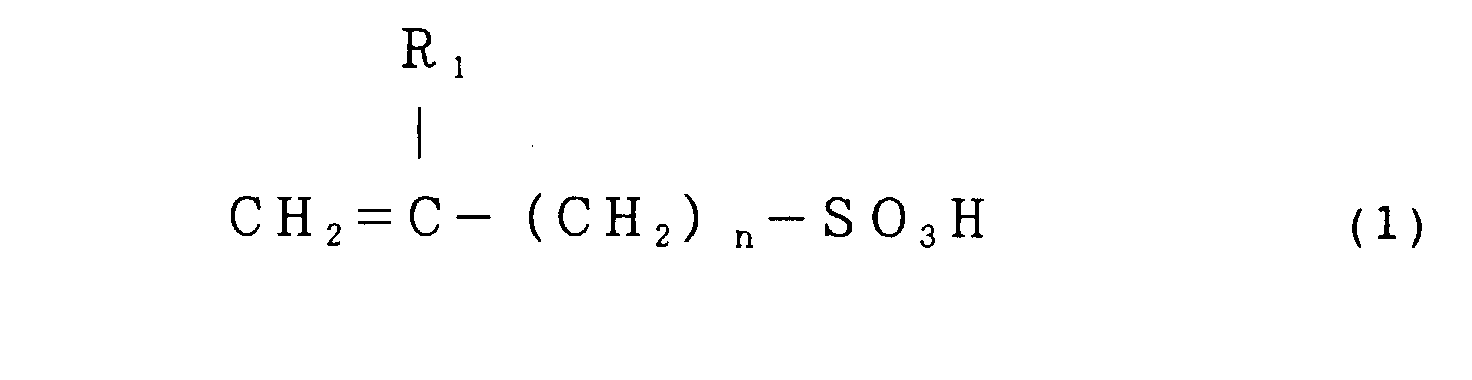
- (2) A polymer (B) according to (1), wherein the weight average molecular weight of the polymer (A) is 1,000 to 5,000,000;
- (3) A polymer (B) according to (1), wherein at least one of the vinyl monomers (b) is (meth)acrylamide;
- (4) A polymer (B) according to (1), wherein at least one of the vinyl monomers (c) is (meth)acrylamide;
- (5) A polymer (B) according to (1), wherein at least one of the vinyl monomers (b) and at least one of the vinyl monomers (c) are (meth)acrylamide;
- (6) A polymer (B) according to (1), wherein the polymer (A) consists of the same vinyl monomer components as those of the polymer (B), and at least one vinyl monomer component has a molar ratio in the polymer (A) substantially different from that in the polymer (B);
- (7) A polymer (B) according to (1), wherein the remaining vinyl monomer composition after subtracting the vinyl monomer composition of the polymer (A) from that of the polymer (B), is different from the composition of the polymer (A);
- (8) A polymer (B) according to (1), wherein the components or the composition are substantially different between the polymers (A) and (B);
- (9) A polymer (B) according to (1), wherein at least one of vinyl monomers (b) is an ionic monomer;
- (10) A polymer (B) according to (1), wherein at least one of vinyl monomers (b) is an anionic monomer;
- (11) A polymer (B) according to (1) having a weight average molecular weight of 100,000 to 10,000,000;
- (12) A polymer (B) according to (1) comprising a cross-linking vinyl monomer as a component monomer;
- (13) A paper strength agent comprising the polymer (B) according to (1);
- (14) A surface coating comprising the polymer (B) according to (1);
- (15) A paper strength agent comprising the polymer (B) according to (10);
- (16) A surface coating comprising the polymer (B) according to (10);
- (17) A process for manufacturing a polymer (B),
comprising the steps of
- preparing a polymer (A) by polymerizing one or more
vinyl monomers (a) selected from the group consisting of
vinyl monomers represented by the general formula (1):

- wherein R1 represents a hydrogen atom or a lower alkyl with 1 to 3 carbon atoms and n is an integer of 1 to 8 and their salts with one or more vinyl monomers (b) which are co-polymerizable with the vinyl monomer components (a); and
- polymerizing one or more vinyl monomers (c) in the presence of the polymer (A);
- (18) A cationic polymer (C) prepared by Hofmann degradation of the polymer (B) according to (1) wherein one or both of the vinyl monomers (b) and (c) comprise a monomer having an amide group, at an alkaline pH;
- (19) A cationic polymer (C) according to (18) wherein the monomer having an amide group is (meth)acrylamide;
- (20) A cationic polymer (C) according to (18) wherein the polymer (B) contains 0.1 to 99.9 mol% of the monomers of the polymer (A);
- (21) A cationic polymer (C) according to (18) wherein the weight average molecular weight of the polymer (B) is 100,000 to 10,000,000;
- (22) A cationic polymer (C) according to (18) wherein the said Hofmann degradation is reaction of the polymer (B) with a hypohalous acid salt at an alkaline pH at a temperature of 50 to 110 °C;
- (23) A paper strength agent comprising the cationic polymer (C) according to (18);
- (24) A drainage aid comprising the cationic polymer (C) according to (18);
- (25) A process for manufacturing a cationic polymer
(C), comprising the steps of
- preparing a polymer (A) by polymerizing one or more
vinyl monomers (a) selected from the group consisting of
vinyl monomers represented by the general formula (1):
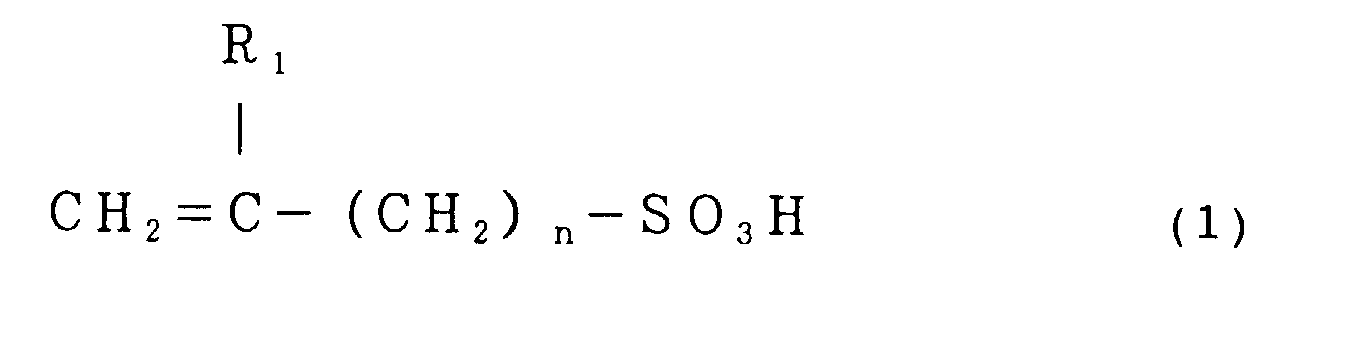
- wherein R1 represents a hydrogen atom or a lower alkyl with 1 to 3 carbon atoms and n is an integer of 1 to 8 and their salts with one or more vinyl monomers (b) which are co-polymerizable with the vinyl monomer components (a);
- polymerizing one or more vinyl monomers (c) in the presence of the polymer (A) to prepare a polymer (B); and
- conducting Hofmann degradation of the polymer (B) at an alkaline pH;
- and wherein one or both of the vinyl monomers (b) and (c) comprise a monomer having an amide group.
-
- The polymer of this invention may be prepared by multi-step polymerization using monomers having particular structures as components. It, therefore, has excellent properties such as freeness property and mechanical strength as well as exhibits good workability with a lower viscosity. Thus, the polymer can be suitably used as an additive for paper making such as a paper strength agent, a surface coating and a drainage aid.
- In addition, (meth)acrylamide may be used as a component for the polymer of this invention to provide a polymer with good mechanical strength even under harsh paper-making conditions.
- Furthermore, the cationic acrylamide polymer of this invention prepared by Hofmann degradation can improve a Z-axis directional strength and a freeness in particular, even under harsh paper-making conditions such as increase of waste papers.
- Embodiments of the present invention will now be described in more detail in the following description.
- The polymer of this invention is a polymer essentially comprising polymer (A) prepared by polymerizing particular vinyl monomers (a) and vinyl monomers (b). In brief, the polymer (A) is a component of the polymer (B).
- First, the polymer (A) prepared from one or more vinyl monomers (a) selected from the group consisting of vinyl monomers represented by the general formula (1) and their salts and vinyl monomers (b) co-polymerizable with the components (a) will be described.
- One or more vinyl monomers (a) selected from the group consisting of vinyl monomers represented by the general formula (1) and their salts which are used as components of the polymer (A) of this invention are the vinyl monomers represented by the general formula (1) wherein an alkyl represented by R1 is a lower alkyl with 1 to 3 carbon atoms, such as methyl, ethyl, n-propyl and i-propyl. Salts of the vinyl monomers include alkali metal salts such as sodium and potassium salts, and ammonium salts. Sulfonates represented by the general formula (1) include allylsulfonic acid, sodium allylsulfonate, methallylsulfonic acid, sodium methallylsulfonate and ammonium methallylsulfonate.
- In the general formula (1), n is an integer of 1 to 8, preferably 1 to 4.
- The vinyl monomers represented by the general formula (1) are contained in the polymer (A) in 0.005 to 50 mol%, preferably 1 to 40 mol%. The vinyl monomers may be used alone or in combination thereof.
- The vinyl monomers (b) used for preparation of the polymer (A) of this invention, which are co-polymerizable with the vinyl monomers (a) represented by the general formula (1) may be any monomers co-polymerizable with the vinyl monomers (a), and thus selected from a variety of monomers. The vinyl monomers (b) include, preferably in view of polymerizability, (meth)acrylamide, an ionic monomer, (meth)acrylamide and an ionic monomer, and (meth)acrylamide and a hydrophobic monomer. When anionic vinyl monomers are used as the vinyl monomers (b), a paper strength agent and a surface coating of excellent properties can be obtained.
- Anionic vinyl monomers include unsaturated carboxylic acids and their salts such as acrylic acid, methacrylic acid, crotonic acid, itaconic acid, maleic acid, fumaric acid, citraconic acid, 3-butene-1,2,3-tricarboxylic acid 4-pentene-1,2,4-tricarboxylic acid and aconitic acid as well as unsaturated sulfonic acids and their salts such as vinylsulfonic acid, styrenesulfonic acid, acrylamide 2-methylpropanesulfonic acid and acrylamide tert-butylsulfonic acid. These may be used alone or in combination of several compounds thereof.
- In polymerization for the polymer (A), other monomers such as (meth)acrylamide, hydrophobic monomers, ionic monomers as well as hydrophilic monomers and cross-linking monomers may be incorporated.
- Anionic monomers may be those described above.
- Cationic monomers include amines such as N,N-dimethylaminoethyl (meth)acrylate, N,N-diethylaminoethyl (meth)acrylate, N,N-dimethylaminopropyl (meth)acrylate, N,N-dimethylaminopropyl (meth)acrylamide and N,N-diethylaminopropyl (meth)acrylamide and their salts, and their quaternary compounds with, for example, methyl chloride, benzyl chloride, dimethyl sulfate and epichlorohydrin and dimethyldiallyl ammonium chloride dimethyldiallyl ammonium bromide,
- Hydrophobic monomers include N-alkyl (meth)acrylamides such as N,N-di-n-propyl (meth)acrylamide, N-n-butyl (meth)acrylamide, N-n-hexyl (meth)acrylamide, N-n-octyl (meth)acrylamide, N-tert-octyl (meth)acrylamide, N-dodecyl acrylamide and N-n-dodecyl methacrylamide; N-(ω-glycidoxyalkyl) (meth)acrylamides such as N,N-diglycidyl (meth)acrylamide, N-(4-glycidoxybutyl) (meth)acrylamide, N-(5-glycidoxypentyl) acrylamide and N-(6-glycidoxyhexyl) acrylamide; (meth)acrylates such as methyl (meth)acrylate, ethyl (meth)acrylate, butyl (meth)acrylate, lauryl (meth)acrylate, 2-ethylhexyl (meth)acrylate and glycidyl (meth)acrylate; olefins such as acrylonitrile, methacrylonitrile, vinyl acetate, vinyl chloride, vinylidene chloride, ethylene, propylene and butene; styrene; α-methylstyrene; butadiene; and isoprene.
- Hydrophilic monomers include, besides (meth)acrylamides, diacetone acrylamide, N,N-dimethyl (meth)acrylamide, N-ethyl (meth)acrylamide, N,N-diethyl (meth)acrylamide, N-propyl acrylamide, N-acryloylpyrrolidine, N-acryloylpiperidine, N-acryloylmorpholine, hydroxyethyl (meth)acrylate, hydroxypropyl (meth)acrylate, a variety of methoxypolyethyleneglycol (meth)acrylates, N-vinylformamide, N-vinylacetamide and N-vinyl-2-pyrrolidone.
- Cross-linking monomers include difunctional cross-linking monomers such as methylene bis(meth)acrylamide, ethylene bis(meth)acrylamide, dimethyl(meth)acrylamide, hexamethylene bis(meth)acrylamide, ethyleneglycol di(meth)acrylate, diethyleneglycol di(meth)acrylate, triethyleneglycol di(meth)acrylate, divinylbenzene and diallyl (meth)acrylamide; and multifunctional cross-linking monomers such as 1,3,5-triacryloylhexahydro-S-triazine, triallyl isocyanurate, pentaerythritol triacrylate, trimethylolpropane acrylate, triacrylformal and diacryloylimide.
- The polymer (A) in this invention may be preferably prepared by radical polymerization. A polymerization solvent is usually, but not limited to, water. Organic solvents such as alcohols and dimethylformamide may be used, and mixture of water and organic solvents.
- Polymerization for the polymer (A) in this invention may be conducted by a batch polymerization process in which all monomers are placed together in a reactor and polymerized; a semi-batch polymerization process in which some or all monomers are added dropwise in a reactor to initiate polymerization; or a continuous polymerization process a produced polymer is continuously removed while continuously supplying materials such as monomers.
- Initiators which may be used in polymerization for the polymer (A) in this invention, are preferably, but not limited to, water-soluble ones. They may be added in one portion or dropwise into an aqueous solution of monomers.
- Specific initiators include persulfates and peroxides such as ammonium persulfate, potassium persulfate, sodium persulfate, hydrogen peroxide, benzoyl peroxide and tert-butyl peroxide. These may be preferably used alone, or may be used as a redox initiator in combination with a reducing agent. Reducing agents which may be used include sulfites, hydrosulfites, lower ionized salts of metals such as iron, copper and cobalt, organic amines such as N,N,N',N'-tetramethylethylenediamine and reducing sugars such as aldoses and ketoses.
- In this invention, azo compounds are also preferable, including 2,2'-azobis-2-methylpropionamidine hydrochloride, 2,2'-azobis-2,4-dimethylvaleronitrile, 2,2'-azobis-N,N'-dimethyleneisobutylamidine hydrochloride, 2,2'-azobis-2-methyl-N-(2-hydroxyethyl)-propionamide, 2,2'-azobis-2-(2-imidazolin-2-yl)-propane and its salts, and 4,4'-azobis-4-cyanovaleric acid and its salts. These initiators may be used in combination of two or more.
- In polymerization for the polymer (A) in this invention, a polymerization temperature is about 30 to 100 °C for a single initiator and is in a lower region, about 5 to 90 °C for a redox initiator. During polymerization, the system may not be necessarily kept at the same temperature and may be varied as appropriate, as the polymerization proceeds. The temperature of the polymerization system is generally raised due to polymerization heat generated during the polymerization reaction, and therefore it may be necessary to cool the system. The atmosphere of the polymerization reactor may be preferably, but not limited to, replaced with an inert gas such as nitrogen for promoting polymerization.
- In polymerization for the polymer (A) in this invention, a polymerization period may be generally, but not limited to, about 5 min to 20 hours including a dropping time in a semi-batch polymerization.
- In polymerization for the polymer (A) in this invention, a polymerization pH is not particularly limited, and may be adjusted as needed. Exemplary pH adjusting agents which may be used include alkaline agents such as sodium hydroxide, potassium hydroxide and ammonia; inorganic acids such as phosphoric acid, sulfuric acid and hydrochloric acid; and organic acids such as formic acid and acetic acid.
- In polymerization for the polymer (A) in this invention, a polymerization concentration, i.e., a concentration of the polymer (A) at the end of the polymerization, is preferably 1 to 50 wt%, more preferably 5 to 50 wt%.
- The weight average molecular weight of the polymer (A) is preferably 1,000 to 5,000,000, more preferably 1,000 to 2,000,000, most preferably 1,000 to 1,000,000.
- The polymer (B) prepared by polymerizing one or more vinyl monomers (c) in the presence of the polymer (A) in this invention, will be described.
- The vinyl monomers (c) for the polymer (B) of this invention may be selected from a variety of monomers. Therefore, they may be optionally chosen from various combinations, preferably in view of polymerizability (meth)acrylamide, an ionic monomer, (meth)acrylamide and an ionic monomer, and (meth)acrylamide and a hydrophobic monomer. Other monomers such as (meth)acrylamide, hydrophobic monomers, ionic monomers as well as hydrophilic monomers and cross-linking monomers may be incorporated. In particular, a cross-linking monomer may be incorporated for providing a suitably high molecular weight of polymer. Furthermore, co-polymerization of the vinyl monomers (a) may be preferably used.
- Anionic vinyl monomers include unsaturated carboxylic acids and their salts such as acrylic acid, methacrylic acid, crotonic acid, itaconic acid, maleic acid, fumaric acid, citraconic acid, 3-butene-1,2,3-tricarboxylic acid 4-pentene-1,2,4-tricarboxylic acid and aconitic acid as well as unsaturated sulfonic acids and their salts such as vinylsulfonic acid, styrenesulfonic acid, acrylamide 2-methylsulfonic acid and acrylamide tert-butylsulfonic acid. These may be used alone or in combination of several compounds thereof.
- Cationic monomers include amines such as N,N-dimethylaminoethyl (meth)acrylate, N,N-diethylaminoethyl (meth)acrylate, N,N-dimethylaminopropyl (meth)acrylate, N,N-dimethylaminopropyl (meth)acrylamide and N,N-diethylaminopropyl (meth)acrylamide and their salts, and their quaternary compounds with, for example, methyl chloride, benzyl chloride, dimethyl sulfate and epichlorohydrin and dimethyldiallyl ammonium chloride dimethyldiallyl ammonium bromide, such as methacryloiloxyethyl-dimethyl-benzylammonium chloride(DMBq),methacryloiloxyethyl-dimethyl-benzylammonium bromide.
- Hydrophobic monomers include N-alkyl (meth)acrylamides such as N,N-di-n-propyl (meth)acrylamide, N-n-butyl (meth)acrylamide, N-n-hexyl (meth)acrylamide, N-n-octyl (meth)acrylamide, N-tert-octyl (meth)acrylamide, N-dodecyl acrylamide and N-n-dodecyl methacrylamide; N-(ω-glycidoxyalkyl) (meth)acrylamides such as N,N-diglycidyl (meth)acrylamide, N-(4-glycidoxybutyl) (meth)acrylamide, N-(5-glycidoxypentyl) acrylamide and N-(6-glycidoxyhexyl) acrylamide; (meth)acrylates such as methyl (meth)acrylate, ethyl (meth)acrylate, butyl (meth)acrylate, lauryl (meth)acrylate, 2-ethylhexyl (meth)acrylate and glycidyl (meth)acrylate; olefins such as acrylonitrile, methacrylonitrile, vinyl acetate, vinyl chloride, vinylidene chloride, ethylene, propylene and butene; styrene; α-methylstyrene; butadiene; and isoprene.
- Hydrophilic monomers include diacetone acrylamide, N,N-dimethyl (meth)acrylamide, N-ethyl (meth)acrylamide, N,N-diethyl (meth)acrylamide, N-propyl acrylamide, N-acryloylpyrrolidine, N-acryloylpiperidine, N-acryloylmorpholine, hydroxyethyl (meth)acrylate, hydroxypropyl (meth)acrylate, a variety of methoxypolyethyleneglycol (meth)acrylates, N-vinylformamide, N-vinylacetamide and N-vinyl-2-pyrrolidone.
- Cross-linking monomers include difunctional cross-linking monomers such as methylene bis(meth)acrylamide, ethylene bis(meth)acrylamide, dimethylmethacrylamide, hexamethylene bis(meth)acrylamide, ethyleneglycol di(meth)acrylate, diethyleneglycol di(meth)acrylate, triethyleneglycol di(meth)acrylate, divinylbenzene and diallyl (meth)acrylamide; and multifunctional cross-linking monomers such as 1,3,5-triacryloylhexahydro-S-triazine, triallyl isocyanurate, pentaerythritol triacrylate, trimethylolpropane acrylate, triacrylformal and diacryloylimide.
- When anionic vinyl monomers (b) are used, in the polymer (B) of this invention, the anionic vinyl monomers (b) are contained in preferably 0.1 to 50 mol%, more preferably 1 to 30 mol%. The anionic vinyl monomers (b) may be used not only as monomer components for the polymer (A) but also the vinyl monomers (c) in polymerization for the polymer (B).
- In polymerization for the polymer (B) of this invention, the polymer (A) may be used as a powder or liquid. It may be preferable that the polymer (B) is prepared by (i) preparing the polymer (A) using a known polymerization process, quenching the reaction and then forming the polymer (B) or (ii) preparing the polymer (A) and then continuously the polymer (B).
- The polymer (B) in this invention may be preferably prepared by radical polymerization. A polymerization solvent is usually, but not limited to, water. Organic solvents such as alcohols and dimethylformamide may be used. For Hofmann degradation, since the reaction system is usually an aqueous solution, it is preferable to use water as a polymerization solvent.
- Polymerization for the polymer (B) in this invention may be conducted by a batch polymerization process in which all monomers are placed together in a reactor and polymerized, or a semi-batch polymerization process in which the polymer (A) and some or all monomers are added dropwise in a reactor to initiate polymerization. Alternatively, a semi-batch polymerization in which a solution of the polymer (A) is first placed in a reactor, and some or all monomers are then dropped to initiate polymerization may be used. Furthermore, polymerization for the polymer (B) may be conducted intermittently with several steps.
- Initiators which may be used in polymerization for the polymer (B) in this invention, are preferably, but not limited to, water-soluble ones. They may be added in one portion or dropwise into an aqueous solution of monomers. Specific initiators include persulfates and peroxides such as ammonium persulfate, potassium persulfate, sodium persulfate, hydrogen peroxide, benzoyl peroxide and tert-butyl peroxide. These may be preferably used alone, or may be used as a redox initiator in combination with a reducing agent. Reducing agents which may be used include sulfites, hydrosulfites, lower ionized salts of metals such as iron, copper and cobalt, organic amines such as N,N,N',N'-tetramethylethylenediamine and reducing sugars such as aldoses and ketoses.
- In this invention, azo compounds are also preferable, including 2,2'-azobis-2-methylpropionamidine hydrochloride, 2,2'-azobis-2,4-dimethylvaleronitrile, 2,2'-azobis-N,N'-dimethyleneisobutylamidine hydrochloride, 2,2'-azobis-2-methyl-N-(2-hydroxyethyl)-propionamide, 2,2'-azobis-2-(2-imidazolin-2-yl)-propane and its salts, and 4,4'-azobis-4-cyanovaleric acid and its salts. These initiators may be used in combination of two or more.
- In polymerization for the polymer (B) in this invention, a polymerization temperature is about 30 to 100 °C for a single initiator and is in a lower region, about 5 to 90 °C for a redox initiator. During polymerization, the system may not be necessarily kept at the same temperature and may be varied as appropriate, as the polymerization proceeds. The temperature of the polymerization system is generally raised due to polymerization heat generated during the polymerization reaction, and therefore it may be necessary to cool the system. The atmosphere of the polymerization reactor may be preferably, but not limited to, replaced with an inert gas such as nitrogen for promoting polymerization.
- In polymerization for the polymer (B) in this invention, a polymerization period may be generally, but not limited to, about 5 min to 20 hours including a dropping time in a semi-batch polymerization.
- In polymerization for the polymer (B) in this invention, a polymerization pH is not particularly limited, and may be adjusted as needed. Exemplary pH adjusting agents which may be used include alkaline agents such as sodium hydroxide, potassium hydroxide and ammonia; inorganic acids such as phosphoric acid, sulfuric acid and hydrochloric acid; and organic acids such as formic acid and acetic acid.
- In polymerization for the polymer (B) in this invention, a polymerization concentration, i.e., a concentration of the polymer (B) at the end of the polymerization, is preferably 1 to 70 wt%, more preferably 5 to 50 wt%.
- In preparation of the polymer (B) of this invention, a cross-linking monomer may be used as an essential component, to provide a polymer which may be expected to exhibit an improved paper strengthening effect. Cross-linking monomers include difunctional cross-linking monomers such as methylene bis(meth)acrylamide, ethylene bis(meth)acrylamide, dimethyl(meth)acrylamide, hexamethylene bis(meth)acrylamide, ethyleneglycol di(meth)acrylate, diethyleneglycol di(meth)acrylate, triethyleneglycol di(meth)acrylate, divinylbenzene and diallyl (meth)acrylamide; and multifunctional cross-linking monomers such as 1,3,5-triacryloylhexahydro-S-triazine, triallyl isocyanurate, pentaerythritol triacrylate, trimethylolpropane acrylate, triacrylformal and diacryloylimide.
- These cross-linking vinyl monomers may be preferably used in the amount of 0.01 to 5 mol%, more preferably, 0.01 to 2 mol% to the total amount of the monomers for preparing the polymer (B).
- These cross-linking vinyl monomers may be used during preparation of the polymer (A) or both of the polymer (A) and the polymer (B), preferably preparation of the polymer (B).
- The molar ratio of all the monomers for the polymer (A) to all the monomers for the polymer (B) of this invention [(A)/(B)] is preferably 0.001 to 0.999, more preferably 0.01 to 0.98, more preferably 0.02 to 0.40 or 0.45 to 0.99, most preferably 0.04 to 0.30 or 0.60 to 0.98.
- The molar ratio of (meth)acrylamide to all the monomers for the polymer (B) [(meth)acrylamide /(B)] is preferably 0.001 to 0.999, more preferably 0.04 to 0.96.
- When the polymer (B) is intended to use as an additive for papermaking which also has a paper strengthening effect, the molar ratio of (meth)acrylamide for the polymer (B) to all the monomers for the polymer (B) is preferably 0.50 to 0.999, and the molar ratio of all the ionic monomers to all the monomers for the polymer (B) is preferably 0.005 to 0.50, more preferably 0.01 to 0.30.
- In this invention, the combination and the composition of the vinyl monomers (a) and (b) for the polymer (A) may not be necessarily the same as those of the vinyl monomers (c), and may be varied depending on an application of the resulting polymer. For example, the vinyl monomers (b) and the vinyl monomers (c) may be as follows:
NO. vinyl monomers (b) vinyl monomers (c) (1) cationic monomers noncationic monomers (nonionic or anionic monomers etc.) (2) anionic monomers nonanionic monomers (nonionic or cationic monomers etc.) (3) nonanionic monomers (nonionic or cationic monomers etc.) anionic monomers (4) noncationic monomers (nonionic or anionic monomers etc.) cationic monomers (5) nonhydrophobic monomers hydrophobic monomers (6) hydrophobic monomers nonhydrophobic monomers - Paper strength agent or surface coating in which anionic monomer(s) are used for vinyl monomers (b) shows excellent properties and paper strength agent in which cationic monomer(s) are used for vinyl monomers (b) and anionic monomer(s) are used for vinyl monomers (c) shows excellent properties.
- The vinyl monomers [the vinyl monomers (a) and (b)] for the polymer (A) and the vinyl monomers (c) may be the same in their monomer combinations and different from their compositions.
- For example, acrylic acid and acrylonitrile may be used as an anionic vinyl compound (b) in preparation of the polymer (A) and a vinyl compound (c) co-polymerizable with (meth)acrylamide in preparation of the polymer (B), respectively. Alternatively, acrylic acid may be used for (b) and (c), with different ratios. The molar ratio of (meth)acrylamide in the polymer (B) is preferably at least 50 mol%.
- The weight average molecular weight of the polymer (B) is preferably 100,000 to 10,000,000, more preferably 500,000 to 10,000,000 when applied for paper strength agent or surface coating.
- For the polymer (A), the weight average molecular weight is preferably 1,000 to 5,000,000. A compound represented by the general formula (a) may be used for controlling the molecular weight of the polymer (B). Furthermore, a known chain transfer agent may be used or polymerization conditions including a temperature and a polymerization period may be adjusted, for controlling the molecular weight of the polymer B as appropriate.
- A cross-linking agent may be used for increasing the molecular weight with a lower viscosity. It may be achieved by incorporating a monomer such as N-substituted (meth)acrylamides which may be grafted, or by conducting polymerization at a higher temperature, i.e., 90 °C or higher, to provide a relatively loose cross linking.
- The acrylamide polymer of this invention may be used as a paper strength agent etc. after being subject to modification such as Mannich modification and Hofmann modification. It may be used in combination with or as a mixture with a variety of ionic polymers.
- The acrylamide polymer(B) of this invention may be suitably used as an additive for paper making such as a paper strength agent and a surface coating.
- Paper strength agents may be generally divided into those added to a pulp slurry and those applied, impregnated or sprayed on a wet or dry paper web. The acrylamide polymer of this invention may be used in both application types.
- The acrylamide polymer(B) of this invention, when used for an additive for paper making, may be used not only alone but also in combination with a variety of agents including various polymers such as conventionally used starches, PVAs, carboxymethyl celluloses and polyacrylamides; size agents such as rosins and synthetic size agents; drainage aids; retention aids; waterproof agents; mold releases; defoaming agents; rust-preventive agents; and ion-mounting media, to be used as a more functional paper strength agent or surface coating.
- When used as a paper strength agent or surface coating, the acrylamide polymer(B) of this invention is preferably in a form of an aqueous solution. In such an application, of course, a higher polymer concentration is economically preferable. The concentration may be, however, selected so that the solution has a coefficient of viscosity up to 50,000 cps(centipoise), preferably up to 30,000 cps in view of its workability during delivery and/or use, more preferably up to 20,000 cps.
- The polymer according to this invention may exhibit better effects as a paper strength agent or surface coating than one according to the prior art. To date it is unclear why the acrylamide polymer(B) with such excellent properties can be provided, but it may be speculated that controlling a molecular disposition would consequently enhance polymer's interaction with a pulp fiber or aluminum sulfate molecule used in a wet end in comparison with a known polymer.
- The polymer (C) prepared by Hofmann degradation of the polymer (B) of this invention may be used as a paper strength agent, which provides an excellent Z-axis and freeness.
- The polymer (B) as a starting material may be used in the reaction as it is when the preparation is conducted in an aqueous solution, or may be diluted if needed. If the polymer (B) is prepared in another solvent, the solvent may be replaced with an aqueous one before initiating the reaction. The solvent in the previous step may be contained as long as it may not affect the performance or the workability of the product obtained by Hofmann degradation. Hofmann degradation is a reaction where an amide group in a polymer is attacked by a hypohalous acid in the presence of an alkaline compound. Hypohalous acids include hypochlorous acid, hypobromous acid and hypoiodous acid.
- Hypohalous acid salts include alkali metal and alkaline earth metal salts of hypochlorous acid such as sodium hypochlorite, potassium hypochlorite, lithium hypochlorite, calcium hypochlorite, magnesium hypochlorite and barium hypochlorite, as well as alkali metal and alkaline earth metal salts of hypobromous and hypoiodous acids. Alternatively, a halogen gas may be introduced into an alkaline solution to generate a hypohalous acid salt.
- Alkaline compounds include alkali metal hydroxides, alkaline earth metal hydroxides and alkali metal carbonates, preferably alkali metal hydroxides such as sodium hydroxide, potassium hydroxide and lithium hydroxide.
- The amounts of the above materials in relation to the polymer (B) are 0.05 to 2 mol, preferably 0.1 to 1.5 mol to 1 mol amide group for a hypohalous acid salt and 0.05 to 4 mol, preferably 0.1 to 3.0 mol to 1 mol amide group for an alkaline compound.
- Hofmann degradation is conducted at an alkaline pH within 8 to 14, preferably 11 to 14. In the reaction the concentration of the polymer (B) is about 0.1 to 17.5 wt%, but since a higher concentration makes stirring difficult and thus is apt to cause gelatinization, it is preferably 0.1 to 10 wt%. When Hofmann degradation is conducted at a higher temperature for a shorter period, it is again preferable that the concentration is 1 to 10 wt% because the reaction may be inappropriately slow when the concentration is less than 1 wt%.
- Hofmann degradation may be conducted at a temperature of 50 to 110 °C. A temperature within a higher region of 65 to 100 °C rather than a lower region is preferable because a resulting polymer has better effects as a paper strength agent. A reaction time depends on a reaction temperature and a polymer concentration in a reaction solution and thus cannot be generally described, but for example, when the polymer concentration is 1 wt%, tens of minutes at 50 °C, several minutes at 65 °C and tens of seconds at 80 °C may be adequate. As the polymer concentration increases, the reaction time may be reduced.
- It is recommended that after Hofmann degradation under the above conditions, the reaction is quenched for minimizing side reactions, although quenching may not be necessary when the resulting solution is used immediately after the reaction.
- The reaction may be quenched by appropriate procedures such as (1)adding a reducing agent, (2)cooling the system and (3) lowering the pH of the solution with an acid, alone or in combination thereof.
- The procedure (1) inactivates reactive species such as the remaining hypohalous acid salt by their reaction with the reducing agent such as sodium sulfite, sodium thiosulfate, ethyl malonate, thioglycerol and triethylamine. The amount of the reducing agent is generally 0.005 to 0.15 moles, preferably 0.01 to 0.10 moles per one mole of the hypohalous acid salt used in the reaction.
- The procedure (2) depresses the reaction by cooling, for which a heat exchanger or diluting with cold water may be employed. The temperature may be reduced to generally below 50 °C, preferably below 45 °C, more preferably below 40 °C.
- The procedure (3) decreases the pH of the reaction solution which is generally 12 to 13 at the end of the reaction, to quench Hofmann degradation while inhibiting hydrolysis. The pH may be decreased to below a neutral region, preferably 4 to 6. Acids which may be used for pH adjustment, include inorganic acids such as hydrochloric acid, sulfuric acid, phosphoric acid and nitric acid; and organic acids such as formic acid, acetic acid and citric acid.
- The reaction solution after quenching described above may be used as the cationic polymer (C) as it is, or the aqueous solution may be poured into a solvent such as methanol which does not dissolve the cationic polymer (C) to precipitate the polymer, which is then dried to a powder. The cationic polymer (C) may be stored in a tank and used when needed. A storage temperature may be a low temperature at which the aqueous solution is not frozen, preferably 10 to 15 °C.
- The cationic polymer (C) may be used in a process of sheet forming of a paper or cardboard. The polymer may be added as a paper strength agent or drainage aid with significant effects. The cationic polymer (C) may be added in a paper strength agent or drainage aid to an effective amount for providing required effects, or may be used alone.
- The cationic polymer (C) may be used in sheet forming according to a well-known procedure, and used alone or preferably in combination with other agents such as aluminum sulfate and anionic resins including anionic acrylamide polymers if necessary.
- The ratio between the cationic polymer (C) and the anionic resin may be arbitrarily selected, preferably 100:0 to 10:90 as a weight ratio of solids. Their amount is 0.01 to 5 wt%, preferably 0.05 to 2 wt% to the weight of the dry pulp solid.
- They may be added at any point before forming a wet sheet and in any order or at the same time, although even after forming a wet sheet, they may be added by spray or roll-coater application, especially for producing a joined paper.
- The cationic acrylamide polymer of this invention produced by Hofmann reaction of an acrylamide polymer with an controlled branched and cross-linked structure can improve particularly a Z-axis directional strength and a freeness even under harsh papermaking conditions such as increase of a waste paper.
- Thus, when used for a product such as a corrugated paper and a newspaper in which a waste paper may be used in a significant proportion, the polymer of this invention may be considerably effective to provide a paper with an improved paper strength. Furthermore, it has many significant advantages; for example, an overall amount of additives for papermaking may be reduced, leading to cost reduction in papermaking and reduction of unfixed resins which may cause contamination in the papermaking system.
- This invention will be more specifically described by, but not limited to, the following Examples and Comparative Examples, where % represents wt% unless otherwise indicated.
- The measurement conditions in GPC-MALLS, i.e., measurement by a GPC-MALLS technique where a GPC is connected with a multi-angle light scattering detector, in Examples and Comparative Examples, are as follows:
- GPC body: System 11, Showa Denko K.K.;
- Column: SHODEX SB 80M;
- Eluent: a N/15 phosphate buffer(pH 7) containing N/10 sodium nitrate;
- Flow rate: 1.0 mL/min;
- Detector: a multi-angle light scattering detector DAWN, Wyatt Technology Company.
-
- In a five-necked flask equipped with an agitator, a reflux condenser, a thermometer, a nitrogen-inlet tube and a dropping inlet (hereinafter, referred to as a "reaction vessel") was placed 201.33 g of purified water, and then the internal temperature was adjusted to 80 °C while introducing nitrogen gas.
- A solution of 18.64 g of 80 %(hereinafter, % represents wt% unless otherwise indicated) acrylic acid and 3.27 g of sodium methallylsulfonate and an aqueous solution(60 g) of 0.24 g of 4,4'-azobis-4-cyanovaleric acid(purity: 84 %) were prepared, and simultaneously added dropwise at constant rates into the reaction vessel over 60 min, maintaining the internal temperature at 80 °C. After addition, polymerization was continued at 80 °C for 4 hours, to provide a polymer A.
- Subsequently a solution of 549.89 g of 50 % acrylamide, 0.32 g of methylene bisacrylamide and 6.55 g of sodium methallylsulfonate and an aqueous solution(60 g) of 0.37 g of 4,4'-azobis-4-cyanovaleric acid(purity: 84 %) were prepared and simultaneously added dropwise at constant rates into the reaction vessel over 180 min, maintaining the internal temperature at 80 °C. After addition, polymerization was continued at 80 °C for 8 hours, to provide a polymer B. While cooling the polymer solution, the proportion of the nonvolatile component was adjusted by adding water, to give an aqueous solution of an anionic polymer containing 30 % of the nonvolatile component with a Brookfield viscosity of 6290 cps at 25 °C. The polymer is designated as M-1.
- The weight-average molecular weight of M-1 by GPC-MALLS was 4,500,000.
- In the above reaction vessel was placed 221.84 g of purified water, and then the internal temperature was adjusted to 80 °C while introducing nitrogen gas.
- A solution of 36.58 g of 80 % acrylic acid and 6.42 g of sodium methallylsulfonate and an aqueous solution(60 g) of 0.24 g of 4,4'-azobis-4-cyanovaleric acid(purity: 84 %) were prepared, and simultaneously added dropwise at constant rates into the reaction vessel over 60 min, maintaining the internal temperature at 80 °C. After addition, polymerization was continued at 80 °C for 3 hours, to provide a polymer A.
- Subsequently a solution of 501.68 g of 50 % acrylamide, 0.63 g of methylene bisacrylamide and 12.85 g of sodium methallylsulfonate and an aqueous solution(60 g) of 0.73 g of 4,4'-azobis-4-cyanovaleric acid(purity: 84 %) were prepared and simultaneously added dropwise at constant rates into the reaction vessel over 240 min, maintaining the internal temperature at 80 °C. After addition, polymerization was continued at 80 °C for 5 hours, to provide a polymer B. While cooling the polymer solution, the proportion of the nonvolatile component was adjusted by adding water, to give an aqueous solution of an anionic polymer containing 30 % of the nonvolatile component with a Brookfield viscosity of 6640 cps at 25 °C. The polymer is designated as M-2.
- The weight-average molecular weight of M-2 by GPC-MALLS was 4,910,000.
- In the above reaction vessel was placed 228.27 g of purified water, and then the internal temperature was adjusted to 80 °C while introducing nitrogen gas.
- A solution of 56.98 g of 50 % acrylamide, 36.12 g of 80 % acrylic acid and 6.34 g of sodium methallylsulfonate and an aqueous solution(60 g) of 0.24 g of 4,4'-azobis-4-cyanovaleric acid(purity: 84 %) were prepared, and simultaneously added dropwise at constant rates into the reaction vessel over 60 min, maintaining the internal temperature at 80 °C. After addition, polymerization was continued at 80 °C for 5 hours, to provide a polymer A.
- Subsequently a solution of 432.02 g of 50 % acrylamide, 1.24 g of methylene bisacrylamide and 19.02 g of sodium methallylsulfonate and an aqueous solution(60 g) of 1.71 g of 4,4'-azobis-4-cyanovaleric acid(purity: 84 %) were prepared and simultaneously added dropwise at constant rates into the reaction vessel over 300 min, maintaining the internal temperature at 90 °C. After addition, polymerization was continued at 90 °C for 3 hours, to provide a polymer B. While cooling the polymer solution, the proportion of the nonvolatile component was adjusted by adding water, to give an aqueous solution of an anionic polymer containing 30 % of the nonvolatile component with a Brookfield viscosity of 8730 cps at 25 °C. The polymer is designated as M-3.
- The weight-average molecular weight of M-3 by GPC-MALLS was 5,930,000.
- In the above reaction vessel was placed 238.79 g of purified water, and then the internal temperature was adjusted to 80 °C while introducing nitrogen gas.
- A solution of 28.49 g of 50 % acrylamide, 54.17 g of 80 % acrylic acid and 9.51 g of sodium methallylsulfonate and an aqueous solution(60 g) of 1.47 g of 4,4'-azobis-4-cyanovaleric acid(purity: 84 %) were prepared, and simultaneously added dropwise at constant rates into the reaction vessel over 90 min, maintaining the internal temperature at 80 °C. After addition, polymerization was continued at 80 °C for 2 hours, to provide a polymer A.
- Subsequently a solution of 432.26 g of 50 % acrylamide, 0.93 g of methylene bisacrylamide and 15.85 g of sodium methallylsulfonate and an aqueous solution(60 g) of 1.22 g of 4,4'-azobis-4-cyanovaleric acid(purity: 84 %) were prepared and simultaneously added dropwise at constant rates into the reaction vessel over 150 min, maintaining the internal temperature at 80 °C. After addition, polymerization was continued at 80 °C for 5 hours, to provide a polymer B. While cooling the polymer solution, the proportion of the nonvolatile component was adjusted by adding water, to give an aqueous solution of an anionic polymer containing 30 % of the nonvolatile component with a Brookfield viscosity of 8080 cps at 25 °C. The polymer is designated as M-4.
- The weight-average molecular weight of M-4 by GPC-MALLS was 5,850,000.
- In the above reaction vessel was placed 236.22 g of purified water, and then the internal temperature was adjusted to 90 °C while introducing nitrogen gas.
- A solution of 24.84 g of itaconic acid and 12.08 g of sodium methallylsulfonate and an aqueous solution(60 g) of 1.47 g of 4,4'-azobis-4-cyanovaleric acid(purity: 84 %) were prepared, and simultaneously added dropwise at constant rates into the reaction vessel over 60 min, maintaining the internal temperature at 90 °C. After addition, polymerization was continued at 90 °C for 5 hours, to provide a polymer A.
- Subsequently a solution of 487.55 g of 50 % acrylamide, 1.18 g of methylene bisacrylamide and 18.12 g of sodium methallylsulfonate and an aqueous solution(60 g) of 1.71 g of 4,4'-azobis-4-cyanovaleric acid(purity: 84 %) were prepared and simultaneously added dropwise at constant rates into the reaction vessel over 150 min, maintaining the internal temperature at 90 °C. After addition, polymerization was continued at 80 °C for 5 hours, to provide a polymer B. While cooling the polymer solution, the proportion of the nonvolatile component was adjusted by adding water, to give an aqueous solution of an anionic polymer containing 30 % of the nonvolatile component with a Brookfield viscosity of 7570 cps at 25 °C. The polymer is designated as M-5.
- The weight-average molecular weight of M-5 by GPC-MALLS was 4,780,000.
- In the above reaction vessel was placed 265.49 g of purified water, and then the internal temperature was adjusted to 90 °C while introducing nitrogen gas.
- A solution of 47.13 g of itaconic acid and 17.19 g of sodium methallylsulfonate and an aqueous solution(60 g) of 1.47 g of 4,4'-azobis-4-cyanovaleric acid(purity: 84 %) were prepared, and simultaneously added dropwise at constant rates into the reaction vessel over 90 min, maintaining the internal temperature at 90 °C. After addition, polymerization was continued at 90 °C for 2 hours, to provide a polymer A.
- Subsequently a solution of 429.01 g of 50 % acrylamide, 1.12 g of methylene bisacrylamide and 20.05 g of sodium methallylsulfonate and an aqueous solution(60 g) of 1.59 g of 4,4'-azobis-4-cyanovaleric acid(purity: 84 %) were prepared and simultaneously added dropwise at constant rates into the reaction vessel over 150 min, maintaining the internal temperature at 80 °C. After addition, polymerization was continued at 90 °C for 4 hours, to provide a polymer B. While cooling the polymer solution, the proportion of the nonvolatile component was adjusted by adding water, to give an aqueous solution of an anionic polymer containing 30 % of the nonvolatile component with a Brookfield viscosity of 6930 cps at 25 °C. The polymer is designated as M-6.
- The weight-average molecular weight of M-6 by GPC-MALLS was 4,840,000.
- In the above reaction vessel was placed 226.72 g of purified water, and then the internal temperature was adjusted to 80 °C while introducing nitrogen gas.
- A solution of 38.61 g of 50 % acrylamide, 15.14 g of itaconic acid and 12.27 g of sodium methallylsulfonate and an aqueous solution(60 g) of 0.73 g of 4,4'-azobis-4-cyanovaleric acid(purity: 84 %) were prepared, and simultaneously added dropwise at constant rates into the reaction vessel over 60 min, maintaining the internal temperature at 80 °C. After addition, polymerization was continued at 80 °C for 5 hours, to provide a polymer A.
- Subsequently a solution of 467.96 g of 50 % acrylamide, 0.90 g of methylene bisacrylamide and 18.41 g of sodium methallylsulfonate and an aqueous solution(60 g) of 1.10 g of 4,4'-azobis-4-cyanovaleric acid(purity: 84 %) were prepared and simultaneously added dropwise at constant rates into the reaction vessel over 150 min, maintaining the internal temperature at 80 °C. After addition, polymerization was continued at 80 °C for 5 hours, to provide a polymer B. While cooling the polymer solution, the proportion of the nonvolatile component was adjusted by adding water, to give an aqueous solution of an anionic polymer containing 30 % of the nonvolatile component with a Brookfield viscosity of 6470 cps at 25 °C. The polymer is designated as M-7.
- The weight-average molecular weight of M-7 by GPC-MALLS was 4,780,000.
- In the above reaction vessel was placed 246.46 g of purified water, and then the internal temperature was adjusted to 90 °C while introducing nitrogen gas.
- A solution of 64.13 g of 50 % acrylamide, 39.17 g of itaconic acid and 11.89 g of sodium methallylsulfonate and an aqueous solution(60 g) of 1.47 g of 4,4'-azobis-4-cyanovaleric acid(purity: 84 %) were prepared, and simultaneously added dropwise at constant rates into the reaction vessel over 90 min, maintaining the internal temperature at 90 °C. After addition, polymerization was continued at 90 °C for 6 hours, to provide a polymer A.
- Subsequently a solution of 402.95 g of 50 % acrylamide, 0.58 g of methylene bisacrylamide and 14.86 g of sodium methallylsulfonate and an aqueous solution(60 g) of 0.61 g of 4,4'-azobis-4-cyanovaleric acid(purity: 84 %) were prepared and simultaneously added dropwise at constant rates into the reaction vessel over 150 min, maintaining the internal temperature at 80 °C. After addition, polymerization was continued at 80 °C for 4 hours, to provide a polymer B. While cooling the polymer solution, the proportion of the nonvolatile component was adjusted by adding water, to give an aqueous solution of an anionic polymer containing 30 % of the nonvolatile component with a Brookfield viscosity of 5500 cps at 25 °C. The polymer is designated as M-8.
- The weight-average molecular weight of M-8 by GPC-MALLS was 4,430,000.
- In the above reaction vessel was placed 201.33 g of purified water, and then the internal temperature was adjusted to 80 °C while introducing nitrogen gas.
- A solution of 549.89 g of 50 % acrylamide, 18.64 g of 80 % acrylic acid, 9.82 g of sodium methallylsulfonate and 0.32 g of methylene bisacrylamide in 18.19 g of distilled water and an aqueous solution(120 g) of 0.24 g of 4,4'-azobis-4-cyanovaleric acid(purity: 84 %) were prepared, and simultaneously added dropwise at constant rates into the reaction vessel over 240 min, maintaining the internal temperature at 80 °C. After addition, polymerization was continued at 80 °C for 8 hours. While cooling the polymer solution, the proportion of the nonvolatile component was adjusted by adding water, to give an aqueous solution of an anionic polymer containing 30 % of the nonvolatile component with a Brookfield viscosity of 8180 cps at 25 °C. The polymer is designated as N-1.
- The weight-average molecular weight of N-1 by GPC-MALLS was 1,950,000.
- In the above reaction vessel was placed 221.84 g of purified water, and then the internal temperature was adjusted to 80 °C while introducing nitrogen gas.
- A solution of 501.68 g of 50 % acrylamide, 36.58 g of 80 % acrylic acid, 19.27 g of sodium methallylsulfonate and 0.63 g of methylene bisacrylamide and an aqueous solution(120 g) of 0.49 g of 4,4'-azobis-4-cyanovaleric acid(purity: 84 %) were prepared, and simultaneously added dropwise at constant rates into the reaction vessel over 300 min, maintaining the internal temperature at 80 °C. After addition, polymerization was continued at 80 °C for 3 hours. While cooling the polymer solution, the proportion of the nonvolatile component was adjusted by adding water, to give an aqueous solution of an anionic polymer containing 30 % of the nonvolatile component with a Brookfield viscosity of 8690 cps at 25 °C. The polymer is designated as N-2.
- The weight-average molecular weight of N-2 by GPC-MALLS was 2,240,000.
- In the above reaction vessel was placed 228.27 g of purified water, and then the internal temperature was adjusted to 80 °C while introducing nitrogen gas.
- A solution of 432.02 g of 50 % acrylamide, 36.12 g of 80 % acrylic acid, 25.36 g of sodium methallylsulfonate and 1.24 g of methylene bisacrylamide and an aqueous solution(120 g) of 1.47 g of 4,4'-azobis-4-cyanovaleric acid(purity: 84 %) were prepared, and simultaneously added dropwise at constant rates into the reaction vessel over 300 min, maintaining the internal temperature at 80 °C. After addition, polymerization was continued at 80 °C for 5 hours. While cooling the polymer solution, the proportion of the nonvolatile component was adjusted by adding water, to give an aqueous solution of an anionic polymer containing 30 % of the nonvolatile component with a Brookfield viscosity of 11050 cps at 25 °C. The polymer is designated as N-3.
- The weight-average molecular weight of N-3 by GPC-MALLS was 1,840,000.
- In a five-necked flask equipped with an agitator, a reflux condenser, a thermometer, a nitrogen-inlet tube and a dropping inlet(hereinafter, referred to as a "reaction vessel") was placed 238.79 g of purified water, and then the internal temperature was adjusted to 80 °C while introducing nitrogen gas.
- A solution of 460.75 g of 50 % acrylamide, 54.17 g of 80 % acrylic acid, 25.36 g of sodium methallylsulfonate and 0.93 g of methylene bisacrylamide and an aqueous solution(120 g) of 1.22 g of 4,4'-azobis-4-cyanovaleric acid(purity: 84 %) were prepared, and simultaneously added dropwise at constant rates into the reaction vessel over 300 min, maintaining the internal temperature at 80 °C. After addition, polymerization was continued at 80 °C for 3 hours. While cooling the polymer solution, the proportion of the nonvolatile component was adjusted by adding water, to give an aqueous solution of an anionic polymer containing 30 % of the nonvolatile component with a Brookfield viscosity of 11550 cps at 25 °C. The polymer is designated as N-4.
- The weight-average molecular weight of N-4 by GPC-MALLS was 3,460,000.
- In the above reaction vessel was placed 236.22 g of purified water, and then the internal temperature was adjusted to 80 °C while introducing nitrogen gas.
- A solution of 487.55 g of 50 % acrylamide, 24.84 g of itaconic acid, 30.20 g of sodium methallylsulfonate and 1.18 g of methylene bisacrylamide and an aqueous solution(120 g) of 1.22 g of 4,4'-azobis-4-cyanovaleric acid(purity: 84 %) were prepared, and simultaneously added dropwise at constant rates into the reaction vessel over 300 min, maintaining the internal temperature at 80 °C. After addition, polymerization was continued at 80 °C for 5 hours. While cooling the polymer solution, the proportion of the nonvolatile component was adjusted by adding water, to give an aqueous solution of an anionic polymer containing 30 % of the nonvolatile component with a Brookfield viscosity of 9440 cps at 25 °C. The polymer is designated as N-5.
- The weight-average molecular weight of N-5 by GPC-MALLS was 1,960,000.
- In the above reaction vessel was placed 265.49 g of purified water, and then the internal temperature was adjusted to 80 °C while introducing nitrogen gas.
- A solution of 429.01 g of 50 % acrylamide, 47.13 g of itaconic acid, 37.24 g of sodium methallylsulfonate and 1.12 g of methylene bisacrylamide and an aqueous solution(120 g) of 0.85 g of 4,4'-azobis-4-cyanovaleric acid(purity: 84 %) were prepared, and simultaneously added dropwise at constant rates into the reaction vessel over 300 min, maintaining the internal temperature at 80 °C. After addition, polymerization was continued at 80 °C for 2 hours. While cooling the polymer solution, the proportion of the nonvolatile component was adjusted by adding water, to give an aqueous solution of an anionic polymer containing 30 % of the nonvolatile component with a Brookfield viscosity of 8750 cps at 25 °C. The polymer is designated as N-6.
- The weight-average molecular weight of N-6 by GPC-MALLS was 2,580,000.
- In the above reaction vessel was placed 226.72 g of purified water, and then the internal temperature was adjusted to 80 °C while introducing nitrogen gas.
- A solution of 471.57 g of 50 % acrylamide, 15.14 g of itaconic acid, 30.68 g of sodium methallylsulfonate and 0.90 g of methylene bisacrylamide and an aqueous solution(120 g) of 0.61 g of 4,4'-azobis-4-cyanovaleric acid(purity: 84 %) were prepared, and simultaneously added dropwise at constant rates into the reaction vessel over 300 min, maintaining the internal temperature at 80 °C. After addition, polymerization was continued at 80 °C for 5 hours. While cooling the polymer solution, the proportion of the nonvolatile component was adjusted by adding water, to give an aqueous solution of an anionic polymer containing 30 % of the nonvolatile component with a Brookfield viscosity of 8560 cps at 25 °C. The polymer is designated as N-7.
- The weight-average molecular weight of N-7 by GPC-MALLS was 2,560,000.
- In the above reaction vessel was placed 246.46 g of purified water, and then the internal temperature was adjusted to 80 °C while introducing nitrogen gas.
- A solution of 467.08 g of 50 % acrylamide, 39.17 g of itaconic acid, 26.75 g of sodium methallylsulfonate and 0.58 g of methylene bisacrylamide and an aqueous solution(120 g) of 0.50 g of 4,4'-azobis-4-cyanovaleric acid(purity: 84 %) were prepared, and simultaneously added dropwise at constant rates into the reaction vessel over 300 min, maintaining the internal temperature at 80 °C. After addition, polymerization was continued at 80 °C for 3 hours. While cooling the polymer solution, the proportion of the nonvolatile component was adjusted by adding water, to give an aqueous solution of an anionic polymer containing 30 % of the nonvolatile component with a Brookfield viscosity of 8110 cps at 25 °C. The polymer is designated as N-8.
- The weight-average molecular weight of N-8 by GPC-MALLS was 3,670,000.
- The compositions and the physical properties of the polymers from the above Examples and Comparative Examples are summarized in Tables 1 and 2.
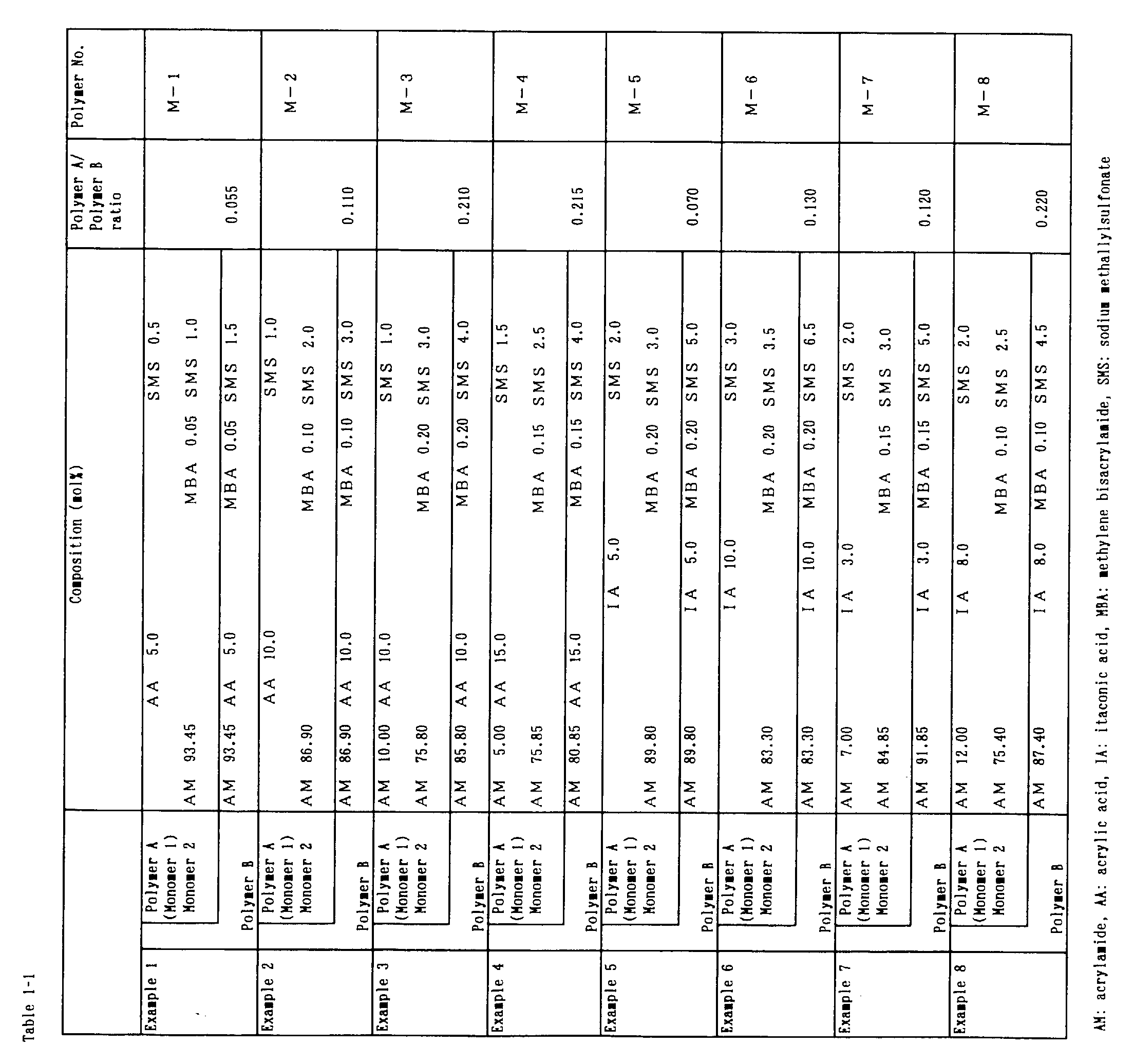

Polymer No. Viscosity ( ps/25 °C) Molecular Weight (104) M-1 62. 9 450 M-2 66. 4 491 M-3 87. 3 593 M-4 80. 8 585 M-5 75. 7 478 M-6 69. 3 484 M-7 64. 7 478 M-8 55. 0 443 N-1 81. 8 195 N-2 86. 9 224 N-3 110. 5 184 N-4 115. 5 346 N-5 94. 4 196 N-6 87. 5 258 N-7 85. 6 256 N-8 81. 1 367 - Application Examples will be described, in which the polymers from the above Examples and Comparative Examples were used as an internal paper strength agent.
- To an L-BKP 1% slurry with a beating degree of CSF(Canadian Standard Freeness) 400 obtained from waste corrugated papers was added aluminum sulfate in an amount of 2 % to the pulp, and then the mixture was stirred for 3 min. The pH of the pulp slurry was 4.5. A 1 % aqueous solution of the polymer M-1 was added in an amount of 0.5 % to the pulp on nonvolatile-component basis with stirring, and the mixture was further stirred for 3 min. Then, the resulting pulp slurry was used to make a paper with a TAPPI standard (square) sheet machine. The wet sheet thus made was dried in a drum dryer at 110 °C for 3 min, to give a hand-made paper with a basis weight of 100 g/m2. The dried paper was subject to humidity control in an air-conditioned chamber at 20 °C and RH 65 % for at least 24 hours, and its burst index(JIS-P8112) and Z-axis directional strength(Internal Bond Tester; Kumagaya Riki Kogyo) were determined. The polymers M-2 to M-8 and N-1 to N-8 were processed and evaluated as described above. The results are shown in Table 3.
Polymer No. Burst index Z-directional strength (kg·cm) M-1 5. 02 4. 53 M-2 5. 08 4. 52 M-3 5. 06 4. 60 M-4 5. 11 4. 58 M-5 5. 16 4. 65 M-6 5. 21 4. 58 M-7 5. 40 4. 59 M-8 5. 31 4. 52 N-1 3. 92 3. 28 N-2 3. 95 3. 21 N-3 3. 95 3. 30 N-4 3. 95 3. 35 N-5 4. 10 3. 42 N-6 4. 08 3. 40 N-7 4. 09 3. 47 N-8 4. 04 3. 42 None 3. 85 2. 96 - In the above reaction vessel was placed 214.86 g of purified water, and then the internal temperature was adjusted to 80 °C while introducing nitrogen gas.
- A solution of 24.85 g of N,N-dimethylaminoethyl methacrylate and 3.13 g of sodium methallylsulfonate whose pH was adjusted to 4.2 with 35 % HCl and an aqueous solution(60 g) of 0.49 g of 4,4'-azobis-4-cyanovaleric acid(purity: 84 %) were prepared, and simultaneously added dropwise at constant rates into the reaction vessel over 120 min, maintaining the internal temperature at 80 °C. After addition, polymerization was continued at 80 °C for 4 hours, to provide a polymer A.
- Subsequently a solution of 530.33 g of 50 % acrylamide, 0.61 g of methylene bisacrylamide and 6.25 g of sodium methallylsulfonate whose pH was adjusted to 4.2 with 35 % HCl and an aqueous solution(60 g) of 0.93 g of 4,4'-azobis-4-cyanovaleric acid(purity: 84 %) were prepared and simultaneously added dropwise at constant rates into the reaction vessel over 180 min, maintaining the internal temperature at 80 °C. After addition, polymerization was continued at 80 °C for 4 hours, to provide a polymer B. While cooling the polymer solution, the proportion of the nonvolatile component was adjusted by adding water, to give an aqueous solution of an amphoteric polymer containing 30 % of the nonvolatile component with a Brookfield viscosity of 5170 cps at 25 °C. The polymer is designated as M-9.
- The weight-average molecular weight of M-9 by GPC-MALLS was 2,460,000.
- In the above reaction vessel was placed 262.84 g of purified water, and then the internal temperature was adjusted to 80 °C while introducing nitrogen gas.
- A solution of 67.57 g of N,N-dimethylaminoethyl methacrylate and 2.83 g of sodium methallylsulfonate whose pH was adjusted to 4.2 with 35 % HCl and an aqueous solution(60 g) of 0.49 g of 4,4'-azobis-4-cyanovaleric acid(purity: 84 %) were prepared, and simultaneously added dropwise at constant rates into the reaction vessel over 120 min, maintaining the internal temperature at 80 °C. After addition, polymerization was continued at 80 °C for 6 hours, to provide a polymer A.
- Subsequently a solution of 434.33 g of 50 % acrylamide, 1.10 g of methylene bisacrylamide and 11.33 g of sodium methallylsulfonate whose pH was adjusted to 4.2 with 35 % HCl and an aqueous solution(60 g) of 1.71 g of 4,4'-azobis-4-cyanovaleric acid(purity: 84 %) were prepared and simultaneously added dropwise at constant rates into the reaction vessel over 180 min, maintaining the internal temperature at 80 °C. After addition, polymerization was continued at 80 °C for 4 hours, to provide a polymer B. While cooling the polymer solution, the proportion of the nonvolatile component was adjusted by adding water, to give an aqueous solution of an amphoteric polymer containing 30 % of the nonvolatile component with a Brookfield viscosity of 6020 cps at 25 °C. The polymer is designated as M-10.
- The weight-average molecular weight of M-10 by GPC-MALLS was 3,460,000.
- In the above reaction vessel was placed 243.66 g of purified water, and then the internal temperature was adjusted to 80 °C while introducing nitrogen gas.
- A solution of 35.30 g of N,N-dimethylaminoethyl methacrylate, 9.74 g of itaconic acid and 5.92 g of sodium methallylsulfonate whose pH was adjusted to 4.2 with 35 % HCl and an aqueous solution(60 g) of 0.49 g of 4,4'-azobis-4-cyanovaleric acid(purity: 84 %) were prepared, and simultaneously added dropwise at constant rates into the reaction vessel over 120 min, maintaining the internal temperature at 80 °C. After addition, polymerization was continued at 80 °C for 4 hours, to provide a polymer A.
- Subsequently a solution of 472.68 g of 50 % acrylamide, 0.87 g of methylene bisacrylamide and 11.84 g of sodium methallylsulfonate whose pH was adjusted to 4.2 with 35 % HCl and an aqueous solution(60 g) of 1.78 g of 4,4'-azobis-4-cyanovaleric acid(purity: 84 %) were prepared and simultaneously added dropwise at constant rates into the reaction vessel over 180 min, maintaining the internal temperature at 80 °C. After addition, polymerization was continued at 80 °C for 5 hours, to provide a polymer B. While cooling the polymer solution, the proportion of the nonvolatile component was adjusted by adding water, to give an aqueous solution of an amphoteric polymer containing 30 % of the nonvolatile component with a Brookfield viscosity of 3830 cps at 25 °C. The polymer is designated as M-11.
- The weight-average molecular weight of M-11 by GPC-MALLS was 2,360,000.
- In the above reaction vessel was placed 273.19 g of purified water, and then the internal temperature was adjusted to 80 °C while introducing nitrogen gas.
- A solution of 66.29 g of N,N-dimethylaminoethyl methacrylate, 9.14 g of itaconic acid and 5.56 g of sodium methallylsulfonate whose pH was adjusted to 4.2 with 35 % HCl and an aqueous solution(60 g) of 0.73 g of 4,4'-azobis-4-cyanovaleric acid(purity: 84 %) were prepared, and simultaneously added dropwise at constant rates into the reaction vessel over 90 min, maintaining the internal temperature at 80 °C. After addition, polymerization was continued at 80 °C for 6 hours, to provide a polymer A.
- Subsequently a solution of 413.62 g of 50 % acrylamide, 1.08 g of methylene bisacrylamide and 11.15 g of sodium methallylsulfonate whose pH was adjusted to 4.2 with 35 % HCl and an aqueous solution(60 g) of 1.66 g of 4,4'-azobis-4-cyanovaleric acid(purity: 84 %) were prepared and simultaneously added dropwise at constant rates into the reaction vessel over 180 min, maintaining the internal temperature at 80 °C. After addition, polymerization was continued at 80 °C for 4 hours, to provide a polymer B. While cooling the polymer solution, the proportion of the nonvolatile component was adjusted by adding water, to give an aqueous solution of an amphoteric polymer containing 30 % of the nonvolatile component with a Brookfield viscosity of 5620 cps at 25 °C. The polymer is designated as M-12.
- The weight-average molecular weight of M-12 by GPC-MALLS was 3,440,000.
- In the above reaction vessel was placed 247.19 g of purified water, and then the internal temperature was adjusted to 80 °C while introducing nitrogen gas.
- A solution of 52.74 g of 50 % acrylamide, 46.66 g of N,N-dimethylaminoethyl methacrylate, 4.83 g of itaconic acid and 5.87 g of sodium methallylsulfonate whose pH was adjusted to 4.2 with 35 % HCl and an aqueous solution(60 g) of 0.98 g of 4,4'-azobis-4-cyanovaleric acid(purity: 84 %) were prepared, and simultaneously added dropwise at constant rates into the reaction vessel over 60 min, maintaining the internal temperature at 80 °C. After addition, polymerization was continued at 80 °C for 6 hours, to provide a polymer A.
- Subsequently a solution of 413.23 g of 50 % acrylamide, 0.86 g of methylene bisacrylamide and 8.80 g of sodium methallylsulfonate whose pH was adjusted to 4.2 with 35 % HCl and an aqueous solution(60 g) of 1.17 g of 4,4'-azobis-4-cyanovaleric acid(purity: 84 %) were prepared and simultaneously added dropwise at constant rates into the reaction vessel over 180 min, maintaining the internal temperature at 80 °C. After addition, polymerization was continued at 80 °C for 4 hours, to provide a polymer B. While cooling the polymer solution, the proportion of the nonvolatile component was adjusted by adding water, to give an aqueous solution of an amphoteric polymer containing 30 % of the nonvolatile component with a Brookfield viscosity of 5800 cps at 25 °C. The polymer is designated as M-13.
- The weight-average molecular weight of M-13 by GPC-MALLS was 2,940,000.
- In the above reaction vessel was placed 302.94 g of purified water, and then the internal temperature was adjusted to 80 °C while introducing nitrogen gas.
- A solution of 70.26 g of 50 % acrylamide, 77.70 g of N,N-dimethylaminoethyl methacrylate, 17.15 g of itaconic acid and 10.42 g of sodium methallylsulfonate whose pH was adjusted to 4.2 with 35 % HCl and an aqueous solution(60 g) of 0.84 g of 2,2'-azobis-2-(2-imidazolin-2-yl) were prepared, and simultaneously added dropwise at constant rates into the reaction vessel over 120 min, maintaining the internal temperature at 80 °C. After addition, polymerization was continued at 80 °C for 3 hours, to provide a polymer A.
- Subsequently a solution of 283.86 g of 50 % acrylamide, 2.03 g of methylene bisacrylamide and 15.63 g of sodium methallylsulfonate whose pH was adjusted to 4.2 with 35 % HCl and an aqueous solution(60 g) of 2.74 g of 2,2'-azobis-2-(2-imidazolin-2-yl) were prepared and simultaneously added dropwise at constant rates into the reaction vessel over 180 min, maintaining the internal temperature at 80 °C. After addition, polymerization was continued at 80 °C for 4 hours, to provide a polymer B. While cooling the polymer solution, the proportion of the nonvolatile component was adjusted by adding water, to give an aqueous solution of an amphoteric polymer containing 30 % of the nonvolatile component with a Brookfield viscosity of 8090 cps at 25 °C. The polymer is designated as M-14.
- The weight-average molecular weight of M-14 by GPC-MALLS was 3,920,000.
- In the above reaction vessel was placed 249.42 g of purified water, and then the internal temperature was adjusted to 80 °C while introducing nitrogen gas.
- A solution of 105.59 g of 50 % acrylamide, 29.19 g of N,N-dimethylaminoethyl methacrylate, 4.83 g of itaconic acid and 5.87 g of sodium methallylsulfonate whose pH was adjusted to 4.2 with 35 % HCl and an aqueous solution(60 g) of 0.98 g of 4,4'-azobis-4-cyanovaleric acid(purity: 84 %) were prepared, and simultaneously added dropwise at constant rates into the reaction vessel over 60 min, maintaining the internal temperature at 80 °C. After addition, polymerization was continued at 80 °C for 6 hours, to provide a polymer A.
- Subsequently a solution of 355.58 g of 50 % acrylamide, 16.91 g of itaconic acid, 0.86 g of methylene bisacrylamide and 11.75 g of sodium methallylsulfonate whose pH was adjusted to 4.2 with 35 % HCl and an aqueous solution(60 g) of 1.00 g of 4,4'-azobis-4-cyanovaleric acid(purity: 84 %) were prepared and simultaneously added dropwise at constant rates into the reaction vessel over 180 min, maintaining the internal temperature at 80 °C. After addition, polymerization was continued at 80 °C for 8 hours, to provide a polymer B. While cooling the polymer solution, the proportion of the nonvolatile component was adjusted by adding water, to give an aqueous solution of an amphoteric polymer containing 30 % of the nonvolatile component with a Brookfield viscosity of 4100 cps at 25 °C. The polymer is designated as M-15.
- The weight-average molecular weight of M-15 by GPC-MALLS was 3,090,000.
- In the above reaction vessel was placed 280.98 g of purified water, and then the internal temperature was adjusted to 80 °C while introducing nitrogen gas.
- A solution of 64.04 g of 50 % acrylamide, 54.48 g of N,N-dimethylaminoethyl methacrylate, 4.51 g of itaconic acid and 10.96 g of sodium methallylsulfonate whose pH was adjusted to 4.2 with 35 % HCl and an aqueous solution(60 g) of 1.47 g of 4,4'-azobis-4-cyanovaleric acid(purity: 84 %) were prepared, and simultaneously added dropwise at constant rates into the reaction vessel over 60 min, maintaining the internal temperature at 80 °C. After addition, polymerization was continued at 90 °C for 1 hour, to provide a polymer A.
- Subsequently a solution of 333.99 g of 50 % acrylamide, 13.53 g of itaconic acid, 1.07 g of methylene bisacrylamide and 16.44 g of sodium methallylsulfonate whose pH was adjusted to 4.2 with 35 % HCl and an aqueous solution(60 g) of 1.26 g of 4,4'-azobis-4-cyanovaleric acid(purity: 84 %) were prepared and simultaneously added dropwise at constant rates into the reaction vessel over 120 min, maintaining the internal temperature at 90 °C. After addition, polymerization was continued at 80 °C for 2 hours, to provide a polymer B. While cooling the polymer solution, the proportion of the nonvolatile component was adjusted by adding water, to give an aqueous solution of an amphoteric polymer containing 30 % of the nonvolatile component with a Brookfield viscosity of 3670 cps at 25 °C. The polymer is designated as M-16.
- The weight-average molecular weight of M-16 by GPC-MALLS was 3,770,000.
- In the above reaction vessel was placed 214.84 g of purified water, and then the internal temperature was adjusted to 80 °C while introducing nitrogen gas.
- A solution of 530.33 g of 50 % acrylamide, 24.85 g of N,N-dimethylaminoethyl methacrylate, 0.61 g of methylene bisacrylamide and 9.15 g of sodium methallylsulfonate whose pH was adjusted to 4.2 with 35 % HCl and an aqueous solution(120 g) of 0.66 g of 4,4'-azobis-4-cyanovaleric acid(purity: 84 %) were prepared, and simultaneously added dropwise at constant rates into the reaction vessel over 300 min, maintaining the internal temperature at 80 °C. After addition, polymerization was continued at 80 °C for 4 hours. While cooling the polymer solution, the proportion of the nonvolatile component was adjusted by adding water, to give an aqueous solution of an amphoteric polymer containing 30 % of the nonvolatile component with a Brookfield viscosity of 9390 cps at 25 °C. The polymer is designated as N-9.
- The weight-average molecular weight of N-9 by GPC-MALLS was 629,000.
- In the above reaction vessel was placed 262.84 g of purified water, and then the internal temperature was adjusted to 80 °C while introducing nitrogen gas.
- A solution of 434.33 g of 50 % acrylamide, 67.57 g of N,N-dimethylaminoethyl methacrylate, 1.10 g of methylene bisacrylamide and 14.16 g of sodium methallylsulfonate whose pH was adjusted to 4.2 with 35 % HCl and an aqueous solution(120 g) of 1.25 g of 4,4'-azobis-4-cyanovaleric acid(purity: 84 %) were prepared, and simultaneously added dropwise at constant rates into the reaction vessel over 300 min, maintaining the internal temperature at 80 °C. After addition, polymerization was continued at 80 °C for 4 hours. While cooling the polymer solution, the proportion of the nonvolatile component was adjusted by adding water, to give an aqueous solution of an amphoteric polymer containing 30 % of the nonvolatile component with a Brookfield viscosity of 11900 cps at 25 °C. The polymer is designated as N-10.
- The weight-average molecular weight of N-10 by GPC-MALLS was 775,000.
- In the above reaction vessel was placed 243.66 g of purified water, and then the internal temperature was adjusted to 80 °C while introducing nitrogen gas.
- A solution of 472.68 g of 50 % acrylamide, 35.30 g of N,N-dimethylaminoethyl methacrylate, 9.14 g of itaconic acid, 0.87 g of methylene bisacrylamide and 17.76 g of sodium methallylsulfonate whose pH was adjusted to 4.2 with 35 % HCl and an aqueous solution(120 g) of 0.81 g of 4,4'-azobis-4-cyanovaleric acid(purity: 84 %) were prepared, and simultaneously added dropwise at constant rates into the reaction vessel over 300 min, maintaining the internal temperature at 80 °C. After addition, polymerization was continued at 80 °C for 4 hours. While cooling the polymer solution, the proportion of the nonvolatile component was adjusted by adding water, to give an aqueous solution of an amphoteric polymer containing 30 % of the nonvolatile component with a Brookfield viscosity of 7850 cps at 25 °C. The polymer is designated as N-11.
- The weight-average molecular weight of N-11 by GPC-MALLS was 974,000.
- In the above reaction vessel was placed 273.19 g of purified water, and then the internal temperature was adjusted to 80 °C while introducing nitrogen gas.
- A solution of 413.62 g of 50 % acrylamide, 66.29 g of N,N-dimethylaminoethyl methacrylate, 9.14 g of itaconic acid, 1.08 g of methylene bisacrylamide and 116.67 g of sodium methallylsulfonate whose pH was adjusted to 4.2 with 35 % HCl and an aqueous solution(120 g) of 1.12 g of 4,4'-azobis-4-cyanovaleric acid(purity: 84 %) were prepared, and simultaneously added dropwise at constant rates into the reaction vessel over 300 min, maintaining the internal temperature at 80 °C. After addition, polymerization was continued at 80 °C for 4 hours. While cooling the polymer solution, the proportion of the nonvolatile component was adjusted by adding water, to give an aqueous solution of an amphoteric polymer containing 30 % of the nonvolatile component with a Brookfield viscosity of 10300 cps at 25 °C. The polymer is designated as N-12.
- The weight-average molecular weight of N-12 by GPC-MALLS was 913,000.
- In the above reaction vessel was placed 247.19 g of purified water, and then the internal temperature was adjusted to 80 °C while introducing nitrogen gas.
- A solution of 465.97 g of 50 % acrylamide, 46.66 g of N,N-dimethylaminoethyl methacrylate, 4.83 g of itaconic acid, 0.86 g of methylene bisacrylamide and 14.36 g of sodium methallylsulfonate whose pH was adjusted to 4.2 with 35 % HCl and an aqueous solution(120 g) of 0.84 g of 4,4'-azobis-4-cyanovaleric acid(purity: 84 %) were prepared, and simultaneously added dropwise at constant rates into the reaction vessel over 300 min, maintaining the internal temperature at 80 °C. After addition, polymerization was continued at 80 °C for 4 hours. While cooling the polymer solution, the proportion of the nonvolatile component was adjusted by adding water, to give an aqueous solution of an amphoteric polymer containing 30 % of the nonvolatile component with a Brookfield viscosity of 9250 cps at 25 °C. The polymer is designated as N-13.
- The weight-average molecular weight of N-13 by GPC-MALLS was 904,000.
- In the above reaction vessel was placed 302.94 g of purified water, and then the internal temperature was adjusted to 80 °C while introducing nitrogen gas.
- A solution of 354.12 g of 50 % acrylamide, 77.70 g of N,N-dimethylaminoethyl methacrylate, 17.15 g of itaconic acid, 2.03 g of methylene bisacrylamide and 26.07 g of sodium methallylsulfonate whose pH was adjusted to 4.2 with 35 % HCl and an aqueous solution(120 g) of 2.52 g of 2,2'-azobis-2-(2-imidazolin-2-yl) were prepared, and simultaneously added dropwise at constant rates into the reaction vessel over 300 min, maintaining the internal temperature at 80 °C. After addition, polymerization was continued at 80 °C for 4 hours. While cooling the polymer solution, the proportion of the nonvolatile component was adjusted by adding water, to give an aqueous solution of an amphoteric polymer containing 30 % of the nonvolatile component with a Brookfield viscosity of 11700 cps at 25 °C. The polymer is designated as N-14.
- The weight-average molecular weight of N-14 by GPC-MALLS was 712,000.
- In the above reaction vessel was placed 249.42 g of purified water, and then the internal temperature was adjusted to 80 °C while introducing nitrogen gas.
- A solution of 461.17 g of 50 % acrylamide, 29.19 g of N,N-dimethylaminoethyl methacrylate, 16.58 g of itaconic acid, 0.86 g of methylene bisacrylamide and 17.62 g of sodium methallylsulfonate whose pH was adjusted to 4.2 with 35 % HCl and an aqueous solution(120 g) of 0.85 g of 4,4'-azobis-4-cyanovaleric acid(purity: 84 %) were prepared, and simultaneously added dropwise at constant rates into the reaction vessel over 300 min, maintaining the internal temperature at 80 °C. After addition, polymerization was continued at 80 °C for 4 hours. While cooling the polymer solution, the proportion of the nonvolatile component was adjusted by adding water, to give an aqueous solution of an amphoteric polymer containing 30 % of the nonvolatile component with a Brookfield viscosity of 7710 cps at 25 °C. The polymer is designated as N-15.
- The weight-average molecular weight of N-15 by GPC-MALLS was 903,000.
- In the above reaction vessel was placed 280.98 g of purified water, and then the internal temperature was adjusted to 80 °C while introducing nitrogen gas.
- A solution of 398.03 g of 50 % acrylamide, 54.48 g of N,N-dimethylaminoethyl methacrylate, 18.04 g of itaconic acid, 1.07 g of methylene bisacrylamide and 27.40 g of sodium methallylsulfonate whose pH was adjusted to 4.2 with 35 % HCl and an aqueous solution(120 g) of 0.73 g of 4,4'-azobis-4-cyanovaleric acid(purity: 84 %) were prepared, and simultaneously added dropwise at constant rates into the reaction vessel over 300 min, maintaining the internal temperature at 80 °C. After addition, polymerization was continued at 80 °C for 4 hours. While cooling the polymer solution, the proportion of the nonvolatile component was adjusted by adding water, to give an aqueous solution of an amphoteric polymer containing 30 % of the nonvolatile component with a Brookfield viscosity of 7230 cps at 25 °C. The polymer is designated as N-16.
- The weight-average molecular weight of N-16 by GPC-MALLS was 1,710,000.
- The compositions and the physical properties of the polymers from Examples 9 to 16 and Comparative Examples 9 to 16 are summarized in Tables 4 and 5.
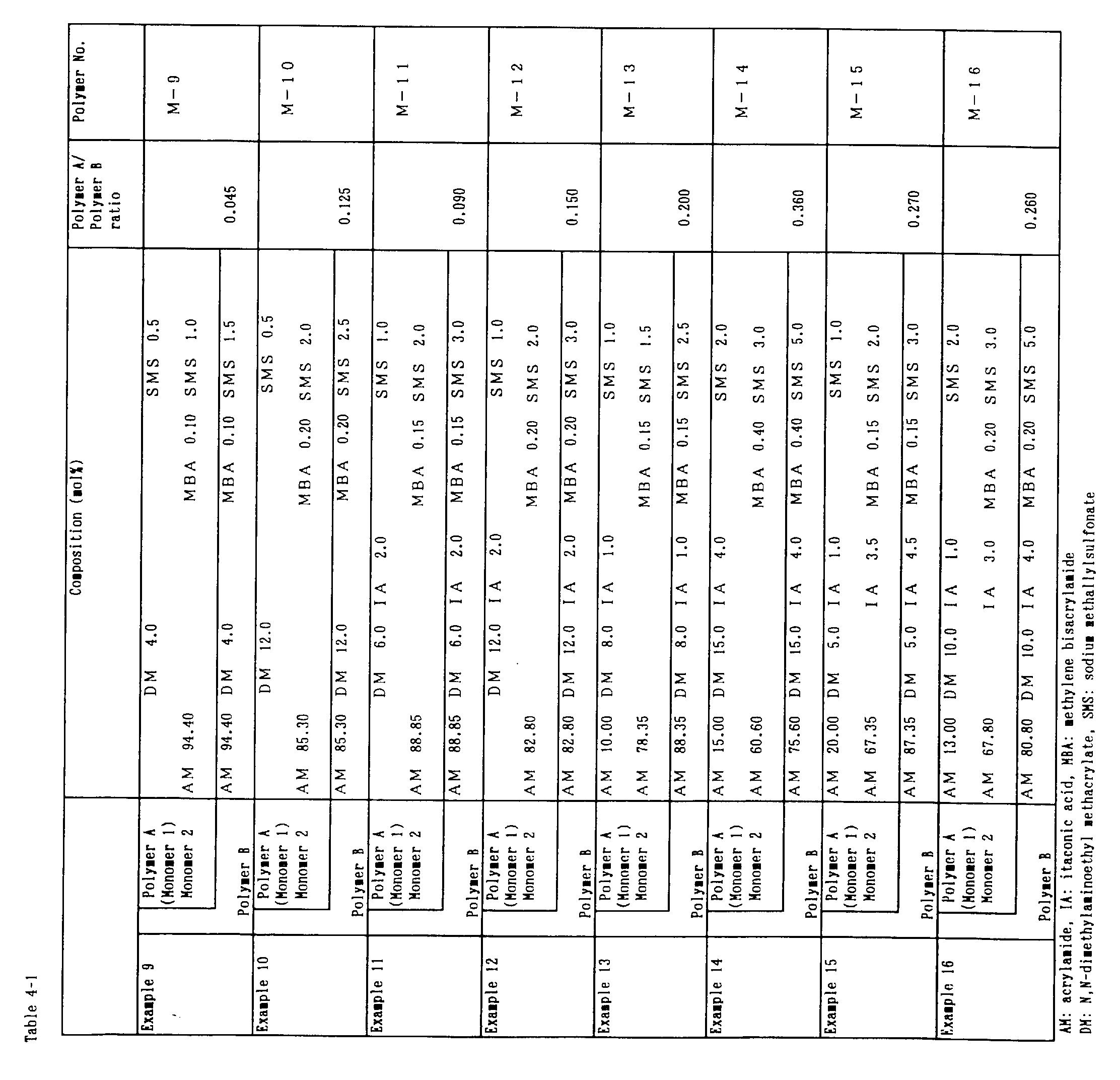

Polymer No. Viscosity (ps/25 °C) Molecular Weight (104) M-9 51. 7 246 M-10 60. 2 346 M-11 38. 3 236 M-12 56. 2 344 M-13 58. 0 294 M-14 80. 9 392 M-15 41. 0 309 M-16 36. 7 377 N-9 93. 9 62. 9 N-10 119. 0 77. 5 N-11 78. 5 97. 4 N-12 103. 0 91. 3 N-13 92. 5 90. 4 N-14 117. 0 71. 2 N-15 77. 1 90. 3 N-16 72. 3 171 - Application Examples will be described, in which the polymers from Examples 9 to 16 and Comparative Examples 9 to 16 were used as an internal paper strength agent.
- To a 1% slurry with a CSF of 355 obtained from waste corrugated papers was added aluminum sulfate in an amount of 1 % to the pulp, and then the mixture was stirred for 3 min. The pH of the pulp slurry was 6.0. A 1 % aqueous solution of the polymer M-9 was added in an amount of 0.5 % to the pulp on nonvolatile-component basis with stirring, and the mixture was further stirred for 3 min. Then, the freeness of the resulting pulp slurry was determined(JIS-P8121) and it was used to make a paper with a TAPPI standard (square) sheet machine. The wet sheet thus made was dried in a drum dryer at 110 °C for 3 min, to give a hand-made paper with a basis weight of 100 g/m2. The dried paper was subject to humidity control in an air-conditioned chamber at 20 °C and RH 65 % for at least 24 hours, and its burst index(JIS-P8112) and Z-axis directional strength(Internal Bond Tester; Kumagaya Riki Kogyo) were determined. The polymers M-10 to M-16 and N-9 to N-16 were processed and evaluated as described above. The results are shown in Table 6.
Polymer No. Freeness Burst index Z-directional strength (kg·cm) Appl. Example 9 M-9 422 4. 71 4. 48 Appl. Example 10 M-10 435 4. 75 4. 78 Appl. Example 11 M-11 451 4. 67 4. 54 Appl. Example 12 M-12 449 4. 72 4. 65 Appl. Example 13 M-13 453 4. 83 4. 47 Appl. Example 14 M-14 420 4. 88 4. 79 Appl. Example 15 M-15 464 4. 70 4. 81 Appl. Example 16 M-16 469 4. 82 4. 72 Comp.Appl.Ex. 9 N-9 352 3. 86 3. 74 Comp.Appl.Ex. 10 N-10 348 3. 99 3. 81 Comp.Appl.Ex. 11 N-11 393 3. 89 3. 88 Comp.Appl.Ex. 12 N-12 369 3. 97 3. 93 Comp.Appl.Ex. 13 N-13 408 3. 77 3. 78 Comp.Appl.Ex. 14 N-14 362 3. 94 3. 93 Comp.Appl.Ex. 15 N-15 375 3. 91 3. 87 Comp.Appl.Ex. 16 N-16 402 3. 98 3. 99 None 359 3.68 3.52 - In the above reaction vessel was placed 373.48 g of purified water, and then the internal temperature was adjusted to 80 °C while introducing nitrogen gas.
- A solution of 307.51 g of 50 % acrylamide, 170.84 g of 70 % methacryloyloxyethyl-dimethyl-benzylammonium chloride, 7.31 g of itaconic acid and 8.89 g of sodium methallylsulfonate whose pH was adjusted to 3.5 with 35 % HCl and an aqueous solution(60 g) of 0.49 g of 4,4'-azobis-4-cyanovaleric acid(purity: 84 %) were prepared, and simultaneously added dropwise at constant rates into the reaction vessel over 300 min, maintaining the internal temperature at 80 °C. After addition, polymerization was continued at 80 °C for 4 hours and then 0.4 g of hydroquinone was added, to provide a polymer, which is designated as m-17.
- All the amount of m-17 was added into the above reaction vessel, whose internal temperature was then adjusted to 80 °C while introducing nitrogen gas. A solution of 2.17 g of methylene bisacrylamide, 7.59 g of 80 % acrylic acid and 2.22 g of sodium methallylsulfonate whose pH was adjusted to 3.5 with 35 % HCl and an aqueous solution(60 g) of 0.09 g of 4,4'-azobis-4-cyanovaleric acid(purity: 84 %) were prepared and simultaneously added dropwise at constant rates into the reaction vessel over 10 min, maintaining the internal temperature at 80 °C. After addition, polymerization was continued at 80 °C for 3 hours, to provide a polymer B. While cooling the polymer solution the proportion of the nonvolatile component was adjusted by adding water, to give an aqueous solution of an amphoteric polymer containing 30 % of the nonvolatile component with a Brookfield viscosity of 15400 cps at 25 °C. The polymer is designated as M-17.
- The weight-average molecular weight of M-17 by GPC-MALLS was 6,500,000.
- In the above reaction vessel was placed 158.10 g of purified water, and then the internal temperature was adjusted to 80 °C while introducing nitrogen gas.
- A solution of 385.67 g of 50 % acrylamide, 191.34 g of 75 % acryloyloxyethyl-dimethyl-benzylammonium chloride, 64.39 g of 80 % acryloyloxyethyl-trimethylammonium chloride, 13.84 g of itaconic acid and 16.82 g of sodium methallylsulfonate whose pH was adjusted to 4.2 with 35 % HCl and an aqueous solution(72 g) of 0.59 g of 4,4'-azobis-4-cyanovaleric acid(purity: 84 %) were prepared, and simultaneously added dropwise at constant rates into the reaction vessel over 200 min, maintaining the internal temperature at 80 °C. After addition, polymerization was continued at 80 °C for 3 hours. Methanol was added to provide a precipitate, which was then dried to give a polymer designated as m-18.
- In the above reaction vessel was placed 403.03g of purified water and 174.63g of the dried polymer m-18 and the solution was adjusted to pH 4.2 with 35 % HCl and then internal temperature was adjusted to 80°C while introducing nitrogen gas.
- A solution of 174.63 g of the polymer m-18, 173.93 g of 50 % acrylamide, 2.73 g of methylene bisacrylamide, 11.53 g of itaconic acid and 0.10 g of sodium hypophosphite whose pH was adjusted to 4.2 with 35 % HCl and an aqueous solution(60 g) of 0.17 g of 4,4'-azobis-4-cyanovaleric acid(purity: 84 %) were prepared and simultaneously added dropwise at constant rates into the reaction vessel over 180 min, maintaining the internal temperature at 80 °C. After addition, polymerization was continued at 80 °C for 3 hours, to provide a polymer B. While cooling the polymer solution the proportion of the nonvolatile component was adjusted by adding water, to give an aqueous solution of an amphoteric polymer containing 45 % of the nonvolatile component with a Brookfield viscosity of 13640 cps at 25 °C. The polymer is designated as M-18.
- The weight-average molecular weight of M-18 by GPC-MALLS was 5,910,000.
- In the above reaction vessel was placed 613.73 g of purified water, and then the internal temperature was adjusted to 80 °C while introducing nitrogen gas.
- A solution of 93.52 g of 50 % acrylamide, 71.53 g of 60 % methacryloyloxyethyl-dimethyl-benzylammonium chloride, 11.81 g of N,N-dimethylaminopropylacrylamide and 3.59 g of sodium methallylsulfonate whose pH was adjusted to 4.2 with 35 % HCl and an aqueous solution(60 g) of 0.49 g of 4,4'-azobis-4-cyanovaleric acid(purity: 84 %) were prepared, and simultaneously added dropwise at constant rates into the reaction vessel over 180 min, maintaining the internal temperature at 80 °C. After addition, polymerization was continued at 80 °C for 3 hours, 0.4 g of hydroquinone was added and the mixture was cooled to provide an aqueous solution of a polymer designated as m-19.
- In a Dewar vessel was placed all the aqueous solution of the polymer m-19, 81.80 g of 50 % acrylamide, 2.95 g of itaconic acid, 0.12 g of methylene bisacrylamide, and 0.96 g of sodium hypophosphite, and the solution was adjusted to pH 4.2 with 35 % HCl and heated to 65 °C. An aqueous solution(30 g) of 0.13 g of ammonium persulfate and an aqueous solution(30 g) of 0.08 g of sodium hydrogensulfite were prepared and separately added into the Dewar vessel. The polymer solution was heated to 80 °C and then the internal temperature was kept at 80 °C for 4 hours. While cooling the polymer solution the proportion of the nonvolatile component was adjusted by adding water, to give an aqueous solution of an amphoteric polymer containing 15 % of the nonvolatile component with a Brookfield viscosity of 18730 cps at 25 °C. The polymer is designated as M-19.
- The weight-average molecular weight of M-19 by GPC-MALLS was 6,930,000.
- In the above reaction vessel was placed 375.81 g of purified water, and then the internal temperature was adjusted to 80 °C while introducing nitrogen gas.
- A solution of 144.04 g of 50 % acrylamide, 72.61 g of 60 % methacryloyloxyethyl-dimethyl-benzylammonium chloride, 39.86 g of 80 % methacryloyloxyethyl-trimethylammonium chloride, 21.98 g of N,N-dimethylaminoethyl acrylate and 9.71 g of sodium methallylsulfonate whose pH was adjusted to 4.5 with 35 % HCl and an aqueous solution(60 g) of 0.49 g of 4,4'-azobis-4-cyanovaleric acid(purity: 84 %) were prepared, and simultaneously added dropwise at constant rates into the reaction vessel over 120 min, maintaining the internal temperature at 80 °C. After addition, polymerization was continued at 80 °C for 3 hours, to give a polymer designated as m-20.
- A solution of 190.30 g of 50 % acrylamide, 7.99 g of itaconic acid, 1.89 g of methylene bisacrylamide, 6.09 g of N,N-dimethylacrylamide and 9.71 g of sodium methallylsulfonate whose pH was adjusted to 4.5 with 35 % HCl and an aqueous solution(60 g) of 0.49 g of 4,4'-azobis-4-cyanovaleric acid(purity: 84 %) were prepared and simultaneously added dropwise at constant rates into the reaction vessel over 120 min, maintaining the internal temperature at 90 °C. After addition, polymerization was continued at 90 °C for 3 hours, to provide a polymer B. While cooling the polymer solution the proportion of the nonvolatile component was adjusted by adding water, to give an aqueous solution of an amphoteric polymer containing 30 % of the nonvolatile component with a Brookfield viscosity of 3040 cps at 25 °C. The polymer is designated as M-20.
- The weight-average molecular weight of M-20 by GPC-MALLS was 3,110,000.
- In the above reaction vessel was placed 373.48 g of purified water, and then the internal temperature was adjusted to 80 °C while introducing nitrogen gas.
- A solution of 307.51 g of 50 % acrylamide, 170.84 g of 70 % methacryloyloxyethyl-dimethyl-benzylammonium chloride, 7.59 g of 80 % acrylic acid, 7.31 g of itaconic acid, 2.17 g of methylene bisacrylamide and 11.11 g of sodium methallylsulfonate whose pH was adjusted to 3.5 with 35 % HCl and an aqueous solution(120 g) of 0.49 g of 4,4'-azobis-4-cyanovaleric acid(purity: 84 %) were prepared, and simultaneously added dropwise at constant rates into the reaction vessel over 300 min, maintaining the internal temperature at 80 °C. After addition, polymerization was continued at 80 °C for 4 hours. While cooling the polymer solution the proportion of the nonvolatile component was adjusted by adding water, to give an aqueous solution of an amphoteric polymer containing 30 % of the nonvolatile component with a Brookfield viscosity of 18180 cps at 25 °C. The polymer is designated as N-17.
- The weight-average molecular weight of N-17 by GPC-MALLS was 2,950,000.
- In the above reaction vessel was placed 131.75 g of purified water, and then the internal temperature was adjusted to 80 °C while introducing nitrogen gas.
- A solution of 495.32 g of 50 % acrylamide, 159.45 g of 75 % acryloyloxyethyl-dimethyl-benzylammonium chloride, 53.66 g of 80 % acryloyloxyethyl-trimethylammonium chloride, 23.07 g of itaconic acid, 2.73 g of methylene bisacrylamide, 14.02 g of sodium methallylsulfonate and 0.10 g of sodium hypophosphite whose pH was adjusted to 4.2 with 35 % HCl and an aqueous solution(120 g) of 0.49 g of 4,4'-azobis-4-cyanovaleric acid(purity: 84 %) were prepared, and simultaneously added dropwise at constant rates into the reaction vessel over 380 min, maintaining the internal temperature at 80 °C. After addition, polymerization was continued at 80 °C for 5 hours. While cooling the polymer solution the proportion of the nonvolatile component was adjusted by adding water, to give an aqueous solution of an amphoteric polymer containing 45 % of the nonvolatile component with a Brookfield viscosity of 18690 cps at 25 °C. The polymer is designated as N-18.
- The weight-average molecular weight of N-18 by GPC-MALLS was 2,840,000.
- In the above reaction vessel was placed 613.73 g of purified water, and then the internal temperature was adjusted to 80 °C while introducing nitrogen gas.
- A solution of 175.32 g of 50 % acrylamide, 71.53 g of 60 % methacryloyloxyethyl-dimethyl-benzylammonium chloride, 11.81 g of N,N-dimethylaminopropylacrylamide, 2.95 g of itaconic acid, 0.12 g of methylene bisacrylamide and 4.54 g of sodium methallylsulfonate whose pH was adjusted to 4.2 with 35 % HCl and an aqueous solution(120 g) of 0.49 g of 4,4'-azobis-4-cyanovaleric acid(purity: 84 %) were prepared, and simultaneously added dropwise at constant rates into the reaction vessel over 360 min, maintaining the internal temperature at 80 °C. After addition, polymerization was continued at 80 °C for 4 hours. While cooling the polymer solution the proportion of the nonvolatile component was adjusted by adding water, to give an aqueous solution of an amphoteric polymer containing 15 % of the nonvolatile component with a Brookfield viscosity of 15050 cps at 25 °C. The polymer is designated as N-19.
- The weight-average molecular weight of N-19 by GPC-MALLS was 2,530,000.
- In the above reaction vessel was placed 375.81 g of purified water, and then the internal temperature was adjusted to 80 °C while introducing nitrogen gas.
- A solution of 334.34 g of 50 % acrylamide, 72.61 g of 60 % methacryloyloxyethyl-dimethyl-benzylammonium chloride, 39.86 g of 80 % methacryloyloxyethyl-trimethylammonium chloride, 21.98 g of N,N-dimethylaminoethyl acrylate, 6.09 g of N,N-dimethylacrylamide, 7.99 g of itaconic acid, 1.89 g of methylene bisacrylamide and 19.42 g of sodium methallylsulfonate whose pH was adjusted to 4.5 with 35 % HCl and an aqueous solution(120 g) of 0.49 g of 4,4'-azobis-4-cyanovaleric acid(purity: 84 %) were prepared, and simultaneously added dropwise at constant rates into the reaction vessel over 240 min, maintaining the internal temperature at 80 °C. After addition, polymerization was continued at 80 °C for 4 hours. While cooling the polymer solution the proportion of the nonvolatile component was adjusted by adding water, to give an aqueous solution of an amphoteric polymer containing 30 % of the nonvolatile component with a Brookfield viscosity of 3560 cps at 25 °C. The polymer is designated as N-20.
- The weight-average molecular weight of N-20 by GPC-MALLS was 1,320,000.
- The compositions and the physical properties of the polymers from Examples 17 to 20 and Comparative Examples 17 to 20 are summarized in Tables 7 and 8.
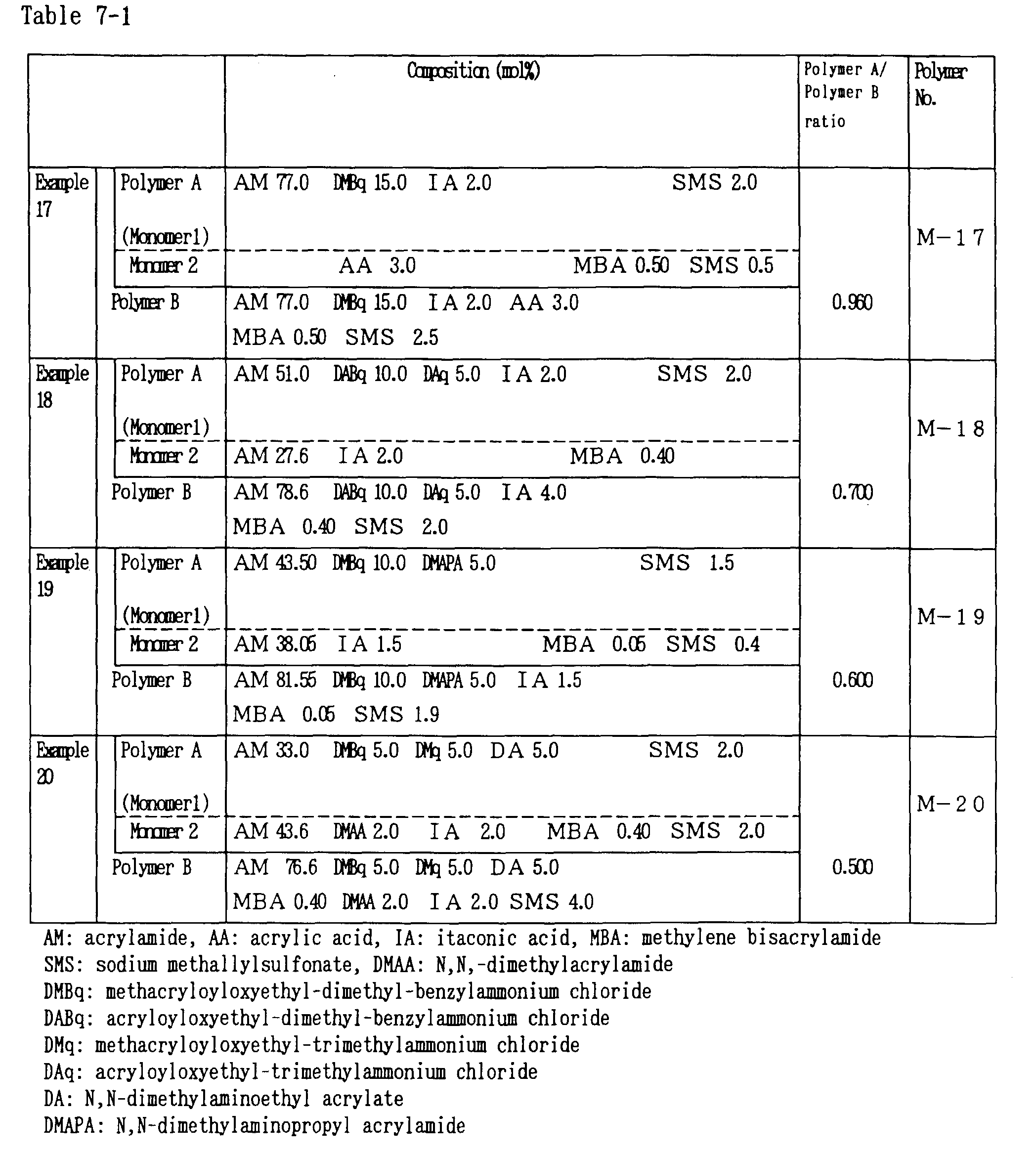
Composition (mol%) Polymer A/ Polymer B ratio Polymer No. Comp. Example 17 AM 77.0 DMBq 15.0 IA 2.0 AA 3.0
MBA 0.50 SMS 2.5- N-17 Comp. Example 18 AM 78.6 DABq 10.0 DAq 5.0 IA 4.0
MBA 0.40 SMS 2.0- N-18 Comp. Example 19 AM 81.55 DMBq 10.0 DMAPA 2.0 IA 1.5
MBA 0.05 SMS 1.9- N-19 Comp. Example 20 AM 76.6 DMBq 5.0 DMq 5.0 DA 5.0
MBA 0.40 DMAA 2.0 IA 2.0 SMS 4.0- N-20 AM: acrylamide, AA: acrylic acid, IA: itaconic acid, MBA: methylene bisacrylamide SMS: sodium methallylsulfonate, DMAA; N,N,-dimethylacrylamide DMBq: methacryloyloxyethyl-dimethyl-benzylammonium chloride DABq: acryloyloxyethyl-dimethyl-benzylammonium chloride DMq: methacryloyloxyethyl-trimethylammonium chloride DAq: acryloyloxyethyl-trimethylammonium chloride DA: N,N-dimethylaminoethyl acrylate DMAPA: N,N-dimethylaminopropyl acrylamide Polymer No. Viscosity (ps/25 °C) Concentration (%) Molecular Weight (104) M-17 154. 0 30. 0 650 M-18 136. 4 45. 0 591 M-19 187. 3 15. 0 693 M-20 30. 4 30. 0 311 N-17 181. 8 30. 0 295 N-18 186. 9 45. 0 284 N-19 150. 5 15. 0 253 N-20 35. 6 30. 0 132 - Application Examples will be described, in which the polymers from Examples 17 to 20 and Comparative Examples 17 to 20 were used as an internal paper strength agent.
- To a stirred 1% slurry, pH 7.5, with a CSF of 222 obtained from waste corrugated papers was added a 1 % aqueous solution of the polymer M-17 in an amount of 0.5 % to the pulp, and then the mixture was stirred for 3 min. Then, the freeness of the resulting pulp slurry was determined(JIS-P8121) and it was used to make a paper with a TAPPI standard (square) sheet machine. The wet sheet thus made was dried in a drum dryer at 110 °C for 3 min, to give a hand-made paper with a basis weight of 140 g/m2. The dried paper was subject to humidity control in an air-conditioned chamber at 20 °C and RH 65 % for at least 24 hours, and its burst index(JIS-P8112) and Z-axis directional strength(Internal Bond Tester; Kumagaya Riki Kogyo) were determined. The polymers M-18 to M-20 and N-17 to N-20 were processed and evaluated as described above. The results are shown in Table 9.
(Papermaking pH 7.5) Polymer No. Freeness Burst index Z-directional strength (kg·cm) Appl. Example 17 M-17 242 3. 71 4. 88 Appl. Example 18 M-18 255 3. 75 4. 78 Appl. Example 19 M-19 251 3. 67 5. 09 Appl. Example 20 M-20 249 3. 72 4. 75 Comp.Appl.Ex.17 N-17 232 2. 86 3. 98 Comp.Appl.Ex.18 N-18 228 2. 99 3. 87 Comp.Appl.Ex. 19 N-19 233 2. 89 3. 80 Comp.Appl.Ex.20 N-20 219 2. 97 3. 90 None 222 2. 50 3. 62 - In the above reaction vessel was placed 257.05 g of purified water, and then the internal temperature was adjusted to 80 °C while introducing nitrogen gas.
- A solution of 307.38 g of 80 % acryloyloxyethyl-trimethylammonium chloride and 4.10 g of sodium methallylsulfonate whose pH was adjusted to 4.2 with 35 % HCl and an aqueous solution(60 g) of 0.98 g of 4,4'-azobis-4-cyanovaleric acid(purity: 84 %) were prepared, and simultaneously added dropwise at constant rates into the reaction vessel over 180 min, maintaining the internal temperature at 80 °C. After addition, polymerization was continued at 80 °C for 3 hours, to give a polymer designated as m-21.
- A solution of 307.38 g of 80 % acryloyloxyethyl-trimethylammonium chloride and 4.10 g of sodium methallylsulfonate whose pH was adjusted to 4.2 with 35 % HCl and an aqueous solution(60 g) of 0.98 g of 4,4'-azobis-4-cyanovaleric acid(purity: 84 %) were prepared and simultaneously added dropwise at constant rates into the reaction vessel over 180 min, maintaining the internal temperature at 80 °C. After addition, polymerization was continued at 80 °C for 3 hours, to provide a polymer B. While cooling the polymer solution the proportion of the nonvolatile component was adjusted by adding water, to give an aqueous solution of a polymer containing 50 % of the nonvolatile component with a Brookfield viscosity of 7600 cps at 25 °C. The polymer is designated as M-21.
- In the above reaction vessel was placed 257.05 g of purified water, and then the internal temperature was adjusted to 80 °C while introducing nitrogen gas.
- A solution of 614.75 g of 80 % acryloyloxyethyl-trimethylammonium chloride and 8.20 g of sodium methallylsulfonate whose pH was adjusted to 4.5 with 35 % HCl and an aqueous solution(120 g) of 0.98 g of 4,4'-azobis-4-cyanovaleric acid(purity: 84 %) were prepared, and simultaneously added dropwise at constant rates into the reaction vessel over 360 min, maintaining the internal temperature at 80 °C. After addition, polymerization was continued at 80 °C for 4 hours to give a polymer B. While cooling the polymer solution the proportion of the nonvolatile component was adjusted by adding water, to give an aqueous solution of an amphoteric polymer containing 50 % of the nonvolatile component with a Brookfield viscosity of 8050 cps at 25 °C. The polymer is designated as N-21.
- The compositions and the physical properties of the polymers from example 21 and Comparative example 21 are summarized in Tables 10 and 11.
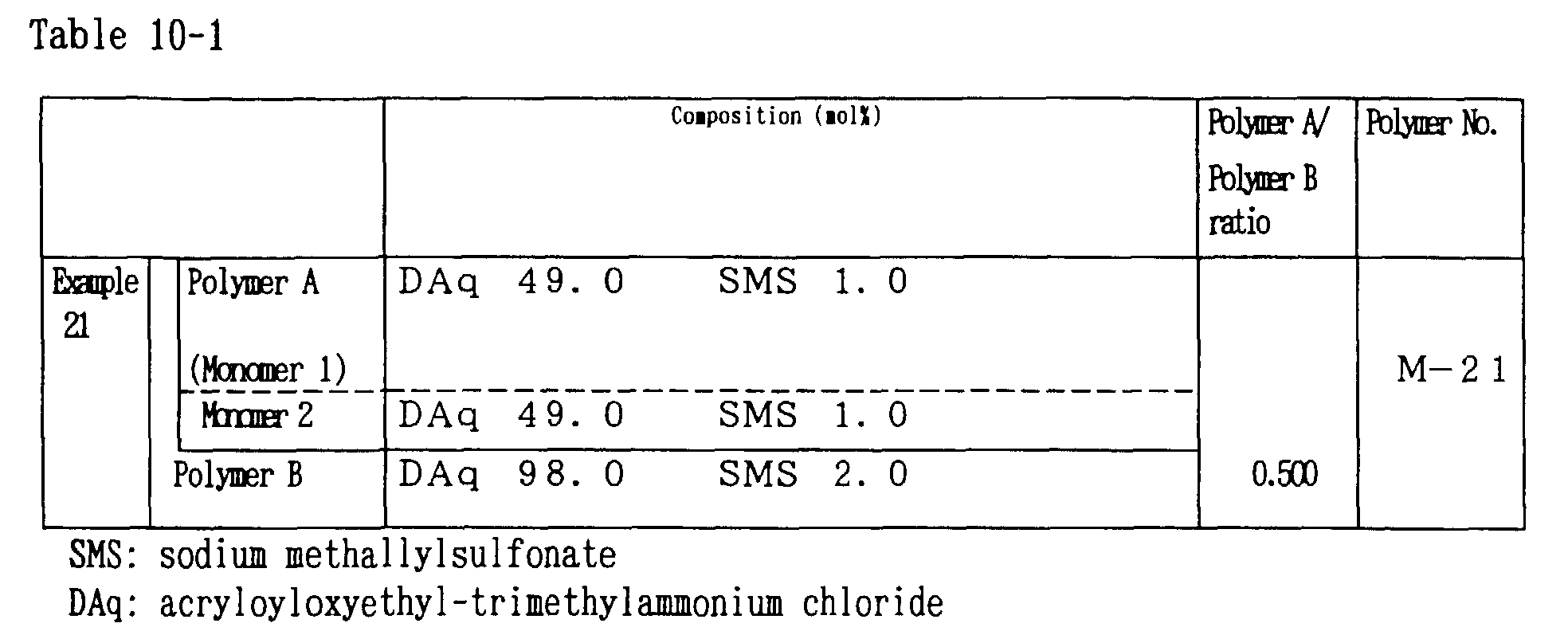
Composition (mol%) Polymer A/ Polymer B ratio Polymer No. Comp. Example 21 DAq 98. 0 SMS 2. 0 - N-21 Polymer No. Viscosity (ps/25 °C) Concentration (%) M-21 76. 0 50. 0 N-21 80. 5 50. 0 - To a stirred 1% slurry with a CSF of 376 obtained from waste corrugated papers was added aluminum sulfate in an amount of 1.0 % to the pulp, and the mixture was stirred for 3 min. The pH of the pulp slurry was 5.5. A 1 % aqueous solution of the polymer M-21 was added with stirring in an amount of 0.05 % to the pulp on nonvolatile-component basis, and then the mixture was stirred for 3 min. Then, the freeness of the resulting pulp slurry was determined(JIS-P8121) and it was used to make a paper with a TAPPI standard (square) sheet machine. The wet sheet thus made was dried in a drum dryer at 110 °C for 3 min, to give a hand-made paper with a basis weight of 120 g/m2. The dried paper was subject to humidity control in an air-conditioned chamber at 20 °C and RH 65 % for at least 24 hours, and its burst index(JIS-P8112) and Z-axis directional strength(Internal Bond Tester; Kumagaya Riki Kogyo) were determined. The polymer N-21 was processed and evaluated as described above. The results are shown in Table 12.
(Papermaking pH 5.5) Polymer No. Freeness Burst index Z-directional strength (kg·cm) Appl.Example 21 M-21 552 2. 47 1. 74 Comp.Appl.Ex.21 N-21 435 2. 00 1. 43 None 376 2. 00 1. 39 - The measuring conditions for GPC-MALLS in the Examples and the Comparative Examples below are as follows
- GPC body: System 21, Showa Denko K.K.;
- Column: SHODEX OHpak SB-806MHQ;
- Eluent: a N/15 phosphate buffer(pH 7) containing N/10 sodium nitrate;
- Flow rate: 1.0 mL/min;
- Detector: a multi-angle light scattering detector DAWN, Wyatt Technology Company.
-
- In a five-necked flask equipped with an agitator, a reflux condenser, a thermometer, a nitrogen-inlet tube and a dropping inlet (hereinafter, referred to as a "reaction vessel") was placed 184 g of ion exchanged water, and after replacing the atmosphere with nitrogen, the internal temperature was adjusted to 80 °C with a heater(waterbath).
- A solution of 22.0 g of 80 % acrylic acid, 9.88 g of sodium methallylsulfonate and 231 g of 50 % acrylamide whose pH was adjusted to 4.5 with 20 % sodium hydroxide and an aqueous solution(52 g) of 0.408 g of potassium persulfate were prepared, and simultaneously added dropwise at constant rates into the reaction vessel over 30 min, maintaining the internal temperature at 80 °C. After addition, polymerization was continued at 80 °C for 1 hour, to provide a polymer A.
- Subsequently a solution of 299 g of 50 % acrylamide, 0.627 g of methylene bisacrylamide and 4.5 g of sodium methallylsulfonate and an aqueous solution(100 g) of 0.112 g of potassium persulfate were prepared and simultaneously added dropwise at constant rates into the reaction vessel over 120 min, maintaining the internal temperature at 80 °C. After addition, polymerization was continued at 80 °C for 2 hours, to provide a polymer B. While cooling the polymer solution the proportion of the nonvolatile component was adjusted by adding water, to give an aqueous solution of an anionic acrylamide polymer containing 30 % of the nonvolatile component with a Brookfield viscosity of 3600 mPa·s at 25 °C. The polymer is designated as P-1.
- The weight-average molecular weight of P-1 by GPC-MALLS was 860,000.
- In the reaction vessel was placed 178 g of ion exchanged water, and after replacing the atmosphere with nitrogen, the internal temperature was adjusted to 80 °C with a heater(waterbath).
- A solution of 17.6 g of 80 % acrylic acid, 12.3 g of sodium methallylsulfonate and 370 g of 50 % acrylamide whose pH was adjusted to 4.5 with 20 % sodium hydroxide and an aqueous solution(80 g) of 0.3 g of potassium persulfate were prepared, and simultaneously added dropwise at constant rates into the reaction vessel over 120 min, maintaining the internal temperature at 80 °C. After addition, polymerization was continued at 80 °C for 1 hour, to provide a polymer A.
- Subsequently a solution of 53 g of 50 % acrylamide and 0.501 g of methylene bisacrylamide and an aqueous solution(41 g) of 0.14 g of potassium persulfate were prepared and simultaneously added dropwise at constant rates into the reaction vessel over 30 min, maintaining the internal temperature at 80 °C. After addition, polymerization was continued at 80 °C for 2 hours, to provide a polymer B. While cooling the polymer solution the proportion of the nonvolatile component was adjusted by adding water, to give an aqueous solution of an anionic acrylamide polymer containing 30 % of the nonvolatile component with a Brookfield viscosity of 8100 mPa·s at 25 °C. The polymer is designated as P-2.
- The weight-average molecular weight of P-2 by GPC-MALLS was 3,710,000.
- In the reaction vessel was placed 175 g of ion exchanged water, and after replacing the atmosphere with nitrogen, the internal temperature was adjusted to 80 °C with a heater(waterbath).
- A solution of 8.77 g of 80 % acrylic acid, 13.9 g of sodium methallylsulfonate and 369 g of 50 % acrylamide whose pH was adjusted to 4.5 with 20 % sodium hydroxide and an aqueous solution(80 g) of 0.3 g of potassium persulfate were prepared, and simultaneously added dropwise at constant rates into the reaction vessel over 120 min, maintaining the internal temperature at 80 °C. After addition, polymerization was continued at 80 °C for 1 hour, to provide a polymer A.
- Subsequently a solution of 65.5 g of 50 % acrylamide and 0.5 g of methylene bisacrylamide and an aqueous solution(41 g) of 0.14 g of potassium persulfate were prepared and simultaneously added dropwise at constant rates into the reaction vessel over 30 min, maintaining the internal temperature at 80 °C. After addition, polymerization was continued at 80 °C for 2 hours, to provide a polymer B. While cooling the polymer solution the proportion of the nonvolatile component was adjusted by adding water, to give an aqueous solution of an anionic acrylamide polymer containing 30 % of the nonvolatile component with a Brookfield viscosity of 5900 mPa·s at 25 °C. The polymer is designated as P-3.
- The weight-average molecular weight of P-3 by GPC-MALLS was 3,230,000.
- In the reaction vessel was placed 184 g of ion exchanged water, and after replacing the atmosphere with nitrogen, the internal temperature was adjusted to 80 °C with a heater(waterbath).
- A solution of 35.1 g of 80 % acrylic acid, 10.6 g of sodium methallylsulfonate and 369 g of 50 % acrylamide whose pH was adjusted to 4.5 with 20 % sodium hydroxide and an aqueous solution(80 g) of 0.3 g of potassium persulfate were prepared, and simultaneously added dropwise at constant rates into the reaction vessel over 120 min, maintaining the internal temperature at 80 °C. After addition, polymerization was continued at 80 °C for 1 hour, to provide a polymer A.
- Subsequently a solution of 26.9 g of 50 % acrylamide and 0.501 g of methylene bisacrylamide and an aqueous solution(41 g) of 0.14 g of potassium persulfate were prepared and simultaneously added dropwise at constant rates into the reaction vessel over 30 min, maintaining the internal temperature at 80 °C. After addition, polymerization was continued at 80 °C for 2 hours, to provide a polymer B. While cooling the polymer solution the proportion of the nonvolatile component was adjusted by adding water, to give an aqueous solution of an anionic acrylamide polymer containing 30 % of the nonvolatile component with a Brookfield viscosity of 5000 mPa·s at 25 °C. The polymer is designated as P-4.
- The weight-average molecular weight of P-4 by GPC-MALLS was 1,560,000.
- In the reaction vessel was placed 186 g of ion exchanged water, and after replacing the atmosphere with nitrogen, the internal temperature was adjusted to 80 °C with a heater(waterbath).
- A solution of 23.5 g of itaconic acid, 7.84 g of sodium methallylsulfonate and 256 g of 50 % acrylamide whose pH was adjusted to 6 with 40 % sodium hydroxide and an aqueous solution(41 g) of 0.2 g of potassium persulfate were prepared, and simultaneously added dropwise at constant rates into the reaction vessel over 60 min, maintaining the internal temperature at 80 °C. After addition, polymerization was continued at 80 °C for 1 hour, to provide a polymer A.
- Subsequently a solution of 136 g of 50 % acrylamide, 0.463 g of methylene bisacrylamide and 1.54 g of sodium methallylsulfonate and an aqueous solution(80 g) of 0.24 g of potassium persulfate were prepared and simultaneously added dropwise at constant rates into the reaction vessel over 120 min, maintaining the internal temperature at 80 °C. After addition, polymerization was continued at 80 °C for 2 hours, to provide a polymer B. While cooling the polymer solution the proportion of the nonvolatile component was adjusted by adding water, to give an aqueous solution of an anionic acrylamide polymer containing 30 % of the nonvolatile component with a Brookfield viscosity of 6250 mPa·s at 25 °C. The polymer is designated as P-5.
- The weight-average molecular weight of P-5 by GPC-MALLS was 5,340,000.
- In the reaction vessel was placed 185 g of ion exchanged water, and after replacing the atmosphere with nitrogen, the internal temperature was adjusted to 80 °C with a heater(waterbath).
- A solution of 23.7 g of itaconic acid, 5.52 g of sodium methallylsulfonate and 388 g of 50 % acrylamide whose pH was adjusted to 6 with 40 % sodium hydroxide and an aqueous solution(80 g) of 0.3 g of potassium persulfate were prepared, and simultaneously added dropwise at constant rates into the reaction vessel over 120 min, maintaining the internal temperature at 80 °C. After addition, polymerization was continued at 80 °C for 1 hour, to provide a polymer A.
- Subsequently a solution of 3.23 g of 50 % acrylamide, 0.468 g of methylene bisacrylamide and 5.46 g of 80 % acrylic acid and an aqueous solution(41 g) of 0.14 g of potassium persulfate were prepared and simultaneously added dropwise at constant rates into the reaction vessel over 30 min, maintaining the internal temperature at 80 °C. After addition, polymerization was continued at 80 °C for 2 hours, to provide a polymer B. While cooling the polymer solution the proportion of the nonvolatile component was adjusted by adding water, to give an aqueous solution of an anionic acrylamide polymer containing 30 % of the nonvolatile component with a Brookfield viscosity of 5420 mPa·s at 25 °C. The polymer is designated as P-6.
- The weight-average molecular weight of P-6 by GPC-MALLS was 1,230,000.
- In the reaction vessel was placed 178 g of ion exchanged water, and after replacing the atmosphere with nitrogen, the internal temperature was adjusted to 80 °C with a heater(waterbath).
- A solution of 12.2 g of itaconic acid, 10.3 g of sodium methallylsulfonate and 356 g of 50 % acrylamide whose pH was adjusted to 6 with 40 % sodium hydroxide and an aqueous solution(41 g) of 0.24 g of potassium persulfate were prepared, and simultaneously added dropwise at constant rates into the reaction vessel over 60 min, maintaining the internal temperature at 80 °C. After addition, polymerization was continued at 80 °C for 1 hour, to provide a polymer A.
- Subsequently a solution of 65.7 g of 50 % acrylamide, 0.483 g of methylene bisacrylamide and 0.421 g of sodium methallylsulfonate and an aqueous solution(80 g) of 0.2 g of potassium persulfate were prepared and simultaneously added dropwise at constant rates into the reaction vessel over 120 min, maintaining the internal temperature at 80 °C. After addition, polymerization was continued at 80 °C for 2 hours, to provide a polymer B. While cooling the polymer solution the proportion of the nonvolatile component was adjusted by adding water, to give an aqueous solution of an anionic acrylamide polymer containing 30 % of the nonvolatile component with a Brookfield viscosity of 5250 mPa·s at 25 °C. The polymer is designated as P-7.
- The weight-average molecular weight of P-7 by GPC-MALLS was 3,620,000.
- In the reaction vessel were placed 165 g of ion exchanged water, 76 g of 40 % acrylamide, 11.2 g of acrylonitrile and 3.68 g of 80 % acrylic acid, and the internal temperature was adjusted to 35 °C with a heater(waterbath). Into the vessel were added 0.456 g of potassium persulfate and after 6 min an aqueous solution(0.75 g) of 0.046 g of sodium hydrogensulfite to initiate a polymerization reaction. Ninety(90) minutes after the initiation of the polymerization, solution(0.56g) of 0.14 g of sodium hydrogensulfite was added, and the mixture was allowed to stand for 30 min. While cooling the polymer solution 25.9 g of water and then 25 % sodium hydroxide for pH adjustment were added, and then the proportion of the nonvolatile component were adjusted to 15 % by adding water, to give an aqueous solution of an anionic acrylamide polymer with a Brookfield viscosity of 5200 mPa·s at 25 °C. The polymer is designated as Q-1.
- The weight-average molecular weight of Q-1 by GPC-MALLS was 200,000.
- In the reaction vessel were placed 73.9 g of ion exchanged water, and after replacing the atmosphere with nitrogen, the internal temperature was adjusted to 80 °C with a heater(waterbath).
- A solution of 7.1 g of 80 % acrylic acid, 4.15 g of sodium methallylsulfate, 172 g of 50 % acrylamide and 0.182 g of methylene bisacrylamide in 13.6 g of ion exchanged water and an aqueous solution(13.01 g) of 0.096 g of potassium persulfate were prepared and simultaneously added dropwise at constant rates into the reaction vessel over 150 min, maintaining the internal temperature at 80 °C. After addition, polymerization was continued at 80 °C for 2 hours. While cooling the polymer solution the proportion of the nonvolatile component were adjusted by adding water, to give an aqueous solution of an anionic acrylamide polymer containing 30 % of the nonvolatile component with a Brookfield viscosity of 3500 mPa·s at 25 °C. The polymer is designated as Q-2.
- The weight-average molecular weight of Q-2 by GPC-MALLS was 1,040,000.
- In the reaction vessel were placed 80.5 g of ion exchanged water, and after replacing the atmosphere with nitrogen, the internal temperature was adjusted to 80 °C with a heater(waterbath).
- A solution of 4.95 g of itaconic acid, 1.52 g of sodium methallylsulfate, 157 g of 50 % acrylamide, 0.137 g of methylene bisacrylamide and 6.74 g of acrylonitrile whose pH was adjusted to 6 with 25 % sodium hydroxide and an aqueous solution(31 g) of 1.27 g of potassium persulfate were prepared and simultaneously added dropwise at constant rates into the reaction vessel over 150 min, maintaining the internal temperature at 79 °C. After addition, polymerization was continued at 79 °C for 2 hours. While cooling the polymer solution the proportion of the nonvolatile component were adjusted by adding water, to give an aqueous solution of an anionic acrylamide polymer containing 30 % of the nonvolatile component with a Brookfield viscosity of 3700 mPa·s at 25 °C. The polymer is designated as Q-3.
- The weight-average molecular weight of Q-3 by GPC-MALLS was 510,000.
- The compositions and the physical properties of Examples 22 to 28 and Comparative Examples 22 to 24 are summarized in Table 13.
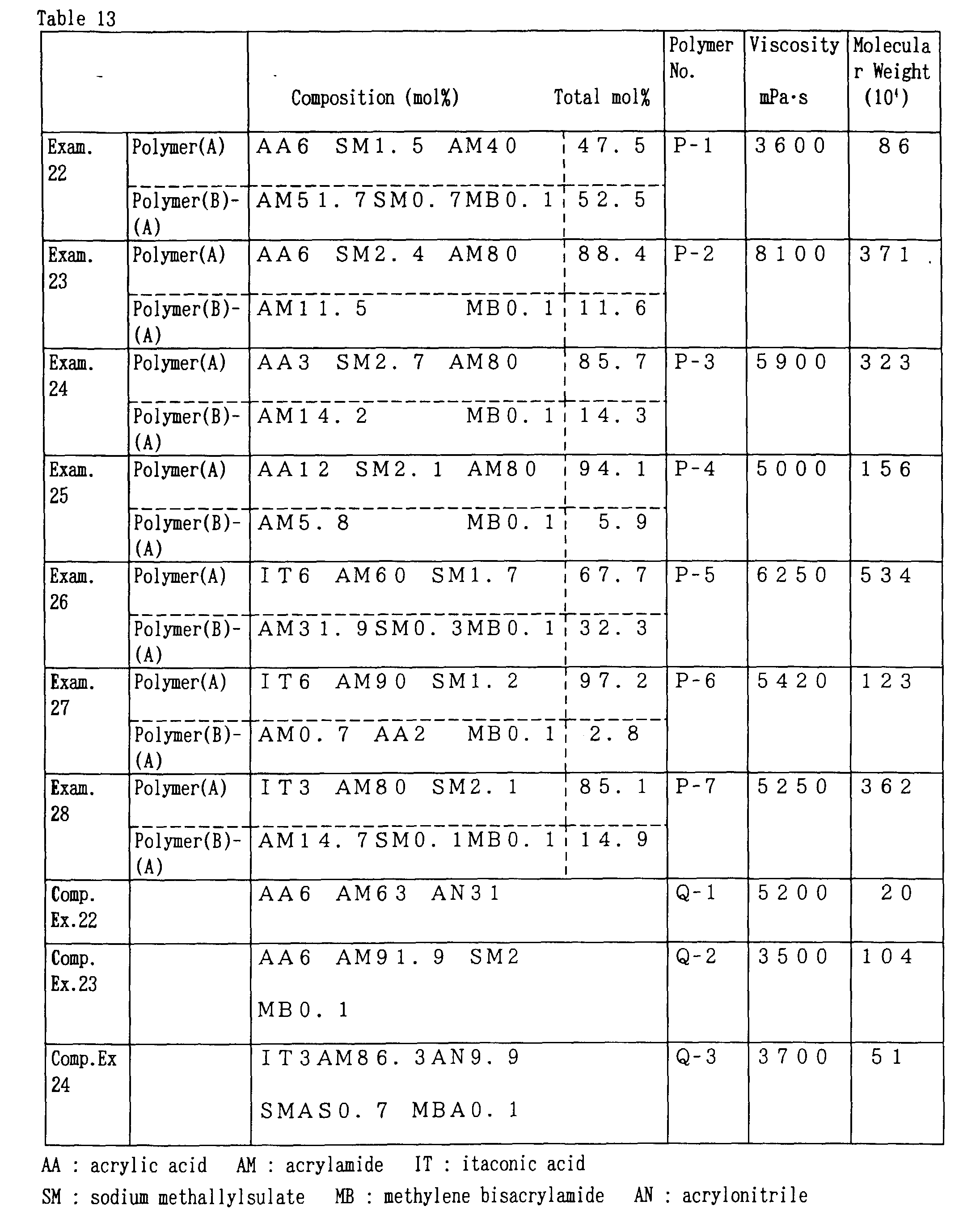
- There will be described papermaking evaluation examples for 2 types of papermaking conditions when the polymers from Examples and 22 to 28 and Comparative Examples 22 to 24 are used as an internal paper strength agent, as well as coating evaluation examples when the polymers are used as a surface-coating paper strength agent. Unless otherwise described the amounts indicated are those on solid basis.
- The polymer P-1 was added into a 1 % N-UKP(needleleaf-unbleached sulfate pulp) slurry with a beating degree CSF(Canadian Standard Freeness) of 600 in an amount of 0.3 % to the pulp. After stirring for 1 min, aluminum sulfate was added in an amount of 2.5 % to the pulp, and the mixture was stirred for further 1 min. The pH of the slurry was 4.5. With stirring, cationized starch was added in an amount of 0.4 % to the pulp and the mixture was stirred for 1 min. Then, acidic rosin emulsion size agent was added in an amount of 0.2 % to the pulp and the mixture was stirred for further 1 min. Then, the resulting pulp slurry was used to make a paper with a TAPPI standard (square) sheet machine. The wet sheet thus made was dried in a drum dryer at 110 °C for 3 min, to give a hand-made paper with a basis weight of 70 g/m2. The dried paper was subject to humidity control in an air-conditioned chamber at 20 °C and RH 65 % for at least 24 hours, and its burst index(JIS-P8112), breaking length(JIS-P8113) and Steckigt sizing degree were determined. The results are shown in Table 14 as Papermaking Example 1.
Papermaking condition 1 for a kraft paper Polymer No. Burst index Breaking length (km) Sizing degree (second) Papermaking Example 1 P - 1 4. 02 5. 03 80. 6 Papermaking Example 2 P - 2 4. 28 5 . 27 83 . 7 Papermaking Example 3 P - 3 4. 26 5. 17 81. 9 Papermaking Example 4 P - 4 4. 21 5. 31 87. 7 Papermaking Example 5 P - 5 4. 15 5. 16 84. 1 Papermaking Example 6 P - 6 4. 17 5. 17 86. 5 Papermaking Example 7 P - 7 4. 22 5. 19 81. 6 Comparative Papermaking Example 1 Q - 1 3. 85 4. 68 78. 2 Comparative Papermaking Example 2 Q - 2 3. 77 4. 66 77. 6 Comparative Papermaking Example 3 Q - 3 3. 73 4. 58 74. 3 Comparative Papermaking Example 4 Blank 1 2. 88 3. 78 36. 8 - A paper was made as described in Papermaking Example 1 except that the polymer P-1 was replaced with each of the polymers P-2 to P-7 and Q-1 to Q-3. The results are shown in Table 14 as Papermaking Examples 2 to 7 and Comparative Papermaking Examples 1 to 3.
- A paper was made as described in Papermaking Example 1 except that a polymer was not used. The product's physical properties were evaluated. The results are shown in Table 14 as Blank 1.
- Aluminum sulfate was added into a 1 % pulp slurry obtained from waste corrugated paper with a beating degree CSF(Canadian Standard Freeness) of 350 in an amount of 2.5 % to the pulp. After stirring for 1 min, a 6:4 mixture of the polymer P-1 and Mannich modified PAM was added in an amount of 0.4 % to the pulp, and the mixture was stirred for further 1 min. The pH of the slurry was 6. The CSF(JIS-P8121) of the pulp slurry was determined and it was used to make a paper with a TAPPI standard (square) sheet machine. The wet sheet thus made was dried in a drum dryer at 110 °C for 3 min, to give a hand-made paper with a basis weight of 140 g/m2.
- Furthermore, aluminum sulfate was added in an amount of 1.25 % to the pulp and a hand-made paper sheet was prepared as described above using a pulp slurry, pH 7. The dried paper thus obtained was subject to humidity control in an air-conditioned chamber at 20 °C and RH 65 % for at least 24 hours, and its burst index(JIS-P8112) and Z-axis directional strength(Internal Bond Tester; Kumagaya Riki Kogyo) were determined. The results are shown in Table 15 as Papermaking Example 8.
Papermaking condition 2 for a liner Polymer No. CSF(mL) Burst index Z-directional strength (mJ) pH6 pH7 pH6 pH7 pH6 pH7 Papermaking Example 8 P - 1 448 425 2. 75 2. 84 261 247 Papermaking Example 9 P - 2 487 473 2. 82 2. 99 284 273 Papermaking Example 10 P - 3 490 470 2. 89 3. 13 278 275 Papermaking Example 11 P - 4 488 466 2. 85 3. 06 286 272 Papermaking Example 12 P - 5 457 448 2. 92 3. 05 281 280 Papermaking Example 13 P - 6 464 451 2. 96 2. 99 288 278 Papermaking Example 14 P - 7 467 442 2. 86 3. 08 291 266 Comparative Papermaking Example 5 Q -1 419 381 2. 38 2. 67 233 225 Comparative Papermaking Example 6 Q - 2 439 405 2. 49 2. 76 243 236 Comparative Papermaking Example 7 Q - 3 405 378 2. 51 2. 78 245 230 Comparative Papermaking Example 8 Blank 2 344 332 1. 97 2. 01 191 185 - A paper was made as described in Papermaking Example 8 except that the polymer P-1 was replaced with each of the polymers P-2 to P-7 and Q-1 to Q-3. The results are shown in Table 15 as Papermaking Examples 9 to 14 and Comparative Papermaking Examples 5 to 7.
- A paper was made as described in Papermaking Example 8 except that a polymer was not used. The product's physical properties were evaluated. The results are shown in Table 15 as Blank 2.
- A fine coated base paper with a basis weight of 70 g/m2 was cut into a size of 24 cm long and 19 cm wide. The polymer P-1 was diluted with water to 4 %, and the coated base paper cut as above was soaked in the diluted solution for a second. The paper was then squeezed with two rollers and the adhered polymer was weighed. Immediately after weighing, the paper was dried in a drum dryer at 110 °C for 2 min, to give a paper sample. The coating amount was 2 g/m2 on nonvolatile component basis. The dried paper thus obtained was subject to humidity control in an air-conditioned chamber at 20 °C and RH 65 % for at least 24 hours, and its RI pick(RI-3 type, Akira Seisakusho; Inktuck 25, Toyo Ink; the amount of ink: 0.4 mL; 100 revolutions per minute) and Z-axis directional strength(Internal Bond Tester; Kumagaya Riki Kogyo) were determined. The results are shown in Table 16 as Coating Example 1.
Coating Polymer No. RI pick Z-directional strength (mJ) Coating Example 1 P - 1 7. 5 342 Coating Example 2 P - 2 7. 8 367 Coating Example 3 P - 3 7. 5 353 Coating Example 4 P - 4 8. 0 388 Coating Example 5 P - 5 8. 0 414 Coating Example 6 P - 6 8. 5 426 Coating Example 7 P - 7 8. 3 412 Comparative Coating Example 1 Q - 1 7. 3 315 Comparative Coating Example 2 Q - 2 7. 5 330 Comparative Coating Example 3 Q - 3 7. 3 310 Comparative Coating Example 4 Blank 3 3. 0 117 - Coating was conducted as described in Coating Example 1 except that the polymer P-1 was replaced with each of the polymers P-2 to P-7 and Q-1 to Q-3. The results are shown in Table 16 as Coating Examples 2 to 7 and Comparative Coating Examples 1 to 3.
- Coating was conducted as described in Coating Example 1 except that the diluted solution of the polymer was replaced with water. The product's physical properties were evaluated. The results are shown in Table 16 as Blank 3.
- The effects of this invention will be described based on Papermaking Examples and Coating Examples. Using an acrylamide polymer improves a paper strength, compared with Blanks. However, it can be clearly seen that an anionic acrylamide polymer according to this invention in any Papermaking or Coating Example is better than a polymer obtained in any Comparative Example.
- For example, when used as a paper strength agent for a kraft paper in Table 14, the polymer of this invention provides a higher paper strength and is also highly effective for size expression. Furthermore, when added as a mixture with a Mannich modified polyacrylamide as a linerboard, it exhibits excellent freeness and paper strength as shown in Table 15. In particular, it is quite effective even in a system where an amount of aluminum sulfate is smaller and a papermaking pH is higher. Furthermore, it is indicated in Table 16 that when used as a surface coating, an anionic acrylamide polymer according to this invention can significantly improve a surface paper strength as well as an internal paper strength.
- Comparing the polymer P-1 from Example 1 and the polymer Q-2 from Comparative Example 2, their compositions are not very different and P-1 has a somewhat smaller molecular weight than Q-2. P-1, however, has a higher paper strength. It may be, therefore, said that the anionic acrylamide polymer of this invention exhibits an excellent paper strength due to not only its composition and molecular weight but also the fact that its molecular disposition can be well controlled by using a characteristic polymerization procedure where a polymer (B) is formed by polymerization in the presence of a polymer (A).
- As described above, it can be understood that the anionic acrylamide polymer of this invention is highly effective as an internal paper strength agent or a surface coating, compared with an agent according to the prior art.
- In a five-necked flask equipped with an agitator, a reflux condenser, a thermometer, a nitrogen-inlet tube and a dropping inlet (hereinafter, referred to as a "reaction vessel") was placed 181.93 g of purified water, and then the internal temperature was adjusted to 80 °C while introducing nitrogen gas.
- A solution of 58.58 g of 50 % acrylamide and 0.26 g of sodium methallylsulfonate and a solution of 0.03 g of 4,4'-azobis-4-cyanovaleric acid(purity: 84 %) in 51.20 g of purified water were prepared, and simultaneously added dropwise at constant rates into the reaction vessel over 30 min, maintaining the internal temperature at 80 °C. After addition, polymerization was continued at 80 °C for 1 hour(This procedure is referred to as the first step).
- A solution of 516.44 g of 50 % acrylamide, 11.08 g of sodium methallylsulfonate and 0.64 g of methylene bisacrylamide and a solution of 0.20 g of 4,4'-azobis-4-cyanovaleric acid(purity: 84 %) in 51.20 g of purified water were prepared and simultaneously added dropwise at constant rates into the reaction vessel over 2 hours, maintaining the internal temperature at 80 °C. After addition, polymerization was continued at 80 °C for 2 hours, to provide a polymer containing 30 % of the nonvolatile component, i.e., the product concentration, with a Brookfield viscosity of 4,200 mPa·s at 25 °C(This procedure is referred to as the second step). The weight-average molecular weight of this polymer by GPC-MALLS was 1,630,000. The polymer is designated as A-1.
- In the above reaction vessel was placed 202.25 g of purified water, and then the internal temperature was adjusted to 80 °C while introducing nitrogen gas.
- A solution of 58.47 g of 50 % acrylamide and 2.60 g of sodium methallylsulfonate and a solution of 0.03 g of 4,4'-azobis-4-cyanovaleric acid(purity: 84 %) in 51.20 g of purified water were prepared, and simultaneously added dropwise at constant rates into the reaction vessel over 30 min, maintaining the internal temperature at 80 °C. After addition, polymerization was continued at 80 °C for 1 hour.
- A solution of 514.51 g of 50 % acrylamide, 9.76 g of sodium methallylsulfonate and 0.63 g of methylene bisacrylamide and a solution of 0.2 g of 4,4'-azobis-4-cyanovaleric acid(purity: 84 %) in 51.20 g of purified water were prepared and simultaneously added dropwise at constant rates into the reaction vessel over 2 hours, maintaining the internal temperature at 80 °C. After addition, polymerization was continued at 80 °C for 2 hours, to provide a polymer containing 30 % of the nonvolatile component with a Brookfield viscosity of 3,700 mPa·s at 25 °C. The weight-average molecular weight of this polymer by GPC-MALLS was 1,870,000. The polymer is designated as A-2.
- In the above reaction vessel was placed 302.80 g of purified water, and then the internal temperature was adjusted to 80 °C while introducing nitrogen gas.
- A solution of 146.50 g of 50 % acrylamide and 1.64 g of sodium methallylsulfonate and a solution of 0.08 g of 4,4'-azobis-4-cyanovaleric acid(purity: 84 %) in 51.20 g of purified water were prepared, and simultaneously added dropwise at constant rates into the reaction vessel over 30 min, maintaining the internal temperature at 80 °C. After addition, polymerization was continued at 80 °C for 1 hour.
- A solution of 439.52 g of 50 % acrylamide and 5.60 g of sodium methallylsulfonate and a solution of 0.19 g of 4,4'-azobis-4-cyanovaleric acid(purity: 84 %) in 51.20 g of purified water were prepared and simultaneously added dropwise at constant rates into the reaction vessel over 2 hours, maintaining the internal temperature at 80 °C. After addition, polymerization was continued at 80 °C for 2 hours, to provide a polymer containing 30 % of the nonvolatile component with a Brookfield viscosity of 6,900 mPa·s at 25 °C. The weight-average molecular weight of this polymer by GPC-MALLS was 1,050,000. The polymer is designated as A-3.
- In the above reaction vessel was placed 417.06 g of purified water, and then the internal temperature was adjusted to 80 °C while introducing nitrogen gas.
- A solution of 305.08 g of 50 % acrylamide and 3.40 g of sodium methallylsulfonate and a solution of 0.16 g of 4,4'-azobis-4-cyanovaleric acid(purity: 84 %) in 51.20 g of purified water were prepared, and simultaneously added dropwise at constant rates into the reaction vessel over 30 min, maintaining the internal temperature at 80 °C. After addition, polymerization was continued at 80 °C for 1 hour.
- A solution of 457.62 g of 50 % acrylamide, 6.84 g of sodium methallylsulfonate and 0.83 g of methylene bisacrylamide and a solution of 0.18 g of 4,4'-azobis-4-cyanovaleric acid(purity: 84 %) in 51.20 g of purified water were prepared and simultaneously added dropwise at constant rates into the reaction vessel over 2 hours, maintaining the internal temperature at 80 °C. After addition, polymerization was continued at 80 °C for 2 hours, to provide a polymer containing 30 % of the nonvolatile component with a Brookfield viscosity of 7,800 mPa·s at 25 °C. The weight-average molecular weight of this polymer by GPC-MALLS was 1,730,000. The polymer is designated as A-4.
- In the above reaction vessel was placed 314.80 g of purified water, and then the internal temperature was adjusted to 80 °C while introducing nitrogen gas.
- A solution of 305.18 g of 50 % acrylamide and 3.39 g of sodium methallylsulfonate and a solution of 0.16 g of 4,4'-azobis-4-cyanovaleric acid(purity: 84 %) in 51.20 g of purified water were prepared, and simultaneously added dropwise at constant rates into the reaction vessel over 30 min, maintaining the internal temperature at 80 °C. After addition, polymerization was continued at 80 °C for 1 hour.
- A solution of 305.18 g of 50 % acrylamide and 4.80 g of sodium methallylsulfonate and a solution of 0.12 g of 4,4'-azobis-4-cyanovaleric acid(purity: 84 %) in 51.20 g of purified water were prepared and simultaneously added dropwise at constant rates into the reaction vessel over 2 hours, maintaining the internal temperature at 80 °C. After addition, polymerization was continued at 80 °C for 2 hours, to provide a polymer containing 30 % of the nonvolatile component with a Brookfield viscosity of 7,300 mPa·s at 25 °C. The weight-average molecular weight of this polymer by GPC-MALLS was 1,070,000. The polymer is designated as A-5.
- In the above reaction vessel was placed 314.80 g of purified water, and then the internal temperature was adjusted to 80 °C while introducing nitrogen gas.
- A solution of 305.18 g of 50 % acrylamide and 3.39 g of sodium methallylsulfonate and a solution of 0.16 g of 4,4'-azobis-4-cyanovaleric acid(purity: 84 %) in 51.20 g of purified water were prepared, and simultaneously added dropwise at constant rates into the reaction vessel over 30 min, maintaining the internal temperature at 80 °C. After addition, polymerization was continued at 80 °C for 1 hour.
- A solution of 305.18 g of 50 % acrylamide, 4.80 g of sodium methallylsulfonate and 0.67 g of methylene bisacrylamide and a solution of 0.12 g of 4,4'-azobis-4-cyanovaleric acid(purity: 84 %) in 51.20 g of purified water were prepared and simultaneously added dropwise at constant rates into the reaction vessel over 2 hours, maintaining the internal temperature at 80 °C. After addition, polymerization was continued at 80 °C for 2 hours, to provide a polymer containing 30 % of the nonvolatile component with a Brookfield viscosity of 6,900 mPa·s at 25 °C. The weight-average molecular weight of this polymer by GPC-MALLS was 1,670,000. The polymer is designated as A-6.
- In the above reaction vessel was placed 246.00 g of purified water, and then the internal temperature was adjusted to 80 °C while introducing nitrogen gas.
- A solution of 305.16 g of 50 % acrylamide and 3.39 g of sodium methallylsulfonate and a solution of 0.16 g of 4,4'-azobis-4-cyanovaleric acid(purity: 84 %) in 51.20 g of purified water were prepared, and simultaneously added dropwise at constant rates into the reaction vessel over 30 min, maintaining the internal temperature at 80 °C. After addition, polymerization was continued at 80 °C for 1 hour.
- A solution of 203.42 g of 50 % acrylamide, 4.00 g of sodium methallylsulfonate and 0.56 g of methylene bisacrylamide and a solution of 0.08 g of 4,4'-azobis-4-cyanovaleric acid(purity: 84 %) in 51.20 g of purified water were prepared and simultaneously added dropwise at constant rates into the reaction vessel over 2 hours, maintaining the internal temperature at 80 °C. After addition, polymerization was continued at 80 °C for 2 hours, to provide a polymer containing 30 % of the nonvolatile component with a Brookfield viscosity of 6,400 mPa·s at 25 °C. The weight-average molecular weight of this polymer by GPC-MALLS was 1,560,000. The polymer is designated as A-7.
- In the above reaction vessel was placed 302.80 g of purified water, and then the internal temperature was adjusted to 80 °C while introducing nitrogen gas.
- A solution of 439.52 g of 50 % acrylamide and 4.94 g of sodium methallylsulfonate and a solution of 0.19 g of 4,4'-azobis-4-cyanovaleric acid(purity: 84 %) in 51.20 g of purified water were prepared, and simultaneously added dropwise at constant rates into the reaction vessel over 2 hours, maintaining the internal temperature at 80 °C. After addition, polymerization was continued at 80 °C for 1 hour.
- A solution of 146.50 g of 50 % acrylamide and 2.30 g of sodium methallylsulfonate and a solution of 0.08 g of 4,4'-azobis-4-cyanovaleric acid(purity: 84 %) in 51.20 g of purified water were prepared and simultaneously added dropwise at constant rates into the reaction vessel over 30 min, maintaining the internal temperature at 80 °C. After addition, polymerization was continued at 80 °C for 2 hours, to provide a polymer containing 30 % of the nonvolatile component with a Brookfield viscosity of 7,200 mPa·s at 25 °C. The weight-average molecular weight of this polymer by GPC-MALLS was 1,040,000. The polymer is designated as A-8.
- In the above reaction vessel was placed 314.80 g of purified water, and then the internal temperature was adjusted to 80 °C while introducing nitrogen gas.
- A solution of 601.34 g of 50 % acrylamide and 7.12 g of sodium methallylsulfonate and a solution of 0.32 g of 4,4'-azobis-4-cyanovaleric acid(purity: 84 %) in 51.20 g of purified water were prepared, and simultaneously added dropwise at constant rates into the reaction vessel over 2 hours, maintaining the internal temperature at 80 °C. After addition, polymerization was continued at 80 °C for 1 hour.
- A solution of 31.6 g of 50 % acrylamide, 0.36 g of sodium methallylsulfonate and 0.07 g of methylene bisacrylamide and a solution of 0.04 g of 4,4'-azobis-4-cyanovaleric acid(purity: 84 %) in 51.20 g of purified water were prepared and simultaneously added dropwise at constant rates into the reaction vessel over 30 min, maintaining the internal temperature at 80 °C. After addition, polymerization was continued at 80 °C for 2 hours, to provide a polymer containing 30 % of the nonvolatile component with a Brookfield viscosity of 7,200 mPa·s at 25 °C. The weight-average molecular weight of this polymer by GPC-MALLS was 1,500,000. The polymer is designated as A-9.
- In the above reaction vessel was placed 377.76 g of purified water, and then the internal temperature was adjusted to 80 °C while introducing nitrogen gas.
- A solution of 466.52 g of 50 % acrylamide and 3.85 g of sodium methallylsulfonate and a solution of 0.25 g of 4,4'-azobis-4-cyanovaleric acid(purity: 84 %) in 51.20 g of purified water were prepared, and simultaneously added dropwise at constant rates into the reaction vessel over 2 hours, maintaining the internal temperature at 80 °C. After addition, polymerization was continued at 80 °C for 1 hour.
- A solution of 24.44 g of 50 % acrylamide, 0.27 g of sodium methallylsulfonate and 0.05 g of methylene bisacrylamide and a solution of 0.04 g of 4,4'-azobis-4-cyanovaleric acid(purity: 84 %) in 51.20 g of purified water were prepared and simultaneously added dropwise at constant rates into the reaction vessel over 30 min, maintaining the internal temperature at 80 °C. After addition, polymerization was continued at 80 °C for 2 hours, to provide a polymer containing 25 % of the nonvolatile component with a Brookfield viscosity of 4,300 mPa·s at 25 °C. The weight-average molecular weight of this polymer by GPC-MALLS was 1,360,000. The polymer is designated as A-10.
- In the above reaction vessel was placed 236.50 g of purified water, and then the internal temperature was adjusted to 80 °C while introducing nitrogen gas.
- A solution of 600.00 g of 50 % acrylamide, 3.46 g of sodium persulfate and 0.86 g of ammonium ferrous sulfate in 51.20 g of purified water was prepared and added dropwise at a constant rate into the reaction vessel over 2 hours, maintaining the internal temperature at 80 °C. After addition, polymerization was continued at 80 °C for 1 hour, to provide a polymer containing 30 % of the nonvolatile component with a Brookfield viscosity of 7,400 mPa·s at 25 °C. The weight-average molecular weight of this polymer by GPC-MALLS was 150,000. The polymer is designated as B-1.
- In the above reaction vessel was placed 236.50 g of purified water, and then the internal temperature was adjusted to 80 °C while introducing nitrogen gas.
- A solution of 600.00 g of 50 % acrylamide and 4.34 g of sodium methallylsulfonate and a solution of 0.15 g of 4,4'-azobis-4-cyanovaleric acid(purity: 84 %) in 50.00 g of purified water were prepared and simultaneously added dropwise at constant rates into the reaction vessel over 2 hours, maintaining the internal temperature at 80 °C. After addition, polymerization was continued at 80 °C for 3 hours, to provide a polymer containing 30 % of the nonvolatile component with a Brookfield viscosity of 5,800 mPa·s at 25 °C. The weight-average molecular weight of this polymer by GPC-MALLS was 580,000. The polymer is designated as B-2.
- In the above reaction vessel was placed 236.50 g of purified water, and then the internal temperature was adjusted to 80 °C while introducing nitrogen gas.
- A solution of 600.00 g of 50 % acrylamide, 9.34 g of sodium methallylsulfonate and 0.33 g of methylene bisacrylamide and a solution of 0.30 g of 4,4'-azobis-4-cyanovaleric acid(purity: 84 %) in 50.00 g of purified water were prepared and simultaneously added dropwise at constant rates into the reaction vessel over 2 hours, maintaining the internal temperature at 80 °C. After addition, polymerization was continued at 80 °C for 3 hours, to provide a polymer containing 30 % of the nonvolatile component with a Brookfield viscosity of 6,100 mPa·s at 25 °C. The weight-average molecular weight of this polymer by GPC-MALLS was 1,540,000. The polymer is designated as B-3.
- In the above reaction vessel was placed 236.50 g of purified water, and then the internal temperature was adjusted to 80 °C while introducing nitrogen gas.
- A solution of 600.00 g of 50 % acrylamide, 18.00 g of sodium methallylsulfonate and 0.66 g of methylene bisacrylamide and a solution of 0.30 g of 4,4'-azobis-4-cyanovaleric acid(purity: 84 %) in 50.00 g of purified water were prepared and simultaneously added dropwise at constant rates into the reaction vessel over 2 hours, maintaining the internal temperature at 80 °C. After addition, polymerization was continued at 80 °C for 3 hours, to provide a polymer containing 30 % of the nonvolatile component with a Brookfield viscosity of 7,600 mPa·s at 25 °C. The weight-average molecular weight of this polymer by GPC-MALLS was 1,690,000. The polymer is designated as B-4.
- In the above reaction vessel were placed 298.50 g of 50 % acrylamide and 687.60 g of purified water, and while replacing the atmosphere with nitrogen the mixture was warmed to 45 °C. Then, 7.20 g of 10 % sodium persulfate and 1.80 g of 10 % ammonium ferrous sulfate were added to the mixture, immediately after which polymerization was initiated and the solution temperature was raised to 80 °C. Polymerization was then continued at 80 °C for 2 hours, to provide a polymer containing 15.0 % of the nonvolatile component with a Brookfield viscosity of 8,100 mPa·s at 25 °C. The weight-average molecular weight of this polymer by GPC-MALLS was 600,000. The polymer is designated as B-5.
- The compositions and the physical properties of the polymers from Preparation Examples 1 to 15 are shown in Table 17.
Comp. (mol%) Product concentration Viscosity Molecular weight Polymer No. AAM MBA SMS (%) (mPa·s) (104) Preparaton Example 1 1st Step 10.0 0.04 2nd Step 882 0.10 1.70 30.0 4,200 163 A-1 Preparation Example 2 1st Step 10.0 0.04 2nd Step 88.0 0.10 1.50 30.0 3,700 187 A-2 Preparation Example 3 1st Step 24.8 025 2nd Step 742 0.85 30.0 6,900 105 A-3 Preparation Example 4 1st Step 39.6 0.40 2nd Step 59.1 0.10 0.80 30.0 7,800 173 A-4 Preparation Example 5 1st Step 49.5 0.50 2nd Step 49.3 0.70 30.0 7,300 107 A-5 Peparation Example 6 1st Step 49.5 0.50 2nd Step 492 0.10 0.70 30.0 6,900 167 A-6 Preparation Exampe 7 1st Step 59.4 0.59 2nd Step 392 0.10 0.70 30.0 6,400 156 A-7 Preparation Example 8 1st Step 74.3 0.75 2nd Step 24.7 0.35 30.0 7,200 104 A-8 Preparation Example 9 1st Step 94.0 1.00 2nd Step 4.9 0.01 0.05 30.0 7,200 150 A-9 Preparation Example 10 1st Step 94.3 0.70 2nd Step 4.9 0.01 0.05 25.0 4,300 136 A-10 Preparation Example 11 100.0 30.0 7,400 15 B-1 Preparation Example 12 99.4 0.65 30.0 5,800 58 B-2 Preparation Example 13 98.6 0.05 1.38 30.0 6,100 154 B-3 Prepartion Example 14 98.3 0.10 1.62 30.0 7,600 169 B-4 Preparaton Example 15 100.0 15.0 8,100 60 B-5 AAM acrylamide; MBA: methylene bisacrylamide; SMS: sodium methalylsulfonate - Hofmann degradation of the polymers from Preparation Examples will be described, using the polymer A-1 as a typical example.
- First, 2.0 g of the polymer A-1 from Preparation Example 1 as a solid was diluted with purified water, to give a solution of 40.0 g in total. The solution was heated to 70 °C, to which with stirring was added a solution(8.10 g) of 12.5 % of sodium hypochlorite and 20 % sodium hydroxide(molar ratio = 1:2), and the mixture was allowed to stand for 30 seconds. Then, 152.60 g of pre-cooled purified water was added, and the resulting mixture was cooled in ice-water to give a Hofmann degradation product(Example 29).
- A similar procedure was conducted for each of the polymers A-2 to A-10(Examples 30 to 38) and B-1 to B-5(Comparative Examples 25 to 29), to give a Hofmann degradation product. Each reaction product thus obtained was colloidal-titrated in a 1/400N aqueous solution of potassium polyvinylsulfonate using toluidine blue as an indicator to determine its cation valence, which is shown in Table 18.
Polymer material No. Cationic charge density (meq/g) C.S.F (ml) Burst index (kPa·m2/g) Z-directional strength (kg·cm) Example 29 A-1 3.65 545 2.97 2.76 Example 30 A-2 3.64 563 2.97 2.84 Example 31 A-3 3.67 522 2.94 2.73 Example 32 A-4 3.71 545 2.83 2.64 Example 33 A-5 3.70 513 2.85 2.65 Example 34 A-6 3.67 527 2.85 2.62 Example 35 A-7 3.71 563 2.90 2.65 Example 36 A-8 3.73 536 2.88 2.62 Example 37 A-9 3.78 549 2.88 2.68 Example 38 A-10 3.76 554 2.90 2.74 Comparative Example 25 B-1 3.89 482 2.45 2.33 Comparative Example 26 B-2 3.63 500 2.74 2.57 Comparative Example 27 B-3 3.38 486 2.52 2.53 Comparative Example 28 B-4 341 491 2.68 2.54 Comparative Example 29 B-5 364 509 2.45 2.48 Blank 450 2.23 1.55 - Evaluation results of the Hofmann degradation products as an internal paper strength agent will be described.
- Waste corrugated papers were beaten to give a 2.0 % pulp slurry with a Canadian Standard Freeness(hereinafter, referred to as C.S.F.) of 450 mL, whose pH was then adjusted to 5.5. To the mixture was added aluminum sulfate in an amount of 1.8 % to the pulp, and the mixture was stirred for 1 min. Then, a 1:1 mixture of a commercially available anionic polyacrylamide(Hopelon 3150B; Mitsui Chemical) and a Hofmann degradation product was added in an amount of 0.5 % to the pulp, and the mixture was stirred for 1 min. A part of the pulp slurry was used to determine a C.S.F. according to JIS P8121, and the remainder was subject to papermaking with a TAPPI standard (square) sheet machine. The wet sheet thus made was dried in a dryer at 110 °C for 1 hour, to give a hand-made paper with a basis weight of 150 g/m2. The dried paper was subject to humidity control in an air-conditioned chamber at 20 °C and RH 65 % for at least 24 hours, and its burst index(JIS-P8112) and Z-axis directional strength(Internal Bond Tester; Kumagaya Riki Kogyo) were determined.
- The results are shown in Table 18, where a blank indicates that aluminum sulfate or a paper strength agent was not added.
- As seen from the table, the cationic polymers according to this invention prepared by Hofmann degradation exhibit excellent effects on a freeness, a burst strength and a Z-axis directional strength. Furthermore, the high-concentration polymers according to this invention can improve not only a paper strength but also a freeness. The cation polymers are very useful as a paper strength agent or drainage aid.
Claims (15)
- A polymer (B) prepared by polymerizing one or more vinyl monomers (c) in the presence of a polymer (A) prepared by polymerizing one or more vinyl monomers (a) selected from the group consisting of vinyl monomers represented by the general formula (1):wherein R1 represents a hydrogen atom or a lower alkyl with 1 to 3 carbon atoms and n is an integer of 1 to 8 and their salts with one or more vinyl monomers (b) which are co-polymerizable with the vinyl monomer components (a), and for example polymer (A) has a weight average molecular weight of 1,000 to 5,000,000 and/or the polymer (B) has a weight average molecular weight of 100,000 to 10,000,000.

- A polymer (B) as claimed in claim 1, wherein at least one of the vinyl monomers (b) is (meth)acrylamide, and/or at least one of the vinyl monomers (c) is (meth)acrylamide.
- A polymer (B) as claimed in claim 1, wherein the polymer (A) consists of the same vinyl monomer components as those of the polymer (B), and at least one vinyl monomer component has a molar ratio in the polymer (A) substantially different from that in the polymer (B).
- A polymer (B) as claimed in claim 1, wherein the remaining vinyl monomer composition after subtracting the vinyl monomer composition of the polymer (A) from that of the polymer (B), is different from the composition of the polymer (A).
- A polymer (B) as claimed in claim 1, wherein the components or the composition are substantially different between the polymers (A) and (B).
- A polymer (B) as claimed in claim 1, wherein at least one of vinyl monomers (b) is an ionic monomer, for example an anionic monomer.
- A polymer (B) as claimed in claim 1, comprising a cross-linking vinyl monomer as a component monomer.
- A process for manufacturing a polymer (B), comprising the steps ofpreparing a polymer (A) by polymerizing one or more vinyl monomers (a) selected from the group consisting of vinyl monomers represented by the general formula (1):wherein R1 represents a hydrogen atom or a lower alkyl with 1 to 3 carbon atoms and n is an integer of 1 to 8 and their salts with one or more vinyl monomers (b) which are co-polymerizable with the vinyl monomer components (a); and
 polymerizing one or more vinyl monomers (c) in the presence of the polymer (A).
 - A cationic polymer (C) prepared by Hofmann degradation of the polymer (B) as claimed in any of claims 1 to 7, at an alkaline pH, wherein one or both of the vinyl monomers (b) and (c) comprise a monomer having an amide group, and for example the monomer having an amide group is (meth)acrylamide.
- A cationic polymer (C) as claimed in claim 9, wherein the polymer (B) contains 0.1 to 99.9 mol% of the monomers of the polymer (A).
- A cationic polymer (C) as claimed in claim 9, wherein the weight average molecular weight of the polymer (B) is 100,000 to 10,000,000.
- A cationic polymer (C) as claimed in claim 9, wherein the said Hofmann degradation is reaction of the polymer (B) with a hypohalous acid salt at an alkaline pH at a temperature of 50 to 110°C.
- A paper strength agent or a drainage aid, comprising polymer (B) as claimed in any of claims 1 to 7, or the cationic polymer (C) as claimed in any of claims 9 to 12.
- A process for manufacturing a cationic polymer (C), comprising the steps ofpreparing a polymer (A) by polymerizing one or more vinyl monomers (a) selected from the group consisting of vinyl monomers represented by the general formula (1):wherein R1 represents a hydrogen atom or a lower alkyl with 1 to 3 carbon atoms and n is an integer of 1 to 8 and their salts with one or more vinyl monomers (b) which are co-polymerizable with the vinyl monomer components (a);
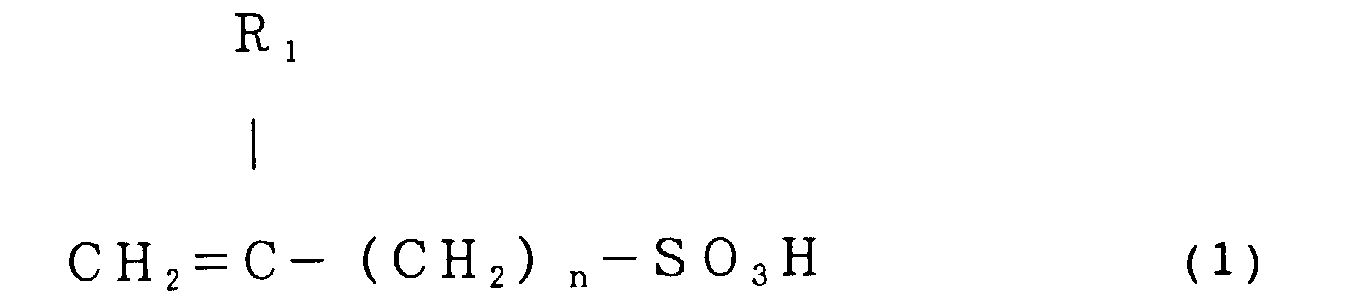 polymerizing one or more vinyl monomers (c) in the presence of the polymer (A) to prepare a polymer (B); andconducting Hofmann degradation of the polymer (B) at an alkaline pH;and wherein one or both of the vinyl monomers (b) and (c) comprise a monomer having an amide group.
 - A surface coating or coating material comprising the polymer (B) as claimed in any of claims 1 to 7 or the cationic polymer (C) as claimed in any of claims 9 to 12.
Applications Claiming Priority (3)
| Application Number | Priority Date | Filing Date | Title |
|---|---|---|---|
| JP328850/97 | 1997-11-28 | ||
| JP32885097 | 1997-11-28 | ||
| JP32885097 | 1997-11-28 |
Publications (2)
| Publication Number | Publication Date |
|---|---|
| EP0919578A1 true EP0919578A1 (en) | 1999-06-02 |
| EP0919578B1 EP0919578B1 (en) | 2004-02-11 |
Family
ID=18214795
Family Applications (1)
| Application Number | Title | Priority Date | Filing Date |
|---|---|---|---|
| EP98309660A Expired - Lifetime EP0919578B1 (en) | 1997-11-28 | 1998-11-25 | Polymers suitable for paper making additives and process of manufacturing them |
Country Status (8)
| Country | Link |
|---|---|
| US (1) | US6255400B1 (en) |
| EP (1) | EP0919578B1 (en) |
| KR (2) | KR100300929B1 (en) |
| CN (1) | CN1165559C (en) |
| DE (1) | DE69821584T2 (en) |
| ID (1) | ID21403A (en) |
| MY (1) | MY119578A (en) |
| TW (2) | TW542845B (en) |
Cited By (7)
| Publication number | Priority date | Publication date | Assignee | Title |
|---|---|---|---|---|
| WO2002053835A1 (en) * | 2000-12-27 | 2002-07-11 | Japan Pmc Corporation | Papermaking additive, process for producing papermaking additive, and paper containing papermaking additive |
| WO2008055954A1 (en) * | 2006-11-10 | 2008-05-15 | Basf Se | Low-viscosity coating compositions |
| WO2014132175A1 (en) * | 2013-03-01 | 2014-09-04 | Basf Se | Aqueous emulsion of a sizing agent |
| US20180016746A1 (en) * | 2015-01-27 | 2018-01-18 | Kemira Oyj | Polymer product in particle form and its use |
| US10689809B2 (en) | 2016-03-03 | 2020-06-23 | S.P.C.M. Sa | Process for manufacturing paper and board |
| WO2023227693A1 (en) * | 2022-05-25 | 2023-11-30 | Snf Group | Novel polymer and method for the preparation thereof |
| US20250171576A1 (en) * | 2022-06-24 | 2025-05-29 | Snf Group | New polymer and its preparation method |
Families Citing this family (17)
| Publication number | Priority date | Publication date | Assignee | Title |
|---|---|---|---|---|
| EP1431368A1 (en) * | 2002-12-18 | 2004-06-23 | Eliokem | Fluid loss reducer for high temperature high pressure water-based mud application |
| CN100338305C (en) * | 2004-03-11 | 2007-09-19 | 大连广汇化学有限公司 | Method for preparing amphiprotic intensifier for paper |
| US8816031B2 (en) * | 2006-03-06 | 2014-08-26 | Harima Chemicals, Inc. | Water-soluble polymer and additive for paper manufacture |
| EP1849803A1 (en) * | 2006-04-28 | 2007-10-31 | Harima Chemicals, Inc. | Method for Preparing Water Soluble Polymer and Papermaking Additive |
| FR2918989B1 (en) * | 2007-07-18 | 2010-08-27 | Snf Sas | WATER-SOLUBLE, WATER-SOLUBLE CATIONIC ACRYLAMIDE POLYMERS AND THEIR ACHIEVEMENTS |
| KR100976822B1 (en) * | 2007-09-20 | 2010-08-20 | 주식회사 화성산업 | Cationic block type strength enhancer and preparation method thereof |
| KR101161272B1 (en) * | 2009-11-17 | 2012-07-02 | 오씨아이에스엔에프 주식회사 | Manufacturing method and application of polyacrylamide which have functional groups of polynaphtalene sulfonate or ligno sulfonate |
| US9505937B2 (en) * | 2012-05-16 | 2016-11-29 | Ppg Industries Ohio, Inc. | Anionic electrodepositable coating compositions capable of forming low gloss coatings |
| US9598588B2 (en) | 2012-05-16 | 2017-03-21 | Ppg Industries Ohio, Inc. | Cationic electrodepositable coating compositions capable of forming low gloss coatings |
| JP5817802B2 (en) * | 2013-10-15 | 2015-11-18 | 栗田工業株式会社 | Intermediate for papermaking additive and method for producing papermaking additive |
| CA2990318C (en) | 2015-06-25 | 2023-12-05 | Kemira Oyj | A method for producing a material with a network of at least two polymers, a product thereof and use of the product |
| KR20170008966A (en) | 2015-07-15 | 2017-01-25 | (주) 수양 | Method for producing amphoteric polyacrylamide with graft structure as dry strengthening agent |
| JPWO2017022749A1 (en) * | 2015-08-06 | 2018-02-22 | Dic株式会社 | Adhesive tape, heat dissipation sheet, electronic device, and method for producing adhesive tape |
| JP6897227B2 (en) * | 2016-03-31 | 2021-06-30 | 荒川化学工業株式会社 | Paper strength enhancer, paper manufacturing method, and paper |
| KR101917306B1 (en) | 2017-12-13 | 2019-01-24 | 신경식 | Functional paper and method for manufacturing the same |
| JP7524868B2 (en) * | 2021-09-17 | 2024-07-30 | 荒川化学工業株式会社 | Papermaking additive, method for producing papermaking additive and paper |
| JP7533407B2 (en) * | 2021-09-17 | 2024-08-14 | 荒川化学工業株式会社 | Papermaking additive, method for producing papermaking additive and paper |
Citations (6)
| Publication number | Priority date | Publication date | Assignee | Title |
|---|---|---|---|---|
| GB1390656A (en) * | 1972-10-27 | 1975-04-16 | Kohjin Co | Process for producing polymer blend fibres having heat stability |
| US4217260A (en) * | 1977-08-03 | 1980-08-12 | Rhone-Poulenc Industries | Latices of vinyl polymers which are stable in electrolytes |
| US5239014A (en) * | 1988-12-28 | 1993-08-24 | Mitsui Toatsu Chemicals, Inc. | Cationic acrylamide polymers and the applications of these polymers |
| US5290869A (en) * | 1991-12-21 | 1994-03-01 | Takemoto Yushi Kabushiki Kaisha | Cement dispersion agents |
| EP0725044A1 (en) * | 1993-10-21 | 1996-08-07 | Chichibu Onoda Cement Corporation | Self-leveling water-base composition |
| US5627249A (en) * | 1993-12-24 | 1997-05-06 | Mitsui Toatsu Chemicals, Incorporated | Acrylamide polymers and use thereof |
Family Cites Families (6)
| Publication number | Priority date | Publication date | Assignee | Title |
|---|---|---|---|---|
| US3984495A (en) * | 1968-05-07 | 1976-10-05 | Kohjin Co., Ltd. | Shaped products such as fibers and films composed mainly of polyvinyl chloride and polyvinyl alcohol, and further containing an amido-containing polymer, and methods for production thereof |
| JPS59126415A (en) * | 1983-01-10 | 1984-07-21 | Japan Exlan Co Ltd | Production of flame-retardant acrylic polymer |
| DE3680059D1 (en) * | 1985-09-25 | 1991-08-08 | Mitsubishi Chem Ind | WATER REPELLENT COMPOSITION. |
| US5230869A (en) * | 1990-02-09 | 1993-07-27 | Ashland Oil, Inc. | Addition of magnetically active moieties for magnetic beneficiation of particulates in fluid bed hydrocarbon processing |
| DE4409903A1 (en) * | 1994-03-23 | 1995-09-28 | Basf Ag | Graft polymers containing N-vinyl units, process for their preparation and their use |
| US5854386A (en) * | 1997-08-25 | 1998-12-29 | Arco Chemical Technology, L.P. | Stabilizers for polymer polyols |
-
1998
- 1998-11-23 US US09/197,530 patent/US6255400B1/en not_active Expired - Lifetime
- 1998-11-24 MY MYPI98005329A patent/MY119578A/en unknown
- 1998-11-25 EP EP98309660A patent/EP0919578B1/en not_active Expired - Lifetime
- 1998-11-25 DE DE69821584T patent/DE69821584T2/en not_active Expired - Lifetime
- 1998-11-26 TW TW087119633A patent/TW542845B/en not_active IP Right Cessation
- 1998-11-26 TW TW090124043A patent/TWI271410B/en not_active IP Right Cessation
- 1998-11-28 CN CNB98125831XA patent/CN1165559C/en not_active Expired - Lifetime
- 1998-11-28 KR KR19980051554A patent/KR100300929B1/en not_active Expired - Lifetime
- 1998-11-30 ID IDP981556A patent/ID21403A/en unknown
-
2000
- 2000-11-27 KR KR20000071088A patent/KR100291618B1/en not_active Expired - Lifetime
Patent Citations (6)
| Publication number | Priority date | Publication date | Assignee | Title |
|---|---|---|---|---|
| GB1390656A (en) * | 1972-10-27 | 1975-04-16 | Kohjin Co | Process for producing polymer blend fibres having heat stability |
| US4217260A (en) * | 1977-08-03 | 1980-08-12 | Rhone-Poulenc Industries | Latices of vinyl polymers which are stable in electrolytes |
| US5239014A (en) * | 1988-12-28 | 1993-08-24 | Mitsui Toatsu Chemicals, Inc. | Cationic acrylamide polymers and the applications of these polymers |
| US5290869A (en) * | 1991-12-21 | 1994-03-01 | Takemoto Yushi Kabushiki Kaisha | Cement dispersion agents |
| EP0725044A1 (en) * | 1993-10-21 | 1996-08-07 | Chichibu Onoda Cement Corporation | Self-leveling water-base composition |
| US5627249A (en) * | 1993-12-24 | 1997-05-06 | Mitsui Toatsu Chemicals, Incorporated | Acrylamide polymers and use thereof |
Cited By (13)
| Publication number | Priority date | Publication date | Assignee | Title |
|---|---|---|---|---|
| WO2002053835A1 (en) * | 2000-12-27 | 2002-07-11 | Japan Pmc Corporation | Papermaking additive, process for producing papermaking additive, and paper containing papermaking additive |
| WO2008055954A1 (en) * | 2006-11-10 | 2008-05-15 | Basf Se | Low-viscosity coating compositions |
| US8129441B2 (en) | 2006-11-10 | 2012-03-06 | Basf Aktiengesellschaft | Low-viscosity coating compositions |
| WO2014132175A1 (en) * | 2013-03-01 | 2014-09-04 | Basf Se | Aqueous emulsion of a sizing agent |
| US20180016746A1 (en) * | 2015-01-27 | 2018-01-18 | Kemira Oyj | Polymer product in particle form and its use |
| US10590604B2 (en) * | 2015-01-27 | 2020-03-17 | Kemira Oyj | Polymer product in particle form and its use |
| US10689809B2 (en) | 2016-03-03 | 2020-06-23 | S.P.C.M. Sa | Process for manufacturing paper and board |
| WO2023227693A1 (en) * | 2022-05-25 | 2023-11-30 | Snf Group | Novel polymer and method for the preparation thereof |
| KR20250013168A (en) * | 2022-05-25 | 2025-01-31 | 에스엔에프 그룹 | Novel polymer and method for producing the same |
| US20250171577A1 (en) * | 2022-05-25 | 2025-05-29 | Snf Group | Novel polymer and method for the preparation thereof |
| US12365754B2 (en) * | 2022-05-25 | 2025-07-22 | Snf Group | Polymer and method for the preparation thereof |
| US20250171576A1 (en) * | 2022-06-24 | 2025-05-29 | Snf Group | New polymer and its preparation method |
| US12331147B2 (en) * | 2022-06-24 | 2025-06-17 | Snf Group | Polymer and its preparation method |
Also Published As
| Publication number | Publication date |
|---|---|
| KR19990045679A (en) | 1999-06-25 |
| TW542845B (en) | 2003-07-21 |
| KR100291618B1 (en) | 2001-05-15 |
| CN1165559C (en) | 2004-09-08 |
| US6255400B1 (en) | 2001-07-03 |
| TWI271410B (en) | 2007-01-21 |
| KR20010015520A (en) | 2001-02-26 |
| EP0919578B1 (en) | 2004-02-11 |
| MY119578A (en) | 2005-06-30 |
| DE69821584T2 (en) | 2004-12-16 |
| CN1226567A (en) | 1999-08-25 |
| DE69821584D1 (en) | 2004-03-18 |
| KR100300929B1 (en) | 2001-09-06 |
| ID21403A (en) | 1999-06-03 |
Similar Documents
| Publication | Publication Date | Title |
|---|---|---|
| EP0919578B1 (en) | Polymers suitable for paper making additives and process of manufacturing them | |
| US7482417B2 (en) | Papermaking chemical, method for manufacturing same, and paper containing same | |
| KR0164906B1 (en) | Acrylamide polymer and uses thereof | |
| TWI575135B (en) | Coating composition and method for manufacturing same paper with improved dry strength | |
| WO1999032719A1 (en) | Novel strength resins for paper and repulpable wet and dry strength paper made therewith | |
| KR20070100220A (en) | High performance, high strength resin for the paper industry | |
| KR102761355B1 (en) | Paper additives, paper and papermaking processes | |
| US4298639A (en) | Wet strength polymers | |
| JPH11228641A (en) | New polymer and its usage | |
| CA2608126C (en) | High molecular weight compact structured polymers, methods of making and using | |
| JP4238945B2 (en) | Paper additive and paper manufacturing method | |
| JP2004011059A (en) | Additive for papermaking | |
| CN103459716B (en) | Paperboard manufacturing method | |
| EP0282081A1 (en) | Method for increasing paper strength | |
| CN113039224B (en) | Method for producing paper or board | |
| JP2000129590A (en) | Anionic acrylamide polymer and its use | |
| US12448734B2 (en) | Paper-strengthening agent, paper, and method of producing paper | |
| JPH05302298A (en) | Improving agent for paper surface quality | |
| JP4835966B2 (en) | Interlayer strength improver | |
| JPH08188982A (en) | Papermaking additives | |
| JP2005336646A (en) | Additive for papermaking and paper obtained therefrom | |
| RU2799548C2 (en) | Method of manufacturing paper or cardboard | |
| JP2001020198A (en) | Papermaking additive | |
| JP2000239326A (en) | Polymer of acrylamide-based copolymer, additive for papermaking and paper | |
| JPH05272092A (en) | Production of additive for paper production |
Legal Events
| Date | Code | Title | Description |
|---|---|---|---|
| PUAI | Public reference made under article 153(3) epc to a published international application that has entered the european phase |
Free format text: ORIGINAL CODE: 0009012 |
|
| 17P | Request for examination filed |
Effective date: 19981216 |
|
| AK | Designated contracting states |
Kind code of ref document: A1 Designated state(s): DE FR GB |
|
| AX | Request for extension of the european patent |
Free format text: AL;LT;LV;MK;RO;SI |
|
| AKX | Designation fees paid |
Free format text: DE FR GB |
|
| 17Q | First examination report despatched |
Effective date: 20020517 |
|
| GRAP | Despatch of communication of intention to grant a patent |
Free format text: ORIGINAL CODE: EPIDOSNIGR1 |
|
| GRAS | Grant fee paid |
Free format text: ORIGINAL CODE: EPIDOSNIGR3 |
|
| GRAA | (expected) grant |
Free format text: ORIGINAL CODE: 0009210 |
|
| AK | Designated contracting states |
Kind code of ref document: B1 Designated state(s): DE FR GB |
|
| REG | Reference to a national code |
Ref country code: GB Ref legal event code: FG4D |
|
| REF | Corresponds to: |
Ref document number: 69821584 Country of ref document: DE Date of ref document: 20040318 Kind code of ref document: P |
|
| ET | Fr: translation filed | ||
| RAP2 | Party data changed (patent owner data changed or rights of a patent transferred) |
Owner name: MITSUI CHEMICALS, INC. |
|
| PLBE | No opposition filed within time limit |
Free format text: ORIGINAL CODE: 0009261 |
|
| STAA | Information on the status of an ep patent application or granted ep patent |
Free format text: STATUS: NO OPPOSITION FILED WITHIN TIME LIMIT |
|
| 26N | No opposition filed |
Effective date: 20041112 |
|
| REG | Reference to a national code |
Ref country code: DE Ref legal event code: R082 Ref document number: 69821584 Country of ref document: DE Representative=s name: MAI DOERR BESIER EUROPEAN PATENT ATTORNEYS - E, DE Ref country code: DE Ref legal event code: R082 Ref document number: 69821584 Country of ref document: DE Representative=s name: MAI DOERR BESIER PATENTANWAELTE, DE |
|
| REG | Reference to a national code |
Ref country code: FR Ref legal event code: PLFP Year of fee payment: 18 |
|
| REG | Reference to a national code |
Ref country code: FR Ref legal event code: PLFP Year of fee payment: 19 |
|
| REG | Reference to a national code |
Ref country code: FR Ref legal event code: PLFP Year of fee payment: 20 |
|
| PGFP | Annual fee paid to national office [announced via postgrant information from national office to epo] |
Ref country code: FR Payment date: 20171121 Year of fee payment: 20 Ref country code: DE Payment date: 20171121 Year of fee payment: 20 |
|
| PGFP | Annual fee paid to national office [announced via postgrant information from national office to epo] |
Ref country code: GB Payment date: 20171123 Year of fee payment: 20 |
|
| REG | Reference to a national code |
Ref country code: DE Ref legal event code: R071 Ref document number: 69821584 Country of ref document: DE |
|
| REG | Reference to a national code |
Ref country code: GB Ref legal event code: PE20 Expiry date: 20181124 |
|
| PG25 | Lapsed in a contracting state [announced via postgrant information from national office to epo] |
Ref country code: GB Free format text: LAPSE BECAUSE OF EXPIRATION OF PROTECTION Effective date: 20181124 |