EP0919553B1 - cis-SUBSTITUTED AMINOCYCLOPROPANE DERIVATIVES - Google Patents
cis-SUBSTITUTED AMINOCYCLOPROPANE DERIVATIVES Download PDFInfo
- Publication number
- EP0919553B1 EP0919553B1 EP97930766A EP97930766A EP0919553B1 EP 0919553 B1 EP0919553 B1 EP 0919553B1 EP 97930766 A EP97930766 A EP 97930766A EP 97930766 A EP97930766 A EP 97930766A EP 0919553 B1 EP0919553 B1 EP 0919553B1
- Authority
- EP
- European Patent Office
- Prior art keywords
- group
- salt
- hydrate
- carbon atoms
- formula
- Prior art date
- Legal status (The legal status is an assumption and is not a legal conclusion. Google has not performed a legal analysis and makes no representation as to the accuracy of the status listed.)
- Expired - Lifetime
Links
- HTJDQJBWANPRPF-UHFFFAOYSA-N Cyclopropylamine Chemical class NC1CC1 HTJDQJBWANPRPF-UHFFFAOYSA-N 0.000 title description 2
- 150000001875 compounds Chemical class 0.000 claims abstract description 135
- -1 acetoxymethyl group Chemical group 0.000 claims abstract description 118
- 150000003839 salts Chemical class 0.000 claims abstract description 112
- 125000000217 alkyl group Chemical group 0.000 claims abstract description 58
- 125000003277 amino group Chemical group 0.000 claims abstract description 36
- 125000004435 hydrogen atom Chemical group [H]* 0.000 claims abstract description 36
- 125000005843 halogen group Chemical group 0.000 claims abstract description 34
- 125000003545 alkoxy group Chemical group 0.000 claims abstract description 26
- 125000002887 hydroxy group Chemical group [H]O* 0.000 claims abstract description 17
- 125000003342 alkenyl group Chemical group 0.000 claims abstract description 15
- 239000004599 antimicrobial Substances 0.000 claims abstract description 13
- 125000004414 alkyl thio group Chemical group 0.000 claims abstract description 12
- 125000001997 phenyl group Chemical group [H]C1=C([H])C([H])=C(*)C([H])=C1[H] 0.000 claims abstract description 12
- 125000000304 alkynyl group Chemical group 0.000 claims abstract description 10
- 150000004677 hydrates Chemical class 0.000 claims abstract description 10
- 229910052757 nitrogen Inorganic materials 0.000 claims abstract description 9
- 125000004433 nitrogen atom Chemical group N* 0.000 claims abstract description 9
- 230000036961 partial effect Effects 0.000 claims abstract description 9
- 125000000753 cycloalkyl group Chemical group 0.000 claims abstract description 7
- 125000003884 phenylalkyl group Chemical group 0.000 claims abstract description 7
- 125000004849 alkoxymethyl group Chemical group 0.000 claims abstract description 6
- 125000003282 alkyl amino group Chemical group 0.000 claims abstract description 6
- 125000001188 haloalkyl group Chemical group 0.000 claims abstract description 5
- 125000003396 thiol group Chemical group [H]S* 0.000 claims abstract description 5
- 125000004093 cyano group Chemical group *C#N 0.000 claims abstract description 4
- 125000003754 ethoxycarbonyl group Chemical group C(=O)(OCC)* 0.000 claims abstract description 4
- 125000004432 carbon atom Chemical group C* 0.000 claims description 130
- 125000001424 substituent group Chemical group 0.000 claims description 38
- 125000006239 protecting group Chemical group 0.000 claims description 24
- 229910052731 fluorine Inorganic materials 0.000 claims description 18
- 125000001153 fluoro group Chemical group F* 0.000 claims description 17
- 125000001559 cyclopropyl group Chemical group [H]C1([H])C([H])([H])C1([H])* 0.000 claims description 14
- 125000002252 acyl group Chemical group 0.000 claims description 13
- OPPXBXNLAGXYRN-BSOSBYQFSA-N benzyl 3-[(1s,2s)-2-[(2-methylpropan-2-yl)oxycarbonylamino]cyclopropyl]pyrrolidine-1-carboxylate Chemical compound CC(C)(C)OC(=O)N[C@H]1C[C@H]1C1CN(C(=O)OCC=2C=CC=CC=2)CC1 OPPXBXNLAGXYRN-BSOSBYQFSA-N 0.000 claims description 12
- 125000002485 formyl group Chemical group [H]C(*)=O 0.000 claims description 11
- 125000000999 tert-butyl group Chemical group [H]C([H])([H])C(*)(C([H])([H])[H])C([H])([H])[H] 0.000 claims description 8
- 125000003710 aryl alkyl group Chemical group 0.000 claims description 7
- 125000001797 benzyl group Chemical group [H]C1=C([H])C([H])=C(C([H])=C1[H])C([H])([H])* 0.000 claims description 7
- 125000004122 cyclic group Chemical group 0.000 claims description 7
- 239000003814 drug Substances 0.000 claims description 7
- 229940079593 drug Drugs 0.000 claims description 7
- 125000002777 acetyl group Chemical group [H]C([H])([H])C(*)=O 0.000 claims description 6
- 125000004453 alkoxycarbonyl group Chemical group 0.000 claims description 6
- 125000005098 aryl alkoxy carbonyl group Chemical group 0.000 claims description 6
- 125000004184 methoxymethyl group Chemical group [H]C([H])([H])OC([H])([H])* 0.000 claims description 6
- 125000003808 silyl group Chemical group [H][Si]([H])([H])[*] 0.000 claims description 6
- 229910052717 sulfur Inorganic materials 0.000 claims description 6
- 125000004434 sulfur atom Chemical group 0.000 claims description 6
- GBLRQXKSCRCLBZ-YVQAASCFSA-N (1R,2S,1'R,2'S)-doxacurium Chemical group COC1=C(OC)C(OC)=CC(C[C@H]2[N@+](CCC3=C2C(=C(OC)C(OC)=C3)OC)(C)CCCOC(=O)CCC(=O)OCCC[N@@+]2(C)[C@@H](C3=C(OC)C(OC)=C(OC)C=C3CC2)CC=2C=C(OC)C(OC)=C(OC)C=2)=C1 GBLRQXKSCRCLBZ-YVQAASCFSA-N 0.000 claims description 5
- YQTCQNIPQMJNTI-UHFFFAOYSA-N 2,2-dimethylpropan-1-one Chemical group CC(C)(C)[C]=O YQTCQNIPQMJNTI-UHFFFAOYSA-N 0.000 claims description 5
- 125000004429 atom Chemical group 0.000 claims description 5
- 125000003236 benzoyl group Chemical group [H]C1=C([H])C([H])=C(C([H])=C1[H])C(*)=O 0.000 claims description 5
- 125000001584 benzyloxycarbonyl group Chemical group C(=O)(OCC1=CC=CC=C1)* 0.000 claims description 5
- 125000002668 chloroacetyl group Chemical group ClCC(=O)* 0.000 claims description 5
- 125000006503 p-nitrobenzyl group Chemical group [H]C1=C([H])C(=C([H])C([H])=C1[N+]([O-])=O)C([H])([H])* 0.000 claims description 5
- 125000001412 tetrahydropyranyl group Chemical group 0.000 claims description 5
- 125000004044 trifluoroacetyl group Chemical group FC(C(=O)*)(F)F 0.000 claims description 5
- 125000000026 trimethylsilyl group Chemical group [H]C([H])([H])[Si]([*])(C([H])([H])[H])C([H])([H])[H] 0.000 claims description 5
- 125000002221 trityl group Chemical group [H]C1=C([H])C([H])=C([H])C([H])=C1C([*])(C1=C(C(=C(C(=C1[H])[H])[H])[H])[H])C1=C([H])C([H])=C([H])C([H])=C1[H] 0.000 claims description 5
- 239000004480 active ingredient Substances 0.000 claims description 4
- 125000004076 pyridyl group Chemical group 0.000 claims description 4
- 125000000714 pyrimidinyl group Chemical group 0.000 claims description 4
- YEMMDGGHMSWGPL-PVQPZDAFSA-N 5-amino-7-[3-[(1s,2s)-2-aminocyclopropyl]pyrrolidin-1-yl]-6-fluoro-1-[(1r,2s)-2-fluorocyclopropyl]-8-methyl-4-oxoquinoline-3-carboxylic acid Chemical compound FC1=C(N)C(C(C(C(O)=O)=CN2[C@H]3[C@H](C3)F)=O)=C2C(C)=C1N(C1)CCC1[C@@H]1C[C@@H]1N YEMMDGGHMSWGPL-PVQPZDAFSA-N 0.000 claims description 3
- 125000000449 nitro group Chemical group [O-][N+](*)=O 0.000 claims description 3
- 125000004430 oxygen atom Chemical group O* 0.000 claims description 3
- 150000003248 quinolines Chemical group 0.000 claims description 3
- 230000000845 anti-microbial effect Effects 0.000 abstract description 11
- 244000005700 microbiome Species 0.000 abstract description 5
- 230000003389 potentiating effect Effects 0.000 abstract description 4
- 125000003118 aryl group Chemical group 0.000 abstract 1
- OEYIOHPDSNJKLS-UHFFFAOYSA-N choline Chemical group C[N+](C)(C)CCO OEYIOHPDSNJKLS-UHFFFAOYSA-N 0.000 abstract 1
- 125000001072 heteroaryl group Chemical group 0.000 abstract 1
- XEKOWRVHYACXOJ-UHFFFAOYSA-N Ethyl acetate Chemical compound CCOC(C)=O XEKOWRVHYACXOJ-UHFFFAOYSA-N 0.000 description 90
- 239000002904 solvent Substances 0.000 description 68
- 230000002829 reductive effect Effects 0.000 description 65
- HEDRZPFGACZZDS-MICDWDOJSA-N Trichloro(2H)methane Chemical compound [2H]C(Cl)(Cl)Cl HEDRZPFGACZZDS-MICDWDOJSA-N 0.000 description 64
- 239000000203 mixture Substances 0.000 description 54
- HEDRZPFGACZZDS-UHFFFAOYSA-N Chloroform Chemical compound ClC(Cl)Cl HEDRZPFGACZZDS-UHFFFAOYSA-N 0.000 description 52
- 239000000243 solution Substances 0.000 description 52
- VLKZOEOYAKHREP-UHFFFAOYSA-N n-Hexane Chemical compound CCCCCC VLKZOEOYAKHREP-UHFFFAOYSA-N 0.000 description 51
- 239000007864 aqueous solution Substances 0.000 description 39
- VEXZGXHMUGYJMC-UHFFFAOYSA-N Hydrochloric acid Chemical compound Cl VEXZGXHMUGYJMC-UHFFFAOYSA-N 0.000 description 38
- 238000005160 1H NMR spectroscopy Methods 0.000 description 35
- LFQSCWFLJHTTHZ-UHFFFAOYSA-N Ethanol Chemical compound CCO LFQSCWFLJHTTHZ-UHFFFAOYSA-N 0.000 description 34
- XLYOFNOQVPJJNP-UHFFFAOYSA-N water Substances O XLYOFNOQVPJJNP-UHFFFAOYSA-N 0.000 description 34
- YMWUJEATGCHHMB-UHFFFAOYSA-N Dichloromethane Chemical compound ClCCl YMWUJEATGCHHMB-UHFFFAOYSA-N 0.000 description 33
- 239000012044 organic layer Substances 0.000 description 31
- OKKJLVBELUTLKV-UHFFFAOYSA-N Methanol Chemical compound OC OKKJLVBELUTLKV-UHFFFAOYSA-N 0.000 description 30
- PMZURENOXWZQFD-UHFFFAOYSA-L Sodium Sulfate Chemical compound [Na+].[Na+].[O-]S([O-])(=O)=O PMZURENOXWZQFD-UHFFFAOYSA-L 0.000 description 28
- ZMANZCXQSJIPKH-UHFFFAOYSA-N Triethylamine Chemical class CCN(CC)CC ZMANZCXQSJIPKH-UHFFFAOYSA-N 0.000 description 28
- GKIRPKYJQBWNGO-OCEACIFDSA-N clomifene Chemical compound C1=CC(OCCN(CC)CC)=CC=C1C(\C=1C=CC=CC=1)=C(\Cl)C1=CC=CC=C1 GKIRPKYJQBWNGO-OCEACIFDSA-N 0.000 description 28
- 238000006243 chemical reaction Methods 0.000 description 26
- HEMHJVSKTPXQMS-UHFFFAOYSA-M Sodium hydroxide Chemical compound [OH-].[Na+] HEMHJVSKTPXQMS-UHFFFAOYSA-M 0.000 description 24
- YXFVVABEGXRONW-UHFFFAOYSA-N Toluene Chemical compound CC1=CC=CC=C1 YXFVVABEGXRONW-UHFFFAOYSA-N 0.000 description 24
- 238000003756 stirring Methods 0.000 description 24
- 239000000126 substance Substances 0.000 description 24
- WYURNTSHIVDZCO-UHFFFAOYSA-N Tetrahydrofuran Chemical compound C1CCOC1 WYURNTSHIVDZCO-UHFFFAOYSA-N 0.000 description 22
- KRKNYBCHXYNGOX-UHFFFAOYSA-N citric acid Chemical compound OC(=O)CC(O)(C(O)=O)CC(O)=O KRKNYBCHXYNGOX-UHFFFAOYSA-N 0.000 description 18
- 238000001704 evaporation Methods 0.000 description 18
- 230000008020 evaporation Effects 0.000 description 18
- 239000011541 reaction mixture Substances 0.000 description 17
- 238000010898 silica gel chromatography Methods 0.000 description 17
- RTZKZFJDLAIYFH-UHFFFAOYSA-N Diethyl ether Chemical compound CCOCC RTZKZFJDLAIYFH-UHFFFAOYSA-N 0.000 description 15
- 238000001816 cooling Methods 0.000 description 15
- KDLHZDBZIXYQEI-UHFFFAOYSA-N Palladium Chemical compound [Pd] KDLHZDBZIXYQEI-UHFFFAOYSA-N 0.000 description 14
- FAPWRFPIFSIZLT-UHFFFAOYSA-M Sodium chloride Chemical class [Na+].[Cl-] FAPWRFPIFSIZLT-UHFFFAOYSA-M 0.000 description 14
- 150000001732 carboxylic acid derivatives Chemical group 0.000 description 13
- 239000007787 solid Substances 0.000 description 13
- ZMXDDKWLCZADIW-UHFFFAOYSA-N N,N-Dimethylformamide Chemical compound CN(C)C=O ZMXDDKWLCZADIW-UHFFFAOYSA-N 0.000 description 12
- YLQBMQCUIZJEEH-UHFFFAOYSA-N tetrahydrofuran Natural products C=1C=COC=1 YLQBMQCUIZJEEH-UHFFFAOYSA-N 0.000 description 11
- 239000010410 layer Substances 0.000 description 10
- KWYUFKZDYYNOTN-UHFFFAOYSA-M Potassium hydroxide Chemical compound [OH-].[K+] KWYUFKZDYYNOTN-UHFFFAOYSA-M 0.000 description 9
- 238000002360 preparation method Methods 0.000 description 9
- 238000010992 reflux Methods 0.000 description 9
- IAZDPXIOMUYVGZ-UHFFFAOYSA-N Dimethylsulphoxide Chemical compound CS(C)=O IAZDPXIOMUYVGZ-UHFFFAOYSA-N 0.000 description 8
- 238000000034 method Methods 0.000 description 8
- LISFMEBWQUVKPJ-UHFFFAOYSA-N quinolin-2-ol Chemical compound C1=CC=C2NC(=O)C=CC2=C1 LISFMEBWQUVKPJ-UHFFFAOYSA-N 0.000 description 8
- 125000001495 ethyl group Chemical group [H]C([H])([H])C([H])([H])* 0.000 description 7
- 125000002496 methyl group Chemical group [H]C([H])([H])* 0.000 description 7
- 0 Cc1c(*)c(C(C(O)=C(*)*2*)=O)c2nc1C Chemical compound Cc1c(*)c(C(C(O)=C(*)*2*)=O)c2nc1C 0.000 description 6
- 241001465754 Metazoa Species 0.000 description 6
- DTQVDTLACAAQTR-UHFFFAOYSA-N Trifluoroacetic acid Chemical compound OC(=O)C(F)(F)F DTQVDTLACAAQTR-UHFFFAOYSA-N 0.000 description 6
- 239000002253 acid Substances 0.000 description 6
- HSDAJNMJOMSNEV-UHFFFAOYSA-N benzyl chloroformate Chemical compound ClC(=O)OCC1=CC=CC=C1 HSDAJNMJOMSNEV-UHFFFAOYSA-N 0.000 description 6
- UXKZORMIDMQIGT-YVZMLIKISA-N tert-butyl (1s,2r)-2-(1-benzyl-2-sulfanylidenepyrrolidin-3-yl)cyclopropane-1-carboxylate Chemical compound CC(C)(C)OC(=O)[C@H]1C[C@H]1C1C(=S)N(CC=2C=CC=CC=2)CC1 UXKZORMIDMQIGT-YVZMLIKISA-N 0.000 description 6
- LQPVTCAQXSQUIA-ASODMVGOSA-N tert-butyl (1s,2r)-2-(2-oxopyrrolidin-3-yl)cyclopropane-1-carboxylate Chemical compound CC(C)(C)OC(=O)[C@H]1C[C@@H]1C1C(=O)NCC1 LQPVTCAQXSQUIA-ASODMVGOSA-N 0.000 description 6
- 229910052799 carbon Inorganic materials 0.000 description 5
- 239000013078 crystal Substances 0.000 description 5
- 201000010099 disease Diseases 0.000 description 5
- 208000037265 diseases, disorders, signs and symptoms Diseases 0.000 description 5
- 238000001914 filtration Methods 0.000 description 5
- IBKKNWMCKONNST-BDAKNGLRSA-N tert-butyl (1s,2r)-2-(3-ethoxy-3-oxopropanoyl)cyclopropane-1-carboxylate Chemical compound CCOC(=O)CC(=O)[C@@H]1C[C@@H]1C(=O)OC(C)(C)C IBKKNWMCKONNST-BDAKNGLRSA-N 0.000 description 5
- YSLIPUSJNFIFAB-UHFFFAOYSA-N 2-oxopyridine-1-carboxylic acid Chemical class OC(=O)N1C=CC=CC1=O YSLIPUSJNFIFAB-UHFFFAOYSA-N 0.000 description 4
- QTBSBXVTEAMEQO-UHFFFAOYSA-N Acetic acid Chemical compound CC(O)=O QTBSBXVTEAMEQO-UHFFFAOYSA-N 0.000 description 4
- 241000894006 Bacteria Species 0.000 description 4
- UFHFLCQGNIYNRP-UHFFFAOYSA-N Hydrogen Chemical compound [H][H] UFHFLCQGNIYNRP-UHFFFAOYSA-N 0.000 description 4
- JUJWROOIHBZHMG-UHFFFAOYSA-N Pyridine Chemical compound C1=CC=NC=C1 JUJWROOIHBZHMG-UHFFFAOYSA-N 0.000 description 4
- 150000001412 amines Chemical class 0.000 description 4
- NDZZBKIOYAVSBF-BSOSBYQFSA-N benzyl 3-[(1s,2s)-2-[(2-methylpropan-2-yl)oxycarbonyl]cyclopropyl]pyrrolidine-1-carboxylate Chemical compound CC(C)(C)OC(=O)[C@H]1C[C@H]1C1CN(C(=O)OCC=2C=CC=CC=2)CC1 NDZZBKIOYAVSBF-BSOSBYQFSA-N 0.000 description 4
- 229910052801 chlorine Inorganic materials 0.000 description 4
- 150000002148 esters Chemical group 0.000 description 4
- 238000009472 formulation Methods 0.000 description 4
- 229910052739 hydrogen Inorganic materials 0.000 description 4
- 239000001257 hydrogen Substances 0.000 description 4
- 125000001449 isopropyl group Chemical group [H]C([H])([H])C([H])(*)C([H])([H])[H] 0.000 description 4
- 239000000843 powder Substances 0.000 description 4
- 229920006395 saturated elastomer Polymers 0.000 description 4
- QGMDMUTXQJHCJH-YVZMLIKISA-N tert-butyl (1s,2s)-2-(1-benzyl-2-oxopyrrolidin-3-yl)cyclopropane-1-carboxylate Chemical compound CC(C)(C)OC(=O)[C@H]1C[C@H]1C1C(=O)N(CC=2C=CC=CC=2)CC1 QGMDMUTXQJHCJH-YVZMLIKISA-N 0.000 description 4
- XPYIAXNJHCVABB-BSOSBYQFSA-N tert-butyl (1s,2s)-2-(1-benzylpyrrolidin-3-yl)cyclopropane-1-carboxylate Chemical compound CC(C)(C)OC(=O)[C@H]1C[C@H]1C1CN(CC=2C=CC=CC=2)CC1 XPYIAXNJHCVABB-BSOSBYQFSA-N 0.000 description 4
- VZCYOOQTPOCHFL-UHFFFAOYSA-N trans-butenedioic acid Natural products OC(=O)C=CC(O)=O VZCYOOQTPOCHFL-UHFFFAOYSA-N 0.000 description 4
- 238000005406 washing Methods 0.000 description 4
- IQIADELBDBDDAW-RITPCOANSA-N (1r,2s)-2-[(2-methylpropan-2-yl)oxycarbonyl]cyclopropane-1-carboxylic acid Chemical compound CC(C)(C)OC(=O)[C@H]1C[C@H]1C(O)=O IQIADELBDBDDAW-RITPCOANSA-N 0.000 description 3
- KYVBNYUBXIEUFW-UHFFFAOYSA-N 1,1,3,3-tetramethylguanidine Chemical compound CN(C)C(=N)N(C)C KYVBNYUBXIEUFW-UHFFFAOYSA-N 0.000 description 3
- LIFSIBVTJOPWMV-NKWVEPMBSA-N 5-amino-6,7-difluoro-1-[(1r,2s)-2-fluorocyclopropyl]-8-methyl-4-oxoquinoline-3-carboxylic acid Chemical compound CC1=C(F)C(F)=C(N)C(C(C(C(O)=O)=C2)=O)=C1N2[C@@H]1C[C@@H]1F LIFSIBVTJOPWMV-NKWVEPMBSA-N 0.000 description 3
- WEVYAHXRMPXWCK-UHFFFAOYSA-N Acetonitrile Chemical compound CC#N WEVYAHXRMPXWCK-UHFFFAOYSA-N 0.000 description 3
- NLXLAEXVIDQMFP-UHFFFAOYSA-N Ammonia chloride Chemical class [NH4+].[Cl-] NLXLAEXVIDQMFP-UHFFFAOYSA-N 0.000 description 3
- VHUUQVKOLVNVRT-UHFFFAOYSA-N Ammonium hydroxide Chemical compound [NH4+].[OH-] VHUUQVKOLVNVRT-UHFFFAOYSA-N 0.000 description 3
- 239000007868 Raney catalyst Substances 0.000 description 3
- NPXOKRUENSOPAO-UHFFFAOYSA-N Raney nickel Chemical compound [Al].[Ni] NPXOKRUENSOPAO-UHFFFAOYSA-N 0.000 description 3
- 229910000564 Raney nickel Inorganic materials 0.000 description 3
- 206010039438 Salmonella Infections Diseases 0.000 description 3
- CDBYLPFSWZWCQE-UHFFFAOYSA-L Sodium Carbonate Chemical class [Na+].[Na+].[O-]C([O-])=O CDBYLPFSWZWCQE-UHFFFAOYSA-L 0.000 description 3
- DKGAVHZHDRPRBM-UHFFFAOYSA-N Tert-Butanol Chemical compound CC(C)(C)O DKGAVHZHDRPRBM-UHFFFAOYSA-N 0.000 description 3
- 239000002671 adjuvant Substances 0.000 description 3
- QGZKDVFQNNGYKY-UHFFFAOYSA-N ammonia Natural products N QGZKDVFQNNGYKY-UHFFFAOYSA-N 0.000 description 3
- 238000004458 analytical method Methods 0.000 description 3
- 230000015572 biosynthetic process Effects 0.000 description 3
- 150000001734 carboxylic acid salts Chemical class 0.000 description 3
- 239000003054 catalyst Substances 0.000 description 3
- 239000003153 chemical reaction reagent Substances 0.000 description 3
- 125000001309 chloro group Chemical group Cl* 0.000 description 3
- 201000003146 cystitis Diseases 0.000 description 3
- 125000001033 ether group Chemical group 0.000 description 3
- 238000000605 extraction Methods 0.000 description 3
- 239000000543 intermediate Substances 0.000 description 3
- 239000012046 mixed solvent Substances 0.000 description 3
- 238000002156 mixing Methods 0.000 description 3
- 125000004123 n-propyl group Chemical group [H]C([H])([H])C([H])([H])C([H])([H])* 0.000 description 3
- 244000052769 pathogen Species 0.000 description 3
- 206010039447 salmonellosis Diseases 0.000 description 3
- 239000000725 suspension Substances 0.000 description 3
- 238000003786 synthesis reaction Methods 0.000 description 3
- QGMDMUTXQJHCJH-JAIYHHTPSA-N tert-butyl (1s,2r)-2-(1-benzyl-2-oxopyrrolidin-3-yl)cyclopropane-1-carboxylate Chemical compound CC(C)(C)OC(=O)[C@H]1C[C@@H]1C1C(=O)N(CC=2C=CC=CC=2)CC1 QGMDMUTXQJHCJH-JAIYHHTPSA-N 0.000 description 3
- VCKSTZGPDSFQFI-ASODMVGOSA-N tert-butyl (1s,2r)-2-(1-hydroxy-2-oxopyrrolidin-3-yl)cyclopropane-1-carboxylate Chemical compound CC(C)(C)OC(=O)[C@H]1C[C@@H]1C1C(=O)N(O)CC1 VCKSTZGPDSFQFI-ASODMVGOSA-N 0.000 description 3
- ONWZYQVEEMQSIA-AGROOBSYSA-N tert-butyl n-[(1s,2s)-2-pyrrolidin-3-ylcyclopropyl]carbamate Chemical compound CC(C)(C)OC(=O)N[C@H]1C[C@H]1C1CNCC1 ONWZYQVEEMQSIA-AGROOBSYSA-N 0.000 description 3
- 125000000391 vinyl group Chemical group [H]C([*])=C([H])[H] 0.000 description 3
- TUKJTSUSKQOYCD-STHAYSLISA-N (1r,2s)-2-fluorocyclopropan-1-amine Chemical compound N[C@@H]1C[C@@H]1F TUKJTSUSKQOYCD-STHAYSLISA-N 0.000 description 2
- IRRAJLZEAOBJIV-DMTCNVIQSA-N (1r,2s)-2-methoxycarbonylcyclopropane-1-carboxylic acid Chemical compound COC(=O)[C@H]1C[C@H]1C(O)=O IRRAJLZEAOBJIV-DMTCNVIQSA-N 0.000 description 2
- GQHTUMJGOHRCHB-UHFFFAOYSA-N 2,3,4,6,7,8,9,10-octahydropyrimido[1,2-a]azepine Chemical compound C1CCCCN2CCCN=C21 GQHTUMJGOHRCHB-UHFFFAOYSA-N 0.000 description 2
- LBLYYCQCTBFVLH-UHFFFAOYSA-M 2-methylbenzenesulfonate Chemical compound CC1=CC=CC=C1S([O-])(=O)=O LBLYYCQCTBFVLH-UHFFFAOYSA-M 0.000 description 2
- QTBSBXVTEAMEQO-UHFFFAOYSA-M Acetate Chemical compound CC([O-])=O QTBSBXVTEAMEQO-UHFFFAOYSA-M 0.000 description 2
- 241000283690 Bos taurus Species 0.000 description 2
- WKBOTKDWSSQWDR-UHFFFAOYSA-N Bromine atom Chemical compound [Br] WKBOTKDWSSQWDR-UHFFFAOYSA-N 0.000 description 2
- CRJPCFXDUJZWOJ-UHFFFAOYSA-M C(CC(=O)[O-])(=O)OCC.[Mg+] Chemical compound C(CC(=O)[O-])(=O)OCC.[Mg+] CRJPCFXDUJZWOJ-UHFFFAOYSA-M 0.000 description 2
- KRKNYBCHXYNGOX-UHFFFAOYSA-K Citrate Chemical compound [O-]C(=O)CC(O)(CC([O-])=O)C([O-])=O KRKNYBCHXYNGOX-UHFFFAOYSA-K 0.000 description 2
- 208000003322 Coinfection Diseases 0.000 description 2
- 208000035473 Communicable disease Diseases 0.000 description 2
- 229920002261 Corn starch Polymers 0.000 description 2
- 241000588724 Escherichia coli Species 0.000 description 2
- VZCYOOQTPOCHFL-OWOJBTEDSA-N Fumaric acid Chemical compound OC(=O)\C=C\C(O)=O VZCYOOQTPOCHFL-OWOJBTEDSA-N 0.000 description 2
- 206010061190 Haemophilus infection Diseases 0.000 description 2
- 208000032969 Hemorrhagic Septicemia Diseases 0.000 description 2
- CPELXLSAUQHCOX-UHFFFAOYSA-N Hydrogen bromide Chemical compound Br CPELXLSAUQHCOX-UHFFFAOYSA-N 0.000 description 2
- JVTAAEKCZFNVCJ-UHFFFAOYSA-M Lactate Chemical compound CC(O)C([O-])=O JVTAAEKCZFNVCJ-UHFFFAOYSA-M 0.000 description 2
- 239000012359 Methanesulfonyl chloride Substances 0.000 description 2
- 229910002651 NO3 Inorganic materials 0.000 description 2
- NHNBFGGVMKEFGY-UHFFFAOYSA-N Nitrate Chemical compound [O-][N+]([O-])=O NHNBFGGVMKEFGY-UHFFFAOYSA-N 0.000 description 2
- 229910019142 PO4 Inorganic materials 0.000 description 2
- 208000014645 Pasteurella hemorrhagic septicemia Diseases 0.000 description 2
- RWRDLPDLKQPQOW-UHFFFAOYSA-N Pyrrolidine Chemical group C1CCNC1 RWRDLPDLKQPQOW-UHFFFAOYSA-N 0.000 description 2
- KEAYESYHFKHZAL-UHFFFAOYSA-N Sodium Chemical compound [Na] KEAYESYHFKHZAL-UHFFFAOYSA-N 0.000 description 2
- UIIMBOGNXHQVGW-UHFFFAOYSA-M Sodium bicarbonate Chemical class [Na+].OC([O-])=O UIIMBOGNXHQVGW-UHFFFAOYSA-M 0.000 description 2
- 206010041925 Staphylococcal infections Diseases 0.000 description 2
- 241000191940 Staphylococcus Species 0.000 description 2
- 241000193996 Streptococcus pyogenes Species 0.000 description 2
- QAOWNCQODCNURD-UHFFFAOYSA-L Sulfate Chemical compound [O-]S([O-])(=O)=O QAOWNCQODCNURD-UHFFFAOYSA-L 0.000 description 2
- 230000002378 acidificating effect Effects 0.000 description 2
- 239000000654 additive Substances 0.000 description 2
- 229910052783 alkali metal Inorganic materials 0.000 description 2
- 229910052784 alkaline earth metal Inorganic materials 0.000 description 2
- VZTDIZULWFCMLS-UHFFFAOYSA-N ammonium formate Chemical compound [NH4+].[O-]C=O VZTDIZULWFCMLS-UHFFFAOYSA-N 0.000 description 2
- SRSXLGNVWSONIS-UHFFFAOYSA-M benzenesulfonate Chemical compound [O-]S(=O)(=O)C1=CC=CC=C1 SRSXLGNVWSONIS-UHFFFAOYSA-M 0.000 description 2
- 229940077388 benzenesulfonate Drugs 0.000 description 2
- NDZZBKIOYAVSBF-FGJGXXMFSA-N benzyl 3-[(1r,2s)-2-[(2-methylpropan-2-yl)oxycarbonyl]cyclopropyl]pyrrolidine-1-carboxylate Chemical compound CC(C)(C)OC(=O)[C@H]1C[C@@H]1C1CN(C(=O)OCC=2C=CC=CC=2)CC1 NDZZBKIOYAVSBF-FGJGXXMFSA-N 0.000 description 2
- KCXMKQUNVWSEMD-UHFFFAOYSA-N benzyl chloride Chemical compound ClCC1=CC=CC=C1 KCXMKQUNVWSEMD-UHFFFAOYSA-N 0.000 description 2
- 229940073608 benzyl chloride Drugs 0.000 description 2
- 206010006451 bronchitis Diseases 0.000 description 2
- 239000006227 byproduct Substances 0.000 description 2
- 239000002775 capsule Substances 0.000 description 2
- PFKFTWBEEFSNDU-UHFFFAOYSA-N carbonyldiimidazole Chemical compound C1=CN=CN1C(=O)N1C=CN=C1 PFKFTWBEEFSNDU-UHFFFAOYSA-N 0.000 description 2
- 239000008120 corn starch Substances 0.000 description 2
- 239000002552 dosage form Substances 0.000 description 2
- 230000000694 effects Effects 0.000 description 2
- 239000000839 emulsion Substances 0.000 description 2
- 125000004705 ethylthio group Chemical group C(C)S* 0.000 description 2
- 125000002534 ethynyl group Chemical group [H]C#C* 0.000 description 2
- 239000008187 granular material Substances 0.000 description 2
- XMBWDFGMSWQBCA-UHFFFAOYSA-N hydrogen iodide Chemical compound I XMBWDFGMSWQBCA-UHFFFAOYSA-N 0.000 description 2
- 230000007062 hydrolysis Effects 0.000 description 2
- 238000006460 hydrolysis reaction Methods 0.000 description 2
- 208000015181 infectious disease Diseases 0.000 description 2
- 230000002458 infectious effect Effects 0.000 description 2
- 239000007924 injection Substances 0.000 description 2
- 238000002347 injection Methods 0.000 description 2
- 208000014674 injury Diseases 0.000 description 2
- HQKMJHAJHXVSDF-UHFFFAOYSA-L magnesium stearate Chemical compound [Mg+2].CCCCCCCCCCCCCCCCCC([O-])=O.CCCCCCCCCCCCCCCCCC([O-])=O HQKMJHAJHXVSDF-UHFFFAOYSA-L 0.000 description 2
- VZCYOOQTPOCHFL-UPHRSURJSA-N maleic acid Chemical compound OC(=O)\C=C/C(O)=O VZCYOOQTPOCHFL-UPHRSURJSA-N 0.000 description 2
- QARBMVPHQWIHKH-UHFFFAOYSA-N methanesulfonyl chloride Chemical compound CS(Cl)(=O)=O QARBMVPHQWIHKH-UHFFFAOYSA-N 0.000 description 2
- 208000015688 methicillin-resistant staphylococcus aureus infectious disease Diseases 0.000 description 2
- 125000002816 methylsulfanyl group Chemical group [H]C([H])([H])S[*] 0.000 description 2
- PSHKMPUSSFXUIA-UHFFFAOYSA-N n,n-dimethylpyridin-2-amine Chemical compound CN(C)C1=CC=CC=N1 PSHKMPUSSFXUIA-UHFFFAOYSA-N 0.000 description 2
- LYGJENNIWJXYER-UHFFFAOYSA-N nitromethane Chemical compound C[N+]([O-])=O LYGJENNIWJXYER-UHFFFAOYSA-N 0.000 description 2
- NBIIXXVUZAFLBC-UHFFFAOYSA-K phosphate Chemical compound [O-]P([O-])([O-])=O NBIIXXVUZAFLBC-UHFFFAOYSA-K 0.000 description 2
- 239000010452 phosphate Substances 0.000 description 2
- 125000002924 primary amino group Chemical group [H]N([H])* 0.000 description 2
- 239000000651 prodrug Substances 0.000 description 2
- 229940002612 prodrug Drugs 0.000 description 2
- UMJSCPRVCHMLSP-UHFFFAOYSA-N pyridine Natural products COC1=CC=CN=C1 UMJSCPRVCHMLSP-UHFFFAOYSA-N 0.000 description 2
- 206010039083 rhinitis Diseases 0.000 description 2
- 229910000033 sodium borohydride Inorganic materials 0.000 description 2
- 239000012279 sodium borohydride Substances 0.000 description 2
- 239000012312 sodium hydride Substances 0.000 description 2
- 229910000104 sodium hydride Inorganic materials 0.000 description 2
- 238000001228 spectrum Methods 0.000 description 2
- 238000006467 substitution reaction Methods 0.000 description 2
- 239000006188 syrup Substances 0.000 description 2
- 235000020357 syrup Nutrition 0.000 description 2
- DYHSDKLCOJIUFX-UHFFFAOYSA-N tert-butoxycarbonyl anhydride Chemical compound CC(C)(C)OC(=O)OC(=O)OC(C)(C)C DYHSDKLCOJIUFX-UHFFFAOYSA-N 0.000 description 2
- XPYIAXNJHCVABB-FGJGXXMFSA-N tert-butyl (1s,2r)-2-(1-benzylpyrrolidin-3-yl)cyclopropane-1-carboxylate Chemical compound CC(C)(C)OC(=O)[C@H]1C[C@@H]1C1CN(CC=2C=CC=CC=2)CC1 XPYIAXNJHCVABB-FGJGXXMFSA-N 0.000 description 2
- SOCSUUIHSXWSFK-SAIIYOCFSA-N tert-butyl (1s,2r)-2-(1-ethoxy-5-nitro-1-oxopentan-3-yl)cyclopropane-1-carboxylate Chemical compound CCOC(=O)CC(CC[N+]([O-])=O)[C@H]1C[C@@H]1C(=O)OC(C)(C)C SOCSUUIHSXWSFK-SAIIYOCFSA-N 0.000 description 2
- SOCSUUIHSXWSFK-RAMGSTBQSA-N tert-butyl (1s,2s)-2-(1-ethoxy-5-nitro-1-oxopentan-3-yl)cyclopropane-1-carboxylate Chemical compound CCOC(=O)CC(CC[N+]([O-])=O)[C@@H]1C[C@@H]1C(=O)OC(C)(C)C SOCSUUIHSXWSFK-RAMGSTBQSA-N 0.000 description 2
- LQPVTCAQXSQUIA-NPPUSCPJSA-N tert-butyl (1s,2s)-2-(2-oxopyrrolidin-3-yl)cyclopropane-1-carboxylate Chemical compound CC(C)(C)OC(=O)[C@H]1C[C@H]1C1C(=O)NCC1 LQPVTCAQXSQUIA-NPPUSCPJSA-N 0.000 description 2
- MAWABIBCQRXUNL-ZJUUUORDSA-N tert-butyl (1s,2s)-2-(3-ethoxy-3-oxoprop-1-enyl)cyclopropane-1-carboxylate Chemical compound CCOC(=O)C=C[C@@H]1C[C@@H]1C(=O)OC(C)(C)C MAWABIBCQRXUNL-ZJUUUORDSA-N 0.000 description 2
- 230000008733 trauma Effects 0.000 description 2
- IRRAJLZEAOBJIV-IUYQGCFVSA-N (1s,2r)-2-methoxycarbonylcyclopropane-1-carboxylic acid Chemical compound COC(=O)[C@@H]1C[C@@H]1C(O)=O IRRAJLZEAOBJIV-IUYQGCFVSA-N 0.000 description 1
- CYCSKMRENCOKNJ-RQJHMYQMSA-N 1-o-tert-butyl 2-o-methyl (1s,2r)-cyclopropane-1,2-dicarboxylate Chemical compound COC(=O)[C@@H]1C[C@@H]1C(=O)OC(C)(C)C CYCSKMRENCOKNJ-RQJHMYQMSA-N 0.000 description 1
- 125000004215 2,4-difluorophenyl group Chemical group [H]C1=C([H])C(*)=C(F)C([H])=C1F 0.000 description 1
- 125000004777 2-fluoroethyl group Chemical group [H]C([H])(F)C([H])([H])* 0.000 description 1
- 125000004198 2-fluorophenyl group Chemical group [H]C1=C([H])C(F)=C(*)C([H])=C1[H] 0.000 description 1
- 125000000094 2-phenylethyl group Chemical group [H]C1=C([H])C([H])=C(C([H])=C1[H])C([H])([H])C([H])([H])* 0.000 description 1
- JSGVZVOGOQILFM-UHFFFAOYSA-N 3-methoxy-1-butanol Chemical compound COC(C)CCO JSGVZVOGOQILFM-UHFFFAOYSA-N 0.000 description 1
- 125000001255 4-fluorophenyl group Chemical group [H]C1=C([H])C(*)=C([H])C([H])=C1F 0.000 description 1
- NNEYLLXUMIQVRD-UHFFFAOYSA-N 7-[3-(1-aminocyclopropyl)pyrrolidin-1-yl]-1-ethyl-6,8-difluoro-4-oxoquinoline-3-carboxylic acid Chemical compound FC1=C2N(CC)C=C(C(O)=O)C(=O)C2=CC(F)=C1N(C1)CCC1C1(N)CC1 NNEYLLXUMIQVRD-UHFFFAOYSA-N 0.000 description 1
- 241000588625 Acinetobacter sp. Species 0.000 description 1
- 208000002874 Acne Vulgaris Diseases 0.000 description 1
- NIXOWILDQLNWCW-UHFFFAOYSA-M Acrylate Chemical compound [O-]C(=O)C=C NIXOWILDQLNWCW-UHFFFAOYSA-M 0.000 description 1
- 206010048946 Anal abscess Diseases 0.000 description 1
- 206010003210 Arteriosclerosis Diseases 0.000 description 1
- 208000037260 Atherosclerotic Plaque Diseases 0.000 description 1
- 201000008283 Atrophic Rhinitis Diseases 0.000 description 1
- 241000271566 Aves Species 0.000 description 1
- 208000004429 Bacillary Dysentery Diseases 0.000 description 1
- 206010004016 Bacterial diarrhoea Diseases 0.000 description 1
- 206010004142 Bartholinitis Diseases 0.000 description 1
- BVKZGUZCCUSVTD-UHFFFAOYSA-M Bicarbonate Chemical compound OC([O-])=O BVKZGUZCCUSVTD-UHFFFAOYSA-M 0.000 description 1
- 241000588807 Bordetella Species 0.000 description 1
- ZOXJGFHDIHLPTG-UHFFFAOYSA-N Boron Chemical group [B] ZOXJGFHDIHLPTG-UHFFFAOYSA-N 0.000 description 1
- 208000031462 Bovine Mastitis Diseases 0.000 description 1
- 206010006458 Bronchitis chronic Diseases 0.000 description 1
- MTFQCOHUJSQSMY-UHFFFAOYSA-N CCC1CN(C)CC1 Chemical compound CCC1CN(C)CC1 MTFQCOHUJSQSMY-UHFFFAOYSA-N 0.000 description 1
- UZBHXVIDIFWERE-YFKPBYRVSA-N C[C@@H]1N(C=C(C(O)=O)C(c2c(c(F)c3C)N)=O)c2c3OC1 Chemical compound C[C@@H]1N(C=C(C(O)=O)C(c2c(c(F)c3C)N)=O)c2c3OC1 UZBHXVIDIFWERE-YFKPBYRVSA-N 0.000 description 1
- 241000589994 Campylobacter sp. Species 0.000 description 1
- 241000282472 Canis lupus familiaris Species 0.000 description 1
- 206010007247 Carbuncle Diseases 0.000 description 1
- 206010007882 Cellulitis Diseases 0.000 description 1
- 241000606153 Chlamydia trachomatis Species 0.000 description 1
- ZAMOUSCENKQFHK-UHFFFAOYSA-N Chlorine atom Chemical compound [Cl] ZAMOUSCENKQFHK-UHFFFAOYSA-N 0.000 description 1
- 206010008631 Cholera Diseases 0.000 description 1
- 208000014085 Chronic respiratory disease Diseases 0.000 description 1
- 241000873310 Citrobacter sp. Species 0.000 description 1
- 208000012353 Contagious Pleuropneumonia Diseases 0.000 description 1
- 206010010904 Convulsion Diseases 0.000 description 1
- LVZWSLJZHVFIQJ-UHFFFAOYSA-N Cyclopropane Chemical group C1CC1 LVZWSLJZHVFIQJ-UHFFFAOYSA-N 0.000 description 1
- 206010011844 Dacryocystitis Diseases 0.000 description 1
- 208000004232 Enteritis Diseases 0.000 description 1
- 241000147019 Enterobacter sp. Species 0.000 description 1
- 241000194032 Enterococcus faecalis Species 0.000 description 1
- 201000000297 Erysipelas Diseases 0.000 description 1
- 241000588722 Escherichia Species 0.000 description 1
- 241000282326 Felis catus Species 0.000 description 1
- 239000004606 Fillers/Extenders Substances 0.000 description 1
- 241000192125 Firmicutes Species 0.000 description 1
- PXGOKWXKJXAPGV-UHFFFAOYSA-N Fluorine Chemical compound FF PXGOKWXKJXAPGV-UHFFFAOYSA-N 0.000 description 1
- 206010016936 Folliculitis Diseases 0.000 description 1
- 206010017553 Furuncle Diseases 0.000 description 1
- 206010017915 Gastroenteritis shigella Diseases 0.000 description 1
- 241000606790 Haemophilus Species 0.000 description 1
- 241000606768 Haemophilus influenzae Species 0.000 description 1
- 206010056254 Intrauterine infection Diseases 0.000 description 1
- 241000588747 Klebsiella pneumoniae Species 0.000 description 1
- 201000009906 Meningitis Diseases 0.000 description 1
- 241000219470 Mirabilis Species 0.000 description 1
- 241000204031 Mycoplasma Species 0.000 description 1
- FXHOOIRPVKKKFG-UHFFFAOYSA-N N,N-Dimethylacetamide Chemical compound CN(C)C(C)=O FXHOOIRPVKKKFG-UHFFFAOYSA-N 0.000 description 1
- SECXISVLQFMRJM-UHFFFAOYSA-N N-Methylpyrrolidone Chemical compound CN1CCCC1=O SECXISVLQFMRJM-UHFFFAOYSA-N 0.000 description 1
- MBBZMMPHUWSWHV-BDVNFPICSA-N N-methylglucamine Chemical class CNC[C@H](O)[C@@H](O)[C@H](O)[C@H](O)CO MBBZMMPHUWSWHV-BDVNFPICSA-N 0.000 description 1
- 241000588652 Neisseria gonorrhoeae Species 0.000 description 1
- 206010033078 Otitis media Diseases 0.000 description 1
- 206010034016 Paronychia Diseases 0.000 description 1
- 241000606860 Pasteurella Species 0.000 description 1
- 206010034107 Pasteurella infections Diseases 0.000 description 1
- 208000029082 Pelvic Inflammatory Disease Diseases 0.000 description 1
- 208000009019 Pericoronitis Diseases 0.000 description 1
- 206010034972 Photosensitivity reaction Diseases 0.000 description 1
- 206010035664 Pneumonia Diseases 0.000 description 1
- 241000334216 Proteus sp. Species 0.000 description 1
- 241000589517 Pseudomonas aeruginosa Species 0.000 description 1
- 206010037596 Pyelonephritis Diseases 0.000 description 1
- 206010037651 Pyometra Diseases 0.000 description 1
- 206010039088 Rhinitis atrophic Diseases 0.000 description 1
- 241000607142 Salmonella Species 0.000 description 1
- 206010049677 Salpingo-oophoritis Diseases 0.000 description 1
- 206010040047 Sepsis Diseases 0.000 description 1
- 241000607714 Serratia sp. Species 0.000 description 1
- 241000607758 Shigella sp. Species 0.000 description 1
- 241000295644 Staphylococcaceae Species 0.000 description 1
- 241000191963 Staphylococcus epidermidis Species 0.000 description 1
- 241000193998 Streptococcus pneumoniae Species 0.000 description 1
- 206010042343 Subcutaneous abscess Diseases 0.000 description 1
- 241000282887 Suidae Species 0.000 description 1
- 239000003655 absorption accelerator Substances 0.000 description 1
- 150000007513 acids Chemical class 0.000 description 1
- 206010000496 acne Diseases 0.000 description 1
- 239000003905 agrochemical Substances 0.000 description 1
- 150000001340 alkali metals Chemical class 0.000 description 1
- 125000004183 alkoxy alkyl group Chemical group 0.000 description 1
- 125000005196 alkyl carbonyloxy group Chemical group 0.000 description 1
- 125000005907 alkyl ester group Chemical group 0.000 description 1
- 125000004390 alkyl sulfonyl group Chemical group 0.000 description 1
- 150000003863 ammonium salts Chemical class 0.000 description 1
- 230000002421 anti-septic effect Effects 0.000 description 1
- 239000002246 antineoplastic agent Substances 0.000 description 1
- 229940064004 antiseptic throat preparations Drugs 0.000 description 1
- 239000007900 aqueous suspension Substances 0.000 description 1
- 125000004391 aryl sulfonyl group Chemical group 0.000 description 1
- 150000007514 bases Chemical class 0.000 description 1
- 239000003782 beta lactam antibiotic agent Substances 0.000 description 1
- 239000011230 binding agent Substances 0.000 description 1
- 208000010217 blepharitis Diseases 0.000 description 1
- 230000037396 body weight Effects 0.000 description 1
- 229910052796 boron Inorganic materials 0.000 description 1
- GDTBXPJZTBHREO-UHFFFAOYSA-N bromine Substances BrBr GDTBXPJZTBHREO-UHFFFAOYSA-N 0.000 description 1
- 229910052794 bromium Inorganic materials 0.000 description 1
- 201000009267 bronchiectasis Diseases 0.000 description 1
- KTUQUZJOVNIKNZ-UHFFFAOYSA-N butan-1-ol;hydrate Chemical compound O.CCCCO KTUQUZJOVNIKNZ-UHFFFAOYSA-N 0.000 description 1
- 125000000484 butyl group Chemical group [H]C([*])([H])C([H])([H])C([H])([H])C([H])([H])[H] 0.000 description 1
- 125000004063 butyryl group Chemical group O=C([*])C([H])([H])C([H])([H])C([H])([H])[H] 0.000 description 1
- 239000011575 calcium Substances 0.000 description 1
- 159000000007 calcium salts Chemical class 0.000 description 1
- 150000007942 carboxylates Chemical class 0.000 description 1
- 150000001733 carboxylic acid esters Chemical class 0.000 description 1
- 230000000973 chemotherapeutic effect Effects 0.000 description 1
- 239000000460 chlorine Substances 0.000 description 1
- 208000003167 cholangitis Diseases 0.000 description 1
- 201000001352 cholecystitis Diseases 0.000 description 1
- 229960001231 choline Drugs 0.000 description 1
- 208000007451 chronic bronchitis Diseases 0.000 description 1
- 201000009151 chronic rhinitis Diseases 0.000 description 1
- 238000003776 cleavage reaction Methods 0.000 description 1
- 230000036461 convulsion Effects 0.000 description 1
- 239000006071 cream Substances 0.000 description 1
- 229940127089 cytotoxic agent Drugs 0.000 description 1
- 206010062952 diffuse panbronchiolitis Diseases 0.000 description 1
- JBVOSZYUSFDYIN-SYDPRGILSA-N dimethyl (1s,2r)-cyclopropane-1,2-dicarboxylate Chemical compound COC(=O)[C@H]1C[C@H]1C(=O)OC JBVOSZYUSFDYIN-SYDPRGILSA-N 0.000 description 1
- 239000003995 emulsifying agent Substances 0.000 description 1
- 206010014665 endocarditis Diseases 0.000 description 1
- 201000010063 epididymitis Diseases 0.000 description 1
- 125000005745 ethoxymethyl group Chemical group [H]C([H])([H])C([H])([H])OC([H])([H])* 0.000 description 1
- 239000004403 ethyl p-hydroxybenzoate Substances 0.000 description 1
- 235000010228 ethyl p-hydroxybenzoate Nutrition 0.000 description 1
- 229940043351 ethyl-p-hydroxybenzoate Drugs 0.000 description 1
- NUVBSKCKDOMJSU-UHFFFAOYSA-N ethylparaben Chemical compound CCOC(=O)C1=CC=C(O)C=C1 NUVBSKCKDOMJSU-UHFFFAOYSA-N 0.000 description 1
- 230000001747 exhibiting effect Effects 0.000 description 1
- 239000000945 filler Substances 0.000 description 1
- 239000011737 fluorine Substances 0.000 description 1
- 239000005452 food preservative Substances 0.000 description 1
- 235000019249 food preservative Nutrition 0.000 description 1
- 238000004108 freeze drying Methods 0.000 description 1
- 239000000499 gel Substances 0.000 description 1
- 208000020426 gonococcal urethritis Diseases 0.000 description 1
- 229940047650 haemophilus influenzae Drugs 0.000 description 1
- 208000008025 hordeolum Diseases 0.000 description 1
- 229920003063 hydroxymethyl cellulose Polymers 0.000 description 1
- 229940031574 hydroxymethyl cellulose Drugs 0.000 description 1
- 238000001727 in vivo Methods 0.000 description 1
- 230000006698 induction Effects 0.000 description 1
- 230000002401 inhibitory effect Effects 0.000 description 1
- 229940102223 injectable solution Drugs 0.000 description 1
- 150000007529 inorganic bases Chemical class 0.000 description 1
- 238000011835 investigation Methods 0.000 description 1
- 239000007788 liquid Substances 0.000 description 1
- 229910003002 lithium salt Inorganic materials 0.000 description 1
- 159000000002 lithium salts Chemical class 0.000 description 1
- 239000006210 lotion Substances 0.000 description 1
- 239000000314 lubricant Substances 0.000 description 1
- 201000003265 lymphadenitis Diseases 0.000 description 1
- 206010025226 lymphangitis Diseases 0.000 description 1
- 159000000003 magnesium salts Chemical class 0.000 description 1
- 235000019359 magnesium stearate Nutrition 0.000 description 1
- 238000002844 melting Methods 0.000 description 1
- 230000008018 melting Effects 0.000 description 1
- 125000000250 methylamino group Chemical group [H]N(*)C([H])([H])[H] 0.000 description 1
- 230000007935 neutral effect Effects 0.000 description 1
- 239000000041 non-steroidal anti-inflammatory agent Substances 0.000 description 1
- OGJPXUAPXNRGGI-UHFFFAOYSA-N norfloxacin Chemical compound C1=C2N(CC)C=C(C(O)=O)C(=O)C2=CC(F)=C1N1CCNCC1 OGJPXUAPXNRGGI-UHFFFAOYSA-N 0.000 description 1
- 229960001180 norfloxacin Drugs 0.000 description 1
- 239000002674 ointment Substances 0.000 description 1
- 150000007530 organic bases Chemical class 0.000 description 1
- 125000005188 oxoalkyl group Chemical group 0.000 description 1
- 201000005115 pasteurellosis Diseases 0.000 description 1
- 206010034674 peritonitis Diseases 0.000 description 1
- 239000000825 pharmaceutical preparation Substances 0.000 description 1
- 125000003170 phenylsulfonyl group Chemical group C1(=CC=CC=C1)S(=O)(=O)* 0.000 description 1
- 208000007578 phototoxic dermatitis Diseases 0.000 description 1
- 231100000018 phototoxicity Toxicity 0.000 description 1
- 230000001766 physiological effect Effects 0.000 description 1
- 208000008423 pleurisy Diseases 0.000 description 1
- XAEFZNCEHLXOMS-UHFFFAOYSA-M potassium benzoate Chemical compound [K+].[O-]C(=O)C1=CC=CC=C1 XAEFZNCEHLXOMS-UHFFFAOYSA-M 0.000 description 1
- 239000003755 preservative agent Substances 0.000 description 1
- 230000002335 preservative effect Effects 0.000 description 1
- 230000002265 prevention Effects 0.000 description 1
- 125000001436 propyl group Chemical group [H]C([*])([H])C([H])([H])C([H])([H])[H] 0.000 description 1
- 201000007094 prostatitis Diseases 0.000 description 1
- 239000008213 purified water Substances 0.000 description 1
- 201000002765 pyometritis Diseases 0.000 description 1
- LOAUVZALPPNFOQ-UHFFFAOYSA-N quinaldic acid Chemical class C1=CC=CC2=NC(C(=O)O)=CC=C21 LOAUVZALPPNFOQ-UHFFFAOYSA-N 0.000 description 1
- 150000007660 quinolones Chemical class 0.000 description 1
- 238000001953 recrystallisation Methods 0.000 description 1
- 230000007017 scission Effects 0.000 description 1
- 208000013223 septicemia Diseases 0.000 description 1
- 201000005113 shigellosis Diseases 0.000 description 1
- RMAQACBXLXPBSY-UHFFFAOYSA-N silicic acid Chemical compound O[Si](O)(O)O RMAQACBXLXPBSY-UHFFFAOYSA-N 0.000 description 1
- 235000012239 silicon dioxide Nutrition 0.000 description 1
- 201000009890 sinusitis Diseases 0.000 description 1
- 206010040872 skin infection Diseases 0.000 description 1
- 159000000000 sodium salts Chemical class 0.000 description 1
- 239000007921 spray Substances 0.000 description 1
- 239000003381 stabilizer Substances 0.000 description 1
- 238000010561 standard procedure Methods 0.000 description 1
- 229940031000 streptococcus pneumoniae Drugs 0.000 description 1
- 125000000547 substituted alkyl group Chemical group 0.000 description 1
- 150000003871 sulfonates Chemical class 0.000 description 1
- 238000001356 surgical procedure Methods 0.000 description 1
- 239000000375 suspending agent Substances 0.000 description 1
- 208000024891 symptom Diseases 0.000 description 1
- 230000009885 systemic effect Effects 0.000 description 1
- 239000003826 tablet Substances 0.000 description 1
- MAWABIBCQRXUNL-UWVGGRQHSA-N tert-butyl (1S,2R)-2-(3-ethoxy-3-oxoprop-1-enyl)cyclopropane-1-carboxylate Chemical compound CCOC(=O)C=C[C@H]1C[C@@H]1C(=O)OC(C)(C)C MAWABIBCQRXUNL-UWVGGRQHSA-N 0.000 description 1
- QGMDMUTXQJHCJH-UHFFFAOYSA-N tert-butyl 2-(1-benzyl-2-oxopyrrolidin-3-yl)cyclopropane-1-carboxylate Chemical compound CC(C)(C)OC(=O)C1CC1C1C(=O)N(CC=2C=CC=CC=2)CC1 QGMDMUTXQJHCJH-UHFFFAOYSA-N 0.000 description 1
- 238000002560 therapeutic procedure Methods 0.000 description 1
- YONPGGFAJWQGJC-UHFFFAOYSA-K titanium(iii) chloride Chemical compound Cl[Ti](Cl)Cl YONPGGFAJWQGJC-UHFFFAOYSA-K 0.000 description 1
- 125000005147 toluenesulfonyl group Chemical group C=1(C(=CC=CC1)S(=O)(=O)*)C 0.000 description 1
- 206010044008 tonsillitis Diseases 0.000 description 1
- 125000002023 trifluoromethyl group Chemical group FC(F)(F)* 0.000 description 1
- LENZDBCJOHFCAS-UHFFFAOYSA-N tris Chemical class OCC(N)(CO)CO LENZDBCJOHFCAS-UHFFFAOYSA-N 0.000 description 1
- 208000000143 urethritis Diseases 0.000 description 1
- 239000000080 wetting agent Substances 0.000 description 1
- 239000002132 β-lactam antibiotic Substances 0.000 description 1
- 229940124586 β-lactam antibiotics Drugs 0.000 description 1
Classifications
-
- C—CHEMISTRY; METALLURGY
- C07—ORGANIC CHEMISTRY
- C07D—HETEROCYCLIC COMPOUNDS
- C07D471/00—Heterocyclic compounds containing nitrogen atoms as the only ring hetero atoms in the condensed system, at least one ring being a six-membered ring with one nitrogen atom, not provided for by groups C07D451/00 - C07D463/00
- C07D471/02—Heterocyclic compounds containing nitrogen atoms as the only ring hetero atoms in the condensed system, at least one ring being a six-membered ring with one nitrogen atom, not provided for by groups C07D451/00 - C07D463/00 in which the condensed system contains two hetero rings
- C07D471/04—Ortho-condensed systems
-
- C—CHEMISTRY; METALLURGY
- C07—ORGANIC CHEMISTRY
- C07D—HETEROCYCLIC COMPOUNDS
- C07D207/00—Heterocyclic compounds containing five-membered rings not condensed with other rings, with one nitrogen atom as the only ring hetero atom
- C07D207/02—Heterocyclic compounds containing five-membered rings not condensed with other rings, with one nitrogen atom as the only ring hetero atom with only hydrogen or carbon atoms directly attached to the ring nitrogen atom
- C07D207/18—Heterocyclic compounds containing five-membered rings not condensed with other rings, with one nitrogen atom as the only ring hetero atom with only hydrogen or carbon atoms directly attached to the ring nitrogen atom having one double bond between ring members or between a ring member and a non-ring member
- C07D207/22—Heterocyclic compounds containing five-membered rings not condensed with other rings, with one nitrogen atom as the only ring hetero atom with only hydrogen or carbon atoms directly attached to the ring nitrogen atom having one double bond between ring members or between a ring member and a non-ring member with hetero atoms or with carbon atoms having three bonds to hetero atoms with at the most one bond to halogen, e.g. ester or nitrile radicals, directly attached to ring carbon atoms
- C07D207/24—Oxygen or sulfur atoms
- C07D207/26—2-Pyrrolidones
-
- A—HUMAN NECESSITIES
- A61—MEDICAL OR VETERINARY SCIENCE; HYGIENE
- A61K—PREPARATIONS FOR MEDICAL, DENTAL OR TOILETRY PURPOSES
- A61K31/00—Medicinal preparations containing organic active ingredients
- A61K31/33—Heterocyclic compounds
- A61K31/395—Heterocyclic compounds having nitrogen as a ring hetero atom, e.g. guanethidine or rifamycins
- A61K31/435—Heterocyclic compounds having nitrogen as a ring hetero atom, e.g. guanethidine or rifamycins having six-membered rings with one nitrogen as the only ring hetero atom
- A61K31/4353—Heterocyclic compounds having nitrogen as a ring hetero atom, e.g. guanethidine or rifamycins having six-membered rings with one nitrogen as the only ring hetero atom ortho- or peri-condensed with heterocyclic ring systems
- A61K31/4375—Heterocyclic compounds having nitrogen as a ring hetero atom, e.g. guanethidine or rifamycins having six-membered rings with one nitrogen as the only ring hetero atom ortho- or peri-condensed with heterocyclic ring systems the heterocyclic ring system containing a six-membered ring having nitrogen as a ring heteroatom, e.g. quinolizines, naphthyridines, berberine, vincamine
-
- A—HUMAN NECESSITIES
- A61—MEDICAL OR VETERINARY SCIENCE; HYGIENE
- A61K—PREPARATIONS FOR MEDICAL, DENTAL OR TOILETRY PURPOSES
- A61K31/00—Medicinal preparations containing organic active ingredients
- A61K31/33—Heterocyclic compounds
- A61K31/395—Heterocyclic compounds having nitrogen as a ring hetero atom, e.g. guanethidine or rifamycins
- A61K31/435—Heterocyclic compounds having nitrogen as a ring hetero atom, e.g. guanethidine or rifamycins having six-membered rings with one nitrogen as the only ring hetero atom
- A61K31/47—Quinolines; Isoquinolines
-
- A—HUMAN NECESSITIES
- A61—MEDICAL OR VETERINARY SCIENCE; HYGIENE
- A61K—PREPARATIONS FOR MEDICAL, DENTAL OR TOILETRY PURPOSES
- A61K31/00—Medicinal preparations containing organic active ingredients
- A61K31/33—Heterocyclic compounds
- A61K31/395—Heterocyclic compounds having nitrogen as a ring hetero atom, e.g. guanethidine or rifamycins
- A61K31/435—Heterocyclic compounds having nitrogen as a ring hetero atom, e.g. guanethidine or rifamycins having six-membered rings with one nitrogen as the only ring hetero atom
- A61K31/47—Quinolines; Isoquinolines
- A61K31/4709—Non-condensed quinolines and containing further heterocyclic rings
-
- A—HUMAN NECESSITIES
- A61—MEDICAL OR VETERINARY SCIENCE; HYGIENE
- A61P—SPECIFIC THERAPEUTIC ACTIVITY OF CHEMICAL COMPOUNDS OR MEDICINAL PREPARATIONS
- A61P31/00—Antiinfectives, i.e. antibiotics, antiseptics, chemotherapeutics
- A61P31/04—Antibacterial agents
-
- C—CHEMISTRY; METALLURGY
- C07—ORGANIC CHEMISTRY
- C07D—HETEROCYCLIC COMPOUNDS
- C07D207/00—Heterocyclic compounds containing five-membered rings not condensed with other rings, with one nitrogen atom as the only ring hetero atom
- C07D207/02—Heterocyclic compounds containing five-membered rings not condensed with other rings, with one nitrogen atom as the only ring hetero atom with only hydrogen or carbon atoms directly attached to the ring nitrogen atom
- C07D207/18—Heterocyclic compounds containing five-membered rings not condensed with other rings, with one nitrogen atom as the only ring hetero atom with only hydrogen or carbon atoms directly attached to the ring nitrogen atom having one double bond between ring members or between a ring member and a non-ring member
- C07D207/22—Heterocyclic compounds containing five-membered rings not condensed with other rings, with one nitrogen atom as the only ring hetero atom with only hydrogen or carbon atoms directly attached to the ring nitrogen atom having one double bond between ring members or between a ring member and a non-ring member with hetero atoms or with carbon atoms having three bonds to hetero atoms with at the most one bond to halogen, e.g. ester or nitrile radicals, directly attached to ring carbon atoms
- C07D207/24—Oxygen or sulfur atoms
-
- C—CHEMISTRY; METALLURGY
- C07—ORGANIC CHEMISTRY
- C07D—HETEROCYCLIC COMPOUNDS
- C07D401/00—Heterocyclic compounds containing two or more hetero rings, having nitrogen atoms as the only ring hetero atoms, at least one ring being a six-membered ring with only one nitrogen atom
- C07D401/02—Heterocyclic compounds containing two or more hetero rings, having nitrogen atoms as the only ring hetero atoms, at least one ring being a six-membered ring with only one nitrogen atom containing two hetero rings
- C07D401/04—Heterocyclic compounds containing two or more hetero rings, having nitrogen atoms as the only ring hetero atoms, at least one ring being a six-membered ring with only one nitrogen atom containing two hetero rings directly linked by a ring-member-to-ring-member bond
-
- Y—GENERAL TAGGING OF NEW TECHNOLOGICAL DEVELOPMENTS; GENERAL TAGGING OF CROSS-SECTIONAL TECHNOLOGIES SPANNING OVER SEVERAL SECTIONS OF THE IPC; TECHNICAL SUBJECTS COVERED BY FORMER USPC CROSS-REFERENCE ART COLLECTIONS [XRACs] AND DIGESTS
- Y02—TECHNOLOGIES OR APPLICATIONS FOR MITIGATION OR ADAPTATION AGAINST CLIMATE CHANGE
- Y02A—TECHNOLOGIES FOR ADAPTATION TO CLIMATE CHANGE
- Y02A50/00—TECHNOLOGIES FOR ADAPTATION TO CLIMATE CHANGE in human health protection, e.g. against extreme weather
- Y02A50/30—Against vector-borne diseases, e.g. mosquito-borne, fly-borne, tick-borne or waterborne diseases whose impact is exacerbated by climate change
Definitions
- This invention relates to an antimicrobial compound useful as a drug for humans, animals or fishes or an antimicrobial preservative and an antimicrobial agent or preparation containing the same.
- US 5,380,874 discloses pyridone carboxylic acid derivatives having antimicrobial activity.
- the reference discloses the compounds 7-[3-(1-aminocyclopropyl)-1-pyrrolodinyl]-1-cyclopropyl-6,8-difluoro-1,4-dihydro-4-oxoquinoline-3-carboxylic acid and 7-[3-(1-aminocyclopropyl)-1-pyrrolidinyl]-1-ethyl-6,8-difluoro-1,4-dihydro-4-oxoquinoline-3-carboxylic acid.
- the present invention relates to a compound represented by formula (I) shown below, its salt and their hydrates: wherein R 1 and R 2 each independently represents a hydrogen atom or an alkyl group having 1 to 6 carbon atoms which may be substituted with one or more substituents selected from the group consisting of a hydroxyl group, a halogen atom, an alkylthio group having 1 to 6 carbon atoms, and an alkyloxy group having 1 to 6 carbon atoms; n represents an integer of 1 to 3; Q represents a partial structure having formula: wherein R 3 represents an alkyl group having 1 to 6 carbon atoms, an alkenyl group having 2 to 6 carbon atoms, a halogenoalkyl group having 1 to 6 carbon atoms, a cycloalkyl group having 3 to 6 carbon atoms, which is unsubstituted or substituted by a halogen atom, a phenyl group which is unsubstituted or substituted by 1 to 3 substitu
- the present invention also relates to:
- the present invention also relates to a compound represented by formula (VI) shown below, a salt or hydrate thereof, and a hydrate of the salt: wherein R 1 and R 2 each independently represents a hydrogen atom or an alkyl group having 1 to 6 carbon atoms which may be substituted with one or more substituents selected from the group consisting of a hydroxyl group, a halogen atom, an alkylthio group having 1 to 6 carbon atoms, and an alkyloxy group having 1 to 6 carbon atoms; one of R 1 and R 2 may be a protective group for amino group; n represents an integer of 1 to 3; Q' represents a hydrogen atom or a protective group for amino group; and the two substituents on the cyclopropane ring, are in a cis-configuration;
- Substituents R 1 and R 2 each independently represents a hydrogen atom or an alkyl group having 1 to 6 carbon atoms which may be substituted with one or more substituents selected from the group consisting of a hydroxyl group, a halogen atom, an alkylthio group having 1 to 6 carbon atoms, and an alkyloxy group having 1 to 6 carbon atoms.
- the alkyl group may be a straight-chain or branched having 1 to 6 carbon atoms and preferably is a methyl group, an ethyl group, an n-propyl group, and an isopropyl group.
- the hydroxyl-substituted alkyl group having 1 to 6 carbon atoms may be a straight-chain or branched and preferably are a hydroxyethyl group and a hydroxypropyl group.
- the alkylthio group having 1 to 6 carbon atoms preferably includes a methylthio group and an ethylthio group.
- the alkyloxy group having 1 to 6 carbon atoms preferably are a methoxyll group and an ethoxyl group.
- Substituent R 3 represents an alkyl group having 1 to 6 carbon atoms, an alkenyl group having 2 to 6 carbon atoms, a halogenoalkyl group having 1 to 6 carbon atoms, a substituted or unsubstituted cycloalkyl group having 3 to 6 carbon atoms, a substituted or unsubstituted phenyl group, a substituted or unsubstituted pyridyl or pyrimidyl group, an alkoxyl group having 1 to 6 carbon atoms, or an alkylamino group having 1 to 6 carbon atoms.
- the alkyl group having 1 to 6 carbon atoms preferably are an ethyl group.
- the alkenyl group having 2 to 6 carbon atoms preferably are a vinyl group or a 1-isopropenyl group.
- the halogenoalkyl group having 1 to 6 carbon atoms preferably are a 2-fluoroethyl group.
- the cycloalkyl group preferably is a cyclopropyl group.
- the substituent for the cycloalkyl group is a halogen atom, particularly a fluorine atom.
- the phenyl group which may have a substituent includes a phenyl group and a phenyl group having 1 to 3 substituents selected from the group consisting of a halogen atom (e.g., fluorine, chlorine, and bromine), a lower alkyl group having 1 to 6 carbon atoms, a hydroxyl group, an amino group, a nitro group, a lower alkoxyl group having 1 to 6 carbon atoms, etc., and preferably are a phenyl group, a 2-fluorophenyl group, a 4-fluorophenyl group, 2,4-difluorophenyl group, and a 2-fluoro-4-hydroxyphenyl group.
- a halogen atom e.g., fluorine, chlorine, and bromine
- the substituent on the pyridyl or pyrimidyl group is a halogen atom.
- the alkoxyl group having 1 to 6 carbon atoms preferably are a methoxyl group.
- the alkylamino group having 1 to 6 carbon atoms preferably are a methylamino group.
- Substituent R 3 is preferably a cycloalkyl group or a halogenocycloalkyl group, still preferably a cyclopropyl group or a 2-halogenocyclopropyl group, in which the halogen atom is preferably a fluorine atom.
- Substituent R 4 represents a hydrogen atom or an alkylthio group having 1 to 6 carbon atoms, or R 3 and R 4 may be taken together with part of the mother skeleton (that is, so as to the nitrogen atom to which R 3 is bonded and the carbon atom to which R 4 is bonded to are involved) to form a cyclic structure.
- the ring formed may contain a sulfur atom as a ring constituting atom. It may be substituted with an alkyl group having 1 to 6 carbon atoms.
- the ring is a 4- to 6-membered ring and may be saturated, partially saturated or unsaturated.
- the alkylthio group having 1 to 6 carbon atoms preferably are a methylthio group and an ethylthio group.
- the condensed ring structure thus formed includes the following structures.
- X 1 represents a halogen atom or a hydrogen atom.
- halogen atom a fluorine atom is preferable.
- X 1 preferably is a fluorine atom or a hydrogen atom.
- A is a partial structure of formula (II):
- X 2 represents a hydrogen atom, an amino group, a halogen atom, a cyano group, a halogenomethyl group, a halogenomethoxyl group, an alkyl group having 1 to 6 carbon atoms, an alkenyl group having 2 to 6 carbon atoms, an alkynyl group having 2 to 6 carbon atoms, or an alkoxyl group having 1 to 6 carbon atoms.
- the amino group may have one or more substituents selected from the group consisting of a formyl group, an alkyl group having 1 to 6 carbon atoms and an acyl group having 2 to 5 carbon atoms.
- the alkyl group may be a straight-chain or branched having 1 to 6 carbon atoms and preferably are a methyl group, an ethyl group, an n-propyl group, and an isopropyl group.
- the alkenyl group may be a straight-chain or branched having 2 to 6 carbon atoms and preferably is a vinyl group.
- the alkynyl group may be a straight-chain or branched having 2 to 6 carbon atoms and preferably is an ethynyl group.
- the halogenomethyl group may contain 1 to 3 halogen atoms, and the halogen atom thereof is preferably a fluorine atom.
- the alkoxyl group may be those having 1 to 6 carbon atoms and preferably is a methoxyl group.
- the halogenomethoxyl group may have 1 to 3 halogen atoms, and the halogen atom thereof is preferably a fluorine atom.
- R 3 and X 2 may be taken together with part of the mother skeleton (that is, so as to the nitrogen atom to which R 3 is bonded and the carbon atom to which X 2 is bonded are involved) to form a cyclic structure that may contain an oxygen atom, a nitrogen atom or a sulfur atom as a ring constituting atom and/or may be substituted with an alkyl group having 1 to 6 carbon atoms.
- the cyclic structure is a 4- to 7-membered ring and may be saturated, partially saturated or unsaturated.
- the condensed ring structure thus formed includes the following structures.
- a 6-carboxy-2,3-dihydro-3-(S)-methyl-7-oxo-7H-pyrido[1,2,3-de][1,4]benzoxazin-10-yl group is particularly preferred of them.
- Substituent R 5 represents a hydrogen atom, an amino group, a hydroxyl group, a thiol group, a halogenomethyl group, an alkyl group having 1 to 6 carbon atoms, an alkenyl group having 2 to 6 carbon atoms, an alkynyl group having 2 to 6 carbon atoms or an alkoxyl group having 1 to 6 carbon atoms, in which the amino group may be substituted with one or more substituents selected from the group consisting of a formyl group, an alkyl group having 1 to 6 carbon atoms, and an acyl group having 2 to 5 carbon atoms.
- the alkyl group can be a straight-chain or branched having 1 to 6 carbon atoms and preferably is a methyl group, an ethyl group, an n-propyl group, and an isopropyl group.
- the alkenyl group can be a straight-chain or branched having 2 to 6 carbon atoms and preferably is a vinyl group.
- the alkynyl group may be a straight-chain or branched having 2 to 6 carbon atoms and preferably is an ethynyl group.
- the halogenomethyl group may contain 1 to 3 halogen atoms, and the halogen atom thereof preferably is a fluorine atom.
- the alkoxyl group can be those having 1 to 6 carbon atoms and preferably is a methoxyl group.
- the acyl group having 2 to 5 carbon atoms which may be a substitutent for the amino group preferably are an acetyl group, a propanoly group and a butanoyl group.
- X 2 or R 5 is an amino group, a hydroxyl group or a thiol group
- these groups may be protected by commonly used protective groups, such as a substituted or unsubstituted alkoxycarbonyl group, a substituted or unsubstituted aralkyloxycarbonyl group, a substituted or unsubstituted acyl group, a substituted or unsubstituted alkyl group, a substituted or unsubstituted aralkyl group, and a silyl group substituted with an alkyl group or an aralkyl group (they may be the same or different).
- protective groups such as a substituted or unsubstituted alkoxycarbonyl group, a substituted or unsubstituted aralkyloxycarbonyl group, a substituted or unsubstituted acyl group, a substituted or unsubstituted alkyl group, a substituted or unsubstituted
- the protective group include substituted or unsubstituted alkoxycarbonyl groups, e.g., a t-butoxycarbonyl group and a 2,2,2-trichloroethoxycarbonyl group; substituted or unsubstituted aralkyloxycarbonyl groups, e.g., a benzyloxycarbonyl group, a p-methoxybenzyloxycarbonyl group, and a p-nitrobenzyloxycarbonyl group; substituted or unsubstituted acyl groups, e.g., an acetyl group, a methoxyacetyl group, a trifluoroacetyl group, a chloroacetyl group, a pivaloyl group, a formyl group, and a benzoyl group; substituted or unsubstituted alkyl or aralkyl groups, e.g., a t-butyl group, a 2,2,2-
- Y represents a hydrogen atom, a phenyl group, an acetoxymethyl group, a pivaloyloxymethyl group, an ethoxycarbonyl group, a choline group, a dimethylaminoethyl group, a 5-indanyl group, a phthalidinyl group, a 5-alkyl-2-oxo-1,3-dioxol-4-ylmethyl group, a 3-acetoxy-2-oxobutyl group, an alkyl group having 1 to 6 carbon atoms, an alkoxymethyl group having 2 to 7 carbon atoms, or a phenylalkyl group having 1 to 6 carbon atoms in the alkyl moiety thereof.
- the alkyl group having 1 to 6 carbon atoms preferably are a methyl group, an ethyl group, a propyl group, an isopropyl group, a butyl group and a t-butyl group.
- the alkoxymethyl group having 2 to 7 carbon atoms preferably are a methoxymethyl group and an ethoxymethyl.
- the phenylalkyl group having 1 to 6 carbon atoms in the alkyl moiety thereof preferably are a benzyl group and a phenetyl group.
- A is a partial structure represented by formula (II)
- a preferable combination of substituents R 5 and X 2 is that R 5 is selected from an amino group, a hydrogen atom, a hydroxyl group, and an alkyl group having 1 to 6 carbon atoms
- X 2 is selected from an alkyl group having 1 to 6 carbon atoms, an alkoxyl group having 1 to 6 carbon atoms, a halogenomethoxyl group, and a hydrogen atom.
- R 5 is an amino group, a hydrogen atom, a hydroxyl group or a methyl group
- X 2 is a methyl group, a methoxyl group, a difluoromethoxyl group or a hydrogen atom.
- X 1 preferably is a fluorine atom with respect to R 5 and X 2 .
- X 1 and X 2 are both a halogen atom
- X 1 preferably is a fluorine atom
- X 2 preferably is a fluorine atom or a chlorine atom.
- the amino moiety and the nitrogen-containing saturated heterocyclic moiety are in a cis- configuration with respect to the cyclopropyl group (cyclopropane ring), as shown below:
- n 2 or 3
- the nitrogen-containing saturated heterocyclic moiety and the cyclopropane ring are bonded in two modes to provide isomers.
- the present invention is intended to embrace all these isomers under the scope thereof.
- the cyclopropyl moiety may have further substituents, for example, a fluorine atom, a methyl group, an ethyl group, a trifluoromethyl group, etc.
- the halogenocyclopropyl group as R 3 is then described.
- the substituent halogen atom includes a fluorine atom and a chlorine atom, with a fluorine atom being preferred.
- the substituent halogen atom and the pyridonecarboxylic acid moiety be in a cis-configuration with respect to the cyclopropane ring.
- the cis-2-halogenocyclopropyl moiety of R 3 makes a pair of antipodes, each of which was observed to exhibit potent antimicrobial activity and high safety.
- a compound comprising a pure diastereomer as used herein is construed as including not only a compound containing no other diastereomer at all but a compound containing other diastereomers to such an extent that the compound is recognized to be stereochemically pure as a whole. In other words, it is construed as meaning that other diastereomers may exist to some extent as long as the existence gives no substantial influence on physiological activities or physicochemical constants.
- stereochemically pure as used herein is intended to mean that a compound comprises only one of its stereoisomers ascribed to its asymmetric carbon atom.
- the latitude of the term “pure” in “pure diastereomer” also applies here.
- the pyridonecarboxylic acid derivative of the present invention may present in either a free form or a form of an acid addition salt or a carboxylic acid salt.
- Acid addition salts include inorganic acid salts, such as a hydrochloride, a sulfate, a nitrate, a hydrobromide, a hydroiodide, and a phosphate; and organic acid salts, such as an acetate, a metanesulfonate, a benzenesulfonate, a toluenesulfonate, a citrate, a maleate, a fumarate, and a lactate.
- the carboxylic acid salts include inorganic salts and organic salts, such as alkali metal salts, e.g., a lithium salt, a sodium salt, and a potassium salt; alkaline earth metal salts, e.g., a magnesium salt and a calcium salt; an ammonium salt; a triethylamine salt, an N-methylglucamine salt, and a tris-(hydroxymethyl)aminomethane salt.
- alkali metal salts e.g., a lithium salt, a sodium salt, and a potassium salt
- alkaline earth metal salts e.g., a magnesium salt and a calcium salt
- an ammonium salt e.g., a triethylamine salt, an N-methylglucamine salt, and a tris-(hydroxymethyl)aminomethane salt.
- the free pyridonecarboxylic acid derivatives, acid addition salts thereof, and carboxylic acid salts thereof may be present as a hydrate.
- quinolone derivatives with the carboxylic acid moiety thereof having an ester form are useful as an intermediate for synthesis or a pro-drug.
- alkyl esters, benzyl esters, alkoxylalkyl esters, phenylalkyl esters, and phenyl esters are useful as synthetic intermediates.
- Esters which can be used as pro-drugs are those which are susceptible to an in vivo cleavage to form a free carboxylic acid, including an acetoxymethyl ester, a pivaloyloxymethyl ester, an ethoxycarbonyl ester, a choline ester, a dimethylaminoethyl ester, a 5-indanyl ester, a phthalidinyl ester, a 5-alkyl-2-oxo-1,3-dioxol-4-ylmethyl ester, and oxoalkyl esters, such as a 3-acetoxy-2-oxobutyl ester.
- the compound of formula (I) can be prepared through various processes.
- a preferred process comprises reacting a compound represented by formula (III): wherein X 3 represents a leaving group, such as a fluorine atom, a chlorine atom, a bromine atom, an alkylsulfonyl group having 1 to 3 carbon atoms, or an arylsulfonyl group, e.g., a benzenesulfonyl group or a toluenesulfonyl group; Y has the same meaning as in formula (I) or represents a boron-containing group represented by formula (IV): -B(R 6 )R 7 wherein R 6 and R 7 each represents a fluorine atom or a lower alkylcarbonyloxy group; and R 3 , R 4 , R 5 , X 1 , and X 2 are as defined in formula (I), with a compound represented by formula (V): wherein R 1 , R 2 , and
- protective group Rx Any protective group generally used in the art can be used as protective group Rx.
- useful protective groups include alkoxylcarbonyl groups, e.g., a t-butoxycarbonyl group and a 2,2,2-trichloroethoxycarbonyl group; aralkyloxycarbonyl groups, e.g., a benzyloxycarbonyl group, a p-methoxybenzyloxycarbonyl group, and a p-nitrobenzyloxycarbonyl group; acyl groups, e.g., an acetyl group, a methoxyacetyl group, a trifluoroacetyl group, a chloroacetyl group, a pivaloyl group, a formyl group, and a benzoyl group; alkyl or aralkyl groups, e.g., a t-butyl group, a benzyl group, a p-nitrobenzyl
- Y is an alkyl group having 1 to 6 carbon atoms, an alkoxymethyl group having 2 to 7 carbon atoms or a phenylalkyl group having 1 to 6 carbon atoms in the alkyl moiety thereof
- Y is an alkyl group having 1 to 6 carbon atoms, an alkoxymethyl group having 2 to 7 carbon atoms or a phenylalkyl group having 1 to 6 carbon atoms in the alkyl moiety thereof
- the protective group if any, is removed under properly selected conditions to obtain a desired compound (I).
- the compound obtained by the substitution reaction between the compound (III) wherein Y is the group (IV) and the compound (V) can be converted to the corresponding carboxylic acid by treatment with an acidic or basic compound.
- the substitution reaction between the compound of formula (III) and the compound of formula (V) is carried out with or without a solvent.
- the solvent if used, is not limited as long as it is inert under the reaction conditions. Suitable solvents include dimethyl sulfoxide, pyridine, acetonitrile, ethanol, chloroform, dimethylformamide, dimethylacetamide, N-methylpyrrolidone, tetrahydrofuran, water, and 3-methoxybutanol. These solvents may be used as a mixture thereof.
- the reaction is usually performed at room temperature to 200°C, preferably 25 to 150°C, for 0.5 to 48 hours.
- the reaction usually completes in about 0.5 to 2 hours.
- an acid acceptor such as an inorganic base (e.g., an alkali metal or alkaline earth metal carbonate or hydrogencarbonate) or an organic base (e.g., triethylamine, pyridine or 1,8-diazabicycloundecene).
- the compound of formula (V) can be prepared by various processes. A preferred process is shown in Reference Examples hereinafter given, but the process is not limited thereto. Most generally, the compound of formula (V) is prepared by removing the protective group from a compound represented by formula (VI) shown below, in which the nitrogen atom is protected by a protective group Q'.
- R 1 and R 2 each represent a hydrogen atom or an alkyl group having 1 to 6 carbon atoms, which may have one or more substituents selected from the group consisting of a hydroxyl group, a halogen atom, an alkylthio group having 1 to 6 carbon atoms, and an alkyloxy group having 1 to 6 carbon atoms; one of R 1 and R 2 may be an protective group for amino group; n represents an integer of 1 to 3; Q' represents a protective group for amino group; and the two substituents on the cyclopropane ring, are in a cis-configuration.
- the compound (VI) may exist in the form of a salt, a hydrate, or a hydrate of the salt.
- Acid addition salts include inorganic acid salts and organic acid salts.
- the inorganic acid salts are a hydrochloride, a sulfate, a nitrate, a hydrobromide, a hydroiodide, and a phosphate.
- the organic acid salts include sulfonates, such as a metanesulfonate, a benzenesulfonate, and a toluenesulfonate, and carboxylates, such as an acetate, a citrate, a maleate, a fumarate, and a lactate.
- R 1 and R 2 both represent an protective group for amino group, while they may be the same or different, it is advantageous for the preparation of the compound (I) that these protective groups are different so that they are cleaved under the respective different reaction conditions.
- the protective group for amino group as R 1 or R 2 and Q' includes substituted or unsubstituted alkoxycarbonyl groups, e.g., a t-butoxycarbonyl group and a 2,2,2-trichloroethoxycarbonyl group; substituted or unsubstituted aralkyloxycarbonyl groups, e.g., a benzyloxycarbonyl group, a p-methoxybenzyloxycarbonyl group, and a p-nitrobenzyloxycarbonyl group; substituted or unsubstituted acyl groups, e.g., an acetyl group, a methoxyacetyl group, a trifluoroacetyl group, a chloroacetyl group, a pivaloyl group, a formyl group, and a benzoyl group; substituted or unsubstituted alkyl or aralkyl groups, e.g., a
- Cis-2-fluorocyclopropylamine comprising a pure isomer which is preferred for the synthesis of the compound of formula (I) comprising a pure isomer, can be synthesized by, for example, the process described in JP-A-2-231475 (the term "JP-A" as used herein means an "unexamined published Japanese patent application”).
- Synthesis of the compound of formula (I) comprising a pure isomer from the resulting optically active cis-2-fluorocyclopropylamine derivative can be carried out by, for example, the process described in JP-A-2-231475.
- the compounds of the present invention have potent antimicrobial activity and are therefore useful as drugs for humans, animals or fishes, agricultural chemicals, or food preservatives.
- the dose of the compound is in the range of from 50 mg to 1 g, and preferably from 100 mg to 300 mg, per day for an adult.
- the dose is generally in the range of from 1 to 200 mg, and preferably from 5 to 100 mg, per kg of body weight per day while varying depending on the purpose of administration (for therapy or for prevention), the kind and the size of the animal, the kind of the pathogenic organisms, and severity of symptom.
- the above-mentioned daily dose is given once a day or in 2 to 4 divided doses. If necessary, a daily dose may exceed the above-specified range.
- the compounds according to the present invention are active on a broad range of microorganisms causing various infectious diseases and effective to prevent, alleviate or cure diseases caused by these pathogens.
- bacteria or bacterium-like microorganisms on which the compounds of the invention are effective include staphylococci, Streptococcus pyogenes , Streptococcus haemolyticus , Streptococcus faecalis , Streptococcus pneumoniae , peptostreptococci, Neisseria gonorrhoeae , Escherichia coli , Citrobacter sp., Shigella sp., Klebsiella pneumoniae , Enterobacter sp., Serratia sp., Proteus sp., Pseudomonas aeruginosa , Haemophilus influenzae , Acinetobacter sp., Campylobacter sp., and Chlamydozoon trachomatis .
- folliculitis furuncle, carbuncle, erysipelas, phlegmon, lymphangitis/lymphadenitis, felon, subcutaneous abscess, spiradenitis, acne agminata, infectious atheroma, perianal abscess, mastadenitis, superficial secondary infections after trauma, burn or surgery trauma, pharyngolaryngitis, acute bronchitis, tonsillitis, chronic bronchitis, bronchiectasis, diffuse panbronchiolitis, secondary infections of chronic respiratory diseases, pneumonia, pyelonephritis, cystitis, prostatitis, epididymitis, gonococcal urethritis, non-gonococcal urethritis, cholecystitis, cholangitis, bacillary dysentery, enteritis, adnexitis, intrauterine infections, bartholinitis,
- the compounds of the present invention are also effective on various microorganisms causing veterinary diseases, such as those belonging to the genera Escherichia , Salmonella , Pasteurella , Haemophilus , Bordetella , Staphylococcus , and Mycoplasma .
- Illustrative examples of the veterinary diseases include those of fowl, such as colibacillosis, pullorum disease, avian paratyphosis, fowl cholera, infectious coryza, staphylomycosis, and mycoplasmosis; those of pigs, such as colibacillosis, salmonellosis, pasteurellosis, hemophilus infections, atrophic rhinitis, exudative epidermitis, and mycoplasmosis; those of cattle, such as colibacillosis, salmonellosis, hemorrhagic septicemia, mycoplasmosis, bovine contagious pleuropneumonia, and bovine mastitis; those of dogs, such as colisepsis, salmonellosis, hemorrhagic septicemia, pyometra, and cystitis; those of cats, such as exudative pleurisy, cystitis, chronic rhinitis, and hemophil
- Dosage forms of pharmaceutical preparations containing the compound of the present invention are appropriately selected according to the administration route and can be prepared by conventional preparation methods.
- Examples of dosage forms for oral administration include tablets, powders, granules, capsules, solutions, syrups, elixirs, and oily or aqueous suspensions.
- Injectable preparations may contain adjuvants, such as stabilizers, antiseptics, and solubilizers.
- the injectable solution which may contain these adjuvants may be put into a container and solidified by, for example, lyophilization to prepare a solid preparation which is dissolved on use.
- the container may contain either a single dose or multiple doses.
- Preparations for external application include solutions, suspensions, emulsions, ointments, gels, creams, lotions, and sprays.
- Solid preparations may contain, in addition to the active compound, pharmaceutically acceptable additives.
- the active compound is mixed with additives selected according to necessity from among fillers, extenders, binders, disintegrators, absorption accelerators, wetting agents, and lubricants and formulated into solid preparations.
- Liquid preparations include solutions, suspensions, and emulsions. They may contain adjuvants, such as suspending agents, emulsifiers, and so forth.
- the compound can be administered to animals orally either directly or by mixing with feedstuff, or in a dissolved form directly given to animals or by mixing with water or feedstuff or non-orally by injection.
- the compound can be formulated into powders, fine granules, soluble powders, syrups, solutions, and injections according to the customary methods in the art.
- the present invention will further be illustrated in greater detail by way of Examples and Reference Examples, but the present invention should not be construed as being limited thereto.
- the antimicrobial activity of the compounds prepared was examined in accordance with the standard method specified by the Japan Chemotherapeutic Society, and the results obtained were expressed in terms of minimum inhibitory concentration (MIC; ⁇ g/ml).
- Triethylamine (2.5 ml) was added to a solution of 316.1 mg (1.01 mmol) of 5-amino-6,7-difluoro-1-[(1R,2S)-2-fluorocyclopropyl]-8-methyl-1,4-dihydro-4-oxoquinoline-3-carboxylic acid and 343.6 mg (1.52 mmol) of 1-benzyloxycarbonyl-3-(cis-2-t-butoxycarbonylaminocyclopropyl) pyrrolidine (isomer A) in 5 ml of dimethyl sulfoxide, and the mixture was heated under reflux at 130°C for 4 days.
- the solvent was removed by evaporation under reduced pressure, and chloroform was added to the residue, followed by washing successively with a 10% citric acid aqueous solution and a saturated sodium chloride aqueous solution.
- the organic layer was dried over anhydrous sodium sulfate, and the solvent was evaporated under reduced pressure.
- To the residue was added 10 ml of concentrated hydrochloric acid under cooling with ice. After stirring at room temperature for 30 minutes, water was added to the reaction mixture, followed by extraction with dichloromethane. The aqueous layer was neutralized with 5N and 1N sodium hydroxide aqueous solutions and extracted with chloroform. The organic layer was dried over anhydrous sodium sulfate, and the solvent was evaporated under reduced pressure.
- Triethylamine (2 ml) was added to a solution of 195.9 mg (0.63 mmol) of 5-amino-6,7-difluoro-1-[(1R,2S)-2-fluorocyclopropyl]-8-methyl-1,4-dihydro-4-oxoquinoline-3-carboxylic acid and 213.0 mg (0.94 mmol) of 1-benzyloxycarbonyl-3-(cis-2-t-butoxycarbonylaminocyclopropyl)pyrrolidine (isomer B) in 4 ml of dimethyl sulfoxide, and the mixture was heated under reflux at 130°C for 45 hours.
- the solvent was removed by evaporation under reduced pressure, and chloroform was added to the residue, followed by washing successively with a 10% citric acid aqueous solution and a saturated sodium chloride aqueous solution.
- the organic layer was dried over anhydrous sodium sulfate, and the solvent was evaporated under reduced pressure.
- To the residue was added 10 ml of concentrated hydrochloric acid under cooling with ice. After stirring at room temperature for 30 minutes, water was added to the reaction mixture, followed by extraction with dichloromethane. The aqueous layer was neutralized with 5N and 1N sodium hydroxide aqueous solutions and extracted with chloroform.
- the aqueous layer was adjusted to a pH of 10 or higher with a 5N sodium hydroxide aqueous solution and extracted with chloroform.
- the aqueous layer was neutralized with concentrated hydrochloric acid and 1N hydrochloric acid and extracted with chloroform.
- the organic layer was dried over anhydrous sodium sulfate, and the solvent was evaporated under reduced pressure. The residue was recrystallized from ethanol and diethyl ether to give 65.9 mg (25.1%) of the title compound (isomer B) as yellow crystals.
- Triethylamine (4 ml) was added to a solution of 526.3 mg (1.69 mmol) of 5-amino-6,7-difluoro-1-[(1R,2S)-2-fluorocyclopropyl]-8-methyl-1,4-dihydro-4-oxoquinoline-3-carboxylic acid and 572.2 mg (2.53 mmol) of 1-benzyloxycarbonyl-3-[(1S,2S)-2-t-butoxycarbonylaminocyclopropyl]pyrrolidine (isomer B) in 8 ml of dimethyl sulfoxide, and the mixture was heated under reflux at 130°C for 90 hours.
- the solvent was removed by evaporation under reduced pressure, and chloroform was added to the residue, followed by washing with a 10% citric acid aqueous solution and a saturated sodium chloride aqueous solution.
- the organic layer was dried over anhydrous sodium sulfate, and the solvent was evaporated under reduced pressure.
- the first aqueous layer was adjusted to a pH of 10 or higher with a 5N sodium hydroxide aqueous solution and extracted with chloroform.
- the aqueous layer was neutralized with concentrated hydrochloric acid and 1N hydrochloric acid and extracted with chloroform.
- the combined organic layer was dried over anhydrous sodium sulfate, and the solvent was evaporated under reduced pressure to obtain 286.1 mg of a crude carboxylic acid.
- the antimicrobial activity of the compound prepared in Example 3 is shown in Table 1 below.
- Antimicrobial Spectra Microorganism MIC ( ⁇ g/ml) E . coli , NIHJ ⁇ 0.003 S . flexneli , 2A 5503 ⁇ 0.003 Pr . vulgaris , 08601 0.05 Pr . mirabilis , IFO-3849 0.05 Ser . marcescens , 10100 0.10 Ps . aeruginosa , 32104 0.20 Ps . aeruginosa , 32121 0.10 Ps . maltophilia , IID-1275 0.05 S . aureaus , 209P ⁇ 0.003 S . epidermidis , 56500 0.006 Str . pyogenes , G-36 0.006 Str . faecalis , ATCC-19433 0.025 S . aureus , 870307 0.025
- the compound according to the present invention exhibits excellent activity and safety and is useful as an antimicrobial agent.
Landscapes
- Chemical & Material Sciences (AREA)
- Organic Chemistry (AREA)
- Health & Medical Sciences (AREA)
- Life Sciences & Earth Sciences (AREA)
- Veterinary Medicine (AREA)
- Public Health (AREA)
- General Health & Medical Sciences (AREA)
- Medicinal Chemistry (AREA)
- Animal Behavior & Ethology (AREA)
- Pharmacology & Pharmacy (AREA)
- Epidemiology (AREA)
- Nuclear Medicine, Radiotherapy & Molecular Imaging (AREA)
- General Chemical & Material Sciences (AREA)
- Chemical Kinetics & Catalysis (AREA)
- Oncology (AREA)
- Communicable Diseases (AREA)
- Pharmaceuticals Containing Other Organic And Inorganic Compounds (AREA)
- Organic Low-Molecular-Weight Compounds And Preparation Thereof (AREA)
- Nitrogen Condensed Heterocyclic Rings (AREA)
- Low-Molecular Organic Synthesis Reactions Using Catalysts (AREA)
- Heterocyclic Compounds That Contain Two Or More Ring Oxygen Atoms (AREA)
- Nitrogen And Oxygen Or Sulfur-Condensed Heterocyclic Ring Systems (AREA)
- Acyclic And Carbocyclic Compounds In Medicinal Compositions (AREA)
Abstract
Description
- This invention relates to an antimicrobial compound useful as a drug for humans, animals or fishes or an antimicrobial preservative and an antimicrobial agent or preparation containing the same.
- Since the discovery of Norfloxacin, improvements have been added to synthetic quinolone antimicrobial agents in antimicrobial activity and in pharmacokinatics, and many compounds have been launched for clinical use as a chemotherapeutic agent effective on all most all systemic infectious diseases.
- However, low sensitive bacteria resistant to the synthetic quinolone antimicrobial agents have recently been increasing in the clinical field. For example, bacteria resistant to drugs other than synthetic quinolone antimicrobial agents have come to acquire resistance to synthetic quinolone antimicrobial agents, as exemplified by Staphylococcus aureaus insensitive to β-lactam antibiotics (MRSA). Therefore, more effective drugs have been keenly demanded in the field of clinics.
- Further, it has been revealed that synthetic quinolone antimicrobial agents tend to involve side effects, such as induction of convulsion in a combined use with a non-steroid antiinflammatory agent, and phototoxicity. Therefore, development of safer synthetic quinolone antimicrobial agents has been sought.
- US 5,380,874 discloses pyridone carboxylic acid derivatives having antimicrobial activity. The reference, inter alia, discloses the compounds 7-[3-(1-aminocyclopropyl)-1-pyrrolodinyl]-1-cyclopropyl-6,8-difluoro-1,4-dihydro-4-oxoquinoline-3-carboxylic acid and 7-[3-(1-aminocyclopropyl)-1-pyrrolidinyl]-1-ethyl-6,8-difluoro-1,4-dihydro-4-oxoquinoline-3-carboxylic acid.
- US 4,954,507 describes quinoline carboxylic acids wherein the substituent at the 7-position, inter alia, corresponds to the formulawhere n is 0 to 3 and R2 is H or unsubstituted or substituted alkyl. Similarly, US 5,284,842 discloses quinolone carboxylic acids wherein the substituent at the 7-position corresponds to
 where n is 1 or 2, Y is, e.g., amino, and X1 is, e.g., hydroxyl.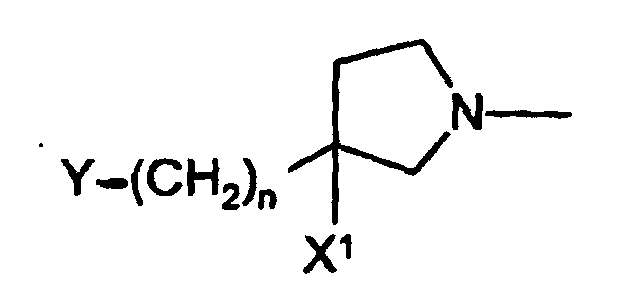
- In the light of these circumstances, the inventors have conducted extensive investigation for the purpose of providing excellent compounds fulfilling the above demands. As a result, they have found that cis-substituted aminocyclopropane derivatives represented by the following formula (I) and their salts have broad antimicrobial spectra, exhibiting potent antimicrobial activity particularly on Gram positive bacteria, especially quinolone-resistant bacteria including MRSA, and also show satisfactory in pharmacokinatics and safety.
- The present invention relates to a compound represented by formula (I) shown below, its salt and their hydrates:wherein R1 and R2 each independently represents a hydrogen atom or an alkyl group having 1 to 6 carbon atoms which may be substituted with one or more substituents selected from the group consisting of a hydroxyl group, a halogen atom, an alkylthio group having 1 to 6 carbon atoms, and an alkyloxy group having 1 to 6 carbon atoms; n represents an integer of 1 to 3; Q represents a partial structure having formula:
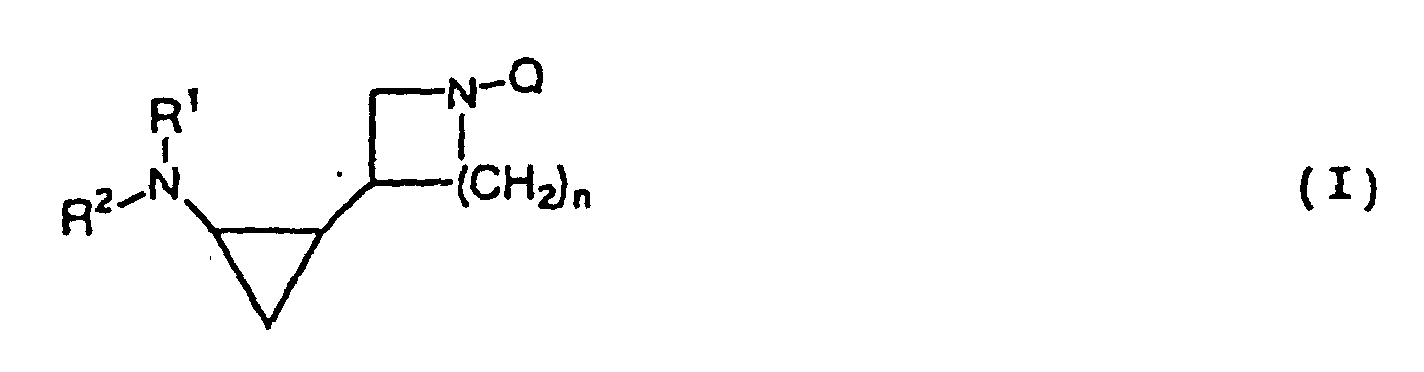 wherein R3 represents an alkyl group having 1 to 6 carbon atoms, an alkenyl group having 2 to 6 carbon atoms, a halogenoalkyl group having 1 to 6 carbon atoms, a cycloalkyl group having 3 to 6 carbon atoms, which is unsubstituted or substituted by a halogen atom, a phenyl group which is unsubstituted or substituted by 1 to 3 substituents selected from a halogen atom, an alkyl group having 1 to 6 carbon atoms, a hydroxyl group, an amino group, a nitro group, and an alkoxyl group having 1 to 6 carbon atoms; a pyridyl or pyrimidyl group which is unsubstituted or substituted by a halogen atom, an alkoxyl group having 1 to 6 carbon atoms, or an alkylamino group having 1 to 6 carbon atoms; R4 represents a hydrogen atom or an alkylthio group having 1 to 6 carbon atoms; R3 and R4 may be taken together with part of the mother skeleton to which they are bonded to form a 4- to 6-membered cyclic structure that may contain a sulfur atom as a ring constituting atom and/or may be substituted with an alkyl group having 1 to 6 carbon atoms; R5 represents a hydrogen atom, an amino group, a hydroxyl group, a thiol group, a halogenomethyl group, an alkyl group having 1 to 6 carbon atoms, an alkenyl group having 2 to 6 carbon atoms, an alkynyl group having 2 to 6 carbon atoms or an alkoxyl group having 1 to 6 carbon atoms, in which the amino group may be substituted with one or more substituents selected from the group consisting of a formyl group, an alkyl group having 1 to 6 carbon atoms, and an acyl group having 2 to 5 carbon atoms; X1 represents a halogen atom or a hydrogen atom; and A represents a nitrogen atom or a partial structure represented by formula (II):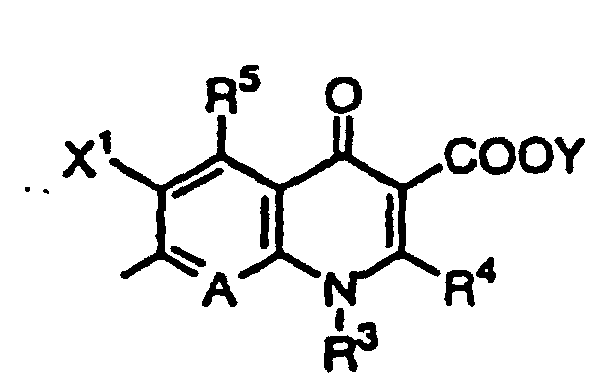
-
 wherein X2 represents a hydrogen atom, an amino
group, a halogen atom, a cyano group, a
halogenomethyl group, a halogenomethoxyl group,
an alkyl group having 1 to 6 carbon atoms, an
alkenyl group having 2 to 6 carbon atoms, an
alkynyl group having 2 to 6 carbon atoms, or an
alkoxyl group having 1 to 6 carbon atoms, in
which the amino group may be substituted with
one or more substituents selected from the
group consisting of a formyl group, an alkyl
group having 1 to 6 carbon atoms and an acyl
group having 2 to 5 carbon atoms; and X2 and R3
may be taken together with part of the mother
skeleton to which they are bonded to form a
4 to 7-membered cyclic structure that may contain an oxygen
atom, a nitrogen atom or a sulfur atom as a
ring constituting and/or may be substituted
with an alkyl group having 1 to 6 carbon atoms;
wherein X2 represents a hydrogen atom, an amino
group, a halogen atom, a cyano group, a
halogenomethyl group, a halogenomethoxyl group,
an alkyl group having 1 to 6 carbon atoms, an
alkenyl group having 2 to 6 carbon atoms, an
alkynyl group having 2 to 6 carbon atoms, or an
alkoxyl group having 1 to 6 carbon atoms, in
which the amino group may be substituted with
one or more substituents selected from the
group consisting of a formyl group, an alkyl
group having 1 to 6 carbon atoms and an acyl
group having 2 to 5 carbon atoms; and X2 and R3
may be taken together with part of the mother
skeleton to which they are bonded to form a
4 to 7-membered cyclic structure that may contain an oxygen
atom, a nitrogen atom or a sulfur atom as a
ring constituting and/or may be substituted
with an alkyl group having 1 to 6 carbon atoms; -
- The present invention also relates to:
- a compound of formula (I), wherein Q is a partial structure
represented by formula:
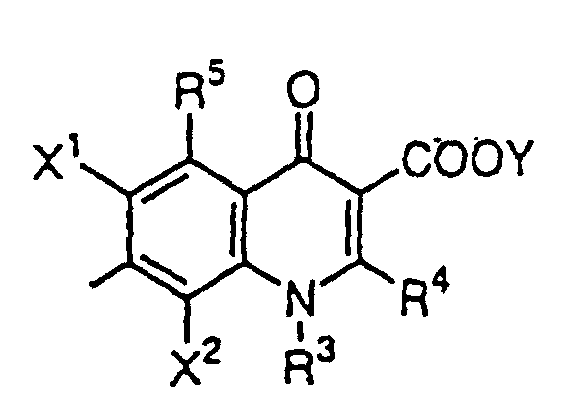 wherein R3, R4, R5, X1, X2, and Y are as defined above,
or a salt or hydrate thereof or a hydrate of the salt;
wherein R3, R4, R5, X1, X2, and Y are as defined above,
or a salt or hydrate thereof or a hydrate of the salt;
- a compound of formula (I), wherein Q is a 6-carboxy-9-fluoro-2,3-dihydro-3-(S)-methyl-7-oxo-7H-pyrido[1,2,3-de][1,4]benzoxazin-10-yl
group of formula:
or a salt or hydrate thereof or a hydrate of the salt;

- a compound of formula (I), wherein Q is a 8-amino-6-carboxy-9-fluoro-2,3-dihydro-3-(S)-methyl-7-oxo-7H-pyrido[1,2,3-de][1,4]benzoxazin-10-yl
group of formula:
or a salt or hydrate thereof or a hydrate of the salt;
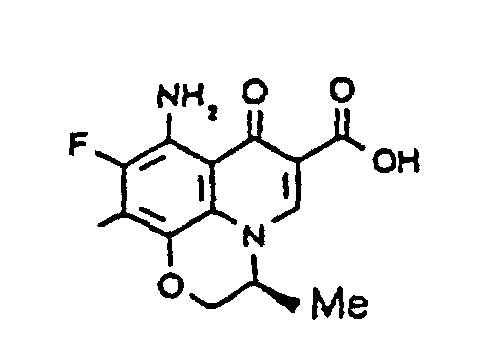
- a compound of formula (I), wherein Q is a 5-amino-3-carboxy-6-fluoro-1-[2-(S)-fluoro-1-(R)-cyclopropyl]-1,4-dihydro-8-methoxyl-4-oxoquinolin-7-yl
group of formula:
or a salt or hydrate thereof or a hydrate of the salt;
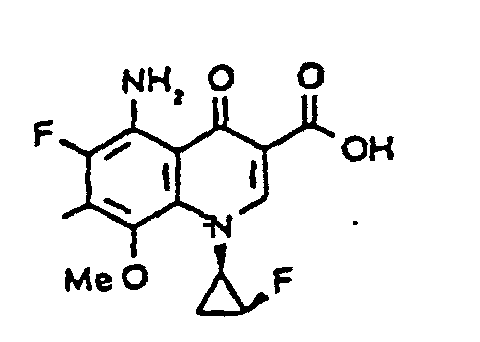
- a compound of formula (I), wherein Q is a 5-amino-3-carboxy-6-fluoro-1-[2-(S)-fluoro-1-(R)-cyclopropyl]-1,4-dihydro-8-methyl-4-oxoquinolin-7-yl
group of formula:
or a salt or hydrate thereof or a hydrate of the salt;
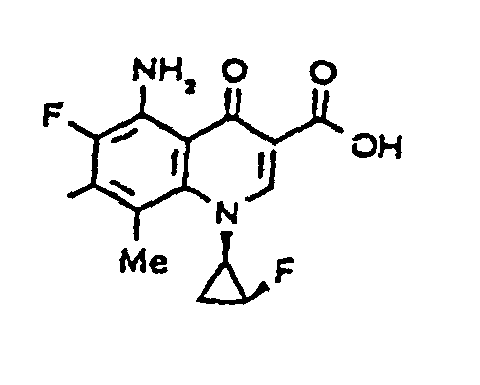
- a compound of formula (I), wherein Q is a 3-carboxy-6-fluoro-1-[2-(S)-fluoro-1-(R)-cyclopropyl]-1,4-dihydro-8-methoxyl-4-oxoquinolin-7-yl
group of formula:
or a salt or hydrate thereof or a hydrate of the salt;

- a compound of formula (I), wherein n is 2, or a salt or hydrate thereof or a hydrate of the salt;
- a compound of formula (I), wherein R1 and R2 are each a hydrogen atom, or a salt or hydrate thereof or a hydrate of the salt;
- a compound of formula (I), wherein R3 is a halogenocyclopropyl group, or a salt or hydrate thereof or a hydrate of the salt;
- a compound of formula (I), wherein R3 is a 1,2-cis-2-halogenocyclopropyl group, or a salt or hydrate thereof or a hydrate of the salt;
- a compound of formula (I), wherein R3 is a stereochemically pure substituent, or a salt or hydrate thereof or a hydrate of the salt;
- a compound of formula (I), wherein R3 is a (1R,2S)-2-halogenocyclopropyl group, or a salt or hydrate thereof or a hydrate of the salt;
- a compound of formula (I), wherein R3 is a (1R,2S)-2-fluorocyclopropyl group, or a salt or hydrate thereof or a hydrate of the salt;
- a compound of formula (I), wherein X1 is a halogen atom, or a salt or hydrate thereof or a hydrate of the salt;
- a compound of formula (I), wherein X1 is a fluorine atom, or a salt or hydrate thereof or a hydrate of the salt;
- a compound of formula (I) which is a stereochemically pure compound, or a salt or hydrate thereof or a hydrate of the salt;
- 5-amino-7-{3-[(1S,2S)-2-aminocyclopropyl]-1-pyrrolidinyl}-6-fluoro-1-[(1R,2S)-2-fluorocyclopropyl]-8-methyl-1,4-dihydro-4-oxoquinoline-3-carboxylic acid or a salt or hydrate thereof or a hydrate of the salt;
- a drug containing any of the above-described compounds, hydrates thereof, salts thereof, and hydrates of the salts as an active ingredient; and
- an antimicrobial agent containing any of the above-described compounds, hydrates thereof, salts thereof, and hydrates of the salts as an active ingredient.
-
- The present invention also relates to a compound represented by formula (VI) shown below, a salt or hydrate thereof, and a hydrate of the salt:wherein R1 and R2 each independently represents a hydrogen atom or an alkyl group having 1 to 6 carbon atoms which may be substituted with one or more substituents selected from the group consisting of a hydroxyl group, a halogen atom, an alkylthio group having 1 to 6 carbon atoms, and an alkyloxy group having 1 to 6 carbon atoms; one of R1 and R2 may be a protective group for amino group; n represents an integer of 1 to 3; Q' represents a hydrogen atom or a protective group for amino group; and the two substituents on the cyclopropane ring,
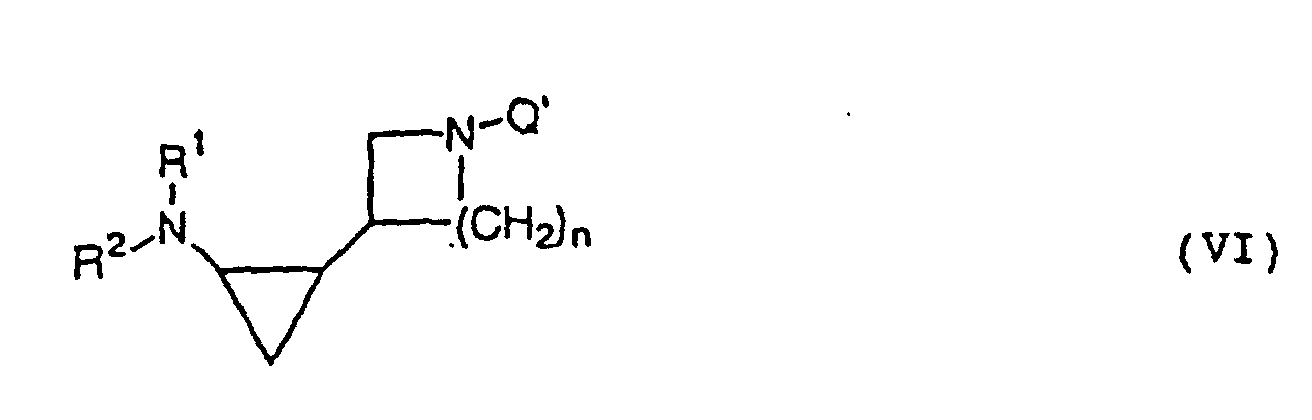 are in a cis-configuration;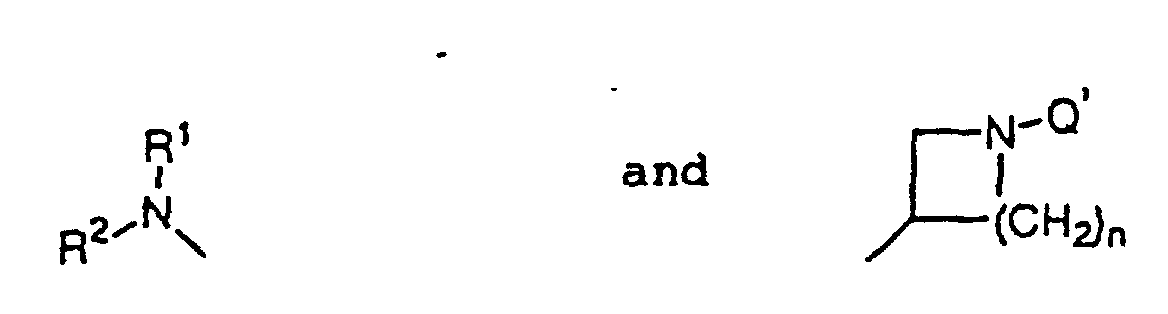
- a compound of formula (VI), wherein the protective group for amino group is selected from the group consisting of a substituted or unsubstituted alkoxycarbonyl group, a substituted or unsubstituted aralkyloxycarbonyl group, a substituted or unsubstituted acyl group, a substituted or unsubstituted alkyl group, a substituted or unsubstituted aralkyl group, and a substituted silyl group, or a salt or hydrate thereof or a hydrate of the salt;
- a compound of formula (VI), wherein the protective group for amino group is selected from the group consisting of a t-butoxycarbonyl group, a 2,2,2-trichloroethoxycarbonyl group, a benzyloxycarbonyl group, a p-methoxylbenzyloxycarbonyl group, a p-nitrobenzyloxycarbonyl group, an acetyl group, a methoxylacetyl group, a trifluoroacetyl group, a chloroacetyl group, a pivaloyl group, a formyl group, a benzoyl group, a t-butyl group, a benzyl group, a p-nitrobenzyl group, a p-methoxybenzyl group, a triphenylmethyl group, a methoxymethyl group, a t-butoxymethyl group, a tetrahydropyranyl group, a 2,2,2-trichloroethoxymethyl group, a trimethylsilyl group, an isopropyldimethylsilyl group, a t-butyldimethylsilyl group, a tribenzylsilyl group, and a t-butyldiphenylsilyl group, or a salt or hydrate thereof or a hydrate of the salt;
- a compound of formula (VI), wherein Q' and one of R1 and R2 are different protective groups for amino group, or a salt or hydrate thereof or a hydrate of the salt;
- a compound of formula (VI) which is a stereochemically pure compound, or a salt or hydrate thereof or a hydrate of the salt;
- and 1-benzyloxycarbonyl-3-[(1S,2S)-2-t-butoxycarbonylaminocyclopropyl]pyrrolidine or a salt or hydrate thereof or a hydrate of the salt.
-
- The compound according to the present invention, represented by formula (I):namely, formula:
 is described with reference to the substituents thereof.
- Substituents R1 and R2 each independently represents a hydrogen atom or an alkyl group having 1 to 6 carbon atoms which may be substituted with one or more substituents selected from the group consisting of a hydroxyl group, a halogen atom, an alkylthio group having 1 to 6 carbon atoms, and an alkyloxy group having 1 to 6 carbon atoms.
- The alkyl group may be a straight-chain or branched having 1 to 6 carbon atoms and preferably is a methyl group, an ethyl group, an n-propyl group, and an isopropyl group. The hydroxyl-substituted alkyl group having 1 to 6 carbon atoms may be a straight-chain or branched and preferably are a hydroxyethyl group and a hydroxypropyl group.
- The alkylthio group having 1 to 6 carbon atoms preferably includes a methylthio group and an ethylthio group. The alkyloxy group having 1 to 6 carbon atoms preferably are a methoxyll group and an ethoxyl group.
- Substituent R3 represents an alkyl group having 1 to 6 carbon atoms, an alkenyl group having 2 to 6 carbon atoms, a halogenoalkyl group having 1 to 6 carbon atoms, a substituted or unsubstituted cycloalkyl group having 3 to 6 carbon atoms, a substituted or unsubstituted phenyl group, a substituted or unsubstituted pyridyl or pyrimidyl group, an alkoxyl group having 1 to 6 carbon atoms, or an alkylamino group having 1 to 6 carbon atoms.
- The alkyl group having 1 to 6 carbon atoms preferably are an ethyl group. The alkenyl group having 2 to 6 carbon atoms preferably are a vinyl group or a 1-isopropenyl group. The halogenoalkyl group having 1 to 6 carbon atoms preferably are a 2-fluoroethyl group. The cycloalkyl group preferably is a cyclopropyl group. The substituent for the cycloalkyl group is a halogen atom, particularly a fluorine atom.
- The phenyl group which may have a substituent includes a phenyl group and a phenyl group having 1 to 3 substituents selected from the group consisting of a halogen atom (e.g., fluorine, chlorine, and bromine), a lower alkyl group having 1 to 6 carbon atoms, a hydroxyl group, an amino group, a nitro group, a lower alkoxyl group having 1 to 6 carbon atoms, etc., and preferably are a phenyl group, a 2-fluorophenyl group, a 4-fluorophenyl group, 2,4-difluorophenyl group, and a 2-fluoro-4-hydroxyphenyl group.
- The substituent on the pyridyl or pyrimidyl group is a halogen atom.
- The alkoxyl group having 1 to 6 carbon atoms preferably are a methoxyl group. The alkylamino group having 1 to 6 carbon atoms preferably are a methylamino group.
- Substituent R3 is preferably a cycloalkyl group or a halogenocycloalkyl group, still preferably a cyclopropyl group or a 2-halogenocyclopropyl group, in which the halogen atom is preferably a fluorine atom.
- Substituent R4 represents a hydrogen atom or an alkylthio group having 1 to 6 carbon atoms, or R3 and R4 may be taken together with part of the mother skeleton (that is, so as to the nitrogen atom to which R3 is bonded and the carbon atom to which R4 is bonded to are involved) to form a cyclic structure. The ring formed may contain a sulfur atom as a ring constituting atom. It may be substituted with an alkyl group having 1 to 6 carbon atoms. The ring is a 4- to 6-membered ring and may be saturated, partially saturated or unsaturated. The alkylthio group having 1 to 6 carbon atoms preferably are a methylthio group and an ethylthio group.
- The condensed ring structure thus formed includes the following structures.X1 represents a halogen atom or a hydrogen atom.

- As for the halogen atom, a fluorine atom is preferable.
X1 preferably is a fluorine atom or a hydrogen atom. - Where A is a partial structure of formula (II):X2 represents a hydrogen atom, an amino group, a halogen atom, a cyano group, a halogenomethyl group, a halogenomethoxyl group, an alkyl group having 1 to 6 carbon atoms, an alkenyl group having 2 to 6 carbon atoms, an alkynyl group having 2 to 6 carbon atoms, or an alkoxyl group having 1 to 6 carbon atoms. The amino group may have one or more substituents selected from the group consisting of a formyl group, an alkyl group having 1 to 6 carbon atoms and an acyl group having 2 to 5 carbon atoms.

- The alkyl group may be a straight-chain or branched having 1 to 6 carbon atoms and preferably are a methyl group, an ethyl group, an n-propyl group, and an isopropyl group. The alkenyl group may be a straight-chain or branched having 2 to 6 carbon atoms and preferably is a vinyl group. The alkynyl group may be a straight-chain or branched having 2 to 6 carbon atoms and preferably is an ethynyl group. The halogenomethyl group may contain 1 to 3 halogen atoms, and the halogen atom thereof is preferably a fluorine atom. The alkoxyl group may be those having 1 to 6 carbon atoms and preferably is a methoxyl group. The halogenomethoxyl group may have 1 to 3 halogen atoms, and the halogen atom thereof is preferably a fluorine atom.
- R3 and X2 may be taken together with part of the mother skeleton (that is, so as to the nitrogen atom to which R3 is bonded and the carbon atom to which X2 is bonded are involved) to form a cyclic structure that may contain an oxygen atom, a nitrogen atom or a sulfur atom as a ring constituting atom and/or may be substituted with an alkyl group having 1 to 6 carbon atoms. The cyclic structure is a 4- to 7-membered ring and may be saturated, partially saturated or unsaturated.
- The condensed ring structure thus formed includes the following structures.
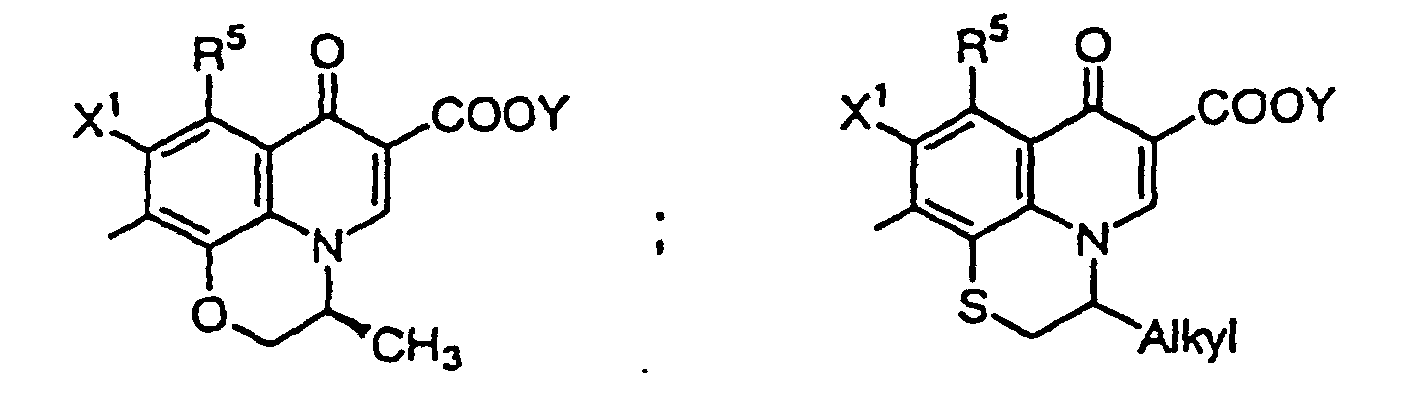
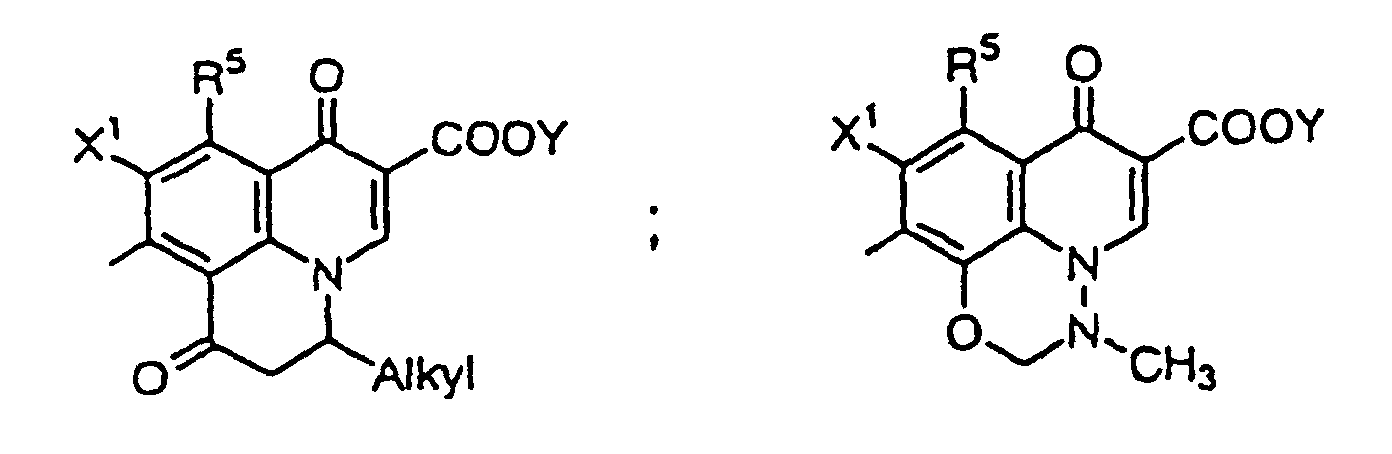
- A 6-carboxy-2,3-dihydro-3-(S)-methyl-7-oxo-7H-pyrido[1,2,3-de][1,4]benzoxazin-10-yl group is particularly preferred of them.
- Substituent R5 represents a hydrogen atom, an amino group, a hydroxyl group, a thiol group, a halogenomethyl group, an alkyl group having 1 to 6 carbon atoms, an alkenyl group having 2 to 6 carbon atoms, an alkynyl group having 2 to 6 carbon atoms or an alkoxyl group having 1 to 6 carbon atoms, in which the amino group may be substituted with one or more substituents selected from the group consisting of a formyl group, an alkyl group having 1 to 6 carbon atoms, and an acyl group having 2 to 5 carbon atoms.
- The alkyl group can be a straight-chain or branched having 1 to 6 carbon atoms and preferably is a methyl group, an ethyl group, an n-propyl group, and an isopropyl group. The alkenyl group can be a straight-chain or branched having 2 to 6 carbon atoms and preferably is a vinyl group. The alkynyl group may be a straight-chain or branched having 2 to 6 carbon atoms and preferably is an ethynyl group. The halogenomethyl group may contain 1 to 3 halogen atoms, and the halogen atom thereof preferably is a fluorine atom. The alkoxyl group can be those having 1 to 6 carbon atoms and preferably is a methoxyl group.
- The acyl group having 2 to 5 carbon atoms which may be a substitutent for the amino group preferably are an acetyl group, a propanoly group and a butanoyl group.
- Where X2 or R5 is an amino group, a hydroxyl group or a thiol group, these groups may be protected by commonly used protective groups, such as a substituted or unsubstituted alkoxycarbonyl group, a substituted or unsubstituted aralkyloxycarbonyl group, a substituted or unsubstituted acyl group, a substituted or unsubstituted alkyl group, a substituted or unsubstituted aralkyl group, and a silyl group substituted with an alkyl group or an aralkyl group (they may be the same or different).
- Specific examples of the protective group include substituted or unsubstituted alkoxycarbonyl groups, e.g., a t-butoxycarbonyl group and a 2,2,2-trichloroethoxycarbonyl group; substituted or unsubstituted aralkyloxycarbonyl groups, e.g., a benzyloxycarbonyl group, a p-methoxybenzyloxycarbonyl group, and a p-nitrobenzyloxycarbonyl group; substituted or unsubstituted acyl groups, e.g., an acetyl group, a methoxyacetyl group, a trifluoroacetyl group, a chloroacetyl group, a pivaloyl group, a formyl group, and a benzoyl group; substituted or unsubstituted alkyl or aralkyl groups, e.g., a t-butyl group, a benzyl group, a p-nitrobenzyl group, a p-methoxybenzyl group, a triphenylmethyl group, and a phenethyl group; ether groups, e.g, a methoxymethyl group, a t-butoxymethyl group, a tetrahydropyranyl group, and a 2,2,2-trichloroethoxymethyl group; and substituted silyl groups, e.g., a trimethylsilyl group, an isopropyldimethylsilyl group, a t-butyldimethylsilyl group, a tribenzylsilyl group, and a t-butyldiphenylsilyl group. The compounds whose substituents are protected by these protective groups are particularly useful as an intermediate for preparing the compounds of formula (I).
- Y represents a hydrogen atom, a phenyl group, an acetoxymethyl group, a pivaloyloxymethyl group, an ethoxycarbonyl group, a choline group, a dimethylaminoethyl group, a 5-indanyl group, a phthalidinyl group, a 5-alkyl-2-oxo-1,3-dioxol-4-ylmethyl group, a 3-acetoxy-2-oxobutyl group, an alkyl group having 1 to 6 carbon atoms, an alkoxymethyl group having 2 to 7 carbon atoms, or a phenylalkyl group having 1 to 6 carbon atoms in the alkyl moiety thereof.
- The alkyl group having 1 to 6 carbon atoms preferably are a methyl group, an ethyl group, a propyl group, an isopropyl group, a butyl group and a t-butyl group. The alkoxymethyl group having 2 to 7 carbon atoms preferably are a methoxymethyl group and an ethoxymethyl. The phenylalkyl group having 1 to 6 carbon atoms in the alkyl moiety thereof preferably are a benzyl group and a phenetyl group.
- Where A is a partial structure represented by formula (II), a preferable combination of substituents R5 and X2 is that R5 is selected from an amino group, a hydrogen atom, a hydroxyl group, and an alkyl group having 1 to 6 carbon atoms, and X2 is selected from an alkyl group having 1 to 6 carbon atoms, an alkoxyl group having 1 to 6 carbon atoms, a halogenomethoxyl group, and a hydrogen atom. In a still preferred combination, R5 is an amino group, a hydrogen atom, a hydroxyl group or a methyl group, and X2 is a methyl group, a methoxyl group, a difluoromethoxyl group or a hydrogen atom.
- In the above case, X1 preferably is a fluorine atom with respect to R5 and X2. Where X1 and X2 are both a halogen atom, X1 preferably is a fluorine atom, and X2 preferably is a fluorine atom or a chlorine atom.
- The compounds according to the present invention are characterized in that the quinolone skeleton has a substituent represented by formula:at the 7-position or a corresponding position, namely, the formula that the amino group or alkylamino group:
 and a 4-membered (n=1) to 6-membered (n=3) nitrogen-containing saturated heterocyclic substituent:
 are bonded to the cyclopropyl group.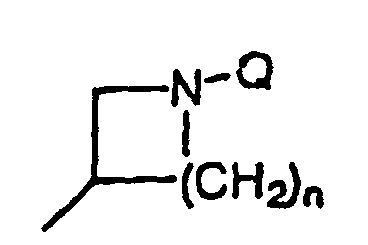
- The amino moiety and the nitrogen-containing saturated heterocyclic moiety are in a cis- configuration with respect to the cyclopropyl group (cyclopropane ring), as shown below:
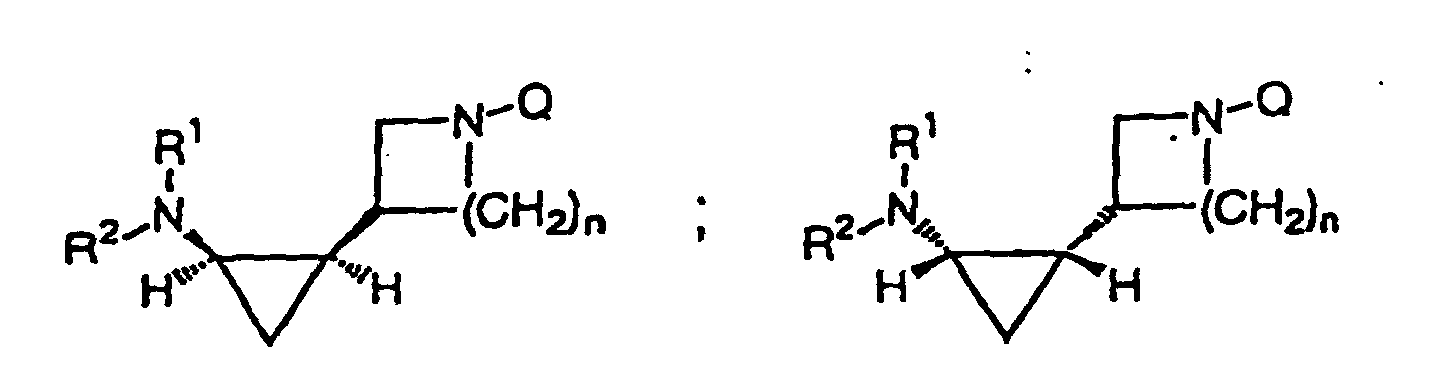
- Where n is 2 or 3, the nitrogen-containing saturated heterocyclic moiety and the cyclopropane ring are bonded in two modes to provide isomers. Such isomers are illustrated below, taking the structure wherein n=2 for instance. Similar isomers are produced when n is 3. The present invention is intended to embrace all these isomers under the scope thereof.

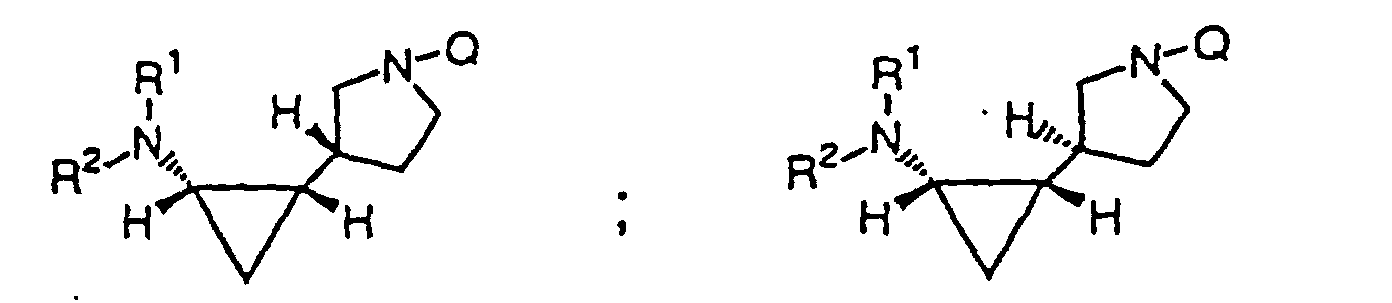
- The cyclopropyl moiety may have further substituents, for example, a fluorine atom, a methyl group, an ethyl group, a trifluoromethyl group, etc.
- The halogenocyclopropyl group as R3 is then described. The substituent halogen atom includes a fluorine atom and a chlorine atom, with a fluorine atom being preferred.
- It is particularly preferred that the substituent halogen atom and the pyridonecarboxylic acid moiety be in a cis-configuration with respect to the cyclopropane ring.
- Regardless of stereoisomerism of the 7-positioned substituent, the cis-2-halogenocyclopropyl moiety of R3 makes a pair of antipodes, each of which was observed to exhibit potent antimicrobial activity and high safety.
- Where the compound of formula (I) has such a structure that produces diastereomers, it is desirable to administer a compound comprising a pure diastereomer in administration to humans or animals. The language "a compound comprising a pure diastereomer" as used herein is construed as including not only a compound containing no other diastereomer at all but a compound containing other diastereomers to such an extent that the compound is recognized to be stereochemically pure as a whole. In other words, it is construed as meaning that other diastereomers may exist to some extent as long as the existence gives no substantial influence on physiological activities or physicochemical constants.
- The language "stereochemically pure" as used herein is intended to mean that a compound comprises only one of its stereoisomers ascribed to its asymmetric carbon atom. The latitude of the term "pure" in "pure diastereomer" also applies here.
- The pyridonecarboxylic acid derivative of the present invention may present in either a free form or a form of an acid addition salt or a carboxylic acid salt. Acid addition salts include inorganic acid salts, such as a hydrochloride, a sulfate, a nitrate, a hydrobromide, a hydroiodide, and a phosphate; and organic acid salts, such as an acetate, a metanesulfonate, a benzenesulfonate, a toluenesulfonate, a citrate, a maleate, a fumarate, and a lactate.
- The carboxylic acid salts include inorganic salts and organic salts, such as alkali metal salts, e.g., a lithium salt, a sodium salt, and a potassium salt; alkaline earth metal salts, e.g., a magnesium salt and a calcium salt; an ammonium salt; a triethylamine salt, an N-methylglucamine salt, and a tris-(hydroxymethyl)aminomethane salt.
- The free pyridonecarboxylic acid derivatives, acid addition salts thereof, and carboxylic acid salts thereof may be present as a hydrate.
- On the other hand, quinolone derivatives with the carboxylic acid moiety thereof having an ester form are useful as an intermediate for synthesis or a pro-drug. For example, alkyl esters, benzyl esters, alkoxylalkyl esters, phenylalkyl esters, and phenyl esters are useful as synthetic intermediates.
- Esters which can be used as pro-drugs are those which are susceptible to an in vivo cleavage to form a free carboxylic acid, including an acetoxymethyl ester, a pivaloyloxymethyl ester, an ethoxycarbonyl ester, a choline ester, a dimethylaminoethyl ester, a 5-indanyl ester, a phthalidinyl ester, a 5-alkyl-2-oxo-1,3-dioxol-4-ylmethyl ester, and oxoalkyl esters, such as a 3-acetoxy-2-oxobutyl ester.
- The compound of formula (I) can be prepared through various processes. A preferred process comprises reacting a compound represented by formula (III):wherein X3 represents a leaving group, such as a fluorine atom, a chlorine atom, a bromine atom, an alkylsulfonyl group having 1 to 3 carbon atoms, or an arylsulfonyl group, e.g., a benzenesulfonyl group or a toluenesulfonyl group; Y has the same meaning as in formula (I) or represents a boron-containing group represented by formula (IV):
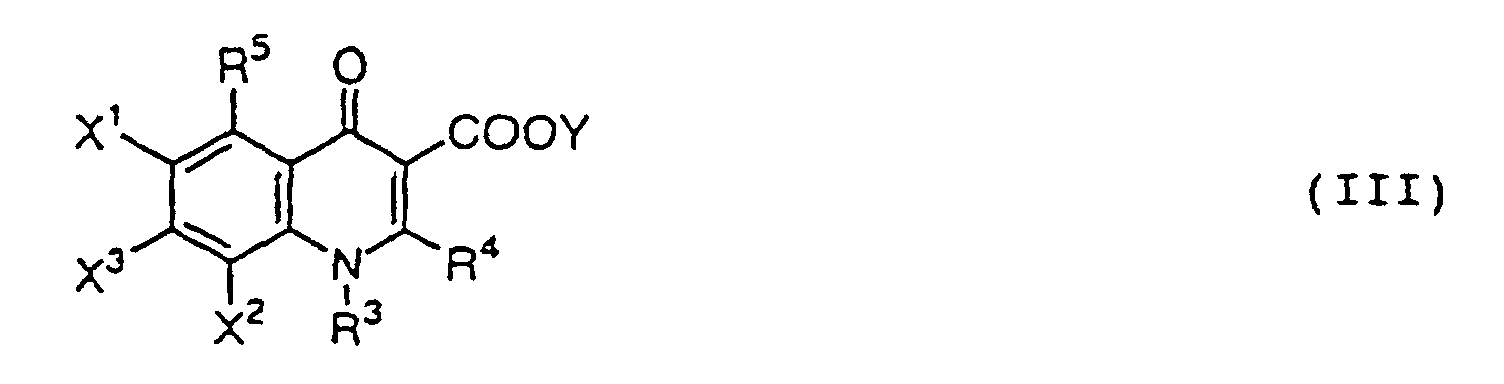
and R3, R4, R5, X1, and X2 are as defined in formula (I), with a compound represented by formula (V):wherein R1, R2, and n are as defined in formula (I), except that R1 may be a nitrogen-protective group Rx.
- Any protective group generally used in the art can be used as protective group Rx. Examples of useful protective groups include alkoxylcarbonyl groups, e.g., a t-butoxycarbonyl group and a 2,2,2-trichloroethoxycarbonyl group; aralkyloxycarbonyl groups, e.g., a benzyloxycarbonyl group, a p-methoxybenzyloxycarbonyl group, and a p-nitrobenzyloxycarbonyl group; acyl groups, e.g., an acetyl group, a methoxyacetyl group, a trifluoroacetyl group, a chloroacetyl group, a pivaloyl group, a formyl group, and a benzoyl group; alkyl or aralkyl groups, e.g., a t-butyl group, a benzyl group, a p-nitrobenzyl group, a p-methoxybenzyl group, and a triphenylmethyl group; ether groups, e.g, a methoxymethyl group, a t-butoxymethyl group, a tetrahydropyranyl group, and a 2,2,2-trichloroethoxymethyl group; and substituted silyl groups, e.g., a trimethylsilyl group, an isopropyldimethylsilyl group, a t-butyldimethylsilyl group, a tribenzylsilyl group, and a t-butyldiphenylsilyl group, or an acid addition salt thereof.
- The resulting compound in which Y is an alkyl group having 1 to 6 carbon atoms, an alkoxymethyl group having 2 to 7 carbon atoms or a phenylalkyl group having 1 to 6 carbon atoms in the alkyl moiety thereof can be converted to the corresponding carboxylic acid by hydrolysis under an acidic or basic condition commonly used for hydrolysis of carboxylic acid esters. The protective group, if any, is removed under properly selected conditions to obtain a desired compound (I).
- The compound obtained by the substitution reaction between the compound (III) wherein Y is the group (IV) and the compound (V) can be converted to the corresponding carboxylic acid by treatment with an acidic or basic compound.
- The substitution reaction between the compound of formula (III) and the compound of formula (V) is carried out with or without a solvent. The solvent, if used, is not limited as long as it is inert under the reaction conditions. Suitable solvents include dimethyl sulfoxide, pyridine, acetonitrile, ethanol, chloroform, dimethylformamide, dimethylacetamide, N-methylpyrrolidone, tetrahydrofuran, water, and 3-methoxybutanol. These solvents may be used as a mixture thereof.
- The reaction is usually performed at room temperature to 200°C, preferably 25 to 150°C, for 0.5 to 48 hours. The reaction usually completes in about 0.5 to 2 hours. It is advantageous to conduct the reaction in the presence of an acid acceptor, such as an inorganic base (e.g., an alkali metal or alkaline earth metal carbonate or hydrogencarbonate) or an organic base (e.g., triethylamine, pyridine or 1,8-diazabicycloundecene).
- The compound of formula (V) can be prepared by various processes. A preferred process is shown in Reference Examples hereinafter given, but the process is not limited thereto. Most generally, the compound of formula (V) is prepared by removing the protective group from a compound represented by formula (VI) shown below, in which the nitrogen atom is protected by a protective group Q'.wherein R1 and R2 each represent a hydrogen atom or an alkyl group having 1 to 6 carbon atoms, which may have one or more substituents selected from the group consisting of a hydroxyl group, a halogen atom, an alkylthio group having 1 to 6 carbon atoms, and an alkyloxy group having 1 to 6 carbon atoms; one of R1 and R2 may be an protective group for amino group; n represents an integer of 1 to 3; Q' represents a protective group for amino group; and the two substituents on the cyclopropane ring,
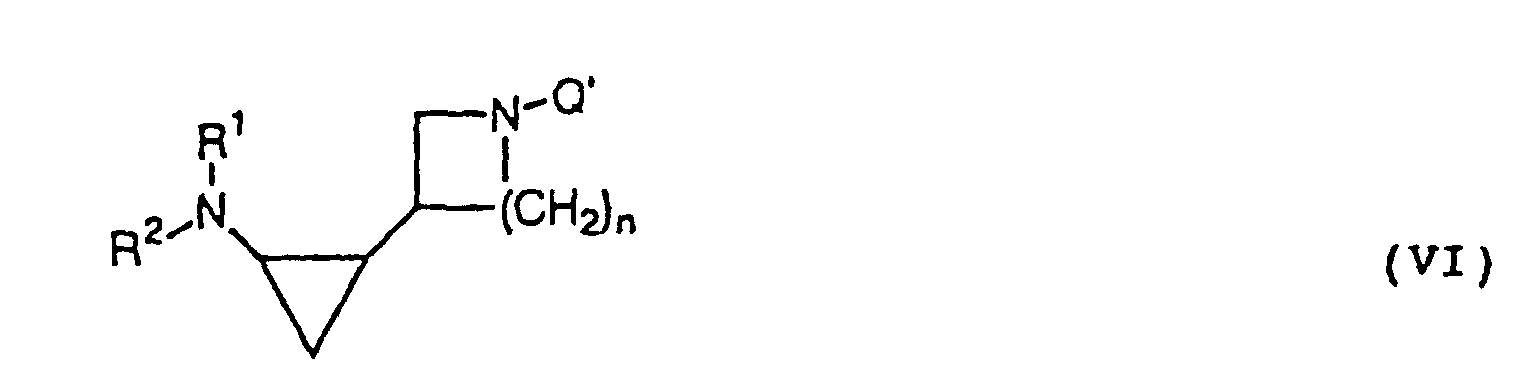 are in a cis-configuration.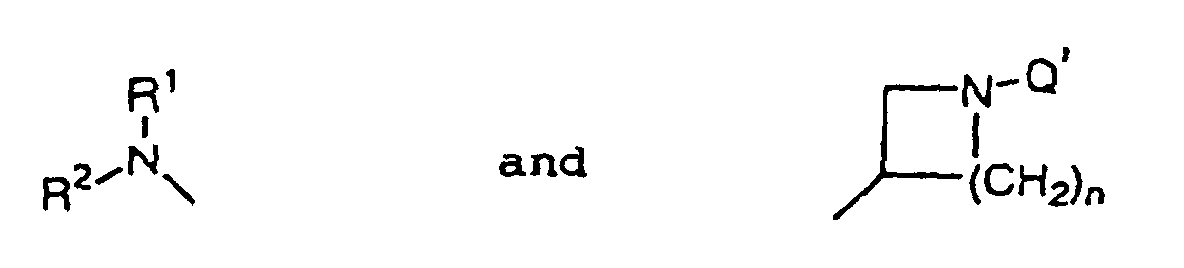
- The compound (VI) may exist in the form of a salt, a hydrate, or a hydrate of the salt. Acid addition salts include inorganic acid salts and organic acid salts. Examples of the inorganic acid salts are a hydrochloride, a sulfate, a nitrate, a hydrobromide, a hydroiodide, and a phosphate. Examples of the organic acid salts include sulfonates, such as a metanesulfonate, a benzenesulfonate, and a toluenesulfonate, and carboxylates, such as an acetate, a citrate, a maleate, a fumarate, and a lactate.
- Where Q' and one of R1 and R2 both represent an protective group for amino group, while they may be the same or different, it is advantageous for the preparation of the compound (I) that these protective groups are different so that they are cleaved under the respective different reaction conditions.
- The protective group for amino group as R1 or R2 and Q' includes substituted or unsubstituted alkoxycarbonyl groups, e.g., a t-butoxycarbonyl group and a 2,2,2-trichloroethoxycarbonyl group; substituted or unsubstituted aralkyloxycarbonyl groups, e.g., a benzyloxycarbonyl group, a p-methoxybenzyloxycarbonyl group, and a p-nitrobenzyloxycarbonyl group; substituted or unsubstituted acyl groups, e.g., an acetyl group, a methoxyacetyl group, a trifluoroacetyl group, a chloroacetyl group, a pivaloyl group, a formyl group, and a benzoyl group; substituted or unsubstituted alkyl or aralkyl groups, e.g., a t-butyl group, a benzyl group, a p-nitrobenzyl group, a p-methoxybenzyl group, and a triphenylmethyl group; ether groups, e.g, a methoxymethyl group, a t-butoxymethyl group, a tetrahydropyranyl group, and a 2,2,2-trichloroethoxymethyl group; and substituted silyl groups, e.g., a trimethylsilyl group, an isopropyldimethylsilyl group, a t-butyldimethylsilyl group, a tribenzylsilyl group, and a t-butyldiphenylsilyl group.
- Cis-2-fluorocyclopropylamine comprising a pure isomer, which is preferred for the synthesis of the compound of formula (I) comprising a pure isomer, can be synthesized by, for example, the process described in JP-A-2-231475 (the term "JP-A" as used herein means an "unexamined published Japanese patent application"). Synthesis of the compound of formula (I) comprising a pure isomer from the resulting optically active cis-2-fluorocyclopropylamine derivative can be carried out by, for example, the process described in JP-A-2-231475.
- The compounds of the present invention have potent antimicrobial activity and are therefore useful as drugs for humans, animals or fishes, agricultural chemicals, or food preservatives.
- For use as drugs for humans, the dose of the compound is in the range of from 50 mg to 1 g, and preferably from 100 mg to 300 mg, per day for an adult.
- For veterinary use, the dose is generally in the range of from 1 to 200 mg, and preferably from 5 to 100 mg, per kg of body weight per day while varying depending on the purpose of administration (for therapy or for prevention), the kind and the size of the animal, the kind of the pathogenic organisms, and severity of symptom.
- The above-mentioned daily dose is given once a day or in 2 to 4 divided doses. If necessary, a daily dose may exceed the above-specified range.
- The compounds according to the present invention are active on a broad range of microorganisms causing various infectious diseases and effective to prevent, alleviate or cure diseases caused by these pathogens.
- Examples of bacteria or bacterium-like microorganisms on which the compounds of the invention are effective include staphylococci, Streptococcus pyogenes, Streptococcus haemolyticus, Streptococcus faecalis, Streptococcus pneumoniae, peptostreptococci, Neisseria gonorrhoeae, Escherichia coli, Citrobacter sp., Shigella sp., Klebsiella pneumoniae, Enterobacter sp., Serratia sp., Proteus sp., Pseudomonas aeruginosa, Haemophilus influenzae, Acinetobacter sp., Campylobacter sp., and Chlamydozoon trachomatis.
- Diseases which are caused by these pathogens include folliculitis, furuncle, carbuncle, erysipelas, phlegmon, lymphangitis/lymphadenitis, felon, subcutaneous abscess, spiradenitis, acne agminata, infectious atheroma, perianal abscess, mastadenitis, superficial secondary infections after trauma, burn or surgery trauma, pharyngolaryngitis, acute bronchitis, tonsillitis, chronic bronchitis, bronchiectasis, diffuse panbronchiolitis, secondary infections of chronic respiratory diseases, pneumonia, pyelonephritis, cystitis, prostatitis, epididymitis, gonococcal urethritis, non-gonococcal urethritis, cholecystitis, cholangitis, bacillary dysentery, enteritis, adnexitis, intrauterine infections, bartholinitis, blepharitis, hordeolum, dacryocystitis, tarsadenitis, keratohelcosis, otitis media, sinusitis, paradentosis, pericoronitis, gnathitis, peritonitis, endocarditis, septicemia, meningitis, and skin infections.
- The compounds of the present invention are also effective on various microorganisms causing veterinary diseases, such as those belonging to the genera Escherichia, Salmonella, Pasteurella, Haemophilus, Bordetella, Staphylococcus, and Mycoplasma. Illustrative examples of the veterinary diseases include those of fowl, such as colibacillosis, pullorum disease, avian paratyphosis, fowl cholera, infectious coryza, staphylomycosis, and mycoplasmosis; those of pigs, such as colibacillosis, salmonellosis, pasteurellosis, hemophilus infections, atrophic rhinitis, exudative epidermitis, and mycoplasmosis; those of cattle, such as colibacillosis, salmonellosis, hemorrhagic septicemia, mycoplasmosis, bovine contagious pleuropneumonia, and bovine mastitis; those of dogs, such as colisepsis, salmonellosis, hemorrhagic septicemia, pyometra, and cystitis; those of cats, such as exudative pleurisy, cystitis, chronic rhinitis, and hemophilus infections; and those of kittens, such as bacterial diarrhea and mycoplasmosis.
- Dosage forms of pharmaceutical preparations containing the compound of the present invention are appropriately selected according to the administration route and can be prepared by conventional preparation methods. Examples of dosage forms for oral administration include tablets, powders, granules, capsules, solutions, syrups, elixirs, and oily or aqueous suspensions.
- Injectable preparations may contain adjuvants, such as stabilizers, antiseptics, and solubilizers. The injectable solution which may contain these adjuvants may be put into a container and solidified by, for example, lyophilization to prepare a solid preparation which is dissolved on use. The container may contain either a single dose or multiple doses.
- Preparations for external application include solutions, suspensions, emulsions, ointments, gels, creams, lotions, and sprays.
- Solid preparations may contain, in addition to the active compound, pharmaceutically acceptable additives. For example, the active compound is mixed with additives selected according to necessity from among fillers, extenders, binders, disintegrators, absorption accelerators, wetting agents, and lubricants and formulated into solid preparations.
- Liquid preparations include solutions, suspensions, and emulsions. They may contain adjuvants, such as suspending agents, emulsifiers, and so forth.
- The compound can be administered to animals orally either directly or by mixing with feedstuff, or in a dissolved form directly given to animals or by mixing with water or feedstuff or non-orally by injection.
- For veterinary use, the compound can be formulated into powders, fine granules, soluble powders, syrups, solutions, and injections according to the customary methods in the art.
- Formulation Examples are shown below.
-
Capsules Compound of Example 2 100.0 mg Corn starch 23.0 mg CMC·Ca 22.5 mg Hydroxymethyl cellulose 3.0 mg Magnesium stearate 1.5 mg Total: 150.0 mg -
Solution Compound of Example 2 1 to 10 g Acetic acid or sodium hydroxide 0.5 to 2 g Ethyl p-hydroxybenzoate 0.1 g Purified water 87.9 to 98.4 g Total: 100 g -
Powder for Mixing with Feed Compound of Example 2 1 to 10 g Corn starch 89.5 to 98.5 g Light anhydrous silicic acid 0.5 g Total: 100 g - The present invention will further be illustrated in greater detail by way of Examples and Reference Examples, but the present invention should not be construed as being limited thereto. The antimicrobial activity of the compounds prepared was examined in accordance with the standard method specified by the Japan Chemotherapeutic Society, and the results obtained were expressed in terms of minimum inhibitory concentration (MIC; µg/ml).
- Triethylamine (2.5 ml) was added to a solution of 316.1 mg (1.01 mmol) of 5-amino-6,7-difluoro-1-[(1R,2S)-2-fluorocyclopropyl]-8-methyl-1,4-dihydro-4-oxoquinoline-3-carboxylic acid and 343.6 mg (1.52 mmol) of 1-benzyloxycarbonyl-3-(cis-2-t-butoxycarbonylaminocyclopropyl) pyrrolidine (isomer A) in 5 ml of dimethyl sulfoxide, and the mixture was heated under reflux at 130°C for 4 days. The solvent was removed by evaporation under reduced pressure, and chloroform was added to the residue, followed by washing successively with a 10% citric acid aqueous solution and a saturated sodium chloride aqueous solution. The organic layer was dried over anhydrous sodium sulfate, and the solvent was evaporated under reduced pressure. To the residue was added 10 ml of concentrated hydrochloric acid under cooling with ice. After stirring at room temperature for 30 minutes, water was added to the reaction mixture, followed by extraction with dichloromethane. The aqueous layer was neutralized with 5N and 1N sodium hydroxide aqueous solutions and extracted with chloroform. The organic layer was dried over anhydrous sodium sulfate, and the solvent was evaporated under reduced pressure. The residue was recrystallized from ethanol and diethyl ether to give 122.8 mg (29.0%) of the title compound (isomer A) as yellow crystals.
1H-NMR (0.1N-NaOD) δ ppm:
0.00-0.10 (1H, m), 0.55-0.75 (2H, m), 1.00-1.15 (1H, m), 1.35-1.50 (1H, m), 1.55-1.80 (1H, m), 1.85-2.00 (1H, m), 2.00-2.15 (1H, m), 2.15-2.30 (4H, m), 3.10-3.70 (4H, m), 3.80-3.90 (1H, m), 4.60-5.00 (1H, m), and 8.18 and 8.20 (1H, d each, J=2.9, 2.4 Hz each).Elementary Analysis for C21H24F2N4O3: Calcd. (%): C, 60.28; H, 5.78; N, 13.39 Found (%): C, 60.09; H, 5.96; N, 13.06 - Triethylamine (2 ml) was added to a solution of 195.9 mg (0.63 mmol) of 5-amino-6,7-difluoro-1-[(1R,2S)-2-fluorocyclopropyl]-8-methyl-1,4-dihydro-4-oxoquinoline-3-carboxylic acid and 213.0 mg (0.94 mmol) of 1-benzyloxycarbonyl-3-(cis-2-t-butoxycarbonylaminocyclopropyl)pyrrolidine (isomer B) in 4 ml of dimethyl sulfoxide, and the mixture was heated under reflux at 130°C for 45 hours. The solvent was removed by evaporation under reduced pressure, and chloroform was added to the residue, followed by washing successively with a 10% citric acid aqueous solution and a saturated sodium chloride aqueous solution. The organic layer was dried over anhydrous sodium sulfate, and the solvent was evaporated under reduced pressure. To the residue was added 10 ml of concentrated hydrochloric acid under cooling with ice. After stirring at room temperature for 30 minutes, water was added to the reaction mixture, followed by extraction with dichloromethane. The aqueous layer was neutralized with 5N and 1N sodium hydroxide aqueous solutions and extracted with chloroform. The aqueous layer was adjusted to a pH of 10 or higher with a 5N sodium hydroxide aqueous solution and extracted with chloroform. The aqueous layer was neutralized with concentrated hydrochloric acid and 1N hydrochloric acid and extracted with chloroform. The organic layer was dried over anhydrous sodium sulfate, and the solvent was evaporated under reduced pressure. The residue was recrystallized from ethanol and diethyl ether to give 65.9 mg (25.1%) of the title compound (isomer B) as yellow crystals.
1H-NMR (0.1N-NaOD) δ ppm:
0.00-0.10 (1H, m), 0.55-0.70 (2H, m), 0.95-1.15 (1H, m), 1.30-1.50 (1H, m), 1.60-1.80 (1H, m), 1.80-2.10 (2H, m), 2.10-2.25 (4H, m), 3.00-3.70 (4H, m), 3.75-3.85 (1H, m), 4.65-4.95 (1H, m), and 8.13 and 8.14 (1H, d each, J=2.9, 2.0 Hz each).Elementary Analysis for C21H24F2N4O3·0.5H2O: Calcd. (%): C, 59.01; H, 5.90; N, 13.11 Found (%): C, 59.10; H, 5.66; N, 13.06 - Triethylamine (4 ml) was added to a solution of 526.3 mg (1.69 mmol) of 5-amino-6,7-difluoro-1-[(1R,2S)-2-fluorocyclopropyl]-8-methyl-1,4-dihydro-4-oxoquinoline-3-carboxylic acid and 572.2 mg (2.53 mmol) of 1-benzyloxycarbonyl-3-[(1S,2S)-2-t-butoxycarbonylaminocyclopropyl]pyrrolidine (isomer B) in 8 ml of dimethyl sulfoxide, and the mixture was heated under reflux at 130°C for 90 hours. The solvent was removed by evaporation under reduced pressure, and chloroform was added to the residue, followed by washing with a 10% citric acid aqueous solution and a saturated sodium chloride aqueous solution. The organic layer was dried over anhydrous sodium sulfate, and the solvent was evaporated under reduced pressure. The residue was purified by silica gel column chromatography (chloroform:methanol=9:1) to obtain 551.4 mg of a protected compound and 141.4 mg of a mixture of the protected compound and by-products as a brown caramel-like substance.
- To the resulting protected compound (551.4 mg) was added 10 ml of concentrated hydrochloric acid under ice-cooling, followed by stirring at room temperature for 20 minutes. Water was added to the reaction mixture, and the mixture was extracted with dichloromethane. The aqueous layer was neutralized with 5N and 1N sodium hydroxide aqueous solutions and extracted with chloroform. The organic layer was removed by evaporation, and the residue was adjusted to a pH of 10 or higher with water and a 1N sodium hydroxide aqueous solution and extracted with chloroform. The aqueous layer was neutralized with concentrated hydrochloric acid and 1N hydrochloric acid and extracted with chloroform. The first aqueous layer was adjusted to a pH of 10 or higher with a 5N sodium hydroxide aqueous solution and extracted with chloroform. The aqueous layer was neutralized with concentrated hydrochloric acid and 1N hydrochloric acid and extracted with chloroform. The combined organic layer was dried over anhydrous sodium sulfate, and the solvent was evaporated under reduced pressure to obtain 286.1 mg of a crude carboxylic acid.
- The mixture (141.4 mg) of the protected compound and by-products was similarly treated to obtain 62.3 mg of a crude carboxylic acid.
- Recrystallization of the resulting crude carboxylic acid from ethanol gave 204.4 mg (29.0%) of the title compound as yellow crystals.
1H-NMR (0.1N-NaOD) δ ppm:
-0.05-0.05 (1H, m), 0.55-0.65 (2H, m), 0.90-1.10 (1H, m), 1.30-1.40 (1H, m), 1.60-1.70 (1H, m), 1.80-1.90 (1H, m), 2.00-2.10 (1H, m), 2.10-2.20 (4H, m), 3.20-3.30 (1H, m), 3.30-3.40 (2H, m), 3.50-3.60 (1H, m), 3.70-3.80 (1H, m), 4.70-4.95 (1H, m), and 8.11 (1H, brs).Elementary Analysis for C21H24F2N4O3: Calcd. (%): C, 60.28; H, 5.78; N, 13.39 Found (%): C, 60.21; H, 5.72; N, 13.15 - To 150 ml of a methanol solution of 14.68 g (92.8 mmol) of dimethyl cis-1,2-cyclopropanedicarboxylate was added 67 ml of an aqueous solution of 7.52 g (113.9 mmol) of potassium hydroxide under cooling with ice, and the mixture was stirred at room temperature for 24 hours. After completion of the reaction, the solvent was removed by evaporation under reduced pressure, and to the residue was added water. The reaction mixture was washed with diethyl ether. The aqueous layer was adjusted to pH 2 with concentrated hydrochloric acid and extracted with ethyl acetate. The organic layer was dried over anhydrous sodium sulfate, and the solvent was evaporated under reduced pressure to give 12.38 g (92.5%) of the title compound as a colorless oily substance.
1H-NMR (CDCl3) δ ppm:
1.35 (1H, dt, J=8.3, 4.9Hz), 1.70 (1H, dt, J=6.8, 4.9Hz), 2.05-2.20 (2H, m), and 3.72 (3H, m). - To 70 ml of an anhydrous tetrahydrofuran solution of 6.83 g (47.4 mmol) of cis-2-methoxycarbonylcyclopropanecarboxylic acid were added 1.16 g (9.48 mmol) of dimethylaminopyridine and 13.45 g (61.6 mmol) of di-t-butyl dicarbonate at room temperature, and the mixture was stirred at the same temperature for 4 hours. After completion of the reaction, the solvent was removed by evaporation under reduced pressure, and ethyl acetate was added to the residue. The mixture was washed successively with 0.5N hydrochloric acid, water, and a saturated sodium chloride aqueous solution. The organic layer was dried over anhydrous sodium sulfate, and the solvent was evaporated under reduced pressure to give 9.49 g (quantitative) of the title compound as a brown oily substance.
1H-NMR (CDCl3) δ ppm:
1.10-1.20 (1H, m), 1.44 (9H, s), 1.55-1.65 (1H, m), 1.95-2.05 (2H, m), and 3.67 (3H, s). - To 100 ml of a methanol solution of 9.49 g (47.4 mmol) of t-butyl cis-2-methoxycarbonylcyclopropanecarboxylate was added 40 ml of an aqueous solution of 4.06 g (61.5 mmol) of potassium hydroxide under cooling with ice, followed by stirring at room temperature for 24 hours. After completion of the reaction, the solvent was evaporated under reduced pressure. Water was added to the residue, and the mixture was washed with diethyl ether. The aqueous layer was adjusted to a pH of 2 to 3 with concentrated hydrochloric acid and extracted with ethyl acetate. The organic layer was dried over anhydrous sodium sulfate, and the solvent was evaporated under reduced pressure to give 7.56 g (85.7%) of the title compound as a pale yellow solid.
1H-NMR (CDCl3) δ ppm:
1.30-1.40 (1H, m), 1.45 (9H, s), 1.60-1.65 (1H, m), and 2.00-2.10 (2H, m) - To 100 ml of an anhydrous tetrahydrofuran solution of 7.56 g (40.6 mmol) of cis-2-t-butoxycarbonylcyclopropanecarboxylic acid was added 7.57 g (46.7 mmol) of 1,1-carbonyldiimidazole under cooling with ice. After stirring the mixture was stirred at room temperature for 2 hours, the solvent was evaporated under reduced pressure. To 50 ml of an anhydrous tetrahydrofuran solution of the resulting residue was added 80 ml of an anhydrous tetrahydrofuran solution of 101.5 mmol of previously prepared magnesium monoethyl malonate was added, followed by stirring overnight. After completion of the reaction, the solvent was removed by evaporation under reduced pressure, and ethyl acetate was added to the residue. The mixture was washed successively with 0.5N hydrochloric acid, a saturated sodium hydrogencarbonate aqueous solution, and a saturated sodium chloride aqueous solution. The organic layer was dried over anhydrous sodium sulfate, and the solvent was evaporated under reduced pressure. The residue was purified by silica gel column chromatography (hexane:ethyl acetate=7:3) to give 6.67 g (64.1%) of the titled compound as a yellow oily substance.
1H-NMR (CDCl3) δ ppm:
1.20 (1H, dt, J=7.8, 4.9Hz), 1.29 (3H, t, J=7.3Hz), 1.42 (9H, s), 1.71 (1H, dt, J=6.8, 4.9Hz), 2.00-2.10 (1H, m), 2.30-2.40 (1H, m), 3.55 (1H, d, J=15.6Hz), 3.57 (1H, d, J=15.6Hz), 4.20 (2H, q, J=7.3Hz). - To 70 ml of a methanol solution of 6.67 g (26.0 mmol) of ethyl 3-(cis-2-t-butoxycarbonylcyclopropyl)-3-oxopropionate was added 492.2 mg (13.0 mmol) of sodium borohydride at -10°C, and the mixture was stirred at that temperature for 20 minutes. A saturated ammonium chloride aqueous solution was added thereto, and the reaction mixture was extracted with chloroform. The organic layer was dried over anhydrous sodium sulfate, and the solvent was evaporated under reduced pressure to obtain 6.52 g (97.0%) of a crude alcohol as a colorless oily substance.
- To 150 ml of a dichloromethane solution of the crude alcohol (6.52 g, 25.2 mmol) were added 7.04 ml (50.4 mmol) of triethylamine and 2.54 ml (32.8 mmol) of methanesulfonyl chloride while cooling with ice. After the mixture was stirred at the same temperature for 1.5 hours, 8.30 ml (55.4 mmol) of 1,8-diazabicyclo[5.4.0]-7-undecene was added thereto, followed by stirring at room temperature for 18 hours. The solvent was evaporated under reduced pressure, and chloroform was added to the residue. The mixture was washed successively with 0.1N hydrochloric acid and a saturated sodium chloride aqueous solution. The organic layer was dried over anhydrous sodium sulfate, and the solvent was removed by evaporation under reduced pressure to give 6.07 g (quantitative) of the title compound as a yellow oily substance.
1H-NMR (CDCl3) δ ppm:
1.27 (3H, t, J=7.3 Hz), 1.25-1.35 (1H, m), 1.35-1.45 (1H, m), 1.46 (9H, s), 1.90-2.05 (2H, m), 4.10-4.20 (2H, m), 6.00 (1H, d, J=15.6Hz), and 6.90 (1H, ddd, J=15.6, 8.8, 1.5Hz). - To 60 ml of a nitromethane solution of 6.07 g (25.2 mmol) of ethyl 3-(cis-2-t-butoxycarbonylcyclopropyl) acrylate was added 3.48 ml (27.7 mmol) of tetramethylguanidine at room temperature, and the mixture was stirred for 6 hours. To the reaction mixture was further added 0.32 ml (2.52 mmol) of tetramethylguanidine, followed by stirring for 18 hours. The solvent was evaporated under reduced pressure, and the residue was purified by silica gel column chromatography (hexane:ethyl acetate=85:15) to give 6.536 g (85.9%) of the title compound as a pale yellow oily substance.
1H-NMR (CDCl3) δ ppm:
0.95-1.10 (2H, m), 1.20-1.30 (4H, m), 1.46 and 1.48 (9H, s each), 1.65-1.80 (1H, m), 2.40-2.70 (2H, m), 2.70-2.80 (1H, m), 4.10-4.20 (2H, m), and 4.45-4.55 and 4.60-4.75 (2H, m each) - To 200 ml of a methanol solution of 6.536 g (21.7 mmol) of ethyl 3-(cis-2-t-butoxycarbonylcyclopropyl)-3-nitroethylpropionate were added 5 g of 10% palladium-on-carbon and 13.68 g (217 mmol) of ammonium formate at room temperature, and the mixture was stirred at the same temperature for 1.5 hours. After completion of the reaction, the solvent was evaporated under reduced pressure. Water was added to the residue, and the mixture was extracted with chloroform. The organic layer was dried over anhydrous sodium sulfate, and the solvent was evaporated under reduced pressure to give a crude amine.
- A toluene solution (150 ml) of the resulting crude amine was heated at 110 to 120°C for 2 hours. The solvent was evaporated under reduced pressure to give 4.89 g (quantitative) of the title compound as yellow crystals.
1H-NMR (CDCl3) δ ppm:
0.90-1.10 (2H, m), 1.20-1.35 (1H, m), 1.45 (9H, s), 1.65-1.75 (1H, m), 2.10-2.70 (3H, m), 3.10-3.20 and 3.20-3.30 (1H, m each), 3.35-3.45 and 3.55-3.65 (1H, m each), and 6.06 (1H, brs). - To 30 ml of a dimethylformamide solution of 2.288 g (10.2 mmol) of 3-(cis-2-t-butoxycarbonylcyclopropyl)pyrrolidin-2-one was added 406.2 mg (10.2 mmol) of sodium hydride under cooling with ice, followed by stirring at room temperature for 1.5 hours. Then, 1.81 ml (15.3 mmol) of benzyl chloride was added thereto dropwise, followed by stirring for 2.5 hours. After completion of the reaction, water was added to the reaction mixture, and the mixture was extracted with ethyl acetate, and the organic layer was washed with water and a saturated sodium chloride aqueous solution. The organic layer was dried over anhydrous sodium sulfate, and the solvent was removed by evaporation under reduced pressure. The residue was purified by silica gel column chromatography (hexane:ethyl acetate=7:3) to give 1.121 g (35.0%) of 1-benzyl-3-(2-t-butoxycarbonylcyclopropyl)pyrrolidin-2-one (isomer A: an isomer attributed to the steric configuration of the cyclopropyl group bonded to the carbon atom of the pyrrolidine ring) as a colorless solid. The column was then eluted with hexane:ethyl acetate=1:1 to give 670.9 mg (20.9%) of 1-benzyl-3-(cis-2-t-butoxycarbonylcyclopropyl)pyrrolidin-2-one (isomer B: an isomer attributed to the steric configuration of the cyclopropyl group bonded to the carbon atom of the pyrrolidine ring) as a colorless solid.
- Isomer A:
1H-NMR (CDCl3) δ ppm:
0.85-1.00 (2H, m), 1.10-1.25 (1H, m), 1.45 (9H, s), 1.65-1.75 (1H, m), 2.25 (1H, dd, J=16.1, 6.4Hz), 2.35-2.45 (1H, m), 2.50 (1H, dd, J=16.1, 8.8Hz), 3.08 (1H, dd, J=9.8, 5.9Hz), 3.43 (1H, t, J=8.8Hz), 4.45 (1H, d, J=14.7Hz), 4.46 (1H, d, J=14.7Hz), and 7.20-7.40 (5H, m). - Isomer B:
1H-NMR (CDCl3) δ ppm:
0.90-1.00 (1H, m), 1.00-1.10 (1H, m), 1.15-1.25 (1H, m), 1.37 (9H, s), 1.55-1.65 (1H, m), 2.33 (1H, dd, J=16.1, 7.3Hz), 2.35-2.45 (1H, m), 2.68 (1H, dd, J=16.1, 8.3Hz), 2.99 (1H, dd, J=9.3, 5.9Hz), 3.20 (1H, dd, J=9.3, 7.8Hz), 4.39 (1H, d, J=14.7Hz), 4.48 (1H, d, J=14.7Hz), and 7.20-7.40 (5H, m). -
- To 40 ml of a toluene solution of 1.990 g (6.31 mmol) of 1-benzyl-3-(cis-2-t-butoxycarbonylcyclopropyl)pyrrolidin-2-one (isomer A) was added 1.378 g (3.41 mmol) of a Lawson's reagent, and the mixture was stirred at 50 to 60°C for 1.5 hours. After completion of the reaction, the reaction mixture was subjected to silica gel column chromatography (hexane:ethyl acetate=7:3) to give 1.707 g (81.6%) of the title compound (isomer A) as a pale yellow solid.
1H-NMR (CDCl3) δ ppm:
0.80-0.90 (1H, m), 0.90-1.00 (1H, m), 1.10-1.20 (1H, m), 1.45 (9H, s), 1.65-1.75 (1H, m), 2.40-2.55 (1H, m), 2.90 (1H, dd, J=17.6, 5.4Hz), 3.12 (1H, dd, J=17.6, 8.3Hz), 3.41 (1H, dd, J=11.2, 5.4Hz), 3.75 (1H, dd, J=11.2, 7.8Hz), 4.97 (1H, d, J=14.2Hz), 5.01 (1H, d, J=14.2Hz), 7.30-7.40 (5H, m) - To 50 ml of an ethanol solution of 1.70 g (5.13 mmol) of 1-benzyl-3-(cis-2-t-butoxycarbonylcyclopropyl)pyrrolidine-2-thione (isomer A) was added 14 ml of Raney nickel, followed by stirring at room temperature for 1.5 hours. Any insoluble matter was removed by filtration, and the solvent was evaporated under reduced pressure. Chloroform was added to the residue, and the mixture was washed with 10% aqueous ammonia. The organic layer was dried over anhydrous sodium sulfate, and the solvent was evaporated under reduced pressure to give 1.479 g (95.7%) of the title compound (isomer A) as a pale yellow oily substance.
1H-NMR (CDCl3) δ ppm:
0.85-0.95 (2H, m), 1.20-1.30 (1H, m), 1.44 (9H, s), 1.50-1.65 (2H, m), 1.85-1.95 (1H, m), 2.10-2.25 (1H, m), 2.40 (1H, dd, J=8.8, 5.9Hz), 2.51 (1H, q, J=7.8Hz), 2.62 (1H, dt, J=8.8, 5.4Hz), 2.72 (1H, t, J=8.7Hz), 3.59 (1H, d, J=12.7Hz), 3.62 (1H, d, J=12.7Hz), and 7.20-7.40 (5H, m). - To 30 ml of a dichloromethane solution of 1.466 g (4.86 mmol) of 1-benzyl-3-(cis-2-t-butoxycarbonylcyclopropyl)-pyrrolidine (isomer A) was added 1.39 ml (9.72 mmol) of benzyl chloroformate at room temperature, and the mixture was stirred at the same temperature for 15.5 hours, followed by heat-refluxing for 1 hour. To the reaction mixture was further added 0.70 ml (4.86 mmol) of benzyl chloroformate, followed by heat-refluxing for 1.5 hours. The solvent was evaporated under reduced pressure, and the residue was purified by silica gel column chromatography (hexane:ethyl acetate=7:3) to give 1.261 g (75.1%) of the title compound as a colorless oily substance.
1H-NMR (CDCl3) δ ppm:
0.90-1.00 (2H, m), 1.05-1.15 (1H, m), 1.46 (9H, s), 1.60-1.70 (2H, m), 1.80-1.95 (1H, m), 2.20-2.30 (1H, m), 3.15-3.30 (1H, m), 3.30-3.40 (1H, m), 3.50-3.70 (2H, m), 5.14 (2H, s), and 7.25-7.40 (5H, m). - To 10 ml of a dichloromethane solution of 1.252 g (3.62 mmol) of 1-benzyloxycarbonyl-3-(cis-2-t-butoxycarbonylcyclopropyl)pyrrolidine was added 5 ml of trifluoroacetic acid under cooling with ice, and the mixture was stirred at room temperature for 2 hours. After completion of the reaction, the solvent was removed by evaporation under reduced pressure. Toluene was added to the residue, followed by evaporation to obtain a crude carboxylic acid.
- To 30 ml of a 2-methyl-2-propanol solution of the resulting crude carboxylic acid were added 0.781 ml (3.62 mmol) of diphenylphosphoric acid azide and 0.758 ml (5.43 mmol) of triethylamine, and the mixture was stirred at room temperature for 1 hour and then heated under reflux for 31 hours. After completion of the reaction, the solvent was evaporated under reduced pressure, and ethyl acetate was added to the residue. The mixture was washed successively with a 5% citric acid aqueous solution, a saturated sodium carbonate aqueous solution, and a saturated sodium chloride aqueous solution. The organic layer was dried over anhydrous sodium sulfate, and the solvent was evaporated under reduced pressure. The residue was purified by silica gel column chromatography (hexane:ethyl acetate=7:3) to give 6.67 g (64.1%) of ethyl 3-(cis-2-t-butoxycarbonylcyclopropyl)-3-oxopropionate as a yellow oily substance and 575.2 mg (44.0%) of 1-benzyloxycarbonyl-3-(cis-2-t-butoxycarbonylaminocyclopropyl)pyrrolidine (isomer A) as a colorless oily substance.
1H-NMR (CDCl3) δ ppm:
0.20-0.30 (1H, m), 0.75-0.95 (2H, m), 1.44 (9H, s), 1.70-1.90 (2H, m), 2.00-2.10 (1H, m), 2.65-2.75 (1H, m), 3.15-3.30 (1H, m), 3.30-3.40 (1H, m), 3.50-3.65 (2H, m), 4.50-4.65 (1H, brs), 5.13 (2H, s), and 7.30-7.40 (5H, m). - To 15 ml of an ethanol solution of 547.3 mg (1.52 mmol) of 1-benzyloxycarbonyl-3-(cis-2-t-butoxycarbonylaminocyclopropyl)pyrrolidine (isomer A) was added 550 mg of 5% palladium-on-carbon, followed by shaking in a hydrogen stream (4 kg/cm2) for 1.5 hours. The catalyst was removed by filtration, and the solvent was removed by evaporation under reduced pressure to give 343.6 mg (quantitative) of the title compound as a brown oily substance.
1H-NMR (CDCl3) δ ppm:
0.20-0.30 (1H, m), 0.75-0.95 (2H, m), 1.45 (9H, s), 1.55-1.75 (2H, m), 1.90-2.00 (1H, m), 2.60-2.70 (1H, m), 2.70-2.80 (1H, m), 2.90-3.00 (1H, m), 3.00-3.15 (2H, m), and 4.70-4.80 (1H, brs). - To 30 ml of a toluene solution of 1.534 g (4.86 mmol) of 1-benzyl-3-(cis-2-t-butoxycarbonylcyclopropyl)pyrrolidin-2-one (isomer B) was added 1.062 g (2.62 mmol) of a Lawson's reagent, followed by stirring at 50 to 60°C for 1.5 hours. After completion of the reaction, the reaction mixture was subjected to silica gel column chromatography (hexane:ethyl acetate=7:3) to give 1.198 g (74.3%) of the title compound as a pale yellow solid.
1H-NMR (CDCl3) δ ppm:
0.90-1.00 (1H, m), 1.00-1.10 (1H, m), 1.10-1.20 (1H, m), 1.35 (9H, s), 1.55-1.65 (1H, m), 2.40-2.50 (1H, m), 2.97 (1H, dd, J=18.1, 6.3Hz), 3.25-3.35 (2H, m), 3.52 (1H, dd, J=11.2, 6.8Hz), 4.92 (1H, d, J=14.2Hz), 5.01 (1H, d, J=14.2Hz), 7.25-7.40 (5H, m). - To 50 ml of an ethanol solution of 1.19 g (3.59 mmol) of 1-benzyl-3-(cis-2-t-butoxycarbonylcyclopropyl)pyrrolidine-2-thione (isomer B) was added 10 ml of Raney nickel, followed by stirring at room temperature for 30 minutes. The insoluble matter was filtered off, and the solvent was evaporated under reduced pressure. Chloroform was added to the residue, and the mixture was washed with 10% aqueous ammonia. The organic layer was dried over anhydrous sodium sulfate, and the solvent was evaporated under reduced pressure to give 929.0 mg (85.8%) of the title compound as a pale yellow oily substance.
1H-NMR (CDCl3) δ ppm:
0.85-0.95 (2H, m), 1.15-1.30 (1H, m), 1.38 (9H, s), 1.55-1.70 (2H, m), 2.05-2.25 (2H, m), 2.25-2.35 (1H, m), 2.50-2.75 (3H, m), 3.56 (1H, d, J=12.7Hz), 3.60 (1H, d, J=12.7Hz), and 7.20-7.40 (5H, m). - To 15 ml of a dichloromethane solution of 922.6 mg (3.06 mmol) of 1-benzyl-3-(cis-2-t-butoxycarbonylcyclopropyl) pyrrolidine (isomer B) was added 0.874 ml (6.12 mmol) of benzyl chloroformate at room temperature, followed by stirring at the same temperature overnight. To the reaction mixture was further added 0.502 ml (3.52 mmol) of benzyl chloroformate, followed by stirring for 2 days. The solvent was evaporated under reduced pressure, and the residue was purified by silica gel column chromatography (hexane:ethyl acetate=7:3) to give 685.5 mg (64.8%) of the title compound as a colorless oily substance.
1H-NMR (CDCl3) δ ppm:
0.90-1.15 (3H, m), 1.43, 1.46 (9H, s each), 1.60-1.80 (2H, m), 2.00-2.15 (1H, m), 2.20-2.30 (1H, m), 3.05-3.20 (1H, m), 3.30-3.50 (2H, m), 3.50-3.65 (1H, m), 5.10-5.20 (2H, m), and 7.25-7.40 (5H, m). - To 3 ml of a dichloromethane solution of 685.5 mg (1.98 mmol) of 1-benzyloxycarbonyl-3-(cis-2-t-butoxycarbonylcyclopropyl)pyrrolidine (isomer B) was added 3 ml of trifluoroacetic acid under cooling with ice, followed by stirring at room temperature for 1.5 hours. After completion of the reaction, the solvent was evaporated under reduced pressure, and toluene was added to the residue, followed by evaporation to obtain a crude carboxylic acid.
- To 20 ml of a 2-methyl-2-propanol solution of the resulting crude carboxylic acid were added 0.411 ml (1.98 mmol) of diphenylphosphoric acid azide and 0.399 ml (2.97 mmol) of triethylamine, and the mixture was stirred at room temperature for 1.5 hours and then heated under reflux for 16 hours. After completion of the reaction, the solvent was removed by evaporation under reduced pressure, and ethyl acetate was added to the residue. The mixture was washed successively with a 5% citric acid aqueous solution, a saturated sodium carbonate aqueous solution, and a saturated sodium chloride aqueous solution. The organic layer was dried over anhydrous sodium sulfate, and the solvent was evaporated under reduced pressure. The residue was purified by silica gel column chromatography (hexane:ethyl acetate=7:3) to give 345.2 mg (48.3%) of the title compound as a colorless oily substance.
1H-NMR (CDCl3) δ ppm:
0.20-0.35 (1H, m), 0.75-0.85 (1H, m), 0.90-1.00 (1H, m), 1.40 (9H, s), 1.70-1.85 (2H, m), 1.95-2.10 (1H, m), 2.60-2.70 (1H, m), 3.10-3.25 (1H, m), 3.30-3.40 (1H, m), 3.50-3.70 (2H, m), 4.50-4.65 (1H, brs), 5.05-5.20 (2H, m), and 7.25-7.40 (5H, m). - To 10 ml of an ethanol solution of 340.4 mg (0.94 mmol) of 1-benzyloxycarbonyl-3-(cis-2-t-butoxycarbonylaminocyclopropyl)pyrrolidine was added 350 mg of 5% palladium-on-carbon, and the mixture was shaken in a hydrogen stream (3.5 kg/cm2) for 1.5 hours. The catalyst was removed by filtration, and the solvent was evaporated under reduced pressure to give 213.0 mg (99.7%) of the title compound as a colorless solid.
1H-NMR (CDCl3) δ ppm:
0.20-0.30 (1H, m), 0.75-1.00 (2H, m), 1.45 (9H, s), 1.60-1.80 (2H, m), 1.90-2.05 (1H, m), 2.60-2.80 (2H, m), 2.80-3.20 (3H, m), and 4.65-4.80 (1H, m). - To 120 ml of anhydrous tetrahydrofuran solution of 11.38 g (79.0 mmol) of (-)-(1S,2R)-2-methoxycarbonylcyclopropanecarboxylic acid were added 1.93 g (15.80 mmol) of dimethylaminopyridine and 22.41 g (102.67 mmol) of di-t-butyl dicarbonate at room temperature, and the mixture was stirred at the same temperature for 18 hours. After completion of the reaction, the solvent was evaporated under reduced pressure, and ethyl acetate was added to the residue. The mixture was washed successively with 0.5N hydrochloric acid, water, and a saturated sodium chloride aqueous solution. The organic layer was dried over anhydrous sodium sulfate, and the solvent was evaporated under reduced pressure to give 15.81 g (quantitative) of the title compound as a brown oily substance.
1H-NMR (CDCl3) δ ppm:
1.17 (1H, dt, J=8.3, 4.9Hz), 1.44 (9H, s), 1.55-1.65 (1H, m), 1.95-2.05 (2H, m), and 3.69 (3H, s). - To 150 ml of a methanol solution of 15.81 g (79.0 mmol) of (1S,2R)-t-butyl 2-methoxycarbonylcyclopropanecarboxylate was added 50 ml of an aqueous solution of 6.77 g (102.6 mmol) of potassium hydroxide under ice-cooling, followed by stirring at room temperature overnight. After completion of the reaction, the solvent was removed by evaporation under reduced pressure. Water was added to the residue, followed by washing with diethyl ether. The aqueous solution was adjusted to a p of 2 to 3 with concentrated hydrochloric acid and extracted with ethyl acetate. The organic layer was dried over anhydrous sodium sulfate, and the solvent was evaporated under reduced pressure to give 14.71 g (quantitative) of the title compound as a pale yellow solid.
1H-NMR (CDCl3) δ ppm:
1.25-1.35 (1H, m), 1.44 (9H, s), 1.60-1.65 (1H, m), and 2.00-2.10 (2H, m). - To 170 ml of an anhydrous tetrahydrofuran solution of 14.71 g (79.0 mmol) of (1R,2S)-2-t-butoxycarbonylcyclopropanecarboxylic acid was added 16.49 g (90.6 mmol) of 1,1-carbonyldiimidazole under cooling with ice, and the mixture was stirred at room temperature for 1.5 hours. The solvent was removed by evaporation under reduced pressure. To 60 ml of an anhydrous tetrahydrofuran solution of the resulting residue was added 150 ml of an anhydrous tetrahydrofuran solution of 197.5 mmol of previously prepared magnesium monoethyl malonate, followed by stirring for 3 days. After completion of the reaction, the solvent was evaporated under reduced pressure. Ethyl acetate was added to the residue, and the mixture was washed successively with 0.5N hydrochloric acid, a saturated sodium hydrogencarbonate aqueous solution, and a saturated sodium chloride aqueous solution. The organic layer was dried over anhydrous sodium sulfate, and the solvent was evaporated under reduced pressure. The residue was purified by silica gel column chromatography (hexane:ethyl acetate=7:3) to give 18.53 g (91.8%) of the title compound as a colorless oily substance.
1H-NMR (CDCl3) δ ppm:
1.15-1.30 (4H, m), 1.42 (9H, s), 1.65-1.75 (1H, m), 2.00-2.10 (1H, m), 2.25-2.35 (1H, m), 3.50-3.65 (2H, m), and 4.15-5.25 (2H, m) - To 200 ml of a methanol solution of 18.48 g (72.1 mmol) of ethyl 3-[(1R,2S)-2-t-butoxycarbonylcyclopropyl]-3-oxopropionate was added 1.36 g (36.1 mmol) of sodium borohydride at -10°C, followed by stirring at that temperature for 30 minutes. A saturated ammonium chloride aqueous solution was added thereto, and the reaction mixture was extracted with chloroform. The organic layer was dried over anhydrous sodium sulfate, and the solvent was evaporated under reduced pressure to give 18.62 g (quantitative) of a crude alcohol as a colorless oily substance.
- To 400 ml of a dichloromethane solution of 18.62 g (72.1 mmol) of the crude alcohol were added 20.10 ml (144.2 mmol) of triethylamine and 7.25 ml (93.7 mmol) of methanesulfonyl chloride under cooling with ice. After stirring the mixture at the same temperature for 1.5 hours, 23.72 ml (158.6 mmol) of 1,8-diazabicyclo[5.4.0]-7-undecene was added thereto, followed by stirring at room temperature for 15 hours. The solvent was evaporated under reduced pressure, and chloroform was added to the residue. The mixture was washed successively with 0.1N hydrochloric acid, water ,and a saturated sodium chloride aqueous solution. The organic layer was dried over anhydrous sodium sulfate, and the solvent was evaporated under reduced pressure to give 17.33 g (quantitative) of the title compound as a yellow oily substance.
1H-NMR (CDCl3) δ ppm:
1.27 (3H, t, J=7.3Hz), 1.25-1.35 (1H, m), 1.35-1.45 (1H, m), 1.45 (9H, s), 1.90-2.05 (2H, m), 4.10-4.25 (2H, m), 5.98 (1H, d, J=15.6Hz), and 6.91 (1H, ddd, J=15.6, 8.8, 1.5Hz) - To 150 ml of a nitromethane solution of 17.33 g (72.1 mmol) of ethyl 3-[(1R,2S)-2-t-butoxycarbonylcyclopropyl)acrylate was added 14.47 ml (115.4 mmol) of tetramethylguanidine at room temperature, and the mixture was stirred at 70°C for 3.5 hours. The solvent was evaporated under reduced pressure, and the residue was purified by silica gel column chromatography (hexane:ethyl acetate=85:15) to give 18.95 g (87.2%) of the title compound as a colorless oily substance.
1H-NMR (CDCl3) δ ppm:
0.95-1.15 (2H, m), 1.25-1.35 (4H, m), 1.46 and 1.48 (9H, s each), 1.65-1.80 (1H, m), 2.40-2.70 (2H, m), 2.70-2.85 (1H, m), 4.10-4.20 (2H, m), and 4.45-4.55 and 4.60-4.75 (2H, m each). - To 600 ml of a methanol solution of 18.99 g (63.0 mmol) of ethyl 3-[(1R,2S)-2-t-butoxycarbonylcyclopropyl]-3-nitroethylpropionate were added about 5 g of 10% palladium-on-carbon, 7 g of 5% palladium-on-carbon, and 51.67 g (819 mmol) of ammonium formate at room temperature, and the mixture was stirred at the same temperature for 4 hours. After completion of the reaction, the solvent was evaporated under reduced pressure. Water was added to the residue, followed by extraction with chloroform. The organic layer was dried over anhydrous sodium sulfate, and the solvent was evaporated under reduced pressure to give 14.67 g (85.8%) of a crude amine.
- A toluene solution (500 ml) of 14.67 g of the resulting crude amine was heated at 110 to 120°C for 1.5 hours. The solvent was evaporated under reduced pressure, and the residue was purified by silica gel column chromatography (chloroform:methanol=98:2) to give 10.38 g of a mixture of 3-[(1R,2S)-2-t-butoxycarbonylcyclopropyl]pyrrolidin-2-one and 3-[1R,2S)-2-t-butoxycarbonylcylcopropyl]-1-hydroxypyrrolidin-2-one and 2.08 g of 3-[(1R,2S)-2-t-butoxycarbonylcyclopropyl]-1-hydroxypyrrolidin-2-one as colorless crystals.
- To 100 ml of a solution of 1.85 g of the resulting 3-[(1R,2S)-2-t-butoxycarbonylcyclopropyl]-1-hydroxypyrrolidin-2-one in a 3:1 mixed solvent of methanol and water was added 4.45 ml of a titanium trichloride solution at room temperature while maintaining the reaction mixture neutral by addition of a 1N sodium hydroxide aqueous solution, followed by stirring at the same temperature for 1.5 hours. After completion of the reaction, water was added to the reaction mixture, and the mixture was extracted with ethyl acetate. The organic layer was dried over anhydrous sodium sulfate, and the solvent was evaporated under reduced pressure to give 1.53 g (88.4%) of 3-[(1R,2S)-2-t-butoxycarbonylcyclopropyl]pyrrolidin-2-one.
- In the same manner, 7.30 g of 3-[(1R,2S)-2-t-butoxycarbonylcyclopropyl]pyrrolidin-2-one was obtained from 9.49 g of the mixture of 3-[(1R,2S)-2-t-butoxycarbonylcyclopropyl]pyrrolidin-2-one and 3-[(1R,2S)-2-t-butoxycarbonylcyclopropyl]-1-hydroxypyrrolidin-2-one.
1H-NMR (CDCl3) δ ppm:
0.95-1.10 (2H, m), 1.20-1.35 (1H, m), 1.45 (9H, s), 1.65-1.75 (1H, m), 2.05-2.60 (3H, m), 3.10-3.20, 3.20-3.30 (1H, m each), 3.35-3.45, 3.55-3.65 (1H, m each), and 5.90-6.10 (1H, m). - A solution (100 ml) of 8.816 g (39.1 mmol) of 3-[(1R,2S)-2-t-butoxycarbonylcylcopropyl]pyrrolidin-2-one in a 3:2 mixed solvent of tetrahydrofuran and dimethylformamide was added dropwise to 20 ml of a suspension of 1.72 g (43.0 mmol) of sodium hydride in dimethylformamide while cooling with ice, and the mixture was stirred at room temperature for 1.5 hours. Then, 40 ml of a tetrahydrofuran solution of 6.76 ml (58.7 mmol) of benzyl chloride was added dropwise thereto, followed by stirring for 3 hours. After completion of the reaction, a saturated ammonium chloride aqueous solution was added thereto, followed by evaporation under reduced pressure. Water was added to the residue, and the mixture was extracted with ethyl acetate. The organic layer was washed with water and then with a saturated sodium chloride aqueous solution. The organic layer was dried over anhydrous sodium sulfate, and the solvent was evaporated under reduced pressure. The residue was purified by silica gel column chromatography (hexane:ethyl acetate=7:3) to give 5.710 g (44.8%) of 1-benzyl-3-[(1R,2S)-2-t-butoxycarbonylcyclopropyl]pyrrolidin-2-one (isomer A1) as a colorless solid. Then, the column was eluted with a 1:1 mixed solvent of hexane and ethyl acetate to give 3.959 g (31.1%) of 1-benzyl-3-[(1R,2S)-2-t-butoxycarbonylcyclopropyl]pyrrolidin-2-one (isomer B1) as a pale yellow oily substance.
- Isomer A1:
1H-NMR (CDCl3) δ ppm:
0.85-1.00 (2H, m), 1.10-1.20 (1H, m), 1.45 (9H, s), 1.65-1.75 (1H, m), 2.25 (1H, dd, J=16.1, 6.3Hz), 2.35-2.45 (1H, m), 2.50 (1H, dd, J=16.1, 8.8Hz), 3.08 (1H, dd, J=9.8, 5.9Hz), 3.43 (1H, dd, J=9.8, 7.8Hz), 4.45 (1H, d, J=14.7Hz), 4.46 (1H, d, J=14.7Hz), and 7.20-7.40 (5H, m) - Isomer B1:
1H-NMR (CDCl3) δ ppm:
0.90-1.00 (1H, m), 1.00-1.05 (1H, m), 1.10-1.25 (1H, m), 1.37 (9H, s), 1.55-1.65 (1H, m), 2.33 (1H, dd, J=16.1, 7.3Hz), 2.35-2.50 (1H, m), 2.67 (1H, dd, J=16.1, 8.3Hz), 2.99 (1H, dd, J=9.8, 6.3Hz), 3.21 (1H, dd, J=9.8, 7.8Hz), 4.40 (1H, d, J=14.7Hz), 4.48 (1H, d, J=14.7Hz), and 7.20-7.40 (5H, m)
[α] 22 / D +75.980 (c=1.045, CHCl3) -
- To 80 ml of a toluene solution of 3.999 g (12.69 mmol) of 1-benzyl-3-[(1R,2S)-2-t-butoxycarbonylcyclopropyl]-pyrrolidin-2-one (isomer B1) was added 2.769 g (6.85 mmol) of a Lawson's reagent, and the mixture was stirred at 50 to 60°C for 1 hour and 40 minutes. After completion of the reaction, the reaction mixture was subjected to silica gel column chromatography (hexane:ethyl acetate=4:1) to give 4.044 g (96.2%) of the title compound as a pale yellow solid.
1H-NMR (CDCl3) δ ppm:
0.90-1.00 (1H, m), 1.00-1.10 (1H, m), 1.10-1.20 (1H, m), 1.35 (9H, s), 1.55-1.65 (1H, m), 2.40-2.55 (1H, m), 2.97 (1H, dd, J=17.6, 6.4Hz), 3.25-3.35 (2H, m), 3.52 (1H, dd, J=11.2, 7.8Hz), 4.92 (1H, d, J=14.2Hz), 5.01 (1H, d, J=14.2Hz), and 7.25-7.40 (5H, m). - To 60 ml of an ethanol solution of 4.040 g (12.19 mmol) of 1-benzyl-3-[(1R,2S)-2-t-butoxycarbonylcyclopropyl]-pyrrolidine-2-thione (isomer B1) was added 20 ml of Raney nickel, followed by stirring at room temperature for 40 minutes. Any insoluble matter was removed by filtration, and the solvent was evaporated under reduced pressure. Chloroform was added to the residue, and the mixture was washed with 10% aqueous ammonia. The organic layer was dried over anhydrous sodium sulfate, and the solvent was evaporated under reduced pressure to give 2.988 g (81.3%) of the title compound as a colorless oily substance.
1H-NMR (CDCl3) δ ppm:
0.85-1.00 (2H, m), 1.15-1.30 (1H, m), 1.38 (9H, s), 1.55-1.70 (2H, m), 2.00-2.25 (2H, m), 2.30 (1H, dd, J=9.3, 5.9Hz), 2.50-2.65 (3H, m), 3.56 (1H, d, J=12.7Hz), 3.60 (1H, d, J=12.7Hz), and 7.20-7.35 (5H, m). - To 50 ml of a dichloromethane solution of 2.984 g (9.90 mmol) of 1-benzyl-3-[(1R,2S)-2-t-butoxycarbonylcyclopropyl]pyrrolidine (isomer B1) was added 2.83 ml (19.82 mmol) of benzyl chloroformate at room temperature, and the mixture was stirred at the same temperature for 14 hours. To the reaction mixture was further added 1.98 ml (13.86 mmol) of benzyl chloroformate, followed by refluxing for 2 hours. The solvent was evaporated under reduced pressure, and the residue was purified by silica gel column chromatography (hexane:ethyl acetate=7:3) to give 2.188 g (64.0%) of the title compound as a colorless oily substance.
1H-NMR (CDCl3) δ ppm:
0.90-1.05 (2H, m), 1.05-1.15 (1H, m), 1.43 and 1.46 (9H, s each), 1.60-1.80 (2H, m), 2.00-2.15 (1H, m), 2.20-2.30 (1H, m), 3.05-3.20 (1H, m), 3.30-3.40 (1H, m), 3.40-3.50 (1H, m), 3.50-3.65 (1H, m), 5.05-5.20 (2H, m), and 7.25-7.40 (5H, m). - To 10 ml of a dichloromethane solution of 2.183 g (6.32 mmol) of 1-benzyloxycarbonyl-3-[(1R,2S)-2-t-butoxycarbonylcyclopropyl]pyrrolidine (isomer B1) was added 8 ml of trifluoroacetic acid under cooling with ice, and the mixture was stirred at room temperature for 1.5 hours. After completion of the reaction, the solvent was evaporated under reduced pressure. Toluene was added to the residue and evaporated under reduced pressure to obtain a crude carboxylic acid.
- To 60 ml of a solution of the resulting crude carboxylic acid in 2-methyl-2-propanol were added 1.36 ml (6.32 mmol) of diphenylphosphoric acid azide and 1.32 ml (9.48 mmol) of triethylamine, and the mixture was stirred at room temperature for 1.5 hours and then heated under reflux for 35 hours. After completion of the reaction, the solvent was evaporated under reduced pressure. Ethyl acetate was added to the residue, and the mixture was washed successively with a 5% citric acid aqueous solution, a saturated sodium carbonate aqueous solution, and a saturated sodium chloride aqueous solution. The organic layer was dried over anhydrous sodium sulfate, and the solvent was evaporated under reduced pressure. The resulting residue was purified by silica gel column chromatography (hexane:ethyl acetate=7:3) to give 950.3 mg (41.7%) of the title compound as a colorless oily substance.
1H-NMR (CDCl3) δ ppm:
0.20-0.35 (1H, m), 0.75-0.90 (1H, m), 0.90-1.00 (1H, m), 1.40 (9H, s), 1.70-1.85 (2H, m), 1.95-2.10 (1H, m), 2.60-2.70 (1H, m), 3.15-3.25 (1H, m), 3.30-3.40 (1H, m), 3.50-3.70 (2H, m), 4.50-4.65 (1H, brs), 5.05-5.15 (2H, m), and 7.25-7.40 (5H, m).
[α] 23 / D +36.820 (c=1.950, CHCl3) - To 25 ml of an ethanol solution of 911.3 mg (2.53 mmol) of 1-benzyloxycarbonyl-3-[(1S,2S)-2-t-butoxycarbonylaminocyclopropyl]pyrrolidine (isomer B1) was added 900 mg of 5% palladium-on-carbon, and the mixture was shaken in a hydrogen stream (4.5 kg/cm2) for 1.5 hours. To the reaction mixture was added 100 mg of 5% palladium-on-carbon, followed by shaking in a hydrogen stream (4.0 kg/cm2) for 1 hour. The catalyst was removed by filtration, and the solvent was removed by evaporation under reduced pressure to give 572.2 mg (quantitative) of the title compound as a colorless solid.
1H-NMR (CDCl3) δ ppm:
0.20-0.30 (1H, m), 0.80-1.00 (2H, m), 1.45 (9H, s), 1.65-1.85 (2H, m), 2.y00-2.10 (1H, m), 2.60-2.70 (1H, m), 2.80-2.95 (1H, m), 2.95-3.10 (1H, m), 3.15-3.25 (2H, m), 4.75-4.95 (1H, m). - The antimicrobial activity of the compound prepared in Example 3 is shown in Table 1 below.
Antimicrobial Spectra Microorganism MIC (µg/ml) E. coli, NIHJ ≤0.003 S. flexneli, 2A 5503 ≤0.003 Pr. vulgaris, 08601 0.05 Pr. mirabilis, IFO-3849 0.05 Ser. marcescens, 10100 0.10 Ps. aeruginosa, 32104 0.20 Ps. aeruginosa, 32121 0.10 Ps. maltophilia, IID-1275 0.05 S. aureaus, 209P ≤0.003 S. epidermidis, 56500 0.006 Str. pyogenes, G-36 0.006 Str. faecalis, ATCC-19433 0.025 S. aureus, 870307 0.025 - The compound according to the present invention exhibits excellent activity and safety and is useful as an antimicrobial agent.
and Y represents a hydrogen atom, a phenyl group, an acetoxymethyl group, a pivaloyloxymethyl group, an ethoxycarbonyl group, a choline group, a dimethylaminoethyl group, a 5-indanyl group, a phthalidinyl group, a 5-alkyl-2-oxo-1,3-dioxol-4-ylmethyl group, a 3-acetoxy-2-oxobutyl group, an alkyl group having 1 to 6 carbon atoms, an alkoxymethyl group having 2 to 7 carbon atoms, or a phenylalkyl group having 1 to 6 carbon atoms in the alkyl moiety thereof;
and the two substituents on the cyclopropane ring,

Claims (26)
- A compound represented by formula (I):wherein R1 and R2 each independently represents a hydrogen atom or an alkyl group having 1 to 6 carbon atoms which may be substituted with one or more substituents selected from the group consisting of a hydroxyl group, a halogen atom, an alkylthio group having 1 to 6 carbon atoms, and an alkyloxy group having 1 to 6 carbon atoms; n represents an integer of 1 to 3; Q represents a partial structure having formula:
 wherein R3 represents an alkyl group having 1 to 6 carbon atoms, an alkenyl group having 2 to 6 carbon atoms, a halogenoalkyl group having 1 to 6 carbon atoms, a cycloalkyl group having 3 to 6 carbon atoms which is unsubstituted or substituted by a halogen atom; a phenyl group which is unsubstituted or substituted by 1 to 3 substituents selected from a halogen atom, an alkyl group having 1 to 6 carbon atoms, a hydroxyl group, an amino group, a nitro group, and an alkoxyl group having 1 to 6 carbon atoms; a pyridyl or pyrimidyl group, which is unsubstituted or substituted by a halogen atom, an alkoxyl group having 1 to 6 carbon atoms, or an alkylamino group having 1 to 6 carbon atoms; R4 represents a hydrogen atom or an alkylthio group having 1 to 6 carbon atoms; R3 and R4 may be taken together with part of the mother skeleton to which they are bonded to form a 4-to 6-membered cyclic structure that may contain a sulfur atom as a ring constituting atom and/or may be substituted with an alkyl group having 1 to 6 carbon atoms; R5 represents a hydrogen atom, an amino group, a hydroxyl group, a thiol group, a halogenomethyl group, an alkyl group having 1 to 6 carbon atoms, an alkenyl group having 2 to 6 carbon atoms, an alkynyl group having 2 to 6 carbon atoms or an alkoxyl group having 1 to 6 carbon atoms, in which the amino group may be substituted with one or more substituents selected from the group consisting of a formyl group, an alkyl group having 1 to 6 carbon atoms, and an acyl group having 2 to 5 carbon atoms; X1 represents a halogen atom or a hydrogen atom; and A represents a nitrogen atom or a partial structure represented by formula (II):
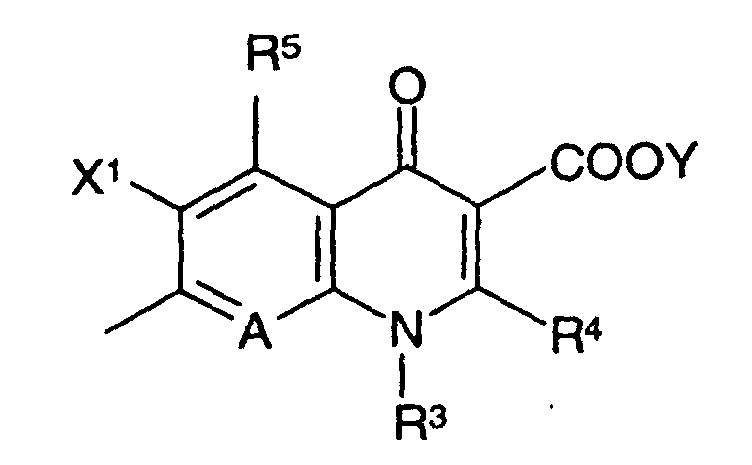 wherein X2 represents a hydrogen atom, an amino group, a halogen atom, a cyano group, a halogenomethyl group, a halogenomethoxyl group, an alkyl group having 1 to 6 carbon atoms, an alkenyl group having 2 to 6 carbon atoms, an alkynyl group having 2 to 6 carbon atoms, or an alkoxyl group having 1 to 6 carbon atoms, in which the amino group may be substituted with one or more substituents selected from the group consisting of a formyl group, an alkyl group having 1 to 6 carbon atoms and an acyl group having 2 to 5 carbon atoms; and X2 and R3 may be taken together with part of the mother skeleton to which they are bonded to form a 4- to 7-membered cyclic structure that may contain an oxygen atom, a nitrogen atom or a sulfur atom as a ring constituting atom and/or may be substituted with an alkyl group having 1 to 6 carbon atoms;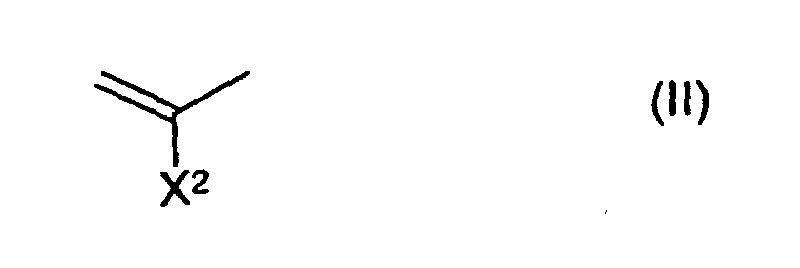
and Y represents a hydrogen atom, a phenyl group, an acetoxymethyl group, a pivaloyloxymethyl group, an ethoxycarbonyl group, a choline group, a dimethylaminoethyl group, a 5-indanyl group, a phthalidinyl group, a 5-alkyl-2-oxo-1,3-dioxol-4-ylmethyl group, a 3-acetoxy-2-oxobutyl group, an alkyl group having 1 to 6 carbon atoms, an alkoxymethyl group having 2 to 7 carbon atoms, or a phenylalkyl group having 1 to 6 carbon atoms in the alkyl moiety thereof; and the two substituents on the cyclopropane ring,are in a cis-configuration,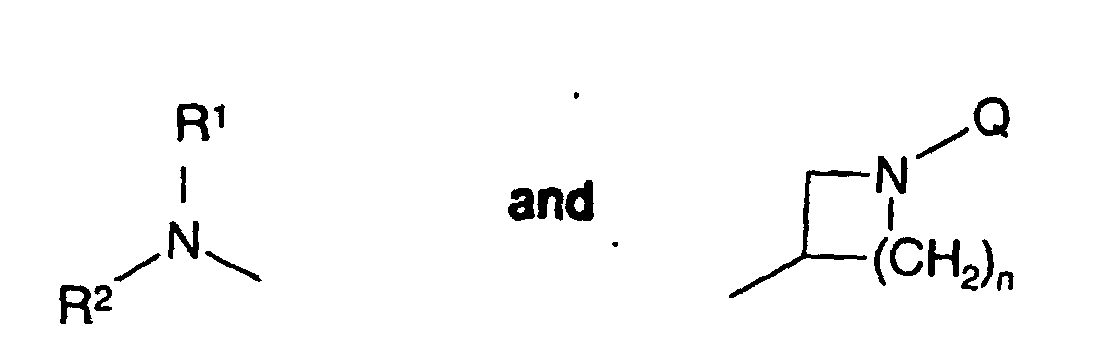
or a salt or hydrate thereof or a hydrate of the salt. - A compound according to claim 1, wherein Q in formula (I) is a partial structure represented by formula:wherein R3, R4, R5, X1, X2, and Y are as defined above,

or a salt or hydrate thereof or a hydrate of the salt. - A compound according to claim 1 or 2, wherein Q in formula (I) is a 6-carboxy-9-fluoro-2,3-dihydro-3-(S)-methyl-7-oxo-7H-pyrido[1,2,3-de][1,4]benzoxazin-10-yl group, or a salt or hydrate thereof or a hydrate of the salt.
- A compound according to claim 1 or 2, wherein Q in formula (I) is a 8-amino-6-carboxy-9-fluoro-2,3-dihydro-3-(S)-methyl-7-oxo-7H-pyrido[1,2,3-de][1,4]benzoxazin-10-yl group, or a salt or hydrate thereof or a hydrate of the salt.
- A compound according to claim 1 or 2, wherein Q in formula (I) is a 5-amino-3-carboxy-6-fluoro-1-[2-(S)-fluoro-1-(R)-cyclopropyl]-1,4-dihydro-8-methoxyl-4-oxoquinolin-7-yl group, or a salt or hydrate thereof or a hydrate of the salt.
- A compound according to claim 1 or 2, wherein Q in formula (I) is a 5-amino-3-carboxy-6-fluoro-1-[2-(S)-fluoro-1-(R)-cyclopropyl]-1,4-dihydro-8-methyl-4-oxoquinolin-7-yl group, or a salt or hydrate thereof or a hydrate of the salt.
- A compound according to claim 1 or 2, wherein Q in formula (I) is a 3-carboxy-6-fluoro-1-[2-(S)-fluoro-1-(R)-cyclopropyl]-1,4-dihydro-8-methoxyl-4-oxoquinolin-7-yl group, or a salt or hydrate thereof or a hydrate of the salt.
- A compound according to claim 1, 2, 3, 4, 5, 6 or 7, wherein n in formula (I) is 2, or a salt or hydrate thereof or a hydrate of the salt.
- A compound according to claim 1, 2, 3, 4, 5, 6, 7 or 8, wherein both R1 and R2 in formula (I) are a hydrogen atom, or a salt or hydrate thereof or a hydrate of the salt.
- A compound according to claim 1, 2, 8 or 9, wherein R3 in formula (I) is a halogenocyclopropyl group, or a salt or hydrate thereof or a hydrate of the salt.
- A compound according to claim 1, 2, 8 or 9, wherein R3 in formula (I) is a 1,2-cis-2-halogenocyclopropyl group, or a salt or hydrate thereof or a hydrate of the salt.
- A compound according to claim 1, 2, 8, 9, 10 or 11, wherein R3 in formula (I) is a stereochemically pure substituent, or a salt or hydrate thereof or a hydrate of the salt.
- A compound according to claim 1, 2, 8 or 9, wherein R3 in formula (I) is a (1R,2S)-2-halogenocyclopropyl group, or a salt or hydrate thereof or a hydrate of the salt.
- A compound according to claim 1, 2, 8, 9, 10 or 11, wherein R3 in formula (I) is a (1R,2S)-2-fluorocyclopropyl group, or a salt or hydrate thereof or a hydrate of the salt.
- A compound according to claim 1, 2, 8, 9, 10, 11, 12, 13 or 14, wherein X1 in formula (I) is a halogen atom, or a salt or hydrate thereof or a hydrate of the salt.
- A compound according to claim 1, 2, 8, 9, 10, 11, 12, 13, 14 or 15, wherein X1 in formula (I) is a fluorine atom, or a salt or hydrate thereof or a hydrate of the salt.
- A compound according to claim 1, 2, 3, 4, 5, 6, 7, 8, 9, 10, 11, 12, 13, 14, 15 or 16, wherein the compound of formula (I) is a stereochemically pure compound, or a salt or hydrate thereof or a hydrate of the salt.
- 5-Amino-7-{3-[(1S,2S)-2-aminocyclopropyl]-1-pyrrolidinyl}-6-fluoro-1-[(1R,2S)-2-fluorocyclopropyl]-8-methyl-1,4-dihydro-4-oxoquinoline-3-carboxylic acid or a salt or hydrate thereof or a hydrate of the salt.
- A drug containing any of the compounds described in claims 1 to 18, hydrates thereof, salts thereof, and hydrates of the salts as an active ingredient.
- An antimicrobial agent containing any of the compounds described in claims 1 to 18, hydrates thereof, salts thereof, and hydrates of the salts as an active ingredient.
- A compound represented by formula (VI):wherein R1 and R2 each independently represents a hydrogen atom or an alkyl group having 1 to 6 carbon atoms which may be substituted with one or more substituents selected from the group consisting of a hydroxyl group, a halogen atom, an alkylthio group having 1 to 6 carbon atoms, and an alkyloxy group having 1 to 6 carbon atoms; one of R1 and R2 may be a protective group for amino group; n represents an integer of 1 to 3; Q' represents a hydrogen atom or a protective group for amino group; and the two substituents on the cyclopropane ring,
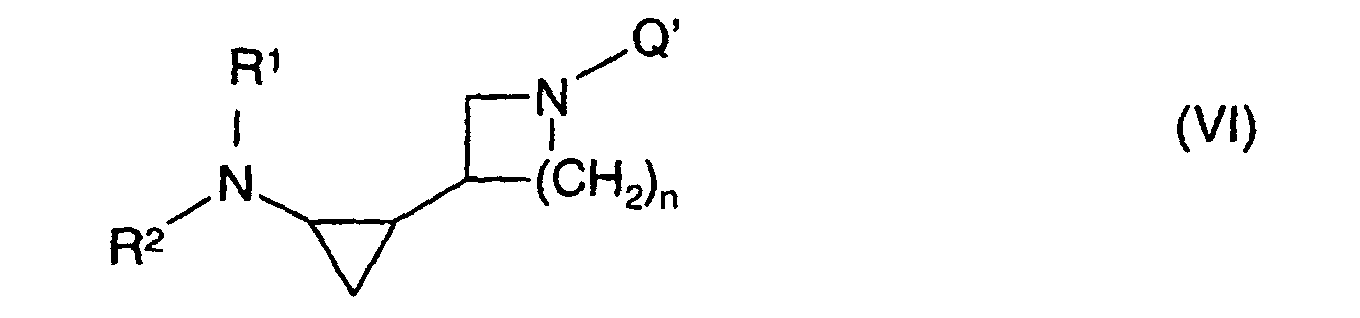 are in a cis-configuration;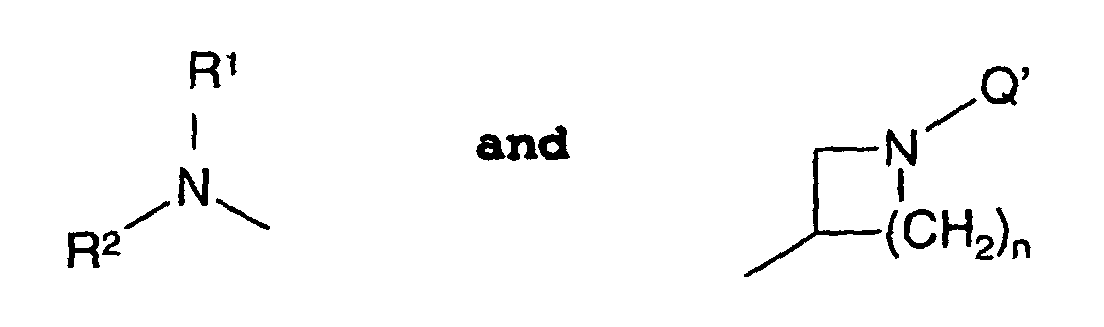
or a salt or hydrate thereof or a hydrate of the salt. - A compound according to claim 21, wherein the protective group for amino group is selected from the group consisting of an alkoxylcarbonyl group, an aralkyloxycarbonyl group, an acyl group, an alkyl group, an aralkyl group, and a substituted silyl group, or a salt or hydrate thereof or a hydrate of the salt.
- A compound according to claim 21 or 22, wherein the protective group for amino group is selected from the group consisting of a t-butoxycarbonyl group, a 2,2,2-trichloroethoxycarbonyl group, a benzyloxycarbonyl group, a p-methoxybenzyloxycarbonyl group, a p-nitrobenzyloxycarbonyl group, an acetyl group, a methoxyacetyl group, a trifluoroacetyl group, a chloroacetyl group, a pivaloyl group, a formyl group, a benzoyl group, a t-butyl group, a benzyl group, a p-nitrobenzyl group, a p-methoxybenzyl group, a triphenylmethyl group, a methoxymethyl group, a t-butoxymethyl group, a tetrahydropyranyl group, a 2,2,2-trichloroethoxymethyl group, a trimethylsilyl group, an isopropyldimethylsilyl group, a t-butyldimethylsilyl group, a tribenzylsilyl group, and a t-butyldiphenylsilyl group, or a salt or hydrate thereof or a hydrate of the salt.
- A compound according to claim 21, 22 or 23, wherein Q' and one of R1 and R2 are different protective group for amino groups, or a salt or hydrate thereof or a hydrate of the salt.
- A compound according to claim 21, 22, 23 or 24, wherein the compound of formula (VI) is a stereochemically pure compound, or a salt or hydrate thereof or a hydrate of the salt.
- 1-Benzyloxycarbonyl-3-[(1S,2S)-2-t-butoxycarbonylaminocyclopropyl]pyrrolidine.
Applications Claiming Priority (4)
| Application Number | Priority Date | Filing Date | Title |
|---|---|---|---|
| JP18293996 | 1996-07-12 | ||
| JP18293996 | 1996-07-12 | ||
| JP182939/96 | 1996-07-12 | ||
| PCT/JP1997/002411 WO1998002431A1 (en) | 1996-07-12 | 1997-07-11 | cis-SUBSTITUTED AMINOCYCLOPROPANE DERIVATIVES |
Publications (3)
| Publication Number | Publication Date |
|---|---|
| EP0919553A1 EP0919553A1 (en) | 1999-06-02 |
| EP0919553A4 EP0919553A4 (en) | 2002-06-12 |
| EP0919553B1 true EP0919553B1 (en) | 2005-03-02 |
Family
ID=16127021
Family Applications (1)
| Application Number | Title | Priority Date | Filing Date |
|---|---|---|---|
| EP97930766A Expired - Lifetime EP0919553B1 (en) | 1996-07-12 | 1997-07-11 | cis-SUBSTITUTED AMINOCYCLOPROPANE DERIVATIVES |
Country Status (12)
| Country | Link |
|---|---|
| US (3) | US6391889B2 (en) |
| EP (1) | EP0919553B1 (en) |
| JP (1) | JP4094061B2 (en) |
| KR (1) | KR100488284B1 (en) |
| CN (1) | CN1113064C (en) |
| AT (1) | ATE289999T1 (en) |
| AU (1) | AU3459797A (en) |
| DE (1) | DE69732635T2 (en) |
| DK (1) | DK0919553T3 (en) |
| ES (1) | ES2238723T3 (en) |
| PT (1) | PT919553E (en) |
| WO (1) | WO1998002431A1 (en) |
Families Citing this family (12)
| Publication number | Priority date | Publication date | Assignee | Title |
|---|---|---|---|---|
| CA2367373C (en) | 1999-03-17 | 2011-09-20 | Daiichi Pharmaceutical Co., Ltd. | Medicinal compositions |
| JP2005232000A (en) * | 2000-03-10 | 2005-09-02 | Dainippon Pharmaceut Co Ltd | Pyridonecarboxylic acid derivative or salt thereof |
| US6608078B2 (en) | 2000-05-08 | 2003-08-19 | Wockhardt Limited | Antibacterial chiral 8-(substituted piperidino)-benzo [i,j] quinolizines, processes, compositions and methods of treatment |
| US7098219B2 (en) | 2000-08-01 | 2006-08-29 | Wockhart Limited | Inhibitors of cellular efflux pumps of microbes |
| EP1336611B1 (en) * | 2000-11-20 | 2007-09-05 | Daiichi Pharmaceutical Co., Ltd. | Dehalogeno compounds |
| US6964966B2 (en) | 2001-04-25 | 2005-11-15 | Wockhardt Limited | Generation triple-targeting, chiral, broad-spectrum antimicrobial 7-substituted piperidino-quinolone carboxylic acid derivatives, their preparation, compositions and use as medicaments |
| US6878713B2 (en) | 2001-04-25 | 2005-04-12 | Wockhardt Limited | Generation triple-targeting, chiral, broad-spectrum antimicrobial 7-substituted piperidino-quinolone carboxylic acid derivatives, their preparation, compositions and use as medicaments |
| US6664267B1 (en) | 2002-05-28 | 2003-12-16 | Wockhardt Limited | Crystalline fluoroquinolone arginine salt form |
| WO2005023805A1 (en) | 2003-09-04 | 2005-03-17 | Wockhardt Limited | Benzoquinolizine-2-carboxylic acid arginine salt tetrahydrate |
| JP4693915B2 (en) | 2009-05-20 | 2011-06-01 | 株式会社東芝 | Direct methanol fuel cell |
| JP4691189B1 (en) | 2009-11-25 | 2011-06-01 | 株式会社東芝 | Direct methanol fuel cell |
| CN105315188B (en) * | 2014-06-03 | 2018-10-16 | 武汉药明康德新药开发有限公司 | A kind of preparation method of 2- (1- (tertbutyloxycarbonyl) azelidinyls -3-) ethylene-acetic acid |
Family Cites Families (12)
| Publication number | Priority date | Publication date | Assignee | Title |
|---|---|---|---|---|
| IE55898B1 (en) | 1982-09-09 | 1991-02-14 | Warner Lambert Co | Antibacterial agents |
| EP0207420B1 (en) * | 1985-06-26 | 1992-05-06 | Daiichi Pharmaceutical Co., Ltd. | Pyridonecarboxylic acid derivatives |
| US4954507A (en) * | 1986-10-08 | 1990-09-04 | Bristol-Myers Company | 1-tertiary-alkyl-substituted naphthyridine carboxylic acid antibacterial agents |
| US4920120A (en) * | 1988-01-25 | 1990-04-24 | Warner-Lambert Company | Antibacterial agents |
| US5173484A (en) * | 1988-02-05 | 1992-12-22 | Bayer Aktiengesellschaft | Quinolone- and naphthyridone carboxylic acid derivatives, process for their production, antibacterial compositions and feed additives containing them |
| US5580872A (en) * | 1990-05-02 | 1996-12-03 | Abbott Laboratories | Quinolizinone type compounds |
| FR2676445B1 (en) * | 1991-05-16 | 1995-02-03 | Esteve Labor Dr | SUBSTITUTED PYRIDONE AMINO ACID AZETIDINYL DERIVATIVES, THEIR PREPARATION AND THEIR APPLICATION AS MEDICAMENTS. |
| JPH07300472A (en) * | 1992-12-28 | 1995-11-14 | Korea Res Inst Chem Technol | Novel quinolonecarboxylic acid derivative and method for producing the same |
| TW420610B (en) * | 1994-04-07 | 2001-02-01 | Pfizer | A pharmaceutical composition for treating a H. pylori infection or gastric or duodenal ulcers |
| JPH0848629A (en) * | 1994-08-08 | 1996-02-20 | Dainippon Pharmaceut Co Ltd | Pyridone carboxylic acid derivative and anti-H. Pylori agent containing the same |
| JP3745433B2 (en) | 1995-02-02 | 2006-02-15 | 第一製薬株式会社 | Heterocyclic compounds |
| JP3771620B2 (en) * | 1995-02-07 | 2006-04-26 | 第一製薬株式会社 | Heterocyclic spiro derivatives |
-
1997
- 1997-07-11 DE DE69732635T patent/DE69732635T2/en not_active Expired - Lifetime
- 1997-07-11 DK DK97930766T patent/DK0919553T3/en active
- 1997-07-11 US US09/214,433 patent/US6391889B2/en not_active Expired - Fee Related
- 1997-07-11 EP EP97930766A patent/EP0919553B1/en not_active Expired - Lifetime
- 1997-07-11 WO PCT/JP1997/002411 patent/WO1998002431A1/en not_active Ceased
- 1997-07-11 AT AT97930766T patent/ATE289999T1/en not_active IP Right Cessation
- 1997-07-11 PT PT97930766T patent/PT919553E/en unknown
- 1997-07-11 CN CN97197630A patent/CN1113064C/en not_active Expired - Fee Related
- 1997-07-11 KR KR10-1999-7000168A patent/KR100488284B1/en not_active Expired - Fee Related
- 1997-07-11 ES ES97930766T patent/ES2238723T3/en not_active Expired - Lifetime
- 1997-07-11 AU AU34597/97A patent/AU3459797A/en not_active Abandoned
- 1997-07-11 JP JP50584098A patent/JP4094061B2/en not_active Expired - Fee Related
-
2001
- 2001-07-19 US US09/907,909 patent/US6462040B1/en not_active Expired - Fee Related
-
2002
- 2002-03-28 US US10/107,339 patent/US6949662B2/en not_active Expired - Fee Related
Also Published As
| Publication number | Publication date |
|---|---|
| JP4094061B2 (en) | 2008-06-04 |
| PT919553E (en) | 2005-05-31 |
| US6391889B2 (en) | 2002-05-21 |
| US6462040B1 (en) | 2002-10-08 |
| CN1113064C (en) | 2003-07-02 |
| EP0919553A4 (en) | 2002-06-12 |
| DE69732635D1 (en) | 2005-04-07 |
| ES2238723T3 (en) | 2005-09-01 |
| US6949662B2 (en) | 2005-09-27 |
| WO1998002431A1 (en) | 1998-01-22 |
| US20020052502A1 (en) | 2002-05-02 |
| CN1228776A (en) | 1999-09-15 |
| EP0919553A1 (en) | 1999-06-02 |
| DE69732635T2 (en) | 2005-12-29 |
| US20020002182A1 (en) | 2002-01-03 |
| DK0919553T3 (en) | 2005-06-06 |
| KR20000023709A (en) | 2000-04-25 |
| ATE289999T1 (en) | 2005-03-15 |
| KR100488284B1 (en) | 2005-05-11 |
| AU3459797A (en) | 1998-02-09 |
| US20020183523A1 (en) | 2002-12-05 |
Similar Documents
| Publication | Publication Date | Title |
|---|---|---|
| US5849757A (en) | Pyridonecarboxylic acid derivatives substituted by a bicyclic amino group as antibacterials | |
| JP4040091B2 (en) | Substituted aminocycloalkylpyrrolidine derivatives | |
| US6391889B2 (en) | Cis-substituted aminocyclopropane derivatives | |
| US6384050B1 (en) | Tricyclic amine derivatives | |
| US6184388B1 (en) | Substituted aminocycloalkylpyrrolidine derivatives and cis-substituted aminocycloalkylpyrrolidine derivatives | |
| US6573260B1 (en) | Cycloalkyl-substituted aminomethylpyrrolidine derivatives | |
| JPWO1998002431A1 (en) | Cis-substituted aminocyclopropane derivatives | |
| JP3833738B2 (en) | Substituted aminomethylpyrrolidine derivatives | |
| EP0995744B1 (en) | Cis-substituted fluoromethylpyrrolidine derivatives | |
| EP1020459B1 (en) | Cis-disubstituted aminocycloalkyl-pyrrolidine derivatives | |
| JP2005194274A (en) | Medicine containing dehalogeno compound as effective ingredient | |
| JP2919910B2 (en) | Optically active quinolone carboxylic acid derivative | |
| AU732175B2 (en) | Substituted cyclobutylamine derivative | |
| AU726378B2 (en) | Cycloalkylaminomethylpyrrolidine derivatives | |
| JPH11199561A (en) | Cis-substituted aminocyclopropane compound | |
| JPH1081682A (en) | Cis-substituted aminocyclopropane derivative | |
| EP0816355A1 (en) | Heterocyclic spiro derivatives | |
| HK1113571A (en) | Fluoroalkylpyrrolidine derivative |
Legal Events
| Date | Code | Title | Description |
|---|---|---|---|
| PUAI | Public reference made under article 153(3) epc to a published international application that has entered the european phase |
Free format text: ORIGINAL CODE: 0009012 |
|
| 17P | Request for examination filed |
Effective date: 19990108 |
|
| AK | Designated contracting states |
Kind code of ref document: A1 Designated state(s): AT BE CH DE DK ES FI FR GB GR IE IT LI LU MC NL PT SE |
|
| A4 | Supplementary search report drawn up and despatched |
Effective date: 20020502 |
|
| AK | Designated contracting states |
Kind code of ref document: A4 Designated state(s): AT BE CH DE DK ES FI FR GB GR IE IT LI LU MC NL PT SE |
|
| RIC1 | Information provided on ipc code assigned before grant |
Free format text: 7C 07D 401/04 A, 7C 07D 471/04 B, 7C 07D 489/08 B, 7C 07D 513/08 B, 7A 61K 31/47 B, 7C 07D 207/09 B, 7C 07D 207/16 B |
|
| 17Q | First examination report despatched |
Effective date: 20021014 |
|
| GRAP | Despatch of communication of intention to grant a patent |
Free format text: ORIGINAL CODE: EPIDOSNIGR1 |
|
| GRAS | Grant fee paid |
Free format text: ORIGINAL CODE: EPIDOSNIGR3 |
|
| GRAA | (expected) grant |
Free format text: ORIGINAL CODE: 0009210 |
|
| AK | Designated contracting states |
Kind code of ref document: B1 Designated state(s): AT BE CH DE DK ES FI FR GB GR IE IT LI LU MC NL PT SE |
|
| REG | Reference to a national code |
Ref country code: GB Ref legal event code: FG4D |
|
| REG | Reference to a national code |
Ref country code: CH Ref legal event code: EP |
|
| REG | Reference to a national code |
Ref country code: IE Ref legal event code: FG4D |
|
| REF | Corresponds to: |
Ref document number: 69732635 Country of ref document: DE Date of ref document: 20050407 Kind code of ref document: P |
|
| REG | Reference to a national code |
Ref country code: SE Ref legal event code: TRGR |
|
| REG | Reference to a national code |
Ref country code: PT Ref legal event code: SC4A Free format text: AVAILABILITY OF NATIONAL TRANSLATION Effective date: 20050413 |
|
| REG | Reference to a national code |
Ref country code: DK Ref legal event code: T3 |
|
| REG | Reference to a national code |
Ref country code: CH Ref legal event code: NV Representative=s name: BOVARD AG PATENTANWAELTE Ref country code: GR Ref legal event code: EP Ref document number: 20050401478 Country of ref document: GR |
|
| REG | Reference to a national code |
Ref country code: ES Ref legal event code: FG2A Ref document number: 2238723 Country of ref document: ES Kind code of ref document: T3 |
|
| PLBE | No opposition filed within time limit |
Free format text: ORIGINAL CODE: 0009261 |
|
| STAA | Information on the status of an ep patent application or granted ep patent |
Free format text: STATUS: NO OPPOSITION FILED WITHIN TIME LIMIT |
|
| 26N | No opposition filed |
Effective date: 20051205 |
|
| ET | Fr: translation filed | ||
| PGFP | Annual fee paid to national office [announced via postgrant information from national office to epo] |
Ref country code: PT Payment date: 20070628 Year of fee payment: 11 |
|
| PGFP | Annual fee paid to national office [announced via postgrant information from national office to epo] |
Ref country code: MC Payment date: 20070718 Year of fee payment: 11 Ref country code: DK Payment date: 20070718 Year of fee payment: 11 Ref country code: IE Payment date: 20070718 Year of fee payment: 11 |
|
| PGFP | Annual fee paid to national office [announced via postgrant information from national office to epo] |
Ref country code: LU Payment date: 20070719 Year of fee payment: 11 |
|
| PGFP | Annual fee paid to national office [announced via postgrant information from national office to epo] |
Ref country code: FI Payment date: 20070712 Year of fee payment: 11 Ref country code: CH Payment date: 20070713 Year of fee payment: 11 Ref country code: AT Payment date: 20070711 Year of fee payment: 11 |
|
| PGFP | Annual fee paid to national office [announced via postgrant information from national office to epo] |
Ref country code: SE Payment date: 20070704 Year of fee payment: 11 Ref country code: NL Payment date: 20070715 Year of fee payment: 11 |
|
| PGFP | Annual fee paid to national office [announced via postgrant information from national office to epo] |
Ref country code: BE Payment date: 20071008 Year of fee payment: 11 |
|
| PGFP | Annual fee paid to national office [announced via postgrant information from national office to epo] |
Ref country code: GR Payment date: 20070620 Year of fee payment: 11 |
|
| REG | Reference to a national code |
Ref country code: PT Ref legal event code: MM4A Free format text: LAPSE DUE TO NON-PAYMENT OF FEES Effective date: 20090112 |
|
| REG | Reference to a national code |
Ref country code: CH Ref legal event code: PL |
|
| REG | Reference to a national code |
Ref country code: DK Ref legal event code: EBP |
|
| EUG | Se: european patent has lapsed | ||
| PG25 | Lapsed in a contracting state [announced via postgrant information from national office to epo] |
Ref country code: MC Free format text: LAPSE BECAUSE OF NON-PAYMENT OF DUE FEES Effective date: 20080731 |
|
| NLV4 | Nl: lapsed or anulled due to non-payment of the annual fee |
Effective date: 20090201 |
|
| REG | Reference to a national code |
Ref country code: IE Ref legal event code: MM4A |
|
| PG25 | Lapsed in a contracting state [announced via postgrant information from national office to epo] |
Ref country code: AT Free format text: LAPSE BECAUSE OF NON-PAYMENT OF DUE FEES Effective date: 20080711 |
|
| PG25 | Lapsed in a contracting state [announced via postgrant information from national office to epo] |
Ref country code: PT Free format text: LAPSE BECAUSE OF NON-PAYMENT OF DUE FEES Effective date: 20090112 Ref country code: NL Free format text: LAPSE BECAUSE OF NON-PAYMENT OF DUE FEES Effective date: 20090201 Ref country code: FI Free format text: LAPSE BECAUSE OF NON-PAYMENT OF DUE FEES Effective date: 20080711 |
|
| PG25 | Lapsed in a contracting state [announced via postgrant information from national office to epo] |
Ref country code: LI Free format text: LAPSE BECAUSE OF NON-PAYMENT OF DUE FEES Effective date: 20080731 Ref country code: GR Free format text: LAPSE BECAUSE OF NON-PAYMENT OF DUE FEES Effective date: 20090204 Ref country code: CH Free format text: LAPSE BECAUSE OF NON-PAYMENT OF DUE FEES Effective date: 20080731 |
|
| PG25 | Lapsed in a contracting state [announced via postgrant information from national office to epo] |
Ref country code: IE Free format text: LAPSE BECAUSE OF NON-PAYMENT OF DUE FEES Effective date: 20080711 Ref country code: DK Free format text: LAPSE BECAUSE OF NON-PAYMENT OF DUE FEES Effective date: 20080731 |
|
| PG25 | Lapsed in a contracting state [announced via postgrant information from national office to epo] |
Ref country code: LU Free format text: LAPSE BECAUSE OF NON-PAYMENT OF DUE FEES Effective date: 20080711 |
|
| PG25 | Lapsed in a contracting state [announced via postgrant information from national office to epo] |
Ref country code: SE Free format text: LAPSE BECAUSE OF NON-PAYMENT OF DUE FEES Effective date: 20080712 Ref country code: BE Free format text: LAPSE BECAUSE OF NON-PAYMENT OF DUE FEES Effective date: 20080731 |
|
| PGFP | Annual fee paid to national office [announced via postgrant information from national office to epo] |
Ref country code: ES Payment date: 20100722 Year of fee payment: 14 |
|
| PGFP | Annual fee paid to national office [announced via postgrant information from national office to epo] |
Ref country code: IT Payment date: 20100719 Year of fee payment: 14 Ref country code: FR Payment date: 20100805 Year of fee payment: 14 Ref country code: DE Payment date: 20100707 Year of fee payment: 14 |
|
| PGFP | Annual fee paid to national office [announced via postgrant information from national office to epo] |
Ref country code: GB Payment date: 20100707 Year of fee payment: 14 |
|
| GBPC | Gb: european patent ceased through non-payment of renewal fee |
Effective date: 20110711 |
|
| REG | Reference to a national code |
Ref country code: FR Ref legal event code: ST Effective date: 20120330 |
|
| PG25 | Lapsed in a contracting state [announced via postgrant information from national office to epo] |
Ref country code: DE Free format text: LAPSE BECAUSE OF NON-PAYMENT OF DUE FEES Effective date: 20120201 Ref country code: FR Free format text: LAPSE BECAUSE OF NON-PAYMENT OF DUE FEES Effective date: 20110801 |
|
| REG | Reference to a national code |
Ref country code: DE Ref legal event code: R119 Ref document number: 69732635 Country of ref document: DE Effective date: 20120201 |
|
| PG25 | Lapsed in a contracting state [announced via postgrant information from national office to epo] |
Ref country code: IT Free format text: LAPSE BECAUSE OF NON-PAYMENT OF DUE FEES Effective date: 20110711 |
|
| PG25 | Lapsed in a contracting state [announced via postgrant information from national office to epo] |
Ref country code: GB Free format text: LAPSE BECAUSE OF NON-PAYMENT OF DUE FEES Effective date: 20110711 |
|
| REG | Reference to a national code |
Ref country code: ES Ref legal event code: FD2A Effective date: 20130606 |
|
| PG25 | Lapsed in a contracting state [announced via postgrant information from national office to epo] |
Ref country code: ES Free format text: LAPSE BECAUSE OF NON-PAYMENT OF DUE FEES Effective date: 20110712 |