EP0918235A2 - Axial refractive index distributed lens - Google Patents
Axial refractive index distributed lens Download PDFInfo
- Publication number
- EP0918235A2 EP0918235A2 EP98121550A EP98121550A EP0918235A2 EP 0918235 A2 EP0918235 A2 EP 0918235A2 EP 98121550 A EP98121550 A EP 98121550A EP 98121550 A EP98121550 A EP 98121550A EP 0918235 A2 EP0918235 A2 EP 0918235A2
- Authority
- EP
- European Patent Office
- Prior art keywords
- mol
- glass
- refractive index
- silver
- zno
- Prior art date
- Legal status (The legal status is an assumption and is not a legal conclusion. Google has not performed a legal analysis and makes no representation as to the accuracy of the status listed.)
- Granted
Links
- 239000011521 glass Substances 0.000 claims abstract description 160
- 238000009826 distribution Methods 0.000 claims abstract description 58
- 229910052709 silver Inorganic materials 0.000 claims abstract description 55
- 239000004332 silver Substances 0.000 claims abstract description 55
- 239000000203 mixture Substances 0.000 claims abstract description 46
- 239000000463 material Substances 0.000 claims abstract description 38
- VYPSYNLAJGMNEJ-UHFFFAOYSA-N Silicium dioxide Chemical compound O=[Si]=O VYPSYNLAJGMNEJ-UHFFFAOYSA-N 0.000 claims abstract description 26
- MCMNRKCIXSYSNV-UHFFFAOYSA-N Zirconium dioxide Chemical compound O=[Zr]=O MCMNRKCIXSYSNV-UHFFFAOYSA-N 0.000 claims abstract description 24
- 238000005342 ion exchange Methods 0.000 claims abstract description 20
- KKCBUQHMOMHUOY-UHFFFAOYSA-N Na2O Inorganic materials [O-2].[Na+].[Na+] KKCBUQHMOMHUOY-UHFFFAOYSA-N 0.000 claims abstract description 18
- MRELNEQAGSRDBK-UHFFFAOYSA-N lanthanum oxide Inorganic materials [O-2].[O-2].[O-2].[La+3].[La+3] MRELNEQAGSRDBK-UHFFFAOYSA-N 0.000 claims abstract description 14
- KTUFCUMIWABKDW-UHFFFAOYSA-N oxo(oxolanthaniooxy)lanthanum Chemical compound O=[La]O[La]=O KTUFCUMIWABKDW-UHFFFAOYSA-N 0.000 claims abstract description 14
- 229910052681 coesite Inorganic materials 0.000 claims abstract description 13
- 229910052906 cristobalite Inorganic materials 0.000 claims abstract description 13
- 238000000034 method Methods 0.000 claims abstract description 13
- 239000000377 silicon dioxide Substances 0.000 claims abstract description 13
- 229910052682 stishovite Inorganic materials 0.000 claims abstract description 13
- PBCFLUZVCVVTBY-UHFFFAOYSA-N tantalum pentoxide Inorganic materials O=[Ta](=O)O[Ta](=O)=O PBCFLUZVCVVTBY-UHFFFAOYSA-N 0.000 claims abstract description 13
- 229910052905 tridymite Inorganic materials 0.000 claims abstract description 13
- 230000003287 optical effect Effects 0.000 claims abstract description 11
- BQCADISMDOOEFD-UHFFFAOYSA-N Silver Chemical compound [Ag] BQCADISMDOOEFD-UHFFFAOYSA-N 0.000 abstract description 31
- -1 silver ions Chemical class 0.000 abstract description 24
- 238000002844 melting Methods 0.000 abstract description 14
- 230000008018 melting Effects 0.000 abstract description 14
- 238000013461 design Methods 0.000 abstract description 5
- PNEYBMLMFCGWSK-UHFFFAOYSA-N aluminium oxide Inorganic materials [O-2].[O-2].[O-2].[Al+3].[Al+3] PNEYBMLMFCGWSK-UHFFFAOYSA-N 0.000 abstract 1
- 229910052593 corundum Inorganic materials 0.000 abstract 1
- 235000012239 silicon dioxide Nutrition 0.000 abstract 1
- 229910001845 yogo sapphire Inorganic materials 0.000 abstract 1
- SQGYOTSLMSWVJD-UHFFFAOYSA-N silver(1+) nitrate Chemical compound [Ag+].[O-]N(=O)=O SQGYOTSLMSWVJD-UHFFFAOYSA-N 0.000 description 27
- 150000003839 salts Chemical class 0.000 description 26
- 230000004075 alteration Effects 0.000 description 16
- BASFCYQUMIYNBI-UHFFFAOYSA-N platinum Chemical compound [Pt] BASFCYQUMIYNBI-UHFFFAOYSA-N 0.000 description 16
- VWDWKYIASSYTQR-UHFFFAOYSA-N sodium nitrate Chemical compound [Na+].[O-][N+]([O-])=O VWDWKYIASSYTQR-UHFFFAOYSA-N 0.000 description 16
- 150000002500 ions Chemical class 0.000 description 15
- 239000002253 acid Substances 0.000 description 9
- XLYOFNOQVPJJNP-UHFFFAOYSA-N water Substances O XLYOFNOQVPJJNP-UHFFFAOYSA-N 0.000 description 9
- 239000003513 alkali Substances 0.000 description 8
- 238000012937 correction Methods 0.000 description 8
- 238000007496 glass forming Methods 0.000 description 8
- 229910052697 platinum Inorganic materials 0.000 description 8
- 239000000843 powder Substances 0.000 description 8
- 230000007423 decrease Effects 0.000 description 7
- 239000000084 colloidal system Substances 0.000 description 6
- 229910001415 sodium ion Inorganic materials 0.000 description 6
- FOIXSVOLVBLSDH-UHFFFAOYSA-N Silver ion Chemical compound [Ag+] FOIXSVOLVBLSDH-UHFFFAOYSA-N 0.000 description 4
- 230000000694 effects Effects 0.000 description 4
- 238000004519 manufacturing process Methods 0.000 description 4
- 239000000155 melt Substances 0.000 description 4
- ZKATWMILCYLAPD-UHFFFAOYSA-N niobium pentoxide Chemical compound O=[Nb](=O)O[Nb](=O)=O ZKATWMILCYLAPD-UHFFFAOYSA-N 0.000 description 4
- 229910001392 phosphorus oxide Inorganic materials 0.000 description 4
- VSAISIQCTGDGPU-UHFFFAOYSA-N tetraphosphorus hexaoxide Chemical compound O1P(O2)OP3OP1OP2O3 VSAISIQCTGDGPU-UHFFFAOYSA-N 0.000 description 4
- 229910052716 thallium Inorganic materials 0.000 description 4
- FKNQFGJONOIPTF-UHFFFAOYSA-N Sodium cation Chemical group [Na+] FKNQFGJONOIPTF-UHFFFAOYSA-N 0.000 description 3
- 239000005407 aluminoborosilicate glass Substances 0.000 description 3
- 239000005354 aluminosilicate glass Substances 0.000 description 3
- 230000008859 change Effects 0.000 description 3
- 230000000052 comparative effect Effects 0.000 description 3
- 229910001387 inorganic aluminate Inorganic materials 0.000 description 3
- 229910001961 silver nitrate Inorganic materials 0.000 description 3
- BKVIYDNLLOSFOA-UHFFFAOYSA-N thallium Chemical compound [Tl] BKVIYDNLLOSFOA-UHFFFAOYSA-N 0.000 description 3
- GRYLNZFGIOXLOG-UHFFFAOYSA-N Nitric acid Chemical class O[N+]([O-])=O GRYLNZFGIOXLOG-UHFFFAOYSA-N 0.000 description 2
- 229910021607 Silver chloride Inorganic materials 0.000 description 2
- 230000015572 biosynthetic process Effects 0.000 description 2
- 230000003247 decreasing effect Effects 0.000 description 2
- 238000009792 diffusion process Methods 0.000 description 2
- 238000005191 phase separation Methods 0.000 description 2
- 238000005498 polishing Methods 0.000 description 2
- 239000005368 silicate glass Substances 0.000 description 2
- HKZLPVFGJNLROG-UHFFFAOYSA-M silver monochloride Chemical compound [Cl-].[Ag+] HKZLPVFGJNLROG-UHFFFAOYSA-M 0.000 description 2
- 239000011734 sodium Substances 0.000 description 2
- RUDFQVOCFDJEEF-UHFFFAOYSA-N yttrium(III) oxide Inorganic materials [O-2].[O-2].[O-2].[Y+3].[Y+3] RUDFQVOCFDJEEF-UHFFFAOYSA-N 0.000 description 2
- JIAARYAFYJHUJI-UHFFFAOYSA-L zinc dichloride Chemical compound [Cl-].[Cl-].[Zn+2] JIAARYAFYJHUJI-UHFFFAOYSA-L 0.000 description 2
- ZOXJGFHDIHLPTG-UHFFFAOYSA-N Boron Chemical compound [B] ZOXJGFHDIHLPTG-UHFFFAOYSA-N 0.000 description 1
- FYYHWMGAXLPEAU-UHFFFAOYSA-N Magnesium Chemical compound [Mg] FYYHWMGAXLPEAU-UHFFFAOYSA-N 0.000 description 1
- 229910002651 NO3 Inorganic materials 0.000 description 1
- NHNBFGGVMKEFGY-UHFFFAOYSA-N Nitrate Chemical compound [O-][N+]([O-])=O NHNBFGGVMKEFGY-UHFFFAOYSA-N 0.000 description 1
- BPQQTUXANYXVAA-UHFFFAOYSA-N Orthosilicate Chemical compound [O-][Si]([O-])([O-])[O-] BPQQTUXANYXVAA-UHFFFAOYSA-N 0.000 description 1
- 206010040925 Skin striae Diseases 0.000 description 1
- QAOWNCQODCNURD-UHFFFAOYSA-L Sulfate Chemical compound [O-]S([O-])(=O)=O QAOWNCQODCNURD-UHFFFAOYSA-L 0.000 description 1
- QAOWNCQODCNURD-UHFFFAOYSA-N Sulfuric acid Chemical class OS(O)(=O)=O QAOWNCQODCNURD-UHFFFAOYSA-N 0.000 description 1
- PTFCDOFLOPIGGS-UHFFFAOYSA-N Zinc dication Chemical compound [Zn+2] PTFCDOFLOPIGGS-UHFFFAOYSA-N 0.000 description 1
- 229910052946 acanthite Inorganic materials 0.000 description 1
- 230000009471 action Effects 0.000 description 1
- 229910052782 aluminium Inorganic materials 0.000 description 1
- XAGFODPZIPBFFR-UHFFFAOYSA-N aluminium Chemical compound [Al] XAGFODPZIPBFFR-UHFFFAOYSA-N 0.000 description 1
- GHPGOEFPKIHBNM-UHFFFAOYSA-N antimony(3+);oxygen(2-) Chemical compound [O-2].[O-2].[O-2].[Sb+3].[Sb+3] GHPGOEFPKIHBNM-UHFFFAOYSA-N 0.000 description 1
- QVQLCTNNEUAWMS-UHFFFAOYSA-N barium oxide Inorganic materials [Ba]=O QVQLCTNNEUAWMS-UHFFFAOYSA-N 0.000 description 1
- 230000008901 benefit Effects 0.000 description 1
- 229910052796 boron Inorganic materials 0.000 description 1
- 239000003086 colorant Substances 0.000 description 1
- 238000005536 corrosion prevention Methods 0.000 description 1
- 238000005520 cutting process Methods 0.000 description 1
- 238000004031 devitrification Methods 0.000 description 1
- 230000003467 diminishing effect Effects 0.000 description 1
- 239000006185 dispersion Substances 0.000 description 1
- 238000003912 environmental pollution Methods 0.000 description 1
- 238000011156 evaluation Methods 0.000 description 1
- 239000005357 flat glass Substances 0.000 description 1
- 150000004820 halides Chemical class 0.000 description 1
- 238000010348 incorporation Methods 0.000 description 1
- 239000004615 ingredient Substances 0.000 description 1
- 239000011777 magnesium Substances 0.000 description 1
- 229910052749 magnesium Inorganic materials 0.000 description 1
- 238000005259 measurement Methods 0.000 description 1
- 229910052751 metal Inorganic materials 0.000 description 1
- 239000002184 metal Substances 0.000 description 1
- 150000002739 metals Chemical class 0.000 description 1
- 238000012986 modification Methods 0.000 description 1
- 230000004048 modification Effects 0.000 description 1
- 238000000465 moulding Methods 0.000 description 1
- 239000005304 optical glass Substances 0.000 description 1
- XUARKZBEFFVFRG-UHFFFAOYSA-N silver sulfide Chemical compound [S-2].[Ag+].[Ag+] XUARKZBEFFVFRG-UHFFFAOYSA-N 0.000 description 1
- 229940056910 silver sulfide Drugs 0.000 description 1
- 235000010344 sodium nitrate Nutrition 0.000 description 1
- 239000004317 sodium nitrate Substances 0.000 description 1
- 239000007787 solid Substances 0.000 description 1
- 238000010561 standard procedure Methods 0.000 description 1
- 239000000126 substance Substances 0.000 description 1
- 150000003475 thallium Chemical class 0.000 description 1
- YTQVHRVITVLIRD-UHFFFAOYSA-L thallium sulfate Chemical compound [Tl+].[Tl+].[O-]S([O-])(=O)=O YTQVHRVITVLIRD-UHFFFAOYSA-L 0.000 description 1
- 229910000374 thallium(I) sulfate Inorganic materials 0.000 description 1
- 231100000331 toxic Toxicity 0.000 description 1
- 230000002588 toxic effect Effects 0.000 description 1
- ZNOKGRXACCSDPY-UHFFFAOYSA-N tungsten(VI) oxide Inorganic materials O=[W](=O)=O ZNOKGRXACCSDPY-UHFFFAOYSA-N 0.000 description 1
- 235000005074 zinc chloride Nutrition 0.000 description 1
- 239000011592 zinc chloride Substances 0.000 description 1
Images






Classifications
-
- G—PHYSICS
- G02—OPTICS
- G02B—OPTICAL ELEMENTS, SYSTEMS OR APPARATUS
- G02B3/00—Simple or compound lenses
- G02B3/0087—Simple or compound lenses with index gradient
-
- C—CHEMISTRY; METALLURGY
- C03—GLASS; MINERAL OR SLAG WOOL
- C03C—CHEMICAL COMPOSITION OF GLASSES, GLAZES OR VITREOUS ENAMELS; SURFACE TREATMENT OF GLASS; SURFACE TREATMENT OF FIBRES OR FILAMENTS MADE FROM GLASS, MINERALS OR SLAGS; JOINING GLASS TO GLASS OR OTHER MATERIALS
- C03C21/00—Treatment of glass, not in the form of fibres or filaments, by diffusing ions or metals in the surface
- C03C21/001—Treatment of glass, not in the form of fibres or filaments, by diffusing ions or metals in the surface in liquid phase, e.g. molten salts, solutions
- C03C21/005—Treatment of glass, not in the form of fibres or filaments, by diffusing ions or metals in the surface in liquid phase, e.g. molten salts, solutions to introduce in the glass such metals or metallic ions as Ag, Cu
-
- C—CHEMISTRY; METALLURGY
- C03—GLASS; MINERAL OR SLAG WOOL
- C03C—CHEMICAL COMPOSITION OF GLASSES, GLAZES OR VITREOUS ENAMELS; SURFACE TREATMENT OF GLASS; SURFACE TREATMENT OF FIBRES OR FILAMENTS MADE FROM GLASS, MINERALS OR SLAGS; JOINING GLASS TO GLASS OR OTHER MATERIALS
- C03C3/00—Glass compositions
- C03C3/04—Glass compositions containing silica
- C03C3/062—Glass compositions containing silica with less than 40% silica by weight
- C03C3/064—Glass compositions containing silica with less than 40% silica by weight containing boron
- C03C3/066—Glass compositions containing silica with less than 40% silica by weight containing boron containing zinc
-
- C—CHEMISTRY; METALLURGY
- C03—GLASS; MINERAL OR SLAG WOOL
- C03C—CHEMICAL COMPOSITION OF GLASSES, GLAZES OR VITREOUS ENAMELS; SURFACE TREATMENT OF GLASS; SURFACE TREATMENT OF FIBRES OR FILAMENTS MADE FROM GLASS, MINERALS OR SLAGS; JOINING GLASS TO GLASS OR OTHER MATERIALS
- C03C3/00—Glass compositions
- C03C3/04—Glass compositions containing silica
- C03C3/076—Glass compositions containing silica with 40% to 90% silica, by weight
- C03C3/089—Glass compositions containing silica with 40% to 90% silica, by weight containing boron
- C03C3/091—Glass compositions containing silica with 40% to 90% silica, by weight containing boron containing aluminium
- C03C3/093—Glass compositions containing silica with 40% to 90% silica, by weight containing boron containing aluminium containing zinc or zirconium
Definitions
- the present invention relates to an axial refractive index distributed lens, in which the refractive index nearly changes in a direction of an optical axis. More particularly, this invention relates to an axial refractive index distributed lens obtained by forming a refractive index distribution in the direction of the optical axis by an ion exchange method using silver.
- a single lens which is made of glass or plastic material having a homogeneous refractive index and which has spherical or flat surfaces is incapable of correcting the spherical aberration on the optical axis.
- lenses having an aspherical surface is capable of correcting the spherical aberration, such aspherical lenses have problems that molds used for press-molding those lenses have a high production cost and that grinding marks remained on the mold surface are transferred to the lens surface.
- FIG. 1 (a) and (b) are a sectional view diagrammatically showing a planoconvex condenser lens 1 with an axial gradient refractive index distribution and a graph showing the gradient refractive index distribution thereof, respectively.
- the axial refractive index distributed lens 1 gives a refractive index distribution R in the direction of the optical axis L thereof and has a uniform refractive index within the plane perpendicular to the optical axis.
- the refractive index distribution in the spherical surface part is linear and has a specific slope according to the radius of curvature, whereby the spherical aberration can be satisfactorily corrected.
- Lenses having a larger numerical aperture (NA), i.e., lenses which are brighter, should have a larger difference in refractive index within the linear part.
- Whether or not the spherical surface part outside the area of the effective diameter D has a refractive index distribution has almost no influence on spherical aberration.
- this axial refractive index distributed lens has an advantage that grinding and polishing are easy, because the lens surface may be spherical or may remain flat.
- a preferred method for producing the axial refractive index distributed lens is a method as described below.
- a flat glass plate 5 having a uniform refractive index is provided, and this glass plate is immersed in a molten salt 6, e.g., a nitrate or sulfate. Ion exchange occurs between the glass plate 5 and the molten salt 6 by diffusion, into the glass plate 5, ions which contribute to the change of refractive index toward the deep inner part from the glass surface.
- a refractive index distribution which gradually decreases or increases toward the deep inner part of the glass from the surface thereof is formed in the glass plate 5.
- a part of the glass plate which contains the refractive index distribution is cut out and ground and polished to make an axial refractive index distributed lens.
- the molten salt used in this embodiment is a molten salt comprising a thallium salt such as TlNO 3 or Tl 2 SO 4 .
- JP-A-61-261238 and JP-A-62-100451 Another possible ions which contribute to a large refractive index difference are silver ions as shown in JP-A-61-261238 and JP-A-62-100451.
- JP-A as used herein means an "unexamined published Japanese patent application”.
- glasses containing a large amount of phosphorus oxide have poor weather resistance and hence pose a problem in practical use.
- Glasses containing a large amount of phosphorus oxide have another problem that the glasses react with a nitric acid salt during ion exchange process to form a devitrification product on the glass surface or the glasses dissolve in the molten salt.
- a molten salt other than nitric acid salts e.g., a molten salt of a sulfuric acid salt or a halide, has many problems, for example, that such a molten salt highly corrodes metals and glasses and it is hence difficult to select an appropriate container for the molten salt.
- Improvements of the glass composition shown in JP-A-62-100451 include the glass composition described in JP-A-4-2629. This glass composition also is insufficient in stability in molten salts and durability of the glass material, and hence has a problem in practical use.
- an aluminosilicate glass is known as a glass composition which does not contain phosphorus oxide and in which silver ions do not form a colloid.
- the silicate framework is cut and non-bridging oxygens (hereinafter referred to as "NBO") strongly bonded to alkali ions are formed.
- NBO non-bridging oxygens
- the present invention has been made to overcome the conventional problems described above.
- An object of the present invention is to provide an excellent axial refractive index distributed lens which has a refractive index distribution required for an optical design, high durability, and high quality, i.e., a glass of a low melting temperature, and is obtained from a glass composition which has an ion exchange rate sufficient for practical use and enables silver ions to be stably present therein.
- the present invention provides an axial refractive index distributed lens obtained by forming a refractive index distribution in a glass material in the direction of an optical axis thereof by an ion exchange method using silver, the glass material comprising a glass composition having the following components:
- the present invention makes it possible to lower the melting temperature of the glass while maintaining high durability, by incorporating MgO and ZnO into an aluminoborosilicate glass. Silver ions are stably incorporated in their ionized state into the glass to thereby realize the axial refractive index distributed lens having a necessary refractive index distribution.
- bivalent ions considerably decrease the diffusion rate of univalent ions.
- MgO and ZnO are polyvalent ions which do not relatively decrease the ion exchange rate (R.H. Doremus, "Glass Science 2nd.” p. 278, John Wiley & Sons). It has been reported that these magnesium and zinc ions are polyvalent ions having the possibility of diminishing NBO in glasses ( Appl. Opt ., 31 [25] 5221 (1992)). However, no report has been made so far on the actual production of an axial refractive index distributed lens of a glass containing MgO and ZnO.
- the object of the present invention can be accomplished by incorporating MgO and ZnO into an aluminoborosilicate glass as glass compositions of a glass material for the axial refractive index distributed lens.
- the present invention has been completed based on this finding.
- the glass composition preferably has the following components:
- the glass composition in the present invention more preferably has the following components:
- a ratio of the concentration of Al 2 O 3 to that of Na 2 O, [Al 2 O 3 ]/[Na 2 O], is desirably from 0.8 to 1.2.
- the glass composition constituting the glass material used in the present invention is explained.
- the concentration of MgO+ZnO is 2.5 ⁇ MgO+ZnO ⁇ 18 mol%, preferably 3 ⁇ MgO+ZnO ⁇ 15 mol%, and more preferably 5 ⁇ MgO+ZnO ⁇ 12.5 mol%.
- MgO and ZnO may be used alone or as a mixture thereof.
- the optimal alkali ions which are replaced with silver ions for forming a refractive index distribution are sodium ions because silver ions have a large interdiffusion coefficient with sodium ions and have a short ion exchange time. If the concentration of sodium ions is 10 mol% or lower, the necessary difference in refractive index cannot be obtained. If the concentration thereof exceeds 25 mol%, the glass has poor durability, causing problem on practical use. Therefore, the concentration of Na 2 O is 10 ⁇ Na 2 O ⁇ 25 mol%, preferably 12.5 ⁇ Na 2 O ⁇ 25 mol%, and more preferably 12.5 ⁇ Na 2 O ⁇ 18 mol%.
- Al 2 O 3 is an essential component to enable the glass to stably contain silver ions.
- [Na]/[Al] is desirably 1 in order to eliminate NBO in glass.
- the present invention makes it possible to stably contain silver ions in the glass even if [Na]/[Al] is not 1, by introducing MgO and ZnO into a glass.
- the concentration of Al 2 O 3 in the glass is desirably 0.8 to 1.2 times that of Na 2 O.
- the concentration of Al 2 O 3 is 8 ⁇ Al 2 O 3 ⁇ 25 mol%, preferably 10 ⁇ Al 2 O 3 ⁇ 22 mol%, and more preferably 12.5 ⁇ Al 2 O 3 ⁇ 18 mol%.
- B 2 O 3 has an effect to lower the melting temperature of a glass, thereby making it easy to produce a glass having good quality and also to prevent occurrence of cracks due to ion exchange process. If the concentration of B 2 O 3 is lower than 3 mol%, its effect is insufficient. If the concentration thereof exceeds 18 mol%, durability of the glass decreases, and problem arises in practical use. Therefore, the concentration of B 2 O 3 is 3 ⁇ B 2 O 3 ⁇ 18 mol%, preferably 5 ⁇ B 2 O 3 ⁇ 16 mol%, and more preferably 7 ⁇ B 2 O 3 ⁇ 15 mol%.
- SiO 2 is the major component for forming a network structure of the glass. If the concentration of SiO 2 is lower than 35 mol%, chemical durability of glass significantly decreases. If the concentration thereof exceeds 55 mol%, contents of oxides used for forming a refractive index distribution and other oxides are limited and the melting temperature becomes too high, thereby it is difficult to obtain a glass having good quality. For this reason, the concentration of SiO 2 is 35 ⁇ SiO 2 ⁇ 55 mol%, preferably 40 ⁇ SiO 2 ⁇ 55 mol%, and more preferably 42.5 ⁇ SiO 2 ⁇ 52.5 mol%.
- La 2 O 3 and BaO can further be added to the glass composition in order to change the refractive index and dispersion of the glass material so as to increase a degree of freedom in lens design.
- concentration of La 2 O 3 and BaO in the glass is too high, problems arise that the rate of silver/sodium ion exchange is too low and the glass suffers from phase separation.
- concentration of La 2 O 3 and BaO each is 5 mol% or lower, and preferably 3 mol% or lower.
- Ta 2 O 5 can also be added to the glass composition in order to change the refractive index and dsipersion of the glass material.
- Ta 2 O 5 decreases the rate of silver/sodium ion exchange less than La 2 O 3 and BaO.
- the concentration of Ta 2 O 5 is 3 mol% or lower.
- ZrO 2 can further be added in the present invention in order to improve durability of the glass.
- concentration of ZrO 2 in the glass is too high, problems arise that a melting temperature of the glass is too high and the rate of silver/sodium ion exchange is too low. For this reason, the concentration of ZrO 2 is 3 mol% or lower.
- Nb 2 O 5 , Sb 2 O 3 , WO 3 and Y 2 O 3 may be added in amounts of 0 ⁇ Nb 2 O 5 ⁇ 3 mol%, 0 ⁇ 1 mol%, 0 ⁇ WO 3 ⁇ 1 mol%, and 0 ⁇ Y 2 O 3 ⁇ 1 mol%, respectively, per 100 mol% of the major components described above so long as the incorporation of these ingredients does not impair the properties as a axial refractive index distributed lens.
- the axial refractive index distributed lens according to the present invention can be easily produced from a glass material (which may have any shape such as a flat plate, cylindrical, spherical, or block shape) made of a glass composition having the components described above, by subjecting the glass material to ion exchange by, for example, immersing the same in a molten salt to diffuse silver ions into the glass material to thereby form a refractive index distribution, cutting the glass material into a given size, and then grinding and polishing the cut material.
- a glass material which may have any shape such as a flat plate, cylindrical, spherical, or block shape
- ion exchange by, for example, immersing the same in a molten salt to diffuse silver ions into the glass material to thereby form a refractive index distribution
- cutting the glass material into a given size and then grinding and polishing the cut material.
- Examples of the molten salt used above include a mixed molten salt of 5 to 30 mol% silver nitrate and 95 to 70 mol% sodium nitrate and a mixed molten salt of 50 to 100 mol% silver chloride, 0 to 50 mol% zinc chloride, and 0 to 30 mol% silver sulfide.
- the mixed molten salt containing silver nitrate is preferably used from the standpoint of corrosion prevention.
- Treatment conditions are appropriately selected according to the desired refractive index distribution, i.e., the desired amount of silver ions to be injected, in the temperature range of 300 to 420°C for the mixed molten salt comprising silver nitrate and 450 to 550°C for the mixed molten salt comprising silver chloride, for at most 10 to 60 days.
- a mixture of glass-forming materials having the composition shown in Table 1 was melted in a platinum crucible at 1,400°C, and the resulting melt was cast.
- the glass thus obtained was evaluated for durability by a powder method which is a standard method adopted by the Optical Glass Industry Association of Japan. As a result, water resistance and acid resistance of the glass were rated as the first grade and the second grade, respectively. These results show that the glass having the recited composition had high weather resistance.
- a plate having a size of 30 x 40 x 3.5 mm was cut out of the glass block obtained above. This plate was immersed for 29 days in a 400°C mixed molten salt of 20 mol% AgNO 3 and 80 mol% NaNO 3 to produce a glass material for an axial refractive index distributed lens.
- Refractive index distribution near the surface of this glass plate is shown in Fig. 3.
- the refractive index distribution of the glass plate was approximately linear over the range of from the surface to a depth of about 0.8 mm, and was thus ascertained to be suitable for the correction of spherical aberration.
- a planoconvex condenser lens was designed such that the top of the convex surface corresponded to an inner point of the glass plate which was located at a depth of 0.15 mm from the surface of the ion-exchanged glass, and the lens had a thickness of 0.85 mm, an effective diameter of 6.0 mm, an outer diameter of 6.4 mm, and an R of the convex surface of 7.37 mm.
- This lens had a focal length of 12.99 mm and an F number of 2.17.
- the RMS-OPD value of the on-axis focal image was 0.044 ⁇ .
- spherical aberration had been corrected by the axial refractive index distribution, and the amount of aberration was not more than the diffraction limit (0.07 ⁇ ).
- Example 2 A mixture of glass-forming materials having the same composition as in Example 1 except that MgO was used in place of ZnO (Example 2) or ZnO and MgO were used in almost the same amount (Example 3) as shown in Table 1 was melted in a platinum crucible at 1,400°C, and the resulting melt was cast.
- the glasses obtained were evaluated for durability by the powder method. As a result, the water resistance and acid resistance of each glass were rated as the first grade and the second grade, respectively.
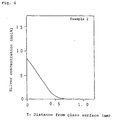
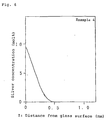
- a plate having a size of 30 x 40 x 3.5 mm was cut out of each glass block obtained above. These plates were immersed for 4 days in a 400°C mixed molten salt of 20 mol% AgNO 3 and 80 mol% NaNO 3 .
- the silver concentration distribution in surface part of the treated glasses is shown in Figs. 4 and 5.
- the refractive index distribution determined through rough calculation from the silver concentration distribution shown in Figs. 4 and 5 was approximately linear as in Example 1, and was thus ascertained to be suitable for the correction of spherical aberration.
- a mixture of glass-forming materials having the same composition as in Example 1 except that the Na 2 O/Al 2 O 3 concentration ratio was changed as shown in Table 1 was melted in a platinum crucible at 1,400°C, and the resulting melt was cast.
- the glass obtained was evaluated for durability by the powder method. As a result, the water resistance and acid resistance of the glass were rated both as the second grade.
- a plate having a size of 30 x 40 x 3.5 mm was cut out of the glass block obtained above.
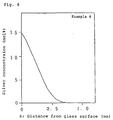
- the plate was immersed for 4 days in a 400°C mixed molten salt of 20 mol% AgNO 3 and 80 mol% NaNO 3 .
- the silver concentration distribution in a surface part of the treated glass is shown in Fig. 6.
- the refractive index distribution determined through rough calculation from the silver concentration distribution shown in Fig. 6 was approximately linear as in Example 1, and was thus ascertained to be suitable for the correction of spherical aberration.
- a mixture of glass-forming materials having the same composition as in Example 1 except that the Na 2 O/Al 2 O 3 concentration ratio was changed as shown in Table 1 was melted in a platinum crucible at 1,450°C, and the melt was cast.
- the glasses obtained were evaluated for durability by the powder method. As a result, the water resistance and acid resistance of the glass obtained in Example 5 were rated as the first grade and the second grade, respectively, while the water resistance and acid resistance of each of the glasses obtained in Examples 6 and 7 were rated as the second grade and the third grade, respectively.
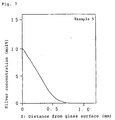
- a plate having a size of 30 x 40 x 3.5 mm was cut out of each glass block obtained above. These plates were immersed for 4 days in a 400°C mixed molten salt of 20 mol% AgNO 3 and 80 mol% NaNO 3 .
- the silver concentration distribution in surface part of the treated glasses is shown in Figs. 7 to 9.
- the refractive index distribution determined through rough calculation from the silver concentration distribution shown in Figs. 7 to 9 was approximately linear as in Example 1, and was thus ascertained to be suitable for the correction of spherical aberration.
- the glass obtained had a refractive index of 1.5317, which was higher by 0.018 than that of the glass obtained in Example 1.
- the glass obtained was evaluated for durability by the powder method. As a result, the water resistance and acid resistance of the glass were rated as the first grade and the second grade, respectively.
- a plate having a size of 30 x 40 x 3.5 mm was cut out of the glass block obtained above.
- the plate was immersed for 4 days in a 400°C mixed molten salt of 20 mol% AgNO 3 and 80 mol% NaNO 3 .
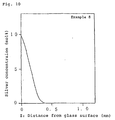
- the silver concentration distribution in a surface part of the treated glass is shown in Fig. 10.
- the refractive index distribution determined through rough calculation from the silver concentration distribution shown in Fig. 10 was approximately linear as in Example 1, and was thus ascertained to be suitable for the correction of spherical aberration.
- a mixture of glass-forming materials having the same composition as in Example 5 except that BaO or Ta 2 O 5 was added as a refractive index regulator (part of the ZnO was replaced with BaO or Ta 2 O 5 ) as shown in Table 1 was melted in a platinum crucible at 1,450°C, and the melt was cast.
- the glasses obtained respectively had refractive indexes of 1.5168 and 1.5260, which were higher by 0.002 and 0.011 respectively than that of the glass obtained in Example 5.
- the glasses obtained were evaluated for durability by the powder method. As a result, the water resistance and acid resistance of each glass were rated as the first grade and the second grade, respectively.
- a plate having a size of 30 x 40 x 3.5 mm was cut out of each glass block obtained above. These plates were immersed for 4 days in a 400°C mixed molten salt of 20 mol% AgNO 3 and 80 mol% NaNO 3 .
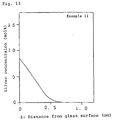
- the silver concentration distributions in surface part of the treated glasses are shown in Figs. 11 and 12.
- the refractive index distributions determined through rough calculation from the silver concentration distributions shown in Figs. 11 and 12 were approximately linear as in Example 1, and were thus ascertained to be suitable for the correction of spherical aberration.
- a mixture of glass-forming materials having the same composition as in Example 1 except that ZrO 2 was added (part of the ZnO was replaced with ZrO 2 ) as shown in Table 1 was melted in a platinum crucible at 1,450°C, and the melt was cast.
- the glass obtained was evaluated for durability by the powder method. As a result, the water resistance and acid resistance of the glass were rated both as the first grade, showing that this glass had improved durability as compared with the glass obtained in Example 1.
- a plate having a size of 30 x 40 x 3.5 mm was cut out of the glass block obtained above.
- the plate was immersed for 4 days in a 400°C mixed molten salt of 20 mol% AgNO 3 and 80 mol% NaNO 3 .
- the silver concentration distribution in a surface part of the treated glass is shown in Fig. 13.
- the refractive index distribution determined through rough calculation from the silver concentration distribution shown in Fig. 13 was approximately linear as in Example 1, and was thus ascertained to be suitable for the correction of spherical aberration.
- a mixture of glass-forming materials having the composition shown in Table 1 was melted in a platinum crucible and then cast.
- the temperature required for this melting was 1,550°C, which was higher by 100 to 150°C than those required in the Examples.
- the glass obtained was evaluated for durability by the powder method. As a result, the water resistance and acid resistance thereof were rated both as the third grade, showing that this glass had lower durability than the glasses obtained in the Examples.
- the axial refractive index distributed lens having high quality and high properties is provided from a glass material which has a refractive index distribution required for an optical design, high durability, a low melting temperature and an ion exchange rate sufficient for practical use and is capable of allowing silver ions to be stably present therein, by incorporating ZnO and MgO in given proportions into an aluminoborosilicate glass.
- the axial refractive index distributed lens of the present invention can be used not only as plano-convex spherical lenses such as that shown in the Examples described above, but also in a wide range of various optical systems including camera lenses, oculars, and microscopes.
Landscapes
- Chemical & Material Sciences (AREA)
- Life Sciences & Earth Sciences (AREA)
- Engineering & Computer Science (AREA)
- Chemical Kinetics & Catalysis (AREA)
- General Chemical & Material Sciences (AREA)
- Geochemistry & Mineralogy (AREA)
- Materials Engineering (AREA)
- Organic Chemistry (AREA)
- Physics & Mathematics (AREA)
- General Physics & Mathematics (AREA)
- Optics & Photonics (AREA)
- Glass Compositions (AREA)
Abstract
Description
provided that
provided that
provided that


Claims (4)
- An axial refractive index distributed lens obtained by forming in a glass material, a refractive index distribution in the direction of the optical axis thereof by an ion exchange method using silver,said glass material comprising a glass composition having the following composition:10 < Na2O ≤ 25 mol%8 < Al2O3 ≤ 25 mol%0 ≤ MgO ≤ 18 mol%0 ≤ ZnO ≤ 18 mol%3 ≤ B2O3 ≤ 18 mol%35 ≤ SiO2 ≤ 55 mol%0 ≤ La2O3 ≤ 5 mol%0 ≤ BaO ≤ 5 mol%0 ≤ Ta2O5 ≤ 3 mol%0 ≤ ZrO2 ≤ 3 mol%
provided that2.5 ≤ MgO + ZnO ≤ 18 mol%. - The axial refractive index distributed lens of claim 1, wherein the glass composition has the following composition:12.5 ≤ Na2O ≤ 25 mol%10 ≤ Al2O3 ≤ 22 mol%0 ≤ MgO ≤ 15 mol%0 ≤ ZnO ≤ 15 mol%5 ≤ B2O3 ≤ 16 mol%40 ≤ SiO2 ≤ 55 mol%0 ≤ La2O3 ≤ 3 mol%0 ≤ BaO ≤ 3 mol%0 ≤ Ta2O5 ≤ 3 mol%0 ≤ ZrO2 ≤ 3 mol%
provided that3 ≤ MgO + ZnO ≤ 15 mol%. - The axial refractive index distributed lens of claim 2, wherein the glass composition has the following composition:12.5 ≤ Na2O ≤ 18 mol%12.5 ≤ Al2O3 ≤ 18 mol%0 ≤ MgO ≤ 12.5 mol%0 ≤ ZnO ≤ 12.5 mol%7 ≤ B2O3 ≤ 15 mol%42.5 ≤ SiO2 ≤ 52.5 mol%0 ≤ La2O3 ≤ 3 mol%0 ≤ BaO ≤ 3 mol%0 ≤ Ta2O5 ≤ 3 mol%0 ≤ ZrO2 ≤ 3 mol%
provided that5 ≤ MgO + ZnO ≤ 12.5 mol%. - The axial refractive index distributed lens of claim 1, wherein in the glass composition has a ratio of the concentration of Al2O3 to that of Na2O, [Al2O3]/[Na2O], of 0.8 to 1.2.
Applications Claiming Priority (3)
| Application Number | Priority Date | Filing Date | Title |
|---|---|---|---|
| JP9319843A JPH11153705A (en) | 1997-11-20 | 1997-11-20 | Axial gradient index lens |
| JP319843/97 | 1997-11-20 | ||
| JP31984397 | 1997-11-20 |
Publications (3)
| Publication Number | Publication Date |
|---|---|
| EP0918235A2 true EP0918235A2 (en) | 1999-05-26 |
| EP0918235A3 EP0918235A3 (en) | 1999-06-16 |
| EP0918235B1 EP0918235B1 (en) | 2004-06-30 |
Family
ID=18114846
Family Applications (1)
| Application Number | Title | Priority Date | Filing Date |
|---|---|---|---|
| EP98121550A Expired - Lifetime EP0918235B1 (en) | 1997-11-20 | 1998-11-17 | Axial refractive index distributed lens |
Country Status (4)
| Country | Link |
|---|---|
| US (1) | US6066273A (en) |
| EP (1) | EP0918235B1 (en) |
| JP (1) | JPH11153705A (en) |
| DE (1) | DE69824814T2 (en) |
Cited By (8)
| Publication number | Priority date | Publication date | Assignee | Title |
|---|---|---|---|---|
| EP1106586A1 (en) * | 1999-12-01 | 2001-06-13 | Nippon Sheet Glass Co., Ltd. | Graded index lens |
| EP1197476A3 (en) * | 2000-10-11 | 2002-05-22 | Nippon Sheet Glass Co., Ltd. | Mother glass composition for graded index lens |
| EP1211525A1 (en) * | 2000-12-04 | 2002-06-05 | Nippon Sheet Glass Co., Ltd. | Refractive index distribution lens, production method thereof, and lens array |
| WO2002027360A3 (en) * | 2000-09-29 | 2003-03-13 | Innovative Tech Licensing Llc | Graded index microlenses and methods of design and formation |
| EP1544176A2 (en) | 2003-12-19 | 2005-06-22 | GRINTECH GmbH | Alumino-boro-silicate glass and process to make crystal-free Gradient Index Lenses |
| SG111936A1 (en) * | 2001-03-05 | 2005-06-29 | Nippon Sheet Glass Co Ltd | Mother glass for laser processing and glass for laser processing |
| EP1365265A4 (en) * | 2001-01-31 | 2007-04-11 | Fdk Corp | OPTICAL WAVEGUIDE MEMBER AND METHOD FOR PREPARING THE SAME |
| US8260115B2 (en) | 2003-01-24 | 2012-09-04 | Rovi Europe Limited | Method and product for copy protection of optical discs using unbalanced DC content |
Families Citing this family (14)
| Publication number | Priority date | Publication date | Assignee | Title |
|---|---|---|---|---|
| JP2002311212A (en) * | 2001-04-13 | 2002-10-23 | Nippon Sheet Glass Co Ltd | Processing method of optical axis direction gradient index lens, optical axis direction gradient index lens manufactured by the method, and collimator using the same |
| US20070207912A1 (en) * | 2006-03-02 | 2007-09-06 | Guardian Industries Corp. | Method of making glass including use of boron oxide for reducing glass refining time |
| FR2939787A1 (en) * | 2008-12-15 | 2010-06-18 | Saint Gobain | GLASS COMPOSITION SUITABLE FOR THE PRODUCTION OF OPTICAL PLANE ELEMENTS |
| US8341976B2 (en) * | 2009-02-19 | 2013-01-01 | Corning Incorporated | Method of separating strengthened glass |
| US20100255980A1 (en) * | 2009-04-03 | 2010-10-07 | Guardian Industires Corp. | Low iron high transmission glass with boron oxide for improved optics, durability and refining, and corresponding method |
| US8778820B2 (en) * | 2010-05-27 | 2014-07-15 | Corning Incorporated | Glasses having low softening temperatures and high toughness |
| CO6790239A1 (en) * | 2012-05-09 | 2013-11-14 | Agp America Sa | Curved armored glass with glass, ceramic or mechanically curved ceramic in the outer layer |
| US9670088B2 (en) | 2014-05-20 | 2017-06-06 | Corning Incorporated | Scratch resistant glass and method of making |
| DE102014221679B4 (en) * | 2014-10-24 | 2016-12-29 | Fraunhofer-Gesellschaft zur Förderung der angewandten Forschung e.V. | Process for the preparation of a silver-containing glass powder and the use of the glass powder |
| EP3887328A2 (en) | 2018-11-26 | 2021-10-06 | Owens Corning Intellectual Capital, LLC | High performance fiberglass composition with improved specific modulus |
| KR102752872B1 (en) | 2018-11-26 | 2025-01-09 | 오웬스 코닝 인텔렉츄얼 캐피탈 엘엘씨 | High-performance fiberglass compositions having improved elastic modulus |
| JP6875431B2 (en) * | 2019-01-29 | 2021-05-26 | 日本板硝子株式会社 | Refraction distribution type lenses, optical products, optical instruments, glass compositions for refraction distribution type lenses, and methods for manufacturing refraction distribution type lenses. |
| CN112079565B (en) * | 2020-09-25 | 2022-04-15 | 成都光明光电股份有限公司 | Glass composition, gradient index glass and manufacturing method thereof |
| CN112110646B (en) * | 2020-09-25 | 2022-02-11 | 成都光明光电股份有限公司 | Glass material, gradient index glass and method for producing the same |
Family Cites Families (12)
| Publication number | Priority date | Publication date | Assignee | Title |
|---|---|---|---|---|
| US3873408A (en) * | 1969-10-06 | 1975-03-25 | Bausch & Lomb | Method of producing a refractive index gradient in glass |
| DE3524605A1 (en) * | 1985-01-22 | 1987-01-15 | Schott Glaswerke | LIGHTWAVE GUIDE, MADE OF SPECIAL HIGH ALUMINUM SUBSTRATE GLASSES THROUGH ION EXCHANGE FOR CS + IONS |
| FR2578658B1 (en) * | 1985-03-05 | 1990-06-01 | Nippon Sheet Glass Co Ltd | MICROLENTINE PLATE AND MANUFACTURING METHOD THEREOF |
| JPS61222943A (en) * | 1985-03-29 | 1986-10-03 | Hoya Corp | Production of lens of index distribution type |
| JPS61261238A (en) * | 1985-05-13 | 1986-11-19 | Hoya Corp | Production of lens having refractive index distribution in axial direction |
| JPS62100451A (en) * | 1985-10-28 | 1987-05-09 | Hoya Corp | Glass composition suitable to produce glass having refractive index gradient |
| US4756733A (en) * | 1986-04-14 | 1988-07-12 | The University Of Rochester | Method and composition for creating gradient-index glass |
| JP2557388B2 (en) * | 1987-06-02 | 1996-11-27 | キヤノン株式会社 | Gradient index type optical element and manufacturing method thereof |
| DE3803420A1 (en) * | 1988-02-05 | 1989-08-17 | Jenaer Glaswerk Veb | Glasses for the production of extended refractive index distributions of high transparency |
| US5139557A (en) * | 1989-04-12 | 1992-08-18 | Nippon Sheet Glass Co., Ltd. | Method of performing an ion exchange of optical glass |
| US5007948A (en) * | 1990-03-19 | 1991-04-16 | Corning Incorporated | Essentially colorless silver-containing glasses through ion exchange |
| JP3708238B2 (en) * | 1996-08-08 | 2005-10-19 | オリンパス株式会社 | Manufacturing method of gradient index optical element |
-
1997
- 1997-11-20 JP JP9319843A patent/JPH11153705A/en active Pending
-
1998
- 1998-11-17 EP EP98121550A patent/EP0918235B1/en not_active Expired - Lifetime
- 1998-11-17 US US09/193,719 patent/US6066273A/en not_active Expired - Fee Related
- 1998-11-17 DE DE69824814T patent/DE69824814T2/en not_active Expired - Fee Related
Cited By (14)
| Publication number | Priority date | Publication date | Assignee | Title |
|---|---|---|---|---|
| EP1106586A1 (en) * | 1999-12-01 | 2001-06-13 | Nippon Sheet Glass Co., Ltd. | Graded index lens |
| US6511932B2 (en) | 1999-12-01 | 2003-01-28 | Nippon Sheet Glass Co., Ltd. | Graded index lens |
| WO2002027360A3 (en) * | 2000-09-29 | 2003-03-13 | Innovative Tech Licensing Llc | Graded index microlenses and methods of design and formation |
| US6661581B1 (en) | 2000-09-29 | 2003-12-09 | Rockwell Scientific Company | Graded index microlenses and methods of design and formation |
| US6764972B2 (en) | 2000-10-11 | 2004-07-20 | Nippon Sheet Glass Co., Ltd. | Mother glass composition for graded index lens |
| EP1197476A3 (en) * | 2000-10-11 | 2002-05-22 | Nippon Sheet Glass Co., Ltd. | Mother glass composition for graded index lens |
| EP1211525A1 (en) * | 2000-12-04 | 2002-06-05 | Nippon Sheet Glass Co., Ltd. | Refractive index distribution lens, production method thereof, and lens array |
| US6771428B2 (en) | 2000-12-04 | 2004-08-03 | Nippon Sheet Glass Co., Ltd. | Gradient index rod lens, method for manufacturing gradient index rod lens, and lens array |
| EP1365265A4 (en) * | 2001-01-31 | 2007-04-11 | Fdk Corp | OPTICAL WAVEGUIDE MEMBER AND METHOD FOR PREPARING THE SAME |
| SG111936A1 (en) * | 2001-03-05 | 2005-06-29 | Nippon Sheet Glass Co Ltd | Mother glass for laser processing and glass for laser processing |
| US8260115B2 (en) | 2003-01-24 | 2012-09-04 | Rovi Europe Limited | Method and product for copy protection of optical discs using unbalanced DC content |
| EP1544176A2 (en) | 2003-12-19 | 2005-06-22 | GRINTECH GmbH | Alumino-boro-silicate glass and process to make crystal-free Gradient Index Lenses |
| EP1544176A3 (en) * | 2003-12-19 | 2006-01-11 | GRINTECH GmbH | Alumino-boro-silicate glass and process to make crystal-free Gradient Index Lenses |
| US7482296B2 (en) | 2003-12-19 | 2009-01-27 | Grintech Gmbh | Aluminoborosilicate glass and method for the production of crystallite-free gradient index lenses |
Also Published As
| Publication number | Publication date |
|---|---|
| DE69824814D1 (en) | 2004-08-05 |
| DE69824814T2 (en) | 2005-07-07 |
| JPH11153705A (en) | 1999-06-08 |
| EP0918235A3 (en) | 1999-06-16 |
| US6066273A (en) | 2000-05-23 |
| EP0918235B1 (en) | 2004-06-30 |
Similar Documents
| Publication | Publication Date | Title |
|---|---|---|
| EP0918235B1 (en) | Axial refractive index distributed lens | |
| EP1106586B1 (en) | Graded index lens | |
| US4584279A (en) | Optical glass with refractive indices>1.90, Abbe numbers>25 and high chemical stability | |
| KR101617178B1 (en) | Optical glass, glass material for press molding, optical element blank, optical element and manufacturing method thereof | |
| JP4558343B2 (en) | Aluminosilicate glass | |
| JP7219199B2 (en) | Optical glasses and optical elements | |
| CA1183174A (en) | Thallium-containing optical glass | |
| CN108623152B (en) | Optical glass, optical preform and optical element | |
| JP2011037660A (en) | Optical glass, lens preform and optical element | |
| JP2004277281A (en) | Aluminoboro-silicate glass | |
| US4438211A (en) | Optical and ophthalmic glass with refractive indices nd>1.58, Abbe numbers>45 and densities<2.75 g/cm3 | |
| CN108751698B (en) | Optical glass, optical preform and optical element | |
| KR20180111681A (en) | Optical glass and optical element | |
| US7482296B2 (en) | Aluminoborosilicate glass and method for the production of crystallite-free gradient index lenses | |
| CN116177875A (en) | Optical glass, optical preforms and optical components | |
| EP1099670B1 (en) | Mother glass composition for graded index lens | |
| CN106746613B (en) | Optical glass | |
| JP2010105906A (en) | Optical glass, optical element, and preform for precision press-molding | |
| EP1197476A2 (en) | Mother glass composition for graded index lens | |
| GB2127010A (en) | Thallium-containing optical glass composition | |
| JPS63230536A (en) | Thallium-containing optical glass | |
| JP2001180970A (en) | Manufacturing method of the zinc-containing optical glass | |
| JPH09278479A (en) | Optical glass for mold press | |
| JPS5941934B2 (en) | Glass composition for light focusing lenses | |
| JPS6364941A (en) | Glass composition for light-collecting lens |
Legal Events
| Date | Code | Title | Description |
|---|---|---|---|
| PUAI | Public reference made under article 153(3) epc to a published international application that has entered the european phase |
Free format text: ORIGINAL CODE: 0009012 |
|
| PUAL | Search report despatched |
Free format text: ORIGINAL CODE: 0009013 |
|
| AK | Designated contracting states |
Kind code of ref document: A2 Designated state(s): DE FR GB |
|
| AX | Request for extension of the european patent |
Free format text: AL;LT;LV;MK;RO;SI |
|
| AK | Designated contracting states |
Kind code of ref document: A3 Designated state(s): AT BE CH CY DE DK ES FI FR GB GR IE IT LI LU MC NL PT SE |
|
| AX | Request for extension of the european patent |
Free format text: AL;LT;LV;MK;RO;SI |
|
| 17P | Request for examination filed |
Effective date: 19991012 |
|
| AKX | Designation fees paid |
Free format text: DE FR GB |
|
| 17Q | First examination report despatched |
Effective date: 20020828 |
|
| GRAP | Despatch of communication of intention to grant a patent |
Free format text: ORIGINAL CODE: EPIDOSNIGR1 |
|
| GRAS | Grant fee paid |
Free format text: ORIGINAL CODE: EPIDOSNIGR3 |
|
| GRAA | (expected) grant |
Free format text: ORIGINAL CODE: 0009210 |
|
| AK | Designated contracting states |
Kind code of ref document: B1 Designated state(s): DE FR GB |
|
| PG25 | Lapsed in a contracting state [announced via postgrant information from national office to epo] |
Ref country code: FR Free format text: LAPSE BECAUSE OF FAILURE TO SUBMIT A TRANSLATION OF THE DESCRIPTION OR TO PAY THE FEE WITHIN THE PRESCRIBED TIME-LIMIT Effective date: 20040630 |
|
| REG | Reference to a national code |
Ref country code: GB Ref legal event code: FG4D |
|
| REF | Corresponds to: |
Ref document number: 69824814 Country of ref document: DE Date of ref document: 20040805 Kind code of ref document: P |
|
| PLBE | No opposition filed within time limit |
Free format text: ORIGINAL CODE: 0009261 |
|
| STAA | Information on the status of an ep patent application or granted ep patent |
Free format text: STATUS: NO OPPOSITION FILED WITHIN TIME LIMIT |
|
| 26N | No opposition filed |
Effective date: 20050331 |
|
| EN | Fr: translation not filed | ||
| PGFP | Annual fee paid to national office [announced via postgrant information from national office to epo] |
Ref country code: DE Payment date: 20081114 Year of fee payment: 11 |
|
| PGFP | Annual fee paid to national office [announced via postgrant information from national office to epo] |
Ref country code: GB Payment date: 20081112 Year of fee payment: 11 |
|
| GBPC | Gb: european patent ceased through non-payment of renewal fee |
Effective date: 20091117 |
|
| PG25 | Lapsed in a contracting state [announced via postgrant information from national office to epo] |
Ref country code: DE Free format text: LAPSE BECAUSE OF NON-PAYMENT OF DUE FEES Effective date: 20100601 |
|
| PG25 | Lapsed in a contracting state [announced via postgrant information from national office to epo] |
Ref country code: GB Free format text: LAPSE BECAUSE OF NON-PAYMENT OF DUE FEES Effective date: 20091117 |