EP0917222A2 - Verfahren zur Herstellung von Doppeloxidschicht, Doppeloxid/Metall-Verbundkörper, Doppeloxidschicht und funktionales leitfähiges Material - Google Patents
Verfahren zur Herstellung von Doppeloxidschicht, Doppeloxid/Metall-Verbundkörper, Doppeloxidschicht und funktionales leitfähiges Material Download PDFInfo
- Publication number
- EP0917222A2 EP0917222A2 EP98121142A EP98121142A EP0917222A2 EP 0917222 A2 EP0917222 A2 EP 0917222A2 EP 98121142 A EP98121142 A EP 98121142A EP 98121142 A EP98121142 A EP 98121142A EP 0917222 A2 EP0917222 A2 EP 0917222A2
- Authority
- EP
- European Patent Office
- Prior art keywords
- double oxide
- lithium
- metal
- oxide film
- film
- Prior art date
- Legal status (The legal status is an assumption and is not a legal conclusion. Google has not performed a legal analysis and makes no representation as to the accuracy of the status listed.)
- Withdrawn
Links
Images



Classifications
-
- H—ELECTRICITY
- H01—ELECTRIC ELEMENTS
- H01M—PROCESSES OR MEANS, e.g. BATTERIES, FOR THE DIRECT CONVERSION OF CHEMICAL ENERGY INTO ELECTRICAL ENERGY
- H01M4/00—Electrodes
- H01M4/02—Electrodes composed of, or comprising, active material
- H01M4/04—Processes of manufacture in general
- H01M4/0438—Processes of manufacture in general by electrochemical processing
- H01M4/044—Activating, forming or electrochemical attack of the supporting material
-
- C—CHEMISTRY; METALLURGY
- C23—COATING METALLIC MATERIAL; COATING MATERIAL WITH METALLIC MATERIAL; CHEMICAL SURFACE TREATMENT; DIFFUSION TREATMENT OF METALLIC MATERIAL; COATING BY VACUUM EVAPORATION, BY SPUTTERING, BY ION IMPLANTATION OR BY CHEMICAL VAPOUR DEPOSITION, IN GENERAL; INHIBITING CORROSION OF METALLIC MATERIAL OR INCRUSTATION IN GENERAL
- C23C—COATING METALLIC MATERIAL; COATING MATERIAL WITH METALLIC MATERIAL; SURFACE TREATMENT OF METALLIC MATERIAL BY DIFFUSION INTO THE SURFACE, BY CHEMICAL CONVERSION OR SUBSTITUTION; COATING BY VACUUM EVAPORATION, BY SPUTTERING, BY ION IMPLANTATION OR BY CHEMICAL VAPOUR DEPOSITION, IN GENERAL
- C23C22/00—Chemical surface treatment of metallic material by reaction of the surface with a reactive liquid, leaving reaction products of surface material in the coating, e.g. conversion coatings, passivation of metals
-
- C—CHEMISTRY; METALLURGY
- C01—INORGANIC CHEMISTRY
- C01G—COMPOUNDS CONTAINING METALS NOT COVERED BY SUBCLASSES C01D OR C01F
- C01G45/00—Compounds of manganese
- C01G45/12—Complex oxides containing manganese and at least one other metal element
- C01G45/1221—Manganates or manganites with trivalent manganese, tetravalent manganese or mixtures thereof
-
- C—CHEMISTRY; METALLURGY
- C01—INORGANIC CHEMISTRY
- C01G—COMPOUNDS CONTAINING METALS NOT COVERED BY SUBCLASSES C01D OR C01F
- C01G49/00—Compounds of iron
- C01G49/0018—Mixed oxides or hydroxides
- C01G49/0027—Mixed oxides or hydroxides containing one alkali metal
-
- C—CHEMISTRY; METALLURGY
- C01—INORGANIC CHEMISTRY
- C01G—COMPOUNDS CONTAINING METALS NOT COVERED BY SUBCLASSES C01D OR C01F
- C01G51/00—Compounds of cobalt
- C01G51/40—Complex oxides containing cobalt and at least one other metal element
- C01G51/42—Complex oxides containing cobalt and at least one other metal element containing alkali metals, e.g. LiCoO2
-
- C—CHEMISTRY; METALLURGY
- C01—INORGANIC CHEMISTRY
- C01G—COMPOUNDS CONTAINING METALS NOT COVERED BY SUBCLASSES C01D OR C01F
- C01G53/00—Compounds of nickel
- C01G53/40—Complex oxides containing nickel and at least one other metal element
- C01G53/42—Complex oxides containing nickel and at least one other metal element containing alkali metals, e.g. LiNiO2
-
- H—ELECTRICITY
- H01—ELECTRIC ELEMENTS
- H01M—PROCESSES OR MEANS, e.g. BATTERIES, FOR THE DIRECT CONVERSION OF CHEMICAL ENERGY INTO ELECTRICAL ENERGY
- H01M4/00—Electrodes
- H01M4/02—Electrodes composed of, or comprising, active material
- H01M4/04—Processes of manufacture in general
- H01M4/0438—Processes of manufacture in general by electrochemical processing
-
- H—ELECTRICITY
- H01—ELECTRIC ELEMENTS
- H01M—PROCESSES OR MEANS, e.g. BATTERIES, FOR THE DIRECT CONVERSION OF CHEMICAL ENERGY INTO ELECTRICAL ENERGY
- H01M4/00—Electrodes
- H01M4/02—Electrodes composed of, or comprising, active material
- H01M4/04—Processes of manufacture in general
- H01M4/0438—Processes of manufacture in general by electrochemical processing
- H01M4/044—Activating, forming or electrochemical attack of the supporting material
- H01M4/0442—Anodisation, Oxidation
-
- H—ELECTRICITY
- H01—ELECTRIC ELEMENTS
- H01M—PROCESSES OR MEANS, e.g. BATTERIES, FOR THE DIRECT CONVERSION OF CHEMICAL ENERGY INTO ELECTRICAL ENERGY
- H01M4/00—Electrodes
- H01M4/02—Electrodes composed of, or comprising, active material
- H01M4/04—Processes of manufacture in general
- H01M4/0438—Processes of manufacture in general by electrochemical processing
- H01M4/0459—Electrochemical doping, intercalation, occlusion or alloying
-
- H—ELECTRICITY
- H01—ELECTRIC ELEMENTS
- H01M—PROCESSES OR MEANS, e.g. BATTERIES, FOR THE DIRECT CONVERSION OF CHEMICAL ENERGY INTO ELECTRICAL ENERGY
- H01M4/00—Electrodes
- H01M4/02—Electrodes composed of, or comprising, active material
- H01M4/36—Selection of substances as active materials, active masses, active liquids
- H01M4/48—Selection of substances as active materials, active masses, active liquids of inorganic oxides or hydroxides
- H01M4/485—Selection of substances as active materials, active masses, active liquids of inorganic oxides or hydroxides of mixed oxides or hydroxides for inserting or intercalating light metals, e.g. LiTi2O4 or LiTi2OxFy
-
- H—ELECTRICITY
- H01—ELECTRIC ELEMENTS
- H01M—PROCESSES OR MEANS, e.g. BATTERIES, FOR THE DIRECT CONVERSION OF CHEMICAL ENERGY INTO ELECTRICAL ENERGY
- H01M4/00—Electrodes
- H01M4/02—Electrodes composed of, or comprising, active material
- H01M4/36—Selection of substances as active materials, active masses, active liquids
- H01M4/48—Selection of substances as active materials, active masses, active liquids of inorganic oxides or hydroxides
- H01M4/50—Selection of substances as active materials, active masses, active liquids of inorganic oxides or hydroxides of manganese
- H01M4/505—Selection of substances as active materials, active masses, active liquids of inorganic oxides or hydroxides of manganese of mixed oxides or hydroxides containing manganese for inserting or intercalating light metals, e.g. LiMn2O4 or LiMn2OxFy
-
- H—ELECTRICITY
- H01—ELECTRIC ELEMENTS
- H01M—PROCESSES OR MEANS, e.g. BATTERIES, FOR THE DIRECT CONVERSION OF CHEMICAL ENERGY INTO ELECTRICAL ENERGY
- H01M4/00—Electrodes
- H01M4/02—Electrodes composed of, or comprising, active material
- H01M4/36—Selection of substances as active materials, active masses, active liquids
- H01M4/48—Selection of substances as active materials, active masses, active liquids of inorganic oxides or hydroxides
- H01M4/52—Selection of substances as active materials, active masses, active liquids of inorganic oxides or hydroxides of nickel, cobalt or iron
- H01M4/525—Selection of substances as active materials, active masses, active liquids of inorganic oxides or hydroxides of nickel, cobalt or iron of mixed oxides or hydroxides containing iron, cobalt or nickel for inserting or intercalating light metals, e.g. LiNiO2, LiCoO2 or LiCoOxFy
-
- C—CHEMISTRY; METALLURGY
- C01—INORGANIC CHEMISTRY
- C01P—INDEXING SCHEME RELATING TO STRUCTURAL AND PHYSICAL ASPECTS OF SOLID INORGANIC COMPOUNDS
- C01P2002/00—Crystal-structural characteristics
- C01P2002/70—Crystal-structural characteristics defined by measured X-ray, neutron or electron diffraction data
- C01P2002/72—Crystal-structural characteristics defined by measured X-ray, neutron or electron diffraction data by d-values or two theta-values, e.g. as X-ray diagram
-
- C—CHEMISTRY; METALLURGY
- C01—INORGANIC CHEMISTRY
- C01P—INDEXING SCHEME RELATING TO STRUCTURAL AND PHYSICAL ASPECTS OF SOLID INORGANIC COMPOUNDS
- C01P2002/00—Crystal-structural characteristics
- C01P2002/80—Crystal-structural characteristics defined by measured data other than those specified in group C01P2002/70
- C01P2002/85—Crystal-structural characteristics defined by measured data other than those specified in group C01P2002/70 by XPS, EDX or EDAX data
-
- C—CHEMISTRY; METALLURGY
- C01—INORGANIC CHEMISTRY
- C01P—INDEXING SCHEME RELATING TO STRUCTURAL AND PHYSICAL ASPECTS OF SOLID INORGANIC COMPOUNDS
- C01P2004/00—Particle morphology
- C01P2004/60—Particles characterised by their size
- C01P2004/62—Submicrometer sized, i.e. from 0.1-1 micrometer
-
- C—CHEMISTRY; METALLURGY
- C01—INORGANIC CHEMISTRY
- C01P—INDEXING SCHEME RELATING TO STRUCTURAL AND PHYSICAL ASPECTS OF SOLID INORGANIC COMPOUNDS
- C01P2006/00—Physical properties of inorganic compounds
- C01P2006/40—Electric properties
-
- H—ELECTRICITY
- H01—ELECTRIC ELEMENTS
- H01M—PROCESSES OR MEANS, e.g. BATTERIES, FOR THE DIRECT CONVERSION OF CHEMICAL ENERGY INTO ELECTRICAL ENERGY
- H01M10/00—Secondary cells; Manufacture thereof
- H01M10/05—Accumulators with non-aqueous electrolyte
- H01M10/052—Li-accumulators
-
- Y—GENERAL TAGGING OF NEW TECHNOLOGICAL DEVELOPMENTS; GENERAL TAGGING OF CROSS-SECTIONAL TECHNOLOGIES SPANNING OVER SEVERAL SECTIONS OF THE IPC; TECHNICAL SUBJECTS COVERED BY FORMER USPC CROSS-REFERENCE ART COLLECTIONS [XRACs] AND DIGESTS
- Y02—TECHNOLOGIES OR APPLICATIONS FOR MITIGATION OR ADAPTATION AGAINST CLIMATE CHANGE
- Y02E—REDUCTION OF GREENHOUSE GAS [GHG] EMISSIONS, RELATED TO ENERGY GENERATION, TRANSMISSION OR DISTRIBUTION
- Y02E60/00—Enabling technologies; Technologies with a potential or indirect contribution to GHG emissions mitigation
- Y02E60/10—Energy storage using batteries
Definitions
- This invention relates to a method of producing a double oxide film, and more particularly to a lithium double oxide, a double oxide/metal composite and a functional conductive material including such a film.
- Lithium double oxides are considered as electrode material in a lithium battery and its derivatives such as electrochromic device. Because the lithium double oxides have layered structure, lithium ions can be intercalated and deintercalated into the interlayer space. If the components of the lithium battery such as cathode, electrolyte and anode can be made in a film form, the lithium battery can be miniaturized even to micrometer scale. The major difficulty in fabricating lithium microbatteries is in the preparation of the lithium double oxide film as cathode. Therefore, the preparation of such a thin film has been attempted in various places and fields.
- PVD physical vapor deposition
- Such a process generally includes (1) the preparation of lithium double oxide powder or its precursor, (2) the formation of a target through shape-forming and sintering and (3) the deposition of a thin film from the target.
- the target is evaporated or ionized by sputter, laser ablation or similar methods, and deposited onto a substrate to form a thin film.
- the PVD process is a multistage process and requires a high energy consumption for high temperature heating or ionization at each stage in addition to the energy consumption to keep a vacuum. Furthermore, even if the prepared target has a desired composition, the structure and chemical composition of the prepared film are not identical to those of the target due to the selective vaporization of Li upon the course of evaporation or ionization. Moreover, the life time of the target is short. Particularly, when the composition of the target is modified upon the evaporation or ionization, such a target is almost a waste. Therefore, this process is not an efficient way in views of energy and material at all.
- lithium double oxide thin film is far from practical use at present. Only a thick film obtained by dispersing and firing lithium double oxide slurry on metal film has been put into practical use on small size battery system, but not on microbattery system.
- an object of the invention to provide a new method solving the aforementioned drawbacks such as ununiformity of the composition due to selective evaporation of lithium at a high temperature, difficulty in the film formation from vapor phase, problems in the multistage process and restrictions in the starting material or the apparatus derived from the ionization or vaporization.
- a method of producing a double oxide film between a lithium element and a metal element other than the lithium element in which the metal element is at least one element selected from the group consisting of Ni, Co, Mn, V, Fe, Cr, and Al, and which comprises a step of hydrothermal reaction between a metal body made of the metal element and a lithium ion in an alkaline solution containing the lithium ion to form a double oxide film of the metal element and the lithium element on a surface of the metal body.
- the inventors have confirmed the following facts: (1) when a nickel metal plate or foil is immersed into a solution mainly composed of LiOH and then heated in an autoclave at a fixed temperature between 100 and 200°C for 10-20 hours, lithium nickel oxide film is directly formed on the surface of the plate or foil through hydrothermal reaction; (2) when a direct current having a current density of around 1 mA/cm 2 is applied in the treatment of the above item (1), the quantity of the resulting film largely increases and the quality of the film is improved; (3) the surface of the resulting film is composed of fine and homogeneous lithium nickel oxide grains with a size of about 20 nm and has a uniformed chemical composition; (4) the lithium nickel oxide film has a satisfactorily strong adhesion force and is practically usual as a thin film electrode without any post-synthesis heat treatments; and (5) Li ion can be reversibly intercalated and deintercalated into the obtained film. In result, the invention has been accomplished.
- the inventors have created a novel technique wherein the metal with particular shape of Ni or the like is activated and reacted in an aqueous solution containing Li ions to form directly a lithium double oxide in film form.
- the invention has been accomplished by the application of a principle completely different from the conventional methods of producing lithium double oxide films so that the method of the invention has the following features: (1) the reaction between metal or metal alloy with particular shape and an aqueous solution containing Li ions; (2) the low temperature fabrication of lithium double oxide films with an excellent crystallinity; (3) the easy combination of other activation methods such as the simultaneous hydrothermal and electrochemical reactions to motivate an interfacial reaction even at very low temperature; (4) the composition, structure and properties of the resulting films can be easily controlled depending on the synthetic conditions such as the composition, concentration, volume and temperature of the solution, the applied current density, the reaction time and the like; (5) when metal or metal alloy with particular shape and size is applied to the treatment, lithium double oxide films with desired shape and size are fabricated; and (6) since the aqueous solution is used in the process according to the invention, the apparatus can be made into a completely closed circulation system and hence wastes and environmental loads can be minimized, and the like.
- the term of "functional conductive material” used in the invention means a material transmitting, converting, amplifying recording or oscillating energy or signal through ion, electron and/or positive hole.
- the functional conductive material includes, for example, an electrode material, a sensor material, an electric conductive material, a recording material, an energy exchange material, a catalyst material, a light absorbing material, a photochromic material, an electrochromic material and the like.
- the metal body used in the invention is composed of at least one metal element selected from the group consisting of Ni, Co, Mn, V, Fe, Cr and Al. It is formed that all these metals are easy to form a double oxide with Li ions.
- the use of Ni, Co, Mn, Fe and/or Al is favorable because their double oxides are easy to develop a lithium ion conductivity or to bring about the free access of the Li ion.
- Ni and Co double oxides can be adopted as lithium battery materials.
- the above mentioned metals and alloys have been used as a body or a substrate.
- the metal body may have various shapes.
- the resulting film her the treatment may have a 1D, 2D or 3D pathway of lithium ions to give access to an inner part of the body.
- metal body with the exact amount and thickness may be supplied so that the metal body may fully react to produce the lithium double oxide film. Therefore, metal films on the surface of another inert metal body or a non-metal body such as plastic, glass or the like can also be used as bodies in the method of the invention.
- such a metal body is immersed in an alkaline aqueous solution containing lithium ions.
- the preferable concentration of lithium is 0.1-5.0 mol/liter.
- concentration of 5.0 mole/liter is the solubility limit of a lithium salt. Therefore, when the concentration exceeds the solubility limit, excessive lithium species are unfavorably precipitated.
- lithium ions not contributing to the film formation remains in the solution. Since the use aqueous solution can be easily recycled after replenishing of Li salt due to the apparatus with completely closed circulation system, waste of substance can be minimized, which is also environmentally and economically beneficial. In this point, the usage of high concentration lithium solution is not at all a disadvantage.
- a direct current is applied to the metal substrate during the hydrothermal reaction.
- the direct current is preferable to have a current density of 0.001-50 mA/cm 2 .
- the applied current density is less than 0.001 mA/cm 2 , long reaction time is required to produce the desired film. Otherwise, when it exceeds 50 mA/cm 2 , the grains constituting the film become coarse or the surface of the film becomes rough.
- autoclave should not be only used, but some container with heat, pressure and chemical resistance up to a certain point can be also used as a reaction vessel.
- the hydrothermal reactions are performed at a fixed temperature between 60 and 300°C. When the reaction temperature is lower than 60°C, it is difficult to form the desired film, or even it the film can be formed, its crystallinity is insufficient and the film properties are degraded. When it exceeds 300°C, the vapor pressure of the solution will exceed 80 atmospheric pressures and it is possible to occur several problems in the pressure, heat and chemical resistance of the reaction container.
- the reasonable hydrothermal reaction temperature is 100-200°C. In this temperature range, it is easy to control the hydrothermal reaction and the properties of the resulting film.
- the films prepared between 125 and 175°C show the prospective electrochemical activity for the electrode material.
- a nickel metal plate is immersed in the 4M LiOH aqueous solution and then a direct current having a current density of 1.0 mA/cm 2 is applied to the plate at 150°C for 20 hours by using the plate as anode.
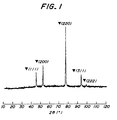
- the X-ray diffraction (XRD) patterns of nickel metal plates before and after the hydrothermal-electrochemical treatment are measured.
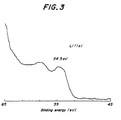
- the prepared film is analyzed using an X-ray photoelectron spectroscopy (XPS).
- the grain size of the crystal in the film is measured using an atomic force microscopy (AFM), and the thickness of the film is measured from its cross section view using a scanning electron microscopy (SEM).
- AFM atomic force microscopy
- SEM scanning electron microscopy
- Fig. 1 shows the X-ray diffraction pattern of nickel metal plate before the hydrothermal-electrochemical treatment.
- Fig. 2 shows the X -ray diffraction pattern of the nickel plate her the hydrothermal-electrochemical treatment. Peaks denoted by in Figs. 1 and 2 are assigned to Ni metal, and peaks denoted by are assigned to lithium nickel oxide. As shown in Figs. 1 and 2, lithium nickel oxide is obtained on the Ni metal plate.
- Fig. 3 shows the Li(ls) X-ray photoelectron spectrum of the prepared film.
- Fig. 4 shows the Ni(2p3/2) X-ray photoelectron spectrum of the prepared film. As shown in Figs. 3 and 4, the presence of both Li + and Ni 3+ in the prepared film is confirmed.
- Lithium nickel oxide films are also prepared at different temperatures under the same electrochemical condition as Example 1 (galvanostatic charging at the current density of 1.0 mA/cm 2 and reaction time of 20 hours) (Example 2: 60°C, Example 3: 100°C, Example 4: 125°C, Example 5: 175°C and Example 6: 200°C).
- Example 3 (100°C) ⁇ ⁇ 0.16 7.8
- Example 4 (125°C) ⁇ ⁇ 0.53 21.1
- Example 1 (150°C) ⁇ ⁇ 0.30 16.7
- Example 5 (175°C) ⁇ ⁇ 0.26 15.6
- Example 6 (200°C) ⁇ ⁇ 0.24 14.4
- the well crystalline lithium nickel oxide films are evidently formed at a fixed temperature of 100-200°C.
- lithium nickel oxide film could be produced even at low temperature of 60°C but very long reaction time is necessary to produce, thus the film properties are not summarized in Table 1.
- the film thickness and the grain size as a function of fabrication temperature exhibit a local maximum at 125°C.
- Lithium nickel oxide films are also prepared at different applied current density under the same hydrothermal condition as Example 1 (fabrication temperature of 150°C and reaction time of 20 hours) (Example 7: 0.01 mA/cm 2 , Example 8: 0.1 mA/cm 2 , Example 9: 0.5 mA/cm 2 , Example 10: 3.0 mA/cm 2 and Example 11: 5.0 mA/cm 2 ).
- Example 8 (0.1 mA/cm 2 ) ⁇ ⁇ 0.35 24.4
- Example 9 (0.5 mA/cm 2 ) ⁇ ⁇ 0.29 18.3
- Example 1 (1.0 mA/cm 2 ) ⁇ ⁇ 0.30 16.7
- Example 10 (3.0 mA/cm 2 ) ⁇ ⁇ 0.30 17.8
- Example 11 (5.0 mA/cm 2 ) ⁇ ⁇ 0.31 8.3
- the lithium nickel oxide films are evidently formed at a fixed current density of 0.01-5.0 mA/cm 2 .
- the film properties are not summarized in Table 2 because very long reaction time is necessary to produce lithium nickel oxide film.
- Lithium nickel oxide films are also prepared in the different LiOH concentration solutions under the same other conditions as Example 1 (fabrication temperature of 150°C, galvanostatic charging at the current density of 1.0 mA/cm 2 and reaction time of 20 hours) (Example 12: 1.0M LiOH solution and Example 13: 0.1 M LiOH solution).
- lithium nickel oxide film When the concentration of lithium ion is higher than 1.0 mole/liter, lithium nickel oxide film is formed. On the other hand, when it is 0.1 mole/liter, unexpected composite film such as nickel hydroxide film is obtained.
- Example 2 The same treatment as Example 1 is applied to a nickel metal film on a conductive substrate such as a metal or a conductive plastic plate.
- a nickel metal film coated on the substrate is completely transformed into lithium nickel oxide film. It demonstrates that electrode material films can be directly deposited on electronics using the method in the invention.
- Example 18 The same treatment as Example 1 is applied to other metal plates such as Co (Example 15), Fe (Example 16), Cr (Example 17) and Mn (Example 18) metal plates inserted of nickel metal plate.
- Co Example 15
- Fe Example 16
- Cr Example 17
- Mn Example 18
- LiCoO 2 , LiFeO 2 , LiCrO 2 or LiMnO 2 film is formed as the resulting film.
- Fig. 5 shows the cyclic voltammograms of the film of Example 1 at various scan rates. At any scan rates, the film exhibits very good reversibility and reproducibility.
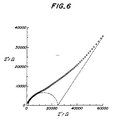
- Fig. 6 shows two overlapping semicircles.
- the semicircle at high frequencies in the Cole-Cole plot of the film of Example 1 corresponds to its lithium ionic conductivity.
- the method of the invention can fabricate lithium double oxide films on the surface of metal body with an arbitrary shape in a single synthetic step at low temperature. It is completely different from the conventional methods.
- the invention is firstly disclosed as a novel method producing lithium double oxide films.
- the film composed of only lithium double oxide can be fabricated on various substrates.
- the facility in applying the method of the invention gives the versatility in shaping, up-sizing and orienting films. Therefore, the method of the invention has lots of merits in comparison with any other methods for the film fabrication.
Landscapes
- Chemical & Material Sciences (AREA)
- Organic Chemistry (AREA)
- Chemical Kinetics & Catalysis (AREA)
- General Chemical & Material Sciences (AREA)
- Inorganic Chemistry (AREA)
- Electrochemistry (AREA)
- Engineering & Computer Science (AREA)
- Manufacturing & Machinery (AREA)
- Materials Engineering (AREA)
- Mechanical Engineering (AREA)
- Metallurgy (AREA)
- Battery Electrode And Active Subsutance (AREA)
- Chemical Treatment Of Metals (AREA)
- Inorganic Compounds Of Heavy Metals (AREA)
- Secondary Cells (AREA)
Applications Claiming Priority (3)
| Application Number | Priority Date | Filing Date | Title |
|---|---|---|---|
| JP9310630A JP3060009B2 (ja) | 1997-11-12 | 1997-11-12 | 複合酸化物膜の製造方法、金属複合体、複合酸化物膜及び機能性導電材料 |
| JP310630/97 | 1997-11-12 | ||
| JP31063097 | 1997-11-12 |
Publications (2)
| Publication Number | Publication Date |
|---|---|
| EP0917222A2 true EP0917222A2 (de) | 1999-05-19 |
| EP0917222A3 EP0917222A3 (de) | 2005-10-12 |
Family
ID=18007577
Family Applications (1)
| Application Number | Title | Priority Date | Filing Date |
|---|---|---|---|
| EP98121142A Withdrawn EP0917222A3 (de) | 1997-11-12 | 1998-11-11 | Verfahren zur Herstellung von Doppeloxidschicht, Doppeloxid/Metall-Verbundkörper, Doppeloxidschicht und funktionales leitfähiges Material |
Country Status (4)
| Country | Link |
|---|---|
| US (1) | US6165624A (de) |
| EP (1) | EP0917222A3 (de) |
| JP (1) | JP3060009B2 (de) |
| KR (1) | KR100324910B1 (de) |
Families Citing this family (7)
| Publication number | Priority date | Publication date | Assignee | Title |
|---|---|---|---|---|
| KR100398744B1 (ko) * | 2000-02-16 | 2003-09-19 | 주식회사 엘지화학 | 전기화학적 성능이 향상된 리튬망간 스피넬 복합산화물의 제조방법 |
| JP3353070B2 (ja) | 2000-03-17 | 2002-12-03 | 東京工業大学長 | 薄膜形成方法 |
| DE102012212465B3 (de) | 2012-07-17 | 2013-11-07 | Trumpf Werkzeugmaschinen Gmbh + Co. Kg | Elektroadhäsionsgreifer zum Halten von Werkstücken |
| WO2017221451A1 (ja) * | 2016-06-24 | 2017-12-28 | 日本碍子株式会社 | 層状複水酸化物を含む機能層及び複合材料 |
| KR102533157B1 (ko) * | 2016-07-27 | 2023-05-17 | 삼성에스디아이 주식회사 | 리튬 이차전지의 양극 활물질의 제조방법 |
| US10886523B2 (en) * | 2018-05-24 | 2021-01-05 | Xerion Advanced Battery Corporation | Electroplating lithiated transition metal oxides using low purity starting precursors |
| CN117285260B (zh) * | 2023-08-14 | 2026-01-30 | 上海理工大学 | 镍锰双金属氢氧化物、氧化物电致变色薄膜及制备和应用 |
Family Cites Families (3)
| Publication number | Priority date | Publication date | Assignee | Title |
|---|---|---|---|---|
| US3645860A (en) * | 1969-03-04 | 1972-02-29 | Leesona Corp | Process for the preparation of an electrocatalyst |
| US4921738A (en) * | 1988-12-09 | 1990-05-01 | The United States Of America As Represented By The United States Department Of Energy | Li2 O-Al2 O3 -SiO2 glass ceramic-aluminum containing austenitic stainless steel composite body and a method of producing the same |
| DE4327760A1 (de) * | 1993-08-18 | 1995-02-23 | Varta Batterie | Verfahren zur Herstellung einer positiven Elektrode für Lithium-Sekundärbatterien |
-
1997
- 1997-11-12 JP JP9310630A patent/JP3060009B2/ja not_active Expired - Lifetime
-
1998
- 1998-11-11 EP EP98121142A patent/EP0917222A3/de not_active Withdrawn
- 1998-11-12 KR KR1019980048459A patent/KR100324910B1/ko not_active Expired - Fee Related
- 1998-11-12 US US09/190,713 patent/US6165624A/en not_active Expired - Fee Related
Also Published As
| Publication number | Publication date |
|---|---|
| KR19990045240A (ko) | 1999-06-25 |
| JP3060009B2 (ja) | 2000-07-04 |
| JPH11140661A (ja) | 1999-05-25 |
| KR100324910B1 (ko) | 2002-06-24 |
| US6165624A (en) | 2000-12-26 |
| EP0917222A3 (de) | 2005-10-12 |
Similar Documents
| Publication | Publication Date | Title |
|---|---|---|
| CN112701257B (zh) | 全固体二次电池、制造全固体二次电池的方法、和受保护的电极 | |
| CN110880616B (zh) | 固体电解质、其制备方法和包括其的二次电池 | |
| EP0442681B1 (de) | Herstellungsverfahren für eine Elektrode und Herstellungsverfahren für eine Verbund-Elektrode-Elektrolyte | |
| Wang et al. | A nanocrystalline NiO thin-film electrode prepared by pulsed laser ablation for Li-ion batteries | |
| EP2741354B1 (de) | Kathodenaktivmaterial für lithiumionen-sekundärbatterie | |
| EP2219253B1 (de) | Elektrodenmaterial | |
| US7927743B2 (en) | Lithium metal composite oxide particles, process of producing lithium metal composite oxide particles, electrode structure containing lithium metal composite oxide particles, process of producing electrode structure, and lithium secondary battery having electrode structure | |
| EP4266407A1 (de) | Positives aktivmaterial für eine wiederaufladbare lithiumbatterie, verfahren zur herstellung davon und wiederaufladbare lithiumbatterie damit | |
| US8808405B2 (en) | Method of forming a solid state cathode for high energy density secondary batteries | |
| US20020015889A1 (en) | Process for producing an electrode material for a rechargeable lithium battery, an electrode structural body for a rechargeable lithium battery, process for producing said electrode structural body, a rechargeable lithium battery in which said electrode structural body is used, and a process for producing said rechargeable lithium battery | |
| EP2763217A1 (de) | Aktives positivelektrodenmaterial für lithiumionen-sekundärbatterie und herstellungsverfahren dafür | |
| Sugiawati et al. | Sputtered porous Li-Fe-PO film cathodes prepared by radio frequency sputtering for Li-ion microbatteries | |
| Fragnaud et al. | Characterization of sprayed and sputter deposited LiCoO2 thin films for rechargeable microbatteries | |
| EP2093825A1 (de) | Batteriestruktur und lithium-sekundärbatterie damit | |
| Wang et al. | A nanocrystalline Co3O4 thin film electrode for Li-ion batteries | |
| CN110828769A (zh) | 形成能量存储器的方法 | |
| Daramalla et al. | Superior electrochemical performance of amorphous titanium niobium oxide thin films for Li-ion thin film batteries | |
| Lakshmi-Narayana et al. | Pulsed laser–deposited Li2TiO3 thin film electrodes for energy storage | |
| US6165624A (en) | Article and method of producing a double oxide film | |
| CN118355541A (zh) | 电池 | |
| Shembel et al. | Electrolytic molybdenum oxides in lithium batteries | |
| Dewan et al. | Electrophoretically deposited bismuth iron oxide as dual role anode material for both lithium and sodium-ion batteries | |
| US20250015341A1 (en) | Thin sulfide-based solid-state electrolytes via spray deposition | |
| US20250006985A1 (en) | Silicon nitride stabilized interface between lithium metal and solid electrolyte for high performance lithium metal batteries | |
| CN120641998A (zh) | 固体电解质及固体电解质电池 |
Legal Events
| Date | Code | Title | Description |
|---|---|---|---|
| PUAI | Public reference made under article 153(3) epc to a published international application that has entered the european phase |
Free format text: ORIGINAL CODE: 0009012 |
|
| 17P | Request for examination filed |
Effective date: 19981111 |
|
| AK | Designated contracting states |
Kind code of ref document: A2 Designated state(s): AT BE CH CY DE DK ES FI FR GB GR IE IT LI LU MC NL PT SE |
|
| AX | Request for extension of the european patent |
Free format text: AL;LT;LV;MK;RO;SI |
|
| PUAL | Search report despatched |
Free format text: ORIGINAL CODE: 0009013 |
|
| AK | Designated contracting states |
Kind code of ref document: A3 Designated state(s): AT BE CH CY DE DK ES FI FR GB GR IE IT LI LU MC NL PT SE |
|
| AX | Request for extension of the european patent |
Extension state: AL LT LV MK RO SI |
|
| AKX | Designation fees paid |
Designated state(s): DE FR GB |
|
| 17Q | First examination report despatched |
Effective date: 20070613 |
|
| STAA | Information on the status of an ep patent application or granted ep patent |
Free format text: STATUS: THE APPLICATION IS DEEMED TO BE WITHDRAWN |
|
| 18D | Application deemed to be withdrawn |
Effective date: 20071024 |