EP0916725B1 - C4 cycle of pck type - Google Patents
C4 cycle of pck type Download PDFInfo
- Publication number
- EP0916725B1 EP0916725B1 EP98901570A EP98901570A EP0916725B1 EP 0916725 B1 EP0916725 B1 EP 0916725B1 EP 98901570 A EP98901570 A EP 98901570A EP 98901570 A EP98901570 A EP 98901570A EP 0916725 B1 EP0916725 B1 EP 0916725B1
- Authority
- EP
- European Patent Office
- Prior art keywords
- seq
- plant
- gene
- nucleic acid
- pck
- Prior art date
- Legal status (The legal status is an assumption and is not a legal conclusion. Google has not performed a legal analysis and makes no representation as to the accuracy of the status listed.)
- Expired - Lifetime
Links
- 108090000623 proteins and genes Proteins 0.000 claims description 103
- 230000000243 photosynthetic effect Effects 0.000 claims description 63
- 108091000041 Phosphoenolpyruvate Carboxylase Proteins 0.000 claims description 45
- 230000037361 pathway Effects 0.000 claims description 42
- 238000000034 method Methods 0.000 claims description 37
- 108090000765 processed proteins & peptides Proteins 0.000 claims description 25
- DTBNBXWJWCWCIK-UHFFFAOYSA-N phosphoenolpyruvic acid Chemical compound OC(=O)C(=C)OP(O)(O)=O DTBNBXWJWCWCIK-UHFFFAOYSA-N 0.000 claims description 12
- 101150094986 pepC gene Proteins 0.000 claims description 8
- 101150031265 PCK gene Proteins 0.000 claims description 7
- 230000001131 transforming effect Effects 0.000 claims description 6
- 108010016852 Orthophosphate Dikinase Pyruvate Proteins 0.000 claims description 5
- 229930029653 phosphoenolpyruvate Natural products 0.000 claims description 5
- 108090000209 Carbonic anhydrases Proteins 0.000 claims description 4
- 102000003846 Carbonic anhydrases Human genes 0.000 claims description 4
- 241000196324 Embryophyta Species 0.000 description 108
- 108020004414 DNA Proteins 0.000 description 76
- 108020004707 nucleic acids Proteins 0.000 description 63
- 102000039446 nucleic acids Human genes 0.000 description 63
- 150000007523 nucleic acids Chemical class 0.000 description 63
- CURLTUGMZLYLDI-UHFFFAOYSA-N Carbon dioxide Chemical compound O=C=O CURLTUGMZLYLDI-UHFFFAOYSA-N 0.000 description 61
- 240000007594 Oryza sativa Species 0.000 description 48
- 235000007164 Oryza sativa Nutrition 0.000 description 48
- 235000009566 rice Nutrition 0.000 description 46
- 239000012634 fragment Substances 0.000 description 44
- 229910002092 carbon dioxide Inorganic materials 0.000 description 34
- 239000001569 carbon dioxide Substances 0.000 description 32
- 101150063097 ppdK gene Proteins 0.000 description 31
- 102000004190 Enzymes Human genes 0.000 description 29
- 108090000790 Enzymes Proteins 0.000 description 29
- 239000013612 plasmid Substances 0.000 description 29
- 101100409013 Mesembryanthemum crystallinum PPD gene Proteins 0.000 description 23
- 240000008042 Zea mays Species 0.000 description 23
- 235000002017 Zea mays subsp mays Nutrition 0.000 description 21
- 239000002299 complementary DNA Substances 0.000 description 21
- 235000016383 Zea mays subsp huehuetenangensis Nutrition 0.000 description 20
- 230000000694 effects Effects 0.000 description 20
- 235000009973 maize Nutrition 0.000 description 20
- 210000003763 chloroplast Anatomy 0.000 description 18
- 235000018102 proteins Nutrition 0.000 description 18
- 102000004169 proteins and genes Human genes 0.000 description 18
- 230000014509 gene expression Effects 0.000 description 15
- 150000001875 compounds Chemical class 0.000 description 14
- 210000004027 cell Anatomy 0.000 description 13
- 238000010276 construction Methods 0.000 description 12
- 108010003581 Ribulose-bisphosphate carboxylase Proteins 0.000 description 11
- 239000000287 crude extract Substances 0.000 description 10
- 210000000473 mesophyll cell Anatomy 0.000 description 10
- LFQSCWFLJHTTHZ-UHFFFAOYSA-N Ethanol Chemical compound CCO LFQSCWFLJHTTHZ-UHFFFAOYSA-N 0.000 description 9
- 229940049920 malate Drugs 0.000 description 9
- 230000029553 photosynthesis Effects 0.000 description 9
- 238000010672 photosynthesis Methods 0.000 description 9
- 108090000489 Carboxy-Lyases Proteins 0.000 description 8
- 102000004031 Carboxy-Lyases Human genes 0.000 description 8
- 235000002637 Nicotiana tabacum Nutrition 0.000 description 8
- 210000000805 cytoplasm Anatomy 0.000 description 8
- BJEPYKJPYRNKOW-UHFFFAOYSA-N malic acid Chemical compound OC(=O)C(O)CC(O)=O BJEPYKJPYRNKOW-UHFFFAOYSA-N 0.000 description 8
- 210000001519 tissue Anatomy 0.000 description 8
- 241000589158 Agrobacterium Species 0.000 description 7
- 241000208125 Nicotiana Species 0.000 description 7
- 244000300264 Spinacia oleracea Species 0.000 description 7
- 235000009337 Spinacia oleracea Nutrition 0.000 description 7
- 230000008859 change Effects 0.000 description 7
- 239000000758 substrate Substances 0.000 description 7
- 230000009261 transgenic effect Effects 0.000 description 7
- 239000013598 vector Substances 0.000 description 7
- PEDCQBHIVMGVHV-UHFFFAOYSA-N Glycerine Chemical compound OCC(O)CO PEDCQBHIVMGVHV-UHFFFAOYSA-N 0.000 description 6
- 101150026239 PDPN gene Proteins 0.000 description 6
- 108020004999 messenger RNA Proteins 0.000 description 6
- GUUBJKMBDULZTE-UHFFFAOYSA-M potassium;2-[4-(2-hydroxyethyl)piperazin-1-yl]ethanesulfonic acid;hydroxide Chemical compound [OH-].[K+].OCCN1CCN(CCS(O)(=O)=O)CC1 GUUBJKMBDULZTE-UHFFFAOYSA-M 0.000 description 6
- 210000002107 sheath cell Anatomy 0.000 description 6
- 239000000126 substance Substances 0.000 description 6
- 230000009466 transformation Effects 0.000 description 6
- FWMNVWWHGCHHJJ-SKKKGAJSSA-N 4-amino-1-[(2r)-6-amino-2-[[(2r)-2-[[(2r)-2-[[(2r)-2-amino-3-phenylpropanoyl]amino]-3-phenylpropanoyl]amino]-4-methylpentanoyl]amino]hexanoyl]piperidine-4-carboxylic acid Chemical compound C([C@H](C(=O)N[C@H](CC(C)C)C(=O)N[C@H](CCCCN)C(=O)N1CCC(N)(CC1)C(O)=O)NC(=O)[C@H](N)CC=1C=CC=CC=1)C1=CC=CC=C1 FWMNVWWHGCHHJJ-SKKKGAJSSA-N 0.000 description 5
- 108700007698 Genetic Terminator Regions Proteins 0.000 description 5
- 230000009471 action Effects 0.000 description 5
- 230000004071 biological effect Effects 0.000 description 5
- 230000029087 digestion Effects 0.000 description 5
- 230000019935 photoinhibition Effects 0.000 description 5
- 239000000243 solution Substances 0.000 description 5
- IJGRMHOSHXDMSA-UHFFFAOYSA-N Atomic nitrogen Chemical compound N#N IJGRMHOSHXDMSA-UHFFFAOYSA-N 0.000 description 4
- 108700039691 Genetic Promoter Regions Proteins 0.000 description 4
- TWRXJAOTZQYOKJ-UHFFFAOYSA-L Magnesium chloride Chemical compound [Mg+2].[Cl-].[Cl-] TWRXJAOTZQYOKJ-UHFFFAOYSA-L 0.000 description 4
- CSNNHWWHGAXBCP-UHFFFAOYSA-L Magnesium sulfate Chemical compound [Mg+2].[O-][S+2]([O-])([O-])[O-] CSNNHWWHGAXBCP-UHFFFAOYSA-L 0.000 description 4
- 241001521326 Urochloa panicoides Species 0.000 description 4
- 229940024606 amino acid Drugs 0.000 description 4
- 235000001014 amino acid Nutrition 0.000 description 4
- 150000001413 amino acids Chemical class 0.000 description 4
- ATNHDLDRLWWWCB-AENOIHSZSA-M chlorophyll a Chemical compound C1([C@@H](C(=O)OC)C(=O)C2=C3C)=C2N2C3=CC(C(CC)=C3C)=[N+]4C3=CC3=C(C=C)C(C)=C5N3[Mg-2]42[N+]2=C1[C@@H](CCC(=O)OC\C=C(/C)CCC[C@H](C)CCC[C@H](C)CCCC(C)C)[C@H](C)C2=C5 ATNHDLDRLWWWCB-AENOIHSZSA-M 0.000 description 4
- 238000006114 decarboxylation reaction Methods 0.000 description 4
- 230000003247 decreasing effect Effects 0.000 description 4
- 238000002474 experimental method Methods 0.000 description 4
- 238000005259 measurement Methods 0.000 description 4
- 230000035772 mutation Effects 0.000 description 4
- 229930027945 nicotinamide-adenine dinucleotide Natural products 0.000 description 4
- BOPGDPNILDQYTO-NNYOXOHSSA-N nicotinamide-adenine dinucleotide Chemical compound C1=CCC(C(=O)N)=CN1[C@H]1[C@H](O)[C@H](O)[C@@H](COP(O)(=O)OP(O)(=O)OC[C@@H]2[C@H]([C@@H](O)[C@@H](O2)N2C3=NC=NC(N)=C3N=C2)O)O1 BOPGDPNILDQYTO-NNYOXOHSSA-N 0.000 description 4
- 230000008569 process Effects 0.000 description 4
- 239000000700 radioactive tracer Substances 0.000 description 4
- 239000011541 reaction mixture Substances 0.000 description 4
- DAEPDZWVDSPTHF-UHFFFAOYSA-M sodium pyruvate Chemical compound [Na+].CC(=O)C([O-])=O DAEPDZWVDSPTHF-UHFFFAOYSA-M 0.000 description 4
- XLYOFNOQVPJJNP-UHFFFAOYSA-N water Substances O XLYOFNOQVPJJNP-UHFFFAOYSA-N 0.000 description 4
- DGVVWUTYPXICAM-UHFFFAOYSA-N β‐Mercaptoethanol Chemical compound OCCS DGVVWUTYPXICAM-UHFFFAOYSA-N 0.000 description 4
- KCXVZYZYPLLWCC-UHFFFAOYSA-N EDTA Chemical compound OC(=O)CN(CC(O)=O)CCN(CC(O)=O)CC(O)=O KCXVZYZYPLLWCC-UHFFFAOYSA-N 0.000 description 3
- 241000588724 Escherichia coli Species 0.000 description 3
- 108091034117 Oligonucleotide Proteins 0.000 description 3
- 229930006000 Sucrose Natural products 0.000 description 3
- CZMRCDWAGMRECN-UGDNZRGBSA-N Sucrose Chemical compound O[C@H]1[C@H](O)[C@@H](CO)O[C@@]1(CO)O[C@@H]1[C@H](O)[C@@H](O)[C@H](O)[C@@H](CO)O1 CZMRCDWAGMRECN-UGDNZRGBSA-N 0.000 description 3
- 238000010521 absorption reaction Methods 0.000 description 3
- 238000006243 chemical reaction Methods 0.000 description 3
- -1 compound malate Chemical class 0.000 description 3
- VHJLVAABSRFDPM-QWWZWVQMSA-N dithiothreitol Chemical compound SC[C@@H](O)[C@H](O)CS VHJLVAABSRFDPM-QWWZWVQMSA-N 0.000 description 3
- 230000002255 enzymatic effect Effects 0.000 description 3
- 230000002068 genetic effect Effects 0.000 description 3
- 239000002773 nucleotide Substances 0.000 description 3
- 125000003729 nucleotide group Chemical group 0.000 description 3
- KHPXUQMNIQBQEV-UHFFFAOYSA-N oxaloacetic acid Chemical compound OC(=O)CC(=O)C(O)=O KHPXUQMNIQBQEV-UHFFFAOYSA-N 0.000 description 3
- 239000000047 product Substances 0.000 description 3
- 230000002285 radioactive effect Effects 0.000 description 3
- 239000005720 sucrose Substances 0.000 description 3
- NLXLAEXVIDQMFP-UHFFFAOYSA-N Ammonia chloride Chemical compound [NH4+].[Cl-] NLXLAEXVIDQMFP-UHFFFAOYSA-N 0.000 description 2
- 241000219194 Arabidopsis Species 0.000 description 2
- 241000894006 Bacteria Species 0.000 description 2
- BVKZGUZCCUSVTD-UHFFFAOYSA-M Bicarbonate Chemical compound OC([O-])=O BVKZGUZCCUSVTD-UHFFFAOYSA-M 0.000 description 2
- 108091026890 Coding region Proteins 0.000 description 2
- NBSCHQHZLSJFNQ-GASJEMHNSA-N D-Glucose 6-phosphate Chemical compound OC1O[C@H](COP(O)(O)=O)[C@@H](O)[C@H](O)[C@H]1O NBSCHQHZLSJFNQ-GASJEMHNSA-N 0.000 description 2
- 241001131785 Escherichia coli HB101 Species 0.000 description 2
- VFRROHXSMXFLSN-UHFFFAOYSA-N Glc6P Natural products OP(=O)(O)OCC(O)C(O)C(O)C(O)C=O VFRROHXSMXFLSN-UHFFFAOYSA-N 0.000 description 2
- 244000068988 Glycine max Species 0.000 description 2
- 235000010469 Glycine max Nutrition 0.000 description 2
- CKLJMWTZIZZHCS-REOHCLBHSA-N L-aspartic acid Chemical compound OC(=O)[C@@H](N)CC(O)=O CKLJMWTZIZZHCS-REOHCLBHSA-N 0.000 description 2
- 241000209510 Liliopsida Species 0.000 description 2
- 235000007688 Lycopersicon esculentum Nutrition 0.000 description 2
- 102000013460 Malate Dehydrogenase Human genes 0.000 description 2
- 108010026217 Malate Dehydrogenase Proteins 0.000 description 2
- 229910021380 Manganese Chloride Inorganic materials 0.000 description 2
- GLFNIEUTAYBVOC-UHFFFAOYSA-L Manganese chloride Chemical compound Cl[Mn]Cl GLFNIEUTAYBVOC-UHFFFAOYSA-L 0.000 description 2
- LRHPLDYGYMQRHN-UHFFFAOYSA-N N-Butanol Chemical compound CCCCO LRHPLDYGYMQRHN-UHFFFAOYSA-N 0.000 description 2
- 244000061176 Nicotiana tabacum Species 0.000 description 2
- 240000008467 Oryza sativa Japonica Group Species 0.000 description 2
- NBIIXXVUZAFLBC-UHFFFAOYSA-N Phosphoric acid Chemical compound OP(O)(O)=O NBIIXXVUZAFLBC-UHFFFAOYSA-N 0.000 description 2
- 239000002202 Polyethylene glycol Substances 0.000 description 2
- 240000003768 Solanum lycopersicum Species 0.000 description 2
- 244000061456 Solanum tuberosum Species 0.000 description 2
- 235000002595 Solanum tuberosum Nutrition 0.000 description 2
- 108700019146 Transgenes Proteins 0.000 description 2
- 235000007244 Zea mays Nutrition 0.000 description 2
- 239000002253 acid Substances 0.000 description 2
- 230000003321 amplification Effects 0.000 description 2
- 238000000376 autoradiography Methods 0.000 description 2
- 230000001580 bacterial effect Effects 0.000 description 2
- 108091008324 binding proteins Proteins 0.000 description 2
- 230000015572 biosynthetic process Effects 0.000 description 2
- 238000009835 boiling Methods 0.000 description 2
- 238000009395 breeding Methods 0.000 description 2
- 239000000872 buffer Substances 0.000 description 2
- 150000001722 carbon compounds Chemical class 0.000 description 2
- 229930002875 chlorophyll Natural products 0.000 description 2
- 235000019804 chlorophyll Nutrition 0.000 description 2
- 229930002868 chlorophyll a Natural products 0.000 description 2
- 229930002869 chlorophyll b Natural products 0.000 description 2
- NSMUHPMZFPKNMZ-VBYMZDBQSA-M chlorophyll b Chemical compound C1([C@@H](C(=O)OC)C(=O)C2=C3C)=C2N2C3=CC(C(CC)=C3C=O)=[N+]4C3=CC3=C(C=C)C(C)=C5N3[Mg-2]42[N+]2=C1[C@@H](CCC(=O)OC\C=C(/C)CCC[C@H](C)CCC[C@H](C)CCCC(C)C)[C@H](C)C2=C5 NSMUHPMZFPKNMZ-VBYMZDBQSA-M 0.000 description 2
- 239000012141 concentrate Substances 0.000 description 2
- 239000013068 control sample Substances 0.000 description 2
- 238000007796 conventional method Methods 0.000 description 2
- 238000011161 development Methods 0.000 description 2
- 230000018109 developmental process Effects 0.000 description 2
- XBDQKXXYIPTUBI-UHFFFAOYSA-N dimethylselenoniopropionate Natural products CCC(O)=O XBDQKXXYIPTUBI-UHFFFAOYSA-N 0.000 description 2
- 238000004520 electroporation Methods 0.000 description 2
- 239000000284 extract Substances 0.000 description 2
- 230000006801 homologous recombination Effects 0.000 description 2
- 238000002744 homologous recombination Methods 0.000 description 2
- 230000006872 improvement Effects 0.000 description 2
- 239000007788 liquid Substances 0.000 description 2
- 229910001629 magnesium chloride Inorganic materials 0.000 description 2
- 229910052943 magnesium sulfate Inorganic materials 0.000 description 2
- 235000019341 magnesium sulphate Nutrition 0.000 description 2
- 235000002867 manganese chloride Nutrition 0.000 description 2
- 239000011565 manganese chloride Substances 0.000 description 2
- 229940099607 manganese chloride Drugs 0.000 description 2
- 230000013011 mating Effects 0.000 description 2
- 230000003278 mimic effect Effects 0.000 description 2
- 239000000203 mixture Substances 0.000 description 2
- 229910052757 nitrogen Inorganic materials 0.000 description 2
- 238000003199 nucleic acid amplification method Methods 0.000 description 2
- VLTRZXGMWDSKGL-UHFFFAOYSA-N perchloric acid Chemical compound OCl(=O)(=O)=O VLTRZXGMWDSKGL-UHFFFAOYSA-N 0.000 description 2
- YBYRMVIVWMBXKQ-UHFFFAOYSA-N phenylmethanesulfonyl fluoride Chemical compound FS(=O)(=O)CC1=CC=CC=C1 YBYRMVIVWMBXKQ-UHFFFAOYSA-N 0.000 description 2
- 239000013600 plasmid vector Substances 0.000 description 2
- 229920001223 polyethylene glycol Polymers 0.000 description 2
- 235000015497 potassium bicarbonate Nutrition 0.000 description 2
- 229910000028 potassium bicarbonate Inorganic materials 0.000 description 2
- 239000011736 potassium bicarbonate Substances 0.000 description 2
- TYJJADVDDVDEDZ-UHFFFAOYSA-M potassium hydrogencarbonate Chemical compound [K+].OC([O-])=O TYJJADVDDVDEDZ-UHFFFAOYSA-M 0.000 description 2
- 229940086066 potassium hydrogencarbonate Drugs 0.000 description 2
- 238000011160 research Methods 0.000 description 2
- 238000012216 screening Methods 0.000 description 2
- 229940054269 sodium pyruvate Drugs 0.000 description 2
- 239000002904 solvent Substances 0.000 description 2
- 238000004809 thin layer chromatography Methods 0.000 description 2
- 238000011144 upstream manufacturing Methods 0.000 description 2
- 238000001262 western blot Methods 0.000 description 2
- BJEPYKJPYRNKOW-DOMIDYPGSA-N 2-hydroxybutanedioic acid Chemical compound O[14C](=O)C(O)CC(O)=O BJEPYKJPYRNKOW-DOMIDYPGSA-N 0.000 description 1
- ZPLCXHWYPWVJDL-UHFFFAOYSA-N 4-[(4-hydroxyphenyl)methyl]-1,3-oxazolidin-2-one Chemical compound C1=CC(O)=CC=C1CC1NC(=O)OC1 ZPLCXHWYPWVJDL-UHFFFAOYSA-N 0.000 description 1
- SLXKOJJOQWFEFD-UHFFFAOYSA-N 6-aminohexanoic acid Chemical compound NCCCCCC(O)=O SLXKOJJOQWFEFD-UHFFFAOYSA-N 0.000 description 1
- 230000002407 ATP formation Effects 0.000 description 1
- 102000002260 Alkaline Phosphatase Human genes 0.000 description 1
- 108020004774 Alkaline Phosphatase Proteins 0.000 description 1
- 241000219318 Amaranthus Species 0.000 description 1
- CIWBSHSKHKDKBQ-JLAZNSOCSA-N Ascorbic acid Natural products OC[C@H](O)[C@H]1OC(=O)C(O)=C1O CIWBSHSKHKDKBQ-JLAZNSOCSA-N 0.000 description 1
- 240000001913 Atriplex hortensis Species 0.000 description 1
- 235000004337 Atriplex hortensis Nutrition 0.000 description 1
- 101100297345 Caenorhabditis elegans pgl-2 gene Proteins 0.000 description 1
- 241000283707 Capra Species 0.000 description 1
- OKTJSMMVPCPJKN-UHFFFAOYSA-N Carbon Chemical compound [C] OKTJSMMVPCPJKN-UHFFFAOYSA-N 0.000 description 1
- BVKZGUZCCUSVTD-UHFFFAOYSA-L Carbonate Chemical compound [O-]C([O-])=O BVKZGUZCCUSVTD-UHFFFAOYSA-L 0.000 description 1
- 102000016938 Catalase Human genes 0.000 description 1
- 108010053835 Catalase Proteins 0.000 description 1
- 241000701489 Cauliflower mosaic virus Species 0.000 description 1
- 241000186216 Corynebacterium Species 0.000 description 1
- 229920000742 Cotton Polymers 0.000 description 1
- 240000008067 Cucumis sativus Species 0.000 description 1
- 235000010799 Cucumis sativus var sativus Nutrition 0.000 description 1
- CIWBSHSKHKDKBQ-DUZGATOHSA-N D-isoascorbic acid Chemical compound OC[C@@H](O)[C@H]1OC(=O)C(O)=C1O CIWBSHSKHKDKBQ-DUZGATOHSA-N 0.000 description 1
- 241000701959 Escherichia virus Lambda Species 0.000 description 1
- 101100409011 Flaveria pringlei PPDK gene Proteins 0.000 description 1
- 241000208815 Flaveria trinervia Species 0.000 description 1
- 101000984434 Flaveria trinervia C4 phosphoenolpyruvate carboxylase Proteins 0.000 description 1
- 102000053187 Glucuronidase Human genes 0.000 description 1
- 108010060309 Glucuronidase Proteins 0.000 description 1
- 101001128634 Homo sapiens NADH dehydrogenase [ubiquinone] 1 beta subcomplex subunit 2, mitochondrial Proteins 0.000 description 1
- 235000007340 Hordeum vulgare Nutrition 0.000 description 1
- 240000005979 Hordeum vulgare Species 0.000 description 1
- WHUUTDBJXJRKMK-VKHMYHEASA-N L-glutamic acid Chemical compound OC(=O)[C@@H](N)CCC(O)=O WHUUTDBJXJRKMK-VKHMYHEASA-N 0.000 description 1
- FFEARJCKVFRZRR-BYPYZUCNSA-N L-methionine Chemical compound CSCC[C@H](N)C(O)=O FFEARJCKVFRZRR-BYPYZUCNSA-N 0.000 description 1
- 108010034715 Light-Harvesting Protein Complexes Proteins 0.000 description 1
- 240000004658 Medicago sativa Species 0.000 description 1
- 235000017587 Medicago sativa ssp. sativa Nutrition 0.000 description 1
- 235000009071 Mesembryanthemum crystallinum Nutrition 0.000 description 1
- 244000021685 Mesembryanthemum crystallinum Species 0.000 description 1
- 241001465754 Metazoa Species 0.000 description 1
- 102100032194 NADH dehydrogenase [ubiquinone] 1 beta subcomplex subunit 2, mitochondrial Human genes 0.000 description 1
- 239000000020 Nitrocellulose Substances 0.000 description 1
- 108091028043 Nucleic acid sequence Proteins 0.000 description 1
- 241000283973 Oryctolagus cuniculus Species 0.000 description 1
- 235000005043 Oryza sativa Japonica Group Nutrition 0.000 description 1
- 102000004020 Oxygenases Human genes 0.000 description 1
- 108090000417 Oxygenases Proteins 0.000 description 1
- 101150045799 PEPCK gene Proteins 0.000 description 1
- 108700001094 Plant Genes Proteins 0.000 description 1
- 229920003071 Polyclar® Polymers 0.000 description 1
- LCTONWCANYUPML-UHFFFAOYSA-M Pyruvate Chemical compound CC(=O)C([O-])=O LCTONWCANYUPML-UHFFFAOYSA-M 0.000 description 1
- 102000013009 Pyruvate Kinase Human genes 0.000 description 1
- 108020005115 Pyruvate Kinase Proteins 0.000 description 1
- 108700008625 Reporter Genes Proteins 0.000 description 1
- 241000589180 Rhizobium Species 0.000 description 1
- 240000000528 Ricinus communis Species 0.000 description 1
- 235000004443 Ricinus communis Nutrition 0.000 description 1
- MTCFGRXMJLQNBG-UHFFFAOYSA-N Serine Natural products OCC(N)C(O)=O MTCFGRXMJLQNBG-UHFFFAOYSA-N 0.000 description 1
- 235000021307 Triticum Nutrition 0.000 description 1
- 244000098338 Triticum aestivum Species 0.000 description 1
- 235000010724 Wisteria floribunda Nutrition 0.000 description 1
- 235000005824 Zea mays ssp. parviglumis Nutrition 0.000 description 1
- 238000009825 accumulation Methods 0.000 description 1
- 229910000147 aluminium phosphate Inorganic materials 0.000 description 1
- 125000000539 amino acid group Chemical group 0.000 description 1
- 235000019270 ammonium chloride Nutrition 0.000 description 1
- 210000003484 anatomy Anatomy 0.000 description 1
- 238000013459 approach Methods 0.000 description 1
- 229940009098 aspartate Drugs 0.000 description 1
- 235000003704 aspartic acid Nutrition 0.000 description 1
- 238000003149 assay kit Methods 0.000 description 1
- 230000009286 beneficial effect Effects 0.000 description 1
- PXXJHWLDUBFPOL-UHFFFAOYSA-N benzamidine Chemical compound NC(=N)C1=CC=CC=C1 PXXJHWLDUBFPOL-UHFFFAOYSA-N 0.000 description 1
- OQFSQFPPLPISGP-UHFFFAOYSA-N beta-carboxyaspartic acid Natural products OC(=O)C(N)C(C(O)=O)C(O)=O OQFSQFPPLPISGP-UHFFFAOYSA-N 0.000 description 1
- 102000023732 binding proteins Human genes 0.000 description 1
- 230000001488 breeding effect Effects 0.000 description 1
- 229910052792 caesium Inorganic materials 0.000 description 1
- TVFDJXOCXUVLDH-UHFFFAOYSA-N caesium atom Chemical compound [Cs] TVFDJXOCXUVLDH-UHFFFAOYSA-N 0.000 description 1
- 229910052799 carbon Inorganic materials 0.000 description 1
- 230000030570 cellular localization Effects 0.000 description 1
- 229920002678 cellulose Polymers 0.000 description 1
- 239000001913 cellulose Substances 0.000 description 1
- 238000010367 cloning Methods 0.000 description 1
- 235000005822 corn Nutrition 0.000 description 1
- 125000004122 cyclic group Chemical group 0.000 description 1
- 230000000911 decarboxylating effect Effects 0.000 description 1
- 238000012217 deletion Methods 0.000 description 1
- 230000037430 deletion Effects 0.000 description 1
- 230000001419 dependent effect Effects 0.000 description 1
- 238000013461 design Methods 0.000 description 1
- 238000001514 detection method Methods 0.000 description 1
- 230000006866 deterioration Effects 0.000 description 1
- 230000003028 elevating effect Effects 0.000 description 1
- 235000010350 erythorbic acid Nutrition 0.000 description 1
- 229960005542 ethidium bromide Drugs 0.000 description 1
- 241001233957 eudicotyledons Species 0.000 description 1
- 230000001497 fibrovascular Effects 0.000 description 1
- 239000007789 gas Substances 0.000 description 1
- 238000007429 general method Methods 0.000 description 1
- 238000010353 genetic engineering Methods 0.000 description 1
- 229930195712 glutamate Natural products 0.000 description 1
- PJJJBBJSCAKJQF-UHFFFAOYSA-N guanidinium chloride Chemical compound [Cl-].NC(N)=[NH2+] PJJJBBJSCAKJQF-UHFFFAOYSA-N 0.000 description 1
- 238000003306 harvesting Methods 0.000 description 1
- 239000012135 ice-cold extraction buffer Substances 0.000 description 1
- 238000005286 illumination Methods 0.000 description 1
- 238000001727 in vivo Methods 0.000 description 1
- 230000006698 induction Effects 0.000 description 1
- 229910052816 inorganic phosphate Inorganic materials 0.000 description 1
- 229940026239 isoascorbic acid Drugs 0.000 description 1
- 230000004807 localization Effects 0.000 description 1
- 238000004519 manufacturing process Methods 0.000 description 1
- 239000012528 membrane Substances 0.000 description 1
- 239000002207 metabolite Substances 0.000 description 1
- 229930182817 methionine Natural products 0.000 description 1
- 238000002156 mixing Methods 0.000 description 1
- 238000010369 molecular cloning Methods 0.000 description 1
- 230000009456 molecular mechanism Effects 0.000 description 1
- 229920001220 nitrocellulos Polymers 0.000 description 1
- 210000000056 organ Anatomy 0.000 description 1
- 230000002018 overexpression Effects 0.000 description 1
- 238000012261 overproduction Methods 0.000 description 1
- 239000008363 phosphate buffer Substances 0.000 description 1
- 230000005097 photorespiration Effects 0.000 description 1
- 238000003976 plant breeding Methods 0.000 description 1
- 229920001184 polypeptide Polymers 0.000 description 1
- 102000004196 processed proteins & peptides Human genes 0.000 description 1
- 235000019260 propionic acid Nutrition 0.000 description 1
- 238000002731 protein assay Methods 0.000 description 1
- 210000001938 protoplast Anatomy 0.000 description 1
- 238000000746 purification Methods 0.000 description 1
- 229940076788 pyruvate Drugs 0.000 description 1
- IUVKMZGDUIUOCP-BTNSXGMBSA-N quinbolone Chemical compound O([C@H]1CC[C@H]2[C@H]3[C@@H]([C@]4(C=CC(=O)C=C4CC3)C)CC[C@@]21C)C1=CCCC1 IUVKMZGDUIUOCP-BTNSXGMBSA-N 0.000 description 1
- 230000008929 regeneration Effects 0.000 description 1
- 238000011069 regeneration method Methods 0.000 description 1
- 239000000523 sample Substances 0.000 description 1
- 229920006395 saturated elastomer Polymers 0.000 description 1
- 230000009758 senescence Effects 0.000 description 1
- AJPJDKMHJJGVTQ-UHFFFAOYSA-M sodium dihydrogen phosphate Chemical compound [Na+].OP(O)([O-])=O AJPJDKMHJJGVTQ-UHFFFAOYSA-M 0.000 description 1
- 238000002415 sodium dodecyl sulfate polyacrylamide gel electrophoresis Methods 0.000 description 1
- 241000894007 species Species 0.000 description 1
- 238000010561 standard procedure Methods 0.000 description 1
- 239000006228 supernatant Substances 0.000 description 1
- 208000024891 symptom Diseases 0.000 description 1
- 238000005199 ultracentrifugation Methods 0.000 description 1
Images


Classifications
-
- C—CHEMISTRY; METALLURGY
- C12—BIOCHEMISTRY; BEER; SPIRITS; WINE; VINEGAR; MICROBIOLOGY; ENZYMOLOGY; MUTATION OR GENETIC ENGINEERING
- C12N—MICROORGANISMS OR ENZYMES; COMPOSITIONS THEREOF; PROPAGATING, PRESERVING, OR MAINTAINING MICROORGANISMS; MUTATION OR GENETIC ENGINEERING; CULTURE MEDIA
- C12N9/00—Enzymes; Proenzymes; Compositions thereof; Processes for preparing, activating, inhibiting, separating or purifying enzymes
- C12N9/88—Lyases (4.)
-
- C—CHEMISTRY; METALLURGY
- C12—BIOCHEMISTRY; BEER; SPIRITS; WINE; VINEGAR; MICROBIOLOGY; ENZYMOLOGY; MUTATION OR GENETIC ENGINEERING
- C12N—MICROORGANISMS OR ENZYMES; COMPOSITIONS THEREOF; PROPAGATING, PRESERVING, OR MAINTAINING MICROORGANISMS; MUTATION OR GENETIC ENGINEERING; CULTURE MEDIA
- C12N15/00—Mutation or genetic engineering; DNA or RNA concerning genetic engineering, vectors, e.g. plasmids, or their isolation, preparation or purification; Use of hosts therefor
- C12N15/09—Recombinant DNA-technology
- C12N15/63—Introduction of foreign genetic material using vectors; Vectors; Use of hosts therefor; Regulation of expression
- C12N15/79—Vectors or expression systems specially adapted for eukaryotic hosts
- C12N15/82—Vectors or expression systems specially adapted for eukaryotic hosts for plant cells, e.g. plant artificial chromosomes (PACs)
- C12N15/8241—Phenotypically and genetically modified plants via recombinant DNA technology
- C12N15/8242—Phenotypically and genetically modified plants via recombinant DNA technology with non-agronomic quality (output) traits, e.g. for industrial processing; Value added, non-agronomic traits
-
- C—CHEMISTRY; METALLURGY
- C12—BIOCHEMISTRY; BEER; SPIRITS; WINE; VINEGAR; MICROBIOLOGY; ENZYMOLOGY; MUTATION OR GENETIC ENGINEERING
- C12N—MICROORGANISMS OR ENZYMES; COMPOSITIONS THEREOF; PROPAGATING, PRESERVING, OR MAINTAINING MICROORGANISMS; MUTATION OR GENETIC ENGINEERING; CULTURE MEDIA
- C12N15/00—Mutation or genetic engineering; DNA or RNA concerning genetic engineering, vectors, e.g. plasmids, or their isolation, preparation or purification; Use of hosts therefor
- C12N15/09—Recombinant DNA-technology
- C12N15/63—Introduction of foreign genetic material using vectors; Vectors; Use of hosts therefor; Regulation of expression
- C12N15/79—Vectors or expression systems specially adapted for eukaryotic hosts
- C12N15/82—Vectors or expression systems specially adapted for eukaryotic hosts for plant cells, e.g. plant artificial chromosomes (PACs)
- C12N15/8241—Phenotypically and genetically modified plants via recombinant DNA technology
- C12N15/8242—Phenotypically and genetically modified plants via recombinant DNA technology with non-agronomic quality (output) traits, e.g. for industrial processing; Value added, non-agronomic traits
- C12N15/8243—Phenotypically and genetically modified plants via recombinant DNA technology with non-agronomic quality (output) traits, e.g. for industrial processing; Value added, non-agronomic traits involving biosynthetic or metabolic pathways, i.e. metabolic engineering, e.g. nicotine, caffeine
-
- C—CHEMISTRY; METALLURGY
- C12—BIOCHEMISTRY; BEER; SPIRITS; WINE; VINEGAR; MICROBIOLOGY; ENZYMOLOGY; MUTATION OR GENETIC ENGINEERING
- C12N—MICROORGANISMS OR ENZYMES; COMPOSITIONS THEREOF; PROPAGATING, PRESERVING, OR MAINTAINING MICROORGANISMS; MUTATION OR GENETIC ENGINEERING; CULTURE MEDIA
- C12N15/00—Mutation or genetic engineering; DNA or RNA concerning genetic engineering, vectors, e.g. plasmids, or their isolation, preparation or purification; Use of hosts therefor
- C12N15/09—Recombinant DNA-technology
- C12N15/63—Introduction of foreign genetic material using vectors; Vectors; Use of hosts therefor; Regulation of expression
- C12N15/79—Vectors or expression systems specially adapted for eukaryotic hosts
- C12N15/82—Vectors or expression systems specially adapted for eukaryotic hosts for plant cells, e.g. plant artificial chromosomes (PACs)
- C12N15/8241—Phenotypically and genetically modified plants via recombinant DNA technology
- C12N15/8261—Phenotypically and genetically modified plants via recombinant DNA technology with agronomic (input) traits, e.g. crop yield
- C12N15/8262—Phenotypically and genetically modified plants via recombinant DNA technology with agronomic (input) traits, e.g. crop yield involving plant development
- C12N15/8269—Photosynthesis
Definitions
- the present invention relates to a process for transforming a C3 plant to provide it with a C4 cycle by introducing two or more enzymes which participate in the C4 photosynthetic pathway.
- C4 plants Three types of photosynthetic pathway are known in higher plants, namely, C3, C4 and CAM types.
- Leaf tissues of plants having a C4 type photosynthetic pathway (hereafter sometimes referred to as C4 plants) comprise mesophyll cells and bundle sheath cells existing around fibro vascular bundles, forming the specific leaf tissue structure called Kranz-type anatomy.
- C4 plants fix carbon dioxide into a C4 compound by the action of a phosphoenolpyruvate carboxylase (hereafter sometimes referred to as PEPC) located in the cytoplasm of mesophyll cells.
- PEPC phosphoenolpyruvate carboxylase
- the fixed carbon dioxide is released by decarboxylase in bundle sheath cells, which increases the level of carbon dioxide in the vicinity of ribulose-1,5-biphosphate carboxylase/oxygenase (hereafter sometimes referred to as Rubisco) which is the enzyme for the essential carbon dioxide fixation.
- the metabolite resulting from the decarboxylation in the bundle sheath cells is transferred into mesophyll cells and converted to phosphoenolpyruvate (hereafter sometimes referred to as PEP), a substrate for PEPC, by the action of the pyruvate, orthophosphate dikinase (hereafter sometimes referred to as PPDK) located in mesophyll cells, with a simultaneous consumption of ATP.
- PEP phosphoenolpyruvate
- PPDK orthophosphate dikinase
- mesophyll cell is the place of formation of the C4 compounds at the initial carbon fixation as well as the place of re-generation of the PEPC substrate
- bundle sheath cell is the place of decarboxylation of the C4 compound and essential carbon dioxide fixation by way of the Calvin-Benson cycle.
- the three steps i.e., the carbon dioxide fixation by PEPC, the release of carbon dioxide in the vicinity of Rubisco, and the re-generation of PEPC substrate accompanied by the consumption of ATP, constitute a system of cycle reaction which is called a C4 photosynthetic pathway.
- the pathway provides C4 plants with an enhanced ability to accumulate carbon dioxide, and to avoid the decrease of photosynthetic efficiency which may otherwise take place under high light intensity due to the over production of ATP (avoidance of photoinhibition). These properties are not found in C3 plants having a regular photosynthetic pathway (C3 type photosynthesis).
- C4 plants do not exhibit photorespiration as in C3 plants, and therefore, the former shows less deterioration in the efficiency of photosynthesis than the latter when placed under an atmosphere which is dried, highlight intensity or high temperature. As such, C4 plants are superior to C3 plants in their ability to conduct photosynthesis.
- C4 photosynthetic pathway could be introduced in a C3 plant by means of crossing and breeding.
- most species having a C4 photosynthetic pathway and those having a regular C3 photosynthetic pathway are grouped into different genus or family, and crossing between them is difficult.
- an attempt to introduce properties of a C4 plant wherein a C3 plant was crossed with a C4 plant selected from the same genus orache did not succeed (Ohsugi, R. Nogyo-gijutsu (1995) Vol.50, pp.30-36).
- Hudspeth, et al. observed that the green leaves of transgenic tobacco into which PEPC gene was introduced under the control of tobacco chlorophyll a/b binding protein gene promoter (cab promoter) showed the doubling or PEPC activity and the increase of malate level (Hudspeth, et al., Plant Physiol., (1992) 98: 458-464).
- Kogami, et al. observed that the green leaves of transgenic tobacco into which PEPC gene was introduced under the control of cauliflower mosaic virus 35S promoter contained about twice as much PEPC activity as non-transformed toabcco (Kogami, et al., Transgenic Research (1994) Vol.3: 287-296).
- Hudspeth, et al. and Kogami, et al. simply observed the accumulation of the C4 compound malate without confirming any change in photosynthetic property caused by the introduction of PEPC as a single gene into the C3 plant tobacco.
- the cells of C3 plants are incapable of rapidly decarboxylating a C4 compound to supply the carbon dioxide to the Calvin cycle. Therefore, it would not be possible, by way of a simple introduction of PEPC gene into a C3 plant, in an attempt to provide the plant with the capability of C4 photosynthetic pathway to concentrate carbonate or avoid a photoinhibition, when an improvement in the photosynthetic property of a C3 plant is desired.
- Japanese Patent Public Disclosure Hei 8-80197 discloses that a DNA fragment encoding transit peptide was connected with a phosphoenolpyruvate carboxykinase (PCK) gene.
- PCK carboxykinase
- the chimeric gene was introduced into rice, which is a C3 plant, whereby the enzyme activity in the crude extract of green leaves was detected as well as the localization of PCK protein in chloroplasts.
- Ichikawa, et al., Nihon Sakumotsu Gakkai Kiji, Vol.63, Suppl.2, (1994), p.247) disclose that when PPDK was introduced into C3 plants, Arabidopsis and tomato, the protein was accumulated in the plants. However, no description is made about the establishment of a C4 photosynthetic pathway or change in the photosynthetic property of the transgenic plants.
- Japanese Patent Publication Hei 6-12990 discloses the change in the photosynthetic efficiency in the cotyledonous protoplasts of Lycopersicon esculentum wherein carbonic anhydrase (herein under sometimes referred to as CA) protein was incorporated.
- CA carbonic anhydrase
- Majeau et al. disclose that the in vivo over expression of CA did not give rise to any change in the photosynthetic ability of the plant (Plant Mol. Biol. (1994) 25: 337-385).
- An object of the present invention is to provide a method for improving the photosynthetic property of C3 plants.
- the present invention provides a method for transforming a C3 plant to provide it with a C4 photosynthetic pathway by means of the introduction of a construct comprising two or more enzymes which take part in C4 photosynthetic pathway.
- Another object of the present invention is to provide a plant which has been transformed to have a C4 pathway in accordance with the method of the invention.
- a further object of the present invention is to provide a vector which is useful for conducting the transformation of a C3 plant.
- the present invention has been accomplished as a result of extensive study by the inventors by introducing PEPC gene into a C3 plant together with PCK gene which has been connected with the DNA fragment coding for a transit peptide.
- the present inventors focused on the fact that in previous attempts the respective gene of C4 photosynthetic components was introduced into cytoplasm of a C3 plant as a single gene. Thus, the inventors assumed that the above fact may account for the reason why previous attempts failed to actuate the C4 photosynthetic pathway or improve the photosynthetic property even though some of the transgenic C3 plants acquired the activity of the introduced enzymes.
- the present inventors have designed a system wherein: the genes of two or more enzymes are introduced on a construct into a C3 plant in such a manner that each enzyme will be expressed at a defined intracellular localization; chloroplasts will undertake the role of bundle sheath cells of a C4 plant; and said two or more enzymes required in the C4 photosynthetic pathway will be expressed simultaneously in green mesophyll cells.
- the method of the present invention for providing the C4 photosynthetic pathway comprises: providing mesophyll cells of a green leaf of C3 plant (e.g. rice); allowing the enzyme (PEPC) of the first carbon dioxide fixation process of a C4 plant to act in the cytoplasm of said cells; allowing a decarboxylase for the C4 compound to act in chloroplasts of said cells; and simultaneously allowing the expression of an enzyme to regenerate PEP either in the cytoplasm or chloroplasts of said cells.
- PEPC enzyme
- PCK is the enzyme which decarboxylates oxaloacetate to generate PEP while it consumes ATP.
- PCK can be advantageously used as a decarboxylase since decarboxylation, consumption of ATP, and re-generation of PEP can be effected by the single enzyme.
- the gene for this enzyme is connected with a sequence of transit peptide. The transit peptide conveys the decarboxylase polypeptide into chloroplasts to allow the enzyme to exhibit its function in the chloroplasts.
- the carbon dioxide fixation pathway which mimics the C4 photosynthetic pathway derived from the differentiated leaf tissue structure of C4 plants is constituted in a C3 plant, wherein the cytoplasm of the C3 plant green leaf mesophyll cells mimic mesophyll cells of C4 plants, and the chloroplasts of C3 plants mimic the bundle sheath cells of C4 plants (Fig. 1).
- the cytoplasm of the C3 plant green leaf mesophyll cells mimic mesophyll cells of C4 plants
- the chloroplasts of C3 plants mimic the bundle sheath cells of C4 plants (Fig. 1).
- PEPC polystyrene-maleic anhydride
- decarboxylase an enzyme for re-generating PEP
- CA may be co-expressed in cytoplasm to supply bicarbonate ion as the direct substrate of PEPC so that the C4 photosynthetic pathway will function more smoothly.
- PPDK which catalyses the formation of PEP from pyruvate may be co-expressed in addition to PEPC, PCK and CA, if an increased supply of PEP as the substrate for PEPC is desired, whereby the C4 photosynthesis cycle will function still more smoothly.
- the present invention relates to a method for transforming a C3 plant to provide it with a C4 photosynthetic pathway by way of introducing into said plant a construct comprising a gene coding for PEPC, a gene coding for PCK which has been connected with a DNA fragment coding for a transit peptide.
- PEPC genes which may be used in the present invention include PEPC genes from bacteria, protozoas, plants, and so on.
- bacterial PEPC gene that of a glutamate producing strain of Corynebacterium is known (Japanese Patent Publication Hei 7-83714).
- PEPCs are of plant origin, for example those derived from maize (Japanese Patent Publication Hei 6-30587), Amaranthus (Rydzik, E. and Berry, J.O., Plant Physiol., (1995) 110:713), Flaveria trinervia (Poetsch, W., et al., FEBS Lett., (1991) 292:133-136), tobacco (Koizumi, N., et al., Plant Mol.
- PCK encoding genes used in the present invention are ATP dependent ones derived from plants and bacteria.
- plant PCK include those from Urochloa panicoides (Japanese Patent PublicDisclosure Hei 8-80197) and cucumber (Kim, D.-J. and Smith, S.M., Plant Mol. Biol., (1994) 26: 423-434), and examples of bacterial PCK include those from E . coli (Medina, V. et al.,J. Bacteriol., (1990) 172: 7151-7156) and Rhizobium (Osteras, M. et al., J. Bacteriol., (1995) 177: 1452-1460).
- PCK exhibits its function in chloroplasts, as described above.
- a DNA fragment encoding transit peptide sequence is connected with the PCK gene.
- transit peptide sequences which may be connected with PCK gene have been reported in proteins localized in chloroplasts (Keegstra, K. et al., Annu. Rev. Plant Mol. Biol., (1989) 40: 471-501). It is preferred in the present invention that the transit peptide sequence is derived from rice proteins. Especially preferred, transit peptide sequence is the sequence of Rubisco small subunit (SEQ ID NO:2) which can be obtained according to the method shown in examples hereinafter.
- SEQ ID NO:2 Rubisco small subunit
- a gene encoding CA may further be introduced to C3 plants into cytoplasm for providing hydrogencarbonate ion as the substrate for PEPC as described above.
- CA genes encoding CA which may be used in the present invention are known such as those derived from animals and plants. However, sequence homologies between CAs of higher plants and other organisms are not high. Further, the enzyme activity of CA from higher plants is affected by inorganic phosphate (Sultemeyer, D. et al., Physiol. Plant., (1993) 88: 179-190). Therefore, it is preferred that the gene is derived from a plant, such as spinach (Burnell et al., Plant Physiol., (1990) 92: 37-40), pea (Roeske, C.A. and Ogren, W.L., Nuc.
- a plant such as spinach (Burnell et al., Plant Physiol., (1990) 92: 37-40), pea (Roeske, C.A. and Ogren, W.L., Nuc.
- CA derived from spinach. Because spinach CA is localized in chloroplasts, the gene of the enzyme contains a transit peptide encoding region. Thus, SEQ ID NO:3, the transit peptide encoding region is eliminated by the induction of a point mutation as described in Example 1 and the gene having the sequence represented by SEQ ID NO:3, is used for the genetic construction.
- Genes encoding PPDK used in the present invention include maize C4 type PPDK gene (Matsuoka, M. et al., J. Biol. Chem., (1988) 263: 11080-11083), rice PPDK gene (Japanese Patent Public Disclosure Hei 7-184657), Flaveria pringlei PPDK gene (Rosche, E. et al., Plant Mol. Biol., (1994) 26: 763-769), Mesembryanthemum crystallinum (Fisslthaler, B. et al., Planta, (1995) 196: 492-500), and maize C4 type PPDK gene is preferred.
- PPDK gene may be expressed either in chloroplasts or in cytoplasm. If it is desired to express PPDK gene in chloroplasts, the gene may have been connected with a DNA fragment coding for transit peptide.
- Promoter sequences useful for expressing the gene of the above enzymes not to be limited to any specific ones, although those which are specific to a photosynthetic organ are preferred.
- maize C4 type PPDK promoter (Glackin et al., (1990) Proc. Natl. Acad. Sci. USA, 87: 3004-3008)
- maize C4 type PEPC promoter Hudspeth, R.L. and Grula, J.W., Plant Mol. Biol., (1989) 12: 579-589
- rice Rubisco small subunit promoter Yamazuka, J.
- the gene which encodes each of the above mentioned enzymes of C4 pathway may be carried on a separate gene construct (gene-introducing construct) which is used to transform a C3 plant.
- gene-introducing construct gene construct which is used to transform a C3 plant.
- two or more of the genes are carried on a single gene-introducing construct which is introduced into a C3 plant to effect a transformation thereof. In that case, there is no specific limitation with regard to the order of genes.
- Transformation of C3 plant cells with such a gene-introducing construct comprising derived genes independently or linked together may be conducted according to a standard method by introducing the gene-introducing construct into the cells of a selected C3 plant.
- General methods for gene introduction are known in the art such as electroporation, electroinjection, chemical treatment with, e.g., polyethylene glycol (PEG) and genetic bombardment.
- PEG polyethylene glycol
- the genes are introduced to transform C3 plant cells using the Agrobacterium method.
- the Agrobacterium method is well known in the art and capable of transforming both dicotyledons (e.g. Japanese Patent Public Disclosure Hei 4-330234) and monocotyledons (WO94/00977).
- Successful transformants can be selected by the method described hereinafter.
- Phenotypes of transformants can be fixed by any appropriate conventional breeding methods and, hence, an introduced gene can be transferred to the progeny of the transformants.
- the method of the present invention can be applied to any C3 plants, and the method is especially beneficial for crops such as rice, wheat, barley, soybean, potato, tobacco, rape and the like, whereas productivity per dry weights is expected to be raised due to the increase of photosynthetic ability.
- the invention is applied to monocotyledons, most preferably to rice.
- the C4 photosynthetic pathway in the present invention is constituted by the three processes, that is, the carbon dioxide fixation by PEPC described above, the release of carbon dioxide in the vicinity of Rubisco by decarboxylase and the regeneration of substrates for PEPC using ATP.
- the method comprises:
- the DNA fragment of the corn C4 type PPDK promoter region was obtained by the PCR method (Mcpherson, M.J., Quirke, P. and Taylor, GR. ed.: PCR. A practical approach, Oxford Express Press, Oxford NY (1991)) with the use of the following two synthetic primers prepared on the basis of a known nucleotide sequence (Glackin, C.A. and Grula, J.W. (1990) Proc. Natl. Acad. Sci. USA 87:3004-3008):
- the cDNA of maize C4 PEPC was isolated by screening 20,000 clones from a cDNA library obtained by using mRNA prepared by the guanidine-hydrochloric acid method from green leaves of maize seedlings (hybrid variety "harvest queen") and ⁇ ZAP vector (manufactured by Stratagene, U.S.A.) in accordance with the instruction given in the attached manual with the use of the following synthetic oligonucleotide, as a probe, prepared based on a known nucleotide sequence (Hudspeth, R.L. and Grula, J.W. (1989) Plant Mol. Biol. 12: 579-589):
- a vector was obtained by inserting a fragment of 1.8 kbp containing the spinach CA cDNA region (which are obtained by digesting a ⁇ phage clone ( ⁇ LCA48) reported previously (Burnell, J.N. et al. (1990) Plant, Physiol. 92:33-40) with HindIII and KpnI) into the HindIII/KpnI site of pBluescriptSK- (manufactured by Stratagene, U.S.A.). From this cDNA, the region encoding the transit peptide which participates in the transport of CA into chloroplasts was deleted.
- the final amino acid residue in the transit peptide region was altered from serine to methionine so that the point mutation would introduce an NcoI recognition site.
- the mutation was effected with the use of the following synthetic oligonucleotide:
- the terminator regions used were a DNA fragment of the NOS terminator region obtained by digesting pBI121 (Jefferson, R.A. (1987) Plant Mol. Biol. Reptr. 5:387-405) with SalI and EcoRI, and a DNA fragment of the 35S terminator region obtained by digesting pGL2 (Bilang, R. et al. (1991) Gene 100:247-250) with SphI and EcoRI.
- the promoter, cDNA and terminator DNA fragments thus obtained were combined and ligated as indicated below and then inserted between the HindIII-EcoRI sites of pBluescriptIISK- (manufactured by Stratagene, U.S.A.) to thereby construct plasmids (plasmids for introducing a single gene, see Fig. 2).
- pDKS was digested with ClaI, blunt-ended and then digested with XbaI.
- the DNA fragment thus obtained was inserted into pDPN at the sites digested with SmaI and XbaI to thereby give plasmid pPK carrying the two genes, i.e., PEPC and PCK (see Fig. 2).
- pDCS was digested with SmaI and an HindIII linker was added thereto. After being digested with HindIII, the obtained DNA fragment was inserted into the HindIII site of pDPN to thereby give plasmid pCP.
- pDKS was digested with ClaI, blunt ended and then digested with XbaI.
- the DNA fragment thus obtained was inserted into pCP at the site digested with SmaI and XbaI to thereby give plasmid pCPK carrying the three genes, i.e., CA, PEPC and PCK (see Fig. 2).
- pPK was digested with XbaI and then partially digested with HindIII to thereby give a DNA fragment of about 7.5 kbp
- pCPK was digested with XbaI and then partially digested with HindIII to thereby give another DNA fragment of about 9.5 kbp.
- These DNA fragments were inserted into pSB11 (Komari, T. et al. Plant J. (1996)10:165-174) respectively at the sites digested with XbaI and HindIII to thereby construct superbinary intermediate plasmids pSPK and pSCPK.
- the plasmid vector pCR1000 (manufactured by Invitrogen, U.S.A.) having the PPDK promoter region, which had been obtained by the PCR method as described above, was digested with HindIII and EcoRI and then inserted between the HindIII and EcoRI sites of pBluescript IISK-(manufactured by Stratagene, U.S.A.) from which the SacI site had been deleted. Then the resultant product was digested with SacI and blunt-ended. Next, a fragment of about 200 bp containing the first intron of Ricinus communis catalase, (which had been obtained by digesting pIG221 (Ohta et al.
- cDNA of maize C4 PPDK was isolated by screening a cDNA library prepared by a conventional method (Sambrook, J. et al. ibid.) by using ⁇ ZAP vector (manufactured by Stratagene, U.S.A.) with the use of the following synthetic oligonucleotide:
- the gene 7 terminator contained in plasmid pPGA643A (Gynheung AN, Paul R. Ebert, Amitava Mitra and Sam B. HA: binary vectors, Plant Molecular Biology Manual A3:1-19 (1988)) was used.
- the gene 7 terminator was obtained by digesting pPGA643 (Gynheung AN et al., ibid.) with ClaI and KpnI.
- the terminator was inserted between the ClaI and KpnI sites of pBluescript IISK-(manufactured by Stratagene, U.S.A.) to thereby give a plasmid.
- This plasmid was digested with KpnI and blunt-ended and an XbaI linker was added thereinto. After a digestion with ClaI and XbaI, the resulted DNA fragment was employed in the gene construction.
- the PPDK cDNA and the gene 7 terminator were inserted between the NdeI and XbaI sites of pSK-Di to thereby give plasmid pSK-DiDT containing the PPDK gene.
- An SmaI linker was inserted into the Xho I site of pSK-DiPN and digested with SmaI.
- the DNA fragment of about 4.5 kpb thus obtained was inserted into pSK-DiCS at the site having been digested with PstI and blunt ended to thereby give a plasmid pSK-CiPi.
- an XbaI linker was added to the Xho I site of the plasmid, and it was digested with XbaI and Not I.
- the DNA fragment of about 4.8 kbp thus obtained was inserted between the XbaI and Not I sites of the plasmid pSK-CiPi to thereby give plasmid pSK-CiPiDi.
- An Not I linker was added to the Xho I site of pSK-CiPiDi and a digestion was effected with Not I to thereby give DNA fragment of about 12 kbp.
- pSB11 Komari, T. et a 1., Plant J. 10:165-174 (1996) was digested with HindIII and EcoRI and blunt-ended. Next, an Not I linker was added thereinto.
- Rice transformants having pSB4PK, pSB4CPK and pSB4CiPiDiKi introduced thereinto were constructed by the Agrobacterium method reported described (Hiei, Y. et al. (1994) Plant J. 6:271-282).
- the homogenate was centrifuged at 15,000 x g for 20 minutes at 4°C. Then the obtained supernatant was desalted by passing through an NAP5 TM column (manufactured by Pharmacia, Sweden) which had been equilibrated at room temperature with a column buffer (50 mM HEPES-KOH pH 7.0, 10 mM magnesium chloride, 2 mM manganese chloride, 1 mM EDTA, 0.1% 2-mercaptoethanol, and 20% glycerol) to thereby give a crude extract.
- the chlorophyll content in the homogenate was determined by a method reported previously (Wintermans and deMots (1965) Biochem. Biophys. Acta 109:448-453), while the protein content in the crude extract was determined by using Protein Assay Kit TM (manufactured by BioRad, U.S.A.).
- the expression of the enzymes in the transformants was detected by Western blotting as follows.
- the crude extracts obtained above were subjected to SDS-PAGE in such a manner as to adjust the protein concentration at the same level.
- the separated proteins in the gel were electrically transferred onto a nitrocellulose membrane (manufactured by Schleicher & Schüll, Germany) and the expression of each of the proteins was detected by using a rabbit antiserum against maize PEPC protein, Urochloa panicoides PCK protein, spinach CA protein or maize PPDK protein, an alkaline phosphatase conjugated goat anti-rabbit IgG (manufactured by Organon Teknika, U.S.A.) and AP Immun-Blot Assay KIT TM (manufactured by BioRad, U.S.A.).
- the PEPC activity was determined by measuring the decreasing rate of the absorption of NADH at 340 nm with the use of 1 ml of a reaction mixture containing 25 mM HEPES-KOH (pH 8.0), 5 mM magnesium sulfate, 4 mM dithiothreitol, 5 mM potassium hydrogencarbonate, 0.25 mM NADH, 1 mM glucose-6-phosphate, 5 mM phosphoenolpyruvate, 1 U malate dehydrogenase (manufactured by Boehringer Mannheim, Germany) and 25 ⁇ l of the crude extract.
- the PCK activity was determined by measuring the decreasing rate of the absorption of oxaloacetic acid at 280 nm with the use of 1 ml of a reaction mixture containing 25 mM HEPES-KOH (pH 8.0), 4 mM dithiothreitol, 0.2 mM oxaloacetic acid, 1 U pyruvate kinase (manufactured by Boehringer Mannheim, Germany), 0.2 mM ATP and 50 ⁇ l of the crude extract.
- the CA activity was determined by adding 0.5 ml of an ice-cold, carbon dioxide saturated water to 0.3 ml of a 50 mM HEPES-KOH buffer (pH 8.0) stained with Bromothymol Blue and 10 ⁇ l of the crude extract and measuring the time required until the coloration of the reaction mixture disappeared on ice. The activity was calculated in accordance with the method reported previously (Burnell, J.N. and Hatch, M.D. (1988) Plant Physiol. 86:1252-1256).
- the PPDK activity was determined by measuring the decreasing rate of the absorption of NADH at 340 nm with the use of 1 ml of a reaction mixture containing 25 mM HEPES-KOH (pH 8.0), 10 mM dithiothreitol, 10 mM potassium hydrogencarbonate, 8 mM magnesium sulfate, 5 mM ammonium chloride, 2.5 mM monosodium hydrogenphosphate, 1 mM ATP, 1 mM of glucose-6-phosphate, 5 mM of sodium pyruvate, 0.2 mM NADH, 2 U malate dehydrogenase, 2 U PEPC (manufactured by Wako Pure Chemical Industries, Japan) and 200 ⁇ l of the crude extract.
- radioactive carbon dioxide gas which had been generated by mixing 100-180 ⁇ l of 60% perchloric acid with a 50-70 ⁇ Ci NaH 14 CO 3 solution (manufactured by Amersham, England) in a gas-tight syringe, was injected into the closed system. After a pulse of 5 seconds, the leaves were frozen in liquid nitrogen to cease any biological activities and then put in 80% hot ethanol for about 30 minutes to thereby extract soluble matters. After a pulse of 5 seconds, the open air was introduced into the system.
- the development was effected at room temperature by using a mixture of phenol-water-glacial acetic acid-0.5 M EDTA (47 : 84 : 5.5 : 1.14, v/v) as the primary developing solvent and an isovolumetric mixture of a solution A (n-butanol : water, 74 : 5, v/v) with a solution B (propionic acid : water, 9 : 11, v/v) as the secondary developing solvent.
- the plate was dried followed by autoradiography with Bioimage Analyzer Bas 1000 System (Fuji Film Japan) to determinate the relative amount of each spot.
- Bioimage Analyzer Bas 1000 System Feji Film Japan
- Leaves of the rice transformant and the control which had been grown in an air-conditioned green house, were detached, put into a 10 mM phosphate buffer (pH 6.4) and then irradiated at 27,000 lx for 1 hour. Next, these leaves were put into a 100 ⁇ l of the solution to which 5 ⁇ l of 1 ⁇ Ci [ 14 C] malate (manufactured by Amersham, England) had been added. After a determined period of time, the leaf samples were taken out. Then the part immersed in the solution was removed and immersed in boiling 80% ethanol to thereby cease any biological activities. Soluble matters were allowed to elute therefrom by boiling for 30 minutes.
- the elute was evaporated on an evaporator.
- the substance labeled with the radioisotope was separated by two-dimensional thin layer chromatography followed by autoradiography with Bioimage Analyzer Bas 1000 System to determine the radioactivity of each spot. Thus the relative amount of the substance labeled with the radioisotope was examined.
- LI-6200 manufactured by LI-COR, U.S.A.
- Transformant individuals were made for each gene construct prepared above and the expression of the transgenes were examined by Western blotting.
- 19 rice transformants having the gene construct pDPN introduced thereinto (transformant with PEPC)
- the expression of PEPC protein was confirmed in 15 transformants.
- 31 rice transformants having the gene construct pDKS introduced thereinto (transformant with PCK)
- the expression of PCK protein was confirmed in 20 transformants.
- rice transformants having the gene construct pDCS introduced thereinto transformant with CA
- CA protein at relatively high levels was confirmed in 3 transformants.
- the PCK protein can be localized in chloroplasts due to the action of the transit peptide.
- Table 1 Activity of enzymes in rice transformants Enzymatic activity (U/mg chlorophyll) CA PEPC PCK PPDK transformant with CA 18,760 0.458 0 nd transformant with PEPC 2,250 1.880 0 nd transformant with PCK 1,364 0.474 7.744 nd transformant with 2 genes 2,143 1.171 5.780 nd transformant with 3 genes 9,269 1.071 3.001 nd transformant with 4 genes 9,450 1.490 3.170 0.37 control (Tsukinohikari) 2,171 0.322 0 0.29 nd: not determined.
- [ 14 C] malate was supplied to leaf sections of the R1 progenies of the rice transformants having two and three genes introduced thereinto and the control (Tsukinohikari). After 15 minutes, biological activities in the tissues were ceased and the proportion of the labeled compounds were examined. As a result, it was found that the relative amount of labeled sucrose in the transformants were about 3 times higher than that in the control sample (see Table 3). This fact indicates that the introduced PCK functioned in the green leaf tissues of the rice transformants so that carbon dioxide was passed from the C4 compound in the C4 photosynthetic pathway to the Calvin-Benson cycle. Table 3: Tracer experiment with [ 14 C]malate 14 C uptake into sucrose (%) control (Tsukinohikari) 6.2 transformant with 2 genes 15.7 transformant with 3 genes 22.5
- the results described above indicate that the rice transformants having two and three genes introduced thereinto contain active forms of the enzymes relating to C4 photosynthesis, which are the expression products of the introduced genes, and, moreover, that the C4 photosynthetic pathway functions in these plants so as to enhance the photosynthetic potency. Accordingly, the present invention enables the PCK type C4 photosynthetic pathway to function in C3 plant cells to thereby alter the photosynthetic potency.
- a cyclic reaction similar to the C4 photosynthetic pathway of C4 plants can be actuated in mesophyll cells of C3 plants so as to impart the C3 plants a function of elevating the carbon dioxide concentration in chloroplasts and another function of avoiding photoinhibition due to ATP consumption. Because of the enhanced photosynthetic potency, plants acquired these functions are expected to achieve elevated yield per dry weight, improved drought resistance, improved high temperature resistance, improved tolerance to high light intensity and enhanced photosynthetic potency under low carbon dioxide conditions.
- the present invention relates a method for transforming a C3 plant to provide it with a C4 photoshynthetic pathway by way of the introduction of some genes participating in a C4 photosynthetic pathway.
- the method of the invention comprises introducing a phosphoenolpyruvate carboxylase (PEPC) and a gene coding for a phosphoenolpyruvate carboxykinase (PCK) which has been connected with a DNA fragment coding for a transit peptide into a C3 plant.
- PEPC phosphoenolpyruvate carboxylase
- PCK phosphoenolpyruvate carboxykinase
Landscapes
- Health & Medical Sciences (AREA)
- Genetics & Genomics (AREA)
- Life Sciences & Earth Sciences (AREA)
- Engineering & Computer Science (AREA)
- Chemical & Material Sciences (AREA)
- Biotechnology (AREA)
- Organic Chemistry (AREA)
- Zoology (AREA)
- Wood Science & Technology (AREA)
- Bioinformatics & Cheminformatics (AREA)
- Molecular Biology (AREA)
- General Engineering & Computer Science (AREA)
- Biomedical Technology (AREA)
- Biochemistry (AREA)
- Microbiology (AREA)
- General Health & Medical Sciences (AREA)
- Physics & Mathematics (AREA)
- Plant Pathology (AREA)
- Biophysics (AREA)
- Cell Biology (AREA)
- Physiology (AREA)
- Medicinal Chemistry (AREA)
- Nutrition Science (AREA)
- Breeding Of Plants And Reproduction By Means Of Culturing (AREA)
- Enzymes And Modification Thereof (AREA)
Description
- The present invention relates to a process for transforming a C3 plant to provide it with a C4 cycle by introducing two or more enzymes which participate in the C4 photosynthetic pathway.
- Three types of photosynthetic pathway are known in higher plants, namely, C3, C4 and CAM types. Leaf tissues of plants having a C4 type photosynthetic pathway (hereafter sometimes referred to as C4 plants) comprise mesophyll cells and bundle sheath cells existing around fibro vascular bundles, forming the specific leaf tissue structure called Kranz-type anatomy. C4 plants fix carbon dioxide into a C4 compound by the action of a phosphoenolpyruvate carboxylase (hereafter sometimes referred to as PEPC) located in the cytoplasm of mesophyll cells. The fixed carbon dioxide is released by decarboxylase in bundle sheath cells, which increases the level of carbon dioxide in the vicinity of ribulose-1,5-biphosphate carboxylase/oxygenase (hereafter sometimes referred to as Rubisco) which is the enzyme for the essential carbon dioxide fixation. The metabolite resulting from the decarboxylation in the bundle sheath cells is transferred into mesophyll cells and converted to phosphoenolpyruvate (hereafter sometimes referred to as PEP), a substrate for PEPC, by the action of the pyruvate, orthophosphate dikinase (hereafter sometimes referred to as PPDK) located in mesophyll cells, with a simultaneous consumption of ATP. Namely, the two types of cells in green leaves of C4 plants are functionally differentiated; mesophyll cell is the place of formation of the C4 compounds at the initial carbon fixation as well as the place of re-generation of the PEPC substrate, while the bundle sheath cell is the place of decarboxylation of the C4 compound and essential carbon dioxide fixation by way of the Calvin-Benson cycle.
- The three steps i.e., the carbon dioxide fixation by PEPC, the release of carbon dioxide in the vicinity of Rubisco, and the re-generation of PEPC substrate accompanied by the consumption of ATP, constitute a system of cycle reaction which is called a C4 photosynthetic pathway. The pathway provides C4 plants with an enhanced ability to accumulate carbon dioxide, and to avoid the decrease of photosynthetic efficiency which may otherwise take place under high light intensity due to the over production of ATP (avoidance of photoinhibition). These properties are not found in C3 plants having a regular photosynthetic pathway (C3 type photosynthesis). Thus, C4 plants do not exhibit photorespiration as in C3 plants, and therefore, the former shows less deterioration in the efficiency of photosynthesis than the latter when placed under an atmosphere which is dried, highlight intensity or high temperature. As such, C4 plants are superior to C3 plants in their ability to conduct photosynthesis.
- One might expect that a C4 photosynthetic pathway could be introduced in a C3 plant by means of crossing and breeding. However, most species having a C4 photosynthetic pathway and those having a regular C3 photosynthetic pathway are grouped into different genus or family, and crossing between them is difficult. Moreover, an attempt to introduce properties of a C4 plant wherein a C3 plant was crossed with a C4 plant selected from the same genus orache did not succeed (Ohsugi, R. Nogyo-gijutsu (1995) Vol.50, pp.30-36).
- Hudspeth, et al. observed that the green leaves of transgenic tobacco into which PEPC gene was introduced under the control of tobacco chlorophyll a/b binding protein gene promoter (cab promoter) showed the doubling or PEPC activity and the increase of malate level (Hudspeth, et al., Plant Physiol., (1992) 98: 458-464). Kogami, et al. observed that the green leaves of transgenic tobacco into which PEPC gene was introduced under the control of
cauliflower mosaic virus 35S promoter contained about twice as much PEPC activity as non-transformed toabcco (Kogami, et al., Transgenic Research (1994) Vol.3: 287-296). - Thus, Hudspeth, et al. and Kogami, et al. simply observed the accumulation of the C4 compound malate without confirming any change in photosynthetic property caused by the introduction of PEPC as a single gene into the C3 plant tobacco. The cells of C3 plants are incapable of rapidly decarboxylating a C4 compound to supply the carbon dioxide to the Calvin cycle. Therefore, it would not be possible, by way of a simple introduction of PEPC gene into a C3 plant, in an attempt to provide the plant with the capability of C4 photosynthetic pathway to concentrate carbonate or avoid a photoinhibition, when an improvement in the photosynthetic property of a C3 plant is desired.
- Japanese Patent Public Disclosure Hei 8-80197 discloses that a DNA fragment encoding transit peptide was connected with a phosphoenolpyruvate carboxykinase (PCK) gene. The chimeric gene was introduced into rice, which is a C3 plant, whereby the enzyme activity in the crude extract of green leaves was detected as well as the localization of PCK protein in chloroplasts. These facts indicate that it is possible to allow the activity of PCK to localize in chloroplasts. However, no description is made about the establishment of a C4 photosynthetic pathway or change of photosynthetic property in the transgenic plants.
- Ichikawa, et al., Nihon Sakumotsu Gakkai Kiji, Vol.63, Suppl.2, (1994), p.247) disclose that when PPDK was introduced into C3 plants, Arabidopsis and tomato, the protein was accumulated in the plants. However, no description is made about the establishment of a C4 photosynthetic pathway or change in the photosynthetic property of the transgenic plants. Japanese Patent Publication Hei 6-12990 discloses the change in the photosynthetic efficiency in the cotyledonous protoplasts of Lycopersicon esculentum wherein carbonic anhydrase (herein under sometimes referred to as CA) protein was incorporated. On the other hand, Majeau et al., disclose that the in vivo over expression of CA did not give rise to any change in the photosynthetic ability of the plant (Plant Mol. Biol. (1994) 25: 337-385).
- As discussed above, previous attempts to introduce a gene from a C4 photosynthetic pathway into a C3 plant by a genetic engineering method were limited to the introduction of CA, PEPC, PCK or PPDK gene as a single gene. These attempts failed to confirm any C4 photosynthetic pathway or change in the efficiency of photosynthesis, even if the expression of the introduced gene or the enzyme activity was observed in some attempts.
- An object of the present invention is to provide a method for improving the photosynthetic property of C3 plants. Specifically, the present invention provides a method for transforming a C3 plant to provide it with a C4 photosynthetic pathway by means of the introduction of a construct comprising two or more enzymes which take part in C4 photosynthetic pathway.
- Another object of the present invention is to provide a plant which has been transformed to have a C4 pathway in accordance with the method of the invention.
- A further object of the present invention is to provide a vector which is useful for conducting the transformation of a C3 plant.
-
- Fig. 1 is an illustration of the PCK type C4 photosynthesis cycle.
- Fig. 2 is an illustration of the gene construct used in the transformation of a C3 plant.
- Fig. 3 is a graph wherein the relative amount of isotope-labeled carbon compound is plotted against the course of time.
- Fig. 4 is a graph showing the photosynthetic activity of the transformed rice.
- The present invention has been accomplished as a result of extensive study by the inventors by introducing PEPC gene into a C3 plant together with PCK gene which has been connected with the DNA fragment coding for a transit peptide.
- The present inventors focused on the fact that in previous attempts the respective gene of C4 photosynthetic components was introduced into cytoplasm of a C3 plant as a single gene. Thus, the inventors assumed that the above fact may account for the reason why previous attempts failed to actuate the C4 photosynthetic pathway or improve the photosynthetic property even though some of the transgenic C3 plants acquired the activity of the introduced enzymes.
- On the basis of said assumption, the present inventors have designed a system wherein: the genes of two or more enzymes are introduced on a construct into a C3 plant in such a manner that each enzyme will be expressed at a defined intracellular localization; chloroplasts will undertake the role of bundle sheath cells of a C4 plant; and said two or more enzymes required in the C4 photosynthetic pathway will be expressed simultaneously in green mesophyll cells. In accordance with said design, it is possible not only to provide a C3 plant with respective enzyme activity, but also to enable the C3 plant to utilize a cycle reaction which mimics the C4 photosynthetic pathway of C4 plants, thereby to enhance the ability to accumulate carbon dioxide in chloroplasts and avoid photoinhibition which may be caused by an excessive consumption of ATP. It is expected that plants provided with such properties will exhibit improved productivity, improved tolerance to drought, improved tolerance to high temperature and an improved photosynthetic property under low carbon dioxide conditions, as a result of the improvement of photosynthetic property.
- The method of the present invention for providing the C4 photosynthetic pathway comprises: providing mesophyll cells of a green leaf of C3 plant (e.g. rice); allowing the enzyme (PEPC) of the first carbon dioxide fixation process of a C4 plant to act in the cytoplasm of said cells; allowing a decarboxylase for the C4 compound to act in chloroplasts of said cells; and simultaneously allowing the expression of an enzyme to regenerate PEP either in the cytoplasm or chloroplasts of said cells.
- Decarboxylases useful for said purpose include PCK. PCK is the enzyme which decarboxylates oxaloacetate to generate PEP while it consumes ATP. Thus, PCK can be advantageously used as a decarboxylase since decarboxylation, consumption of ATP, and re-generation of PEP can be effected by the single enzyme. In order to enable a decarboxylase to exhibit its activity in chloroplasts, the gene for this enzyme is connected with a sequence of transit peptide. The transit peptide conveys the decarboxylase polypeptide into chloroplasts to allow the enzyme to exhibit its function in the chloroplasts.
- By means of the transformation as stated above, the carbon dioxide fixation pathway which mimics the C4 photosynthetic pathway derived from the differentiated leaf tissue structure of C4 plants is constituted in a C3 plant, wherein the cytoplasm of the C3 plant green leaf mesophyll cells mimic mesophyll cells of C4 plants, and the chloroplasts of C3 plants mimic the bundle sheath cells of C4 plants (Fig. 1). Thus, it is possible to provide a C3 plant with an ability to concentrate carbon dioxide and avoid photoinhibition.
- The combination of PEPC, decarboxylase and an enzyme for re-generating PEP will be sufficient to constitute the desired C4 photosynthetic pathway. However, in a preferred embodiment, CA may be co-expressed in cytoplasm to supply bicarbonate ion as the direct substrate of PEPC so that the C4 photosynthetic pathway will function more smoothly. Further, PPDK which catalyses the formation of PEP from pyruvate may be co-expressed in addition to PEPC, PCK and CA, if an increased supply of PEP as the substrate for PEPC is desired, whereby the C4 photosynthesis cycle will function still more smoothly.
- The present invention will be described in greater detail in the following.
- The present invention relates to a method for transforming a C3 plant to provide it with a C4 photosynthetic pathway by way of introducing into said plant a construct comprising a gene coding for PEPC, a gene coding for PCK which has been connected with a DNA fragment coding for a transit peptide.
- PEPC genes which may be used in the present invention include PEPC genes from bacteria, protozoas, plants, and so on. As a specific example of bacterial PEPC gene, that of a glutamate producing strain of Corynebacterium is known (Japanese Patent Publication Hei 7-83714).
- However, preferred PEPCs are of plant origin, for example those derived from maize (Japanese Patent Publication Hei 6-30587), Amaranthus (Rydzik, E. and Berry, J.O., Plant Physiol., (1995) 110:713), Flaveria trinervia (Poetsch, W., et al., FEBS Lett., (1991) 292:133-136), tobacco (Koizumi, N., et al., Plant Mol. Biol., (1991) 17:535-539), soybean (Japanese Patent Public Disclosure Hei 6-319567), rape (Japanese Patent Public Disclosure Hei 6-90766), potato (Merkelbach, S., et al., Plant Mol. Biol., (1993) 23:881-888), alfalfa (Pathariana, S.M., et al., Plant Mol. Biol., (1992) 20:437-450), Mesembryanthenum crystallinum (Cushman, J.C. and Bohnart, H.J., Nuc.Acid Res., (1989 6743-6744) are preferred. PEPC of maize is especially preferred.
- Examples of PCK encoding genes used in the present invention are ATP dependent ones derived from plants and bacteria. Examples of plant PCK include those from Urochloa panicoides (Japanese Patent PublicDisclosure Hei 8-80197) and cucumber (Kim, D.-J. and Smith, S.M., Plant Mol. Biol., (1994) 26: 423-434), and examples of bacterial PCK include those from E. coli (Medina, V. et al.,J. Bacteriol., (1990) 172: 7151-7156) and Rhizobium (Osteras, M. et al., J. Bacteriol., (1995) 177: 1452-1460). PCK gene derived from a plant, especially from Urochloa panicoides, is preferred.
- Further, it is required that PCK exhibits its function in chloroplasts, as described above. In order to ensure this, a DNA fragment encoding transit peptide sequence is connected with the PCK gene.
- A number of transit peptide sequences which may be connected with PCK gene have been reported in proteins localized in chloroplasts (Keegstra, K. et al., Annu. Rev. Plant Mol. Biol., (1989) 40: 471-501). It is preferred in the present invention that the transit peptide sequence is derived from rice proteins. Especially preferred, transit peptide sequence is the sequence of Rubisco small subunit (SEQ ID NO:2) which can be obtained according to the method shown in examples hereinafter. The DNA fragment encoding a transit peptide sequence is connected in frame with PCK structural gene at an upstream, and preferably the immediate upstream thereof.
- In the present invention, a gene encoding CA may further be introduced to C3 plants into cytoplasm for providing hydrogencarbonate ion as the substrate for PEPC as described above.
- A number of genes encoding CA which may be used in the present invention are known such as those derived from animals and plants. However, sequence homologies between CAs of higher plants and other organisms are not high. Further, the enzyme activity of CA from higher plants is affected by inorganic phosphate (Sultemeyer, D. et al., Physiol. Plant., (1993) 88: 179-190). Therefore, it is preferred that the gene is derived from a plant, such as spinach (Burnell et al., Plant Physiol., (1990) 92: 37-40), pea (Roeske, C.A. and Ogren, W.L., Nuc. Acid Res., (1990) 18: 3413), Arabidopsis (Raines, C.A. et al., Plant Mol. Biol., (1992) 20: 1143-1148), rice (WO95/11979) and maize (WO95/11979). Especially preferred is the CA derived from spinach. Because spinach CA is localized in chloroplasts, the gene of the enzyme contains a transit peptide encoding region. Thus, SEQ ID NO:3, the transit peptide encoding region is eliminated by the induction of a point mutation as described in Example 1 and the gene having the sequence represented by SEQ ID NO:3, is used for the genetic construction.
- Genes encoding PPDK used in the present invention include maize C4 type PPDK gene (Matsuoka, M. et al., J. Biol. Chem., (1988) 263: 11080-11083), rice PPDK gene (Japanese Patent Public Disclosure Hei 7-184657), Flaveria pringlei PPDK gene (Rosche, E. et al., Plant Mol. Biol., (1994) 26: 763-769), Mesembryanthemum crystallinum (Fisslthaler, B. et al., Planta, (1995) 196: 492-500), and maize C4 type PPDK gene is preferred.
- PPDK gene may be expressed either in chloroplasts or in cytoplasm. If it is desired to express PPDK gene in chloroplasts, the gene may have been connected with a DNA fragment coding for transit peptide.
- Promoter sequences useful for expressing the gene of the above enzymes, not to be limited to any specific ones, although those which are specific to a photosynthetic organ are preferred. For example, maize C4 type PPDK promoter (Glackin et al., (1990) Proc. Natl. Acad. Sci. USA, 87: 3004-3008), maize C4 type PEPC promoter (Hudspeth, R.L. and Grula, J.W., Plant Mol. Biol., (1989) 12: 579-589), rice Rubisco small subunit promoter (Kyozuka, J. et al., Plant Physiol., (1993) 102: 991-1000), and light-harvesting chlorophyll a/b binding protein promoter (Sakamoto, M. et al., Plant Cell Physiol., (1991) 32: 385-393) are preferred. Maize C4 type PPDK promoter is especially preferred. In the Examples hereinafter, SEQ ID NO:1 is used as the promoter.
- In accordance with the present invention, the gene which encodes each of the above mentioned enzymes of C4 pathway may be carried on a separate gene construct (gene-introducing construct) which is used to transform a C3 plant. However, preferably, two or more of the genes are carried on a single gene-introducing construct which is introduced into a C3 plant to effect a transformation thereof. In that case, there is no specific limitation with regard to the order of genes.
- Transformation of C3 plant cells with such a gene-introducing construct comprising derived genes independently or linked together may be conducted according to a standard method by introducing the gene-introducing construct into the cells of a selected C3 plant. General methods for gene introduction are known in the art such as electroporation, electroinjection, chemical treatment with, e.g., polyethylene glycol (PEG) and genetic bombardment. Among them, it is preferred that the genes are introduced to transform C3 plant cells using the Agrobacterium method. The Agrobacterium method is well known in the art and capable of transforming both dicotyledons (e.g. Japanese Patent Public Disclosure Hei 4-330234) and monocotyledons (WO94/00977). Successful transformants can be selected by the method described hereinafter.
- Phenotypes of transformants can be fixed by any appropriate conventional breeding methods and, hence, an introduced gene can be transferred to the progeny of the transformants.
- The method of the present invention can be applied to any C3 plants, and the method is especially beneficial for crops such as rice, wheat, barley, soybean, potato, tobacco, rape and the like, whereas productivity per dry weights is expected to be raised due to the increase of photosynthetic ability. Preferably, the invention is applied to monocotyledons, most preferably to rice.
- The C4 photosynthetic pathway in the present invention is constituted by the three processes, that is, the carbon dioxide fixation by PEPC described above, the release of carbon dioxide in the vicinity of Rubisco by decarboxylase and the regeneration of substrates for PEPC using ATP.
- The method to confirm that the C4 photosynthetic pathway functions in a transformed C3 plant will be described in detail in Examples hereinafter. Briefly, the method comprises:
- (1) studying whether a C4 compound as the initial product is formed by the action of PEPC in the transformants when detached leaves of the transformant and control plants are allowed to incorporate radioactive carbon dioxide (14CO2) or studying whether the introduced C4 photosynthetic pathway functions in the transformant by chasing the proportion of labeled carbon compounds with the passage of time;
- (2) studying whether the decarboxylation of C4 compound functions by the action of PCK in the transformants when detached leaves of the transformant and control plants are allowed to incorporate radioactive malate ([14C] malate) and the relative amount of labeled sucrose after a determined time period is compared between the transformant and control plants; and/or
- (3) studying any changes in photosynthetic property in the transformant by measurement of photosynthetic property.
- To further illustrate the present invention in greater detail, and not by way of limitation, the following Examples will be given.
- The DNA fragment of the corn C4 type PPDK promoter region was obtained by the PCR method (Mcpherson, M.J., Quirke, P. and Taylor, GR. ed.: PCR. A practical approach, Oxford Express Press, Oxford NY (1991)) with the use of the following two synthetic primers prepared on the basis of a known nucleotide sequence (Glackin, C.A. and Grula, J.W. (1990) Proc. Natl. Acad. Sci. USA 87:3004-3008):
- 5'-CTAAAGACATGGAGGTGGAAG-3' (5' side) (SEQ ID NO: 4)
- 5'-GTAGCTCGATGGGTGCACG-3' (3' side) (SEQ ID NO: 5).
- The cDNA of maize C4 PEPC was isolated by screening 20,000 clones from a cDNA library obtained by using mRNA prepared by the guanidine-hydrochloric acid method from green leaves of maize seedlings (hybrid variety "harvest queen") and λZAP vector (manufactured by Stratagene, U.S.A.) in accordance with the instruction given in the attached manual with the use of the following synthetic oligonucleotide, as a probe, prepared based on a known nucleotide sequence (Hudspeth, R.L. and Grula, J.W. (1989) Plant Mol. Biol. 12: 579-589):
- 5'-GCCATGGCGCGGCGGGAAGCTAAGCACGGAAGCGA-3' (SEQ ID NO: 6)
- The cDNA of Urochloa panicoides PCK was used in a gene construct wherein the region encoding the transit peptide of rice Rubisco small subunit has been added as reported previously (Japanese Patent Public Disclosure Hei 8-80197). Namely, λPCK170204 and λPCK100101 were ligated together at the KpnI sites existing in the inserts thereof. By using the DNA fragment thus obtained as a template, PCR was carried out with the use of the following synthetic primers:
- PCK-f2: 5'-GCTCTAGATCTCTGGCACGTGAATATGGCCCAACCTCG-3' (SEQ ID NO:7); and
- PCK-r2: 5'-CAGTGCATGCCGCCGAACAGGCATACAGATTTACACCAG-3' (SEQ ID NO:8).
- Separately, a DNA fragment encoding the transit peptide of rice Rubisco small subunit was isolated by the PCR method with the use of the following primers synthesized based on the sequence of rice Rubisco small subunit (Matsuoka et al., Plant Cell Physiol. 29:1015-1022 (1988)):
- TP-f1: 5'-GGAATTCCATGGTGCATCTCAAGAAGTAC-3' (SEQ ID NO:9); and
- TP-r1: 5'-GCTCTAGACTGCATGCACCTGATCC-3' (SEQ ID NO:10).
- By using the amplified DNA fragment as a template, PCR was performed again by using the following synthetic primer:
- TP-f2: 5'-GGAATTCCATGGCCCCCTCCGTGATGG-3' (SEQ ID NO: 11);
- A vector was obtained by inserting a fragment of 1.8 kbp containing the spinach CA cDNA region (which are obtained by digesting a λ phage clone (λLCA48) reported previously (Burnell, J.N. et al. (1990) Plant, Physiol. 92:33-40) with HindIII and KpnI) into the HindIII/KpnI site of pBluescriptSK- (manufactured by Stratagene, U.S.A.). From this cDNA, the region encoding the transit peptide which participates in the transport of CA into chloroplasts was deleted. In order to effect the deletion, the final amino acid residue in the transit peptide region was altered from serine to methionine so that the point mutation would introduce an NcoI recognition site. The mutation was effected with the use of the following synthetic oligonucleotide:
- 5'-GGTGGCACAGATAACCATGGATCCAGTTAGCCGACGGTGGC-3' (SEQ ID NO:12); and
- The terminator regions, used were a DNA fragment of the NOS terminator region obtained by digesting pBI121 (Jefferson, R.A. (1987) Plant Mol. Biol. Reptr. 5:387-405) with SalI and EcoRI, and a DNA fragment of the 35S terminator region obtained by digesting pGL2 (Bilang, R. et al. (1991) Gene 100:247-250) with SphI and EcoRI.
- The promoter, cDNA and terminator DNA fragments thus obtained were combined and ligated as indicated below and then inserted between the HindIII-EcoRI sites of pBluescriptIISK- (manufactured by Stratagene, U.S.A.) to thereby construct plasmids (plasmids for introducing a single gene, see Fig. 2).
- · PPDK promoter::PEPC cDNA::NOS terminator (pDPN)
- · PPDK promoter::CA cDNA::35S terminator (pDCS)
- · PPDK promoter::PCK cDNA::35S terminator (pDKS).
- Further, pDKS was digested with ClaI, blunt-ended and then digested with XbaI. The DNA fragment thus obtained was inserted into pDPN at the sites digested with SmaI and XbaI to thereby give plasmid pPK carrying the two genes, i.e., PEPC and PCK (see Fig. 2). Next, pDCS was digested with SmaI and an HindIII linker was added thereto. After being digested with HindIII, the obtained DNA fragment was inserted into the HindIII site of pDPN to thereby give plasmid pCP. Furthermore, pDKS was digested with ClaI, blunt ended and then digested with XbaI. The DNA fragment thus obtained was inserted into pCP at the site digested with SmaI and XbaI to thereby give plasmid pCPK carrying the three genes, i.e., CA, PEPC and PCK (see Fig. 2). Next, pPK was digested with XbaI and then partially digested with HindIII to thereby give a DNA fragment of about 7.5 kbp, while pCPK was digested with XbaI and then partially digested with HindIII to thereby give another DNA fragment of about 9.5 kbp. These DNA fragments were inserted into pSB11 (Komari, T. et al. Plant J. (1996)10:165-174) respectively at the sites digested with XbaI and HindIII to thereby construct superbinary intermediate plasmids pSPK and pSCPK.
- These vectors were each introduced into Escherichia coli LE392 strain. Then introduction into Agrobacterium and homologous recombination (Komari, T. et al. Plant J. (1996)10:165-174) were carried out via triparental mating with Agrobacterium LBA4404/pSB4 and E. coli HB101/pRK2013 to thereby give plasmids pSB4PK and pSB4CPK.
- The plasmid vector pCR1000 (manufactured by Invitrogen, U.S.A.) having the PPDK promoter region, which had been obtained by the PCR method as described above, was digested with HindIII and EcoRI and then inserted between the HindIII and EcoRI sites of pBluescript IISK-(manufactured by Stratagene, U.S.A.) from which the SacI site had been deleted. Then the resultant product was digested with SacI and blunt-ended. Next, a fragment of about 200 bp containing the first intron of Ricinus communis catalase, (which had been obtained by digesting pIG221 (Ohta et al. :Construction and expression in tobacco of a beta-glucuronidase (GUS) reporter gene containing an intron within the coding sequence. Plant Cell Physiol. 31:805-813 (1990)) with BamHI and SalI followed by blunting,) was inserted thereinto to thereby give plasmid pSK-Di containing the PPDK (catI) promoter. This plasmid was then digested with NdeI and blunt-ended to thereby give another plasmid pSK-Di2 having the NcoI linker inserted thereinto.
- cDNA of maize C4 PPDK was isolated by screening a cDNA library prepared by a conventional method (Sambrook, J. et al. ibid.) by using λZAP vector (manufactured by Stratagene, U.S.A.) with the use of the following synthetic oligonucleotide:
- 5'-TAGCTCGATGGGTTGCACGATCATATGGAGCAAGG-3' (SEQ ID NO: 13)
- 5'-TTTCATATGGCGCCCGTTCAATGTGCGC GTTCGCAGAGGGTGTTCCACTTCGGCAA-3' (5' side) (SEQ ID NO: 14); and
- 5'-GTACTCCTCCACCCACTGCA-3' (3' side) (SEQ ID NO: 15);
- As the terminator region, the gene 7 terminator contained in plasmid pPGA643A (Gynheung AN, Paul R. Ebert, Amitava Mitra and Sam B. HA: binary vectors, Plant Molecular Biology Manual A3:1-19 (1988)) was used. The gene 7 terminator was obtained by digesting pPGA643 (Gynheung AN et al., ibid.) with ClaI and KpnI. The terminator was inserted between the ClaI and KpnI sites of pBluescript IISK-(manufactured by Stratagene, U.S.A.) to thereby give a plasmid. This plasmid was digested with KpnI and blunt-ended and an XbaI linker was added thereinto. After a digestion with ClaI and XbaI, the resulted DNA fragment was employed in the gene construction.
- The PPDK cDNA and the gene 7 terminator were inserted between the NdeI and XbaI sites of pSK-Di to thereby give plasmid pSK-DiDT containing the PPDK gene.
- A DNA fragment of about 3.4 kbp, which had been obtained by digesting the above-mentioned pDPN with XbaI and then partially digesting with NcoI, was inserted between the NcoI and XbaI sites of pSK-Di2 to thereby give a plasmid pSK-DiPN containing the PEPC gene.
- A DNA fragment of about 2.4 kbp, which had been obtained by digesting the above-mentioned pDKS with NcoI and XbaI, was inserted between the NcoI and XbaI sites of pSK-Di2 to thereby give a plasmid pSK-DiKS containing the PEPCK gene.
- A DNA fragment of about 1 kbp, which had been obtained by digesting the above-mentioned pDCS with NcoI and XbaI, was inserted between the NcoI and XbaI sites of pSK-Di2 to thereby give a plasmid pSK-DiCS containing the CA gene.
- An SmaI linker was inserted into the Xho I site of pSK-DiPN and digested with SmaI. The DNA fragment of about 4.5 kpb thus obtained was inserted into pSK-DiCS at the site having been digested with PstI and blunt ended to thereby give a plasmid pSK-CiPi. After deleting the XbaI site of pSK-DiDT, an XbaI linker was added to the Xho I site of the plasmid, and it was digested with XbaI and Not I. The DNA fragment of about 4.8 kbp thus obtained was inserted between the XbaI and Not I sites of the plasmid pSK-CiPi to thereby give plasmid pSK-CiPiDi. An Not I linker was added to the Xho I site of pSK-CiPiDi and a digestion was effected with Not I to thereby give DNA fragment of about 12 kbp. pSB11 (Komari, T. et a 1., Plant J. 10:165-174 (1996)) was digested with HindIII and EcoRI and blunt-ended. Next, an Not I linker was added thereinto. Into this Not I site, the above-mentioned DNA fragment of about 12 kbp was inserted to thereby give plasmid pSBmCiPiDi. An XbaI linker was added to the Xho I site of pSK-DiKS and digestion was effected with XbaI. The DNA fragment of about 3.3 kbp thus obtained was inserted into the XbaI site of pSBmCiPiDi to thereby give plasmid pSBmCiPiKiDi.
- Then introduction into Agrobacterium and homologous recombination (Komari, T. et al., ibid.) were carried out via triparent mating among E. coli DH5a strain carrying the plasmid pSBmCiPiKiDi, Agrobacterium LBA4404/ carrying pSB4 and E. coli HB101 strain carrying pRK2013 to thereby give plasmid pSB4CiPiKiDi.
- A Japonica rice (cultivar "Tsukinohikari") was used throughout the transformation study of rice.
- Rice transformants having pDPN, pDKS and pDCS introduced thereinto were constructed by the electroporation method previously described (Japanese Patent Public Disclosure Hei 8-80197).
- Rice transformants having pSB4PK, pSB4CPK and pSB4CiPiDiKi introduced thereinto were constructed by the Agrobacterium method reported described (Hiei, Y. et al. (1994) Plant J. 6:271-282).
- These transformants were grown in an air-conditioned green house (daylight period: 16 hours, daytime: 28°C, nighttime: 23°C).
- About 0.1 g of the green leaves of the transformants or control rice ("Tsukinohikari") was homogenized in 1 ml of an ice-cold extraction buffer (50 mM HEPES-KOH pH 7.0, 10 mM magnesium chloride, 2 mM manganese chloride, 1 mM sodium pyruvate, 1 mM phosphoric acid, 1 mM EDTA, 0.1% 2-mercaptoethanol, 20% glycerol, 1 mM phenylmethylsulfonyl fluoride, 1 mM benzamidine, 1 mM 6-amino-n-caproic acid, 0.2% (w/w) isoascorbic acid, and 2% (w/v) polyclar AT). The homogenate was centrifuged at 15,000 x g for 20 minutes at 4°C. Then the obtained supernatant was desalted by passing through an NAP5™ column (manufactured by Pharmacia, Sweden) which had been equilibrated at room temperature with a column buffer (50 mM HEPES-KOH pH 7.0, 10 mM magnesium chloride, 2 mM manganese chloride, 1 mM EDTA, 0.1% 2-mercaptoethanol, and 20% glycerol) to thereby give a crude extract. The chlorophyll content in the homogenate was determined by a method reported previously (Wintermans and deMots (1965) Biochem. Biophys. Acta 109:448-453), while the protein content in the crude extract was determined by using Protein Assay Kit™ (manufactured by BioRad, U.S.A.).
- The expression of the enzymes in the transformants was detected by Western blotting as follows. The crude extracts obtained above were subjected to SDS-PAGE in such a manner as to adjust the protein concentration at the same level. The separated proteins in the gel were electrically transferred onto a nitrocellulose membrane (manufactured by Schleicher & Schüll, Germany) and the expression of each of the proteins was detected by using a rabbit antiserum against maize PEPC protein, Urochloa panicoides PCK protein, spinach CA protein or maize PPDK protein, an alkaline phosphatase conjugated goat anti-rabbit IgG (manufactured by Organon Teknika, U.S.A.) and AP Immun-Blot Assay KIT™ (manufactured by BioRad, U.S.A.).
- The PEPC activity was determined by measuring the decreasing rate of the absorption of NADH at 340 nm with the use of 1 ml of a reaction mixture containing 25 mM HEPES-KOH (pH 8.0), 5 mM magnesium sulfate, 4 mM dithiothreitol, 5 mM potassium hydrogencarbonate, 0.25 mM NADH, 1 mM glucose-6-phosphate, 5 mM phosphoenolpyruvate, 1 U malate dehydrogenase (manufactured by Boehringer Mannheim, Germany) and 25 µl of the crude extract.
- The PCK activity was determined by measuring the decreasing rate of the absorption of oxaloacetic acid at 280 nm with the use of 1 ml of a reaction mixture containing 25 mM HEPES-KOH (pH 8.0), 4 mM dithiothreitol, 0.2 mM oxaloacetic acid, 1 U pyruvate kinase (manufactured by Boehringer Mannheim, Germany), 0.2 mM ATP and 50 µl of the crude extract.
- The CA activity was determined by adding 0.5 ml of an ice-cold, carbon dioxide saturated water to 0.3 ml of a 50 mM HEPES-KOH buffer (pH 8.0) stained with Bromothymol Blue and 10 µl of the crude extract and measuring the time required until the coloration of the reaction mixture disappeared on ice. The activity was calculated in accordance with the method reported previously (Burnell, J.N. and Hatch, M.D. (1988) Plant Physiol. 86:1252-1256).
- The PPDK activity was determined by measuring the decreasing rate of the absorption of NADH at 340 nm with the use of 1 ml of a reaction mixture containing 25 mM HEPES-KOH (pH 8.0), 10 mM dithiothreitol, 10 mM potassium hydrogencarbonate, 8 mM magnesium sulfate, 5 mM ammonium chloride, 2.5 mM monosodium hydrogenphosphate, 1 mM ATP, 1 mM of glucose-6-phosphate, 5 mM of sodium pyruvate, 0.2 mM NADH, 2 U malate dehydrogenase, 2 U PEPC (manufactured by Wako Pure Chemical Industries, Japan) and 200 µl of the crude extract.
- Leaf tips (about 5 cm) of the rice transformant and the control ("Tsukinohikari"), which had been grown in an air-conditioned green house, were detached and each cut end was covered with absorbent cotton immersed in water. These samples were set in an assimilation chamber (about 120 ml or 50 ml in capacity) made by the inventors. After passing the open air at a flow rate of about 5 l/min for 30 minutes under irradiation at about 27,000 lx, radioactive carbon dioxide gas, which had been generated by mixing 100-180 µl of 60% perchloric acid with a 50-70 µCi NaH14CO3 solution (manufactured by Amersham, England) in a gas-tight syringe, was injected into the closed system. After a pulse of 5 seconds, the leaves were frozen in liquid nitrogen to cease any biological activities and then put in 80% hot ethanol for about 30 minutes to thereby extract soluble matters. After a pulse of 5 seconds, the open air was introduced into the system. 10, 30 and 90 seconds thereafter, the leaf samples were taken out from the chamber and immersed in liquid nitrogen to cease any biological activities. Then soluble matters were extracted in 80% hot ethanol. The extracts thus obtained were each evaporated on an evaporator and subjected to two-dimensional thin layer chromatography on Funaseru SF Cellulose Thin Layer Plate™ (manufactured by Funakoshi Japan, 20 cm x 20 cm).
- The development was effected at room temperature by using a mixture of phenol-water-glacial acetic acid-0.5 M EDTA (47 : 84 : 5.5 : 1.14, v/v) as the primary developing solvent and an isovolumetric mixture of a solution A (n-butanol : water, 74 : 5, v/v) with a solution B (propionic acid : water, 9 : 11, v/v) as the secondary developing solvent. After the completion of the development, the plate was dried followed by autoradiography with Bioimage Analyzer Bas 1000 System (Fuji Film Japan) to determinate the relative amount of each spot. Thus the proportion of the substance labeled with the radioisotope was examined.
- Leaves of the rice transformant and the control ("Tsukinohikari"), which had been grown in an air-conditioned green house, were detached, put into a 10 mM phosphate buffer (pH 6.4) and then irradiated at 27,000 lx for 1 hour. Next, these leaves were put into a 100 µl of the solution to which 5 µl of 1 µCi [14C] malate (manufactured by Amersham, England) had been added. After a determined period of time, the leaf samples were taken out. Then the part immersed in the solution was removed and immersed in boiling 80% ethanol to thereby cease any biological activities. Soluble matters were allowed to elute therefrom by boiling for 30 minutes. The elute was evaporated on an evaporator. The substance labeled with the radioisotope was separated by two-dimensional thin layer chromatography followed by autoradiography with Bioimage Analyzer Bas 1000 System to determine the radioactivity of each spot. Thus the relative amount of the substance labeled with the radioisotope was examined.
- Rice transformants having three genes introduced thereinto and the control ("Tsukinohikari"), which had been grown in the air-conditioned green house, were transferred to be grown in a growth cabinet (daylight period: 12 hours, illumination: about 35,000 lx, 25°C) for acclimatization. Then the photosynthetic activities of fully expanded leaves showing no symptom of senescence were measured with a photosynthesis measurement system (LI-6200, manufactured by LI-COR, U.S.A.).
- Transformant individuals were made for each gene construct prepared above and the expression of the transgenes were examined by Western blotting. Among 19 rice transformants having the gene construct pDPN introduced thereinto (transformant with PEPC), the expression of PEPC protein was confirmed in 15 transformants. Among 31 rice transformants having the gene construct pDKS introduced thereinto (transformant with PCK), the expression of PCK protein was confirmed in 20 transformants. Among 41 rice transformants having the gene construct pDCS introduced thereinto (transformant with CA), the expression of CA protein at relatively high levels was confirmed in 3 transformants. Among 21 rice transformants having the gene construct pSB4PK introduced thereinto (transformant with two genes), the expression of two proteins, i.e., PEPC and PCK, was confirmed in 12 transformants. Among 40 rice transformants having the gene construct pSB4CPK introduced thereinto (transformant with three genes), the expression of three proteins, i.e., CA, PEPC and PCK, was confirmed in 15 transformants. Among 72 rice transformants having the gene construct pSB4CiPiKiDi introduced thereinto (transformant with four genes), the expression of four proteins, i.e., CA, PEPC, PCK and PPDK, was confirmed in 22 transformants.
- R1 progenies were made from, among these rice transformants, showing relatively high expression levels of the enzymes introduced thereinto. Then the activity of each enzyme in crude extracts of green leaves was examined. Table 1 shows the results. As Table 1 clearly shows, the crude extracts of the R1 generation transformants showed higher activities of the enzymes introduced thereinto than those in the control rice ("Tsukinohikari"). These facts indicate that the enzymes expressed from the introduced genes in the transformants exhibit their enzymatic activities. The gene constructs for PCK introduction employed in this Example were chimera genes to which the region encoding the transit peptide of rice Rubisco small subunit had been added, similar to those reported previously (Japanese Patent Public Disclosure Hei 8-80197). Thus, the PCK protein can be localized in chloroplasts due to the action of the transit peptide.
Table 1: Activity of enzymes in rice transformants Enzymatic activity (U/mg chlorophyll) CA PEPC PCK PPDK transformant with CA 18,760 0.458 0 nd transformant with PEPC 2,250 1.880 0 nd transformant with PCK 1,364 0.474 7.744 nd transformant with 2 genes 2,143 1.171 5.780 nd transformant with 3 genes 9,269 1.071 3.001 nd transformant with 4 genes 9,450 1.490 3.170 0.37 control (Tsukinohikari) 2,171 0.322 0 0.29 nd: not determined. - 14CO2 was supplied to leaf sections of the plants of the R1 generation of the rice transformants having two and three genes introduced thereinto and the control (Tsukinohikari). After 5 seconds, biological activities in the tissues were ceased and the relative amount of the labeled C4 compounds was examined. As a result, it was found that the contents of labeled malate and labeled aspartic acid in the transformants were respectively about 10 times and about 2 times higher than those in the control sample (see Table 2). These facts indicate that the introduced PEPC functioned in the green leaf tissues of the transformants so that the first carbon dioxide fixation process in the C4 photosynthetic pathway was performed therein.
Table 2: Tracer experiment with 14CO2 14C uptake (%) malate aspartate (Tsukinohikari) 0.7 0.9 transformant with 2 genes 9.8 2.0 transformant with 3 genes 8.1 1.9 - Also, 14CO2 was supplied for 5 seconds to leaf sections of R1 generations of the rice transformants having two, three or four genes introduced thereinto, as well as the rice control (Tsukinohikari) and maize control. Subsequently, the behavior of the labeled C4 compounds was chased with the passage of time. In the rice transformants, the labeled C4 compounds decreased similar to the case of maize (i.e., a C4 plant). In contrast thereto, the labeled C4 compounds in the rice control did not show any significant change (see Fig. 3). These facts indicate that, in the rice transformants, the C4 compounds formed by the carbon dioxide fixation by the introduced PEPC were immediately metabolized into other substances, similar to the phenomena observed in green leaf tissues of C4 plants.
- [14C] malate was supplied to leaf sections of the R1 progenies of the rice transformants having two and three genes introduced thereinto and the control (Tsukinohikari). After 15 minutes, biological activities in the tissues were ceased and the proportion of the labeled compounds were examined. As a result, it was found that the relative amount of labeled sucrose in the transformants were about 3 times higher than that in the control sample (see Table 3). This fact indicates that the introduced PCK functioned in the green leaf tissues of the rice transformants so that carbon dioxide was passed from the C4 compound in the C4 photosynthetic pathway to the Calvin-Benson cycle.
Table 3: Tracer experiment with [14C]malate 14C uptake into sucrose (%) control (Tsukinohikari) 6.2 transformant with 2 genes 15.7 transformant with 3 genes 22.5 - The photosynthetic activities of R1 progenies of the rice transformant having 3 genes introduced thereinto and the rice control (Tsuki no Hikari) were measured while varying the concentration of carbon dioxide supplied to the leaves. The rate of photosynthesis was plotted against intercellular carbon dioxide concentration (see Fig. 4). As a result, the intercellular carbon dioxide concentration of the transformant at the point that the apparent photosynthetic activity was assumed to disappear (i.e., the intercept on the axis x of the line in Fig. 4) was lower than that of the rice control. This fact means that the CO2 compensation point of the rice transformant is lower than that of the control. In general, C4 plants show CO2 compensation points lower than those of C3 plants. Thus, it can be concluded that the rice transformants constructed herein are similar in photosynthetic characteristics to C4 plants as compared with the rice control.
- The results described above indicate that the rice transformants having two and three genes introduced thereinto contain active forms of the enzymes relating to C4 photosynthesis, which are the expression products of the introduced genes, and, moreover, that the C4 photosynthetic pathway functions in these plants so as to enhance the photosynthetic potency. Accordingly, the present invention enables the PCK type C4 photosynthetic pathway to function in C3 plant cells to thereby alter the photosynthetic potency.
- According to the present invention, a cyclic reaction similar to the C4 photosynthetic pathway of C4 plants can be actuated in mesophyll cells of C3 plants so as to impart the C3 plants a function of elevating the carbon dioxide concentration in chloroplasts and another function of avoiding photoinhibition due to ATP consumption. Because of the enhanced photosynthetic potency, plants acquired these functions are expected to achieve elevated yield per dry weight, improved drought resistance, improved high temperature resistance, improved tolerance to high light intensity and enhanced photosynthetic potency under low carbon dioxide conditions.
- The present invention relates a method for transforming a C3 plant to provide it with a C4 photoshynthetic pathway by way of the introduction of some genes participating in a C4 photosynthetic pathway. To this end, the method of the invention comprises introducing a phosphoenolpyruvate carboxylase (PEPC) and a gene coding for a phosphoenolpyruvate carboxykinase (PCK) which has been connected with a DNA fragment coding for a transit peptide into a C3 plant.
-
- (2) INFORMATION FOR SEQ ID NO: 1:
- (i) SEQUENCE CHARACTERISTICS:
- (A) LENGTH: 930 base pairs
- (B) TYPE: nucleic acid
- (C) STRANDEDNESS: double
- (D) TOPOLOGY: linear
- (ii) MOLECULE TYPE: DNA (genomic)
- (vi) ORIGINAL SOURCE:
- (A) ORGANISM: Zea mays
- (B) BREED: Inbred B73
- (ix) FEATURE: C4 type PPDK gene promoter region (partial)
- (xi) SEQUENCE DESCRIPTION: SEQ ID NO: 1:


- (i) SEQUENCE CHARACTERISTICS:
- (2) INFORMATION FOR SEQ ID NO: 2:
- (i) SEQUENCE CHARACTERISTICS:
- (A) LENGTH: 153 base pairs
- (B) TYPE: nucleic acid
- (C) STRANDEDNESS: double
- (D) TOPOLOGY: linear
- (ii) MOLECULE TYPE: cDNA to mRNA
- (vi) ORIGINAL SOURCE:
- (A) ORGANISM: Oryza sativa
- (B) BREED: Nihonbare
- (ix) FEATURE: Transit sequence region of RUBISCO small subunit
- (xi) SEQUENCE DESCRIPTION: SEQ ID NO: 2:

- (i) SEQUENCE CHARACTERISTICS:
- (2) INFORMATION FOR SEQ ID NO: 3:
- (i) SEQUENCE CHARACTERISTICS:
- (A) LENGTH: 697 base pairs
- (B) TYPE: nucleic acid
- (C) STRANDEDNESS: double
- (D) TOPOLOGY: linear
- (ii) MOLECULE TYPE: cDNA to mRNA
- (vi) ORIGINAL SOURCE:
- (A) ORGANISM: Spinacia oleracea
- (ix) FEATURE: mRNA for carbonic anhydrase without transit peptide coding region
- (xi) SEQUENCE DESCRIPTION: SEQ ID NO: 3:


- (i) SEQUENCE CHARACTERISTICS:
- (2) INFORMATION FOR SEQ ID NO: 4:
- (i) SEQUENCE CHARACTERISTICS:
- (A) LENGTH: 21 base pairs
- (B) TYPE: nucleic acid
- (C) STRANDEDNESS: single
- (D) TOPOLOGY: linear
- (ii) MOLECULE TYPE: DNA (synthetic)
- (xi) SEQUENCE DESCRIPTION: SEQ ID NO: 4:
CTAAAGACAT GGAGGTGGAA G 21
- (i) SEQUENCE CHARACTERISTICS:
- (2) INFORMATION FOR SEQ ID NO: 5:
- (i) SEQUENCE CHARACTERISTICS:
- (A) LENGTH: 19 base pairs
- (B) TYPE: nucleic acid
- (C) STRANDEDNESS: single
- (D) TOPOLOGY: linear
- (ii) MOLECULE TYPE: DNA (synthetic)
- (xi) SEQUENCE DESCRIPTION: SEQ ID NO: 5:
GTAGCTCGAT GGGTGCACG 19
- (i) SEQUENCE CHARACTERISTICS:
- (2) INFORMATION FOR SEQ ID NO: 6:
- (i) SEQUENCE CHARACTERISTICS:
- (A) LENGTH: 35 base pairs
- (B) TYPE: nucleic acid
- (C) STRANDEDNESS: single
- (D) TOPOLOGY: linear
- (ii) MOLECULE TYPE: DNA (synthetic)
- (xi) SEQUENCE DESCRIPTION: SEQ ID NO: 6:
GCCATGGCGC GGCGGGAAGC TAAGCACGGA AGCGA 35
- (i) SEQUENCE CHARACTERISTICS:
- (2) INFORMATION FOR SEQ ID NO: 7:
- (i) SEQUENCE CHARACTERISTICS:
- (A) LENGTH: 39 base pairs
- (B) TYPE: nucleic acid
- (C) STRANDEDNESS: single
- (D) TOPOLOGY: linear
- (ii) MOLECULE TYPE: DNA (synthetic)
- (xi) SEQUENCE DESCRIPTION: SEQ ID NO: 7:
GCTCTAGATC TCTGGCACGT GAATATGGCC CCAACCTCG 39
- (i) SEQUENCE CHARACTERISTICS:
- (2) INFORMATION FOR SEQ ID NO: 8:
- (i) SEQUENCE CHARACTERISTICS:
- (A) LENGTH: 39 base pairs
- (B) TYPE: nucleic acid
- (C) STRANDEDNESS: single
- (D) TOPOLOGY: linear
- (ii) MOLECULE TYPE: DNA (synthetic)
- (xi) SEQUENCE DESCRIPTION: SEQ ID NO: 8:
CAGTGCATGC CGCCGAACAG GCATACAGAT TTACACCAG 39
- (i) SEQUENCE CHARACTERISTICS:
- (2) INFORMATION FOR SEQ ID NO: 9:
- (i) SEQUENCE CHARACTERISTICS:
- (A) LENGTH: 29 base pairs
- (B) TYPE: nucleic acid
- (C) STRANDEDNESS: single
- (D) TOPOLOGY: linear
- (ii) MOLECULE TYPE: DNA (synthetic)
- (xi) SEQUENCE DESCRIPTION: SEQ ID NO: 9:
GGAATTCCAT GGTGCATCTC AAGAAGTAC 29
- (i) SEQUENCE CHARACTERISTICS:
- (2) INFORMATION FOR SEQ ID NO: 10:
- (i) SEQUENCE CHARACTERISTICS:
- (A) LENGTH: 25 base pairs
- (B) TYPE: nucleic acid
- (C) STRANDEDNESS: single
- (D) TOPOLOGY: linear
- (ii) MOLECULE TYPE: DNA (synthetic)
- (xi) SEQUENCE DESCRIPTION: SEQ ID NO: 10:
GCTCTAGACT GCATGCACCT GATCC 25
- (i) SEQUENCE CHARACTERISTICS:
- (2) INFORMATION FOR SEQ ID NO: 11:
- (i) SEQUENCE CHARACTERISTICS:
- (A) LENGTH: 27 base pairs
- (B) TYPE: nucleic acid
- (C) STRANDEDNESS: single
- (D) TOPOLOGY: linear
- (ii) MOLECULE TYPE: DNA (synthetic)
- (xi) SEQUENCE DESCRIPTION: SEQ ID NO: 11:
GGAATTCCAT GGCCCCCTCC GTGATGG 27
- (i) SEQUENCE CHARACTERISTICS:
- (2) INFORMATION FOR SEQ ID NO: 12:
- (i) SEQUENCE CHARACTERISTICS:
- (A) LENGTH: 41 base pairs
- (B) TYPE: nucleic acid
- (C) STRANDEDNESS: single
- (D) TOPOLOGY: linear
- (ii) MOLECULE TYPE: DNA (synthetic)
- (xi) SEQUENCE DESCRIPTION: SEQ ID NO: 12:
GGTGGCACAG ATAACCATGG ATCCAGTTAG CCGACGGTGG C 41
- (i) SEQUENCE CHARACTERISTICS:
- (2) INFORMATION FOR SEQ ID NO: 13:
- (i) SEQUENCE CHARACTERISTICS:
- (A) LENGTH: 35 base pairs
- (B) TYPE: nucleic acid
- (C) STRANDEDNESS: single
- (D) TOPOLOGY: linear
- (ii) MOLECULE TYPE: DNA (synthetic)
- (xi) SEQUENCE DESCRIPTION: SEQ ID NO: 13:
TAGCTCGATG GGTTGCACGA TCATATGGAG CAAGG 35
- (i) SEQUENCE CHARACTERISTICS:
- (2) INFORMATION FOR SEQ ID NO: 14:
- (i) SEQUENCE CHARACTERISTICS:
- (A) LENGTH: 56 base pairs
- (B) TYPE: nucleic acid
- (C) STRANDEDNESS: single
- (D) TOPOLOGY: linear
- (ii) MOLECULE TYPE: DNA (synthetic)
- (xi) SEQUENCE DESCRIPTION: SEQ ID NO: 14:
TTTCATATGG CGCCCGTTCA ATGTGCGCGT TCGCAGAGGG TGTTCCACTT CGGCAA 56
- (i) SEQUENCE CHARACTERISTICS:
- (2) INFORMATION FOR SEQ ID NO: 15:
- (i) SEQUENCE CHARACTERISTICS:
- (A) LENGTH: 20 base pairs
- (B) TYPE: nucleic acid
- (C) STRANDEDNESS: single
- (D) TOPOLOGY: linear
- (ii) MOLECULE TYPE: DNA (synthetic)
- (xi) SEQUENCE DESCRIPTION: SEQ ID NO: 15:
GTACTCCTCC ACCCACTGCA 20
- (i) SEQUENCE CHARACTERISTICS:
-
- (1) GENERAL INFORMATION:
- (i) APPLICANT:
- (A) NAME: Japan Tobacco Inc.
- (B) STREET: 2-1, Toranomon 2-chome, Minato-ku
- (C) CITY: Tokyo
- (E) COUNTRY: Japan
- (F) POSTAL CODE (ZIP): 105-0001
- (A) NAME: ARAI, Masao, c/o Japan Tobacco Inc,. Plant Breeding and Genetic Research Lab.
- (B) STREET: 700, Higashibara, Toyoda-cho, Iwata-gun
- (C) CITY: Shizuoka
- (E) COUNTRY: Japan
- (F) POSTAL CODE (ZIP): 438-0802
- (ii) TITLE OF INVENTION: PCK-Type C4 Cycle
- (iii) NUMBER OF SEQUENCES: 27
- (iv) COMPUTER READABLE FORM:
- (A) MEDIUM TYPE: Floppy disk
- (B) COMPUTER: IBM PC compatible
- (C) OPERATING SYSTEM: PC-DOS/MS-DOS
- (D) SOFTWARE: PatentIn Release #1.0, Version #1.30 (EPO)
- (v) CURRENT APPLICATION DATA:
APPLICATION NUMBER: EP 98 901 5770.6 - (vi) PRIOR APPLICATION DATA:
- (A) APPLICATION NUMBER: JP 26658/1997
- (B) FILING DATE: 10-FEB-1997
- (vi) PRIOR APPLICATION DATA:
- (A) APPLICATION NUMBER: PCT/JP98/00537
- (i) APPLICANT:
- (2) INFORMATION FOR SEQ ID NO: 1:
- (i) SEQUENCE CHARACTERISTICS:
- (A) LENGTH: 930 base pairs
- (B) TYPE: nucleic acid
- (C) STRANDEDNESS: double
- (D) TOPOLOGY: linear
- (ii) MOLECULE TYPE: DNA (genomic)
- (vi) ORIGINAL SOURCE:
- (A) ORGANISM: Zea mays
- (B) STRAIN: Inbred B73
- (xi) SEQUENCE DESCRIPTION: SEQ ID NO: 1:


- (i) SEQUENCE CHARACTERISTICS:
- (2) INFORMATION FOR SEQ ID NO: 2:
- (i) SEQUENCE CHARACTERISTICS:
- (A) LENGTH: 153 base pairs
- (B) TYPE: nucleic acid
- (C) STRANDEDNESS: double
- (D) TOPOLOGY: linear
- (ii) MOLECULE TYPE: cDNA to mRNA
- (vi) ORIGINAL SOURCE:
- (A) ORGANISM: Oryza sativa
- (B) STRAIN: Nihonbare
- (ix) FEATURE:
- (A) NAME/KEY: CDS
- (B) LOCATION:1..153
- (xi) SEQUENCE DESCRIPTION: SEQ ID NO: 2:


- (i) SEQUENCE CHARACTERISTICS:
- (2) INFORMATION FOR SEQ ID NO: 3:
- (i) SEQUENCE CHARACTERISTICS:
- (A) LENGTH: 51 amino acids
- (B) TYPE: amino acid
- (D) TOPOLOGY: linear
- (ii) MOLECULE TYPE: protein
- (xi) SEQUENCE DESCRIPTION: SEQ ID NO: 3:

- (i) SEQUENCE CHARACTERISTICS:
- (2) INFORMATION FOR SEQ ID NO: 4:
- (i) SEQUENCE CHARACTERISTICS:
- (A) LENGTH: 697 base pairs
- (B) TYPE: nucleic acid
- (C) STRANDEDNESS: double
- (D) TOPOLOGY: linear
- (ii) MOLECULE TYPE: cDNA to mRNA
- (vi) ORIGINAL SOURCE:
- (A) ORGANISM: Spinacia oleracea
- (ix) FEATURE:
- (A) NAME/KEY: CDS
- (B) LOCATION:3..668
- (xi) SEQUENCE DESCRIPTION: SEQ ID NO: 4:
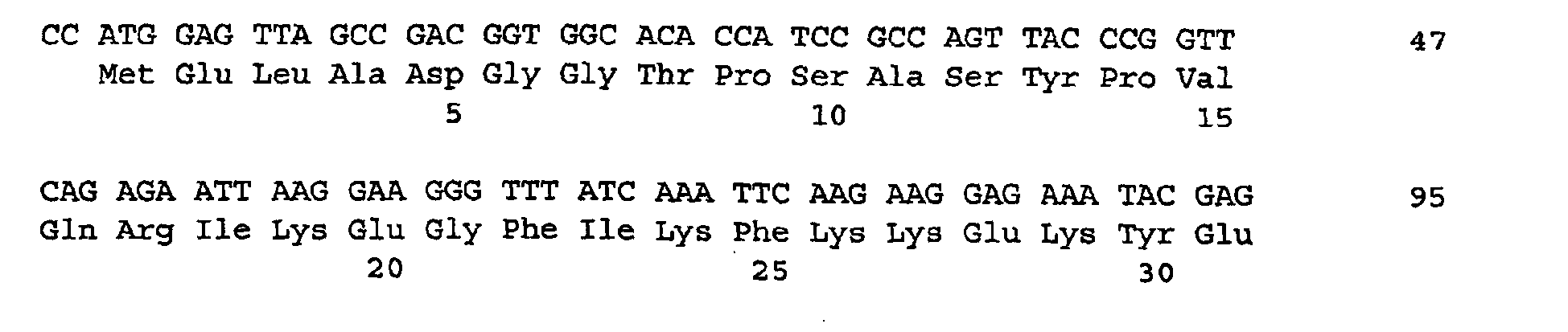

- (i) SEQUENCE CHARACTERISTICS:
- (2) INFORMATION FOR SEQ ID NO: 5:
- (i) SEQUENCE CHARACTERISTICS:
- (A) LENGTH: 222 amino acids
- (B) TYPE: amino acid
- (D) TOPOLOGY: linear
- (ii) MOLECULE TYPE: protein
- (xi) SEQUENCE DESCRIPTION: SEQ ID NO: 5:

- (i) SEQUENCE CHARACTERISTICS:
- (2) INFORMATION FOR SEQ ID NO: 6:
- (i) SEQUENCE CHARACTERISTICS:
- (A) LENGTH: 21 base pairs
- (B) TYPE: nucleic acid
- (C) STRANDEDNESS: single
- (D) TOPOLOGY: linear
- (ii) MOLECULE TYPE: other nucleic acid
- (A) DESCRIPTION: /desc = "DNA (synthetic)"
- (xi) SEQUENCE DESCRIPTION: SEQ ID NO: 6:
CTAAAGACAT GGAGGTGGAA G 21
- (i) SEQUENCE CHARACTERISTICS:
- (2) INFORMATION FOR SEQ ID NO: 7:
- (i) SEQUENCE CHARACTERISTICS:
- (A) LENGTH: 19 base pairs
- (B) TYPE: nucleic acid
- (C) STRANDEDNESS: single
- (D) TOPOLOGY: linear
- (ii) MOLECULE TYPE: other nucleic acid
- (A) DESCRIPTION: /desc = "DNA (synthetic)"
- (xi) SEQUENCE DESCRIPTION: SEQ ID NO: 7:
GTAGCTCGAT GGGTGCACG 19
- (i) SEQUENCE CHARACTERISTICS:
- (2) INFORMATION FOR SEQ ID NO: 8:
- (i) SEQUENCE CHARACTERISTICS:
- (A) LENGTH: 35 base pairs
- (B) TYPE: nucleic acid
- (C) STRANDEDNESS: single
- (D) TOPOLOGY: linear
- (ii) MOLECULE TYPE: other nucleic acid
- (A) DESCRIPTION: /desc = "DNA (synthetic)"
- (xi) SEQUENCE DESCRIPTION: SEQ ID NO: 8:
GCCATGGCGC GGCGGGAAGC TAAGCACGGA AGCGA 35
- (i) SEQUENCE CHARACTERISTICS:
- (2) INFORMATION FOR SEQ ID NO: 9:
- (i) SEQUENCE CHARACTERISTICS:
- (A) LENGTH: 39 base pairs
- (B) TYPE: nucleic acid
- (C) STRANDEDNESS: single
- (D) TOPOLOGY: linear
- (ii) MOLECULE TYPE: other nucleic acid
- (A) DESCRIPTION: /desc = "DNA (synthetic)"
- (xi) SEQUENCE DESCRIPTION: SEQ ID NO: 9:
GCTCTAGATC TCTGGCACGT GAATATGGCC CCAACCTCG 39
- (i) SEQUENCE CHARACTERISTICS:
- (2) INFORMATION FOR SEQ ID NO: 10:
- (i) SEQUENCE CHARACTERISTICS:
- (A) LENGTH: 39 base pairs
- (B) TYPE: nucleic acid
- (C) STRANDEDNESS: single
- (D) TOPOLOGY: linear
- (ii) MOLECULE TYPE: other nucleic acid
- (A) DESCRIPTION: /desc = "DNA (synthetic)"
- (xi) SEQUENCE DESCRIPTION: SEQ ID NO: 10:
CAGTGCATGC CGCCGAACAG GCATACAGAT TTACACCAG 39
- (i) SEQUENCE CHARACTERISTICS:
- (2) INFORMATION FOR SEQ ID NO: 11:
- (i) SEQUENCE CHARACTERISTICS:
- (A) LENGTH: 29 base pairs
- (B) TYPE: nucleic acid
- (C) STRANDEDNESS: single
- (D) TOPOLOGY: linear
- (ii) MOLECULE TYPE: other nucleic acid
- (A) DESCRIPTION: /desc = "DNA (synthetic)"
- (xi) SEQUENCE DESCRIPTION: SEQ ID NO: 11:
GGAATTCCAT GGTGCATCTC AAGAAGTAC 29
- (i) SEQUENCE CHARACTERISTICS:
- (2) INFORMATION FOR SEQ ID NO: 12:
- (i) SEQUENCE CHARACTERISTICS:
- (A) LENGTH: 25 base pairs
- (B) TYPE: nucleic acid
- (C) STRANDEDNESS: single
- (D) TOPOLOGY: linear
- (ii) MOLECULE TYPE: other nucleic acid
- (A) DESCRIPTION: /desc = "DNA (synthetic)"
- (xi) SEQUENCE DESCRIPTION: SEQ ID NO: 12:
GCTCTAGACT GCATGCACCT GATCC 25
- (i) SEQUENCE CHARACTERISTICS:
- (2) INFORMATION FOR SEQ ID NO: 13:
- (i) SEQUENCE CHARACTERISTICS:
- (A) LENGTH: 27 base pairs
- (B) TYPE: nucleic acid
- (C) STRANDEDNESS: single
- (D) TOPOLOGY: linear
- (ii) MOLECULE TYPE: other nucleic acid
- (A) DESCRIPTION: /desc = "DNA (synthetic)"
- (xi) SEQUENCE DESCRIPTION: SEQ ID NO: 13:
GGAATTCCAT GGCCCCCTCC GTGATGG 27
- (i) SEQUENCE CHARACTERISTICS:
- (2) INFORMATION FOR SEQ ID NO: 14:
- (i) SEQUENCE CHARACTERISTICS:
- (A) LENGTH: 41 base pairs
- (B) TYPE: nucleic acid
- (C) STRANDEDNESS: single
- (D) TOPOLOGY: linear
- (ii) MOLECULE TYPE: other nucleic acid
- (A) DESCRIPTION: /desc = "DNA (synthetic)"
- (xi) SEQUENCE DESCRIPTION: SEQ ID NO: 14:
GGTGGCACAG ATAACCATGG ATCCAGTTAG CCGACGGTGG C 41
- (i) SEQUENCE CHARACTERISTICS:
- (2) INFORMATION FOR SEQ ID NO: 15:
- (i) SEQUENCE CHARACTERISTICS:
- (A) LENGTH: 35 base pairs
- (B) TYPE: nucleic acid
- (C) STRANDEDNESS: single
- (D) TOPOLOGY: linear
- (ii) MOLECULE TYPE: other nucleic acid
- (A) DESCRIPTION: /desc = "DNA (synthetic)"
- (xi) SEQUENCE DESCRIPTION: SEQ ID NO: 15:
TAGCTCGATG GGTTGCACGA TCATATGGAG CAAGG 35
- (i) SEQUENCE CHARACTERISTICS:
- (2) INFORMATION FOR SEQ ID NO: 16:
- (i) SEQUENCE CHARACTERISTICS:
- (A) LENGTH: 56 base pairs
- (B) TYPE: nucleic acid
- (C) STRANDEDNESS: single
- (D) TOPOLOGY: linear
- (ii) MOLECULE TYPE: other nucleic acid
- (A) DESCRIPTION: /desc = "DNA (synthetic)"
- (xi) SEQUENCE DESCRIPTION: SEQ ID NO: 16:
TTTCATATGG CGCCCGTTCA ATGTGCGCGT TCGCAGAGGG TGTTCCACTT CGGCAA 56
- (i) SEQUENCE CHARACTERISTICS:
- (2) INFORMATION FOR SEQ ID NO: 17:
- (i) SEQUENCE CHARACTERISTICS:
- (A) LENGTH: 20 base pairs
- (B) TYPE: nucleic acid
- (C) STRANDEDNESS: single
- (D) TOPOLOGY: linear
- (ii) MOLECULE TYPE: other nucleic acid
- (A) DESCRIPTION: /desc = "DNA (synthetic)"
- (xi) SEQUENCE DESCRIPTION: SEQ ID NO: 17:
GTACTCCTCC ACCCACTGCA 20
- (i) SEQUENCE CHARACTERISTICS:
- (2) INFORMATION FOR SEQ ID NO: 18:
- (i) SEQUENCE CHARACTERISTICS:
- (A) LENGTH: 36 base pairs
- (B) TYPE: nucleic acid
- (C) STRANDEDNESS: single
- (D) TOPOLOGY: linear
- (ii) MOLECULE TYPE: other nucleic acid
- (A) DESCRIPTION: /desc = "DNA (synthetic)"
- (xi) SEQUENCE DESCRIPTION: SEQ ID NO: 18:
GCAAGCTTTT ACTTGTACCA ACTAATATAA TGAGTG 36
- (i) SEQUENCE CHARACTERISTICS:
- (2) INFORMATION FOR SEQ ID NO: 19:
- (i) SEQUENCE CHARACTERISTICS:
- (A) LENGTH: 36 base pairs
- (B) TYPE: nucleic acid
- (C) STRANDEDNESS: single
- (D) TOPOLOGY: linear
- (ii) MOLECULE TYPE: other nucleic acid
- (A) DESCRIPTION: /desc = "DNA (synthetic)"
- (xi) SEQUENCE DESCRIPTION: SEQ ID NO: 19:
TGGATCCTCT AGAGTACTTC TTGAGATGCA CTGCTC 36
- (i) SEQUENCE CHARACTERISTICS:
- (2) INFORMATION FOR SEQ ID NO: 20:
- (i) SEQUENCE CHARACTERISTICS:
- (A) LENGTH: 24 base pairs
- (B) TYPE: nucleic acid
- (C) STRANDEDNESS: single
- (D) TOPOLOGY: linear
- (ii) MOLECULE TYPE: other nucleic acid
- (A) DESCRIPTION: /desc = "DNA (synthetic)"
- (xi) SEQUENCE DESCRIPTION: SEQ ID NO: 20:
TACTTACGTG GCCTTCTTCC TCCG 24
- (i) SEQUENCE CHARACTERISTICS:
- (2) INFORMATION FOR SEQ ID NO: 21:
- (i) SEQUENCE CHARACTERISTICS:
- (A) LENGTH: 24 base pairs
- (B) TYPE: nucleic acid
- (C) STRANDEDNESS: single
- (D) TOPOLOGY: linear
- (ii) MOLECULE TYPE: other nucleic acid
- (A) DESCRIPTION: /desc = "DNA (synthetic)"
- (xi) SEQUENCE DESCRIPTION: SEQ ID NO: 21:
GGTTTGGCTG CTGGATTCAA AGGG 24
- (i) SEQUENCE CHARACTERISTICS:
- (2) INFORMATION FOR SEQ ID NO: 22:
- (i) SEQUENCE CHARACTERISTICS:
- (A) LENGTH: 30 base pairs
- (B) TYPE: nucleic acid
- (C) STRANDEDNESS: single
- (D) TOPOLOGY: linear
- (ii) MOLECULE TYPE: other nucleic acid
- (A) DESCRIPTION: /desc = "DNA (synthetic)"
- (xi) SEQUENCE DESCRIPTION: SEQ ID NO: 22:
GTCGACCATA TGCTGTCCAC GCGCACCGCC 30
- (i) SEQUENCE CHARACTERISTICS:
- (2) INFORMATION FOR SEQ ID NO: 23:
- (i) SEQUENCE CHARACTERISTICS:
- (A) LENGTH: 21 base pairs
- (B) TYPE: nucleic acid
- (C) STRANDEDNESS: single
- (D) TOPOLOGY: linear
- (ii) MOLECULE TYPE: other nucleic acid
- (A) DESCRIPTION: /desc = "DNA (synthetic)"
- (xi) SEQUENCE DESCRIPTION: SEQ ID NO: 23:
CAAAAGGGTG TAACCGCTTG C 21
- (i) SEQUENCE CHARACTERISTICS:
- (2) INFORMATION FOR SEQ ID NO: 24:
- (i) SEQUENCE CHARACTERISTICS:
- (A) LENGTH: 19 base pairs
- (B) TYPE: nucleic acid
- (C) STRANDEDNESS: single
- (D) TOPOLOGY: linear
- (ii) MOLECULE TYPE: other nucleic acid
- (A) DESCRIPTION: /desc = "DNA (synthetic)"
- (xi) SEQUENCE DESCRIPTION: SEQ ID NO: 24:
AGCCTACGAG CTCGGTCTG 19
- (i) SEQUENCE CHARACTERISTICS:
- (2) INFORMATION FOR SEQ ID NO: 25:
- (i) SEQUENCE CHARACTERISTICS:
- (A) LENGTH: 30 base pairs
- (B) TYPE: nucleic acid
- (C) STRANDEDNESS: single
- (D) TOPOLOGY: linear
- (ii) MOLECULE TYPE: other nucleic acid
- (A) DESCRIPTION: /desc = "DNA (synthetic)"
- (xi) SEQUENCE DESCRIPTION: SEQ ID NO: 25:
CCCGGGCATG CGCAAAATTG ATCCCCGCAG 30
- (i) SEQUENCE CHARACTERISTICS:
- (2) INFORMATION FOR SEQ ID NO: 26:
- (i) SEQUENCE CHARACTERISTICS:
- (A) LENGTH: 27 base pairs
- (B) TYPE: nucleic acid
- (C) STRANDEDNESS: single
- (D) TOPOLOGY: linear
- (ii) MOLECULE TYPE: other nucleic acid
- (A) DESCRIPTION: /desc = "DNA (synthetic)"
- (xi) SEQUENCE DESCRIPTION: SEQ ID NO: 26:
CATATGCACC AGGGACAGGG AAGCGAC 27
- (i) SEQUENCE CHARACTERISTICS:
- (2) INFORMATION FOR SEQ ID NO: 27:
- (i) SEQUENCE CHARACTERISTICS:
- (A) LENGTH: 24 base pairs
- (B) TYPE: nucleic acid
- (C) STRANDEDNESS: single
- (D) TOPOLOGY: linear
- (ii) MOLECULE TYPE: other nucleic acid
- (A) DESCRIPTION: /desc = "DNA (synthetic)"
- (xi) SEQUENCE DESCRIPTION: SEQ ID NO: 27:
CCCATGTACT CCTCCACCCA CTGC 24
- (i) SEQUENCE CHARACTERISTICS:
The resulting DNA fragment of about 2.2 kbp was employed in the gene construction.
Claims (6)
- A method for transforming a C3 plant to provide the plant with a photosynthetic pathway which mimics the C4 photosynthetic pathway, wherein said method comprises introducing the following construct to the C3 plant, the construct comprising:a gene coding for a phosphoenolpyruvate carboxylase (PEPC), wherein the PEPC gene is linked to a heterologous promoter; anda gene coding for a phosphoenolpyruvate carboxykinase (PCK), wherein the PCK gene is linked to a heterologous promoter and a gene coding for transit peptide.
- A method according to claim 1 wherein a gene coding for a carbonic anhydrase (CA) is further introduced into the C3 plant.
- A method according to claim 1 wherein a gene encoding a pyruvate, orthophosphate dikinase (PPDK) is further introduced into the C3 plant.
- A method according to any of claims 1-3 wherein a promoter sequence is a photosynthetic tissue specific promoter sequence.
- A method according to any of claims 1-4 wherein two or more or all of said genes are carried on a single gene construct capable of introducing the genes to a plant, whereby the genes are introduced into a C3 plant.
- A plant which has been transformed by a method according to any of claims 1-5 so that said plant has a C4 photosynthetic pathway and contains a construct as defined in claim 1.
Applications Claiming Priority (3)
| Application Number | Priority Date | Filing Date | Title |
|---|---|---|---|
| JP2665897 | 1997-02-10 | ||
| JP26658/97 | 1997-02-10 | ||
| PCT/JP1998/000537 WO1998035030A1 (en) | 1997-02-10 | 1998-02-10 | C4 cycle of pck type |
Publications (3)
| Publication Number | Publication Date |
|---|---|
| EP0916725A1 EP0916725A1 (en) | 1999-05-19 |
| EP0916725A4 EP0916725A4 (en) | 2004-06-09 |
| EP0916725B1 true EP0916725B1 (en) | 2007-04-18 |
Family
ID=12199531
Family Applications (1)
| Application Number | Title | Priority Date | Filing Date |
|---|---|---|---|
| EP98901570A Expired - Lifetime EP0916725B1 (en) | 1997-02-10 | 1998-02-10 | C4 cycle of pck type |
Country Status (14)
| Country | Link |
|---|---|
| US (2) | US6610913B1 (en) |
| EP (1) | EP0916725B1 (en) |
| JP (1) | JP3501814B2 (en) |
| KR (1) | KR100769755B1 (en) |
| CN (1) | CN1107723C (en) |
| AR (1) | AR011652A1 (en) |
| AT (1) | ATE360064T1 (en) |
| AU (1) | AU729520B2 (en) |
| CA (1) | CA2250827C (en) |
| DE (1) | DE69837588T2 (en) |
| ID (1) | ID21006A (en) |
| NZ (1) | NZ332271A (en) |
| RU (1) | RU2159813C2 (en) |
| WO (1) | WO1998035030A1 (en) |
Families Citing this family (13)
| Publication number | Priority date | Publication date | Assignee | Title |
|---|---|---|---|---|
| FR2823064B1 (en) * | 2001-04-04 | 2004-05-28 | Biogemma Fr | PROCESS FOR OBTAINING C4 PLANTS WITH MODIFIED CARBON METABOLISM |
| EP1367127A1 (en) | 2002-05-27 | 2003-12-03 | Bayer CropScience AG | A method for production of plants with suppressed photorespiration and improved CO2 fixation |
| US7642347B2 (en) * | 2006-06-23 | 2010-01-05 | Monsanto Technology Llc | Chimeric regulatory elements for gene expression in leaf mesophyll and bundle sheath cells |
| BRPI0718977A2 (en) | 2006-11-24 | 2014-02-04 | Cropdesign Nv | METHOD FOR INCREASING SEED Yield IN PLANTS IN RELATION TO CONTROL PLANTS, CONSTRUCTION, USE OF THE SAME, PLANT, PART OF PLANT OR PLANT CELL, METHOD FOR THE PRODUCTION OF A TRANSGENIC PLANT HAVING INCREASE IN PLANT SEED CONTROL , Transgenic plant, harvestable parts of a plant, products, and use of a nucleic acid |
| CA2697186A1 (en) * | 2007-07-31 | 2009-02-05 | Basf Plant Science Gmbh | Plants having enhanced yield-related traits and a method for making the same |
| DE202008005083U1 (en) * | 2008-01-22 | 2008-06-26 | Wezag Gmbh Werkzeugfabrik | crimping pliers |
| GB0903346D0 (en) * | 2009-02-27 | 2009-04-08 | Cambridge Advanced Tech | Transgenic Plants |
| WO2013063344A1 (en) * | 2011-10-28 | 2013-05-02 | Pioneer Hi-Bred International, Inc. | Engineered pep carboxylase variants for improved plant productivity |
| EP2958986B1 (en) * | 2013-02-22 | 2022-09-07 | DSM IP Assets B.V. | Recombinant micro-organism for use in method with increased product yield |
| WO2014201156A1 (en) * | 2013-06-11 | 2014-12-18 | Florida State University Research Foundation, Inc. | Materials and methods for controlling bundle sheath cell fate and function in plants |
| CN103805616A (en) * | 2014-02-25 | 2014-05-21 | 河南省农业科学院小麦研究所 | C4 type pyruvate orthophosphate dikinase (PPDK) gene of corn and application thereof in wheat |
| CN108440672B (en) * | 2018-03-13 | 2020-12-04 | 华南农业大学 | A branch of photorespiration metabolism and its application in C3 plants |
| KR102381872B1 (en) | 2020-10-19 | 2022-04-12 | 주식회사 수앤그린테크 | Pot Apparatus For Cultivating Rice |
Family Cites Families (12)
| Publication number | Priority date | Publication date | Assignee | Title |
|---|---|---|---|---|
| JPH0783714B2 (en) | 1983-08-29 | 1995-09-13 | 味の素株式会社 | Fermentation method for producing L-amino acid |
| JPH0612990B2 (en) | 1984-08-09 | 1994-02-23 | 株式会社アドバンス | Method for increasing CO2 fixation capacity of living cells |
| JPH0630587B2 (en) | 1985-08-23 | 1994-04-27 | 住友化学工業株式会社 | Cloned maize ppc gene |
| JPH04222527A (en) | 1990-12-19 | 1992-08-12 | Japan Tobacco Inc | Transformation of tomato |
| JP3002735B2 (en) | 1991-09-27 | 2000-01-24 | 農林水産省食品総合研究所長 | Soybean phosphoenolpyruvate carboxylase gene |
| DE69334225D1 (en) | 1992-07-07 | 2008-07-31 | Japan Tobacco Inc | METHOD FOR TRANSFORMING A MONOCOTYLEDONE PLANT |
| JPH0690766A (en) | 1992-09-09 | 1994-04-05 | Mitsui Giyousai Shokubutsu Bio Kenkyusho:Kk | Phosphoenol pyruvic acid carboxylase gene of brassics napus |
| DE69433809T2 (en) | 1993-09-03 | 2005-06-16 | Japan Tobacco Inc. | PROCESS FOR TRANSFORMATION OF MONOCOTYLEDONES USING THE SHIELD OF UNREQUIRED EMBRYOES |
| WO1995011979A1 (en) | 1993-10-29 | 1995-05-04 | Japan Tobacco Inc. | Dna coding for carbonic anhydrase |
| JP3329820B2 (en) | 1993-12-03 | 2002-09-30 | 日本たばこ産業株式会社 | Polypeptide having low-temperature-resistant pyruvate phosphate dikinase activity, DNA encoding the same, recombinant vector containing the DNA, and transformed plant |
| JPH07184657A (en) | 1993-12-28 | 1995-07-25 | Japan Turf Glass:Kk | C4 photosynthesis-related gene in rice plant and its promoter |
| JP3521161B2 (en) * | 1994-07-09 | 2004-04-19 | 日本たばこ産業株式会社 | DNA encoding phosphoenolpyruvate carboxykinase, recombinant vector containing the same, and transformed plant |
-
1998
- 1998-02-02 ID IDW980099D patent/ID21006A/en unknown
- 1998-02-10 NZ NZ332271A patent/NZ332271A/en unknown
- 1998-02-10 WO PCT/JP1998/000537 patent/WO1998035030A1/en not_active Ceased
- 1998-02-10 US US09/155,989 patent/US6610913B1/en not_active Expired - Fee Related
- 1998-02-10 DE DE69837588T patent/DE69837588T2/en not_active Expired - Lifetime
- 1998-02-10 AR ARP980100571A patent/AR011652A1/en not_active Application Discontinuation
- 1998-02-10 EP EP98901570A patent/EP0916725B1/en not_active Expired - Lifetime
- 1998-02-10 RU RU98120358/13A patent/RU2159813C2/en not_active IP Right Cessation
- 1998-02-10 AT AT98901570T patent/ATE360064T1/en not_active IP Right Cessation
- 1998-02-10 CA CA002250827A patent/CA2250827C/en not_active Expired - Fee Related
- 1998-02-10 CN CN98800345A patent/CN1107723C/en not_active Expired - Fee Related
- 1998-02-10 JP JP53414598A patent/JP3501814B2/en not_active Expired - Fee Related
- 1998-02-10 AU AU57817/98A patent/AU729520B2/en not_active Ceased
- 1998-02-10 KR KR1019980708043A patent/KR100769755B1/en not_active Expired - Fee Related
-
2003
- 2003-02-20 US US10/368,396 patent/US20030221219A1/en not_active Abandoned
Non-Patent Citations (1)
| Title |
|---|
| None * |
Also Published As
| Publication number | Publication date |
|---|---|
| CN1220698A (en) | 1999-06-23 |
| AU729520B2 (en) | 2001-02-01 |
| DE69837588D1 (en) | 2007-05-31 |
| US20030221219A1 (en) | 2003-11-27 |
| NZ332271A (en) | 2000-04-28 |
| ATE360064T1 (en) | 2007-05-15 |
| WO1998035030A1 (en) | 1998-08-13 |
| AU5781798A (en) | 1998-08-26 |
| KR20000064878A (en) | 2000-11-06 |
| DE69837588T2 (en) | 2008-01-03 |
| CA2250827C (en) | 2005-10-18 |
| ID21006A (en) | 1999-04-08 |
| US6610913B1 (en) | 2003-08-26 |
| EP0916725A1 (en) | 1999-05-19 |
| EP0916725A4 (en) | 2004-06-09 |
| JP3501814B2 (en) | 2004-03-02 |
| KR100769755B1 (en) | 2008-01-22 |
| CA2250827A1 (en) | 1998-08-13 |
| RU2159813C2 (en) | 2000-11-27 |
| AR011652A1 (en) | 2000-08-30 |
| CN1107723C (en) | 2003-05-07 |
Similar Documents
| Publication | Publication Date | Title |
|---|---|---|
| Gehlen et al. | Effects of altered phospho enol pyruvate carboxylase activities on transgenic C3 plant Solanum tuberosum | |
| JP5129223B2 (en) | Transgenic plants exhibiting increased nitrogen assimilation | |
| US6107547A (en) | Transgenic plants that exhibit enhanced nitrogen assimilation | |
| Kogami et al. | Molecular and physiological evaluation of transgenic tobacco plants expressing a maize phospho enol pyruvate carboxylase gene under the control of the cauliflower mosaic virus 35S promoter | |
| US9371538B2 (en) | Method for increasing photosynthetic carbon fixation using glycolate dehydrogenase multi-subunit fusion protein | |
| US20110268865A1 (en) | Method for increasing photosynthetic carbon fixation in rice | |
| US20020069430A1 (en) | Transgenic plants that exhibit enhanced nitrogen assimilation | |
| US5955651A (en) | Transgenic plants that exhibit enhanced nitrogen assimilation | |
| US20150218578A1 (en) | Methods of increasing tolerance to heat stress and amino acid content of plants | |
| CA2250827C (en) | Transforming a c3 plant with c4 photosynthetic pathway using phosphoenolpyruvate carboxykinase | |
| US6864405B1 (en) | Transgenic plants that exhibit enhanced nitrogen assimilation | |
| WO1998050561A1 (en) | Regulating metabolism by modifying the level of trehalose-6-phosphate by inhibiting endogenous trehalase levels | |
| JPH08508412A (en) | Plants with modified response to ethylene | |
| MX2011002110A (en) | Transgenic plants with enhanced growth characteristics. | |
| JPWO1998035030A1 (en) | PCK type C4 circuit | |
| BRPI0713698A2 (en) | gene and protein to adapt to nitrogen limitation and modulation | |
| US20150203864A1 (en) | Myb55 promoter and use thereof | |
| US20100170009A1 (en) | Nucleic acids encoding plant glutamine phenylpyruvate transaminase (GPT) and uses thereof | |
| TW201014909A (en) | Plant techonology | |
| WO1999066785A1 (en) | Water stress or salt stress tolerant transgenic cereal plants | |
| AU2012245969B2 (en) | An expression construct and process for enhancing the carbon, nitrogen, biomass and yield of plants | |
| KR102632726B1 (en) | OsWRKY5 gene controlling resistance to abiotic stress in plant and uses thereof | |
| US10119127B2 (en) | Nucleic acids encoding plant glutamine phenylpyruvate transaminase (GPT) and uses thereof | |
| JPH11341928A (en) | Incorporation of c4 photosynthesis circuit in c3 plant using malic enzyme | |
| MXPA98008409A (en) | C4 cycle of pck type |
Legal Events
| Date | Code | Title | Description |
|---|---|---|---|
| PUAI | Public reference made under article 153(3) epc to a published international application that has entered the european phase |
Free format text: ORIGINAL CODE: 0009012 |
|
| 17P | Request for examination filed |
Effective date: 19990208 |
|
| AK | Designated contracting states |
Kind code of ref document: A1 Designated state(s): AT BE CH DE DK ES FI FR GB GR IE IT LI LU MC NL PT SE |
|
| RIC1 | Information provided on ipc code assigned before grant |
Ipc: 7A 01H 5/00 B Ipc: 7C 12N 15/82 B Ipc: 7C 12N 15/09 A |
|
| A4 | Supplementary search report drawn up and despatched |
Effective date: 20040422 |
|
| RIN1 | Information on inventor provided before grant (corrected) |
Inventor name: BURNELL, JAMES, N. Inventor name: OHTA, SHOZO,JAPAN TOBACCO INC. Inventor name: YAMADA, SHIGEHIRO,JAPAN TOBACCO INC. Inventor name: MURAI, NOBUHIKO,JAPAN TOBACCO INC. Inventor name: SUZUKI, SHOICHI,JAPAN TOBACCO INC. Inventor name: ARAI, MASAO,JAPAN TOBACCO INC. |
|
| 17Q | First examination report despatched |
Effective date: 20050318 |
|
| R17C | First examination report despatched (corrected) |
Effective date: 20050318 |
|
| GRAP | Despatch of communication of intention to grant a patent |
Free format text: ORIGINAL CODE: EPIDOSNIGR1 |
|
| GRAS | Grant fee paid |
Free format text: ORIGINAL CODE: EPIDOSNIGR3 |
|
| GRAA | (expected) grant |
Free format text: ORIGINAL CODE: 0009210 |
|
| AK | Designated contracting states |
Kind code of ref document: B1 Designated state(s): AT BE CH DE DK ES FI FR GB GR IE IT LI LU MC NL PT SE |
|
| PG25 | Lapsed in a contracting state [announced via postgrant information from national office to epo] |
Ref country code: LI Free format text: LAPSE BECAUSE OF FAILURE TO SUBMIT A TRANSLATION OF THE DESCRIPTION OR TO PAY THE FEE WITHIN THE PRESCRIBED TIME-LIMIT Effective date: 20070418 Ref country code: FI Free format text: LAPSE BECAUSE OF FAILURE TO SUBMIT A TRANSLATION OF THE DESCRIPTION OR TO PAY THE FEE WITHIN THE PRESCRIBED TIME-LIMIT Effective date: 20070418 Ref country code: CH Free format text: LAPSE BECAUSE OF FAILURE TO SUBMIT A TRANSLATION OF THE DESCRIPTION OR TO PAY THE FEE WITHIN THE PRESCRIBED TIME-LIMIT Effective date: 20070418 |
|
| REG | Reference to a national code |
Ref country code: CH Ref legal event code: EP |
|
| REG | Reference to a national code |
Ref country code: IE Ref legal event code: FG4D |
|
| REF | Corresponds to: |
Ref document number: 69837588 Country of ref document: DE Date of ref document: 20070531 Kind code of ref document: P |
|
| PG25 | Lapsed in a contracting state [announced via postgrant information from national office to epo] |
Ref country code: SE Free format text: LAPSE BECAUSE OF FAILURE TO SUBMIT A TRANSLATION OF THE DESCRIPTION OR TO PAY THE FEE WITHIN THE PRESCRIBED TIME-LIMIT Effective date: 20070718 |
|
| PG25 | Lapsed in a contracting state [announced via postgrant information from national office to epo] |
Ref country code: ES Free format text: LAPSE BECAUSE OF FAILURE TO SUBMIT A TRANSLATION OF THE DESCRIPTION OR TO PAY THE FEE WITHIN THE PRESCRIBED TIME-LIMIT Effective date: 20070729 |
|
| ET | Fr: translation filed | ||
| PG25 | Lapsed in a contracting state [announced via postgrant information from national office to epo] |
Ref country code: PT Free format text: LAPSE BECAUSE OF FAILURE TO SUBMIT A TRANSLATION OF THE DESCRIPTION OR TO PAY THE FEE WITHIN THE PRESCRIBED TIME-LIMIT Effective date: 20070918 |
|
| REG | Reference to a national code |
Ref country code: CH Ref legal event code: PL |
|
| NLV1 | Nl: lapsed or annulled due to failure to fulfill the requirements of art. 29p and 29m of the patents act | ||
| PG25 | Lapsed in a contracting state [announced via postgrant information from national office to epo] |
Ref country code: AT Free format text: LAPSE BECAUSE OF FAILURE TO SUBMIT A TRANSLATION OF THE DESCRIPTION OR TO PAY THE FEE WITHIN THE PRESCRIBED TIME-LIMIT Effective date: 20070418 |
|
| PG25 | Lapsed in a contracting state [announced via postgrant information from national office to epo] |
Ref country code: BE Free format text: LAPSE BECAUSE OF FAILURE TO SUBMIT A TRANSLATION OF THE DESCRIPTION OR TO PAY THE FEE WITHIN THE PRESCRIBED TIME-LIMIT Effective date: 20070418 |
|
| PG25 | Lapsed in a contracting state [announced via postgrant information from national office to epo] |
Ref country code: NL Free format text: LAPSE BECAUSE OF FAILURE TO SUBMIT A TRANSLATION OF THE DESCRIPTION OR TO PAY THE FEE WITHIN THE PRESCRIBED TIME-LIMIT Effective date: 20070418 Ref country code: DK Free format text: LAPSE BECAUSE OF FAILURE TO SUBMIT A TRANSLATION OF THE DESCRIPTION OR TO PAY THE FEE WITHIN THE PRESCRIBED TIME-LIMIT Effective date: 20070418 |
|
| PLBE | No opposition filed within time limit |
Free format text: ORIGINAL CODE: 0009261 |
|
| STAA | Information on the status of an ep patent application or granted ep patent |
Free format text: STATUS: NO OPPOSITION FILED WITHIN TIME LIMIT |
|
| 26N | No opposition filed |
Effective date: 20080121 |
|
| PG25 | Lapsed in a contracting state [announced via postgrant information from national office to epo] |
Ref country code: GR Free format text: LAPSE BECAUSE OF FAILURE TO SUBMIT A TRANSLATION OF THE DESCRIPTION OR TO PAY THE FEE WITHIN THE PRESCRIBED TIME-LIMIT Effective date: 20070719 |
|
| PGFP | Annual fee paid to national office [announced via postgrant information from national office to epo] |
Ref country code: IT Payment date: 20080222 Year of fee payment: 11 Ref country code: GB Payment date: 20080130 Year of fee payment: 11 |
|
| PGFP | Annual fee paid to national office [announced via postgrant information from national office to epo] |
Ref country code: FR Payment date: 20080111 Year of fee payment: 11 |
|
| PG25 | Lapsed in a contracting state [announced via postgrant information from national office to epo] |
Ref country code: MC Free format text: LAPSE BECAUSE OF NON-PAYMENT OF DUE FEES Effective date: 20080228 |
|
| PG25 | Lapsed in a contracting state [announced via postgrant information from national office to epo] |
Ref country code: IE Free format text: LAPSE BECAUSE OF NON-PAYMENT OF DUE FEES Effective date: 20080211 |
|
| GBPC | Gb: european patent ceased through non-payment of renewal fee |
Effective date: 20090210 |
|
| REG | Reference to a national code |
Ref country code: FR Ref legal event code: ST Effective date: 20091030 |
|
| PG25 | Lapsed in a contracting state [announced via postgrant information from national office to epo] |
Ref country code: GB Free format text: LAPSE BECAUSE OF NON-PAYMENT OF DUE FEES Effective date: 20090210 Ref country code: FR Free format text: LAPSE BECAUSE OF NON-PAYMENT OF DUE FEES Effective date: 20090302 |
|
| PG25 | Lapsed in a contracting state [announced via postgrant information from national office to epo] |
Ref country code: LU Free format text: LAPSE BECAUSE OF NON-PAYMENT OF DUE FEES Effective date: 20080210 |
|
| PGFP | Annual fee paid to national office [announced via postgrant information from national office to epo] |
Ref country code: DE Payment date: 20100226 Year of fee payment: 13 |
|
| PG25 | Lapsed in a contracting state [announced via postgrant information from national office to epo] |
Ref country code: IT Free format text: LAPSE BECAUSE OF NON-PAYMENT OF DUE FEES Effective date: 20090210 |
|
| REG | Reference to a national code |
Ref country code: DE Ref legal event code: R119 Ref document number: 69837588 Country of ref document: DE Effective date: 20110901 |
|
| PG25 | Lapsed in a contracting state [announced via postgrant information from national office to epo] |
Ref country code: DE Free format text: LAPSE BECAUSE OF NON-PAYMENT OF DUE FEES Effective date: 20110901 |