EP0912495B1 - Asymetric synthesis of chiral beta-amino acids - Google Patents
Asymetric synthesis of chiral beta-amino acids Download PDFInfo
- Publication number
- EP0912495B1 EP0912495B1 EP97932388A EP97932388A EP0912495B1 EP 0912495 B1 EP0912495 B1 EP 0912495B1 EP 97932388 A EP97932388 A EP 97932388A EP 97932388 A EP97932388 A EP 97932388A EP 0912495 B1 EP0912495 B1 EP 0912495B1
- Authority
- EP
- European Patent Office
- Prior art keywords
- amino
- trimethylsilyl
- pentynoate
- process according
- formula
- Prior art date
- Legal status (The legal status is an assumption and is not a legal conclusion. Google has not performed a legal analysis and makes no representation as to the accuracy of the status listed.)
- Expired - Lifetime
Links
- 150000001576 beta-amino acids Chemical class 0.000 title claims description 11
- 230000015572 biosynthetic process Effects 0.000 title description 3
- 238000003786 synthesis reaction Methods 0.000 title description 2
- YXFVVABEGXRONW-UHFFFAOYSA-N Toluene Chemical compound CC1=CC=CC=C1 YXFVVABEGXRONW-UHFFFAOYSA-N 0.000 claims abstract description 93
- 238000000034 method Methods 0.000 claims abstract description 53
- 125000000999 tert-butyl group Chemical group [H]C([H])([H])C(*)(C([H])([H])[H])C([H])([H])[H] 0.000 claims abstract description 40
- 230000008569 process Effects 0.000 claims abstract description 36
- 125000002924 primary amino group Chemical group [H]N([H])* 0.000 claims abstract description 31
- JQWHASGSAFIOCM-UHFFFAOYSA-M sodium periodate Chemical compound [Na+].[O-]I(=O)(=O)=O JQWHASGSAFIOCM-UHFFFAOYSA-M 0.000 claims abstract description 30
- IJXJGQCXFSSHNL-MRVPVSSYSA-N (2s)-2-amino-2-phenylethanol Chemical compound OC[C@@H](N)C1=CC=CC=C1 IJXJGQCXFSSHNL-MRVPVSSYSA-N 0.000 claims abstract description 21
- 238000002360 preparation method Methods 0.000 claims abstract description 20
- 125000001495 ethyl group Chemical group [H]C([H])([H])C([H])([H])* 0.000 claims abstract description 19
- WRMNZCZEMHIOCP-UHFFFAOYSA-N 2-phenylethanol Chemical compound OCCC1=CC=CC=C1 WRMNZCZEMHIOCP-UHFFFAOYSA-N 0.000 claims abstract description 12
- OWVBKVUUDMFVCR-UHFFFAOYSA-M bromozinc(1+);tert-butyl acetate Chemical compound Br[Zn+].CC(C)(C)OC([CH2-])=O OWVBKVUUDMFVCR-UHFFFAOYSA-M 0.000 claims abstract description 11
- 125000001639 phenylmethylene group Chemical group [H]C(=*)C1=C([H])C([H])=C([H])C([H])=C1[H] 0.000 claims abstract description 10
- 230000003301 hydrolyzing effect Effects 0.000 claims abstract description 9
- LJRWLSKYGWLYIM-UHFFFAOYSA-N 3-trimethylsilylprop-2-ynal Chemical compound C[Si](C)(C)C#CC=O LJRWLSKYGWLYIM-UHFFFAOYSA-N 0.000 claims abstract description 8
- WYURNTSHIVDZCO-UHFFFAOYSA-N Tetrahydrofuran Chemical compound C1CCOC1 WYURNTSHIVDZCO-UHFFFAOYSA-N 0.000 claims description 130
- BZLVMXJERCGZMT-UHFFFAOYSA-N Methyl tert-butyl ether Chemical compound COC(C)(C)C BZLVMXJERCGZMT-UHFFFAOYSA-N 0.000 claims description 80
- LFQSCWFLJHTTHZ-UHFFFAOYSA-N Ethanol Chemical compound CCO LFQSCWFLJHTTHZ-UHFFFAOYSA-N 0.000 claims description 77
- SECXISVLQFMRJM-UHFFFAOYSA-N NMP Substances CN1CCCC1=O SECXISVLQFMRJM-UHFFFAOYSA-N 0.000 claims description 66
- YLQBMQCUIZJEEH-UHFFFAOYSA-N tetrahydrofuran Natural products C=1C=COC=1 YLQBMQCUIZJEEH-UHFFFAOYSA-N 0.000 claims description 59
- 150000002466 imines Chemical class 0.000 claims description 54
- IAZDPXIOMUYVGZ-UHFFFAOYSA-N Dimethylsulphoxide Chemical compound CS(C)=O IAZDPXIOMUYVGZ-UHFFFAOYSA-N 0.000 claims description 44
- NLXLAEXVIDQMFP-UHFFFAOYSA-N Ammonia chloride Chemical compound [NH4+].[Cl-] NLXLAEXVIDQMFP-UHFFFAOYSA-N 0.000 claims description 35
- JOXIMZWYDAKGHI-UHFFFAOYSA-N toluene-4-sulfonic acid Chemical compound CC1=CC=C(S(O)(=O)=O)C=C1 JOXIMZWYDAKGHI-UHFFFAOYSA-N 0.000 claims description 32
- -1 imino alcohol Chemical compound 0.000 claims description 30
- XLYOFNOQVPJJNP-UHFFFAOYSA-N water Substances O XLYOFNOQVPJJNP-UHFFFAOYSA-N 0.000 claims description 29
- OKKJLVBELUTLKV-UHFFFAOYSA-N Methanol Chemical compound OC OKKJLVBELUTLKV-UHFFFAOYSA-N 0.000 claims description 24
- BAVYZALUXZFZLV-UHFFFAOYSA-N Methylamine Chemical compound NC BAVYZALUXZFZLV-UHFFFAOYSA-N 0.000 claims description 23
- 150000001414 amino alcohols Chemical class 0.000 claims description 19
- 235000019270 ammonium chloride Nutrition 0.000 claims description 13
- 125000003118 aryl group Chemical group 0.000 claims description 13
- JEHCHYAKAXDFKV-UHFFFAOYSA-J lead tetraacetate Chemical compound CC(=O)O[Pb](OC(C)=O)(OC(C)=O)OC(C)=O JEHCHYAKAXDFKV-UHFFFAOYSA-J 0.000 claims description 10
- 150000001299 aldehydes Chemical class 0.000 claims description 9
- 125000004076 pyridyl group Chemical group 0.000 claims description 8
- IJXJGQCXFSSHNL-QMMMGPOBSA-N (R)-(-)-2-Phenylglycinol Chemical compound OC[C@H](N)C1=CC=CC=C1 IJXJGQCXFSSHNL-QMMMGPOBSA-N 0.000 claims description 7
- 125000000304 alkynyl group Chemical group 0.000 claims description 7
- 125000002541 furyl group Chemical group 0.000 claims description 7
- 125000003107 substituted aryl group Chemical group 0.000 claims description 7
- 125000003342 alkenyl group Chemical group 0.000 claims description 6
- 125000004169 (C1-C6) alkyl group Chemical group 0.000 claims description 5
- VHUUQVKOLVNVRT-UHFFFAOYSA-N Ammonium hydroxide Chemical compound [NH4+].[OH-] VHUUQVKOLVNVRT-UHFFFAOYSA-N 0.000 claims description 3
- 230000002378 acidificating effect Effects 0.000 claims description 3
- 239000000908 ammonium hydroxide Substances 0.000 claims description 3
- 125000001449 isopropyl group Chemical group [H]C([H])([H])C([H])(*)C([H])([H])[H] 0.000 claims description 3
- 125000001997 phenyl group Chemical group [H]C1=C([H])C([H])=C(*)C([H])=C1[H] 0.000 claims description 3
- 125000002941 2-furyl group Chemical group O1C([*])=C([H])C([H])=C1[H] 0.000 claims 2
- KPCZJLGGXRGYIE-UHFFFAOYSA-N [C]1=CC=CN=C1 Chemical group [C]1=CC=CN=C1 KPCZJLGGXRGYIE-UHFFFAOYSA-N 0.000 claims 2
- IMNFDUFMRHMDMM-UHFFFAOYSA-N N-Heptane Chemical compound CCCCCCC IMNFDUFMRHMDMM-UHFFFAOYSA-N 0.000 description 67
- HEDRZPFGACZZDS-MICDWDOJSA-N Trichloro(2H)methane Chemical compound [2H]C(Cl)(Cl)Cl HEDRZPFGACZZDS-MICDWDOJSA-N 0.000 description 64
- 239000000243 solution Substances 0.000 description 61
- 239000000203 mixture Substances 0.000 description 47
- WEVYAHXRMPXWCK-UHFFFAOYSA-N Acetonitrile Chemical compound CC#N WEVYAHXRMPXWCK-UHFFFAOYSA-N 0.000 description 27
- HEDRZPFGACZZDS-UHFFFAOYSA-N Chloroform Chemical compound ClC(Cl)Cl HEDRZPFGACZZDS-UHFFFAOYSA-N 0.000 description 26
- CSNNHWWHGAXBCP-UHFFFAOYSA-L Magnesium sulfate Chemical compound [Mg+2].[O-][S+2]([O-])([O-])[O-] CSNNHWWHGAXBCP-UHFFFAOYSA-L 0.000 description 26
- CZDYPVPMEAXLPK-UHFFFAOYSA-N tetramethylsilane Chemical compound C[Si](C)(C)C CZDYPVPMEAXLPK-UHFFFAOYSA-N 0.000 description 25
- XEKOWRVHYACXOJ-UHFFFAOYSA-N Ethyl acetate Chemical compound CCOC(C)=O XEKOWRVHYACXOJ-UHFFFAOYSA-N 0.000 description 24
- 239000007787 solid Substances 0.000 description 24
- 238000005160 1H NMR spectroscopy Methods 0.000 description 22
- VEXZGXHMUGYJMC-UHFFFAOYSA-N Hydrochloric acid Chemical compound Cl VEXZGXHMUGYJMC-UHFFFAOYSA-N 0.000 description 22
- 238000006243 chemical reaction Methods 0.000 description 22
- 238000001644 13C nuclear magnetic resonance spectroscopy Methods 0.000 description 19
- 238000003756 stirring Methods 0.000 description 19
- IJGRMHOSHXDMSA-UHFFFAOYSA-N Atomic nitrogen Chemical compound N#N IJGRMHOSHXDMSA-UHFFFAOYSA-N 0.000 description 18
- 239000003153 chemical reaction reagent Substances 0.000 description 17
- 239000000047 product Substances 0.000 description 17
- 238000001914 filtration Methods 0.000 description 16
- 238000004817 gas chromatography Methods 0.000 description 16
- 239000011541 reaction mixture Substances 0.000 description 15
- 150000001875 compounds Chemical class 0.000 description 14
- 239000003921 oil Substances 0.000 description 14
- 235000019198 oils Nutrition 0.000 description 14
- VYPSYNLAJGMNEJ-UHFFFAOYSA-N Silicium dioxide Chemical compound O=[Si]=O VYPSYNLAJGMNEJ-UHFFFAOYSA-N 0.000 description 13
- 229910052943 magnesium sulfate Inorganic materials 0.000 description 13
- HUMNYLRZRPPJDN-UHFFFAOYSA-N benzaldehyde Chemical compound O=CC1=CC=CC=C1 HUMNYLRZRPPJDN-UHFFFAOYSA-N 0.000 description 12
- 239000000523 sample Substances 0.000 description 12
- 235000019439 ethyl acetate Nutrition 0.000 description 11
- 150000003839 salts Chemical class 0.000 description 11
- IXCSERBJSXMMFS-UHFFFAOYSA-N hydrogen chloride Substances Cl.Cl IXCSERBJSXMMFS-UHFFFAOYSA-N 0.000 description 10
- 229910000041 hydrogen chloride Inorganic materials 0.000 description 10
- 239000010410 layer Substances 0.000 description 10
- 239000007864 aqueous solution Substances 0.000 description 9
- 239000012043 crude product Substances 0.000 description 9
- 229910052757 nitrogen Inorganic materials 0.000 description 9
- 239000012044 organic layer Substances 0.000 description 9
- 239000002904 solvent Substances 0.000 description 8
- 238000004587 chromatography analysis Methods 0.000 description 7
- 238000000605 extraction Methods 0.000 description 7
- KJIFKLIQANRMOU-UHFFFAOYSA-N oxidanium;4-methylbenzenesulfonate Chemical compound O.CC1=CC=C(S(O)(=O)=O)C=C1 KJIFKLIQANRMOU-UHFFFAOYSA-N 0.000 description 7
- 239000011701 zinc Substances 0.000 description 7
- FAPWRFPIFSIZLT-UHFFFAOYSA-M Sodium chloride Chemical compound [Na+].[Cl-] FAPWRFPIFSIZLT-UHFFFAOYSA-M 0.000 description 6
- HCHKCACWOHOZIP-UHFFFAOYSA-N Zinc Chemical compound [Zn] HCHKCACWOHOZIP-UHFFFAOYSA-N 0.000 description 6
- 239000000010 aprotic solvent Substances 0.000 description 6
- 239000012267 brine Substances 0.000 description 6
- 238000001816 cooling Methods 0.000 description 6
- 238000010828 elution Methods 0.000 description 6
- QNGNSVIICDLXHT-UHFFFAOYSA-N para-ethylbenzaldehyde Natural products CCC1=CC=C(C=O)C=C1 QNGNSVIICDLXHT-UHFFFAOYSA-N 0.000 description 6
- 239000000377 silicon dioxide Substances 0.000 description 6
- 239000002002 slurry Substances 0.000 description 6
- QDRKDTQENPPHOJ-UHFFFAOYSA-N sodium ethoxide Chemical compound [Na+].CC[O-] QDRKDTQENPPHOJ-UHFFFAOYSA-N 0.000 description 6
- HPALAKNZSZLMCH-UHFFFAOYSA-M sodium;chloride;hydrate Chemical compound O.[Na+].[Cl-] HPALAKNZSZLMCH-UHFFFAOYSA-M 0.000 description 6
- 229910052725 zinc Inorganic materials 0.000 description 6
- 235000019502 Orange oil Nutrition 0.000 description 5
- 238000004458 analytical method Methods 0.000 description 5
- 229910052681 coesite Inorganic materials 0.000 description 5
- 229910052906 cristobalite Inorganic materials 0.000 description 5
- 238000004090 dissolution Methods 0.000 description 5
- 239000011521 glass Substances 0.000 description 5
- 239000010502 orange oil Substances 0.000 description 5
- 239000002798 polar solvent Substances 0.000 description 5
- 238000000746 purification Methods 0.000 description 5
- 239000012047 saturated solution Substances 0.000 description 5
- 229910052682 stishovite Inorganic materials 0.000 description 5
- 229910052905 tridymite Inorganic materials 0.000 description 5
- QCQCHGYLTSGIGX-GHXANHINSA-N 4-[[(3ar,5ar,5br,7ar,9s,11ar,11br,13as)-5a,5b,8,8,11a-pentamethyl-3a-[(5-methylpyridine-3-carbonyl)amino]-2-oxo-1-propan-2-yl-4,5,6,7,7a,9,10,11,11b,12,13,13a-dodecahydro-3h-cyclopenta[a]chrysen-9-yl]oxy]-2,2-dimethyl-4-oxobutanoic acid Chemical compound N([C@@]12CC[C@@]3(C)[C@]4(C)CC[C@H]5C(C)(C)[C@@H](OC(=O)CC(C)(C)C(O)=O)CC[C@]5(C)[C@H]4CC[C@@H]3C1=C(C(C2)=O)C(C)C)C(=O)C1=CN=CC(C)=C1 QCQCHGYLTSGIGX-GHXANHINSA-N 0.000 description 4
- QGZKDVFQNNGYKY-UHFFFAOYSA-N Ammonia Chemical compound N QGZKDVFQNNGYKY-UHFFFAOYSA-N 0.000 description 4
- 0 CC(C)(C)OC(CC(*)NC(CO)c1ccccc1)=O Chemical compound CC(C)(C)OC(CC(*)NC(CO)c1ccccc1)=O 0.000 description 4
- 239000007832 Na2SO4 Substances 0.000 description 4
- PMZURENOXWZQFD-UHFFFAOYSA-L Sodium Sulfate Chemical compound [Na+].[Na+].[O-]S([O-])(=O)=O PMZURENOXWZQFD-UHFFFAOYSA-L 0.000 description 4
- UIIMBOGNXHQVGW-UHFFFAOYSA-M Sodium bicarbonate Chemical compound [Na+].OC([O-])=O UIIMBOGNXHQVGW-UHFFFAOYSA-M 0.000 description 4
- 239000002253 acid Substances 0.000 description 4
- 238000013019 agitation Methods 0.000 description 4
- 239000012141 concentrate Substances 0.000 description 4
- 238000010790 dilution Methods 0.000 description 4
- 239000012895 dilution Substances 0.000 description 4
- 238000001035 drying Methods 0.000 description 4
- 235000015497 potassium bicarbonate Nutrition 0.000 description 4
- 229910000028 potassium bicarbonate Inorganic materials 0.000 description 4
- 239000011736 potassium bicarbonate Substances 0.000 description 4
- TYJJADVDDVDEDZ-UHFFFAOYSA-M potassium hydrogencarbonate Chemical compound [K+].OC([O-])=O TYJJADVDDVDEDZ-UHFFFAOYSA-M 0.000 description 4
- 150000003254 radicals Chemical class 0.000 description 4
- 238000010992 reflux Methods 0.000 description 4
- 229910052938 sodium sulfate Inorganic materials 0.000 description 4
- 238000010626 work up procedure Methods 0.000 description 4
- IWYDHOAUDWTVEP-SSDOTTSWSA-N (R)-mandelic acid Chemical compound OC(=O)[C@H](O)C1=CC=CC=C1 IWYDHOAUDWTVEP-SSDOTTSWSA-N 0.000 description 3
- IMSODMZESSGVBE-UHFFFAOYSA-N 2-Oxazoline Chemical compound C1CN=CO1 IMSODMZESSGVBE-UHFFFAOYSA-N 0.000 description 3
- QTBSBXVTEAMEQO-UHFFFAOYSA-N Acetic acid Chemical compound CC(O)=O QTBSBXVTEAMEQO-UHFFFAOYSA-N 0.000 description 3
- 239000004215 Carbon black (E152) Substances 0.000 description 3
- IAZDPXIOMUYVGZ-WFGJKAKNSA-N Dimethyl sulfoxide Chemical compound [2H]C([2H])([2H])S(=O)C([2H])([2H])[2H] IAZDPXIOMUYVGZ-WFGJKAKNSA-N 0.000 description 3
- KDLHZDBZIXYQEI-UHFFFAOYSA-N Palladium Chemical compound [Pd] KDLHZDBZIXYQEI-UHFFFAOYSA-N 0.000 description 3
- 229910018540 Si C Inorganic materials 0.000 description 3
- HEMHJVSKTPXQMS-UHFFFAOYSA-M Sodium hydroxide Chemical compound [OH-].[Na+] HEMHJVSKTPXQMS-UHFFFAOYSA-M 0.000 description 3
- 239000004809 Teflon Substances 0.000 description 3
- 229920006362 Teflon® Polymers 0.000 description 3
- WETWJCDKMRHUPV-UHFFFAOYSA-N acetyl chloride Chemical compound CC(Cl)=O WETWJCDKMRHUPV-UHFFFAOYSA-N 0.000 description 3
- 239000012346 acetyl chloride Substances 0.000 description 3
- 125000000217 alkyl group Chemical group 0.000 description 3
- 125000004432 carbon atom Chemical group C* 0.000 description 3
- 238000004296 chiral HPLC Methods 0.000 description 3
- 238000005859 coupling reaction Methods 0.000 description 3
- 229930195733 hydrocarbon Natural products 0.000 description 3
- 235000019341 magnesium sulphate Nutrition 0.000 description 3
- 239000000463 material Substances 0.000 description 3
- 238000007248 oxidative elimination reaction Methods 0.000 description 3
- 238000001556 precipitation Methods 0.000 description 3
- 229920006395 saturated elastomer Polymers 0.000 description 3
- 239000011780 sodium chloride Substances 0.000 description 3
- 239000007858 starting material Substances 0.000 description 3
- BNWCETAHAJSBFG-UHFFFAOYSA-N tert-butyl 2-bromoacetate Chemical compound CC(C)(C)OC(=O)CBr BNWCETAHAJSBFG-UHFFFAOYSA-N 0.000 description 3
- VPVSAYLEADMTJS-UHFFFAOYSA-N tert-butyl 3-amino-5-trimethylsilylpent-4-ynoate Chemical compound CC(C)(C)OC(=O)CC(N)C#C[Si](C)(C)C VPVSAYLEADMTJS-UHFFFAOYSA-N 0.000 description 3
- HBENZIXOGRCSQN-VQWWACLZSA-N (1S,2S,6R,14R,15R,16R)-5-(cyclopropylmethyl)-16-[(2S)-2-hydroxy-3,3-dimethylpentan-2-yl]-15-methoxy-13-oxa-5-azahexacyclo[13.2.2.12,8.01,6.02,14.012,20]icosa-8(20),9,11-trien-11-ol Chemical compound N1([C@@H]2CC=3C4=C(C(=CC=3)O)O[C@H]3[C@@]5(OC)CC[C@@]2([C@@]43CC1)C[C@@H]5[C@](C)(O)C(C)(C)CC)CC1CC1 HBENZIXOGRCSQN-VQWWACLZSA-N 0.000 description 2
- QRDAPCMJAOQZSU-KQQUZDAGSA-N (e)-3-[4-[(e)-3-(3-fluorophenyl)-3-oxoprop-1-enyl]-1-methylpyrrol-2-yl]-n-hydroxyprop-2-enamide Chemical compound C1=C(\C=C\C(=O)NO)N(C)C=C1\C=C\C(=O)C1=CC=CC(F)=C1 QRDAPCMJAOQZSU-KQQUZDAGSA-N 0.000 description 2
- APQIUTYORBAGEZ-UHFFFAOYSA-N 1,1-dibromoethane Chemical compound CC(Br)Br APQIUTYORBAGEZ-UHFFFAOYSA-N 0.000 description 2
- IANQTJSKSUMEQM-UHFFFAOYSA-N 1-benzofuran Chemical compound C1=CC=C2OC=CC2=C1 IANQTJSKSUMEQM-UHFFFAOYSA-N 0.000 description 2
- FJJYHTVHBVXEEQ-UHFFFAOYSA-N 2,2-dimethylpropanal Chemical compound CC(C)(C)C=O FJJYHTVHBVXEEQ-UHFFFAOYSA-N 0.000 description 2
- CYSWUSAYJNCAKA-FYJFLYSWSA-N ClC1=C(C=CC=2N=C(SC=21)OCC)OC1=CC=C(C=N1)/C=C/[C@H](C)NC(C)=O Chemical compound ClC1=C(C=CC=2N=C(SC=21)OCC)OC1=CC=C(C=N1)/C=C/[C@H](C)NC(C)=O CYSWUSAYJNCAKA-FYJFLYSWSA-N 0.000 description 2
- QBXVXKRWOVBUDB-GRKNLSHJSA-N ClC=1C(=CC(=C(CN2[C@H](C[C@H](C2)O)C(=O)O)C1)OCC1=CC(=CC=C1)C#N)OCC1=C(C(=CC=C1)C1=CC2=C(OCCO2)C=C1)C Chemical compound ClC=1C(=CC(=C(CN2[C@H](C[C@H](C2)O)C(=O)O)C1)OCC1=CC(=CC=C1)C#N)OCC1=C(C(=CC=C1)C1=CC2=C(OCCO2)C=C1)C QBXVXKRWOVBUDB-GRKNLSHJSA-N 0.000 description 2
- AVXURJPOCDRRFD-UHFFFAOYSA-N Hydroxylamine Chemical compound ON AVXURJPOCDRRFD-UHFFFAOYSA-N 0.000 description 2
- KFZMGEQAYNKOFK-UHFFFAOYSA-N Isopropanol Chemical compound CC(C)O KFZMGEQAYNKOFK-UHFFFAOYSA-N 0.000 description 2
- AMIMRNSIRUDHCM-UHFFFAOYSA-N Isopropylaldehyde Chemical compound CC(C)C=O AMIMRNSIRUDHCM-UHFFFAOYSA-N 0.000 description 2
- MZRVEZGGRBJDDB-UHFFFAOYSA-N N-Butyllithium Chemical compound [Li]CCCC MZRVEZGGRBJDDB-UHFFFAOYSA-N 0.000 description 2
- 230000004913 activation Effects 0.000 description 2
- SRVFFFJZQVENJC-IHRRRGAJSA-N aloxistatin Chemical compound CCOC(=O)[C@H]1O[C@@H]1C(=O)N[C@@H](CC(C)C)C(=O)NCCC(C)C SRVFFFJZQVENJC-IHRRRGAJSA-N 0.000 description 2
- HSFWRNGVRCDJHI-UHFFFAOYSA-N alpha-acetylene Natural products C#C HSFWRNGVRCDJHI-UHFFFAOYSA-N 0.000 description 2
- 150000001413 amino acids Chemical class 0.000 description 2
- 238000010533 azeotropic distillation Methods 0.000 description 2
- 230000003197 catalytic effect Effects 0.000 description 2
- 230000008878 coupling Effects 0.000 description 2
- 238000010168 coupling process Methods 0.000 description 2
- 238000010908 decantation Methods 0.000 description 2
- 239000002274 desiccant Substances 0.000 description 2
- 238000005828 desilylation reaction Methods 0.000 description 2
- 238000004821 distillation Methods 0.000 description 2
- 150000002148 esters Chemical class 0.000 description 2
- OUWAIQPQYZYLGM-UHFFFAOYSA-N ethyl 3-amino-5-trimethylsilylpent-4-ynoate Chemical compound CCOC(=O)CC(N)C#C[Si](C)(C)C OUWAIQPQYZYLGM-UHFFFAOYSA-N 0.000 description 2
- XDCFZUJTBDNKAT-UHFFFAOYSA-N ethyl 3-aminopent-4-ynoate Chemical compound CCOC(=O)CC(N)C#C XDCFZUJTBDNKAT-UHFFFAOYSA-N 0.000 description 2
- 125000002534 ethynyl group Chemical group [H]C#C* 0.000 description 2
- 239000000284 extract Substances 0.000 description 2
- 239000000706 filtrate Substances 0.000 description 2
- HYBBIBNJHNGZAN-UHFFFAOYSA-N furfural Chemical compound O=CC1=CC=CO1 HYBBIBNJHNGZAN-UHFFFAOYSA-N 0.000 description 2
- 239000007789 gas Substances 0.000 description 2
- 238000011065 in-situ storage Methods 0.000 description 2
- 238000003760 magnetic stirring Methods 0.000 description 2
- 238000004519 manufacturing process Methods 0.000 description 2
- 239000002808 molecular sieve Substances 0.000 description 2
- UNQWFEWGIVECTP-UHFFFAOYSA-N n,3-bis(trimethylsilyl)prop-2-yn-1-imine Chemical compound C[Si](C)(C)N=CC#C[Si](C)(C)C UNQWFEWGIVECTP-UHFFFAOYSA-N 0.000 description 2
- 239000012299 nitrogen atmosphere Substances 0.000 description 2
- 230000003287 optical effect Effects 0.000 description 2
- WYURNTSHIVDZCO-SVYQBANQSA-N oxolane-d8 Chemical compound [2H]C1([2H])OC([2H])([2H])C([2H])([2H])C1([2H])[2H] WYURNTSHIVDZCO-SVYQBANQSA-N 0.000 description 2
- 239000008177 pharmaceutical agent Substances 0.000 description 2
- 239000002244 precipitate Substances 0.000 description 2
- 238000010791 quenching Methods 0.000 description 2
- 239000002994 raw material Substances 0.000 description 2
- 238000001953 recrystallisation Methods 0.000 description 2
- 238000013341 scale-up Methods 0.000 description 2
- 238000000926 separation method Methods 0.000 description 2
- 238000010583 slow cooling Methods 0.000 description 2
- URGAHOPLAPQHLN-UHFFFAOYSA-N sodium aluminosilicate Chemical compound [Na+].[Al+3].[O-][Si]([O-])=O.[O-][Si]([O-])=O URGAHOPLAPQHLN-UHFFFAOYSA-N 0.000 description 2
- 235000017557 sodium bicarbonate Nutrition 0.000 description 2
- 229910000030 sodium bicarbonate Inorganic materials 0.000 description 2
- 239000012086 standard solution Substances 0.000 description 2
- 239000000126 substance Substances 0.000 description 2
- 230000009466 transformation Effects 0.000 description 2
- 238000005406 washing Methods 0.000 description 2
- FANCTJAFZSYTIS-IQUVVAJASA-N (1r,3s,5z)-5-[(2e)-2-[(1r,3as,7ar)-7a-methyl-1-[(2r)-4-(phenylsulfonimidoyl)butan-2-yl]-2,3,3a,5,6,7-hexahydro-1h-inden-4-ylidene]ethylidene]-4-methylidenecyclohexane-1,3-diol Chemical compound C([C@@H](C)[C@@H]1[C@]2(CCCC(/[C@@H]2CC1)=C\C=C\1C([C@@H](O)C[C@H](O)C/1)=C)C)CS(=N)(=O)C1=CC=CC=C1 FANCTJAFZSYTIS-IQUVVAJASA-N 0.000 description 1
- PHDIJLFSKNMCMI-ITGJKDDRSA-N (3R,4S,5R,6R)-6-(hydroxymethyl)-4-(8-quinolin-6-yloxyoctoxy)oxane-2,3,5-triol Chemical compound OC[C@@H]1[C@H]([C@@H]([C@H](C(O1)O)O)OCCCCCCCCOC=1C=C2C=CC=NC2=CC=1)O PHDIJLFSKNMCMI-ITGJKDDRSA-N 0.000 description 1
- JNPGUXGVLNJQSQ-BGGMYYEUSA-M (e,3r,5s)-7-[4-(4-fluorophenyl)-1,2-di(propan-2-yl)pyrrol-3-yl]-3,5-dihydroxyhept-6-enoate Chemical compound CC(C)N1C(C(C)C)=C(\C=C\[C@@H](O)C[C@@H](O)CC([O-])=O)C(C=2C=CC(F)=CC=2)=C1 JNPGUXGVLNJQSQ-BGGMYYEUSA-M 0.000 description 1
- VAVHMEQFYYBAPR-ITWZMISCSA-N (e,3r,5s)-7-[4-(4-fluorophenyl)-1-phenyl-2-propan-2-ylpyrrol-3-yl]-3,5-dihydroxyhept-6-enoic acid Chemical compound CC(C)C1=C(\C=C\[C@@H](O)C[C@@H](O)CC(O)=O)C(C=2C=CC(F)=CC=2)=CN1C1=CC=CC=C1 VAVHMEQFYYBAPR-ITWZMISCSA-N 0.000 description 1
- PAAZPARNPHGIKF-UHFFFAOYSA-N 1,2-dibromoethane Chemical compound BrCCBr PAAZPARNPHGIKF-UHFFFAOYSA-N 0.000 description 1
- YJTKZCDBKVTVBY-UHFFFAOYSA-N 1,3-Diphenylbenzene Chemical group C1=CC=CC=C1C1=CC=CC(C=2C=CC=CC=2)=C1 YJTKZCDBKVTVBY-UHFFFAOYSA-N 0.000 description 1
- CASRSOJWLARCRX-UHFFFAOYSA-N 3,5-dichlorobenzaldehyde Chemical compound ClC1=CC(Cl)=CC(C=O)=C1 CASRSOJWLARCRX-UHFFFAOYSA-N 0.000 description 1
- QTBSBXVTEAMEQO-UHFFFAOYSA-M Acetate Chemical compound CC([O-])=O QTBSBXVTEAMEQO-UHFFFAOYSA-M 0.000 description 1
- KRVQALMTMXRXDE-UHFFFAOYSA-M Br[Zn] Chemical compound Br[Zn] KRVQALMTMXRXDE-UHFFFAOYSA-M 0.000 description 1
- CURLTUGMZLYLDI-UHFFFAOYSA-N Carbon dioxide Chemical compound O=C=O CURLTUGMZLYLDI-UHFFFAOYSA-N 0.000 description 1
- 101000783577 Dendroaspis angusticeps Thrombostatin Proteins 0.000 description 1
- 101000783578 Dendroaspis jamesoni kaimosae Dendroaspin Proteins 0.000 description 1
- 238000005481 NMR spectroscopy Methods 0.000 description 1
- 229910004068 NO2Cl Inorganic materials 0.000 description 1
- WYNCHZVNFNFDNH-UHFFFAOYSA-N Oxazolidine Chemical class C1COCN1 WYNCHZVNFNFDNH-UHFFFAOYSA-N 0.000 description 1
- IWYDHOAUDWTVEP-UHFFFAOYSA-N R-2-phenyl-2-hydroxyacetic acid Natural products OC(=O)C(O)C1=CC=CC=C1 IWYDHOAUDWTVEP-UHFFFAOYSA-N 0.000 description 1
- 238000006680 Reformatsky reaction Methods 0.000 description 1
- YLEIFZAVNWDOBM-ZTNXSLBXSA-N ac1l9hc7 Chemical compound C([C@H]12)C[C@@H](C([C@@H](O)CC3)(C)C)[C@@]43C[C@@]14CC[C@@]1(C)[C@@]2(C)C[C@@H]2O[C@]3(O)[C@H](O)C(C)(C)O[C@@H]3[C@@H](C)[C@H]12 YLEIFZAVNWDOBM-ZTNXSLBXSA-N 0.000 description 1
- 238000005903 acid hydrolysis reaction Methods 0.000 description 1
- 238000007605 air drying Methods 0.000 description 1
- 125000003545 alkoxy group Chemical group 0.000 description 1
- 150000001412 amines Chemical class 0.000 description 1
- 229940127218 antiplatelet drug Drugs 0.000 description 1
- 239000008346 aqueous phase Substances 0.000 description 1
- 150000005840 aryl radicals Chemical class 0.000 description 1
- 239000012455 biphasic mixture Substances 0.000 description 1
- 125000001246 bromo group Chemical group Br* 0.000 description 1
- 125000004369 butenyl group Chemical group C(=CCC)* 0.000 description 1
- 125000000480 butynyl group Chemical group [*]C#CC([H])([H])C([H])([H])[H] 0.000 description 1
- 238000004364 calculation method Methods 0.000 description 1
- 235000011089 carbon dioxide Nutrition 0.000 description 1
- 239000011203 carbon fibre reinforced carbon Substances 0.000 description 1
- 238000012512 characterization method Methods 0.000 description 1
- 125000001309 chloro group Chemical group Cl* 0.000 description 1
- 238000003776 cleavage reaction Methods 0.000 description 1
- 238000004440 column chromatography Methods 0.000 description 1
- 238000007796 conventional method Methods 0.000 description 1
- 239000010779 crude oil Substances 0.000 description 1
- 230000002255 enzymatic effect Effects 0.000 description 1
- ZHCINJQZDFCSEL-CYBMUJFWSA-N ethyl (3s)-3-[[4-(4-carbamimidoylanilino)-4-oxobutanoyl]amino]pent-4-ynoate Chemical compound CCOC(=O)C[C@@H](C#C)NC(=O)CCC(=O)NC1=CC=C(C(N)=N)C=C1 ZHCINJQZDFCSEL-CYBMUJFWSA-N 0.000 description 1
- 125000001153 fluoro group Chemical group F* 0.000 description 1
- 238000009472 formulation Methods 0.000 description 1
- XLYOFNOQVPJJNP-ZSJDYOACSA-N heavy water Substances [2H]O[2H] XLYOFNOQVPJJNP-ZSJDYOACSA-N 0.000 description 1
- 125000000623 heterocyclic group Chemical group 0.000 description 1
- 125000006038 hexenyl group Chemical group 0.000 description 1
- 125000004051 hexyl group Chemical group [H]C([H])([H])C([H])([H])C([H])([H])C([H])([H])C([H])([H])C([H])([H])* 0.000 description 1
- 125000005980 hexynyl group Chemical group 0.000 description 1
- 239000012535 impurity Substances 0.000 description 1
- ICIWUVCWSCSTAQ-UHFFFAOYSA-N iodic acid Chemical class OI(=O)=O ICIWUVCWSCSTAQ-UHFFFAOYSA-N 0.000 description 1
- 125000000959 isobutyl group Chemical group [H]C([H])([H])C([H])(C([H])([H])[H])C([H])([H])* 0.000 description 1
- 239000011968 lewis acid catalyst Substances 0.000 description 1
- YNESATAKKCNGOF-UHFFFAOYSA-N lithium bis(trimethylsilyl)amide Chemical compound [Li+].C[Si](C)(C)[N-][Si](C)(C)C YNESATAKKCNGOF-UHFFFAOYSA-N 0.000 description 1
- 230000014759 maintenance of location Effects 0.000 description 1
- 238000010907 mechanical stirring Methods 0.000 description 1
- 229910052751 metal Inorganic materials 0.000 description 1
- 239000002184 metal Substances 0.000 description 1
- 125000002496 methyl group Chemical group [H]C([H])([H])* 0.000 description 1
- LCEDQNDDFOCWGG-UHFFFAOYSA-N morpholine-4-carbaldehyde Chemical compound O=CN1CCOCC1 LCEDQNDDFOCWGG-UHFFFAOYSA-N 0.000 description 1
- 239000012452 mother liquor Substances 0.000 description 1
- 125000004108 n-butyl group Chemical group [H]C([H])([H])C([H])([H])C([H])([H])C([H])([H])* 0.000 description 1
- 125000004123 n-propyl group Chemical group [H]C([H])([H])C([H])([H])C([H])([H])* 0.000 description 1
- 125000001624 naphthyl group Chemical group 0.000 description 1
- 238000006386 neutralization reaction Methods 0.000 description 1
- 125000000449 nitro group Chemical group [O-][N+](*)=O 0.000 description 1
- 239000012074 organic phase Substances 0.000 description 1
- 125000001181 organosilyl group Chemical group [SiH3]* 0.000 description 1
- 125000002255 pentenyl group Chemical group C(=CCCC)* 0.000 description 1
- 125000001147 pentyl group Chemical group C(CCCC)* 0.000 description 1
- 125000005981 pentynyl group Chemical group 0.000 description 1
- 229960003742 phenol Drugs 0.000 description 1
- 239000000106 platelet aggregation inhibitor Substances 0.000 description 1
- 239000000843 powder Substances 0.000 description 1
- 125000004368 propenyl group Chemical group C(=CC)* 0.000 description 1
- 125000002568 propynyl group Chemical group [*]C#CC([H])([H])[H] 0.000 description 1
- QJZUKDFHGGYHMC-UHFFFAOYSA-N pyridine-3-carbaldehyde Chemical compound O=CC1=CC=CN=C1 QJZUKDFHGGYHMC-UHFFFAOYSA-N 0.000 description 1
- 230000000171 quenching effect Effects 0.000 description 1
- 238000011084 recovery Methods 0.000 description 1
- 238000002390 rotary evaporation Methods 0.000 description 1
- 230000007017 scission Effects 0.000 description 1
- 125000002914 sec-butyl group Chemical group [H]C([H])([H])C([H])([H])C([H])(*)C([H])([H])[H] 0.000 description 1
- 125000001424 substituent group Chemical group 0.000 description 1
- 239000000725 suspension Substances 0.000 description 1
- 238000010189 synthetic method Methods 0.000 description 1
- ZTCGGBIFOFASKI-UHFFFAOYSA-N tert-butyl acetate;lithium Chemical compound [Li].CC(=O)OC(C)(C)C ZTCGGBIFOFASKI-UHFFFAOYSA-N 0.000 description 1
- 238000004448 titration Methods 0.000 description 1
- CWMFRHBXRUITQE-UHFFFAOYSA-N trimethylsilylacetylene Chemical group C[Si](C)(C)C#C CWMFRHBXRUITQE-UHFFFAOYSA-N 0.000 description 1
- 125000000391 vinyl group Chemical group [H]C([*])=C([H])[H] 0.000 description 1
- 150000003751 zinc Chemical class 0.000 description 1
Classifications
-
- C—CHEMISTRY; METALLURGY
- C07—ORGANIC CHEMISTRY
- C07C—ACYCLIC OR CARBOCYCLIC COMPOUNDS
- C07C229/00—Compounds containing amino and carboxyl groups bound to the same carbon skeleton
- C07C229/02—Compounds containing amino and carboxyl groups bound to the same carbon skeleton having amino and carboxyl groups bound to acyclic carbon atoms of the same carbon skeleton
- C07C229/30—Compounds containing amino and carboxyl groups bound to the same carbon skeleton having amino and carboxyl groups bound to acyclic carbon atoms of the same carbon skeleton the carbon skeleton being acyclic and unsaturated
-
- C—CHEMISTRY; METALLURGY
- C07—ORGANIC CHEMISTRY
- C07C—ACYCLIC OR CARBOCYCLIC COMPOUNDS
- C07C227/00—Preparation of compounds containing amino and carboxyl groups bound to the same carbon skeleton
- C07C227/30—Preparation of optical isomers
- C07C227/32—Preparation of optical isomers by stereospecific synthesis
-
- C—CHEMISTRY; METALLURGY
- C07—ORGANIC CHEMISTRY
- C07D—HETEROCYCLIC COMPOUNDS
- C07D213/00—Heterocyclic compounds containing six-membered rings, not condensed with other rings, with one nitrogen atom as the only ring hetero atom and three or more double bonds between ring members or between ring members and non-ring members
- C07D213/02—Heterocyclic compounds containing six-membered rings, not condensed with other rings, with one nitrogen atom as the only ring hetero atom and three or more double bonds between ring members or between ring members and non-ring members having three double bonds between ring members or between ring members and non-ring members
- C07D213/04—Heterocyclic compounds containing six-membered rings, not condensed with other rings, with one nitrogen atom as the only ring hetero atom and three or more double bonds between ring members or between ring members and non-ring members having three double bonds between ring members or between ring members and non-ring members having no bond between the ring nitrogen atom and a non-ring member or having only hydrogen or carbon atoms directly attached to the ring nitrogen atom
- C07D213/24—Heterocyclic compounds containing six-membered rings, not condensed with other rings, with one nitrogen atom as the only ring hetero atom and three or more double bonds between ring members or between ring members and non-ring members having three double bonds between ring members or between ring members and non-ring members having no bond between the ring nitrogen atom and a non-ring member or having only hydrogen or carbon atoms directly attached to the ring nitrogen atom with substituted hydrocarbon radicals attached to ring carbon atoms
- C07D213/54—Radicals substituted by carbon atoms having three bonds to hetero atoms with at the most one bond to halogen, e.g. ester or nitrile radicals
- C07D213/55—Acids; Esters
-
- C—CHEMISTRY; METALLURGY
- C07—ORGANIC CHEMISTRY
- C07D—HETEROCYCLIC COMPOUNDS
- C07D307/00—Heterocyclic compounds containing five-membered rings having one oxygen atom as the only ring hetero atom
- C07D307/02—Heterocyclic compounds containing five-membered rings having one oxygen atom as the only ring hetero atom not condensed with other rings
- C07D307/34—Heterocyclic compounds containing five-membered rings having one oxygen atom as the only ring hetero atom not condensed with other rings having two or three double bonds between ring members or between ring members and non-ring members
- C07D307/38—Heterocyclic compounds containing five-membered rings having one oxygen atom as the only ring hetero atom not condensed with other rings having two or three double bonds between ring members or between ring members and non-ring members with substituted hydrocarbon radicals attached to ring carbon atoms
- C07D307/54—Radicals substituted by carbon atoms having three bonds to hetero atoms with at the most one bond to halogen, e.g. ester or nitrile radicals
-
- Y—GENERAL TAGGING OF NEW TECHNOLOGICAL DEVELOPMENTS; GENERAL TAGGING OF CROSS-SECTIONAL TECHNOLOGIES SPANNING OVER SEVERAL SECTIONS OF THE IPC; TECHNICAL SUBJECTS COVERED BY FORMER USPC CROSS-REFERENCE ART COLLECTIONS [XRACs] AND DIGESTS
- Y02—TECHNOLOGIES OR APPLICATIONS FOR MITIGATION OR ADAPTATION AGAINST CLIMATE CHANGE
- Y02P—CLIMATE CHANGE MITIGATION TECHNOLOGIES IN THE PRODUCTION OR PROCESSING OF GOODS
- Y02P20/00—Technologies relating to chemical industry
- Y02P20/50—Improvements relating to the production of bulk chemicals
- Y02P20/582—Recycling of unreacted starting or intermediate materials
Definitions
- the present invention relates to a process for the preparation of chiral beta-amino acids of the formula wherein R is selected from the group consisting of alkenyl, alkynyl, C 1 -C 6 -alkyl, aryl, substituted aryl, pyridyl, and furanyl and R 1 is tert-butyl ; which process comprises treating an aldehyde of the formula with (R) or (S) phenylglycinol in tetrahydrofuran (THF) or toluene to produce an imino alcohol of the formula reacting said imino alcohol with BrZnCH 2 CO 2 -tBu in N-methyl pyrrolidinone (NMP), dimethylsulfoxide (DMSO) or THF followed by addition of aqueous ammonium chloride and hydrochloric acid to produce an amino alcohol of the formula reacting the amino alcohol with sodium periodate (NaIO 4 ) or lead tetraacetate (Pb(OAc
- the present invention relates to a process for the preparation of the chiral beta-amino acid of the formula known by the chemical name ethyl 3S-amino-4-pentynoate and salts thereof.
- the process comprises treating 3-(trimethylsilyl)-2-propynal with L-phenylglycinol in toluene, to produce ⁇ S-[[3-(trimethylsilyl)-2-propynylidene]amino]benzenethanol; reacting ⁇ S-[[3-(trimethylsilyl) -2-propynylidene]amino]benzenethanol with BrZnCH 2 CO 2 t-Bu in THF/NMP to produce 1,1-dimethylethyl 3S-[(2-hydroxy-1S-phenylethyl)amino]-5-(trimethylsilyl)-4-pentynoate; reacting the 1,1-dimethylethyl 3S-[(2-hydroxy-1S)
- the preferred chiral ⁇ -amino acid produced by the process of the present invention is useful in preparing ethyl 3S-[[4-[[4-(aminoiminomethyl)phenyl]amino]-1,4-dioxobutyl]amino]-4-pentynoate a pharmaceutical agent useful as a platelet aggregation inhibitor.
- Said pharmaceutical agent is more fully described in U.S. Patent 5,344,957.
- U.S. Patent No. 5,536,869 discloses a process for preparing ethyl 3S-amino-4-pentynoate monohydrochloride which comprises:
- THL, 1992, 33(20), 2895-8 describes the preparation of ⁇ -amino esters using the zinc derivative of ethyl bromoacetate as Reformatsky Reagent for the oxidative cleavage of 1,3-oxazolidines which subsequently are hydrogenated with H 2 /Pd/C.
- THL 1993, 34(1), 47-50 discloses the synthesis of ⁇ -amino acids/esters by reaction of Pb(OAc) 4 with a suitable aminoalcohol under retention of the enantiomeric excess, starting from the compounds according to the above THL-reference whereby the Reformatsky reaction is also carried out at elevated temperatures in the presence of a Lewis-acid catalyst.
- the present invention relates to a process for the preparation of chiral beta-amino acids of the formula wherein R is selected from the group consisting of alkenyl, alkynyl, aryl, C 1 -C 6 -alkyl, substituted aryl, pyridyl and furanyl and R 1 is t-butyl; which process comprises treating an aldehyde of the formula with (R) or (S) phenylglycinol in tetrahydrofuran (THF) or toluene to produce an imino alcohol of the formula reacting said imino alcohol with BrZnCH 2 CO 2 -tBu in N-methyl pyrrolidinone (NMP), dimethylsulfoxide (DMSO) or THF followed by addition of ammonium chloride to produce an amino alcohol of the formula reacting the amino alcohol with sodium periodate (NalO 4 ) or lead tetraacetate (Pd(OAc) 4 ) to form an imine of the formula hydro
- the invention herein is directed to a process for the preparation of ethyl 3S-amino-4-pentynoate.
- the process involves treating 3-(trimethylsilyl)-2-propynal with L-phenylglycinol in toluene to produce ⁇ S-[[3-(trimethylsilyl)-2-propynylidene amino]benzenethanol; reacting ⁇ S-[[3-(trimethylsilyl)-2-propynylidene]amino]benzenethanol with BrZnCH 2 CO 2 t-Bu in THF/NMP to produce 1,1-dimethylethyl 3S-[(2-hydroxy-1S-phenylethyl)amino]-5-(trimethylsilyl)-4-pentynoate; reacting the 1,1-dimethylethyl 3S-[(2-hydroxy-1S-phenylethyl)amino]-5-(trimethylsilyl)-4-pentyn
- the invention herein is directed to the preparation of beta-amino acids of the formula and acid addition salts thereof wherein R is selected from the group consisting of alkenyl, alkynyl, C 1 -C 6 -alkyl, aryl, substituted aryl, pyridyl, and furanyl and R 1 is tert-butyl.
- the invention herein is directed to the preparation of ethyl 3S-amino-4-pentynoate of the formula and addition salts thereof.
- Aldehyde A is prepared according to methodology disclosed in U.S. Patent No. 5,536,869.
- aldehyde A is transformed to imine B by reaction with L-phenylglycinol in toluene (or alternatively in THF) followed by drying with MgSO 4 , or molecular sieve or azeotropic distillation.
- the Reformatsky reagent BrZnCH 2 CO 2 t-Bu is prepared in THF by fast activation of zinc with dibromoethane (2-5 mole %) (alternatively, zinc is activated with diluted HCl followed by drying with THF and high vacuum or with tetramethylsilane (1-5%) in THF at 25°C), followed by reaction with tert -butyl bromoacetate at 50°C.
- a solution of BrZnCH 2 CO 2 t-Bu is prepared by removing the THF by distillation, followed by dissolution in NMP or DMSO or by filtration of the solid reagent followed by dilution with an aprotic solvent such as NMP or DMSO.
- a solution of imine B in NMP (or alternatively in DMSO or THF) is added to a solution of the Reformatsky reagent in an aprotic polar solvent such as THF, NMP, NMP/THF or DMSO, followed by quenching with aqueous ammonium chloride and aqueous hydrochloric acid and subsequent extraction with methyl tert-butyl ether (MTBE) or EtOAc.
- MTBE methyl tert-butyl ether
- EtOAc methyl tert-butyl ether
- the amino alcohol C is reacted with NaIO 4 in the presence of aqueous methylamine in ethanol/water followed by filtration, dilution with toluene, MTBE or THF to give a solution of imine D .
- the reaction mixture can be concentrated and extracted with MTBE, filtered, dried, filtered and concentrated.
- Imine D is hydrolyzed in the presence of para-toluenesulfonic acid in MTBE (or alternatively in THF or toluene). Precipitation with heptane and filtration afforded the para-toluenesulfonic acid salt E .
- Transformation of para-toluenesulfonic acid salt E to hydrochloride salt F is achieved by successive reaction with 0.3 equivalents para-toluenesulfonic acid in ethanol, followed by basic work up (aqueous solution of sodium bicarbonate or potassium bicarbonate) and extraction, with sodium ethoxide in ethanol, with HCl in EtOH (generated by the addition of acetyl chloride in EtOH or dissolution of HCl gas in ethanol) and recrystallization in acetonitrile/MTBE (or alternatively acetonitrile/toluene or acetonitrile/heptane).
- the Reformatsky reagent BrZnCH 2 CO 2 t-Bu is prepared in THF by fast activation of zinc with dibromoethane (1-5 mole %) (alternatively, the zinc is activated with diluted HCl followed by drying with THF and high vacuum or tetramethylsilane (TMS) in THF at 25°C), followed by reaction with tert -butyl bromoacetate at 50°C.
- TMS tetramethylsilane
- a solution of the reagent is prepared by removing the THF by distillation or decantation followed by dissolution in an aprotic polar solvent such as NMP or DMSO or by filtration of the solid reagent followed by dilution with an aprotic polar solvent such as NMP or DMSO.
- a solution of imine H in an aprotic polar solvent such as NMP, DMSO or THF is added to a solution of the Reformatsky reagent in an aprotic polar solvent such as NMP, NMP/THF, DMSO or THF, followed by acidic aqueous (ammonium chloride/HCl) or basic (ammonium hydroxide) quench and subsequent extraction with MTBE or EtOAc, washing with aqueous ammonium chloride, water and brine to produce the amino alcohol I .
- an aprotic polar solvent such as NMP, NMP/THF, DMSO or THF
- the amino alcohol I is reacted with NaIO 4 in the presence of methylamine in ethanol/water or lead tetraacetate in methanol followed by filtration, dilution with toluene, MTBE or THF to give a solution of imine J .
- the reaction mixture can be concentrated and extracted with MTBE, filtered, dried, filtered and concentrated.
- Imine J is hydrolyzed in the presence of para-toluenesulfonic acid in THF, toluene or MTBE. Precipitation with heptane and filtration afforded the para-toluenesulfonic acid salt K with configuration D (from D-phenylglycinol) or L (from L-phenylglycinol).
- a solvent such as ethanol
- basic work up aqueous solution of sodium bicarbonate or potassium bicarbonate
- HCl in EtOH generated by addition of acetyl chloride
- alkyl refers to straight chain or branched chain hydrocarbon radicals having from 1 to 6 carbon atoms. Examples of such alkyl radicals include methyl, ethyl, n-propyl, isopropyl, n-butyl, isobutyl, sec-butyl, t-butyl, pentyl, hexyl.
- alkenyl refers to unsaturated acyclic hydrocarbon radicals containing at least one double bond and 2 to 6 carbon atoms, which carbon-carbon double bond may have either cis or trans geometry. Examples of such groups are ethenyl, propenyl, butenyl, isobutenyl, pentenyl, hexenyl.
- alkynyl refers to acyclic hydrocarbon radicals containing one or more triple bonds and 2 to 6 carbon atoms. Examples of such groups are ethynyl, propynyl, butynyl, pentynyl, hexynyl.
- aryl denotes aromatic ring systems composed of one or more aromatic rings, preferably consisting of one or two aromatic rings.
- the term embraces aromatic radicals such as phenyl, naphthyl, triphenyl, benzofuran.
- substituted aryl denotes an aryl radical as defined above substituted by one or more substituent selected from the group consisting of alkyl, amino, hydroxy, chloro, fluoro, bromo, alkoxy and nitro.
- L-phenylglycinol refers to a radical of the formula and is used interchangeably with the term (S)-phenylglycinol.
- D-phenylglycinol refers to a radical of the formula and is used interchangeably with the term (R)-phenylglycinol.
- the present invention provides a safe, convenient and cost effective manufacturing process for the preparation of ethyl 3S-amino-4-pentynoate which is amenable to scale-up.
- the process utilizes raw materials which are readily available and cost efficient. Its convenience is demonstrated in that the synthetic route does not require either a chromatography or chemical or enzymatic separation of diastereoisomers. Its cost effectiveness is demonstrated by the final products being produced in high yield and a high level of optical purity.
- a 4 liter jacketed flask, fitted with a condenser, temperature probe and mechanical stirrer was charged with 180 g of Zn metal (-30-100 mesh, 180.0 g, 2.77 mole) and 1.25 L of THF was added to the vessel. While stirring, 1,2-dibromoethane (4.74 mL, 0.055 mole) was added to the vessel via a syringe.
- the suspension of zinc in THF was heated to reflux (65°C) and maintained at this temperature for 1 hour. The mixture was cooled to 50°C before charging the tert-butyl bromoacetate (488 g, 369 mL, 2.5 moles) over a 1.5 hour time period.
- Controlled reagent addition was performed with a 50 ml syringe and syringe pump (addition rate set at 4.1 mL/min). A temperature of 50°C ⁇ 50°C was maintained during the addition. The reaction mixture was allowed to stir at 50°C for 1 hour after the addition was complete. The reaction mixture was allowed to cool to 25°C, and the agitation turned off to allow the precipitate to settle (the product precipitates from THF solution at 31°C). The THF mother liquor was removed by decantation into a 2L round bottom flask under partial vacuum (20 mm Hg) with a dip tube (coarse fritted glass filter).
- Step B - Titration Method
- Example 2 A solution of the product of Example 2 in NMP/THF (2.6/1, 1.5 L, 1.57 M, 2.4 moles) was charged in a 4L flask (jacketed, 4 ports fitted with mechanical stirrer, teflon coated temperature probe and addition funnel). The solution was cooled to -10°C and a solution of the imine of Example 1 (220.0 g, 0.96 mole) in NMP (0.250 L) was added after 30 minutes while the temperature was maintained at -3°C. After total conversion (less than 1% of starting material), as determined by gas chromatography (GC), a mixture of 29% ammonium chloride aqueous solution (1.0 L) and 2N HCl (0.5 L) was added in 15 minutes from-10°C to 13°C.
- GC gas chromatography
- the cake was washed twice with toluene (2 x 50 mL).
- the 3 fractions were combined and partially concentrated to a weight of 161 g containing 53.3 wt% of the title compound (determined by GC quantitation) with a yield of 92% and a chiral purity of 99.9% (determined by chiral HPLC).
- p-Toluenesulfonic acid monohydrate (71.2 g, 0.374 mole) was charged to a 4L jacketed reaction vessel under nitrogen.
- a thermocouple thermometer was put in place.
- the reactor jacket was cooled to 0°C.
- the solution of the product of Example 4 was added via an addition funnel over 5 minutes with stirring at 250 rpm.
- the reaction temperature rose to 10°C.
- the addition funnel was rinsed with THF (300 mL). After stirring for 15 minutes the mixture became homogeneous. The stirring rate was increased to 350 rpm.
- the reaction vessel was rinsed by adding heptanes (500 mL) and THF (50 mL) with stirring.
- the reaction mixture was cooled to 10°C and added to the filter.
- the cake was washed with heptanes (3 x 300 mL) and dried by using a combination of vacuum and nitrogen flow for 4.5 hours to produce the title compound (145.9 g, 94%): mp.
- a portion of the crude title compound (80.0 g) was recrystallized from acetonitrile/MTBE.
- To 80.0 g of crude title compound was added 400 mL acetonitrile.
- the mixture was heated to reflux and the resulting heated opaque yellow solution was filtered through 20 g celite which had been washed with 160 mL hot acetonitrile.
- the filtrate was concentrated in vacuo removing 195 mL of solvent.
- the concentrated solution was cooled to 45°C.
- To the solution was added 195 mL of MTBE.
- the resulting opaque mixture was heated to reflux, cooled to 50°C and stirred for 15 minutes.
- the mixture was cooled to 40°C and held for 15 minutes.
- the mixture was then allowed to cool to 22°C and filtered.
- Scheme III depicts the preparation of other ⁇ -amino esters using the process of the present invention as described hereinafter.
- Oxazoline 60.60, 62.80, 72.12, 72.34, 91.05, 91.68, 135.03, 135.41, 142.62.
- Mixed signals (aromatics) 124.86, 124.956, 125.33, 126.53, 126.65, 126.75, 127.38, 127.74, 127.77, 128.11, 128.26, 128.32, 128.72, 128.84, 128.93, 129.06, 130.64.
- reaction mixture was concentrated under reduced pressure (water aspirator).
- MTBE was added and the mixture was filtered through a coarse glass fritted filter. The layers were separated and the organic layer was washed with H 2 O (100 ml) dried with MgSO 4 (25 g), filtered and concentrated under reduced pressure to afford 30.2 g of an orange oil containing compound 3a .
- the crude mixture containing 3a was diluted with THF (65 ml) and was charged in a 500 ml round bottom 3N flask fitted with a mechanical stirrer and an addition funnel.
- a solution of p-toluenesulfonic acid monohydrate (13.6 g, 71.6 mmole) in THF (20 ml) was then added in 2 minutes followed by a wash of THF (5 ml) via the addition funnel. After 5 minutes, heptane (65 ml) was added and heavy precipitation occurred. Additional heptane (65 ml) was added.
- the compound 1b was prepared from S-phenyl glycinol (27.44 g, 0.2 mole), benzaldehyde (21.75 g, 0.205 mole) in toluene (200 mL) and MgSO 4 (8.0 g). The crude mixture was slurried in heptane (100 mL) and filtered to afford the compound 1b as a white solid (40.07 g, 88.9%).
- compound 2b was prepared from a solution of Reformatsky reagent from Example 2 (1.38 M in NMP/THF(3/2), 0.22 mole, 160 mL) and imine 1c (22.53 g, 0.1 mole) in NMP (20 mL) to afford a yellow oil (33.24 g, 97.3%) containing the compound 2b as a single diastereoisomer (as determined by 1 H NMR and GC). The crude product was not purified and was used directly in the next step.
- the imine 3b was prepared from NaIO 4 (19.57 g, 0.091 mole) and methyl amine (40 wt% in H 2 O, 5.56 mL, 0.77 mole), and amino alcohol (27.37 g, 0.075 mole, crude) in ethanol (105 mL), H 2 O (65 mL) (17 hours). After work up and concentration, a crude mixture (19.8 g) was obtained containing the phenyl imine 3b .
- the phenyl imine 3b of Example 13 was hydrolyzed in THF (50 mL) following the general procedure for the preparation of PTSA salt described in Example 10 with a solution of PTSA.H 2 O (10.72 g, 0.057 mole) in THF (15 mL). Heptane (100 mL) was added and the mixture heated to 35°C for 30 minutes followed by slow cooling to 0°C. Filtration and washes with THF 30%/heptane (100 mL) afforded the desired salt 4b (19.28 g, 49% overall yield from Example 12) as an ivory solid.
- compound 1c was prepared from S-phenyl glycinol (27.44 g, 0.2 mole), 3-pyridinecarboxaldehyde (21.96 g, 0.205 mole) in toluene (120 mL) with MgSO 4 (8 g). The crude imine was slurried in heptane (100 mL), stirred for 2 hours and filtered to afford 42.25 g (93.3% yield) of the imine 1c as a white powder.
- the imine 3c was prepared from NaIO 4 (19.57 g, 0.091 mole), methyl amine (40 wt% in H 2 O, 5.56 mL, 0.77 mole), and amino alcohol 2c (27.37 g, 0.075 mole, crude) in ethanol (105 mL), H 2 O (65 mL) (17 hours). After work up and concentration, a crude product (19.8 g) was obtained containing the phenyl imine 3c .
- the phenyl imine 3c was hydrolyzed in THF (50 mL) following the general procedure for the formation of PTSA salt described in Example 10 with a solution of PTSA:H 2 O (10.72 g, 0.057 mole) in THF (15 mL). Heptane (100 mL) was added and the mixture heated to 35°C for 30 minutes followed by slow cooling to 0°C. Filtration and wash with THF 30%/heptane (100 mL) afforded the desired salt 4c (19.28 g, 65% overall yield from Example 16) as an ivory solid.
- compound 1e was prepared from L-phenylglycinol (10.00 g, 0.073 mole) and trimethylacetaldehyde (6.59 g, 0.076 mole) in toluene (50 mL) with MgSO 4 as drying agent (2.7 g) to afford imine 1e (14.41 g) as a clear oil which was used in the following Example without further purification.
- the crude oil containing 3e from Example 21 was dissolved in MTBE (38 mL) and paratoluene sulfonic acid (8.24 g, 0.043 g) was added. After 15 minutes, heptane (150 mL) was added and the resultant slurry was filtered to afford 13.86 g of a white solid containing the salt with some impurities.
- the compound was purified by reslurrying in MTBE/heptane followed by filtration under nitrogen/vacuum (pressure filter) to yield 11.83 g of product 4e (43.4% overall yield from Example 19).
- compound 1f was prepared from L-phenylglycinol (10.00 g, 0.073 mole) and isobutyraldehyde (6.59 g, 0.076 mole) in toluene (50 mL) with MgSO 4 as drying agent (2.9 g) to afford 15.40 g of imine 1f as a yellow oil which was used without further purification in the following Example.
- the mixture was extracted with MTBE (2 x 100 mL). The combined extracts were washed with ammonium chloride solution (50 mL), water (50 mL) and sodium chloride solution (50 mL). The solution was dried (Na 2 SO 4 ) and the solvent was removed under vacuum.
- the crude product (yellow oil, 7.3 g) was purified by column chromatography on silica, eluting with heptane/MTBE (2:1) to yield the desired product (5.43 g; 70.5%).
- the aminoalcohol from Example 26 (4.88 g; 14.72 mmol) was dissolved in ethanol (30 mL) in a 100 mL 3-neck flask with magnetic stirring under nitrogen. Methylamine (1.30 mL of a 40% aqueous solution; 15.1 mmol) was added via syringe. A solution of sodium periodate (3.55 g; 16.6 mmol) in water (24 mL) at 30°C was added in portions. Ice cooling was employed to keep the reaction temperature below 30°C. The reaction mixture was stirred for 2 hours at 25°C then cooled to 0°C, The mixture was filtered through a glass frit washing with MTBE (100 mL).
Landscapes
- Chemical & Material Sciences (AREA)
- Organic Chemistry (AREA)
- Organic Low-Molecular-Weight Compounds And Preparation Thereof (AREA)
- Pharmaceuticals Containing Other Organic And Inorganic Compounds (AREA)
- Pyridine Compounds (AREA)
Abstract
Description
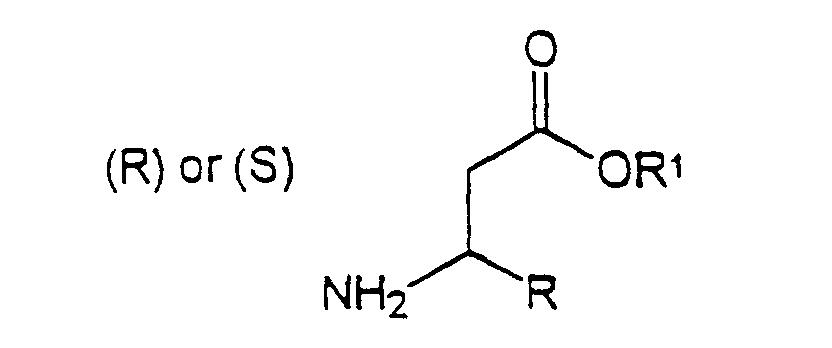
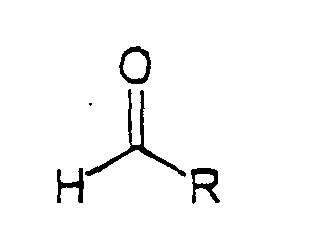
- The present invention relates to a process for the preparation of chiral beta-amino acids of the formulawherein R is selected from the group consisting of alkenyl, alkynyl, C1-C6-alkyl, aryl, substituted aryl, pyridyl, and furanyl and R1 is tert-butyl ; which process comprises treating an aldehyde of the formula
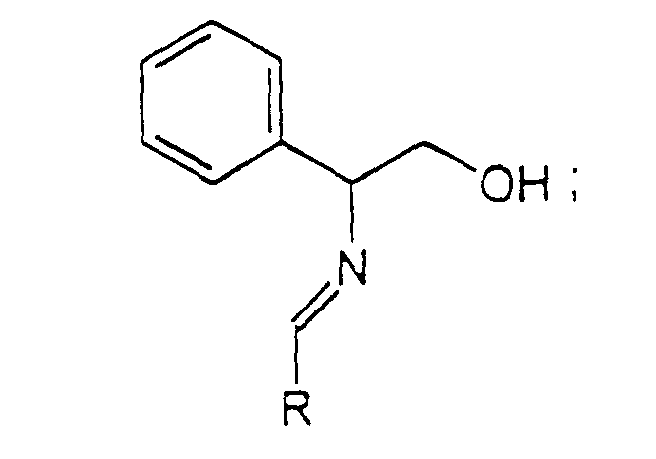
 with (R) or (S) phenylglycinol in tetrahydrofuran (THF) or toluene to produce an imino alcohol of the formula
 reacting said imino alcohol with BrZnCH2CO2-tBu in N-methyl pyrrolidinone (NMP), dimethylsulfoxide (DMSO) or THF followed by addition of aqueous ammonium chloride and hydrochloric acid to produce an amino alcohol of the formula
 reacting the amino alcohol with sodium periodate (NaIO4) or lead tetraacetate (Pb(OAc)4) to form an imine of the formula
 hydrolyzing said imine in the presence of para toluene sulfonic acid to produce an (R) or (S) beta-amino acid of the formula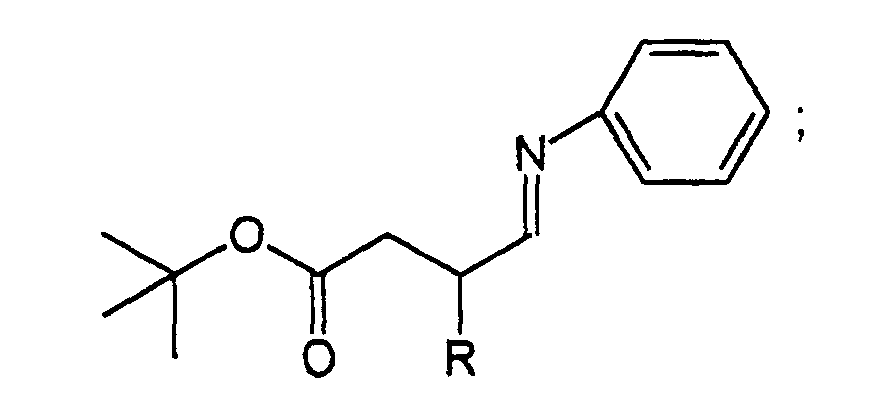
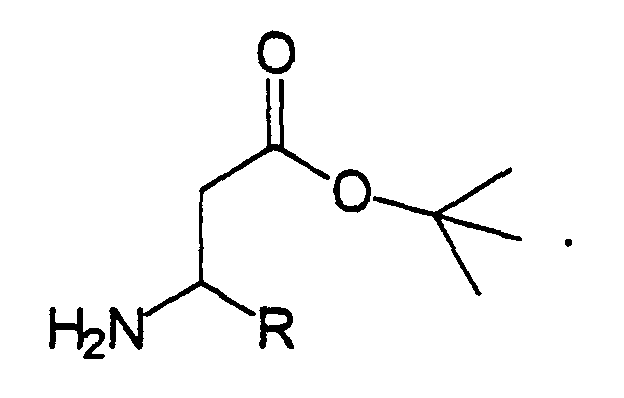
- More preferably, the present invention relates to a process for the preparation of the chiral beta-amino acid of the formulaknown by the chemical name ethyl 3S-amino-4-pentynoate and salts thereof. The process comprises treating 3-(trimethylsilyl)-2-propynal with L-phenylglycinol in toluene, to produce αS-[[3-(trimethylsilyl)-2-propynylidene]amino]benzenethanol; reacting αS-[[3-(trimethylsilyl) -2-propynylidene]amino]benzenethanol with BrZnCH2CO2t-Bu in THF/NMP to produce 1,1-dimethylethyl 3S-[(2-hydroxy-1S-phenylethyl)amino]-5-(trimethylsilyl)-4-pentynoate; reacting the 1,1-dimethylethyl 3S-[(2-hydroxy-1S-phenylethyl)amino]-5-(trimethylsilyl)-4-pentynoate with sodium periodate to form 1,1-dimethylethyl 3S-[(phenylmethylene)amino]-5-(trimethylsilyl) -4-pentynoate; hydrolyzing 1,1-dimethylethyl 3S-[(phenylmethylene)amino]-5-(trimethylsilyl)-4-pentynoate to produce 1,1-dimethylethyl 3S-amino-5-(trimethylsilyl)-4-pentynoate; and transesterifying 1,1-dimethylethyl 3S-amino-5-(trimethylsilyl)-4-pentynoate and desilylating to produce ethyl 3S-amino-4-pentynoate.

- The preferred chiral β-amino acid produced by the process of the present invention is useful in preparing ethyl 3S-[[4-[[4-(aminoiminomethyl)phenyl]amino]-1,4-dioxobutyl]amino]-4-pentynoate a pharmaceutical agent useful as a platelet aggregation inhibitor. Said pharmaceutical agent is more fully described in U.S. Patent 5,344,957.
- A preparation of ethyl 3S-amino-4-pentynoate is described in Method 3 of Scheme V of U.S. Patent No. 5,344,957. Additional methods for preparing ethyl 3S-amino-4-pentynoate are disclosed by D.H. Hua and A. Verma, Tetrahedron Lett., 547-550 (1985) and by T. Kametani, Heterocycles, Vol. 17, 463 (1982).
- U.S. Patent No. 5,536,869 discloses a process for preparing ethyl 3S-amino-4-pentynoate monohydrochloride which comprises:
- (a) treating (trimethylsilyl)acetylene sequentially with n-butyllithium and 4-formylmorpholine in the presence of an aprotic solvent followed by acid hydrolysis to give 3-(trimethylsilyl)-2-propynal;
- (b) treating 3-(trimethylsilyl)-2-propynal, the product of step a, with lithium bis(trimethylsilyl)amide in the presence of an aprotic solvent to give N,3-bis(trimethylsilyl)-2-propyn-1-imine in situ, treating N,3-bis(trimethylsilyl)-2-propyn-1-imine with lithium t-butyl acetate followed by hydrolytic cleavage to give (±)1,1-dimethylethyl 3-amino-5-(trimethylsilyl)-4-pentynoate;
- (c) treating (±)1,1-dimethylethyl 3-amino-5-(trimethylsilyl)-4-pentynoate, the product of step b, with p-toluenesulfonic acid in the presence of aprotic solvents to give (±)1,1-dimethylethyl 3-amino-5-(trimethylsilyl)-4-pentynoate, mono p-toluenesulfonic acid salt, treating the resulting salt with ethanol in the presence of p-toluenesulfonic acid, followed by neutralization to give (±)ethyl 3-amino-5-(trimethylsilyl)-4-pentynoate; and
- (d) treating (±)ethyl 3-amino-5-(trimethylsilyl)-4-pentynoate, the product of step c, with a catalytic amount of base in the presence of alkanol solvent followed by a catalytic amount of acid to give the desilylated (±)ethyl 3-amino-4-pentynoate in situ, treating (±)ethyl 3-amino-4-pentynoate with (R)-(-)-mandelic acid in the presence of aprotic solvents to give ethyl 3S-amino-4-pentynoate compounded with αR-hydroxybenzeneacetic acid; and
- (e) treating ethyl 3S-amino-4-pentynoate compounded with αR-hydroxybenzeneacetic acid, the product of step d, with gaseous hydrochloric acid in the presence of an aprotic solvent to give ethyl 3S-amino-4-pentynoate, monohydrochloride; with the understanding that when a pharmaceutically acceptable acid addition salt other than hydrochloride is desired the ethyl 3S-amino-4-pentynoate compounded with αR-hydroxybenzene acetic acid, the product of step d, is treated with the appropriate acid corresponding to the desired salt.
-
- THL, 1992, 33(20), 2895-8 describes the preparation of β-amino esters using the zinc derivative of ethyl bromoacetate as Reformatsky Reagent for the oxidative cleavage of 1,3-oxazolidines which subsequently are hydrogenated with H2/Pd/C.
- THL, 1993, 34(1), 47-50 discloses the synthesis of β-amino acids/esters by reaction of Pb(OAc)4 with a suitable aminoalcohol under retention of the enantiomeric excess, starting from the compounds according to the above THL-reference whereby the Reformatsky reaction is also carried out at elevated temperatures in the presence of a Lewis-acid catalyst.
- It would be desirable to provide a process for the preparation of said amino acids and preferably of ethyl 3S-amino-4-pentynoate which is amenable to scale-up, and which employs raw materials which are readily available, resulting in high yield and a high level of optical purity which doesn't require any chromatography and/or separation of diastereoisomers.
- The present invention relates to a process for the preparation of chiral beta-amino acids of the formulawherein R is selected from the group consisting of alkenyl, alkynyl, aryl, C1-C6-alkyl, substituted aryl, pyridyl and furanyl and R1 is t-butyl; which process comprises treating an aldehyde of the formula
 with (R) or (S) phenylglycinol in tetrahydrofuran (THF) or toluene to produce an imino alcohol of the formula
 reacting said imino alcohol with BrZnCH2CO2-tBu in N-methyl pyrrolidinone (NMP), dimethylsulfoxide (DMSO) or THF followed by addition of ammonium chloride to produce an amino alcohol of the formula
 reacting the amino alcohol with sodium periodate (NalO4) or lead tetraacetate (Pd(OAc)4) to form an imine of the formula
 hydrolyzing said imine in the presence of para toluene sulfonic acid to produce an R or S amino acid of the formula

- More preferably, the invention herein is directed to a process for the preparation of ethyl 3S-amino-4-pentynoate. The process involves treating 3-(trimethylsilyl)-2-propynal with L-phenylglycinol in toluene to produce αS-[[3-(trimethylsilyl)-2-propynylidene amino]benzenethanol; reacting αS-[[3-(trimethylsilyl)-2-propynylidene]amino]benzenethanol with BrZnCH2CO2t-Bu in THF/NMP to produce 1,1-dimethylethyl 3S-[(2-hydroxy-1S-phenylethyl)amino]-5-(trimethylsilyl)-4-pentynoate; reacting the 1,1-dimethylethyl 3S-[(2-hydroxy-1S-phenylethyl)amino]-5-(trimethylsilyl)-4-pentynoate with sodium periodate to form 1,1-dimethylethyl 3S-[(phenylmethylene)amino]-5-(trimethylsilyl)-4-pentynoate; hydrolyzing 1,1-dimethylethyl 3S-[(phenylmethylene)amino]-5-(trimethylsilyl)-4-pentynoate to produce 1,1-dimethylethyl 3S-amino-5-(trimethylsilyl)-4-pentynoate; and transesterifying 1,1-dimethylethyl 3S-amino-5-(trimethylsilyl)-4-pentynoate and desilylating to produce ethyl 3S-amino-4-pentynoate.
- The invention herein is directed to the preparation of beta-amino acids of the formulaand acid addition salts thereof wherein R is selected from the group consisting of alkenyl, alkynyl, C1-C6-alkyl, aryl, substituted aryl, pyridyl, and furanyl and R1 is tert-butyl.

- More specifically, the invention herein is directed to the preparation of ethyl 3S-amino-4-pentynoate of the formulaand addition salts thereof.

- A synthetic scheme for the most preferred synthetic method is outlined in Scheme I and the following description thereof.


- Aldehyde A is prepared according to methodology disclosed in U.S. Patent No. 5,536,869.
- In Scheme I aldehyde A is transformed to imine B by reaction with L-phenylglycinol in toluene (or alternatively in THF) followed by drying with MgSO4, or molecular sieve or azeotropic distillation.
- The Reformatsky reagent BrZnCH2CO2t-Bu is prepared in THF by fast activation of zinc with dibromoethane (2-5 mole %) (alternatively, zinc is activated with diluted HCl followed by drying with THF and high vacuum or with tetramethylsilane (1-5%) in THF at 25°C), followed by reaction with tert-butyl bromoacetate at 50°C. A solution of BrZnCH2CO2t-Bu is prepared by removing the THF by distillation, followed by dissolution in NMP or DMSO or by filtration of the solid reagent followed by dilution with an aprotic solvent such as NMP or DMSO.
- A solution of imine B in NMP (or alternatively in DMSO or THF) is added to a solution of the Reformatsky reagent in an aprotic polar solvent such as THF, NMP, NMP/THF or DMSO, followed by quenching with aqueous ammonium chloride and aqueous hydrochloric acid and subsequent extraction with methyl tert-butyl ether (MTBE) or EtOAc. The organic solution is washed with aqueous ammonium chloride, water and brine to give the amino alcohol C .
- The amino alcohol C is reacted with NaIO4 in the presence of aqueous methylamine in ethanol/water followed by filtration, dilution with toluene, MTBE or THF to give a solution of imine D . [Alternatively, the reaction mixture can be concentrated and extracted with MTBE, filtered, dried, filtered and concentrated.]
- Imine D is hydrolyzed in the presence of para-toluenesulfonic acid in MTBE (or alternatively in THF or toluene). Precipitation with heptane and filtration afforded the para-toluenesulfonic acid salt E.
- Transformation of para-toluenesulfonic acid salt E to hydrochloride salt F is achieved by successive reaction with 0.3 equivalents para-toluenesulfonic acid in ethanol, followed by basic work up (aqueous solution of sodium bicarbonate or potassium bicarbonate) and extraction, with sodium ethoxide in ethanol, with HCl in EtOH (generated by the addition of acetyl chloride in EtOH or dissolution of HCl gas in ethanol) and recrystallization in acetonitrile/MTBE (or alternatively acetonitrile/toluene or acetonitrile/heptane).

- In Scheme II aldehyde G (R = alkynyl, alkyl, aryl, substituted aryl, pyridinyl, furanyl) is transformed to imine H by reaction with D or L phenylglycinol in THF or toluene, followed by drying with MgSO4, molecular sieves or by azeotropic distillation.
- The Reformatsky reagent BrZnCH2CO2t-Bu is prepared in THF by fast activation of zinc with dibromoethane (1-5 mole %) (alternatively, the zinc is activated with diluted HCl followed by drying with THF and high vacuum or tetramethylsilane (TMS) in THF at 25°C), followed by reaction with tert-butyl bromoacetate at 50°C. A solution of the reagent is prepared by removing the THF by distillation or decantation followed by dissolution in an aprotic polar solvent such as NMP or DMSO or by filtration of the solid reagent followed by dilution with an aprotic polar solvent such as NMP or DMSO.
- A solution of imine H in an aprotic polar solvent such as NMP, DMSO or THF, is added to a solution of the Reformatsky reagent in an aprotic polar solvent such as NMP, NMP/THF, DMSO or THF, followed by acidic aqueous (ammonium chloride/HCl) or basic (ammonium hydroxide) quench and subsequent extraction with MTBE or EtOAc, washing with aqueous ammonium chloride, water and brine to produce the amino alcohol I .
- The amino alcohol I is reacted with NaIO4 in the presence of methylamine in ethanol/water or lead tetraacetate in methanol followed by filtration, dilution with toluene, MTBE or THF to give a solution of imine J . Alternatively, the reaction mixture can be concentrated and extracted with MTBE, filtered, dried, filtered and concentrated.
- Imine J is hydrolyzed in the presence of para-toluenesulfonic acid in THF, toluene or MTBE. Precipitation with heptane and filtration afforded the para-toluenesulfonic acid salt K with configuration D (from D-phenylglycinol) or L (from L-phenylglycinol).
- Transformation of para-toluenesulfonic acid salt K (R = 2-trimethylsilyl-ethynyl) to hydrochloride salt L (R = ethynyl) is achieved by successive reaction with para-toluenesulfonic acid in a solvent such as ethanol, followed by basic work up (aqueous solution of sodium bicarbonate or potassium bicarbonate) and extraction, with sodium ethoxide in an alkanol such as ethanol, with HCl in EtOH (generated by addition of acetyl chloride in an alkanol solvent such as ethanol or dissolution of HCl gas in ethanol) and recrystallization in acetonitrile/MTBE (or alternatively acetonitrile/toluene or acetonitrile/heptane).
- Unless otherwise noted the starting materials for the process of this invention are all commercially available or can be prepared according to conventional methods known to those with skill in the art. All equipment employed is commercially available.
- The following is a list of definitions and abbreviations used herein:
- The term "alkyl" refers to straight chain or branched chain hydrocarbon radicals having from 1 to 6 carbon atoms. Examples of such alkyl radicals include methyl, ethyl, n-propyl, isopropyl, n-butyl, isobutyl, sec-butyl, t-butyl, pentyl, hexyl.
- As used herein the term "alkenyl" refers to unsaturated acyclic hydrocarbon radicals containing at least one double bond and 2 to 6 carbon atoms, which carbon-carbon double bond may have either cis or trans geometry. Examples of such groups are ethenyl, propenyl, butenyl, isobutenyl, pentenyl, hexenyl.
- As used herein the term "alkynyl" refers to acyclic hydrocarbon radicals containing one or more triple bonds and 2 to 6 carbon atoms. Examples of such groups are ethynyl, propynyl, butynyl, pentynyl, hexynyl.
- The term "aryl" as used herein denotes aromatic ring systems composed of one or more aromatic rings, preferably consisting of one or two aromatic rings. The term embraces aromatic radicals such as phenyl, naphthyl, triphenyl, benzofuran.
- The term "substituted aryl" as used herein denotes an aryl radical as defined above substituted by one or more substituent selected from the group consisting of alkyl, amino, hydroxy, chloro, fluoro, bromo, alkoxy and nitro.
- The terms "pyridyl" or "pyridinyl" are represented by a radical of the formula

- The term "furanyl" is represented by a radical of the formula
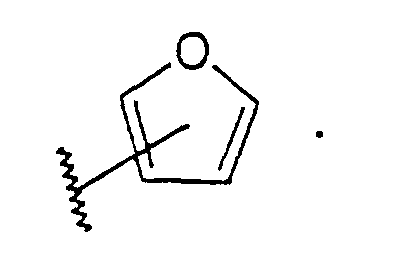
- The term "L-phenylglycinol" refers to a radical of the formulaand is used interchangeably with the term (S)-phenylglycinol.
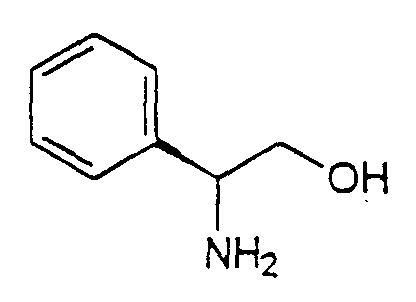
- The term "D-phenylglycinol" refers to a radical of the formulaand is used interchangeably with the term (R)-phenylglycinol.

- THF refers to tetrahydrofuran.
- NMP refers to N-methylpyrrolidinone.
- DMSO refers to dimethylsulfoxide.
- NaIO4 refers to sodium periodate.
- NH4Cl refers to ammonium chloride.
- CH3NH2 refers to methylamine.
- EtOH refers to ethanol.
- Pb(OAc)4 refers to lead tetraacetate.
- PTSA refers to para-toluenesulfonic acid.
- MTBE refers to methyl tert-butyl ether.
- NaOEt refers to sodium ethoxide.
- EtOAc refers to ethyl acetate.
- MgSO4 refers to magnesium sulfate.
- GC refers to gas chromatography.
-
- The present invention provides a safe, convenient and cost effective manufacturing process for the preparation of ethyl 3S-amino-4-pentynoate which is amenable to scale-up. The process utilizes raw materials which are readily available and cost efficient. Its convenience is demonstrated in that the synthetic route does not require either a chromatography or chemical or enzymatic separation of diastereoisomers. Its cost effectiveness is demonstrated by the final products being produced in high yield and a high level of optical purity.
- The following non-limiting examples describe and illustrate a method for carrying out the process of the present invention, as well as other aspects of the invention, and the results achieved thereby in further detail. Both an explanation of, and the actual procedures for, the various aspects of the present invention are described where appropriate. These examples are intended to be illustrative of the present invention.
- Those of skill in the art will readily understand that known variations of the conditions and processes described in these examples can be used to perform the process of the present invention.
-
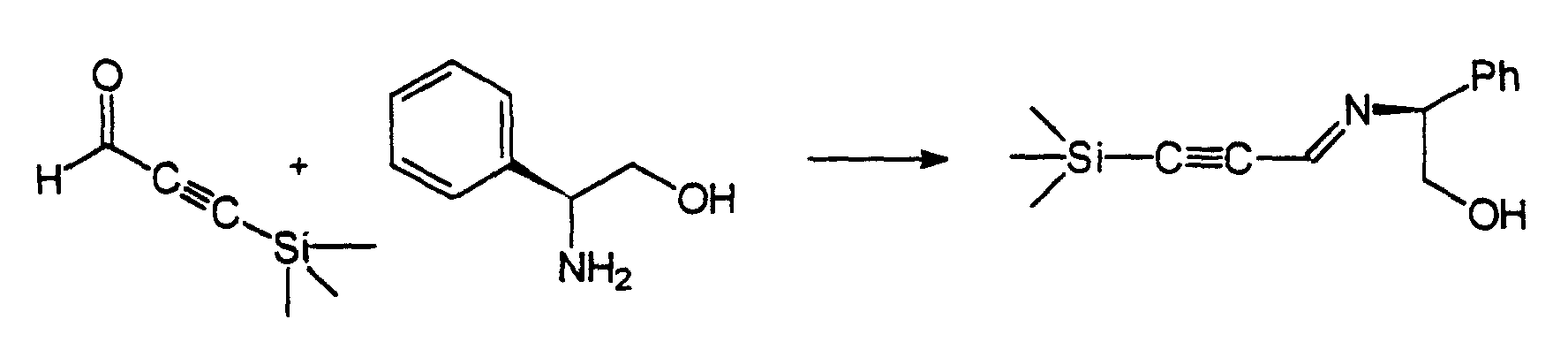
- To a slurry of L-phenylglycinol in toluene (10.00 g, 72.9 mmoles/55 ml), at ambient temperature, was added 1.05 equivalent of 3-(trimethylsilyl)-2-propynal (9.66 g, 76.5 mmoles) at such rate as to keep the temperature below 30°C. The mixture was stirred at ambient temperature for 1 hour. The water was azeotropically removed with toluene under reduced pressure to a final weight of 28.2 g (1.5 X the expected yield). At room temperature and with stirring 75 ml of heptane was added and the mixture was cooled to -10°C for 8 hours. Filtration of the solids by suction followed by a heptane rinse of the cake and air drying produced the solid imine αS-[[3-(trimethylsilyl)-2-propynylidene]amino]benzenethanol (80%:15.00 g) in 4:1 ratio of anti to syn isomers (as determined by NMR in THF).
mp 78-80°C; 1HNMR (THF-d8) anti-isomer, δ 0.20 (s, 9H), 3.61 (t, 1H, J = 6.3 Hz), 3.95 (t, 1H, J = 6.3 Hz), 4.18 (t, 1H, J = 6.3 Hz), 7.17 (tt, 1H, J = 7.3, 1.4 Hz), 7.25 (complex t, 2H, J = 7.3 Hz), 7.35 (complex d, 2H, J = 7.3 Hz), 7.57 (s, 1H). Syn-isomer, δ 0.22 (s, 9H), 3.76-3.63 (complex band, 3H), 5.01 (m, 1H), 7.16 (tt, 1H, 7.3, 1.4 Hz), 7.23 (complex t, 2H, J = 7.3 Hz), 7.33 (complex d, 2H, J = 7.3 Hz), 7.56 (d, 1H); 13C NMR (THF-d8) anti-isomer, δ -0.3, 67.9, 79.3, 96.5, 103.5, 127.9, 128.2, 129.0, 141.9, 145.4. Syn-isomer, δ -0.4, 68.6, 73.2, 98.2, 103.6, 127.7, 128.6, 128.9, 142.4, 143.3; IR (MIR) ν (cm-1) 1610, 2370, 2340, 3390, 3610 cm-1.Analysis Calculated for C14H19NOSi C, 68.52; H, 7.80; N, 5.71. Found: C, 68.59; H, 7.52; N, 5.71. - A 4 liter jacketed flask, fitted with a condenser, temperature probe and mechanical stirrer was charged with 180 g of Zn metal (-30-100 mesh, 180.0 g, 2.77 mole) and 1.25 L of THF was added to the vessel. While stirring, 1,2-dibromoethane (4.74 mL, 0.055 mole) was added to the vessel via a syringe. The suspension of zinc in THF was heated to reflux (65°C) and maintained at this temperature for 1 hour. The mixture was cooled to 50°C before charging the tert-butyl bromoacetate (488 g, 369 mL, 2.5 moles) over a 1.5 hour time period. Controlled reagent addition was performed with a 50 ml syringe and syringe pump (addition rate set at 4.1 mL/min). A temperature of 50°C ± 50°C was maintained during the addition. The reaction mixture was allowed to stir at 50°C for 1 hour after the addition was complete. The reaction mixture was allowed to cool to 25°C, and the agitation turned off to allow the precipitate to settle (the product precipitates from THF solution at 31°C). The THF mother liquor was removed by decantation into a 2L round bottom flask under partial vacuum (20 mm Hg) with a dip tube (coarse fritted glass filter). This removed 65% of THF from the vessel, 800 mL of NMP was added and agitation resumed for 5 minutes at 25°C. The reaction mixture was transferred to another vessel by filtration to remove the remaining zinc. Alternatively, the solid reagent can be filtered and dried under N2 using a pressure funnel. The cake is washed with THF and a white solid was obtained. The solid was dried for 1-2 hours. Typical recovery is 85-90%. The solid can be stored at -20°C (for at least 6 months).
- A 1.0 mL aliquot of the Reformatsky-NMP/THF solution was removed from the reaction mixture via syringe and added to a 25 mL round bottom flask which contained a preweighed amount of benzaldehyde (250-300 mg) and a magnetic stir bar, under a nitrogen atmosphere. The reaction mixture was stirred for 30 minutes at room temperature. To the flask was added 5.0 mL of aqueous 29% NH4Cl and 5.0 mL of methyl t-butyl ether (MTBE). The resulting mixture was stirred for 5 minutes at room temperature. The agitation was stopped and the layers allowed to separate over 5 minutes. A 1.0 mL aliquot of the organic layer was removed and diluted to 25 mL with MTBE in a volumetric flask. This solution was analyzed by gas chromatography (GC) to determine the amount of benzaldehyde which remained. Standard solutions of benzaldehyde in MTBE at concentrations of 0.04 M, 0.01 M, and 0.002 M were coinjected with the sample. The sample concentration was determined from the linearity plot of the standard solutions and the sample GC peak area. The concentration of the Reformatsky solution was determined using the following calculation:
- Analytical determination of the titer was 1.57 molar with a molar yield of 94% of Example 2.
-
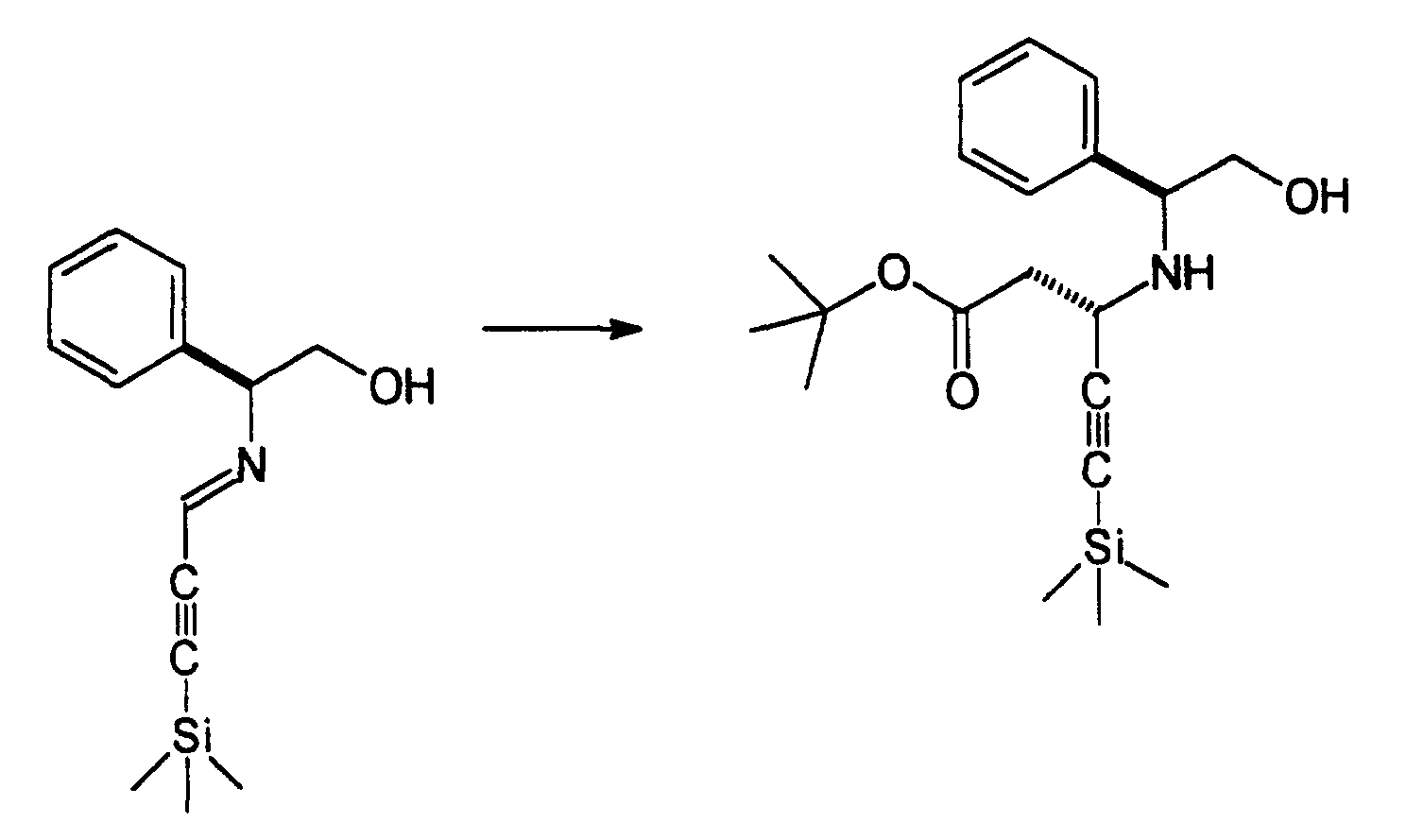
- A solution of the product of Example 2 in NMP/THF (2.6/1, 1.5 L, 1.57 M, 2.4 moles) was charged in a 4L flask (jacketed, 4 ports fitted with mechanical stirrer, teflon coated temperature probe and addition funnel). The solution was cooled to -10°C and a solution of the imine of Example 1 (220.0 g, 0.96 mole) in NMP (0.250 L) was added after 30 minutes while the temperature was maintained at -3°C. After total conversion (less than 1% of starting material), as determined by gas chromatography (GC), a mixture of 29% ammonium chloride aqueous solution (1.0 L) and 2N HCl (0.5 L) was added in 15 minutes from-10°C to 13°C. The mixture was warmed to 25°C and MTBE (1.0 L) was added. The mixture was stirred for 30 minutes and the layers were separated. The aqueous layer was extracted with MTBE (0.5 L). The organic layers were combined and washed successively with a 29% solution of NH4Cl (0.5 L), H2O (0.5 L) and brine (0.5 L) and were concentrated under reduced pressure to afford an orange oil (366 g) containing the title compound (84 wt%, 91% yield determined by GC quantitation) 1,1-dimethylethyl 3R-[(2-hydroxy-lS-phenylethyl)amino]-5-(trimethylsilyl)-4-pentynoate, (mixture obtained with a diastereomeric excess (de) of 80% as determined by chiral HPLC).
- The two isomers were separated by preparative chiral HPLC for analytical purpose:
Data for 1,1-dimethylethyl 3R-[(2-hydroxy-1S-phenylethyl)amino]-5-(trimethylsilyl)-4-pentynoate: 1H NMR (CDCl3, TMS) δ (ppm) 0.16 (s, 9H); 1.45 (s, 9H), 2.52 (dd (AB), 1H, J = 5.6, 15.3 Hz), 2.56 (dd, (AB), 1H, J = 5.6, 15.3 Hz), 3.55 (dd, 1H, J = 7.7, 5.6 Hz), 3.59 (dd, 1H, J = 8.5, 10.7 Hz), 3.74 (dd, 1H, J = 4.5, 10.8 Hz), 4.15 (dd, 1H, J = 4.5, 8.4 Hz), 7.27 to 7.34 (m, 5H); 13C NMR (CDCl3) δ (ppm): 0.05, 28.08, 42.22, 44.86, 67.21, 67.47, 80.95, 88.61, 105.00, 127.74, 128.52, 139.69, 170.06; DSC: 79.68°C (endo. 71.68 J/g), 237.33°C (exo. 169.0 J/g); [α]D 25= +179.3° (c = 0.36, CHCl3) ; IR (MIR) ν (cm-1) 2167, 1735; UV (methanol) λmax (nm) = 204 (abs = 0.37);Microanalytical: calcd for C20H31NO3Si C, 66.44; H, 8.64; N, 3.87. Found C, 66.34; H, 8.88; N, 3.89. Microanalytical: calcd for C20H31NO3Si C, 66.44; H, 8.64; N, 3.87. Found C, 66.22; H, 8.82; N, 3.85. -

- NaIO4 (77.0 g, 0.36 mole) was charged into a flask (500 mL) followed by H2O (0.330 L) and the mixture was stirred for 30 minutes at 25°C. A solution of 1,1-dimethylethyl 3S-[(2-hydroxy-lS-phenylethyl)-amino]-5-(trimethylethyl)-4-pentynoate of Example 3 (116.3 g, 86 wt %, 0.277 mole) in ethanol (0.520 L) was charged into a 1L flask (4 ports, jacketed, fitted with mechanical stirrer and teflon coated temperature probe) purged with N2, followed by addition of a solution of methylamine (40 wt %, 24 mL, 0.278 mole). After 5 minutes of stirring at 25°C, a slurry of NaIO4 in H2O was added portionwise while maintaining a temperature below 35°C (32 ± 2°C). After complete addition, conversion was complete and the mixture was cooled to 3°C and held at this temperature for 3 hours. The mixture was filtered on a pressure filter (extra coarse, 600 mL) and the cake was dried for 3.5 hours under a N2 vacuum (Karl-Fisher analysis showed 5.60% H2O remaining). The cake containing a mixture of the title compound and iodate salt was charged into a flask (500 mL) and toluene (130 mL) was added. After 30 minutes of stirring at 30°C the mixture was filtered. The cake was washed twice with toluene (2 x 50 mL). The 3 fractions were combined and partially concentrated to a weight of 161 g containing 53.3 wt% of the title compound (determined by GC quantitation) with a yield of 92% and a chiral purity of 99.9% (determined by chiral HPLC). A sample was isolated for full characterization by concentration of the solution:
1H NMR (CDCl3, TMS) δ (ppm) 0.20 (s, 9H); 1.45 (s, 9H), 2.66 (dd (AB), 1H, J = 7.0, 15.0 Hz), 2.80 (dd, (AB), J = 7.7, 15.0 Hz), 4.83 (dt, 1H, J = 1.7, 7.6 Hz), 7.38 to 7.44 (m, 3H), 7.74 to 7.77 (m, 2H), 8.56 (d, 1H, J = 1.5 Hz); 13C NMR (CDCl3) δ (ppm): 0.02, 28.09, 43.20, 56.46, 80.75, 92.53, 103.15, 128.47, 128.54, 130.90; 135.90, 161.78, 169.55; DSC: 72.22°C (endo. 112.4 J/g); [α]D 25= -35.5° (c = 1.16, CHCl3); IR (MIR) ν (cm-1) 2174, 1728, 1641; UV (methanol) λmax (nm) = 205 (abs = 1.004), 248 (abs = 0.655);Microanalytical: calcd for C19H27NO2Si C, 69.26; H, 8.26; N, 4.25. Found C, 69.10; H, 8.43; N, 4.33. -

- A solution of the product of Example 4 (123.3 g, 0.374 mole) in dry THF (350 mL) was prepared. p-Toluenesulfonic acid monohydrate (71.2 g, 0.374 mole) was charged to a 4L jacketed reaction vessel under nitrogen. An overhead stirrer with a 10 cm teflon stir blade was attached. A thermocouple thermometer was put in place. The reactor jacket was cooled to 0°C. The solution of the product of Example 4 was added via an addition funnel over 5 minutes with stirring at 250 rpm. The reaction temperature rose to 10°C. The addition funnel was rinsed with THF (300 mL). After stirring for 15 minutes the mixture became homogeneous. The stirring rate was increased to 350 rpm. Skellysolve C heptanes (1360 mL) was added over 5 minutes. The product crystallized and the agitation was increased to 540 rpm. The solvent was distilled from the reactor under vacuum under the following conditions. An oil pump connected to a vacuum regulator which was used to adjust the vacuum to 45 mm Hg. The jacket temperature was set to 20°C and a dry ice/isopropanol condenser with 2 L receiving flask was used to collect the distillate. The distillate collected was 900 mL. The reactor was placed under a nitrogen atmosphere and further heptanes (900 mL) were added. The slurry was cooled to 2°C. The solids were collected on a 10 cm coarse glass fritted filter using vacuum. The reaction vessel was rinsed by adding heptanes (500 mL) and THF (50 mL) with stirring. The reaction mixture was cooled to 10°C and added to the filter. The cake was washed with heptanes (3 x 300 mL) and dried by using a combination of vacuum and nitrogen flow for 4.5 hours to produce the title compound (145.9 g, 94%): mp. 142°C;
1H NMR (CDCl3, 400 MHz) δ 8.32 (br, s, 3H), 7.79 (d, J = 8.0 Hz, 2H), 7.15 (d, J = 8.0 Hz, 2H), 4.40 (dd, J = 8.0, 6.0 Hz, 1H), 2.89 (dd, J = 17.0, 8.0 Hz, 1H), 2.76 (dd, J = 17.0, 5.0 Hz, 1H), 2.36 (s, 3H), 1.41 (s, 9H), 0.10 (s, 9H); 13C NMR (CDCl3, 125 MHz) δ 168.60, 141.55, 140.22, 128.81 (2C), 126.11 (2C), 98.51, 92.71, 82.02, 40.56, 38.56, 27.95 (3C), 21.31, -0.53 (3C);Analysis Calculated for C19H31NO5SSi C, 55.17; H, 7.55; N, 3.39. Found C, 55.27; H, 7.27; N, 3.34. -

- A solution of the product of Example 5 (500.0 g, 1.21 mol) and p-toluenesulfonic acid monohydrate (69.5 g, 0.365 mol) in ethanol (930 mL) was heated to reflux and held for 4 hours. Reaction completion was determined by GC. The reaction mixture was concentrated in vacuo. MTBE (1200 mL) was charged to the concentrate with stirring to afford complete dissolution. A 20 wt/wt % potassium bicarbonate aqueous solution (1387 g) was added to the MTBE solution. The biphasic mixture was stirred for 15 minutes. The aqueous layer was back-extracted with MTBE (700 mL). The combined organic layers were extracted a second time with a 20 wt/wt % potassium bicarbonate aqueous solution (306 g). The organic layer was concentrated in vacuo. Water was removed azeotropically with ethanol (900 mL) under reduced vacuum. An 87% yield of the desired silyl protected free amine was obtained [1.06 mol]. To the concentrate was charged ethanol 2B (600 mL), followed by 21 wt % sodium ethoxide (in ethanol denatured with 5% toluene) (39.6 mL, 0.106 mol, 0.1 equivalent sodium ethoxide). The reaction solution was allowed to cool to room temperature and stirred for one-half hour. Desilylation completion was determined by GC. In a separate vessel was charged ethanol 2B (720 mL), followed by acetyl chloride (81.6 mL, 1.15 mol, 1.1 equivalent). This addition was carried out over 20 minutes, not allowing the temperature to rise above 45°C. The solution was then cooled to 20-25°C. The resulting hydrogen chloride/ethyl acetate/ethanol solution was charged to the desilylation reaction mixture. The reaction mixture was cooled to 25°C with stirring over a 30 minute period and then stirred at 25°C for an additional 30 minutes. The reaction mixture was concentrated under reduced pressure. The concentrate was cooled to room temperature and toluene (920 mL) was added. The mixture was stirred for 20 minutes and then concentrated in vacuo. Toluene (920 mL) was added to the concentrate and stirred for 20 minutes. Solids were collected by filtration and dried affording 184.94 g of crude title compound (86.1% yield).
- A portion of the crude title compound (80.0 g) was recrystallized from acetonitrile/MTBE. To 80.0 g of crude title compound was added 400 mL acetonitrile. The mixture was heated to reflux and the resulting heated opaque yellow solution was filtered through 20 g celite which had been washed with 160 mL hot acetonitrile. The filtrate was concentrated in vacuo removing 195 mL of solvent. The concentrated solution was cooled to 45°C. To the solution was added 195 mL of MTBE. The resulting opaque mixture was heated to reflux, cooled to 50°C and stirred for 15 minutes. The mixture was cooled to 40°C and held for 15 minutes. The mixture was then allowed to cool to 22°C and filtered. The resulting solids were rinsed with 2 x 80 mL MTBE. The solids were dried on the filter for 10 minutes, then under high vacuum for 2 hours, providing 72.18 g of the title compound.
1H NMR (D6-DMSO) δ (ppm) 1.21 (t, 3H, J = 7 Hz), 2.84 (dd, 1H, J = 9, 16 Hz), 3.03 (dd, 1H, J = 5, 16 Hz), 3.70 (d, 1H, J = 2Hz), 4.13 (q, 2H, J = 7 Hz), 4.31 (m, 1H), 8.82 (s, 3H); 13C NMR (D6-DMSO) δ (ppm): 13.95, 37.58, 38.40, 60.71, 77.99, 78.63, 168.42; DSC: 125-131°C (endo. 107.2 J/g); [α]D 25 = -6.7; IR (MIR) v (cm-1) 3252, 2128, 1726;Microanalytical: calcd for C7H12NO2Cl C, 47.33; H, 6.81; N, 7.89; Cl, 19.96: Found C, 47.15; H, 6.84; N, 7.99; Cl, 19.55. 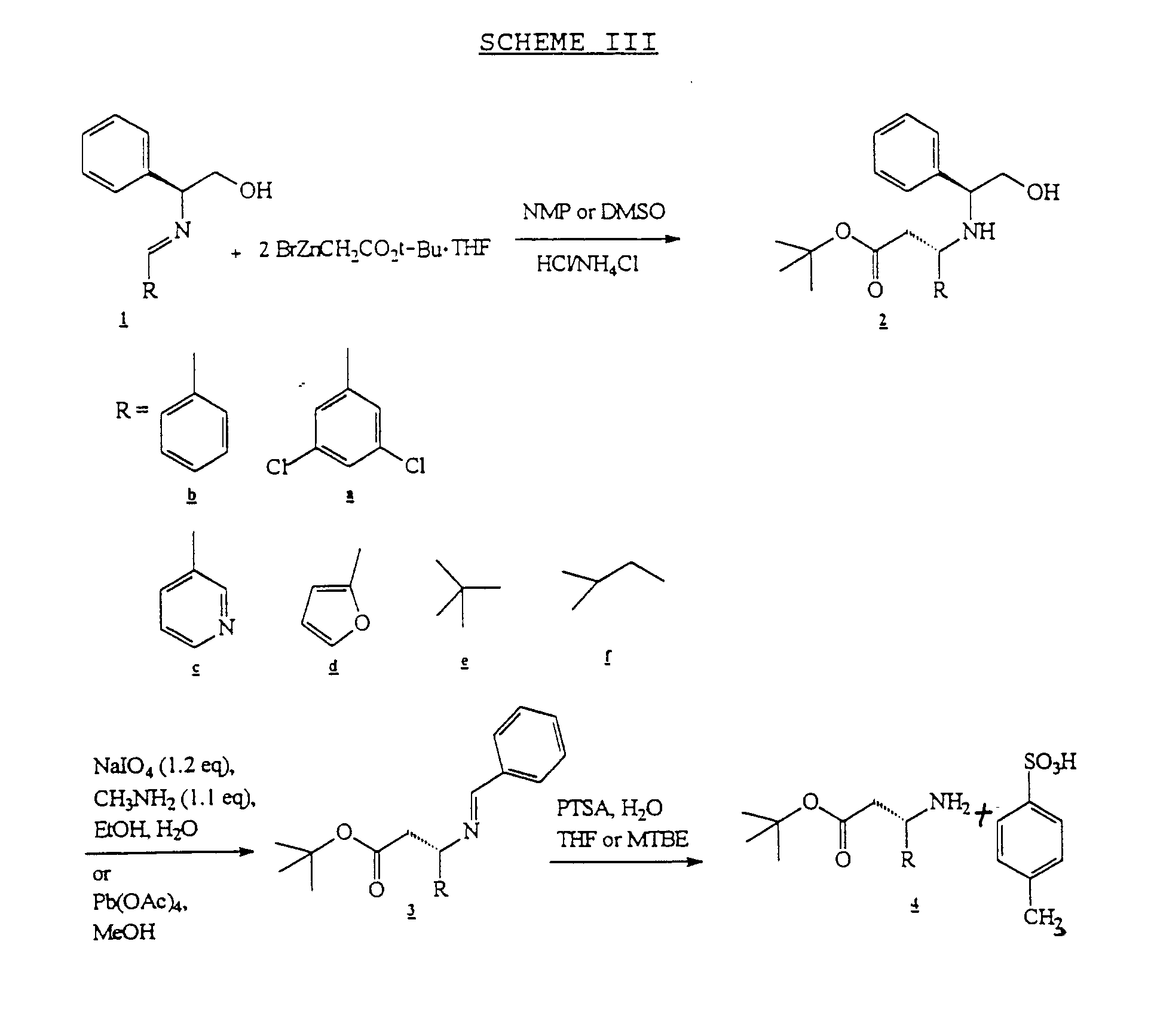
- Scheme III depicts the preparation of other β-amino esters using the process of the present invention as described hereinafter.
-

- (S)-Phenyl glycinol (11.74 g, 0.086 mole) was charged in a 500 mL 3N RB flask fitted with a mechanical stirrer, followed by addition of toluene (110 ml). The flask was vacuum/flushed with nitrogen. 3,5-dichlorobenzaldehyde (15.0 g, 0.086 mole) was added. After 15 minutes at 22°C, MgSO4 (15 g) was added (exothermic reaction). The mixture was stirred for 1 hour at 22°C, filtered on a coarse fritted filter. The cake was washed with toluene (20 ml). The solutions were combined and concentrated under reduced pressure to afford 27.00 g of a pale yellow oil containing the imine 1a. No further purification was performed and the crude product was used directly in the coupling reaction. 1H NMR (CDCl3), TMS) mixture of imine and oxazoline 4/1. (ppm):(imine) 3.88 to 3.99 (m, 2H), 4.50 (dd, 1H, J = 4.7, 8.1 Hz) 7.67 (d, 2H), 8.28 (s, 1H):oxazoline: 5.55 and 5.70 (s, 0.5 + 0.5 H), 3.72 to 3.83 (m, 0.5 + 0.5 H), 4.30 to 4.35 (m, 0.5 + 0.5 H), 4.40 to 4.48 (m, 0.5H), 4.54 to 4.60 (m, 0.5 H), mixed protons: 7.15 to 7.47 (m(aromatic + CDCl3)); 13C NMR (CDCl3, TMS) (ppm):imine: 67.55, 76.38, 135.13, 138.70, 140.05, 159.72. Oxazoline: 60.60, 62.80, 72.12, 72.34, 91.05, 91.68, 135.03, 135.41, 142.62. Mixed signals: (aromatics) 124.86, 124.956, 125.33, 126.53, 126.65, 126.75, 127.38, 127.74, 127.77, 128.11, 128.26, 128.32, 128.72, 128.84, 128.93, 129.06, 130.64.
-
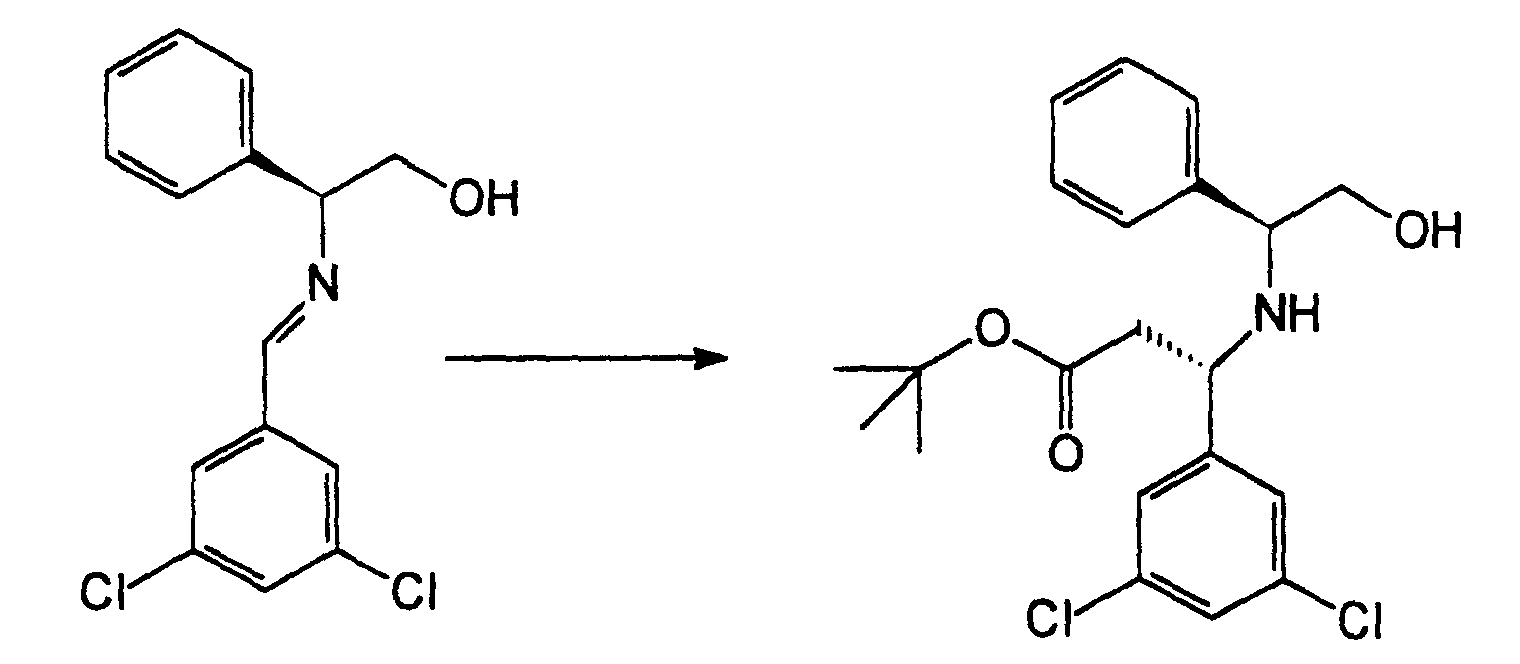
- A 1L jacketted 3 ports reactor with bottom valve, fitted with a mechanical stirrer and an addition funnel was charged with a solution of Reformatsky reagent from Example 2 (189 mmoles, 165 ml, 1.15 M). The solution was then cooled to -10°C. A solution of imine from Example 7 (25.39 g, 85.8 mmoles) in NMP (60 ml) was prepared under nitrogen and charged in the addition funnel. The solution of imine was then added in 5 minutes while the temperature was maintained at -5°C (jacket at -10°C). The reaction was monitored by GC and TLC (elution heptane/EtOAc 30%). After 5 minutes the reaction was almost complete (trace of starting material). The mixture was stirred for an additional hour and a mixture of 2N HCl/saturated solution of NH4Cl (1/2, 135 ml) was added. MTBE (200 ml) was added and the mixture was stirred for 1 hour at 23°C. Stirring was stopped and the layers were separated. The aqueous layer was extracted with MTBE (100 ml). The two organic layers were combined, washed successively with a saturated solution of NH4Cl (140 ml), water (140 ml) and brine (140 ml). The solution was dried with MgSO4 (30 g), filtered and concentrated to afford 35.2 g of an orange oil containing the desired product 2a as a single diastereoisomer (by 1H NMR).
- In a separate reaction (28.6 mmole scale) the crude product (11.36 g) was purified by chromatography (SiO2, 200 g), elution heptane/EtOAc 30%) to afford the desired compound 2a as a pale yellow oil (10.07 g, 85%). 1H NMR (CDCl3, TMS) δ (ppm) 1.40 (s, 9H), 2.56 (dd (AB), 1H, J = 5.6, 15.4 Hz), 2.56 (dd (AB), 1H, J = 8.1, 15.6 Hz), 2.60 (s(broad), 1H), 3.62 (dd (AB), 1H, J = 6.8, 10.7 Hz), 3.72 (dd, 1H, J = 4.2, 6.8 Hz), 3.80 (dd (AB), 1H, J = 4.2, 6.8 Hz), 4.11 (dd, 1H, J = 5.8, 7.9 Hz), 7.09 to 7.29 (m, 8H, (aromatic)); 13C NMR (CDCl3, TMS) δ (ppm):28.00, 42.98, 57.28, 62.24, 65.99, 81.42, 125.69, 127.21, 127.35, 127.60, 128.48, 134.83, 140.78, 146.44, 170.58; DSC: 241.46°C (endo. 180.1 J/g); [α]D 25 = +6.9° (c = 1.025, CHCl3); IR (MIR) (cm-1) 1726, 1587, 1567.
Microanalytical: calcd for C21H25Cl2NO3 C: 61.47; H: 6.14; N: 3.41; Cl: 17.27 Found C: 59.95; H: 6.51; N: 3.11; Cl: 16.00 -
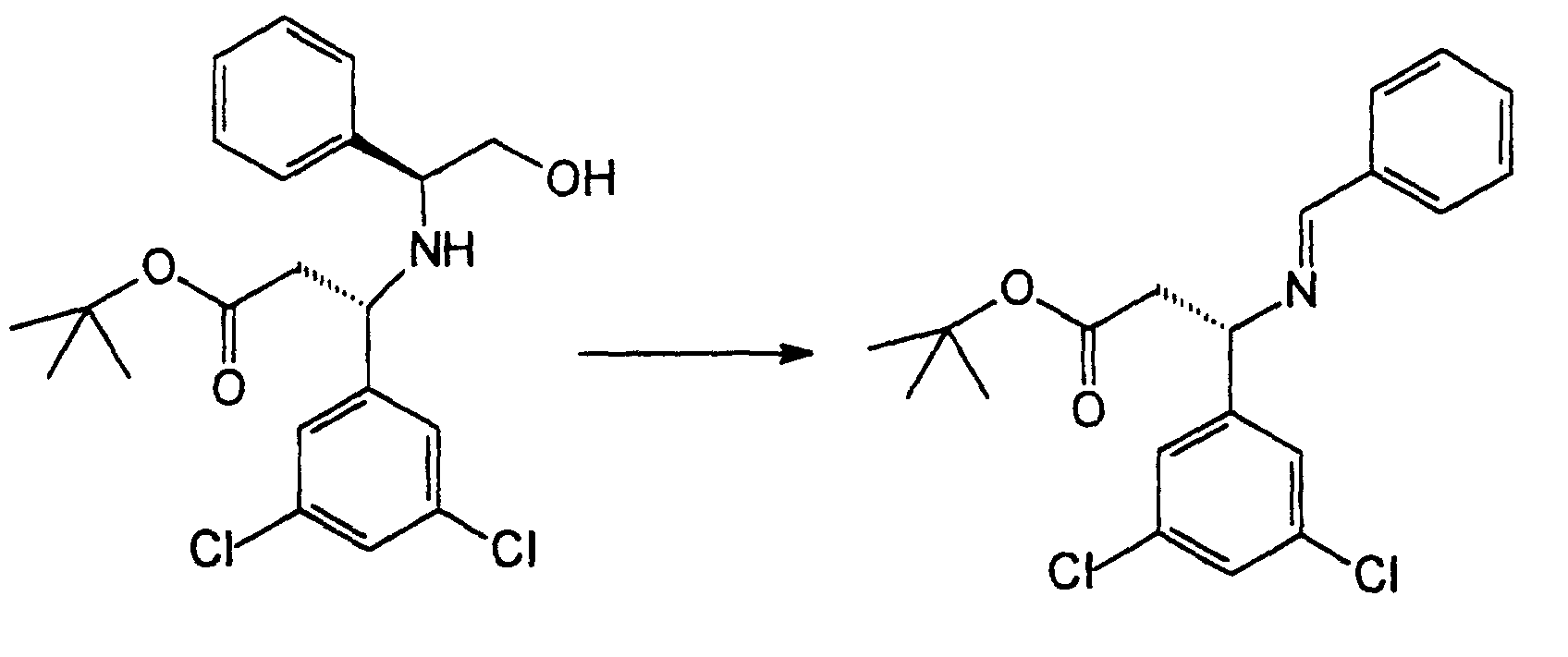
- A solution of crude ester from Example 8 in EtOH (140 ml) was charged to a 500 ml round bottom 3N flask. A solution of methyl amine (8.9 ml, 0.1 mole) was added. A slurry of NaIO4 (0.112 mole, 25.92 g) in H2O (72 ml) at 25°C was added by portion while maintaining a temperature of 30°C (± 2°C). The reaction was monitored by TLC. The reaction mixture was then stirred at room temperature for 15 hours. HaIO4 (6 g, 0.026 mole) solid was added. After 4 hours, NaIO4 (6 g, 0.026 mole) solid was added and the mixture was heated at 30°C for 0.5 hour. After cooling to 25°C, the reaction mixture was concentrated under reduced pressure (water aspirator). MTBE was added and the mixture was filtered through a coarse glass fritted filter. The layers were separated and the organic layer was washed with H2O (100 ml) dried with MgSO4 (25 g), filtered and concentrated under reduced pressure to afford 30.2 g of an orange oil containing compound 3a.
-
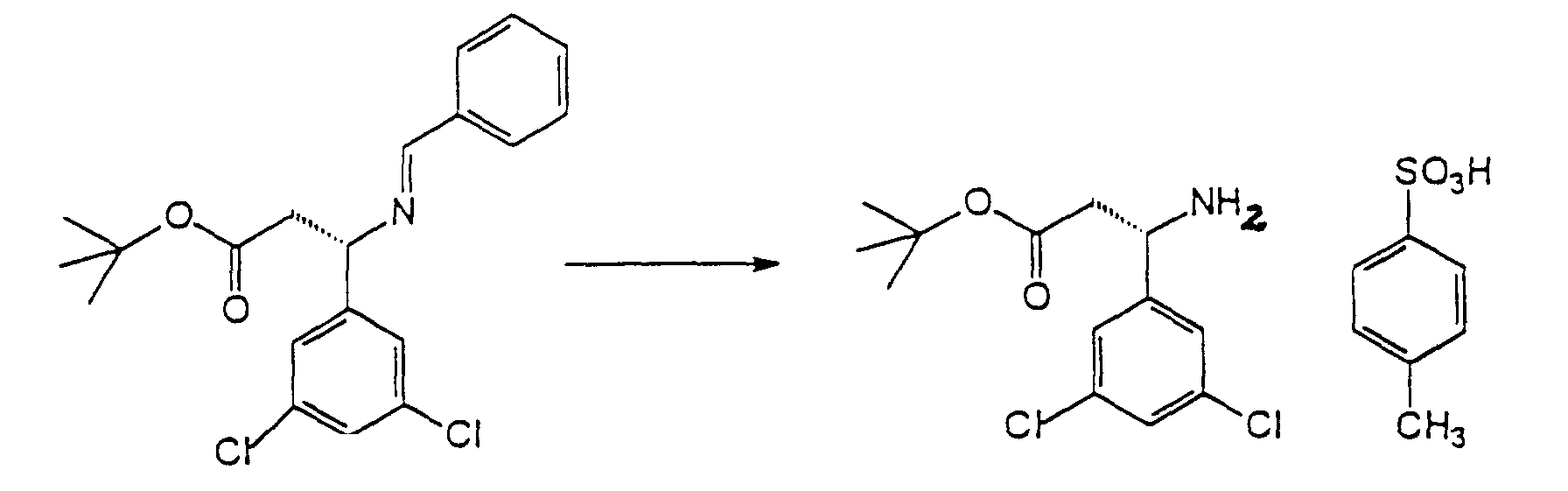
- The crude mixture containing 3a was diluted with THF (65 ml) and was charged in a 500 ml round bottom 3N flask fitted with a mechanical stirrer and an addition funnel. A solution of p-toluenesulfonic acid monohydrate (13.6 g, 71.6 mmole) in THF (20 ml) was then added in 2 minutes followed by a wash of THF (5 ml) via the addition funnel. After 5 minutes, heptane (65 ml) was added and heavy precipitation occurred. Additional heptane (65 ml) was added. After 0.5 hour, the slurry was filtered through a coarse glass fritted pressure filter and was washed with heptane/THF 20% (100 ml) and heptane/THF 33% (150 ml). The cake was then dried under vacuum/nitrogen for 2 hours. The ivory solid 4a was collected to afford 25.1 g (63% overall yield from example 7) of the desired compound. 1H NMR (CDCl3, TMS) (ppm) 1.26 (s, 9H), 3.37 (s, 3H), 2.84 (dd, (AB), J = 9.5, 16.3 Hz), 2.98 (dd, (AB), J = 5.2, 16.2 Hz), 4.53 (m, 1H), 7.14 (d, 2H, J = 7.9 Hz), 7.19 (t, 1H, J = 1.8 Hz), 7.32 (d, 2H, J = 8.1 Hz), 7.56 (d, 2H, J = 8.1 Hz), 8.43 (s(broad), 3H); 13C NMR (CDCl3, TMS) δ (ppm): 21.37, 27.80, 39.47, 51.36, 81.85, 125.77, 126.43, 129.01, 129.06, 135.17, 139.14, 140.59, 140.69, 168.06. DSC: 120.30°C (80.71 J/Kg), 242.63 (endothermic, 100.3 J/g) [α]D 25 = +37.4 (c = 0.147, CHCl3) ; IR (MIR) (cm-1) 1726, 1587, 1567.
Microanalytical: found for C20H25Cl2NO2S C: 51.65; H: 5.64; N: 3.01; Cl: 15.13; S: 7.00 Calcd C: 51.95; H: 5.45; N: 3.03; Cl: 15.33; S: 7.02. -

- Following the general procedure for the preparation of imine described in Example 7 the compound 1b was prepared from S-phenyl glycinol (27.44 g, 0.2 mole), benzaldehyde (21.75 g, 0.205 mole) in toluene (200 mL) and MgSO4 (8.0 g). The crude mixture was slurried in heptane (100 mL) and filtered to afford the compound 1b as a white solid (40.07 g, 88.9%).
-

- Following the general procedure for the Reformatsky coupling described in Example 8, compound 2b was prepared from a solution of Reformatsky reagent from Example 2 (1.38 M in NMP/THF(3/2), 0.22 mole, 160 mL) and imine 1c (22.53 g, 0.1 mole) in NMP (20 mL) to afford a yellow oil (33.24 g, 97.3%) containing the compound 2b as a single diastereoisomer (as determined by 1H NMR and GC). The crude product was not purified and was used directly in the next step.
- A sample of the crude product was purified by chromatography (SiO2, 300 g), elution heptane/EtOAc 40%) to afford the desired compound as a pale yellow oil. 1H NMR (CDCl3, TMS) δ (ppm) 1.40 (s, 9H), 2.60 (dd, 1H (AB), J = 5.8, 15.3 Hz), 2.67 (dd, 1H (AB), J = 8.515 4Hz), 3.58 (dd, 1H, J = 6.2, 10.9 Hz), 3.71 (dd, 1H, J = 6.3, 4.4), 3.84 (dd, 1H, J = 4.3, 10.9 Hz), 4.19 (dd, 1H (AB), J = 5.8, 8.3 Hz), 7.18 to 7.29 (m, 10 H); 13C NMR (CDCl3, TMS) δ (ppm):28.01, 43.54, 57.39, 61.21, 80.90, 126.92, 127.17, 127.34, 127.37, 128.44, 128.47, 141.61, 142.60, 171.25; DSC:226.60°C (endo. 113.1 J/g) ; [α]D 25 = +19.5°C (c = 1.2, CHCl3) ; IR (MIR) (cm-1) 1720.
Microanalytical: calcd for C21H27NO3 C: 73.87; H: 7.97; N: 4.10 Found C: 73.87; H: 7.94; N: 3.97. -

- Following the general procedure for the oxidative cleavage as described in Example 9, the imine 3b , was prepared from NaIO4 (19.57 g, 0.091 mole) and methyl amine (40 wt% in H2O, 5.56 mL, 0.77 mole), and amino alcohol (27.37 g, 0.075 mole, crude) in ethanol (105 mL), H2O (65 mL) (17 hours). After work up and concentration, a crude mixture (19.8 g) was obtained containing the phenyl imine 3b .
-
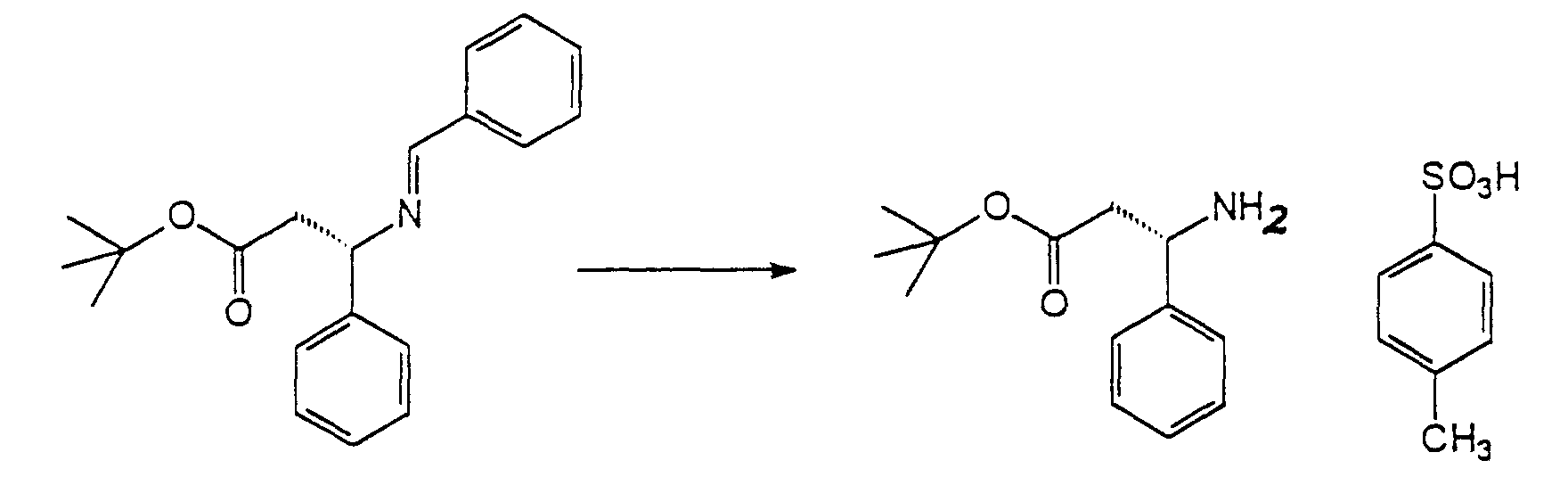
- The phenyl imine 3b of Example 13 was hydrolyzed in THF (50 mL) following the general procedure for the preparation of PTSA salt described in Example 10 with a solution of PTSA.H2O (10.72 g, 0.057 mole) in THF (15 mL). Heptane (100 mL) was added and the mixture heated to 35°C for 30 minutes followed by slow cooling to 0°C. Filtration and washes with THF 30%/heptane (100 mL) afforded the desired salt 4b (19.28 g, 49% overall yield from Example 12) as an ivory solid.
1H NMR (DMSO D6, TMS) δ (ppm) 1.26 (s, 9H), 2.29 (s, 3H), 2.81 (dd, 1H, J = 9.2, 15.6 Hz) 2.99 (dd, 1H, J = 5.8, 15.8 Hz), 4.55 (m, 1H), 7.11 (d, 2H, 7.8 Hz), 7.38 to 7.49 (m, 8H), 8.31 (s(broad), 3H); 13C NMR (DMSO D6, TMS) δ (ppm):20.77, 27.45, 51.20, 80.84, 125.48, 127.69, 128.18, 128.58, 128.88, 136.41, 138.06, 145.00, 168.05. DSC:107.62°C (endo 177.9 J/Kg), 161.73 (endo, 2.77 J/g), 174.49 (endo 9.54 J/g), 236.51 (endo 354.2 J/g) [α]D 25 = -2.5° (c = 0.91, CHCl3); IR (MIR) (cm-1) 1725.Microanalytical: calcd for C20H27NO5S C: 61.05; H: 6.92; N: 3.56; S: 8.15 found C: 60.13; H: 7.03; N: 3.53; S: 8.46. -

- Following the general procedure for the preparation of imine described in Example 7, compound 1c was prepared from S-phenyl glycinol (27.44 g, 0.2 mole), 3-pyridinecarboxaldehyde (21.96 g, 0.205 mole) in toluene (120 mL) with MgSO4 (8 g). The crude imine was slurried in heptane (100 mL), stirred for 2 hours and filtered to afford 42.25 g (93.3% yield) of the imine 1c as a white powder.
-

- Following the general procedure for the Reformatsky coupling described in Example 8, compound 2c was prepared from a solution of Reformatsky reagent of Example 2 (1.36 M in NMP/THF(3/2), 0.164 mole, 121 mL) and imine 1c from Example 15 (17.0 g, 0.075 mole) in NMP (20 m). Regular extraction yielded 17 g of a crude mixture. Additional extractions were performed. A saturated solution of ammonium chloride (50 mL) was added to the aqueous layer followed by MTBE extraction. This procedure was repeated. The MTBE layers were combined and washed as in the general procedure to yield an additional 10.35 g of a crude mixture. The crude mixtures were combined to afford 27.85 g (25.69 g, 100%) of an orange oil containing the compound 2c as a single diastereoisomer (as determined by 1H NMR and GC). The crude product was not purified and was used directly in the next step.
- A sample of crude product was purified by chromatography (SiO2, 50 g), elution heptane/EtOAc 60%) and recrystallized from MTBE/heptane (4/1) to afford the desired compound as a white solid. 1H NMR (CDCl3, TMS) δ (ppm) 1.38 (s, 9H), 2.60 (dd(AB), 1H, J = 5.7, 15.6 Hz), 2.71 (dd(AB), 1H, J = 8.1, 15.5 Hz), 3.60 (dd(AB), 1H, J = 6.8, 10.5 Hz), 3.72 to 3.80 (m, 2H), 4.20 (dd, 1H, J = 5.8, 8.1 Hz), 7.13 to 7.23 (m, 6H, (aromatic)), 7.62 (dt, 1H, J = 1.8, 8.0 Hz), 8.46 (dd, 1H, J = 1.6, 5.0 Hz), 8.54 (d, 1H, J = 1.9 Hz); 13C NMR (CDCl3, TMS) δ (ppm):26.72, 27.75, 27.84, 42.46, 55.59, 62.83, 66.10, 81.07, 123.58, 127.16, 127.25, 128.17, 136.11, 139.40, 140.66, 147.60, 148.32, 170.19; DSC: 8 5.75°C (endo. 133.4 J/g); [α]D 25 = +17.3° (c = 1.035, CHCl3); IR (MIR) (cm-1) 1718. UV max (nm) = 205 (abs = 0.48), 261 (abs = 0.096), 268 (abs = 0.073)
Microanalytical: calcd for C20H26N2O3 C: 70.15; H: 7.65; N: 8.18 Found C: 70.24; H: 7.79; N: 8.02. -
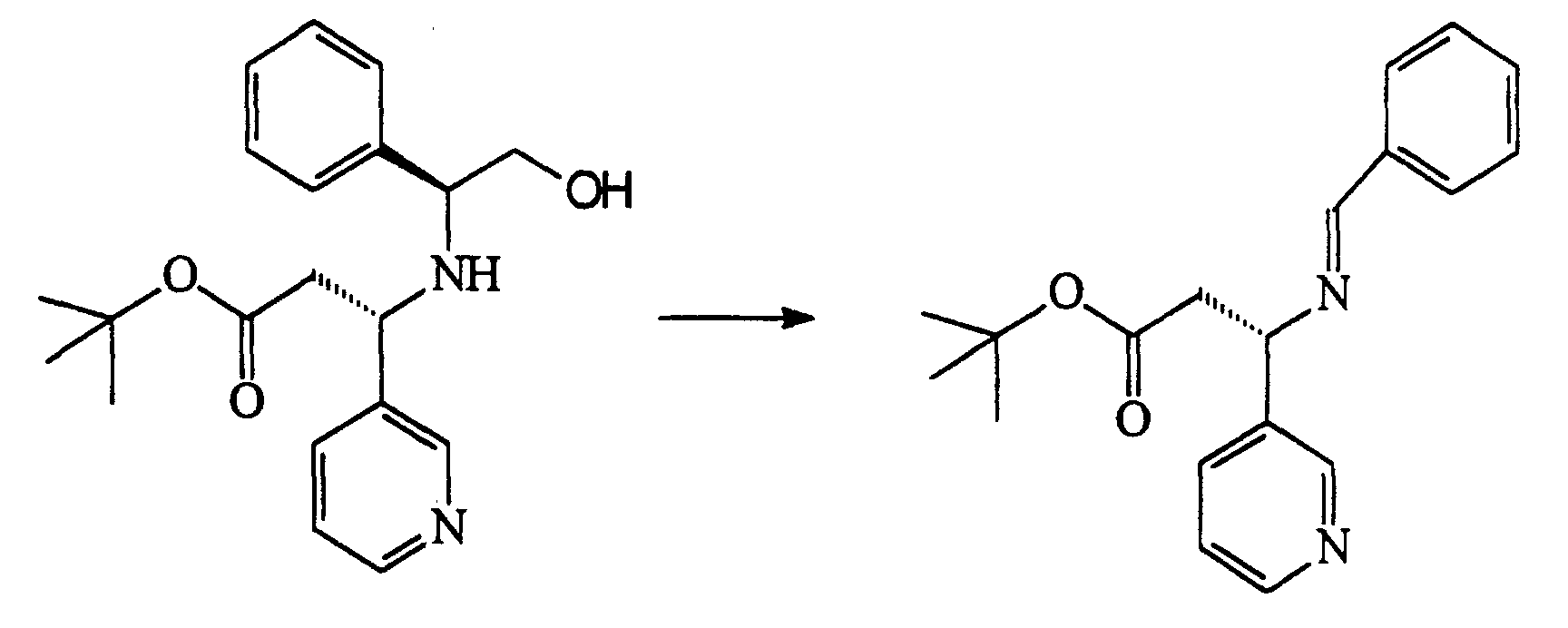
- Following the general procedure for the oxidative cleavage, described in Example 9, the imine 3c was prepared from NaIO4 (19.57 g, 0.091 mole), methyl amine (40 wt% in H2O, 5.56 mL, 0.77 mole), and amino alcohol 2c (27.37 g, 0.075 mole, crude) in ethanol (105 mL), H2O (65 mL) (17 hours). After work up and concentration, a crude product (19.8 g) was obtained containing the phenyl imine 3c .
-
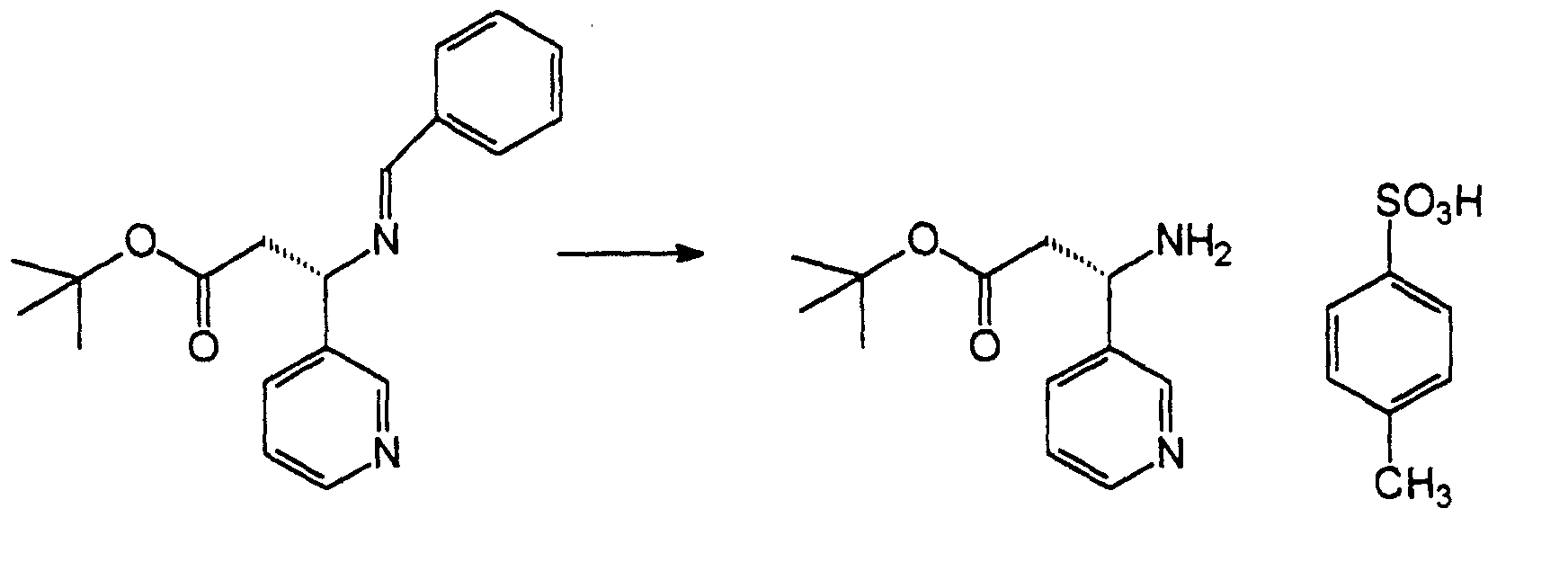
- The phenyl imine 3c was hydrolyzed in THF (50 mL) following the general procedure for the formation of PTSA salt described in Example 10 with a solution of PTSA:H2O (10.72 g, 0.057 mole) in THF (15 mL). Heptane (100 mL) was added and the mixture heated to 35°C for 30 minutes followed by slow cooling to 0°C. Filtration and wash with THF 30%/heptane (100 mL) afforded the desired salt 4c (19.28 g, 65% overall yield from Example 16) as an ivory solid.
1H NMR (CDCl3, TMS) δ (ppm) 1.24 (s, 9H), 2.35 (s, 3H), 2.90 (dd, 1H, (AB), J = 8.87, 16.6 Hz), 3.09 (dd, 1H (AB), J = 5.8, 16.6 Hz), 4.71 (dd, 1H, J = 6.0, 8.9 Hz), 7.09 (d, 2H, J = 7.9 Hz), 7.19 (dd, 1H, J = 4.9, 7.9 Hz), 7.57 (d, 2H, J = 8.1 Hz), 7.99 (dd, 1H, 1.7, 8.1 Hz), 8.46 (dd, 1H, J = 1.4, 5.0 Hz), 8.70 (d, 1H, 1.9 Hz); 13C NMR (CDCl3, TMS) δ (ppm): 21.30, 27.72, 38.99, 49.86, 81.95, 124.16, 125.84, 128.95, 132.52, 137.18, 140.46, 141.22, 148.28, 148.57, 168.34. DSC: 113.62°C (endo 68.41 J/Kg), 159.9 (endo, 62.88 J/g) [α]D 25 = -1.5 (c = 0.998, CHCl3); IR (MIR) (cm-1) 2116, 1721, 1540.Microanalytical: found for C19H26N2O5S C: 57.85; H: 6.64; N: 7.10; S: 8.13 calcd C: 57.15; H: 6.46; N: 6.44; S: 8.38. -

- Following the general procedure for the preparation of imine described in Example 7, compound 1e was prepared from L-phenylglycinol (10.00 g, 0.073 mole) and trimethylacetaldehyde (6.59 g, 0.076 mole) in toluene (50 mL) with MgSO4 as drying agent (2.7 g) to afford imine 1e (14.41 g) as a clear oil which was used in the following Example without further purification.
-

- A solution of the imine 1e in DMSO (30 mL) was added in 15 minutes to a solution of Reformatsky reagent from Example 2 (57.50 g, 0.173 mole) in DMSO (80 mL) while cooling to 8°C. After addition the mixture was held at 22°C and stirred for 22 hours. Reformatsky reagent from Example 2 (23.00 g, 0.069 mole) was then added as a solid. The mixture was stirred at 22°C for an additional 8 hours (89% conversion by GC). A saturated aqueous solution of NH4Cl (100 mL) was then added and the mixture extracted with MTBE (2 X 100 mL). The organic layers were combined, washed with a saturated solution of NH4Cl (100 mL), H2O (100 mL), brine (100 mL) and dried with Na2SO4.
Filtration and concentration afforded a crude mixture of yellow oil (17.57 g) containing the compound 2e which was used without purification in the following Example. A sample of product was purified by chromatography (SiO2, 300 g), elution heptane/EtOAc 40%) to afford the desired compound as a pale yellow oil. 1H NMR (CDCl3, TMS) δ (ppm) 0.83 (s, 9H), 1.46 (s, 9H), 2.24 (dd(AB), 1H, J = 5.4, 15.4 Hz), 2.51 (dd(AB), 1H, 5.3, 15.5 Hz), 2.67 (t, 1H, J = 5.4 Hz), 3.53 (dd(AB), 1H, J = 9.0, 10.8 Hz), 3.67 (dd, 1H, J = 4.3, 10.8 Hz), 3.85 (dd, J = 4.27, 8.8 Hz), 7.23 to 7.34 (m, 5H); 13C NMR (CDCl3, TMS)δ (ppm):26.68, 28.06, 35.04, 37.87, 60.80, 62.73, 67.33, 80.48, 127.42, 127.75, 128.35.Microanalytical: calcd for C19H31NO3 C: 70.99; H: 9.72; N: 4.36 Found C: 69.91; H: 9.98; N: 4.15. -
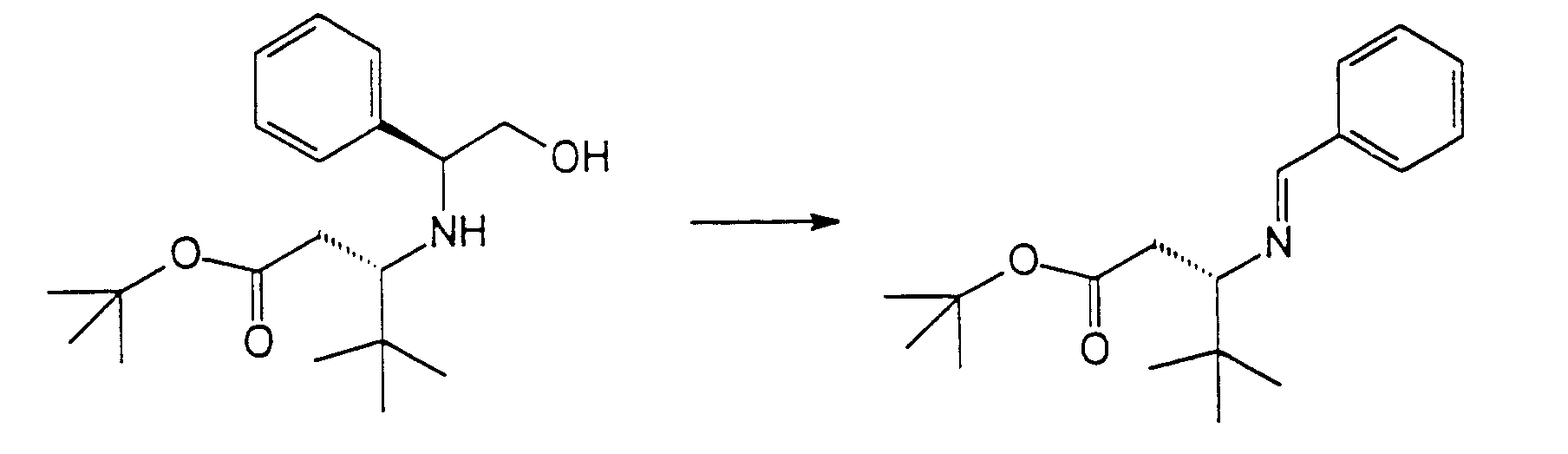
- The crude product containing compound 2e from Example 20 was diluted with MeOH (520 mL), cooled to 0°C and Pb(OAc)4 (23.40 g, 0.0536 mole) was added. The resulting orange solution was stirred for 1 hour at 0°C. A 15% aqueous solution of NaOH (100 mL) was added and the mixture was held at 22°C and concentrated under reduced pressure to remove MeOH. MTBE was added, the mixture filtered and the layers were separated. The organic layer was dried with NaSO4, filtered and concentrated to afford 14.30 g of a yellow oil containing 3e.
-
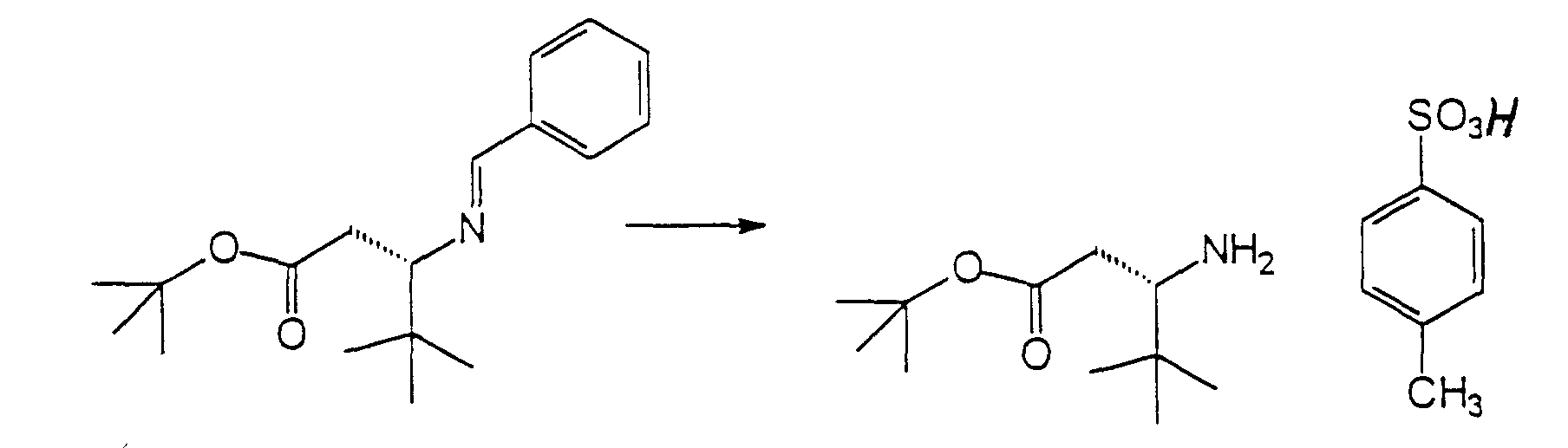
- The crude oil containing 3e from Example 21 was dissolved in MTBE (38 mL) and paratoluene sulfonic acid (8.24 g, 0.043 g) was added. After 15 minutes, heptane (150 mL) was added and the resultant slurry was filtered to afford 13.86 g of a white solid containing the salt with some impurities. The compound was purified by reslurrying in MTBE/heptane followed by filtration under nitrogen/vacuum (pressure filter) to yield 11.83 g of product 4e (43.4% overall yield from Example 19).
1H NMR (CDCl3, TMS) δ (ppm) 1.01 (s, 9H), 1.41 (s, 1H), 2.35 (s, 3H), 2.55 (dd, 1H, J = 4.0, 17.7 Hz), 2.66 (dd, 1H, J = 9.0, 17.6 Hz), 3.28 (m, 1H), 7.15 (d, 2H), 7.75 (d, 2H), 7.80 (s(broad), 3H); 13C NMR (DMSO D6, TMS) δ (ppm):21.28, 26.00, 27.92, 33.22, 33.83, 57.38, 82.12, 126.08, 128.70, 139.92, 141.98, 170.96 DSC: 117.11°C (endo 65.14 J/Kg), 147.84°C (endo 93.35 J/g) ; [α]D 25 = -24.7° (c = 0.777, CHCl3) ; IR (MIR) (cm-1) 1718.Microanalytical: calcd for C18H31NO5S C: 57.88; H: 8.37; N: 3.75; S: 8.58 Found C: 57.64; H: 8.46; N: 3.58; S: 8.80. -

- Following the general procedure for the preparation of imine described in Example 22, compound 1f was prepared from L-phenylglycinol (10.00 g, 0.073 mole) and isobutyraldehyde (6.59 g, 0.076 mole) in toluene (50 mL) with MgSO4 as drying agent (2.9 g) to afford 15.40 g of imine 1f as a yellow oil which was used without further purification in the following Example.
-
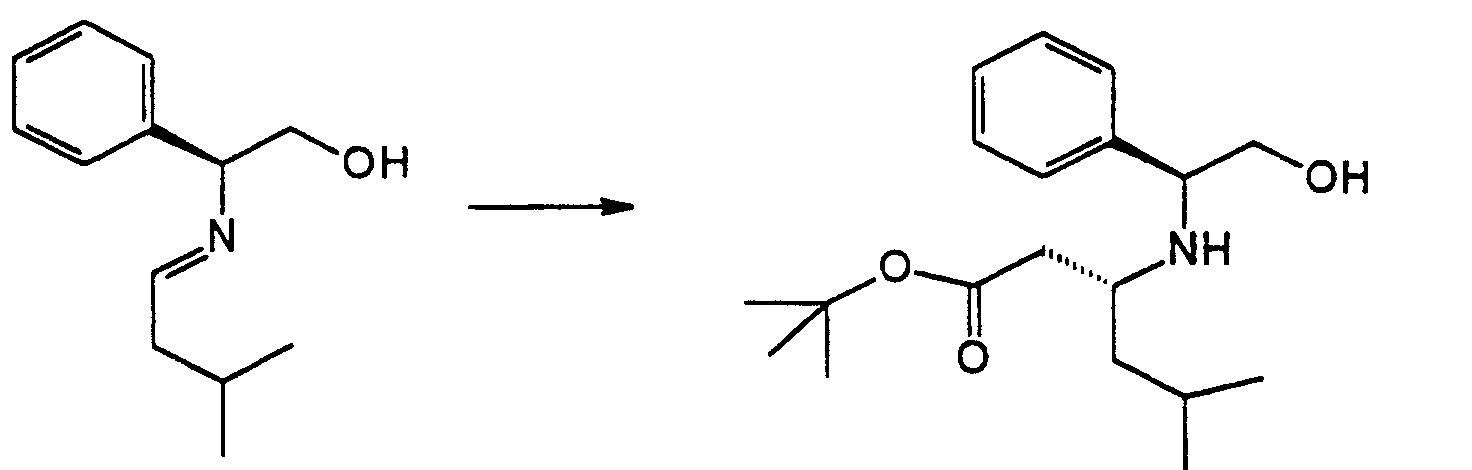
- A solution of the imine 1f produced in Example 23 in DMSO (30 mL) was added over 15 minutes to a solution of Reformatsky reagent from Example 2 (57.50 g, 0.173 mole) in DMSO (80 mL) while cooling to 8°C. The mixture was held at 22°C and stirred for 16 hours. Additional Reformatsky reagent from Example 2 (2.50 g, 0.008 mole) was then added as a solid and the mixture was stirred at 22°C for an additional 4 hours (92% conversion by GC). A saturated aqueous solution of NH4Cl (100 mL) was then added and the mixture extracted with MTBE (2X 100 mL). The organic layers were combined, washed with a saturated solution of NH4Cl (100 mL), H2O (100 mL), brine (100 mL) and dried with Na2SO4. Filtration and concentration afforded (20.1 g, 85.65% overall yield from Example 23) a yellow oil containing the compound 2f which was used without further purification. A sample of product was purified by chromatography (SiO2, 300 g), elution heptane/EtOAc 40%) to afford the desired compound 2f as a pale yellow oil. 1H NMR (CDCl3, TMS) δ (ppm) 0.68 (d, 3H, J = 6.5 Hz), 0.83 (2H, J = 6.6 Hz), 1.19 (m, 1H), 1.32 (m, 1H), 1.46 (s, 9H), 1.61 (s, 1H), 2.26 (dd(AB), 1H, J = 5.70, 14.62 Hz), 2.38 (dd(AB), 1H, J = 5.71, 14.57 Hz), 2.92 (m, 1H), 3.51 (dd(AB), 1H, J = 10.75, 8.54 Hz), 3.69 (dd(AB), 1H, J = 4.32, 10.72 Hz), 3.84 (dd, 1H, J = 8.49, 4.44 Hz), 7.23 to 7.35 (m, 5H); 13C NMR (CDCl3, TMS) δ (ppm):22.26, 22.94, 24.68, 28.13, 40.41, 44.95, 50.47, 61.77, 67.00, 80.55, 127.29, 127.49, 128.50, 141.51, 171.96. DSC: 171.62°C (endo. 36.3 J/g), 224.06°C (234.5 J/g), 281.65°C (endo 234.5 J/g); [α]D 25 = +49° (c = 1.005, CHCl3); IR (MIR) (cm-1) 3428, 3331, 1721.
Microanalytical: calcd for C19H31NO3 C: 70.99; H: 9.72; N: 4.36 Found C: 69.29; H: 9.75; N: 4.08. -
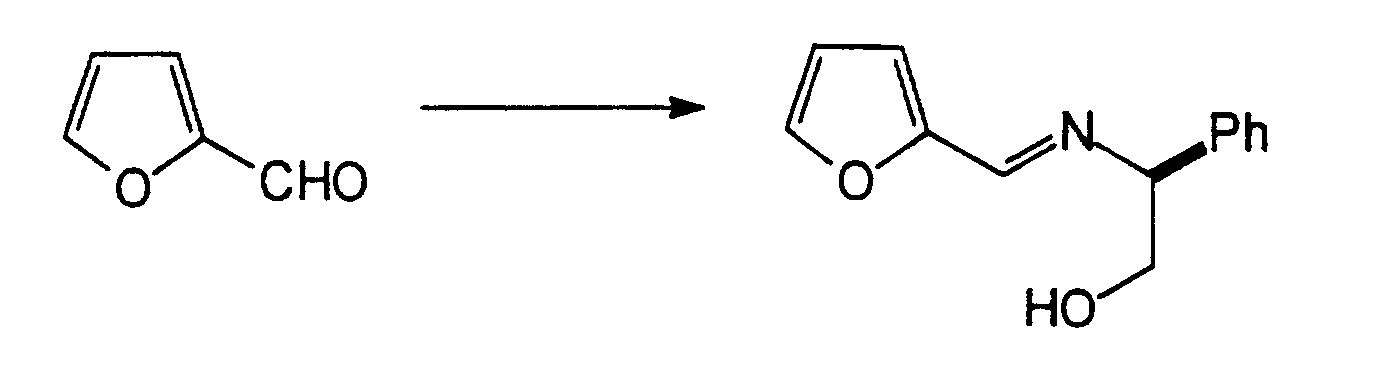
- Freshly distilled 2-furaldehyde (26.73 g; 0.278 moles) was dissolved in toluene (100 mL) under nitrogen in a 500 mL 3-neck flask with magnetic stirring. A thermocouple thermometer was put in place. L-phenylglycinol (38.16 g; 0.278 mole) was added. The mixture was stirred for 30 minutes with ice cooling. Magnesium sulfate (33.5 g; 0.278 moles) was added. After stirring a further 30 minutes the magnesium sulfate was removed by filtration. The solvent was removed by rotary evaporation. Heptane (100 mL) was added with stirring. The resulting yellow solid was dried under vacuum (54.72 g; 91.4%).
1H NMR (400 MHz, CDCl3) δ 8.17 (s, 1H), 7.54 (d, J = 1.75 Hz), 7.43-7.25 (m, 5H), 6.78 (dd, J = 3.4, 0.7 Hz, 1H), 6.48 (dd, J = 3.4, 1.8 Hz, 1H), 4.43 (dd, J = 8.6, 4.5 Hz, 1H), 4.03 (dd, J = 11.3, 8.6 Hz, 1H), 3.90 (dd, J = 11.3, 4.4 Hz, 1H). 13C NMR (CDCl3) δ 151.52, 151.16, 144.99, 140.42, 128.61, 127.51, 127.32, 114.91, 111.75, 77.19, 67.50 ppm. IR v 3257, 2956, 2920, 2885, 2858, 1649, 1486, 1473, 1448, 1415, 1393, 1367, 1280, 1152, 1077, 1054, 1023, 931, 883, 746, 701 cm-1. [α]589 = -99.7° (c 1.008, CHCl3).Analysis Calculated for C13H13NO2 C: 72.54; H: 6.09; N: 6.51 Found C: 72.57; H: 6.34; N: 6.51. -

- A solution of t-butyl(bromozinc)acetate from Example 2 in N-methylpyrrolidinone (43 mL of a 1.36 M solution; 58.07 mmol) was charged to a 250 mL 3-neck flask under nitrogen. Overhead mechanical stirring and a cooling bath with automated temperature control were put in place. The solution was cooled to -5°C. A solution of the imine from Example 25 (5.00 g; 23.23 mmol) in NMP (40 mL) was added via addition funnel. After stirring for 3.5 hours the mixture was quenched by addition of 2N hydrochloric acid (30 mL) and saturated aqueous ammonium chloride solution (60 mL). The mixture was extracted with MTBE (2 x 100 mL). The combined extracts were washed with ammonium chloride solution (50 mL), water (50 mL) and sodium chloride solution (50 mL). The solution was dried (Na2SO4) and the solvent was removed under vacuum. The crude product (yellow oil, 7.3 g) was purified by column chromatography on silica, eluting with heptane/MTBE (2:1) to yield the desired product (5.43 g; 70.5%).
1H NMR (400 MHz, CDCl3) δ (ppm): 7.29-7.19 (m, 6H), 6.21 (dd, J = 3.2, 1.8 Hz, 1H), 6.07 (d, J = 3.2 Hz, 1H), 4.25 (dd, J = 7.7, 6.2 Hz, 1H), 3.79-3.75 (m, 2H), 3.55 (dd, J = 12.0, 7.9 Hz, 1H), 2.71-2.65 (m, 2H), 1.44 (s, 9H). 13C NMR (CDCl3) δ (ppm): 170.96, 155.28, 141.62, 141.44, 128.43, 127.39, 127.08, 109.94, 106.29, 81.01, 66.09, 61.69, 51.41, 40.74, 28.03. IR v 3427, 2974, 2929, 2870, 1720, 1452, 1365, 1147 cm-1. [α]589 = 7.6° (c 0.983, CHCl3). -

- The aminoalcohol from Example 26 (4.88 g; 14.72 mmol) was dissolved in ethanol (30 mL) in a 100 mL 3-neck flask with magnetic stirring under nitrogen. Methylamine (1.30 mL of a 40% aqueous solution; 15.1 mmol) was added via syringe. A solution of sodium periodate (3.55 g; 16.6 mmol) in water (24 mL) at 30°C was added in portions. Ice cooling was employed to keep the reaction temperature below 30°C. The reaction mixture was stirred for 2 hours at 25°C then cooled to 0°C, The mixture was filtered through a glass frit washing with MTBE (100 mL). The filtrate was washed with water (50 mL) and sodium chloride solution (50 mL). The combined aqueous phases were extracted with MTBE (50 mL). The extract was washed with sodium chloride solution (30 mL). The combined organic phases were dried (Na2SO4) and the solvent was removed under vacuum to yield a crude orange oil (4.10 g). This was dissolved in THF (10 mL) and added to p-toluenesulfonic acid (2.35 g; 12.33 mmol) at 0°C with stirring. Heptane (25 mL) was added causing some material to oil out of solution. Further heptane (25 mL) was added and stirring continued until the material solidified. The material was broken up, collected by filtration, washed with heptane/THF (3:1, 20 mL) to yield a pale yellow solid (4.39 g; 78%).
1H NMR (400 MHz, CDCl3) δ (ppm): 8.23 (br, s, 3H), 7.67 (d, J = 8.1 Hz, 2H), 7.23-7.22 (m, 1H), 7.12 (d, J = 8.0 Hz, 2H), 6.40 (d, J = 3.4 Hz, 1H), 6.22 (dd, J = 3.3, 1.8 Hz, 1H), 4.72 (br, m, 1H), 2.96 (m, 2H), 2.35 (s, 3H), 1.32 (s, 9H). 13C NMR (CDCl3) δ (ppm): 168.80, 148.60, 142.89, 141.45, 140.24, 128.80, 126.03, 110.60, 109.47, 81.74, 45.67, 36.77, 27.83, 21.31.Analysis Calculated for C18H25NO6S.1/2H2O C: 55.09; H: 6.42; N: 3.57 Found C: 55.08; H: 6.69; N: 3.83.
Claims (19)
- A process for the preparation of a chiral β-amino acid of the formulawhich comprises treating 3-(trimethylsilyl)-2-propynal with L-phenylglycinol to produce αS-[[3-(trimethylsilyl)-2-propynylidene]amino]benzeneethanol; reacting αS-[[3-(trimethylsilyl)-2-propynylidene]amino]benzenethanol with BrZnCH2CO2t-Bu to produce 1,1-dimethylethyl 3S-[(2-hydroxy-1S-phenylethyl)amino]-5-(trimethylsilyl)-4-pentynoate; reacting 1,1-dimethylethyl 3S-[(2-hydroxy-1S-phenylethyl)amino]-5-(trimethylsilyl)-4-pentynoate with sodium periodate to form 1,1-dimethylethyl 3S-[(phenylmethylene)amino]-5-(trimethylsilyl)-4-pentynoate; hydrolyzing 1,1-dimethylethyl 3S-[(phenylmethylene)amino]-5-(trimethylsilyl)-4-pentynoate to produce 1,1-dimethylethyl 3S-amino-5-(trimethylsilyl)-4-pentynoate; transesterifying 1,1-dimethylethyl 3S-amino-5-(trimethylsilyl)-4-pentynoate and desilylating to produce ethyl 3S-amino-4-pentynoate.
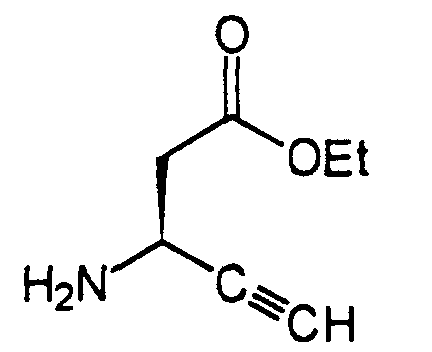
- The process according to claim 1 wherein the 3-(trimethylsilyl)-2-propynal is treated with L-phenylglycinol in toluene.
- The process according to claim 1 wherein the αS-[[3-(trimethylsilyl)-2-propynylidene]amino]benzenethanol is reacted with BrZnCH2CO2t-Bu in THF/NMP.
- The process according to claim 1 wherein the 1,1-dimethylethyl 3S-[(2-hydroxy-1-S-phenylethyl)amino]-5-(trimethylsilyl)-4-pentynoate is reacted with sodium periodate in the presence of methylamine in ethanol/water.
- The process according to claim 1 wherein 1,1-dimethylethyl 3S-[(phenylmethylene)amino]-5-(trimethylsilyl)-4-pentynoate is hydrolyzed in the presence of para-toluenesulfonic acid in MTBE, THF or toluene.
- A process for the preparation of an (R) β-amino acid of the formulawherein R is selected from the group consisting of alkynyl, alkenyl, C1-C6-alkyl, aryl, substituted aryl, pyridyl and furanyl; and R1 is t-butyl; comprising treating an aldehyde of the formula
 with (R) phenylglycinol in tetrahydrofuran or toluene to produce an imino alcohol of the formula
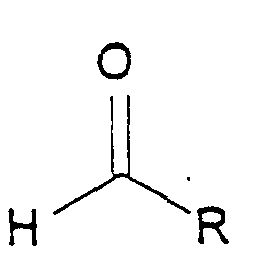 reacting said imino alcohol with BrZnCH2CO2-t-Bu in NMP, DMSO, THF or NMP/THF followed by addition of acidic ammonium chloride/HCl or basic ammonium hydroxide to give an amino alcohol of the formula
 reacting said amino alcohol with NaIO4 in the presence of methyl amine in ethanol/water or lead tetraacetate in methanol to form an imine of the formula
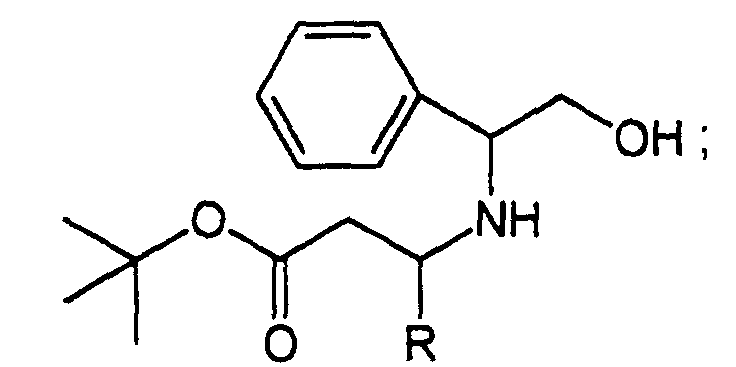 and hydrolyzing said imine in the presence of para-toluenesulfonic acid to produce an (R)-amino acid of the formula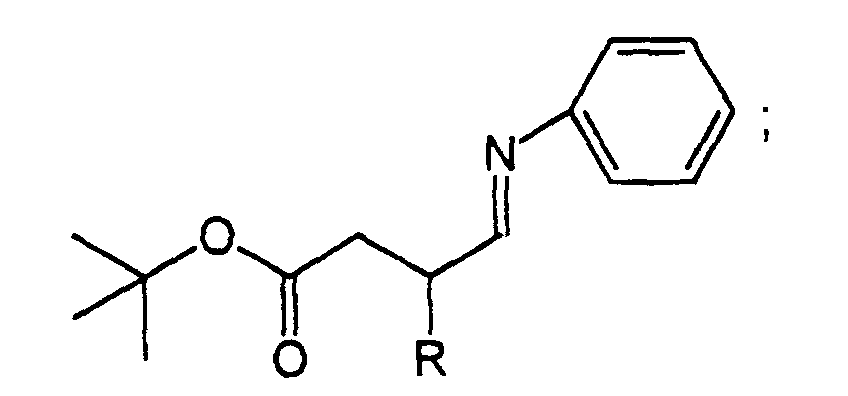

- The process according to Claim 6 wherein R is phenyl.
- The process according to Claim 6 wherein R is 3,5-dichlorophenyl.
- The process according to Claim 6 wherein R is 3-pyridinyl.
- The process according to Claim 6 wherein R is 2-furanyl.
- The process according to Claim 6 wherein R is t-butyl.
- The process according to Claim 6 wherein R is isopropyl.
- A process for the preparation of an (S) β-amino acid of the formulawherein R is selected from the group consisting of alkynyl, alkenyl, C1-C6-alkyl, aryl, substituted aryl, pyridyl and furanyl; and R1 is t-butyl; comprising treating an aldehyde of the formula
 with (S) phenylglycinol in tetrahydrofuran or toluene to produce an imino alcohol of the formula
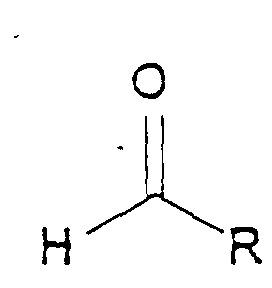 reacting said imino alcohol with BrZnCH2CO2-t-Bu in NMP, DMSO, THF or NMP/THF followed by addition of acidic ammonium chloride/HCl or basic ammonium hydroxide to give an amino alcohol of the formula
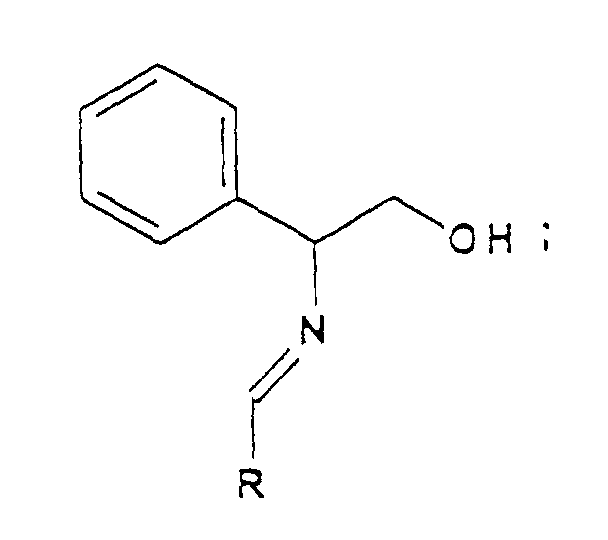 reacting said amino alcohol with NaIO4 in the presence of methyl amine in ethanol/water or lead tetraacetate in methanol to form an imine of the formula
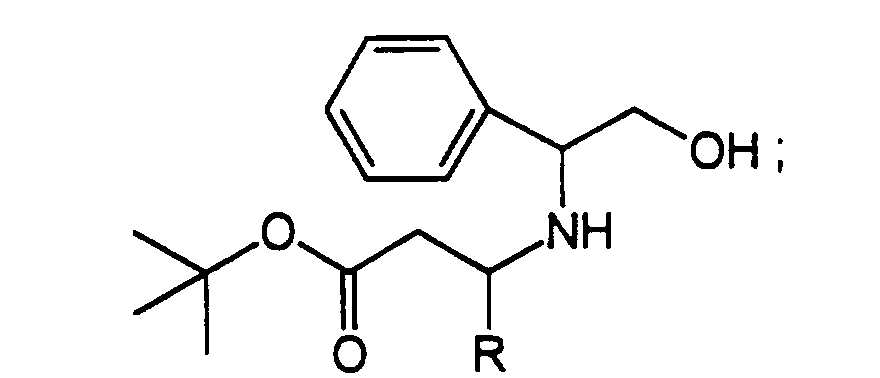 and hydrolyzing said imine in the presence of para-toluenesulfonic acid to produce an (S)-amino acid of the formula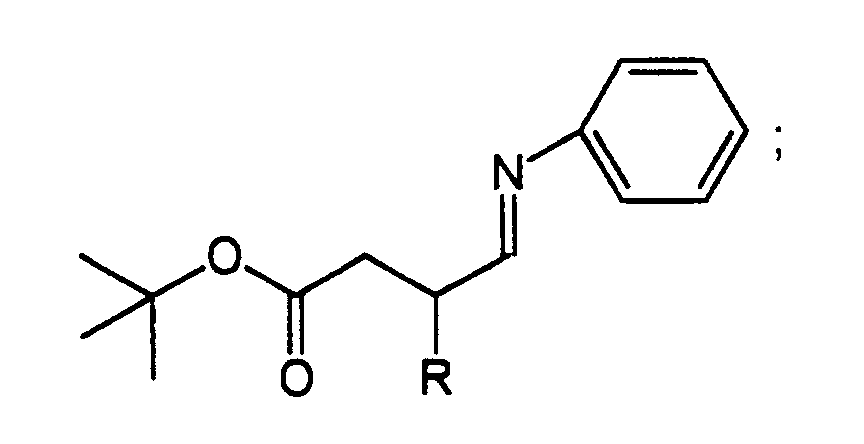

- The process according to Claim 13 wherein R is phenyl.
- The process according to Claim 13 wherein R is 3,5-dichlorophenyl.
- The process according to Claim 13 wherein R is 3-pyridinyl.
- The process according to Claim 13 wherein R is 2-furanyl.
- The process according to Claim 13 wherein R is t-butyl.
- The process according to Claim 13 wherein R is isopropyl.
Applications Claiming Priority (3)
| Application Number | Priority Date | Filing Date | Title |
|---|---|---|---|
| US2163196P | 1996-07-12 | 1996-07-12 | |
| US21631P | 1996-07-12 | ||
| PCT/US1997/011366 WO1998002410A1 (en) | 1996-07-12 | 1997-07-10 | Asymetric synthesis of chiral beta-amino acids |
Publications (2)
| Publication Number | Publication Date |
|---|---|
| EP0912495A1 EP0912495A1 (en) | 1999-05-06 |
| EP0912495B1 true EP0912495B1 (en) | 2001-11-21 |
Family
ID=21805290
Family Applications (1)
| Application Number | Title | Priority Date | Filing Date |
|---|---|---|---|
| EP97932388A Expired - Lifetime EP0912495B1 (en) | 1996-07-12 | 1997-07-10 | Asymetric synthesis of chiral beta-amino acids |
Country Status (14)
| Country | Link |
|---|---|
| US (1) | US5840961A (en) |
| EP (1) | EP0912495B1 (en) |
| JP (1) | JP2000514809A (en) |
| CN (1) | CN1119321C (en) |
| AT (1) | ATE209179T1 (en) |
| AU (1) | AU3586097A (en) |
| CA (1) | CA2258712C (en) |
| DE (1) | DE69709742T2 (en) |
| DK (1) | DK0912495T3 (en) |
| ES (1) | ES2167758T3 (en) |
| PT (1) | PT912495E (en) |
| TW (1) | TW404936B (en) |
| WO (1) | WO1998002410A1 (en) |
| ZA (1) | ZA976138B (en) |
Families Citing this family (17)
| Publication number | Priority date | Publication date | Assignee | Title |
|---|---|---|---|---|
| AU7359198A (en) * | 1997-05-01 | 1998-11-27 | G.D. Searle & Co. | Method and apparatus for preparation of chiral beta amino acids |
| ZA991105B (en) * | 1998-03-04 | 2000-02-11 | Searle & Co | Synthesis of chiral beta-amino acids. |
| CN1398189A (en) | 1998-12-23 | 2003-02-19 | G.D.西尔公司 | Combination therapy of radiation and COX-2 inhibitor for treatment of neoplasia |
| CA2367971A1 (en) | 1999-03-22 | 2000-09-28 | Ortho-Mcneil Pharmaceutical, Inc. | Synthesis of 3-amino-3-aryl propanoates |
| AU3906300A (en) * | 1999-03-22 | 2000-10-09 | Ortho-Mcneil Pharmaceutical, Inc. | Process of preparing 3s-3-amino-3-aryl propionic acid and derivatives thereof |
| MXPA01009615A (en) | 1999-03-22 | 2003-07-21 | Johnson & Johnson | Process for preparing [s-(r*,s*)] -beta -[[[1-[1-oxo-3- (4-piperidinyl) propyl] -3-piperidinyl] carbonyl] amino] -3- pyridinepropanoic acid and derivatives. |
| NL1013789C2 (en) * | 1999-12-08 | 2001-06-12 | Dsm Nv | New diastereomerically enriched phenylglycine amide derivatives useful in the preparation of enantiomerically enriched compounds such as alpha- and beta-amino acids and amines |
| EP1235786B1 (en) | 1999-12-08 | 2007-08-29 | DSM IP Assets B.V. | Method for the preparation of enantiomerically enriched compounds |
| US6586612B2 (en) * | 2001-11-16 | 2003-07-01 | Crompton Corporation | Process for the preparation of secondary and tertiary amino-functional silanes, iminoorganosilanes and/or imidoorganosilanes |
| EP1471056B1 (en) | 2002-01-10 | 2012-07-11 | Takeda Pharmaceutical Company Limited | Process for producing fused imidazole compound, reformatsky reagent in stable form, and process for producing the same |
| NI200300043A (en) * | 2002-03-28 | 2003-11-05 | Warner Lambert Co | AMINO ACIDS WITH AFFINITY FOR THE PROTEIN a2DELTA. |
| JP2007506729A (en) * | 2003-09-25 | 2007-03-22 | ワーナー−ランバート カンパニー リミテッド ライアビリティー カンパニー | Prodrugs of amino acids with affinity for α2δ protein |
| WO2006069798A1 (en) * | 2004-12-28 | 2006-07-06 | Dsm Ip Assets B.V. | Process for the preparation of chiral amines |
| FR2969604B1 (en) * | 2010-12-23 | 2013-01-18 | Diverchim | PROCESS FOR PREPARING CHIRAL AMINO ACIDS |
| US8716226B2 (en) | 2012-07-18 | 2014-05-06 | Saint Louis University | 3,5 phenyl-substituted beta amino acid derivatives as integrin antagonists |
| US9085606B2 (en) | 2012-07-18 | 2015-07-21 | Saint Louis University | Beta amino acid derivatives as integrin antagonists |
| AU2016381336A1 (en) | 2015-12-30 | 2018-06-28 | Saint Louis University | Meta-azacyclic amino benzoic acid derivatives as pan integrin antagonists |
Family Cites Families (2)
| Publication number | Priority date | Publication date | Assignee | Title |
|---|---|---|---|---|
| US5239113A (en) * | 1991-10-15 | 1993-08-24 | Monsanto Company | Substituted β-amino acid derivatives useful as platelet aggregation inhibitors and intermediates thereof |
| US5536869A (en) * | 1995-07-14 | 1996-07-16 | G. D. Searle & Co. | Process for the preparation of ethyl 3S-[4-[[4-(aminoiminomethyl)phenyl]amino]-1,4-dioxobutyl]amino]-4-pentynoate |
-
1997
- 1997-07-10 JP JP10506053A patent/JP2000514809A/en not_active Ceased
- 1997-07-10 US US08/890,907 patent/US5840961A/en not_active Expired - Lifetime
- 1997-07-10 AU AU35860/97A patent/AU3586097A/en not_active Abandoned
- 1997-07-10 EP EP97932388A patent/EP0912495B1/en not_active Expired - Lifetime
- 1997-07-10 DE DE69709742T patent/DE69709742T2/en not_active Expired - Fee Related
- 1997-07-10 DK DK97932388T patent/DK0912495T3/en active
- 1997-07-10 WO PCT/US1997/011366 patent/WO1998002410A1/en not_active Ceased
- 1997-07-10 AT AT97932388T patent/ATE209179T1/en not_active IP Right Cessation
- 1997-07-10 ES ES97932388T patent/ES2167758T3/en not_active Expired - Lifetime
- 1997-07-10 CA CA002258712A patent/CA2258712C/en not_active Expired - Fee Related
- 1997-07-10 CN CN97196251A patent/CN1119321C/en not_active Expired - Fee Related
- 1997-07-10 PT PT97932388T patent/PT912495E/en unknown
- 1997-07-10 ZA ZA976138A patent/ZA976138B/en unknown
- 1997-07-25 TW TW086109863A patent/TW404936B/en not_active IP Right Cessation
Also Published As
| Publication number | Publication date |
|---|---|
| AU3586097A (en) | 1998-02-09 |
| CA2258712C (en) | 2008-01-08 |
| EP0912495A1 (en) | 1999-05-06 |
| CA2258712A1 (en) | 1998-01-22 |
| ES2167758T3 (en) | 2002-05-16 |
| US5840961A (en) | 1998-11-24 |
| DE69709742D1 (en) | 2002-02-21 |
| WO1998002410A1 (en) | 1998-01-22 |
| PT912495E (en) | 2002-04-29 |
| CN1119321C (en) | 2003-08-27 |
| DE69709742T2 (en) | 2002-08-08 |
| ZA976138B (en) | 1998-07-10 |
| TW404936B (en) | 2000-09-11 |
| JP2000514809A (en) | 2000-11-07 |
| HK1019874A1 (en) | 2000-03-03 |
| CN1225084A (en) | 1999-08-04 |
| ATE209179T1 (en) | 2001-12-15 |
| DK0912495T3 (en) | 2002-05-21 |
Similar Documents
| Publication | Publication Date | Title |
|---|---|---|
| US5840961A (en) | Asymmetric synthesis of chiral beta-amiNo acids | |
| US8273790B2 (en) | Exo-selective synthesis of himbacine analogs | |
| JPH0262854A (en) | Production of substituted phenoxyethylamines | |
| US10975050B2 (en) | Process for preparing optically pure (R)-4-n-propyl-dihydrofuran-2(3H)-one | |
| US20260062381A1 (en) | Methods for synthesis of the tricyclic prostaglandin d2 metabolite methyl ester | |
| JP2006525294A (en) | Process for producing 4-hydroxyisoleucine and its derivatives | |
| JP3563643B2 (en) | Imidazoline compounds, intermediates thereof, and methods for producing them, and methods for producing azepine compounds and salts thereof | |
| EP1060159B1 (en) | Synthesis of chiral beta-amino acids | |
| WO2019170521A1 (en) | Synthesis of obeticholic acid and synthesis intermediate | |
| JPS6317077B2 (en) | ||
| Díaz et al. | Enantioselective synthesis of novel homochiral α-substituted (S)-isoserine derivatives. Incorporation of this amino acid in a highly conformationally constrained dipeptide surrogate | |
| JP5259045B2 (en) | Benzoprostacyclin intermediates and methods for their production | |
| EP0058071A2 (en) | Process and intermediates for preparing pirbuterol | |
| CN111662318B (en) | A kind of iloprost key intermediate and preparation method thereof | |
| Franco et al. | A. Dondoni | |
| KR20070095973A (en) | 5-Chloro-2,4-dihydroxypyridine | |
| CN119708036A (en) | Preparation method of fabatan | |
| CA2319424A1 (en) | Processes and intermediates useful to make antifolates | |
| US5350696A (en) | 2-acetyl-6-cyanopyridines and their use as intermediates in the synthesis of oligo-2,6-pyridines | |
| JPH11189580A (en) | Method for producing benzyl bromide derivative | |
| WO2001074764A1 (en) | Intermediates for vitamin d and processes for the preparation thereof | |
| JPH07233175A (en) | Asymmetric production of metal-substituted cyclopropylmethanol derivative. | |
| JPS632251B2 (en) | ||
| JPS62153271A (en) | Production of indole | |
| JPH0477752B2 (en) |
Legal Events
| Date | Code | Title | Description |
|---|---|---|---|
| PUAI | Public reference made under article 153(3) epc to a published international application that has entered the european phase |
Free format text: ORIGINAL CODE: 0009012 |
|
| 17P | Request for examination filed |
Effective date: 19981219 |
|
| AK | Designated contracting states |
Kind code of ref document: A1 Designated state(s): AT BE CH DE DK ES FI FR GB GR IE IT LI LU NL PT SE |
|
| 17Q | First examination report despatched |
Effective date: 19991229 |
|
| GRAG | Despatch of communication of intention to grant |
Free format text: ORIGINAL CODE: EPIDOS AGRA |
|
| GRAG | Despatch of communication of intention to grant |
Free format text: ORIGINAL CODE: EPIDOS AGRA |
|
| GRAH | Despatch of communication of intention to grant a patent |
Free format text: ORIGINAL CODE: EPIDOS IGRA |
|
| GRAH | Despatch of communication of intention to grant a patent |
Free format text: ORIGINAL CODE: EPIDOS IGRA |
|
| GRAA | (expected) grant |
Free format text: ORIGINAL CODE: 0009210 |
|
| AK | Designated contracting states |
Kind code of ref document: B1 Designated state(s): AT BE CH DE DK ES FI FR GB GR IE IT LI LU NL PT SE |
|
| PG25 | Lapsed in a contracting state [announced via postgrant information from national office to epo] |
Ref country code: GR Free format text: LAPSE BECAUSE OF FAILURE TO SUBMIT A TRANSLATION OF THE DESCRIPTION OR TO PAY THE FEE WITHIN THE PRESCRIBED TIME-LIMIT Effective date: 20011121 |
|
| REF | Corresponds to: |
Ref document number: 209179 Country of ref document: AT Date of ref document: 20011215 Kind code of ref document: T |
|
| REG | Reference to a national code |
Ref country code: CH Ref legal event code: NV Representative=s name: DIETLIN & CIE S.A. Ref country code: CH Ref legal event code: EP |
|
| REG | Reference to a national code |
Ref country code: IE Ref legal event code: FG4D |
|
| REG | Reference to a national code |
Ref country code: GB Ref legal event code: IF02 |
|
| REF | Corresponds to: |
Ref document number: 69709742 Country of ref document: DE Date of ref document: 20020221 |
|
| REG | Reference to a national code |
Ref country code: PT Ref legal event code: SC4A Free format text: AVAILABILITY OF NATIONAL TRANSLATION Effective date: 20020124 |
|
| ET | Fr: translation filed | ||
| REG | Reference to a national code |
Ref country code: ES Ref legal event code: FG2A Ref document number: 2167758 Country of ref document: ES Kind code of ref document: T3 |
|
| REG | Reference to a national code |
Ref country code: DK Ref legal event code: T3 |
|
| REG | Reference to a national code |
Ref country code: GR Ref legal event code: EP Ref document number: 20020400147 Country of ref document: GR |
|
| PLBE | No opposition filed within time limit |
Free format text: ORIGINAL CODE: 0009261 |
|
| STAA | Information on the status of an ep patent application or granted ep patent |
Free format text: STATUS: NO OPPOSITION FILED WITHIN TIME LIMIT |
|
| 26N | No opposition filed | ||
| PGFP | Annual fee paid to national office [announced via postgrant information from national office to epo] |
Ref country code: PT Payment date: 20080620 Year of fee payment: 12 |
|
| PGFP | Annual fee paid to national office [announced via postgrant information from national office to epo] |
Ref country code: LU Payment date: 20080804 Year of fee payment: 12 Ref country code: ES Payment date: 20080728 Year of fee payment: 12 Ref country code: DK Payment date: 20080729 Year of fee payment: 12 Ref country code: DE Payment date: 20080829 Year of fee payment: 12 Ref country code: CH Payment date: 20080730 Year of fee payment: 12 |
|
| PGFP | Annual fee paid to national office [announced via postgrant information from national office to epo] |
Ref country code: NL Payment date: 20080724 Year of fee payment: 12 Ref country code: IT Payment date: 20080725 Year of fee payment: 12 Ref country code: IE Payment date: 20080725 Year of fee payment: 12 Ref country code: FR Payment date: 20080729 Year of fee payment: 12 Ref country code: FI Payment date: 20080730 Year of fee payment: 12 Ref country code: AT Payment date: 20080619 Year of fee payment: 12 |
|
| PGFP | Annual fee paid to national office [announced via postgrant information from national office to epo] |
Ref country code: GB Payment date: 20080729 Year of fee payment: 12 |
|
| PGFP | Annual fee paid to national office [announced via postgrant information from national office to epo] |
Ref country code: SE Payment date: 20080729 Year of fee payment: 12 Ref country code: BE Payment date: 20080818 Year of fee payment: 12 |
|
| PGFP | Annual fee paid to national office [announced via postgrant information from national office to epo] |
Ref country code: GR Payment date: 20080729 Year of fee payment: 12 |
|
| REG | Reference to a national code |
Ref country code: PT Ref legal event code: MM4A Free format text: LAPSE DUE TO NON-PAYMENT OF FEES Effective date: 20100111 |
|
| BERE | Be: lapsed |
Owner name: G.D. *SEARLE & CO. Effective date: 20090731 |
|
| REG | Reference to a national code |
Ref country code: CH Ref legal event code: PL |
|
| REG | Reference to a national code |
Ref country code: DK Ref legal event code: EBP |
|
| EUG | Se: european patent has lapsed | ||
| GBPC | Gb: european patent ceased through non-payment of renewal fee |
Effective date: 20090710 |
|
| NLV4 | Nl: lapsed or anulled due to non-payment of the annual fee |
Effective date: 20100201 |
|
| REG | Reference to a national code |
Ref country code: FR Ref legal event code: ST Effective date: 20100331 |
|
| REG | Reference to a national code |
Ref country code: IE Ref legal event code: MM4A |
|
| PG25 | Lapsed in a contracting state [announced via postgrant information from national office to epo] |
Ref country code: PT Free format text: LAPSE BECAUSE OF NON-PAYMENT OF DUE FEES Effective date: 20100111 Ref country code: LI Free format text: LAPSE BECAUSE OF NON-PAYMENT OF DUE FEES Effective date: 20090731 Ref country code: FR Free format text: LAPSE BECAUSE OF NON-PAYMENT OF DUE FEES Effective date: 20090731 Ref country code: FI Free format text: LAPSE BECAUSE OF NON-PAYMENT OF DUE FEES Effective date: 20090710 Ref country code: CH Free format text: LAPSE BECAUSE OF NON-PAYMENT OF DUE FEES Effective date: 20090731 |
|
| PG25 | Lapsed in a contracting state [announced via postgrant information from national office to epo] |
Ref country code: GB Free format text: LAPSE BECAUSE OF NON-PAYMENT OF DUE FEES Effective date: 20090710 |
|
| PG25 | Lapsed in a contracting state [announced via postgrant information from national office to epo] |
Ref country code: DE Free format text: LAPSE BECAUSE OF NON-PAYMENT OF DUE FEES Effective date: 20100202 Ref country code: BE Free format text: LAPSE BECAUSE OF NON-PAYMENT OF DUE FEES Effective date: 20090731 Ref country code: AT Free format text: LAPSE BECAUSE OF NON-PAYMENT OF DUE FEES Effective date: 20090710 |
|
| PG25 | Lapsed in a contracting state [announced via postgrant information from national office to epo] |
Ref country code: IE Free format text: LAPSE BECAUSE OF NON-PAYMENT OF DUE FEES Effective date: 20090710 Ref country code: DK Free format text: LAPSE BECAUSE OF NON-PAYMENT OF DUE FEES Effective date: 20090731 |
|
| REG | Reference to a national code |
Ref country code: ES Ref legal event code: FD2A Effective date: 20090711 |
|
| PG25 | Lapsed in a contracting state [announced via postgrant information from national office to epo] |
Ref country code: ES Free format text: LAPSE BECAUSE OF NON-PAYMENT OF DUE FEES Effective date: 20090711 |
|
| PG25 | Lapsed in a contracting state [announced via postgrant information from national office to epo] |
Ref country code: IT Free format text: LAPSE BECAUSE OF NON-PAYMENT OF DUE FEES Effective date: 20090710 |
|
| PG25 | Lapsed in a contracting state [announced via postgrant information from national office to epo] |
Ref country code: LU Free format text: LAPSE BECAUSE OF NON-PAYMENT OF DUE FEES Effective date: 20090710 |
|
| PG25 | Lapsed in a contracting state [announced via postgrant information from national office to epo] |
Ref country code: SE Free format text: LAPSE BECAUSE OF NON-PAYMENT OF DUE FEES Effective date: 20090711 |
|
| PG25 | Lapsed in a contracting state [announced via postgrant information from national office to epo] |
Ref country code: NL Free format text: LAPSE BECAUSE OF NON-PAYMENT OF DUE FEES Effective date: 20100201 |