EP0912319B1 - Method of and device for use in forming blister pack packaging - Google Patents
Method of and device for use in forming blister pack packaging Download PDFInfo
- Publication number
- EP0912319B1 EP0912319B1 EP97931108A EP97931108A EP0912319B1 EP 0912319 B1 EP0912319 B1 EP 0912319B1 EP 97931108 A EP97931108 A EP 97931108A EP 97931108 A EP97931108 A EP 97931108A EP 0912319 B1 EP0912319 B1 EP 0912319B1
- Authority
- EP
- European Patent Office
- Prior art keywords
- die
- thermoplastic material
- dies
- female
- plastic
- Prior art date
- Legal status (The legal status is an assumption and is not a legal conclusion. Google has not performed a legal analysis and makes no representation as to the accuracy of the status listed.)
- Expired - Lifetime
Links
- 238000000034 method Methods 0.000 title claims abstract description 19
- 238000004806 packaging method and process Methods 0.000 title claims abstract description 11
- 239000012815 thermoplastic material Substances 0.000 claims abstract description 18
- 238000001816 cooling Methods 0.000 claims abstract description 15
- 238000003856 thermoforming Methods 0.000 claims abstract description 15
- 238000007666 vacuum forming Methods 0.000 claims description 5
- 239000012530 fluid Substances 0.000 claims description 4
- 239000012809 cooling fluid Substances 0.000 claims 1
- 229920003023 plastic Polymers 0.000 description 31
- 239000004033 plastic Substances 0.000 description 30
- 239000000463 material Substances 0.000 description 15
- 238000004519 manufacturing process Methods 0.000 description 4
- 239000002184 metal Substances 0.000 description 4
- LYCAIKOWRPUZTN-UHFFFAOYSA-N Ethylene glycol Chemical compound OCCO LYCAIKOWRPUZTN-UHFFFAOYSA-N 0.000 description 3
- XLYOFNOQVPJJNP-UHFFFAOYSA-N water Substances O XLYOFNOQVPJJNP-UHFFFAOYSA-N 0.000 description 3
- 238000010438 heat treatment Methods 0.000 description 2
- 239000002131 composite material Substances 0.000 description 1
- 239000004020 conductor Substances 0.000 description 1
- 230000001419 dependent effect Effects 0.000 description 1
- 239000011152 fibreglass Substances 0.000 description 1
- -1 for example Substances 0.000 description 1
- 150000002334 glycols Chemical class 0.000 description 1
- 238000007373 indentation Methods 0.000 description 1
- 239000011810 insulating material Substances 0.000 description 1
- 230000003287 optical effect Effects 0.000 description 1
- 230000002093 peripheral effect Effects 0.000 description 1
- 239000002985 plastic film Substances 0.000 description 1
- 239000004800 polyvinyl chloride Substances 0.000 description 1
- 238000003825 pressing Methods 0.000 description 1
- 238000005057 refrigeration Methods 0.000 description 1
Images


Classifications
-
- B—PERFORMING OPERATIONS; TRANSPORTING
- B29—WORKING OF PLASTICS; WORKING OF SUBSTANCES IN A PLASTIC STATE IN GENERAL
- B29C—SHAPING OR JOINING OF PLASTICS; SHAPING OF MATERIAL IN A PLASTIC STATE, NOT OTHERWISE PROVIDED FOR; AFTER-TREATMENT OF THE SHAPED PRODUCTS, e.g. REPAIRING
- B29C51/00—Shaping by thermoforming, i.e. shaping sheets or sheet like preforms after heating, e.g. shaping sheets in matched moulds or by deep-drawing; Apparatus therefor
- B29C51/26—Component parts, details or accessories; Auxiliary operations
- B29C51/42—Heating or cooling
- B29C51/426—Producing specific thermal regimes during thermoforming to obtain particular properties
-
- B—PERFORMING OPERATIONS; TRANSPORTING
- B29—WORKING OF PLASTICS; WORKING OF SUBSTANCES IN A PLASTIC STATE IN GENERAL
- B29C—SHAPING OR JOINING OF PLASTICS; SHAPING OF MATERIAL IN A PLASTIC STATE, NOT OTHERWISE PROVIDED FOR; AFTER-TREATMENT OF THE SHAPED PRODUCTS, e.g. REPAIRING
- B29C35/00—Heating, cooling or curing, e.g. crosslinking or vulcanising; Apparatus therefor
- B29C35/16—Cooling
-
- B—PERFORMING OPERATIONS; TRANSPORTING
- B29—WORKING OF PLASTICS; WORKING OF SUBSTANCES IN A PLASTIC STATE IN GENERAL
- B29C—SHAPING OR JOINING OF PLASTICS; SHAPING OF MATERIAL IN A PLASTIC STATE, NOT OTHERWISE PROVIDED FOR; AFTER-TREATMENT OF THE SHAPED PRODUCTS, e.g. REPAIRING
- B29C51/00—Shaping by thermoforming, i.e. shaping sheets or sheet like preforms after heating, e.g. shaping sheets in matched moulds or by deep-drawing; Apparatus therefor
- B29C51/08—Deep drawing or matched-mould forming, i.e. using mechanical means only
- B29C51/082—Deep drawing or matched-mould forming, i.e. using mechanical means only by shaping between complementary mould parts
-
- B—PERFORMING OPERATIONS; TRANSPORTING
- B29—WORKING OF PLASTICS; WORKING OF SUBSTANCES IN A PLASTIC STATE IN GENERAL
- B29L—INDEXING SCHEME ASSOCIATED WITH SUBCLASS B29C, RELATING TO PARTICULAR ARTICLES
- B29L2031/00—Other particular articles
- B29L2031/722—Decorative or ornamental articles
Definitions
- the present invention relates to methods of forming blister pack packaging according to the precharacterising part of claim 1 and to a device according to the precharacterising part of claim 6.
- a blister pack includes a flat backing sheet, generally of cardboard or plastic, and a plastic "bubble” or “blister”, generally of transparent plastic, the backing sheet and blister being joined to form a sealed cavity in which the article rests.
- the blister portion of the packaging may be formed by thermoforming a region of a planar plastic material to a desired shape, e.g., by placing the plastic material between a pair of male and female dies that are temperature controlled at a temperature sufficient to soften the plastic and pressing the male and female dies together to form an indentation or "blister" in the plastic.
- This process for forming the blister portion is generally effective, but tends to create distortion of the plastic which can be undesirable.
- this distortion it is often difficult or impossible to use a plastic material having a decorative graphic pre-printed on it, as the graphic will also be distorted.
- any desired graphics are typically applied in a separate processing step, e.g., by applying a decal and/or label to the thermoformed plastic.
- GB 1 416 818 discloses a method for forming a web of woven plastics material to a required shape, with minimal distortion of a pattern thereon, employing male and female molds. The plastics material is pressed between the molds and the web is formed by heat dissipated from the parts of the web and the mold which are directly heated.
- U.S. 4,420,454 discloses a method of making a plastic hollow article in which the peripheral portion of a flat thermoplastic material is clamped while a central portion of the thermoplastic material is compressed between first and second plungers in a die cavity while controlling the compressing forces and the temperature of the plungers, the die cavity and the thermoplastic material.
- GB 2 052 365 discloses a hollow body of thermoplastic material formed by clamping areas of a blank such that at least one zone is defined therein, and applying a pressure tool against the zone so as to stretch a portion of the blank and orient the material.
- JP 61172722 discloses a method of preventing shrinking and curling of a plastic sheet used in forming blister packaging. Only portions of the sheet at which pockets are to be formed are locally heated with a heating roller and then formed with a forming roller.
- the method of the invention allows a blister pack to be thermoformed using preprinted plastic material without undesirable deformation of the plastic material and thus the printing on the plastic.
- the method of the invention may also allow decals or labels to be applied to a printed or non-printed plastic material prior to thermoforming, without risk of damage to the decal or label during the thermoforming process.
- the method of the invention also provides excellent control over the wall thickness of the thermoformed blister.
- the above object is achieved by the method of forming blister pack packaging including providing a substantially planar thermoplastic material and placing the thermoplastic material between a pair of opposed male and female thermoforming dies, characterized by cooling a portion of at least one of the dies while the thermoplastic material is positioned between the dies wherein the cooled portion of the die is positioned to contact an area of the thermoplastic material in which it is desired to avoid distortion.
- cooling it is meant that the temperature of the die is reduced relative to its normal operating temperature; because the normal operating temperature of the die may be significantly higher than room temperature, due to friction, “cooling” is meant to include reducing the temperature of the die to a temperature higher than room temperature but lower than the temperature that the die would be at were it not cooled.
- Preferred embodiments include one or more of the following features.
- a portion of the male die is cooled and the female die is temperature controlled to maintain the female die at a sufficient temperature to allow the plastic material used to be thermoformed.
- the male die includes (a) a metal head that has a bore for the passage of water to cool the metal head, and (b) insulating sidewalls on each side of the metal head.
- the thermoplastic material is preheated prior to being placed between the dies.
- the female die is a vacuum forming die.
- the above object is attained by the device for use in forming blister pack packaging as defined in independent claim 6.
- Fig. 1 is schematic perspective view of a production line utilizing a method according to one embodiment of the invention.
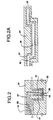
- Figs. 2 and 2a are cross-sectional views, taken along lines 2-2 and 2A-2A, respectively, of the thermoforming die used in the production line shown in Fig. 1.
- Fig. 3 is a cross-sectional view of a male die according to an alternate embodiment of the invention, taken along line 2-2 of Fig. 1.
- Fig. 4 is a cross-sectional view of a male die according to yet another alternate embodiment of the invention, taken along line 2A-2A in Fig. 1.
- the plastic is first preheated by any desired heating device 16, as is well known in the vacuum forming art.
- the preheating temperature will depend upon the plastic used, as would be understood by those skilled in the art, but will generally be from about 175°C to 230°C.
- the plastic is passed through a registration device 18, which may be any desired type of registration device, e.g., optical or mechanical, for registration of the spacing of the graphics 12.
- the plastic passes next to the vacuum forming station 20.
- the vacuum forming station 20 includes a heated female thermoforming cavity 22 and a chilled male thermoforming die 24.
- the female cavity 22 is preferably temperature controlled to maintain its temperature constant at about 20 to 80°C, depending upon the plastic used, as would be understood by one skilled in the art.
- the male die is chilled to a predetermined temperature, e.g., from about -10°C to 30°C, generally about 4°C to 25°C, to prevent distortion of the plastic during thermoforming.
- the temperature selected will depend upon the plastic used; for example, a suitable temperature for polyvinyl chloride (PVC) is 15°C. Suitable temperatures for other plastics could be readily determined by one skilled in the art by trial and error; a suitable temperature is one at which little or no distortion of a preprinted graphic is observed. It is preferred that the male die contact the plastic first, prior to the plastic contacting the female cavity, for optimum control of plastic distortion.
- PVC polyvinyl chloride
- only the tip portion 26 of the male die is chilled, so as not to interfere with thermoforming of the plastic by the sidewalls of the male die.
- different areas of the die may be chilled. However, in most cases at least a portion of the die should not be chilled, to ensure proper thermoforming.
- chilling of the tip portion of the male die may be accomplished by providing a male die as shown in Figs. 2 and 2a.
- Male die 24 includes a core 27 having a cooling channel 28 extending along its length, the cooling channel having an inlet 30 and an outlet 32 and being positioned adjacent the tip portion 26 of the die.
- Cooling channel 28 allows cold water or other chilled fluid to be channeled through the die continuously during the thermoforming process.
- Suitable channel diameters are those which are sufficiently small to fit within a desired width die, yet sufficiently large to provide a desired degree of cooling with the fluid used, as would be understood by one skilled in the art. In the embodiment shown, the diameter of the channel is preferably from about 3 to 4 mm.
- the core 27 is formed of metal or other highly thermally conductive material, for most effective cooling.
- the remainder of the male die (the sidewalls 31 of the die) is preferably constructed of a thermally insulative material, e.g., insulating laminates such as those commercially available from McMaster-Carr, Chicago, IL, under the tradenames GAROLITE and YOROLITE, or syntactic composites, e.g., those available from Emerson & Cuming, Canton, MA, under the tradename SYNTAC R 350.
- Preferred insulating materials have a thermal conductivity of from about 0.1 to 0.2 W/(m x K).
- Insulating layer 34 may be any desired insulative material, e.g., a fiberglass sheet material such as that available under the tradename YOROLITE, from McMaster-Carr.
- any desired cooling method can be used to cool a portion of the die, e.g., a refrigeration loop, as would be understood by one skilled in the art.
- other fluids can be used to cool the die, rather than water, e.g., glycols, for example, ethylene glycol, or compressed air.
- cooling channel 28 can run directly from the inlet to the outlet, without extending downward towards the tip of the die as shown in Fig. 2A.
- the die shown in Fig. 4 is more economical to manufacture, and thus may be advantageous if the die materials are selected to allow sufficient cooling of the tip to be obtained with this configuration of the cooling channel.
Landscapes
- Engineering & Computer Science (AREA)
- Mechanical Engineering (AREA)
- Moulds For Moulding Plastics Or The Like (AREA)
- Blow-Moulding Or Thermoforming Of Plastics Or The Like (AREA)
Abstract
Description
- The present invention relates to methods of forming blister pack packaging according to the precharacterising part of claim 1 and to a device according to the precharacterising part of claim 6.
- Articles to be displayed for retail sale are frequently packaged in "blister pack" packaging. A blister pack includes a flat backing sheet, generally of cardboard or plastic, and a plastic "bubble" or "blister", generally of transparent plastic, the backing sheet and blister being joined to form a sealed cavity in which the article rests.
- The blister portion of the packaging may be formed by thermoforming a region of a planar plastic material to a desired shape, e.g., by placing the plastic material between a pair of male and female dies that are temperature controlled at a temperature sufficient to soften the plastic and pressing the male and female dies together to form an indentation or "blister" in the plastic.
- This process for forming the blister portion is generally effective, but tends to create distortion of the plastic which can be undesirable. In particular, because of this distortion, it is often difficult or impossible to use a plastic material having a decorative graphic pre-printed on it, as the graphic will also be distorted. As a result, any desired graphics are typically applied in a separate processing step, e.g., by applying a decal and/or label to the thermoformed plastic.
- GB 1 416 818 discloses a method for forming a web of woven plastics material to a required shape, with minimal distortion of a pattern thereon, employing male and female molds. The plastics material is pressed between the molds and the web is formed by heat dissipated from the parts of the web and the mold which are directly heated.
- U.S. 4,420,454 discloses a method of making a plastic hollow article in which the peripheral portion of a flat thermoplastic material is clamped while a central portion of the thermoplastic material is compressed between first and second plungers in a die cavity while controlling the compressing forces and the temperature of the plungers, the die cavity and the thermoplastic material.
- GB 2 052 365 discloses a hollow body of thermoplastic material formed by clamping areas of a blank such that at least one zone is defined therein, and applying a pressure tool against the zone so as to stretch a portion of the blank and orient the material.
- JP 61172722 discloses a method of preventing shrinking and curling of a plastic sheet used in forming blister packaging. Only portions of the sheet at which pockets are to be formed are locally heated with a heating roller and then formed with a forming roller.
- It is an object of the invention to provide an improved method of forming blister pack packaging. Advantageously, the method of the invention allows a blister pack to be thermoformed using preprinted plastic material without undesirable deformation of the plastic material and thus the printing on the plastic. The method of the invention may also allow decals or labels to be applied to a printed or non-printed plastic material prior to thermoforming, without risk of damage to the decal or label during the thermoforming process. The method of the invention also provides excellent control over the wall thickness of the thermoformed blister.
- In a first aspect the above object is achieved by the method of forming blister pack packaging including providing a substantially planar thermoplastic material and placing the thermoplastic material between a pair of opposed male and female thermoforming dies, characterized by cooling a portion of at least one of the dies while the thermoplastic material is positioned between the dies wherein the cooled portion of the die is positioned to contact an area of the thermoplastic material in which it is desired to avoid distortion. By "cooling", it is meant that the temperature of the die is reduced relative to its normal operating temperature; because the normal operating temperature of the die may be significantly higher than room temperature, due to friction, "cooling" is meant to include reducing the temperature of the die to a temperature higher than room temperature but lower than the temperature that the die would be at were it not cooled.
- Particular embodiments of the invention are the subject of the dependent claims 2 to 5.
- Preferred embodiments include one or more of the following features. A portion of the male die is cooled and the female die is temperature controlled to maintain the female die at a sufficient temperature to allow the plastic material used to be thermoformed. The male die includes (a) a metal head that has a bore for the passage of water to cool the metal head, and (b) insulating sidewalls on each side of the metal head. The thermoplastic material is preheated prior to being placed between the dies. The female die is a vacuum forming die.
- In a second aspect the above object is attained by the device for use in forming blister pack packaging as defined in independent claim 6.
- Other features and advantages of the invention will be apparent from the description of preferred embodiments thereof, taken together with the drawings, and from the claims.
-
- Fig. 1 is schematic perspective view of a production line utilizing a method according to one embodiment of the invention.
- Figs. 2 and 2a are cross-sectional views, taken along lines 2-2 and 2A-2A, respectively, of the thermoforming die used in the production line shown in Fig. 1.
- Fig. 3 is a cross-sectional view of a male die according to an alternate embodiment of the invention, taken along line 2-2 of Fig. 1.
- Fig. 4 is a cross-sectional view of a male die according to yet another alternate embodiment of the invention, taken along line 2A-2A in Fig. 1.
- A preferred method according to the invention is shown in Fig. 1. According to this method, a planar
plastic material 10 having a plurality of graphics 12 (preprinted, labels or decals) spaced at intervals on its surface, is unrolled from aroll 14. The plastic is first preheated by any desiredheating device 16, as is well known in the vacuum forming art. The preheating temperature will depend upon the plastic used, as would be understood by those skilled in the art, but will generally be from about 175°C to 230°C. Next, the plastic is passed through aregistration device 18, which may be any desired type of registration device, e.g., optical or mechanical, for registration of the spacing of thegraphics 12. The plastic passes next to thevacuum forming station 20. - The
vacuum forming station 20 includes a heated femalethermoforming cavity 22 and a chilled male thermoformingdie 24. Thefemale cavity 22 is preferably temperature controlled to maintain its temperature constant at about 20 to 80°C, depending upon the plastic used, as would be understood by one skilled in the art. The male die is chilled to a predetermined temperature, e.g., from about -10°C to 30°C, generally about 4°C to 25°C, to prevent distortion of the plastic during thermoforming. The temperature selected will depend upon the plastic used; for example, a suitable temperature for polyvinyl chloride (PVC) is 15°C. Suitable temperatures for other plastics could be readily determined by one skilled in the art by trial and error; a suitable temperature is one at which little or no distortion of a preprinted graphic is observed. It is preferred that the male die contact the plastic first, prior to the plastic contacting the female cavity, for optimum control of plastic distortion. - Preferably, only the
tip portion 26 of the male die is chilled, so as not to interfere with thermoforming of the plastic by the sidewalls of the male die. Depending upon the location of thegraphic 12 on the blister, different areas of the die may be chilled. However, in most cases at least a portion of the die should not be chilled, to ensure proper thermoforming. - chilling of the tip portion of the male die may be accomplished by providing a male die as shown in Figs. 2 and 2a.
Male die 24 includes acore 27 having acooling channel 28 extending along its length, the cooling channel having aninlet 30 and anoutlet 32 and being positioned adjacent thetip portion 26 of the die.Cooling channel 28 allows cold water or other chilled fluid to be channeled through the die continuously during the thermoforming process. Suitable channel diameters are those which are sufficiently small to fit within a desired width die, yet sufficiently large to provide a desired degree of cooling with the fluid used, as would be understood by one skilled in the art. In the embodiment shown, the diameter of the channel is preferably from about 3 to 4 mm. - Preferably, the
core 27 is formed of metal or other highly thermally conductive material, for most effective cooling. The remainder of the male die (thesidewalls 31 of the die) is preferably constructed of a thermally insulative material, e.g., insulating laminates such as those commercially available from McMaster-Carr, Chicago, IL, under the tradenames GAROLITE and YOROLITE, or syntactic composites, e.g., those available from Emerson & Cuming, Canton, MA, under the tradename SYNTACR 350. Preferred insulating materials have a thermal conductivity of from about 0.1 to 0.2 W/(m x K). - If the side walls of the male die are too cold for a given application, an alternative die can be used, as shown in Fig. 3, in which a further
insulating layer 34 is provided between thecore 27 and thesidewalls 31.Insulating layer 34 may be any desired insulative material, e.g., a fiberglass sheet material such as that available under the tradename YOROLITE, from McMaster-Carr. - Other embodiments are within the claims. For example, any desired cooling method can be used to cool a portion of the die, e.g., a refrigeration loop, as would be understood by one skilled in the art. Moreover, other fluids can be used to cool the die, rather than water, e.g., glycols, for example, ethylene glycol, or compressed air.
- Further, as shown in Fig. 4,
cooling channel 28 can run directly from the inlet to the outlet, without extending downward towards the tip of the die as shown in Fig. 2A. The die shown in Fig. 4 is more economical to manufacture, and thus may be advantageous if the die materials are selected to allow sufficient cooling of the tip to be obtained with this configuration of the cooling channel.
Claims (6)
- A method of forming blister pack packaging including providing a substantially planar thermoplastic material (10), and placing a portion of the thermoplastic material (10) between a pair of opposed male (24) and female (22) thermoforming dies, characterized by cooling a portion of at least one of the dies (22,24) while said thermoplastic material (10) is positioned between said dies (22,24), wherein the cooled portion of the die is positioned to contact an area of the thermoplastic material (10) in which it is desired to avoid distortion.
- A method according to claim 1, characterized in that a portion of the male die (24) is cooled.
- A method according to claim 2, characterized in that said portion of the male die (24) is cooled to a temperature between -10° and 30°C.
- A method according to any of claims 1-3, characterized in that the thermoplastic material (10) is preheated prior to being placed between the dies (22,24).
- A method according to claim 1, characterized in that the female die (22) is a vacuum forming cavity.
- A device for use in forming blister pack packaging characterized by (a) a female thermoforming cavity (22), constructed to be maintained at a predetermined temperature sufficient to thermoform a thermoplastic material (10); and (b) a male die (24), in opposed spaced relation to said female thermoforming cavity (22), comprising a cooling channel (28) constructed for fluid flow of cooling fluid through the male die (24).
Applications Claiming Priority (3)
| Application Number | Priority Date | Filing Date | Title |
|---|---|---|---|
| US664353 | 1996-06-17 | ||
| US08/664,353 US5840243A (en) | 1996-06-17 | 1996-06-17 | Method of forming blister pack packaging |
| PCT/US1997/010094 WO1997048543A1 (en) | 1996-06-17 | 1997-06-09 | Method of forming blister pack packaging |
Publications (2)
| Publication Number | Publication Date |
|---|---|
| EP0912319A1 EP0912319A1 (en) | 1999-05-06 |
| EP0912319B1 true EP0912319B1 (en) | 2001-10-04 |
Family
ID=24665656
Family Applications (1)
| Application Number | Title | Priority Date | Filing Date |
|---|---|---|---|
| EP97931108A Expired - Lifetime EP0912319B1 (en) | 1996-06-17 | 1997-06-09 | Method of and device for use in forming blister pack packaging |
Country Status (8)
| Country | Link |
|---|---|
| US (3) | US5840243A (en) |
| EP (1) | EP0912319B1 (en) |
| JP (1) | JP2000512923A (en) |
| AU (1) | AU712778B2 (en) |
| BR (1) | BR9709803A (en) |
| CA (1) | CA2257179A1 (en) |
| DE (1) | DE69707131T2 (en) |
| WO (1) | WO1997048543A1 (en) |
Cited By (2)
| Publication number | Priority date | Publication date | Assignee | Title |
|---|---|---|---|---|
| US7156308B2 (en) | 2001-12-17 | 2007-01-02 | International Barcode Corporation | Double-sided bar code doubling as a single bar code |
| US7182259B2 (en) | 2001-10-26 | 2007-02-27 | International Barcode Corporation | Method and apparatus for applying bar code information to products during production |
Families Citing this family (15)
| Publication number | Priority date | Publication date | Assignee | Title |
|---|---|---|---|---|
| US6726611B2 (en) * | 1999-08-17 | 2004-04-27 | Display Pack, Inc. | Display package and method of manufacture |
| GB2373235A (en) * | 2001-03-16 | 2002-09-18 | Reckitt Benckiser | Composition packaged in film |
| US20050131733A1 (en) * | 2001-12-17 | 2005-06-16 | Allen Lubow | Sealable individual bar coded packets |
| US20030213555A1 (en) * | 2002-05-15 | 2003-11-20 | Emidio Bernardi | Method and device for heat sealing plastic blister packs |
| WO2003106143A1 (en) * | 2002-06-16 | 2003-12-24 | Westvaco Packaging Group, Inc. | Method of forming packaging using thermoforming inks |
| US20050284789A1 (en) * | 2004-06-29 | 2005-12-29 | Carespodi Dennis L | Laser-scored push-through blister backing and methods of making same |
| DE102004054219B4 (en) * | 2004-11-10 | 2008-03-06 | Uhlmann Pac-Systeme Gmbh & Co Kg | Apparatus for deep-drawing thermoformable film |
| DE102005041134B4 (en) * | 2005-08-30 | 2012-11-29 | Wipak Walsrode Gmbh & Co. Kg | Printed web-shaped multilayer packaging film for rapport-appropriate deep drawing and process for its production |
| US7537118B2 (en) * | 2006-02-21 | 2009-05-26 | Display Pack, Inc. | Display package and method of manufacture |
| DE102006050675A1 (en) * | 2006-10-24 | 2008-04-30 | Cfs Germany Gmbh | Packaging machine, has lower film heated with heating unit and adjacently drawn with upper die, and coolant e.g. nozzle, arranged at region of heating unit and/or at region of upper die, where coolant locally cools film |
| US9460948B2 (en) * | 2007-09-04 | 2016-10-04 | Ncr Corporation | Data management |
| US8616372B2 (en) | 2007-10-17 | 2013-12-31 | Quality Packaging, Inc. | Recyclable blister pack and process of making |
| CN105015848A (en) * | 2015-07-27 | 2015-11-04 | 芮成稳 | Full-automatic labeling and blister packaging machine |
| CN108454075A (en) * | 2018-04-25 | 2018-08-28 | 苏州云康机电有限公司 | Double-chamber Parallel Compression Blister Forming Machine |
| WO2024174864A1 (en) * | 2023-02-23 | 2024-08-29 | 星迈创新科技(苏州)有限公司 | Cleaning device |
Family Cites Families (32)
| Publication number | Priority date | Publication date | Assignee | Title |
|---|---|---|---|---|
| US2985915A (en) * | 1958-12-12 | 1961-05-30 | Hedwin Corp | Thermoforming process for thermoplastic sheeting |
| US3198681A (en) * | 1961-04-18 | 1965-08-03 | American Packaging Corp | Package |
| US3195284A (en) * | 1964-01-20 | 1965-07-20 | United Shoe Machinery Corp | Apparatus and method for forming and closing a display package |
| US3294301A (en) * | 1965-02-09 | 1966-12-27 | Standard Packaging Corp | Web registration system |
| US3400811A (en) * | 1965-09-03 | 1968-09-10 | Torrington Co | Display package |
| US3492773A (en) * | 1967-01-25 | 1970-02-03 | Anderson Bros Mfg Co | Method of vacuum packaging |
| US3496610A (en) * | 1967-12-18 | 1970-02-24 | Monsanto Co | Apparatus for foaming plastic articles of manufacture |
| DE1815983B1 (en) * | 1968-12-20 | 1970-09-03 | Demag Ag | Device for the automatic production of containers, container sub-parts or the like. |
| US3632252A (en) * | 1969-03-05 | 1972-01-04 | Owens Illinois Inc | Apparatus for forming articles |
| GB1416818A (en) * | 1973-01-18 | 1975-12-10 | Standard Telephones Cables Ltd | Arrangement for forming object from plastic fabric |
| US3929952A (en) * | 1973-03-07 | 1975-12-30 | Illinois Tool Works | Method for molding a plastic container |
| USRE29937E (en) * | 1974-02-15 | 1979-03-20 | Mahaffy & Harder Engineering Co. | Continuous movement packaging machine |
| US4033092A (en) * | 1974-08-01 | 1977-07-05 | Multivac Sepp Haggenmueller Kg | Vacuum packaging machine for the production of packages from packaging material webs |
| US4048781A (en) * | 1975-01-24 | 1977-09-20 | Portion Packaging Limited | Process for the production of a product filled container |
| US4192638A (en) * | 1976-05-17 | 1980-03-11 | Gerard Lezier | Molding device having heat transfer chambers insulated from each other for molding expandable thermoplastic resin particles |
| US4068448A (en) * | 1976-08-09 | 1978-01-17 | In-Pac Corporation | Small article packaging apparatus |
| SE7805165L (en) * | 1977-05-10 | 1978-11-11 | Gatrun Anstalt | PROCEDURE AND DEVICE FOR TREATMENT OF A PRODUCT IN A STERILE ENVIRONMENT |
| IT1112724B (en) * | 1979-04-24 | 1986-01-20 | Sitma Soc Italiana Macchine Au | DEVICE TO CONTROL THE POSITION OF THE FILM COMPARED TO THE PRODUCTS TO BE PACKED IN A PACKAGING MACHINE USING A PRINTED FILM |
| SE424285B (en) * | 1979-06-11 | 1982-07-12 | Plm Ab | ELEMENTS OF THERMOPLASTIC MATERIALS WITH AN EDGE PART AND ONE, IN RELATION TO THIS, SUBMITTED BODY AND PROCEDURE FOR MANUFACTURE OF SAID ELEMENTS |
| SE424420B (en) * | 1979-06-11 | 1982-07-19 | Plm Ab | MANUFACTURING OF ARTICLES BY DRAWING AND BLASHING |
| US4349999A (en) * | 1979-07-09 | 1982-09-21 | Mahaffy & Harder Engineering Co. | Packaging techniques for semi-rigid packages |
| US4500277A (en) * | 1982-03-02 | 1985-02-19 | W. R. Grace Australia Limited | Apparatus for thermoforming thermoplastic sheet materials |
| US4420454A (en) * | 1982-03-05 | 1983-12-13 | Toyo Seikan Kaisha, Limited | Method of making a plastic hollow article |
| FR2528386B1 (en) * | 1982-06-14 | 1986-04-11 | Erca Holding | PROCESS AND INSTALLATION FOR PACKAGING A PRODUCT |
| IT1169173B (en) * | 1983-02-23 | 1987-05-27 | Ima Spa | DEVICE FOR FLEXOGRAPHIC PRINTING ON A TAPE OF PACKING MATERIAL IN THE PACKAGING MACHINES, PARTICULARLY OF BLISTERS PACKS |
| JPS61172722A (en) * | 1985-01-25 | 1986-08-04 | Miyuuchiyuaru:Kk | Heat forming of thermoplastic sheet |
| US4842742A (en) * | 1986-08-25 | 1989-06-27 | Whirlpool Corporation | Method for forming large objects such as refrigerator liners from crystalline synthetic resins |
| FR2639321B1 (en) * | 1988-11-18 | 1991-02-22 | Torterotot Roland | METHOD AND DEVICE FOR STERILIZING A PACKAGING PLANT FOR FOOD OR PHARMACEUTICAL PRODUCTS |
| US5404693A (en) * | 1992-04-17 | 1995-04-11 | Sencorp Systems, Inc. | Method for making plastic blister packages |
| JP3483904B2 (en) * | 1992-10-21 | 2004-01-06 | 株式会社ジャストシステム | Information processing method and apparatus |
| US5545370A (en) * | 1994-04-11 | 1996-08-13 | Plastofilm Industries, Inc. | Process for producing thermoformed article employing selective cooling |
| US5633022A (en) * | 1995-06-08 | 1997-05-27 | Old Line Plastics, Inc. | Differential temperature vacuum-forming tool |
-
1996
- 1996-06-17 US US08/664,353 patent/US5840243A/en not_active Expired - Lifetime
-
1997
- 1997-06-09 JP JP10503111A patent/JP2000512923A/en active Pending
- 1997-06-09 CA CA002257179A patent/CA2257179A1/en not_active Abandoned
- 1997-06-09 WO PCT/US1997/010094 patent/WO1997048543A1/en not_active Ceased
- 1997-06-09 EP EP97931108A patent/EP0912319B1/en not_active Expired - Lifetime
- 1997-06-09 DE DE69707131T patent/DE69707131T2/en not_active Expired - Lifetime
- 1997-06-09 AU AU34826/97A patent/AU712778B2/en not_active Ceased
- 1997-06-09 BR BR9709803A patent/BR9709803A/en active Search and Examination
-
1998
- 1998-11-24 US US09/199,220 patent/US6234781B1/en not_active Expired - Lifetime
-
2001
- 2001-04-12 US US09/833,442 patent/US20010020594A1/en not_active Abandoned
Cited By (2)
| Publication number | Priority date | Publication date | Assignee | Title |
|---|---|---|---|---|
| US7182259B2 (en) | 2001-10-26 | 2007-02-27 | International Barcode Corporation | Method and apparatus for applying bar code information to products during production |
| US7156308B2 (en) | 2001-12-17 | 2007-01-02 | International Barcode Corporation | Double-sided bar code doubling as a single bar code |
Also Published As
| Publication number | Publication date |
|---|---|
| AU3482697A (en) | 1998-01-07 |
| CA2257179A1 (en) | 1997-12-24 |
| US6234781B1 (en) | 2001-05-22 |
| US5840243A (en) | 1998-11-24 |
| AU712778B2 (en) | 1999-11-18 |
| US20010020594A1 (en) | 2001-09-13 |
| WO1997048543A1 (en) | 1997-12-24 |
| EP0912319A1 (en) | 1999-05-06 |
| BR9709803A (en) | 1999-08-10 |
| DE69707131D1 (en) | 2001-11-08 |
| JP2000512923A (en) | 2000-10-03 |
| DE69707131T2 (en) | 2002-06-06 |
Similar Documents
| Publication | Publication Date | Title |
|---|---|---|
| AU712778B2 (en) | Method of forming blister pack packaging | |
| EP0782908A2 (en) | Foil-decorating injection molding machine and foil-decorating injection molding method | |
| CA2143507C (en) | Method of forming strip products from thermoplastic materials | |
| CA2365771A1 (en) | Method and apparatus for forming a metal sheet under elevated temperature and air pressure | |
| US20050143243A1 (en) | Method for preparing air channel-equipped film for use in vacuum package | |
| CA2148556A1 (en) | Methods of Making a Cushiony Decorative Tile or Cover Product from Extruded Hot Recycled Polyvinyl Chloride Material with Discrete Fibres Randomly Dispersed Therein as the Material Exits the Extruder, and the Products So Formed | |
| KR920009539A (en) | Method of use for improving the surface of products manufactured by low heat inertia mold and blow molding or heating | |
| KR100556127B1 (en) | Air embossing | |
| US5290490A (en) | Method and apparatus for differentially heating and thermoforming a polymer sheet | |
| KR100643266B1 (en) | Vinyl board embossing molding device and molding method | |
| JPH0852761A (en) | Molding simultaneous painting method | |
| CN102376195A (en) | In-mold label and manufacturing method | |
| JP4270624B2 (en) | Blow molding method for resin hollow molding products | |
| US20020139255A1 (en) | Apparatus and method of heat embossing thin, low density polethylene films | |
| JP2001159497A (en) | Insulation | |
| EP1798025A1 (en) | Method of embossing a packaging film and apparatus therefor | |
| EP1008436A3 (en) | Method and apparatus for manufacturing articles from thermoplastic material | |
| EP1059156A3 (en) | Equipment for moulding thermoplastic articles | |
| JPS61172722A (en) | Heat forming of thermoplastic sheet | |
| MXPA98010834A (en) | Method to form an ampol packaging | |
| CN1222112A (en) | Method for making bubble pack | |
| CN211683441U (en) | Moulding material production device | |
| CA2091777A1 (en) | Process for producing multilayer molded article | |
| JPH0523580B2 (en) | ||
| JPH0753397B2 (en) | Insert mold |
Legal Events
| Date | Code | Title | Description |
|---|---|---|---|
| PUAI | Public reference made under article 153(3) epc to a published international application that has entered the european phase |
Free format text: ORIGINAL CODE: 0009012 |
|
| 17P | Request for examination filed |
Effective date: 19990112 |
|
| AK | Designated contracting states |
Kind code of ref document: A1 Designated state(s): BE DE FR GB IT |
|
| 17Q | First examination report despatched |
Effective date: 19990823 |
|
| GRAG | Despatch of communication of intention to grant |
Free format text: ORIGINAL CODE: EPIDOS AGRA |
|
| RTI1 | Title (correction) |
Free format text: METHOD OF AND DEVICE FOR USE IN FORMING BLISTER PACK PACKAGING |
|
| GRAG | Despatch of communication of intention to grant |
Free format text: ORIGINAL CODE: EPIDOS AGRA |
|
| GRAH | Despatch of communication of intention to grant a patent |
Free format text: ORIGINAL CODE: EPIDOS IGRA |
|
| RAP1 | Party data changed (applicant data changed or rights of an application transferred) |
Owner name: GILLETTE CANADA COMPANY |
|
| GRAH | Despatch of communication of intention to grant a patent |
Free format text: ORIGINAL CODE: EPIDOS IGRA |
|
| GRAA | (expected) grant |
Free format text: ORIGINAL CODE: 0009210 |
|
| AK | Designated contracting states |
Kind code of ref document: B1 Designated state(s): BE DE FR GB IT |
|
| REF | Corresponds to: |
Ref document number: 69707131 Country of ref document: DE Date of ref document: 20011108 |
|
| REG | Reference to a national code |
Ref country code: GB Ref legal event code: IF02 |
|
| ET | Fr: translation filed | ||
| PLBE | No opposition filed within time limit |
Free format text: ORIGINAL CODE: 0009261 |
|
| STAA | Information on the status of an ep patent application or granted ep patent |
Free format text: STATUS: NO OPPOSITION FILED WITHIN TIME LIMIT |
|
| 26N | No opposition filed | ||
| PGFP | Annual fee paid to national office [announced via postgrant information from national office to epo] |
Ref country code: IT Payment date: 20080628 Year of fee payment: 12 |
|
| PGFP | Annual fee paid to national office [announced via postgrant information from national office to epo] |
Ref country code: GB Payment date: 20080506 Year of fee payment: 12 |
|
| GBPC | Gb: european patent ceased through non-payment of renewal fee |
Effective date: 20090609 |
|
| REG | Reference to a national code |
Ref country code: FR Ref legal event code: ST Effective date: 20100226 |
|
| PG25 | Lapsed in a contracting state [announced via postgrant information from national office to epo] |
Ref country code: FR Free format text: LAPSE BECAUSE OF NON-PAYMENT OF DUE FEES Effective date: 20090630 |
|
| PGFP | Annual fee paid to national office [announced via postgrant information from national office to epo] |
Ref country code: FR Payment date: 20080424 Year of fee payment: 12 |
|
| PG25 | Lapsed in a contracting state [announced via postgrant information from national office to epo] |
Ref country code: GB Free format text: LAPSE BECAUSE OF NON-PAYMENT OF DUE FEES Effective date: 20090609 |
|
| PG25 | Lapsed in a contracting state [announced via postgrant information from national office to epo] |
Ref country code: IT Free format text: LAPSE BECAUSE OF NON-PAYMENT OF DUE FEES Effective date: 20090609 |
|
| PGFP | Annual fee paid to national office [announced via postgrant information from national office to epo] |
Ref country code: BE Payment date: 20160614 Year of fee payment: 20 |
|
| PGFP | Annual fee paid to national office [announced via postgrant information from national office to epo] |
Ref country code: DE Payment date: 20160629 Year of fee payment: 20 |
|
| REG | Reference to a national code |
Ref country code: DE Ref legal event code: R071 Ref document number: 69707131 Country of ref document: DE |