EP0909074B1 - Verfahren und vorrichtung für computernetzfirewall mit mehrfachbereichsunterstützung - Google Patents
Verfahren und vorrichtung für computernetzfirewall mit mehrfachbereichsunterstützung Download PDFInfo
- Publication number
- EP0909074B1 EP0909074B1 EP98306998.0A EP98306998A EP0909074B1 EP 0909074 B1 EP0909074 B1 EP 0909074B1 EP 98306998 A EP98306998 A EP 98306998A EP 0909074 B1 EP0909074 B1 EP 0909074B1
- Authority
- EP
- European Patent Office
- Prior art keywords
- packet
- domain
- firewall
- security policies
- destination
- Prior art date
- Legal status (The legal status is an assumption and is not a legal conclusion. Google has not performed a legal analysis and makes no representation as to the accuracy of the status listed.)
- Expired - Lifetime
Links
- 238000000034 method Methods 0.000 title claims description 46
- 108020001568 subdomains Proteins 0.000 claims description 3
- 238000012545 processing Methods 0.000 description 36
- 230000009471 action Effects 0.000 description 26
- 230000008569 process Effects 0.000 description 22
- 238000001914 filtration Methods 0.000 description 6
- 230000005540 biological transmission Effects 0.000 description 4
- 230000009977 dual effect Effects 0.000 description 4
- 230000006870 function Effects 0.000 description 4
- 238000012550 audit Methods 0.000 description 3
- 230000008859 change Effects 0.000 description 3
- 238000013507 mapping Methods 0.000 description 3
- 241000700605 Viruses Species 0.000 description 1
- 230000015572 biosynthetic process Effects 0.000 description 1
- 230000001419 dependent effect Effects 0.000 description 1
- 238000003780 insertion Methods 0.000 description 1
- 230000037431 insertion Effects 0.000 description 1
- 230000002265 prevention Effects 0.000 description 1
- 230000004044 response Effects 0.000 description 1
- 238000012546 transfer Methods 0.000 description 1
- 238000013519 translation Methods 0.000 description 1
- 230000005641 tunneling Effects 0.000 description 1
Images





Classifications
-
- H—ELECTRICITY
- H04—ELECTRIC COMMUNICATION TECHNIQUE
- H04L—TRANSMISSION OF DIGITAL INFORMATION, e.g. TELEGRAPHIC COMMUNICATION
- H04L63/00—Network architectures or network communication protocols for network security
- H04L63/02—Network architectures or network communication protocols for network security for separating internal from external traffic, e.g. firewalls
- H04L63/0227—Filtering policies
- H04L63/0254—Stateful filtering
-
- H—ELECTRICITY
- H04—ELECTRIC COMMUNICATION TECHNIQUE
- H04L—TRANSMISSION OF DIGITAL INFORMATION, e.g. TELEGRAPHIC COMMUNICATION
- H04L63/00—Network architectures or network communication protocols for network security
- H04L63/02—Network architectures or network communication protocols for network security for separating internal from external traffic, e.g. firewalls
- H04L63/0227—Filtering policies
- H04L63/0263—Rule management
-
- H—ELECTRICITY
- H04—ELECTRIC COMMUNICATION TECHNIQUE
- H04L—TRANSMISSION OF DIGITAL INFORMATION, e.g. TELEGRAPHIC COMMUNICATION
- H04L9/00—Cryptographic mechanisms or cryptographic arrangements for secret or secure communications; Network security protocols
- H04L9/40—Network security protocols
Definitions
- This invention relates to the prevention of unauthorized access in computer networks and, more particularly, to firewall protection within computer networks.
- information is conventionally transmitted in the form of packets.
- Information present at one site may be accessed by or transmitted to another site at the command of the former or the latter.
- packet filtering effected at a network processor component known as a firewall
- packets are inspected and filtered, i.e., passed on or dropped depending on whether they conform to a set of predefined access rules.
- these rule sets are represented in tabular form.
- firewall administrator allows broad access which is consented to from one side of the firewall to the other, but blocks transmissions in the opposite direction which are not part of an active network session.
- "inside" company employees may have unrestricted access through the firewall to an "outside” network such as the Internet, but access from the Internet is blocked unless it has been specifically authorized.
- firewalls can be interposed between network domains, and can also be used within a domain to protect sub-domains. In each case, different security policies may be involved.
- Proxy processes have been developed to run concurrently on the firewall processor on behalf of the user. Proxy processes have also been developed for other special-purpose applications, e.g., to perform services such as authentication, mail handling, and virus scanning.
- Application document EP0743777 A2 describes a system for validating data packets, where a plurality of network domains can be protected.
- a computer network firewall is able to support (a) multiple security policies, (b) multiple users, or (c) multiple security policies as well as multiple users, by applying any one of several distinct sets of access rules for a given packet.
- the particular rule set that is applied for any packet can be determined based on information such as the incoming and outgoing network interfaces as well as the network source and destination addresses.
- a computer network firewall can be configured to utilize "stateful" packet filtering which improves performance by storing the results of rule processing applied to one or more packets.
- Stateful packet filtering may be implemented by caching rule processing results for one or more packets, and then utilizing the cached results to bypass rule processing for subsequent similar packets.
- the results of applying a rule set to a particular packet of a network session may be cached, such that when a subsequent packet from the same network session arrives in the firewall, the cached results from the previous packet are used for the subsequent packet. This avoids the need to apply the rule set to each incoming packet.
- a computer network firewall authorizes or prevents certain network sessions using a dependency mask which can be set based on session data items such as source host address, destination host address, and type of service.
- the dependency mask can be used to query a cache of active sessions being processed by the firewall, to thereby identify the number of sessions that satisfy the query.
- the query may be associated with an access rule, such that the selection of that particular rule is dependent on the number of successful matches to the query.
- a computer network firewall may make use of dynamic rules which are added to a set of access rules for processing packets.
- the dynamic rules allow a given rule set to be modified based on events happening in the network without requiring that the entire rule set be reloaded.
- Exemplary dynamic rules include a "one-time" rule which is only used for a single session, a time-limited rule which is used only for a specified time period, and a threshold rule which is used only when certain conditions are satisfied.
- Other types of dynamic rules include rules which define a host group, such that the host group can be modified to add or drop different hosts without altering other aspects of the access rule set.
- a computer network firewall can be instructed to redirect a network session to a separate server for processing, so as to unburden the firewall of application proxies.
- the separate server processes the redirected network session, and then passes the session back through the firewall to the intended original destination.
- the computer network firewalls of the present invention facilitate firewall processing in a wide variety of important applications.
- the invention may be implemented in a dial-up access gateway.
- Another exemplary embodiment of the invention may be implemented in a distributed manner with a first portion of the firewall resident in the network and a second portion of the firewall resident in a set-top box, computer or other user terminal in a home or business.
- the latter embodiment can allow the firewall techniques of the invention to provide, for example, parental control of Internet and video access in the home.
- the preferred techniques can be implemented at a firewall for controlling the flow of data between, for example, separate local area networks (LANs) or subnets of a LAN.
- LANs local area networks
- Exemplary embodiments of the invention are described herein in terms of processes. Efficient prototypes of such processes have been implemented as computer system software, using the "C" programming language for implementation on general-purpose PC hardware. Efficiency can be enhanced further, as is known, by special-purpose firmware or hardware computer system implementations.
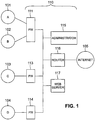
- a single firewall can support multiple users, each with a separate security policy. Also, as different security policies can apply for communications between sub-sites, such a capability can be used within a site. Respective configurations are illustrated by Figs. 1 and 2 .
- Fig. 1 shows four user sites 101-104, e.g., of corporations A through D, with firewall protection in their connections to the Internet 105.
- a firewall facility here in the form of a LAN 110, including firewall processors 111, 113 and 114, an administrator processor 115, a router 116 and a web server 117.
- Each of firewall processors 113 and 114 is dedicated to a single site, namely respective sites 103 and 104.
- Firewall processor 111 is configured to serve the two sites 101 and 102.
- Firewall processor 111 implements separate firewall policies for each of the two sites vis-a-vis the Internet 105, as well as for communications between the two sites. A process for preferred operation of the firewall processor 111 is described below with reference to Figs. 5A and 5B , including properly selecting among different firewall policies.
- Fig. 2 shows a user site 201 connected to the Internet 105 via a firewall processor 211.
- An administrator processor 215 and a router 216 are connected to the firewall processor 211.
- the router 216 is connected to additional firewall processors 212 and 213 which are internal to the user site 201.
- the firewall processor 212 protects a single sub-site 223, such as Human Resources (HR).
- the firewall processor 213 is configured for protecting two sub-sites, such as Payroll (P) and Disbursements (D), vis-a-vis the remainder of the site 201 as well as with respect to communications between sub-sites 221 and 222. This can be achieved by employing the process illustrated by Figs. 5A and 5B in the firewall processor 213.
- the security policies can be represented by sets of access rules which are represented in tabular form and which are loaded into the firewall by a firewall administrator. As illustrated in Fig. 3 , such a table can provide for categories including rule number, designations of source and destination hosts, a designation of a special service which can be called for in a packet, and a specification of an action to be taken on a packet. Special services can include proxy services, network address translation, and encryption, for example.
- the categories "Source Host,” “Destination Host” and “Service” impose conditions which must be satisfied by data included in a packet for the specified action to be taken on that packet. Other conditions can be included, and such conditions need not relate to data included in the packet. For example, application of a rule can be made conditional on the time of day or day of the week.
- rule processing for a packet, the rules are applied sequentially until a rule is found which is satisfied by the packet (or until the rule table is exhausted, in which case the packet is dropped). For a packet to satisfy a rule, each condition included in the rule must be met. For example, with reference to Fig. 3 , a packet from source host A to destination host D and representing mail will be dropped under Rule 20.
- the first five category names correspond to the categories shown in Fig. 3 . Category Name Description Rule Number Number of rule within domain.
- Rule numbers do not have to be unique but should generally represent a single service, such as FTP Source Host Source host group identifier or IP address Destination Host Destination host group identifier or IP address Service Service group or protocol/destination port/source port Action
- Rule action e.g., "pass,” “drop” or “proxy” Notify on Drop If "yes,” an Internet Control Message Protocol (ICMP) message is sent out if action is "drop” Cache Timeout Number of seconds of inactivity before session entry is removed from cache Reset Session If "yes,” for TCP sessions, send TCP reset to both ends of connection upon cache timeout Rule Timeout Number of seconds of inactivity before rule is removed from rule list Start Period Start active period for rule End Period End active period for rule Kill Session at End of Period If "yes” then any sessions authorized by this rule will be killed at the end of the time period Dependency Mask Dependency mask name In Interface Interface name to match on reception Out Interface Interface name to which packet is sent Audit Session Audit record generation.
- ICMP Internet Control
- Alarm Code Alarm code value used to tie rule to particular alarms
- Source Host Map Type Type of mapping to be performed e.g., "pool” or “direct” Destination Host Map IP address or host group containing map-to host IP addresses
- Group Destination Host Map Type Type of mapping to be performed e.g., "pool” or “direct” Service Map Group Service group containing map-to destination port numbers or the destination port. Protocol and source port in a referenced service group are ignored.
- Service Map Type Type of mapping to be performed e.g., "pool” or “direct” Max Use Total Count Maximum number of times this rule may be used. The rule is removed after the limit is reached. Max Use Concurrent Count Maximum number of sessions authorized by this rule which may be active at a given time. The rule is inactive until the count falls below the designated value. Copy to Address Address of application to which a copy of packet is sent. Used for session captures. Tunnel Destination Set up a tunnel and send it to this destination address and protocol. A new IP header will be added to the packet. Tunnel Requirements Indicates when tunneling is required. If “null” then no check is required. If “in” then incoming session must have been tunneled. If “out” then initiate action to tunnel packet.
- IPSEC Requirements Indicates when IP Security (IPSEC) processing is required. If “null” then no check is required. If “in” then incoming session must have been protected using IPSEC. If “out” then initiate action to add IPSEC protection. If “both” then do both. Sequence Number Randomize Option to randomize TCP sequence numbers. Default is “no.” Syn Storm Protection Provide protection from “syn storm” attacks. Default is “no.” Authorize Return Channel If "yes,” initial packet will create forward and reverse channels in cache with same action. Default is “yes.”
- a computer network firewall in accordance with the invention can be configured to utilize "stateful" packet filtering which improves performance by storing in a cache the results of rule processing as applied to one or more packets.
- Stateful packet filtering may be implemented by caching rule processing results for received packets, and then utilizing the cached results to bypass rule processing for subsequent similar packets.
- the results of applying a rule set to a packet of a given network session may be cached, such that when a subsequent packet from the same network session arrives in the firewall, the cached results from the previous packet are used for the subsequent packet. This avoids the need to apply the rule set to each incoming packet, and thereby provides substantial performance advantages over conventional firewalls.
- the cache can include a "session key," hardware address information, interface information, the number of the applicable rule, an alarm code, statistical information, and an applicable action.
- the session key includes at least one header item which was appended to the data to be transmitted in the packet, and in an exemplary embodiment includes (i) the Internet protocol (IP) source address, (ii) the IP destination address, (iii) the next-level protocol, e.g., transmission control protocol (TCP) or universal datagram protocol (UDP), (iv) the source port associated with the protocol, and (v) the destination port associated with the protocol.
- IP Internet protocol
- TCP transmission control protocol
- UDP universal datagram protocol
- items (i) and (ii) are shown individually. Items (iii) to (v) are represented by "telnet” or "mail” for short.
- a decision module or engine determines which security policy to use for a new network session.
- Each new session must be approved by the security policies of the source domain and the destination domain(s). For connections going to the Internet, it is likely that only a single domain check is performed.
- the DSE makes the domain selection based on the incoming or outgoing network interface, as well as on the source or destination network address of each packet. Inclusion, in packets, of source or destination addresses allows for multiple users to be supported by a single network interface.
- the incoming or outgoing network interface may be in the form of a network interface card (NIC), e.g., an Intel EtherExpress Pro 100B card available from Intel Corporation.
- NIC network interface card
- Figs. 5A and 5B illustrate over-all flow for packet processing by a firewall which supports multiple domains. Such processing includes determining the domains which the packet is to cross, examining the applicable rules to ascertain whether the packet may pass, and determining whether any special processing is required.
- each domain is associated with one or more network interfaces. Interfaces that support more than one domain are separated using an IP address range to distinguish the packets. The following steps are included:
- a domain table For convenient linking of each network interface to a domain, a domain table is used. In cases where an interface is shared by multiple domains, an address range is included. This is illustrated by Fig. 6 which shows non-overlapping address ranges.
- Fig. 7 illustrates domain table processing as performed in steps 503 and 506 described above, including the following steps:
- a rule can include a condition or mask that allows a connection back to a user, but only if there is a proper forward connection concurrently active, i.e., a connection in which the source and destination addresses are interchanged. As a result, there is no need for a separate or proxy application on the firewall.
- a dependency mask in accordance with the invention can define a query directed to the session cache.
- a match is determined by matching all fields defined in the mask with the corresponding fields in the cache. Empty fields within the mask are not used for comparison.
- a dependency mask may be defined in a rule for the first packet of a network session, using (a) information in the packet, (b) the source interface for that packet and (c) one or several dependency conditions that must be met for the packet to pass.
- a corresponding entry is made in the cache.
- Fig. 8 shows rules with a dependency mask ("hit count") in a format similar to that of Fig. 3 .
- Special symbols are included for certain host designations, namely (i) a "dot” symbol (.) calling for inclusion of packet data of the corresponding category, and (ii) a caret symbol ( ⁇ ) calling for inclusion of packet data from a certain different category instead.
- "Hit count” indicates the number of matches which must be found in the cache for the specified action to be taken. For example, in the dependency mask named "realaudio,” a count of 1 is used for passing UDP packets provided one requisite TCP session is active. In the dependency mask "telnet,” a count of 10 is used to drop packets to prevent overloading of resources.
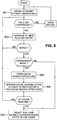
- Fig. 9 illustrates dependency mask processing including the following steps:
- Rule processing including the above-described dependency mask processing, is performed only on the first packet of a network session. All other packets bypass the rule search functions because their action has been saved in the session cache after processing of the first packet.
- Dynamic rules are rules which are included with the access rules as a need arises, for processing along with the access rules, e.g., by a rule processing engine. Dynamic rules can include unique, current information such as, for example, specific source and destination port numbers. They can be loaded at any time by trusted parties, e.g., a trusted application, remote proxy or firewall administrator, to authorize specific network sessions. A dynamic rule can be set for single-session use, or its use can be limited as to time. Once a dynamic rule has served its function, it can be removed from the rule set. The dynamic rules allow a given rule set to be modified based on events happening in the network without requiring that the entire rule set be reloaded.
- Exemplary dynamic rules include a "one-time" rule which is only used for a single session, a time-limited rule which is used only for a specified time period, and a threshold rule which is used only when certain conditions are satisfied.
- Another type of dynamic rule includes rules which define a host group, such that the host group can be modified to add or drop different hosts without altering other aspects of the access rule set.
- Other dynamic rules may be used to facilitate rule setup in certain specific types of processing applications. For example, an FTP proxy application could use a dynamic rule to authorize establishment of an FTP data channel in response to a data request. The dynamic rule in this example would typically not be loaded until a data request is made over the FTP control session, and could be limited to one use and made active for only a limited time period. The rule set therefore need not include a separate data channel rule for use with all requests. As a result, the rule specification and rule processing are simplified, and security is improved.
- Proxy reflection in accordance with the present invention involves redirecting a network session to another, "remote" proxy server for processing, and then later passing it back via the firewall to the intended destination.
- a decision is made to determine whether service by a proxy server is required. If so, the firewall replaces the destination address in the packet with the host address of the proxy application and, if necessary, it can also change the service port.
- the proxy application receives the session, it will request from the firewall the original destination address of the session for determining whether the connection to the destination is authorized. If the proxy then makes the connection to that destination as itself, using its own IP address, the service provided by the firewall will be called “single reflection" or "one-way reflection.”
- connection should appear at the destination to be coming from the original source rather than the remote system. This applies, e.g., to services which check the source IP address to ensure that it matches the user who signed up for the requested service.
- This capability is provided by "dual reflection" (or “two-way reflection"), with the source address of the outgoing connection changed back from the remote proxy to the original user's source address. This change is effected at the firewall, as each packet is received from the proxy and sent to the destination.
- the proxy application requests from the firewall the details of the original, incoming network session.
- the firewall returns a port number to use on the outgoing connection. This port number is unique and will allow the firewall to identify the proper outgoing connection so that it can map the source address to the proper user source address. As a result, the proxy application is invisible to both parties.
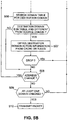
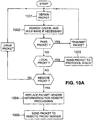
- dynamic rules can be used as described below for an illustrative embodiment, with reference to Figs. 10A and 10B .
- Fig. 10A illustrates proxy reflection processing including the following steps at the firewall:
- the invention can be implemented in a wide variety of applications.
- the invention may be used to provide improved firewall performance in a dial-up access gateway.
- Another exemplary embodiment of the invention may be implemented in a distributed manner with a first portion of the firewall resident in the network and a second portion of the firewall resident in a set-top box, computer or other user terminal in a home or business.
- the latter embodiment can allow the firewall techniques of the invention to provide, for example, parental control of Internet and video access in the home.
Landscapes
- Engineering & Computer Science (AREA)
- Computer Security & Cryptography (AREA)
- Computer Networks & Wireless Communication (AREA)
- Signal Processing (AREA)
- Computer Hardware Design (AREA)
- Computing Systems (AREA)
- General Engineering & Computer Science (AREA)
- Business, Economics & Management (AREA)
- General Business, Economics & Management (AREA)
- Computer And Data Communications (AREA)
- Data Exchanges In Wide-Area Networks (AREA)
Claims (22)
- Verfahren für das Validieren eines Pakets in einem Computernetzwerk, GEKENNZEICHNET DURCH:das Bestimmen (503, 506) mindestens einer mit dem Paket assoziierten Domain, wobei die mindestens eine Domain mindestens entweder eine Quelldomain des Pakets oder eine Zieldomain des Pakets umfasst;das Auswählen (504, 507) mindestens einer aus einer Vielzahl von Sicherheitsrichtlinien in Funktion der bestimmten, mindestens einen Domain; unddas Verwenden (504, 508-510) der mindestens einen aus der Vielzahl von Sicherheitsrichtlinien zum Validieren des Pakets.
- Das Verfahren nach Anspruch 1, wobei eine Sicherheitsrichtlinie mehrere Regeln umfasst und wobei der Schritt des Verwendens das Validieren des Pakets unter Verwendung mindestens eines Teils der mehreren Regeln der ausgewählten, mindestens einen Sicherheitsrichtlinie aus der Vielzahl von Sicherheitsrichtlinien umfasst.
- Das Verfahren nach Anspruch 1, wobei mindestens ein Teilsatz der Sicherheitsrichtlinien verschiedenen Domains entspricht, die mit einer einzigen Firewall assoziiert sind.
- Das Verfahren nach Anspruch 1, wobei mindestens ein Teilsatz der Sicherheitsrichtlinien verschiedenen Unterdomains innerhalb einer bestimmten Domain entspricht.
- Das Verfahren nach Anspruch 1, wobei nur ein Administrator für eine bestimmte Domain Zugang hat, um Regeln einer Sicherheitsrichtlinie für die betreffende Domain zu ändern.
- Das Verfahren nach Anspruch 1, wobei das Netzwerk eine Vielzahl von Netzwerkschnittstellen umfasst und der Schritt des Bestimmens das Bestimmen der Schnittstelle umfasst, an welcher das Paket empfangen wurde.
- Das Verfahren nach Anspruch 1, wobei der Schritt des Bestimmens den Bezug auf eine in der Anfrage enthaltene Quell-IP-Adresse umfasst.
- Das Verfahren nach Anspruch 1, wobei das Netzwerk eine Vielzahl von Netzwerkschnittstellen umfasst und der Schritt des Bestimmens das Bestimmen der Schnittstelle umfasst, an welche das Paket zu senden ist.
- Das Verfahren nach Anspruch 1, wobei der Schritt des Bestimmens den Bezug auf eine in dem Paket enthaltene Ziel-IP-Adresse umfasst.
- Verfahren für das Validieren eines Pakets in einem Computernetzwerk, GEKENNZEICHNET DURCH:das Ableiten (502) eines Sitzungsschlüssels für das Paket;das Auswählen (504, 507) mindestens einer aus einer Vielzahl von Sicherheitsrichtlinien in Funktion des Sitzungsschlüssels und einer mit dem Paket assoziierten Domain; unddas Verwenden (504, 508-510) der mindestens einen aus der Vielzahl von Sicherheitsrichtlinien zum Validieren des Pakets.
- Das Verfahren nach Anspruch 10, wobei der Sitzungsschlüssel Elemente umfasst, die von den dem Paket beigefügten Kopfdaten abgeleitet sind.
- Das Verfahren nach Anspruch 10, wobei der Sitzungsschlüssel mindestens ein Element aus einem Satz von Elementen enthält, der folgende Elemente umfasst: (i) eine Quelladresse, (ii) eine Zieladresse, (iii) ein Next-Level-Protokoll, (iv) einen mit einem Protokoll assoziierten Quell-Port, und (v) einen mit dem Protokoll assoziierten Ziel-Port.
- Das Verfahren nach Anspruch 10, wobei der Sitzungsschlüssel mindestens ein Element aus einem Satz von Elementen enthält, der folgende Elemente umfasst: (i) eine Internet-Protokoll- oder IP-Quelladresse, (ii) eine IP-Zieladresse, (iii) ein Next-Level-Protokoll, (iv) den mit dem Protokoll assoziierten Quell-Port, und (v) den mit dem Protokoll assoziierten Ziel-Port.
- Das Verfahren nach Anspruch 10, wobei das Netzwerk eine Vielzahl von Netzwerkschnittstellen umfasst und der Schritt des Auswählens den Schritt des Bestimmens der Schnittstelle umfasst, an welcher das Paket empfangen wurde.
- Das Verfahren nach Anspruch 10, wobei das Netzwerk eine Vielzahl von Netzwerkschnittstellen umfasst und der Schritt des Auswählens den Schritt des Bestimmens der Schnittstelle umfasst, an welche das Paket zu senden ist.
- Das Verfahren nach Anspruch 10, wobei eine Sicherheitsrichtlinie mehrere Regeln umfasst und wobei der Schritt des Verwendens der mindestens einen aus der Vielzahl von Sicherheitsrichtlinien ausgewählten Sicherheitsrichtlinie das Validieren des Pakets unter Verwendung mindestens eines Teils der mehreren Regeln der ausgewählten, mindestens einen Sicherheitsrichtlinie aus der Vielzahl von Sicherheitsrichtlinien umfasst.
- Vorrichtung (111, 213) zur Verwendung bei der Validierung eines Pakets in einer Firewall eines Computernetzwerks, wobei die Vorrichtung GEKENNZEICHNET IST DURCH:Mittel für das Bestimmen (503, 506) mindestens einer mit dem Paket assoziierten Domain, wobei die mindestens eine Domain mindestens entweder eine Quelldomain des Pakets oder eine Zieldomain des Pakets umfasst;Mittel für das Auswählen (504, 507) mindestens einer aus einer Vielzahl von Sicherheitsrichtlinien in Funktion der bestimmten, mindestens einen Domain; undMittel für das Verwenden (504, 508-510) der mindestens einen aus der Vielzahl von Sicherheitsrichtlinien zum Validieren des Pakets.
- Die Vorrichtung nach Anspruch 17, wobei eine Sicherheitsrichtlinie mehrere Regeln umfasst und wobei der Mittel für das Verwenden Mittel für das Validieren des Pakets unter Verwendung mindestens eines Teils der mehreren Regeln der ausgewählten, mindestens einen Sicherheitsrichtlinie aus der Vielzahl von Sicherheitsrichtlinien umfasst.
- Die Vorrichtung nach Anspruch 17, wobei mindestens ein Teilsatz der Sicherheitsrichtlinien verschiedenen Domains entspricht, die mit einer einzigen Firewall assoziiert sind.
- Die Vorrichtung nach Anspruch 17, wobei mindestens ein Teilsatz der Sicherheitsrichtlinien verschiedenen Unterdomains innerhalb einer bestimmten Domain entspricht.
- Die Vorrichtung nach Anspruch 17, wobei nur ein Administrator für eine bestimmte Domain Zugang hat, um Regeln einer Sicherheitsrichtlinie für die betreffende Domain zu ändern.
- Verfahren für das Bereitstellen einer Firewall in einem Computernetzwerk, GEKENNZEICHNET DURCH:das Segmentieren einer Vielzahl von Sicherheitsrichtlinien in eine Vielzahl von Domains, wobei eine Domain mindestens eine Sicherheitsrichtlinie und eine Sicherheitsrichtlinie mehrere Regeln umfasst, und wobei mit der Vielzahl von Domains (111) weiterhin eine Vielzahl von Administratoren assoziiert ist; unddas dergestalt erfolgende Verwalten der Vielzahl an Regeln, dass nur ein Administrator für eine bestimmte Domain dazu befugt ist, Regeln einer Sicherheitsrichtlinie für die betreffende Domain (115) zu ändern.
Applications Claiming Priority (2)
| Application Number | Priority Date | Filing Date | Title |
|---|---|---|---|
| US927382 | 1997-09-12 | ||
| US08/927,382 US7143438B1 (en) | 1997-09-12 | 1997-09-12 | Methods and apparatus for a computer network firewall with multiple domain support |
Publications (2)
| Publication Number | Publication Date |
|---|---|
| EP0909074A1 EP0909074A1 (de) | 1999-04-14 |
| EP0909074B1 true EP0909074B1 (de) | 2017-02-22 |
Family
ID=25454664
Family Applications (1)
| Application Number | Title | Priority Date | Filing Date |
|---|---|---|---|
| EP98306998.0A Expired - Lifetime EP0909074B1 (de) | 1997-09-12 | 1998-09-01 | Verfahren und vorrichtung für computernetzfirewall mit mehrfachbereichsunterstützung |
Country Status (3)
| Country | Link |
|---|---|
| US (1) | US7143438B1 (de) |
| EP (1) | EP0909074B1 (de) |
| JP (1) | JP3492920B2 (de) |
Families Citing this family (98)
| Publication number | Priority date | Publication date | Assignee | Title |
|---|---|---|---|---|
| US6791947B2 (en) | 1996-12-16 | 2004-09-14 | Juniper Networks | In-line packet processing |
| US7283561B1 (en) * | 1997-12-12 | 2007-10-16 | Level 3 Communications, Llc | Secure network architecture with quality of service |
| WO1999048261A2 (en) * | 1998-03-18 | 1999-09-23 | Secure Computing Corporation | System and method for controlling interactions between networks |
| US6701432B1 (en) * | 1999-04-01 | 2004-03-02 | Netscreen Technologies, Inc. | Firewall including local bus |
| AU5486800A (en) * | 1999-06-10 | 2001-01-02 | Alcatel Internetworking, Inc. | Policy based network architecture |
| US7032022B1 (en) | 1999-06-10 | 2006-04-18 | Alcatel | Statistics aggregation for policy-based network |
| EP1143660A3 (de) * | 1999-06-10 | 2003-12-10 | Alcatel Internetworking, Inc. | Zustandübertragungsprotokoll für höher verfügbare Einheiten |
| JP4316737B2 (ja) * | 1999-08-23 | 2009-08-19 | マスプロ電工株式会社 | ケーブルモデムシステム |
| JP4454080B2 (ja) * | 1999-11-10 | 2010-04-21 | シャープ株式会社 | 情報フィルタリング装置、情報フィルタリング方法および情報フィルタリングプログラムを記録した媒体 |
| US8074256B2 (en) | 2000-01-07 | 2011-12-06 | Mcafee, Inc. | Pdstudio design system and method |
| US6779120B1 (en) | 2000-01-07 | 2004-08-17 | Securify, Inc. | Declarative language for specifying a security policy |
| US7016980B1 (en) * | 2000-01-18 | 2006-03-21 | Lucent Technologies Inc. | Method and apparatus for analyzing one or more firewalls |
| FR2806179B1 (fr) * | 2000-03-09 | 2003-06-27 | Nilcom | Organe de controle d'acces sur internet pour permettre des autorisations ou interdictions d'acces |
| JP2003527035A (ja) * | 2000-03-17 | 2003-09-09 | デコード ジェネティクス イーエッチエフ. | 遠隔の第三者監視を有する自動識別保護システム |
| JP2001313640A (ja) * | 2000-05-02 | 2001-11-09 | Ntt Data Corp | 通信ネットワークにおけるアクセス種別を判定する方法及びシステム、記録媒体 |
| JP2002056176A (ja) | 2000-06-01 | 2002-02-20 | Asgent Inc | セキュリティポリシー構築方法及び装置並びにセキュリティポリシー構築を支援する方法及び装置 |
| US20020093527A1 (en) * | 2000-06-16 | 2002-07-18 | Sherlock Kieran G. | User interface for a security policy system and method |
| US7917647B2 (en) | 2000-06-16 | 2011-03-29 | Mcafee, Inc. | Method and apparatus for rate limiting |
| AU2001269870A1 (en) * | 2000-06-16 | 2002-01-02 | Securify, Inc. | System and method for security policy |
| US6950947B1 (en) | 2000-06-20 | 2005-09-27 | Networks Associates Technology, Inc. | System for sharing network state to enhance network throughput |
| US6981278B1 (en) * | 2000-09-05 | 2005-12-27 | Sterling Commerce, Inc. | System and method for secure dual channel communication through a firewall |
| GB2371186A (en) * | 2001-01-11 | 2002-07-17 | Marconi Comm Ltd | Checking packets |
| US7290283B2 (en) * | 2001-01-31 | 2007-10-30 | Lancope, Inc. | Network port profiling |
| FR2822318B1 (fr) | 2001-03-14 | 2003-05-30 | Gemplus Card Int | Dispositif portable pour securiser le trafic de paquets dans une plate-forme hote |
| SE520437C2 (sv) * | 2001-03-22 | 2003-07-08 | Columbitech Ab | Metod för minimering av antalet öppningar i en brandvägg belägen mellan ett privat och ett offentligt nätverk |
| SE520393C2 (sv) * | 2001-03-22 | 2003-07-01 | Columbitech Ab | Metod för kommunikation genom brandvägg |
| JP5229109B2 (ja) * | 2001-03-27 | 2013-07-03 | 富士通株式会社 | パケット中継処理装置 |
| US7095716B1 (en) | 2001-03-30 | 2006-08-22 | Juniper Networks, Inc. | Internet security device and method |
| US7093280B2 (en) * | 2001-03-30 | 2006-08-15 | Juniper Networks, Inc. | Internet security system |
| US20020178365A1 (en) * | 2001-05-24 | 2002-11-28 | Shingo Yamaguchi | Method and system for controlling access to network resources based on connection security |
| US7640434B2 (en) * | 2001-05-31 | 2009-12-29 | Trend Micro, Inc. | Identification of undesirable content in responses sent in reply to a user request for content |
| US7302700B2 (en) * | 2001-09-28 | 2007-11-27 | Juniper Networks, Inc. | Method and apparatus for implementing a layer 3/layer 7 firewall in an L2 device |
| US10129273B2 (en) | 2001-11-30 | 2018-11-13 | Cisco Technology, Inc. | System and methods for computer network security involving user confirmation of network connections |
| US7761605B1 (en) | 2001-12-20 | 2010-07-20 | Mcafee, Inc. | Embedded anti-virus scanner for a network adapter |
| US8185943B1 (en) * | 2001-12-20 | 2012-05-22 | Mcafee, Inc. | Network adapter firewall system and method |
| US7650634B2 (en) | 2002-02-08 | 2010-01-19 | Juniper Networks, Inc. | Intelligent integrated network security device |
| US8370936B2 (en) | 2002-02-08 | 2013-02-05 | Juniper Networks, Inc. | Multi-method gateway-based network security systems and methods |
| US7734752B2 (en) | 2002-02-08 | 2010-06-08 | Juniper Networks, Inc. | Intelligent integrated network security device for high-availability applications |
| JP3986871B2 (ja) * | 2002-04-17 | 2007-10-03 | 株式会社エヌ・ティ・ティ・データ | アンチプロファイリング装置およびアンチプロファイリングプログラム |
| FR2838843B1 (fr) * | 2002-04-23 | 2004-12-17 | Cit Alcatel | Dispositif d'adaptation dynamique de filtres de donnees |
| JP3564117B2 (ja) | 2002-07-01 | 2004-09-08 | 株式会社バッファロー | 無線lan装置 |
| FR2844415B1 (fr) * | 2002-09-05 | 2005-02-11 | At & T Corp | Systeme pare-feu pour interconnecter deux reseaux ip geres par deux entites administratives differentes |
| GB0227049D0 (en) * | 2002-11-20 | 2002-12-24 | Bae Sys Defence Sys Ltd | Management of network security domains |
| US9003048B2 (en) * | 2003-04-01 | 2015-04-07 | Microsoft Technology Licensing, Llc | Network zones |
| US7325002B2 (en) * | 2003-04-04 | 2008-01-29 | Juniper Networks, Inc. | Detection of network security breaches based on analysis of network record logs |
| US7509674B2 (en) * | 2003-10-07 | 2009-03-24 | Alcatel Lucent | Access control listing mechanism for routers |
| WO2005067260A1 (en) * | 2003-12-31 | 2005-07-21 | Applied Identity | Method and system for delegating access to computer network resources |
| US20050172132A1 (en) | 2004-01-30 | 2005-08-04 | Chen Sherman (. | Secure key authentication and ladder system |
| US9461825B2 (en) | 2004-01-30 | 2016-10-04 | Broadcom Corporation | Method and system for preventing revocation denial of service attacks |
| US9094699B2 (en) * | 2004-02-05 | 2015-07-28 | Broadcom Corporation | System and method for security key transmission with strong pairing to destination client |
| WO2005094192A2 (en) * | 2004-03-31 | 2005-10-13 | Lg Electronics, Inc. | Home network system |
| US20060059558A1 (en) * | 2004-09-15 | 2006-03-16 | John Selep | Proactive containment of network security attacks |
| US20070266431A1 (en) * | 2004-11-04 | 2007-11-15 | Nec Corporation | Firewall Inspecting System and Firewall Information Extraction System |
| CN100461690C (zh) * | 2005-07-21 | 2009-02-11 | 华为技术有限公司 | 通用网管安全管理系统及其方法 |
| US7746862B1 (en) | 2005-08-02 | 2010-06-29 | Juniper Networks, Inc. | Packet processing in a multiple processor system |
| CN1949765B (zh) * | 2005-10-10 | 2010-10-13 | 华为技术有限公司 | 获得被管设备的ssh主机公开密钥的方法和系统 |
| WO2007072245A2 (en) * | 2005-12-21 | 2007-06-28 | Koninklijke Philips Electronics N.V. | Dynamic firewall rule definition |
| US20080071770A1 (en) * | 2006-09-18 | 2008-03-20 | Nokia Corporation | Method, Apparatus and Computer Program Product for Viewing a Virtual Database Using Portable Devices |
| US8099774B2 (en) | 2006-10-30 | 2012-01-17 | Microsoft Corporation | Dynamic updating of firewall parameters |
| GB2446624A (en) * | 2007-02-13 | 2008-08-20 | Ali Guryel | Secure network used in educational establishments |
| US7953895B1 (en) | 2007-03-07 | 2011-05-31 | Juniper Networks, Inc. | Application identification |
| US20080244723A1 (en) * | 2007-03-27 | 2008-10-02 | Microsoft Corporation | Firewall Restriction Using Manifest |
| US7941838B2 (en) * | 2007-05-09 | 2011-05-10 | Microsoft Corporation | Firewall control with multiple profiles |
| US8621552B1 (en) * | 2007-05-22 | 2013-12-31 | Skybox Security Inc. | Method, a system, and a computer program product for managing access change assurance |
| US8195806B2 (en) * | 2007-07-16 | 2012-06-05 | International Business Machines Corporation | Managing remote host visibility in a proxy server environment |
| JP4985246B2 (ja) * | 2007-09-04 | 2012-07-25 | 富士通株式会社 | データ中継装置、データ中継方法、および、当該データ中継装置としてのコンピュータに実行される管理プログラム |
| JP4964735B2 (ja) * | 2007-10-24 | 2012-07-04 | 株式会社日立製作所 | ネットワークシステム、管理計算機、及びフィルタ再構成方法 |
| US8806605B1 (en) * | 2008-01-11 | 2014-08-12 | Juniper Networks, Inc. | Provisioning network access through a firewall |
| US8805949B2 (en) | 2008-01-16 | 2014-08-12 | Netapp, Inc. | System and method for populating a cache using behavioral adaptive policies |
| WO2009098819A1 (ja) * | 2008-02-04 | 2009-08-13 | Nec Corporation | 通信システム |
| FR2944117B1 (fr) * | 2009-04-06 | 2014-05-09 | Airbus France | Procedes et dispositifs de gestion d'evenements lies a la securite des systemes informatiques d'aeronefs |
| EP2256658A1 (de) * | 2009-05-26 | 2010-12-01 | Gemalto SA | Verfahren zur Ausführung einer in eine tragbare elektronische Vorrichtung eingebetteten Anwendung |
| US9621516B2 (en) * | 2009-06-24 | 2017-04-11 | Vmware, Inc. | Firewall configured with dynamic membership sets representing machine attributes |
| US9531674B2 (en) * | 2009-11-11 | 2016-12-27 | Microsoft Technology Licensing, Llc | Virtual host security profiles |
| EP2369808A1 (de) * | 2010-03-22 | 2011-09-28 | Thomson Telecom Belgium | Verfahren für sicheren Zugriff auf Daten oder einen Dienst über eine das Verfahren implementierende Vorrichtung und zugehörige Vorrichtung |
| US9137205B2 (en) | 2012-10-22 | 2015-09-15 | Centripetal Networks, Inc. | Methods and systems for protecting a secured network |
| US9565213B2 (en) | 2012-10-22 | 2017-02-07 | Centripetal Networks, Inc. | Methods and systems for protecting a secured network |
| US12563103B2 (en) | 2012-10-22 | 2026-02-24 | Centripetal Networks, Llc | Methods and systems for protecting a secured network |
| US9203806B2 (en) | 2013-01-11 | 2015-12-01 | Centripetal Networks, Inc. | Rule swapping in a packet network |
| US9124552B2 (en) | 2013-03-12 | 2015-09-01 | Centripetal Networks, Inc. | Filtering network data transfers |
| US9094445B2 (en) | 2013-03-15 | 2015-07-28 | Centripetal Networks, Inc. | Protecting networks from cyber attacks and overloading |
| US9961096B1 (en) | 2013-09-17 | 2018-05-01 | Cisco Technology, Inc. | Distributed behavior based anomaly detection |
| WO2015094372A1 (en) * | 2013-12-20 | 2015-06-25 | Mcafee, Inc. | Intelligent firewall access rules |
| JP6193147B2 (ja) * | 2014-02-17 | 2017-09-06 | Kddi株式会社 | ファイアウォール装置の制御装置及びプログラム |
| US9264370B1 (en) | 2015-02-10 | 2016-02-16 | Centripetal Networks, Inc. | Correlating packets in communications networks |
| CN104683341B (zh) * | 2015-02-27 | 2018-09-25 | 努比亚技术有限公司 | 应用登录方法和系统 |
| US9866576B2 (en) | 2015-04-17 | 2018-01-09 | Centripetal Networks, Inc. | Rule-based network-threat detection |
| CN106549793B (zh) * | 2015-09-23 | 2020-08-07 | 华为技术有限公司 | 流量控制方法及设备 |
| US9917856B2 (en) | 2015-12-23 | 2018-03-13 | Centripetal Networks, Inc. | Rule-based network-threat detection for encrypted communications |
| US11729144B2 (en) | 2016-01-04 | 2023-08-15 | Centripetal Networks, Llc | Efficient packet capture for cyber threat analysis |
| US10320748B2 (en) | 2017-02-23 | 2019-06-11 | At&T Intellectual Property I, L.P. | Single packet authorization in a cloud computing environment |
| US10503899B2 (en) | 2017-07-10 | 2019-12-10 | Centripetal Networks, Inc. | Cyberanalysis workflow acceleration |
| US10284526B2 (en) | 2017-07-24 | 2019-05-07 | Centripetal Networks, Inc. | Efficient SSL/TLS proxy |
| US11233777B2 (en) | 2017-07-24 | 2022-01-25 | Centripetal Networks, Inc. | Efficient SSL/TLS proxy |
| US10333898B1 (en) | 2018-07-09 | 2019-06-25 | Centripetal Networks, Inc. | Methods and systems for efficient network protection |
| US11362996B2 (en) | 2020-10-27 | 2022-06-14 | Centripetal Networks, Inc. | Methods and systems for efficient adaptive logging of cyber threat incidents |
| US11159546B1 (en) | 2021-04-20 | 2021-10-26 | Centripetal Networks, Inc. | Methods and systems for efficient threat context-aware packet filtering for network protection |
| US12425371B2 (en) * | 2022-09-16 | 2025-09-23 | Cisco Technology, Inc. | System and method for providing SCHC-based edge firewalling |
Family Cites Families (15)
| Publication number | Priority date | Publication date | Assignee | Title |
|---|---|---|---|---|
| WO1997000471A2 (en) | 1993-12-15 | 1997-01-03 | Check Point Software Technologies Ltd. | A system for securing the flow of and selectively modifying packets in a computer network |
| US5606668A (en) * | 1993-12-15 | 1997-02-25 | Checkpoint Software Technologies Ltd. | System for securing inbound and outbound data packet flow in a computer network |
| US5835726A (en) * | 1993-12-15 | 1998-11-10 | Check Point Software Technologies Ltd. | System for securing the flow of and selectively modifying packets in a computer network |
| US5623601A (en) * | 1994-11-18 | 1997-04-22 | Milkway Networks Corporation | Apparatus and method for providing a secure gateway for communication and data exchanges between networks |
| US5550984A (en) * | 1994-12-07 | 1996-08-27 | Matsushita Electric Corporation Of America | Security system for preventing unauthorized communications between networks by translating communications received in ip protocol to non-ip protocol to remove address and routing services information |
| US5802320A (en) | 1995-05-18 | 1998-09-01 | Sun Microsystems, Inc. | System for packet filtering of data packets at a computer network interface |
| US5751971A (en) | 1995-07-12 | 1998-05-12 | Cabletron Systems, Inc. | Internet protocol (IP) work group routing |
| US5826014A (en) * | 1996-02-06 | 1998-10-20 | Network Engineering Software | Firewall system for protecting network elements connected to a public network |
| US5898830A (en) * | 1996-10-17 | 1999-04-27 | Network Engineering Software | Firewall providing enhanced network security and user transparency |
| US5842040A (en) * | 1996-06-18 | 1998-11-24 | Storage Technology Corporation | Policy caching method and apparatus for use in a communication device based on contents of one data unit in a subset of related data units |
| US5848233A (en) | 1996-12-09 | 1998-12-08 | Sun Microsystems, Inc. | Method and apparatus for dynamic packet filter assignment |
| US6173364B1 (en) | 1997-01-15 | 2001-01-09 | At&T Corp. | Session cache and rule caching method for a dynamic filter |
| US6170012B1 (en) * | 1997-09-12 | 2001-01-02 | Lucent Technologies Inc. | Methods and apparatus for a computer network firewall with cache query processing |
| US6098172A (en) * | 1997-09-12 | 2000-08-01 | Lucent Technologies Inc. | Methods and apparatus for a computer network firewall with proxy reflection |
| US6154775A (en) * | 1997-09-12 | 2000-11-28 | Lucent Technologies Inc. | Methods and apparatus for a computer network firewall with dynamic rule processing with the ability to dynamically alter the operations of rules |
-
1997
- 1997-09-12 US US08/927,382 patent/US7143438B1/en not_active Expired - Lifetime
-
1998
- 1998-09-01 EP EP98306998.0A patent/EP0909074B1/de not_active Expired - Lifetime
- 1998-09-07 JP JP25283298A patent/JP3492920B2/ja not_active Expired - Lifetime
Non-Patent Citations (1)
| Title |
|---|
| None * |
Also Published As
| Publication number | Publication date |
|---|---|
| US7143438B1 (en) | 2006-11-28 |
| JPH11168511A (ja) | 1999-06-22 |
| EP0909074A1 (de) | 1999-04-14 |
| JP3492920B2 (ja) | 2004-02-03 |
Similar Documents
| Publication | Publication Date | Title |
|---|---|---|
| EP0909074B1 (de) | Verfahren und vorrichtung für computernetzfirewall mit mehrfachbereichsunterstützung | |
| US6170012B1 (en) | Methods and apparatus for a computer network firewall with cache query processing | |
| US6141749A (en) | Methods and apparatus for a computer network firewall with stateful packet filtering | |
| US6098172A (en) | Methods and apparatus for a computer network firewall with proxy reflection | |
| US6154775A (en) | Methods and apparatus for a computer network firewall with dynamic rule processing with the ability to dynamically alter the operations of rules | |
| CN116015865B (zh) | 用于网络安全应用的高效加密sni过滤的方法和系统 | |
| US20230164116A1 (en) | Multi-tenant cloud-based firewall systems and methods | |
| EP3720100B1 (de) | Verfahren und vorrichtung zur dienstanfrageverarbeitung | |
| AU687575B2 (en) | Security system for interconnected computer networks | |
| US6182226B1 (en) | System and method for controlling interactions between networks | |
| US9124550B1 (en) | Distributed multi-processing security gateway | |
| US7428590B2 (en) | Systems and methods for reflecting messages associated with a target protocol within a network | |
| US7707401B2 (en) | Systems and methods for a protocol gateway | |
| US20040111623A1 (en) | Systems and methods for detecting user presence | |
| US20040103318A1 (en) | Systems and methods for implementing protocol enforcement rules | |
| EP1269709B1 (de) | Proxy netzwerkadressenübersetzung | |
| US12418507B2 (en) | Network security device | |
| CN100420197C (zh) | 一种实现网络设备防攻击的方法 | |
| US20080101222A1 (en) | Lightweight, Time/Space Efficient Packet Filtering | |
| KR20070000606A (ko) | 방화벽 설정 방법 |
Legal Events
| Date | Code | Title | Description |
|---|---|---|---|
| PUAI | Public reference made under article 153(3) epc to a published international application that has entered the european phase |
Free format text: ORIGINAL CODE: 0009012 |
|
| AK | Designated contracting states |
Kind code of ref document: A1 Designated state(s): DE FR GB |
|
| AX | Request for extension of the european patent |
Free format text: AL;LT;LV;MK;RO;SI |
|
| 17P | Request for examination filed |
Effective date: 19991001 |
|
| AKX | Designation fees paid |
Free format text: DE FR GB |
|
| 17Q | First examination report despatched |
Effective date: 20061005 |
|
| RAP3 | Party data changed (applicant data changed or rights of an application transferred) |
Owner name: LUCENT TECHNOLOGIES INC. |
|
| RAP1 | Party data changed (applicant data changed or rights of an application transferred) |
Owner name: ALCATEL-LUCENT USA INC. |
|
| 111Z | Information provided on other rights and legal means of execution |
Free format text: DE FR GB Effective date: 20130410 |
|
| D11X | Information provided on other rights and legal means of execution (deleted) | ||
| GRAP | Despatch of communication of intention to grant a patent |
Free format text: ORIGINAL CODE: EPIDOSNIGR1 |
|
| INTG | Intention to grant announced |
Effective date: 20160915 |
|
| GRAS | Grant fee paid |
Free format text: ORIGINAL CODE: EPIDOSNIGR3 |
|
| GRAA | (expected) grant |
Free format text: ORIGINAL CODE: 0009210 |
|
| AK | Designated contracting states |
Kind code of ref document: B1 Designated state(s): DE FR GB |
|
| REG | Reference to a national code |
Ref country code: GB Ref legal event code: FG4D |
|
| REG | Reference to a national code |
Ref country code: DE Ref legal event code: R096 Ref document number: 69843601 Country of ref document: DE |
|
| REG | Reference to a national code |
Ref country code: FR Ref legal event code: PLFP Year of fee payment: 20 |
|
| PGFP | Annual fee paid to national office [announced via postgrant information from national office to epo] |
Ref country code: FR Payment date: 20170928 Year of fee payment: 20 Ref country code: GB Payment date: 20170921 Year of fee payment: 20 Ref country code: DE Payment date: 20170928 Year of fee payment: 20 |
|
| REG | Reference to a national code |
Ref country code: DE Ref legal event code: R097 Ref document number: 69843601 Country of ref document: DE |
|
| PLBE | No opposition filed within time limit |
Free format text: ORIGINAL CODE: 0009261 |
|
| STAA | Information on the status of an ep patent application or granted ep patent |
Free format text: STATUS: NO OPPOSITION FILED WITHIN TIME LIMIT |
|
| 26N | No opposition filed |
Effective date: 20171123 |
|
| REG | Reference to a national code |
Ref country code: DE Ref legal event code: R071 Ref document number: 69843601 Country of ref document: DE |
|
| REG | Reference to a national code |
Ref country code: GB Ref legal event code: PE20 Expiry date: 20180831 |
|
| PG25 | Lapsed in a contracting state [announced via postgrant information from national office to epo] |
Ref country code: GB Free format text: LAPSE BECAUSE OF EXPIRATION OF PROTECTION Effective date: 20180831 |