EP0908462B1 - Silatrane derivative and curable silicone composition containing same - Google Patents
Silatrane derivative and curable silicone composition containing same Download PDFInfo
- Publication number
- EP0908462B1 EP0908462B1 EP98119252A EP98119252A EP0908462B1 EP 0908462 B1 EP0908462 B1 EP 0908462B1 EP 98119252 A EP98119252 A EP 98119252A EP 98119252 A EP98119252 A EP 98119252A EP 0908462 B1 EP0908462 B1 EP 0908462B1
- Authority
- EP
- European Patent Office
- Prior art keywords
- group
- composition
- silatrane derivative
- curable silicone
- curable
- Prior art date
- Legal status (The legal status is an assumption and is not a legal conclusion. Google has not performed a legal analysis and makes no representation as to the accuracy of the status listed.)
- Expired - Lifetime
Links
- 0 *S1(OCC2)OCCN2CCO1 Chemical compound *S1(OCC2)OCCN2CCO1 0.000 description 1
Classifications
-
- C—CHEMISTRY; METALLURGY
- C08—ORGANIC MACROMOLECULAR COMPOUNDS; THEIR PREPARATION OR CHEMICAL WORKING-UP; COMPOSITIONS BASED THEREON
- C08K—Use of inorganic or non-macromolecular organic substances as compounding ingredients
- C08K5/00—Use of organic ingredients
- C08K5/54—Silicon-containing compounds
- C08K5/549—Silicon-containing compounds containing silicon in a ring
-
- C—CHEMISTRY; METALLURGY
- C07—ORGANIC CHEMISTRY
- C07F—ACYCLIC, CARBOCYCLIC OR HETEROCYCLIC COMPOUNDS CONTAINING ELEMENTS OTHER THAN CARBON, HYDROGEN, HALOGEN, OXYGEN, NITROGEN, SULFUR, SELENIUM OR TELLURIUM
- C07F7/00—Compounds containing elements of Groups 4 or 14 of the Periodic Table
- C07F7/02—Silicon compounds
- C07F7/08—Compounds having one or more C—Si linkages
- C07F7/18—Compounds having one or more C—Si linkages as well as one or more C—O—Si linkages
- C07F7/1804—Compounds having Si-O-C linkages
Definitions
- the present invention relates to an adhesion promoter comprising a silatrane derivative and more particularly a silatrane derivative having at least one alkoxysilyl-containing organic group and to a curable silicone composition containing same.
- the present invention further relates to the use of said silatrane derivative as a primer.
- compositions composed of a reaction mixture of an aminoalkylalkoxysilane and an epoxyalkylalkoxysilane (see Japanese Patent Publications 52-8854, 55-41702, and 7-113083, EP-A-0 304 958), and compositions composed of a cyclic aminoalkylsilane (see Japanese Patent Publication 5-32397 US-A-4 794 192) have been proposed as adhesion promoters which enhance the adhesion of curable silicone compositions.
- adhesion promoters were not capable of imparting sufficient adhesion to a curable silicone composition.
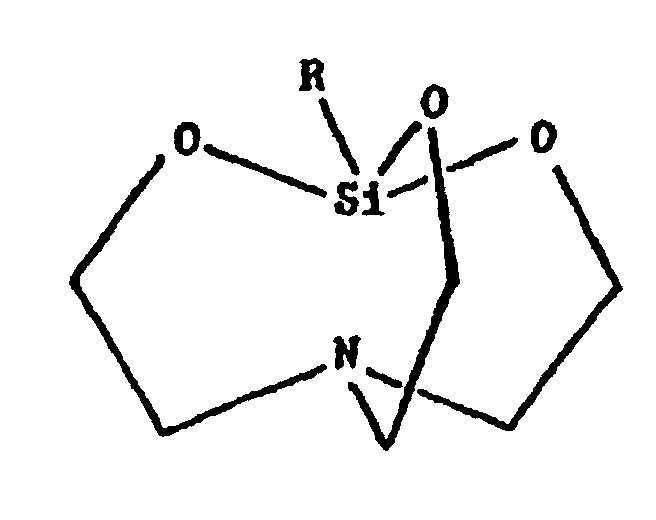
- silatrane compounds expressed by the following formula, in which R is a methyl group, phenyl group, methoxy group, or ethoxy group, but good adhesion was still not exhibited when one of these silatrane compounds was added to a curable silicone composition.
- Silatrane derivatives as well are described in Chemical Abstracts. Vol. 97 (1982) p. 733 and JP 10182669. However none of these documents mentions their use in connection with curable (silicone) compositions.
- the inventors arrived at the present invention as a result of research they conducted in an effort to solve the above problem.
- an object of the present invention is to provide a curable silicone composition that contains a silatrane derivative and exhibits good adhesion.
- the instant invention is directed to an adhesion promoter comprising a silatrane derivative and to a curable silicone composition containing same.
- the invention is further directed to the use of said silatrane derivative as a primer.
- each R 1 is independently a hydrogen atom or an alkyl group.
- alkyl group of R 1 include methyl, ethyl, propyl, butyl, pentyl, isopropyl, isobutyl, cyclopentyl, and cyclohexyl. It is particularly preferred for R 1 to be a hydrogen atom or a methyl group.
- Each R 2 in the above formula is independently selected from the group consisting of a hydrogen atom, an alkyl group, and an alkoxysilyl-containing organic group expressed by the general formula: -R 4 -Si(OR 5 ) x R 6 (3-x) with the proviso that at least one R 2 group is the alkoxysilyl-containing organic group.
- Examples of the alkyl group of R 2 are the same as the alkyl groups listed for R 1 above.
- R 4 in the formula is a divalent organic group, examples of which include methylene, ethylene, methylmethylene, propylene, methylethylene, butylene, hexylene, 1-methylpentylene, 1,4-dimethylbutylene, and other alkylene groups; and methyleneoxypropylene, methyleneoxypentylene, and other alkyleneoxyalkylene groups; with ethylene, propylene, butylene, methyleneoxypropylene, and methyleneoxypentylene being preferable.
- R 5 in the formula is a C 1 to C 10 alkyl group, examples of which include the same alkyl groups as given above for R 1 , with a methyl group or ethyl group being preferable.
- R 6 in the formula is a substituted or unsubstituted monovalent hydrocarbon group, examples of which include a methyl group, ethyl group, propyl group, butyl group, pentyl group, isopropyl group, isobutyl group, cyclopentyl group, cyclohexyl group, and other alkyl groups; a phenyl group, tolyl group, xylyl group, naphthyl group, and other aryl groups; a vinyl group, allyl group, butenyl group, pentenyl group, hexenyl group, and other alkenyl groups; a benzyl group, phenethyl group, and other aralkyl groups; and a chloromethyl group,
- R 3 in the above formula is at least one type of group selected from the group consisting of substituted or unsubstituted monovalent hydrocarbon groups, C 1 to C 10 alkoxy groups, glycidoxyalkyl groups, oxiranylalkyl groups, acyloxyalkyl groups, haloalkyl groups, and aminoalkyl groups.
- Examples of the monovalent hydrocarbon group of R 3 are the same as the monovalent hydrocarbon groups listed for R 6 above; examples of the alkoxy group of R 3 include a methoxy group, ethoxy group, and propoxy group; examples of the glycidoxyalkyl group of R 3 include a 3-glycidoxypropyl group; examples of the oxiranylalkyl group or R 3 include a 4-oxiranylbutyl group and an 8-oxiranyloctyl group; examples of the acyloxyalkyl group of R 3 include an acetoxypropyl group and a 3-methacryloxypropyl group; and examples of the aminoalkyl group of R 3 include a 3-aminopropyl group and an N-(2-aminoethyl)-3-aminopropyl group.
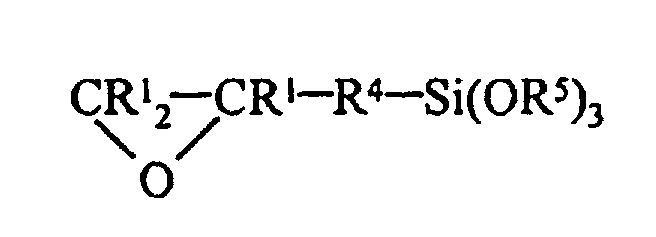
- the first method of preparing a silatrane derivative according to the present invention comprises reacting an epoxy group-containing trialkoxysilane compound having the formula: with a compound selected from the group consisting of ammonia and an amine compound having the formula: NH y (CR 1 2 CR 1 2 OH) (3-y) wherein R 1 , R 4 , and R 5 are as defined above and y is 1 or 2.
- the first method produces a silatrane derivative containing a silicon-bonded glycidoxyalkyl group or oxiranylalkyl group.
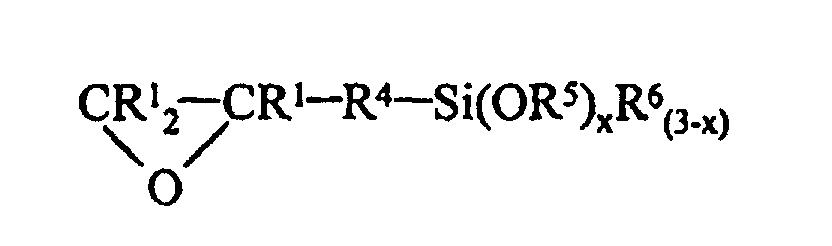
- the second method of preparing a silatrane derivative according to the present invention comprises reacting an epoxy group-containing alkoxysilane compound having the formula: and an alkoxysilane compound having the formula: R 3 Si(OR 5 ) 3 with a compound selected from the group consisting of ammonia and an amine compound having the formula: NH y (CR 1 2 CR 1 2 OH) (3-y) wherein R 1 , R 3 , R 4 , R 5 , and R 6 are as defined above; x is 1, 2, or 3; and y is 1 or 2.
- the ammonia or amine compound causes the epoxy groups to undergo a ring cleavage reaction, and the hydroxyl groups produced by this ring cleavage reaction, or the hydroxyl groups in the amine compound, undergo an alkoxy group exchange reaction with the alkoxy groups bonded to silicon atoms in the alkoxysilane, thus resulting in a cyclization reaction and forming the silatrane structure.
- the epoxy group-containing trialkoxysilane compound is a raw material for forming the skeleton of the above-mentioned silatrane derivative, and it is also a raw material for introducing trialkoxysilyl groups into the molecules of the above-mentioned silatrane derivative.
- R 1 , R 4 , and R 5 are as defined above.
- epoxy group-containing trialkoxysilane compound examples include 4-oxiranylbutyltrimethoxysilane, 8-oxiranyloctyltrimethoxysilane, 3-glycidoxypropyltrimethoxysilane, 3-glycidoxypropyltriethoxysilane, glycidoxymethyltrimethoxysilane, and glycidoxymethyltriethoxysilane.
- the ammonia or amine compound is a raw material for forming the skeleton of the silatrane derivative of the present invention.
- R 1 in the formula for the amine compound is as defined above and y is 1 or 2.
- Examples of this amine compound include 2-hydroxyethylamine, 2,2'-dihydroxyethylamine, and 2-hydroxy-2-methyl-ethylamine.
- this epoxy group-containing trialkoxysilane compound should be used in an amount of 3 to 30 mol, and preferably 4 to 20 mol, per mole of ammonia. This means that it is recommended that this epoxy group-containing trialkoxysilane compound be used in the approximate stoichiometric amount or in an excess amount with respect to the ammonia in this manufacturing method.
- the generation of by-products will be suppressed if the epoxy group-containing trialkoxysilane compound is used in an excess amount to the extent that the reaction does not slow down, but excess epoxy group-containing trialkoxysilane compound will remain behind.
- This unreacted epoxy group-containing trialkoxysilane compound that remains can be separated and recovered from the silatrane derivative by distillation or the like following the reaction.
- This reaction can also be conducted while ammonia gas is blown into the epoxy group-containing trialkoxysilane compound.
- this epoxy group-containing trialkoxysilane compound be used in the approximate stoichiometric amount or in an excess amount with respect to the amine compound in this manufacturing method.
- the generation of by-products will be suppressed if the epoxy group-containing trialkoxysilane compound is used in an excess amount to the extent that the reaction does not slow down, but excess epoxy group-containing trialkoxysilane compound will remain behind.
- This unreacted epoxy group-containing trialkoxysilane compound that remains can be separated and recovered from the silatrane derivative as needed by distillation or the like following the reaction.
- the epoxy group-containing alkoxysilane compound is a raw material for introducing alkoxysilyl groups into the molecules of the silatrane derivative.
- R 1 , R 4 , R 5 , and R 6 are as previously defined and x is 1, 2, or 3, with 3 being preferable.
- epoxy group-containing alkoxysilane compound examples include 4-oxiranylbutyltrimethoxysilane, 4-oxiranylbutylmethyldimethoxysilane, 8-oxiranyloctyltrimethoxysilane, 3-glycidoxypropyltrimethoxysilane, 3-glycidoxypropyltriethoxysilane, 3-glycidoxypropylmethyldimethoxysilane, 3-glycidoxypropylmethyldiethoxysilane, and glycidoxymethyltriethoxysilane.
- the ammonia or amine compound is a raw material for forming the skeleton of the silatrane derivative.
- R 1 is as defined above and y is 1 or 2. Examples of this amine compound are the same as the compounds listed above in the former method.
- the alkoxysilane compound is a raw material for forming the skeleton of the silatrane derivative.
- R 3 and R 5 are as defined above.
- this alkoxysilane compound include tetramethoxysilane, tetraethoxysilane, methyltrimethoxysilane, methyltriethoxysilane, vinyltrimethoxysilane, vinyltriethoxysilane, phenyltrimethoxysilane, 3-methacryloxypropyltrimethoxysilane, 3,3,3-trifluoropropyltrimethoxysilane, nonafluorobutylethyltrimethoxysilane, 3-aminopropyltrimethoxysilane, 3-aminopropyltriethoxysilane, and N-(2-aminoethyl)-3-aminopropyltrimethoxysilane.
- the epoxy group-containing alkoxysilane compound and alkoxysilane compound added with respect to the ammonia in order to suppress the generation of by-products and obtain the silatrane derivative at a good yield, if the reaction is conducted under conditions where the ammonia is not lost by evaporation, then the epoxy group-containing alkoxysilane compound should be used in an amount of 2 to 20 mol, and preferably 3 to 15 mol, per mole of ammonia.
- the alkoxysilane compound should be added in an amount of 0.5 to 50 mol per mole of ammonia, with a range of 1 to 20 mol being preferable.
- the alkoxysilane compound be used in the approximate stoichiometric amount or in an excess amount with respect to the ammonia.
- the generation of by-products will be suppressed if the alkoxysilane compound is used in an excess amount to the extent that the reaction does not slow down, but excess alkoxysilane compound will remain behind.
- This unreacted alkoxysilane compound that remains can be separated and recovered from the silatrane derivative by distillation or the like following the reaction.
- This reaction can also be conducted while ammonia gas is blown into a mixture of the epoxy group-containing alkoxysilane and the alkoxysilane compound and the alkoxysilane compound.
- the epoxy group-containing alkoxysilane compound In the latter manufacturing method, no limit is imposed on the amounts of the epoxy group-containing alkoxysilane compound and the alkoxysilane compound added with respect to the amine compound, but in order to obtain the silatrane derivative at a good yield, if y in the amine compound is 1, then the epoxy group-containing alkoxysilane compound should be used in an amount of 0.5 to 10 mol, and preferably 0.8 to 5 mol, per mole of this amine compound, and if y in this amine compound is 2, then the epoxy group-containing alkoxysilane compound should be used in an amount of 1.5 to 20 mol, and preferably 1.8 to 10 mol, with an amount of about 2 mol being particularly favorable.
- the amount in which the alkoxysilane compound is added should be 0.5 to 50 mol, and preferably 1 to 20 mol, per mole of the amine compound. This means that it is recommended that the alkoxysilane compound be used in the approximate stoichiometric amount or in an excess amount with respect to the amine compound in this manufacturing method. In general, the generation of by-products will be suppressed if the alkoxysilane compound is used in an excess amount to the extent that the reaction does not slow down, but excess alkoxysilane compound will remain behind. This unreacted alkoxysilane compound that remains can be separated and recovered from the silatrane derivative as needed by distillation or the like following the reaction.
- the reactions will proceed either at room temperature or under heating, but heating to 100 °C or lower is preferred in order to reduce the reaction time.
- organic solvents that can be used include hexane, heptane, octane, and other such aliphatic hydrocarbons; toluene, xylene, and other such aromatic hydrocarbons; methanol, ethanol, isopropanol, and other such alcohols; acetone, methyl isobutyl ketone, and other such ketones; diethyl ether, tetrahydrofuran, and other such ethers; ethyl acetate, isoamyl acetate, and other such esters; and dimethylformamide, dimethylacetamide, and other such amide compounds.
- an alcohol such as methanol or ethanol in particular will allow the reaction time to be shortened and the targeted silatrane derivative to be obtained at an even better yield.
- an alcohol it is preferable to use an alcohol that has the same number of carbons as the silicon atom-bonded alkoxy groups in the raw material epoxy group-containing trialkoxysilane compound or epoxy group-containing alkoxysilane compound and the alkoxysilane compound so that the alkoxy groups bonded to silicon atoms will undergo an alkoxy group exchange reaction during the above reaction.
- the reaction can be made markedly shorter, and the yield of the silatrane derivative that is obtained can be increased, by conducting the reaction at the reflux temperature of this alcohol.
- the silatrane derivative of the present invention can be used, for example, to impart adhesive properties to silicone compositions cured by condensation reactions, silicone compositions cured by hydrosilylation reactions, silicone compositions cured by UV rays or other high-energy rays, and other such curable silicone compositions, as well as to alkoxysilane-modified polyether-based curable compositions, curable polyurethane resin and rubber compositions, curable epoxy resin compositions, curable polysulfide resin compositions, curable unsaturated polyester resin compositions, and other such curable compositions, or it can be used as a primer which increases the adhesion of the above-mentioned curable compositions when applied to the surface of a metal, glass, plastic, or other such substrate.
- the silatrane derivative is particularly useful with silicone compositions cured by condensation reactions, silicone compositions cured by hydrosilylation reactions, silicone compositions cured by UV rays or other high-energy rays, and other such curable silicone compositions.
- the adhesion promoter of the present invention contains a mixture of this silatrane derivative with an alkoxysilane-containing adhesion promoter.
- alkoxysilane-containing adhesion promoters that can be used together with this silatrane derivative include methyltrimethoxysilane, vinyltrimethoxysilane, allyltrimethoxysilane, 3-methacryloxypropyltrimethoxysilane, 3-glycidoxypropyltrimethoxysilane, 3-aminopropyltrimethoxysilane, N-(2-aminoethyl)-3-aminopropyltrimethoxysilane, bis(trimethoxysilyl)propane, and bis(trimethoxysilyl)hexane.
- the silatrane derivative content should be at least 10 wt%, with at least 50 wt% being preferable and at least 70 wt% being even better. The reason for this is that the adhesion promotion effect will tend to be diminished if the silatrane derivative content is below this range.
- the curable silicone composition of the present invention is characterized by containing the above-mentioned silatrane derivative.
- curable silicone compositions containing this derivative include condensation reaction-curable silicone compositions cured by a condensation reaction such as a dealcoholization condensation reaction, a dehydration condensation reaction, a dehydrogenation condensation reaction, a de-oxime condensation reaction, a de-acetic acid condensation reaction, or a de-acetone condensation reaction; silicone compositions cured by hydrosilylation reactions; and high-energy ray-curable silicone compositions cured by high-energy rays, such as in a mercapto-vinyl addition reaction, an acrylic functional group radical reaction, or a cationic polymerization reaction for epoxy groups or vinyl ether groups.
- a silicone composition cured by a hydrosilylation reaction is particularly favorable.
- the silatrane derivative should be contained in an amount of 0.01 to 20 wt%, and preferably 0.05 to 10 wt%, in the curable silicone composition. A range of 0.1 to 5 wt% is particularly favorable.
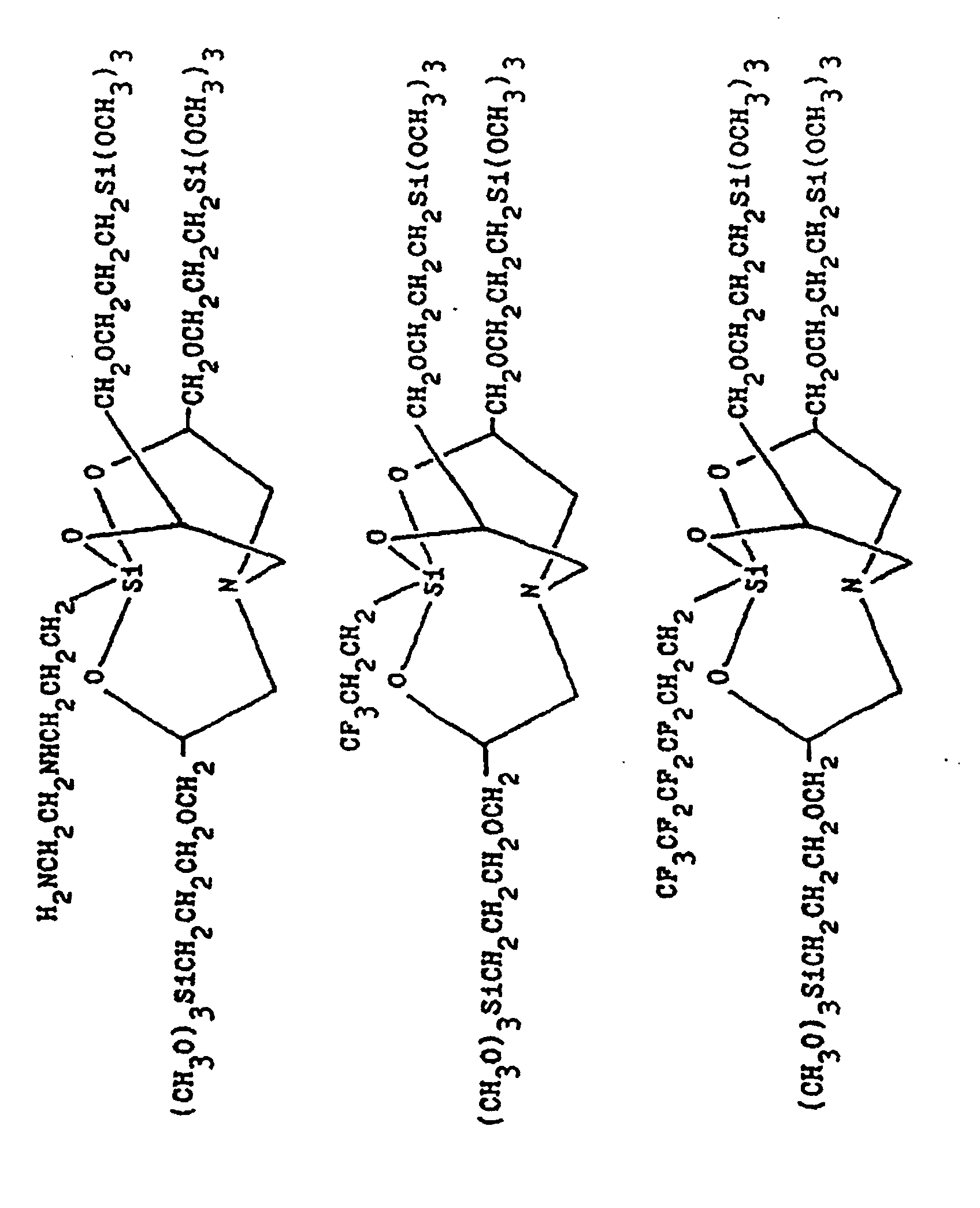
- This silatrane derivative was over 90 wt%. This transparent liquid was termed an adhesion promoter.
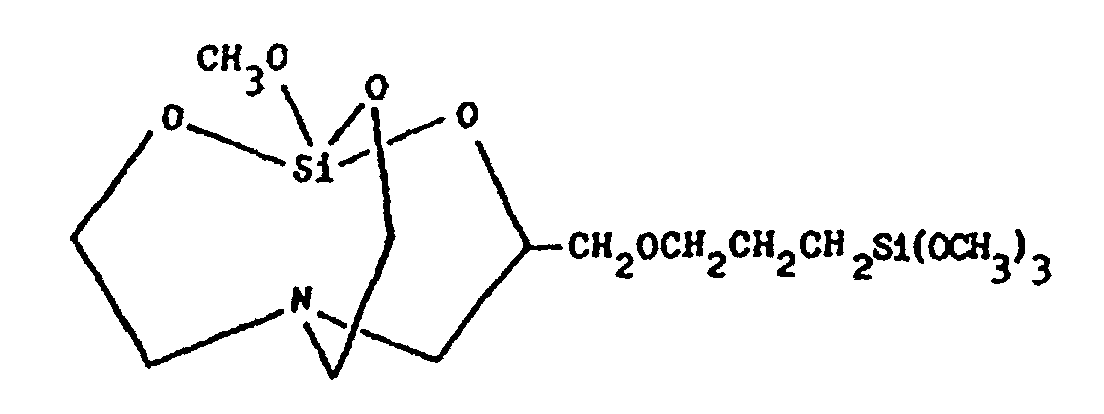
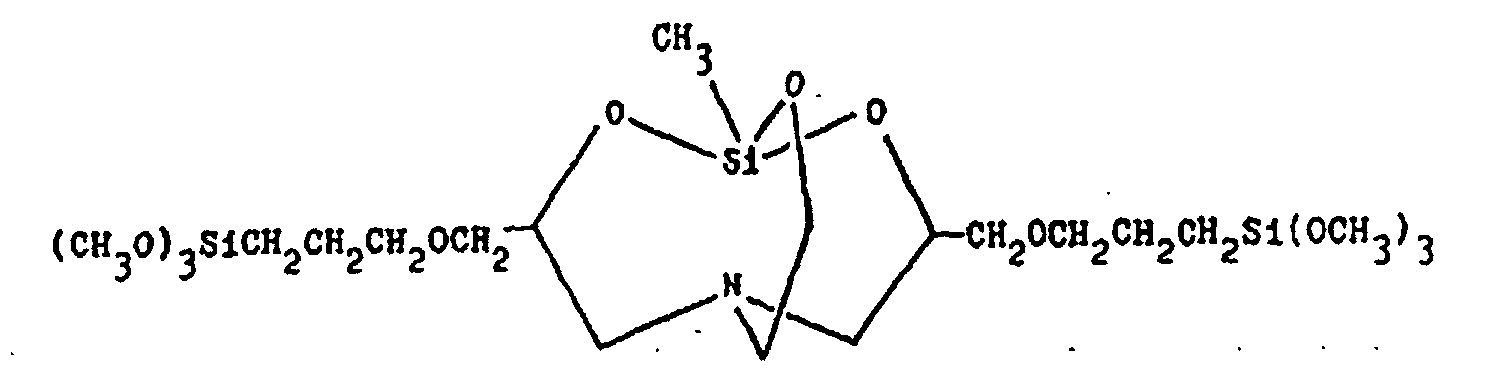
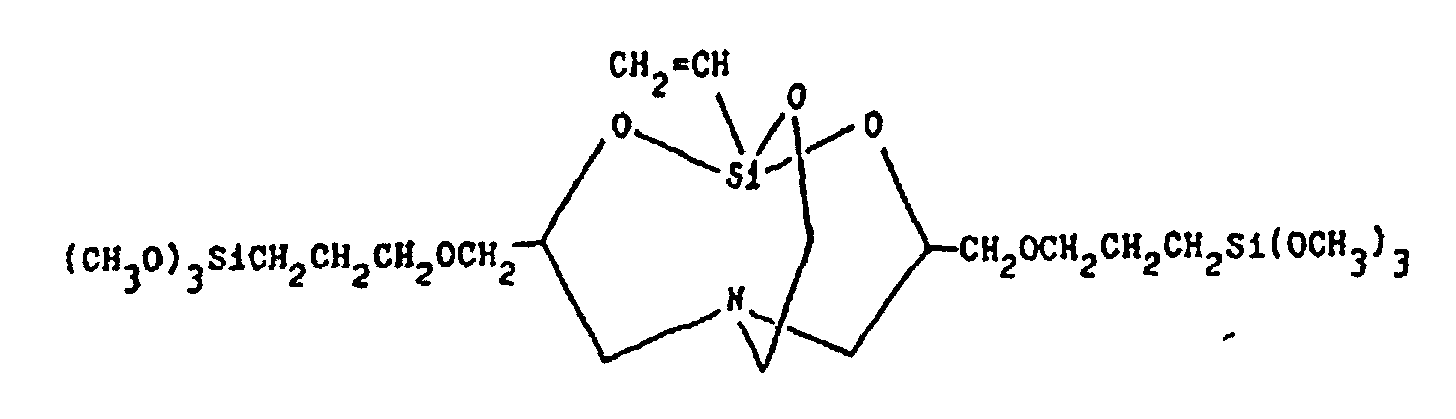
- This transparent liquid was subjected to 29 Si-nuclear magnetic resonance analysis and 13 C-nuclear magnetic resonance analysis, which confirmed that the silatrane derivative expressed by the following formula had been produced.
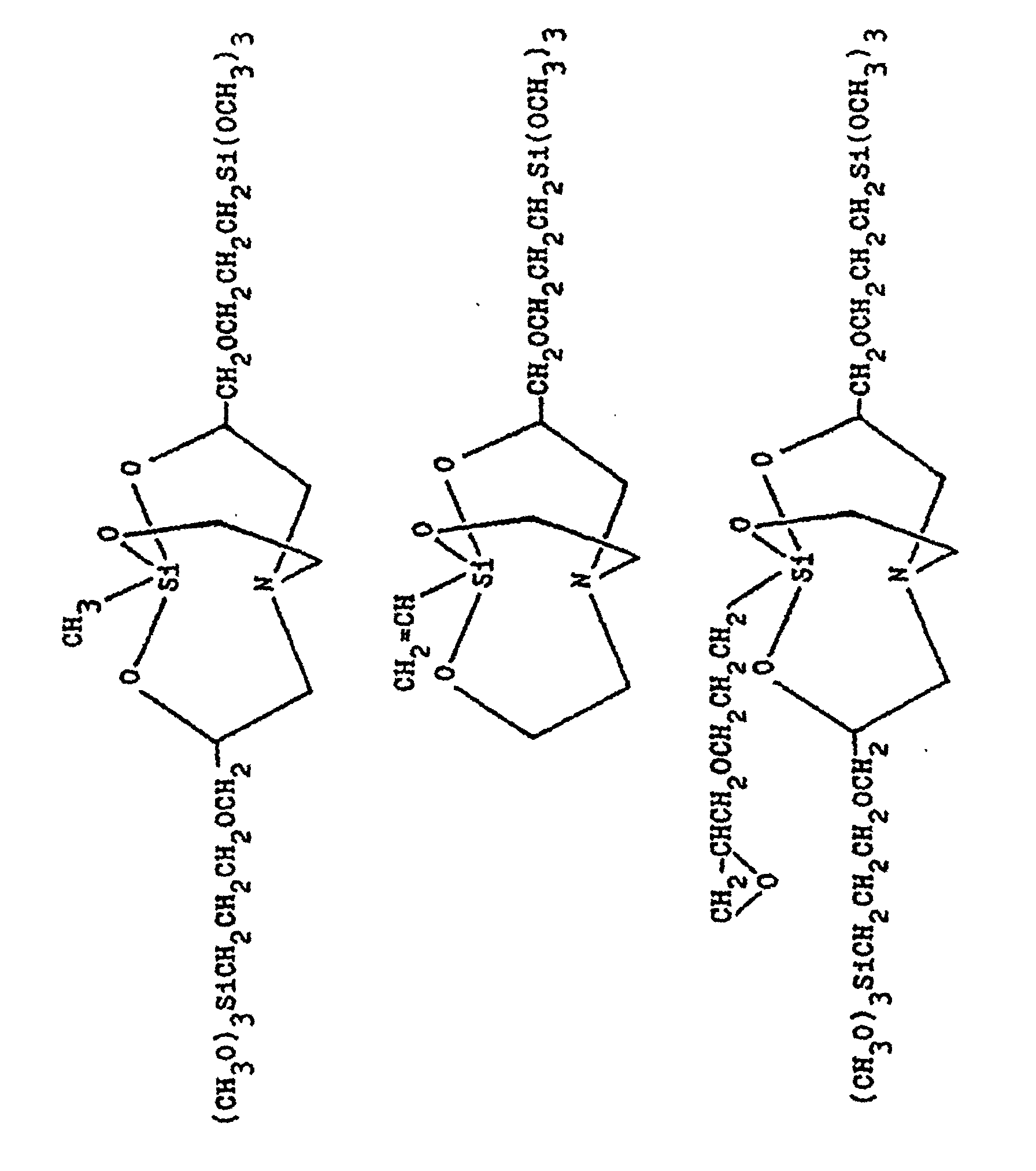
- the content of this silatrane derivative was over 90 wt%.
- This transparent liquid was termed an adhesion promoter.
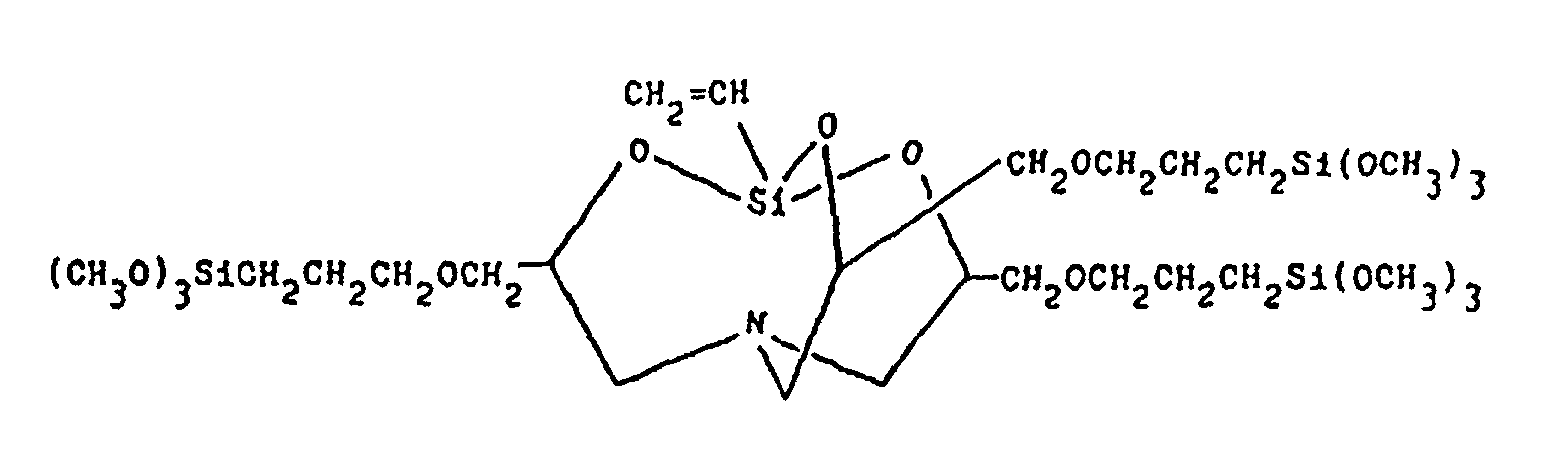
- This transparent liquid was subjected to 29 Si-nuclear magnetic resonance analysis and 13 C-nuclear magnetic resonance analysis, which confirmed that the silatrane derivative expressed by the following formula had been produced.
- the content of this silatrane derivative was over 90 wt%.
- This transparent liquid was termed an adhesion promoter.
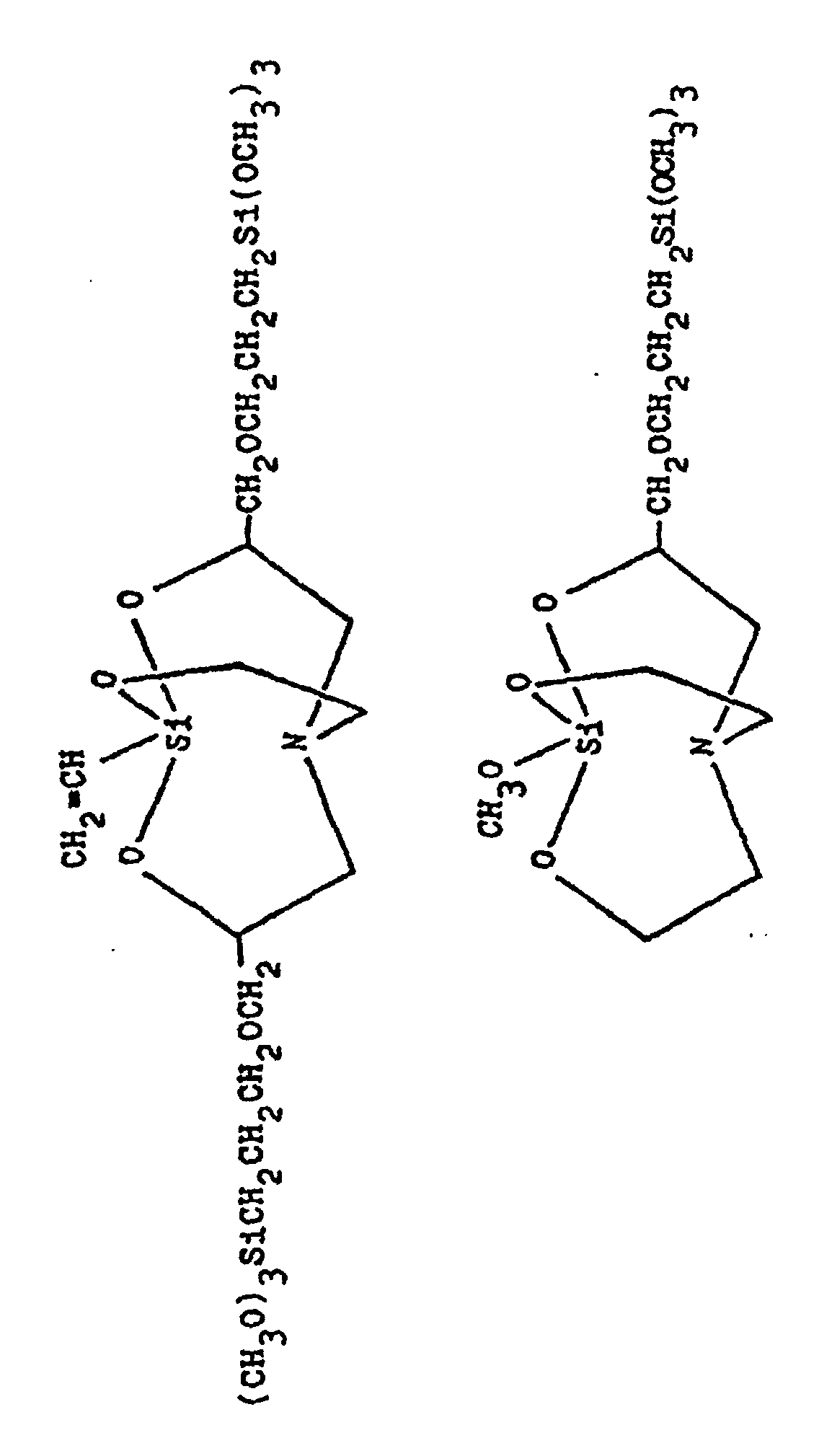
- This transparent liquid was subjected to 29 Si-nuclear magnetic resonance analysis and 13 C-nuclear magnetic resonance analysis, which confirmed that the silatrane derivative expressed by the following formula had been produced.
- the content of this silatrane derivative was over 90 wt%.
- This transparent liquid was termed an adhesion promoter.
- reaction mixture thus obtained was transferred to a pear-shaped flask, and the low-boiling component was distilled off by a rotary evaporator, which yielded 152.1 g of a faintly yellow transparent liquid.
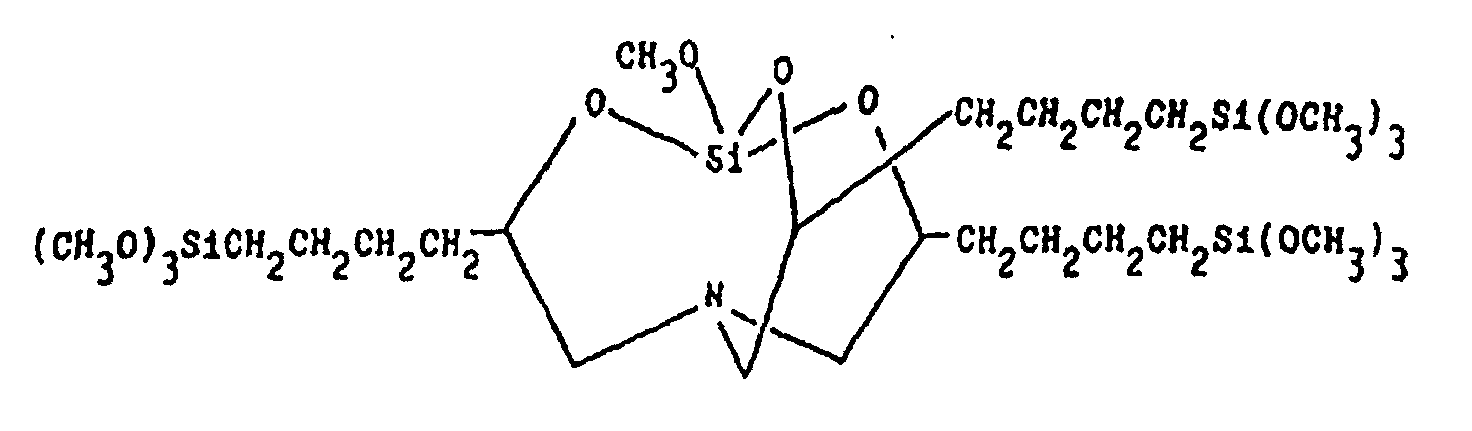
- This transparent liquid was subjected to 29 Si-nuclear magnetic resonance analysis and 13 C-nuclear magnetic resonance analysis, which confirmed that the silatrane derivative expressed by the following formula had been produced. The content of this silatrane derivative was over 90 wt%.
- This transparent liquid was termed an adhesion promoter.
- the reaction mixture thus obtained was subjected to 29 Si-nuclear magnetic resonance analysis and 13 C-nuclear magnetic resonance analysis, which confirmed it to be a mixture composed of the raw materials N-(2-aminoethyl)-3-aminopropyltrimethoxysilane and 3-glycidoxypropyltrimethoxysilane and condensation products of these silanes.
- This reaction mixture was termed an adhesion promoter.
- a curable silicone composition was prepared as follows. A dimethylpolysiloxane terminated at both ends of the molecular chain with trimethoxysiloxy groups, fumed silica whose surface had been rendered hydrophobic by hexamethyldisilazane, methyltrimethoxysilane, and a titanium-based catalyst for use in a condensation reaction were uniformly mixed to prepare a de-alcoholization condensation reaction-curable silicone composition.
- the adhesion promoters prepared in Reference Examples 1 to 7 were each blended in an amount of 0.5 wt% into this curable silicone composition to prepare seven types of curable silicone composition.
- a curable silicone composition not containing any of these adhesion promoters was separately readied.
- These curable silicone compositions were used to coat the surfaces of the substrates shown in Table 1, after which the coatings were cured by being allowed to stand at room temperature for 7 days.
- the cured products thus obtained were in a rubbery form.
- the adhesion of the obtained eight types of silicone rubber with respect to the substrates was evaluated. Further, the silicone rubber was immersed in 50 °C hot water along with the substrate, after which the adhesion of the obtained eight types of silicone rubber to the substrate was also evaluated.
- a curable silicone composition was prepared as follows. A dimethylpolysiloxane terminated at both ends of the molecular chain with dimethylvinylsiloxy groups, fumed silica whose surface had been rendered hydrophobic by hexamethyldisilazane, a dimethylsiloxane-methylhydrodienesiloxane copolymer terminated at both ends of the molecular chain with trimethylsiloxy groups, phenylbutynol, and a platinum-based catalyst for use in a hydrosilylation reaction were uniformly mixed to prepare a hydrosilylation reaction-curable silicone composition.
- the adhesion promoters prepared in Reference Examples 1 to 7 were each blended in an amount of 1 wt% into this curable silicone composition to prepare seven types of curable silicone composition. For the sake of comparison, a curable silicone composition not containing any of these adhesion promoters was separately readied. These curable silicone compositions were used to coat the surfaces of the substrates shown in Table 2, after which the coatings were cured by being heated for 30 minutes in a 120°C circulating hot air oven. The cured products thus obtained were in a rubbery form.
- reaction mixture thus obtained was transferred to a pear-shaped flask and condensed under reduced pressure by a rotary evaporator, which yielded 150.5 g of a faintly yellow transparent liquid.
- This transparent liquid was subjected to 29 Si-nuclear magnetic resonance analysis and 13 C-nuclear magnetic resonance analysis, which confirmed that the silatrane derivative expressed by the following formula had been produced, and that the content thereof was at least 70 wt%.
- This transparent liquid was subjected to 29 Si-nuclear magnetic resonance analysis, and two signals attributable to the silicon atoms in the silane rings in two types of stereoisomer were observed at -68.0 ppm and -69.7 ppm, which confirmed that the silatrane derivative expressed by the following formula had been produced, and that the content thereof was at least 50 wt%.
Landscapes
- Chemical & Material Sciences (AREA)
- Organic Chemistry (AREA)
- Health & Medical Sciences (AREA)
- Chemical Kinetics & Catalysis (AREA)
- Medicinal Chemistry (AREA)
- Polymers & Plastics (AREA)
Description







| Present invention | Comparative examples | |||||||
| 1 | 2 | 3 | 4 | 5 | 1 | 2 | 3 | |
| Type of adhesion promoter | RE 1 | RE 2 | RE 3 | RE 4 | RE 5 | RE 6 | RE 7 | none |
| Initial adhesion of silicone rubber | ||||||||
| Type of substrate | ○ | ○ | ○ | ○ | ○ | ○ | ○ | ○ |
| Aluminum | ○ | ○ | ○ | ○ | ○ | ○ | ○ | Δ |
| Stainless steel | ○ | ○ | ○ | ○ | ○ | ○ | Δ | ○ |
| Glass | ○ | ○ | ○ | ○ | ○ | ○ | ○ | ○ |
| Polycarbonate resin | ○ | ○ | ○ | ○ | ○ | Δ | Δ | × |
| Polybutylene terephthalate resin | ○ | ○ | ○ | ○ | ○ | Δ | ○ | Δ |
| Polyethylene terephthalate resin | ||||||||
| Adhesion of silicone rubber after immersion in hot water | ||||||||
| Type of substrate | ||||||||
| Aluminum | ○ | ○ | ○ | ○ | ○ | Δ | ○ | Δ |
| Stainless steel | ○ | ○ | ○ | ○ | ○ | Δ | × | Δ |
| Glass | ○ | ○ | ○ | ○ | ○ | ○ | × | Δ |
| Polycarbonate resin | ○ | ○ | ○ | ○ | ○ | ○ | Δ | ○ |
| Polybutylene terephthalate resin | ○ | ○ | ○ | ○ | ○ | Δ | × | × |
| Polyethylene terephthalate resin | ○ | ○ | ○ | ○ | ○ | Δ | Δ | Δ |
| R.E = Reference Example |
| Present invention Examples | Comparative Examples | |||||||
| 6 | 7 | 8 | 9 | 10 | 4 | 5 | 6 | |
| Type of adhesion promoter | RE 1 | RE 2 | RE 3 | RE 4 | RE 5 | RE 6 | RE 7 | none |
| Initial adhesion of silicone rubber | ||||||||
| Type of substrate | ||||||||
| Aluminum | Δ | Δ | Δ | ○ | ○ | × | DNC | × |
| Stainless steel | Δ | Δ | Δ | ○ | ○ | × | DNC | × |
| Glass | Δ | ○ | ○ | ○ | ○ | Δ | DNC | × |
| Polycarbonate resin | × | ○ | Δ | ○ | ○ | × | DNC | × |
| Polybutylene terephthalate resin | × | Δ | Δ | ○ | ○ | × | DNC | × |
| Polyethylene terephthalate resin | × | × | × | ○ | ○ | × | DNC | × |
| DNC: did not cure; RE: Reference Example |


Claims (9)
- A composition comprising :(A) a silatrane derivative having the formula:wherein each R1 is independently a hydrogen atom or an alkyl group; each R2 is independently selected from the group consisting of a hydrogen atom, an alkyl group, and an alkoxysilyl-containing organic group having the general formula:
 (B) a curable composition.
 - The composition according to claim 1, wherein the curable composition (B) is a curable silicone composition.
- The composition according to claims 1 or 2, wherein R1 is a hydrogen atom or a methyl group; R4 is a divalent organic group selected from the group consisting of ethylene, propylene, butylene, methyleneoxypropylene, and methyleneoxypentylene; R5 is methyl or ethyl; and x is 3.
- The composition according to claims 1 or 2, wherein the silatrane derivative is present in an amount from 0.05 to 10 weight percent based on the total weight of the composition.
- The composition according to claim 2, wherein the curable silicone composition is curable by a hydrosilylation reaction, a condensation reaction or high-energy ray.
- The composition of claim 2, wherein the curable silicone composition comprises a dimethylpolysiloxane terminated at both ends of the molecular chain with trimethoxysiloxy groups, fumed silica whose surface had been rendered hydrophobic by hexamethyldisilazane, methyltrimethoxysilane, and a titanium-based catalyst.
- The composition of claim 2, wherein the curable silicone composition comprises a dimethylpolysiloxane terminated at both . ends of the molecular chain with dimethylvinylsiloxy groups, fumed silica whose surface had been rendered hydrophobic by hexamethyldisilazane, a dimethylsiloxane-methylhydrogensiloxane copolymer terminated at both ends of the molecular chain with trimethylsiloxy groups, phenylbutynol, and a platinum-based catalyst.
- An adhesion promoter comprising the silatrane derivative (A) of claim 1 and an alkoxysilane-containing adhesion promoter.
- Use of the silatrane derivative (A) of claim 1 as a primer.
Applications Claiming Priority (6)
| Application Number | Priority Date | Filing Date | Title |
|---|---|---|---|
| JP29491297 | 1997-10-13 | ||
| JP29491297A JP3924055B2 (en) | 1997-10-13 | 1997-10-13 | Silatrane derivative and method for producing the same |
| JP294912/97 | 1997-10-13 | ||
| JP34429697A JP3859851B2 (en) | 1997-11-28 | 1997-11-28 | Adhesion promoter and curable silicone composition |
| JP344296/97 | 1997-11-28 | ||
| JP34429697 | 1997-11-28 |
Publications (3)
| Publication Number | Publication Date |
|---|---|
| EP0908462A2 EP0908462A2 (en) | 1999-04-14 |
| EP0908462A3 EP0908462A3 (en) | 1999-11-03 |
| EP0908462B1 true EP0908462B1 (en) | 2003-07-16 |
Family
ID=26560040
Family Applications (1)
| Application Number | Title | Priority Date | Filing Date |
|---|---|---|---|
| EP98119252A Expired - Lifetime EP0908462B1 (en) | 1997-10-13 | 1998-10-13 | Silatrane derivative and curable silicone composition containing same |
Country Status (3)
| Country | Link |
|---|---|
| US (1) | US5936110A (en) |
| EP (1) | EP0908462B1 (en) |
| DE (1) | DE69816395T2 (en) |
Families Citing this family (13)
| Publication number | Priority date | Publication date | Assignee | Title |
|---|---|---|---|---|
| JP2000072968A (en) * | 1998-08-28 | 2000-03-07 | Dow Corning Toray Silicone Co Ltd | Silicone aqueous emulsion composition |
| JP2000198929A (en) * | 1998-10-30 | 2000-07-18 | Dow Corning Toray Silicone Co Ltd | Silicone rubber composition for composite molding |
| JP2000265063A (en) * | 1999-03-16 | 2000-09-26 | Dow Corning Toray Silicone Co Ltd | Silicone rubber composition |
| JP2000302977A (en) * | 1999-04-16 | 2000-10-31 | Dow Corning Toray Silicone Co Ltd | Silicone rubber composition |
| JP2001019933A (en) * | 1999-07-09 | 2001-01-23 | Dow Corning Toray Silicone Co Ltd | Silicone adhesive sheet and method for producing the same |
| US6284861B1 (en) | 1999-12-13 | 2001-09-04 | Dow Corning Toray Silicone, Ltd. | Silicone rubber composition |
| US7094306B2 (en) * | 2001-12-18 | 2006-08-22 | Dow Corning Toray Silicone Co., Ltd. | Photocurable organic polymer composition |
| US20060110605A1 (en) * | 2004-11-24 | 2006-05-25 | Guardian Industries Corp. | Hydrophilic coating and method of making same |
| JP5143835B2 (en) * | 2006-07-03 | 2013-02-13 | ダウ・コーニング・コーポレイション | Chemically curable integrated warm edge spacers and seals |
| WO2010111174A1 (en) | 2009-03-23 | 2010-09-30 | Dow Corning Corporation | Chemically curing all-in-one warm edge spacer and seal |
| US8871317B2 (en) | 2010-09-09 | 2014-10-28 | Teknor Apex Company | Curable adhesive system, method of assembly of distinct components therewith |
| US11208518B2 (en) | 2018-12-11 | 2021-12-28 | The Goodyear Tire & Rubber Company | Functionalized polymer, rubber composition and pneumatic tire |
| JP7774044B2 (en) * | 2020-09-25 | 2025-11-20 | ダウ シリコーンズ コーポレーション | Curable silicone composition and cured product thereof |
Family Cites Families (13)
| Publication number | Priority date | Publication date | Assignee | Title |
|---|---|---|---|---|
| US3133108A (en) * | 1958-07-29 | 1964-05-12 | Westinghouse Electric Corp | Nitrogen coordinated silicon compounds |
| US2953545A (en) * | 1958-11-18 | 1960-09-20 | Westinghouse Electric Corp | Process for curing glycidyl polyethers and products produced thereby |
| US3118921A (en) * | 1958-12-15 | 1964-01-21 | Kendall & Co | Amino-silicon compounds |
| US3032576A (en) * | 1961-02-20 | 1962-05-01 | Union Carbide Corp | N-substituted derivatives of aminoalkylsilanes |
| US4048206A (en) * | 1975-04-22 | 1977-09-13 | Mikhail Grigorievich Voronkov | Process for the production of 1-organylsilatranes and carbofunctional derivatives thereof |
| DE2542534C3 (en) * | 1975-09-24 | 1979-08-02 | Deutsche Gold- Und Silber-Scheideanstalt Vormals Roessler, 6000 Frankfurt | Process for the preparation of sulfur-containing organosilicon compounds |
| JPS5938957B2 (en) * | 1976-08-31 | 1984-09-20 | 味の素株式会社 | Synthesis method of silatrane derivatives |
| DE2712866C3 (en) * | 1977-03-24 | 1980-04-30 | Deutsche Gold- Und Silber-Scheideanstalt Vormals Roessler, 6000 Frankfurt | Process for the preparation of organosilicon compounds containing sulfur |
| CS196940B1 (en) * | 1978-02-06 | 1980-04-30 | Stanislav Florovic | N'-bis/beta-hydroxyethyl/gamma ureidopropyltriptychsiloxazolidine |
| JPS6169781A (en) * | 1984-09-13 | 1986-04-10 | Nitto Kasei Kk | Preparation of tri-organotin silatrane derivative |
| JPH07113083B2 (en) * | 1987-08-28 | 1995-12-06 | 東レ・ダウコーニング・シリコーン株式会社 | Room temperature curable organopolysiloxane composition |
| JPH07113083A (en) * | 1993-10-15 | 1995-05-02 | Nippon Steel Chem Co Ltd | Coke manufacturing method and coke oven lid |
| JP4148544B2 (en) * | 1996-12-25 | 2008-09-10 | 東レ・ダウコーニング株式会社 | Silatrane derivative and method for producing the same |
-
1998
- 1998-10-13 DE DE69816395T patent/DE69816395T2/en not_active Expired - Lifetime
- 1998-10-13 EP EP98119252A patent/EP0908462B1/en not_active Expired - Lifetime
- 1998-10-14 US US09/172,797 patent/US5936110A/en not_active Expired - Lifetime
Also Published As
| Publication number | Publication date |
|---|---|
| EP0908462A2 (en) | 1999-04-14 |
| DE69816395T2 (en) | 2004-05-13 |
| EP0908462A3 (en) | 1999-11-03 |
| DE69816395D1 (en) | 2003-08-21 |
| US5936110A (en) | 1999-08-10 |
Similar Documents
| Publication | Publication Date | Title |
|---|---|---|
| EP0919558B1 (en) | Silatrane derivative, method for manufacturing same, adhesion promoter, and curable silicone compositions | |
| JP3831481B2 (en) | Carbacyltolan derivative, method for producing the same, adhesion promoter, and curable silicone composition | |
| US5936110A (en) | Silatrane derivative and curable silicone composition containing same | |
| KR101868158B1 (en) | Succinic anhydride group containing cyclic organosiloxane, preparation thereof, organosiloxane composition and thermosetting resin composition | |
| JP4187843B2 (en) | Silatrane derivative, method for producing the same, adhesion promoter, and curable silicone composition | |
| KR100280586B1 (en) | An alkoxy-terminated polydiorganosiloxane, a process for producing the same, and a room temperature curable silicone elastomer | |
| EP0653472B1 (en) | Curable organopolysiloxane composition containing adhesion promoter | |
| EP0530496B1 (en) | Organosilicon compounds and method for preparing same | |
| JPS6172077A (en) | adhesion promoter | |
| JP3859851B2 (en) | Adhesion promoter and curable silicone composition | |
| EP1002834A1 (en) | Silicone rubber composition for composite molding | |
| TW574222B (en) | Organosilicon compound | |
| US5786493A (en) | Cyclic silane esters and solvolysis products thereof, and processes for the preparation of the cyclic silane esters and the solvolysis products | |
| US5777144A (en) | Bi-functional siloxane compounds | |
| US7053233B2 (en) | Silane compound having at least two protected functional groups and method for preparing the same | |
| JPH11158379A5 (en) | ||
| JP4148544B2 (en) | Silatrane derivative and method for producing the same | |
| KR20240089740A (en) | Room temperature curable organopolysiloxane compositions, adhesives, sealants and coatings | |
| US20080177065A1 (en) | Nitrogen-Containing Organosilicon Compound Method Of Manufacture, And Method Of Treating Surfaces | |
| CN111607091B (en) | Organic silicon compound, its preparation method and curable composition | |
| US6172252B1 (en) | Pheno-functional organosilicon compounds and method for the preparation | |
| US5514827A (en) | Silylated cyclic hydrocarbons and their uses | |
| JP3924055B2 (en) | Silatrane derivative and method for producing the same | |
| JPH07138535A (en) | Adhesion promoter | |
| JP3193740B2 (en) | Organosilicon compound and method for producing the same |
Legal Events
| Date | Code | Title | Description |
|---|---|---|---|
| PUAI | Public reference made under article 153(3) epc to a published international application that has entered the european phase |
Free format text: ORIGINAL CODE: 0009012 |
|
| AK | Designated contracting states |
Kind code of ref document: A2 Designated state(s): DE FR GB IT |
|
| AX | Request for extension of the european patent |
Free format text: AL;LT;LV;MK;RO;SI |
|
| PUAL | Search report despatched |
Free format text: ORIGINAL CODE: 0009013 |
|
| AK | Designated contracting states |
Kind code of ref document: A3 Designated state(s): AT BE CH CY DE DK ES FI FR GB GR IE IT LI LU MC NL PT SE |
|
| AX | Request for extension of the european patent |
Free format text: AL;LT;LV;MK;RO;SI |
|
| 17P | Request for examination filed |
Effective date: 20000427 |
|
| AKX | Designation fees paid |
Free format text: DE FR GB IT |
|
| 17Q | First examination report despatched |
Effective date: 20011207 |
|
| GRAH | Despatch of communication of intention to grant a patent |
Free format text: ORIGINAL CODE: EPIDOS IGRA |
|
| GRAH | Despatch of communication of intention to grant a patent |
Free format text: ORIGINAL CODE: EPIDOS IGRA |
|
| GRAA | (expected) grant |
Free format text: ORIGINAL CODE: 0009210 |
|
| AK | Designated contracting states |
Designated state(s): DE FR GB IT |
|
| REG | Reference to a national code |
Ref country code: GB Ref legal event code: FG4D |
|
| REF | Corresponds to: |
Ref document number: 69816395 Country of ref document: DE Date of ref document: 20030821 Kind code of ref document: P |
|
| ET | Fr: translation filed | ||
| PLBE | No opposition filed within time limit |
Free format text: ORIGINAL CODE: 0009261 |
|
| STAA | Information on the status of an ep patent application or granted ep patent |
Free format text: STATUS: NO OPPOSITION FILED WITHIN TIME LIMIT |
|
| 26N | No opposition filed |
Effective date: 20040419 |
|
| PG25 | Lapsed in a contracting state [announced via postgrant information from national office to epo] |
Ref country code: IT Free format text: LAPSE BECAUSE OF NON-PAYMENT OF DUE FEES;WARNING: LAPSES OF ITALIAN PATENTS WITH EFFECTIVE DATE BEFORE 2007 MAY HAVE OCCURRED AT ANY TIME BEFORE 2007. THE CORRECT EFFECTIVE DATE MAY BE DIFFERENT FROM THE ONE RECORDED. Effective date: 20051013 |
|
| PGFP | Annual fee paid to national office [announced via postgrant information from national office to epo] |
Ref country code: FR Payment date: 20121018 Year of fee payment: 15 |
|
| PGFP | Annual fee paid to national office [announced via postgrant information from national office to epo] |
Ref country code: GB Payment date: 20121010 Year of fee payment: 15 |
|
| REG | Reference to a national code |
Ref country code: DE Ref legal event code: R082 Ref document number: 69816395 Country of ref document: DE Representative=s name: FLEISCHER, ENGELS & PARTNER MBB, PATENTANWAELT, DE |
|
| GBPC | Gb: european patent ceased through non-payment of renewal fee |
Effective date: 20131013 |
|
| PG25 | Lapsed in a contracting state [announced via postgrant information from national office to epo] |
Ref country code: GB Free format text: LAPSE BECAUSE OF NON-PAYMENT OF DUE FEES Effective date: 20131013 |
|
| REG | Reference to a national code |
Ref country code: FR Ref legal event code: ST Effective date: 20140630 |
|
| PG25 | Lapsed in a contracting state [announced via postgrant information from national office to epo] |
Ref country code: FR Free format text: LAPSE BECAUSE OF NON-PAYMENT OF DUE FEES Effective date: 20131031 |
|
| PGFP | Annual fee paid to national office [announced via postgrant information from national office to epo] |
Ref country code: DE Payment date: 20171011 Year of fee payment: 20 |
|
| REG | Reference to a national code |
Ref country code: DE Ref legal event code: R071 Ref document number: 69816395 Country of ref document: DE |