EP0905804A2 - Elektrode für Batterie mit nichtwässrigem Elektrolyt und Verfahren zur Herstellung - Google Patents
Elektrode für Batterie mit nichtwässrigem Elektrolyt und Verfahren zur Herstellung Download PDFInfo
- Publication number
- EP0905804A2 EP0905804A2 EP98114939A EP98114939A EP0905804A2 EP 0905804 A2 EP0905804 A2 EP 0905804A2 EP 98114939 A EP98114939 A EP 98114939A EP 98114939 A EP98114939 A EP 98114939A EP 0905804 A2 EP0905804 A2 EP 0905804A2
- Authority
- EP
- European Patent Office
- Prior art keywords
- electrode
- battery
- polymer
- nonaqueous electrolyte
- current collector
- Prior art date
- Legal status (The legal status is an assumption and is not a legal conclusion. Google has not performed a legal analysis and makes no representation as to the accuracy of the status listed.)
- Withdrawn
Links
Images



Classifications
-
- H—ELECTRICITY
- H01—ELECTRIC ELEMENTS
- H01M—PROCESSES OR MEANS, e.g. BATTERIES, FOR THE DIRECT CONVERSION OF CHEMICAL ENERGY INTO ELECTRICAL ENERGY
- H01M4/00—Electrodes
- H01M4/02—Electrodes composed of, or comprising, active material
- H01M4/62—Selection of inactive substances as ingredients for active masses, e.g. binders, fillers
- H01M4/621—Binders
- H01M4/622—Binders being polymers
- H01M4/623—Binders being polymers fluorinated polymers
-
- H—ELECTRICITY
- H01—ELECTRIC ELEMENTS
- H01M—PROCESSES OR MEANS, e.g. BATTERIES, FOR THE DIRECT CONVERSION OF CHEMICAL ENERGY INTO ELECTRICAL ENERGY
- H01M4/00—Electrodes
- H01M4/02—Electrodes composed of, or comprising, active material
- H01M4/04—Processes of manufacture in general
-
- H—ELECTRICITY
- H01—ELECTRIC ELEMENTS
- H01M—PROCESSES OR MEANS, e.g. BATTERIES, FOR THE DIRECT CONVERSION OF CHEMICAL ENERGY INTO ELECTRICAL ENERGY
- H01M4/00—Electrodes
- H01M4/02—Electrodes composed of, or comprising, active material
- H01M4/04—Processes of manufacture in general
- H01M4/0402—Methods of deposition of the material
-
- H—ELECTRICITY
- H01—ELECTRIC ELEMENTS
- H01M—PROCESSES OR MEANS, e.g. BATTERIES, FOR THE DIRECT CONVERSION OF CHEMICAL ENERGY INTO ELECTRICAL ENERGY
- H01M4/00—Electrodes
- H01M4/02—Electrodes composed of, or comprising, active material
- H01M4/04—Processes of manufacture in general
- H01M4/0402—Methods of deposition of the material
- H01M4/0404—Methods of deposition of the material by coating on electrode collectors
-
- H—ELECTRICITY
- H01—ELECTRIC ELEMENTS
- H01M—PROCESSES OR MEANS, e.g. BATTERIES, FOR THE DIRECT CONVERSION OF CHEMICAL ENERGY INTO ELECTRICAL ENERGY
- H01M4/00—Electrodes
- H01M4/02—Electrodes composed of, or comprising, active material
- H01M4/04—Processes of manufacture in general
- H01M4/0402—Methods of deposition of the material
- H01M4/0416—Methods of deposition of the material involving impregnation with a solution, dispersion, paste or dry powder
-
- H—ELECTRICITY
- H01—ELECTRIC ELEMENTS
- H01M—PROCESSES OR MEANS, e.g. BATTERIES, FOR THE DIRECT CONVERSION OF CHEMICAL ENERGY INTO ELECTRICAL ENERGY
- H01M4/00—Electrodes
- H01M4/02—Electrodes composed of, or comprising, active material
- H01M4/13—Electrodes for accumulators with non-aqueous electrolyte, e.g. for lithium-accumulators; Processes of manufacture thereof
- H01M4/139—Processes of manufacture
-
- H—ELECTRICITY
- H01—ELECTRIC ELEMENTS
- H01M—PROCESSES OR MEANS, e.g. BATTERIES, FOR THE DIRECT CONVERSION OF CHEMICAL ENERGY INTO ELECTRICAL ENERGY
- H01M4/00—Electrodes
- H01M4/02—Electrodes composed of, or comprising, active material
- H01M4/13—Electrodes for accumulators with non-aqueous electrolyte, e.g. for lithium-accumulators; Processes of manufacture thereof
- H01M4/139—Processes of manufacture
- H01M4/1391—Processes of manufacture of electrodes based on mixed oxides or hydroxides, or on mixtures of oxides or hydroxides, e.g. LiCoOx
-
- H—ELECTRICITY
- H01—ELECTRIC ELEMENTS
- H01M—PROCESSES OR MEANS, e.g. BATTERIES, FOR THE DIRECT CONVERSION OF CHEMICAL ENERGY INTO ELECTRICAL ENERGY
- H01M4/00—Electrodes
- H01M4/02—Electrodes composed of, or comprising, active material
- H01M4/64—Carriers or collectors
- H01M4/66—Selection of materials
- H01M4/661—Metal or alloys, e.g. alloy coatings
-
- H—ELECTRICITY
- H01—ELECTRIC ELEMENTS
- H01M—PROCESSES OR MEANS, e.g. BATTERIES, FOR THE DIRECT CONVERSION OF CHEMICAL ENERGY INTO ELECTRICAL ENERGY
- H01M10/00—Secondary cells; Manufacture thereof
- H01M10/05—Accumulators with non-aqueous electrolyte
- H01M10/052—Li-accumulators
- H01M10/0525—Rocking-chair batteries, i.e. batteries with lithium insertion or intercalation in both electrodes; Lithium-ion batteries
-
- Y—GENERAL TAGGING OF NEW TECHNOLOGICAL DEVELOPMENTS; GENERAL TAGGING OF CROSS-SECTIONAL TECHNOLOGIES SPANNING OVER SEVERAL SECTIONS OF THE IPC; TECHNICAL SUBJECTS COVERED BY FORMER USPC CROSS-REFERENCE ART COLLECTIONS [XRACs] AND DIGESTS
- Y02—TECHNOLOGIES OR APPLICATIONS FOR MITIGATION OR ADAPTATION AGAINST CLIMATE CHANGE
- Y02E—REDUCTION OF GREENHOUSE GAS [GHG] EMISSIONS, RELATED TO ENERGY GENERATION, TRANSMISSION OR DISTRIBUTION
- Y02E60/00—Enabling technologies; Technologies with a potential or indirect contribution to GHG emissions mitigation
- Y02E60/10—Energy storage using batteries
-
- Y—GENERAL TAGGING OF NEW TECHNOLOGICAL DEVELOPMENTS; GENERAL TAGGING OF CROSS-SECTIONAL TECHNOLOGIES SPANNING OVER SEVERAL SECTIONS OF THE IPC; TECHNICAL SUBJECTS COVERED BY FORMER USPC CROSS-REFERENCE ART COLLECTIONS [XRACs] AND DIGESTS
- Y10—TECHNICAL SUBJECTS COVERED BY FORMER USPC
- Y10T—TECHNICAL SUBJECTS COVERED BY FORMER US CLASSIFICATION
- Y10T29/00—Metal working
- Y10T29/49—Method of mechanical manufacture
- Y10T29/49002—Electrical device making
- Y10T29/49108—Electric battery cell making
Definitions
- the present invention relates to a process for producing an electrode for a nonaqueous electrolyte battery.
- a battery comprising a nonaqueous electrolyte solution and a negative electrode made of an alkaline metal can form a high voltage battery providing a voltage as high as not lower than 3 V and thus can serve as a high energy density battery.
- a battery if it serves as a secondary battery, is disadvantageous in that it is liable to shortcircuiting due to the deposition of dendrite of alkaline metal during charging and thus has a reduced endurance. Further, since an alkaline metal has a high reactivity, such a battery can be hardly provided with a sufficient safety.
- lithium ion battery which comprises a carbon-based negative electrode made of graphite or carbon on which dendrite of metallic lithium can hardly be deposited instead of metallic lithium and a positive electrode made of lithium cobaltate or lithium nickelate.
- This lithium ion battery has been used as a high energy density battery.
- the majority of lithium ions taking part in the electrode reaction in the charge-discharge reaction are not those dissolved in the electrolyte originally. Lithium ions released from the active material move through the electrolyte and then reach the opposite electrode. Thus, the movement distance of lithium ion is long. Further, the transport number of lithium ion in the electrolyte of a nonaqueous electrolyte battery at room temperature is normally not more than 0.5 while the transport number of proton and oxyhydroxide ion in the aqueous battery is close to 1.
- the movement rate of ion in the electrolyte is governed by the diffusion of ion. Accordingly, if the pores in the electrode are filled with solid electrolyte instead of electrolyte solution, the diffusion rate of ion in the electrolyte is very low, deteriorating the high rate charge-discharge properties of the battery. Thus, practical battery properties cannot be obtained.
- the polymer electrolyte to be filled in the pores in the electrode needs to be elastic enough to deform according to the volumetric expansion and shrinkage of the active material during charging and discharging.
- the porous polymer electrolyte is preferably a polymer gel obtained by allowing a polymer to swell with an electrolyte solution.
- An optimum process for the preparation of the porous polymer is a solvent extraction method which allows the formation of continuous pores consisting of uniform spherical pores (U.S. Patent 4,539,256).
- the solvent extraction method is a method for the preparation of porous polymer which comprises immersing polymer paste in a second solvent insoluble in the polymer soluble in the solvent for the polymer paste so that the solvent for the polymer paste is extracted to form pores and the polymer is solidified.
- a second solvent in which the polymer paste is immersed in water which exhibits a strong polarity, a good solubility in many polymers and an insolubility in many high molecular compounds and is inexpensive, is most suitable.
- a nonaqueous electrolyte battery it is undesirable that water enters in the battery.
- a battery having little water content and good properties con be prepared by a process which comprises immersing an electrode in water, sufficiently drying the electrode, inserting the electrode into a battery case, and then injecting an electrolyte solution into the battery so that the polymer is allowed to swell to form a porous polymer.
- a nonaqueous electrolyte battery such as lithium ion battery
- a current collector there may be used a metal.
- many metals corrode with water having an excellent electronic conductivity.
- the current collector when such an electrode is immersed in water, the current collector exhibits a remarkably deteriorated electronic conductivity on the surface thereof. Accordingly, such a battery is disadvantageous in that the deterioration of the current collector properties causes deterioration of the battery properties.
- the current collector there cannot be substantially used a metal such as aluminum and copper.
- the present invention has been worked in the light of the foregoing problems. It is an object of the present invention to inhibit the corrosion of a current collector by water and hence inhibit the deterioration of the battery properties due to the deterioration of the properties of the current collector even if the current collector is made of a metal and the electrode provided with the porous polymer is prepared by immersing an electrode having the polymer paste held therein in water.
- a process for producing an electrode of a nonaqueous electrolyte battery is comprised of the steps of: preparing an electrode comprising a metal as a current collector and having an active material layer; preparing a polymer paste having a polymer dissolved in a solvent soluble in water; allowing the polymer paste to be held in the electrode; and extracting the solvent from the polymer paste with an aqueous solution containing an alcohol, phosphorus or phosphorus compound.
- the aqueous solution containing a phosphorus compound is an aqueous solution of phosphoric acid or phosphate.
- the concentration of phosphorus or phosphorus compound in the aqueous solution is from 1 x 10 -7 to 1 mol/l.
- the concentration of alcohol in the aqueous solution is from 1 to 70% by weight.
- the alcohol is ethanol or methanol.
- the metallic collector is made of aluminum or copper.
- An electrode for a nonaqueous electrolyte battery is produced by preparing an electrode made of a metal as a current collector and having an active material layer and a polymer paste having a polymer dissolved in a solvent soluble in water, allowing said polymer paste to be held in the electrode, and then extracting the solvent from the polymer paste with an aqueous solution containing an alcohol, phosphorus or phosphorus compound.
- an active material layer is formed on a metallic current collector.
- the active material layer includes an active material, a binder and a solvent. It may includes an electro-conducting additives incorporated therein.
- the active material layer thus formed is then dried to form a porous active material layer.
- the reason why the active material layer is rendered porous is that the solvent can be easily evaporated.
- a polymer paste having a polymer dissolved in a solvent soluble in water is applied to the surface of the active material layer.
- the active material layer is immersed in the polymer paste. In this manner, the polymer paste is allowed to penetrate into the pores in the active material layer.
- the solvent is extracted from the polymer paste with water to form a porous polymer in the pores in the active material layer or in the active material layer and on the surface area of the electrode.
- a porous polymer in the pores in the active material layer or in the active material layer and on the surface area of the electrode.
- 08/637,600 is used to prepare an electrode having a porous solid electrolyte, a problem arises that when the electrode is immersed in water during the solvent extraction method by which a porous polymer is prepared in the pores in the electrode or in the pores in the electrode and on the surface of the electrode, the metal constituting the current collector corrodes, remarkably reducing the electronic conductivity. Further, the resulting deterioration of the current collector properties causes deterioration of the battery properties.
- the current collector is made of a metal
- the electrode holding a polymer paste having a polymer dissolved in a solvent soluble in water is treated with water containing an alcohol, phosphorus or phosphorus compound so that the solvent for polymer paste is extracted to produce an electrode provided with a porous polymer.
- the use of the present invention prevents the deterioration of the current collector properties due to the corrosion of the current collector, making it possible to obtain sufficient battery properties, even if an electrode provided with a porous polymer is prepared by a solvent extraction method which involves immersing an electrode in water. Since water, which is inexpensive, can be used as the solvent in which the electrode is immersed in the solvent extraction method, the production cost of the electrode can be reduced as compared with the case where other solvents are used.
- the corrosion of the metallic current collector can be easily accelerated.
- the acceleration of the corrosion of the metallic current collector is remarkable particularly when the alkaline component is dissolved from the active material in water.
- the effect of the present invention is remarkable particularly when the active material is a composite oxide, oxide having tunnel-like pores or lamellar metal chalcogenide represented by the composition formula Li x MO 2 or Li y M 2 O 4 (in which M represents a transition metal, x represents a number of from more than 0 to not more than 1, and y represents a number of from more than 0 to not more than 2), from which impurities come out.
- the rise in the resistivity of the electrode can be inhibited.
- an aprotic protophilic solvent more preferably n-methyl-2-pyrrolidone, dimethylformamide or dimethyl sulfoxide.
- a nonaqueous electrolyte battery was prepared according to the following procedure.
- a mixture of 70 wt% of lithium cobaltate, 6 wt% of acetylene black, 9 wt% of a polyvinylidene fluoride (PVdF) and 15 wt% of n-methyl pyrrolidone (NMP) was applied to an aluminum foil having a width of 100 mm, a length of 480 mm and a thickness of 20 ⁇ m, and then dried at a temperature of 150°C to evaporate NMP. This procedure was effected on both sides of the aluminum foil to prepare a positive electrode having an active material layer formed on both sides thereof. The positive electrode thus prepared was then subjected to the following treatment to prepare two kinds of positive electrodes (A) and (B).
- a polymer paste obtained by dissolving 4 wt% of PVdF in 96 wt% of NMP was applied to both sides of one of the two electrodes, and then allowed to stand for 5 minutes so that it penetrated into the pores in the active material layer.
- the electrode was then passed through the gap between rollers to remove the polymer paste which had not penetrated into the electrode but had been attached to the electrode.
- the positive electrode was then subjected to solvent extraction method which includes immersing it in an aqueous solution of 1 x 10 -3 mol/l phosphoric acid so that NMP in the polymer paste is replaced by water. In this manner, PVdF in the pores in the electrode was provided with continuous pores. PVdF was then solidified.
- the electrode was dried at a temperature of 100°C for 30 minutes to remove water therefrom, and then pressed to reduce its thickness from 280 ⁇ m to 175 ⁇ m. The electrode thus treated was then cut into a size of 19 mm wide x 480 mm long. Thus, the electrode (A) was prepared.
- the polymer paste was not applied to the other of the two positive electrodes.
- the electrode was pressed to reduce its thickness from 280 ⁇ m to 175 ⁇ m.
- the electrode was then cut into a size of 19 mm wide x 480 mm long.
- the electrode (B) was prepared.
- An active material paste obtained by mixing 81 wt% of graphite, 9 wt% of PVdF and 10 wt% of NMP was applied to a copper foil having a width of 80 mm, a length of 500 mm and a thickness of 14 ⁇ m, and then dried at a temperature of 150°C to evaporate NMP. This procedure was effected on both sides of the copper foil to prepare a negative electrode provided with an active material layer on both sides thereof. The negative electrode thus prepared was then subjected to the following treatment to prepare two kinds of negative electrodes (C) and (D).
- a polymer paste obtained by dissolving 4 wt% of PVdF in 96 wt% of NMP was applied to both sides of one of the two electrodes, and then allowed to stand for 5 minutes so that it penetrated into the pores in the active material layer.
- the electrode was then passed through the gap between rollers to remove the polymer paste which had not penetrated into the electrode but had been attached to the electrode.
- the negative electrode was then subjected to solvent extraction method which includes immersing it in an aqueous solution of 1 x 10 -3 mol/l phosphoric acid so that NMP in the polymer paste is replaced by water. In this manner, PVdF in the pores in the electrode was provided with continuous pores. PVdF was then solidified.
- the electrode was dried at a temperature of 100°C for 30 minutes to remove water therefrom, and then pressed to reduce its thickness from 300 ⁇ m to 190 ⁇ m. The electrode thus treated was then cut into a size of 20 mm wide x 500 mm long. Thus, the electrode (C) was prepared.
- the polymer paste was not applied to the other of the two negative electrodes.
- the electrode was pressed to reduce its thickness from 300 ⁇ m to 190 ⁇ m.
- the electrode was then cut into a size of 20 mm wide x 500 mm long.
- the electrode (D) was prepared.
- These positive and negative electrodes were wound with a polyethylene separator having a thickness of 30 ⁇ m and a width of 22 mm provided interposed therebetween, and then inserted into a stainless steel case having a height of 47.0 mm, a width of 22.2 mm and a thickness of 6.4 mm.
- an electrolyte solution obtained by adding 1 mol/l of LiPF 6 to a 1 : 1 (by volume) mixture of ethylene carbonate and dimethyl carbonate to prepare batteries (E) and (F) of the present invention having a nominal capacity of 400 mAh.
- the battery (E) was made of the positive electrode (A) and the negative electrode (D).
- the battery (F) was made of the positive electrode (B) and the negative electrode (C).
- the battery was provided with an irrecoverable safety valve.
- a comparative battery (G) was prepared in the same manner as the battery (E) except that the positive electrode was immersed in purified water free of phosphoric acid.
- a comparative battery (H) was prepared in the same manner as the battery (F) except that the negative electrode was immersed in purified water free of phosphoric acid.
- the batteries (E), (F), (G) and (H) thus prepared were then subjected to the following charge-discharge test.
- the batteries were each charged at a constant current of 400 mA to 4.1 V where it was then charged for 2 hours, allowed to stand for 10 minutes, and then discharged at a constant current of 800 mA to 2.75 V.
- the charge-discharge properties of these batteries are shown in Fig. 1.
- Fig. 1 shows that the batteries (E) and (F) of the present invention exhibit far better high rate discharge properties than the comparative batteries (G) and (H).
- a positive electrode (I) and negative electrode (J) of the present invention were prepared.
- the positive electrode (I) was prepared in the same manner as the positive electrode (A) except that the concentration of phosphoric acid in the aqueous solution was changed.
- the negative electrode (J) was prepared in the same manner as the negative electrode (C) except that the concentration of phosphoric acid in the aqueous solution was changed.
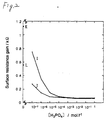
- comparative positive electrode (K) and negative electrode (L) were prepared in the same manner as the positive electrode (I) and negative electrode (J), respectively, except that the electrode coated with a polymer pasta was immersed in purified water free of phosphoric acid. These electrodes were then measured for surface resistance.
- MCP-TESTER LORESTA-FP produced by Mitsubishi Petrochemical Co., Ltd. was used.
- two probes having a diameter of 2 mm were pressed against one surface of the electrode under a predetermined pressure at an interval of 8 mm. Under these conditions, the surface resistance between the two probes was measured.
- the current collector exhibits a far higher electronic conductivity than the active material layer. Thus, in this method, the resistance between the surface of the electrode and the current collector is actually measured, making it possible to detect the rise in the surface resistance of the current collector.
- the measurement of the surface resistance of the electrode was effected before the application of the polymer paste having PVdF dissolved in NMP to the electrode and after the 100°C-30 min.
- Positive and negative electrodes of the present invention were prepared in the same manner as in Example 1 except that various phosphorus compounds were used instead of phosphoric acid. These electrodes were then measured for surface resistance in the same manner as in Example 2. The results are set forth in Table 1.
- a mixture of 70 wt% of lithium cobaltate, 6 wt% of acetylene black and 15 wt% of n-methyl pyrrolidone (NMP) having 9 wt% of a polyvinylidene fluoride (PVdF) dissolved therein was applied to an aluminum foil having a width of 20 mm, a length of 480 mm and a thickness of 20 ⁇ m, and then dried at a temperature of 90°C to evaporate NMP. This procedure was effected on both sides of the aluminum foil to prepare an electrode. A polymer paste having 4 wt% of PVdF in NMP was then applied to the main body of the electrode thus prepared so that the polymer paste penetrated into the pores in the active material layer.
- NMP n-methyl pyrrolidone
- PVdF polyvinylidene fluoride
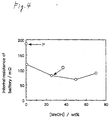
- the electrode was immersed in water containing from 1 to 70 wt% of methanol to effect solvent extraction.
- the electrode thus treated was withdrawn, and then dried at a temperature of 130°C.
- the electrode was then pressed to provide a positive electrode (M).
- the thickness of the positive electrode thus obtained was 170 ⁇ m.
- the weight of the active material and electro-conducting additives filled per unit area was 23 ⁇ g/cm 2 .
- a positive electrode (N) was prepared in the same manner as the positive electrode (M) except that as the solvent for extraction of NMP there was used water free of alcohol. The results of the measurement of surface resistance of these porous polymer-containing positive electrodes are shown in Fig. 3.
- the positive electrode (M) of the present invention which has been obtained by extraction of NMP with water containing methanol, exhibits a lower surface resistance than the positive electrode (N), which has been obtained by extraction of NMP with water.
- Fig. 4 shows that the concentration of methanol, if any, is preferably from 1 to 70 wt%, more preferably from 30 to 60 wt%.
- a battery prepared from the foregoing positive electrode (M) will be described hereinafter.
- a negative electrode was prepared as follows. A mixture of 81 wt% of graphite, 9 wt% of PVdF and 10 wt% of NMP was applied to a copper foil having a thickness of 14 ⁇ m, and then dried at a temperature of 150°C to evaporate NMP. This procedure was effected on both sides of the copper foil. The copper foil was then pressed to prepare a negative electrode. The thickness of the negative electrode thus obtained was 190 ⁇ m.
- the positive electrode (M) and the negative electrode were wound with a microporous polypropylene separator having a thickness of 26 ⁇ m (trade name: Celgard) provided interposed therebetween, and then inserted into a stainless steel case having a height of 47.0 mm, a width of 22.2 mm and a thickness of 6.4 mm to form a prismatic battery. Thereafter, 2.5 g of an electrolyte solution composed of a 1 : 1 (by volume) mixture of ethylene carbonate containing 1 M of LiPF 6 and diethyl carbonate was injected into the stainless steel case. The battery was then heated at a temperature of 60°C for 48 hours to prepare a battery (O) of the present invention having a nominal capacity of 400 mAh.
- a battery (O) of the present invention having a nominal capacity of 400 mAh.
- the foregoing battery (O) of the present invention and the comparative battery (P) were each charged at a constant current of 1 A to 4.1 V where it was then charged for 2 hours, and then discharged at a constant current of 1 A to 2.5 V.
- the results of the discharge test are set forth in Fig. 5. These results show that the battery (O) of the present invention exhibits better discharge properties than the comparative battery (P), which has been obtained by extraction of NMP with water.
- polyvinylidene fluoride As the polymer to be packed in the pores in the electrode there was used a polyvinylidene fluoride.
- other various polymers may be used singly or in admixture.
- these polymers include polyether such as polyethylene oxide and polypropylene oxide, polyacrylonitrile, polyvinyl fluoride, polyvinylidiene chloride, polymethyl methacrylate, polymethyl acrylate, polyvinyl alcohol, polymethacrylonitrile, polyvinyl acetate, polyvinyl pyrrolidone, polyethyleneimine, polybutadiene, polystyrene, polyisoprene, and derivatives thereof.
- Polymers obtained by copolymerization of various monomers constituting the foregoing polymers may be used.
- the nonaqueous electrolyte solution there was used a mixture of ethylene carbonate and dimethyl carbonate.
- other various solvents may be used.
- these solvents include polar solvents such as ethylene carbonate, propylene carbonate, dimethyl carbonate, diethyl carbonate, ⁇ -butyrolactone, sulfolane, dimethyl sulfoxide, acetonitrile, dimethylformamide, dimethylacetamide, 1, 2-dimethoxyethane, 1, 2-diethoxyethane, tetrahydrofuran, 2-methyltetrahydrofuran, dioxolan and methyl acetate, and mixture thereof.
- polar solvents such as ethylene carbonate, propylene carbonate, dimethyl carbonate, diethyl carbonate, ⁇ -butyrolactone, sulfolane, dimethyl sulfoxide, acetonitrile, dimethylformamide, dimethylacetamide, 1, 2-dimethoxyethane, 1, 2-die
- LiPF 6 LiPF 6
- LiAsF 6 LiClO 4
- LiSCN LiI, LiCF 3 SO 3 , LiCl, LiBr and LiCF 3 CO 2 and mixture thereof may be used.
- LiCoO 2 As the compound capable of intercalating and deintercalating lithium as a positive active material there was used LiCoO 2 .
- the present invention is not limited to this compound.
- an inorganic compound there may be used a compound represented by the composition formula Li x MO 2 or Li y M 2 O 4 (in which M represents a transition metal, x represents a number of from more than 0 to not more than 1, and y represents a number of from more than 0 to not more than 2) in the form of composite oxide, oxide having tunnel-like pores or lamellar metal chalcogenide.
- the compound to be used as negative material there was used graphite.
- an alloy of lithium with Al, Si, Pb, Sn, Cd, etc., composite oxide of transition metal such as LiFe 2 O 3 , oxide of transition metal such as MoO 2 , carbon-based material such as graphite and carbon, lithium nitride such as Li 5 (Li 3 N), tin or silicon oxide, lithium foil, or mixture thereof may be used.
- an electrode comprising a current collector made of a metal and an active material layer and holding therein a polymer paste having a polymer dissolved in a solvent soluble in water is treated with an aqueous solution containing an alcohol, phosphorus or phosphorus compound to prepare an electrode for nonaqueous electrolyte battery.
- an electrode constituted by a current collector made of a metal is immersed in an aqueous solution, the deterioration of the current collector properties due to the corrosion of metal by water can be remarkably inhibited.
- the use of the present invention prevents the deterioration of the current collector properties due to the corrosion of the current collector, making it possible to obtain sufficient battery properties, even if an electrode provided with a porous polymer is prepared by a solvent extraction method which involves immersing an electrode in water. Since water, which is inexpensive, can be used as the solvent in which the electrode is immersed in the solvent extraction method, the production cost of the electrode can be reduced as compared with the case where other solvents are used. Thus, the present invention allows the production of a safe high performance nonaqueous electrolyte battery at a low cost.
Landscapes
- Chemical & Material Sciences (AREA)
- Engineering & Computer Science (AREA)
- Chemical Kinetics & Catalysis (AREA)
- Electrochemistry (AREA)
- General Chemical & Material Sciences (AREA)
- Manufacturing & Machinery (AREA)
- Materials Engineering (AREA)
- Dispersion Chemistry (AREA)
- Secondary Cells (AREA)
- Cell Electrode Carriers And Collectors (AREA)
- Battery Electrode And Active Subsutance (AREA)
Applications Claiming Priority (9)
| Application Number | Priority Date | Filing Date | Title |
|---|---|---|---|
| JP22725797 | 1997-08-08 | ||
| JP22725897 | 1997-08-08 | ||
| JP227258/97 | 1997-08-08 | ||
| JP9227258A JPH1167192A (ja) | 1997-08-08 | 1997-08-08 | 非水電解質電池用電極の製造法及び非水電解質電池の製造法 |
| JP9227257A JPH1167191A (ja) | 1997-08-08 | 1997-08-08 | 非水電解質電池用電極の製造法及び非水電解質電池の製造法 |
| JP227257/97 | 1997-08-08 | ||
| JP335044/97 | 1997-11-18 | ||
| JP33504497 | 1997-11-18 | ||
| JP9335044A JPH11149942A (ja) | 1997-11-18 | 1997-11-18 | 多孔質複合電極の製造方法 |
Publications (2)
| Publication Number | Publication Date |
|---|---|
| EP0905804A2 true EP0905804A2 (de) | 1999-03-31 |
| EP0905804A3 EP0905804A3 (de) | 1999-12-08 |
Family
ID=27331267
Family Applications (1)
| Application Number | Title | Priority Date | Filing Date |
|---|---|---|---|
| EP98114939A Withdrawn EP0905804A3 (de) | 1997-08-08 | 1998-08-07 | Elektrode für Batterie mit nichtwässrigem Elektrolyt und Verfahren zur Herstellung |
Country Status (3)
| Country | Link |
|---|---|
| US (1) | US6676713B1 (de) |
| EP (1) | EP0905804A3 (de) |
| CN (1) | CN1155129C (de) |
Cited By (1)
| Publication number | Priority date | Publication date | Assignee | Title |
|---|---|---|---|---|
| FR2916905A1 (fr) * | 2007-06-04 | 2008-12-05 | Commissariat Energie Atomique | Nouvelle composition pour la fabrication d'electrodes, electrodes et batteries en resultant. |
Families Citing this family (14)
| Publication number | Priority date | Publication date | Assignee | Title |
|---|---|---|---|---|
| EP1077498A1 (de) | 1999-03-04 | 2001-02-21 | Japan Storage Battery Co., Ltd. | Aktives kompositmaterial und verfahren zu dessen , elektrode und verfahren zu deren herstellung und nichtwässrige elektrolytische zelle |
| KR100666821B1 (ko) * | 2004-02-07 | 2007-01-09 | 주식회사 엘지화학 | 유/무기 복합 다공성 코팅층이 형성된 전극 및 이를포함하는 전기 화학 소자 |
| EP1575099A1 (de) * | 2004-03-09 | 2005-09-14 | RWE SCHOTT Solar GmbH | Verfahren zum Ausbilden einer Struktur |
| US20050274000A1 (en) * | 2004-06-14 | 2005-12-15 | The University Of Chicago | Methods for fabricating lithium rechargeable batteries |
| EP1784876B1 (de) | 2004-09-02 | 2018-01-24 | LG Chem, Ltd. | Poröser film mit organischer/anorganischer zusammensetzung und dadurch hergestellte elektrochemische einrichtung |
| JP4679112B2 (ja) * | 2004-10-29 | 2011-04-27 | 三洋電機株式会社 | 非水電解質二次電池及びその製造方法 |
| US7923400B2 (en) * | 2004-12-14 | 2011-04-12 | Nissan Motor Co., Ltd. | Method of making an electrode for use in a battery |
| WO2006101779A2 (en) * | 2005-03-15 | 2006-09-28 | The University Of Chicago | Non-aqueous electrolytes for lithium ion batteries |
| JP4581888B2 (ja) * | 2005-07-25 | 2010-11-17 | Tdk株式会社 | 電気化学素子用電極の製造方法および電気化学素子の製造方法 |
| WO2007066966A1 (en) * | 2005-12-06 | 2007-06-14 | Lg Chem Ltd. | Electrode with enhanced safety and electrochemical device having the same |
| KR100966024B1 (ko) * | 2007-04-24 | 2010-06-24 | 주식회사 엘지화학 | 이종의 세퍼레이터를 구비한 전기화학소자 |
| KR20120098728A (ko) * | 2009-10-21 | 2012-09-05 | 도쿠리츠교세이호징 고쿠리츠코토센몬갓코키코 | 폴리머 복합 미립자를 이용한 고분자 고체 전해질을 이용한 전기 화학 디바이스 |
| JP6113521B2 (ja) * | 2012-02-27 | 2017-04-12 | 株式会社東芝 | 非水電解質電池および電池パック |
| CN111384376B (zh) * | 2018-12-29 | 2021-09-03 | 上海杉杉科技有限公司 | 硅碳负极材料及其制备方法、应用和制得的锂离子电池 |
Family Cites Families (5)
| Publication number | Priority date | Publication date | Assignee | Title |
|---|---|---|---|---|
| JPS60264048A (ja) * | 1984-06-13 | 1985-12-27 | Central Glass Co Ltd | 電地用正極の製造法 |
| US5558954A (en) * | 1994-10-13 | 1996-09-24 | Polystor Corporation | Preparation of carbon electrodes by polymer-precipitation |
| FR2729009B1 (fr) * | 1994-12-28 | 1997-01-31 | Accumulateurs Fixes | Electrode bifonctionnelle pour generateur electrochimique ou supercondensateur et son procede de fabrication |
| TW342537B (en) * | 1995-03-03 | 1998-10-11 | Atochem North America Elf | Polymeric electrode, electrolyte, article of manufacture and composition |
| US5738691A (en) * | 1997-04-28 | 1998-04-14 | Valence Technology, Inc. | Ultrasonic extraction of plasticizer from electrochemical cells |
-
1998
- 1998-08-07 CN CNB981035493A patent/CN1155129C/zh not_active Expired - Fee Related
- 1998-08-07 EP EP98114939A patent/EP0905804A3/de not_active Withdrawn
- 1998-08-10 US US09/131,675 patent/US6676713B1/en not_active Expired - Fee Related
Cited By (3)
| Publication number | Priority date | Publication date | Assignee | Title |
|---|---|---|---|---|
| FR2916905A1 (fr) * | 2007-06-04 | 2008-12-05 | Commissariat Energie Atomique | Nouvelle composition pour la fabrication d'electrodes, electrodes et batteries en resultant. |
| WO2009004182A1 (fr) * | 2007-06-04 | 2009-01-08 | Commissariat A L'energie Atomique | Nouvelle composition pour la fabrication d'electrodes, electrodes et batteries en resultant |
| US8475962B2 (en) | 2007-06-04 | 2013-07-02 | Commissariat A L'energie Atomique | Composition for manufacture of electrodes and electrodes and batteries resulting therefrom |
Also Published As
| Publication number | Publication date |
|---|---|
| US6676713B1 (en) | 2004-01-13 |
| EP0905804A3 (de) | 1999-12-08 |
| CN1155129C (zh) | 2004-06-23 |
| CN1209659A (zh) | 1999-03-03 |
Similar Documents
| Publication | Publication Date | Title |
|---|---|---|
| US6534218B1 (en) | Electrode for nonaqueous electrolyte battery | |
| KR100985346B1 (ko) | 리튬 이차전지 | |
| JP4029266B2 (ja) | 非水電解質電池および非水電解質電池の製造法 | |
| US9012088B2 (en) | Anode composition comprising acrylonitrile-acrylic acid copolymer as binder, method for preparing the anode composition and lithium secondary battery using the anode composition | |
| JP3385516B2 (ja) | 非水系ポリマー電池及び非水系ポリマー電池用ポリマー膜の製造方法 | |
| EP3690992A1 (de) | Kathode für festelektrolytbatterie und festelektrolytbatterie damit | |
| EP3686982A1 (de) | Festelektrolytbatterie sowie batteriemodul und batteriepack damit | |
| EP1193789A1 (de) | Nicht-wässrige elektrolytische sekundärzelle | |
| EP3460894B1 (de) | Lithium-schwefel-batterie | |
| US6676713B1 (en) | Process for producing electrode of nonaqueous electrolyte battery | |
| EP0838873B1 (de) | Nichtwässrige Polymer-Batterie | |
| JPWO2002091514A1 (ja) | 非水電解質電池およびその製造方法 | |
| EP1176660A2 (de) | Nicht-wässrige Elektrolyt-Sekundärbatterie | |
| EP1077498A1 (de) | Aktives kompositmaterial und verfahren zu dessen , elektrode und verfahren zu deren herstellung und nichtwässrige elektrolytische zelle | |
| JP3968772B2 (ja) | 非水電解質電池 | |
| JP3825571B2 (ja) | 非水電解質電池 | |
| JPH1126025A (ja) | 円筒型非水電池 | |
| JPH10247520A (ja) | 非水電解質電池 | |
| JP2002093463A (ja) | 非水電解質電池 | |
| JPH1167191A (ja) | 非水電解質電池用電極の製造法及び非水電解質電池の製造法 | |
| JP4016712B2 (ja) | リチウムイオン導電性ポリマー電解質およびそれを用いたポリマー電解質電池 | |
| JP4041998B2 (ja) | 非水電解質電池の製造方法 | |
| JP3566858B2 (ja) | 非水電解質電池 | |
| JP2002056895A (ja) | 非水電解質電池 | |
| JP2002056893A (ja) | 非水電解質電池 |
Legal Events
| Date | Code | Title | Description |
|---|---|---|---|
| PUAI | Public reference made under article 153(3) epc to a published international application that has entered the european phase |
Free format text: ORIGINAL CODE: 0009012 |
|
| AK | Designated contracting states |
Kind code of ref document: A2 Designated state(s): DE FR GB |
|
| AX | Request for extension of the european patent |
Free format text: AL;LT;LV;MK;RO;SI |
|
| PUAL | Search report despatched |
Free format text: ORIGINAL CODE: 0009013 |
|
| AK | Designated contracting states |
Kind code of ref document: A3 Designated state(s): AT BE CH CY DE DK ES FI FR GB GR IE IT LI LU MC NL PT SE |
|
| AX | Request for extension of the european patent |
Free format text: AL;LT;LV;MK;RO;SI |
|
| RIC1 | Information provided on ipc code assigned before grant |
Free format text: 6H 01M 4/02 A, 6H 01M 10/40 B, 6H 01M 4/66 B, 6H 01M 4/04 B |
|
| 17P | Request for examination filed |
Effective date: 20000217 |
|
| AKX | Designation fees paid |
Free format text: DE FR GB |
|
| STAA | Information on the status of an ep patent application or granted ep patent |
Free format text: STATUS: THE APPLICATION HAS BEEN WITHDRAWN |
|
| 18W | Application withdrawn |
Effective date: 20050614 |