EP0904425B1 - Moderate temperature manganese phosphate conversion coating composition and process - Google Patents
Moderate temperature manganese phosphate conversion coating composition and process Download PDFInfo
- Publication number
- EP0904425B1 EP0904425B1 EP97903984A EP97903984A EP0904425B1 EP 0904425 B1 EP0904425 B1 EP 0904425B1 EP 97903984 A EP97903984 A EP 97903984A EP 97903984 A EP97903984 A EP 97903984A EP 0904425 B1 EP0904425 B1 EP 0904425B1
- Authority
- EP
- European Patent Office
- Prior art keywords
- range
- concentration
- dissolved
- composition
- cations
- Prior art date
- Legal status (The legal status is an assumption and is not a legal conclusion. Google has not performed a legal analysis and makes no representation as to the accuracy of the status listed.)
- Expired - Lifetime
Links
Classifications
-
- C—CHEMISTRY; METALLURGY
- C23—COATING METALLIC MATERIAL; COATING MATERIAL WITH METALLIC MATERIAL; CHEMICAL SURFACE TREATMENT; DIFFUSION TREATMENT OF METALLIC MATERIAL; COATING BY VACUUM EVAPORATION, BY SPUTTERING, BY ION IMPLANTATION OR BY CHEMICAL VAPOUR DEPOSITION, IN GENERAL; INHIBITING CORROSION OF METALLIC MATERIAL OR INCRUSTATION IN GENERAL
- C23C—COATING METALLIC MATERIAL; COATING MATERIAL WITH METALLIC MATERIAL; SURFACE TREATMENT OF METALLIC MATERIAL BY DIFFUSION INTO THE SURFACE, BY CHEMICAL CONVERSION OR SUBSTITUTION; COATING BY VACUUM EVAPORATION, BY SPUTTERING, BY ION IMPLANTATION OR BY CHEMICAL VAPOUR DEPOSITION, IN GENERAL
- C23C22/00—Chemical surface treatment of metallic material by reaction of the surface with a reactive liquid, leaving reaction products of surface material in the coating, e.g. conversion coatings, passivation of metals
- C23C22/05—Chemical surface treatment of metallic material by reaction of the surface with a reactive liquid, leaving reaction products of surface material in the coating, e.g. conversion coatings, passivation of metals using aqueous solutions
- C23C22/06—Chemical surface treatment of metallic material by reaction of the surface with a reactive liquid, leaving reaction products of surface material in the coating, e.g. conversion coatings, passivation of metals using aqueous solutions using aqueous acidic solutions with pH less than 6
- C23C22/34—Chemical surface treatment of metallic material by reaction of the surface with a reactive liquid, leaving reaction products of surface material in the coating, e.g. conversion coatings, passivation of metals using aqueous solutions using aqueous acidic solutions with pH less than 6 containing fluorides or complex fluorides
- C23C22/36—Chemical surface treatment of metallic material by reaction of the surface with a reactive liquid, leaving reaction products of surface material in the coating, e.g. conversion coatings, passivation of metals using aqueous solutions using aqueous acidic solutions with pH less than 6 containing fluorides or complex fluorides containing also phosphates
- C23C22/364—Chemical surface treatment of metallic material by reaction of the surface with a reactive liquid, leaving reaction products of surface material in the coating, e.g. conversion coatings, passivation of metals using aqueous solutions using aqueous acidic solutions with pH less than 6 containing fluorides or complex fluorides containing also phosphates containing also manganese cations
-
- C—CHEMISTRY; METALLURGY
- C23—COATING METALLIC MATERIAL; COATING MATERIAL WITH METALLIC MATERIAL; CHEMICAL SURFACE TREATMENT; DIFFUSION TREATMENT OF METALLIC MATERIAL; COATING BY VACUUM EVAPORATION, BY SPUTTERING, BY ION IMPLANTATION OR BY CHEMICAL VAPOUR DEPOSITION, IN GENERAL; INHIBITING CORROSION OF METALLIC MATERIAL OR INCRUSTATION IN GENERAL
- C23C—COATING METALLIC MATERIAL; COATING MATERIAL WITH METALLIC MATERIAL; SURFACE TREATMENT OF METALLIC MATERIAL BY DIFFUSION INTO THE SURFACE, BY CHEMICAL CONVERSION OR SUBSTITUTION; COATING BY VACUUM EVAPORATION, BY SPUTTERING, BY ION IMPLANTATION OR BY CHEMICAL VAPOUR DEPOSITION, IN GENERAL
- C23C22/00—Chemical surface treatment of metallic material by reaction of the surface with a reactive liquid, leaving reaction products of surface material in the coating, e.g. conversion coatings, passivation of metals
- C23C22/05—Chemical surface treatment of metallic material by reaction of the surface with a reactive liquid, leaving reaction products of surface material in the coating, e.g. conversion coatings, passivation of metals using aqueous solutions
- C23C22/06—Chemical surface treatment of metallic material by reaction of the surface with a reactive liquid, leaving reaction products of surface material in the coating, e.g. conversion coatings, passivation of metals using aqueous solutions using aqueous acidic solutions with pH less than 6
- C23C22/07—Chemical surface treatment of metallic material by reaction of the surface with a reactive liquid, leaving reaction products of surface material in the coating, e.g. conversion coatings, passivation of metals using aqueous solutions using aqueous acidic solutions with pH less than 6 containing phosphates
- C23C22/08—Orthophosphates
- C23C22/18—Orthophosphates containing manganese cations
Definitions
- This invention relates to compositions and processes for depositing a manganese containing phosphate conversion coating on metal surfaces, particularly the surfaces of ferrous metals, galvanized steel, and other predominantly zinciferous surfaces.
- the invention particularly relates to such compositions and processes that produce, at a temperature not more than 80 °C, a conversion coating suitable as a high quality undercoat for paint and like organic coatings.
- aqueous acidic compositions containing a sufficient concentration of phosphate ions results in the deposition on the active metal surfaces of a conversion coating containing phosphate ions and some metallic cations, which are derived from dissolution of the active metal being phosphate conversion coated, from metallic cations with a valence of at least two that are present in the aqueous acidic compositions, or both.
- the phosphating compositions contain zinc, nickel, or manganese, in order to speed the process and improve the uniformity of the coating, it is customary to include in the coating composition a component called an "accelerator" that does not usually become incorporated into the coating formed.
- Typical widely used accelerators include nitrite and chlorate ions, water soluble nitroaromatic organic compounds such as p-nitrobenzene sulfonic acid, and hydroxylamine, the latter almost always in the form of salts or complexes and different from most other accelerators because, in the concentrations in which it is normally used, it is not a strong enough oxidizing agent to oxidize Fe(II) ions to Fe(III) ions, one of the functions of most other accelerators.
- Prior art phosphating compositions that include manganese as substantially the only metal cations with a valence of two or more in the compositions have been known and used. However, such compositions have been previously used in practice only at relatively high temperatures, almost always above 80 °C and more often above 88 °C. Such compositions have been notoriously prone to sludging, a phenomenon that occurs with almost all phosphate conversion coating compositions but is quantitatively aggravated when the compositions contain manganese as the predominant cations with a valence of two or more.
- prior art manganese phosphating compositions are not known to have produced satisfactory quality conversion coatings when contacted with the surfaces to be coated by spraying only, and have generally been used only when the surfaces to be coated were immersed in the compositions.
- SU 1,608,244 teaches a concentrated composition for use, after dilution, in treating car components, at high temperatures and with relatively long contact times.
- the initial concentrate is prepared from Mn carbonate, H 3 PO 4 , HNO 3 , Ni(NO 3 ) 2 .6H 2 O, propylene glycol and H 2 O.
- DE 805,343 discloses a concentrate composition comprising dissolved manganese and phosphate ions.
- the phosphating process taught requires a relatively high operating temperature, near the boiling point of water.
- U.S. 3,767,476 describes a phosphating method which must be carried out in a closed chamber under a relatively high steam pressure, at a minimum temperature slightly above the boiling point of water.
- Various alternative and/or concurrent objects of this invention are: (i) to provide a composition and process for phosphating that will provide a high quality protective undercoat for paint and like organic binder containing overcoatings, where manganese ion are the predominant cations with a valence of two or more in the composition; (ii) to provide manganese containing phosphate conversion coatings readily controlled to lower coating masses of manganese per unit area coated than have been usual with prior art manganese phosphate conversion coating compositions; (iii) to provide relatively economical phosphate conversion coating compositions and processes that will provide as good quality paint undercoatings as do currently conventional phosphate conversion coating processes utilizing zinc, nickei, and/or cobait containing conversion coating forming compositions; (iv) to provide conversion coatings with good paint undercoating quality by spraying; (v) to reduce the pollution hazard from phosphating compositions by (v.1) reducing or eliminating their content of zinc, nickel, cobalt, chromium, copper, and
- a conversion coating forming aqueous liquid composition that has a pH of at least 3.0 and comprises, preferably consists essentially of, or more preferably consists of, water and:
- Various embodiments of the invention include working compositions for direct use in treating metals, make-up concentrates from which such working compositions can be prepared by dilution with water, replenisher concentrates suitable for maintaining optimum performance of working compositions according to the invention, processes for treating metals with a composition according to the invention, and extended processes including additional steps that are conventional per se , such as cleaning, activation of the surface to be conversion coated before it is contacted with the conversion coating composition (e.g., activation of steel with titanium phosphate sols, also known as "Jernstedt salts"), rinsing, and subsequent painting or some similar overcoating process that puts into place an organic binder containing protective coating over the metal surface treated according to a narrower embodiment of the invention.
- Articles of manufacture including surfaces treated according to a process of the invention are also within the scope of the invention.
- the present invention accordingly provides a process of forming a conversion coating on a surface of a metal substrate, selected from ferrous metals, zinciferous metals and combinations thereof, without the imposition of any external electromotive force on the substrate or an electric current therethrough, in which process the metal substrate surface is contacted with an acidic aqueous liquid composition, which besides water comprises:
- compositions according to the invention as defined above should be substantially free from many ingredients used in compositions for similar purposes in the prior art.
- maximum storage stability of a concentrate, avoidance of possibly troublesome anions, economy, and/or minimization of pollution potential is desired, it is preferred, with increasing preference in the order given, independently for each preferably minimized component listed below, that these compositions contain no more than 25, 15, 9, 5, 3, 1.0, 0.35, 0.10, 0.08, 0.04, 0.02, 0.01, 0.001, or 0.0002, percent of each of the following constituents: nitrite; halates and perhalates (i.e.
- perchlorate, chlorate, iodate, etc. hydroxylamine and salts and complexes of hydroxylamine; chloride; bromide; iodide; organic compounds containing nitro groups; hexavalent chromium; manganese in a valence state of four or greater; metal cations, other than manganese and iron, with a valance of two or more; ferricyanide; ferrocyanide; and pyrazole compounds.
- Components such as these may not be harmful in some cases, but they have not been found to be needed or advantageous in compositions according to this invention, and their minimization is therefore normally preferred at least for reasons of economy.
- working phosphating compositions according to this invention should have an oxidizing power no greater than that which is inherent in an otherwise preferred composition according to the invention, with other ingredients explicitly specified as necessary or preferred, that is in equilibrium with the natural atmospheric gases.
- the oxidizing power of the composition may be measured for this purpose by the potential of a platinum electrode immersed in the composition, compared to some standard reference electrode maintained in electrical contact with the composition via a salt bridge, flowing junction, semipermeable membrane, or the like as known to those skilled in electrochemistry.
- the dissolved manganese cations required for necessary component (A) may be obtained from any soluble manganese salt or from manganese metal itself or any manganese containing compound that reacts with aqueous acid to form dissolved manganese cations.
- Normally preferred sources are manganese carbonate and manganese oxide.
- the presence of reducing agent component (E) as defined above is usually preferred, because without it the dissolution rate of MnO in phosphoric acid is very slow.
- Reducing agents appear to act in a catalytic or at least partially catalytic manner to speed the dissolution process, inasmuch as the amount of reducing agent needed to make the dissolution rate of MnO practically fast is far less than the amount that would be stoichiometrically required to react with all the manganese present.
- the concentration of dissolved manganese cations preferably is at least, with increasing preference in the order given, 0.1, 0.2, 0.30, 0.40, 0.50, 0.60, 0.70, 0.80, 0.90, 1.00, 1.10, 1.20, 1.30, 1.35, 1.40, 1.45, or 1.49 parts per thousand (hereinafter usually abbreviated as "ppt") and independently preferably is not more than, with increasing preference in the order given, 4.0, 3.5, 3.0, 2.7, 2.5, 2.3, 2.2, 2.1, or 2.0 ppt. Smaller concentrations than those recited as preferred minimums above generally do not produce satisfactory coatings in a reasonable time. Larger concentrations than those recited as prefened maximums above generally do not produce any quality improvement in the coatings formed and are therefore uneconomical.
- the dissolved phosphate ions that constitute necessary component (B) also may be obtained from a variety of sources as known in the general phosphate conversion coating art. Because of a preference noted below for a substantial amount of total acid in a working conversion coating forming aqueous liquid composition according to the invention, normally much of the phosphate ion content will preferably be supplied by phosphoric acid added to the composition, and the stoichiometric equivalent as phosphate ions of all undissociated phosphoric acid and all its anionic ionization products in solution, along with the stoichiometric equivalent as phosphate ions of any dihydrogen phosphate, monohydrogen phosphate, or completely neutralized phosphate ions added to the composition in salt form, are to be understood as forming part of component (B), irrespective of the actual degree of ionization that exists in the composition.
- component (B) If any metaphosphoric acid or condensed phosphoric acids or their salts are present in the compositions, their stoichiometric equivalent as phosphate is also considered part of component (B). Generally, however, it is preferred to use orthophosphoric and its salts only for component (B).
- the concentration of component (B) preferably is at least, with increasing preference in the order given, 5, 6, 7, 8, 9, 10, 10.5, 11.0, 11.5, 11.8, 12.0, 12.2, 12.4, or 12.6 ppt and independently preferably is not more than, with increasing preference in the order given, 100, 50, 40, 30, 27, 24, 21, 19.0, 18.0, 17.0, 16.0, 15.0. 14.0, 13.7, 13.3, 13.0, or 12.8 ppt.
- the ratio of the concentration of component (A) to the concentration of component (B) in a conversion coating forming aqueous liquid composition according to the invention, whether working or concentrate, preferably is at least, with increasing preference in the order given, 1.0:50, 1.0:40, 1.0:35, 1.0:30, 1.0:27, 1.0:24, 1.0:21, 1.0:18, 1.0:16, 1.0:15, 1.0:14, or 1.0:13.7 and independently preferably is not more than, with increasing preference in the order given, 1.0:5.0, 1.0:6.0, 1.0:7.0, 1.0:8.0, 1.0:8.5, 1.0:9.0. 1.0:9.5, 1.0:10, 1.0:10.5, 1.0:11.0, 1.0:11.5, 1.0:12.0, 1.0:12.5. 1.0:13.0. or 1.0:13.3.
- Nitric acid is preferably present in a composition according to the invention, most preferably as the major but not the sole constituent of component (C); other acids can also be present in the compositions according to the invention, either alone or with nitric acid.
- the major recognized purpose of most of component (C) is to increase the "Total Acid" content of compositions according to the invention above the levels that can be achieved with phosphoric acid alone without exceeding the above noted preferred maximum values for phosphate ions.
- the Total Acid content is measured in "points", which are defined for the purposes of this description to be equal to the milliliters ("ml") of 0.1 N NaOH required to titrate a 10 ml aliquot sample of the composition to a pH of 8.2 (e.g., with phenolphthalein indicator).
- the Total Acid points present in a working composition according to the invention preferably are at least, with increasing preference in the order given, 4, 6, 8, 10, 12.0, 13.0, 14.0, 14.5, 15.0, 15.3, 15.5, 15.7, or 15.9 and independently preferably are, primarily for reasons of economy, not more than, 50, 40, 35, 30, 25, 20, 18.0, 17.5, 17.0, 16.5, or 16.2.
- Points of Free Acid are defined in the same way as points of Total Acid, except that the titration is to a pH of 3.8 (e.g., with bromophenol blue indicator). If the pH of the composition is already 3.8 or greater, the titration is made with 0.1 N strong acid instead of NaOH and is then described alternatively as negative Free Acid, or more commonly, as "Acid Consumed”.
- Compositions according to the invention preferably have Free Acid points that are at least, with increasing preference in the order given, -1.5, -1.0, -0.80, -0.70, -0.60., -0.55, or -0.50 and independently preferably are not more than, with increasing preference in the order given, 1.5, 1.0, 0.80, 0.60, 0.50, 0.40, 0.30, 0.20, 0.15, or 0.10.
- the concentration of formic acid preferably is at least, with increasing preference in the order given, 0.04, 0.08, 0.15, 0.20, 0.25, 0.30, 0.35, 0.39, or 0.43 g/L and independently, primarily for reasons of economy, preferably is not more than, with increasing preference in the order given, 5, 3.0, 2.0, 1.5, 1.0, 0.90, 0.80, 0.70, 0.65, 0.60, 0.55, 0.50, or 0.45 g/L.
- the ratio of the concentration of formic acid to the concentration of nitric acid preferably is at least, with increasing preference in the order given, 0.002, 0.004, 0.006, 0.008, 0.010, 0.015, 0.020, 0.023, 0.026, 0.029, 0.032, or 0.034:1.0 and independently preferably is not more than, with increasing preference in the order given, 0.5, 0.3, 0.20, 0.10, 4.080, 0.070, 0.060, 0.050, 0.045, 0.041, 0.038, or 0.036:1.0.
- the primary benefit observed from the presence of formic acid in compositions according to the invention is more rapid coating formation.
- Component (D) one of the important functions of which when used is to sequester calcium and magnesium ions that might be present in the water supply, normally is not needed in compositions according to the invention unless they are to be diluted with very hard water.
- it is preferably derived from anions or other molecules each of which contains both at least one carboxyl(ate) moiety and one hydroxyl moiety that is not part of any carboxyl(ate) moiety, more preferably from the group consisting of citric acid, gluconic acid, and heptogluconic acid and the water soluble salts of all of these acids, most preferably from gluconic acid and its water soluble salts.
- the concentration of component (D) in a working conversion coating forming aqueous liquid composition according to the invention preferably is at least, with increasing preference in the order given, 0.4, 0.8, 1.5, 2.0, 2.5, 3.0, 3.5, 4.0, 4.3, 4.6, 4.8. or 5.0 millimoles per liter of total composition (hereinafter usually abbreviated as "m M ”) and independently, primarily for reasons of economy, when it is used at all, the concentration of component (D) in a working composition according to the invention preferably is not more than, with increasing preference in the order given, 50, 25, 15, 10, 7.0, 5.8, 5.5, or 5.2 m M .
- reducing agent component (E) is normally preferred in compositions according to the invention when concentrates are being made by dissolving MnO in phosphoric acid. If working solutions are being prepared directly, or some more readily soluble source of Mn(II) ions than MnO is used, component (E) is generally not needed. When component (E) is used, it is preferably selected from the group consisting of (i) hydroxylamine and salts, complexes, oximes.
- reaction products of hydroxylamine that, when dissolved in water, establish an equilibrium with free hydroxylamine and rapidly release more hydroxylamine when any already released has been consumed by some irreversible reaction, so that these reaction products function chemically in the same manner as hydroxylamine itself when dissolved in water and (ii) ferrous ions, with the latter preferred, because they are less expensive and also effective in lower concentrations.
- Any water soluble salt of ferrous iron may be used as a source of ferrous ions, as may powdered metallic iron, although the latter is not usually preferred because its dissolution is more difficult.
- the ratio of the molar concentration of ferrous ions to the molar concentration of any MnO used in preparing a composition according to the invention preferably is at least, with increasing preference in the order given, 0.001: 1.0, 0.003:1.0, 0.005:1.0, 0.006:1.0, 0.0070:1.0, 0.0075:1.0, 0.0080:1.0, 0.0083:1.0, or 0.0085:1.0 and independently preferably is, primarily for reasons of economy, not more than, with increasing preference in the order given, 0.50:1.0, 0.30:1.0, 0.10:1.0, 0.07:1.0, 0.05:1.0, 0.040:1.0, 0.030:1.0.
- hydroxylamine is used, it is preferably provided by hydroxylamine sulfate, i.e., (HONH 3 ) 2 SO 4 , hereinafter usually abbreviated as "HAS".
- HAS hydroxylamine sulfate
- the ratio of the molar concentration of hydroxylamine to the molar concentration of any MnO used in preparing a composition according to the invention preferably is at least.
- Optional surfactant component (F) is often preferably present in a composition according to the invention, in order to promote thorough and uniform wetting of metal substrates to be phosphated by a conversion coating composition according to the invention.
- a preferred type of surfactant for conversion coating compositions according to the invention is that consisting of partial esters of phosphoric acid with ether alcohols made by condensing ethylene oxide with phenol.
- the amount of surfactant preferably is at least, with increasing preference in the order given, 0.01, 0.03, 0.05, 0.07, 0.080, 0.085, 0.090, 0.095, or 0.099 ppt and independently preferably is, primarily for reasons of economy, not more than, with increasing preference in the order given, 1.0, 0.8, 0.6, 0.4, 0.30, 0.25, 0.20, 0.17, 0.15, 0.13, or 0.11 ppt.
- Optional fluoride component (G) is normally preferred in compositions according to the invention. because it has at least three beneficial possible functions: (i) counteracting the tendency of galvanized surfaces being phosphated to develop "white specking" if the phosphating compositions contain substantial amounts of chloride, as occur in some tap water supplies; (ii) providing a buffering action to maintain the acidity of the compositions in a desirable range; and (iii) promoting a desirable rate of dissolution of the metal being phosphated, as is often necessary for the phosphating process. to work.
- ppm concentration stoichiometrically equivalent to 100 to 300 parts per million (hereinafter usually abbreviated as "ppm") of fluorine atoms is optimum for cold rolled steel substrates, while substantially higher concentrations of fluoride are preferred if aluminum is to be conversion coated.
- the amount used in that instance preferably should be sufficient to avoid the well known difficulties that can be caused by accumulation of aluminum ions in phosphating compositions that do not contain any complexing agent. such as fluoride, for the aluminum ions.
- Optional component (H) of divalent metal ions, except for manganese and any iron added as part of the reducing agent component (E), is not generally needed in, and therefore, at least for reasons of economy, normally is preferably omitted from. compositions according to the invention, but may be useful in some special circumstances.
- Optional buffering agent component (J) is often preferred in a composition according to the invention, particularly if component (G) is omitted. Borates, silicates, acetates, and the corresponding acids are suitable constituents for component (J) when desired, as are many other materials well known to those skilled in the art.
- Optional component (K) biocide.
- compositions according to the invention are usually preferably present in compositions according to the invention if substantial amounts of gluconic and/or citric acids and their salts are present in the compositions, because numerous microorganisms prevalent in normal environments can utilize these organic acids as nutrients and in the process destroy the effectiveness of the compositions for their intended use and/or make the compositions repulsive to workers who use them, for example by developing a foul odor.
- make-up concentrate compositions are single package liquid concentrates, i.e., are aqueous liquids that consist of water and each of components (A) through (K), as recited above for working compositions. that are desired in the working compositions to be prepared from the make-up concentrate compositions. along with any other ingredients desired in the working compositions, except acid or alkaline materials that are not part of any of components (A) through (K) but are added to working compositions after preparation thereof to slightly less, than the final desired volume, in order to adjust the Free Acid and Total Acid contents therein as defined above.
- alkalinizing adjustment will be needed and if so, primarily for reasons of economy, at least one of ammonium, potassium, and sodium hydroxides is preferably used.
- all the components except water of a make-up concentrate composition according to the invention are present therein in a concentration such that the ratio of the concentration of each component in the make-up concentrate composition to the concentration of the same component in the working composition that it is desired to prepare from the concentrate composition will be at least, with increasing preference in the order given, 5:1.0, 10:1.0, 20:1.0, 30:1.0, 40:1.0, or 50:1.0.
- the concentrates are stable to storage in the temperature range from at least -20 to 50, or more preferably to 80, °C. Stability may conveniently be evaluated by measuring the free acid and total acid contents as described above, usually after dilution of a sample to approximately the concentration desired for a working composition. If these values have not changed after storage by more than 10% of their value before storage or by more than 0.2 points, if the absolute value before storage was less than 2.0 points, the concentrate is considered storage stable. With increasing preference in the order given, the concentrates according to the invention will be storage stable as thus defined after storage for at least 1, 3, 10, 30, 60, or 200 days.
- the actual conversion coating forming step in a process according to this invention preferably is performed at a temperature that is at least, with increasing preference in the order given, 23, 26, 29, 32, 35, 38, 41, 44, 46, 48, 50, 52, 54, or 55 °C and independently preferably is, primarily for reasons of economy, particularly for minimization of sludge volume, not more than 75, 72, 70, 68, 66, 64, 62, or 61 °C.
- the time of contact preferably should be sufficient to form a complete coating of microcrystalline phosphate over the contacted surface.
- the time of contact preferably is at least, with increasing preference in the order given.
- the time of contact preferably is at least, with increasing preference in the order given, 0.40, 0.50, 0.60, 0.70, 0.80, 0.90, 1.0, 1.3, 1.5, 1.7, or 2.0 minutes and independently, primarily for reasons of economy, preferably is not more than, with increasing preference in the order given, 30, 20, 15, 12, 10, 8, 7.0, 6.5, 6.0, 5.5, 5.0, 4.5, 4.0, 3.5, 3.0, or 2.5 minutes.
- Low times of contact are particularly preferred when the substrate surface to be coated is primarily zinciferous, because with such substrates the coating weight obtained does not increase very much after a coating that completely covers the contacted surface has been formed, whereas with steel substrates, coating weights continue to increase with time of contact, even after a coating that completely covers the contacted surface has formed.
- a conversion coating formed by a process according to the invention preferably has a mass per unit area that is at least, with increasing preference in the order given, 0.4, 0.7, 1.0, 1,2, 1.5, 1.7, 1.9, 2.1, 2.3, 2.40, 2.50, 2.60, 2.70, 2.80, 2.90, or 2.97 grams per square meter of surface coated (hereinafter usually abbreviated as "g/m 2 ”) and independently preferably is not more than, with increasing preference in the order given, 20, 17, 15, 13, 11, 9.0, 8.0, 7.0, 6.0, 5.0, 4.5, 4.0, 3.8. 3.6, 3.4, 3.20, or 3.10 g/m 2 .
- the substrate to be conversion coated is preferably thoroughly cleaned by any of various methods well known to those skilled in the art to be suitable for the particular substrate to be coated. If a conversion coating according to this invention is to be applied to a steel substrate, after being cleaned the substrate is preferably first conditioned with a conventional manganese hydrogen phosphate and alkali metal pyrophosphate conditioner for use on steel before prior art manganese phosphating. If a conversion coating according to this invention is to be applied to a predominantly zinciferous substrate such as galvanized steel, a titanium phosphate sol, also known as a Jemstedt salt, conditioning treatment is preferably used between cleaning and phosphate conversion coating according to this invention. If a conversion coating according to this invention is to be applied to a substrate containing substantial areas of both steel and galvanized steel, a mixture of the two previously specified types of conditioning treatments is preferably contacted with the substrate between cleaning and conversion coating according to the invention.
- the substrates used and their abbreviations as used below are shown in Table 1.1 below.
- the substrates were in the form of conventional rectangular test panels.
- Concentrates 1.1.1 and 1.1.2 according to the invention were prepared from the ingredients shown in Table 1.3 below. Ingredient Parts of Ingredient in Concentrate #: 1.1.1 1.1.2 Tap Water 490 494 75 % Aqueous Solution of H 3 PO 4 350 350 69 % Aqueous Solution of HNO 3 120 120 Hydroxylamine Sulfate 5.0 0 Ferrous Sulfate Heptahydrate 0 1.2 Manganous Oxide 35.0 35.0
- An Initial Working Composition 2.1 was prepared by dissolving the following ingredients, along with whatever amount of water was needed in addition to the ingredients listed below, to produce a total volume of 10 liters: 500 grams (hereinafter usually abbreviated as "g") of Concentrate 1.1; 10 g of MnCO 3 ; 10 g of gluconic acid, 1.0 g of a surfactant constituted of partial esters of phosphoric acid, preferably with an alcohol including an aromatic portion, such as TRYFAC® 5555 or 5556 surfactants available commercially from Henkel Corp., Emery Group, Cincinnati, Ohio, RHODAFACTM BG-510, BG-769, BX-660, PE-9, RA-600, RE-610, RE-960, RM-710, RP-710, or RS-710 surfactants, commercially available from Rhone-Poulenc, and DePhos P-6 LF, P 6-LF AS, and PE 481 surfactants commercially available from Deforest Enterprises, Inc., Boc
- a working composition was made in the same manner as for Group 2, except that the gluconic acid and manganese carbonate were omitted, the pH was adjusted to 3.7s, and the points of Total Acid were 16.4.
- Concentrate 1.1 as described above was diluted to give a manganese(II) concentration of 2.5 - 2.8 ppt and adjusted with sodium hydroxide to give Total Acid at 29.3 points and Free Acid at 1.4 points.
- Test panels were coated by immersion at 65.6 °C to produce results as shown in Table 4.1. The coating obtained on panel 4.1 did not completely cover the surface, but on all other panels in Table 4.1, the coating obtained did completely cover the surface.
- each composition shown was aged by immersing in it a number of cold-rolled steel panels sufficient to correspond to 0.5 square centimeter per liter of composition; these "aging" panels were left in place for five minutes.
- Working Compositions 5.1 - 5.8 and 5.10 as shown in Table 5.2 were prepared from corresponding Concentrates 5.1 - 5.8 as shown in Table 5.1 by adding to water, to produce a preliminary solution containing about 120 g/L of the Concentrate: the corresponding Concentrate; formic acid, in the form of a 90 % solution in water; and GAFACTM RP-710.
- the preliminary solution was then adjusted to a final volume with more water and with an aqueous solution of 50 % sodium hydroxide, in an amount to contain all of the sodium required to produce the sodium concentrations shown in Table 5.2, so as to bring the final Free Acid points to a value within the range from 0.20 to 0.33, the final concentration of the Concentrate to 100 g/L, the final concentration of the formic acid to 0.044 %, and the final concentration of GAFACTM RP-71 0 to 0.02 %.
- Working Composition 5.9 shown in Table 5.2 which also contained formic acid and GAFACTM RP-710 in the same concentrations as specified above for the other Working Compositions shown in Table 5.2, was prepared directly from the basic ingredients.
- the concentrations of nitrate and phosphate ions shown in Table 5.2 for Working Compositions 5.1 through 5.8 constitute the three variable values of two of the three factors in a three-factor face centered cubic experimental design.
- Working Composition 5.9 was originally intended to have the highest values of both nitric and phosphoric acid concentrations to complete this experimental design, but this proved to be impossible because of instability of the composition, so that Working Composition 5.9 was prepared with the slightly lower values shown for these ingredients in Table 5.2 and proved to be stable at those concentrations.
- the third factor of this experimental design was immersion time, which is shown in Table 5.4 et seq .
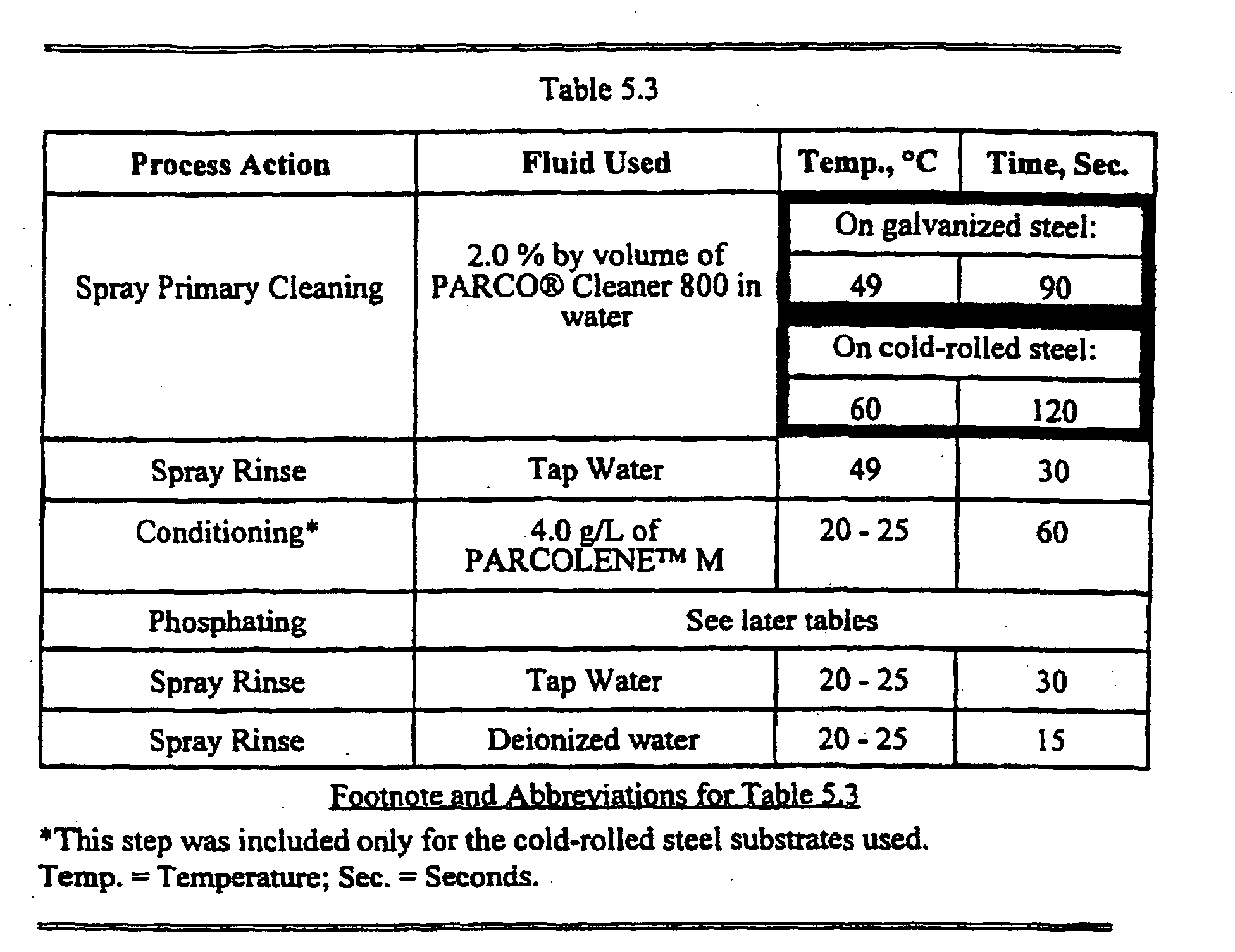
- the Working Compositions shown in Table 5.2 were used in extended processes according to the invention with features as described in Table 5.3 below.
- Substrates processed in this group included cold-rolled steel, double sided and single sided electrogalvanized steel, and nickel-flashed steel.
- the substrates used for corrosion testing were painted before testing with either DURACRONTM 200, a paint known to give relatively poor protection against corrosion on its own and therefore to be useful for discriminating among degrees of protection provided by the phosphate coating, and with a highly protective paint system of the type now commonly used on new automobiles manufactured in the U.
- Coating masses shown in Table 5.4 were determined by conventional stripping of unpainted coated samples, except for the one-sided electrogalvanized substrates, for which the coating weight were calculated based on measurements of the phosphorus content in the coatings by an ASOMATM Model 8620 X-ray fluorescence measuring instrument supplied by Asoma Instruments, Inc., 1212-H Technology Blvd., Austin, Texas and used as directed by its manufacturer.
- Composition 5.10 from Table 5.2 was used with contact by spraying rather than immersion. Two minutes of spraying at 60 °C produced a coating with a good visual appearance.
Landscapes
- Chemical & Material Sciences (AREA)
- General Chemical & Material Sciences (AREA)
- Chemical Kinetics & Catalysis (AREA)
- Engineering & Computer Science (AREA)
- Materials Engineering (AREA)
- Mechanical Engineering (AREA)
- Metallurgy (AREA)
- Organic Chemistry (AREA)
- Chemical Treatment Of Metals (AREA)
- Paints Or Removers (AREA)
- Application Of Or Painting With Fluid Materials (AREA)
Description
said aqueous liquid composition being contacted with the metal substrate for a time not greater than 5.0 minutes, effective to form a coating with a mass of at least 1.2 g/m2.
| Substrate Metal Type | Abbreviation | Conditioner Used |
| Cold rolled steel | CRS | PARCOLENE® M |
| Hot dip galvanized steel | HDG | FIXODINE® Z8 |
| Process Action | Fluid Used | Temp., °C | Time, Sec. |
| Spray Primary Cleaning | 21 g/L of PARCO® Cleaner 1502 in water | 49 | 90 |
| Spray Rinse | Tap Water | 49 | 30 |
| Conditioning | See table 1 | 20 - 25 | 60 |
| Phosphating | See specific examples | ||
| Spray Rinse | Tap Water | 20-25 | 30 |
| Postrinsing | PARCOLENE® 95A Postrinse in water | 20 - 25 | 30 |
| Spray Rinse | Deionized water | 20-25 | 15 |
| Ingredient | Parts of Ingredient in Concentrate #: | |
| 1.1.1 | 1.1.2 | |
| Tap Water | 490 | 494 |
| 75 % Aqueous Solution of H3PO4 | 350 | 350 |
| 69 % Aqueous Solution of HNO3 | 120 | 120 |
| Hydroxylamine Sulfate | 5.0 | 0 |
| Ferrous Sulfate Heptahydrate | 0 | 1.2 |
| Manganous Oxide | 35.0 | 35.0 |
| Panel # | Temp., °C | Postrinsing ? | g/m2 of Phos. | Notes |
| 2.1 | 65.6 | No | 5.74 | - |
| 2.2 | 54.4 | No | 2.96 | - |
| 2.3 | 54.4 | No | 2.64 | 1 |
| 2.4 | 54.4 | Yes | 2.64 | - |
| 2.5 | 54.4 | No | 4.15 | 2 |
| 2.6 | 48.9 | No | 1.40 | 2 |
| 2.7 | 54.4 | No | 5.50 | 3 |
| 2.8 | 54.4 | No | 0.43 | 4 |
| Notes for Table 2.1 | ||||
| 1. Between panels 2.2 and 2.3, 20 additional panels on which coating weights were not measured were processed to age the composition. This caused the points of Total Acid to decrease slightly to 16.0. Phosphate coatings with good visual appearance were obtained on all of these 20 additional panels. | ||||
| 2. Between panels 2.4 and 2.5, sufficient HAS was added to the composition in which the panels were immersed to result in a concentration of 0.25 % of HAS in the composition. | ||||
| 3. Between panels 2.6 and 2.7, additional HAS was added to the composition in which the panels were immersed, to result in a total concentration of 0.6 % of HAS in the composition. | ||||
| 4. Between panels 2.6 and 2.7, additional HAS was added to the composition in which the panels were immersed, to result in a total concentration of 2.0 % of HAS in the composition. The very sparse phosphate coating formed appeared to be iron phosphate only, with no substantial content of manganese. | ||||
| Additional Abbreviation for Table 2.1 g/m2 = grams per square meter. |
| Panel Number | Substrate | Minutes Immersed | g/m2 of Phosphate Coated |
| 4.1 | CRS | 3 | 2.70 |
| 4.2 | CRS | 5 | 3.42 |
| 4.3 | CRS | 10 | 6.51 |
| 4.4 | HDG | 3 | 3.02 |
| 4.5 | HDG | 5 | 3.02 |
| 4.6 | HDG | 10 | 3.02 |
| Composition Number | Grams, per Kilogram of Total Composition, of: | |||
| 42 °Baumé HNO3 | 75 % H3PO4 | FeSO4·7H2O | MnO | |
| 5.1 | 174 | 345 | 1.2 | 27.0 |
| 5.2 | 50.0 | 206 | 1.2 | 27.0 |
| 5.3 | 50.0 | 480 | 1.2 | 27.0 |
| 5.4 | 303 | 206 | 1.2 | 27.0 |
| 5.5 | 50.0 | 345 | 1.2 | 27.0 |
| 5.6 | 303 | 345 | 1.2 | 27.0 |
| 5.7 | 175 | 206 | 1.2 | 27.0 |
| 5.8 | 175 | 480 | 1.2 | 27.0 |
| 5.9 | 303 | 480 | 1.2 | 27.0 |
| 5.10 | 150 | 340 | 1.2 | 30.0 |
| 5.11 | 304 | 480 | 1.2 | 27.0 |
| 5.12 | 175 | 345 | 1.2 | 27.0 |
| Notes for Table 5.1 The HNO3 and H3PO4 were added in the form of aqueous solutions with the density or concentration noted in the Table headings. 42 °Baumé nitric acid contains about 69 % of pure HNO3. The balance of all the concentrates not shown explicitly in the Table was water. |
| Working Composition Number | Characteristics of the Working Compositions | |||||||
| Conc. in % of: | TA Points | pH | ||||||
| PO4 -3 | NO3 -1 | Mn+2 | Na+1 | Initial | Final | Initial | Final | |
| 5.1 | 2.5 | 1.15 | 0.20 | 0.80 | 30.4 | 30.0 | 3.51 | 3.48 |
| 5.2 | 1.5 | 0.33 | 0.20 | 0.31 | 20.2 | 20.0 | 3.49 | 3.47 |
| 5.3 | 3.5 | 0.33 | 0.20 | 0.50 | 43.2 | 43.4 | 3.49 | 3.47 |
| 5.4 | 1.5 | 2.0 | 0.20 | 0.92 | 19.5 | 19.3 | 3.48 | 3.42 |
| 5.5 | 2.5 | 0.33 | 0.20 | 0.54 | 31.0 | 30.8 | 3.44 | 3.41 |
| 5.6 | 2.5 | 2.0 | 0.20 | 1.15 | 31.8 | 31.4 | 3.44 | 3.39 |
| 5.7 | 1.5 | 1.15 | 0.20 | 0.61 | 19.9 | 19.7 | 3.48 | 3.43 |
| 5.8 | 3.5 | 1.15 | 0.20 | 1.06 | 41.9 | 41.6 | 3.44 | 3.40 |
| 5.9 | 3.4 | 1.9 | 0.20 | 1.40 | 39.1 | 39.1 | 3.35 | 3.26 |
| 5.10 | 2.5 | 1.0 | 0.23 | 0.38 | 24.0 | 24.0 | 3.40 | 3.30 |



Claims (8)
- A process of forming a conversion coating on a surface of a metal substrate, selected from ferrous metals, zinciferous metals and combinations thereof, without the imposition of any external electromotive force on the substrate or an electric current therethrough, in which process the metal substrate surface is contacted with an acidic aqueous liquid composition, which besides water comprises:and in which said aqueous liquid composition during its contact with the metal substrate has a temperature of not more than 75°C, a free acid points value in the range of from -1.5 to +1.5, where said free acid points are defined as being equal to the number of millilitres of 0.1 N NaOH required to titrate a 10 ml aliquot sample of the composition to a pH of 3.8, and a total acid points value in the range of from 4 to 50, where said total acid points are defined as being equal to the number of millilitres of 0.1 N NaOH required to titrate a 10 ml aliquot sample of the composition to a pH of 8.2, said composition also containing a concentration of not more than 0.02 % of each of the following constituents, namely zinc cations; nickel cations; calcium cations; magnesium cations, cobalt(II) cations; nitrite ions, all halate and perhalate ions; chloride ions; ferrocyanide ions, and ferricyanide ions; and(A) dissolved divalent manganese cations in a concentration of from 0.30 to 4.0 ppt by weight; and(B) dissolved phosphate anions present in a concentration such that the weight ratio of divalent manganese cations to dissolved phosphate anions is in the range of from 1.0:50 to 1.0:6.0,
said aqueous liquid composition being contacted with the metal substrate for a time not greater than 5.0 minutes, effective to form a coating with a mass of at least 1.2 g/m2. - A process as claimed in claim 1, in which said aqueous liquid composition further comprises nitric acid, and the concentration of dissolved phosphate anions is not greater than 40 ppt by weight.
- A process as claimed in claim 1 or claim 2, in which:said aqueous liquid composition further comprises formic acid in a concentration of at least 0.15 g/l;the concentration of dissolved divalent manganese cations is in the range of from 0.70 to 3.0 ppt by weight; andthe ratio of the concentrations of dissolved manganese cations to dissolved phosphate anions is in the range of from 1.0:30 to 1.0:8.0.
- A process as claimed in claim 3, in which the composition:comprises formic acid in a concentration in the range of from 0.25 to 1.0 g/l and having a ratio to the concentration of nitric acid (expressed in g/l) that is in the range of from 0.002:1.0 to 0.20:1.0;contains a concentration of dissolved divalent manganese cations in the range of from 0.70 to 2.5 ppt by weight;contains a concentration of dissolved phosphate anions in the range of from 7 to 19 ppt by weight; andhas a ratio of the concentrations of dissolved manganese cations to dissolved phosphate anions in the range of from 1.0:24 to 1.0:10.0
- A process as claimed in claim 3 or claim 4, in which said composition:comprises formic acid in a concentration in the range of from 0.25 to 0.70 g/l, and having a ratio to the concentration of nitric acid (expressed in g/l) that is in the range of from 0.008:1.0 to 0.010:1.0;has a concentration of dissolved divalent manganese cations in the range of from 0.70 to 2.3 ppt by weight;has a concentration of dissolved phosphate anions in the range of from 11.0 to 17.0 ppt by weight; andhas a ratio of the concentrations of dissolved manganese cations to dissolved phosphate anions in the range of from 1.0:18 to 1.0:12.0.
- A process as claimed in as claimed in any of the preceding claims, in which the composition is maintained at a temperature in the range of from 44 to 64°C during a contact time in the range of from 0.50 to 5.0 minutes so as to form a conversion coating with a mass per unit area that is in the range of from 1.9 to 5.0 g/m2.
- A process as claimed in claim 6, in which said aqueous liquid composition:the total acid points value of the aqueous liquid composition is in the range of from 15.0 to 30.comprises formic acid in a concentration in the range of from 0.35 to 0.55 g/l and that has a ratio to the concentration of nitric acid (in g/l) in the range of from 0.015:1.0 to 0.050:1.0;the concentration of dissolved divalent manganese cations is in the range of from 1.20 to 2.3 ppt by weight;the concentration of dissolved phosphate anions is in the range of from 11.0 to 17.0 ppt by weight; and
- A process as claimed in any of claims 1 to 7, further comprising a preliminary step of preparing the acidic aqueous liquid composition, in which preliminary step: component (A) is derived from manganous oxide and the dissolution thereof to make said aqueous liquid composition is accelerated by the presence of a dissolved reducing agent in a precursor aqueous liquid composition with which the manganous oxide is in physical contact during its dissolution.
Applications Claiming Priority (5)
| Application Number | Priority Date | Filing Date | Title |
|---|---|---|---|
| US601481 | 1996-02-14 | ||
| US08/601,481 US5595611A (en) | 1996-02-14 | 1996-02-14 | Moderate temperature manganese phosphate conversion coating composition and process |
| US08/747,136 US5728235A (en) | 1996-02-14 | 1996-11-12 | Moderate temperature manganese phosphate conversion coating composition and process |
| US747136 | 1996-11-12 | ||
| PCT/US1997/001242 WO1997030191A1 (en) | 1996-02-14 | 1997-02-03 | Moderate temperature manganese phosphate conversion coating composition and process |
Publications (3)
| Publication Number | Publication Date |
|---|---|
| EP0904425A1 EP0904425A1 (en) | 1999-03-31 |
| EP0904425A4 EP0904425A4 (en) | 1999-04-21 |
| EP0904425B1 true EP0904425B1 (en) | 2004-09-15 |
Family
ID=27083869
Family Applications (1)
| Application Number | Title | Priority Date | Filing Date |
|---|---|---|---|
| EP97903984A Expired - Lifetime EP0904425B1 (en) | 1996-02-14 | 1997-02-03 | Moderate temperature manganese phosphate conversion coating composition and process |
Country Status (12)
| Country | Link |
|---|---|
| US (1) | US5728235A (en) |
| EP (1) | EP0904425B1 (en) |
| AR (1) | AR005805A1 (en) |
| AT (1) | ATE276383T1 (en) |
| AU (1) | AU712410B2 (en) |
| BR (1) | BR9707498A (en) |
| DE (1) | DE69730711T2 (en) |
| ES (1) | ES2225950T3 (en) |
| NZ (1) | NZ330788A (en) |
| TR (1) | TR199801526T2 (en) |
| TW (1) | TW449625B (en) |
| WO (1) | WO1997030191A1 (en) |
Families Citing this family (8)
| Publication number | Priority date | Publication date | Assignee | Title |
|---|---|---|---|---|
| JP2003520904A (en) * | 2000-01-31 | 2003-07-08 | 日本パーカライジング株式会社 | Phosphate conversion coating method and composition |
| US6902766B1 (en) | 2000-07-27 | 2005-06-07 | Lord Corporation | Two-part aqueous metal protection treatment |
| EP1382718B1 (en) * | 2001-02-26 | 2013-04-24 | Nippon Steel & Sumitomo Metal Corporation | Surface treated steel product, method for production thereof and chemical conversion treatment solution |
| US20030104228A1 (en) * | 2001-11-07 | 2003-06-05 | Henkel Corporation | Hureaulite conversion coating as a base for the bonding of rubber to metal |
| WO2003054250A1 (en) * | 2001-12-13 | 2003-07-03 | Henkel Kommanditgesellschaft Auf Aktien | Use of substituted hydroxylamines in metal phosphating processes |
| US6899956B2 (en) | 2002-05-03 | 2005-05-31 | Birchwood Laboratories, Inc. | Metal coloring process and solutions therefor |
| US20040118483A1 (en) * | 2002-12-24 | 2004-06-24 | Michael Deemer | Process and solution for providing a thin corrosion inhibiting coating on a metallic surface |
| ES2547901T3 (en) * | 2003-12-04 | 2015-10-09 | Nippon Steel & Sumitomo Metal Corporation | Surface adjustment treatment prior to the chemical treatment of a steel product |
Family Cites Families (26)
| Publication number | Priority date | Publication date | Assignee | Title |
|---|---|---|---|---|
| CA752345A (en) * | 1967-02-07 | Hooker Chemical Corporation | Production of phosphate coatings on metal | |
| US1206075A (en) * | 1915-08-21 | 1916-11-28 | Parker Rust Proof Company Of America | Process for rust-proofing metal. |
| BE341226A (en) * | 1926-05-10 | |||
| US2132000A (en) * | 1936-10-07 | 1938-10-04 | Curtin Howe Corp | Phosphate coating bath and method of making |
| US2375458A (en) * | 1939-09-06 | 1945-05-08 | Norman F Agnew | Electrical fence charging apparatus |
| DE805343C (en) * | 1950-01-31 | 1951-05-17 | American Chem Paint Co | Process for the production of phosphate coatings on metals, especially iron and steel |
| US2668496A (en) * | 1951-06-22 | 1954-02-09 | Thomco Mfg Co Inc | Cylinder support means for rotary tape printing presses |
| BE515434A (en) * | 1951-11-19 | |||
| FR1172741A (en) * | 1956-02-27 | 1959-02-13 | Parker Ste Continentale | Phosphating solution and coating process using this solution |
| US3562023A (en) * | 1968-05-15 | 1971-02-09 | Whitefield Chemical Co Inc | Manganese coating bath with molybdenum |
| US3767476A (en) * | 1971-08-31 | 1973-10-23 | Us Army | Method and composition for phosphatizing steel under pressure |
| US3860455A (en) * | 1973-03-16 | 1975-01-14 | Oxy Metal Finishing Corp | Method for phosphatizing ferrous surfaces |
| JPS58123882A (en) * | 1982-01-20 | 1983-07-23 | Toyota Motor Corp | Chemical conversion treatment giving manganese phosphate film |
| DE3631759A1 (en) * | 1986-09-18 | 1988-03-31 | Metallgesellschaft Ag | METHOD FOR PRODUCING PHOSPHATE COATINGS ON METAL SURFACES |
| US4941930A (en) * | 1986-09-26 | 1990-07-17 | Chemfil Corporation | Phosphate coating composition and method of applying a zinc-nickel phosphate coating |
| US4793867A (en) * | 1986-09-26 | 1988-12-27 | Chemfil Corporation | Phosphate coating composition and method of applying a zinc-nickel phosphate coating |
| US4717431A (en) * | 1987-02-25 | 1988-01-05 | Amchem Products, Inc. | Nickel-free metal phosphating composition and method for use |
| FR2618164B1 (en) * | 1987-06-25 | 1994-02-04 | Roquette Freres | SOLUTION AND METHOD FOR MIXED PHOSPHATATION. |
| SU1608244A1 (en) * | 1987-12-22 | 1990-11-23 | Ленинградский Государственный Научно-Исследовательский И Проектный Институт Основной Химической Промышленности | Phosphatizing composition |
| JPH0730455B2 (en) * | 1988-09-27 | 1995-04-05 | 日本パーカライジング株式会社 | Phosphate chemical treatment liquid |
| US5372656A (en) * | 1989-08-17 | 1994-12-13 | Henkel Kommanditgesellschaft Auf Aktien | Process for producing manganese-containing zinc phosphate coatings on galvanized steel |
| US5261973A (en) * | 1991-07-29 | 1993-11-16 | Henkel Corporation | Zinc phosphate conversion coating and process |
| JP3219453B2 (en) * | 1992-03-17 | 2001-10-15 | 日本パーカライジング株式会社 | Manufacturing method of galvanized steel sheet with excellent blackening resistance |
| JP3274917B2 (en) * | 1993-09-14 | 2002-04-15 | 日本パーカライジング株式会社 | Manganese phosphate chemical conversion treatment solution for steel and method for forming chemical conversion film |
| JP3325366B2 (en) * | 1993-10-29 | 2002-09-17 | 日本パーカライジング株式会社 | Chemical conversion treatment liquid composition for magnesium-containing metal, chemical conversion treatment method, and chemical conversion-treated material |
| DE4440300A1 (en) * | 1994-11-11 | 1996-05-15 | Metallgesellschaft Ag | Process for applying phosphate coatings |
-
1996
- 1996-11-12 US US08/747,136 patent/US5728235A/en not_active Expired - Lifetime
-
1997
- 1997-02-03 AT AT97903984T patent/ATE276383T1/en not_active IP Right Cessation
- 1997-02-03 BR BR9707498A patent/BR9707498A/en not_active Application Discontinuation
- 1997-02-03 WO PCT/US1997/001242 patent/WO1997030191A1/en not_active Ceased
- 1997-02-03 AU AU18405/97A patent/AU712410B2/en not_active Ceased
- 1997-02-03 TR TR1998/01526T patent/TR199801526T2/en unknown
- 1997-02-03 NZ NZ330788A patent/NZ330788A/en unknown
- 1997-02-03 DE DE69730711T patent/DE69730711T2/en not_active Expired - Lifetime
- 1997-02-03 EP EP97903984A patent/EP0904425B1/en not_active Expired - Lifetime
- 1997-02-03 ES ES97903984T patent/ES2225950T3/en not_active Expired - Lifetime
- 1997-02-13 AR ARP970100569A patent/AR005805A1/en active IP Right Grant
- 1997-03-18 TW TW086103351A patent/TW449625B/en active
Also Published As
| Publication number | Publication date |
|---|---|
| TR199801526T2 (en) | 1999-01-18 |
| NZ330788A (en) | 1999-10-28 |
| DE69730711T2 (en) | 2005-09-22 |
| AU712410B2 (en) | 1999-11-04 |
| AU1840597A (en) | 1997-09-02 |
| EP0904425A4 (en) | 1999-04-21 |
| WO1997030191A1 (en) | 1997-08-21 |
| ATE276383T1 (en) | 2004-10-15 |
| BR9707498A (en) | 1999-07-27 |
| US5728235A (en) | 1998-03-17 |
| TW449625B (en) | 2001-08-11 |
| ES2225950T3 (en) | 2005-03-16 |
| AR005805A1 (en) | 1999-07-14 |
| DE69730711D1 (en) | 2004-10-21 |
| EP0904425A1 (en) | 1999-03-31 |
Similar Documents
| Publication | Publication Date | Title |
|---|---|---|
| KR100250366B1 (en) | Acidic aqueous composition and thickening agent for forming zinc phosphate coating on metal substrate | |
| US5885373A (en) | Chromium free, low organic content post-rinse for conversion coatings | |
| US5797987A (en) | Zinc phosphate conversion coating compositions and process | |
| US4486241A (en) | Composition and process for treating steel | |
| AU2003293945B2 (en) | Process for providing a thin corrosion inhibiting coating on a metallic surface | |
| CA2440127A1 (en) | Method for applying a phosphate coating and use of metal parts coated in this manner | |
| US5595611A (en) | Moderate temperature manganese phosphate conversion coating composition and process | |
| AU4067901A (en) | Method for applying a phosphate covering and use of metal parts thus phospated | |
| EP0866887A1 (en) | Finely crystalline and/or fast phosphate conversion coating composition and process | |
| KR20010072179A (en) | Method for phosphatizing , rerinsing and cathodic electro-dipcoating | |
| CA1322147C (en) | Zinc-nickel phosphate conversion coating composition and process | |
| US6743302B2 (en) | Dry-in-place zinc phosphating compositions including adhesion-promoting polymers | |
| AU712410B2 (en) | Moderate temperature manganese phosphate conversion coating composition and process | |
| WO2009017535A2 (en) | High manganese cobalt-modified zinc phosphate conversion coating | |
| EP1287180B1 (en) | Phosphate conversion coating process and composition | |
| EP0675972A1 (en) | Substantially nickel-free phosphate conversion coating composition and process | |
| JPH04341574A (en) | Treatment of zinc phosphate onto metal surface | |
| GB1582354A (en) | Processes for producing phosphate coatings on ferrous metal surfaces | |
| SK112598A3 (en) | Zinc phosphatizing with low quantity of copper and manganese | |
| US2975082A (en) | Method of providing ferrous articles with phosphate coatings and compositions therefor | |
| US4643778A (en) | Composition and process for treating steel | |
| KR19990087077A (en) | Zinc-phosphatizing method using low concentration of nickel and / or cobalt | |
| CA2244902C (en) | Moderate temperature manganese phosphate conversion coating composition and process | |
| CA2236512C (en) | Process of phosphatizing metal surfaces | |
| JPH10140366A (en) | Medium temperature manganese phosphate chemical conversion treatment solution and chemical conversion treatment method |
Legal Events
| Date | Code | Title | Description |
|---|---|---|---|
| PUAI | Public reference made under article 153(3) epc to a published international application that has entered the european phase |
Free format text: ORIGINAL CODE: 0009012 |
|
| 17P | Request for examination filed |
Effective date: 19980910 |
|
| AK | Designated contracting states |
Kind code of ref document: A1 Designated state(s): AT DE ES FR GB IT SE |
|
| A4 | Supplementary search report drawn up and despatched |
Effective date: 19990310 |
|
| AK | Designated contracting states |
Kind code of ref document: A4 Designated state(s): AT DE ES FR GB IT SE |
|
| 17Q | First examination report despatched |
Effective date: 20000307 |
|
| GRAP | Despatch of communication of intention to grant a patent |
Free format text: ORIGINAL CODE: EPIDOSNIGR1 |
|
| GRAS | Grant fee paid |
Free format text: ORIGINAL CODE: EPIDOSNIGR3 |
|
| GRAA | (expected) grant |
Free format text: ORIGINAL CODE: 0009210 |
|
| AK | Designated contracting states |
Kind code of ref document: B1 Designated state(s): AT DE ES FR GB IT SE |
|
| PG25 | Lapsed in a contracting state [announced via postgrant information from national office to epo] |
Ref country code: AT Free format text: LAPSE BECAUSE OF FAILURE TO SUBMIT A TRANSLATION OF THE DESCRIPTION OR TO PAY THE FEE WITHIN THE PRESCRIBED TIME-LIMIT Effective date: 20040915 |
|
| REG | Reference to a national code |
Ref country code: GB Ref legal event code: FG4D |
|
| RAP2 | Party data changed (patent owner data changed or rights of a patent transferred) |
Owner name: HENKEL CORPORATION |
|
| REF | Corresponds to: |
Ref document number: 69730711 Country of ref document: DE Date of ref document: 20041021 Kind code of ref document: P |
|
| PG25 | Lapsed in a contracting state [announced via postgrant information from national office to epo] |
Ref country code: SE Free format text: LAPSE BECAUSE OF FAILURE TO SUBMIT A TRANSLATION OF THE DESCRIPTION OR TO PAY THE FEE WITHIN THE PRESCRIBED TIME-LIMIT Effective date: 20041215 |
|
| REG | Reference to a national code |
Ref country code: ES Ref legal event code: FG2A Ref document number: 2225950 Country of ref document: ES Kind code of ref document: T3 |
|
| PLBE | No opposition filed within time limit |
Free format text: ORIGINAL CODE: 0009261 |
|
| STAA | Information on the status of an ep patent application or granted ep patent |
Free format text: STATUS: NO OPPOSITION FILED WITHIN TIME LIMIT |
|
| ET | Fr: translation filed | ||
| 26N | No opposition filed |
Effective date: 20050616 |
|
| REG | Reference to a national code |
Ref country code: FR Ref legal event code: PLFP Year of fee payment: 19 |
|
| REG | Reference to a national code |
Ref country code: FR Ref legal event code: PLFP Year of fee payment: 20 |
|
| PGFP | Annual fee paid to national office [announced via postgrant information from national office to epo] |
Ref country code: DE Payment date: 20160218 Year of fee payment: 20 Ref country code: ES Payment date: 20160210 Year of fee payment: 20 Ref country code: IT Payment date: 20160223 Year of fee payment: 20 |
|
| PGFP | Annual fee paid to national office [announced via postgrant information from national office to epo] |
Ref country code: FR Payment date: 20160218 Year of fee payment: 20 Ref country code: GB Payment date: 20160217 Year of fee payment: 20 |
|
| REG | Reference to a national code |
Ref country code: DE Ref legal event code: R071 Ref document number: 69730711 Country of ref document: DE |
|
| REG | Reference to a national code |
Ref country code: GB Ref legal event code: PE20 Expiry date: 20170202 |
|
| REG | Reference to a national code |
Ref country code: ES Ref legal event code: FD2A Effective date: 20170526 |
|
| PG25 | Lapsed in a contracting state [announced via postgrant information from national office to epo] |
Ref country code: GB Free format text: LAPSE BECAUSE OF EXPIRATION OF PROTECTION Effective date: 20170202 |
|
| PG25 | Lapsed in a contracting state [announced via postgrant information from national office to epo] |
Ref country code: ES Free format text: LAPSE BECAUSE OF EXPIRATION OF PROTECTION Effective date: 20170204 |