EP0904403B1 - Protein kinase assay as a method for identification of fungicides - Google Patents
Protein kinase assay as a method for identification of fungicides Download PDFInfo
- Publication number
- EP0904403B1 EP0904403B1 EP97923899A EP97923899A EP0904403B1 EP 0904403 B1 EP0904403 B1 EP 0904403B1 EP 97923899 A EP97923899 A EP 97923899A EP 97923899 A EP97923899 A EP 97923899A EP 0904403 B1 EP0904403 B1 EP 0904403B1
- Authority
- EP
- European Patent Office
- Prior art keywords
- protein kinase
- protamine
- assay
- fungicides
- atp
- Prior art date
- Legal status (The legal status is an assumption and is not a legal conclusion. Google has not performed a legal analysis and makes no representation as to the accuracy of the status listed.)
- Revoked
Links
Images
Classifications
-
- C—CHEMISTRY; METALLURGY
- C12—BIOCHEMISTRY; BEER; SPIRITS; WINE; VINEGAR; MICROBIOLOGY; ENZYMOLOGY; MUTATION OR GENETIC ENGINEERING
- C12Q—MEASURING OR TESTING PROCESSES INVOLVING ENZYMES, NUCLEIC ACIDS OR MICROORGANISMS; COMPOSITIONS OR TEST PAPERS THEREFOR; PROCESSES OF PREPARING SUCH COMPOSITIONS; CONDITION-RESPONSIVE CONTROL IN MICROBIOLOGICAL OR ENZYMOLOGICAL PROCESSES
- C12Q1/00—Measuring or testing processes involving enzymes, nucleic acids or microorganisms; Compositions therefor; Processes of preparing such compositions
- C12Q1/48—Measuring or testing processes involving enzymes, nucleic acids or microorganisms; Compositions therefor; Processes of preparing such compositions involving transferase
Definitions
- the present invention relates to a novel method which is useful in the field of the identification of fungicides.
- Protein phosphorylation has long been recognized as an important event in the regulation of cell differentiation as well as in the generation and the transduction of signals in cells. In spite of this knowledge, selection of antifungals has never been based on the protein kinase inhibitory effect.
- the present invention consists in a procedure for the identification of fungal protein kinase inhibitors.
- the procedure consists in the cultivation of the target fungus up to the logarithmic growth phase, in the isolation of a protein kinase and in the protein kinase activity measurement with various concentrations of inhibitors from a concentrated stock solution.
- An objective of the present invention is an assay for detecting substances having fungicidal activities which comprises
- an assay for detecting substances having fungicidal activities which comprises
- a further aspect of the invention is a method for identifying potential fungicides which comprises testing a candidate compound in a protein kinase inhibition assay.
- Prefered is a method for identifying potential fungicides which comprises
- Said compounds which have been identified with a protein kinase inhibition assay, can be used as a fungicide.
- novel fungicides can be identified by the protein kinase inhibition assay.
- novel fungicides can be used in a fungicide composition comprising a protein kinase inhibitor as the active ingredient in combination with a carrier and/or a second fungicide and can be applied in a fungi inhibiting amount to the locus desired to protect from fungi.
- test compound can be characterized as having fungicidal properties when one or more of the protein kinases fractions (PK-I, PK-II, PK-III etc) decreases in the activity by the phosphorylation reaction of a substrate compared to the activity observed in the same reaction without the test compound.
- test compound in an protein kinase inhibition assay wherein the protein kinase is a protein kinase III from Neurospora crassa.
- the method consists in the isolation of a protein kinase from a fungus, e.g.Neurospora crassa.
- the fungus is cultivated using standard methods, preferably as inoculum in Petri dishes, up to the logarithmic growth phase.
- Protein kinase is isolated using standard methods. The protein kinase extract is then resolved into fractions of a suitable volume, preferably of 2 ml. Further purification is carried out, for example by centrifugation, gel filtration, ion exchange chromatography, affinity chromatography, ammonium sulfate precipitation or combinations thereof.
- the collected fractions are submitted to the phosphorylation reaction with a dye-labeled substrate or a non labeled substrate, e.g. casein, histon, protamine-sulfate, protamine free base, kemptide; preferably selected from protamine base or protamine-salt, more preferably with the non labeled protamine-sulfate.
- a dye-labeled substrate or a non labeled substrate e.g. casein, histon, protamine-sulfate, protamine free base, kemptide; preferably selected from protamine base or protamine-salt, more preferably with the non labeled protamine-sulfate.
- Suitable phosphorylation agents are [ ⁇ - 33 P]ATP, [ ⁇ - 32 P]ATP, ATP, preferably radioactive [ ⁇ - 33 P]ATP.
- reaction is carried out in a suitable polar solvent, e.g. water, ethanol, dimethylsulfoxide, acetone, preferably in dimethylsulfoxide.
- a suitable polar solvent e.g. water, ethanol, dimethylsulfoxide, acetone, preferably in dimethylsulfoxide.
- the amount of phosphorylated products is determined by conventional methods, e.g. colorimetry, scintillation counting, preferably by scintillation counting by use of [ ⁇ - 33 P]ATP.
- Fractions containing a protein kinase are used in a phosphorylating reaction in the presence of a testing compound under evaluation for fungicidal properties.
- the method according to the present invention is able to confirm the presence of fungicidal properties when the compound tested has an inhibitory effect on protein kinase activity. If inhibition of the protein kinase activity is observed, the test compound is very probably a fungicide, and to be further tested on pathogens in plants by greenhouse screenings.
- This selection test method is useful as a fast screening of compounds that potentially have fungicidal properties.
- a preferred assay involves measuring the protein phosphorylating activity by using radioactive [ ⁇ - 33 P]ATP and protamine-sulfate as substrate.
- the phosphorylated products are isolated and quantified by adsorption on P81 chromatography paper and radioactivity measurement in a scintillation counter.
- Protein kinase inhibitors identified by this method can be used in a method which comprises applying a fungi inhibiting amount of a protein kinase inhibitor to the locus desired to protect from fungi.
- fungi inhibiting amount of protein kinase refers to an amount of protein kinase inhibitor sufficient to kill or inhibit the fungi it is desired to control.
- the protein kinase inhibitors are applied to the plants in a disease inhibiting and phytologically acceptable amount.
- the term "disease inhibiting and phytologically acceptable amount" as used herin refers to an amount of a compound of the invention which kills or inhibits the plant disease for which control is desired, but is not significantly toxic to the plant.
- the protein kinase inhibitors can also be used in a fungicide composition comprising the protein kinase inhibitor as the active ingredient in combination with a carrier.
- a fungicide composition comprising the protein kinase inhibitor as the active ingredient in combination with a carrier.
- protein kinase inhibitors are applied in the form of compositions which are important embodiments of the invention; and which comprise a protein kinase inhibitor as active ingredient in combination with a phytologically-acceptable carrier.
- compositions can be applied to the crop area or plant to be treated, simultaneously or in succession with further compounds.
- further compounds can be e.g. fertilisers or micronutrient donors or other preparations which influence the growth of plants. They can also be selective herbicides as well as insecticides, fungicides, bactericides, nematicides, molluscicides or mixtures of several of these preparations, if desired together with further carriers, surfactants or application promoting adjuvants customarily employed in the art of formulation.
- the protein kinase inhibitors can be mixed with other fungicides, resulting in some cases in unexpected synergistic activities.
- azoles such as propiconazole, difenoconazole, cyproconazole, epoxiconazole, tebuconazole, tetraconazole, fenbuconazole, metconazole, bromuconazole; and also fenpropidine, fenpropimorph, cyprodinile, pyrimethanile, S-methyl benzo-1,2,3-thiadiazole-7-thiocarboxylate; and strobilurines such as azoxystrobine and cresoximemethyl.
- azoles such as propiconazole, difenoconazole, cyproconazole, epoxiconazole, tebuconazole, tetraconazole, fenbuconazole, metconazole, bromuconazole; and also fenpropidine, fenpropimorph, cyprodinile, pyrimethanile, S-methyl benzo-1,2,
- Suitable carriers and adjuvants can be solid or liquid and are substances useful in formulation technology, e.g. natural or regenerated mineral substances, solvents, dispersants, wetting agents, tackifiers, thickeners, binders or fertilisers.
- a preferred method of applying a protein kinase inhibitor, or an agrochemical composition which contains at least one of said compounds, is foliar application.
- the frequency of application and the rate of application will depend on the risk of infestation by the corresponding pathogen.
- the compounds of formula I can also penetrate the plant through the roots via the soil (systemic action) by drenching the locus of the plant with a liquid formulation, or by applying the compounds in solid form to the soil, e.g. in granular form (soil application). In crops of water rice such granulates can be applied to the flooded rice field.
- the protein kinase inhibitor may also be applied to seeds (coating) by impregnating the seeds or tubers either with a liquid formulation of the fungicide or coating them with a solid formulation.
- the protein kinase inhibitor are used in unmodified form or, preferably, together with the adjuvants conventionally employed in the art of formulation. To this end they are conveniently formulated in known manner to emulsifiable concentrates, coatable pastes, directly sprayable or dilutable solutions, dilute emulsions, wettable powders, soluble powders, dusts, granulates, and also encapsulations e.g. in polymeric substances.
- the methods of application such as spraying, atomising, dusting, scattering, coating or pouring, are chosen in accordance with the intended objectives and the prevailing circumstances.
- Advantageous rates of application are normally from 5 g to 2 kg of active ingredient (a.i.) per hectare (ha), preferably from 10 g to 1 kg a.i./ha, most preferably from 20 g to 600 g a,i./ha.
- convenient dosages are from 10 mg to 1 g of active substance per kg of seeds.
- compositions containing the protein kinase inhibitor and, if desired, a solid or liquid adjuvant are prepared in known manner, typically by intimately mixing and/or grinding the compound with extenders, e.g. solvents, solid carriers and, optionally, surface active compounds (surfactants).
- extenders e.g. solvents, solid carriers and, optionally, surface active compounds (surfactants).
- Suitable solvents may typically be: aromatic hydrocarbons, preferably the fractions containing 8 to 12 carbon atoms such as xylene mixtures or substituted naphthalenes; phthalates such as dibutyl or dioctyl phthalate; aliphatic hydrocarbons such as cyclohexane or paraffins; alcohols and glycols and their ethers and esters such as ethanol, diethylene glycol, 2-methoxyethanol or 2-ethoxyethanol; ketones such as cyclohexanone; strongly polar solvents such as N-methyl-2-pyrrolidone, dimethyl sulfoxide or dimethyl formamide; as well as vegetable oils or epoxidised vegetable oils such as epoxidised coconut oil or soybean oil; and water.
- aromatic hydrocarbons preferably the fractions containing 8 to 12 carbon atoms such as xylene mixtures or substituted naphthalenes
- phthalates such as dibutyl or dioctyl phthalate
- the solid carriers typically used for dusts and dispersible powders are usually natural mineral fillers such as calcite, talcum, kaolin, montmorillonite or attapulgite.
- natural mineral fillers such as calcite, talcum, kaolin, montmorillonite or attapulgite.
- highly dispersed silicic acid or highly dispersed absorbent polymers are also possible.
- Suitable granulated adsorptive carriers are porous types, including pumice, broken brick, sepiolite or bentonite; and suitable nonsorbent carriers are materials such as calcite or sand.
- innumerable pregranulated materials of inorganic or organic origin may be used, typically especially dolomite or pulverised plant residues.
- suitable surfactants are nonionic, cationic and/or anionic surfactants having good emulsifying, dispersing and wetting properties.
- surfactants will also be understood to include surfactant mixtures.
- Suitable anionic surfactants may be so-called water-soluble soaps as well as water-soluble synthetic surface-active compounds.
- nonionic surfactants are nonylphenol polyethoxyethanols, castor oil polyglycol ether, polyadducts of polypropylene and polyethylene oxide, tributylphenoxy polyethoxyethanol, polyethylene glycol and octylphenoxy polyethoxyethanol.
- Fatty acid esters of polyoxyethylene sorbitan such as polyoxyethylene sorbitan trioleate, are also suitable.
- the cationic surfactants are preferably quarternary ammonium salts carrying, as N-substituent, at least one C 8 -C 22 alkyl radical and, as further substituents, optionally halogenated lower alkyl, benzyl or hydroxy-lower alkyl radicals.
- the agrochemical formulations will usually contain from 0.1 to 99 % by weight, preferably from 0.1 to 95 % by weight, of the compound of formula I, 99.9 to 1 % by weight, preferably 99.8 to 5 % by weight, of a solid or liquid adjuvant, and from 0 to 25 % by weight, preferably from 0.1 to 25 % by weight, of a surfactant.
- compositions may also contain further adjuvants such as stabilisers, antifoams, viscosity regulators, binders or tackifiers as well as fertilisers, micronutrient donors or other formulations for obtaining special effects.
- adjuvants such as stabilisers, antifoams, viscosity regulators, binders or tackifiers as well as fertilisers, micronutrient donors or other formulations for obtaining special effects.
- the protein kinase inhibitors identified by the method according to the invention can also be used in a fungicide composition in combination with another fungicide.
- Example 1 Preparation of protein kinase from Neurospora crassa
- Mycelium from a stock culture of the wild-type strain 74-OR8-1, obtained from the American Type Culture Collection (ATCC 18889), is grown as inoculum in Petri dishes (d 9cm) at 24°C in the dark for 14 days (medium : Biomalt 10 g, Difco dry yeast extract 4 g, glucose 4 g and agar 20 g, in 1 I water).
- Macroconidia are washed off with 10 ml sterile water, filtered through glass wool and then transferred into Erlenmeyer flasks (1l) containing 500 ml of Vogel's minimal medium to give 5 x 10 4 macroconidia ml -1 (medium : tri-sodium citrate dihydrate 150 g, KH 2 PO 4 250 g, NH 4 NO 3 100 g, MgSO 4 7H 2 O 10 g, CaCl 2 2H 2 O 5 g, citric acid monohydrate 0.25 g, ZnSO 4 7H 2 O 0.25 g, Fe(NH 4 ) 2 (SO 4 ) 2 6H 2 O 50 mg, CuSO 4 5H 2 O 12.5 mg, MnSO 4 H 2 O 2.5 mg, H 3 BO 3 2.5 mg, Na 2 MoO 4 2H 2 O 2.5 mg and sucrose 20 g, in 1 I water).
- medium tri-sodium citrate dihydrate 150 g, KH 2 PO 4 250 g, NH 4 NO 3 100 g
- the flasks are incubated on a rotary shaker (150 rev. min -1 ) at 24°C for 36 hours in the dark.
- the wet weight of the cells thus obtained from each flask is 50 g.
- Mycelia (50 g) are collected by filtration, rinsed with cold water, homogenized with a Sorvall Omni-mixer over 60 seconds and extracted with 100 ml of buffer A : 20 mM Tris-HCI (pH 7.6), 10 mM EGTA.
- the precipitate is recovered by centrifugation at 20000 g for 20 min and resuspended in 2.5 ml buffer B : 20 mM tris-HCI (pH 7.6), 1 mM EGTA, 1 mM EDTA, 50 mM 2-mercaptoethanol.
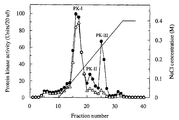
- the suspension is then successively passed through a Sephadex G-25 PD-10 and applied to a Bio-Gel TSK DEAE-5-PW column (75 x 7.5 mm) equilibrated with buffer B. The column is extensively washed with the same buffer. Adsorbed proteins are eluted at a linear gradient of NaCI (0-0.4 M) added in buffer B.
- Fractions of 2 ml are collected and assayed for protein kinase activity.
- the active fractions are desalted on Sephadex G-25 PD-10.
- fractions containing active protein kinases are chromatographed on Affi-Gel® Blue gel (Bio-Rad Laboratories).
- the column (1 x 6 cm) is equilibrated with buffer B.
- the enzymes are then adsorbed and 20 ml of buffer B is allowed to pass through. Protein kinases are eluted with a linear gradient of 0-0.4 M NaCl in buffer B.
- PK-I protein kinases activity
- PK-III Three protein kinases activities (PK-I, PK-II and PK-III) are found in the supernatant of N.crassa by using protamine-sulfate as substrate.
- Protein kinase activity is assayed in a reaction mixture containing in a final volume of 100 ml, 20 mM Tris-HCI (pH 7.4), 20 mg protamine-suifate, 10 mM Mg(NO 3 ) 2 , 10 mM ATP (0.2 mCi [g- 33 P] ATP), 1 mM NaN 3 , 0.04 mM okadaic acid, 20 ml of protein kinase. After 20 minutes incubation at 32°C, aliquots of 50 ml are analyzed for substrate phosphorylation using P81 chromatography paper (20 mm x 20 mm; Whatman, Maidstone, UK) according to the method described by J.J.
- Fig.1 shows the result of a DEAE-TSK separation of protein kinases from Neurospora crassa measured with protamine sulfate as substrate in the absence (dark symbols) and in the presence (white symbols) of 100 mM fenpiclonil. (-) NaCI gradient (0-0.4 M).
Landscapes
- Chemical & Material Sciences (AREA)
- Organic Chemistry (AREA)
- Life Sciences & Earth Sciences (AREA)
- Zoology (AREA)
- Wood Science & Technology (AREA)
- Proteomics, Peptides & Aminoacids (AREA)
- Health & Medical Sciences (AREA)
- Engineering & Computer Science (AREA)
- Microbiology (AREA)
- Biochemistry (AREA)
- Physics & Mathematics (AREA)
- Molecular Biology (AREA)
- Biotechnology (AREA)
- Biophysics (AREA)
- Analytical Chemistry (AREA)
- Immunology (AREA)
- Bioinformatics & Cheminformatics (AREA)
- General Engineering & Computer Science (AREA)
- General Health & Medical Sciences (AREA)
- Genetics & Genomics (AREA)
- Agricultural Chemicals And Associated Chemicals (AREA)
- Measuring Or Testing Involving Enzymes Or Micro-Organisms (AREA)
Applications Claiming Priority (3)
| Application Number | Priority Date | Filing Date | Title |
|---|---|---|---|
| GB9610872 | 1996-05-23 | ||
| GBGB9610872.5A GB9610872D0 (en) | 1996-05-23 | 1996-05-23 | Protein kinase assay as a method for identification of fungicides |
| PCT/EP1997/002476 WO1997044484A1 (en) | 1996-05-23 | 1997-05-15 | Protein kinase assay as a method for identification of fungicides |
Publications (2)
| Publication Number | Publication Date |
|---|---|
| EP0904403A1 EP0904403A1 (en) | 1999-03-31 |
| EP0904403B1 true EP0904403B1 (en) | 2002-02-13 |
Family
ID=10794238
Family Applications (1)
| Application Number | Title | Priority Date | Filing Date |
|---|---|---|---|
| EP97923899A Revoked EP0904403B1 (en) | 1996-05-23 | 1997-05-15 | Protein kinase assay as a method for identification of fungicides |
Country Status (11)
| Country | Link |
|---|---|
| US (1) | US6399319B1 (da) |
| EP (1) | EP0904403B1 (da) |
| JP (1) | JP2000511415A (da) |
| AR (1) | AR007243A1 (da) |
| AT (1) | ATE213275T1 (da) |
| AU (1) | AU2955097A (da) |
| DE (1) | DE69710455T2 (da) |
| DK (1) | DK0904403T3 (da) |
| GB (1) | GB9610872D0 (da) |
| WO (1) | WO1997044484A1 (da) |
| ZA (1) | ZA974450B (da) |
Families Citing this family (5)
| Publication number | Priority date | Publication date | Assignee | Title |
|---|---|---|---|---|
| US4786784A (en) * | 1987-02-17 | 1988-11-22 | Libbey-Owens-Ford Co. | Method for producing an electrically heated window assembly and resulting article |
| WO1998044148A1 (en) * | 1997-03-28 | 1998-10-08 | Mycotox, Inc. | Histidine kinase assay |
| DE10160660A1 (de) | 2001-12-11 | 2003-06-18 | Bayer Cropscience Ag | Polypeptide zum Identifizieren von fungizid wirksamen Verbindungen |
| AU2003249239A1 (en) * | 2002-07-15 | 2004-02-02 | Sugen, Inc. | Method for selectively inhibiting fungal growth |
| DE10356218A1 (de) * | 2003-12-03 | 2005-06-30 | Bayer Cropscience Ag | Verfahren zum Identifizieren von fungizid wirksamen Verbindungen basierend auf Pyruvatkinasen aus Pilzen |
Citations (1)
| Publication number | Priority date | Publication date | Assignee | Title |
|---|---|---|---|---|
| EP0236272A1 (de) * | 1986-03-04 | 1987-09-09 | Ciba-Geigy Ag | Fungizide Verwendung eines Cyanopyrrol-Derivates |
Family Cites Families (6)
| Publication number | Priority date | Publication date | Assignee | Title |
|---|---|---|---|---|
| US4820692A (en) * | 1986-01-30 | 1989-04-11 | State Of Oregon, Acting By And Through The Oregon State Board Of Higher Education, Acting For And On Behalf Of The Oregon Health Sciences University And Oregon State University | Methylthioribose analogs, their preparation and use as medicinal agents and biocides |
| ATE84669T1 (de) | 1988-08-04 | 1993-02-15 | Ciba Geigy Ag | Mikrobizide mittel. |
| ES2065565T3 (es) | 1990-03-13 | 1995-02-16 | Hoechst Roussel Pharma | 1-alquil-, 1-alquenil- y 1-alquinil-aril-2-amino-1,3-propanodioles y compuestos afines, un procedimiento y compuestos intermedios para su preparacion y su uso como medicamentos. |
| PH30300A (en) * | 1993-05-07 | 1997-01-20 | Ciba Geigy Ag | Polycyclic compounds and processes for the preparation thereof |
| CA2172824A1 (en) * | 1993-10-25 | 1995-05-04 | Charles M. Moehle | Methods for screening for antimycotics |
| US5733920A (en) * | 1995-10-31 | 1998-03-31 | Mitotix, Inc. | Inhibitors of cyclin dependent kinases |
-
1996
- 1996-05-23 GB GBGB9610872.5A patent/GB9610872D0/en active Pending
-
1997
- 1997-05-15 EP EP97923899A patent/EP0904403B1/en not_active Revoked
- 1997-05-15 US US09/194,048 patent/US6399319B1/en not_active Expired - Fee Related
- 1997-05-15 DK DK97923899T patent/DK0904403T3/da active
- 1997-05-15 AT AT97923899T patent/ATE213275T1/de not_active IP Right Cessation
- 1997-05-15 AU AU29550/97A patent/AU2955097A/en not_active Abandoned
- 1997-05-15 WO PCT/EP1997/002476 patent/WO1997044484A1/en not_active Ceased
- 1997-05-15 DE DE69710455T patent/DE69710455T2/de not_active Expired - Fee Related
- 1997-05-15 JP JP09541489A patent/JP2000511415A/ja active Pending
- 1997-05-21 AR ARP970102161A patent/AR007243A1/es not_active Application Discontinuation
- 1997-05-22 ZA ZA9704450A patent/ZA974450B/xx unknown
Patent Citations (1)
| Publication number | Priority date | Publication date | Assignee | Title |
|---|---|---|---|---|
| EP0236272A1 (de) * | 1986-03-04 | 1987-09-09 | Ciba-Geigy Ag | Fungizide Verwendung eines Cyanopyrrol-Derivates |
Also Published As
| Publication number | Publication date |
|---|---|
| ATE213275T1 (de) | 2002-02-15 |
| US6399319B1 (en) | 2002-06-04 |
| AU2955097A (en) | 1997-12-09 |
| DK0904403T3 (da) | 2002-05-27 |
| AR007243A1 (es) | 1999-10-27 |
| GB9610872D0 (en) | 1996-07-31 |
| ZA974450B (en) | 1997-11-24 |
| DE69710455D1 (de) | 2002-03-21 |
| JP2000511415A (ja) | 2000-09-05 |
| EP0904403A1 (en) | 1999-03-31 |
| WO1997044484A1 (en) | 1997-11-27 |
| DE69710455T2 (de) | 2002-10-02 |
Similar Documents
| Publication | Publication Date | Title |
|---|---|---|
| US4849219A (en) | Microbicides | |
| Blumhorst et al. | Efficacy of selected herbicides as influenced by soil properties | |
| Kough et al. | Depressed metabolic activity of vesicular‐arbuscular mycorrhizal fungi after fungicide applications | |
| WO2021176057A1 (en) | Fungicidal compositions | |
| AU2025220851A1 (en) | Fungicidal compositions | |
| UA57074C2 (uk) | Трифторметилалкіламінотриазолопіримідини, фунгіцидна композиція на їх основі та спосіб пригнічення грибів | |
| IE59455B1 (en) | Fungicidal use of a cyanopyrrole derivative | |
| Amaradasa et al. | In vitro fungicide sensitivity of Rhizoctonia and Waitea isolates collected from turfgrasses | |
| US5948783A (en) | Fungicidal trifluoromethylalkylamino-triazolopyrimidines | |
| Aberton et al. | The use of potassium phosphonate to control Phytophthora cinnamomi in native vegetation at Anglesea, Victoria | |
| US6399319B1 (en) | Protein kinase assay as a method for identification of fungicides | |
| Rupe et al. | Vertical and temporal distribution of Fusarium solani and Heterodera glycines in fields with sudden death syndrome of soybean | |
| EP4114184A1 (en) | Fungicidal compositions | |
| NZ219271A (en) | Synergistic combinations of propiconazol and fenpropidin | |
| IE870564L (en) | Fungicidal composition | |
| Thakur et al. | Combination of Azoxystrobin+ Difenocanazole provides effective management of sheath blight of rice caused by Rhizoctonia solani | |
| Chen et al. | Phosphate-solubilizing microbes in rhizosphere soils of 19 weeds in southeastern China | |
| KR100686791B1 (ko) | 살진균성 혼합물 | |
| Hollomon | A laboratory assay to determine the sensitivity of Rhynchosporium secalis to the fungicide triadimenol | |
| Johansen et al. | Responses of forage legumes and grasses to molybdenum | |
| JP4355217B2 (ja) | 除草剤の新規標的としてのトリプトファンアミノトランスフェラーゼ、インドール−3−ピルビン酸デカルボキシラーゼ、およびインドール−3−アセトアルデヒドオキシダーゼ | |
| DK151001B (da) | Fremgangsmaade til behandling af fungus-infektion paa dyrkede planter og fungicidt praeparat til anvendelse ved plantebeskyttelse | |
| McKone et al. | Nitrogen fixation in association with the root systems of goldenrods (Solidago L.) | |
| Kasuya | Growth inhibition of pathogenic root fungi by extracts of ectomycorrhizal fungi or Picea glehnii inoculated with ectomycorrhizal fungi | |
| Aravind et al. | Estimation of biochemical factors responsible for resistance to root and collar rot (Macrophomina phaseolina (Tassi) Goid.) in okra. |
Legal Events
| Date | Code | Title | Description |
|---|---|---|---|
| PUAI | Public reference made under article 153(3) epc to a published international application that has entered the european phase |
Free format text: ORIGINAL CODE: 0009012 |
|
| 17P | Request for examination filed |
Effective date: 19981027 |
|
| AK | Designated contracting states |
Kind code of ref document: A1 Designated state(s): AT BE CH DE DK ES FI FR GB GR IE IT LI LU MC NL PT SE |
|
| RAP1 | Party data changed (applicant data changed or rights of an application transferred) |
Owner name: NOVARTIS-ERFINDUNGEN VERWALTUNGSGESELLSCHAFT M.B. Owner name: NOVARTIS AG |
|
| RIN1 | Information on inventor provided before grant (corrected) |
Inventor name: MEYER, THOMAS Inventor name: PILLONEL, CHRISTIAN |
|
| 17Q | First examination report despatched |
Effective date: 20000613 |
|
| GRAG | Despatch of communication of intention to grant |
Free format text: ORIGINAL CODE: EPIDOS AGRA |
|
| RAP1 | Party data changed (applicant data changed or rights of an application transferred) |
Owner name: SYNGENTA PARTICIPATIONS AG |
|
| GRAG | Despatch of communication of intention to grant |
Free format text: ORIGINAL CODE: EPIDOS AGRA |
|
| GRAG | Despatch of communication of intention to grant |
Free format text: ORIGINAL CODE: EPIDOS AGRA |
|
| GRAH | Despatch of communication of intention to grant a patent |
Free format text: ORIGINAL CODE: EPIDOS IGRA |
|
| GRAH | Despatch of communication of intention to grant a patent |
Free format text: ORIGINAL CODE: EPIDOS IGRA |
|
| GRAA | (expected) grant |
Free format text: ORIGINAL CODE: 0009210 |
|
| REG | Reference to a national code |
Ref country code: GB Ref legal event code: IF02 |
|
| AK | Designated contracting states |
Kind code of ref document: B1 Designated state(s): AT BE CH DE DK ES FI FR GB GR IE IT LI LU MC NL PT SE |
|
| PG25 | Lapsed in a contracting state [announced via postgrant information from national office to epo] |
Ref country code: GR Free format text: LAPSE BECAUSE OF FAILURE TO SUBMIT A TRANSLATION OF THE DESCRIPTION OR TO PAY THE FEE WITHIN THE PRESCRIBED TIME-LIMIT Effective date: 20020213 Ref country code: FI Free format text: LAPSE BECAUSE OF FAILURE TO SUBMIT A TRANSLATION OF THE DESCRIPTION OR TO PAY THE FEE WITHIN THE PRESCRIBED TIME-LIMIT Effective date: 20020213 |
|
| REF | Corresponds to: |
Ref document number: 213275 Country of ref document: AT Date of ref document: 20020215 Kind code of ref document: T |
|
| REG | Reference to a national code |
Ref country code: CH Ref legal event code: EP |
|
| REF | Corresponds to: |
Ref document number: 69710455 Country of ref document: DE Date of ref document: 20020321 |
|
| PG25 | Lapsed in a contracting state [announced via postgrant information from national office to epo] |
Ref country code: SE Free format text: LAPSE BECAUSE OF FAILURE TO SUBMIT A TRANSLATION OF THE DESCRIPTION OR TO PAY THE FEE WITHIN THE PRESCRIBED TIME-LIMIT Effective date: 20020513 Ref country code: PT Free format text: LAPSE BECAUSE OF FAILURE TO SUBMIT A TRANSLATION OF THE DESCRIPTION OR TO PAY THE FEE WITHIN THE PRESCRIBED TIME-LIMIT Effective date: 20020513 |
|
| PG25 | Lapsed in a contracting state [announced via postgrant information from national office to epo] |
Ref country code: MC Free format text: LAPSE BECAUSE OF NON-PAYMENT OF DUE FEES Effective date: 20020515 |
|
| REG | Reference to a national code |
Ref country code: DK Ref legal event code: T3 |
|
| ET | Fr: translation filed | ||
| PG25 | Lapsed in a contracting state [announced via postgrant information from national office to epo] |
Ref country code: ES Free format text: LAPSE BECAUSE OF FAILURE TO SUBMIT A TRANSLATION OF THE DESCRIPTION OR TO PAY THE FEE WITHIN THE PRESCRIBED TIME-LIMIT Effective date: 20020829 |
|
| PLBI | Opposition filed |
Free format text: ORIGINAL CODE: 0009260 |
|
| 26 | Opposition filed |
Opponent name: BAYER AG KONZERNBEREICH RP PATENTE UND LIZENZEN Effective date: 20020902 |
|
| PLBI | Opposition filed |
Free format text: ORIGINAL CODE: 0009260 |
|
| 26 | Opposition filed |
Opponent name: BASF AKTIENGESELLSCHAFT PATENTE, MARKEN UND LIZENZ Effective date: 20020926 Opponent name: BAYER AG KONZERNBEREICH RP PATENTE UND LIZENZEN Effective date: 20020902 |
|
| NLR1 | Nl: opposition has been filed with the epo |
Opponent name: BAYER AG KONZERNBEREICH RP PATENTE UND LIZENZEN |
|
| PLBF | Reply of patent proprietor to notice(s) of opposition |
Free format text: ORIGINAL CODE: EPIDOS OBSO |
|
| NLR1 | Nl: opposition has been filed with the epo |
Opponent name: BASF AKTIENGESELLSCHAFT PATENTE, MARKEN UND LIZENZ Opponent name: BAYER AG KONZERNBEREICH RP PATENTE UND LIZENZEN |
|
| PGFP | Annual fee paid to national office [announced via postgrant information from national office to epo] |
Ref country code: FR Payment date: 20030508 Year of fee payment: 7 |
|
| PGFP | Annual fee paid to national office [announced via postgrant information from national office to epo] |
Ref country code: LU Payment date: 20030512 Year of fee payment: 7 |
|
| PGFP | Annual fee paid to national office [announced via postgrant information from national office to epo] |
Ref country code: AT Payment date: 20030514 Year of fee payment: 7 Ref country code: GB Payment date: 20030514 Year of fee payment: 7 |
|
| PGFP | Annual fee paid to national office [announced via postgrant information from national office to epo] |
Ref country code: CH Payment date: 20030516 Year of fee payment: 7 |
|
| PGFP | Annual fee paid to national office [announced via postgrant information from national office to epo] |
Ref country code: DK Payment date: 20030520 Year of fee payment: 7 |
|
| PGFP | Annual fee paid to national office [announced via postgrant information from national office to epo] |
Ref country code: DE Payment date: 20030522 Year of fee payment: 7 |
|
| PGFP | Annual fee paid to national office [announced via postgrant information from national office to epo] |
Ref country code: IE Payment date: 20030528 Year of fee payment: 7 |
|
| PGFP | Annual fee paid to national office [announced via postgrant information from national office to epo] |
Ref country code: NL Payment date: 20030530 Year of fee payment: 7 |
|
| PGFP | Annual fee paid to national office [announced via postgrant information from national office to epo] |
Ref country code: BE Payment date: 20030729 Year of fee payment: 7 |
|
| PG25 | Lapsed in a contracting state [announced via postgrant information from national office to epo] |
Ref country code: LU Free format text: LAPSE BECAUSE OF NON-PAYMENT OF DUE FEES Effective date: 20040515 Ref country code: GB Free format text: LAPSE BECAUSE OF NON-PAYMENT OF DUE FEES Effective date: 20040515 Ref country code: AT Free format text: LAPSE BECAUSE OF NON-PAYMENT OF DUE FEES Effective date: 20040515 |
|
| PG25 | Lapsed in a contracting state [announced via postgrant information from national office to epo] |
Ref country code: IE Free format text: LAPSE BECAUSE OF NON-PAYMENT OF DUE FEES Effective date: 20040517 |
|
| PG25 | Lapsed in a contracting state [announced via postgrant information from national office to epo] |
Ref country code: LI Free format text: LAPSE BECAUSE OF NON-PAYMENT OF DUE FEES Effective date: 20040531 Ref country code: CH Free format text: LAPSE BECAUSE OF NON-PAYMENT OF DUE FEES Effective date: 20040531 Ref country code: BE Free format text: LAPSE BECAUSE OF NON-PAYMENT OF DUE FEES Effective date: 20040531 |
|
| PG25 | Lapsed in a contracting state [announced via postgrant information from national office to epo] |
Ref country code: DK Free format text: LAPSE BECAUSE OF NON-PAYMENT OF DUE FEES Effective date: 20040601 |
|
| BERE | Be: lapsed |
Owner name: *SYNGENTA PARTICIPATIONS A.G. Effective date: 20040531 |
|
| PG25 | Lapsed in a contracting state [announced via postgrant information from national office to epo] |
Ref country code: NL Free format text: LAPSE BECAUSE OF NON-PAYMENT OF DUE FEES Effective date: 20041201 Ref country code: DE Free format text: LAPSE BECAUSE OF NON-PAYMENT OF DUE FEES Effective date: 20041201 |
|
| REG | Reference to a national code |
Ref country code: DK Ref legal event code: EBP |
|
| GBPC | Gb: european patent ceased through non-payment of renewal fee |
Effective date: 20040515 |
|
| REG | Reference to a national code |
Ref country code: CH Ref legal event code: PL |
|
| PG25 | Lapsed in a contracting state [announced via postgrant information from national office to epo] |
Ref country code: FR Free format text: LAPSE BECAUSE OF NON-PAYMENT OF DUE FEES Effective date: 20050131 |
|
| NLV4 | Nl: lapsed or anulled due to non-payment of the annual fee |
Effective date: 20041201 |
|
| REG | Reference to a national code |
Ref country code: IE Ref legal event code: MM4A |
|
| REG | Reference to a national code |
Ref country code: FR Ref legal event code: ST |
|
| PG25 | Lapsed in a contracting state [announced via postgrant information from national office to epo] |
Ref country code: IT Free format text: LAPSE BECAUSE OF NON-PAYMENT OF DUE FEES;WARNING: LAPSES OF ITALIAN PATENTS WITH EFFECTIVE DATE BEFORE 2007 MAY HAVE OCCURRED AT ANY TIME BEFORE 2007. THE CORRECT EFFECTIVE DATE MAY BE DIFFERENT FROM THE ONE RECORDED. Effective date: 20050515 |
|
| PLAB | Opposition data, opponent's data or that of the opponent's representative modified |
Free format text: ORIGINAL CODE: 0009299OPPO |
|
| PLAY | Examination report in opposition despatched + time limit |
Free format text: ORIGINAL CODE: EPIDOSNORE2 |
|
| RDAF | Communication despatched that patent is revoked |
Free format text: ORIGINAL CODE: EPIDOSNREV1 |
|
| RDAG | Patent revoked |
Free format text: ORIGINAL CODE: 0009271 |
|
| STAA | Information on the status of an ep patent application or granted ep patent |
Free format text: STATUS: PATENT REVOKED |
|
| 27W | Patent revoked |
Effective date: 20090710 |