EP0903773A2 - Double-enveloped halogen bulb - Google Patents
Double-enveloped halogen bulb Download PDFInfo
- Publication number
- EP0903773A2 EP0903773A2 EP98106484A EP98106484A EP0903773A2 EP 0903773 A2 EP0903773 A2 EP 0903773A2 EP 98106484 A EP98106484 A EP 98106484A EP 98106484 A EP98106484 A EP 98106484A EP 0903773 A2 EP0903773 A2 EP 0903773A2
- Authority
- EP
- European Patent Office
- Prior art keywords
- halogen bulb
- enveloped
- double
- socket
- glass envelope
- Prior art date
- Legal status (The legal status is an assumption and is not a legal conclusion. Google has not performed a legal analysis and makes no representation as to the accuracy of the status listed.)
- Withdrawn
Links
- 229910052736 halogen Inorganic materials 0.000 title claims abstract description 166
- 150000002367 halogens Chemical class 0.000 title claims abstract description 166
- 239000011521 glass Substances 0.000 claims abstract description 110
- 238000009423 ventilation Methods 0.000 claims abstract description 18
- 239000002184 metal Substances 0.000 claims description 20
- 229910052751 metal Inorganic materials 0.000 claims description 20
- 238000005476 soldering Methods 0.000 claims description 16
- RYGMFSIKBFXOCR-UHFFFAOYSA-N Copper Chemical compound [Cu] RYGMFSIKBFXOCR-UHFFFAOYSA-N 0.000 claims description 12
- 229910052802 copper Inorganic materials 0.000 claims description 12
- 239000010949 copper Substances 0.000 claims description 12
- 239000000919 ceramic Substances 0.000 claims description 11
- 239000010453 quartz Substances 0.000 claims description 8
- VYPSYNLAJGMNEJ-UHFFFAOYSA-N silicon dioxide Inorganic materials O=[Si]=O VYPSYNLAJGMNEJ-UHFFFAOYSA-N 0.000 claims description 8
- 239000000853 adhesive Substances 0.000 claims description 7
- 230000001070 adhesive effect Effects 0.000 claims description 7
- 239000004568 cement Substances 0.000 claims description 6
- 239000007769 metal material Substances 0.000 claims description 5
- 239000012811 non-conductive material Substances 0.000 claims description 4
- 238000005452 bending Methods 0.000 claims description 3
- 229910010293 ceramic material Inorganic materials 0.000 claims description 3
- 239000004033 plastic Substances 0.000 claims description 3
- 229920003023 plastic Polymers 0.000 claims description 3
- 239000000203 mixture Substances 0.000 claims description 2
- 238000009413 insulation Methods 0.000 claims 2
- 230000002093 peripheral effect Effects 0.000 claims 1
- 238000010276 construction Methods 0.000 description 6
- 230000001681 protective effect Effects 0.000 description 5
- 238000001816 cooling Methods 0.000 description 3
- 230000000694 effects Effects 0.000 description 3
- 239000000463 material Substances 0.000 description 3
- 239000005388 borosilicate glass Substances 0.000 description 2
- 238000004880 explosion Methods 0.000 description 2
- 208000027418 Wounds and injury Diseases 0.000 description 1
- 230000006378 damage Effects 0.000 description 1
- 208000014674 injury Diseases 0.000 description 1
- 239000011810 insulating material Substances 0.000 description 1
- 239000012212 insulator Substances 0.000 description 1
- 238000000034 method Methods 0.000 description 1
- 230000002035 prolonged effect Effects 0.000 description 1
- 229910000679 solder Inorganic materials 0.000 description 1
Images






Classifications
-
- H—ELECTRICITY
- H01—ELECTRIC ELEMENTS
- H01K—ELECTRIC INCANDESCENT LAMPS
- H01K1/00—Details
- H01K1/28—Envelopes; Vessels
- H01K1/34—Double wall vessels
-
- H—ELECTRICITY
- H01—ELECTRIC ELEMENTS
- H01J—ELECTRIC DISCHARGE TUBES OR DISCHARGE LAMPS
- H01J5/00—Details relating to vessels or to leading-in conductors common to two or more basic types of discharge tubes or lamps
- H01J5/50—Means forming part of the tube or lamps for the purpose of providing electrical connection to it
- H01J5/54—Means forming part of the tube or lamps for the purpose of providing electrical connection to it supported by a separate part, e.g. base
- H01J5/58—Means for fastening the separate part to the vessel, e.g. by cement
-
- H—ELECTRICITY
- H01—ELECTRIC ELEMENTS
- H01J—ELECTRIC DISCHARGE TUBES OR DISCHARGE LAMPS
- H01J61/00—Gas-discharge or vapour-discharge lamps
- H01J61/02—Details
- H01J61/30—Vessels; Containers
- H01J61/34—Double-wall vessels or containers
-
- H—ELECTRICITY
- H01—ELECTRIC ELEMENTS
- H01J—ELECTRIC DISCHARGE TUBES OR DISCHARGE LAMPS
- H01J61/00—Gas-discharge or vapour-discharge lamps
- H01J61/02—Details
- H01J61/52—Cooling arrangements; Heating arrangements; Means for circulating gas or vapour within the discharge space
-
- H—ELECTRICITY
- H01—ELECTRIC ELEMENTS
- H01K—ELECTRIC INCANDESCENT LAMPS
- H01K1/00—Details
- H01K1/58—Cooling arrangements
-
- H—ELECTRICITY
- H01—ELECTRIC ELEMENTS
- H01J—ELECTRIC DISCHARGE TUBES OR DISCHARGE LAMPS
- H01J61/00—Gas-discharge or vapour-discharge lamps
- H01J61/02—Details
- H01J61/30—Vessels; Containers
-
- Y—GENERAL TAGGING OF NEW TECHNOLOGICAL DEVELOPMENTS; GENERAL TAGGING OF CROSS-SECTIONAL TECHNOLOGIES SPANNING OVER SEVERAL SECTIONS OF THE IPC; TECHNICAL SUBJECTS COVERED BY FORMER USPC CROSS-REFERENCE ART COLLECTIONS [XRACs] AND DIGESTS
- Y02—TECHNOLOGIES OR APPLICATIONS FOR MITIGATION OR ADAPTATION AGAINST CLIMATE CHANGE
- Y02B—CLIMATE CHANGE MITIGATION TECHNOLOGIES RELATED TO BUILDINGS, e.g. HOUSING, HOUSE APPLIANCES OR RELATED END-USER APPLICATIONS
- Y02B20/00—Energy efficient lighting technologies, e.g. halogen lamps or gas discharge lamps
Definitions
- the present invention relates generally to a halogen bulb, and more particularly to a double-enveloped halogen bulb which can be directly fitted into an electrical socket without the use of a protective case.
- the halogen bulbs are generally grouped into a low-wattage (1-100 watts) single-ended halogen bulb and a high-wattage (101-500 watts) tubular double-ended halogen bulb.
- the single-ended halogen bulb is generally fitted into a domelike case similar to the light bulb of a flashlight or car light and is mounted in a ceiling or wall for lighting or auxiliary lighting.
- the tubular double-ended halogen bulb was generally used for outdoor projection and is used in recent years in the indoor floor lamp for upward projection.
- the high-wattage tubular double-ended halogen bulb generates heat with a low risk of explosion.
- tubular double-ended halogen bulb In order to prevent a fire caused by a foreign object which happens to make contact with the hot halogen bulb, the tubular double-ended halogen bulb must be shielded by a protective case. It is therefore readily conceivable that a lighting fixture provided with a high-wattage tubular double-ended halogen bulb has at least two shortcomings which have to be properly addressed. In the first place, the tubular double-ended halogen bulb must be made and sold along with a protective case, thereby resulting in an increase in the cost of shipping and storage. In addition, it is almost impossible or very difficult for the consumer to replace a damaged or burn-out tubular double-ended halogen bulb.
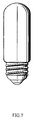
- the double-enveloped halogen bulb which is basically made up of a tubular halogen bulb having two conductive ends, a hollow glass envelope, and a socket for fixing the tubular halogen bulb in the hollow glass envelope.
- the conductive ends of the tubular halogen bulb are electrically connected with two different localities of the socket.
- the tubular halogen bulb further has a quartz envelope, a metal filament which is located in the quartz envelope such that both ends of the metal filament are sealed at both ends of said quartz envelope and electrically connected to said two conductive ends separately, and a halogen gas mixture contained hermetically in the quartz envelope.
- the tubular halogen bulb suitable for application in the present invention should have a wattage ranging between 25 watts and 500 watts, preferably 60 watts or more.
- the tubular halogen bulb is currently available in the market place and is made by, for examples, GE (General Electric) of the United states of Philips of The Netherlands.
- the hollow glass envelope of the present invention has a thickness ranging between 2mm and 8mm, preferably between 3mm and 6mm.
- the hollow glass envelope is made of a conventional glass material, preferably a glass material containing 95% of borosilicate.
- the hollow glass envelope has an outer surface which is either polished or sanded.
- the hollow glass envelope of the present invention is intended to protect a person or an animal contiguous to the bulb from a bodily injury in the event that the tubular halogen bulb explodes.
- the hollow glass envelope of the present invention serves as a heat insulator for preventing a fire or explosion caused by a foreign object which is inadvertently caused to make contact with the overheated tubular halogen bulb.
- the hollow glass envelope of the present invention has a neck, an opening located at one end of the neck, and a head located at another end of the neck.
- the opening end of the neck is received in an opening of the socket and fastened therein.
- the head of the hollow glass envelope of the present invention has a plurality of bulges perpendicular to an outer surface thereof.
- the outer surface of the hollow glass envelope may be a plain surface opposite to the socket and has an area ranging between 3,000mm 2 and 14,000mm 2 .
- the bulges have a height ranging between 3mm and 10mm.
- the bulges may be cylindrical, blocklike or striplike in shape.
- the cylindrical or blocklike bulges each has a top area ranging between 5mm 2 and 25mm 2 and are equidistantly distributed on the outer surface of the hollow glass envelope. These bulges are distributed at an interval ranging between 2mm and 10mm.
- the striplike bulges have a width ranging between 3mm and 10mm, and a length equal to or slightly shorter than a linear distance between two opposite edges of the outer surface of the hollow glass envelope.
- the striplike bulges are equidistantly distributed on the outer surface of the hollow glass envelope such that the bulges are parallel to one another, and that the bulges are distributed at an interval ranging between 3mm and 10mm.
- These bulges have a cooling effect and serve to minimize the contact area between the overheated surface and a foreign object which happens to fall on the overheated surface.
- the air circulation takes place between two bulges so as to bring about the cooling effect at such time when the foreign object is supported on these bulges.
- the double-enveloped halogen bulb of the present invention has a prolonged life span of service and is relatively safe.
- the hollow glass envelope of the present invention may be made integrally or made of two component parts which are combined to form the glass envelope.
- the hollow glass envelope which is either made integrally or made of the combination of two component parts, may be further provided with a plurality of air holes.
- the air holes are constructed such that the tubular halogen bulb can not be seen directly by the naked eye through one of these air holes, so as to protect the persons from the broken pieces which may be ejected through the air holes at such time when the overheated tubular halogen bulb explodes.
- the air holes serve to cool the overheated halogen bulb.
- the head of the hollow glass envelope may be round, oblong, spindle, cylindrical, bowl-shaped, or funnel-shaped.
- the hollow glass envelope of the present invention is made of two component parts, the glass envelope has a cap and a funnel-shaped portion which has a first open end fastened with the socket, and a second open end with an opening greater than an opening of the first open end.
- the second open end of the funnel-shaped portion is capped by the cap which is attached to the second open end by an adhesive.
- the cap and the second open end are provided with means enabling the cap and the second open end to become engaged with each other.
- the cap may be provided with a protruded edge perpendicular to a surface facing the funnel-shaped portion, whereas the second open end of the funnel-shaped portion is provided at a portion contiguous to inner circumferential edge thereof with a protuberance corresponding in location to the protruded edge of the cap.
- the cap can be engaged with the second open end of the funnel-shaped portion right after the application of the adhesive.
- the surface of the cap facing the funnel-shaped portion may be provided along the edge thereof with a plurality of wedges which are separated from one another and perpendicular to the surface, whereas the second open end of the funnel-shaped portion is provided with a plurality of recesses corresponding in location and size to the wedges.
- the cap and the second open end of the funnel-shaped portion can be thus engaged with each other.
- the connecting portions of the cap and the funnel-shaped portion may be provided with a plurality of air holes.
- the air holes are located in a portion contiguous to the second open end of the funnel-shaped portion.
- the socket of the double-enveloped halogen bulb of the present invention may be a conventional socket of a tungsten-filament light bulb, a conventional socket of the double-post GU10 type, or new sockets created by the present inventor.
- the tungsten-filament light bulb socket has a hollow columnar body having an opening at one end and an electrically insulating closed end member fixed at another end of said hollow columnar body. Said hollow columnar body is made of metal, and said closed end member has a small central hole.
- the tubular halogen bulb of the present invention is engaged with the conventional tungsten-filament light bulb socket such that a lead connected to one of the two conductive ends of the tubular halogen bulb penetrates through the small central hole, and the protruding end thereof is bent prior to being fastened to the closed end member with a solder bump, and that another lead connected to another end of the two conductive ends is connected with the hollow columnar body.
- the hollow columnar body is provided in the inner wall thereof with threads while the outer wall of the neck of the hollow glass envelope is provided with threads which are engageable with the threads of the hollow columnar body.
- a new type socket suitable for use in the present invention is similar to the conventional socket of the tungsten-filament light bulb, except that a closed end member of the new type socket is threadably mounted inside the hollow columnar body with a cylindrical end of said closed end member protruding from said another end of said hollow columnar body, wherein said closed end member is provided with two square holes and one round hole around said cylindrical end thereof; and said new type socket further has a copper hat having two fastening legs on the rim of the copper hat; and wherein the copper hat is fastened onto the protruding cylindrical end of the closed end member by inserting the two fastening legs into the two square holes of the closed end member and bending them toward each other. Said one of said two conductive ends or a lead connected to said one of said two conductive end of said tubular halogen bulb is passed through said round hole and soldered to said copper hat.
- said another lead is connected to said another end of said two conductive ends at one end thereof by soldering; and another end of said another lead is bent over an edge of the opening end of said neck and received in a first groove formed on the outer surface of the neck and perpendicular to the threads of the neck, so that said another end of said another lead is electrically connected to said hollow columnar body when said socket is threaded on the threads of the neck of the glass envelope.
- said another lead is in an inverted-U-shaped lead having two hooks at both legs thereof, and said neck is further provided with a second groove on the outer surface thereof, wherein said inverted-U-shaped lead is connected to said another end of said two conductive ends at the middle portion thereof by soldering, and the two hooks are received in said first and second grooves separately, so that said two hooks are electrically connected to said hollow columnar body when said socket is threaded on the threads of the neck of the glass envelope.
- the socket of the GU10 type is a hallow columnar body having an opening at one end and a closed end at another end thereof, and is made integrally of an electrically non-conductive material such as plastics, with the closed end of the socket being provided with two conductive posts separated from each other. Two additional leads are used to separately electrically connect the two conductive posts with the two conductive ends of the tubular halogen bulb of the present invention.
- the GU10 socket and the neck of the glass envelope of the present invention are preferably attached together by means of an adhesive, wherein said hollow columnar body of said socket has an inner diameter corresponding to an outer diameter of the neck of the glass envelope.
- the double-enveloped halogen bulb containing the GU10 socket or another new type of socket described in the following paragraph further comprises an inverted-U-shaped lead having two hooks at both legs thereof and two additional leads.
- Said neck of said glass envelop is further provided with two grooves on the outer surface thereof.
- Said inverted-U-shaped lead is connected to one of said two conductive ends of said tubular halogen bulb at the middle portion thereof by soldering, and the two hooks are received in said two grooves separately, wherein one leg of said inverted-U-shaped lead and another end of said two conductive ends of said tubular halogen bulb are electrically connected to said two conductive posts with said two additional leads separately.
- Said another new type socket is a hallow columnar body having an opening at one end and a closed end at another end thereof, and is made integrally of a ceramic material, with the closed end thereof being provided with two conductive posts separated from each other, which is similar to the conventional socket of GU10 type in structure.
- said two conductive posts are hollow, one ends of the two additional leads are received inside the two hollow conductive posts and protruding therefrom separately, the protruding ends of the two additional leads are separately connected to one ends of the two hollow conductive posts by soldering, and another ends of the two additional leads are separately connected to said one leg of said inverted-U-shaped lead and said another end of said two conductive ends of said tubular halogen bulb by soldering.
- Said another new type socket may be further with two axial protuberant guides on the inner wall of said hollow columnar body thereof, and said glass envelope is provided with two additional grooves corresponding to said two axial protuberant guides on an outer surface of said opening end of said neck thereof, so that the socket is non-rotatably mounted on the neck of the glass envelope with the two axial protuberant guides being received in the two additional grooves of said neck respectively.
- said GU10 socket and said another new type socket are fastened with said opening end of said neck of said glass envelope by a ceramic cement.
- said two conductive posts of said GU10 socket and said another new type socket are separately received in two through holes provided at said closed ends of said sockets and fastened by means of a ceramic cement.
- said GU10 socket and said another new type socket are further provided with one or more ventilation holes at said closed ends thereof.
- the tubular halogen bulb of the present invention is preferably fixed in the hollow glass envelope such that the longitudinal axis of the tubular halogen bulb is substantially parallel to the longitudinal axis of the socket.
- the tubular halogen bulb of the present invention is fixed in the hollow glass envelope such that the longitudinal axis of the tubular halogen bulb is substantially perpendicular to the longitudinal axis of the socket.
- the tubular halogen bulb is preferably supported by a bracket which is provided at one end thereof with two legs and at another end thereof with tow arms. The two legs of the bracket are respectively fastened with the socket and between the socket and the neck of the hollow glass envelope, or at two locations between the socket and the neck of the hollow glass envelope.
- the two arms of the bracket are intended to hold the tubular halogen bulb.
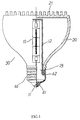
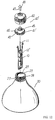
- a double-enveloped halogen bulb 30 of the first preferred embodiment of the present invention is composed of a tubular halogen bulb 10 having two conductive ends, a hollow glass envelope 20, and a socket 40 for holding securely the tubular halogen bulb 10 inside the hollow glass envelope 20.
- the hollow glass envelope 20 is made integrally of 95% borosilicate glass and has a thickness of 4mm.
- the outer surface of the hollow glass envelope 20 is polished by sanding.
- the top surface of the head of the hollow glass envelope 20 has a plurality of cylindrical protuberances 21 perpendicular to the top surface of the head and having a height of 5mm and a diameter of 3mm.
- the top surface of the head is a circular plane and has a radius of 46.8mm.
- the cylindrical protuberances 21 are equidistantly arranged on the top surface of the head at an interval of 3mm.
- the neck of the glass envelope 20 is provided at the lower end thereof with an opening 29 and is further provided in the outer surface thereof with male threads engageable with the socket 40.
- the socket 40 has a hollow columnar body 42 having an opening at one end and a closed end at another end thereof.
- the closed end is made of an insulating material 41 with a small central hole (not shown in the drawings), whereas the hollow columnar body 42 is made of a metal material and is provided therein with female threads corresponding in location to and engageable with the male threads of the neck of the glass envelope 20.
- a lead 11 is connected with one of the two conductive ends of the tubular halogen bulb 10 at one end thereof, and another end thereof juts out from the small central hole, wherein the protruding end of the lead 11 is bent and soldered to the closed end 41.
- Another lead 12 is connected with another end of another conductive ends at one end thereof, and another end thereof is bent over the edge of the opening end of the neck of the glass envelope 20 such that the another end of the lead 12 is intimately attached to a vertical groove located on the male threads of the outer surface of the neck, and that the lead 12 is electrically connected with the metal columnar body 42 when the metal columnar body 42 is threaded on the male threads of the neck.
- the tubular halogen bulb 10 of the double-enveloped halogen bulb 30 of the first preferred embodiment of the present invention has a wattage ranging between 60W and 300W.
- the double-enveloped halogen bulb 30 is provided with the socket 40 which is compatible with the conventional tungsten-filament light bulb.
- the double-enveloped halogen bulb 30 is devoid of a protective case.
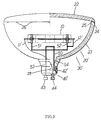
- a double-enveloped halogen bulb 30'of the second preferred embodiment of the present invention consists of a tubular halogen bulb 10 having two conductive ends, a hollow glass envelope 20', a socket 40' for securing the tubular halogen bulb 10 inside the hollow glass envelope 20', and a bracket 50 of a metal material for supporting the tubular halogen bulb 10.
- the glass envelope 20 has a cap 22 and a funnel-shaped portion 23. Both the cap 22 and the funnel-shaped portion 23 are made of 95% borosilicate glass.
- the funnel-shaped portion 23 has one end, which is provided with a smaller opening 29 and is fastened securely with the socket 40', whereas the funnel-shaped portion 23 has another end, which is provided with a larger opening and is capped with the cap 22.
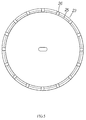
- the cap 22 is provided in the underside of the circumferential edge thereof with a protruded edge 24 perpendicular to the underside. As shown in FIG.
- another end (with the larger opening) of the funnel-shaped portion 23 is provided in the vicinity of the inner circumferential edge of the top surface thereof with a protuberance 25 corresponding in location to the protruded edge 24.
- the cap 22 is therefore engageable with another end of the funnel-shaped portion 23.
- the cap 22 is fastened securely with another end of the funnel-shaped portion 23 by means of an adhesive.
- the socket 40' is of the GU10 type and is provided with a hollow columnar body 42' of a plastic material, and two metal bodies 43 and 44 which are fastened with the closed end of the hollow columnar body 42'.
- the socket 40' is fastened securely with one end (with the smaller opening 29) of the funnel-shaped portion 23 of the glass envelope 20' by means of an adhesive.
- the tubular halogen bulb 10 Prior to the processes of fastening the cap 22 with the funnel-shaped portion 23 and of fastening the socket 40' with the glass envelope 20', the tubular halogen bulb 10 must be mounted in the funnel-shaped portion 23 of the glass envelope 20' such that the proximity of both ends of the tubular halogen bulb 10 are held by two arms 51 and 52 of the bracket 50.
- a leg 53 of the bracket 50 is fastened with the metal body 43 of the socket 40' by soldering.
- Another leg 54 is bent over the edge of the smaller opening end of the funnel-shaped portion 23 and is bound between the socket 40' and the funnel-shaped portion 23 of the glass envelope 20'.
- An electrically lead 11' is used to connect one of the two conductive ends of the tubular halogen bulb 10 with the metal body 44 of the socket 40'.
- Another electrically-conductive lead 12' which is connected with another end of the two conductive ends of the tubular halogen bulb 10, is soldered with the metal bracket 50 and is therefore electrically connected with the metal body
- the glass envelope 20' has a plurality of ventilation holes 26, which are located in the another end (with the larger opening) of the funnel-shaped portion 23'.
- the tubular halogen bulb 10 of the double-enveloped halogen bulb 30' is horizontally located so as to minimize the height of the glass envelope 20', thereby making the double-enveloped halogen bulb 30' suitable for use in an environment in which a height limitation is called for.
- the effect of cooling the double-enveloped halogen bulb 30' at work is attained by means of the ventilation holes 26.
- a double-enveloped halogen bulb of the third preferred embodiment of the present invention is basically similar to that of the first preferred embodiment of the present invention, with the only difference being that the former consists of a hollow glass envelope which is different in shape from the hollow glass envelope of the latter.
- a double-enveloped halogen bulb of the fourth preferred embodiment of the present invention is basically similar to that of the first preferred embodiment of the present invention, except that the former consists of a hollow glass envelope different in shape from the hollow glass envelope of the double-enveloped halogen bulb of the latter.
- a double-enveloped halogen bulb of the fifth preferred embodiment of the present invention is similar in construction to that of the first preferred embodiment of the present invention, except that the former consists of a hollow glass envelope 20 which is provided on the top surface thereof with a plurality of parallel ridges 21' separated equidistantly at an interval of 6mm.
- the ridges 21' have a height of 8mm.
- Two of the ridges 21' which are located at the far right and the far left are flat triangular in form and 5.3mm in width.
- Those ridges 21' which are located between the two triangular ridges 21' are in the form of stripe and are 6mm in width.
- the ridges 21' have various lengths, which are smaller than the linear distance between the two opposite points on the circumference of the top surface.
- a double-enveloped halogen bulb of the sixth preferred embodiment of the present invention is similar in construction to that of the fifth preferred embodiment of the present invention, except that the former has a plurality of parallel ridges 21a on the top surface of the hollow glass envelope 20 which are lower in height (6mm) and are chamfered at the longitudinal edges thereof.
- the groove between any two ridges 21a is concave-up in a cross-section view.
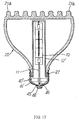
- FIGS. 12 and 13 show a double-enveloped halogen bulb according to the seventh preferred embodiment of the present invention.
- the construction of the socket 40'' is different from that of the socket 40 used in the first preferred embodiment shown in FIG. 1, and the fastening of the tubular halogen bulb 10 with the hollow glass envelope 20 is improved.
- the socket 40'' has a hollow columnar body 42 having a large opening at one end and a small opening at another end thereof.
- the hollow columnar body 42 is made of a metal material and is provided therein with female threads corresponding in location to and engageable with the male threads 28 of the neck of the glass envelope 20.
- the socket 40'' further has an inner ceramic member 41' threadably mounted inside the hollow columnar body 42 so that a cylindrical end of the ceramic member 41' is protruding from the small opening of the hollow columnar body 42, and a copper hat 48 having two fastening legs 47.
- the ceramic member 41' is provided at another end and on the outer surface thereof with male threads 49 by which it is threadably engaged with the female threads of the hollow columnar body 42; and is also provided with two square holes 45 and two round holes 46 around the cylindrical end thereof.
- the copper hat 48 is fastened onto the protruding cylindrical end of the ceramic member 41' by inserting the two fastening legs 47 into the two square holes 45 of the ceramic member 41' and bending them toward each other.
- the hollow columnar body 42 and the copper hat 48 are the negative and positive electrodes of the socket 40'', respectively.
- the hollow glass envelope 20 of this embodiment is similar in construction to that of the sixth preferred embodiment of the present invention, except that the former is provided with two opposite grooves 27 on the outer surface of the neck of the glass envelope 20.
- the grooves 27 are perpendicular to the threads 28.
- Another lead 11 is connected with another one of the two conductive ends of the tubular halogen bulb 10 at one end thereof, and another end thereof juts out from one of the two round holes 46 of the socket 40'', and the protruding end 11 of said another lead 11 is soldered to the copper hat 48 after the socket 40'' is threaded on the male threads 28 at the neck of the glass envelop 20, while the two hooks of the inverted-U-shaped lead 12'' are electrically connected with the metal columnar body 42 of the socket 40''.
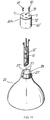
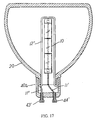
- FIGS. 14 to 16 show a double-enveloped halogen bulb according to the eighth preferred embodiment of the present invention.
- the construction of the socket 40a is different from that of the socket 40'' used in the seventh preferred embodiment shown in FIGS. 12 and 13.
- the hollow glass envelope 20 of this embodiment is similar in construction to that of the seventh preferred embodiment of the present invention, except that the former is provided with four vertical grooves 27, 27' on the outer surface and at the neck of the glass envelope 20, and the former does not have the threads 28 and parallel ridges 21a as provided respectively at the neck and on the top surface of the hollow glass envelope 20 in the latter.
- the four vertical grooves 27, 27' are spaced with one another by 90 degrees, and any opposite two of them are corresponding to the two axial protuberant guides 73 of the hollow columnar body 42'' in shape and size.
- a double-enveloped halogen bulb according to the ninth preferred embodiment of the present invention is basically similar to that of the eighth preferred embodiment of the present invention, except that the two metal bodies 43', 44' of the former are hollow, and one ends of the two additional leads 11', 11'' of the former are received inside the two hollow metal bodies 43', 44' and protruding therefrom before the protruding ends are soldered to the outer ends of the two hollow metal bodies 43', 44'.
- another ends of the two additional leads 11', 11'' are soldered to said one end 11 of the two conductive ends and one leg of the inverted-U-shaped leads 12'', before the tubular halogen bulb 10 is placed inside the glass envelope 20 and is hung at the neck of the glass envelope 20.
- Said one ends of the two additional leads 11', 11'' are inserted into two holes formed inside the two hollow metal bodies 43', 44' and protruding therefrom, when the socket 40a is mounted on the neck of the glass envelope 20.
- the protruding ends of the two additional leads 11', 11'' are soldered to the outer ends of the two metal bodies 43', 44' from outside.
Landscapes
- Connecting Device With Holders (AREA)
- Common Detailed Techniques For Electron Tubes Or Discharge Tubes (AREA)
Abstract
Description
Claims (41)
- A double-enveloped halogen bulb comprising a tubular halogen bulb having two conductive ends, a hollow glass envelope, and a socket for securing said tubular halogen bulb in said glass envelope such that said two conductive ends are connected electrically with two different portions of said socket, said tubular halogen bulb further having a quartz envelope, a metal filament located in said quartz envelope such that both ends of said metal filament are sealed at both ends of said quartz envelope and electrically connected to said two conductive ends separately, and a halogen mixture contained in said quartz envelope, said glass envelope having a thickness ranging between 2mm and 8mm.
- The double-enveloped halogen bulb as defined in claim 1, wherein said glass envelope has a thickness ranging between 3mm and 6mm.
- The double-enveloped halogen bulb as defined in claim 1, wherein said glass envelope has a neck provided at one end thereof with an opening and at another end thereof with a head, said one end of said neck being connected with said socket.
- The double-enveloped halogen bulb as defined in claim 3, wherein said glass envelope has an outer surface which is opposite to said socket and is provided with a plurality of cylindrical protuberances perpendicular to said outer surface and having a height ranging between 3mm and 10mm, and a top area ranging between 5mm2 and 25mm2.
- The double-enveloped halogen bulb as defined in claim 4, wherein said outer surface is a planar surface with an area ranging between 3,000mm2 and 14,000mm2; and wherein said cylindrical protuberances are separated from one another at an interval ranging between 2mm and 10mm.
- The double-enveloped halogen bulb as defined in claim 3, wherein said head of said glass envelope has an outer surface which is opposite to said socket and is provided with a plurality of striplike protuberances perpendicular to said outer surface and having a height ranging between 3mm and 10mm, a width ranging between 3mm and 10mm, and a length equal to or smaller than a linear distance between two opposite points located at a peripheral edge of said outer surface.
- The double-enveloped halogen bulb as defined in claim 6, wherein said outer surface is a planar surface with an area ranging between 3,000mm2 and 14,000mm2; and wherein said striplike protuberances are parallel to one another and are equidistantly arranged on said planar surface at an interval ranging 3-10mm.
- The double-enveloped halogen bulb as defined in claim 3, wherein said head is spherical, oblong, spindle, columnar, bowl-shaped, or funnel-shaped.
- The double-enveloped halogen bulb as defined in claim 3, wherein said socket has a hollow columnar body having an opening at one end, and a closed end member fixed connected to another end of said hollow columnar body; wherein said opening end of said neck of said glass envelope is received in said hollow columnar body via said opening end of said hollow columnar body; and wherein said tubular halogen bulb is fixed in said glass envelope such that a longitudinal axis of said tubular halogen bulb is substantially parallel to a longitudinal axis of said hollow columnar body of said socket.
- The double-enveloped halogen bulb as defined in claim 9, wherein said hollow columnar body of said socket is provided in an inner surface thereof with threads; and wherein said opening end of said glass envelope is further provided on an outer surface thereof with threads engageable with said threads of said hollow columnar body.
- The double-enveloped halogen bulb as defined in claim 10, wherein said hollow columnar body is made of a metal material; wherein said closed end member is an insulation body having a central hole through which one of said two conductive ends or a lead connected to said one of said two conductive end of said tubular halogen bulb is bent and fastened by soldering; and wherein said hollow columnar body is electrically connected to another end of said two conductive ends with another lead.
- The double-enveloped halogen bulb as defined in claim 9, wherein said hollow columnar body and said closed end member of said socket are integrally made of an electrically non-conductive material; wherein a closed end of said socket is provided with two conductive bodies separated from each other and connected electrically with said two conductive ends of said tubular halogen bulb, respectively.
- The double-enveloped halogen bulb as defined in claim 12, wherein said electrically non-conductive material is plastic, and said socket and said opening end of said neck of said glass envelope are fastened by an adhesive.
- The double-enveloped halogen bulb as defined in claim 1, wherein said glass envelope is made integrally.
- The double-enveloped halogen bulb as defined in claim 3, wherein said socket has a hollow columnar body having an opening at one end, and a closed end member fixed connected to another end of said hollow columnar body; wherein said opening end of said neck of said glass envelope is received in said hollow columnar body via said opening end of said hollow columnar body; and wherein said tubular halogen bulb is fixed in said glass envelope such that a longitudinal axis of said tubular halogen bulb is substantially perpendicular to a longitudinal axis of said hollow columnar body of said socket.
- The double-enveloped halogen bulb as defined in claim 15, further comprising a bracket for supporting said tubular halogen bulb, said bracket provided at one end thereof with two legs fastened respectively with said socket and/or between said socket and said neck of said glass envelope, said bracket further provided at another end thereof with two arms holding proximity of both ends of said tubular halogen bulb.
- The double-enveloped halogen bulb as defined in claim 16, wherein said glass envelope has a plurality of ventilation holes.
- The double-enveloped halogen bulb as defined in claim 17, wherein said ventilation holes are formed in such a manner that said tubular halogen bulb can not be seen by the naked eye through said ventilation holes.
- The double-enveloped halogen bulb as defined in claim 15, wherein said glass envelope has a cap and a funnel-shaped portion having a first open end and a second open end, said first open end being fastened with said socket, said second open end having an opening larger than an opening of said first open end, said second open end being capped by said cap of said glass envelope.
- The double-enveloped halogen bulb as defined in claim 19, wherein said cap is fastened with said second open end of said funnel-shaped portion by an adhesive.
- The double-enveloped halogen bulb as defined in claim 20, wherein said cap is provided with a retaining portion; and wherein said second open end of said funnel-shaped portion is provided with a retaining portion engageable with said retaining portion of said cap.
- The double-enveloped halogen bulb as defined in claim 21, wherein said cap has a surface facing said funnel-shaped portion and having a periphery provided with a protruded edge perpendicular to said surface; and wherein said second open end of said funnel-shaped portion is provided in a periphery thereof with a protuberance corresponding in location to said protruded edge of said cap.
- The double-enveloped halogen bulb as defined in claim 21, wherein said cap has a surface facing said funnel-shaped portion and having a periphery provided with a plurality of wedges separated from one another and perpendicular to said surface; and wherein said second open end of said funnel-shaped portion is provided in a periphery thereof with a plurality of recesses corresponding in location and size to said wedges of said cap.
- The double-enveloped halogen bulb as defined in claim 19, wherein said glass envelope has a plurality of ventilation holes.
- The double-enveloped halogen bulb as defined in claim 24, wherein said ventilation holes are formed in such a manner that said tubular halogen bulb can not be seen by the naked eye through said ventilation holes.
- The double-enveloped halogen bulb as defined in claim 25, wherein said ventilation holes are located near a portion where said cap and said funnel-shaped portion are engaged with each other.
- The double-enveloped halogen bulb as defined in claim 26, wherein said ventilation holes are located at an area contiguous to said second open end of said funnel-shaped portion.
- The double-enveloped halogen bulb as defined in claim 11, wherein said another lead is connected to said another end of said two conductive ends at one end thereof by soldering; and another end of said another lead is bent over an edge of the opening end of said neck and received in a first groove formed on the outer surface of the neck and perpendicular to the threads of the neck, so that said another end of said another lead is electrically connected to said hollow columnar body when said socket is threaded on the threads of the neck of the glass envelope.
- The double-enveloped halogen bulb as defined in claim 28, wherein said another lead is in an inverted-U-shaped lead having two hooks at both legs thereof, and said neck is further provided with a second groove on the outer surface thereof, wherein said inverted-U-shaped lead is connected to said another end of said two conductive ends at the middle portion thereof by soldering, and the two hooks are received in said first and second grooves separately, so that said two hooks are electrically connected to said hollow columnar body when said socket is threaded on the threads of the neck of the glass envelope.
- The double-enveloped halogen bulb as defined in claim 10, wherein said hollow columnar body is made of a metal material, and said closed end member is an insulation body threadably mounted inside the hollow columnar body with a cylindrical end of said closed end member protruding from said another end of said hollow columnar body; wherein said closed end member is provided with two square holes and one round hole around said cylindrical end thereof; wherein said socket further has a copper hat having two fastening legs on the rim of the copper hat; and wherein the copper hat is fastened onto the protruding cylindrical end of the closed end member by inserting the two fastening legs into the two square holes of the closed end member and bending them toward each other, one of said two conductive ends or a lead connected to said one of said two conductive end of said tubular halogen bulb is passed through said round hole and soldered to said copper hat, and said hollow columnar body is electrically connected to another end of said two conductive ends with another lead.
- The double-enveloped halogen bulb as defined in claim 30, wherein said another lead is connected to said another end of said two conductive ends at one end thereof by soldering; and another end of said another lead is bent over an edge of the opening end of said neck and received in a first groove formed on the outer surface of the neck and perpendicular to the threads of the neck, so that said another end of said another lead is electrically connected to said hollow columnar body when said socket is threaded on the threads of the neck of the glass envelope.
- The double-enveloped halogen bulb as defined in claim 31, wherein said another lead is in an inverted-U-shaped lead having two hooks at both legs thereof, and said neck is further provided with a second groove on the outer surface thereof, wherein said inverted-U-shaped lead is connected to said another end of said two conductive ends at the middle portion thereof by soldering, and the two hooks are received in said first and second grooves separately, so that said two hooks are electrically connected to said hollow columnar body when said socket is threaded on the threads of the neck of the glass envelope.
- The double-enveloped halogen bulb as defined in claim 12 further comprises an inverted-U-shaped lead having two hooks at both legs thereof and two additional leads, wherein said neck of said glass envelop is further provided with two grooves on the outer surface thereof, wherein said inverted-U-shaped lead is connected to one of said two conductive ends of said tubular halogen bulb at the middle portion thereof by soldering, and the two hooks are received in said two grooves separately, wherein one leg of said inverted-U-shaped lead and another end of said two conductive ends of said tubular halogen bulb are electrically connected to said two conductive bodies with said two additional leads separately.
- The double-enveloped halogen bulb as defined in claim 33, wherein said two conductive bodies are hollow, one ends of the two additional leads are received inside the two hollow conductive bodies and protruding therefrom separately, the protruding ends of the two additional leads are separately connected to one ends of the two hollow conductive bodies by soldering, and another ends of the two additional leads are separately connected to said one leg of said inverted-U-shaped lead and said another end of said two conductive ends of said tubular halogen bulb by soldering.
- The double-enveloped halogen bulb as defined in claim 34, wherein said hollow columnar body of said socket is further provided with two axial protuberant guides on the inner wall thereof, said hollow columnar body of said socket has an inner diameter corresponding to an outer diameter of the neck of the glass envelope, and said glass envelope is provided with two additional grooves corresponding to said two axial protuberant guides on an outer surface of said opening end of said neck thereof, so that the socket is non-rotatably mounted on the neck of the glass envelope with the two axial protuberant guides being received in the two additional grooves of said neck respectively.
- The double-enveloped halogen bulb as defined in claim 34 wherein said electrically non-conductive material is a ceramic material.
- The double-enveloped halogen bulb as defined in claim 36, wherein said socket and said opening end of said neck of said glass envelope are fastened by a ceramic cement.
- The double-enveloped halogen bulb as defined in claim 36, wherein said two conductive bodies are separately received in two through holes provided at said closed end of said socket and fastened by means of a ceramic cement
- The double-enveloped halogen bulb as defined in claim 12, wherein said socket is further provided with one or more ventilation holes at said closed end thereof.
- The double-enveloped halogen bulb as defined in claim 33, wherein said socket is further provided with one or more ventilation holes at said closed end thereof.
- The double-enveloped halogen bulb as defined in claim 34, wherein said socket is further provided with one or more ventilation holes at said closed end thereof.
Applications Claiming Priority (4)
| Application Number | Priority Date | Filing Date | Title |
|---|---|---|---|
| CN97116589 | 1997-09-17 | ||
| CN97116589 | 1997-09-17 | ||
| CN98202732 | 1998-03-25 | ||
| CN 98202732 CN2335261Y (en) | 1998-03-25 | 1998-03-25 | Halogen lamp with double-laye closure |
Publications (2)
| Publication Number | Publication Date |
|---|---|
| EP0903773A2 true EP0903773A2 (en) | 1999-03-24 |
| EP0903773A3 EP0903773A3 (en) | 1999-06-16 |
Family
ID=25744363
Family Applications (1)
| Application Number | Title | Priority Date | Filing Date |
|---|---|---|---|
| EP98106484A Withdrawn EP0903773A3 (en) | 1997-09-17 | 1998-04-08 | Double-enveloped halogen bulb |
Country Status (1)
| Country | Link |
|---|---|
| EP (1) | EP0903773A3 (en) |
Family Cites Families (13)
| Publication number | Priority date | Publication date | Assignee | Title |
|---|---|---|---|---|
| BR8400807A (en) * | 1983-02-25 | 1984-10-02 | Gte Prod Corp | ELECTRIC HALOGEN / TUNGSTEN LAMP WITH PERMEATABLE ELEMENT CLOSING THE EXTERNAL HOUSING |
| BR8400762A (en) * | 1983-02-25 | 1984-10-02 | Gte Prod Corp | METHOD FOR MANUFACTURING ELECTRIC LAMP AND LAMP |
| US4591752A (en) * | 1983-10-14 | 1986-05-27 | Duro-Test Corporation | Incandescent lamp with high pressure rare gas filled tungsten-halogen element and transparent thick walled safety envelope |
| US4829210A (en) * | 1987-01-23 | 1989-05-09 | Gte Products Corporation | Multifunctional structural member and reflector lamp employing same |
| CA1305995C (en) * | 1987-08-28 | 1992-08-04 | William M. Keeffe | Double-enveloped lamp having a shield surrounding a light-source capsule within a thick-walled outer envelope |
| JP3214633B2 (en) * | 1992-05-29 | 2001-10-02 | 岩崎電気株式会社 | Halogen bulb |
| EP0589695B1 (en) * | 1992-09-23 | 1997-01-15 | Flowil International Lighting (Holding) B.V. | Electric lamp with threaded base |
| EP0590602A1 (en) * | 1992-09-28 | 1994-04-06 | Toshiba Lighting & Technology Corporation | Double-bulb halogen lamp and lighting system |
| US5670840A (en) * | 1992-11-12 | 1997-09-23 | Lanese; Gustino J. | Tungsten-halogen incandescent lamp with reduced risk of containment failure |
| JPH06310109A (en) * | 1993-04-28 | 1994-11-04 | Iwasaki Electric Co Ltd | Halogen bulb and its lighting equipment |
| JPH08129992A (en) * | 1994-10-31 | 1996-05-21 | Iwasaki Electric Co Ltd | Halogen bulb with outer bulb |
| JP3118749B2 (en) * | 1995-12-15 | 2000-12-18 | ウシオ電機株式会社 | Double tube incandescent bulb |
| JPH09237609A (en) * | 1996-02-29 | 1997-09-09 | Iwasaki Electric Co Ltd | Halogen bulb with outer bulb |
-
1998
- 1998-04-08 EP EP98106484A patent/EP0903773A3/en not_active Withdrawn
Also Published As
| Publication number | Publication date |
|---|---|
| EP0903773A3 (en) | 1999-06-16 |
Similar Documents
| Publication | Publication Date | Title |
|---|---|---|
| US6133676A (en) | Double-enveloped halogen bulb provided with protuberances in the outer surface of the envelope | |
| US4459648A (en) | Recessed lighting fixture and lamp mount therefor | |
| US20090045715A1 (en) | Modular lighting apparatus | |
| CN1184661C (en) | Headlight bulb | |
| WO2013076578A2 (en) | Light-emitting diode lamp | |
| US20210025550A1 (en) | Light emitting diode filament light source | |
| US5218261A (en) | Single based electric lamp | |
| US5428515A (en) | Electric lighting assembly | |
| US6380683B1 (en) | Socket and light bulb assembly utilizing magnetic coupling | |
| US5453655A (en) | Single-based incadescent lamp construction | |
| US5980071A (en) | Lighting fitting | |
| US10724691B2 (en) | Lightbulb and bulb cap therefor | |
| US7264375B1 (en) | Self-ballasted fluorescent lamp | |
| EP0599624B1 (en) | Lamp base inner shell | |
| JP3873360B2 (en) | Fluorescent lamp device and lighting apparatus | |
| US20020080607A1 (en) | Lamp securing device | |
| US2436259A (en) | Electric lamp base | |
| CA2539917C (en) | Improved base for a mogul-based lamp | |
| CN101359576B (en) | Electric lamp with an outer vessel and a built-in lamp and method for production of same | |
| KR200188613Y1 (en) | Structure for assembling the incandescent lamp | |
| JP3986115B2 (en) | Light bulb device and lighting device | |
| JP3565159B2 (en) | Tube base and tube using the same | |
| JPS6338524Y2 (en) | ||
| JPS6321041Y2 (en) | ||
| JPS596564Y2 (en) | fluorescent lamp device |
Legal Events
| Date | Code | Title | Description |
|---|---|---|---|
| PUAI | Public reference made under article 153(3) epc to a published international application that has entered the european phase |
Free format text: ORIGINAL CODE: 0009012 |
|
| AK | Designated contracting states |
Kind code of ref document: A2 Designated state(s): DE ES FR GB IT NL |
|
| AX | Request for extension of the european patent |
Free format text: AL;LT;LV;MK;RO;SI |
|
| PUAL | Search report despatched |
Free format text: ORIGINAL CODE: 0009013 |
|
| AK | Designated contracting states |
Kind code of ref document: A3 Designated state(s): AT BE CH CY DE DK ES FI FR GB GR IE IT LI LU MC NL PT SE |
|
| AX | Request for extension of the european patent |
Free format text: AL;LT;LV;MK;RO;SI |
|
| 17P | Request for examination filed |
Effective date: 19990624 |
|
| AKX | Designation fees paid |
Free format text: DE ES FR GB IT NL |
|
| 17Q | First examination report despatched |
Effective date: 20021105 |
|
| STAA | Information on the status of an ep patent application or granted ep patent |
Free format text: STATUS: THE APPLICATION IS DEEMED TO BE WITHDRAWN |
|
| 18D | Application deemed to be withdrawn |
Effective date: 20030318 |