EP0903727A1 - System und Verfahren zur automatischen Spracherkennung - Google Patents
System und Verfahren zur automatischen Spracherkennung Download PDFInfo
- Publication number
- EP0903727A1 EP0903727A1 EP97830454A EP97830454A EP0903727A1 EP 0903727 A1 EP0903727 A1 EP 0903727A1 EP 97830454 A EP97830454 A EP 97830454A EP 97830454 A EP97830454 A EP 97830454A EP 0903727 A1 EP0903727 A1 EP 0903727A1
- Authority
- EP
- European Patent Office
- Prior art keywords
- language models
- networks
- hierarchical
- language
- recurrent
- Prior art date
- Legal status (The legal status is an assumption and is not a legal conclusion. Google has not performed a legal analysis and makes no representation as to the accuracy of the status listed.)
- Withdrawn
Links
- 238000000034 method Methods 0.000 title claims description 12
- 230000000306 recurrent effect Effects 0.000 claims abstract description 15
- 230000007704 transition Effects 0.000 claims abstract description 14
- 230000009471 action Effects 0.000 claims abstract description 9
- 230000006870 function Effects 0.000 claims abstract description 5
- 230000008569 process Effects 0.000 claims description 6
- 230000004044 response Effects 0.000 claims 2
- 238000000605 extraction Methods 0.000 claims 1
- 238000013518 transcription Methods 0.000 claims 1
- 230000035897 transcription Effects 0.000 claims 1
- 230000001755 vocal effect Effects 0.000 claims 1
- 230000003993 interaction Effects 0.000 abstract description 7
- 230000014509 gene expression Effects 0.000 description 5
- 238000013459 approach Methods 0.000 description 4
- 230000008901 benefit Effects 0.000 description 3
- 238000012545 processing Methods 0.000 description 3
- 238000013479 data entry Methods 0.000 description 2
- 238000012986 modification Methods 0.000 description 2
- 230000004048 modification Effects 0.000 description 2
- 101100409194 Rattus norvegicus Ppargc1b gene Proteins 0.000 description 1
- 230000002411 adverse Effects 0.000 description 1
- 230000008878 coupling Effects 0.000 description 1
- 238000010168 coupling process Methods 0.000 description 1
- 238000005859 coupling reaction Methods 0.000 description 1
- 238000011161 development Methods 0.000 description 1
- 238000010586 diagram Methods 0.000 description 1
- 238000005516 engineering process Methods 0.000 description 1
- 238000012805 post-processing Methods 0.000 description 1
- 238000007781 pre-processing Methods 0.000 description 1
- 230000004043 responsiveness Effects 0.000 description 1
- 238000010845 search algorithm Methods 0.000 description 1
- 230000009466 transformation Effects 0.000 description 1
- 230000001131 transforming effect Effects 0.000 description 1
- 238000013519 translation Methods 0.000 description 1
- 239000013598 vector Substances 0.000 description 1
Images


Classifications
-
- G—PHYSICS
- G10—MUSICAL INSTRUMENTS; ACOUSTICS
- G10L—SPEECH ANALYSIS TECHNIQUES OR SPEECH SYNTHESIS; SPEECH RECOGNITION; SPEECH OR VOICE PROCESSING TECHNIQUES; SPEECH OR AUDIO CODING OR DECODING
- G10L15/00—Speech recognition
- G10L15/08—Speech classification or search
- G10L15/18—Speech classification or search using natural language modelling
- G10L15/183—Speech classification or search using natural language modelling using context dependencies, e.g. language models
- G10L15/19—Grammatical context, e.g. disambiguation of the recognition hypotheses based on word sequence rules
- G10L15/193—Formal grammars, e.g. finite state automata, context free grammars or word networks
-
- G—PHYSICS
- G10—MUSICAL INSTRUMENTS; ACOUSTICS
- G10L—SPEECH ANALYSIS TECHNIQUES OR SPEECH SYNTHESIS; SPEECH RECOGNITION; SPEECH OR VOICE PROCESSING TECHNIQUES; SPEECH OR AUDIO CODING OR DECODING
- G10L15/00—Speech recognition
- G10L15/08—Speech classification or search
- G10L15/18—Speech classification or search using natural language modelling
- G10L15/183—Speech classification or search using natural language modelling using context dependencies, e.g. language models
- G10L15/19—Grammatical context, e.g. disambiguation of the recognition hypotheses based on word sequence rules
- G10L15/197—Probabilistic grammars, e.g. word n-grams
-
- G—PHYSICS
- G10—MUSICAL INSTRUMENTS; ACOUSTICS
- G10L—SPEECH ANALYSIS TECHNIQUES OR SPEECH SYNTHESIS; SPEECH RECOGNITION; SPEECH OR VOICE PROCESSING TECHNIQUES; SPEECH OR AUDIO CODING OR DECODING
- G10L15/00—Speech recognition
- G10L15/22—Procedures used during a speech recognition process, e.g. man-machine dialogue
- G10L2015/226—Procedures used during a speech recognition process, e.g. man-machine dialogue using non-speech characteristics
- G10L2015/228—Procedures used during a speech recognition process, e.g. man-machine dialogue using non-speech characteristics of application context
Definitions
- the invention is generally concerned with ASR techniques, ASR being an acronym for "Automatic Speech Recognition”.
- the automatic speech recognition sector has already attained a maturity level that permits it to be used in various contexts, including - for example - controlling equipment and devices by means of spoken orders, data-entry systems, query systems, dictation systems, etc.
- One of the requirements for assuring satisfactory operation of an automatic speech recognition system is that the part of the system dedicated to extracting the linguistic information from the acoustic signal should be provided with an accurate description of a set of possible hypotheses among which it should look for the utterances that is intended to recognize.
- This set whose component elements are word sequences, is normally referred to as the "recognition language” and the model that describes it is referred to as the "language model” (LM). Consequently, the language model brings together the a priori knowledge available to the system as regards the possible content of the sentences pronounced by the user.
- LM language model
- the language model may vary during the interaction between the user and the system, according to modifications in the state of the system itself.
- a typical example is constituted by the so-called dialogue systems, where the user is prompted by the system to answer questions regarding different subjects. Each question may have a particular set of possible answers, so that the recognizer can apply different language models at different moments.
- the present invention has to be seen in the context of dynamic systems of this type. If the speech decoder is to achieve a sufficient speed, a good coupling has to exist between the search algorithm and the data structure used for representing the language model.
- one of the most effective approaches is that of using a dynamic programming procedure, based on the assumption that the language model is represented by means of a finite state network, that is to say, a graph in which the arcs carry labels corresponding to the words. Though convenient for search and efficiency, this representation is not very economical, so that the graph needed for storing a complex language model is one of the most resource-demanding parts of the automatic speech recognition system.
- the present invention sets itself the object of overcoming the difficulties discussed above.
- this object can be attained thanks to an automatic speech recognition process having the characteristics set out in the claims hereinbelow.
- the invention also concerns the respective system.
- HMMs hierarchical language models
- the aforesaid hierarchical language models are represented by means of probabilistic recurrent transition networks (PRTNs), where the arc labels can constitute references to other networks.
- PRTNs probabilistic recurrent transition networks
- the invention also employs a recursive search engine that directly searches these networks and is capable of providing both recognition and parsing of an incoming utterance in a single step.
- language models are normally used to assign a priori probabilities to particular sequences of words.
- a common technique for improving the robustness of language models is that of allowing the language model symbols to be not necessarily mere words, but also references to lists of words, called word “classes”. Cases in point are "proper name”, "city name”, and so on. With this approach, the probability of a word in a given context is computed as the probability of its class in the context, times the probability of the word in its class.
- Hierarchical language models are a further step in this direction, allowing language model labels to be references to other language models instead of only words or word lists (classes). For example, numbers and dates are often expressions that span more words in an utterance. They cannot be represented by means of word classes, but they can be well isolated and modelled by specific language models. In this sense, hierarchical language modelling can have benefits in many applications of speech technology, especially as a powerful technique for managing on-the-fly definitions of dynamic language models.
- PFSN Probabilistic Finites State Networks
- PRTN probabilistic recurrent transition networks
- dynamic definition of language models can greatly benefit from the above approaches.
- the language models corresponding to the different states of the interaction differ from each other in being different combinations of elements of a common pool of basic component language models.
- the use of a hierarchical representation allows to avoid the overhead that would result if they had to be translated into standard language models.
- dynamic language models are generated by means of regular expressions whose terminal symbols may refer to basic language models, and these expressions are compiled into PRTNs.
- the resulting networks are normally very compact in their recursive representation, but they may correspond to complex hierarchical language models if all their external links are taken into account.
- the speech decoding engine is able to work on the previously described recurrent PRTN structures without needing its translation into a standard PSFN.
- the solution according to the invention proposes to employ a modified Viterbi decoder working on PRTNs.
- the module can also build a parsing tree of an input utterance, thus providing a one-step recognition and parsing procedure.
- the overall speech recognition system shown in Figure 1 is generally intended to realize any kind of transformation of a physical reality F upon receipt of a stimulus signal consisting of a speech signal.
- the system in question could be, for example, an automatic dictation system, any system that permits a device or an apparatus being controlled upon receipt of command signals represented by voice messages produced by a speaker, a data-entry system, an information request system capable of responding to questions concerning particular topics (financial information, train and aircraft timetables, etc.), and similar applications.
- the system comprises an input interface that terminates in a microphone 1 capable of capturing the speech signal of one or more speakers and transforming it - in a signal processor indicated by 2 - into a digital signal that conveys the content of the speech signal captured by the microphone 1.
- the signal captured by the microphone 1 corresponds to the English spoken phrase "one million rate twenty five point forty three percent", i.e. the expression of an item of information of - for example - a financial type concerning a rate of 25.43% applied to an amount equal to a million.
- the system in accordance with criteria that as such are well known - preserves an item of information intended to identify, at least at the beginning of the interaction, a language model accepted in a particular case.
- the user himself may have signalled to the system - for example, by means of information supplied by pressing one or more keys on a keyboard, or by touching a screen or in any other way (including some previous use of the described speech recognition system) - the fact that the interaction about to take place concerns, for example, the obtainment or introduction of information of a financial nature.
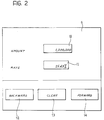
- the active language model of the system is destined to accept data corresponding to the mask S (presented, for example, on a display screen) represented in Figure 2, with a field 10 for the amount (i.e. the previously mentioned value of one million), a field 11 for the rate or percentage (i.e. the previously mentioned value of 25.43%) one or more fields 12 to 14 for the development of the interaction and here denominated, respectively, "backward", “clean” and "forward”.
- one of the fields 10 or 11 may be chosen by pronouncing a corresponding key word.
- One or more of the said fields may receive an attribution by pronouncing the key word and the appropriate value or by simply following their order, for example, without pronouncing any key word, but only the respective values.
- the mask may be cleaned and/or the next mask or the previous mask may be called by pronouncing a single command.
- the signal processing device in the case here considered the processor 2 generally realizes not only the pure and simple digitalization of the signal corresponding to the input speech, but also the pre-processing actions intended to extract the important features or observations contained in the speech signal. This function, once again, is realized in accordance with criteria that as such are well known to the state of the art and do not therefore call for further discussion.
- the said observations are fed to a decoder 3 whose manner of functioning is based specifically on the use of a probabilistic recurrent transition network as mentioned on several occasions in the introduction to this description.
- the decoder 3 the said observations Y1, Y2, ..., Y n can be processed in such a manner as to generate the best possible interpretation of the input corresponding to the speech signal.
- the decoder avails itself of two knowledge sources:
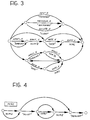
- the tree of Figure 5 can evolve in 105 towards the predisposition for selecting field 11 actuated in 106 (word “rate”).
- the active language model contains references to language models named "num 12", "num 2" and "perc”.
- the numerical reference 6 identifies a post-processing module that processes the parsing tree generated by the decoder 3 to provide a suitable representation of the significance (meaning), a semantic frame, for example.
- the module 6 also performs language processing operations: for example, the word sequences that express numbers are effectively transformed into numbers with a view to their introduction into the system.
- the reference 7 identifies an operating module intended to transform the significance representations generated in the post-processor 6 into effective actions or commands (that is to say, modifications of the physical reality F) for such particular external modules as a user interface or a control device for some item of equipment (a videowriting system, for example), realizing also the action of updating the active language model determined on the basis of pre-established internal rules.
- the language model in question is generated by means of a syntactic expression that, in its turn, is compiled in the form of a probabilistic recurrent transition network in a graph compilation module 8 that, just as shown in Figure 1, performs a feedback action from the management module 7 to the decoder 3.
Landscapes
- Engineering & Computer Science (AREA)
- Artificial Intelligence (AREA)
- Computational Linguistics (AREA)
- Health & Medical Sciences (AREA)
- Audiology, Speech & Language Pathology (AREA)
- Human Computer Interaction (AREA)
- Physics & Mathematics (AREA)
- Acoustics & Sound (AREA)
- Multimedia (AREA)
- Machine Translation (AREA)
Priority Applications (1)
| Application Number | Priority Date | Filing Date | Title |
|---|---|---|---|
| EP97830454A EP0903727A1 (de) | 1997-09-17 | 1997-09-17 | System und Verfahren zur automatischen Spracherkennung |
Applications Claiming Priority (1)
| Application Number | Priority Date | Filing Date | Title |
|---|---|---|---|
| EP97830454A EP0903727A1 (de) | 1997-09-17 | 1997-09-17 | System und Verfahren zur automatischen Spracherkennung |
Publications (1)
| Publication Number | Publication Date |
|---|---|
| EP0903727A1 true EP0903727A1 (de) | 1999-03-24 |
Family
ID=8230772
Family Applications (1)
| Application Number | Title | Priority Date | Filing Date |
|---|---|---|---|
| EP97830454A Withdrawn EP0903727A1 (de) | 1997-09-17 | 1997-09-17 | System und Verfahren zur automatischen Spracherkennung |
Country Status (1)
| Country | Link |
|---|---|
| EP (1) | EP0903727A1 (de) |
Cited By (5)
| Publication number | Priority date | Publication date | Assignee | Title |
|---|---|---|---|---|
| WO2002071391A3 (en) * | 2001-03-01 | 2002-11-21 | Ibm | Hierarchichal language models |
| EP1199706A3 (de) * | 2000-10-18 | 2004-01-07 | Saymore Speech Operated Systems GmbH | Verfahren zur eindeutigen Analyse eines Sprachbefehls |
| US7584103B2 (en) | 2004-08-20 | 2009-09-01 | Multimodal Technologies, Inc. | Automated extraction of semantic content and generation of a structured document from speech |
| US8321199B2 (en) | 2006-06-22 | 2012-11-27 | Multimodal Technologies, Llc | Verification of extracted data |
| US8959102B2 (en) | 2010-10-08 | 2015-02-17 | Mmodal Ip Llc | Structured searching of dynamic structured document corpuses |
Citations (2)
| Publication number | Priority date | Publication date | Assignee | Title |
|---|---|---|---|---|
| EP0533338A2 (de) * | 1991-08-16 | 1993-03-24 | AT&T Corp. | Vermittlungsmethode und Einrichtung für Informationsdienste |
| WO1994016434A1 (en) * | 1992-12-31 | 1994-07-21 | Apple Computer, Inc. | Recursive finite state grammar |
-
1997
- 1997-09-17 EP EP97830454A patent/EP0903727A1/de not_active Withdrawn
Patent Citations (2)
| Publication number | Priority date | Publication date | Assignee | Title |
|---|---|---|---|---|
| EP0533338A2 (de) * | 1991-08-16 | 1993-03-24 | AT&T Corp. | Vermittlungsmethode und Einrichtung für Informationsdienste |
| WO1994016434A1 (en) * | 1992-12-31 | 1994-07-21 | Apple Computer, Inc. | Recursive finite state grammar |
Non-Patent Citations (4)
| Title |
|---|
| BROWN ET AL.: "Context-free large-vocabulary connected speech recognition with evolutional grammars", INTERNATIONAL CONFERENCE ON ACOUSTICS, SPEECH, SIGNAL PROCESSING (ICASSP 1994), vol. 2, 19 April 1994 (1994-04-19) - 22 April 1994 (1994-04-22), ADELAIDE, AU, pages 145 - 148, XP000528461 * |
| BURHKE ET AL.: "A wave decoder for continuous speech recognition", FOURTH INTERNATIONAL CONFERENCE ON SPOKEN LANGUAGE PROCESSING (ICSLP 1996), vol. 4, 3 October 1996 (1996-10-03) - 6 October 1996 (1996-10-06), PHILADELPHIA, PA, US, pages 2135 - 2138, XP002056209 * |
| SCAGLIOLA: "Language models and search algorithms for real-time speech recognition", INTERNATIONAL JOURNAL OF MAN-MACHINE STUDIES, vol. 22, no. 5, May 1985 (1985-05-01), GB, pages 523 - 547, XP002056210 * |
| WARD ET AL.: "Flexible use of semantic constraints in speech recognition", INTERNATIONAL CONFERENCE ON ACOUSTICS, SPEECH AND SIGNAL PROCESSING (ICASSP 1993), vol. 2, 27 April 1993 (1993-04-27) - 30 April 1993 (1993-04-30), MINNEAPOLIS, MN, US, pages 49 - 50, XP000427722 * |
Cited By (8)
| Publication number | Priority date | Publication date | Assignee | Title |
|---|---|---|---|---|
| EP1199706A3 (de) * | 2000-10-18 | 2004-01-07 | Saymore Speech Operated Systems GmbH | Verfahren zur eindeutigen Analyse eines Sprachbefehls |
| WO2002071391A3 (en) * | 2001-03-01 | 2002-11-21 | Ibm | Hierarchichal language models |
| US6754626B2 (en) | 2001-03-01 | 2004-06-22 | International Business Machines Corporation | Creating a hierarchical tree of language models for a dialog system based on prompt and dialog context |
| US7584103B2 (en) | 2004-08-20 | 2009-09-01 | Multimodal Technologies, Inc. | Automated extraction of semantic content and generation of a structured document from speech |
| US8321199B2 (en) | 2006-06-22 | 2012-11-27 | Multimodal Technologies, Llc | Verification of extracted data |
| US8560314B2 (en) | 2006-06-22 | 2013-10-15 | Multimodal Technologies, Llc | Applying service levels to transcripts |
| US9892734B2 (en) | 2006-06-22 | 2018-02-13 | Mmodal Ip Llc | Automatic decision support |
| US8959102B2 (en) | 2010-10-08 | 2015-02-17 | Mmodal Ip Llc | Structured searching of dynamic structured document corpuses |
Similar Documents
| Publication | Publication Date | Title |
|---|---|---|
| US5761637A (en) | Dialogue-sound processing apparatus and method | |
| US7848926B2 (en) | System, method, and program for correcting misrecognized spoken words by selecting appropriate correction word from one or more competitive words | |
| US6556973B1 (en) | Conversion between data representation formats | |
| US5819220A (en) | Web triggered word set boosting for speech interfaces to the world wide web | |
| JP2644171B2 (ja) | 知能機械のための決定トリーの形でターゲット分野依存型モデルを構築する方法及びスピーチ認識システム | |
| CA2437620C (en) | Hierarchichal language models | |
| KR20170022445A (ko) | 통합 모델 기반의 음성 인식 장치 및 방법 | |
| US20250149032A1 (en) | End-to-end automatic speech recognition system for both conversational and command-and-control speech | |
| KR20240068704A (ko) | 준지도 스피치 인식을 위한 대조 샴 네트워크 | |
| JP2024502946A6 (ja) | 音声認識トランスクリプトの句読点付け及び大文字化 | |
| KR20250092276A (ko) | 스피치 인식을 위한 반지도 트레이닝 방식 | |
| Pieraccini | AI assistants | |
| CN117577095A (zh) | 一种基于ai的智能语音识别系统及方法 | |
| KR101130351B1 (ko) | 영숫자 개념용 음성 인식 문법 생성 | |
| Li et al. | Audio-llm: Activating the capabilities of large language models to comprehend audio data | |
| WO2023162513A1 (ja) | 言語モデル学習装置、対話装置及び学習済言語モデル | |
| Vidal et al. | Grammatical inference and automatic speech recognition | |
| Brugnara et al. | Dynamic language models for interactive speech applications | |
| Galley et al. | Hybrid natural language generation for spoken dialogue systems | |
| Hussein et al. | Speech recognition of high impact model using deep learning technique: a review | |
| EP1109110A1 (de) | System und Verfahren für den Transfer von verpackten linguistischen Strukturen | |
| US7206738B2 (en) | Hybrid baseform generation | |
| JPH10247194A (ja) | 自動通訳装置 | |
| JP2001013992A (ja) | 音声理解装置 | |
| KR102823708B1 (ko) | 동적 인식대상 어휘 추가 기반 대어휘 연속 음성인식 방법 및 장치 |
Legal Events
| Date | Code | Title | Description |
|---|---|---|---|
| PUAI | Public reference made under article 153(3) epc to a published international application that has entered the european phase |
Free format text: ORIGINAL CODE: 0009012 |
|
| AK | Designated contracting states |
Kind code of ref document: A1 Designated state(s): AT BE CH DE DK ES FI FR GB GR IE IT LI LU MC NL PT SE |
|
| AX | Request for extension of the european patent |
Free format text: AL;LT;LV;RO;SI |
|
| AKX | Designation fees paid | ||
| STAA | Information on the status of an ep patent application or granted ep patent |
Free format text: STATUS: THE APPLICATION IS DEEMED TO BE WITHDRAWN |
|
| 18D | Application deemed to be withdrawn |
Effective date: 19990925 |
|
| REG | Reference to a national code |
Ref country code: DE Ref legal event code: 8566 |