EP0903510B1 - Compliant foil fluid film thrust bearing with tilting pad underspring - Google Patents
Compliant foil fluid film thrust bearing with tilting pad underspring Download PDFInfo
- Publication number
- EP0903510B1 EP0903510B1 EP98307596A EP98307596A EP0903510B1 EP 0903510 B1 EP0903510 B1 EP 0903510B1 EP 98307596 A EP98307596 A EP 98307596A EP 98307596 A EP98307596 A EP 98307596A EP 0903510 B1 EP0903510 B1 EP 0903510B1
- Authority
- EP
- European Patent Office
- Prior art keywords
- foil
- spring
- relatively
- fluid
- flexure
- Prior art date
- Legal status (The legal status is an assumption and is not a legal conclusion. Google has not performed a legal analysis and makes no representation as to the accuracy of the status listed.)
- Expired - Lifetime
Links
Images



Classifications
-
- F—MECHANICAL ENGINEERING; LIGHTING; HEATING; WEAPONS; BLASTING
- F16—ENGINEERING ELEMENTS AND UNITS; GENERAL MEASURES FOR PRODUCING AND MAINTAINING EFFECTIVE FUNCTIONING OF MACHINES OR INSTALLATIONS; THERMAL INSULATION IN GENERAL
- F16C—SHAFTS; FLEXIBLE SHAFTS; ELEMENTS OR CRANKSHAFT MECHANISMS; ROTARY BODIES OTHER THAN GEARING ELEMENTS; BEARINGS
- F16C17/00—Sliding-contact bearings for exclusively rotary movement
- F16C17/04—Sliding-contact bearings for exclusively rotary movement for axial load only
- F16C17/042—Sliding-contact bearings for exclusively rotary movement for axial load only with flexible leaves to create hydrodynamic wedge, e.g. axial foil bearings
-
- F—MECHANICAL ENGINEERING; LIGHTING; HEATING; WEAPONS; BLASTING
- F01—MACHINES OR ENGINES IN GENERAL; ENGINE PLANTS IN GENERAL; STEAM ENGINES
- F01D—NON-POSITIVE DISPLACEMENT MACHINES OR ENGINES, e.g. STEAM TURBINES
- F01D25/00—Component parts, details, or accessories, not provided for in, or of interest apart from, other groups
- F01D25/16—Arrangement of bearings; Supporting or mounting bearings in casings
- F01D25/166—Sliding contact bearing
- F01D25/168—Sliding contact bearing for axial load mainly
-
- F—MECHANICAL ENGINEERING; LIGHTING; HEATING; WEAPONS; BLASTING
- F16—ENGINEERING ELEMENTS AND UNITS; GENERAL MEASURES FOR PRODUCING AND MAINTAINING EFFECTIVE FUNCTIONING OF MACHINES OR INSTALLATIONS; THERMAL INSULATION IN GENERAL
- F16C—SHAFTS; FLEXIBLE SHAFTS; ELEMENTS OR CRANKSHAFT MECHANISMS; ROTARY BODIES OTHER THAN GEARING ELEMENTS; BEARINGS
- F16C27/00—Elastic or yielding bearings or bearing supports, for exclusively rotary movement
- F16C27/02—Sliding-contact bearings
-
- F—MECHANICAL ENGINEERING; LIGHTING; HEATING; WEAPONS; BLASTING
- F05—INDEXING SCHEMES RELATING TO ENGINES OR PUMPS IN VARIOUS SUBCLASSES OF CLASSES F01-F04
- F05D—INDEXING SCHEME FOR ASPECTS RELATING TO NON-POSITIVE-DISPLACEMENT MACHINES OR ENGINES, GAS-TURBINES OR JET-PROPULSION PLANTS
- F05D2220/00—Application
- F05D2220/40—Application in turbochargers
-
- F—MECHANICAL ENGINEERING; LIGHTING; HEATING; WEAPONS; BLASTING
- F05—INDEXING SCHEMES RELATING TO ENGINES OR PUMPS IN VARIOUS SUBCLASSES OF CLASSES F01-F04
- F05D—INDEXING SCHEME FOR ASPECTS RELATING TO NON-POSITIVE-DISPLACEMENT MACHINES OR ENGINES, GAS-TURBINES OR JET-PROPULSION PLANTS
- F05D2240/00—Components
- F05D2240/50—Bearings
- F05D2240/52—Axial thrust bearings
-
- F—MECHANICAL ENGINEERING; LIGHTING; HEATING; WEAPONS; BLASTING
- F05—INDEXING SCHEMES RELATING TO ENGINES OR PUMPS IN VARIOUS SUBCLASSES OF CLASSES F01-F04
- F05D—INDEXING SCHEME FOR ASPECTS RELATING TO NON-POSITIVE-DISPLACEMENT MACHINES OR ENGINES, GAS-TURBINES OR JET-PROPULSION PLANTS
- F05D2240/00—Components
- F05D2240/50—Bearings
- F05D2240/53—Hydrodynamic or hydrostatic bearings
-
- F—MECHANICAL ENGINEERING; LIGHTING; HEATING; WEAPONS; BLASTING
- F16—ENGINEERING ELEMENTS AND UNITS; GENERAL MEASURES FOR PRODUCING AND MAINTAINING EFFECTIVE FUNCTIONING OF MACHINES OR INSTALLATIONS; THERMAL INSULATION IN GENERAL
- F16C—SHAFTS; FLEXIBLE SHAFTS; ELEMENTS OR CRANKSHAFT MECHANISMS; ROTARY BODIES OTHER THAN GEARING ELEMENTS; BEARINGS
- F16C2360/00—Engines or pumps
- F16C2360/23—Gas turbine engines
- F16C2360/24—Turbochargers
Definitions
- This invention relates to the general field of compliant foil fluid film bearings.
- Compliant foil fluid film thrust bearings are currently being utilized in a variety of high speed rotor applications. These bearings are generally comprised of a two sided thrust disk rotating element, non-rotating compliant fluid foil members that axially enclose the rotating element, non-rotating compliant spring foil members that axially enclose the fluid foil members and a non-rotating thrust plate element and a non-rotating housing element that axially enclose and provide attachments for the foil members.
- the space between the rotating element and the thrust plate element on one side of the bearing and the space between the rotating element and the thrust surface of the housing element on the other side of the bearing are filled with fluid (usually air) which envelops the foils.
- the rotary motion of the rotating element applies viscous drag forces to the fluid and induces circumferential flow of the fluid between the smooth surface of the rotating element and the fluid foil.
- the space between the rotating element and the fluid foil is subdivided into a plurality of fluid-dynamic wedge channels.
- These wedge channels have typically been formed by resistance welding compliant, convex curved foil pads to an underlying support foil.
- the leading ramps of the foil pads relative to the fluid's circumferential flow and the smooth surface of the rotating element form the two primary surfaces of the converging wedge channels.
- the trailing ramps and the smooth surface of the rotating element form the primary surfaces of the diverging wedge channels.
- the fluid flowing circumferentially along a converging wedge channel experiences steadily decreasing flow area, increasing circumferential flow velocity and increasing static fluid pressure.
- the convergence angle of the wedge channel increases causing the fluid pressure rise along the channel to increase. If the rotating element moves away, the pressure rise along the wedge channel decreases.
- the fluid in the wedge channels exerts restoring forces on the rotating element that vary with and stabilize running clearances and prevent contact between the rotating and non-rotating elements of the bearing. Flexing and sliding of the foils causes coulomb damping of any axial or overturning motion of the rotating element of the bearing.
- the rotating element of the bearing is typically in physical contact with the fluid foil members of the bearing at low rotational speeds. This physical contact results in bearing wear. It is only when the rotor speed is above what is termed the lift-off/touch-down speed that the fluid dynamic forces generated in the wedge channels assure a running gap between the rotating and non-rotating elements.
- Compliant foil fluid film thrust bearings tend to rely on backing springs to preload the fluid foils against the relatively moveable rotating element (thrust disk) so as to control foil position/nesting and to establish foil dynamic stability.
- the bearing starting torque (which should ideally be zero) is directly proportional to these preload forces.
- These preload forces also significantly increase the disk speed at which the hydrodynamic effects in the wedge channels are strong enough to lift the rotating element of the bearing out of physical contact with the non-rotating members of the bearing.
- These preload forces and the high lift-off/touch-down speeds result in significant bearing wear each time the disk is started or stopped.
- compliant foil fluid film thrust bearings It has been common for compliant foil fluid film thrust bearings to utilize a plurality of coated, convex curved, compliant fluid foil pads that are welded to a support foil to form the fluid foil member of the bearing. These two piece fluid foil members are typically thicker and have poorer thickness control than can single piece fluid foil members. Two piece fluid foil members also experience process fluid flow turbulence, increased drag at operating speeds and reduced load capacity owing to the flow discontinuities between the trailing edges of each foil pad and the weld attachment edge of the next circumferentially located pad.
- Some conventional, compliant foil fluid film thrust bearings utilize spring foil elements that are formed by milling (chemically or otherwise) circumferentially offset recesses in opposing sides of flat foil stock so as to leave circumferentially offset unmilled ridges on opposing sides of the foil elements. Pressure applied to the offset ridges induces the spring foil element to deflect in a spring-like manner. Spring foil elements formed in this manner are prone to large variations in their spring rates due to small variations in milling depth. This milling process non-symetrically relieves any residual surface compressive stresses induced by previous foil rolling operations and thus induces foil warpage.
- bearings utilize convolute shaped spring foil elements that are formed by pressing annealed Inconel 750X foil blanks between two contoured plates having matching wavy contours with constant plate to plate spacing and then heat treating the foil blanks at approximately 1300 degrees Fahrenheit (704 °C) for approximately 20 hours while they are still pressed between the contoured plates.
- Spring foils formed in this manner are prone to have large variations in undeflected thickness.
- the fluid foils may be attached to the spring foils by welding or brazing or various spring foil elements may be welded or brazed together to form a spring foil member.
- Those thrust bearings that utilize welding or brazing to attach one foil element to another are subject to foil distortions and foil fatigue failures, particularly at the bond sites.
- the sides of the fluid foils that face the rotating element of the bearing can utilize low rubbing friction coatings to minimize bearing wear when disk speed is below the lift-off/touch-down speed. These coatings, however, may have large thickness tolerances that can adversely affect the foil pack thickness tolerance.
- US-A-5 529 398 discloses a compliant foil fluid film thrust bearing comprising:
- the spring foil member comprises three spring foil elements disposed one on top of the other.
- the central spring foil element defines a flat annular member that is perforated.
- the annular member is sandwiched between radially extending ribs defined by the other two spring foil elements.
- the ribs function as offset fulcrums and support the annular member against applied loads in the manner of a simply supported beam.
- the otherwise flat annular member is able to flex between the fulcrum supports and function as a spring when a load is applied to it through the other two spring foil elements. There is thus provided a backing spring arrangement for the compliant fluid foil member.
- the invention provides a method of rotatably supporting a thrust disk on a thrust plate comprising the steps of:
- the invention also includes a compliant foil fluid film thrust bearing comprising:
- turbomachine utilizing an embodiment of the compliant foil fluid film thrust bearing of the present invention is illustrated in Figure 1.
- the turbomachine 10 generally includes turbine wheel 12 and compressor wheel 14 at opposite ends of a common shaft or tie bar 16.
- the thrust and radial bearing rotor 18 is disposed around the tie bar 16 between the turbine wheel 12 and the compressor wheel 14.
- a journal bearing cartridge 20 in center bearing housing 22 rotatably supports the bearing rotor 18.
- the compressor end of the bearing rotor 18 includes a radially extending thrust disk 24 which extends into a recess 26 in the compressor end of the center bearing housing 22.
- a bearing thrust plate 28 is disposed on the opposite side of the bearing rotor thrust disk 24.
- the outer periphery of the compressor end of the center bearing housing 22 engages the compressor housing 30.
- a thrust bearing spacer 32 is positioned radially outward from the thrust disk 24 of the bearing rotor 18 and is positioned radially by a plurality of circumferentially spaced pins 34 which are fixed in holes 38 in the recess 26 of the center bearing housing 22 and extend into holes 38 in the thrust bearing plate 28.
- a thrust bearing fluid foil member 40 and thrust bearing spring foil member 42 are disposed on either side of the bearing rotor thrust disk 24 and thrust bearing spacer 32. On one side, the fluid foil member 40 and spring foil member 42 are positioned in the recess 26 of the center bearing housing 22 and on the other side they are adjacent to the bearing thrust plate 28.
- the fluid foil member 40 and spring foil member 42 are held in position radially and circumferentially by the pins 34 which extend from the center bearing housing 22, through holes in one spring foil element 42, through holes in one fluid foil element 40, traverse the bore of the thrust bearing spacer 32, through holes in the opposite side fluid foil element 40, the holes in the opposite side spring foil member 42 and into holes 38 in the bearing thrust plate 28.
- the bearing thrust plate 28 is biased towards the center bearing housing 22 by a Belleville washer 23 disposed between the lip 25 on the bearing thrust plate 28 and the compressor housing 30.
- the thickness of the thrust bearing spacer 32 is several thousandths of an inch greater than the thickness of the bearing rotor thrust disk 24. Variations in the foil or foil coating thicknesses inherently cause compensating variations in the spacing between the thrust plate 28 and the housing 22. Thus, variations in bearing sway space and bearing compliance due to foil thickness tolerances are prevented.
- Figures 3-5 illustrate a fluid foil member 40 integrally formed from a single flat disk termed a foil blank.
- a plurality of individual fluid foils 41 are formed from a flat sheet of a nickel steel such as Inconel 750X by room temperature pressing steeply sloped joggles to function as diverging wedge channels while allowing the gradually converging wedge channel ramps to result without plastic deformation as the straight line connection between the joggles.
- the fluid foil members would normally be annealed both during forming and use and may be coated prior to forming the joggles with any number of a myriad of low friction or friction reducing coating materials which can protect the metal from abrasion during starting and stopping, and inadvertent and occasional high speed touch-downs. The coating would also provide for some embedment of contamination particles.
- the individual fluid foils 41 (shown as twelve) are generally chevron shaped and connected to an outer self shimming ring 44 by support webs 45. Fluid passages or openings 46 are formed between adjacent support webs 45. Every fourth fluid passage 46 includes an indexing tab 47.
- Each aerodynamic foil 41 has a trailing edge 48 with a rounded trailing point or nose 49 and a leading edge 50 a generally straight ramped contour from the leading edge 50 to the trailing edge 48.
- the individual fluid foils 41 have a generally scoop shape as best illustrated in the two sectional views of Figures 4 and 5.
- One or two rows of openings 51 are provided at the leading edge 50 of each individual fluid foil 41 to allow fluid to enter the leading edge of the converging ramp adjacent to the thrust disk from under the fluid foil in the area of the spring foil members 42.
- the thrust bearing spring foil member 42 generally comprises an outer spring foil element 53 (Figure 6), an intermediate outer spring foil element 54 (Figure 7), a middle spring foil element 55 (Figure 8), an intermediate inner spring foil element 56 (Figure 9), and an inner spring foil element 57 ( Figure 10).
- the outer support foil element 53 generally includes an inner connector ring 60 and an outer self shimming ring 61 with a plurality (shown as twelve) of narrow width spring pads or foils 62 extending therebetween.
- the narrow spring foils 62 consist of an inner curved foil section 63 extending outward from the inner connector ring 60 at a forward angle (in the direction of the thrust disk's rotary motion) and an outer curved foil section 64 extending inward from the self shimming ring 61 at a forward angle.
- the inner and outer foil sections 63,64 are nominally oriented approximately forty degrees from circumferential at all points along their length and join together to form a generally nose-shaped foil section 65.
- the outer foil sections 64 are individually connected to the outer self shimming ring 61 by a radially extending connector or supporting web 66.
- the narrow spring foil 62 is narrowest at the connection to the inner connector ring 60 and gradually increases in width to the point or tip of the nose 65 and continues to gradually increase in width in the outer foil section 64 to the connector web 66.
- the connector web 66 is of an even greater, generally radially increasing, width.
- a plurality of indexing tabs 67 (shown as four) extend inward from the outer self shimming ring 61 in order to enable precise alignment of the outer support foil element 53 with the other elements of the thrust bearing spring foil member 42 and with the fluid foil member 40.
- the intermediate outer support foil element 54 generally includes an inner connector ring 73 and an outer self shimming ring 72 with a plurality (shown as twelve) of wide spring pads or foils 71 extending therebetween.
- the wide spring foils 71 consist of an inner curved foil section 75 extending outward from the inner connector ring 73 at a forward angle and an outer curved foil section 76 extending inward from the self shimming ring 72 at a forward angle.
- the inner and outer foil sections 75, 76 join together to form a generally nose-shaped foil section 77.
- Each of the outer foil sections 76 are individually connected to the outer self shimming ring 72 by a pair of radially extending connector or supporting webs 74.
- a plurality of concentric outer dam rings 78 (shown as three) extend between adjacent wide spring foils 71 generally where the wide spring foils 71 and the pair of webs 74 connect.
- the wide spring foil 71 is narrowest at the connection to the inner connector ring 73 and gradually increases in width to the point or tip of the nose 77 and continues to gradually increase in width in the outer foil section 76 to the connector webs 74.
- a plurality of indexing tabs 79 (shown as four) extend inward from the outer self shimming ring 72 in order to enable precise alignment of the outer support foil element 54 with the other elements of the thrust bearing spring foil member 42 and with the fluid foil member 40.
- the middle spring foil element 55 is illustrated in Figure 8 and includes an outer self shimming ring 81 and indexing tabs 82 identical to and aligned with the corresponding elements in the outer spring foil element 53, intermediate outer spring foil element 54 and fluid foil member 40.
- a plurality of pairs (shown as twelve) of generally nose-shaped narrow spring pads or foils 83 extend between the inner connector ring 84 and the outer self shimming ring 81.
- Each of the pair of narrow spring foils 83 generally straddle the narrow spring foils 62 of the outer spring foil element 53 and are aligned at the leading and trailing edges of the wide spring foil 71.
- a connector web 87 joins each of the narrow spring foils 83 to the outer self shimming ring 81.
- a plurality of concentric outer dam rings 85 (shown as two) extend between adjacent pairs of narrow spring foils 83 where they connect to webs 87.
- a plurality of concentric inner dam rings 86 (shown as three) extend between adjacent pairs of narrow spring foils 83 near the inner connector ring 84.
- Figure 9 illustrates the intermediate inner spring foil element 56 which has an outer self shimming ring 89 and indexing tabs 91 which are common to the spring foil member 42.
- the plurality of pairs of intermediate width spring foil elements 92 (shown as twelve) are disposed between the outer self shimming ring 89 and an inner connector ring 90.
- Each of said pair of intermediate width spring foil elements are connected to the outer self shimming ring by a pair of webs 94.
- intermediate width is meant a width between the width of the narrow width outer and inner foils 62, 83 and the width of the wide intermediate outer foil 71.
- Each of the pairs of webs 94 for the intermediate width foils are joined by a circumferential stiffening ring 93.
- a single outer dam ring 96 (which could alternately be a plurality of dam rings) and a plurality (shown as two) of concentric inner dam rings 95 extend between adjacent pairs of intermediate width foils 92, at the connection to the webs 94 and adjacent to the inner connector ring 90, respectively.
- Each of the pair of intermediate width foils 92 generally are positioned over one of said pair of narrow width spring foils 83 of the middle spring foil member 55.
- the inner spring foil element 57 is illustrated in Figure 10 and includes an outer self shimming ring 100 and indexing tabs 101 identical to and aligned with the corresponding elements in the other spring foil elements 53, 54, 55, and 56 and fluid foil member 40.
- a plurality of trios (shown as twelve) of generally nose-shaped narrow spring pads or foils 102 extend between the inner connector ring 103 and the outer self shimming ring 100.
- Each of the trio of narrow spring foils 102 have widths that are generally the same as the narrow spring foils 62 of the outer spring foil element 53 and the pairs of narrow spring foils 83 of the middle spring foil element 55.
- a connector web 105 joins each of the trio of narrow spring foils 102 to the outer self shimming ring 100. These webs 105 of each trio of narrow spring foils 102 are joined together by a circumferential stiffening ring 106.
- Figure 11 is a plan view of the assembled fluid foil member 40 and spring foil member 42 with the individual spring foil elements overlain and positioned by their respective indexing tabs. Proceeding in a counterclockwise rotation, the individual spring foil elements are individually cut away in a foil-by-foil manner to show their relationship with each other.
- the outer spring foil 62 is shown in the arc identified as "A”.
- Arc "B” illustrates the outer intermediate foil 71 aligned over the outer spring foil 62.
- a pair of middle spring foils 83 are laid over the outer spring foil 62 and intermendiate spring foil 71 in arc “C”.
- Arc "D” then includes the pair of intermediate inner foils 92 and finally the trio of inner foils 102 are shown over the pair of intermediate inner foils 92 in arc "E”.
- the fluid foils 41 are then laid over the assembled spring foils in arc "F”.
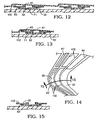
- Figure 12 illustrates an unloaded fluid foil member and spring foil member while a loaded fluid foil member and spring foil member are shown in Figure 13.
- the foil 62 is located nearer to the trailing edge of foil 71 than to the leading edge of foil 71.
- Foils 83 are located nearer the trailing edge of foils 92 than to the leading edge of foils 92. This ensures that the tilting pad spring support will deliver more force to the underside of the fluid foil 40 near its trailing edge 48 than its leading edge 50.
- the fluid foil blank, as well as the individual elements of the thrust bearing spring foil member 42, can be formed from flat metal sheets by optically masked chemical etch techniques.
- Nickel steels such as Inconel 750X for the fluid foil and Inconel 718 for the spring foil elements can be used.
- foil thicknesses are between 0.004 inches and 0.007 inches (approximately 0.102 mm and 0.179 mm).
- the nickel steel metal sheets from which the foil elements are formed normally are heat treated to full hardness in a vacuum oven (1300 degrees Fahrenheit (704 °C) for about twenty hours for Inconel 750X).
- the five individual elements of the thrust bearing spring foil member 42 can be assembled by stacking the spring foil elements without bonding. The relative micro movement of these foils in use provides coulomb damping.
- the shape of the fluid foils 41 induces regenerative vortex flow patterns in the process fluid across the fluid foil.
- the process fluid generally enters the leading surface of the foil 41 from the trailing edge 48 of the preceding foil.
- Any make-up process fluid is provided from the inner and outer diameter of the leading edge or from openings 51. There is some fluid leakage flow from the inner diameter and outer diameter, respectively, near the trailing edge 48.
- the compliant fluid foil members 40 are located adjacent to the two thrust faces of the thrust disk 24.
- the spring foil members 42 provide support for the fluid foil members 40 but allow them to follow the axial and overturning motion of the disk 24.
- the forces applied by the fluid foil members to the thrust disk through the process fluid vary inversely with foil to disk gap and vary proportionally with disk deflection.
- the thrust plate 28 is held away from the center bearing housing 22 by the total thickness of the outer self shimming rings of the fluid foil members 40 and spring foil members 42 and the thickness of the thrust bearing spacer 32.
- the thrust bearing spacer 32 is slightly thicker than the thrust disk 24 so that there is a small clearance between the fluid foil member 40 and the thrust disk 24 that is not affected by normal variations in foil or foil coating thickness.
- the bearing has no preload force and has zero starting torque when the disk's axis of rotation is oriented ninety degrees to the force of gravity. With the regenerative vortex flow pattern established by the contour of the fluid foil elements, the bearing running clearances are significantly improved (increased) and lift-off speeds are significantly less than previously possible.
- the converging wedge channel ramps formed in the surface of the fluid foil members have compound curve profiles with concave curvatures radially, flat slopes circumferentially at zero speed and convex curvatures at operating speed when fluid dynamic and spring forces are applied to the foil elements.
- the tilting pad support for the fluid foil elements assures a near optimum convex curvature circumferentially over a wide range of bearing thrust loads.
- the profiles will form and function as scoops with radially wide fluid flow inlets, a radially narrowing channel width along the circumferential fluid flow paths, and rounded circumferentially trailing edges. This multi-path regenerative vortex fluid flow pattern reduces fluid pressure losses when the process fluid travels "down the ramp" in a nominally circumferential direction that is opposite to the rotation of the thrust disk adjacent to the fluid foil member.
- the particular tilting pad bearing of the present invention has five spring foils and a fluid foil.
- the five spring foil elements have four support lines for each fluid foil ramp. The relative force exerted at each of these support lines is proportionally controlled by the circumferential spacing between several curved spring foil lines that generally match the curved shape of the formed fluid foil.
- the outer spring foil element 53 has twelve individual narrow width spring foils 62 adjacent to either the thrust disk on one side of the thrust bearing or to the thrust surface of the housing on the other side of the thrust disk. Each of these narrow spring foils 62 provides a curved, generally nose shaped support line.
- the wide intermediate outer spring foils 71 are supported by the individual narrow spring foils 62 and can articulate both by flexing and by tilting on the single support line of the narrow spring foils 62 to either a nose up or nose down position as required by the rest of the thrust bearing.
- narrow width spring foils 83 which provide two support lines per ramp and can give support at the nose and the leading edge of the wide spring foils 71.
- the two foil support lines of narrow spring foils 83 push underneath and near the peripheral center of each of the two pairs of intermediate width foils 92 so that these intermediate width foils 92 can tilt nose up or nose down as required.
- narrow width spring foils 102 have three support lines, one at the trailing edge of the leading spring foil 92, one at the leading edge of the trailing spring foil 92 and one at the trailing edge of the trailing spring foil 92.
- one of the pair intermediate width foils 92 provides a line of support pushing on the underside of the fluid foil 41 relatively close to the start of the converging ramp, and then the next three support lines moving up the ramp are provided to the fluid foil through spring foil 102.
- the circumferential spacing between these various support lines now referring to the support lines of spring foil elements 53, 55, 56, and 57, control the percentage of the total force coming through the spring foil elements which is delivered to each circumferential location on the fluid foil above the spring foil element 57.
- the highest spring force will be at the nose of the formed fluid foil where the fluid compressed pressure is highest.
- the support forces and the spring rates produced are lower when moving away from the spring foil nose. While these foil elements are primarily tilting members to allow compliance to the fluid foil, they also have spring properties in their own right.
- the concentric dam rings of spring foil elements 54, 55, and 56 effectively serve as dams to limit leakage out of the thrust bearing particularly when the bearing is operated hydrostatically.
- the thrust bearing of the present invention is particularly useful in a hydrostatically augmented thrust bearing such as described in United States Patent Application No. 08/662,250 filed June 14, 1996 by Robert W. Bosley and Ronald F. Miller entitled "Hydrostatic Augmentation of a Compliant Foil Hydrodynamic Fluid Film Thrust Bearing", which issued as US 5 827 040 after the priority date and filing date of the present application and which has a family member published as EP-A-812 996 forming a prior art under Article 54(3) EPC.
- the openings 51 at the leading edge of the fluid foil 41 are specifically provided for this hydrostatic augmentation.
- the thrust bearing will, however, function as a hydrodynamic thrust bearing with or without openings 51.
- the tilting pad thrust bearing operates with its fluid foil flexed circumferentially in a convex fluid dynamically optimized shape on the surface adjacent to the thrust disk without relying upon air pressure in the spring area. Air pressure will, however, provide additional convex shaping and load capacity and provide good adaptability.
- the shape of the spring foil nose can be varied to control the spring rate.
- the nose of the trailing edge of middle spring foil 83' can be sharper, that is have a smaller radius than the noses of the trailing edge of inner spring foil 102 and intermediate inner spring foil 92. This will stiffen up the spring rate at the end of the converging ramp so that there will be less fluid flow leakage and provide greater support for the fluid foil nose.
- the generally scoop-shaped converging wedge channels formed on the surface of the fluid foil members induce vortex fluid flow patterns and limit process fluid flow losses from the channels at the radial inner and outer edges of the foils.
- This together with the self shimming construction and other features of the present invention, provides a thrust bearing having a high load carrying capacity, good damping, small sway clearances, low running torque, high running foil to disk clearances, zero preload force, low starting torque, low lift-off/touch-down speeds, and low wear. In addition, all of this is achieved with a low parts count, low manufacturing cost, and ease of assembly.
- fluid foil members and spring foil elements can have a straight radial shape as shown in Figures 16-21. Except for having a straight radial shape rather than the nose shape previously described, the fluid foil member 40' having straight radial foils 141 and spring or support foil members 53', 54', 55', 56', and 57' would function generally the same and have the same relative spacing and relative positioning with respect to each other.
- the outer support foil element 53' of Figure 17 includes narrow width radial spring pads or foils 162
- intermediate outer support foil element 54' of Figure 18 includes wide radial pads or foils 171
- middle support foil element 55' of Figure 19 includes pairs of narrow width radial spring pads or foils 183
- intermediate inner support foil element 56' of Figure 20 includes pairs of wide radial spring pads or foils 192
- inner support foil element 57' of Figure 21 includes trios of narrow width radial spring pads or foils 202.
- the generally flat (radially) fluid foil surfaces, and underlying spring foils which maintain generally flat (radially) fluid foil surfaces of Figures 16-21, are not intended to establish a scoop shaped converging ramp and therefor do not generate vortex regenerative process fluid flows.
- the compliant foil fluid film thrust bearing generally comprises a single sided or two sided thrust disk rotor, fluid foils, spring foils, a thrust plate, a foil retaining housing and a spacer ring.
- the non-rotating but compliant fluid foils are located adjacent to the thrust face or faces of the rotatable disk
- the fluid foils have open faced channels that induce regenerative vortex flow patterns in the process fluid.
- the forces applied by the thrust disk to the fluid foils vary inversely with fluid foil to disk gap and vary proportionally with disk deflection.
- the spring foils provide a tilting pad support for the fluid foils but allow them to follow the axial and overturning motion of the disk.
- Each of the types of foils namely fluid foils and spring foils are attached to the foil retaining housing by a compliant web structure and pins.
- the foils are formed as thin, flat, annular sheets with integral shim rings at their periphery and contoured cutout patterns that are unique to each type of foil.
- the fluid foil blank is coated on one side with a compliant, wear resistant material, then stamped with a forming tool to form the fluid flow channels.
- the thrust plate is preloaded towards the thrust surface of the foil retaining housing by a preload spring and is held away from the housing by the total thickness of the foil shim rings and the thickness of the spacer ring. This allows the bearing to essentially self shim itself to establish a small clearance between the fluid foils and the disk that is not affected by normal variations in foil or foil coating thicknesses.
- the bearing has no preload force and has zero starting torque when the rotor's axis of rotation is oriented ninety degrees to the force of gravity. Owing to the vortex flow pattern of the process fluid, the bearing running clearances and load capacities are improved while lift-off speeds are reduced. In addition, good damping, low running torque and small sway space are achieved. This is all accomplished at a low manufacturing cost with a low parts count.
- the embodiments provide such a bearing with converging wedge channel features (formed on the surface of the fluid foil element) that limit fluid flow losses from the channel at the radial outer and radial inner edges of those channels.
- the embodiments provide such a bearing with converging wedge channel ramps formed on the surface of the fluid foil elements that have compound curve profiles with concave curvatures radially, flat slopes circumferentially at zero speed and convex curvatures at operating speed when fluid dynamic and spring forces are applied to the fluid foil elements.
- the profiles will form and function as scoops with radially wide fluid flow inlets, radially narrowing channel widths along the circumferential fluid flow paths, and rounded circumferentially trailing edges.
- the embodiments provide such a bearing with a fluid flow pattern that reduces fluid pressure losses when the process fluid travels "down the ramp” (in a nominally circumferential direction that is opposite to the rotation of the thrust disk) adjacent to the fluid foil element.
- the embodiments provide such a bearing with a fluid flow pattern that is regenerative with a different flow path for each regenerative flow loop.
- the embodiments provide such a bearing with foil elements that are extremely flat owing to the processes used to roll and heat treat the foil metal and the processes used to form (e.g. etch) the foil blanks and elements.
- the embodiments provide such a bearing with fluid foil elements that are formed from blanks by pressing steeply sloped joggles to function as diverging wedge channels while allowing the gradually converging wedge channel ramps to result without plastic deformation as the straight line connection between the joggles.
- the embodiments provide such a bearing with fluid foil elements that are formed from annealed blanks of nickel steel, such as Inconel 750X, by pressing at room temperature.
- the embodiments provide such a bearing with a spring foil member that has local spring rates that vary with radial and circumferential location so as to accommodate variations in fluid pressure within the converging wedge channel adjacent to the local areas of the spring foil member.
- the embodiments provide such a bearing with a tilting pad spring support system that controls the relative support forces applied to the underside of the fluid foil at a multiplicity of locations circumferentially along the converging wedge channel.
- the embodiments provide such a bearing with a tilting pad spring support system having circumferentially closer spacing between support/pivot lines moving up the converging ramp from the leading edge of the fluid foil to the trailing edge of the fluid foil.
- the embodiments provide such a bearing with a tilting pad spring support system providing increasing support forces and support spring rates moving up the converging ramp from the leading edge of the fluid foil to the trailing edge of the fluid foil.
- the embodiments provide such a bearing with a tilting pad spring support system that assures retention of a reasonably hydrodynamically optimized scoop shape for the fluid foil converging ramps over a wide range of bearing operating speeds and bearing thrust loads.
- the embodiments provide such a bearing with self shimming capability utilizing the resilient mounting and preload characteristics of the thrust disk, the spacer ring and the foil's self shimming rings to prevent variations in bearing axial play and sway space due to variations in foil thickness and foil coating thickness.
Landscapes
- Engineering & Computer Science (AREA)
- General Engineering & Computer Science (AREA)
- Mechanical Engineering (AREA)
- Physics & Mathematics (AREA)
- Fluid Mechanics (AREA)
- Support Of The Bearing (AREA)
- Sliding-Contact Bearings (AREA)
Description
- This invention relates to the general field of compliant foil fluid film bearings.
- Compliant foil fluid film thrust bearings are currently being utilized in a variety of high speed rotor applications. These bearings are generally comprised of a two sided thrust disk rotating element, non-rotating compliant fluid foil members that axially enclose the rotating element, non-rotating compliant spring foil members that axially enclose the fluid foil members and a non-rotating thrust plate element and a non-rotating housing element that axially enclose and provide attachments for the foil members. The space between the rotating element and the thrust plate element on one side of the bearing and the space between the rotating element and the thrust surface of the housing element on the other side of the bearing are filled with fluid (usually air) which envelops the foils.
- The rotary motion of the rotating element applies viscous drag forces to the fluid and induces circumferential flow of the fluid between the smooth surface of the rotating element and the fluid foil. The space between the rotating element and the fluid foil is subdivided into a plurality of fluid-dynamic wedge channels. These wedge channels have typically been formed by resistance welding compliant, convex curved foil pads to an underlying support foil. The leading ramps of the foil pads relative to the fluid's circumferential flow and the smooth surface of the rotating element form the two primary surfaces of the converging wedge channels. The trailing ramps and the smooth surface of the rotating element form the primary surfaces of the diverging wedge channels. The fluid flowing circumferentially along a converging wedge channel experiences steadily decreasing flow area, increasing circumferential flow velocity and increasing static fluid pressure. If the rotating element moves toward the non-rotating element, the convergence angle of the wedge channel increases causing the fluid pressure rise along the channel to increase. If the rotating element moves away, the pressure rise along the wedge channel decreases. Thus, the fluid in the wedge channels exerts restoring forces on the rotating element that vary with and stabilize running clearances and prevent contact between the rotating and non-rotating elements of the bearing. Flexing and sliding of the foils causes coulomb damping of any axial or overturning motion of the rotating element of the bearing.
- Owing to preload spring forces or gravity forces, the rotating element of the bearing is typically in physical contact with the fluid foil members of the bearing at low rotational speeds. This physical contact results in bearing wear. It is only when the rotor speed is above what is termed the lift-off/touch-down speed that the fluid dynamic forces generated in the wedge channels assure a running gap between the rotating and non-rotating elements.
- Conventional, compliant foil fluid film thrust bearings have fluid dynamic wedge channel ramps that converge or diverge circumferentially with no radial component to the ramp slopes. The converging wedge channel ramps have no side wall or other constraints to prevent fluid flow out of the channels at their inner and outer edges. At the trailing edge of the converging wedge channel, the high fluid pressure and lack of radial flow constraints induces radial flow leakage out of the channel, which in turn, results in a reduction in fluid pressure, a loss in bearing load capacity, and an increase in bearing drag. The radial flow leakage requires make-up flow at the beginning of the converging wedge channel.
- Conventional, compliant foil fluid film thrust bearings have primary fluid flow patterns in the converging wedge channels that are single path recirculating loops. The fluid in the converging wedge channels adjacent to the rotating disk travels circumferentially in the same direction as the disk's motion (up the ramp) owing to viscous drag. The fluid in the converging wedge channels adjacent to the non-rotating fluid foil travels circumferentially in the direction opposite to the disk's motion (down the ramp) owing to the circumferential pressure gradient along the channel. Much of the fluid that travels up the ramp near the disk while gaining static pressure turns back before reaching the end of the wedge channel and travels down the ramp near the fluid foil while losing pressure. Almost all of this fluid turns again before reaching the beginning of the wedge channels and travels up the ramp while again gaining pressure. The fluid traveling the single path recirculating loop flow patterns travels essentially the same path each loop and experiences the same pressure increases and pressure decreases each loop with no net pressure gain from one loop to the next. These bearings generate less fluid dynamic pressure and have less load capacity than bearings that utilize multi-path vortex flow patterns where the flow traveling each regenerative loop travels a different path and where there is a net increase in fluid pressure each loop
- Conventional, compliant foil fluid film thrust bearings operate with extremely small running clearances and moderate as opposed to low drag and power consumption. The clearances between the non-rotating fluid foil's converging channel ramp trailing ends and the rotating thrust disk are typically less than 100 micro-inches when the bearing is heavily loaded at operating conditions. The bearing's drag coefficient is typically more than 0.005 at operating speed as defined by the ratio of the fluid dynamic drag induced shear forces applied to the disk by the bearing divided by the thrust load carried by the bearing.
- Compliant foil fluid film thrust bearings tend to rely on backing springs to preload the fluid foils against the relatively moveable rotating element (thrust disk) so as to control foil position/nesting and to establish foil dynamic stability. The bearing starting torque (which should ideally be zero) is directly proportional to these preload forces. These preload forces also significantly increase the disk speed at which the hydrodynamic effects in the wedge channels are strong enough to lift the rotating element of the bearing out of physical contact with the non-rotating members of the bearing. These preload forces and the high lift-off/touch-down speeds result in significant bearing wear each time the disk is started or stopped.
- Many conventional, compliant foil fluid film thrust bearings have large sway spaces and loose compliance, i.e. they do not tightly restrict the axial or overturning motion of the bearing thrust disk, owing to poor control of spring deflection tolerances inherent in the spring designs.
- It has been common for compliant foil fluid film thrust bearings to utilize a plurality of coated, convex curved, compliant fluid foil pads that are welded to a support foil to form the fluid foil member of the bearing. These two piece fluid foil members are typically thicker and have poorer thickness control than can single piece fluid foil members. Two piece fluid foil members also experience process fluid flow turbulence, increased drag at operating speeds and reduced load capacity owing to the flow discontinuities between the trailing edges of each foil pad and the weld attachment edge of the next circumferentially located pad.
- Some conventional, compliant foil fluid film thrust bearings utilize spring foil elements that are formed by milling (chemically or otherwise) circumferentially offset recesses in opposing sides of flat foil stock so as to leave circumferentially offset unmilled ridges on opposing sides of the foil elements. Pressure applied to the offset ridges induces the spring foil element to deflect in a spring-like manner. Spring foil elements formed in this manner are prone to large variations in their spring rates due to small variations in milling depth. This milling process non-symetrically relieves any residual surface compressive stresses induced by previous foil rolling operations and thus induces foil warpage.
- Other bearings utilize convolute shaped spring foil elements that are formed by pressing annealed Inconel 750X foil blanks between two contoured plates having matching wavy contours with constant plate to plate spacing and then heat treating the foil blanks at approximately 1300 degrees Fahrenheit (704 °C) for approximately 20 hours while they are still pressed between the contoured plates. Spring foils formed in this manner are prone to have large variations in undeflected thickness.
- In some cases, the fluid foils may be attached to the spring foils by welding or brazing or various spring foil elements may be welded or brazed together to form a spring foil member. Those thrust bearings that utilize welding or brazing to attach one foil element to another are subject to foil distortions and foil fatigue failures, particularly at the bond sites.
- The sides of the fluid foils that face the rotating element of the bearing can utilize low rubbing friction coatings to minimize bearing wear when disk speed is below the lift-off/touch-down speed. These coatings, however, may have large thickness tolerances that can adversely affect the foil pack thickness tolerance.
- The latest development in compliant foil fluid film thrust bearings, described in US-A-5 529 398 issued June 25, 1996 to Robert W. Bosley entitled "Compliant Foil Hydrodynamic Fluid Film Thrust Bearing" includes a self shimming capability to compensate for variations in foil pack thickness and three (3) spring or support foils beneath the fluid foil.
- US-A-5 529 398 discloses a compliant foil fluid film thrust bearing comprising:
- a thrust disk rotatably supported by a thrust bearing surface; and
- a compliant foil bearing operably disposed between said rotatable thrust disk and said thrust bearing surface and mounted on said thrust bearing surface, said compliant foil bearing including a compliant fluid foil member having a plurality of converging ramps and diverging joggles to form alternating converging and diverging wedge channels on the surface of said fluid foil member facing said rotatable thrust disk, and a spring foil member mounted on said thrust bearing surface and disposed between said thrust bearing surface and said fluid foil member.
-
- The spring foil member comprises three spring foil elements disposed one on top of the other. The central spring foil element defines a flat annular member that is perforated. The annular member is sandwiched between radially extending ribs defined by the other two spring foil elements. The ribs function as offset fulcrums and support the annular member against applied loads in the manner of a simply supported beam. The otherwise flat annular member is able to flex between the fulcrum supports and function as a spring when a load is applied to it through the other two spring foil elements. There is thus provided a backing spring arrangement for the compliant fluid foil member.
- The invention provides a method of rotatably supporting a thrust disk on a thrust plate comprising the steps of:
- providing a compliant foil bearing between said thrust disk and said thrust plate, said compliant foil bearing including an annular compliant fluid foil member having a plurality of converging ramps and diverging joggles to form alternating converging and diverging wedge channels on the surface of said annular compliant fluid foil member facing said thrust disk;
- mounting a spring foil member between said compliant fluid foil bearing member and said thrust plate; and
- providing said spring foil member with a plurality of spring foil elements having a number of relatively narrow width spring pads; characterised by providing at least one spring foil element having a number of relatively wide spring pads and
- creating a tilting pad support for said compliant fluid foil bearing member by alternating individual ones of said plurality of said relatively narrow width spring foil elements with the or each relatively wide spring pad spring foil element.
-
- The invention also includes a compliant foil fluid film thrust bearing comprising:
- a thrust disk rotatably supported by a thrust bearing surface; and
- a compliant foil bearing operably disposed between said rotatable
thrust disk and said thrust bearing surface and mounted on said thrust bearing
surface, said compliant foil bearing including a compliant fluid foil member
having a plurality of converging ramps and diverging joggles to form
alternating converging and diverging wedge channels on the surface of said
fluid foil member facing said rotatable thrust disk, and a spring foil member
mounted on said thrust bearing surface and disposed between said thrust
bearing surface and said fluid foil member, said spring foil member
comprising a plurality of spring foil elements having a number of relatively
narrow width spring pads; characterised in that
- said spring foil member further comprises at least one spring foil element having a number of relatively wide spring pads and in that individual ones of said plurality of relatively narrow width spring pad spring foil elements alternate with the or each relatively wide spring pad spring foil element to create a tilting pad support for said compliant fluid foil member.
-
- Having thus described the present invention in general terms, reference will now be made to the accompanying drawings in which:
- Figure 1 is a sectional view of a turbomachine having a compliant foil fluid film thrust bearing according to an embodiment of the present invention;
- Figure 2 is an enlarged partial view of
oval 2 of Figure 1 illustrating the thrust plate and spacer area of the compliant foil fluid film thrust bearing; - Figure 3 is a plan view of the fluid foil member of the compliant foil fluid film thrust bearing of the embodiment;
- Figure 4 is an enlarged sectional view of the fluid foil member of Figure 4 taken along lines 4-4;
- Figure 5 is another enlarged sectional view of the fluid foil member of Figure 4 taken along lines 5-5;
- Figure 6 is a plan view of the outer spring foil element of the spring foil member of the compliant foil fluid film thrust bearing of the embodiment;
- Figure 7 is a plan view of the intermediate outer spring foil element of the spring foil member of the compliant foil fluid film thrust bearing of the embodiment;
- Figure 8 is a plan view of the middle spring foil element of the spring foil member of the compliant foil fluid film thrust bearing of the embodiment;
- Figure 9 is a plan view of the intermediate inner spring foil element of the spring foil member of the compliant foil fluid film thrust bearing of the embodiment;
- Figure 10 is a plan view of the inner spring foil element of the spring foil member of the compliant foil fluid film thrust bearing of the embodiment;
- Figure 11 is a plan view, partially cut away foil-by-foil, of the compliant foil fluid film thrust bearing of the embodiment;
- Figure 12 is a sectional view of the unloaded fluid foil member and spring foil member of Figure 11 taken along line 12-12;
- Figure 13 is a sectional view of the loaded fluid foil member and spring foil member of Figure 11 taken along line 12-12;
- Figure 14 is a plan view of an alternative embodiment of a compliant foil fluid film thrust bearing of the present invention;
- Figure 15 is a sectional view of the compliant foil fluid film thrust bearing of Figure 14 taken along line 15-15; and
- Figure 16 is a partial plan view of the fluid foil member of yet another alternative embodiment compliant foil fluid film thrust bearing of the present invention;
- Figure 17 is a partial plan view of the outer spring foil element of the spring foil member used with the fluid foil member of the compliant foil fluid film thrust bearing of Figure 16;
- Figure 18 is a partial plan view of the intermediate outer spring foil element of the spring foil member used with the fluid foil member of the compliant foil fluid film thrust bearing of Figure 16;
- Figure 19 is a partial plan view of the middle spring foil element of the spring foil member used with the fluid foil member of the compliant foil fluid film thrust bearing of Figure 16;
- Figure 20 is a partial plan view of the intermediate inner spring foil element of the spring foil member used with the fluid foil member of the compliant foil fluid film thrust bearing of Figure 16; and
- Figure 21 is a partial plan view of the inner spring foil element of the spring foil member used with the fluid foil member of the compliant foil fluid film thrust bearing of Figure 16.
-
- A turbomachine utilizing an embodiment of the compliant foil fluid film thrust bearing of the present invention is illustrated in Figure 1. The
turbomachine 10 generally includesturbine wheel 12 andcompressor wheel 14 at opposite ends of a common shaft ortie bar 16. The thrust andradial bearing rotor 18 is disposed around thetie bar 16 between theturbine wheel 12 and thecompressor wheel 14. Ajournal bearing cartridge 20 incenter bearing housing 22 rotatably supports the bearingrotor 18. - The compressor end of the bearing
rotor 18 includes a radially extendingthrust disk 24 which extends into arecess 26 in the compressor end of thecenter bearing housing 22. A bearingthrust plate 28 is disposed on the opposite side of the bearingrotor thrust disk 24. The outer periphery of the compressor end of thecenter bearing housing 22 engages thecompressor housing 30. - As best illustrated in Figure 2, a
thrust bearing spacer 32 is positioned radially outward from thethrust disk 24 of the bearingrotor 18 and is positioned radially by a plurality of circumferentially spacedpins 34 which are fixed inholes 38 in therecess 26 of thecenter bearing housing 22 and extend intoholes 38 in thethrust bearing plate 28. A thrust bearingfluid foil member 40 and thrust bearingspring foil member 42 are disposed on either side of the bearingrotor thrust disk 24 andthrust bearing spacer 32. On one side, thefluid foil member 40 andspring foil member 42 are positioned in therecess 26 of thecenter bearing housing 22 and on the other side they are adjacent to the bearing thrustplate 28. Thefluid foil member 40 andspring foil member 42 are held in position radially and circumferentially by thepins 34 which extend from thecenter bearing housing 22, through holes in onespring foil element 42, through holes in onefluid foil element 40, traverse the bore of thethrust bearing spacer 32, through holes in the opposite sidefluid foil element 40, the holes in the opposite sidespring foil member 42 and intoholes 38 in the bearing thrustplate 28. The bearing thrustplate 28 is biased towards thecenter bearing housing 22 by aBelleville washer 23 disposed between thelip 25 on the bearing thrustplate 28 and thecompressor housing 30. - The thickness of the
thrust bearing spacer 32 is several thousandths of an inch greater than the thickness of the bearingrotor thrust disk 24. Variations in the foil or foil coating thicknesses inherently cause compensating variations in the spacing between thethrust plate 28 and thehousing 22. Thus, variations in bearing sway space and bearing compliance due to foil thickness tolerances are prevented. - Figures 3-5 illustrate a
fluid foil member 40 integrally formed from a single flat disk termed a foil blank. A plurality of individual fluid foils 41 are formed from a flat sheet of a nickel steel such as Inconel 750X by room temperature pressing steeply sloped joggles to function as diverging wedge channels while allowing the gradually converging wedge channel ramps to result without plastic deformation as the straight line connection between the joggles. The fluid foil members would normally be annealed both during forming and use and may be coated prior to forming the joggles with any number of a myriad of low friction or friction reducing coating materials which can protect the metal from abrasion during starting and stopping, and inadvertent and occasional high speed touch-downs. The coating would also provide for some embedment of contamination particles. - The individual fluid foils 41 (shown as twelve) are generally chevron shaped and connected to an outer
self shimming ring 44 bysupport webs 45. Fluid passages oropenings 46 are formed betweenadjacent support webs 45. Everyfourth fluid passage 46 includes anindexing tab 47. Eachaerodynamic foil 41 has a trailingedge 48 with a rounded trailing point ornose 49 and a leading edge 50 a generally straight ramped contour from the leadingedge 50 to the trailingedge 48. The individual fluid foils 41 have a generally scoop shape as best illustrated in the two sectional views of Figures 4 and 5. One or two rows ofopenings 51 are provided at theleading edge 50 of eachindividual fluid foil 41 to allow fluid to enter the leading edge of the converging ramp adjacent to the thrust disk from under the fluid foil in the area of thespring foil members 42. - As illustrated in Figures 6-10, the thrust bearing
spring foil member 42 generally comprises an outer spring foil element 53 (Figure 6), an intermediate outer spring foil element 54 (Figure 7), a middle spring foil element 55 (Figure 8), an intermediate inner spring foil element 56 (Figure 9), and an inner spring foil element 57 (Figure 10). - The outer
support foil element 53, shown in Figure 6, generally includes aninner connector ring 60 and an outerself shimming ring 61 with a plurality (shown as twelve) of narrow width spring pads or foils 62 extending therebetween. The narrow spring foils 62 consist of an innercurved foil section 63 extending outward from theinner connector ring 60 at a forward angle (in the direction of the thrust disk's rotary motion) and an outercurved foil section 64 extending inward from theself shimming ring 61 at a forward angle. The inner andouter foil sections foil section 65. Theouter foil sections 64 are individually connected to the outerself shimming ring 61 by a radially extending connector or supportingweb 66. - The
narrow spring foil 62 is narrowest at the connection to theinner connector ring 60 and gradually increases in width to the point or tip of thenose 65 and continues to gradually increase in width in theouter foil section 64 to theconnector web 66. Theconnector web 66 is of an even greater, generally radially increasing, width. A plurality of indexing tabs 67 (shown as four) extend inward from the outerself shimming ring 61 in order to enable precise alignment of the outersupport foil element 53 with the other elements of the thrust bearingspring foil member 42 and with thefluid foil member 40. - The intermediate outer
support foil element 54, shown in Figure 7, generally includes aninner connector ring 73 and an outerself shimming ring 72 with a plurality (shown as twelve) of wide spring pads or foils 71 extending therebetween. The wide spring foils 71 consist of an innercurved foil section 75 extending outward from theinner connector ring 73 at a forward angle and an outercurved foil section 76 extending inward from theself shimming ring 72 at a forward angle. The inner andouter foil sections foil section 77. Each of theouter foil sections 76 are individually connected to the outerself shimming ring 72 by a pair of radially extending connector or supportingwebs 74. A plurality of concentric outer dam rings 78 (shown as three) extend between adjacent wide spring foils 71 generally where the wide spring foils 71 and the pair ofwebs 74 connect. - The
wide spring foil 71 is narrowest at the connection to theinner connector ring 73 and gradually increases in width to the point or tip of thenose 77 and continues to gradually increase in width in theouter foil section 76 to theconnector webs 74. A plurality of indexing tabs 79 (shown as four) extend inward from the outerself shimming ring 72 in order to enable precise alignment of the outersupport foil element 54 with the other elements of the thrust bearingspring foil member 42 and with thefluid foil member 40. - The middle
spring foil element 55 is illustrated in Figure 8 and includes an outerself shimming ring 81 andindexing tabs 82 identical to and aligned with the corresponding elements in the outerspring foil element 53, intermediate outerspring foil element 54 andfluid foil member 40. A plurality of pairs (shown as twelve) of generally nose-shaped narrow spring pads or foils 83 extend between theinner connector ring 84 and the outerself shimming ring 81. Each of the pair of narrow spring foils 83 generally straddle the narrow spring foils 62 of the outerspring foil element 53 and are aligned at the leading and trailing edges of thewide spring foil 71. - A
connector web 87 joins each of the narrow spring foils 83 to the outerself shimming ring 81. A plurality of concentric outer dam rings 85 (shown as two) extend between adjacent pairs of narrow spring foils 83 where they connect towebs 87. A plurality of concentric inner dam rings 86 (shown as three) extend between adjacent pairs of narrow spring foils 83 near theinner connector ring 84. - Figure 9 illustrates the intermediate inner
spring foil element 56 which has an outerself shimming ring 89 andindexing tabs 91 which are common to thespring foil member 42. The plurality of pairs of intermediate width spring foil elements 92 (shown as twelve) are disposed between the outerself shimming ring 89 and aninner connector ring 90. Each of said pair of intermediate width spring foil elements are connected to the outer self shimming ring by a pair ofwebs 94. By intermediate width is meant a width between the width of the narrow width outer andinner foils outer foil 71. - Each of the pairs of
webs 94 for the intermediate width foils are joined by acircumferential stiffening ring 93. In addition, a single outer dam ring 96 (which could alternately be a plurality of dam rings) and a plurality (shown as two) of concentric inner dam rings 95 extend between adjacent pairs of intermediate width foils 92, at the connection to thewebs 94 and adjacent to theinner connector ring 90, respectively. Each of the pair of intermediate width foils 92 generally are positioned over one of said pair of narrow width spring foils 83 of the middlespring foil member 55. - The inner
spring foil element 57 is illustrated in Figure 10 and includes an outerself shimming ring 100 andindexing tabs 101 identical to and aligned with the corresponding elements in the otherspring foil elements fluid foil member 40.. A plurality of trios (shown as twelve) of generally nose-shaped narrow spring pads or foils 102 extend between theinner connector ring 103 and the outerself shimming ring 100. Each of the trio of narrow spring foils 102 have widths that are generally the same as the narrow spring foils 62 of the outerspring foil element 53 and the pairs of narrow spring foils 83 of the middlespring foil element 55. Of the trio of narrow spring foils 102, two are aligned at the leading and trailing edges of one of the pair of intermediate width spring foils 92 and the third of the trio of narrow spring foils are aligned with the trailing edge of the other of the pair of intermediate width spring foils 92. - A
connector web 105 joins each of the trio of narrow spring foils 102 to the outerself shimming ring 100. Thesewebs 105 of each trio of narrow spring foils 102 are joined together by acircumferential stiffening ring 106. - The precise relationship of the
fluid foil member 40 andspring foil member 42, including the fivespring foil elements fluid foil member 40 andspring foil member 42 with the individual spring foil elements overlain and positioned by their respective indexing tabs. Proceeding in a counterclockwise rotation, the individual spring foil elements are individually cut away in a foil-by-foil manner to show their relationship with each other. - The
outer spring foil 62 is shown in the arc identified as "A". Arc "B" illustrates the outerintermediate foil 71 aligned over theouter spring foil 62. A pair of middle spring foils 83 are laid over theouter spring foil 62 andintermendiate spring foil 71 in arc "C". Arc "D" then includes the pair of intermediate inner foils 92 and finally the trio ofinner foils 102 are shown over the pair of intermediate inner foils 92 in arc "E". The fluid foils 41 are then laid over the assembled spring foils in arc "F". - An even more precise relationsip of the various foils is illiustrated in Figures 12 and 13. Figure 12 illustrates an unloaded fluid foil member and spring foil member while a loaded fluid foil member and spring foil member are shown in Figure 13. It should be noted that the
foil 62 is located nearer to the trailing edge offoil 71 than to the leading edge offoil 71.Foils 83 are located nearer the trailing edge offoils 92 than to the leading edge offoils 92. This ensures that the tilting pad spring support will deliver more force to the underside of thefluid foil 40 near its trailingedge 48 than its leadingedge 50. - The fluid foil blank, as well as the individual elements of the thrust bearing
spring foil member 42, can be formed from flat metal sheets by optically masked chemical etch techniques. Nickel steels, such as Inconel 750X for the fluid foil and Inconel 718 for the spring foil elements can be used. Typically, foil thicknesses are between 0.004 inches and 0.007 inches (approximately 0.102 mm and 0.179 mm). The nickel steel metal sheets from which the foil elements are formed normally are heat treated to full hardness in a vacuum oven (1300 degrees Fahrenheit (704 °C) for about twenty hours for Inconel 750X). The five individual elements of the thrust bearingspring foil member 42 can be assembled by stacking the spring foil elements without bonding. The relative micro movement of these foils in use provides coulomb damping. - The shape of the fluid foils 41, namely an open-faced channel having a converging width and sloping "walls", induces regenerative vortex flow patterns in the process fluid across the fluid foil. The process fluid generally enters the leading surface of the
foil 41 from the trailingedge 48 of the preceding foil. Any make-up process fluid is provided from the inner and outer diameter of the leading edge or fromopenings 51. There is some fluid leakage flow from the inner diameter and outer diameter, respectively, near the trailingedge 48. - The compliant
fluid foil members 40 are located adjacent to the two thrust faces of thethrust disk 24. Thespring foil members 42 provide support for thefluid foil members 40 but allow them to follow the axial and overturning motion of thedisk 24. The forces applied by the fluid foil members to the thrust disk through the process fluid vary inversely with foil to disk gap and vary proportionally with disk deflection. - The
thrust plate 28 is held away from thecenter bearing housing 22 by the total thickness of the outer self shimming rings of thefluid foil members 40 andspring foil members 42 and the thickness of thethrust bearing spacer 32. Thethrust bearing spacer 32 is slightly thicker than thethrust disk 24 so that there is a small clearance between thefluid foil member 40 and thethrust disk 24 that is not affected by normal variations in foil or foil coating thickness. The bearing has no preload force and has zero starting torque when the disk's axis of rotation is oriented ninety degrees to the force of gravity. With the regenerative vortex flow pattern established by the contour of the fluid foil elements, the bearing running clearances are significantly improved (increased) and lift-off speeds are significantly less than previously possible. - The converging wedge channel ramps formed in the surface of the fluid foil members have compound curve profiles with concave curvatures radially, flat slopes circumferentially at zero speed and convex curvatures at operating speed when fluid dynamic and spring forces are applied to the foil elements. The tilting pad support for the fluid foil elements assures a near optimum convex curvature circumferentially over a wide range of bearing thrust loads. The profiles will form and function as scoops with radially wide fluid flow inlets, a radially narrowing channel width along the circumferential fluid flow paths, and rounded circumferentially trailing edges. This multi-path regenerative vortex fluid flow pattern reduces fluid pressure losses when the process fluid travels "down the ramp" in a nominally circumferential direction that is opposite to the rotation of the thrust disk adjacent to the fluid foil member.
- The particular tilting pad bearing of the present invention has five spring foils and a fluid foil. The five spring foil elements have four support lines for each fluid foil ramp. The relative force exerted at each of these support lines is proportionally controlled by the circumferential spacing between several curved spring foil lines that generally match the curved shape of the formed fluid foil.
- The outer
spring foil element 53 has twelve individual narrow width spring foils 62 adjacent to either the thrust disk on one side of the thrust bearing or to the thrust surface of the housing on the other side of the thrust disk. Each of these narrow spring foils 62 provides a curved, generally nose shaped support line. - The wide intermediate outer spring foils 71 are supported by the individual narrow spring foils 62 and can articulate both by flexing and by tilting on the single support line of the narrow spring foils 62 to either a nose up or nose down position as required by the rest of the thrust bearing.
- Above the wide spring foils 71 are the pair of narrow width spring foils 83 which provide two support lines per ramp and can give support at the nose and the leading edge of the wide spring foils 71. The two foil support lines of narrow spring foils 83 push underneath and near the peripheral center of each of the two pairs of intermediate width foils 92 so that these intermediate width foils 92 can tilt nose up or nose down as required. Lastly, narrow width spring foils 102 have three support lines, one at the trailing edge of the leading
spring foil 92, one at the leading edge of the trailingspring foil 92 and one at the trailing edge of the trailingspring foil 92. - Effectively, one of the pair intermediate width foils 92 provides a line of support pushing on the underside of the
fluid foil 41 relatively close to the start of the converging ramp, and then the next three support lines moving up the ramp are provided to the fluid foil throughspring foil 102. This makes the entire spring structure behave like the articulated supports of tank treads, where as you go over uneven ground the tank treads themselves can articulate because you have a support structure that articulates. The circumferential spacing between these various support lines, now referring to the support lines ofspring foil elements spring foil element 57. - The highest spring force will be at the nose of the formed fluid foil where the fluid compressed pressure is highest. The support forces and the spring rates produced are lower when moving away from the spring foil nose. While these foil elements are primarily tilting members to allow compliance to the fluid foil, they also have spring properties in their own right.
- The concentric dam rings of
spring foil elements US 5 827 040 after the priority date and filing date of the present application and which has a family member published as EP-A-812 996 forming a prior art under Article 54(3) EPC. Theopenings 51 at the leading edge of thefluid foil 41 are specifically provided for this hydrostatic augmentation. The thrust bearing will, however, function as a hydrodynamic thrust bearing with or withoutopenings 51. - The tilting pad thrust bearing operates with its fluid foil flexed circumferentially in a convex fluid dynamically optimized shape on the surface adjacent to the thrust disk without relying upon air pressure in the spring area. Air pressure will, however, provide additional convex shaping and load capacity and provide good adaptability.
- While the nose shape of the individual spring foils has been shown to be relatively identical for the five spring foils and the fluid foil, the shape of the spring foil nose can be varied to control the spring rate. As illustrated in Figures 14 and 15, the nose of the trailing edge of middle spring foil 83' can be sharper, that is have a smaller radius than the noses of the trailing edge of
inner spring foil 102 and intermediateinner spring foil 92. This will stiffen up the spring rate at the end of the converging ramp so that there will be less fluid flow leakage and provide greater support for the fluid foil nose. - The generally scoop-shaped converging wedge channels formed on the surface of the fluid foil members induce vortex fluid flow patterns and limit process fluid flow losses from the channels at the radial inner and outer edges of the foils. This, together with the self shimming construction and other features of the present invention, provides a thrust bearing having a high load carrying capacity, good damping, small sway clearances, low running torque, high running foil to disk clearances, zero preload force, low starting torque, low lift-off/touch-down speeds, and low wear. In addition, all of this is achieved with a low parts count, low manufacturing cost, and ease of assembly.
- Further, the fluid foil members and spring foil elements can have a straight radial shape as shown in Figures 16-21. Except for having a straight radial shape rather than the nose shape previously described, the fluid foil member 40' having straight radial foils 141 and spring or support foil members 53', 54', 55', 56', and 57' would function generally the same and have the same relative spacing and relative positioning with respect to each other. The outer support foil element 53' of Figure 17 includes narrow width radial spring pads or foils 162, intermediate outer support foil element 54' of Figure 18 includes wide radial pads or foils 171, middle support foil element 55' of Figure 19 includes pairs of narrow width radial spring pads or foils 183, intermediate inner support foil element 56' of Figure 20 includes pairs of wide radial spring pads or foils 192, while inner support foil element 57' of Figure 21 includes trios of narrow width radial spring pads or foils 202. The generally flat (radially) fluid foil surfaces, and underlying spring foils which maintain generally flat (radially) fluid foil surfaces of Figures 16-21, are not intended to establish a scoop shaped converging ramp and therefor do not generate vortex regenerative process fluid flows.
- In the embodiments, the compliant foil fluid film thrust bearing generally comprises a single sided or two sided thrust disk rotor, fluid foils, spring foils, a thrust plate, a foil retaining housing and a spacer ring. The non-rotating but compliant fluid foils are located adjacent to the thrust face or faces of the rotatable disk The fluid foils have open faced channels that induce regenerative vortex flow patterns in the process fluid. The forces applied by the thrust disk to the fluid foils vary inversely with fluid foil to disk gap and vary proportionally with disk deflection.
- The spring foils provide a tilting pad support for the fluid foils but allow them to follow the axial and overturning motion of the disk. Each of the types of foils, namely fluid foils and spring foils are attached to the foil retaining housing by a compliant web structure and pins. The foils are formed as thin, flat, annular sheets with integral shim rings at their periphery and contoured cutout patterns that are unique to each type of foil.
- As part of the forming process, the fluid foil blank is coated on one side with a compliant, wear resistant material, then stamped with a forming tool to form the fluid flow channels. The thrust plate is preloaded towards the thrust surface of the foil retaining housing by a preload spring and is held away from the housing by the total thickness of the foil shim rings and the thickness of the spacer ring. This allows the bearing to essentially self shim itself to establish a small clearance between the fluid foils and the disk that is not affected by normal variations in foil or foil coating thicknesses.
- The bearing has no preload force and has zero starting torque when the rotor's axis of rotation is oriented ninety degrees to the force of gravity. Owing to the vortex flow pattern of the process fluid, the bearing running clearances and load capacities are improved while lift-off speeds are reduced. In addition, good damping, low running torque and small sway space are achieved. This is all accomplished at a low manufacturing cost with a low parts count.
- It will be appreciated that the embodiments provide an improved compliant foil fluid film thrust bearing.
- It will be appreciated that the embodiments provide such a bearing with enhanced axial and overturning load carrying capacity.
- It will be appreciated that the embodiments provide such a bearing with both squeeze film and coulomb damping.
- It will be appreciated that the embodiments provide such a bearing with small sway space clearances to tightly restrict bearing and thrust disk rotor deflections.
- It will be appreciated that the embodiments provide such a bearing with very low operating torque.
- It will be appreciated that the embodiments provide such a bearing with large running clearances between the fluid foil elements and the thrust disk.
- It will be appreciated that the embodiments provide such a bearing with fluid foil members that are not preloaded by spring forces against the thrust disk at zero speed.
- It will be appreciated that the embodiments provide such a bearing with zero starting torque when there is no gravity induced preload forces.
- It will be appreciated that the embodiments provide such a bearing with an extremely low lift-off/touch-down speed which is consistent with zero preload forces.
- It will be appreciated that the embodiments provide such a bearing with very low starting and stopping wear which is consistent with zero preload forces and a low lift-off/touch-down speed.
- It will be appreciated that the embodiments provide such a bearing with converging wedge channel features (formed on the surface of the fluid foil element) that limit fluid flow losses from the channel at the radial outer and radial inner edges of those channels.
- It will be appreciated that the embodiments provide such a bearing with converging wedge channel ramps formed on the surface of the fluid foil elements that have compound curve profiles with concave curvatures radially, flat slopes circumferentially at zero speed and convex curvatures at operating speed when fluid dynamic and spring forces are applied to the fluid foil elements. The profiles will form and function as scoops with radially wide fluid flow inlets, radially narrowing channel widths along the circumferential fluid flow paths, and rounded circumferentially trailing edges.
- It will be appreciated that the embodiments provide such a bearing with a fluid flow pattern that reduces fluid pressure losses when the process fluid travels "down the ramp" (in a nominally circumferential direction that is opposite to the rotation of the thrust disk) adjacent to the fluid foil element.
- It will be appreciated that the embodiments provide such a bearing with a fluid flow pattern that is regenerative with a different flow path for each regenerative flow loop.
- It will be appreciated that the embodiments provide such a bearing with a vortex flow pattern.
- It will be appreciated that the embodiments provide such a bearing with fluid flow element blanks and spring foil elements that are fabricated by optically masked chemical etch techniques.
- It will be appreciated that the embodiments provide such a bearing with foil elements that are extremely flat owing to the processes used to roll and heat treat the foil metal and the processes used to form (e.g. etch) the foil blanks and elements.
- It will be appreciated that the embodiments provide such a bearing with foil elements that have tightly held thickness tolerances.
- It will be appreciated that the embodiments provide such a bearing with fluid foil members that are single fluid foil elements, one for each side of the bearing.
- It will be appreciated that the embodiments provide such a bearing with fluid foil elements that are formed from blanks by pressing steeply sloped joggles to function as diverging wedge channels while allowing the gradually converging wedge channel ramps to result without plastic deformation as the straight line connection between the joggles.
- It will be appreciated that the embodiments provide such a bearing with fluid foil elements that are formed from annealed blanks of nickel steel, such as Inconel 750X, by pressing at room temperature.
- It will be appreciated that the embodiments provide such a bearing with a spring foil member that has local spring rates that vary with radial and circumferential location so as to accommodate variations in fluid pressure within the converging wedge channel adjacent to the local areas of the spring foil member.
- It will be appreciated that the embodiments provide such a bearing with a tilting pad spring support system that controls the relative support forces applied to the underside of the fluid foil at a multiplicity of locations circumferentially along the converging wedge channel.
- It will be appreciated that the embodiments provide such a bearing with a tilting pad spring support system having circumferentially closer spacing between support/pivot lines moving up the converging ramp from the leading edge of the fluid foil to the trailing edge of the fluid foil.
- It will be appreciated that the embodiments provide such a bearing with a tilting pad spring support system providing increasing support forces and support spring rates moving up the converging ramp from the leading edge of the fluid foil to the trailing edge of the fluid foil.
- It will be appreciated that the embodiments provide such a bearing with a tilting pad spring support system with radially curved support/pivot lines.
- It will be appreciated that the embodiments provide such a bearing with a tilting pad spring support system that assures retention of a reasonably hydrodynamically optimized scoop shape for the fluid foil converging ramps over a wide range of bearing operating speeds and bearing thrust loads.
- It will be appreciated that the embodiments provide such a bearing with foil elements that are not welded or brazed to form foil member assemblies.
- It will be appreciated that the embodiments provide such a bearing with pins (rigidly attached to the bearing housing) which position and resist rotation of the foil elements.
- It will be appreciated that the embodiments provide such a bearing with self shimming capability utilizing the resilient mounting and preload characteristics of the thrust disk, the spacer ring and the foil's self shimming rings to prevent variations in bearing axial play and sway space due to variations in foil thickness and foil coating thickness.
- It will be appreciated that the embodiments provide such a bearing with fluid foil elements, spacer ring element, thrust disk element and thrust plate element that can be installed in the thrust bearing quickly and easily.
- While specific embodiments of the invention have been illustrated and described, it is to be understood that these are provided by way of example only and that the invention is not to be construed as being limited thereto but only by the scope of the claims.
Claims (25)
- A method of rotatably supporting a thrust disk (24) on a thrust plate (28) comprising the steps of:providing a compliant foil bearing between said thrust disk and said thrust plate, said compliant foil bearing including an annular compliant fluid foil member (40) having a plurality of converging ramps and diverging joggles to form alternating converging and diverging wedge channels on the surface of said annular compliant fluid foil member facing said thrust disk;mounting a spring foil member (42) between said compliant fluid foil bearing member and said thrust plate; andproviding said spring foil member with a plurality of spring foil elements (53,55,57) having a number of relatively narrow width spring pads (62,83,102); characterised by providing at least one spring foil element (54,56) having a number of relatively wide spring pads (71,92) andcreating a tilting pad support for said compliant fluid foil member (40) by alternating individual ones of said plurality of said relatively narrow width spring pad spring foil elements (53,55,57) with the or each relatively wide spring pad spring foil element (54,56).
- A compliant foil fluid film thrust bearing comprising:a thrust disk (24) rotatably supported by a thrust bearing surface (26;28); anda compliant foil bearing operably disposed between said rotatable thrust disk and said thrust bearing surface and mounted on said thrust bearing surface, said compliant foil bearing including a compliant fluid foil member (40) having a plurality of converging ramps and diverging joggles to form alternating converging and diverging wedge channels on the surface of said fluid foil member facing said rotatable thrust disk, and a spring foil member (42) mounted on said thrust bearing surface and disposed between said thrust bearing surface and said fluid foil member, said spring foil member (42) comprising a plurality of spring foil elements (53,55,57) having a number of relatively narrow width spring pads (62,83,102); characterised in thatsaid spring foil member (42) further comprises at least one spring foil element (54,56) having a number of relatively wide spring pads (71,92) and in that individual ones of said plurality of relatively narrow width spring pad spring foil elements (53,55,57) alternate with the or each relatively wide spring pad spring foil element (54,56) to create a tilting pad support for said compliant fluid foil member (40).
- The compliant foil fluid film thrust bearing of claim 2, wherein said relatively narrow width spring pads (62,83,102) and relatively wide spring pads (71,92) are arranged to provide circumferentially closer spacing between support/pivot lines moving up the individual converging ramps of said fluid foil member to the trailing edge (48) of the individual converging ramps of said fluid foil member.
- The compliant foil fluid film thrust bearing of claim 3, wherein said support/pivot lines moving up the individual converging ramps of said fluid foil member to the trailing edge (48) of the individual converging ramps of said fluid foil member number three.
- The compliant foil fluid film thrust bearing of claim 3, wherein said support/pivot lines moving up the individual converging ramps of said fluid foil member to the trailing edge (48) of the individual converging ramps of said fluid foil member number four.
- The compliant foil fluid film thrust bearing of claim 2, wherein said relatively narrow width spring pads (62,83,102) and relatively wide spring pads (71,92) are arranged to provide increasing support forces and support spring rates moving up the individual converging ramps of said fluid foil member to the trailing edge (48) of the individual converging ramps of said fluid foil member.
- The compliant foil fluid film thrust bearing of claim 2, wherein said relatively narrow width spring pads (62,83,102) and relatively wide spring pads (71,92) are arranged to assure retention of a reasonably hydrodynamically optimized scoop shape for the individual converging ramps of said fluid foil member over a wide range of bearing operating speeds and bearing thrust loads.
- The compliant foil fluid film thrust bearing of claim 2, wherein said relatively narrow width spring pads (62,83,102) are radially curved.
- The compliant foil fluid film thrust bearing of claim 8, wherein said relatively narrow width spring pads have a generally chevron shape with a generally blunt nose.
- The compliant foil fluid film thrust bearing of claim 2, wherein said relatively narrow width spring pads (162,183,202) are radially straight.
- The compliant foil fluid film thrust bearing of claim 2, comprising three relatively narrow width spring pad spring foil elements (53,55,57) and two relatively wide spring pad spring foil elements (54,56).
- The compliant foil fluid film thrust bearing of claim 2, wherein said relatively narrow width spring pads (62,83,102) and relatively wide spring pads (71,92) respectively provide single relatively narrow pivot supports (62) and single relatively wider flexure and tilting supports (71) for said fluid foil member (40), pairs of relatively narrow pivot supports (83) and pairs of relatively wider flexure and tilting supports (92), and trios of relatively narrow pivot supports (102), said single relatively narrow pivot supports (62), single relatively wider flexure and tilting supports (71), pairs of relatively narrow pivot supports (83), pairs of relatively wider flexure and tilting supports (92), and trios of relatively narrow pivot supports (102) being sequentially arranged together to form said tilting pad support for said compliant fluid foil member (40).
- The compliant foil fluid film thrust bearing of claim 2, comprisinga bearing housing (22) defining said thrust bearing surface (26), a generally opposed thrust bearing plate (28) defining a second said thrust bearing surface anda shaft (16) rotatably supported within said bearing housing and including said thrust disk (24), which extends radially between said thrust bearing surfaces, and wherein said compliant foil fluid film thrust bearing further comprises:a second compliant foil bearing comprising a second said compliant fluid foil member (40), said second fluid foil member being disposed between said second thrust bearing surface and said thrust disk and having its converging and diverging wedge channels facing said thrust disk; anda second said spring foil member (42), said second spring foil member being disposed between said second thrust bearing surface and said second fluid foil member.
- The compliant foil fluid film thrust bearing of claim 13, wherein the periphery of each of said pair of fluid foil members (40) includes a self-shimming peripheral ring (44), the periphery of each of said pair of spring foil members (42) includes a self-shimming peripheral ring (61,72,81,94,100), and each of said pair of fluid foil members and each of said pair of spring foil members includes a plurality of peripheral tabs (47,67,79,82,91,101) having indexing openings therein;
said compliant foil fluid bearing further comprising a bearing spacer (32) disposed between said pair of fluid foil members (40) at the outer periphery of said thrust disk (24), and said bearing spacer having an axial thickness slightly greater than the axial thickness of said thrust disk such that the thickness of said pair of fluid foil member peripheral rings, the thickness of said pair of spring foil member peripheral rings and the thickness of said bearing spacer together establishes a clearance between the fluid foil elements and said rotatable thrust disk (24); and
a plurality of pins (34) corresponding to said plurality of tabs, with individual pins extending from said bearing housing through said fluid foil members, said spring foil members, said bearing spacer and into said thrust bearing plate. - The compliant foil fluid film thrust bearing of claim 13, wherein said pair of spring foil members (42) includes spring foil elements (54,56) which have spring pads (71,92) that have arcuate dams (78,96) at the radially outward ends thereof.
- The compliant foil fluid film thrust bearing of claim 13, wherein said converging wedge channels are generally scoop shaped chevrons.
- The compliant foil fluid film thrust bearing of claim 16, wherein said relatively narrow width spring pads (62,83,102) and relatively wide spring pads (71,92) provide single relatively narrow pivot supports (62) and single relatively wider flexure and tilting supports (71), pairs of relatively narrow pivot supports (83) and pairs of relatively wider flexure and tilting supports (92), and trios of relatively narrow pivot supports (102), said single relatively narrow pivot supports (62), single relatively wider flexure and tilting supports (71), pairs of relatively narrow pivot supports (83), pairs of relatively wider flexure and tilting supports (92), and trios of relatively narrow pivot supports (102) sequentially arranged together to form respective said tilting pad supports for said fluid foil members (40).
- The compliant foil fluid film thrust bearing of claim 16, wherein said relatively narrow width spring pas (62,83,102) and relatively width spring pads (71,92) respectively provide:a plurality of first relatively narrow pivot supports (62);a plurality of first relatively wide flexure and tilting support pads (71) having a trailing edge and a leading edge, with a first relatively narrow pivot support pivotably supporting a first relatively wide support pad intermediate the trailing edge and the leading edge of said first relatively wide flexure and tilting support pad;a plurality of pairs of second relatively narrow pivot supports (83), with the trailing of a pair of second relatively narrow pivot supports (83) disposed on the trailing edge of a first relatively wide flexure and tilting support pad (71) and the leading of said pair of second relatively narrow pivot supports (83) disposed on the leading edge of a first relatively wide flexure and tilting support pad;a plurality of pairs of second relatively wide flexure and tilting support pads (92) each having a trailing edge and a leading edge, with the trailing one of a pair of second relatively narrow pivot supports (83) pivotably supporting the trailing one of a pair of second relatively wide flexure and tilting support pads (92) intermediate the trailing edge and the leading edge of said second relatively wide flexure and tilting support pad and the leading of said pair of second relatively narrow pivot supports (83) pivotably supporting the leading one of said pair of second relatively wide flexure and tilting support pads (92) intermediate the trailing edge and the leading edge of said second relatively wide flexure and tilting support pad; anda plurality of trios of third relatively narrow pivot supports (102), with one of a trio of third relatively narrow pivot supports disposed on the trailing edge of the trailing one of said pair of second relatively wide flexure and tilting support pads (92), one of said trio of third relatively narrow pivot supports (102) disposed on the leading edge of the trailing one of said pair of second relatively wide flexure and tilting support pads (92), and one of said trio of third relatively narrow pivot supports (102) disposed on the trailing edge of the leading one of said pair of second relatively wide flexure and tilting support pads (92),each of said generally scoop shaped chevrons supported by a trio of said third relatively narrow pivot supports (102) and the leading edge of the leading one of said pair of second relatively wide flexure and tilting support pads (92) associated with said trio of said third relatively narrow pivot supports (102).
- The compliant foil fluid film thrust bearing of claim 18, wherein said first relatively narrow pivot support (62) pivotably supports said first relatively wide flexure and tilting support pad (71) closer to the trailing edge of said first relatively wide flexure and tilting support pad than to the leading edge of said first relatively wide flexure and tilting support pad, the trailing one of a pair of second relatively narrow pivot supports (83) pivotably supports the trailing one of a pair of second relatively wide flexure and tilting support pads (92) closer to trailing edge of said second relatively wide flexure and tilting support pad than to the leading edge of said second wide flexure and tilting support pad, and the leading one of said pair of second relatively narrow pivot supports (83) pivotably supports the leading one of said pair of second relatively wide flexure and tilting support pads (92) closer to trailing edge of said second relatively wide flexure and tilting support pad than to the leading edge of said second relatively wide flexure and tilting support pad.
- The compliant foil fluid film thrust bearing of claim 18, wherein said first relatively narrow pivot (62) support pivotably supports said first relatively wide flexure and tilting support pad (71) closer to the trailing edge of said first relatively wide flexure and tilting support pad than to the leading edge of said first relatively wide flexure and tilting support pad, the trailing of a pair of second relatively narrow pivot supports (83) pivotably supports the trailing of a pair of second relatively wide flexure and tilting support pads (92) closer to trailing edge of said second relatively wide flexure and tilting support pad than to the center of said second relatively wide flexure and tilting support pad, and the leading of said pair of second relatively narrow pivot supports (83) pivotably supports the leading of said pair of second relatively wide flexure and tilting support pads (92) closer to trailing edge of said second relatively wide flexure and tilting support pad than to the center of said second relatively wide flexure and tilting support pad.
- The compliant foil fluid film thrust bearing of claim 13, wherein said converging wedge channels are generally annular segments having a radial leading edge (50) and a radial trailing edge (48).
- The compliant foil fluid film thrust bearing of claim 21, wherein said relatively narrow width spring pads (62,83,102) and relatively wide spring pads (71,92) respectively provide single relatively narrow pivot supports (62) and single relatively wider flexure and tilting supports (71), pairs of relatively pivot supports (83) and pairs of relatively wider flexure and tilting supports (92), and trios of relatively narrow pivot supports (102), said single relatively narrow pivot supports (62), single relatively wider flexure and tilting supports (71), pairs of relatively narrow pivot supports (83), pairs of relatively wider flexure and tilting supports (92), and trios of relatively narrow pivot supports (102) being sequentially arranged together to form said tilting pad support for the respective said fluid foil members (40).
- The compliant foil fluid film thrust bearing of claim 21, wherein said relatively narrow width spring pads (62,83,102) and relatively width spring pads (71,92) respectively provide:a plurality of first relatively narrow pivot supports (62);a plurality of first relatively wide flexure and tilting support pads (71) having a trailing edge and a leading edge, with a first narrow pivot support pivotably supporting a first relatively wide support pad intermediate the trailing edge and the leading edge of said first relatively wide flexure and tilting support pad;a plurality of pairs of second relatively narrow pivot supports (83), with the trailing of a pair of second relatively narrow pivot supports (83) disposed on the trailing edge of a first relatively wide flexure and tilting support pad (71) and the leading of said pair of second relatively narrow pivot supports (83) disposed on the leading edge of a first relatively wide flexure and tilting support pad;a plurality of pairs of second relatively wide flexure and tilting support pads (92) each having a trailing edge and a leading edge, with the trailing one of a pair of second relatively narrow pivot supports (83) pivotably supporting the trailing one of a pair of second relatively wide flexure and tilting support pads (92) intermediate the trailing edge and the leading edge of said second relatively wide flexure and tilting support pad and the leading one of said pair of second relatively narrow pivot supports pivotably supporting the leading one of said pair of second wide relatively flexure and tilting support pads intermediate the trailing edge and the leading edge of said second relatively wide flexure and tilting support pad; anda plurality of trios of third relatively narrow pivot supports (102), with one of a trio of third relatively narrow pivot supports disposed on the trailing edge of the trailing one of said pair of second relatively wide flexure and tilting support pads, one of said trio of third relatively narrow pivot supports disposed on the leading edge of the trailing one of said pair of second relatively wide flexure and tilting support pads, and one of said trio of third relatively narrow pivot supports disposed on the trailing edge of the leading one of said pair of second relatively wide flexure and tilting support pads,each of said radially sided annular segments supported by a trio of third relatively narrow pivot supports (102) and the leading edge of the leading of said pair of second relatively wide flexure and tilting support pads (92) associated with said trio of said third relatively narrow pivot supports (102).
- The compliant foil fluid film thrust bearing of claim 23, wherein said first relatively narrow pivot support (62) pivotably supports said first relatively wide flexure and tilting support pad (71) closer to the trailing edge of said first relatively wide flexure and tilting support pad than to the leading edge of said first relatively wide flexure and tilting support pad, the trailing one of a pair of second relatively narrow pivot supports (83) pivotably supports the trailing one of a pair of second relatively wide flexure and tilting support pads (92) closer to trailing edge of said second relatively wide flexure and tilting support pad than to the leading edge of said second relatively wide flexure and tilting support pad, and the leading one of said pair of second relatively narrow pivot supports pivotably supports the leading one of said pair of second relatively wide flexure and tilting support pads closer to trailing edge of said second relatively wide flexure and tilting support pad than to the leading edge of said second relatively wide flexure and tilting support pad.
- The compliant foil fluid film thrust bearing of claim 23, wherein said first relatively narrow pivot support (62) pivotably supports said first relatively wide flexure and tilting support pad (71) closer to the trailing edge of said first relatively wide flexure and tilting support pad than to the leading edge of said first relatively wide flexure and tilting support pad, the trailing one of a pair of second relatively narrow pivot supports (83) pivotably supports the trailing one of a pair of second relatively wide flexure and tilting support pads (92) closer to trailing edge of said second relatively wide flexure and tilting support pad than to the center said second relatively wide flexure and tilting support pad, and the leading one of said pair of second relatively narrow pivot supports (83) pivotably supports the leading one of said pair of second relatively wide flexure and tilting support pads (92) closer to trailing edge of said second relatively wide flexure and tilting support pad than to the center of said second relatively wide flexure and tilting support pad.
Applications Claiming Priority (2)
| Application Number | Priority Date | Filing Date | Title |
|---|---|---|---|
| US933695 | 1997-09-19 | ||
| US08/933,695 US5918985A (en) | 1997-09-19 | 1997-09-19 | Compliant foil fluid thrust film bearing with a tilting pad underspring |
Publications (3)
| Publication Number | Publication Date |
|---|---|
| EP0903510A2 EP0903510A2 (en) | 1999-03-24 |
| EP0903510A3 EP0903510A3 (en) | 2000-03-08 |
| EP0903510B1 true EP0903510B1 (en) | 2005-07-27 |
Family
ID=25464364
Family Applications (1)
| Application Number | Title | Priority Date | Filing Date |
|---|---|---|---|
| EP98307596A Expired - Lifetime EP0903510B1 (en) | 1997-09-19 | 1998-09-18 | Compliant foil fluid film thrust bearing with tilting pad underspring |
Country Status (6)
| Country | Link |
|---|---|
| US (2) | US5918985A (en) |
| EP (1) | EP0903510B1 (en) |
| JP (1) | JP4249822B2 (en) |
| CA (1) | CA2238356C (en) |
| DE (1) | DE69830961T2 (en) |
| IL (1) | IL124664A0 (en) |
Cited By (1)
| Publication number | Priority date | Publication date | Assignee | Title |
|---|---|---|---|---|
| US9657594B2 (en) | 2013-03-12 | 2017-05-23 | Rolls-Royce Corporation | Gas turbine engine, machine and self-aligning foil bearing system |
Families Citing this family (42)
| Publication number | Priority date | Publication date | Assignee | Title |
|---|---|---|---|---|
| US6169334B1 (en) | 1998-10-27 | 2001-01-02 | Capstone Turbine Corporation | Command and control system and method for multiple turbogenerators |
| US6354741B1 (en) * | 1999-01-22 | 2002-03-12 | Alliedsignal Inc. | Foil thrust bearing |
| US6158892A (en) * | 1999-08-25 | 2000-12-12 | Capstone Turbine Corporation | Fluid film thrust bearing having integral compliant foils |
| US6489692B1 (en) | 1999-12-13 | 2002-12-03 | Capstone Turbine Corporation | Method and apparatus for controlling rotation of magnetic rotor |
| US6702463B1 (en) * | 2000-11-15 | 2004-03-09 | Capstone Turbine Corporation | Compliant foil thrust bearing |
| AU2002217775A1 (en) * | 2000-12-01 | 2002-06-11 | Dennis Weissert | Hydrodynamic compliant foil thrust bearing |
| US6752533B2 (en) | 2002-11-15 | 2004-06-22 | Honeywell International Inc. | Foil thrust bearing cooling |
| US7112036B2 (en) * | 2003-10-28 | 2006-09-26 | Capstone Turbine Corporation | Rotor and bearing system for a turbomachine |
| US6964522B2 (en) * | 2004-01-22 | 2005-11-15 | Honeywell International Inc. | Hydrodynamic journal foil bearing system |
| US7497627B2 (en) * | 2004-06-07 | 2009-03-03 | Honeywell International Inc. | Thrust bearing |
| DE102006062206B4 (en) * | 2006-12-22 | 2011-06-16 | Minebea Co., Ltd. | Fluid dynamic bearing with axial preload |
| US7948105B2 (en) * | 2007-02-01 | 2011-05-24 | R&D Dynamics Corporation | Turboalternator with hydrodynamic bearings |
| CA2762184A1 (en) | 2009-05-12 | 2010-11-18 | Icr Turbine Engine Corporation | Gas turbine energy storage and conversion system |
| US8866334B2 (en) | 2010-03-02 | 2014-10-21 | Icr Turbine Engine Corporation | Dispatchable power from a renewable energy facility |
| US8984895B2 (en) | 2010-07-09 | 2015-03-24 | Icr Turbine Engine Corporation | Metallic ceramic spool for a gas turbine engine |
| US9951784B2 (en) | 2010-07-27 | 2018-04-24 | R&D Dynamics Corporation | Mechanically-coupled turbomachinery configurations and cooling methods for hermetically-sealed high-temperature operation |
| AU2011295668A1 (en) | 2010-09-03 | 2013-05-02 | Icr Turbine Engine Corporation | Gas turbine engine configurations |
| US9051873B2 (en) | 2011-05-20 | 2015-06-09 | Icr Turbine Engine Corporation | Ceramic-to-metal turbine shaft attachment |
| US9476428B2 (en) | 2011-06-01 | 2016-10-25 | R & D Dynamics Corporation | Ultra high pressure turbomachine for waste heat recovery |
| US9033579B2 (en) | 2011-08-01 | 2015-05-19 | Ntn Corporation | Thrust foil bearing |
| JP5766562B2 (en) * | 2011-09-14 | 2015-08-19 | Ntn株式会社 | Thrust foil bearing |
| JP5840423B2 (en) * | 2011-08-29 | 2016-01-06 | Ntn株式会社 | Foil bearing |
| CN103688068B (en) * | 2011-08-24 | 2017-04-26 | 博格华纳公司 | Bearing arrangement |
| JP6113444B2 (en) * | 2011-09-22 | 2017-04-12 | Ntn株式会社 | Foil bearing |
| US9062712B1 (en) | 2012-02-27 | 2015-06-23 | The United States Of America As Represented By The Administrator Of The National Aeronautics And Space Administration | Passive thermal management of foil bearings |
| US10094288B2 (en) | 2012-07-24 | 2018-10-09 | Icr Turbine Engine Corporation | Ceramic-to-metal turbine volute attachment for a gas turbine engine |
| EP3044470B1 (en) | 2013-09-11 | 2019-07-10 | Xdot Engineering and Analysis, PLLC | Wing foil bearings and methods of manufacturing same |
| WO2015157052A1 (en) * | 2014-04-11 | 2015-10-15 | Borgwarner Inc. | Foil thrust bearing for oil free turbocharger |
| JP2016089919A (en) * | 2014-11-04 | 2016-05-23 | 日本電産株式会社 | Method for manufacturing hydrodynamic bearing device and spindle motor |
| EP3171047A1 (en) * | 2015-11-17 | 2017-05-24 | Brandenburgische Technische Universität Cottbus-Senftenberg | Gas lubricated foil bearing with self-induced cooling |
| US9896965B2 (en) * | 2015-12-11 | 2018-02-20 | Hamilton Sundstrand Corporation | Thrust bearing assembly with flow path restriction |
| FR3055678B1 (en) | 2016-09-02 | 2020-09-18 | Danfoss Silicon Power Gmbh | AXIAL BEARING ARRANGEMENT FOR A CENTRIFUGAL COMPRESSOR DRIVE SHAFT |
| ES2959957T3 (en) * | 2017-05-22 | 2024-02-29 | Waukesha Bearings Corp | Bearing monitoring/analysis system |
| WO2019124393A1 (en) * | 2017-12-19 | 2019-06-27 | Ntn株式会社 | Foil bearing, foil bearing unit, turbo machine, and manufacturing method for foil bearing |
| JP7065715B2 (en) * | 2017-12-19 | 2022-05-12 | Ntn株式会社 | Foil bearings, foil bearing units, turbomachinery, foil bearing manufacturing methods |
| DE102019200331A1 (en) * | 2019-01-14 | 2020-07-16 | Robert Bosch Gmbh | Foil axial bearing for fuel cell systems |
| DE102019202573A1 (en) * | 2019-02-26 | 2020-08-27 | Robert Bosch Gmbh | Axial foil bearings |
| JP7114520B2 (en) * | 2019-03-26 | 2022-08-08 | Ntn株式会社 | Thrust foil bearings, foil bearing units, turbomachinery and foils |
| WO2020217576A1 (en) * | 2019-04-25 | 2020-10-29 | パナソニックIpマネジメント株式会社 | Bearing structure and fluid machine |
| KR102289217B1 (en) * | 2021-03-31 | 2021-08-13 | 주식회사 뉴로스 | Air foil thrust bearing |
| JP2025032519A (en) * | 2023-08-28 | 2025-03-12 | 三菱重工業株式会社 | Gas Bearing |
| CN117803651A (en) * | 2023-12-29 | 2024-04-02 | 湖南大学 | A streamlined mesh thrust gas foil bearing |
Family Cites Families (62)
| Publication number | Priority date | Publication date | Assignee | Title |
|---|---|---|---|---|
| US2748714A (en) | 1952-10-17 | 1956-06-05 | Fred W Henry | Thrust bearing |
| NL143660B (en) | 1965-03-27 | 1974-10-15 | Philips Nv | AXIAL ARMY. |
| US3375046A (en) | 1965-11-01 | 1968-03-26 | Garrett Corp | Foil thrust bearing arrangements |
| US3382014A (en) | 1966-02-18 | 1968-05-07 | Garrett Corp | Self-acting foil bearings |
| US3487786A (en) | 1967-10-25 | 1970-01-06 | Eugene G Danner | Thrust compensating impeller |
| US3495886A (en) | 1968-02-29 | 1970-02-17 | Borg Warner | Thrust bearing |
| US3615121A (en) | 1969-04-01 | 1971-10-26 | Garrett Corp | Bearing foil anchoring arrangements |
| US3635534A (en) | 1969-08-06 | 1972-01-18 | Garrett Corp | Self-pressurizing bearings with resilient elements |
| US3747997A (en) | 1971-07-22 | 1973-07-24 | Mechanical Tech Inc | Hydrodynamic foil bearings |
| US3809443A (en) | 1971-08-05 | 1974-05-07 | Mechanical Tech Inc | Hydrodynamic foil bearings |
| NL7213192A (en) | 1972-09-29 | 1974-04-02 | ||
| US3795427A (en) | 1972-11-24 | 1974-03-05 | Ampex | Anti-whirl fluid bearing |
| US4178046A (en) | 1976-05-24 | 1979-12-11 | The Garrett Corporation | Foil bearing |
| US4082375A (en) | 1976-12-17 | 1978-04-04 | United Technologies Corporation | Dual wedge fluid thrust bearing including wave spring |
| US4116503A (en) | 1977-06-13 | 1978-09-26 | United Technologies Corporation | Resilient foil thrust bearings |
| US4171928A (en) | 1977-09-19 | 1979-10-23 | The Garrett Corporation | Foil bearing turbomachine |
| US4170389A (en) | 1977-09-21 | 1979-10-09 | Ampex Corporation | Foil bearing |
| DE2747400C2 (en) * | 1977-10-21 | 1983-02-10 | Kabushiki Kaisha Komatsu Seisakusho, Tokyo | Hydrodynamic thrust bearing |
| CA1096431A (en) | 1978-07-03 | 1981-02-24 | Kunio Shibata | Fluid bearing |
| CH633355A5 (en) | 1978-08-04 | 1982-11-30 | Bbc Brown Boveri & Cie | AXLE BEARING BEARING ARRANGEMENT. |
| US4223958A (en) | 1978-12-29 | 1980-09-23 | Mechanical Technology Incorporated | Modular compliant hydrodynamic bearing with overlapping bearing sheet |
| US4213657A (en) | 1978-12-29 | 1980-07-22 | Mechanical Technology Incorporated | Compliant hydrodynamic bearing with tubular support element |
| US4225196A (en) | 1978-12-29 | 1980-09-30 | Mechanical Technology Incorporated | Hydrodynamic compliant thrust bearing |
| US4227753A (en) | 1978-12-29 | 1980-10-14 | Mechanical Technology Incorporated | Compliant gas thrust bearing with profiled and apertured thrust runner |
| US4315359A (en) | 1978-12-29 | 1982-02-16 | Mechanical Technology Incorporated | Hydrodynamic compliant thrust bearing and method of making |
| US4277111A (en) | 1978-12-29 | 1981-07-07 | Mechanical Technology Incorporated | Support element for compliant hydrodynamic thrust bearing |
| US4208076A (en) | 1978-12-29 | 1980-06-17 | Mechanical Technology Incorporated | Compliant hydrodynamic bearing with improved support element |
| DE2909973C2 (en) | 1979-03-14 | 1982-10-21 | Forschungsvereinigung Verbrennungskraftmaschinen E.V., 6000 Frankfurt | Aerodynamic springy multi-slide surface bearing |
| US4247155A (en) | 1979-06-13 | 1981-01-27 | United Technologies Corporation | Resilient foil bearings |
| US4277112A (en) | 1979-10-01 | 1981-07-07 | Mechanical Technology Incorporated | Stepped, split, cantilevered compliant bearing support |
| US4300806A (en) | 1980-04-03 | 1981-11-17 | Mechanical Technology Incorporated | Multi-stage support element for compliant hydrodynamic bearings |
| NL8002281A (en) | 1980-04-18 | 1981-11-16 | Ihc Holland Nv | AXIAL BEARING. |
| DD154633B1 (en) | 1980-11-28 | 1986-03-12 | Zeiss Jena Veb Carl | FLUID BEARING |
| US4462700A (en) | 1981-11-23 | 1984-07-31 | United Technologies Corporation | Hydrodynamic fluid film thrust bearing |
| US4555187A (en) * | 1982-09-30 | 1985-11-26 | The Garrett Corporation | Foil bearing alignment |
| JPS5963024A (en) | 1982-09-30 | 1984-04-10 | Matsushita Electric Ind Co Ltd | Fluid bearing cylinder device |
| US4624583A (en) | 1984-10-01 | 1986-11-25 | The Garrett Corporation | Foil thrust bearing |
| US4621930A (en) | 1984-10-01 | 1986-11-11 | The Garrett Corporation | Foil thrust bearing cooling |
| JPS6192316A (en) * | 1984-10-13 | 1986-05-10 | Taiho Kogyo Co Ltd | Leaf type foil thrust bearing |
| US4668106A (en) | 1984-11-19 | 1987-05-26 | The Garrett Corporation | Thrust bearing underspring |
| US4776077A (en) | 1985-12-19 | 1988-10-11 | Allied-Signal, Inc. | Method of making a thrust bearing underspring |
| US4682900A (en) | 1985-12-19 | 1987-07-28 | The Garrett Corporation | Thrust bearing underspring |
| NL8601464A (en) | 1986-06-06 | 1988-01-04 | Philips Nv | AXIAL BEARING WITH A RESERVOIR WITH A PATTERN OF TRANSPORT GROOVES. |
| US4961122A (en) | 1987-05-11 | 1990-10-02 | Hitachi, Ltd. | Hydrodynamic grooved bearing device |
| US4767221A (en) | 1987-06-11 | 1988-08-30 | Williams International Corporation | Compliant hydrodynamic gas lubricated thrust bearing |
| US4871267A (en) * | 1988-06-07 | 1989-10-03 | Allied-Signal Inc. | Foil thrust bearing |
| JPH0216820U (en) * | 1988-07-19 | 1990-02-02 | ||
| US5102295A (en) | 1990-04-03 | 1992-04-07 | General Electric Company | Thrust force-compensating apparatus with improved hydraulic pressure-responsive balance mechanism |
| US5110220A (en) * | 1991-03-08 | 1992-05-05 | Allied-Signal Inc. | Thrust bearing underspring |
| US5209652A (en) | 1991-12-06 | 1993-05-11 | Allied-Signal, Inc. | Compact cryogenic turbopump |
| US5248205A (en) | 1992-08-24 | 1993-09-28 | Alliedsignal Inc. | Foil thrust bearing with varying radial and circumferential stiffness |
| US5318366A (en) * | 1992-08-24 | 1994-06-07 | Alliedsignal Inc. | Foil thrust bearing with varying radial and circumferential stiffness |
| US5358378A (en) | 1992-11-17 | 1994-10-25 | Holscher Donald J | Multistage centrifugal compressor without seals and with axial thrust balance |
| US5529398A (en) * | 1994-12-23 | 1996-06-25 | Bosley; Robert W. | Compliant foil hydrodynamic fluid film thrust bearing |
| US5540505A (en) | 1995-04-18 | 1996-07-30 | United Technologies Corporation | Top foil plate for hydrodynamic fluid film thrust bearings |
| US5547286A (en) | 1995-04-18 | 1996-08-20 | United Technologies Corporation | Hydrodynamic air thrust bearing with offset bump foils |
| US5498082A (en) * | 1995-06-20 | 1996-03-12 | Alliedsignal Inc. | Bi-directional foil thrust bearing |
| US5827040A (en) | 1996-06-14 | 1998-10-27 | Capstone Turbine Corporation | Hydrostatic augmentation of a compliant foil hydrodynamic fluid film thrust bearing |
| US5833369A (en) | 1997-03-28 | 1998-11-10 | Mohawk Innovative Technology, Inc. | High load capacity compliant foil hydrodynamic thrust bearing |
| US5902049A (en) | 1997-03-28 | 1999-05-11 | Mohawk Innovative Technology, Inc. | High load capacity compliant foil hydrodynamic journal bearing |
| US5871284A (en) | 1997-09-10 | 1999-02-16 | Alliedsignal Inc. | Foil thrust bearing set |
| US6224263B1 (en) | 1999-01-22 | 2001-05-01 | Alliedsignal Inc. | Foil thrust bearing with varying circumferential and radial stiffness |
-
1997
- 1997-09-19 US US08/933,695 patent/US5918985A/en not_active Ceased
-
1998
- 1998-05-22 CA CA002238356A patent/CA2238356C/en not_active Expired - Lifetime
- 1998-05-27 IL IL12466498A patent/IL124664A0/en not_active IP Right Cessation
- 1998-09-04 JP JP25067598A patent/JP4249822B2/en not_active Expired - Lifetime
- 1998-09-18 EP EP98307596A patent/EP0903510B1/en not_active Expired - Lifetime
- 1998-09-18 DE DE69830961T patent/DE69830961T2/en not_active Expired - Lifetime
-
2001
- 2001-07-06 US US09/900,775 patent/USRE38373E1/en not_active Expired - Lifetime
Cited By (1)
| Publication number | Priority date | Publication date | Assignee | Title |
|---|---|---|---|---|
| US9657594B2 (en) | 2013-03-12 | 2017-05-23 | Rolls-Royce Corporation | Gas turbine engine, machine and self-aligning foil bearing system |
Also Published As
| Publication number | Publication date |
|---|---|
| DE69830961D1 (en) | 2005-09-01 |
| USRE38373E1 (en) | 2003-12-30 |
| CA2238356C (en) | 2008-09-09 |
| JPH11148512A (en) | 1999-06-02 |
| DE69830961T2 (en) | 2006-03-23 |
| CA2238356A1 (en) | 1999-03-19 |
| US5918985A (en) | 1999-07-06 |
| JP4249822B2 (en) | 2009-04-08 |
| EP0903510A3 (en) | 2000-03-08 |
| IL124664A0 (en) | 1998-12-06 |
| EP0903510A2 (en) | 1999-03-24 |
Similar Documents
| Publication | Publication Date | Title |
|---|---|---|
| USRE38373E1 (en) | Compliant foil fluid film thrust bearing with a tilting pad underspring | |
| EP1001180B1 (en) | Compliant fluid foil member for hydrodynamic fluid film thrust bearing | |
| US6702463B1 (en) | Compliant foil thrust bearing | |
| US6158892A (en) | Fluid film thrust bearing having integral compliant foils | |
| US4277111A (en) | Support element for compliant hydrodynamic thrust bearing | |
| JPH10331847A (en) | Hydrodynamic thrust bearing made of flexible foil | |
| EP0927831B1 (en) | Compliant foil fluid film radial bearing | |
| US5540505A (en) | Top foil plate for hydrodynamic fluid film thrust bearings | |
| US4082375A (en) | Dual wedge fluid thrust bearing including wave spring | |
| EP2286119B1 (en) | Non-contact seal for a gas turbine engine | |
| US5547287A (en) | Method and bearing construction for control of hot oil carryover and loss of lubricant | |
| US9151322B2 (en) | Foil journal bearing applicable to high speed machining center | |
| DE2825693C2 (en) | ||
| EP0821768B1 (en) | Hydrodynamic air thrust bearing with offset bump foils | |
| US5549392A (en) | Resilient mount pad journal bearing | |
| US4746230A (en) | Tilt pad journal bearing | |
| JP4373055B2 (en) | Thrust dynamic pressure gas bearing | |
| EP0866922B1 (en) | Thrust bearing arrangement | |
| EP0617763A1 (en) | Pad type hydrodynamic thrust bearings having a modular construction | |
| CA2218044C (en) | Hydrodynamic air thrust bearing with offset bump foils |
Legal Events
| Date | Code | Title | Description |
|---|---|---|---|
| PUAI | Public reference made under article 153(3) epc to a published international application that has entered the european phase |
Free format text: ORIGINAL CODE: 0009012 |
|
| AK | Designated contracting states |
Kind code of ref document: A2 Designated state(s): DE FR GB |
|
| AX | Request for extension of the european patent |
Free format text: AL;LT;LV;MK;RO;SI |
|
| PUAL | Search report despatched |
Free format text: ORIGINAL CODE: 0009013 |
|
| AK | Designated contracting states |
Kind code of ref document: A3 Designated state(s): AT BE CH CY DE DK ES FI FR GB GR IE IT LI LU MC NL PT SE |
|
| AX | Request for extension of the european patent |
Free format text: AL;LT;LV;MK;RO;SI |
|
| RIC1 | Information provided on ipc code assigned before grant |
Free format text: 7F 16C 27/08 A, 7F 16C 17/06 B, 7F 01D 25/22 B |
|
| 17P | Request for examination filed |
Effective date: 20000901 |
|
| AKX | Designation fees paid |
Free format text: DE FR GB |
|
| 17Q | First examination report despatched |
Effective date: 20031001 |
|
| GRAP | Despatch of communication of intention to grant a patent |
Free format text: ORIGINAL CODE: EPIDOSNIGR1 |
|
| GRAS | Grant fee paid |
Free format text: ORIGINAL CODE: EPIDOSNIGR3 |
|
| GRAA | (expected) grant |
Free format text: ORIGINAL CODE: 0009210 |
|
| AK | Designated contracting states |
Kind code of ref document: B1 Designated state(s): DE FR GB |
|
| REG | Reference to a national code |
Ref country code: GB Ref legal event code: FG4D |
|
| REF | Corresponds to: |
Ref document number: 69830961 Country of ref document: DE Date of ref document: 20050901 Kind code of ref document: P |
|
| ET | Fr: translation filed | ||
| PLBE | No opposition filed within time limit |
Free format text: ORIGINAL CODE: 0009261 |
|
| STAA | Information on the status of an ep patent application or granted ep patent |
Free format text: STATUS: NO OPPOSITION FILED WITHIN TIME LIMIT |
|
| 26N | No opposition filed |
Effective date: 20060428 |
|
| REG | Reference to a national code |
Ref country code: FR Ref legal event code: PLFP Year of fee payment: 19 |
|
| REG | Reference to a national code |
Ref country code: FR Ref legal event code: PLFP Year of fee payment: 20 |
|
| PGFP | Annual fee paid to national office [announced via postgrant information from national office to epo] |
Ref country code: FR Payment date: 20170810 Year of fee payment: 20 Ref country code: GB Payment date: 20170913 Year of fee payment: 20 Ref country code: DE Payment date: 20170912 Year of fee payment: 20 |
|
| REG | Reference to a national code |
Ref country code: DE Ref legal event code: R071 Ref document number: 69830961 Country of ref document: DE |
|
| REG | Reference to a national code |
Ref country code: GB Ref legal event code: PE20 Expiry date: 20180917 |
|
| PG25 | Lapsed in a contracting state [announced via postgrant information from national office to epo] |
Ref country code: GB Free format text: LAPSE BECAUSE OF EXPIRATION OF PROTECTION Effective date: 20180917 |