EP0903435A2 - Waterproofing membrane and the method for its manufacture - Google Patents
Waterproofing membrane and the method for its manufacture Download PDFInfo
- Publication number
- EP0903435A2 EP0903435A2 EP98117400A EP98117400A EP0903435A2 EP 0903435 A2 EP0903435 A2 EP 0903435A2 EP 98117400 A EP98117400 A EP 98117400A EP 98117400 A EP98117400 A EP 98117400A EP 0903435 A2 EP0903435 A2 EP 0903435A2
- Authority
- EP
- European Patent Office
- Prior art keywords
- waterproofing
- core
- compatibility
- enhancing
- membrane
- Prior art date
- Legal status (The legal status is an assumption and is not a legal conclusion. Google has not performed a legal analysis and makes no representation as to the accuracy of the status listed.)
- Granted
Links
Images
Classifications
-
- D—TEXTILES; PAPER
- D06—TREATMENT OF TEXTILES OR THE LIKE; LAUNDERING; FLEXIBLE MATERIALS NOT OTHERWISE PROVIDED FOR
- D06N—WALL, FLOOR, OR LIKE COVERING MATERIALS, e.g. LINOLEUM, OILCLOTH, ARTIFICIAL LEATHER, ROOFING FELT, CONSISTING OF A FIBROUS WEB COATED WITH A LAYER OF MACROMOLECULAR MATERIAL; FLEXIBLE SHEET MATERIAL NOT OTHERWISE PROVIDED FOR
- D06N5/00—Roofing materials comprising a fibrous web coated with bitumen or another polymer, e.g. pitch
-
- D—TEXTILES; PAPER
- D06—TREATMENT OF TEXTILES OR THE LIKE; LAUNDERING; FLEXIBLE MATERIALS NOT OTHERWISE PROVIDED FOR
- D06N—WALL, FLOOR, OR LIKE COVERING MATERIALS, e.g. LINOLEUM, OILCLOTH, ARTIFICIAL LEATHER, ROOFING FELT, CONSISTING OF A FIBROUS WEB COATED WITH A LAYER OF MACROMOLECULAR MATERIAL; FLEXIBLE SHEET MATERIAL NOT OTHERWISE PROVIDED FOR
- D06N7/00—Flexible sheet materials not otherwise provided for, e.g. textile threads, filaments, yarns or tow, glued on macromolecular material
Definitions
- This invention relates to a bitumen-polymer-based waterproofing membrane which is particularly suitable for the protection of buildings and civil engineering works in general from rainwater or groundwater, as well as for the containment of water, e.g. in water catchment tanks for irrigation, and a new process for the manufacture of that membrane.
- Bitumen-polymer-based waterproofing membranes have been produced for many years and can be found on the market e.g. in the form of rolls ready for application to the surfaces of structures which require waterproofing.
- these membranes comprise:
- cores glass fleece, non-woven materials and synthetic fibre, plastics films, metal sheets, glass nets and fabrics, cardboard, paper and many others.
- Surface finishing materials are also used on one or both sides of the membrane, and these may have various functions, e.g. an aesthetic function as in the case of the "self-protected" membranes, i.e. coated on the top side or on the surface intended to remain visible, e.g. with slate chippings or metal sheeting, or a functional function, as in the case of membranes lined with films of a textile nature in order to improve their paintability or the application of adhesives or also membranes coated with anti-adherent materials which make them easier and more convenient to lay, preventing sticking between the various turns of the membrane when it is wound in a roll.
- various functions e.g. an aesthetic function as in the case of the "self-protected" membranes, i.e. coated on the top side or on the surface intended to remain visible, e.g. with slate chippings or metal sheeting, or a functional function, as in the case of membranes lined with films of a textile nature in order to improve their paintability or the application of adhesives or also
- thermoplastic polymers used to modify the bitumen to obtain waterproofing membranes are those of the polyolefin series and the styrene-butadiene series.
- Bituminous membranes containing modifying agents of the polyolefin series are described as BPP membranes (bitumen - polymer plastomer) or also in some cases “bitumen-APP membranes", as the first modifying agent historically introduced for modifying bitumen for obtaining plastomer waterproofing materials was in fact APP (atactic polypropylene). These membranes are more resistant to high temperatures and are plastomers, i.e.they have a plastic behaviour, that is under the effect of an induced deformation the waterproofing material follows the deformation without offering any constant resilient elasticity.
- bituminous membranes containing modifying agents of the styrene-butadiene copolymer series are described as BPE membranes (bitumen-polymer-elastomer) or bitumen-SBS membranes, in that the main modifying agent is in fact styrene-butadiene-styrene.
- BPE membranes bitumen-polymer-elastomer
- bitumen-SBS membranes bitumen-SBS membranes
- the advantages and the corresponding limitations of waterproofing materials of the BPP type and the BPE type are, in the case of the former, greater resistance to heat and solar radiation, and in particular UV radiation, and plasticity, while in the case of the latter, better resistance to low temperatures, better bonding to the substrate and elasticity.
- waterproofing membranes are manufactured by impregnating the core with the waterproofing material.
- the core or mechanical support is coated on one or both sides with a waterproofing material previously prepared in suitable heated mixers in which the bitumen has suitable polymers and other additives added to it.
- the bituminous material is then cooled, surface treated and finally rolled into rolls of predetermined length.
- Impregnation both by immersion and by spreading, is a difficult operation in that the desired thickness has to be imparted to the membrane and reinforcing material, especially when porous products, such as for example polyester non-wovens, have to be perfectly impregnated to ensure absolute uniformity in the finished product.
- the impregnating operation tends to set up tension in the membrane as it is being formed, which is subjected to a variable amount of elongation.
- This elongation is "frozen” by the immediately subsequent cooling of the membrane and constitutes an important parameter for the quality of the finished product.
- An assessment of the magnitude of this effect may be made by measuring "dimensional stability" on the finished product, that is the free shrinkage which the membrane exhibits when after heating it is left free to recover the elongation imparted at the time of its manufacture. The greater the shrinkage the less will be the stability of the membrane.
- the principal object of this invention is to provide waterproofing membranes with enhanced dimensional stability which are therefore suitable for providing lasting and effective protection over a long period of time.
- Another object of this invention is to provide a process for the manufacture of bituminous waterproofing membranes which in addition to yielding membranes with a high degree of dimensional stability is easy to implement and does not require any major investment in plant.
- a waterproofing membrane comprising a core is characterised in that it comprises three different layers of waterproofing material applied to the core in three separate successive steps.
- the first layer of waterproofing material applied to the core has characteristics which render it compatible with the remaining two layers applied subsequently.
- the core saturated with waterproofing material is allowed to cool between the first and the second steps so that it acquires sufficient rigidity to withstand the tension subsequently induced and therefore has better dimensional stability.
- a plant for the production of waterproofing membrane in three layers characterised in that it comprises a first station in which a core is immersed in a bath of waterproofing mass or material having stabilising and compatibility-enhancing characteristics with respect to the two materials subsequently applied to the core, until saturation, a second station in which the core saturated with waterproofing material has a layer of waterproofing material based on both elastomer and plastomer applied to one side, and a third station in which a layer of waterproofing material including compatibility-enhancing materials is spread onto the core from the said second station.
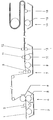
- the sole Figure shows a diagrammatical lateral elevation view of a three station plant according to the invention.
- the waterproofing material applied to the core is based on bitumen modified with low molecular weight polymers of a partly polar nature, e.g. EVA (ethylene vinyl acetate), low molecular weight acrylic copolymers and others capable of performing the same bonding function between waterproofing materials.
- EVA ethylene vinyl acetate
- This modification is effective from the chemical point of view in that it confers stability and compatibility with the materials subsequently applied to the core.
- the quantity of waterproofing material applied must in practice be limited to saturation of the core, and the latter may be of any suitable type.
- compositions which can be used to provide the waterproofing/compatibility-enhancing material Three examples are provided below by way of non-limiting indicative examples of compositions which can be used to provide the waterproofing/compatibility-enhancing material.
- Type 85/25 oxidised bitumen 80% Radial SBS type elastomer 5% Polypropylene homopolymer 10% Filler with a "10,000 mesh" particle size 5%
- the operation of applying this compatibility-enhancing material can be performed by immersing core 1 through use of a suitable immersion roll 2, which can be adjustably set at various levels with respect to a trough 3 containing the bath of waterproofing/compatibility-enhancing material in a first treatment station 4.
- the immersion operation is performed in combination with a rolling operation performed by a squeezing roller diagrammatically represented by a pair of cylinders 5 and 6 controlled by a balance lever mechanism to exert a maximum pressure of 60 kg/cm 2 on core 1.
- Core 1 is therefore saturated at station 4, and the limitation on the quantity of waterproofing material must in practice be limited to saturation of the core otherwise the compatibility-enhancing effect may be compromised.
- core 1 is not subjected to any kind of tension, and as a result the operation of applying the waterproofing/compatibility-enhancing material and that of rolling must be controlled electronically so that they take place under closely controlled conditions. Core 1 is therefore carefully “monitored” to avoid stretching during application.
- the passage through second treatment station 7 should take place at a predetermined distance from first station 4 so the saturated core can cool in ambient air with a temperature drop of approximately 30°C.
- the second type of waterproofing material for example one with a plastomer or elastomer base, respectively, and therefore of the BPP or BPE type, is applied.
- the type of waterproofing material is different from that present at station 4 and is therefore prepared and delivered independently by separate pipes (not shown).
- the waterproofing material can be applied to the upper or lower side or both sides according to the nature of the final membrane which it is desired to obtain.
- the cooling of core 1 which would have an adverse effect on the bonding of subsequent layers when the compatibility-enhancing material was not present, provides the additional benefit of improving the dimensional stability of the membrane because it confers sufficient rigidity upon the core, even if weakly impregnated or, better, saturated with waterproofing material, to withstand the tensions subsequently induced during the manufacturing process.
- an immersion roller 8 which is preferably interfaced electronically with a drive motor which is capable of controlling the tension on the core between station 4 and station 7 and an inking roller 9 as well as two pairs of calendering rollers 10, 11 and 12, 13.
- a third station 14 there is provided an inking roller 15 and a spreading roller 16, which apply a further layer of waterproofing material which is different from the previous materials and is therefore likewise produced and delivered in a totally independent way to one side of the membrane being formed.
- the waterproofing material in this third station comprises bitumen suitably modified with appropriate compatibility-enhancing agents similar to those used at station 4, that is with polymers of the EVA (ethylene vinyl acetate) and low molecular weight acrylic type.
Landscapes
- Engineering & Computer Science (AREA)
- Textile Engineering (AREA)
- Laminated Bodies (AREA)
- Synthetic Leather, Interior Materials Or Flexible Sheet Materials (AREA)
- Building Environments (AREA)
- Separation Using Semi-Permeable Membranes (AREA)
Abstract
Description
- a bituminous waterproofing material based on "distilled" or "oxidised" bitumen, appropriately mixed with thermoplastic polymers to modify its strength properties at high and low temperatures, and
- one or more "cores" or mechanical reinforcements intended to provide the final membrane with the required properties of resistance to the stresses to which the membrane is likely to be subjected when in use.
- in a first step a waterproofing material based on bitumen modified with thermoplastic polymers of low molecular weight having a partly polar nature, and having stabilising and compatibility-enhancing properties, is applied to a core until it becomes saturated,
- in a second step, a layer of elastomer or plastomer-based waterproofing material, which is different from that applied in the first step, is applied to at least one of the surfaces of the core saturated with waterproofing material, and
- in a third step a layer of waterproofing material modified with compatibility-enhancing polymers of low molecular weight is applied to one side of the membrane treated in the second step.
| Type 180/200 distilled bitumen | 85% |
| EVA | 10% |
| |
5% |
| Type 180/200 distilled bitumen | 80% |
| Isostatic polypropylene copolymer 300,000 |
10% |
| |
10% |
| Type 85/25 oxidised bitumen | 80% |
| Radial SBS |
5% |
| |
10% |
| Filler with a "10,000 mesh" |
5% |
Claims (20)
- A waterproofing membrane comprising a core and characterised in that it comprises three different layers of waterproofing material applied to the core in three separate successive steps.
- Membrane according to claim 1, characterised in that the first layer of waterproofing material applied to the core has characteristic features which render it compatible with the remaining two layers subsequently applied.
- Membrane according to claim 2, characterised in that the said first layer of waterproofing/compatibility-enhancing material impregnates the core until saturation.
- Membrane according to claim 2 or 3, characterised in that the said layer of waterproofing/compatibility-enhancing material applied to the core is based on bitumen modified with low molecular weight polymers of a partly polar nature.
- Membrane according to claim 4, characterised in that the said low molecular weight polymers of a partly polar nature comprise EVA (ethylene vinyl acetate) and low molecular weight acrylic copolymers.
- Membrane according to any one of claims 2 to 5, characterised in that the said second layer is applied to at least one side of the said core saturated with waterproofing/compatibility-enhancing material and comprises plastomer or elastomer-based waterproofing material.
- Membrane according to claim 6, characterised in that the said third layer is applied to only one side of the membrane and comprises bitumen modified with compatibility-enhancing products based on low molecular weight polymers such as EVA (ethylene vinyl acetate) and low molecular weight acrylic polymers.
- Process for the manufacture of waterproofing membranes in three successive steps, namelyin a first step a waterproofing material based on bitumen modified with thermoplastic polymers of low molecular weight having a partly polar nature and having stabilising and compatibility-enhancing properties is applied to a core until it becomes saturated,in a second step, a layer of elastomer or plastomer-based waterproofing material which is different from that applied in the first step is applied to at least one of the surfaces of the core saturated with waterproofing material, andin a third step a layer of waterproofing material modified with compatibility-enhancing polymers of low molecular weight is applied to one side of the membrane treated in the second step.
- Process according to claim 8, characterised in that the said core saturated with waterproofing material is allowed to cool between the first and the second step so that it acquires sufficient rigidity to withstand subsequent induced tensions and therefore improved dimensional stability.
- Process according to claim 8 or 9, characterised in that the said operation of applying the said compatibility-enhancing material takes place by immersing the core in a bath of waterproofing/compatibility-enhancing material for saturating the said core.
- Process according to claim 10, characterised in that the said immersion operation is performed in combination with a calendering operation.
- Process according to any one of claims 8 to 11, characterised in that the said operation of applying the waterproofing/compatibility-enhancing material and calendering are controlled electronically so that they are carried out under strictly controlled conditions.
- Process according to any one of claims 8 to 12, characterised in that after the operation of applying the waterproofing/compatibility-enhancing material a stage of cooling the core is provided.
- Process according to claim 12 or 13, characterised in that plastomer or elastomer-based waterproofing material is applied to at least one side of the said core saturated with waterproofing/compatibility-enhancing material.
- Process according to claim 14, characterised in that a further layer of waterproofing material which is different from the foregoing, comprising bitumen modified with compatibility-enhancing agents selected from polymers of the EVA (ethylene vinyl acetate) and low molecular weight acrylic type, is applied to only one side of the membrane being formed.
- Plant for the production of a waterproofing membrane in three layers characterised in that it comprises a first station in which a core is immersed in a bath of waterproofing mass or material having stabilising and compatibility-enhancing characteristics with respect to the two materials subsequently applied to the core, until saturation, a second station in which the core saturated with waterproofing material has a layer of waterproofing material based on both elastomer and plastomer applied to one side, and a third station in which a layer of waterproofing material including compatibility-enhancing materials is spread onto the core from the said second station.
- Plant in accordance with claim 16, characterised in that the said first station comprises a bath of waterproofing/compatibility-enhancing material, at least one immersion cylinder or roller which can be adjustably set at different levels with respect to the bath, and at least one pair of calendering rollers.
- Plant according to claim 16 or 17, characterised in that the said second station comprises a bath of waterproofing material, at least one immersion cylinder or roller which can be adjustably set at different levels with respect to the said bath, an inking roller and at least one pair of squeezing rollers.
- Plant according to claim 18, characterised in that the said third station comprises a bath of waterproofing material, an inking roller and a spreading roller, which apply a further layer of waterproofing material which is different from the foregoing to one side of the membrane being formed.
- Plant according to any one of claims 16 to 19, characterised in that it comprises electronic control means for both the operation of applying the waterproofing/compatibility-enhancing material and the calendering operation.
Applications Claiming Priority (2)
| Application Number | Priority Date | Filing Date | Title |
|---|---|---|---|
| ITVR970085 IT1296530B1 (en) | 1997-09-17 | 1997-09-17 | WATERPROOFING MEMBRANE AND PROCEDURE FOR ITS MANUFACTURE |
| ITVR970085 | 1997-09-17 |
Publications (3)
| Publication Number | Publication Date |
|---|---|
| EP0903435A2 true EP0903435A2 (en) | 1999-03-24 |
| EP0903435A3 EP0903435A3 (en) | 2001-05-02 |
| EP0903435B1 EP0903435B1 (en) | 2004-02-25 |
Family
ID=11428429
Family Applications (1)
| Application Number | Title | Priority Date | Filing Date |
|---|---|---|---|
| EP19980117400 Expired - Lifetime EP0903435B1 (en) | 1997-09-17 | 1998-09-14 | Waterproofing membrane and the method for its manufacture |
Country Status (3)
| Country | Link |
|---|---|
| EP (1) | EP0903435B1 (en) |
| DE (1) | DE69821847D1 (en) |
| IT (1) | IT1296530B1 (en) |
Cited By (1)
| Publication number | Priority date | Publication date | Assignee | Title |
|---|---|---|---|---|
| US6696125B2 (en) | 2002-04-25 | 2004-02-24 | Polyglass, U.S.A. | Self-adhered modified bitumen roofing material |
Family Cites Families (4)
| Publication number | Priority date | Publication date | Assignee | Title |
|---|---|---|---|---|
| US2893889A (en) * | 1956-04-02 | 1959-07-07 | United States Gypsum Co | Intumescent fire-retarding bituminous coating composition and roofing made therefrom |
| US4055453A (en) * | 1972-02-19 | 1977-10-25 | Tajima Roofing Co., Ltd. | Process for producing laminated bituminous roofing membrane |
| US4871605A (en) * | 1983-08-05 | 1989-10-03 | Genstar Building Materials Company | Inorganic fiber mat based bituminous sheet materials |
| US4755409A (en) * | 1986-01-24 | 1988-07-05 | Hyload Corporation | Waterproofing laminate |
-
1997
- 1997-09-17 IT ITVR970085 patent/IT1296530B1/en active IP Right Grant
-
1998
- 1998-09-14 DE DE69821847T patent/DE69821847D1/en not_active Expired - Lifetime
- 1998-09-14 EP EP19980117400 patent/EP0903435B1/en not_active Expired - Lifetime
Cited By (1)
| Publication number | Priority date | Publication date | Assignee | Title |
|---|---|---|---|---|
| US6696125B2 (en) | 2002-04-25 | 2004-02-24 | Polyglass, U.S.A. | Self-adhered modified bitumen roofing material |
Also Published As
| Publication number | Publication date |
|---|---|
| IT1296530B1 (en) | 1999-07-02 |
| EP0903435A3 (en) | 2001-05-02 |
| ITVR970085A1 (en) | 1999-03-17 |
| DE69821847D1 (en) | 2004-04-01 |
| EP0903435B1 (en) | 2004-02-25 |
Similar Documents
| Publication | Publication Date | Title |
|---|---|---|
| EP1710337B1 (en) | Nonwoven polymeric fiber mat composites and method | |
| US11927015B2 (en) | Synthetic fabric having slip resistant properties and method of making same | |
| US4762744A (en) | Reinforcing composite for roofing membranes and process for making such composites | |
| US4248652A (en) | Method of making leatherlike materials (A) | |
| DE2306235C2 (en) | Process for the production of a multi-layer bitumen roof membrane | |
| US4780350A (en) | Reinforcing composite for roofing membranes and process for making such composites | |
| US20080176022A1 (en) | Carrier membrane, coated membrane composite, and method | |
| JPH04214474A (en) | Support web for roofing material thin cloth | |
| DE1923871A1 (en) | Process for the production of polyurethane films or laminates | |
| US5151146A (en) | Method of making a roofing laminate including a triaxial wound nonwoven fiberglass scrim | |
| CA2802068A1 (en) | Method for constructing composite building boards using dissolvable films | |
| US6492012B1 (en) | Polymer penetrated porous substrates | |
| US4185133A (en) | Process for saturating a fiber mat of open structure | |
| US5108831A (en) | Roofing material | |
| US20060228962A1 (en) | Nonwoven polymeric fiber mat and method | |
| DE69323585T2 (en) | METHOD FOR PRODUCING A CARPET TILE | |
| EP0903435A2 (en) | Waterproofing membrane and the method for its manufacture | |
| WO2019185459A1 (en) | A method for producing a pre-formed bituminous waterproofing membrane | |
| EP0208918A2 (en) | Reinforcing composite for roofing membranes and process for making such composites | |
| GB2052378A (en) | Preformed sheet-like structures | |
| US20070049144A1 (en) | Coal tar enamel coated base sheets | |
| US4584210A (en) | Method and means for producing waterproofing membranes | |
| DK175921B1 (en) | Equipment is for producing carpet squares with a pile side and a rear side for imparting shape and dimension stability | |
| AU678061B2 (en) | Liquid-repellant covering layer and method for the manufacture of such covering layer | |
| NO760486L (en) |
Legal Events
| Date | Code | Title | Description |
|---|---|---|---|
| PUAI | Public reference made under article 153(3) epc to a published international application that has entered the european phase |
Free format text: ORIGINAL CODE: 0009012 |
|
| AK | Designated contracting states |
Kind code of ref document: A2 Designated state(s): AT BE CH CY DE DK ES FI FR GB GR IE IT LI LU MC NL PT SE |
|
| AX | Request for extension of the european patent |
Free format text: AL;LT;LV;MK;RO;SI |
|
| PUAL | Search report despatched |
Free format text: ORIGINAL CODE: 0009013 |
|
| AK | Designated contracting states |
Kind code of ref document: A3 Designated state(s): AT BE CH CY DE DK ES FI FR GB GR IE IT LI LU MC NL PT SE |
|
| AX | Request for extension of the european patent |
Free format text: AL;LT;LV;MK;RO;SI |
|
| RIC1 | Information provided on ipc code assigned before grant |
Free format text: 7D 06N 7/00 A, 7D 06N 5/00 B |
|
| 17P | Request for examination filed |
Effective date: 20010904 |
|
| AKX | Designation fees paid |
Free format text: AT BE CH CY DE DK ES FI FR GB GR IE IT LI LU MC NL PT SE |
|
| AXX | Extension fees paid |
Free format text: RO PAYMENT 20010904;SI PAYMENT 20010904 |
|
| 17Q | First examination report despatched |
Effective date: 20020220 |
|
| GRAH | Despatch of communication of intention to grant a patent |
Free format text: ORIGINAL CODE: EPIDOS IGRA |
|
| GRAH | Despatch of communication of intention to grant a patent |
Free format text: ORIGINAL CODE: EPIDOS IGRA |
|
| GRAA | (expected) grant |
Free format text: ORIGINAL CODE: 0009210 |
|
| RBV | Designated contracting states (corrected) |
Designated state(s): BE DE GB IT NL PT SE |
|
| AK | Designated contracting states |
Kind code of ref document: B1 Designated state(s): BE DE GB IT NL PT SE |
|
| AX | Request for extension of the european patent |
Extension state: RO SI |
|
| PG25 | Lapsed in a contracting state [announced via postgrant information from national office to epo] |
Ref country code: NL Free format text: LAPSE BECAUSE OF FAILURE TO SUBMIT A TRANSLATION OF THE DESCRIPTION OR TO PAY THE FEE WITHIN THE PRESCRIBED TIME-LIMIT Effective date: 20040225 Ref country code: BE Free format text: LAPSE BECAUSE OF FAILURE TO SUBMIT A TRANSLATION OF THE DESCRIPTION OR TO PAY THE FEE WITHIN THE PRESCRIBED TIME-LIMIT Effective date: 20040225 |
|
| REG | Reference to a national code |
Ref country code: GB Ref legal event code: FG4D |
|
| REG | Reference to a national code |
Ref country code: IE Ref legal event code: FG4D |
|
| REF | Corresponds to: |
Ref document number: 69821847 Country of ref document: DE Date of ref document: 20040401 Kind code of ref document: P |
|
| PG25 | Lapsed in a contracting state [announced via postgrant information from national office to epo] |
Ref country code: SE Free format text: LAPSE BECAUSE OF FAILURE TO SUBMIT A TRANSLATION OF THE DESCRIPTION OR TO PAY THE FEE WITHIN THE PRESCRIBED TIME-LIMIT Effective date: 20040525 |
|
| PG25 | Lapsed in a contracting state [announced via postgrant information from national office to epo] |
Ref country code: DE Free format text: LAPSE BECAUSE OF FAILURE TO SUBMIT A TRANSLATION OF THE DESCRIPTION OR TO PAY THE FEE WITHIN THE PRESCRIBED TIME-LIMIT Effective date: 20040526 |
|
| NLV1 | Nl: lapsed or annulled due to failure to fulfill the requirements of art. 29p and 29m of the patents act | ||
| PG25 | Lapsed in a contracting state [announced via postgrant information from national office to epo] |
Ref country code: GB Free format text: LAPSE BECAUSE OF NON-PAYMENT OF DUE FEES Effective date: 20040914 |
|
| PLBE | No opposition filed within time limit |
Free format text: ORIGINAL CODE: 0009261 |
|
| STAA | Information on the status of an ep patent application or granted ep patent |
Free format text: STATUS: NO OPPOSITION FILED WITHIN TIME LIMIT |
|
| 26N | No opposition filed |
Effective date: 20041126 |
|
| GBPC | Gb: european patent ceased through non-payment of renewal fee |
Effective date: 20040914 |
|
| REG | Reference to a national code |
Ref country code: IE Ref legal event code: MM4A |
|
| PG25 | Lapsed in a contracting state [announced via postgrant information from national office to epo] |
Ref country code: PT Free format text: LAPSE BECAUSE OF NON-PAYMENT OF DUE FEES Effective date: 20040725 |
|
| PGFP | Annual fee paid to national office [announced via postgrant information from national office to epo] |
Ref country code: IT Payment date: 20100928 Year of fee payment: 13 |
|
| PG25 | Lapsed in a contracting state [announced via postgrant information from national office to epo] |
Ref country code: IT Free format text: LAPSE BECAUSE OF NON-PAYMENT OF DUE FEES Effective date: 20110914 |