EP0903420A2 - Cobalt free high speed steels - Google Patents
Cobalt free high speed steels Download PDFInfo
- Publication number
- EP0903420A2 EP0903420A2 EP98117679A EP98117679A EP0903420A2 EP 0903420 A2 EP0903420 A2 EP 0903420A2 EP 98117679 A EP98117679 A EP 98117679A EP 98117679 A EP98117679 A EP 98117679A EP 0903420 A2 EP0903420 A2 EP 0903420A2
- Authority
- EP
- European Patent Office
- Prior art keywords
- niobium
- alloy
- zirconium
- less
- aluminum
- Prior art date
- Legal status (The legal status is an assumption and is not a legal conclusion. Google has not performed a legal analysis and makes no representation as to the accuracy of the status listed.)
- Withdrawn
Links
Classifications
-
- C—CHEMISTRY; METALLURGY
- C22—METALLURGY; FERROUS OR NON-FERROUS ALLOYS; TREATMENT OF ALLOYS OR NON-FERROUS METALS
- C22C—ALLOYS
- C22C38/00—Ferrous alloys, e.g. steel alloys
- C22C38/18—Ferrous alloys, e.g. steel alloys containing chromium
- C22C38/22—Ferrous alloys, e.g. steel alloys containing chromium with molybdenum or tungsten
-
- C—CHEMISTRY; METALLURGY
- C22—METALLURGY; FERROUS OR NON-FERROUS ALLOYS; TREATMENT OF ALLOYS OR NON-FERROUS METALS
- C22C—ALLOYS
- C22C38/00—Ferrous alloys, e.g. steel alloys
- C22C38/18—Ferrous alloys, e.g. steel alloys containing chromium
- C22C38/24—Ferrous alloys, e.g. steel alloys containing chromium with vanadium
-
- C—CHEMISTRY; METALLURGY
- C22—METALLURGY; FERROUS OR NON-FERROUS ALLOYS; TREATMENT OF ALLOYS OR NON-FERROUS METALS
- C22C—ALLOYS
- C22C38/00—Ferrous alloys, e.g. steel alloys
- C22C38/18—Ferrous alloys, e.g. steel alloys containing chromium
- C22C38/26—Ferrous alloys, e.g. steel alloys containing chromium with niobium or tantalum
-
- C—CHEMISTRY; METALLURGY
- C22—METALLURGY; FERROUS OR NON-FERROUS ALLOYS; TREATMENT OF ALLOYS OR NON-FERROUS METALS
- C22C—ALLOYS
- C22C38/00—Ferrous alloys, e.g. steel alloys
- C22C38/18—Ferrous alloys, e.g. steel alloys containing chromium
- C22C38/28—Ferrous alloys, e.g. steel alloys containing chromium with titanium or zirconium
-
- C—CHEMISTRY; METALLURGY
- C21—METALLURGY OF IRON
- C21D—MODIFYING THE PHYSICAL STRUCTURE OF FERROUS METALS; GENERAL DEVICES FOR HEAT TREATMENT OF FERROUS OR NON-FERROUS METALS OR ALLOYS; MAKING METAL MALLEABLE, e.g. BY DECARBURISATION OR TEMPERING
- C21D1/00—General methods or devices for heat treatment, e.g. annealing, hardening, quenching or tempering
- C21D1/18—Hardening; Quenching with or without subsequent tempering
Definitions
- the present invention relates generally to the art of metallurgy and, more particularly, to high speed tool steels.
- High speed steels are composite materials that contain a variety of alloy carbide particles in an iron base plus, depending on the heat treatment, various atomic arrangements of iron carbon in the form of austenitic, ferritic, bainitic and martensitic structures.
- Various carbide forming elements such as, for example, chromium, molybdenum, tungsten and vanadium, are constituents of high speeds.
- niobium and titanium are used as additional carbide forming elements.
- the retention of the critical cutting surfaces is related to the hardness of the tool.
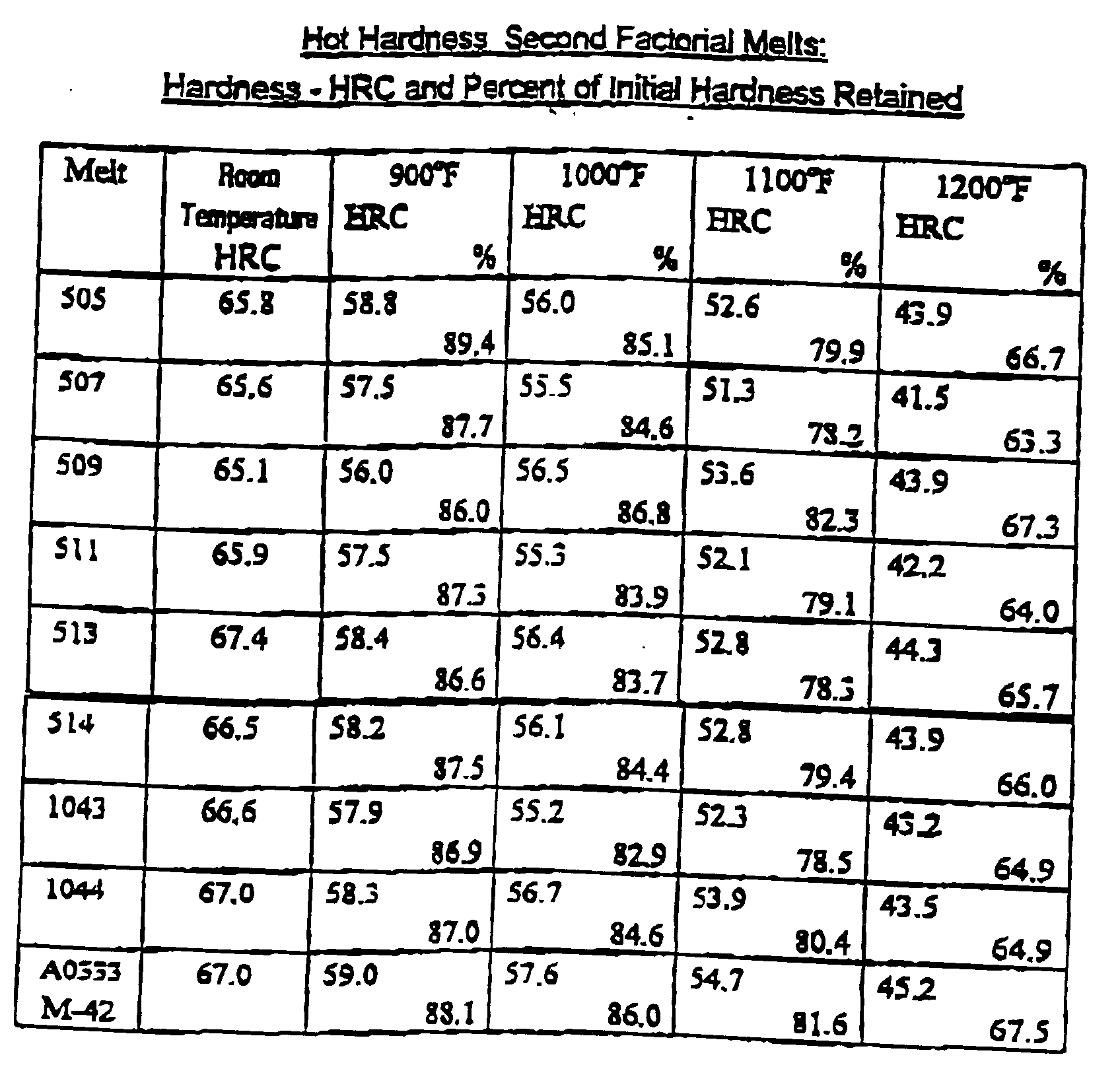
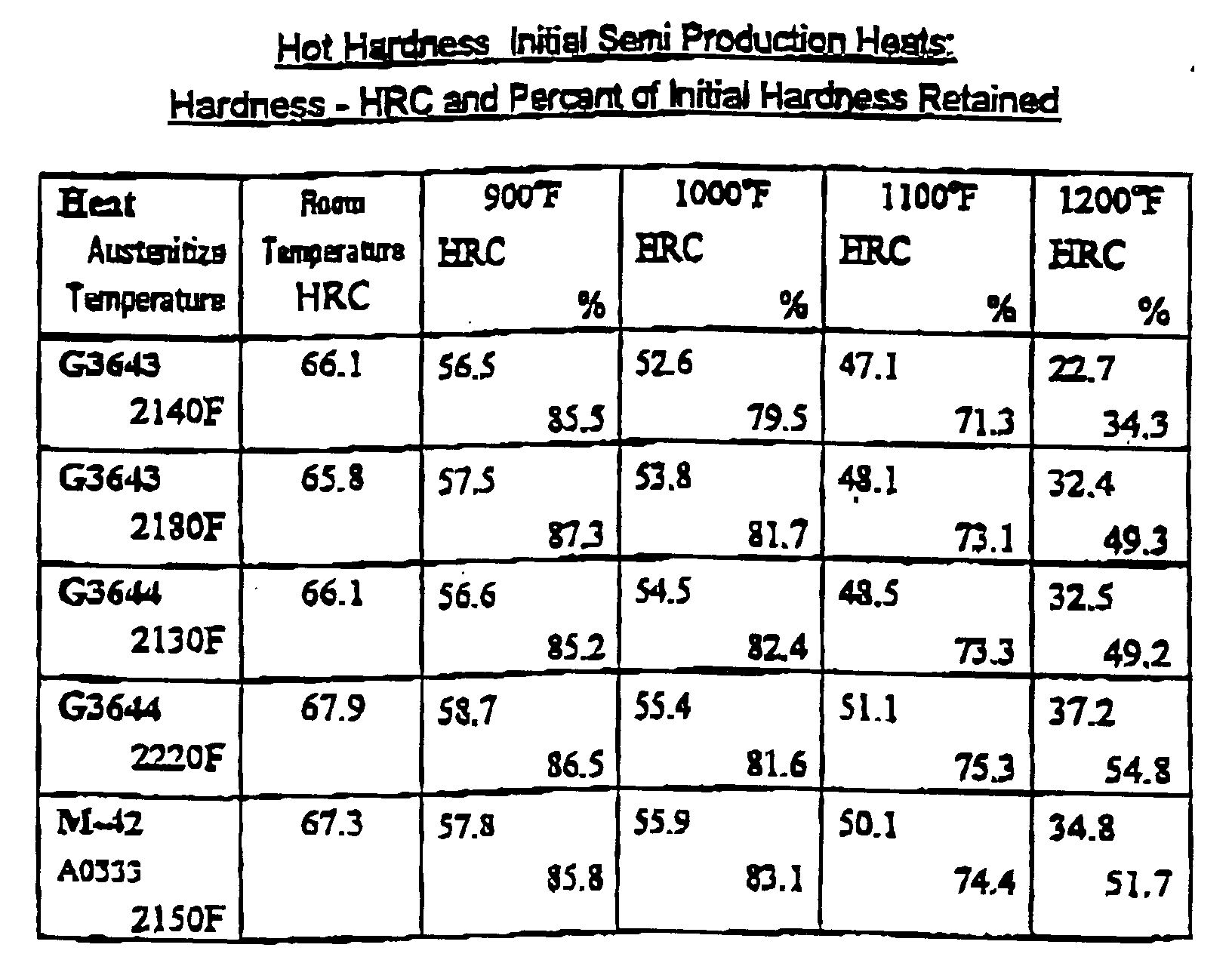
- the ability of the tool to retain its hardness is assessed by the hardness of the tool at elevated temperatures. Retention of the hardness can be measured by testing the steel at a given temperature or heating the steel for a prolonged time at a given temperature then measuring the steel's retention of hardness at room temperature when the tool cools down.
- the present invention improves the hot hardness properties of high speed steel without the use of cobalt or very high tungsten and/or molybdenum combinations. Cobalt is not only expensive but its supply is irregular and the use of very high tungsten and molybdenum combinations produce steels that are difficult to hot work without utilizing costly powder metallurgy methods.
- the present invention provides a family of high speed steel compositions that have the capability of achieving high hardness upon proper hardening and retaining a significant portion of that property at temperatures commonly encountered by cutting tools such as drills, taps and reamers. These steels are also useful in operations that require high hardness at more moderate to room temperature operations such as punches and thread forming tools.
- the present invention is directed to an alloy steel having the capability of retaining high hardness at elevated temperature for a prolonged time.
- the alloy steel is suitable for use as a high speed tool steel and broadly comprises in % by weight: 0.7-1.4 C; less than 1 Mn; less than 0.04 P; up to 0.7 Si; 3-6 Cr; 4-12 Mo; less than 0.5 Co; 0.5-2.25 V; 1-7 W; up to 1.25 Al; at least one of 0.04-2.5 Nb; 0.25-2.5 Zr; 0.08-4.75 Ta; and at least one of 0.005-0.7 Ti; 0.025-1.4 Zr; balance Fe.
- the alloy may also have an S content of 0.036-0.300; and Mn of 0.30-1.35 and may optionally be treated when in a liquid state with up to 0.05 of Mg or Ca.
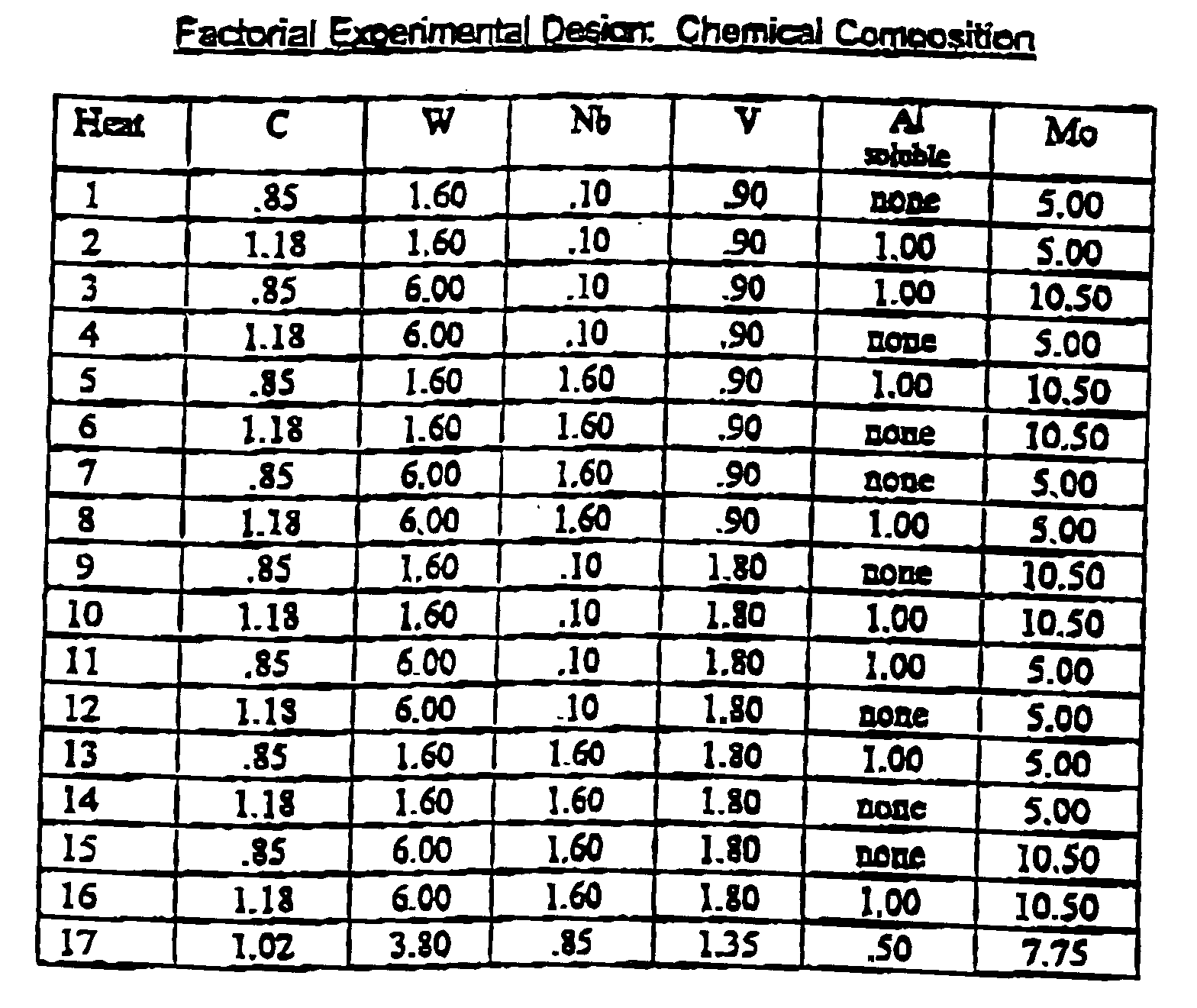
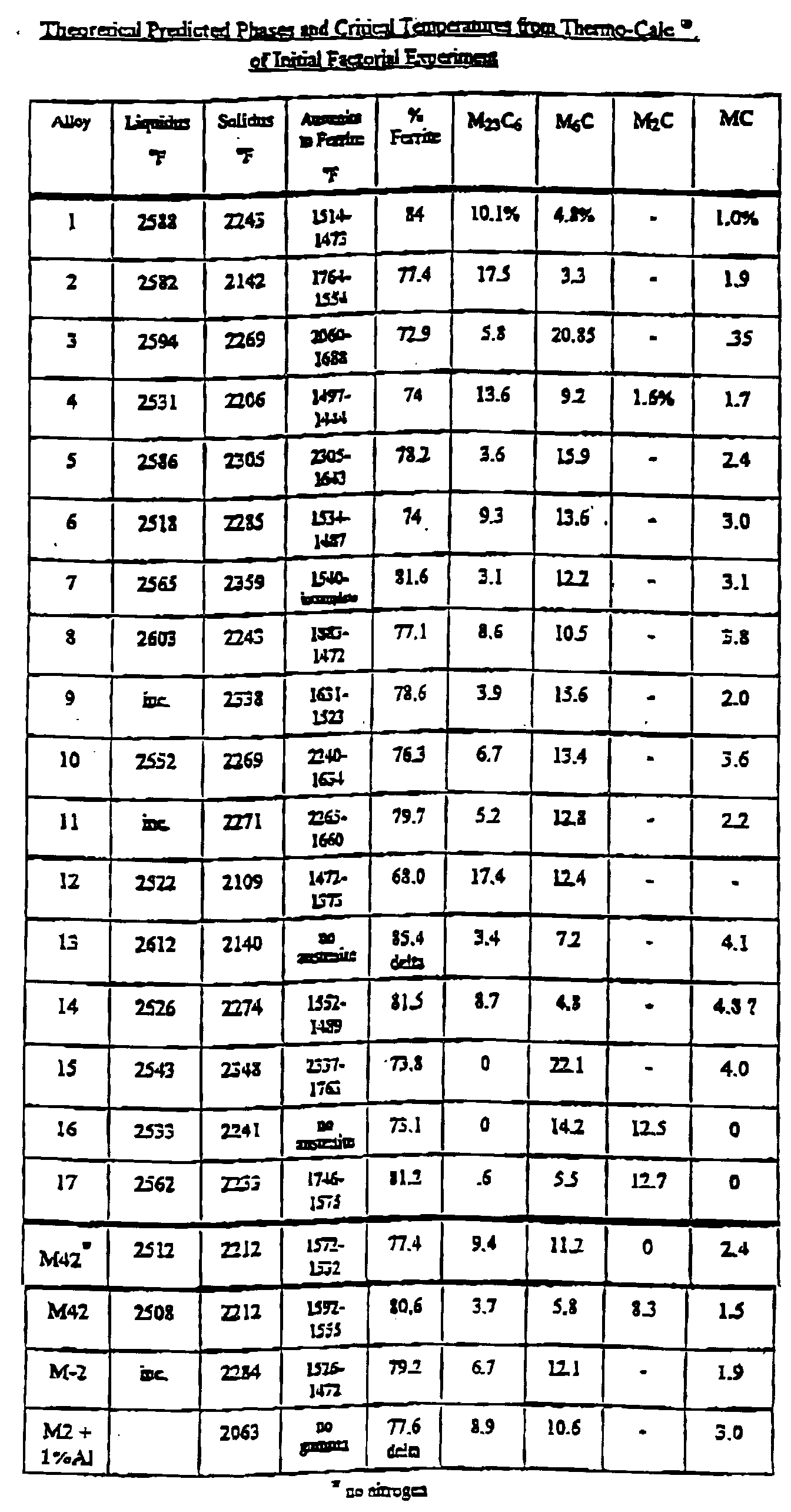
- the present invention provides a high speed steel similar to the popular types such as AISI M-2 with the hot hardness properties similar to AISI M-42. Since the hardness and other physical properties of high speed steels are related to their heat treatment, carbide size, distribution and composition, the theoretical phases of high speed steels were examined through the calculations of Thermo Calc® (a registered trademark of Thermo-Calc AB) a software program that utilizes known thermodynamic values of the constituent elements to predict phase formation. Initially, a fractionated factorial experiment was designed based on the concept that small, primary, MC carbides would resist softening.
- AISI M-2 high speed was chosen as a base, the carbon, tungsten, vanadium and molybdenum levels were varied with the addition of varying amounts of niobium and aluminum.
- the niobium was added to combine with the carbon as a source of carbides stable at high temperatures.
- the aluminum was added as a means of improving the hot hardness of the alloy since it retards softening, it was also added since it enhances the stability of the ferrite and modifies the morphology of niobium carbide particles.
- the modification of the niobium carbide morphology is affected by aluminum because it reduces the activity of carbon in the melt and in the austenite.
- niobium combines to form carbides in the form of M 6 C, these will be large blocky particles. Large blocky particles are less desirable than smaller fine particles which are type formed when the niobium forms M 2 C type carbides.
- the use of aluminum to improve hot hardness properties of high speed steels and M-2 grade in particular has been used in the past, particularly at concentrations around one weight percentage. Aluminum, however, reduces the solidus temperature substantially and thus causes difficulties in heat treating because it limits the ability to use very high austenitizing temperatures for maximum hardening response. Aluminum also increases the carbide content that precipitates during secondary hardening brought out by tempering at intermediate temperatures. Heat treated hardness is also improved by the addition of aluminum since it decreases the amount of retained austenite. Aluminum is critical in the present invention and preferably added up to 1.25 wt.%. Smaller amounts of aluminum, in the range of 0.025 to 0.25, are effective in obtaining the desired properties.
- silicon Although silicon also increases temper hardness, it also drastically lowers hardening temperatures as the liquidus and solidus temperatures. Silicon can replace tungsten, molybdenum and vanadium in the matrix and raise the solubility of carbon in the matrix. These changes cause a higher quenched hardness, but this effect decreases in the presence of nitrogen. Nitrogen is typically present in high speed tool steel in concentrations of .01 to .08%. Nitrogen raises the tempered hardness and it causes the primary, MC carbides, to be globular in shape.
- Niobium readily forms carbide particles. These particles form as the metal solidifies in the form, MC, that is noted as good for wear resistance. Niobium decreases the solubility of carbon in austenite and the lower carbon content of the austenite matrix results in higher martensite transformation start temperature. These higher martensite start temperatures favor less retained austenite. The addition of niobium and consequent formation of niobium carbide particles result in higher hardening temperatures. The formation of niobium carbide particles is favored, as measured by the free energy at elevated temperatures, over the formation of other common carbide compounds such as vanadium, molybdenum, tungsten and chromium carbides.
- Chromium was set for an aim of 3.75 wt.%, silicon at .35%, manganese at .32%, phosphorus at .015% maximum, sulphur at .005%, nickel at .16% with no additions of cobalt or titanium.
- a series of trial ingots based on a fractionated factorial was melted in a 100 pound vacuum induction furnace then cast into round molds which were rolled to bar for evaluation.
- An additional alloy in the middle of the factorial design composition range was also melted, alloy number 17.
- the initial heats to be melted had the following aim compositions.
- the proposed alloys were examined for predicted equilibrium phases and transformations from the liquid state via Thermo Calc®.
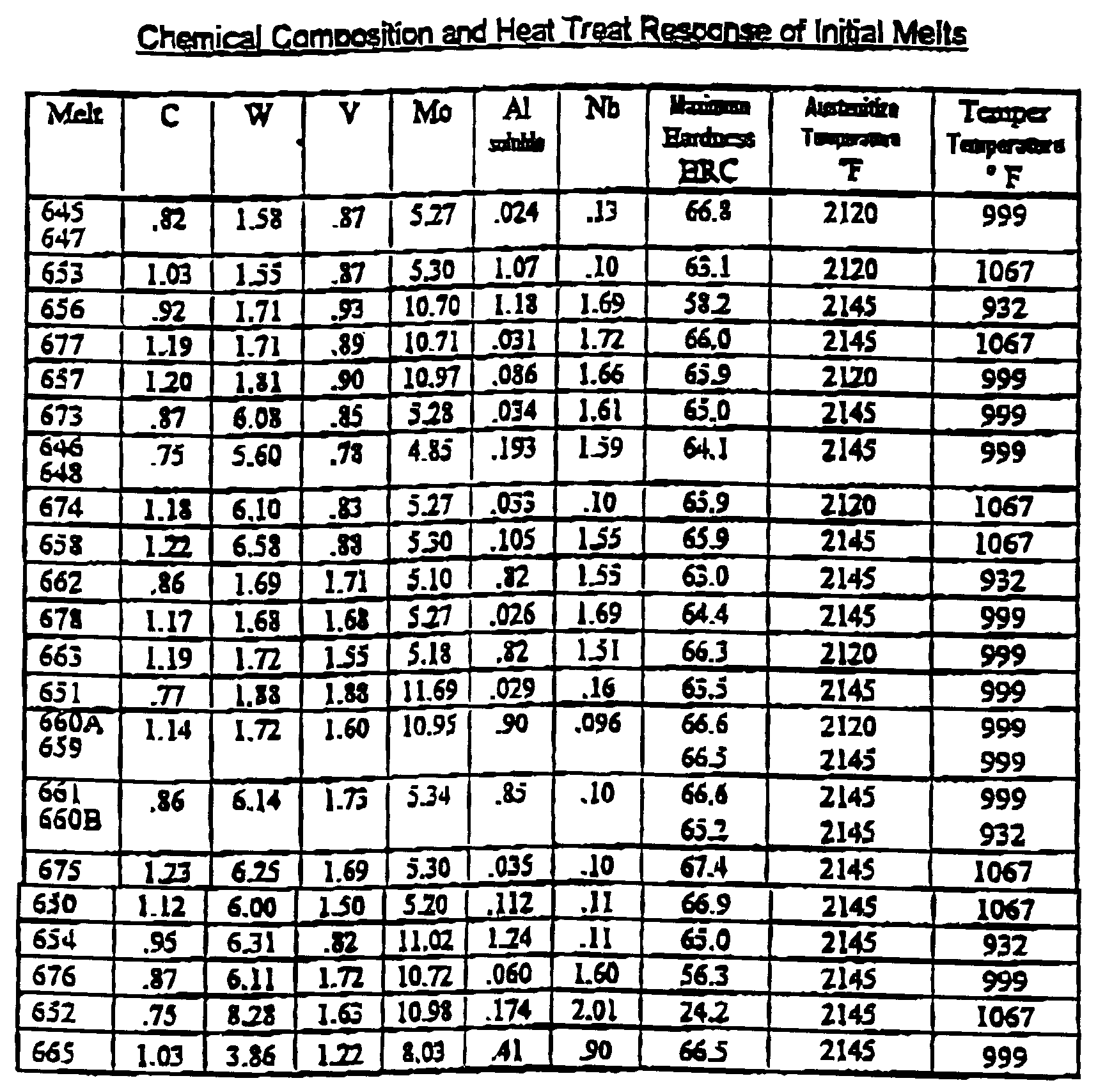
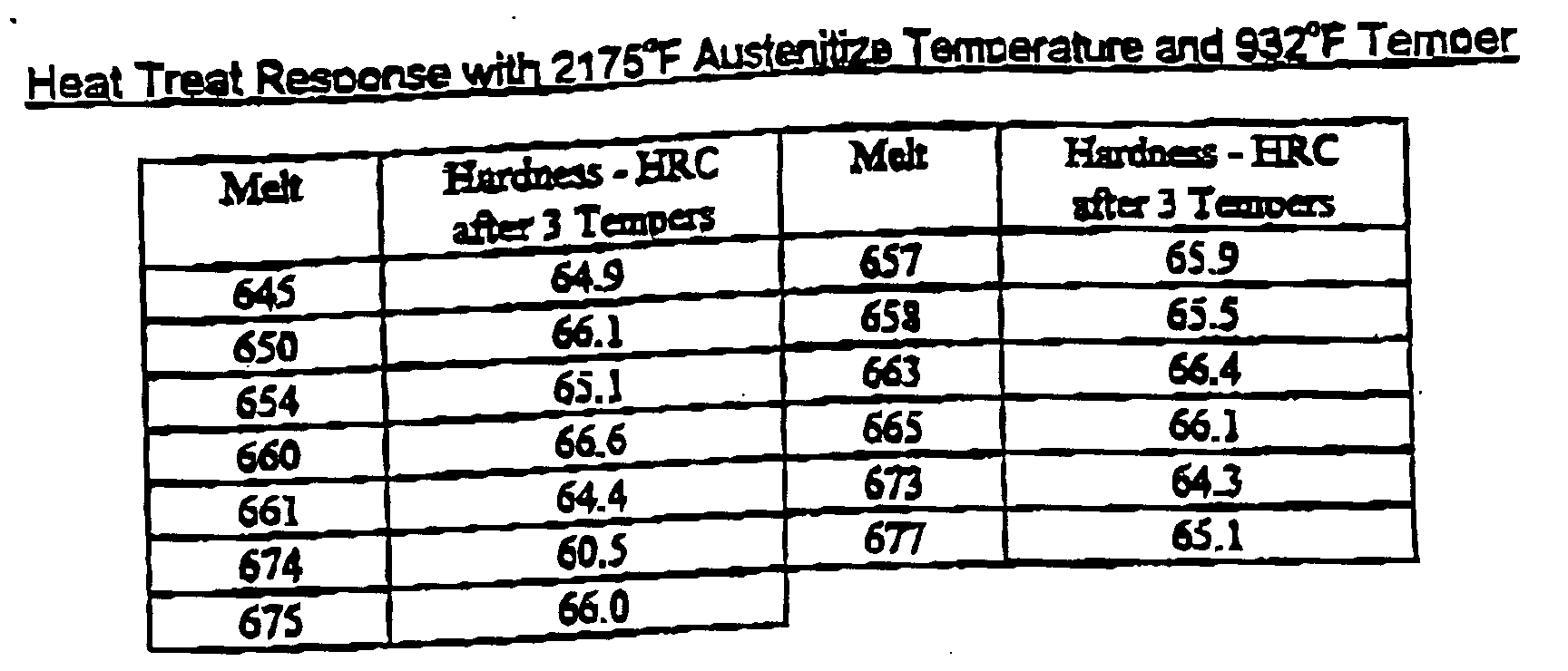
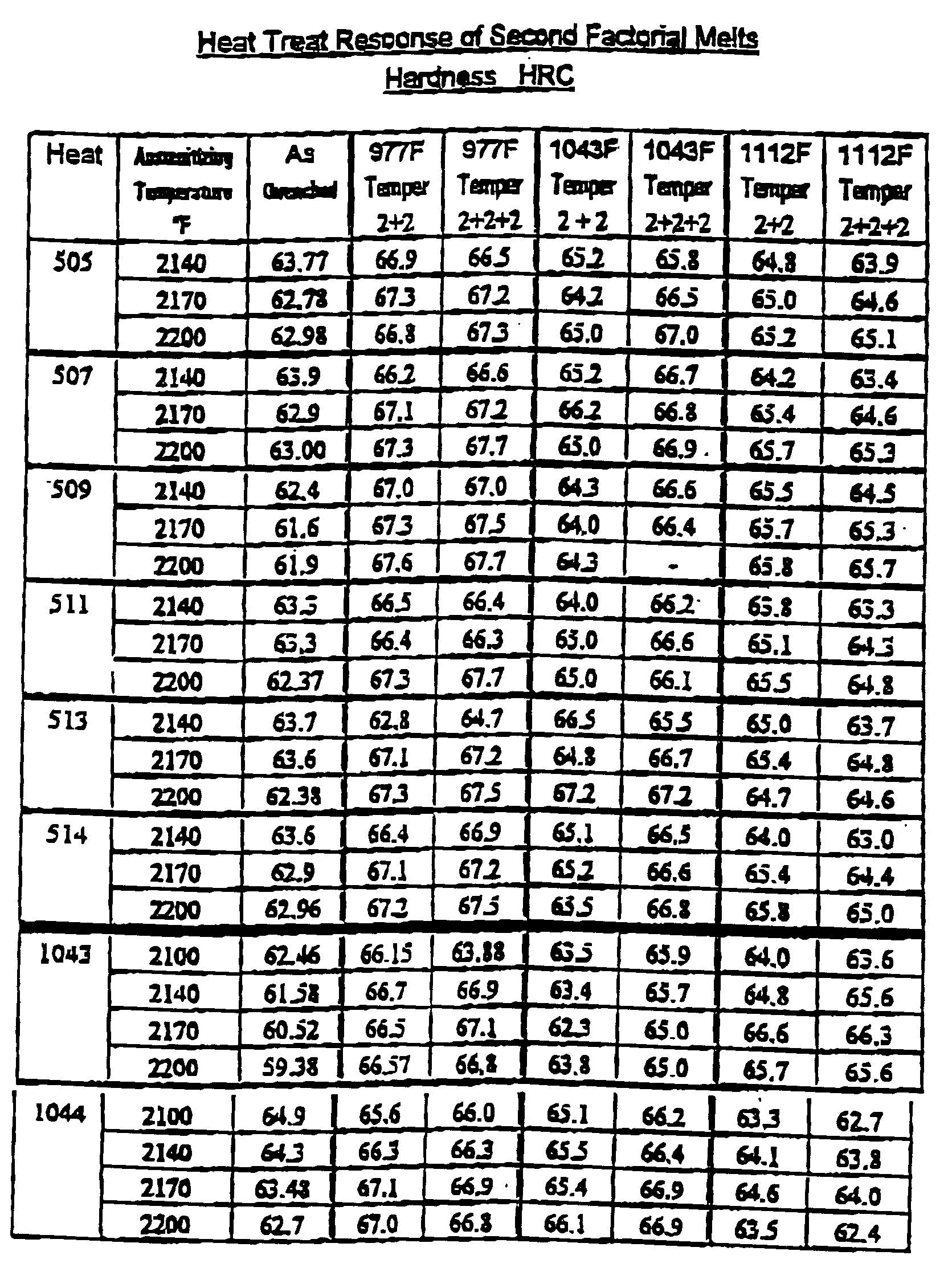
- the ingots were rolled to approximately 1.25x4" flats. Samples were cut from wrought bars from each trial heat. These pieces were then austenitized at a range of temperatures form 2125-2175°F. Rockwell "C” hardness, "HRC”, was measured after quenching from the austenitizing temperature then again following each two hour tempered cycle. The pieces were austenitized at three or more different temperatures set in the range 2125 - 2175°F then tempered over a range of temperatures from 932-1067°F.
- the original ingots were examined for titanium content which was picked up apparently as a contaminant from some of the raw materials used to make up the trial ingots.
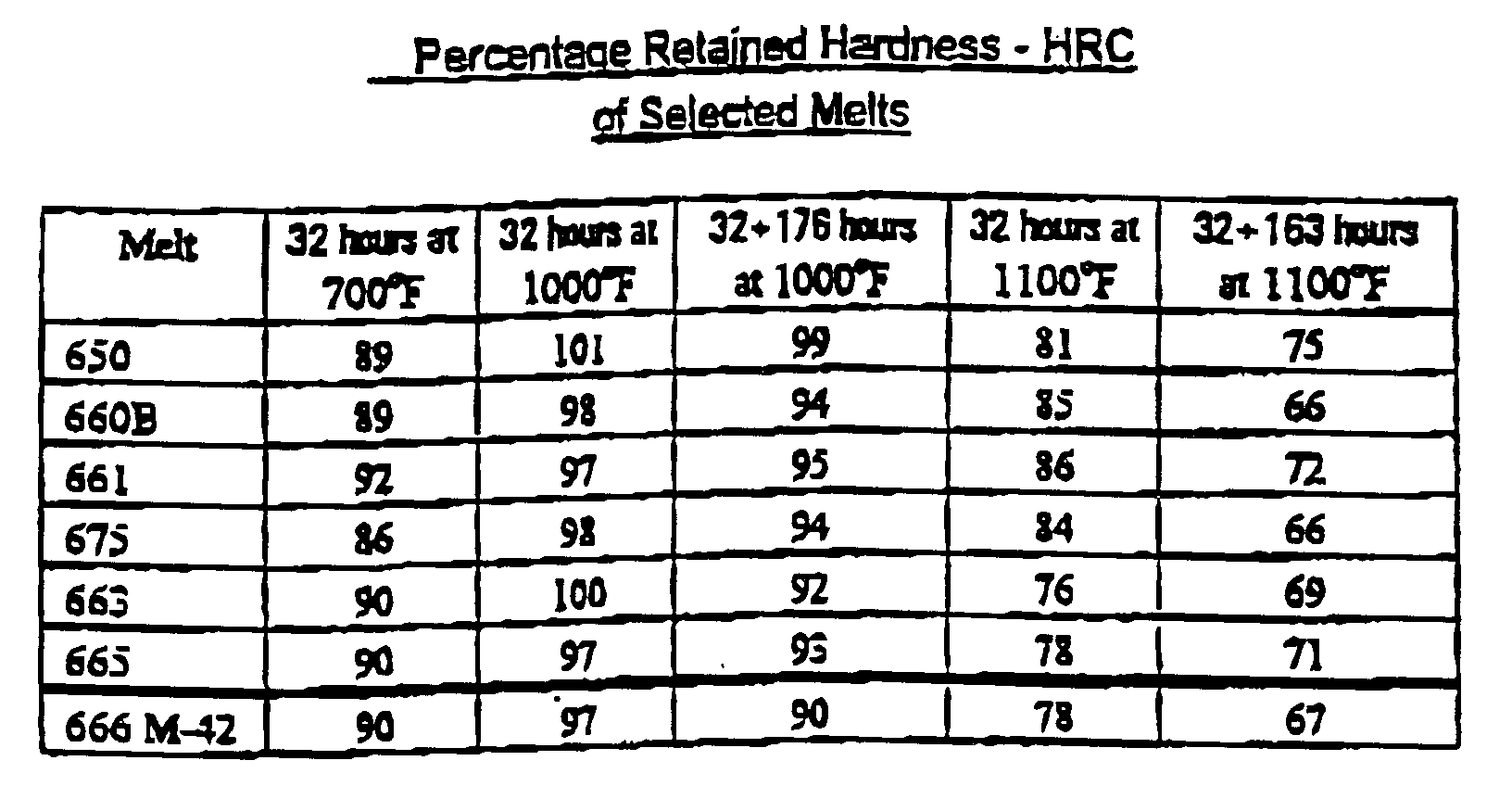
- a second set of melts were made involving a factorial around the heats with good hardenability and high retained hardness, heats 650, 660, 661 and 675, using different levels of aluminum and titanium. These heats are basically AISI M-2 with a low niobium content modified with varying amounts of aluminum and titanium. Two additional high niobium heats were melted because of the promising results on the initial melts of 663 and 665. Heat 663 is basically AISI M-1 with 1.5% niobium plus aluminum.
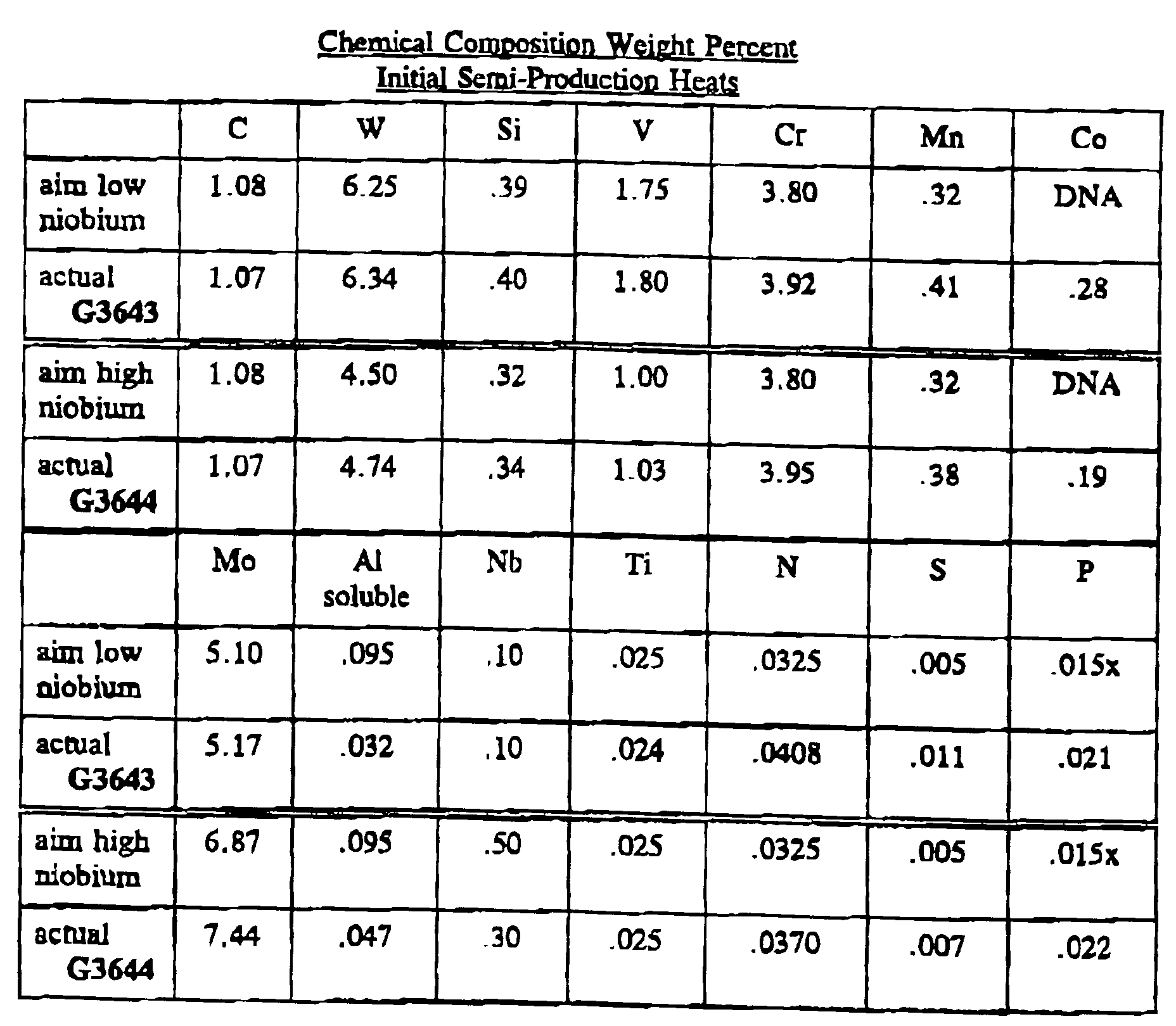
- the initial low niobium heat was set to be .06% in carbon below stoichiometric balance with the carbides while the actual heat is .09% below balance.
- the high niobium heat was aimed to be .01% deficient in carbon from stoichiometric balance but the final product was .04% deficient.
- the molybdenum level in the high niobium heat was above the aim, the molybdenum to tungsten ratio was essentially unchanged. The aim on the soluble aluminum content was missed substantially on both heats, but processing to wrought bar and testing were continued.
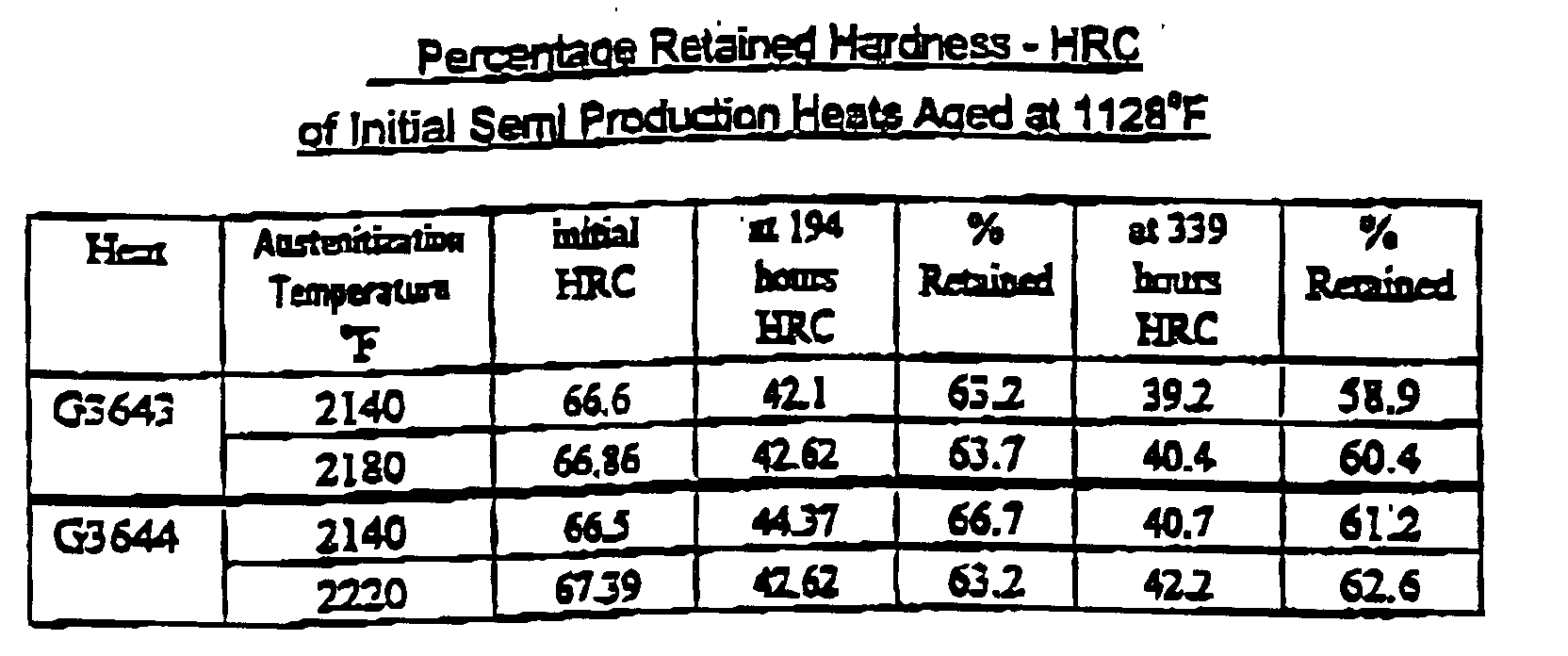
- Bar samples from both heats were quenched and tempered, then aged at elevated temperature, 1128°F, then air cooled to room temperature to determine their retained hardness.
- the first set of semi production heats was slightly out of the desired chemical analysis, two additional heats were melted.
- the low niobium composition was tried again with higher aluminum.
- the higher niobium type was modified to have lower tungsten with higher molybdenum, niobium and aluminum.
- this high niobium heat was designed to mimic some of the alloy balances in AISI M-42.
- the ratio of vanadium plus niobium and titanium to the total tungsten and molybdenum is similar to M-42.
- the ratio of molybdenum to molybdenum plus tungsten is the same as M-42.
- the aimed stoichiometric balance is also similar to M-42 while the total atomic fraction of carbide forming elements is the same.
- the second low niobium heat was set to be .06% in carbon below stoichiometric balance required to form known precipitates with alloy carbide formers and the actual heat was close to that aim with a carbon content just .08% below balance.
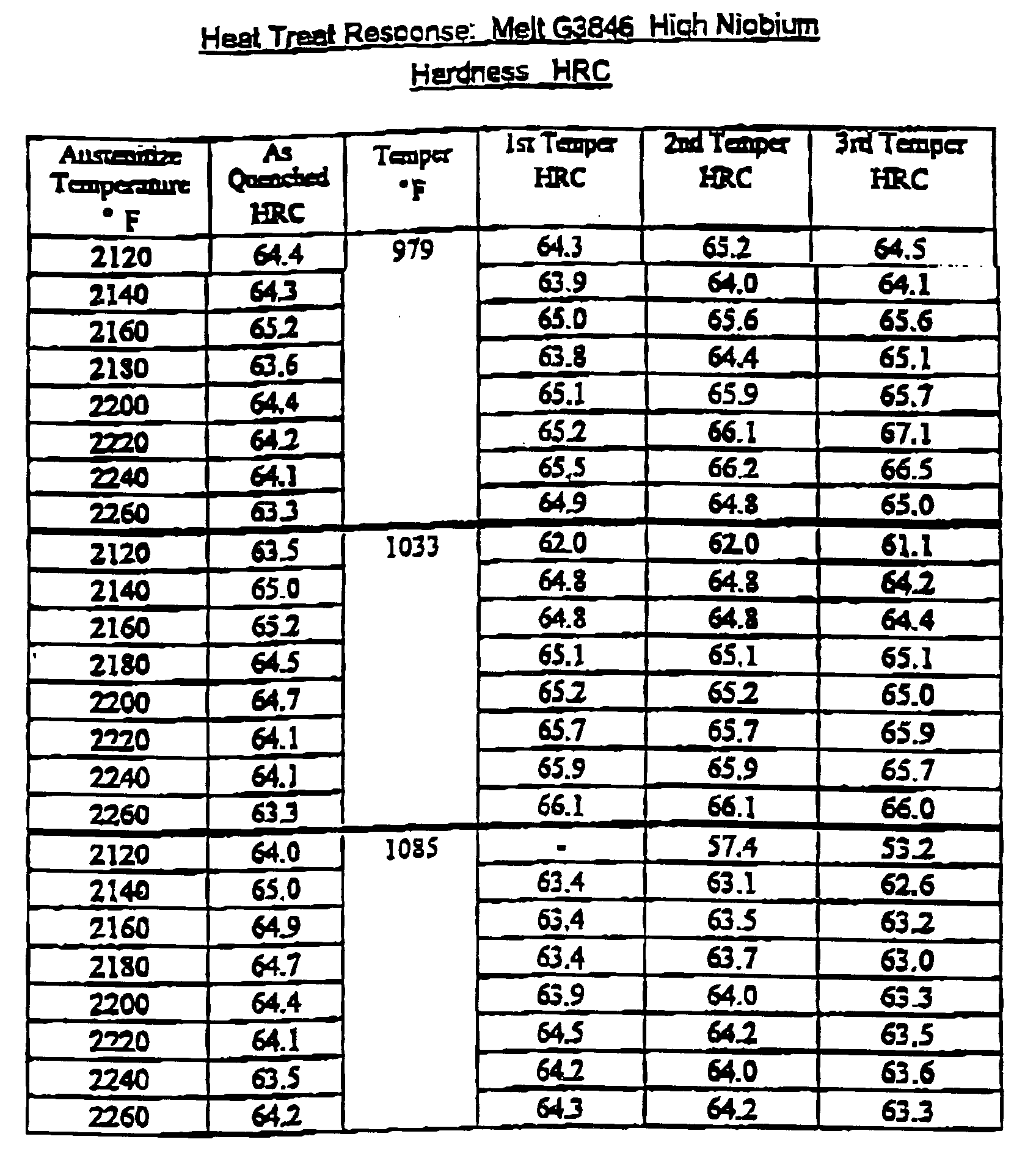
- the high niobium heat was aimed to be .07% deficient in the carbon necessary to meet the need for carbon to form a stoichiometric balance with the alloy carbide formers but the final product was .10% deficient.
- the carbon necessary to combine with the primary, MC, type carbide formers such as VC, TiC, and NbC was .03% more than in the aim chemistry.
- Bar samples from both heats of annealed material were hardened in salt, quenched, then tempered in air for two hours for each cycle. Bar samples from heat G3845 were hardened and tempered and given aging treatments to measure resistance to softening in cutting operations.
- Bar samples from heat G3845 were hardened and tempered and given aging treatments to measure resistance to softening in cutting operations.
Landscapes
- Chemical & Material Sciences (AREA)
- Engineering & Computer Science (AREA)
- Materials Engineering (AREA)
- Mechanical Engineering (AREA)
- Metallurgy (AREA)
- Organic Chemistry (AREA)
- Heat Treatment Of Steel (AREA)
- Heat Treatment Of Articles (AREA)
Abstract
Description








Claims (9)
- An alloy steel consisting essentially of by weight about 0.70 to 1.40% carbon, up to 1.00% manganese, less than 0.040% phosphorous, less than 0.70% silicon, 3.00 to 6.00% chromium, 4.00 to 12.00% molybdenum, less than 0.5% cobalt 0.75 to 2.25% vanadium, 1.00 to 7.00% tungsten, up to 1.25% aluminum and at least one member of the group consisting of: 0.04 to 2.00% niobium, 0.04 to 2.00% zirconium, and 0.08 to 4.00% tantalum, and at least one member of the group consisting of: 0.005 to 0.70% titanium and 0.10 to 1.40% zirconium, balance substantially iron.
- An alloy steel consisting essentially of by weight about 0.75 to 1.20% carbon, 0.10 to 0.70% manganese, less than 0.040% phosphorous, 0.10 to 0.60% silicon, 3.25 to 5.00% chromium, 4.00 to 10.00% molybdenum, less than 0.50% cobalt, 0.75 to 2.25% vanadium, 2.00 to 7.00% tungsten, 0.025 to 0.25% aluminium and at least one of the group consisting of: 0.05 to 0.25% niobium, 0.05 to 0.25% zirconium and 0.10 to 0.50% tantalum, and at least one member of the group consisting of: 0.015 to 0.050% titanium and 0.025 to 0.100% zirconium, balance substantiallly iron.
- An alloy steel consisting essentially of by weight about 0.85 to 1.25% carbon, 0.10 to 0.70% manganese, less than 0.040% phosphorous, 0.10 to 0.70% silicon, 3.25 to 5.00% chromium, 5.25 to 12.00% molybdenum, less than 0.50% cobalt, 0.75 to 2.25% vanadium, 3.00 to 7.00% tungsten, 0.030 to 1.25% aluminum and at least one member of the group consisting of: 0.25 to 2.00% niobium, 0.25 to 2.00% zirconium and 0.50 to 4.00% tantalum, and at least one member of the group consisting of: 0.015 to 0.070% titanium and 0.025 to 0.140% zirconium, balance substantially iron.
- An alloy steel consisting essentially of by weight about 0.75 to 1.25% carbon, 0.10 to 0.70% manganese, less than 0.040% phosphorous, 0.10 to 0.70% silicon, 3.25 to 5.00% chromium, 5.25 to 12.00% molybdenum, less than 0.50% cobalt, 0.50 to 1.75% vanadium, 0.50 to 5.00% tungsten, 0.030 to 1.25% aluminum and at least one member of the group consisting of: 0.15 to 2.50% niobium, 0.25 to 2.50% zirconium and 0.30 to 4.75% tantalum, and at least one member of the group consisting of: 0.015 to 0.100% titanium and 0.030 to .180% zirconium, balance substantially iron.
- An alloy steel consisting essentially of by weight about 0.7 to 1.4% carbon, 0.3 to 1.35% manganese, 0.036 to 0.300% sulphur, less than 0.04% phosphorous, up to 0.7% silicon, 3 to 6% chromium, 4 to 12% molybdenum, less than 0.5% cobalt, 0.5 to 2.27% vanadium, 0.5 to 7% tungsten, 0.030 to 1.25% aluminum, and one member selected from the group consisting of 0.04 to 2.5 niobium, 0.04 to 2.5% zirconium, 0.08 to 4.75% tantalum, and one member from the group consisting of 0.005 to 0.7% titanium and 0.025 to 1.4% zirconium, balance substantially iron.
- The steel alloy according to claim 5 containing 0.75 to 2.25% vanadium, 1 to 7% tungsten, 2% maximum niobium, 2% maximum zirconium, 4% maximum tantalum, and wherein the alloy is treated in a liquid state with up to 0.05 wt.% of magnesium or calcium.
- The steel alloy of claim 5 containing 0.75 to 1.2% carbon, 0.1 to 0.6% silicon, 3.25 to 5% chromium, 4 to 10% molybdenum, 0.75 to 2.25% vanadium, 2 to 7% tungsten, 0.025 to 0.25% aluminum, 0.05 to 0.25% niobium, 0.05 to 0.25% zirconium, 0.1 to 0.5% tantalum, and wherein the alloy is treated in a liquid state with up to 0.05 wt.% of magnesium or calcium.
- The steel alloy of claim 5 containing 0.85 to 1.25% carbon, 0.1 to 0.7% silicon, 3.25 to 5% chromium, 5.25 to 12% molybdenum, 0.75 to 2.25% vanadium, 3 to 7% tungsten, 0.03 to 1.25% aluminum, 0.05 to 0.25% niobium, 0.05 to 0.25% zirconium, 0.1 to 0.5% tantalum, 0.015 to 0.05% titanium, and wherein the alloy is treated in a liquid state with up to 0.05 wt.% of magnesium or calcium.
- The steel alloy of claim 5 containing 0.75 to 1.25% carbon, 0.1 to 0.7% silicon, 3.25 to 5% chromium, 5.25 to 12% molybdenum, 0.5 to 1.75% vanadium, 0.5 to 5% tungsten, 0.3 to 1.25% aluminum, 0.15 to 2.5% niobium, 0.25 to 2.5% zirconium, 0.3 to 4.75% tantalum, 0.015 to 0.1% titanium, and wherein the alloy is treated in a liquid state with up to 0.05 wt.% of magnesium or calcium.
Applications Claiming Priority (2)
| Application Number | Priority Date | Filing Date | Title |
|---|---|---|---|
| US5914397P | 1997-09-17 | 1997-09-17 | |
| US59143P | 1997-09-17 |
Publications (2)
| Publication Number | Publication Date |
|---|---|
| EP0903420A2 true EP0903420A2 (en) | 1999-03-24 |
| EP0903420A3 EP0903420A3 (en) | 1999-12-15 |
Family
ID=22021114
Family Applications (1)
| Application Number | Title | Priority Date | Filing Date |
|---|---|---|---|
| EP98117679A Withdrawn EP0903420A3 (en) | 1997-09-17 | 1998-09-17 | Cobalt free high speed steels |
Country Status (2)
| Country | Link |
|---|---|
| US (1) | US6200528B1 (en) |
| EP (1) | EP0903420A3 (en) |
Cited By (5)
| Publication number | Priority date | Publication date | Assignee | Title |
|---|---|---|---|---|
| AT407648B (en) * | 1999-05-10 | 2001-05-25 | Boehler Edelstahl | METALLIC MATERIAL WITH HIGH HARDNESS, HIGH WEAR RESISTANCE AND HIGH TOUGHNESS |
| US6585483B2 (en) | 2001-11-20 | 2003-07-01 | Honeywell International Inc. | Stationary roller shaft formed of a material having a low inclusion content and high hardness |
| CN105296868A (en) * | 2014-12-31 | 2016-02-03 | 芜湖金龙模具锻造有限责任公司 | Wear resisting ultrahard high-speed steel |
| CN109988971A (en) * | 2019-04-16 | 2019-07-09 | 东北大学 | A method of producing special ultra-pure high-speed tool steel |
| CN110273105A (en) * | 2019-07-30 | 2019-09-24 | 攀钢集团江油长城特殊钢有限公司 | A kind of high-speed tool steel and preparation method thereof |
Families Citing this family (12)
| Publication number | Priority date | Publication date | Assignee | Title |
|---|---|---|---|---|
| SE514410C2 (en) * | 1999-06-16 | 2001-02-19 | Erasteel Kloster Ab | Powder metallurgically made steel |
| SE516934C2 (en) * | 1999-10-05 | 2002-03-26 | Uddeholm Tooling Ab | Steel material, its use and manufacture |
| KR100406428B1 (en) * | 2001-03-30 | 2003-11-19 | 재단법인 포항산업과학연구원 | Co-free high speed steel having superior hardness by modifying Si content and method for manufacturing the same |
| JP4218239B2 (en) * | 2001-12-06 | 2009-02-04 | 日立金属株式会社 | Method of manufacturing tool steel by lamination and tool steel |
| US6723182B1 (en) | 2002-11-14 | 2004-04-20 | Arthur J. Bahmiller | Martensitic alloy steels having intermetallic compounds and precipitates as a substitute for cobalt |
| US7387692B2 (en) * | 2006-01-09 | 2008-06-17 | Ati Properties, Inc. | Tool and bearing steels |
| BRPI0603856A (en) * | 2006-08-28 | 2008-04-15 | Villares Metals Sa | hard alloys of lean composition |
| IT1391656B1 (en) * | 2008-11-07 | 2012-01-17 | Polimeri Europa Spa | HIGH-RESISTANCE GRANULATOR BLADES FOR WEARING AND RELATED SHARPENING METHOD |
| AT509598B1 (en) | 2010-10-18 | 2011-10-15 | Boehler Edelstahl Gmbh & Co Kg | METHOD FOR PRODUCING TOOLS FROM ALLOYED STEEL AND TOOLS, IN PARTICULAR FOR DISPERSING MACHINING METALS |
| CN104894483B (en) * | 2015-05-15 | 2018-07-31 | 安泰科技股份有限公司 | Powder metallurgy wear resistant tools steel |
| BR102015027438B8 (en) * | 2015-10-29 | 2021-12-21 | Inst De Pesquisas Tecnologicas Do Estado De Sao Paulo S/A | Piston rings in cast tool steels and their manufacturing process |
| CN117512470B (en) * | 2023-10-27 | 2026-07-10 | 海南核电有限公司 | A coating material and laser cladding process for water erosion resistance of steam turbine blades |
Family Cites Families (25)
| Publication number | Priority date | Publication date | Assignee | Title |
|---|---|---|---|---|
| US2343069A (en) * | 1942-02-27 | 1944-02-29 | Carpenter Steel Co | Steel alloy |
| DE1271409B (en) * | 1961-12-28 | 1968-06-27 | Fujikoshi Kozai Kogyo Kabushik | High speed steel containing titanium and tantalum |
| US3901690A (en) | 1971-05-11 | 1975-08-26 | Carpenter Technology Corp | Wear resistant alloy steels containing cb and one of ti, hf or zr |
| CH585799A5 (en) * | 1971-12-29 | 1977-03-15 | Lenin Kohaszati Muvek | High speed steel based on molybdenum - with good cutting props dependent on vanadium and niobium content |
| DE2263576B2 (en) | 1972-12-27 | 1978-06-01 | Thyssen Edelstahlwerke Ag, 4000 Duesseldorf | Process for producing an M2 C-free structure in high-speed steel |
| SU561748A1 (en) | 1974-12-16 | 1977-06-15 | Институт Проблем Литья Ан Украинской Сср | Casting high-speed steel |
| JPS52111411A (en) * | 1976-03-17 | 1977-09-19 | Hitachi Metals Ltd | High speed tool steel |
| US4224060A (en) | 1977-12-29 | 1980-09-23 | Acos Villares S.A. | Hard alloys |
| SE8106207L (en) | 1980-11-10 | 1982-05-11 | Teledyne Ind | SPEEDS AND OTHER TOOLS |
| JPS57143468A (en) * | 1981-02-28 | 1982-09-04 | Daido Steel Co Ltd | High-speed tool steel |
| AT390967B (en) * | 1982-09-14 | 1990-07-25 | Boehler Gmbh | FAST WORK STEEL ALLOY |
| SU1113423A1 (en) | 1983-07-28 | 1984-09-15 | Белорусский Ордена Трудового Красного Знамени Политехнический Институт | High-speed steel |
| JPS60208457A (en) | 1984-03-30 | 1985-10-21 | Daido Steel Co Ltd | Alloy tool steel |
| JPS6121299A (en) | 1984-07-11 | 1986-01-29 | 都築 純一 | Concrete segment |
| JPS6136070A (en) | 1984-07-26 | 1986-02-20 | ヤマハ発動機株式会社 | Windshield device for car with bar handle |
| JPH0791620B2 (en) | 1985-03-16 | 1995-10-04 | 大同特殊鋼株式会社 | High speed tool steel with excellent grindability |
| JPS62252891A (en) | 1986-04-25 | 1987-11-04 | Sumitomo Heavy Ind Ltd | Counterflow floating plate type heat exchanger |
| PL261399A3 (en) * | 1986-09-15 | 1988-08-18 | Economic nonledeburitic high-speed steels | |
| SU1463793A1 (en) | 1987-08-17 | 1989-03-07 | Белорусский Политехнический Институт | High-speed steel |
| SU1463797A1 (en) | 1987-08-27 | 1989-03-07 | Белорусский Политехнический Институт | High-speed steel |
| JP2863201B2 (en) | 1989-06-29 | 1999-03-03 | 富士通株式会社 | Developing device |
| JPH0323617A (en) | 1989-06-21 | 1991-01-31 | Jeol Ltd | Ion beam lithography |
| DE69217960T2 (en) * | 1991-08-07 | 1997-06-26 | Erasteel Kloster Ab | POWDER METALLURGICALLY PRODUCED FAST WORK STEEL |
| JP3257649B2 (en) | 1993-05-13 | 2002-02-18 | 日立金属株式会社 | High toughness high speed steel member and method of manufacturing the same |
| GB9404786D0 (en) | 1994-03-11 | 1994-04-27 | Davy Roll Company The Limited | Rolling mill rolls |
-
1998
- 1998-09-17 US US09/156,727 patent/US6200528B1/en not_active Expired - Fee Related
- 1998-09-17 EP EP98117679A patent/EP0903420A3/en not_active Withdrawn
Cited By (6)
| Publication number | Priority date | Publication date | Assignee | Title |
|---|---|---|---|---|
| AT407648B (en) * | 1999-05-10 | 2001-05-25 | Boehler Edelstahl | METALLIC MATERIAL WITH HIGH HARDNESS, HIGH WEAR RESISTANCE AND HIGH TOUGHNESS |
| US6585483B2 (en) | 2001-11-20 | 2003-07-01 | Honeywell International Inc. | Stationary roller shaft formed of a material having a low inclusion content and high hardness |
| US6892455B1 (en) | 2001-11-20 | 2005-05-17 | Honeywell International, Inc. | Stationary roller shaft formed of a material having a low inclusion content and high hardness |
| CN105296868A (en) * | 2014-12-31 | 2016-02-03 | 芜湖金龙模具锻造有限责任公司 | Wear resisting ultrahard high-speed steel |
| CN109988971A (en) * | 2019-04-16 | 2019-07-09 | 东北大学 | A method of producing special ultra-pure high-speed tool steel |
| CN110273105A (en) * | 2019-07-30 | 2019-09-24 | 攀钢集团江油长城特殊钢有限公司 | A kind of high-speed tool steel and preparation method thereof |
Also Published As
| Publication number | Publication date |
|---|---|
| US6200528B1 (en) | 2001-03-13 |
| EP0903420A3 (en) | 1999-12-15 |
Similar Documents
| Publication | Publication Date | Title |
|---|---|---|
| US6200528B1 (en) | Cobalt free high speed steels | |
| Grange | Effect of microstructural banding in steel | |
| US4673433A (en) | Low-alloy steel material, die blocks and other heavy forgings made thereof and a method to manufacture the material | |
| RO115276B1 (en) | MARTENSITIC STEEL, INOXIDABLE, WITH IMPROVED PROCESSING | |
| EP0091897A1 (en) | Strain hardening austenitic manganese steel and process for the manufacture thereof | |
| EP1199375B1 (en) | Non-refined steel being reduced in anisotropy of material and excellent in strength, toughness and machinability | |
| US6348109B1 (en) | Steel material and method for its manufacturing | |
| US4765849A (en) | Low-alloy steel material, die blocks and other heavy forgings made thereof | |
| US4011108A (en) | Cutting tools and a process for the manufacture of such tools | |
| US4798634A (en) | Corrosion resistant wrought stainless steel alloys having intermediate strength and good machinability | |
| EP1088906B1 (en) | High impact and thermal shock resistant die steel, dies, die blocks and method of manufacture therefor | |
| US5362337A (en) | Free-machining martensitic stainless steel | |
| Kibble et al. | Influence of heat treatment on the microstructure and hardness of 19% high-chromium cast irons | |
| KR100685544B1 (en) | Steel, its use and manufacturing method | |
| CA2369298A1 (en) | Steel cold work tool, its use and manufacturing | |
| CA1191039A (en) | Powder metallurgy tool steel article | |
| JPH07116550B2 (en) | Low alloy high speed tool steel and manufacturing method thereof | |
| EP0191873B1 (en) | Method and steel alloy for producing high-strength hot forgings | |
| WO1987004731A1 (en) | Corrosion resistant stainless steel alloys having intermediate strength and good machinability | |
| US4377422A (en) | Hadfield's steel containing 2% vanadium | |
| CA1086991A (en) | Abrasion resistant stainless steel | |
| CA2061765A1 (en) | Martensitic stainless steel article and method for producing the same | |
| WO2025125982A1 (en) | A hot worked and annealed graphitic steel for parts machining and manufacturing method thereof | |
| KR20240018573A (en) | Hot forming steel parts and manufacturing methods | |
| Copeland et al. | Effect of Copper and Tin on Mechanical Properties of Hot-rolled 0.2 Wt-pct Carbon Steels |
Legal Events
| Date | Code | Title | Description |
|---|---|---|---|
| PUAI | Public reference made under article 153(3) epc to a published international application that has entered the european phase |
Free format text: ORIGINAL CODE: 0009012 |
|
| AK | Designated contracting states |
Kind code of ref document: A2 Designated state(s): AT DE FR GB SE |
|
| AX | Request for extension of the european patent |
Free format text: AL;LT;LV;MK;RO;SI |
|
| PUAL | Search report despatched |
Free format text: ORIGINAL CODE: 0009013 |
|
| AK | Designated contracting states |
Kind code of ref document: A3 Designated state(s): AT BE CH CY DE DK ES FI FR GB GR IE IT LI LU MC NL PT SE |
|
| AX | Request for extension of the european patent |
Free format text: AL;LT;LV;MK;RO;SI |
|
| 17P | Request for examination filed |
Effective date: 20000614 |
|
| AKX | Designation fees paid |
Free format text: AT DE FR GB SE |
|
| 17Q | First examination report despatched |
Effective date: 20010706 |
|
| STAA | Information on the status of an ep patent application or granted ep patent |
Free format text: STATUS: THE APPLICATION IS DEEMED TO BE WITHDRAWN |
|
| 18D | Application deemed to be withdrawn |
Effective date: 20020928 |