EP0900528A2 - Zero time clipper roller conveyor - Google Patents
Zero time clipper roller conveyor Download PDFInfo
- Publication number
- EP0900528A2 EP0900528A2 EP98113395A EP98113395A EP0900528A2 EP 0900528 A2 EP0900528 A2 EP 0900528A2 EP 98113395 A EP98113395 A EP 98113395A EP 98113395 A EP98113395 A EP 98113395A EP 0900528 A2 EP0900528 A2 EP 0900528A2
- Authority
- EP
- European Patent Office
- Prior art keywords
- food product
- stuffed
- closing device
- rollers
- closing
- Prior art date
- Legal status (The legal status is an assumption and is not a legal conclusion. Google has not performed a legal analysis and makes no representation as to the accuracy of the status listed.)
- Ceased
Links
- 208000019300 CLIPPERS Diseases 0.000 title description 3
- 208000021930 chronic lymphocytic inflammation with pontine perivascular enhancement responsive to steroids Diseases 0.000 title description 3
- 235000013305 food Nutrition 0.000 claims abstract description 114
- 238000000034 method Methods 0.000 claims abstract description 9
- 230000003213 activating effect Effects 0.000 claims abstract description 5
- 230000007246 mechanism Effects 0.000 claims description 33
- 235000013580 sausages Nutrition 0.000 claims description 17
- 238000002360 preparation method Methods 0.000 claims description 3
- 238000005452 bending Methods 0.000 claims description 2
- 241000269319 Squalius cephalus Species 0.000 description 3
- 238000004519 manufacturing process Methods 0.000 description 3
- 238000004513 sizing Methods 0.000 description 2
- 241000251468 Actinopterygii Species 0.000 description 1
- 229920003043 Cellulose fiber Polymers 0.000 description 1
- 102000008186 Collagen Human genes 0.000 description 1
- 108010035532 Collagen Proteins 0.000 description 1
- 241000287828 Gallus gallus Species 0.000 description 1
- 240000002129 Malva sylvestris Species 0.000 description 1
- 235000006770 Malva sylvestris Nutrition 0.000 description 1
- 241000288147 Meleagris gallopavo Species 0.000 description 1
- 241001237745 Salamis Species 0.000 description 1
- 210000000481 breast Anatomy 0.000 description 1
- 235000013351 cheese Nutrition 0.000 description 1
- 229920001436 collagen Polymers 0.000 description 1
- 230000009977 dual effect Effects 0.000 description 1
- 230000008030 elimination Effects 0.000 description 1
- 238000003379 elimination reaction Methods 0.000 description 1
- 239000000835 fiber Substances 0.000 description 1
- 235000015244 frankfurter Nutrition 0.000 description 1
- 230000001771 impaired effect Effects 0.000 description 1
- 235000015250 liver sausages Nutrition 0.000 description 1
- 235000013372 meat Nutrition 0.000 description 1
- 239000004033 plastic Substances 0.000 description 1
- 229920003023 plastic Polymers 0.000 description 1
- 239000004627 regenerated cellulose Substances 0.000 description 1
- 235000015175 salami Nutrition 0.000 description 1
- 238000007789 sealing Methods 0.000 description 1
- 238000000926 separation method Methods 0.000 description 1
Images

Classifications
-
- A—HUMAN NECESSITIES
- A22—BUTCHERING; MEAT TREATMENT; PROCESSING POULTRY OR FISH
- A22C—PROCESSING MEAT, POULTRY, OR FISH
- A22C11/00—Sausage making ; Apparatus for handling or conveying sausage products during manufacture
- A22C11/12—Apparatus for tying sausage skins ; Clipping sausage skins
- A22C11/125—Apparatus for tying sausage skins ; Clipping sausage skins by clipping; Removal of clips
-
- A—HUMAN NECESSITIES
- A22—BUTCHERING; MEAT TREATMENT; PROCESSING POULTRY OR FISH
- A22C—PROCESSING MEAT, POULTRY, OR FISH
- A22C11/00—Sausage making ; Apparatus for handling or conveying sausage products during manufacture
- A22C11/02—Sausage filling or stuffing machines
-
- A—HUMAN NECESSITIES
- A22—BUTCHERING; MEAT TREATMENT; PROCESSING POULTRY OR FISH
- A22C—PROCESSING MEAT, POULTRY, OR FISH
- A22C11/00—Sausage making ; Apparatus for handling or conveying sausage products during manufacture
- A22C11/10—Apparatus for twisting or linking sausages
-
- A—HUMAN NECESSITIES
- A22—BUTCHERING; MEAT TREATMENT; PROCESSING POULTRY OR FISH
- A22C—PROCESSING MEAT, POULTRY, OR FISH
- A22C11/00—Sausage making ; Apparatus for handling or conveying sausage products during manufacture
- A22C11/12—Apparatus for tying sausage skins ; Clipping sausage skins
Definitions
- This invention relates to stuffing of tubular food casing with food product and more particularly relates to a method and apparatus for efficiently applying clips or ties to stuffed food product for separation into discrete "links.”
- a method for stuffing food product into a tubular food casing by continuously filling a tubular food casing to obtain a predetermined linear rate of movement of stuffed food product; moving a closing device with the food casing at said predetermined linear rate of movement; activating the closing device to apply a closure in the form of a tie or clip to segregate the stuffed food product into links while the stuffed food product continues to move at the predetermined rate; and supporting the filled food casing during the filling and closing by means of a roller table comprising indented rollers and upon which the filled food casing rests, the roller table being provided with opposing link side supports containing bearings which support the rollers and which permit the rollers to freely rotate.
- the roller table lacks a roller directly beneath the closing device to form a space which permits closing of the food casing.
- the link side supports move in the direction of movement and at the speed of the closing device so that the space stays beneath the closing device at all times during its motion and so that the rollers move in the direction and speed of the closing device.
- the invention also includes an improved food product stuffing machine which stuffs food product into a tubular food casing which comprises a means for continuously stuffing the food product into the tubular casing so as to obtain a predetermined linear rate of continuous movement of stuffed food product; a closing device which can apply a closure in the form of a clip or tie to the stuffed food product; means for moving said closing device with said stuffed food product at said predetermined linear rate; means for activating said closing device to apply a clip or tie to the stuffed food product to segregate the stuffed food product into stuffed food product links while the stuffed food product continues to move at said predetermined rate; and means for supporting said filled food casing during said filling and closing by means of a roller table comprising indented rollers and upon which the filled food casing rests, said roller table being provided with opposing link side supports containing bearings which support the rollers and which permit the rollers to freely rotate, said roller table lacking a roller directly beneath the closing device to form a space which permits closing of the food casing, said link
- the closures are usually, but not essentially, clips and the food product is usually, but not essentially, sausage product.
- the term "sausage” or “sausage casing” are used herein, it is to be understood that the invention also applies to other stuffable “foodstuffs" within “food casings.”
- the apparatus When the apparatus of the invention uses clips as the closing means, the apparatus includes a clipping mechanism which moves from a starting position with the stuffed sausage product at said predetermined rate during application of a clip to the sausage product and includes means for returning the clipping mechanism along the same path to the starting position after the clip is applied.
- a clipping mechanism which moves from a starting position with the stuffed sausage product at said predetermined rate during application of a clip to the sausage product and includes means for returning the clipping mechanism along the same path to the starting position after the clip is applied.
- the clipping mechanism comprises a first V shaped jaw and a second V shaped jaw which move toward each other to compress and narrow the stuffed sausage product in preparation for application of a clip and also comprises a means for applying a U shaped clip over the narrowed portion of the stuffed sausage product followed by bending legs of the clip to retain and segregate sausage links.
- Food product as used herein means essentially any food which can be stuffed into a tubular film casing.
- the most common of such foods are sausage meats, e.g. frankfurters, bologna, salami, Italian sausage, Polish sausage, knockwurst, bratwurst, liver sausage, summer sausage, etc.
- Other foods also can be stuffed into such casings, e.g. fish paste, turkey breast, whole and processed ham, cheeses, processed chicken, etc.
- “Stuffed” means to be introduced into a tubular film casing. Such stuffing may be accomplished by any suitable means which usually involves passing the food product through a stuffing horn upon which tubular film casing has been placed.
- Tubular film casing means a film in the form of a tube or hose. Such tubular films may be originally extruded in a tubular form or may be later formed from a flat film by sealing opposing edges of a flat film.
- the film used to form the casing may be any suitable film such as regenerated cellulose, collagen, and plastic, any of which may optionally be reinforced with fibers, e.g. a non-woven cellulose fiber paper.
- Continuous means without stopping, except for purposes of resupplying food product or tubular film casing, if required.
- “Stuffed food product” means the product resulting from stuffing the food product into a tubular film casing.
- Predetermined linear rate means an essentially constant continuous throughput of finished stuffed food product.
- “Closing the stuffed food product” means to tie, clip or otherwise secure the end of the tubular food casing, at the end into which stuffing took place, after stuffing to retain the food product within the casing and to form segregated “links”.
- the means for moving the closing device with the stuffed food product and returning it may be any suitable means such as a carriage operated by a servo motor, or a series of gears, belts or chains and sprockets.
- FIG. 1 illustrates a preferred embodiment of a machine 10 of the invention.
- a shirred stick 11 of tubular food casing 12 is placed over a stuffing horn 13 and a sizing ring 14 is then placed over an end 16 of the stuffing horn 13 after a section 18 of casing 12 is pulled from the shirred stick 11.
- the open end 20 of section 18 is then closed by gathering casing 12 at the end by means of gathering mechanism 22 and applying a clip by means of clipping mechanism 24.
- Horizontal transport 26 comprises upper horizontal guide rods 28, and lower horizontal guide rods 30, all of which are secured to frame 32 of the machine.
- Transport 26 also comprises carriage 34 which rides upon upper and lower guide rods 28 and 30 using slide bearings 36. Carriage 34 is moved in both directions along the guide rods by means of servo motor 38.
- carriage 34 is moved in the direction of movement 35 of stuffed food product at a rate which matches the linear rate of movement of stuffed food product.
- the casing is gathered and clipped by the carried gathering and clipping mechanisms 22 and 24 at the desired location for closing the casing to form a finished "link" of stuffed food product. The gathering and clipping thus occurs without interrupting the flow of food product or slowing the rate of movement of stuffed food product.
- the servo motor reverses and returns the carriage 34, with carried gathering and clipping mechanisms, so that the mechanisms are positioned to again activate when a desired closing position on the stuffed food product reaches the mechanisms.
- roller conveyor table 42 As can also be seen in the drawings, stuffed food product is carried by roller conveyor table 42, as it is formed at the end of the stuffing horn. Since the gathering and clipping mechanisms partly operate at a level below a bottom edge 44 of stuffed food product, the roller conveyor table of the preferred embodiment is unique in that it has a gap in the area of the gathering and clipping mechanisms. This is particularly interesting in that the portion of the roller conveyor with the gap moves as the gathering and clipping mechanisms move. This is accomplished by securing the roller conveyor to carriage 34 such that as the carriage is moved, the gap is always below the bottom edge 44 in the area of the gathering and clipping mechanisms.
- the gathering mechanism attached to the carriage in a preferred embodiment, comprises opposing gathering shutters which have V shaped grooves which gather the casing into a tight area as the gathering shutters 48 move toward each other.
- the gathering shutters are moved toward each other by any suitable means such as one or more air operated pistons or servo motors.
- a clip punch comprising cylinder 55 moves a U shaped clip around the gathered casing and against a die which bends legs of the clip thus securing it to the casing.
- the clip punch may also be operated by any suitable means such as an air actuated piston.
- Roller conveyor table 42 having rollers 50 connected together by means of links 52.
- Rollers 50 are complex rollers in that they each comprise guide rollers 54 and a chub roller 56.
- Guide rollers 54 roll along dual parallel spaced tracks 58 and keep the roller conveyor 42 aligned and supported.
- Chub rollers 56 are free wheeling and thus offer almost no resistance to outward movement of stuffed food product as it leaves the stuffing horn thus frictional resistance of stuffed food product does not cause non-uniform stuffing.
- Clipper connecting link 60 permits the elimination of a roller beneath the clipper so that the gathering and clipping mechanism can simultaneously contact stuffed food product from opposing directions.
- a connecting bar 62 is provided so that the track rollers 56 move at the speed of the gathering and clipping mechanisms and so that the connecting link stays aligned with them at all times. Action by the gathering and clipping mechanisms is thus never impaired by rollers 50.
- the method and apparatus of the invention overcomes the previously discussed disadvantages associated with closing links of stuffed food product. For example, it is not necessary to stop the stuffing operation to close the casing to form links thus production rate is increased. It is not necessary to stop and start a pump for food product thus saving wear on the pump and food product surges are reduced or eliminated thus resulting in a more uniform product. Further frictional resistance to stuffed food product is practically eliminated so that lack of uniformity of sizing due to frictional resistance is overcome.
- the apparatus of the present invention will stuff links or chubs over thirty percent faster than the present state-of-the-art commercial "T-SIZER" stuffing machine without even considering less down time due to extended pump life.
Landscapes
- Life Sciences & Earth Sciences (AREA)
- Engineering & Computer Science (AREA)
- Wood Science & Technology (AREA)
- Zoology (AREA)
- Food Science & Technology (AREA)
- Manufacturing And Processing Devices For Dough (AREA)
- Containers And Plastic Fillers For Packaging (AREA)
Abstract
Description
- This is a continuation-in-part of U.S. Patent Application Serial Number 08/520,583, filed August 29, 1995.
- This invention relates to stuffing of tubular food casing with food product and more particularly relates to a method and apparatus for efficiently applying clips or ties to stuffed food product for separation into discrete "links."
- It has been known that food product stuffed into tubular food casing can be separated into discrete links by means of ties or clips. Unfortunately such linking has been an inefficient operation since in order to apply a tie or clip the stuffing operation has to be momentarily stopped. This has had a number of disadvantages. In particular the repeated starting and stopping of the stuffing operation is time consuming thus slowing the stuffing process. In addition food product is supplied to the casing by means of a food product pump which must be repeatedly turned on and off as the stuffing operation starts and stops. This is not only hard on the pump but creates pressure surges of food product which contributes to a non-uniform diameter in the finished stuffed product.
- Attempts have been made to apply closures as the stuffed food product continues to move, e.g., as described in WO-A-9005671 and NL-A-9201169. These publications described complex mechanisms requiring numerous closing devices. Another problem associated with such devices is a non uniformity resulting from friction of stuffed food product with conveying or holding mechanisms.
- It is therefore an object of the present invention to provide a method and apparatus which permits improved production rate for stuffed tubular food casing and which permits the production of product having a more uniform stuffed diameter, using a single closing device.
- In accordance with the invention there is therefore provided a method for stuffing food product into a tubular food casing by continuously filling a tubular food casing to obtain a predetermined linear rate of movement of stuffed food product; moving a closing device with the food casing at said predetermined linear rate of movement; activating the closing device to apply a closure in the form of a tie or clip to segregate the stuffed food product into links while the stuffed food product continues to move at the predetermined rate; and supporting the filled food casing during the filling and closing by means of a roller table comprising indented rollers and upon which the filled food casing rests, the roller table being provided with opposing link side supports containing bearings which support the rollers and which permit the rollers to freely rotate. The roller table lacks a roller directly beneath the closing device to form a space which permits closing of the food casing. The link side supports move in the direction of movement and at the speed of the closing device so that the space stays beneath the closing device at all times during its motion and so that the rollers move in the direction and speed of the closing device.
- The invention also includes an improved food product stuffing machine which stuffs food product into a tubular food casing which comprises a means for continuously stuffing the food product into the tubular casing so as to obtain a predetermined linear rate of continuous movement of stuffed food product; a closing device which can apply a closure in the form of a clip or tie to the stuffed food product; means for moving said closing device with said stuffed food product at said predetermined linear rate; means for activating said closing device to apply a clip or tie to the stuffed food product to segregate the stuffed food product into stuffed food product links while the stuffed food product continues to move at said predetermined rate; and means for supporting said filled food casing during said filling and closing by means of a roller table comprising indented rollers and upon which the filled food casing rests, said roller table being provided with opposing link side supports containing bearings which support the rollers and which permit the rollers to freely rotate, said roller table lacking a roller directly beneath the closing device to form a space which permits closing of the food casing, said link side supports moving in the direction of movement and at the speed of the closing device so that the space stays beneath the closing device at all times during its motion and so that the rollers move in the direction and speed of the closing device. After clipping, means is provided for returning the closing device along its original path to an original position to repeat the operation after another desired length of casing is stuffed.
- In accordance with the present invention, the closures are usually, but not essentially, clips and the food product is usually, but not essentially, sausage product. When the term "sausage" or "sausage casing" are used herein, it is to be understood that the invention also applies to other stuffable "foodstuffs" within "food casings."
- When the apparatus of the invention uses clips as the closing means, the apparatus includes a clipping mechanism which moves from a starting position with the stuffed sausage product at said predetermined rate during application of a clip to the sausage product and includes means for returning the clipping mechanism along the same path to the starting position after the clip is applied.
- In a preferred embodiment, the clipping mechanism comprises a first V shaped jaw and a second V shaped jaw which move toward each other to compress and narrow the stuffed sausage product in preparation for application of a clip and also comprises a means for applying a U shaped clip over the narrowed portion of the stuffed sausage product followed by bending legs of the clip to retain and segregate sausage links.
-
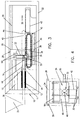
- Figure 1 is a side cross-sectional view of the machine of the invention showing the roller conveyor table and closing and clipping devices at a first position proximate the end of the stuffing horn wherein the closing and clipping devices are open.
- Figure 2 is a right end view of the apparatus shown in Figure 1.
- Figure 3 is a side cross-sectional view of the machine of Figure 1 wherein the closing and clipping mechanisms are in a second position further from the stuffing horn than in Figure 1 wherein the closing mechanism is closed upon the casing.
- Figure 4 is a right end view of the machine shown in Figure 3.
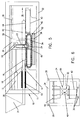
- Figure 5 is a side cross-sectional view of the machine of Figure 3 wherein the closing and clipping mechanisms are in a third position still further from the stuffing horn than in Figure 3 wherein the closing mechanism is closed and the clipping mechanism has been actuated.
- Figure 6 is an end view of the machine of Figure 5.
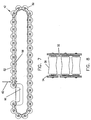
- Figure 7 is a side view of an embodiment of the roller conveyor table of the invention.
- Figure 8 is an end view of the conveyor of Figure 7.
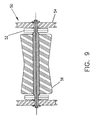
- Figure 9 is a cross-sectional view of a roller in the roller conveyor of Figure 7.
-
- "Food product" as used herein means essentially any food which can be stuffed into a tubular film casing. The most common of such foods are sausage meats, e.g. frankfurters, bologna, salami, Italian sausage, Polish sausage, knockwurst, bratwurst, liver sausage, summer sausage, etc. Other foods also can be stuffed into such casings, e.g. fish paste, turkey breast, whole and processed ham, cheeses, processed chicken, etc.
- "Stuffed" means to be introduced into a tubular film casing. Such stuffing may be accomplished by any suitable means which usually involves passing the food product through a stuffing horn upon which tubular film casing has been placed.
- "Tubular film casing" means a film in the form of a tube or hose. Such tubular films may be originally extruded in a tubular form or may be later formed from a flat film by sealing opposing edges of a flat film. The film used to form the casing may be any suitable film such as regenerated cellulose, collagen, and plastic, any of which may optionally be reinforced with fibers, e.g. a non-woven cellulose fiber paper.
- "Continuously" means without stopping, except for purposes of resupplying food product or tubular film casing, if required.
- "Stuffed food product" means the product resulting from stuffing the food product into a tubular film casing.
- "Predetermined linear rate" means an essentially constant continuous throughput of finished stuffed food product.
- "Closing the stuffed food product" means to tie, clip or otherwise secure the end of the tubular food casing, at the end into which stuffing took place, after stuffing to retain the food product within the casing and to form segregated "links".
- The means for moving the closing device with the stuffed food product and returning it may be any suitable means such as a carriage operated by a servo motor, or a series of gears, belts or chains and sprockets.
- The invention may be better understood by reference to the drawings which illustrate a preferred embodiment of the machine of the invention for practicing the method of the invention.
- The drawings illustrate a preferred embodiment of a
machine 10 of the invention. Referring to the drawings, ashirred stick 11 oftubular food casing 12 is placed over astuffing horn 13 and asizing ring 14 is then placed over anend 16 of the stuffinghorn 13 after asection 18 ofcasing 12 is pulled from theshirred stick 11. - The
open end 20 ofsection 18 is then closed by gatheringcasing 12 at the end by means ofgathering mechanism 22 and applying a clip by means ofclipping mechanism 24. -
Gathering mechanism 22 andclipping mechanism 24 are secured tohorizontal transport 26 and are slidably mounted onshafts 50.Horizontal transport 26 comprises upperhorizontal guide rods 28, and lowerhorizontal guide rods 30, all of which are secured toframe 32 of the machine.Transport 26 also comprisescarriage 34 which rides upon upper andlower guide rods slide bearings 36. Carriage 34 is moved in both directions along the guide rods by means ofservo motor 38. - After the end of
casing 12 is clipped food product is passed through stuffinghorn 13 at a rate which is controlled by afood pump 21. As aresult food casing 12 is drawn fromstick 11 to form stuffedfood product 40 which moves at a linear rate matched to the entry of sufficient food into the casing for stuffing. - After a desired length of food casing is stuffed,
carriage 34 is moved in the direction ofmovement 35 of stuffed food product at a rate which matches the linear rate of movement of stuffed food product. As the carriage moves, the casing is gathered and clipped by the carried gathering andclipping mechanisms - As soon as the clipping is complete, the servo motor reverses and returns the
carriage 34, with carried gathering and clipping mechanisms, so that the mechanisms are positioned to again activate when a desired closing position on the stuffed food product reaches the mechanisms. - As can also be seen in the drawings, stuffed food product is carried by roller conveyor table 42, as it is formed at the end of the stuffing horn. Since the gathering and clipping mechanisms partly operate at a level below a
bottom edge 44 of stuffed food product, the roller conveyor table of the preferred embodiment is unique in that it has a gap in the area of the gathering and clipping mechanisms. This is particularly interesting in that the portion of the roller conveyor with the gap moves as the gathering and clipping mechanisms move. This is accomplished by securing the roller conveyor tocarriage 34 such that as the carriage is moved, the gap is always below thebottom edge 44 in the area of the gathering and clipping mechanisms. - The gathering mechanism attached to the carriage, in a preferred embodiment, comprises opposing gathering shutters which have V shaped grooves which gather the casing into a tight area as the gathering
shutters 48 move toward each other. The gathering shutters are moved toward each other by any suitable means such as one or more air operated pistons or servo motors. - After gathering a clip
punch comprising cylinder 55 moves a U shaped clip around the gathered casing and against a die which bends legs of the clip thus securing it to the casing. The clip punch may also be operated by any suitable means such as an air actuated piston. - In operation, after the first clip is placed on
end 20 of the casing, food product flows from the stuffing horn into the casing to form stuffed food product which is carried from the stuffing horn at a predetermined rate by means of roller conveyor table 42. After a desired length of stuffed food product is made,carriage 34 moves in the direction of travel of the stuffed food product at a location along the stuffed food product where a clip is desired. As the carriage moves, gatheringshutters 48 move toward each other to gather the casing in preparation for receipt of a clip. Subsequent to gathering, a clip punch, carrying a clip, places the clip around the gathered casing and impinges the clip upon a die which folds the clip around and secures it to, the gathered casing. - Figures 7, 8 and 9 show roller conveyor table 42 having
rollers 50 connected together by means oflinks 52.Rollers 50 are complex rollers in that they each compriseguide rollers 54 and achub roller 56.Guide rollers 54 roll along dual parallel spacedtracks 58 and keep theroller conveyor 42 aligned and supported.Chub rollers 56 are free wheeling and thus offer almost no resistance to outward movement of stuffed food product as it leaves the stuffing horn thus frictional resistance of stuffed food product does not cause non-uniform stuffing. -
Clipper connecting link 60 permits the elimination of a roller beneath the clipper so that the gathering and clipping mechanism can simultaneously contact stuffed food product from opposing directions. A connectingbar 62 is provided so that thetrack rollers 56 move at the speed of the gathering and clipping mechanisms and so that the connecting link stays aligned with them at all times. Action by the gathering and clipping mechanisms is thus never impaired byrollers 50. - The method and apparatus of the invention overcomes the previously discussed disadvantages associated with closing links of stuffed food product. For example, it is not necessary to stop the stuffing operation to close the casing to form links thus production rate is increased. It is not necessary to stop and start a pump for food product thus saving wear on the pump and food product surges are reduced or eliminated thus resulting in a more uniform product. Further frictional resistance to stuffed food product is practically eliminated so that lack of uniformity of sizing due to frictional resistance is overcome.
- In a time comparison, the apparatus of the present invention will stuff links or chubs over thirty percent faster than the present state-of-the-art commercial "T-SIZER" stuffing machine without even considering less down time due to extended pump life.
Claims (11)
- A method for stuffing food product into a tubular food casing which comprises:a) continuously filling a tubular food casing to obtain a predetermined linear rate of movement of stuffed food product;b) moving a closing device with said food casing at said predetermined linear rate of movement; andc) activating said closing device to apply a closure in the form of a tie or clip to segregate the stuffed food product into links while the stuffed food product continues to move at said predetermined rate; characterized in that said filled food casing is supported during said filling and closing by means of a roller table comprising indented rollers and upon which the filled food casing rests, said roller table being provided with opposing link side supports containing bearings which support the rollers and which permit the rollers to freely rotate, said roller table lacking a roller directly beneath the closing device to form a space which permits closing of the food casing, said link side supports moving in the direction of movement and at the speed of the closing device so that the space stays beneath the closing device at all times during its motion and so that the rollers move in the direction and speed of the closing device.
- An improved food product stuffing machine which stuffs food product into a tubular food casing which comprises:means for continuously stuffing the food product into the tubular casing so as to obtain a predetermined linear rate of continuous movement of stuffed food product;a closing device which can apply a closure in the form of a clip or tie to the stuffed food product;means for moving said closing device with said stuffed food product at said predetermined linear rate; andmeans for activating said closing device to apply a clip or tie to the stuffed food product to segregate the stuffed food product into stuffed food product links while the stuffed food product continues to move at said predetermined rate; characterized in that means are provided for supporting said filled food casing during said filling and closing which means includes a roller table comprising indented rollers and upon which the filled food casing rests, said roller table being provided with opposing link side supports containing bearings which support the rollers and which permit the rollers to freely rotate, said roller table lacking a roller directly beneath the closing device to form a space which permits closing of the food casing, said link side supports moving in the direction of movement and at the speed of the closing device so that the space stays beneath the closing device at all times during its motion and so that the rollers move in the direction and speed of the closing device.
- The machine of claim 2 wherein the closing device is a clipping device which applies clips to the stuffed food product.
- The machine of claim 3 wherein the clipping device comprises a clipping mechanism which moves with the space from a starting position with the stuffed sausage product at said predetermined rate during application of a clip to the sausage product.
- The machine of claim 4 wherein means is provided for returning the clipping mechanism and the space to the stalling position after the clip is applied.
- The machine of claim 4 wherein the clipping mechanism comprises a first V shaped jaw and a second V shaped jaw which move toward each other to compress and narrow the stuffed sausage product in preparation for application of a clip, at least one of said V shaped jaws at least partially moving within said space.
- The machine of claim 6 wherein the clipping mechanism further comprises a means for applying a U shaped clip over the narrowed portion of the stuffed sausage product followed by bending legs of the clip to retain and segregate sausage links.
- The machine of claim 2 wherein means is provided for returning the closing mechanism to a starting location, after said food casing is closed.
- The machine of claim 8 wherein the means for moving the closing mechanism and space at the predetermined rate and the means for returning the closing mechanism and space to a starting location each comprise the same servo motor.
- The machine of claim 2 wherein the means for moving the stuffed food product comprises a belt conveyor.
- A roller table comprising indented rollers forming a supporting surface; characterized in that the table is provided with opposing link side supports containing bearings which support the rollers and which permit the rollers to freely rotate, said roller table lacking at least one roller to form a space which permits an operation from beneath the supporting surface upon an article on the supporting surface during movement of said article said link side supports moving in the direction of movement and speed of a moving device performing the operation so that the space stays aligned with said device and so that the rollers move in the direction and speed of said device.
Applications Claiming Priority (2)
| Application Number | Priority Date | Filing Date | Title |
|---|---|---|---|
| US922816 | 1997-09-03 | ||
| US08/922,816 US5890955A (en) | 1995-08-29 | 1997-09-03 | Zero time clipper roller conveyor |
Publications (2)
| Publication Number | Publication Date |
|---|---|
| EP0900528A2 true EP0900528A2 (en) | 1999-03-10 |
| EP0900528A3 EP0900528A3 (en) | 1999-03-17 |
Family
ID=25447606
Family Applications (1)
| Application Number | Title | Priority Date | Filing Date |
|---|---|---|---|
| EP98113395A Ceased EP0900528A3 (en) | 1997-09-03 | 1998-07-17 | Zero time clipper roller conveyor |
Country Status (3)
| Country | Link |
|---|---|
| US (1) | US5890955A (en) |
| EP (1) | EP0900528A3 (en) |
| CA (1) | CA2242977A1 (en) |
Cited By (2)
| Publication number | Priority date | Publication date | Assignee | Title |
|---|---|---|---|---|
| EP1607000A1 (en) * | 2004-06-14 | 2005-12-21 | Albert Handtmann Maschinenfabrik GmbH & Co. KG | Method and device for producing sausage |
| EP1987720A1 (en) * | 2007-05-04 | 2008-11-05 | Poly-clip System GmbH & Co. KG | Method and device for controlled closing of at least one clip around a braided section devoid of filling material of a tubular wrapper on a filling material section surrounded by the wrapper |
Families Citing this family (8)
| Publication number | Priority date | Publication date | Assignee | Title |
|---|---|---|---|---|
| AUPO431596A0 (en) * | 1996-12-20 | 1997-01-23 | Scientec Research Pty Ltd | Apparatus and method for coating a material |
| DE10124719A1 (en) * | 2001-05-19 | 2002-11-21 | Wilhelm Fessmann Gmbh U Co | Supply of individual sausages distributed by switch point to several processing stations |
| US6932688B2 (en) | 2001-10-12 | 2005-08-23 | Teepak Properties, Llc | Apparatus for automatically stuffing food casing |
| ES2259358T3 (en) * | 2002-11-22 | 2006-10-01 | ALBERT HANDTMANN MASCHINENFABRIK GMBH & CO. KG | DEVICE WITH VACUUM CHARGER AND A CLIP DEVICE. |
| DE202004007711U1 (en) * | 2004-05-13 | 2004-08-12 | Tipper Tie Technopack Gmbh | Sausage packaging device for filling pasty contents in tubular casing material |
| US7507150B2 (en) * | 2004-08-23 | 2009-03-24 | Visko Teepak Belgium Nv | Shirred casing |
| EP2783571B8 (en) * | 2013-03-25 | 2017-05-24 | Albert Handtmann Maschinenfabrik GmbH & Co. KG | Method and device for operating a filling machine |
| WO2022094585A1 (en) * | 2020-10-30 | 2022-05-05 | Edward Showalter | Apparatus, systems and methods for preparing and dispensing foods |
Citations (2)
| Publication number | Priority date | Publication date | Assignee | Title |
|---|---|---|---|---|
| WO1990005671A2 (en) | 1988-11-14 | 1990-05-31 | Delaware Capital Formation, Inc. | Continuously rotating platform with multiple mounted double clippers for continuously forming link product |
| NL9201169A (en) | 1992-06-30 | 1994-01-17 | Meyn Maschf | Method and apparatus for fabricating a series of food products joined together |
Family Cites Families (13)
| Publication number | Priority date | Publication date | Assignee | Title |
|---|---|---|---|---|
| FR1557553A (en) * | 1967-03-31 | 1969-02-14 | ||
| US3975795A (en) * | 1975-01-20 | 1976-08-24 | Union Carbide Corporation | Product stuffing apparatus and method |
| US4044426A (en) * | 1975-10-30 | 1977-08-30 | Union Carbide Corporation | Stuffing apparatus |
| US4017941A (en) * | 1975-10-30 | 1977-04-19 | Union Carbide Corporation | Casing sensing means for stuffing apparatus |
| CH607817A5 (en) * | 1976-02-13 | 1978-11-15 | Handtmann Albert | |
| CH598766A5 (en) * | 1976-11-29 | 1978-05-12 | Hoegger & Cie Ag C | |
| US4438545A (en) * | 1981-06-12 | 1984-03-27 | Union Carbide Corporation | Stuffing method and apparatus |
| DE3617559C1 (en) * | 1986-05-24 | 1987-10-01 | Guenter Kollross | Method and device for dividing a sausage strand produced on an automatic filling machine into a plurality of sausages which can be separated or separated from one another |
| US4773128A (en) * | 1987-01-13 | 1988-09-27 | Teepak, Inc. | Apparatus and methods of stuffing food casings to provide dimensionally uniform products |
| US4796332A (en) * | 1987-08-13 | 1989-01-10 | Teepak, Inc. | Constricting and fastening apparatus |
| IT1244765B (en) * | 1991-03-11 | 1994-08-08 | Righele Giovanni | MACHINE FOR THE SEPARATION OF A CONTINUOUS SAUSAGE IN SINGLE SAUSAGES |
| IT1245613B (en) * | 1991-03-29 | 1994-09-29 | Giovan Battista Possenti | METHOD AND DEVICE FOR THE PACKAGING OF PRODUCTS IN GENERICALLY TUBULAR ENVELOPES |
| CA2175177A1 (en) * | 1995-08-29 | 1997-03-01 | Thomas Ralph Stanley | Zero time clipper |
-
1997
- 1997-09-03 US US08/922,816 patent/US5890955A/en not_active Expired - Fee Related
-
1998
- 1998-07-14 CA CA002242977A patent/CA2242977A1/en not_active Abandoned
- 1998-07-17 EP EP98113395A patent/EP0900528A3/en not_active Ceased
Patent Citations (2)
| Publication number | Priority date | Publication date | Assignee | Title |
|---|---|---|---|---|
| WO1990005671A2 (en) | 1988-11-14 | 1990-05-31 | Delaware Capital Formation, Inc. | Continuously rotating platform with multiple mounted double clippers for continuously forming link product |
| NL9201169A (en) | 1992-06-30 | 1994-01-17 | Meyn Maschf | Method and apparatus for fabricating a series of food products joined together |
Cited By (5)
| Publication number | Priority date | Publication date | Assignee | Title |
|---|---|---|---|---|
| EP1607000A1 (en) * | 2004-06-14 | 2005-12-21 | Albert Handtmann Maschinenfabrik GmbH & Co. KG | Method and device for producing sausage |
| EP1987720A1 (en) * | 2007-05-04 | 2008-11-05 | Poly-clip System GmbH & Co. KG | Method and device for controlled closing of at least one clip around a braided section devoid of filling material of a tubular wrapper on a filling material section surrounded by the wrapper |
| US7604531B2 (en) | 2007-05-04 | 2009-10-20 | Poly-Clip System Gmbh & Co. Kg | Method of and apparatus for controlled closure of at least one clip around a filling material-free plait portion of a tubular casing at a filling material portion enclosed by the casing |
| RU2380295C1 (en) * | 2007-05-04 | 2010-01-27 | Поли-Клип Зюстем Гмбх Унд Ко.Кг | Method of controlled squeezing by at least one clips, of folded tubular unfilled shell section and device to this end |
| CN101391659B (en) * | 2007-05-04 | 2012-10-10 | 波利-克利普系统两合公司 | Method and device for controlled closing of at least one clip |
Also Published As
| Publication number | Publication date |
|---|---|
| CA2242977A1 (en) | 1999-03-03 |
| EP0900528A3 (en) | 1999-03-17 |
| US5890955A (en) | 1999-04-06 |
Similar Documents
| Publication | Publication Date | Title |
|---|---|---|
| US7650729B2 (en) | Telescoping conveyor mechanisms that cooperate with packaging systems having clippers and related methods | |
| CA1106685A (en) | Product stuffing apparatus and method | |
| US7740526B2 (en) | Apparatus for the automatic stuffing of meat products into a double casing comprising a sheet and a net | |
| US8641483B2 (en) | Systems with cooperating reruckers for producing encased products and related rerucker assemblies | |
| CA1085227A (en) | Stuffing apparatus | |
| US5890955A (en) | Zero time clipper roller conveyor | |
| EP0760210B1 (en) | Zero time clipper | |
| EP3597547A1 (en) | Process and machine for making clipless chub package contaning viscous product | |
| US5468179A (en) | Apparatus and methods for preparing loaf shaped sausage products in slack filled food casings | |
| CA1295227C (en) | Constricting and fastening apparatus | |
| US3315300A (en) | Apparatus for manufacturing casing from a continuous tube | |
| US7862407B2 (en) | Device for sectioning individual sausages of continuosly extruded product | |
| US5330382A (en) | Sizer adapter apparatus and method for creating substantially evenly and incompletely filled casings | |
| JP2002515752A (en) | Method and apparatus for separating components having different viscosities and / or sizes from a mixture | |
| MXPA98007137A (en) | Roller conveyor to apply c time holders | |
| MXPA96002289A (en) | Engrapadora in time c | |
| JPH08103206A (en) | Method and apparatus for filling sourse etc. | |
| EP3216348B1 (en) | Method and machine for producing sausage-shaped products | |
| NL9002695A (en) | Fish-fillet skinning machine for rapid skinning - has knife with tunnel above gap between belts through which pressure member protrudes |
Legal Events
| Date | Code | Title | Description |
|---|---|---|---|
| PUAI | Public reference made under article 153(3) epc to a published international application that has entered the european phase |
Free format text: ORIGINAL CODE: 0009012 |
|
| PUAL | Search report despatched |
Free format text: ORIGINAL CODE: 0009013 |
|
| AK | Designated contracting states |
Kind code of ref document: A2 Designated state(s): AT BE DE DK FI FR GB IE IT NL SE |
|
| AX | Request for extension of the european patent |
Free format text: AL;LT;LV;MK;RO;SI |
|
| AK | Designated contracting states |
Kind code of ref document: A3 Designated state(s): AT BE CH CY DE DK ES FI FR GB GR IE IT LI LU MC NL PT SE |
|
| AX | Request for extension of the european patent |
Free format text: AL;LT;LV;MK;RO;SI |
|
| 17P | Request for examination filed |
Effective date: 19990917 |
|
| AKX | Designation fees paid |
Free format text: AT BE DE DK FI FR GB IE IT NL SE |
|
| RAP3 | Party data changed (applicant data changed or rights of an application transferred) |
Owner name: TEEPAK INVESTMENTS, INC. |
|
| GRAG | Despatch of communication of intention to grant |
Free format text: ORIGINAL CODE: EPIDOS AGRA |
|
| 17Q | First examination report despatched |
Effective date: 20020410 |
|
| STAA | Information on the status of an ep patent application or granted ep patent |
Free format text: STATUS: THE APPLICATION HAS BEEN REFUSED |
|
| 18R | Application refused |
Effective date: 20021004 |