EP0900138B1 - Thermally insulating textile - Google Patents
Thermally insulating textile Download PDFInfo
- Publication number
- EP0900138B1 EP0900138B1 EP97915613A EP97915613A EP0900138B1 EP 0900138 B1 EP0900138 B1 EP 0900138B1 EP 97915613 A EP97915613 A EP 97915613A EP 97915613 A EP97915613 A EP 97915613A EP 0900138 B1 EP0900138 B1 EP 0900138B1
- Authority
- EP
- European Patent Office
- Prior art keywords
- textile
- shape memory
- composition
- substrate
- temperature
- Prior art date
- Legal status (The legal status is an assumption and is not a legal conclusion. Google has not performed a legal analysis and makes no representation as to the accuracy of the status listed.)
- Expired - Lifetime
Links
Images


Classifications
-
- B—PERFORMING OPERATIONS; TRANSPORTING
- B32—LAYERED PRODUCTS
- B32B—LAYERED PRODUCTS, i.e. PRODUCTS BUILT-UP OF STRATA OF FLAT OR NON-FLAT, e.g. CELLULAR OR HONEYCOMB, FORM
- B32B5/00—Layered products characterised by the non- homogeneity or physical structure, i.e. comprising a fibrous, filamentary, particulate or foam layer; Layered products characterised by having a layer differing constitutionally or physically in different parts
- B32B5/22—Layered products characterised by the non- homogeneity or physical structure, i.e. comprising a fibrous, filamentary, particulate or foam layer; Layered products characterised by having a layer differing constitutionally or physically in different parts characterised by the presence of two or more layers which are next to each other and are fibrous, filamentary, formed of particles or foamed
- B32B5/24—Layered products characterised by the non- homogeneity or physical structure, i.e. comprising a fibrous, filamentary, particulate or foam layer; Layered products characterised by having a layer differing constitutionally or physically in different parts characterised by the presence of two or more layers which are next to each other and are fibrous, filamentary, formed of particles or foamed one layer being a fibrous or filamentary layer
-
- B—PERFORMING OPERATIONS; TRANSPORTING
- B32—LAYERED PRODUCTS
- B32B—LAYERED PRODUCTS, i.e. PRODUCTS BUILT-UP OF STRATA OF FLAT OR NON-FLAT, e.g. CELLULAR OR HONEYCOMB, FORM
- B32B5/00—Layered products characterised by the non- homogeneity or physical structure, i.e. comprising a fibrous, filamentary, particulate or foam layer; Layered products characterised by having a layer differing constitutionally or physically in different parts
- B32B5/22—Layered products characterised by the non- homogeneity or physical structure, i.e. comprising a fibrous, filamentary, particulate or foam layer; Layered products characterised by having a layer differing constitutionally or physically in different parts characterised by the presence of two or more layers which are next to each other and are fibrous, filamentary, formed of particles or foamed
- B32B5/24—Layered products characterised by the non- homogeneity or physical structure, i.e. comprising a fibrous, filamentary, particulate or foam layer; Layered products characterised by having a layer differing constitutionally or physically in different parts characterised by the presence of two or more layers which are next to each other and are fibrous, filamentary, formed of particles or foamed one layer being a fibrous or filamentary layer
- B32B5/26—Layered products characterised by the non- homogeneity or physical structure, i.e. comprising a fibrous, filamentary, particulate or foam layer; Layered products characterised by having a layer differing constitutionally or physically in different parts characterised by the presence of two or more layers which are next to each other and are fibrous, filamentary, formed of particles or foamed one layer being a fibrous or filamentary layer another layer next to it also being fibrous or filamentary
-
- B—PERFORMING OPERATIONS; TRANSPORTING
- B32—LAYERED PRODUCTS
- B32B—LAYERED PRODUCTS, i.e. PRODUCTS BUILT-UP OF STRATA OF FLAT OR NON-FLAT, e.g. CELLULAR OR HONEYCOMB, FORM
- B32B7/00—Layered products characterised by the relation between layers; Layered products characterised by the relative orientation of features between layers, or by the relative values of a measurable parameter between layers, i.e. products comprising layers having different physical, chemical or physicochemical properties; Layered products characterised by the interconnection of layers
- B32B7/04—Interconnection of layers
-
- A—HUMAN NECESSITIES
- A41—WEARING APPAREL
- A41D—OUTERWEAR; PROTECTIVE GARMENTS; ACCESSORIES
- A41D2400/00—Functions or special features of garments
- A41D2400/10—Heat retention or warming
-
- B—PERFORMING OPERATIONS; TRANSPORTING
- B32—LAYERED PRODUCTS
- B32B—LAYERED PRODUCTS, i.e. PRODUCTS BUILT-UP OF STRATA OF FLAT OR NON-FLAT, e.g. CELLULAR OR HONEYCOMB, FORM
- B32B2305/00—Condition, form or state of the layers or laminate
- B32B2305/10—Fibres of continuous length
- B32B2305/18—Fabrics, textiles
-
- B—PERFORMING OPERATIONS; TRANSPORTING
- B32—LAYERED PRODUCTS
- B32B—LAYERED PRODUCTS, i.e. PRODUCTS BUILT-UP OF STRATA OF FLAT OR NON-FLAT, e.g. CELLULAR OR HONEYCOMB, FORM
- B32B2307/00—Properties of the layers or laminate
- B32B2307/30—Properties of the layers or laminate having particular thermal properties
- B32B2307/304—Insulating
-
- C—CHEMISTRY; METALLURGY
- C08—ORGANIC MACROMOLECULAR COMPOUNDS; THEIR PREPARATION OR CHEMICAL WORKING-UP; COMPOSITIONS BASED THEREON
- C08L—COMPOSITIONS OF MACROMOLECULAR COMPOUNDS
- C08L2201/00—Properties
- C08L2201/12—Shape memory
-
- D—TEXTILES; PAPER
- D10—INDEXING SCHEME ASSOCIATED WITH SUBLASSES OF SECTION D, RELATING TO TEXTILES
- D10B—INDEXING SCHEME ASSOCIATED WITH SUBLASSES OF SECTION D, RELATING TO TEXTILES
- D10B2401/00—Physical properties
- D10B2401/04—Heat-responsive characteristics
- D10B2401/046—Shape recovering or form memory
-
- Y—GENERAL TAGGING OF NEW TECHNOLOGICAL DEVELOPMENTS; GENERAL TAGGING OF CROSS-SECTIONAL TECHNOLOGIES SPANNING OVER SEVERAL SECTIONS OF THE IPC; TECHNICAL SUBJECTS COVERED BY FORMER USPC CROSS-REFERENCE ART COLLECTIONS [XRACs] AND DIGESTS
- Y10—TECHNICAL SUBJECTS COVERED BY FORMER USPC
- Y10T—TECHNICAL SUBJECTS COVERED BY FORMER US CLASSIFICATION
- Y10T428/00—Stock material or miscellaneous articles
- Y10T428/24—Structurally defined web or sheet [e.g., overall dimension, etc.]
- Y10T428/24025—Superposed movable attached layers or components
-
- Y—GENERAL TAGGING OF NEW TECHNOLOGICAL DEVELOPMENTS; GENERAL TAGGING OF CROSS-SECTIONAL TECHNOLOGIES SPANNING OVER SEVERAL SECTIONS OF THE IPC; TECHNICAL SUBJECTS COVERED BY FORMER USPC CROSS-REFERENCE ART COLLECTIONS [XRACs] AND DIGESTS
- Y10—TECHNICAL SUBJECTS COVERED BY FORMER USPC
- Y10T—TECHNICAL SUBJECTS COVERED BY FORMER US CLASSIFICATION
- Y10T428/00—Stock material or miscellaneous articles
- Y10T428/24—Structurally defined web or sheet [e.g., overall dimension, etc.]
- Y10T428/24174—Structurally defined web or sheet [e.g., overall dimension, etc.] including sheet or component perpendicular to plane of web or sheet
-
- Y—GENERAL TAGGING OF NEW TECHNOLOGICAL DEVELOPMENTS; GENERAL TAGGING OF CROSS-SECTIONAL TECHNOLOGIES SPANNING OVER SEVERAL SECTIONS OF THE IPC; TECHNICAL SUBJECTS COVERED BY FORMER USPC CROSS-REFERENCE ART COLLECTIONS [XRACs] AND DIGESTS
- Y10—TECHNICAL SUBJECTS COVERED BY FORMER USPC
- Y10T—TECHNICAL SUBJECTS COVERED BY FORMER US CLASSIFICATION
- Y10T428/00—Stock material or miscellaneous articles
- Y10T428/24—Structurally defined web or sheet [e.g., overall dimension, etc.]
- Y10T428/24174—Structurally defined web or sheet [e.g., overall dimension, etc.] including sheet or component perpendicular to plane of web or sheet
- Y10T428/24182—Inward from edge of web or sheet
-
- Y—GENERAL TAGGING OF NEW TECHNOLOGICAL DEVELOPMENTS; GENERAL TAGGING OF CROSS-SECTIONAL TECHNOLOGIES SPANNING OVER SEVERAL SECTIONS OF THE IPC; TECHNICAL SUBJECTS COVERED BY FORMER USPC CROSS-REFERENCE ART COLLECTIONS [XRACs] AND DIGESTS
- Y10—TECHNICAL SUBJECTS COVERED BY FORMER USPC
- Y10T—TECHNICAL SUBJECTS COVERED BY FORMER US CLASSIFICATION
- Y10T428/00—Stock material or miscellaneous articles
- Y10T428/24—Structurally defined web or sheet [e.g., overall dimension, etc.]
- Y10T428/24628—Nonplanar uniform thickness material
- Y10T428/24636—Embodying mechanically interengaged strand[s], strand-portion[s] or strand-like strip[s] [e.g., weave, knit, etc.]
-
- Y—GENERAL TAGGING OF NEW TECHNOLOGICAL DEVELOPMENTS; GENERAL TAGGING OF CROSS-SECTIONAL TECHNOLOGIES SPANNING OVER SEVERAL SECTIONS OF THE IPC; TECHNICAL SUBJECTS COVERED BY FORMER USPC CROSS-REFERENCE ART COLLECTIONS [XRACs] AND DIGESTS
- Y10—TECHNICAL SUBJECTS COVERED BY FORMER USPC
- Y10T—TECHNICAL SUBJECTS COVERED BY FORMER US CLASSIFICATION
- Y10T428/00—Stock material or miscellaneous articles
- Y10T428/24—Structurally defined web or sheet [e.g., overall dimension, etc.]
- Y10T428/24628—Nonplanar uniform thickness material
- Y10T428/24636—Embodying mechanically interengaged strand[s], strand-portion[s] or strand-like strip[s] [e.g., weave, knit, etc.]
- Y10T428/24645—Embodying mechanically interengaged strand[s], strand-portion[s] or strand-like strip[s] [e.g., weave, knit, etc.] with folds in parallel planes
-
- Y—GENERAL TAGGING OF NEW TECHNOLOGICAL DEVELOPMENTS; GENERAL TAGGING OF CROSS-SECTIONAL TECHNOLOGIES SPANNING OVER SEVERAL SECTIONS OF THE IPC; TECHNICAL SUBJECTS COVERED BY FORMER USPC CROSS-REFERENCE ART COLLECTIONS [XRACs] AND DIGESTS
- Y10—TECHNICAL SUBJECTS COVERED BY FORMER USPC
- Y10T—TECHNICAL SUBJECTS COVERED BY FORMER US CLASSIFICATION
- Y10T428/00—Stock material or miscellaneous articles
- Y10T428/24—Structurally defined web or sheet [e.g., overall dimension, etc.]
- Y10T428/24628—Nonplanar uniform thickness material
- Y10T428/24669—Aligned or parallel nonplanarities
- Y10T428/24686—Pleats or otherwise parallel adjacent folds
-
- Y—GENERAL TAGGING OF NEW TECHNOLOGICAL DEVELOPMENTS; GENERAL TAGGING OF CROSS-SECTIONAL TECHNOLOGIES SPANNING OVER SEVERAL SECTIONS OF THE IPC; TECHNICAL SUBJECTS COVERED BY FORMER USPC CROSS-REFERENCE ART COLLECTIONS [XRACs] AND DIGESTS
- Y10—TECHNICAL SUBJECTS COVERED BY FORMER USPC
- Y10T—TECHNICAL SUBJECTS COVERED BY FORMER US CLASSIFICATION
- Y10T428/00—Stock material or miscellaneous articles
- Y10T428/24—Structurally defined web or sheet [e.g., overall dimension, etc.]
- Y10T428/24628—Nonplanar uniform thickness material
- Y10T428/24669—Aligned or parallel nonplanarities
- Y10T428/24694—Parallel corrugations
-
- Y—GENERAL TAGGING OF NEW TECHNOLOGICAL DEVELOPMENTS; GENERAL TAGGING OF CROSS-SECTIONAL TECHNOLOGIES SPANNING OVER SEVERAL SECTIONS OF THE IPC; TECHNICAL SUBJECTS COVERED BY FORMER USPC CROSS-REFERENCE ART COLLECTIONS [XRACs] AND DIGESTS
- Y10—TECHNICAL SUBJECTS COVERED BY FORMER USPC
- Y10T—TECHNICAL SUBJECTS COVERED BY FORMER US CLASSIFICATION
- Y10T442/00—Fabric [woven, knitted, or nonwoven textile or cloth, etc.]
- Y10T442/10—Scrim [e.g., open net or mesh, gauze, loose or open weave or knit, etc.]
- Y10T442/102—Woven scrim
- Y10T442/109—Metal or metal-coated fiber-containing scrim
-
- Y—GENERAL TAGGING OF NEW TECHNOLOGICAL DEVELOPMENTS; GENERAL TAGGING OF CROSS-SECTIONAL TECHNOLOGIES SPANNING OVER SEVERAL SECTIONS OF THE IPC; TECHNICAL SUBJECTS COVERED BY FORMER USPC CROSS-REFERENCE ART COLLECTIONS [XRACs] AND DIGESTS
- Y10—TECHNICAL SUBJECTS COVERED BY FORMER USPC
- Y10T—TECHNICAL SUBJECTS COVERED BY FORMER US CLASSIFICATION
- Y10T442/00—Fabric [woven, knitted, or nonwoven textile or cloth, etc.]
- Y10T442/10—Scrim [e.g., open net or mesh, gauze, loose or open weave or knit, etc.]
- Y10T442/102—Woven scrim
- Y10T442/109—Metal or metal-coated fiber-containing scrim
- Y10T442/116—Including a woven fabric which is not a scrim
-
- Y—GENERAL TAGGING OF NEW TECHNOLOGICAL DEVELOPMENTS; GENERAL TAGGING OF CROSS-SECTIONAL TECHNOLOGIES SPANNING OVER SEVERAL SECTIONS OF THE IPC; TECHNICAL SUBJECTS COVERED BY FORMER USPC CROSS-REFERENCE ART COLLECTIONS [XRACs] AND DIGESTS
- Y10—TECHNICAL SUBJECTS COVERED BY FORMER USPC
- Y10T—TECHNICAL SUBJECTS COVERED BY FORMER US CLASSIFICATION
- Y10T442/00—Fabric [woven, knitted, or nonwoven textile or cloth, etc.]
- Y10T442/30—Woven fabric [i.e., woven strand or strip material]
Definitions
- the present invention relates to a thermally insulating textile and more particularly to a thermally insulating textile in which the degree of insulation automatically varies in response to changes in ambient temperature.
- thermal protection offered by currently available protective garments which employ thermally insulating textiles to trap layers of air may be altered by varying the amount of trapped air. This may be achieved by having the wearer add or remove garment layers. However this requires the wearer either to carry a number of garments or to wear a garment adapted to protect against the largest likely change in ambient temperature. As thermally protective garments tend to be bulky both solutions are likely to prove cumbersome to the wearer. Additionally, the wearing of a garment which provides protection against the largest potential change in ambient temperature, for example in situations where there may be a likelihood of fire or a risk of exposure to cold, may place thermal stress on the wearer in the absence of these situations.
- the air gap between two layers of a garment may be increased.
- variable thermal protection may be achieved.
- One known fabric which may be utilised to provide such a variable air gap garment is described in GB 2 234 705 A and comprises a material having two parallel material layers between which is disposed fibres, the height of which may be manually varied by the effecting a relative movement of the layers.
- This solution requires the wearer to pull on one or other of the layers by, for example, zipping and unzipping gussets in order to vary the thermal insulation and has the disadvantages that the wearer must stop what he or she is doing in order to adjust the garment and in that the wearer may not respond quickly enough to rapid environmental changes to provide timely thermal protection.
- a textile comprising a laminate of two material layers having interposed a temperature sensitive bulking layer, the bulking layer comprising a shape memory composition being adapted to co-operate with the material layers to automatically vary the gap therebetween upon departure in a desired direction of the textile temperature from a predetermined temperature.
- shape memory compositions are well known (for example: pgs 29-31 Plastics Engineering February 1995; “Properties and Applications of Polyurethane-Series Shape Memory Polymer” pgs 1998-2001 ANTEC '94 and “The Properties and Processing of Shape Memory Alloys" AD-Vol 24/AMD Vol 123, Smart Structures and Materials Avionics Society of Mechanical Engineering (ASME) 1991) and have the property that they can exist in two solid phases so that at certain temperatures they will exist primarily in one phase or the other.
- compositions may be incorporated into a textile for example by depositing a coating onto a flexible substrate such as fabric layer, which may be the internal face of the fabric envelope, or by incorporating fibres made from such compositions into the weave of a fabric layer and may be employed in either a reversible or irreversible process.
- a flexible substrate such as fabric layer, which may be the internal face of the fabric envelope, or by incorporating fibres made from such compositions into the weave of a fabric layer and may be employed in either a reversible or irreversible process.
- the reversible process exploits mainly the property of these compositions that there is associated a specific volume change with the change between phases while the irreversible process exploits mainly the "shape memory" property of these compositions where a shape incorporated in one phase at a particular temperature is altered to another shape in the second phase at a predetermined temperature only to be recovered when the composition reverts to the original, particular temperature.
- a shape incorporated in one phase at a particular temperature is altered to another shape in the second phase at a predetermined temperature only to be recovered when the composition reverts to the original, particular temperature.
- the change in specific volume of the shape memory composition may be no more than a few percent.
- the composition and substrate arrangement of the textile is therefore made so as to magnify this change. This may be achieved by choosing a pattern made by the deposited shape memory composition onto the substrate so as to provide a multiple effect, such as by employing a plurality of concentric rings in a repeat pattern.
- a further enhancement of this multiple effect may be achieved by providing a textile having one or more pairs of such patterned flexible substrates arranged such that the protuberances of each substrate of the pair will oppose one another.
- a folded substrate which may be, for example, folded in concertina or spiral fashion, the substrate having deposited on portions thereof the shape memory composition, with the portions being selected to provide for unfolding of the folded substrate as the specific volume of the shape memory composition decreases. As the substrate unfolds then the size of the cross-section of the textile will increase to produce an increase in its thermal insulation effect.
- a folding of the substrate may be effected by an increase in the volume of the composition.
- Reversible arrangements such as are discussed in this paragraph have the advantage that as the temperature changes from a predetermined temperature, typically between about 20°C and 40°C, in a desired direction, bulking of the shape memory composite may occur by an amount dependent on that temperature change to provide the textile with a variable thermal insulation which reverses as the textile temperature moves back towards the predetermined temperature.
- the textile may alternatively be made to undergo an irreversible change in thermal insulation and may employ substrates substantially similar to the ones employed for the textile which acts reversibly, that is deposited, patterned, inter-woven or folded flexible substrates. These substrates are made to provide an increase in the thermal insulation of the textile by being shaped into a high volume structure at a temperature where the change in thermal insulation is required, for example at about 60°C for high temperature protection, or at a higher processing temperature, then after cooling as appropriate, stress applied to reduce the bulk, for example by compressing or folding the original structure and the stress frozen in at a predetermined temperature, typically between about 20°C and 40°C.
- Such textiles have the advantage (over textiles constructed to undergo reversible thermal insulation changes) that large retained strains can be released. This provides for a more pronounced volume change within the textile and hence a greater change in the thermal protection provided by such a textile. This is particularly suitable for use in the production of thermal protection garments since such garments need to be able to automatically react to large and rapid temperature changes
- the bulking layer 1 of the textile 2 comprises a pair of fabric substrates 3a,b onto which is deposited a polyurethane based shape memory polymer in a repeat pattern.
- the polymer being chosen to exhibit a reversible phase change to a phase having a decreased specific volume at about 0°C, it being obvious to those skilled in the art that a number of suitable polymers exist which may be substituted for the one here.
- One such fabric substrate 3 is shown in Figure 1a and is provided with a printed pattern of concentric rings 4 of polymer, repeated at centres C. These rings 4 are printed at about 20°C and are made planar at that temperature by suitable equilibration, for example pressing through release paper at an iron temperature of approximately 110°C.
- the textile 2 shown in Figures 1b and 1c comprise two fabric layers 15,15' having a pair of fabric substrates 3a,b sandwiched between them.
- the substrates 3 a,b are correlated such that the protuberances 6,6', which appear in each substrate as the phase changes, oppose one another. This correlation may be maintained by stitching the layers 3 a,b, 15,15' of the textile 2 together at their edges.
- a variant on the textile of Figures 1 would be to choose the polyurethane shape memory polymer to exhibit a phase change at higher temperatures, for example at about 70°C, to provide a textile capable of high temperature thermal protection.
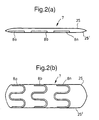
- a textile 7 which is formed so as to undergo an irreversible increase in thermal insulation is shown in Figures 2.
- the bulking layer comprises a number of fabric strips 8 a..n on to which is deposited a polyurethane shape memory polymer. These strips 8 a..n are made to form individual coils or "springs" which are made and equilibrated in an extended state at 70°C. These stress free structures 8 a..n are then coiled to exhibit the compact cross-sections, as shown in Figure 2a, and the applied stress frozen in at 20°C. One end of each such compact coil 8 a..n is then looped through the weave of one of the fabric layers 25,25' and fixed by ultrasonic point welding. These coils 8 a..n form the bulking layer over substantially all of one face of one of the fabric layers 25,25'.
- FIG. 3 A further embodiment of a textile 9 according to the present invention is shown in Figures 3.
- the bulking layer comprises a fabric substrate 10 onto which are attached, in a grid pattern, Nickel/Titanium shape memory alloy wires 11 having a 4% retained strain.
- the wires are fixed on the fabric substrate 10 by having an adhesive applied at their crossing points.
- a number of these substrates 10 a..n, chosen so as to be able to effect the desired change in thermal insulation, are sandwiched between two fabric layers 35,35' to form the bulking layer of the textile 9 which is substantially flat at 20°C (Figure 3b).
- the substrates 10 a..n of this bulking layer pucker to increase the gap between the layers 35,35' as shown schematically in Figure 3c.
Landscapes
- Laminated Bodies (AREA)
Abstract
Description
- The present invention relates to a thermally insulating textile and more particularly to a thermally insulating textile in which the degree of insulation automatically varies in response to changes in ambient temperature.
- The thermal protection offered by currently available protective garments which employ thermally insulating textiles to trap layers of air may be altered by varying the amount of trapped air. This may be achieved by having the wearer add or remove garment layers. However this requires the wearer either to carry a number of garments or to wear a garment adapted to protect against the largest likely change in ambient temperature. As thermally protective garments tend to be bulky both solutions are likely to prove cumbersome to the wearer. Additionally, the wearing of a garment which provides protection against the largest potential change in ambient temperature, for example in situations where there may be a likelihood of fire or a risk of exposure to cold, may place thermal stress on the wearer in the absence of these situations.
- As an alternative to increasing the number of garment layers in order to achieve an increased thermal protection the air gap between two layers of a garment may be increased. Thus, by providing a garment in which the air gap may be varied variable thermal protection may be achieved. One known fabric which may be utilised to provide such a variable air gap garment is described in
GB 2 234 705 A and comprises a material having two parallel material layers between which is disposed fibres, the height of which may be manually varied by the effecting a relative movement of the layers. This solution requires the wearer to pull on one or other of the layers by, for example, zipping and unzipping gussets in order to vary the thermal insulation and has the disadvantages that the wearer must stop what he or she is doing in order to adjust the garment and in that the wearer may not respond quickly enough to rapid environmental changes to provide timely thermal protection. - According to the present invention there is provided a textile comprising a laminate of two material layers having interposed a temperature sensitive bulking layer, the bulking layer comprising a shape memory composition being adapted to co-operate with the material layers to automatically vary the gap therebetween upon departure in a desired direction of the textile temperature from a predetermined temperature.
- Thus, as the volume of the textile automatically changes then the thermal insulating properties of the textile changes, increasing as the volume increases to trap more air and decreasing as the volume decreases to trap less air. This has the advantage that garments fabricated using this textile are able to provide a variable thermal protection for the wearer without the need for the wearer to vary the number of garments worn or to manually make changes to the air gap.
- So called "shape memory" compositions are well known (for example: pgs 29-31 Plastics Engineering February 1995; "Properties and Applications of Polyurethane-Series Shape Memory Polymer" pgs 1998-2001 ANTEC '94 and "The Properties and Processing of Shape Memory Alloys..." AD-Vol 24/AMD Vol 123, Smart Structures and Materials Avionics Society of Mechanical Engineering (ASME) 1991) and have the property that they can exist in two solid phases so that at certain temperatures they will exist primarily in one phase or the other. These compositions may be incorporated into a textile for example by depositing a coating onto a flexible substrate such as fabric layer, which may be the internal face of the fabric envelope, or by incorporating fibres made from such compositions into the weave of a fabric layer and may be employed in either a reversible or irreversible process.
- The reversible process exploits mainly the property of these compositions that there is associated a specific volume change with the change between phases while the irreversible process exploits mainly the "shape memory" property of these compositions where a shape incorporated in one phase at a particular temperature is altered to another shape in the second phase at a predetermined temperature only to be recovered when the composition reverts to the original, particular temperature. Thus, by choosing the volume of the shape to be much greater at the particular temperature than at the predetermined temperature a textile incorporating such a composition is capable of undergoing an irreversible increase in volume with departure from the predetermined temperature to the particular temperature.
- When used reversibly, for example when deposited onto a flexible substrate, such as a fabric, plastics or rubber layer, so as to provide out of plane protuberances in that substrate as the specific volume of the composition decreases, the change in specific volume of the shape memory composition may be no more than a few percent. Preferably the composition and substrate arrangement of the textile is therefore made so as to magnify this change. This may be achieved by choosing a pattern made by the deposited shape memory composition onto the substrate so as to provide a multiple effect, such as by employing a plurality of concentric rings in a repeat pattern.
- Usefully a further enhancement of this multiple effect may be achieved by providing a textile having one or more pairs of such patterned flexible substrates arranged such that the protuberances of each substrate of the pair will oppose one another. As an alternative to the use of such patterns, there may be provided a folded substrate which may be, for example, folded in concertina or spiral fashion, the substrate having deposited on portions thereof the shape memory composition, with the portions being selected to provide for unfolding of the folded substrate as the specific volume of the shape memory composition decreases. As the substrate unfolds then the size of the cross-section of the textile will increase to produce an increase in its thermal insulation effect.
- It will be obvious to those skilled in the art that through a suitable choice of the portions on which to deposit the composition a folding of the substrate may be effected by an increase in the volume of the composition. Reversible arrangements such as are discussed in this paragraph have the advantage that as the temperature changes from a predetermined temperature, typically between about 20°C and 40°C, in a desired direction, bulking of the shape memory composite may occur by an amount dependent on that temperature change to provide the textile with a variable thermal insulation which reverses as the textile temperature moves back towards the predetermined temperature.
- The textile may alternatively be made to undergo an irreversible change in thermal insulation and may employ substrates substantially similar to the ones employed for the textile which acts reversibly, that is deposited, patterned, inter-woven or folded flexible substrates. These substrates are made to provide an increase in the thermal insulation of the textile by being shaped into a high volume structure at a temperature where the change in thermal insulation is required, for example at about 60°C for high temperature protection, or at a higher processing temperature, then after cooling as appropriate, stress applied to reduce the bulk, for example by compressing or folding the original structure and the stress frozen in at a predetermined temperature, typically between about 20°C and 40°C. Such textiles have the advantage (over textiles constructed to undergo reversible thermal insulation changes) that large retained strains can be released. This provides for a more pronounced volume change within the textile and hence a greater change in the thermal protection provided by such a textile. This is particularly suitable for use in the production of thermal protection garments since such garments need to be able to automatically react to large and rapid temperature changes.
- Embodiments of the invention will now be described, by way of examples only, with reference to the drawings in the accompanying figures of which:
- Figures 1 are schematic representations of a textile according to the present invention having a bulking layer comprising a shape memory composition deposited on a fabric substrate with a) a plan view of the fabric substrate b) a sectional view through the textile at 20°C and c) a sectional view through the textile at 0°C.
- Figures 2 are schematic representations of a textile according to the first aspect of the present invention capable of an irreversible change with a) the textile at 20°C and b) the textile at 70°C.
- Figures 3 are schematic representations of a textile according to the present invention having a bulking layer comprising a shape memory alloy incorporated into the weave of a fabric substrate with a) a plan view of the fabric substrate b) a sectional view through the textile at 20°C and c) a sectional view through the textile at 70°C.
-
- Referring to Figure 1, the
bulking layer 1 of thetextile 2 comprises a pair offabric substrates 3a,b onto which is deposited a polyurethane based shape memory polymer in a repeat pattern. The polymer being chosen to exhibit a reversible phase change to a phase having a decreased specific volume at about 0°C, it being obvious to those skilled in the art that a number of suitable polymers exist which may be substituted for the one here. Onesuch fabric substrate 3 is shown in Figure 1a and is provided with a printed pattern of concentric rings 4 of polymer, repeated at centres C. These rings 4 are printed at about 20°C and are made planar at that temperature by suitable equilibration, for example pressing through release paper at an iron temperature of approximately 110°C. Thetextile 2 shown in Figures 1b and 1c comprise twofabric layers 15,15' having a pair offabric substrates 3a,b sandwiched between them. Thesubstrates 3 a,b are correlated such that theprotuberances 6,6', which appear in each substrate as the phase changes, oppose one another. This correlation may be maintained by stitching thelayers 3 a,b, 15,15' of thetextile 2 together at their edges. - Since the textile according to Figures 1 exploits the volume change in the shape memory polymer to achieve a change in the thermal insulation properties of that textile then the changes are reversible.
- A variant on the textile of Figures 1 would be to choose the polyurethane shape memory polymer to exhibit a phase change at higher temperatures, for example at about 70°C, to provide a textile capable of high temperature thermal protection.
- A
textile 7 which is formed so as to undergo an irreversible increase in thermal insulation is shown in Figures 2. The bulking layer comprises a number offabric strips 8 a..n on to which is deposited a polyurethane shape memory polymer. Thesestrips 8 a..n are made to form individual coils or "springs" which are made and equilibrated in an extended state at 70°C. These stressfree structures 8 a..n are then coiled to exhibit the compact cross-sections, as shown in Figure 2a, and the applied stress frozen in at 20°C. One end of each suchcompact coil 8 a..n is then looped through the weave of one of thefabric layers 25,25' and fixed by ultrasonic point welding. Thesecoils 8 a..n form the bulking layer over substantially all of one face of one of thefabric layers 25,25'. - On exposure of the
textile 7 to a temperature of 70°C the bulking layer responds irreversibly with thecoils 8 a..n recovering their initial extended state to push apart the layers offabric 25,25' as shown in Figure 2b. - It will be appreciated that a similar effect may be obtained by replacing the coated fabric strips with coiled "springs" of a suitable shape memory metals, such as Nickel/Titanium alloys.
- A further embodiment of a
textile 9 according to the present invention is shown in Figures 3. The bulking layer comprises afabric substrate 10 onto which are attached, in a grid pattern, Nickel/Titanium shapememory alloy wires 11 having a 4% retained strain. The wires are fixed on thefabric substrate 10 by having an adhesive applied at their crossing points. A number of thesesubstrates 10 a..n, chosen so as to be able to effect the desired change in thermal insulation, are sandwiched between twofabric layers 35,35' to form the bulking layer of thetextile 9 which is substantially flat at 20°C (Figure 3b). As the temperature of the textile varies from the predetermined temperature towards a higher temperature thesubstrates 10 a..n of this bulking layer pucker to increase the gap between thelayers 35,35' as shown schematically in Figure 3c. - It will be clear to a person skilled in the art that while the above examples utilise fabric substrates and layers any suitably flexible material may be substituted, depending on the desired characteristics of the garments to be fabricated from the textile.
Claims (13)
- A textile comprising a laminate of two material layers having interposed a temperature sensitive bulking layer, wherein the bulking layer comprises a shape memory composition being adapted to co-operate with the material layers to automatically vary the gap therebetween upon variation of the textile temperature, in a predetermined direction, from a predetermined temperature.
- A textile as claimed in Claim 1 wherein the bulking layer additionally comprises a flexible substrate onto which the shape memory composition is contacted.
- A textile as claimed in Claim 2 wherein the flexible substrate is in a folded state at the predetermined temperature with the shape memory composition contacted thereto so as to be capable of effecting unfolding of the substrate upon departure from the predetermined temperature.
- A textile as claimed in Claim 2 wherein the shape memory composition is formed as a deposit on to the flexible substrate in such a manner as to provide out of plane protuberances when the specific volume of the composition decreases.
- A textile as claimed in Claim 4 wherein the shape memory composition is deposited onto the flexible substrate to define a plurality of concentrically arranged rings in a repeat pattern.
- A textile as claimed in any of the Claims 4 or 5 wherein there is additionally provided one or more substantially similar composition deposited flexible substrates, the substrates being arranged in pairs such that the protuberances in one substrate of a pair will oppose those in the other substrate of that pair.
- A textile as claimed in any claim 2 to 6 wherein either or both the flexible substrate and material layers comprises a fabric.
- A textile as claimed in Claim 2 wherein the bulking layer comprises one or more flexible substrates having fibres of shape memory composition contacted thereto.
- A textile as claimed in Claim 8 wherein the fibres are incorporated in the weave of one or more fabric substrates.
- A textile as claimed in Claim 9 wherein the shape memory composition is in the form of shape memory alloy wires.
- A textile as claimed in Claim 10 wherein the wires comprise alloys of Nickel and Titanium.
- A textile as claimed in Claim 8 wherein the fibres comprise shape memory alloy wires are formed into a grid contacted to a surface of the one or more flexible substrates.
- A textile as claimed in Claim 1 wherein the bulking layer comprises a plurality of shape memory alloy wires each adapted to move from a coiled configuration to an un-coiled configuration on departure from the predetermined temperature.
Applications Claiming Priority (3)
| Application Number | Priority Date | Filing Date | Title |
|---|---|---|---|
| GB9609253 | 1996-05-02 | ||
| GB9609253A GB2312644B (en) | 1996-05-02 | 1996-05-02 | Thermally insulating textile |
| PCT/GB1997/000966 WO1997042026A1 (en) | 1996-05-02 | 1997-04-07 | Thermally insulating textile |
Publications (2)
| Publication Number | Publication Date |
|---|---|
| EP0900138A1 EP0900138A1 (en) | 1999-03-10 |
| EP0900138B1 true EP0900138B1 (en) | 2002-01-09 |
Family
ID=10793122
Family Applications (1)
| Application Number | Title | Priority Date | Filing Date |
|---|---|---|---|
| EP97915613A Expired - Lifetime EP0900138B1 (en) | 1996-05-02 | 1997-04-07 | Thermally insulating textile |
Country Status (6)
| Country | Link |
|---|---|
| US (1) | US6312784B2 (en) |
| EP (1) | EP0900138B1 (en) |
| JP (1) | JP4079454B2 (en) |
| DE (1) | DE69709919T2 (en) |
| GB (1) | GB2312644B (en) |
| WO (1) | WO1997042026A1 (en) |
Cited By (4)
| Publication number | Priority date | Publication date | Assignee | Title |
|---|---|---|---|---|
| CN108135296A (en) * | 2015-05-21 | 2018-06-08 | 奥特尔实验室有限责任公司 | The system and method for hot adaptive material |
| US10793979B2 (en) | 2017-04-10 | 2020-10-06 | Other Lab, Llc | Coiled actuator system and method |
| US11885577B2 (en) | 2015-05-20 | 2024-01-30 | Other Lab, Llc | Heat exchanger array system and method for an air thermal conditioner |
| US12389964B2 (en) | 2018-03-05 | 2025-08-19 | Other Lab, Llc | Thermally adaptive fabrics and methods of making same |
Families Citing this family (33)
| Publication number | Priority date | Publication date | Assignee | Title |
|---|---|---|---|---|
| WO1999005926A1 (en) * | 1997-08-01 | 1999-02-11 | Gore Enterprise Holdings, Inc. | Adaptive thermal insulation material |
| DE19923575C1 (en) * | 1999-05-21 | 2001-03-22 | Deotexis Inc | Flat textile material |
| FR2831771B1 (en) * | 2001-11-07 | 2004-08-27 | Kermel | MULTI-LAYER COMPLEX MATERIAL IN SHEET USED FOR THE REALIZATION OF PROTECTIVE CLOTHING, ESPECIALLY FOR FIRE-FIGHTERS |
| FR2831772B1 (en) * | 2001-11-07 | 2004-07-02 | Kermel | TEXTILE COMPLEX FOR THERMAL INSULATION |
| US7299805B2 (en) | 2002-06-07 | 2007-11-27 | Marctec, Llc | Scaffold and method for implanting cells |
| ITTO20020988A1 (en) * | 2002-11-14 | 2004-05-15 | Fiat Ricerche | SCREENING DEVICE. |
| GB2411621A (en) * | 2004-03-02 | 2005-09-07 | Neil Saville | A variable geometry variable insulation fabric |
| US20120121874A1 (en) * | 2005-05-19 | 2012-05-17 | Bonutti Peter M | Conformal fabric systems and method |
| US20050249899A1 (en) * | 2004-05-06 | 2005-11-10 | Bonutti Peter M | Biodegradable packaging material |
| WO2006002371A2 (en) | 2004-06-24 | 2006-01-05 | Malden Mills Industries, Inc. | Engineered fabric articles |
| US7428772B2 (en) * | 2005-05-19 | 2008-09-30 | Mmi-Ipco, Llc | Engineered fabric articles |
| US20060263570A1 (en) * | 2005-05-19 | 2006-11-23 | Bunyan Michael H | Thermal lamination module |
| US8187984B2 (en) | 2006-06-09 | 2012-05-29 | Malden Mills Industries, Inc. | Temperature responsive smart textile |
| JP2008057099A (en) | 2006-08-29 | 2008-03-13 | Mmi-Ipco Llc | Temperature responsive smart textile |
| US8389100B2 (en) | 2006-08-29 | 2013-03-05 | Mmi-Ipco, Llc | Temperature responsive smart textile |
| US7976924B2 (en) * | 2007-02-03 | 2011-07-12 | Raytheon Company | Active garment materials |
| US8349438B2 (en) * | 2008-01-03 | 2013-01-08 | The Boeing Company | Insulative material and associated method of forming same |
| EP2218577A1 (en) | 2009-02-16 | 2010-08-18 | Stichting Dutch Polymer Institute | Adaptive thermal insulation material |
| US20130196109A1 (en) | 2009-11-24 | 2013-08-01 | Mmi-Ipco, Llc | Insulated Composite Fabric |
| JP5586402B2 (en) * | 2010-09-29 | 2014-09-10 | 富士フイルム株式会社 | Endoscope apparatus and imaging element heat dissipation method thereof |
| US9163334B1 (en) | 2011-11-23 | 2015-10-20 | The United States Of America As Represented By The Secretary Of The Army | Actuators based on unbalanced moments of inertia |
| US10252456B1 (en) | 2011-11-23 | 2019-04-09 | The United States Of America, As Represented By The Secretary Of The Army | Method of making actuators based on unbalanced moments of inertia |
| JP5918081B2 (en) | 2012-06-27 | 2016-05-18 | 株式会社finetrack | Fabric laminates and clothing, bedding |
| WO2014035996A2 (en) | 2012-08-27 | 2014-03-06 | Nike International Ltd. | Dynamic materials intergrated into articles for adjustable physical dimensional characteristics |
| US9609901B2 (en) | 2013-04-12 | 2017-04-04 | Nike, Inc. | Adaptive planar shift garment material |
| KR101566361B1 (en) | 2014-04-28 | 2015-11-05 | 인하대학교 산학협력단 | Keep-warm clothes using shape memory alloy |
| US20160340826A1 (en) * | 2015-05-22 | 2016-11-24 | Massachusetts lnstitute of Technology | Active self-transformable textiles |
| CN106880096A (en) * | 2017-03-14 | 2017-06-23 | 邬惠林 | A kind of temperature control clothes |
| IT201700082051A1 (en) * | 2017-07-19 | 2019-01-19 | Getters Spa | INSULATING COMPOSITE FABRIC |
| IT201800006454A1 (en) * | 2018-06-19 | 2019-12-19 | TEXTILE STRUCTURE WITH SHAPE MEMORY METAL ALLOY WIRE FOR THE PACKAGING OF PERSONAL PROTECTIVE EQUIPMENT (PPE), EQUIPPED WITH EXTENSIBLE INTERSPACE TO INCREASE HEAT PROTECTION IN OPERATING CONDITIONS | |
| US11411366B2 (en) * | 2019-01-15 | 2022-08-09 | Northrop Grumman Systems Corporation | Combined laser architecture using wavelength multiplexed seed source |
| US11407672B2 (en) * | 2019-10-03 | 2022-08-09 | Northrop Grumman Systems Corporation | Method for high fill-factor optical arrays manufacturing |
| WO2025052495A1 (en) * | 2023-09-04 | 2025-03-13 | 三菱電機株式会社 | Optical beam transmission device |
Family Cites Families (11)
| Publication number | Priority date | Publication date | Assignee | Title |
|---|---|---|---|---|
| JPS5988916A (en) * | 1982-06-30 | 1984-05-23 | Kanai Hiroyuki | Conjugate fiber of shape memory alloy and sheetlike material thereof |
| JPH082973B2 (en) * | 1987-01-08 | 1996-01-17 | 株式会社トーキン | Sheet-like composite material |
| FR2614956B1 (en) | 1987-05-05 | 1989-08-18 | Renault | ACTIVE DEVICE FOR VARYING THE STRENGTH OF SUSPENSION ELEMENTS, ESPECIALLY FOR MOTOR VEHICLES |
| JPH02289344A (en) * | 1989-02-23 | 1990-11-29 | Asahi Chem Ind Co Ltd | Shape memory resin laminate |
| GB2234705B (en) * | 1989-07-20 | 1993-02-10 | Secr Defence | Variable insulation pile fabrics |
| JPH03130147A (en) * | 1989-10-17 | 1991-06-03 | Motohisa Yoshida | Special fabric |
| JPH0551853A (en) * | 1991-08-16 | 1993-03-02 | Unitika Ltd | Copolyester fiber laminate having shape memorizing ability |
| US5181287A (en) * | 1992-03-18 | 1993-01-26 | Jun Jie Yang | Heat-venting insulating article |
| US6004662A (en) * | 1992-07-14 | 1999-12-21 | Buckley; Theresa M. | Flexible composite material with phase change thermal storage |
| JP2950700B2 (en) * | 1993-02-15 | 1999-09-20 | マルコ株式会社 | Fabric-like composite material and its manufacturing method |
| US5918480A (en) * | 1994-08-03 | 1999-07-06 | Matsushita Refrigeration Company | Refrigerator |
-
1996
- 1996-05-02 GB GB9609253A patent/GB2312644B/en not_active Expired - Fee Related
-
1997
- 1997-04-07 US US09/180,074 patent/US6312784B2/en not_active Expired - Fee Related
- 1997-04-07 JP JP53961797A patent/JP4079454B2/en not_active Expired - Fee Related
- 1997-04-07 WO PCT/GB1997/000966 patent/WO1997042026A1/en not_active Ceased
- 1997-04-07 EP EP97915613A patent/EP0900138B1/en not_active Expired - Lifetime
- 1997-04-07 DE DE69709919T patent/DE69709919T2/en not_active Expired - Fee Related
Cited By (7)
| Publication number | Priority date | Publication date | Assignee | Title |
|---|---|---|---|---|
| US11885577B2 (en) | 2015-05-20 | 2024-01-30 | Other Lab, Llc | Heat exchanger array system and method for an air thermal conditioner |
| CN108135296A (en) * | 2015-05-21 | 2018-06-08 | 奥特尔实验室有限责任公司 | The system and method for hot adaptive material |
| US10793981B2 (en) | 2015-05-21 | 2020-10-06 | Other Lab, Llc | System and method for thermally adaptive materials |
| US11686024B2 (en) | 2015-05-21 | 2023-06-27 | Other Lab, Llc | System and method for thermally adaptive materials |
| US10793979B2 (en) | 2017-04-10 | 2020-10-06 | Other Lab, Llc | Coiled actuator system and method |
| US11519106B2 (en) | 2017-04-10 | 2022-12-06 | Other Lab, Llc | Coiled actuator system and method |
| US12389964B2 (en) | 2018-03-05 | 2025-08-19 | Other Lab, Llc | Thermally adaptive fabrics and methods of making same |
Also Published As
| Publication number | Publication date |
|---|---|
| WO1997042026A1 (en) | 1997-11-13 |
| DE69709919T2 (en) | 2002-08-22 |
| DE69709919D1 (en) | 2002-02-28 |
| GB2312644B (en) | 2000-07-26 |
| JP2000511595A (en) | 2000-09-05 |
| US6312784B2 (en) | 2001-11-06 |
| EP0900138A1 (en) | 1999-03-10 |
| GB2312644A (en) | 1997-11-05 |
| JP4079454B2 (en) | 2008-04-23 |
| US20010008821A1 (en) | 2001-07-19 |
| GB9609253D0 (en) | 1996-07-03 |
Similar Documents
| Publication | Publication Date | Title |
|---|---|---|
| US6312784B2 (en) | Thermally insulating textile | |
| EP3599919B1 (en) | Heat shielding composite cloth | |
| EP3433492B1 (en) | Actuating textiles containing polymer fiber muscles | |
| US7976924B2 (en) | Active garment materials | |
| US4551378A (en) | Nonwoven thermal insulating stretch fabric and method for producing same | |
| KR101956969B1 (en) | Dynamic materials integrated into articles for adjustable physical dimensional characteristics | |
| US8187984B2 (en) | Temperature responsive smart textile | |
| Abebe et al. | Dynamic thermal-regulating textiles with metallic fibers based on a switchable transmittance | |
| JP2018522144A5 (en) | ||
| WO1999005926A1 (en) | Adaptive thermal insulation material | |
| KR102936221B1 (en) | Metallized breathable composite textile and method for producing the same | |
| US3748108A (en) | Thermally activated spring with improved thermal properties | |
| Kim et al. | Design of wearable hybrid generator for harvesting heat energy from human body depending on physiological activity | |
| WO2008044814A1 (en) | Intelligent heat insulating product using one-way shape memory alloy and products employing same | |
| Stamopoulos et al. | Hysteretic behavior of the vortex lattice at the onset of the second peak for the HgBa 2 CuO 4+ δ superconductor | |
| US4115624A (en) | Thermostat metal compositions | |
| JPH0543042Y2 (en) | ||
| CN2233677Y (en) | Violence-proof protective (garment) layer | |
| Merati | Smart textiles | |
| JPH01314705A (en) | Production of padding material for clothes | |
| US3865559A (en) | Composite thermostat metal | |
| JPH0235835Y2 (en) | ||
| CN214821536U (en) | A heat-sensitive shape memory nonwoven fabric | |
| JPS6241306A (en) | Patch work structure | |
| Carpi et al. | Mechanical Models and Actuation Technologies for Active Fabrics: A Brief Survey of the State of the Art |
Legal Events
| Date | Code | Title | Description |
|---|---|---|---|
| PUAI | Public reference made under article 153(3) epc to a published international application that has entered the european phase |
Free format text: ORIGINAL CODE: 0009012 |
|
| 17P | Request for examination filed |
Effective date: 19981019 |
|
| AK | Designated contracting states |
Kind code of ref document: A1 Designated state(s): BE DE FI FR IE IT NL SE |
|
| GRAG | Despatch of communication of intention to grant |
Free format text: ORIGINAL CODE: EPIDOS AGRA |
|
| GRAG | Despatch of communication of intention to grant |
Free format text: ORIGINAL CODE: EPIDOS AGRA |
|
| GRAH | Despatch of communication of intention to grant a patent |
Free format text: ORIGINAL CODE: EPIDOS IGRA |
|
| 17Q | First examination report despatched |
Effective date: 20010529 |
|
| GRAH | Despatch of communication of intention to grant a patent |
Free format text: ORIGINAL CODE: EPIDOS IGRA |
|
| GRAA | (expected) grant |
Free format text: ORIGINAL CODE: 0009210 |
|
| AK | Designated contracting states |
Kind code of ref document: B1 Designated state(s): BE DE FI FR IE IT NL SE |
|
| REG | Reference to a national code |
Ref country code: IE Ref legal event code: FG4D |
|
| REF | Corresponds to: |
Ref document number: 69709919 Country of ref document: DE Date of ref document: 20020228 |
|
| PLBE | No opposition filed within time limit |
Free format text: ORIGINAL CODE: 0009261 |
|
| STAA | Information on the status of an ep patent application or granted ep patent |
Free format text: STATUS: NO OPPOSITION FILED WITHIN TIME LIMIT |
|
| 26N | No opposition filed | ||
| PGFP | Annual fee paid to national office [announced via postgrant information from national office to epo] |
Ref country code: IE Payment date: 20090421 Year of fee payment: 13 |
|
| PGFP | Annual fee paid to national office [announced via postgrant information from national office to epo] |
Ref country code: SE Payment date: 20090416 Year of fee payment: 13 Ref country code: NL Payment date: 20090415 Year of fee payment: 13 Ref country code: IT Payment date: 20090429 Year of fee payment: 13 Ref country code: FR Payment date: 20090414 Year of fee payment: 13 Ref country code: FI Payment date: 20090417 Year of fee payment: 13 Ref country code: DE Payment date: 20090422 Year of fee payment: 13 |
|
| PGFP | Annual fee paid to national office [announced via postgrant information from national office to epo] |
Ref country code: BE Payment date: 20090528 Year of fee payment: 13 |
|
| BERE | Be: lapsed |
Owner name: THE *SECRETARY OF STATE FOR DEFENCE IN HER BRITANN Effective date: 20100430 |
|
| REG | Reference to a national code |
Ref country code: NL Ref legal event code: V1 Effective date: 20101101 |
|
| EUG | Se: european patent has lapsed | ||
| REG | Reference to a national code |
Ref country code: IE Ref legal event code: MM4A |
|
| REG | Reference to a national code |
Ref country code: FR Ref legal event code: ST Effective date: 20101230 |
|
| PG25 | Lapsed in a contracting state [announced via postgrant information from national office to epo] |
Ref country code: NL Free format text: LAPSE BECAUSE OF NON-PAYMENT OF DUE FEES Effective date: 20101101 Ref country code: IE Free format text: LAPSE BECAUSE OF NON-PAYMENT OF DUE FEES Effective date: 20100407 Ref country code: FI Free format text: LAPSE BECAUSE OF NON-PAYMENT OF DUE FEES Effective date: 20100407 |
|
| PG25 | Lapsed in a contracting state [announced via postgrant information from national office to epo] |
Ref country code: DE Free format text: LAPSE BECAUSE OF NON-PAYMENT OF DUE FEES Effective date: 20101103 |
|
| PG25 | Lapsed in a contracting state [announced via postgrant information from national office to epo] |
Ref country code: BE Free format text: LAPSE BECAUSE OF NON-PAYMENT OF DUE FEES Effective date: 20100430 Ref country code: IT Free format text: LAPSE BECAUSE OF NON-PAYMENT OF DUE FEES Effective date: 20100407 |
|
| PG25 | Lapsed in a contracting state [announced via postgrant information from national office to epo] |
Ref country code: FR Free format text: LAPSE BECAUSE OF NON-PAYMENT OF DUE FEES Effective date: 20100430 |
|
| PG25 | Lapsed in a contracting state [announced via postgrant information from national office to epo] |
Ref country code: SE Free format text: LAPSE BECAUSE OF NON-PAYMENT OF DUE FEES Effective date: 20100408 |